 filings.tools
Pentair 10-K 2017-12-31
Filed 2018-02-27. 22 sections, 408K characters. Original on sec.gov · Markdown · JSON
Cover and table of contents
10-K 1 a2017pnr-10k.htm 10-K
UNITED STATES SECURITIES AND EXCHANGE COMMISSION
Washington, D.C. 20549
FORM 10-K
| þ | ANNUAL REPORT PURSUANT TO SECTION 13 OR 15(d) OF THE SECURITIES EXCHANGE ACT OF 1934 |
For the Fiscal Year Ended December 31, 2017
OR
| ¨ | TRANSITION REPORT PURSUANT TO SECTION 13 OR 15(d) OF THE SECURITIES EXCHANGE ACT OF 1934 |
Commission file number 001-11625
Pentair plc
(Exact name of Registrant as specified in its charter)
| Ireland | 98-1141328 | |
| (State or other jurisdiction of incorporation or organization) | (I.R.S. Employer Identification number) | |
| 43 London Wall, London, EC2M 5TF, United Kingdom | ||
| (Address of principal executive offices) |
Registrant's telephone number, including area code: 44-20-7347-8925
Securities registered pursuant to Section 12(b) of the Act:
| Title of each class | Name of each exchange on which registered | |
| Ordinary Shares, nominal value $0.01 per share | New York Stock Exchange |
Securities registered pursuant to Section 12(g) of the Act: None
Indicate by check mark if the registrant is a well-known seasoned issuer, as defined in Rule 405 of the Securities Act. Yes þ No ¨
Indicate by check mark if the registrant is not required to file reports pursuant to Section 13 or Section 15(d) of the Act. Yes ¨ No þ
Indicate by check mark whether the registrant (1) has filed all reports required to be filed by Section 13 or 15(d) of the Securities Exchange Act of 1934 during the preceding 12 months (or for such shorter period that the Registrant was required to file such reports) and (2) has been subject to such filing requirements for the past 90 days. Yes þ No ¨
Indicate by check mark whether the registrant has submitted electronically and posted on its corporate Website, if any, every Interactive Data File required to be submitted and posted pursuant to Rule 405 of Regulation S-T during the preceding 12 months (or for such shorter period that the Registrant was required to submit and post such files). Yes þ No ¨
Indicate by check mark if disclosure of delinquent filers pursuant to Item 405 of Regulation S-K is not contained herein and will not be contained, to the best of registrant's knowledge, in definitive proxy or information statements incorporated by reference in PART III of this Form 10-K or any amendment to this Form 10-K. þ
Indicate by check mark whether the registrant is a large accelerated filer, an accelerated filer, a non-accelerated filer, a smaller reporting company or an emerging growth company. See the definitions of "large accelerated filer," "accelerated filer", "smaller reporting company" and "emerging growth company" in Rule 12b-2 of the Exchange Act.:
| Large accelerated filer þ | Accelerated filer o | Non-accelerated filer o | Smaller reporting company o | Emerging growth company o | ||||
| (Do not check if a smaller reporting company) |
If an emerging growth company, indicate by check mark if the registrant has elected not to use the extended transition period for complying with any new or revised financial accounting standards provided pursuant to Section 13(a) of the Exchange Act. ¨
Indicate by check mark whether the registrant is a shell company (as defined in Rule 12b-2 of the Act). Yes ¨ No þ
Aggregate market value of voting and non-voting common equity held by non-affiliates of the Registrant, based on the closing price of $66.54 per share as reported on the New York Stock Exchange on June 30, 2017 (the last business day of Registrant's most recently completed second quarter): $10,849,958,298.
The number of shares outstanding of Registrant's only class of common stock on December 31, 2017 was 180,306,617.
DOCUMENTS INCORPORATED BY REFERENCE
Parts of the Registrant's definitive proxy statement for its annual general meeting to be held on May 8, 2018, are incorporated by reference in this Form 10-K in response to Part III, ITEM 10, 11, 12, 13 and 14.
Pentair plc
Annual Report on Form 10-K
For the Year Ended December 31, 2017
PART I
Item 1. BUSINESS
GENERAL
Pentair plc is a focused diversified industrial manufacturing company comprising two reporting segments: Water and Electrical. Water designs, manufactures, markets and services innovative products and solutions to meet filtration, separation, flow and water management challenges in agriculture, aquaculture, foodservice, food and beverage processing, swimming pools, water supply and disposal and a variety of industrial applications. Electrical designs, manufactures, markets, installs and services high performance products and solutions that connect and protect some of the world's most sensitive equipment, buildings and critical processes.
Pentair strategy
Our strategy is to drive sustainable, profitable growth and return on invested capital improvements through:
| • | building operational excellence through the Pentair Integrated Management System ("PIMS") consisting of lean enterprise, growth and talent management; |
| • | driving long-term growth in sales, operating income and cash flows, through growth and productivity initiatives along with acquisitions; |
| • | developing new products and enhancing existing products; |
| • | penetrating attractive growth markets, particularly outside of the United States; |
| • | expanding multi-channel distribution; and |
| • | proactively managing our business portfolio for optimal value creation, including consideration of new business platforms. |
Unless the context otherwise indicates, references herein to "Pentair," the "Company," and such words as "we," "us," and "our" include Pentair plc and its consolidated subsidiaries. We are an Irish public limited company that was formed in 2014. We are the successor to Pentair Ltd., a Swiss corporation formed in 2012, and Pentair, Inc., a Minnesota corporation formed in 1966 and our wholly-owned subsidiary, under the Securities Exchange Act of 1934, as amended (the "Exchange Act").
HISTORY AND DEVELOPMENT
In December 2013, the Company's Board of Directors approved changing the Company's jurisdiction of organization from Switzerland to Ireland. At an extraordinary meeting of shareholders on May 20, 2014, Pentair Ltd. shareholders voted in favor of a reorganization proposal pursuant to which Pentair Ltd. would merge into Pentair plc and all Pentair Ltd. common shares would be cancelled and all holders of such shares would receive ordinary shares of Pentair plc on a one-to-one basis. The reorganization transaction was completed on June 3, 2014, at which time Pentair plc replaced Pentair Ltd. as the ultimate parent company (the "Redomicile"). Shares of Pentair plc began trading on the New York Stock Exchange ("NYSE") on June 3, 2014 under the symbol "PNR," the same symbol under which Pentair Ltd. shares were previously traded.
Although our jurisdiction of organization is Ireland, we manage our affairs so that we are centrally managed and controlled in the United Kingdom (the "U.K.") and therefore have our tax residency in the U.K.
Our former parent company, Pentair Ltd., took its form on September 28, 2012 as a result of a reverse acquisition (the "Merger") involving Pentair, Inc. and an indirect, wholly-owned subsidiary of Flow Control (defined below), with Pentair, Inc. surviving as an indirect, wholly-owned subsidiary of ours. "Flow Control" refers to Pentair Ltd. prior to the Merger. Prior to the Merger, Tyco International Ltd. ("Tyco") engaged in an internal restructuring whereby it transferred to Flow Control certain assets related to the flow control business of Tyco, and Flow Control assumed from Tyco certain liabilities related to the flow control business of Tyco. On September 28, 2012 prior to the Merger, Tyco effected a spin-off of Flow Control through the pro-rata distribution of 100% of the outstanding ordinary shares of Flow Control to Tyco's shareholders (the "Distribution"), resulting in the distribution of approximately 110.9 million of our ordinary shares to Tyco's shareholders. The Merger was accounted for as a reverse acquisition under the purchase method of accounting with Pentair, Inc. treated as the acquirer.
On September 18, 2015, we acquired, as part of Electrical, all of the outstanding shares of capital stock of ERICO Global Company ("ERICO") for approximately $1.8 billion in cash (the "ERICO Acquisition"). ERICO is a leading global manufacturer and marketer of engineered electrical and fastening products for electrical, mechanical and civil applications. ERICO has employees in 30 countries across the world with recognized brands including CADDY fixing, fastening and support products; ERICO electrical grounding, bonding and connectivity products and LENTON engineered systems.
On April 28, 2017 we completed the sale of the Valves & Controls business to Emerson Electric Co. for $3.15 billion in cash. The sale resulted in a gain of $181.1 million, net of tax. The results of the Valves & Controls business have been presented as discontinued operations and the related assets and liabilities have been reclassified as held for sale for all periods presented. The Valves & Controls business was previously disclosed as a stand-alone reporting segment.
On May 9, 2017, we announced that our Board of Directors approved a plan to separate our Water business and Electrical business into two independent, publicly-traded companies (the "Proposed Separation"). The Proposed Separation is expected to occur through a tax-free spin-off of the Electrical business to Pentair shareholders.
Completion of the Proposed Separation is subject to certain customary conditions, including, among other things, final approval of the transaction by Pentair's Board of Directors, receipt of tax opinions and rulings and effectiveness of appropriate filings with the U.S. Securities and Exchange Commission (the “SEC"). Upon completion of the Proposed Separation, it is anticipated that Electrical's jurisdiction of organization will be Ireland, but that it will manage its affairs so that it will be centrally managed and controlled in the United Kingdom (the "U.K.") and therefore will have its tax residency in the U.K.
We are targeting April 30, 2018 for the completion of the Proposed Separation; however, there can be no assurance regarding the ultimate timing of the Proposed Separation or that the Proposed Separation will be completed.
Our registered principal office is located at 43 London Wall, London, EC2M 5TF, United Kingdom. Our management office in the United States ("U.S.") is located at 5500 Wayzata Boulevard, Suite 600, Minneapolis, Minnesota.
BUSINESS AND PRODUCTS
Reporting segment and geographical financial information is contained in ITEM 8, Note 16 of the Notes to Consolidated Financial Statements, included in this Form 10-K. The following is a brief description of each of the Company's reportable segments and business activities.
During the first quarter of 2017, we reorganized our business segments to reflect a new operating structure, resulting in a change to our reporting segments. All prior period amounts related to the segment change have been retrospectively reclassified throughout this Annual Report on Form 10-K to conform to the new presentation. As part of this reorganization, the legacy Water Quality Systems business segment was combined with the legacy Flow & Filtration Solutions business segment to form the Water reporting segment and now operates as a stand-alone business segment. In addition, the legacy Technical Solutions business segment was renamed the Electrical reporting segment.
Water
The Water segment designs, manufactures, markets and services innovative water solutions for the filtration, separation, flow and water management challenges in agriculture, foodservice, food and beverage processing, swimming pools, water supply and disposal and a variety of industrial applications.
Water provides a comprehensive portfolio of products and services to address customers’ needs for reliable and efficient movement and control of water and other fluids. This includes a full range of water treatment equipment including energy-efficient pumps, point-of-entry/point-of-use filtration, valves, UV sanitization and automation controls for residential and commercial applications, as well as engineered solutions in advanced filtration, desalination, water supply and disposal, process and control for industrial and infrastructure applications. We offer design and consulting services and our advanced water technologies are used across a wide number of industries including residential, commercial, foodservice, industrial, aquaculture, irrigation and flood control, wastewater and more. Our equipment and solutions are found in swimming pools and spas, water purification and sanitation systems, foodservice operations, food and beverage processing plants, wastewater treatment plants, flood control and storm water management facilities and in other applications across the globe.
Brand names for Water include Aurora, Berkeley, Codeline, Everpure, Fairbanks-Nijhuis, Kreepy Krauly, Haffmans, Hydromatic, Hypro, Pentair, Pentair Aquatic Eco-Systems, Sta-Rite, Shurflo, Südmo and X-Flow.
Customers
Water customers include businesses engaged in wholesale and retail distribution in the residential & commercial, food & beverage, infrastructure, and industrial verticals. Customers also include end-user and consumers in the residential & commercial vertical as well as engineering procurement contractors, and original equipment manufacturers.
Seasonality
We experience increased demand for residential water supply and pool equipment products, infrastructure and agricultural products following warm weather trends, which are at season highs from April to August. The magnitude of the sales increase is mitigated by employing some advance sale “early buy” programs (generally including extended payment terms and/or
additional discounts). Seasonal effects may vary from year to year and are impacted by weather patterns, particularly by temperatures, heavy flooding and droughts.
Competition
Water faces numerous domestic and international competitors, some of which have substantially greater resources directed to the verticals in which we compete. Competition focuses on brand names, product performance (including energy-efficient offerings and required specifications), quality, service and price. We compete by offering a wide variety of innovative and high-quality products, which are competitively priced. We believe our distribution channels and reputation for quality also provide us a competitive advantage.
Electrical
The Electrical segment designs, manufactures, markets, installs and services high performance products and solutions that connect and protect some of the world's most sensitive equipment, buildings and critical processes.
Electrical products include mild steel, stainless steel, aluminum and non-metallic enclosures, cabinets, cases, subracks, backplanes, engineered fastening solutions across a wide range of industries and verticals and thermal management systems including heat tracing, floor heating, fire-rated and specialty wiring, sensing, and snow melting and de-icing solutions for industrial, commercial and residential use.
The portfolio of products serves a range of industries, including use in the commercial, communications, energy, electronics, industrial, infrastructure, medical, and security & defense verticals. Brand names for Electrical offerings include CADDY, ERICO, Hoffman, LENTON, Raychem, Schroff and Tracer.
Customers
Electrical customers include electrical distributors, data center contractors, original equipment manufacturers, greenfield development contractors and maintenance contractors. Electrical has a globally installed base of customers.
Seasonality
Electrical generally experiences increased demand for thermal protection products and services during the fall and winter months in the Northern Hemisphere and increased demand for electrical fastening products during the spring and summer months in the Northern Hemisphere.
Competition
Within Electrical, the equipment protection business faces significant competition in the verticals it serves, particularly within the communications industry, where product design, prototyping, global supply, price competition and customer service are significant factors. The industries and verticals served by the thermal management business are highly fragmented, comprising local markets and niches. The industries and verticals served by the engineered fastening solutions business is relatively fragmented, with a small number of large competitors and a large number of smaller suppliers. We compete by offering a wide variety of innovative and compatible products, which are competitively priced.
INFORMATION REGARDING ALL REPORTABLE SEGMENTS
Backlog of orders by segment
| December 31 | |||||||||||
| In millions | 2017 | 2016 | $ change | % change | |||||||
| Water | $ | 406.9 | $ | 375.8 | $ | 31.1 | 8.3 | % | |||
| Electrical | 280.4 | 266.3 | 14.1 | 5.3 | |||||||
| Total | $ | 687.3 | $ | 642.1 | $ | 45.2 | 7.0 | % |
A substantial portion of our revenues result from orders received and products delivered in the same month. Our backlog typically has a short manufacturing cycle and products generally ship within 90 days of the date on which a customer places an order. However, a portion of our backlog, particularly from orders for major capital projects, can take more than one year depending on the size and type of order. We record as part of our backlog all orders from external customers, which represent firm commitments, and are supported by a purchase order or other legitimate contract. We expect the majority of our backlog at December 31, 2017 will be shipped in 2018.
Research and development
We conduct research and development activities primarily in our own facilities. These efforts consist primarily of the development of new products, product applications and manufacturing processes. Research and development expenditures during 2017, 2016 and 2015 were $115.8 million, $114.1 million and $98.7 million, respectively.
Raw materials
The principal materials we use in manufacturing our products are electric motors, mild steel, stainless steel, electronic components, plastics (resins, fiberglass, epoxies), copper and paint (powder and liquid). In addition to the purchase of raw materials, we purchase some finished goods for distribution through our sales channels.
We purchase the materials we use in various manufacturing processes on the open market and the majority is available through multiple sources which are in adequate supply. We have not experienced any significant work stoppages to date due to shortages of materials. We have certain long-term commitments, principally price commitments, for the purchase of various component parts and raw materials and believe that it is unlikely that any of these agreements would be terminated prematurely. Alternate sources of supply at competitive prices are available for most materials for which long-term commitments exist and we believe that the termination of any of these commitments would not have a material adverse effect on our financial position, results of operations or cash flows.
Certain commodities, such as metals and resin, are subject to market and duty-driven price fluctuations. We manage these fluctuations through several mechanisms, including long-term agreements with price adjustment clauses for significant commodity market movements in certain circumstances. Prices for raw materials, such as metals and resins, may trend higher in the future.
Intellectual property
Patents, non-compete agreements, proprietary technologies, customer relationships, trademarks, trade names and brand names are important to our business. However, we do not regard our business as being materially dependent upon any single patent, non-compete agreement, proprietary technology, customer relationship, trademark, trade name or brand name.
Patents, patent applications and license agreements will expire or terminate over time by operation of law, in accordance with their terms or otherwise. We do not expect the termination of patents, patent applications or license agreements to have a material adverse effect on our financial position, results of operations or cash flows.
Employees
As of December 31, 2017, we employed 18,400 people worldwide.
Captive insurance subsidiary
We insure certain general and product liability, property, workers' compensation and automobile liability risks through our regulated wholly-owned captive insurance subsidiary, Penwald Insurance Company ("Penwald"). Reserves for policy claims are established based on actuarial projections of ultimate losses. Accruals with respect to liabilities insured by third parties, such as liabilities arising from acquired businesses, pre-Penwald liabilities and those of certain non-U.S. operations are established.
Matters pertaining to Penwald are discussed in ITEM 3 and ITEM 8, Note 1 of the Notes to Consolidated Financial Statements – Insurance subsidiary, included in this Form 10-K.
Available information
We make available free of charge (other than an investor's own Internet access charges) through our Internet website (http://www.pentair.com) our Annual Report on Form 10-K, Quarterly Reports on Form 10-Q, Current Reports on Form 8-K, and if applicable, amendments to those reports filed or furnished pursuant to Section 13(a) or 15(d) of the Exchange Act as soon as reasonably practicable after we electronically file such material with, or furnish it to, the SEC. Reports of beneficial ownership filed by our directors and executive officers pursuant to Section 16(a) of the Exchange Act are also available on our website. We are not including the information contained on our website as part of or incorporating it by reference into, this Annual Report on Form 10-K.
Item 1A. RISK FACTORS
You should carefully consider all of the information in this document and the following risk factors before making an investment decision regarding our securities. Any of the following risks could materially and adversely affect our business, financial condition, results of operations, cash flows and the actual outcome of matters as to which forward-looking statements are made in this document.
Risks Relating to Our Proposed Separation of Our Water Business and Electrical Business by Spin-off
The proposed separation of our Water business and Electrical business is contingent upon the satisfaction of a number of conditions, may require significant time and attention of our management and may have an adverse effect on us whether or not it is completed.
On May 9, 2017, we announced that our Board of Directors approved a plan to separate our Water business and Electrical business into two independent, publicly-traded companies through a spin-off. Completion of the spin-off will be contingent upon customary conditions, including obtaining final approval from our Board of Directors, receipt of tax opinions and rulings and effectiveness of appropriate filings with the SEC. In addition, the proposed spin-off is complex in nature and may be affected by unanticipated developments or changes in market conditions. For these and other reasons, the spin-off may not be completed on April 30, 2018, as we are targeting, if at all.
Whether or not we complete the spin-off, our ongoing businesses may be adversely affected and we may be subject to certain risks and consequences as a result of pursuing the spin-off, including the following:
| • | execution of the proposed spin-off will require significant time and attention from management, which may distract management from the operation of our businesses and the execution of other initiatives that may have been beneficial to us; |
| • | our employees may also be distracted due to uncertainty about their future roles with each of the separate companies pending the completion of the spin-off; |
| • | some of our suppliers or customers may delay or defer decisions or may end their relationships with us; |
| • | we will be required to pay certain costs and expenses relating to the spin-off, such as legal, accounting and other professional fees, whether or not it is completed; and |
| • | we may experience negative reactions from the financial markets if we fail to complete the spin-off or fail to complete it on a timely basis. |
Any of these factors could have a material adverse effect on our business, financial condition, results of operations, cash flows and trading prices.
We may be unable to achieve some or all of the benefits that we expect to achieve from the spin-off.
Although we believe that separating our Electrical business from our Water business by means of the spin-off will provide financial, operational, managerial and other benefits to us and our shareholders, the spin-off may not provide the results on the scope or on the scale we anticipate, and we may not realize any or all of the intended benefits. In addition, we will incur one-time costs and ongoing costs in connection with, or as a result of, the spin-off, including costs of operating as independent, publicly-traded companies that the two businesses will no longer be able to share. Those costs may exceed our estimates or could negate some of the benefits we expect to realize. If we do not realize the intended benefits or if our costs exceed our estimates, we could suffer a material adverse effect on the business, financial condition, results of operations, cash flows and trading prices.
If the proposed spin-off of our Electrical business is completed, the trading price of our ordinary shares will likely decline and may experience greater volatility.
We expect the trading price of our ordinary shares immediately following the spin-off to be significantly lower than immediately prior to the spin-off because the trading price for our shares will no longer reflect the value of our Electrical business. In addition, until the market has fully analyzed our value without our Electrical business, the price of our shares may experience greater volatility.
If the proposed spin-off is completed, our shares may not match some holders' investment strategies or meet minimum criteria for inclusion in stock market indices or portfolios, which could cause investors to sell their shares. Excessive selling pressure could cause the market price of our shares to decrease further following the completion of the proposed spin-off.
Following the spin-off, the value of our ordinary shares and the ordinary shares of the Electrical business that is spun off may collectively trade at an aggregate price less than that at which the Company's ordinary shares might trade had the spin-off not occurred.
For a number of reasons, our ordinary shares and the ordinary shares of the Electrical business that is spun off that you may hold following the spin-off may collectively trade at a value less than the price at which our ordinary shares might have traded had the spin-off not occurred and we continued to own the Electrical business. These reasons include the future performance of either us or the Electrical business as separate, independent companies and the future shareholder base and market for our ordinary shares and the ordinary shares of the Electrical business and the prices at which these shares individually trade.
The proposed spin-off transaction could result in substantial tax liability to us and our shareholders.
The spin-off is conditioned on our receipt of opinions of tax counsel and tax rulings from taxing authorities. However, these tax opinions will not be binding on taxing authorities. Accordingly, taxing authorities or the courts may reach conclusions with respect to the spin-off that are different from the conclusions reached in the opinions of counsel. Moreover, the opinions of counsel will be based on certain statements and representations made by us, which, if incomplete or inaccurate in any material respect, could invalidate the opinion of counsel. Additionally, certain internal restructuring transactions necessary to accomplish the spin-off may result in adverse tax consequences to us.
If the spin-off and certain related transactions were determined to be taxable, we could be subject to a substantial tax liability that could have a material adverse effect on our financial condition, results of operations and cash flows. In addition, if the spin-off were taxable, each holder of our ordinary shares who receives shares of the Electrical business in the spin-off would generally be treated as receiving a taxable distribution of property in an amount equal to the fair market value of the shares received.
Risks Relating to Our Business
General global economic and business conditions affect demand for our products.
We compete in various geographic regions and product markets around the world. Among these, the most significant are global industrial markets and residential markets. We have experienced, and expect to continue to experience, fluctuations in revenues and results of operations due to economic and business cycles. Important factors for our businesses and the businesses of our customers include the overall strength of the economy and our customers' confidence in the economy, industrial and governmental capital spending, the strength of the residential and commercial real estate markets, unemployment rates, availability of consumer and commercial financing, interest rates, and energy and commodity prices. The businesses of many of our industrial customers are to varying degrees cyclical and have experienced periodic downturns. While we attempt to minimize our exposure to economic or market fluctuations by serving a balanced mix of end markets and geographic regions, any of the above factors, individually or in the aggregate, or a significant or sustained downturn in a specific end market or geographic region could reduce demand for our products and services, which could have a material adverse effect on our business, financial condition, results of operations and cash flows.
We compete in attractive markets with a high level of competition, which may result in pressure on our profit margins and limit our ability to maintain or increase the market share of our products.
The markets for our products and services are geographically diverse and highly competitive. We compete against large and well-established national and global companies, as well as regional and local companies and lower cost manufacturers. We compete based on technical expertise, reputation for quality and reliability, timeliness of delivery, previous installation history, contractual terms and price. Some of our competitors, in particular smaller companies, attempt to compete based primarily on price, localized expertise and local relationships, especially with respect to products and applications that do not require a great deal of engineering or technical expertise. In addition, during economic downturns average selling prices tend to decrease as market participants compete more aggressively on price. If we are unable to continue to differentiate our products, services and solutions, or if we are forced to cut prices or to incur additional costs to remain competitive, it could have a material adverse effect on our business, financial condition, results of operations and cash flows.
Volatility in currency exchange rates could have a material adverse effect on our financial condition, results of operations and cash flows.
Sales outside of the U.S. for the year ended December 31, 2017 accounted for 40% of our net sales. Our financial statements reflect translation of items denominated in non-U.S. currencies to U.S. dollars. Therefore, if the U.S. dollar strengthens in relation to the principal non-U.S. currencies from which we derive revenue as compared to a prior period, our U.S. dollar reported revenue and income will effectively be decreased to the extent of the change in currency valuations, and vice-versa. Fluctuations in foreign currency exchange rates, most notably the strengthening of the U.S. dollar against the euro, could have a material adverse effect on our reported revenue in future periods. In addition, currency variations could have a material adverse effect on margins on sales of our products in countries outside of the U.S. and margins on sales of products that include components obtained from suppliers located outside of the U.S.
Our future growth is dependent upon our ability to continue to adapt our products, services and organization to meet the demands of local markets in both developed and emerging economies and by developing or acquiring new technologies that achieve market acceptance with acceptable margins.
We operate in global markets that are characterized by customer demand that is often global in scope but localized in delivery. We compete with thousands of smaller regional and local companies that may be positioned to offer products produced at lower cost than ours, or to capitalize on highly localized relationships and knowledge that are difficult for us to replicate. Also, in several emerging markets potential customers prefer local suppliers, in some cases because of existing relationships and in other cases because of local legal restrictions or incentives that favor local businesses. Accordingly, our future success depends upon a number of factors, including our ability to adapt our products, services, organization, workforce and sales strategies to fit localities throughout the world, particularly in high growth emerging markets; identify emerging technological and other trends in our target end-markets; and develop or acquire competitive products and services and bring them to market quickly and cost-effectively. The failure to effectively adapt our products or services could have a material adverse effect on our business, financial condition, results of operations and cash flows.
We may not be able to identify, finance and complete suitable acquisitions and investments, and any completed acquisitions and investments could be unsuccessful or consume significant resources.
Our business strategy includes acquiring businesses and making investments that complement our existing businesses. We continue to analyze and evaluate the acquisition of strategic businesses or product lines with the potential to strengthen our industry position or enhance our existing set of product and service offerings. We may not be able to identify suitable acquisition candidates, obtain financing or have sufficient cash necessary for acquisitions or successfully complete acquisitions in the future or that completed acquisitions will be successful. Acquisitions and investments may involve significant cash expenditures, debt incurrences, equity issuances, operating losses and expenses. Acquisitions involve numerous other risks, including:
| • | diversion of management time and attention from daily operations; |
| • | difficulties integrating acquired businesses, technologies and personnel into our business; |
| • | difficulties in obtaining and verifying the financial statements and other business information of acquired businesses; |
| • | inability to obtain required regulatory approvals; |
| • | potential loss of key employees, key contractual relationships or key customers of acquired companies or of ours; |
| • | assumption of the liabilities and exposure to unforeseen liabilities of acquired companies, including risks relating to the U.S. Foreign Corrupt Practices Act (the "FCPA"); and |
| • | dilution of interests of holders of our shares through the issuance of equity securities or equity-linked securities. |
It may be difficult for us to complete transactions quickly and to integrate acquired operations efficiently into our business operations. Any acquisitions or investments may not be successful and may ultimately result in impairment charges and have a material adverse effect on our business, financial condition, results of operations and cash flows.
We may not achieve some or all of the expected benefits of our business initiatives.
During 2017, 2016 and 2015, we initiated and continued execution of certain business initiatives aimed at reducing our fixed cost structure and realigning our business. As a result, we have incurred substantial expense, including restructuring charges. We may not be able to achieve the operating efficiencies to reduce costs or realize benefits that were anticipated in connection with these initiatives. If we are unable to execute these initiatives as planned, we may not realize all or any of the anticipated benefits, which could have a material adverse effect on our business, financial condition, results of operations and cash flows.
We are exposed to political, regulatory, economic and other risks that arise from operating a multinational business.
Sales outside of the U.S. for the year ended December 31, 2017 accounted for 40% of our net sales. Further, most of our businesses obtain some products, components and raw materials from non-U.S. suppliers. Accordingly, our business is subject to the political, regulatory, economic and other risks that are inherent in operating in numerous countries. These risks include:
| • | changes in general economic and political conditions in countries where we operate, particularly in emerging markets; |
| • | relatively more severe economic conditions in some international markets than in the U.S.; |
| • | the difficulty of enforcing agreements and collecting receivables through non-U.S. legal systems; |
| • | the difficulty of communicating and monitoring standards and directives across our global facilities; |
| • | trade protection measures and import or export licensing requirements and restrictions; |
| • | the possibility of terrorist action affecting us or our operations; |
| • | the threat of nationalization and expropriation; |
| • | the imposition of tariffs, exchange controls or other trade restrictions; |
| • | difficulty in staffing and managing widespread operations in non-U.S. labor markets; |
| • | changes in tax treaties, laws or rulings that could have a material adverse impact on our effective tax rate; |
| • | limitations on repatriation of earnings; |
| • | the difficulty of protecting intellectual property in non-U.S. countries; and |
| • | changes in and required compliance with a variety of non-U.S. laws and regulations. |
Our success depends in part on our ability to anticipate and effectively manage these and other risks. We cannot assure you that these and other factors will not have a material adverse effect on our international operations or on our business as a whole.
We may experience cost and other inflation.
In the past, we have experienced material cost and other inflation in a number of our businesses. We strive for productivity improvements and implement increases in selling prices to help mitigate cost increases in raw materials (especially metals and resins), energy and other costs such as pension, health care and insurance. We continue to implement operational initiatives in order to mitigate the impacts of this inflation and continuously reduce our costs. However, these actions may not be successful in managing our costs or increasing our productivity. Continued cost inflation or failure of our initiatives to generate cost savings or improve productivity could have a material adverse effect on our business, financial condition, results of operations and cash flows.
Intellectual property challenges may hinder our ability to develop, engineer and market our products.
Patents, non-compete agreements, proprietary technologies, customer relationships, trademarks, trade names and brand names are important to our business. Intellectual property protection, however, may not preclude competitors from developing products similar to ours or from challenging our names or products. Our pending patent applications, and our pending copyright and trademark registration applications, may not be allowed or competitors may challenge the validity or scope of our patents, copyrights or trademarks. In addition, our patents, copyrights, trademarks and other intellectual property rights may not provide us a significant competitive advantage. Over the past few years, we have noticed an increasing tendency for participants in our markets to use challenges to intellectual property as a means to compete. Patent and trademark challenges increase our costs to develop, engineer and market our products. We may need to spend significant resources monitoring our intellectual property rights and we may or may not be able to detect infringement by third parties. If we fail to successfully enforce our intellectual property rights or register new patents, our competitive position could suffer, which could have a material adverse effect on our business, financial condition, results of operations and cash flows.
We have significant goodwill and intangible assets and future impairment of our goodwill and intangible assets could have a material adverse effect on our results of operations.
We test goodwill and other indefinite-lived intangible assets for impairment on at least an annual basis, and more frequently if circumstances warrant, by comparing the estimated fair value of each of our reporting units to their respective carrying values on their balance sheets. As of December 31, 2017 our goodwill and intangible assets were $5,909.5 million and represented 68% of our total assets. Long-term declines in projected future cash flows could result in future goodwill and intangible asset impairment charges.
A material disruption at any of our manufacturing facilities could cause us to be unable to meet customer demands or increase our costs.
If operations at any of our manufacturing facilities were to be disrupted as a result of significant equipment failures, natural disasters, earthquakes, power outages, fires, explosions, terrorism, adverse weather conditions, labor disputes or other reasons, we may be unable to fill customer orders and otherwise meet customer demand for our products, which could have a material adverse effect our business, financial condition, results of operations and cash flows. Interruptions in production, in particular at our manufacturing facilities, could increase our costs and reduce our sales. Any interruption in production capability could require us to make substantial capital expenditures to fill customer orders. We maintain property damage insurance that we believe to be adequate to provide for reconstruction of facilities and equipment, as well as business interruption insurance to mitigate losses resulting from any production interruption or shutdown caused by an insured loss. However, any recovery under our insurance policies may not offset the lost sales or increased costs that may be experienced during the disruption of operations, which could have a material adverse effect our business, financial condition, results of operations and cash flows.
Seasonality of sales and weather conditions could have a material adverse effect on our financial results.
We experience seasonal demand in a number of markets within both of our business segments. In Water, demand for residential water supply products, infrastructure, agricultural products and end-user demand for pool equipment in our primary markets follow warm weather trends and are at seasonal highs from April to August. The magnitude of the sales increase in Water is partially mitigated by employing some advance sale or "early buy" programs (generally including extended payment terms and/or additional discounts). Seasonal effects may vary from year to year and are impacted by weather patterns, particularly by temperatures, heavy flooding and droughts. Electrical generally experiences increased demand for thermal protection products and services during the fall and winter months in the Northern Hemisphere and increased demand for electrical fastening products during the spring and summer months in the Northern Hemisphere. Seasonality and weather conditions could have a material adverse effect on our results of operations.
Our share price may fluctuate significantly.
We cannot predict the prices at which our shares may trade. The market price of our shares may fluctuate widely, depending on many factors, some of which may be beyond our control, including:
| • | actual or anticipated fluctuations in our results of operations due to factors related to our business; |
| • | success or failure of our business strategy; |
| • | our quarterly or annual earnings, or those of other companies in our industry; |
| • | our ability to obtain third-party financing as needed; |
| • | announcements by us or our competitors of significant acquisitions or dispositions; |
| • | changes in accounting standards, policies, guidance, interpretations or principles; |
| • | changes in earnings estimates by us or securities analysts or our ability to meet those estimates; |
| • | the operating and share price performance of other comparable companies; |
| • | investor perception of us; |
| • | natural or other environmental disasters that investors believe may affect us; |
| • | overall market fluctuations; |
| • | results from any material litigation, including asbestos claims, government investigations or environmental liabilities; |
| • | changes in laws and regulations affecting our business; and |
| • | general economic conditions and other external factors. |
Stock markets in general have experienced volatility that has often been unrelated to the operating performance of a particular company. These broad market fluctuations could have a material adverse effect on our share price.
Risks Relating to Legal, Regulatory and Compliance Matters
Violations of the U.S. Foreign Corrupt Practices Act and similar anti-corruption laws outside the U.S. could have a material adverse effect on us.
The FCPA and similar anti-corruption laws in other jurisdictions generally prohibit companies and their intermediaries from making improper payments to government officials or other persons for the purpose of obtaining or retaining business. Recent years have seen a substantial increase in anti-bribery law enforcement activity, with more frequent and aggressive investigations and enforcement proceedings by both the U.S. Department of Justice and the SEC, increased enforcement activity by non-U.S. regulators and increases in criminal and civil proceedings brought against companies and individuals. Our policies mandate compliance with these anti-bribery laws. We operate in many parts of the world that are recognized as having governmental and commercial corruption and in certain circumstances, strict compliance with anti-bribery laws may conflict with local customs and practices. Because many of our customers and end users are involved in infrastructure construction and energy production, they are often subject to increased scrutiny by regulators. We cannot assure you that our internal control policies and procedures will always protect us from reckless or criminal acts committed by our employees or third-party intermediaries. In the event that we believe or have reason to believe that our employees or agents have or may have violated applicable anti-corruption laws, including the FCPA we may be required to investigate or have outside counsel investigate the relevant facts and circumstances, which can be expensive and require significant time and attention from senior management. Violations of these laws may require self-disclosure to government agencies and result in criminal or civil sanctions, which could disrupt our business and result in a material adverse effect on our reputation, business, financial condition, results of operations and cash flows.
Our failure to satisfy international trade compliance regulations, and changes in U.S. government sanctions, could have a material adverse effect on us.
Our global operations require importing and exporting goods and technology across international borders on a regular basis. Certain of the products we manufacture are "dual use" products, which are products that may have both civil and military applications, or may otherwise be involved in weapons proliferation, and are often subject to more stringent export controls. From time to time, we obtain or receive information alleging improper activity in connection with imports or exports. Our policy mandates strict compliance with U.S. and non-U.S. trade laws applicable to our products. However, even when we are in strict compliance with law and our policies, we may suffer reputational damage if certain of our products are sold through various intermediaries to entities operating in sanctioned countries. When we receive information alleging improper activity, our policy is to investigate that information and respond appropriately, including, if warranted, reporting our findings to relevant government authorities. Nonetheless, our policies and procedures may not always protect us from actions that would violate U.S. and/or non-U.S. laws. Any improper actions could subject us to civil or criminal penalties, including material monetary fines, or other adverse actions including denial of import or export privileges, and could damage our reputation and business prospects.
Changes in U.S. administrative policy, including changes to existing trade agreements, could have a material adverse effect on us.
As a result of changes to U.S. administrative policy, there may be changes to existing trade agreements, like the North American Free Trade Agreement, greater restrictions on free trade generally, significant increases in tariffs on goods imported into the U.S. particularly tariffs on products manufactured in Mexico, among other possible changes. Changes in U.S. social, political, regulatory and economic conditions or in laws and policies governing foreign trade, manufacturing, development and investment in the territories and countries where we currently manufacture and sell products, and any resulting negative sentiments towards the U.S. as a result of such changes, could have a material adverse effect on our business, financial condition, results of operations and cash flows.
We are exposed to potential environmental laws, liabilities and litigation.
We are subject to U.S. federal, state, local and non-U.S. laws and regulations governing our environmental practices, public and worker health and safety, and the indoor and outdoor environment. Compliance with these environmental, health and safety regulations could require us to satisfy environmental liabilities, increase the cost of manufacturing our products or otherwise have a material adverse effect on our business, financial condition, results of operations and cash flows. Any violations of these laws by us could cause us to incur unanticipated liabilities. We are also required to comply with various environmental laws and maintain permits, some of which are subject to renewal from time to time, for many of our businesses and we could suffer if we are unable to renew existing permits or to obtain any additional permits that we may require. Compliance with environmental requirements also could require significant operating or capital expenditures or result in significant operational restrictions. We cannot assure you that we have been or will be at all times in compliance with environmental and health and safety laws. If we violate these laws, we could be fined, criminally charged or otherwise sanctioned by regulators.
We have been named as defendant, target or a potentially responsible party ("PRP") in a number of environmental clean-ups relating to our current or former business units. We have disposed of a number of businesses in recent years and in certain cases, we have retained responsibility and potential liability for certain environmental obligations. We have received claims for indemnification from certain purchasers. We may be named as a PRP at other sites in the future for existing business units, as well as both divested and acquired businesses. In addition to clean-up actions brought by governmental authorities, private parties could bring personal injury or other claims due to the presence of, or exposure to, hazardous substances.
Certain environmental laws impose liability on current or previous owners or operators of real property for the cost of removal or remediation of hazardous substances at their properties or at properties at which they have disposed of hazardous substances. We have projects underway at several current and former manufacturing facilities to investigate and remediate environmental contamination resulting from our past operations or by other businesses that previously owned or used the properties. The cost of clean-up and other environmental liabilities can be difficult to accurately predict. In addition, environmental requirements change and tend to become more stringent over time. Our eventual environmental clean-up costs and liabilities could exceed the amount of our current reserves.
Our subsidiaries are party to asbestos-related product litigation that could adversely affect our financial condition, results of operations and cash flows.
Our subsidiaries, along with numerous other companies, are named as defendants in a substantial number of lawsuits based on alleged exposure to asbestos-containing materials. These cases typically involve product liability claims based primarily on allegations of manufacture, sale or distribution of industrial products that either contained asbestos or were attached to or used with asbestos-containing components manufactured by third parties. Each case typically names between dozens to hundreds of corporate defendants. Historically, our subsidiaries have been identified as defendants in asbestos-related claims. We have experienced an increase in the number of asbestos-related lawsuits over the past several years, including lawsuits by plaintiffs
with mesothelioma-related claims. A large percentage of these suits have not presented viable legal claims and, as a result, have been dismissed or withdrawn. Our strategy has been, and continues to be, to mount a vigorous defense aimed at having unsubstantiated suits dismissed, and, only where appropriate, settling claims before trial. As of December 31, 2017, there were approximately 600 claims pending against our subsidiaries. We cannot predict with certainty the extent to which we will be successful in litigating or otherwise resolving lawsuits in the future and we continue to evaluate different strategies related to asbestos claims filed against us including entity restructuring and judicial relief. Unfavorable rulings, judgments or settlement terms could have a material adverse impact on our business and financial condition, results of operations and cash flows.
We are exposed to certain regulatory and financial risks related to climate change.
Climate change is receiving ever increasing attention worldwide. Many scientists, legislators and others attribute global warming to increased levels of greenhouse gases, which has led to significant legislative and regulatory efforts to limit greenhouse gas emissions. The U.S. Environmental Protection Agency ("EPA") has published findings that emissions of carbon dioxide, methane, and other greenhouse gases ("GHGs") present an endangerment to public health and the environment because emissions of such gases are, according to the EPA, contributing to the warming of the earth's atmosphere and other climate changes. Based on these findings, the EPA has implemented regulations that require reporting of GHG emissions, or that limit emissions of GHGs from certain mobile or stationary sources. In addition, the U.S. Congress and federal and state regulatory agencies have considered other legislation and regulatory proposals to reduce emissions of GHGs, and many states have already taken legal measures to reduce emissions of GHGs, primarily through the development of GHG inventories, GHG permitting and/or regional GHG cap-and-trade programs. It is uncertain whether, when and in what form a federal mandatory carbon dioxide emissions reduction program, or other state programs, may be adopted. Similarly, certain countries have adopted the Kyoto Protocol and/or the Paris Accord, and these and other existing international initiatives or those under consideration could affect our international operations. To the extent our customers, particularly our energy and industrial customers , are subject to any of these or other similar proposed or newly enacted laws and regulations, we are exposed to risks that the additional costs by customers to comply with such laws and regulations could impact their ability or desire to continue to operate at similar levels in certain jurisdictions as historically seen or as currently anticipated, which could negatively impact their demand for our products and services. These actions could also increase costs associated with our operations, including costs for raw materials and transportation. Because it is uncertain what laws will be enacted, we cannot predict the potential impact of such laws on our future financial condition, results of operations and cash flows.
Increased information technology security threats and computer crime pose a risk to our systems, networks, products and services, and we are exposed to potential regulatory, financial and reputational risks relating to the protection of our data.
We rely upon information technology systems and networks in connection with a variety of business activities, some of which are managed by third parties. Additionally, we collect and store data that is sensitive to Pentair and its employees, customers, dealers and suppliers. As our business increasingly interfaces with employees, customers, dealers and suppliers using information technology systems and networks, we are subject to an increased risk to the secure operation of these systems and networks and to additional laws and regulatory requirements regarding data privacy, including the European Union General Data Protection Regulation. The secure operation of these information technology systems and networks, and the processing and maintenance of this data is critical to our business operations and strategy. Information technology security threats -- from user error to attacks designed to gain unauthorized access to our systems, networks and data -- are increasing in frequency and sophistication. Attacks may range from random attempts to coordinated and targeted attacks, including sophisticated computer crime and advanced persistent threats. These threats pose a risk to the security of our systems and networks and the confidentiality, availability and integrity of the data we process and maintain. Establishing systems and processes to address these threats and changes in legal requirements relating to data collection and storage may increase our costs. We have experienced data breaches, and, although we have determined such data breaches to be immaterial and such data breaches have not had a material adverse effect on our financial condition, results of operations or cash flows, there can be no assurance of similar results in the future. Should future attacks succeed in the theft of assets, exporting sensitive data or financial information or controlling sensitive systems or networks, it could expose us and our employees, customers, dealers and suppliers to the theft of assets, misuse of information or systems, the compromising of confidential information, manipulation and destruction of data, defective products, production downtimes and operations disruptions, and breach of privacy, which may require notification under data privacy and other applicable laws. The occurrence of any of these events could have a material adverse effect on our reputation, business, financial condition, results of operations and cash flows. In addition, such breaches in security could result in litigation, regulatory action and potential liability and the costs and operational consequences of implementing further data protection measures.
We may be negatively impacted by litigation, including product liability claims.
Our businesses expose us to potential litigation, such as product liability claims relating to the design, manufacture and sale of our products. While we currently maintain what we believe to be suitable product liability insurance, we may not be able to maintain this insurance on acceptable terms and this insurance may not provide adequate protection against potential or previously existing liabilities. In addition, we self-insure a portion of product liability claims. Successful claims against us for significant amounts could have a material adverse effect on our product reputation, business, financial condition, results of operations and cash flows.
We share responsibility for certain income tax liabilities for tax periods prior to and including the date of the Distribution.
In connection with the Distribution, we entered into a tax sharing agreement (the "2012 Tax Sharing Agreement") with Tyco (now known as Johnson Controls International plc, "Johnson Controls") and The ADT Corporation ("ADT"), which governs the rights and obligations of ADT, Johnson Controls and us for certain pre-Distribution tax liabilities, including Johnson Controls' obligations under a separate tax sharing agreement (the "2007 Tax Sharing Agreement") entered into by Johnson Controls, Covidien Ltd. (now known as Medtronic plc, "Medtronic") and TE Connectivity Ltd. ("TE Connectivity") in connection with the 2007 distributions of Medtronic and TE Connectivity by Johnson Controls.
The 2012 Tax Sharing Agreement provides that we, Johnson Controls and ADT will share (i) certain pre-Distribution income tax liabilities that arise from adjustments made by tax authorities to our, Johnson Controls' and ADT's U.S. income tax returns, including withholding tax, income tax, or other tax liabilities that could arise if the Merger, Distribution or certain internal transactions undertaken in anticipation of the Distribution are determined to be taxable for U.S. federal or Swiss tax purposes, and (ii) payments required to be made by Johnson Controls with respect to the 2007 Tax Sharing Agreement (the liabilities in clauses (i) and (ii) collectively, "Shared Tax Liabilities"). Johnson Controls is responsible for the first $500 million of Shared Tax Liabilities. As of December 31, 2017, Johnson Controls has paid $210.0 million of Shared Tax Liabilities. We and ADT will share 42% and 58%, respectively, of the next $225 million of Shared Tax Liabilities. We, ADT and Johnson Controls will share 20%, 27.5% and 52.5%, respectively, of Shared Tax Liabilities above $725 million. Costs and expenses associated with the management of Shared Tax Liabilities will generally be shared 20% by us, 27.5% by ADT and 52.5% by Johnson Controls. The ultimate resolution of these matters, and the impact of that resolution, are uncertain. To the extent we are responsible for any liability under the 2012 Tax Sharing Agreement, and indirectly the 2007 Tax Sharing Agreement, there could be a material adverse impact on our financial condition, results of operations, cash flows or our effective tax rate in future reporting periods.
In addition, under the terms of the 2012 Tax Sharing Agreement, in the event the Distribution, the ADT distribution, the internal transactions or the Merger were determined to be taxable as a result of actions taken after the Distribution by us, ADT or Johnson Controls, the party responsible for such failure would be responsible for all taxes imposed as a result thereof. If such failure is not the result of actions taken after the Distribution by us, ADT or Johnson Controls, then we, ADT and Johnson Controls would be responsible for any taxes imposed as a result of such determination in the same manner and in the same proportions as we, ADT and Johnson Controls are responsible for Shared Tax Liabilities. Such tax amounts could be significant.
Risks Relating to Our Liquidity
Disruptions in the financial markets could adversely affect us, our customers and our suppliers by increasing funding costs or reducing availability of credit.
In the normal course of our business, we may access credit markets for general corporate purposes, which may include repayment of indebtedness, acquisitions, additions to working capital, repurchase of shares, capital expenditures and investments in our subsidiaries. Although we expect to have sufficient liquidity to meet our foreseeable needs, our access to and the cost of capital could be negatively impacted by disruptions in the credit markets, which have occurred in the past and made financing terms for borrowers unattractive or unavailable. These factors may make it more difficult or expensive for us to access credit markets if the need arises. In addition, these factors may make it more difficult for our suppliers to meet demand for their products or for prospective customers to commence new projects, as customers and suppliers may experience increased costs of debt financing or difficulties in obtaining debt financing. Disruptions in the financial markets have had adverse effects on other areas of the economy and have led to a slowdown in general economic activity that may continue to adversely affect our businesses. These disruptions may have other unknown adverse effects. One or more of these factors could adversely affect our business, financial condition, results of operations or cash flows.
Covenants in our debt instruments may adversely affect us.
Our credit agreements and indentures contain customary financial covenants, including those that limit the amount of our debt, which may restrict the operations of our business and our ability to incur additional debt to finance acquisitions. Our ability to meet the financial covenants can be affected by events beyond our control, and we cannot provide assurance that we will meet those tests. A breach of any of these covenants could result in a default under our credit agreements or indentures. Upon the occurrence of an event of default under any of our credit facilities or indentures, the lenders or trustees could elect to declare all
amounts outstanding thereunder to be immediately due and payable and, in the case of credit facility lenders, terminate all commitments to extend further credit. If the lenders or trustees accelerate the repayment of borrowings, we cannot provide assurance that we will have sufficient assets to repay our credit facilities and our other indebtedness. Furthermore, acceleration of any obligation under any of our material debt instruments will permit the holders of our other material debt to accelerate their obligations, which could have a material adverse effect on our financial condition.
We may increase our debt or raise additional capital in the future, which could affect our financial condition, and may decrease our profitability.
As of December 31, 2017, we had $1.4 billion of total debt outstanding. We may increase our debt or raise additional capital in the future, subject to restrictions in our debt agreements. If our cash flow from operations is less than we anticipate, if our cash requirements are more than we expect, or if we intend to finance acquisitions, we may require more financing. However, debt or equity financing may not be available to us on acceptable terms, if at all. If we incur additional debt or raise equity through the issuance of additional capital shares, the terms of the debt or capital shares issued may give the holders rights, preferences and privileges senior to those of holders of our ordinary shares, particularly in the event of liquidation. The terms of the debt may also impose additional and more stringent restrictions on our operations than we currently have. If we raise funds through the issuance of additional equity, the percentage ownership of existing shareholders in our company would decline. If we are unable to raise additional capital when needed, our financial condition could be adversely affected.
Our leverage could have a material adverse effect on our business, financial condition or results of operations.
Our ability to make payments on and to refinance our indebtedness, including our existing debt as well as any future debt that we may incur, will depend on our ability to generate cash in the future from operations, financings or asset sales. Our ability to generate cash is subject to general economic, financial, competitive, legislative, regulatory and other factors that are beyond our control. If we are not able to repay or refinance our debt as it becomes due, we may be forced to sell assets or take other disadvantageous actions, including (i) reducing financing in the future for working capital, capital expenditures and general corporate purposes or (ii) dedicating an unsustainable level of our cash flow from operations to the payment of principal and interest on our indebtedness. The lenders who hold such debt could also accelerate amounts due, which could potentially trigger a default or acceleration of any of our other debt.
Risks Relating to Our Jurisdiction of Incorporation in Ireland and Tax Residency in the U.K.
We are subject to changes in law and other factors that may not allow us to maintain a worldwide effective corporate tax rate that is competitive in our industry.
While we believe that we should be able to maintain a worldwide effective corporate tax rate that is competitive in our industry, we cannot give any assurance as to what our effective tax rate will be in the future because of, among other things, uncertainty regarding tax policies of the jurisdictions where we operate. Also, the tax laws of the U.S., the U.K., Ireland and other jurisdictions could change in the future, and such changes could cause a material change in our worldwide effective corporate tax rate. In particular, legislative action could be taken by the U.S., the U.K., Ireland or the European Union which could override tax treaties or modify tax statutes or regulations upon which we expect to rely and adversely affect our effective tax rate. We cannot predict the outcome of any specific legislative proposals. If proposals were enacted that had the effect of disregarding our incorporation in Ireland or limiting our ability as an Irish company to maintain tax residency in the U.K. and take advantage of the tax treaties among the U.S., the U.K. and Ireland, we could be subject to increased taxation, which could materially adversely affect our financial condition, results of operations, cash flows or our effective tax rate in future reporting periods.
A change in our tax residency could have a negative effect on our future profitability, and may trigger taxes on dividends or exit charges.
Under current Irish legislation, a company is regarded as resident for tax purposes in Ireland if it is centrally managed and controlled in Ireland, or, in certain circumstances, if it is incorporated in Ireland. Under current U.K. legislation, a company that is centrally managed and controlled in the U.K. is regarded as resident in the U.K. for taxation purposes unless it is treated as resident in another jurisdiction pursuant to any appropriate double tax treaty with the U.K. Other jurisdictions may also seek to assert taxing jurisdiction over Pentair.
Where a company is treated as tax resident under the domestic laws of both the U.K. and Ireland, article 4(3) of the Double Tax Convention between Ireland and the U.K. (the "residence tie-breaker") currently provides that the company shall be treated as resident only in one of those two jurisdictions if its place of effective management is situated in that jurisdiction.
The Organisation for Economic Co-operation and Development has proposed a number of measures relating to the tax treatment of multinationals, some of which are to be implemented by amending double tax treaties through a multilateral instrument (the "MLI"). The MLI has been signed by a number of countries, including Ireland and the U.K. The MLI allows signatories to opt into or out of certain changes: the effect for a given double tax convention depends on the options chosen by
the two contracting states. Ireland and the U.K. have indicated they intend to change the residence tie-breaker so that it will depend on a ruling by the tax authorities of the two contracting states, instead of an objective application of the place of effective management test. Accordingly, if Ireland and the U.K. maintain their position and enough other countries ratify the MLI, the residence tie-breaker would be amended to depend on a determination by Irish Revenue Commissioners and the U.K. HM Revenue and Customs. It is not certain when this will take place nor what factors will be taken into account in making the determination, but we do not expect such a determination to alter our tax residency.
It is possible that in the future, whether as a result of a change in law (including the entry into force of the MLI or a change to the intention of Ireland or the U.K. in relation to the MLI) or the practice of any relevant tax authority or as a result of any change in the conduct of our affairs, we could become, or be regarded as having become, resident in a jurisdiction other than the U.K. If Pentair ceases to be resident in the U.K. and becomes resident in another jurisdiction, it may be subject to U.K. exit charges, and could become liable for additional tax charges in the other jurisdiction (including dividend withholding taxes or corporate income tax charges). If Pentair were to be treated as resident in more than one jurisdiction, it could be subject to taxation in multiple jurisdictions. If, for example, Pentair were considered to be a tax resident of Ireland, we could become liable for Irish corporation tax and any dividends paid by it could be subject to Irish dividend withholding tax.
Irish law differs from the laws in effect in the United States and may afford less protection to holders of our securities.
It may not be possible to enforce court judgments obtained in the U.S. against us in Ireland based on the civil liability provisions of the U.S. federal or state securities laws. In addition, there is some uncertainty as to whether the courts of Ireland would recognize or enforce judgments of U.S. courts obtained against us or our directors or officers based on the civil liabilities provisions of the U.S. federal or state securities laws or hear actions against us or those persons based on those laws. We have been advised that the U.S. currently does not have a treaty with Ireland providing for the reciprocal recognition and enforcement of judgments in civil and commercial matters. Therefore, a final judgment for the payment of money rendered by any U.S. federal or state court based on civil liability, whether or not based solely on U.S. federal or state securities laws, would not automatically be enforceable in Ireland.
As an Irish company, we are governed by the Irish Companies Act, which differs in some material respects from laws generally applicable to U.S. corporations and shareholders, including, among others, differences relating to interested director and officer transactions and shareholder lawsuits. Likewise, the duties of directors and officers of an Irish company generally are owed to the company only. Shareholders of Irish companies generally do not have a personal right of action against directors or officers of the company and may exercise such rights of action on behalf of the company only in limited circumstances. Accordingly, holders of our securities may have more difficulty protecting their interests than would holders of securities of a corporation incorporated in a jurisdiction of the U.S.
Transfers of our ordinary shares may be subject to Irish stamp duty.
Transfers of our ordinary shares effected by means of the transfer of book entry interests in the Depository Trust Company ("DTC") will not be subject to Irish stamp duty. However, if you hold your ordinary shares directly rather than beneficially through DTC, any transfer of your ordinary shares could be subject to Irish stamp duty (currently at the rate of 1 percent of the higher of the price paid or the market value of the shares acquired). Payment of Irish stamp duty is generally a legal obligation of the transferee.
We currently intend to pay, or cause one of our affiliates to pay, stamp duty in connection with share transfers made in the ordinary course of trading by a seller who holds shares directly to a buyer who holds the acquired shares beneficially. In other cases we may, in our absolute discretion, pay or cause one of our affiliates to pay any stamp duty. Our articles of association provide that, in the event of any such payment, we (i) may seek reimbursement from the buyer, (ii) will have a lien against the shares acquired by such buyer and any dividends paid on such shares and (iii) may set-off the amount of the stamp duty against future dividends on such shares. Parties to a share transfer may assume that any stamp duty arising in respect of a transaction in our shares has been paid unless one or both of such parties is otherwise notified by us.
Our ordinary shares, received by means of a gift or inheritance could be subject to Irish capital acquisitions tax.
Irish capital acquisitions tax ("CAT") could apply to a gift or inheritance of our ordinary shares irrespective of the place of residence, ordinary residence or domicile of the parties. This is because our shares will be regarded as property situated in Ireland. The person who receives the gift or inheritance has primary liability for CAT. Gifts and inheritances passing between spouses are exempt from CAT. Children have a tax-free threshold of €310,000 per lifetime in respect of taxable gifts or inheritances received from their parents for periods on or after October 12, 2016.
Item 1B. UNRESOLVED STAFF COMMENTS
None.
Item 2. PROPERTIES
Our principal office is located in leased premises in London, United Kingdom, and our management office in the United States is located in leased premises in Minneapolis, Minnesota. Our operations are conducted in facilities throughout the world. These facilities house manufacturing and distribution operations, as well as sales and marketing, engineering and administrative offices.
We carry out our Water manufacturing operations at 21 plants located throughout the United States and at 27 plants located in 14 other countries. In addition, Water has 33 distribution facilities, 48 sales offices and 11 service centers located in numerous countries throughout the world.
We carry out our Electrical manufacturing operations at 8 plants located throughout the United States and at 13 plants located in 11 other countries. In addition, Electrical has 24 distribution facilities, 53 sales offices and 2 service centers located in numerous countries throughout the world.
We believe that our production facilities are suitable for their purpose and are adequate to support our businesses.
Item 3. LEGAL PROCEEDINGS
We have been made parties to a number of actions filed or have been given notice of potential claims relating to the conduct of our business, including those pertaining to commercial disputes, product liability, asbestos, environmental, safety and health, patent infringement and employment matters.
While we believe that a material impact on our consolidated financial position, results of operations or cash flows from any such future claims or potential claims is unlikely, given the inherent uncertainty of litigation, a remote possibility exists that a future adverse ruling or unfavorable development could result in future charges that could have a material adverse impact. We do and will continue to periodically reexamine our estimates of probable liabilities and any associated expenses and receivables and make appropriate adjustments to such estimates based on experience and developments in litigation. As a result, the current estimates of the potential impact on our consolidated financial position, results of operations and cash flows for the proceedings and claims described in the notes to our consolidated financial statements could change in the future.
Asbestos matters
Our subsidiaries and numerous other unaffiliated companies are named as defendants in personal injury lawsuits based on alleged exposure to asbestos-containing materials. These cases typically involve product liability claims based primarily on allegations of manufacture, sale or distribution of industrial products that either contained asbestos or were attached to or used with asbestos-containing components manufactured by third-parties. Each case typically names between dozens to hundreds of corporate defendants. While we have observed an increase in the number of these lawsuits over the past several years, including lawsuits by plaintiffs with mesothelioma-related claims, a large percentage of these suits have not presented viable legal claims and, as a result, have been dismissed by the courts. Our historical strategy has been to mount a vigorous defense aimed at having unsubstantiated suits dismissed, and, where appropriate, settling suits before trial. Although a large percentage of litigated suits have been dismissed, we cannot predict the extent to which we will be successful in resolving lawsuits in the future.
As of December 31, 2017, there were approximately 600 claims outstanding against our subsidiaries. This amount is not adjusted for claims that are not actively being prosecuted, identified incorrect defendants, or duplicated other actions, which would ultimately reflect our current estimate of the number of viable claims made against us, our affiliates, or entities for which we assumed responsibility in connection with acquisitions or divestitures. In addition, the amount does not include certain claims pending against third parties for which we have been provided an indemnification.
Environmental matters
We have been named as defendant, target or a potentially responsible party ("PRP") in a number of environmental clean-ups relating to our current or former business units. We have disposed of a number of businesses in recent years and in certain cases, we have retained responsibility and potential liability for certain environmental obligations. We have received claims for indemnification from certain purchasers. We may be named as a PRP at other sites in the future for existing business units, as well as both divested and acquired businesses. In addition to cleanup actions brought by governmental authorities, private parties could bring personal injury or other claims due to the presence of, or exposure to, hazardous substances.
Certain environmental laws impose liability on current or previous owners or operators of real property for the cost of removal or remediation of hazardous substances at their properties or at properties at which they have disposed of hazardous substances. We have projects underway at several current and former manufacturing facilities to investigate and remediate environmental contamination resulting from our past operations or by other businesses that previously owned or used the properties.
Our accruals for environmental matters are recorded on a site-by-site basis when it is probable that a liability has been incurred and the amount of the liability can be reasonably estimated, based on current law and existing technologies. It can be difficult to estimate reliably the final costs of investigation and remediation due to various factors. In our opinion, the amounts accrued are appropriate based on facts and circumstances as currently known. As of December 31, 2017, our recorded reserves for environmental matters were not material. We do not anticipate our remaining environmental conditions will have a material adverse effect on our financial position, results of operations or cash flows. However, unknown conditions, new details about existing conditions or changes in environmental requirements may give rise to environmental liabilities that will exceed the amount of our current reserves and could have a material adverse effect in the future.
Product liability claims
We are subject to various product liability lawsuits and personal injury claims. A substantial number of these lawsuits and claims are insured and accrued for by Penwald, our captive insurance subsidiary. See discussion in ITEM 1 and ITEM 8, Note 1 of the Notes to Consolidated Financial Statements — Insurance subsidiary. Penwald records a liability for these claims based on actuarial projections of ultimate losses. For all other claims, accruals covering the claims are recorded, on an undiscounted basis, when it is probable that a liability has been incurred and the amount of the liability can be reasonably estimated based on existing information. The accruals are adjusted periodically as additional information becomes available. We have not experienced significant unfavorable trends in either the severity or frequency of product liability lawsuits or personal injury claims.
Item 4. MINE SAFETY DISCLOSURES
Not applicable.
EXECUTIVE OFFICERS OF THE REGISTRANT
Current executive officers of Pentair plc, their ages, current position and their business experience during at least the past five years are as follows:
| Name | Age | Current Position and Business Experience | |||
| Randall J. Hogan | 62 | Chief Executive Officer since 2001 and Chairman of the Board since 2002; President and Chief Operating Officer, 1999 — 2000; Executive Vice President and President of Pentair's Electrical and Electronic Enclosures Group, 1998 — 1999; United Technologies Carrier Transicold President, 1995 — 1997; Pratt & Whitney Industrial Turbines Vice President and General Manager, 1994 — 1995; General Electric various executive positions, 1988 — 1994; McKinsey & Company consultant, 1981 — 1987. It is expected that Mr. Hogan will retire from his positions as Chairman and Chief Executive Officer of the Company and become the Chairman of nVent Electric plc, effective upon the completion of the Proposed Separation. | |||
| John L. Stauch | 53 | Executive Vice President and Chief Financial Officer since 2007; Chief Financial Officer of the Automation and Control Systems unit of Honeywell International Inc., 2005 — 2007; Vice President, Finance and Chief Financial Officer of the Sensing and Controls unit of Honeywell International Inc., 2004 — 2005; Vice President, Finance and Chief Financial Officer of the Automation & Control Products unit of Honeywell International Inc., 2002 — 2004; Chief Financial Officer and IT Director of PerkinElmer Optoelectronics, a unit of PerkinElmer, Inc., 2000 — 2002; Various executive, investor relations and managerial finance positions with Honeywell International Inc. and its predecessor AlliedSignal Inc., 1994 — 2000. It is expected that Mr. Stauch will become the Company’s Chief Executive Officer, effective upon the completion of the Proposed Separation. | |||
| Angela D. Jilek | 49 | Senior Vice President, General Counsel and Secretary since 2010; Assistant General Counsel, 2002 — 2010; Shareholder and Officer of the law firm of Henson & Efron, P.A., 2000 — 2002; Associate Attorney in the law firm of Henson & Efron, P.A. 1996 — 2000 and in the law firm of Felhaber Larson Fenlon & Vogt, P.A., 1992 — 1996. It is expected that Ms. Jilek will retire from the Company effective May 1, 2018. | |||
| John H. Jacko | 60 | Senior Vice President and Chief Marketing Officer since 2017; Vice President and Chief Marketing Officer of Kennametal Corporation, 2007 — 2016; Senior Vice President and Chief Marketing Officer of Flowserve Corporation, 2002 — 2007; Vice President of Marketing and Customer Management of Flowserve Corporation, 2001 — 2002; Various business leadership positions of Honeywell Aerospace, 1995 — 2001. It is expected that Mr. Jacko will become the Company’s Chief Growth Officer, effective upon the completion of the Proposed Separation. | |||
| Mark C. Borin | 50 | Senior Vice President and Chief Accounting Officer since 2008 and Treasurer since 2015; Partner in the audit practice of the public accounting firm KPMG LLP, 2000 — 2008; Various positions in the audit practice of KPMG LLP, 1989 — 2000. It is expected that Mr. Borin will become the Company’s Chief Financial Officer, effective upon the completion of the Proposed Separation. | |||
| Karl R. Frykman | 57 | President, Water segment since 2017; President, Water Quality Systems Global Business Unit, 2007 — 2016; President of Aquatic Systems' National Pool Tile group, 1998— 2007; Vice President of Operations for American Products, 1995 — 1998; Vice President of Anthony Pools, 1990 — 1995; Vice President of Poolsaver, 1988 — 1990. It is expected that Mr. Frykman will become the Company’s Chief Operating Officer, effective upon the completion of the Proposed Separation. | |||
| Beth A. Wozniak | 53 | President, Electrical segment since 2017; President, Flow & Filtration Solutions Global Business Unit, 2015 — 2016; President of Environmental and Combustion Controls unit of Honeywell International Inc., 2011 — 2015; President of Sensing and Controls unit of Honeywell International Inc., 2006 — 2011; Various leadership positions at Honeywell International Inc. and its predecessor AlliedSignal Inc., 1990 — 2006. It is expected that Ms. Wozniak will resign from her position with the Company and become the Chief Executive Officer of nVent Electric plc, effective upon the completion of the Proposed Separation. |
PART II
Item 5. MARKET FOR REGISTRANT'S COMMON EQUITY, RELATED STOCKHOLDER MATTERS AND ISSUER PURCHASES OF EQUITY SECURITIES
Our ordinary shares are listed for trading on the New York Stock Exchange and trade under the symbol "PNR." As of December 31, 2017, there were 16,011 shareholders of record.
The high, low and closing sales price for our ordinary shares and the dividends paid for each of the quarterly periods for 2017 and 2016 were as follows:
| 2017 | 2016 | ||||||||||||||||||||||||
| First | Second | Third | Fourth | First | Second | Third | Fourth | ||||||||||||||||||
| High | $ | 63.45 | $ | 69.03 | $ | 68.50 | $ | 71.76 | $ | 54.54 | $ | 63.39 | $ | 66.99 | $ | 64.39 | |||||||||
| Low | 56.53 | 61.61 | 59.13 | 67.27 | 41.57 | 50.37 | 57.20 | 53.80 | |||||||||||||||||
| Close | 62.78 | 66.54 | 67.96 | 70.62 | 54.26 | 58.29 | 64.24 | 56.07 | |||||||||||||||||
| Dividends paid | 0.345 | 0.345 | 0.345 | 0.345 | 0.33 | 0.33 | 0.34 | 0.34 |
Pentair has paid 168 consecutive quarterly dividends. The Board of Directors has approved a plan to increase the dividend for 2018, which will mark the 42nd consecutive year we have increased dividends.
Future dividends on our ordinary shares or reductions of share capital for distribution to shareholders, if any, must be approved by our Board of Directors for payment out of distributable reserves on our statutory balance sheet. We are not permitted to pay dividends out of share capital, which includes share premiums. Distributable reserves may be created through the earnings of the Irish parent company and through a reduction in share capital approved by the Irish High Court. Distributable reserves are not linked to a U.S. generally accepted accounting principles ("GAAP") reported amount (e.g., retained earnings). On July 22, 2014, the Irish High Court approved Pentair plc's conversion of approximately $14.4 billion of share premium to distributable reserves. On July 29, 2014, following the approval of the Irish High Court, we made the required filing of Pentair plc's initial accounts with the Irish Companies Registration Office, which completed the process to allow us to pay future cash dividends and redeem and repurchase shares out of Pentair plc's "distributable reserves." Our distributable reserve balance was $9.0 billion and $9.4 billion as of December 31, 2017 and 2016, respectively.
The timing, declaration and payment of future dividends to holders of our ordinary shares will depend upon many factors, including our financial condition and results of operations, the capital requirements of our businesses, industry practice and any other relevant factors.
United Kingdom tax considerations
Although our jurisdiction of organization is Ireland, we manage our affairs so that we are centrally managed and controlled in the U.K. and therefore have our tax residency in the U.K.
As a result of its U.K. tax status, dividend distributions by Pentair plc to its shareholders are not subject to withholding tax, as the U.K. currently does not levy a withholding tax on dividend distributions.
See the discussion of "Dividends" under "Liquidity and Capital Resources—Financing Activities" in ITEM 7 of this annual report on Form 10-K for additional information required by this item.
Share Performance Graph
The following information under the caption "Share Performance Graph" in this ITEM 5 of this Annual Report on Form 10-K is not deemed to be "soliciting material" or to be "filed" with the SEC or subject to Regulation 14A or 14C under the Securities Exchange Act of 1934, as amended (the "Exchange Act"), or to the liabilities of Section 18 of the Exchange Act and will not be deemed to be incorporated by reference into any filing under the Securities Act of 1933, as amended, or the Exchange Act, except to the extent we specifically incorporate it by reference into such a filing.
The following graph sets forth the cumulative total shareholder return on our ordinary shares for the last five years, assuming the investment of $100 on December 31, 2012 and the reinvestment of all dividends since that date to December 31, 2017. The graph also contains for comparison purposes the S&P 500 Index and the S&P 500 Industrials Index, assuming the same investment level and reinvestment of dividends.
By virtue of our market capitalization, we are a component of the S&P 500 Index. On the basis of our size and diversity of businesses, we believe the S&P 500 Industrials Index is an appropriate published industry index for comparison purposes.
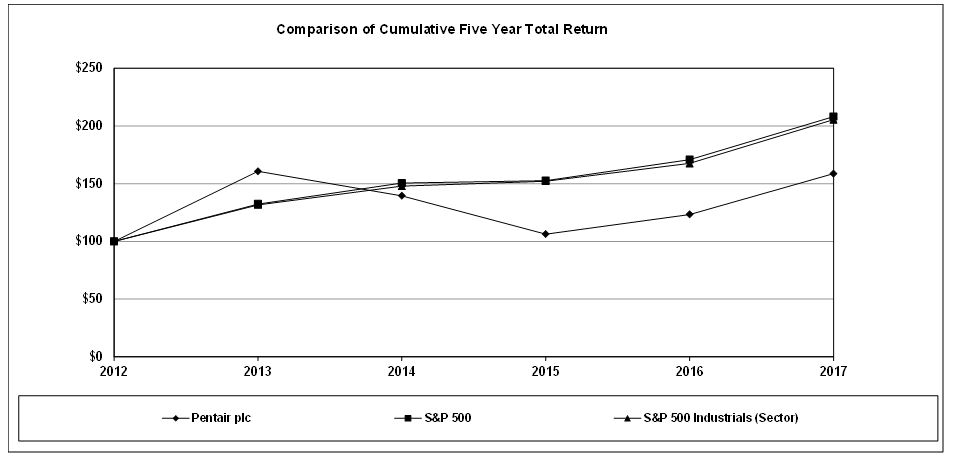
| Base Period December | INDEXED RETURNS Years ended December 31 | |||||||||||
| Company / Index | 2012 | 2013 | 2014 | 2015 | 2016 | 2017 | ||||||
| Pentair plc | 100 | 160.70 | 139.55 | 106.31 | 123.32 | 158.68 | ||||||
| S&P 500 Index | 100 | 132.39 | 150.51 | 152.59 | 170.84 | 208.14 | ||||||
| S&P 500 Industrials Index | 100 | 131.64 | 147.91 | 152.19 | 167.59 | 205.41 |
Purchases of Equity Securities
The following table provides information with respect to purchases we made of our ordinary shares during the fourth quarter of 2017:
| (a) | (b) | (c) | (d) | |||||||
| Total number of shares purchased | Average price paid per share | Total number of shares purchased as part of publicly announced plans or programs | Dollar value of shares that may yet be purchased under the plans or programs | |||||||
| October 1 – October 28, 2017 | 1,146 | $ | 67.96 | — | $ | 700,000,054 | ||||
| October 29 – November 25, 2017 | 17,792 | 69.28 | — | 700,000,054 | ||||||
| November 26 – December 31, 2017 | 1,432,297 | 69.80 | 1,432,297 | 600,000,119 | ||||||
| Total | 1,451,235 | 1,432,297 |
| (a) | The purchases in this column include 1,146 shares for the period October 1 – October 28, 2017, 17,792 shares for the period October 29 – November 25, 2017, and no shares for the period November 26 – December 31, 2017 deemed surrendered to us by participants in our 2012 Stock and Incentive Plan (the "2012 Plan") and earlier stock incentive plans that are now outstanding under the 2012 Plan (collectively the "Plans") to satisfy the exercise price or withholding of tax obligations related to the exercise of stock options and vesting of restricted shares. |
| (b) | The average price paid in this column includes shares repurchased as part of our publicly announced plans and shares deemed surrendered to us by participants in the Plans to satisfy the exercise price of stock options and withholding tax obligations due upon stock option exercises and vesting of restricted shares. |
| (c) | The number of shares in this column represents the number of shares repurchased as part of our publicly announced plans to repurchase our ordinary shares up to a maximum dollar limit of $1.0 billion. |
| (d) | In December 2014, our Board of Directors authorized the repurchase of our ordinary shares up to a maximum dollar limit of $1.0 billion. This authorization expires on December 31, 2019. We have $600.0 million remaining availability for repurchases under the 2014 authorization. |
Item 6. SELECTED FINANCIAL DATA
The following table sets forth our selected historical financial data for the five years ended December 31, 2017.
| Years ended December 31 | |||||||||||||||
| In millions, except per-share data | 2017 | 2016 | 2015 | 2014 | 2013 | ||||||||||
| Consolidated statements of operations and comprehensive income data | |||||||||||||||
| Net sales | $ | 4,936.5 | $ | 4,890.0 | $ | 4,616.4 | $ | 4,666.8 | $ | 4,553.7 | |||||
| Operating income | 680.8 | 700.7 | 616.1 | 538.5 | 529.2 | ||||||||||
| Net income from continuing operations attributable to Pentair plc | 480.0 | 451.6 | 397.1 | 356.6 | 354.8 | ||||||||||
| Per-share data | |||||||||||||||
| Basic: | |||||||||||||||
| Earnings per ordinary share from continuing operations attributable to Pentair plc | $ | 2.64 | $ | 2.49 | $ | 2.20 | $ | 1.87 | $ | 1.76 | |||||
| Weighted average shares | 181.7 | 181.3 | 180.3 | 190.6 | 201.1 | ||||||||||
| Diluted: | |||||||||||||||
| Earnings per ordinary share from continuing operations attributable to Pentair plc | $ | 2.61 | $ | 2.47 | $ | 2.17 | $ | 1.84 | $ | 1.73 | |||||
| Weighted average shares | 183.7 | 183.1 | 182.6 | 193.7 | 204.6 | ||||||||||
| Cash dividends declared and paid per ordinary share | $ | 1.38 | $ | 1.34 | $ | 1.28 | $ | 1.10 | $ | 0.96 | |||||
| Cash dividends declared and unpaid per ordinary share | 0.35 | 0.345 | 0.33 | 0.64 | 0.50 | ||||||||||
| Consolidated balance sheets data | |||||||||||||||
| Total assets | $ | 8,633.7 | $ | 11,534.8 | $ | 11,833.4 | $ | 10,643.8 | $ | 11,732.5 | |||||
| Total debt | 1,440.7 | 4,279.2 | 4,685.8 | 2,988.4 | 2,532.6 | ||||||||||
| Total equity | 5,037.8 | 4,254.4 | 4,008.8 | 4,663.8 | 6,217.7 |
Item 7. MANAGEMENT'S DISCUSSION AND ANALYSIS OF FINANCIAL CONDITION AND RESULTS OF OPERATIONS
Forward-looking statements
This report contains statements that we believe to be "forward-looking statements" within the meaning of the Private Securities Litigation Reform Act of 1995. All statements, other than statements of historical fact are forward-looking statements. Without limitation, any statements preceded or followed by or that include the words "targets," "plans," "believes," "expects," "intends," "will," "likely," "may," "anticipates," "estimates," "projects," "should," "would," "positioned," "strategy," "future" or words, phrases or terms of similar substance or the negative thereof, are forward-looking statements. These forward-looking statements are not guarantees of future performance and are subject to risks, uncertainties, assumptions and other factors, some of which are beyond our control, which could cause actual results to differ materially from those expressed or implied by such forward-looking statements. These factors include the ability to satisfy the necessary conditions to consummate the Proposed Separation (as defined below) on a timely basis or at all; the ability to successfully separate the Water and Electrical businesses and realize the anticipated benefits from the Proposed Separation; adverse effects on the Water and Electrical business operations or financial results and the market price of our shares as a result of the announcement or consummation of the Proposed Separation; unanticipated transaction expenses, such as litigation or legal settlement expenses; failure to obtain tax rulings or changes in tax laws; changes in capital market conditions; the impact of the Proposed Separation on our employees, customers and suppliers; overall global economic and business conditions impacting the Water and Electrical businesses; future opportunities that our board may determine present greater potential to increase shareholder value; the ability of the Water and Electrical businesses to operate independently following the Proposed Separation; the ability to achieve the benefits of our restructuring plans; the ability to successfully identify, finance, complete and integrate acquisitions; competition and pricing pressures in the markets we serve; the strength of housing and related markets; volatility in currency exchange rates and commodity prices; inability to generate savings from excellence in operations initiatives consisting of lean enterprise, supply management and cash flow practices; increased risks associated with operating foreign businesses; the ability to deliver backlog and win future project work; failure of markets to accept new product introductions and enhancements; the impact of changes in laws and regulations, including those that limit U.S. tax benefits; the outcome of litigation and governmental proceedings; and the ability to achieve our long-term strategic operating goals. Additional information concerning these and other factors is contained in our filings with the U.S. Securities and Exchange Commission (the "SEC"), including this Annual Report on Form 10-K. All forward-looking statements speak only as of the date of this report. Pentair plc assumes no obligation, and disclaims any obligation, to update the information contained in this report.
Overview
Pentair plc is a focused diversified industrial manufacturing company comprising two reporting segments: Water and Electrical. We classify our operations into business segments based primarily on types of products offered and markets served. For the year ended December 31, 2017, Water and Electrical accounted for 58% and 42% of total revenues, respectively.
Although our jurisdiction of organization is Ireland, we manage our affairs so that we are centrally managed and controlled in the United Kingdom (the "U.K.") and therefore have our tax residency in the U.K.
On September 18, 2015, we acquired, as part of Electrical, all of the outstanding shares of capital stock of ERICO Global Company ("ERICO") for approximately $1.8 billion in cash (the "ERICO Acquisition"). ERICO is a leading global manufacturer and marketer of engineered electrical and fastening products for electrical, mechanical and civil applications. ERICO has employees in 30 countries across the world with recognized brands including CADDY fixing, fastening and support products; ERICO electrical grounding, bonding and connectivity products and LENTON engineered systems.
On April 28, 2017 we completed the sale of the Valves & Controls business to Emerson Electric Co. for $3.15 billion in cash. The sale resulted in a gain of $181.1 million, net of tax. The results of the Valves & Controls business have been presented as discontinued operations and the related assets and liabilities have been reclassified as held for sale for all periods presented. The Valves & Controls business was previously disclosed as a stand-alone reporting segment.
On May 9, 2017, we announced that our Board of Directors approved a plan to separate our Water business and Electrical business into two independent, publicly-traded companies (the "Proposed Separation"). The Proposed Separation is expected to occur through a tax-free spin-off of the Electrical business to Pentair shareholders.
Completion of the Proposed Separation is subject to certain customary conditions, including, among other things, final approval of the transaction by Pentair's Board of Directors, receipt of tax opinions and rulings and effectiveness of appropriate filings with the SEC. Upon completion of the Proposed Separation, it is anticipated that Electrical's jurisdiction of organization will be Ireland, but that it will manage its affairs so that it will be centrally managed and controlled in the U.K. and therefore will have its tax residency in the U.K.
We are targeting April 30, 2018 for the completion of the Proposed Separation; however, there can be no assurance regarding the ultimate timing of the Proposed Separation or that the Proposed Separation will be completed.
Key trends and uncertainties regarding our existing business
The following trends and uncertainties affected our financial performance in 2017 and 2016, and will likely impact our results in the future:
| • | During 2017 and 2016, we continued execution of certain business restructuring initiatives aimed at reducing our fixed cost structure and, during 2017, began realigning our business in contemplation of the Proposed Separation. We expect that these actions will contribute to margin growth in 2018. |
| • | We have identified specific product and geographic market opportunities that we find attractive and continue to pursue, both within and outside the United States. We are reinforcing our businesses to more effectively address these opportunities through research and development and additional sales and marketing resources. Unless we successfully penetrate these markets, our core sales growth will likely be limited or may decline. |
| • | We have experienced material and other cost inflation. We strive for productivity improvements, and we implement increases in selling prices to help mitigate this inflation. We expect the current economic environment will result in continuing price volatility for many of our raw materials, and we are uncertain as to the timing and impact of these market changes. |
In 2018, our operating objectives include the following:
| • | Complete the execution of the Proposed Separation to create two industry-leading pure-play companies in Water and Electrical. |
| • | Driving operating excellence through PIMS, with specific focus on sourcing and supply management, cash flow management and lean operations; |
| • | Achieving differentiated revenue growth through new products and global and market expansion; |
| • | Optimizing our technological capabilities to increasingly gene |
Showing the first 8K of 67K characters. Open the full section
Item 7A. QUANTITATIVE AND QUALITATIVE DISCLOSURES ABOUT MARKET RISK
Market risk is the potential economic loss that may result from adverse changes in the fair value of financial instruments. We are exposed to various market risks, including changes in interest rates and foreign currency rates. Periodically, we use derivative financial instruments to manage or reduce the impact of changes in interest rates. Counterparties to all derivative contracts are major financial institutions. All instruments are entered into for other than trading purposes. The major accounting policies and utilization of these instruments is described more fully in ITEM 8, Note 1 of the Notes to Consolidated Financial Statements.
Interest rate risk
Our debt portfolio as of December 31, 2017, was comprised of debt predominantly denominated in U.S. dollars. This debt portfolio is comprised of 96% fixed-rate debt and 4% variable-rate debt. Changes in interest rates have different impacts on the fixed and variable-rate portions of our debt portfolio. A change in interest rates on the fixed portion of the debt portfolio impacts the fair value, but has no impact on interest incurred or cash flows. A change in interest rates on the variable portion of the debt portfolio impacts the interest incurred and cash flows but does not impact the net financial instrument position.
Based on the fixed-rate debt included in our debt portfolio, as of December 31, 2017, a 100 basis point increase or decrease in interest rates would result in a $28.6 million decrease or a $29.3 million increase in fair value, respectively.
Based on the variable-rate debt included in our debt portfolio as of December 31, 2017, a 100 basis point increase or decrease in interest rates would result in a $0.6 million increase or decrease in interest incurred.
Foreign currency risk
We conduct business in various locations throughout the world and are subject to market risk due to changes in the value of foreign currencies in relation to our reporting currency, the U.S. dollar. Periodically, we use derivative financial instruments to manage these risks. The functional currencies of our foreign operating locations are generally the local currency in the country of domicile. We manage these operating activities at the local level and revenues, costs, assets and liabilities are generally denominated in local currencies, thereby mitigating the risk associated with changes in foreign exchange. However, our results of operations and assets and liabilities are reported in U.S. dollars and thus will fluctuate with changes in exchange rates between such local currencies and the U.S. dollar.
From time to time, we may enter into short duration foreign currency contracts to hedge foreign currency risks. As the majority of our foreign currency contracts have an original maturity date of less than one year, there is no material foreign currency risk. At December 31, 2017 and 2016, we had outstanding foreign currency derivative contracts with gross notional U.S. dollar equivalent amounts of $481.4 million and $475.6 million, respectively. Changes in the fair value of all derivatives are recognized immediately in income unless the derivative qualifies as a hedge of future cash flows. Gains and losses related to a hedge are deferred and recorded in the Consolidated Balance Sheets as a component of AOCI and subsequently recognized in the Consolidated Statements of Operations and Comprehensive Income (Loss) when the hedged item affects earnings.
In September 2015, we designated the €500.0 million 2.45% Senior Notes due 2019 (the "2019 Euro Notes") as a net investment hedge of our investments in certain international subsidiaries that use the Euro as their functional currency. The hedge is intended to reduce, but will not eliminate, the impact on our financial results of changes in the exchange rate between the Euro and the U.S. dollar. The currency risk related to the net investment hedge is measured by estimating the potential impact of a 10% change in the value of the U.S. dollar relative to the Euro. The rates used to perform this analysis were based on the market exchange rates in effect on December 31, 2017. A 10% appreciation of the U.S. dollar relative to the Euro would result in a $54.0 million net increase in Other comprehensive income. Conversely, a 10% depreciation of the U.S. dollar relative to the Euro would result in a $66.0 million net decrease in Other comprehensive income. However, these increases and decreases in Other comprehensive income would be offset by decreases or increases in the hedged net investments on our balance sheet due to currency translation.
Item 8. FINANCIAL STATEMENTS AND SUPPLEMENTARY DATA
MANAGEMENT'S REPORT ON INTERNAL CONTROL OVER FINANCIAL REPORTING
Management of Pentair plc and its subsidiaries (the "Company") is responsible for establishing and maintaining adequate internal control over financial reporting, as such term is defined in Rules 13a-15(f) and 15d-15(f) of the Securities Exchange Act of 1934. The Company's internal control over financial reporting is designed to provide reasonable assurance regarding the reliability of financial reporting and the preparation of financial statements for external purposes in accordance with generally accepted accounting principles. The Company's internal control over financial reporting includes those policies and procedures that (1) pertain to maintenance of records that, in reasonable detail, accurately and fairly reflect the transactions and dispositions of the assets of the Company; (2) provide reasonable assurance that transactions are recorded as necessary to permit preparation of the financial statements in accordance with generally accepted accounting principles and that receipts and expenditures of the Company are being made only in accordance with authorizations of management and directors of the Company; and (3) provide reasonable assurance regarding prevention or timely detection of unauthorized acquisition, use or disposition of the Company's assets that could have a material effect on the financial statements.
Because of its inherent limitations, internal control over financial reporting may not prevent or detect misstatements. Also, projections of any evaluation of the effectiveness of internal control over financial reporting to future periods are subject to the risk that the controls may become inadequate because of changes in conditions or that the degree of compliance with the policies or procedures may deteriorate.
Management assessed the effectiveness of the Company's internal control over financial reporting as of December 31, 2017. In making this assessment, management used the criteria for effective internal control over financial reporting described in Internal Control-Integrated Framework (2013) issued by the Committee of Sponsoring Organizations of the Treadway Commission. Based on this assessment, management believes that, as of December 31, 2017, the Company's internal control over financial reporting was effective based on those criteria.
Our independent registered public accounting firm, Deloitte & Touche LLP, has issued an attestation report on the Company's internal control over financial reporting as of December 31, 2017. That attestation report is set forth immediately following this management report.
| Randall J. Hogan | John L. Stauch | |
| Chairman and Chief Executive Officer | Executive Vice President and Chief Financial Officer |
REPORT OF INDEPENDENT REGISTERED PUBLIC ACCOUNTING FIRM
To the Board of Directors and Shareholders of
Pentair plc
London, United Kingdom
Opinion on Internal Control over Financial Reporting
We have audited the internal control over financial reporting of Pentair plc and subsidiaries (the "Company") as of December 31, 2017, based on criteria established in Internal Control — Integrated Framework (2013) issued by the Committee of Sponsoring Organizations of the Treadway Commission (COSO). In our opinion, the Company maintained, in all material respects, effective internal control over financial reporting as of December 31, 2017, based on the criteria established in Internal Control - Integrated Framework (2013) issued by COSO.
We have also audited, in accordance with the standards of the Public Company Accounting Oversight Board (United States), the consolidated financial statements and financial statement schedule listed in the Index at Item 15 as of and for the year ended December 31, 2017, of the Company and our report dated February 27, 2018 expressed an unqualified opinion on those financial statements and financial statement schedule.
Basis for Opinion
The Company’s management is responsible for maintaining effective internal control over financial reporting and for its assessment of the effectiveness of internal control over financial reporting, included in the accompanying Management’s Report on Internal Control over Financial Reporting. Our responsibility is to express an opinion on the Company’s internal control over financial reporting based on our audit. We are a public accounting firm registered with the PCAOB and are required to be independent with respect to the Company in accordance with the U.S. federal securities laws and the applicable rules and regulations of the Securities and Exchange Commission and the PCAOB.
We conducted our audit in accordance with the standards of the PCAOB. Those standards require that we plan and perform the audit to obtain reasonable assurance about whether effective internal control over financial reporting was maintained in all material respects. Our audit included obtaining an understanding of internal control over financial reporting, assessing the risk that a material weakness exists, testing and evaluating the design and operating effectiveness of internal control based on the assessed risk, and performing such other procedures as we considered necessary in the circumstances. We believe that our audit provides a reasonable basis for our opinion.
Definition and Limitations of Internal Control over Financial Reporting
A company’s internal control over financial reporting is a process designed to provide reasonable assurance regarding the reliability of financial reporting and the preparation of financial statements for external purposes in accordance with generally accepted accounting principles. A company’s internal control over financial reporting includes those policies and procedures that (1) pertain to the maintenance of records that, in reasonable detail, accurately and fairly reflect the transactions and dispositions of the assets of the company; (2) provide reasonable assurance that transactions are recorded as necessary to permit preparation of financial statements in accordance with generally accepted accounting principles, and that receipts and expenditures of the company are being made only in accordance with authorizations of management and directors of the company; and (3) provide reasonable assurance regarding prevention or timely detection of unauthorized acquisition, use, or disposition of the company’s assets that could have a material effect on the financial statements.
Because of its inherent limitations, internal control over financial reporting may not prevent or detect misstatements. Also, projections of any evaluation of effectiveness to future periods are subject to the risk that controls may become inadequate because of changes in conditions, or that the degree of compliance with the policies or procedures may deteriorate.
/s/ Deloitte & Touche LLP
Minneapolis, Minnesota
February 27, 2018
REPORT OF INDEPENDENT REGISTERED PUBLIC ACCOUNTING FIRM
To the Board of Directors and Shareholders of
Pentair plc
London, United Kingdom
Opinion on the Financial Statements
We have audited the accompanying consolidated balance sheets of Pentair plc and subsidiaries (the "Company") as of December 31, 2017 and 2016, the related consolidated statements of operations and comprehensive income (loss), changes in equity, and cash flows for each of the three years in the period ended December 31, 2017, the related notes, and the schedule listed in the Index at Item 15 (collectively referred to as the "financial statements"). In our opinion, the financial statements present fairly, in all material respects, the financial position of the Company as of December 31, 2017 and 2016, and the results of its operations and its cash flows for each of the three years in the period ended December 31, 2017, in conformity with accounting principles generally accepted in the United States of America.
We have also
Showing the first 8K of 193K characters. Open the full section
Item 9. CHANGES IN AND DISAGREEMENTS WITH ACCOUNTANTS ON ACCOUNTING AND FINANCIAL DISCLOSURE
None.
Item 9A. CONTROLS AND PROCEDURES
Our management, with the participation of our Chief Executive Officer and our Chief Financial Officer, evaluated the effectiveness of the design and operation of our disclosure controls and procedures as of the end of the year ended December 31, 2017, pursuant to Rule 13a-15(b) of the Securities Exchange Act of 1934 ("the Exchange Act"). Based upon their evaluation, our Chief Executive Officer and our Chief Financial Officer concluded that our disclosure controls and procedures were effective as of the year ended December 31, 2017 to ensure that information required to be disclosed by us in the reports we file or submit under the Exchange Act is recorded, processed, summarized and reported, within the time periods specified in the Securities and Exchange Commission's rules and forms and to ensure that information required to be disclosed by us in the reports we file or submit under the Exchange Act is accumulated and communicated to our management, including our principal executive and principal financial officers, as appropriate to allow timely decisions regarding required disclosures.
Management's Annual Report on Internal Control Over Financial Reporting
The report of management required under this ITEM 9A is contained in ITEM 8 of this Annual Report on Form 10-K under the caption "Management's Report on Internal Control Over Financial Reporting."
Attestation Report of Independent Registered Public Accounting Firm
The attestation report required under this ITEM 9A is contained in ITEM 8 of this Annual Report on Form 10-K under the caption "Report of Independent Registered Public Accounting Firm."
Changes in Internal Control over Financial Reporting
There was no change in our internal control over financial reporting that occurred during the quarter ended December 31, 2017 that has materially affected, or is reasonably likely to materially affect, our internal control over financial reporting.
Item 9B. OTHER INFORMATION
None.
PART III
Item 10. DIRECTORS, EXECUTIVE OFFICERS AND CORPORATE GOVERNANCE
Information required under this item with respect to directors is contained in our Proxy Statement for our 2018 annual general meeting of shareholders under the captions "Corporate Governance Matters," "Proposal 1 Re-elect Director Nominees" and "Section 16(a) Beneficial Ownership Reporting Compliance" and is incorporated herein by reference.
Information required under this item with respect to executive officers is contained in Part I of this Form 10-K under the caption "Executive Officers of the Registrant."
Our Board of Directors has adopted Pentair's Code of Business Conduct and Ethics and designated it as the code of ethics for the Company's Chief Executive Officer and senior financial officers. The Code of Business Conduct and Ethics also applies to all employees and directors in accordance with New York Stock Exchange Listing Standards. We have posted a copy of Pentair's Code of Business Conduct and Ethics on our website at http://pentair.com/en/about-us/leadership/corporate-governance. We intend to satisfy the disclosure requirements under Item 5.05 of Form 8-K regarding amendments to or waivers from, Pentair's Code of Business Conduct and Ethics by posting such information on our website at http://pentair.com/en/about-us/leadership/corporate-governance.
We are not including the information contained on our website as part of, or incorporating it by reference into, this report.
Item 11. EXECUTIVE COMPENSATION
Information required under this item is contained in our Proxy Statement for our 2018 annual general meeting of shareholders under the captions "Compensation Discussion and Analysis," "Compensation Committee Report," "Executive Compensation Tables" and "Corporate Governance Matters - Director Compensation" and is incorporated herein by reference.
Item 12. SECURITY OWNERSHIP OF CERTAIN BENEFICIAL OWNERS AND MANAGEMENT AND RELATED STOCKHOLDER MATTERS
Information required under this item with respect to security ownership is contained in our Proxy Statement for our 2018 annual general meeting of shareholders under the caption "Security Ownership" and is incorporated herein by reference.
The following table summarizes, as of December 31, 2017, information about compensation plans under which our equity securities are authorized for issuance:
| Plan category | Number of securities to be issued upon exercise of outstanding options, warrants and rights (a) | Weighted-average exercise price of outstanding options, warrants and rights (b) | Number of securities remaining available for future issuance under equity compensation plans (excluding securities reflected in column (a)) (c) | |||||||
| Equity compensation plans approved by security holders: | ||||||||||
| 2012 Stock and Incentive Plan | 4,542,732 | (1) | $ | 57.73 | (2) | 4,166,037 | (3) | |||
| 2008 Omnibus Stock Incentive Plan | 1,688,173 | (4) | 32.21 | (2) | — | (5) | ||||
| 2004 Omnibus Stock Incentive Plan | 6,598 | 33.19 | — | (5) | ||||||
| Outside Directors Non-qualified Stock Option Plan | — | — | — | (5) | ||||||
| Total | 6,237,503 | $ | 49.49 | (2) | 4,166,037 |
| (1) | Consists of 3,551,120 shares subject to stock options, 537,259 shares subject to restricted stock units, and 454,353 shares subject to performance share awards. |
| (2) | Represents the weighted average exercise price of outstanding stock options and does not take into account outstanding restricted stock units or performance share units. |
| (3) | Represents securities remaining available for issuance under the 2012 Stock and Incentive Plan. |
| (4) | Consists of 1,688,173 shares subject to stock options. |
| (5) | The 2008 Omnibus Stock Incentive Plan was terminated in 2012. The 2004 Omnibus Plan and the Directors Plan were terminated in 2008. Options previously granted under these plans and restricted stock units granted under the 2008 Omnibus Stock Incentive Plan remain outstanding, but no further options or shares may be granted or issued under either plan. |
Item 13. CERTAIN RELATIONSHIPS AND RELATED TRANSACTIONS AND DIRECTOR INDEPENDENCE
Information required under this item is contained in our Proxy Statement for our 2018 annual general meeting of shareholders under the captions "Proposal 1 Re-elect Director Nominees - Director Independence" and "Corporate Governance Matters - The Board's Role and Responsibilities - Policies and Procedures Regarding Related Person Transactions" and is incorporated herein by reference.
Item 14. PRINCIPAL ACCOUNTING FEES AND SERVICES
Information required under this item is contained in our Proxy Statement for our 2018 annual general meeting of shareholders under the caption "Proposal 3 Ratify, by Non-Binding Advisory Vote, the Appointment of Deloitte & Touche LLP as the Independent Auditors of Pentair plc and to Authorize, by Binding Vote, the Audit and Finance Committee of the Board of Directors to Set the Auditors' Remuneration" and is incorporated herein by reference.
PART IV
Item 15. EXHIBITS AND FINANCIAL STATEMENT SCHEDULES
(a) List of documents filed as part of this report:
(1) Financial Statements
Consolidated Statements of Operations and Comprehensive Income (Loss) for the years ended December 31, 2017, 2016 and 2015
Consolidated Balance Sheets as of December 31, 2017 and 2016
Consolidated Statements of Cash Flows for the years ended December 31, 2017, 2016 and 2015
Consolidated Statements of Changes in Equity for the years ended December 31, 2017, 2016 and 2015
Notes to Consolidated Financial Statements
(2) Financial Statement Schedule
Schedule II — Valuation and Qualifying Accounts
All other schedules for which provision is made in the applicable accounting regulations of the Securities and Exchange Commission have been omitted because they are not applicable or the required information is shown in the financial statements or notes thereto.
(3) Exhibits
The exhibits of this Annual Report on Form 10-K included herein are set forth below.
| Exhibit Number | Exhibit | |
| 2.1 | Agreement and Plan of Merger, dated August 14, 2015, among Pentair plc, Pentair Lionel Acquisition Co., Pentair Lionel Merger Sub, Inc. and ERICO Global Company (Incorporated by reference to Exhibit 2.1 in the Current Report on Form 8-K of Pentair plc filed with the Commission on August 18, 2015 (File No. 001-11625)). | |
| 2.2 | Share Purchase Agreement, dated August 18, 2016, by and between Emerson Electric Co. and Pentair plc (Incorporated by reference to Exhibit 2.1 in the Quarterly Report on Form 10-Q of Pentair plc filed with the Commission on October 25, 2016 (File No. 001-11625)). | |
| 3.1 | Amended and Restated Memorandum and Articles of Association of Pentair plc (Incorporated by reference to Exhibit 3.1 to the Current Report on Form 8-K of Pentair plc filed with the Commission on May 9, 2017 (File No. 001-11625)). | |
| 4.1 | Indenture, dated as of September 24, 2012, among Pentair Finance S.A. (formerly Tyco Flow Control International Finance S.A.) (as Issuer), Pentair Ltd. (as Guarantor) and Wells Fargo Bank, National Association (as Trustee) (Incorporated by reference to Exhibit 4.1 in the Current Report on Form 8-K of Pentair Ltd. filed with the Commission on September 28, 2012 (File No. 001-11625)). | |
| 4.2 | Second Supplemental Indenture, dated as of September 24, 2012, among Pentair Finance S.A. (formerly Tyco Flow Control International Finance S.A.) (as Issuer), Pentair Ltd. (as Guarantor), Pentair, Inc. and Wells Fargo Bank, National Association (as Trustee) (Incorporated by reference to Exhibit 4.3 in the Current Report on Form 8-K of Pentair Ltd. filed with the Commission on September 28, 2012 (File No. 001-11625)). | |
| 4.3 | Fourth Supplemental Indenture, dated as of November 26, 2012, among Pentair Finance S.A. (as Issuer), Pentair Ltd. (as Guarantor) and Wells Fargo Bank, National Association (as Trustee) (Incorporated by reference to Exhibit 4.2 in the Current Report on Form 8-K of Pentair Ltd. filed with the Commission on November 28, 2012 (File No. 001-11625)). | |
| 4.4 | Fifth Supplemental Indenture, dated as of December 18, 2012, among Pentair Finance S.A. (as Issuer), Pentair Ltd. (as Guarantor) and Wells Fargo Bank, National Association (as Trustee) (Incorporated by reference to Exhibit 4.1 in the Current Report on Form 8-K of Pentair Ltd. filed with the Commission on December 18, 2012 (File No. 001-11625)). | |
| 4.5 | Sixth Supplemental Indenture, dated as of May 20, 2014, among Pentair Finance S.A., Pentair Ltd., Pentair Investments Switzerland GmbH, Pentair plc and Wells Fargo Bank, National Association, as trustee (Incorporated by reference to Exhibit 4.3 in the Current Report on Form 8-K of Pentair plc filed with the Commission on May 20, 2014 (File No. 001-11625)). | |
| 4.6 | Seventh Supplemental Indenture, dated as of May 26, 2017, among Pentair Finance S.A., Pentair plc, Pentair Investments Switzerland GmbH and Wells Fargo Bank, National Association as trustee (Incorporated by reference to Exhibit 4.1 to the Current Report on Form 8-K of Pentair plc filed with the Commission on May 31, 2017 (File No. 001-11625)). | |
| 4.7 | Senior Indenture, dated May 2, 2011 by and among Pentair, Inc. and Wells Fargo Bank, National Association (Incorporated by reference to Exhibit 4.5 to Pentair, Inc.'s Registration Statement on Form S-3 (Registration 333-173829)). | |
| 4.8 | First Supplemental Indenture, dated as of May 9, 2011, among Pentair, Inc., the guarantors named therein and Wells Fargo Bank, National Association (Incorporated by reference to Exhibit 4.2 in the Current Report on Form 8-K of Pentair, Inc. filed with the Commission on May 9, 2011 (File No. 000-04689)). | |
| 4.9 | Third Supplemental Indenture, dated October 1, 2012, among Pentair Ltd., Pentair, Inc. and Wells Fargo Bank, National Association, as trustee (Incorporated by reference to Exhibit 4.1 in the Current Report on Form 8-K of Pentair Ltd. filed with the Commission on October 1, 2012 (File No. 001-11625)). | |
| 4.10 | Fourth Supplemental Indenture, dated as of December 17, 2012, among Pentair, Inc. (as Issuer), Pentair Ltd. (as Guarantor) and Wells Fargo Bank, National Association (as Trustee) (Incorporated by reference to Exhibit 4.2 in the Current Report on Form 8-K of Pentair Ltd. filed with the Commission on December 18, 2012 (File No. 001-11625)). | |
| 4.11 | Fifth Supplemental Indenture, dated as of May 20, 2014, among Pentair, Inc., Pentair Ltd., Pentair Investments Switzerland GmbH, Pentair plc and Wells Fargo Bank, National Association, as trustee (Incorporated by reference to Exhibit 4.2 in the Current Report on Form 8-K of Pentair plc filed with the Commission on May 20, 2014 (File No. 001-11625)). | |
| 4.12 | Sixth Supplemental Indenture, dated as of May 26, 2017, among Pentair, Inc., Pentair plc, Pentair Investments Switzerland GmbH and Wells Fargo Bank, National Association, as trustee (Incorporated by reference to Exhibit 4.2 to the Current Report on Form 8-K of Pentair plc filed with the Commission on May 31, 2017 (File No. 001-11625)). | |
| 4.13 | Amended and Restated Credit Agreement, dated as of October 3, 2014 among Pentair, plc, Pentair Investments Switzerland GmbH, Pentair Finance, S.A., Pentair, Inc. and the lenders and agents party thereto (Incorporated by reference to Exhibit 4.1 in the Current Report on Form 8-K of Pentair, plc, filed with the Commission on October 3, 2014 (File No. 001-11625)). | |
| 4.14 | First Amendment, dated as of August 28, 2015, among Pentair, Pentair Investments Switzerland GmbH, Pentair Finance S.A. and the lenders and agents party thereto (Incorporated by reference to Exhibit 4.1 to the Current Report on Form 8-K of Pentair plc filed with the SEC on September 3, 2015 (File No. 001-11625)). | |
| 4.15 | Second Amendment, dated as of September 2, 2015, among Pentair, Pentair Investments Switzerland GmbH, Pentair Finance S.A. and the lenders and agents party thereto (Incorporated by reference to Exhibit 4.2 to the Current Report on Form 8-K of Pentair plc filed with the Commission on September 3, 2015 (File No. 001-11625)). | |
| 4.16 | Third Amendment, dated as of September 15, 2016, among Pentair, Pentair Investments Switzerland GmbH, Pentair Finance S.A. and the lenders and agent party thereto (Incorporated by reference to Exhibit 4.1 to the Current Report on Form 8-K of Pentair plc filed with the Commission on September 16, 2016 (File No. 001-11625)). | |
| 4.17 | Indenture, dated as of September 16, 2015, among Pentair Finance S.A. (as Issuer), Pentair plc (as Parent and Guarantor), Pentair Investments Switzerland GmbH (as Guarantor) and U.S. Bank National Association (as Trustee) (Incorporated by reference to Exhibit 4.1 to the Current Report on Form 8-K of Pentair plc filed with the Commission on September 16, 2015 (File No. 001-11625)). | |
| 4.18 | First Supplemental Indenture, dated as of September 16, 2015, among Pentair Finance S.A. (as Issuer), Pentair plc (as Parent and Guarantor), Pentair Investments Switzerland GmbH (as Guarantor) and U.S. Bank National Association (as Trustee) (Incorporated by reference to Exhibit 4.2 to the Current Report on Form 8-K of Pentair plc filed with the SEC on September 16, 2015 (File No. 001-11625)). | |
| 4.19 | Second Supplemental Indenture, dated as of September 16, 2015, among Pentair Finance S.A. (as Issuer), Pentair plc (as Parent and Guarantor), Pentair Investments Switzerland GmbH (as Guarantor) and U.S. Bank National Association (as Trustee) (Incorporated by reference to Exhibit 4.3 to the Current Report on Form 8-K of Pentair plc filed with the Commission on September 16, 2015 (File No. 001-11625)). | |
| 4.20 | Third Supplemental Indenture, dated as of September 16, 2015, among Pentair Finance S.A. (as Issuer), Pentair plc (as Parent and Guarantor), Pentair Investments Switzerland GmbH (as Guarantor) and U.S. Bank National Association (as Trustee) (Incorporated by reference to Exhibit 4.4 to the Current Report on Form 8-K of Pentair plc filed with the Commission on September 16, 2015 (File No. 001-11625)). | |
| 4.21 | Fourth Supplemental Indenture, dated as of September 17, 2015, among Pentair Finance S.A. (as Issuer), Pentair plc (as Parent and Guarantor), Pentair Investments Switzerland GmbH (as Guarantor) and U.S. Bank National Association (as Trustee) (Incorporated by reference to Exhibit 4.2 to the Current Report on Form 8-K of Pentair plc filed with the Commission on September 17, 2015 (File No. 001-11625)). | |
| 4.22 | Fifth Supplemental Indenture, dated as of May 26, 2017, among Pentair Finance S.A., Pentair plc, Pentair Investments Switzerland GmbH and U.S. Bank National Association, as trustee (Incorporated by reference to Exhibit 4.3 to the Current Report on Form 8-K of Pentair plc filed with the Commission on May 31, 2017 (File No. 001-11625)). | |
| 10.1 | Tax Sharing Agreement, dated September 28, 2012 by and among Pentair Ltd., Tyco International Ltd. and The ADT Corporation (Incorporated by reference to Exhibit 10.1 in the Current Report on Form 8-K of Pentair Ltd. filed with the Commission on September 28, 2012 (File No. 001-11625)). | |
| 10.2 | Pentair plc 2012 Stock and Incentive Plan, as amended and restated effective as of January 1, 2017. (Incorporated by reference to Exhibit 10.2 to the Annual Report on Form 10-K of Pentair plc for the year ended December 31, 2016 (File No. 001-11625)).* | |
| 10.3 | Form of Executive Officer Stock Option Grant Agreement for grants made prior to January 1, 2017 (Incorporated by reference to Exhibit 10.7 in the Current Report on Form 8-K of Pentair plc filed with the Commission on June 3, 2014 (File No. 001-11625)).* | |
| 10.4 | Form of Executive Officer Restricted Stock Unit Grant Agreement for grants made prior to January 1, 2017 (Incorporated by reference to Exhibit 10.8 in the Current Report on Form 8-K of Pentair plc filed with the Commission on June 3, 2014 (File No. 001-11625)).* | |
| 10.5 | Form of Executive Officer Performance Unit Grant Agreement for grants made prior to January 1, 2016 (Incorporated by reference to Exhibit 10.9 in the Current Report on Form 8-K of Pentair plc filed with the Commission on June 3, 2014 (File No. 001-11625)).* | |
| 10.6 | Form of Non-Employee Director Stock Option Grant Agreement (Incorporated by reference to Exhibit 10.10 in the Current Report on Form 8-K of Pentair plc filed with the Commission on June 3, 2014 (File No. 001-11625)).* | |
| 10.7 | Form of Non-Employee Director Restricted Stock Unit Grant Agreement (Incorporated by reference to Exhibit 10.11 in the Current Report on Form 8-K of Pentair plc filed with the Commission on June 3, 2014 (File No. 001-11625)).* | |
| 10.8 | Form of Performance Share Units Grant Agreement for grants made during 2016 (Incorporated by reference to Exhibit 10.8 in the Annual Report on Form 10-K of Pentair plc filed with the Commission on February 26, 2016 (File No. 001-11625)).* | |
| 10.9 | Pentair plc 2008 Omnibus Stock Incentive Plan, as amended and restated effective as of January 1, 2017 (Incorporated by reference to Exhibit 10.9 to the Annual Report on Form 10-K of Pentair plc for the year ended December 31, 2016 (File No. 001-11625)).* | |
| 10.10 | Pentair plc Omnibus Stock Incentive Plan, as amended and restated (Incorporated by reference to Exhibit 10.3 in the Current Report on Form 8-K of Pentair plc filed with the Commission on June 3, 2014 (File No. 001-11625)).* | |
| 10.11 | Pentair plc Outside Directors Nonqualified Stock Option Plan, as amended and restated (Incorporated by reference to Exhibit 10.4 in the Current Report on Form 8-K of Pentair plc filed with the Commission on June 3, 2014 (File No. 001-11625)).* | |
| 10.12 | Form of Assignment and Assumption Agreement, among Pentair, Inc., Pentair Ltd. and the executive officers of Pentair Ltd. relating to Key Executive Employment and Severance Agreement (Incorporated by reference to Exhibit 10.12 in the Current Report on Form 8-K of Pentair Ltd. filed with the Commission on October 1, 2012 (File No. 001-11625)).* | |
| 10.13 | Form of Key Executive Employment and Severance Agreement for Randall J. Hogan (Incorporated by reference to Exhibit 10.10 in the Annual Report on Form 10-K of Pentair, Inc. for the year ended December 31, 2008 (File No. 000-04689)).* | |
| 10.14 | Form of Key Executive Employment and Severance Agreement for John L. Stauch, Mark C. Borin and Angela D. Jilek (Incorporated by reference to Exhibit 10.12 in the Annual Report on Form 10-K of Pentair, Inc. for the year ended December 31, 2008 (File No. 000-04689)).* | |
| 10.15 | Form of Key Executive Employment and Severance Agreement for Karl R. Frykman (Incorporated by reference to Exhibit 10.16 in the Annual Report on Form 10-K of Pentair Ltd. for the year ended December 31, 2013 (File No. 001-11625)).* | |
| 10.16 | Form of Key Executive Employment and Severance Agreement for Beth A. Wozniak and John H. Jacko (Incorporated by reference to Exhibit 10.16 in the Annual Report on Form 10-K of Pentair plc filed with the Commission on February 26, 2016 (File No. 001-11625)).* | |
| 10.17 | Pentair plc Compensation Plan for Non-Employee Directors, as amended and restated (Incorporated by reference to Exhibit 10.6 in the Current Report on Form 8-K of Pentair plc filed with the Commission on June 3, 2014 (File No. 001-11625)).* | |
| 10.18 | Pentair plc Employee Stock Purchase and Bonus Plan, as amended and restated (Incorporated by reference to Exhibit 10.5 in the Current Report on Form 8-K of Pentair plc filed with the Commission on June 3, 2014 (File No. 001-11625)).* | |
| 10.19 | Pentair, Inc. Non-Qualified Deferred Compensation Plan effective January 1, 1996 (Incorporated by reference to Exhibit 10.17 in the Annual Report on Form 10-K of Pentair, Inc. for the year ended December 31, 2005 (File No. 000-04689)).* | |
| 10.20 | Trust Agreement for Pentair, Inc. Non-Qualified Deferred Compensation Plan between Pentair, Inc. and Fidelity Management Trust Company (Incorporated by reference to Exhibit 10.18 contained in the Annual Report on Form 10-K of Pentair, Inc. for the year ended December 31, 1995 (File No. 000-04689)).* | |
| 10.21 | Amendment effective August 23, 2000 to Pentair, Inc. Non-Qualified Deferred Compensation Plan effective January 1, 1996 (Incorporated by reference to Exhibit 10.8 in the Current Report on Form 8-K of Pentair, Inc. filed with the Commission on September 21, 2000 (File No. 000-04689)).* | |
| 10.22 | Pentair, Inc. Non-Qualified Deferred Compensation Plan effective January 1, 2009, as amended and restated (Incorporated by reference to Exhibit 10.12 in the Current Report on Form 8-K of Pentair plc filed with the Commission on June 3, 2014 (File No. 001-11625)).* | |
| 10.23 | Pentair, Inc. 1999 Supplemental Executive Retirement Plan as Amended and Restated effective August 23, 2000 (Incorporated by reference to Exhibit 10.2 in the Current Report on Form 8-K of Pentair, Inc. filed with the Commission on September 21, 2000 (File No. 000-04689)).* | |
| 10.24 | Pentair, Inc. Supplemental Executive Retirement Plan effective January 1, 2009, as amended and restated (Incorporated by reference to Exhibit 10.13 in the Current Report on Form 8-K of Pentair plc filed with the Commission on June 3, 2014 (File No. 001-11625)).* | |
| 10.25 | Pentair, Inc. Restoration Plan as Amended and Restated effective August 23, 2000 (Incorporated by reference to Exhibit 10.3 in the Current Report on Form 8-K of Pentair, Inc. filed with the Commission on September 21, 2000 (File No. 000-04689)).* | |
| 10.26 | Pentair, Inc. Restoration Plan effective January 1, 2009, as amended and restated (Incorporated by reference to Exhibit 10.14 in the Current Report on Form 8-K of Pentair plc filed with the Commission on June 3, 2014 (File No. 001-11625)).* | |
| 10.27 | Form of Deed of Indemnification for directors and executive officers of Pentair plc (Incorporated by reference to Exhibit 10.15 in the Current Report on Form 8-K of Pentair plc filed with the Commission on June 3, 2014 (File No. 001-11625)).* | |
| 10.28 | Form of Indemnification Agreement for directors and executive officers of Pentair plc (Incorporated by reference to Exhibit 10.16 in the Current Report on Form 8-K of Pentair plc filed with the Commission on June 3, 2014 (File No. 001-11625)).* | |
| 10.29 | Letter agreement, dated September 7, 2015, among Pentair plc, Edward P. Garden, Matthew Peltz, Brian Baldwin and Trian Fund Management, L.P. (Incorporated by reference to Exhibit 10.1 to the Current Report on Form 8-K of Pentair plc filed with the SEC on September 8, 2015 (File No. 001-11625)). | |
| 10.30 | Form of Executive Officer Stock Option Grant Agreement for grants made on or after January 1, 2017 (Incorporated by reference to Exhibit 10.31 to the Annual Report on Form 10-K of Pentair plc for the year ended December 31, 2016 (File No. 001-11625)).* | |
| 10.31 | Form of Executive Officer Restricted Stock Unit Grant Agreement for grants made on or after January 2, 2017 (Incorporated by reference to Exhibit 10.32 to the Annual Report on Form 10-K of Pentair plc for the year ended December 31, 2016 (File No. 001-11625)).* | |
| 10.32 | Form of Executive Officer Performance Unit Grant Agreement for grants made on or after January 1, 2017 (Incorporated by reference to Exhibit 10.33 to the Annual Report on Form 10-K of Pentair plc for the year ended December 31, 2016 (File No. 001-11625)).* | |
| 10.33 | Separation Agreement and Release, dated as of January 5, 2018, between Pentair Management Company and Karen L. Keegans (Incorporated by reference to Exhibit 10.1 to the Current Report on Form 8-K of Pentair plc filed with the Commission on January 9, 2018 (File No. 001-11625)).* | |
| 10.34 | Separation Agreement, dated as of May 2, 2017, between Pentair Management Company and Dennis J. Cassidy, Jr. (Incorporated by reference to Exhibit 10.1 to the Current Report on Form 8-K of Pentair plc filed with the Commission on June 5, 2017 (File No. 001-11625)).* | |
| 21 | List of Pentair plc subsidiaries. | |
| 23 | Consent of Independent Registered Public Accounting Firm — Deloitte & Touche LLP. | |
| 24 | Power of attorney. | |
| 31.1 | Certification of Chief Executive Officer. | |
| 31.2 | Certification of Chief Financial Officer. | |
| 32.1 | Certification of Chief Executive Officer, Pursuant to 18 U.S.C. Section 1350, as Adopted Pursuant to Section 906 of the Sarbanes-Oxley Act of 2002. | |
| 32.2 | Certification of Chief Financial Officer, Pursuant to 18 U.S.C. Section 1350, as Adopted Pursuant to Section 906 of the Sarbanes-Oxley Act of 2002. | |
| 101 | The following materials from Pentair plc's Annual Report on Form 10-K for the year ended December 31, 2017 are filed herewith, formatted in XBRL (Extensible Business Reporting Language): (i) the Consolidated Statements of Operations and Comprehensive Income (Loss) for the years ended December 31, 2017, 2016 and 2015, (ii) the Consolidated Balance Sheets as of December 31, 2017 and 2016, (iii) the Consolidated Statements of Cash Flows for the years ended December 31, 2017, 2016 and 2015, (iv) the Consolidated Statements of Changes in Equity for the years ended December 31, 2017, 2016 and 2015 and (v) the Notes to the Consolidated Financial Statements. |
| * | Denotes a management contract or compensatory plan or arrangement. |
Item 16. FORM 10-K SUMMARY
None.
SIGNATURES
Pursuant to the requirements of Section 13 or 15(d) of the Securities Exchange Act of 1934, the registrant has duly caused this report to be signed on its behalf by the undersigned, thereunto duly authorized, on February 27, 2018.
| PENTAIR PLC | ||
| By | /s/ John L. Stauch | |
| John L. Stauch | ||
| Executive Vice President and Chief Financial Officer |
Pursuant to the requirements of the Securities Exchange Act of 1934, this report has been signed below by the following persons on behalf of the Registrant and in the capacities indicated, on February 27, 2018.
| Signature | Title | |
| /s/ Randall J. Hogan | Chairman and Chief Executive Officer | |
| Randall J. Hogan | ||
| /s/ John L. Stauch | Executive Vice President and Chief Financial Officer | |
| John L. Stauch | ||
| /s/ Mark C. Borin | Senior Vice President, Chief Accounting Officer and Treasurer | |
| Mark C. Borin | ||
| * | Director | |
| Glynis A. Bryan | ||
| * | Director | |
| Jerry W. Burris | ||
| * | Director | |
| Carol Anthony (John) Davidson | ||
| * | Director | |
| Jacques Esculier | ||
| * | Director | |
| Edward P. Garden | ||
| * | Director | |
| T. Michael Glenn | ||
| * | Director | |
| David H. Y. Ho | ||
| * | Director | |
| David A. Jones | ||
| * | Director | |
| Ronald L. Merriman | ||
| * | Director | |
| William T. Monahan | ||
| * | Director | |
| Billie I. Williamson |
| *By | /s/ Angela D. Jilek |
| Angela D. Jilek | |
| Attorney-in-fact |
Schedule II — Valuation and Qualifying Accounts
Pentair plc and Subsidiaries
| In millions | Beginning balance | Additions charged (reductions credited) to costs and expenses | Deductions (1) | Other changes (2) | Ending balance | ||||||||||
| Allowances for doubtful accounts | |||||||||||||||
| Year ended December 31, 2017 | $ | 16.4 | $ | 0.8 | $ | 4.5 | $ | 1.1 | $ | 13.8 | |||||
| Year ended December 31, 2016 | $ | 19.0 | $ | 1.2 | $ | 4.1 | $ | 0.3 | $ | 16.4 | |||||
| Year ended December 31, 2015 | $ | 12.1 | $ | 10.1 | $ | 2.4 | $ | (0.8 | ) | $ | 19.0 |
| (1) | Uncollectible accounts written off, net of recoveries |
| (2) | Result of foreign currency effects |