 filings.tools
Item 1. BUSINESS
93K characters. Original on sec.gov · Markdown
Item 1. BUSINESS
Pinnacle West
Pinnacle West is a holding company that conducts business through its subsidiaries. We derive essentially all of our revenues and earnings from our wholly-owned subsidiary, APS. APS is a vertically-integrated electric utility that provides either retail or wholesale electric service to most of the State of Arizona, with the major exceptions of about one-half of the Phoenix metropolitan area, the Tucson metropolitan area and Mohave County in northwestern Arizona.
Pinnacle West’s other subsidiaries are El Dorado, BCE and 4CA. Additional information related to these subsidiaries is provided later in this report.
Our reportable business segment is our regulated electricity segment, which consists of traditional regulated retail and wholesale electricity businesses (primarily electric service to Native Load customers) and related activities, and includes electricity generation, transmission and distribution.
BUSINESS OF ARIZONA PUBLIC SERVICE COMPANY
APS currently provides electric service to approximately 1.2 million customers. We own or lease 6,236 MW of regulated generation capacity and we hold a mix of both long-term and short-term purchased power agreements for additional capacity, including a variety of agreements for the purchase of renewable energy. During 2016, no single purchaser or user of energy accounted for more than 1.1% of our electric revenues.
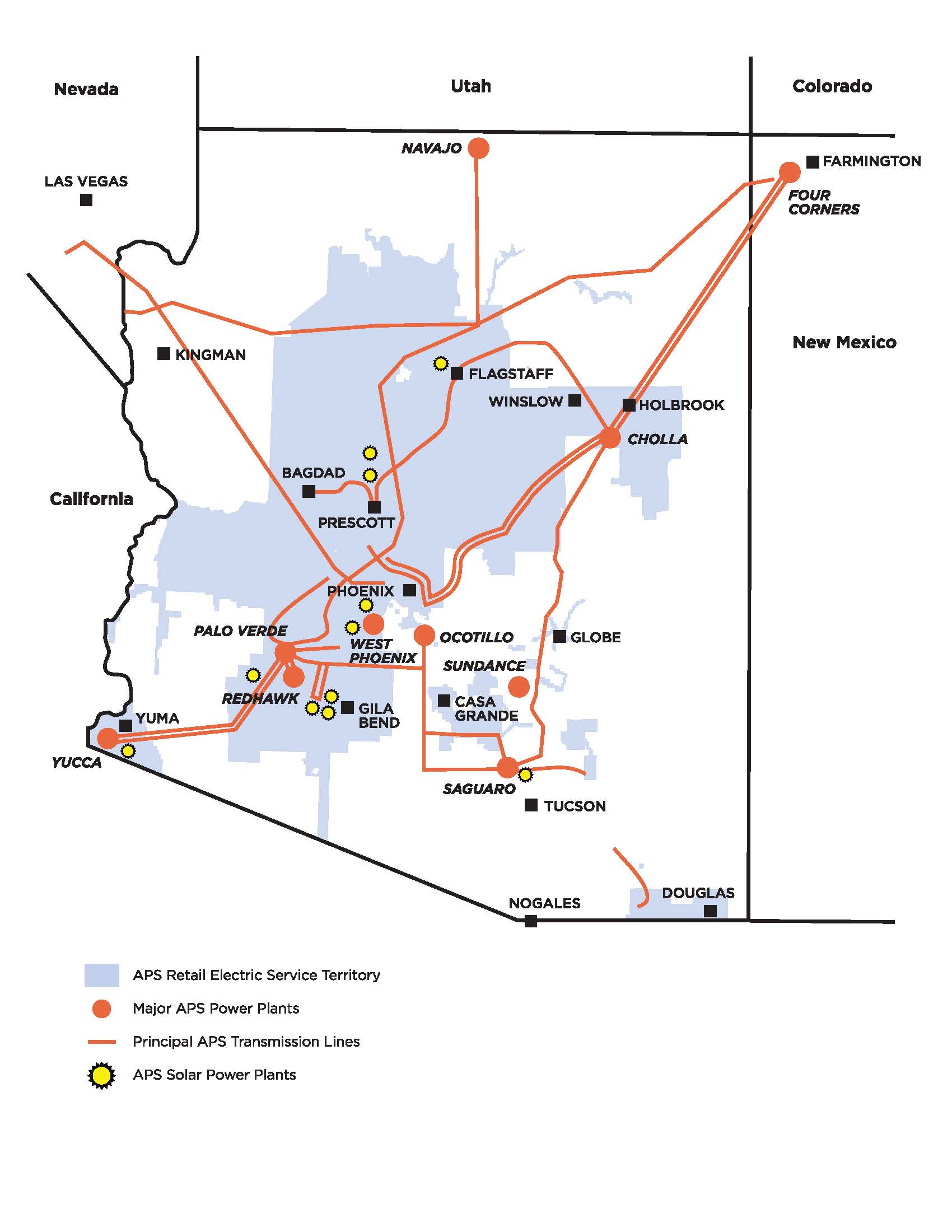
The following map shows APS’s retail service territory, including the locations of its generating facilities and principal transmission lines.
Energy Sources and Resource Planning
To serve its customers, APS obtains power through its various generation stations and through purchased power agreements. Resource planning is an important function necessary to meet Arizona’s future energy needs. APS’s sources of energy by type used to supply energy to Native Load customers during 2016 were as follows:

Generation Facilities
APS has ownership interests in or leases the coal, nuclear, gas, oil and solar generating facilities described below. For additional information regarding these facilities, see Item 2.
Coal-Fueled Generating Facilities
Four Corners — Four Corners is located in the northwestern corner of New Mexico, and was originally a 5-unit coal-fired power plant. APS owns 100% of Units 1, 2 and 3, which were retired as of December 30, 2013. APS operates the plant and owns 63% of Four Corners Units 4 and 5 following the acquisition of SCE’s interest in Units 4 and 5 described below. APS has a total entitlement from Four Corners of 970 MW. Additionally, 4CA, a wholly-owned subsidiary of Pinnacle West, owns 7% of Units 4 and 5 following its acquisition of El Paso's interest in these units described below.
On December 30, 2013, APS purchased SCE’s 48% interest in each of Units 4 and 5 of Four Corners. The final purchase price for the interest was approximately $182 million. In connection with APS’s prior retail
rate case with the ACC, the ACC reserved the right to review the prudence of the Four Corners transaction for cost recovery purposes upon the closing of the transaction. On December 23, 2014, the ACC approved rate adjustments related to APS’s acquisition of SCE’s interest in Four Corners resulting in a revenue increase of $57.1 million on an annual basis. On February 23, 2015, the ACC decision approving the rate adjustments was appealed. APS has intervened and is actively participating in the proceeding. The Arizona Court of Appeals suspended the appeal pending the Arizona Supreme Court's decision in the System Improvement Benefits ("SIB") matter discussed in Note 3. On August 8, 2016, the Arizona Supreme Court issued its opinion in the SIB matter, and the Arizona Court of Appeals has now ordered supplemental briefing on how that SIB decision should affect the challenge to the Four Corners rate adjustment. We cannot predict when or how this matter will be resolved.
Concurrently with the closing of the SCE transaction, BHP Billiton, the parent company of BNCC, the coal supplier and operator of the mine that serves Four Corners, transferred its ownership of BNCC to NTEC, a company formed by the Navajo Nation to own the mine and develop other energy projects. BHP Billiton was retained by NTEC under contract as the mine manager and operator through 2016. Also occurring concurrently with the closing, the Four Corners’ co-owners executed a long-term agreement for the supply of coal to Four Corners from July 2016 through 2031 (the "2016 Coal Supply Agreement"). El Paso, a 7% owner in Units 4 and 5 of Four Corners, did not sign the 2016 Coal Supply Agreement. Under the 2016 Coal Supply Agreement, APS agreed to assume the 7% shortfall obligation. On February 17, 2015, APS and El Paso entered into an asset purchase agreement providing for the purchase by APS, or an affiliate of APS, of El Paso’s 7% interest in each of Units 4 and 5 of Four Corners. 4CA purchased the El Paso interest on July 6, 2016. The purchase price was immaterial in amount, and 4CA assumed El Paso's reclamation and decommissioning obligations associated with the 7% interest.
NTEC has the option to purchase the 7% interest within a certain timeframe pursuant to an option granted to NTEC. On December 29, 2015, NTEC provided notice of its intent to exercise the option. The 2016 Coal Supply Agreement contains alternate pricing terms for the 7% shortfall obligations in the event NTEC does not purchase the interest.
APS, on behalf of the Four Corners participants, negotiated amendments to an existing facility lease with the Navajo Nation, which extends the Four Corners leasehold interest from 2016 to 2041. The Navajo Nation approved these amendments in March 2011. The effectiveness of the amendments also required the approval of the DOI, as did a related federal rights-of-way grant. A federal environmental review was undertaken as part of the DOI review process, and culminated in the issuance by DOI of a record of decision on July 17, 2015 justifying the agency action extending the life of the plant and the adjacent mine.
On April 20, 2016, several environmental groups filed a lawsuit against OSM and other federal agencies in the District of Arizona in connection with their issuance of the approvals that extended the life of Four Corners and the adjacent mine. The lawsuit alleges that these federal agencies violated both the Endangered Species Act ("ESA") and the National Environmental Policy Act ("NEPA") in providing the federal approvals necessary to extend operations at Four Corners and the adjacent Navajo Mine past July 6, 2016. APS filed a motion to intervene in the proceedings, which was granted on August 3, 2016. Briefing on the merits of this litigation is expected to extend through May 2017. On September 15, 2016, NTEC, the company that owns the adjacent mine, filed a motion to intervene for the purpose of dismissing the lawsuit based on NTEC's tribal sovereign immunity. Because the court has placed a stay on all litigation deadlines pending its decision regarding NTEC's motion to dismiss, the schedule for briefing and the anticipated timeline for completion of this litigation will likely be extended. We cannot predict the outcome of this matter or its potential effect on Four Corners.
Cholla — Cholla was originally a 4-unit coal-fired power plant, which is located in northeastern Arizona. APS operates the plant and owns 100% of Cholla Units 1, 2 and 3. PacifiCorp owns Cholla Unit 4,
and APS operates that unit for PacifiCorp. On September 11, 2014, APS announced that it would close its 260 MW Unit 2 at Cholla and cease burning coal at Units 1 and 3 by the mid-2020s if EPA approves a compromise proposal offered by APS to meet required environmental and emissions standards and rules. On April 14, 2015, the ACC approved APS's plan to retire Unit 2, without expressing any view on the future recoverability of APS's remaining investment in the Unit. (See Note 3 for details related to the resulting regulatory asset and Note 10 for details of the proposal.) APS believes that the environmental benefits of this proposal are greater in the long-term than the benefits that would have resulted from adding the emissions control equipment. APS closed Unit 2 on October 1, 2015. Following the closure of Unit 2, APS has a total entitlement from Cholla of 387 MW.
On January 13, 2017, EPA approved a final rule incorporating APS's compromise approach. Once the final rule is published in the Federal Register, parties have 60 days to file a petition for review in the Ninth Circuit Court of Appeals. APS cannot predict at this time whether such petitions will be filed or if they will be successful. In addition, under the terms of an executive memorandum issued on January 20, 2017, this final rule will not be published in the Federal Register until after it has been reviewed by an appointee of the President. We cannot predict when such review will occur and what may result from the additional review.
APS purchases all of Cholla’s coal requirements from a coal supplier, an affiliate of Peabody Energy Corporation, that mines all of the coal under long-term leases of coal reserves with the federal and state governments and private landholders. On April 13, 2016, Peabody Energy Corporation and certain affiliated entities filed a petition for relief under chapter 11 of the Bankruptcy Code in the United States Bankruptcy Court for the Eastern District of Missouri. Under the Coal Supply Agreement, dated December 21, 2005, Peabody supplied coal to APS and PacifiCorp (collectively, the “Buyers”) for use at Cholla. APS believes that the Coal Supply Agreement terminated automatically on April 13, 2016 as a result of Peabody's bankruptcy filing. The Buyers filed a motion requesting that the Bankruptcy Court enter an order determining that the Buyers are authorized to enforce the termination provisions in the Coal Supply Agreement.
On May 13, 2016, Peabody filed a complaint against the Buyers in the bankruptcy court in which Peabody alleged that the Buyers breached the Coal Supply Agreement. On January 27, 2017, the bankruptcy court approved a settlement between the parties, and on February 6, 2017 the parties executed an amendment to the Coal Supply Agreement that allows for continuation of the agreement with modified terms and conditions acceptable to the parties.
APS has a long-term coal transportation by rail contract that expires in 2017.
Navajo Generating Station — The Navajo Plant is a 3-unit coal-fired power plant located in northern Arizona. Salt River Project operates the plant and APS owns a 14% interest in Navajo Units 1, 2 and 3. APS has a total entitlement from the Navajo Plant of 315 MW. The Navajo Plant’s coal requirements are purchased from a supplier with long-term leases from the Navajo Nation and the Hopi Tribe. The Navajo Plant is under contract with its coal supplier through 2019, with extension rights through 2026. The Navajo Plant site is leased from the Navajo Nation and is also subject to an easement from the federal government. The current lease expires in 2019.
On February 13, 2017, the co-owners of the Navajo Plant voted not to pursue continued operation of the plant beyond December 2019, the expiration of the current lease term, and to pursue a new lease or lease extension with the Navajo Nation that would allow decommissioning activities to begin after December 2019 instead of later this year. Various stakeholders including regulators, tribal representatives and others interested in the continued operation of the plant intend to meet to determine if an alternate solution can be reached that would permit continued operation of the plant beyond 2019. We cannot predict whether any alternate solutions will be found that would be acceptable to all of the stakeholders and feasible to implement. APS is currently
recovering depreciation and a return on the net book value of its interest in the Navajo Plant. APS will seek continued recovery in rates for the book value of its remaining investment in the plant ($108 million as of December 31, 2016) plus a return on the net book value as well as other costs related to retirement and closure, which are still being assessed and which may be material. We cannot predict whether APS would obtain such recovery.
On February 14, 2017, the ACC opened a docket titled "ACC Investigation Concerning the Future of the Navajo Generating Station" with the stated goal of engaging stakeholders and negotiating a sustainable pathway for the Navajo Plant to continue operating in some form after December 2019. APS cannot predict the outcome of this proceeding.
These coal-fueled plants face uncertainties, including those related to existing and potential legislation and regulation, that could significantly impact their economics and operations. See “Environmental Matters” below and “Management’s Discussion and Analysis of Financial Condition and Results of Operations — Overview and Capital Expenditures” in Item 7 for developments impacting these coal-fueled facilities. See Note 10 for information regarding APS’s coal mine reclamation obligations.
Nuclear
Palo Verde Nuclear Generating Station — Palo Verde is a 3-unit nuclear power plant located approximately 50 miles west of Phoenix, Arizona. APS operates the plant and owns 29.1% of Palo Verde Units 1 and 3 and approximately 17% of Unit 2. In addition, APS leases approximately 12.1% of Unit 2, resulting in a 29.1% combined ownership and leasehold interest in that unit. APS has a total entitlement from Palo Verde of 1,146 MW.
Palo Verde Leases — In 1986, APS entered into agreements with three separate lessor trust entities in order to sell and lease back approximately 42% of its share of Palo Verde Unit 2 and certain common facilities. The leaseback was originally scheduled to expire at the end of 2015 and contained options to renew the leases or to purchase the leased property for fair market value at the end of the lease terms. On July 7, 2014, APS exercised the fixed rate lease renewal options. The exercise of the renewal options resulted in APS retaining the assets through 2023 under one lease and 2033 under the other two leases. At the end of the lease renewal periods, APS will have the option to purchase the leased assets at their fair market value, extend the leases for up to two years, or return the assets to the lessors. See Note 18 for additional information regarding the Palo Verde Unit 2 sale leaseback transactions.
Palo Verde Operating Licenses — Operation of each of the three Palo Verde Units requires an operating license from the NRC. The NRC issued full power operating licenses for Unit 1 in June 1985, Unit 2 in April 1986 and Unit 3 in November 1987, and issued renewed operating licenses for each of the three units in April 2011, which extended the licenses for Units 1, 2 and 3 to June 2045, April 2046 and November 2047, respectively.
Palo Verde Fuel Cycle — The Palo Verde participants are continually identifying their future nuclear fuel resource needs and negotiating arrangements to fill those needs. The fuel cycle for Palo Verde is comprised of the following stages:
-
mining and milling of uranium ore to produce uranium concentrates;
-
conversion of uranium concentrates to uranium hexafluoride;
-
enrichment of uranium hexafluoride;
-
fabrication of fuel assemblies;
-
utilization of fuel assemblies in reactors; and
-
storage and disposal of spent nuclear fuel.
The Palo Verde participants have contracted for 100% of Palo Verde’s requirements for uranium concentrates and conversion services through 2018 and 45% of its requirements in 2019-2025. The participants have also contracted for 100% of Palo Verde’s enrichment services through 2020 and 20% of its enrichment services for 2021-2026; and all of Palo Verde’s fuel assembly fabrication services through 2024.
Spent Nuclear Fuel and Waste Disposal — The Nuclear Waste Policy Act of 1982 (“NWPA”) required the DOE to accept, transport, and dispose of spent nuclear fuel and high level waste generated by the nation’s nuclear power plants by 1998. The DOE’s obligations are reflected in a contract for Disposal of Spent Nuclear Fuel and/or High-Level Radioactive Waste (the “Standard Contract”) with each nuclear power plant. The DOE failed to begin accepting spent nuclear fuel by 1998. APS is directly and indirectly involved in several legal proceedings related to DOE’s failure to meet its statutory and contractual obligations regarding acceptance of spent nuclear fuel and high level waste.
APS Lawsuit for Breach of Standard Contract — In December 2003, APS, acting on behalf of itself and the participant owners of Palo Verde, filed a lawsuit against DOE in the United States Court of Federal Claims ("Court of Federal Claims") for damages incurred due to DOE’s breach of the Standard Contract. The Court of Federal Claims ruled in favor of APS and the Palo Verde participants in October 2010 and awarded $30.2 million in damages to APS and the Palo Verde participants for costs incurred through December 2006.
On December 19, 2012, APS, acting on behalf of itself and the participant owners of Palo Verde, filed a second breach of contract lawsuit against the DOE in the Court of Federal Claims. This lawsuit sought to recover damages incurred due to DOE’s breach of the Standard Contract for failing to accept Palo Verde’s spent nuclear fuel and high level waste from January 1, 2007 through June 30, 2011, as it was required to do pursuant to the terms of the Standard Contract and the Nuclear Waste Policy Act. On August 18, 2014, APS and DOE entered into a settlement agreement, stipulating to a dismissal of the lawsuit and payment of $57.4 million by DOE to the Palo Verde owners for certain specified costs incurred by Palo Verde during the period January 1, 2007 through June 30, 2011. APS’s share of this amount is $16.7 million. Amounts recovered in the lawsuit and settlement were recorded as adjustments to a regulatory liability and had no impact on the amount of reported net income. In addition, the settlement agreement provides APS with a method for submitting claims and getting recovery for costs incurred through December 31, 2016, which has been extended to December 31, 2019.
APS has submitted two claims pursuant to the terms of the August 18, 2014 settlement agreement, for two separate time periods during July 1, 2011 through June 30, 2015. The DOE has approved and paid $53.9 million for these claims (APS’s share is $15.7 million). The amounts recovered were primarily recorded as adjustments to a regulatory liability and had no impact on reported net income. APS's next claim pursuant to the terms of the August 18, 2014 settlement agreement was submitted to the DOE on October 31, 2016, and approved on February 1, 2017, in the amount $11.3 million (APS's share is $3.3 million). Payment for the claim is expected in the second quarter of 2017.
The One-Mill Fee — In 2011, the National Association of Regulatory Utility Commissioners and the Nuclear Energy Institute challenged DOE’s 2010 determination of the adequacy of the one tenth of a cent per kWh fee (the “one-mill fee”) paid by the nation’s commercial nuclear power plant owners pursuant to their individual obligations under the Standard Contract. This fee is recovered by APS in its retail rates. In June 2012, the U.S. Court of Appeals for the District of Columbia Circuit (the “D.C. Circuit”) held that DOE failed to conduct a sufficient fee analysis in making the 2010 determination. The D.C. Circuit remanded the 2010 determination to the Secretary of the DOE (“Secretary”) with instructions to conduct a new fee adequacy determination within six months. In February 2013, upon completion of DOE’s revised one-mill fee adequacy determination, the D.C. Circuit reopened the proceedings. On November 19, 2013, the D.C. Circuit found that the DOE did not conduct a legally adequate fee assessment and ordered the Secretary to notify Congress of his
intent to suspend collecting annual fees for nuclear waste disposal from nuclear power plant operators, as he is required to do pursuant to the NWPA and the D.C. Circuit’s order. On January 3, 2014, the Secretary notified Congress of his intention to suspend collection of the one-mill fee, subject to Congress’ disapproval. On May 16, 2014, the DOE notified all commercial nuclear power plant operators who are party to a Standard Contract that it reduced the one-mill fee to zero, thus effectively terminating the one-mill fee.
DOE’s Construction Authorization Application for Yucca Mountain — The DOE had planned to meet its NWPA and Standard Contract disposal obligations by designing, licensing, constructing, and operating a permanent geologic repository at Yucca Mountain, Nevada. In June 2008, the DOE submitted its Yucca Mountain construction authorization application to the NRC, but in March 2010, the DOE filed a motion to dismiss with prejudice the Yucca Mountain construction authorization application. Several interested parties have also intervened in the NRC proceeding. Additionally, a number of interested parties filed a variety of lawsuits in different jurisdictions around the country challenging the DOE’s authority to withdraw the Yucca Mountain construction authorization application and NRC’s cessation of its review of the Yucca Mountain construction authorization application. The cases have been consolidated into one matter at the D.C. Circuit. In August 2013, the D.C. Circuit ordered the NRC to resume its review of the application with available appropriated funds.
On October 16, 2014, the NRC issued Volume 3 of the safety evaluation report developed as part of the Yucca Mountain construction authorization application. This volume addresses repository safety after permanent closure, and its issuance is a key milestone in the Yucca Mountain licensing process. Volume 3 contains the staff’s finding that the DOE’s repository design meets the requirements that apply after the repository is permanently closed, including but not limited to the post-closure performance objectives in NRC’s regulations.
On December 18, 2014, the NRC issued Volume 4 of the safety evaluation report developed as part of the Yucca Mountain construction authorization application. This volume covers administrative and programmatic requirements for the repository. It documents the staff’s evaluation of whether the DOE’s research and development and performance confirmation programs, as well as other administrative controls and systems, meet applicable NRC requirements. Volume 4 contains the staff’s finding that most administrative and programmatic requirements in NRC regulations are met, except for certain requirements relating to ownership of land and water rights.
Publication of Volumes 3 and 4 does not signal whether or when the NRC might authorize construction of the repository.
Waste Confidence and Continued Storage — On June 8, 2012, the D.C. Circuit issued its decision on a challenge by several states and environmental groups of the NRC’s rulemaking regarding temporary storage and permanent disposal of high level nuclear waste and spent nuclear fuel. The petitioners had challenged the NRC’s 2010 update to the agency’s Waste Confidence Decision and temporary storage rule (“Waste Confidence Decision”).
The D.C. Circuit found that the agency’s 2010 Waste Confidence Decision update constituted a major federal action, which, consistent with NEPA, requires either an environmental impact statement or a finding of no significant impact from the agency’s actions. The D.C. Circuit found that the NRC’s evaluation of the environmental risks from spent nuclear fuel was deficient, and therefore remanded the 2010 Waste Confidence Decision update for further action consistent with NEPA.
On September 6, 2012, the NRC Commissioners issued a directive to the NRC staff to proceed directly with development of a generic environmental impact statement to support an updated Waste Confidence
Decision. The NRC Commissioners also directed the staff to establish a schedule to publish a final rule and environmental impact study within 24 months of September 6, 2012.
In September 2013, the NRC issued its draft Generic Environmental Impact Statement (“GEIS”) to support an updated Waste Confidence Decision. On August 26, 2014, the NRC approved a final rule on the environmental effects of continued storage of spent nuclear fuel. Renamed as the Continued Storage Rule, the NRC’s decision adopted the findings of the GEIS regarding the environmental impacts of storing spent fuel at any reactor site after the reactor’s licensed period of operations. As a result, those generic impacts do not need to be re-analyzed in the environmental reviews for individual licenses. Although Palo Verde had not been involved in any licensing actions affected by the D.C. Circuit’s June 8, 2012, decision, the NRC lifted its suspension on final licensing actions on all nuclear power plant licenses and renewals that went into effect when the D.C. Circuit issued its June 2012 decision. The final Continued Storage Rule was subject to continuing legal challenges before the NRC and the Court of Appeals. In June 2016, the D.C. Circuit issued its final decision, rejecting all remaining legal challenges to the Continued Storage Rule. On August 8, 2016, the D.C. Circuit denied a petition for rehearing.
Palo Verde has sufficient capacity at its on-site independent spent fuel storage installation (“ISFSI”) to store all of the nuclear fuel that will be irradiated during the initial operating license period, which ends in December 2027. Additionally, Palo Verde has sufficient capacity at its on-site ISFSI to store a portion of the fuel that will be irradiated during the period of extended operation, which ends in November 2047. If uncertainties regarding the United States government’s obligation to accept and store spent fuel are not favorably resolved, APS will evaluate alternative storage solutions that may obviate the need to expand the ISFSI to accommodate all of the fuel that will be irradiated during the period of extended operation.
Nuclear Decommissioning Costs — APS currently relies on an external sinking fund mechanism to meet the NRC financial assurance requirements for decommissioning its interests in Palo Verde Units 1, 2 and 3. The decommissioning costs of Palo Verde Units 1, 2 and 3 are currently included in APS’s ACC jurisdictional rates. Decommissioning costs are recoverable through a non-bypassable system benefits charge (paid by all retail customers taking service from the APS system). Based on current nuclear decommissioning trust asset balances, site specific decommissioning cost studies, anticipated future contributions to the decommissioning trusts, and return projections on the asset portfolios over the expected remaining operating life of the facility, we are on track to meet the current site specific decommissioning costs for Palo Verde at the time the units are expected to be decommissioned. See Note 19 for additional information about APS’s nuclear decommissioning trusts.
Palo Verde Liability and Insurance Matters — See “Palo Verde Nuclear Generating Station — Nuclear Insurance” in Note 10 for a discussion of the insurance maintained by the Palo Verde participants, including APS, for Palo Verde.
Natural Gas and Oil Fueled Generating Facilities
APS has six natural gas power plants located throughout Arizona, consisting of Redhawk, located near Palo Verde; Ocotillo, located in Tempe (discussed below); Sundance, located in Coolidge; West Phoenix, located in southwest Phoenix; Saguaro, located north of Tucson; and Yucca, located near Yuma. Several of the units at Yucca run on either gas or oil. APS has one oil-only power plant, Douglas, located in the town of Douglas, Arizona. APS owns and operates each of these plants with the exception of one oil-only combustion turbine unit and one oil and gas steam unit at Yucca that are operated by APS and owned by the Imperial Irrigation District. APS has a total entitlement from these plants of 3,179 MW. Gas for these plants is financially hedged up to three years in advance of purchasing and the gas is generally purchased one month prior to delivery. APS has long-term gas transportation agreements with three different companies, some of
which are effective through 2024. Fuel oil is acquired under short-term purchases delivered primarily to West Phoenix, where it is distributed to APS’s other oil power plants by truck.
Ocotillo is a 330 MW 4-unit gas plant located in the metropolitan Phoenix area. In early 2014, APS announced a project to modernize the plant, which involves retiring two older 110 MW steam units, adding five 102 MW combustion turbines and maintaining two existing 55 MW combustion turbines. In total, this increases the capacity of the site by 290 MW, to 620 MW, with completion targeted by summer 2019. (See Note 3 for proposed rate recovery in our current retail rate case.) On September 9, 2016, Maricopa County issued a final permit decision that authorizes construction of the Ocotillo modernization project and construction will begin in early 2017.
Solar Facilities
APS developed utility scale solar resources through the 170 MW ACC-approved AZ Sun Program. APS invested approximately $675 million in its AZ Sun Program. These facilities are owned by APS and are located in multiple locations throughout Arizona. In 2016, APS developed the 40MW Red Rock Solar Plant, which it owns and operates. Two of our large customers will purchase renewable energy credits from APS that is equivalent to the amount of renewable energy that Red Rock is projected to generate.
Additionally, APS owns and operates more than forty small solar systems around the state. Together they have the capacity to produce approximately 4 MW of renewable energy. This fleet of solar systems includes a 3 MW facility located at the Prescott Airport and 1 MW of small solar in various locations across Arizona. APS has also developed solar photovoltaic distributed energy systems installed as part of the Community Power Project in Flagstaff, Arizona. The Community Power Project, approved by the ACC on April 1, 2010, is a pilot program through which APS owns, operates and receives energy from approximately 1 MW of solar photovoltaic distributed energy systems located within a certain test area in Flagstaff, Arizona. Additionally, APS owns 12 MW of solar photovoltaic systems installed across Arizona through the ACC-approved Schools and Government Program.
In December 2014, the ACC voted that it had no objection to APS implementing an APS-owned rooftop solar research and development program aimed at learning how to efficiently enable the integration of rooftop solar and battery storage with the grid. The first stage of the program, called the "Solar Partner Program," placed 8 MW of residential rooftop solar on strategically selected distribution feeders in an effort to maximize potential system benefits, as well as made systems available to limited-income customers who could not easily install solar through transactions with third parties. The second stage of the program, which included an additional 2 MW of rooftop solar and energy storage, placed two energy storage systems sized at 2 MW on two different high solar penetration feeders to test various grid-related operation improvements and system interoperability, and was in operation by the end of 2016. The ACC expressly reserved that any determination of prudency of the residential rooftop solar program for rate making purposes would not be made until the project was fully in service, and APS has requested cost recovery for the project in its currently pending rate case. On September 30, 2016, APS presented its preliminary findings from the residential rooftop solar program in a filing with the ACC.
Purchased Power Contracts
In addition to its own available generating capacity, APS purchases electricity under various arrangements, including long-term contracts and purchases through short-term markets to supplement its owned or leased generation and hedge its energy requirements. A portion of APS’s purchased power expense is netted against wholesale sales on the Consolidated Statements of Income. (See Note 16.) APS continually assesses its need for additional capacity resources to assure system reliability.
Purchased Power Capacity — APS’s purchased power capacity under long-term contracts as of December 31, 2016 is summarized in the table below. All capacity values are based on net capacity unless otherwise noted.
| Type | Dates Available | Capacity (MW) | |||
| Purchase Agreement (a) | Year-round through June 14, 2020 | 60 | |||
| Exchange Agreement (b) | May 15 to September 15 annually through February 2021 | 480 | |||
| Tolling Agreement | Year-round through May 2017 | 514 | |||
| Tolling Agreement | Summer seasons through October 2019 | 560 | |||
| Demand Response Agreement (c) | Summer seasons through 2024 | 25 | |||
| Tolling Agreement (d) | Summer seasons from Summer 2020 through Summer 2025 | 565 | |||
| Renewable Energy (e) | Various | 629 |
| (a) | Up to 60 MW of capacity is available; however, the amount of electricity available to APS under this agreement is based in large part on customer demand and is adjusted annually. |
| (b) | This is a seasonal capacity exchange agreement under which APS receives electricity during the summer peak season (from May 15 to September 15) and APS returns a like amount of electricity during the winter season (from October 15 to February 15). |
| (c) | The capacity under this agreement may be increased in 5 MW increments in each of 2015 and 2016 and 10 MW increments in years 2017 through 2024, up to a maximum of 50 MW. |
| (d) | This agreement was signed in response to APS's 2016 all source request for proposal seeking capacity resources. |
| (e) | Renewable energy purchased power agreements are described in detail below under “Current and Future Resources — Renewable Energy Standard — Renewable Energy Portfolio.” |
Current and Future Resources
Current Demand and Reserve Margin
Electric power demand is generally seasonal. In Arizona, demand for power peaks during the hot summer months. APS’s 2016 peak one-hour demand on its electric system was recorded on June 19, 2016 at 7,051 MW, compared to the 2015 peak of 7,031 MW recorded on August 15, 2015. APS’s reserve margin at the time of the 2016 peak demand, calculated using system load serving capacity, was 30%. For 2017, due to expiring purchase contracts, APS is procuring market resources to maintain its minimum 15% planning reserve criteria.
Future Resources and Resource Plan
APS filed its preliminary 2017 Integrated Resource Plan on March 1, 2016 and an updated preliminary 2017 Integrated Resource Plan on September 30, 2016. APS also held stakeholder meetings in February and November 2016 in addition to an ACC-led Integrated Resource Plan workshop in July 2016. The preliminary Integrated Resource Plan and associated stakeholder meetings are part of a modified planning process that allows time to incorporate implications of the Clean Power Plan as well as input from stakeholder meetings. The final Integrated Resource Plan will be submitted by or on April 3, 2017 and the ACC is expected to complete its review by February 1, 2018.
On September 11, 2014, APS announced that it would close Cholla Unit 2 and cease burning coal at the other APS-owned units (Units 1 and 3) at the plant by the mid-2020s, if EPA approves a compromise proposal offered by APS to meet required environmental and emissions standards and rules. On April 14, 2015, the ACC approved APS's plan to retire Unit 2, without expressing any view on the future recoverability of APS's remaining investment in the Unit. APS closed Unit 2 on October 1, 2015. Previously, APS estimated Cholla
Unit 2’s end of life to be 2033. APS is currently recovering a return on and of the net book value of the unit in base rates and is seeking recovery of the unit’s decommissioning and other retirement-related costs over the remaining life of the plant in its current retail rate case. APS believes it will be allowed recovery of the remaining net book value of Unit 2 ($116 million as of December 31, 2016), in addition to a return on its investment. In accordance with GAAP, in the third quarter of 2014, Unit 2’s remaining net book value was reclassified from property, plant and equipment to a regulatory asset. If the ACC does not allow full recovery of the remaining net book value of Cholla Unit 2, all or a portion of the regulatory asset will be written off and APS’s net income, cash flows, and financial position will be negatively impacted. (See "Business of Arizona Public Service Company - Energy Sources and Resource Planning - Generation Facilities - Coal-Fueled Generating Facilities - Cholla" above for details regarding the status of the EPA's rule related to Cholla.)
See "Business of Arizona Public Service Company - Energy Sources and Resource Planning - Generation Facilities - Coal-Fueled Generating Facilities - Navajo Generating Station" above for information regarding future plans for the Navajo Plant.
Energy Imbalance Market
In 2015, APS and the CAISO, the operator for the majority of California's transmission grid, signed an agreement for APS to begin participation in the Energy Imbalance Market (“EIM”). APS's participation in the EIM began on October 1, 2016. The EIM allows for rebalancing supply and demand in 15-minute blocks with dispatching every five minutes before the energy is needed, instead of the traditional one hour blocks. APS expects that its participation in EIM will lower its fuel costs, improve visibility and situational awareness for system operations in the Western Interconnection power grid, and improve integration of APS’s renewable resources.
Renewable Energy Standard
In 2006, the ACC adopted the RES. Under the RES, electric utilities that are regulated by the ACC must supply an increasing percentage of their retail electric energy sales from eligible renewable resources, including solar, wind, biomass, biogas and geothermal technologies. The renewable energy requirement is 7% of retail electric sales in 2017 and increases annually until it reaches 15% in 2025. In APS’s 2009 retail rate case settlement agreement (the “2009 Settlement Agreement”), APS committed to have 1,700 GWh of new renewable resources in service by year-end 2015 in addition to its RES renewable resource commitments. APS met its settlement commitment and RES target for 2016.
A component of the RES is focused on stimulating development of distributed energy systems. Accordingly, under the RES, an increasing percentage of that requirement must be supplied from distributed energy resources. This distributed energy requirement is 30% of the overall RES requirement of 7% in 2017. The following table summarizes the RES requirement standard (not including the additional commitment required by the 2009 Settlement Agreement) and its timing:
| 2017 | 2020 | 2025 | |||
| RES as a % of retail electric sales | 7% | 10% | 15% | ||
| Percent of RES to be supplied from distributed energy resources | 30% | 30% | 30% |
On April 21, 2015, the RES rules were amended to require utilities to report on all eligible renewable resources in their service territory, irrespective of whether the utility owns renewable energy credits associated with such renewable energy. The rules allow the ACC to consider such information in determining whether APS has satisfied the requirements of the RES.
Renewable Energy Portfolio. To date, APS has a diverse portfolio of existing and planned renewable resources totaling 1,480 MW, including solar, wind, geothermal, biomass and biogas. Of this portfolio, 1,440 MW are currently in operation and 40 MW are under contract for development or are under construction. Renewable resources in operation include 239 MW of facilities owned by APS, 629 MW of long-term purchased power agreements, and an estimated 539 MW of customer-sited, third-party owned distributed energy resources.
APS’s strategy to achieve its RES requirements includes executing purchased power contracts for new facilities, ongoing development of distributed energy resources and procurement of new facilities to be owned by APS. See "Energy Sources and Resource Planning - Generation Facilities - Solar Facilities" above for information regarding APS-owned solar facilities.
The following table summarizes APS’s renewable energy sources currently in operation and under development. Agreements for the development and completion of future resources are subject to various conditions, including successful siting, permitting and interconnection of the projects to the electric grid.
| Location | Actual/ Target Commercial Operation Date | Term (Years) | Net Capacity In Operation (MW AC) | Net Capacity Planned/Under Development (MW AC) | ||||||||||
| APS Owned | ||||||||||||||
| Solar: | ||||||||||||||
| AZ Sun Program: | ||||||||||||||
| Paloma | Gila Bend, AZ | 2011 | 17 | |||||||||||
| Cotton Center | Gila Bend, AZ | 2011 | 17 | |||||||||||
| Hyder Phase 1 | Hyder, AZ | 2011 | 11 | |||||||||||
| Hyder Phase 2 | Hyder, AZ | 2012 | 5 | |||||||||||
| Chino Valley | Chino Valley, AZ | 2012 | 19 | |||||||||||
| Hyder II | Hyder, AZ | 2013 | 14 | |||||||||||
| Foothills | Yuma, AZ | 2013 | 35 | |||||||||||
| Gila Bend | Gila Bend, AZ | 2014 | 32 | |||||||||||
| Luke AFB | Glendale, AZ | 2015 | 10 | |||||||||||
| Desert Star | Buckeye, AZ | 2015 | 10 | |||||||||||
| Subtotal AZ Sun Program | 170 | — | ||||||||||||
| Multiple Facilities | AZ | Various | 4 | |||||||||||
| Red Rock | Red Rock, AZ | 2016 | 40 | |||||||||||
| Distributed Energy: | ||||||||||||||
| APS Owned (a) | AZ | Various | 25 | |||||||||||
| Total APS Owned | 239 | — | ||||||||||||
| Purchased Power Agreements | ||||||||||||||
| Solar: | ||||||||||||||
| Solana | Gila Bend, AZ | 2013 | 30 | 250 | ||||||||||
| RE Ajo | Ajo, AZ | 2011 | 25 | 5 | ||||||||||
| Sun E AZ 1 | Prescott, AZ | 2011 | 30 | 10 | ||||||||||
| Saddle Mountain | Tonopah, AZ | 2012 | 30 | 15 | ||||||||||
| Badger | Tonopah, AZ | 2013 | 30 | 15 | ||||||||||
| Gillespie | Maricopa County, AZ | 2013 | 30 | 15 | ||||||||||
| Wind: | ||||||||||||||
| Aragonne Mesa | Santa Rosa, NM | 2006 | 20 | 90 | ||||||||||
| High Lonesome | Mountainair, NM | 2009 | 30 | 100 | ||||||||||
| Perrin Ranch Wind | Williams, AZ | 2012 | 25 | 99 | ||||||||||
| Geothermal: | ||||||||||||||
| Salton Sea | Imperial County, CA | 2006 | 23 | 10 | ||||||||||
| Biomass: | ||||||||||||||
| Snowflake | Snowflake, AZ | 2008 | 15 | 14 | ||||||||||
| Biogas: | ||||||||||||||
| Glendale Landfill | Glendale, AZ | 2010 | 20 | 3 | ||||||||||
| NW Regional Landfill | Surprise, AZ | 2012 | 20 | 3 | ||||||||||
| Total Purchased Power Agreements | 629 | — | ||||||||||||
| Distributed Energy | ||||||||||||||
| Solar (b) | ||||||||||||||
| Third-party Owned | AZ | Various | 539 | 40 | ||||||||||
| Agreement 1 | Bagdad, AZ | 2011 | 25 | 15 | ||||||||||
| Agreement 2 | AZ | 2011-2012 | 20-21 | 18 | ||||||||||
| Total Distributed Energy | 572 | 40 | ||||||||||||
| Total Renewable Portfolio | 1,440 | 40 |
| (a) | Includes Flagstaff Community Power Project, APS School and Government Program and APS Solar Partner Program. |
| (b) | Includes rooftop solar facilities owned by third parties. Distributed generation is produced in DC and is converted to AC for reporting purposes. |
Demand Side Management
In December 2009, Arizona regulators placed an increased focus on energy efficiency and other demand side management programs to encourage customers to conserve energy, while incentivizing utilities to aid in these efforts that ultimately reduce the demand for energy. The ACC initiated its Energy Efficiency rulemaking, with a proposed Energy Efficiency Standard (“EES”) of 22% cumulative annual energy savings by 2020. This standard was adopted and became effective on January 1, 2011. This standard will likely impact Arizona’s future energy resource needs. (See Note 3 for energy efficiency and other demand side management obligations).
Competitive Environment and Regulatory Oversight
Retail
The ACC regulates APS’s retail electric rates and its issuance of securities. The ACC must also approve any significant transfer or encumbrance of APS’s property used to provide retail electric service and approve or receive prior notification of certain transactions between Pinnacle West, APS and their respective affiliates.
APS is subject to varying degrees of competition from other investor-owned electric and gas utilities in Arizona (such as Southwest Gas Corporation), as well as cooperatives, municipalities, electrical districts and similar types of governmental or non-profit organizations. In addition, some customers, particularly industrial and large commercial customers, may own and operate generation facilities to meet some or all of their own energy requirements. This practice is becoming more popular with customers installing or having installed products such as rooftop solar panels to meet or supplement their energy needs.
On April 14, 2010, the ACC issued a decision holding that solar vendors that install and operate solar facilities for non-profit schools and governments pursuant to a specific type of contract that calculates payments based on the energy produced are not “public service corporations” under the Arizona Constitution, and are therefore not regulated by the ACC. APS cannot predict when, and the extent to which, additional electric service providers will enter or re-enter APS’s service territory.
On May 9, 2013, the ACC voted to re-examine the facilitation of a deregulated retail electric market in Arizona. The ACC subsequently opened a docket for this matter and received comments from a number of interested parties on the considerations involved in establishing retail electric deregulation in the state. One of these considerations was whether various aspects of a deregulated market, including setting utility rates on a “market” basis, would be consistent with the requirements of the Arizona Constitution. On September 11, 2013, after receiving legal advice from the ACC staff, the ACC voted 4-1 to close the current docket and await full Arizona Constitutional authority before any further examination of this matter. The motion approved by the ACC also included opening one or more new dockets in the future to explore options to offer more rate choices to customers and innovative changes within the existing cost-of-service regulatory model that could include elements of competition. The ACC opened a docket on November 4, 2013 to explore technological advances and innovative changes within the electric utility industry. A series of workshops in this docket were held in 2014 and another in February of 2015. No further workshops are scheduled and no actions were taken as a result of these workshops.
Wholesale
FERC regulates rates for wholesale power sales and transmission services. (See Note 3 for information regarding APS’s transmission rates.) During 2016, approximately 3.5% of APS’s electric operating revenues resulted from such sales and services. APS’s wholesale activity primarily consists of managing fuel and purchased power supplies to serve retail customer energy requirements. APS also sells, in the wholesale market, its generation output that is not needed for APS’s Native Load and, in doing so, competes with other utilities, power marketers and independent power producers. Additionally, subject to specified parameters, APS hedges both electricity and fuels. The majority of these activities are undertaken to mitigate risk in APS’s portfolio.
Subpoena from Arizona Corporation Commissioner Robert Burns
On August 25, 2016, Commissioner Burns, individually and not by action of the ACC as a whole, filed subpoenas in APS’s current retail rate proceeding to APS and Pinnacle West for the production of records and information relating to a range of expenditures from 2011 through 2016. The subpoenas requested information concerning marketing and advertising expenditures, charitable donations, lobbying expenses, contributions to 501(c)(3) and (c)(4) nonprofits and political contributions. The return date for the production of information was set as September 15, 2016. The subpoenas also sought testimony from Company personnel having knowledge of the material, including the Chief Executive Officer.
On September 9, 2016, APS filed with the ACC a motion to quash the subpoenas or, alternatively to stay APS's obligations to comply with the subpoenas and decline to decide APS's motion pending court proceedings. Contemporaneously with the filing of this motion, APS and Pinnacle West filed a complaint for special action and declaratory judgment in the Superior Court of Arizona for Maricopa County, seeking a declaratory judgment that Commissioner Burns’ subpoenas are contrary to law. On September 15, 2016, APS produced all non-confidential and responsive documents and offered to produce any remaining responsive documents that are confidential after an appropriate confidentiality agreement is signed.
On February 7, 2017, Commissioner Burns opened a new ACC docket and indicated that its purpose is to study and rectify problems with transparency and disclosure regarding financial contributions from regulated monopolies or other stakeholders who may appear before the ACC that may directly or indirectly benefit an ACC Commissioner, a candidate for ACC Commissioner, or key ACC staff. As part of this docket, Commissioner Burns set March 24, 2017 as a deadline for APS to produce all information previously requested through the subpoenas. Commissioner Burns has also scheduled a workshop in this matter for March 17, 2017. APS and Pinnacle West cannot predict the outcome of this matter.
Environmental Matters
Climate Change
Legislative Initiatives. There have been no recent attempts by Congress to pass legislation that would regulate greenhouse gas ("GHG") emissions, and it is doubtful whether the 115th Congress will consider a climate change bill. In the event climate change legislation ultimately passes, the actual economic and operational impact of such legislation on APS depends on a variety of factors, none of which can be fully known until a law is written, enacted and the specifics of the resulting program are established. These factors include the terms of the legislation with regard to allowed GHG emissions; the cost to reduce emissions; in the event a cap-and-trade program is established, whether any permitted emissions allowances will be allocated to source operators free of cost or auctioned (and, if so, the cost of those allowances in the marketplace) and
whether offsets and other measures to moderate the costs of compliance will be available; and, in the event of a carbon tax, the amount of the tax per pound of carbon dioxide (“CO2”) equivalent emitted.
In addition to federal legislative initiatives, state-specific initiatives may also impact our business. While Arizona has no pending legislation and no proposed agency rule regulating GHGs in Arizona, the California legislature enacted AB 32 and SB 1368 in 2006 to address GHG emissions. In October 2011, the California Air Resources Board approved final regulations that established a state-wide cap on GHG emissions beginning on January 1, 2013 and established a GHG allowance trading program under that cap. The first phase of the program, which applies to, among other entities, importers of electricity, commenced on January 1, 2013. Under the program, entities selling electricity into California, including APS, must hold carbon allowances to cover GHG emissions associated with electricity sales into California from outside the state. APS is authorized to recover the cost of these carbon allowances through the PSA.
Regulatory Initiatives. In 2009, EPA determined that GHG emissions endanger public health and welfare. As a result of this “endangerment finding,” EPA determined that the Clean Air Act required new regulatory requirements for new and modified major GHG emitting sources, including power plants. APS will generally be required to consider the impact of GHG emissions as part of its traditional New Source Review ("NSR") analysis for new major sources and major modifications to existing plants.
On June 2, 2014, EPA issued two proposed rules to regulate GHG emissions from modified and reconstructed electric generating units ("EGUs") pursuant to Section 111(b) of the Clean Air Act and existing fossil fuel-fired power plants pursuant to Clean Air Act Section 111(d).
On August 3, 2015, EPA finalized carbon pollution standards for existing, new, modified, and reconstructed EGUs. EPA’s final rules require newly built fossil fuel-fired EGUs, along with those undergoing modification or reconstruction, to meet CO2 performance standards based on a combination of best operating practices and equipment upgrades. EPA established separate performance standards for two types of EGUs: stationary combustion turbines, typically natural gas; and electric utility steam generating units, typically coal.
With respect to existing power plants, EPA’s recently finalized “Clean Power Plan” imposes state-specific goals or targets to achieve reductions in CO2 emission rates from existing EGUs measured from a 2012 baseline. In a significant change from the proposed rule, EPA’s final performance standards apply directly to specific units based upon their fuel-type and configuration (i.e., coal- or oil-fired steam plants versus combined cycle natural gas plants). As such, each state’s goal is an emissions performance standard that reflects the fuel mix employed by the EGUs in operation in those states. The final rule provides guidelines to states to help develop their plans for meeting the interim (2022-2029) and final (2030 and beyond) emission performance standards, with three distinct compliance periods within that timeframe. States were originally required to submit their plans to EPA by September 2016, with an optional two-year extension provided to states establishing a need for additional time; however, this timing will be impacted by the court-imposed stay described below.
Prior to the court-imposed stay described below, ADEQ, with input from a technical working group comprised of Arizona utilities and other stakeholders, was working to develop a compliance plan for submittal to EPA. Since the imposition of the stay, ADEQ is continuing to assess alternatives while completing outreach and soliciting feedback from stakeholders. In addition to these ongoing state proceedings, EPA has taken public comments on proposed model rules and a proposed federal compliance plan, which included consideration as to how the Clean Power Plan will apply to EGUs on tribal land such as the Navajo Nation.
The legality of the Clean Power Plan is being challenged in the U.S. Court of Appeals for the D.C. Circuit; the parties raising this challenge include, among others, the ACC. On February 9, 2016, the U.S.
Supreme Court granted a stay of the Clean Power Plan pending judicial review of the rule, which temporarily delays compliance obligations under the Clean Power Plan. We cannot predict the extent of the delay.
With respect to our Arizona generating units, we are currently evaluating the range of compliance options available to ADEQ, including whether Arizona deploys a rate- or mass-based compliance plan. Based on the fuel-mix and location of our Arizona EGUs, and the significant investments we have made in renewable generation and demand-side energy efficiency, if ADEQ selects a rate-based compliance plan, we believe that we will be able to comply with the Clean Power Plan for our Arizona generating units in a manner that will not have material financial or operational impacts to the Company. On the other hand, if ADEQ selects a mass-based approach to compliance with the Clean Power Plan, our annual cost of compliance could be material. These costs could include costs to acquire mass-based compliance allowances.
As to our facilities on the Navajo Nation, EPA has yet to determine whether or to what extent EGUs on the Navajo Nation will be required to comply with the Clean Power Plan. EPA has proposed to determine that it is necessary or appropriate to impose a federal plan on the Navajo Nation for compliance with the Clean Power Plan. In response, we filed comments with EPA advocating that such a federal plan is neither necessary nor appropriate to protect air quality on the Navajo Nation. If EPA reaches a determination that is consistent with our preferred approach for the Navajo Nation, we believe the Clean Power Plan will not have material financial or operational impacts on our operations within the Navajo Nation.
Alternatively, if EPA determines that a federal plan is necessary or appropriate for the Navajo Nation, and depending on our need for future operations at our EGUs located there, we may be unable to comply with the federal plan unless we acquire mass-based allowances or emission rate credits within established carbon trading markets, or curtail our operations. Subject to the uncertainties set forth below, and assuming that EPA establishes a federal plan for the Navajo Nation that requires carbon allowances or credits to be surrendered for plan compliance, it is possible we will be required to purchase some quantity of credits or allowances, the cost of which could be material.
Because ADEQ has not issued its plan for Arizona, and because we do not know whether EPA will decide to impose a plan or, if so, what that plan will require, there are a number of uncertainties associated with our potential cost exposure. These uncertainties include: whether judicial review will result in the Clean Power Plan being vacated in whole or in part or, if not, the extent of any resulting compliance deadline delays; whether any plan will be imposed for EGUs on the Navajo Nation; the future existence and liquidity of allowance or credit compliance trading markets; the applicability of existing contractual obligations with current and former owners of our participant-owned coal-fired EGUs; the type of federal or state compliance plan (either rate- or mass-based); whether or not the trading of allowances or credits will be authorized mechanisms for compliance with any final EPA or ADEQ plan; and how units that have been closed will be treated for allowance or credit allocation purposes.
In the event that the incurrence of compliance costs is not economically viable or prudent for our operations in Arizona or on the Navajo Nation, or if we do not have the option of acquiring allowances to account for the emissions from our operations, we may explore other options, including reduced levels of output or potential plant closures, as alternatives to purchasing allowances. Given these uncertainties, our analysis of the available compliance options remains ongoing, and additional information or considerations may arise that change our expectations.
Company Response to Climate Change Initiatives. We have undertaken a number of initiatives that address emission concerns, including renewable energy procurement and development, promotion of programs and rates that promote energy conservation, renewable energy use, and energy efficiency. (See “Energy Sources and Resource Planning - Current and Future Resources” above for details of these plans and
initiatives.) APS currently has a diverse portfolio of renewable resources, including solar, wind, geothermal, biogas, and biomass, and we expect the percentage of renewable energy in our resource portfolio to increase over the coming years.
APS prepares an inventory of GHG emissions from its operations. This inventory is reported to EPA under the EPA GHG Reporting Program and is voluntarily communicated to the public in Pinnacle West’s annual Corporate Responsibility Report, which is available on our website (www.pinnaclewest.com). The report provides information related to the Company and its approach to sustainability and its workplace and environmental performance. The information on Pinnacle West’s website, including the Corporate Responsibility Report, is not incorporated by reference into or otherwise a part of this report.
EPA Environmental Regulation
Regional Haze Rules. In 1999, EPA announced regional haze rules to reduce visibility impairment in national parks and wilderness areas. The rules require states (or, for sources located on tribal land, EPA) to determine what pollution control technologies constitute the BART for certain older major stationary sources, including fossil-fired power plants. EPA subsequently issued the Clean Air Visibility Rule, which provides guidelines on how to perform a BART analysis.
The Four Corners and Navajo Plant participants’ obligations to comply with EPA’s final BART determinations (and Cholla’s obligations to comply with ADEQ’s and EPA’s determinations), coupled with the financial impact of potential future climate change legislation, other environmental regulations, and other business considerations, could jeopardize the economic viability of these plants or the ability of individual participants to continue their participation in these plants.
Cholla. APS believes that EPA’s original 2012 final rule establishing controls constituting BART for Cholla, which would require installation of selective catalytic reduction ("SCR") controls with a cost to APS of approximately $100 million is unsupported and that EPA had no basis for disapproving Arizona’s State Implementation Plan ("SIP") and promulgating a Federal Implementation Plan ("FIP") that is inconsistent with the state’s considered BART determinations under the regional haze program. Accordingly, on February 1, 2013, APS filed a Petition for Review of the final BART rule in the United States Court of Appeals for the Ninth Circuit. Briefing in the case was completed in February 2014.
In September 2014, APS met with EPA to propose a compromise BART strategy. Pending certain regulatory approvals, APS would permanently close Cholla Unit 2 and cease burning coal at Units 1 and 3 by the mid-2020s. (See Note 3 for details related to the resulting regulatory asset.) APS made the proposal with the understanding that additional emission control equipment is unlikely to be required in the future because retiring and/or converting the units as contemplated in the proposal is more cost effective than, and will result in increased visibility improvement over, the current BART requirements for NOx imposed on the Cholla units under EPA's BART FIP. APS’s proposal involves state and federal rulemaking processes. In light of these ongoing administrative proceedings, on February 19, 2015, APS, PacifiCorp (owner of Cholla Unit 4), and EPA jointly moved the court to sever and hold in abeyance those claims in the litigation pertaining to Cholla pending regulatory actions by the state and EPA. The court granted the parties' unopposed motion on February 20, 2015.
On October 16, 2015, ADEQ issued a revised operating permit for Cholla, which incorporates APS's proposal, and subsequently submitted a proposed revision to the SIP to the EPA, which would incorporate the new permit terms. On June 30, 2016, EPA issued a proposed rule approving a revision to the Arizona SIP that incorporates APS’s compromise approach for compliance with the Regional Haze program. EPA signed the final rule approving the Agency's proposal on January 13, 2017. Once the final rule is published in the Federal Register, parties have 60 days to file a petition for review in the Ninth Circuit Court of Appeals. APS cannot
predict at this time whether such petitions will be filed or if they will be successful. In addition, under the terms of an executive memorandum issued on January 20, 2017, this final rule will not be published in the Federal Register until after it has been reviewed by an appointee of the President. We cannot predict when such review will occur and what may result from the additional review.
Four Corners. Based on EPA’s final standards, APS estimates that its 63% share of the cost of required controls for Four Corners Units 4 and 5 would be approximately $400 million. In addition, APS and El Paso entered into an asset purchase agreement providing for the purchase by APS, or an affiliate of APS, of El Paso's 7% interest in Four Corners Units 4 and 5. 4CA purchased the El Paso interest on July 6, 2016. NTEC has the option to purchase the interest within a certain timeframe pursuant to an option granted to NTEC. In December 2015, NTEC provided notice of its intent to exercise the option. The cost of the pollution controls related to the 7% interest is approximately $45 million, which will be assumed by the ultimate owner of the 7% interest.
Navajo Plant. On July 28, 2014, EPA issued a final Navajo Plant BART rule. APS estimates that its share of costs for upgrades at the Navajo Plant, based on EPA’s FIP, could be up to approximately $200 million. In October 2014, a coalition of environmental groups, an Indian tribe and others filed petitions for review in the United States Court of Appeals for the Ninth Circuit asking the Court to review EPA's final BART rule for the Navajo Plant. We cannot predict the outcome of this review process. See "Business of Arizona Public Service Company - Energy Sources and Resource Planning - Generation Facilities - Coal-Fueled Generating Facilities - Navajo Generating Station" above for information regarding future plans for the Navajo Plant.
Mercury and other Hazardous Air Pollutants. In 2011, EPA issued rules establishing maximum achievable control technology standards to regulate emissions of mercury and other hazardous air pollutants from fossil-fired plants. APS estimates that the cost for the remaining equipment necessary to meet these standards is approximately $8 million for Cholla. No additional equipment is needed for Four Corners Units 4 and 5 to comply with these rules. SRP, the operating agent for the Navajo Plant, estimates that APS's share of costs for equipment necessary to comply with the rules is approximately $1 million, the majority of which has already been incurred. Litigation concerning the rules, including supplemental analyses EPA has prepared in support of the MATS regulation, is ongoing. These proceedings do not materially impact APS. Regardless of the results from further judicial or administrative proceedings concerning the MATS rulemaking, the Arizona State Mercury Rule, the stringency of which is roughly equivalent to that of MATS, would still apply to Cholla.
Coal Combustion Waste. On December 19, 2014, EPA issued its final regulations governing the handling and disposal of CCR, such as fly ash and bottom ash. The rule regulates CCR as a non-hazardous waste under Subtitle D of the Resource Conservation and Recovery Act ("RCRA") and establishes national minimum criteria for existing and new CCR landfills and surface impoundments and all lateral expansions consisting of location restrictions, design and operating criteria, groundwater monitoring and corrective action, closure requirements and post closure care, and recordkeeping, notification, and Internet posting requirements. The rule generally requires any existing unlined CCR surface impoundment that is contaminating groundwater above a regulated constituent’s groundwater protection standard to stop receiving CCR and either retrofit or close, and further requires the closure of any CCR landfill or surface impoundment that cannot meet the applicable performance criteria for location restrictions or structural integrity. While EPA has chosen to regulate the disposal of CCR in landfills and surface impoundments as non-hazardous waste under the final rule, the agency makes clear that it will continue to evaluate any risks associated with CCR disposal and leaves open the possibility that it may regulate CCR as a hazardous waste under RCRA Subtitle C in the future.
On December 16, 2016, President Obama signed the Water Infrastructure Improvements for the Nation ("WIIN") Act into law, which contains a number of provisions requiring EPA to modify the self-implementing provisions of the Agency's current CCR rules under Subtitle D. Such modifications include new EPA authority to directly enforce the CCR rules through the use of administrative orders and providing states, like Arizona, where the Cholla facility is located, the option of developing CCR disposal unit permitting programs, subject to EPA approval. For facilities in states that do not develop state-specific permitting programs, EPA is required to develop a federal permit program, pending the availability of congressional appropriations. By contrast, for facilities located within the boundaries of Native American tribal reservations, such as the Navajo Nation, where the Navajo Plant and Four Corners facilities are located, EPA is required to develop a federal permit program regardless of appropriated funds. Because EPA has yet to undertake rulemaking proceedings to implement the CCR provisions of the WIIN Act, and Arizona has yet to determine whether it will develop a state-specific permitting program, it is unclear what effects the CCR provisions of the WIIN Act will have on APS's management of CCR.
APS currently disposes of CCR in ash ponds and dry storage areas at Cholla and Four Corners. APS estimates that its share of incremental costs to comply with the CCR rule for Four Corners is approximately $15 million. APS is currently evaluating compliance alternatives for Cholla and estimates that its share of incremental costs to comply with the CCR rule for this plant is in the range of $5 million to $40 million based upon which compliance alternatives are ultimately selected. The Navajo Plant currently disposes of CCR in a dry landfill storage area. APS estimates that its share of incremental costs to comply with the CCR rule for the Navajo Plant is approximately $1 million, the majority of which has already been incurred. Additionally, the CCR rule requires ongoing groundwater monitoring. Depending upon the results of such monitoring at each of Cholla, Four Corners and the Navajo Plant, we may be required to take corrective actions, the costs of which we are unable to reasonably estimate at this time.
Pursuant to a June 24, 2016 order by the D.C. Circuit Court of Appeals in the litigation by industry- and environmental-groups challenging EPA’s CCR regulations, within the next three years EPA is required to complete a rulemaking proceeding concerning whether or not boron must be included on the list of groundwater constituents that might trigger corrective action under EPA’s CCR rules. EPA is not required to take final action approving the inclusion of boron, but EPA must propose and consider its inclusion. Should EPA take final action adding boron to the list of groundwater constituents that might trigger corrective action, any resulting corrective action measures may increase APS's costs of compliance with the CCR rule at our coal-fired generating facilities. At this time, though, APS cannot predict when EPA will commence its rulemaking concerning boron or the eventual results of those proceedings.
Effluent Limitation Guidelines. On September 30, 2015, EPA finalized revised effluent limitation guidelines establishing technology-based wastewater discharge limitations for fossil-fired EGUs. EPA’s final regulation targets metals and other pollutants in wastewater streams originating from fly ash and bottom ash handling activities, scrubber activities, and coal ash disposal leachate. Based upon an earlier set of preferred alternatives, the final effluent limitations generally require chemical precipitation and biological treatment for flue gas desulfurization scrubber wastewater, “zero discharge” from fly ash and bottom ash handling, and impoundment for coal ash disposal leachate. Compliance with these limitations will be required in connection with National Pollution Discharge Elimination System ("NPDES") discharge permit renewals, which occur in five-year intervals, that arise between 2018 and 2023. Until a draft NPDES permit for Four Corners is proposed during that timeframe, we are uncertain what will be required to control these discharges in compliance with the finalized effluent limitations at that facility. Cholla and the Navajo Plant do not require NPDES permitting.
Ozone National Ambient Air Quality Standards. On October 1, 2015, EPA finalized revisions to the primary ground-level ozone national ambient air quality standards (“NAAQS”) at a level of 70 parts per billion
(“ppb”). With ozone standards becoming more stringent, our fossil generation units will come under increasing pressure to reduce emissions of nitrogen oxides and volatile organic compounds, and to generate emission offsets for new projects or facility expansions located in ozone nonattainment areas. EPA is expected to designate attainment and nonattainment areas relative to the new 70 ppb standard by October 1, 2017. Depending on when EPA approves attainment designations for the Arizona and Navajo Nation jurisdictions in which our fossil generation units are located, revisions to SIPs and FIPs, respectively, implementing required controls to achieve the new 70 ppb standard are expected to be in place between 2020 and 2021. At this time, because proposed SIPs and FIPs implementing the revised ozone NAAQSs have yet to be released, APS is unable to predict what impact the adoption of these standards may have on the Company. APS will continue to monitor these standards as they are implemented within the jurisdictions affecting APS.
Superfund-Related Matters. The Comprehensive Environmental Response Compensation and Liability Act ("Superfund") establishes liability for the cleanup of hazardous substances found contaminating the soil, water or air. Those who generated, transported or disposed of hazardous substances at a contaminated site are among those who are potentially responsible parties ("PRPs"). PRPs may be strictly, and often are jointly and severally, liable for clean-up. On September 3, 2003, EPA advised APS that EPA considers APS to be a PRP in the Motorola 52nd Street Superfund Site, Operable Unit 3 ("OU3") in Phoenix, Arizona. APS has facilities that are within this Superfund site. APS and Pinnacle West have agreed with EPA to perform certain investigative activities of the APS facilities within OU3. In addition, on September 23, 2009, APS agreed with EPA and one other PRP to voluntarily assist with the funding and management of the site-wide groundwater remedial investigation and feasibility study work plan ("RI/FS"). The OU3 working group parties have agreed to a schedule with EPA that calls for the submission of a revised draft RI/FS by June 2017. We estimate that our costs related to this investigation and study will be approximately $2 million. We anticipate incurring additional expenditures in the future, but because the overall investigation is not complete and ultimate remediation requirements are not yet finalized, at the present time expenditures related to this matter cannot be reasonably estimated.
On August 6, 2013, the Roosevelt Irrigation District ("RID") filed a lawsuit in Arizona District Court against APS and 24 other defendants, alleging that RID’s groundwater wells were contaminated by the release of hazardous substances from facilities owned or operated by the defendants. The lawsuit also alleges that, under Superfund laws, the defendants are jointly and severally liable to RID. The allegations against APS arise out of APS’s current and former ownership of facilities in and around OU3. As part of a state governmental investigation into groundwater contamination in this area, on January 25, 2015, ADEQ sent a letter to APS seeking information concerning the degree to which, if any, APS’s current and former ownership of these facilities may have contributed to groundwater contamination in this area. APS responded to ADEQ on May 4, 2015. On December 16, 2016, two RID contractors filed ancillary lawsuits for recovery of costs against APS and the other defendants. We are unable to predict the outcome of these matters; however, we do not expect the outcome to have a material impact on our financial position, results of operations or cash flows.
Manufactured Gas Plant Sites. Certain properties which APS now owns or which were previously owned by it or its corporate predecessors were at one time sites of, or sites associated with, manufactured gas plants. APS is taking action to voluntarily remediate these sites. APS does not expect these matters to have a material adverse effect on its financial position, results of operations or cash flows.
Federal Agency Environmental Lawsuit Related to Four Corners
On April 20, 2016, several environmental groups filed a lawsuit against OSM and other federal agencies in the District of Arizona in connection with their issuance of the approvals that extended the life of Four Corners and the adjacent mine. The lawsuit alleges that these federal agencies violated both the ESA and NEPA in providing the federal approvals necessary to extend operations at the Four Corners Power Plant and
the adjacent Navajo Mine past July 6, 2016. APS filed a motion to intervene in the proceedings, which was granted on August 3, 2016. Briefing on the merits of this litigation is expected to extend through May 2017. On September 15, 2016, NTEC, the company that owns the adjacent mine, filed a motion to intervene for the purpose of dismissing the lawsuit based on NTEC's tribal sovereign immunity. Because the court has placed a stay on all litigation deadlines pending its decision regarding NTEC's motion to dismiss, the schedule for briefing and the anticipated timeline for completion of this litigation will likely be extended. We cannot predict the outcome of this matter or its potential effect on Four Corners.
Navajo Nation Environmental Issues
Four Corners and the Navajo Plant are located on the Navajo Reservation and are held under easements granted by the federal government, as well as leases from the Navajo Nation. See “Energy Sources and Resource Planning - Generation Facilities - Coal-Fueled Generating Facilities” above for additional information regarding these plants.
In July 1995, the Navajo Nation enacted the Navajo Nation Air Pollution Prevention and Control Act, the Navajo Nation Safe Drinking Water Act, and the Navajo Nation Pesticide Act (collectively, the “Navajo Acts”). The Navajo Acts purport to give the Navajo Nation Environmental Protection Agency authority to promulgate regulations covering air quality, drinking water, and pesticide activities, including those activities that occur at Four Corners and the Navajo Plant. On October 17, 1995, the Four Corners participants and the Navajo Plant participants each filed a lawsuit in the District Court of the Navajo Nation, Window Rock District, challenging the applicability of the Navajo Acts as to Four Corners and the Navajo Plant. The Court has stayed these proceedings pursuant to a request by the parties, and the parties are seeking to negotiate a settlement.
In April 2000, the Navajo Nation Council approved operating permit regulations under the Navajo Nation Air Pollution Prevention and Control Act. APS believes the Navajo Nation exceeded its authority when it adopted the operating permit regulations. On July 12, 2000, the Four Corners participants and the Navajo Plant participants each filed a petition with the Navajo Supreme Court for review of these regulations. Those proceedings have been stayed, pending the settlement negotiations mentioned above. APS cannot currently predict the outcome of this matter.
On May 18, 2005, APS, SRP, as the operating agent for the Navajo Plant, and the Navajo Nation executed a Voluntary Compliance Agreement to resolve their disputes regarding the Navajo Nation Air Pollution Prevention and Control Act. As a result of this agreement, APS sought, and the courts granted, dismissal of the pending litigation in the Navajo Nation Supreme Court and the Navajo Nation District Court, to the extent the claims relate to the Clean Air Act. The agreement does not address or resolve any dispute relating to other Navajo Acts. APS cannot currently predict the outcome of this matter.
Water Supply
Assured supplies of water are important for APS’s generating plants. At the present time, APS has adequate water to meet its needs. The Four Corners region, in which Four Corners is located, has historically experienced drought conditions that may affect the water supply for the plants if adequate moisture is not received in the watershed that supplies the area. However, during the past 12 months the region has received snowfall and precipitation sufficient to recover the Navajo Reservoir to an optimum operating level, reducing the probability of shortage in future years. Although the watershed and reservoirs are in a good condition at this time, APS is continuing to work with area stakeholders to implement agreements to minimize the effect, if any, on future drought conditions that could have an impact on operations of its plants.
Conflicting claims to limited amounts of water in the southwestern United States have resulted in numerous court actions, which, in addition to future supply conditions, have the potential to impact APS’s operations.
San Juan River Adjudication. Both groundwater and surface water in areas important to APS’s operations have been the subject of inquiries, claims, and legal proceedings, which will require a number of years to resolve. APS is one of a number of parties in a proceeding, filed March 13, 1975, before the Eleventh Judicial District Court in New Mexico to adjudicate rights to a stream system from which water for Four Corners is derived. An agreement reached with the Navajo Nation in 1985, however, provides that if Four Corners loses a portion of its rights in the adjudication, the Navajo Nation will provide, for an agreed upon cost, sufficient water from its allocation to offset the loss. In addition, APS is a party to a water contract that allows the company to secure water for Four Corners in the event of a water shortage and is a party to a shortage sharing agreement, which provides for the apportionment of water supplies to Four Corners in the event of a water shortage in the San Juan River Basin.
Gila River Adjudication. A summons served on APS in early 1986 required all water claimants in the Lower Gila River Watershed in Arizona to assert any claims to water on or before January 20, 1987, in an action pending in Arizona Superior Court. Palo Verde is located within the geographic area subject to the summons. APS’s rights and the rights of the other Palo Verde participants to the use of groundwater and effluent at Palo Verde are potentially at issue in this action. As operating agent of Palo Verde, APS filed claims that dispute the court’s jurisdiction over the Palo Verde participants’ groundwater rights and their contractual rights to effluent relating to Palo Verde. Alternatively, APS seeks confirmation of such rights. Several of APS’s other power plants are also located within the geographic area subject to the summons. APS’s claims dispute the court’s jurisdiction over APS’s groundwater rights with respect to these plants. Alternatively, APS seeks confirmation of such rights. In November 1999, the Arizona Supreme Court issued a decision confirming that certain groundwater rights may be available to the federal government and Indian tribes. In addition, in September 2000, the Arizona Supreme Court issued a decision affirming the lower court’s criteria for resolving groundwater claims. Litigation on both of these issues has continued in the trial court. In December 2005, APS and other parties filed a petition with the Arizona Supreme Court requesting interlocutory review of a September 2005 trial court order regarding procedures for determining whether groundwater pumping is affecting surface water rights. The Arizona Supreme Court denied the petition in May 2007, and the trial court is now proceeding with implementation of its 2005 order. No trial date concerning APS’s water rights claims has been set in this matter.
Little Colorado River Adjudication. APS has filed claims to water in the Little Colorado River Watershed in Arizona in an action pending in the Apache County, Arizona, Superior Court, which was originally filed on September 5, 1985. APS’s groundwater resource utilized at Cholla is within the geographic area subject to the adjudication and, therefore, is potentially at issue in the case. APS’s claims dispute the court’s jurisdiction over its groundwater rights. Alternatively, APS seeks confirmation of such rights. Other claims have been identified as ready for litigation in motions filed with the court. No trial date concerning APS’s water rights claims has been set in this matter.
Although the above matters remain subject to further evaluation, APS does not expect that the described litigation will have a material adverse impact on its financial position, results of operations, or cash flows.
BUSINESS OF OTHER SUBSIDIARIES
Bright Canyon Energy
On July 31, 2014, Pinnacle West announced its creation of a wholly-owned subsidiary, BCE. BCE will focus on new growth opportunities that leverage the Company’s core expertise in the electric energy industry. BCE’s first initiative is a 50/50 joint venture with BHE U.S. Transmission LLC, a subsidiary of Berkshire Hathaway Energy Company. The joint venture, named TransCanyon, is pursuing independent transmission opportunities within the eleven states that comprise the Western Electricity Coordinating Council, excluding opportunities related to transmission service that would otherwise be provided under the tariffs of the retail service territories of the venture partners’ utility affiliates. TransCanyon continues to pursue transmission development opportunities in the western United States consistent with its strategy.
On March 29, 2016, TransCanyon entered into a strategic alliance agreement with Pacific Gas and Electric Company ("PG&E") to jointly pursue competitive transmission opportunities solicited by the CAISO, the operator for the majority of California's transmission grid. TransCanyon and PG&E intend to jointly engage in the development of future transmission infrastructure and compete to develop, build, own and operate transmission projects approved by the CAISO.
El Dorado
El Dorado owns minority interests in several energy-related investments and Arizona community-based ventures. El Dorado’s short-term goal is to prudently realize the value of its existing investments. As of December 31, 2016, El Dorado had total assets of approximately $11 million. El Dorado is not expected to contribute in any material way to our future financial performance, nor will it require any material amounts of capital over the next three years.
4CA
See "Business of Arizona Public Service Company - Energy Sources and Resource Planning - Generating Facilities - Coal-Fueled Generating Facilities - Four Corners" above for information regarding 4CA. As of December 31, 2016, 4CA had total assets of approximately $69 million.
OTHER INFORMATION
Subpoenas
Pinnacle West has received grand jury subpoenas issued in connection with an investigation by the office of the United States Attorney for the District of Arizona. The subpoenas seek information principally pertaining to the 2014 statewide election races in Arizona for Secretary of State and for positions on the ACC. The subpoenas request records involving certain Pinnacle West officers and employees, including the Company’s Chief Executive Officer, as well as communications between Pinnacle West personnel and a former ACC Commissioner. Pinnacle West is cooperating fully with the United States Attorney’s office in this matter.
Other Information
Pinnacle West, APS and El Dorado are all incorporated in the State of Arizona. BCE and 4CA are incorporated in Delaware. Additional information for each of these companies is provided below:
| Principal Executive Office Address | Year of Incorporation | Approximate Number of Employees at December 31, 2016 | |||||
| Pinnacle West | 400 North Fifth Street Phoenix, AZ 85004 | 1985 | 89 | ||||
| APS | 400 North Fifth Street P.O. Box 53999 Phoenix, AZ 85072-3999 | 1920 | 6,244 | ||||
| BCE | 400 East Van Buren Phoenix, AZ 85004 | 2014 | 6 | ||||
| El Dorado | 400 East Van Buren Phoenix, AZ 85004 | 1983 | — | ||||
| 4CA | 400 North Fifth Street Phoenix, AZ 85004 | 2016 | — | ||||
| Total | 6,339 |
The APS number includes employees at jointly-owned generating facilities (approximately 2,628 employees) for which APS serves as the generating facility manager. Approximately 1,613 APS employees are union employees, represented by the International Brotherhood of Electrical Workers ("IBEW") or the United Security Professionals of America ("USPA"). APS concluded negotiations with IBEW representatives over the new collective bargaining agreement in April 2015, and the new agreement is in place until March 31, 2018. The contract provides an average wage increase of 2.0% for the first year, 2.25% for the second year and 3.0% for the third year. The Company concluded negotiations with the USPA over the terms of a new collective bargaining agreement in May of 2014, and the new agreement is in place until May 31, 2017.
WHERE TO FIND MORE INFORMATION
We use our website (www.pinnaclewest.com) as a channel of distribution for material Company information. The following filings are available free of charge on our website as soon as reasonably practicable after they are electronically filed with, or furnished to, the Securities and Exchange Commission (“SEC”): Annual Reports on Form 10-K, definitive proxy statements for our annual shareholder meetings, Quarterly Reports on Form 10-Q, Current Reports on Form 8-K and all amendments to those reports. Our board and committee charters, Code of Ethics for Financial Executives, Code of Ethics and Business Practices and other corporate governance information is also available on the Pinnacle West website. Pinnacle West will post any amendments to the Code of Ethics for Financial Executives and Code of Ethics and Business Practices, and any waivers that are required to be disclosed by the rules of either the SEC or the New York Stock Exchange, on its website. The information on Pinnacle West’s website is not incorporated by reference into this report.
You can request a copy of these documents, excluding exhibits, by contacting Pinnacle West at the following address: Pinnacle West Capital Corporation, Office of the Corporate Secretary, Mail Station 8602, P.O. Box 53999, Phoenix, Arizona 85072-3999 (telephone 602-250-4400).
Previous: Cover and table of contents · Next: Item 1A. RISK FACTORS