 filings.tools
Pinnacle West Capital 10-K 2019-12-31
Filed 2020-02-21. 21 sections, 724K characters. Original on sec.gov · Markdown · JSON
Cover and table of contents
UNITED STATES
SECURITIES AND EXCHANGE COMMISSION
WASHINGTON, D.C. 20549
FORM 10-K
(Mark One)
☒ ANNUAL REPORT PURSUANT TO SECTION 13 OR 15(d) OF THE SECURITIES EXCHANGE ACT OF 1934
For the fiscal year ended December 31, 2019
OR
☐ TRANSITION REPORT PURSUANT TO SECTION 13 OR 15(d) OF THE SECURITIES EXCHANGE ACT OF 1934
For the transition period from to
| Commission File Number | Exact Name of Each Registrant as specified in its charter; State of Incorporation; Address; and Telephone Number | IRS Employer Identification No. | |||||
| 1-8962 | PINNACLE WEST CAPITAL CORPORATION | 86-0512431 | |||||
| (an Arizona corporation) | |||||||
| 400 North Fifth Street, P.O. Box 53999 | |||||||
| Phoenix | Arizona | 85072-3999 | |||||
| (602) | 250-1000 | ||||||
| 1-4473 | ARIZONA PUBLIC SERVICE COMPANY | 86-0011170 | |||||
| (an Arizona corporation) | |||||||
| 400 North Fifth Street, P.O. Box 53999 | |||||||
| Phoenix | Arizona | 85072-3999 | |||||
| (602) | 250-1000 |
Securities registered pursuant to Section 12(b) of the Act:
| Title Of Each Class | Trading Symbol | Name Of Each Exchange On Which Registered | ||||
| PINNACLE WEST CAPITAL CORPORATION | Common Stock, No Par Value | PNW | New York Stock Exchange |
Securities registered pursuant to Section 12(g) of the Act:
ARIZONA PUBLIC SERVICE COMPANY Common Stock, Par Value $2.50 per share
Indicate by check mark if the registrant is a well-known seasoned issuer, as defined in Rule 405 of the Securities Act
| PINNACLE WEST CAPITAL CORPORATION | Yes | ☒ | No | ☐ | |
| ARIZONA PUBLIC SERVICE COMPANY | Yes | ☒ | No | ☐ |
Indicate by check mark if the registrant is not required to file reports pursuant to Section 13 or Section 15(d) of the Act.
| PINNACLE WEST CAPITAL CORPORATION | Yes | ☒ | No | ☐ | |
| ARIZONA PUBLIC SERVICE COMPANY | Yes | ☒ | No | ☐ |
Indicate by check mark whether each registrant (1) has filed all reports required to be filed by Section 13 or 15(d) of the Securities Exchange Act of 1934 during the preceding 12 months (or for such shorter period that the registrant was required to file such reports), and (2) has been subject to such filing requirements for the past 90 days.
| PINNACLE WEST CAPITAL CORPORATION | Yes | ☒ | No | ☐ | |
| ARIZONA PUBLIC SERVICE COMPANY | Yes | ☒ | No | ☐ |
Indicate by check mark whether the registrant has submitted electronically and posted on its corporate Web site, if any, every Interactive Data File required to be submitted and posted pursuant to Rule 405 of Regulation S-T during the preceding 12 months (or for such shorter period that the registrant was required to submit and post such files).
| PINNACLE WEST CAPITAL CORPORATION | Yes | ☒ | No | ☐ | |
| ARIZONA PUBLIC SERVICE COMPANY | Yes | ☒ | No | ☐ |
Indicate by check mark whether the registrant is a large accelerated filer, an accelerated filer, a non-accelerated filer, smaller reporting company or an emerging growth company. See the definitions of "large accelerated filer," "accelerated filer," "smaller reporting company," and "emerging growth company" in Rule 12b-2 of the Exchange Act.
PINNACLE WEST CAPITAL CORPORATION
| Large accelerated filer | ☒ | Accelerated filer | ☐ | Non-accelerated filer | ☐ | Smaller reporting company | ☐ |
| Emerging growth company | ☐ |
ARIZONA PUBLIC SERVICE COMPANY
| Large accelerated filer | ☐ | Accelerated filer | ☐ | Non-accelerated filer | ☒ | Smaller reporting company | ☐ |
| Emerging growth company | ☐ |
If an emerging growth company, indicate by check mark if the registrant has elected not to use the extended transition period for complying with any new or revised financial accounting standards provided pursuant to Section 13(a) of the Exchange Act. ☐
Indicate by check mark whether each registrant is a shell company (as defined in Rule 12b-2 of the Exchange Act).
| PINNACLE WEST CAPITAL CORPORATION | Yes | ☐ | No | ☒ | |
| ARIZONA PUBLIC SERVICE COMPANY | Yes | ☐ | No | ☒ |
State the aggregate market value of the voting and non-voting common equity held by non-affiliates, computed by reference to the price at which the common equity was last sold, or the average bid and asked price of such common equity, as of the last business day of each registrant’s most recently completed second fiscal quarter:
| PINNACLE WEST CAPITAL CORPORATION | $ | 10,536,165,750 | as of June 30, 2019 | ||
| ARIZONA PUBLIC SERVICE COMPANY | $ | 0 | as of June 30, 2019 |
Indicate the number of shares outstanding of each of the issuer’s classes of common stock, as of the latest practicable date.
| PINNACLE WEST CAPITAL CORPORATION | Number of shares of common stock, no par value, outstanding as of February 14, 2020: | 112,439,441 |
| ARIZONA PUBLIC SERVICE COMPANY | Number of shares of common stock, $2.50 par value, outstanding as of February 14, 2020: | 71,264,947 |
DOCUMENTS INCORPORATED BY REFERENCE
Portions of Pinnacle West Capital Corporation’s definitive Proxy Statement relating to its Annual Meeting of Shareholders to be held on May 20, 2020 are incorporated by reference into Part III hereof.
Arizona Public Service Company meets the conditions set forth in General Instruction I(1)(a) and (b) of Form 10-K and is therefore filing this form with the reduced disclosure format allowed under that General Instruction.
TABLE OF CONTENTS
This combined Form 10-K is separately filed by Pinnacle West and APS. Each registrant is filing on its own behalf all of the information contained in this Form 10-K that relates to such registrant and, where required, its subsidiaries. Except as stated in the preceding sentence, neither registrant is filing any information that does not relate to such registrant, and therefore makes no representation as to any such information. The information required with respect to each company is set forth within the applicable items. Item 8 of this report includes Consolidated Financial Statements of Pinnacle West and Consolidated Financial Statements of APS. Item 8 also includes Combined Notes to Consolidated Financial Statements.
i
GLOSSARY OF NAMES AND TECHNICAL TERMS
| 4CA | 4C Acquisition, LLC, a subsidiary of the Company |
| AC | Alternating Current |
| ACC | Arizona Corporation Commission |
| ADEQ | Arizona Department of Environmental Quality |
| AFUDC | Allowance for Funds Used During Construction |
| ANPP | Arizona Nuclear Power Project, also known as Palo Verde |
| APS | Arizona Public Service Company, a subsidiary of the Company |
| ARO | Asset retirement obligations |
| ASU | Accounting Standards Update |
| BART | Best available retrofit technology |
| Base Fuel Rate | The portion of APS’s retail base rates attributable to fuel and purchased power costs |
| BCE | Bright Canyon Energy Corporation, a subsidiary of the Company |
| CAISO | California Independent System Operator |
| CCR | Coal combustion residuals |
| Cholla | Cholla Power Plant |
| DC | Direct Current |
| distributed energy systems | Small-scale renewable energy technologies that are located on customers’ properties, such as rooftop solar systems |
| DOE | United States Department of Energy |
| DOI | United States Department of the Interior |
| DSM | Demand side management |
| EES | Energy Efficiency Standard |
| EGU | Electric generating unit |
| El Dorado | El Dorado Investment Company, a subsidiary of the Company |
| El Paso | El Paso Electric Company |
| EPA | United States Environmental Protection Agency |
| FERC | United States Federal Energy Regulatory Commission |
| Four Corners | Four Corners Power Plant |
| GHG | Greenhouse gas |
| GWh | Gigawatt-hour, one billion watts per hour |
| kV | Kilovolt, one thousand volts |
| kWh | Kilowatt-hour, one thousand watts per hour |
| LFCR | Lost Fixed Cost Recovery Mechanism |
| MMBtu | One million British Thermal Units |
| MW | Megawatt, one million watts |
| MWh | Megawatt-hour, one million watts per hour |
| Native Load | Retail and wholesale sales supplied under traditional cost-based rate regulation |
| Navajo Plant | Navajo Generating Station |
| NERC | North American Electric Reliability Corporation |
| NRC | United States Nuclear Regulatory Commission |
| NTEC | Navajo Transitional Energy Company, LLC |
| OCI | Other comprehensive income |
| OSM | Office of Surface Mining Reclamation and Enforcement |
| Palo Verde | Palo Verde Generating Station or PVGS |
| Pinnacle West | Pinnacle West Capital Corporation (any use of the words “Company,” “we,” and “our” refer to Pinnacle West) |
| PSA | Power supply adjustor approved by the ACC to provide for recovery or refund of variations in actual fuel and purchased power costs compared with the Base Fuel Rate |
| RES | Arizona Renewable Energy Standard and Tariff |
| Salt River Project or SRP | Salt River Project Agricultural Improvement and Power District |
| SCE | Southern California Edison Company |
| TCA | Transmission cost adjustor |
| TEAM | Tax expense adjustor mechanism |
| VIE | Variable interest entity |
ii
FORWARD-LOOKING STATEMENTS
This document contains forward-looking statements based on current expectations. These forward-looking statements are often identified by words such as "estimate," "predict," "may," "believe," "plan," "expect," "require," "intend," "assume," "project" and similar words. Because actual results may differ materially from expectations, we caution readers not to place undue reliance on these statements. A number of factors could cause future results to differ materially from historical results, or from outcomes currently expected or sought by Pinnacle West or APS. In addition to the Risk Factors described in Item 1A and in Item 7 — “Management’s Discussion and Analysis of Financial Condition and Results of Operations” of this report, these factors include, but are not limited to:
| • | our ability to manage capital expenditures and operations and maintenance costs while maintaining reliability and customer service levels; |
| • | variations in demand for electricity, including those due to weather, seasonality, the general economy, customer and sales growth (or decline), the effects of energy conservation measures and distributed generation, and technological advancements; |
| • | power plant and transmission system performance and outages; |
| • | competition in retail and wholesale power markets; |
| • | regulatory and judicial decisions, developments and proceedings; |
| • | new legislation, ballot initiatives and regulation, including those relating to environmental requirements, regulatory policy, nuclear plant operations and potential deregulation of retail electric markets; |
| • | fuel and water supply availability; |
| • | our ability to achieve timely and adequate rate recovery of our costs, including returns on and of debt and equity capital investment; |
| • | our ability to meet renewable energy and energy efficiency mandates and recover related costs; |
| • | risks inherent in the operation of nuclear facilities, including spent fuel disposal uncertainty; |
| • | current and future economic conditions in Arizona, including in real estate markets; |
| • | the direct or indirect effect on our facilities or business from cybersecurity threats or intrusions, data security breaches, terrorist attack, physical attack, severe storms, droughts, or other catastrophic events, such as fires, explosions, pandemic health events or similar occurrences; |
| • | the development of new technologies which may affect electric sales or delivery; |
| • | the cost of debt and equity capital and the ability to access capital markets when required; |
| • | environmental, economic and other concerns surrounding coal-fired generation, including regulation of greenhouse gas emissions; |
| • | volatile fuel and purchased power costs; |
| • | the investment performance of the assets of our nuclear decommissioning trust, pension, and other postretirement benefit plans and the resulting impact on future funding requirements; |
| • | the liquidity of wholesale power markets and the use of derivative contracts in our business; |
| • | potential shortfalls in insurance coverage; |
| • | new accounting requirements or new interpretations of existing requirements; |
| • | generation, transmission and distribution facility and system conditions and operating costs; |
| • | the ability to meet the anticipated future need for additional generation and associated transmission facilities in our region; |
| • | the willingness or ability of our counterparties, power plant participants and power plant land owners to meet contractual or other obligations or continue or discontinue power plant operations consistent with our corporate interests; and |
| • | restrictions on dividends or other provisions in our credit agreements and ACC orders. |
These and other factors are discussed in the Risk Factors described in Item 1A of this report, and in Item 7 — “Management’s Discussion and Analysis of Financial Condition and Results of Operations” of this
report, which readers should review carefully before placing any reliance on our financial statements or disclosures. Neither Pinnacle West nor APS assumes any obligation to update these statements, even if our internal estimates change, except as required by law.
PART I
Item 1. BUSINESS
Pinnacle West
Pinnacle West is a holding company that conducts business through its subsidiaries. We derive essentially all of our revenues and earnings from our wholly-owned subsidiary, APS. APS is a vertically-integrated electric utility that provides either retail or wholesale electric service to most of the State of Arizona, with the major exceptions of about one-half of the Phoenix metropolitan area, the Tucson metropolitan area and Mohave County in northwestern Arizona.
Pinnacle West’s other subsidiaries are El Dorado, BCE and 4CA. Additional information related to these subsidiaries is provided later in this report.
Our reportable business segment is our regulated electricity segment, which consists of traditional regulated retail and wholesale electricity businesses (primarily electric service to Native Load customers) and related activities, and includes electricity generation, transmission and distribution.
BUSINESS OF ARIZONA PUBLIC SERVICE COMPANY
APS currently provides electric service to approximately 1.3 million customers. We own or lease 6,316 MW of regulated generation capacity and we hold a mix of both long-term and short-term purchased power agreements for additional capacity, including a variety of agreements for the purchase of renewable energy. During 2019, no single purchaser or user of energy accounted for more than 1.7% of our electric revenues.
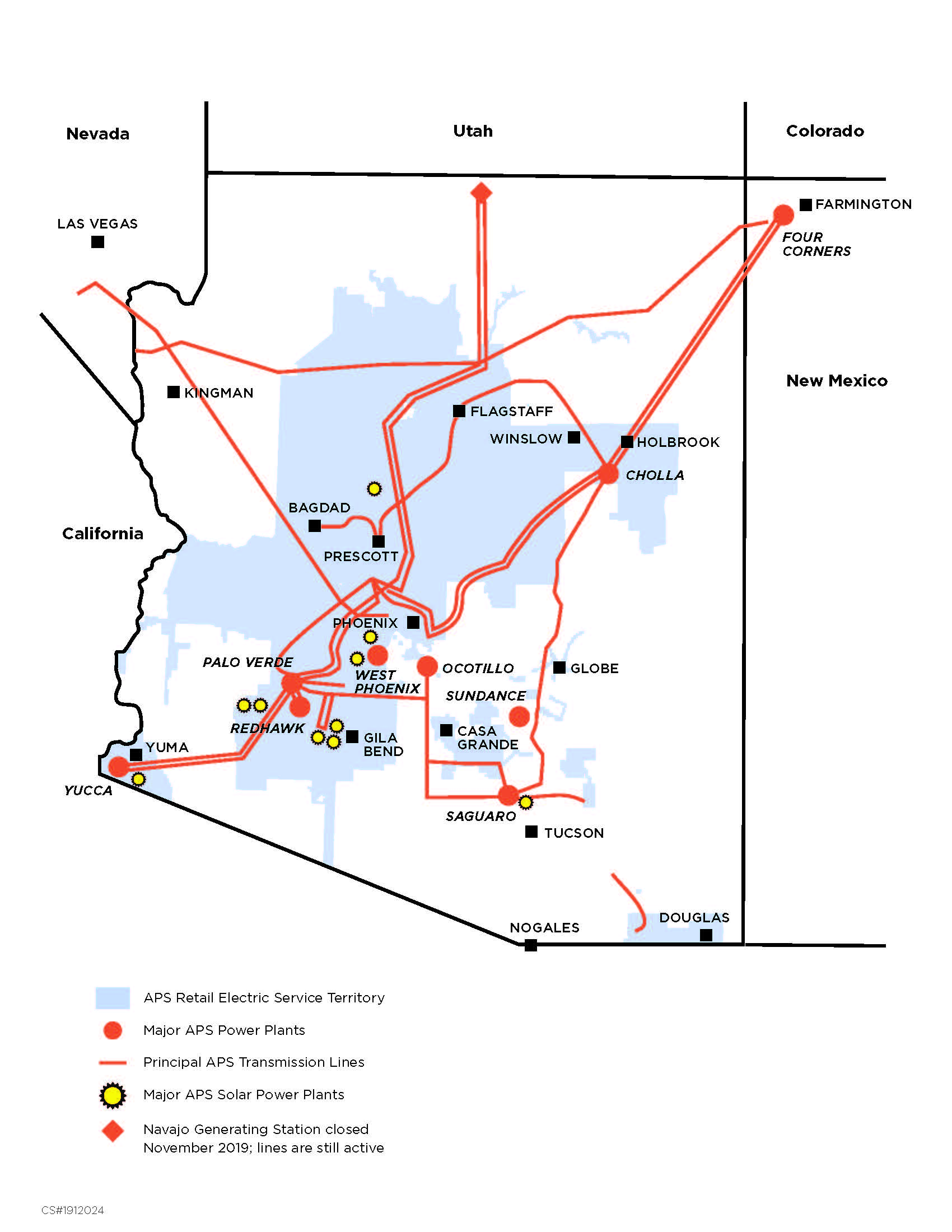
The following map shows APS’s retail service territory, including the locations of its generating facilities and principal transmission lines.
Energy Sources and Resource Planning
To serve its customers, APS obtains power through its various generation stations and through purchased power agreements. Resource planning is an important function necessary to meet Arizona’s future energy needs. APS’s sources of energy by type used to supply energy to Native Load customers during 2019 were as follows:
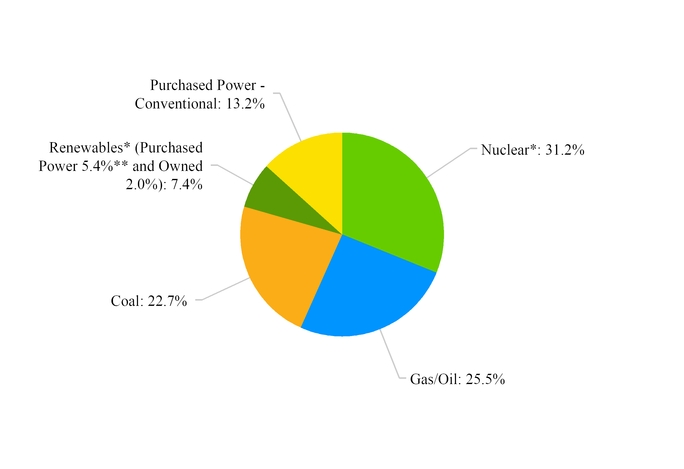
- When including APS’s historical energy efficiency and distributed generation energy contributions, the share of our customers’ energy supply being derived from clean resources is 51%.
** Purchased Power includes renewables from long-term power purchase agreements with grid-scale renewables providers and distributed generation.
Clean Energy Focus Initiatives
APS has undertaken a number of initiatives to address emission concerns, including renewable energy procurement and development, and promotion of programs and rates that promote energy conservation, renewable energy use, and energy efficiency. (See “Energy Sources and Resource Planning - Current and Future Resources” below for details of these plans and initiatives.) APS currently has a diverse portfolio of renewable resources, including solar, wind, geothermal, biogas, and biomass. In addition, APS recently announced its Clean Energy Commitment, a three-pronged approach aimed at ultimately eliminating carbon-emitting resources from its electric generation resource portfolio.
APS’s Clean Energy Commitment consists of three parts. First, APS announced an aspirational goal to generate electricity with zero-carbon emissions by 2050. Second, APS announced a nearer-term 2030 target of 65% clean energy, with 45% of APS's generation coming from renewable energy. Third, APS committed to
eliminate coal-fired generation from its portfolio of electricity generating resources by 2031. Among other strategies, APS intends to achieve these goals through various methods such as relying on Palo Verde, the nation’s largest producer of carbon-free energy; increasing clean energy resources, including renewables; developing energy storage; cease buying coal-generation; managing demand with a modern interactive grid; promoting customer technology and energy efficiency; and optimizing regional resources. (See Item 7, "Management's Discussion and Analysis of Financial Condition and Results of Operation" for additional information about our Clean Energy Commitment.)
Over this same period of time, APS also intends to harden its infrastructure in order to improve climate resiliency, which involves system and operational improvements aimed at reducing the impact of extreme weather events and other climate-related disruptions upon APS's operations. Among other resiliency strategies, APS anticipates increasing investments in a modern and more flexible electricity grid with advanced distribution technologies. Moreover, APS plans to continue its comprehensive forest management programs aimed at reducing wildfires, as those risks become compounded by shorter, drier winters and longer, hotter summers.
APS prepares an annual inventory of GHG emissions from its operations. For APS's operations involving fossil-fuel electricity generation and electricity transmission and distribution, APS's annual GHG inventory is reported to EPA under the EPA GHG Reporting Program. APS also voluntarily tracks the full scope of the Company's GHG emissions arising from all APS operations. In addition to GHG emissions from generation and transmission and distribution operations, this data includes all other GHG emissions arising from ancillary Company operations, such as vehicle use, employee travel, portable generators and facility energy usage. This data is then communicated to the public in Pinnacle West’s annual Corporate Responsibility Report, which is available on our website (www.pinnaclewest.com). The report provides information related to the Company and its approach to sustainability and its workplace and environmental performance. The information on Pinnacle West’s website, including the Corporate Responsibility Report, is not incorporated by reference into or otherwise a part of this report.
Generation Facilities
APS has ownership interests in or leases the coal, nuclear, gas, oil and solar generating facilities described below. For additional information regarding these facilities, see Item 2.
Nuclear
Palo Verde Generating Station — Palo Verde is a 3-unit nuclear power plant located approximately 50 miles west of Phoenix, Arizona. APS operates the plant and owns 29.1% of Palo Verde Units 1 and 3 and approximately 17% of Unit 2. In addition, APS leases approximately 12.1% of Unit 2, resulting in a 29.1% combined ownership and leasehold interest in that unit. APS has a total entitlement from Palo Verde of 1,146 MW.
Palo Verde Leases — In 1986, APS entered into agreements with three separate lessor trust entities in order to sell and lease back approximately 42% of its share of Palo Verde Unit 2 and certain common facilities. The leaseback was originally scheduled to expire at the end of 2015 and contained options to renew the leases or to purchase the leased property for fair market value at the end of the lease terms. On July 7, 2014, APS exercised the fixed rate lease renewal options. The exercise of the renewal options resulted in APS retaining the assets through 2023 under one lease and 2033 under the other two leases. At the end of the lease renewal periods, APS will have the option to purchase the leased assets at their fair market value, extend the leases for up to two years, or return the assets to the lessors. See Note 19 for additional information regarding the Palo Verde Unit 2 sale leaseback transactions.
Palo Verde Operating Licenses — Operation of each of the three Palo Verde Units requires an operating license from the NRC. The NRC issued full power operating licenses for Unit 1 in June 1985, Unit 2 in April 1986 and Unit 3 in November 1987, and issued renewed operating licenses for each of the three units in April 2011, which extended the licenses for Units 1, 2 and 3 to June 2045, April 2046 and November 2047, respectively.
Palo Verde Fuel Cycle — The
Showing the first 8K of 92K characters. Open the full section
Item 1A. RISK FACTORS
In addition to the factors affecting specific business operations identified in the description of these operations contained elsewhere in this report, set forth below are risks and uncertainties that could affect our financial results. Unless otherwise indicated or the context otherwise requires, the following risks and uncertainties apply to Pinnacle West and its subsidiaries, including APS.
REGULATORY RISKS
Our financial condition depends upon APS’s ability to recover costs in a timely manner from customers through regulated rates and otherwise execute its business strategy.
APS is subject to comprehensive regulation by several federal, state and local regulatory agencies that significantly influence its business, liquidity and results of operations and its ability to fully recover costs from utility customers in a timely manner. The ACC regulates APS’s retail electric rates and FERC regulates rates for wholesale power sales and transmission services. The profitability of APS is affected by the rates it may charge and the timeliness of recovering costs incurred through its rates. Consequently, our financial condition and results of operations are dependent upon the satisfactory resolution of any APS rate proceedings and ancillary matters which may come before the ACC and FERC, including in some cases how court challenges to these regulatory decisions are resolved. Arizona, like certain other states, has a statute that allows the ACC to reopen prior decisions and modify otherwise final orders under certain circumstances.
The ACC must also approve APS’s issuance of equity and debt securities and any significant transfer or encumbrance of APS property used to provide retail electric service, and must approve or receive prior notification of certain transactions between us, APS and our respective affiliates, including the infusion of equity into APS. Decisions made by the ACC or FERC could have a material adverse impact on our financial condition, results of operations or cash flows.
APS’s ability to conduct its business operations and avoid fines and penalties depends upon compliance with federal, state and local statutes, regulations and ACC requirements, and obtaining and maintaining certain regulatory permits, approvals and certificates.
APS must comply in good faith with all applicable statutes, regulations, rules, tariffs, and orders of agencies that regulate APS’s business, including FERC, NRC, EPA, the ACC, and state and local governmental agencies. These agencies regulate many aspects of APS’s utility operations, including safety and performance, emissions, siting and construction of facilities, customer service and the rates that APS can charge retail and wholesale customers. Failure to comply can subject APS to, among other things, fines and penalties. For example, under the Energy Policy Act of 2005, FERC can impose penalties (approximately $1.2 million dollars per day per violation) for failure to comply with mandatory electric reliability standards. APS is also required to have numerous permits, approvals and certificates from these agencies. APS believes the necessary permits, approvals and certificates have been obtained for its existing operations and that APS’s business is conducted in accordance with applicable laws in all material respects. However, changes in regulations or the imposition
of new or revised laws or regulations could have an adverse impact on our results of operations. We are also unable to predict the impact on our business and operating results from pending or future regulatory activities of any of these agencies*.*
The operation of APS’s nuclear power plant exposes it to substantial regulatory oversight and potentially significant liabilities and capital expenditures.
The NRC has broad authority under federal law to impose safety-related, security-related and other licensing requirements for the operation of nuclear generating facilities. Events at nuclear facilities of other operators or impacting the industry generally may lead the NRC to impose additional requirements and regulations on all nuclear generating facilities, including Palo Verde. In the event of noncompliance with its requirements, the NRC has the authority to impose a progressively increased inspection regime that could ultimately result in the shut-down of a unit or civil penalties, or both, depending upon the NRC’s assessment of the severity of the situation, until compliance is achieved. The increased costs resulting from penalties, a heightened level of scrutiny and implementation of plans to achieve compliance with NRC requirements may adversely affect APS’s financial condition, results of operations and cash flows.
APS is subject to numerous environmental laws and regulations, and changes in, or liabilities under, existing or new laws or regulations may increase APS’s cost of operations or impact its business plans.
APS is, or may become, subject to numerous environmental laws and regulations affecting many aspects of its present and future operations, including air emissions of conventional pollutants and greenhouse gases, water quality, discharges of wastewater and waste streams originating from fly ash and bottom ash handling facilities, solid waste, hazardous waste, and coal combustion products, which consist of bottom ash, fly ash, and air pollution control wastes. These laws and regulations can result in increased capital, operating, and other costs, particularly with regard to enforcement efforts focused on power plant emissions obligations. These laws and regulations generally require APS to obtain and comply with a wide variety of environmental licenses, permits, and other approvals. If there is a delay or failure to obtain any required environmental regulatory approval, or if APS fails to obtain, maintain, or comply with any such approval, operations at affected facilities could be suspended or subject to additional expenses. In addition, failure to comply with applicable environmental laws and regulations could result in civil liability as a result of government enforcement actions or private claims or criminal penalties. Both public officials and private individuals may seek to enforce applicable environmental laws and regulations. APS cannot predict the outcome (financial or operational) of any related litigation that may arise.
Environmental Clean Up. APS has been named as a PRP for a Superfund site in Phoenix, Arizona, and it could be named a PRP in the future for other environmental clean-up at sites identified by a regulatory body. APS cannot predict with certainty the amount and timing of all future expenditures related to environmental matters because of the difficulty of estimating clean-up costs. There is also uncertainty in quantifying liabilities under environmental laws that impose joint and several liability on all PRPs.
Coal Ash. In December 2014, EPA issued final regulations governing the handling and disposal of CCR, which are generated as a result of burning coal and consist of, among other things, fly ash and bottom ash. The rule regulates CCR as a non-hazardous waste. APS currently disposes of CCR in ash ponds and dry storage areas at Cholla and Four Corners and in a dry landfill storage area at the Navajo Plant. To the extent the rule requires the closure or modification of these CCR units or the construction of new CCR units beyond what we currently anticipate, APS would incur significant additional costs for CCR disposal. In addition, the rule may also require corrective action to address releases from CCR disposal units or the presence of CCR constituents within groundwater near CCR disposal units above certain regulatory thresholds.
Ozone National Ambient Air Quality Standards. In 2015, EPA finalized revisions to the national ambient air quality standards for nitrogen oxides, which set new, more stringent standards intended to protect human health and human welfare. Depending on the final attainment designations for the new standards and the state implementation requirements, APS may be required to invest in new pollution control technologies and to generate emission offsets for new projects or facility expansions located in ozone nonattainment areas.
APS cannot assure that existing environmental regulations will not be revised or that new regulations seeking to protect the environment will not be adopted or become applicable to it. Revised or additional regulations that result in increased compliance costs or additional operating restrictions, particularly if those costs incurred by APS are not fully recoverable from APS’s customers, could have a material adverse effect on its financial condition, results of operations or cash flows. Due to current or potential future regulations or legislation coupled with trends in natural gas and coal prices, or other clean energy rules or initiatives, the economics or feasibility of continuing to own certain resources, particularly coal facilities, may deteriorate, warranting early retirement of those plants, which may result in asset impairments. APS would seek recovery in rates for the book value of any remaining investments in the plants as well as other costs related to early retirement, but cannot predict whether it would obtain such recovery.
APS faces potential financial risks resulting from climate change litigation and legislative and regulatory efforts to limit GHG emissions, as well as physical and operational risks related to climate effects.
Concern over climate change has led to significant legislative and regulatory efforts to limit CO2, which is a major byproduct of the combustion of fossil fuel, and other GHG emissions.
Potential Financial Risks - Greenhouse Gas Regulation, the Clean Power Plan and Potential Litigation. In 2015, EPA finalized a rule to limit carbon dioxide emissions from existing power plants, the CPP. The implementation of this rule within the jurisdictions where APS operates could result in a shift in in-state generation from coal to natural gas and renewable generation. Such a substantial change in APS’s generation portfolio could require additional capital investments and increased operating costs, and thus have a significant financial impact on the Company. EPA took action in October 2017 to repeal these regulations and in July 2019, EPA published final regulations, the ACE Rule, to replace the CPP with a new set of regulations. EPA’s action in 2019 to repeal the CPP and replace it with the ACE regulations is currently subject to pending judicial review in the U.S. Court of Appeals for the District of Columbia.
Depending on the final outcome of a pending judicial review of ACE and repeal of the CPP, along with related regulatory activity to implement the ACE regulations, the utility industry may face alternative efforts from private parties seeking to establish alternative GHG emission limitations from power plants. Alternative GHG emission limitations may arise from litigation under either federal or state common laws or citizen suit provisions of federal environmental statutes that attempt to force federal agency rulemaking or imposing direct facility emission limitations. Such lawsuits may also seek damages from harm alleged to have resulted from power plant GHG emissions.
Physical and Operational Risks. Weather extremes such as drought and high temperature variations are common occurrences in the southwest United States' desert area, and these are risks that APS considers in the normal course of business in the engineering and construction of its electric system. Large increases in ambient temperatures could require evaluation of certain materials used within its system and may represent a greater challenge. As part of conducting its business, APS recognizes that the southwestern United States is particularly susceptible to the risks posed by climate change, which over time is projected to exacerbate high temperature extremes and prolong drought in the area where APS conducts its business.
Co-owners of our jointly owned generation facilities may have unaligned goals and positions due to the effects of legislation, regulations, economic conditions or changes in our industry, which could have a significant impact on our ability to continue operations of such facilities.
APS owns certain of our power plants jointly with other owners with varying ownership interests in such facilities. Changes in the nature of our industry and the economic viability of certain plants, including impacts resulting from types and availability of other resources, fuel costs, legislation and regulation, together with timing considerations related to expiration of leases or other agreements for such facilities, could result in unaligned positions among co-owners. Such differences in the co-owners’ willingness or ability to continue their participation could ultimately lead to disagreements among the parties as to how and whether to continue operation of such plants, which could lead to eventual shut down of units or facilities and uncertainty related to the resulting cost recovery of such assets. See Note 4 for a discussion of the Navajo Plant and Cholla retirement and the related risks associated with APS's continued recovery of its remaining investment in the plant.
Deregulation or restructuring of the electric industry may result in increased competition, which could have a significant adverse impact on APS’s business and its results of operations.
In 1999, the ACC approved rules for the introduction of retail electric competition in Arizona. Retail competition could have a significant adverse financial impact on APS due to an impairment of assets, a loss of retail customers, lower profit margins or increased costs of capital. Although some very limited retail competition existed in APS’s service area in 1999 and 2000, there are currently no active retail competitors offering unbundled energy or other utility services to APS’s customers. This is in large part due to a 2004 Arizona Court of Appeals decision that found critical components of the ACC's rules to be violative of the Arizona Constitution. The ruling also voided the operating authority of all the competitive providers previously authorized by the ACC. On May 9, 2013, the ACC voted to re-examine the facilitation of a deregulated retail electric market in Arizona. The ACC subsequently opened a docket for this matter and received comments from a number of interested parties on the considerations involved in establishing retail electric deregulation in the state. One of these considerations is whether various aspects of a deregulated market, including setting utility rates on a “market” basis, would be consistent with the requirements of the Arizona Constitution. On September 11, 2013, after receiving legal advice from the ACC staff, the ACC voted 4-1 to close the current docket and await full Arizona Constitutional authority before any further examination of this matter. The motion approved by the ACC also included opening one or more new dockets in the future to explore options to offer more rate choices to customers and innovative changes within the existing cost-of-service regulatory model that could include elements of competition.
One of these options would be a continuation or expansion of APS’s existing AG (Alternative Generation)-X program, which essentially allows up to 200 MW of cumulative load to be served via a buy-through arrangement with competitive suppliers of generation. The AG-X program was approved by the ACC as part of the 2017 Settlement Agreement.
In November 2018, the ACC voted to again re-examine retail competition. In addition, proposals to enable or support retail electric competition may be made from time to time through ballot initiatives, legislative action or other forums in Arizona. The ACC has scheduled a workshop for February 25-26, 2020 for further consideration and discussion of the retail electric competition rules. APS cannot predict whether these efforts will result in any changes and, if changes to the rules results, what impact these rules would have on APS.
Proposals to change policy in Arizona or other states made through ballot initiatives or referenda may increase the Company’s cost of operations or impact its business plans.
In Arizona and other states, a person or organization may file a ballot initiative or referendum with the Arizona Secretary of State or other applicable state agency and, if a sufficient number of verifiable signatures are presented, the initiative or referendum may be placed on the ballot for the public to vote on the matter. Ballot initiatives and referenda may relate to any matter, including policy and regulation related to the electric industry, and may change statutes or the state constitution in ways that could impact Arizona utility customers, the Arizona economy and the Company. Some ballot initiatives and referenda are drafted in an unclear manner and their potential industry and economic impact can be subject to varied and conflicting interpretations. We may oppose certain initiatives or referenda (including those that could result in negative impacts to our customers, the state or the Company) via the electoral process, litigation, traditional legislative mechanisms, agency rulemaking or otherwise, which could result in significant costs to the Company. The passage of certain initiatives or referenda could result in laws and regulations that impact our business plans and have a material adverse impact on our financial condition, results of operations or cash flows.
OPERATIONAL RISKS
APS’s results of operations can be adversely affected by various factors impacting demand for electricity.
Weather Conditions. Weather conditions directly influence the demand for electricity and affect the price of energy commodities. Electric power demand is generally a seasonal business. In Arizona, demand for power peaks during the hot summer months, with market prices also peaking at that time. As a result, APS’s overall operating results fluctuate substantially on a seasonal basis. In addition, APS has historically sold less power, and consequently earned less income, when weather conditions are milder. As a result, unusually mild weather could diminish APS’s financial condition, results of operations or cash flows.
Apart from the impact upon electricity demand, weather conditions related to prolonged high temperatures or extreme heat events present operational challenges. In the southwestern United States, where APS conducts its business, the effects of climate change are projected to increase the overall average temperature, lead to more extreme temperature events, and exacerbate prolonged drought conditions leading to the declining availability of water resources. Extreme heat events and rising temperatures are projected to reduce the generation capacity of thermal-power plants and decrease the efficiency of the transmission grid. These operational risks related to rising temperatures and extreme heat events could affect APS’s financial condition, results of operations or cash flows.
Higher temperatures may decrease the snowpack, which might result in lowered soil moisture and an increased threat of forest fires. Forest fires could threaten APS’s communities and electric transmission lines and facilities. Any damage caused as a result of forest fires could negatively impact APS’s financial condition, results of operations or cash flows. In addition, the decrease in snowpack can also lead to reduced water supplies in the areas where APS relies upon non-renewable water resources to supply cooling and process water for electricity generation. Prolonged and extreme drought conditions can also affect APS’s long-term ability to access the water resources necessary for thermal electricity generation operations. Reductions in the availability of water for power plant cooling could negatively impact APS’s financial condition, results of operations or cash flows.
Effects of Energy Conservation Measures and Distributed Energy Resources. The ACC has enacted rules regarding energy efficiency that mandate a 22% cumulative annual energy savings requirement by 2020. This will likely increase participation by APS customers in energy efficiency and conservation programs and other demand-side management efforts, which in turn will impact the demand for electricity. The rules also
include a requirement for the ACC to review and address financial disincentives, recovery of fixed costs and the recovery of net lost revenue that would result from lower sales due to increased energy efficiency requirements. To that end, the LFCR is designed to address these matters.
APS must also meet certain distributed energy requirements. A portion of APS’s total renewable energy requirement must be met with an increasing percentage of distributed energy resources (generally, small scale renewable technologies located on customers’ properties). The distributed energy requirement is 30% of the applicable RES requirement for 2012 and subsequent years. Customer participation in distributed energy programs would result in lower demand, since customers would be meeting some of their own energy needs.
In addition to these rules and requirements, energy efficiency technologies and distributed energy resources continue to evolve, which may have similar impacts on demand for electricity. Reduced demand due to these energy efficiency requirements, distributed energy requirements and other emerging technologies, unless substantially offset through ratemaking mechanisms, could have a material adverse impact on APS’s financial condition, results of operations and cash flows.
Actual and Projected Customer and Sales Growth. Retail customers in APS's service territory increased 2.0% for the year ended December 31, 2019 compared with the prior year. For the three years 2017 through 2019, APS’s retail customer growth averaged 1.8% per year. We currently project annual customer growth to be 1.5 - 2.5% for 2020 and for 2020 through 2022 based on our assessment of improving economic conditions in Arizona.
Retail electricity sales in kWh, adjusted to exclude the effects of weather variations, increased 0.6% for the year ended December 31, 2019 compared with the prior year. Improving economic conditions and customer growth were offset by energy savings driven by customer conservation, energy efficiency, and distributed renewable generation initiatives. For the three years 2017 through 2019, annual retail electricity sales were about flat, adjusted to exclude the effects of weather variations. We currently project that annual retail electricity sales in kWh will increase in the range of 1.0 - 2.0% for 2020 and increase on average in the range of 1.0 - 2.0% during 2020 through 2022, including the effects of customer conservation and energy efficiency and distributed renewable generation initiatives, but excluding the effects of weather variations and excluding the impacts of several new large data centers opening operations in Metro Phoenix. The impact of new large data centers could raise the range of expected sales annual growth rate over the 2020 to 2022 period, but demand from these customers remains uncertain at this point. Slower than expected growth of the Arizona economy or acceleration of the expected effects of customer conservation, energy efficiency or distributed renewable generation initiatives could further impact these estimates.
Actual customer and sales growth may differ from our projections as a result of numerous factors, such as economic conditions, customer growth, usage patterns and energy conservation, impacts of energy efficiency programs and growth in distributed renewable generation, and responses to retail price changes. Additionally, recovery of a substantial portion of our fixed costs of providing service is based upon the volumetric amount of our sales. If our customer growth rate does not continue to improve as projected, or if we experience acceleration of expected effects of customer conservation, energy efficiency or distributed renewable generation initiatives, we may be unable to reach our estimated sales projections, which could have a negative impact on our financial condition, results of operations and cash flows.
The operation of power generation facilities and transmission systems involves risks that could result in reduced output or unscheduled outages, which could materially affect APS’s results of operations**.**
The operation of power generation, transmission and distribution facilities involves certain risks, including the risk of breakdown or failure of equipment, fuel interruption, and performance below expected
levels of output or efficiency. Unscheduled outages, including extensions of scheduled outages due to mechanical failures or other complications, occur from time to time and are an inherent risk of APS’s business. Because our transmission facilities are interconnected with those of third parties, the operation of our facilities could be adversely affected by unexpected or uncontrollable events occurring on the larger transmission power grid, and the operation or failure of our facilities could adversely affect the operations of others. Concerns over physical security of these assets could include damage to certain of our facilities due to vandalism or other deliberate acts that could lead to outages or other adverse effects. If APS’s facilities operate below expectations, especially during its peak seasons, it may lose revenue or incur additional expenses, including increased purchased power expenses.
The impact of wildfires could negatively affect APS's results of operations.
Wildfires have the potential to affect the communities that APS serves and APS's vast network of electric transmission and distribution lines and facilities. The potential likelihood of wildfires has increased due to many of the same weather impacts existing in Arizona as those that led to the catastrophic wildfires in Northern California. While we proactively take steps to mitigate wildfire risk in the areas of our electrical assets, wildfire risk is always present due to APS's expansive service territory. APS could be held liable for damages incurred as a result of wildfires that were caused by or enhanced due to APS's negligence. The Arizona liability standard is different from that of California, which generally imposes liability for resulting damages without regard to fault. Any damage caused to our assets, loss of service to our customers, or liability imposed as a result of wildfires could negatively impact APS's financial condition, results of operations or cash flows.
The inability to successfully develop or acquire generation resources to meet reliability requirements and other new or evolving standards or regulations could adversely impact our business.
Potential changes in regulatory standards, impacts of new and existing laws and regulations, including environmental laws and regulations, and the need to obtain various regulatory approvals create uncertainty surrounding our generation portfolio. The current abundance of low, stably priced natural gas, together with environmental and other concerns surrounding coal-fired generation resources, create strategic challenges as to the appropriate generation portfolio and fuel diversification mix. In addition, APS is required by the ACC to meet certain energy resource portfolio requirements, including those related to renewables development and energy efficiency measures. The development of any generation facility is subject to many risks, including those related to financing, siting, permitting, new and evolving technology, and the construction of sufficient transmission capacity to support these facilities. APS’s inability to adequately develop or acquire the necessary generation resources could have a material adverse impact on our business and results of operations.
In expressing concerns about the environmental and climate-related impacts from continued extraction, transportation, delivery and combustion of fossil fuels, environmental advocacy groups and other third parties have in recent years undertaken greater efforts to oppose the permitting and construction of fossil fuel infrastructure projects. These efforts may increase in scope and frequency depending on a number of variables, including the future course of Federal environmental regulation and the increasing financial resources devoted to these opposition activities. APS cannot predict the effect that any such opposition may have on our ability to develop and construct fossil fuel infrastructure projects in the future.
The lack of access to sufficient supplies of water could have a material adverse impact on APS’s business and results of operations.
Assured supplies of water are important for APS’s generating plants. Water in the southwestern United States is limited, and various parties have made conflicting claims regarding the right to access and use such limited supply of water. Both groundwater and surface water in areas important to APS’s generating plants have been and are the subject of inquiries, claims and legal proceedings. In addition, the region in which APS’s power plants are located is prone to drought conditions, which could potentially affect the plants’ water supplies. Climate change is also projected to exacerbate prolonged drought conditions. APS’s inability to access sufficient supplies of water could have a material adverse impact on our business and results of operations.
We are subject to cybersecurity risks and risks of unauthorized access to our systems that could adversely affect our business and financial condition.
We operate in a highly regulated industry that requires the continued operation of sophisticated information technology systems and network infrastructure. In the regular course of our business, we handle a range of sensitive security, customer and business systems information. There appears to be an increasing level of activity, sophistication and maturity of threat actors, in particular nation state actors, that seek to exploit potential vulnerabilities in the electric utility industry and wish to disrupt the U.S. bulk power, transmission and distribution system. Our information technology systems, generation (including our Palo Verde nuclear facility), transmission and distribution facilities, and other infrastructure facilities and systems and physical assets could be targets of unauthorized access and are critical areas of cyber protection for us.
We rely extensively on IT systems, networks, and services, including internet sites, data hosting and processing facilities, and other hardware, software and technical applications and platforms. Some of these systems are managed, hosted, provided, or used for third parties to assist in conducting our business. As more third parties are involved in the operation of our business, there is a risk the confidentiality, integrity, privacy or security of data held by, or accessible to, third parties may be compromised.
If a significant cybersecurity event or breach were to occur, we may not be able to fulfill critical business functions and we could (i) experience property damage, disruptions to our business, theft of or unauthorized access to customer, employee, financial or system operation information or other information; (ii) experience loss of revenue or incur significant costs for repair, remediation and breach notification, and increased capital and operating costs to implement increased security measures; and (iii) be subject to increased regulation, litigation and reputational damage. If such disruptions or breaches are not detected quickly, their effect could be compounded or could delay our response or the effectiveness of our response and ability to limit our exposure to potential liability. These types of events could also require significant management attention and resources, and could have a material adverse impact on our financial condition, results of operations or cash flows.
We develop and maintain systems and processes aimed at detecting and preventing information and cybersecurity incidents which require significant investment, maintenance, and ongoing monitoring and updating as technologies and regulatory requirements change. These systems and processes may be insufficient to mitigate the possibility of information and cybersecurity incidents, malicious social engineering, fraudulent or other malicious activities, and human error or malfeasance in the safeguarding of our data.
We are subject to laws and rules issued by multiple government agencies concerning safeguarding and maintaining the confidentiality of our security, customer and business information. One of these agencies, NERC, has issued comprehensive regulations and standards surrounding the security of bulk power systems,
and is continually in the process of developing updated and additional requirements with which the utility industry must comply. The NRC also has issued regulations and standards related to the protection of critical digital assets at commercial nuclear power plants. The increasing promulgation of NERC and NRC rules and standards will increase our compliance costs and our exposure to the potential risk of violations of the standards. Experiencing a cybersecurity incident could cause us to be non-compliant with applicable laws and regulations, such as those promulgated by NERC and the NRC, or contracts that require us to securely maintain confidential data, causing us to incur costs related to legal claims or proceedings and regulatory fines or penalties.
The risk of these system-related events and security breaches occurring continues to intensify. We have experienced, and expect to continue to experience, threats and attempted intrusions to our information technology systems and we could experience such threats and attempted intrusions to our operational control systems. To date we do not believe we have experienced a material breach or disruption to our network or information systems or our service operations. We will not be able to anticipate all cyberattacks or information security breaches, and our ongoing investments in security resources, talent, and business practices may not be effective against all threat actors. As such attacks continue to increase in sophistication and frequency, we may be unable to prevent all such attacks from being successful in the future.
We maintain cyber insurance to provide coverage for a portion of the losses and damages that may result from a security breach of our information technology systems, but such insurance is subject to a number of exclusions and may not cover the total loss or damage caused by a breach. The market for cybersecurity insurance is relatively new and coverage available for cybersecurity events may evolve as the industry matures. In the future, adequate insurance may not be available at rates that we believe are reasonable, and the costs of responding to and recovering from a cyber incident may not be covered by insurance or recoverable in rates.
The ownership and operation of power generation and transmission facilities on Indian lands could result in uncertainty related to continued leases, easements and rights-of-way, which could have a significant impact on our business.
Four Corners and portions of certain APS transmission lines are located on Indian lands pursuant to leases, easements or other rights-of-way that are effective for specified periods. APS is unable to predict the final outcomes of pending and future approvals by the applicable sovereign governing bodies with respect to renewals of these leases, easements and rights-of-way.
There are inherent risks in the ownership and operation of nuclear facilities, such as environmental, health, fuel supply, spent fuel disposal, regulatory and financial risks and the risk of terrorist attack that could adversely affect our business and financial condition.
APS has an ownership interest in and operates, on behalf of a group of participants, Palo Verde, which is the largest nuclear electric generating facility in the United States. Palo Verde constitutes approximately 18% of our owned and leased generation capacity. Palo Verde is subject to environmental, health and financial risks, such as the ability to obtain adequate supplies of nuclear fuel; the ability to dispose of spent nuclear fuel; the ability to maintain adequate reserves for decommissioning; potential liabilities arising out of the operation of these facilities; the costs of securing the facilities against possible terrorist attacks; and unscheduled outages due to equipment and other problems. APS maintains nuclear decommissioning trust funds and external insurance coverage to minimize its financial exposure to some of these risks; however, it is possible that damages could exceed the amount of insurance coverage. In addition, APS may be required under federal law to pay up to $120.1 million (but not more than $17.9 million per year) of liabilities arising out of a nuclear incident occurring not only at Palo Verde, but at any other nuclear power reactor in the United States. Although we have no reason to anticipate a serious nuclear incident at Palo Verde, if an incident did occur, it could materially and adversely affect our results of operations and financial condition. A major incident at a nuclear facility anywhere in the world could cause the NRC to limit or prohibit the operation or licensing of any domestic nuclear unit and to promulgate new regulations that could require significant capital expenditures and/or increase operating costs.
The use of derivative contracts in the normal course of our business could result in financial losses that negatively impact our results of operations.
APS’s operations include managing market risks related to commodity prices. APS is exposed to the impact of market fluctuations in the price and transportation costs of electricity, natural gas and coal to the extent that unhedged positions exist. We have established procedures to manage risks associated with these market fluctuations by utilizing various commodity derivatives, including exchange traded futures and over-the-counter forwards, options, and swaps. As part of our overall risk management program, we enter into derivative transactions to hedge purchases and sales of electricity and fuels. The changes in market value of such contracts have a high correlation to price changes in the hedged commodity. To the extent that commodity markets are illiquid, we may not be able to execute our risk management strategies, which could result in greater unhedged positions than we would prefer at a given time and financial losses that negatively impact our results of operations.
The Dodd-Frank Wall Street Reform and Consumer Protection Act (“Dodd-Frank Act”) contains measures aimed at increasing the transparency and stability of the over-the counter ("OTC") derivative markets and preventing excessive speculation. The Dodd-Frank Act could restrict, among other things, trading positions in the energy futures markets, require different collateral or settlement positions, or increase regulatory reporting over derivative positions. Based on the provisions included in the Dodd-Frank Act and the implementation of regulations, these changes could, among other things, impact our ability to hedge commodity price and interest rate risk or increase the costs associated with our hedging programs.
We are exposed to losses in the event of nonperformance or nonpayment by counterparties. We use a risk management process to assess and monitor the financial exposure of all counterparties. Despite the fact that the majority of APS’s trading counterparties are rated as investment grade by the rating agencies, there is still a possibility that one or more of these companies could default, which could result in a material adverse impact on our earnings for a given period.
Changes in technology could create challenges for APS’s existing business.
Alternative energy technologies that produce power or reduce power consumption or emissions are being developed and commercialized, including renewable technologies such as photovoltaic (solar) cells, customer-sited generation, energy storage (batteries) and efficiency technologies. Advances in technology and equipment/appliance efficiency could reduce the demand for supply from conventional generation, including carbon-free nuclear generation, and increase the complexity of managing APS's information technology and power system operations, which could adversely affect APS’s business.
Customer-sited alternative energy technologies present challenges to APS’s operations due to misalignment with APS’s existing operational needs. When these resources lack “dispatchability” and other elements of utility-side control, they are considered “unmanaged” resources. The cumulative effect of such unmanaged resources results in added complexity for APS’s system management.
APS continues to pursue and implement advanced grid technologies, including transmission and distribution system technologies and digital meters enabling two-way communications between the utility and its customers. Many of the products and processes resulting from these and other alternative technologies, including energy storage technologies, have not yet been widely used or tested on a long-term basis, and their use on large-scale systems is not as established or mature as APS’s existing technologies and equipment. The implementation of new and additional technologies adds complexity to our information technology and operational technology systems, which could require additional infrastructure and resources. Widespread installation and acceptance of new technologies could also enable the entry of new market participants, such as technology companies, into the interface between APS and its customers and could have other unpredictable effects on APS’s traditional business model.
Deployment of renewable energy technologies is expected to continue across the western states and result in a larger portion of the overall energy production coming from these sources. These trends, which have benefited from historical and continuing government support for certain technologies, have the potential to put downward pressure on wholesale power prices throughout the western states which could make APS's existing generating facilities less economical and impact their operational patterns and long-term viability.
We are subject to employee workforce factors that could adversely affect our business and financial condition.
Like many companies in the electric utility industry, our workforce is maturing, with approximately 35% of employees eligible to retire by the end of 2024. Although we have undertaken efforts to recruit, train and develop new employees, we face increased competition for talent. We are subject to other employee workforce factors, such as the availability and retention of qualified personnel and the need to negotiate collective bargaining agreements with union employees. These or other employee workforce factors could negatively impact our business, financial condition or results of operations.
FINANCIAL RISKS
Financial market disruptions or new rules or regulations may increase our financing costs or limit our access to various financial markets, which may adversely affect our liquidity and our ability to implement our financial strategy.
Pinnacle West and APS rely on access to credit markets as a significant source of liquidity and the capital markets for capital requirements not satisfied by cash flow from our operations. We believe that we will maintain sufficient access to these financial markets. However, certain market disruptions or rules or regulations may cause our cost of borrowing to increase generally, and/or otherwise adversely affect our ability to access these financial markets.
In addition, the credit commitments of our lenders under our bank facilities may not be satisfied or continued beyond current commitment periods for a variety of reasons, including new rules and regulations, periods of financial distress or liquidity issues affecting our lenders or financial markets, which could materially adversely affect the adequacy of our liquidity sources and the cost of maintaining these sources.
Changes in economic conditions, monetary policy, financial regulation or other factors could result in higher interest rates, which would increase interest expense on our existing variable rate debt and new debt we expect to issue in the future, and thus reduce funds available to us for our current plans.
Additionally, an increase in our leverage, whether as a result of these factors or otherwise, could adversely affect us by:
| • | causing a downgrade of our credit ratings; |
| • | increasing the cost of future debt financing and refinancing; |
| • | increasing our vulnerability to adverse economic and industry conditions; and |
| • | requiring us to dedicate an increased portion of our cash flow from operations to payments on our debt, which would reduce funds available to us for operations, future investment in our business or other purposes. |
A downgrade of our credit ratings could materially and adversely affect our business, financial condition and results of operations.
Our current ratings are set forth in “Liquidity and Capital Resources — Credit Ratings” in Item 7. We cannot be sure that any of our current ratings will remain in effect for any given period of time or that a rating will not be lowered or withdrawn entirely by a rating agency if, in its judgment, circumstances in the future so warrant. Any downgrade or withdrawal could adversely affect the market price of Pinnacle West’s and APS’s securities, limit our access to capital and increase our borrowing costs, which would adversely impact our financial results. We could be required to pay a higher interest rate for future financings, and our potential pool of investors and funding sources could decrease. In addition, borrowing costs under our existing credit facilities depend on our credit ratings. A downgrade could also require us to provide additional support in the form of letters of credit or cash or other collateral to various counterparties. If our short-term ratings were to be lowered, it could severely limit access to the commercial paper market. We note that the ratings from rating agencies are not recommendations to buy, sell or hold our securities and that each rating should be evaluated independently of any other rating.
Investment performance, changing interest rates and other economic, social and political factors could decrease the value of our benefit plan assets, nuclear decommissioning trust funds and other special use funds or increase the valuation of our related obligations, resulting in significant additional funding requirements. We are also subject to risks related to the provision of employee healthcare benefits and healthcare reform legislation. Any inability to fully recover these costs in our utility rates would negatively impact our financial condition.
We have significant pension plan and other postretirement benefits plan obligations to our employees and retirees, and legal obligations to fund our pension trust and nuclear decommissioning trusts for Palo Verde. We hold and invest substantial assets in these trusts that are designed to provide funds to pay for certain of these obligations as they arise. Declines in market values of the fixed income and equity securities held in these trusts may increase our funding requirements into the related trusts. Additionally, the valuation of liabilities related to our pension plan and other postretirement benefit plans are impacted by a discount rate, which is the interest rate used to discount future pension and other postretirement benefit obligations. Declining interest rates decrease the discount rate, increase the valuation of the plan liabilities and may result in increases in pension and other postretirement benefit costs, cash contributions, regulatory assets, and charges to OCI. Changes in demographics, including increased number of retirements or changes in life expectancy and changes in other actuarial assumptions, may also result in similar impacts. The minimum contributions required under these plans are impacted by federal legislation and related regulations. Increasing liabilities or otherwise increasing funding requirements under these plans, resulting from adverse changes in legislation or otherwise, could result in significant cash funding obligations that could have a material impact on our financial position, results of operations or cash flows.
We recover most of the pension costs and other postretirement benefit costs and all of the currently estimated nuclear decommissioning costs in our regulated rates. Any inability to fully recover these costs in a timely manner would have a material negative impact on our financial condition, results of operations or cash flows.
While most of the Patient Protection and Affordable Care Act provisions have been implemented, changes to or repeal of that Act and pending or future federal or state legislative or regulatory activity or court proceedings could increase costs of providing medical insurance for our employees and retirees. Any potential changes and resulting cost impacts cannot be determined with certainty at this time.
Our cash flow depends on the performance of APS and its ability to make distributions.
We derive essentially all of our revenues and earnings from our wholly-owned subsidiary, APS. Accordingly, our cash flow and our ability to pay dividends on our common stock is dependent upon the earnings and cash flows of APS and its distributions to us. APS is a separate and distinct legal entity and has no obligation to make distributions to us.
APS’s financing agreements may restrict its ability to pay dividends, make distributions or otherwise transfer funds to us. In addition, an ACC financing order requires APS to maintain a common equity ratio of at least 40% and does not allow APS to pay common dividends if the payment would reduce its common equity below that threshold. The common equity ratio, as defined in the ACC order, is total shareholder equity divided by the sum of total shareholder equity and long-term debt, including current maturities of long-term debt.
Pinnacle West’s ability to meet its debt service obligations could be adversely affected because its debt securities are structurally subordinated to the debt securities and other obligations of its subsidiaries.
Because Pinnacle West is structured as a holding company, all existing and future debt and other liabilities of its subsidiaries will be effectively senior in right of payment to its own debt securities. The assets and cash flows of our subsidiaries will be available, in the first instance, to service their own debt and other obligations. Our ability to have the benefit of their cash flows, particularly in the case of any insolvency or financial distress affecting our subsidiaries, would arise only through our equity ownership interests in our subsidiaries and only after their creditors have been satisfied.
The market price of our common stock may be volatile.
The market price of our common stock could be subject to significant fluctuations in response to factors such as the following, some of which are beyond our control:
| • | variations in our quarterly operating results; |
| • | operating results that vary from the expectations of management, securities analysts and investors; |
| • | changes in expectations as to future financial performance, including financial estimates by securities analysts and investors; |
| • | developments generally affecting industries in which we operate; |
| • | announcements by us or our competitors of significant contracts, acquisitions, joint marketing relationships, joint ventures or capital commitments; |
| • | announcements by third parties of significant claims or proceedings against us; |
| • | favorable or adverse regulatory or legislative developments; |
| • | our dividend policy; |
| • | future sales by the Company of equity or equity-linked securities; and |
| • | general domestic and international economic conditions. |
In addition, the stock market in general has experienced volatility that has often been unrelated to the operating performance of a particular company. These broad market fluctuations may adversely affect the market price of our common stock.
Certain provisions of our articles of incorporation and bylaws and of Arizona law make it difficult for shareholders to change the composition of our board and may discourage takeover attempts.
These provisions, which could preclude our shareholders from receiving a change of control premium, include the following:
| • | restrictions on our ability to engage in a wide range of “business combination” transactions with an “interested shareholder” (generally, any person who beneficially owns 10% or more of our outstanding voting power, or any of our affiliates or associates who beneficially owned 10% or more of our outstanding voting power at any time during the prior three years) or any affiliate or associate of an interested shareholder, unless specific conditions are met; |
| • | anti-greenmail provisions of Arizona law and our bylaws that prohibit us from purchasing shares of our voting stock from beneficial owners of more than 5% of our outstanding shares unless specified conditions are satisfied; |
| • | the ability of the Board of Directors to increase the size of and fill vacancies on the Board of Directors, whether resulting from such increase, or from death, resignation, disqualification or otherwise; |
| • | the ability of our Board of Directors to issue additional shares of common stock and shares of preferred stock and to determine the price and, with respect to preferred stock, the other terms, including preferences and voting rights, of those shares without shareholder approval; |
| • | restrictions that limit the rights of our shareholders to call a special meeting of shareholders; and |
| • | restrictions regarding the rights of our shareholders to nominate directors or to submit proposals to be considered at shareholder meetings. |
While these provisions may have the effect of encouraging persons seeking to acquire control of us to negotiate with our Board of Directors, they could enable the Board of Directors to hinder or frustrate a transaction that some, or a majority, of our shareholders might believe to be in their best interests and, in that case, may prevent or discourage attempts to remove and replace incumbent directors.
Item 1B. UNRESOLVED STAFF COMMENTS
Neither Pinnacle West nor APS has received written comments regarding its periodic or current reports from the SEC staff that were issued 180 days or more preceding the end of its 2019 fiscal year and that remain unresolved.
Item 2. PROPERTIES
Generation Facilities
APS
APS’s portfolio of owned generating facilities as of December 31, 2019 is provided in the table below:
| Name | No. of Units | % Owned (a) | Principal Fuels Used | Primary Dispatch Type | Owned Capacity (MW) | |||||||
| Nuclear: | ||||||||||||
| Palo Verde (b) | 3 | 29.1 | % | Uranium | Base Load | 1,146 | ||||||
| Total Nuclear | 1,146 | |||||||||||
| Steam: | ||||||||||||
| Four Corners 4, 5 (c) | 2 | 63 | % | Coal | Base Load | 970 | ||||||
| Cholla 1,3 | 2 | Coal | Base Load | 387 | ||||||||
| Navajo (d) | — | Coal | Base Load | — | ||||||||
| Ocotillo (e) | — | Gas | Peaking | — | ||||||||
| Total Steam | 1,357 | |||||||||||
| Combined Cycle: | ||||||||||||
| Redhawk (f) | 2 | Gas | Load Following | 1,088 | ||||||||
| West Phoenix | 5 | Gas | Load Following | 887 | ||||||||
| Total Combined Cycle | 1,975 | |||||||||||
| Combustion Turbine: | ||||||||||||
| Ocotillo (e) | 7 | Gas | Peaking | 620 | ||||||||
| Saguaro | 3 | Gas | Peaking | 189 | ||||||||
| Douglas/Fairview | 1 | Oil | Peaking | 16 | ||||||||
| Sundance | 10 | Gas | Peaking | 420 | ||||||||
| West Phoenix | 2 | Gas | Peaking | 110 | ||||||||
| Yucca 1, 2, 3 | 3 | Gas | Peaking | 93 | ||||||||
| Yucca 4 | 1 | Oil | Peaking | 54 | ||||||||
| Yucca 5, 6 | 2 | Gas | Peaking | 96 | ||||||||
| Total Combustion Turbine | 1,598 | |||||||||||
| Solar: | ||||||||||||
| Cotton Center (g) | 1 | Solar | As Available | 17 | ||||||||
| Hyder I (g) | 1 | Solar | As Available | 16 | ||||||||
| Paloma (g) | 1 | Solar | As Available | 17 | ||||||||
| Chino Valley | 1 | Solar | As Available | 19 | ||||||||
| Gila Bend (g) | 1 | Solar | As Available | 32 | ||||||||
| Hyder II (g) | 1 | Solar | As Available | 14 | ||||||||
| Foothills (g) | 1 | Solar | As Available | 35 | ||||||||
| Luke AFB | 1 | Solar | As Available | 10 | ||||||||
| Desert Star (g) | 1 | Solar | As Available | 10 | ||||||||
| Red Rock | 1 | Solar | As Available | 40 | ||||||||
| APS Owned Distributed Energy | Solar | As Available | 26 | |||||||||
| Multiple facilities | Solar | As Available | 4 | |||||||||
| Total Solar | 240 | |||||||||||
| Total Capacity | 6,316 |
| (a) | 100% unless otherwise noted. |
| (b) | Our 29.1% ownership in Palo Verde includes leased interests. See “Business of Arizona Public Service Company — Energy Sources and Resource Planning — Generation Facilities — Nuclear” in Item 1 for details regarding leased interests in Palo Verde. The other participants are Salt River Project (17.49%), SCE (15.8%), El Paso (15.8%), Public Service Company of New Mexico (10.2%), Southern California Public Power Authority (5.91%), and Los Angeles Department of Water & Power (5.7%). The plant is operated by APS. |
| (c) | The other participants are Salt River Project (10%), Public Service Company of New Mexico (13%), Tucson Electric Power Company (7%) and NTEC (7%). The plant is operated by APS. |
| (d) | Unit 3 was retired in October 2019 with Units 1 and 2 following in November 2019. |
| (e) | Ocotillo Steam Units 1 and 2 were retired on January 10, 2019. Units 3 through 7 all went into service on or prior to May 30, 2019 which increased generation capacity by 510 MW. |
| (f) | Redhawk generation capacity increased by 104 MW following the Advanced Gas Path upgrade installed on both units. |
| (g) | APS is under contract and currently plans to add battery storage at these AZ Sun sites. Due to the McMicken battery energy storage equipment failure, APS is working with the counterparty for the AZ Sun sites to determine appropriate timing and path forward for such facilities. (See "Business of Arizona Public Service Company - Energy Sources and Resource Planning - Energy Storage" above for details related to these and other energy storage agreements.) |
See “Business of Arizona Public Service Company — Environmental Matters” in Item 1 with respect to matters having a possible impact on the operation of certain of APS’s generating facilities.
See “Business of Arizona Public Service Company” in Item 1 for a map detailing the location of APS’s major power plants and principal transmission lines.
4CA
4CA, a wholly-owned subsidiary of Pinnacle West, purchased El Paso's 7% interest in Units 4 and 5 of Four Corners on July 6, 2016 and subsequently sold the interest to NTEC on July 3, 2018. (See "Business of Arizona Public Service Company - Energy Sources and Resource Planning - Generation Facilities - Coal-Fueled Generating Facilities - Four Corners" in Item 1 and "Four Corners - 4CA Matter" in Note 11 for additional information about 4CA's interest in Four Corners.)
Transmission and Distribution Facilities
Current Facilities**.** APS’s transmission facilities consist of approximately 6,192 pole miles of overhead lines and approximately 49 miles of underground lines, 5,969 miles of which are located in Arizona. APS’s distribution facilities consist of approximately 11,191 miles of overhead lines and approximately 22,092 miles of underground primary cable, all of which are located in Arizona. APS shares ownership of some of its transmission facilities with other companies.
The following table shows APS’s jointly-owned interests in those transmission facilities recorded on the Consolidated Balance Sheets at December 31, 2019:
| Percent Owned (Weighted-Average) | ||
| Morgan — Pinnacle Peak System | 64.6 | % |
| Palo Verde — Rudd 500kV System | 50.0 | % |
| Round Valley System | 50.0 | % |
| ANPP 500kV System | 33.5 | % |
| Navajo Southern System | 26.7 | % |
| Four Corners Switchyards | 63.0 | % |
| Palo Verde — Yuma 500kV System | 19.0 | % |
| Phoenix — Mead System | 17.1 | % |
| Palo Verde — Morgan System | 88.9 | % |
| Hassayampa — North Gila System | 80.0 | % |
| Cholla 500kV Switchyard | 85.7 | % |
| Saguaro 500kV Switchyard | 60.0 | % |
| Kyrene - Knox System | 50.0 | % |
Expansion. Each year APS prepares and files with the ACC a ten-year transmission plan. In APS’s 2020 plan, APS projects it will develop 29 miles of new transmission lines over the next ten years. One significant project, the Palo Verde to Morgan project recently completed all phases and provides a new 500kV path that spans from the Palo Verde hub around the western and northern edges of the Phoenix metropolitan area and terminates at a bulk substation in the northeast part of Phoenix. The Palo Verde to Morgan project includes Palo Verde-Delaney-Sun Valley-Morgan-Pinnacle Peak. The project consisted of four phases and the fourth phase, Morgan to Sun Valley 500kV, was energized in April of 2018. In total, the project consisted of over 100 miles of new 500kV lines, with many of those miles constructed with the capability to employ a 230kV line as a second circuit.
APS continues to work with regulators to identify transmission projects necessary to support renewable energy facilities. Two such projects, which have been completed and were included in previous APS transmission plans, are the Delaney to Palo Verde line and the North Gila to Hassayampa line, both of which support the transmission of renewable energy to Phoenix and California. The North Gila to Hassayampa line went into service in May 2015 and the Delaney to Palo Verde line went into service in May 2016.
NERC Critical Infrastructu****re Protection Reliability Standards. Since 2014, APS has been implementing a comprehensive project to ensure compliance with NERC's Critical Infrastructure Protection Reliability Standards ("CIP"). APS completed substantial implementation in the fourth quarter of 2019 for compliance with CIP standards that became effective January 1, 2020.
Plant and Transmission Line Leases and Rights-of-Way on Indian Lands
The Navajo Plant and Four Corners are located on land held under leases from the Navajo Nation and also under rights-of-way from the federal government. The co-owners of the Navajo Plant and the Navajo Nation agreed that the Navajo Plant would remain in operation until December 2019 under the existing plant lease. The co-owners and the Navajo Nation executed a lease extension on November 29, 2017 that allows for decommissioning activities to begin after the plant ceased operations in November 2019.
APS, on behalf of the Four Corners participants, negotiated amendments to the Four Corners facility lease with the Navajo Nation, which extends the Four Corners leasehold interest from 2016 to 2041. See
"Business of Arizona Public Service Company - Energy Sources and Resource Planning - Generating Facilities - Coal-Fueled Generating Facilities - Four Corners" in Item 1 for additional information about the Four Corners right-of-way and lease matters.
Certain portions of our transmission lines are located on Indian lands pursuant to rights-of-way that are effective for specified periods. Some of these rights-of-way have expired and our renewal applications have not yet been acted upon by the appropriate Indian tribes or federal agencies. Other rights expire at various times in the future and renewal action by the applicable tribe or federal agencies will be required at that time. In recent negotiations, certain of the affected Indian tribes have required payments substantially in excess of amounts that we have paid in the past for such rights-of-way. The ultimate cost of renewal of certain of the rights-of-way for our transmission lines is therefore uncertain.
Item 3. LEGAL PROCEEDINGS
See “Business of Arizona Public Service Company — Environmental Matters” in Item 1 with regard to pending or threatened litigation and other disputes.
See Note 4 for ACC and FERC-related matters.
See Note 11 for information regarding environmental matters and Superfund–related matters.
Item 4. MINE SAFETY DISCLOSURES
Not applicable.
INFORMATION ABOUT OUR EXECUTIVE OFFICERS
Pinnacle West’s executive officers are elected no less often than annually and may be removed by the Board of Directors, or in certain cases also by the Human Resources Committee, at any time. The executive officers, their ages at February 21, 2020, current positions and principal occupations for the past five years are as follows:
| Name | Age | Position | Period | |||
| Jeffrey B. Guldner | 54 | Chairman of the Board, President and Chief Executive Office of Pinnacle West; Chairman of the Board and Chief Executive Officer of APS | 2019-Present | |||
| President of APS | 2018-2020 | |||||
| Executive Vice President, Public Policy of Pinnacle West | 2017-2019 | |||||
| Executive Vice President, Public Policy of APS | 2017-2018 | |||||
| General Counsel of Pinnacle West and APS | 2017-2018 | |||||
| Senior Vice President, Public Policy of APS | 2014-2017 | |||||
| Robert S. Bement | 64 | Executive Vice President and Special Advisor to the Chief Executive Officer of APS | 2020-Present | |||
| Executive Vice President and Chief Nuclear Officer, PVGS, of APS | 2016-2020 | |||||
| Senior Vice President, Site Operations, PVGS, of APS | 2011-2016 | |||||
| Elizabeth A. Blankenship | 48 | Vice President, Controller and Chief Accounting Officer of Pinnacle West and APS | 2019-Present | |||
| General Manager, Accounting Operations of APS | 2019-2019 | |||||
| Director, Accounting Operations of APS | 2014-2019 | |||||
| Donna M. Easterly | 55 | Senior Vice President, Human Resources of APS | 2020-Present | |||
| Vice President, Human Resources and Ethics of APS | 2017-2020 | |||||
| Vice President, Chief Procurement Officer of APS | 2014-2017 | |||||
| Daniel T. Froetscher | 58 | President and Chief Operating Officer of APS | 2020-Present | |||
| Executive Vice President, Operations of APS | 2018-2020 | |||||
| Senior Vice President, Transmission, Distribution & Customers of APS | 2014-2018 | |||||
| Theodore N. Geisler | 41 | Senior Vice President and Chief Financial Officer of Pinnacle West and APS | 2020-Present | |||
| Vice President and Chief Information Officer of APS | 2018-2020 | |||||
| General Manager, Transmission and Distribution Operations and Maintenance of APS | 2017-2018 | |||||
| Director, Investor Relations of Pinnacle West | 2016-2017 | |||||
| Director, Transmission Operations and Maintenance of APS | 2013-2016 | |||||
| James R. Hatfield | 62 | Chief Administrative Officer and Treasurer of Pinnacle West and APS | 2020-Present | |||
| Executive Vice President of Pinnacle West and APS | 2012-Present | |||||
| Chief Financial Officer of Pinnacle West and APS | 2008-2020 | |||||
| Maria L. Lacal | 59 | Executive Vice President and Chief Nuclear Officer, PVGS, of APS | 2020-Present | |||
| Senior Vice President, Regulatory and Oversight, PVGS, of APS | 2016-2020 | |||||
| Vice President, Regulatory and Oversight, PVGS, of APS | 2015-2016 | |||||
| Vice President, Operations Support, PVGS, of APS | 2011-2015 | |||||
| Barbara D. Lockwood | 53 | Senior Vice President, Public Policy of APS | 2020-Present | |||
| Vice President, Regulation of APS | 2015-2020 | |||||
| General Manager, Regulatory Policy and Compliance of APS | 2014-2015 | |||||
| Lee R. Nickloy (a) | 53 | Vice President and Treasurer of Pinnacle West and APS | 2010-Present | |||
| Robert E. Smith | 50 | Senior Vice President and General Counsel of Pinnacle West and APS | 2018-Present | |||
| Senior Vice President and General Counsel of Columbia Pipeline Group, Inc. | 2014-2016 |
(a) Lee R. Nickloy is retiring from Pinnacle West and APS on March 2, 2020.
PART II
Item 5. MARKET FOR REGISTRANTS’ COMMON EQUITY, RELATED
STOCKHOLDER MATTERS AND ISSUER PURCHASES OF EQUITY SECURITIES
Pinnacle West’s common stock is publicly held and is traded on the New York Stock Exchange under stock symbol PNW. At the close of business on February 14, 2020, Pinnacle West’s common stock was held of record by approximately 16,942 shareholders.
APS’s common stock is wholly-owned by Pinnacle West and is not listed for trading on any stock exchange. The sole holder of APS’s common stock, Pinnacle West, is entitled to dividends when and as declared out of legally available funds. At December 31, 2019, APS did not have any outstanding preferred stock.
Item 6. SELECTED FINANCIAL DATA
PINNACLE WEST CAPITAL CORPORATION – CONSOLIDATED
The selected data presented below as of and for the years ended December 31, 2019, 2018, 2017, 2016 and 2015 are derived from the Consolidated Financial Statements. The data should be read in connection with the Consolidated Financial Statements including the related notes included in Item 8 of this Form 10-K.
| 2019 | 2018 | 2017 | 2016 | 2015 | ||||||||||||||||
| (dollars in thousands, except per share amounts) | ||||||||||||||||||||
| OPERATING RESULTS | ||||||||||||||||||||
| Operating revenues | $ | 3,471,209 | $ | 3,691,247 | $ | 3,565,296 | $ | 3,498,682 | $ | 3,495,443 | ||||||||||
| Net income | 557,813 | 530,540 | 507,949 | 461,527 | 456,190 | |||||||||||||||
| Less: Net income attributable to noncontrolling interests | 19,493 | 19,493 | 19,493 | 19,493 | 18,933 | |||||||||||||||
| Net income attributable to common shareholders | $ | 538,320 | $ | 511,047 | $ | 488,456 | $ | 442,034 | $ | 437,257 | ||||||||||
| COMMON STOCK DATA | ||||||||||||||||||||
| Book value per share – year-end | $ | 48.30 | $ | 46.59 | $ | 44.80 | $ | 43.14 | $ | 41.30 | ||||||||||
| Earnings per weighted-average common share outstanding: | ||||||||||||||||||||
| Net income attributable to common shareholders – basic | $ | 4.79 | $ | 4.56 | $ | 4.37 | $ | 3.97 | $ | 3.94 | ||||||||||
| Net income attributable to common shareholders – diluted | $ | 4.77 | $ | 4.54 | $ | 4.35 | $ | 3.95 | $ | 3.92 | ||||||||||
| Dividends declared per share | $ | 3.04 | $ | 2.87 | $ | 2.70 | $ | 2.56 | $ | 2.44 | ||||||||||
| Weighted-average common shares outstanding – basic | 112,442,818 | 112,129,017 | 111,838,922 | 111,408,729 | 111,025,944 | |||||||||||||||
| Weighted-average common shares outstanding – diluted | 112,758,059 | 112,549,722 | 112,366,675 | 112,046,043 | 111,552,130 | |||||||||||||||
| BALANCE SHEET DATA | ||||||||||||||||||||
| Total assets | $ | 18,479,247 | $ | 17,664,202 | $ | 17,019,082 | $ | 16,004,253 | $ | 15,028,258 | ||||||||||
| Liabilities and equity: | ||||||||||||||||||||
| Current liabilities | $ | 2,078,365 | $ | 1,648,964 | $ | 1,197,852 | $ | 1,292,946 | $ | 1,442,317 | ||||||||||
| Long-term debt less current maturities | 4,832,558 | 4,638,232 | 4,789,713 | 4,021,785 | 3,462,391 | |||||||||||||||
| Deferred credits and other | 6,015,136 | 6,028,301 | 5,895,787 | 5,753,610 | 5,404,093 | |||||||||||||||
| Total liabilities | 12,926,059 | 12,315,497 | 11,883,352 | 11,068,341 | 10,308,801 | |||||||||||||||
| Total equity | 5,553,188 | 5,348,705 | 5,135,730 | 4,935,912 | 4,719,457 | |||||||||||||||
| Total liabilities and equity | $ | 18,479,247 | $ | 17,664,202 | $ | 17,019,082 | $ | 16,004,253 | $ | 15,028,258 |
SELECTED FINANCIAL DATA
ARIZONA PUBLIC SERVICE COMPANY – CONSOLIDATED
| 2019 | 2018 | 2017 | 2016 | 2015 | ||||||||||||||||
| (dollars in thousands) | ||||||||||||||||||||
| OPERATING RESULTS | ||||||||||||||||||||
| Operating revenues | $ | 3,471,209 | $ | 3,688,342 | $ | 3,557,652 | $ | 3,498,090 | $ | 3,494,900 | ||||||||||
| Fuel and purchased power costs | 1,042,237 | 1,094,020 | 992,744 | 1,082,625 | 1,101,298 | |||||||||||||||
| Other operating expenses | 1,741,988 | 1,764,554 | 1,640,369 | 1,556,980 | 1,556,670 | |||||||||||||||
| Operating income | 686,984 | 829,768 | 924,539 | 858,485 | 836,932 | |||||||||||||||
| Other income | 89,854 | 111,015 | 60,482 | 52,081 | 54,225 | |||||||||||||||
| Interest expense — net of allowance for borrowed funds | 201,646 | 206,211 | 192,051 | 183,090 | 176,109 | |||||||||||||||
| Net income before income taxes | 575,192 | 734,572 | 792,970 | 727,476 | 715,048 | |||||||||||||||
| Income taxes | (9,572 | ) | 144,814 | 269,168 | 245,842 | 245,841 | ||||||||||||||
| Net income | 584,764 | 589,758 | 523,802 | 481,634 | 469,207 | |||||||||||||||
| Less: Net income attributable to noncontrolling interests | 19,493 | 19,493 | 19,493 | 19,493 | 18,933 | |||||||||||||||
| Net income attributable to common shareholder | $ | 565,271 | $ | 570,265 | $ | 504,309 | $ | 462,141 | $ | 450,274 | ||||||||||
| BALANCE SHEET DATA | ||||||||||||||||||||
| Total assets | $ | 18,370,723 | $ | 17,565,323 | $ | 16,893,751 | $ | 15,931,175 | $ | 14,982,182 | ||||||||||
| Liabilities and equity: | ||||||||||||||||||||
| Total equity | $ | 5,998,803 | $ | 5,786,797 | $ | 5,385,869 | $ | 5,037,970 | $ | 4,814,794 | ||||||||||
| Long-term debt less current maturities | 4,833,133 | 4,189,436 | 4,491,292 | 4,021,785 | 3,337,391 | |||||||||||||||
| Total capitalization | 10,831,936 | 9,976,233 | 9,877,161 | 9,059,755 | 8,152,185 | |||||||||||||||
| Current liabilities | 1,492,029 | 1,576,097 | 1,098,274 | 1,094,037 | 1,424,708 | |||||||||||||||
| Deferred credits and other | 6,046,758 | 6,012,993 | 5,918,316 | 5,777,383 | 5,405,289 | |||||||||||||||
| Total liabilities and equity | $ | 18,370,723 | $ | 17,565,323 | $ | 16,893,751 | $ | 15,931,175 | $ | 14,982,182 |
Item 7. MANAGEMENT’S DISCUSSION AND ANALYSIS
OF FINANCIAL CONDITION AND RESULTS OF OPERATIONS
INTRODUCTION
The following discussion should be read in conjunction with Pinnacle West’s Consolidated Financial Statements and APS’s Consolidated Financial Statements and the related Notes that appear in Item 8 of this report. This discussion provides a comparison of the 2019 results with 2018 results. A comparison of the 2018 results with 2017 results can be found in the Annual Report on Form 10-K for the fiscal year ended December 31, 2018. For information on factors that may cause our actual future results to differ from those we currently seek or anticipate, see “Forward-Looking Statements” at the front of this report and “Risk Factors” in Item 1A.
OVERVIEW
Business Overview
Pinnacle West is an investor-owned electric utility holding company based in Phoenix, Arizona with consolidated assets of about $18 billion. For over 130 years, Pinnacle West and our affiliates have provided energy and energy-related products to people and businesses throughout Arizona.
Pinnacle West derives essentially all of our revenues and earnings from our principal subsidiary, APS. APS is Arizona’s largest and longest-serving electric company that generates safe, affordable and reliable electricity for approximately 1.3 million retail customers in 11 of Arizona’s 15 counties. APS is also the operator and co-owner of Palo Verde - a primary source of electricity for the southwest United States and the largest nuclear power plant in the United States.
Strategic Overview
Our strategy is to deliver shareholder value by creating a sustainable energy future for Arizona with a clean, affordable, reliable and customer-focused plan.
Clean Energy Commitment
We are committed to doing our part to make the future clean and carbon-free. Our vision for APS and Arizona presents an opportunity to engage with customers to achieve clean energy goals. Guided by science, our approach is intended to encourage market-based and innovative solutions to drive towards a low-carbon economy. We believe clean energy can power a robust economy.
APS's new clean energy goals consist of three parts:
- An aspirational 2050 goal to provide 100% clean, carbon-free electricity;
| • | A 2030 target of achieving a resource mix that is 65% clean energy, with 45% of the portfolio coming from renewable energy; and |
- A commitment to end APS’s use of coal-fired generation by 2031.
APS's ability to successfully execute its clean energy commitment is dependent upon a number of important external factors, some of which include a supportive regulatory environment, sales and customer growth, development of clean energy technologies and continued access to capital markets.
2050 Aspirational Goal: 100% Clean, Carbon-Free Electricity. Achieving a fully clean, carbon-free energy mix by 2050 is our aspiration. The 2050 goal will involve new thinking and depends on improved and new technologies.
2030 Goal: 65% Clean Electricity. APS has an energy mix that is already 50% clean with existing plans to add more renewables and energy storage before 2025. Those plans are intended to allow us to attain an energy mix that is 65% clean by 2030, with 45% of APS's portfolio coming from renewable energy. This target will serve as a checkpoint for our resource planning, investment strategy, and customer affordability efforts as APS moves toward 100% clean, carbon-free by 2050.
2031 Goal: End APS's Use of Coal-Fired Generation. The commitment to end APS's use of coal-fired generation by 2031 will require APS to cease buying coal-generation from Four Corners. APS has permanently retired more than 1,000 MW of coal-fired electric generating capacity. These closures and other measures taken by APS have resulted in a total reduction of carbon emissions of 28% since 2005. In addition, APS has committed to end the use of coal at its remaining Cholla units by 2025.
Renewables. APS intends to strengthen its already diverse energy mix by increasing its investments in carbon-free resources. Its near-term actions include competitive solicitations to procure clean energy resources such as solar, wind, energy storage, demand response and DSM resources, including energy efficiency resources that enable renewable additions and lead to a cleaner grid.
Palo Verde. Palo Verde is the nation’s largest producer of electricity and the largest source of carbon-free energy. The plant supplies nearly 70% of our clean energy and provides the foundation for the reliable and affordable service for APS customers. Palo Verde is not just the cornerstone of our current clean energy mix, it also is a significant provider of clean energy to the southwest United States. The plant’s continued operation is important to a carbon-free and clean energy future for Arizona and the region, as a reliable, continuous, affordable resource and as a large contributor to the local economy.
Affordable
We believe it is APS's responsibility to deliver electric services to customers in the most cost-effective manner. Since January 2018, the average residential bill decreased by 7.8% or $11.68, due primarily to savings from lower operating costs in areas such as fuel and purchased power and federal tax reform that have been passed on to customers.
Building upon existing cost management efforts, APS launched a customer affordability initiative in 2019. The initiative was implemented company-wide to thoughtfully and deliberately assess our business processes and organizational approaches to completing high-value work and eliminating waste. Through the initiative and existing cost management practices, APS identified $20 million in possible cost savings for 2020.
Participation in the EIM continues to be an effective tool for creating savings for our customers from the real-time, voluntary market. Over the past three years, the EIM has delivered approximately $140 million in gross benefits to APS customers. APS is in discussions with the EIM operator, CAISO, and other EIM participants about the feasibility of creating a voluntary day-ahead market to achieve more cost savings and use the region’s renewable resources more efficiently.
Reliable
While our energy mix evolves, the obligation to deliver reliable service to our customers remains. Excluding voluntary outages and proactive fire mitigation efforts, APS finished 2019 with its best score for frequency of customer power outages.
Planned investments will support operating and maintaining the grid, updating technology, accommodating customer growth and enabling more renewable energy resources. Our advanced management system allows operators to locate outages, control line devices remotely and helps them coordinate more closely with field crews to safely maintain an increasingly dynamic grid. The system also integrates a new meter data management system that increases grid visibility and gives customers access to more of their energy usage data. (See "Liquidity and Capital Resources - Capital Expenditures" below for additional details on capital expenditures.)
Wildfire safety remains a critical focus for APS and other utilities. We increased investment in fire mitigation efforts to clear defensible space around our infrastructure, build partnerships with government entities and first responders and educate customers and communities. These programs contribute to customer reliability, responsible forest management and safe communities.
The new units at our modernized Ocotillo power plant provide cleaner-running and more efficient units. They support reliability by responding quickly to the variability of solar generation, and delivering energy in the late afternoon and early evening, when solar production declines as the sun sets and customer demand peaks.
Customer-Focused
Customers are at the core of what APS does every day and APS is committed to providing options that make it easier for its custom
Showing the first 8K of 75K characters. Open the full section
Item 7A. QUANTITATIVE AND QUALITATIVE
DISCLOSURES ABOUT MARKET RISK
See “Market and Credit Risks” in Item 7 above for a discussion of quantitative and qualitative disclosures about market risks.
Item 8. FINANCIAL STATEMENTS AND SUPPLEMENTARY DATA
INDEX TO FINANCIAL STATEMENTS AND
FINANCIAL STATEMENT SCHEDULES
See Note 13 for the selected quarterly financial data (unaudited) required to be presented in this Item.
MANAGEMENT’S REPORT ON INTERNAL CONTROL
OVER FINANCIAL REPORTING
(PINNACLE WEST CAPITAL CORPORATION)
Our management is responsible for establishing and maintaining adequate internal control over financial reporting, as such term is defined in Exchange Act Rules 13a-15(f), for Pinnacle West Capital Corporation. Management conducted an evaluation of the effectiveness of our internal control over financial reporting based on the framework in Internal Control — Integrated Framework (2013) issued by the Committee of Sponsoring Organizations of the Treadway Commission. Based on our evaluation under the framework in Internal Control — Integrated Framework (2013), our management concluded that our internal control over financial reporting was effective as of December 31, 2019. The effectiveness of our internal control over financial reporting as of December 31, 2019 has been audited by Deloitte & Touche LLP, an independent registered public accounting firm, as stated in their report which is included herein and also relates to the Company’s consolidated financial statements.
February 21, 2020
REPORT OF INDEPENDENT REGISTERED PUBLIC ACCOUNTING FIRM
To the Shareholders and the Board of Directors of
Pinnacle West Capital Corporation
Phoenix, Arizona
Opinions on the Financial Statements and Internal Control over Financial Reporting
We have audited the accompanying consolidated balance sheets of Pinnacle West Capital Corporation and subsidiaries (the "Company") as of December 31, 2019 and 2018, the related consolidated statements of income, comprehensive income, changes in equity, and cash flows, for each of the three years in the period ended December 31, 2019, the related notes and the schedules listed in the Index at Item 15 (collectively referred to as the "financial statements"). We also have audited the Company’s internal control over financial reporting as of December 31, 2019, based on criteria established in Internal Control - Integrated Framework (2013) issued by the Committee of Sponsoring Organizations of the Treadway Commission (COSO).
In our opinion, the financial statements referred to above present fairly, in all material respects, the financial position of the Company as of December 31, 2019 and 2018, and the results of its operations and its cash flows for each of the three years in the period ended December 31, 2019, in conformity with accounting principles generally accepted in the United States of America. Also, in our opinion, the Company maintained, in all material respects, effective internal control over financial reporting as of December 31, 2019, based on criteria established in Internal Control - Integrated Framework (2013)
Showing the first 8K of 358K characters. Open the full section
Item 9. CHANGES IN AND DISAGREEMENTS WITH ACCOUNTANTS
ON ACCOUNTING AND FINANCIAL DISCLOSURE
None.
Item 9A. CONTROLS AND PROCEDURES
(a)Disclosure Controls and Procedures
The term “disclosure controls and procedures” means controls and other procedures of a company that are designed to ensure that information required to be disclosed by a company in the reports that it files or submits under the Securities Exchange Act of 1934 (the “Exchange Act”) (15 U.S.C. 78a et seq.) is recorded, processed, summarized and reported, within the time periods specified in the SEC’s rules and forms. Disclosure controls and procedures include, without limitation, controls and procedures designed to ensure that information required to be disclosed by a company in the reports that it files or submits under the Exchange Act is accumulated and communicated to a company’s management, including its principal executive and principal financial officers, or persons performing similar functions, as appropriate to allow timely decisions regarding required disclosure.
Pinnacle West’s management, with the participation of Pinnacle West’s Chief Executive Officer and Chief Financial Officer, have evaluated the effectiveness of Pinnacle West’s disclosure controls and procedures as of December 31, 2019. Based on that evaluation, Pinnacle West’s Chief Executive Officer and Chief Financial Officer have concluded that, as of that date, Pinnacle West’s disclosure controls and procedures were effective.
APS’s management, with the participation of APS’s Chief Executive Officer and Chief Financial Officer, have evaluated the effectiveness of APS’s disclosure controls and procedures as of December 31, 2019. Based on that evaluation, APS’s Chief Executive Officer and Chief Financial Officer have concluded that, as of that date, APS’s disclosure controls and procedures were effective.
(b)Management’s Annual Reports on Internal Control Over Financial Reporting
Reference is made to “Management’s Report on Internal Control over Financial Reporting (Pinnacle West Capital Corporation)” in Item 8 of this report and “Management’s Report on Internal Control over Financial Reporting (Arizona Public Service Company)” in Item 8 of this report.
(c)Attestation Reports of the Registered Public Accounting Firm
Reference is made to “Report of Independent Registered Public Accounting Firm” in Item 8 of this report and “Report of Independent Registered Public Accounting Firm” in Item 8 of this report on the internal control over financial reporting of Pinnacle West Capital Corporation and Arizona Public Service Company, respectively.
(d)Changes In Internal Control Over Financial Reporting
No change in Pinnacle West’s or APS’s internal control over financial reporting occurred during the fiscal quarter ended December 31, 2019 that materially affected, or is reasonably likely to materially affect, Pinnacle West’s or APS’s internal control over financial reporting.
Item 9B. OTHER INFORMATION
None.
PART III
Item 10. DIRECTORS, EXECUTIVE OFFICERS
AND CORPORATE GOVERNANCE OF PINNACLE WEST
Reference is hereby made to “Information About Our Board and Corporate Governance” and “Proposal 1 — Election of Directors” in the Pinnacle West Proxy Statement relating to the Annual Meeting of Shareholders to be held on May 20, 2020 (the “2020 Proxy Statement”) and to the “Information about our Executive Officers” section in Part I of this report.
Pinnacle West has adopted a Code of Ethics for Financial Executives that applies to financial executives including Pinnacle West’s Chief Executive Officer, Chief Financial Officer, Chief Accounting Officer, Controller, Treasurer, and General Counsel, the President and Chief Operating Officer of APS and other persons designated as financial executives by the Chair of the Audit Committee. The Code of Ethics for Financial Executives is posted on Pinnacle West’s website (www.pinnaclewest.com). Pinnacle West intends to satisfy the requirements under Item 5.05 of Form 8-K regarding disclosure of amendments to, or waivers from, provisions of the Code of Ethics for Financial Executives by posting such information on Pinnacle West’s website.
Item 11. EXECUTIVE COMPENSATION
Reference is hereby made to “Director Compensation,” “Executive Compensation,” and “Human Resources Committee Interlocks and Insider Participation” in the 2020 Proxy Statement.
Item 12. SECURITY OWNERSHIP OF
CERTAIN BENEFICIAL OWNERS AND MANAGEMENT
AND RELATED STOCKHOLDER MATTERS
Reference is hereby made to “Ownership of Pinnacle West Stock” in the 2020 Proxy Statement.
Securities Authorized for Issuance Under Equity Compensation Plans
The following table sets forth information as of December 31, 2019 with respect to the 2012 Plan and the 2007 Plan, under which our equity securities are outstanding or currently authorized for issuance.
Equity Compensation Plan Information
| Plan Category | Number of securities to be issued upon exercise of outstanding options, warrants and rights (a) | Weighted- average exercise price of outstanding options, warrants and rights (b) | Number of securities remaining available for future issuance under equity compensation plans (excluding securities reflected in column (a)) (c) | |||||
| Equity compensation plans approved by security holders | 1,267,062 | — | 1,645,994 | |||||
| Equity compensation plans not approved by security holders | — | |||||||
| Total | 1,267,062 | — | 1,645,994 |
| (a) | This amount includes shares subject to outstanding performance share awards and restricted stock unit awards at the maximum amount of shares issuable under such awards. However, payout of the performance share awards is contingent on the Company reaching certain levels of performance during a three-year performance period. If the performance criteria for these awards are not fully satisfied, the award recipient will receive less than the maximum number of shares available under these grants and may receive nothing from these grants. |
| (b) | The weighted-average exercise price in this column does not take performance share awards or restricted stock unit awards into account, as those awards have no exercise price. |
| (c) | Awards under the 2012 Plan can take the form of options, stock appreciation rights, restricted stock, performance shares, performance share units, performance cash, stock grants, stock units, dividend equivalents, and restricted stock units. Additional shares cannot be awarded under the 2007 Plan. However, if an award under the 2012 Plan is forfeited, terminated or canceled or expires, the shares subject to such award, to the extent of the forfeiture, termination, cancellation or expiration, may be added back to the shares available for issuance under the 2012 Plan. |
Equity Compensation Plans Approved By Security Holders
Amounts in column (a) in the table above include shares subject to awards outstanding under two equity compensation plans that were previously approved by our shareholders: (a) the 2007 Plan, which was approved by our shareholders at our 2007 annual meeting of shareholders and under which no new stock awards may be granted; and (b) the 2012 Plan, as amended, which was approved by our shareholders at our 2012 annual meeting of shareholders and the first amendment to the 2012 Plan was approved by our shareholders at our 2017 annual meeting of shareholders. See Note 16 of the Notes to Consolidated Financial Statements for additional information regarding these plans.
Equity Compensation Plans Not Approved by Security Holders
The Company does not have any equity compensation plans under which shares can be issued that have not been approved by the shareholders.
Item 13. CERTAIN RELATIONSHIPS AND RELATED
TRANSACTIONS, AND DIRECTOR INDEPENDENCE
Reference is hereby made to “Information About Our Board and Corporate Governance” and “Related Party Transactions” in the 2020 Proxy Statement.
Item 14. PRINCIPAL ACCOUNTANT
FEES AND SERVICES
Pinnacle West
Reference is hereby made to “Audit Matters — Audit Fees and — Pre-Approval Policies” in the 2020 Proxy Statement.
APS
The following fees were paid to APS’s independent registered public accountants, Deloitte & Touche LLP, for the last two fiscal years:
| Type of Service | 2019 | 2018 | ||||||
| Audit Fees (1) | $ | 2,328,565 | $ | 2,342,455 | ||||
| Audit-Related Fees (2) | 322,917 | 300,334 |
(1) The aggregate fees billed for services rendered for the audit of annual financial statements and for review of financial statements included in Reports on Form 10-Q.
(2) The aggregate fees billed for assurance and related services that are reasonably related to the performance of the audit or review of the financial statements and are not included in Audit Fees reported above, which primarily consist of fees for employee benefit plan audits performed in 2019 and 2018.
Pinnacle West’s Audit Committee pre-approves each audit service and non-audit service to be provided by APS’s registered public accounting firm. The Audit Committee has delegated to the Chair of the Audit Committee the authority to pre-approve audit and non-audit services to be performed by the independent public accountants if the services are not expected to cost more than $50,000. The Chair must report any pre-approval decisions to the Audit Committee at its next scheduled meeting. All of the services performed by Deloitte & Touche LLP for APS in 2019 were pre-approved by the Audit Committee or the Chair consistent with the pre-approval policy.
PART IV
Item 15. EXHIBITS AND FINANCIAL STATEMENT SCHEDULES
Financial Statements and Financial Statement Schedules
See the Index to Financial Statements and Financial Statement Schedule in Part II, Item 8.
Exhibits Filed
The documents listed below are being filed or have previously been filed on behalf of Pinnacle West or APS and are incorporated herein by reference from the documents indicated and made a part hereof. Exhibits not identified as previously filed are filed herewith.
| Exhibit No. | Registrant(s) | Description | Previously Filed as Exhibit: a | Date Filed | ||||
| 3.1 | Pinnacle West | Articles of Incorporation, restated as of May 21, 2008 | 3.1 to Pinnacle West/APS June 30, 2008 Form 10-Q Report, File No. 1-8962 | 8/7/2008 | ||||
| 3.2 | Pinnacle West | Pinnacle West Capital Corporation Bylaws, amended as of February 22, 2017 | 3.1 to Pinnacle West/APS February 28, 2017 Form 8-K Report, File Nos. 1-8962 and 1-4473 | 2/28/2017 | ||||
| 3.3 | APS | Articles of Incorporation, restated as of May 25, 1988 | 4.2 to APS’s Form 18 Registration Nos. 33-33910 and 33-55248 by means of September 24, 1993 Form 8-K Report, File No. 1-4473 | 9/29/1993 | ||||
| 3.3.1 | APS | Amendment to the Articles of Incorporation of Arizona Public Service Company, amended May 16, 2012 | 3.1 to Pinnacle West/APS May 22, 2012 Form 8-K Report, File Nos. 1-8962 and 1-4473 | 5/22/2012 | ||||
| 3.4 | APS | Arizona Public Service Company Bylaws, amended as of December 16, 2008 | 3.4 to Pinnacle West/APS December 31, 2008 Form 10-K, File No. 1-4473 | 2/20/2009 | ||||
| 4.1 | Pinnacle West | Specimen Certificate of Pinnacle West Capital Corporation Common Stock, no par value | 4.1 to Pinnacle West June 20, 2017 Form 8-K Report, File No. 1-8962 | 6/20/2017 | ||||
| 4.2 | Pinnacle West APS | Indenture dated as of January 1, 1995 among APS and The Bank of New York Mellon, as Trustee | 4.6 to APS’s Registration Statement Nos. 33-61228 and 33-55473 by means of January 1, 1995 Form 8-K Report, File No. 1-4473 | 1/11/1995 | ||||
| 4.2a | Pinnacle West APS | First Supplemental Indenture dated as of January 1, 1995 | 4.4 to APS’s Registration Statement Nos. 33-61228 and 33-55473 by means of January 1, 1995 Form 8-K Report, File No. 1-4473 | 1/11/1995 | ||||
| 4.3 | Pinnacle West APS | Indenture dated as of November 15, 1996 between APS and The Bank of New York, as Trustee | 4.5 to APS’s Registration Statements Nos. 33-61228, 33-55473, 33-64455 and 333- 15379 by means of November 19, 1996 Form 8-K Report, File No. 1-4473 | 11/22/1996 | ||||
| Exhibit No. | Registrant(s) | Description | Previously Filed as Exhibit: a | Date Filed | ||||
| 4.3a | Pinnacle West APS | First Supplemental Indenture dated as of November 15, 1996 | 4.6 to APS’s Registration Statements Nos. 33-61228, 33-55473, 33-64455 and 333-15379 by means of November 19, 1996 Form 8-K Report, File No. 1-4473 | 11/22/1996 | ||||
| 4.3b | Pinnacle West APS | Second Supplemental Indenture dated as of April 1, 1997 | 4.10 to APS’s Registration Statement Nos. 33-55473, 33-64455 and 333-15379 by means of April 7, 1997 Form 8-K Report, File No. 1-4473 | 4/9/1997 | ||||
| 4.3c | Pinnacle West APS | Third Supplemental Indenture dated as of November 1, 2002 | 10.2 to Pinnacle West’s March 31, 2003 Form 10-Q Report, File No. 1-8962 | 5/15/2003 | ||||
| 4.4 | Pinnacle West | Indenture dated as of December 1, 2000 between the Company and The Bank of New York, as Trustee, relating to Senior Unsecured Debt Securities | 4.1 to Pinnacle West’s Registration Statement No. 333-52476 | 12/21/2000 | ||||
| 4.4a | Pinnacle West | Third Supplemental Indenture dated as of November 30, 2017 | 4.1 to Pinnacle West November 30, 2017 Form 8-K Report, File No. 1-8962 | 11/30/2017 | ||||
| 4.5 | Pinnacle West | Indenture dated as of December 1, 2000 between the Company and The Bank of New York, as Trustee, relating to Subordinated Unsecured Debt Securities | 4.2 to Pinnacle West’s Registration Statement No. 333-52476 | 12/21/2000 | ||||
| 4.6 | Pinnacle West APS | Indenture dated as of January 15, 1998 between APS and The Bank of New York Mellon Trust Company N.A. (successor to JPMorgan Chase Bank, N.A., formerly known as The Chase Manhattan Bank), as Trustee | 4.10 to APS’s Registration Statement Nos. 333-15379 and 333-27551 by means of January 13, 1998 Form 8-K Report, File No. 1-4473 | 1/16/1998 | ||||
| 4.6a | Pinnacle West APS | Seventh Supplemental Indenture dated as of May 1, 2003 | 4.1 to APS’s Registration Statement No. 333-90824 by means of May 7, 2003 Form 8-K Report, File No. 1-4473 | 5/9/2003 | ||||
| 4.6b | Pinnacle West APS | Eighth Supplemental Indenture dated as of June 15, 2004 | 4.1 to APS’s Registration Statement No. 333-106772 by means of June 24, 2004 Form 8-K Report, File No. 1-4473 | 6/28/2004 | ||||
| 4.6c | Pinnacle West APS | Ninth Supplemental Indenture dated as of August 15, 2005 | 4.1 to APS’s Registration Statements Nos. 333-106772 and 333-121512 by means of August 17, 2005 Form 8-K Report, File No. 1-4473 | 8/22/2005 | ||||
| 4.6d | APS | Tenth Supplemental Indenture dated as of August 1, 2006 | 4.1 to APS’s July 31, 2006 Form 8-K Report, File No. 1-4473 | 8/3/2006 | ||||
| 4.6e | Pinnacle West APS | Eleventh Supplemental Indenture dated as of February 26, 2009 | 4.6e to Pinnacle West/APS 2014 Form 10-K Report, File Nos. 1-8962 and 1-4473 | 2/20/2015 | ||||
Showing the first 8K of 90K characters. Open the full section