 filings.tools
Phillips 66 10-K 2019-12-31
Filed 2020-02-21. 19 sections, 533K characters. Original on sec.gov · Markdown · JSON
Cover and table of contents
| 2019 |
| UNITED STATES | ||
| SECURITIES AND EXCHANGE COMMISSION | ||
| Washington, D.C. 20549 |
FORM 10-K
| (Mark One) | ||
| ☒ | ANNUAL REPORT PURSUANT TO SECTION 13 OR 15(d) OF THE SECURITIES EXCHANGE ACT OF 1934 | |
| For the fiscal year ended | December 31, 2019 | |
| OR | ||
| ☐ | TRANSITION REPORT PURSUANT TO SECTION 13 OR 15(d) OF THE SECURITIES EXCHANGE ACT OF 1934 |
| For the transition period from | to |
Commission file number: 001-35349
| Phillips 66 | ||
| (Exact name of registrant as specified in its charter) |
| Delaware | 45-3779385 | |||
| (State or other jurisdiction of incorporation or organization) | (I.R.S. Employer Identification No.) |
2331 CityWest Blvd**.,** Houston**,** Texas 77042
(Address of principal executive offices) (Zip Code)
Registrant’s telephone number, including area code: 281**-**293-6600
| Securities registered pursuant to Section 12(b) of the Act: | ||||||
| Title of each class | Trading Symbol(s) | Name of each exchange on which registered | ||||
| Common Stock, $0.01 Par Value | PSX | New York Stock Exchange |
| Securities registered pursuant to Section 12(g) of the Act: None | |||||||||||
| Indicate by check mark if the registrant is a well-known seasoned issuer, as defined in Rule 405 of the Securities Act. | ☒ | Yes | ☐ | No | |||||||
| Indicate by check mark if the registrant is not required to file reports pursuant to Section 13 or Section 15(d) of the Act. | ☐ | Yes | ☒ | No | |||||||
| Indicate by check mark whether the registrant (1) has filed all reports required to be filed by Section 13 or 15(d) of the Securities Exchange Act of 1934 during the preceding 12 months (or for such shorter period that the registrant was required to file such reports), and (2) has been subject to such filing requirements for the past 90 days. | ☒ | Yes | ☐ | No | |||||||
| Indicate by check mark whether the registrant has submitted electronically every Interactive Data File required to be submitted pursuant to Rule 405 of Regulation S-T during the preceding 12 months (or for such shorter period that the registrant was required to submit such files). | ☒ | Yes | ☐ | No | |||||||
| Indicate by check mark whether the registrant is a large accelerated filer, an accelerated filer, a non-accelerated filer, a smaller reporting company, or an emerging growth company. See the definitions of “large accelerated filer,” “accelerated filer,” “smaller reporting company” and “emerging growth company” in Rule 12b-2 of the Exchange Act. | |||||||||||
| Large accelerated filer | ☒ | Accelerated filer | ☐ | Non-accelerated filer | ☐ | Smaller reporting company | ☐ | ||||
| Emerging growth company | ☐ | ||||||||||
| If an emerging growth company, indicate by check mark if the registrant has elected not to use the extended transition period for complying with any new or revised financial accounting standards provided pursuant to Section 13(a) of the Exchange Act. | ☐ | ||||||||||
| Indicate by check mark whether the registrant is a shell company (as defined in Rule 12b-2 of the Act). | ☐ | Yes | ☒ | No |
The aggregate market value of common stock held by non-affiliates of the registrant on June 28, 2019, the last business day of the registrant’s most recently completed second fiscal quarter, based on the closing price on that date of $93.54, was $41.9 billion. The registrant, solely for the purpose of this required presentation, had deemed its Board of Directors and executive officers to be affiliates, and deducted their stockholdings in determining the aggregate market value.
The registrant had 439,445,842 shares of common stock outstanding at January 31, 2020.
Documents incorporated by reference:
Portions of the Proxy Statement for the Annual Meeting of Stockholders to be held on May 6, 2020 (Part III).
Showing the first 8K of 72K characters. Open the full section
Item 1A. RISK FACTORS
You should carefully consider the following risk factors in addition to the other information included in this Annual Report on Form 10-K. Each of these risk factors could adversely affect our business, operating results and financial condition, as well as the value of an investment in our common stock.
Our operating results and future rate of growth are exposed to the effects of changing commodity prices and refining, marketing and petrochemical margins.
Our revenues, operating results and future rate of growth are highly dependent on a number of factors, including fixed and variable expenses (including the cost of crude oil, NGL, and other refining and petrochemical feedstocks) and the margin we can derive from selling refined petroleum, petrochemical and plastics products. The prices of feedstocks and our products fluctuate substantially. These prices depend on numerous factors beyond our control, including the global supply and demand for feedstocks and our products, which are subject to, among other things:
| • | Changes in the global economy and the level of foreign and domestic production of crude oil, natural gas and NGL and refined petroleum, petrochemical and plastics products. |
| • | Availability of feedstocks and refined petroleum products and the infrastructure to transport them. |
| • | Local factors, including market conditions, the level of operations of other facilities in our markets, and the volume of products imported and exported. |
| • | Threatened or actual terrorist incidents, acts of war and other global political conditions, and public health issues and outbreaks. |
| • | Government regulations. |
| • | Weather conditions, hurricanes or other natural disasters. |
| • | Availability of alternative energy sources. |
The price of crude oil influences prices for refined petroleum products. We do not produce crude oil and must purchase all of the crude oil we process. Many crude oils available on the world market will not meet the quality restrictions for use in our refineries. Others are not economical to use due to high transportation costs or for other reasons. The prices for crude oil and refined petroleum products can fluctuate differently based on global, regional and local market conditions, as well as by type and class of products, which can reduce refining margins and could have a significant impact on our refining, wholesale marketing and retail operations, revenues, operating income and cash flows. Also, crude oil supply contracts generally have market-responsive pricing provisions. We normally purchase our refinery feedstocks weeks before manufacturing and selling the refined petroleum products. Changes in prices that occur between when we purchase feedstocks and when we sell the refined petroleum products produced from these feedstocks could have a significant effect on our financial results. We also purchase refined petroleum products produced by others for sale to our customers. Price changes that occur between when we purchase and sell these refined petroleum products also could have a material adverse effect on our business, financial condition and results of operations.
The price of feedstocks also influences prices for petrochemical and plastics products. Although our Chemicals segment transports and fractionates feedstocks to meet a portion of their demand and has certain long-term feedstock supply contracts with others, it is still subject to volatile feedstock prices. In addition, the petrochemicals industry is both cyclical and volatile. Cyclicality occurs when periods of tight supply, resulting in increased prices and profit margins, are followed by periods of capacity expansion, resulting in oversupply and declining prices and profit margins. Volatility occurs as a result of changes in supply and demand for products, changes in energy prices, and changes in various other economic conditions around the world.
We expect to continue to incur substantial capital expenditures and operating costs as a result of our compliance with existing and future environmental laws and regulations. Likewise, future environmental laws and regulations may impact or limit our current business plans and reduce demand for our products.
Our business is subject to numerous laws and regulations relating to the protection of the environment. These laws and regulations continue to increase in both number and complexity and affect our operations with respect to, among other things:
| • | The discharge of pollutants into the environment. |
| • | Emissions into the atmosphere, such as nitrogen oxides, sulfur dioxide and mercury emissions, and greenhouse gas emissions, as they are, or may become, regulated. |
| • | The quantity of renewable fuels that must be blended into motor fuels. |
| • | The handling, use, storage, transportation, disposal and cleanup of hazardous materials and hazardous and nonhazardous wastes. |
| • | The dismantlement and abandonment of our facilities and restoration of our properties at the end of their useful lives. |
We have incurred and will continue to incur substantial capital, operating and maintenance, and remediation expenditures as a result of these laws and regulations. To the extent these expenditures, as with all costs, are not ultimately reflected in the prices of our products and services, our business, financial condition, results of operations and cash flows in future periods could be materially adversely affected.
The U.S. Environmental Protection Agency (EPA) has implemented a Renewable Fuel Standard (RFS) pursuant to the Energy Policy Act of 2005 and the Energy Independence and Security Act of 2007. The RFS program sets annual quotas for the quantity of renewable fuels, such as ethanol, that must be blended into motor fuels consumed in the United States. To provide certain flexibility in compliance options available to the industry, a Renewable Identification Number (RIN) is assigned to each gallon of renewable fuel produced in, or imported into, the United States. As a producer of petroleum-based motor fuels, we are obligated to blend renewable fuels into the products we produce at a rate that is at least commensurate to the EPA’s quota and, to the extent we do not, we must purchase RINs in the open market to satisfy our obligation under the RFS program. To the extent the EPA mandates a blending quantity of renewable fuel that exceeds the amount that is commercially feasible to blend into motor fuel (a situation commonly referred to as “the blend wall”), our operations could be materially adversely impacted, up to and including a reduction in produced motor fuel.
The adoption of climate change legislation or regulation could result in increased operating costs and reduced demand for the refined petroleum products we produce.
The U.S. government, including the EPA, as well as several state and international governments, have either considered or adopted legislation or regulations in an effort to reduce greenhouse gas (GHG) emissions. These proposed or promulgated laws apply or could apply in states and/or countries where we have interests or may have interests in the future. In addition, various groups suggest that additional laws may be needed in an effort to address climate change, as illustrated by the Paris Agreement, which entered into force on November 4, 2016 and establishes a commitment by signatory parties to pursue domestic GHG emission reductions. Although the United States submitted formal notification of its withdrawal from the Paris Agreement to the United Nations in November 2019, a future presidential administration could reverse the withdrawal. We cannot predict the extent to which any such legislation or regulation will be enacted and, if so, what its provisions would be. To the extent we incur additional costs required to comply with the adoption of new laws and regulations that are not ultimately recovered in the prices of our products and services, our business, financial condition, results of operations and cash flows in future periods could be materially adversely affected. In addition, demand for the refined petroleum products we produce could be adversely affected.
Climate change may adversely affect our and our joint ventures’ facilities and ongoing operations.
The potential physical effects of climate change on our operations are highly uncertain and depend upon the unique geographic and environmental factors present. We have systems in place to manage potential acute physical risks, but if any such events were to occur, they could have an adverse effect on our assets and operations. Examples of potential physical risks include floods, hurricane-force winds, wildfires and snowstorms, as well as rising sea levels at our coastal facilities. We and our joint ventures have incurred, and will continue to incur, costs to protect our assets from physical risks and to employ processes, to the extent available, to mitigate such risks. Many of our facilities, as well as facilities of our joint ventures, are located near coastal areas. As a result, extreme weather and rising sea levels may disrupt our or our joint ventures’ ability to operate those facilities or transport crude oil and refined petroleum products. Extended periods of such disruption could have an adverse effect on our results of operations. We could also incur substantial costs to prevent or repair damage to these facilities. Finally, depending on the severity and duration of any extreme weather events or climate conditions, we or our joint ventures could be required to modify operations and incur costs that could materially and adversely affect our business, financial condition and results of operations.
Political and economic developments could affect our operations and materially reduce our profitability and cash flows.
Actions of federal, state, local and international governments through legislation or regulation, executive order, permit or other review of infrastructure or facility development, and commercial restrictions could delay projects, increase costs, limit development, or otherwise reduce our operating profitability both in the United States and abroad. Any such actions may affect many aspects of our operations, including:
| • | Requiring permits or other approvals that may impose unforeseen or unduly burdensome conditions or potentially cause delays in our operations. |
| • | Further limiting or prohibiting construction or other activities in environmentally sensitive or other areas. |
| • | Requiring increased capital costs to construct, maintain or upgrade equipment or facilities. |
| • | Restricting the locations where we may construct facilities or requiring the relocation of facilities. |
In addition, the U.S. government can prevent or restrict us from doing business in foreign countries and from doing business with entities affiliated with foreign governments, which can include state oil companies and U.S. subsidiaries of those companies. The Office of Foreign Assets Control (OFAC) of the U.S. Department of the Treasury administers and enforces economic and trade sanctions based on U.S. foreign policy and national security matters. For example, sanctions are currently in effect against Venezuela and certain entities affiliated with it. The effect of any such OFAC sanctions could disrupt transactions with or operations involving entities affiliated with sanctioned countries, and could limit our ability to obtain optimum crude slates and other refinery feedstocks and effectively distribute refined petroleum products.
Other risks inherent in doing business internationally include global financial market turmoil; economic volatility and global economic slowdown; currency exchange rate fluctuations and inflationary pressures; import or export restrictions and changes in trade regulations; acts of terrorism, war, civil unrest and other political risks; difficulties in developing, staffing and managing foreign operations; and potentially adverse tax developments. If any of these events occur, our businesses and those of our joint ventures may be adversely affected.
Additionally, renewable fuels, alternative energy mandates and energy conservation efforts could reduce demand for refined petroleum products. Tax incentives and other subsidies can make renewable fuels and alternative energy more competitive with refined petroleum products than they otherwise might be, which may reduce refined petroleum product margins and hinder the ability of refined petroleum products to compete with renewable fuels.
Large capital projects can take many years to complete, and market conditions could deteriorate significantly between the project approval date and the project startup date, negatively impacting expected project returns.
Our basis for approving a large-scale capital project is the expectation that it will deliver an acceptable level of return on the capital invested. We base these forecasted project economics on our best estimate of future market conditions. Most large-scale projects take several years to complete. During this multiyear period, market conditions can change from those we forecast, and these changes could be significant. Accordingly, we may not be able to realize our expected returns from a large investment in a capital project, and this could negatively impact our results of operations, cash flows and our return on capital employed.
Plans we may have to expand existing assets or construct new assets, particularly in our Midstream segment, are subject to risks associated with societal and political pressures and other forms of opposition to the future development, transportation and use of carbon-based fuels. Such risks could adversely impact our ability to realize certain growth strategies.
Certain of our planned expenditures are based upon the assumption that societal sentiment will continue to enable, and existing regulations will remain intact to allow for, the future development, transportation and use of carbon-based fuels. A portion of our growth strategy is dependent on our ability to expand existing assets and to construct additional assets. Policy decisions relating to the production, refining, transportation and marketing of carbon-based fuels are subject to political pressures and the influence and protests of environmental and other special interest groups. For example, our Midstream segment’s growth plans include the construction or expansion of pipelines, which can involve numerous regulatory, environmental, political, and legal uncertainties, many of which are beyond our control. Our growth projects may not be completed on schedule or at the budgeted cost. In addition, our revenues may not increase immediately upon the expenditure of funds on a particular project. Delays or cost increases related to capital spending programs could negatively impact our results of operations, cash flows and our return on capital employed.
Our operations are subject to business interruptions and casualty losses. Failure to manage risks associated with business interruptions could adversely impact our operations, financial condition, results of operations and cash flows.
Our operations are subject to business interruptions due to scheduled refinery turnarounds, unplanned maintenance or unplanned events such as explosions, fires, refinery or pipeline releases or other incidents, power outages, severe weather, labor disputes, or other natural or man-made disasters, such as acts of terrorism, including cyber intrusion. The inability to operate one or more of our facilities due to any of these events could significantly impair our ability to manufacture our products. Additionally, our manufacturing equipment is becoming increasingly dependent on our information technology systems. A disruption in our information technology systems due to a catastrophic event or security breach could interrupt or damage our operations.
Explosions, fires, refinery or pipeline releases or other incidents involving our assets or operations could result in serious personal injury or loss of human life, significant damage to property and equipment, environmental pollution, impairment of operations and substantial losses to us. For assets located near populated areas, including residential areas, commercial business centers, industrial sites and other public gathering areas, the level of damage resulting from these risks could be greater. Damages resulting from an incident involving any of our assets or operations may result in our being named as a defendant in one or more lawsuits asserting potentially substantial claims or in our being assessed potentially substantial fines by governmental authorities. Should any of these risks materialize at any of our equity affiliates, it could have a material adverse effect on the business and financial condition of the equity affiliate and negatively impact their ability to make future distributions to us.
There are certain hazards and risks inherent in our operations that could adversely affect those operations and our financial results.
The operation of refineries, power plants, fractionators, pipelines, terminals and vessels is inherently subject to the risks of spills, discharges or other inadvertent releases of petroleum or hazardous substances. If any of these events had previously occurred or occurs in the future in connection with any of our refineries, pipelines or refined petroleum products terminals, or in connection with any facilities that receive our wastes or byproducts for treatment or disposal, other than events for which we are indemnified, we could be liable for all costs and penalties associated with their remediation under federal, state, local and international environmental laws or common law, and could be liable for property damage to third parties caused by contamination from releases and spills.
We do not insure against all potential losses, and, therefore, our business, financial condition, results of operations and cash flows could be adversely affected by unexpected liabilities and increased costs.
We maintain insurance coverage in amounts we believe to be prudent against many, but not all, potential liabilities arising from operating hazards. Uninsured liabilities arising from operating hazards, including but not limited to, explosions, fires, refinery or pipeline releases or other incidents involving our assets or operations, could reduce the funds available to us for capital and investment spending and could have a material adverse effect on our business, financial condition, results of operations and cash flows.
Our investments in joint ventures decrease our ability to manage risk.
We conduct some of our operations, including parts of our Midstream, Refining and M&S segments, and our entire Chemicals segment, through joint ventures in which we share control with our joint venture participants. Our joint venture participants may have economic, business or legal interests or goals that are inconsistent with ours or those of the joint venture, or our joint venture participants may be unable to meet their economic or other obligations, and we may be required to fulfill those obligations alone. Failure by us, or an entity in which we have a joint venture interest, to adequately manage the risks associated with any acquisitions or joint ventures could have a material adverse effect on the financial condition or results of operations of our joint ventures and, in turn, our business and operations.
We are subject to interruptions of supply and increased costs as a result of our reliance on third-party transportation of crude oil, NGL and refined petroleum products.
We often utilize the services of third parties to transport crude oil, NGL and refined petroleum products to and from our facilities. In addition to our own operational risks discussed above, we could experience interruptions of supply or increases in costs to deliver refined petroleum products to market if the ability of the pipelines or vessels to transport crude oil or refined petroleum products is disrupted because of weather events, accidents, governmental regulations or third-party actions. A prolonged disruption of the ability of a pipeline or vessel to transport crude oil, NGL or refined petroleum products to or from one or more of our refineries or other facilities could have a material adverse effect on our business, financial condition, results of operations and cash flows.
Increased regulation of hydraulic fracturing could result in reductions or delays in U.S. production of crude oil and natural gas, which could adversely impact our results of operations.
An increasing percentage of crude oil supplied to our refineries and the crude oil and gas production of our Midstream segment’s customers is being produced from unconventional oil shale reservoirs. These reservoirs require hydraulic fracturing completion processes to release the hydrocarbons from the rock so they can flow through casing to the surface. Hydraulic fracturing involves the injection of water, sand and chemicals under pressure into a formation to stimulate hydrocarbon production. The EPA, as well as several state agencies, have commenced studies and/or convened hearings regarding the potential environmental impacts of hydraulic fracturing activities. At the same time, certain environmental groups have suggested that additional laws may be needed to more closely and uniformly regulate the hydraulic fracturing process, and legislation has been proposed to provide for such regulation. In addition, some communities have adopted measures to ban hydraulic fracturing in their communities. We cannot predict whether any such legislation will ever be enacted and, if so, what its provisions would be. Any additional levels of regulation and permits required with the adoption of new laws and regulations at the federal or state level could result in our having to rely on higher priced crude oil for our refineries. This could lead to delays, increased operating costs and process prohibitions that could reduce the volumes of natural gas that move through DCP Midstream’s gathering systems and could reduce supplies and increase costs of NGL feedstocks to CPChem’s facilities. This could materially adversely affect our results of operations and the ability of DCP Midstream and CPChem to make cash distributions to us.
DCP Midstream’s success depends on its ability to obtain new sources of natural gas and NGL. Any decrease in the volumes of natural gas DCP Midstream gathers could adversely affect its business and operating results.
DCP Midstream’s gathering and transportation pipeline systems are connected to or dependent on the level of production from natural gas wells, which naturally declines over time. As a result, its cash flows associated with these wells will also decline over time. In order to maintain or increase throughput levels on its gathering and transportation pipeline systems and NGL pipelines and the asset utilization rates at its natural gas processing plants, DCP Midstream must continually obtain new supplies. The primary factors affecting DCP Midstream’s ability to obtain new supplies of natural gas and NGL, and to attract new customers to its assets, include the level of successful drilling activity near these assets, prices of, and the demand for, natural gas and crude oil, producers’ desire and ability to obtain necessary permits in an efficient manner, natural gas field characteristics and production performance, surface access and infrastructure issues, and its ability to compete for volumes from successful new wells. If DCP Midstream is not able to obtain new supplies of natural gas to replace the natural decline in volumes from existing wells or because of competition, throughput on its pipelines and the utilization rates of its treating and processing facilities would decline. This could have a material adverse effect on its business, results of operations, financial position and cash flows, and its ability to make cash distributions to us.
Competitors that produce their own supply of feedstocks, have more extensive retail outlets, or have greater financial resources may have a competitive advantage.
The refining and marketing industry is highly competitive with respect to both feedstock supply and refined petroleum product markets. We compete with many companies for available supplies of crude oil and other feedstocks and for outlets for our refined petroleum products. We do not produce any of our crude oil feedstocks. Some of our competitors, however, obtain a portion of their feedstocks from their own production and some have more extensive retail outlets than we have. Competitors that have their own production or extensive retail outlets (and greater brand-name recognition) are at times able to offset losses from refining operations with profits from producing or retailing operations, and may be better positioned to withstand periods of depressed refining margins or feedstock shortages.
Some of our competitors also have materially greater financial and other resources than we have. Such competitors have a greater ability to bear the economic risks inherent in all phases of our business. In addition, we compete with other industries that provide alternative means to satisfy the energy and fuel requirements of our industrial, commercial and individual customers.
We may incur losses as a result of our forward contracts and derivative transactions.
We currently use commodity derivative instruments, and we expect to use them in the future. If the instruments we utilize to hedge our exposure to various types of risk are not effective, we may incur losses. Derivative transactions involve the risk that counterparties may be unable to satisfy their obligations to us. The risk of counterparty default is heightened in a poor economic environment.
One of our subsidiaries acts as the general partner of a publicly traded master limited partnership, Phillips 66 Partners, which may involve a greater exposure to legal liability than our historic business operations.
One of our subsidiaries acts as the general partner of Phillips 66 Partners, a publicly traded master limited partnership. Our control of the general partner of Phillips 66 Partners may increase the possibility that we could be subject to claims of breach of fiduciary duties, including claims of conflicts of interest, related to Phillips 66 Partners. Any liability resulting from such claims could have a material adverse effect on our future business, financial condition, results of operations and cash flows.
Security breaches and other disruptions could compromise our information and expose us to liability, which would cause our business and reputation to suffer.
In the ordinary course of our business, we collect sensitive data, including personally identifiable information of our customers and employees. Despite our security measures, our information technology and infrastructure, or information technology and infrastructure of our third-party service providers (e.g., cloud-based service providers), may be vulnerable to attacks by malicious actors or breached due to human error, malfeasance or other disruptions. Although we have experienced occasional, actual or attempted breaches of our cybersecurity, none of these breaches has had a material effect on our business, operations or reputation (or compromised any customer data). Any such breaches could compromise our networks and the information stored there could be accessed, publicly disclosed, lost or stolen. Any such access, disclosure or other loss of information could result in legal claims or proceedings, liability under laws that protect the privacy of customer information, including the European Union’s General Data Protection Regulation, disrupt the services we provide to customers, and damage our reputation, any of which could adversely affect our business.
Uncertainty and illiquidity in credit and capital markets can impair our ability to obtain credit and financing on acceptable terms and can adversely affect the financial strength of our business partners.
Our ability to obtain credit and capital depends in large measure on the state of the credit and capital markets, which is beyond our control. Our ability to access credit and capital markets may be restricted at a time when we would like, or need, access to those markets, which could constrain our flexibility to react to changing economic and business conditions. In addition, the cost and availability of debt and equity financing may be adversely impacted by unstable or illiquid market conditions. Protracted uncertainty and illiquidity in these markets also could have an adverse impact on our lenders, commodity transaction counterparties, or our customers, preventing them from meeting their obligations to us.
From time to time, our cash needs may exceed our internally generated cash flow, and our business could be materially and adversely affected if we are unable to obtain necessary funds from financing activities. From time to time, we may need to supplement cash generated from operations with proceeds from financing activities. Uncertainty and illiquidity in financial markets may materially impact the ability of the participating financial institutions to fund their commitments to us under our liquidity facilities that are supported by a broad syndicate of financial institutions. Accordingly, we may not be able to obtain the full amount of the funds available under our liquidity facilities to satisfy our cash requirements, and our failure to do so could have a material adverse effect on our operations and financial position.
Deterioration in our credit profile could increase our costs of borrowing money and limit our access to the capital markets and commercial credit, and could trigger co-venturer rights under joint venture arrangements.
Our or Phillips 66 Partners’ credit ratings could be lowered or withdrawn entirely by a rating agency if, in its judgment, the circumstances warrant. If a rating agency were to downgrade our rating below investment grade, our or Phillips 66 Partners’ borrowing costs would increase, and our funding sources could decrease. In addition, a failure by us to maintain an investment grade rating could affect our business relationships with suppliers and operating partners. For example, our agreement with Chevron regarding CPChem permits Chevron to buy our 50% interest in CPChem for fair market value if we experience a change in control or if both Standard & Poor’s Financial Services LLC and Moody’s Investors Service, Inc. lower our credit ratings below investment grade and the credit rating from either rating agency remains below investment grade for 365 days thereafter, with fair market value determined by agreement or by nationally recognized investment banks. As a result of these factors, a downgrade of credit ratings could have a materially adverse impact on our future operations and financial position.
The level of returns on pension and postretirement plan assets and the actuarial assumptions used for valuation purposes could affect our earnings and cash flows in future periods.
Assumptions used in determining projected benefit obligations and the expected return on plan assets for our pension plans and other postretirement benefit plans are evaluated by us based on a variety of independent sources of market information and in consultation with outside actuaries. If we determine that changes are warranted in the assumptions used, such as the discount rate, expected long-term rate of return, or health care cost trend rate, our future pension and postretirement benefit expenses and funding requirements could increase. In addition, several factors could cause actual results to differ significantly from the actuarial assumptions that we use. Funding obligations are determined based on the value of assets and liabilities on a specific date as required under relevant regulations. Future pension funding requirements, and the timing of funding payments, could be affected by legislation enacted by governmental authorities.
We are subject to continuing contingent liabilities of ConocoPhillips following the Separation relating to taxes and other matters. If we become obligated, we may need to use cash to meet these obligations and our financial results could be negatively impacted. Further, ConocoPhillips has indemnified us for certain matters, but may not be able to satisfy its obligations to us in the future.
Notwithstanding the Separation, there are several significant areas where the liabilities of ConocoPhillips may become our obligations. For example, under the Internal Revenue Code of 1986, as amended (the Code) and the related rules and regulations, each corporation that was a member of the ConocoPhillips consolidated U.S. federal income tax reporting group during any taxable period or portion of any taxable period ending on or before the effective time of the Separation is jointly and severally liable for the U.S. federal income tax liability of the entire ConocoPhillips consolidated tax reporting group for that taxable period. In connection with the Separation, we entered into the Tax Sharing Agreement with ConocoPhillips that allocates the responsibility for prior period taxes of the ConocoPhillips consolidated tax reporting group between us and ConocoPhillips. ConocoPhillips may be unable to pay any prior period taxes for which it is responsible, and we could be required to pay the entire amount of such taxes. Other provisions of federal law establish similar liability for other matters, including laws governing tax-qualified pension plans as well as other contingent liabilities.
Also pursuant to the Tax Sharing Agreement, we agreed to be responsible for, and indemnify ConocoPhillips with respect to, all taxes arising as a result of the Separation and certain related transactions failing to qualify under Sections 368(a) and 355 of the Code for U.S. federal income tax purposes to the extent such tax liability arises as a result of any breach of any representation, warranty, covenant or other obligation by us or certain affiliates made in connection with the issuance of the private letter ruling relating to the Separation or in the Tax Sharing Agreement. Our indemnification obligations to ConocoPhillips and its subsidiaries, officers and directors are not limited by any maximum amount. If we are required to indemnify ConocoPhillips or such other persons under the circumstances set forth in the Tax Sharing Agreement, we may be subject to substantial liabilities.
Pursuant to an Indemnification and Release Agreement and certain other agreements with ConocoPhillips entered into in connection with the Separation, ConocoPhillips agreed to indemnify us for certain liabilities, and we agreed to indemnify ConocoPhillips for certain liabilities. Indemnities that we may be required to provide ConocoPhillips are not subject to any cap, may be significant and could negatively impact our business, particularly indemnities relating to our actions that could impact the tax-free nature of the distribution of Phillips 66 stock. Third parties could also seek to hold us responsible for any of the liabilities that ConocoPhillips has agreed to retain. Further, the indemnity from ConocoPhillips may not be sufficient to protect us against the full amount of such liabilities, and ConocoPhillips may not be able to fully satisfy its indemnification obligations. Moreover, even if we ultimately succeed in recovering from ConocoPhillips any amounts for which we are held liable, we may be temporarily required to bear these losses ourselves. Each of these risks could negatively affect our business, results of operations and financial condition.
Item 1B. UNRESOLVED STAFF COMMENTS
Item 3. LEGAL PROCEEDINGS
Item 103 of Regulation S-K promulgated by the U.S. Securities and Exchange Commission (SEC) requires disclosure of certain environmental matters when a governmental authority is a party to the proceedings and such proceedings involve potential monetary sanctions, unless we reasonably believe that the matter will result in no monetary sanctions, or in monetary sanctions, exclusive of interest and costs, of less than $100,000. The following matters are disclosed in accordance with that requirement. We do not currently believe that the eventual outcome of any such matters, individually or in the aggregate, could have a material adverse effect on the Company’s business, financial condition, results of operations or cash flows.
Our U.S. refineries are implementing two separate consent decrees, regarding alleged violations of the Federal Clean Air Act, with the U.S. Environmental Protection Agency (EPA), three states and one local air pollution agency. Some of the requirements and limitations contained in the decrees provide for stipulated penalties for violations. Stipulated penalties under the decrees are not automatic, but must be requested by one of the agency signatories. As part of periodic reports under the decrees or other reports required by permits or regulations, we occasionally report matters that could be subject to a request for stipulated penalties. If a specific request for stipulated penalties meeting the SEC reporting threshold described above is made pursuant to these decrees based on a given reported exceedance, we will separately report that matter and the amount of the proposed penalty.
New Matters
On January 6, 2020, the California State Water Resources Control (Water Board) issued a penalty demand of $558,300 to resolve the Rodeo Refinery’s National Pollutant Discharge Elimination System permit requirement exceedance for total suspended solids that occurred following heavy rains on February 14, 2019. We are working with the Water Board to resolve this matter.
Matters Previously Reported (unresolved or resolved since the quarterly report on Form 10-Q for the quarterly period ended September 30, 2019*)*
In May 2012, the Illinois Attorney General’s office filed and notified us of a complaint with respect to operations at the Wood River Refinery alleging violations of the Illinois groundwater standards and a third party’s hazardous waste permit. The complaint seeks as relief remediation of area groundwater; compliance with the hazardous waste permit; enhanced pipeline and tank integrity measures; additional spill reporting; and fines and penalties exceeding $100,000. We are working with the Illinois Environmental Protection Agency and Attorney General’s office to resolve these allegations.
Item 4. MINE SAFETY DISCLOSURES
Not applicable.
INFORMATION ABOUT OUR EXECUTIVE OFFICERS
| Name | Position Held | Age* | |
| Greg C. Garland | Chairman and Chief Executive Officer | 62 | |
| Robert A. Herman | Executive Vice President, Refining | 60 | |
| Paula A. Johnson | Executive Vice President, Legal and Government Affairs, General Counsel and Corporate Secretary | 56 | |
| Brian M. Mandell | Executive Vice President, Marketing and Commercial | 56 | |
| Kevin J. Mitchell | Executive Vice President, Finance and Chief Financial Officer | 53 | |
| Chukwuemeka A. Oyolu | Vice President and Controller | 50 | |
| Timothy D. Roberts | Executive Vice President, Midstream | 58 |
** On* February 21, 2020*.*
There are no family relationships among any of the officers named above. The Board of Directors annually elects the officers to serve until a successor is elected and qualified or as otherwise provided in our By-Laws. Set forth below is information about the executive officers identified above.
Greg C. Garland has been the Chairman and Chief Executive Officer of Phillips 66 since April 2012. Previously, Mr. Garland served as ConocoPhillips’ Senior Vice President, Exploration and Production—Americas from October 2010 to April 2012, and as President and Chief Executive Officer of CPChem from 2008 to 2010.
Robert A. Herman is Executive Vice President, Refining of Phillips 66, a position he has held since September 2017. Previously, Mr. Herman served Phillips 66 as Executive Vice President, Midstream from June 2014 to September 2017, Senior Vice President, HSE, Projects and Procurement from February 2014 to June 2014, and Senior Vice President, Health, Safety, and Environment from April 2012 to February 2014.
Paula A. Johnson is Executive Vice President, Legal and Government Affairs, General Counsel and Corporate Secretary of Phillips 66, a position she has held since October 2016. Ms. Johnson served as Executive Vice President, Legal, General Counsel and Corporate Secretary of Phillips 66 from May 2013 to October 2016, and as Senior Vice President, General Counsel and Corporate Secretary from April 2012 to May 2013.
Brian M. Mandell is Executive Vice President, Marketing and Commercial of Phillips 66, a position he has held since March 2019. Mr. Mandell served Phillips 66 as Senior Vice President, Marketing and Commercial from August 2018 to March 2019, Senior Vice President, Commercial from November 2016 to August 2018, President, Global Marketing from March 2015 to November 2016, and Global Trading Lead, Clean Products, Commercial from May 2012 to March 2015.
Kevin J. Mitchell is Executive Vice President, Finance and Chief Financial Officer of Phillips 66, a position he has held since January 2016. Previously, Mr. Mitchell served as Phillips 66’s Vice President, Investor Relations from September 2014 to January 2016. Prior to joining the company, he served as the General Auditor of ConocoPhillips from May 2010 until September 2014.
Chukwuemeka A. Oyolu is Vice President and Controller of Phillips 66, a position he has held since December 2014. Mr. Oyolu previously served as Phillips 66’s General Manager, Planning and Optimization from February 2014 to December 2014 and General Manager, Finance for Refining, Marketing and Transportation from May 2012 to February 2014.
Timothy D. Roberts is Executive Vice President, Midstream of Phillips 66, a position he has held since August 2018. Previously, Mr. Roberts served as Phillips 66’s Executive Vice President, Marketing and Commercial from January 2017 to August 2018 and as Executive Vice President Strategy and Business Development from April 2016 to January 2017. Before joining Phillips 66, Mr. Roberts served in a number of executive roles at LyondellBasell Industries N.V. beginning in 2011, most recently as Executive Vice President, Global Olefins and Polyolefins from October 2013 to March 2016.
PART II
| Item 5. | MARKET FOR REGISTRANT’S COMMON EQUITY, RELATED STOCKHOLDER MATTERS AND ISSUER PURCHASES OF EQUITY SECURITIES |
Phillips 66’s common stock is traded on the New York Stock Exchange under the symbol “PSX.” At January 31, 2020, our number of stockholders of record was 34,639.
Performance Graph
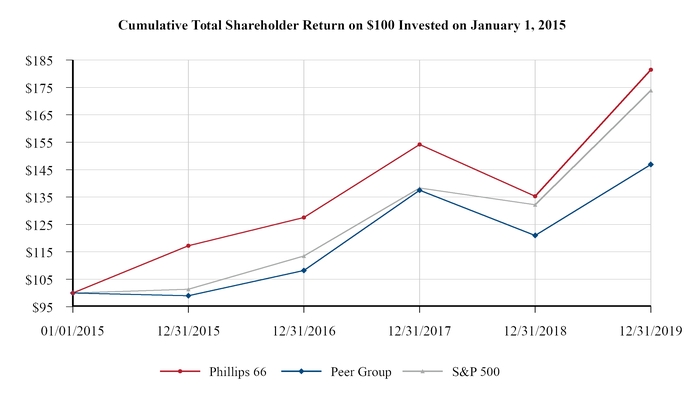
The performance graph above includes a peer index (the “Peer Group”) composed of Celanese Corporation; Delek US Holdings, Inc.; Eastman Chemical Co.; Enterprise Products Partners, LP; HollyFrontier Corporation; Huntsman Corporation; LyondellBasell Industries N.V.; Marathon Petroleum Corporation; Oneok, Inc.; PBF Energy Inc.; Targa Resources Corp.; Valero Energy Corporation; and Westlake Chemical Corp. Additionally, Andeavor is included as a peer for periods prior to its acquisition by Marathon Petroleum Corporation in October 2018.
Issuer Purchases of Equity Securities
| Millions of Dollars | |||||||||||||
| Period | Total Number of Shares Purchased* | Average Price Paid per Share | Total Number of Shares Purchased as Part of Publicly Announced Plans or Programs** | Approximate Dollar Value of Shares that May Yet Be Purchased Under the Plans or Programs | |||||||||
| October 1-31, 2019 | 1,371,989 | $ | 105.71 | 1,371,989 | $ | 3,224 | |||||||
| November 1-30, 2019 | 934,053 | 117.79 | 934,053 | 3,114 | |||||||||
| December 1-31, 2019 | 1,391,363 | 113.22 | 1,391,363 | 2,957 | |||||||||
| Total | 3,697,405 | $ | 111.58 | 3,697,405 |
** Includes repurchase of shares of common stock from company employees in connection with the company’s broad-based employee incentive plans, when applicable.*
*** On October 4, 2019, our Board of Directors approved a new share repurchase program that authorizes us to repurchase up to $3 billion of our common stock, bringing the total amount of share repurchases authorized by our Board of Directors since July 2012 to an aggregate of $15 billion. The authorizations do not have expiration dates. The share repurchases are expected to be funded primarily through available cash. The shares under these authorizations are repurchased from time to time in the open market at the company’s discretion, subject to market conditions and other factors, and in accordance with applicable regulatory requirements. We are not obligated to acquire any particular amount of common stock and may commence, suspend or discontinue purchases at any time or from time to time without prior notice. Shares of stock repurchased are held as treasury shares.*
Item 6. SELECTED FINANCIAL DATA
| Millions of Dollars Except Per Share Amounts | |||||||||||||||
| 2019 | 2018 | 2017 | 2016 | 2015 | |||||||||||
| Sales and other operating revenues* | $ | 107,293 | 111,461 | 102,354 | 84,279 | 98,975 | |||||||||
| Net income | 3,377 | 5,873 | 5,248 | 1,644 | 4,280 | ||||||||||
| Net income attributable to Phillips 66 | 3,076 | 5,595 | 5,106 | 1,555 | 4,227 | ||||||||||
| Per common share | |||||||||||||||
| Basic | 6.80 | 11.87 | 9.90 | 2.94 | 7.78 | ||||||||||
| Diluted | 6.77 | 11.80 | 9.85 | 2.92 | 7.73 | ||||||||||
| Total assets | 58,720 | 54,302 | 54,371 | 51,653 | 48,580 | ||||||||||
| Long-term debt | 11,216 | 11,093 | 10,069 | 9,588 | 8,843 | ||||||||||
| Cash dividends declared per common share | 3.50 | 3.10 | 2.73 | 2.45 | 2.18 |
** Sales and other operating revenues for the years ended December 31,* 2015 through 2017*, are presented in accordance with accounting standards in effect prior to our adoption of ASU No. 2014-09 on January 1, 2018. See Note 1—Summary of Significant Accounting Policies, in the Notes to Consolidated Financial Statements, for further discussion regarding our adoption of ASU No. 2014-09.*
To ensure full understanding, you should read the selected financial data presented above in conjunction with “Management’s Discussion and Analysis of Financial Condition and Results of Operations” and the consolidated financial statements and accompanying notes included elsewhere in this Annual Report on Form 10-K.
Item 7. MANAGEMENT’S DISCUSSION AND ANALYSIS OF FINANCIAL CONDITION AND RESULTS OF OPERATIONS
Unless otherwise indicated, “the company,” “we,” “our,” “us” and “Phillips 66” are used in this report to refer to the businesses of Phillips 66 and its consolidated subsidiaries.
Management’s Discussion and Analysis is the company’s analysis of its financial performance, financial condition, and significant trends that may affect future performance. It should be read in conjunction with the consolidated financial statements and notes thereto included elsewhere in this Annual Report on Form 10-K. It contains forward-looking statements including, without limitation, statements relating to the company’s plans, strategies, objectives, expectations and intentions that are made pursuant to the “safe harbor” provisions of the Private Securities Litigation Reform Act of 1995. The words “anticipate,” “estimate,” “believe,” “budget,” “continue,” “could,” “intend,” “may,” “plan,” “potential,” “predict,” “seek,” “should,” “will,” “would,” “expect,” “objective,” “projection,” “forecast,” “goal,” “guidance,” “outlook,” “effort,” “target” and similar expressions identify forward-looking statements. The company does not undertake to update, revise or correct any of the forward-looking information unless required to do so under the federal securities laws. Readers are cautioned that such forward-looking statements should be read in conjunction with the company’s disclosures under the heading: “CAUTIONARY STATEMENT FOR THE PURPOSES OF THE ‘SAFE HARBOR’ PROVISIONS OF THE PRIVATE SECURITIES LITIGATION REFORM ACT OF 1995.”
The terms “earnings” and “loss” as used in Management’s Discussion and Analysis refer to net income (loss) attributable to Phillips 66. The terms “pre-tax income” or “pre-tax loss” as used in Management’s Discussion and Analysis refer to income (loss) before income taxes.
EXECUTIVE OVERVIEW AND BUSINESS ENVIRONMENT
Phillips 66 is an energy manufacturing and logistics company with midstream, chemicals, refining, and marketing and specialties businesses. At December 31, 2019, we had total assets of $58.7 billion.
Executive Overview
In 2019, we reported earnings of $3.1 billion and generated $4.8 billion in cash from operating activities. In addition, Phillips 66 Partners LP (Phillips 66 Partners) had net debt issuances of $0.5 billion and received $0.4 billion from its joint venture partners to partially fund the Gray Oak Pipeline capital project. We used available cash primarily for capital expenditures and investments of $3.9 billion, repurchases of our common stock of $1.7 billion, and dividend payments on our common stock of $1.6 billion. We ended 2019 with $1.6 billion of cash and cash equivalents and approximately $5.7 billion of total committed capacity available under our credit facilities.
We continue to focus on the following strategic priorities:
| • | Operating Excellence. Our commitment to operating excellence guides everything we do. We are committed to protecting the health and safety of everyone who has a role in our operations and the communities in which we operate. Continuous improvement in safety, environmental stewardship, reliability and cost efficiency is a fundamental requirement for our company and employees. We employ rigorous training and audit programs to drive ongoing improvement in both personal and process safety as we strive for zero incidents. Since we cannot control commodity prices, controlling operating expenses and overhead costs, within the context of our commitment to safety and environmental stewardship, is a high priority. Senior management actively monitors these costs. We are committed to protecting the environment and strive to reduce our environmental footprint throughout our operations. Optimizing utilization rates at our refineries through reliable and safe operations enables us to capture the value available in the market in terms of prices and margins. During 2019, our worldwide refining crude oil capacity utilization rate was 94%. |
| • | Growth. A disciplined capital allocation process ensures we focus investments on projects that generate competitive returns through the business cycle. Our strategy focuses on investing in growth opportunities in the Midstream and Chemicals segments. Results from our Transportation and NGL businesses in our Midstream segment for 2019 were a reflection of this, as these businesses benefited from higher equity earnings and cash distributions from completed capital projects. In 2020, we have budgeted $2.4 billion for Midstream capital expenditures and investments, including $962 million for Phillips 66 Partners. Capital will be used to continue building out and maintaining our integrated logistics infrastructure network, including pipelines, storage, export and fractionation facilities. In Chemicals, our share of expected self-funded capital spending by Chevron Phillips Chemical Company LLC (CPChem) is $656 million. CPChem will fund continuing development of petrochemical projects on the U.S. Gulf Coast (USGC) and in Qatar, as well as debottlenecking opportunities on existing assets. |
| • | Returns. We plan to enhance Refining returns by increasing throughput of advantaged feedstocks, improving yields, portfolio optimization and an ongoing commitment to operating excellence. Our Refining segment maintained a strong clean product yield and optimized advantaged crude oil throughput at our U.S. refineries in 2019. For 2020, capital in Refining will be directed toward high-return projects to enhance the yield of higher-value products and other high-return, quick-payout projects. Marketing and Specialties (M&S) will continue to develop and enhance our retail network and brands in the United States and Europe. |
| • | Distributions. We believe shareholder value is enhanced through, among other things, consistent growth of regular dividends, complemented by share repurchases. We increased our quarterly dividend rate by 13% during 2019, and have increased it every year since the company’s inception in 2012. Regular dividends demonstrate the confidence our Board of Directors and management have in our capital structure and operations’ capability to generate free cash flow throughout the business cycle. In 2019, we repurchased $1.7 billion, or approximately 17 million shares, of our common stock. On October 4, 2019, our Board of Directors approved a new share repurchase program that authorizes us to repurchase up to $3 billion of our common stock, bringing the total amount of share repurchases authorized by our Board of Directors since July 2012 to an aggregate of $15 billion. At the discretion of our Board of Directors, we plan to increase dividends annually and fund our share repurchase programs while continuing to invest in the growth of our business. |
| • | High-Performing Organization. We strive to attract, develop and retain individuals with the knowledge and skills to implement our business strategy and who support our values and culture. Throughout the company, we focus on getting results in the right way, embrace our values as a common bond, and believe success is both what we do and how we do it. We encourage collaboration throughout our company, while valuing differences, respecting diversity, and creating a great place to work. We foster an environment of learning and development through structured programs focused on enhancing functional and technical skills where employees are engaged in our business and committed to their own, as well as the company’s, success. |
Business Environment
The Midstream segment includes our Transportation and Natural Gas Liquids (NGL) businesses. Our Transportation business contains fee-based operations that are not directly exposed to commodity price risk. Our
Showing the first 8K of 127K characters. Open the full section
Item 7A. QUANTITATIVE AND QUALITATIVE DISCLOSURES ABOUT MARKET RISK
Financial Instrument Market Risk
We and certain of our subsidiaries are exposed to market risks produced by changes in the prices of crude oil, refined petroleum products, natural gas, NGL and electric power, as well as fluctuations in interest rates and foreign currency exchange rates. We and certain of our subsidiaries may hold and use derivative contracts to manage these risks.
Commodity Price Risk
Generally, our policy is to remain exposed to the market prices of commodities. Consistent with this policy, we use derivative contracts to convert our exposure from fixed-price sales or purchase contracts, often specified in contracts with refined petroleum product customers, back to floating market prices. We also use futures, forwards, swaps and options in various markets to accomplish the following objectives:
| • | Balance physical systems or to meet our refinery requirements and market demand. In addition to cash settlement prior to contract expiration, exchange-traded futures contracts may be settled by physical delivery of the underlying commodity. |
| • | Enable us to use the market knowledge gained from our physical commodity market activities to capture market opportunities, such as moving physical commodities to more profitable locations, storing commodities to capture seasonal or time premiums, and blending commodities to capture quality upgrades. Derivatives may be utilized to optimize these activities. |
| • | Manage the risk to our cash flows from price exposures on specific crude oil, refined petroleum product, natural gas and NGL transactions. |
These objectives optimize the value of our supply chain and may reduce our exposure to fluctuations in market prices.
Our use of derivative instruments is governed by an “Authority Limitations” document approved by our Board of Directors, which prohibits the use of highly leveraged derivatives or derivative instruments without sufficient market liquidity for comparable valuations and establishes Value at Risk (VaR) limits. Compliance with these limits is monitored daily by our global risk group.
We use a VaR model to estimate the loss in fair value that could potentially result on a single day from the effect of adverse changes in market conditions on the derivative commodity instruments held or issued. Using Monte Carlo simulation, a 95% confidence level and a one-day holding period, the VaR for derivative commodity instruments issued or held at December 31, 2019 and 2018, was immaterial to our cash flows and net income.
Interest Rate Risk
Our use of fixed- or variable-rate debt directly exposes us to interest rate risk. Fixed-rate debt, such as our senior notes, exposes us to changes in the fair value of our debt due to changes in market interest rates. Fixed-rate debt also exposes us to the risk that we may need to refinance maturing debt with new debt at higher rates, or that we may be obligated to pay rates higher than the current market. Variable-rate debt, such as our floating-rate notes or borrowings under our revolving credit facility, exposes us to short-term changes in market rates that impact our interest expense. The following tables provide information about our debt instruments that are sensitive to changes in U.S. interest rates. These tables present principal cash flows and related weighted-average interest rates by expected maturity dates. Weighted-average variable rates are based on effective rates at each reporting date. The carrying amount of our floating-rate debt approximates its fair value. The fair value of the fixed-rate financial instruments is estimated based on observable market prices.
| Millions of Dollars, Except as Indicated | ||||||||||||||
| Expected Maturity Date | Fixed Rate Maturity | Average Interest Rate | Floating Rate Maturity | Average Interest Rate | ||||||||||
| Year-End 2019 | ||||||||||||||
| 2020 | $ | — | — | % | $ | 525 | 2.69 | % | ||||||
| 2021 | — | — | 550 | 2.46 | ||||||||||
| 2022 | 2,000 | 4.30 | — | — | ||||||||||
| 2023 | — | — | — | — | ||||||||||
| 2024 | 300 | 2.45 | — | — | ||||||||||
| Remaining years | 8,176 | 4.57 | 25 | 2.39 | ||||||||||
| Total | $ | 10,476 | $ | 1,100 | ||||||||||
| Fair value | $ | 11,813 | $ | 1,100 |
| Millions of Dollars, Except as Indicated | ||||||||||||||
| Expected Maturity Date | Fixed Rate Maturity | Average Interest Rate | Floating Rate Maturity | Average Interest Rate | ||||||||||
| Year-End 2018 | ||||||||||||||
| 2019 | $ | — | — | % | $ | 50 | 3.65 | % | ||||||
| 2020 | 300 | 2.65 | 525 | 3.21 | ||||||||||
| 2021 | — | — | 625 | 3.23 | ||||||||||
| 2022 | 2,000 | 4.30 | — | — | ||||||||||
| 2023 | — | — | — | — | ||||||||||
| Remaining years | 7,576 | 4.69 | — | — | ||||||||||
| Total | $ | 9,876 | $ | 1,200 | ||||||||||
| Fair value | $ | 9,727 | $ | 1,200 |
Our Chief Executive Officer and Chief Financial Officer monitor risks resulting from commodity prices, interest rates and foreign currency exchange rates.
For additional information about our use of derivative instruments, see Note 15—Derivatives and Financial Instruments, in the Notes to Consolidated Financial Statements.
CAUTIONARY STATEMENT FOR THE PURPOSES OF THE “SAFE HARBOR” PROVISIONS OF THE PRIVATE SECURITIES LITIGATION REFORM ACT OF 1995
This report includes forward-looking statements within the meaning of Section 27A of the Securities Act of 1933 and Section 21E of the Securities Exchange Act of 1934. You can identify our forward-looking statements by the words “anticipate,” “estimate,” “believe,” “budget,” “continue,” “could,” “intend,” “may,” “plan,” “potential,” “predict,” “seek,” “should,” “will,” “would,” “expect,” “objective,” “projection,” “forecast,” “goal,” “guidance,” “outlook,” “effort,” “target” and similar expressions.
We based the forward-looking statements on our current expectations, estimates and projections about us and the industries in which we operate in general. We caution you these statements are not guarantees of future performance as they involve assumptions that, while made in good faith, may prove to be incorrect, and involve risks and uncertainties we cannot predict. In addition, we based many of these forward-looking statements on assumptions about future events that may prove to be inaccurate. Accordingly, our actual outcomes and results may differ materially from what we have expressed or forecast in the forward-looking statements. Any differences could result from a variety of factors, including the following:
| • | Fluctuations in NGL, crude oil, refined petroleum product and natural gas prices and refining, marketing and petrochemical margins. |
| • | Failure of new products and services to achieve market acceptance. |
| • | Unexpected changes in costs or technical requirements for constructing, modifying or operating our facilities or transporting our products. |
| • | Unexpected technological or commercial difficulties in manufacturing, refining or transporting our products, including chemical products. |
| • | Lack of, or disruptions in, adequate and reliable transportation for our NGL, crude oil, natural gas and refined petroleum products. |
| • | The level and success of drilling and quality of production volumes around our Midstream assets. |
| • | Our inability to timely obtain or maintain permits, including those necessary for capital projects. |
| • | Our inability to comply with government regulations or make capital expenditures required to maintain compliance. |
| • | Failure to complete definitive agreements and feasibility studies for, and to complete construction of, announced and future capital projects on time and within budget. |
| • | Potential disruption or interruption of our operations due to accidents, weather events, civil unrest, political events, terrorism or cyber attacks. |
| • | International monetary conditions and exchange controls. |
| • | Substantial investment or reduced demand for products as a result of existing or future environmental rules and regulations. |
| • | Liability resulting from litigation or for remedial actions, including removal and reclamation obligations under environmental regulations. |
| • | General domestic and international economic and political developments including: armed hostilities; expropriation of assets; changes in governmental policies relating to NGL, crude oil, natural gas or refined petroleum products pricing, regulation or taxation; and other political, economic or diplomatic developments, including those caused by public health issues and outbreaks. |
| • | Changes in tax, environmental and other laws and regulations (including alternative energy mandates) applicable to our business. |
| • | Limited access to capital or significantly higher cost of capital related to changes to our credit profile or illiquidity or uncertainty in the domestic or international financial markets. |
| • | The operation, financing and distribution decisions of our joint ventures. |
| • | Domestic and foreign supplies of crude oil and other feedstocks. |
| • | Domestic and foreign supplies of petrochemicals and refined petroleum products, such as gasoline, diesel, aviation fuel and home heating oil. |
| • | Governmental policies relating to exports of crude oil and natural gas. |
| • | Overcapacity or undercapacity in the midstream, chemicals and refining industries. |
| • | Fluctuations in consumer demand for refined petroleum products. |
| • | The factors generally described in Item 1A.—Risk Factors in this report. |
Item 8. FINANCIAL STATEMENTS AND SUPPLEMENTARY DATA
PHILLIPS 66
INDEX TO FINANCIAL STATEMENTS
Report of Management
Management prepared, and is responsible for, the consolidated financial statements and the other information appearing in this Annual Report. The consolidated financial statements present fairly the company’s financial position, results of operations and cash flows in conformity with generally accepted accounting principles in the United States. In preparing its consolidated financial statements, the company includes amounts that are based on estimates and judgments management believes are reasonable under the circumstances. The company’s financial statements have been audited by Ernst & Young LLP, an independent registered public accounting firm appointed by the Audit and Finance Committee of the Board of Directors. Management has made available to Ernst & Young LLP all of the company’s financial records and related data, as well as the minutes of stockholders’ and directors’ meetings.
Assessment of Internal Control Over Financial Reporting
Management is responsible for establishing and maintaining adequate internal control over financial reporting. Phillips 66’s internal control system was designed to provide reasonable assurance to the company’s management and directors regarding the preparation and fair presentation of published financial statements.
All internal control systems, no matter how well designed, have inherent limitations. Therefore, even those systems determined to be effective can provide only reasonable assurance with respect to financial statement preparation and presentation.
Management assessed the effectiveness of the company’s internal control over financial reporting as of December 31, 2019. In making this assessment, it used the criteria set forth by the Committee of Sponsoring Organizations of the Treadway Commission in Internal Control—Integrated Framework (2013). Based on this assessment, management concluded the company’s internal control over financial reporting was effective as of December 31, 2019.
Ernst & Young LLP has issued an audit report on the company’s internal control over financial reporting as of December 31, 2019, and their report is included herein.
| /s/ Greg C. Garland | /s/ Kevin J. Mitchell | |
| Greg C. Garland | Kevin J. Mitchell | |
| Chairman of the Board of Directors and | Executive Vice President, Finance and | |
| Chief Executive Officer | Chief Financial Officer | |
Date: February 21, 2020
Report of Independent Registered Public Accounting Firm
To the Board of Directors and Stockholders of Phillips 66
Opinion on the Financial Statements
We have audited the accompanying consolidated balance sheet of Phillips 66 (the Company) as of December 31, 2019 and 2018, the related consolidated statements of income, comprehensive income, changes in equity, and cash flows, for each of the three years in the period ended December 31, 2019, and the related notes (collectively referred to as the financial statements). In our opinion, the financial statements present fairly, in all material respects, the consolidated financial position of the Company as of December 31, 2019 and 2018, and the consolidated results of its operations and its cash flows for each of the three years in the period ended December 31, 2019, in conformity with U.S. generally accepted accounting principles.
We also have audited, in accordance with the standards of the Public Company Accounting Oversight Board (United States) (PCAOB), the Company’s internal control over financial reporting as of December 31, 2019, based on criteria established in Internal Control-Integrated Framework issued by the Committee of Sponsoring Organizations of the Treadway Commission (2013 framework) and our report dated February 21, 2020 expressed an unqualified opinion thereon.
Adoption of ASU No. 2014-09
As discussed in Note 1 to the consolidated financial statements, the Company adopted ASU No. 2014-09, “Revenue from Contracts with Customers (Topic 606)” effective January 1, 2018. As a result, for the years ended December 31, 2019 and 2018, the Company changed its presentation of excise taxes collected from customers on sales of refined petroleum products.
Basis for Opinion
These financial statements are the responsibility of the Company’s management. Our responsibility is to express an opinion on the Company’s financial statements based on our audits. We are a public accounting firm registered with the PCAOB and are required to be independent with respect to the Company in accordance with the U.S. federal securities laws and the applicable rules and regulations of the Securities and Exchange Commission and the PCAOB.
We conducted our audits in accordance with the standards of the PCAOB. Those standards require that we plan and perform the audit to obtain reasonable assurance about whether the financial statements are free of material misstatement, whether due to error or fraud. Our audits included performing procedures to assess the risks of material misstatement of the financial statements, whether due to error or fraud, and performing procedures that respond to those risks. Such procedures include examining, on a test basis, evidence regarding the amounts and disclosures in the financial statements. Our audits also included evaluating the accounting principles used and significant estimates made by management, as well as evaluating the overall presentation of the financial statements. We believe that our audits provide a reasonable basis for our opinion.
Critical Audit Matter
The critical audit matter communicated below is a matter arising from the current period audit of the financial statements that was communicated or required to be communicated to the audit committee and that: (1) relates to accounts or disclosures that are material to the financial statements and (2) involved our especially challenging, subjective or complex judgments. The communication of the critical audit mat
Showing the first 8K of 247K characters. Open the full section
Item 9. CHANGES IN AND DISAGREEMENTS WITH ACCOUNTANTS ON ACCOUNTING AND FINANCIAL DISCLOSURE
None.
Item 9A. CONTROLS AND PROCEDURES
We maintain disclosure controls and procedures designed to ensure that information required to be disclosed in reports we file or submit under the Securities Exchange Act of 1934, as amended (the Act), is recorded, processed, summarized and reported within the time periods specified in SEC rules and forms, and that such information is accumulated and communicated to management, including our principal executive and principal financial officers, as appropriate, to allow timely decisions regarding required disclosure. As of December 31, 2019, with the participation of management, our Chairman and Chief Executive Officer and our Executive Vice President, Finance and Chief Financial Officer carried out an evaluation, pursuant to Rule 13a-15(b) of the Act, of the effectiveness of our disclosure controls and procedures (as defined in Rule 13a-15(e) of the Act). Based upon that evaluation, our Chairman and Chief Executive Officer and our Executive Vice President, Finance and Chief Financial Officer concluded that our disclosure controls and procedures were operating effectively as of December 31, 2019.
Effective October 1, 2019, we began a phased, multiyear implementation of an updated enterprise resource planning (ERP) system. As a result, changes were made to our business processes and information systems. To maintain adequate controls over these updated business processes and information systems, we evaluated and updated applicable internal controls over financial reporting accordingly. There have been no other changes in our internal control over financial reporting, as defined in Rule 13a-15(f) of the Act, in the quarterly period ended December 31, 2019, that have materially affected, or are reasonably likely to materially affect, our internal control over financial reporting.
Management’s Annual Report on Internal Control Over Financial Reporting
This report is included in Item 8 and is incorporated herein by reference.
Report of Independent Registered Public Accounting Firm on Internal Control Over Financial Reporting
This report is included in Item 8 and is incorporated herein by reference.
Item 9B. OTHER INFORMATION
Item 10. DIRECTORS, EXECUTIVE OFFICERS AND CORPORATE GOVERNANCE
Information regarding our executive officers appears in Part I of this report.
The remaining information required by Item 10 of Part III is incorporated herein by reference from our Proxy Statement for the Annual Meeting of Stockholders to be held on May 6, 2020, which will be filed within 120 days after December 31, 2019 (2020 Definitive Proxy Statement).*
Item 11. EXECUTIVE COMPENSATION
The information required by Item 11 of Part III is incorporated herein by reference from our 2020 Definitive Proxy Statement.*
Item 12. SECURITY OWNERSHIP OF CERTAIN BENEFICIAL OWNERS AND MANAGEMENT AND RELATED STOCKHOLDER MATTERS
The information required by Item 12 of Part III is incorporated herein by reference from our 2020 Definitive Proxy Statement.*
Item 13. CERTAIN RELATIONSHIPS AND RELATED TRANSACTIONS, AND DIRECTOR INDEPENDENCE
The information required by Item 13 of Part III is incorporated herein by reference from our 2020 Definitive Proxy Statement.*
Item 14. PRINCIPAL ACCOUNTING FEES AND SERVICES
The information required by Item 14 of Part III is incorporated herein by reference from our 2020 Definitive Proxy Statement.*
** Except for information or data specifically incorporated herein by reference under Items 10 through 14, other information and data appearing in our* 2020 Definitive Proxy Statement are not deemed to be a part of this Annual Report on Form 10-K or deemed to be filed with the Commission as a part of this report.
PART IV
Item 15. EXHIBITS, FINANCIAL STATEMENT SCHEDULES
| (a) | 1. | Financial Statements and Supplementary Data The financial statements and supplementary information listed in the Index to Financial Statements, which appears on page 73, are filed as part of this Annual Report on Form 10-K. |
| 2. | Financial Statement Schedules All financial statement schedules are omitted because they are not required, not significant, not applicable, or the information is shown in the financial statements or notes thereto. | |
| 3. | Exhibits The exhibits listed in the Index to Exhibits, which appears on pages 150 to 153, are filed as part of this Annual Report on Form 10-K. | |
| (c) | Pursuant to Rule 3-09 of Regulation S-X, the financial statements of Chevron Phillips Chemical Company LLC as of December 31, 2019 and 2018, and for each of the three years ended December 31, 2019, are included as an exhibit to this Annual Report on Form 10-K. |
Item 16. FORM 10-K SUMMARY
None.
PHILLIPS 66
INDEX TO EXHIBITS
| Incorporated by Reference | |||||||
| Exhibit Number | Exhibit Description | Form | Exhibit Number | Filing Date | SEC File No. | ||
| 99.1* | The financial statements of Chevron Phillips Chemical Company LLC, pursuant to Rule 3-09 of Regulation S-X. | ||||||
| 101.INS* | Inline XBRL Instance Document - the instance document does not appear in the Interactive Data File because its XBRL tags are embedded within the Inline XBRL document. | ||||||
| 101.SCH* | Inline XBRL Schema Document. | ||||||
| 101.CAL* | Inline XBRL Calculation Linkbase Document. | ||||||
| 101.LAB* | Inline XBRL Labels Linkbase Document. | ||||||
| 101.PRE* | Inline XBRL Presentation Linkbase Document. | ||||||
| 101.DEF* | Inline XBRL Definition Linkbase Document. | ||||||
| 104* | Cover Page Interactive Data File (formatted as Inline XBRL and contained in Exhibit 101). | ||||||
** Filed herewith.*
*** Management contracts and compensatory plans or arrangements.*
SIGNATURES
Pursuant to the requirements of Section 13 or 15(d) of the Securities Exchange Act of 1934, the registrant has duly caused this report to be signed on its behalf by the undersigned, thereunto duly authorized.
| PHILLIPS 66 | ||
| Date: | February 21, 2020 | /s/ Greg C. Garland |
| Greg C. Garland Chairman of the Board of Directors and Chief Executive Officer |
Pursuant to the requirements of the Securities Exchange Act of 1934, this report has been signed below, as of February 21, 2020, by the following persons on behalf of the registrant and in the capacities indicated.
| Signature | Title | |
| /s/ Greg C. Garland | Chairman of the Board of Directors | |
| Greg C. Garland | and Chief Executive Officer | |
| (Principal executive officer) | ||
| /s/ Kevin J. Mitchell | Executive Vice President, Finance | |
| Kevin J. Mitchell | and Chief Financial Officer | |
| (Principal financial officer) | ||
| /s/ Chukwuemeka A. Oyolu | Vice President and Controller | |
| Chukwuemeka A. Oyolu | (Principal accounting officer) | |
| /s/ Gary K. Adams | Director | |
| Gary K. Adams | ||
| /s/ J. Brian Ferguson | Director | |
| J. Brian Ferguson | ||
| /s/ Charles M. Holley | Director | |
| Charles M. Holley | ||
| /s/ John E. Lowe | Director | |
| John E. Lowe | ||
| /s/ Harold W. McGraw III | Director | |
| Harold W. McGraw III | ||
| /s/ Denise L. Ramos | Director | |
| Denise L. Ramos | ||
| /s/ Glenn F. Tilton | Director | |
| Glenn F. Tilton | ||
| /s/ Victoria J. Tschinkel | Director | |
| Victoria J. Tschinkel | ||
| /s/ Marna C. Whittington | Director | |
| Marna C. Whittington |