 filings.tools
Item 1. Business
15K characters. Original on sec.gov · Markdown
Item 1. Business
Our Business
PTC is a global software company that enables manufacturers and product companies to digitally transform how they design, manufacture, and service the physical products that the world relies on. Headquartered in Boston, Massachusetts, PTC employs over 7,000 people and supports more than 30,000 customers globally.
We primarily serve customers in the following industry verticals:
Industrials
Federal, Aerospace and Defense
Electronics and High Tech
Automotive
Medical Technology and Life Sciences
Our customers are focused on improving their competitiveness in the face of global competition and increasing product complexity, and our suite of software offerings is a strategic enabler of this and their digital transformation initiatives. We enable our customers to establish a strong product data foundation and leverage that foundation to drive cross-functional collaboration, accelerate new product introduction timelines and deliver higher product quality.
Our offerings include CAD (Computer Aided Design) solutions for product data authoring and PLM (Product Lifecycle Management) solutions for product data management and process orchestration.
Within the overall PLM category, our offerings also include ALM (Application Lifecycle Management) and SLM (Service Lifecyle Management).
Given the breadth and openness of our portfolio, we can enable end-to-end digital thread initiatives, which leverage a connected flow of product data across design, manufacturing, service, and, ultimately, reuse. A digital thread enables product companies to break down silos, streamline workflows, and achieve interoperability across departments, functions and systems with a single version of truth. It also secures the quality, consistency and traceability of product-related data, ensuring that the data is up-to-date, accessible, reliable and actionable. With a digital thread, the right data is delivered to the right people at the right time and in the right context across the value chain.
Our business is based on a subscription model, with 93% of our 2024 revenue being recurring in nature. Compared to a perpetual license model, our subscription model naturally drives higher customer engagement and retention and provides better business predictability. This, in turn, enables us to make steady and sustained investments to pursue mid-to-long-term growth opportunities.
Our Principal Products and Services
PLM software products for product data management and process orchestration
Our Windchill**®** PLM application suite manages all aspects of the product development lifecycle—from concept through service and end-of-life. Windchill provides real-time information sharing, dynamic data visualization, and the ability to collaborate across geographically distributed teams, enabling manufacturers to elevate their product development, manufacturing, field service, and end-of-life processes.
Our Codebeamer**®** and pure::variants****TM application lifecycle management (ALM) solutions enable companies to accelerate the development of products that contain software, including software-defined products which require multiple software variants to be created and updated over the life of the product.
Our ServiceMax**®** service lifecycle management (SLM) solution enables companies to improve asset uptime with optimized in-person and remote service, boost technician productivity with the latest mobile tools, and deliver metrics for confident decision making.
Our Servigistics**®** service parts management solution enables companies to effectively manage their service parts inventory, enabling them to optimize equipment availability and uptime, and increase customer satisfaction.
Our Arena**®** Software as a Service (SaaS) PLM solution enables product teams to collaborate virtually anytime and anywhere, making it easier to share the latest product and quality information with internal teams and supply chain partners and deliver innovative products to customers faster. Our Arena quality management system software connects quality and product designs into a single system to simplify regulatory compliance.
CAD software products for product data authoring
Our Creo**®** 3D CAD technology enables the digital design, testing, and modification of product models. With its design simulation, additive manufacturing, and generative design innovations, we enable our customers to be first to market with differentiated products. From initial concept to design, simulation, and analysis, Creo provides designers with innovative tools to efficiently create better products, faster.
Our Onshape® SaaS product development platform unites computer-aided design with data management, collaboration tools, and real-time analytics. A cloud-native multi-tenant solution that can be instantly deployed on virtually any computer or mobile device, Onshape enables teams to work together from just about anywhere. Real-time design reviews, commenting, and simultaneous editing enable a collaborative workflow where multiple design iterations can be completed in parallel and merged into the final design.
Enabling technologies
Our principal products and services are enhanced by a collection of enabling technologies, including SaaS versions of our Creo**®** CAD and Windchill**®** PLM software, artificial intelligence software, our ThingWorx® Internet of Things software, and our Vuforia® augmented reality software. The primary focus of these technologies is to deliver value-added capabilities to our principal products and services, such as the improved security and collaboration environment of a SaaS platform; unlocking productivity with artificial intelligence; moving product data more quickly across engineering, manufacturing, and service using IoT; or automatically analyzing the quality of a manufactured product with augmented reality.
Our Markets and How We Address Them
Our strategy aims to create value for our customers, increase our Annual Run Rate (ARR) and cash flow, and deliver long-term value for shareholders. We focus our resources on the following five solutions, where we believe we can create the greatest customer value:
PLM
ALM
SLM
CAD
SaaS or Software as a Service
Our growth is primarily driven by existing customers that continue to expand their PTC footprint, largely relating to their focus on improving their competitiveness through digital transformation. To a lesser extent, our growth is also supported by new customers and price increases.
We derive approximately 75% of our sales from products and services sold directly by our sales force to end-user customers. The rest of our sales of products and services are through third-party resellers. Our sales force focuses on large accounts, while our reseller channel provides a cost-effective means of covering the small- and medium-size business markets. Our strategic reseller and software partners enable us to increase our market reach, offer broader solutions, and add compelling technology to our offerings. Our strategic services partners provide service offerings to help customers implement our product offerings and transition to SaaS.
Additional financial information about our international and domestic operations may be found in Note 3. Revenue from Contracts with Customers of Notes to Consolidated Financial Statements in this Annual Report, which information is incorporated herein by reference.
Competition
We compete with a number of companies whose offerings address one or more specific functional areas covered by our solutions. For enterprise CAD and PLM solutions, we compete with large established companies including Autodesk, Dassault Systèmes SA, and Siemens AG. For our ALM products, we compete with IBM, Jama Software, Inc. and Siemens AG. For our SLM products, we compete with enterprise software companies such as Oracle, SAP and IFS AB, and with companies that offer point solutions.
Proprietary Rights
Our software products and related technical know-how, along with our trademarks, including our company names, product names and logos, are proprietary. We protect our intellectual property rights in these items by relying on copyrights, trademarks, patents and common law safeguards, including trade secret protection. The nature and extent of such legal protection depends in part on the type of intellectual property right and the relevant jurisdiction. In the U.S., we are generally able to maintain our trademark registrations for as long as the trademarks are in use and to maintain our patents for up to 20 years from the earliest effective filing date. We also use license management and other anti-piracy technology measures, as well as contractual restrictions, to curtail the unauthorized use and distribution of our products.
Our proprietary rights are subject to the risks and uncertainties described under Item 1A. Risk Factors below, which is incorporated into this section by reference.
Environmental Sustainability
At PTC, we’re working to contribute to the decarbonization and circularity of global manufacturing. While we have a climate action plan committed to reducing our company’s “footprint,” we believe far larger benefits will flow from our “handprint” stemming from our software offerings. Our software solutions enable manufacturers to design, build, and service their products more sustainably.
Footprint
Our emission reduction plan was validated by the Science Based Targets initiative (SBTi) in September 2024. Our near-term commitment is to reduce by 2030 combined Scope 1 (direct emissions from owned/controlled operations) and Scope 2 (indirect energy use) emissions by 50% and reduce Scope 3 - Category 1 (Purchased Goods and Services) by 25% compared to our 2022 baseline. Our long-term net-zero commitment is to reach net-zero across all scope emissions by 2050, with absolute reductions of over 90% across Scopes 1-3, with accredited carbon removal offsets for the remaining 10% (or less) as needed.
We have already begun to implement programs and pursue initiatives to reduce our emissions and carbon footprint, including:
entering into a Virtual Power Purchase Agreement (VPPA) to reduce our future carbon footprint;
prioritizing energy efficiency and accessibility to public transportation when selecting office space;
providing a subsidy for employee’s public transportation commute costs; and
selecting suppliers with decarbonization targets.
Handprint
Environmental sustainability is integral to our product offerings. With our software, manufacturers can support their sustainability and compliance initiatives, including by designing with less material, enhancing product repairability and circularity, improving factory efficiency, and enabling remote service.
People and Culture
Within our work environment we seek to create an equitable and inclusive culture in which all employees can thrive. This is a key aspect of our talent strategy. Our approach is focused on promoting an agile culture, an increased sense of belonging, engaged work environments, and high-performing teams.

PTC at-a-Glance
As of September 30, 2024, PTC had 7,501 full-time employees. Our employee population is geographically diverse and serves a geographically diverse customer and partner network.
Worldwide Employee Representation
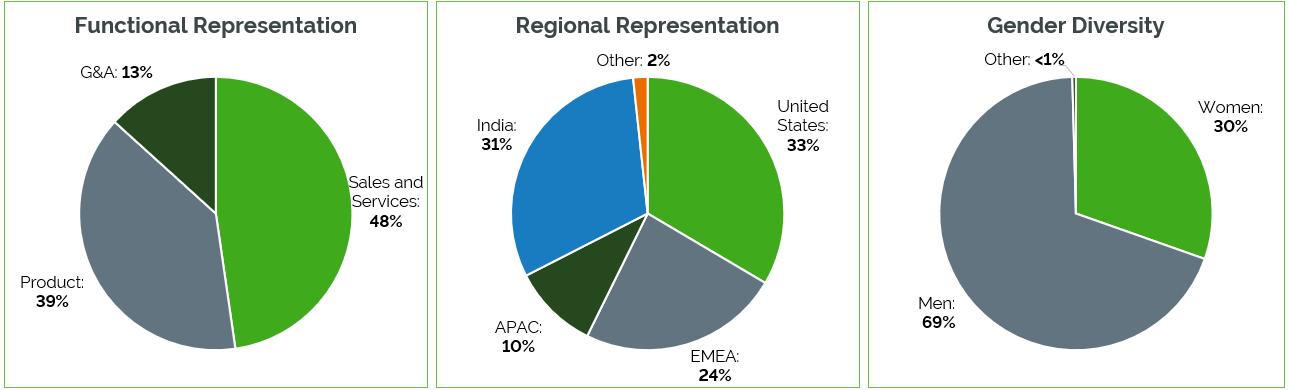
United States Employee Representation

Compensation and Benefits
PTC provides a comprehensive and competitive compensation and benefits package designed to attract, retain, motivate, and engage talent around the world, including base salaries, and, for eligible roles, incentive and equity compensation. Employees also have the opportunity to purchase PTC stock at a discount through our Employee Stock Purchase Plan.
Our benefit offerings are designed to meet the needs of our employees and their families around the world. Specific offerings differ country by country due to cultural norms, market dynamics, and legal requirements, but we provide a wide variety of core health and financial programs such as healthcare, life and disability insurance, employee assistance plans, retirement savings and pension benefit plans, and generous paid family leave and vacation time.
Talent Development & Employee Engagement
As we focus on enhancing the employee experience, we are increasing our efforts to invest in our people and create meaningful opportunities to learn, grow, develop, and advance their careers. We have specific development programs and coaching programs, as well as numerous other self-led learning paths. The variety of options means that employees have the ability to focus on the development path most meaningful to them.
Diversity, Equity, and Inclusion (DEI)
Commitment to our values and diversity in our workforce is supported by various ongoing efforts. We mitigate bias by coaching managers and leaders in fostering psychologically safe environments. We also review and revise our processes based on feedback and engagement scores from employee pulse surveys. We embed equitable practices into the planning and execution of how we attract, select, develop, and retain talent. Meanwhile, our DEI ambassadors are aligned with business functions to amplify and enhance our efforts in these areas. Finally, to cultivate a community of belonging, our 11 Employee Resource Groups foster an inclusive culture and facilitate safe spaces for employees to navigate social issues and challenges.
Additional Information About Our Employee Initiatives
You can find more information about our employee initiatives in our 2024 Impact Report, which we expect to release in early 2025.
Available Information
We make available free of charge on our website at www.ptc.com the following reports as soon as reasonably practicable after electronically filing them with, or furnishing them to, the SEC: our Annual Reports on Form 10-K; our Quarterly Reports on Form 10-Q; our Current Reports on Form 8-K; and amendments to those reports filed or furnished pursuant to Sections 13(a) or 15(d) of the Securities Exchange Act of 1934. Our Proxy Statements for our Annual Meetings and Section 16 trading reports on SEC Forms 3, 4 and 5 also are available on our website.
Corporate Information
PTC was incorporated in Massachusetts in 1985 and is headquartered in Boston, Massachusetts.
Previous: Cover and table of contents · Next: Item 1A. Risk Factors