 filings.tools
Item 1. BUSINESS
36K characters. Original on sec.gov · Markdown
Item 1. BUSINESS
Overview
PayPal Holdings, Inc. was incorporated in Delaware in January 2015 and is a leading technology platform and digital payments company that enables digital and mobile payments on behalf of consumers and merchants worldwide. PayPal is committed to democratizing financial services and empowering people and businesses to join and thrive in the global economy. Our goal is to enable our consumers and merchants to manage and move their money anywhere in the world, anytime, on any platform, and using any device. Our combined payment solutions, including our PayPal, PayPal Credit, Braintree, Venmo, Xoom, and iZettle products and services, comprise our proprietary Payments Platform.
PayPal’s payment solutions enable our customers to send and receive payments. We operate a global, two-sided network at scale that connects merchants and consumers with 305 million active accounts (consisting of 281 million consumer active accounts and 24 million merchant active accounts) across more than 200 markets. PayPal helps merchants and consumers connect, transact, and complete payments, whether they are online, on a mobile device, in an app, or in person. PayPal is more than a connection to third-party payment networks. We provide proprietary payment solutions accepted by merchants that enable the completion of payments on our Payments Platform on behalf of our customers.
We offer our customers the flexibility to use their accounts to purchase and receive payment for goods and services, as well as the ability to transfer and withdraw funds. We enable consumers to exchange funds more safely with merchants using a variety of funding sources, which may include a bank account, a PayPal account balance, a Venmo account balance, a PayPal Credit account, a credit or debit card, or other stored value products such as coupons, gift cards, and eligible credit card rewards. Our PayPal, Venmo, and Xoom products also make it safer and simpler for friends and family to transfer funds to each other. We offer merchants an end-to-end payments solution that provides authorization and settlement capabilities, as well as instant access to funds. We help merchants connect with their customers and manage risk. We enable consumers to engage in cross-border shopping and merchants to extend their global reach while reducing the complexity and friction involved in enabling overseas and cross-border trade.
We earn revenues primarily by charging fees for completing payment transactions for our customers and other payment-related services that are typically based on the volume of activity processed on our Payments Platform. Generally we do not charge consumers to fund or draw from their accounts; however, we generate revenue from consumers on fees charged for foreign currency exchange, and instant transfers from their PayPal or Venmo account to their debit card or bank account, as well as from interest and fees from our PayPal Credit product. We also earn revenue by providing other value added services, which comprise revenue earned through partnerships, our PayPal merchant and consumer credit products, subscription fees, gateway services, and other services that we provide to our merchants and consumers. Our gateway services, which include our Payflow Gateway service and Braintree Gateway service, provide the technology that links a merchant’s website to its processing network and merchant account and enables merchants to accept payments online with credit or debit cards.
Strategy
Our ability to grow revenue is affected by, among other things, consumer spending patterns, merchant and consumer adoption of digital payment methods, the expansion of multiple commerce channels, the growth of mobile devices and merchant and consumer applications on those devices, the growth of consumers globally with internet and mobile access, the pace of transition from cash and checks to digital forms of payment, our share of the digital payments market, and our ability to innovate and introduce new products and services that merchants and consumers value. Our strategy to drive growth in our business includes the following:
| • | Growing our core business: through expanding our global capabilities, customer base and scale, increasing our customers’ use of our products and services by better addressing their everyday needs related to accessing, managing, and moving money, and expanding the adoption of our solutions by merchants and consumers; |
| • | Expanding our value proposition for merchants and consumers: by being technology and platform agnostic, partnering with our merchants to grow and expand their business online and in-store; and providing consumers with simple, secure, and flexible ways to manage and move money across different markets, merchants, and platforms; |
| • | Forming strategic partnerships: by building new strategic partnerships to provide better experiences for our customers, offering greater choice and flexibility, acquiring new customers, and reinforcing our role in the ecosystem; and |
| • | Seeking new areas of growth: organically and through acquisitions and strategic investments in our existing and new international markets around the world and focusing on innovation both in the digital and physical world. |
Key Performance Metrics
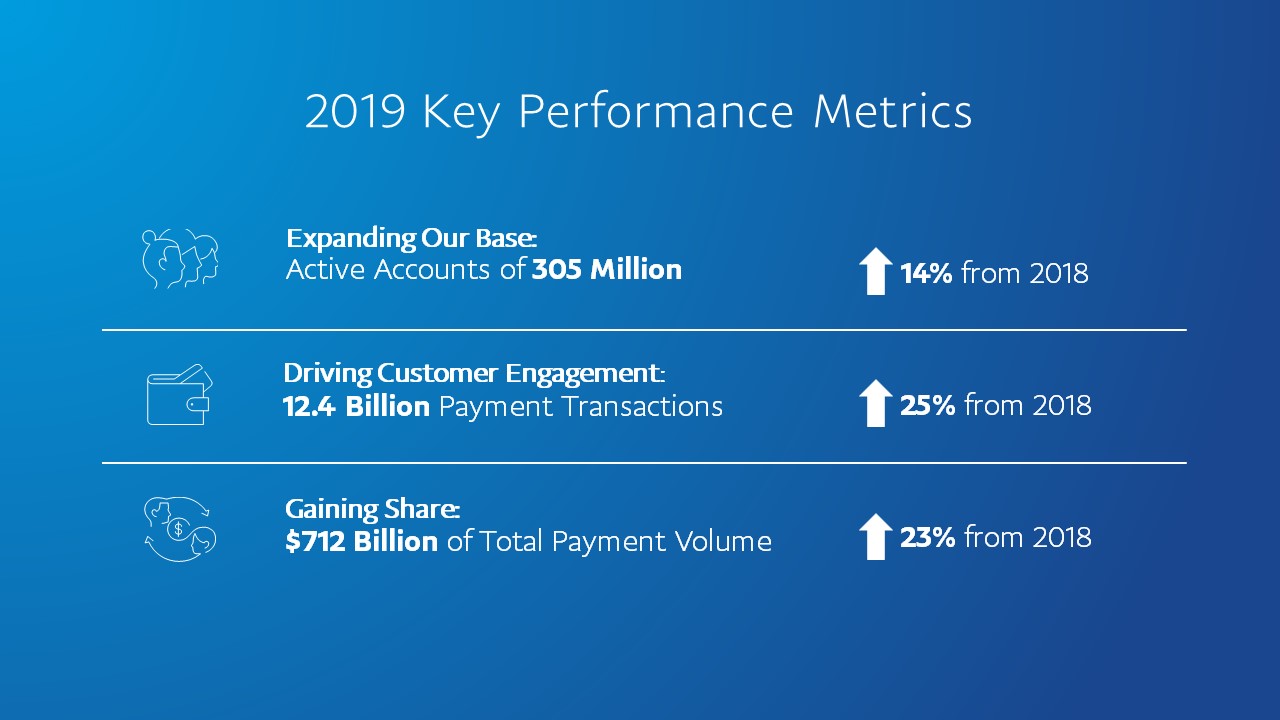
We measure the relevance of our products and services to our customers, and therefore the success of our business, through active accounts, payment transactions, and total payment volume:
Active Accounts: An active account is an account registered directly with PayPal or a platform access partner that has completed a transaction on our Payments Platform, not including gateway-exclusive transactions, within the past 12 months. A platform access partner is a third-party whose customers are provided access to PayPal’s Payments Platform through such third-party’s login credentials. A market is a geographic area or political jurisdiction, such as a country, territory, or protectorate, in which we offer some or all of our products and services. A country, territory, or protectorate is identified by a distinct set of laws and regulations.
Number of Payment Transactions: Number of payment transactions is the total number of payments, net of payment reversals, successfully completed on our Payments Platform or enabled by PayPal via a partner payment solution, not including gateway-exclusive transactions.
Total Payment Volume (“TPV”): TPV is the value of payments, net of reversals, successfully completed on our Payments Platform or enabled by PayPal via a partner payment solution, not including gateway-exclusive transactions.
Our Strengths
Our business is built on a strong foundation designed to drive growth and differentiate us from our competitors. We believe that our competitive strengths include the following:
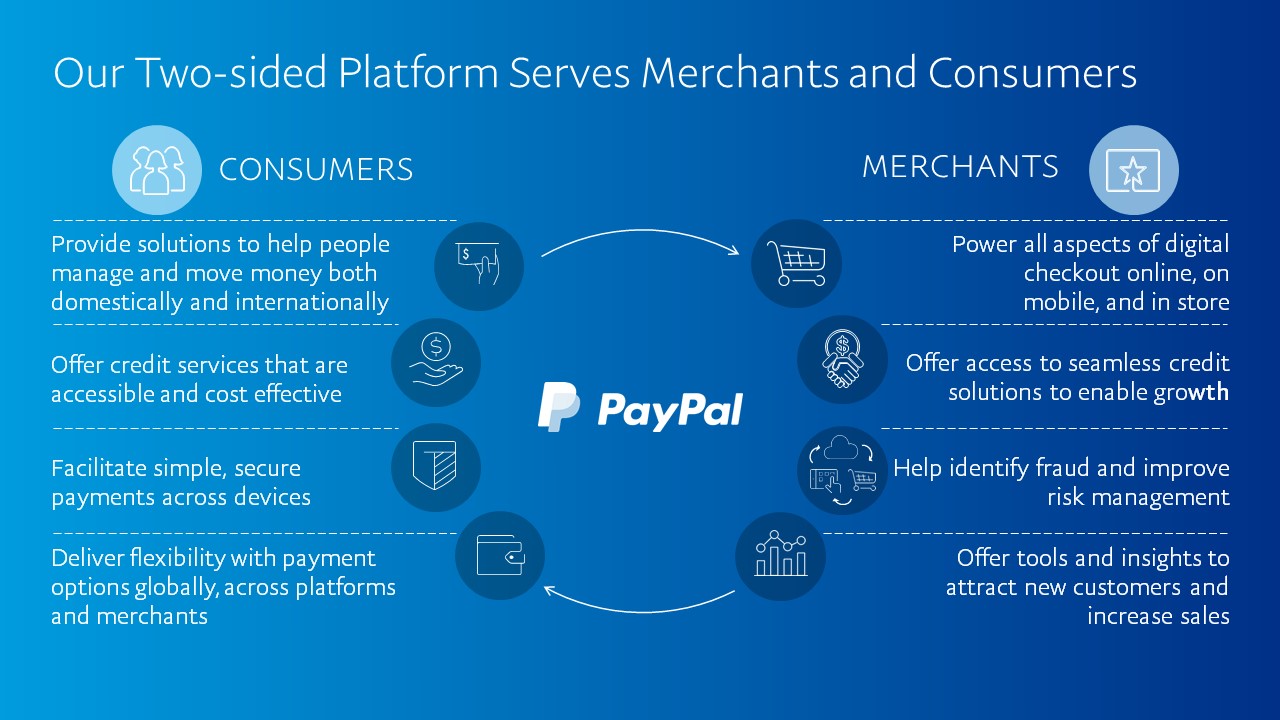
| • | *Two-sided Platform—*our platform connecting merchants and consumers enables PayPal to offer unique end-to-end product experiences while gaining valuable insights into customer behavior through our data. Our platform provides for digital, mobile, and in-store transactions while being both technology and platform agnostic. |
| • | *Scale—*our global scale allows us to drive organic growth. As of December 31, 2019, we had 305 million active accounts, consisting of 281 million consumer active accounts and 24 million merchant active accounts in more than 200 markets around the world. In 2019, we processed $712 billion of TPV. |
| • | *Brands—*we have built well-recognized and trusted brands. Our marketing efforts across multiple demographic groups play an important role in building brand visibility, usage, and overall preference among customers. |
| • | *Risk Management—*our risk management system and use of tokenization are designed to help keep customer information secure, and to help ensure we process legitimate transactions around the world, while identifying and minimizing illegal, high-risk, or fraudulent transactions. |
| • | *Regulatory—*we believe that our regulatory licenses, which enable us to operate in markets around the world, are a distinct advantage and help support business growth. |
Technology
Our Payments Platform utilizes a combination of proprietary and third-party technologies and services intended to efficiently and securely facilitate transactions between millions of merchants and consumers worldwide across different channels, markets, and networks. Our Payments Platform connects with financial service providers around the world and allows consumers to make purchases using a wide range of payment methods, regardless of where a merchant is located. Consumers who use our Payments Platform can send payments in more than 200 markets around the world and in more than 100 currencies, withdraw funds to their bank accounts in 56 currencies and hold balances in their PayPal accounts in 25 currencies.
A transaction on our Payments Platform can involve multiple participants in addition to us, including a merchant, a consumer, and the consumer’s funding source provider. We have developed intuitive user interfaces, customer tools, transaction completion database, and network applications on our Payments Platform that help our customers utilize our suite of products and services. Our Payments Platform, open application programming interfaces, and developer tools are designed to enable developers to innovate with ease and offer robust applications to our global ecosystem of merchants and consumers, while at the same time maintaining the security of our customers’ financial information.
The technology infrastructure supporting our Payments Platform simplifies the storage and processing of large amounts of data and facilitates the deployment and operation of large-scale global products and services in both our own data centers and cloud computing. Our technology infrastructure is designed around industry best practices intended to reduce downtime in the event of outages or catastrophic occurrences. Our Payments Platform incorporates multiple layers of protection for business continuity and system redundancy purposes and to help address cybersecurity risks. We have a comprehensive cybersecurity program designed to protect our technology infrastructure and Payments Platform against these challenges, including regularly testing our systems to identify and address potential vulnerabilities. We strive to continually improve our technology infrastructure and Payments Platform to enhance the customer experience and to increase efficiency, scalability, and security.
Merchant and Consumer Payment Solutions
Merchant Value Proposition
We partner with our merchants to help grow and expand their businesses by providing global reach and powering all aspects of digital checkout. We offer alternative payment methods, including access to credit solutions, provide fraud prevention and risk management solutions, reducing losses through proprietary protection programs, and offer tools and insights for leveraging data analytics to attract new customers and improve sales conversion. We employ a technology and platform agnostic approach intended to enable merchants of all sizes to provide digital checkout online, on mobile, and in-store (at the point of sale) across all platforms and devices and to securely and simply receive payments from their customers. Merchants can onboard quickly with PayPal and are generally not required to invest in new or specialized hardware. PayPal is also a popular form of payment solution for mobile commerce, and our business has grown with the increased adoption of mobile devices. We believe our Braintree products strengthen our position in digital and mobile payments and extend our coverage to a new class of retailers and service providers that offer their services primarily through mobile applications. Through a single Braintree integration, a merchant can begin accepting payments with credit or debit cards, PayPal, PayPal Credit, Google Pay, Apple Pay, Samsung Pay, and other payment solutions. iZettle offers a card acceptance service that enables small businesses to accept credit and debit card payments, as well as a software solution to record, manage, and analyze sales. iZettle provides in-store capabilities in twelve countries. During 2019, we launched PayPal for Marketplaces, our global, end-to-end solution designed to satisfy the unique payment needs of platforms, marketplaces, and crowdfunding sites, which provides payment solutions for accepting and disbursing funds between consumers and businesses. We also offer gateway services which provide the payment gateway technology that links a merchant’s website to its processing network and enable merchants to accept payments online with credit or debit cards. Our acquisition of a controlling equity interest in Guofubao Information Technology Co. (GoPay), Ltd (“GoPay”), a holder of payment business licenses in China, enables us to partner with Chinese financial institutions and technology platforms to provide a more comprehensive set of payment solutions to merchants and consumers, both in China and globally.
We offer access to credit products for certain small and medium-sized merchants through our PayPal Working Capital and PayPal Business Loan products, which we collectively refer to as our business financing offerings. Our PayPal Working Capital product allows businesses to borrow a certain percentage of their annual payment volume processed by PayPal for a fixed fee. Our PayPal Business Loan product provides businesses with short-term financing for a fixed fee based on an evaluation of both the applying business as well as the business owner. We believe that our business financing offerings allow us to deepen our engagement with our existing small and medium-sized merchants and expand services to new merchants by providing access to capital that may not be available effectively or efficiently from traditional banks or other lending providers.
We generate revenues from merchants primarily by charging fees for completing their payment transactions and other payment-related services.
Consumer Value Proposition
We focus on providing affordable consumer products intended to democratize the management and movement of money. We provide consumers with a digital wallet which enables them to send payments to merchants more safely using a variety of funding sources, which may include a bank account, a PayPal account balance, a Venmo account balance, a PayPal Credit account, a credit or debit card, or other stored value products such as coupons, gift cards, and eligible credit card rewards.
We also offer consumers person-to-person (“P2P”) payment solutions through our PayPal, Venmo, and Xoom products. PayPal continues to be a key driver of our total P2P volumes, enabling both domestic and international P2P transfers across our Payments Platform. Our Venmo app in the U.S. is a leading mobile application used to move money between our customers and to make purchases at approved merchants. Xoom is an international money transfer service that enables our customers to send money and prepaid mobile phone reloads to, and pay bills for, people around the world in a secure, fast, and cost-effective way. P2P is a significant customer acquisition channel that facilitates organic growth by enabling potential PayPal users to establish active accounts with us at the time they make or receive a P2P payment.
We offer our PayPal Credit product to consumers in certain markets as a potential funding source at checkout. Once a consumer is approved for credit, PayPal Credit is made available as a funding source for that account holder. Our U.S. PayPal branded consumer credit program is offered exclusively through Synchrony Bank. We believe that our consumer credit products allow us to increase engagement with consumers and merchants on our two-sided network and differentiate us from other payment processors by helping merchants drive incremental sales.
We generate revenue from consumers on fees charged for foreign currency exchange, optional instant transfers from their PayPal or Venmo account to their debit card or bank account, and on interest and fees from our PayPal Credit product.
Protecting Merchants and Consumers
Protecting merchants and consumers on our Payments Platform from financial and fraud loss is imperative to successfully competing in the payments industry and sustainably growing our business. Fraudulent activities, such as account takeover, identity theft (including stolen financial information), and counterparty malicious activities, represent a significant risk to merchants and consumers, as well as their payment partners. We provide merchants and consumers with protection programs on most purchase transactions completed on our Payments Platform, excluding gateway-exclusive transactions or situations where our customer agreements specifically do not provide for protections. We believe that these programs, which protect both merchants and consumers from financial loss resulting from fraud and counterparty non-performance, are generally much broader than similar protections provided by other participants in the payments industry. As a result, merchants may incur losses for chargebacks and other claims on certain transactions when using other payments providers that the merchants would not incur if they used our payments services. We also provide consumer protection against losses on qualifying purchases and accept claims for review up to 180 days post-transaction. We believe that this protection is generally consistent with, or better than, that offered by other payments providers. These programs are designed to promote confidence on both the part of consumers, who will only be required to pay if they receive their purchased item or service in the condition significantly as described, and merchants, who will receive payment for the product or service they deliver to the customer.
Our ability to protect both merchants and consumers is based largely on our proprietary, end-to-end Payments Platform and our ability to leverage the data from both sides of transactions on our two-sided network specifically from buyers and sellers and from senders and receivers of payments. We believe mobile devices will continue to play a significant and increasing role in commerce, including by creating the opportunities to make our ecosystem safer. For example, PayPal uses data from mobile devices and growing protection for the mobile operating environment to reduce financial and fraud risk to merchants and consumers. Our ongoing investment in systems and processes designed to enhance the safety and security of our products reflects our goal of having PayPal recognized as one of the world’s most trusted payments brands.
Competition
The global payments industry is highly competitive, rapidly changing, highly innovative, and increasingly subject to regulatory scrutiny and oversight. We compete against a wide range of businesses, including those that are larger than we are, have greater name recognition, longer operating histories, or a dominant or more secure position, or offer other products and services to consumers and merchants that we do not offer, as well as smaller or younger companies that may be more agile in responding quickly to regulatory and technological changes. Many of the areas in which we compete evolve rapidly with changing and disruptive technologies, shifting user needs, and frequent introductions of new products and services. Competition also may intensify as businesses enter into business combinations and partnerships, and established companies in other segments expand to become competitive with different aspects of our business.
We compete primarily on the basis of the following:
| • | ability to attract, retain, and engage both merchants and consumers on our Payments Platform; |
| • | ability to demonstrate to merchants that they may achieve incremental sales by using and offering our services to consumers; |
| • | consumer confidence in the safety and security of transactions on our Payments Platform, including the ability for consumers to use our products and services without sharing their financial information with the merchant or any other party they are paying; |
| • | simplicity and transparency of our fee structure; |
| • | ability to develop products and services across multiple commerce channels, including e-commerce, mobile, and payments at the point of sale; |
| • | trust in our dispute resolution and buyer and seller protection programs; |
| • | customer service experience; |
| • | brand recognition and preference; |
| • | website, mobile platform, and application onboarding, ease-of-use, speed, availability, and dependability; |
| • | ability of our Payments Platform to support across technologies and payment methods; |
| • | system reliability and data security; |
| • | ability to assist merchants in complying with payments-related laws and regulations; |
| • | ease and quality of integration into third-party mobile applications and operating systems; and |
| • | quality of developer tools, such as our application programming interfaces and software development kits. |
In addition to the discussion in this section, see “Item 1A. Risk Factors” under the caption “We face substantial and increasingly intense competition worldwide in the global payments industry” for further discussion of the potential impact of competition on our business.
Research and Development
Total research and development expense was $1.1 billion, $1.1 billion and $953 million in 2019, 2018 and 2017, respectively.
Intellectual Property
The protection of our intellectual property, including our trademarks, patents, copyrights, domain names, trade dress, and trade secrets is important to the success of our business. We seek to protect our intellectual property rights by relying on applicable laws and regulations in the U.S. and internationally, as well as a variety of administrative procedures. We have registered our core brands as domain names and as trademarks in the U.S. and a large number of other jurisdictions. We also have in place an active program to continue to secure and enforce trademarks and domain names that corresponds to our brands in markets of interest. We have filed patent applications in the U.S. and in international jurisdictions covering certain aspects of our proprietary technology and new innovations. We also rely on contractual restrictions to protect our proprietary rights when offering or procuring products and services. We have routinely entered into confidentiality and invention assignment agreements with our employees and contractors, and non-disclosure agreements with parties with whom we conduct business to control access to, and use and disclosure of, our proprietary information.
For additional information regarding some of the risks relating to our intellectual property, including costs of protecting our intellectual property, see the information in “Item 1A. Risk Factors” under the captions “We are subject to patent litigation” and “We may be unable to adequately protect or enforce our intellectual property rights, or third parties may allege that we are infringing their intellectual property rights.”
Government Regulation
We operate globally and in a rapidly evolving regulatory environment characterized by a heightened regulatory focus on all aspects of the payments industry. That focus continues to become even more heightened as regulators on a global basis focus on such important issues as countering terrorist financing, anti-money laundering, privacy, cybersecurity, and consumer protection. Some of the laws and regulations to which we are subject were enacted recently, and the laws and regulations applicable to us, including those enacted prior to the advent of digital and mobile payments, are continuing to evolve through legislative and regulatory action and judicial interpretation. New or changing laws and regulations, including how such laws and regulations are interpreted and implemented, as well as increased penalties and enforcement actions related to non-compliance, could have a material adverse impact on our business, results of operations, and financial condition. Therefore, we monitor these areas closely to design compliant solutions for our customers who depend on us.
Government regulation impacts key aspects of our business. We are subject to regulations that affect the payments industry in the markets we operate.
Payments Regulation. Various laws and regulations govern the payments industry in the U.S. and internationally. In the U.S., PayPal, Inc. holds licenses to operate as a money transmitter (or its equivalent), which, among other things, subjects PayPal, Inc. to reporting requirements, bonding requirements, limitations on the investment of customer funds, and inspection by state regulatory agencies. Outside the U.S., we provide similar services customized for various countries and foreign jurisdictions through our foreign subsidiaries. The activities of those non-U.S. entities are, or may be, supervised by a financial regulatory authority in the jurisdictions in which they operate. Among other regulatory authorities, the Luxembourg Commission de Surveillance du Secteur Financier (the “CSSF”), the Australian Prudential Regulation Authority, the Monetary Authority of Singapore, the Reserve Bank of India, the Central Bank of Russia, the Central Bank of Brazil, and the People's Bank of China have asserted jurisdiction over some or all of our activities in their respective jurisdictions. This list is not exhaustive, and there are numerous other regulatory agencies that have or may assert jurisdiction over our activities. The laws and regulations applicable to the payments industry in any given jurisdiction are subject to interpretation and change.
Banking Agency Supervision. We serve our customers in the European Union (“EU”) through PayPal (Europe) S.à.r.l. et Cie, SCA, a wholly-owned subsidiary that is licensed and subject to regulation as a bank in Luxembourg by the CSSF. Consequently, we must comply with rules and regulations of the European banking industry, including those related to capitalization, funds management, corporate governance, anti-money laundering, disclosure, reporting, and inspection. We are, or may be, subject to banking-related regulations in other countries now or in the future related to our role in the financial industry. In addition, based on our relationships with our partner financial institutions, we are, or may be, subject to indirect regulation and examination by these financial institutions’ regulators.
Consumer Financial Protection Bureau. The Consumer Financial Protection Bureau (the “CFPB”) has significant authority to regulate consumer financial products in the U.S., including consumer credit, deposits, payments, and similar products. As a large market participant of remittance transfers, the CFPB has direct supervisory authority over our business. The CFPB and other similar regulatory agencies in other jurisdictions may have broad consumer protection mandates that could result in the promulgation and interpretation of rules and regulations that may affect our business.
Anti-Money Laundering and Counter-Terrorist Financing. PayPal is subject to anti-money laundering (“AML”) laws and regulations in the U.S. and other jurisdictions, as well as laws designed to prevent the use of the financial systems to facilitate terrorist activities. Our AML program is designed to prevent our payment network from being used to facilitate money laundering, terrorist financing, and other illicit activities, or to do business in countries or with persons and entities included on designated country or person lists promulgated by the U.S. Department of the Treasury’s Office of Foreign Assets Controls (“OFAC”) and equivalent authorities in other countries. Our AML and sanctions compliance programs, overseen by our AML/Bank Secrecy Act Officer, is composed of policies, procedures, and internal controls, and is designed to address these legal and regulatory requirements and assist in managing money laundering and terrorist financing risks.
Interchange Fees. Interchange fees associated with four-party payments systems are being reviewed or challenged in various jurisdictions. For example, in the EU, the Multilateral Interchange Fee (“MIF”) Regulation caps interchange fees for credit and debit card payments and provides for business rules to be complied with by any company dealing with card transactions, including PayPal. As a result, the fees that we collect in certain jurisdictions may become the subject of regulatory challenge.
Data Protection and Information Security. Aspects of our operations or business are subject to privacy and data protection regulation in the U.S., the EU, Asia Pacific, and elsewhere. For example, the EU adopted a comprehensive General Data Protection Regulation (the “GDPR”), which came into effect in May 2018. GDPR expanded the scope of the EU data protection law to foreign companies processing personal data of European Economic Area (“EEA”) individuals and imposed a stricter data protection compliance regime. In the U.S., we are subject to privacy and information safeguarding requirements under the Gramm-Leach-Bliley Act and the California Consumer Privacy Act that require similar privacy protections afforded by the GDPR, as well as the maintenance of a written, comprehensive information security program. In Europe, the operations of our Luxembourg bank are subject to confidentiality and information safeguarding requirements under the Luxembourg Banking Act. Regulatory authorities around the world are considering numerous legislative and regulatory proposals concerning privacy and data protection that may contain additional privacy and data protection obligations. In addition, the interpretation and application of these privacy and data protection laws in the U.S., Europe, and elsewhere are often uncertain and in a state of flux.
Anti-Corruption. PayPal is subject to applicable anti-corruption laws, such as the U.S. Foreign Corrupt Practices Act and the U.K. Bribery Act, and similar anti-corruption laws in the jurisdictions in which we operate. Anti-corruption laws generally prohibit offering, promising, giving, accepting, or authorizing others to provide anything of value, either directly or indirectly, to or from a government official or private party in order to influence official action or otherwise gain an unfair business advantage, such as to obtain or retain business. We have implemented policies, procedures, and internal controls that are designed to comply with these laws and regulations.
Additional Regulatory Developments. Various regulatory agencies continue to examine a wide variety of issues, including virtual currencies, identity theft, account management guidelines, privacy, disclosure rules, cybersecurity, and marketing, that may impact PayPal’s business.
For an additional discussion on governmental regulation affecting our business, please see the risk factors related to regulation of our payments business and regulation in the areas of consumer privacy, data use, and/or security in “Item 1A. Risk Factors” under the caption “Risk Factors That May Affect Our Business, Results of Operations, and Financial Condition” and “Item 3. Legal Proceedings” included elsewhere in this Annual Report on Form 10-K.
Seasonality
The Company does not experience meaningful seasonality with respect to net revenues. No individual quarter in 2019, 2018 or 2017 accounted for more than 30% of annual net revenue.
Employees
As of December 31, 2019, we employed approximately 23,200 people globally, of whom approximately 11,200 were located in the U.S. We consider our relationship with our employees to be good.
Separation from eBay Inc.
PayPal Holdings, Inc. was incorporated in Delaware in January 2015 for the purpose of owning and operating eBay’s Payments business in connection with the separation and distribution described below. eBay completed the transfer of substantially all of the assets, liabilities, and operations of eBay’s Payments business to PayPal in June 2015. Prior to the contribution of the Payments business, PayPal Holdings, Inc. had no operations. On July 17, 2015 (the “distribution date”), PayPal became an independent publicly traded company through the pro rata distribution by eBay of 100% of the outstanding common stock of PayPal to eBay stockholders (which we refer to as the “separation” or the “distribution”). Each eBay stockholder of record as of the close of business on July 8, 2015 received one share of PayPal common stock for every share of eBay common stock held on the record date. Approximately 1.2 billion shares of PayPal common stock were distributed on July 17, 2015 to eBay stockholders. PayPal’s common stock began “regular way” trading under the ticker symbol “PYPL” on the NASDAQ Global Select Market on July 20, 2015.
Available Information
The address of our principal executive offices is PayPal Holdings, Inc., 2211 North First Street, San Jose, California 95131. Our website is located at www.paypal.com, and our investor relations website is located at http://investor.paypal-corp.com. From time to time, we may use our investor relations site and other online and social media channels, including our PayPal Stories Blog (https://www.paypal.com/stories/us), Twitter handles (@PayPal and @PayPalNews), LinkedIn page (https://www.linkedin.com/company/paypal), Facebook page (https://www.facebook.com/PayPalUSA/), YouTube channel (https://www.youtube.com/paypal), Dan Schulman’s LinkedIn profile (https://www.linkedin.com/in/dan-schulman/), John Rainey’s LinkedIn profile (www.linkedin.com/in/john-rainey-pypl), and Dan Schulman’s Facebook page (https://www.facebook.com/DanSchulmanPayPal/) to disclose material non-public information and comply with our disclosure obligations under Regulation Fair Disclosure (“FD”). Our Annual Report on Form 10-K, quarterly reports on Form 10-Q, current reports on Form 8-K, and amendments to those reports are available free of charge on our investor relations website as soon as reasonably practicable after they are electronically filed with, or furnished to, the SEC. The content of our websites and information we may post on or provide to online and social media channels, including those mentioned above, and information that can be accessed through our websites or these online and social media channels is not incorporated by reference into this Annual Report on Form 10-K or in any other report or document we file with the SEC, and any references to our websites or these online and social media channels are intended to be inactive textual references only.
Previous: Cover and table of contents · Next: Item 1A. RISK FACTORS