 filings.tools
Royal Caribbean Cruises 10-K 2017-12-31
Filed 2018-02-21. 17 sections, 445K characters. Original on sec.gov · Markdown · JSON
Cover and table of contents
10-K 1 rcl-20171231x10k.htm 10-K
UNITED STATES
SECURITIES AND EXCHANGE COMMISSION
Washington, D.C. 20549
FORM 10-K
| (Mark One) | |
| x | ANNUAL REPORT PURSUANT TO SECTION 13 OR 15(d) OF THE SECURITIES EXCHANGE ACT OF 1934 |
For the fiscal year ended December 31, 2017
or
| o | TRANSITION REPORT PURSUANT TO SECTION 13 OR 15(d) OF THE SECURITIES EXCHANGE ACT OF 1934 |
For the transition period from to
Commission file number: 1-11884
ROYAL CARIBBEAN CRUISES LTD.
(Exact name of registrant as specified in its charter)
| Republic of Liberia (State or other jurisdiction of incorporation or organization) | 98-0081645 (I.R.S. Employer Identification No.) |
1050 Caribbean Way, Miami, Florida 33132
(Address of principal executive offices) (zip code)
(305) 539-6000
(Registrant's telephone number, including area code)
Securities registered pursuant to Section 12(b) of the Act:
| Title of each class | Name of each exchange on which registered | |
| Common Stock, par value $.01 per share | New York Stock Exchange |
Securities registered pursuant to Section 12(g) of the Act: None
Indicate by check mark if the registrant is a well-known seasoned issuer, as defined in Rule 405 of the Securities Act. Yes x No o
Indicate by check mark if the registrant is not required to file reports pursuant to Section 13 or Section 15(d) of the Act. Yes o No x
Indicate by check mark whether the registrant (1) has filed all reports required to be filed by Section 13 or 15(d) of the Securities Exchange Act of 1934 during the preceding 12 months (or for such shorter period that the registrant was required to file such reports), and (2) has been subject to such filing requirements for the past 90 days. Yes x No o
Indicate by check mark whether the registrant has submitted electronically and posted on its corporate Web site, if any, every Interactive Data File required to be submitted and posted pursuant to Rule 405 of Regulation S-T (§232.405 of this chapter) during the preceding 12 months (or for such shorter period that the registrant was required to submit and post such files). Yes x No o
Indicate by check mark if disclosure of delinquent filers pursuant to Item 405 of Regulation S-K (§229.405 of this chapter) is not contained herein, and will not be contained, to the best of registrant's knowledge, in definitive proxy or information statements incorporated by reference in Part III of this Form 10-K or any amendment to this Form 10-K. o
Indicate by check mark whether the registrant is a large accelerated filer, an accelerated filer, a non-accelerated filer, a smaller reporting company, or an emerging growth company. See the definitions of “large accelerated filer,” “accelerated filer,” “smaller reporting company,” and “emerging growth company” in Rule 12b-2 of the Exchange Act.
| Large accelerated filer x | Accelerated filer o | Non-accelerated filer o | Smaller reporting company o | |||
| Emerging growth company o | (Do not check if a smaller reporting company) |
If an emerging growth company, indicate by check mark if the registrant has elected not to use the extended transition period for complying with any new or revised financial accounting standards provided pursuant to Section 13(a) of the Exchange Act. o
Indicate by check mark whether the registrant is a shell company (as defined in Rule 12b-2 of the Act). Yes o No x
The aggregate market value of the registrant's common stock at June 30, 2017 (based upon the closing sale price of the common stock on the New York Stock Exchange on June 30, 2017) held by those persons deemed by the registrant to be non-affiliates was approximately $19.9 billion. Shares of the registrant's common stock held by each executive officer and director and by each entity or person that, to the registrant's knowledge, owned 10% or more of the registrant's outstanding common stock as of June 30, 2017 have been excluded from this number in that these persons may be deemed affiliates of the registrant. This determination of possible affiliate status is not necessarily a conclusive determination for other purposes.
There were 213,749,009 shares of common stock outstanding as of February 12, 2018.
DOCUMENTS INCORPORATED BY REFERENCE
Portions of the registrant's Definitive Proxy Statement relating to its 2018 Annual Meeting of Shareholders are incorporated by reference in Part III, Items 10-14 of this Annual Report on Form 10-K as indicated herein.
ROYAL CARIBBEAN CRUISES LTD.
TABLE OF CONTENTS
PART I
As used in this Annual Report on Form 10-K, the terms “Royal Caribbean,” the “Company,” “we,” “our” and “us” refer to Royal Caribbean Cruises Ltd. and, depending on the context, Royal Caribbean Cruises Ltd.’s consolidated subsidiaries and/or affiliates. The terms “Royal Caribbean International,” “Celebrity Cruises,” and “Azamara Club Cruises” refer to our wholly-owned global cruise brands. Throughout this Annual Report on Form 10-K, we also refer to regional brands in which we hold an ownership interest, including “TUI Cruises,” “Pullmantur” and “SkySea Cruises."However, because these regional brands are unconsolidated investments, our operating results and other disclosures herein do not include these brands unless otherwise specified. In accordance with cruise vacation industry practice, the term “berths” is determined based on double occupancy per cabin even though many cabins can accommodate three or more passengers.
This Annual Report on Form 10-K also includes trademarks, trade names and service marks of other companies. Use or display by us of other parties’ trademarks, trade names or service marks is not intended to and does not imply a relationship with, or endorsement or sponsorship of us by, these other parties other than as described herein.
Item 1. Business.
General
We are the world’s second largest cruise company. We own and operate three global cruise brands: Royal Caribbean International, Celebrity Cruises and Azamara Club Cruises (our "Global Brands"). We also own a 50% joint venture interest in the German brand TUI Cruises, a 49% interest in the Spanish brand Pullmantur and a 36% interest in the Chinese brand SkySea Cruises (collectively, our "Partner Brands"). Together, our Global Brands and our Partner Brands operate a combined total of 49 ships in the cruise vacation industry with an aggregate capacity of approximately 124,070 berths as of December 31, 2017.
Our ships operate on a selection of worldwide itineraries that call on approximately 540 destinations on all seven continents. In addition to our headquarters in Miami, Florida, we have offices and a network of international representatives around the world which primarily focus on sales and market development.
We compete principally by establishing valued brands that offer exceptional service provided by our crew and on the basis of innovation and quality of ships, variety of itineraries, choice of destinations and price. We believe that our commitment to build state-of-the-art ships and to invest in the maintenance and upgrade of our fleet to, among other things, incorporate our latest signature innovations, allows us to continue to attract new and loyal repeat guests.
We believe cruising continues to be a popular vacation choice due to its inherent value, extensive itineraries and variety of shipboard and shoreside activities. In addition, we believe our brands are well-positioned globally and possess the ability to attract a wide range of guests by appealing to multiple customer bases allowing our global sourcing to be well diversified.
Royal Caribbean was founded in 1968 as a partnership. Its corporate structure has evolved over the years and the current parent corporation, Royal Caribbean Cruises Ltd., was incorporated on July 23, 1985 in the Republic of Liberia under the Business Corporation Act of Liberia.
Our Global Brands
Our Global Brands include Royal Caribbean International, Celebrity Cruises and Azamara Club Cruises.
We believe our Global Brands possess the versatility to enter multiple cruise market segments within the cruise vacation industry. Although each of our Global Brands has its own marketing style as well as ships and crews of various sizes, the nature of the products sold and services delivered by our Global Brands share a common base (i.e., the sale and provision of cruise vacations). Our Global Brands also have similar itineraries as well as similar cost and revenue components. In addition, our Global Brands source passengers from similar markets around the world and operate in
similar economic environments with a significant degree of commercial overlap. As a result, we strategically manage our Global Brands as a single business with the ultimate objective of maximizing long-term shareholder value.
Royal Caribbean International
Royal Caribbean International is positioned to compete in both the contemporary and premium segments of the cruise vacation industry. The brand appeals to families with children of all ages, as well as both older and younger couples, providing cruises that generally feature a casual ambiance as well as a variety of activities and entertainment venues. We believe that the quality of the Royal Caribbean International brand allows it to achieve market coverage that is among the broadest of any of the major cruise brands in the cruise vacation industry. Royal Caribbean International’s strategy is to attract an array of vacationing guests by providing a wide variety of itineraries to destinations worldwide including Alaska, Asia, Australia, Bahamas, Bermuda, Canada, the Caribbean, Europe, the Panama Canal and New Zealand with cruise lengths that range from two to 23 nights. Royal Caribbean International offers multiple innovative options for onboard dining, entertainment and other onboard activities. Because of the brand’s ability to deliver extensive and innovative product offerings at an excellent value to consumers, we believe Royal Caribbean International is well positioned to attract new consumers to cruising and to continue to bring loyal repeat guests back for their next vacation.
Under our Royal Caribbean International brand, we operate 24 ships with an aggregate capacity of approximately 76,450 berths. Additionally, we have six ships on order with an aggregate capacity of approximately 30,500 berths. These ships include our fourth and fifth Quantum-class ships, which are scheduled to enter service in the second quarter of 2019 and fourth quarter of 2020, respectively, the fourth and fifth Oasis-class ships, which are scheduled to enter service in the first quarter of 2018 and second quarter of 2021, respectively, and the first and second ships of a new generation, known as our Icon-class, which are expected to enter service in the second quarters of 2022 and 2024, respectively.
Celebrity Cruises
Celebrity Cruises is positioned within the premium segment of the cruise vacation industry. Celebrity Cruises’ strategy is to target affluent consumers by delivering a destination-rich, modern luxury experience on upscale ships that offer, among other things, luxurious accommodations, high-end design spaces, high-standard service and fine dining. Celebrity Cruises offers a range of itineraries to destinations, including Alaska, Asia, Australia, Bermuda, Canada, the Caribbean, Europe, the Galapagos Islands, Hawaii, India, New Zealand, the Panama Canal and South America with cruise lengths ranging from two to 19 nights.
Under our Celebrity Cruises brand, we operate 12 ships with an aggregate capacity of approximately 23,170 berths. Additionally, we have five ships on order with an aggregate capacity of approximately 11,700 berths. These ships include four ships of a new generation, known as our Edge-class, which are expected to enter service in the fourth quarter of 2018, the first quarter of 2020 and the fourth quarters of 2021 and 2022, respectively, and a ship designed for the Galapagos Islands, which is expected to enter service in the second quarter of 2019.
Azamara Club Cruises
Azamara Club Cruises is designed to serve the up-market segment of the North American, United Kingdom and Australian markets. The up-market segment incorporates elements of the premium segment and the luxury segment which is generally characterized by smaller ships, high standards of accommodation and service and exotic itineraries. Azamara Club Cruises’ strategy is to deliver distinctive destination experiences through unique itineraries with more overnights and longer stays as well as comprehensive tours allowing guests to experience the destination in more depth. Azamara Club Cruises offers a variety of itineraries to popular destinations, including Asia, Australia/New Zealand, Northern and Western Europe, the Mediterranean, Central and North America and the less-traveled islands of the Caribbean.
Under our Azamara Club Cruises brand, we operate two ships with an aggregate capacity of approximately 1,400
berths offering cruise itineraries ranging from four to 21 nights. Additionally, during 2017, we entered into an agreement to purchase a 700 berth ship that is scheduled to be delivered in March 2018 and expected to enter service during the third quarter of 2018.
Our Partner Brands
Our Global Brands are complemented by our 50% joint venture interest in TUI Cruises, which is specifically tailored for the German market, our 49% interest in the Spanish brand Pullmantur, which is primarily focused on the cruise market in Spain, and our 36% interest in SkySea Cruises, which is specifically tailored for the Chinese market. We account for our investments in our Partner Brands under the equity method of accounting and, accordingly, the operating results of these Partner Brands are not included in our
Showing the first 8K of 84K characters. Open the full section
Item 1A. Risk Factors
The risk factors set forth below and elsewhere in this Annual Report on Form 10-K are important factors that could cause actual results to differ from expected or historical results. It is not possible to predict or identify all such risks. There may be additional risks that we consider not to be material, or which are not known, and any of these risks could have the effects set forth below. The ordering of the risk factors set forth below is not intended to reflect any Company indication of priority or likelihood. See Item 7. Management’s Discussion and Analysis of Financial Condition and Results of Operations for a cautionary note regarding forward-looking statements.
Adverse worldwide economic or other conditions could reduce the demand for cruises and passenger spending, adversely impacting our operating results, cash flows and financial condition including potentially impairing the value of our ships and other assets.
The demand for cruises is affected by international, national and local economic conditions. Weak or uncertain economic conditions impact consumer confidence and pose a risk as vacationers may postpone or reduce discretionary spending. This, in turn, may result in cruise booking slowdowns, decreased cruise prices and lower onboard revenues. Given the global nature of our business, we are exposed to many different economies and our business could be hurt by challenging conditions in any of our markets. Any significant deterioration of international, national or local economic conditions could result in a prolonged period of booking slowdowns, depressed cruise prices and reduced onboard revenues.
Fears of terrorist attacks, war, and other hostilities could have a negative impact on our results of operations.
Events such as terrorist attacks, war (or war-like conditions), conflicts (domestic or cross-border), civil unrest and other hostilities, including an escalation in the frequency or severity of incidents, and the resulting political instability, travel restrictions and advisories, and concerns over safety and security aspects of traveling or the fear of any of the foregoing have had, and could have in the future, a significant adverse impact on demand and pricing in the travel and vacation industry. In view of our global operations, we are susceptible to a wide range of adverse events. These events could also result in additional security measures taken by local authorities which may potentially impact access to ports and/or destinations.
Our operating costs could increase due to market forces and economic or geo-political factors beyond our control.
Our operating costs, including fuel, food, payroll and benefits, airfare, taxes, insurance and security costs, are all subject to increases due to market forces and economic or geo-political conditions or other factors beyond our control. Increases in these operating costs could adversely affect our profitability.
Fluctuations in foreign currency exchange rates, fuel prices and interest rates could affect our financial results.
We are exposed to market risk attributable to changes in foreign currency exchange rates, fuel prices and interest rates. Significant changes in any of the foregoing could have a material impact on our financial results, net of the impact of our hedging activities and natural offsets. Our operating results have been and will continue to be impacted, often significantly, by changes in each of these factors. The value of our earnings in foreign currencies is adversely impacted by a strong United States dollar. In addition, any significant increase in fuel prices could materially and adversely affect our business as fuel prices not only impact our fuel costs, but also some of our other expenses, such as crew travel, freight and commodity prices. See “Item 7. Management’s Discussion and Analysis of Financial Condition and Results of Operations” and “Item 7A. Quantitative and Qualitative Disclosures About Market Risk” for more information.
Conducting business globally may result in increased costs and other risks.
We operate our business globally. Operating internationally exposes us to a number of risks, including increased exposure to a wider range of regional and local economic conditions, volatile local political conditions, potential
changes in duties and taxes, including changing and/or uncertain interpretations of existing tax laws and regulations, required compliance with additional laws and policies affecting cruising, vacation or maritime businesses or governing the operations of foreign-based companies, currency fluctuations, interest rate movements, difficulties in operating under local business environments, port quality and availability in certain regions, U.S. and global anti-bribery laws or regulations, imposition of trade barriers and restrictions on repatriation of earnings.
Our future growth strategies increasingly depend on the growth and sustained profitability of certain international markets, such as China. Some factors that will be critical to our success in developing these markets may be different than those affecting our more-established North American and European markets. In the Chinese market, in particular, our future success depends on our ability to continue to raise awareness of our products, evolve the available distribution channels and adapt our offerings to best suit the Chinese consumer. China’s economy differs from the economies of other developed countries in many respects and, as the legal and regulatory system in China continues to evolve, there may be greater uncertainty as to the interpretation and enforcement of applicable laws and regulations. In March 2017, China's National Tourism Administration issued a directive to travel agents to halt sales of holiday packages to South Korea. This travel restriction has had a direct impact on our related itineraries impacting the overall performance of our China business. It is uncertain what the ultimate scope and duration of this restriction will be, but to the extent that this or similar sanctions affecting regional travel and/or tourism continues or are put in place, it may impact local demand, available cruise itineraries and the overall financial performance of the China market.
Operating globally also exposes us to numerous and sometimes conflicting legal, regulatory and tax requirements. In many parts of the world, including countries in which we operate, practices in the local business communities might not conform to international business standards. We must adhere to policies designed to promote legal and regulatory compliance as well as applicable laws and regulations. However, we might not be successful in ensuring that our employees, agents, representatives and other third parties with whom we associate throughout the world properly adhere to them. Failure by us, our employees or any of these third parties to adhere to our policies or applicable laws or regulations could result in penalties, sanctions, damage to our reputation and related costs which in turn could negatively affect our results of operations and cash flows.
We have operations in and source passengers from the United Kingdom and other member countries of the European Union. In March 2017, the United Kingdom notified the European Council of its intent to withdraw from the European Union. Since the initial referendum in June 2016, the expected withdrawal has resulted in increased volatility in the global financial markets and, in particular, in global currency exchange rates. The expected withdrawal could potentially adversely affect tax, legal and regulatory regimes to which our business in the region is subject. The expected withdrawal could also, among other potential outcomes, disrupt the free movement of goods, services and people between the United Kingdom and the European Union. Further, as the expected withdrawal approaches, continued uncertainty around these issues could lead to adverse effects on the economy of the United Kingdom, including the value of the British Pound, and the other economies in which we operate, making it more difficult to source passengers from these regions. These risks may be exacerbated if voters of other countries within the European Union similarly elect to exit the European Union in future referendums.
As a global operator, our business may be also impacted by changes in U.S. policy or priorities in areas such as trade, immigration and/or environmental or labor regulations, among others. Depending on the nature and scope of any such changes, they could impact our domestic and international business operations. Any such changes, and any international response to them, could potentially introduce new barriers to passenger or crew travel and/or cross border transactions, impact our guest experience and/or increase our operating costs.
If we are unable to address these risks adequately, our financial position and results of operations could be adversely affected, including potentially impairing the value of our ships and other assets.
Price increases for commercial airline service for our guests or major changes or reduction in commercial airline service and/or availability could adversely impact the demand for cruises and undermine our ability to provide reasonably priced vacation packages to our guests.
Many of our guests depend on scheduled commercial airline services to transport them to or from the ports where our cruises embark or disembark. Increases in the price of airfare would increase the overall price of the cruise vacation to our guests, which may adversely impact demand for our cruises. In addition, changes in the availability of commercial airline services could adversely affect our guests’ ability to obtain airfare, as well as our ability to fly our guests to or from our cruise ships, which could adversely affect our results of operations.
Incidents or adverse publicity concerning our ships and/or passengers or the cruise vacation industry in general, unusual weather conditions and other natural disasters or disruptions could affect our reputation as well as impact our sales and results of operations.
The ownership and/or operation of cruise ships, private destinations, port facilities and shore excursions involves the risk of accidents, illnesses, mechanical failures, environmental incidents and other incidents which may bring into question safety, health, security and vacation satisfaction which could negatively impact our reputation. Incidents involving cruise ships, and, in particular the safety, health and security of guests and crew and media coverage thereof have impacted and could in the future impact demand for our cruises and pricing in the industry. Our reputation and our business could also be damaged by negative publicity regarding the cruise industry in general, including publicity regarding the spread of contagious disease and the potentially adverse environmental impacts of cruising. The considerable expansion in the use of social media and digital marketing over recent years has compounded the potential scope of any negative publicity. If any such incident or news cycle occurs during a time of high seasonal demand, the effect could disproportionately impact our results of operations for the year. In addition, incidents involving cruise ships may result in additional costs to our business, increasing government or other regulatory oversight and, in the case of incidents involving our ships, potential litigation.
Our cruise ships and port facilities may also be adversely impacted by weather or natural disasters or disruptions, such as hurricanes. We are often forced to alter itineraries and occasionally cancel a cruise or a series of cruises or to redeploy our ships due to these types of events, which could have an adverse effect on our sales and profitability in the current and future periods. For example, the 2017 hurricane season was particularly impactful to our operations in the Caribbean. Increases in the frequency, severity or duration of severe weather events, including those related to climate change, could exacerbate the impact and cause further disruption to our operations. In addition, these and any other events which impact the travel industry more generally may negatively impact our ability to deliver guests or crew to our cruises and/or interrupt our ability to obtain services and goods from key vendors in our supply chain. Any of the foregoing could have an adverse impact on our results of operations and on industry performance.
An increase in capacity worldwide or excess capacity in a particular market could adversely impact our cruise sales and/or pricing.
Although our ships can be redeployed, cruise sales and/or pricing may be impacted by the introduction of new ships into the marketplace, reductions in cruise capacity, overall market growth and deployment decisions of ourselves and our competitors. As of December 31, 2017, a total of 75 new ships with approximately 184,000 berths are on order for delivery through 2022 in the cruise industry. The further net growth in capacity from these new ships and future orders, without an increase in the cruise industry’s demand and/or share of the vacation market, could depress cruise prices and impede our ability to achieve yield improvement.
In addition, to the extent that we or our competitors deploy ships to a particular itinerary and the resulting capacity in that region exceeds the demand, we may lower pricing and profitability may be lower than anticipated. This risk exists in emerging cruise markets, such as China, where capacity has grown rapidly over the past few years and in mature markets where excess capacity is typically redeployed. Any of the foregoing could have an adverse impact on our results of operations, cash flows and financial condition, including potentially impairing the value of our ships and other assets.
Unavailability of ports of call may adversely affect our results of operations.
We believe that port destinations are a major reason why guests choose to go on a particular cruise or on a cruise vacation. The availability of ports is affected by a number of factors, including existing capacity constraints, constraints related to the size of certain ships, security, environmental and health concerns, adverse weather conditions and natural disasters, financial limitations on port development, exclusivity arrangements that ports may have with our competitors, local governmental regulations and local community concerns about port development and other adverse impacts on their communities from additional tourists. In addition, fuel costs may adversely impact the destinations on certain of our itineraries. Any limitations on the availability or feasibility of our ports of call or on the availability of shore excursions and other service providers at such ports could adversely affect our results of operations.
Our reliance on shipyards, their subcontractors and our suppliers to implement our newbuild and ship upgrade programs and to repair and maintain our ships exposes us to risks which, if realized, could adversely impact our business.
We rely on shipyards, their subcontractors and our suppliers to effectively construct our new ships and to repair, maintain and upgrade our existing ships on a timely basis and in a cost effective manner.
There are a limited number of shipyards with the capability and capacity to build our new ships and, accordingly, increased demand for available new construction slots and/or continued consolidation in the cruise shipyard industry (including completion of Italian shipbuilder Fincantieri's bid for STX France) could impact our ability to construct new ships when and as planned, cause us to continue to commit to new ship orders earlier than we have historically done so and/or result in stronger bargaining power on the part of the shipyards and the export credit agencies providing financing for the project. Our inability to timely and cost-effectively procure new capacity could have a significant negative impact on our future business plans and results of operations.
Building, repairing, maintaining and/or upgrading a ship is sophisticated work that involves significant risks. In addition, the prices of labor and/or various commodities that are used in the construction of ships can be subject to volatile price changes, including the impact of fluctuations in foreign exchange rates. Shipyards, their subcontractors and/or our suppliers may encounter financial, technical or design problems when doing these jobs. If materialized, these problems could impact the timely delivery or costs of new ships or the ability of shipyards to repair and upgrade our fleet in accordance with our needs or expectations. In addition, delays or mechanical faults may result in cancellation of cruises or, in more severe situations, new ship orders, or necessitate unscheduled drydocks and repairs of ships. These events and any related adverse publicity could result in lost revenue, increased operating expenses, or both, and thus adversely affect our results of operations.
We may lose business to competitors throughout the vacation market.
We operate in the vacation market and cruising is one of many alternatives for people choosing a vacation. We therefore risk losing business not only to other cruise lines, but also to other vacation operators, which provide other leisure options including hotels, resorts, internet-based alternative lodging sites and package holidays and tours.
We face significant competition from other cruise lines on the basis of cruise pricing, travel agent preference and also in terms of the nature of ships and services we offer to guests. Our principal competitors within the cruise vacation industry include Carnival Corporation & plc, which owns, among others, Aida Cruises, Carnival Cruise Line, Costa Cruises, Cunard Line, Holland America Line, P&O Cruises, Princess Cruises and Seabourn; Disney Cruise Line; MSC Cruises; and Norwegian Cruise Line Holdings Ltd, which owns Norwegian Cruise Line, Oceania Cruises and Regent Seven Seas Cruises. Our revenues are sensitive to the actions of other cruise lines in many areas including pricing, scheduling, capacity and promotions, which can have a substantial adverse impact not only on our revenues, but on overall industry revenues.
In the event that we do not effectively market or differentiate our cruise brands from our competitors or otherwise compete effectively with other vacation alternatives and new or existing cruise companies, our results of operations and financial position could be adversely affected.
We may not be able to obtain sufficient financing or capital for our needs or may not be able to do so on terms that are acceptable or consistent with our expectations.
To fund our capital expenditures (including new ship orders), operations and scheduled debt payments, we have historically relied on a combination of cash flows provided by operations, drawdowns under available credit facilities, the incurrence of additional indebtedness and the sale of equity or debt securities in private or public securities markets. Any circumstance or event which leads to a decrease in consumer cruise spending, such as worsening global economic conditions or significant incidents impacting the cruise industry, could negatively affect our operating cash flows. See “-Adverse worldwide economic, geopolitical or other conditions…” and “-Incidents or adverse publicity concerning our ships and/or passengers or the cruise vacation industry…” for more information.
Although we believe we can access sufficient liquidity to fund our operations, investments and obligations as expected, there can be no assurances to that effect. Our ability to access additional funding as and when needed, our ability to timely refinance and/or replace our outstanding debt securities and credit facilities on acceptable terms and our cost of funding will depend upon numerous factors including, but not limited to, the vibrancy of the financial markets, our financial performance, the performance of our industry in general and the size, scope and timing of our financial needs. In addition, even where financing commitments have been secured, significant disruptions in the capital and credit markets could cause our banking and other counterparties to breach their contractual obligations to us. This could include failures of banks or other financial service companies to fund required borrowings under our loan agreements or to pay us amounts that may become due or return collateral that is refundable under our derivative contracts for hedging of fuel prices, interest rates and foreign currencies or other agreements. If any of the foregoing occurs it may have a negative impact on our cash flows, including our ability to meet our obligations, our results of operations and our financial condition.
Our liquidity could be adversely impacted if we are unable to satisfy the covenants required by our credit facilities.
Our debt agreements contain covenants, including covenants restricting our ability to take certain actions and financial covenants. Our ability to maintain our credit facilities may also be impacted by changes in our ownership base. More specifically, we may be required to prepay our bank financing facilities if any person acquires ownership of more than 50% of our common stock or, subject to certain exceptions, during any 24-month period, a majority of the Board is no longer comprised of individuals who were members of the Board on the first day of such period. Our public debt securities also contain change of control provisions that would be triggered by a third-party acquisition of greater than 50% of our common stock coupled with a ratings downgrade.
Our failure to comply with the terms of our debt facilities could result in an event of default. Generally, if an event of default under any debt agreement occurs, then pursuant to cross default acceleration clauses, our outstanding debt and derivative contract payables could become due and/or terminated. In addition, in such events, our credit card processors could hold back payments to create a reserve. We cannot provide assurances that we would have sufficient liquidity to repay, or the ability to refinance the debt if such amounts were accelerated upon an event of default.
If we are unable to appropriately balance our cost management and capital allocation strategies with our goal of satisfying guest expectations, it may adversely impact our business success.
Our goals call for us to provide high quality products and deliver high quality services. There can be no assurance that we can successfully balance these goals with our cost management and capital allocation strategies. Our business also requires us to make capital allocation decisions, such as ordering new ships and/or upgrading our existing fleet, based on expected market preferences and projected demand. There can be no assurance that our strategies will be successful, which could adversely impact our business, financial condition and results of operations. Investments in older tonnage, in particular, run the risk of not meeting expected returns and diluting related asset values.
Our attempts to expand our business into new markets and new ventures may not be successful.
We opportunistically seek to grow our business through, among other things, expansion into new destination or source markets and establishment of new ventures complementary to our current offerings. These attempts to expand our business increase the complexity of our business, require significant levels of investment and can strain our management, personnel, operations and systems. There can be no assurance that these business expansion efforts will develop as anticipated or that we will succeed, and if we do not, we may be unable to recover our investment, which could adversely impact our business, financial condition and results of operations.
Our reliance on travel agencies to sell and market our cruises exposes us to certain risks which, if realized, could adversely impact our business.
We rely on travel agencies to generate the majority of bookings for our ships. Accordingly, we must ensure that our commission rates and incentive structures remain competitive. If we fail to offer competitive compensation packages, these agencies may be incentivized to sell cruises offered by our competitors to our detriment, which could adversely impact our operating results. Our reliance on third-party sellers is particularly pronounced in certain markets, such as China, where we have a large number of travel agent charter and group sales and less retail agency and direct booking. In addition, the travel agent industry is sensitive to economic conditions that impact discretionary income. Significant disruptions, especially disruptions impacting those agencies that sell a high volume of our business, or contractions in the industry could reduce the number of travel agencies available for us to market and sell our cruises, which could have an adverse impact on our financial condition and results of operations.
Disruptions in our shoreside or shipboard operations or our information systems may adversely affect our results of operations.
Our principal executive office and principal shoreside operations are located in Florida, and we have shoreside offices throughout the world. Actual or threatened natural disasters (e.g., hurricanes/typhoons, earthquakes, tornadoes, fires or floods) or similar events in these locations may have a material impact on our business continuity, reputation and results of operations. In addition, substantial or repeated information systems failures, computer viruses or cyber-attacks impacting our shoreside or shipboard operations could adversely impact our business. We do not generally carry business interruption insurance for our shoreside or shipboard operations or our information systems. As such, any losses or damages incurred by us could have an adverse impact on our results of operations.
The loss of key personnel, our inability to recruit or retain qualified personnel, or disruptions among our shipboard personnel due to strained employee relations could adversely affect our results of operations.
Our success depends, in large part, on the skills and contributions of key executives and other employees, and on our ability to recruit, develop and retain high quality personnel. As demand for qualified personnel in the industry grows, we must continue to effectively recruit, train, motivate and retain our employees, both shoreside and on our ships, in order to effectively compete in our industry, maintain our current business and support our projected global growth.
As of December 31, 2017, 85% of our shipboard employees were covered by collective bargaining agreements. A dispute under our collective bargaining agreements could result in a work stoppage of those employees covered by the agreements. We may not be able to satisfactorily renegotiate these collective bargaining agreements when they expire. In addition, existing collective bargaining agreements may not prevent a strike or work stoppage on our ships. We may also be subject to or affected by work stoppages unrelated to our business or collective bargaining agreements. Any such work stoppages or potential work stoppages could have a material adverse effect on our financial results, as could a loss of key employees, our inability to recruit or retain qualified personnel or disruptions among our personnel.
Business activities that involve our co-investment with third parties may subject us to additional risks.
Partnerships, joint ventures and other business structures involving our co-investment with third parties generally include some form of shared control over the operations of the business and create additional risks, including the possibility that other investors in such ventures could become bankrupt or otherwise lack the financial resources to
meet their obligations, or could have or develop business interests, policies or objectives that are inconsistent with ours. With the sale of 51% of our interest in Pullmantur Holdings in July 2016, we continue to expand the breadth of our co-investment activities, which also include TUI Cruises, SkySea Cruises, Grand Bahama Shipyard and minority ownership investments in various port development and other projects. In addition to financial risks, our co-investment activities may also present managerial and operational risks and expose us to reputational or legal concerns. These or other issues related to our co-investment with third parties could adversely impact our operations.
We rely on supply chain vendors and third-party service providers who are integral to the operations of our businesses. These vendors and service providers may be unable or unwilling to deliver on their commitments or may act in ways that could harm our business.
We rely on supply chain vendors to deliver key products to the operations of our businesses around the world. Any event impacting a vendor’s ability to deliver goods of the required quality at the location and time needed could negatively impact our ability to deliver our cruise experience. Events impacting our supply chain could be caused by factors beyond the control of our suppliers or us, including inclement weather, natural disasters, increased demand, problems in production or distribution and/or disruptions in third-party logistics or transportation systems. Interruptions to our supply chain could increase costs and could limit the availability of products critical to our operations.
In order to achieve cost and operational efficiencies, we outsource to third-party vendors certain services that are integral to the operations of our global businesses, such as our onboard concessionaires, certain of our call center operations and operation of a large part of our information technology systems. We are subject to the risk that certain decisions are subject to the control of our third-party service providers and that these decisions may adversely affect our activities. A failure to adequately monitor a third-party service provider’s compliance with a service level agreement or regulatory or legal requirements could result in significant economic and reputational harm to us. There is also a risk the confidentiality, privacy and/or security of data held by third parties or communicated over third-party networks or platforms could become compromised.
A failure to keep pace with developments in technology or technological obsolescence could impair our operations or competitive position.
Our business continues to demand the use of sophisticated technology and systems. These technologies and systems require significant investment and must be proven, refined, updated, and/or replaced with more advanced systems in order to continue to meet our customers’ demands and expectations. If we are unable to do so in a timely manner or within reasonable cost parameters or if we are unable to appropriately and timely train our employees to operate any of these new systems, our business could suffer. We also may not achieve the benefits that we anticipate from any new technology or system, and a failure to do so could result in higher than anticipated costs or could impair our operating results.
We may be exposed to the threat of cyber attacks and/or data breaches, including the risks and costs associated with protecting our key operating systems and maintaining integrity and security of our business information, as well as personal data of our guests, employees and business partners.
Cyber attacks can vary in scope and intent from economically driven attacks to malicious attacks targeting our key operating systems with the intent to disrupt, disable or otherwise cripple our maritime and /or shoreside operations. This can include any combination of phishing attacks, malware and/or viruses targeted at our key systems. The breadth and scope of this threat has grown over time, and the techniques and sophistication used to conduct cyber attacks, as well as the sources and targets of the attacks, change frequently. While we invest time, effort and capital resources to secure our key systems and networks, our security measures cannot provide absolute assurance that we will be successful in preventing or responding to all such attacks.
A successful cyber attack may target us directly, or may be the result of a third party vendor's inadequate care. In either scenario, the Company may suffer damage to its key systems and/or data that could interrupt our operations, adversely impact our reputation and brand and expose us to increased risks of governmental investigation, litigation
and other liability, any of which could adversely affect our business. Furthermore, responding to such an attack and mitigating the risk of future attacks could result in additional operating and capital costs in systems technology, personnel, monitoring and other investments.
In addition to malicious cyber attacks, we are also subject to various risks associated with the collection, handling, storage and transmission of sensitive information. In the course of doing business, we collect large volumes of internal, customer and other third-party data, including personally identifiable information and individual credit data, for various business purposes. We are subject to federal, state and international laws (including the European Union General Data Protection Regulation which will take effect in May 2018), as well as industry standards, relating to the collection, use, retention, security and transfer of personally identifiable information and individual credit data. In many cases, these laws apply not only to third-party transactions, but also to transfers of information between the Company and its subsidiaries, and among the Company, its subsidiaries and other parties with which the Company has commercial relations. Several jurisdictions have passed laws in this area, and other jurisdictions are considering imposing additional restrictions. These laws continue to develop and may be inconsistent from jurisdiction to jurisdiction. Complying with emerging and changing international requirements has caused, and may cause us to incur substantial costs or require us to change our business practices. If we fail to comply with the various applicable data collection and privacy laws, we could be exposed to fines, penalties, restrictions, litigation or other expenses, and our business could be adversely impacted.
Even if we are fully compliant with legal and/or industry standards and any relevant contractual requirements, we still may not be able to prevent security breaches involving sensitive data and/or critical systems. Any breach, theft, loss, or fraudulent use of guest, employee, third-party or company data, could adversely impact our reputation and brand and our ability to retain or attract new customers, and expose us to risks of data loss, business disruption, governmental investigation, litigation and other liability, any of which could adversely affect our business. Significant capital investments and other expenditures could be required to remedy the problem and prevent future breaches, including costs associated with additional security technologies, personnel, experts and credit monitoring services for those whose data has been breached. Further, if we or our vendors experience significant data security breaches or fail to detect and appropriately respond to significant data security breaches, we could be exposed to government enforcement actions and private litigation.
The potential unavailability of insurance coverage or an inability to obtain insurance coverage at commercially reasonable rates may adversely affect our financial condition or results of operations.
We seek to maintain appropriate insurance coverage at commercially reasonable rates. We normally insure based on the cost of an asset rather than replacement value and we also elect to self-insure, co-insure, or use deductibles in certain circumstances for certain risks such as loss of use of a ship or a cyber-security breach. The limits of insurance coverage we purchase are based on the availability of the coverage, evaluation of our risk profile and cost of coverage. Accordingly, we are not protected against all risks which could result in an unexpected decrease in our revenue and results of operations in the event of an incident.
We are members of three Protection and Indemnity ("P&I") clubs, which are part of a worldwide group of 13 P&I clubs, known as the International Group of P&I Clubs (the “IG”). P&I coverage provided by the clubs is on a mutual basis and we are subject to additional premium calls in the event of a catastrophic loss incurred by any member of the 13 P&I clubs, whereby the reinsurance limits purchased by the IG are exhausted. We are also subject to additional premium calls based on investment and underwriting shortfalls experienced by our own individual insurers.
We cannot be certain that insurance and reinsurance coverage will be available to us and at commercially reasonable rates in the future. Additionally, if we or other insureds sustain significant losses, the result may be higher insurance premiums, cancellation of coverage, or the inability to obtain coverage. Such events could adversely affect our financial condition or results of operations.
Environmental, labor, health and safety, financial responsibility and other maritime regulations could affect operations and increase operating costs.
The United States and various state and foreign government or regulatory agencies have enacted or may enact environmental regulations or policies, such as requiring the use of low sulfur fuels, that could increase our direct cost to operate in certain markets, increase our cost for fuel, limit the supply of compliant fuel, cause us to incur significant expenses to purchase and/or develop new equipment and adversely impact the cruise vacation industry. While we have taken and expect to continue to take a number of actions to mitigate the potential impact of certain of these regulations, there can be no assurances that these efforts will be successful or completed on a timely basis.
There is increasing global regulatory focus on climate change and greenhouse gas (GHG) emissions. These regulatory efforts, both internationally and in the United States are still developing, and we cannot yet determine what the final regulatory programs or their impact will be in any jurisdiction where we do business. However, such climate change-related regulatory activity in the future may adversely affect our business and financial results by requiring us to reduce our emissions, purchase allowances or otherwise pay for our emissions. Such activity may also impact us by increasing our operating costs, including fuel costs.
Some environmental groups have also lobbied for more stringent regulation of cruise ships and have generated negative publicity about the cruise vacation industry and its environmental impact. See Item 1. Business-Regulation-Environmental Regulations.
In addition, we are subject to various international, national, state and local laws, regulations and treaties that govern, among other things, discharge from our ships, safety standards applicable to our ships, treatment of disabled persons, health and sanitary standards applicable to our guests, security standards on board our ships and at the ship/port interface areas, and financial responsibilities to our guests. These issues are, and we believe will continue to be, an area of focus by the relevant authorities throughout the world. This could result in the enactment of more stringent regulation of cruise ships that could subject us to increasing compliance costs in the future.
A change in our tax status under the United States Internal Revenue Code, or other jurisdictions, may have adverse effects on our income.
We and a number of our subsidiaries are foreign corporations that derive income from a U.S. trade or business and/or from sources within the United States. Drinker Biddle & Reath LLP, our U.S. tax counsel, has delivered to us an opinion, based on certain representations and assumptions set forth in it, to the effect that this income, to the extent derived from or incidental to the international operation of a ship or ships, is excluded from gross income for U.S. federal income tax purposes pursuant to Section 883 of the Internal Revenue Code. We believe that most of our income (including that of our subsidiaries) is derived from or incidental to the international operation of a ship or ships.
Our ability to rely on Section 883 could be challenged or could change in the future. Provisions of the Internal Revenue Code, including Section 883, are subject to legislative change at any time. Moreover, changes could occur in the future with respect to the identity, residence or holdings of our direct or indirect shareholders, trading volume or trading frequency of our shares, or relevant foreign tax laws of Liberia such that it no longer qualifies as an equivalent exemption jurisdiction, that could affect our eligibility for the Section 883 exemption. Accordingly, there can be no assurance that we will continue to be exempt from U.S. income tax on U.S. source shipping income in the future. If we were not entitled to the benefit of Section 883, we and our subsidiaries would be subject to U.S. taxation on a portion of the income derived from or incidental to the international operation of our ships, which would reduce our net income.
Additionally, portions of our business are operated by companies that are within the United Kingdom tonnage tax regime. Further, some of our operations are conducted in jurisdictions where we rely on tax treaties to provide exemption from taxation. To the extent the United Kingdom tonnage tax laws change or we do not continue to meet the applicable qualification requirements or if tax treaties are changed or revoked, we may be required to pay higher income tax in these jurisdictions, adversely impacting our results of operations.
As budgetary constraints continue to adversely impact the jurisdictions in which we operate, increases in income tax regulations, tax audits or tax reform affecting our operations may be imposed.
Litigation, enforcement actions, fines or penalties could adversely impact our financial condition or results of operations and/or damage our reputation.
Our business is subject to various United States and international laws and regulations that could lead to enforcement actions, fines, civil or criminal penalties or the assertion of litigation claims and damages. In addition, improper conduct by our employees, agents or joint venture partners could damage our reputation and/or lead to litigation or legal proceedings that could result in civil or criminal penalties, including substantial monetary fines. In certain circumstances it may not be economical to defend against such matters and/or a legal strategy may not ultimately result in us prevailing in a matter. Such events could lead to an adverse impact on our financial condition or results of operations.
We are not a United States corporation and our shareholders may be subject to the uncertainties of a foreign legal system in protecting their interests.
Our corporate affairs are governed by our Articles of Incorporation and By-Laws and by the Business Corporation Act of Liberia. The provisions of the Business Corporation Act of Liberia resemble provisions of the corporation laws of a number of states in the United States. However, while most states have a fairly well developed body of case law interpreting their respective corporate statutes, there are very few judicial cases in Liberia interpreting the Business Corporation Act of Liberia. As such, the rights and fiduciary responsibilities of directors under Liberian law are not as clearly established as the rights and fiduciary responsibilities of directors under statutes or judicial precedent in certain United States jurisdictions. For example, the right of shareholders to bring a derivative action in Liberian courts may be more limited than in United States jurisdictions. There may also be practical difficulties for shareholders attempting to bring suit in Liberia and Liberian courts may or may not recognize and enforce foreign judgments. Thus, our public shareholders may have more difficulty in protecting their interests with respect to actions by management, directors or controlling shareholders than would shareholders of a corporation incorporated in a United States jurisdiction.
Provisions of our Articles of Incorporation, By-Laws and Liberian law could inhibit others from acquiring us, prevent a change of control, and may prevent efforts by our shareholders to change our management.
Certain provisions of our Articles of Incorporation and By-Laws and Liberian law may inhibit third parties from effectuating a change of control of the Company without Board approval which could result in the entrenchment of current management. These include provisions in our Articles of Incorporation that prevent third parties, other than A. Wilhelmsen AS. and Cruise Associates, from acquiring beneficial ownership of more than 4.9% of our outstanding shares without the consent of our Board of Directors.
Item 1B. Unresolved Staff Comments
None.
Item 2. Properties
Information about our cruise ships, including their size and primary areas of operation, may be found within the Operating Strategies - Fleet upgrade, maintenance and expansion section and the Operations - Cruise Ships and Itineraries sections in Item 1. Business. Information regarding our cruise ships under construction, estimated expenditures and financing may be found within the Future Capital Commitments and Funding Needs and Sources sections of Item 7. Management’s Discussion and Analysis of Financial Condition and Results of Operations.
Our principal executive office and principal shoreside operations are located in leased office buildings at the Port of Miami, Florida. We also lease a number of other offices in the US and throughout Europe, Asia, Mexico, South America and Australia to administer our brand operations globally.
We believe that our facilities are adequate for our current needs and that we are capable of obtaining additional facilities as necessary.
We also operate two private destinations which we utilize as ports-of-call on certain itineraries: (i) an island we own in the Bahamas which we call CocoCay; and (ii) Labadee, a secluded peninsula we lease on the north coast of Haiti.
Item 3. Legal Proceedings
We are routinely involved in claims typical within the cruise vacation industry. The majority of these claims are covered by insurance. We believe the outcome of such claims, net of expected insurance recoveries, will not have a material adverse impact on our financial condition or results of operations and cash flows.
Item 4. Mine Safety Disclosures
None.
PART II
Item 5. Market for Registrant's Common Equity, Related Stockholder Matters and Issuer Purchases of Equity Securities
Market Information
Our common stock is listed on the New York Stock Exchange ("NYSE") under the symbol "RCL." The table below sets forth the high and low sales prices of our common stock as reported by the NYSE for the two most recent years by quarter:
| NYSE Common Stock | |||
| High | Low | ||
| 2017 | |||
| Fourth Quarter | $133.75 | $117.55 | |
| Third Quarter | $125.00 | $107.79 | |
| Second Quarter | $115.63 | $93.86 | |
| First Quarter | $101.11 | $82.72 | |
| 2016 | |||
| Fourth Quarter | $86.84 | $67.53 | |
| Third Quarter | $75.72 | $65.10 | |
| Second Quarter | $84.56 | $64.95 | |
| First Quarter | $99.81 | $64.21 |
Holders
As of February 12, 2018, there were 1,529 record holders of our common stock. Since certain of our shares are held by brokers and other institutions on behalf of shareholders, the foregoing number is not representative of the number of beneficial owners.
Dividends
In 2016, we declared cash dividends on our common stock of $0.375 per share during the first and second quarters of 2016. We increased the dividend amount to $0.48 per share for the dividends declared in the third and fourth quarters of 2016 and the first and second quarters of 2017. The dividend amount was increased to $0.60 per share for the dividends declared in the third and fourth quarters of 2017.
Holders of our common stock have an equal right to share in our profits in the form of dividends when and if declared by our Board of Directors out of funds legally available. Holders of our common stock have no rights to any sinking fund.
There are no exchange control restrictions on remittances of dividends on our common stock since (1) we are and intend to maintain our status as a nonresident Liberian entity under the Liberia Revenue Code of 2000 as Amended and the regulations thereunder, and (2) our ship-owning subsidiaries are not now engaged, and are not in the future expected to engage, in any business in Liberia, including voyages exclusively within the territorial waters of the Republic of Liberia. Under current Liberian law, no Liberian taxes or withholding will be imposed on payments to holders of our securities other than to a holder that is a resident Liberian entity or a resident individual or an individual or entity subject to taxation in Liberia as a result of having a permanent establishment within the meaning of the Liberia Revenue Code of 2000 as Amended in Liberia.
The declaration of dividends shall at all times be subject to the final determination of our Board of Directors that a dividend is prudent at that time in consideration of the needs of the business.
Share Repurchases
The following table presents the total number of shares of our common stock that we repurchased during the quarter ended December 31, 2017:
| Period | Total number of shares purchased | Average price paid per share | Total number of shares purchased as part of publicly announced plans or programs(1) | Approximate dollar value of shares that may yet be purchased under the plans or programs | |||
| October 1, 2017 - October 31, 2017 | — | — | — | $375,000,000 | |||
| November 1, 2017 - November 30, 2017 | 275,647 | $124.05 | 275,647 | $341,000,000 | |||
| December 1, 2017 - December 31, 2017 | 526,470 | $124.96 | 526,470 | $275,000,000 | |||
| Total | 802,117 | 802,117 |
| (1) | On April 28, 2017, we announced that our board of directors authorized a 12-month common stock repurchase program for up to $500 million. The timing and number of shares to be repurchased will depend on a variety of factors including price and market conditions. During the fourth quarter of 2017, we repurchased 0.8 million shares of our common stock for a total of $100 million in open market transactions that were recorded within Treasury stock in our consolidated balance sheet. Repurchases under the program may be made at management's discretion from time to time on the open market or through privately negotiated transactions. |
Performance Graph
The following graph compares the total return, assuming reinvestment of dividends, on an investment in the Company, based on performance of the Company's common stock, with the total return of the Standard & Poor's 500 Composite Stock Index and the Dow Jones United States Travel and Leisure Index for a five year period by measuring the changes in common stock prices from December 31, 2012 to December 31, 2017.
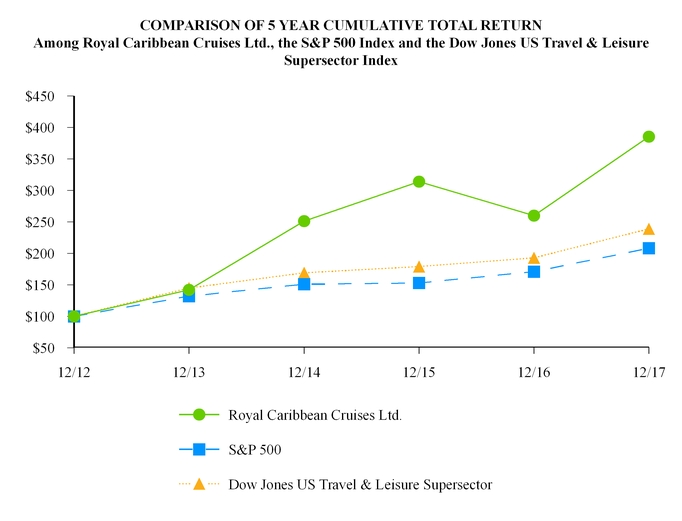
| 12/12 | 12/13 | 12/14 | 12/15 | 12/16 | 12/17 | ||||||
| Royal Caribbean Cruises Ltd. | 100.00 | 142.11 | 251.44 | 313.65 | 260.04 | 385.47 | |||||
| S&P 500 | 100.00 | 132.39 | 150.51 | 152.59 | 170.84 | 208.14 | |||||
| Dow Jones US Travel & Leisure | 100.00 | 145.48 | 169.28 | 179.27 | 192.85 | 238.77 |
The stock performance graph assumes for comparison that the value of the Company's common stock and of each index was $100 on December 31, 2012 and that all dividends were reinvested. Past performance is not necessarily an indicator of future results.
Item 6. Selected Financial Data
The selected consolidated financial data presented below for the years 2013 through 2017 and as of the end of each such year, except for Adjusted Net Income amounts, are derived from our audited consolidated financial statements and should be read in conjunction with those financial statements and the related notes as well as in conjunction with Item 7. Management's Discussion and Analysis of Financial Condition and Results of Operations.
| Year Ended December 31, | |||||||||||||||||||
| 2017 | 2016 | 2015 | 2014 | 2013 | |||||||||||||||
| (in thousands, except per share data) | |||||||||||||||||||
| Operating Data: | |||||||||||||||||||
| Total revenues | $ | 8,777,845 | $ | 8,496,401 | $ | 8,299,074 | $ | 8,073,855 | $ | 7,959,894 | |||||||||
| Operating income | $ | 1,744,056 | $ | 1,477,205 | $ | 874,902 | $ | 941,859 | $ | 798,148 | |||||||||
| Net income | $ | 1,625,133 | $ | 1,283,388 | $ | 665,783 | $ | 764,146 | $ | 473,692 | |||||||||
| Adjusted Net Income(1) (2) (3) (4) | $ | 1,625,133 | $ | 1,314,689 | $ | 1,065,066 | $ | 755,729 | $ | 539,224 | |||||||||
| Per Share Data—Basic: | |||||||||||||||||||
| Net income | $ | 7.57 | $ | 5.96 | $ | 3.03 | $ | 3.45 | $ | 2.16 | |||||||||
| Adjusted Net Income | $ | 7.57 | $ | 6.10 | $ | 4.85 | $ | 3.41 | $ | 2.46 | |||||||||
| Weighted-average shares | 214,617 | 215,393 | 219,537 | 221,658 | 219,638 | ||||||||||||||
| Per Share Data—Diluted: | |||||||||||||||||||
| Net income | $ | 7.53 | $ | 5.93 | $ | 3.02 | $ | 3.43 | $ | 2.14 | |||||||||
| Adjusted Net Income | $ | 7.53 | $ | 6.08 | $ | 4.83 | $ | 3.39 | $ | 2.44 | |||||||||
| Weighted-average shares and potentially dilutive shares | 215,694 | 216,316 | 220,689 | 223,044 | 220,941 | ||||||||||||||
| Dividends declared per common share | $ | 2.16 | $ | 1.71 | $ | 1.35 | $ | 1.10 | $ | 0.74 | |||||||||
| Balance Sheet Data: | |||||||||||||||||||
| Total assets | $ | 22,296,317 | $ | 22,310,324 | $ | 20,782,043 | $ | 20,524,060 | $ | 19,915,003 | |||||||||
| Total debt, including capital leases | $ | 7,539,451 | $ | 9,387,436 | $ | 8,527,243 | $ | 8,254,818 | $ | 7,916,860 | |||||||||
| Common stock | $ | 2,352 | $ | 2,346 | $ | 2,339 | $ | 2,331 | $ | 2,308 | |||||||||
| Total shareholders' equity | $ | 10,702,303 | $ | 9,121,412 | $ | 8,063,039 | $ | 8,284,359 | $ | 8,808,265 |
| (1) | For 2017, 2016 and 2015, refer to Financial Presentation and Results of Operations under Item 7. Management's Discussion and Analysis of Financial Condition and Results of Operations for definition of Adjusted Net Income and reconciliation of Adjusted Net Income to Net income. |
| (2) | Amount for 2017 includes a gain of $30.9 million related to the sale of Legend of the Seas. |
| (3) | Amount for 2014 excludes restructuring and related impairment charges of $4.3 million, other initiative costs of $21.2 million, an $11.0 million loss related to the estimated impact of Pullmantur's non-core businesses that were sold in 2014 and a loss of $17.4 million recognized on the sale of Celebrity Century. Additionally, the amount for 2014 excludes $28.9 million of net income resulting from the change in our voyage proration methodology and the reversal of a deferred tax asset valuation allowance of $33.5 million due to Spanish tax reform. |
| (4) | Amount for 2013 excludes restructuring and related impairment charges of $56.9 million and an $8.6 million loss related to the estimated impact of Pullmantur's non-core businesses that were sold in 2014. |
Item 7. Management's Discussion and Analysis of Financial Condition and Results of Operations
Cautionary Note Concerning Forward-Looking Statements
The discussion under this caption "Management's Discussion and Analysis of Financial Condition and Results of Operations" and elsewhere in this document, including, for example, under the "Risk Factors" and "Business" captions, includes "forward-looking statements" within the meaning of the Private Securities Litigation Reform Act of 1995. All statements other than statements of historical fact, including statements regarding guidance (including our expectations for the first quarter and full year of 2018 and our earnings and yield estimates for 2018 set forth under the heading "Outlook" below), business and industry prospects or future results of operations or financial position, made in this Annual Report on Form 10-K are forward-looking. Words such as "anticipate," "believe," "could," "estimate," "expect," "goal," "intend," "may," "plan," "project," "seek," "should," "will," "driving" and similar expressions are intended to further identify any of these forward-looking statements. Forward-looking statements reflect management's current expectations but they are based on judgments and are inherently uncertain. Furthermore, they are subject to risks, uncertainties and other factors that could cause our actual results, performance or achievements to differ materially from the future results, performance or achievements expressed or implied in those forward-looking statements. Examples of these risks, uncertainties and other factors include, but are not limited to, those discussed in this Annual Report on Form 10-K and, in particular, the risks discussed under the caption "Risk Factors" in Part I, Item 1A of this report.
All forward-looking statements made in this Annual Report on Form 10-K speak only as of the date of this document. Given these risks and uncertainties, readers are cautioned not to place undue reliance on such forward-looking statements. We undertake no obligation to publicly update or revise any forward-looking statements, whether as a result of new information, future events or otherwise.
Overview
The discussion and analysis of our financial condition and results of operations have been organized to present the following:
| • | a review of our critical accounting policies and of our financial presentation, including discussion of certain operational and financial metrics we utilize to assist us in managing our business; |
| • | a discussion of our results of operations for the year ended December 31, 2017 compared to the same period in 2016 and the year ended December 31, 2016 compared to the same period in 2015; |
| • | a discussion of our business outlook, including our expectations for selected financial items for the first quarter and full year of 2018; and |
| • | a discussion of our liquidity and capital resources, including our future capital and contractual commitments and potential funding sources. |
Critical Accounting Policies
Our consolidated financial statements are prepared in accordance with accounting principles generally accepted in the United States of America ("GAAP"). (Refer to Note 1. General and Note 2. Summary of Significant Accounting Policies to our consolidated financial statements under Item 8. Financial Statements and Supplementary Data). Certain of our accounting policies are deemed "critical," as they require management's highest degree of judgment, estimates and assumptions. We have discussed these accounting policies and estimates with the audit committee of our board of directors. We believe our most critical accounting policies are as follows:
Ship Accounting
Our ships represent our most significant assets and are stated at cost less accumulated depreciation and amortization. Depreciation of ships is generally computed net of a 15% projected residual value using the straight-line method over the estimated useful life of the asset, which is generally 30 years. The 30-year useful life of our newly constructed ships and 15% associated residual value are both based on the weighted-average of all major components
of a ship. Our useful life and residual value estimates take into consideration the impact of anticipated technological changes, long-term cruise and vacation market conditions and historical useful lives of similarly-built ships. In addition, we take into consideration our estimates of the weighted-average useful lives of the ships' major component systems, such as hull, superstructure, main electric, engines and cabins. Given the very large and complex nature of our ships, our accounting estimates related to ships and determinations of ship improvement costs to be capitalized require considerable judgment and are inherently uncertain. We do not have cost segregation studies performed to specifically componentize our ship systems. Therefore, we estimate the costs of component systems based principally on general and technical information known about major ship component systems and their lives and our knowledge of the cruise vacation industry. We do not identify and track depreciation by ship component systems, but instead utilize these estimates to determine the net cost basis of assets replaced or refurbished. Improvement costs that we believe add value to our ships are capitalized as additions to the ship and depreciated over the shorter of the improvements' estimated useful lives or that of the associated ship. The estimated cost and accumulated depreciation of replaced or refurbished ship components are written off and any resulting losses are recognized in Cruise operating expenses.
We use the deferral method to account for drydocking costs. Under the deferral method, drydocking costs incurred are deferred and charged to expense on a straight-line basis over the period to the next scheduled drydock, which we estimate to be a period of thirty to sixty months based on the vessel's age as required by Class. Deferred drydock costs consist of the costs to drydock the vessel and other costs incurred in connection with the drydock which are necessary to maintain the vessel's Class certification. Class certification is necessary in order for our cruise ships to be flagged in a specific country, obtain liability insurance and legally operate as passenger cruise ships. The activities associated with those drydocking costs cannot be performed while the vessel is in service and, as such, are done during a drydock as a planned major maintenance activity. The significant deferred drydock costs consist of hauling and wharfage services provided by the drydock facility, hull inspection and related activities (e.g., scraping, pressure cleaning, bottom painting), maintenance to steering propulsion, thruster equipment and ballast tanks, port services such as tugs, pilotage and line handling, and freight associated with these items. We perform a detailed analysis of the various activities performed for each drydock and only defer those costs that are directly related to planned major maintenance activities necessary to maintain Class. The costs deferred are related to activities not otherwise routinely periodically performed to maintain a vessel's designed and intended operating capability. Repairs and maintenance activities are charged to expense as incurred.
We use judgment when estimating the period between drydocks, which can result in adjustments to the estimated amortization of drydock costs. If the vessel is disposed of before the next drydock, the remaining balance in deferred drydock is written-off to the gain or loss upon disposal of vessel in the period in which the sale takes place. We also use judgment when identifying costs incurred during a drydock which are necessary to maintain the vessel's Class certification as compared to those costs attributable to repairs and maintenance which are expensed as incurred.
We believe we have made reas
Showing the first 8K of 88K characters. Open the full section
Item 7A. Quantitative and Qualitative Disclosures About Market Risk
Financial Instruments and Other
General
We are exposed to market risk attributable to changes in interest rates, foreign currency exchange rates and fuel prices. We try to mitigate these risks through a combination of our normal operating and financing activities and through the use of derivative financial instruments pursuant to our hedging practices and policies. The financial impact of these hedging instruments is primarily offset by corresponding changes in the underlying exposures being hedged. We achieve this by closely matching the amount, term and conditions of the derivative instrument with the underlying risk being hedged. Although certain of our derivative financial instruments do not qualify or are not accounted for under hedge accounting, our objective is not to hold or issue derivative financial instruments for trading or other speculative purposes. (Refer to Note 14. Fair Value Measurements and Derivative Instruments to our consolidated financial statements under Item 8. Financial Statements and Supplementary Data.)
Interest Rate Risk
Our exposure to market risk for changes in interest rates relates to our long-term debt obligations including future interest payments. At December 31, 2017, approximately 57.4% of our long-term debt was effectively fixed as compared to 40.5% as of December 31, 2016. We use interest rate swap agreements to modify our exposure to interest rate movements and to manage our interest expense.
Market risk associated with our long-term fixed rate debt is the potential increase in fair value resulting from a decrease in interest rates. We use interest rate swap agreements that effectively convert a portion of our fixed-rate debt to a floating-rate basis to manage this risk. At December 31, 2017 and December 31, 2016, we maintained interest rate swap agreements on the following fixed-rate debt instruments:
| Debt Instrument | Swap Notional as of December 31, 2017 (In thousands) | Maturity | Debt Fixed Rate | Swap Floating Rate: LIBOR plus | All-in Swap Floating Rate as of December 31, 2017 | ||
| Oasis of the Seas term loan | $ | 140,000 | October 2021 | 5.41% | 3.87% | 5.44% | |
| Unsecured senior notes | 650,000 | November 2022 | 5.25% | 3.63% | 5.05% | ||
| $ | 790,000 |
These interest rate swap agreements are accounted for as fair value hedges.
The estimated fair value of our long-term fixed-rate debt at December 31, 2017 was $2.4 billion, using quoted market prices, where available, or using the present value of expected future cash flows which incorporates risk profile. The fair value of our fixed to floating interest rate swap agreements was estimated to be a liability of $19.8 million as of December 31, 2017, based on the present value of expected future cash flows. A hypothetical one percentage point decrease in interest rates at December 31, 2017 would increase the fair value of our hedged and unhedged long-term fixed-rate debt by approximately $127.4 million and would increase the fair value of our fixed to floating interest rate swap agreements by approximately $31.8 million.
Market risk associated with our long-term floating-rate debt is the potential increase in interest expense from an increase in interest rates. We use interest rate swap agreements that effectively convert a portion of our floating-rate debt to a fixed-rate basis to manage this risk. A hypothetical one percentage point increase in interest rates would increase our forecasted 2018 interest expense by approximately $30.1 million, assuming no change in foreign currency exchange rates.
At December 31, 2017 and December 31, 2016, we maintained interest rate swap agreements on the following floating-rate debt instruments:
| Debt Instrument | Swap Notional as of December 31, 2017 (In thousands) | Maturity | Debt Floating Rate | All-in Swap Fixed Rate | |||
| Celebrity Reflection term loan | $ | 381,792 | October 2024 | LIBOR plus | 0.40% | 2.85% | |
| Quantum of the Seas term loan | 551,250 | October 2026 | LIBOR plus | 1.30% | 3.74% | ||
| Anthem of the Seas term loan | 573,958 | April 2027 | LIBOR plus | 1.30% | 3.86% | ||
| Ovation of the Seas term loan | 726,250 | April 2028 | LIBOR plus | 1.00% | 3.16% | ||
| Harmony of the Seas term loan (1) | 728,373 | May 2028 | EURIBOR plus | 1.15% | 2.26% | ||
| $ | 2,961,623 |
| (1) | Interest rate swap agreements hedging the Euro-denominated term loan for Harmony of the Seas include EURIBOR zero-floors matching the hedged debt EURIBOR zero-floor. Amount presented is based on the exchange rate as of December 31, 2017. |
These interest rate swap agreements are accounted for as cash flow hedges.
The fair value of our floating to fixed interest rate swap agreements was estimated to be a liability of $24.5 million as of December 31, 2017 based on the present value of expected future cash flows. These interest rate swap agreements are accounted for as cash flow hedges.
Foreign Currency Exchange Rate Risk
Our primary exposure to foreign currency exchange rate risk relates to our ship construction contracts denominated in Euros, our foreign currency denominated debt and our international business operations. We enter into foreign currency forward contracts, collar options and cross-currency swap agreements to manage portions of the exposure to movements in foreign currency exchange rates.
The estimated fair value, as of December 31, 2017, of our Euro-denominated forward contracts associated with our ship construction contracts was an asset of $235.9 million, based on the present value of expected future cash flows. As of December 31, 2017, the aggregate cost of our ships on order, not including the TUI Cruises' ships on order, was approximately $13.3 billion, of which we had deposited $465.7 million as of such date. Approximately 54.0% and 66.7% of the aggregate cost of the ships under construction was exposed to fluctuations in the Euro exchange rate at December 31, 2017 and December 31, 2016, respectively. A hypothetical 10% strengthening of the Euro as of December 31, 2017, assuming no changes in comparative interest rates, would result in a $716.0 million increase in the United States dollar cost of the foreign currency denominated ship construction contracts exposed to fluctuations in the Euro exchange rate. The majority of our foreign currency forward contracts, collar options and cross-currency swap agreements are accounted for as cash flow, fair value or net investment hedges depending on the designation of the related hedge.
Our international business operations subject us to foreign currency exchange risk. We transact business in many different foreign currencies and maintain investments in foreign operations which may expose us to financial market risk resulting from fluctuations in foreign currency exchange rates. Movements in foreign currency exchange rates may affect the value of our earnings in foreign currencies and cash flows. We manage most of this exposure on a consolidated basis, which allows us to take advantage of any natural offsets. Therefore, weakness in one particular currency might be offset by strengths in other currencies over time. The extent to which one currency is effective as a natural offset of another currency fluctuates over time. In addition, some foreign currency exposures have little to no mitigating natural offsets available.
We consider our investments in our foreign operations to be denominated in relatively stable currencies and of a long-term nature. As of December 31, 2017, we maintained foreign currency forward contracts and designated them as hedges of a portion of our net investment in TUI cruises of €101.0 million, or approximately $121.3 million based on the exchange rate at December 31, 2017. These forward currency contracts mature in October 2021.
We also address the exposure of our investments in foreign operations by denominating a portion of our debt in our subsidiaries' and investments' functional currencies and designating it as a hedge of these subsidiaries and investments. We had designated debt as a hedge of our net investments in TUI Cruises of approximately €246.0 million, or approximately $295.3 million, through December 31, 2017. As of December 31, 2016, we had designated debt as a hedge of our net investments in TUI Cruises of approximately €295.0 million, or approximately $311.2 million.
We have included approximately $68.5 million and $114.0 million of foreign-currency transaction losses and of changes in the fair value of derivatives in the foreign currency translation adjustment component of Accumulated other comprehensive loss at December 31, 2017 and December 31, 2016, respectively.
Lastly, on a regular basis, we enter into foreign currency forward contracts and, from time to time, we utilize cross-currency swap agreements to minimize the volatility resulting from the remeasurement of net monetary assets and liabilities denominated in a currency other than our functional currency or the functional currencies of our foreign subsidiaries. During 2017, we maintained an average of approximately $739.4 million of these foreign currency forward contracts. These instruments are not designated as hedging instruments. In 2017, 2016 and 2015 changes in the fair value of the foreign currency forward contracts resulted in a gain (loss) of approximately $62.0 million, $(51.1) million and $(55.5) million, respectively, which offset (losses) gains arising from the remeasurement of monetary assets and liabilities denominated in foreign currencies in those same years of $(75.6) million, $39.8 million and $34.6 million, respectively. These changes were recognized in earnings within Other expense in our consolidated statements of comprehensive income (loss).
Fuel Price Risk
Our exposure to market risk for changes in fuel prices relates primarily to the consumption of fuel on our ships. Fuel cost (net of the financial impact of fuel swap agreements), as a percentage of our total revenues, was approximately 7.8% in 2017, 8.4% in 2016 and 9.6% in 2015. We use fuel swap agreements to mitigate the financial impact of fluctuations in fuel prices.
As of December 31, 2017, we had fuel swap agreements to pay fixed prices for fuel with an aggregate notional amount of approximately $828.5 million, maturing through 2021. The fuel swap agreements represented 50% of our projected 2018 fuel requirements, 46% of our projected 2019 fuel requirements, 36% of our projected 2020 fuel requirements and 14% of our projected 2021 fuel requirements. These fuel swap agreements are generally accounted for as cash flow hedges. The estimated fair value of these contracts at December 31, 2017 was estimated to be an asset of $14.3 million. We estimate that a hypothetical 10% increase in our weighted-average fuel price from that experienced during the year ended December 31, 2017 would increase our forecasted 2018 fuel cost by approximately $38.0 million, net of the impact of fuel swap agreements.
Item 8. Financial Statements and Supplementary Data
Our Consolidated Financial Statements and Quarterly Selected Financial Data are included beginning on page F-1 of this report.
Item 9. Changes In and Disagreements With Accountants on Accounting and Financial Disclosure
None.
Item 9A. Controls and Procedures
Evaluation of Disclosure Controls and Procedures
Our management, with the participation of our Chairman and Chief Executive Officer and Chief Financial Officer, conducted an evaluation of the effectiveness of our disclosure controls and procedures, as such term is defined in Exchange Act Rule 13a-15(e), as of the end of the period covered by this report. Based upon such evaluation, our Chairman and Chief Executive Officer and Chief Financial Officer concluded that those controls and procedures are effective to provide reasonable assurance that information required to be disclosed by us in the reports that we file or submit under the Exchange Act is accumulated and communicated to management, including our Chairman and Chief Executive Officer and our Chief Financial Officer, as appropriate, to allow timely decisions regarding required disclosure and are effective to provide reasonable assurance that such information is recorded, processed, summarized and reported within the time periods specified by the SEC’s rules and forms.
Management's Report on Internal Control Over Financial Reporting
Our management is responsible for establishing and maintaining adequate internal control over financial reporting, as such term is defined in Exchange Act Rule 13a-15(f). Our management, with the participation of our Chairman and Chief Executive Officer and our Chief Financial Officer, conducted an evaluation of the effectiveness of our internal control over financial reporting based on the Internal Control-Integrated Framework (2013) issued by the Committee of Sponsoring Organizations of the Treadway Commission. Based on this evaluation, management concluded that our internal control over financial reporting was effective as of December 31, 2017. The effectiveness of our internal control over financial reporting as of December 31, 2017 has been audited by PricewaterhouseCoopers LLP, the independent registered certified public accounting firm that audited our consolidated financial statements included in this Annual Report on Form 10-K, as stated in its report, which is included herein on page F-2.
Changes in Internal Control Over Financial Reporting
There were no changes in our internal control over financial reporting identified in connection with the evaluation required by Exchange Act Rule 13a-15(d) during the quarter ended December 31, 2017 that have materially affected, or are reasonably likely to materially affect, our internal control over financial reporting.
Inherent Limitations on Effectiveness of Controls
It should be noted that any system of controls, however well designed and operated, can provide only reasonable, and not absolute, assurance that the objectives of the system will be met. In addition, the design of any control system is based in part upon certain assumptions about the likelihood of future events. Because of these and other inherent limitations of control systems, there is only reasonable assurance that our controls will succeed in achieving their goals under all potential future conditions.
Item 9B. Other Information
None.
PART III
Items 10, 11, 12, 13 and 14. Directors, Executive Officers and Corporate Governance; Executive Compensation; Security Ownership of Certain Beneficial Owners and Management and Related Stockholder Matters; Certain Relationships and Related Transactions; and Director Independence and Principal Accountant Fees and Services.
Except for information concerning executive officers (called for by Item 401(b) of Regulation S-K), which is included in Part I of this Annual Report on Form 10-K, the information required by Items 10, 11, 12, 13 and 14 is incorporated herein by reference to the Royal Caribbean Cruises Ltd. Definitive Proxy Statement relating to our 2018 Annual Meeting of Shareholders (the "Proxy Statement") to be filed with the Securities and Exchange Commission no later than 120 days after the close of the fiscal year. Please refer to the following sections in the Proxy Statement for more information regarding our corporate governance: "Corporate Governance"; "Proposal 1—Election of Directors"; and "Certain Relationships and Related Person Transactions." Copies of the Proxy Statement will become available when filed through our Investor Relations website at www.rclcorporate.com (please see "Financial Reports" under "Financial Information"); by contacting our Investor Relations department at 1050 Caribbean Way, Miami, Florida 33132—telephone (305) 982-2625; or by visiting the SEC's website at www.sec.gov.
We have adopted a Code of Business Conduct and Ethics that applies to all of our employees, including our executive officers, and our directors. A copy of the Code of Business Conduct and Ethics is posted in the corporate governance section of our website at www.rclcorporate.com and is available in print, without charge, to shareholders upon written request to our Corporate Secretary at Royal Caribbean Cruises, Ltd., 1050 Caribbean Way, Miami, Florida 33132. Any amendments to the code or any waivers from any provisions of the code granted to executive officers or directors will be promptly disclosed to investors by posting on our website at www.rclcorporate.com. None of the websites referenced in this Annual Report on Form 10-K or the information contained therein is incorporated herein by reference.
PART IV
Item 15. Exhibits and Financial Statement Schedules
(a)(1) Financial Statements
Our Consolidated Financial Statements have been prepared in accordance with Item 8. Financial Statements and Supplementary Data and are included beginning on page F-1 of this report.
| (2) | Financial Statement Schedules |
None.
| (3) | Exhibits |
INDEX TO EXHIBITS
Exhibits 10.22 through 10.50 represent management compensatory plans or arrangements.
| * | Filed herewith |
| ** | Furnished herewith |
Interactive Data File
| 101 | —The following financial statements from Royal Caribbean Cruises Ltd.'s Annual Report on Form 10-K for the year ended December 31, 2017, as filed with the SEC on February 20, 2018, formatted in XBRL, as follows: | |
| (i) | the Consolidated Statements of Comprehensive Income (Loss) for the years ended December 31, 2017, 2016 and 2015; | |
| (ii) | the Consolidated Balance Sheets at December 31, 2017 and 2016; | |
| (iii) | the Consolidated Statements of Cash Flows for the years ended December 31, 2017, 2016 and 2015; | |
| (iv) | the Consolidated Statements of Shareholders' Equity for the years ended December 31, 2017, 2016 and 2015; and | |
| (v) | the Notes to the Consolidated Financial Statements, tagged in summary and detail. |
Item 16. Form 10-K Summary
None.
SIGNATURES
Pursuant to the requirements of the Securities Exchange Act of 1934, the registrant has duly caused this report to be signed on its behalf by the undersigned, thereunto duly authorized.
| ROYAL CARIBBEAN CRUISES LTD. (Registrant) | |
| By: | /s/ JASON T. LIBERTY |
| Jason T. Liberty Executive Vice President, Chief Financial Officer (Principal Financial Officer and duly authorized signatory) |
February 20, 2018
Pursuant to the requirements of the Securities Exchange Act of 1934, this report has been signed below by the following persons on behalf of the registrant and in the capacities indicated on February 20, 2018.
| /s/ RICHARD D. FAIN |
| Richard D. Fain Director, Chairman and Chief Executive Officer (Principal Executive Officer) |
| /s/ JASON T. LIBERTY |
| Jason T. Liberty Executive Vice President, Chief Financial Officer (Principal Financial Officer) |
| /s/ HENRY L. PUJOL |
| Henry L. Pujol Senior Vice President, Chief Accounting Officer (Principal Accounting Officer) |
| * |
| John F. Brock Director |
| * |
| William L. Kimsey Director |
| * |
| Maritza G. Montiel Director |
| * |
| Ann S. Moore Director |
| * |
| Eyal M. Ofer Director |
| * |
| Thomas J. Pritzker Director |
| * |
| William K. Reilly Director |
| * |
| Bernt Reitan Director |
| * |
| Vagn O. Sørensen Director |
| * |
| Donald Thompson Director |
| * |
| Arne Alexander Wilhelmsen Director |
| *By: | /s/ JASON T. LIBERTY |
| Jason T. Liberty, as Attorney-in-Fact |
ROYAL CARIBBEAN CRUISES LTD.
INDEX TO CONSOLIDATED FINANCIAL STATEMENTS
F-1
Report of Independent Registered Public Accounting Firm
To the Board of Directors and Shareholders
of Royal Caribbean Cruises Ltd.
Opinions on the Financial Statements and Internal Control over Financial Reporting
We have audited the accompanying consolidated balance sheets of Royal Caribbean Cruises Ltd. and its subsidiaries as of December 31, 2017 and 2016, and the related consolidated statements of comprehensive income (loss), shareholders’ equity and cash flows for each of the three years in the period ended December 31, 2017, including the related notes (collectively referred to as the “consolidated financial statements”). We also have audited the Company's internal control over financial reporting as of December 31, 2017, based on criteria established in Internal Control - Integrated Framework (2013) issued by the Committee of Sponsoring Organizations of the Treadway Commission (COSO).
In our opinion, the consolidated financial statements referred to above present fairly, in all material respects, the financial position of the Company as of December 31, 2017 and 2016, and the results of their operations and their cash flows for each of the three years in the period ended December 31, 2017 in conformity with accounting principles generally accepted in the United States of America. Also in our opinion, the Company maintained, in all material respects, effective internal control over financial reporting as of December 31, 2017, based on criteria established in Internal Control - Integrated Framework (2013) issued by the COSO.
Basis for Opinions
The Company's management is responsible for these consolidated financial statements, for maintaining effective internal control over financial reporting, and for its assessment of the effectiveness of internal control over financial reporting, included in Management's Report on Internal Control over Financial Reporting appearing under Item 9A. Our responsibility is to express opinions on the Company’s consolidated financial statements and on the Company's internal control over financial reporting based on our audits. We are a public accounting firm registered with the Public Company Accounting Oversight Board (United States) ("PCAOB") and are required to be independent with respect to the Company in accordance with the U.S. federal securities laws and the applicable rules and regulations of the Securities and Exchange Commission and the PCAOB.
We conducted our audits in accordance with the standards of the PCAOB. Those standards require that we plan and perform the audits to obtain reasonable assurance about whether the consolidated financial statements are free of material misstatement, whether due to error or fraud, and whether effective internal control over financial reporting was maintained in all material respects.
Our audits of the consolidated financial statements included performing procedures to assess the risks of material misstatement of the consolidated financial statements, whether due to error or fraud, and performing procedures that respond to those risks. Such procedures included examining, on a test basis, evidence regarding the amounts and disclosures in the consolidated financial statements. Our audits also included evaluating the accounting principles used and significant estimates made by management, as well as evaluating the overall presentation of the consolidated financial statements. Our audit of internal control over financial reporting included obtaining an understanding of internal control over financial reporting, assessing the risk that a material weakness exists, and testing and evaluating the design and operating effectiveness of internal control based on the assessed risk. Our audits also included performing such other procedures as we considered necessary in the circumstances. We believe that our audits provide a reasonable basis for our opinions.
Definition and Limitations of Internal Control over Financial Reporting
A company’s internal control over financial reporting is a process designed to provide reasonable assurance regarding the reliability of financial reporting and the preparation of financial statements for external purposes in accordance with generally accepted accounting principles. A company’s internal control over financial reporting includes those policies and procedures that (i) pertain to the maintenance of records that, in reasonable detail, accurately and fairly reflect the transactions and dispositions of the assets of the company; (ii) provide reasonable assurance that transactions are recorded as necessary to permit preparation of financial statements in accordance with generally accepted accounting principles, and that receipts and expenditures of the company are being made only in accordance with authorizations of management and directors of the company; and (iii) provide reasonable assurance regarding prevention or timely detection of unauthorized acquisition, use, or disposition of the company’s assets that could have a material effect on the financial statements.
F-2
Because of its inherent limitations, internal control over financial reporting may not prevent or detect misstatements. Also, projections of any evaluation of effectiveness to future periods are subject to the risk that controls may become inadequate because of changes in conditions, or that the degree of compliance with the policies or procedures may deteriora
Showing the first 8K of 168K characters. Open the full section