 filings.tools
Royal Caribbean Cruises 10-K 2021-12-31
Filed 2022-03-01. 18 sections, 720K characters. Original on sec.gov · Markdown · JSON
Cover and table of contents
UNITED STATES
SECURITIES AND EXCHANGE COMMISSION
Washington, D.C. 20549
FORM 10-K
| (Mark One) | |||||
| ☒ | ANNUAL REPORT PURSUANT TO SECTION 13 OR 15(d) OF THE SECURITIES EXCHANGE ACT OF 1934 |
For the fiscal year ended December 31, 2021
or
| ☐ | TRANSITION REPORT PURSUANT TO SECTION 13 OR 15(d) OF THE SECURITIES EXCHANGE ACT OF 1934 |
For the transition period from to
Commission file number: 1-11884
ROYAL CARIBBEAN CRUISES LTD.
(Exact name of registrant as specified in its charter)
| Republic of Liberia (State or other jurisdiction of incorporation or organization) | 98-0081645 (I.R.S. Employer Identification No.) |
1050 Caribbean Way, Miami, Florida 33132
(Address of principal executive offices) (zip code)
(305) 539-6000
(Registrant's telephone number, including area code)
Securities registered pursuant to Section 12(b) of the Act:
| Title of each class | Trading Symbol(s) | Name of each exchange on which registered | ||||||||||||
| Common Stock, par value $.01 per share | RCL | New York Stock Exchange |
Securities registered pursuant to Section 12(g) of the Act: None
Indicate by check mark if the registrant is a well-known seasoned issuer, as defined in Rule 405 of the Securities Act. Yes ☒ No ☐
Indicate by check mark if the registrant is not required to file reports pursuant to Section 13 or Section 15(d) of the Act. Yes ☐ No ☒
Indicate by check mark whether the registrant (1) has filed all reports required to be filed by Section 13 or 15(d) of the Securities Exchange Act of 1934 during the preceding 12 months (or for such shorter period that the registrant was required to file such reports), and (2) has been subject to such filing requirements for the past 90 days. Yes ☒ No ☐
Indicate by check mark whether the registrant has submitted electronically every Interactive Data File required to be submitted pursuant to Rule 405 of Regulation S-T (§232.405 of this chapter) during the preceding 12 months (or for such shorter period that the registrant was required to submit such files). Yes ☒ No ☐
Indicate by check mark whether the registrant is a large accelerated filer, an accelerated filer, a non-accelerated filer, a smaller reporting company, or an emerging growth company. See the definitions of “large accelerated filer,” “accelerated filer,” “smaller reporting company,” and “emerging growth company” in Rule 12b-2 of the Exchange Act.
| Large accelerated filer ☒ | Accelerated filer ☐ | Non-accelerated filer ☐ | Smaller reporting company ☐ | |||||||||||||||||
| Emerging growth company ☐ |
If an emerging growth company, indicate by check mark if the registrant has elected not to use the extended transition period for complying with any new or revised financial accounting standards provided pursuant to Section 13(a) of the Exchange Act. ☐
Indicate by check mark whether the registrant has filed a report on and attestation to its management’s assessment of the effectiveness of its internal control over financial reporting under Section 404(b) of the Sarbanes-Oxley Act (15 U.S.C. 7262(b)) by the registered public accounting firm that prepared or issued its audit report. Yes ☒ No ☐
Indicate by check mark whether the registrant is a shell company (as defined in Rule 12b-2 of the Act). Yes ☐ No ☒
The aggregate market value of the registrant's common stock at June 30, 2021 (based upon the closing sale price of the common stock on the New York Stock Exchange on June 30, 2021) held by those persons deemed by the registrant to be non-affiliates was approximately $21.7 billion. Shares of the registrant's common stock held by each executive officer and director and by each entity or person that, to the registrant's knowledge, owned 10% or more of the registrant's outstanding common stock as of June 30, 2021 have been excluded from this number in that these persons may be deemed affiliates of the registrant. This determination of possible affiliate status is not necessarily a conclusive determination for other purposes.
There were 255,002,771 shares of common stock outstanding as of February 24, 2022.
DOCUMENTS INCORPORATED BY REFERENCE
Portions of the registrant's Definitive Proxy Statement relating to its 2022 Annual Meeting of Shareholders are incorporated by reference in Part III, Items 10-14 of this Annual Report on Form 10-K as indicated herein.
F-1
ROYAL CARIBBEAN CRUISES LTD.
TABLE OF CONTENTS
F-2
PART I
As used in this Annual Report on Form 10-K, the terms “Royal Caribbean,” "Royal Caribbean Group," the “Company,” “we,” “our” and “us” refer to Royal Caribbean Cruises Ltd. and, depending on the context, Royal Caribbean Cruises Ltd.’s consolidated subsidiaries and/or affiliates. The terms “Royal Caribbean International,” “Celebrity Cruises,” and “Silversea Cruises” refer to our wholly owned global cruise brands. Throughout this Annual Report on Form 10-K, we also refer to our partner brands in which we hold an ownership interest, including “TUI Cruises,” and “Hapag-Lloyd Cruises.” However, because these partner brands are unconsolidated investments, our operating results and other disclosures herein do not include these brands unless otherwise specified. In accordance with cruise vacation industry practice, the term “berths” is determined based on double occupancy per cabin even though many cabins can accommodate three or more passengers.
This Annual Report on Form 10-K also includes trademarks, trade names and service marks of other companies. Use or display by us of other parties’ trademarks, trade names or service marks is not intended to and does not imply a relationship with, or endorsement or sponsorship of us by, these other parties other than as described herein.
Item 1. Business.
General
We are one of the leading cruise companies in the world. We control and operate three global cruise brands: Royal Caribbean International, Celebrity Cruises and Silversea Cruises (collectively, our "Global Brands"). We also own a 50% joint venture interest in TUI Cruises GmbH ("TUIC"), that operates the German brands TUI Cruises and Hapag-Lloyd Cruises (collectively, our "Partner Brands"). Together, our Global Brands and our Partner Brands operate a combined total of 61 ships in the cruise vacation industry with an aggregate capacity of approximately 140,855 berths as of December 31, 2021.
Our ships operate on a selection of worldwide itineraries that call on approximately 1,000 destinations on all seven continents. In addition to our headquarters in Miami, Florida, we have offices and a network of international representatives around the world, which primarily focus on sales and market development.
We compete principally by operating valued brands that offer exceptional service provided by our crew and on the basis of innovation and quality of ships, variety of itineraries, choice of destinations and price. We believe that our commitment to build state-of-the-art ships and to invest in the maintenance and upgrade of our fleet to, among other things, incorporate many of our latest signature innovations, allows us to continue to attract new and loyal repeat guests.
Royal Caribbean was founded in 1968 as a partnership. Its corporate structure has evolved over the years and, the current parent corporation, Royal Caribbean Cruises Ltd., was incorporated on July 23, 1985 in the Republic of Liberia under the Business Corporation Act of Liberia.
COVID-19
Return to Healthy Sailing
We have restarted our global cruise operations in a phased manner, following our voluntary suspension of global cruise operations that commenced in March of 2020 in response to the COVID-19 pandemic. By the end of December 2021, we operated 50 of our Global and Partner Brand ships, representing over 85% of our capacity, and we have carried approximately 1.3 million guests since we resumed operations.
Our return to service efforts incorporate our enhanced health and safety protocols, and the requirements of regulatory agencies, which has resulted in reduced guest occupancy, modified itineraries and vaccination protocols. We experienced service disruptions and cancelled several sailings in the first quarter of 2022 due to the impact from the Omicron variant ("Omicron"). Service disruptions have abated as COVID-19 cases have declined. Despite the service disruptions and cancellations, we believe the overall trajectory of our return to service remains unchanged. We expect that by the end of the first quarter of 2022, 53 out of 62 ships, including Wonder of the Seas, which was delivered in January 2022, will have been brought back to service. Additionally, we expect that the rest of the fleet will return to operations before the summer season. See Part II. Item 7. Management's Discussion and Analysis - Critical Accounting Policies and Estimates and Recent Developments: COVID-19, and Note 1. General to our consolidated financial statements under Item 8. Financial Statements and Supplementary Data for further details on the impact of COVID-19 on our financial condition and results of operations.
Our Global Brands
Our Global Brands include Royal Caribbean International, Celebrity Cruises, and Silversea Cruises. We believe our Global Brands possess the versatility to enter multiple cruise market segments within the cruise vacation industry. Although each of our Global Brands has its own marketing style, as well as ships and crews of various sizes, the nature of the products sold and services delivered by our Global Brands share a common base (i.e., the sale and provision of cruise vacations). Our Global Brands also offer similar itineraries as well as similar cost and revenue components. The itineraries of our Global Brands are subject to the phased resumption of our operations and local restrictions. In addition, our Global Brands have historically sourced passengers from similar markets around the world and operated in similar economic environments with a significant degree of commercial overlap. As a result, we strategically manage our Global Brands as a single business with the ultimate objective of maximizing long-term shareholder value.
Royal Caribbean International
Royal Caribbean International is the world's largest cruise brand. The brand competes in both the contemporary and premium segments of the cruise vacation industry and appeals to families with children of all ages, as well as both older and younger couples. Royal Caribbean International offers cruises and land destinations that generally feature a casual ambiance, as well as a variety of activities and entertainment venues. We believe that the quality of the Royal Caribbean
International brand allows it to achieve market coverage that is among the broadest of any of the major cruise brands in the cruise vacation industry. Royal Caribbean International’s strategy is to attract an array of vacationing guests by offering a wide variety of itineraries to destinations worldwide, including Alaska, Asia, Australia, the Bahamas, Bermuda, Canada, the Caribbean, Europe, the Panama Canal and New Zealand, with cruise lengths generally ranging from one to 25 nights. Royal Caribbean International offers multiple innovative options for onboard dining, entertainment and other onboard activities. Because of the brand’s ability to deliver extensive and innovative product offerings at an excellent value to consumers, we believe Royal Caribbean International is well positioned to attract new consumers to cruising and to continue to bring loyal repeat guests back for their next vacation.
Royal Caribbean International operates 25 ships with an aggregate capacity of approximately 88,400 berths. Additionally, as of December 31, 2021, Royal Caribbean International had five ships on order with an aggregate capacity of approximately 28,200 berths, which consisted of two Oasis-class ships and the first three ships of a new generation, known as the Icon-class ships. The two Oasis-class ships include Wonder of the Seas, which was delivered in January of 2022, and our sixth Oasis-class ship, which is expected to be delivered in the second quarter of 2024. The Icon-class ships include Icon of the Seas, which is expected to be delivered in the third quarter of 2023, and the second and third Icon-class ships, which are expected to be delivered in the second quarters of 2025 and 2026, respectively.
The expected delivery dates for all of our ships on order are subject to change in the event of shipyard construction delays. See Part I. Item 1A. Risk Factors for further discussion on the impact of COVID-19 on shipyard operations.
Celebrity Cruises
Celebrity Cruises is positioned within the luxury segment of the cruise vacation industry. Celebrity Cruises’ strategy is to target affluent consumers by delivering a destination-rich experience on upscale ships that offer, among other things, luxurious accommodations, refined design-forward spaces, world-class service and culinary excellence. Celebrity Cruises offers a range of itineraries to destinations, including Alaska, Asia, Australia, Bermuda, Canada, the Caribbean, Europe, the Galapagos Islands, Hawaii, New Zealand, the Panama Canal and South America, with cruise lengths ranging from two to 18 nights.
Celebrity Cruises operates 14 ships with an aggregate capacity of approximately 29,215 berths. Additionally, as of December 31, 2021, Celebrity Cruises had two ships on order with an aggregate capacity of approximately 6,500 berths. These ships include two Edge-class ships, Celebrity Beyond and Celebrity Ascent, which are expected to be delivered in the second quarter of 2022 and in the fourth quarter of 2023, respectively. In addition, we have an a
Showing the first 8K of 105K characters. Open the full section
Item 1A. Risk Factors
The risk factors set forth below and elsewhere in this Annual Report on Form 10-K are important factors that could cause actual results to differ from expected or historical results. It is not possible to predict or identify all such risks. There may be additional risks that we consider not to be material, or which are not known, and any of these risks could affect our operations. The ordering of the risk factors set forth below is not intended to reflect a risk's potential likelihood or magnitude. See Item 7. Management’s Discussion and Analysis of Financial Condition and Results of Operations for a cautionary note regarding forward-looking statements.
COVID-19 and Financial Risks
The COVID-19 pandemic has had, and continues to have, a material adverse impact on our business, results of operations and liquidity. The global spread of COVID-19, the unprecedented responses by governments and other authorities to control and contain the disease, including related variants and challenges to global vaccination efforts, have caused significant disruptions, created new risks, and exacerbated existing risks to our business.
We have been, and continue to be, negatively impacted by the COVID-19 pandemic, including impacts that resulted or may result from actions taken in response to the outbreak and the occurrence and spread of related variants. Examples of these include, but are not limited to, cruising advisories and required or voluntary travel restrictions, that resulted in the temporary suspension of our Global Brands' operations, from which we have resumed limited operations; restrictions on the movement and gathering of people; social distancing measures; shelter-in-place/stay-at-home orders; and disruptions to businesses in our supply chain. In addition to the restrictions affecting our business, the extent, duration, and magnitude of the COVID-19 pandemic’s effect on the economy and consumer demand for cruising and travel is evolving and difficult to predict. As such, these impacts may persist for an extended period of time or even become more pronounced, even as we resume operations.
The COVID-19 pandemic also has elevated risks affecting significant parts of our business:
- Operations: While we have restarted our global cruise operations in a phased manner, following the March 2020 suspension of our global cruise operations, there is no assurance that our plan to resume operations will be successful. It is possible that future COVID-19 cases could occur onboard and, even if controlled and contained, it is uncertain whether we will need to suspend additional sailings and to what extent in such event. Onboard cases have resulted in illness among our guests and crew, incremental costs, guest refunds and negative publicity and media attention. In addition, we may face challenges in executing our return to service plans as a result of new and evolving operating protocols, including due to state laws regarding proof of vaccination requirements and related litigation, and possible changes in regulations in the countries in which we operate and plan to operate.
Uncertainties remain as to the specifics, timing and costs of administering and implementing our health and safety measures, some of which may be significant. These measures also may negatively impact guest satisfaction. Based on our assessment of these requirements and recommendations, the status of COVID-19 infection and/or vaccination rates in the U.S. or globally or for other reasons, we may determine it necessary to cancel or modify certain of our Global Brands’ cruise sailings. In addition, there is no guarantee that the vaccines will be effective. We believe the impact to our global bookings resulting from COVID-19 will continue to have a material negative impact on our results of operations and liquidity, which may be prolonged beyond containment of the disease and its variants.
Our previous suspension of sailings and our gradual resumption of operations has led to a significant decline in our revenues and cash inflows, which required us to take cost and capital expenditure containment actions. Consequently, we reduced and furloughed some of our workforce, with approximately 23% of our U.S. shoreside employee base being impacted in 2020. Our ships and our shipboard crew are gradually being notified about new assignments as operations resume over time. We may be challenged in rebuilding the rest of our workforce which could delay our phased resumption of operations. In addition, we have reduced our planned capital spending through 2022, which may negatively impact or delay our execution of planned growth strategies, particularly as it relates to investments in our ships, technology, and our expansion of land-based developments. We also have taken actions to monitor and mitigate changes in our supply chain, and port destination availability, which may strain relationships with our vendors and port partners.
If we are unable to satisfy the safety standards applicable to our sailings, our operations may be negatively impacted and we could be exposed to reputational and legal risks. Due to the unprecedented and uncertain nature of the COVID-19 pandemic and related regulatory landscape, it is difficult to predict the impact of further disruptions and their magnitude. In addition, we have never previously experienced a complete cessation of our cruising operations or a subsequent phased resumption of operations, and as a consequence, we are unable to predict the precise impact of such a cessation or phased resumption of operations on our brands and future prospects.
- Results of Operations:** Our suspensions of sailings have materially impacted the results of our operations. We have incurred and will continue to incur significant costs as we accommodate passengers due to cancelled sailings. In addition, we have
incurred and will likely continue to incur significant overhead costs associated with the return to service of our fleet and enhanced COVID-19 related cleaning, testing, vaccination and other mitigation procedures. We may experience volatility in demand for cruising for an indeterminable length of time due to the uncertain nature of the COVID-19 pandemic and ongoing concerns about health and safety, and we cannot predict when we will return to pre-pandemic demand or fare pricing or if we will return to such levels in the foreseeable future. In turn, these negative impacts to our financial performance have resulted and may continue to result in impairments of our long-lived and intangible assets, which has influenced our decision making relating to early disposal, sale or retirement of assets. Following the resumption of operations, our Global Brands and our Partner Brands may be subject to the continued impact of the COVID-19 pandemic. Additionally, any future profitability will be impacted by increased debt service costs as a result of our liquidity actions.
- Liquidity:** The suspension of our sailings and the reduction in demand for future cruising adversely impacted our liquidity, and we have continued to experience higher than historical levels of refunds of customer deposits, while cash inflows from new or existing bookings on future sailings are below pre-pandemic levels. As a result, we have taken actions to increase our liquidity through a combination of operating and capital expense reductions and increased financing activities. Refer to Note 8. Debt to our consolidated financial statements under Item 8. Financial Statements and Supplemental Data for further discussion of our 2021 financing activities.
We have agreed with certain of our lenders that we will not pay dividends or engage in stock repurchases until after the third quarter of 2022. Thereafter, in the event we declare a dividend or engage in stock repurchases we will need to repay the amounts deferred under our export credit facilities. On February 25, 2021, S&P Global further downgraded
Showing the first 8K of 83K characters. Open the full section
Item 1B. Unresolved Staff Comments
None.
Item 2. Properties
Information about our cruise ships, including their size, may be found within the Operating Strategies - Fleet upgrade and maintenance section and the Operations - Cruise Ships and Itineraries sections in Item 1*. Business*. Information regarding our cruise ships under construction, estimated expenditures and financing may be found within the Future Capital Commitments and Funding Needs and Sources sections of Item 7. Management’s Discussion and Analysis of Financial Condition and Results of Operations.
Our principal executive office and principal shoreside operations are located in leased office buildings at the Port of Miami, Florida. We also lease a number of other offices in the U.S. and throughout Europe, Asia, Mexico, South America and Australia to administer our brand operations globally.
We believe that our facilities are adequate for our current needs and that we are capable of obtaining additional facilities as necessary.
We also operate two private destinations which we utilize as ports-of-call on certain itineraries: (i) an island we own in the Bahamas that we call CocoCay; and (ii) Labadee, a secluded peninsula that we lease on the north coast of Haiti.
Item 3. Legal Proceedings
As previously reported, two lawsuits were filed against us in August 2019 in the U.S. District Court for the Southern District of Florida (the "Court") under Title III of the Cuban Liberty and Democratic Solidarity Act, also known as the Helms-Burton Act. The complaint filed by Havana Docks Corporation ("Havana Docks Action") alleges it holds an interest in the Havana Cruise Port Terminal, and the complaint filed by Javier Garcia-Bengochea (the "Port of Santiago Action") alleges that he holds an interest in the Port of Santiago, Cuba, both of which were expropriated by the Cuban government. The complaints further allege that we trafficked in those properties by embarking and disembarking passengers at these facilities. The plaintiffs seek all available statutory remedies, including the value of the expropriated property, plus interest, treble damages, attorneys’ fees and costs. In the Havana Docks Action, we and the plaintiff have filed motions for summary judgment, which were heard by the Court in January 2022. The Havana Docks Action is scheduled for trial on May 23, 2022. The Court dismissed the Port of Santiago Action with prejudice on the basis that the plaintiff lacked standing, and the plaintiff’s appeal of the dismissal is awaiting a decision by the appellate court. We believe we have meritorious defenses to the claims alleged in both the Havana Docks Action and the Port of Santiago Action, and we intend to vigorously defend ourselves against them. The outcome of litigation is inherently unpredictable and subject to significant uncertainties, and there can be no assurances that the final outcome of either case will not be material.
We are also routinely involved in claims typical within the travel and tourism vacation industry. The majority of these claims are covered by insurance. We believe the outcome of such claims, net of expected insurance recoveries, will not have a material adverse impact on our financial condition or results of operations and cash flows.
Item 4. Mine Safety Disclosures
None.
PART II
Item 5. Market for Registrant's Common Equity, Related Stockholder Matters and Issuer Purchases of Equity Securities
Market Information
Our common stock is listed on the New York Stock Exchange ("NYSE") under the symbol "RCL."
Holders
As of February 24, 2022, there were approximately 1,267 record holders of our common stock. Since certain of our shares are held by brokers and other institutions on behalf of shareholders, the foregoing number is not representative of the number of beneficial owners.
Dividends
Holders of our common stock have an equal right, pro rata based on number of shares held, to share in our profits in the form of dividends when and if declared by our board of directors out of funds legally available, subject to any rights of holders of preferred stock if any. Holders of our common stock have no rights to any sinking fund.
There are no exchange control restrictions on remittances of dividends on our common stock by reason of our incorporation in Liberia because (1) we are and intend to maintain our status as a nonresident Liberian entity under the Liberia Revenue Code of 2000 as amended and the regulations thereunder, and (2) our ship-owning subsidiaries are not now engaged, and are not in the future expected to engage, in any business in Liberia, including voyages exclusively within the territorial waters of the Republic of Liberia. Under current Liberian law, no Liberian taxes or withholding will be imposed on payments to holders of our securities other than to a holder that is a resident Liberian entity or a resident individual or an individual or entity subject to taxation in Liberia as a result of having a permanent establishment within the meaning of the Liberia Revenue Code of 2000 as amended in Liberia.
The declaration of dividends shall at all times be subject to the final determination of our board of directors that a dividend is prudent at that time in consideration of the needs of the business. In connection with securing various financial covenant waivers, we agreed with certain of our lenders not to pay dividends until the end of the third quarter of 2022. In addition, in the event we thereafter declare a dividend, we will need to repay the amounts deferred under our export credit facilities as part of the principal amortization deferrals agreed with them during 2020 and 2021. Accordingly, we have not declared a dividend since the first quarter of 2020. Refer to Note 10*. Shareholders' Equity* to our consolidated financial statements under Item 8. Financial Statements and Supplemental Data for further information on dividends declared.
Share Repurchases
There were no repurchases of common stock during the year ended December 31, 2021.
In connection with our debt covenant waivers, we agreed with certain of our lenders not to engage in stock repurchases until the end of the third quarter of 2022. In addition, in the event we engage in share repurchases, we will need to repay the amounts deferred under our export credit facilities as part of the principal amortization deferrals agreed with them during 2020 and 2021.
Performance Graph
The following graph compares the total return, assuming reinvestment of dividends, on an investment in the Company, based on performance of the Company's common stock, with the total return of the Standard & Poor's 500 Composite Stock Index ("S&P 500") and the Dow Jones United States Travel and Leisure Index for a five year period by measuring the changes in common stock prices from December 31, 2016 to December 31, 2021.
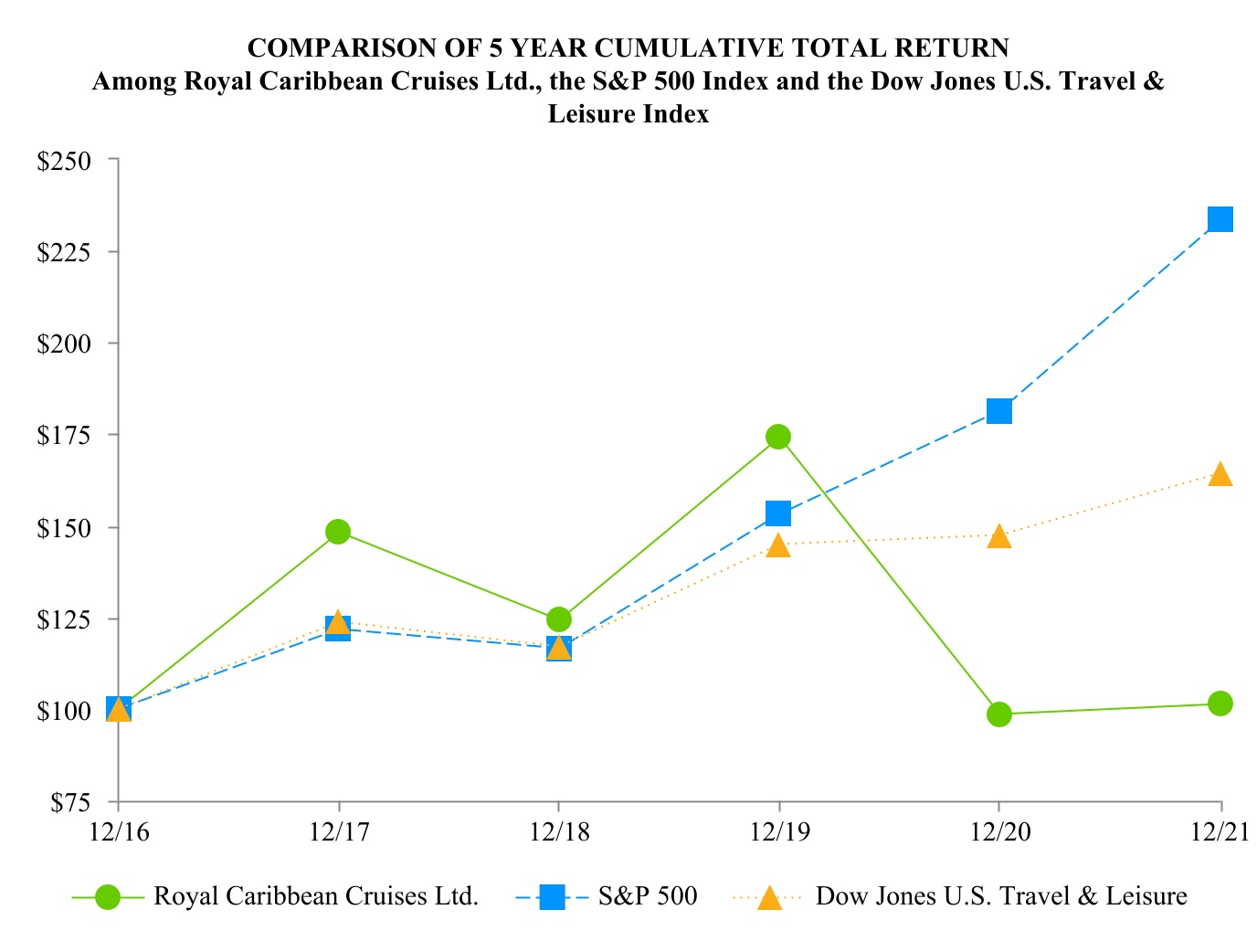
| 12/16 | 12/17 | 12/18 | 12/19 | 12/20 | 12/21 | ||||||||||||||||||||||||||||||
| Royal Caribbean Cruises Ltd. | 100.00 | 148.23 | 124.30 | 173.97 | 98.48 | 101.39 | |||||||||||||||||||||||||||||
| S&P 500 | 100.00 | 121.83 | 116.49 | 153.17 | 181.35 | 233.41 | |||||||||||||||||||||||||||||
| Dow Jones U.S. Travel & Leisure | 100.00 | 123.81 | 116.89 | 144.87 | 147.40 | 164.33 |
The stock performance graph assumes for comparison that the value of the Company's common stock and of each index was $100 on December 31, 2016 and that all dividends were reinvested. Past performance is not necessarily an indicator of future results.
Item 6. Reserved.
Not applicable.
Item 7. Management's Discussion and Analysis of Financial Condition and Results of Operations
Cautionary Note Concerning Forward-Looking Statements
The discussion under this caption “Management's Discussion and Analysis of Financial Condition and Results of Operations” and elsewhere in this document, includes “forward-looking statements” within the meaning of the Private Securities Litigation Reform Act of 1995. All statements other than statements of historical fact, including statements regarding our expectations for future periods, business and industry prospects or future results of operations or financial position, made in this Annual Report on Form 10-K are forward-looking. Words such as “anticipate,” “believe,” “considering,” “could,” “driving,” “estimate,” “expect,” “goal,” “intend,” “may,” “plan,” “project,” “seek,” “should,” “will” and similar expressions are intended to further identify any of these forward-looking statements. Forward-looking statements reflect management's current expectations but they are based on judgments and are inherently uncertain. Furthermore, they are subject to risks, uncertainties and other factors that could cause our actual results, performance or achievements to differ materially from the future results, performance or achievements expressed or implied in those forward-looking statements. Examples of these risks, uncertainties and other factors include, but are not limited to, those discussed in this Annual Report on Form 10-K and, in particular, the risks discussed under the caption Risk Factors” in Part I, Item 1A herein.
All forward-looking statements made in this Annual Report on Form 10-K speak only as of the date of this document. Given these risks and uncertainties, readers are cautioned not to place undue reliance on such forward-looking statements. We undertake no obligation to publicly update or revise any forward-looking statements, whether as a result of new information, future events or otherwise.
Overview
The discussion and analysis of our financial condition and results of operations is organized to present the following:
-
a review of our critical accounting policies and estimates and of our financial presentation, including discussion of certain operational and financial metrics we utilize to assist us in managing our business;
-
a discussion of our results of operations for the year ended December 31, 2021 compared to the same period in 2020;
-
a discussion of our business outlook, and
-
a discussion of our liquidity and capital resources, including our future capital and contractual commitments and potential funding sources.
A discussion of our results of operations for the year ended December 31, 2020 compared to the year ended December 31, 2019 is included in Part II. Item 7. Management's Discussion and Analysis of Financial Condition and Results of Operations of our Annual Report on Form 10-K for the year ended December 31, 2020, filed with the SEC on February 26, 2021 and is incorporated by reference into this Form 10-K.
Critical Accounting Policies and Estimates
Our consolidated financial statements are prepared in accordance with accounting principles generally accepted in the United States of America ("GAAP"). (Refer to Note 1*. General* and Note 2*. Summary of Significant Accounting Policies* to our consolidated financial statements under Item 8. Financial Statements and Supplementary Data). Certain of our accounting policies are deemed "critical," as they require management's highest degree of judgment, estimates and assumptions. We have discussed these accounting policies and estimates with the audit committee of our board of directors. We believe our most critical accounting policies and estimates are as follows:
Liquidity and COVID-19
The effects of COVID-19 have had and continue to have a material negative impact on our operations, financial results and liquidity. The full extent of the impact will be determined by the length of time COVID-19 influences our industry and our gradual return to service. Given the ongoing effects of COVID-19 on our operations and global bookings, we have identified the estimation of our future liquidity requirements as a critical accounting policy.
*•*Expected continued gradual resumption of cruise operations;
-
Expected sustained increase in revenue per available passenger cruise day during our continued resumption of cruise operations;
-
Expected lower than comparable historical occupancy levels during our continued resumption of cruise operations, increasing over time until we reach historical occupancy levels; and
-
Expected spend during our continued resumption of cruise operations, including returning our crew members to our vessels and maintaining enhanced health and safety protocols.
The assumptions used to estimate our liquidity requirements are frequently and continuously evaluated because of the unprecedented environment that we are experiencing due to COVID-19. In addition, the magnitude, duration and speed of the global pandemic continues to be uncertain. As a result, we have made reasonable estimates and judgments of the impact of COVID-19 on our liquidity within our financial statements and there may be changes to those estimates in future periods.
We have taken and will continue to take actions to improve our liquidity, including:
-
Reduction of capital expenditures;
-
Reduction of operating expenses in 2020 and 2021 during the suspension of our global cruise operations (including furloughing staff and laying up vessels);
-
Amending credit agreements to defer payments and covenant requirements, as well as extend maturity dates;
-
Raising capital through debt and stock issuances; and
-
Suspending dividend payments.
Ship Accounting
Ships represent our most significant assets and are stated at cost less accumulated depreciation and amortization. Depreciation of ships is generally computed net of a 10%-15% projected residual value, using the straight-line method over the estimated useful life of the asset, which is generally 30-35 years. The 30-35 year useful life and 10%-15% residual value is the weighted-average of all major components of a ship. Our useful life and residual value estimates take into consideration the impact of anticipated technological changes, long-term cruise and vacation market conditions and historical useful lives of similarly-built ships. In addition, we take into consideration our estimates of the weighted-average useful lives of the ships' major component systems, such as hull, superstructure, main electric, engines and cabins. We employ a cost allocation methodology at the component level, in order to support the estimated weighted-average useful lives and residual values, as well as to determine the net cost basis of assets being replaced. Given the very large and complex nature of our ships, our accounting estimates related to ships and determinations of ship improvement costs to be capitalized require considerable judgment and are inherently uncertain. We do not have cost segregation studies performed to specifically componentize our ship systems. However, we estimate the costs, useful lives and residual values of component systems based principally on general and technical information known about major ship component systems and their lives, as well as our knowledge of the cruise vacation industry. We do not identify and track depreciation by ship component systems, but instead utilize these estimates to determine the net cost basis of assets replaced or refurbished. Impro
Showing the first 8K of 105K characters. Open the full section
Item 7A. Quantitative and Qualitative Disclosures About Market Risk
Financial Instruments and Other
General
We are exposed to market risk attributable to changes in interest rates, foreign currency exchange rates and fuel prices. We try to mitigate these risks through a combination of our normal operating and financing activities and through the use of derivative financial instruments pursuant to our hedging practices and policies. The financial impact of these hedging instruments is primarily offset by corresponding changes in the underlying exposures being hedged. We achieve this by closely matching the amount, term and conditions of the derivative instrument with the underlying risk being hedged. Although certain of our derivative financial instruments do not qualify or are not accounted for under hedge accounting, our objective is not to hold or issue derivative financial instruments for trading or other speculative purposes. Refer to Note 16. Fair Value Measurements and Derivative Instruments to our consolidated financial statements under Item 8. Financial Statements and Supplementary Data.
Interest Rate Risk
Our exposure to market risk for changes in interest rates relates to our long-term debt obligations including future interest payments. At December 31, 2021, approximately 65.7% of our long-term debt was effectively fixed as compared to 64.5% as of December 31, 2020. We use interest rate swap agreements to modify our exposure to interest rate movements and to manage our interest expense.
Market risk associated with our long-term fixed rate debt is the potential increase in fair value resulting from a decrease in interest rates. We use interest rate swap agreements that effectively convert a portion of our fixed-rate debt to a floating-rate basis to manage this risk. At December 31, 2021, we maintained interest rate swap agreements on the following fixed-rate debt instruments:
| Debt Instrument | Swap Notional as of December 31, 2021 (In thousands) | Maturity | Debt Fixed Rate | Swap Floating Rate: LIBOR plus | All-in Swap Floating Rate as of December 31, 2021 | ||||||||||||
| Unsecured senior notes | 650,000 | November 2022 | 5.25% | 3.63% | 3.79% | ||||||||||||
| $ | 650,000 |
These interest rate swap agreements are accounted for as fair value hedges.
The estimated fair value of our long-term fixed-rate debt at December 31, 2021 was $13.7 billion, using quoted market prices, where available, or using the present value of expected future cash flows which incorporates risk profile. The fair value of our fixed to floating interest rate swap agreements was estimated to be an asset of $7.7 million as of December 31, 2021, based on the present value of expected future cash flows. A hypothetical one percentage point decrease in interest rates at December 31, 2021 would increase the fair value of our hedged and unhedged long-term fixed-rate debt by approximately $105.3 million and would increase the fair value of our fixed to floating interest rate swap agreements by approximately $5.0 million.
Market risk associated with our long-term floating-rate debt is the potential increase in interest expense from an increase in interest rates. We use interest rate swap agreements that effectively convert a portion of our floating-rate debt to a fixed-rate basis to manage this risk. A hypothetical one percentage point increase in interest rates would increase our forecasted 2022 interest expense by approximately $48.7 million, assuming no change in foreign currency exchange rates.
At December 31, 2021, we maintained interest rate swap agreements on the following floating-rate debt instruments:
| Debt Instrument | Swap Notional as of December 31, 2021 (In thousands) | Maturity | Debt Floating Rate | All-in Swap Fixed Rate | |||||||||||||
| Celebrity Reflection term loan | $ | 163,625 | October 2024 | LIBOR plus | 0.40% | 2.85% | |||||||||||
| Quantum of the Seas term loan | 306,250 | October 2026 | LIBOR plus | 1.30% | 3.74% | ||||||||||||
| Anthem of the Seas term loan | 332,292 | April 2027 | LIBOR plus | 1.30% | 3.86% | ||||||||||||
| Ovation of the Seas term loan | 449,583 | April 2028 | LIBOR plus | 1.00% | 3.16% | ||||||||||||
| Harmony of the Seas term loan (1) | 427,142 | May 2028 | EURIBOR plus | 1.15% | 2.26% | ||||||||||||
| Odyssey of the Seas term loan(2) | 421,667 | October 2032 | LIBOR plus | 0.96% | 3.21% | ||||||||||||
| Odyssey of the Seas term loan (2) | 191,667 | October 2032 | LIBOR plus | 0.96% | 2.84% | ||||||||||||
| $ | 2,292,226 |
(1) Interest rate swap agreements hedging the Euro-denominated term loan for Harmony of the Seas include EURIBOR zero-floors matching the hedged debt EURIBOR zero-floor. Amount presented is based on the exchange rate as of December 31, 2021.
(2) Interest rate swap agreements hedging the term loan of Odyssey of the Seas include LIBOR zero-floors matching the debt LIBOR zero-floor. The effective dates of the $421.7 million and $191.7 million interest rate swap agreements are October 2020 and October 2022, respectively. The unsecured term loan for the financing of Odyssey of the Seas was drawn on March 2021.
These interest rate swap agreements are accounted for as cash flow hedges.
The fair value of our floating to fixed interest rate swap agreements was estimated to be a liability of $70.7 million as of December 31, 2021 based on the present value of expected future cash flows. These interest rate swap agreements are accounted for as cash flow hedges.
Foreign Currency Exchange Rate Risk
Our primary exposure to foreign currency exchange rate risk relates to our ship construction contracts denominated in Euros, our foreign currency denominated debt and our international business operations. On a regular basis, we enter into foreign currency forward contracts and, from time to time, we utilize cross-currency swap agreements and collar options to manage portions of the exposure to movements in foreign currency exchange rates.
The estimated fair value, as of December 31, 2021, of our Euro-denominated forward contracts associated with our ship construction contracts was a liability of $122.5 million, based on the present value of expected future cash flows. As of December 31, 2021, the aggregate cost of our ships on order, not including ships on order by our Partner Brands, was approximately $12.4 billion, of which we had deposited $800.2 million as of such date. Approximately 59.0% of the aggregate cost of the ships under construction was exposed to fluctuations in the Euro exchange rate at December 31, 2021 and 2020, respectively. A hypothetical 10% strengthening of the Euro as of December 31, 2021, assuming no changes in comparative interest rates, would result in a $730.4 million increase in the United States dollar cost of the foreign currency denominated ship construction contracts exposed to fluctuations in the Euro exchange rate. Our foreign currency forward contract agreements are accounted for as cash flow or net investment hedges depending on the designation of the related hedge.
Our international business operations subject us to foreign currency exchange risk. We transact business in many different foreign currencies and maintain investments in foreign operations which may expose us to financial market risk resulting from fluctuations in foreign currency exchange rates. Movements in foreign currency exchange rates may affect the value of our earnings in foreign currencies and cash flows. We manage most of this exposure on a consolidated basis, which allows us to take advantage of any natural offsets. Therefore, weakness in one particular currency might be offset by strengths in other currencies over time. The extent to which one currency is effective as a natural offset of another currency fluctuates over time. In addition, some foreign currency exposures have little to no mitigating natural offsets available.
We consider our investments in our foreign operations to be denominated in relatively stable currencies and of a long-term nature. As of December 31, 2021, we maintained a foreign currency forward contract and designated it as a hedge of a portion of our net investment in TUI Cruises of €245.0 million, or approximately $278.6 million based on the exchange rate at December 31, 2021. This forward currency contract matures in April 2022.
We also address the exposure of our investments in foreign operations by denominating a portion of our debt in our subsidiaries' and investments' functional currencies and designating it as a hedge of these subsidiaries and investments. We had designated debt as a hedge of our net investments primarily in TUI Cruises of approximately €97.0 million, or approximately $110.3 million, through December 31, 2021. As of December 31, 2020, we had designated debt as a hedge of our net investments primarily in TUI Cruises of approximately €215.0 million, or approximately $263.0 million.
We have included net gains of approximately $47.7 million and $22.1 million of foreign-currency transaction remeasurement and changes in the fair value of derivatives in the foreign currency translation adjustment component of Accumulated other comprehensive loss at December 31, 2021 and 2020, respectively.
On a regular basis, we enter into foreign currency forward contracts and, from time to time, we utilize cross-currency swap agreements and collar options to minimize the volatility resulting from the remeasurement of net monetary assets and liabilities denominated in a currency other than our functional currency or the functional currencies of our foreign subsidiaries. During 2021, we maintained an average of approximately $483.2 million of these foreign currency forward contracts. These instruments are not designated as hedging instruments. For the years ended December 31, 2021, 2020 and 2019 changes in the fair value of the foreign currency forward contracts resulted in gains (losses) of approximately $(30.9) million, $(19.0) million and $1.4 million, respectively, which offset gains (losses) arising from the remeasurement of monetary assets and liabilities denominated in foreign currencies in those same years of $24.3 million, $(1.5) million and $0.4 million, respectively. These changes were recognized in earnings within Other income (expense) in our consolidated statements of comprehensive income (loss).
Fuel Price Risk
Our exposure to market risk for changes in fuel prices relates primarily to the consumption of fuel on our ships. Fuel cost, net of the financial impact of fuel swap agreements, as a percentage of our total revenues, was approximately 25.1% in 2021, 16.8% in 2020 and 6.4% in 2019. We use fuel swap agreements to mitigate the financial impact of fluctuations in fuel prices.
As of December 31, 2021, we had fuel swap agreements to pay fixed prices for fuel with an aggregate notional amount of approximately $527.3 million, maturing through 2023. These fuel swap agreements are generally accounted for as cash flow hedges. The fuel swap agreements designated as hedges of projected fuel purchases represented 54% of our projected 2022 fuel requirements and 15% of our projected 2023 fuel requirements. The prior suspension of our cruise operations due to the COVID-19 pandemic and our gradual resumption of cruise operations has resulted in reductions to our forecasted fuel purchases. As of December 31, 2021, the Company had outstanding fuel swaps of 231,900 metric tons, maturing in 2022, that do not hedge forecasted fuel consumption. Of these swaps, 115,950 metric tons relate to fuel swap agreements with discontinued hedge accounting, in which we effectively pay fixed prices for our fuel purchases and receive floating prices from the counterparty. The remaining 115,950 tons relate to fuel swap agreements that were not designated as hedges since inception, in which we effectively pay floating prices for our fuel purchases and receive fixed prices from the counterparty. The estimated fair value of our fuel swap agreements at December 31, 2021 was estimated to be an asset of $40.3 million. We estimate that a hypothetical 10% increase in our weighted-average fuel price from that experienced during the year ended December 31, 2021 would increase our forecasted 2022 fuel cost by approximately $50.0 million, net of the impact of fuel swap agreements.
Item 8. Financial Statements and Supplementary Data
Our Consolidated Financial Statements are included beginning on page F-1 of this report.
Item 9. Changes In and Disagreements With Accountants on Accounting and Financial Disclosure
None.
Item 9A. Controls and Procedures
Evaluation of Disclosure Controls and Procedures
Our management, with the participation of our President and Chief Executive Officer and Chief Financial Officer, conducted an evaluation of the effectiveness of our disclosure controls and procedures, as such term is defined in Exchange Act Rule 13a-15(e), as of the end of the period covered by this report. Based upon such evaluation, our President and Chief Executive Officer and Chief Financial Officer concluded that those controls and procedures are effective to provide reasonable assurance that information required to be disclosed by us in the reports that we file or submit under the Exchange Act is accumulated and communicated to management, including our President and Chief Executive Officer and our Chief Financial Officer, as appropriate, to allow timely decisions regarding required disclosure and are effective to provide reasonable assurance that such information is recorded, processed, summarized and reported within the time periods specified by the Securities and Exchange Commission's (the "SEC") rules and forms.
Management's Report on Internal Control Over Financial Reporting
Our management is responsible for establishing and maintaining adequate internal control over financial reporting, as such term is defined in Exchange Act Rule 13a-15(f). Our management, with the participation of our President and Chief Executive Officer and our Chief Financial Officer, conducted an evaluation of the effectiveness of our internal control over financial reporting based on the Internal Control-Integrated Framework (2013) issued by the Committee of Sponsoring Organizations of the Treadway Commission. Based on this evaluation, management concluded that our internal control over financial reporting was effective as of December 31, 2021.
The effectiveness of our internal control over financial reporting as of December 31, 2021 has been audited by PricewaterhouseCoopers LLP, the independent registered public accounting firm that audited our consolidated financial statements included in this Annual Report on Form 10-K, as stated in its report, which is included herein on page F-2.
Changes in Internal Control Over Financial Reporting
There were no changes in our internal control over financial reporting identified in connection with the evaluation required by Exchange Act Rule 13a-15(d) during the quarter ended December 31, 2021 that have materially affected, or are reasonably likely to materially affect, our internal control over financial reporting.
Inherent Limitations on Effectiveness of Controls
It should be noted that any system of controls, however well designed and operated, can provide only reasonable, and not absolute, assurance that the objectives of the system will be met. In addition, the design of any control system is based in part upon certain assumptions about the likelihood of future events. Because of these and other inherent limitations of control systems, there is only reasonable assurance that our controls will succeed in achieving their goals under all potential future conditions.
Item 9B. Other Information
None.
Item 9C. Disclosure Regarding Foreign Jurisdictions that Prevent Inspections
Not applicable.
PART III
Items 10, 11, 12, 13 and 14. Directors, Executive Officers and Corporate Governance; Executive Compensation; Security Ownership of Certain Beneficial Owners and Management and Related Stockholder Matters; Certain Relationships and Related Transactions; and Director Independence and Principal Accountant Fees and Services.
Except for information concerning executive officers (called for by Item 401(b) of Regulation S-K), which is included in Part I of this Annual Report on Form 10-K, the information required by Items 10, 11, 12, 13 and 14 is incorporated herein by reference to certain sections of the Royal Caribbean Cruises Ltd. Definitive Proxy Statement relating to our 2022 Annual Meeting of Shareholders (the "Proxy Statement") to be filed with the Securities and Exchange Commission no later than 120 days after the close of the fiscal year. Please refer to the following sections in the Proxy Statement for more information: "Corporate Governance"; "Proposal 1—Election of Directors"; "Certain Relationships and Related Person Transactions"; "Delinquent Section 16(a) Reports"; "Executive Compensation"; "Security Ownership of Certain Beneficial Owners and Management"; and "Proposal 3—Ratification of Principal Independent Registered Public Accounting Firm." Copies of the Proxy Statement will become available when filed through our Investor Relations website at www.rclcorporate.com (please see "Financial Reports" under "Financial Information"); by contacting our Investor Relations department at 1050 Caribbean Way, Miami, Florida 33132—telephone (305) 982-2625; or by visiting the SEC's website at www.sec.gov.
We have adopted a Code of Business Conduct and Ethics that applies to all of our employees, including our executive officers, and our directors. A copy of the Code of Business Conduct and Ethics is posted in the corporate governance section of our website at www.rclcorporate.com and is available in print, without charge, to shareholders upon written request to our Corporate Secretary at Royal Caribbean Cruises, Ltd., 1050 Caribbean Way, Miami, Florida 33132. Any amendments to the code or any waivers from any provisions of the code granted to executive officers or directors will be promptly disclosed to investors by posting on our website at www.rclcorporate.com. None of the websites referenced in this Annual Report on Form 10-K or the information contained therein is incorporated herein by reference.
PART IV
Item 15. Exhibits and Financial Statement Schedules
(a)(1) Financial Statements
Our Consolidated Financial Statements have been prepared in accordance with Item 8. Financial Statements and Supplementary Data and are included beginning on page F-1 of this report.
(1)Financial Statement Schedules
None.
(1)Exhibits
Showing the first 8K of 97K characters. Open the full section
Item 16. Form 10-K Summary
None.
SIGNATURES
Pursuant to the requirements of the Securities Exchange Act of 1934, the registrant has duly caused this report to be signed on its behalf by the undersigned, thereunto duly authorized.
| ROYAL CARIBBEAN CRUISES LTD. (Registrant) | |||||
| By: | /s/ NAFTALI HOLTZ | ||||
| Naftali Holtz Chief Financial Officer (Principal Financial Officer and duly authorized signatory) |
March 1, 2022
Pursuant to the requirements of the Securities Exchange Act of 1934, this report has been signed below by the following persons on behalf of the registrant and in the capacities indicated on March 1, 2022.
| /s/ JASON T. LIBERTY | ||
| Jason T. Liberty Director and Chief Executive Officer (Principal Executive Officer) | ||
| /s/ NAFTALI HOLTZ | ||
| Naftali Holtz Chief Financial Officer (Principal Financial Officer) | ||
| /s/ HENRY L. PUJOL | ||
| Henry L. Pujol Senior Vice President, Chief Accounting Officer (Principal Accounting Officer) | ||
| /s/ RICHARD D. FAIN | ||
| Richard D. Fain Chairman of the Board | ||
| * | ||
| John F. Brock Director | ||
| * | ||
| Stephen R. Howe Jr. Director | ||
| * | ||
| William L. Kimsey Director | ||
| * | ||
| Maritza G. Montiel Director | ||
| * | ||
| Ann S. Moore Director | ||
| * | ||
| Eyal M. Ofer Director | ||
| * | ||
| William K. Reilly Director | ||
| * | ||
| Vagn O. Sørensen Director | ||
| * | ||
| Donald Thompson Director | ||
| * | ||
| Arne Alexander Wilhelmsen Director | ||
| * | ||
| Amy C. McPherson Director | ||
| * | ||
| Michael O. Leavitt Director | ||
| * |
| *By: | /s/ NAFTALI HOLTZ | ||||
| Naftali Holtz, as Attorney-in-Fact |
ROYAL CARIBBEAN CRUISES LTD.
INDEX TO CONSOLIDATED FINANCIAL STATEMENTS
Report of Independent Registered Public Accounting Firm
To the Board of Directors and Shareholders of Royal Caribbean Cruises Ltd.
Opinions on the Financial Statements and Internal Control over Financial Reporting
We have audited the accompanying consolidated balance sheets of Royal Caribbean Cruises Ltd. and its subsidiaries (the “Company”) as of December 31, 2021 and 2020, and the related consolidated statements of comprehensive (loss) income, shareholders’ equity, and cash flows for each of the three years in the period ended December 31, 2021, including the related notes (collectively referred to as the “consolidated financial statements”). We also have audited the Company's internal control over financial reporting as of December 31, 2021, based on criteria established in Internal Control - Integrated Framework (2013) issued by the Committee of Sponsoring Organizations of the Treadway Commission (COSO).
In our opinion, the consolidated financial statements referred to above present fairly, in all material respects, the financial position of the Company as of December 31, 2021 and 2020, and the results of its operations and its cash flows for each of the three years in the period ended December 31, 2021 in conformity with accounting principles generally accepted in the United States of America. Also in our opinion, the Company maintained, in all material respects, effective internal control over financial reporting as of December 31, 2021, based on criteria established in Internal Control - Integrated Framework (2013) issued by the COSO.
Change in Accounting Principle
As discussed in Note 1 to the consolidated financial statements, effective October 1, 2021, the Company changed the manner in which it accounts for the consolidation of Silversea Cruises.
Basis for Opinions
The Company's management is responsible for these consolidated financial statements, for maintaining effective internal control over financial reporting, and for its assessment of the effectiveness of internal control over financial reporting, included in Management’s Report on Internal Control over Financial Reporting appearing under Item 9A. Our responsibility is to express opinions on the Company’s consolidated financial statements and on the Company's internal control over financial reporting based on our audits. We are a public accounting firm registered with the Public Company Accounting Oversight Board (United States) (PCAOB) and are required to be independent with respect to the Company in accordance with the U.S. federal securities laws and the applicable rules and regulations of the Securities and Exchange Commission and the PCAOB.
We conducted our audits in accordance with the standards of the PCAOB. Those standards require that we plan and perform the audits to obtain reasonable assurance about whether the consolidated financial statements are free of material misstatement, whether due to error or fraud, and whether effective internal control over financial reporting was maintained in all material respects.
Our audits of the consolidated financial statements included performing procedures to assess the risks of material misstatement of the consolidated financial statements, whether due to error or fraud, and performing procedures that respond to those risks. Such procedures included examining, on a test basis, evidence regarding the amounts and disclosures in the consolidated financial statements. Our audits also included evaluating the accounting principles used and significant estimates made by management, as well as evaluating the overall presentation of the consolidated financial statements. Our audit of internal control over financial reporting included obtaining an understanding of internal control over financial reporting, assessing the risk that a material weakness exists, and testing and evaluating the design and operating effectiveness of internal control based on the assessed risk. Our audits also included performing such other procedures as we considered necessary in the circumstances. We believe that our audits provide a reasonable basis for our opinions.
Emphasis of Matter
As discussed in Note 1 to the consolidated financial statements, the ongoing effects of the COVID-19 pandemic have had, and will continue to have, a material negative impact on the Company’s results of operations and liquidity. Management’s evaluation of the events and conditions and management’s plans to mitigate these ma
Showing the first 8K of 291K characters. Open the full section