 filings.tools
Regions Financial 10-K 2018-12-31
Filed 2019-02-22. 22 sections, 859K characters. Original on sec.gov · Markdown · JSON
Cover and table of contents
10-K 1 rf-20181231x10k.htm 10-K
UNITED STATES
SECURITIES AND EXCHANGE COMMISSION
WASHINGTON, DC 20549
FORM 10-K
| ý | ANNUAL REPORT PURSUANT TO SECTION 13 OR 15(d) OF THE SECURITIES EXCHANGE ACT OF 1934 |
For the fiscal year ended December 31, 2018
OR
| ¨ | TRANSITION REPORT PURSUANT TO SECTION 13 OR 15(d) OF THE SECURITIES EXCHANGE ACT OF 1934 |
For the transition period from to
Commission file number 001-34034
REGIONS FINANCIAL CORPORATION
(Exact name of registrant as specified in its charter)
| Delaware | 63-0589368 | |
| (State or other jurisdiction of incorporation or organization) | (I.R.S. Employer Identification No.) |
1900 Fifth Avenue North, Birmingham, Alabama 35203
(Address of principal executive offices)
Registrant’s telephone number, including area code: (800) 734-4667
Securities registered pursuant to Section 12(b) of the Act:
| Title of each class | Name of each exchange on which registered | |
| Common Stock, $.01 par value | New York Stock Exchange | |
| Depositary Shares, each representing a 1/40th Interest in a Share of 6.375% Non-Cumulative Perpetual Preferred Stock, Series A | New York Stock Exchange | |
| Depositary Shares, each representing a 1/40th Interest in a Share of 6.375% Fixed-to-Floating Rate Non-Cumulative Perpetual Preferred Stock, Series B | New York Stock Exchange |
Securities registered pursuant to Section 12(g) of the Act: None
Indicate by check mark if the registrant is a well-known seasoned issuer, as defined in Rule 405 of the Securities Act. Yes ý No ¨
Indicate by check mark if the registrant is not required to file reports pursuant to Section 13 or Section 15(d) of the Act. Yes ¨ No ý
Indicate by check mark whether the registrant (1) has filed all reports required to be filed by Section 13 or 15(d) of the Securities Exchange Act of 1934 during the preceding 12 months (or for such shorter period that the registrant was required to file such reports), and (2) has been subject to such filing requirements for the past 90 days. Yes ý No ¨
Indicate by check mark whether the registrant has submitted electronically every Interactive Data File required to be submitted pursuant to Rule 405 of Regulation S-T (§232.405 of this chapter) during the preceding 12 months (or for such shorter period that the registrant was required to submit such files). Yes ý No ¨
Indicate by check mark if disclosure of delinquent filers pursuant to Item 405 of Regulation S-K is not contained herein, and will not be contained, to the best of registrant’s knowledge, in definitive proxy or information statements incorporated by reference in Part III of this Form 10-K or any amendment to this Form 10-K. ý
Indicate by check mark whether the registrant is a large accelerated filer, an accelerated filer, a non-accelerated filer, or a smaller reporting company. See the definitions of “large accelerated filer,” “accelerated filer” and “smaller reporting company” in Rule 12b-2 of the Exchange Act.
| Large accelerated filer x | Accelerated filer ¨ | |||||
| Non-accelerated filer ¨ | Smaller reporting company ¨ | |||||
| Emerging growth company ¨ |
If an emerging growth company, indicate by check mark if the registrant has elected not to use the extended transition period for complying with any new or revised financial accounting standards provided pursuant to Section 13(a) of the Exchange Act. ¨
Indicate by check mark whether the registrant is a shell company (as defined in Rule 12b-2 of the Act). Yes ¨ No ý
State the aggregate market value of the voting and non-voting common equity held by non-affiliates computed by reference to the price at which the common equity was last sold, or the average bid and asked price of such common equity, as of the last business day of the registrant’s most recently completed second fiscal quarter.
Common Stock, $.01 par value—$19,253,215,827 as of June 30, 2018.
Indicate the number of shares outstanding of each of the registrant’s classes of common stock, as of the latest practicable date.
Common Stock, $.01 par value—1,017,718,703 shares issued and outstanding as of February 20, 2019.
DOCUMENTS INCORPORATED BY REFERENCE
Portions of the proxy statement for the Annual Meeting to be held on April 24, 2019 are incorporated by reference into Part III.
REGIONS FINANCIAL CORPORATION
FORM 10-K
INDEX
| Page | ||||
| PART I | ||||
| Forward-Looking Statements | 6 | |||
| Item 1. | Business | 9 | ||
| Item 1A. | Risk Factors | 20 | ||
| Item 1B. | Unresolved Staff Comments | 34 | ||
| Item 2. | Properties | 34 | ||
| Item 3. | Legal Proceedings | 34 | ||
| Item 4. | Mine Safety Disclosures | 34 | ||
| PART II | ||||
| Item 5. | Market for Registrant's Common Equity, Related Stockholder Matters and Issuer Purchases of Equity Securities | 35 | ||
| Item 6. | Selected Financial Data | 36 | ||
| Item 7. | Management's Discussion and Analysis of Financial Condition and Results of Operations | 37 | ||
| Item 7A. | Quantitative and Qualitative Disclosures about Market Risk | 37 | ||
| Item 8. | Financial Statements and Supplementary Data | 87 | ||
| Item 9. | Changes in and Disagreements with Accountants on Accounting and Financial Disclosure | 169 | ||
| Item 9A. | Controls and Procedures | 169 | ||
| Item 9B. | Other Information | 169 | ||
| PART III | ||||
| Item 10. | Directors, Executive Officers and Corporate Governance | 170 | ||
| Item 11. | Executive Compensation | 172 | ||
| Item 12. | Security Ownership of Certain Beneficial Owners and Management and Related Stockholder Matters | 172 | ||
| Item 13. | Certain Relationships and Related Transactions, and Director Independence | 172 | ||
| Item 14. | Principal Accounting Fees and Services | 172 | ||
| PART IV | ||||
| Item 15. | Exhibits, Financial Statement Schedules | 173 | ||
| Item 16. | Form 10-K Summary | 179 | ||
| SIGNATURES | 180 |
Glossary of Defined Terms
Agencies - collectively, FNMA, FHLMC and GNMA.
ALCO - Asset/Liability Management Committee.
AOCI - Accumulated other comprehensive income.
ASC - Accounting Standards Codification.
ASU - Accounting Standards Update.
ATM - Automated teller machine.
Bank - Regions Bank.
Basel I - Basel Committee's 1988 Regulatory Capital Framework (First Accord).
Basel III - Basel Committee's 2010 Regulatory Capital Framework (Third Accord).
Basel III Rules - Final capital rules adopting the Basel III capital framework approved by U.S. federal
regulators in 2013.
Basel IV - Basel Committee's revised Regulatory Capital Framework proposal released in December 2017.
Basel Committee - Basel Committee on Banking Supervision.
BHC - Bank Holding Company.
BHC Act - Bank Holding Company Act of 1956, as amended.
BITS - Technology arm of the Financial Services Roundtable.
Board - The Company’s Board of Directors.
CAP - Customer Assistance Program.
CCAR - Comprehensive Capital Analysis and Review.
CCB - Capital Conservation Buffer.
CECL - Current Expected Credit Loss Approach.
CEO - Chief Executive Officer.
CET1 - Common Equity Tier 1.
CFO - Chief Financial Officer.
CFPB - Consumer Financial Protection Bureau.
CFTC - Commodity Futures Trading Commission.
Company - Regions Financial Corporation and its subsidiaries.
COSO - Committee of Sponsoring Organizations of the Treadway Commission.
CPR - Constant (or Conditional) Prepayment Rate.
CRA - Community Reinvestment Act of 1977.
DIF - Deposit Insurance Fund.
Dodd-Frank Act - The Dodd-Frank Wall Street Reform and Consumer Protection Act of 2010.
DPD - Days Past Due.
DUS - Fannie Mae Delegated Underwriting & Servicing.
EAD - Exposure at Default.
EGRRCPA - The Economic Growth, Regulatory Relief, and Consumer Protection Act.
ERI - Eligible retained income.
FASB - Financial Accounting Standards Board.
FDIA - Federal Deposit Insurance Act, as amended.
FDIC - The Federal Deposit Insurance Corporation.
Federal Reserve - The Board of Governors of the Federal Reserve System.
FFIEC - Federal Financial Institutions Examination Council.
FHA - Federal Housing Administration.
FHC - Financial Holding Company.
FHLB - Federal Home Loan Bank.
FHLMC - Federal Home Loan Mortgage Corporation, known as Freddie Mac.
FICO - The Financing Corporation, established by the Competitive Equality Banking Act of
FICO scores - Personal credit scores based on the model introduced by the Fair Isaac Corporation.
FinCEN - the Financial Crimes Enforcement Network.
FINRA - Financial Industry Regulatory Authority.
FNMA - Federal National Mortgage Association, known as Fannie Mae.
FOMC - Federal Open Market Committee.
FRB - Federal Reserve Bank.
FS-ISAC - Financial Services - Information Sharing & Analysis Center.
FSOC - Federal Stability Oversight Council.
FTP - Funds Transfer Pricing.
GAAP - Generally Accepted Accounting Principles in the United States.
GDP - Gross Domestic Product.
GDPR - EU General Data Protection Regulation.
GNMA - Government National Mortgage Association.
HUD - U.S. Department of Housing and Urban Development.
IPO - Initial public offering.
IRA - Individual Retirement Account.
IRS - Internal Revenue Service.
LCR - Liquidity coverage ratio.
LGD - Loss given default.
LIBOR - London InterBank Offered Rates.
LLC - Limited Liability Company.
LTIP - Long-term incentive plan.
LTV - Loan to value.
MD&A - Management’s Discussion and Analysis of Financial Condition and Results of Operations.
Morgan Keegan - Morgan Keegan & Company, Inc.
MSAs - Metropolitan Statistical Areas.
MSR - Mortgage servicing right.
MSRB - Municipal Securities Rulemaking Board.
NAV - Net Asset Value.
NM - Not meaningful.
NPR - Notice of Public Ruling.
NSFR - Net stable funding ratio.
NYSE - New York Stock Exchange.
OAS - Option-Adjusted Spread.
OCC - Office of the Comptroller of the Currency.
OCI - Other comprehensive income.
OFAC - U.S. Treasury Department - Office of Foreign Assets Control.
OIS - Overnight Indexed Swap.
OLA - Orderly Liquidation Authority.
OTTI - Other-than-temporary impairment.
PD - Probability of default.
Raymond James - Raymond James Financial, Inc.
Regions Securities - Regions Securities LLC.
SBIC - Small Business Investment Companies.
SCB - Stress capital buffer.
SEC - U.S. Securities and Exchange Commission.
SERP - Supplemental Executive Retirement Plan.
SLB - Stress leverage buffer.
SOFR - Secured Overnight Funding Rate.
Tax Reform - H.R.1, An Act to Provide for Reconciliation Pursuant to Titles II and V of the Concurrent
Resolution on the Budget for Fiscal Year 2018.
TBA - To Be Announced.
TDR - Troubled debt restructuring.
TRACE - Trade Reporting and Compliance Engine.
U.S. - United States.
USA PATRIOT Act - Uniting and Strengthening America by Providing Appropriate Tools Required to Intercept
and Obstruct Terrorism Act of 2001.
U.S. Treasury - The United States Department of the Treasury.
UTB - Unrecognized tax benefits.
VIE - Variable interest entity.
Visa - The Visa, U.S.A. Inc. card association or its affiliates, collectively.
Volcker Rule - Section 619 of the Dodd-Frank Act and regulations promulgated thereunder, as applicable.
PART I
Forward-Looking Statements
This Annual Report on Form 10-K, other periodic reports filed by Regions Financial Corporation under the Securities Exchange Act of 1934, as amended, and any other written or oral statements made by us or on our behalf to analysts, investors, the media and others, may include forward-looking statements as defined in the Private Securities Litigation Reform Act of 1995. The terms “Regions,” the “Company,” “we,” “us” and “our” as used herein mean collectively Regions Financial Corporation, a Delaware corporation, together with its subsidiaries when or where appropriate. The words “future,” “anticipates,” “assumes,” “intends,” “plans,” “seeks,” “believes,” “predicts,” “potential,” “objectives,” “estimates,” “expects,” “targets,” “projects,” “outlook,” “forecast,” “would,” “will,” “may,” “might,” “could,” “should,” “can,” and similar terms and expressions often signify forward-looking statements. Forward-looking statements are not based on historical information, but rather are related to future operations, strategies, financial results or other developments. Forward-looking statements are based on management’s current expectations as well as certain assumptions and estimates made by, and information available to, management at the time the statements are made. Those statements are based on general assumptions and are subject to various risks, and because they also relate to the future they are likewise subject to inherent uncertainties and other factors that may cause actual results to differ materially from the views, beliefs and projections expressed in such statements. Therefore, we caution you against relying on any of these forward-looking statements. These risks, uncertainties and other factors include, but are not limited to, the risks identified in Item 1A. “Risk Factors” of this Annual Report on Form 10-K and those described below:
| • | Current and future economic and market conditions in the United States generally or in the communities we serve, including the effects of possible declines in property values, increases in unemployment rates and potential reductions of economic growth, which may adversely affect our lending and other businesses and our financial results and conditions. |
| • | Possible changes in trade, monetary and fiscal policies of, and other activities undertaken by, governments, agencies, central banks and similar organizations, which could have a material adverse effect on our earnings. |
| • | Possible changes in market interest rates or capital markets could adversely affect our revenue and expense, the value of assets and obligations, and the availability and cost of capital and liquidity. |
| • | Any impairment of our goodwill or other intangibles, any repricing of assets, or any adjustment of valuation allowances on our deferred tax assets due to changes in law, adverse changes in the economic environment, declining operations of the reporting unit or other factors. |
| • | The effect of changes in tax laws, including the effect of Tax Reform and any future interpretations of or amendments to Tax Reform, which may impact our earnings, capital ratios and our ability to return capital to stockholders. |
| • | Possible changes in the creditworthiness of customers and the possible impairment of the collectability of loans and leases, including operating leases. |
| • | Changes in the speed of loan prepayments, loan origination and sale volumes, charge-offs, loan loss provisions or actual loan losses where our allowance for loan losses may not be adequate to cover our eventual losses. |
| • | Possible acceleration of prepayments on mortgage-backed securities due to low interest rates, and the related acceleration of premium amortization on those securities. |
| • | Loss of customer checking and savings account deposits as customers pursue other, higher-yield investments, which could increase our funding costs. |
| • | Possible changes in consumer and business spending and saving habits and the related effect on our ability to increase assets and to attract deposits, which could adversely affect our net income. |
| • | Our ability to effectively compete with other traditional and non-traditional financial services companies, some of whom possess greater financial resources than we do or are subject to different regulatory standards than we are. |
| • | Our inability to develop and gain acceptance from current and prospective customers for new products and services and the enhancement of existing products and services to meet customers’ needs and respond to emerging technological trends in a timely manner could have a negative impact on our revenue. |
| • | Our inability to keep pace with technological changes could result in losing business to competitors. |
| • | Changes in laws and regulations affecting our businesses, including legislation and regulations relating to bank products and services, as well as changes in the enforcement and interpretation of such laws and regulations by applicable governmental and self-regulatory agencies, which could require us to change certain business practices, increase compliance risk, reduce our revenue, impose additional costs on us, or otherwise negatively affect our businesses. |
| • | Our ability to obtain a regulatory non-objection (as part of the CCAR process or otherwise) to take certain capital actions, including paying dividends and any plans to increase common stock dividends, repurchase common stock under current or future programs, or redeem preferred stock or other regulatory capital instruments, may impact our ability to return capital to stockholders and market perceptions of us. |
| • | Our ability to comply with stress testing and capital planning requirements (as part of the CCAR process or otherwise) may continue to require a significant investment of our managerial resources due to the importance and intensity of such tests and requirements. |
| • | Our ability to comply with applicable capital and liquidity requirements (including, among other things, the Basel III capital standards and the LCR rule), including our ability to generate capital internally or raise capital on favorable terms, and if we fail to meet requirements, our financial condition could be negatively impacted. |
| • | The effects of any developments, changes or actions relating to any litigation or regulatory proceedings brought against us or any of our subsidiaries. |
| • | The costs, including possibly incurring fines, penalties, or other negative effects (including reputational harm) of any adverse judicial, administrative, or arbitral rulings or proceedings, regulatory enforcement actions, or other legal actions to which we or any of our subsidiaries are a party, and which may adversely affect our results. |
| • | Our ability to manage fluctuations in the value of assets and liabilities and off-balance sheet exposure so as to maintain sufficient capital and liquidity to support our business. |
| • | Our ability to execute on our strategic and operational plans, including our ability to fully realize the financial and non-financial benefits relating to our strategic initiatives. |
| • | The risks and uncertainties related to our acquisition or divestiture of businesses. |
| • | The success of our marketing efforts in attracting and retaining customers. |
| • | Our ability to recruit and retain talented and experienced personnel to assist in the development, management and operation of our products and services may be affected by changes in laws and regulations in effect from time to time. |
| • | Fraud or misconduct by our customers, employees or business partners. |
| • | Any inaccurate or incomplete information provided to us by our customers or counterparties. |
| • | Inability of our framework to manage risks associated with our business such as credit risk and operational risk, including third-party vendors and other service providers, which could, among other things, result in a breach of operating or security systems as a result of a cyber attack or similar act or failure to deliver our services effectively. |
| • | Dependence on key suppliers or vendors to obtain equipment and other supplies for our business on acceptable terms. |
| • | The inability of our internal controls and procedures to prevent, detect or mitigate any material errors or fraudulent acts. |
| • | The effects of geopolitical instability, including wars, conflicts and terrorist attacks and the potential impact, directly or indirectly, on our businesses. |
| • | The effects of man-made and natural disasters, including fires, floods, droughts, tornadoes, hurricanes, and environmental damage, which may negatively affect our operations and/or our loan portfolios and increase our cost of conducting business. The severity and impact of future earthquakes, fires, hurricanes, tornadoes, droughts, floods and other weather-related events are difficult to predict and may be exacerbated by global climate change. |
| • | Changes in commodity market prices and conditions could adversely affect the cash flows of our borrowers operating in industries that are impacted by changes in commodity prices (including businesses indirectly impacted by commodities prices such as businesses that transport commodities or manufacture equipment used in the production of commodities), which could impair their ability to service any loans outstanding to them and/or reduce demand for loans in those industries. |
| • | Our ability to identify and address cyber-security risks such as data security breaches, malware, “denial of service” attacks, “hacking” and identity theft, a failure of which could disrupt our business and result in the disclosure of and/or misuse or misappropriation of confidential or proprietary information, disruption or damage to our systems, increased costs, losses, or adverse effects to our reputation. |
| • | Our ability to realize our adjusted efficiency ratio target as part of our expense management initiatives. |
| • | Possible cessation or market replacement of LIBOR and the related effect on our LIBOR-based financial products and contracts, including, but not limited to, hedging products, debt obligations, investments, and loans. |
| • | Possible downgrades in our credit ratings or outlook could increase the costs of funding from capital markets. |
| • | The effects of a possible downgrade in the U.S. government’s sovereign credit rating or outlook, which could result in risks to us and general economic conditions that we are not able to predict. |
| • | The effects of problems encountered by other financial institutions that adversely affect us or the banking industry generally could require us to change certain business practices, reduce our revenue, impose additional costs on us, or otherwise negatively affect our businesses. |
| • | The effects of the failure of any component of our business infrastructure provided by a third party could disrupt our businesses, result in the disclosure of and/or misuse of confidential information or proprietary information, increase our costs, negatively affect our reputation, and cause losses. |
| • | Our ability to receive dividends from our subsidiaries could affect our liquidity and ability to pay dividends to stockholders. |
| • | Changes in accounting policies or procedures as may be required by the FASB or other regulatory agencies could materially affect our financial statements and how we report those results, and expectations and preliminary analyses relating to how such changes will affect our financial results could prove incorrect. |
| • | Other risks identified from time to time in reports that we file with the SEC. |
| • | Fluctuations in the price of our common stock and inability to complete stock repurchases in the time frame and/or on the terms anticipated. |
| • | The effects of any damage to our reputation resulting from developments related to any of the items identified above. |
You should not place undue reliance on any forward-looking statements, which speak only as of the date made. Factors or events that could cause our actual results to differ may emerge from time to time, and it is not possible to predict all of them. We assume no obligation and do not intend to update or revise any forward-looking statements that are made from time to time, either as a result of future developments, new information or otherwise, except as may be required by law.
Item 1. Business
Regions Financial Corporation is a FHC headquartered in Birmingham, Alabama that operates in the South, Midwest and Texas. The terms "Regions," "the Company," "we," "us" and "our" mean Regions Financial Corporation, a Delaware corporation and its subsidiaries, when appropriate. Regions provides traditional commercial, retail and mortgage banking services, as well as other financial services in the fields of asset management, wealth management, securities brokerage, trust services, merger and acquisition advisory services, and other specialty financing. At December 31, 2018, Regions had total consolidated assets of approximately $125.7 billion, total consolidated deposits of approximately $94.5 billion and total consolidated stockholders’ equity of approximately $15.1 billion.
Regions is a Delaware corporation and on July 1, 2004, became the successor by merger to Union Planters Corporation and the former Regions Financial Corporation. Its principal executive offices are located at 1900 Fifth Avenue North, Birmingham, Alabama 35203, and its telephone number at that address is (800) 734-4667.
Banking Operations
Regions conducts its banking operations through Regions Bank, an Alabama state-chartered commercial bank that is a member of the Federal Reserve System. At December 31, 2018, Regions operated 1,952 ATMs and 1,454 total branch outlets across the South, Midwest and Texas.
The following chart depicts the distribution of branch locations in each of the states in which Regions conducts its banking operations.
| Branches | ||
| Florida | 307 | |
| Tennessee | 220 | |
| Alabama | 211 | |
| Mississippi | 126 | |
| Georgia | 116 | |
| Louisiana | 99 | |
| Arkansas | 82 | |
| Texas | 80 | |
| Missouri | 64 | |
| Indiana | 52 | |
| Illinois | 48 | |
| South Carolina | 23 | |
| Kentucky | 11 | |
| Iowa | 8 | |
| North Carolina | 7 | |
| Total | 1,454 |
Other Financial Services Operations
In addition to its banking operations, Regions provides additional financial services through the following subsidiaries:
Regions Equipment Finance Corporation and Regions Commercial Equipment Finance, LLC, each a wholly-owned subsidiary of Regions Bank, provide equipment financing products focusing on commercial clients.
Regions Investment Services, Inc., a wholly-owned subsidiary of Regions Bank, offers investments and insurance products to Regions Bank customers, provided by licensed insurance agents. In addition, Regions Bank and Regions Investment Services, Inc. also maintain an agreement with Cetera Investment Services, LLC to offer securities, insurance and advisory services to Regions Bank customers through dually-employed financial advisors.
Regions Securities LLC, a wholly-owned subsidiary of Regions headquartered in Atlanta, Georgia, serves as a broker-dealer to commercial clients and acts in an advisory capacity to merger and acquisition transactions. Additionally, BlackArch Partners LLC is a wholly-owned subsidiary of Regions and is headquartered in Charlotte, North Carolina. BlackArch Partners LLC and its subsidiaries offer merger and acquisition services to its institutional clients and commercial entities.
Regions Affordable Housing LLC is a wholly-owned subsidiary of Regions Bank headquartered in Great Neck, New York, and engages in low income housing tax credit corporate fund syndication and asset management.
Supervision and Regulation
We are subject to the extensive regulatory framework applicable to BHCs and their subsidiaries. This framework is intended primarily for the protection of depositors, the FDIC's DIF and the banking system as a whole, and generally is not intended for the protection of stockholders or other investors. Described below are the material elements of selected laws and regulations applicable to us and our subsidiaries. These descriptions are not intended to be complete and are qualified in their entirety by reference to the full text of the statutes and regulations described. Changes in applicable law or regulation, and in their interpretation and application by regulatory agencies and other governmental authorities, cannot be predicted, but may have a material effect on our business, financial condition or results of operations.
Overview
We are registered with the Federal Reserve as a BHC and have elected to be treated as an FHC under the BHC Act. As such, we and our subsidiaries are subject to the supervision, examination and reporting requirements of the BHC Act and the regulations of the Federal Reserve. Generally, the BHC Act provides for “umbrella” regulation of FHCs by the Federal Reserve and functional regulation of holding company subsidiaries by applicable regulatory agencies. The BHC Act also requires the Federal Reserve to examine any subsidiary of a BHC, other than a depository institution, engaged in activities permissible for a depository institution. The Federal Reserve is also granted the authority, in certain circumstances, to require reports of, examine and adopt rules applicable to any holding company subsidiary.
Regions Bank is a member of the FDIC, and, as such, its deposits are insured by the FDIC to the extent provided by law. Regions Bank is an Alabama state-chartered bank and a member of the Federal Reserve System. Its operations are generally subject to supervision and examination by both the Federal Reserve and the Alabama State Banking Department and the bank regulators are given authority to approve or disapprove mergers, acquisitions, consolidations, the establishment of branches and similar corporate actions. The federal and state banking regulators also have the power to prevent the continuance or development of unsafe or unsound banking practices or other violations of law. State and federal laws and regulations govern the activities in which Regions Bank engages, including the investments it makes and the aggregate amount of loans that may be granted to one borrower. Various consumer and compliance laws and regulations also affect its operations. Regions Bank is also affected by the actions of the Federal Reserve as it implements monetary policy. As a Federal Reserve System member bank, Regions Bank is required to hold stock in the Federal Reserve Bank of Atlanta in an amount equal to 6 percent of its capital stock and surplus. Member banks with total assets in excess of $10 billion, including Regions Bank, receive a floating dividend rate tied to 10-year U.S. Treasuries, with the maximum dividend rate capped at 6 percent.
Regions Bank and its affiliates are also subject to supervision, regulation, examination and enforcement by the CFPB with respect to consumer protection laws and regulations. Some of Regions’ non-bank subsidiaries are also subject to regulation by various federal and state agencies, such as the SEC and FINRA in the case of our broker-dealer subsidiaries, Regions Securities LLC and BlackArch Securities LLC.
We are also subject to the disclosure and regulatory requirements of the Securities Exchange Act of 1934, as amended, as administered by the SEC. Our common stock and depository shares representing our outstanding preferred stock are each listed on the NYSE. Consequently, we are also subject to the NYSE’s rules for listed companies.
Under Section 165 of the Dodd-Frank Act, as amended by EGRRCPA, which was signed into law on May 24, 2018, U.S. BHCs with total consolidated assets of $100 billion or more but less than $250 billion, including Regions, are currently subject to enhanced prudential standards. The enhanced prudential standards include risk-based capital and leverage requirements, liquidity standards, risk management and risk committee requirements, stress test requirements and a debt-to-equity limit for companies that the FSOC has determined would pose a grave threat to systemic financial stability were they to fail such limits. In general, EGRRCPA increased the statutory asset threshold above which the Federal Reserve is required to apply these enhanced prudential standards from $50 billion to $250 billion. Although EGRRCPA’s increased asset threshold took effect immediately for BHCs with total consolidated assets less than $100 billion, the increased asset threshold for BHCs with total consolidated assets of $100 billion or more but less than $250 billion, including Regions, generally will become effective 18 months after the date of enactment (that is, November 2019). The Federal Reserve is authorized, however, during that 18-month period to exempt, by order, any BHC with assets between $100 billion and $250 billion from any enhanced prudential standard requirement. The Federal Reserve is also authorized to apply any enhanced prudential standard requirement to any BHC with between $100 billion and $250 billion in total consolidated assets that would otherwise be exempt under EGRRCPA, if the Federal Reserve determines that such action is appropriate to address risks to financial stability and promote safety and soundness, taking into consideration certain factors including the BHC’s capital structure, riskiness, complexity, financial activities (including financial activities of subsidiaries), size, and any other risk-related factors that the Federal Reserve deems appropriate. BHCs with $250 billion or more in total consolidated assets remain fully subject to the Dodd-Frank Act’s enhanced prudential standards requirements.
In October 2018, pursuant to the discretion afforded them with respect to BHCs with assets between $100 billion and $250 billion, the Federal Reserve and the other Federal bank regulators proposed rules that would tailor the application of the enhanced prudential standards to BHCs and depository institutions per the EGRRCPA amendments (the “Tailoring NPRs”). The Tailoring NPRs would assign each U.S. BHC with $100 billion or more in total consolidated assets, as well as its bank subsidiaries, to one
of four categories based on its size and five risk-based indicators: (1) cross-jurisdictional activity, (2) weighted short-term wholesale funding, (3) non-bank assets, (4) off-balance sheet exposure, and (5) status as a U.S. global systemically important BHC (“G-SIB”). Under the Tailoring NPRs, Category IV standards would apply to banking organizations with at least $100 billion in total consolidated assets that do not meet any of the thresholds specified for Categories I through III.
The Federal Reserve staff indicated in connection with the Tailoring NPRs the firms that would fall into each of the four Categories based on data for the second quarter of 2018. According to the Federal Reserve’s projections, Regions (and, pursuant to the proposed rules, its depository institution subsidiary, Regions Bank) would be a “Category IV” firm under each of the Tailoring NPRs, although the thresholds for each of the four categories could change in the final rules. Firms that would be subject to Category IV standards, such as Regions and Regions Bank, would generally be subject to the same capital and liquidity requirements as firms with less than $100 billion in total consolidated assets, but would also be required to monitor and report certain risk-based indicators. Accordingly, under the Tailoring NPRs, Category IV firms would, among other things, (1) no longer be subject to any LCR or proposed NSFR requirement, (2) no longer be subject to company-run capital stress testing requirements and (3) become subject to supervisory capital stress testing on a biennial instead of annual basis. The Tailoring NPRs are subject to modification through the federal rulemaking process in accordance with the Administrative Procedures Act. A chart summarizing key elements of the capital, liquidity and enhanced prudential standards requirements applicable to Regions should the Tailoring NPRs be adopted is included immediately below, and elements of the Tailoring NPRs are discussed in further detail throughout this section.
| Application under Tailoring NPRs of Certain Enhanced Prudential Standards, Capital and Liquidity Requirements to Regions | ||
| Current | Assuming Adoption of Tailoring NPR and Assignment to Category IV | |
| CAPITAL | ||
| Stress Testing: Company-Run (DFAST) | ü (Annual) | û |
| Stress Testing: Supervisory | ü (Annual) | ü (Two-Year Cycle) |
| CCAR: Quantitative† | ü (Annual) | ü (Two-Year Cycle) |
| Annual Capital Plan Submission† | ü | ü |
| Opt-Out of AOCI Capital Impact | ü | ü |
| Generally Applicable Leverage Ratio | ü | ü |
| LIQUIDITY | ||
| LCR | ü (Modified) | û |
| NSFR (Proposed) | ü (Modified) | û |
| Liquidity Stress Tests | ü (Monthly) | ü (Quarterly) |
| Liquidity Risk Management | ü | ü |
| Liquidity Buffer | ü | ü |
| FR 2052a Reporting | ü (Monthly) | ü (Monthly) |
| CERTAIN OTHER ENHANCED PRUDENTIAL STANDARDS | ||
| Risk Committee | ü | ü |
| Risk Management | ü | ü |
† The Tailoring NPR does not amend the Federal Reserve’s capital plan rule, but the Federal Reserve indicated that it expects to release a future proposal to do so, consistent with the changes to its stress testing rules.
Pursuant to the Dodd-Frank Act, as amended by EGRRCPA, BHCs with total consolidated assets of $100 billion or more, such as Regions, are required to submit resolution plans to the Federal Reserve and FDIC providing for the company’s strategy for rapid and orderly resolution in the event of its material financial distress or failure. Regions submitted its most recent resolution plan to these agencies in December 2017 and Regions Bank submitted its most recent resolution plan in June 2018. If the Federal Reserve and the FDIC determine that these plans are not credible and we do not cure the deficiencies, the Federal Reserve and the FDIC may jointly impose more stringent capital, leverage or liquidity requirements or restrictions on growth, activities or operations
of the Company or Regions Bank or may jointly order the Company or Regions Bank to divest assets or operations to facilitate an orderly resolution in the event of failure. Currently, Regions is required to submit a resolution plan by December 31, 2019, and Regions Bank will not be required to submit a resolution plan before July 1, 2020; however, in connection with the release of the Tailoring NPRs, the Federal Reserve noted that it expects to release a separate proposal to amend, with the FDIC, their joint resolution plan rule to address the applicability of resolution plan requirements for U.S. BHCs with between $100 billion and $250 billion in total consolidated assets, including Regions, and to adjust the scope and applicability of resolution plan requirements for firms that remain subject to them.
The ultimate benefits or consequences of EGRRCPA and the Tailoring NPRs on Regions, Regions Bank and their respective subsidiaries and activities will be subject to the final form of the Tailoring NPRs and additional rulemakings issued by the Federal Reserve and other federal regulators. Regions cannot predict future changes in the applicable laws, regulations and regulatory agency policies, yet such changes may have a material impact on Regions’ business, financial condition or results of operations. We will continue to evaluate the impact of any changes in law and any new regulations promulgated, including changes in regulatory costs and fees, modifications to consumer products or disclosures required by the CFPB and the requirements of the enhanced supervision provisions, among others.
On February 5, 2019 the Federal Reserve provided relief to BHCs with assets between $100 billion and $250 billion, including Regions, in the form of a one-year extension to the requirement to submit a capital plan to the Federal Reserve. Thus, Regions must submit a capital plan to the Federal Reserve by April 5, 2020, rather than April 5, 2019. In addition, Regions is not subject to the supervisory capital stress testing or the company-run capital stress testing requirements for 2019. However, Regions is still required to maintain a capital plan that is reviewed and approved by Regions’ Board of Directors. Furthermore, while Regions is not required to submit a full capital plan to the Federal Reserve in 2019, the Company is required to submit its planned capital actions for the period between July 1, 2019 and June 30, 2020. The Federal Reserve has announced that for the period from July 1, 2019 through June 30, 2020, Regions, like other firms granted an extension, is approved to make capital distributions up to the amount that would have allowed the firm to remain above all minimum capital requirements in CCAR 2018, adjusted for any changes in Regions’ regulatory capital ratios since the Federal Reserve acted on Regions’ 2018 capital plan.
Permissible Activities under the BHC Act
In general, the BHC Act limits the activities permissible for BHCs to the business of banking, managing or controlling banks and such other activities as the Federal Reserve has determined to be so closely related to banking as to be properly incidental thereto. A BHC electing to be treated as a FHC, like Regions, may also engage in a range of activities that are (i) financial in nature or incidental to such financial activity or (ii) complementary to a financial activity and that do not pose a substantial risk to the safety and soundness of a depository institution or to the financial system generally. These activities include securities dealing, underwriting and market making, insurance underwriting and agency activities, merchant banking and insurance company portfolio investments.
For a BHC to be eligible to elect FHC status, all of its subsidiary insured depository institutions must be well-capitalized and well-managed as described below under “-Regulatory Remedies under the FDIA” and must have received at least a satisfactory rating on such institution’s most recent examination under the CRA. The BHC itself must also be well-capitalized and well-managed in order to be eligible to elect FHC status. If an FHC fails to continue to be well-capitalized or well-managed after engaging in activities not permissible for BHCs that have not elected to be treated as financial holding companies, the company must enter into an agreement with the Federal Reserve to comply with all applicable capital and management requirements. If the company does not return to compliance within 180 days, the Federal Reserve may order the company to divest its subsidiary banks or the company may be required to discontinue or divest investments in companies engaged in activities permissible only for a BHC electing to be treated as an FHC. Furthermore, if the Federal Reserve determines that an FHC has not maintained a CRA rating of at least "satisfactory," the FHC would not be able to commence any new financial activities or acquire a company that engages in such activities, although the FHC would still be allowed to engage in activities closely related to banking and make investments in the ordinary course of conducting banking activities.
The BHC Act does not place territorial restrictions on permissible non-banking activities of BHCs. The Federal Reserve has the power to order any BHC or its subsidiaries to terminate any activity or to terminate its ownership or control of any subsidiary when the Federal Reserve has reasonable grounds to believe that continuation of such activity or such ownership or control constitutes a serious risk to the financial soundness, safety or stability of any bank subsidiary of the BHC.
Capital Requirements
Regions and Regions Bank are each required to comply with applicable capital adequacy standards established by the Federal Reserve, which are based on the Basel III framework.
The Basel III-based U.S. capital rules, among other things, impose a capital measure called Common Equity Tier 1 Capital, or CET1 capital, to which most deductions/adjustments to regulatory capital measures must be made. In addition, the Basel III-based U.S. capital rules specify that Tier 1 capital consists of CET1 and “Additional Tier 1 capital” instruments meeting certain specified requirements.
Under the U.S. Basel III-based capital rules, the minimum capital ratios are:
| • | 4.5% CET1 capital to risk-weighted assets; |
| • | 6.0% tier 1 capital (that is, CET1 capital plus additional tier 1 capital) to risk-weighted assets; |
| • | 8.0% total capital (that is, tier 1 capital plus tier 2 capital) to risk-weighted assets; and |
| • | 4.0% tier 1 capital to total average consolidated assets as defined under U.S. Basel III Standardized approach (known as the “leverage ratio”). |
The U.S. capital rules also impose a capital conservation buffer (“CCB”) on top of the three minimum risk-weighted asset ratios listed above. As of January 1, 2019, the CCB has been fully phased-in and is 2.5%. Banking institutions that fail to meet the effective minimum ratios once the CCB is taken into account (that is, 7.0% for CET1 capital to risk-weighted assets, 8.5% for tier 1 capital to risk-weighted assets and 10.5% for total capital to risk-weighted assets) will be subject to constraints on capital distributions, including dividends and share repurchases, and certain discretionary executive compensation. The severity of the constraints depends on the amount of the shortfall and the institution’s “eligible retained income” (that is, four quarter trailing net income, net of distributions and tax effects not reflected in net income). On April 10, 2018, the Federal Reserve issued a proposal designed to create a single, integrated capital requirement by combining the quantitative assessment of firms’ capital plans with the CCB requirement. Details of this proposal are discussed under “- Comprehensive Capital Analysis and Review and Stress Testing” below. Although the proposal, if adopted, would change the way in which the minimum ratios are calculated, firms would continue to be subject to progressively more stringent constraints on capital actions as they approach the minimum ratios.
For more information, see the “Regulatory Requirements” section of Item 7. “Management’s Discussion and Analysis of Financial Condition and Results of Operations” of this Annual Report on Form 10-K.
Leverage Requirements
BHCs and banks are also required to comply with minimum leverage capital requirements. These requirements provide for a minimum ratio of Tier 1 capital to total consolidated average tangible assets (as defined for regulatory purposes), called the “leverage ratio,” of 4.0% for all BHCs.
Liquidity Requirements
Liquidity risk management and supervision have become increasingly important since the financial crisis. In addition to the liquidity buffer requirement, Regions is currently subject to the federal banking agencies’ rules implementing Basel III’s LCR, which is designed to ensure that a covered bank or BHC maintains an adequate level of unencumbered high-quality liquid assets under an acute 30-day liquidity stress scenario. The LCR rule, following the threshold amendments under EGRRCPA, currently applies in a modified, less stringent, form to BHCs, such as Regions, having $100 billion or more but less than $250 billion in total consolidated assets and less than $10 billion in total on-balance sheet foreign exposure. Since January 1, 2017, the rule has been fully phased-in. Regions is required to calculate its LCR on a monthly basis. If a covered company fails to meet the required LCR, it must promptly notify its primary federal banking regulator and may be required to take remedial actions. In December 2016, the Federal Reserve issued a final rule that requires BHCs currently subject to the LCR rule, such as Regions, to disclose publicly, on a quarterly basis, quantitative and qualitative information about certain components of its LCR beginning with the fourth quarter of 2018 for modified LCR BHCs such as Regions. At December 31, 2018, Regions’ LCR was above the minimum requirement. As noted above, under the Tailoring NPRs, Category IV firms, including Regions, would no longer be subject to any LCR requirement.
In addition to LCR, the Basel III framework also included a second standard, referred to as the NSFR, which is designed to promote more medium- and long-term funding of the assets and activities of banks over a one-year time horizon. In May 2016, the U.S. banking regulators issued a proposed rule to implement the NSFR for large U.S. banking organizations. Under the 2016 proposal, BHCs with less than $250 billion, but more than $50 billion, in total consolidated assets and less than $10 billion in on-balance sheet foreign exposure, such as Regions, would have been subject to a less stringent modified NSFR requirement. As proposed, the NSFR rule would have taken effect on January 1, 2018; however, the U.S. banking regulators have not issued the final rule. As noted above, under the Tailoring NPRs, Category IV firms, including Regions, would no longer be subject to any NSFR requirement.
Under the Tailoring NPRs, Category IV firms, including Regions, would remain subject to liquidity risk management requirements, but these requirements would be tailored such that these firms would be required to: (i) calculate collateral positions monthly, as opposed to weekly as is currently required; (ii) establish a more limited set of liquidity risk limits than are currently required; and (iii) monitor fewer elements of intraday liquidity risk exposures than are currently monitored. These firms would also be subject to liquidity stress testing quarterly, rather than monthly, and would be required to report liquidity data on the FR 2052a on a monthly basis. The liquidity buffer requirements for these firms would not change.
Comprehensive Capital Analysis and Review and Stress Testing
The Federal Reserve currently conducts annual analyses of BHCs with at least $100 billion in total consolidated assets to determine whether the companies have sufficient capital on a consolidated basis necessary to absorb losses in baseline, adverse and severely adverse economic conditions (although, in light of EGRRCPA’s eliminating the statutory requirement for the adverse scenario, on January 8, 2019, the Federal Reserve proposed amendments to its stress testing rules that would, among other things, eliminate the adverse scenario). Regions is also currently required to conduct its own semi-annual stress analysis to assess the potential impact on Regions of the economic and financial conditions used as part of the Federal Reserve’s annual stress analysis. Under the Tailoring NPRs, Category IV firms, including Regions, would be subject to supervisory stress testing every other year, rather than annually, and would no longer be subject to company-run stress testing requirements, but would remain subject to the quantitative review of their capital plans under CCAR, to required capital plan submissions, and to the FR Y-14 reporting requirements.
U.S. BHCs with total consolidated assets of $100 billion or more, such as Regions, must develop and maintain a capital plan, and must submit the capital plan to the Federal Reserve as part of the Federal Reserve’s CCAR process. The CCAR process is intended to help ensure that these BHCs have robust, forward-looking capital planning processes that account for each company’s unique risks and that permit continued operations during times of economic and financial stress. In connection with the release of the Tailoring NPRs, the Federal Reserve noted that it expects to revise its guidance relating to capital planning to align with the proposed categories of standards set forth in the Tailoring NPRs, and the impact of the future proposal on Regions and its capital planning process will depend on the final form of the Federal Reserve’s revised guidance.
As noted above, on April 10, 2018, the Federal Reserve issued a proposal designed to create a single, integrated capital requirement by combining the quantitative assessment of CCAR with the CCB requirement. If adopted, the proposal would replace the current static 2.5% CCB with a SCB requirement. The SCB, subject to a minimum of 2.5%, would reflect stressed losses in the supervisory severely adverse scenario of the Federal Reserve’s supervisory stress tests and would also include four quarters of planned common stock dividends. The proposal would also introduce a SLB requirement, similar to the SCB, which would apply to the Tier 1 leverage ratio. In addition, the proposal would eliminate the quantitative objection provisions of CCAR but would require a BHC to reduce its planned capital distributions if those distributions would not be consistent with the applicable capital buffer constraints based on the BHC’s own baseline scenario projections. The Federal Reserve has stated that it intends to propose revisions to the stress buffer requirements that would be applicable to Category IV BHCs to align with the proposed two-year supervisory stress testing cycle for Category IV BHCs.
In addition to other limitations, our ability to make any capital distributions (including dividends and share repurchases) is contingent on the Federal Reserve's non-objection to our capital plan. Should the Federal Reserve object to a capital plan, a BHC may not make any capital distribution other than those capital distributions to which the Federal Reserve has indicated its non-objection in writing. As a result of a final rule adopted by the Federal Reserve in January 2017, beginning with the 2017 CCAR cycle, the Federal Reserve may no longer object on the basis of qualitative criteria to capital plans submitted by BHCs that have total consolidated assets of at least $50 billion but less than $250 billion, non-bank assets of less than $75 billion, and that are not U.S. global-systemically important banks, such as Regions. Our annual capital planning submission is currently due by April 5th and the Federal Reserve will publish the results of its supervisory CCAR review of our capital plan by June 30th of each year. As noted above, the Tailoring NPR, which would change the supervisory stress testing cycle from annual to biennial, would not similarly amend the Federal Reserve’s capital plan rule, but the Federal Reserve indicated that it expects to release a future proposal to do so.
Safety and Soundness Standards
The FDIA requires the federal banking agencies to take prompt corrective action in respect of depository institutions that do not meet specified capital requirements. The FDIA establishes five capital categories (“well-capitalized,” “adequately capitalized,” “undercapitalized,” “significantly undercapitalized” and “critically undercapitalized”), and the federal banking agencies must take certain mandatory supervisory actions, and are authorized to take other discretionary actions, with respect to institutions that are undercapitalized, significantly undercapitalized or critically undercapitalized. The severity of these mandatory and discretionary supervisory actions depends upon the capital category in which the institution is placed. Generally, subject to a narrow exception, the FDIA requires the banking regulator to appoint a receiver or conservator for an institution that is critically undercapitalized. As of December 31, 2018, both Regions and Regions Bank were well-capitalized.
An institution that is classified as well-capitalized based on its capital levels may be treated as adequately capitalized, and an institution that is adequately capitalized or undercapitalized based upon its capital levels may be treated as though it were undercapitalized or significantly undercapitalized, respectively, if the appropriate federal banking agency, after notice and opportunity for hearing, determines that an unsafe or unsound condition or an unsafe or unsound practice warrants such treatment.
An institution that is categorized as undercapitalized, significantly undercapitalized or critically undercapitalized is required to submit an acceptable capital restoration plan to its appropriate federal banking regulator. Under the FDIA, in order for the capital restoration plan to be accepted by the appropriate federal banking agency, a BHC must guarantee that a subsidiary depository
institution will comply with its capital restoration plan, subject to certain limitations. The BHC must also provide appropriate assurances of performance.
The FDIA requires the various regulatory agencies to prescribe certain non-capital standards for safety and soundness relating generally to operations and management, asset quality, and executive compensation and permits regulatory action against a financial institution that does not meet such standards. Regulators also must take into consideration: (i) concentrations of credit risk; (ii) interest rate risk (when the interest rate sensitivity of an institution’s assets does not match the sensitivity of its liabilities or its off-balance sheet position); and (iii) risks from non-traditional activities, as well as an institution’s ability to manage those risks, when determining the adequacy of an institution’s capital. Regulators make this evaluation as a part of their regular examination of the institution’s safety and soundness. Additionally, regulators may choose to examine other factors in order to evaluate the safety and soundness of financial institutions.
Payment of Dividends
We are a legal entity separate and distinct from our banking and other subsidiaries. The principal source of cash flow to us, including cash flow to pay dividends to our stockholders and principal and interest on any of our outstanding debt, is dividends from Regions Bank. There are statutory and regulatory limitations on the payment of dividends by Regions Bank to us, as well as by us to our stockholders.
If, in the opinion of a federal bank regulatory agency, an institution under its jurisdiction is engaged in or is about to engage in an unsafe or unsound practice, such agency may require, after notice and hearing, that such institution cease and desist from such practice. The federal bank regulatory agencies have indicated that paying dividends that deplete an institution’s capital base to an inadequate level would be an unsafe and unsound banking practice. Under the FDIA, an insured institution may not pay a dividend if payment would cause it to become undercapitalized or if it already is undercapitalized. See “-Safety and Soundness Standards” above. Moreover, the Federal Reserve and the FDIC have issued policy statements stating that BHCs and insured banks should generally pay dividends only out of current operating earnings.
Payment of Dividends by Regions Bank. Under the Federal Reserve’s Regulation H, Regions Bank may not, without approval of the Federal Reserve, declare or pay a dividend to us if the total of all dividends declared in a calendar year exceeds the total of (a) Regions Bank’s net income for that year and (b) its retained net income for the preceding two calendar years, less any required transfers to additional paid-in capital or to a fund for the retirement of preferred stock.
Under Alabama law, Regions Bank may not pay a dividend in excess of 90% of its net earnings unless its surplus is equal to at least 20% of capital. Regions Bank is also required by Alabama law to seek the approval of the Alabama Superintendent of Banking prior to the payment of dividends if the total of all dividends declared by Regions Bank in any calendar year will exceed the total of (a) Regions Bank’s net earnings for that year, plus (b) its retained net earnings for the preceding two years, less any required transfers to surplus. The statute defines net earnings as the remainder of all earnings from current operations plus actual recoveries on loans and investments and other assets, after deducting from the total thereof all current operating expenses, actual losses, accrued dividends on preferred stock, if any, and all federal, state and local taxes. Regions Bank cannot, without approval from the Federal Reserve and the Alabama Superintendent of Banking, declare or pay a dividend to Regions unless Regions Bank is able to satisfy the criteria discussed above.
Payment of Dividends by Regions. Our payment of dividends to our stockholders is subject to the oversight of the Federal Reserve. In particular, the dividend policies and share repurchases of a large BHC, such as Regions, are reviewed by the Federal Reserve based on capital plans submitted as part of the CCAR process and stress tests as submitted by the BHC, and will be assessed against, among other things, the BHC’s ability to achieve the required capital ratios under the Basel III Rules as they are phased in by U.S. regulators. See “-Capital Requirements” and “-Comprehensive Capital Analysis and Review and Stress Testing” above.
Support of Subsidiary Banks
Under longstanding Federal Reserve policy, which has been codified by the Dodd-Frank Act, Regions is expected to act as a source of financial strength to, and to commit resources to support, its subsidiary bank. This support may be required at times when Regions may not be inclined to provide it. In addition, any capital loans by a BHC to its subsidiary bank are subordinate in right of payment to deposits and to certain other indebtedness of such subsidiary bank. In the event of a BHC’s bankruptcy, any commitment by the BHC to a federal bank regulatory agency to maintain the capital of a subsidiary bank will be assumed by the bankruptcy trustee and entitled to a priority of payment.
Transactions with Affiliates
Sections 23A and 23B of the Federal Reserve Act and the Federal Reserve’s Regulation W restrict transactions between a bank and its affiliates, including a parent BHC. Regions Bank is subject to these restrictions, which include quantitative and qualitative limits on the amounts and types of transactions that may take place, including extensions of credit to affiliates, investments in the stock or securities of affiliates, purchases of assets from affiliates and certain other transactions with affiliates. These restrictions also require that credit transactions with affiliates be collateralized and that transactions with affiliates be on market
terms or better for the bank. Generally, a bank’s covered transactions with any affiliate are limited to 10% of the bank’s capital stock and surplus and covered transactions with all affiliates are limited to 20% of the bank’s capital stock and surplus.
Deposit Insurance
Regions Bank accepts deposits, and those deposits have the benefit of FDIC insurance up to the applicable limits. Under the FDIA, insurance of deposits may be terminated by the FDIC upon a finding that the insured depository institution has engaged in unsafe and unsound practices, is in an unsafe or unsound condition to continue operations or has violated any applicable law, regulation, rule, order or condition imposed by a bank’s federal regulatory agency.
Deposit Insurance Assessments. Regions Bank pays deposit insurance premiums to the FDIC based on an assessment rate established by the FDIC. FDIC assessment rates for large institutions that have more than $10 billion in assets, such as Regions Bank, are calculated based on a “scorecard” methodology that seeks to capture both the probability that an individual large institution will fail and the magnitude of the impact on the deposit insurance fund if such a failure occurs, based primarily on the difference between the institution’s average of total assets and average tangible equity. The FDIC has the ability to make discretionary adjustments to the total score, up or down, based upon significant risk factors that are not adequately captured in the scorecard. For large institutions, including Regions Bank, after accounting for potential base-rate adjustments, the total base assessment rate could range from 1.5 to 40 basis points on an annualized basis.
The FDIA established a minimum ratio of the DIF to estimated insured deposits of 1.15% prior to September 2020 and 1.35% thereafter. Beginning July 1, 2016, the FDIC imposed a surcharge on the quarterly assessments of insured depository institutions with total consolidated assets of $10 billion or more, such as Regions Bank, that continued through September 30, 2018, when the reserve ratio of the DIF first reached 1.36%, exceeding the future statutorily required minimum of 1.35%. Because the statutory minimum was reached, the surcharge no longer applies. The surcharge was enacted to continue through the earlier of the quarter that the DIF first reaches or exceeds 1.35% or December 31, 2018. During 2018, the DIF reached the 1.35% minimum and the surcharge was discontinued beginning with the fourth quarter of 2018 assessment. During 2018, Regions Bank’s total FDIC insurance assessments and surcharge were $85 million, a $23 million decrease from 2017. We cannot predict whether, as a result of an adverse change in economic conditions or other reasons, the FDIC will increase deposit insurance assessment levels in the future.
For more information, see the “FDIC Insurance Assessments” section of Item 7. “Management’s Discussion and Analysis of Financial Condition and Results of Operations” of this Annual Report on Form 10-K.
Acquisitions
The BHC Act requires every BHC to obtain the prior approval of the Federal Reserve before: (i) it may acquire direct or indirect ownership or control of any voting shares of any bank or savings and loan association, if after such acquisition, the BHC will directly or indirectly own or control 5% or more of the voting shares of the institution; (ii) it or any of its subsidiaries, other than a bank, may acquire all or substantially all of the assets of any bank or savings and loan association; or (iii) it may merge or consolidate with any other BHC. FHCs with consolidated assets exceeding $50 billion must obtain prior approval from the Federal Reserve before acquiring certain non-bank financial companies with assets exceeding $10 billion. FHCs seeking approval to complete an acquisition must be well-capitalized and well-managed. Currently, BHCs with consolidated assets exceeding $50 billion must also provide prior written notice to the Federal Reserve before acquiring direct or indirect ownership or control of any voting shares of any company having consolidated assets of $10 billion or more. EGRRCPA amended this requirement to apply only to BHCs with consolidated assets exceeding $250 billion, effective November 24, 2019.
The BHC Act further provides that the Federal Reserve may not approve any transaction that would result in a monopoly or would be in furtherance of any combination or conspiracy to monopolize or attempt to monopolize the business of banking in any section of the U.S., or the effect of which may be substantially to lessen competition or to tend to create a monopoly in any section of the country, or that in any other manner would be in restraint of trade, unless the anticompetitive effects of the proposed transaction are clearly outweighed by the public interest in meeting the convenience and needs of the community to be served. The Federal Reserve is also required to consider the financial and managerial resources and future prospects of the BHCs and banks impacted and the convenience and needs of the community to be served. Consideration of financial resources generally focuses on capital adequacy, and the consideration of convenience and needs of the community to be served includes the parties’ performance under the CRA. The Federal Reserve must also take into account the institutions’ effectiveness in combating money laundering. In addition, pursuant to the Dodd-Frank Act, the BHC Act was amended to require the Federal Reserve to, when evaluating a proposed transaction, consider the extent to which the transaction would result in greater or more concentrated risks to the stability of the U.S. banking or financial system.
Depositor Preference
Under federal law, claims of depositors and certain claims for both administrative expenses and employee compensation against an insured depository institution would be afforded a priority over other general unsecured claims against such an institution in the “liquidation or other resolution” of such an institution by any receiver.
Volcker Rule
The Dodd-Frank Act prohibits banks and their affiliates from engaging in proprietary trading and investing in, sponsoring and having certain relationships with private funds such as hedge funds or private equity funds that would be considered an investment company for purposes of the Volcker Rule. The final rules implementing the Volcker Rule also require that large BHCs, such as Regions, design and implement compliance programs to ensure adherence to the Volcker Rule’s prohibitions. Development and monitoring of the required compliance program may require the expenditure of resources and management attention. In July 2018, the Federal Reserve, OCC, FDIC, CFTC and SEC issued a notice of proposed rulemaking intended to tailor the application of the Volcker Rule based on the size and scope of a banking entity’s trading activities and to clarify and amend certain definitions, requirements and exemptions. The ultimate impact of any amendments to the Volcker Rule will depend on, among other things, further rulemaking and implementation guidance from the relevant U.S. federal regulatory agencies and the development of market practices and standards.
Consumer Protection Laws
We are subject to a number of federal and state consumer protection laws, including laws designed to protect customers and promote lending to various sectors of the economy and population. These laws include, but are not limited to, the Equal Credit Opportunity Act, the Fair Credit Reporting Act, the Truth in Lending Act, the Home Mortgage Disclosure Act, the Real Estate Settlement Procedures Act, the Truth in Savings Act, the Electronic Funds Transfer Act, and their respective state law counterparts.
The CFPB has broad rulemaking, supervisory and enforcement powers under various federal consumer financial protection laws, including the laws referenced above, fair lending laws and certain other statutes. The CFPB has finalized a number of significant rules, including rules that impact nearly every aspect of the lifecycle of a residential mortgage loan. The CFPB also has examination and primary enforcement authority with respect to depository institutions with $10 billion or more in assets, including the authority to prevent unfair, deceptive or abusive practices in connection with the offering of consumer financial products.
Additionally, the Dodd-Frank Act permits states to adopt consumer protection laws and standards that are more stringent than those adopted at the federal level and, in certain circumstances, permits state attorneys general to enforce compliance with both the state and federal laws and regulations.
Financial Privacy and Cybersecurity
The federal banking regulators have adopted rules that limit the ability of banks and other financial institutions to disclose non-public information about consumers to non-affiliated third parties. These limitations require disclosure of privacy policies to consumers and, in some circumstances, allow consumers to prevent disclosure of certain personal information to a non-affiliated third party. These regulations affect how consumer information is used in diversified financial companies and conveyed to outside vendors. In addition, consumers may also prevent disclosure of certain information among affiliated companies that is assembled or used to determine eligibility for a product or service, such as that shown on consumer credit reports and application information. Consumers also have the option to direct banks and other financial institutions not to share information about transactions and experiences with affiliated companies for the purpose of marketing products or services.
The federal banking regulators regularly issue guidance regarding cybersecurity intended to enhance cyber risk management standards among financial institutions. A financial institution is expected to establish multiple lines of defense and to ensure their risk management processes address the risk posed by potential threats to the institution. A financial institution’s management is expected to maintain sufficient processes to effectively respond and recover the institution’s operations after a cyber-attack. A financial institution is also expected to develop appropriate processes to enable recovery of data and business operations if a critical service provider of the institution falls victim to this type of cyber-attack. The Regions Information Security Program reflects the requirements of this guidance.
State regulators have also been increasingly active in implementing privacy and cybersecurity standards and regulations. Recently, several states have adopted regulations requiring certain financial institutions to implement cybersecurity programs and providing detailed requirements with respect to these programs, including data encryption requirements. Many states have also recently implemented or modified their data breach notification and data privacy requirements. We expect this trend of state-level activity in those areas to continue, and are continually monitoring developments in the states in which our customers are located.
Community Reinvestment Act
Regions Bank is subject to the provisions of the CRA. Under the terms of the CRA, Regions Bank has a continuing and affirmative obligation, consistent with safe and sound operation, to help meet the credit needs of its communities, including providing credit to individuals residing in low- and moderate-income neighborhoods. The CRA requires each appropriate federal bank regulatory agency, in connection with its examination of a depository institution, to assess such institution’s record in assessing and meeting the credit needs of the community served by that institution, including low- and moderate-income neighborhoods. The regulatory agency’s assessment is part of the Federal Reserve’s consideration of applications by a bank or BHC to acquire, merge or consolidate with another banking institution or its holding company, to establish a new branch office that will accept deposits or to relocate an office. In the case of a BHC applicant, the Federal Reserve will assess the records of each subsidiary
depository institution of the applicant BHC, and such records may be the basis for denying the application. In April 2018, the U.S. Department of Treasury issued a memorandum to the Federal banking regulators with recommended changes to the CRA’s implementing regulations to reduce their complexity and associated burden on banks. We will continue to evaluate the impact of any changes to the regulations implementing the CRA.
Compensation Practices
Our compensation practices are subject to oversight by the Federal Reserve. The federal banking regulators have provided guidance designed to ensure that incentive compensation arrangements at banking organizations take into account risk and are consistent with safe and sound practices. The guidance sets forth the following three key principles with respect to incentive compensation arrangements: (i) the arrangements should provide employees with incentives that appropriately balance risk and financial results in a manner that does not encourage employees to expose their organizations to imprudent risk; (ii) the arrangements should be compatible with effective controls and risk management; and (iii) the arrangements should be supported by strong corporate governance. The guidance provides that supervisory findings with respect to incentive compensation will be incorporated, as appropriate, into the organization’s supervisory ratings, which can affect its ability to make acquisitions or perform other actions. The guidance also provides that enforcement actions may be taken against a banking organization if its incentive compensation arrangements or related risk management, control or governance processes pose a risk to the organization’s safety and soundness.
Anti-Money Laundering
A continued focus of governmental policy relating to financial institutions in recent years has been combating money laundering and terrorist financing. The USA PATRIOT Act broadened the application of anti-money laundering regulations to apply to additional types of financial institutions such as broker-dealers, investment advisors and insurance companies, and strengthened the ability of the U.S. Government to help prevent, detect and prosecute international money laundering and the financing of terrorism. The principal provisions of Title III of the USA PATRIOT Act require that regulated financial institutions, including state member banks: (i) establish an anti-money laundering program that includes training and audit components; (ii) comply with regulations regarding the verification of the identity of any person seeking to open an account; (iii) take additional required precautions with non-U.S. owned accounts; and (iv) perform certain verification and certification of money laundering risk for their foreign correspondent banking relationships. Failure of a financial institution to comply with the USA PATRIOT Act’s requirements could have serious legal and reputational consequences for the institution. Regions’ banking subsidiary has augmented its systems and procedures to meet the requirements of these regulations and will continue to revise and update their policies, procedures and controls to reflect changes required by the USA PATRIOT Act and implementing regulations. The USA PATRIOT Act also requires federal banking regulators to evaluate the effectiveness of an applicant in combating money laundering in determining whether to approve a proposed bank acquisition.
In May 2016, FinCEN, which drafts regulations implementing the USA PATRIOT Act and other anti-money laundering and Bank Secrecy Act legislation, issued final rules that require financial institutions to obtain beneficial ownership information with respect to legal entities with which such institutions conduct business, subject to certain exclusions and exemptions, and financial institutions that are subject to these final rules, including Regions, were required to comply by May 2018. Bank regulators are focusing their examinations on anti-money laundering compliance, and we continue to monitor and augment, where necessary, our anti-money laundering compliance programs.
Office of Foreign Assets Control Regulation
The U.S. has imposed economic sanctions that affect transactions with designated foreign countries, nationals and others. These are typically known as the “OFAC” rules based on their administration by the U.S. Treasury Department Office of Foreign Assets Control. The OFAC-administered sanctions targeting countries take many different forms. Generally, however, they contain one or more of the following elements: (i) restrictions on trade with or investment in a sanctioned country, including prohibitions against direct or indirect imports from and exports to a sanctioned country and prohibitions on U.S. persons engaging in financial transactions relating to, making investments in, or providing investment-related advice or assistance to, a sanctioned country; and (ii) a blocking of assets in which the government or specially designated nationals of the sanctioned country have an interest, by prohibiting transfers of property subject to U.S. jurisdiction (including property in the possession or control of U.S. persons). Blocked assets (e.g., property and bank deposits) cannot be paid out, withdrawn, set off or transferred in any manner without a license from OFAC. Failure to comply with these sanctions could have serious legal and reputational consequences.
Regulation of Broker Dealers
Our subsidiaries, Regions Securities LLC and BlackArch Securities LLC, are registered broker-dealers with the SEC and, as a result, are subject to regulation and examination by the SEC, FINRA and other self-regulatory organizations. These regulations cover a broad range of issues, including capital requirements; sales and trading practices; use of client funds and securities; the conduct of directors, officers and employees; record-keeping and recording; supervisory procedures to prevent improper trading on material non-public information; qualification and licensing of sales personnel; and limitations on the extension of credit in securities transactions. In addition to federal registration, state securities commissions require the registration of certain broker-dealers.
Competition
All aspects of our business are highly competitive. Our subsidiaries compete with other financial institutions located in the states in which they operate and other adjoining states, as well as large banks in major financial centers and other financial intermediaries, such as savings and loan associations, credit unions, Internet banks, finance companies, mutual funds, insurance companies, brokerage and investment banking firms, mortgage companies and financial service operations of major commercial and retail corporations. We expect competition to remain intense among financial services companies given the relatively low interest rate and slower economic environment relative to past economic cycles. Also, future changes in monetary policy , coupled with post-crisis regulatory requirements, may increase competition for certain deposit products.
Customers for banking services and other financial services offered by our subsidiaries are generally influenced by convenience, quality of service, personal contacts, price of services and availability of products. Although our position varies in different markets, we believe that our affiliates effectively compete with other financial services companies in their relevant market areas.
Employees
As of December 31, 2018, Regions and its subsidiaries had 19,969 full-time equivalent employees.
Available Information
We maintain a website at www.regions.com. We make available on our website, free of charge, our annual reports on Form 10-K, quarterly reports on Form 10-Q and current reports on Form 8-K, including exhibits, and amendments to those reports that are filed with or furnished to the SEC pursuant to Section 13(a) of the Securities Exchange Act of 1934. These documents are made available on our website as soon as reasonably practicable after they are electronically filed with or furnished to the SEC. These documents are also available, free of charge, on the SEC's website at www.sec.gov. Also available on our website are our (i) Corporate Governance Principles, (ii) Code of Business Conduct and Ethics, (iii) Code of Ethics for Senior Financial Officers, (iv) Fair Disclosure Policy Summary, and (v) the charters of our Audit Committee, Compensation and Human Resources Committee, Nominating and Corporate Governance Committee, and Risk Committee.
Item 1A. Risk Factors
An investment in the Company involves risk, some of which, including market, liquidity, credit, operational, legal, compliance, reputational and strategic risks, could be substantial and is inherent in our business. This risk also includes the possibility that the value of the investment could decrease considerably, and dividends or other distributions concerning the investment could be reduced or eliminated. Discussed below are risk factors that could adversely affect our financial results and condition, as well as the value of, and return on investment in the Company.
Risks Related to the Operation of Our Business
Our businesses have been, and may continue to be, adversely affected by conditions in the financial markets and economic conditions generally.
We provide traditional commercial, retail and mortgage banking services, as well as other financial services including asset management, wealth management, securities brokerage, merger-and-acquisition advisory services and other specialty financing. All of our businesses are materially affected by conditions in the financial markets and economic conditions generally or specifically in the Southeastern U.S., the principal markets in which we conduct business. A worsening of business and economic conditions generally or specifically in the principal markets in which we conduct business could have adverse effects on our business, including the following:
| • | A decrease in the demand for, or the availability of, loans and other products and services offered by us; |
| • | A decrease in the value of our loans held for sale or other assets secured by consumer or commercial real estate; |
| • | An impairment of certain intangible assets, such as goodwill; |
| • | A decrease in interest income from variable rate loans, due to declines in interest rates; and |
| • | An increase in the number of clients and counterparties who become delinquent, file for protection under bankruptcy laws or default on their loans or other obligations to us, which could result in a higher level of nonperforming assets, net charge-offs, provisions for loan losses, and valuation adjustments on loans held for sale. |
In the event of severely adverse business and economic conditions generally or specifically in the principal markets in which we conduct business, there can be no assurance that the federal government and the Federal Reserve would intervene. If economic conditions worsen or volatility increases, our business, financial condition and results of operations could be materially adversely affected.
Ineffective liquidity management could adversely affect our financial results and condition.
Effective liquidity management is essential for the operation of our business. We require sufficient liquidity to meet customer loan requests, customer deposit maturities/withdrawals, payments on our debt obligations as they come due and other cash commitments under both normal operating conditions and unpredictable circumstances causing industry or general financial market stress. Our access to funding sources in amounts adequate to finance our activities on terms that are acceptable to us could be impaired by factors that affect us specifically or the financial services industry or economy generally. Factors that could detrimentally impact our access to liquidity sources include a downturn in the geographic markets in which our loans and operations are concentrated or difficult credit markets. Our access to deposits may also be affected by the liquidity needs of our depositors. In particular, a majority of our liabilities during 2018 were checking accounts and other liquid deposits, which are payable on demand or upon several days’ notice, while by comparison, a substantial majority of our assets were loans, which cannot be called or sold in the same time frame. Although we have historically been able to replace maturing deposits and advances as necessary, we might not be able to replace such funds in the future, especially if a large number of our depositors seek to withdraw their accounts, regardless of the reason. A failure to maintain adequate liquidity could materially and adversely affect our business, results of operations or financial condition.
Our operations are concentrated in the Southeastern U.S., and adverse changes in the economic conditions in this region can adversely affect our financial results and condition.
Our operations are concentrated in the Southeastern U.S., particularly in the states of Alabama, Florida, Georgia, Louisiana, Mississippi and Tennessee. As a result, local economic conditions in the Southeastern U.S. significantly affect the demand for the loans and other products we offer to our customers (including real estate, commercial and construction loans), the ability of borrowers to repay these loans and the value of the collateral securing these loans. Following the financial crisis, the national real estate market experienced a significant decline in value, and the value of real estate in Florida in particular declined significantly more than real estate values in the U.S. as a whole. This decline has had an adverse impact on some of our borrowers and on the value of the collateral securing many of our loans. Although real estate in many geographies has improved, any further declines in the future may affect borrowers and collateral values, which could adversely affect our currently performing loans, leading to future delinquencies or defaults and increases in our provision for loan losses. Further or continued adverse changes in these economic conditions could materially adversely affect our business, results of operations or financial condition.
Weather-related events and other natural disasters, as well as man-made disasters, could cause a disruption in our operations or other consequences that could have an adverse impact on financial results and condition.
A significant portion of our operations is located in the areas bordering the Gulf of Mexico and the Atlantic Ocean, regions that are susceptible to hurricanes, or in areas of the Southeastern U.S. that are susceptible to tornadoes and other severe weather events. In particular, in recent years, a number of severe Atlantic Ocean hurricanes impacted areas in our footprint. Many areas in the Southeastern U.S. have also experienced severe droughts and floods in recent years. Any of these, or any other severe weather event, could cause disruption to our operations and could have a material adverse effect on our overall business, results of operations or financial condition. While we maintain insurance covering many of these weather-related events, including coverage for lost profits and extra expense, there is no insurance against the disruption that a catastrophic earthquake, fire, hurricane, tornado or other severe weather event could produce to the markets that we serve and the resulting adverse impact on our borrowers to timely repay their loans and the value of any collateral held by us. The severity and impact of future earthquakes, fires, hurricanes, tornadoes, droughts, floods and other weather-related events are difficult to predict and may be exacerbated by global climate change. Man-made disasters and other events connected with the Gulf of Mexico or Atlantic Ocean, such as oil spills, could have similar effects.
If we experience greater credit losses in our loan portfolios than anticipated, our earnings may be materially adversely affected.
As a lender, we are exposed to the risk that our customers will be unable to repay their loans and leases according to their terms and that any collateral securing the payment of their loans and leases may not be sufficient to assure repayment. Credit losses are inherent in the business of making loans and could have a material adverse effect on our operating results.
W
Showing the first 8K of 85K characters. Open the full section
Item 1B. Unresolved Staff Comments
None.
Item 2. Properties
Regions’ corporate headquarters occupy the main banking facility of Regions Bank, located at 1900 Fifth Avenue North, Birmingham, Alabama 35203.
At December 31, 2018, Regions Bank, Regions’ banking subsidiary, operated 1,454 banking offices. At December 31, 2018, there were no significant encumbrances on the offices, equipment and other operational facilities owned by Regions and its subsidiaries.
See Item 1. “Business” of this Annual Report on Form 10-K for a list of the states in which Regions Bank’s branches are located.
Item 3. Legal Proceedings
Information required by this item is set forth in Note 24 “Commitments, Contingencies and Guarantees” in the Notes to the Consolidated Financial Statements, which are included in Item 8. of this Annual Report on Form 10-K.
Item 4. Mine Safety Disclosures.
Not applicable.
Executive Officers of the Registrant
Information concerning the Executive Officers of Regions is set forth under Item 10. “Directors, Executive Officers and Corporate Governance” of this Annual Report on Form 10-K.
PART II
Item 5. Market For Registrant’s Common Equity, Related Stockholder Matters and Issuer Purchases of Equity Securities
Regions common stock, par value $.01 per share, is listed for trading on the New York Stock Exchange under the symbol RF. Information relating to compensation plans under which Regions' equity securities are authorized for issuance is presented in Part III, Item 12. As of February 20, 2019, there were 41,998 holders of record of Regions common stock (including participants in the Computershare Investment Plan for Regions Financial Corporation).
Restrictions on the ability of Regions Bank to transfer funds to Regions at December 31, 2018, are set forth in Note 14 “Regulatory Capital Requirements and Restrictions” to the consolidated financial statements, which are included in Item 8. of this Annual Report on Form 10-K. A discussion of certain limitations on the ability of Regions Bank to pay dividends to Regions and the ability of Regions to pay dividends on its common stock is set forth in Item 1. “Business” under the heading “Supervision and Regulation—Payment of Dividends” of this Annual Report on Form 10-K.
In connection with Regions' acquisition of BlackArch Partners LLC ("BlackArch") on October 20, 2015, Regions issued 831,766 shares of Regions common stock to the former owners of BlackArch as partial consideration for the acquisition. The shares issued in the transaction are exempt from the registration requirements of the Securities Act of 1933, as amended, pursuant to Section 4(a)(2). Pursuant to contingent payment provisions in the purchase agreement, if certain conditions are met, Regions will issue up to 1,528,234 additional shares of Regions common stock to the former owners of BlackArch over the four-year period following the acquisition. During 2018 and 2017, an additional 98,951 shares and 134,837 shares were issued, respectively, leaving 1,097,455 additional shares to be potentially issued. Each of the former owners of BlackArch are accredited investors and no underwriters or placement agents were involved in connection with issuance of Regions common stock.
The following table presents information regarding issuer purchases of equity securities during the fourth quarter of 2018.
Issuer Purchases of Equity Securities
| Period | Total Number of Shares Purchased | Average Price Paid per Share | Total Number of Shares Purchased as Part of Publicly Announced Plans or Programs | Maximum Approximate Dollar Value of Shares that May Yet Be Purchased Under Publicly Announced Plans or Programs | |||||||||
| October 1—31, 2018 | 11,599,010 | $ | 16.32 | 11,599,010 | $ | 560,149,190 | |||||||
| November 1—30, 2018 | 10,400,170 | $ | 17.33 | 10,400,170 | $ | 379,800,363 | |||||||
| December 1—31, 2018 | — | $ | — | — | $ | — | |||||||
| Total 4th Quarter | 21,999,180 | $ | 16.80 | 21,999,180 | $ | 379,800,363 |
Regions' Board authorized, effective June 28, 2018, a new $2.031 billion common stock repurchase plan, permitting repurchases from the beginning of the third quarter of 2018 through the end of the second quarter of 2019. As of December 31, 2018, Regions has repurchased approximately 90.4 million shares of common stock at a total cost of $1.7 billion under this plan. The Company also continued to repurchase shares on the open market under its capital plan in the first quarter of 2019. As of February 21, 2019, Regions had repurchased approximately 7.4 million additional shares of common stock at a total cost of approximately $114.0 million. All of these shares were immediately retired upon repurchase and, therefore, will not be included in treasury stock.
PERFORMANCE GRAPH
Set forth below is a graph comparing the yearly percentage change in the cumulative total return of Regions common stock against the cumulative total return of the S&P 500 Index and the S&P 500 Banks Index for the past five years. This presentation assumes that the value of the investment in Regions’ common stock and in each index was $100 and that all dividends were reinvested.
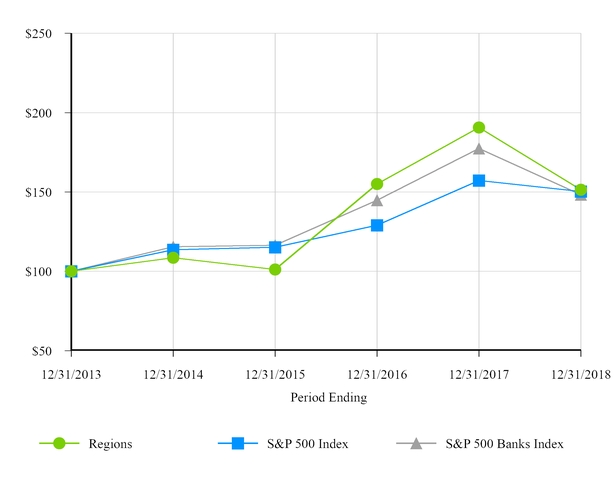
| Cumulative Total Return | |||||||||||||||||||||||
| 12/31/2013 | 12/31/2014 | 12/31/2015 | 12/31/2016 | 12/31/2017 | 12/31/2018 | ||||||||||||||||||
| Regions | $ | 100.00 | $ | 108.63 | $ | 101.11 | $ | 155.10 | $ | 190.70 | $ | 151.47 | |||||||||||
| S&P 500 Index | 100.00 | 113.68 | 115.24 | 129.02 | 157.17 | 150.27 | |||||||||||||||||
| S&P 500 Banks Index | 100.00 | 115.51 | 116.49 | 144.81 | 177.47 | 148.30 |
Item 6. Selected Financial Data
The information required by Item 6. is set forth in Table 1 “Financial Highlights” of “Management’s Discussion and Analysis of Financial Condition and Results of Operations”, which is included in Item 7. of this Annual Report on Form 10-K.
Item 7. Management’s Discussion and Analysis of Financial Condition and Results of Operations
Item 7A. Quantitative and Qualitative Disclosures about Market Risk
EXECUTIVE OVERVIEW
Management believes the following sections provide an overview of several of the most relevant matters necessary for an understanding of the financial aspects of Regions Financial Corporation’s (“Regions” or “the Company”) business, particularly regarding its 2018 results. Cross references to more detailed information regarding each topic within MD&A and the consolidated financial statements are included. This summary is intended to assist in understanding the information provided, but should be read in conjunction with the entire MD&A and consolidated financial statements, as well as the other sections of this Annual Report on Form 10-K.
2018 Results
Regions reported net income from continuing operations available to common shareholders of $1.5 billion, or $1.36 per diluted share, in 2018 compared to net income available to common shareholders from continuing operations of $1.2 billion, or $0.98 per diluted share, in 2017.
Net interest income and other financing income (taxable-equivalent basis) totaled $3.8 billion in 2018 compared to $3.6 billion in 2017. The net interest margin (taxable-equivalent basis) was 3.50 percent in 2018, reflecting an 18 basis point increase from 2017 primarily due to increases in yields on earning assets, particularly loans, exceeding the increase in total funding costs.
The provision for loan losses totaled $229 million in 2018 compared to $150 million in 2017. This increase was primarily a result of increased loan balances and slowing credit improvement as compared to 2017. The increase was partially offset by the release of the Company's $40 million hurricane-specific loan loss allowance associated with certain 2017 hurricanes, as well as a $16 million net reduction to the provision for loan losses in the first quarter of 2018 associated with the sale of $254 million in residential first mortgage loans consisting primarily of performing troubled debt restructured loans. The provision for loan losses was less than net charge-offs by $94 million in 2018, which also included the impact of broad-based improvements in non-performing and criticized loans. Net charge-offs were 0.40 percent of average loans in 2018, compared to 0.38 percent in 2017.
Non-interest income from continuing operations was $2.0 billion in both 2018 and 2017. While total non-interest income from continuing operations was consistent between years, there were increases in service charges on deposit accounts, card and ATM fees, capital markets income, investment services fee income, and other miscellaneous income. These increases were partially offset by decreases in mortgage income and income from bank-owned life insurance, lower net securities gains, and losses from market value adjustments on employee benefit assets. See Table 5 "Non-Interest Income from Continuing Operations" for further details.
Non-interest expense from continuing operations was $3.6 billion in 2018 and $3.5 billion in 2017. The increase was driven primarily by increases in salaries and employee benefits, outside services, professional, legal and regulatory expenses, as well as a reduction in the credit for unfunded credit losses. These increases were partially offset by decreases in FDIC insurance assessments, branch consolidation, property and equipment charges, and Visa class B shares expense. See Table 6 "Non-Interest Expense from Continuing Operations" for further details.
On December 22, 2017, Tax Reform was enacted. Effective January 1, 2018, Tax Reform reduced the maximum corporate statutory federal income tax rate from 35 percent to 21 percent. This was the primary contributor to reducing Regions' effective tax rate from 33.3 percent in 2017 to 19.8 percent in 2018.
On April 4, 2018, Regions entered into a stock purchase agreement to sell Regions Insurance Group, Inc. and related affiliates to BB&T Insurance Holdings, Inc. The transaction closed on July 2, 2018, and generated an after-tax gain of $196 million. A discussion of activity within discontinued operations is included at the end of "Operating Results" in the MD&A section of this report.
For more information, refer to the following additional sections within this Form 10-K:
| • | "Operating Results" section of MD&A |
| • | “Net Interest Income and Other Financing Income and Net Interest Margin” discussion within the “Operating Results” section of MD&A |
| • | “Interest Rate Risk” discussion within “Risk Management” section of MD&A |
Capital
Capital Actions
As part of its 2018 CCAR submission, Regions' proposed capital plan included increasing its quarterly common stock dividend from $0.09 per share to $0.14 per share beginning in the third quarter of 2018 and the execution of up to $2.031 billion in common share repurchases. The 2018 capital plan covers the period from the third quarter of 2018 through the second quarter of 2019. As of December 31, 2018, Regions had repurchased approximately 90.4 million shares of common stock at a total cost of approximately
$1.7 billion under this plan. The Federal Reserve did not object to the capital plan. The Company continued to repurchase shares under this plan into the first quarter of 2019.
For more information, refer to the following additional sections within this Form 10-K:
| • | “Stockholders’ Equity” discussion in MD&A |
| • | Note 15 “Stockholders’ Equity and Accumulated Other Comprehensive Income (Loss)” to the consolidated financial statements |
Regulatory Capital
Regions and Regions Bank are required to comply with regulatory capital requirements established by Federal and State banking agencies. Under the Basel III Rules, Regions is designated as a standardized approach bank and, as such, began transitioning to the Basel III Rules in January 2015 subject to a phase-in period through January 2019, which has been extended. When fully phased in, the Basel III Rules will increase capital requirements through higher minimum capital levels as well as through increases in risk-weights for certain exposures. Proposals from the federal banking agencies may revise the capital treatment of certain assets and may extend the current transitional treatment. The Basel III Rules maintained the minimum guidelines for Regions to be considered well-capitalized for Tier 1 capital and Total capital at 6.0% and 10.0%, respectively. At December 31, 2018, Regions’ Basel III Tier 1 capital and Total capital ratios were estimated to be 10.68% and 12.46%, respectively.
The Basel III Rules also officially defined CET1. Regions' Basel III CET1 ratio at December 31, 2018 was estimated to be 9.90%. Regions estimates its fully phased-in CET1 ratio (non-GAAP) at December 31, 2018 to be 9.83%.
For more information, refer to the following additional sections within this Form 10-K:
| • | “Supervision and Regulation” discussion within Item 1. Business |
| • | Table 2 - “GAAP to Non-GAAP reconciliation” in MD&A |
| • | "Regulatory Requirements" section of MD&A |
| • | Note 14 “Regulatory Capital Requirements and Restrictions” to the consolidated financial statements |
Loan Portfolio and Credit
During 2018, total loans increased by $3.2 billion or 4.0 percent compared to 2017. Loan balances increased year-over-year in all three portfolio segments. The commercial portfolio segment increase was driven primarily by a $3.2 billion increase in the commercial and industrial loan portfolio class. The growth in the commercial portfolio was broad-based, with the energy and financial services portfolio classes experiencing the largest increases compared to 2017. The investor real estate portfolio segment increase was driven by a $588 million increase in commercial investor real estate mortgage loans. This increase was the result of growth in term real estate lendin
Showing the first 8K of 264K characters. Open the full section
Item 8. Financial Statements and Supplementary Data
REPORT OF MANAGEMENT ON INTERNAL CONTROL OVER FINANCIAL REPORTING
We, as members of the Management of Regions Financial Corporation and subsidiaries (the “Company”), are responsible for establishing and maintaining effective internal control over financial reporting. Regions’ internal control system was designed to provide reasonable assurance to the Company’s management and Board of Directors regarding the preparation and fair presentation of the Company’s financial statements for external purposes in accordance with U.S. generally accepted accounting principles. Internal control over financial reporting includes self-monitoring mechanisms, and actions are taken to correct deficiencies as they are identified.
All internal controls systems, no matter how well designed, have inherent limitations and may not prevent or detect misstatements in the Company’s financial statements, including the possibility of circumvention or overriding of controls. Therefore, even those systems determined to be effective can provide only reasonable assurance with respect to financial statement preparation and presentation. Also, projections of any evaluation of effectiveness to future periods are subject to the risk that controls may become inadequate because of changes in conditions, or that the degree of compliance with the policies or procedures may deteriorate.
Regions’ management assessed the effectiveness of the Company’s internal control over financial reporting as of December 31, 2018. In making this assessment, we used the criteria set forth by the Committee of Sponsoring Organizations of the Treadway Commission (“COSO”) in its 2013 Internal Control—Integrated Framework. Based on our assessment, we believe and assert that, as of December 31, 2018, the Company’s internal control over financial reporting is effective based on those criteria.
Regions’ independent registered public accounting firm has issued an audit report on the effectiveness of the Company’s internal control over financial reporting. This report appears on the following page.
| REGIONS FINANCIAL CORPORATION | ||
| by | /S/ JOHN M. TURNER, JR. | |
| John M. Turner, Jr. President and Chief Executive Officer | ||
| by | /S/ DAVID J. TURNER, JR. | |
| David J. Turner, Jr. Chief Financial Officer |
REPORT OF INDEPENDENT REGISTERED PUBLIC ACCOUNTING FIRM
To the Stockholders and the Board of Directors of Regions Financial Corporation
Opinion on Internal Control over Financial Reporting
We have audited Regions Financial Corporation and subsidiaries’ internal control over financial reporting as of December 31, 2018, based on criteria established in Internal Control-Integrated Framework issued by the Committee of Sponsoring Organizations of the Treadway Commission (2013 framework) (the COSO criteria). In our opinion, Regions Financial Corporation and subsidiaries (the Company) maintained, in all material respects, effective internal control over financial reporting as of December 31, 2018, based on the COSO criteria.
We also have audited, in accordance with the standards of the Public Company Accounting Oversight Board (United States) (PCAOB), the consolidated balance sheets of Regions Financial Corporation and subsidiaries as of December 31, 2018 and 2017, the related consolidated statements of income, comprehensive income, stockholders’ equity and cash flows for each of the three years in the period ended December 31, 2018, and the related notes of the Company and our report dated February 22, 2019 expressed an unqualified opinion thereon.
Basis for Opinion
The Company’s management is responsible for maintaining effective internal control over financial reporting and for its assessment of the effectiveness of internal control over financial reporting included in the accompanying Report of Management on Internal Control over Financial Reporting. Our responsibility is to express an opinion on the Company’s internal control over financial reporting based on our audit. We are a public accounting firm registered with the PCAOB and are required to be independent with respect to the Company in accordance with the U.S. federal securities laws and the applicable rules and regulations of the Securities and Exchange Commission and the PCAOB.
We conducted our audit in accordance with the standards of the PCAOB. Those standards require that we plan and perform the audit to obtain reasonable assurance about whether effective internal control over financial reporting was maintained in all material respects.
Our audit included obtaining an understanding of internal control over financial reporting, assessing the risk that a material weakness exists, testing and evaluating the design and operating effectiveness of internal control based on the assessed risk, and performing such other procedures as we considered necessary in the circumstances. We believe that our audit provides a reasonable basis for our opinion.
Definition and Limitations of Internal Control Over Financial Reporting
A company’s internal control over financial reporting is a process designed to provide reasonable assurance regarding the reliability of financial reporting and the preparation of financial statements for external purposes in accordance with generally accepted accounting principles. A company’s internal control over financial reporting includes those policies and procedures that (1) pertain to the maintenance of records that, in reasonable detail, accurately and fairly reflect the transactions and dispositions of the assets of the company; (2) provide reasonable assurance that transactions are recorded as necessary to permit preparation of financial statements in accordance with generally accepted accounting principles, and that receipts and expenditures of the company are being made only in accordance with authorizations of management and directors of the company; and (3) provide reasonable assurance regarding prevention or timely detection of unauthorized acquisition, use, or disposition of the company’s assets that could have a material effect on the financial statements.
Because of its inherent limitations, internal control over financial reporting may not prevent or detect misstatements. Also, projections of any evaluation of effectiveness to future periods are subject to the risk that controls may become inadequate because of changes in conditions, or that the degree of compliance with the policies or procedures may deteriorate.
Birmingham, Alabama
February 22, 2019
REPORT OF INDEPENDENT REGISTERED PUBLIC ACCOUNTING FIRM
To the Stockholders and the Board of Directors of Regions Financial Corporation
Opinion on the Financial Statements
We have audited the accompanying consolidated balance sheets of Regions Financial Corporation and subsidiaries (the Company) as of December 31, 2018 and 2017, the related consolidated statements of income, comprehensive income, stockholders’ equity and cash flows for each of the three years in the period ended December 31, 2018, and the related notes (collectively referred to as the “consolidated financial statements”). In our opinion, the consolidated financial statements present fairly, in all material respects, the financial position of the Company at December 31, 2018 and 2017, and the results of its operations and its cash flows for each of the three years in the period ended December 31, 2018, in conformity with U.S. generally accepted accounting principles.
We also have audited, in accordance with the standards of the Public Company Accounting Oversight Board (United States) (PCAOB), the Company’s internal control over financial reporting as of December 31, 2018, based on criteria established in Internal Control-Integrated Framework issued by the Committee of
Showing the first 8K of 379K characters. Open the full section
Item 9. Changes in and Disagreements with Accountants on Accounting and Financial Disclosure
Not Applicable.
Item 9A. Controls and Procedures
Based on an evaluation, as of the end of the period covered by this Form 10-K, under the supervision and with the participation of Regions’ management, including its Chief Executive Officer and Chief Financial Officer, the Chief Executive Officer and the Chief Financial Officer have concluded that Regions’ disclosure controls and procedures (as defined in Rule 13a-15(e) under the Securities Exchange Act of 1934) are effective. During the fourth fiscal quarter of the year ended December 31, 2018, there have been no changes in Regions’ internal control over financial reporting that have materially affected, or are reasonably likely to materially affect, Regions’ control over financial reporting.
The Report of Management on Internal Control Over Financial Reporting and the attestation report of registered public accounting firm on registrant's internal control over financial reporting are included in Item 8. of this Annual Report on Form 10-K.
Item 9B. Other Information
Not applicable.
PART III
Item 10. Directors, Executive Officers and Corporate Governance
Information about the Directors and Director nominees of Regions included in Regions’ Proxy Statement for the Annual Meeting of Shareholders to be held on April 24, 2019 (the “Proxy Statement”) under the captions “PROPOSAL 1—ELECTION OF DIRECTORS—Who are this year's nominees?,” “—What criteria were considered by the NCG Committee in selecting the nominees?,” and “—What skills and characteristics are currently represented on the Board?” and the information incorporated by reference pursuant to Item 13. below are incorporated herein by reference. Information regarding Regions’ executive officers is included below.
Information regarding Regions’ Audit Committee included in the Proxy Statement under the caption “CORPORATE GOVERNANCE—Audit Committee” is incorporated herein by reference.
Information regarding timeliness of filings under Section 16(a) of the Securities Exchange Act of 1934 included in the Proxy Statement under the caption “OWNERSHIP OF REGIONS COMMON STOCK—Section 16(a) Beneficial Ownership Reporting Compliance” is incorporated herein by reference.
Information regarding Regions’ Code of Ethics for Senior Financial Officers included in the Proxy Statement under the caption “CORPORATE PURPOSE, CULTURE, AND ESG—Code of Business Conduct and Ethics and Code of Ethics for Senior Financial Officers” is incorporated herein by reference.
Information included in the Proxy Statement under the caption “CORPORATE GOVERNANCE—Family Relationships” is incorporated herein by reference.
Executive officers of the registrant as of December 31, 2018, are as follows:
| Executive Officer | Age | Position and Offices Held with Registrant and Subsidiaries | Executive Officer Since | |||
| O. B. Grayson Hall, Jr. † | 61 | Executive Chairman and Director of registrant and Regions Bank. Previously served as Chairman, President, and Chief Executive Officer. | 1993 | |||
| John M. Turner, Jr. | 57 | President and Chief Executive Officer of registrant and Regions Bank. Previously served as Senior Executive Vice President; Head of Corporate Banking Group and as South Region President of Regions Bank. Prior to joining Regions, served as President of Whitney National Bank and Whitney Holding Corporation. | 2011 | |||
| David J. Turner, Jr. | 55 | Senior Executive Vice President and Chief Financial Officer of registrant and Regions Bank. | 2010 | |||
| John B. Owen | 57 | Senior Executive Vice President and Chief Operating Officer of registrant and Regions Bank. Previously Head of Regional Banking Group; Head of the Business Groups. | 2009 | |||
| Fournier J. “Boots” Gale, III | 74 | Senior Executive Vice President, General Counsel and Corporate Secretary of registrant and Regions Bank. Previously a founding partner of Maynard Cooper & Gale, P.C. in Birmingham, Alabama. | 2011 | |||
| C. Matthew Lusco | 61 | Senior Executive Vice President and Chief Risk Officer of registrant and Regions Bank. Previously managing partner of KPMG LLP’s offices in Birmingham, Alabama and Memphis, Tennessee. | 2011 | |||
| Kate R. Danella | 39 | Executive Vice President and Head of Strategic Planning and Corporate Development of registrant and Regions Bank. Previously served as Head of Private Wealth Management and as Wealth Strategy and Effectiveness Executive of Regions Bank. Prior to joining Regions, served as Vice President of Capital Group Companies. | 2018 |
| C. Keith Herron | 54 | Senior Executive Vice President and Head of Corporate Responsibility and Community Engagement of registrant and Regions Bank. Director of Regions Foundation. Previously served as Regional President, South Region of Regions Bank and as Head of Strategic Planning and Execution of registrant and Regions Bank. | 2010 | |||
| David R. Keenan | 51 | Senior Executive Vice President and Chief Human Resources Officer of registrant and Regions Bank. | 2010 | |||
| Scott M. Peters | 57 | Senior Executive Vice President and Head of Consumer Banking Group of registrant and Regions Bank. Director of Regions Investment Services, Inc. Previously Consumer Services Group Head. | 2010 | |||
| William D. Ritter | 48 | Senior Executive Vice President and Head of Wealth Management of registrant and Regions Bank. | 2010 | |||
| Ronald G. Smith | 58 | Senior Executive Vice President and Head of Corporate Banking Group of registrant and Regions Bank. Director of Regions Equipment Finance Corporation and Regions Foundation of Tennessee. Manager of RFC Financial Services Holding LLC. Previously Regional President, Mid-America Region of Regions Bank. | 2010 |
† On December 31, 2018, at 11:59p.m., O. B. Grayson Hall, Jr. retired as Executive Chairman of the Company and from the Company’s Board.
Item 11. Executive Compensation
All information presented under the captions “COMPENSATION DISCUSSION AND ANALYSIS,” “COMPENSATION OF EXECUTIVE OFFICERS,” “COMPENSATION AND HUMAN RESOURCES COMMITTEE REPORT,” “CORPORATE GOVERNANCE—Compensation Committee Interlocks and Insider Participation” and “—Relationship of Compensation Policies and Practices to Risk Management,” and “PROPOSAL 1—ELECTION OF DIRECTORS—How are Directors compensated?” of the Proxy Statement are incorporated herein by reference.
Item 12. Security Ownership of Certain Beneficial Owners and Management and Related Stockholder Matters
All information presented under the caption “OWNERSHIP OF REGIONS COMMON STOCK” of the Proxy Statement is incorporated herein by reference.
Equity Compensation Plan Information
The following table gives information about the common stock that may be issued upon the exercise of options, warrants and rights under all of Regions’ existing equity compensation plans as of December 31, 2018.
| Plan Category | Number of Securities to be Issued Upon Exercise of Outstanding Options, Warrants and Rights (a) | Weighted Average Exercise Price of Outstanding Options, Warrants and Rights | Number of Securities Remaining Available Under Equity Compensation Plans (Excluding Securities in First Column) | ||||||
| Equity Compensation Plans Approved by Stockholders | 1,724,723 | $ | 6.86 | 42,561,810 | (b) | ||||
| Equity Compensation Plans Not Approved by Stockholders | — | $ | — | — | |||||
| Total | 1,724,723 | $ | 6.86 | 42,561,810 |
| (a) | Does not include outstanding restricted stock units of 11,445,943. |
| (b) | Consists of shares available for future issuance under the Regions Financial Corporation 2015 Long Term Incentive Plan. In 2015, all prior long-term incentive plans were closed to new grants. |
Item 13. Certain Relationships and Related Transactions, and Director Independence
All information presented under the captions “CORPORATE GOVERNANCE—Transactions with Directors,” “—Other Business Relationships and Transactions,” “—Policies Relating to Transactions with Related Persons” and “—Director Independence” of the Proxy Statement is incorporated herein by reference.
Item 14. Principal Accounting Fees and Services
All information presented under the caption “ PROPOSAL 2 - RATIFICATION OF APPOINTMENT OF INDEPENDENT REGISTERED PUBLIC ACCOUNTING FIRM” of the Proxy Statement is incorporated herein by reference.
PART IV
Item 15. Exhibits, Financial Statement Schedules
(a) 1. Consolidated Financial Statements. The following reports of independent registered public accounting firm and consolidated financial statements of Regions and its subsidiaries are included in Item 8. of this Form 10-K:
| Reports of Independent Registered Public Accounting Firm; |
| Consolidated Balance Sheets—December 31, 2018 and 2017; |
| Consolidated Statements of Income—Years ended December 31, 2018, 2017 and 2016; |
| Consolidated Statements of Comprehensive Income—Years ended December 31, 2018, 2017 and 2016; |
| Consolidated Statements of Changes in Stockholders’ Equity—Years ended December 31, 2018, 2017 and 2016; and |
| Consolidated Statements of Cash Flows—Years ended December 31, 2018, 2017 and 2016. |
| Notes to Consolidated Financial Statements |
- Consolidated Financial Statement Schedules. The following consolidated financial statement schedules are included in Item 8. of this Form 10-K:
None. The Schedules to consolidated financial statements are not required under the related instructions or are inapplicable.
(b) Exhibits. The exhibits indicated below are either included or incorporated by reference as indicated.
- Compensatory plan or agreement.
Copies of exhibits not included herein may be obtained free of charge, electronically through Regions’ website at www.regions.com or through the SEC’s website at www.sec.gov or upon request to:
Investor Relations
Regions Financial Corporation
1900 Fifth Avenue North
Birmingham, Alabama 35203
(205) 264-7040
Item 16. Form 10-K Summary
Not applicable.
SIGNATURES
Pursuant to the requirements of the Securities Exchange Act of 1934, the registrant has duly caused this report to be signed on its behalf by undersigned thereunto duly authorized.
| DATE: | February 22, 2019 | Regions Financial Corporation | |
| By: | /S/ JOHN M. TURNER, JR. | ||
| John M. Turner, Jr. President and Chief Executive Officer |
Pursuant to the requirements of the Securities Exchange Act of 1934, this report has been signed below by the following persons on behalf of the registrant and in the capacities and on the dates indicated
| Signature | Title | Date | |
| /S/ JOHN M. TURNER, JR. | President and Chief Executive Officer, and Director (principal executive officer) | February 22, 2019 | |
| John M. Turner, Jr. | |||
| /S/ DAVID J. TURNER, JR. | Senior Executive Vice President and Chief Financial Officer (principal financial officer) | February 22, 2019 | |
| David J. Turner, Jr. | |||
| /S/ HARDIE B. KIMBROUGH, JR. | Executive Vice President and Controller (principal accounting officer) | February 22, 2019 | |
| Hardie B. Kimbrough, Jr. | |||
| * | Director | February 22, 2019 | |
| Carolyn H. Byrd | |||
| * | Director | February 22, 2019 | |
| Don DeFosset | |||
| * | Director | February 22, 2019 | |
| Samuel A. Di Piazza, Jr. | |||
| * | Director | February 22, 2019 | |
| Eric C. Fast | |||
| * | Director | February 22, 2019 | |
| Zhanna Golodryga | |||
| * | Director | February 22, 2019 | |
| John D. Johns | |||
| * | Director | February 22, 2019 | |
| Ruth Ann Marshall | |||
| Signature | Title | Date | |
| * | Director | February 22, 2019 | |
| Susan W. Matlock | |||
| * | Director | February 22, 2019 | |
| John E. Maupin, Jr. | |||
| * | Director | February 22, 2019 | |
| Charles D. McCrary | |||
| * | Director | February 22, 2019 | |
| James T. Prokopanko | |||
| * | Director | February 22, 2019 | |
| Lee J. Styslinger III | |||
| * | Director | February 22, 2019 | |
| José S. Suquet | |||
| * | Director | February 22, 2019 | |
| Timothy Vines |
- Fournier J. Gale, III, by signing his name hereto, does sign this document on behalf of each of the persons indicated above pursuant to powers of attorney executed by such persons and filed with the Securities and Exchange Commission.
| By: | /S/ FOURNIER J. GALE, III |
| Fournier J. Gale, III | |
| Attorney in Fact |