
Regions Financial (RF) 10-K risk factor changes: FY2019 vs FY2018
The 2019-12-31 10-K against the 2018-12-31 one, compared heading by heading and sentence by sentence. One of these filings carries no fiscal year tag, so its year is the calendar year of the period end.
Item 1A114 rewritten48 added38 removed317 unchanged
All filing items2,607 rewritten787 added814 removed2,604 unchanged
Summary
counted, not written
- Item 1A headings could not be compared: only 0 carried over between the two years, which usually means one filing was read wrongly, so none is reported as new or removed.
- Sentence by sentence, 787 added, 814 removed, 2,607 rewritten and 2,604 unchanged across 16 items that differ.
Sentences by item
22 items, with every count and a link to each item that changed
Underlined words on a shaded ground are new in FY2019; struck-through words were in FY2018. Sentences that are wholly new or wholly gone are labelled rather than marked.
Item 1A. Risk Factors
114 rewritten, 48 added, 38 removed, 317 unchanged
Read the full itemFY2019 item · filed February 21, 2020FY2018 item · filed February 22, 2019
[removed: Risks] [added: Risks] Related to the Operation of Our [removed: Business][added: Business]
[removed: Our] [added: Our] businesses have been, and may continue to be, adversely affected by conditions in the financial markets and economic conditions [removed: generally.][added: generally.]
[removed: Ineffective] [added: Ineffective] liquidity management could adversely affect our financial results and [removed: condition.][added: condition.]
In particular, a majority of our liabilities during [removed: 2018] [added: 2019] were checking accounts and other liquid deposits, which are payable on demand or upon several days’ notice, while by comparison, a substantial majority of our assets were loans, which cannot be called or sold in the same time frame.
[removed: Our] [added: Our] operations are concentrated in the Southeastern U.S., and adverse changes in the economic conditions in this region can adversely affect our financial results and [removed: condition.][added: condition.]
[removed: Weather-related] [added: Weather-related] events and other natural disasters, [added: including those caused or exacerbated by climate change,] as well as man-made disasters, could cause a disruption in our operations or other consequences that could have an adverse impact on financial results and [removed: condition.][added: condition.]
While we maintain insurance covering many of these weather-related events, including coverage for lost profits and extra expense, there is no insurance against the disruption that a catastrophic earthquake, fire, hurricane, tornado or other severe weather event could produce to the markets that we serve and the resulting adverse impact on our [removed: borrowers] [added: borrowers’ ability] to timely repay their loans and the value of any collateral held by us.
[removed: If] [added: If] we experience greater credit losses in our loan portfolios than anticipated, our earnings may be materially adversely [removed: affected.][added: affected.]
We make various assumptions and judgments about the collectability of our loan portfolio and provide an allowance for [removed: loan] [added: credit] losses based on a number of factors.
Our management periodically determines the allowance for [removed: loan] [added: credit] losses based on available information, including the quality of the loan portfolio, economic conditions, the value of the underlying collateral and the level of non-accrual loans.
If, as a result of general economic conditions, there is a decrease in asset quality or growth in the loan [removed: portfolio,] [added: portfolio and] management determines that additional increases in the allowance for [removed: loan] [added: credit] losses are necessary, we may incur additional expenses which will reduce our net income, and our business, results of operations or financial condition may be materially adversely affected.
Although our management will establish an allowance for [removed: loan] [added: credit] losses it believes is appropriate to absorb [removed: probable and] reasonably estimable losses in our loan portfolio, this allowance may not be adequate.
For example, if a hurricane or other natural disaster were to occur in one of our principal markets or if economic conditions in those markets were to deteriorate unexpectedly, additional [removed: loan] [added: credit] losses not incorporated in the existing allowance for [removed: loan] [added: credit] losses may occur.
Losses in excess of the existing allowance for [removed: loan] [added: credit] losses will reduce our net income and could adversely affect our business, results of operations or financial condition, perhaps materially.
In addition, bank regulatory agencies will periodically review our allowance for [removed: loan] [added: credit] losses and the value attributed to non-accrual loans and to real estate acquired through foreclosure.
Such regulatory agencies may require us to adjust our determination [removed: of the value for these items.]
As discussed in greater detail below, [removed: Accounting Standards Update 2016-13, Measurement of Credit Losses on Financial Instruments, is] [added: CECL became] effective January 1, 2020, and [removed: will] substantially [removed: change] [added: changed] the accounting for credit losses on loans and other financial assets.
The [added: accounting] standard removes the existing “probable” threshold in GAAP for recognizing credit losses and instead requires companies to reflect their estimate of credit losses over the life of the financial assets.
[removed: Weakness] [added: Weakness] in the residential real estate markets could adversely affect our [removed: performance.][added: performance.]
As of December 31, [removed: 2018,] [added: 2019,] consumer residential real estate loans represented approximately [removed: 28.3%] [added: 27.8%] of our total loan portfolio.
[removed: Weakness] [added: Weakness] in the commercial real estate markets could adversely affect our [removed: performance.][added: performance.]
As of December 31, [removed: 2018,] [added: 2019,] approximately [removed: 7.7%] [added: 7.5%] of our loan portfolio consisted of investor real estate loans.
The combination of these factors could result in deterioration in the fundamentals underlying the commercial real estate market and the deterioration in value [added: of some of our loans.]
[removed: Risks] [added: Risks] associated with home equity products where we are in a second lien position could materially adversely affect our [removed: performance.][added: performance.]
Of our [removed: $9.3] [added: $8.4] billion home equity portfolio at December 31, [removed: 2018,] [added: 2019,] approximately [removed: $5.9] [added: $5.3] billion were home equity lines of credit and [removed: $3.4] [added: $3.1] billion were closed-end home equity loans (primarily originated as amortizing loans).
As of December 31, [removed: 2018,] [added: 2019,] approximately [removed: $3.1] [added: $2.8] billion of our home equity lines and loans were in a second lien position.
[removed: Weakness] [added: Weakness] in commodity businesses could adversely affect our [removed: performance.][added: performance.]
[removed: Industry] [added: Industry] competition may adversely affect our degree of [removed: success.][added: success.]
Our ability to compete successfully depends on a number of [added: additional] factors, including customer convenience, quality of service, personal contacts, pricing and range of products.
[removed: Fluctuations] [added: Fluctuations] in market interest rates may adversely affect our [removed: performance.][added: performance.]
Our current one-year interest rate sensitivity position is [added: modestly] asset sensitive.
[removed: Changes] [added: Changes] in the method pursuant to which the LIBOR and other benchmark rates are determined could adversely impact our business and results of [removed: operations.][added: operations.]
Certain of our LIBOR-based financial products and contracts, including, but not limited to, hedging products, debt obligations, [added: preferred stock,] investments, and loans, extend beyond 2021.
[removed: Any] [added: Any] future reductions in our credit ratings may increase our funding costs and place limitations on business [removed: activities related to providing credit support to customers.][added: activities.]
Regions’ liquidity policy requires that the holding company maintain [removed: cash sufficient to cover] the greater of (i) [added: cash sufficient to cover] 18 months of debt service and other cash needs or (ii) a [removed: minimum] cash balance of $500 million.
Additionally, if Regions were to be downgraded to below investment grade, certain counterparty contracts may be required to be renegotiated or require [removed: the] posting of additional collateral.
[removed: The] [added: The] value of our goodwill and other intangible assets may decline in the [removed: future.][added: future.]
As of December 31, [removed: 2018,] [added: 2019,] we had $4.8 billion of goodwill and [removed: $115] [added: $105] million of other intangible assets.
Adverse events or circumstances could impact the recoverability of these intangible assets including loss of core deposits, significant losses of credit card accounts and/or balances, increased competition [removed: or] [added: and] adverse changes in the economy.
[removed: The] [added: The] value of our deferred tax assets could adversely affect our operating results and regulatory capital [removed: ratios.][added: ratios.]
Climate change may worsen the severity and impact of future earthquakes, fires, hurricanes, tornadoes, droughts, floods and other extreme weather-related events that could cause disruption to our business and operations.
Chronic results of climate change such as shifting weather patterns could also cause disruption to our business and operations.
We are subject to environmental, social and governance risks that could adversely affect our reputation and the trading price of our common stock.
We are subject to a variety of risks that arise out of the set of concerns that together comprise what have become commonly known as ESG matters.
Risks arising from ESG matters may adversely affect, among other things, our reputation and the trading price of our common stock.
As a large financial institution with a diverse base of customers, vendors and suppliers, we may face potential negative publicity based on the identity of those we choose to do business with and the public’s (or certain segments of the public’s) view of those customers.
This negative publicity may be driven by adverse news coverage in traditional media and may also be spread through the use of social media platforms.
If Regions’ relationships with its customers, vendors and suppliers were to become the subject of such negative publicity, our ability to attract and retain customers and employees may be negatively impacted and our stock price may also be impacted.
Additionally, investors have begun to consider how corporations are addressing ESG matters when making investment decisions.
For example, certain investors are beginning to incorporate the business risks of climate change and the adequacy of companies’ responses to climate change and other ESG matters as part of their investment theses.
These shifts in investing priorities may result in adverse effects on the trading price of our common stock if investors determine that Regions has not made sufficient progress on ESG matters.
of the value for these items.
See Note 1 "Summary of Significant Accounting Policies" to the consolidated financial statements of this Annual Report on Form 10-K for disclosure on the estimated impact to the allowance at adoption.
For example, oil prices have been volatile in recent years, and our energy-related portfolio may be subject to additional pressure on credit quality metrics including past due, criticized, and non-performing loans, as well as net charge-offs.
We operate in a highly competitive industry that could become even more competitive as a result of legislative, regulatory and technological changes, as well as continued industry consolidation.
This consolidation may produce larger, better-capitalized and more geographically diverse companies that are capable of offering a wider array of financial products and services at more competitive prices.
For example, there have been a number of recently completed or announced significant mergers of financial institutions within our market areas.
These mergers will, if completed, allow the merged financial institutions to benefit from cost savings and shared resources.
In addition, technology has lowered barriers to entry and made it possible for non-banks to offer products and services, such as loans and payment services, that traditionally were banking products, and made it possible for technology companies to compete with financial institutions in providing electronic, internet-based, and mobile phone–based financial solutions.
Competition with non-banks, including technology companies, to provide financial products and services is intensifying.
In particular, the activity of financial technology companies (“fintechs”) has grown significantly over recent years and is expected to continue to grow.
Fintechs have and may continue to offer bank or bank-like products.
For example, a number of fintechs have applied for bank or industrial loan charters.
In addition, other fintechs have partnered with existing banks to allow them to offer deposit products to their customers.
Regulatory changes, such as the recently proposed revisions to the FDIC’s rules on brokered deposits intended to reflect recent technological changes and innovations, may also make it easier for fintechs to partner with banks and offer deposit products.
In addition to fintechs, traditional technology companies have begun to make efforts toward providing financial services directly to their customers and are expected to continue to explore new ways to do so.
Many of these companies, including our competitors, have fewer regulatory constraints, and some have lower cost structures, in part due to lack of physical locations.
Regulators, industry groups and certain committees (e.g., the Alternative Reference Rates Committee) have, among other things, published recommended fallback language for LIBOR-linked financial instruments, identified recommended alternatives for certain LIBOR rates (e.g., the SOFR as the recommended alternative to U.S. Dollar LIBOR), and proposed implementations of the recommended alternatives in floating rate instruments.
At this time, it is not possible to predict whether these recommendations and proposals will be broadly accepted, whether they will continue to evolve, and what the effect of their implementation may be on the markets for floating-rate financial instruments.
governance and regulatory compliance, acquisitions and actions taken by our regulators or by community organizations in response to these activities.
Furthermore, negative publicity regarding Regions as an employer could have an adverse impact on our reputation, especially with respect to matters of diversity, pay equity and workplace harassment.
Additionally, whereas negative public opinion once was primarily driven by adverse news coverage in traditional media, the increased use of social media platforms facilitates the rapid dissemination of information or misinformation, which magnifies the potential harm to our reputation.
These criminals may attempt to
be inaccurate or misleading.
The standard had a material impact to the allowance and capital at adoption.
See Regions' estimated impact at adoption in Note 1 "Summary of Significant Accounting Policies" to the consolidated financial statements of this Annual Report on Form 10-K.
In December 2018, the Federal banking agencies released a final rule to provide relief for the initial capital decrease at adoption of CECL by allowing the impact to be phased-in over a three-year period, such that 25% of the transitional amounts are phased-in during the first year (2020) with an additional 25% phased in each subsequent year, such that the impact of adoption would be completely recognized by the beginning of the fourth year (2023).
Regions plans to elect the phase-in.
The adoption of CECL may also impact Regions' ongoing earnings, perhaps materially, due in part to changes in loan portfolio composition, changes in credit metrics, and changes in the macroeconomic forecast.
Regions' ability to accurately forecast the future economic environment could result in volatility in the provision as a result of the new accounting standard.
The adoption of the standard may result in an overall material increase in the allowance for credit losses.
However, the impact at adoption will be influenced by the portfolios' composition and quality at the adoption date as well as economic conditions and forecasts at that time.
of some of our loans.
We operate in a highly competitive environment, and we expect competition to remain intense among financial services companies given the relatively low interest rate and slower economic environment relative to past economic cycles.
In particular, the activity and prominence of marketplace lenders and other technological financial services companies have grown significantly over recent years and is expected to continue growing, including further entry into offering traditional banking products and the possibility of obtaining bank or bank-like charters, such as the OCC’s fintech charter.
In addition, certain customers could be prohibited from placing deposits with Regions Bank.
For a discussion of proposed rules that may impact our compensation practices, see the “Supervision and Regulation-Compensation Practices” section of Item 1.
“Business” of this Annual Report on Form 10-K.
We need to stay current on technological changes in order to compete and meet customer demands.
The financial services market, including banking services, is undergoing rapid changes with frequent introductions of new technology-driven products and services.
In addition to better serving customers, the effective use of technology increases efficiency and may enable us to reduce costs.
Our future success may depend, in part, on our ability to use technology to provide products and services that provide convenience to customers and to create additional efficiencies in our operations.
Further, financial technology providers, who invest substantial resources in developing and designing new technology (in particular digital and mobile technology), are beginning to offer more traditional banking products (either directly or through bank partnerships) and may in the future be able to provide additional services by obtaining a bank-like charter, such as the OCC’s fintech charter.
We also
In
In December 2018, the Federal Reserve, OCC and FDIC released a final rule to revise their regulatory capital rules to address this upcoming change to the allowance measurement and subsequent concerns related to the impact on capital and capital planning.
The rule provides an optional three-year phase-in period for the day-one adverse regulatory capital impact upon adoption of the standard.
The impact of this final rule on Regions and Regions Bank will depend on whether we elect to phase in the impact of the standard over a three-year period.
The adoption of the standard may result in an overall material increase in the allowance for credit losses.
However, the impact at adoption will be influenced by the portfolios' composition and quality at the adoption date as well as economic conditions and forecasts at that time.
It is also possible that Regions’ ongoing reported earnings and lending activity will be negatively impacted in periods following adoption.
relating to anti-money laundering matters or sales practices, have increased substantially and are likely to remain elevated.
Although EGRRCPA contained limited amendments to the Dodd-Frank Act and certain other post-financial crisis regulatory requirements, rules to implement the changes have yet to be finalized, and the final timing, scope and impact of these changes to the regulatory framework applicable to financial institutions remain uncertain.
In particular, the capital adequacy and liquidity guidelines applicable to Regions and Regions Bank under the currently applicable Basel III Rules require Regions to satisfy additional, more stringent capital adequacy and liquidity standards than in the past.
In addition, these requirements could have a negative impact on our ability to lend, grow deposit balances, make acquisitions and make capital distributions in the form of increased dividends or share repurchases.
Higher capital levels could also lower our
return on equity.
In particular, the CFPB has adopted rules impacting nearly every aspect of the lifecycle of a residential mortgage loan as discussed in the “Supervision and Regulation” section of Item 1.
“Business” of this Annual Report on Form 10-K above.
The Federal Reserve conducts an annual stress analysis of Regions to evaluate our ability to absorb losses in three economic and financial scenarios generated by the Federal Reserve, including base, adverse and severely adverse economic and financial scenarios (although, in light of EGRRCPA’s eliminating the statutory requirement for the adverse scenario, on January 8, 2019, the Federal Reserve proposed amendments to its stress testing rules that would, among other things, eliminate the adverse scenario).
The rules also require us to conduct our own semi-annual stress analysis to assess the potential impact on Regions of the scenarios used as part of the Federal Reserve’s annual stress analysis.
The rules also currently require us to disclose publicly a summary of the results of our semi-annual stress analyses, and Regions Bank’s annual stress analyses, under the severely adverse scenario.
Certain elements of these stress testing and capital planning requirements may be eased in the future consistent with recently issued and anticipated proposals by the Federal banking agencies following the enactment of EGRRCPA.
However, the ultimate timing and implementation of such relief is unclear and therefore we expect to remain subject to these standards in the near term.
Increased volatility could result in a decline in the market price of our capital stock.
Bank could be forced to raise additional capital by making additional offerings of debt securities, including medium-term notes, senior or subordinated notes or other applicable securities.
Certain elements of these capital planning requirements may be eased in the future consistent with recently issued and anticipated proposals by the Federal banking agencies following the enactment of EGRRCPA and the proposed Stress Capital Buffer framework.
However, the ultimate timing and implementation of such relief is unclear and therefore we expect to remain subject to these standards in the near term.
An excerpt. Shown here: 40 of 114 rewritten, 40 of 48 added and all 38 removed. The counts are complete. For every sentence, read Item 1A. Risk Factors in the FY2019 filing and the FY2018 filing.
Item 7A. Quantitative and Qualitative Disclosures about Market Risk
864 rewritten, 338 added, 340 removed, 652 unchanged
Read the full itemFY2019 item · filed February 21, 2020FY2018 item · filed February 22, 2019
[removed: EXECUTIVE OVERVIEW][added: EXECUTIVE OVERVIEW]
Management believes the following sections provide an overview of several of the most relevant matters necessary for an understanding of the financial aspects of Regions Financial Corporation’s (“Regions” or “the Company”) business, particularly regarding its [removed: 2018] [added: 2019] results.
Regions reported net income from continuing operations available to common shareholders of $1.5 billion, or [removed: $1.36] [added: $1.50] per diluted share, in [removed: 2018] [added: 2019] compared to net income available to common shareholders from continuing operations of [removed: $1.2] [added: $1.5] billion, or [removed: $0.98] [added: $1.36] per diluted share, in [removed: 2017.][added: 2018.]
Net interest income and other financing income (taxable-equivalent basis) totaled $3.8 billion in [removed: 2018 compared to $3.6 billion in 2017.][added: both 2019 and 2018.]
The provision for loan losses totaled [removed: $229] [added: $387] million in [removed: 2018] [added: 2019] compared to [removed: $150] [added: $229] million in [removed: 2017.][added: 2018.]
[removed: The increase was partially offset by] [added: During 2018, lower than anticipated losses associated with certain 2017 hurricanes resulted in] the release of the Company's $40 million hurricane-specific loan loss [removed: allowance associated with certain 2017 hurricanes, as well as a $16 million net reduction to the provision for loan losses in the first quarter of 2018 associated with] [added: allowance, and] the sale of $254 million in residential first mortgage loans consisting primarily of performing troubled debt restructured [removed: loans.][added: loans resulted in a $16 million net reduction to the provision for loan losses.]
Non-interest income from continuing operations was [removed: $2.0] [added: $2.1] billion in [removed: both 2018] [added: 2019] and [removed: 2017.][added: compared to $2.0 billion in 2018.]
Non-interest expense from continuing operations was [removed: $3.6] [added: $3.5] billion in [removed: 2018] [added: 2019] and [removed: $3.5] [added: $3.6] billion in [removed: 2017.][added: 2018.]
The [removed: increase] [added: decrease] was driven primarily by [removed: increases in] [added: lower] salaries and employee benefits, [removed: outside services,] [added: occupancy expense,] professional, legal and regulatory expenses, as well as a reduction in [removed: the credit for unfunded credit losses.][added: FDIC insurance assessments.]
These [removed: increases] [added: decreases] were partially offset by [removed: decreases] [added: increases] in [removed: FDIC insurance assessments,] branch [removed: consolidation, property and equipment charges,] [added: consolidation charges] and [removed: Visa class B shares expense.][added: expenses related to the early extinguishment of debt.]
[removed: This was the primary contributor to reducing] Regions' effective tax rate [removed: from 33.3] [added: was 20.3] percent in [removed: 2017] [added: 2019 compared] to 19.8 percent in 2018.
On April 4, 2018, Regions entered into a stock purchase agreement to sell Regions Insurance Group, Inc. and related affiliates to BB&T Insurance Holdings, Inc. [removed: The transaction closed on July 2, 2018, and generated an after-tax gain of $196 million.][added: (now Truist Insurance Holdings, Inc).]
[removed: Capital][added: Capital]
[removed: Capital Actions][added: *Capital Actions*]
[removed: As part of] [added: While Regions was not required to participate in the 2019 CCAR, Regions did submit] its [removed: 2018 CCAR submission, Regions' proposed] [added: planned] capital [removed: plan] [added: actions to the Federal Reserve which] included increasing its quarterly common stock dividend from [removed: $0.09] [added: $0.14] per share to [removed: $0.14] [added: $0.155] per share beginning in the third quarter of [removed: 2018] [added: 2019] and the execution of up to [removed: $2.031] [added: $1.370] billion in common share repurchases.
The [removed: 2018] [added: 2019] capital plan covers the period from the third quarter of [removed: 2018] [added: 2019] through the second quarter of [removed: 2019.][added: 2020.]
As of December 31, [removed: 2018,] [added: 2019,] Regions had repurchased approximately [removed: 90.4] [added: 47.5] million shares of common stock at a total cost of approximately [added: $721.5 million under this plan.]
[removed: Regulatory Capital][added: *Regulatory Capital*]
At December 31, [removed: 2018,] [added: 2019,] Regions’ Basel III Tier 1 capital and Total capital ratios were estimated to be [removed: 10.68%] [added: 10.91%] and [removed: 12.46%,] [added: 12.68%,] respectively.
Regions' Basel III CET1 ratio at December 31, [removed: 2018] [added: 2019] was estimated to be [removed: 9.90%.][added: 9.68%.]
[removed: | • | Table 2 - “GAAP] [added: Table 2—GAAP] to Non-GAAP [removed: reconciliation” in MD&A |][added: Reconciliation]
| • | Note [removed: 14 “Regulatory] [added: 13 "Regulatory] Capital Requirements and [removed: Restrictions”] [added: Restrictions"] to the consolidated financial statements |
[removed: Loan] [added: Loan] Portfolio and [removed: Credit][added: Credit]
[removed: The] [added: In 2019,] economic growth trends [added: declined modestly compared to 2018, which] resulted in [removed: higher] [added: lower] market interest rates [added: and muted loan growth] during the year.
[removed: Labor] [added: However, labor] market and housing market conditions [removed: continued to progress at a steady pace] [added: were healthy] over the course of [removed: 2018.][added: 2019.]
Management’s expectation for [removed: 2019] [added: 2020] adjusted average loan growth is in the low single digits consistent with the GDP forecast.
Net charge-offs totaled [removed: $323] [added: $358] million, or [removed: 0.40] [added: 0.43] percent of average loans, in [removed: 2018,] [added: 2019,] compared to [removed: $307] [added: $323] million, or [removed: 0.38] [added: 0.40] percent in [removed: 2017,] [added: 2018,] reflecting [removed: some large-dollar commercial loan] [added: increased] charge-offs [removed: within] [added: in] the [removed: energy, healthcare] [added: commercial] and [removed: restaurant, accommodation] [added: industrial] and [removed: lodging sectors, as well as an increase associated with growth in] indirect-other consumer [removed: loans.][added: loan portfolios.]
The allowance for loan losses was [removed: 1.01] [added: 1.05] percent of total loans, net of unearned income at December 31, [removed: 2018, a decrease] [added: 2019, an increase] from [removed: 1.17] [added: 1.01] percent at December 31, [removed: 2017.][added: 2018.]
The coverage ratio of allowance for loan losses to non-performing loans was [removed: 169%] [added: 171 percent] at December 31, [removed: 2018,] [added: 2019,] compared to [removed: 144%] [added: 169 percent] at December 31, [removed: 2017.][added: 2018.]
[removed: Liquidity][added: Liquidity]
At the end of [removed: 2018,] [added: 2019,] Regions Bank had [removed: $1.5] [added: $2.5] billion in cash on deposit with the Federal Reserve and the loan-to-deposit ratio was [removed: 88] [added: 85] percent.
At December 31, [removed: 2018,] [added: 2019,] the Company’s borrowing capacity with the Federal Reserve was [removed: $19.0] [added: $16.9] billion based on available collateral.
Borrowing availability with the FHLB was [removed: $8.7] [added: $17.5] billion based on available collateral at the same date.
[removed: The Company has] [added: Debt securities of] approximately [removed: $16.6] [added: $8.3] billion [added: were pledged as] of [added: December 31, 2019, leaving approximately $14.2 billion of] unencumbered liquid securities available for pledging.
Additionally, Regions' Board has authorized Regions Bank to issue up to [removed: $5] [added: $10] billion in aggregate principal amount of bank notes outstanding at any one time.
| • | [removed: “Liquidity Risk”] [added: “Liquidity”] discussion within the “Risk Management” section of MD&A |
| • | Note 12 [removed: “Short-Term Borrowings”] [added: "Borrowings"] to the consolidated financial statements |
[removed: | • |] [added: See] Note [removed: 13 “Long-Term Borrowings”] [added: 12 "Borrowings"] to the consolidated financial statements [removed: |][added: for additional information.]
Selected management expectations for [removed: 2019] [added: 2020] are noted below:
| [removed: • |] Full year adjusted average loan growth [removed: in the low] [added: | | Low] single [removed: digits, compared to 2018 adjusted average balances, consistent with GDP forecast (non-GAAP)] [added: digits] |
2019 Results
The net interest margin (taxable-equivalent basis) was 3.45 percent in 2019, reflecting a 3 basis point decrease from 2018.
Net interest margin was negatively impacted by the remixing of lower yielding deposit products to higher yielding deposit products and debt instruments, as well as higher average loan balances.
These factors were partially offset by the benefits from securities repositioning and favorable loan remixing.
The provision was higher than net charge-offs by $29 million in 2019.
Refer to the "Allowance for Credit Losses" section of Management's Discussion and Analysis for further detail.
The increase was primarily driven by increases in service charges on deposit accounts, card and ATM fees, mortgage income, and other miscellaneous income.
The increases were partially offset by a decrease in capital markets income and losses on sales of securities during 2019.
Under the Basel III Rules, Regions is designated as a standardized approach bank.
During 2019, total loans decreased by $189 million or 0.2 percent compared to 2018.
The decrease was primarily driven by a decrease in the indirect vehicles portfolio of $1.2 billion, which reflects Regions' decision in January 2019 to discontinue its indirect auto lending business.
Additionally, the home equity portfolio declined compared to 2018 due to continued payoffs and paydowns in excess of current year originations.
These declines were partially offset by increases in the commercial and industrial and indirect-other consumer loan portfolios.
Overall, economic growth is expected to continue to be moderate in 2020.
Refer to the "Economic Environment in Regions' Banking Markets" section of MD&A for further discussion.
Regions is required to conduct liquidity stress testing and measure its available sources of liquidity against minimums as established through stress testing.
Regions was fully compliant with those requirements as of year-end.
2020 Expectations
| 2020 Expectations | | |
| Category | | Expectation |
| Adjusted operating leverage | | Positive |
On May 31, 2019, Regions entered into an agreement to acquire Highland Associates, Inc., an institutional investment firm based in Birmingham, Alabama.
The transaction closed on August 1, 2019.
The transaction closed on July 2, 2018.
Because tangible common stockholders’ equity is not formally defined by GAAP, this measure is considered to be
| Add: Purchasing card balances (1) | | — | | | | 232 | | | | 202 | | | | 178 | | | | 162 | | |
| Less: Indirect—vehicles | | 2,421 | | | | 3,217 | | | | 3,660 | | | | 4,103 | | | | 3,828 | | |
| Adjusted average total loans (non-GAAP) | | $ | 80,827 | | | $ | 77,667 | | | $ | 76,134 | | | $ | 77,154 | | | $ | 75,714 | |
| (1) | On December 31, 2018, purchasing cards were reclassified to commercial and industrial loans from other assets. |
Step Two consists of determining the implied estimated fair value of goodwill, which is the net
future taxable income exclusive of reversing temporary differences and carryforwards and tax planning strategies.
Net interest income and other financing income (taxable-equivalent basis) increased $11 million in 2019 compared to 2018, driven primarily by higher short-term market interest rates, higher average loan balances, favorable loan remixing, and securities repositioning.
The increases were largely offset by higher funding costs and the impact of lower long-term interest rates on asset pricing.
The net interest margin decreased to 3.45 percent in 2019 from 3.48 percent in 2018, as the increases in funding rates exceeded increases in yields on earning assets.
This is primarily attributed to market interest rate dynamics, including the impact of remixing from lower yielding deposit products to higher yielding deposit products and debt instruments.
Higher average loan balances also contributed to the decrease in net interest margin.
The Federal Reserve began to increase policy accommodation during 2019, through lowering its policy rate and resuming increases to its balance sheet.
The yield increase was largely attributable to securities portfolio optimization strategies and reinvestment at higher long-term interest rate levels throughout 2018 and the first half of 2019.
Specifically, the optimization strategies, which were completed in 2019, included reducing the overall size of the portfolio through a combination of sales and maturities of lower yielding securities as well as the repositioning of agency MBS into prepayment protected securities, primarily agency commercial MBS.
The loan portfolio also increased in yield to 4.69 percent in 2019 from 4.52 percent in 2018.
2018 Results
The net interest margin (taxable-equivalent basis) was 3.50 percent in 2018, reflecting an 18 basis point increase from 2017 primarily due to increases in yields on earning assets, particularly loans, exceeding the increase in total funding costs.
This increase was primarily a result of increased loan balances and slowing credit improvement as compared to 2017.
The provision for loan losses was less than net charge-offs by $94 million in 2018, which also included the impact of broad-based improvements in non-performing and criticized loans.
Net charge-offs were 0.40 percent of average loans in 2018, compared to 0.38 percent in 2017.
While total non-interest income from continuing operations was consistent between years, there were increases in service charges on deposit accounts, card and ATM fees, capital markets income, investment services fee income, and other miscellaneous income.
These increases were partially offset by decreases in mortgage income and income from bank-owned life insurance, lower net securities gains, and losses from market value adjustments on employee benefit assets.
On December 22, 2017, Tax Reform was enacted.
Effective January 1, 2018, Tax Reform reduced the maximum corporate statutory federal income tax rate from 35 percent to 21 percent.
A discussion of activity within discontinued operations is included at the end of "Operating Results" in the MD&A section of this report.
$1.7 billion under this plan.
The Federal Reserve did not object to the capital plan.
The Company continued to repurchase shares under this plan into the first quarter of 2019.
Under the Basel III Rules, Regions is designated as a standardized approach bank and, as such, began transitioning to the Basel III Rules in January 2015 subject to a phase-in period through January 2019, which has been extended.
When fully phased in, the Basel III Rules will increase capital requirements through higher minimum capital levels as well as through increases in risk-weights for certain exposures.
Proposals from the federal banking agencies may revise the capital treatment of certain assets and may extend the current transitional treatment.
Regions estimates its fully phased-in CET1 ratio (non-GAAP) at December 31, 2018 to be 9.83%.
During 2018, total loans increased by $3.2 billion or 4.0 percent compared to 2017.
Loan balances increased year-over-year in all three portfolio segments.
The commercial portfolio segment increase was driven primarily by a $3.2 billion increase in the commercial and industrial loan portfolio class.
The growth in the commercial portfolio was broad-based, with the energy and financial services portfolio classes experiencing the largest increases compared to 2017.
The investor real estate portfolio segment increase was driven by a $588 million increase in commercial investor real estate mortgage loans.
This increase was the result of growth in term real estate lending, as well as a reclassification in December 2018 of approximately $345 million of senior housing loans into the investor real estate portfolio from the owner-occupied commercial real estate mortgage portfolio.
The $28 million increase in the consumer portfolio segment was due primarily to increases in indirect-other consumer loans due to continued growth in point-of-sale initiatives, as well as growth in residential first mortgage loans.
These increases were partially offset by decreases in home equity loans as a result of continued payoffs and paydowns and indirect-vehicle loans reflecting the termination of a third-party arrangement in 2016.
Improvement in overall economic conditions continued in 2018, with demand for bank lending increasing during the second half of the year.
These factors contributed to balance sheet growth for Regions, and provided Regions’ customers with the ability to optimize liquidity through the use of cash for higher earning investment opportunities.
Overall, current economic momentum is expected to slow modestly in 2019.
Total non-accrual loans, past due loans, troubled debt restructurings, and criticized commercial and investor real estate loans decreased year-over-year.
The decrease was driven primarily by payoffs and paydowns of criticized commercial loans, as well as improved risk ratings in the commercial loan portfolio.
A minimum LCR requirement exists for certain large BHCs, savings and loan holding companies and depository institutions, and a less stringent LCR requirement (the "modified LCR") exists for other banking organizations, such as Regions, with $50 billion or more in total consolidated assets.
The regulatory agencies finalized a rule that requires quarterly public disclosures of certain LCR measures beginning with results from the fourth quarter of 2018.
At December 31, 2018, the Company was fully compliant with the LCR requirements.
2019 Expectations
| • | Adjusted non-interest expenses relatively stable (non-GAAP) |
On October 17, 2016, Regions announced the acquisition of the low income housing tax credit corporate fund syndication and asset management businesses of First Sterling Financial, Inc., which is one of the leading national syndicators of investment funds benefiting from low income housing tax credits.
The acquisition complements Regions' existing low income housing tax credit origination business and further expands the Company's capabilities to serve more clients and communities.
| Basel I Tier 1 common regulatory capital (non-GAAP) (4) | N/A% | | | | N/A% | | | | N/A% | | | | N/A% | | | | 11.65 | | % |
| Basel III common equity Tier 1 ratio—Fully Phased-In Pro-Forma (non-GAAP) (2)(4)(5) | 9.83 | | | | 10.95 | | | | 11.05 | | | | 10.69 | | | | 11.00 | | |
N/A - not applicable.
An excerpt. Shown here: 40 of 864 rewritten, 40 of 338 added and 40 of 340 removed. The counts are complete. For every sentence, read Item 7A. Quantitative and Qualitative Disclosures about Market Risk in the FY2019 filing and the FY2018 filing.
Item 1. Business
97 rewritten, 44 added, 59 removed, 178 unchanged
Read the full itemFY2019 item · filed February 21, 2020FY2018 item · filed February 22, 2019
Regions Financial Corporation is a FHC headquartered in Birmingham, Alabama [removed: that operates] [added: operating] in the South, Midwest and Texas.
At December 31, [removed: 2018,] [added: 2019,] Regions had total consolidated assets of approximately [removed: $125.7] [added: $126.2] billion, total consolidated deposits of approximately [removed: $94.5] [added: $97.5] billion and total consolidated stockholders’ equity of approximately [removed: $15.1] [added: $16.3] billion.
[removed: Banking Operations][added: Banking Operations]
At December 31, [removed: 2018,] [added: 2019,] Regions operated [removed: 1,952] [added: 2,028] ATMs and [removed: 1,454] [added: 1,428] total branch outlets across the South, Midwest and Texas.
| | [removed: Branches] [added: Branches] | |
| Louisiana | [removed: 99] [added: 96] | |
| Arkansas | [removed: 82] [added: 79] | |
| Texas | [removed: 80] [added: 90] | |
| Missouri | [removed: 64] [added: 56] | |
| Illinois | [removed: 48] [added: 44] | |
| South Carolina | [removed: 23] [added: 22] | |
[removed: Other] [added: Other] Financial Services [removed: Operations][added: Operations]
[removed: Supervision] [added: Supervision] and [removed: Regulation][added: Regulation]
[removed: Overview][added: Overview]
In October [removed: 2018, pursuant to the discretion afforded them with respect to BHCs with assets between $100 billion and $250 billion,] [added: 2019,] the Federal Reserve and the other Federal bank regulators [removed: proposed] [added: finalized] rules that [removed: would] tailor the application of the enhanced prudential standards to BHCs and depository institutions per the EGRRCPA amendments (the “Tailoring [removed: NPRs”).][added: Rules”).]
The Tailoring [removed: NPRs would] [added: Rules] assign each U.S. BHC with $100 billion or more in total consolidated assets, as well as its bank subsidiaries, to one [added: of four categories based on its size and five other risk-based indicators: (1) cross-jurisdictional activity, (2) wSTWF, (3) non-bank assets, (4) off-balance sheet exposure, and (5) status as a U.S. G-SIB.]
Under the Tailoring [removed: NPRs,] [added: Rules, Regions (and, pursuant to the Tailoring Rules, its depository institution subsidiary, Regions Bank) is subject to] Category IV [removed: standards would] [added: standards, which] apply to banking organizations with at least $100 billion in total consolidated assets that do not meet any of the thresholds specified for Categories I through III.
Firms [removed: that would be] subject to Category IV [removed: standards, such as Regions and Regions Bank, would] [added: standards will] generally be subject to the same capital and liquidity requirements as firms with less than $100 billion in total consolidated assets, but [removed: would] [added: are, among other things, subject to certain enhanced prudential standards and] also [removed: be] required to monitor and report certain risk-based indicators.
Accordingly, under the Tailoring [removed: NPRs,] [added: Rules,] Category IV firms [removed: would,] [added: are,] among other things, (1) [removed: no longer be] [added: not] subject to [removed: any] LCR [removed: or proposed NSFR requirement,] [added: requirements (or, in certain cases, subject to reduced requirements),] (2) no longer [removed: be] subject to company-run capital stress testing [removed: requirements and] [added: requirements,] (3) [removed: become] subject to supervisory capital stress testing on a biennial instead of annual [removed: basis.][added: basis, (4) subject to requirements to develop and maintain a capital plan on an annual basis and (5) subject to certain liquidity risk management and risk committee requirements.]
A chart summarizing key elements of the capital, liquidity and enhanced prudential standards requirements applicable to Regions [removed: should] [added: under] the Tailoring [removed: NPRs be adopted] [added: Rules] is included immediately below, and elements of the Tailoring [removed: NPRs] [added: Rules] are discussed in further detail throughout this section.
| [removed: Application] [added: Application] under Tailoring [removed: NPRs] [added: Rules] of Certain Enhanced Prudential Standards, Capital and Liquidity Requirements to [removed: Regions] [added: Regions1] | | |
| [removed: CAPITAL] [added: CAPITAL] | | |
| Stress Testing: Company-Run (DFAST) | [added: û |] ü (Annual) | [removed: û |]
| Stress Testing: Supervisory | ü [removed: (Annual) | ü] (Two-Year Cycle) | [added: ü (Annual) |]
| [removed: CCAR: Quantitative† | ü (Annual)] [added: CCAR] | ü (Two-Year Cycle) | [added: ü (Annual) |]
| Annual Capital Plan [removed: Submission†] [added: Submission] | ü | ü |
| [removed: LIQUIDITY] [added: LIQUIDITY] | | |
| LCR | [added: û |] ü (Modified) | [removed: û |]
| NSFR [removed: (Proposed)] [added: (Proposed)2] | [added: û (Expected) |] ü (Modified) | [removed: û |]
| Liquidity Stress Tests | ü [removed: (Monthly)] [added: (Quarterly)] | ü [removed: (Quarterly)] [added: (Monthly)] |
| Liquidity Risk Management | ü [added: (Tailored)] | ü |
| [removed: CERTAIN] [added: CERTAIN] OTHER ENHANCED PRUDENTIAL [removed: STANDARDS] [added: STANDARDS] | | |
[removed: † The] [added: As noted above, the] Tailoring [removed: NPR does] [added: Rules, which changed the supervisory stress testing cycle from annual to biennial, did] not [added: similarly] amend the Federal Reserve’s capital plan rule, but the Federal Reserve indicated that it expects to release a future proposal to do [removed: so, consistent with the changes to its stress testing rules.][added: so.]
Pursuant to the Dodd-Frank Act, as amended by EGRRCPA, [added: certain] BHCs [removed: with total consolidated assets of $100 billion or more, such as Regions,] are required to submit resolution plans to the Federal Reserve and FDIC providing for the company’s strategy for rapid and orderly resolution in the event of its material financial [removed: distress or failure.]
Regions [removed: submitted its most recent resolution plan to these agencies in December 2017 and Regions] Bank submitted its most recent resolution plan in June 2018.
On February 5, [removed: 2019] [added: 2019,] the Federal Reserve provided relief to [added: certain] BHCs with assets between $100 billion and $250 billion, including Regions, in the form of a one-year extension to the requirement to submit a capital plan to the Federal Reserve.
Thus, Regions [removed: must] [added: was not required to] submit a capital plan to the Federal Reserve [added: in 2019 but must submit a plan] by April [removed: 5, 2020, rather than April 5, 2019.][added: 6, 2020.]
In addition, Regions [removed: is] [added: was] not subject to the supervisory capital stress testing or the company-run capital stress testing requirements for [removed: 2019.][added: 2019, but will be subject to supervisory capital stress testing for 2020.]
However, Regions is still required to [removed: maintain] [added: develop] a capital plan that is reviewed and approved by Regions’ Board of [removed: Directors.][added: Directors on an annual basis.]
Furthermore, while Regions [removed: is] [added: was] not required to submit a full capital plan to the Federal Reserve in 2019, the Company [removed: is] [added: was] required to submit its planned capital actions for the period between July 1, 2019 and June 30, 2020.
| Florida | 303 | |
| Tennessee | 219 | |
| Alabama | 205 | |
| Mississippi | 122 | |
| Georgia | 114 | |
| Total | 1,428 | |
Regions Investment Management, Inc. serves as the investment adviser to Regions Wealth Management division and trades in stocks and bonds for trust clients.
Highland Associates, Inc. is an institutional investment firm providing investment counsel and consulting services to not-for-profit healthcare entities and mission-based organizations.
Both Regions Investment Management, Inc. and Highland Associates, Inc. are wholly-owned subsidiaries of Regions Bank.
In addition, Regions and Regions Bank are subject to the final rule adopted by the Federal Reserve, OCC and FDIC in July 2019 relating to simplifications of the capital rules applicable to non-advanced approaches banking organizations.
These rules will be effective for the Company on April 1, 2020, and provide for simplified capital requirements relating to the threshold deductions for mortgage servicing assets, deferred tax assets arising from temporary differences that a banking organization could not realize through net operating loss carry backs, and investments in the capital of unconsolidated financial institutions, as well as the inclusion of minority interests in regulatory capital.
| | Tailoring Rules (including Assignment to Category IV) | Previously Applicable Rules |
| Advanced Approaches | û | û |
| Capital Rules Simplification | ü (As a non-advanced approaches banking organization) | ü (As a non-advanced approaches banking organization) |
| Risk Management Framework and Related Requirements | ü | ü |
1 The Tailoring Rules do not amend the Federal Reserve’s capital plan rule, but the Federal Reserve indicated that it expects to release a future proposal to do so, to incorporate the risk-based categories in the final rules as well as to further tailor the capital planning requirements applicable to Category IV firms.
2 The NSFR has not been adopted, but the applicability of any finalized NSFR is expected to follow the framework for applying the LCR.
distress or failure.
Regions submitted its most recent resolution plan to these agencies in December 2017.
However, in connection with the release of the Tailoring Rules, the Federal Reserve and FDIC finalized rules in October 2019 which, among other things, adjust the review cycles and applicability of the agencies’ resolution planning requirements.
Under these new rules, Category IV firms such as Regions are no longer required to submit resolution plans.
In April 2019, the FDIC released an advance notice of proposed rulemaking about potential changes to its resolution planning requirements for insured depository institutions, such as Regions Bank, and the next round of insured depository institution resolution plan submissions will not be required until the rulemaking process is complete.
In December 2017, the Basel Committee published standards that it described as the finalization of the Basel III post-crisis regulatory reforms (the standards are commonly referred to as “Basel IV”).
Among other things, these standards revise the Basel Committee’s standardized approach for credit risk (including recalibrating risk weights and introducing new capital requirements for certain “unconditionally cancellable commitments,” such as unused credit card and home equity lines of credit) and provide a new standardized approach for operational risk capital.
Under the Basel framework, these standards will generally be effective on January 1, 2022, with an aggregate output floor phasing in through January 1, 2027.
Under the current U.S. Basel III rules, operational risk capital requirements and a capital floor apply only to advanced approaches institutions, and not to Regions or Regions Bank.
The impact of Basel IV will depend on the manner in which it is implemented in the U.S. with respect to firms such as Regions and Regions Bank.
However, Category IV firms remain subject to minimum liquidity buffers and liquidity stress testing requirements, though the minimum frequency of such testing has been revised to quarterly, rather than monthly.
Category IV firms are required to continue reporting liquidity data on the FR 2052a on a monthly basis.
Although the NSFR has not been finalized, it is expected that the framework for applying any finalized NSFR will be consistent with the approach for the LCR requirement under the Tailoring Rules.
The CCAR
to an inadequate level would be an unsafe and unsound banking practice.
The BHC Act requires every BHC to obtain the prior approval of the Federal Reserve before: (i) it may acquire direct or indirect ownership or control of any voting shares of any bank or savings and loan association, if after such acquisition, the BHC
These regulators have also stated their intention to engage in further rulemaking with respect to the implementing regulations relating to covered funds, including potential changes to the definition of “covered fund” and the prohibitions on certain covered transactions.
service provider of the institution falls victim to this type of cyber-attack.
For example, the California Consumer Privacy Act became effective on January 1, 2020.
Subsequently, in December 2019, the OCC and FDIC issued a notice of proposed rulemaking intended update and modernize the CRA's implementing regulations.
However, the Federal Reserve has not issued any proposed changes.
Regions Bank's most recent CRA rating from the Federal Reserve is "Satisfactory".
Our subsidiaries, Regions Securities LLC and BlackArch Securities LLC, are registered broker-dealers with the SEC, and Regions Investment Management, Inc. and Highland Associates, Inc. are registered investment advisers with the SEC.
| Florida | 307 | |
| Tennessee | 220 | |
| Alabama | 211 | |
| Mississippi | 126 | |
| Georgia | 116 | |
| Total | 1,454 | |
Under Section 165 of the Dodd-Frank Act, as amended by EGRRCPA, which was signed into law on May 24, 2018, U.S. BHCs with total consolidated assets of $100 billion or more but less than $250 billion, including Regions, are currently subject to enhanced prudential standards.
The enhanced prudential standards include risk-based capital and leverage requirements, liquidity standards, risk management and risk committee requirements, stress test requirements and a debt-to-equity limit for companies that the FSOC has determined would pose a grave threat to systemic financial stability were they to fail such limits.
In general, EGRRCPA increased the statutory asset threshold above which the Federal Reserve is required to apply these enhanced prudential standards from $50 billion to $250 billion.
Although EGRRCPA’s increased asset threshold took effect immediately for BHCs with total consolidated assets less than $100 billion, the increased asset threshold for BHCs with total consolidated assets of $100 billion or more but less than $250 billion, including Regions, generally will become effective 18 months after the date of enactment (that is, November 2019).
The Federal Reserve is authorized, however, during that 18-month period to exempt, by order, any BHC with assets between $100 billion and $250 billion from any enhanced prudential standard requirement.
The Federal Reserve is also authorized to apply any enhanced prudential standard requirement to any BHC with between $100 billion and $250 billion in total consolidated assets that would otherwise be exempt under EGRRCPA, if the Federal Reserve determines that such action is appropriate to address risks to financial stability and promote safety and soundness, taking into consideration certain factors including the BHC’s capital structure, riskiness, complexity, financial activities (including financial activities of subsidiaries), size, and any other risk-related factors that the Federal Reserve deems appropriate.
BHCs with $250 billion or more in total consolidated assets remain fully subject to the Dodd-Frank Act’s enhanced prudential standards requirements.
of four categories based on its size and five risk-based indicators: (1) cross-jurisdictional activity, (2) weighted short-term wholesale funding, (3) non-bank assets, (4) off-balance sheet exposure, and (5) status as a U.S. global systemically important BHC (“G-SIB”).
The Federal Reserve staff indicated in connection with the Tailoring NPRs the firms that would fall into each of the four Categories based on data for the second quarter of 2018.
According to the Federal Reserve’s projections, Regions (and, pursuant to the proposed rules, its depository institution subsidiary, Regions Bank) would be a “Category IV” firm under each of the Tailoring NPRs, although the thresholds for each of the four categories could change in the final rules.
The Tailoring NPRs are subject to modification through the federal rulemaking process in accordance with the Administrative Procedures Act.
| | Current | Assuming Adoption of Tailoring NPR and Assignment to Category IV |
| Risk Management | ü | ü |
If the Federal Reserve and the FDIC determine that these plans are not credible and we do not cure the deficiencies, the Federal Reserve and the FDIC may jointly impose more stringent capital, leverage or liquidity requirements or restrictions on growth, activities or operations
of the Company or Regions Bank or may jointly order the Company or Regions Bank to divest assets or operations to facilitate an orderly resolution in the event of failure.
Currently, Regions is required to submit a resolution plan by December 31, 2019, and Regions Bank will not be required to submit a resolution plan before July 1, 2020; however, in connection with the release of the Tailoring NPRs, the Federal Reserve noted that it expects to release a separate proposal to amend, with the FDIC, their joint resolution plan rule to address the applicability of resolution plan requirements for U.S. BHCs with between $100 billion and $250 billion in total consolidated assets, including Regions, and to adjust the scope and applicability of resolution plan requirements for firms that remain subject to them.
The ultimate benefits or consequences of EGRRCPA and the Tailoring NPRs on Regions, Regions Bank and their respective subsidiaries and activities will be subject to the final form of the Tailoring NPRs and additional rulemakings issued by the Federal Reserve and other federal regulators.
As of January 1, 2019, the CCB has been fully phased-in and is 2.5%.
Liquidity risk management and supervision have become increasingly important since the financial crisis.
In addition to the liquidity buffer requirement, Regions is currently subject to the federal banking agencies’ rules implementing Basel III’s LCR, which is designed to ensure that a covered bank or BHC maintains an adequate level of unencumbered high-quality liquid assets under an acute 30-day liquidity stress scenario.
The LCR rule, following the threshold amendments under EGRRCPA, currently applies in a modified, less stringent, form to BHCs, such as Regions, having $100 billion or more but less than $250 billion in total consolidated assets and less than $10 billion in total on-balance sheet foreign exposure.
Since January 1, 2017, the rule has been fully phased-in.
Regions is required to calculate its LCR on a monthly basis.
If a covered company fails to meet the required LCR, it must promptly notify its primary federal banking regulator and may be required to take remedial actions.
In December 2016, the Federal Reserve issued a final rule that requires BHCs currently subject to the LCR rule, such as Regions, to disclose publicly, on a quarterly basis, quantitative and qualitative information about certain components of its LCR beginning with the fourth quarter of 2018 for modified LCR BHCs such as Regions.
At December 31, 2018, Regions’ LCR was above the minimum requirement.
As proposed, the NSFR rule would have taken effect on January 1, 2018; however, the U.S. banking regulators have not issued the final rule.
As noted above, under the Tailoring NPRs, Category IV firms, including Regions, would no longer be subject to any NSFR requirement.
These firms would also be subject to liquidity stress testing quarterly, rather than monthly, and would be required to report liquidity data on the FR 2052a on a monthly basis.
The liquidity buffer requirements for these firms would not change.
Regions is also currently required to conduct its own semi-annual stress analysis to assess the potential impact on Regions of the economic and financial conditions used as part of the Federal Reserve’s annual stress analysis.
As a result of a final rule adopted by the Federal Reserve in January 2017, beginning with the 2017 CCAR cycle, the Federal Reserve may no longer object on the basis of qualitative criteria to capital plans submitted by BHCs that have total consolidated assets of at least $50 billion but less than $250 billion, non-bank assets of less than $75 billion, and that are not U.S. global-systemically important banks, such as Regions.
As noted above, the Tailoring NPR, which would change the supervisory stress testing cycle from annual to biennial, would not similarly amend the Federal Reserve’s capital plan rule, but the Federal Reserve indicated that it expects to release a future proposal to do so.
institution will comply with its capital restoration plan, subject to certain limitations.
An excerpt. Shown here: 40 of 97 rewritten, 40 of 44 added and 40 of 59 removed. The counts are complete. For every sentence, read Item 1. Business in the FY2019 filing and the FY2018 filing.
Cover and table of contents
73 rewritten, 19 added, 7 removed, 167 unchanged
Read the full itemFY2019 item · filed February 21, 2020FY2018 item · filed February 22, 2019
[removed: UNITED STATES][added: UNITED STATES]
[removed: SECURITIES] [added: SECURITIES] AND EXCHANGE [removed: COMMISSION][added: COMMISSION]
[removed: WASHINGTON,] [added: WASHINGTON,] DC [removed: 20549][added: 20549]
[removed: FORM 10-K][added: FORM 10-K]
| [removed: ý] [added: ☒] | [removed: ANNUAL] [added: ANNUAL] REPORT PURSUANT TO SECTION 13 OR 15(d) OF THE SECURITIES EXCHANGE ACT OF [removed: 1934] [added: 1934] |
For the fiscal year ended December 31, [removed: 2018][added: 2019]
| [removed: ¨] [added: ☐] | [removed: TRANSITION] [added: TRANSITION] REPORT PURSUANT TO SECTION 13 OR 15(d) OF THE SECURITIES EXCHANGE ACT OF [removed: 1934] [added: 1934] |
[removed: REGIONS] [added: REGIONS] FINANCIAL [removed: CORPORATION][added: CORPORATION]
[removed: (Exact] [added: (Exact] name of registrant as specified in its [removed: charter)][added: charter)]
| [removed: Delaware] [added: Delaware] | | [removed: 63-0589368] [added: 63-0589368] |
| [removed: (State] [added: (State] or other jurisdiction [removed: of incorporation] [added: of incorporation] or [removed: organization)] [added: organization)] | | [removed: (I.R.S. Employer Identification No.)] [added: (I.R.S. Employer Identification No.)] |
[removed: 1900] [added: 1900] Fifth Avenue [removed: North, Birmingham, Alabama 35203][added: North, Birmingham, Alabama 35203]
[removed: (Address] [added: (Address] of principal executive [removed: offices)][added: offices)]
[removed: Registrant’s] [added: Registrant’s] telephone number, including area code: [removed: (800) 734-4667][added: (800) 734-4667]
[removed: Securities] [added: Securities] registered pursuant to Section 12(b) of the [removed: Act:][added: Act:]
| [removed: Title] [added: Title] of each [removed: class] [added: class] | [added: Trading Symbol(s)] | [removed: Name] [added: Name] of each exchange on which [removed: registered] [added: registered] |
| Common Stock, $.01 par value | [added: RF] | New York Stock Exchange |
| [removed: Depositary Shares, each representing a 1/40th Interest in a Share of] 6.375% Non-Cumulative Perpetual Preferred Stock, Series A | [added: RF PRA] | New York Stock Exchange |
| [removed: Depositary Shares, each representing a 1/40th Interest in a Share of] 6.375% Fixed-to-Floating Rate Non-Cumulative Perpetual Preferred Stock, Series B | [added: RF PRB] | New York Stock Exchange |
[removed: Securities] [added: Securities] registered pursuant to Section 12(g) of the Act: [removed: None][added: None]
Yes [removed: ¨] [added: ☐] No ý
Indicate by check mark whether the registrant is a large accelerated filer, an accelerated filer, a non-accelerated filer, [removed: or a] smaller reporting [added: company, or an emerging growth] company.
See the definitions of “large accelerated filer,” “accelerated [removed: filer” and] [added: filer,”] “smaller reporting [added: company,” and “emerging growth] company” in Rule 12b-2 of the Exchange Act.
[removed: | | |] [added: (Check one): Large Accelerated Filer ý Accelerated filer ☐] Non-accelerated filer [removed: ¨ | |] [added: ☐] Smaller reporting company [removed: ¨ | | |][added: ☐ Emerging growth company ☐]
[removed: Common] [added: Common] Stock, $.01 par [removed: value—$19,253,215,827 as] [added: value—$9,975,697,351 as] of June 30, [removed: 2018.][added: 2019.]
[removed: Common] [added: Common] Stock, $.01 par [removed: value—1,017,718,703 shares] [added: value—957,381,827 shares] issued and outstanding as of February [removed: 20, 2019.][added: 19, 2020.]
[removed: DOCUMENTS] [added: DOCUMENTS] INCORPORATED BY [removed: REFERENCE][added: REFERENCE]
Portions of the proxy statement for the Annual Meeting to be held on April [removed: 24, 2019] [added: 22, 2020] are incorporated by reference into Part III.
[removed: REGIONS] [added: REGIONS] FINANCIAL [removed: CORPORATION][added: CORPORATION]
[removed: FORM 10-K][added: FORM 10-K]
[removed: INDEX][added: INDEX]
| | | | | [removed: Page] [added: Page] |
| [removed: PART I] [added: PART I] | | | | |
[removed: | Forward-Looking Statements | | | | [6](#s6F57A25652E850308F28265E6D44339D) |][added: Forward-Looking Statements]
| Item 1. | | Business | | [removed: [9](#sABB9ABAFE5DF533389A4BA49F3F8D283)] [added: [10](#sD08D736C6B965C019AA4362AABAB8EAC)] |
| Item 1A. | | Risk Factors | | [removed: [20](#s63B336DEB1C95C6F9DB5B8735365AC95)] [added: [20](#s3EEE2F84C8385631912675261BB64EA4)] |
| Item 1B. | | Unresolved Staff Comments | | [removed: [34](#sF5A8F8F2A1005FDD80A0B6393F37E43D)] [added: [34](#s1F265E6634235C12BF6A0DEDF5065BD9)] |
| Item 2. | | Properties | | [removed: [34](#s601E62447D9351CFAC1B538B359B6139)] [added: [34](#sF683E18C74005819ADB65B442D9C6BA6)] |
| Item 3. | | Legal Proceedings | | [removed: [34](#s7F5D0EC280995415B18E84F373E031B4)] [added: [34](#s0D582CBE519C5EAF890152D3F267C36D)] |
| Item 4. | | Mine Safety Disclosures | | [removed: [34](#sA602BD4E2BD159F9820849EE8A330BED)] [added: [34](#s5A6F9E0C6CAB5D67B4367CB4F38E5B68)] |
| Depositary Shares, each representing a 1/40th Interest in a Share of | | |
| Depositary Shares, each representing a 1/40th Interest in a Share of | | |
| Depositary Shares, each representing a 1/40th Interest in a Share of | | |
| 5.700% Fixed-to-Floating Rate Non-Cumulative Perpetual Preferred Stock, Series C | RF PRC | New York Stock Exchange |
| SIGNATURES | | | | [181](#s74A3B38069795A6E8CAFBBABB8A9840C) |
Allowance- Allowance for credit losses.
ACL- Allowance for credit losses.
ALLL- Allowance for loan and lease losses.
CECL - Accounting Standards Update 2016-13, *Measurement of Credit Losses on Financial Instruments*
CPI- Consumer price index.
ESG - Environmental, Social and Governance.
G-SIB - Global Systematically Important Bank Holding Company.
HPI- Housing Price Index.
ISM - Institute for Supply Management.
PCE - Personal Consumption Expenditure.
R&S- Reasonable and supportable .
TTC- Through-the-cycle.
wSTWF - Weighted Short-Term Wholesale Funding.
or future programs, or redeem preferred stock or other regulatory capital instruments, may impact our ability to return capital to stockholders and market perceptions of us.
10-K 1 rf-20181231x10k.htm 10-K
Indicate by check mark if disclosure of delinquent filers pursuant to Item 405 of Regulation S-K is not contained herein, and will not be contained, to the best of registrant’s knowledge, in definitive proxy or information statements incorporated by reference in Part III of this Form 10-K or any amendment to this Form 10-K.
| | | Large accelerated filer x | | Accelerated filer ¨ | | |
| | | | | Emerging growth company ¨ | | |
| SIGNATURES | | | | [180](#s5200ABA5F3C656D4AB9D745F17B4379C) |
1987.
FSOC - Federal Stability Oversight Council.
An excerpt. Shown here: 40 of 73 rewritten, all 19 added and all 7 removed. The counts are complete. For every sentence, read Cover and table of contents in the FY2019 filing and the FY2018 filing.
Item 2. Properties
2 rewritten, 0 added, 0 removed, 3 unchanged
Read the full itemFY2019 item · filed February 21, 2020FY2018 item · filed February 22, 2019
At December 31, [removed: 2018,] [added: 2019,] Regions Bank, Regions’ banking subsidiary, operated [removed: 1,454] [added: 1,428] banking offices.
At December 31, [removed: 2018,] [added: 2019,] there were no significant encumbrances on the offices, equipment and other operational facilities owned by Regions and its subsidiaries.
Item 4. Mine Safety Disclosures.
1 rewritten, 1 added, 1 removed, 3 unchanged
Read the full itemFY2019 item · filed February 21, 2020FY2018 item · filed February 22, 2019
[removed: PART II][added: PART II]
Information About Our Executive Officers
Executive Officers of the Registrant
Item 5. Market For Registrant’s Common Equity, Related Stockholder Matters and Issuer Purchases of Equity Securities
14 rewritten, 8 added, 10 removed, 9 unchanged
Read the full itemFY2019 item · filed February 21, 2020FY2018 item · filed February 22, 2019
As of February [removed: 20, 2019,] [added: 19, 2020,] there were [removed: 41,998] [added: 40,161] holders of record of Regions common stock (including participants in the Computershare Investment Plan for Regions Financial Corporation).
Restrictions on the ability of Regions Bank to transfer funds to Regions at December 31, [removed: 2018,] [added: 2019,] are set forth in Note [removed: 14 “Regulatory] [added: 13 "Regulatory] Capital Requirements and [removed: Restrictions”] [added: Restrictions"] to the consolidated financial statements, which are included in Item 8.
Pursuant to contingent payment provisions in the purchase agreement, if certain conditions [removed: are] [added: were] met, Regions [removed: will issue up] [added: was required] to [removed: 1,528,234] [added: issue] additional shares of Regions common stock to the former owners of BlackArch over the four-year period following the acquisition.
The following table presents information regarding issuer purchases of equity securities during the fourth quarter of [removed: 2018.][added: 2019.]
[removed: Issuer] [added: Issuer] Purchases of Equity [removed: Securities][added: Securities]
| [removed: Period] [added: Period] | [removed: Total] [added: Total] Number of Shares [removed: Purchased] [added: Purchased] | | | [removed: Average] [added: Average] Price [removed: Paid per Share] [added: Paid per Share] | | | | [removed: Total] [added: Total] Number of [removed: Shares Purchased] [added: Shares Purchased] as Part [removed: of Publicly Announced Plans] [added: of Publicly Announced Plans] or [removed: Programs] [added: Programs] | | | [removed: Maximum] [added: Maximum] Approximate Dollar Value [removed: of Shares] [added: of Shares] that [removed: May Yet] [added: May Yet] Be Purchased Under Publicly Announced Plans or [removed: Programs] [added: Programs] | | |
[removed: Regions' Board authorized, effective] [added: On] June [removed: 28, 2018,] [added: 27, 2019, Regions announced the Board authorization of] a new [removed: $2.031] [added: $1.37] billion common stock repurchase plan, permitting repurchases from the beginning of the third quarter of [removed: 2018] [added: 2019] through the end of the second quarter of [removed: 2019.][added: 2020.]
As of December 31, [removed: 2018,] [added: 2019,] Regions [removed: has] repurchased approximately [removed: 90.4] [added: 47.5] million shares of common stock at a total cost of [removed: $1.7 billion] [added: $721.5 million] under this plan.
All of these shares were immediately retired upon repurchase and, therefore, [removed: will] [added: were] not [removed: be] included in treasury stock.
[removed: PERFORMANCE GRAPH][added: PERFORMANCE GRAPH]
[removed: Set forth below is a] [added: The] graph [removed: comparing] [added: below compares] the yearly percentage change in the cumulative total return of Regions common stock against the cumulative total return of the S&P 500 Index and the S&P 500 Banks Index for the past five years.
[removed: 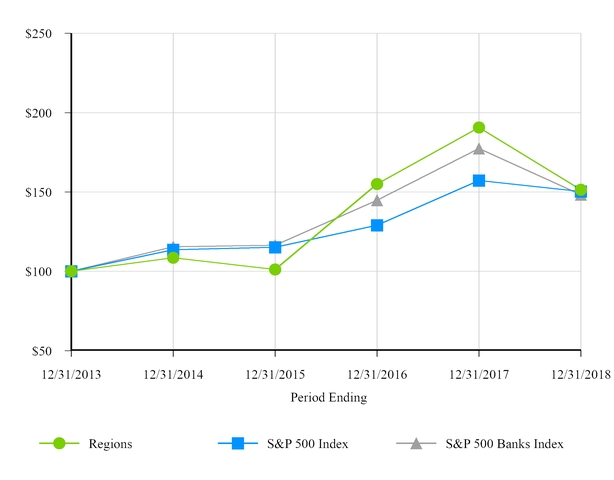][added: ]
| | [removed: Cumulative] [added: Cumulative] Total [removed: Return] [added: Return] | | | | | | | | | | | | | | | | | | | | | | |
| | [removed: 12/31/2013] [added: 12/31/2014] | | | | [removed: 12/31/2014] [added: 12/31/2015] | | | | [removed: 12/31/2015] [added: 12/31/2016] | | | | [removed: 12/31/2016] [added: 12/31/2017] | | | | [removed: 12/31/2017] [added: 12/31/2018] | | | | [removed: 12/31/2018] [added: 12/31/2019] | | |
During 2019 and 2018, an additional 107,779 shares and 98,951 shares were issued, respectively, which were the final shares to be issued as consideration for the acquisition.
| October 1—31, 2019 | — | | | $ | — | | | — | | | $ | 780,744,464 | |
| November 1—30, 2019 | — | | | $ | — | | | — | | | $ | 780,744,464 | |
| December 1—31, 2019 | 7,800,000 | | | $ | 16.93 | | | 7,800,000 | | | $ | 648,536,444 | |
| Total 4th Quarter | 7,800,000 | | | $ | 16.93 | | | 7,800,000 | | | $ | 648,536,444 | |
| Regions | $ | 100.00 | | | $ | 93.08 | | | $ | 142.78 | | | $ | 175.55 | | | $ | 139.44 | | | $ | 185.87 | |
| S&P 500 Index | 100.00 | | | | 101.37 | | | | 113.49 | | | | 138.26 | | | | 132.19 | | | | 173.80 | | |
| S&P 500 Banks Index | 100.00 | | | | 100.85 | | | | 125.36 | | | | 153.64 | | | | 128.38 | | | | 180.55 | | |
During 2018 and 2017, an additional 98,951 shares and 134,837 shares were issued, respectively, leaving 1,097,455 additional shares to be potentially issued.
| October 1—31, 2018 | 11,599,010 | | | $ | 16.32 | | | 11,599,010 | | | $ | 560,149,190 | |
| November 1—30, 2018 | 10,400,170 | | | $ | 17.33 | | | 10,400,170 | | | $ | 379,800,363 | |
| December 1—31, 2018 | — | | | $ | — | | | — | | | $ | — | |
| Total 4th Quarter | 21,999,180 | | | $ | 16.80 | | | 21,999,180 | | | $ | 379,800,363 | |
The Company also continued to repurchase shares on the open market under its capital plan in the first quarter of 2019.
As of February 21, 2019, Regions had repurchased approximately 7.4 million additional shares of common stock at a total cost of approximately $114.0 million.
| Regions | $ | 100.00 | | | $ | 108.63 | | | $ | 101.11 | | | $ | 155.10 | | | $ | 190.70 | | | $ | 151.47 | |
| S&P 500 Index | 100.00 | | | | 113.68 | | | | 115.24 | | | | 129.02 | | | | 157.17 | | | | 150.27 | | |
| S&P 500 Banks Index | 100.00 | | | | 115.51 | | | | 116.49 | | | | 144.81 | | | | 177.47 | | | | 148.30 | | |
Item 8. Financial Statements and Supplementary Data
1,313 rewritten, 318 added, 332 removed, 1,224 unchanged
Read the full itemFY2019 item · filed February 21, 2020FY2018 item · filed February 22, 2019
[removed: REPORT] [added: REPORT] OF MANAGEMENT ON INTERNAL CONTROL OVER FINANCIAL [removed: REPORTING][added: REPORTING]
Regions’ management assessed the effectiveness of the Company’s internal control over financial reporting as of December 31, [removed: 2018.][added: 2019.]
Based on our assessment, we believe and assert that, as of December 31, [removed: 2018,] [added: 2019,] the Company’s internal control over financial reporting is effective based on those criteria.
| | | [removed: REGIONS] [added: REGIONS] FINANCIAL [removed: CORPORATION] [added: CORPORATION] |
| | | [removed: John] [added: John] M. Turner, Jr. President and Chief Executive [removed: Officer] [added: Officer] |
| | | [removed: David] [added: David] J. Turner, [removed: Jr. Chief] [added: Jr. Chief] Financial [removed: Officer] [added: Officer] |
[removed: REPORT] [added: REPORT] OF INDEPENDENT REGISTERED PUBLIC ACCOUNTING [removed: FIRM][added: FIRM]
[removed: Opinion] [added: Opinion] on Internal Control over Financial [removed: Reporting][added: Reporting]
We have audited Regions Financial Corporation and subsidiaries’ internal control over financial reporting as of December 31, [removed: 2018,] [added: 2019,] based on criteria established in Internal Control-Integrated Framework issued by the Committee of Sponsoring Organizations of the Treadway Commission (2013 framework) (the COSO criteria).
In our opinion, Regions Financial Corporation and subsidiaries (the Company) maintained, in all material respects, effective internal control over financial reporting as of December 31, [removed: 2018,] [added: 2019,] based on the COSO criteria.
We also have audited, in accordance with the standards of the Public Company Accounting Oversight Board (United States) (PCAOB), the consolidated balance sheets of Regions Financial Corporation and subsidiaries as of December 31, [removed: 2018] [added: 2019] and [removed: 2017,] [added: 2018,] the related consolidated statements of income, comprehensive income, stockholders’ equity and cash flows for each of the three years in the period ended December 31, [removed: 2018,] [added: 2019,] and the related notes of the Company and our report dated February [removed: 22, 2019] [added: 21, 2020] expressed an unqualified opinion thereon.
[removed: Basis] [added: Basis] for [removed: Opinion][added: Opinion]
[removed: Definition] [added: Definition] and Limitations of Internal Control Over Financial [removed: Reporting][added: Reporting]
[removed: ][added: ]
[removed: February 22, 2019][added: | | 2019 | | | | | | | | | | | | | | |]
[removed: REPORT] [added: REPORT] OF INDEPENDENT REGISTERED PUBLIC ACCOUNTING [removed: FIRM][added: FIRM]
[removed: Opinion] [added: Opinion] on the Financial [removed: Statements][added: Statements]
We have audited the accompanying consolidated balance sheets of Regions Financial Corporation and subsidiaries (the Company) as of December 31, [removed: 2018] [added: 2019] and [removed: 2017,] [added: 2018,] the related consolidated statements of income, comprehensive income, stockholders’ equity and cash flows for each of the three years in the period ended December 31, [removed: 2018,] [added: 2019,] and the related notes (collectively referred to as the “consolidated financial statements”).
In our opinion, the consolidated financial statements present fairly, in all material respects, the financial position of the Company at December 31, [removed: 2018] [added: 2019] and [removed: 2017,] [added: 2018,] and the results of its operations and its cash flows for each of the three years in the period ended December 31, [removed: 2018,] [added: 2019,] in conformity with U.S. generally accepted accounting principles.
We also have audited, in accordance with the standards of the Public Company Accounting Oversight Board (United States) (PCAOB), the Company’s internal control over financial reporting as of December 31, [removed: 2018,] [added: 2019,] based on criteria established in Internal Control-Integrated Framework issued by the Committee of Sponsoring Organizations of the Treadway Commission (2013 framework) and our report dated February [removed: 22, 2019] [added: 21, 2020] expressed an unqualified opinion thereon.
[removed: Basis] [added: Basis] for [removed: Opinion][added: Opinion]
[removed: ][added: ]
[removed: REGIONS] [added: REGIONS] FINANCIAL CORPORATION AND [removed: SUBSIDIARIES][added: SUBSIDIARIES]
[removed: CONSOLIDATED] [added: CONSOLIDATED] BALANCE [removed: SHEETS][added: SHEETS]
| | [removed: December 31] [added: December 31] | | | | | | |
| | [removed: 2018] [added: 2018] | | | | [removed: 2017] [added: 2017] | | |
| | [removed: (In] [added: (In] millions, except share [removed: data)] [added: data)] | | | | | | |
| [removed: Assets] [added: Assets] | | | | | | | |
| Cash and due from banks | $ | [removed: 2,018] [added: 1,598] | | | $ | [removed: 2,012] [added: 2,018] | |
| Interest-bearing deposits in other banks | [removed: 1,520] [added: 2,516] | | | | [removed: 1,899] [added: 1,520] | | |
[removed: | Federal funds sold and securities purchased under agreements to resell | — | | | | 70 | | |][added: SECURITIES PURCHASED UNDER AGREEMENTS TO RESELL AND SECURITIES SOLD UNDER AGREEMENTS TO REPURCHASE]
| Debt securities held to maturity (estimated fair value of [removed: $1,460] [added: $1,372] and [removed: $1,667,] [added: $1,460] respectively) | [removed: 1,482] [added: 1,332] | | | | [removed: 1,658] [added: 1,482] | | |
| Debt securities available for sale | [removed: 22,729] [added: 22,606] | | | | [removed: 23,403] [added: 22,729] | | |
| Loans held for sale (includes [removed: $251] [added: $439] and [removed: $325] [added: $251] measured at fair value, respectively) | [removed: 304] [added: 637] | | | | [removed: 348] [added: 304] | | |
| Loans, net of unearned income | [removed: 83,152] [added: 82,963] | | | | [removed: 79,947] [added: 83,152] | | |
| Allowance for loan losses | [removed: (840] [added: (869] | | ) | | [removed: (934] [added: (840] | | ) |
| Net loans | [removed: 82,312] [added: 82,094] | | | | [removed: 79,013] [added: 82,312] | | |
| Other earning assets | [removed: 1,719] [added: 1,518] | | | | [removed: 1,891] [added: 1,719] | | |
| Premises and equipment, net | [removed: 2,045] [added: 1,960] | | | | [removed: 2,064] [added: 2,045] | | |
| Interest receivable | [removed: 375] [added: 362] | | | | [removed: 337] [added: 375] | | |
February 21, 2020
Critical audit matter
The critical audit matter communicated below is a matter arising from the current period audit of the financial statements that was communicated or required to be communicated to the audit committee and that: (1) relates to accounts or disclosures that are material to the financial statements and (2) involved especially challenging, subjective, or complex judgments.
The communication of the critical audit matter does not alter in any way our opinion on the consolidated financial statements, taken as a whole, and we are not, by communicating the critical audit matter below, providing a separate opinion on the critical audit matter or on the accounts or disclosures to which it relates.
| *Description of the Matter* | | The Company’s loan portfolio totaled $83.0 billion as of December 31, 2019, and the associated allowance for loan losses (ALL) was $869 million. As discussed in Notes 1 and 6 to the consolidated financial statements, the ALL is established to absorb probable credit losses inherent in the Company’s loan portfolio. Management’s estimate for the probable credit losses is established through quantitative, as well as qualitative, factors. The Company attributes portions of the allowance to loans that it evaluates individually and determines to be impaired and to groups of loans that it evaluates collectively. For non-accrual commercial and investor real estate loans equal to or greater than $2.5 million, the allowance for loan losses is based on the present value of estimated cash flows, estimates of collateral value, or observable market prices. For accruing commercial and investor real estate loans and non-accruing commercial and investor real estate loans less than $2.5 million, as well as for consumer loans, the allowance for loan losses is estimated based on historical default and/or loss information for pools of loans with similar risk characteristics and product types. The Company’s methodology for determining the appropriate ALL also considers the imprecision inherent in the estimation process. As a result, management adjusts the ALL for consideration of the potential impact of qualitative factors, which include credit quality trends; loss experience in particular portfolios; macroeconomic factors such as unemployment, real estate prices, or commodity pricing volatility; changes in risk selection and underwriting standards; shifts in credit quality of customers which is not yet reflected in historical data; and volatility associated with large individual credits, among others. Auditing management’s estimate of the ALL involved a high degree of subjectivity in evaluating the qualitative factors that management assessed and the measurement of each qualitative factor. Management’s assessment and measurement of the qualitative factors is highly judgmental and has a significant effect on the ALL. |
| *How We Addressed the Matter in Our Audit* | | Our audit procedures related to the qualitative factors of the ALL included the following procedures, among others. We gained an understanding of the Company’s process for establishing the ALL, including the identification and measurement of qualitative factors. We evaluated the design and tested the operating effectiveness of controls relevant to that process, including controls over credit risk management, the reliability of data sourced from the loan systems and credit warehouses, the completeness and accuracy of quantitative loss modeling, and the ALL methodology and assumptions. In doing so, we tested review and approval controls in the Company’s governance process designed to identify and assess the need for and measurement of qualitative factors to estimate inherent credit losses associated with factors not captured fully in the quantitative components of the ALL. With respect to the identification of qualitative factors, we evaluated 1) the potential impact of imprecision in the quantitative models (and hence the need to consider a qualitative adjustment to the ALL); 2) changes, assumptions and adjustments to the models; 3) sufficiency, availability and relevance of historical loss data used in the models; and 4) the risk factors used in the models. Regarding measurement of the qualitative factors, we evaluated internal data utilized by management to estimate the appropriate level of the qualitative factors, as well as internal data produced by the Company’s Credit Review, Internal Audit and Model Validation groups, and external macroeconomic factors independently obtained during the audit, with consideration given to the reliability of the macroeconomic factors and existence of new and potentially contradictory information. We also evaluated the overall allowance for loan losses balance taken as a whole inclusive of such qualitative factors. |
February 21, 2020
| Cumulative effect from change in accounting guidance | — | | | — | | | | — | | | — | | | | — | | | | 2 | | | | — | | | | — | | | | 2 | | |
| Preferred stock transactions: | | | | | | | | | | | | | | | | | | | | | | | | | | | | | | | | | |
| Net proceeds from issuance of 500 thousand shares of Series C, fixed to floating rate, non-cumulative perpetual preferred stock, including related surplus | 1 | | | 490 | | | | — | | | — | | | | — | | | | — | | | | — | | | | — | | | | 490 | | |
| Impact of share repurchases | — | | | — | | | | (72 | ) | | (1 | | ) | | (1,100 | | ) | | — | | | | — | | | | — | | | | (1,101 | | ) |
| BALANCE AT DECEMBER 31, 2019 | 2 | | | $ | 1,310 | | | 957 | | | $ | 10 | | | $ | 12,685 | | | $ | 3,751 | | | $ | (1,371 | ) | | $ | (90 | ) | | $ | 16,295 | |
| Net proceeds from issuance of preferred stock | 490 | | | | — | | | | — | | |
The cumulative effect of the retrospective application had an immaterial impact on retained earnings.
Direct financing, sales-type and leveraged leases are included within the commercial portfolio segment.
and amortization type for accruing, non-past due loans.
LEASES
*LESSEES*
Regions' lease portfolio is primarily composed of property leases that are classified as either operating or finance leases with the majority classified as operating leases.
Property leases, which primarily include office locations and retail branches, typically have original lease terms ranging from 1 year to 20 years, some of which may also include an option to extend the lease beyond the original lease term.
In some circumstances, Regions may also have an option to terminate the lease early with advance notice.
Regions includes renewal and termination options within the lease term if deemed reasonably certain of exercise.
As most leases do not state an implicit rate, Regions utilizes the incremental borrowing rate based on information available at the lease commencement date to determine the present value of lease payments.
Leases with a term of 12 months or less are not recorded on the balance sheet.
Regions continues to recognize lease payments as an expense over the lease term as appropriate.
The remainder of the lease portfolio is comprised of equipment leases that have remaining lease terms of 1 year to 4 years.
*LESSORS*
Regions also has portfolios of leveraged and operating leases.
These arrangements provide equipment financing for leased assets, such as vehicles and aircraft.
At the commencement date, Regions (lessor) enters into an agreement with the customer (lessee) to lease the underlying equipment for a specified lease term.
The lease agreements may provide customers the option to terminate the lease by buying the equipment at fair market value at the time of termination or at the end of the lease term.
Regions' equipment finance asset management group performs due diligence procedures on the lease residual and overall equipment values as part of the origination process.
Regions performs lease residual value reviews on an ongoing basis.
In order to manage the residual value risk inherent in some of its direct financing leases, Regions purchases residual value insurance from an independent third party.
Sales-type, direct financing, and leveraged leases are recorded within loans and operating leases are recorded within other earning assets on the consolidated balance sheet.
interest expense in the same income statement line item with the hedged item in the period in which the change in fair value occurs.
examination, the Company records a liability for the recognized income tax benefit.
See Note 18 for further discussion and details of employee benefit plans.
Interest rate lock commitments on loans intended
The fair values for commercial loans held for sale are based on Company-specific data not observable in the market.
February 22, 2019
| BALANCE AT JANUARY 1, 2016 | 1 | | | $ | 820 | | | 1,297 | | | $ | 13 | | | $ | 17,883 | | | $ | (115 | ) | | $ | (1,377 | ) | | $ | (380 | ) | | $ | 16,844 | |
| Impact of share repurchase | — | | | — | | | | (89 | ) | | — | | | | (839 | | ) | | — | | | | — | | | | — | | | | (839 | | ) |
The cumulative effect of the retrospective application was a total reduction to retained earnings of $2 million, of which the individual components were immaterial.
SECURITIES PURCHASED UNDER AGREEMENTS TO RESELL AND SECURITIES SOLD UNDER AGREEMENTS TO REPURCHASE
sales of performing loans are included in non-interest income.
operating lease revenue on a straight line basis over the scheduled lease term.
Regions enters into lease transactions for the right to use assets.
At December 31, 2018 and 2017, the carrying values of foreclosed properties were immaterial.
commitment is removed from the consolidated balance sheets and recognized in other non-interest expense.
Excluding the effects of Tax Reform, as discussed in Note 20 and the "Recent Accounting Pronouncements and Accounting Changes" section below, the impact of changes in tax rates related to unrealized gains and losses included in accumulated other comprehensive income is immaterial.
merchants.
the Company develops valuations based on assumptions that are not readily observable in the market place; these valuations are Level 3 measurements.
other regulatory guidance.
The fair values for commercial loans held for sale that are based on formally committed loan sale prices or valuations performed using observable inputs are classified as a Level 2 measurement.
If no formally committed sales price is available, a professional valuation is obtained, consistent with the process described above for foreclosed property and other real estate.
| ASU 2014-09, Revenue from Contracts with Customers ASU 2015-14, Deferral of the Effective Date ASU 2016-08, Principal versus Agent Considerations ASU 2016-10, Identifying Performance Obligations and Licensing ASU 2016-12, Narrow-Scope Improvements and Practical Expedience ASU 2016-20, Technical Corrections and Improvements to Topic 606, Revenue from Contracts with Customers | This ASU supersedes the revenue recognition requirements in ASC Topic 605, Revenue Recognition, and most industry-specific guidance throughout the Industry topics of the Codification. The core principle of the ASU is that an entity should recognize revenue to depict the transfer of promised goods or services to customers in an amount that reflects the consideration to which the entity expects to be entitled in exchange for those goods or services. The ASU may be adopted either retrospectively or on a modified retrospective basis. | January 1, 2018 | Regions adopted the new revenue recognition standard on January 1, 2018 using the modified retrospective method. The adoption of this guidance did not have a material impact. For the year ended December 31, 2018, approximately $1.7 billion of non-interest income is within the scope of the new revenue recognition standard and includes service charges on deposit accounts, card and ATM fees, investment management and trust fee income, capital markets fee income, investment services fee income and other components within non-interest income. Income streams that are out of scope of the new standard include interest income, mortgage income, securities gains (losses), bank-owned life insurance and certain other components within non-interest income. Regions also developed additional quantitative and qualitative disclosures required by the new revenue recognition standard. See Note 25. |
| ASU 2016-01, Recognition and Measurement of Financial Assets and Liabilities ASU 2018-03, Technical Corrections and Improvements to Financial Instruments ASU 2018-04, Debt Securities and Regulated Operations | This ASU amends ASC Topic 825, Financial Instruments-Overall, and addresses certain aspects of recognition, measurement, presentation, and disclosure of financial instruments. Among other minor amendments applicable to Regions, the main provisions require investments in equity securities to be measured at fair value with changes in fair value recognized through net income unless they qualify for a practicability exception (excludes investments accounted for under the equity method of accounting or those that result in consolidation of the investee). Except for disclosure requirements that have been adopted prospectively, the ASU must be adopted on a modified retrospective basis. | January 1, 2018 | The adoption of this guidance resulted in trading account assets and equity securities available for sale being reclassified to other earning assets. The adoption of this guidance did not have a material impact. See Note 8. |
| ASU 2016-15, Classification of Certain Cash Receipts and Cash Payments | This ASU amends Topic 230, Statement of Cash Flows, and provides clarification with respect to classification within the statement of cash flows where current guidance is unclear or silent. The ASU must be adopted retrospectively. | January 1, 2018 | The adoption of this guidance did not have a material impact. |
| ASU 2017-01, Clarifying the Definition of a Business | This ASU amends Topic 805, Business Combinations, and provides additional accounting guidance to better determine when a set of assets and activities is a business. The ASU must be adopted prospectively. | January 1, 2018 | The adoption of this guidance did not have a material impact. |
| ASU 2017-05, Other Income- Gains and Losses from the Derecognition of Nonfinancial Assets | This ASU amends Subtopic 610-20, Other Income - Gains and Losses from the Derecognition of Nonfinancial Assets, to clarify the scope and to add guidance for partial sales of nonfinancial assets. The new standard adds a definition for in-substance nonfinancial assets and clarifies that nonfinancial assets within a legal entity are within the scope of ASC 606. This ASU may be adopted either retrospectively or on a modified retrospective basis. | January 1, 2018 | Regions adopted the guidance using the modified retrospective method. The adoption of this guidance did not have a material impact. |
| ASU 2017-07, Compensation- Retirement Benefits | This ASU amends Topic 715, Retirement Benefits, and provides more prescriptive guidance around the presentation of net periodic pension and postretirement benefit cost in the income statement. The amendment requires that the service cost component be disaggregated from other components of net periodic benefit cost in the income statement. The ASU must be adopted retrospectively. | January 1, 2018 | The adoption of this guidance did not have a material impact. See Note 18. |
| ASU 2017-09, Stock Compensation: Scope of Modification Accounting | This ASU amends Topic 718, Compensation-Stock Compensation, and clarifies when modification accounting should be applied to changes in terms or conditions of share-based payment awards. The amendments narrow the scope of modification accounting by clarifying that modification accounting should be applied to awards if the change affects the fair value, vesting conditions, or classification of the award. The amendments do not impact current disclosure requirements for modifications, regardless of whether modification accounting is required under the new guidance. The ASU must be adopted prospectively to modifications that occur on or after the adoption date. | January 1, 2018 | The adoption of this guidance did not have a material impact. |
| ASU 2017-12, Targeted Improvements to Accounting for Hedging Activities | This ASU amends ASC 815, Derivatives and Hedging to (1) improve the transparency and understandability of information conveyed to financial statement users about an entity’s risk management activities by better aligning the entity’s financial reporting for hedging relationships with those risk management activities and (2) reduce the complexity of and simplify the application of hedge accounting by preparers. Except for disclosure requirements that have been adopted prospectively, the ASU must be adopted on a modified retrospective basis. | January 1, 2019 Early adoption is permitted. | Regions elected to adopt this ASU for financial reporting as of January 1, 2018. The adoption of this guidance did not have a material impact. See Note 21. |
| ASU 2018-05, Income Taxes | This ASU amends SEC guidance in the Codification related to income taxes to reflect the guidance in SEC Staff Accounting Bulletin 118, which provides guidance for companies that are not able to complete their accounting for the income tax effects of the Tax Reform in the period of enactment. The staff believes that to the extent a company can reasonably estimate the impact of the Tax Reform, such items should be reported in the first reporting period in which the Company is able to determine the reasonable estimate. | Effective upon issuance. | Regions adopted this ASU upon issuance. The adoption of this guidance did not have a material impact. |
| ASU 2018-13, Fair Value Measurement | This ASU amends the disclosure requirements of Topic 820, Fair Value Measurement, to remove disclosure of transfers between Level 1 and Level 2 of the fair value hierarchy and to include disclosure of the range and weighted average used in Level 3 fair value measurements, among other amendments. The ASU applies to all entities that are required to provide disclosures about recurring or non-recurring fair value measurements. Amendments should be applied retrospectively to all periods presented, except for certain amendments, which should be applied prospectively for only the most recent interim or annual period presented in the initial fiscal year of adoption. | January 1, 2020 Early adoption is permitted. | Regions elected to adopt this ASU for financial reporting as of December 31, 2018. The adoption of this guidance did not have a material impact. |
| ASU 2018-14, Compensation - Retirement Benefits | This ASU amends the disclosure requirements in Topic 715, Retirement Benefits. The ASU applies to all employer entities that sponsor defined benefit pension or other post-retirement plans. Applicable disclosure changes include: the removal of amounts in accumulated other comprehensive income expected to be recognized as components of net periodic benefit cost over the next year; the removal of the effects of a one-percentage point change in assumed health care cost trend rates; and the addition of an explanation of reasons for significant gains and losses related to changes in the benefit obligation for the period. The ASU must be adopted on a retrospective basis. | January 1, 2021 Early adoption is permitted. | Regions elected to adopt this ASU for financial reporting as of December 31, 2018. The adoption of this guidance did not have a material impact. See Note 18. |
| Other | — | | | | 3 | | | | 5 | | |
| Other | 16 | | | | 30 | | | | 25 | | |
| Residential agency | $ | 1,051 | | | $ | — | | | $ | (40 | ) | | $ | 1,011 | | | $ | 12 | | | $ | (4 | ) | | $ | 1,019 | |
| | $ | 1,702 | | | $ | — | | | $ | (44 | ) | | $ | 1,658 | | | $ | 17 | | | $ | (8 | ) | | $ | 1,667 | |
| Residential agency | 17,622 | | | | 53 | | | | (244 | | ) | | 17,431 | | | | | | | | | | | | 17,431 | | |
| | $ | 23,605 | | | $ | 82 | | | $ | (284 | ) | | $ | 23,403 | | | | | | | | | | | $ | 23,403 | |
| Commercial agency | 634 | | | | 618 | | |
| | $ | 1,517 | | | $ | 1,460 | |
| | $ | 23,258 | | | $ | 22,729 | |
| | $ | — | | | $ | — | | | $ | 1,169 | | | $ | (39 | ) | | $ | 1,169 | | | $ | (39 | ) |
| Residential agency | 5,157 | | | | (40 | | ) | | 8,195 | | | | (204 | | ) | | 13,352 | | | | (244 | | ) |
| Commercial agency | 1,666 | | | | (10 | | ) | | 904 | | | | (20 | | ) | | 2,570 | | | | (30 | | ) |
| Commercial non-agency | 393 | | | | (2 | | ) | | 61 | | | | (1 | | ) | | 454 | | | | (3 | | ) |
An excerpt. Shown here: 40 of 1,313 rewritten, 40 of 318 added and 40 of 332 removed. The counts are complete. For every sentence, read Item 8. Financial Statements and Supplementary Data in the FY2019 filing and the FY2018 filing.
Item 9A. Controls and Procedures
1 rewritten, 0 added, 0 removed, 3 unchanged
Read the full itemFY2019 item · filed February 21, 2020FY2018 item · filed February 22, 2019
During the fourth fiscal quarter of the year ended December 31, [removed: 2018,] [added: 2019,] there have been no changes in Regions’ internal control over financial reporting that have materially affected, or are reasonably likely to materially affect, Regions’ control over financial reporting.
Item 9B. Other Information
1 rewritten, 0 added, 0 removed, 1 unchanged
Read the full itemFY2019 item · filed February 21, 2020FY2018 item · filed February 22, 2019
[removed: PART III][added: PART III]
Item 10. Directors, Executive Officers and Corporate Governance
15 rewritten, 2 added, 3 removed, 4 unchanged
Read the full itemFY2019 item · filed February 21, 2020FY2018 item · filed February 22, 2019
Information about the Directors and Director nominees of Regions included in Regions’ Proxy Statement for the Annual Meeting of Shareholders to be held on April [removed: 24, 2019] [added: 22, 2020] (the “Proxy Statement”) under the captions “PROPOSAL 1—ELECTION OF DIRECTORS—Who are this year's nominees?,” “—What criteria were considered by the NCG Committee in selecting the nominees?,” and “—What skills and characteristics are currently represented on the Board?” and the information incorporated by reference pursuant to Item 13.
Information regarding Regions’ Code of Ethics for Senior Financial Officers included in the Proxy Statement under the caption “CORPORATE [removed: PURPOSE, CULTURE, AND ESG—Code of Business Conduct and Ethics and Code] [added: GOVERNANCE—Codes] of [removed: Ethics for Senior Financial Officers”] [added: Ethics”] is incorporated herein by reference.
Executive officers of the registrant as of December 31, [removed: 2018,] [added: 2019,] are as follows:
| [removed: Executive Officer] [added: Executive Officer] | | [removed: Age] [added: Age] | | [removed: Position and Offices] [added: Position and Offices] Held [removed: with Registrant] [added: with Registrant] and [removed: Subsidiaries] [added: Subsidiaries] | | [removed: Executive Officer Since] [added: Executive Officer Since] |
| John M. Turner, Jr. | | [removed: 57] [added: 58] | | President and Chief Executive Officer of registrant and Regions Bank. Previously served as Senior Executive Vice President; Head of Corporate Banking Group and as South Region President of Regions Bank. Prior to joining Regions, served as President of Whitney National Bank and Whitney Holding Corporation. | | 2011 |
| David J. Turner, Jr. | | [removed: 55] [added: 56] | | Senior Executive Vice President and Chief Financial Officer of registrant and Regions Bank. | | 2010 |
| John B. Owen | | [removed: 57] [added: 58] | | Senior Executive Vice President and Chief Operating Officer of registrant and Regions Bank. Previously Head of Regional Banking Group; Head of the Business Groups. | | 2009 |
| Fournier J. “Boots” Gale, III | | [removed: 74] [added: 75] | | Senior Executive Vice President, General Counsel and Corporate Secretary of registrant and Regions Bank. Previously a founding partner of Maynard Cooper & Gale, P.C. in Birmingham, Alabama. | | 2011 |
| C. Matthew Lusco | | [removed: 61] [added: 62] | | Senior Executive Vice President and Chief Risk Officer of registrant and Regions Bank. Previously managing partner of KPMG LLP’s offices in Birmingham, Alabama and Memphis, Tennessee. | | 2011 |
| Kate R. Danella | | [removed: 39] [added: 40] | | Executive Vice President and Head of Strategic Planning [added: & Consumer Bank Products] and [added: Origination Partnerships of registrant and Regions Bank. Previously served as Head of Strategic Planning and] Corporate Development of registrant and Regions Bank. Previously served as Head of Private Wealth Management and as Wealth Strategy and Effectiveness Executive of Regions Bank. Prior to joining Regions, served as Vice President of Capital Group Companies. | | 2018 |
| C. Keith [removed: Herron] [added: Herron†] | | [removed: 54] [added: 55] | | Senior Executive Vice President and Head of Corporate Responsibility and Community Engagement of registrant and Regions Bank. Director of Regions Foundation. Previously served as Regional President, South Region of Regions Bank and as Head of Strategic Planning and Execution of registrant and Regions Bank. | | 2010 |
| David R. Keenan | | [removed: 51] [added: 52] | | Senior Executive Vice President and Chief Human Resources Officer of registrant and Regions Bank. | | 2010 |
| Scott M. Peters | | [removed: 57] [added: 58] | | Senior Executive Vice President and Head of Consumer Banking Group of registrant and Regions Bank. Director of Regions Investment Services, Inc. Previously Consumer Services Group Head. | | 2010 |
| William D. Ritter | | [removed: 48] [added: 49] | | Senior Executive Vice President and Head of Wealth Management [added: Group] of registrant and Regions Bank. [added: Director of Highland Associates, Inc.] | | 2010 |
| Ronald G. Smith | | [removed: 58] [added: 59] | | Senior Executive Vice President and Head of Corporate Banking Group of registrant and Regions Bank. Director of Regions Equipment Finance [removed: Corporation and Regions Foundation of Tennessee.] [added: Corporation.] Manager of RFC Financial Services Holding LLC. Previously Regional President, Mid-America Region of Regions Bank. | | 2010 |
† C.
Keith Herron retired on January 15, 2020.
Information regarding timeliness of filings under Section 16(a) of the Securities Exchange Act of 1934 included in the Proxy Statement under the caption “OWNERSHIP OF REGIONS COMMON STOCK—Section 16(a) Beneficial Ownership Reporting Compliance” is incorporated herein by reference.
| O. B. Grayson Hall, Jr. † | | 61 | | Executive Chairman and Director of registrant and Regions Bank. Previously served as Chairman, President, and Chief Executive Officer. | | 1993 |
† On December 31, 2018, at 11:59p.m., O. B. Grayson Hall, Jr. retired as Executive Chairman of the Company and from the Company’s Board.
Item 12. Security Ownership of Certain Beneficial Owners and Management and Related Stockholder Matters
4 rewritten, 2 added, 2 removed, 3 unchanged
Read the full itemFY2019 item · filed February 21, 2020FY2018 item · filed February 22, 2019
[removed: Equity] [added: Equity] Compensation Plan [removed: Information][added: Information]
The following table gives information about the common stock that may be issued upon the exercise of options, warrants and rights under all of Regions’ existing equity compensation plans as of December 31, [removed: 2018.][added: 2019.]
| [removed: Plan Category] [added: Plan Category] | [removed: Number] [added: Number] of [removed: Securities to] [added: Securities to] be Issued [removed: Upon Exercise of Outstanding Options, Warrants] [added: Upon Exercise of Outstanding Options, Warrants] and Rights [removed: (a)] [added: (a)] | | | [removed: Weighted Average Exercise] [added: Weighted Average Exercise] Price [removed: of Outstanding Options, Warrants] [added: of Outstanding Options, Warrants] and [removed: Rights] [added: Rights] | | | [removed: Number] [added: Number] of [removed: Securities Remaining] [added: Securities Remaining] Available Under [removed: Equity Compensation Plans (Excluding Securities in] [added: Equity Compensation Plans (Excluding Securities in] First [removed: Column)] [added: Column)] | | |
| (a) | Does not include outstanding restricted stock units of [removed: 11,445,943.] [added: 8,997,358.] |
| Equity Compensation Plans Approved by Stockholders | 967,769 | | | $ | 6.80 | | 39,018,893 | | (b) |
| Total | 967,769 | | | $ | 6.80 | | 39,018,893 | | |
| Equity Compensation Plans Approved by Stockholders | 1,724,723 | | | $ | 6.86 | | 42,561,810 | | (b) |
| Total | 1,724,723 | | | $ | 6.86 | | 42,561,810 | | |
Item 13. Certain Relationships and Related Transactions, and Director Independence
1 rewritten, 0 added, 0 removed, 0 unchanged
Read the full itemFY2019 item · filed February 21, 2020FY2018 item · filed February 22, 2019
All information presented under the captions “CORPORATE GOVERNANCE—Transactions with Directors,” “—Other Business Relationships and Transactions,” “—Policies [removed: Relating to] [added: Governing] Transactions with Related Persons” and “—Director Independence” of the Proxy Statement is incorporated herein by reference.
Item 14. Principal Accounting Fees and Services
2 rewritten, 0 added, 0 removed, 0 unchanged
Read the full itemFY2019 item · filed February 21, 2020FY2018 item · filed February 22, 2019
All information presented under the caption “ PROPOSAL [removed: 2 - RATIFICATION] [added: 2—RATIFICATION] OF APPOINTMENT OF INDEPENDENT REGISTERED PUBLIC ACCOUNTING FIRM” of the Proxy Statement is incorporated herein by reference.
[removed: PART IV][added: PART IV]
Item 15. Exhibits, Financial Statement Schedules
69 rewritten, 7 added, 17 removed, 25 unchanged
Read the full itemFY2019 item · filed February 21, 2020FY2018 item · filed February 22, 2019
[added: *Consolidated Financial Statements.*] The following reports of independent registered public accounting firm and consolidated financial statements of Regions and its subsidiaries are included in Item 8.
| Consolidated Balance Sheets—December 31, [removed: 2018] [added: 2019] and [removed: 2017;] [added: 2018;] |
| Consolidated Statements of Income—Years ended December 31, [removed: 2018, 2017] [added: 2019, 2018] and [removed: 2016;] [added: 2017;] |
| Consolidated Statements of Comprehensive Income—Years ended December 31, [removed: 2018, 2017] [added: 2019, 2018] and [removed: 2016;] [added: 2017;] |
| Consolidated Statements of Changes in Stockholders’ Equity—Years ended December 31, [removed: 2018, 2017] [added: 2019, 2018] and [removed: 2016;] [added: 2017;] and |
| Consolidated Statements of Cash Flows—Years ended December 31, [removed: 2018, 2017] [added: 2019, 2018] and [removed: 2016.] [added: 2017.] |
[removed: Consolidated] [added: *Consolidated] Financial Statement [removed: Schedules.][added: Schedules.* The following consolidated financial statement schedules are included in Item 8.]
[added: (b) *Exhibits.*] The exhibits indicated below are either included or incorporated by reference as indicated.
| [removed: SEC Assigned Exhibit Number] [added: SEC Assigned Exhibit Number] | [removed: Description] [added: Description] of [removed: Exhibits] [added: Exhibits] |
| 3.1 | [Amended and Restated Certificate of Incorporation incorporated by reference to Exhibit 3.1 to Form 10-Q Quarterly Report filed by registrant on August 6, [removed: 2012, File No. 000-50831.](http://www.sec.gov/Archives/edgar/data/1281761/000119312512336748/d361719dex31.htm)] [added: 2012](http://www.sec.gov/Archives/edgar/data/1281761/000119312512336748/d361719dex31.htm)] |
| 3.2 | [Certificate of [removed: Designations] [added: Designations,] incorporated by reference to Exhibit 3.3 to Form 8-A filed by registrant on November 1, [removed: 2012, File No. 001-34034.](http://www.sec.gov/Archives/edgar/data/1281761/000119312512444531/d430770dex33.htm)] [added: 2012](http://www.sec.gov/Archives/edgar/data/1281761/000119312512444531/d430770dex33.htm)] |
| 3.3 | [Certificate of Designations, incorporated by reference to Exhibit 3.3 to [removed: the] Form 8-A filed by [removed: registration] [added: registrant] on April 28, [removed: 2014, File No. 001-34034.](http://www.sec.gov/Archives/edgar/data/1281761/000119312514163147/d717095dex33.htm)] [added: 2014](http://www.sec.gov/Archives/edgar/data/1281761/000119312514163147/d717095dex33.htm)] |
| [removed: 3.4] [added: 3.5] | [Bylaws as amended and restated, incorporated by reference to Exhibit 3.2 to Form 8-K Current Report filed by registrant on July [removed: 25, 2018.](http://www.sec.gov/Archives/edgar/data/1281761/000128176118000078/bylaws7-25x18.htm)] [added: 24, 2019](http://www.sec.gov/Archives/edgar/data/1281761/000128176119000067/rfc2019bylaws.htm).] |
| 4.2 | [Deposit Agreement, dated as of November 1, 2012, by and among Regions Financial Corporation, Computershare Trust Company, N.A., as depositary, Computershare Inc., and the holders from time to time of the depositary receipts described therein, incorporated by reference to Exhibit 4.1 to Form 8-A filed by registrant on November 1, [removed: 2012, File No. 001-34034.](http://www.sec.gov/Archives/edgar/data/1281761/000119312512444531/d430770dex41.htm)] [added: 2012](http://www.sec.gov/Archives/edgar/data/1281761/000119312512444531/d430770dex41.htm)] |
| 4.3 | [Form of depositary receipt representing the Depositary Shares incorporated by reference to Exhibit 4.2 to Form 8-A filed by registrant on November 1, [removed: 2012, File No. 001-34034.](http://www.sec.gov/Archives/edgar/data/1281761/000119312512444531/d430770dex41.htm)] [added: 2012](http://www.sec.gov/Archives/edgar/data/1281761/000119312512444531/d430770dex41.htm)] |
| 4.4 | [Form of Stock Certificate representing the Preferred Stock, incorporated by reference to Exhibit 4.3 to Form 8-A filed by registrant on November 1, [removed: 2012, File No. 001-34034.](http://www.sec.gov/Archives/edgar/data/1281761/000119312512444531/d430770dex43.htm)] [added: 2012](http://www.sec.gov/Archives/edgar/data/1281761/000119312512444531/d430770dex43.htm)] |
| 4.5 | [Deposit Agreement, dated as of April 29, 2014, by and among Regions Financial Corporation, Computershare Trust Company, N.A., as depositary, Computershare, Inc. and the holders from time to time of the depositary receipts described therein, incorporated by reference to Exhibit 4.1 to the Form 8-K filed by registrant on April 29, [removed: 2014, File No. 001-34034.](http://www.sec.gov/Archives/edgar/data/1281761/000119312514167390/d717083dex41.htm)] [added: 2014](http://www.sec.gov/Archives/edgar/data/1281761/000119312514167390/d717083dex41.htm)] |
| [removed: SEC Assigned Exhibit Number] [added: SEC Assigned Exhibit Number] | [removed: Description] [added: Description] of [removed: Exhibits] [added: Exhibits] |
| 4.6 | [Form of depositary receipt representing the Depositary Shares, incorporated by reference to Exhibit 4.2 to the Form 8-K filed by registrant on April 29, [removed: 2014, File No. 001-34034.](http://www.sec.gov/Archives/edgar/data/1281761/000119312514167390/d717083dex41.htm)] [added: 2014](http://www.sec.gov/Archives/edgar/data/1281761/000119312514167390/d717083dex41.htm)] |
| 4.7 | [Form of certificate representing the Series B Preferred Stock, incorporated by reference to Exhibit 4.3 to the Form 8-A filed by registrant on April 28, [removed: 2014, File No. 001-34034.](http://www.sec.gov/Archives/edgar/data/1281761/000119312514163147/d717095dex43.htm)] [added: 2014](http://www.sec.gov/Archives/edgar/data/1281761/000119312514163147/d717095dex43.htm)] |
| [removed: 10.4*] [added: 10.7*] | [removed: [Form] [added: [2019 Form] of Notice and Form of Restricted Stock Unit Award Agreement under Regions Financial Corporation 2015 Long Term Incentive Plan, incorporated by reference to Exhibit 10.2 to Form 10-Q Quarterly Report filed by registrant on August [removed: 5, 2016.](http://www.sec.gov/Archives/edgar/data/1281761/000128176116000155/rf-20160630xex102.htm)] [added: 7, 2019.](http://www.sec.gov/Archives/edgar/data/1281761/000128176119000071/rf-2019630xex102.htm)] |
| [removed: 10.7*] [added: 10.10*] | [removed: [Form] [added: [2019 Form] of Notice and Form of Performance Stock Unit Award Agreement under Regions Financial Corporation 2015 Long Term Incentive Plan, incorporated by reference to Exhibit 10.3 to Form 10-Q Quarterly Report filed by registrant on August [removed: 5, 2016.](http://www.sec.gov/Archives/edgar/data/1281761/000128176116000155/rf-20160630xex103.htm)] [added: 7, 2019.](http://www.sec.gov/Archives/edgar/data/1281761/000128176119000071/rf-2019630xex103.htm)] |
| [removed: 10.10*] [added: 10.13*] | [removed: [Form] [added: [2019 Form] of Notice and Form of Performance Unit Award Agreement under Regions Financial Corporation 2015 Long Term Incentive Plan, incorporated by reference to Exhibit [removed: 10.4] [added: 10.3] to Form 10-Q Quarterly Report filed by registrant on August [removed: 5, 2016.](http://www.sec.gov/Archives/edgar/data/1281761/000128176116000155/rf-20160630xex104.htm)] [added: 7, 2019.](http://www.sec.gov/Archives/edgar/data/1281761/000128176119000071/rf-2019630xex103.htm)] |
| [removed: SEC Assigned Exhibit Number] [added: SEC Assigned Exhibit Number] | [removed: Description] [added: Description] of [removed: Exhibits] [added: Exhibits] |
| [removed: 10.13*] [added: 10.14*] | [Regions Financial Corporation 2010 Long Term Incentive Plan, incorporated by reference to Appendix B to Regions Financial Corporation’s Proxy Statement dated April 1, 2010, for the Regions Annual Meeting of Stockholders held May 13, [removed: 2010, File No. 000-50831](http://www.sec.gov/Archives/edgar/data/1281761/000119312510073976/ddef14a.htm#toc84908_88).] [added: 2010.](http://www.sec.gov/Archives/edgar/data/1281761/000119312510073976/ddef14a.htm#toc84908_88)] |
| [removed: 10.14*] [added: 10.15*] | [Amendment, effective August 31, 2010, to Regions Financial Corporation 2010 Long Term Incentive Plan, incorporated by reference to Exhibit 10.1 to Form 10-Q Quarterly Report filed by registrant on November 3, [removed: 2010, File No. 000-50831.](http://www.sec.gov/Archives/edgar/data/1281761/000119312510246226/dex101.htm)] [added: 2010.](http://www.sec.gov/Archives/edgar/data/1281761/000119312510246226/dex101.htm)] |
| [removed: 10.15*] [added: 10.16*] | [Form of stock option grant agreement under Regions Financial Corporation 2010 Long Term Incentive Plan, incorporated by reference to Exhibit 10.5 to Form 10-K Annual Report filed by registrant on February 24, [removed: 2011, File No. 000-50831.](http://www.sec.gov/Archives/edgar/data/1281761/000119312511045404/dex105.htm)] [added: 2011.](http://www.sec.gov/Archives/edgar/data/1281761/000119312511045404/dex105.htm)] |
| [removed: 10.16*] [added: 10.4*] | [removed: [Form] [added: [2019 Form] of Notice and Form of [added: Director] Restricted Stock Unit Award Agreement under Regions Financial Corporation [removed: 2010] [added: 2015] Long Term Incentive Plan, incorporated by reference to Exhibit [removed: 10.3] [added: 10.1] to Form 10-Q Quarterly Report filed by registrant on August [removed: 5, 2015.](http://www.sec.gov/Archives/edgar/data/1281761/000128176115000065/rf-2015630xex103.htm)] [added: 7, 2019.](http://www.sec.gov/Archives/edgar/data/1281761/000128176119000071/rf-2019630xex101.htm)] |
| 10.17* | [removed: [Form of Notice and Form of Performance Stock Unit Award Agreement under Regions] [added: [Regions] Financial Corporation [removed: 2010 Long Term Incentive] [added: Directors’ Deferred Restricted Stock Unit] Plan, incorporated by reference to Exhibit [removed: 10.4] [added: 10.26] to Form [removed: 10-Q Quarterly] [added: 10-K Annual] Report filed by registrant on [removed: August 5, 2015.](http://www.sec.gov/Archives/edgar/data/1281761/000128176115000065/rf-2015630xex104.htm)] [added: February 22, 2019.](http://www.sec.gov/Archives/edgar/data/1281761/000128176119000019/rf-20181231xex1026.htm)] |
| [removed: 10.18*] [added: 10.47*] | [removed: [Form of Notice and Form of Performance Unit Award Agreement under Regions] [added: [Regions] Financial Corporation [removed: 2010 Long Term] [added: Amended and Restated Management] Incentive Plan, incorporated by reference to Exhibit [removed: 10.5] [added: 10.1] to Form [removed: 10-Q Quarterly Report] [added: 8-K Current report] filed by registrant on [removed: August 5, 2015.](http://www.sec.gov/Archives/edgar/data/1281761/000128176115000065/rf-2015630xex105.htm)] [added: May 25, 2012.](http://www.sec.gov/Archives/edgar/data/1281761/000119312512249194/d357078dex101.htm)] |
| [removed: 10.23*] [added: 10.48*] | [Amendment [added: Number One] to [added: the] Regions Financial Corporation [removed: 2006 Long Term] [added: Amended and Restated Management] Incentive Plan, incorporated by reference to Exhibit [removed: 10.5] [added: 10.3] to Form 10-Q Quarterly Report filed by registrant on [removed: May 7, 2008, File No. 000-50831.](http://www.sec.gov/Archives/edgar/data/1281761/000119312508105551/dex105.htm)] [added: November 5, 2014.](http://www.sec.gov/Archives/edgar/data/1281761/000128176114000074/rf-20140930xex103.htm)] |
| [removed: 10.25*] [added: 10.18*] | [removed: [Form of director stock option grant agreement under Regions] [added: [Regions] Financial Corporation [removed: 2006 Long Term Incentive] [added: Directors’ Deferred Stock Investment] Plan, incorporated by reference to Exhibit [removed: 10.45] [added: 10.27] to Form 10-K Annual Report filed by registrant on February [removed: 27, 2008, File No. 000-50831.](http://www.sec.gov/Archives/edgar/data/1281761/000119312508038935/dex1045.htm)] [added: 25, 2009.](http://www.sec.gov/Archives/edgar/data/1281761/000119312509036452/dex1027.htm)] |
| [removed: SEC Assigned Exhibit Number] [added: SEC Assigned Exhibit Number] | [removed: Description] [added: Description] of [removed: Exhibits] [added: Exhibits] |
| [removed: 10.27*] [added: 10.19*] | [removed: [Amended and Restated Regions] [added: [Regions] Financial Corporation [removed: Directors’] Deferred [removed: Stock Investment Plan,] [added: Compensation Plan for Former Directors of AmSouth Bancorporation (formerly named Deferred Compensation Plan for Directors of AmSouth Bancorporation),] incorporated by reference to Exhibit [removed: 10.27] [added: 10.30] to Form 10-K Annual Report filed by registrant on February 25, [removed: 2009, File No. 000-50831.](http://www.sec.gov/Archives/edgar/data/1281761/000119312509036452/dex1027.htm)] [added: 2009.](http://www.sec.gov/Archives/edgar/data/1281761/000119312509036452/dex1030.htm)] |
| [removed: 10.28*] [added: 10.22*] | [removed: [Amended and Restated Regions Financial Corporation Deferred Compensation Plan for Former Directors of] [added: [Amendment Number 2 to] AmSouth Bancorporation [removed: (formerly named] Deferred Compensation [removed: Plan for Directors of AmSouth Bancorporation),] [added: Plan,] incorporated by reference to Exhibit [removed: 10.30] [added: 10.36] to Form 10-K Annual Report filed by registrant on February 25, [removed: 2009, File No. 000-50831.](http://www.sec.gov/Archives/edgar/data/1281761/000119312509036452/dex1030.htm)] [added: 2009.](http://www.sec.gov/Archives/edgar/data/1281761/000119312509036452/dex1036.htm)] |
| [removed: 10.29*] [added: 10.20*] | [AmSouth Bancorporation Deferred Compensation Plan, incorporated by reference to Exhibit 10.13 to Form 10-K Annual Report filed by AmSouth Bancorporation on March 15, [removed: 2005, File No. 1-7476.](http://www.sec.gov/Archives/edgar/data/3133/000119312505051242/dex1013.htm)] [added: 2005.](http://www.sec.gov/Archives/edgar/data/3133/000119312505051242/dex1013.htm)] |
| [removed: 10.30*] [added: 10.21*] | [Amendment Number 1 to AmSouth Bancorporation Deferred Compensation Plan effective November 4, 2006, incorporated by reference to Exhibit 10.59 to Form 10-K Annual Report filed by registrant on March 1, [removed: 2007, File No. 000-50831.](http://www.sec.gov/Archives/edgar/data/1281761/000119312507043798/dex1059.htm)] [added: 2007.](http://www.sec.gov/Archives/edgar/data/1281761/000119312507043798/dex1059.htm)] |
| [removed: 10.31*] [added: 10.23*] | [Amendment Number [removed: 2] [added: Three] to [added: the] AmSouth Bancorporation Deferred Compensation Plan, incorporated by reference to Exhibit [removed: 10.36] [added: 10.1] to Form [removed: 10-K Annual] [added: 10-Q Quarterly] Report filed by registrant on [removed: February 25, 2009, File No. 000-50831.](http://www.sec.gov/Archives/edgar/data/1281761/000119312509036452/dex1036.htm)] [added: November 5, 2014.](http://www.sec.gov/Archives/edgar/data/1281761/000128176114000074/rf-20140930xex101.htm)] |
| [removed: 10.33*] [added: 10.45*] | [removed: [Retirement Agreement, dated December 11, 2018, between Regions] [added: [Regions] Financial Corporation [removed: and Regions Bank] [added: Use of Corporate Aircraft Policy, amended] and [removed: O. B. Grayson Hall, Jr.,] [added: restated June 2018,] incorporated by reference to Exhibit [removed: 10.1] [added: 10.7] to Form [removed: 8-K Current Report] [added: 10-Q] filed by registrant on [removed: December 12, 2018.](http://www.sec.gov/Archives/edgar/data/1281761/000128176118000122/hallexh101.htm)] [added: August 8, 2018.](http://www.sec.gov/Archives/edgar/data/1281761/000128176118000092/rf-2018630xex107.htm)] |
| [removed: 10.34*] [added: 10.24*] | [Form of Change-in-Control Agreement with executive officer John M. Turner, Jr., incorporated by reference to Exhibit 99.3 to Form 8-K Current Report filed by registrant on June 19, 2018.](http://www.sec.gov/Archives/edgar/data/1281761/000128176118000060/exh993.htm) |
| 3.4 | [Certificate of Designations, incorporated by reference to Exhibit 3.4 to Form 8-A filed by registrant on April 29, 2019.](http://www.sec.gov/Archives/edgar/data/1281761/000119312519124304/d739526dex34.htm) |
| 4.8 | [Deposit Agreement, dated as of April 30, 2019, by and among Regions Financial Corporation, Computershare, Inc., and Computershare Trust Company, N.A., jointly as depositary, and the holders from time to time of the depositary receipts described therein, incorporated by reference to Exhibit 4.1 to the Form 8-A filed by registrant on April 29, 2019.](http://www.sec.gov/Archives/edgar/data/1281761/000119312519124304/d739526dex41.htm) |
| 4.9 | [Form of depositary receipt representing the Depositary Shares, incorporated by reference to Exhibit 4.1 to the Form 8-A filed by registrant on April 29, 2019.](http://www.sec.gov/Archives/edgar/data/1281761/000119312519124304/d739526dex41.htm) |
| 4.10 | [Description of Registered Securities.](https://www.sec.gov/Archives/edgar/data/1281761/000128176120000010/rf-20191231xex410.htm) |
| 10.42* | [Regions Financial Corporation Post 2006 Supplemental Executive Retirement Plan Amended and Restated as of January 1, 2020.](https://www.sec.gov/Archives/edgar/data/1281761/000128176120000010/rf-20191231xex1042.htm) |
| 101 | The following materials from Regions' Form 10-K Report for the year ended December 31, 2019, formatted in Inline XBRL: (i) the Consolidated Balance Sheets; (ii) the Consolidated Statements of Income; (iii) the Consolidated Statements of Comprehensive Income; (iv) the Consolidated Statements of Changes in Stockholders' Equity; (v) the Consolidated Statements of Cash Flows; and (vi) the Notes to the Consolidated Financial Statements. |
| 104 | The cover page of Regions' Form 10-K Report for the year ended December 31, 2019, formatted in Inline XBRL (included within the Exhibit 101 attachments). |
Consolidated Financial Statements.
The following consolidated financial statement schedules are included in Item 8.
(b) Exhibits.
| 10.19* | [AmSouth Bancorporation 2006 Long Term Incentive Compensation Plan, incorporated by reference to Appendix C to AmSouth Bancorporation’s Proxy Statement dated March 10, 2006, for the AmSouth Annual Meeting of Shareholders held April 20, 2006, File No. 1-7476.](http://www.sec.gov/Archives/edgar/data/3133/000119312506055983/ddef14a.htm#toc74405_17) |
| 10.20* | [Form of stock option grant agreement under AmSouth Bancorporation 2006 Long Term Incentive Compensation Plan, incorporated by reference to Exhibit 99.3 to Form 8-K Current Report filed by registrant on April 30, 2007, File No. 000-50831.](http://www.sec.gov/Archives/edgar/data/1281761/000119312507096146/dex993.htm) |
| 10.21* | [Form of performance-based stock option grant agreement and award notice under AmSouth Bancorporation 2006 Long Term Incentive Compensation Plan, incorporated by reference to Exhibit 10.4 to Form 10-Q Quarterly Report filed by registrant on May 11, 2009, File No. 000-50831.](http://www.sec.gov/Archives/edgar/data/1281761/000119312509106629/dex104.htm) |
| 10.22* | [Regions Financial Corporation 2006 Long Term Incentive Plan, incorporated by reference to Appendix A to Regions Financial Corporation’s Proxy Statement dated April 5, 2006, for the Regions Annual Meeting of Stockholders held May 18, 2006, File No. 000-50831.](http://www.sec.gov/Archives/edgar/data/1281761/000095014406003239/g00533def14a.htm#134) |
| 10.24* | [Form of stock option grant agreement under Regions Financial Corporation 2006 Long Term Incentive Plan, incorporated by reference to Exhibit 99.1 to Form 8-K Current Report filed by registrant on April 30, 2007, File No. 000-50831.](http://www.sec.gov/Archives/edgar/data/1281761/000119312507096146/dex991.htm) |
| 10.26* | [Regions Financial Corporation Directors’ Deferred Restricted Stock Unit Plan.](https://www.sec.gov/Archives/edgar/data/1281761/000128176119000019/rf-20181231xex1026.htm) |
| 10.32* | [Amendment Number Three to the AmSouth Bancorporation Deferred Compensation Plan, incorporated by reference to Exhibit 10.1 to Form 10-Q Quarterly Report filed by registrant on November 5, 2014, File No. 001-34034.](http://www.sec.gov/Archives/edgar/data/1281761/000128176114000074/rf-20140930xex101.htm) |
| 10.53* | [Amendment to Aircraft Time Sharing Agreement by and between Regions Financial Corporation and O.B. Grayson Hall, Jr., incorporated by reference to Exhibit 10.63 to Form 10-K Annual Report filed by registrant on February 21, 2013, File No. 001-34034.](http://www.sec.gov/Archives/edgar/data/1281761/000119312513069212/d418921dex1063.htm) |
| 10.54* | [Form of Aircraft Time Sharing Agreement, incorporated by reference to Exhibit 99.2 to Form 8-K Current Report filed by registrant on June 19, 2018.](http://www.sec.gov/Archives/edgar/data/1281761/000128176118000060/exh992.htm) |
| 10.56* | [Regions Financial Corporation Use of Corporate Aircraft Policy, amended and restated June 2018, incorporated by reference to Exhibit 10.7 to Form 10-Q filed by registrant on August 8, 2018.](http://www.sec.gov/Archives/edgar/data/1281761/000128176118000092/rf-2018630xex107.htm) |
| 10.58* | [Amendment Number One to the Regions Financial Corporation Amended and Restated Management Incentive Plan, incorporated by reference to Exhibit 10.3 to Form 10-Q Quarterly Report filed by registrant on November 5, 2014, File No. 001-34034.](http://www.sec.gov/Archives/edgar/data/1281761/000128176114000074/rf-20140930xex103.htm) |
| 10.59* | [Regions Financial Corporation Executive Incentive Plan, incorporated by reference to Appendix A to Proxy Statement filed by registrant on March 26, 2013, File No. 001-34034, and approved by the stockholders at the annual meeting held May 16, 2013.](http://www.sec.gov/Archives/edgar/data/1281761/000119312513126871/d465936ddef14a.htm#toc465936_90) |
| 10.60 | [Confirmation - Accelerated Share Repurchase Agreement, dated August 27, 2018, between registrant and Morgan Stanley & Co. LLC, incorporated by reference to Exhibit 10.1 to Form 8-K Current Report filed by registrant on August 27, 2018.](http://www.sec.gov/Archives/edgar/data/1281761/000128176118000100/scexhibit.htm) |
| 101 | Interactive Data File |
An excerpt. Shown here: 40 of 69 rewritten, all 7 added and all 17 removed. The counts are complete. For every sentence, read Item 15. Exhibits, Financial Statement Schedules in the FY2019 filing and the FY2018 filing.
Item 16. Form 10-K Summary
36 rewritten, 0 added, 5 removed, 7 unchanged
Read the full itemFY2019 item · filed February 21, 2020FY2018 item · filed February 22, 2019
[removed: SIGNATURES][added: SIGNATURES]
| DATE: | February [removed: 22, 2019] [added: 21, 2020] | | [removed: Regions] [added: Regions] Financial [removed: Corporation] [added: Corporation] |
| | | | [removed: John] [added: John] M. Turner, [removed: Jr. President] [added: Jr. President] and Chief Executive [removed: Officer] [added: Officer] |
| [removed: Signature] [added: Signature] | | [removed: Title] [added: Title] | [removed: Date] [added: Date] |
| /S/ JOHN M. TURNER, JR. | | President and Chief Executive Officer, and Director (principal executive officer) | February [removed: 22, 2019] [added: 21, 2020] |
| [removed: John] [added: John] M. Turner, [removed: Jr.] [added: Jr.] | | | |
| /S/ DAVID J. TURNER, JR. | | Senior Executive Vice President and Chief Financial Officer (principal financial officer) | February [removed: 22, 2019] [added: 21, 2020] |
| [removed: David] [added: David] J. Turner, [removed: Jr.] [added: Jr.] | | | |
| /S/ HARDIE B. KIMBROUGH, JR. | | Executive Vice President and Controller (principal accounting officer) | February [removed: 22, 2019] [added: 21, 2020] |
| [removed: Hardie] [added: Hardie] B. Kimbrough, [removed: Jr.] [added: Jr.] | | | |
| * | | Director | February [removed: 22, 2019] [added: 21, 2020] |
| [removed: Carolyn] [added: Carolyn] H. [removed: Byrd] [added: Byrd] | | | |
| * | | Director | February [removed: 22, 2019] [added: 21, 2020] |
| [removed: Don DeFosset] [added: Don DeFosset] | | | |
| * | | Director | February [removed: 22, 2019] [added: 21, 2020] |
| [removed: Samuel] [added: Samuel] A. Di Piazza, [removed: Jr.] [added: Jr.] | | | |
| * | | Director | February [removed: 22, 2019] [added: 21, 2020] |
| [removed: Eric] [added: Eric] C. [removed: Fast] [added: Fast] | | | |
| * | | Director | February [removed: 22, 2019] [added: 21, 2020] |
| [removed: Zhanna Golodryga] [added: Zhanna Golodryga] | | | |
| * | | Director | February [removed: 22, 2019] [added: 21, 2020] |
| [removed: John] [added: John] D. [removed: Johns] [added: Johns] | | | |
| * | | Director | February [removed: 22, 2019] [added: 21, 2020] |
| [removed: Ruth] [added: Ruth] Ann [removed: Marshall] [added: Marshall] | | | |
| * | | Director | February [removed: 22, 2019] [added: 21, 2020] |
| * | | Director | February [removed: 22, 2019] [added: 21, 2020] |
| * | | Director | February [removed: 22, 2019] [added: 21, 2020] |
| [removed: Charles] [added: Charles] D. [removed: McCrary] [added: McCrary] | | | |
| * | | Director | February [removed: 22, 2019] [added: 21, 2020] |
| [removed: James] [added: James] T. [removed: Prokopanko] [added: Prokopanko] | | | |
| * | | Director | February [removed: 22, 2019] [added: 21, 2020] |
| [removed: Lee] [added: Lee] J. Styslinger [removed: III] [added: III] | | | |
| [removed: José] [added: José] S. [removed: Suquet] [added: Suquet] | | | |
| [removed: Timothy Vines] [added: Timothy Vines] | | | |
| | [removed: Fournier] [added: Fournier] J. Gale, [removed: III] [added: III] |
| | [removed: Attorney] [added: Attorney] in [removed: Fact] [added: Fact] |
| Signature | | Title | Date |
| Susan W. Matlock | | | |
| John E. Maupin, Jr. | | | |
| * | | Director | February 22, 2019 |
| * | | Director | February 22, 2019 |