 filings.tools
Regions Financial 10-K 2021-12-31
Filed 2022-02-24. 23 sections, 958K characters. Original on sec.gov · Markdown · JSON
Cover and table of contents
Table of Contents
UNITED STATES
SECURITIES AND EXCHANGE COMMISSION
WASHINGTON, DC 20549
FORM 10-K
| ☒ | ANNUAL REPORT PURSUANT TO SECTION 13 OR 15(d) OF THE SECURITIES EXCHANGE ACT OF 1934 |
For the fiscal year ended December 31, 2021
OR
| ☐ | TRANSITION REPORT PURSUANT TO SECTION 13 OR 15(d) OF THE SECURITIES EXCHANGE ACT OF 1934 |
For the transition period from to
Commission file number 001-34034
REGIONS FINANCIAL CORPORATION
(Exact name of registrant as specified in its charter)
| Delaware | 63-0589368 | |||||||
| (State or other jurisdiction of incorporation or organization) | (I.R.S. Employer Identification No.) |
1900 Fifth Avenue North, Birmingham, Alabama 35203
(Address of principal executive offices)
Registrant’s telephone number, including area code: (800) 734-4667
Securities registered pursuant to Section 12(b) of the Act:
| Title of each class | Trading Symbol(s) | Name of each exchange on which registered | ||||||
| Common Stock, $.01 par value | RF | New York Stock Exchange | ||||||
| Depositary Shares, each representing a 1/40th Interest in a Share of | ||||||||
| 6.375% Fixed-to-Floating Rate Non-Cumulative Perpetual Preferred Stock, Series B | RF PRB | New York Stock Exchange | ||||||
| Depositary Shares, each representing a 1/40th Interest in a Share of | ||||||||
| 5.700% Fixed-to-Floating Rate Non-Cumulative Perpetual Preferred Stock, Series C | RF PRC | New York Stock Exchange | ||||||
| Depositary Shares, each representing a 1/40th Interest in a Share of | ||||||||
| 4.45% Non-Cumulative Perpetual Preferred Stock, Series E | RF PRE | New York Stock Exchange |
Securities registered pursuant to Section 12(g) of the Act: None
Indicate by check mark if the registrant is a well-known seasoned issuer, as defined in Rule 405 of the Securities Act. Yes ý No ¨
Indicate by check mark if the registrant is not required to file reports pursuant to Section 13 or Section 15(d) of the Act. Yes ¨ No ý
Indicate by check mark whether the registrant (1) has filed all reports required to be filed by Section 13 or 15(d) of the Securities Exchange Act of 1934 during the preceding 12 months (or for such shorter period that the registrant was required to file such reports), and (2) has been subject to such filing requirements for the past 90 days. Yes ý No ¨
Indicate by check mark whether the registrant has submitted electronically every Interactive Data File required to be submitted pursuant to Rule 405 of Regulation S-T (§232.405 of this chapter) during the preceding 12 months (or for such shorter period that the registrant was required to submit such files). Yes ý No ¨
Indicate by check mark whether the registrant is a large accelerated filer, an accelerated filer, a non-accelerated filer, smaller reporting company, or an emerging growth company. See the definitions of “large accelerated filer,” “accelerated filer,” “smaller reporting company,” and “emerging growth company” in Rule 12b-2 of the Exchange Act. (Check one): Large Accelerated Filer ý Accelerated filer ☐ Non-accelerated filer ☐ Smaller reporting company ☐ Emerging growth company ☐
If an emerging growth company, indicate by check mark if the registrant has elected not to use the extended transition period for complying with any new or revised financial accounting standards provided pursuant to Section 13(a) of the Exchange Act. ¨
Indicate by check mark whether the registrant has filed a report on and attestation to its management’s assessment of the effectiveness of its internal control over financial reporting under Section 404(b) of the Sarbanes-Oxley Act (15 U.S.C.7262(b)) by the registered public accounting firm that prepared or issued its audit report. ☒
Indicate by check mark whether the registrant is a shell company (as defined in Rule 12b-2 of the Act). Yes ☐ No ý
State the aggregate market value of the voting and non-voting common equity held by non-affiliates computed by reference to the price at which the common equity was last sold, or the average bid and asked price of such common equity, as of the last business day of the registrant’s most recently completed second fiscal quarter.
Common Stock, $.01 par value—$18,795,418,440 as of June 30, 2021.
Indicate the number of shares outstanding of each of the registrant’s classes of common stock, as of the latest practicable date.
Common Stock, $.01 par value—937,146,134 shares issued and outstanding as of February 22, 2022.
DOCUMENTS INCORPORATED BY REFERENCE
Portions of the proxy statement for the registrant's 2022 Annual Meeting of Shareholders are incorporated by reference into Part III to the extent described therein.
Table of Contents
REGIONS FINANCIAL CORPORATION
FORM 10-K
INDEX
| Page | ||||||||||||||
| PART I | ||||||||||||||
| Cautionary Note Regarding Forward-Looking Statements and Risk Factor Summary | 7 | |||||||||||||
| Item 1. | Business | 10 | ||||||||||||
| Item 1A. | Risk Factors | 21 | ||||||||||||
| Item 1B. | Unresolved Staff Comments | 37 | ||||||||||||
| Item 2. | Properties | 37 | ||||||||||||
| Item 3. | Legal Proceedings | 37 | ||||||||||||
| Item 4. | Mine Safety Disclosures | 37 | ||||||||||||
| PART II | ||||||||||||||
| Item 5. | Market for Registrant's Common Equity, Related shareholder Matters and Issuer Purchases of Equity Securities | 39 | ||||||||||||
| Item 6. | [Reserved] | 40 | ||||||||||||
| Item 7. | Management's Discussion and Analysis of Financial Condition and Results of Operations | 41 | ||||||||||||
| Item 7A. | Quantitative and Qualitative Disclosures about Market Risk | 41 | ||||||||||||
| Item 8. | Financial Statements and Supplementary Data | 87 | ||||||||||||
| Item 9. | Changes in and Disagreements with Accountants on Accounting and Financial Disclosure | 172 | ||||||||||||
| Item 9A. | Controls and Procedures | 172 | ||||||||||||
| Item 9B. | Other Information | 172 | ||||||||||||
| Item 9C. | Disclosure Regarding Foreign Jurisdictions that Prevent Inspections | 172 | ||||||||||||
| PART III | ||||||||||||||
| Item 10. | Directors, Executive Officers and Corporate Governance | 173 | ||||||||||||
| Item 11. | Executive Compensation | 174 | ||||||||||||
| Item 12. | Security Ownership of Certain Beneficial Owners and Management and Related Stockholder Matters | 174 | ||||||||||||
| Item 13. | Certain Relationships and Related Transactions, and Director Independence | 174 | ||||||||||||
| Item 14. | Principal Accountant Fees and Services | 174 | ||||||||||||
| PART IV | ||||||||||||||
| Item 15. | Exhibits and Financial Statement Schedules | 175 | ||||||||||||
| Item 16. | Form 10-K Summary | 180 | ||||||||||||
| SIGNATURES | 181 |
Table of Contents
Glossary of Defined Terms
Agencies - collectively, FNMA and GNMA.
ACL - Allowance for credit losses.
ALCO - Asset/Liability Management Committee.
ALLL - Allowance for loan and lease losses.
Allowance - Allowance for credit losses.
AMLA - Anti-Money Laundering Act of 2020
AMERIBOR - American Interbank Offered Rate.
AOCI - Accumulated other comprehensive income.
ASC - Accounting Standards Codification.
ARRC - Alternative Reference Rates Committee.
Ascentium - Ascentium Capital, LLC., an equipment finance entity acquired April 1, 2020.
ASU - Accounting Standards Update.
ATM - Automated teller machine.
Bank - Regions Bank.
Basel III - Basel Committee's 2010 Regulatory Capital Framework (Third Accord).
Basel III Rules - Final capital rules adopting the Basel III capital framework approved by U.S. federal regulators in 2013.
Basel Committee - Basel Committee on Banking Supervision.
BHC - Bank Holding Company.
BHC Act - Bank Holding Company Act of 1956, as amended.
BITS - Technology policy division of the Bank Policy Institute.
Board - The Company’s Board of Directors.
BSBY - Bloomberg Short-Term Bank Yield index.
Call Report - Regions Bank's FFIEC 031 filing.
CAP - Customer Assistance Program.
CARES Act - Coronavirus Aid, Relief, and Economic Security Act.
CCAR - Comprehensive Capital Analysis and Review.
CCB - Capital Conservation Buffer.
CECL - Accounting Standards Update 2016-13, Measurement of Credit Losses on Financial Instruments ("Current Expected Credit Losses").
CEO - Chief Executive Officer.
CET1 - Common Equity Tier 1.
CFO - Chief Financial Officer.
CFPB - Consumer Financial Protection Bureau.
CHR - Compensation and Human Resources.
Clearsight - Clearsight Advisors, Inc., a mergers and acquisitions firm acquired December 31, 2021.
Company - Regions Financial Corporation and its subsidiaries.
COSO - Committee of Sponsoring Organizations of the Treadway Commission.
COVID-19 - Coronavirus Disease 2019.
CPR - Constant (or Conditional) prepayment rate.
CRA - Community Reinvestment Act of 1977.
DE&I - Diversity, Equity & Inclusion
DIF - Deposit Insurance Fund.
Table of Contents
Dodd-Frank Act - The Dodd-Frank Wall Street Reform and Consumer Protection Act of 2010.
DPD - Days past due.
DUS - Fannie Mae Delegated Underwriting & Servicing.
E&P - Extraction and production.
EAD - Exposure-at-default.
EEO-1 - Equal employment opportunity commission's standard form 100 report
EGRRCPA - The Economic Growth, Regulatory Relief, and Consumer Protection Act.
EnerBank - EnerBank USA, a consumer lending institution acquired October 1, 2021.
ESG - Environmental, Social and Governance.
ETS - Emergency Temporary Standard
EU - European Union
FASB - Financial Accounting Standards Board.
FCA - Financial Conduct Authority.
FDIA - Federal Deposit Insurance Act, as amended.
FDIC - The Federal Deposit Insurance Corporation.
Federal Reserve - The Board of Governors of the Federal Reserve System.
FFIEC - Federal Financial Institutions Examination Council.
FHA - Federal Housing Administration.
FHC - Financial Holding Company.
FHLB - Federal Home Loan Bank.
FICO - The Financing Corporation, established by the Competitive Equality Banking Act of 1987.
FICO scores - Personal credit scores based on the model introduced by the Fair Isaac Corporation.
FinCEN - the Financial Crimes Enforcement Network.
FINRA - Financial Industry Regulatory Authority.
Fintechs - Financial Technology Companies.
FNMA - Federal National Mortgage Association, known as Fannie Mae.
FOMC - Federal Open Market Committee.
FRB - Federal Reserve Bank.
FS-ISAC - Financial Services - Information Sharing & Analysis Center.
FTP - Funds Transfer Pricing.
GAAP - Generally Accepted Accounting Principles in the United States.
GDP - Gross domestic product.
GNMA - Government National Mortgage Association.
G-SIB - Globally Systematically Important Bank Holding Company.
HPI - Housing price index.
HUD - U.S. Department of Housing and Urban Development.
HCM - Human Capital Management.
IPO - Initial public offering.
IRA - Individual Retirement Account.
IRE - Investor real estate portfolio segment.
IRS - Internal Revenue Service.
ISM - Institute for Supply Management.
Table of Contents
LCR - Liquidity coverage ratio.
LGD - Loss given default.
LIBOR - London InterBank Offered Rate.
LLC - Limited Liability Company.
LROC - Liquidity Risk Oversight Committee.
LTIP - Long-term incentive plan.
LTV - Loan to value.
MBS - Mortgage-backed securities.
M&A - Mergers and acquisitions.
MD&A - Management’s Discussion and Analysis of Financial Condition and Results of Operations.
MSAs - Metropolitan Statistical Areas.
MSR - Mortgage servicing right.
NAV - Net Asset Value.
NM - Not meaningful.
NSFR - Net stable funding ratio.
NYSE - New York Stock Exchange.
OAS - Option-adjusted spread.
OCC - Office of the Comptroller of the Currency.
OCI - Other comprehensive income.
OFAC - U.S. Treasury Department - Office of Foreign Assets Control.
OIS - Overnight indexed swap.
OLA - Orderly Liquidation Authority.
PCD - Purchased credit deteriorated.
PCE - Personal Consumption Expenditure.
PD - Probability of default.
PPP - Paycheck Protection Program.
R&S - Reasonable and supportable.
Raymond James - Raymond James Financial, Inc.
REIT - Real estate investment trust.
Regions Securities - Regions Securities LLC.
RETDR - Reasonable expectation of a troubled debt restructuring.
RWAs - Risk-weighted assets.
S&P 500 - a stock market index that measures the stock performance of 500 large companies listed on stock exchanges in the United States.
Sabal - Sabal Capital Partners, LLC, a diversified financial services firm acquired December 1, 2021.
SBA - Small Business Administration.
SBIC - Small Business Investment Company.
SCB - Stress Capital Buffer.
SEC - U.S. Securities and Exchange Commission.
SERP - Supplemental Executive Retirement Plan.
SOFR - Secured Overnight Financing Rate.
TBA - To Be Announced.
TDR - Troubled debt restructuring.
Table of Contents
TRACE - Trade Reporting and Compliance Engine.
TTC - Through-the-cycle.
U.K. - United Kingdom.
U.S. - United States.
USA PATRIOT Act - Uniting and Strengthening America by Providing Appropriate Tools Required to Intercept and Obstruct Terrorism Act of 2001.
U.S. Treasury - The United States Department of the Treasury.
USD - United States dollar.
UTB - Unrecognized tax benefits.
VIE - Variable interest entity.
Visa - The Visa, U.S.A. Inc. card association or its affiliates, collectively.
wSTWF - Weighted short-term wholesale funding.
Table of Contents
PART I
Cautionary Note Regarding Forward-Looking Statements and Risk Factor Summary
This Annual Report on Form 10-K, other periodic reports filed by Regions Financial Corporation under the Securities Exchange Act of 1934, as amended, and any other written or oral statements made by us or on our behalf to analysts, investors, the media and others, may include forward-looking statements as defined in the Private Securities Litigation Reform Act of 1995. The words “future,” “anticipates,” “assumes,” “intends,” “plans,” “seeks,” “believes,” “predicts,” “potential,” “objectives,” “estimates,” “expects,” “targets,” “projects,” “outlook,” “forecast,” “would,” “will,” “may,” “might,” “could,” “should,” “can,” and similar terms and expressions often signify forward-looking statements. Forward-looking statements are subject to the risk that the actual effects may differ, possibly materially, from what is reflected in those forward-looking statements due to factors and future developments that are uncertain, unpredictable and in many cases beyond our control, including the scope and duration of the COVID-19 pandemic (including the impact of additional variants and resurgences), the effectiveness, availability and acceptance of any vaccines or therapies, and the direct and indirect impact of the COVID-19 pandemic on our customers, third parties and us. Forward-looking statements are not based on historical information, but rather are related to future operations, strategies, financial results or other developments. Forward-looking statements are based on management’s current expectations as well as certain assumptions and estimates made by, and information available to, management at the time the statements are made. Those statements are based on general assumptions and are subject to various risks, and because they also relate to the future they are likewise subject to inherent uncertainties and other factors that may cause actual results to differ materially from the views, beliefs and projections expressed in such statements. Therefore, we caution you against relying on any of these forward-looking statements. These risks, uncertainties and other factors include, but are not limited to, the risks identified in Item 1A. “Risk Factors” of this Annual Report on Form 10-K and those described below:
-
Current and future economic and market conditions in the United States generally or in the communities we serve (in particular the Southeastern United States), including the effects of possible declines in property values, increases in unemployment rates, financial market disruptions and potential reductions of economic growth, which may adversely affect our lending and other businesses and our financial results and conditions.
-
Possible changes in trade, monetary and fiscal policies of, and other activities undertaken by, governments, agencies, central banks and similar organizations, which could have a material adverse effect on our earnings.
-
Possible changes in market interest rates or capital markets could adversely affect our revenue and expense, the value of assets and obligations, and the availability and cost of capital and liquidity.
-
The impact of pandemics, including the ongoing COVID-19 pandemic, on our businesses, operations, and financial results and conditions. The duration and severity of any pandemic, including the COVID-19 pandemic, could disrupt the global economy, adversely affect our capital and liquidity position, impair the ability of borrowers to repay outstanding loans and increase our allowance for credit losses, impair collateral values, and result in lost revenue or additional expenses.
-
Any impairment of our goodwill or other intangibles, any repricing of assets, or any adjustment of valuation allowances on our deferred tax assets due to changes in tax law, adverse changes in the economic environment, declining operations of the reporting unit or other factors.
-
The effect of new tax legislation and/or interpretation of existing tax law, which may impact our earnings, capital ratios, and our ability to return capital to shareholders.
-
Possible changes in the creditworthiness of customers and the possible impairment of the collectability of loans and leases, including operating leases.
-
Changes in the speed of loan prepayments, loan origination and sale volumes, charge-offs, credit loss provisions or actual credit losses where our allowance for credit losses may not be adequate to cover our eventual losses.
-
Possible acceleration of prepayments on mortgage-backed securities due to low interest rates, and the related acceleration of premium amortization on those securities.
-
Loss of customer checking and savings account deposits as customers pursue other, higher-yield investments, which could increase our funding costs.
-
Possible changes in consumer and business spending and saving habits and the related effect on our ability to increase assets and to attract deposits, which could adversely affect our net income.
-
Our ability to effectively compete with other traditional and non-traditional financial services companies, including fintechs, some of whom possess greater financial resources than we do or are subject to different regulatory standards than we are.
-
Our inability to develop and gain acceptance from current and prospective customers for new products and services and the enhancement of existing products and services to meet customers’ needs and respond to emerging technological trends in a timely manner could have a negative impact on our revenue.
Table of Contents
-
Our inability to keep pace with technological changes, including those related to the offering of digital banking and financial services, could result in losing business to competitors.
-
Changes in laws and regulations affecting our businesses, including legislation and regulations relating to bank products and services, as well as changes in the enforcement and interpretation of such laws and regulations by applicable governmental and self-regulatory agencies, including as a result of the changes in U.S. presidential administration, control of the U.S. Congress, and changes in personnel at the bank regulatory agencies, which could require us to change certain business practices, increase compliance risk, reduce our revenue, impose additional costs on us, or otherwise negatively affect our businesses.
-
Our capital actions, including dividend payments, common stock repurchases, or redemptions of preferred stock, must not cause us to fall below minimum capital ratio requirements, with applicable buffers taken into account, and must comply with other requirements and restrictions under law or imposed by our regulators, which may impact our ability to return capital to shareholders.
-
Our ability to comply with stress testing and capital planning requirements (as part of the CCAR process or otherwise) may continue to require a significant investment of our managerial resources due to the importance of such tests and requirements.
-
Our ability to comply with applicable capital and liquidity requirements (including, among other things, the Basel III capital standards), including our ability to generate capital internally or raise capital on favorable terms, and if we fail to meet requirements, our financial condition and market perceptions of us could be negatively impacted.
-
The effects of any developments, changes or actions relating to any litigation or regulatory proceedings brought against us or any of our subsidiaries.
-
The costs, including possibly incurring fines, penalties, or other negative effects (including reputational harm) of any adverse judicial, administrative, or arbitral rulings or proceedings, regulatory enforcement actions, or other legal actions to which we or any of our subsidiaries are a party, and which may adversely affect our results.
-
Our ability to manage fluctuations in the value of assets and liabilities and off-balance sheet exposure so as to maintain sufficient capital and liquidity to support our businesses.
-
Our ability to execute on our strategic and operational plans, including our ability to fully realize the financial and nonfinancial benefits relating to our strategic initiatives.
-
The risks and uncertainties related to our acquisition or divestiture of businesses, including our recently completed acquisitions of EnerBank, Sabal, and Clearsight, and risks related to such acquisitions, including that the expected synergies, cost savings and other financial or other benefits may not be realized within the expected timeframes, or might be less than projected; difficulties in integrating the businesses; and the inability of Regions to effectively cross-sell products following these acquisitions.
-
The success of our marketing efforts in attracting and retaining customers.
-
Our ability to recruit and retain talented and experienced personnel to assist in the development, management and operation of our products and services may be affected by changes in laws and regulations in effect from time to time.
-
Fraud or misconduct by our customers, employees or business partners.
-
Any inaccurate or incomplete information provided to us by our customers or counterparties.
-
Inability of our framework to manage risks associated with our businesses, such as credit risk and operational risk, including third-party vendors and other service providers, which could, among other things, result in a breach of operating or security systems as a result of a cyber attack or similar act or failure to deliver our services effectively.
-
Dependence on key suppliers or vendors to obtain equipment and other supplies for our businesses on acceptable terms.
-
The inability of our internal controls and procedures to prevent, detect or mitigate any material errors or fraudulent acts.
-
The effects of geopolitical instability, including wars, conflicts, civil unrest, and terrorist attacks and the potential impact, directly or indirectly, on our businesses.
-
The effects of man-made and natural disasters, including fires, floods, droughts, tornadoes, hurricanes, and environmental damage (specifically in the Southeastern United States), which may negatively affect our operations and/or our loan portfolios and increase our cost of conducting business. The severity and frequency of future earthquakes, fires, hurricanes, tornadoes, droughts, floods and other weather-related events are difficult to predict and may be exacerbated by global climate change.
-
Changes in commodity market prices and conditions could adversely affect the cash flows of our borrowers operating in industries that are impacted by changes in commodity prices (including businesses indirectly impacted by commodities prices such as businesses that transport commodities or manufacture equipment used in the production of commodities), which could impair their ability to service any loans outstanding to them and/or reduce demand for loans in those industries.
Table of Contents
-
Our ability to identify and address cyber-security risks such as data security breaches, malware, ransomware, “denial of service” attacks, “hacking” and identity theft, including account take-overs, a failure of which could disrupt our businesses and result in the disclosure of and/or misuse or misappropriation of confidential or proprietary information, disruption or damage to our systems, increased costs, losses, or adverse effects to our reputation.
-
Our ability to achieve our expense management initiatives.
-
Market replacement of LIBOR and the related effect on our LIBOR-based financial products and contracts, including, but not limited to, derivative products, debt obligations, deposits, investments, and loans.
-
Possible downgrades in our credit ratings or outlook could, among other negative impacts, increase the costs of funding from capital markets.
-
The effects of problems encountered by other financial institutions that adversely affect us or the banking industry generally could require us to change certain business practices, reduce our revenue, impose additional costs on us, or otherwise negatively affect our businesses.
-
The effects of the failure of any component of our business infrastructure provided by a third party could disrupt our businesses, result in the disclosure of and/or misuse of confidential information or proprietary information, increase our costs, negatively affect our reputation, and cause losses.
-
Our ability to receive dividends from our subsidiaries, in particular Regions Bank, could affect our liquidity and ability to pay dividends to shareholders.
-
Changes in accounting policies or procedures as may be required by the FASB or other regulatory agencies could materially affect our financial statements and how we report those results, and expectations and preliminary analyses relating to how such changes will affect our financial results could prove incorrect.
-
Fluctuations in the price of our common stock and inability to complete stock repurchases in the time frame and/or on the terms anticipated.
-
The effects of anti-takeover and exclusive forum laws and provision in our certificate of incorporation and bylaws.
-
The effects of any damage to our reputation resulting from developments related to any of the items identified above.
-
Other risks identified from time to time in reports that we file with the SEC.
You should not place undue reliance on any forward-looking statements, which speak only as of the date made. Factors or events that could cause our actual results to differ may emerge from time to time, and it is not possible to predict all of them. We assume no obligation and do not intend to update or revise any forward-looking statements that are made from time to time, either as a result of future developments, new information or otherwise, except as may be required by law.
Table of Contents
Item 1. Business
Regions Financial Corporation is a FHC headquartered in Birmingham, Alabama operating in the South, Midwest and Texas. In addition, Regions operates several offices delivering specialty capabilities in New York, Washington D.C., Chicago and other locations nationwide. Regions provides financial solutions for a wide range of clients including retail and mortgage banking services, commercial banking services and wealth and investment services. Further, Regions and its subsidiaries deliver specialty capabilities including merger and acquisition advisory services, capital market solutions, home improvement lending and others. At December 31, 2021, Regions had total consolidated assets of approximately $162.9 billion, total consolidated deposits of approximately $139.1 billion and total consolidated shareholders’ equity of approximately $18.3 billion.
The terms “Regions,” the “Company,” “we,” “us” and “our” as used herein mean collectively Regions Financial Corporation, a Delaware corporation, together with its subsidiaries when or where appropriate. Its principal executive offices are located at 1900 Fifth Avenue North, Birmingham, Alabama 35203, and its telephone number at that address is (800) 734-4667.
Banking Operations
Regions conducts its banking operations through Regions Bank, an Alabama state-chartered commercial bank that is a member of the Federal Reserve System. At December 31, 2021, Regions operated 2,068 ATMs and 1,302 total branch outlets primarily across the South, Midwest and Texas.
The following table reflects the distribution of branch locations in each of the states in which Regions conducts its banking operations.
| Branches | |||||
| Florida | 280 | ||||
| Tennessee | 200 | ||||
| Alabama | 190 | ||||
| Georgia | 114 | ||||
| Mississippi | 101 | ||||
| Texas | 93 | ||||
| Louisiana | 84 | ||||
| Arkansas | 60 | ||||
| Missouri | 51 | ||||
| Indiana | 44 | ||||
| Illinois | 41 | ||||
| South Carolina | 20 | ||||
| Kentucky | 11 | ||||
| North Carolina | 7 | ||||
| Iowa | 5 | ||||
| Utah | 1 | ||||
| Total | 1,302 |
Other Financial Services Operations
In addition to its banking operations, Regions provides additional financial services through the following subsidiaries:
Regions Equipment Finance Corporation and Regions Commercial Equipment Finance, LLC, each a wholly-owned subsidiary of Regions Bank, provide equipment financing products focusing on commercial clients. Ascentium Capital, also a wholly-owned subsidiary of Regions Bank, provides financing of essential-use equipment for small business customers through a technology-enabled model that delivers same-day credit decisions and funding.
Regions Investment Services, Inc., a wholly-owned subsidiary of Regions Bank, offers investments and insurance products to Regions Bank customers, provided by licensed insurance agents. In addition, Regions Bank and Regions Investment Services, Inc. also maintain an agreement with Cetera Investment Services, LLC to offer securities, insurance and advisory services to Regions Bank customers through dually-employed financial advisors.
Regions Securities LLC, a wholly-owned subsidiary of Regions headquartered in Atlanta, Georgia, serves as a broker-dealer to commercial clients and acts in an advisory capacity to merger and acquisition transactions.
Table of Contents
BlackArch Partners LLC is a wholly-owned subsidiary of Regions and is headquartered in Charlotte, North Carolina. BlackArch Partners LLC and its broker-dealer subsidiary offer merger and acquisition services to its institutional clients and commercial entities, as well as serving as a broker-dealer to commercial clients.
Clearsight Advisors, Inc. is a wholly-owned subsidiary of Regions headquartered in McLean, Virginia, and acts in an advisory capacity to merger and acquisition transactions.
Sabal Capital Partners, LLC, is a wholly-owned subsidiary of Regions Bank headquartered in Irvine, California, and is a national commercial real estate lender.
Regions Investment Management, Inc. serves as the investment adviser to Regions Wealth Management division and trades in stocks and bonds for trust clients. Highland Associates, Inc. is an institutional investment firm providing investment counsel and consulting services to not-for-profit healthcare entities and mission-based organizations. Regions Bank has also retained Highland Associates, Inc. to provide investment advisory services with respect to assets held in accounts in Regions Bank’s trust department. Both Regions Investment Management, Inc. and Highland Associates, Inc. are wholly-owned subsidiaries of Regions Bank.
Regions Affordable Housing LLC is a wholly-owned subsidiary of Regions Bank headquartered in Great Neck, New York, and engages in low income housing tax credit corporate fund syndication and asset management.
Supervision and Regulation
We are subject to the extensive regulatory framework applicable to BHCs and their subsidiaries. This framework is intended primarily for the protection of depositors, the FDIC’s DIF and the banking system as a whole, and generally is not intended for the protection of shareholders or other investors. Described below are the material elements of selected laws and regulations applicable to us and our subsidiaries. These descriptions are not intended to be complete and are qualified in their entirety by reference to the full text of the statutes and regulations described. Changes in applicable law or regulation, and in their interpretation and application by regulatory agencies and other governmental authorities, cannot be predicted, but may have a material effect on our business, financial condition or results of operations.
Overview
We are registered with the Federal Reserve as a BHC and have elected to be treated as an FHC under the BHC Act. As such, we and our subsidiaries are subject to the supervision, examination and reporting requirements of the BHC Act and the regulations of the Federal Reserve. Generally, the BHC Act provides for “umbrella” regulation of FHCs by the Federal Reserve and functional regulation of holding company subsidiaries by applicable regulatory agencies. The BHC Act also requires the Federal Reserve to examine any subsidiary of a BHC, other than a depository institution, engaged in activities permissible for a depository institution. The Federal Reserve is also granted the authority, in certain circumstances, to require reports of, examine and adopt rules applicable to any holding company subsidiary.
Regions Bank is a member of the FDIC, and, as such, its deposits are insured by the FDIC to the extent provided by law. Regions Bank is an Alabama state-chartered bank and a member of the Federal Reserve System. Its operations are generally subject to supervision and examination by both the Federal Reserve and the Alabama State Banking Department and the bank regulators are given authority to approve or disapprove mergers, acquisitions, consolidations, the establishment of branches and similar corporate actions. The federal and state banking regulators also have the power to prevent the continuance or development of unsafe or unsound banking practices or other violations of law. State and federal laws and regulations govern the activities in which Regions Bank engages, including the investments it makes and the aggregate amount of loans that may be granted to one borrower. Various consumer and compliance laws and regulations also affect its operations. Regions Bank is also affected by the actions of the Federal Reserve as it implements monetary policy. As a Federal Reserve System member bank, Regions Bank is required to hold stock in the Federal Reserve Bank of Atlanta in an amount equal to 6 percent of its capital stock and surplus. Mem
Showing the first 8K of 66K characters. Open the full section
Item 1A. Risk Factors
An investment in the Company involves risks, some of which, including market, liquidity, credit, operational, legal, compliance, reputational and strategic risks, could be substantial and is inherent in our business. These risks also includes the possibility that the value of the investment could decrease considerably, and dividends or other distributions concerning the investment could be reduced or eliminated. Discussed below are risk factors that could adversely affect our financial results and condition, as well as the value of, and return on investment in the Company.
Risks Related to the Operation of Our Business
Our businesses have been, and may continue to be, adversely affected by conditions in the financial markets and economic conditions generally.
We provide traditional commercial, retail and mortgage banking services, as well as other financial services including asset management, wealth management, securities brokerage, merger-and-acquisition advisory services and other specialty financing. All of our businesses are materially affected by conditions in the financial markets and economic conditions generally or specifically in the South, Midwest and Texas, the principal markets in which we conduct business. A worsening of business and economic conditions generally or specifically in the principal markets in which we conduct business could have adverse effects on our business, including the following:
-
A decrease in the demand for, or the availability of, loans and other products and services offered by us;
-
A decrease in the value of our loans held for sale or other assets secured by consumer or commercial real estate;
-
An impairment of certain intangible assets, such as goodwill;
-
A decrease in interest income from variable rate loans, due to declines in interest rates; and
-
An increase in the number of clients and counterparties who become delinquent, file for protection under bankruptcy laws or default on their loans or other obligations to us, which could result in a higher level of nonperforming assets, net charge-offs, provisions for credit losses, and valuation adjustments on loans held for sale.
In the event of severely adverse business and economic conditions generally or specifically in the principal markets in which we conduct business, there can be no assurance that the federal government and the Federal Reserve would intervene. Further, the trajectory of the COVID-19 pandemic (including variant strains and resurgences of the COVID-19 virus) and its effects on the U.S. and global economy remains uncertain, as does the success of any measures taken or that may be taken in response to the COVID-19 pandemic, which ultimately may not be sufficient to address the specific effects of the pandemic or avert severe and prolonged reductions in economic activity. If economic conditions worsen or volatility increases, our business, financial condition and results of operations could be materially adversely affected.
Volatility and uncertainty related to inflation and the effects of inflation, which may lead to increased costs for businesses and consumers and potentially contribute to poor business and economic conditions generally, may enhance or contribute to some of the risks discussed herein. For example, higher inflation, or volatility and uncertainty related to inflation, could reduce demand for the our products, adversely affect the creditworthiness of the Company’s borrowers or result in lower values for the our investment securities and other interest-earning assets.
Our business, financial condition, liquidity, capital and results of operations have been, and will likely continue to be, adversely affected by the COVID-19 pandemic.
The COVID-19 pandemic has created disruptions that have adversely affected, and may in the future adversely affect, our business, financial condition, liquidity, capital and results of operations. We cannot predict the extent to which the pandemic will cause such adverse effects in the future. The nature and extent of any ongoing or future adverse effects will depend on future developments, which are highly uncertain and outside our control, including the scope and duration of the COVID-19 pandemic and its impact on our employees, clients, customers, counterparties and service providers, as well as other market participants.
Circumstances brought about by the pandemic persist, and likely will persist, including supply chain disruptions, labor shortages, increased market volatility, credit deterioration and defaults, and increased spending on business continuity efforts, which may require that we reduce costs and investments in other areas. Should the pandemic worsen, we may face additional circumstances such as significant draws on credit lines should customers seek to increase liquidity.
We are offering assistance to support customers based upon customer needs. If such measures are not effective in mitigating the effects of the pandemic on borrowers, we may experience higher rates of default and increased credit losses in the future. We may also have to provide additional assistance or otherwise experience higher rates of default and increased credit losses.
Further, we have approximately $748 million in PPP loans as of year-end 2021. While much of the PPP forgiveness process has been completed, these efforts may continue to affect our revenue and results of operations and make our results
Table of Contents
more difficult to forecast. In addition, the PPP and other government programs in which we may participate are complex and our participation may lead to governmental and regulatory scrutiny, negative publicity and damage to our reputation.
The effects of the COVID-19 pandemic may also cause some of our commercial customers to be unable to pay their loans as they come due or decrease the value of collateral, which could cause significant increases in our credit losses. The pandemic may alter consumer behavior, including short- and long-term spending patterns. Accordingly, certain of these industries may continue to be negatively impacted even after the pandemic has subsided.
Other negative effects of the pandemic that may impact our business, financial condition, liquidity, capital and results of operations cannot be predicted at this time, but it is likely that such adverse effects will continue until the COVID-19 pandemic subsides. The COVID-19 pandemic may also have the effect of heightening many of the other risks described in the section entitled “Risk Factors” in this Annual Report on Form 10-K and any subsequent Quarterly Report on Form 10-Q.
Ineffective liquidity management could adversely affect our financial results and condition.
Effective liquidity management is essential for the operation of our business. We require sufficient liquidity to meet customer loan requests, customer deposit maturities/withdrawals, payments on our debt obligations as they come due and other cash commitments under both normal operating conditions and unpredictable circumstances causing industry or general financial market stress. Further, a substantial majority of our assets are loans, which cannot necessarily be called or sold on timeframes short enough to meet these liquidity requirements. In addition, our access to funding sources in amounts adequate to finance our activities on terms that are acceptable to us could be impaired by factors that affect us specifically or the financial services industry or economy generally. Factors that could detrimentally impact our access to liquidity sources include a downturn in the geographic markets in which our loans and operations are concentrated, difficult credit markets, or unforeseen outflows of cash or collateral, including as a result of unusual effects in the market, including as a result of the COVID-19 pandemic. Although we have historically been able to meet the liquidity needs of customers as necessary, the ability
Showing the first 8K of 99K characters. Open the full section
Item 1B. Unresolved Staff Comments
None.
Item 2. Properties
Regions’ corporate headquarters occupy the main banking facility of Regions Bank, located at 1900 Fifth Avenue North, Birmingham, Alabama 35203.
At December 31, 2021, Regions Bank, Regions’ banking subsidiary, operated 1,302 banking offices. At December 31, 2021, there were no significant encumbrances on the offices, equipment and other operational facilities owned by Regions and its subsidiaries.
See Item 1. “Business” of this Annual Report on Form 10-K for a list of the states in which Regions Bank’s branches are located.
Item 3. Legal Proceedings
Information required by this item is set forth in Note 23 "Commitments, Contingencies and Guarantees" in the Notes to the Consolidated Financial Statements, which are included in Item 8. of this Annual Report on Form 10-K.
Item 4. Mine Safety Disclosures.
Not applicable.
Information About Our Executive Officers
Information concerning the Executive Officers of Regions as of February 24, 2022 is set forth below.
| Executive Officer | Age | Position and Offices Held with Registrant and Subsidiaries | Executive Officer Since | |||||||||||||||||
| John M. Turner, Jr. | 60 | President and Chief Executive Officer of registrant and Regions Bank. Previously served as Head of Corporate Banking Group of registrant and Regions Bank and as South Region President of Regions Bank. Prior to joining Regions, served as President of Whitney National Bank and Whitney Holding Corporation. | 2011 | |||||||||||||||||
| David J. Turner, Jr. | 58 | Senior Executive Vice President and Chief Financial Officer of registrant and Regions Bank. | 2010 | |||||||||||||||||
| Tara A. Plimpton | 53 | Senior Executive Vice President, Chief Legal Officer and Corporate Secretary of registrant and Regions Bank. Previously served as General Counsel of registrant and Regions Bank. Prior to joining Regions, served as Vice President and General Counsel of GE Global Operations and as General Counsel of GE Energy Connections. | 2020 | |||||||||||||||||
| C. Matthew Lusco | 64 | Senior Executive Vice President and Chief Risk Officer of registrant and Regions Bank. Previously served as managing partner of KPMG LLP’s offices in Birmingham, Alabama and Memphis, Tennessee. | 2011 | |||||||||||||||||
| Kate R. Danella | 43 | Senior Executive Vice President and Chief Strategy and Client Experience Officer of registrant and Regions Bank. Previously served as Executive Vice President and Head of Strategic Planning & Consumer Bank Products and Origination Partnerships and as Head of Strategic Planning and Corporate Development of registrant and Regions Bank. Previously served as Head of Private Wealth Management and as Wealth Strategy and Effectiveness Executive of Regions Bank. Prior to joining Regions, served as Vice President of Capital Group Companies. | 2018 | |||||||||||||||||
| David R. Keenan | 54 | Senior Executive Vice President and Chief Administrative and Human Resources Officer of registrant and Regions Bank. Previously served as Chief Human Resources Officer of registrant and Regions Bank. | 2010 |
Table of Contents
| Scott M. Peters | 60 | Senior Executive Vice President and Head of Consumer Banking Group of registrant and Regions Bank. Director of Regions Investment Services, Inc. Previously served as Consumer Services Group Head of registrant and Regions Bank. | 2010 | |||||||||||||||||
| William D. Ritter | 51 | Senior Executive Vice President and Head of Wealth Management Group of registrant and Regions Bank. Director of Highland Associates, Inc. | 2010 | |||||||||||||||||
| Ronald G. Smith | 61 | Senior Executive Vice President and Head of Corporate Banking Group of registrant and Regions Bank. Director of Regions Equipment Finance Corporation. Manager of RFC Financial Services Holding LLC. Previously served as Regional President, Mid-America Region of Regions Bank. | 2010 |
Table of Contents
PART II
Item 5. Market For Registrant’s Common Equity, Related Shareholder Matters and Issuer Purchases of Equity Securities
Regions common stock, par value $.01 per share, is listed for trading on the New York Stock Exchange under the symbol RF. Information relating to compensation plans under which Regions' equity securities are authorized for issuance is presented in Part III, Item 12. As of February 22, 2022, there were 37,222 holders of record of Regions common stock (including participants in the Computershare Investment Plan for Regions Financial Corporation).
Restrictions on the ability of Regions Bank to transfer funds to Regions at December 31, 2021, are set forth in Note 12 "Regulatory Capital Requirements and Restrictions" to the consolidated financial statements, which are included in Item 8. of this Annual Report on Form 10-K. A discussion of certain limitations on the ability of Regions Bank to pay dividends to Regions and the ability of Regions to pay dividends on its common stock is set forth in Item 1. “Business” under the heading “Supervision and Regulation—Payment of Dividends” of this Annual Report on Form 10-K.
Issuer Purchases of Equity Securities
| Period | Total Number of Shares Purchased | Average Price Paid per Share | Total Number of Shares Purchased as Part of Publicly Announced Plans or Programs | Maximum Approximate Dollar Value of Shares that May Yet Be Purchased Under Publicly Announced Plans or Programs | |||||||||||||||||||||||||
| October 1-31, 2021 | 650,000 | $ | 23.87 | 650,000 | $ | 2,305,547,758 | |||||||||||||||||||||||
| November 1-30, 2021 | 7,294,800 | $ | 24.09 | 7,294,800 | $ | 2,129,712,326 | |||||||||||||||||||||||
| December 1-31, 2021 | 4,825,000 | $ | 22.58 | 4,825,000 | $ | 2,020,698,556 | |||||||||||||||||||||||
| Total Fourth Quarter | 12,769,800 | $ | 23.51 | 12,769,800 | $ | 2,020,698,556 |
As part of the Company's capital plan, on April 21, 2021, Regions announced the Board's authorization of the repurchase of up to $2.5 billion of the Company's common stock, permitting purchases from the second quarter of 2021 through the first quarter of 2022.
As of December 31, 2021, Regions repurchased approximately 20.8 million shares of common stock at a total cost of $467 million under this plan. All of these shares were immediately retired upon repurchase and, therefore, were not included in treasury stock.
Table of Contents
PERFORMANCE GRAPH
The graph below compares the yearly percentage change in the cumulative total return of Regions common stock against the cumulative total return of the S&P 500 Index and the S&P 500 Banks Index for the past five years. This presentation assumes that the value of the investment in Regions’ common stock and in each index was $100 and that all dividends were reinvested.
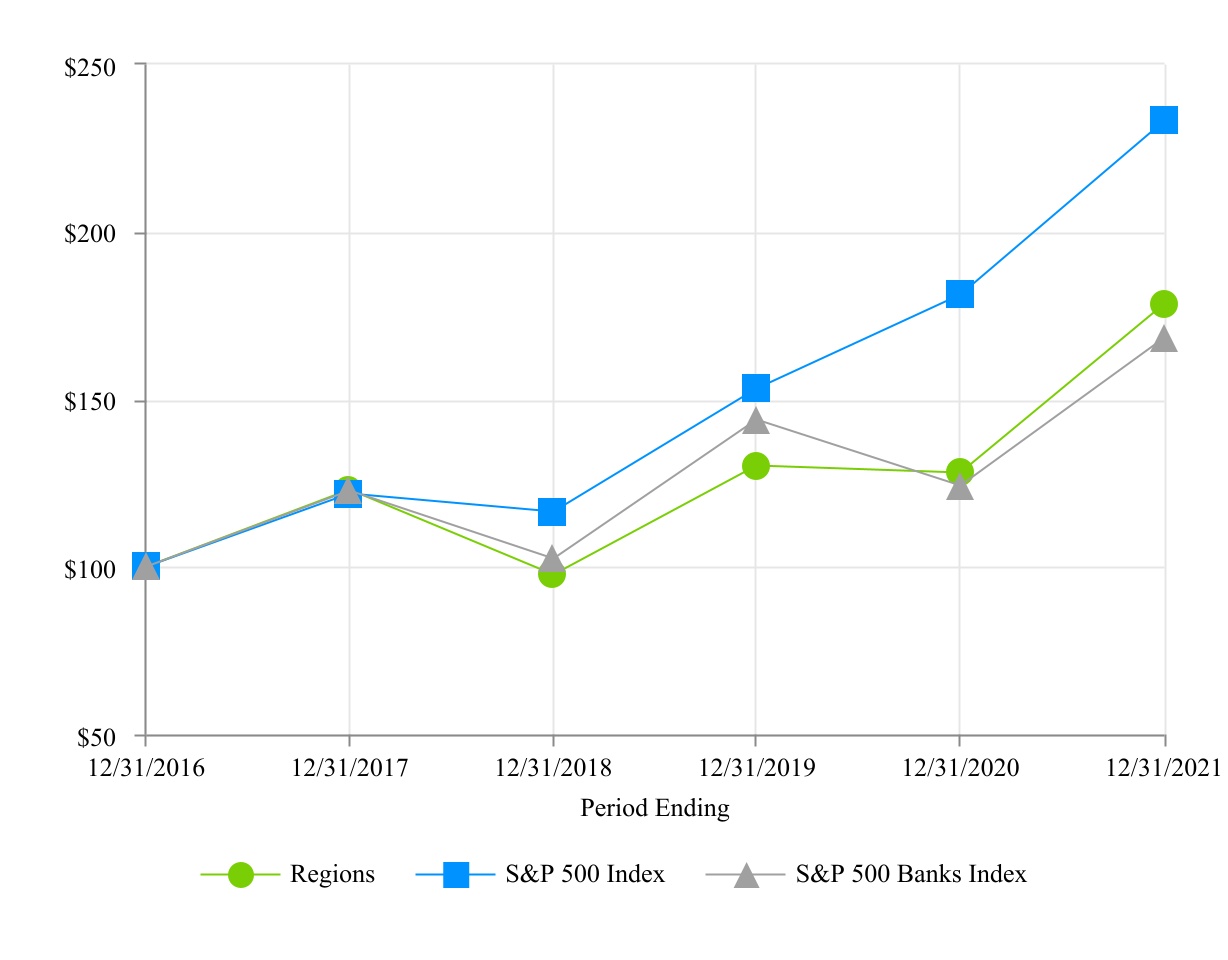
| Cumulative Total Return | |||||||||||||||||||||||||||||||||||
| 12/31/2016 | 12/31/2017 | 12/31/2018 | 12/31/2019 | 12/31/2020 | 12/31/2021 | ||||||||||||||||||||||||||||||
| Regions | $ | 100.00 | $ | 122.95 | $ | 97.66 | $ | 130.18 | $ | 128.05 | $ | 178.50 | |||||||||||||||||||||||
| S&P 500 Index | 100.00 | 121.82 | 116.47 | 153.13 | 181.29 | 233.28 | |||||||||||||||||||||||||||||
| S&P 500 Banks Index | 100.00 | 122.55 | 102.41 | 144.02 | 124.21 | 168.23 |
Item 6. [Reserved]
Table of Contents
Item 7. Management’s Discussion and Analysis of Financial Condition and Results of Operations
EXECUTIVE OVERVIEW
Management believes the following sections provide an overview of several of the most relevant matters necessary for an understanding of the financial aspects of Regions's business, particularly regarding its 2021 results. Cross references to more detailed information regarding each topic within MD&A and the consolidated financial statements are included. This summary is intended to assist in understanding the information provided, but should be read in conjunction with the entire MD&A and consolidated financial statements, as well as the other sections of this Annual Report on Form 10-K.
Economic Environment in Regions’ Banking Markets
One of the primary factors influencing the credit performance of Regions’ loan portfolio is the overall economic environment in the U.S. and the primary markets in which it operates. After preliminary growth of 5.7 percent in 2021, the February baseline forecast anticipates real GDP growth of 4.1 percent in 2022 and 3.2 percent in 2023, the January 2022 baseline forecast anticipates growth of 4.1 percent in 2022 and 3.0 percent in 2023. As in 2020 and 2021, intra-year growth patterns in 2022 will remain subject to period spikes and subsequent declines in COVID-19 case counts, though it could be that these swings in case counts become less disruptive as time goes on. As 2021 was coming to a close, there were signs that global supply chain and logistics bottlenecks were beginning to ease, and Regions expects further progress along these lines in 2022. The Company continues to expect that by late-2023 the economy will be back on the path of growth around 2.0 percent that prevailed prior to the pandemic. As has been the case since the onset of the pandemic, there remains a heightened degree of uncertainty around current economic forecasts.
With manufacturing activity across Asia having come back online, global shipping rates having fallen from their peaks, U.S. motor vehicle producers having recalled idled workers and increased production, late-2021 brought signs that the supply-side constraints that weighed on the U.S. economy over much of the year were easing. Though it will still be some time before supply chains are functioning normally, further progress along these lines will support stepped-up manufacturing activity. With business inventories having been drawn down significantly over the course of 2021, it is anticipated that inventory restocking will be a meaningful tailwind for growth in 2022. Additionally, with production having been curtailed in 2021, manufacturers and homebuilders ended the year with sizable backlogs of unfilled orders and, with supply-side constraints easing, backfilling these orders will also be a tailwind for growth in 2022.
As the supply side of the economy normalizes further over the course of 2022, the demand side of the economy is being waned from the considerable fiscal and monetary support provided in 2020 and 2021. Still, though to a lesser degree than was the case over the prior two years, fiscal and monetary policy will remain accommodative in 2022. While pandemic-related transfer payments such as the three rounds of Economic Impact Payments, supplemental unemployment insurance benefits, and the expanded Child Care Tax Credit have largely run their course, robust growth in labor earnings will help fill the void in disposable personal income. To that point, aggregate private sector wage and salary earnings, the largest single component of personal income, rose at an annualized rate of 11 percent in the fourth quarter of 2021, and while growth will moderate in 2022 it will nonetheless remain well above the pre-pandemic trend rate. Between robust growth in labor earnings, a significant pool of excess saving, and healthy household balance sheets, there are plenty of reasons for continued growth in consumer spending, though elevated inflation will likely weigh on growth in discretionary spending.
Business investment is expected to remain supportive of real GDP growth in 2022. Firms took advantage of favorable financing conditions, including elevated internal cash balances, to embark on replacement investment in machinery and equipment in 2021, and that is expected to continue in 2022. At the same time, firms increased investments in technology and automation in 2021 as a means of either enhancing labor productivity or substituting capital for labor given pressing labor supply constraints. That is expected to continue in 2022, and investment in intellectual property products is expected to remain robust. The one area of business investment that may continue to underperform is investment in structures, particularly as needs for physical office and retail space remain difficult to gauge.
The supply/demand imbalance in the housing market widened during 2021. Inventories of new homes for sale have been held down by shortages of labor and materials, and inventories of existing homes for sale continue to bump along near record-lows. At the same time, demand for home purchases has been fueled by favorable mortgage interest rates and greater freedom in work arrangements for many. The growing supply/demand imbalance has fueled rapid house price appreciation; the HPI was on course to rise by around 15 percent for full-year 2021 and another double-digit increase is expected in 2022 though the pace of price appreciation is expected to slow as the year progresses. It should be noted that, given the extent to which prices have risen to date, affordability has become an increasing issue even in the absence of higher mortgage interest rates. To the extent mortgage interest rates rise in 2022, affordability constraints will become more binding for increased numbers of prospective buyers.
Labor supply constraints have weighed on the pace of growth in nonfarm employment. At year-end 2021, the level of nonfarm employment was 3.6 million jobs below the level as of February 2020, and there were 2.3 million fewer people in the labor force than was the case at the onset of the pandemic. With over 10.5 million open jobs across the U.S. economy as of November 2021, there were more than 1.5 open jobs for each unemployed person. Labor force participation is expected to rise
Table of Contents
in 2022, but the labor force participation rate at year-end 2022 is expected to be well below the pre-pandemic rate. With continued strong demand for labor while labor supply remains constrained, wage growth has been much faster than would otherwise have been the case at this point in the cycle.
As measured by the CPI, inflation is likely to remain at or above 7.0 percent through the first quarter of 2022. The expectation of further easing of supply chain and logistics bottlenecks would contribute to a sharp deceleration in goods price inflation, if not outright goods price deflation. While that would act as a drag on overall inflation, faster growth in services prices is expected, including rent and medical care, and continued robust growth in labor costs to keep inflation easily above the FOMC’s 2.0 percent target rate through 2022. We believe the FOMC will begin raising the Fed funds rate in March and expect four or five 25-basis point hikes by year-end, though market expectations currently anticipate a slightly faster pace of rate hikes. We also anticipate the FOMC will allow the Fed’s balance sheet to begin winding down either late in the second quarter of 2022 or early in the third quarter of 2022. This would be a significant departure from the FOMC’s playbook during the prior cycle, when the Fed’s balance sheet was held steady for nearly three years after the asset purchases ended.
Patterns of economic activity within the Regions footprint are expected to be broadly similar to those seen in the U.S. as a whole. To the extent supply chain and logistics bottlenecks do ease over the course of 2022, an above-average exposure to manufacturing, particularly motor vehicle manufacturing, a
Showing the first 8K of 261K characters. Open the full section
Item 7A. Quantitative and Qualitative Disclosures about Market Risk
This information is set forth in the Risk Management section of Item 7 and is incorporated herein by reference.
Table of Contents
Item 8. Financial Statements and Supplementary Data
REPORT OF MANAGEMENT ON INTERNAL CONTROL OVER FINANCIAL REPORTING
We, as members of the Management of Regions Financial Corporation and subsidiaries (the “Company”), are responsible for establishing and maintaining effective internal control over financial reporting. Regions’ internal control system was designed to provide reasonable assurance to the Company’s management and Board of Directors regarding the preparation and fair presentation of the Company’s financial statements for external purposes in accordance with U.S. generally accepted accounting principles. Internal control over financial reporting includes self-monitoring mechanisms, and actions are taken to correct deficiencies as they are identified.
All internal controls systems, no matter how well designed, have inherent limitations and may not prevent or detect misstatements in the Company’s financial statements, including the possibility of circumvention or overriding of controls. Therefore, even those systems determined to be effective can provide only reasonable assurance with respect to financial statement preparation and presentation. Also, projections of any evaluation of effectiveness to future periods are subject to the risk that controls may become inadequate because of changes in conditions, or that the degree of compliance with the policies or procedures may deteriorate.
Regions’ management assessed the effectiveness of the Company’s internal control over financial reporting as of December 31, 2021. In making this assessment, we used the criteria set forth by the Committee of Sponsoring Organizations of the Treadway Commission (“COSO”) in its 2013 Internal Control—Integrated Framework. Based on our assessment, we believe and assert that, as of December 31, 2021, the Company’s internal control over financial reporting is effective based on those criteria.
Our assessment of and conclusion on the effectiveness of internal control over financial reporting did not include the internal controls over the operations of EnerBank USA or Sabal Capital Partners LLC, which are included in the Company's 2021 consolidated financial statements. EnerBank USA constituted approximately 2 percent of both the Company's total assets and total liabilities as of December 31, 2021, and less than 1 percent of total revenue for the year then ended. Sabal Capital Partners LLC constituted less than 1 percent of the Company's total assets and total liabilities as of December 31, 2021 and less than 1 percent of total revenue for the year then ended.
Regions’ independent registered public accounting firm has issued an audit report on the effectiveness of the Company’s internal control over financial reporting. This report appears on the following page.
| REGIONS FINANCIAL CORPORATION | ||||||||
| by | /S/ JOHN M. TURNER, JR. | |||||||
| John M. Turner, Jr. President and Chief Executive Officer | ||||||||
| by | /S/ DAVID J. TURNER, JR. | |||||||
| David J. Turner, Jr. Chief Financial Officer |
Table of Contents
REPORT OF INDEPENDENT REGISTERED PUBLIC ACCOUNTING FIRM
To the Shareholders and the Board of Directors of Regions Financial Corporation
Opinion on Internal Control over Financial Reporting
We have audited Regions Financial Corporation and subsidiaries’ internal control over financial reporting as of December 31, 2021, based on criteria established in Internal Control—Integrated Framework issued by the Committee of Sponsoring Organizations of the Treadway Commission (2013 framework) (the COSO criteria). In our opinion, Regions Financial Corporation and subsidiaries (the Company) maintained, in all material respects, effective internal control over financial reporting as of December 31, 2021, based on the COSO criteria.
As indicated in the accompanying Report of Management on Internal Control over Financial Reporting, management’s assessment of and conclusions on the effectiveness of internal control over financial reporting did not include the internal controls of EnerBank USA or Sabal Capital Partners LLC, which are included in the 2021 consolidated financial statements. EnerBank USA constituted approximately 2 percent of both the Company’s total assets and total liabilities as of December 31, 2021, and less than 1 percent of the Company’s total revenue for the year then ended. Sabal Capital Partners LLC constituted less than 1 percent of the Company’s total assets and total liabilities as of December 31, 2021, and less than 1 percent of the Company’s total revenue for the year then ended. Our audit of internal control over financial reporting of the Company also did not include an evaluation of the internal control over financial reporting of EnerBank USA or Sabal Capital Partners LLC.
We also have audited, in accordance with the standards of the Public Company Accounting Oversight Board (United States) (PCAOB), the consolidated balance sheets of Regions Financial Corporation and subsidiaries as of December 31, 2021 and 2020, the related consolidated statements of income, comprehensive income, shareholders’ equity and cash flows for each of the three years in the period ended December 31, 2021, and the related notes and our report dated February 24, 2022 expressed an unqualified opinion thereon.
Basis for Opinion
The Company’s management is responsible for maintaining effective internal control over financial reporting and for its assessment of the effectiveness of internal control over financial reporting included in the accompanying Report of Management on Internal Control over Financial Reporting. Our responsibility is to express an opinion on the Company’s internal control over financial reporting based on our audit. We are a public accounting firm registered with the PCAOB and are required to be independent with respect to the Company in accordance with the U.S. federal securities laws and the applicable rules and regulations of the Securities and Exchange Commission and the PCAOB.
We conducted our audit in accordance with the standards of the PCAOB. Those standards require that we plan and perform the audit to obtain reasonable assurance about whether effective internal control over financial reporting was maintained in all material respects.
Our audit included obtaining an understanding of internal control over financial reporting, assessing the risk that a material weakness exists, testing and evaluating the design and operating effectiveness of internal control based on the assessed risk, and performing such other procedures as we considered necessary in the circumstances. We believe that our audit provides a reasonable basis for our opinion.
Definition and Limitations of Internal Control Over Financial Reporting
A company’s internal control over financial reporting is a process designed to provide reasonable assurance regarding the reliability of financial reporting and the preparation of financial statements for external purposes in accordance with generally accepted accounting principles. A company’s internal control over financial reporting includes those policies and procedures that (1) pertain to the maintenance of records that, in reasonable detail, accurately and fairly reflect the transactions and dispositions of the assets of the company; (2) provide reasonable assurance that transactions are recorded as necessary to permit preparation of financial statements in accordance with generally accepted accounting principles, and that receipts and expenditures of the company are being made only in accordance with authorizations of management and directors of the company; and (3) provide reasonable assurance regarding prevention or timely detection of unauthorized acquisition, use, or dispo
Showing the first 8K of 454K characters. Open the full section
Item 9. Changes in and Disagreements with Accountants on Accounting and Financial Disclosure
Not Applicable.
Item 9A. Controls and Procedures
Based on an evaluation, as of the end of the period covered by this Form 10-K, under the supervision and with the participation of Regions’ management, including its Chief Executive Officer and Chief Financial Officer, the Chief Executive Officer and the Chief Financial Officer have concluded that Regions’ disclosure controls and procedures (as defined in Rule 13a-15(e) under the Securities Exchange Act of 1934) are effective. In the fourth quarter, Regions acquired EnerBank and Sabal Capital Partners and are in the process of integrating the acquired businesses into our overall internal control over financial reporting process. As permitted under applicable regulations, we have excluded acquisitions from our assessment of internal control over financial reporting as of December 31, 2021.
During the fourth fiscal quarter of the year ended December 31, 2021, there have been no changes in Regions’ internal control over financial reporting that have materially affected, or are reasonably likely to materially affect, Regions’ control over financial reporting.
The Report of Management on Internal Control Over Financial Reporting and the attestation report of registered public accounting firm on registrant's internal control over financial reporting are included in Item 8. of this Annual Report on Form 10-K.
Item 9B. Other Information
Not applicable.
Item 9C. Disclosure Regarding Foreign Jurisdictions that Prevent Inspections
Not applicable.
Table of Contents
PART III
Item 10. Directors, Executive Officers and Corporate Governance
Information about the Directors and Director nominees of Regions included in Regions’ Proxy Statement for the 2022 Annual Meeting of Shareholders (the “Proxy Statement”) under the captions “PROPOSAL 1—ELECTION OF DIRECTORS—Who are this year's nominees?,” “—What criteria were considered by the NCG Committee in selecting the nominees?,” “—What skills and characteristics are currently represented on the Board?,” and “—How often are the Directors elected?” and the information incorporated by reference pursuant to Item 13. below are incorporated herein by reference. Information regarding Regions’ executive officers is at the end of Item I of this Annual Report on Form 10-K.
Information regarding Regions’ Audit Committee included in the Proxy Statement under the caption “CORPORATE GOVERNANCE—Audit Committee” is incorporated herein by reference.
Information regarding timeliness of filings under Section 16(a) of the Securities Exchange Act of 1934 included in the Proxy Statement under the caption “OWNERSHIP OF REGIONS COMMON STOCK—Delinquent Section 16(a) Reports” is incorporated herein by reference.
Information regarding Regions’ Code of Ethics for Senior Financial Officers included in the Proxy Statement under the caption “CORPORATE GOVERNANCE—Codes of Ethics” is incorporated herein by reference.
Information included in the Proxy Statement under the caption “CORPORATE GOVERNANCE—Family Relationships” is incorporated herein by reference.
Table of Contents
Item 11. Executive Compensation
All information presented under the captions “COMPENSATION DISCUSSION AND ANALYSIS,” “COMPENSATION OF EXECUTIVE OFFICERS,” “COMPENSATION AND HUMAN RESOURCES COMMITTEE REPORT,” “CORPORATE GOVERNANCE—Compensation Committee Interlocks and Insider Participation” and “—Relationship of Compensation Policies and Practices to Risk Management,” and “PROPOSAL 1—ELECTION OF DIRECTORS—How are Directors compensated?” of the Proxy Statement are incorporated herein by reference.
Item 12. Security Ownership of Certain Beneficial Owners and Management and Related Stockholder Matters
All information presented under the caption “OWNERSHIP OF REGIONS COMMON STOCK” of the Proxy Statement is incorporated herein by reference.
Equity Compensation Plan Information
The following table gives information about the common stock that may be issued upon the exercise of options, warrants and rights under all of Regions’ existing equity compensation plans as of December 31, 2021.
| Plan Category | Number of Securities to be Issued Upon Exercise of Outstanding Options, Warrants and Rights (a) | Weighted Average Exercise Price of Outstanding Options, Warrants and Rights | Number of Securities Remaining Available Under Equity Compensation Plans (Excluding Securities in First Column) | ||||||||||||||
| Equity Compensation Plans Approved by Stockholders | — | $ | — | 30,267,272 | (b) | ||||||||||||
| Equity Compensation Plans Not Approved by Stockholders | — | $ | — | — | |||||||||||||
| Total | — | $ | — | 30,267,272 |
(a)Does not include outstanding restricted stock units of 11,206,894.
(b)Consists of shares available for future issuance under the Regions Financial Corporation 2015 Long Term Incentive Plan. In 2015, all prior long-term incentive plans were closed to new grants.
Item 13. Certain Relationships and Related Transactions, and Director Independence
All information presented under the captions “CORPORATE GOVERNANCE—Transactions with Directors,” “—Other Business Relationships and Transactions,” “—Policies Governing Transactions with Related Persons” and “—Director Independence” of the Proxy Statement is incorporated herein by reference.
Item 14. Principal Accountant Fees and Services
All information presented under the caption “ PROPOSAL 2—RATIFICATION OF APPOINTMENT OF INDEPENDENT REGISTERED PUBLIC ACCOUNTING FIRM” of the Proxy Statement is incorporated herein by reference.
Table of Contents
PART IV
Item 15. Exhibits and Financial Statement Schedules
(a) 1. Consolidated Financial Statements. The following reports of independent registered public accounting firm (PCAOB ID: 42) and consolidated financial statements of Regions and its subsidiaries are included in Item 8. of this Form 10-K:
| Reports of Independent Registered Public Accounting Firm; | ||
| Consolidated Balance Sheets—December 31, 2021 and 2020; | ||
| Consolidated Statements of Income—Years ended December 31, 2021, 2020 and 2019; | ||
| Consolidated Statements of Comprehensive Income—Years ended December 31, 2021, 2020 and 2019; | ||
| Consolidated Statements of Changes in Shareholders’ Equity—Years ended December 31, 2021, 2020 and 2019; and | ||
| Consolidated Statements of Cash Flows—Years ended December 31, 2021, 2020 and 2019. | ||
| Notes to Consolidated Financial Statements |
- Consolidated Financial Statement Schedules. The following consolidated financial statement schedules are included in Item 8. of this Form 10-K:
None. The Schedules to consolidated financial statements are not required under the related instructions or are inapplicable.
(b) Exhibits. The exhibits indicated below are either included or incorporated by reference as indicated.
Table of Contents
Table of Contents
Table of Contents
Table of Contents
Table of Contents
| SEC Assigned Exhibit Number | Description of Exhibits | |||||||
| 101 | The following materials from Regions' Form 10-K Report for the year ended December 31, 2021, formatted in Inline XBRL: (i) the Consolidated Balance Sheets; (ii) the Consolidated Statements of Income; (iii) the Consolidated Statements of Comprehensive Income; (iv) the Consolidated Statements of Changes in Stockholders' Equity; (v) the Consolidated Statements of Cash Flows; and (vi) the Notes to the Consolidated Financial Statements. | |||||||
| 104 | The cover page of Regions' Form 10-K Report for the year ended December 31, 2021, formatted in Inline XBRL (included within the Exhibit 101 attachments). | |||||||
- Compensatory plan or agreement.
Copies of exhibits not included herein may be obtained free of charge, electronically through Regions’ website at www.regions.com or through the SEC’s website at www.sec.gov or upon request to:
Investor Relations
Regions Financial Corporation
1900 Fifth Avenue North
Birmingham, Alabama 35203
(205) 264-7040
Item 16. Form 10-K Summary
Not applicable.
Table of Contents
SIGNATURES
Pursuant to the requirements of Section 13 or 15(d) of the Securities Exchange Act of 1934, the registrant has duly caused this report to be signed on its behalf by the undersigned, thereunto duly authorized.
| DATE: | February 24, 2022 | Regions Financial Corporation | |||||||||
| By: | /S/ JOHN M. TURNER, JR. | ||||||||||
| John M. Turner, Jr. President and Chief Executive Officer |
Pursuant to the requirements of the Securities Exchange Act of 1934, this report has been signed below by the following persons on behalf of the registrant and in the capacities and on the dates indicated
Table of Contents
| Signature | Title | Date | |||||||||
| /S/ JOHN M. TURNER, JR. | President and Chief Executive Officer, and Director (principal executive officer) | February 24, 2022 | |||||||||
| John M. Turner, Jr. | |||||||||||
| /S/ DAVID J. TURNER, JR. | Senior Executive Vice President and Chief Financial Officer (principal financial officer) | February 24, 2022 | |||||||||
| David J. Turner, Jr. | |||||||||||
| /S/ HARDIE B. KIMBROUGH, JR. | Executive Vice President and Controller (principal accounting officer) | February 24, 2022 | |||||||||
| Hardie B. Kimbrough, Jr. | |||||||||||
| * | Director | February 24, 2022 | |||||||||
| Carolyn H. Byrd | |||||||||||
| * | Director | February 24, 2022 | |||||||||
| Don DeFosset | |||||||||||
| * | Director | February 24, 2022 | |||||||||
| Samuel A. Di Piazza, Jr. | |||||||||||
| * | Director | February 24, 2022 | |||||||||
| Zhanna Golodryga | |||||||||||
| * | Director | February 24, 2022 | |||||||||
| John D. Johns | |||||||||||
| * | Director | February 24, 2022 | |||||||||
| Join M. Johnson | |||||||||||
| * | Director | February 24, 2022 | |||||||||
| Ruth Ann Marshall | |||||||||||
| * | Director | February 24, 2022 | |||||||||
| Charles D. McCrary | |||||||||||
| * | Director | February 24, 2022 | |||||||||
| James T. Prokopanko | |||||||||||
| * | Director | February 24, 2022 | |||||||||
| Lee J. Styslinger III | |||||||||||
| * | Director | February 24, 2022 | |||||||||
| José S. Suquet | |||||||||||
| * | Director | February 24, 2022 | |||||||||
| Timothy Vines |
Table of Contents
- Tara A. Plimpton, by signing her name hereto, does sign this document on behalf of each of the persons indicated above pursuant to powers of attorney executed by such persons and filed with the Securities and Exchange Commission.
| By: | /S/ Tara A. Plimpton | ||||
| Tara A. Plimpton | |||||
| Attorney in Fact |