 filings.tools
Raymond James Financial 10-K 2019-09-30
Filed 2019-11-26. 17 sections, 723K characters. Original on sec.gov · Markdown · JSON
Cover and table of contents
UNITED STATES
SECURITIES AND EXCHANGE COMMISSION
Washington, D.C. 20549
FORM 10-K
| ☒ | ANNUAL REPORT PURSUANT TO SECTION 13 OR 15(d) OF THE SECURITIES EXCHANGE ACT OF 1934 |
For the fiscal year ended September 30, 2019
Or
| ☐ | TRANSITION REPORT PURSUANT TO SECTION 13 OR 15(d) OF THE SECURITIES EXCHANGE ACT OF 1934 |
For the transition period from to
Commission file number 1-9109
RAYMOND JAMES FINANCIAL, INC.
(Exact name of registrant as specified in its charter)
| Florida | 59-1517485 | |
| (State or other jurisdiction of | (I.R.S. Employer | |
| incorporation or organization) | Identification No.) |
| 880 Carillon Parkway | St. Petersburg | Florida | 33716 |
| (Address of principal executive offices) | (Zip Code) |
(727) 567-1000
Registrant’s telephone number, including area code
Securities registered pursuant to Section 12(b) of the Exchange Act:
| Title of each class | Trading Symbol(s) | Name of each exchange on which registered |
| Common Stock, $.01 par value | RJF | New York Stock Exchange |
| Securities registered pursuant to Section 12(g) of the Exchange Act: | None |
Indicate by check mark if the registrant is a well-known seasoned issuer, as defined in Rule 405 of the Securities Act. Yes ☒ No ☐
Indicate by check mark if the registrant is not required to file reports pursuant to Section 13 or Section 15(d) of the Exchange Act. Yes ☐ No ☒
Indicate by check mark whether the registrant (1) has filed all reports required to be filed by Section 13 or 15(d) of the Exchange Act during the preceding 12 months (or for such shorter period that the registrant was required to file such reports), and (2) has been subject to such filing requirements for the past 90 days. Yes ☒ No ☐
Indicate by check mark whether the registrant has submitted electronically every Interactive Data File required to be submitted pursuant to Rule 405 of Regulation S-T (Section 232.405) during the preceding 12 months (or for such shorter period that the registrant was required to submit such files). Yes ☒ No ☐
Indicate by check mark whether the registrant is a large accelerated filer, an accelerated filer, a non-accelerated filer, a smaller reporting company, or an emerging growth company. See the definitions of “large accelerated filer,” “accelerated filer,” “smaller reporting company,” and “emerging growth company” in Rule 12b-2 of the Exchange Act.
| Large accelerated filer | ☒ | Accelerated filer | ☐ |
| Non-accelerated filer | ☐ | Smaller reporting company | ☐ |
| Emerging growth company | ☐ |
If an emerging growth company, indicate by check mark if the registrant has elected not to use the extended transition period for complying with any new or revised financial accounting standards provided pursuant to Section 13(a) of the Exchange Act. ☐
Indicate by check mark whether the registrant is a shell company (as defined in Rule 12b-2 of the Exchange Act). Yes ☐ No ☒
As of March 29, 2019, the aggregate market value of the registrant’s common stock held by non-affiliates of the registrant computed by reference to the price at which the common stock was last sold was $10,125,195,760.
The number of shares outstanding of the registrant’s common stock as of November 25, 2019 was 138,723,230.
DOCUMENTS INCORPORATED BY REFERENCE
Portions of the definitive Proxy Statement to be delivered to shareholders in connection with the Annual Meeting of Shareholders to be held February 20, 2020 are incorporated by reference into Part III.
RAYMOND JAMES FINANCIAL, INC.
TABLE OF CONTENTS
| PAGE | |||
| PART I. | |||
| Item 1. | Business | 3 | |
| Item 1A. | Risk factors | 16 | |
| Item 1B. | Unresolved staff comments | 29 | |
| Item 2. | Properties | 29 | |
| Item 3. | Legal proceedings | 29 | |
| Item 4. | Mine safety disclosures | 30 | |
| PART II. | |||
| Item 5. | Market for registrant’s common equity, related shareholder matters and issuer purchases of equity securities | 30 | |
| Item 6. | Selected financial data | 32 | |
| Item 7. | Management’s discussion and analysis of financial condition and results of operations | 33 | |
| Item 7A. | Quantitative and qualitative disclosures about market risk | 70 | |
| Item 8. | Financial statements and supplementary data | 71 | |
| Item 9. | Changes in and disagreements with accountants on accounting and financial disclosure | 144 | |
| Item 9A. | Controls and procedures | 144 | |
| Item 9B. | Other information | 147 | |
| PART III. | |||
| Item 10. | Directors, executive officers and corporate governance | 147 | |
| Item 11. | Executive compensation | 147 | |
| Item 12. | Security ownership of certain beneficial owners and management and related shareholder matters | 147 | |
| Item 13. | Certain relationships and related transactions, and director independence | 147 | |
| Item 14. | Principal accountant fees and services | 147 | |
| PART IV. | |||
| Item 15. | Exhibits and financial statement schedules | 147 | |
| Signatures | 151 |
RAYMOND JAMES FINANCIAL, INC. AND SUBSIDIARIES
PART I
Item 1. BUSINESS
Raymond James Financial, Inc. (“RJF,” the “firm” or the “Company”) is a leading diversified financial services company providing private client group, capital markets, asset management, banking and other services to individuals, corporations and municipalities. The firm, together with its subsidiaries, is engaged in various financial services activities, including providing investment management services for retail and institutional clients, the underwriting, distribution, trading and brokerage of equity and debt securities and the sale of mutual funds and other investment products. The firm also provides corporate and retail banking services, and trust services. We operate predominately in the U.S. and, to a lesser extent, in Canada, the United Kingdom (“U.K.”), and other parts of Europe.
Established in 1962 and public since 1983, RJF is listed on the New York Stock Exchange (the “NYSE”) under the symbol “RJF.” As a bank holding company and financial holding company, RJF is subject to supervision, examination and regulation by the Board of Governors of the Federal Reserve System (the “Fed”).
Among the keys to our historical and continued success, our emphasis on putting the client first is at the core of our corporate values. We also believe in maintaining a conservative, long-term focus in our decision making. We believe that this disciplined decision-making approach translates to a strong, stable financial services firm for clients, advisors, associates and shareholders.
REPORTABLE SEGMENTS
We currently operate through five segments. Our business segments are Private Client Group (“PCG”), Capital Markets, Asset Management and Raymond James Bank (“RJ Bank”). Our Other segment includes our private equity investments, interest income on certain corporate cash balances and certain corporate overhead costs of RJF that are not allocated to our business segments, including the interest costs on our public debt.
The following graph depicts the relative net revenue contribution of each of our business segments for the fiscal year ended September 30, 2019.
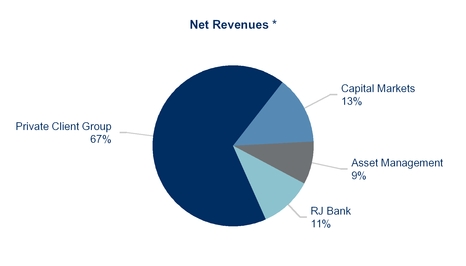
- The preceding chart does not include intersegment eliminations or the Other segment.
PRIVATE CLIENT GROUP
We provide financial planning and securities transaction services through a branch office network. Financial advisors have multiple affiliation options, which we refer to as AdvisorChoice. Our two primary affiliation options for financial advisors are the employee option and the independent contractor option.
We recruit experienced financial advisors from a wide variety of competitors. As a part of their agreement to join us, we may make loans to financial advisors and to certain other key revenue producers primarily for recruiting, transitional cost assistance, and retention purposes.
Total client assets under administration (“AUA”) in our PCG segment as of September 30, 2019 were $798.4 billion, of which $409.1 billion related to fee-based accounts (“fee-based AUA”). We had 8,011 financial advisors affiliated with us as of September 30, 2019.
RAYMOND JAMES FINANCIAL, INC. AND SUBSIDIARIES
Employee financial advisors
Employee financial advisors work in a traditional branch setting supported by local management and administrative staff. They provide services predominately to retail clients. Compensation for these financial advisors primarily includes commission payments and participation in the firm’s benefit plans.
Independent contractor financial advisors
Our financial advisors who are independent contractors are responsible for all of their direct costs and, accordingly, receive a higher payout percentage than employee financial advisors. Our independent contractor financial advisor option is designed to help our advisors build their businesses with as much or as little of our support as they determine they need. With specific approval, and on a limited basis, they are permitted to conduct certain other approved business activities, such as offering insurance products, independent registered investment advisory services, and accounting and tax services.
Products and services
Irrespective of the affiliation choice, our financial advisors offer a broad range of investment products and services, including both third-party and proprietary products, and a variety of financial planning services. Revenues from this segment are typically driven by AUA and are generally either asset-based or transactional in nature. The proportion of our brokerage revenues originating from the employee versus the independent contractor affiliation models is relatively balanced.
PCG segment net revenues the fiscal year ended September 30, 2019 are presented in the following graph.
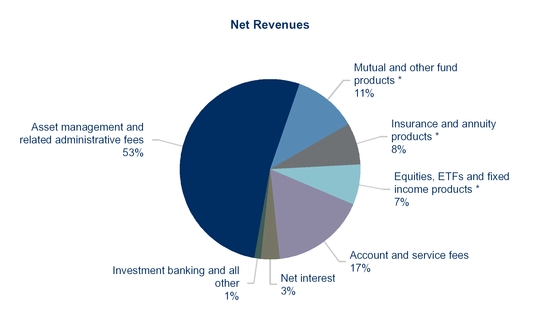
- Included in “Brokerage revenues” on our Consolidated Statements of Income and Comprehensive Income.
We provide the following products and services through this segment:
| • | Investment services for which we charge sales commissions or asset-based fees based on established schedules. |
| • | Portfolio management services for which we charge either a fee computed as a percentage of the assets in the client’s account or a flat periodic fee. |
| • | Insurance and annuity products. |
| • | Professionally managed mutual funds. |
| • | Support to third-party product partners, including sales and marketing support, product availability and distribution, and accounting and administrative services. |
RAYMOND JAMES FINANCIAL, INC. AND SUBSIDIARIES
| • | Administrative services to banks to which we sweep a portion of our clients’ cash deposits as part of the Raymond James Bank Deposit Program (“RJBDP”), our multi-bank sweep program. Fees received from third-party banks for these services are variable in nature and fluctuate based on client cash balances in the program, as well as the level of short-term interest rates relative to interest paid to clients on balances in the RJBDP. PCG also earns servicing fees from RJ Bank, which are based on the number of accounts that are swept to RJ Bank. These fees are eliminated in consolidation. |
| • | Margin loans to clients that are collateralized by the securities purchased or by other securities owned by the client. Interest is charged to clients on the amount borrowed based on current interest rates. |
| • | Custodial, trading, research and other support and services (including access to clients’ account information and the services of the Asset Management segment) to the independent registered investment advisors who are affiliated with us. |
| • | Securities borrowing and lending activities with other broker-dealers, financial institutions and other counterparties. The net revenues of this business consist of the interest spreads generated on these activities. |
| • | Diversification strategies and alternative investment products to qualified clients of our affiliated financial advisors. |
CAPITAL MARKETS
Our Capital Markets segment conducts institutional sales, securities trading, equity research, investment banking and the syndication and management of investments that qualify for tax credits (referred to as our “tax credit funds”). Within our management structure, we distinguish between activities that support equity and fixed income products and services.
Capital Markets segment net revenues for the fiscal year ended September 30, 2019 are presented in the following graph.
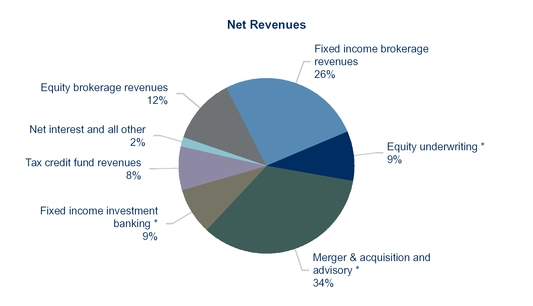
- Included in “Investment banking” on our Consolidated Statements of Income and Comprehensive Income.
We provide the following services through this segment.
Equity products and services
| • | We earn brokerage revenues on the sale of equity products to institutional clients. Client activity is influenced by a combination of general market activity and our Capital Markets group’s ability to identify attractive investment opportunities for our institutional clients. Revenues on equity transactions are generally based on trade size and the amount of business conducted annually with each institution. |
| • | We provide various investment banking services including public and private equity financing for corporate clients and merger & acquisition and advisory services. Our investment banking activities include a comprehensive range of strategic and financial advisory services tailored to our clients’ business life cycles and backed by our strategic industry focus. |
RAYMOND JAMES FINANCIAL, INC. AND SUBSIDIARIES
| • | Our global research department supports our institutional and retail sales efforts and publishes research on a wide variety of companies. This research primarily focuses on U.S. and Canadian companies in specific industries, including consumer, energy, financial services, healthcare, industrial, real estate, technology and communications, and transportation. Research reports are made available to both institutional and retail clients. |
Fixed income products and services
| • | We earn revenues from institutional clients who purchase and sell both taxable and tax-exempt fixed income products, primarily municipal, corporate, government agency and mortgage-backed bonds, and whole loans. We carry inventories of taxable and tax-exempt securities to facilitate client transactions. |
| • | Our fixed income investment banking services include public finance and debt underwriting activities where we serve as a financial advisor, placement agent or underwriter to various issuers, including state and local government agencies (and their political subdivisions), housing agencies, and non-profit entities including healthcare and higher education institutions. When underwriting new issue securities, we may agree to purchase the issue through a negotiated sale or submission of a competitive bid. |
| • | We enter into interest rate derivatives to facilitate client transactions or to actively manage risk exposures that arise from our client activity, including a portion of our trading inventory. In addition, we conduct a “matched book” derivatives business where we may enter into interest rate derivative transactions with clients. In this matched book business, for every derivative transaction we enter into with a client, we enter into an offsetting derivative transaction with a credit support provider that is a third-party financial institution. |
Tax credit funds
| • | We act as the general partner or managing member in partnerships and limited liability companies that invest in real estate project entities which qualify for tax credits under Section 42 of the Internal Revenue Code and/or provide a mechanism for banks and other institutions to meet their Community Reinvestment Act (“CRA”) obligations throughout the U.S. We earn fees for the origination and sale of these investment products as well as for the oversight and management of the investments over the statutory tax credit compliance period. |
ASSET MANAGEMENT
Our Asset Management segment earns asset management and related administrative fees for providing portfolio management and related administrative services for retail and institutional clients. This segment oversees a portion of our fee-based AUA for our PCG clients through our asset management services division (“AMS”) and through Raymond James Trust, N.A. (“RJ Trust”). This segment also provides asset management services through Carillon Tower Advisers and affiliates (collectively, “Carillon Tower Advisers”) for certain retail accounts managed on behalf of third-party institutions, institutional accounts and proprietary mutual funds that we manage.
Management fees in this segment are generally calculated as a percentage of the value of our fee-billable financial assets under management (“AUM”) in both AMS (including the portion of fee-based AUA in PCG that is overseen by AMS) and Carillon Tower Advisers, where investment decisions are made by in-house or third-party portfolio managers or investment committees. The fee rates applied are dependent upon various factors, including the distinctive services provided and the level of assets within each client relationship. The fee rates applied in Carillon Tower Advisers may also vary based on the account objective (i.e., equity, fixed income, or balanced). Our AUM are impacted by market fluctuations and net inflows or outflows of assets, including transfers between fee-based accounts and traditional transaction-based accounts within our PCG segment. Fees are generally collected quarterly and are based on balances as of the beginning of the quarter (particularly in AMS) or the end of the quarter, or based on average daily balances.
Our Asset Management segment also earns administrative fees on certain fee-based assets within PCG that are not overseen by our Asset Management segment, but for which the segment provides administrative support (e.g., record-keeping).
RAYMOND JAMES FINANCIAL, INC. AND SUBSIDIARIES
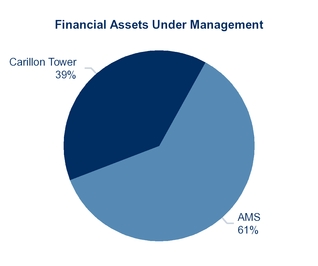
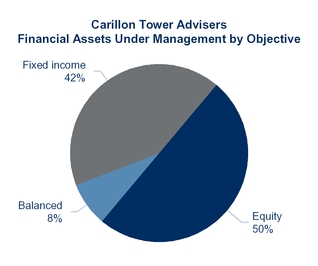
Our AUM and our Carillon Tower Advisers AUM by objective as of September 30, 2019 are presented in the following graphs.
RJ BANK
RJ Bank is a national bank that provides various types of loans, including corporate loans (commercial and industrial (“C&I”), commercial real estate (“CRE”) and CRE construction), tax-exempt loans, residential loans, securities-based loans (“SBL”) and other loans. RJ Bank is active in corporate loan syndications and participations. RJ Bank also provides Federal Deposit Insurance Corporation (“FDIC”)-insured deposit accounts, including to clients of our broker-dealer subsidiaries. RJ Bank generates net interest revenue principally through the interest income earned on loans and an investment portfolio of securities, which is offset by the interest expense it pays on client deposits and on its borrowings.
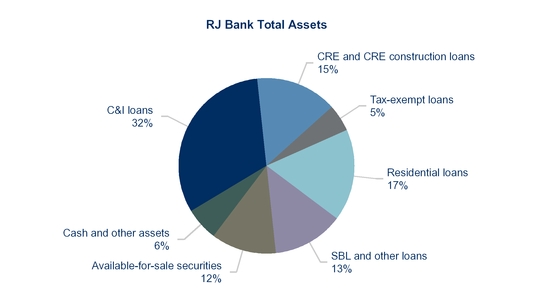
As of September 30, 2019, corporate and tax-exempt loans represented approximately 62% of RJ Bank’s loan portfolio, of which 88% were U.S. and Canadian syndicated loans. Residential mortgage loans are originated or purchased and held for investment or sold in the secondary market. RJ Bank’s investment portfolio is primarily comprised of agency mortgage-backed securities (“MBS”) and collateralized mortgage obligations (“CMOs”) and is classified as available-for-sale. RJ Bank’s liabilities primarily consist of deposits that are cash balances swept from the investment accounts of PCG clients.
RJ Bank had total assets of $25.52 billion at September 30, 2019, which are detailed in the following graph.
RAYMOND JAMES FINANCIAL, INC. AND SUBSIDIARIES
OTHER
Our Other segment includes our private equity investments, interest income on certain corporate cash balances, and certain corporate overhead costs of RJF, including the interest costs on our public debt.
Our private equity portfolio includes various direct and third-party private equity investments and various legacy private equity funds which we sponsor.
EMPLOYEES AND INDEPENDENT CONTRACTORS
Our employees, including employee financial advisors, and independent contractors (collectively “associates”) are vital to our success in the financial services industry. As of September 30, 2019, we had approximately 14,200 employees and 4,710 affiliated independent contractor financial advisors.
OPERATIONS AND INFORMATION PROCESSING
We have operations personnel at various locations who are responsible for processing securities transactions, custody of client securities, support of client accounts, the receipt, identification and delivery of funds and securities, and compliance with regulatory and legal requirements for most of our securities brokerage operations.
The information technology department develops and supports the integrated solutions that provide a customized platform for our businesses. These include a platform for financial advisors designed to allow them to spend more time with their clients and enhance and grow their businesses; systems that support institutional and retail sales and trading activity through to settlement and custody; and thorough security protocols to protect firm and client information.
In the area of information security, we have developed and implemented a framework of principles, policies and technology to protect both our own information and that of our clients. We apply numerous safeguards to maintain the confidentiality, integrity and availability of both client and firm information.
Our business continuity program has been developed to provide reasonable assurance that we will continue to operate in the event of disruptions at our critical facilities. We have developed operational plans for such disruptions, and we have a full time staff devoted to maintaining those plans. Our business continuity plan continues to be enhanced and tested to allow for continuous operations in the event of weather-related or other interruptions at our corporate headquarters in Florida, one of our operations processing or data center sites (located in Florida, Colorado, Tennessee or Michigan), and our branch and office locations throughout the U.S., Canada and Europe.
COMPETITION
The financial services industry is intensely competitive. We compete with many other financial services firms, including a number of larger securities firms, most of which are affiliated with major financial services companies, insurance companies, banking institutions and other organizations. We also compete with companies that offer web-based financial services and discount brokerage services to individual clients, usually with lower levels of service, and, more recently, financial technology (“fintech”) firms. We compete principally on the basis of the quality of our associates, services, product selection, performance records, location and reputation in local markets.
Our ability to compete effectively is substantially dependent on our continuing ability to attract, retain and motivate qualified financial advisors, investment bankers, trading professionals, portfolio managers and other revenue-producing or specialized personnel.
REGULATION
The following discussion summarizes the principal elements of the regulatory and supervisory framework applicable to RJF as a participant in the financial services industry and, in particular, the banking and securities sectors. The framework includes extensive regulation under U.S. federal and state laws, as well as the applicable laws of the jurisdictions outside the U.S. in which RJF does business, and is intended to protect our clients, the integrity of the financial markets, our depositors and the Federal Deposit Insurance Fund and is not intended to protect our creditors or shareholders. These rules and regulations limit our ability to engage in certain activities, as well as our ability to fund RJF from our regulated subsidiaries, which include RJ Bank and our broker-dealer subsidiaries. To the extent that the following information describes statutory and regulatory provisions, it is qualified in its entirety by reference to
RAYMOND JAMES FINANCIAL, INC. AND SUBSIDIARIES
the particular statutory and regulatory provisions that are referenced. A change in applicable statutes or regulations or in regulatory or supervisory policy may have a material effect on our business.
We continue to experience a period of notable change in financial regulation and supervision. These changes could have a significant impact on how we conduct our business. Many regulatory or supervisory policies remain in a state of flux and may be subject to amendment in the near future. As a result, we cannot specifically quantify the impact that such regulatory or supervisory requirements will have on our business and operations (see Item 1A “Risk Factors” within this report for further discussion of the potential future impact on our operations).
Banking supervision and regulation
RJF is a bank holding company (“BHC”) under the Bank Holding Company Act of 1956, as amended (the “BHC Act”), that has made an election to be a financial holding company (“FHC”) and is subject to regulation, oversight and consolidated supervision, including periodic examination, by the Fed. Under the system of “functional regulation” established under the BHC Act, the primary regulators of our U.S. non-bank subsidiaries directly regulate the activities of those subsidiaries, with the Fed exercising a supervisory role. Such “functionally regulated” subsidiaries include our broker-dealers registered with the Securities and Exchange Commission (“SEC”), such as Raymond James & Associates (“RJ&A”) and Raymond James Financial Services, Inc. (“RJFS”), investment advisors registered with the SEC with respect to their investment advisory activities, and our depository institution and trust company chartered and regulated by the Office of the Comptroller of the Currency (“OCC”).
RJ Bank is a national bank and insured depository institution regulated, supervised and examined by the OCC and the Consumer Financial Protection Bureau (“CFPB”). Our trust company non-depository subsidiary, RJ Trust, is also regulated, supervised and examined by the OCC. The Fed and the FDIC also regulate and may examine RJ Bank and, with respect to the Fed, RJ Trust.
Collectively, the rules and regulations of the Fed, the OCC, the FDIC and the CFPB cover all aspects of the banking business, including, for example, lending practices, the receipt of deposits, capital structure, transactions with affiliates, conduct and qualifications of personnel and, as discussed further in the following sections, capital requirements. This regulatory, supervisory and oversight framework is subject to significant changes that can affect the operating costs and permissible businesses of RJF, RJ Bank, RJ Trust and all of our other subsidiaries. As a part of their supervisory functions, the Fed, the OCC, the FDIC, and the CFPB also have the power to bring enforcement actions for violations of law and, in the case of the Fed, the OCC and the FDIC, for unsafe or unsound practices.
Basel III and U.S. capital rules
Both RJF and RJ Bank are subject to minimum capital requirements and overall capital adequacy standards. The OCC, the Fed and the FDIC published final U.S. rules implementing the Basel III capital framework developed by the Basel Committee on Banking Supervision and certain Dodd-Frank Wall Street Reform and Consumer Protection Act (“Dodd-Frank Act”) and other capital provisions and updated the prompt corrective action framework to reflect the new regulatory capital minimums (the “U.S. Basel III Rules”). The U.S. Basel III Rules: (i) increased the quantity and quality of regulatory capital; (ii) established a capital conservation buffer; and (iii) made changes to the calculation of risk-weighted assets. The U.S. Basel III Rules became effective for RJF on January 1, 2015, subject to applicable phase-in periods. The rules governing the capital conservation buffer became effective for both RJF and RJ Bank on January 1, 2016. The capital requirements could restrict our ability to grow during favorable market conditions and to return capital to shareholders, or require us to raise additional capital. As a result, our business, results of operations, financial condition and prospects could be adversely affected. See Item 1A “Risk Factors” within this report for more information.
Failure to meet minimum capital requirements can trigger discretionary, and in certain cases, mandatory actions by regulators that could have a direct material effect on the financial results of RJF and RJ Bank. Under capital adequacy guidelines, RJF and RJ Bank must meet specific capital guidelines that involve quantitative measures of assets, liabilities and certain off-balance sheet items as calculated under regulatory accounting practices. The capital amounts and classification for RJF and RJ Bank are also subject to the qualitative judgments of U.S. regulators based on components of capital, risk-weightings of assets, off-balance sheet transactions and other factors. Quantitative measures established by federal banking regulations to ensure capital adequacy require that RJF and RJ Bank maintain minimum amounts and ratios of: (i) Common Equity Tier 1 (or “CET1”), Tier 1 and Total capital to risk-weighted assets; (ii) Tier 1 capital to average total consolidated assets; and (iii) capital conservation buffers.
In July 2019, the Fed issued a final rule to simplify and clarify a number of existing regulatory capital rules for certain banking organizations. Specifically, the rule simplifies the capital treatment for mortgage servicing assets, certain deferred tax assets, investments in the capital instruments of unconsolidated financial institutions, and minority interest. This rule would also allow BHCs like RJF to repurchase common stock without prior approval from the Fed to the extent that the BHC is not subject to a separate legal or regulatory requirement to obtain prior approval. RJF would continue to need to obtain prior approval from the Fed if it were not “well-capitalized”
RAYMOND JAMES FINANCIAL, INC. AND SUBSIDIARIES
or “well-managed” or if it were subject to any unresolved supervisory issues. Guidance from the Fed also indicates that RJF would need to inform the Fed in advance of repurchasing common stock if it was experiencing, or at risk of experiencing, financial weaknesses or considering expansion, either through acquisitions or other new activities. The rule becomes effective on April 1, 2020, for the amendments to simplify capital rules, and was effective on October 1, 2019, for revisions to the pre-approval requirements for the repurchase of common stock. We are evaluating the impact of the rule on our regulatory capital requirements.
See Note 22 of the Notes to the Consolidated Financial Statements of this Form 10-K for further information.
Stress testing
On May 24, 2018, the Economic Growth, Regulatory Relief, and Consumer Protection Act was signed into law, making certain limited amendments to the Dodd-Frank Act, as well as certain targeted modifications to other post-financial crisis regulations. Among other things, the law raises the asset thresholds for Dodd-Frank Act company-run stress testing and liquidity coverage requirements for BHCs to $250 billion, subject to the ability of the Fed to apply such requirements to institutions with assets of $100 billion or more to address financial stability risks or safety and soundness concerns. The Fed, the OCC and the FDIC have since issued related guidance and regulations. As a result of these changes, and given our current asset size, RJF and RJ Bank are currently no longer subject to Dodd-Frank Act company-run stress testing requirements.
Source of strength
The Fed requires that BHCs, such as RJF, serve as a source of financial strength for any of its subsidiary depository institutions. The term “source of financial strength” is defined as the ability of a company to provide financial assistance to its insured depository institution subsidiaries in the event of financial distress at such subsidiaries. Under this requirement, RJF could be required to provide financial assistance to RJ Bank in the future should it experience financial distress.
Transactions between affiliates
Transactions between (i) RJ Bank, RJ Trust or their subsidiaries on the one hand and (ii) RJF or its other subsidiaries or affiliates on the other hand are subject to compliance with Sections 23A and 23B of the Federal Reserve Act and Regulation W issued by the Fed. These laws and regulations generally limit the types and amounts of transactions (including credit extensions from (i) RJ Bank, RJ Trust or their subsidiaries to (ii) RJF or its other subsidiaries or affiliates) that may take place and generally require those transactions to be on market terms. These laws and regulations generally do not apply to transactions between RJ Bank or RJ Trust and their subsidiaries.
The Volcker Rule, a provision of the Dodd-Frank Act, generally prohibits certain transactions and imposes a market terms requirement on certain other transactions between (i) RJF or its other subsidiaries or affiliates on the one hand and (ii) covered funds for which RJF or its subsidiaries or affiliates serve as the investment manager, investment advisor, commodity trading advisor or sponsor, or other covered funds organized and offered by RJF or its other subsidiaries or affiliates on the other hand. See “The Volcker Rule” in the following section.
Deposit insurance
Since RJ Bank provides deposits covered by FDIC insurance, generally up to $250,000 per account ownership type, RJ Bank is subject to the Federal Deposit Insurance Act. For banks with greater than $10 billion in assets, which includes RJ Bank, the FDIC’s current assessment rate calculation relies on a scorecard designed to measure financial performance and ability to withstand stress, in addition to measuring the FDIC’s exposure should the bank fail.
Prompt corrective action
The U.S. Federal Deposit Insurance Corporation Improvement Act of 1991 (“FDICIA”) requires the U.S. federal bank regulatory agencies to take “prompt corrective action” with respect to depository institutions that do not meet specified capital requirements. FDICIA establishes five capital categories for FDIC-insured banks, such as RJ Bank: well-capitalized, adequately capitalized, undercapitalized, significantly undercapitalized and critically undercapitalized.
An institution may be downgraded to, or deemed to be in, a capital category that is lower than is indicated by its capital ratios if it is determined to be in an unsafe or unsound condition or if it receives an unsatisfactory examination rating with respect to certain matters. FDICIA imposes progressively more restrictive constraints on operations, management and capital distributions, as the capital category
RAYMOND JAMES FINANCIAL, INC. AND SUBSIDIARIES
of an institution declines. Failure to meet the capital requirements could also require a depository institution to raise capital. Ultimately, critically undercapitalized institutions are subject to the appointment of a receiver or conservator.
The prompt corrective action regulations do not apply to BHCs, such as RJF. However, the Fed is authorized to take appropriate action at the BHC level, based upon the undercapitalized status of the BHC’s depository institution subsidiaries. In certain instances related to an undercapitalized depository institution subsidiary, the BHC would be required to guarantee the performance of the undercapitalized subsidiary’s capital restoration plan and might be liable for civil money damages for failure to fulfill its commitments on that guarantee. Furthermore, in the event of the bankruptcy of the BHC, this guarantee would take priority over the BHC’s general unsecured creditors.
The Volcker Rule
RJF is subject to the Volcker Rule, which generally prohibits BHCs and their subsidiaries and affiliates from engaging in proprietary trading or acquiring or retaining an ownership interest, sponsoring, or having certain relationships with hedge funds and private equity funds, subject to certain exceptions.
We have private equity investments, some of which meet the definition of covered funds under the Volcker Rule. The conformance period for compliance with the rule with respect to investments in covered funds was July 2017; however, banking entities were able to apply for an extension to provide up to an additional five years to conform investments in certain illiquid funds. The majority of our covered fund investments meet the criteria to be considered an illiquid fund under the Volcker Rule and we received approval from the Fed to continue to hold such investments until July 2022. The extension of the conformance deadline provides us with additional time to attempt to realize the value of these investments in due course and to execute appropriate strategies to comply with the Volcker Rule at such time. However, our current focus is on the divestiture of our existing portfolio.
The Fed, OCC, FDIC, SEC, and Commodity Futures Trading Commission (“CFTC”) finalized amendments to the Volcker Rule in 2019, which relate primarily to the Volcker Rule’s proprietary trading and compliance program requirements. The amendments do not change the Volcker Rule’s general prohibitions, but they offer certain clarifications and a simplified approach to compliance. While the agencies adopted certain limited changes to the Volcker Rule’s covered fund-related provisions, the agencies noted that they continue to consider other aspects of the covered fund provisions, and intend to issue a separate proposed rulemaking that specifically addresses those areas.
Compensation practices
Our compensation practices are subject to oversight by the Fed. Compensation regulation in the financial industry continues to develop, and we expect these regulations to change over a number of years. The U.S. federal bank regulatory agencies have provided guidance designed to ensure incentive compensation policies do not encourage imprudent risk-taking and are consistent with safety and soundness. The Dodd-Frank Act requires the U.S. financial regulators to adopt rules on incentive-based payment arrangements. The U.S. financial regulators proposed revised rules in 2016, which have not yet been finalized.
Other restrictions
FHCs, such as RJF, generally can engage in a broader range of financial and related activities than are otherwise permissible for BHCs as long as they continue to meet the eligibility requirements for FHCs. The broader range of permissible activities for FHCs includes underwriting, dealing and making markets in securities and making investments in non-FHCs or merchant banking activities.
The Fed, however, has the authority to limit an FHC’s ability to conduct activities that would otherwise be permissible, and will likely do so if the FHC does not satisfactorily meet certain requirements of the Fed. For example, if an FHC or any of its U.S. depository institution subsidiaries ceases to maintain its status as “well-capitalized” or “well-managed,” the Fed may impose corrective capital and/or managerial requirements, as well as additional limitations or conditions. If the deficiencies persist, the FHC may be required to divest its U.S. depository institution subsidiaries or to cease engaging in activities other than the business of banking and certain closely related activities.
RJ Bank is subject to the CRA, which is intended to encourage banks to help meet the credit needs of their communities, including low and moderate income neighborhoods, consistent with safe and sound bank operations. Under the CRA, the Fed, the FDIC and the OCC are required to periodically examine and assign to each bank a public CRA rating. If any insured depository institution subsidiary of a FHC fails to maintain at least a “satisfactory” rating under the CRA, the FHC would be subject to restrictions on certain new activities and acquisitions.
RAYMOND JAMES FINANCIAL, INC. AND SUBSIDIARIES
In addition, we are required to obtain prior Fed approval before engaging in certain banking and other financial activities both within and outside the U.S.
Broker-dealer and securities regulation
The SEC is the federal agency charged with administration of the federal securities laws in the U.S. Our broker-dealer subsidiaries are subject to SEC regulations relating to their business operations, including sales and trading practices, public offerings, publication of research reports, use and safekeeping of client funds and securities, capital structure, record-keeping, privacy requirements, and the conduct of directors, officers and employees. Financial services firms are also subject to regulation by state securities commissions in those states in which they conduct business. RJ&A and RJFS are currently registered as broker-dealers in all 50 states.
Financial services firms are also subject to regulation by various foreign governments, securities exchanges, central banks and regulatory bodies, particularly in those countries where they have established offices. Outside of the U.S., we have additional offices primarily in Canada and Europe and are subject to regulations in those areas. Much of the regulation of broker-dealers in the U.S. and Canada, however, has been delegated to self-regulatory organizations (“SROs”) (e.g., the Financial Industry Regulatory Authority (“FINRA”), the Investment Industry Regulatory Organization of Canada (“IIROC”) and securities exchanges). These SROs adopt and amend rules for regulating the industry, subject to the approval of government agencies. These SROs also conduct periodic examinations of member broker-dealers.
The SEC, SROs and state securities regulators may conduct administrative proceedings that can result in censure, fine, suspension or expulsion of a broker-dealer, its officers, employees or other associated persons. Such administrative proceedings, whether or not resulting in adverse findings, can require substantial expenditures and may adversely impact the reputation of a broker-dealer.
Our U.S. broker-dealer subsidiaries are subject to the Securities Investor Protection Act (“SIPA”) and are required by federal law to be members of the Securities Investors Protection Corporation (“SIPC”). The SIPC was established under SIPA, and oversees the liquidation of broker-dealers during liquidation or financial distress. The SIPC fund provides protection for cash and securities held in client accounts up to $500,000 per client, with a limitation of $250,000 on claims for cash balances.
U.S. broker-dealer capital
Broker-dealers are required to maintain the minimum net capital deemed necessary to meet their continuing commitments to customers and others, and are required to keep their assets in relatively liquid form. These rules also limit the ability of broker-dealers to transfer capital to parent companies and other affiliates. The SEC has adopted amendments to its financial stability rules, many of which are applicable to our broker-dealer subsidiaries, including changes to the: (i) net capital rule; (ii) customer protection rule; (iii) record-keeping rules; and (iv) notification rules.
Fiduciary duty
Pursuant to the Dodd-Frank Act, the SEC was charged with considering whether broker-dealers should be subject to a standard of care similar to the fiduciary standard applicable to registered investment advisors. In June 2019, the SEC adopted a package of rulemakings and interpretations related to the provision of advice by broker-dealers and investment advisers, including Regulation Best Interest and Form CRS. Among other things, Regulation Best Interest requires a broker-dealer to act in the best interest of a retail customer when making a recommendation to that customer of any securities transaction or investment strategy involving securities. Form CRS requires that broker-dealers and investment advisers provide retail investors with a brief summary document containing simple, easy-to-understand information about the nature of the relationship between the parties. Regulation Best Interest and Form CRS have a compliance date of June 30, 2020, and we anticipate that implementation of the regulations will require us to review and modify our policies and procedures, as well as the associated supervisory and compliance controls, which may lead to additional costs.
In addition to the SEC, various states have proposed or are considering adopting laws and regulations seeking to impose new standards of conduct on broker-dealers that, as written, differ from the SEC’s new regulations and may lead to additional implementation costs if adopted.
Investment management regulation
Our investment advisory operations, including the mutual funds that we sponsor, are also subject to extensive regulation in the U.S. The majority of our asset managers are registered as investment advisers with the SEC under the Investment Advisers Act of 1940 as amended (the “Investment Advisers Act”), and are also required to make notice filings in certain states. Virtually all aspects of our
RAYMOND JAMES FINANCIAL, INC. AND SUBSIDIARIES
asset management business are subject to various federal and state laws and regulations. These laws and regulations are primarily intended to benefit the asset management clients.
Anti-money laundering, economic sanctions, and anti-bribery and corruption regulation
The U.S. Bank Secrecy Act (“BSA”), as amended by the USA PATRIOT Act of 2001 (“PATRIOT Act”), contains anti-money laundering and financial transparency laws and mandates the implementation of various regulations applicable to all financial institutions, including standards for verifying client identification at account opening, and obligations to monitor client transactions and report suspicious activities. Through these and other provisions, the BSA and the PATRIOT Act seek to promote the identification of parties that may be involved in terrorism, money laundering or other suspicious activities. Anti-money laundering laws outside the U.S. contain some similar provisions.
The U.S. Treasury’s Office of Foreign Assets Control administers economic and trade sanctions programs and enforces sanctions regulations with which all U.S. persons must comply. The European Union (“E.U.”) as well as various countries have also adopted economic sanctions programs targeted at countries, entities and individuals that are involved in terrorism, hostilities, embezzlement or human rights violations.
In addition, various countries have adopted laws and regulations, including the U.S. Foreign Corrupt Practices Act and the U.K. Bribery Act, related to corrupt and illegal payments to, and hiring practices with regard to, government officials and others. The scope of the types of payments or other benefits covered by these laws is very broad, as well as subject to significant uncertainties that may be clarified only in the context of further regulatory guidance or enforcement proceedings.
RJF and its affiliates have been required to implement and continuously maintain internal policies, procedures, and controls to meet the compliance obligations imposed by such U.S. and non-U.S. laws and regulations concerning anti-money laundering, economic sanctions, and anti-bribery and corruption. Failure to meet the requirements of these regulations can result in supervisory action, including fines.
Privacy and data protection
U.S. federal law establishes minimum federal standards for financial privacy by, among other provisions, requiring financial institutions to adopt and disclose privacy policies with respect to consumer information and setting forth certain limitations on disclosure to third parties of consumer information. U.S. state law and regulations adopted under U.S. federal law impose obligations on RJF and its subsidiaries for protecting the confidentiality, integrity and availability of client information, and require notice of data breaches to certain U.S. regulators and to clients. The General Data Protection Regulation (“GDPR”) imposes additional requirements for companies that collect or store personal data of European Union residents. GDPR expands the scope of the E.U. data protection law to all foreign companies processing personal data of E.U. residents, imposes a strict data protection compliance regime, and includes new rights for E.U. residents. Similarly, the California Consumer Privacy Act, which was enacted in June 2018 and is scheduled to take effect on January 1, 2020, will impose privacy compliance obligations with regard to the personal information of California residents and require companies to provide new disclosures to California consumers and provide for a number of new rights for California residents. We have adopted and disseminated privacy policies, and communicated required information relating to financial privacy and data security, in accordance with applicable law. We continue to monitor regulations related to data privacy and protection on both a domestic and international level to assess requirements and impacts on our global business operations, which could increase operational costs and result in significant financial penalties for failure to comply.
Other non-U.S. regulation
Raymond James Ltd. (“RJ Ltd.”) is currently registered in all provinces and territories in Canada. The financial services industry in Canada is subject to comprehensive regulation under both federal and provincial laws. Securities commissions have been established in all provinces and territorial jurisdictions, which are charged with the administration of securities laws. Investment dealers in Canada are also subject to regulation by SROs, including the Montreal Exchange and IIROC, which are responsible for the enforcement of, and conformity with, securities legislation for their members and have been granted the powers to prescribe their own rules of conduct and financial requirements of members. RJ Ltd. is regulated by each of the securities commissions in the jurisdictions of registration, as well as by the SROs including IIROC. IIROC requires that RJ Ltd. be a member of the Canadian Investors Protection Fund, whose primary role is investor protection. This fund provides protection for securities and cash held in client accounts up to 1 million Canadian dollars (“CAD”) per client, with separate coverage of CAD 1 million for certain types of accounts. See Note 22 of the Notes to Consolidated Financial Statements of this Form 10-K for further information on SEC, FINRA and IIROC regulations pertaining to broker-dealer regulatory minimum net capital requirements.
RAYMOND JAMES FINANCIAL, INC. AND SUBSIDIARIES
Certain of our subsidiaries are registered in, and operate from, the U.K. which has a highly developed and comprehensive regulatory regime. Certain of these subsidiaries operate in the retail sector, providing investment and financial planning services to high-net-worth individuals, while others provide brokerage and investment banking services to institutional clients. These subsidiaries are authorized and regulated by the U.K. conduct regulator, the Financial Conduct Authority (“FCA”), and have permission to carry out business in other E.U. countries as part of treaty arrangements.
Certain of our other subsidiaries are incorporated and operate in France, providing investment and asset management services to high-net-worth individuals and brokerage services to institutional clients. These subsidiaries are both authorized and regulated by the French Regulatory Authority the L’Autorité de contrôle prudentiel et de resolution and Autorité des Marchés Financiers and have permission to carry out business in other E.U. countries as part of treaty arrangements.
In Europe, the Markets in Financial Instruments Regulation and a revision of the Markets in Financial Instruments Directive (together, “MiFID II”), generally took effect on January 3, 2018, and introduced comprehensive, new trading and market infrastructure reforms in the E.U., including new trading venues, enhancements to pre- and post-trading transparency, and additional investor protection requirements, among others. We have made changes to our European operations, including systems and controls, in order to be in compliance with MiFID II.
RAYMOND JAMES FINANCIAL, INC. AND SUBSIDIARIES
EXECUTIVE OFFICERS OF THE REGISTRANT
Executive officers of the registrant (which includes officers of certain significant subsidiaries) are as follows:
| Jennifer C. Ackart | 55 | Senior Vice President since August 2009, Controller since February 1995 and Chief Accounting Officer since March 2019; Chief Financial Officer - Raymond James & Associates, Inc. since March 2019 |
| Bella Loykhter Allaire | 66 | Executive Vice President - Technology and Operations - Raymond James & Associates, Inc. since June 2011 |
| Paul D. Allison | 63 | Chairman, President and CEO - Raymond James Ltd. since January 2009 |
| James E. Bunn | 46 | President - Global Equities and Investment Banking - Raymond James & Associates, Inc. since December 2018 and Head of Investment Banking - Raymond James & Associates, Inc. since January 2014; Co-President - Global Equities and Investment Banking - Raymond James & Associates, Inc., October 2017 - December 2018 |
| John C. Carson, Jr. | 63 | President since April 2012; President - Morgan Keegan & Company, LLC, formerly known as Morgan Keegan & Company, Inc., since July 2013 |
| George Catanese | 60 | Chief Risk Officer since February 2006 |
| Scott A. Curtis | 57 | President - Private Client Group since June 2018; President - Raymond James Financial Services, Inc. since January 2012 |
| Jeffrey A. Dowdle | 55 | Chief Operating Officer and Head of Asset Management Group since October 2019; Chief Administrative Officer, August 2018 - October 2019; President - Asset Management Group, May 2016 - October 2019; Executive Vice President - Asset Management Group, February 2014 - May 2016 |
| Tashtego S. Elwyn | 48 | Chief Executive Officer and President - Raymond James & Associates, Inc. since June 2018; President - Private Client Group - Raymond James & Associates, Inc., January 2012 - June 2018 |
| Thomas A. James | 77 | Chairman Emeritus since February 2017; Executive Chairman, May 2010 - February 2017 |
| Jeffrey P. Julien | 63 | Executive Vice President - Finance since August 2009 and Chief Financial Officer since April 1987; Treasurer, February 2011 - February 2018 |
| Jodi L. Perry | 48 | President - Independent Contractor Division - Raymond James Financial Services, Inc. since June 2018; Senior Vice President, National Director - ICD - Raymond James Financial Services, Inc., May 2018 - June 2018; Senior Vice President, ICD Regional Director - Raymond James Financial Services, Inc., June 2012 - May 2018 |
| Steven M. Raney | 54 | President and CEO - Raymond James Bank, N.A. since January 2006 |
| Paul C. Reilly | 65 | Chairman since February 2017 and Chief Executive Officer since May 2010; Director since January 2006 |
| Jonathan N. Santelli | 48 | Executive Vice President, General Counsel and Secretary since May 2016; Senior Vice President and Deputy General Counsel - First Republic Bank, October 2013 to April 2016 |
| Jeffrey E. Trocin | 60 | Vice Chairman since December 2018; Co-President - Global Equities and Investment Banking - Raymond James & Associates, Inc., October 2017 - December 2018; President - Global Equities and Investment Banking - Raymond James & Associates, Inc., July 2013 - October 2017 |
Except where otherwise indicated, the executive officer has held his or her current position for more than five years.
ADDITIONAL INFORMATION
Our Internet address is www.raymondjames.com. We make available on our website, free of charge and in printer-friendly format including “.pdf” file extensions, our Annual Reports on Form 10-K, Quarterly Reports on Form 10-Q, Current Reports on Form 8-K and amendments to those reports filed or furnished pursuant to Section 13(a) or 15(d) of the Securities Exchange Act of 1934, as soon as reasonably practicable after we electronically file such material with, or furnish it to, the SEC, at www.sec.gov.
Factors affecting “forward-looking statements”
Certain statements made in this Annual Report on Form 10-K may constitute “forward-looking statements” under the Private Securities Litigation Reform Act of 1995. Forward-looking statements include information concerning future strategic objectives, business prospects, anticipated savings, financial results (including expenses, earnings, liquidity, cash flow and capital expenditures), industry or market conditions, demand for and pricing of our products, acquisitions and divestitures, anticipated results of litigation, our effective tax rate, regulatory developments, effects of accounting pronouncements, and general economic conditions. In addition, words such as “believes,” “expects,” “anticipates,” “intends,” “plans,” “estimates,” “projects,” “forecasts,” and future or conditional verbs such
RAYMOND JAMES FINANCIAL, INC. AND SUBSIDIARIES
as “will,” “may,” “could,” “should,” and “would,” as well as any other statement that necessarily depends on future events, are intended to identify forward-looking statements. Forward-looking statements are not guarantees, and they involve risks, uncertainties and assumptions. Although we make such statements based on assumptions that we believe to be reasonable, there can be no assurance that actual results will not differ materially from those expressed in the forward-looking statements. We caution investors not to rely unduly on any forward-looking statements and urge you to carefully consider the risks described in Item 1A “Risk Factors” in this report. We expressly disclaim any obligation to update any forward-looking statement in the event it later turns out to be inaccurate, whether as a result of new information, future events or otherwise.
Item 1A. RISK FACTORS
Our operations and financial results are subject to various risks and uncertainties, including those described in the following sections, which could adversely affect our business, financial condition, results of operations, liquidity and the trading price of our common stock. The list of risk factors provided in the following sections is not exhaustive; there may be factors not discussed in the following sections or of this Form 10-K that adversely impact our results of operations, harm our reputation or inhibit our ability to generate new business prospects.
RISKS RELATED TO OUR BUSINESS AND INDUSTRY
Damage to our reputation could damage our businesses.
Maintaining our reputation is critical to attracting and maintaining clients, investors, financial advisors and other associates. If we fail to address, or appear to fail to address, issues that may give rise to reputational risk, we could significantly harm our business prospects. These issues may include, but are not limited to, any of the risks discussed in this Item 1A, including appropriately dealing with potential conflicts of interest, legal and regulatory requirements, ethical issues, money laundering, cybersecurity and privacy, record-keeping, and sales and trading practices. In addition, the failure to sell securities we have underwritten at anticipated price levels and the proper identification of the legal, credit, liquidity and market risks inherent in our products could also give rise to reputational risk. Failure to maintain appropriate service and quality standards, or a failure or perceived failure to treat clients fairly can result in client dissatisfaction, litigation and heightened regulatory scrutiny, all of which can lead to lost revenue, higher operating costs and reputational harm. Negative publicity about us, whether or not true, may also harm our reputation.
We are affected by domestic and international macroeconomic conditions that impact the global financial markets.
We are engaged in various financial services businesses. As such, we are affected by domestic and international macroeconomic and political conditions, including economic output levels, interest and inflation rates, employment levels, prices of commodities, consumer confidence levels, international trade policy, and fiscal and monetary policy. For example, Fed policies determine, in large part, the cost of funds for lending and investing and the return earned on those loans and investments. The market impact from such policies also can decrease materially the value of certain of our financial assets, most notably debt securities. Changes in Fed policies are beyond our control and, consequently, the impact of these changes on our activities and results of our operations are difficult to predict. Macroeconomic conditions also may directly and indirectly impact a number of factors in the global financial markets that may be detrimental to our operating results, including trading levels, investing, and origination activity in the securities markets, security valuations, the absolute and relative level and volatility of interest and currency rates, real estate values, the actual and perceived quality of issuers and borrowers, and the supply of and demand for loans and deposits.
While we have experienced an operating environment that has been favorable for many of our businesses in recent years, if we were to experience a period of sustained downturn in the securities markets, a return to very low levels of short-term interest rates, credit market dislocations, reductions in the value of real estate, an increase in mortgage and other loan delinquencies, and other negative market factors, our revenues could be significantly impaired. Periods of reduced revenue and other losses could lead to reduced profitability because certain of our expenses, including, but not limited to, our interest expense on debt, rent, facilities and salary expenses are fixed and our ability to reduce them over short time periods is limited.
U.S. markets may also be impacted by political and civil unrest occurring in other parts of the world. Concerns about the E.U., including the U.K.’s notice to the European Council of its decision to exit the E.U. (“Brexit”) and the stability of the E.U.’s sovereign debt, have caused uncertainty and disruption for financial markets globally. Continued uncertainties loom over the future of the U.K.’s relationship with the E.U., including timing of withdrawal, the nature of any transition, implementation or successor arrangements, and future trading arrangements between the U.K. and the E.U. In order to prepare for Brexit, we are taking steps to make certain changes to our European operations in an effort to ensure that we can continue to provide cross-border services in E.U. member states without the need for separate regulatory authorizations in each member state. There is also continued uncertainty regarding the outcome of the E.U.’s financial support programs. It is possible that other E.U. member states may experience financial troubles in the future, or may
RAYMOND JAMES FINANCIAL, INC. AND SUBSIDIARIES
choose to follow the U.K.’s lead and leave the E.U. Any negative impact on economic conditions and global markets from these developments could adversely affect our business, financial condition and liquidity.
We may be impacted by budget pressures affecting U.S. state and local governments, as well as negative trends in the housing and labor markets. Investor concerns regarding these trends could potentially reduce the number and size of transactions in which we participate and, in turn, reduce our fixed income investment banking revenues. In addition, such factors could potentially have an adverse effect on the value of the municipal securities we hold in our trading securities portfolio.
RJ Bank is affected primarily by economic conditions in North America. Market conditions in the U.S. and Canada can be assessed through the following metrics: the level and volatility of interest rates; unemployment and under-employment rates; real estate prices; consumer confidence levels and changes in consumer spending; and the number of personal bankruptcies, among others. Deterioration of market conditions can diminish loan demand, lead to an increase in mortgage and other loan delinquencies, affect loan repayment performance and result in higher reserves and net charge-offs, which can adversely affect our earnings.
Lack of liquidity or access to capital could impair our business and financial condition.
Our inability to maintain adequate liquidity or to easily access credit and capital markets could have a significant negative effect on our financial condition. If liquidity from our brokerage or banking operations is inadequate or unavailable, we may be required to scale back or curtail our operations, such as limiting our recruiting of additional financial advisors, limiting lending, selling assets at unfavorable prices, and cutting or eliminating dividend payments. Our liquidity could be negatively affected by: the inability of our subsidiaries to generate cash in the form of dividends from earnings; liquidity or capital requirements applicable to our subsidiaries that may prevent us from upstreaming cash to the parent company; limited or no accessibility to credit markets for secured and unsecured borrowings by our subsidiaries; diminished access to the capital markets for RJF; and other commitments or restrictions on capital as a result of adverse legal settlements, judgments, or regulatory sanctions. Furthermore, as a bank holding company, we may become subject to prohibitions or limitations on our ability to pay dividends and/or repurchase our stock. Certain of our regulators have the authority, and under certain circumstances, the duty, to prohibit or to limit dividend payments by regulated subsidiaries to their parent.
The availability of financing, including access
Showing the first 8K of 75K characters. Open the full section
Item 1B. UNRESOLVED STAFF COMMENTS
Not applicable.
Item 2. PROPERTIES
We operate our business from our principal location in St. Petersburg, Florida, the Carillon Office Park, a 1.25 million square foot office park that we own. Additionally, we own approximately 65 acres of land located in Pasco County, Florida for future development and occupancy as needed. We conduct certain operations from our owned facility in Southfield, Michigan, comprising approximately 90,000 square feet, and operate a 40,000 square foot information technology data center on land we own in the Denver, Colorado area. Generally, our owned locations and principal leases, identified below, support all of our business segments.
We lease the premises we occupy in other U.S. and foreign locations, including employee-based branch office operations. Leases for branch offices for independent contractors are the responsibility of the respective independent contractor financial advisors and are not included in the amounts listed below. Our leases contain various expiration dates through fiscal year 2031. Our principal leases are in the following locations:
| • | We occupy leased space of approximately 190,000 square feet in Memphis, Tennessee, along with approximately 150,000 square feet in New York and 70,000 square feet in Chicago, with other office and branch locations throughout the U.S.; |
| • | We occupy leased space of approximately 80,000 square feet in both Vancouver and Toronto, along with other office and branch locations throughout Canada; |
| • | We occupy leased space of approximately 30,000 square feet in London, along with other office locations in Germany and France. |
We regularly monitor the facilities owned or occupied by our company to ensure that they suit our needs. To the extent that they do not meet our needs, we expand, contract or relocate, as necessary.
See Note 17 of the Notes to Consolidated Financial Statements of this Form 10-K for information regarding our lease obligations.
Item 3. LEGAL PROCEEDINGS
In addition to any matters that may be specifically described in the following sections, in the normal course of our business, we have been named, from time to time, as a defendant in various legal actions, including arbitrations, class actions and other litigation, arising in connection with our activities as a diversified financial services institution.
RJF and certain of its subsidiaries are subject to regular reviews and inspections by regulatory authorities and self-regulatory organizations. Reviews can result in the imposition of sanctions for regulatory violations, ranging from non-monetary censures to fines and, in serious cases, temporary or permanent suspension from conducting business, or limitations on certain business activities. In addition, regulatory agencies and self-regulatory organizations institute investigations from time to time into industry practices, which can also result in the imposition of such sanctions.
We may contest liability and/or the amount of damages, as appropriate, in each pending matter. Over the last several years, the level of litigation and investigatory activity (both formal and informal) by government and self-regulatory agencies has increased significantly in the financial services industry. There can be no assurance that material losses will not be incurred from claims that have not yet been asserted or are not yet determined to be material.
For many legal and regulatory matters, we are unable to estimate a range of reasonably possible loss as we cannot predict if, how or when such proceedings or investigations will be resolved or what the eventual settlement, fine, penalty or other relief, if any, may be. A large number of factors may contribute to this inherent unpredictability: the proceeding is in its early stages; the damages sought are unspecified, unsupported or uncertain; it is unclear whether a case brought as a class action will be allowed to proceed on that basis;
RAYMOND JAMES FINANCIAL, INC. AND SUBSIDIARIES
the other party is seeking relief other than or in addition to compensatory damages (including, in the case of regulatory and governmental proceedings, potential fines and penalties); the matters present significant legal uncertainties; we have not engaged in settlement discussions; discovery is not complete; there are significant facts in dispute; and numerous parties are named as defendants (including where it is uncertain how liability might be shared among defendants). Subject to the foregoing, after consultation with counsel, we believe that the outcome of such litigation and regulatory proceedings will not have a material adverse effect on our consolidated financial condition. However, the outcome of such litigation and proceedings could be material to our operating results and cash flows for a particular future period, depending on, among other things, our revenues or income for such period.
We may from time to time include in any descriptions of individual matters herein certain quantitative information about the plaintiff’s claim against us as alleged in the plaintiff’s pleadings or other public filings. Although this information may provide insight into the potential magnitude of a matter, it does not represent our estimate of reasonably possible loss or our judgment as to any currently appropriate accrual related thereto.
See Note 17 of the Notes to Consolidated Financial Statements of this Form 10-K for additional information regarding legal and regulatory matter contingencies, and refer to Item 7 “Management’s Discussion and Analysis of Financial Condition and Results of Operations - Critical accounting estimates” in the section “Loss provisions for legal and regulatory matters” of this report and Note 2 of the Notes to Consolidated Financial Statements of this Form 10-K for information on our criteria for establishing accruals.
Legal matters
Brink Complaint and Wistar Complaint
On February 17, 2015, Jyll Brink (“Brink”) filed a putative class action complaint in the U.S. District Court for the Southern District of Florida (the “District Court”) under the caption Jyll Brink v. Raymond James & Associates, Inc. (the “Brink Complaint”). The Brink Complaint alleges that Brink, a former customer of RJ&A, was charged a fee in her Passport Investment Account, and that the fee included an unauthorized and undisclosed profit to RJ&A in violation of its customer agreement and applicable industry standards. The Passport Investment Account is a fee-based account in which clients pay asset-based advisory fees and certain processing fees for ongoing investment advice and monitoring of securities holdings. The Brink Complaint seeks, among other relief, damages in the amount of the difference between the actual cost of processing a trade, as alleged by Brink, and the fee charged by RJ&A. On October 19, 2018, the District Court certified a class of former and current customers of RJ&A who executed a Passport Agreement and were charged processing fees during the period between February 17, 2010 and February 17, 2015.
On February 11, 2016, Caleb Wistar (“Wistar”) and Ernest Mayeaux (“Mayeaux”) filed a putative class action complaint in the District Court under the caption Caleb Wistar and Ernest Mayeaux v. Raymond James Financial Services, Inc. and Raymond James Financial Services Advisors, Inc. (as subsequently amended, the “Wistar Complaint”). Similar to the Brink Complaint, the Wistar Complaint alleges that Wistar and Mayeaux, former customers of Raymond James Financial Services, Inc. (“RJFS”) and Raymond James Financial Services Advisors, Inc. (“RJFSA”), were charged a fee in RJFS and RJFSA’s Passport Investment Account and that the fee included an unauthorized and undisclosed profit to RJFS and RJFSA in violation of its customer agreement and applicable industry standards. The Wistar Complaint seeks, among other relief, damages in the amount of the difference between the actual cost of processing a trade, as alleged by Wistar and Mayeaux, and the fee charge by RJFS and RJFSA.
On April 5, 2019, the parties to the Brink Complaint and the Wistar Complaint agreed in principle to an aggregate settlement of $15 million. On October 25, 2019, the District Court entered an order granting final approval of the settlement.
Item 4. MINE SAFETY DISCLOSURES
Not applicable.
PART II
Item 5. MARKET FOR REGISTRANT’S COMMON EQUITY, RELATED SHAREHOLDER MATTERS AND ISSUER PURCHASES OF EQUITY SECURITIES
Our common stock is traded on the NYSE under the symbol “RJF.” As of November 25, 2019, we had 335 holders of record of our common stock. Shares of our common stock are held by a substantially greater number of beneficial owners, whose shares are held of record by banks, brokers, and other financial institutions.
RAYMOND JAMES FINANCIAL, INC. AND SUBSIDIARIES
See Note 22 of the Notes to Consolidated Financial Statements of this Form 10-K for information regarding our intentions for paying cash dividends and the related capital restrictions.
Information related to our compensation plans under which equity securities are authorized for issuance is presented in Note 21 of the Notes to Consolidated Financial Statements and Part III, Item 12 of this Form 10-K.
We did not have any sales of unregistered securities for the years ended September 30, 2019, 2018 or 2017.
We purchase our own stock from time to time in conjunction with a number of activities, each of which is described in the following paragraphs. The following table presents information on our purchases of our own stock, on a monthly basis, for the twelve months ended September 30, 2019.
| Total number of shares purchased | Average price per share | Number of shares purchased as part of publicly announced plans or programs | Approximate dollar value (in millions) at each month-end, of securities that may yet be purchased under the plans or programs | ||||||||
| October 1, 2018 – October 31, 2018 | 469,566 | $ | 74.88 | 423,903 | $182 | ||||||
| November 1, 2018 – November 30, 2018 | 2,420,562 | $ | 77.66 | 2,341,466 | $500 | ||||||
| December 1, 2018 – December 31, 2018 | 3,449,198 | $ | 74.55 | 3,287,237 | $255 | ||||||
| First quarter | 6,339,326 | $ | 75.76 | 6,052,606 | |||||||
| January 1, 2019 – January 31, 2019 | 13,408 | $ | 75.16 | — | $255 | ||||||
| February 1, 2019 – February 28, 2019 | 4,050 | $ | 82.54 | — | $255 | ||||||
| March 1, 2019 – March 31, 2019 | 603,529 | $ | 78.23 | 602,938 | $458 | ||||||
| Second quarter | 620,987 | $ | 78.19 | 602,938 | |||||||
| April 1, 2019 – April 30, 2019 | 22,241 | $ | 81.07 | — | $458 | ||||||
| May 1, 2019 – May 31, 2019 | 302,699 | $ | 83.53 | 301,756 | $433 | ||||||
| June 1, 2019 – June 30, 2019 | 744,251 | $ | 80.95 | 742,076 | $373 | ||||||
| Third quarter | 1,069,191 | $ | 81.68 | 1,043,832 | |||||||
| July 1, 2019 – July 31, 2019 | 267 | $ | 83.02 | — | $373 | ||||||
| August 1, 2019 – August 31, 2019 | 2,129,923 | $ | 75.75 | 2,127,461 | $750 | ||||||
| September 1, 2019 – September 30, 2019 | — | $ | — | — | $750 | ||||||
| Fourth quarter | 2,130,190 | $ | 75.75 | 2,127,461 | |||||||
| Fiscal year total | 10,159,694 | $ | 76.53 | 9,826,837 |
During the year ended September 30, 2019, we utilized the remainder of the previous Board of Directors’ (“Board”) authorization for repurchases of our common stock and outstanding senior notes. Accordingly, the Board approved two increases to the authorization totaling $750 million, including $500 million in November 2018 and $250 million in March 2019. In August 2019, the Board authorized the repurchase of our common stock in aggregate of up to $750 million, replacing the previous authorization. As of November 25, 2019, we had $750 million remaining under this authorization.
In the preceding table, the total number of shares purchased includes shares purchased pursuant to the Restricted Stock Trust Fund, which was established to acquire our common stock in the open market and used to settle restricted stock units (“RSUs”) granted as a retention vehicle for certain employees of our wholly-owned Canadian subsidiaries. For more information on this trust fund, see Note 2 and Note 9 of the Notes to Consolidated Financial Statements of this Form 10-K. These activities do not utilize the previously described repurchase authorization.
The total number of shares purchased also includes shares repurchased as a result of employees surrendering shares as payment for option exercises or withholding taxes. These activities do not utilize the previously described repurchase authorization.
RAYMOND JAMES FINANCIAL, INC. AND SUBSIDIARIES
Item 6. SELECTED FINANCIAL DATA
| Year ended September 30, | ||||||||||||||||||||
| in millions, except per share amounts | 2019 | 2018 | 2017 | 2016 | 2015 | |||||||||||||||
| Operating results: | ||||||||||||||||||||
| Net revenues | $ | 7,740 | $ | 7,274 | $ | 6,371 | $ | 5,405 | $ | 5,204 | ||||||||||
| Net income | $ | 1,034 | $ | 857 | $ | 636 | $ | 529 | $ | 502 | ||||||||||
| Earnings per common share - basic | $ | 7.32 | $ | 5.89 | $ | 4.43 | $ | 3.72 | $ | 3.51 | ||||||||||
| Earnings per common share - diluted | $ | 7.17 | $ | 5.75 | $ | 4.33 | $ | 3.65 | $ | 3.43 | ||||||||||
| Weighted-average common shares outstanding - basic | 141.0 | 145.3 | 143.3 | 141.8 | 142.5 | |||||||||||||||
| Weighted-average common and common equivalent shares outstanding - diluted | 144.0 | 148.8 | 146.6 | 144.5 | 145.9 | |||||||||||||||
| Dividends per common share - declared | $ | 1.36 | $ | 1.10 | $ | 0.88 | $ | 0.80 | $ | 0.72 | ||||||||||
| Financial condition: | ||||||||||||||||||||
| Total assets | $ | 38,830 | $ | 37,413 | $ | 34,883 | $ | 31,487 | $ | 26,326 | ||||||||||
| Senior notes payable maturing within twelve months | $ | — | $ | — | $ | — | $ | — | $ | 250 | ||||||||||
| Long-term obligations: | ||||||||||||||||||||
| Non-current portion of other borrowings | $ | 889 | $ | 894 | $ | 899 | $ | 604 | $ | 584 | ||||||||||
| Non-current portion of senior notes payable | $ | 1,550 | $ | 1,550 | $ | 1,550 | $ | 1,700 | $ | 900 | ||||||||||
| Total long-term debt | $ | 2,439 | $ | 2,444 | $ | 2,449 | $ | 2,304 | $ | 1,484 | ||||||||||
| Total equity attributable to Raymond James Financial, Inc. | $ | 6,581 | $ | 6,368 | $ | 5,582 | $ | 4,917 | $ | 4,524 | ||||||||||
| Shares outstanding | 137.8 | 145.6 | 144.1 | 141.5 | 142.8 | |||||||||||||||
| Book value per share | $ | 47.76 | $ | 43.73 | $ | 38.74 | $ | 34.73 | $ | 31.69 |
Senior notes maturing within twelve months and the non-current portion of senior notes payable exclude the impact of debt issuance costs.
RAYMOND JAMES FINANCIAL, INC. AND SUBSIDIARIES
Item 7. MANAGEMENT’S DISCUSSION AND ANALYSIS OF FINANCIAL CONDITION AND RESULTS OF OPERATIONS
| INDEX | |
| PAGE | |
| Introduction | 34 |
| Executive overview | 34 |
| Segments | 36 |
| Reconciliation of GAAP measures to non-GAAP financial measures | 37 |
| Net interest analysis | 38 |
| Results of Operations | |
| Private Client Group | 40 |
| Capital Markets | 43 |
| Asset Management | 45 |
| RJ Bank | 47 |
| Other | 51 |
| Certain statistical disclosures by bank holding companies | 51 |
| Liquidity and capital resources | 52 |
| Sources of liquidity | 52 |
| Statement of financial condition analysis | 56 |
| Contractual obligations | 56 |
| Regulatory | 57 |
| Critical accounting estimates | 57 |
| Recent accounting developments | 58 |
| Off-balance sheet arrangements | 58 |
| Effects of inflation | 58 |
| Risk management | 59 |
RAYMOND JAMES FINANCIAL, INC. AND SUBSIDIARIES
Management’s Discussion and Analysis
Introduction
The following Management’s Discussion and Analysis of Financial Condition and Results of Operations (“MD&A”) is intended to help the reader understand the results of our operations and financial condition. This MD&A is provided as a supplement to, and should be read in conjunction with, our consolidated financial statements and accompanying notes to consolidated financial statements. Where “NM” is used in various percentage change computations, the computed percentage change has been determined to be not meaningful.
We operate as a financial holding company and bank holding company. Results in the businesses in which we operate are highly correlated to general economic conditions and, more specifically, to the direction of the U.S. equity and fixed income markets, market volatility, corporate and mortgage lending markets and commercial and residential credit trends. Overall market conditions, interest rates, economic, political and regulatory trends, and industry competition are among the factors which could affect us and which are unpredictable and beyond our control. These factors affect the financial decisions made by market participants, including investors, borrowers, and competitors, impacting their level of participation in the financial markets. These factors also impact the level of investment banking activity and asset valuations, which ultimately affect our business results.
Executive overview
Year ended September 30, 2019 compared with the year ended September 30, 2018
Net revenues of $7.74 billion increased $466 million, or 6%. Pre-tax income of $1.38 billion increased $64 million, or 5%. Our net income of $1.03 billion increased $177 million, or 21%, compared with the prior year, which included a loss of $105 million related to the Tax Cuts and Jobs Act (“Tax Act”), and our earnings per diluted share were $7.17, reflecting a 25% increase. We achieved a return on equity of 16.2% for fiscal 2019, compared with 14.4% for the prior year.
Excluding a $15 million loss on the sale of our operations related to research, sales and trading of European equities and a $19 million goodwill impairment associated with our Canadian Capital Markets business, adjusted net income was $1.07 billion(1), an increase of 11% compared with adjusted net income of $965 million(1) for the prior year. Adjusted earnings per diluted share were $7.40(1), a 14% increase compared with adjusted earnings per diluted share of $6.47(1) for the prior year. Our adjusted return on equity was 16.7%(1) for fiscal 2019, compared with adjusted return on equity of 16.0%(1) for the prior year.
The $466 million increase in net revenues compared with the prior year reflected higher asset management and related administrative fees, net interest income and investment banking revenues. Partially offsetting these increases, brokerage revenues declined compared with the prior year.
Compensation, commissions and benefits expense increased $292 million, or 6%, due to the increase in compensable net revenues, as well as increased staffing levels required to support our continued growth and regulatory compliance requirements. Non-compensation expenses increased $110 million, or 9%. The increase in non-compensation expenses consisted of: the aforementioned $19 million goodwill impairment charge associated with our Canadian Capital Markets business and $15 million loss on the sale of our operations related to research, sales and trading of European equities; a gross-up of $31 million due to new accounting guidance that we adopted in fiscal 2019 which changed the presentation of certain costs (primarily related to investment banking transactions) from a net presentation to a gross presentation; and a $45 million increase in other non-compensation expenses, which included increases in communications and information processing, occupancy and equipment, and business development expenses due to continued investments to support our growth.
Our effective income tax rate was 24.8% for fiscal 2019, reflecting a federal corporate statutory tax rate of 21.0% as a result of the Tax Act enacted in December 2017. Our future effective income tax rate may be impacted positively or negatively by non-taxable items (such as the gains or losses earned on our company-owned life insurance and tax-exempt interest), non-deductible expenses (such as meals and entertainment and certain executive compensation), as well as vesting and exercises of equity compensation.
During fiscal 2019, we repurchased 9.83 million shares of common stock under our Board repurchase authorization for $752 million, an average price of approximately $76.50 per share. In total, we repurchased approximately 6.5% of shares outstanding at the beginning of the fiscal year and returned total capital of approximately $945 million to shareholders through the combination of dividends and share repurchases. As of September 30, 2019, we had $750 million of availability under the Board’s share repurchase authorization announced in August 2019.
- “Adjusted net income,” “adjusted earnings per diluted share,” and “adjusted return on equity” are each non-GAAP financial measures. Please see the “Reconciliation of GAAP measures to non-GAAP measures” in this MD&A, for a reconciliation of our non-GAAP measures to the most directly comparable GAAP measures, and for other important disclosures.
RAYMOND JAMES FINANCIAL, INC. AND SUBSIDIARIES
Management’s Discussion and Analysis
A summary of our financial results by segment compared to the prior year is as follows:
| • | PCG segment net revenues of $5.36 billion increased 5% and pre-tax income increased 1% to $579 million. The increase in net revenues was primarily attributable to an increase in asset management and related administrative fees, primarily due to higher assets in fee-based accounts compared with the prior year. The segment also benefited from an increase in account and service fees related to the RJBDP, the majority of which related to an increase in the per-account servicing fee from RJ Bank. These increases were partially offset by a decline in brokerage revenues. Non-interest expenses increased $263 million, or 6 |
Showing the first 8K of 183K characters. Open the full section
Item 7A. QUANTITATIVE AND QUALITATIVE DISCLOSURES ABOUT MARKET RISK
See Item 7 “Management’s Discussion and Analysis of Financial Condition and Results of Operations - Risk management” of this Form 10-K for our quantitative and qualitative disclosures about market risk.
RAYMOND JAMES FINANCIAL, INC. AND SUBSIDIARIES
Item 8. FINANCIAL STATEMENTS AND SUPPLEMENTARY DATA
Table of Contents
| PAGE | |
| Report of Independent Registered Public Accounting Firm | 72 |
| Consolidated Statements of Financial Condition | 74 |
| Consolidated Statements of Income and Comprehensive Income | 75 |
| Consolidated Statements of Changes in Shareholders’ Equity | 76 |
| Consolidated Statements of Cash Flows | 77 |
| Notes to Consolidated Financial Statements | |
| Note 1 - Organization and basis of presentation | 79 |
| Note 2 - Summary of significant accounting policies | 79 |
| Note 3 - Acquisitions | 97 |
| Note 4 - Fair value | 98 |
| Note 5 - Available-for-sale securities | 104 |
| Note 6 - Derivative assets and derivative liabilities | 107 |
| Note 7 - Collateralized agreements and financings | 109 |
| Note 8 - Bank loans, net | 110 |
| Note 9 - Variable interest entities | 116 |
| Note 10 - Property and equipment | 117 |
| Note 11 - Goodwill and identifiable intangible assets, net | 118 |
| Note 12 - Other assets | 120 |
| Note 13 - Bank deposits | 120 |
| Note 14 - Other borrowings | 121 |
| Note 15 - Senior notes payable | 122 |
| Note 16 - Income taxes | 123 |
| Note 17 - Commitments, contingencies and guarantees | 125 |
| Note 18 - Accumulated other comprehensive income/(loss) | 129 |
| Note 19 - Revenues | 130 |
| Note 20 - Interest income and interest expense | 133 |
| Note 21 - Share-based and other compensation | 133 |
| Note 22 - Regulatory capital requirements | 135 |
| Note 23 - Earnings per share | 137 |
| Note 24 - Segment information | 138 |
| Note 25 - Condensed financial information (parent company only) | 140 |
| Supplementary data | 144 |
Report of Independent Registered Public Accounting Firm
To the Shareholders and Board of Directors
Raymond James Financial, Inc.:
Opinion on the Consolidated Financial Statements
We have audited the accompanying consolidated statements of financial condition of Raymond James Financial, Inc. and subsidiaries (the Company) as of September 30, 2019 and 2018, the related consolidated statements of income and comprehensive income, changes in shareholders’ equity, and cash flows for each of the years in the three-year period ended September 30, 2019, and the related notes (collectively, the consolidated financial statements). In our opinion, the consolidated financial statements present fairly, in all material respects, the financial position of the Company as of September 30, 2019 and 2018, and the results of its operations and its cash flows for each of the years in the three-year period ended September 30, 2019, in conformity with U.S. generally accepted accounting principles.
We also have audited, in accordance with the standards of the Public Company Accounting Oversight Board (United States) (PCAOB), the Company’s internal control over financial reporting as of September 30, 2019, based on criteria established in Internal Control - Integrated Framework (2013) issued by the Committee of Sponsoring Organizations of the Treadway Commission, and our report dated November 26, 2019 expressed an unqualified opinion on the effectiveness of the Company’s internal control over financial reporting.
Basis for Opinion
These consolidated financial statements are the responsibility of the Company’s management. Our responsibility is to express an opinion on these consolidated financial statements based on our audits. We are a public accounting firm registered with the PCAOB and are required to be independent with respect to the Company in accordance with the U.S. federal securities laws and the applicable rules and regulations of the Securities and Exchange Commission and the PCAOB.
We conducted our audits in accordance with the standards of the PCAOB. Those standards require that we plan and perform the audit to obtain reasonable assurance about whether the consolidated financial statements are free of material misstatement, whether due to error or fraud. Our audits included performing procedures to assess the risks of material misstatement of the consolidated financial statements, whether due to error or fraud, and performing procedures that respond to those risks. Such procedures included examining, on a test basis, evidence regarding the amounts and disclosures in the consolidated financial statements. Our audits also included evaluating the accounting principles used and significant estimates made by management, as well as evaluating the overall presentation of the consolidated financial statements. We believe that our audits provide a reasonable basis for our opinion.
Critical Audit Matter
The critical audit matter communicated below is a matter arising from the current period audit of the consolidated financial statements that was communicated or required to be communicated to the audit committee and that: (1) relates to accounts or disclosures that are material to the consolidated financial statements and (2) involved our especially challenging, subjective, or complex judgment. The communication of a critical audit matter does not alter in any way our opinion on the consolidated financial statements, taken as a whole, and we are not, by communicating the critical audit matter below, providing a separate opinion on the critical audit matter or on the accounts or disclosures to which it relates.
Assessment of the allowance for loan losses related to both the commercial and industrial (C&I) and the commercial real estate (CRE) loan portfolios that are collectively evaluated for impairment
As discussed in Notes 2 and 8 to the consolidated financial statements, the Company’s allowance for loan losses related to loans collectively evaluated for impairment (ALL) was based on quantitative historical loss rates adjusted by an estimate of the loss emergence period. The Company also adjusted the quantitative historical loss rates by considering qualitative factors that cause the estimated losses to differ from quantitatively calculated amounts. The Company recorded a total allowance for loan losses of $218 million as of September 30, 2019. Of that amount, the ALL for C&I loans was $133 million or 61% of the total allowance, and the ALL for CRE loans was $49 million or 22% of the total allowance.
We identified the assessment of the ALL related to the C&I and CRE loan portfolios as a critical audit matter because it required a significant degree of subjective auditor judgment and specialized industry knowledge and experience. There was subjectivity in performing procedures over key factors and assumptions used by the Company, including selection of proxy data used to develop loss rates and the evaluation of loss emergence periods. There were also subjective judgments and specialized knowledge needed to assess loan characteristi
Showing the first 8K of 353K characters. Open the full section
Item 9. CHANGES IN AND DISAGREEMENTS WITH ACCOUNTANTS ON ACCOUNTING AND FINANCIAL DISCLOSURE
None.
Item 9A. CONTROLS AND PROCEDURES
Disclosure Controls and Procedures
Disclosure controls are procedures designed to ensure that information required to be disclosed in our reports filed under the Exchange Act, such as this report, are recorded, processed, summarized, and reported within the time periods specified in the SEC’s rules and forms. Disclosure controls are also designed to ensure that such information is accumulated and communicated to management, including our Chief Executive Officer and Chief Financial Officer, as appropriate, to allow timely decisions regarding required disclosure. In designing and evaluating the disclosure controls and procedures, management recognized that any controls and procedures, no matter how well designed and operated, can provide only reasonable, not absolute, assurance of achieving the desired control objectives, as ours are designed to do, and management necessarily was required to apply its judgment in evaluating the cost-benefit relationship of possible controls and procedures.
Under the supervision and with the participation of our management, including our Chief Executive Officer and Chief Financial Officer, we have evaluated the effectiveness of our disclosure controls and procedures pursuant to Exchange Act Rule 13a-15(b) as of the end of the period covered by this report. Based on that evaluation, our Chief Executive Officer and Chief Financial Officer have concluded that these disclosure controls and procedures are effective.
Changes in Internal Control over Financial Reporting
There were no changes in our internal control over financial reporting during the year ended September 30, 2019 that have materially affected, or are reasonably likely to materially affect, our internal control over financial reporting.
REPORT OF MANAGEMENT ON INTERNAL CONTROL OVER FINANCIAL REPORTING
Our management is responsible for establishing and maintaining adequate internal control over our financial reporting. Internal control over financial reporting is a process to provide reasonable assurance regarding the reliability of our financial reporting for external purposes in accordance with accounting principles generally accepted in the United States. Internal control over financial reporting includes maintaining records that, in reasonable detail, accurately and fairly reflect our transactions; providing reasonable assurance
RAYMOND JAMES FINANCIAL, INC. AND SUBSIDIARIES
that transactions are recorded as necessary for preparation of our financial statements; providing reasonable assurance that receipts and expenditures of our assets are made in accordance with management authorization; and providing reasonable assurance that unauthorized acquisition, use or disposition of our assets that could have a material effect on our financial statements would be prevented or detected on a timely basis. Because of its inherent limitations, internal control over financial reporting is not intended to provide absolute assurance that a misstatement of our financial statements would be prevented or detected.
Management conducted an evaluation of the effectiveness of our internal control over financial reporting based on the framework in Internal Control - Integrated Framework (2013) issued by COSO. Based on this evaluation, management concluded that our internal control over financial reporting was effective as of September 30, 2019. KPMG LLP, who audited and reported on our consolidated financial statements included in this report, has issued an attestation report on our internal control over financial reporting as of September 30, 2019 (included as follows).
Report of Independent Registered Public Accounting Firm
To the Shareholders and Board of Directors
Raymond James Financial, Inc.:
Opinion on Internal Control Over Financial Reporting
We have audited Raymond James Financial, Inc. and subsidiaries’ (the Company) internal control over financial reporting as of September 30, 2019, based on criteria established in Internal Control - Integrated Framework (2013) issued by the Committee of Sponsoring Organizations of the Treadway Commission. In our opinion, the Company maintained, in all material respects, effective internal control over financial reporting as of September 30, 2019, based on criteria established in Internal Control - Integrated Framework (2013) issued by the Committee of Sponsoring Organizations of the Treadway Commission.
We also have audited, in accordance with the standards of the Public Company Accounting Oversight Board (United States) (PCAOB), the consolidated statements of financial condition of the Company as of September 30, 2019 and 2018, the related consolidated statements of income and comprehensive income, changes in shareholders’ equity, and cash flows for each of the years in the three-year period ended September 30, 2019, and the related notes (collectively, the consolidated financial statements), and our report dated November 26, 2019 expressed an unqualified opinion on those consolidated financial statements.
Basis for Opinion
The Company’s management is responsible for maintaining effective internal control over financial reporting and for its assessment of the effectiveness of internal control over financial reporting, included in the accompanying Report of Management on Internal Control Over Financial Reporting. Our responsibility is to express an opinion on the Company’s internal control over financial reporting based on our audit. We are a public accounting firm registered with the PCAOB and are required to be independent with respect to the Company in accordance with the U.S. federal securities laws and the applicable rules and regulations of the Securities and Exchange Commission and the PCAOB.
We conducted our audit in accordance with the standards of the PCAOB. Those standards require that we plan and perform the audit to obtain reasonable assurance about whether effective internal control over financial reporting was maintained in all material respects. Our audit of internal control over financial reporting included obtaining an understanding of internal control over financial reporting, assessing the risk that a material weakness exists, and testing and evaluating the design and operating effectiveness of internal control based on the assessed risk. Our audit also included performing such other procedures as we considered necessary in the circumstances. We believe that our audit provides a reasonable basis for our opinion.
Definition and Limitations of Internal Control Over Financial Reporting
A company’s internal control over financial reporting is a process designed to provide reasonable assurance regarding the reliability of financial reporting and the preparation of financial statements for external purposes in accordance with generally accepted accounting principles. A company’s internal control over financial reporting includes those policies and procedures that (1) pertain to the maintenance of records that, in reasonable detail, accurately and fairly reflect the transactions and dispositions of the assets of the company; (2) provide reasonable assurance that transactions are recorded as necessary to permit preparation of financial statements in accordance with generally accepted accounting principles, and that receipts and expenditures of the company are being made only in accordance with authorizations of management and directors of the company; and (3) provide reasonable assurance regarding prevention or timely detection of unauthorized acquisition, use, or disposition of the company’s assets that could have a material effect on the financial statements.
Because of its inherent limitations, internal control over financial reporting may not prevent or detect misstatements. Also, projections of any evaluation of effectiveness to future periods are subject to the risk that controls may become inadequate because of changes in conditions, or that the degree of compliance with the policies or procedures may deteriorate.
/s/ KPMG LLP
Tampa, Florida
November 26, 2019
RAYMOND JAMES FINANCIAL, INC. AND SUBSIDIARIES
Item 9B. OTHER INFORMATION
None.
PART III
Item 10. DIRECTORS, EXECUTIVE OFFICERS AND CORPORATE GOVERNANCE
A list of our executive officers appears in Part I, Item 1 of this report. The balance of the information required by Item 10 is incorporated herein by reference to the registrant’s definitive proxy statement for the 2020 Annual Meeting of Shareholders which will be filed with the SEC no later than 120 days after the close of the fiscal year ended September 30, 2019.
ITEMS 11, 12, 13 and 14.
The information required by Items 11, 12, 13 and 14 is incorporated herein by reference to the registrant’s definitive proxy statement for the 2020 Annual Meeting of Shareholders which will be filed with the SEC no later than 120 days after the close of the fiscal year ended September 30, 2019.
PART IV
Item 15. EXHIBITS AND FINANCIAL STATEMENT SCHEDULES
| (a) | Financial Statements and Schedules |
The financial statements are set forth under Item 8 of this Annual Report on Form 10-K. Financial statement schedules have been omitted since they are either not required, not applicable, or the information is otherwise included.
| (b) | Exhibit listing |
See below and continued on the following pages.
RAYMOND JAMES FINANCIAL, INC. AND SUBSIDIARIES
RAYMOND JAMES FINANCIAL, INC. AND SUBSIDIARIES
RAYMOND JAMES FINANCIAL, INC. AND SUBSIDIARIES
| Exhibit Number | Description | |
| 101.INS | XBRL Instance Document (The instance document does not appear in the Interactive Data File because its XBRL tags are embedded within the Inline XBRL document.) | |
| 101.SCH | Inline XBRL Taxonomy Extension Schema Document. | |
| 101.CAL | Inline XBRL Taxonomy Extension Calculation Linkbase Document. | |
| 101.DEF | Inline XBRL Taxonomy Extension Definition Linkbase Document. | |
| 101.LAB | Inline XBRL Taxonomy Extension Label Linkbase Document. | |
| 101.PRE | Inline XBRL Taxonomy Extension Presentation Linkbase Document. | |
| 104 | Cover Page Interactive Data File - the cover page interactive data file does not appear in the Interactive Data File because its XBRL tags are embedded within the Inline XBRL document. |
- Indicates a management contract or compensatory plan or arrangement in which a director or executive officer participates.
RAYMOND JAMES FINANCIAL, INC. AND SUBSIDIARIES
SIGNATURES
Pursuant to the requirements of Section 13 or 15(d) of the Securities Exchange Act of 1934, the Registrant has duly caused this report to be signed on its behalf by the undersigned, thereunto duly authorized, in the City of St. Petersburg, State of Florida, on the 26th day of November, 2019.
| RAYMOND JAMES FINANCIAL, INC. |
| By: /s/ PAUL C. REILLY |
| Paul C. Reilly, Chairman and Chief Executive Officer |
Pursuant to the requirements of the Securities Exchange Act of 1934, this report has been signed below by the following persons on behalf of the Registrant and in the capacities and on the dates indicated.
| Signature | Title | Date |
| /s/ PAUL C. REILLY | Chairman and Chief Executive Officer (Principal Executive Officer) and Director | November 26, 2019 |
| Paul C. Reilly | ||
| /s/ JEFFREY P. JULIEN | Executive Vice President - Finance and Chief Financial Officer (Principal Financial Officer) | November 26, 2019 |
| Jeffrey P. Julien | ||
| /s/ JENNIFER C. ACKART | Senior Vice President, Controller and Chief Accounting Officer (Principal Accounting Officer) | November 26, 2019 |
| Jennifer C. Ackart | ||
| /s/ THOMAS A. JAMES | Chairman Emeritus and Director | November 26, 2019 |
| Thomas A. James | ||
| /s/ CHARLES G. VON ARENTSCHILDT | Director | November 26, 2019 |
| Charles G. von Arentschildt | ||
| /s/ SHELLEY G. BROADER | Director | November 26, 2019 |
| Shelley G. Broader | ||
| /s/ ROBERT M. DUTKOWSKY | Director | November 26, 2019 |
| Robert M. Dutkowsky | ||
| /s/ JEFFREY N. EDWARDS | Director | November 26, 2019 |
| Jeffrey N. Edwards | ||
| /s/ BENJAMIN C. ESTY | Director | November 26, 2019 |
| Benjamin C. Esty | ||
| /s/ ANNE GATES | Director | November 26, 2019 |
| Anne Gates | ||
| /s/ FRANCIS S. GODBOLD | Vice Chairman and Director | November 26, 2019 |
| Francis S. Godbold | ||
| /s/ GORDON L. JOHNSON | Director | November 26, 2019 |
| Gordon L. Johnson | ||
| /s/ RODERICK C. MCGEARY | Director | November 26, 2019 |
| Roderick C. McGeary | ||
| /s/ RAJ SESHADRI | Director | November 26, 2019 |
| Raj Seshadri | ||
| /s/ SUSAN N. STORY | Director | November 26, 2019 |
| Susan N. Story |