 filings.tools
Raymond James Financial 10-K 2021-09-30
Filed 2021-11-23. 19 sections, 832K characters. Original on sec.gov · Markdown · JSON
Cover and table of contents
UNITED STATES
SECURITIES AND EXCHANGE COMMISSION
Washington, D.C. 20549
FORM 10-K
| ☒ | ANNUAL REPORT PURSUANT TO SECTION 13 OR 15(d) OF THE SECURITIES EXCHANGE ACT OF 1934 |
For the fiscal year ended September 30, 2021
Or
| ☐ | TRANSITION REPORT PURSUANT TO SECTION 13 OR 15(d) OF THE SECURITIES EXCHANGE ACT OF 1934 |
For the transition period from to
Commission file number 1-9109
RAYMOND JAMES FINANCIAL, INC.
(Exact name of registrant as specified in its charter)
| Florida | 59-1517485 | |||||||
| (State or other jurisdiction of | (I.R.S. Employer | |||||||
| incorporation or organization) | Identification No.) |
| 880 Carillon Parkway | St. Petersburg | Florida | 33716 | ||||||||
| (Address of principal executive offices) | (Zip Code) |
(727) 567-1000
Registrant’s telephone number, including area code
Securities registered pursuant to Section 12(b) of the Exchange Act:
| Title of each class | Trading Symbol(s) | Name of each exchange on which registered | ||||||
| Common Stock, $.01 par value | RJF | New York Stock Exchange |
| Securities registered pursuant to Section 12(g) of the Exchange Act: | None |
Indicate by check mark if the registrant is a well-known seasoned issuer, as defined in Rule 405 of the Securities Act. Yes ☒ No ☐
Indicate by check mark if the registrant is not required to file reports pursuant to Section 13 or Section 15(d) of the Exchange Act. Yes ☐ No ☒
Indicate by check mark whether the registrant (1) has filed all reports required to be filed by Section 13 or 15(d) of the Exchange Act during the preceding 12 months (or for such shorter period that the registrant was required to file such reports), and (2) has been subject to such filing requirements for the past 90 days. Yes ☒ No ☐
Indicate by check mark whether the registrant has submitted electronically every Interactive Data File required to be submitted pursuant to Rule 405 of Regulation S-T (Section 232.405) during the preceding 12 months (or for such shorter period that the registrant was required to submit such files). Yes ☒ No ☐
Indicate by check mark whether the registrant is a large accelerated filer, an accelerated filer, a non-accelerated filer, a smaller reporting company, or an emerging growth company. See the definitions of “large accelerated filer,” “accelerated filer,” “smaller reporting company,” and “emerging growth company” in Rule 12b-2 of the Exchange Act.
| Large accelerated filer | ☒ | Accelerated filer | ☐ | ||||||||
| Non-accelerated filer | ☐ | Smaller reporting company | ☐ | ||||||||
| Emerging growth company | ☐ |
If an emerging growth company, indicate by check mark if the registrant has elected not to use the extended transition period for complying with any new or revised financial accounting standards provided pursuant to Section 13(a) of the Exchange Act. ☐
Indicate by check mark whether the registrant has filed a report on and attestation to its management’s assessment of the effectiveness of its internal control over financial reporting under Section 404(b) of the Sarbanes-Oxley Act (15 U.S.C. 7262(b)) by the registered public accounting firm that prepared or issued its audit report. ☒
Indicate by check mark whether the registrant is a shell company (as defined in Rule 12b-2 of the Exchange Act). Yes ☐ No ☒
As of March 31, 2021, the aggregate market value of the registrant’s common stock held by non-affiliates of the registrant computed by reference to the price at which the common stock was last sold was $15,122,502,109.
The number of shares outstanding of the registrant’s common stock as of November 18, 2021 was 206,161,694.
DOCUMENTS INCORPORATED BY REFERENCE
Portions of the definitive Proxy Statement to be delivered to shareholders in connection with the Annual Meeting of Shareholders to be held February 24, 2022 are incorporated by reference into Part III.
RAYMOND JAMES FINANCIAL, INC.
TABLE OF CONTENTS
| PAGE | |||||||||||
| PART I. | |||||||||||
| Item 1. | Business | 3 | |||||||||
| Item 1A. | Risk factors | 20 | |||||||||
| Item 1B. | Unresolved staff comments | 34 | |||||||||
| Item 2. | Properties | 34 | |||||||||
| Item 3. | Legal proceedings | 34 | |||||||||
| Item 4. | Mine safety disclosures | 35 | |||||||||
| PART II. | |||||||||||
| Item 5. | Market for registrant’s common equity, related shareholder matters and issuer purchases of equity securities | 35 | |||||||||
| Item 6. | Reserved | 36 | |||||||||
| Item 7. | Management’s discussion and analysis of financial condition and results of operations | 37 | |||||||||
| Item 7A. | Quantitative and qualitative disclosures about market risk | 76 | |||||||||
| Item 8. | Financial statements and supplementary data | 77 | |||||||||
| Item 9. | Changes in and disagreements with accountants on accounting and financial disclosure | 152 | |||||||||
| Item 9A. | Controls and procedures | 152 | |||||||||
| Item 9B. | Other information | 154 | |||||||||
| Item 9C. | Disclosure regarding foreign jurisdictions that prevent inspection | 154 | |||||||||
| PART III. | |||||||||||
| Item 10. | Directors, executive officers and corporate governance | 154 | |||||||||
| Item 11. | Executive compensation | 154 | |||||||||
| Item 12. | Security ownership of certain beneficial owners and management and related shareholder matters | 154 | |||||||||
| Item 13. | Certain relationships and related transactions, and director independence | 154 | |||||||||
| Item 14. | Principal accountant fees and services | 154 | |||||||||
| PART IV. | |||||||||||
| Item 15. | Exhibits and financial statement schedules | 154 | |||||||||
| Item 16. | Form 10-K summary | 156 | |||||||||
| Signatures | 157 |
RAYMOND JAMES FINANCIAL, INC. AND SUBSIDIARIES
PART I
Item 1. BUSINESS
Raymond James Financial, Inc. (“RJF” or the “firm”) is a leading diversified financial services company providing private client group, capital markets, asset management, banking and other services to individuals, corporations and municipalities. The firm, together with its subsidiaries, is engaged in various financial services activities, including providing investment management services to retail and institutional clients, merger & acquisition and advisory services, the underwriting, distribution, trading and brokerage of equity and debt securities, and the sale of mutual funds and other investment products. The firm also provides corporate and retail banking services, and trust services. The firm operates predominantly in the United States (“U.S.”) and, to a lesser extent, in Canada, the United Kingdom (“U.K.”), and other parts of Europe. As used herein, the terms “our,” “we,” or “us” refer to RJF and/or one or more of its subsidiaries.
Established in 1962 and public since 1983, RJF is listed on the New York Stock Exchange (the “NYSE”) under the symbol “RJF.” As a bank holding company (“BHC”) and financial holding company (“FHC”), RJF is subject to supervision, examination and regulation by the Board of Governors of the Federal Reserve System (“the Fed”).
Among the keys to our historical and continued success, our emphasis on putting the client first is at the core of our corporate values. We also believe in maintaining a conservative, long-term focus in our decision making. We believe that this disciplined decision-making approach translates to a strong, stable financial services firm for clients, associates, and shareholders.
REPORTABLE SEGMENTS
We currently operate through the following five segments: Private Client Group (“PCG”); Capital Markets; Asset Management; Raymond James Bank; and Other.
The following graph depicts the relative net revenue contribution of each of our business segments for the fiscal year ended September 30, 2021.
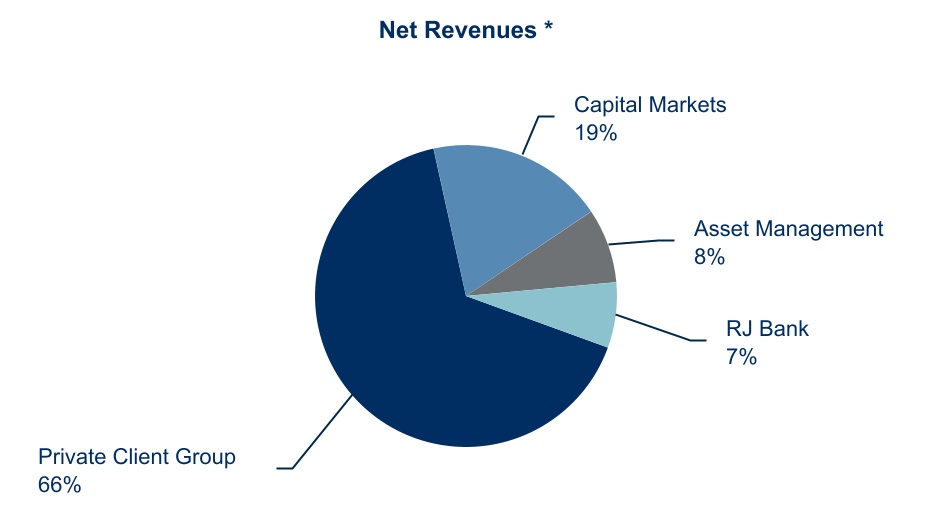
- The preceding chart does not include intersegment eliminations or the Other segment.
Private Client Group
We provide financial planning, investment advisory and securities transaction services to clients through financial advisors. Total client assets under administration (“AUA”) in our PCG segment as of September 30, 2021 were $1.12 trillion, of which $627.1 billion related to fee-based accounts (“fee-based AUA”). We had 8,482 financial advisors affiliated with us as of September 30, 2021.
RAYMOND JAMES FINANCIAL, INC. AND SUBSIDIARIES
Affiliation
We offer multiple affiliation options, which we refer to as AdvisorChoice. Financial advisors primarily affiliate with us directly as either employees or independent contractors, or as employees of the third-party firms to which we provide services through our RIA and Custody Services (“RCS”) division.
Employee financial advisors
Employee financial advisors work in a traditional branch supported by local management and administrative staff. They provide services predominantly to retail clients. Compensation for these financial advisors primarily includes a payout on revenues they generate and such advisors also participate in the firm’s employee benefit plans.
Independent contractor financial advisors
Our financial advisors who are independent contractors are responsible for all of their direct costs and, accordingly, receive a higher payout percentage on the revenues they generate than employee financial advisors. Our independent contractor financial advisor option is designed to help our advisors build their businesses with as much or as little of our support as they determine they need. With specific approval, and on a limited basis, they are permitted to conduct certain other approved business activities, such as offering insurance products, independent registered investment advisory services, and accounting and tax services.
RIA and Custody Services
Through our domestic RCS division, we offer third-party RIAs and broker-dealers a range of products and services including custodial services, trade execution, research and other support and services (including access to clients’ account information and the services of the Asset Management segment) for which we receive fees, which may be either transactional or based on assets under administration. Firms affiliated with us through RCS retain the fees they charge to their clients and are responsible for all of their direct costs. Financial advisors associated with firms in RCS are not included in our financial advisor counts, although their client assets, which totaled $92.7 billion as of September 30, 2021, are included in our AUA.
Products and services
We offer a broad range of third-party and proprietary investment products and services to meet our clients’ various investment and financial needs. Revenues from this segment are typically driven by AUA and are generally either asset-based or transactional in nature.
PCG segment net revenues for the fiscal year ended September 30, 2021 are presented in the following graph.
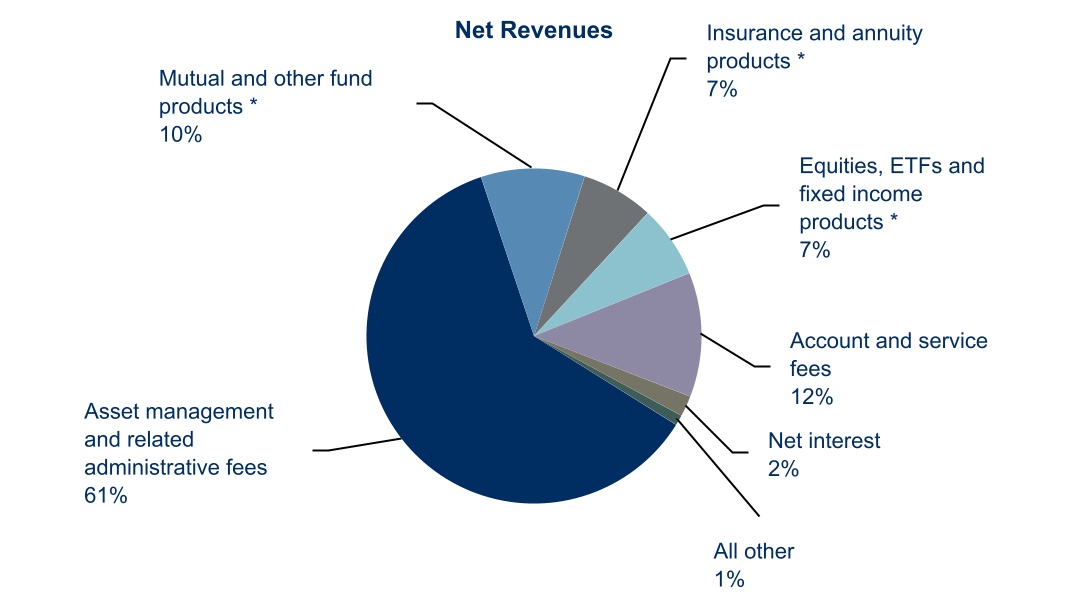
- Included in “Brokerage revenues” on our Consolidated Statements of Income and Comprehensive Income.
RAYMOND JAMES FINANCIAL, INC. AND SUBSIDIARIES
We provide the following products and services through this segment:
-
Investment services for which we charge sales commissions or asset-based fees based on established schedules.
-
Portfolio management services for which we charge either a fee computed as a percentage of the assets in the client’s account or a flat periodic fee.
-
Insurance and annuity products.
-
Mutual funds.
-
Support to third-party product partners, including sales and marketing support, distribution and accounting and administrative services.
-
Administrative services to banks to which we sweep a portion of our clients’ cash deposits as part of the Raymond James Bank Deposit Program (“RJBDP”), our multi-bank sweep program. Fees received from third-party banks for these services are variable in nature and fluctuate based on client cash balances in the program, as well as the level of short-term interest rates relative to interest paid to clients by the third-party banks on balances in the RJBDP. PCG also earns servicing fees from Raymond James Bank, which are based on the number of accounts that are swept to Raymond James Bank as part of the RJBDP. These fees are eliminated in consolidation.
-
Margin loans to clients that are collateralized by the securities purchased or by other securities owned by the client. Interest is charged to clients on the amount borrowed based on current interest rates.
-
Securities borrowing and lending activities with other broker-dealers, financial institutions and other counterparties. The net revenues of this business generally consist of the interest spreads generated on these activities.
-
Diversification strategies and alternative investment products to qualified clients of our affiliated financial advisors.
Capital Markets
Our Capital Markets segment conducts investment banking, institutional sales, securities trading, the syndication and management of investments in low-income housing funds, the majority of which qualify for tax credits (referred to as our “tax credit funds” business), and equity research.
Capital Markets segment net revenues for the fiscal year ended September 30, 2021 are presented in the following graph.
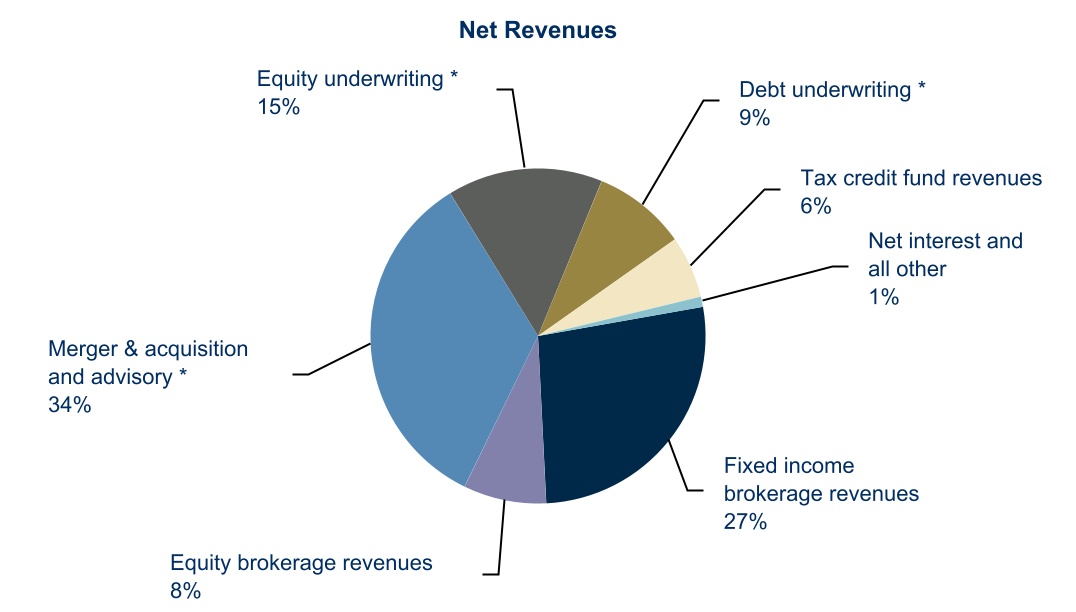
- Included in “Investment banking” on our Consolidated Statements of Income and Comprehensive Income.
RAYMOND JAMES FINANCIAL, INC. AND SUBSIDIARIES
We provide the following products and services through this segment.
**Inv
Showing the first 8K of 72K characters. Open the full section
Item 1A. RISK FACTORS
Our operations and financial results are subject to various risks and uncertainties, including those described in the following sections, which could adversely affect our business, financial condition, results of operations, liquidity and the trading price of our common stock. The list of risk factors provided in the following sections is not exhaustive; there may be other factors that adversely impact our results of operations, harm our reputation or inhibit our ability to generate new business prospects. The following sections should be read in conjunction with “Item 7 - Management’s Discussion and Analysis of Financial Condition and Results of Operations” and our consolidated financial statements and accompanying notes in “Item 8 - Financial Statements and Supplementary Data” of this Annual Report on Form 10-K. In particular, see “Item 7 - Management’s Discussion and Analysis of Financial Condition and Results of Operations - Liquidity and capital resources” for additional information on liquidity and how we manage our liquidity risk and “Item 7 - Management’s Discussion and Analysis of Financial Condition and Results of Operations - Risk management” for additional information on our exposure and how we monitor and manage our market, credit, operational, compliance and certain other risks.
RISKS RELATED TO OUR BUSINESS AND INDUSTRY
The worldwide COVID-19 pandemic may negatively impact our business, financial condition, and results of operations.
The worldwide COVID-19 pandemic and related measures intended to control the spread of the virus have had a significant impact on global economic conditions and may negatively impact certain aspects of our business and results of operations in the future. Although certain economic conditions improved throughout fiscal 2021, the pandemic continues to evolve, as recently experienced with the rapid spread of the Delta variant, and certain of the impacts of the pandemic may continue to affect our results in the future, including: near-zero short-term interest rates resulting in lower net interest income and RJBDP fees from third-party program banks; volatility in our brokerage revenues and investment banking revenues due to market uncertainty caused by the pandemic; and increased credit risk, particularly with regard to industries most vulnerable to the pandemic (e.g., airline, restaurant, gaming, entertainment/leisure and energy), which may result in an elevated bank loan loss provision and charge-offs. In addition, should market conditions deteriorate, or if there is a decline in equity markets similar to that experienced during our fiscal 2020 second quarter, the value of our clients’ assets and certain of our investments would also be negatively affected.
We may also continue to experience business disruptions as a result of the continued spread of COVID-19 and its variants, resulting from restrictions on our employees’ ability to travel, as well as temporary partial or full closures of our facilities and the facilities of our clients, suppliers, or other vendors. We often recruit skilled professionals by visiting their offices or having them visit our offices. Although we have reinstated the majority of our in-person recruiting, renewed travel restrictions or other disruptions that prevent us from meeting with professional prospects may adversely impact our ability to recruit such professional prospects. Further, the increased availability of remote working arrangements in response to the pandemic has intensified and may continue to intensify competition for prospective new associates and impair our ability to retain current associates. Recently promulgated OSHA rules related to required vaccines or alternative testing protocols for unvaccinated associates may also have negative effects on our current associates, including additional administrative burdens and concerns related to perceived health and safety risks, and may result in an increase in employee complaints as well as difficulty attracting and retaining associates. While we maintain contingency plans for events such as pandemic outbreaks, the further spread of COVID-19, or a similar contagious disease could also impair the effectiveness of our executive officers or other associates who are necessary to conduct our business. In addition, the continued spread of COVID-19 could harm the operations of third-party service providers who perform critical services for our business. In some cases, the COVID-19 pandemic has accelerated the transition from traditional to digital financial services and heightened customer expectations in this area, and this transition may require us to invest greater resources in technological improvements.
If COVID-19 or another highly infectious or contagious disease, continues to spread or the response to contain it is unsuccessful, we may experience adverse effects on our business, financial condition, liquidity, and results of operations. A prolonged period of economic deterioration could ultimately result in impairment of our goodwill and identifiable intangible assets. In addition, if financial markets deteriorate as a result of the current or a future pandemic, our access to capital and other sources of funding may become constrained, which may require us to restructure debt or obtain additional financing on terms that may be onerous or highly dilutive.
The extent of any of the previously-described effects on our business will depend on future developments which are highly uncertain and cannot be predicted, including the duration of the COVID-19 pandemic and the possible further impacts on the global economy.
RAYMOND JAMES FINANCIAL, INC. AND SUBSIDIARIES
Damage to our reputation could damage our businesses.
Maintaining our reputation is critical to attracting and maintaining clients, investors, and associates. If we fail to address, or appear to fail to address, issues that may give rise to reputational risk, we could significantly harm our business prospects. These issues may include, but are not limited to, any of the risks discussed in this Item 1A, including appropriately dealing with potential conflicts of interest, legal and regulatory requirements, ethical issues, money laundering, cybersecurity and privacy, record-keeping, sales and trading practices, and associate misconduct. In addition, the failure to either sell securities we have underwritten at anticipated price levels or to properly identify and communicate the risks inherent in the products and services we offer could also give rise to reputational risk. Failure to maintain appropriate service and quality standards or a failure or perceived failure to treat clients fairly can result in client dissatisfaction, litigation and heightened regulatory scrutiny, all of which can lead to lost revenue, higher operating costs and reputational harm. Negative publicity about us, whether or not true, may also harm our reputation. Further, failures at other large financial institutions or other market participants, regardless of whether they relate to our activities, could lead to a general loss of customer confidence in financial institutions that could negatively affect us, including harming the market perception of the financial system in general.
We are affected by domestic and international macroeconomic conditions that impact the global financial markets.
We are engaged in various financial services businesses. As such, we are affected by domestic and international macroeconomic and political conditions, as well as economic output levels, interest and inflation rates, employment levels, prices of commodities, consumer confidence levels and changes in consumer spending, international trade policy, and fiscal and monetary policy. For example, Fed policies determine, in large part, the cost of funds for lending and investing and the return earned on those loans and investments. The market impact from such policies can also decre
Showing the first 8K of 82K characters. Open the full section
Item 1B. UNRESOLVED STAFF COMMENTS
None.
Item 2. PROPERTIES
We operate our business from our principal location in St. Petersburg, Florida in 1.25 million square feet of office space that we own in the Carillon Office Park. We conduct certain operations from our owned facility in Southfield, Michigan, comprising approximately 90,000 square feet, and operate a 40,000 square foot information technology data center on land we own in the Denver, Colorado area. Generally, our owned locations and principal leases, identified below, support all of our business segments.
We lease the premises we occupy in other U.S. and foreign locations, including employee-based branch office operations. Leases for branch offices for independent contractors are the responsibility of the respective independent contractor financial advisors and are not included in the amounts listed below. Our leases contain various expiration dates through fiscal year 2032. Our principal leases are in the following locations:
-
We occupy leased space of approximately 250,000 square feet in Memphis, along with approximately 165,000 square feet in New York City, 70,000 square feet in Chicago and 30,000 square feet in Denver, with other office and branch locations throughout the U.S.;
-
We occupy leased space of approximately 80,000 and 85,000 square feet in Vancouver and Toronto, respectively, along with other office and branch locations throughout Canada;
-
We occupy leased space of approximately 30,000 square feet in London, along with other office locations in Europe, primarily in Germany.
Additionally, we own approximately 65 acres of land located in Pasco County, Florida for potential development, as needed. We regularly monitor the facilities we own or occupy to ensure that they suit our needs, particularly as we introduce more flexibility in work location for our associates as we return to office. To the extent that they do not meet our needs, we will expand, contract or relocate, as necessary. See Note 2 and Note 14 of the Notes to Consolidated Financial Statements of this Form 10-K for information regarding our lease obligations.
Item 3. LEGAL PROCEEDINGS
In the normal course of our business, we have been named, from time to time, as a defendant in various legal actions, including arbitrations, class actions and other litigation, arising in connection with our activities as a diversified financial services institution.
RJF and certain of its subsidiaries are subject to regular reviews and inspections by regulatory authorities and self-regulatory organizations. Reviews can result in the imposition of sanctions for regulatory violations, ranging from non-monetary censures to fines and, in serious cases, temporary or permanent suspension from conducting business, or limitations on certain business
RAYMOND JAMES FINANCIAL, INC. AND SUBSIDIARIES
activities. In addition, regulatory agencies and SROs institute investigations from time to time, among other things, into industry practices, which can also result in the imposition of such sanctions.
We may contest liability and/or the amount of damages, as appropriate, in each pending matter. Over the last several years, the level of litigation and investigatory activity (both formal and informal) by government and self-regulatory agencies in the financial services industry continues to be significant. There can be no assurance that material losses will not be incurred from claims that have not yet been asserted or are not yet determined to be material.
For many legal and regulatory matters, we are unable to estimate a range of reasonably possible loss as we cannot predict if, how or when such proceedings or investigations will be resolved or what the eventual settlement, fine, penalty or other relief, if any, may be. A large number of factors may contribute to this inherent unpredictability: the proceeding is in its early stages; the damages sought are unspecified, unsupported or uncertain; it is unclear whether a case brought as a class action will be allowed to proceed on that basis; the other party is seeking relief other than or in addition to compensatory damages (including, in the case of regulatory and governmental proceedings, potential fines and penalties); the matters present significant legal uncertainties; we have not engaged in settlement discussions; discovery is not complete; there are significant facts in dispute; and numerous parties are named as defendants (including where it is uncertain how liability might be shared among defendants). Subject to the foregoing, after consultation with counsel, we believe that the outcome of such litigation and regulatory proceedings will not have a material adverse effect on our consolidated financial condition. However, the outcome of such litigation and regulatory proceedings could be material to our operating results and cash flows for a particular future period, depending on, among other things, our revenues or income for such period.
See Note 19 of the Notes to Consolidated Financial Statements of this Form 10-K for additional information regarding legal and regulatory matter contingencies, and refer to “Item 7 - Management’s Discussion and Analysis of Financial Condition and Results of Operations - Critical accounting estimates” in the section “Loss provisions for legal and regulatory matters” and Note 2 of the Notes to Consolidated Financial Statements of this Form 10-K for information on our criteria for establishing accruals.
Item 4. MINE SAFETY DISCLOSURES
Not applicable.
PART II
Item 5. MARKET FOR REGISTRANT’S COMMON EQUITY, RELATED SHAREHOLDER MATTERS AND ISSUER PURCHASES OF EQUITY SECURITIES
Our common stock is traded on the NYSE under the symbol “RJF.” As of November 18, 2021, we had 309 holders of record of our common stock. Shares of our common stock are held by a substantially greater number of beneficial owners, whose shares are held of record by banks, brokers, and other financial institutions.
See Note 24 of the Notes to Consolidated Financial Statements of this Form 10-K for information regarding our intentions for paying cash dividends and the related capital restrictions.
Information related to our compensation plans under which equity securities are authorized for issuance is presented in Note 23 of the Notes to Consolidated Financial Statements and Part III, Item 12 of this Form 10-K.
We did not have any sales of unregistered securities for the fiscal years ended September 30, 2021, 2020 or 2019.
RAYMOND JAMES FINANCIAL, INC. AND SUBSIDIARIES
We purchase our own stock from time to time in conjunction with a number of activities, each of which is described in the following paragraphs. The following table presents information on our purchases of our own stock, on a monthly basis, for the twelve months ended September 30, 2021. Share and per share information has been retroactively adjusted to reflect the September 2021 three-for-two stock split.
| Total number of shares purchased | Average price per share | Number of shares purchased as part of publicly announced plans or programs | Approximate dollar value (in millions) at each month-end, of securities that may yet be purchased under the plans or programs | ||||||||||||||||||||
| October 1, 2020 – October 31, 2020 | 1,806 | $ | 53.36 | — | $487 | ||||||||||||||||||
| November 1, 2020 – November 30, 2020 | 139,838 | $ | 60.33 | — | $487 | ||||||||||||||||||
| December 1, 2020 – December 31, 2020 | 175,139 | $ | 62.01 | 161,625 | $740 | ||||||||||||||||||
| First quarter | 316,783 | $ | 61.23 | 161,625 | |||||||||||||||||||
| January 1, 2021 – January 31, 2021 | 3,602 | $ | 66.71 | — | $740 | ||||||||||||||||||
| February 1, 2021 – February 28, 2021 | 10,412 | $ | 66.62 | — | $740 | ||||||||||||||||||
| March 1, 2021 – March 31, 2021 | 752,640 | $ | 80.03 | 750,000 | $680 | ||||||||||||||||||
| Second quarter | 766,654 | $ | 79.79 | 750,000 | |||||||||||||||||||
| April 1, 2021 – April 30, 2021 | 1,331 | $ | 85.94 | — | $680 | ||||||||||||||||||
| May 1, 2021 – May 31, 2021 | — | $ | — | — | $680 | ||||||||||||||||||
| June 1, 2021 – June 30, 2021 | 562,500 | $ | 85.70 | 562,500 | $632 | ||||||||||||||||||
| Third quarter | 563,831 | $ | 85.70 | 562,500 | |||||||||||||||||||
| July 1, 2021 – July 31, 2021 | 1,217 | $ | 86.71 | — | $632 | ||||||||||||||||||
| August 1, 2021 – August 31, 2021 | 114 | $ | 90.55 | — | $632 | ||||||||||||||||||
| September 1, 2021 – September 30, 2021 | — | $ | — | — | $632 | ||||||||||||||||||
| Fourth quarter | 1,331 | $ | 87.04 | — | |||||||||||||||||||
| Fiscal year total | 1,648,599 | $ | 78.24 | 1,474,125 |
In the preceding table, the total number of shares purchased includes shares purchased pursuant to the Restricted Stock Trust Fund, which was established to acquire our common stock in the open market and used to settle restricted stock units (“RSUs”) granted as a retention vehicle for certain employees of our wholly-owned Canadian subsidiaries. For more information on this trust fund, see Note 2 and Note 10 of the Notes to Consolidated Financial Statements of this Form 10-K. These activities do not utilize the repurchase authorization presented in the preceding table.
The total number of shares purchased also includes shares repurchased as a result of employees surrendering shares as payment for option exercises or withholding taxes. These activities do not utilize the repurchase authorization presented in the preceding table.
Item 6. RESERVED
RAYMOND JAMES FINANCIAL, INC. AND SUBSIDIARIES
Item 7. MANAGEMENT’S DISCUSSION AND ANALYSIS OF FINANCIAL CONDITION AND RESULTS OF OPERATIONS
| INDEX | |||||
| PAGE | |||||
| Introduction | 38 | ||||
| Executive overview | 38 | ||||
| Reconciliation of non-GAAP financial measures to GAAP financial measures | 40 | ||||
| Segments | 42 | ||||
| Net interest analysis | 42 | ||||
| Results of Operations | |||||
| Private Client Group | 44 | ||||
| Capital Markets | 48 | ||||
| Asset Management | 50 | ||||
| Raymond James Bank | 53 | ||||
| Other | 54 | ||||
| Certain statistical disclosures by bank holding companies | 55 | ||||
| Statement of financial condition analysis | 55 | ||||
| Liquidity and capital resources | 56 | ||||
| Regulatory | 61 | ||||
| Critical accounting estimates | 61 | ||||
| Recent accounting developments | 62 | ||||
| Risk management | 62 |
RAYMOND JAMES FINANCIAL, INC. AND SUBSIDIARIES
Management’s Discussion and Analysis
INTRODUCTION
The following Management’s Discussion and Analysis of Financial Condition and Results of Operations (“MD&A”) is intended to help the reader understand the results of our operations and financial condition. This MD&A is provided as a supplement to, and should be read in conjunction with, our consolidated financial statements and accompanying notes to consolidated financial statements. Where “NM” is used in various percentage change computations, the computed percentage change has been determined to be not meaningful.
We operate as a financial holding company and bank holding company. Results in the businesses in which we operate are highly correlated to general economic conditions and, more specifically, to the direction of the U.S. equity and fixed income markets, changes in interest rates, market volatility, corporate and mortgage lending markets and commercial and residential credit trends. Overall market conditions, economic, political and regulatory trends, and industry competition are among the factors which could affect us and which are unpredictable and beyond our control. These factors affect the financial decisions made by market participants, including investors, borrowers, and competitors, impacting their level of participation in the financial markets. These factors also impact the level of investment banking activity and asset valuations, which ultimately affect our business results.
EXECUTIVE OVERVIEW
Year ended September 30, 2021 compared with the year ended September 30, 2020
We generated strong results for fiscal 2021, with net revenues of $9.76 billion, an increase of 22% compared with the prior year, and pre-tax income of $1.79 billion, an increase of 70%. During fiscal 2021, pre-tax margin increased in all of our operating segments and we generated particularly strong results in our PCG, Capital Markets and Asset Management segments. Our net income of $1.40 billion was 72% higher than the prior year, and our earnings per diluted share of $6.63(1), which reflected the impact of a 3-for-2 stock split in September 2021, increased 71%. Our return on equity (“ROE”) was 18.4%, compared with 11.9% for the prior year, and return on tangible common equity (“ROTCE”) was 20.4%(2), compared with 13.0%(2) for the prior year.
During fiscal 2021, we completed a $750 million, 30-year senior notes offering at 3.75%, utilizing the proceeds from the offering and cash on hand to early-redeem our $250 million of 5.625% senior notes due 2024 and our $500 million of 3.625% senior notes due 2026. We recognized losses on the extinguishment of such notes of $98 million. Excluding these losses and acquisition-related expenses of $19 million, our adjusted net income was $1.49 billion(2), an increase of 74% compared with adjusted net income for the prior year. Adjusted earnings per diluted share were $7.05(1)(2), a 73% increase compared with adjusted earnings per diluted share of $4.08(1)(2) for the prior year. Our adjusted ROE was 19.5%(2), compared with 12.5%(2) for the prior year, and adjusted ROTCE was 21.6%(2), compared with 13.6%(2) for the prior year.
The significant increase in net revenues compared with the prior year was driven by higher asset management and related administrative fees, largely attributable to higher PCG assets in fee-based accounts, as well as strong investment banking revenues and brokerage revenues. Revenues in the current year also included $74 million of private equity valuation gains, of which $25 million were attributable to noncontrolling interests and were offset in other expenses, compared with $28 million of losses in the prior year, of which $20 million were attributable to noncontrolling interests. Offsetting these increases was the negative impact of lower short-term interest rates on our net interest income and RJBDP fees from third-party banks.
Compensation, commissions and benefits expense increased $1.12 billion, or 20%, primarily resulting from the growth in revenues and pre-tax income compared with the prior year. Our compensation ratio, or the ratio of compensation, commissions and benefits expense to net revenues, decreased to 67.4% compared with 68.4% for the prior year. The decrease in our compensation ratio primarily resulted from higher revenues and changes in our revenue mix due to strong net revenues in our Capital Markets segment, which had a lower compensation ratio at 56% than our PCG segment, and the private equity valuation gains which have no associated direct compensation. Our compensation ratio also benefited from expense management initiatives.
(1) During our fiscal fourth quarter of 2021 the Board of Directors approved a 3-for-2 stock split, effected in the form of a 50% stock dividend, paid on September 21, 2021. All share and per share information has been retroactively adjusted to reflect this stock split.
(2) “ROTCE,” “Adjusted net income,” “adjusted earnings per diluted share,” “adjusted ROE” and “adjusted ROTCE” are each non-GAAP financial measures. Please see the “Reconciliation of non-GAAP financial measures to GAAP financial measures” in this MD&A for a reconciliation of our non-GAAP measures to the most directly comparable GAAP measures and for other important disclosures.
RAYMOND JAMES FINANCIAL, INC. AND SUBSIDIARIES
Management’s Discussion and Analysis
Non-compensation expenses decreased $87 million, or 6%, primarily due to a $265 million decrease in the bank loan provision for credit losses, which was a benefit of $32 million in the current year computed under the current expected credit loss (“CECL”) methodology compared with a provision of $233 million in the prior year computed under the incurred loss methodology. Non-compensation expenses also decreased as a result of $46 million of expenses in the prior year related to a reduction in workforce, which did not recur in the current year, as well as a decrease in business development expenses due to lower travel and event-related expenses as a result of the COVID-19 pandemic. These decreases were partially offset by the aforementioned losses on extinguishment of debt of $98 million in the current year, and an increase in other expenses, primarily due to the change in p
Showing the first 8K of 219K characters. Open the full section
Item 7A. QUANTITATIVE AND QUALITATIVE DISCLOSURES ABOUT MARKET RISK
See “Item 7 - Management’s Discussion and Analysis of Financial Condition and Results of Operations - Risk management” of this Form 10-K for our quantitative and qualitative disclosures about market risk.
RAYMOND JAMES FINANCIAL, INC. AND SUBSIDIARIES
Item 8. FINANCIAL STATEMENTS AND SUPPLEMENTARY DATA
Table of Contents
| PAGE | |||||
| Report of Independent Registered Public Accounting Firm | 78 | ||||
| Consolidated Statements of Financial Condition | 81 | ||||
| Consolidated Statements of Income and Comprehensive Income | 82 | ||||
| Consolidated Statements of Changes in Shareholders’ Equity | 83 | ||||
| Consolidated Statements of Cash Flows | 84 | ||||
| Notes to Consolidated Financial Statements | |||||
| Note 1 - Organization and basis of presentation | 86 | ||||
| Note 2 - Summary of significant accounting policies | 86 | ||||
| Note 3 - Acquisitions | 104 | ||||
| Note 4 - Fair value | 106 | ||||
| Note 5 - Available-for-sale securities | 112 | ||||
| Note 6 - Derivative assets and derivative liabilities | 114 | ||||
| Note 7 - Collateralized agreements and financings | 116 | ||||
| Note 8 - Bank loans, net | 117 | ||||
| Note 9 - Loans to financial advisors, net | 123 | ||||
| Note 10 - Variable interest entities | 123 | ||||
| Note 11 - Goodwill and identifiable intangible assets, net | 125 | ||||
| Note 12 - Other assets | 127 | ||||
| Note 13 - Property and equipment, net | 127 | ||||
| Note 14 - Leases | 128 | ||||
| Note 15 - Bank deposits | 129 | ||||
| Note 16 - Other borrowings | 130 | ||||
| Note 17 - Senior notes payable | 131 | ||||
| Note 18 - Income taxes | 132 | ||||
| Note 19 - Commitments, contingencies and guarantees | 134 | ||||
| Note 20 - Accumulated other comprehensive income/(loss) | 137 | ||||
| Note 21 - Revenues | 138 | ||||
| Note 22 - Interest income and interest expense | 141 | ||||
| Note 23 - Share-based and other compensation | 141 | ||||
| Note 24 - Regulatory capital requirements | 143 | ||||
| Note 25 - Earnings per share | 145 | ||||
| Note 26 - Segment information | 146 | ||||
| Note 27 - Condensed financial information (parent company only) | 148 |
Report of Independent Registered Public Accounting Firm
To the Shareholders and Board of Directors
Raymond James Financial, Inc.:
Opinion on the Consolidated Financial Statements
We have audited the accompanying consolidated statements of financial condition of Raymond James Financial, Inc. and subsidiaries (the Company) as of September 30, 2021 and 2020, the related consolidated statements of income and comprehensive income, changes in shareholders’ equity, and cash flows for each of the years in the three‑year period ended September 30, 2021, and the related notes (collectively, the consolidated financial statements). In our opinion, the consolidated financial statements present fairly, in all material respects, the financial position of the Company as of September 30, 2021 and 2020, and the results of its operations and its cash flows for each of the years in the three‑year period ended September 30, 2021, in conformity with U.S. generally accepted accounting principles.
We also have audited, in accordance with the standards of the Public Company Accounting Oversight Board (United States) (PCAOB), the Company’s internal control over financial reporting as of September 30, 2021, based on criteria established in Internal Control – Integrated Framework (2013) issued by the Committee of Sponsoring Organizations of the Treadway Commission, and our report dated November 23, 2021 expressed an unqualified opinion on the effectiveness of the Company’s internal control over financial reporting.
Basis for Opinion
These consolidated financial statements are the responsibility of the Company’s management. Our responsibility is to express an opinion on these consolidated financial statements based on our audits. We are a public accounting firm registered with the PCAOB and are required to be independent with respect to the Company in accordance with the U.S. federal securities laws and the applicable rules and regulations of the Securities and Exchange Commission and the PCAOB.
We conducted our audits in accordance with the standards of the PCAOB. Those standards require that we plan and perform the audit to obtain reasonable assurance about whether the consolidated financial statements are free of material misstatement, whether due to error or fraud. Our audits included performing procedures to assess the risks of material misstatement of the consolidated financial statements, whether due to error or fraud, and performing procedures that respond to those risks. Such procedures included examining, on a test basis, evidence regarding the amounts and disclosures in the consolidated financial statements. Our audits also included evaluating the accounting principles used and significant estimates made by management, as well as evaluating the overall presentation of the consolidated financial statements. We believe that our audits provide a reasonable basis for our opinion.
Critical Audit Matter
The critical audit matter communicated below is a matter arising from the current period audit of the consolidated financial statements that was communicated or required to be communicated to the audit committee and that: (1) relates to accounts or disclosures that are material to the consolidated financial statements and (2) involved our especially challenging, subjective, or complex judgments. The communication of a critical audit matter does not alter in any way our opinion on the consolidated financial statements, taken as a whole, and we are not, by communicating the critical audit matter below, providing a separate opinion on the critical audit matter or on the accounts or disclosures to which it relates.
Assessment of the allowance for credit losses related to the commercial and industrial (C&I), real estate investment trust (REIT) and the commercial real estate (CRE) portfolio segments that are collectively evaluated for impairment
As discussed in Note 2 and Note 8 to the consolidated financial statements, the Company’s allowance for credit losses on Bank loans was $320 million as of September 30, 2021, a portion of which related to the allowance for credit losses (ACL) on C&I, REIT and CRE portfolio segments evaluated on a collective basis (the collective ACL). The Company estimates the collective ACL using a current expected credit losses methodology which is based on relevant information about historical losses, current conditions, and reasonable and supportable forecasts
Showing the first 8K of 405K characters. Open the full section
Item 9. CHANGES IN AND DISAGREEMENTS WITH ACCOUNTANTS ON ACCOUNTING AND FINANCIAL DISCLOSURE
None.
Item 9A. CONTROLS AND PROCEDURES
Disclosure Controls and Procedures
Disclosure controls are procedures designed to ensure that information required to be disclosed in our reports filed under the Securities Exchange Act of 1934, such as this report, are recorded, processed, summarized, and reported within the time periods specified in the SEC’s rules and forms. Disclosure controls are also designed to ensure that such information is accumulated and communicated to management, including our Chief Executive Officer and Chief Financial Officer, as appropriate, to allow timely decisions regarding required disclosure. In designing and evaluating the disclosure controls and procedures, management recognized that any controls and procedures, no matter how well designed and operated, can provide only reasonable, not absolute, assurance of achieving the desired control objectives, as ours are designed to do, and management necessarily was required to apply its judgment in evaluating the cost-benefit relationship of possible controls and procedures.
Under the supervision and with the participation of our management, including our Chief Executive Officer and Chief Financial Officer, we have evaluated the effectiveness of our disclosure controls and procedures pursuant to Securities Exchange Act of 1934 Rule 13a-15(b) as of the end of the period covered by this report. Based on that evaluation, our Chief Executive Officer and Chief Financial Officer have concluded that these disclosure controls and procedures are effective.
Changes in Internal Control over Financial Reporting
There were no changes in our internal control over financial reporting during the year ended September 30, 2021 that have materially affected, or are reasonably likely to materially affect, our internal control over financial reporting.
Report of Management on Internal Control Over Financial Reporting
Our management is responsible for establishing and maintaining adequate internal control over our financial reporting. Internal control over financial reporting is a process to provide reasonable assurance regarding the reliability of our financial reporting for external purposes in accordance with accounting principles generally accepted in the United States. Internal control over financial reporting includes maintaining records that, in reasonable detail, accurately and fairly reflect our transactions; providing reasonable assurance that transactions are recorded as necessary for preparation of our financial statements; providing reasonable assurance that receipts and expenditures of our assets are made in accordance with management authorization; and providing reasonable assurance that unauthorized acquisition, use or disposition of our assets that could have a material effect on our financial statements would be prevented or detected on a timely basis. Because of its inherent limitations, internal control over financial reporting is not intended to provide absolute assurance that a misstatement of our financial statements would be prevented or detected.
Management conducted an evaluation of the effectiveness of our internal control over financial reporting based on the framework in Internal Control - Integrated Framework (2013) issued by COSO. Based on this evaluation, management concluded that our internal control over financial reporting was effective as of September 30, 2021. KPMG LLP, who audited and reported on our consolidated financial statements included in this report, has issued an attestation report on our internal control over financial reporting as of September 30, 2021 (included as follows).
Report of Independent Registered Public Accounting Firm
To the Shareholders and Board of Directors
Raymond James Financial, Inc.:
Opinion on Internal Control Over Financial Reporting
We have audited Raymond James Financial, Inc. and subsidiaries’ (the Company) internal control over financial reporting as of September 30, 2021, based on criteria established in Internal Control – Integrated Framework (2013) issued by the Committee of Sponsoring Organizations of the Treadway Commission. In our opinion, the Company maintained, in all material respects, effective internal control over financial reporting as of September 30, 2021, based on criteria established in Internal Control – Integrated Framework (2013) issued by the Committee of Sponsoring Organizations of the Treadway Commission.
We also have audited, in accordance with the standards of the Public Company Accounting Oversight Board (United States) (PCAOB), the consolidated statements of financial condition of the Company as of September 30, 2021 and 2020, the related consolidated statements of income and comprehensive income, changes in shareholders’ equity, and cash flows for each of the years in the three-year period ended September 30, 2021, and the related notes (collectively, the consolidated financial statements), and our report dated November 23, 2021 expressed an unqualified opinion on those consolidated financial statements.
Basis for Opinion
The Company’s management is responsible for maintaining effective internal control over financial reporting and for its assessment of the effectiveness of internal control over financial reporting, included in the accompanying Report of Management on Internal Control Over Financial Reporting. Our responsibility is to express an opinion on the Company’s internal control over financial reporting based on our audit. We are a public accounting firm registered with the PCAOB and are required to be independent with respect to the Company in accordance with the U.S. federal securities laws and the applicable rules and regulations of the Securities and Exchange Commission and the PCAOB.
We conducted our audit in accordance with the standards of the PCAOB. Those standards require that we plan and perform the audit to obtain reasonable assurance about whether effective internal control over financial reporting was maintained in all material respects. Our audit of internal control over financial reporting included obtaining an understanding of internal control over financial reporting, assessing the risk that a material weakness exists, and testing and evaluating the design and operating effectiveness of internal control based on the assessed risk. Our audit also included performing such other procedures as we considered necessary in the circumstances. We believe that our audit provides a reasonable basis for our opinion.
Definition and Limitations of Internal Control Over Financial Reporting
A company’s internal control over financial reporting is a process designed to provide reasonable assurance regarding the reliability of financial reporting and the preparation of financial statements for external purposes in accordance with generally accepted accounting principles. A company’s internal control over financial reporting includes those policies and procedures that (1) pertain to the maintenance of records that, in reasonable detail, accurately and fairly reflect the transactions and dispositions of the assets of the company; (2) provide reasonable assurance that transactions are recorded as necessary to permit preparation of financial statements in accordance with generally accepted accounting principles, and that receipts and expenditures of the company are being made only in accordance with authorizations of management and directors of the company; and (3) provide reasonable assurance regarding prevention or timely detection of unauthorized acquisition, use, or disposition of the company’s assets that could have a material effect on the financial statements.
Because of its inherent limitations, internal control over financial reporting may not prevent or detect misstatements. Also, projections of any evaluation of effectiveness to future periods are subject to the risk that controls may become inadequate because of changes in conditions, or that the degree of compliance with the policies or procedures may deteriorate.
/s/ KPMG LLP
Tampa, Florida
November 23, 2021
RAYMOND JAMES FINANCIAL, INC. AND SUBSIDIARIES
Item 9B. OTHER INFORMATION
None.
Item 9C. DISCLOSURE REGARDING FOREIGN JURISDICTIONS THAT PREVENT INSPECTIONS
Not applicable.
PART III
Item 10. DIRECTORS, EXECUTIVE OFFICERS AND CORPORATE GOVERNANCE
A list of our executive officers appears in Part I, Item 1 of this report. The balance of the information required by Item 10 is incorporated herein by reference to the registrant’s definitive proxy statement for the 2022 Annual Meeting of Shareholders which will be filed with the SEC no later than 120 days after the close of the fiscal year ended September 30, 2021.
ITEMS 11, 12, 13 and 14.
The information required by Items 11, 12, 13 and 14 is incorporated herein by reference to the registrant’s definitive proxy statement for the 2022 Annual Meeting of Shareholders which will be filed with the SEC no later than 120 days after the close of the fiscal year ended September 30, 2021.
PART IV
Item 15. EXHIBITS AND FINANCIAL STATEMENT SCHEDULES
(a) Financial Statements and Schedules
The financial statements are set forth under Item 8 of this Annual Report on Form 10-K. Financial statement schedules have been omitted since they are either not required, not applicable, or the information is otherwise included.
(b) Exhibit listing
See below and continued on the following pages.
RAYMOND JAMES FINANCIAL, INC. AND SUBSIDIARIES
RAYMOND JAMES FINANCIAL, INC. AND SUBSIDIARIES
- Indicates a management contract or compensatory plan or arrangement in which a director or executive officer participates.
Item 16. FORM 10-K SUMMARY
None.
RAYMOND JAMES FINANCIAL, INC. AND SUBSIDIARIES
SIGNATURES
Pursuant to the requirements of Section 13 or 15(d) of the Securities Exchange Act of 1934, the Registrant has duly caused this report to be signed on its behalf by the undersigned, thereunto duly authorized, in the City of St. Petersburg, State of Florida, on the 23rd day of November, 2021.
| RAYMOND JAMES FINANCIAL, INC. | ||
| By: /s/ PAUL C. REILLY | ||
| Paul C. Reilly, Chairman and Chief Executive Officer |
Pursuant to the requirements of the Securities Exchange Act of 1934, this report has been signed below by the following persons on behalf of the Registrant and in the capacities and on the dates indicated.
| Signature | Title | Date | ||||||
| /s/ PAUL C. REILLY | Chairman and Chief Executive Officer (Principal Executive Officer) and Director | November 23, 2021 | ||||||
| Paul C. Reilly | ||||||||
| /s/ PAUL M. SHOUKRY | Chief Financial Officer and Treasurer (Principal Financial Officer) | November 23, 2021 | ||||||
| Paul M. Shoukry | ||||||||
| /s/ JONATHAN W. OORLOG, JR. | Senior Vice President and Controller (Principal Accounting Officer) | November 23, 2021 | ||||||
| Jonathan W. Oorlog, Jr. | ||||||||
| /s/ THOMAS A. JAMES | Chairman Emeritus and Director | November 23, 2021 | ||||||
| Thomas A. James | ||||||||
| /s/ MARLENE DEBEL | Director | November 23, 2021 | ||||||
| Marlene Debel | ||||||||
| /s/ ROBERT M. DUTKOWSKY | Director | November 23, 2021 | ||||||
| Robert M. Dutkowsky | ||||||||
| /s/ JEFFREY N. EDWARDS | Director | November 23, 2021 | ||||||
| Jeffrey N. Edwards | ||||||||
| /s/ BENJAMIN C. ESTY | Director | November 23, 2021 | ||||||
| Benjamin C. Esty | ||||||||
| /s/ ANNE GATES | Director | November 23, 2021 | ||||||
| Anne Gates | ||||||||
| /s/ FRANCIS S. GODBOLD | Vice Chairman and Director | November 23, 2021 | ||||||
| Francis S. Godbold | ||||||||
| /s/ GORDON L. JOHNSON | Director | November 23, 2021 | ||||||
| Gordon L. Johnson | ||||||||
| /s/ RODERICK C. MCGEARY | Director | November 23, 2021 | ||||||
| Roderick C. McGeary | ||||||||
| /s/ RAJ SESHADRI | Director | November 23, 2021 | ||||||
| Raj Seshadri | ||||||||
| /s/ SUSAN N. STORY | Director | November 23, 2021 | ||||||
| Susan N. Story |