 filings.tools
Ralph Lauren 10-K 2016-04-02
Filed 2016-05-19. 21 sections, 512K characters. Original on sec.gov · Markdown · JSON
Cover and table of contents
10-K 1 rl-20160402x10k.htm 10-K
UNITED STATES
SECURITIES AND EXCHANGE COMMISSION
Washington, D.C. 20549
Form 10-K
(Mark One)
| þ | ANNUAL REPORT PURSUANT TO SECTION 13 OR 15(d) OF THE SECURITIES EXCHANGE ACT OF 1934 |
| For the fiscal year ended April 2, 2016 |
or
| o | TRANSITION REPORT PURSUANT TO SECTION 13 OR 15(d) OF THE SECURITIES EXCHANGE ACT OF 1934 |
Commission File Number: 001-13057
RALPH LAUREN CORPORATION
(Exact name of registrant as specified in its charter)
| Delaware | 13-2622036 | |
| (State or other jurisdiction of incorporation or organization) | (I.R.S. Employer Identification No.) | |
| 650 Madison Avenue, New York, New York | 10022 | |
| (Address of principal executive offices) | (Zip Code) |
(212) 318-7000
(Registrant's telephone number, including area code)
Securities registered pursuant to Section 12(b) of the Act:
| Title of Each Class | Name of Each Exchange on Which Registered | |
| Class A Common Stock, $.01 par value | New York Stock Exchange |
Securities registered pursuant to Section 12(g) of the Act: None
| Indicate by check mark if the registrant is a well-known seasoned issuer, as defined in Rule 405 of the Securities Act. | Yes þ No o | |
| Indicate by check mark if the registrant is not required to file reports pursuant to Section 13 or 15(d) of the Act. | Yes o No þ | |
| Indicate by check mark whether the registrant (1) has filed all reports required to be filed by Section 13 or 15(d) of the Securities Exchange Act of 1934 during the preceding 12 months (or for such shorter period that the registrant was required to file such reports), and (2) has been subject to such filing requirements for the past 90 days. | Yes þ No o | |
| Indicate by check mark whether the registrant has submitted electronically and posted on its corporate Web site, if any, every Interactive Data File required to be submitted and posted pursuant to Rule 405 of Regulation S-T (§232.405 of this chapter) during the preceding 12 months (or for such shorter period that the registrant was required to submit and post such files). | Yes þ No o | |
| Indicate by check mark if disclosure of delinquent filers pursuant to Item 405 of Regulation S-K (§229.405 of this chapter) is not contained herein, and will not be contained, to the best of registrant's knowledge, in definitive proxy or information statements incorporated by reference in Part III of this Form 10-K or any amendment to this Form 10-K. | o | |
| Indicate by check mark whether the registrant is a large accelerated filer, an accelerated filer, a non-accelerated filer, or a smaller reporting company. See the definitions of "large accelerated filer," "accelerated filer" and "smaller reporting company" in Rule 12b-2 of the Exchange Act. | ||
| Large accelerated filer þ | Accelerated filer o | |
| Non-accelerated filer o (Do not check if a smaller reporting company) | Smaller reporting company o | |
| Indicate by check mark whether the registrant is a shell company (as defined in Rule 12b-2 of the Act). | Yes o No þ | |
| The aggregate market value of the registrant's voting common stock held by non-affiliates of the registrant was approximately $6,341,781,793 as of September 25, 2015, the last business day of the registrant's most recently completed second fiscal quarter based on the closing price of the common stock on the New York Stock Exchange. | ||
| At May 13, 2016, 57,020,766 shares of the registrant's Class A common stock, $.01 par value and 25,881,276 shares of the registrant's Class B common stock, $.01 par value were outstanding. | ||
| Part III incorporates information from certain portions of the registrant's definitive proxy statement to be filed with the Securities and Exchange Commission within 120 days after the fiscal year ended April 2, 2016. |
SPECIAL NOTE REGARDING FORWARD-LOOKING STATEMENTS
Various statements in this Form 10-K or incorporated by reference into this Form 10-K, in future filings by us with the Securities and Exchange Commission (the "SEC"), in our press releases, and in oral statements made from time to time by us or on our behalf constitute "forward-looking statements" within the meaning of the Private Securities Litigation Reform Act of 1995. Forward-looking statements are based on current expectations and are indicated by words or phrases such as "anticipate," "estimate," "expect," "project," "we believe," "is or remains optimistic," "currently envisions," and similar words or phrases and involve known and unknown risks, uncertainties, and other factors which may cause actual results, performance, or achievements to be materially different from the future results, performance, or achievements expressed in or implied by such forward-looking statements. These risks, uncertainties, and other factors include, among others:
| • | the loss of key personnel, including Mr. Ralph Lauren, or other changes in our executive and senior management team or to our operating structure, and our ability to effectively transfer knowledge during periods of transition; |
| • | our ability to achieve anticipated operating enhancements and/or cost reductions from our restructuring plans, which could include the potential sale, discontinuance, or consolidation of certain of our brands; |
| • | our ability to successfully implement our growth strategies and to capitalize on our repositioning initiatives in certain brands, regions, and merchandise categories; |
| • | our efforts to improve the efficiency of our distribution system and to continue to enhance, upgrade, and/or transition our global information technology systems and our global e-commerce platform; |
| • | our ability to secure our facilities and systems and those of our third-party service providers from, among other things, cybersecurity breaches, acts of vandalism, computer viruses, or similar Internet or email events; |
| • | our exposure to currency exchange rate fluctuations from both a transactional and translational perspective, and risks associated with increases in the costs of raw materials, transportation, and labor; |
| • | our ability to continue to maintain our brand image and reputation and protect our trademarks; |
| • | the impact of the volatile state of the global economy, stock markets, and other global economic conditions on us, our customers, our suppliers, and our vendors and on our ability and their ability to access sources of liquidity; |
| • | the impact to our business resulting from changes in consumers' ability or preferences to purchase premium lifestyle products that we offer for sale and our ability to forecast consumer demand, which could result in either a build-up or shortage of inventory; |
| • | changes in the competitive marketplace, including the introduction of new products or pricing changes by our competitors, and consolidations, liquidations, restructurings, and other ownership changes in the retail industry; |
| • | a variety of legal, regulatory, tax, political, and economic risks, including risks related to the importation and exportation of products, tariffs, and other trade barriers which our international operations are subject to and other risks associated with our international operations, such as compliance with the Foreign Corrupt Practices Act or violations of other anti-bribery and corruption laws prohibiting improper payments, and the burdens of complying with a variety of foreign laws and regulations, including tax laws, trade and labor restrictions, and related laws that may reduce the flexibility of our business; |
| • | the impact to our business of events of unrest and instability that are currently taking place in certain parts of the world, as well as from any terrorist action, retaliation, and the threat of further action or retaliation; |
| • | our ability to continue to expand or grow our business internationally and the impact of related changes in our customer, channel, and geographic sales mix as a result; |
| • | changes in our tax obligations and effective tax rates; |
| • | changes in the business of, and our relationships with, major department store customers and licensing partners; |
| • | our intention to introduce new products or enter into or renew alliances and exclusive relationships; |
| • | our ability to access sources of liquidity to provide for our cash needs, including our debt obligations, payment of dividends, capital expenditures, and potential repurchases of our Class A common stock; |
| 2 |
| • | our ability to open new retail stores, concession shops, and e-commerce sites in an effort to expand our direct-to-consumer presence; |
| • | our ability to make certain strategic acquisitions and successfully integrate the acquired businesses into our existing operations; |
| • | the impact to our business resulting from potential costs and obligations related to the early termination of our long-term, non-cancellable leases; |
| • | the potential impact to the trading prices of our securities if our Class A common stock share repurchase activity and/or cash dividend rate differs from investors' expectations; |
| • | our ability to maintain our credit profile and ratings within the financial community; and |
| • | the potential impact on our operations and on our suppliers and customers resulting from natural or man-made disasters. |
These forward-looking statements are based largely on our expectations and judgments and are subject to a number of risks and uncertainties, many of which are unforeseeable and beyond our control. A detailed discussion of significant risk factors that have the potential to cause our actual results to differ materially from our expectations is described in Part I of this Form 10-K under the heading of "Risk Factors." We undertake no obligation to publicly update or revise any forward-looking statements, whether as a result of new information, future events, or otherwise.
WEBSITE ACCESS TO COMPANY REPORTS AND OTHER INFORMATION
Our investor website is http://investor.ralphlauren.com. We were incorporated in June 1997 under the laws of the State of Delaware. Our Annual Reports on Form 10-K, Quarterly Reports on Form 10-Q, Current Reports on Form 8-K, and amendments to those reports filed with or furnished to the SEC pursuant to Section 13(a) or Section 15(d) of the Securities Exchange Act of 1934 are available at our investor website under the caption "SEC Filings" promptly after we electronically file such materials with or furnish such materials to the SEC. Information relating to corporate governance at Ralph Lauren Corporation, including our Corporate Governance Policies, our Code of Business Conduct and Ethics for all directors, officers, and employees, our Code of Ethics for Principal Executive Officers and Senior Financial Officers, and information concerning our directors, Committees of the Board, including Committee charters, and transactions involving Ralph Lauren Corporation securities by directors and executive officers are available at our website under the captions "Corporate Governance" and "SEC Filings." Paper copies of these filings and corporate governance documents are available to stockholders without charge by written request to Investor Relations, Ralph Lauren Corporation, 625 Madison Avenue, New York, New York 10022.
In this Form 10-K, references to "Ralph Lauren," "ourselves," "we," "our," "us," and the "Company" refer to Ralph Lauren Corporation and its subsidiaries, unless the context indicates otherwise. Due to the collaborative and ongoing nature of our relationships with our licensees, such licensees are sometimes referred to in this Form 10-K as "licensing alliances." Our fiscal year ends on the Saturday closest to March 31. All references to "Fiscal 2017" represent the 52-week fiscal year ending April 1, 2017. All references to "Fiscal 2016" represent the 53-week fiscal year ended April 2, 2016. All references to "Fiscal 2015" represent the 52-week fiscal year ended March 28, 2015. All references to "Fiscal 2014" represent the 52-week fiscal year ended March 29, 2014.
| 3 |
PART I
Item 1. Business.
General
Founded in 1967 by Mr. Ralph Lauren, we are a global leader in the design, marketing, and distribution of premium lifestyle products, including apparel, accessories, home furnishings, and other licensed product categories. Our long-standing reputation and distinctive image have been consistently developed across an expanding number of products, brands, sales channels, and international markets. We believe that our global reach, breadth of product offerings, and multi-channel distribution are unique among luxury and apparel companies.
We operate in three distinct but integrated segments: Wholesale, Retail, and Licensing. Our Wholesale business, representing approximately 45% of our Fiscal 2016 net revenues, consists of sales made principally to major department stores and specialty stores around the world. Our Retail business, representing approximately 53% of our Fiscal 2016 net revenues, consists of sales made directly to consumers through our integrated retail channel, which includes our retail stores, concession-based shop-within-shops, and e-commerce operations around the world. Our Licensing business, representing approximately 2% of our Fiscal 2016 net revenues, consists of royalty-based arrangements under which we license to unrelated third parties for specified periods the right to operate retail stores and/or to use our various trademarks in connection with the manufacture and sale of designated products, such as certain apparel, eyewear, fragrances, and home furnishings. Approximately 37% of our Fiscal 2016 net revenues were earned outside of the U.S. See Note 21 to the accompanying audited consolidated financial statements for a summary of net revenues, operating income, and total assets by reportable segment, as well as net revenues and long-lived assets by geographic location.
Over the past five fiscal years, our sales have grown by approximately 8% to $7.405 billion in Fiscal 2016 from $6.860 billion in the fiscal year ended March 31, 2012. This growth has been attributable to both our acquisitions and organic growth. We have diversified our business by channels of distribution, price point, and target consumer, as well as by geography. Our global reach is extensive, with merchandise available through our wholesale distribution channels at over 13,000 different retail locations worldwide. We also sell directly to customers throughout the world via our 493 retail stores and 583 concession-based shop-within-shops, as well as through our various e-commerce sites. In addition to our directly-operated stores and shops, our international licensing partners operate 93 Ralph Lauren stores, 42 Ralph Lauren concession shops, and 133 Club Monaco stores and shops.
We continue to invest in our business. Over the past five fiscal years, we have invested approximately $1.849 billion for acquisitions and capital improvements, primarily funded through strong operating cash flow. We intend to continue to pursue select investment initiatives, which include expanding our presence internationally, extending our direct-to-consumer reach, expanding our accessories and other product and brand offerings, and investing in our operational infrastructure. See "Objectives and Opportunities" for further discussion of our opportunities for growth.
We also continue to return value to our shareholders through our common stock share repurchases and payment of quarterly cash dividends. Over the past five fiscal years, the cost of shares of Class A common stock repurchased pursuant to our common stock repurchase program was approximately $2.373 billion and dividends paid amounted to approximately $679 million.
We have been controlled by the Lauren family since the founding of our Company. As of April 2, 2016, Mr. R. Lauren, or entities controlled by the Lauren family, held approximately 82% of the voting power of the Company's outstanding common stock.
Seasonality of Business
Our business is typically affected by seasonal trends, with higher levels of wholesale sales in our second and fourth fiscal quarters and higher retail sales in our second and third fiscal quarters. These trends result primarily from the timing of seasonal wholesale shipments and key vacation travel, back-to-school, and holiday shopping periods impacting our Retail segment. As a result of growth and other changes in our business, along with changes in consumer spending patterns and the macroeconomic environment, historical quarterly operating trends and working capital requirements may not be indicative of our future performance. In addition, fluctuations in sales, operating income, and cash flows in any fiscal quarter may be affected by other events affecting retail sales, such as changes in weather patterns.
| 4 |
Working capital requirements vary throughout the year. Working capital requirements typically increase during the first half of the fiscal year as inventory builds to support peak shipping/selling periods and, accordingly, typically decrease during the second half of the fiscal year as inventory is shipped/sold. Cash provided by operating activities is typically higher in the second half of the fiscal year due to reduced working capital requirements during that period.
Objectives and Opportunities
Our core strengths include a portfolio of global premium lifestyle brands, a proven ability to develop and extend the distribution of our brands through multiple channels in global markets, a disciplined investment philosophy supported by a strong balance sheet, and an experienced management team. Despite the various risks and uncertainties associated with the current global economic environment, as discussed further in Item 7 — "Management's Discussion and Analysis of Financial Condition and Results of Operations — Current Trends and Outlook," we believe our core strengths will allow us the opportunity to execute our initiatives for long-term sustainable growth in revenue, net income, and operating cash flow.
As our business has grown, our portfolio mix and brand control have evolved from primarily that of a mono-brand U.S.-centric menswear wholesaler with a broad array of product and geographic licenses to that of a portfolio of lifestyle brands with a "direct control" model over most of our brands, products, and international territories. We believe that this broader and better-diversified portfolio mix positions us for ongoing growth, allowing us to offer our customers a range of products, price points, and channels of distribution. We operate our retail business using an omni-channel retailing strategy that seeks to deliver an integrated shopping experience to our customers. We believe that our size and the global scope of our operations favorably position us to take advantage of synergies in design, sourcing, and distribution across our different businesses.
While balancing our key long-term strategic objectives with our near-term priorities, we intend to continue to pursue select opportunities for growth during the course of Fiscal 2017 and beyond. These opportunities and continued investment initiatives include:
| • | International Growth; |
| • | Direct-to-Consumer Growth; |
| • | Product Innovation and Brand Extension Growth; |
| • | Investment in Operational Infrastructure; |
| • | Global Talent Development and Management; and |
| • | Strong Financial Management and Cash Flow Reinvestment. |
In addition, we continue to develop and work towards finalizing our strategic growth plan for Fiscal 2017 and beyond, which once completed may result in modifications to the opportunities and investment initiatives described above.
Recent Developments
Global Reorganization Plan
On May 12, 2015, our Board of Directors approved a reorganization and restructuring plan comprised of the follo
Showing the first 8K of 68K characters. Open the full section
Item 1A. Risk Factors
There are risks associated with an investment in our securities. The following risk factors should be read carefully in connection with evaluating our business and the forward-looking statements contained in this Annual Report on Form 10-K. Any of the following risk factors could materially adversely affect our business, our prospects, our results of operations, our financial condition, our liquidity, the trading price of our securities, and/or the actual outcome of matters as to which forward-looking statements are made in this report. Additional risks and uncertainties not currently known to us or that we currently view as immaterial may also materially adversely affect our business, results of operations, and financial condition in future periods or if circumstances change.
Recent changes in our executive and senior management team may be disruptive to, or cause uncertainty in, our business, results of operations, financial condition, and the market price of our common stock.
Effective on November 2, 2015, Mr. Ralph Lauren was appointed Executive Chairman and Chief Creative Officer, and Mr. Stefan Larsson was appointed President and Chief Executive Officer and became a member of our Board of Directors. In addition to these recent changes, certain members of our executive and senior management team have departed, and we plan to continue to implement other management changes in connection with our long-term growth strategy. These changes in our executive and senior management team may be disruptive to, or cause uncertainty in, our business. The departure of certain key executives and the failure to ensure a smooth transition and effective transfer of knowledge involving senior employees could hinder our strategic planning and execution. Any such disruption or uncertainty could have a material adverse impact on our results of operations, financial condition, and the market price of our common stock. Further, such disruption may hinder our ability to maintain an effective system of internal controls and compliance with the requirements under the Sarbanes-Oxley Act of 2002.
The loss of the services of Mr. Ralph Lauren, members of our executive management team, or other key personnel could have a material adverse effect on our business.
Mr. Ralph Lauren's leadership in the design and marketing areas of our business has been a critical element of our success since the inception of our Company. Mr. R. Lauren is instrumental to, and closely identified with, our brand that bears his name. Our ability to maintain our brand image and leverage the goodwill associated with Mr. R. Lauren's name may be damaged if we were to lose his services. The death or disability of Mr. R. Lauren or other extended or permanent loss of his services, or any negative market or industry perception with respect to him or arising from his loss, could have a material adverse effect on our business, results of operations, and financial condition.
We also depend on the service and management experience of other key executive officers, including Mr. Stefan Larsson, our President and Chief Executive Officer, and other members of senior management who have substantial experience and expertise in our industry and our business and have made significant contributions to our growth and success. The loss of the services of any of our key executive officers or other members of senior management, or one or more of our other key personnel, or the concurrent loss of several of these individuals or any negative public perception with respect to these individuals, could also have a material adverse effect on our business, results of operations, and financial condition.
We are not protected by a material amount of key-man or similar life insurance covering our executive officers, including Mr. R. Lauren, or other members of senior management. We have entered into employment agreements with certain of our executive officers, but competition for experienced executives in our industry is intense and the non-compete period with respect to certain of our executive officers could, in some circumstances in the event of their termination of employment with our Company, end prior to the employment term set forth in their employment agreements.
We may not fully realize the expected cost savings and/or operating efficiencies from our restructuring plans, which could include the potential sale, discontinuance, or consolidation of certain of our brands.
We have implemented, and plan to continue to implement, restructuring plans to support key strategic initiatives, such as the Global Reorganization Plan, as described in Item 1 — "Business — Recent Developments." These restructuring plans are designed to maintain long-term sustainable growth by enhancing our operating effectiveness and efficiency, right-sizing and increasing the quality of our distribution channels, and reducing our operating costs. Restructuring plans present significant potential risks that may impair our ability to achieve anticipated operating enhancements and/or cost reductions, or otherwise harm our business, including:
| • | higher than anticipated costs in implementing planned workforce reductions, particularly in highly regulated locations outside the U.S.; |
| 20 |
| • | higher than anticipated lease termination and store closure costs (see "Our business is subject to risks associated with leasing real estate and other assets under long-term, non-cancellable leases"); |
| • | failure to meet operational targets or customer requirements due to the loss of employees or inadequate transfer of knowledge; |
| • | failure to maintain adequate controls and procedures while executing, and subsequent to completing, our restructuring plans; |
| • | diversion of management attention from ongoing business activities and/or a decrease in employee morale; and |
| • | attrition beyond any planned reduction in workforce. |
If we are not successful in implementing and managing our restructuring plans, we may not be able to achieve targeted operating enhancements and/or cost reductions, which could adversely impact our business, results of operations, and financial condition.
We cannot assure the successful implementation of our growth strategy.
As part of our historical growth strategy, we seek to extend our brands and merchandise categories, expand our geographic coverage, and increase direct management of our brands by opening more of our own stores and, from time to time, strategically acquiring or integrating into our existing operations select businesses previously held by our licensees, as well as to enhance our operations by creating a more demand-driven supply chain and right-sizing our cost structure.
We may have difficulty integrating acquired businesses into our operations, hiring and retaining qualified key employees, or otherwise successfully managing such expansion. Furthermore, we may not be able to successfully integrate the business of any licensee that we acquire into our own business, we may incur additional costs, and we may fail to achieve any expected cost savings or synergies from such integration.
Implementation of our growth strategy involves the continuation and expansion of our retail distribution network on a global basis, including our e-commerce operations, which is subject to many factors beyond our control. We may not be able to procure, purchase, or lease desirable freestanding or department store locations, renew and maintain existing freestanding store leases and department store locations on acceptable terms, or secure suitable replacement locations. The lease negotiation, as well as the number and timing of new stores and shop-within-shop locations actually opened during any given period and their associated contribution to net income for the period, depends on a number of factors including, but not limited to: (i) the availability of suitable financing to us and our landlords; (ii) the timing of the delivery of the leased premises to us from our landlords in order to commence build-out construction activities; (iii) our ability and our landlords' ability to obtain all necessary governmental licenses and permits to construct and operate our stores on a timely basis; (iv) our ability to manage the construction and development costs of new stores; (v) the rectification of any unforeseen engineering or environmental problems with the leased premises; (vi) adverse weather conditions during the construction period; and (vii) the hiring and training of qualified operating personnel in the local market. In addition, the success of our e-commerce operations depends on our ability to maintain and upgrade our e-commerce platform to provide our customers with a seamless shopping experience. While we continue to explore new markets and are always evaluating new potential locations, any of the above factors could have an adverse impact on our business, results of operations, and financial condition. Further, as we continue to expand and increase the global presence of our e-commerce business, sales from our brick and mortar stores and wholesale channels of distribution in areas where e-commerce sites are introduced may decline due to changes in consumer shopping habits and cannibalization.
In Europe, we lack the large wholesale distribution channels we have in the U.S., and we may have difficulty developing and maintaining successful distribution strategies and alliances in certain major European countries. In Asia, our primary mode of distribution is via a network of shops located within leading department stores. As we operate a direct-to-consumer business in this region and face established competitors, who in some cases maintain licensing relationships with such department stores, we may have difficulty in successfully retaining this network and expanding into alternate distribution channels. In addition, certain of the international countries in which we operate, particularly in Asia, have unique operational characteristics that vary from the U.S., including but not limited to employment and labor, transportation, logistics, acquiring store locations, and legal requirements, which may pose challenges to the execution and success of our related growth strategies. Further, macroeconomic trends may not be favorable and could limit our ability to implement our growth strategies in select geographies where we have foreign operations, such as Europe, Asia, Australia, New Zealand, Canada, and Latin America.
| 21 |
Achievement of our growth strategy requires investment in new capabilities, distribution channels, and technologies worldwide. These investments may result in short-term costs without accompanying current revenues and, therefore, may be dilutive to our earnings in the short term. In addition, we may continue to incur costs in connection with repositioning our business in certain geographic areas, including in Asia. Although we believe that our strategy will lead to long-term growth in revenue and profitability, the anticipated benefits may not be fully realized.
Risks and uncertainties associated with the implementation of information systems may negatively impact our business.
We are continually improving and upgrading our computer systems and software. For example, we are in the process of implementing a global operating and financial reporting information technology system, SAP, as part of a multi-year plan to integrate and upgrade our operational and financial systems and processes, which began during our fiscal year ended April 2, 2011. We substantially completed the migration of our North America operations to SAP during Fiscal 2015, and we are currently in the process of executing the migration of our European operations to SAP, which is expected to be completed during Fiscal 2017. In addition to implementing SAP, we also completed the migration of our North America operations to a new procure-to-pay platform during Fiscal 2016, and we expect to execute the migration of our European operations to this new platform during Fiscal 2017. We are also in the process of building an in-house global e-commerce platform as part of our plan to further enhance our omni-channel capabilities. Rollout of the new global e-commerce platform is expected to be completed in 2018.
Implementation of new information systems, such as the global e-commerce platform and global operating and financial reporting system currently being implemented, involves risks and uncertainties. Any disruptions, delays, or deficiencies in the design or implementation of such systems could result in increased costs, disruptions in the sourcing, sale, and shipment of our product, delays in the collection of cash from our customers, and/or adversely affect our ability to timely report our financial results, all of which could materially adversely affect our business, results of operations, and financial condition.
A data security or privacy breach could damage our reputation and our relationships with our customers, expose us to litigation risk, and adversely affect our business.
We are dependent on information technology systems and networks, including the Internet, for a significant portion of our direct-to-consumer sales, including our e-commerce operations and retail business credit card transaction authorization and processing. We are also responsible for storing data relating to our customers and employees and rely on third parties for the operation of our e-commerce websites and for the various social media tools and websites we use as part of our marketing strategy. In our normal course of business, we often collect, retain, and transmit certain sensitive and confidential customer information, including credit card information, over public networks. There is significant concern by consumers, employees, and lawmakers alike over the security of personal information transmitted over the Internet, consumer identity theft, and user privacy.
We have a longstanding information security risk program committed to regular risk management practices surrounding the protection of confidential data. This program includes various technical controls, including security monitoring, data leakage protection, network segmentation and access controls around the computer resources that house confidential or sensitive data. In response to recent security and risk trends, we continually evaluate the security environment surrounding the handling and control of our critical data, especially the private data we receive from our customers, employees and partners, and have instituted additional measures to help protect us from system intrusion or data breaches. Additionally, we have purchased network security and cyber liability insurance in order to provide a level of financial protection, should a data breach occur.
Despite the security measures we currently have in place, our facilities and systems and those of our third-party service providers may be vulnerable to security breaches, acts of vandalism, computer viruses, misplaced or lost data, programming and/or human errors, or other Internet or email events. Any perceived or actual electronic or physical security breach involving the misappropriation, loss, or other unauthorized disclosure of confidential or personally identifiable information, including penetration of our network security, whether by us or by a third party, could disrupt our business, severely damage our reputation and our relationships with our customers or employees, expose us to risks of litigation, fines and penalties, and liability, and result in deterioration in our customers' and employees' confidence in us, and adversely affect our business, results of operations, and financial condition. Since we do not control third-party service providers and cannot guarantee that no electronic or physical computer break-ins and security breaches will occur in the future, any perceived or actual unauthorized disclosure of personally identifiable information regarding our customers or website visitors could harm our reputation and credibility, reduce our e-commerce net sales, impair our ability to attract website visitors, and reduce our ability to attract and retain customers. As these threats develop and grow, we may find it necessary to make significant further investments to protect data and infrastructure. In addition, as the regulatory environment relating to information security and privacy is becoming increasingly demanding, we may also incur significant costs in complying with the various applicable state, federal, and foreign laws regarding protection of, and unauthorized disclosure of, personal information.
| 22 |
Our business could suffer if our computer systems and websites are disrupted or cease to operate effectively.
We are dependent on our computer systems to record and process transactions and manage and operate our business, including in designing, marketing, manufacturing, importing, tracking, and distributing our products, processing payments, accounting for and reporting results, and managing our employees and employee benefit programs. We also utilize an automated replenishment system to facilitate the processing of basic replenishment orders from our Retail segment and our wholesale customers, the movement of goods through distribution channels, and the collection of information for planning and forecasting. In addition, we have e-commerce and other Internet websites in North America, Europe, and Asia, including Australia and New Zealand, and have plans for additional e-commerce sites in Asia and other parts of the world. Given the complexity of our business and the significant number of transactions that we engage in on a daily basis, it is imperative that we maintain uninterrupted operation of our computer hardware and software systems. Despite our preventative efforts, our systems are vulnerable to damage or interruption from, among other things, security breaches, computer viruses, malfunctions, or power outages. Any material disruptions in our information technology systems could have a material adverse effect on our business, results of operations, and financial condition.
Our business is exposed to domestic and foreign currency fluctuations.
We generally purchase our products in U.S. Dollars. However, we source most of our products overseas. As a result, the cost of these products may be affected by changes in the value of the relevant currencies. Changes in currency exchange rates may also impact consumers' willingness or ability to travel abroad and/or purchase our products while traveling, as well as affect the U.S. Dollar value of the foreign currency denominated prices at which our international businesses sell products. In addition, the operating results of our international subsidiaries are exposed to foreign exchange rate fluctuations as their financial results are translated from the respective local currency into U.S. Dollars during the financial statement consolidation process. Foreign currencies that we are exposed to from a transactional and translational perspective primarily include the Euro, the Japanese Yen, the South Korean Won, the Australian Dollar, the Canadian Dollar, the Swiss Franc, the British Pound Sterling, the Chinese Renminbi, and the Hong Kong Dollar. Our international expansion will increase our exposure to foreign currency fluctuations. Although we hedge certain exposures to changes in foreign currency exchange rates arising in the ordinary course of business, we cannot fully anticipate all of our currency exposures and therefore foreign currency fluctuations may have a material adverse impact on our business, results of operations, and financial condition. In addition, factors that could impact the effectiveness of our hedging activities include the volatility of currency markets, the accuracy of forecasted transactions, and the availability of hedging instruments. As such, our hedging activities may not completely mitigate the impact of foreign currency fluctuations on our results of operations. See Item 7 — "Management's Discussion and Analysis of Financial Condition and Results of Operations — Market Risk Management."
The success of our business depends on our ability to retain the value of our brands, to continue to develop products that resonate with our existing customers and attract new customers, and to provide a seamless shopping experience to our customers.
Our success depends on the value of our brands and our ability to consistently anticipate and respond to customers' demands, preferences, and fashion trends in the design, pricing, and production of our products, including the preference for certain products to be manufactured in the U.S. Any failure on our part to anticipate, identify, and respond effectively to these consumer demands, preferences, and trends could adversely affect acceptance of our products. The Ralph Lauren name is integral to our business and our business could be adversely affected if Mr. Ralph Lauren's public image or reputation were to be tarnished. Merchandise missteps or unfavorable publicity, especially through social media which accelerates and increases the potential scope of negative publicity, could negatively impact the image of our brands with our customers and could result in diminished loyalty to our brands, which could adversely impact our business, results of operations, and financial condition.
The success of our business also depends on our ability to continue to develop and maintain a reliable omni-channel experience for our customers. Our business has evolved from an in-store experience to a shopping experience through multiple technologies, including computers, mobile phones, tablets, and other devices, as our customers have become increasingly technologically savvy. If we are unable to develop and continuously improve our customer-facing technologies, we may not be able to provide a convenient and consistent experience to our customers regardless of the sales channel. This could negatively affect our ability to compete with other retailers and result in diminished loyalty to our brands, which could adversely impact our business, results of operations, and financial condition.
| 23 |
The success of our business depends on our ability to respond to constantly changing fashion and retail trends and consumer demands in a timely manner.
The industries in which we operate have historically been subject to rapidly changing fashion trends and consumer preferences. Our success depends in large part on our ability to originate and define fashion product and home product trends, as well as to anticipate, gauge, and react to changing consumer demands in a timely manner. Our products must appeal to a broad range of consumers worldwide whose preferences cannot be predicted with certainty and are subject to rapid change, influenced by fashion trends, current economic conditions, and weather conditions, among other factors. We cannot assure that we will be able to continue to develop appealing styles or successfully meet constantly changing consumer demands in the future. In addition, we cannot assure that any new products or brands that we introduce will be successfully received by consumers. Any failure on our part to anticipate, identify, and respond effectively to changing consumer demands and fashion trends could adversely affect retail and consumer acceptance of our products and leave us with a substantial amount of unsold inventory or missed opportunities. If that occurs, we may be forced to rely on markdowns or promotional sales to dispose of excess, slow-moving inventory, which may harm our business and impair the image of our brands. Conversely, if we underestimate consumer demand for our products or if manufacturers fail to supply quality products in a timely manner, we may experience inventory shortages, which may result in unfilled orders, negatively impact customer relationships, diminish brand loyalty, and result in lost revenues. Any of these outcomes could have a material adverse effect on our business, results of operations, and financial condition.
Additionally, if our products do not meet applicable safety standards or our customers' expectations regarding safety, we could experience lost sales, incur increased costs, and/or be exposed to legal and reputational risk. Events that give rise to actual, potential, or perceived product safety concerns could expose us to government enforcement action and/or private litigation. Reputational damage caused by real or perceived product safety concerns could have a material adverse effect on our business, results of operations, and financial condition. See Item 1 — "Business — Sourcing, Production and Quality."
Our ability to conduct business in international markets may be affected by legal, regulatory, political, and economic risks.
Our ability to capitalize on growth in new international markets and to maintain our current level of operations in our existing international markets is subject to certain risks associated with operating in various international locations. These include, but are not limited to:
| • | the burdens of complying with a variety of foreign laws and regulations, including trade, labor, and product safety trading restrictions; |
| • | compliance with U.S. and other country laws relating to foreign operations, including, but not limited to, the Foreign Corrupt Practices Act, which prohibits U.S. companies from making improper payments to foreign officials for the purpose of obtaining or retaining business, and the U.K. Bribery Act, which prohibits U.K. and related companies from any form of bribery; |
| • | unexpected changes in laws, judicial processes, or regulatory requirements; |
| • | adapting to local customs and culture; and |
| • | new tariffs or other barriers in certain international markets. |
We are also subject to general political and economic risks in connection with our international operations, including:
| • | political instability and terrorist attacks; |
| • | changes in diplomatic and trade relationships; and |
| • | general economic fluctuations in specific countries or markets. |
We cannot predict whether quotas, duties, taxes, or other similar restrictions will be imposed by the U.S., the European Union, Asia, or other countries upon the import or export of our products in the future, or what effect any of these actions would have, if any, on our business, results of operations, and financial condition. Changes in regulatory, geopolitical, social, economic, or monetary policies and other factors, including those which may result from the outcome of the 2016 U.S. presidential election, if any, may have a material adverse effect on our business in the future, or may require us to exit a particular market or significantly modify our current business practices.
| 24 |
Our business is subject to risks associated with importing products and could suffer as a result of increases in the price of raw materials, freight, or labor; or a manufacturer's inability to produce our goods on time and to our specifications.
We do not own or operate any manufacturing facilities and depend exclusively on independent third parties for the manufacture of our products. Our products are manufactured to our specifications through arrangements with over 600 foreign manufacturers in various countries. In Fiscal 2016, over 97% of our products (by dollar value) were produced outside of the U.S., primarily in Asia, Europe, and Latin America. Risks inherent in importing our products include:
| • | changes in social, political, and economic conditions, including those which may result from the outcome of the 2016 U.S. presidential election, or terrorist acts that could result in the disruption of trade from the countries in which our manufacturers or suppliers are located; |
| • | the imposition of additional regulations relating to imports or exports, and costs of complying with laws relating to the identification and reporting of the sources of minerals used in our products; |
| • | the imposition of additional duties, taxes, and other charges on imports or exports; |
| • | significant fluctuations in the cost of raw materials and commodities; |
| • | increases in the cost of labor, travel, and transportation; |
| • | disruptions of shipping and international trade caused by natural and man-made disasters; |
| • | significant delays in the delivery of cargo due to security considerations; |
| • | pandemic and epidemic diseases, which could result in closed factories, reduced workforces, scarcity of raw materials, and scrutiny or embargoing of goods produced in infected areas; |
| • | the imposition of anti-dumping or countervailing duty proceedings resulting in the potential assessment of special anti-dumping or countervailing duties; and |
| • | the imposition of sanctions in the form of additional duties either by the U.S. or its trading partners to remedy perceived illegal actions by national governments. |
Any one of these factors could have a material adverse effect on our business, results of operations, and financial condition.
In addition, the inability of a manufacturer to ship orders of our products in a timely manner or to meet our strict quality standards could cause us to miss the delivery date requirements of our customers for those items, which could result in cancellation of orders, refusal to accept deliveries, or a substantial reduction in purchase prices, any of which could have a material adverse effect on our business, results of operations, and financial condition. Prices of raw materials used to manufacture our products may also fluctuate, and increases in prices of such raw materials could have a material adverse effect on our cost of sales. Furthermore, the cost of labor at many of our third-party manufacturers has been increasing significantly and, as the middle class in developing countries such as China continues to grow, it is unlikely that such cost pressure will abate. The cost of transportation remains significant as well, and it is likely that such cost will fluctuate significantly if oil prices remain volatile. We may not be able to offset such increases in raw materials, freight, or labor costs through pricing actions or other means.
Our business could suffer if we fail to comply with labor laws or if one of our manufacturers fails to use acceptable labor or environmental practices.
We are subject to labor laws governing relationships with employees, including minimum wage requirements, overtime, working conditions, and citizenship requirements. Compliance with these laws may lead to increased costs and operational complexity and may increase our exposure to governmental investigations or litigation.
In addition, we require our licensing partners and independent manufacturers to operate in compliance with applicable laws and regulations. While our internal and vendor operating guidelines promote ethical business practices and our employees periodically visit and monitor the operations of our independent manufacturers, we do not control these manufacturers or their labor practices. The violation of labor, environmental, or other laws by an independent manufacturer used by us or one of our licensing partners, or the divergence of an independent manufacturer's or licensing partner's labor or environmental practices from those generally accepted as ethical or appropriate in the U.S., could interrupt or otherwise disrupt the shipment of finished products to us or damage our reputation. Any of these events, in turn, could have a material adverse effect on our business, results of operations, and financial condition.
| 25 |
A substantial portion of our revenue is derived from a limited number of large wholesale customers. Our business could suffer as a result of consolidations, liquidations, restructurings, other ownership changes in the retail industry, and/or any financial instability of our large wholesale customers.
Several of our department store customers, including some under common ownership, account for a significant portion of our wholesale net sales. A substantial portion of sales of our licensed products by our domestic licensing partners are also made to our largest department store customers. During Fiscal 2016, sales to our largest wholesale customer, Macy's, accounted for approximately 11% of total net revenues. Further, sales to our three largest wholesale customers, including Macy's, accounted for approximately 24% of total net revenues for Fiscal 2016, and constituted approximately 36% of our total gross trade accounts receivable outstanding as of April 2, 2016.
We typically do not enter into long-term agreements with our customers. Instead, we enter into a number of purchase order commitments with our customers for each of our product lines every season. A decision by the controlling owner of a group of stores or any other significant customer, whether motivated by competitive conditions, financial difficulties, or otherwise, to decrease or eliminate the amount of merchandise purchased from us or our licensing partners or to change their manner of doing business with us or our licensing partners or their new strategic and operational initiatives, including their continued focus on further development of their "private label" initiatives, could have a material adverse effect on our business, results of operations, and financial condition. There can be no assurance that consolidations, restructurings, reorganizations, or other ownership changes in the department store sector will not have a material adverse effect on our wholesale business. Additionally, as a result of the recent unfavorable economic conditions, certain of our large wholesale customers, particularly those located in the U.S., have been highly promotional and have aggressively marked down their merchandise, including our products. Such promotional activity could negatively impact our brand image and/or lead to requests from those customers for increased markdown allowances at the end of the season, which could have a material adverse effect on our business, results of operations, and financial condition.
We sell our wholesale merchandise primarily to major department stores across North America, Europe, Asia, Australia, and Latin America and extend credit based on an evaluation of each wholesale customer's financial condition, usually without requiring collateral. However, the financial difficulties of a wholesale customer could cause us to limit or eliminate our business with that customer. We may also assume more credit risk relating to that customer's receivables. Our inability to collect on our trade accounts receivable from any one of these customers could have a material adverse effect on our business, results of operations, and financial condition. See Item 1 - "Business - Wholesale Credit Control."
Volatile economic conditions could have a negative impact on our major customers, suppliers, and lenders, which in turn could materially adversely affect our business, results of operations, and financial condition.
The heightened state of uncertainty surrounding the global economy continues to impact businesses around the world. The current global political and economic environments have resulted in continued economic unpredictability in the U.S., Europe, and Asia. Although we believe that our cash provided by operations and available borrowing capacity under our credit facilities and commercial paper borrowing program will provide us with sufficient liquidity, the impact of economic conditions on our major customers, suppliers, and lenders and their ability to access global capital markets cannot be predicted. The inability of major manufacturers to ship our products could impair our ability to meet the delivery date requirements of our customers. Deterioration in global financial markets could affect our ability to access sources of liquidity to provide for our future cash needs, increase the cost of any future financing, or cause our lenders to be unable to meet their funding commitments under our credit facilities. A disruption in the ability of our significant customers to access liquidity could cause serious disruptions or an overall deterioration of their businesses which could lead to a significant reduction in their future orders of our products and the inability or failure on their part to meet their payment obligations to us, any of which could have a material adverse effect on our business, results of operations, and financial condition.
The downturn in the global economy may continue to affect consumer purchases of discretionary items and luxury retail products, which could adversely affect our business, results of operations, and financial condition.
The industries in which we operate are cyclical. Many economic factors outside of our control affect the level of consumer spending in the apparel, cosmetic, fragrance, accessory, jewelry, watch, and home product industries, including, among others:
| • | general business conditions; |
| • | economic downturns; |
| • | employment levels; |
| 26 |
| • | downturns in the stock market; |
| • | interest rates; |
| • | foreign currency exchange rates; |
| • | the housing market; |
| • | consumer debt levels; |
| • | the availability of consumer credit; |
| • | commodity prices; |
| • | taxation; and |
| • | consumer confidence in future economic conditions. |
Consumer purchases of discretionary items and luxury retail products, including our products, tend to decline during recessionary periods and at other times when disposable income is lower. Unfavorable economic conditions may also reduce consumers' willingness and ability to travel to major cities and vacation destinations in which our stores are located. A downturn or an uncertain outlook in the economies in which we, or our licensing partners, sell our products may materially adversely affect our business, results of operations, and financial condition. See Item 7 — "Management's Discussion and Analysis of Financial Condition and Results of Operations — Current Trends and Outlook" for further discussion.
The domestic and international political situation also affects consumer confidence. The threat, outbreak, or escalation of terrorism, military conflicts, or other hostilities could lead to a decrease in consumer spending and may materially adversely affect our business, results of operations, and financial condition.
We face intense competition worldwide in the markets in which we operate.
We face increasing competition from companies selling apparel, accessories, home, and other of our product categories through the Internet. Although we sell our products through the Internet, increased competition and promotional activity in the worldwide apparel, accessory, and home product industries from Internet-based competitors could reduce our sales, prices, and margins and adversely affect our business, results of operations, and financial condition.
We also face intense competition from other domestic and foreign fashion-oriented apparel, footwear, accessory, and casual apparel producers, some of which may be significantly larger and more diversified and may have greater financial and marketing resources than us. We compete with these companies primarily on the basis of:
| • | anticipating and responding to changing consumer demands in a timely manner; |
| • | creating and maintaining favorable brand recognition, loyalty, and a reputation for quality; |
| • | developing and maintaining innovative, high-quality products in sizes, colors, and styles that appeal to consumers; |
| • | appropriately sourcing raw materials at cost-effective prices; |
| • | appropriately pricing products; |
| • | anticipating and maintaining proper inventory levels; |
| • | providing strong and effective marketing support; |
| • | recruiting and retaining key employees; |
| • | creating an acceptable value proposition for retail customers; |
| • | ensuring product availability and optimizing supply chain and distribution efficiencies with manufacturers and retailers; |
| • | obtaining sufficient retail floor space and effective presentation of our products at retail stores; |
| 27 |
| • | maintaining and growing market share; and |
| • | protecting our intellectual property. |
Any increased competition, or our failure to adequately address any of these competitive factors, could result in reduced market share or sales, which could adversely affect our business, results of operations, and financial condition.
Our profitability may decline as a result of increasing pressure on margins.
Our industry is subject to significant pricing pressure caused by many factors, including intense competition and a highly promotional environment, consolidation in the retail industry, pressure from retailers to reduce the costs of products, and changes in consumer spending patterns. These factors may cause us to reduce our sales prices to retailers and consumers, which could cause our gross margin to decline if we are unable to appropriately manage inventory levels and/or otherwise offset price reductions with comparable reductions in our costs. If our sales prices decline and we fail to sufficiently reduce our product costs or operating expenses, our profitability will decline. This could have a material adverse effect on our business, results of operations, and financial condition. In addition, changes in our customer, channel, and geographic sales mix could have a negative impact on our profitability.
Our trademarks and other intellectual property rights may not be adequately protected outside the U.S.
We believe that our trademarks, intellectual property, and other proprietary rights are extremely important to our success and our competitive position. We devote substantial resources to the establishment and protection of our trademarks and anti-counterfeiting activities worldwide. However, significant counterfeiting and imitation of our products continues, and in the course of our international expansion we have experienced conflicts with various third parties that have acquired or claimed ownership rights to some trademarks that include Polo and/or a representation of a polo player astride a horse, or otherwise have contested our rights to our trademarks. We have in the past resolved certain of these conflicts through both legal action and negotiated settlements, none of which, we believe, has had a material impact on our results of operations or financial condition. We cannot guarantee that the actions we have taken to establish and protect our trademarks and other proprietary rights will be adequate to prevent counterfeiting or a material adverse effect on our business or brands arising from imitation of our products by others or to prevent others from seeking to block sales of our products as a violation of the trademarks and proprietary rights of others. Also, there can be no assurance that others will not assert rights in, or ownership of, trademarks and other proprietary rights of ours or that we will be able to successfully resolve these types of conflicts to our satisfaction or at all. In addition, the laws of certain foreign countries do not protect trademarks or other proprietary rights to the same extent as do the laws of the U.S. and, as a result, our intellectual property may be more vulnerable and difficult to protect in such countries. See Item 1 — "Business — Trademarks," and Item 3 — "Legal Proceedings."
Fluctuations in our tax obligations and effective tax rate may result in volatility of our operating results.
We are subject to income taxes in many U.S. and certain foreign jurisdictions. We record tax expense based on our estimates of future payments, which include reserves for uncertain tax positions in multiple tax jurisdictions. At any one time, multiple tax years are subject to audit by various taxing authorities. The results of these audits and negotiations with taxing authorities may affect the ultimate settlement of these issues. In addition, the tax laws and regulations in the countries where we operate may change or there may be changes in interpretation and enforcement of existing tax laws, which could materially affect our income tax expense in our consolidated financial statements. As a result, we expect that throughout the year there could be ongoing variability in our quarterly tax rates as events occur and exposures are evaluated. In addition, our effective tax rate in a given financial statement period may be materially impacted by changes in the mix and level of earnings by jurisdiction or by changes to existing accounting rules or regulations.
We have significant undistributed earnings held by our subsidiaries outside the U.S. As of April 2, 2016, we had $1.085 billion in cash, cash equivalents, and short-term investments, of which $1.066 billion were held by our subsidiaries domiciled outside the U.S. We currently intend to reinvest these funds in order to fund strategic initiatives, working capital requirements, and debt repayments (both third-party and intercompany) of such foreign subsidiaries. However, if our plans change and we choose to repatriate any funds to the U.S. in the future, we would be subject to applicable U.S. and foreign taxes.
Our Company has an exclusive relationship with certain customers for some of our products. The loss or significant decline in business of these customers could negatively impact our business.
We have exclusive relationships with certain customers for the distribution of some of our products. Our arrangement with these companies makes us dependent on those companies' financial and operational health for the sale of such products. The loss of these relationships could have an adverse effect on our business.
| 28 |
Certain legal proceedings, regulatory matters, and accounting changes could adversely impact our results of operations.
We are involved in certain legal proceedings and regulatory matters and are subject from time to time to various claims involving alleged breach of contract claims, intellectual property and other related claims, escheatment and unclaimed property, credit card fraud, security breaches in certain of our retail store information systems, employment issues, consumer matters, and other litigation. Certain of these lawsuits and claims, if decided adversely to us or settled by us, could result in material liability to our Company or have a negative impact on our reputation or relations with our employees, customers, licensees, or other third parties. In addition, regardless of the outcome of any litigation or regulatory proceedings, such proceedings could result in substantial costs and may require our Company to devote substantial time and resources to defend itself. Further, changes in governmental regulations both in the U.S. and in other countries where we conduct business operations could have an adverse impact on our business, results of operations, and financial condition. See Item 3 — "Legal Proceedings" for further discussion of our Company's legal matters.
In addition, we are subject to changes in accounting rules and interpretations issued by the Financial Accounting Standards Board and other regulatory agencies. If and when effective, such changes to accounting standards could have a material impact on our consolidated financial statements. See Note 4 to the accompanying audited consolidated financial statements for further discussion of recent amendments to current accounting standards.
Our results of operations could be affected by natural events in the locations in which we or our customers or suppliers operate.
We have operations, including retail, distribution, and warehousing operations, in locations subject to natural disasters, such as severe weather, geological events, and pandemic and epidemic diseases, that could disrupt our operations. In addition, our suppliers and customers also have operations in these locations and could experience similar disruptions. The occurrence of natural events may result in sudden disruptions in the business operations of the local economies affected, as well as of the regional and global economies. In addition, our business is affected by unseasonable weather conditions, such as extended periods of unseasonably warm temperatures in the winter or unseasonably cold temperatures in the summer. Such natural events, including unseasonable weather conditions, could result in decreased demand for our products and disruptions in our sales channels and manufacturing and distribution networks, which could have a material adverse effect on our business, results of operations, and financial condition.
Our business could suffer if we need to replace manufacturers or distribution centers.
We compete with other companies for the production capacity of our manufacturers. Some of these competitors have greater financial and other resources than we have, and thus may have an advantage in securing production capacity. If we experience a significant increase in demand, or if an existing manufacturer of ours must be replaced, we may have to expand our third-party manufacturing capacity. We cannot guarantee that this additional capacity will be available when required on terms that are acceptable to us. See Item 1 — "Business — Sourcing, Production and Quality." We enter into a number of purchase order commitments each season specifying a time for delivery, method of payment, design and quality specifications, and other standard industry provisions, but do not have long-term contracts with any manufacturer. None of the manufacturers we use produce our products exclusively.
In addition, we rely on a number of owned and independently-operated distribution facilities around the world to warehouse and ship products to our customers and perform other related logistic services. As such, our ability to meet the needs of our customers depends on the proper operation of these distribution centers. If any of our distribution centers were closed or were to become inoperable for any reason, we could experience a substantial loss of inventory, disruption of deliveries to our customers and our retail stores, increased costs, and longer lead times associated with the distribution of products during the period that would be required to reopen or replace the facility. These disruptions could have a material adverse effect on our business, results of operations, and financial condition.
| 29 |
Our business is subject to risks associated with leasing real estate and other assets under long-term, non-cancellable leases.
We generally operate most of our retail stores under long-term, non-cancellable leasing arrangements. Our leases typically require us to make minimum rental payments, and often contingent rental payments based upon sales. In addition, our leases generally require us to pay our proportionate share of the cost of insurance, taxes, maintenance, and utilities. We generally cannot cancel our leases at our option. If an existing store is not profitable, and we decide to close it, we may be required to record an impairment charge and/or exit costs associated with the disposal of the store. In addition, we may remain obligated under the applicable lease for, among other things, payment of the base rent for the remaining lease term. Such costs and obligations related to the early termination of our leases could have a material adverse effect on our business, results of operations, and financial condition.
The voting shares of our Company's stock are concentrated in one majority stockholder.
As of April 2, 2016, Mr. Ralph Lauren, or entities controlled by the Lauren family, held approximately 82% of the voting power of the outstanding common stock of our Company. Mr. R. Lauren also serves as our Executive Chairman and Chief Creative Officer, Mr. R. Lauren's son, Mr. David Lauren, is an executive officer of the Company and a director on our Board, and we employ other members of the Lauren family. From time to time, we may have other business dealings with Mr. R. Lauren, members of the Lauren family, or entities affiliated with Mr. R. Lauren or the Lauren family. As a result of his stock ownership and position in our Company, Mr. R. Lauren has the ability to exercise significant control over our business, including, without limitation, (i) the election of our Class B common stock directors, voting separately as a class and (ii) any action requiring the approval of our stockholders, including the adoption of amendments to our certificate of incorporation and the approval of mergers or sales of all or substantially all of our assets.
The trading prices of our securities periodically may rise or fall based on the accuracy of predictions of our earnings or other financial performance, including our ability to return value to shareholders.
Our business planning process is designed to maximize our long-term strength, growth, and profitability, and not to achieve an earnings target in any particular fiscal quarter. We believe that this longer-term focus is in the best interests of our Company and our stockholders. At the same time, however, we recognize that, from time to time, it may be helpful to provide investors with guidance as to our quarterly and annual forecast of net sales and earnings. While we generally expect to provide updates to our guidance when we report our results each fiscal quarter, we do not have any responsibility to update any of our forward-looking statements at such times or otherwise. If, or when, we announce actual results that differ from those that have been predicted by us, outside analysts, or others, the market price of our securities could be adversely affected. Investors who rely on these predictions when making investment decisions with respect to our securities do so at their own risk. We take no responsibility for any losses suffered as a result of such changes in the prices of our securities.
We periodically return value to shareholders through our common stock share repurchases and payment of quarterly cash dividends. Investors may have an expectation that we will repurchase all shares available under our Class A common stock repurchase program and/or that we will further increase our quarterly cash dividend. The market price of our securities could be adversely affected if our Class A common stock share repurchase activity and/or cash dividend rate differs from investors' expectations.
We rely on our licensing partners to preserve the value of our licenses. Failure to maintain licensing partners could harm our business.
The risks associated with our own products also apply to our licensed products in addition to any number of possible risks specific to a licensing partner's business, including risks associated with a particular licensing partner's ability to:
| • | obtain capital; |
| • | manage its labor relations; |
| • | maintain relationships with its suppliers and customers; and |
| • | manage its credit and bankruptcy risks effectively. |
Although a number of our license agreements prohibit our licensing partners from entering into licensing arrangements with our competitors, our licensing partners generally are not precluded from offering, under other non-competitor brands, the types of products covered by their license agreements with us. A substantial portion of sales of our products by our domestic
| 30 |
licensing partners are also made to our largest customers. While we have significant control over our licensing partners' products and advertising, we rely on our licensing partners for, among other things, operational and financial control over their businesses. Changes in management, reduced sales of licensed products, poor execution, or financial difficulties with respect to any of our licensing partners could adversely affect our revenues, both directly from reduced licensing revenue received and indirectly from reduced sales of our other products.
Although we believe that we could replace our existing licensing partners in most circumstances, if necessary, our inability to do so for any period of time could adversely affect our revenues, both directly from reduced licensing revenue received and indirectly from reduced sales of our other products. See Item 1 — "Business — Our Licensing Segment."
Item 1B. Unresolved Staff Comments.
Not applicable.
Item 2. Properties.
We lease space for our retail stores, showrooms, warehouses, and offices in various domestic and international locations. We do not own any real property except for our distribution facility and an adjacent parcel of land in Greensboro, North Carolina; our retail e-commerce call center and distribution facility in High Point, North Carolina; and our retail stores in Southampton and Easthampton, New York, and Nantucket, Massachusetts.
We believe that our existing facilities are well maintained, in good operating condition, and are adequate for our present level of operations.
The following table sets forth information relating to our key properties as of April 2, 2016:
| Location | Use | Approximate Square Feet | ||
| Greensboro, NC | Wholesale and retail distribution facility | 1,500,000 | ||
| NC Highway 66, High Point, NC | Wholesale and retail distribution facility | 847,000 | ||
| N. Pendleton Street, High Point, NC | Retail e-commerce call center and distribution facility | 805,000 | ||
| 625 Madison Avenue, NYC | Corporate offices and showrooms | 412,000 | ||
| Eagle Hill Drive, High Point, NC | Wholesale distribution facility | 343,000 | ||
| 650 Madison Avenue, NYC | Executive and corporate offices, design studio, and showrooms | 270,000 | ||
| Lyndhurst, NJ | Corporate and retail administrative offices | 178,000 | ||
| Geneva, Switzerland | European corporate offices | 107,000 | ||
| 7th Avenue, NYC | Corporate offices, design studio, and Women's showrooms | 104,000 | ||
| Gateway Office, Hong Kong | Asia corporate offices | 56,000 | ||
| Manhattan Place, Hong Kong | Asia sourcing offices | 46,000 | ||
| 5th Avenue, NYC | Retail flagship store | 39,000 | ||
| 888 Madison Avenue, NYC | Retail flagship store | 37,900 | ||
| N. Michigan Avenue, Chicago | Retail flagship store | 37,500 | ||
| London, UK | Retail flagship store | 31,500 | ||
| 867 Madison Avenue, NYC | Retail flagship store | 27,700 | ||
| Paris, France | Retail flagship store | 25,700 | ||
| Tokyo, Japan | Retail flagship store | 25,000 | ||
| Lee Gardens, Hong Kong | Retail flagship store | 20,200 | ||
| N. Rodeo Drive, Beverly Hills | Retail flagship store | 19,400 |
| 31 |
As of April 2, 2016, we directly operated 493 retail stores, totaling approximately 3.8 million square feet. We anticipate that we will be able to extend our retail store leases, as well as those leases for our non-retail facilities, which expire in the near future on satisfactory terms or relocate to desirable alternate locations. We generally lease our freestanding retail stores for initial periods ranging from 5 to 15 years, with renewal options. See Item 1A — "Risk Factors — Our business is subject to risks associated with leasing real estate and other assets under long-term, non-cancellable leases."
Item 3. Legal Proceedings.
We are involved, from time to time, in litigation, other legal claims, and proceedings involving matters associated with or incidental to our business, including, among other things, matters involving credit card fraud, trademark and other intellectual property, licensing, importation and exportation of products, taxation, unclaimed property, and employee relations. We believe at present that the resolution of currently pending matters will not individually or in the aggregate have a material adverse effect on our consolidated financial statements. However, our assessment of any litigation or other legal claims could potentially change in light of the discovery of facts not presently known or determinations by judges, juries, or other finders of fact which are not in accord with management's evaluation of the possible liability or outcome of such litigation or claims.
Item 4. Mine Safety Disclosures.
Not applicable.
| 32 |
PART II
Item 5. Market for Registrant's Common Equity, Related Stockholder Matters and Issuer Purchases of Equity Securities.
Our Class A common stock is traded on the New York Stock Exchange ("NYSE") under the symbol "RL." The following table sets forth the high and low sales prices per share of our Class A common stock, as reported on the NYSE Composite Tape, and the cash dividends per common share declared for each quarterly period in our two most recent fiscal years:
| Market Price of Class A Common Stock | Dividends Declared per Common Share | |||||||||||
| High | Low | |||||||||||
| Fiscal 2016: | ||||||||||||
| First Quarter | $ | 141.08 | $ | 127.77 | $ | 0.50 | ||||||
| Second Quarter | 135.67 | 104.34 | 0.50 | |||||||||
| Third Quarter | 137.38 | 103.29 | 0.50 | |||||||||
| Fourth Quarter | 115.85 | 82.15 | 0.50 | |||||||||
| Fiscal 2015: | ||||||||||||
| First Quarter | $ | 164.75 | $ | 141.93 | $ | 0.45 | ||||||
| Second Quarter | 174.98 | 152.22 | 0.45 | |||||||||
| Third Quarter | 185.92 | 153.39 | 0.45 | |||||||||
| Fourth Quarter | 187.49 | 127.29 | 0.50 |
Since 2003, we have maintained a regular quarterly cash dividend program on our common stock. On February 3, 2015, our Board of Directors approved an increase to the quarterly cash dividend on our common stock from $0.45 per share to $0.50 per share. Approximately $168 million was recorded as a reduction to retained earnings during Fiscal 2016 in connection with dividends declared.
As of May 13, 2016, there were 750 holders of record of our Class A common stock and 6 holders of record of our Class B common stock. All of our outstanding shares of Class B common stock are owned by Mr. Ralph Lauren, Executive Chairman and Chief Creative Officer, and entities controlled by the Lauren family. Shares of our Class B common stock may be converted immediately into Class A common stock on a one-for-one basis by the holder. There is no cash or other consideration paid by the holder converting the shares and, accordingly, there is no cash or other consideration received by the Company. The shares of Class A common stock issued by the Company in such conversions are exempt from registration pursuant to Section 3(a)(9) of the Securities Act of 1933, as amended. No shares of our Class B common stock were converted into Class A common stock during the fiscal quarter ended April 2, 2016.
The following table sets forth repurchases of shares of our Class A common stock during the fiscal quarter ended April 2, 2016:
| Total Number of Shares Purchased | Average Price Paid per Share | Total Number of Shares Purchased as Part of Publicly Announced Plans or Programs | Approximate Dollar Value of Shares That May Yet Be Purchased Under the Plans or Programs(a) | |||||||||||
| (millions) | ||||||||||||||
| December 27, 2015 to January 23, 2016 | 819 | (b) | $ | 113.40 | — | $ | 200 | |||||||
| January 24, 2016 to February 20, 2016 | 1,167,700 | 85.61 | 1,167,700 | 100 | ||||||||||
| February 21, 2016 to April 2, 2016 | 946 | (b) | 94.89 | — | 100 | |||||||||
| 1,169,465 | 1,167,700 |
| (a) | As of April 2, 2016, the remaining availability under our Class A common stock repurchase program was approximately $100 million. On May 11, 2016, the Company's Board of Directors approved an expansion of the program that allows it to repurchase up to an additional $200 million of Class A common stock. Repurchases of shares of Class A common stock are subject to overall business and market conditions. |
| 33 |
| (b) | Represents shares surrendered to or withheld by the Company in satisfaction of withholding taxes in connection with the vesting of awards issued under its long-term stock incentive plans. |
The following graph compares the cumulative total stockholder return (stock price appreciation plus dividends) on our Class A common stock to the cumulative total return of the Standard & Poor's 500 Index and a peer group index of companies that we believe are closest to ours (the "Peer Group") for the period from April 2, 2011, the last day of our 2011 fiscal year, through April 2, 2016, the last day of our 2016 fiscal year. Our Peer Group consists of Burberry Group PLC, Coach, Inc., Compagnie Financière Richemont SA, The Estée Lauder Companies Inc., Hermes International, Kering, Luxottica Group, LVMH, PVH Corp., Tiffany & Co., Tod's S.p.A., and V.F. Corporation. All calculations for foreign companies in our Peer Group are performed using the local foreign issue of such companies. The returns are calculated by assuming an investment in the Class A common stock and each index of $100 on April 2, 2011, with all dividends reinvested.
COMPARISON OF 5 YEAR CUMULATIVE TOTAL RETURN*
Among Ralph Lauren Corporation, the S&P 500 Index, and a Peer Group
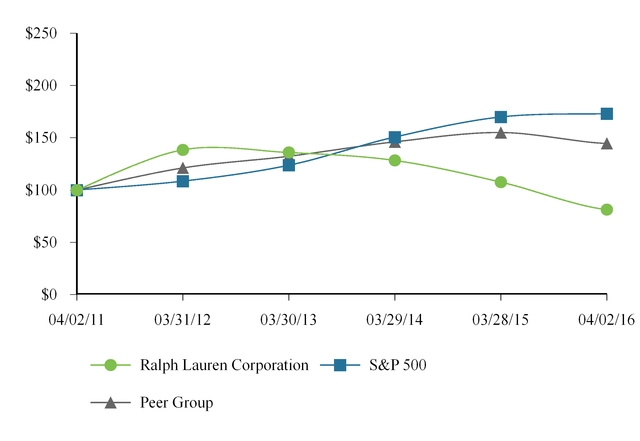
*$100 invested on April 2, 2011 in stock or March 31, 2011 in an index, including reinvestment of dividends. Index calculated on a month-end basis.
Item 6. Selected Financial Data
See the "Index to Consolidated Financial Statements and Supplementary Information," and specifically "Selected Financial Information" appearing at the end of this Annual Report on Form 10-K. This selected financial data should be read in conjunction with Item 7 — "Management's Discussion and Analysis of Financial Condition and Results of Operations" and Item 8 — "Financial Statements and Supplementary Data" included in this Annual Report on Form 10-K. Historical results may not be indicative of future results.
| 34 |
Item 7. Management's Discussion and Analysis of Financial Condition and Results of Operations.
The following management's discussion and analysis of financial condition and results of operations ("MD&A") should be read together with our audited consolidated financial statements and footnotes, which are included in this Annual Report on Form 10-K. We utilize a 52-53 week fiscal year ending on the Saturday closest to March 31. As such, Fiscal 2016 ended on April 2, 2016 and was a 53-week period; Fiscal 2015 ended on March 28, 2015 and was a 52-week period; and Fiscal 2014 ended on March 29, 2014 and was also a 52-week period. Fiscal 2017 will end on April 1, 2017 and will be a 52-week period.
INTRODUCTION
MD&A is provided as a supplement to the accompanying audited consolidated financial statements and footnotes to help provide an understanding of our results of operations, financial condition, and liquidity. MD&A is organized as follows:
| • | Overview. This section provides a general description of our business, current trends and outlook, and a summary of our financial performance for Fiscal 2016. In addition, this section includes a discussion of recent developments and transactions affecting comparability that we believe are important in understanding our results of operations and financial condition, and in anticipating future trends. |
| • | Results of operations. This section provides an analysis of our results of operations for Fiscal 2016 as compared to Fiscal 2015 and Fiscal 2015 as compared to Fiscal 2014. |
| • | Financial condition and liquidity. This section provides a discussion of our financial condition and liquidity as of April 2, 2016, which includes (i) an analysis of our financial condition compared to the prior fiscal year-end; (ii) an analysis of changes in our cash flows for Fiscal 2016 and Fiscal 2015 as compared to the respective prior fiscal year; (iii) an analysis of our liquidity, including the availability under our commercial paper borrowing program and credit facilities, common stock repurchases, payments of dividends, and our outstanding debt and covenant compliance; and (iv) a summary of our contractual and other obligations as of April 2, 2016. |
| • | Market risk management. This section discusses how we manage our risk exposures related to foreign currency exchange rates, interest rates, and our investments as of April 2, 2016. |
| • | Critical accounting policies. This section discusses accounting policies considered to be important to our results of operations and financial condition, which typically require significant judgment and estimation on the part of management in their application. In addition, all of our significant accounting policies, including our critical accounting policies, are summarized in Note 3 to the accompanying audited consolidated financial statements. |
| • | Recently issued accounting standards. This section discusses the potential impact on our reported results of operations and financial condition of certain accounting standards that have been recently issued or proposed. |
OVERVIEW
Our Business
Our Company is a global leader in the design, marketing, and distribution of premium lifestyle products, including apparel, accessories, home furnishings, and other licensed product categories. Our long-standing reputation and distinctive image have been consistently developed across an expanding number of products, brands, sales channels, and international markets. Our brand names include Ralph Lauren, Ralph Lauren Collection, Ralph Lauren Purple Label, Polo Ralph Lauren, Double RL, Lauren Ralph Lauren, Polo Ralph Lauren Children, Denim & Supply Ralph Lauren, Chaps, Club Monaco, and American Living, among others.
We classify our businesses into three segments: Wholesale, Retail, and Licensing. Our Wholesale business, which represented approximately 45% of our Fiscal 2016 net revenues, consists of sales made principally to major department stores and specialty stores around the world. Our Retail business, which represented approximately 53% of our Fiscal 2016 net revenues, consists of sales made directly to consumers through our integrated retail channel, which includes our retail stores, concession-based shop-within-shops, and our e-commerce operations around the world. Our Licensing business, which represented approximately 2% of our Fiscal 2016 net revenues, consists of royalty-based arrangements under which we license to unrelated third parties for specified periods the right to operate retail stores and/or to use our various trademarks in connection with the manufacture and sale of designated products, such as certain apparel, eyewear, fragrances, and home furnishings. Approximately
| 35 |
37% of our Fiscal 2016 net revenues were earned outside of the U.S. See Note 21 to the accompanying audited consolidated financial statements for a summary of net revenues, operating income, and total assets by reportable segment, as well as net revenues and long-lived assets by geographic location.
Our business is typically affected by seasonal trends, with higher levels of wholesale sales in our second and fourth fiscal quarters and higher retail sales in our second and third fiscal quarters. These trends result primarily from the timing of seasonal wholesale shipments and key vacation travel, back-to-school, and holiday shopping periods impacting our Retail segment.
Current Trends and Outlook
The global economy continues to be in a heightened state of uncertainty, as productivity growth in both advanced and emerging countries remains low. Certain worldwide events, including political unrest, disease epidemics, monetary policy changes, and currency and commodity price volatility, as well as China's recent economic slowdown, continue to impact consumer confidence and the global economy as a whole, as well as the world's stock markets. While certain geographic regions are withstanding these pressures better than others, the level of consumer travel and spending on discretionary items remains constrained in certain markets, with trends likely to continue in 2016. Additionally, consumers are increasingly spending more of their discretionary income on “experiences,” such as dining and entertainment, over consumer goods. Consequently, consumer retail traffic remains relatively weak and inconsistent, which has led to increased competition and a desire to offset traffic declines with increased levels of conversion. Certain of our operations have experienced, and have been impacted by, these dynamics, with variations across the geographic regions and businesses in which we operate.
If the current economic conditions and challenging industry trends continue or worsen, the constrained level of worldwide consumer spending and modified consumption behavior may continue to have a negative effect on our sales, inventory levels, and operating margin in Fiscal 2017. Furthermore, our results have been, and are expected to continue to be, negatively impacted by unfavorable foreign exchange rate fluctuations. We have initiated various operating strategies to mitigate these challenges, and remain optimistic about our future growth prospects. Accordingly, we continue to invest in our longer-term growth initiatives, including our restructuring activities, as described within "Recent Developments" below, while continually monitoring macroeconomic risks and remaining focused on disciplined expense management. Although we continue to expect that the dilutive effects of investments that we are making in our business will create operating margin pressure in the near-term, we expect that these initiatives will create longer-term shareholder value. We will continue to monitor these risks and evaluate and adjust our operating strategies and foreign currency and cost management opportunities to mitigate the related impact on our r
Showing the first 8K of 124K characters. Open the full section
Item 7A. Quantitative and Qualitative Disclosures about Market Risk.
For a discussion of our exposure to market risk, see "Market Risk Management" in Item 7 included elsewhere in this Annual Report on Form 10-K.
Item 8. Financial Statements and Supplementary Data.
See the "Index to Consolidated Financial Statements" appearing at the end of this Annual Report on Form 10-K.
Item 9. Changes in and Disagreements with Accountants on Accounting and Financial Disclosure.
Not applicable.
Item 9A. Controls and Procedures.
(a) Evaluation of Disclosure Controls and Procedures
Disclosure controls and procedures are the controls and other procedures of an issuer that are designed to provide reasonable assurance that information required to be disclosed by the issuer in the reports that it files or submits under the Securities Exchange Act of 1934 is recorded, processed, summarized, and reported within the time period specified in the Securities and Exchange Commission's rules and forms. Disclosure controls and procedures include, without limitation, controls and procedures designed to ensure that material information required to be disclosed by an issuer in the reports that it files or submits under the Securities Exchange Act of 1934 is accumulated and communicated to the issuer's management, including its principal executive and principal financial officers, or persons performing similar functions, as appropriate to allow timely decisions regarding required disclosure.
We have evaluated, under the supervision and with the participation of management, including our Chief Executive Officer and Chief Financial Officer, the effectiveness of our disclosure controls and procedures, as defined in Rules 13a-15(e) and 15d-15(e) of the Securities Exchange Act of 1934, as of the end of the fiscal year covered by this annual report. Based on that evaluation, our Chief Executive Officer and Chief Financial Officer have concluded that the Company's disclosure controls and procedures were effective at the reasonable assurance level, as of the fiscal year-end covered by this Annual Report on Form 10-K.
(b) Management's Report on Internal Control Over Financial Reporting
Management is responsible for establishing and maintaining adequate internal control over financial reporting, as defined in Securities Exchange Act Rule 13a-15(f). Internal control over financial reporting is designed to provide reasonable assurance regarding the reliability of financial reporting and preparation of financial statements for external purposes in accordance with U.S. Generally Accepted Accounting Principles. Internal control over financial reporting includes maintaining records that in reasonable detail accurately and fairly reflect our transactions; providing reasonable assurance that transactions are recorded as necessary for preparation of our financial statements; providing reasonable assurance that receipts and expenditures of the Company's assets are made in accordance with management authorization; and providing reasonable assurance that unauthorized acquisition, use or disposition of the Company's assets that could have a material effect on our financial statements would be prevented or detected on a timely basis. Because of its inherent limitations, internal control over financial reporting is not intended to provide absolute assurance that a misstatement of our financial statements would be prevented or detected. Further, the evaluation of the effectiveness of internal control over financial reporting was made as of a specific date, and continued effectiveness in future periods is subject to the risks that controls may become inadequate because of changes in conditions or that the degree of compliance with the policies and procedures may decline.
Under the supervision and with the participation of management, including our Chief Executive Officer and Chief Financial Officer, we conducted an evaluation of the effectiveness of our internal control over financial reporting as of the end of the fiscal year covered by this report based on the framework issued by the Committee of Sponsoring Organizations of the Treadway
| 62 |
Commission in Internal Control-Integrated Framework (2013 Framework). Based on this evaluation, management concluded that the Company's internal controls over financial reporting were effective at the reasonable assurance level as of the fiscal year-end covered by this Annual Report on Form 10-K.
Ernst & Young LLP, the Company's independent registered public accounting firm, has issued an attestation report on the Company's internal control over financial reporting as included elsewhere herein.
(c) Changes in Internal Controls over Financial Reporting
Except as discussed below, there has been no change in our internal control over financial reporting during the fourth quarter of Fiscal 2016 that has materially affected, or is reasonably likely to materially affect, the Company's internal control over financial reporting.
Global Operating and Financial Reporting System Implementation
We are in the process of implementing a global operating and financial reporting information technology system, SAP, as part of a multi-year plan to integrate and upgrade our systems and processes, which began during our fiscal year ended April 2, 2011. The implementation of this global system is scheduled to continue in phases over the next several years. We substantially completed the migration of our North America operations to SAP during Fiscal 2015, and we are currently in the process of executing the migration of our European operations to SAP, which is expected to be completed during Fiscal 2017.
As the phased implementation of this system occurs, we are experiencing certain changes to our processes and procedures which, in turn, result in changes to our internal control over financial reporting. While we expect SAP to strengthen our internal financial controls by automating certain manual processes and standardizing business processes and reporting across our organization, management will continue to evaluate and monitor our internal controls as processes and procedures in each of the affected areas evolve. For a discussion of risks related to the implementation of new systems, see Item 1A — "Risk Factors — Risks and uncertainties associated with the implementation of information systems may negatively impact our business."
Item 9B. Other Information.
Not applicable.
PART III
Item 10. Directors, Executive Officers and Corporate Governance.
Information relating to our directors and corporate governance will be set forth in the Company's proxy statement for its 2016 annual meeting of stockholders to be filed within 120 days after April 2, 2016 (the "Proxy Statement") and is incorporated by reference herein. Information relating to our executive officers is set forth in Item 1 of this Annual Report on Form 10-K under the caption "Executive Officers."
The Company has a Code of Ethics for Principal Executive Officers and Senior Financial Officers that covers the Company's principal executive officer, principal operating officer, principal financial officer, principal accounting officer, controller, and any person performing similar functions, as applicable. The Company also has a Code of Business Conduct and Ethics that covers the Company's directors, officers, and employees. You can find our Code of Ethics for Principal Executive Officers and Senior Financial Officers and our Code of Business Conduct and Ethics (collectively, the "Codes") on our Internet site, http://investor.ralphlauren.com. We will post any amendments to the Codes and any waivers that are required to be disclosed by the rules of either the SEC or the NYSE on our Internet site.
Item 11. Executive Compensation.
Information relating to executive and director compensation will be set forth in the Proxy Statement and such information is incorporated by reference herein.
| 63 |
Item 12. Security Ownership of Certain Beneficial Owners and Management and Related Stockholder Matters.
Equity Compensation Plan Information as of April 2, 2016
The following table sets forth information as of April 2, 2016 regarding compensation plans under which the Company's equity securities are authorized for issuance:
| (a) | (b) | (c) | |||||||||
| Plan Category | Numbers of Securities to be Issued upon Exercise of Outstanding Options, Warrants and Rights | Weighted-Average Exercise Price of Outstanding Options ($) | Number of Securities Remaining Available for Future Issuance Under Equity Compensation Plans (Excluding Securities Reflected in Column (a)) | ||||||||
| Equity compensation plans approved by security holders | 4,170,629 | (1) | $ | 146.58 | (2) | 2,522,816 | (3) | ||||
| Equity compensation plans not approved by security holders | — | — | — | ||||||||
| Total | 4,170,629 | $ | 146.58 | 2,522,816 |
| (1) | Consists of 2,417,979 options to purchase shares of our Class A common stock and 1,752,650 restricted stock units that are payable solely in shares of Class A common stock (including 429,688 service-based restricted stock units that have fully vested but for which the underlying shares have not yet been delivered as of April 2, 2016). Does not include 14,456 outstanding restricted shares that are subject to forfeiture. |
| (2) | Represents the weighted average exercise price of outstanding stock options. |
| (3) | All of the securities remaining available for future issuance set forth in column (c) may be in the form of options, stock appreciation rights, restricted stock, restricted stock units, performance awards, or other stock-based awards under the Company's 1997 Incentive Plan and 2010 Incentive Plan (the "Plans"). An additional 14,456 outstanding shares of restricted stock granted under the Company's Plans that remain subject to forfeiture are not reflected in column (c). |
Other information relating to security ownership of certain beneficial owners and management will be set forth in the Proxy Statement and such information is incorporated by reference herein.
Item 13. Certain Relationships and Related Transactions, and Director Independence.
The information required to be included by Item 13 of Form 10-K will be included in the Proxy Statement and such information is incorporated by reference herein.
Item 14. Principal Accounting Fees and Services.
The information required to be included by Item 14 of Form 10-K will be included in the Proxy Statement and such information is incorporated by reference herein.
| 64 |
PART IV
Item 15. Exhibits, Financial Statement Schedules.
(a) 1., 2. Financial Statements and Financial Statement Schedules. See index on Page F-1.
- Exhibits
| Exhibit Number | Description | |
| 3.1 | Amended and Restated Certificate of Incorporation of the Company (filed as Exhibit 3.1 to the Company's Registration Statement on Form S-1 (File No. 333-24733) (the "S-1")) | |
| 3.2 | Certificate of Amendment to the Amended and Restated Certificate of Incorporation of the Company (filed as Exhibit 3.1 to the Form 8-K filed August 16, 2011) | |
| 3.3 | Third Amended and Restated By-laws of the Company (filed as Exhibit 3.1 to the Form 8-K dated February 4, 2014) | |
| 4.1 | Indenture, dated as of September 26, 2013, by and between the Company and Wells Fargo Bank, National Association (including the form of Note) (filed as Exhibit 4.1 to the Form 8-K dated September 23, 2013) | |
| 4.2 | First Supplemental Indenture, dated as of September 26, 2013, by and between the Company and Wells Fargo Bank, National Association (filed as Exhibit 4.2 to the Form 8-K dated September 23, 2013) | |
| 4.3 | Second Supplemental Indenture, dated as of August 18, 2015, by and between Ralph Lauren Corporation and Wells Fargo Bank, National Association (filed as Exhibit 4.2 to the Form 8-K dated August 13, 2015) | |
| 10.1 | Registration Rights Agreement dated as of June 9, 1997 by and among Ralph Lauren, GS Capital Partners, L.P., GS Capital Partner PRL Holding I, L.P., GS Capital Partners PRL Holding II, L.P., Stone Street Fund 1994, L.P., Stone Street 1994 Subsidiary Corp., Bridge Street Fund 1994, L.P., and the Company (filed as Exhibit 10.3 to the S-1) | |
| 10.2 | Form of Indemnification Agreement between the Company and its Directors and Executive Officers (filed as Exhibit 10.26 to the S-1) | |
| 10.3 | Amended and Restated Employment Agreement, made effective as of June 26, 2012, between the Company and Ralph Lauren (filed as Exhibit 10.1 to the Form 8-K filed July 2, 2012)† | |
| 10.4 | Amendment No. 1 to the Amended and Restated Employment Agreement, dated as of April 1, 2015, between Ralph Lauren Corporation and Ralph Lauren (filed as Exhibit 10.1 to the Form 8-K dated April 6, 2015)† | |
| 10.5 | Amendment No. 2 to the Amended and Restated Employment Agreement, dated as of September 25, 2015, between Ralph Lauren Corporation and Ralph Lauren (filed as Exhibit 10.1 to the Form 8-K dated September 25, 2015)† | |
| 10.6 | Employment Agreement, dated as of September 25, 2015, between Ralph Lauren Corporation and Stefan Larsson (filed as Exhibit 10.2 to the Form 8-K dated September 25, 2015)† | |
| 10.7 | Employment Agreement, effective as of April 7, 2014, between Ralph Lauren Corporation and Valérie Hermann (filed as Exhibit 10.13 to the Company's Annual Report on Form 10-K for the fiscal year ended March 28, 2015 (the "Fiscal 2015 10-K"))† | |
| 10.8 | Amendment No. 1 to the Employment Agreement, effective as of June 24, 2014, between Ralph Lauren Corporation and Valérie Hermann (filed as Exhibit 10.14 to the Fiscal 2015 10-K)† | |
| 10.9 | Amendment No. 2 to the Employment Agreement, effective as of March 29, 2015, between Ralph Lauren Corporation and Valérie Hermann (filed as Exhibit 10.15 to the Fiscal 2015 10-K)† | |
| 10.10 | Amended and Restated Employment Agreement, effective as of April 4, 2016, between Ralph Lauren Corporation and Valérie Hermann (filed as Exhibit 10.1 to the Form 8-K dated May 4, 2016)† | |
| 10.11 | Amended and Restated Employment Agreement, effective as of April 1, 2015, between Ralph Lauren Corporation and Robert L. Madore (filed as Exhibit 10.4 to the Form 8-K dated April 6, 2015)† | |
| 10.12 | Amended and Restated Employment Agreement, effective as of November 1, 2013, between the Company and Jackwyn Nemerov (filed as Exhibit 10.2 to the Form 8-K dated September 18, 2013)† | |
| 10.13 | Amendment No. 1 to the Amended and Restated Employment Agreement, effective as of March 30, 2014, between the Company and Jackwyn Nemerov (filed as Exhibit 10.6 to the Company's Annual Report on Form 10-K for the fiscal year ended March 29, 2014 (the "Fiscal 2014 10-K"))† | |
| 10.14 | Amendment No. 2 to the Amended and Restated Employment Agreement, effective as of March 29, 2015, between Ralph Lauren Corporation and Jackwyn Nemerov (filed as Exhibit 10.9 to the Fiscal 2015 10-K)† | |
| 10.15 | Employment Separation Agreement and Release, between Ralph Lauren Corporation and Jackwyn Nemerov (filed as Exhibit 10.1 to the Form 8-K dated October 21, 2015)† |
| 65 |
| Exhibit Number | Description | |
| 10.16 | Amended and Restated Employment Agreement, effective as of November 1, 2013, between the Company and Christopher H. Peterson (filed as Exhibit 10.3 to the Form 8-K dated September 18, 2013)† | |
| 10.17 | Amendment No. 1 to the Amended and Restated Employment Agreement, effective as of March 30, 2014, between the Company and Christopher Peterson (filed as Exhibit 10.8 to the Fiscal 2014 10-K)† | |
| 10.18 | Amended and Restated Employment Agreement, effective as of April 1, 2015, between Ralph Lauren Corporation and Christopher H. Peterson (filed as Exhibit 10.2 to the Form 8-K dated April 6, 2015)† | |
| 10.19 | Employment Separation Agreement and Release, between Ralph Lauren Corporation and Christopher Peterson (filed as Exhibit 10.1 to the Form 8-K dated February 25, 2016)† | |
| 10.20 | Amended and Restated Employment Agreement, effective as of March 1, 2014, between the Company and Mitchell A. Kosh (filed as Exhibit 10.1 to the Form 8-K dated February 11, 2014)† | |
| 10.21 | Amended and Restated Employment Agreement, effective as of April 1, 2015, between Ralph Lauren Corporation and Mitchell A. Kosh (filed as Exhibit 10.3 to the Form 8-K dated April 6, 2015)† | |
| 10.22 | Employment Separation Agreement and Release, between Ralph Lauren Corporation and Mitchell A. Kosh (filed as Exhibit 10.1 to the Form 8-K dated October 1, 2015)† | |
| 10.23 | Non-Qualified Stock Option Agreement, dated as of June 8, 2004, between the Company and Ralph Lauren (filed as Exhibit 10.14 to the Company's Annual Report on Form 10-K for the fiscal year ended April 2, 2005 (the "Fiscal 2005 10-K"))† | |
| 10.24 | Restricted Stock Unit Award Agreement, dated as of June 8, 2004, between the Company and Ralph Lauren (filed as Exhibit 10.15 to the Fiscal 2005 10-K)† | |
| 10.25 | Executive Officer Annual Incentive Plan, as amended as of August 9, 2012 (filed as Appendix B to the Company's Definitive Proxy Statement dated July 2, 2012)† | |
| 10.26 | 1997 Long-Term Stock Incentive Plan, as Amended and Restated as of August 12, 2004 (filed as Exhibit 99.1 to the Form 8-K dated August 12, 2004)† | |
| 10.27 | Amendment, as of June 30, 2006, to the 1997 Long-Term Stock Incentive Plan, as Amended and Restated as of August 12, 2004 (filed as Exhibit 10.4 to the Form 10-Q for the quarterly period ended July 1, 2006)† | |
| 10.28 | Amendment No. 2, dated as of May 21, 2009, to the 1997 Long-Term Stock Incentive Plan, as Amended and Restated as of August 12, 2004 (filed as Exhibit 10.26 to the Company's Annual Report on Form 10-K for the fiscal year ended March 28, 2009)† | |
| 10.29 | Amended and Restated 2010 Long-Term Incentive Plan, amended as of August 8, 2013 (filed as Exhibit 10.1 to the Form 10-Q for the quarterly period ended June 29, 2013)† | |
| 10.30 | Cliff Restricted Performance Share Unit Award Overview containing the standard terms of cliff restricted performance share unit awards under the Amended and Restated 2010 Long-Term Stock Incentive Plan (filed as Exhibit 10.25 to the Fiscal 2014 10-K)† | |
| 10.31 | Pro-Rata Restricted Performance Share Unit Award Overview containing the standard terms of restricted performance share unit awards under the Amended and Restated 2010 Long-Term Stock Incentive Plan (filed as Exhibit 10.26 to the |
Showing the first 8K of 228K characters. Open the full section