 filings.tools
Ralph Lauren 10-K 2020-03-28
Filed 2020-05-27. 21 sections, 640K characters. Original on sec.gov · Markdown · JSON
Cover and table of contents
UNITED STATES
SECURITIES AND EXCHANGE COMMISSION
Washington, D.C. 20549
Form 10-K
(Mark One)
| ☑ | ANNUAL REPORT PURSUANT TO SECTION 13 OR 15(d) OF THE SECURITIES EXCHANGE ACT OF 1934 |
For the fiscal year ended March 28, 2020
or
| ☐ | TRANSITION REPORT PURSUANT TO SECTION 13 OR 15(d) OF THE SECURITIES EXCHANGE ACT OF 1934 |
Commission File Number: 001-13057
RALPH LAUREN CORPORATION
(Exact name of registrant as specified in its charter)
| Delaware | 13-2622036 | |||
| (State or other jurisdiction of incorporation or organization) | (I.R.S. Employer Identification No.) | |||
| 650 Madison Avenue, | New York, | New York | 10022 | |
| (Address of principal executive offices) | (Zip Code) |
(212) 318-7000
(Registrant's telephone number, including area code)
Securities registered pursuant to Section 12(b) of the Act:
| Title of Each Class | Trading Symbol(s) | Name of Each Exchange on which Registered |
| Class A Common Stock, $.01 par value | RL | New York Stock Exchange |
Securities registered pursuant to Section 12(g) of the Act: None
Indicate by check mark if the registrant is a well-known seasoned issuer, as defined in Rule 405 of the Securities Act. Yes ☑ No ☐
Indicate by check mark if the registrant is not required to file reports pursuant to Section 13 or 15(d) of the Act. Yes ☐ No ☑
Indicate by check mark whether the registrant (1) has filed all reports required to be filed by Section 13 or 15(d) of the Securities Exchange Act of 1934 during the preceding 12 months (or for such shorter period that the registrant was required to file such reports), and (2) has been subject to such filing requirements for the past 90 days. Yes ☑ No ☐
Indicate by check mark whether the registrant has submitted electronically every Interactive Data File required to be submitted pursuant to Rule 405 of Regulation S-T (§232.405 of this chapter) during the preceding 12 months (or for such shorter period that the registrant was required to submit such files). Yes ☑ No ☐
Indicate by check mark whether the registrant is a large accelerated filer, an accelerated filer, a non-accelerated filer, a smaller reporting company, or an emerging growth company. See the definitions of "large accelerated filer," "accelerated filer," "smaller reporting company," and "emerging growth company" in Rule 12b-2 of the Exchange Act.
| Large accelerated filer | ☑ | Accelerated filer | ☐ |
| Non-accelerated filer | ☐ | Smaller reporting company | ☐ |
| Emerging growth company | ☐ |
If an emerging growth company, indicate by check mark if the registrant has elected not to use the extended transition period for complying with any new or revised financial accounting standards provided pursuant to Section 13(a) of the Exchange Act. ☐
Indicate by check mark whether the registrant has filed a report on and attestation to its management’s assessment of the effectiveness of its internal control over financial reporting under Section 404(b) of the Sarbanes-Oxley Act (15 U.S.C. 7262(b)) by the registered public accounting firm that prepared or issued its audit report. ☑
Indicate by check mark whether the registrant is a shell company (as defined in Rule 12b-2 of the Act). Yes ☐ No ☑
The aggregate market value of the registrant's voting common stock held by non-affiliates of the registrant was $4,649,512,283 as of September 27, 2019, the last business day of the registrant's most recently completed second fiscal quarter based on the closing price of the common stock on the New York Stock Exchange.
At May 22, 2020, 47,777,235 shares of the registrant's Class A common stock, $.01 par value and 24,881,276 shares of the registrant's Class B common stock, $.01 par value were outstanding.
Part III incorporates by reference information from certain portions of the registrant's definitive proxy statement to be filed with the Securities and Exchange Commission within 120 days after the fiscal year ended March 28, 2020.
SPECIAL NOTE REGARDING FORWARD-LOOKING STATEMENTS
Various statements in this Form 10-K or incorporated by reference into this Form 10-K, in future filings by us with the Securities and Exchange Commission (the "SEC"), in our press releases, and in oral statements made from time to time by us or on our behalf constitute "forward-looking statements" within the meaning of the Private Securities Litigation Reform Act of 1995. Forward-looking statements include, without limitation, statements regarding our future operating results and sources of liquidity (especially in light of the COVID 19 pandemic), the impact of our strategic plans, initiatives and capital expenses, and our ability to meet environmental, social, and governance goals. Forward looking statements are based on current expectations and are indicated by words or phrases such as "anticipate," "outlook," "estimate," "expect," "project," "believe," "envision," "goal," "target," "can," "will," and similar words or phrases and involve known and unknown risks, uncertainties, and other factors which may cause actual results, performance, or achievements to be materially different from the future results, performance, or achievements expressed in or implied by such forward-looking statements. These risks, uncertainties, and other factors include, among others:
| • | the loss of key personnel, including Mr. Ralph Lauren, or other changes in our executive and senior management team or to our operating structure, and our ability to effectively transfer knowledge during periods of transition; |
| • | the impact to our business resulting from the COVID-19 pandemic, including the temporary closure of our stores, distribution centers, and corporate facilities, as well as those of our wholesale customers, licensing partners, suppliers, and vendors, and potential changes to consumer behavior, spending levels, and/or shopping preferences, such as their willingness to congregate in shopping centers or other populated locations; |
| • | our ability to access capital markets and maintain compliance with covenants associated with our existing debt instruments; |
| • | our ability to maintain adequate levels of liquidity to provide for our cash needs, including our debt obligations, tax obligations, payment of dividends, capital expenditures, and potential repurchases of our Class A common stock, as well as the ability of our customers, suppliers, vendors, and lenders to access sources of liquidity to provide for their own cash needs; |
| • | the impact to our business resulting from changes in consumers' ability, willingness, or preferences to purchase discretionary items and luxury retail products, which tends to decline during recessionary periods, and our ability to accurately forecast consumer demand, the failure of which could result in either a build-up or shortage of inventory; |
| • | the impact of economic, political, and other conditions on us, our customers, suppliers, vendors, and lenders, including business disruptions related to pandemic diseases such as COVID-19 and political unrest such as the recent protests in Hong Kong; |
| • | the potential impact to our business resulting from the financial difficulties of certain of our large wholesale customers, which may result in consolidations, liquidations, restructurings, and other ownership changes in the retail industry, as well as other changes in the competitive marketplace, including the introduction of new products or pricing changes by our competitors; |
| • | our ability to successfully implement our long-term growth strategy; |
| • | our ability to continue to expand and grow our business internationally and the impact of related changes in our customer, channel, and geographic sales mix as a result, as well as our ability to accelerate growth in certain product categories; |
| • | our ability to open new retail stores and concession shops, as well as enhance and expand our digital footprint and capabilities, all in an effort to expand our direct-to-consumer presence; |
| • | our ability to respond to constantly changing fashion and retail trends and consumer demands in a timely manner, develop products that resonate with our existing customers and attract new customers, and execute marketing and advertising programs that appeal to consumers; |
| • | our ability to effectively manage inventory levels and the increasing pressure on our margins in a highly promotional retail environment; |
| • | our ability to continue to maintain our brand image and reputation and protect our trademarks; |
| • | our ability to competitively price our products and create an acceptable value proposition for consumers; |
| 1 |
| • | a variety of legal, regulatory, tax, political, and economic risks, including risks related to the importation and exportation of products which our operations are currently subject to, or may become subject to as a result of potential changes in legislation, and other risks associated with our international operations, such as compliance with the Foreign Corrupt Practices Act or violations of other anti-bribery and corruption laws prohibiting improper payments, and the burdens of complying with a variety of foreign laws and regulations, including tax laws, trade and labor restrictions, and related laws that may reduce the flexibility of our business; |
| • | the potential impact to our business resulting from the imposition of additional duties, tariffs, taxes, and other charges or barriers to trade, including those resulting from current trade developments with China and the related impact to global stock markets, as well as our ability to implement mitigating sourcing strategies; |
| • | the impact to our business resulting from the United Kingdom's exit from the European Union and the uncertainty surrounding its future relationship with the European Union, including trade agreements, as well as the related impact to global stock markets and currency exchange rates; |
| • | the impact to our business resulting from increases in the costs of raw materials, transportation, and labor, including wages, healthcare, and other benefit-related costs; |
| • | our ability to secure our facilities and systems and those of our third-party service providers from, among other things, cybersecurity breaches, acts of vandalism, computer viruses, or similar Internet or email events; |
| • | our efforts to successfully enhance, upgrade, and/or transition our global information technology systems and digital commerce platforms; |
| • | the potential impact to our business if any of our distribution centers were to become inoperable or inaccessible; |
| • | the potential impact on our operations and on our suppliers and customers resulting from man-made or natural disasters, including pandemic diseases such as COVID-19, severe weather, geological events, and other catastrophic events; |
| • | changes in our tax obligations and effective tax rate due to a variety of other factors, including potential changes in U.S. or foreign tax laws and regulations, accounting rules, or the mix and level of earnings by jurisdiction in future periods that are not currently known or anticipated; |
| • | our exposure to currency exchange rate fluctuations from both a transactional and translational perspective; |
| • | the impact to our business resulting from potential costs and obligations related to the early or temporary closure of our stores or termination of our long-term, non-cancellable leases; |
| • | our ability to achieve anticipated operating enhancements and cost reductions from our restructuring plans, as well as the impact to our business resulting from restructuring-related charges, which may be dilutive to our earnings in the short term; |
| • | the impact to our business of events of unrest and instability that are currently taking place in certain parts of the world, as well as from any terrorist action, retaliation, and the threat of further action or retaliation; |
| • | the potential impact to the trading prices of our securities if our Class A common stock share repurchase activity and/or cash dividend payments differ from investors' expectations; |
| • | our ability to maintain our credit profile and ratings within the financial community; |
| • | our intention to introduce new products or brands, or enter into or renew alliances; |
| • | changes in the business of, and our relationships with, major wholesale customers and licensing partners; |
| • | our ability to achieve our goals regarding environmental, social, and governance practices; and |
| • | our ability to make certain strategic acquisitions and successfully integrate the acquired businesses into our existing operations. |
These forward-looking statements are based largely on our expectations and judgments and are subject to a number of risks and uncertainties, many of which are unforeseeable and beyond our control. A detailed discussion of significant risk factors that have the potential to cause our actual results to differ materially from our expectations is described in Part I of this Form 10-K
| 2 |
under the heading of "Risk Factors." We undertake no obligation to publicly update or revise any forward-looking statements, whether as a result of new information, future events, or otherwise.
WEBSITE ACCESS TO COMPANY REPORTS AND OTHER INFORMATION
Our investor website is http://investor.ralphlauren.com. We were incorporated in June 1997 under the laws of the State of Delaware. Our Annual Reports on Form 10-K, Quarterly Reports on Form 10-Q, Current Reports on Form 8-K, and amendments to those reports filed with or furnished to the SEC pursuant to Section 13(a) or Section 15(d) of the Securities Exchange Act of 1934, are available free of charge at our investor website under the caption "SEC Filings" promptly after we electronically file such materials with or furnish such materials to the SEC. All such filings are also available on the SEC's website at https://www.sec.gov. Information relating to corporate governance at Ralph Lauren Corporation, including our Corporate Governance Policies, our Code of Business Conduct and Ethics for all directors, officers, and employees, our Code of Ethics for Principal Executive Officers and Senior Financial Officers, and information concerning our directors, Committees of the Board of Directors, including Committee charters, and transactions involving Ralph Lauren Corporation securities by directors and executive officers, are available at our website under the captions "Corporate Governance" and "SEC Filings." Paper copies of these filings and corporate governance documents are available to stockholders without charge by written request to Investor Relations, Ralph Lauren Corporation, 650 Madison Avenue, New York, New York 10022.
In this Form 10-K, references to "Ralph Lauren," "ourselves," "we," "our," "us," and the "Company" refer to Ralph Lauren Corporation and its subsidiaries, unless the context indicates otherwise. Due to the collaborative and ongoing nature of our relationships with our licensees, such licensees are sometimes referred to in this Form 10-K as "licensing alliances." Our fiscal year ends on the Saturday closest to March 31. All references to "Fiscal 2021" represent the 52-week fiscal year ending March 27, 2021. All references to "Fiscal 2020" represent the 52-week fiscal year ended March 28, 2020. All references to "Fiscal 2019" represent the 52-week fiscal year ended March 30, 2019. All references to "Fiscal 2018" represent the 52-week fiscal year ended March 31, 2018.
PART I
Item 1. Business.
General
Founded in 1967 by Mr. Ralph Lauren, we are a global leader in the design, marketing, and distribution of premium lifestyle products, including apparel, footwear, accessories, home furnishings, fragrances and hospitality. Our long-standing reputation and distinctive image have been developed across an expanding number of products, brands, sales channels, and international markets. We believe that our global reach, breadth of product offerings, and multi-channel distribution are unique among luxury and apparel companies.
We diversify our business by geography (North America, Europe, and Asia, among other regions) and channel of distribution (retail, wholesale, and licensing). This allows us to maintain a dynamic balance as our operating results do not depend solely on the performance of any single geographic area or channel of distribution. We sell directly to consumers through our integrated retail channel, which includes our retail stores, concession-based shop-within-shops, and digital commerce operations around the world. Our wholesale sales are made principally to major department stores, specialty stores, and third-party digital partners around the world, as well as to certain third-party-owned stores to which we have licensed the right to operate in defined geographic territories using our trademarks. In addition, we license to third parties for specified periods the right to access our various trademarks in connection with the licensees' manufacture and sale of designated products, such as certain apparel, eyewear, fragrances, and home furnishings.
We organize our business into the following three reportable segments: North America, Europe, and Asia. In addition to these reportable segments, we also have other non-reportable segments. See "Our Segments" for further discussion of our segment reporting structure.
Our global reach is extensive, as we sell directly to customers throughout the world via our 530 retail stores and 654 concession-based shop-within-shops, as well as through our own digital commerce sites and those of various third-party digital partners. Merchandise is also available through our wholesale distribution channels at over 11,000 doors worldwide, the majority in specialty stores, as well as through the digital commerce sites of many of our wholesale customers. In addition to our directly-operated stores and shops, our international licensing partners operate 80 Ralph Lauren stores, 31 Ralph Lauren concession shops, and 139 Club Monaco stores and shops.
| 3 |
We continue to invest in our business to stimulate growth. Over the past five fiscal years, we have invested approximately $1.331 billion for capital improvements, primarily funded through strong operating cash flow. We also have continued to return value to our shareholders through our common stock share repurchases and payment of quarterly cash dividends. Over the past five fiscal years, the cost of shares of Class A common stock repurchased pursuant to our common stock repurchase program was approximately $1.800 billion and dividends paid amounted to approximately $892 million.
We have been controlled by the Lauren family since the founding of our Company. As of March 28, 2020, Mr. R. Lauren, or entities controlled by the Lauren family, held approximately 84% of the voting power of the Company's outstanding common stock.
Objectives and Opportunities
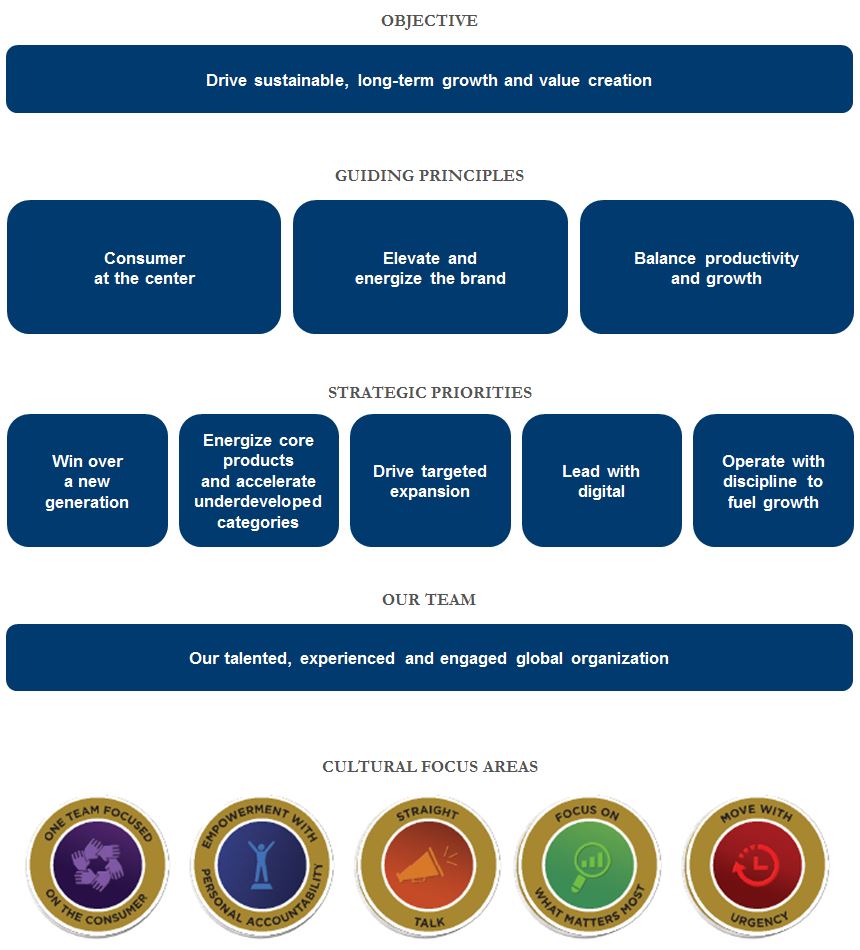
We believe that our size and the global scope of our operations provide us with design, sourcing, and distribution synergies across our different businesses. Our core strengths include a portfolio of global premium lifestyle brands, a well-diversified global multi-channel distribution network, an investment philosophy supported by a strong balance sheet, and an experienced management team. Despite the various risks and uncertainties associated with the current global economic environment, as discussed further in Item 7 — "Management's Discussion and Analysis of Financial Condition and Results of Operations — Global Economic Conditions and Industry Trends," we believe our core strengths will allow us to execute our long-term growth strategy.
An overview of our long-term growth strategy is presented below:
| 4 |
Global Citizenship and Sustainability
Global citizenship and sustainability at Ralph Lauren Corporation is rooted in the heritage of our brand and our purpose to inspire the dream of a better life through authenticity and timeless style. We believe that delivering the next 50 years for Ralph Lauren means rethinking our impact on the environment and society and utilizing creativity, the power of design, and innovative technologies to drive meaningful change.
Although we are at the beginning of this journey, the values and purpose that have defined our business for half a century underline the authenticity of our commitment for our next 50 years. We call our plan "Design the Change," which is guided by the following three pillars:
| 1. | Create Timeless Style |
| • | Sustainable Product Design — We commit to designing more sustainable products and experiences by sourcing responsibly, manufacturing efficiently, and investing in innovation that advances these efforts. |
| • | Sourcing & Traceability — We are committed to sourcing responsibly, securing a long-term, sustainable supply for key raw materials, as well as implementing a supplier engagement strategy that drives transparency, efficiency and partnerships that advance our work to deliver positive social and environmental impacts across our value chain. |
| • | Chemical Management — We commit to monitor and reduce hazardous chemical use and discharge, ultimately eliminating all hazardous chemicals from the production of our products. |
| 2. | Protect the Environment |
| • | Carbon and Energy — We commit to address the issue of global climate change and the contributing impacts of our business by reducing greenhouse gas emissions across our value chain. |
| • | Waste Management — We commit to integrating zero waste principles across our business with an aim to divert waste from landfill through increasing recycling and upcycling, reducing waste at its source, and implementing other best practices. |
| • | Water Stewardship — We commit to reducing water consumption across our value chain, and to safeguarding and preserving water resources in the communities where we operate. |
| 3. | Champion Better Lives |
| • | Diversity and Inclusion — We are committed to advancing an inclusive environment where everyone has a sense of belonging throughout our value chain. |
| • | Health, Safety & Working Conditions — We aim to enrich the quality of work and life for all workers in our value chain by ensuring that everyone has the opportunity to reach their full potential in a safe and comfortable work environment. |
| • | Community Engagement & Philanthropy — We commit to meaningfully engaging our communities through our work across cancer care as well as our global employee volunteerism program. |
Additional information relating to Design the Change can be found in our annual sustainability report, which is available at our website at http://investor.ralphlauren.com under the caption "Global Citizenship & Sustainability Report." The content of our sustainability reports are not incorporated by reference into this Annual Report on Form 10-K or in any other report or document we file with the SEC.
| | | | | --
Showing the first 8K of 82K characters. Open the full section
Item 1A. Risk Factors
There are risks associated with an investment in our securities. The following risk factors should be read carefully in connection with evaluating our business and the forward-looking statements contained in this Annual Report on Form 10-K. Any of the following risk factors could materially adversely affect our business, our prospects, our results of operations, our financial condition, our liquidity, the trading price of our securities, and/or the actual outcome of matters as to which forward-looking statements are made in this report. Additional risks and uncertainties not currently known to us or that we currently view as immaterial may also materially adversely affect our business, results of operations, and financial condition in future periods or if circumstances change.
The loss of the services of Mr. Ralph Lauren, members of our executive management team, or other key personnel could have a material adverse effect on our business.
Mr. Ralph Lauren's leadership in the design and marketing areas of our business has been a critical element of our success since the inception of our Company. Mr. R. Lauren is instrumental to, and closely identified with, our brand that bears his name. Our ability to maintain our brand image and leverage the goodwill associated with Mr. R. Lauren's name may be damaged if we were to lose his services. The death or disability of Mr. R. Lauren or other extended or permanent loss of his services, or any negative market or industry perception with respect to him or arising from his loss, could have a material adverse effect on our business, results of operations, and financial condition.
We also depend on the service and management experience of other key executive officers and other members of senior management who have substantial experience and expertise in our industry and our business and have made significant contributions to our growth and success. Competition in our industry to attract and retain these employees is intense and is influenced by our reputation, our ability to offer competitive compensation and benefits, and economic conditions, among other factors. The loss of the services of any of our key executive officers or other members of senior management, or one or more of our other key personnel, or the concurrent loss of several of these individuals or any negative public perception with respect to these individuals, could also have a material adverse effect on our business, results of operations, and financial condition.
We are not protected by a material amount of key-man or similar life insurance covering our executive officers, including Mr. R. Lauren, or other members of senior management. We have entered into employment agreements with certain of our executive officers, but competition for experienced executives in our industry is intense and the non-compete period with respect to certain of our executive officers could, in some circumstances in the event of their termination of employment with our Company, end prior to the employment term set forth in their employment agreements.
Infectious disease outbreaks, such as the recent COVID-19 pandemic, could have a material adverse effect on our business.
Our business could be adversely affected by infectious disease outbreaks, such as the recent novel strain of coronavirus commonly referred to as COVID-19. COVID-19 has spread rapidly across the globe in recent months, including throughout all major geographies in which we operate (North America, Europe, and Asia), resulting in adverse economic conditions and business disruptions, as well as significant volatility in global financial markets. Governments worldwide have imposed varying degrees of preventative and protective actions, such as temporary travel bans, forced business closures, and stay-at-home orders, all in an effort to reduce the spread of the virus.
In connection with the COVID-19 pandemic, we have experienced varying degrees of business disruptions and periods of closure of our stores, distribution centers, and corporate facilities, as have our wholesale customers, licensing partners, suppliers, and vendors, as described in Item 1 — "Business — Recent Developments." The COVID-19 pandemic remains highly volatile and continues to evolve on a daily basis. Accordingly, we cannot predict for how long and to what extent this crisis will impact our business operations or the global economy as a whole. Potential impacts to our business include, but are not limited to, the following:
| • | our ability to successfully execute our long-term growth strategy during these uncertain times; |
| • | temporary closures of our stores, distribution centers, and corporate facilities for unknown periods of time, as well as those of our wholesale customers and licensing partners; |
| • | potential declines in the level of consumer purchases of discretionary items and luxury retail products, including our products, caused by lower disposal income levels, travel restrictions, or other factors beyond our control; |
| 23 |
| • | the potential build-up of excess inventory as a result of store closures and/or lower consumer demand, including those resulting from potential changes in consumer behavior and/or shopping preferences, such as their willingness to congregate in shopping centers or other populated locations; |
| • | supply chain disruptions resulting from closed factories, reduced workforces, scarcity of raw materials, and scrutiny or embargoing of goods produced in infected areas; |
| • | our ability to access capital markets and maintain compliance with covenants associated with our existing debt instruments, as well as the ability of our key customers, suppliers, and vendors to do the same in regard to their own obligations; |
| • | the potential loss of one or more of our significant wholesale customers, or the loss of a large number of smaller wholesale customers, if they are not able to withstand prolonged periods of adverse economic conditions, and our ability to collect outstanding receivables; |
| • | our ability to maintain an effective system of internal controls and compliance with the requirements under the Sarbanes-Oxley Act of 2002; and |
| • | diversion of management attention and resources from ongoing business activities and/or a decrease in employee morale. |
Additional discussion related to the various risks and uncertainties described above is included elsewhere within this "Risk Factors" section of our Form 10-K.
Economic, political, and other conditions may adversely affect the level of consumer purchases of discretionary items and luxury retail products, including our products.
The industries in which we operate are cyclical. Many economic and other factors outside of our control affect the level of consumer spending in the apparel, footwear, accessory, and home product industries, including, among others:
| • | man-made or natural disasters, including pandemic diseases such as COVID-19; |
| • | consumer perceptions of personal well-being and safety; |
| • | consumer perceptions of current and future economic conditions; |
| • | employment levels and wage rates; |
| • | stock market performance; |
| • | inflation; |
| • | interest rates; |
| • | foreign currency exchange rates; |
| • | the housing market; |
| • | consumer debt levels; |
| • | the availability of consumer credit; |
| • | commodity prices, including fuel and energy costs |
Showing the first 8K of 81K characters. Open the full section
Item 1B. Unresolved Staff Comments.
Not applicable.
Item 2. Properties.
We lease space for our retail stores, showrooms, warehouses, and offices in various domestic and international locations. We do not own any real property except for our retail digital commerce call center and distribution facility in High Point, North Carolina; and our retail stores in Southampton and Easthampton, New York, and Nantucket, Massachusetts.
We believe that our existing facilities are well maintained, in good operating condition, and are adequate for our present level of operations.
The following table sets forth information relating to our key properties as of March 28, 2020:
| Location | Use | Approximate Square Feet | ||
| NC Highway 66, High Point, NC | Wholesale and retail distribution facility | 847,000 | ||
| N. Pendleton Street, High Point, NC | Retail digital commerce call center and distribution facility | 805,000 | ||
| Greensboro, NC | Wholesale and retail distribution facility | 337,700 | ||
| 601 West 26th Street, NYC | Corporate offices | 304,900 | ||
| 650 Madison Avenue, NYC | Executive and corporate offices, design studio, and showrooms | 273,200 | ||
| Nutley, NJ | Corporate and retail administrative offices and showrooms | 255,000 | ||
| Geneva, Switzerland | European corporate offices | 107,000 | ||
| 7th Avenue, NYC | Corporate offices, design studio, and Women's showrooms | 78,800 | ||
| Spinners Building, Hong Kong | Asia sourcing offices | 67,000 | ||
| Gateway Office, Hong Kong | Asia corporate offices | 37,500 | ||
| 888 Madison Avenue, NYC | Retail flagship store | 37,900 | ||
| N. Michigan Avenue, Chicago | Retail flagship store | 37,500 | ||
| New Bond Street, London, UK | Retail flagship store | 31,500 | ||
| 867 Madison Avenue, NYC | Retail flagship store | 27,700 | ||
| Paris, France | Retail flagship store | 25,700 | ||
| Tokyo, Japan | Retail flagship store | 25,000 | ||
| N. Rodeo Drive, Beverly Hills | Retail flagship store | 19,400 | ||
| Regent Street, London, UK | Retail flagship store | 19,000 | ||
| Prince's Building, Hong Kong | Retail flagship store | 9,800 |
As of March 28, 2020, we directly operated 530 retail stores, totaling approximately 4.1 million square feet. We anticipate that we will be able to extend our retail store leases, as well as those leases for our non-retail facilities, which expire in the near future on satisfactory terms or relocate to desirable alternate locations. We generally lease our freestanding retail stores for initial periods ranging from 5 to 15 years, with renewal options. See Item 1A — "Risk Factors — Our business is subject to risks associated with leasing real estate and other assets under long-term, non-cancellable leases."
| 38 |
Item 3. Legal Proceedings.
We are involved, from time to time, in litigation, other legal claims, and proceedings involving matters associated with or incidental to our business, including, among other things, matters involving credit card fraud, trademark and other intellectual property, licensing, importation and exportation of products, taxation, unclaimed property, and employee relations. We believe at present that the resolution of currently pending matters will not individually or in the aggregate have a material adverse effect on our consolidated financial statements. However, our assessment of any litigation or other legal claims could potentially change in light of the discovery of facts not presently known or determinations by judges, juries, or other finders of fact which are not in accord with management's evaluation of the possible liability or outcome of such litigation or claims.
Item 4. Mine Safety Disclosures.
Not applicable.
PART II
Item 5. Market for Registrant's Common Equity, Related Stockholder Matters and Issuer Purchases of Equity Securities.
As of May 22, 2020, there were 667 holders of record of our Class A common stock and 6 holders of record of our Class B common stock. Our Class A common stock is traded on the New York Stock Exchange ("NYSE") under the symbol "RL." All of our outstanding shares of Class B common stock are owned by Mr. Ralph Lauren, Executive Chairman and Chief Creative Officer, and entities controlled by the Lauren family. Shares of our Class B common stock may be converted immediately into Class A common stock on a one-for-one basis by the holder. There is no cash or other consideration paid by the holder converting the shares and, accordingly, there is no cash or other consideration received by the Company. The shares of Class A common stock issued by the Company in such conversions are exempt from registration pursuant to Section 3(a)(9) of the Securities Act of 1933, as amended. No shares of our Class B common stock were converted into Class A common stock during the fiscal quarter ended March 28, 2020.
The following table sets forth repurchases of shares of our Class A common stock during the fiscal quarter ended March 28, 2020:
| Total Number of Shares Purchased | Average Price Paid per Share | Total Number of Shares Purchased as Part of Publicly Announced Plans or Programs | Approximate Dollar Value of Shares That May Yet Be Purchased Under the Plans or Programs**(b)** | |||||||||||
| (millions) | ||||||||||||||
| December 29, 2019 to January 25, 2020 | — | $ | — | — | $ | 732 | ||||||||
| January 26, 2020 to February 22, 2020 | 783,395 | 121.29 | 783,395 | 637 | ||||||||||
| February 23, 2020 to March 28, 2020 | 555,265 | (a) | 104.18 | 543,438 | 580 | |||||||||
| 1,338,660 | 1,326,833 |
| (a) | Includes 11,827 shares surrendered to or withheld by the Company in satisfaction of withholding taxes in connection with the vesting of awards issued under its long-term stock incentive plans. |
| (b) | As of March 28, 2020, the remaining availability under our Class A common stock repurchase program was approximately $580 million, reflecting the May 13, 2019 approval by our Board of Directors to expand the program by up to an additional $600 million of Class A common stock repurchases. Repurchases of shares of Class A common stock are subject to overall business and market conditions. Accordingly, as a result of current business disruptions related to the COVID-19 pandemic, we have temporarily suspended our common stock repurchase program as a preemptive action to preserve cash and strengthen our liquidity. |
| 39 |
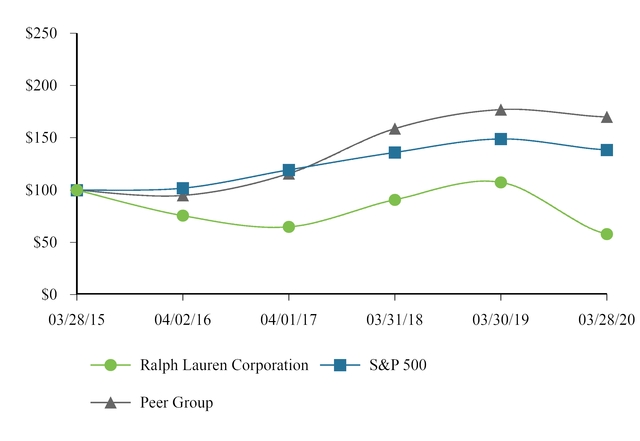
The following graph compares the cumulative total stockholder return (stock price appreciation plus dividends) on our Class A common stock to the cumulative total return of the Standard & Poor's 500 Index and a peer group index of companies that we believe are closest to ours (the "Peer Group") for the period from March 28, 2015, the last day of our 2015 fiscal year, through March 28, 2020, the last day of our 2020 fiscal year. Our Peer Group consists of Burberry Group PLC, Compagnie Financière Richemont SA, EssilorLuxottica SA, The Estée Lauder Companies Inc., Hermes International, Kering, LVMH, PVH Corp., Tapestry, Inc., Tiffany & Co., Tod's S.p.A., and V.F. Corporation. All calculations for foreign companies in our Peer Group are performed using the local foreign issue of such companies. The returns are calculated by assuming a $100 investment made on March 28, 2015 in Class A common stock or March 31, 2015 in an index, with all dividends reinvested.
COMPARISON OF 5 YEAR CUMULATIVE TOTAL RETURN
Among Ralph Lauren Corporation, the S&P 500 Index, and a Peer Group
Item 6. Selected Financial Data
See the "Index to Consolidated Financial Statements and Supplementary Information," and specifically "Selected Financial Information" appearing at the end of this Annual Report on Form 10-K. This selected financial data should be read in conjunction with Item 7 — "Management's Discussion and Analysis of Financial Condition and Results of Operations" and Item 8 — "Financial Statements and Supplementary Data" included in this Annual Report on Form 10-K. Historical results may not be indicative of future results.
| 40 |
Item 7. Management's Discussion and Analysis of Financial Condition and Results of Operations.
The following management's discussion and analysis of financial condition and results of operations ("MD&A") should be read together with our audited consolidated financial statements and notes thereto, which are included in this Annual Report on Form 10-K. We utilize a 52-53 week fiscal year ending on the Saturday closest to March 31. As such, Fiscal 2020 ended on March 28, 2020 and was a 52-week period; Fiscal 2019 ended on March 30, 2019 and was a 52-week period; Fiscal 2018 ended on March 31, 2018 and was a 52-week period; and Fiscal 2021 will end on March 27, 2021 and will be a 52-week period.
INTRODUCTION
MD&A is provided as a supplement to the accompanying consolidated financial statements and notes thereto to help provide an understanding of our results of operations, financial condition, and liquidity. MD&A is organized as follows:
| • | Overview. This section provides a general description of our business, global economic conditions and industry trends, and a summary of our financial performance for Fiscal 2020. In addition, this section includes a discussion of recent developments and transactions affecting comparability that we believe are important in understanding our results of operations and financial condition, and in anticipating future trends. |
| • | Results of operations. This section provides an analysis of our results of operations for Fiscal 2020 and Fiscal 2019 as compared to the respective prior fiscal year. |
| • | Financial condition and liquidity. This section provides a discussion of our financial condition and liquidity as of March 28, 2020, which includes (i) an analysis of our financial condition as compared to the prior fiscal year-end; (ii) an analysis of changes in our cash flows for Fiscal 2020 and Fiscal 2019 as compared to the respective prior fiscal year; (iii) an analysis of our liquidity, including the availability under our commercial paper borrowing program and credit facilities, common stock repurchases, payments of dividends, and our outstanding debt and covenant compliance; and (iv) a summary of our contractual and other obligations as of March 28, 2020. |
| • | Market risk management. This section discusses how we manage our risk exposures related to foreign currency exchange rates, interest rates, and our investments as of March 28, 2020. |
| • | Critical accounting policies. This section discusses accounting policies considered to be important to our results of operations and financial condition, which typically require significant judgment and estimation on the part of management in their application. In addition, all of our significant accounting policies, including our critical accounting policies, are summarized in Note 3 to the accompanying consolidated financial statements. |
| • | Recently issued accounting standards. This section discusses the potential impact on our reported results of operations and financial condition of certain accounting standards that have been recently issued. |
OVERVIEW
Our Business
Our Company is a global leader in the design, marketing, and distribution of premium lifestyle products, including apparel, footwear, accessories, home furnishings, fragrances, and hospitality. Our long-standing reputation and distinctive image have been developed across an expanding number of products, brands, sales channels, and international markets. Our brand names include Ralph Lauren, Ralph Lauren Collection, Ralph Lauren Purple Label, Polo Ralph Lauren, Double RL, Lauren Ralph Lauren, Polo Ralph Lauren Children, Chaps, and Club Monaco, among others.
We diversify our business by geography (North America, Europe, and Asia, among other regions) and channel of distribution (retail, wholesale, and licensing). This allows us to maintain a dynamic balance as our operating results do not depend solely on the performance of any single geographic area or channel of distribution. We sell directly to consumers through our integrated retail channel, which includes our retail stores, concession-based shop-within-shops, and digital commerce operations around the world. Our wholesale sales are made principally to major department stores, specialty stores, and third-party digital partners around the world, as well as to certain third-party-owned stores to which we have licensed the right to operate in defined geographic territories using our trademarks. In addition, we license to third parties for specified periods the right to access our various trademarks in connection with the licensees' manufacture and sale of designated products, such as certain apparel, eyewear, fragrances, and home furnishings.
| 41 |
We organize our business into the following three reportable segments:
| • | North America — Our North America segment, representing approximately 51% of our Fiscal 2020 net revenues, primarily consists of sales of our Ralph Lauren branded products made through our retail and wholesale businesses in the U.S. and Canada, excluding Club Monaco. In North America, our retail business is comprised of our Ralph Lauren stores, our factory stores, and our digital commerce site, www.RalphLauren.com. Our wholesale business in North America is comprised primarily of sales to department stores, and to a lesser extent, specialty stores. |
| • | Europe — Our Europe segment, representing approximately 26% of our Fiscal 2020 net revenues, primarily consists of sales of our Ralph Lauren branded products made through our retail and wholesale businesses in Europe, the Middle East, and Latin America, excluding Club Monaco. In Europe, our retail business is comprised of our Ralph Lauren stores, our factory stores, our concession-based shop-within-shops, and our various digital commerce sites. Our wholesale business in Europe is comprised of a varying mix of sales to both department stores and specialty stores, depending on the country, as well as to various third-party digital partners. |
| • | Asia — Our Asia segment, representing approximately 17% of our Fiscal 2020 net revenues, primarily consists of sales of our Ralph Lauren branded products made through our retail and wholesale businesses in Asia, Australia, and New Zealand. Our retail business in Asia is primarily comprised of our Ralph Lauren stores, our factory stores, our concession-based shop-within-shops, and our digital commerce site, www.RalphLauren.cn, which launched in September 2018. In addition, we sell our products online through various third-party digital partner commerce sites. In Asia, our wholesale business is comprised primarily of sales to department stores, with related products distributed through shop-within-shops. |
No operating segments were aggregated to form our reportable segments. In addition to these reportable segments, we also have other non-reportable segments, representing approximately 6% of our Fiscal 2020 net revenues, which primarily consist of (i) sales of Club Monaco branded products made through our retail and wholesale businesses in the U.S., Canada, and Europe, and our licensing alliances in Europe and Asia, and (ii) royalty revenues earned through our global licensing alliances, excluding Club Monaco.
Effective beginning in the first quarter of Fiscal 2020, operating results related to our business in Latin America are included within our Europe segment due to a change in how we manage this business. Previously, such results were included within our other non-reportable segments. All prior period segment information has been recast to reflect this change on a comparative basis.
Approximately 46% of our Fiscal 2020 net revenues were earned outside of the U.S. See Note 20 to the accompanying consolidated financial statements
Showing the first 8K of 149K characters. Open the full section
Item 7A. Quantitative and Qualitative Disclosures about Market Risk.
For a discussion of our exposure to market risk, see "Market Risk Management" in Item 7 included elsewhere in this Annual Report on Form 10-K.
Item 8. Financial Statements and Supplementary Data.
See the "Index to Consolidated Financial Statements" appearing at the end of this Annual Report on Form 10-K.
Item 9. Changes in and Disagreements with Accountants on Accounting and Financial Disclosure.
Not applicable.
| 72 |
Item 9A. Controls and Procedures.
(a) Evaluation of Disclosure Controls and Procedures
Disclosure controls and procedures are the controls and other procedures of an issuer that are designed to provide reasonable assurance that information required to be disclosed by the issuer in the reports that it files or submits under the Securities Exchange Act of 1934 is recorded, processed, summarized, and reported within the time period specified in the Securities and Exchange Commission's rules and forms. Disclosure controls and procedures include, without limitation, controls and procedures designed to ensure that material information required to be disclosed by an issuer in the reports that it files or submits under the Securities Exchange Act of 1934 is accumulated and communicated to the issuer's management, including its principal executive and principal financial officers, or persons performing similar functions, as appropriate to allow timely decisions regarding required disclosure.
We have evaluated, under the supervision and with the participation of management, including our principal executive and principal financial officers, the effectiveness of our disclosure controls and procedures, as defined in Rules 13a-15(e) and 15d-15(e) of the Securities Exchange Act of 1934, as of the end of the fiscal year covered by this annual report. Based on that evaluation, our principal executive and principal financial officers have concluded that the Company's disclosure controls and procedures were effective at the reasonable assurance level, as of the fiscal year-end covered by this Annual Report on Form 10-K.
(b) Management's Report on Internal Control Over Financial Reporting
Management is responsible for establishing and maintaining adequate internal control over financial reporting, as defined in Securities Exchange Act Rule 13a-15(f). Internal control over financial reporting is designed to provide reasonable assurance regarding the reliability of financial reporting and preparation of financial statements for external purposes in accordance with U.S. Generally Accepted Accounting Principles. Internal control over financial reporting includes maintaining records that in reasonable detail accurately and fairly reflect our transactions; providing reasonable assurance that transactions are recorded as necessary for preparation of our financial statements; providing reasonable assurance that receipts and expenditures of the Company's assets are made in accordance with management authorization; and providing reasonable assurance that unauthorized acquisition, use or disposition of the Company's assets that could have a material effect on our financial statements would be prevented or detected on a timely basis. Because of its inherent limitations, internal control over financial reporting is not intended to provide absolute assurance that a misstatement of our financial statements would be prevented or detected. Further, the evaluation of the effectiveness of internal control over financial reporting was made as of a specific date, and continued effectiveness in future periods is subject to the risks that controls may become inadequate because of changes in conditions or that the degree of compliance with the policies and procedures may decline.
Under the supervision and with the participation of management, including our principal executive and principal financial officers, we conducted an evaluation of the effectiveness of our internal control over financial reporting as of the end of the fiscal year covered by this report based on the framework issued by the Committee of Sponsoring Organizations of the Treadway Commission in Internal Control-Integrated Framework (2013 Framework). Based on this evaluation, management concluded that the Company's internal controls over financial reporting were effective at the reasonable assurance level as of the fiscal year-end covered by this Annual Report on Form 10-K.
Ernst & Young LLP, the Company's independent registered public accounting firm, has issued an attestation report on the Company's internal control over financial reporting as included elsewhere herein.
(c) Changes in Internal Controls over Financial Reporting
Except as discussed below, there has been no change in our internal control over financial reporting during the fourth quarter of Fiscal 2020 that has materially affected, or is reasonably likely to materially affect, the Company's internal control over financial reporting.
In addition to the changes discussed below, we have experienced varying degrees of business disruptions related to the COVID-19 pandemic, including periods of closure of our stores, distribution centers, and corporate facilities beginning during the fourth quarter of Fiscal 2020, as described within "Recent Developments." In response to the COVID-19 pandemic, we have taken various preemptive actions to preserve cash and strengthen our liquidity, including temporarily furloughing and/or reducing work hours for a significant portion of both our store and corporate employees, with those corporate employees not furloughed in affected regions working remotely. Despite such actions, we have not experienced any material changes to our internal controls over financial reporting. We will continue to evaluate and monitor the impact of the COVID-19 pandemic on our internal controls. See Item 1A — "Risk Factors — Infectious disease outbreaks, such as the recent COVID-19 pandemic, could have a material adverse effect on our business" for additional discussion regarding risks to our business associated with the COVID-19 pandemic.
| 73 |
Leases
In connection with our adoption of ASU 2016-02 as of the beginning of the first quarter of Fiscal 2020, changes were made to certain lease-related processes and control activities, including information systems, in order to monitor and maintain appropriate controls over financial reporting. We will continue to evaluate and monitor our internal controls as our lease-related processes and procedures evolve. See Note 4 to the accompanying consolidated financial statements for additional discussion regarding our adoption of ASU 2016-02.
Implementation and Reconfiguration of Financial Reporting Systems
In connection with our initiative to integrate and upgrade our global systems and processes, we migrated our Asia operations to a new financial reporting information technology system, Microsoft AX Dynamics 365, in Fiscal 2020. In addition to this system implementation, during Fiscal 2020, we began reconfiguring the financial reporting information technology system used by our Europe operations, SAP, in order to utilize enhanced financial reporting functionality.
As a result of these actions, we expect to experience certain changes to our processes and procedures which, in turn, will result in changes to our internal control over financial reporting. While we expect these system changes to strengthen our internal financial controls by automating certain manual processes and standardizing business processes and reporting across our organization, management will continue to evaluate and monitor our internal controls as processes and procedures in each of the affected areas evolve. For a discussion of risks related to the implementation of new systems, see Item 1A — "Risk Factors — Our business could suffer if our computer systems and websites are disrupted or cease to operate effectively."
Item 9B. Other Information.
On May 26, 2020, we and certain of our foreign subsidiaries (collectively with the Company, the "Borrowers") entered into the First Amendment (the "Amendment") to the Global Credit Facility with JPMorgan Chase Bank, N.A., as administrative agent (the "Administrative Agent"). The Amendment amended our Global Credit Facility as further described in Note 11 to the accompanying consolidated financial statements.
On May 26, 2020, the Borrowers entered into a new credit facility (the "364 Day Facility") with JPMorgan Chase Bank, N.A., as administrative agent, the Bank of America, N.A. as syndication agent, Deutsche Bank Securities, Inc., ING Bank N.V., Dublin Branch, Sumitomo Mitsui Banking Corporation and HSBC Bank USA, N.A., as co-documentation agents, and a syndicate of financial institutions and institutional lenders (the "Lenders"). The 364 Day Facility provides for an additional $500 million senior unsecured revolving line of credit that matures on May 25, 2021, or earlier in the event we are able to obtain other additional financing, as described in Note 11 to the accompanying consolidated financial statements.
In the ordinary course of their business, the Administrative Agent, the Lenders and certain of their affiliates have in the past or may in the future engage in investment and commercial banking or other transactions of a financial nature with the Company or its affiliates, including the provision of certain advisory services and the making of loans to the Company and its affiliates.
The summary in this Annual Report on Form 10-K of the Amendment and the 364 Day Facility does not purport to be complete and is qualified in its entirety by reference to conformed copy of the Global Credit Facility as amended by the Amendment and the 364 Day Facility, each of which is attached hereto as Exhibits 10.41 and 10.42, respectively.
PART III
Item 10. Directors, Executive Officers and Corporate Governance.
Information relating to our directors and corporate governance will be set forth in the Company's proxy statement for its 2020 annual meeting of stockholders to be filed within 120 days after March 28, 2020 (the "Proxy Statement") and is incorporated by reference herein. Information relating to our executive officers is set forth in Item 1 of this Annual Report on Form 10-K under the caption "Information About Our Executive Officers."
We have a Code of Ethics for Principal Executive Officers and Senior Financial Officers that covers the Company's principal executive officer, principal operating officer, principal financial officer, principal accounting officer, controller, and any person performing similar functions, as applicable. We also have a Code of Business Conduct and Ethics that covers the Company's
| 74 |
directors, officers, and employees. You can find our Code of Ethics for Principal Executive Officers and Senior Financial Officers and our Code of Business Conduct and Ethics (collectively, the "Codes") on our Internet site, http://investor.ralphlauren.com. We will post any amendments to the Codes and any waivers that are required to be disclosed by the rules of either the SEC or the NYSE on our Internet site.
Item 11. Executive Compensation.
Information relating to executive and director compensation will be set forth in the Proxy Statement and such information is incorporated by reference herein.
Item 12. Security Ownership of Certain Beneficial Owners and Management and Related Stockholder Matters.
Equity Compensation Plan Information
The following table sets forth information as of March 28, 2020 regarding compensation plans under which the Company's equity securities are authorized for issuance:
| (a) | (b) | (c) | |||||||||
| Plan Category | Numbers of Securities to be Issued upon Exercise of Outstanding Options, Warrants and Rights | Weighted-Average Exercise Price of Outstanding Options ($) | Number of Securities Remaining Available for Future Issuance Under Equity Compensation Plans (Excluding Securities Reflected in Column (a)) | ||||||||
| Equity compensation plans approved by security holders | 3,249,194 | (1) | $ | 169.37 | (2) | 3,765,684 | (3) | ||||
| Equity compensation plans not approved by security holders | — | — | — | ||||||||
| Total | 3,249,194 | $ | 169.37 | 3,765,684 |
| (1) | Consists of 517,602 options to purchase shares of our Class A common stock and 2,731,592 restricted stock units that are payable solely in shares of Class A common stock (including 469,853 service-based restricted stock units that have fully vested but for which the underlying shares have not yet been delivered as of March 28, 2020). Does not include 3,584 outstanding restricted shares that are subject to forfeiture. |
| (2) | Represents the weighted-average exercise price of outstanding stock options. |
| (3) | All of the securities remaining available for future issuance set forth in column (c) may be in the form of options, stock appreciation rights, restricted stock, restricted stock units, performance awards, or other stock-based awards under the Company's 2019 Incentive Plan. An additional 3,584 outstanding shares of restricted stock granted under the Company's Plans that remain subject to forfeiture are not reflected in column (c). |
Other information relating to security ownership of certain beneficial owners and management will be set forth in the Proxy Statement and such information is incorporated by reference herein.
Item 13. Certain Relationships and Related Transactions, and Director Independence.
The information required to be included by Item 13 of Form 10-K will be included in the Proxy Statement and such information is incorporated by reference herein.
Item 14. Principal Accounting Fees and Services.
The information required to be included by Item 14 of Form 10-K will be included in the Proxy Statement and such information is incorporated by reference herein.
| 75 |
PART IV
Item 15. Exhibits, Financial Statement Schedules.
(a) 1., 2. Financial Statements and Financial Statement Schedules. See index on Page F-1.
- Exhibits
| 76 |
Showing the first 8K of 289K characters. Open the full section