 filings.tools
Republic Services 10-K 2023-12-31
Filed 2024-02-29. 24 sections, 637K characters. Original on sec.gov · Markdown · JSON
Cover and table of contents
UNITED STATES
SECURITIES AND EXCHANGE COMMISSION
Washington, D.C. 20549
Form 10-K
☑ ANNUAL REPORT PURSUANT TO SECTION 13 OR 15(d) OF THE SECURITIES EXCHANGE ACT OF 1934
For the fiscal year ended December 31, 2023
or
☐ TRANSITION REPORT PURSUANT TO SECTION 13 OR 15(d) OF THE SECURITIES EXCHANGE ACT OF 1934
For the transition period from ___________ to ___________
Commission file number: 1-14267
REPUBLIC SERVICES, INC.
(Exact Name of Registrant as Specified in its Charter)
| Delaware | 65-0716904 | ||||
| (State or Other Jurisdiction of Incorporation or Organization) | (IRS Employer Identification No.) | ||||
| 18500 North Allied Way Phoenix, Arizona | 85054 (Zip Code) | ||||
| (Address of Principal Executive Offices) |
Registrant’s telephone number, including area code: (480) 627-2700
Securities registered pursuant to Section 12(b) of the Act:
| Title of Each Class | Trading Symbol(s) | Name of Each Exchange On Which Registered | ||||||
| Common Stock, par value $0.01 per share | RSG | The New York Stock Exchange |
Securities registered pursuant to Section 12(g) of the Act: None
Indicate by check mark if the registrant is a well-known seasoned issuer, as defined in Rule 405 of the Securities Act. Yes þ No ¨
Indicate by check mark if the registrant is not required to file reports pursuant to Section 13 or Section 15(d) of the Act. Yes ¨ No þNote – Checking the box above will not relieve any registrant required to file reports pursuant to Section 13 or 15(d) of the Exchange Act from their obligations under those Sections.
Indicate by check mark whether the registrant: (1) has filed all reports required to be filed by Section 13 or 15(d) of the Securities Exchange Act of 1934 during the preceding 12 months (or for such shorter period that the registrant was required to file such reports), and (2) has been subject to such filing requirements for the past 90 days. Yes þ No ¨
Indicate by check mark whether the registrant has submitted electronically every Interactive Data File required to be submitted pursuant to Rule 405 of Regulation S-T (§232.405 of this chapter) during the preceding 12 months (or for such shorter period that the registrant was required to submit such files). Yes þ No ¨
Indicate by check mark whether the registrant is a large accelerated filer, an accelerated filer, a non-accelerated filer, a smaller reporting company, or an emerging growth company. See the definitions of “large accelerated filer,” “accelerated filer,” “smaller reporting company,” and “emerging growth company” in Rule 12b-2 of the Exchange Act.
| Large accelerated filer þ | Accelerated filer o | Smaller reporting company ☐ | Emerging growth company ☐ | |||||||||||||||||
| Non-accelerated filer o |
If an emerging growth company, indicate by check mark if the registrant has elected not to use the extended transition period for complying with any new or revised financial accounting standards provided pursuant to Section 13(a) of the Exchange Act. ¨
Indicate by check mark whether the registrant has filed a report on and attestation to its management’s assessment of the effectiveness of its internal control over financial reporting under Section 404(b) of the Sarbanes-Oxley Act (15 U.S.C. 7262(b)) by the registered public accounting firm that prepared or issued its audit report. ☑
If securities are registered pursuant to Section 12(b) of the Act, indicate by check mark whether the financial statements of the registrant included in the filing reflect the correction of an error to previously issued financial statements. ¨
Indicate by check mark whether any of those error corrections are restatements that required a recovery analysis of incentive-based compensation received by any of the registrant’s executive officers during the relevant recovery period pursuant to §240.10D-1(b). ¨
Indicate by check mark whether the registrant is a shell company (as defined in Rule 12b-2 of the Act). Yes ☐ No þ
As of June 30, 2023, the aggregate market value of the shares of the Common Stock held by non-affiliates of the registrant was $48.4 billion.
As of February 13, 2024, the registrant had outstanding 314,610,579 shares of Common Stock (excluding treasury shares of 6,156,951).
DOCUMENTS INCORPORATED BY REFERENCE
Portions of the Registrant’s Proxy Statement relative to the 2024 Annual Meeting of Shareholders are incorporated by reference in Part III hereof.
TABLE OF CONTENTS
Unless the context requires otherwise, all references in this Form 10-K to Republic, the Company, we, us and our refer to Republic Services, Inc. and its consolidated subsidiaries.
PART I
Item 1. BUSINESS
Overview
Republic is one of the largest providers of environmental services in the United States, as measured by revenue. We operate across the United States and Canada through 364 collection operations, 246 transfer stations, 74 recycling centers, 207 active landfills, 3 treatment, recovery and disposal facilities, 22 treatment, storage and disposal facilities (TSDF), 6 salt water disposal wells, 12 deep injection wells, and 1 polymer center. We are engaged in 76 landfill gas-to-energy and other renewable energy projects and had post-closure responsibility for 126 closed landfills.
We believe the total addressable North American environmental services market in which we operate generates approximately $114 billion of annual revenue, which includes the $83 billion United States and Canada recycling and waste industry and $31 billion of the broader environmental solutions industry. Within our recycling and waste business, we prioritize investments in market verticals with above average growth rates and higher return profiles. Environmental solutions remains fragmented which provides consolidation opportunities to drive scale. We believe we will be able to further expand our addressable market into other segments of the environmental services industry over time by leveraging our differentiated capabilities, including (1) customer zeal, (2) digital and (3) sustainability.
We operate throughout North America, but the physical collection and recycling or disposal of material is very much a local business and the dynamics and opportunities differ in each of the markets we serve. By combining local operating management with standardized business practices, we drive greater overall operating efficiency across the Company while maintaining day-to-day operating decisions at the local level, closest to the customer.
Our purpose-driven vision is to partner with customers to create a more sustainable world. We believe that our products and services are valuable to our customers and essential for long-term sustainability.
We further believe our focus on and commitment to sustainability allows us to attract and retain the best talent, win more customers, increase customer loyalty and, ultimately, drive higher revenue and profits.
Foundational Elements
Our strategy is designed to generate profitable growth by sustainably managing our customers’ needs, and it is underpinned by three foundational elements – (1) our market position, (2) our operating model and (3) our people and talent agenda.
Market Position
Our goal is to develop the best vertically integrated market position to enable us to build density and improve returns. We strive to have a leading market position in each of the markets we serve, or have a clear path toward how we will achieve a leading market position over time. In situations where we cannot establish a leading market position, or where operations are not generating acceptable returns, we may decide to divest certain assets and reallocate resources to other markets.
We have a robust market planning process to identify opportunities to grow internally through capital investments and infrastructure development and externally through acquisitions and public-private partnerships. Additionally, our market planning process allows us to analyze market conditions and proactively adjust to trends as they emerge, including the effects of legislation, demographic shifts and changes in the market and the competitive landscape.
Internal Growth
- Volume Growth - We believe volumes are driven by population growth, household formation and new business formation. Volume growth through increases in our customer base and service offerings is the most capital efficient method to grow our business. We seek to obtain long-term contracts for collecting recyclable, solid waste and industrial waste material under residential collection contracts with municipalities, exclusive franchise agreements, small-container and large-container contracts and environmental solutions service contracts. We also look to enter into long-term disposal and recycling contracts with municipalities and other third parties. By obtaining such long-term agreements, we can grow our contracted revenue base at a rate consistent with the underlying economic growth in these markets. In addition, by securing long-term agreements, we are better able to help ensure we earn an appropriate return on the capital deployed.
-
Price Increases - We seek to secure price increases necessary to offset increased costs, improve our operating margins and earn an appropriate return on our substantial investments in vehicles, equipment, recycling centers, transfer stations, TSDFs, deep well injection facilities, landfills, and other post-collection infrastructure.
-
Expansion of Recycling Capabilities - Based on the most recent United States Environmental Protection Agency (EPA) data, approximately 32% of municipal solid waste is recycled and/or composted. We expect that percentage to increase over the long-term as communities enhance and expand their recycling programs for their residents. As a key player in the circular economy, we are strategically focused on expanding recycling volume through innovative material handling processes and programs to help our customers achieve their goals related to sustainability and environmentally sound waste practices while also generating an appropriate return. In 2023, we completed construction at our first Polymer Center in Las Vegas, Nevada. The Polymer Center is a vertical integration that will advance circularity for plastics and help us manage the plastics stream from curbside collection to delivery of recycled content for consumer packaging. The Polymer Center will enable us to produce food-grade drop-in substitutes for virgin plastics, while allowing us to expand recycling of plastics across North America. In 2023, we announced the development of Blue Polymers, a joint-venture with Ravago JV Holdings, LLC, creating vertical integration that will further advance circularity by acquiring all olefins produced by the Polymer Centers to further process and manufacture custom blended pellets for food-grade and non-food-grade packaging. We will continue to look for opportunities to expand or enhance our recycling capabilities in markets where customers are demanding these services, demonstrating a willingness to pay and where we can earn an appropriate return on our investment.
-
Infrastructure Development - We seek to identify opportunities to further our position as a vertically integrated service provider in markets where we are not fully integrated. Our goal is to create market-specific, vertically integrated operations typically consisting of one or more collection operations, recycling centers, transfer stations, TSDFs, deep well injection facilities, and landfills. Where appropriate, we seek to obtain permits to build transfer stations, recycling centers and landfills that would vertically integrate our waste services or expand the service areas for our existing disposal sites. Additionally, we seek opportunities to expand and permit new airspace at our existing landfills in order to replace airspace consumed. Development projects, while generally less capital intensive than acquisitions, typically require extensive permitting efforts that can take years to complete with no assurance of success. We undertake development projects when we believe there is a reasonable probability of success and where reasonably priced acquisition opportunities are not available. Through landfill and fleet innovation, recycling and circularity of key materials and renewable energy production, we are committed to continuous development of environmentally responsible operations that increase our efficiency as well as our ability to partner with customers to create a more sustainable world.
*Ex
Showing the first 8K of 100K characters. Open the full section
Item 1A. RISK FACTORS
Disclosure Regarding Forward-Looking Statements
This Annual Report on Form 10-K contains certain forward-looking information about us that is intended to be covered by the safe harbor for “forward-looking statements” provided by the Private Securities Litigation Reform Act of 1995. Forward-looking statements are statements that are not historical facts. Words such as “guidance,” “expect,” “will,” “may,” “anticipate,” “plan,” “estimate,” “project,” “intend,” “should,” “can,” “likely,” “could,” “outlook” and similar expressions are intended to identify forward-looking statements. Among other sections of this Form 10-K, the Risk Factors and Management’s Discussion and Analysis of Financial Condition and Results of Operations include forward-looking statements. These statements include statements about our plans, strategies and prospects. Forward-looking statements are not guarantees of performance. These statements are based upon the current beliefs and expectations of our management and are subject to risk and uncertainties that could cause actual results to differ materially from those expressed in, or implied or projected by, the forward-looking information and statements. Although we believe that the expectations reflected in the forward-looking statements are reasonable, such expectations may not prove to be correct. Among the factors that could cause actual results to differ materially from the expectations expressed in the forward-looking statements are:
-
general economic and market conditions, including inflation and changes in fuel, interest rates, labor, risk, health insurance and other variable costs that generally are not within our control, and our exposure to credit and counterparty risk;
-
fluctuations in prices for recycled commodities that we sell to customers;
-
whether our estimates and assumptions concerning critical accounting issues are correct or appropriate, including estimates and assumptions concerning selected balance sheet accounts, income tax accounts, final capping, closure, post-closure and remediation costs, available airspace, projected costs and expenses related to our landfills and property and equipment, fair values of acquired assets and liabilities assumed in our acquisitions and labor, fuel rates and economic and inflationary trends;
-
competition and demand for services in the environmental services industry;
-
price increases to our customers, which may not be adequate to offset the impact of increased costs, including labor, third-party disposal and fuel and may cause us to lose volume;
-
our ability to manage growth and execute our growth strategy;
-
our compliance with, and future changes in, environmental and flow control regulations and our ability to obtain approvals from regulatory agencies in connection with operating and expanding our landfills and other facilities;
-
the impact on us of our substantial indebtedness, including on our ability to obtain financing on acceptable terms to finance our operations and growth strategy and to operate within the limitations imposed by financing arrangements;
-
our ability to retain our investment grade ratings for our debt;
-
our dependence on key personnel;
-
our dependence on large, long-term collection, transfer and disposal contracts;
-
the capital intensive nature of our business, which may consume cash in excess of cash flow from operations;
-
exposure to liabilities or losses, to the extent not adequately covered by insurance, which could result in substantial expenses;
-
risks associated with undisclosed liabilities of acquired businesses;
-
risks associated with pending and future legal proceedings, including litigation, audits or investigations brought by or before any governmental body;
-
severe weather conditions, including those brought about by climate change, which could impair our financial results by causing increased costs, loss of revenue, reduced operational efficiency or disruptions to our operations;
-
compliance with existing and future legal and regulatory requirements, including changes relating to PFAS and other chemicals of emerging concern and limitations or bans on disposal of certain types of wastes or on the transportation of waste, which could limit our ability to conduct or grow our business, increase our costs to operate or require additional capital expenditures;
-
our ability to achieve reduction in our greenhouse gas emissions and our other sustainability goals;
-
safety and operational risks, including the risk of personal injury to our employees or third parties;
-
potential increases in our costs if we are required to provide additional funding to any multiemployer pension plan to which we contribute or if a withdrawal event (including our voluntary withdrawal, which we consider from time to time, or the mass withdrawal of all contributing employers from any underfunded multiemployer pension plan) occurs with respect to any such plan;
-
the negative impact on our operations of union organizing campaigns, work stoppages or labor shortages;
-
the negative effect that trends toward requiring recycling, waste reduction at the source and prohibiting the disposal of certain types of wastes could have on volumes of waste going to landfills;
-
changes by the Financial Accounting Standards Board or other accounting regulatory bodies to generally accepted accounting principles or policies;
-
the impact of United States and international tax laws and regulations on our business;
-
risks related to interruptions and breaches of our information technology systems that could adversely affect, or temporarily disable, all or a portion of our operations or have a negative effect on our infrastructure;
-
the negative impact that a cyber-security incident could have on our business and our relationships with customers and employees; and
-
acts of war, riots or terrorism, including the continuing war on terrorism, as well as actions taken or to be taken by the United States or other governments as a result of further acts or threats of terrorism and the impact of these acts on economic, financial and social conditions in the United States.
The risks included here are not exhaustive. Refer to the Risk Factors in this Item 1A for further discussion regarding our exposure to risks. You should be aware that any forward-looking statement in this Annual Report on Form 10-K and the documents incorporated herein by reference or elsewhere, speaks only as of the date on which we make it. Additionally, new risk factors emerge from time to time and it is not possible for us to predict all such risk factors, or to assess the impact such risk factors might have on our business or the extent to which any factor or combination of factors may cause actual results to differ materially from those contained in any forward-looking statements. You should not place undue reliance on any forward-looking statement. Except to the extent required by applicable law or regulation, we undertake no obligation to update or publish revised forward-looking statements to reflect events or circumstances after the date of this Annual Report on Form 10-K and the documents incorporated by reference, as the case may be, or to reflect the occurrence of unanticipated events.
Risks Related to Our Business and Operations
The environmental services industry is highly competitive and includes competitors that may have greater financial and operational resources, flexibility to reduce prices or other competitive advantages that could make it difficult for us to compete effectively.
We principally compete with large national waste management companies, numerous municipalities and numerous regional and local companies. Competition for collection accounts is typically based on the quality of services, ease of doing business and/or price. Competition for disposal business is primarily based on geographic location, quality of operations and price. One of our competitors may have greater financial and operational resources than we do. Further, many counties and municipalities that operate their own collection and disposal facilities have the benefits of tax revenue and greater opportunities for tax-exempt financing. Our ability to obtain solid waste volume for our landfills also may be limited by the fact that some major collection operations also own or operate landfills to which they send their waste. In certain markets in which we do not own or operate a landfill, our collection operations may have difficulty competing effectively. We are also subject to risks associated with contracts awarded by municipalities and other entities through competitive bidding. For example, we may not be the successful bidder, we may need to lower our price in order to win or retain a contract, and our competitors may have lower financial
expectations that permit them to reduce their prices in order to win a contract. If we were to lose market share or if we were to lower prices to address competitive issues, it could negatively impact our consolidated financial condition, results of operations and cash flows.
Increases in the cost of fuel or petrochemicals increase our operating expenses, and we may not be able to recover such cost increases from our customers.
We depend on fuel purchased in the open market to operate our collection and transfer trucks and other equipment used for collection, transfer, disposal and other environmental services. Fuel prices are unpredictable and fluctuate significantly based on events beyond our control, including geopolitical developments, actions by the Organization of the Petroleum Exporting Countries and other oil and gas producers, changes in refinery operations, supply and demand for oil and gas, war, terrorism and unrest in oil-producing countries, adverse weather and regional production patterns. Due to contractual or market factors, we may not be able to offset increased fuel costs resulting from such volatility through fuel recovery fees. Our fuel costs were $541.6 million in 2023, or 3.6% of revenue, compared to $631.1 million in 2022, or 4.7% of revenue.
At current consumption levels, a twenty-cent per gallon change in the price of diesel fuel changes our fuel costs by approximately $27 million on an annual basis. Offsetting these changes in fuel expense would be changes in our fuel recovery fee charged to our customers. At current participation rates, we believe a twenty-cent per gallon change in the price of diesel fuel changes our fuel recovery fee by approximately $36 million. A substantial rise or drop in fuel costs could materially affect our revenue and cost of operations.
Over the last decade, regulations have been adopted mandating changes in the composition of fuels for motor vehicles. The renewable fuel standards that the EPA sets annually affect the type of fuel our motor vehicle fleet uses. It is difficult to predict the quantity of renewable fuel volumes that the EPA will mandate for future years. These regulations are one of many factors that may affect the cost of the fuel we use.
Part of our fleet of vehicles is powered by CNG and we also operate CNG fueling stations. We have invested higher upfront capital costs in order to purchase and support our CNG vehicles and fueling stations in order to reduce our overall fleet operating costs through lower fuel expenses and to create a competitive advantage in communities that focus on protecting the environment. CNG is not yet widely adopted in North America. As the CNG industry develops, new regulations, the availability of alternative fuel technologies, fluctuations in the price or availability of CNG or reductions in tax incentives for the use of CNG vehicles could substantially affect our revenue and costs of operations and reduce the benefits sought by investing in CNG vehicles and fueling stations.
Our operations also require the use of products (such as liners at our landfills) whose costs may vary with the price of petrochemicals. An increase in the price of petrochemicals could increase the cost of those products, which would increase our operating and capital costs. Petrochemical prices, and hence our operating and capital costs, may be further affected by regulatory efforts to reduce greenhouse gases from the industries that produce such petrochemicals. We are also susceptible to increases in fuel recovery fees from our vendors.
Fluctuations in prices for recycled commodities that we sell to customers may adversely affect our consolidated financial condition, results of operations and cash flows.
We purchase or collect and process recyclable materials such as paper, cardboard, plastics, aluminum and other metals for sale to third parties. Our results of operations may be affected by changing prices or market requirements for recyclable materials. The resale and purchase prices of, and market demand for, recyclable materials are volatile due to changes in economic conditions and numerous other factors beyond our control. For instance, in 2017 the Chinese government imposed strict limits on the import of recyclable materials, including by restricting the amount of contaminants allowed in imported recycled paper. These limitations significantly decreased the global demand for recyclable materials and resulted in lower commodity prices. Significant price fluctuations or increased operating costs may affect our consolidated financial condition, results of operations and cash flows. In 2023, approximately 82% of our recycling center volume was fiber based and included OCC, ONP and other mixed paper.
At current volumes and mix of materials, we believe a $10 per ton change in the price of recycled commodities change both annual revenue and operating income by approximately $10 million. Accordingly, a substantial rise or drop in recycled commodity prices could materially affect our revenue and operating income. Although we have entered into hedging agreements to help offset volatility in recycled commodity prices in the past, we may not enter into these agreements in the future.
Acute and chronic weather events, including those brought about by climate change, may adversely impact our operations and increase the costs of collection, transfer, disposal and other environmental services we provide.
Our operations could be adversely impacted by extreme weather events, changing weather patterns and rising mean temperature and sea levels, some of which we are already experiencing. For example, we have operations in multiple states that are affected by hurricanes and we have seen the impact of storms and associated flooding in our day-to-day operations and our infrastructure. Changing weather patterns and rising temperatures are expected to result in more severe heat waves, fires, storms and other extreme weather events. Any of these factors could increase the volume of material collected or processed under our existing contracts (without corresponding compensation), impede our employees' and equipment's ability to operate, disrupt our supply chain, delay the development of landfill capacity, or reduce the volume of material generated by our customers. In addition, adverse weather conditions may result in the temporary suspension of our operations, which can significantly affect our operating results in the affected regions during those periods.
The environmental services industry is a capital-intensive industry and our capital expenditures may exceed current expectations, which could require us to obtain additional funding for our operations or impair our ability to grow our business.
Our ability to remain competitive and to grow our business largely depends on our cash flow from operations and access to capital. If our capital efficiency programs cannot offset the effect of inflation and business growth, it may be necessary to increase the amount we spend. Additionally, if we make acquisitions or further expand our operations, the amount we spend on capital, capping, closure, post-closure, environmental remediation and other items will increase. Our cash needs also will increase if the expenditures for capping, closure, post-closure and remediation activities increase above our current estimates, which may occur over a long period due to changes in federal, state, provincial, or local government requirements and other factors beyond our control. Increases in expenditures would negatively impact our cash flows.
We may be unable to obtain or maintain required permits or to expand existing permitted capacity of our facilities, which could decrease our revenue and increase our costs.
We cannot assure you that we will be able to obtain or maintain the permits required for our operations because permits to operate new landfills, transfer stations and other facilities, or to expand the permitted capacity of existing landfills, increase acceptable volume at transfer stations or otherwise increase the capabilities of our facilities, have become more difficult and expensive to obtain and maintain. Permits often take years to obtain as a result of numerous hearings and compliance requirements with regard to zoning, environmental and other regulations. These permits are also often subject to resistance from citizen or other groups and other political pressures. Local communities and citizen groups, adjacent landowners, governmental agencies and others may oppose the issuance of a permit or approval we may need, allege violations of the permits under which we currently operate or laws or regulations to which we are subject, or seek to impose liability on us for environmental damage. Such actions could also create risks related to our reputation, which may limit our ability to do business. Responding to these challenges has, at times, increased our costs and extended the time associated with establishing new landfills, transfer stations and other facilities and expanding existing facilities. In addition, failure to receive regulatory and zoning approval may prohibit us from establishing new landfills, transfer stations and other facilities, or expanding existing facilities. Our failure to obtain the required permits to operate our landfills, transfer stations and other facilities could have a material adverse effect on our consolidated financial condition, results of operations and cash flows. In addition, we may have to dispose collected waste at landfills operated by our competitors or haul the waste long distances at a higher cost to one of our other landfills, either of which could significantly increase our waste disposal costs.
If we do not appropriately estimate landfill capping, closure, post-closure and remediation costs, our consolidated financial condition and results of operations may be adversely affected.
A landfill must be closed and capped, and post-closure maintenance commenced, once the landfill's permitted capacity is reached and additional capacity is not authorized. Further, we undertake remediation activities at some of our solid waste facilities. We have significant financial obligations relating to capping, closure, post-closure and remediation costs at our existing owned or operated landfills, and will have material financial obligations with respect to any future owned or operated landfills. We establish accruals for the estimated costs associated with capping, closure, post-closure and remediation obligations. We could underestimate such costs and our financial obligations for capping, closure, post-closure or remediation costs could exceed the amounts accrued or amounts otherwise receivable pursuant to trust funds established for this purpose. Additionally, if a landfill must be closed earlier than expected or its remaining airspace is reduced for any other reason, the accruals for capping, closure, post-closure and remediation could be required to be accelerated. If our capping, closure, post-closure or remediation costs exceed the amounts accrued, or if such accruals are required to be accelerated, this could have a material adverse effect on our consolidated financial condition, results of operations and cash flows.
Alternatives to landfill disposal could reduce our disposal volumes and cause our revenues and operating results to decline.
Most of the states in which we operate landfills require counties and municipalities to formulate comprehensive plans to reduce the volume of solid waste deposited in landfills through waste planning, composting, recycling or other programs. Some state and local governments mandate waste reduction at the source and prohibit the disposal of certain types of wastes, such as yard waste, at landfills. Further, many of our customers voluntarily are diverting waste to alternatives to landfill disposal, such as recycling and composting, while also working to reduce the amount of waste they generate. Many of the largest companies in the United States are setting zero-waste goals in which they strive to send no waste to landfills and some jurisdictions have enacted or are considering waste reduction regulations such as extended producer responsibility, organic diversion and minimum recycled content regulations. Although such actions help to protect our environment and reduce the impact of waste on climate change, they have reduced, and will in the future reduce, the volume of waste going to landfills and may affect the prices that we can charge for landfill disposal. Accordingly, we may not be able to operate our landfills at their current volumes or charge current prices for landfill disposal services due to possible decreases in demand for such services. If we cannot expand our service offerings and grow lines of business to service waste streams that do not go to landfills and to provide services for customers that wish to reduce waste entirely, this could have a negative effect on our consolidated financial condition, results of operations and cash flows. Further, even if we can develop such service offerings and lines of business, disposal alternatives nonetheless could have a negative effect on our consolidated financial condition, results of operations and cash flows.
We could incur charges to income, which could be material, if landfill and transfer station site development projects or expansion projects are not completed, or certain other events occur.
In accordance with the accounting principles generally accepted in the United States of America (U.S. GAAP), we capitalize certain expenditures relating to the development and expansion of landfills, transfer stations and other projects. If a facility or operation is permanently shut down or determined to be impaired, or a development, expansion or other project is not completed or is determined to be impaired, we will charge against earnings any unamortized capitalized expenditures relating to such facility or project that we are unable to recover through sale, transfer or otherwise. We also carry a significant amount of goodwill on our consolidated balance sheets, which we must assess for impairment annually, and more frequently in the case of certain triggering events. We may incur charges against earnings in accordance with this policy, or other events may cause impairments. Such charges could have a material adverse effect on our results of operations.
The business and assets we operate expose us to safety, operational and other risks, including the risk of personal injury to our employees or third parties.
The provision of environmental services, including the operation of our facilities, a substantial fleet of trucks and other waste-related assets, involves risks. These risks include, among others, the risk of truck accidents, equipment defects, malfunctions and failures, improper use of dangerous equipment, the release of hazardous substances, fire and explosion, any of which could result in environmental liability, personal injury, loss of life, business interruption or property damage or destruction. While we carry insurance to cover many contingencies, and seek to minimize our exposure to these risks through maintenance, training and compliance programs, any substantial losses could have a material adverse effect on our business, results of operations and financial condition.
We may be subject to work stoppages and other workforce effects, which could increase our operating costs and disrupt our operations.
As of December 31, 2023, approximately 23% of our workforce was covered by collective bargaining agreements. If our union-represented employees engage in strikes, work stoppages or other slowdowns, we could experience a significant disruption of our operations and an increase in our operating costs, which could have an adverse effect on our consolidated financial condition, results of operations and cash flows. We have experienced interrupted service when our union-represented employees have engaged in strikes and work stoppages in the past, and we would expect the same to occur as a result of any future strikes or work stoppages. Additional groups of employees may seek union representation in the future which could result in increased operating costs. If a greater percentage of our workforce becomes union-represented, our consolidated financial condition, results of operations and cash flows could be adversely impacted due to the potential for increased operating costs.
We may not be able to achieve reduction of our greenhouse gas emissions and our other sustainability goals.
Climate change and other sustainability matters are embedded in our core value and vision. As part of our strategic long-term plans to address sustainability, among other sustainability goals, we are committed to reducing our absolute Scope 1 and Scope 2 greenhouse gas emissions 35% by 2030 relative to the 2017 baseline year. The execution of our plans and achievement of our goals are subject to risks and uncertainties, including our ability to develop, obtain, license or scale the innovations, technologies and modeling and measurement tools that may be necessary to achieve our plans and the availability, cost and
benefits of materials and infrastructure associated with our sustainability projects, such as our CNG vehicles, fleet electrification, recycling, circularity of key materials, landfill gas-to-energy and other renewable energy projects.
In addition, increasing governmental and societal attention to sustainability matters, including expanding mandatory and voluntary reporting, diligence and disclosure on topics such as climate change, waste production, water usage, talent management and risk oversight, could expand the nature, scope and complexity of matters that we are required to control, assess and report. These and other rapidly changing laws, regulations, policies and related interpretations, as well as increased enforcement actions by various governmental and regulatory agencies, create challenges for us. If we are unable to continue to meet these challenges and comply with all laws, regulations, policies and related interpretations, and meet the sustainability values, standards and metrics that we set for ourselves, it could negatively impact our reputation and our business results.
Risks Related to our Legal and Regulatory Environment
We are subject to costly environmental and flow-control regulations and requirements that may affect our operating margins, restrict our operations and subject us to additional liability.
Complying with laws and regulations governing the collection, treatment, storage, transfer and disposal of material, air quality and emissions of greenhouse gases, water quality and the remediation of contamination associated with the release of hazardous substances is costly. Laws and regulations often require us to, among other things, enhance or replace our equipment and to modify landfill operations or initiate final closure of a landfill. We may not be able to implement price increases sufficient to offset the costs of complying with these laws and regulations. In addition, environmental regulatory changes, including those relating to per- and polyfluoroalkyl substances (commonly referred to as PFAS) and other chemicals of emerging concern, could accelerate or increase expenditures for capping, closure, post-closure and environmental and remediation activities at our waste facilities and obligate us to spend sums in addition to those presently accrued for such purposes, which could have a negative effect on our consolidated financial position, results of operations and cash flows. For example, the EPA has indicated it is considering listing certain PFAS as hazardous substances under CERCLA, which if finalized could trigger additional obligations or liabilities under CERCLA or other laws and regulations. Further, under certain municipal and other agreements, we are subject to landfill diversion requirements that if not met, subject us to liquidated damages and other costs and expenses, the result of which could adversely affect our business, reputation and operating margins.
Our Group 3 operations and facilities also are subject to Canadian environmental laws and regulations, including federal and provincial regulations governing the management of hazardous waste, as well as various treaties, laws and regulations governing the ownership, operation and maintenance of maritime vessels used in the business. Our Group 3 operations are also subject to federal statutes regulating the treatment, storage and disposal of certain radioactive materials.
Our business is and will continue to be affected by state, county, provincial, or local laws or regulations that restrict the transportation of solid waste across state, county, provincial, or other jurisdictional lines or that direct the flow of waste to a specified facility or facilities. Such laws and regulations could negatively affect our operations, resulting in declines in landfill volumes and increased costs of alternate disposal.
Regulation of greenhouse gas emissions and other governmental regulations could impose costs on our operations, the magnitude of which is difficult to estimate.
Efforts to curtail the emission of greenhouse gases and to ameliorate the effects of climate change continue to progress. Our landfill operations emit anthropogenic methane, identified as a greenhouse gas, and our vehicle fleet emits, among other things, carbon dioxide, which also is a greenhouse gas. While passage of comprehensive, federal climate change legislation appears unlikely in the near term, we expect any such legislation, if enacted, to impose costs on our operations, which could be material.
Absent comprehensive federal legislation to control greenhouse gas emissions, the EPA has taken certain actions administratively under its existing Clean Air Act authority. The EPA is compelled to issue rules by the United States Supreme Court's April 2007 Massachusetts v. EPA ruling that greenhouse gases are pollutants for purposes of the Clean Air Act and the EPA's December 2009 finding that continued emissions of greenhouse gases endanger human health and welfare. With respect to our light- and heavy-duty vehicle fleet, the EPA has finalized regulations limiting greenhouse gas emissions and increasing fuel economy standards. The EPA and the NHTSA have finalized such regulations applicable to light-duty vehicles through model year 2025. In 2018, the EPA and the NHTSA proposed to revise the light-duty vehicle standards for model years 2021 through 2024 to make them less stringent; final action on the proposal took place in 2020 but has been challenged in court. On August 16, 2016, the EPA and the NHTSA issued additional regulations that would impose more stringent standards for heavy-duty vehicles through model-year 2027. For further discussion, see Item 1. Business – Regulation – Federal Regulation – The Clean Air Act, in this Annual Report on Form 10-K. These standards and further federal efforts to curtail greenhouse gas emissions and to increase the fuel efficiency of light-duty and heavy-duty vehicles could have a material adverse effect on our consolidated financial condition, results of operations and cash flows.
With regard to greenhouse gas emissions from our landfills, on July 14, 2016, the EPA issued amendments to its regulations that require large landfills that commenced construction, reconstruction or modification on or after July 17, 2014 to capture additional landfill gas to reduce emissions of methane and certain non-methane gases, which are recognized as greenhouse gases. In a separate action finalized that same day, the EPA issued updates to its 1996 Emission Guidelines to reduce emissions of landfill gas from existing active landfills. As part of the Biden Administration focus on climate change, the EPA has taken further steps to implement these regulations. These regulations, or an amended version of them that eventually goes into effect, may require our landfills to deploy more stringent emission controls and monitoring systems, with resulting capital or operating costs. The application of these or other greenhouse gas regulations to our landfills could have a material adverse effect on our landfill operations and on our consolidated financial condition, results of operations and cash flows. We cannot predict what other actions or regulations the current administration may undertake that would affect our industry.
In Canada, the federal Greenhouse Gas Pollution Pricing Act imposes a carbon pricing system for industry in provinces and territories that have not implemented carbon pricing systems of their own or, in the opinion of the federal government, have implemented carbon pricing systems that do not align with the federal benchmark requirements. This federal system imposes a carbon levy to the sale of fuel and sets out an output-based pricing system that applies to industrial emitters that meet certain criteria set out in the statute and its regulations, which creates a price incentive for industrial emitters to reduce greenhouse gas emissions by establishing a regulatory trading system for industry. The carbon levy on fuel is administered by the Canada Revenue Agency and is a carbon tax that applies to the sale of 22 different types of fuel as set out in the statute and its regulations. As of 2024, the Fuel Charge is $80 per ton of CO2e and will increase to $170 per ton by 2030. Both direct and indirect costs associated with compliance with this and other greenhouse gas legislation could have a material adverse effect on our consolidated financial condition, results of operations and cash flows, including material increases to our capital or operating costs related to matters such as infrastructure upgrades or increased fuel costs.
We may incur losses from liabilities that are not covered by our insurance. Changes in insurance markets also may impact our financial results.
We may incur liabilities or suffer losses arising from our operations or properties that resulted in harm to the environment, property, employees or the general public. We maintain insurance for these liabilities and losses, including high deductibles for our environmental liability insurance coverage. If we were to incur substantial liability or loss in connection with these contingencies, our insurance coverage may be inadequate to cover such liability or loss. This could have a material adverse effect on our consolidated financial condition, results of operations and cash flows.
Also, due to the variable condition of the insurance market, we have experienced, and may experience in the future, increased insurance retention levels and increased premiums or unavailability of insurance. As we assume more risk for insurance through higher retention levels, we may experience more variability in our insurance reserves and expense.
Despite our efforts, we may incur additional liability under environmental laws in excess of amounts presently known and accrued.
We are a potentially responsible party at many sites under CERCLA, which provides for the remediation of contaminated facilities and imposes strict, joint and several liability for the cost of remediation on current owners and operators of a facility at which there has been a release or a threatened release of a hazardous substance. CERCLA liability also extends to parties who were site owners and operators at the time hazardous substances were disposed and on persons who arrange for the disposal of such substances at the facility (e.g., generators of the waste and transporters who selected the disposal site). Hundreds of substances are defined as hazardous under CERCLA and their presence, even in minute amounts, can result in substantial liability.
Notwithstanding our efforts to comply with applicable environmental laws, we may have additional liability under environmental laws in excess of our current reserves because, among other things, hazardous substances may be present in waste collected by us or disposed of in our landfills (or in waste collected, transported or disposed of in the past by businesses we have acquired), environmental laws or regulations may change, or there may be adverse environmental conditions that develop or were otherwise previously unknown to us. Environmental liabilities in excess of our current reserves could have a material adverse effect on our consolidated financial position, results of operations and cash flows.
Currently pending or future litigation or governmental proceedings could result in material adverse consequences, including judgments or settlements.
We are and will continue to be involved in lawsuits, regulatory inquiries and governmental and other legal proceedings. Many of these matters raise complicated factual and legal issues and are subject to uncertainties. The timing of the final resolutions to lawsuits, regulatory inquiries and governmental and other legal proceedings is uncertain. Further, the possible outcomes or resolutions to these matters could include adverse judgments, fines or settlements, any of which could require substantial payments and adversely affect our consolidated financial condition, results of operations and cash flows.
For example, we incur costs to defend against litigation brought by government agencies and private parties who allege we are in violation of our permits and applicable environmental laws and regulations, or who assert claims alleging nuisance, environmental damage, personal injury or property damage. As a result, we may be required to pay fines or judgments or implement corrective measures, or we may have our permits and licenses modified or revoked. A significant judgment against us or settlement, the loss of a significant permit or license, or the imposition of a significant fine could have a material adverse effect on our consolidated financial condition, results of operations and cash flows. We establish accruals for our estimates of the costs associated with lawsuits, regulatory, governmental and other legal proceedings. We could underestimate such accruals. Such shortfalls could result in significant unanticipated charges to income.
Changes to federal renewable fuel policies could affect our financial performance in that sector as a renewable fuel producer and impact our projected future investments.
We are engaged in 76 landfill gas-to-energy and other renewable energy projects. The production of renewable fuel through certain of these projects is incentivized by the federal Renewable Fuel Standard (RFS) program. Oil refiners and importers are required through the RFS program to blend specified volumes of renewable transportation fuels with gasoline or buy RINs from renewable fuel producers. RIN prices generally respond to administrative actions, decisions and/or regulations from the EPA, including the issuance of an annual renewable volumetric obligation, as well as fluctuations in supply and demand. Changes in the RFS market, the structure of the RFS program or RIN prices and demand may impact the financial performance of the projects developed to capture and treat gas and could impact or alter our projected future investments.
Risks Related to Financial Strategy and Indebtedness
We have substantial indebtedness, which may limit our financial flexibility.
As of December 31, 2023, we had approximately $13 billion in principal value of debt and finance leases outstanding. This amount of indebtedness and our debt service requirements may limit our financial flexibility to access additional capital and make capital expenditures and other investments in our business, to withstand economic downturns and interest rate increases, to plan for or react to changes in our business and our industry and to comply with the financial and other covenants of our debt instruments. Further, our ability to comply with these financial and other covenants may be affected by changes in economic or business conditions or other events that are beyond our control. If we do not comply with these covenants, we may be required to take actions such as reducing or delaying capital expenditures, reducing or eliminating dividends or stock repurchases, selling assets, restructuring or refinancing all or part of our existing debt, or seeking additional equity capital.
We may be unable to maintain our credit ratings or execute our financial strategy.
Our ability to execute our financial strategy depends in part on our ability to maintain investment grade ratings on our debt. The credit rating process is contingent upon a number of factors, many of which are beyond our control. We may not be able to maintain our investment grade ratings in the future. If we were unable to do so, our interest expense would increase and our ability to obtain financing on favorable terms may be adversely affected.
Our financial strategy also depends on our ability to generate sufficient cash flow to reinvest in our existing business, fund internal growth, acquire other environmental services businesses, pay dividends, repurchase stock and take other actions to enhance shareholder value. We may not succeed in executing our broad-based pricing initiatives, and we may not generate sufficient cash flow to execute our financial strategy, pay cash dividends at our present rate, or increase them, or be able to continue our share repurchase program.
Weakness in the United States economy may expose us to credit risk for amounts due from governmental entities, large national accounts, industrial customers and others.
Weakness in the United States economy can reduce the amount of taxes collected by various governmental entities. We provide services to a number of these entities, including numerous municipalities. These governmental entities may suffer financial difficulties resulting from a decrease in tax revenue and may ultimately be unable or unwilling to pay amounts owed to us. In addition, weakness in the economy may cause other customers, including our large national accounts, or industrial or environmental services clients, to suffer financial difficulties and ultimately to be unable or unwilling to pay amounts owed to us. This could negatively impact our consolidated financial condition, results of operations and cash flows.
Our consolidated financial statements are based on estimates and assumptions that may differ from actual results. The liabilities we record based on such estimates and assumptions may not be adequate to cover the costs we ultimately will face.
Our consolidated financial statements have been prepared in accordance with U.S. GAAP and necessarily include amounts based on management's estimates. Actual results may differ from these amounts. Significant items requiring management to make subjective or complex judgments that are inherently uncertain include the recoverability of long-lived assets, the depletion
and amortization of landfill development costs, accruals for final capping, closure and post-closure costs, valuation allowances for accounts receivable and deferred tax assets, liabilities for potential litigation, claims and assessments and liabilities for environmental remediation, multiemployer pension plans, employee benefit plans, deferred taxes, uncertain tax positions, insurance and our estimates of the fair values of assets acquired and liabilities assumed in any acquisition. The liabilities recorded for items such as these may not be adequate to cover the costs we ultimately will face.
Our obligation to fund multiemployer pension plans to which we contribute, or our withdrawal from such plans, may have an adverse effect on us.
We participate in multiemployer pension plans that generally provide retirement benefits to participants of contributing employers. We do not administer these plans and generally are not represented on the boards of trustees of these plans. The Pension Protection Act enacted in 2006 (the PPA) requires under-funded pension plans to improve their funding ratios. Based on the information available to us, we believe that some of the multiemployer plans to which we contribute are either critical or endangered as those terms are defined in the PPA. We cannot presently determine the amount of additional funding, if any, we may be required to make to these plans. However, plan assessments could have a material adverse effect on our results of operations or cash flows for a given period.
Further, under current law, upon the termination of a multiemployer pension plan, or in the event of a withdrawal by us (which we consider from time to time) or a mass withdrawal of contributing employers (each, a Withdrawal Event), we would be required to make payments to the plan for our proportionate share of the plan's unfunded vested liabilities. We cannot assure you that there will not be a Withdrawal Event with respect to any of the multiemployer pension plans to which we contribute or that, in the event of such a Withdrawal Event, the amounts we would be required to contribute would not have a material adverse effect on our consolidated financial condition, results of operations and cash flows.
For additional discussion and detail regarding multiemployer pension plans see Note 12, Employee Benefit Plans, of the notes to our audited consolidated financial statements in Part II, Item 8 of this Annual Report on Form 10-K.
The costs of providing for pension benefits and related funding requirements are subject to changes in pension fund values and fluctuating actuarial assumptions and may have a material adverse effect on our consolidated financial condition, results of operations and cash flows.
We sponsor a defined benefit pension plan that is funded with trustee assets invested in a diversified portfolio of debt and equity securities. Our costs for providing such benefits and related funding requirements are subject to changes in the market value of plan assets. Our pension expenses and related funding requirements are also subject to various actuarial calculations and assumptions, which may differ materially from actual results due to changing market and economic conditions, interest rates and other factors. A significant increase in our pension obligations and funding requirements could have a material adverse effect on our consolidated financial condition, results of operations and cash flows.
Risks Related to Our Growth Strategy
We may be unable to manage our growth effectively.
Our growth strategy places significant demands on our financial, operational and management resources. To continue our growth, we may need to add administrative, managerial and other personnel, and may need to make additional investments in operations and systems. We may not be able to find and train qualified personnel, or do so on a timely basis, or to expand or otherwise modify our operations and systems to the extent, and in the time, required.
We may be unable to execute our acquisition growth strategy.
Our ability to execute our growth strategy depends in part on our ability to identify and acquire desirable acquisition candidates and on our ability to successfully integrate acquired operations into our business. The integration of our operations with those of acquired companies may present significant challenges to our management. In addition, competition for acquisition candidates may prevent us from acquiring certain acquisition candidates. Thus, we cannot assure you that:
-
desirable acquisition candidates exist or will be identified;
-
we will be able to acquire any of the candidates identified;
-
we will effectively integrate and manage companies we acquire; or
-
any acquisitions will be profitable or accretive to our earnings.
If any of these factors force us to alter our growth strategy, our growth prospects could be adversely affected.
Businesses we acquire may have undisclosed liabilities.
Our due diligence investigations of acquisition candidates may fail to discover certain undisclosed liabilities. If we acquire a company with undisclosed liabilities such as environmental, remediation or contractual liabilities, as a successor owner we may be responsible for such undisclosed liabilities. We try to minimize our exposure to such liabilities by conducting due diligence, by obtaining indemnification from each seller of the acquired companies, by deferring payment of a portion of the purchase price as security for the indemnification, by obtaining representations and warranties insurance and by acquiring only specified assets. However, we may not be able to obtain indemnification, insurance coverage or other security, and such indemnification, insurance coverage or other security obtained may not be enforceable, collectible or sufficient in amount, scope or duration to fully offset any undisclosed liabilities arising from our acquisitions.
Risks Related to Technology and Intellectual Property
Our strategy includes an increasing dependence on technology in our operations. If any of our key technology fails, our business could be adversely affected.
Our operations are increasingly dependent on technology. Our information technology systems are critical to our ability to drive profitable growth through differentiation, continue the implementation of standardized processes and deliver a consistent customer experience. One of our three differentiating capabilities is to enable our customers to do business with us through more channels and with better access to information and, accordingly, we have made substantial investment in our e-commerce platform. Problems with the operation of the information or communication technology systems we use could adversely affect, or temporarily disable, all or a portion of our operations. Inabilities and delays in implementing new systems can also affect our ability to realize projected or expected revenue or cost savings. Further, any systems failures could impede our ability to timely collect and report financial results in accordance with applicable laws.
Emerging technologies, including those that are used to recycle and process waste as an alternative to disposal of waste in landfills, represent risks, as well as opportunities, to our current business model. The costs associated with developing or investing in emerging technologies could require substantial capital and adversely affect our results of operations and cash flows. Delays in the development or implementation of such emerging technologies and difficulties in marketing new products or services based on emerging technologies could have similar negative impacts. Our financial results may suffer if we are not able to develop or license emerging technologies, or if a competitor obtains exclusive rights to an emerging technology that disrupts the current methods used in the environmental services industry.
A cybersecurity incident could negatively impact our business and our relationships with customers.
We use information technology and operational technology assets, including computer and information networks, in substantially all aspects of our business operations. We also use mobile devices, social networking and other online activities to connect with our employees and our customers. Such uses give rise to cybersecurity risks, including security breach, espionage, system disruption, theft and inadvertent release of information. Our business involves the storage and transmission of numerous classes of sensitive and/or confidential information and intellectual property, including customers’ personal information, private information about employees and financial and strategic information about us and our business partners. We also rely on a Payment Card Industry compliant third party to protect our customers’ credit card information. In connection with our strategy to grow through acquisitions and to pursue new initiatives that improve our operations and cost structure, we are also expanding and improving our information technologies, resulting in a larger technological presence and corresponding exposure to cybersecurity risk. If we fail to assess and identify cybersecurity threats associated with acquisitions and new initiatives, we may become increasingly vulnerable to such threats. Additionally, while we have implemented measures to prevent security breaches and cyber incidents, our preventive measures and incident response efforts may not be entirely effective. Also, the regulatory environment surrounding information security and privacy is increasingly demanding, with the frequent imposition of new and constantly changing requirements. This changing regulatory landscape may cause increasingly complex compliance challenges, which may increase our compliance costs. Any failure to comply with these changing security and privacy laws and regulations could result in significant penalties, fines, legal challenges and reputational harm. The theft, destruction, loss, misappropriation, or release of sensitive and/or confidential information or intellectual property, or interference with our information technology systems or the technology systems of third parties on which we rely, could result in business disruption, negative publicity, brand damage, violation of privacy laws, loss of customers, potential liability and competitive disadvantage.
Other Risks Relevant to Our Business
Price increases may not be adequate to offset the effect of increased costs and may cause us to lose volume.
We seek to secure price increases necessary to offset increased costs, improve our operating margins and earn an appropriate return on our substantial investments in assets such as our landfills. From time to time, our competitors reduce their prices in an effort to expand their market share. Contractual, general economic or market-specific conditions also may limit our ability to
raise prices. For example, many of our contracts have price adjustment provisions that are tied to an index such as the consumer price index. Particularly in a weak or volatile United States economy, our costs may increase in excess of the increase, if any, in the consumer price index. This may continue to be the case even when the United States economy recovers because a recovery in the environmental services industry historically has lagged behind a recovery in the general economy. As a result, we may be unable to offset increases in costs, improve our operating margins and obtain adequate investment returns through price increases. Price increases also might cause us to lose volume to lower-cost competitors.
The loss of key personnel could have a material adverse effect on our consolidated financial condition, results of operations, cash flows and growth prospects.
Our future success depends on the continued contributions of several key employees and officers. The loss of the services of key employees and officers, whether through resignation or other causes, or the inability to attract additional qualified personnel, could have a material adverse effect on our consolidated financial condition, results of operations, cash flows and growth prospects. In some of our markets, we compete with other similar businesses which may drive labor costs or reduce the amount of available qualified personnel.
The introduction of new accounting rules, laws or regulations could adversely impact our reported results of operations.
Complying with new accounting rules, laws or regulations, such as, for example, those related to our asset retirement obligations and environmental liabilities, could adversely impact our results of operations or cause unanticipated fluctuations in our results of operations or financial conditions in future periods.
Weakened or volatile economic conditions have and may continue to harm our industry, business and results of operations.
Our business is directly affected by changes in local, national, global and general economic factors and overall economic activity that are outside of our control, including changes in governmental monetary policies, consumer confidence, slowing economic growth, inflation, pandemics, supply chain issues and interest rates. In recent years, for example, the COVID-19 pandemic, inflation, the Ukraine-Russia conflict, United States-China relations, the Israel-Gaza conflict, monetary policy changes, and the resulting increases in interest rates negatively impacted the economy, disrupted supply chains and created significant volatility and disruption of financial markets. In particular, disruption of the labor market and supply chains related to vehicles, especially trucks and the mechanical and electrical components in order to service them, negatively impacts our ability to provide services. A weak or volatile economy may result in decreases in volumes, which adversely affects our revenues. In addition, we have certain fixed costs (e.g., facility expense associated with long-term leases, depreciation expense and accretion expense), which may be difficult to adjust quickly to match declining volume levels. Consumer uncertainty and the loss of consumer confidence may decrease overall economic activity and thereby limit the amount of services we provide. Additionally, a decline in volumes may result in increased competitive pricing pressure and increased customer turnover, resulting in lower revenue and increased operating costs. Operating in an environment of worsening economic conditions could have a material adverse effect on our consolidated financial condition, results of operations and cash flows. Further, recovery in the environmental services industry historically has lagged behind recovery in the general economy. Accordingly, we cannot assure you that an improvement in general economic conditions will result in an immediate, or any, improvement in our consolidated financial condition, results of operations or cash flows.
Item 1B. UNRESOLVED STAFF COMMENTS
None.
Item 1C. CYBERSECURITY
Cybersecurity Risk Management and Strategy
Republic’s technology and cybersecurity programs are crucial to maintaining secure operations, which enable us to deliver on our promise to customers and maintain stakeholder trust. Our Cybersecurity organization, led by our Chief Information Security Officer (CISO), is responsible for establishing, implementing and executing our cybersecurity program and strategy. Our CISO has over 20 years of information technology, information technology audit, and cybersecurity experience, and is involved in assessing the latest developments in cybersecurity, including potential threats and innovative risk management techniques.
Our cybersecurity program is a critical component of our enterprise risk management process overseen by our Board of Directors, and we have integrated cybersecurity-related risks into our overall enterprise risk management framework. Additionally, cybersecurity-related risks are included in the risk universe that the risk management function evaluates to assess top risks to the enterprise on an annual basis.
Our Cybersecurity organization proactively identifies, manages, and mitigates cyber risk in a variety of ways, including but not limited to:
a.A formal enterprise-wide cybersecurity policy and related standards;
b.Cybersecurity training and employee phishing simulations;
c.Scheduled and ad hoc internal and external penetration tests;
d.Cyber incident response, IT disaster recovery, and business continuity plans;
e.Cybersecurity assessments and remediation planning as part of our M&A due diligence process;
f.Identity and access management controls;
g.Third-party risk assessment and management for vendors and third-party service providers; and
h.Cyber incident tabletop exercises for our Board of Directors and management.
A primary element of our cybersecurity program is the implementation of controls that are aligned with industry guidelines and applicable regulations to identify threats, deter attacks, and protect our information security assets. We have procedures in place for selecting and managing our relationships with third-party service providers and other business partners, including to monitor compliance with our agreements and regulatory and legal requirements. We also actively engage with industry participants and intelligence and law enforcement communities as part of our continuing efforts to evaluate and enhance the effectiveness of our information security policies and procedures.
Our cybersecurity program is designed based on the concepts of control maturity and control efficacy. For control maturity, our cybersecurity program is aligned to the National Institute of Standards and Technology (NIST) Cybersecurity Framework (CSF) and is assessed annually by an independent third party against our yearly control maturity targets in the context of current cyber threat and industry trends. The NIST CSF assessment results are used to validate the progress made against the current year maturity targets, inform the program’s strategic priorities and establish maturity targets for the following year. These assessment results are provided to our Audit Committee and our Board of Directors on an annual basis.
For control efficacy, the cybersecurity program leverages a variety of metrics and measurements to demonstrate whether the control objectives are being consistently achieved within the target range. Monthly security operation (SecOps) reviews are utilized to monitor metric trends and root causes to determine potential capability improvements. The monthly SecOps reviews and related actions are aggregated into a subset of key metrics reviewed quarterly by the Audit Committee.
Cybersecurity Governance
Our Audit Committee oversees the management of our cybersecurity risk exposures and the steps management has taken to monitor and control such exposures. At each quarterly meeting, the Audit Committee receives an update from our CISO and other members of management on relevant topics, including cybersecurity program maturity progress, new capabilities implemented, penetration testing results, key cyber risk metrics (e.g., simulated phishing testing and vulnerability management) and notable incidents or events should they occur. On an annual basis, our Board of Directors meets with our CISO and our third-party cybersecurity consultant to review our cybersecurity strategy and the results of our NIST CSF assessment. In accordance with our cybersecurity incident response plan, our Board is promptly informed of potentially material cybersecurity incidents, including with respect to our third-party service providers.
Although we have experienced cybersecurity incidents from time to time that have not had a material adverse effect on our business, financial condition, or results of operations, there can be no assurance that a cyber-attack, security breach, or other cybersecurity incident will not have a material adverse effect on us in the future. For a discussion regarding risks from cybersecurity threats that have or are reasonably likely to affect the company, see our risk factors, including the risk factors titled “Our strategy includes an increasing dependence on technology in our operations. If any of our key technology fails, our business could be adversely affected.” and “A cybersecurity incident could negatively impact our business and our relationships with customers.” in Item 1A of this Annual Report on Form 10-K.
Item 2. PROPERTIES
Our corporate office is located at 18500 North Allied Way, Phoenix, Arizona 85054, where we currently lease approximately 150,000 square feet of office space.
Our principal property and equipment consists of land, landfills, buildings, vehicles and equipment. We own or lease real property in the United States and Canada where we conduct operations. As of December 31, 2023, we operated across the United States and Canada through 364 collection operations, 246 transfer stations, 74 recycling centers, 207 active landfills, 3 treatment, recovery and disposal facilities, 22 treatment, storage and disposal facilities (TSDF), 6 salt water disposal wells and 12 deep injection wells. In the aggregate, our active solid waste landfills total 118,010 acres, including 40,659 permitted acres.
We are engaged in 76 landfill gas-to-energy and other renewable energy projects and had post-closure responsibility for 126 closed landfills. We believe that our property and equipment are adequate for our current needs.
Item 3. LEGAL PROCEEDINGS
General Legal Proceedings
We are subject to extensive and evolving laws and regulations and have implemented safeguards to respond to regulatory requirements. In the normal course of our business, we become involved in legal proceedings. Some may result in fines, penalties or judgments against us, or settlements, which may impact earnings and cash flows for a particular period. Although we cannot predict the ultimate outcome of any legal matter with certainty, we do not believe the outcome of any of our pending legal proceedings will have a material adverse effect on our consolidated financial position, results of operations or cash flows.
As used in the immediately following paragraph, the term legal proceedings refers to litigation and similar claims against us and our subsidiaries, excluding: (1) ordinary course accidents, general commercial liability and workers' compensation claims, which are covered by insurance programs, subject to customary deductibles, and which, together with self-insured employee health care costs, are discussed in Note 7, Other Liabilities, to our audited consolidated financial statements in Part II, Item 8 of this Annual Report on Form 10-K; and (2) environmental remediation liabilities, which totaled $485.4 million at December 31, 2023 and which are discussed in Note 8, Landfill and Environmental Costs, to our audited consolidated financial statements in Part II, Item 8 of this Annual Report on Form 10-K*.*
We accrue for legal proceedings when losses become probable and reasonably estimable. We have recorded an aggregate accrual of approximately $18 million relating to our outstanding legal proceedings as of December 31, 2023. As of the end of each applicable reporting period, we review each of our legal proceedings and, where it is probable that a liability has been incurred, we accrue for all probable and reasonably estimable losses. Where we are able to reasonably estimate a range of losses we may incur with respect to a matter, we record an accrual for the amount within the range that constitutes our best estimate. If we are able to reasonably estimate a range but no amount within the range appears to be a better estimate than any other, we use the amount that is the low end of such range. If we had used the high ends of such ranges, our aggregate potential liability would be approximately $11 million higher than the amount recorded as of December 31, 2023.
Legal Proceedings over Certain Environmental Matters Involving Governmental Authorities with Possible Sanctions of $1,000,000 or More
Item 103 of the SEC's Regulation S-K requires disclosure of certain environmental matters when a governmental authority is a party to the proceedings and the proceedings involve potential monetary sanctions unless we reasonably believe the monetary sanctions will not equal or exceed a threshold which we determine is reasonably designed to result in disclosure of any such proceeding that is material to our business or financial condition. We have determined such disclosure threshold to be $1,000,000. We have no matters to disclose in accordance with that requirement.
Item 4. MINE SAFETY DISCLOSURES
Item 5. MARKET FOR REGISTRANT'S COMMON EQUITY, RELATED STOCKHOLDER MATTERS AND ISSUER PURCHASES OF EQUITY SECURITIES
Market Information, Holders and Dividends
The principal market for our common stock is the New York Stock Exchange, and it is traded under the symbol RSG.
There were 490 holders of record of our common stock at February 13, 2024, which does not include beneficial owners for whom Cede & Co. or others act as nominees.
In January 2024, our Board of Directors declared a regular quarterly dividend of $0.535 per share for shareholders of record on January 2, 2024. We expect to continue to pay quarterly cash dividends, and we may consider increasing our dividends if we believe it will enhance shareholder value.
We have the ability under our credit facilities to pay dividends and repurchase our common stock if we are in compliance with the financial covenants in our credit facilities. As of December 31, 2023, we were in compliance with those financial covenants.
Issuer Purchases of Equity Securities
The following table provides information relating to our purchases of shares of our common stock during the three months ended December 31, 2023:
| Total Number of Shares Purchased (a) | Average Price Paid per Share (a) (d) | Total Number of Shares Purchased as Part of Publicly Announced Program (b) | Dollar Value of Shares that May Yet Be Purchased Under the Program (c) (d) | ||||||||||||||||||||
| October 1 – 31 | 500,160 | $ | 142.69 | 500,160 | $ | 1,282,578,751 | |||||||||||||||||
| November 1 – 30 | — | $ | — | — | $ | 1,282,578,751 | |||||||||||||||||
| December 1 – 31 | — | $ | — | — | $ | 1,282,578,751 | |||||||||||||||||
| 500,160 | 500,160 |
(a)In October 2020, our Board of Directors approved a $2.0 billion share repurchase authorization effective starting January 1, 2021 and extending through December 31, 2023. In October 2023, our Board of Directors approved a $3.0 billion share repurchase authorization effective starting January 1, 2024 and extending through December 31, 2026. Share repurchases under the program may be made through open market purchases or privately negotiated transactions in accordance with applicable federal securities laws. While the Board of Directors has approved the program, the timing of any purchases, the prices and the number of shares of common stock to be purchased will be determined by our management, at its discretion, and will depend upon market conditions and other factors. The share repurchase program may be extended, suspended or discontinued at any time. As of December 31, 2023, there were no repurchased shares pending settlement.
(b)The total number of shares purchased as part of the publicly announced program were all purchased pursuant to the October 2020 authorization.
(c)Shares that may be purchased under the program exclude shares of common stock that may be surrendered to satisfy statutory minimum tax withholding obligations in connection with the vesting of restricted stock units and performance stock units issued to employees.
(d)The average price paid per share, total repurchase costs and approximate maximum dollar value of the shares that may yet be purchased under the plans or programs exclude a 1% excise tax.
Recent Sales of Unregistered Securities
There were no sales of unregistered securities during the three months ended December 31, 2023.
Performance Graph
The following graph compares the performance of our common stock to the Standard & Poor’s 500 Stock Index (S&P 500 Index) and the Dow Jones Waste & Disposal Services Index (DJ W&DS Index). The graph covers the period from December 31, 2018 to December 31, 2023 and assumes that the value of the investment in our common stock and in each index was $100 as of December 31, 2018 and that all dividends were reinvested.
The following performance graph and related information shall not be deemed "soliciting material" or to be "filed" with the SEC, nor shall such information be incorporated by reference into any future filing under the Securities Act of 1933 or the Securities Exchange Act of 1934, each as amended, except to the extent that we specifically incorporate it by reference into such filing.
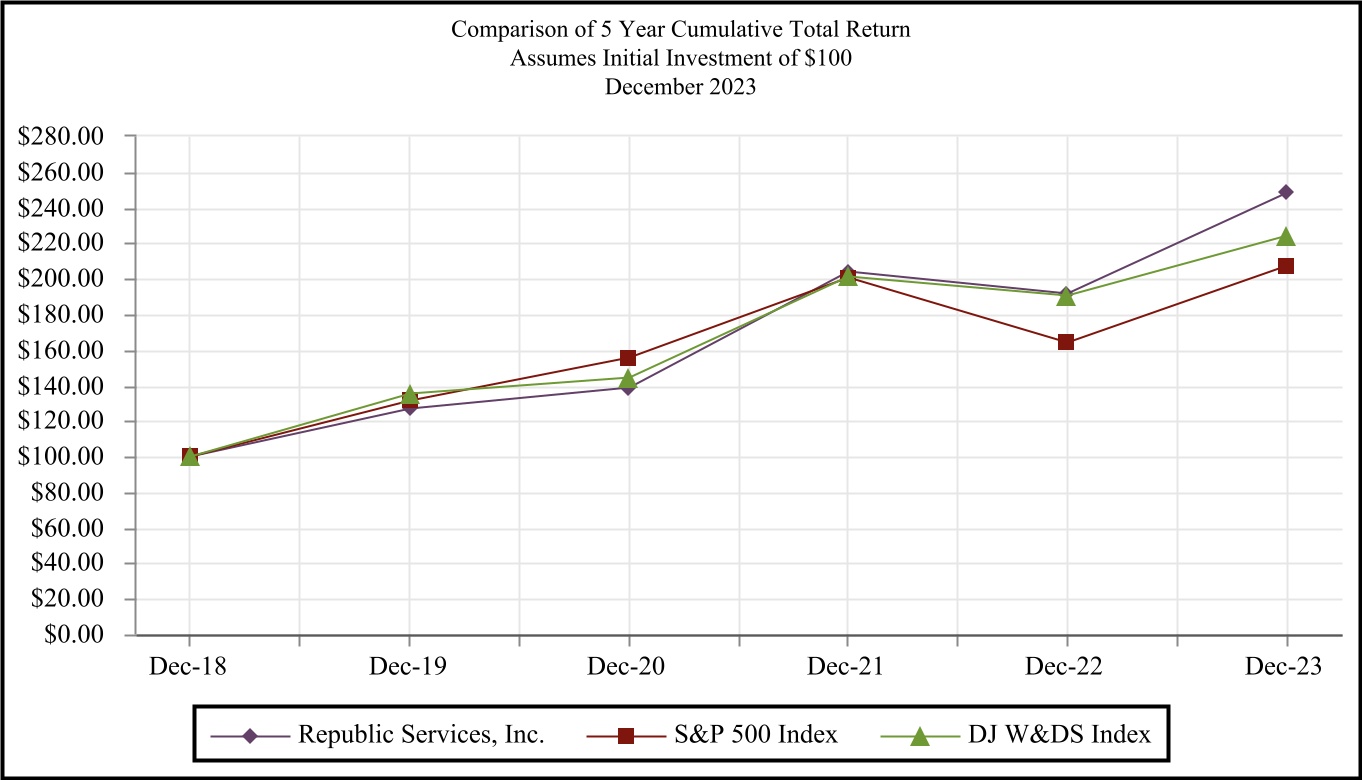
| Indexed Returns for the Years Ended December 31, | |||||||||||||||||||||||||||||||||||
| 2018 | 2019 | 2020 | 2021 | 2022 | 2023 | ||||||||||||||||||||||||||||||
| Republic Services, Inc. | $ | 100.00 | $ | 126.61 | $ | 138.67 | $ | 203.89 | $ | 191.32 | $ | 247.98 | |||||||||||||||||||||||
| S&P 500 Index | $ | 100.00 | $ | 131.49 | $ | 155.68 | $ | 200.37 | $ | 164.08 | $ | 207.21 | |||||||||||||||||||||||
| DJ W&DS Index | $ | 100.00 | $ | 135.09 | $ | 143.96 | $ | 201.25 | $ | 190.37 | $ | 224.24 |
Note: Prepared by Zacks Investment Research, Inc. Used with permission. All rights reserved. Copyright 1980-2024.
Index data: Copyright Standard and Poor's, Inc. Used with permission. All rights reserved.
Index data: Copyright Dow Jones, Inc. Used with permission. All rights reserved.
Item 6. [RESERVED]
Item 7. MANAGEMENT’S DISCUSSION AND ANALYSIS OF FINANCIAL CONDITION AND RESULTS OF OPERATIONS
You should read the following discussion in conjunction with our audited consolidated financial statements and the notes thereto included in Part II, Item 8 of this Annual Report on Form 10-K. This discussion may contain forward-looking statements that anticipate results that are subject to uncertainty. We discuss in more detail various factors that could cause actual results to differ from expectations in Part I, Item 1A, Risk Factors in this Annual Report on Form 10-K.
For further discussion regarding our results of operations for the year ended December 31, 2022 as compared to the year ended December 31, 2021, refer to Part II, Item 7. Management's Discussion and Analysis of Financial Condition and Results of Operations, in our Annual Report on Form 10-K for the fiscal year ended December 31, 2022.
Recent Developments
2024 Financial Guidance
In 2024, we will focus on pricing in excess of cost inflation, driving profitable volume growth, investing in sustainability to improve the environment and drive growth, investing in value-creating acquisitions and advancing technology to improve productivity and increase customer retention. Specific guidance follows:
Revenue
We expect revenue to be in the range of $16.100 billion to $16.200 billion. We expect an increase in average yield of approximately 5.5% to 6.0% and volume growth to be in a range of 0.0% to 0.5%. Average yield on related business revenue is expected to be in a range of 6.5% to 7.0%.
Adjusted Diluted Earnings per Share
The following is a summary of anticipated adjusted diluted earnings per share for the year ending December 31, 2024 compared to the actual adjusted diluted earnings per share for the year ended December 31, 2023. Adjusted diluted earnings per share is not a measure determined in accordance with U.S. GAAP:
| (Anticipated) Year Ending December 31, 2024 | (Actual) Year Ended December 31, 2023 | ||||||||||
| Diluted earnings per share | $ 5.86 to 5.92 | $ | 5.47 | ||||||||
| Restructuring charges | 0.08 | 0.08 | |||||||||
| Gain on business divestitures and impairments, net | — | (0.03) | |||||||||
| Adjustment to withdrawal liability for multiemployer pension funds | — | 0.01 | |||||||||
| US Ecology, Inc. acquisition integration and deal costs | — | 0.08 | |||||||||
| Adjusted diluted earnings per share | $ 5.94 to 6.00 | $ | 5.61 |
We believe that the presentation of adjusted diluted earnings per share provides an understanding of operational activities before the financial effect of certain items. We use this measure, and believe investors will find it helpful, in understanding the ongoing performance of our operations separate from items that have a disproportionate effect on our results for a particular period. We have incurred comparable charges and costs in prior periods, and similar types of adjustments can reasonably be expected to be recorded in future periods. Our definition of adjusted diluted earnings per share may not be comparable to similarly titled measures presented by other companies.
The guidance set forth above constitutes forward-looking information and is not a guarantee of future performance. The
guidance is based upon the current beliefs and expectations of our management and is subject to significant risk and
uncertainties that could cause actual results to differ materially from those shown above. See Item 1A. Risk Factors - Disclosure Regarding Forward-Looking Statements.
Overview
Republic is one of the largest providers of environmental services in the United States, as measured by revenue. As of December 31, 2023, we operated across the United States and Canada through 364 collection operations, 246 transfer stations, 74 recycling centers, 207 active landfills, 3 treatment, recovery and disposal facilities, 22 treatment, storage and disposal facilities (TSDF), 6 salt water disposal wells, 12 deep injection wells and 1 polymer center. We are engaged in 76 landfill gas-to-energy and other renewable energy projects and had post-closure responsibility for 126 closed landfills.
Revenue for the year ended December 31, 2023 increased by 10.8% to $14,964.5 million compared to $13,511.3 million in 2022. This change in revenue is due to increased volume of 0.5%, average yield of 6.1%, acquisitions, net of divestitures of
4.8%, and environmental solutions revenue of 0.1%, partially offset by decreased recycling processing and commodity sales of 0.5% and fuel recovery fees of 0.2%
The following table summarizes our revenue, costs and expenses for the years ended December 31, 2023 and 2022 (in millions of dollars and as a percentage of revenue):
| 2023 | 2022 | ||||||||||||||||||||||||||||||||||
| Revenue | $ | 14,964.5 | 100.0 | % | $ | 13,511.3 | 100.0 | % | |||||||||||||||||||||||||||
| Expenses: | |||||||||||||||||||||||||||||||||||
| Cost of operations | 8,942.2 | 59.8 | 8,205.0 | 60.7 | |||||||||||||||||||||||||||||||
| Depreciation, amortization and depletion of property and equipment | 1,368.4 | 9.1 | 1,245.6 | 9.2 | |||||||||||||||||||||||||||||||
| Amortization of other intangible assets | 66.3 | 0.4 | 53.9 | 0.4 | |||||||||||||||||||||||||||||||
| Amortization of other assets | 66.7 | 0.5 | 52.1 | 0.4 | |||||||||||||||||||||||||||||||
| Accretion | 97.9 | 0.7 | 89.6 | 0.7 | |||||||||||||||||||||||||||||||
| Selling, general and administrative | 1,608.7 | 10.8 | 1,454.3 | 10.8 | |||||||||||||||||||||||||||||||
| Adjustment to withdrawal liability for multiemployer pension funds | 4.5 | — | (1.6) | — | |||||||||||||||||||||||||||||||
| Gain on business divestitures and impairments, net | (3.6) | — | (6.3) | — | |||||||||||||||||||||||||||||||
| Restructuring charges | 33.2 | 0.2 | 27.0 | 0.2 | |||||||||||||||||||||||||||||||
| Operating income | $ | 2,780.2 | 18.5 | % | $ | 2,391.7 | 17.6 | % |
Our pre-tax income was $2,191.5 million for the year ended December 31, 2023, compared to $1,831.5 million in 2022. Our net income attributable to Republic Services, Inc. was $1,731.0 million, or $5.47 per diluted share, for 2023, compared to $1,487.6 million, or $4.69 per diluted share, for 2022.
During 2023 and 2022, we recorded a number of charges, other expenses and benefits that impacted our pre-tax income, tax impact, net income attributable to Republic Services, Inc. (net income – Republic) and diluted earnings per share as noted in the following table (in mill
Showing the first 8K of 136K characters. Open the full section
Item 7A. QUANTITATIVE AND QUALITATIVE DISCLOSURES ABOUT MARKET RISK
Interest Rate Risk
Our major market risk exposure of our financial instruments is changing interest rates in the United States and fluctuations in SOFR. We intend to manage interest rate risk through the use of a combination of fixed and floating rate debt. The carrying value of our variable rate debt approximates fair value because interest rates are variable and, accordingly, approximates current market rates for instruments with similar risk and maturities. The fair value of our debt is determined as of the balance sheet date and is subject to change. We have historically entered into multiple swap agreements designated as cash flow hedges to manage exposure to fluctuations in interest rates on our variable rate debt.
The table below provides information about certain of our market-sensitive financial instruments and constitutes a forward-looking statement.
| Expected Maturity Date | |||||||||||||||||||||||||||||||||||||||||||||||
| 2024 | 2025 | 2026 | 2027 | 2028 | Thereafter | Total | Fair Value as of December 31, 2023 | ||||||||||||||||||||||||||||||||||||||||
| Fixed rate debt: | |||||||||||||||||||||||||||||||||||||||||||||||
| Amount outstanding (in millions) | $ | 911.6 | $ | 864.5 | $ | 511.0 | $ | 660.6 | $ | 811.4 | $ | 6,622.2 | $ | 10,381.3 | $ | 9,886.0 | |||||||||||||||||||||||||||||||
| Variable rate debt: | |||||||||||||||||||||||||||||||||||||||||||||||
| Amount outstanding (in millions) | $ | 20.7 | $ | 500.0 | $ | 874.9 | $ | — | $ | 30.0 | $ | 1,012.5 | $ | 2,438.1 | $ | 2,573.0 |
The fixed and variable rate debt amounts above exclude the remaining non-cash discounts, premiums and adjustments to fair value totaling $129.7 million.
As of December 31, 2023, we had $2,232.2 million of principal floating rate debt and interest rate swap contracts with a notional value of $350.0 million. If interest rates increased or decreased by 100 basis points on our variable rate debt, annualized interest expense and net cash payments for interest would increase or decrease by approximately $20 million. This analysis does not reflect the effect that interest rates would have on other items, such as new borrowings and the impact on the economy. See Note 9, Debt, of the notes to our audited consolidated financial statements in Part II, Item 8 of this Form 10-K for further information regarding how we manage interest rate risk.
Fuel Price Risk
Fuel costs represent a significant operating expense. When economically practical, we may enter into new fuel hedges, renew contracts, or engage in other strategies to mitigate market risk. As of December 31, 2023, we had no fuel hedges in place. While we charge fuel recovery fees to a majority of our customers, we are unable to charge such fees to all customers.
At current consumption levels, we believe a twenty-cent per gallon change in the price of diesel fuel would change our fuel costs by approximately $27 million per year. Offsetting these changes in fuel expense would result in changes in our fuel recovery fee charged to our customers. At current participation rates, we believe a twenty-cent per gallon change in the price of diesel fuel would change our fuel recovery fee by approximately $36 million per year.
Our operations also require the use of certain petrochemical-based products (such as liners at our landfills) the cost of which may vary with the price of petrochemicals. An increase in the price of petrochemicals could increase the cost of those products, which would increase our operating and capital costs. We also are susceptible to increases in fuel recovery fees from our vendors.
Our fuel costs were $541.6 million during 2023, or 3.6% of revenue, compared to $631.1 million, or 4.7% of revenue, during 2022.
Commodities Price Risk
We market recovered materials such as old corrugated containers and old newsprint from our recycling centers. Changes in market supply and demand for recycled commodities causes volatility in commodity prices. In prior periods, we have entered into derivative instruments such as swaps and costless collars designated as cash flow hedges to manage our exposure to changes in prices of these commodities. As of December 31, 2023, we had no recycling commodity hedges in place.
At current volumes and mix of materials, we believe a $10 per ton change in the price of recycled commodities would change both annual revenue and operating income by approximately $10 million.
Revenue from recycling processing and commodity sales during the years ended December 31, 2023 and 2022 was $312.3 million and $359.1 million, respectively.
Item 8. FINANCIAL STATEMENTS AND SUPPLEMENTARY DATA
| Report of Independent Registered Public Accounting Firm (PCAOB ID: 42) | 64 | ||||
| Report of Independent Registered Public Accounting Firm on Internal Control Over Financial Reporting (PCAOB ID: 42) | 66 | ||||
| Consolidated Balance Sheets as of December 31, 2023 and 2022 | 67 | ||||
| Consolidated Statements of Income for Each of the Three Years in the Period Ended December 31, 2023 | 68 | ||||
| Consolidated Statements of Comprehensive Income for Each of the Three Years in the Period Ended December 31, 2023 | 69 | ||||
| Consolidated Statements of Stockholders' Equity for Each of the Three Years in the Period Ended December 31, 2023 | 70 | ||||
| Consolidated Statements of Cash Flows for Each of the Three Years in the Period Ended December 31, 2023 | 71 | ||||
| Notes to Consolidated Financial Statements | 72 |
REPORT OF INDEPENDENT REGISTERED PUBLIC ACCOUNTING FIRM
To the Stockholders and the Board of Directors of Republic Services, Inc.
Opinion on the Financial Statements
We have audited the accompanying consolidated balance sheets of Republic Services, Inc. (the Company) as of December 31, 2023 and 2022, the related consolidated statements of income, comprehensive income, stockholders’ equity and cash flows for each of the three years in the period ended December 31, 2023, and the related notes (collectively referred to as the “consolidated financial statements”). In our opinion, the consolidated financial statements present fairly, in all material respects, the financial position of the Company at December 31, 2023 and 2022, and the results of its operations and its cash flows for each of the three years in the period ended December 31, 2023, in conformity with U.S. generally accepted accounting principles.
We also have audited, in accordance with the standards of the Public Company Accounting Oversight Board (United States) (PCAOB), the Company’s internal control over financial reporting as of December 31, 2023, based on criteria established in Internal Control-Integrated Framework issued by the Committee of Sponsoring Organizations of the Treadway Commission (2013 framework) and our report dated February 28, 2024, expressed an unqualified opinion thereon.
Basis for Opinion
These financial statements are the responsibility of the Company’s management. Our responsibility is to express an opinion on the Company’s financial statements based on our audits. We are a public accounting firm registered with the PCAOB and are required to be independent with respect to the Company in accordance with the U.S. federal securities laws and the applicable rules and regulations of the Securities and Exchange Commission and the PCAOB.
We conducted our audits in accordance with the standards of the PCAOB. Those standards require that we plan and perform the audit to obtain reasonable assurance about whether the financial statements are free of material misstatement, whether due to error or fraud. Our audits included performing procedures to assess the risks of material misstatement of the financial statements, whether due to error or fraud, and performing procedures that respond to those risks. Such procedures included examining, on a test basis, evidence regarding the amounts and disclosures in the financial statements. Our audits also included evaluating the accounting principles used and significant estimates made by management, as well as evaluating the overall presentation of the financial statements. We believe that our audits provide a reasonable basis for our opinion.
Critical Audit Matters
The critical audit matters communicated below are matters arising from the current period audit of the financial statements that were communicated or required to be communicated to the audit committee and that: (1) relate to accounts or disclosures that are material to the financial statements and (2) involved our especially challenging, subjective, or complex judgments. The communication of critical audit matters does not alter in any way our opinion on the consolidated financial statements, taken as a whole, and we are not, by communicating the critical audit matters below, providing separate opinions on the critical audit matters or on the accounts or disclosures to which they relate.
| Landfill Development Asset Amortization | ||||||||
| Description of the Matter | At December 31, 2023, the net book value of the Company’s landfill development assets totaled $4,745.4 million, and the associated landfill development asset amortization expense for 2023 was $470.9 million. Significant assumptions used in calculating the amortization expense include estimated future development costs associated with the land, permitting, cell construction and environmental structures of the landfill in relation to airspace consumed to date and total estimated available airspace. These assumptions have a significant effect on the total landfill development asset amortization expense. As discussed in Note 2 to the consolidated financial statements, costs and airspace estimates are developed at least annually, or more often if significant facts change. |
| How We Addressed the Matter in Our Audit | Auditing landfill development asset amortization expense is complex due to the highly judgmental nature of the assumptions used in the calculation of the expense and required the involvement of specialists to assist us with evaluating estimated future development costs and certain assumptions to project total estimated available airspace. | |||||||
| We tested controls that address the risks of material misstatement relating to the measurement and valuation of landfill development asset amortization expense. For example, we tested controls over the estimation of future landfill development costs and management’s review of the assumptions to project total estimated available airspace. | ||||||||
| To test the landfill development asset amortization expense, our audit procedures included, among others, assessing methodologies and testing the significant assumptions discussed above related to the underlying cost and airspace data used by the Company. We compared the significant assumptions used by management to historical trends and, when available, to comparable size landfills accepting the same type of waste. We also tested the completeness and accuracy of the historical data utilized in the development of the amortization expense. Regarding available airspace, we evaluated the Company’s estimation of the landfill disposal capacity through a comparison of airspace to historical estimates and annual aerial surveys. We involved EY engineering specialists to assist us with evaluating estimated future development costs and certain assumptions to project total estimated available airspace. | ||||||||
| **Landfill Final Capping, Closure and Post-Cl |
Showing the first 8K of 264K characters. Open the full section
Item 9. CHANGES IN AND DISAGREEMENTS WITH ACCOUNTANTS ON ACCOUNTING AND FINANCIAL DISCLOSURE
None.
Item 9A. CONTROLS AND PROCEDURES
REPORT OF MANAGEMENT ON REPUBLIC SERVICES, INC.’S INTERNAL CONTROL OVER FINANCIAL REPORTING
We, as members of management of Republic Services, Inc., are responsible for establishing and maintaining adequate internal control over financial reporting, as such term is defined in Exchange Act Rule 13a-15(f). Internal control over financial reporting is a process designed to provide reasonable assurance regarding the reliability of financial reporting and the preparation of financial statements for external purposes in accordance with generally accepted accounting principles. Internal
control over financial reporting includes those policies and procedures that (1) pertain to the maintenance of records that, in reasonable detail, accurately and fairly reflect transactions and dispositions of our assets; (2) provide reasonable assurance that transactions are recorded as necessary to permit preparation of financial statements in accordance with generally accepted accounting principles and that our receipts and expenditures are being made only in accordance with authorizations of our management and directors; and (3) provide reasonable assurance regarding prevention or timely detection of unauthorized acquisition, use, or disposition of our assets that could have a material effect on the financial statements.
Because of its inherent limitations, our internal control systems and procedures may not prevent or detect misstatements. An internal control system, no matter how well conceived and operated, can provide only reasonable, not absolute, assurance that the objectives of the control system are met. Because of the inherent limitations in all control systems, no evaluation of controls can provide absolute assurance that all control issues and instances of fraud, if any, have been detected. Also, projections of any evaluation of effectiveness to future periods are subject to the risks that controls may become inadequate because of changes in conditions, or that the degree of compliance with the policies and procedures may deteriorate.
We, under the supervision of and with the participation of our management, including the Chief Executive Officer, Chief Financial Officer and Chief Accounting Officer, assessed the effectiveness of our internal control over financial reporting as of December 31, 2023, based on criteria for effective internal control over financial reporting described in Internal Control — Integrated Framework (2013) issued by the Committee of Sponsoring Organizations of the Treadway Commission. Based on this assessment, we concluded that we maintained effective internal control over financial reporting as of December 31, 2023, based on the specified criteria.
Our internal control over financial reporting has been audited by Ernst & Young LLP, an independent registered public accounting firm, as stated in their attestation report which is included herein.
Disclosure Controls and Procedures
We carried out an evaluation, under the supervision and with the participation of our management, including our Chief Executive Officer and Chief Financial Officer, of the effectiveness of our disclosure controls and procedures (as defined in Exchange Act Rules 13a-15(e) and 15d-15(e)) as of the end of the period covered by this Annual Report. Based upon that evaluation, our Chief Executive Officer and Chief Financial Officer concluded that our disclosure controls and procedures were effective as of the end of the period covered by this Annual Report.
Changes in Internal Control Over Financial Reporting
Based on an evaluation, under the supervision and with the participation of our management, including our Chief Executive Officer and Chief Financial Officer, there has been no change in our internal control over financial reporting during the quarter ended December 31, 2023 identified in connection with that evaluation, that has materially affected, or is reasonably likely to materially affect, our internal control over financial reporting.
In March 2023, we acquired all of the issued and outstanding shares and other equity interests of Wasteco Holdings Inc. and related subsidiaries. In June 2023, we acquired a vertically-integrated set of operations located primarily in Colorado from GFL Environmental Inc. In November 2023, we acquired all of the issued and outstanding capital stock or other ownership interests of Advanced Chemical Transport LLC. In December 2023, we acquired all of the issued and outstanding membership and other equity interests of Central Texas Refuse, LLC and an affiliate thereof. As permitted by the SEC Staff interpretive guidance for newly acquired businesses, management's assessment of our internal control over financial reporting as of December 31, 2023 did not include an assessment of internal control over financial reporting as it relates to these acquired businesses. We will continue the process of implementing internal controls over financial reporting for these acquired businesses. These businesses collectively contributed approximately 1% of our total consolidated revenue for the year ended December 31, 2023.
Item 9B. OTHER INFORMATION
During the quarter ended December 31, 2023, no director or officer adopted or terminated any contract, instrument or written plan for the purchase or sale of Republic securities intended to satisfy the affirmative defense conditions of Rule 10b5-1(c) under the Exchange Act or any non-Rule 10b5-1 trading arrangement as defined in Item 408(c) of Regulation S-K.
Item 9C. DISCLOSURE REGARDING FOREIGN JURISDICTIONS THAT PREVENT INSPECTIONS
Item 10. DIRECTORS, EXECUTIVE OFFICERS AND CORPORATE GOVERNANCE
Information required by this item is incorporated by reference to the material appearing under the headings Proposal 1 - Election of Directors, Biographical Information Regarding Director Nominees, Board of Directors and Corporate Governance Matters, Delinquent Section 16(a) Reports and Executive Officers in the Proxy Statement for the 2024 Annual Meeting of Shareholders.
Item 11. EXECUTIVE COMPENSATION
Information required by this item is incorporated by reference to the material appearing under the headings Executive Compensation and Director Compensation in the Proxy Statement for the 2024 Annual Meeting of Shareholders.
Item 12. SECURITY OWNERSHIP OF CERTAIN BENEFICIAL OWNERS AND MANAGEMENT AND RELATED STOCKHOLDER MATTERS
Information required by this item is incorporated by reference to the material appearing under the headings Security Ownership of Five Percent Shareholders and Security Ownership of the Board of Directors and Management in the Proxy Statement for the 2024 Annual Meeting of Shareholders.
The following table sets forth certain information regarding equity compensation plans as of December 31, 2023 (number of securities in millions):
| Plan Category | Number of Securities to be Issued Upon Exercise of Outstanding Options and Rights (b) | Weighted Average Exercise Price of Outstanding Options and Rights (c) | Number of Securities Remaining Available for Future Issuance Under Equity Compensation Plans (excluding securities reflected in the first column) (d) | ||||||||||||||
| Equity compensation plans approved by security holders (a) | 1.3 | $ | 156.67 | 29.6 | |||||||||||||
| Equity compensation plans not approved by security holders | — | — | — | ||||||||||||||
| Total | 1.3 | $ | 156.67 | 29.6 |
(a)Includes our 2006 Plan, Amended and Restated 2007 Stock Incentive Plan, our 2018 Employee Stock Purchase Plan (ESPP) and our 2021 Stock Incentive Plan.
(b)Includes no stock options as all were exercised in 2020, 0.9 million shares underlying restricted stock units, 0.4 million shares underlying performance shares and less than 0.1 million shares underlying purchase rights that accrue under the ESPP.
(c)Excludes restricted stock units and performance shares as these awards do not have exercise prices.
(d)The shares remaining available for future issuances include 11.7 million shares under our 2021 Stock Incentive Plan and 2.4 million shares under our ESPP. No further awards will be granted under the Amended and Restated 2007 Stock Incentive Plan after December 31, 2020.
Item 13. CERTAIN RELATIONSHIPS AND RELATED TRANSACTIONS, AND DIRECTOR INDEPENDENCE
Information required by this item is incorporated by reference to the material appearing under the headings Board of Directors and Corporate Governance Matters and Certain Relationships and Related Party Transactions in the Proxy Statement for the 2024 Annual Meeting of Shareholders.
Item 14. PRINCIPAL ACCOUNTANT FEES AND SERVICES
Information required by this item is incorporated by reference to the material appearing under the heading Audit and Related Fees in the Proxy Statement for the 2024 Annual Meeting of Shareholders.
PART IV
Item 15. EXHIBITS AND FINANCIAL STATEMENT SCHEDULES
(a) The following documents are filed as part of this report:
1. Financial Statements
Our consolidated financial statements are set forth under Part II, Item 8 of this Annual Report on Form 10-K.
2. Financial Statement Schedules
All schedules are omitted as the required information is not applicable or the information is presented in the consolidated financial statements and notes thereto in Part II, Item 8 of this Annual Report on Form 10-K.
3. Exhibits
The following exhibits are filed herewith or are incorporated by reference to exhibits previously filed with the SEC, as indicated in the description of each, File No. 1-14267 in the case of Republic and File No. 1-14705 and No. 0-19285 in the case of Allied, and File No. 1-06805 in the case of Browning-Ferris Industries, Inc.
| Exhibit Number | Description | |||||||
| 3.1 | Amended and Restated Certificate of Incorporation (incorporated by reference to Exhibit 3.1 of the Company’s Quarterly Report on Form 10-Q for the period ended June 30, 1998). | |||||||
| 3.2 | Certificate of Amendment of Amended and Restated Certificate of Incorporation of Republic Services, Inc. (incorporated by reference to Exhibit 4.2 of the Company’s Registration Statement on Form S-8, Registration No. 333-81801, filed with the Commission on June 29, 1999). | |||||||
| 3.3 | Amended and Restated Bylaws of Republic Services, Inc. (incorporated by reference to Exhibit 3.1 of the Company's Quarterly Report on Form 10-Q for the period ended September 30, 2022). | |||||||
| 4.1 | Republic Services, Inc. Common Stock Certificate (incorporated by reference to Exhibit 4.4 of the Company’s Registration Statement on Form S-8, Registration No. 333-81801, filed with the Commission on June 29, 1999). | |||||||
| 4.2 | Indenture, dated as of August 15, 2001 between Republic Services, Inc. and The Bank of New York, as trustee, including the form of notes (incorporated by reference to Exhibit 4.1 of the Company’s Current Report on Form 8-K filed August 16, 2001). | |||||||
| 4.3 | Second Supplemental Indenture, dated as of March 21, 2005, to the Indenture dated as of August 15, 2001, by and between Republic Services, Inc. and The Bank of New York, as trustee, including the form of 6.086% Note due March 15, 2035 (incorporated by reference to Exhibit 4.1 of the Company’s Quarterly Report on Form 10-Q for the quarter ended March 31, 2005). | |||||||
| 4.4 | Indenture, dated as of September 8, 2009, by and between Republic Services, Inc. and The Bank of New York Mellon Trust Company, N.A., as trustee (incorporated by reference to Exhibit 4.1 of the Company’s Current Report on Form 8-K dated September 9, 2009). | |||||||
| 4.5 | Third Supplemental Indenture, dated as of May 9, 2011, to the Indenture dated as of September 8, 2009, by and among Republic Services, Inc., the guarantors named therein and The Bank of New York Mellon Trust Company, N.A., as trustee, including the form of 4.750% Notes due 2023 (incorporated by reference to Exhibit 4.2 of the Company’s Current Report on Form 8-K dated May 9, 2011). | |||||||
| 4.6 | Fourth Supplemental Indenture, dated as of May 9, 2011, to the Indenture dated as of September 8, 2009, by and among Republic Services, Inc., the guarantors named therein and The Bank of New York Mellon Trust Company, N.A., as trustee, including the form of 5.700% Notes due 2041 (incorporated by reference to Exhibit 4.3 of the Company’s Current Report on Form 8-K dated May 9, 2011). | |||||||
| 4.7 | Indenture, dated as of November 25, 2009, by and between Republic Services, Inc. and U.S. Bank National Association, as trustee (incorporated by reference to Exhibit 4.1 of the Company’s Current Report on Form 8-K dated November 25, 2009). | |||||||
| 4.8 | Third Supplemental Indenture, dated as of March 4, 2010, to the Indenture dated as of November 25, 2009, by and among Republic Services, Inc., the guarantors named therein and U.S. Bank National Association, as trustee, including the form of 6.20% Notes due 2040 (incorporated by reference to Exhibit 4.2 of the Company’s Current Report on Form 8-K dated March 4, 2010). | |||||||
| 4.9 | Restated Indenture, dated as of September 1, 1991, by and between Browning-Ferris Industries, Inc. and First City, Texas-Houston, National Association, as trustee (incorporated by reference to Exhibit 4.22 of Allied’s Registration Statement on Form S-4/A (No. 333-61744)). |
| Exhibit Number | Description | |||||||
| 4.10 | First Supplemental Indenture, dated as of July 30, 1999, to the Restated Indenture dated as of September 1, 1991, by and among Allied Waste Industries, Inc., Allied Waste North America, Inc., Browning-Ferris Industries, Inc. and Chase Bank of Texas, National Association, as trustee (incorporated by reference to Exhibit 4.23 of Allied’s Registration Statement on Form S-4/A (No. 333-61744)). | |||||||
| 4.11 | First [sic] Supplemental Indenture, dated as of December 31, 2004, to the Restated Indenture dated as of September 1, 1991, by and among Browning-Ferris Industries, Inc., BBCO, Inc. and JP Morgan Chase Bank, National Association as trustee (incorporated by reference to Exhibit 4.33 of Allied’s Annual Report on Form 10-K for the year ended December 31, 2004). | |||||||
| 4.12 | Third Supplemental Indenture, dated as of December 5, 2008, to the Restated Indenture dated as of September 1, 1991, by and among Allied Waste Industries, Inc., Allied Waste North America, Inc., Browning-Ferris Industries, LLC (successor to Browning-Ferris Industries, Inc.), BBCO, Inc., Republic Services, Inc., the guarantors party thereto and The Bank of New York Mellon Trust Company, N.A., as trustee (incorporated by reference to Exhibit 4.1 of the Company’s Current Report on Form 8-K dated December 10, 2008). | |||||||
| 4.13 | Fourth Supplemental Indenture, dated as of March 11, 2015, to the Indenture, dated as of November 25, 2009, between Republic Services, Inc. and U.S. Bank National Association, as trustee, including the form of 3.20% Notes due 2025 (incorporated by reference to Exhibit 4.1 of the Company's Current Report on Form 8-K dated March 11, 2015). | |||||||
| 4.14 | Fifth Supplemental Indenture, dated as of July 5, 2016, to the Indenture, dated as of November 25, 2009, between Republic Services, Inc. and U.S. Bank National Association, as trustee, including the form of 2.900% Notes due 2026 (incorporated by reference to Exhibit 4.1 of the Company's Current Report on Form 8-K dated July 5, 2016). | |||||||
| 4.15 | Sixth Supplemental Indenture, dated as of November 16, 2017, between Republic Services, Inc. and U.S. Bank National Association, as trustee, including the form of 3.375% Notes due 2027 (incorporated by reference to Exhibit 4.1 of the Company’s Current Report on Form 8-K dated November 15, 2017). | |||||||
| 4.16 | Form of Browning-Ferris Industries, Inc. 7.4% Debentures due 2035 (incorporated by reference to Exhibit 4 of Browning-Ferris Industries, Inc.'s Current Report on Form 8-K dated September 15, 1995). | |||||||
| 4.17 | Seventh Supplemental Indenture, dated as of May 14, 2018, between Republic Services, Inc. and U.S. Bank National Association, as trustee, including the form of 3.950% Notes due 2028 (incorporated by reference to Exhibit 4.1 of the Company’s Current Report on Form 8-K dated May 3, 2018). | |||||||
| 4.18 | Limited consent (2018 Credit Agreement), dated as of August 21, 2019, by and among Republic Services, Inc., as Borrower, Bank of America, N.A., as Administrative Agent, Swing Line Lender and an L/C Issuer, and the lenders party thereto (incorporated by reference to Exhibit 4.1 of the Company's Quarterly Report on Form 10-Q for the quarter ended September 30, 2019). | |||||||
| 4.19 | Description of Securities Registered Under Section 12 of the Securities Exchange Act of 1934 (incorporated by reference to Exhibit 4.23 of the Company’s Annual Report on Form 10-K for the year ended December 31, 2019). | |||||||
| 4.20 | Eighth Supplemental Indenture, dated as of August 7, 2019, between Republic Services, Inc. and U.S. Bank National Association, as trustee, including the form of 2.500% Notes due 2024 (incorporated by reference to Exhibit 4.1 of the Company’s Current Report on Form 8-K dated August 1, 2019). | |||||||
| 4.21 | Ninth Supplemental Indenture, dated as of February 27, 2020, between Republic Services, Inc. and U.S. Bank National Association, as trustee, including the form of 2.300% Notes due 2030 and the form of 3.050% Notes due 2050 (incorporated by reference to Exhibit 4.1 of the Company’s Current Report on Form 8-K dated February 21, 2020). | |||||||
| 4.22 | Tenth Supplemental Indenture, dated as of August 20, 2020, between Republic Services, Inc. and U.S. Bank National Association, as trustee, including the form of 1.450% Notes due 2031 (incorporated by reference to Exhibit 4.1 of the Company’s Current Report on Form 8-K dated August 13, 2020). | |||||||
| 4.23 | Eleventh Supplemental Indenture, dated as of November 24, 2020, between Republic Services, Inc. and U.S. Bank National Association, as trustee, including the form of 0.875% Notes due 2025 and the form of 1.750% Notes due 2032 (incorporated by reference to Exhibit 4.1 of the Company’s Current Report on Form 8-K dated November 12, 2020). | |||||||
| 4.24 | Amended and Restated Credit Agreement, dated as of August 17, 2021, by and among Republic Services, Inc., as Borrower, Bank of America, N.A., as Administrative Agent, Swing Line Lender and L/C Issuer, and the other lenders party thereto (incorporated by reference to Exhibit 4.1 of the Company’s Current Report on Form 8-K dated August 23, 2021). | |||||||
| 4.25 | Twelfth Supplemental Indenture, dated as of November 8, 2021, between Republic Services, Inc. and U.S. Bank National Association, as trustee, including the form of 2.375% Notes due 2033 (incorporated by reference to Exhibit 4.1 of the Company's Current Report on Form 8-K dated November 4, 2021). |
| Exhibit Number | Description | |||||||
| 4.26 | Form of Commercial Paper Dealer Agreement--4(a)(2) Program, dated as of May 25, 2022, between Republic Services, Inc. and the applicable dealer party thereto (incorporated by reference to Exhibit 10.1 of the Company's Current Report on Form 8-K filed September 1, 2022). | |||||||
| 4.27 | Thirteenth Supplemental Indenture, dated as of March 28, 2023, between Republic Services, Inc. and U.S. Bank Trust Company, National Association (as successor in interest to U.S. Bank National Association), as trustee, including the form of 4.875% Notes due 2029 and form of 5.000% Notes due 2034 (incorporated by reference to Exhibit 4.1 of the Company’s Current Report on Form 8-K dated March 23, 2023). | |||||||
| 4.28 | Fourteenth Supplemental Indenture, dated as of December 12, 2023, between Republic Services, Inc. and U.S. Bank Trust Company, National Association (as successor in interest to U.S. Bank National Association), as trustee, including the form of 5.000% Notes due 2033 (incorporated by reference to Exhibit 4.1 of the Company’s Current Report on Form 8-K dated December 11, 2023). | |||||||
| 4.29 | Amendment No. 1, dated as of February 23, 2023, to Amended and Restated Credit Agreement, dated as of August 17, 2021, by and among Republic Services, Inc., USE Canada Holdings, Inc., Bank of America, N.A., as Administrative Agent, Swing Line Lender and L/C Issuer, and the other lenders party thereto (incorporated by reference to Exhibit 4.1 of the Company’s Current Report on Form 8-K dated February 27, 2023). | |||||||
| 4.30 | Term Loan Credit Agreement, dated as of April 29, 2022, by and among Republic Services, Inc., as Borrower, Bank of America, N.A., as Administrative Agent, and the other lenders party thereto (incorporated by reference to Exhibit 4.1 of the Company’s Current Report on Form 8-K dated May 4, 2022). | |||||||
| 4.31 | Amendment No. 1, dated as of February 23, 2023, to Term Loan Credit Agreement, dated as of April 29, 2022, by and among Republic Services, Inc., Bank of America, N.A., as Administrative Agent, and the other lenders party thereto (incorporated by reference to Exhibit 4.2 of the Company’s Current Report on Form 8-K dated February 27, 2023). | |||||||
| 4.32 | Amendment No. 2, dated as of October 30, 2023, to Amended and Restated Credit Agreement, dated as of August 17, 2021, by and among Republic Services, Inc., USE Canada Holdings, Inc., Bank of America, N.A., as Administrative Agent, Swing Line Lender and L/C Issuer, and the other lenders party thereto (incorporated by reference to Exhibit 4.1 of the Company’s Current Report on Form 8-K dated November 3, 2023). | |||||||
| 10.1+ | Republic Services, Inc. Amended and Restated 2007 Stock Incentive Plan effective May 12, 2011 (incorporated by reference to Appendix A of the Company’s Proxy Statement on Schedule 14A filed on April 1, 2011). | |||||||
| 10.2+ | Republic Services, Inc. Executive Incentive Plan, as amended and restated effective October 26, 2020 (incorporated by reference to Exhibit 10.1 to the Company’s Quarterly Report on Form 10-Q for the quarter ended September 30, 2020). | |||||||
| 10.3+ | Form of Employee Restricted Stock Unit Agreement under the Republic Services, Inc. Amended and Restated 2007 Stock Incentive Plan (for awards on or after December 27, 2011) (incorporated by reference to Exhibit 10.1 of the Company’s Current Report on Form 8-K dated December 27, 2011). | |||||||
| 10.4+ | Form of Non-Employee Director Restricted Stock Unit Agreement (annual vesting) under the Republic Services, Inc. Amended and Restated 2007 Stock Incentive Plan (for awards on or after December 27, 2011) (incorporated by reference to Exhibit 10.2 of the Company’s Current Report on Form 8-K dated December 27, 2011). | |||||||
| 10.5+ | Form of Non-Employee Director Restricted Stock Unit Agreement (3 year vesting) under the Republic Services, Inc. Amended and Restated 2007 Stock Incentive Plan (for awards on or after December 27, 2011) (incorporated by reference to Exhibit 10.3 of the Company’s Current Report on Form 8-K dated December 27, 2011). | |||||||
| 10.6+ | Republic Services, Inc. Deferred Compensation Plan, as amended and restated effective January 1, 2010 (incorporated by reference to Exhibit 4.4 of the Company’s Registration Statement on Form S-8, Registration No. 333-170174, filed with the SEC on October 27, 2010). | |||||||
| 10.7+ | Amendment No. 1 to Republic Services, Inc. Deferred Compensation Plan, effective January 6, 2011 (incorporated by reference to Exhibit 10.17 of the Company’s Annual Report on Form 10-K for the year ended December 31, 2010). | |||||||
| 10.8+ | Republic Services, Inc. Amended and Restated Executive Incentive Plan, effective February 4, 2014 (incorporated by reference to Appendix A of the Company’s Proxy Statement on Schedule 14A filed on March 26, 2014). | |||||||
| 10.9+ | Republic Services, Inc. Executive Separation Policy, as amended as of February 8, 2023 (incorporated by reference to Exhibit 10.9 of the Company's Annual Report on Form 10-K for the year ended December 31, 2022). |
| Exhibit Number | Description | |||||||
| 10.10+ | Amendment No. 2 to Republic Services, Inc. Deferred Compensation Plan, effective February 7, 2012 (incorporated by reference to Exhibit 10.3 of the Company’s Quarterly Report on Form 10-Q for the quarter ended March 31, 2012). | |||||||
| 10.11+ | Republic Services, Inc. Amended and Restated 2007 Stock Incentive Plan effective May 9, 2013 (incorporated by reference to Exhibit 10.1 of the Company’s Quarterly Report on Form 10-Q for the quarter ended June 30, 2013). | |||||||
| 10.12+ | Amendment No. 3 to Republic Services, Inc. Deferred Compensation Plan, effective October 29, 2013 (incorporated by reference to Exhibit 10.3 of the Company’s Quarterly Report on Form 10-Q for the quarter ended September 30, 2013). | |||||||
| 10.13+ | Amendment No. 4 to Republic Services, Inc. Deferred Compensation Plan, effective January 1, 2015 (incorporated by reference to Exhibit 10.53 of the Company's Annual Report on Form 10-K for the year ended December 31, 2014). | |||||||
| 10.14+ | Offer Letter, dated July 25, 2016, by and between Catharine D. Ellingsen and Republic Services, Inc. (incorporated by reference to Exhibit 10.37 of the Company’s Annual Report on Form 10-K dated February 16, 2017). | |||||||
| 10.15+* | Non-Competition, Non-Solicitation, Confidentiality and Arbitration Agreement, effective February 13, 2024, by and between Catharine D. Ellingsen and Republic Services, Inc. | |||||||
| 10.16+ | Republic Services, Inc. 2018 Employee Stock Purchase Plan (incorporated by reference to Annex A of the Company’s Proxy Statement on Schedule 14A filed on March 29, 2018). | |||||||
| 10.17+ | Offer Letter, dated April 29, 2019, by and between Timothy Stuart and Republic Services, Inc. (incorporated by reference to Exhibit 10.3 of the Company’s Quarterly Report on Form 10-Q for the quarter ended June 30, 2019). | |||||||
| 10.18+* | Non-Competition, Non-Solicitation and Confidentiality Agreement, effective August 20, 2021, by and between Timothy Stuart and Republic Services, Inc. | |||||||
| 10.19+ | Offer letter, dated May 29, 2020, by and between Brian DelGhiaccio and Republic Services, Inc. (incorporated by reference to Exhibit 10.1 of the Company’s Quarterly Report on Form 10-Q for the quarter ended June 30, 2020). | |||||||
| 10.20+* | Non-Competition, Non-Solicitation, Confidentiality and Arbitration Agreement, effective February 13, 2024, by and between Brian DelGhiaccio and Republic Services, Inc. | |||||||
| 10.21+ | Offer letter, dated March 26, 2021, by and between Jon Vander Ark and Republic Services, Inc. (incorporated by reference to Exhibit 10.1 of the Company's Quarterly Report on Form 10-Q for the quarter ended March 31, 2021). | |||||||
| 10.22+* | Non-Competition, Non-Solicitation, Confidentiality, and Arbitration Agreement, effective February 13, 2024, by and between Jon Vander Ark and Republic Services, Inc. | |||||||
| 10.23+ | Republic Services, Inc. 2021 Stock Incentive Plan (incorporated by reference to Exhibit 10.30 of the Company's Annual Report on Form 10-K for the year ended December 31, 2020). | |||||||
| 10.24+* | Form of Performance Share Agreement (Executive Officer) under the Republic Services, Inc. 2021 Stock Incentive Plan. | |||||||
| 10.25+* | Form of Performance Share Agreement (Other Executive) under the Republic Services, Inc. 2021 Stock Incentive Plan. | |||||||
| 10.26+* | Form of Performance Share Agreement (Non-Executive Officer EVP) under the Republic Services, Inc. 2021 Stock Incentive Plan. | |||||||
| 10.27+* | Form of Employee Restricted Stock Unit Agreement (Senior Executive) under the Republic Services, Inc. 2021 Stock Incentive Plan. | |||||||
| 10.28+* | Form of Employee Restricted Stock Unit Agreement (Senior Executive, Cliff Vesting) under the Republic Services, Inc. 2021 Stock Incentive Plan. | |||||||
| 10.29+* | Form of Employee Restricted Stock Unit Agreement (Other Employees) under the Republic Services, Inc. 2021 Stock Incentive Plan. | |||||||
| 10.30+* | Non-Competition, Non-Solicitation, Confidentiality, and Arbitration Agreement, effective February 13, 2024, by and between Brian A. Bales and Republic Services, Inc. | |||||||
| 21.1* | Subsidiaries of the Company. | |||||||
| 23.1* | Consent of Ernst & Young LLP. | |||||||
| 31.1* | Rule 13a-14(a)/15d-14(a) Certification of Chief Executive Officer. | |||||||
| 31.2* | Rule 13a-14(a)/15d-14(a) Certification of Chief Financial Officer. |
| Exhibit Number | Description | |||||||
| 32.1** | Section 1350 Certification of Chief Executive Officer. | |||||||
| 32.2** | Section 1350 Certification of Chief Financial Officer. | |||||||
| 97+ | Amended and Restated Clawback Policy, dated July 19, 2023 (incorporated by reference to Exhibit 10.1 of the Company's Quarterly Report on Form 10-Q for the quarter ended June 30, 2023). | |||||||
| 101.INS* | XBRL Instance Document. - the instance document does not appear in the Interactive Data File because its XBRL tags are embedded within the Inline XBRL document. | |||||||
| 101.SCH* | XBRL Taxonomy Extension Schema Document. | |||||||
| 101.CAL* | XBRL Taxonomy Extension Calculation Linkbase Document. | |||||||
| 101.LAB* | XBRL Taxonomy Extension Labels Linkbase Document. | |||||||
| 101.PRE* | XBRL Taxonomy Extension Presentation Linkbase Document. | |||||||
| 101.DEF* | XBRL Taxonomy Extension Definition Linkbase Document. | |||||||
| 104* | Cover Page Interactive Data File (formatted as Inline XBRL and contained in Exhibit 101). |
- Filed herewith.
** This exhibit is being furnished rather than filed and shall not be deemed incorporated by reference into any filing, in accordance with Item 601 of Regulation S-K.
+ Indicates a management or compensatory plan or arrangement.
Pursuant to Item 601(b)(4)(iii)(A) of Regulation S-K, the Company has not filed as exhibits to this Form 10-K certain long-term debt instruments under which the total amount of securities authorized does not exceed 10% of the total assets of the Company and its subsidiaries on a consolidated basis. The Company hereby agrees to furnish a copy of any such instrument to the SEC upon request.
Item 16. FORM 10-K SUMMARY
None.
Signatures
Pursuant to the requirements of Section 13 or 15(d) of the Securities Exchange Act of 1934, the Registrant has duly caused this report to be signed on its behalf by the undersigned, thereunto duly authorized.
| Date: | February 28, 2024 | REPUBLIC SERVICES, INC. | |||||||||||||||
| By: | /s/ JON VANDER ARK | ||||||||||||||||
| Jon Vander Ark | |||||||||||||||||
| President and Chief Executive Officer (Principal Executive Officer) |
Pursuant to the requirements of the Securities Exchange Act of 1934, this report has been signed below by the following persons on behalf of the Registrant and in the capacities and on the dates indicated.
| Signature | Title | Date | ||||||||||||
| /s/ JON VANDER ARK | President, Chief Executive Officer and Director (Principal Executive Officer) | February 28, 2024 | ||||||||||||
| Jon Vander Ark | ||||||||||||||
| /s/ BRIAN DELGHIACCIO | Executive Vice President, Chief Financial Officer (Principal Financial Officer) | February 28, 2024 | ||||||||||||
| Brian DelGhiaccio | ||||||||||||||
| /s/ BRIAN A. GOEBEL | Vice President and Chief Accounting Officer (Principal Accounting Officer) | February 28, 2024 | ||||||||||||
| Brian A. Goebel | ||||||||||||||
| /s/ MANUEL KADRE | Chairman of the Board of Directors | February 28, 2024 | ||||||||||||
| Manuel Kadre | ||||||||||||||
| /s/ TOMAGO COLLINS | Director | February 28, 2024 | ||||||||||||
| Tomago Collins | ||||||||||||||
| /s/ MICHAEL A. DUFFY | Director | February 28, 2024 | ||||||||||||
| Michael A. Duffy | ||||||||||||||
| /s/ THOMAS W. HANDLEY | Director | February 28, 2024 | ||||||||||||
| Thomas W. Handley | ||||||||||||||
| /s/ JENNIFER M. KIRK | Director | February 28, 2024 | ||||||||||||
| Jennifer M. Kirk | ||||||||||||||
| /s/ MICHAEL LARSON | Director | February 28, 2024 | ||||||||||||
| Michael Larson | ||||||||||||||
| /s/ N. THOMAS LINEBARGER | Director | February 28, 2024 | ||||||||||||
| N. Thomas Linebarger | ||||||||||||||
| /s/ MEG REYNOLDS | Director | February 28, 2024 | ||||||||||||
| Meg Reynolds |
| /s/ JAMES P. SNEE | Director | February 28, 2024 | ||||||||||||
| James P. Snee | ||||||||||||||
| /s/ BRIAN S. TYLER | Director | February 28, 2024 | ||||||||||||
| Brian S. Tyler | ||||||||||||||
| /s/ SANDRA M. VOLPE | Director | February 28, 2024 | ||||||||||||
| Sandra M. Volpe | ||||||||||||||
| /s/ KATHARINE B. WEYMOUTH | Director | February 28, 2024 | ||||||||||||
| Katharine B. Weymouth | ||||||||||||||