 filings.tools
Revvity 10-K 2023-01-01
Filed 2023-03-01. 23 sections, 481K characters. Original on sec.gov · Markdown · JSON
Cover and table of contents
UNITED STATES SECURITIES AND EXCHANGE COMMISSION
Washington, DC 20549
_____________________________________
Form 10-K
(Mark One)
| ☑ | ANNUAL REPORT PURSUANT TO SECTION 13 OR 15(d) OF THE SECURITIES EXCHANGE ACT OF 1934 | ||||
| For the fiscal year ended January 1, 2023 |
or
| ☐ | TRANSITION REPORT PURSUANT TO SECTION 13 OR 15(d) OF THE SECURITIES EXCHANGE ACT OF 1934 | ||||
| For the transition period from _____ to ________ |
Commission file number 001-5075
_____________________________________
PerkinElmer, Inc.
(Exact name of registrant as specified in its charter)
| Massachusetts | 04-2052042 | |||||||||||||
| (State or other jurisdiction of incorporation or organization) | (I.R.S. Employer Identification No.) | |||||||||||||
| 940 Winter Street, | Waltham, | Massachusetts | 02451 | |||||||||||
| (Address of Principal Executive Offices) | (Zip Code) |
(781) 663-6900
(Registrant’s telephone number, including area code)
____________________________________________________
Securities registered pursuant to Section 12(b) of the Act:
| Title of Each Class | Trading Symbol (s) | Name of Each Exchange on Which Registered | ||||||
| Common Stock, $1 Par Value | PKI | The New York Stock Exchange | ||||||
| 1.875% Notes due 2026 | PKI 21A | The New York Stock Exchange |
Securities registered pursuant to Section 12(g) of the Act: None
Indicate by check mark if the registrant is a well-known seasoned issuer, as defined in Rule 405 of the Securities Act. Yes þ No o
Indicate by check mark if the registrant is not required to file reports pursuant to Section 13 or Section 15(d) of the Act. Yes o No þ
Indicate by check mark whether the registrant: (1) has filed all reports required to be filed by Section 13 or Section 15(d) of the Securities Exchange Act of 1934 during the preceding 12 months (or for such shorter period that the registrant was required to file such reports), and (2) has been subject to such filing requirements for the past 90 days. Yes þ No o
Indicate by check mark whether the registrant has submitted electronically every Interactive Data File required to be submitted pursuant to Rule 405 of Regulation S-T (§232.405 of this chapter) during the preceding 12 months (or for such shorter period that the registrant was required to submit and post such files). Yes þ No o
Indicate by check mark whether the registrant is a large accelerated filer, an accelerated filer, a non-accelerated filer, a smaller reporting company, or emerging growth company. See the definitions of “large accelerated filer,” “accelerated filer,” “smaller reporting company,” and "emerging growth company" in Rule 12b-2 of the Exchange Act.
| Large accelerated filer | þ | Accelerated filer | ☐ | ||||||||||||||
| Non-accelerated filer | ☐ | Smaller reporting company | ☐ | ||||||||||||||
| Emerging growth company | ☐ |
If an emerging growth company, indicate by check mark whether the registrant has elected not to use the extended transition period for complying with any new or revised financial accounting standards provided pursuant to Section 13(a) of the Exchange Act. ¨
Indicate by check mark whether the registrant has filed a report on and attestation to its management’s assessment of the effectiveness of its internal control over financial reporting under Section 404(b) of the Sarbanes-Oxley Act (15 U.S.C. 7262(b)) by the registered public accounting firm that prepared or issued its audit report. ☑
If securities are registered pursuant to Section 12(b) of the Act, indicate by check mark whether the financial statements of the registrant included in the filing reflect the correction of an error to previously issued financial statements. □
Indicate by check mark whether any of those error corrections are restatements that required a recovery analysis of incentive-based compensation received by any of the registrant’s executive officers during the relevant recovery period pursuant to § 240.10D-1(b). □
Indicate by check mark whether the registrant is a shell company (as defined in Rule 12b-2 of the Exchange Act). Yes ☐ No þ
The aggregate market value of the common stock, $1 par value per share, held by non-affiliates of the registrant on July 1, 2022, the last business day of the registrant’s most recently completed second fiscal quarter, was $18,089,645,853 based upon the last reported sale of $144.07 per share of common stock on July 1, 2022.
As of February 24, 2023, there were outstanding 126,411,985 shares of common stock, $1 par value per share.
DOCUMENTS INCORPORATED BY REFERENCE
Portions of PerkinElmer, Inc.’s Definitive Proxy Statement for its Annual Meeting of Shareholders to be held on April 25, 2023 are incorporated by reference into Part III of this Form 10-K.
TABLE OF CONTENTS
PART I
Item 1. Business
Overview
We are a leading provider of products, services and solutions for the diagnostics, life sciences and applied markets. Through our advanced technologies and differentiated solutions, we address critical issues that help to improve lives and the world around us.
Our headquarters are in Waltham, Massachusetts, and we market our products and services in more than 190 countries. As of January 1, 2023, we employed approximately 16,700 employees. Our common stock is listed on the New York Stock Exchange under the symbol “PKI” and we are a component of the S&P 500 Index.
We maintain a website with the address http://www.perkinelmer.com. We are not including the information contained in our website as part of, or incorporating it by reference into, this annual report on Form 10-K. We make available free of charge through our website our annual reports on Form 10-K, quarterly reports on Form 10-Q, current reports on Form 8-K and amendments to these reports, as soon as reasonably practicable after we electronically file these materials with, or otherwise furnish them to, the Securities and Exchange Commission.
Our Strategy
Our strategy is to develop and deliver innovative products, services and solutions in high-growth markets that utilize our knowledge and expertise to address customers’ critical needs and drive scientific breakthroughs. To execute on our strategy and accelerate revenue growth, we focus on broadening our offerings through both the investment in research and development and the acquisition of innovative technology. Our strategy includes:
-
Strengthening our position within key markets by expanding our global product and service offerings, maintaining superior product quality and driving an enhanced customer experience;
-
Attracting, retaining and developing talented and engaged employees;
-
Accelerating transformational innovation through both internal research and development and third-party collaborations and alliances;
-
Augmenting growth in both of our core business segments, Discovery & Analytical Solutions and Diagnostics, through strategic acquisitions and licensing;
-
Engraining focused operational excellence to improve organizational efficiency and agility; and
-
Opportunistically utilizing our share repurchase programs to help drive shareholder value.
Recent Developments
As part of our strategy to grow our core businesses and transform our portfolio, we have recently taken the following actions:
Discontinued Operations in Fiscal Year 2022:
In August 2022, we entered into a Master Purchase and Sale Agreement (the “Purchase Agreement”) with Polaris Purchaser, L.P. (the “Purchaser”), a Delaware limited partnership owned by funds managed by affiliates of New Mountain Capital L.L.C. (the “Sponsor”), under which we agreed to sell to the Purchaser certain assets and the equity interests of certain entities constituting our Analytical, Food and Enterprise Services businesses (the “Business”) (as further defined in the Purchase Agreement), for cash consideration of up to approximately $2.45 billion and the Purchaser’s assumption of certain liabilities relating to the Business (collectively, the “Transaction”). Approximately $2.30 billion of the purchase price will be payable at closing, subject to certain customary adjustments, which includes $75.0 million in deferred payments tied to the transfer of the PerkinElmer brand and related trademarks to the Purchaser (which may be completed within 24 months following the date of the closing at our election). The Purchase Agreement also provides for potential post-closing payments totaling up to $150.0 million, which are contingent on the exit valuation the Sponsor and its affiliated funds receive on a sale or other capital events related to the Business. The Transaction is expected to close in the first quarter of fiscal year 2023, subject to regulatory approvals and other customary closing conditions.
Business Segments and Products
We report our business in two segments: Discovery & Analytical Solutions and Diagnostics.
Discovery & Analytical Solutions Segment
Our comprehensive portfolio of technologies helps life sciences researchers better understand diseases and develop treatments. In addition, we enable scientists to detect, monitor and manage contaminants and toxic chemicals that impact our environment and food supply as well as enable manufacturers to verify product quality and safety. Our Discovery & Analytical Solutions segment serves the life sciences and applied markets.
Life Sciences:
In the life sciences market, we provide a broad suite of products, solutions and services that facilitate optimized workflows, increase productivity, and accelerate every stage of the drug discovery and development pipeline. Our offerings span the areas of cell, gene, and protein research, enabling scientists to work smarter, make research breakthroughs, and transform those breakthroughs into real-world outcomes. We partner with global pharmaceutical, biotech and contract research organizations, as well as academic institutions, to enable them to discover and develop better treatments and therapeutics to fight disease faster and more efficiently.
Applied Markets:
The applied markets consist of environmental, food and industrial markets.
For the environmental market, we develop and provide analytical technologies, solutions and services that enable our customers to understand and characterize the health and quality of our environment, including air, water and soil. Our solutions are used to detect and help reduce the impact commercial products and industrial processes have on our environment. For example, our solutions help ensure compliance with regulatory standards that protect the purity of the world’s water supply by detecting harmful substances, including trace metals such as lead, organic pollutants such as pesticides and benzene, and emerging contaminants such as microplastics and polyfluoroalkyl substances (PFAS). We provide the tools needed to meet rigorous regulatory requirements for environmental testing, meet quality specifications and safety standards, and innovate for next generation analytical products.
We also offer a variety of solutions that help farmers and food producers provide a growing population with food that is safe, nutritious and appealing, and assist manufacturers with ensuring product consistency and maximizing production yield. Our solutions confirm food quality, including the level of moisture in grain or the level of fat in butter and nutritional elements, as well as detect the presence of potentially dangerous contaminants, such as veterinary drug residues in milk and harmful microbiological pathogens in foods. Our workflows can also be used to identify the origin of food products such as olive oil, which helps prevent counterfeiting. Our methods and analyses are transferable throughout the supply chain to enable customers to keep pace with industry standards as well as governmental regulations and certifications.
We also provide analytical instrumentation for industrial markets, which include the chemical, semiconductor, mining, energy, lubricant, petrochemical and polymer industries. Our solutions are used to meet the testing needs for quality assurance standards and in on-going product research and development. By providing material and chemical identification, characterization and quantification techniques, we help organizations drive the advancement and innovation of new products,
with a focus on sustainability to increase the recyclability and biodegradability of materials as well as improving renewable energy solutions and energy storage.
We also provide services designed to help customers in the laboratory services market increase efficiencies and production time while reducing laboratory maintenance costs. Our OneSource® laboratory service business is aligned with customers’ needs, enabling them to acc
Showing the first 8K of 70K characters. Open the full section
Item 1A. Risk Factors
The following important factors affect our business and operations generally or affect multiple segments of our business and operations:
Risks Related to our Business Operations and Industry
If the markets into which we sell our products decline or do not grow as anticipated due to a decline in general economic conditions, or there are uncertainties surrounding the approval of government or industrial funding proposals, or there are unfavorable changes in government regulations, we may see an adverse effect on the results of our business operations.
Our customers include pharmaceutical and biotechnology companies, laboratories, academic and research institutions, public health authorities, private healthcare organizations, doctors and government agencies. Our quarterly revenue and results
of operations are highly dependent on the volume and timing of orders received during the quarter. In addition, our revenues and earnings forecasts for future quarters are often based on the expected trends in our markets. However, the markets we serve do not always experience the trends that we may expect. Negative fluctuations in our customers’ markets, the inability of our customers to secure credit or funding, restrictions in capital expenditures, general economic conditions, cuts in government funding or unfavorable changes in government regulations would likely result in a reduction in demand for our products and services. In addition, government funding is subject to economic conditions and the political process, which is inherently fluid and unpredictable. Our revenues may be adversely affected if our customers delay or reduce purchases as a result of uncertainties surrounding the approval of government or industrial funding proposals. Such declines could harm our consolidated financial position, results of operations, cash flows and trading price of our common stock, and could limit our ability to sustain profitability.
The pandemic caused by COVID-19 has had, and may continue to have, a negative effect on the demand for certain of our products and our global operations including our manufacturing capabilities, logistics and supply chain that may materially and adversely impact our business, financial conditions, results of operations and cash flows.
We face risks related to public health crises and pandemics, including the COVID-19 pandemic. The global impact of COVID-19 resulted in an adverse impact on our operations, supply chains and distribution systems, due to significant global mitigation measures, including government-directed quarantines, social distancing and shelter-in-place mandates, and travel restrictions and/or bans. Continued uncertainty with respect to the severity and duration of the COVID-19 pandemic has contributed to the volatility of financial markets. The COVID-19 pandemic has caused extended global economic disruption, and a global recession is possible.
We have experienced significant reductions in demand for certain of our products due to the COVID-19 pandemic and although the severity and duration of the COVID-19 pandemic cannot be reasonably estimated at this time, additional impacts that we may experience include, but are not limited to: fluctuations in our stock price due to market volatility; further decreases in demand for certain of our products; reduced profitability; large-scale supply chain disruptions impeding our ability to ship and/or receive product; potential interruptions of, or limitations on manufacturing operations imposed by local, state or federal governments; shortages of key raw materials or components; workforce absenteeism and distraction; labor shortages including those resulting from unwillingness to comply with vaccination or other requirements; customer credit concerns; cybersecurity risks and data accessibility disruptions due to remote working arrangements; reduced sources of liquidity; increased borrowing costs; fluctuations in foreign currency markets; potential impairment in the carrying value of goodwill; other asset impairment charges; increased obligations related to our pension and other postretirement benefit plans; and deferred tax valuation allowances.
Substantial uncertainty remains regarding the further development of the COVID-19 pandemic, however, we currently anticipate that business disruptions and market volatility resulting from the COVID-19 pandemic will continue to have a material adverse impact on the growth rate of certain of our businesses, and may also have a material adverse impact on our overall financial condition, results of operations and cash flows.
Our Diagnostics segment experienced an increase in revenue resulting from increased demand for our immunodiagnostics and applied genomics COVID-19 product offerings during fiscal years 2020 and 2021, as well as from the COVID-19 testing laboratory facilities we developed to service the State of California and the United Kingdom. The laboratory in the United Kingdom closed earlier in 2022 and the laboratory in the State of California closed in the second quarter of 2022. As a result of these closures, and the general reduction in COVID-19 testing spending by our customers, the demand for these products and services declined in fiscal year 2022 and we expect it will continue to decline in fiscal year 2023, with revenue largely contingent upon consumer demand for COVID-19 testing as well as our ability to develop, produce and market COVID-19 products.
Our growth and profitability is subject to global economic and political conditions, and operational disruptions at our facilities.
Our business is affected by global economic and political conditions as well as the state of the financial markets, particularly as the United States and other countries balance concerns around debt, inflation, growth and budget allocations in their policy initiatives. There can be no assurance that global economic conditions and financial markets will not worsen and that we will not experience any adverse effects that may be material to our consolidated cash flows, results of operations, financial position or our ability to access capital, such as the adverse effects resulting from a prolonged shutdown in government operations both in the United States and internationally. Our business is also affected by local economic environments, including inflation, recession, financial liquidity and currency volatility or devaluation. Political changes, including war or other conflicts, such as the current conflict in Ukraine, some of which may be disruptive, could interfere with our supply chain, our customers and all of our activities in a particular location.
While we take precautions to prevent production or service interruptions at our global facilities, a major earthquake, fire, flood, power loss or other catastrophic event that results in the destruction or delay of any of our critical business operations could result in our incurring significant liability to customers or other third parties, cause significant reputational damage or have a material adverse effect on our business, operating results or financial condition.
Certain of these risks can be hedged to a limited degree using financial instruments, or other measures, and some of these risks are insurable, but any such mitigation efforts are costly and may not always be fully successful. Our ability to engage in such mitigation efforts has decreased or become even more costly as a result of recent market developments.
If we do not introduce new products in a timely manner, we may lose market share and be unable to achieve revenue growth targets.
We sell many of our products in industries characterized by rapid technological change, frequent new product and service introductions, and evolving customer needs and industry standards. Many of the businesses competing with us in these industries have significant financial and other resources to invest in new technologies, substantial intellectual property portfolios, substantial experience in new product development, regulatory expertise, manufacturing capabilities, and established distribution channels to deliver products to customers. Our products could become technologically obsolete over time, or we may invest in technology that does not lead to revenue growth or continue to sell products for which the demand from our customers is declining, in which case we may lose market share or not achieve our revenue growth targets. The success of our new product offerings will depend upon several factors, including our ability to:
-
accurately anticipate customer needs,
-
innovate and develop new reliable technologies and applications,
-
receive regulatory approvals in a timely manner,
-
successfully commercialize new technologies in a timely manner,
-
price our products competitively, and manufacture and deliver our products in sufficient volumes and on time, and
-
differentiate our offerings from our competitors’ offerings.
Many of our products are used by our customers to develop, test and manufacture their products. We must anticipate industry trends and consistently develop new products to meet our customers’ expectations. In developing new products, we may be required to make significant investments before we can determine the commercial viability of the new product. If we fail to accurately foresee our customers’ needs and future activities, we may invest heavily in research and development of products that do not lead to significant revenue. We may also suffer a loss in market share and potential revenue if we are unable to commercialize our technology in a timely and efficient manner.
In addition, some of our licensed technology is subject to contractual restrictions, which may limit our ability to develop or commercialize products for some applications.
We may not be able to successfully execute acquisitions or divestitures, such as the divestiture of the Analytical, Food and Enterprise Services businesses, license technologies, integrate acquired businesses or licensed technologies into our existing businesses, or make acquired businesses or licensed technologies profitable.
We have in the past supplemented, and may in the future supplement, our internal growth by acquiring businesses and licensing technologies that complement or augment our existing product lines. However, we may be unable to identify or complete promising acquisitions or license transactions for many reasons, such as:
-
competition among buyers and licensees,
-
the high valuations of businesses and technologies,
-
the need for regulatory and other approval, and
-
our inability to raise capital to fund these acquisitions.
Some of the businesses we acquire may be unprofitable or marginally profitable, or may increase the variability of our revenue recognition. If, for example, we are unable to successfully commercialize products and services related to significant in-process research and development that we have capitalized, we may have to impair the value of such assets. Accordingly, the earnings or losses of acquired businesses may dilute our earnings. For these acquired businesses to achieve acceptable levels of profitability, we would have to improve their management, operations, products and market penetration. We may not be successful in this regard and may encounter other difficulties in integrating acquired businesses into our existing operations, such as incompatible management, information or other systems, cultural differences, loss of key personnel, unforeseen
regulatory requirements, previously undisclosed liabilities or difficulties in predicting financial results. To finance our acquisitions, we may have to raise additional funds, either through public or private financings. We may be unable to obtain such funds or may be able to do so only on terms unacceptable to us. We may also incur expenses related to completing acquisitions or licensing technologies, or in evaluating potential acquisitions or technologies, which may adversely impact our profitability.
Additionally, if we are not successful in selling businesses we seek to divest, such as our recent agreement to divest our Analytical, Food and Enterprise Service businesses to New Mountain Capital L.L.C., the activity of such businesses may dilute our earnings and we may not be able to achieve the expected benefits of such divestitures. Divestitures could involve difficulties in the separation of operations, services, products and personnel, the diversion of management’s attention, the disruption of our business and the potential loss of key employees. The transaction may be subject to the satisfaction of pre-closing conditions, including obtaining necessary regulatory and government approvals as well as establishing operational segregations, which, if not satisfied or obtained, may prevent us from completing the transaction. Divestitures may also involve continued financial involvement in or liability with respect to the divested assets and businesses, such as indemnities or other financial obligations, in which the performance of the divested assets or businesses could impact our results of operations. Our ability to provide transition services and support to assist the buyer in the transition to certain functions, including, but not limited to, information technology, accounting and human resources, for a certain period of time may cause us to incur unanticipated costs and liabilities and could adversely affect our financial condition and results of operations.
If we do not compete effectively, our business will be harmed.
We encounter aggressive competition from numerous competitors in many areas of our business. We may not be able to compete effectively with all of these competitors. To remain competitive, we must develop new products and periodically enhance our existing products. We anticipate that we may also have to adjust the prices of many of our products to stay competitive. In addition, new competitors, technologies or market trends may emerge to threaten or reduce the value of entire product lines.
Our quarterly operating results could be subject to significant fluctuation, and we may not be able to adjust our operations to effectively address changes we do not anticipate, which could increase the volatility of our stock price and potentially cause losses to our shareholders.
Given the nature of the markets in which we participate, we cannot reliably predict future revenue and profitability. Changes in competitive, market and economic conditions may require us to adjust our operations, and we may not be able to make those adjustments or make them quickly enough to adapt to changing conditions. A high proportion of our costs are fixed in the short term, due in part to our research and development and manufacturing costs. As a result, small declines in sales could disproportionately affect our operating results in a quarter. Factors that may affect our quarterly operating results include:
-
demand for and market acceptance of our products,
-
competitive pressures resulting in lower selling prices,
-
changes in the level of economic activity in regions in which we do business, including as a result of the COVID-19 pandemic and other global health crises or pandemics,
-
changes in general economic conditions or government funding,
-
settlements of income tax audits,
-
expenses incurred in connection with claims related to environmental conditions at locations where we conduct or formerly conducted operations,
-
contract termination and litigation costs,
-
differing tax laws and changes in those laws, or changes in the countries in which we are subject to taxation,
-
changes in our effective tax rate,
-
changes in industries, such as pharmaceutical and biomedical,
-
changes in the portions of our revenue represented by our various products and customers,
-
our ability to introduce new products,
-
our competitors’ announcement or introduction of new products, services or technological innovations,
-
costs of raw materials, labor, energy, supplies, transportation or other indirect costs,
-
changes in healthcare or other reimbursement rates paid by government agencies and other third parties for certain of our products and services,
-
our ability to realize the benefit of ongoing productivity initiatives,
-
changes in the volume or timing of product orders,
-
fluctuation in the expense related to the mark-to-market adjustment on postretirement benefit plans,
-
changes in our assumptions underlying future funding of pension obligations,
-
changes in assumptions used to determine contingent consideration in acquisitions, and
-
changes in foreign currency exchange rates.
A significant disruption in third-party package delivery and import/export services, or significant increases in prices for those services, could interfere with our ability to ship products, increase our costs and lower our profitability.
We ship a significant portion of our products to our customers through independent package delivery and import/export companies, including UPS and Federal Express in the United States; TNT, UPS and DHL in Europe; and UPS in Asia. We also ship our products through other carriers, including commercial airlines, freight carriers, national trucking firms, overnight carrier services and the United States Postal Service. If one or more of the package delivery or import/export providers experiences a significant disruption in services or institutes a significant price increase, we may have to seek alternative providers and the delivery of our products could be prevented or delayed. Such events could cause us to incur increased shipping costs that could not be passed on to our customers, negatively impacting our profitability and our relationships with certain of our customers.
Disruptions in the supply of raw materials, certain key components and other goods from our limited or single source suppliers could have an adverse effect on the results of our business operations, and could damage our relationships with customers.
The production of our products requires a wide variety of raw materials, key components and other goods that are generally available from alternate sources of supply. However, certain critical raw materials, key components and other goods required for the production and sale of some of our principal products are available from limited or single sources of supply. We generally have multi-year contracts with no minimum purchase requirements with these suppliers, but those contracts may not fully protect us from a failure by certain suppliers to supply critical materials or from the delays inherent in being required to change suppliers and, in some cases, validate new raw materials. Such raw materials, key components and other goods can usually be obtained from alternative sources with the potential for an increase in price, decline in quality or delay in delivery. A prolonged inability to obtain certain raw materials, key components or other goods is possible and could have an adverse effect on our business operations, and could damage our relationships with customers. In addition, a global health crisis or pandemic such as the COVID-19 pandemic, wars, conflicts, or other changes in a country’s or region’s political or economic conditions, could have a significant adverse effect on our supply chain.
We are subject to the rules of the Securities and Exchange Commission requiring disclosure as to whether certain materials known as conflict minerals (tantalum, tin, gold, tungsten and their derivatives) that may be contained in our products are mined from the Democratic Republic of the Congo and adjoining countries. As a result of these rules, we may incur additional costs in complying with the disclosure requirements and in satisfying those customers who require that the components used in our products be certified as conflict-free, and the potential lack of availability of these materials at competitive prices could increase our production costs.
If we do not retain our key personnel, our ability to execute our business strategy will be limited.
Our success depends to a significant extent upon the continued service of our executive officers and key management and technical personnel, particularly our experienced engineers and scientists, and on our ability to continue to attract, retain, and motivate qualified personnel. The competition for these employees is intense. The loss of the services of key personnel could have a material adverse effect on our operating results. In addition, there could be a material adverse effect on us should the turnover rates for key personnel increase significantly or if we are unable to continue to attract qualified personnel. We do not maintain any key person life insurance policies on any of our officers or employees.
Our success also depends on our ability to execute leadership succession plans. The inability to successfully transition key management roles could have a material adverse effect on our operating results.
If we experience a significant disruption in, or breach in security of, our information technology systems or those of our customers, suppliers or other third parties, or cybercrime, resulting in inappropriate access to or inadvertent transfer of
information or assets, or if we fail to implement new systems, software and technologies successfully, our business could be adversely affected.
We rely on several centralized information technology systems throughout our company to develop, manufacture and provide products and services, keep financial records, process orders, manage inventory, process shipments to customers and operate other critical functions. Our and our third-party service providers' information technology systems may be susceptible to damage, disruptions or shutdowns due to power outages, hardware failures, computer viruses, attacks by computer hackers, telecommunication failures, user errors, catastrophes or other unforeseen events. If we were to experience a prolonged system disruption in the information technology systems that involve our interactions with customers, suppliers or other third parties, it could result in the loss of sales and customers and significant incremental costs, which could adversely affect our business. In addition, security breaches of our information technology systems or cybercrime, resulting in inappropriate access to or inadvertent transfer of information or assets, could result in losses or misappropriation of assets or unauthorized disclosure of confidential information belonging to us or to our employees, partners, customers or suppliers, which could result in our suffering significant financial or reputational damage.
Our results of operations will be adversely affected if we fail to realize the full value of our intangible assets.
As of January 1, 2023, our total assets included $9.9 billion of net intangible assets. Net intangible assets consist principally of goodwill associated with acquisitions and costs associated with securing patent rights, trademark rights, customer relationships, core technology and technology licenses and in-process research and development, net of accumulated amortization. We test certain of these items—specifically all of those that are considered “indefinite-lived”—at least annually for potential impairment by comparing the carrying value to the fair market value of the reporting unit to which they are assigned. All of our amortizing intangible assets are also evaluated for impairment should events occur that call into question the value of the intangible assets.
Adverse changes in our business, adverse changes in the assumptions used to determine the fair value of our reporting units, or the failure to grow our Discovery & Analytical Solutions and Diagnostics segments may result in impairment of our intangible assets, which could adversely affect our results of operations.
Risks Related to our Intellectual Property
We may not be successful in adequately protecting our intellectual property.
Patent and trade secret protection is important to us because developing new products, processes and technologies gives us a competitive advantage, although it is time-consuming and expensive. We own many United States and foreign patents and intend to apply for additional patents. Patent applications we file, however, may not result in issued patents or, if they do, the claims allowed in the patents may be narrower than what is needed to protect fully our products, processes and technologies. The expiration of our previously issued patents may cause us to lose a competitive advantage in certain of the products and services we provide. Similarly, applications to register our trademarks may not be granted in all countries in which they are filed. For our intellectual property that is protected by keeping it secret, such as trade secrets and know-how, we may not use adequate measures to protect this intellectual property.
Third parties have in the past and may in the future also challenge the validity of our issued patents, may circumvent or “design around” our patents and patent applications, or claim that our products, processes or technologies infringe their patents. In addition, third parties may assert that our product names infringe their trademarks. We may incur significant expense in legal proceedings to protect our intellectual property against infringement by third parties or to defend against claims of infringement by third parties. Claims by third parties in pending or future lawsuits could result in awards of substantial damages against us or court orders that could effectively prevent us from manufacturing, using, importing or selling our products in the United States or other countries.
If we are unable to renew our licenses or otherwise lose our licensed rights, we may have to stop selling products or we may lose competitive advantage.
We may not be able to renew our existing licenses, or licenses we may obtain in the future, on terms acceptable to us, or at all. If we lose the rights to a patented or other proprietary technology, we may need to stop selling products incorporating that technology and possibly other products, redesign our products or lose a competitive advantage. Potential competitors could in-license technologies that we fail to license and potentially erode our market share.
Our licenses typically subject us to various economic and commercialization obligations. If we fail to comply with these obligations, we could lose important rights under a license, such as the right to exclusivity in a market, or incur losses for failing to comply with our contractual obligations. In some cases, we could lose all rights under the license. In addition, rights
granted under the license could be lost for reasons out of our control. For example, the licensor could lose patent protection for a number of reasons, including invalidity of the licensed patent, or a third-party could obtain a patent that curtails our freedom to operate under one or more licenses.
Risks Related to Legal, Government and Regulatory Matters
The manufacture and sale of products and services may expose us to product and other liability claims for which we could have substantial liability.
We face an inherent business risk of exposure to product and other liability claims if our products, services or product candidates are alleged or found to have caused injury, damage or loss. We may be unable to obtain insurance with adequate levels of coverage for potential liability on acceptable terms or claims of this nature may be excluded from coverage under the terms of any insurance policy that we obtain. If we are unable to obtain such insurance or the amounts of any claims successfully brought against us substantially exceed our coverage, then our business could be adversely impacted.
If we fail to maintain satisfactory compliance with the regulations of the United States Food and Drug Administration and other governmental agencies in the United States and abroad, we may be forced to recall products and cease their manufacture and distribution, and we could be subject to civil, criminal or monetary penalties.
Our operations are subject to regulation by different state and federal government agencies in the United States and other countries, as well as to the standards established by international standards bodies. If we fail to comply with those regulations or standards, we could be subject to fines, penalties, criminal prosecution or other sanctions. Some of our products are subject to regulation by the United States Food and Drug Administration and similar foreign and domestic agencies. These regulations govern a wide variety of product activities, from design and development to labeling, manufacturing, promotion, sales and distribution. If we fail to comply with those regulations or standards, we may have to recall products, cease their manufacture and distribution, and may be subject to fines or criminal prosecution.
We are also subject to a variety of laws, regulations and standards that govern, among other things, the importation and exportation of products, the handling, transportation and manufacture of toxic or hazardous substances, the collection, storage, transfer, use, disclosure, retention and other processing of personal data, and our business practices in the United States and abroad such as anti-bribery, anti-corruption and competition laws. This requires that we devote substantial resources to maintaining our compliance with those laws, regulations and standards. A failure to do so could result in the imposition of civil, criminal or monetary penalties having a material adverse effect on our operations.
Changes in governmental regulations may reduce demand for our products or increase our expenses.
We compete in markets in which we or our customers must comply with federal, state, local and foreign regulations, such as environmental, health and safety, data privacy and food and drug regulations. We develop, configure and market our products to meet customer needs created by these regulations. Any significant change in these regulations could reduce demand for our products or increase our costs of producing these products.
The healthcare industry is highly regulated and if we fail to comply with its extensive system of laws and regulations, we could suffer fines and penalties or be required to make significant changes to our operations which could have a significant adverse effect on the results of our business operations.
The healthcare industry, including the genetic screening market, is subject to extensive and frequently changing international and United States federal, state and local laws and regulations. In addition, legislative provisions relating to healthcare fraud and abuse, patient privacy violations and misconduct involving government insurance programs provide federal enforcement personnel with substantial powers and remedies to pursue suspected violations. We believe that our business will continue to be subject to increasing regulation as the federal government continues to strengthen its position on healthcare matters, the scope and effect of which we cannot predict. If we fail to comply with applicable laws and regulations, we could suffer civil and criminal damages, fines and penalties, exclusion from participation in governmental healthcare programs, and the loss of various licenses, certificates and authorizations necessary to operate our business, as well as incur liabilities from third-party claims, all of which could have a significant adverse effect on our business.
Risks Related to our Foreign Operations
Economic, political and other risks associated with foreign operations could adversely affect our international sales and profitability.
Because we sell our products worldwide, our businesses are subject to risks associated with doing business internationally. Our sales originating outside the United States represented the majority of our total revenue in fiscal year 2022. We anticipate that sales from international operations will continue to represent a substantial portion of our total revenue. In addition, many of our manufacturing facilities, employees and suppliers are located outside the United States. Accordingly, our future results of operations could be harmed by a variety of factors, including:
-
changes in actual, or from projected, foreign currency exchange rates,
-
a global health crisis of unknown duration, such as the COVID-19 pandemic,
-
wars, conflicts, or other changes in a country’s or region’s political or economic conditions, particularly in developing or emerging markets,
-
longer payment cycles of foreign customers and timing of collections in foreign jurisdictions,
-
trade protection measures including embargoes, sanctions and tariffs, such as the sanctions and other restrictions implemented by the United States and other governments on the Russian Federation and related parties in connection with the conflict in Ukraine,
-
import or export licensing requirements and the associated potential for delays or restrictions in the shipment of our products or the receipt of products from our suppliers,
-
policies in foreign countries benefiting domestic manufacturers or other policies detrimental to companies headquartered in the United States,
-
differing tax laws and changes in those laws, or changes in the countries in which we are subject to tax,
-
adverse income tax audit settlements or loss of previously negotiated tax incentives,
-
differing business practices associated with foreign operations,
-
difficulty in transferring cash between international operations and the United States,
-
difficulty in staffing and managing widespread operations,
-
differing labor laws and changes in those laws,
-
differing protection of intellectual property and changes in that protection,
-
expanded enforcement of laws related to data protection and personal privacy,
-
increasing global enforcement of anti-bribery and anti-corruption laws, and
-
differing regulatory requirements and changes in those requirements.
Risks Related to our Debt
We have a substantial amount of outstanding debt, which could impact our ability to obtain future financing and limit our ability to make other expenditures in the conduct of our business.
We have a substantial amount of debt and other financial obligations. Our debt level and related debt service obligations could have negative consequences, including:
-
requiring us to dedicate significant cash flow from operations to the payment of principal and interest on our debt, which reduces the funds we have available for other purposes, such as acquisitions and stock repurchases;
-
reducing our flexibility in planning for or reacting to changes in our business and market conditions;
-
exposing us to interest rate risk as a portion of our debt obligations are at variable rates;
-
increasing our foreign currency risk as a portion of our debt obligations are in denominations other than the U.S. dollar; and
-
increasing the chances of a downgrade of our debt ratings due to the amount or intended purpose of our debt obligations.
We may incur additional indebtedness in the future to meet future financing needs. If we add new debt, the risks described above could increase. In addition, the market for both public and private debt offerings could experience liquidity concerns and increased volatility as a result of the COVID-19 pandemic, which could ultimately increase our borrowing costs and limit our ability to obtain future financing.
Restrictions in our senior unsecured revolving credit facility and other debt instruments may limit our activities.
Our senior unsecured revolving credit facility, senior unsecured notes due in 2023 (“2023 Notes”), senior unsecured notes due in 2024 (“2024 Notes”), senior unsecured notes due in 2026 (“2026 Notes”), senior unsecured notes due in 2028 (“2028 Notes”), senior unsecured notes due in 2029 (“2029 Notes”), senior unsecured notes due in 2031 (“March 2031 Notes”), senior unsecured notes due in 2031 (“September 2031 Notes”) and senior unsecured notes due in 2051 (“2051 Notes”) include restrictive covenants that limit our ability to engage in activities that could otherwise benefit our company. These include restrictions on our ability and the ability of our subsidiaries to:
-
pay dividends on, redeem or repurchase our capital stock,
-
sell assets,
-
incur obligations that restrict our subsidiaries’ ability to make dividend or other payments to us,
-
guarantee or secure indebtedness,
-
enter into transactions with affiliates, and
-
consolidate, merge or transfer all, or substantially all, of our assets and the assets of our subsidiaries on a consolidated basis.
We are also required to meet specified financial ratios under the terms of certain of our existing debt instruments. Our ability to comply with these financial restrictions and covenants is dependent on our future performance, which is subject to prevailing economic conditions and other factors, including factors that are beyond our control, such as foreign exchange rates, interest rates, changes in technology and changes in the level of competition. In addition, if we are unable to maintain our investment grade credit rating, our borrowing costs would increase and we would be subject to different and potentially more restrictive financial covenants under some of our existing debt instruments.
Any future indebtedness that we incur may include similar or more restrictive covenants. Our failure to comply with any of the restrictions in our senior unsecured revolving credit facility, the 2023 Notes, the 2024 Notes, the 2026 Notes, the 2028 Notes, the 2029 Notes, the March 2031 Notes, the September 2031 Notes, the 2051 Notes or any future indebtedness may result in an event of default under those debt instruments, which could permit acceleration of the debt under those debt instruments, and require us to prepay that debt before its scheduled due date under certain circumstances.
Discontinuation or replacement of LIBOR may adversely affect our variable rate debt.
Our indebtedness under our senior unsecured revolving credit facility bears interest at fluctuating interest rates, primarily based on the London Interbank Offered Rate (“LIBOR”) for deposits of U.S. dollars. In July 2017, the United Kingdom Financial Conduct Authority (the authority that regulates LIBOR) announced that it intends to stop compelling banks to submit rates for the calculation of LIBOR after 2021. The discontinuation date for submission and publication of rates for certain tenors of U.S. dollar LIBOR (1-month, 3-month, 6-month, and 12-month) was subsequently extended by the ICE Benchmark Administration (the administrator of LIBOR) until June 30, 2023. The Alternative Reference Rates Committee in the United States has proposed that the Secured Overnight Financing Rate (“SOFR”), calculated using short-term repurchase agreements backed by U.S. Treasury securities, is the rate that represents best practice as the alternative to U.S. dollar LIBOR for use in derivatives and other financial contracts that are currently indexed to LIBOR. No later than June 30, 2023, our indebtedness under our senior unsecured revolving credit facility will be indexed to a replacement benchmark based on SOFR in accordance with the terms of that facility. This change could cause the effective interest rate under our senior unsecured revolving credit facility and our overall interest expense to increase, in which event we may have difficulties making interest payments and funding our other fixed costs, and our available cash flow for general corporate requirements may be adversely affected.
Risks Related to Ownership of our Common Stock
Our share price will fluctuate.
Over the last several years, stock markets in general and our common stock in particular have experienced significant price and volume volatility. Both the market price and the daily trading volume of our common stock may continue to be subject to significant fluctuations due not only to general stock market conditions but also to a change in sentiment in the market regarding our operations and business prospects. In addition to the risk factors discussed above, the price and volume volatility of our common stock may be affected by:
-
operating results that vary from our financial guidance or the expectations of securities analysts and investors,
-
the financial performance of the major end markets that we target,
-
the operating and securities price performance of companies that investors consider to be comparable to us,
-
announcements of strategic developments, acquisitions and other material events by us or our competitors,
-
changes in global financial markets and global economies and general market conditions, such as interest or foreign exchange rates, inflation, freight costs, commodity and equity prices and the value of financial assets, and
-
changes to economic conditions arising from global health crises such as the COVID-19 pandemic or from wars or conflicts.
Dividends on our common stock could be reduced or eliminated in the future.
On October 26, 2022, we announced that our Board of Directors (our “Board”) had declared a quarterly dividend of $0.07 per share for the fourth quarter of fiscal year 2022 that was paid in February 2023. On January 26, 2023, we announced that our Board had declared a quarterly dividend of $0.07 per share for the first quarter of fiscal year 2023 that will be payable in May 2023. In the future, our Board may determine to reduce or eliminate our common stock dividend in order to fund investments for growth, repurchase shares or conserve capital resources.
Item 1B. Unresolved Staff Comments
Not applicable.
Item 2. Properties
We conduct operations for both our Discovery & Analytical Solutions and Diagnostics segments in manufacturing and assembly plants, research laboratories, administrative offices and other facilities. A majority of all such facilities utilized are leased from third parties. Our real property leases are both short-term and long-term. See Note 21, Leases, in the Notes to Consolidated Financial Statements for further discussion of our leases.
Item 3. Legal Proceedings
We are subject to various claims, legal proceedings and investigations covering a wide range of matters that arise in the ordinary course of our business activities. Although we have established accruals for potential losses that we believe are probable and reasonably estimable, in the opinion of our management, based on its review of the information available at this time, the total cost of resolving these contingencies at January 1, 2023 should not have a material adverse effect on our consolidated financial statements included in this annual report on Form 10-K. However, each of these matters is subject to uncertainties, and it is possible that some of these matters may be resolved unfavorably to us.
Item 4. Mine Safety Disclosures
Not applicable.
INFORMATION ABOUT OUR EXECUTIVE OFFICERS
Listed below are our executive officers as of March 1, 2023. No family relationship exists between any one of these executive officers and any of the other executive officers or directors.
| Name | Position | Age | ||||||||||||
| Prahlad Singh | President and Chief Executive Officer | 58 | ||||||||||||
| Maxwell Krakowiak | Senior Vice President and Chief Financial Officer | 33 | ||||||||||||
| Joel S. Goldberg | Senior Vice President, Administration, General Counsel and Secretary | 54 | ||||||||||||
| Daniel R. Tereau | Senior Vice President, Strategy and Business Development | 56 | ||||||||||||
| Miriame Victor | Senior Vice President, Chief Commercial Officer | 42 | ||||||||||||
| Tajinder Vohra | Senior Vice President, Global Operations | 57 | ||||||||||||
| Andrew Okun | Vice President, Chief Accounting Officer and Treasurer | 53 |
Prahlad Singh, 58. Dr. Singh currently serves as President and Chief Executive Officer of PerkinElmer, having previously served as President and Chief Operating Officer of PerkinElmer from January 2019 through December 2019. Dr. Singh joined PerkinElmer as the President of our Diagnostics business in May 2014. He was elected Senior Vice President in September 2016 and Executive Vice President in March 2018. Prior to joining PerkinElmer, Dr. Singh was General Manager of GE Healthcare’s Women’s Health business from 2012 to 2014, with responsibility for its mammography and bone densitometry businesses. Before that, Dr. Singh held senior executive level roles in strategy, business development and mergers & acquisitions at both GE Healthcare and Philips Healthcare. Earlier in his career, he held leadership roles of increasing responsibility at DuPont Pharmaceuticals and subsequently Bristol-Myers Squibb Medical Imaging, which included managing the Asia Pacific and Middle East region. Dr. Singh holds a doctoral degree in chemistry from the University of Missouri-Columbia and a Master of Business Administration from Northeastern University. His research work has resulted in several issued patents and publications in peer reviewed journals.
Maxwell Krakowiak, 33. Mr. Krakowiak was appointed Senior Vice President and Chief Financial Officer of PerkinElmer in August 2022 after having most recently served as our Vice President, Corporate Finance, focusing on driving global finance transformation through people, process and automation. Mr. Krakowiak joined PerkinElmer in October 2018, and prior to being appointed as our Senior Vice President and Chief Financial Officer held several financial leadership positions of increasing scope and responsibilities, including oversight of financial planning and analysis, commercial finance and business development. Prior to joining PerkinElmer, Mr. Krakowiak worked for General Electric Company (“GE”) for seven years, most recently as Executive Audit Manager (from January 2018 to October 2018), working globally across GE’s businesses on financial audits and operational excellence projects. During his tenure at GE, he served in a number of progressively responsible leadership roles across GE’s Corporate Audit Staff and Financial Management leadership programs. Mr. Krakowiak holds a Bachelor of Science degree in finance from Fordham University.
Joel S. Goldberg, 54. Mr. Goldberg currently serves as our Senior Vice President, Administration, General Counsel and Secretary, having joined as our Senior Vice President, General Counsel and Secretary in July 2008. Prior to joining us, Mr. Goldberg spent seven years at Millennium Pharmaceuticals, Inc., where he most recently served as Vice President, Chief Compliance Officer and Secretary. During his seven years with Millennium, he focused in the areas of mergers and acquisitions, strategic alliances, investment and financing transactions, securities and healthcare related compliance, and employment law. Previously, he was an associate of the law firm Edwards & Angell, LLP. Mr. Goldberg graduated from the Northeastern University School of Law and also holds a Master of Business Administration from Northeastern University. He completed his undergraduate degree at the University of Wisconsin-Madison.
Daniel R. Tereau, 56. Mr. Tereau was appointed Senior Vice President, Strategy and Business Development in January 2016, having joined PerkinElmer in April 2014 as Vice President, Strategy and Business Development. He is responsible for leading PerkinElmer’s overall strategic planning and business development activities. Prior to joining PerkinElmer, Mr. Tereau served on Novartis’ leadership team as Senior Vice President and Global Head of Strategy, Business Development and Licensing from 2011 to 2014, where he was responsible for global strategy and business development for the Consumer Health division. Prior to 2011, Mr. Tereau held similar roles at Thermo Fisher Scientific and GE Healthcare. Mr. Tereau holds a Bachelor of Science degree in finance from Ferris State University, a Juris Doctorate from Wayne State University, and earned his Master of Business Administration from Yale University.
Miriame Victor, 42. Ms. Victor joined PerkinElmer in October 2014 as Sales Leader for the Diagnostics business in Europe and most recently served as Vice President and General Manager for EMEAI, prior to being appointed Senior Vice President and Chief Commercial Officer in January 2021. In that role, she oversees PerkinElmer’s product commercialization
efforts across all businesses, having previously completed the successful consolidation of the Diagnostics and Discovery & Analytical Solutions businesses into one unified commercial organization. Prior to joining PerkinElmer, Ms. Victor held various commercial leadership positions in the pharmaceutical industry with MSD and Novartis, and in the medical device industry with GE Healthcare. Ms. Victor holds a Bachelor of Science degree in pharmacy and pharmaceutical sciences from Cairo University and earned her Master of Business Administration from Arab Academy for Science, Technology and Maritime Transport.
Tajinder Vohra, 57. Mr. Vohra joined PerkinElmer in October 2015 as Vice President of Global Operations and was appointed Senior Vice President Global Operations in January 2018. He oversees all of PerkinElmer’s global operations, including manufacturing, supply chain, customer care and distribution. Prior to joining PerkinElmer, Mr. Vohra served at ABB as a Country Operations Leader from 2011 to 2015, where he was responsible for India-wide operations and Supply Chains for India, Middle East and Africa. Prior to 2011, Mr. Vohra was a Senior Vice President with Genpact, managing Supply Chain and IT businesses, and held a number of global management operational positions with GE Healthcare. Mr. Vohra received his Bachelor’s degree in Mechanical Engineering from the University of Delhi, Master’s degree in Industrial Engineering from the University of Alabama and Master’s degree in Manufacturing Engineering from Lehigh University. Mr. Vohra is a certified Six Sigma Black Belt, and was trained in lean manufacturing at the Shingijitsu Training Institute in Japan.
Andrew Okun, 53. Mr. Okun serves as our Vice President, Chief Accounting Officer and Treasurer. Mr. Okun has served as Vice President and Chief Accounting Officer since April 2011 and was appointed Treasurer in February 2021. Mr. Okun joined us in 2001 and has served in financial and controllership positions of increasing responsibility, including Director of Finance for the Optoelectronics business from 2001 through 2005, Vice President of Finance from 2005 through 2009 and Vice President and Corporate Controller from 2009 through 2011. Prior to joining us, Mr. Okun most recently worked for Honeywell International as a Site Controller as well as for Coopers & Lybrand. Mr. Okun is a Certified Public Accountant and earned his Master of Business Administration from the University of Virginia. He completed his undergraduate degree at the University of California, Santa Barbara*.*
PART II
Item 5. Market for Registrant’s Common Equity, Related Stockholder Matters and Issuer Purchases of Equity Securities
Common Equity
We only have one class of common stock. Our common stock is listed on the New York Stock Exchange under the symbol “PKI”. As of February 24, 2023, we had approximately 3,056 holders of record of our common stock.
Stock Repurchases
The following table provides information with respect to the shares of common stock repurchased by us for the periods indicated.
| Issuer Repurchases of Equity Securities | |||||||||||||||||||||||
| Period | Total Number of Shares Purchased**(1)** | Average Price Paid Per Share | Total Number of Shares Purchased as Part of Publicly Announced Plans or Programs**(2)** | Maximum Aggregate Number (or Approximate Dollar Value) of Shares that May Yet Be Purchased Under the Plans or Programs | |||||||||||||||||||
| October 3, 2022 - October 30, 2022 | 44,266 | $ | 120.12 | — | $ | 300,000,000 | |||||||||||||||||
| October 31, 2022 - November 27, 2022 | 138,174 | 138.65 | 138,025 | 280,862,780 | |||||||||||||||||||
| November 28, 2022 - January 1, 2023 | 179 | 142.98 | — | 280,862,780 | |||||||||||||||||||
| Activity for quarter ended January 1, 2023 | 182,619 | $ | 134.16 | 138,025 | $ | 280,862,780 |
(1)Our Board of Directors (our “Board”) has authorized us to repurchase shares of common stock to satisfy minimum statutory tax withholding obligations in connection with the vesting of restricted stock awards and restricted stock unit awards granted pursuant to our equity incentive plans and to satisfy obligations related to the exercise of stock options made pursuant to our equity incentive plans. During the fourth quarter of fiscal year 2022, we repurchased 44,594 shares of common stock for this purpose at an aggregate cost of $5.4 million. The repurchased shares have been reflected as additional authorized but unissued shares, with the payments reflected in common stock and capital in excess of par value.
(2)On July 31, 2020, our Board authorized us to repurchase shares of common stock for an aggregate amount up to $250.0 million under a stock repurchase program (the “Repurchase Program”). On July 22, 2022, the Repurchase Program was terminated by our Board and our Board authorized us to repurchase shares of common stock for an aggregate amount up to $300.0 million under a new stock repurchase program (the “New Repurchase Program”). No shares remain available for repurchase under the Repurchase Program due to its termination. The New Repurchase Program will expire on July 22, 2024 unless terminated earlier by our Board and may be suspended or discontinued at any time. During the fourth quarter of fiscal year 2022, we repurchased 138,025 shares of common stock under the New Repurchase Program for an aggregate cost of $19.1 million. As of January 1, 2023, $280.9 million remained available for aggregate repurchases of shares under the New Repurchase Program.
Stock Performance Graph
Set forth below is a line graph comparing the cumulative total shareholder return on our common stock against the cumulative total return of the S&P Composite-500 Index, the S&P 500 Life Sciences Tools & Services Industry Index and a Peer Group Index for the five fiscal years from December 31, 2017 to January 1, 2023. Our Peer Group Index consists of Agilent Technologies Inc., Thermo Fisher Scientific Inc., and Waters Corporation. The peer group is the same as the peer group used in the stock performance graph in our Annual Report on Form 10-K for the fiscal year ended January 2, 2022.
Comparison of Five-Year Cumulative Total Return
Among PerkinElmer, Inc. Common Stock, S&P Composite-500,
S&P 500 Life Sciences Tools & Services Industry Index and Peer Group Index
TOTAL RETURN TO SHAREHOLDERS
(Includes reinvestment of dividends)
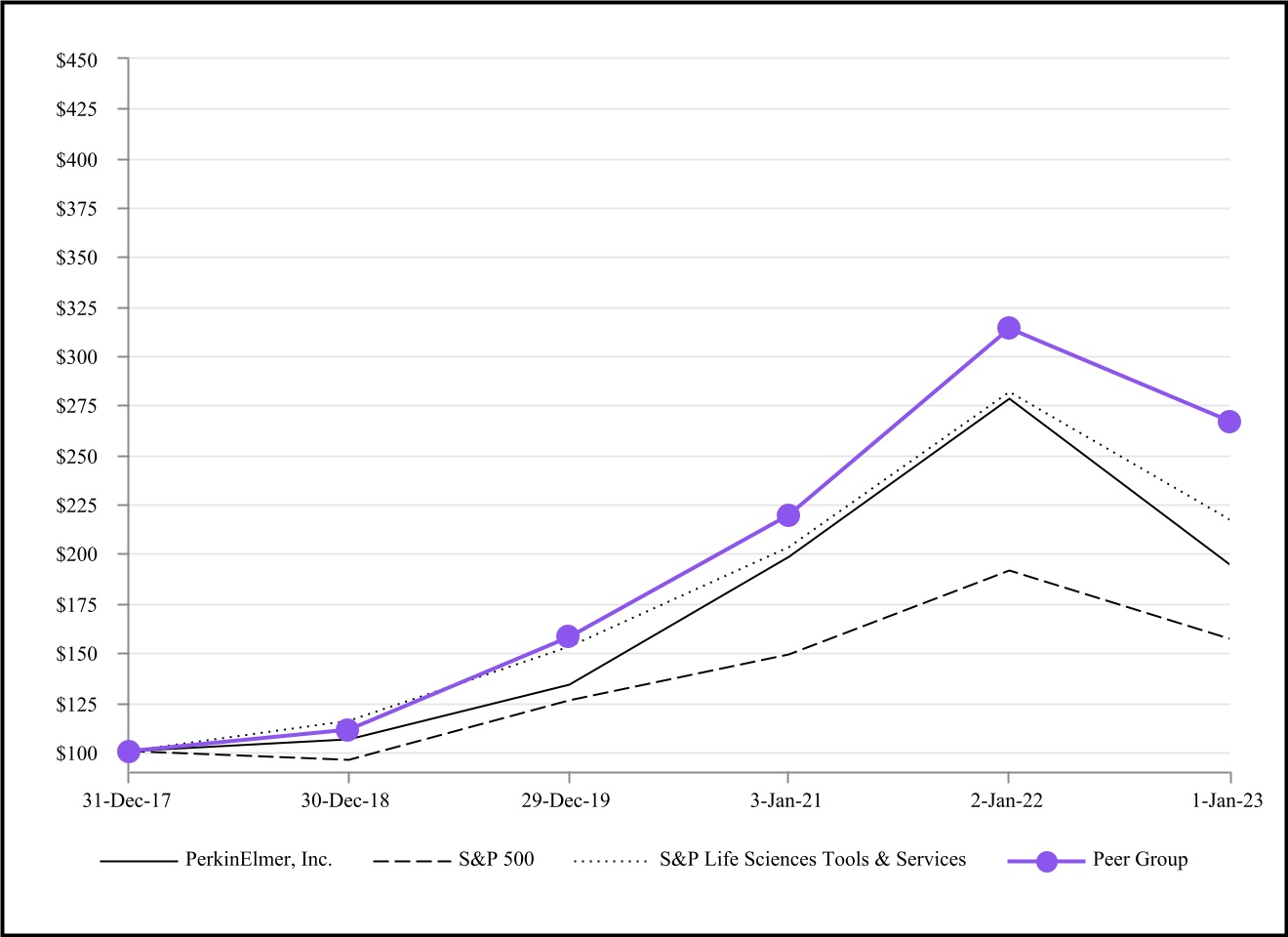
| 31-Dec-17 | 30-Dec-18 | 29-Dec-19 | 3-Jan-21 | 2-Jan-22 | 1-Jan-23 | ||||||||||||||||||||||||||||||
| PerkinElmer, Inc. | $ | 100.00 | $ | 106.07 | $ | 133.61 | $ | 198.11 | $ | 278.09 | $ | 194.30 | |||||||||||||||||||||||
| S&P 500 Index | $ | 100.00 | $ | 95.62 | $ | 125.72 | $ | 148.85 | $ | 191.58 | $ | 156.89 | |||||||||||||||||||||||
| S&P 500 Life Sciences Tools & Services Industry Index | $ | 100.00 | $ | 115.18 | $ | 152.65 | $ | 203.04 | $ | 281.69 | $ | 217.15 | |||||||||||||||||||||||
| Peer Group Index | $ | 100.00 | $ | 111.08 | $ | 157.75 | $ | 219.67 | $ | 313.61 | $ | 266.70 |
Item 6. [Reserved]
Reserved.
Item 7. Management’s Discussion and Analysis of Financial Condition and Results of Operations
This annual report on Form 10-K, including the following management’s discussion and analysis, contains forward-looking information that you should read in conjunction with the consolidated financial statements and notes to consolidated financial statements that we have included elsewhere in this annual report on Form 10-K. For this purpose, any statements contained in this report that are not statements of historical fact may be deemed to be forward-looking statements. Words such as “believes,” “plans,” “anticipates,” “expects,” “will” and similar expressions are intended to identify forward-looking statements. Our actual results may differ materially from the plans, intentions or expectations we disclose in the forward-looking statements we make. We have included important factors above under the heading “Risk Factors” in Item 1A above that we believe could cause actual results to differ materially from the forward-looking statements we make. We are not obligated to publicly update any forward-looking statements, whether as a result of new information, future events or otherwise.
Accounting Period
Our fiscal year ends on the Sunday nearest December 31. We report fiscal years under a 52/53 week format and as a result, certain fiscal years will contain 53 weeks. Each of the fiscal years ended January 1, 2023 (“fiscal year 2022”) and January 2, 2022 (“fiscal year 2021”) included 52 weeks. The fiscal year ended January 3, 2021 (“fiscal year 2020”) included 53 weeks. The fiscal year ending December 31, 2023 (“fiscal year 2023”) will include 52 weeks.
Overview of Fiscal Year 2022
During fiscal year 2022, we continued to see strong returns from our acquisitions as well as our organic investments across technology, marketing and people. Our overall revenue in fiscal year 2022 decreased by $516.0 million, or 13%, as compared to fiscal year 2021, reflecting a decrease of $913.0 million, or 31%, in our Diagnostics segment revenue, partially offset by an increase of $395.2 million, or 44%, in our Discovery & Analytical Solutions segment revenue. Revenue from our 2021 acquisitions contributed $366.9 million to our overall revenue during fiscal year 2022. The decrease in our Diagnostics segment revenue during fiscal year 2022 was primarily driven by decreased demand for our COVID-19 product offerings, partially offset by an increase in our core product offerings resulting in a decrease of $689.0 million in our immunodiagnostics revenue and a decrease of $225.8 million in our applied genomics revenue. Revenue from our 2021 acquisitions contributed $58.1 million to our Diagnostics segment revenue during fiscal year 2022. The increase in our Discovery & Analytical Solutions segment revenue during fiscal year 2022 was driven by an increase of $395.2 million in our life sciences market revenue. Revenue from our 2021 acquisitions contributed $308.7 million to the increase in our Discovery & Analytical Solutions segment revenue during fiscal year 2022.
In our Diagnostics segment, we experienced a global decline in demand for our COVID-19 product offerings due to the cancellation of our service contracts for the State of California and the United Kingdom, and lower COVID-19 testing volumes compared to fiscal year 2021. We saw strong growth in our core immunodiagnostics business in the Americas and Europe, partially offset by the impact of extensive shutdowns in China. In our reproductive health business, an expanded range of product offerings and increased geographic reach more than offset the impact of declining birthrates.
In our Discovery & Analytical Solutions segment, the increase in our life sciences market revenue was the result of an increase in revenue in our pharmaceutical and biotechnology markets across all regions. Instruments, reagents and software experienced strong growth and we saw a positive impact from pricing actions we took in early 2022.
Our consolidated gross margins decreased 350 basis points in fiscal year 2022, as compared to fiscal year 2021, primarily due to increased amortization of acquired intangible assets and lower revenue from our COVID-19 product offerings, partially offset by a favorable shift in product mix and service productivity. Our consolidated operating margin decreased 1,045 basis points in fiscal year 2022, as compared to fiscal year 2021, primarily due to lower revenue from our COVID-19 product offerings, increased costs related to amortization of acquired intangible assets, and investments in new product development and growth initiatives. During fiscal year 2022, supply chain disruptions and inflation did not materially impact our results of operations as compared to fiscal year 2021 as the effects of our initiatives to reduce transportation costs more than offset the impact of inflation on our raw materials purchases. During fiscal year 2022, supply chain disruptions and inflation increased our cost of goods sold by less than $10.0 million as compared to fiscal year 2021.
Overall, we believe that our strategic priorities and recent portfolio transformations, coupled with our expanded range of product offerings, leading market positions, global scale and financial strength provides us with a foundation for continued revenue growth, strong margins and cash flows, and long-term earnings per share growth.
Consolidated Results of Operations
Fiscal Year 2022 Compared to Fiscal Year 2021
Revenue
Revenue for fiscal year 2022 was $3.3 billion, as compared to $3.8 billion for fiscal year 2021, a decrease of $0.5 billion, or 13%, which includes an approximate 4% decrease in revenue attributable to unfavorable changes in foreign exchange rates, partially offset by an approximate 9% increase in revenue attributable to acquisitions. Revenue from our 2021 acquisitions contributed $366.9 million to our overall revenue during fiscal year 2022. The analysis in the remainder of this paragraph compares segment revenue for fiscal year 2022 as compared to fiscal year 2021 and includes the effect of foreign exchange rate fluctuations, and acquisitions and divestitures. The decrease in total revenue reflects a decrease in our Diagnostics segment revenue of $913.0 million, or 31%, due to decreased demand for our COVID-19 product offerings, partially offset by an increase in our core product offerings resulting in a decrease of $689.0 million in our immunodiagnostics revenue and a decrease of $225.8 million in our applied genomics revenue. Our Discovery & Analytical Solutions segment revenue increased by $395.2 million, or 44%, due to increase in revenue in our life sciences market, particularly in the pharmaceutical and biotechnology markets. As a result of adjustments to deferred revenue related to certain acquisitions required by business combination rules, we did not recognize $0.8 million and $2.6 million of revenue for fiscal years 2022 and 2021, respectively, that otherwise would have been recorded by the acquired businesses during each of the respective periods.
Cost of Revenue
Cost of revenue for fiscal year 2022 was $1.3 billion, as compared to $1.4 billion for fiscal year 2021, a decrease of approximately $71.8 million, or 5%. As a percentage of revenue, cost of revenue increased to 40% in fiscal year 2022 from 36% in fiscal year 2021, resulting in a decrease in gross margin of approximately 350 basis points to 60% in fiscal year 2022 from 64% in fiscal year 2021. Amortization of intangible assets increased to $141.6 million for fiscal year 2022, as compared to $100.7 million for fiscal year 2021. Amortization of intangible assets from our 2021 acquisitions amounted to $88.5 million for fiscal year 2022. The amortization of purchase accounting adjustments to record the inventory from certain acquisitions added an incremental expense of $45.3 million for fiscal year 2022, as compared to $35.2 million for fiscal year 2021. Other purchase accounting adjustments added an incremental expense of $6.2 mill
Showing the first 8K of 69K characters. Open the full section
Item 7A. Quantitative and Qualitative Disclosures About Market Risk
Quantitative and Qualitative Disclosures about Market Risk
Financial Instruments
Financial instruments that potentially subject us to concentrations of credit risk consist principally of temporary cash investments, derivatives, marketable securities and accounts receivable. We believe we had no significant concentrations of credit risk as of January 1, 2023.
We use derivative instruments as part of our risk management strategy only, and includes derivatives utilized as economic hedges that are not designated as hedging instruments. By nature, all financial instruments involve market and credit risks. We enter into derivative instruments with major investment grade financial institutions and have policies to monitor the credit risk of those counterparties. We do not enter into derivative contracts for trading or other speculative purposes, nor do we use leveraged financial instruments.
In the ordinary course of business, we enter into foreign exchange contracts for periods consistent with its committed exposures to mitigate the effect of foreign currency movements on transactions denominated in foreign currencies. The intent of these economic hedges is to offset gains and losses that occur on the underlying exposures from these currencies, with gains and losses resulting from the forward currency contracts that hedge these exposures. Transactions covered by hedge contracts include intercompany and third-party receivables and payables. The contracts are primarily in European and Asian currencies, have maturities that do not exceed 12 months, have no cash requirements until maturity, and are recorded at fair value on our consolidated balance sheets. The unrealized gains and losses on these foreign currency contracts are recognized immediately in interest and other expense, net. The cash flows related to the settlement of these hedges are included in cash flows from operating activities within our consolidated statements of cash flows.
Principal hedged currencies include the Australian Dollar, British Pound, Euro, Indian Rupee, Singapore Dollar and Swedish Krona. We held forward foreign exchange contracts, designated as economic hedges, with U.S. dollar equivalent notional amounts totaling $476.9 million at January 1, 2023, $371.9 million at January 2, 2022, and $808.0 million at January 3, 2021, and the fair value of these foreign currency derivative contracts was insignificant. The gains and losses realized on these foreign currency derivative contracts are not material. The duration of these contracts was generally 30 days or less during each of fiscal years 2022, 2021 and 2020.
In addition, in connection with certain intercompany loan agreements utilized to finance our acquisitions and stock repurchase program, we enter into forward foreign exchange contracts intended to hedge movements in foreign exchange rates prior to settlement of such intercompany loans denominated in foreign currencies. We record these hedges at fair value on our consolidated balance sheets. The unrealized gains and losses on these hedges, as well as the gains and losses associated with the remeasurement of the intercompany loans, are recognized immediately in interest and other expense, net. The cash flows related to the settlement of these hedges are included in cash flows from financing activities within our consolidated statements of cash flows.
The outstanding forward exchange contracts designated as economic hedges, which were intended to hedge movements in foreign exchange rates prior to the settlement of certain intercompany loan agreements, included combined U.S. Dollar notional amounts of $360.2 million as of January 2, 2022. The net gains and losses on these derivatives, combined with the gains and losses on the remeasurement of the hedged intercompany loans were not material.
During fiscal year 2018, we designated a portion of the 2026 Notes to hedge our investments in certain foreign subsidiaries. Unrealized translation adjustments from a portion of the 2026 Notes were included in the foreign currency translation component of accumulated other comprehensive income (“AOCI”), which offsets translation adjustments on the underlying net assets of foreign subsidiaries. The cumulative translation gains or losses will remain in AOCI until the foreign subsidiaries are liquidated or sold. As of January 1, 2023, the total notional amount of the 2026 Notes that was designated to hedge investments in foreign subsidiaries was €497.2 million. The unrealized foreign exchange (gains) losses recorded in AOCI related to the net investment hedge were $(34.5) million, $33.2 million and $49.6 million during the fiscal years 2022, 2021 and 2020, respectively.
We do not expect any material net pre-tax gains or losses to be reclassified from accumulated other comprehensive (loss) income into interest and other expense, net within the next twelve months.
See Note 19, Derivatives and Hedging Activities, in the Notes to Consolidated Financial Statements for a detailed discussion of our derivative instruments and hedging activities.
Market Risk
Market Risk. We are exposed to market risk, including changes in interest rates and currency exchange rates. To manage the volatility relating to these exposures, we enter into various derivative transactions pursuant to our policies to hedge against known or forecasted market exposures.
Foreign Exchange Risk. The potential change in foreign currency exchange rates offers a substantial risk to us, as approximately 55% of our business is conducted outside of the United States, generally in foreign currencies. Our risk management strategy currently uses forward contracts to mitigate certain balance sheet foreign currency transaction exposures. The intent of these economic hedges is to offset gains and losses that occur on the underlying exposures, with gains and losses resulting from the forward contracts that hedge these exposures. Moreover, we are able to partially mitigate the impact that fluctuations in currencies have on our net income as a result of our manufacturing facilities located in countries outside the United States, material sourcing and other spending which occur in countries outside the United States, resulting in natural hedges.
Although we attempt to manage our foreign currency exchange risk through the above activities, when the U.S. dollar weakens against other currencies in which we transact business, sales and net income will in general be positively but not proportionately impacted. Conversely, when the U.S. dollar strengthens against other currencies in which we transact business, sales and net income will in general be negatively but not proportionately impacted.
Foreign Currency Risk—Value-at-Risk Disclosure. We utilize a Value-at-Risk model to determine the potential earning/fair value exposures presented by our foreign currency related financial instruments. As discussed above, we seek to minimize this exposure through our hedging program. Our Value-at-Risk computation is based on the Monte Carlo simulation, utilizing a 95% confidence interval and a holding period of 30 days. As of January 1, 2023, this computation estimated that there is a 5% chance that the market value of the underlying exposures and the corresponding derivative instruments either increase or decrease due to foreign currency fluctuations by more than $3.1 million. This Value-At-Risk measure is consistent with our financial statement disclosures relative to our foreign currency hedging program. Specifically, during each of the four quarters ended in fiscal year 2022, the Value-At-Risk ranged between $1.3 million and $3.1 million, with an average of approximately $2.1 million.
Interest Rate Risk. As of January 1, 2023, we had no outstanding borrowings under our senior unsecured revolving credit facility. Amounts drawn under our senior unsecured revolving credit facility bear interest at variable rates; all of our other debt bear interest at fixed rates. Our cash and cash equivalents from continuing operations, for which we receive interest at variable rates, were $454.4 million at January 1, 2023. Fluctuations in interest rates can therefore have a direct impact on both our short-term cash flows, as they relate to interest, and our earnings. To manage the volatility relating to these exposures, we periodically enter into various derivative transactions pursuant to our policies to hedge against known or forecasted interest rate exposures. However, no such instruments are outstanding at January 1, 2023.
Interest Rate Risk—Sensitivity. Our current earnings exposure for changes in interest rates can be summarized as follows:
(i) Changes in interest rates can cause our interest expense and cash flows to fluctuate to the extent we have borrowing outstanding on our revolving credit facility.
(ii) Changes in interest rates can cause our interest income and cash flows to fluctuate.
We believe that we do not have any material exposure of interest rate risk.
Item 8. Financial Statements and Supplemental Data
TABLE OF CONTENTS
REPORT OF INDEPENDENT REGISTERED PUBLIC ACCOUNTING FIRM
To the Stockholders and the Board of Directors of PerkinElmer, Inc.
Opinion on the Financial Statements
We have audited the accompanying consolidated balance sheets of PerkinElmer, Inc. and subsidiaries (the “Company”) as of January 1, 2023 and January 2, 2022 and the related consolidated statements of operations, comprehensive income, stockholders’ equity, and cash flows for each of the three years in the period ended January 1, 2023 and the related notes (collectively referred to as the “financial statements”). In our opinion, the financial statements present fairly, in all material respects, the financial position of the Company as of January 1, 2023 and January 2, 2022, and the results of its operations and its cash flows for each of the three years in the period ended January 1, 2023, in conformity with accounting principles generally accepted in the United States of America.
We have also audited, in accordance with the standards of the Public Company Accounting Oversight Board (United States) (“PCAOB”), the Company’s internal control over financial reporting as of January 1, 2023, based on criteria established in Internal Control - Integrated Framework (2013) issued by the Committee of Sponsoring Organizations of the Treadway Commission and our report dated March 1, 2023 expressed an unqualified opinion on the Company’s internal control over financial reporting.
Basis for Opinion
These financial statements are the responsibility of the Company’s management. Our responsibility is to express an opinion on the Company’s financial statements based on our audits. We are a public accounting firm registered with the PCAOB and are required to be independent with respect to the Company in accordance with the U.S. federal securities laws and the applicable rules and regulations of the Securities and Exchange Commission and the PCAOB.
We conducted our audits in accordance with the standards of the PCAOB. Those standards require that we plan and perform the audit to obtain reasonable assurance about whether the financial statements are free of material misstatement, whether due to error or fraud. Our audits included performing procedures to assess the risks of material misstatement of the financial statements, whether due to error or fraud, and performing procedures that respond to those risks. Such procedures included examining, on a test basis, evidence regarding the amounts and disclosures in the financial statements. Our audits also included evaluating the accounting principles used and significant estimates made by management, as well as evaluating the overall presentation of the financial statements. We believe that our audits provide a reasonable basis for our opinion.
Critical Audit Matter
The critical audit matter communicated below is a matter arising from the current-period audit of the financial statements that was communicated or required to be communicated to the audit committee and that (1) relates to accounts or disclosures that are material to the financial statements and (2) involved our especially challenging, subjective, or complex judgments. The communication of critical audit matters does not alter in any way our opinion on the financial statements, taken as a whole, and we are not, by communicating the critical audit matter below, providing a separate opinion on the critical audit matter or on the accounts or disclosures to which it relates.
Discontinued Operations - Refer to Notes 1 and 4 to the financial statements
Critical Audit Matter Description
In August 2022, the Company entered into a definitive agreement to sell certain assets and the equity interests of certain entities constituting the Analytical, Food and Enterprise Services businesses (the “Business”). At that time, management determined that the proposed sale met the criteria for the Business to be classified as held-for-sale and the results of operations and cashflows of the Business was presented as discontinued operations for all periods presented in accordance with Accounting Standard Codification 205-20, Discontinued Operations (“ASC 205-20”).
The net assets of the Business were $1.42 billion and $1.40 billion as of January 1, 2023 and January 2, 2022, respectively.
Given the level of operational and financial integration between the Business and the continuing operations of the Company, auditing the segregation of assets and liabilities of the Business and the identification of the results of operation and cashflows of the Business required both extensive audit effort and a high degree of auditor judgment.
How the Critical Audit Matter Was Addressed in the Audit
Our audit procedures related to the identification and measurement of the net assets of the Business and the related results of operations and cashflows presented as discontinued operations included the following, among others:
-
We tested the effectiveness of controls over the identification of the net assets, results of operations and cash flows included in the Company’s discontinued operations presentation.
-
We obtained and read the purchase and sale agreement for the proposed sale and compared the terms of that agreement to the identification of the assets and liabilities included in the disposal group.
-
We assessed the Company’s identification of assets and liabilities and the related operations and cash flows of the Business by testing the completeness and accuracy of the Company’s accounting data and schedules that segregate the Business from the continuing operations of the Company.
-
We assessed the presentation and disclosures related to the discontinued operations to ensure proper application of ASC 205-20.
/s / DELOITTE & TOUCHE LLP
Boston, Massachusetts
March 1, 2023
We have served as the Company’s auditor since 2002.
CONSOLIDATED STATEMENTS OF OPERATIONS
| January 1, 2023 | January 2, 2022 | January 3, 2021 | |||||||||||||||
| (In thousands, except per share data) | |||||||||||||||||
| Revenue | |||||||||||||||||
| Product revenue | $ | 2,634,582 | $ | 2,735,068 | $ | 2,280,853 | |||||||||||
| Service revenue | 677,240 | 1,092,740 |
Showing the first 8K of 218K characters. Open the full section
Item 9. Changes in and Disagreements with Accountants on Accounting and Financial Disclosure
Not applicable.
Item 9A. Controls and Procedures
Conclusion Regarding the Effectiveness of Disclosure Controls and Procedures
Our management, with the participation of our Chief Executive Officer and Chief Financial Officer, evaluated the effectiveness of our disclosure controls and procedures as of January 1, 2023. The term “disclosure controls and procedures” as defined in Rules 13a-15(e) and 15d-15(e) under the Securities Exchange Act of 1934, as amended (the “Exchange Act”), means controls and other procedures of a company that are designed to provide reasonable assurance that information required to be disclosed by the company in the reports that it files or submits under the Exchange Act is recorded, processed, summarized and reported, within the time periods specified in the Securities and Exchange Commission’s rules and forms. Disclosure controls and procedures include, without limitation, controls and procedures designed to ensure that information required to be disclosed by a company in the reports that it files or submits under the Exchange Act is accumulated and communicated to the company’s management, including its principal executive and principal financial officers, as appropriate to allow timely decisions regarding required disclosure. Management recognizes that any controls and procedures, no matter how well designed and operated, can provide only reasonable assurance of achieving their objectives, and management necessarily applies its judgment in evaluating the cost-benefit relationship of possible controls and procedures. Based on the evaluation of our disclosure controls and procedures as of January 1, 2023, our Chief Executive Officer and Chief Financial Officer concluded that, as of such date, our disclosure controls and procedures were effective at the reasonable assurance level.
Management’s Report on Internal Control Over Financial Reporting
Our management is responsible for establishing and maintaining adequate internal control over financial reporting. Internal control over financial reporting is defined in Rule 13a-15(f) or 15d-15(f) promulgated under the Exchange Act as a process designed by, or under the supervision of, the company’s principal executive and principal financial officers and effected by the company’s board of directors, management and other personnel, to provide reasonable assurance regarding the reliability of financial reporting and the preparation of financial statements for external purposes in accordance with generally accepted accounting principles, and includes those policies and procedures that:
-
Pertain to the maintenance of records that in reasonable detail accurately and fairly reflect the transactions and dispositions of the assets of the company;
-
Provide reasonable assurance that transactions are recorded as necessary to permit preparation of financial statements in accordance with generally accepted accounting principles, and that receipts and expenditures of the company are being made only in accordance with authorizations of management and directors of the company; and
-
Provide reasonable assurance regarding prevention or timely detection of unauthorized acquisition, use or disposition of the company’s assets that could have a material effect on the financial statements.
Because of its inherent limitations, internal control over financial reporting may not prevent or detect misstatements. Projections of any evaluation of effectiveness to future periods are subject to the risk that controls may become inadequate because of changes in conditions, or that the degree of compliance with the policies or procedures may deteriorate.
Our management assessed the effectiveness of our internal control over financial reporting as of January 1, 2023. In making this assessment, our management used the criteria set forth by the Committee of Sponsoring Organizations of the Treadway Commission in Internal Control-Integrated Framework (2013).
Based on this assessment, our management concluded that, as of January 1, 2023, our internal control over financial reporting was effective based on those criteria.
Our registered public accounting firm has issued an attestation report on our internal control over financial reporting. This report appears below.
Changes in Internal Control Over Financial Reporting
No change in our internal control over financial reporting (as defined in Rules 13a-15(f) and 15d-15(f) under the Exchange Act) occurred during the fiscal quarter ended January 1, 2023 that has materially affected, or is reasonably likely to materially affect, our internal control over financial reporting. We have not experienced any material impact to our internal controls over financial reporting despite the fact that many of our employees are working remotely due to the COVID-19 pandemic. We are continually monitoring and assessing the effect of the COVID-19 situation on our internal controls to minimize the impact on their design and operating effectiveness.
REPORT OF INDEPENDENT REGISTERED PUBLIC ACCOUNTING FIRM
To the Stockholders and the Board of Directors of PerkinElmer, Inc.
Opinion on Internal Control over Financial Reporting
We have audited the internal control over financial reporting of PerkinElmer, Inc. and subsidiaries (the “Company”) as of January 1, 2023, based on criteria established in Internal Control—Integrated Framework (2013) issued by the Committee of Sponsoring Organizations of the Treadway Commission (COSO). In our opinion, the Company maintained, in all material respects, effective internal control over financial reporting as of January 1, 2023, based on criteria established in Internal Control – Integrated Framework (2013) issued by COSO.
We have also audited, in accordance with the standards of the Public Company Accounting Oversight Board (United States) (PCAOB), the consolidated financial statements as of and for the year ended January 1, 2023 of the Company and our report dated March 1, 2023 expressed an unqualified opinion on those financial statements.
Basis for Opinion
The Company’s management is responsible for maintaining effective internal control over financial reporting and for its assessment of the effectiveness of internal control over financial reporting, included in the accompanying Management’s Report on Internal Control Over Financial Reporting. Our responsibility is to express an opinion on the Company’s internal control over financial reporting based on our audit. We are a public accounting firm registered with the PCAOB and are required to be independent with respect to the Company in accordance with the U.S. federal securities laws and the applicable rules and regulations of the Securities and Exchange Commission and the PCAOB.
We conducted our audit in accordance with the standards of the PCAOB. Those standards require that we plan and perform the audit to obtain reasonable assurance about whether effective internal control over financial reporting was maintained in all material respects. Our audit included obtaining an understanding of internal control over financial reporting, assessing the risk that a material weakness exists, testing and evaluating the design and operating effectiveness of internal control based on the assessed risk, and performing such other procedures as we considered necessary in the circumstances. We believe that our audit provides a reasonable basis for our opinion.
Definition and Limitations of Internal Control over Financial Reporting
A company’s internal control over financial reporting is a process designed to provide reasonable assurance regarding the reliability of financial reporting and the preparation of financial statements for external purposes in accordance with generally accepted accounting principles. A company’s internal control over financial reporting includes those policies and procedures that (1) pertain to the maintenance of records that, in reasonable detail, accurately and fairly reflect the transactions and dispositions of the assets of the company; (2) provide reasonable assurance that transactions are recorded as necessary to permit preparation of financial statements in accordance with generally accepted accounting principles, and that receipts and expenditures of the company are being made only in accordance with authorizations of management and directors of the company; and (3) provide reasonable assurance regarding prevention or timely detection of unauthorized acquisition, use, or disposition of the company’s assets that could have a material effect on the financial statements.
Because of its inherent limitations, internal control over financial reporting may not prevent or detect misstatements. Also, projections of any evaluation of effectiveness to future periods are subject to the risk that controls may become inadequate because of changes in conditions, or that the degree of compliance with policies or procedures may deteriorate.
/s / DELOITTE & TOUCHE LLP
Boston, Massachusetts
March 1, 2023
Item 9B. Other Information
Not applicable.
Item 9C. Disclosure Regarding Foreign Jurisdictions that Prevent Inspections
Not applicable.
PART III
Item 10. Directors, Executive Officers and Corporate Governance
The information required to be disclosed by this Item pursuant to Item 401 of Regulation S-K with respect to our executive officers is contained in Part I of this annual report on Form 10-K under the caption, “Information About Our Executive Officers”. The remaining information required to be disclosed by the Item pursuant to Item 401 and Item 407 of Regulation S-K is contained in the proxy statement for our annual meeting of stockholders to be held on April 25, 2023 under the captions “Proposal No. 1 Election of Directors” and “Information Relating to Our Board of Directors and Its Committees” and is incorporated in this annual report on Form 10-K by reference.
We have adopted a code of ethics, our Standards of Business Conduct, that applies to our principal executive officer, principal financial officer, principal accounting officer or controller, and persons performing similar functions. Our Standards of Business Conduct, as well as our corporate governance guidelines and the charters for the audit, compensation and benefits, nominating and corporate governance, executive and finance committees of our Board of Directors, are each accessible under the “Corporate Governance” heading of the “Investors” section of our website, http://www.perkinelmer.com. This information is also available in print to any stockholder who requests it, by writing to PerkinElmer, Inc., 940 Winter Street, Waltham, Massachusetts 02451, Attention: Investor Relations. We also intend to disclose in the same location on our website, any amendments to, or waivers from, our Standards of Business Conduct that are required to be disclosed pursuant to the disclosure requirements of Item 5.05 of Form 8-K.
Item 11. Executive Compensation
The information required to be disclosed by this Item pursuant to Item 402 and Item 407(e) of Regulation S-K is contained in the proxy statement for our annual meeting of stockholders to be held on April 25, 2023 under the captions “Director Compensation,” “Information Relating to Our Board of Directors and Its Committees—Compensation Committee Interlocks and Insider Participation,” and “Executive Compensation,” and is incorporated in this annual report on Form 10-K by reference.
Item 12. Security Ownership of Certain Beneficial Owners and Management and Related Stockholder Matters
The information required to be disclosed by this Item pursuant to Item 403 of Regulation S-K is contained in the proxy statement for our annual meeting of stockholders to be held on April 25, 2023 under the caption “Beneficial Ownership of Common Stock,” and is incorporated in this annual report on Form 10-K by reference.
The information required to be disclosed by this Item pursuant to Item 201(d) of Regulation S-K is contained in the proxy statement for our annual meeting of stockholders to be held on April 25, 2023 under the caption “Executive Compensation—Equity Compensation Plan Information,” and is incorporated in this annual report on Form 10-K by reference.
Item 13. Certain Relationships and Related Transactions, and Director Independence
The information required to be disclosed by this Item pursuant to Item 404 of Regulation S-K is contained in the proxy statement for our annual meeting of stockholders to be held on April 25, 2023 under the caption “Information Relating to Our Board of Directors and Its Committees—Certain Relationships and Policies on Related Party Transactions,” and is incorporated in this annual report on Form 10-K by reference.
The information required to be disclosed by this Item pursuant to Item 407(a) of Regulation S-K is contained in the proxy statement for our annual meeting of stockholders to be held on April 25, 2023 under the caption “Information Relating to Our Board of Directors and Its Committees—Determination of Independence,” and is incorporated in this annual report on Form 10-K by reference.
Item 14. Principal Accountant Fees and Services
The information required to be disclosed by this Item pursuant to Item 9(e) of Schedule 14A is contained in the proxy statement for our annual meeting of stockholders to be held on April 25, 2023 under the caption “Information Relating to Our Board of Directors and Its Committees—Independent Registered Public Accounting Firm Fees and Other Matters”, and is incorporated in this annual report on Form 10-K by reference.
PART IV
Item 15. Exhibits and Financial Statement Schedules
(a) DOCUMENTS FILED AS PART OF THIS REPORT:
- FINANCIAL STATEMENTS
Included in Part II, Item 8:
Report of Independent Registered Public Accounting Firm
Consolidated Statements of Operations for Each of the Three Fiscal Years in the Period Ended January 1, 2023
Consolidated Statements of Comprehensive Income for Each of the Three Fiscal Years in the Period Ended January 1, 2023
Consolidated Balance Sheets as of January 1, 2023 and January 2, 2022
Consolidated Statements of Stockholders’ Equity for Each of the Three Fiscal Years in the Period Ended January 1, 2023
Consolidated Statements of Cash Flows for Each of the Three Fiscal Years in the Period Ended January 1, 2023
Notes to Consolidated Financial Statements
- FINANCIAL STATEMENT SCHEDULE
We have omitted financial statement schedules because of the absence of conditions under which they are required, or because the required information is given in the financial statements or notes thereto.
- EXHIBITS
(1) The exhibits and schedules to this agreement have been omitted from this filing pursuant to Item 601(b)(2) of Regulation S-K. The registrant agrees to furnish copies of any of such exhibits or schedules to the SEC upon request.
- Management contract or compensation plan or arrangement required to be filed as an exhibit pursuant to Item 15(b) of Form 10-K.
Attached as Exhibit 101 to this report are the following formatted in XBRL (Extensible Business Reporting Language):
(i) Consolidated Statements of Operations for each of the three years in the period ended January 1, 2023, (ii) Consolidated Balance Sheets as of January 1, 2023 and January 2, 2022, (iii) Consolidated Statements of Comprehensive Income for each of the three years in the period ended January 1, 2023, (iv) Consolidated Statements of Stockholders' Equity for each of the three years in the period ended January 1, 2023, (v) Consolidated Statements of Cash Flows for each of the three years in the period ended January 1, 2023, and (vi) Notes to Consolidated Financial Statements.
Item 16. Form 10-K Summary
Not applicable.
SIGNATURES
Pursuant to the requirements of Section 13 or 15(d) of the Securities Exchange Act of 1934, the registrant has duly caused this report to be signed on its behalf by the undersigned, thereunto duly authorized.
| Signature | PERKINELMER, INC. Title | Date | |||||||||||||||
| By: | /s/ PRAHLAD SINGH, PhD | President and Chief Executive Officer | March 1, 2023 | ||||||||||||||
| Prahlad Singh, PhD | (Principal Executive Officer) | ||||||||||||||||
| By: | /S/ MAXWELL KRAKOWIAK | Sr. Vice President and | March 1, 2023 | ||||||||||||||
| Maxwell Krakowiak | Chief Financial Officer (Principal Financial Officer) | ||||||||||||||||
| By: | /S/ ANDREW OKUN | Vice President, | March 1, 2023 | ||||||||||||||
| Andrew Okun | Chief Accounting Officer and Treasurer (Principal Accounting Officer) |
POWER OF ATTORNEY AND SIGNATURES
We, the undersigned officers and directors of PerkinElmer, Inc., hereby severally constitute Prahlad Singh and Maxwell Krakowiak, and each of them singly, our true and lawful attorneys with full power to them, and each of them singly, to sign for us and in our names, in the capacities indicated below, this Annual Report on Form 10-K and any and all amendments to said Annual Report on Form 10-K, and generally to do all such things in our name and behalf in our capacities as officers and directors to enable PerkinElmer, Inc. to comply with the provisions of the Securities Exchange Act of 1934, and all requirements of the Securities and Exchange Commission, hereby rectifying and confirming signed by our said attorneys, and any and all amendments thereto.
Pursuant to the requirements of the Securities Exchange Act of 1934, this report has been signed below by the following persons on behalf of the registrant and in the capacities and on the dates indicated:
| Signature | Title | Date | |||||||||||||||
| By: | /s/ PRAHLAD SINGH, PhD | President, Chief Executive Officer and | March 1, 2023 | ||||||||||||||
| Prahlad Singh, PhD | Director (Principal Executive Officer) | ||||||||||||||||
| By: | /s/ MAXWELL KRAKOWIAK | Sr. Vice President and | March 1, 2023 | ||||||||||||||
| Maxwell Krakowiak | Chief Financial Officer (Principal Financial Officer) | ||||||||||||||||
| By: | /s/ ANDREW OKUN | Vice President, Chief Accounting Officer | March 1, 2023 | ||||||||||||||
| Andrew Okun | and Treasurer (Principal Accounting Officer) | ||||||||||||||||
| By: | /s/ PETER BARRETT, PhD | Director | March 1, 2023 | ||||||||||||||
| Peter Barrett, PhD | |||||||||||||||||
| By: | /s/ SAMUEL R. CHAPIN | Director | March 1, 2023 | ||||||||||||||
| Samuel R. Chapin | |||||||||||||||||
| By: | /s/ SYLVIE GRÉGOIRE, PharmD | Director | March 1, 2023 | ||||||||||||||
| Sylvie Grégoire, PharmD | |||||||||||||||||
| By: | /s/MICHELLE MCMURRY-HEATH, MD PhD | Director | March 1, 2023 | ||||||||||||||
| Michelle McMurry-Heath, MD PhD | |||||||||||||||||
| By: | /s/ ALEXIS P. MICHAS | Director | March 1, 2023 | ||||||||||||||
| Alexis P. Michas | |||||||||||||||||
| By: | /s MICHEL VOUNATSOS | Director | March 1, 2023 | ||||||||||||||
| Michel Vounatsos | |||||||||||||||||
| By: | /s/ FRANK WITNEY, PhD | Director | March 1, 2023 | ||||||||||||||
| Frank Witney, PhD | |||||||||||||||||
| By: | /s/ PASCALE WITZ | Director | March 1, 2023 | ||||||||||||||
| Pascale Witz |