 filings.tools
Starbucks 10-K 2021-10-03
Filed 2021-11-19. 23 sections, 465K characters. Original on sec.gov · Markdown · JSON
Cover and table of contents
UNITED STATES SECURITIES AND EXCHANGE COMMISSION
Washington, DC 20549
Form 10-K
☒ ANNUAL REPORT PURSUANT TO SECTION 13 OR 15(d) OF THE SECURITIES EXCHANGE ACT OF 1934
For the Fiscal Year Ended October 3, 2021
or
☐ TRANSITION REPORT PURSUANT TO SECTION 13 OR 15(d) OF THE SECURITIES EXCHANGE ACT OF 1934
For the transition period from to .
Commission File Number: 0-20322
Starbucks Corporation
(Exact Name of Registrant as Specified in its Charter)
| Washington | 91-1325671 | ||||
| (State of Incorporation) | (IRS Employer ID) |
2401 Utah Avenue South, Seattle, Washington 98134
(206) 447-1575
(Address of principal executive office, zip code, telephone number)
Securities Registered Pursuant to Section 12(b) of the Act:
| Title of Each Class | Trading Symbol | Name of Each Exchange on Which Registered | ||||||
| Common Stock, $0.001 par value per share | SBUX | Nasdaq Global Select Market |
Securities Registered Pursuant to Section 12(g) of the Act: None
Indicate by check mark if the registrant is a well-known seasoned issuer, as defined in Rule 405 of the Securities Act. Yes x No ¨
Indicate by check mark if the registrant is not required to file reports pursuant to Section 13 or Section 15(d) of the Act. Yes ¨ No x
Indicate by check mark whether the registrant: (1) has filed all reports required to be filed by Section 13 or 15(d) of the Securities Exchange Act of 1934 during the preceding 12 months (or for such shorter period that the registrant was required to file such reports), and (2) has been subject to such filing requirements for the past 90 days. Yes x No ¨
Indicate by check mark whether the registrant has submitted electronically every Interactive Data File required to be submitted pursuant to Rule 405 of Regulation S-T (§ 232.405 of this chapter) during the preceding 12 months (or for such shorter period that the registrant was required to submit such files). Yes x No ¨
Indicate by check mark whether the registrant is a large accelerated filer, an accelerated filer, a non-accelerated filer, a smaller reporting company, or an emerging growth company. See the definitions of “large accelerated filer,” “accelerated filer,” “smaller reporting company” and “emerging growth company” in Rule 12b-2 of the Exchange Act.
| Large accelerated filer | x | Accelerated filer | ¨ | Non-accelerated filer | ¨ | Smaller reporting company | ☐ | ||||||||||||||||
| Emerging growth company | ☐ |
If an emerging growth company, indicate by check mark if the registrant has elected not to use the extended transition period for complying with any new or revised financial accounting standards provided pursuant to Section 13(a) of the Exchange Act. ¨
Indicate by check mark whether the registrant has filed a report on and attestation to its management's assessment of the effectiveness of its internal control over financial reporting under Section 404(b) of the Sarbanes-Oxley Act (15 U.S.C. 7262(b)) by the registered public accounting firm that prepared or issued its audit report. x
Indicate by check mark whether the registrant is a shell company (as defined in Rule 12b-2 of the Act). Yes ☐ No x
The aggregate market value of the voting stock held by non-affiliates of the registrant as of the last business day of the registrant’s most recently completed second fiscal quarter, based upon the closing sale price of the registrant’s common stock on March 28, 2021 as reported on the Nasdaq Global Select Market was $129.3 billion. As of November 12, 2021, there were 1,173.2 million shares of the registrant’s Common Stock outstanding.
DOCUMENTS INCORPORATED BY REFERENCE
Portions of the definitive Proxy Statement for the registrant’s Annual Meeting of Shareholders to be held on March 16, 2022 have been incorporated by reference into Part III of this Annual Report on Form 10-K.
STARBUCKS CORPORATION
Form 10-K
For the Fiscal Year Ended October 3, 2021
TABLE OF CONTENTS
CAUTIONARY NOTE REGARDING FORWARD-LOOKING STATEMENTS
This Annual Report on Form 10-K includes “forward-looking” statements within the meaning of the Private Securities Litigation Reform Act of 1995. Forward-looking statements can be identified by the fact that they do not relate strictly to historical or current facts. They often include words such as “believes,” “expects,” “anticipates,” “estimates,” “intends,” “plans,” “seeks” or words of similar meaning, or future or conditional verbs, such as “will,” “should,” “could,” “may,” “aims,” “intends,” or “projects.” A forward-looking statement is neither a prediction nor a guarantee of future events or circumstances, and those future events or circumstances may not occur. You should not place undue reliance on forward-looking statements, which speak only as of the date of this Annual Report on Form 10-K. These forward-looking statements are all based on currently available operating, financial and competitive information and are subject to various risks and uncertainties. Our actual future results and trends may differ materially depending on a variety of factors, including, but not limited to, the risks and uncertainties discussed under “Risk Factors” and “Management’s Discussion and Analysis of Financial Condition and Results of Operations.” Given these risks and uncertainties, you should not rely on forward-looking statements as a prediction of actual results. Any or all of the forward-looking statements contained in this Annual Report on Form 10-K and any other public statement made by us, including by our management, may turn out to be incorrect. We are including this cautionary note to make applicable and take advantage of the safe harbor provisions of the Private Securities Litigation Reform Act of 1995 for forward-looking statements. We expressly disclaim any obligation to update or revise any forward-looking statements, whether as a result of new information, future events or otherwise.
PART I
Item 1. Business
General
In this Annual Report on Form 10-K (“10-K” or “Report”) for the fiscal year ended October 3, 2021 (“fiscal 2021”), Starbucks Corporation (together with its subsidiaries) is referred to as “Starbucks,” the “Company,” “we,” “us” or “our.”
Starbucks is the premier roaster, marketer and retailer of specialty coffee in the world, operating in 84 markets. Formed in 1985, Starbucks Corporation’s common stock trades on the Nasdaq Global Select Market (“Nasdaq”) under the symbol “SBUX.” We purchase and roast high-quality coffees that we sell, along with handcrafted coffee, tea and other beverages and a variety of high-quality food items through company-operated stores. We also sell a variety of coffee and tea products and license our trademarks through other channels, such as licensed stores as well as grocery and foodservice through our Global Coffee Alliance with Nestlé S.A. (“Nestlé”). In addition to our flagship Starbucks Coffee brand, we sell goods and services under the following brands: Teavana, Seattle’s Best Coffee, Evolution Fresh, Ethos, Starbucks Reserve and Princi.
Our primary objective is to maintain Starbucks standing as one of the most recognized and respected brands in the world. We believe our work to create a company that is profit-, people- and planet-positive, along with our ability to successfully execute strategies that support this work, contribute to our primary objective.
Profit-Positive
Our profit-positive efforts are aligned with our global long-term “Growth at Scale” agenda to deliver consistent revenue and income growth, through focus and discipline. We believe incremental investments in our brand, principally to support our people- and planet-positive work, will deliver long-term targeted revenue and income growth. This includes expansion of our global store base, adding stores in both existing, developed markets such as the U.S. and in newer, higher growth markets such as China, as well as optimizing the mix of company-operated and licensed stores around the world. In addition, by leveraging experiences gained through our stores and elsewhere, we continue to drive beverage, equipment, process and technology innovation. We strive to regularly offer consumers new, innovative coffee and other products in a variety of forms, across new categories, diverse channels and alternative store formats. We are committed to further investments in our partners (employees) and our industry-leading digital platform as well as environmental, social and governance issues underscoring our mission and values. Our disciplined capital allocation methodology, which prioritizes high-return investments as well as share repurchases and competitive dividends, rounds out our “Growth at Scale” agenda and our profit-positive vision.
People-Positive
Our people-positive vision is to cultivate an inclusive environment where everyone belongs. This includes empowering our partners with opportunities to pursue their aspirations while living our mission and values, acting with empathy and compassion and sharing in our success. This enables our partners to deliver an elevated Starbucks Experience to our customers every day. We also strive to develop long-lasting trust and make tangible differences in the communities where we serve by investing in humanity and the well-being of everyone we connect with, advancing initiatives that support diversity, equity and inclusion through education, pay equity, hiring commitments and meaningful community involvement, including donations.
Planet-Positive
Our planet-positive vision is to give back more than we take from the planet. This includes reducing our environmental impacts, such as expanding reusable packaging, conserving water, shifting to renewable energy and eliminating landfill waste, and committing to the sustainability of high-quality coffee and other raw materials. Sustainability of our raw materials, especially coffee, is paramount to our business operations. We are committed to ethically sourcing coffee, tea and cocoa, donating disease-resistant coffee trees to farmers, providing farmers access to low-interest loans and sharing the expertise of our agronomists with all coffee farmers, among other things.
Human Capital Management
As a company, Starbucks mission is not only to deliver outstanding financial results by offering exceptional and unique products and services, but to also create a strong connection with the communities where we operate. We believe the strength of our workforce is one of the significant contributors to our success as a global brand that leads with purpose as part of our people-positive vision. This is largely attributed to our partners who strive every day to create a welcoming and inclusive environment. Therefore, one of our core strategies is to invest in and support our partners to differentiate our brand, products and services in the competitive specialty coffee market, including the following areas of focus:
Oversight and Management
We recognize the diversity of customers, partners and communities, and believe in creating an inclusive and equitable environment that represents a broad spectrum of backgrounds and cultures. Working under these principles, our Partner
Resources Organization is tasked with managing employment-related matters, including recruiting and hiring, onboarding and training, compensation planning, performance management and professional development. Our Board of Directors and Board committees provide oversight on certain human capital matters, including our Inclusion and Diversity programs and initiatives. As noted in its charter, our Compensation and Management Development Committee is responsible for periodically reviewing Starbucks partner resource programs and initiatives, including healthcare and other benefits, as well as our management development and succession planning practices and strategies. Our Audit and Compliance Committee works closely with the Risk Management Committee, led by Starbucks cfo and general counsel, to monitor and mitigate current and emerging labor and human capital management risks. Furthermore, our Nominating and Corporate Governance Committee, in consultation with management, including our chief partner officer and chief inclusion and diversity officer, annually evaluates the effectiveness of our social responsibility policies, goals and programs, which also include partner-related issues. These reports and recommendations to the Board and its committees are part of the broader framework that guides how Starbucks should attract, retain and develop a skilled workforce that aligns with our values and strategies.
We regularly conduct anonymous surveys to seek feedback from our partners on a variety of topics, including confidence in company leadership, competitiveness of our compensation and benefits package, career growth opportunities and recommendations on how we can remain an employer of choice. The results are shared with our partners and reviewed by senior leadership, who analyze areas of progress or deterioration and prioritize actions and activities in response to this feedback to drive meaningful improvements in partner engagement. Our management and cross-functional teams also work closely to evaluate human capital management issues such as partner retention, workplace safety, harassment and bullying, as well as to implement measures to mitigate these risks.
Diversity, Equity and Inclusion
We are committed to creating a welcoming and inclusive environment. We believe it is our responsibility to advance racial and social equity, and we are committed to furthering that work with intention, transparency and accountability. In 2021, we published our third Civil Rights Assessment that evaluated our ongoing efforts related to diversity, equity and inclusion and how they support our mission and values. The report addressed our progress over time and provides recommendations for how we can better advance diversity, equity and inclusion on behalf of our partners, customers and communities.
We continue to welcome our partners, customers, civil rights and community leaders, along with our chief inclusion and diversity officer, to advise us along this journey.
Starbucks has made specific racial equity commitments based on our principles of being intentional, transparent and accountable at all levels:
*•*Being intentional in cultivating a culture of inclusion, with a focus on partner retention and development.
◦Launching a mentorship program connecting black, indigenous and people of color (“BIPOC”) partners to senior leaders, beginning with a cohort of leaders, senior vice president and above, as well as BIPOC directors in corporate and retail roles.
◦Investing in strategic partnerships with professional organizations that focus on the development of BIPOC talent, providing additional development opportunities for our BIPOC partners.
*•*Being transparent in our approach to Inclusion and Diversity goal setting and progress.
◦Publicly sharing workforce diversity data.
◦Setting annual Inclusion and Diversity goals based on retention rates and progress towards achieving BIPOC representation. Our goal is for at least 30% of all corporate roles and at least 40% of all retail and manufacturing roles to be held by BIPOC partners by 2025.
*•*Holding ourselves accountable at the highest levels of the organization.
*◦*Incorporating metrics focused on building inclusive and diverse teams into our executive compensation programs beginning in fiscal 2021.
◦Joining the Board Diversity Action Alliance to act alongside other companies similarly committed to increasing racially and ethnically diverse representation on corporate boards of directors.
◦Publicizing self-identified race/ethnicity of each member of our board of directors.
Total Rewards
We have demonstrated a history of investing in our workforce by offering competitive salaries and wages by continuously assessing the current business environment and labor market. We have consistently made enhancements in wages in order to attract talent to support our growth strategy and to elevate the customer experience. To foster a stronger sense of ownership and
align the interests of partners with shareholders, restricted stock units are provided to eligible non-executive partners under our broad-based stock incentive programs. Furthermore, we offer comprehensive, locally relevant and innovative benefits to all eligible partners. In the U.S., our largest and most mature market, these include:
-
Comprehensive health insurance coverage is offered to partners working an average of 20 hours or more each week.
-
100% upfront tuition coverage is offered through the Starbucks College Achievement Plan for partners to earn a first-time bachelor's degree online at Arizona State University.
-
100% paid parental leave is available to new parents that welcome a child through birth, adoption or foster placement and work an average of 20 hours or more each week.
-
A Partner and Family Sick Time program is provided and allows partners to accrue paid sick time based on hours worked and use that time for themselves or family members in need of care.
-
Care@Work benefit provides partners with backup care benefits for children and adults at a small cost to partners, as well as free unlimited senior care planning services. This benefit includes up to 30 days of backup care services through the end of fiscal 2022, in light of the COVID-19 pandemic.
-
We view mental health as a fundamental part of our humanity and provide a comprehensive suite of related programs and benefits. These include a free subscription to Headspace, an online application that enables guided mediation, and 20 free mental health therapy or coaching sessions annually with Lyra.
Outside of the U.S., we have provided other innovative benefits to help address market-specific needs, such as providing interest-free loans to our U.K. partners to help cover rental deposits, mental health services in Canada, and in China, a monthly housing subsidy for full-time Starbucks baristas and shift supervisors, as well as comprehensive health insurance coverage for parents of partners.
Role-based Support
To help our partners succeed in their roles, we emphasize continuous training and development opportunities. These include, but are not limited to, safety and security protocols, updates on new products and service offerings and deployment of technologies. Training provided through our Pour Over sessions, which are a series of inspiring talks with thought leaders to help partners understand how to bring the Starbucks Experience to life, include a wide variety of topics such as achievable goal setting, giving and receiving constructive feedback and effective engagement with customers and communities. To help further promote an inclusive culture and to better serve our customers, we encourage U.S.-based partners to enroll in the To Be Welcoming courses we created in partnership with Arizona State University to address different forms of bias and discrimination.
Pay Equity
To be an employer of choice and maintain the strength of our workforce, we consistently assess the current business environment and labor market to refine our compensation and benefits programs and other resources available to our partners.
We previously achieved and currently maintain 100 percent pay equity in the U.S. for women and men and people of all races for partners performing similar work. We have also achieved gender pay equity in China and Canada, two of our largest markets outside of the U.S., and we made a commitment to achieve gender pay equity in all company-operated markets. Further, we have formulated pay-equity principles which provide equal footing, transparency and accountability as best practices that help address known, systemic barriers to global pay equity.
As of October 3, 2021, Starbucks employed approximately 383,000 people worldwide. In the U.S., Starbucks employed approximately 245,000 people, with approximately 235,000 in company-operated stores and the remainder in corporate support, store development, roasting, manufacturing, warehousing and distribution operations. Approximately 138,000 employees were employed outside of the U.S., with approximately 135,000 in company-operated stores and the remainder in regional support operations. The number of Starbucks partners represented by unions is not significant. We believe our efforts in managing our workforce have been effective, evidenced by a strong Starbucks culture and a good relationship between the company and our partners.
Information about our Executive Officers
| Name | Age | Position | ||||||||||||
| Kevin R. Johnson | 61 | president and chief executive officer | ||||||||||||
| John Culver | 61 | group president, North America, and chief operating officer | ||||||||||||
| Michael Conway | 55 | group president, International and Channel Development | ||||||||||||
| Rachel A. Gonzalez | 52 | executive vice president and general counsel | ||||||||||||
| Rachel Ruggeri | 52 | executive vice president, chief financial officer | ||||||||||||
| Angela Lis | 54 | executive vice president, chief partner officer | ||||||||||||
| Gina Woods | 48 | executive vice president, Public Affairs and Social Impact | ||||||||||||
Kevin R. Johnson has served as president and chief executive officer since April 2017 and has been a Starbucks director since March 2009. Mr. Johnson served as president and chief operating officer from March 2015 to April 2017. Mr. Johnson served as Chief Executive Officer of Juniper Networks, Inc., a leading provider of high-performance networking products and services, from September 2008 to December 2013. He also served on the Board of Directors of Juniper Networks from September 2008 to February 2014. Prior to joining Juniper Networks, Mr. Johnson served as President, Platforms and Services Division for Microsoft Corporation, a worldwide provider of software, services and solutions. Mr. Johnson was a member of Microsoft’s Senior Leadership Team and held several senior executive positions over the course of his 16 years at Microsoft. Prior to joining Microsoft in 1992, Mr. Johnson worked in International Business Machine Corp.’s systems integration and consulting business.
John Culver joined Starbucks in August 2002 and has served as group president, North America and chief operating officer since July 2021. From July 2018 to July 2021, Mr. Culver served as group president, International, Channel Development and Global Coffee & Tea. From October 2017 to July 2018, Mr. Culver served as group president, International and Channels. From September 2016 to October 2017, he served as group president, Starbucks Global Retail. From May 2013 to September 2016, he served as group president, China, Asia Pacific, Channel Development and Emerging Brands. Mr. Culver served as president, Starbucks Coffee China and Asia Pacific from October 2011 to May 2013. From December 2009 to October 2011, he served as president, Starbucks Coffee International. Mr. Culver served as executive vice president; president, Global Consumer Products, Foodservice and Seattle’s Best Coffee from February 2009 to September 2009, and then as president, Global Consumer Products and Foodservice from October 2009 to November 2009. He previously served as senior vice president; president, Starbucks Coffee Asia Pacific from January 2007 to February 2009, and vice president; general manager, Foodservice from August 2002 to January 2007. Mr. Culver serves on the Board of Directors of Kimberly-Clark Corporation and Columbia Sportswear Company.
Michael Conway joined Starbucks in March 2013 and was named group president, International and Channel Development in June 2021, where he is responsible for leading Starbucks retail growth and operations in over 80 markets across Asia Pacific, Europe, Middle East and Africa, Latin America and the Caribbean and growth for the Global Channel Development business, which consists of consumer packaged goods, ready-to-drink businesses and strategic partnerships, including those with Nestlé, PepsiCo and other key business partners. Prior to this, he served as executive vice president and president, International Licensed Markets, from March 2020 to June 2021. He also served as executive vice president and president, Starbucks Canada, executive vice president and president for Starbucks Licensed Stores business for the United States and Latin America and executive vice president and president of Starbucks Global Channel Development from December 2014 to March 2020. He currently serves on the Board of Directors of McCormick & Company, Incorporated.
Rachel A. Gonzalez has served as executive vice president, general counsel, law and corporate affairs since joining Starbucks in April 2018. From April 2018 to March 2021, she also served as secretary. Prior to joining Starbucks, Ms. Gonzalez served as executive vice president and chief administrative officer of Sabre Corporation, a technology provider to the travel industry, from May 2017 to April 2018 and as Sabre’s executive vice president and general counsel from September 2014 to May 2017. From March 2013 to September 2014, Ms. Gonzalez served as executive vice president, general counsel and corporate secretary of Dean Foods Company, a food and beverage company, and as its executive vice president, general counsel designate from November 2012 to March 2013. She served as chief counsel, corporate and securities of Dean Foods from 2008 to 2012. From 2006 to 2008, Ms. Gonzalez served as senior vice president and group counsel for Affiliated Computer Services, Inc., an information technology service provider. Prior to that, Ms. Gonzalez was a partner with the law firm of Morgan, Lewis & Bockius LLP, where she focused on corporate finance, mergers and acquisitions, Securities and Exchange Commission (“SEC”) compliance and corporate governance. Ms. Gonzalez currently serves on the Board of Directors of Dana Incorporated.
Rachel Ruggeri joined Starbucks in 2001 as a member of the accounting team and was named executive vice president and chief financial officer in February 2021. In this leadership role, Rachel is responsible for the global finance function for Starbucks, which includes developing and executing the financial strategies that enable the long-term growth of the Company. Prior to her promotion in 2021, she served as senior vice president of Americas with responsibility for the retail portfolio across the segment, including company-operated and licensed stores from June 2020 to January 2021. From September 2016 to June 2020, she held various leadership roles in finance both internal and external to Starbucks, including Chief Financial Officer of Continental Mills from July 2018 to May 2020 and prior to that she was senior vice president of Finance at Starbucks in support of the Americas and Global Retail from September 2016 to June 2018. She was also a vice president of Finance from December 2010 to September 2016 supporting Corporate Financial Planning & Analysis and the U.S. Retail business.
Angela Lis joined Starbucks in 1992 as a part-time barista and has served as executive vice president, chief partner officer since November 2020. From September 2016 to October 2020, Ms. Lis served as senior vice president, partner resources. In this role she was responsible for talent and partner strategies that drive our global retail operations business. Prior to this role, she served as a vice president of partner resources for corporate business functions and global supply chain from December 2012 to September 2016. During her tenure at Starbucks, Ms. Lis has led partner resources business partners across the globe. She has supported both retail and all non-retail business units and was instrumental in the startup of our Channel Development business.
Gina Woods joined Starbucks in 2005 and was named executive vice president of Public Affairs and Social Impact in January 2021. In this role, she leads global communications, partner (employee) communications and events, government affairs and public policy, community impact, people-positive, integrated reputation communications, storytelling and content creation, Seattle’s hometown strategy and entertainment partnerships. From July 2018 to January 2021, she served as senior vice president, Reputation Marketing for Public Affairs, and she previously served as vice president, Entertainment & Executive Communications from September 2013 to July 2018.
Segment Financial Information
Segment information is prepared on the same basis that our management reviews financial information for operational decision-making purposes. In the fourth quarter of fiscal 2021, certain changes were made to our management team, and our operating segment reporting structure was re-aligned as a result. Specifically, we realigned our fully licensed Latin America and Caribbean markets from our Americas operating segment to our International operating segment. Additionally, we renamed the Americas operating segment to the North America operating segment, comprised of our company-operated and licensed stores in the U.S. and Canada.We also made certain other immaterial changes between our International operating segment and Corporate and Other.
We have three reportable operating segments: 1) North America, which is inclusive of the U.S. and Canada; 2) International, which is inclusive of China, Japan, Asia Pacific, Europe, Middle East, Africa, Latin America and Caribbean; and 3) Channel Development. Non-reportable operating segments such as Evolution Fresh and unallocated corporate expenses are reported within Corporate and Other. Revenues from our reportable operating segments as a percentage of total net revenues for fiscal 2021 were as follows: North America (70%), International (24%) and Channel Development (6%).
Our North America and International segments include both company-operated and licensed stores. Our North America segment is our most mature business and has achieved significant scale. Certain markets within our International operations are in various stages of development and may require more extensive support, relative to their current levels of revenue and operating income, than our North America operations.
Our Channel Development segment includes roasted whole bean and ground coffees, Seattle’s Best Coffee®, Starbucks- and Teavana-branded single-serve products, a variety of ready-to-drink beverages, such as Frappuccino® and Starbucks Doubleshot®, foodservice products and other branded products sold worldwide outside of our company-operated and licensed stores. A large portion of our Channel Development business operates under a licensed model of the Global Coffee Alliance with Nestlé, while our global ready-to-drink businesses operate under collaborative relationships with PepsiCo, Inc., Tingyi-Ashi Beverages Holding Co., Ltd., Arla Foods amba and others.
Revenue Components
We generate the majority of our revenues through company-operated stores and licensed stores.
Company-operated and Licensed Store Summary as of October 3, 2021
| North America | As a% of Total North America Stores | International | As a% of Total International Stores | Total | As a% of Total Stores | |||||||||||||||||||||||||||||||||||||||
| Company-operated stores | 9,861 | 59 | % | 7,272 | 43 | % | 17,133 | 51 | % | |||||||||||||||||||||||||||||||||||
| Licensed stores | 6,965 | 41 | % | 9,735 | 57 | % | 16,700 | 49 | % | |||||||||||||||||||||||||||||||||||
| Total | 16,826 | 100 | % | 17,007 | 100 | % | 33,833 | 100 | % |
The mix of company-operated versus licensed stores in a given market generally varies based on several factors, including our ability to access desirable local retail space, the complexity, profitability and expected ultimate size of the market for Starbucks and our ability to leverage the support infrastructure within a geographic region.
Company-operated Stores
Revenue from company-operated stores accounted for 85% of total net revenues during fiscal 2021. Our retail objective is to be the leading retailer and brand of coffee and tea in each of our target markets by selling the finest quality coffee, tea and related products, as well as complementary food offerings, and by providing each customer with a unique Starbucks Experience. The Starbucks Experience is built upon superior customer service, convenience and a seamless digital experience as well as safe, clean and well-maintained stores that reflect the personalities of the communities in which they operate, thereby building a high degree of customer loyalty.
Our strategy for expanding our global retail business is to increase our category share in a disciplined manner, by selectively opening additional stores in new and existing markets, as well as increasing sales in existing stores, to support our long-term strategic objective to maintain Starbucks standing as one of the most recognized and respected brands in the world. Store growth in specific existing markets will vary due to many factors, including expected financial returns, the maturity of the market, economic conditions, consumer behavior and local business practices.
Company-operated store data for the fiscal year-ended October 3, 2021:
| Stores Open as of | Stores Open as of | ||||||||||||||||||||||||||||||||||
| Sep 27, 2020 | Opened | Closed | Transfers | Net | Oct 3, 2021 | ||||||||||||||||||||||||||||||
| North America: | |||||||||||||||||||||||||||||||||||
| U.S. | 8,941 | 449 | (424) | (19) | 6 | 8,947 | |||||||||||||||||||||||||||||
| Canada | 1,159 | 30 | (277) | (4) | (251) | 908 | |||||||||||||||||||||||||||||
| Siren Retail | 9 | 1 | (4) | — | (3) | 6 | |||||||||||||||||||||||||||||
| Total North America | 10,109 | 480 | (705) | (23) | (248) | 9,861 | |||||||||||||||||||||||||||||
| International: | |||||||||||||||||||||||||||||||||||
| China | 4,704 | 697 | (43) | — | 654 | 5,358 | |||||||||||||||||||||||||||||
| Japan | 1,464 | 95 | (13) | — | 82 | 1,546 | |||||||||||||||||||||||||||||
| U.K. | 288 | 15 | (5) | — | 10 | 298 | |||||||||||||||||||||||||||||
| All Other | 67 | — | — | (2) | (2) | 65 | |||||||||||||||||||||||||||||
| Siren Retail | 5 | — | — | — | — | 5 | |||||||||||||||||||||||||||||
| Total International | 6,528 | 807 | (61) | (2) | 744 | 7,272 | |||||||||||||||||||||||||||||
| Total company-operated | 16,637 | 1,287 | (766) | (25) | 496 | 17,133 |
Starbucks® company-operated stores are typically located in high-traffic, high-visibility locations. Our ability to vary the size and format of our stores allows us to locate them in or near a variety of settings, including downtown and suburban retail centers, office buildings, university campuses and rural and off-highway locations. We are continuing the expansion of our stores, particularly drive-thru formats that provide a higher degree of access and convenience, and alternative store formats, which are designed to provide a more streamlined customer experience in dense metropolitan areas.
Prior to the global COVID-19 pandemic, approximately 80% of Starbucks transactions in U.S. company-operated stores were “on-the-go” occasions. This has prompted us to reexamine our U.S. store footprint and evolve our retail presence over time
through targeted store renovations, relocations and new stores. We have since introduced new store formats, such as Starbucks® Pickup, Starbucks Now stores and curbside pickup, to enhance the “on-the-go” customer experience and improve operating efficiency across Starbucks® stores in certain major metropolitan areas in the United States. New store formats are suitable for customers who prefer to order ahead and pay through the Starbucks® Mobile App for pick-up. In our major international markets, we continue to invest in technology and establish partnerships with third parties with relevant expertise to increase digital adoption to provide convenience and elevate the customer experience. In China, the introduction of Starbucks NowTM stores is intended to enable a seamless integration of physical and digital customer touchpoints. Orders may be placed in advance through the Starbucks Mobile App or Starbucks DeliversTM and can be conveniently picked up by customers and delivery providers in these express retail format locations. These strategies align closely with rapidly evolving customer preferences, including higher levels of mobile ordering, more contactless pick-up experiences and reduced in-store congestion, all of which naturally allow for greater physical distancing. We believe our continued efforts to transform our store portfolio and elevate technology will enhance the customer experience and position Starbucks for long-term growth.
Retail sales mix by product type for company-operated stores:
| Fiscal Year Ended | Oct 3, 2021 | Sep 27, 2020 | Sep 29, 2019 | ||||||||||||||
| Beverages | 74 | % | 75 | % | 74 | % | |||||||||||
| Food | 21 | % | 20 | % | 20 | % | |||||||||||
| Other(1) | 5 | % | 5 | % | 6 | % | |||||||||||
| Total | 100 | % | 100 | % | 100 | % |
(1)“Other” primarily consists of sales of packaged and single-serve coffees and teas, serveware and ready-to-drink beverages, among other items.
Stored Value Cards and Loyalty Program
The Starbucks Card, our branded stored value card program, is designed to provide customers with a convenient payment method, support gifting and increase the frequency of store visits by cardholders, in part through the related Starbucks® Rewards loyalty program where available, as discussed below. Stored value cards are issued to customers when they initially load them with an account balance. They can be obtained in our company-operated and most licensed stores in North America, China, Japan and many of our markets in our International segment. Stored value cards can also be obtained online, via the Starbucks® Mobile App and through other U.S. and international retailers. Customers may access their card balances by utilizing their stored value card or the Starbucks® Mobile App in participating stores. In nearly all markets, including the U.S. and Canada, customers who register their Starbucks Cards are automatically enrolled in the Starbucks Rewards program. Registered members can receive various benefits depending on factors such as the number of reward points (“Stars”) earned. In addition to using their Starbucks Cards, Starbucks® Rewards members can earn Stars by paying with cash, credit or debit cards, or selected mobile wallets at company-operated stores in the U.S. and Canada. Using the Mobile Order and Pay functionality of the Starbucks® Mobile App, customers can also place orders in advance for pick-up at certain participating locations in several markets. Refer to Note 1, Summary of Significant Accounting Policies and Estimates, included in Item 8 of Part II of this 10-K, for further discussion of our stored value cards and loyalty program.
Licensed Stores
Revenues from our licensed stores accounted for 9% of total net revenues in fiscal 2021. Licensed stores generally have a lower gross margin and a higher operating margin than company-operated stores. Under the licensed model, Starbucks receives a margin on branded products and supplies sold to the licensed store operator along with a royalty on retail sales. Licensees are responsible for operating costs and capital investments, which more than offset the lower revenues we receive under the licensed store model.
In our licensed store operations, we seek to leverage the expertise of our local partners and share our operating and store development experience. Licensees provide improved, and at times the only, access to desirable retail space. Most licensees are prominent retailers with in-depth market knowledge and access. As part of these arrangements, we sell coffee, tea, food and related products to licensees for resale to customers and receive royalties and license fees from the licensees. We also sell certain equipment, such as coffee brewers and espresso machines, to our licensees for use in their operations. Licensee employees working in licensed retail locations are required to follow our detailed store operating procedures and attend training classes similar to those given to employees in company-operated stores. In a limited number of international markets, we also use traditional franchising and include these stores in the results of operations from our other licensed stores.
Licensed store data for the fiscal year-ended October 3, 2021:
| Stores Open as of | Stores Open as of | ||||||||||||||||||||||||||||||||||
| Sep 27, 2020 | Opened | Closed | Transfers | Net | Oct 3, 2021 | ||||||||||||||||||||||||||||||
| North America: | |||||||||||||||||||||||||||||||||||
| U.S. | 6,387 | 191 | (100) | 19 | 110 | 6,497 | |||||||||||||||||||||||||||||
| Canada | 444 | 48 | (28) | 4 | 24 | 468 | |||||||||||||||||||||||||||||
| Total North America(1) | 6,831 | 239 | (128) | 23 | 134 | 6,965 | |||||||||||||||||||||||||||||
| International: | |||||||||||||||||||||||||||||||||||
| Korea | 1,468 | 166 | (23) | — | 143 | 1,611 | |||||||||||||||||||||||||||||
| Mexico | 752 | 7 | (13) | — | (6) | 746 | |||||||||||||||||||||||||||||
| U.K. | 737 | 68 | (14) | — | 54 | 791 | |||||||||||||||||||||||||||||
| Latin America | 662 | 35 | (6) | — | 29 | 691 | |||||||||||||||||||||||||||||
| Turkey | 530 | 36 | (7) | — | 29 | 559 | |||||||||||||||||||||||||||||
| Taiwan | 501 | 28 | (6) | — | 22 | 523 | |||||||||||||||||||||||||||||
| Indonesia | 458 | 29 | — | — | 29 | 487 | |||||||||||||||||||||||||||||
| Thailand | 405 | 26 | (6) | — | 20 | 425 | |||||||||||||||||||||||||||||
| Philippines | 396 | 5 | — | — | 5 | 401 | |||||||||||||||||||||||||||||
| All Other | 3,283 | 313 | (97) | 2 | 218 | 3,501 | |||||||||||||||||||||||||||||
| Total International(1) | 9,192 | 713 | (172) | 2 | 543 | 9,735 | |||||||||||||||||||||||||||||
| Total licensed | 16,023 | 952 | (300) | 25 | 677 | 16,700 |
(1)North America and International licensed stores as of September 27, 2020, have been recast as a result of our fiscal 2021 operating segment reporting structure realignment.
Other Revenues
Other revenues primarily are recorded in our Channel Development segment and include sales of packaged coffee, tea and ready-to-drink beverages to customers outside of our company-operated and licensed stores, as well as royalties received from Nestlé under the Global Coffee Alliance and other collaborative partnerships.
Product Supply
Starbucks is committed to selling the finest whole bean coffees and coffee beverages. To help ensure compliance with our rigorous coffee standards, we generally control substantially all coffee purchasing, roasting and packaging and the global distribution of coffee used in our operations. Nestlé controls distribution of certain finished goods through the Global Coffee Alliance. We purchase green coffee beans from multiple coffee-producing regions around the world and custom roast them to our exacting standards for our many blends and single origin coffees.
The price of coffee is subject to significant volatility. Although most coffee trades in the commodity market, high-altitude arabica coffee of the quality sought by Starbucks tends to trade on a negotiated basis at a premium above the “C” coffee commodity price. Both the premium and the commodity price depend upon the supply and demand at the time of purchase. Supply and price can be affected by multiple factors in the producing countries, including weather, water supply quality and availability throughout the coffee production chain, natural disasters, crop disease and pests, general increase in farm inputs and costs of production, inventory levels and political and economic conditions. Climate change may further exacerbate many of these factors. Price is also impacted by trading activities in the arabica coffee futures market, including hedge funds and commodity index funds. In addition, green coffee prices have been affected in the past, and may be affected in the future, by the actions of certain organizations and associations that have historically attempted to influence prices of green coffee through agreements establishing export quotas or by restricting coffee supplies.
We buy coffee using fixed-price and price-to-be-fixed purchase commitments, depending on market conditions, to secure an adequate supply of quality green coffee. We also utilize forward contracts, futures contracts and collars to hedge "C" price exposure under our price-to-be-fixed green coffee contracts and our long-term forecasted coffee demand where underlying fixed price and price-to-be-fixed contracts are not yet available. Total purchase commitments, together with existing inventory, are expected to provide an adequate supply of green coffee through fiscal 2022.
We depend upon our relationships with coffee producers, outside trading companies and exporters for our supply of green coffee. We believe, based on relationships established with our suppliers, the risk of non-delivery on such purchase commitments is remote.
To help ensure the future supply of high-quality green coffee and to reinforce our leadership role in the coffee industry, Starbucks operates ten farmer support centers, including our China Farmer Support Center located in the Yunnan Province of this high-growth market. Farmer support centers are staffed with agronomists and sustainability experts who work with coffee farming communities to promote best practices in coffee production designed to improve both coffee quality and yields and agronomy support to address climate change and other impacts.
In addition to coffee, we also purchase significant amounts of dairy and plant-based dairy-free alternative products, particularly fluid milk, oat milk and almond milk, to support the needs of our company-operated stores. We believe, based on relationships established with our dairy and plant-based dairy-free suppliers, that the risk of non-delivery of sufficient fluid milk and plant-based dairy-free alternatives to support our stores generally is remote.
Products other than whole bean coffees and coffee beverages sold in Starbucks® stores include tea and a number of ready-to-drink beverages that are purchased from several specialty suppliers, usually under long-term supply contracts. Food products, such as pastries, breakfast sandwiches and lunch items, are purchased from national, regional and local sources. We also purchase a broad range of paper and plastic products, such as cups and cutlery, from several companies to support the needs of our retail stores as well as our manufacturing and distribution operations. Consistent with our planet-positive vision, we are also expanding our use of reusable packaging to reduce landfill waste. We believe, based on relationships established with these suppliers and manufacturers, that the risk of non-delivery of sufficient amounts of these items generally is remote.
During fiscal 2021, we began to experience certain supply shortages and transportation delays largely attributable to impacts of the COVID-19 pandemic as well as changes in customer demand and behaviors. While we expect these shortages and delays may continue into fiscal 2022, we view them to be temporary and do not believe they will have a material impact to our long-term growth and profitability.
Competition
Our primary competitors for coffee beverage sales are specialty coffee retailers and shops. We believe that our customers choose among specialty coffee retailers and shops primarily on the basis of product quality, brand reputation, service and convenience, as well as price. We continue to experience direct competition from large competitors in the quick-service restaurant sector and the ready-to-drink coffee beverage market, in addition to both well-established and start-up companies in many international markets. We also compete with restaurants and other specialty retailers for prime retail locations and qualified personnel to operate both new and existing stores.
Our coffee and tea products sold through our Channel Development segment compete directly against specialty coffees and teas sold through grocery stores, warehouse clubs, specialty retailers, convenience stores and foodservice accounts and compete indirectly against all other coffees and teas on the market.
Trademarks, Copyrights, Patents and Domain Names
Starbucks owns and has applied to register numerous trademarks and service marks in the U.S. and in other countries throughout the world. Some of our trademarks, including Starbucks, the Starbucks logo, Starbucks Reserve, Seattle’s Best Coffee, Teavana and Frappuccino are of material importance. The duration of trademark registrations varies from country to country. However, trademarks are generally valid and may be renewed indefinitely as long as they are in use and/or their registrations are properly maintained.
We own numerous copyrights for items such as product packaging, promotional materials, in-store graphics and training materials. We also hold patents on certain products, systems and designs which have an average remaining useful life of approximately two years. In addition, Starbucks has registered and maintains numerous Internet domain names, including “Starbucks.com,” “Starbucks.net,” “Starbucksreserve.com,” “Seattlesbest.com” and “Teavana.com.”
Seasonality and Quarterly Results
Our business is subject to moderate seasonal fluctuations, of which our fiscal second quarter typically experiences lower revenues and operating income. The COVID-19 pandemic has had an impact on consumer behaviors and customer traffic; however, it is not yet certain that these changes will sustain and cause other than temporary changes in the seasonal fluctuations of our business. Additionally, as Starbucks Cards are issued to and loaded by customers during the holiday season, we tend to have higher cash flows from operations during the first quarter of the fiscal year. However, since revenues from Starbucks Cards are recognized upon redemption and not when cash is loaded onto the Card, the impact of seasonal fluctuations on the consolidated statements of earnings is much less pronounced. As a result of moderate seasonal fluctuations, results for any quarter are not necessarily indicative of the results that may be achieved for the full fiscal year.
Government Regulation
As a company with global operations, we are subject to the laws and regulations of the United States and the multiple foreign jurisdictions in which we operate as well as the rules, reporting obligations and interpretations of all such requirements and obligations by various governing bodies, which may differ among jurisdictions. In addition, changes to such laws, regulations, rules, reporting obligations and related compliance obligations could result in significant costs but are not expected to have a material effect on our capital expenditures, results of operations and competitive position as compared to prior periods.
Available Information
Starbucks Annual Report on Form 10-K reports, along with all other reports and amendments filed with or furnished to the SEC, are publicly available free of charge on the Investor Relations section of our website at investor.starbucks.com or at www.sec.gov as soon as reasonably practicable after these materials are filed with or furnished to the SEC. We also use our website as a tool to disclose important information about the company and comply with our disclosure obligations under Regulation Fair Disclosure. Our corporate governance policies, code of ethics and Board committee charters and policies are also posted on the Investor Relations section of Starbucks website. The information on our website (or any webpages referenced in this Annual Report on Form 10-K) is not part of this or any other report Starbucks files with, or furnishes to, the SEC.
Item 1A. Risk Factors
You should carefully consider the risks described below in addition to the other information set forth in this Annual Report on Form 10-K, including the Management’s Discussion and Analysis of Financial Conditions and Results of Operations section, the Quantitative and Qualitative Disclosures About Market Risk section, and the consolidated financial statements and related notes. If any of the risks and uncertainties described in the cautionary factors described below actually occur or continue to occur, our business, financial condition and results of operations and the trading price of our common stock could be materially and adversely affected. The considerations and risks that follow are organized within relevant headings but may be relevant to other headings as well. Moreover, the risks below are not the only risks we face and additional risks not currently known to us or that we presently deem immaterial may emerge or become material at any time and may negatively impact our business, reputation, financial condition, results of operations or the trading price of our common stock.
Risks Related to Macroeconomic Conditions
- Our financial condition and results of operations have been and are expected to continue to be adversely affected by the COVID-19 pandemic.
The COVID-19 pandemic has had, and is continuing to have, a significant impact on our business and results of operations. At the peak of the COVID-19 outbreak, many of our company-operated and licensed stores were closed. For stores that remained open, same-store sales declined due to modified operating hours and reduced customer traffic. While nearly all of our company-operated and licensed stores have reopened, we expect that our operations will continue to be impacted by the continuing effects of COVID-19, including resurgences and variants of the virus. It remains difficult to predict the full impact of the COVID-19 pandemic on the broader economy and how consumer behavior may change, and whether such change is temporary or permanent. Social distancing, telecommunicating and reductions in travel may become the new normal. In addition, the COVID-19 pandemic has required and may continue to require us to make controversial decisions about precautionary measures, such as vaccinations, showing proof of vaccinations and face coverings, that could impact our results, including by impacting our brand, our employee retention and satisfaction, and the willingness of customers to buy our products. All of these conditions could fundamentally impact the way we work and the services we provide, and could have continuing adverse effects on our results of operations, cash flows and financial condition. As a result, we may incur additional impairment charges to our inventory, store and corporate assets—and our ability to realize the benefits from deferred tax assets may become limited—any of which may have a significant or material impact on our financial results.
Prolonged volatility or significant disruption of global financial markets due in part to the COVID-19 pandemic could have a negative impact on our ability to access capital markets and other funding sources, on acceptable terms or at all and impede our ability to comply with debt covenants.
- Our financial condition and results of operations are subject to, and may be adversely affected by, a number of other factors, many of which are also largely outside our control.
In addition to the COVID-19 pandemic, our operating results have been in the past and will continue to be subject to a number of other factors, many of which are largely outside our control. Any one or more of the factors listed below or described elsewhere in this risk factors section could have a material adverse impact on our business, financial condition and/or results of operations:
- increases in real estate costs in certain domestic and international markets;
-
inflationary pressures;
-
disruptions to our supply chain;
-
changes in governmental rules and approaches to taxation;
-
fluctuations in foreign currency exchange rates;
-
adverse outcomes of litigation;
-
severe weather or other natural or man-made disasters affecting a large market or several closely located markets that may temporarily but significantly affect our retail business in such markets;
-
changes in climate, including changes to the frequency of severe weather events, that impact the price and availability or cost of goods and services, energy and other materials throughout our supply chain; and
-
especially in our largest markets, including the U.S. and China, labor discord or disruption, geopolitical events, war, terrorism (including incidents targeting us), political instability, acts of public violence, boycotts, increasing anti-American sentiment in certain markets, hostilities and social unrest and other health pandemics that lead to avoidance of public places or restrictions on public gatherings such as in our stores.
-
Economic conditions in the U.S. and international markets could adversely affect our business and financial results.**
As a retailer that is dependent upon consumer discretionary spending, our results of operations are sensitive to changes in or uncertainty about macro-economic conditions. Our customers may have or in the future have less money for discretionary purchases and may stop or reduce their purchases of our products or switch to Starbucks or competitors’ lower-priced products as a result of various factors, including job losses, inflation, higher taxes, reduced access to credit, changes in federal economic policy, the COVID-19 pandemic and recent international trade disputes. Due to the COVID-19 pandemic or other global health events, we may experience a reduction and/or increased volatility in demand for our products, which may be caused by, among other things: store closures or modified operating hours and business model, reduced customer traffic due to illness, quarantine or government or self-imposed restrictions placed on our stores’ operations, impacts caused by precautionary measures such as those related to face coverings and vaccinations, and changes in consumer spending behaviors (e.g. continued practice of social distancing, decrease in consumer confidence in general macroeconomic conditions and a decrease in consumer discretionary spending). Decreases in customer traffic and/or average value per transaction without a corresponding decrease in costs would put downward pressure on margins and would negatively impact our financial results. There is also a risk that if negative economic conditions or uncertainty, as a result of the COVID-19 pandemic or otherwise, persist for a long period of time or worsen, consumers may make long-lasting changes to their discretionary purchasing behavior, including less frequent discretionary purchases on a more permanent basis or there may be a general downturn in the restaurant industry. These and other macroeconomic factors could have an adverse effect on our sales, profitability or development plans, which could harm our results of operations and financial condition.
- Failure to meet market expectations for our financial performance and fluctuations in the stock market as a whole will likely adversely affect the market price and volatility of our stock.**
Failure to meet market expectations going forward, particularly with respect to our operational and financial results and related guidance, environmental performance and shareholder returns, will likely result in a decline and/or increased volatility in the market price of our stock. In addition, price and volume fluctuations in the stock market as a whole may affect the market price of our stock in ways that may be unrelated to our financial performance.
**Ris
Showing the first 8K of 64K characters. Open the full section
Item 1B. Unresolved Staff Comments
None.
Item 2. Properties
The material properties used by Starbucks in connection with its roasting, manufacturing, warehousing, distribution and corporate administrative operations, serving all segments, are as follows:
| Location | Approximate Size in Square Feet | Purpose | |||||||||
| York, PA | 1,957,000 | Roasting, warehousing and distribution | |||||||||
| Seattle, WA | 1,288,000 | Corporate administrative | |||||||||
| Minden, NV (Carson Valley) | 1,080,000 | Roasting, warehousing and distribution | |||||||||
| Lebanon, TN | 680,000 | Warehousing and distribution | |||||||||
| Kent, WA | 510,000 | Roasting and distribution | |||||||||
| Auburn, WA | 491,000 | Warehousing and distribution | |||||||||
| Shanghai, China | 175,000 | Corporate administrative |
We own most of our roasting facilities and lease the majority of our warehousing and distribution locations. As of October 3, 2021, Starbucks had 17,133 company-operated stores, almost all of which are leased. We also lease space in various locations worldwide for regional, district and other administrative offices, training facilities and storage. In addition to the locations listed above, we hold inventory at various locations managed by third-party warehouses. We believe our existing facilities, both owned and leased, are in good condition and suitable for the conduct of our business.
Item 3. Legal Proceedings
See Note 16, Commitments and Contingencies, to the consolidated financial statements included in Item 8 of Part II of this 10-K for information regarding certain legal proceedings in which we are involved.
Item 4. Mine Safety Disclosures
Item 5. Market for the Registrant’s Common Equity, Related Shareholder Matters and Issuer Purchases of Equity Securities
SHAREHOLDER INFORMATION
MARKET INFORMATION AND DIVIDEND POLICY
Starbucks common stock is traded on Nasdaq, under the symbol “SBUX.”
As of November 12, 2021, we had approximately 18,000 shareholders of record. This does not include persons whose stock is in nominee or “street name” accounts through brokers.
Future decisions to pay comparable cash dividends continue to be at the discretion of the Board of Directors and will be dependent on our operating performance, financial condition, capital expenditure requirements and other factors that the Board of Directors considers relevant.
ISSUER PURCHASES OF EQUITY SECURITIES
Shares under our ongoing share repurchase program may be repurchased in open market transactions, including pursuant to a trading plan adopted in accordance with Rule 10b5-1 of the Securities Exchange Act of 1934 (the “Exchange Act”), as amended, or through privately negotiated transactions. The timing, manner, price and amount of repurchases will be determined at our discretion, and the share repurchase program may be suspended, terminated or modified at any time for any reason. During the fiscal year ended October 3, 2021, there was no share repurchase activity. As of October 3, 2021, 48.9 million shares remained available for repurchase under current authorizations. Due to our business recovery and restoration of certain leverage metrics, we have resumed our share repurchase program in the first quarter of fiscal 2022.
Performance Comparison Graph
The following graph depicts the total return to shareholders from October 2, 2016, through October 3, 2021, relative to the performance of the Standard & Poor’s 500 Index, the NASDAQ Composite Index and the Standard & Poor’s 500 Consumer Discretionary Sector, a peer group that includes Starbucks. All indices shown in the graph have been reset to a base of 100 as of October 2, 2016, and assume an investment of $100 on that date and the reinvestment of dividends paid since that date. The stock price performance shown in the graph is not necessarily indicative of future price performance.
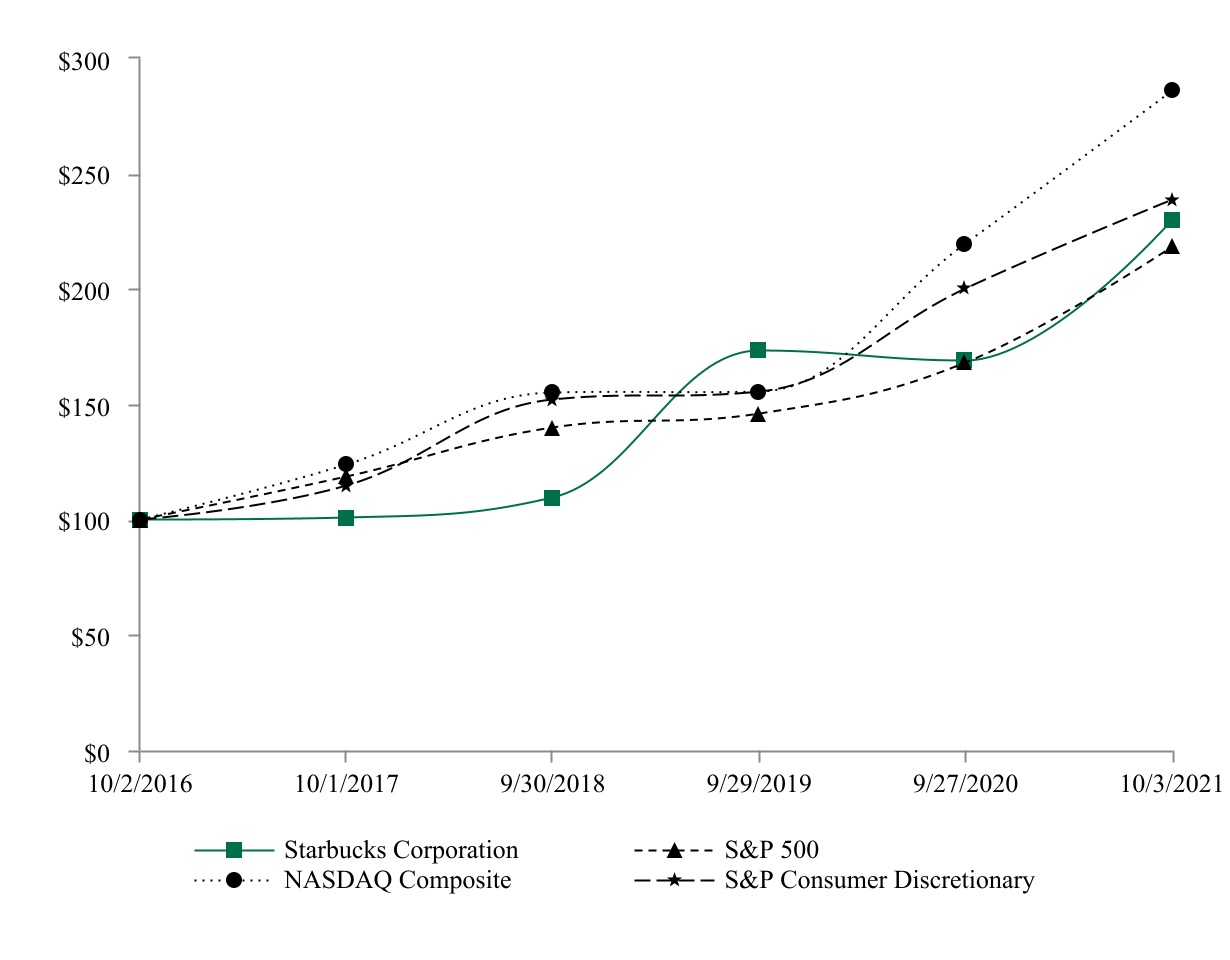
| Oct 2, 2016 | Oct 1, 2017 | Sep 30, 2018 | Sep 29, 2019 | Sep 27, 2020 | Oct 3, 2021 | ||||||||||||||||||||||||||||||
| Starbucks Corporation | $ | 100.00 | $ | 100.98 | $ | 109.35 | $ | 173.26 | $ | 168.68 | $ | 229.83 | |||||||||||||||||||||||
| S&P 500 | 100.00 | 118.61 | 139.85 | 145.80 | 167.89 | 218.27 | |||||||||||||||||||||||||||||
| NASDAQ Composite | 100.00 | 123.68 | 154.82 | 155.63 | 219.37 | 285.75 | |||||||||||||||||||||||||||||
| S&P Consumer Discretionary | 100.00 | 114.52 | 151.78 | 155.36 | 200.25 | 238.59 |
Item 6. [Reserved]
Item 7. Management’s Discussion and Analysis of Financial Condition and Results of Operations
General
Our fiscal year ends on the Sunday closest to September 30. All references to store counts, including data for new store openings, are reported net of related store closures, unless otherwise noted. Fiscal year 2021 included 53 weeks, with the 53rd week falling in the fourth fiscal quarter. Fiscal years 2020 and 2019 included 52 weeks. For fiscal 2021, comparable store sales percentages were calculated excluding the extra week in the fourth quarter of fiscal 2021.
The discussion of our financial condition and results of operations for the year ended September 29, 2019, included in Item 7. Management’s Discussion and Analysis of Financial Condition and Results of Operations (“MD&A”) can be found in the Annual Report on Form 10-K for the year ended September 27, 2020. The fiscal 2021 Latin America and Caribbean licensed store market resegmentation did not have a material impact to prior year North America and International operating segment business trends and operating margins.
Overview
In the fourth quarter of fiscal 2021, certain changes were made to our management team, and our operating segment reporting structure was realigned as a result. We realigned our fully licensed Latin America and Caribbean markets from our Americas operating segment to our International operating segment. Additionally, we renamed the Americas operating segment to the North America operating segment, since it is comprised of our company-operated and licensed stores in the U.S. and Canada. We also made certain other immaterial changes between our International operating segment and Corporate and Other. Concurrent with the change in reportable segments, we revised our prior period financial information to be consistent with the current period presentation. There was no impact on consolidated net revenues, total operating expenses, operating income or net earnings per share as a result of these changes.
We have three reportable operating segments: 1) North America, which is inclusive of the U.S. and Canada; 2) International, which is inclusive of China, Japan, Asia Pacific, Europe, Middle East, Africa, Latin America and the Caribbean; and 3) Channel Development. Non-reportable operating segments such as Evolution Fresh and unallocated corporate expenses are reported within Corporate and Other.
Our financial results and long-term growth model will continue to be driven by new store openings, comparable store sales and margin management. We believe these key operating metrics are useful to investors because management uses these metrics to assess the growth of our business and the effectiveness of our marketing and operational strategies. Throughout this MD&A, we commonly discuss the following key operating metrics:
-
New store openings and store count
-
Comparable store sales
-
Operating margin
Starbucks results for fiscal 2021 demonstrate the overall strength and resilience of our brand. Consolidated revenues increased 24% to $29.1 billion in fiscal 2021 compared to $23.5 billion in fiscal 2020, primarily due to business recovery from the COVID-19 pandemic. Also contributing to the increase was $576 million of incremental revenue attributable to the extra week in fiscal 2021.
For the North America segment, comparable store sales increased 22% for fiscal 2021 compared to a decline of 12% in fiscal 2020. Comparable store sales for our U.S. market increased 21% for fiscal 2021 compared to a decline of 12% in fiscal 2020. The U.S. market also had a 7% increase in two-year comparable store sales(1). We lapped higher costs attributable to COVID-19 in the prior year, including catastrophe pay programs for company-operated store partners (employees), net of qualified tax credits provided by the Coronavirus Aid, Relief and Economic Security Act (“CARES Act”) and the Canada Emergency Wage Subsidy (“CEWS”). In fiscal 2020, we announced a restructuring plan to optimize our North America store portfolio, primarily in dense, metropolitan markets, by blending store formats to better cater to changing customer tastes and preferences. As of the fiscal year ended October 3, 2021, we had substantially completed our restructuring plan, which resulted in the closure of 807 stores in the U.S. and Canada. Costs incurred related to the restructuring efforts were recorded as restructuring and impairments on our consolidated statements of earnings. In October 2021, we announced plans to deliver retail wage increases across the U.S. in fiscal 2022. This investment, combined with industry-leading benefits, supports Starbucks aspiration to remain an employer of choice that can attract and retain the high-quality talent necessary to support our continued growth.
For the International segment, comparable store sales increased by 16% for fiscal 2021 compared to a decline of 19% in fiscal 2020. Comparable store sales for our China market increased 17%, inclusive of a 3% adverse impact from lapping the prior-year value-added tax (“VAT”) benefit. Key markets in the International segment continued to experience pandemic-related restrictions that significantly impacted customer mobility during the year. Although nearly all company-operated stores in these markets remained open, the modified operating protocols had an adverse impact to comparable store sales and operating results.
Revenue for our Channel Development segment decreased $331 million, or 17%, when compared with fiscal 2020. This was largely due to the transition of certain single-serve product activities to Nestlé beginning in the fourth quarter of fiscal 2020. This was partially offset by growth in our ready-to-drink business. We expect Channel Development to return to more normalized reported revenue growth levels in fiscal 2022, as the fourth quarter of fiscal 2021 is the last quarter lapping these transition related activities.
During fiscal 2021, we began to experience certain supply shortages and transportation delays largely attributable to impacts of the COVID-19 pandemic as well as changes in customer demand and behaviors. While we expect these shortages and delays may continue into fiscal 2022, we view them to be temporary and do not believe they will have a material impact to our long-term growth and profitability. Absent significant and prolonged COVID-19 relapses or global economic disruptions, and based on the current trend of our business operations and our focused efforts to elevate customer experiences, enhance digital capabilities and drive beverage innovation, we are confident in the strength of our brand and the durability of long-term “Growth at Scale” strategy to deliver consistent revenue and income growth. We anticipate the planned wage investment in the U.S., along with increased supply chain costs primarily related to inflationary pressures that began in the latter half of the fiscal year, will have an impact to operating margin in fiscal 2022. However, these should be meaningfully offset by benefits from pricing decisions and leverage from revenue growth and productivity efficiency.
(1)Two-year comparable store sales metric is calculated as ((1 + % change in comparable store sales in FY20) * (1 + % change in comparable store sales in FY21)) - 1. Two-year comparable store sales for the U.S. of 7% = ((1 + (-12%)) * (1 + 21%)) - 1.
Financial Highlights
-
Total net revenues increased 24% to $29.1 billion in fiscal 2021 compared to $23.5 billion in fiscal 2020, including $576 million attributable to the extra week in fiscal 2021.
-
Consolidated operating income increased to $4.9 billion in fiscal 2021 compared to $1.6 billion in fiscal 2020. Fiscal 2021 operating margin was 16.8% compared to 6.6% in fiscal 2020. Operating margin expansion was primarily due to sales leverage from business recovery and lapping high
Showing the first 8K of 74K characters. Open the full section
Item 7A. Quantitative and Qualitative Disclosures About Market Risk
The information required by this item is incorporated by reference to the section entitled “Management’s Discussion and Analysis of Financial Condition and Results of Operations — Commodity Prices, Availability and General Risk Conditions” and “Management’s Discussion and Analysis of Financial Condition and Results of Operations — Financial Risk Management” in Item 7 of this Report.
Item 8. Financial Statements and Supplementary Data
STARBUCKS CORPORATION
CONSOLIDATED STATEMENTS OF EARNINGS
(in millions, except per share data)
| Fiscal Year Ended | Oct 3, 2021 | Sep 27, 2020 | Sep 29, 2019 | ||||||||||||||
| Net revenues: | |||||||||||||||||
| Company-operated stores | $ | 24,607.0 | $ | 19,164.6 | $ | 21,544.4 | |||||||||||
| Licensed stores | 2,683.6 | 2,327.1 | 2,875.0 | ||||||||||||||
| Other | 1,770.0 | 2,026.3 | 2,089.2 | ||||||||||||||
| Total net revenues | 29,060.6 | 23,518.0 | 26,508.6 | ||||||||||||||
| Product and distribution costs | 8,738.7 | 7,694.9 | 8,526.9 | ||||||||||||||
| Store operating expenses | 11,930.9 | 10,764.0 | 10,493.6 | ||||||||||||||
| Other operating expenses | 359.5 | 430.3 | 371.0 | ||||||||||||||
| Depreciation and amortization expenses | 1,441.7 | 1,431.3 | 1,377.3 | ||||||||||||||
| General and administrative expenses | 1,932.6 | 1,679.6 | 1,824.1 | ||||||||||||||
| Restructuring and impairments | 170.4 | 278.7 | 135.8 | ||||||||||||||
| Total operating expenses | 24,573.8 | 22,278.8 | 22,728.7 | ||||||||||||||
| Income from equity investees | 385.3 | 322.5 | 298.0 | ||||||||||||||
| Operating income | 4,872.1 | 1,561.7 | 4,077.9 | ||||||||||||||
| Net gain resulting from divestiture of certain operations | 864.5 | — | 622.8 | ||||||||||||||
| Interest income and other, net | 90.1 | 39.7 | 96.5 | ||||||||||||||
| Interest expense | (469.8) | (437.0) | (331.0) | ||||||||||||||
| Earnings before income taxes | 5,356.9 | 1,164.4 | 4,466.2 | ||||||||||||||
| Income tax expense | 1,156.6 | 239.7 | 871.6 | ||||||||||||||
| Net earnings including noncontrolling interests | 4,200.3 | 924.7 | 3,594.6 | ||||||||||||||
| Net earnings/(loss) attributable to noncontrolling interests | 1.0 | (3.6) | (4.6) | ||||||||||||||
| Net earnings attributable to Starbucks | $ | 4,199.3 | $ | 928.3 | $ | 3,599.2 | |||||||||||
| Earnings per share — basic | $ | 3.57 | $ | 0.79 | $ | 2.95 | |||||||||||
| Earnings per share — diluted | $ | 3.54 | $ | 0.79 | $ | 2.92 | |||||||||||
| Weighted average shares outstanding: | |||||||||||||||||
| Basic | 1,177.6 | 1,172.8 | 1,221.2 | ||||||||||||||
| Diluted | 1,185.5 | 1,181.8 | 1,233.2 |
See Notes to Consolidated Financial Statements.
STARBUCKS CORPORATION
CONSOLIDATED STATEMENTS OF COMPREHENSIVE INCOME
(in millions)
| Fiscal Year Ended | Oct 3, 2021 | Sep 27, 2020 | Sep 29, 2019 | ||||||||||||||
| Net earnings including noncontrolling interests | $ | 4,200.3 | $ | 924.7 | $ | 3,594.6 | |||||||||||
| Other comprehensive income/(loss), net of tax: | |||||||||||||||||
| Unrealized holding gains/(losses) on available-for-sale securities | (3.4) | 8.3 | 10.5 | ||||||||||||||
| Tax (expense)/benefit | 0.7 | (1.8) | (2.3) | ||||||||||||||
| Unrealized gains/(losses) on cash flow hedging instruments | 283.8 | (126.3) | (14.1) | ||||||||||||||
| Tax (expense)/benefit | (43.6) | 31.3 | 3.4 | ||||||||||||||
| Unrealized gains/(losses) on net investment hedging instruments | 63.1 | 38.7 | (39.8) | ||||||||||||||
| Tax (expense)/benefit | (16.0) | (9.8) | 10.1 | ||||||||||||||
| Translation adjustment and other | 188.2 | 206.9 | (146.2) | ||||||||||||||
| Tax (expense)/benefit | 2.2 | 1.5 | 2.5 | ||||||||||||||
| Reclassification adjustment for net (gains)/losses realized in net earnings for available-for-sale securities, hedging instruments, translation adjustment and other | 41.8 | (20.1) | 1.3 | ||||||||||||||
| Tax expense/(benefit) | (5.0) | 5.2 | 1.6 | ||||||||||||||
| Other comprehensive income/(loss) | 511.8 | 133.9 | (173.0) | ||||||||||||||
| Comprehensive income including noncontrolling interests | 4,712.1 | 1,058.6 | 3,421.6 | ||||||||||||||
| Comprehensive income/(loss) attributable to noncontrolling interests | 1.0 | (3.6) | (4.6) | ||||||||||||||
| Comprehensive income attributable to Starbucks | $ | 4,711.1 | $ | 1,062.2 | $ | 3,426.2 |
See Notes to Consolidated Financial Statements.
STARBUCKS CORPORATION
CONSOLIDATED BALANCE SHEETS
(in millions, except per share data)
| Oct 3, 2021 | Sep 27, 2020 | ||||||||||
| ASSETS | |||||||||||
| Current assets: | |||||||||||
| Cash and cash equivalents | $ | 6,455.7 | $ | 4,350.9 | |||||||
| Short-term investments | 162.2 | 281.2 | |||||||||
| Accounts receivable, net | 940.0 | 883.4 | |||||||||
| Inventories | 1,603.9 | 1,551.4 | |||||||||
| Prepaid expenses and other current assets | 594.6 | 739.5 | |||||||||
| Total current assets | 9,756.4 | 7,806.4 | |||||||||
| Long-term investments | 281.7 | 206.1 | |||||||||
| Equity investments | 268.5 | 478.7 | |||||||||
| Property, plant and equipment, net | 6,369.5 | 6,241.4 | |||||||||
| Operating lease, right-of-use asset | 8,236.0 | 8,134.1 | |||||||||
| Deferred income taxes, net | 1,874.8 | 1,789.9 | |||||||||
| Other long-term assets | 578.5 | 568.6 | |||||||||
| Other intangible assets | 349.9 | 552.1 | |||||||||
| Goodwill | 3,677.3 | 3,597.2 | |||||||||
| TOTAL ASSETS | $ | 31,392.6 | $ | 29,374.5 | |||||||
| LIABILITIES AND SHAREHOLDERS' EQUITY/(DEFICIT) | |||||||||||
| Current liabilities: | |||||||||||
| Accounts payable | $ | 1,211.6 | $ | 997.9 | |||||||
| Accrued liabilities | 1,973.2 | 1,160.7 | |||||||||
| Accrued payroll and benefits | 772.3 | 696.0 | |||||||||
| Income taxes payable | 348.0 | 98.2 | |||||||||
| Current portion of operating lease liability | 1,251.3 | 1,248.8 | |||||||||
| Stored value card |
Showing the first 8K of 202K characters. Open the full section
Item 9. Changes in and Disagreements with Accountants on Accounting and Financial Disclosure
Not applicable.
Item 9A. Controls and Procedures
Disclosure Controls and Procedures
We maintain disclosure controls and procedures that are designed to ensure that material information required to be disclosed in our periodic reports filed or submitted under the Securities Exchange Act of 1934, as amended (the “Exchange Act”), is recorded, processed, summarized and reported within the time periods specified in the SEC’s rules and forms. Our disclosure controls and procedures are also designed to ensure that information required to be disclosed in the reports we file or submit under the Exchange Act is accumulated and communicated to our management, including our principal executive officer and principal financial officer, as appropriate to allow timely decisions regarding required disclosure.
During the fourth quarter of fiscal 2021, we carried out an evaluation, under the supervision and with the participation of our management, including our chief executive officer and our chief financial officer, of the effectiveness of the design and operation of our disclosure controls and procedures, as defined in Rules 13a-15(e) and 15d-15(e) under the Exchange Act. Based upon that evaluation, our chief executive officer and chief financial officer concluded that our disclosure controls and procedures were effective, as of the end of the period covered by this report (October 3, 2021).
There were no changes in our internal control over financial reporting (as defined in Rules 13a-15(f) and 15d-15(f) of the Exchange Act) during our most recently completed fiscal quarter that materially affected or are reasonably likely to materially affect internal control over financial reporting.
The certifications required by Section 302 of the Sarbanes-Oxley Act of 2002 are filed as exhibits 31.1 and 31.2, respectively, to this 10-K.
Report of Management on Internal Control over Financial Reporting
Our management is responsible for establishing and maintaining adequate internal control over financial reporting. Internal control over financial reporting is a process to provide reasonable assurance regarding the reliability of our financial reporting for external purposes in accordance with accounting principles generally accepted in the United States of America. Internal control over financial reporting includes maintaining records that in reasonable detail accurately and fairly reflect our transactions; providing reasonable assurance that transactions are recorded as necessary for preparation of our financial statements; providing reasonable assurance that receipts and expenditures are made in accordance with management authorization; and providing reasonable assurance that unauthorized acquisition, use or disposition of company assets that could have a material effect on our financial statements would be prevented or detected on a timely basis. Because of its inherent limitations, internal control over financial reporting is not intended to provide absolute assurance that a misstatement of our financial statements would be prevented or detected.
Management conducted an evaluation of the effectiveness of our internal control over financial reporting based on the framework and criteria established in Internal Control — Integrated Framework, issued by the Committee of Sponsoring Organizations of the Treadway Commission. This evaluation included review of the documentation of controls, evaluation of the design effectiveness of controls, testing of the operating effectiveness of controls and a conclusion on this evaluation. Based on this evaluation, management concluded that our internal control over financial reporting was effective as of October 3, 2021.
Our internal control over financial reporting as of October 3, 2021 has been audited by Deloitte & Touche LLP, an independent registered public accounting firm, as stated in their report which is included herein.
REPORT OF INDEPENDENT REGISTERED PUBLIC ACCOUNTING FIRM
To the shareholders and the Board of Directors of Starbucks Corporation
Opinion on Internal Control over Financial Reporting
We have audited the internal control over financial reporting of Starbucks Corporation and subsidiaries (the “Company”) as of October 3, 2021, based on criteria established in Internal Control - Integrated Framework (2013) issued by the Committee of Sponsoring Organizations of the Treadway Commission (COSO). In our opinion, the Company maintained, in all material respects, effective internal control over financial reporting as of October 3, 2021, based on criteria established in Internal Control - Integrated Framework (2013) issued by COSO.
We have also audited, in accordance with the standards of the Public Company Accounting Oversight Board (United States) (PCAOB), the consolidated financial statements as of and for the year ended October 3, 2021, of the Company and our report dated November 19, 2021, expressed an unqualified opinion on those financial statements.
Basis for Opinion
The Company’s management is responsible for maintaining effective internal control over financial reporting and for its assessment of the effectiveness of internal control over financial reporting, included in the accompanying Report of Management on Internal Control over Financial Reporting. Our responsibility is to express an opinion on the Company’s internal control over financial reporting based on our audit. We are a public accounting firm registered with the PCAOB and are required to be independent with respect to the Company in accordance with the U.S. federal securities laws and the applicable rules and regulations of the Securities and Exchange Commission and the PCAOB.
We conducted our audit in accordance with the standards of the PCAOB. Those standards require that we plan and perform the audit to obtain reasonable assurance about whether effective internal control over financial reporting was maintained in all material respects. Our audit included obtaining an understanding of internal control over financial reporting, assessing the risk that a material weakness exists, testing and evaluating the design and operating effectiveness of internal control based on the assessed risk, and performing such other procedures as we considered necessary in the circumstances. We believe that our audit provides a reasonable basis for our opinion.
Definition and Limitations of Internal Control over Financial Reporting
A company’s internal control over financial reporting is a process designed to provide reasonable assurance regarding the reliability of financial reporting and the preparation of financial statements for external purposes in accordance with generally accepted accounting principles. A company’s internal control over financial reporting includes those policies and procedures that (1) pertain to the maintenance of records that, in reasonable detail, accurately and fairly reflect the transactions and dispositions of the assets of the company; (2) provide reasonable assurance that transactions are recorded as necessary to permit preparation of financial statements in accordance with generally accepted accounting principles, and that receipts and expenditures of the company are being made only in accordance with authorizations of management and directors of the company; and (3) provide reasonable assurance regarding prevention or timely detection of unauthorized acquisition, use, or disposition of the company’s assets that could have a material effect on the financial statements.
Because of its inherent limitations, internal control over financial reporting may not prevent or detect misstatements. Also, projections of any evaluation of effectiveness to future periods are subject to the risk that controls may become inadequate because of changes in conditions, or that the degree of compliance with the policies or procedures may deteriorate.
/s/ Deloitte & Touche LLP
Seattle, Washington
November 19, 2021
Item 9B. Other Information
None.
Item 9C. Disclosure Regarding Foreign Jurisdictions that Prevent Inspections
Item 10. Directors, Executive Officers and Corporate Governance
Information regarding our executive officers is set forth in Item 1 of Part I of this Report under the caption “Information about our Executive Officers.”
We adopted a code of ethics that applies to our chief executive officer, chief financial officer, controller and other finance leaders, which is a “code of ethics” as defined by applicable rules of the SEC. This code is publicly available on our website at www.starbucks.com/about-us/company-information/corporate-governance. If we make any amendments to this code other than technical, administrative or other non-substantive amendments, or grant any waivers, including implicit waivers, from a provision of this code to our chief executive officer, chief operating officer, chief financial officer, chief accounting officer or controller, we will disclose the nature of the amendment or waiver, its effective date and to whom it applies on our website at www.starbucks.com/about-us/company-information/corporate-governance or in a report on Form 8-K filed with the SEC.
The remaining information required by this item is incorporated herein by reference to the sections entitled “Proposal 1 - Election of Directors,” “Beneficial Ownership of Common Stock,” “Corporate Governance” and “Corporate Governance - Audit and Compliance Committee” in our definitive Proxy Statement for the Annual Meeting of Shareholders to be held on March 16, 2022 (the “Proxy Statement”).
We will provide disclosure of delinquent Section 16(a) reports, if any, in our Proxy Statement, and such disclosure, if any, is incorporated herein by reference.
Item 11. Executive Compensation
The information required by this item is incorporated by reference to the sections entitled “Executive Compensation,” “Executive Compensation Tables,” “Compensation of Directors” and “Compensation Committee Interlocks and Insider Participation” in the Proxy Statement.
Item 12. Security Ownership of Certain Beneficial Owners and Management and Related Shareholder Matters
The information required by this item is incorporated by reference to the sections entitled “Equity Compensation Plan Information” and “Beneficial Ownership of Common Stock” in the Proxy Statement.
Item 13. Certain Relationships and Related Transactions and Director Independence
The information required by this item is incorporated by reference to the section entitled “Certain Relationships and Related Person Transactions” and “Corporate Governance - Affirmative Determinations Regarding Director Independence and Other Matters” in the Proxy Statement.
Item 14. Principal Accountant Fees and Services
The information required by this item is incorporated by reference to the sections entitled “Proposal 4 - Ratification of Selection of Deloitte & Touche LLP as our Independent Registered Public Accounting Firm - Independent Registered Public Accounting Firm Fees” and “Proposal 4 - Ratification of Selection of Deloitte & Touche LLP as our Independent Registered Public Accounting Firm - Policy on Audit Committee Pre-Approval of Audit and Permissible Non-Audit Services of the Independent Registered Public Accounting Firm” in the Proxy Statement.
PART IV
Item 15. Exhibits and Financial Statement Schedules
(a) The following documents are filed as a part of this 10-K:
1. Financial Statements
The following financial statements are included in Part II, Item 8 of this 10-K:
-
Consolidated Statements of Earnings for the fiscal years ended October 3, 2021, September 27, 2020, and September 29, 2019;
-
Consolidated Statements of Comprehensive Income for the fiscal years ended October 3, 2021, September 27, 2020, and September 29, 2019;
-
Consolidated Balance Sheets as of October 3, 2021 and September 27, 2020;
-
Consolidated Statements of Cash Flows for the fiscal years ended October 3, 2021, September 27, 2020, and September 29, 2019;
-
Consolidated Statements of Equity for the fiscal years ended October 3, 2021, September 27, 2020, and September 29, 2019;
-
Notes to Consolidated Financial Statements; and
-
Reports of Independent Registered Public Accounting Firm
2. Financial Statement Schedules
Financial statement schedules are omitted because they are not required or are not applicable, or the required information is provided in the consolidated financial statements or notes described in Item 15(a)(1) above.
3. Exhibits
- Denotes a management contract or compensatory plan or arrangement.
** Furnished herewith.
Item 16. Form 10-K Summary
None.
SIGNATURES
Pursuant to the requirements of Section 13 or 15(d) of the Securities Exchange Act of 1934, the registrant has duly caused this report to be signed on its behalf by the undersigned, thereunto duly authorized.
| STARBUCKS CORPORATION | ||||||||
| By: | /s/ Kevin R. Johnson | |||||||
| Kevin R. Johnson president and chief executive officer | ||||||||
November 19, 2021
Pursuant to the requirements of the Securities Exchange Act of 1934, this report has been signed below by the following persons on behalf of the registrant and in the capacities indicated as of November 19, 2021.
| Signature | Title | |||||||||||||
| By: | /s/ Kevin R. Johnson | president and chief executive officer, director (principal executive officer) | ||||||||||||
| Kevin R. Johnson | ||||||||||||||
| By: | /s/ Rachel Ruggeri | executive vice president, chief financial officer (principal financial officer) | ||||||||||||
| Rachel Ruggeri | ||||||||||||||
| By: | /s/ Jill L. Walker | senior vice president, Corporate Financial Services, and chief accounting officer (principal accounting officer) | ||||||||||||
| Jill L. Walker | ||||||||||||||
| By: | /s/ Richard E. Allison, Jr. | director | ||||||||||||
| Richard E. Allison, Jr. | ||||||||||||||
| By: | /s/ Andrew Campion | director | ||||||||||||
| Andrew Campion | ||||||||||||||
| By: | /s/ Mary N. Dillon | director | ||||||||||||
| Mary N. Dillon | ||||||||||||||
| By: | /s/ Isabel Ge Mahe | director | ||||||||||||
| Isabel Ge Mahe | ||||||||||||||
| By: | /s/ Mellody Hobson | director | ||||||||||||
| Mellody Hobson | ||||||||||||||
| By: | /s/ Jørgen Vig Knudstorp | director | ||||||||||||
| Jørgen Vig Knudstorp | ||||||||||||||
| By: | /s/ Satya Nadella | director | ||||||||||||
| Satya Nadella | ||||||||||||||
| By: | /s/ Joshua Cooper Ramo | director | ||||||||||||
| Joshua Cooper Ramo | ||||||||||||||
| By: | /s/ Clara Shih | director | ||||||||||||
| Clara Shih | ||||||||||||||
| By: | /s/ Javier G. Teruel | director | ||||||||||||
| Javier G. Teruel |