 filings.tools
Sherwin-Williams 10-K 2022-12-31
Filed 2023-02-22. 23 sections, 465K characters. Original on sec.gov · Markdown · JSON
Cover and table of contents
UNITED STATES
SECURITIES AND EXCHANGE COMMISSION
Washington, D.C. 20549
FORM 10-K
ANNUAL REPORT PURSUANT TO SECTION 13 OR 15(d) OF
THE SECURITIES EXCHANGE ACT OF 1934
For the fiscal year ended December 31, 2022
Commission file number 1-04851
THE SHERWIN-WILLIAMS COMPANY
(Exact name of registrant as specified in its charter)
| Ohio | 34-0526850 | |||||||
| (State or other jurisdiction of incorporation or organization) | (I.R.S. Employer Identification No.) | |||||||
| 101 West Prospect Avenue | ||||||||
| Cleveland, | Ohio | 44115-1075 | ||||||
| (Address of principal executive offices) | (Zip Code) |
(216) 566-2000
Registrant’s telephone number, including area code
Securities registered pursuant to Section 12(b) of the Act:
| Title of each class | Trading Symbol | Name of each exchange on which registered | ||||||||||||
| Common Stock, par value of $0.33-1/3 per share | SHW | New York Stock Exchange |
Securities registered pursuant to Section 12(g) of the Act: None
Indicate by check mark if the Registrant is a well-known seasoned issuer, as defined in Rule 405 of the Securities Act. Yes ☒ No ☐
Indicate by check mark if the Registrant is not required to file reports pursuant to Section 13 or Section 15(d) of the Exchange Act. Yes ☐ No ☒
Indicate by check mark whether the Registrant: (1) has filed all reports required to be filed by Section 13 or 15(d) of the Securities Exchange Act of 1934 during the preceding 12 months (or for such shorter period that the Registrant was required to file such reports), and (2) has been subject to such filing requirements for the past 90 days. Yes ☒ No ☐
Indicate by check mark whether the registrant has submitted electronically every Interactive Data File required to be submitted pursuant to Rule 405 of Regulation S-T (§ 232.405 of this chapter) during the preceding 12 months (or for such shorter period that the registrant was required to submit such files). Yes ☒ No ☐
Indicate by check mark whether the Registrant is a large accelerated filer, an accelerated filer, a non-accelerated filer, a smaller reporting company, or an emerging growth company. See the definitions of “large accelerated filer,” “accelerated filer,” “smaller reporting company” and “emerging growth company” in Rule 12b-2 of the Exchange Act.
| Large accelerated filer | ☒ | Accelerated filer | ☐ | |||||||||||
| Non-accelerated filer | ☐ | Smaller reporting company | ☐ | |||||||||||
| Emerging growth company | ☐ |
If an emerging growth company, indicate by check mark if the registrant has elected not to use the extended transition period for complying with any new or revised financial accounting standards provided pursuant to Section 13(a) of the Exchange Act. ☐
Indicate by check mark whether the registrant has filed a report on and attestation to its management's assessment of the effectiveness of its internal control over financial reporting under Section 404(b) of the Sarbanes-Oxley Act (15 U.S.C. 7262(b)) by the registered public accounting firm that prepared or issued its audit report. Yes ☒ No ☐
If securities are registered pursuant to Section 12(b) of the Act, indicate by check mark whether the financial statements of the registrant included in the filing reflect the correction of an error to previously issued financial statements. ☐
Indicate by check mark whether any of those error corrections are restatements that required a recovery analysis of incentive-based compensation received by any of the registrant’s executive officers during the relevant recovery period pursuant to §240.10D-1(b). ☐
Indicate by check mark whether the Registrant is a shell company (as defined in Rule 12b-2 of the Exchange Act). Yes ☐ No ☒
The aggregate market value of common stock held by non-affiliates of the Registrant at June 30, 2022 was $57,920,449,955 (computed by reference to the price at which the common stock was last sold on such date).
At January 31, 2023, 258,442,281 shares of common stock were outstanding, net of treasury shares.
DOCUMENTS INCORPORATED BY REFERENCE
Portions of our Proxy Statement for the 2023 Annual Meeting of Shareholders (“Proxy Statement”) to be filed with the Securities and Exchange Commission within 120 days of our fiscal year ended December 31, 2022 are incorporated by reference into Part III of this report.
THE SHERWIN-WILLIAMS COMPANY
Table of Contents
PART I
Item 1. BUSINESS
Introduction
The Sherwin-Williams Company, founded in 1866 and incorporated in Ohio in 1884, is engaged in the development, manufacture, distribution and sale of paint, coatings and related products to professional, industrial, commercial and retail customers primarily in North and South America with additional operations in the Caribbean region, Europe, Asia and Australia. Our principal executive offices are located at 101 West Prospect Avenue, Cleveland, Ohio 44115-1075, telephone (216) 566-2000. As used in this report, the terms “Sherwin-Williams,” “Company,” “we” and “our” mean The Sherwin-Williams Company and its consolidated subsidiaries unless the context indicates otherwise.
Available Information
We make available free of charge on or through our website our Annual Reports on Form 10-K, Quarterly Reports on Form 10-Q and Current Reports on Form 8-K, and amendments to these reports, as soon as reasonably practicable after we electronically file such material with, or furnish such material to, the Securities and Exchange Commission (SEC). You may access these documents on our Investor Relations website, investors.sherwin.com.
We also make available free of charge on our website our Corporate Governance Guidelines, our Director Independence Standards, our Code of Conduct and the charters of our Audit Committee, our Compensation and Management Development Committee and our Nominating and Corporate Governance Committee. You may access these documents on our Investor Relations website, investors.sherwin.com.
Basis of Reportable Segments
The Company reports its segment information in the same way that management internally organizes its business for assessing performance and making decisions regarding allocation of resources. The Company has three reportable operating segments: The Americas Group, Consumer Brands Group and Performance Coatings Group (individually, a “Reportable Segment” and collectively, the “Reportable Segments”). The Company reports all other business activities and immaterial operating segments that are not reportable in the Administrative segment. For more information about the Reportable Segments, see Note 23 to the Consolidated Financial Statements in Item 8.
The Americas Group
The Americas Group consisted of 4,931 company-operated specialty paint stores in the United States, Canada, Latin America and the Caribbean region at December 31, 2022. Each store in this segment is engaged in servicing the needs of architectural and industrial paint contractors and do-it-yourself homeowners. These stores market and sell Sherwin-Williams® and other controlled brand architectural paint and coatings, protective and marine products, OEM product finishes and related products. The majority of these products are produced by manufacturing facilities in the Consumer Brands Group. In addition, each store sells select purchased associated products. In addition to our stores in the Latin America region, The Americas Group meets regional customer demands through developing, licensing, manufacturing, distributing and selling a variety of architectural paints, coatings and related products in North and South America. The loss of any single customer would not have a material adverse effect on the business of this segment.
Consumer Brands Group
The Consumer Brands Group manufactures and supplies a broad portfolio of branded and private-label architectural paint, stains, varnishes, industrial products, wood finishes products, wood preservatives, applicators, corrosion inhibitors, aerosols, caulks and adhesives to retailers and distributors throughout North America, as well as in China and Europe. The Consumer Brands Group also supports the Company’s other businesses around the world with new product research and development, manufacturing, distribution and logistics. Approximately 67% of the total sales of the Consumer Brands Group in 2022 were intersegment transfers of products primarily sold through The Americas Group. Sales and marketing of certain controlled brand and private-label products is performed by a direct sales staff. The products distributed through third-party customers are intended for resale to the ultimate end-user of the product. The Consumer Brands Group had sales to certain customers that, individually, may be a significant portion of the sales and related profitability of the segment. This segment incurred most of the Company’s capital expenditures related to ongoing environmental compliance measures at sites currently in operation.
Performance Coatings Group
The Performance Coatings Group develops and sells industrial coatings for wood finishing and general industrial (metal and plastic) applications, automotive refinish, protective and marine coatings, coil coatings, packaging coatings and performance-based resins and colorants worldwide. This segment licenses certain technology and trade names worldwide. Sherwin-Williams® and other controlled brand products are distributed through The Americas Group and this segment’s 317 company-
operated branches and by a direct sales staff and outside sales representatives to retailers, dealers, jobbers, licensees and other third-party distributors. The Performance Coatings Group had sales to certain customers that, individually, may be a significant portion of the sales of the segment. However, the loss of any single customer would not have a material adverse effect on the overall profitability of the segment.
Administrative Segment
The Administrative segment includes the administrative expenses of the Company’s corporate headquarters site. Also included in the Administrative segment is interest expense, interest and investment income, certain expenses related to closed facilities and environmental-related matters and other expenses which are not directly associated with the Reportable Segments. The Administrative segment does not include any significant foreign operations. Also included in the Administrative segment is the operations of a real estate management unit that is responsible for the ownership, management, and leasing of non-retail properties held primarily for use by the Company, including the Company’s headquarters site, and disposal of idle facilities. Sales of this segment represent external leasing revenue of excess headquarters space or leasing of facilities no longer used by the Company in its primary businesses. Material gains and losses from the sale of property are infrequent and not a significant operating factor in determining the performance of the Administrative segment.
Raw Materials and Products Purchased for Resale
Raw materials and products purchased for resale make up the majority of our consolidated cost of goods sold. Raw materials may vary considerably by the specific paint or coating being manufactured but can generally be divided into the following categories: resins and latex, pigments, additives, solvents, and metal or plastic containers. A significant portion of these raw materials are derived from various upstream petrochemical and related commodity feedstocks, notably propylene. Raw materials are sourced from multiple suppliers globally, typically within the geographic region where our products are being manufactured. A portion of specialized resins and other products are manufactured in house. We also purchase a variety of products for resale that are highly complementary to our paint and coating offerings, notably spray equipment and parts, floorcovering, and assorted sundries. We attempt, if feasible, to mitigate our potential risk associated with the sourcing of our raw materials and other products through inventory management, strategic relationships with key suppliers, alternative sourcing strategies and long-term investments to expand our manufacturing capabilities. See Item 1A Risk Factors for more information regarding cost and sourcing of raw materials.
Seasonality
The majority of the sales for the Reportable Segments traditionally occur during the second and third quarters. However, periods of economic downturn can alter these seasonal patterns. There is no significant seasonality in sales for the Administrative segment.
Working Capital
In order to meet increased demand during the second and third quarters, the Company usually builds its inventories during the first quarter. Working capital items (inventories and accounts receivable) are generally financed through short-term borrowings, which include the use of lines of credit and the issuance of commercial paper. For a description of the Company’s liquidity and capital resources, see the “Financial Condition, Liquidity and Cash Flow” section in Item 7.
Trademarks and Trade Names
Customer recognition of trademarks and trade names owned or licensed by the Company collectively contribute significantly to our sales. The major trademarks and trade names used by each of the Reportable Segments are set forth below.
*•*The Americas Group: Sherwin-Williams®, A-100®, Builders Solution®, Captivate®, Cashmere®, Colorgin®, Condor®, Duration®, Emerald®, Kem Tone®, Latitude®, Loxon®, Metalatex®, Novacor®, Painters Edge Plus™, ProClassic®, ProCraft®, Pro Industrial™, ProMar®, SuperDeck®, SuperPaint®, Woodscapes®
*•*Consumer Brands Group: Cabot®, Dupli-Color®, Dutch Boy®, Geocel®, HGTV HOME® by Sherwin-Williams, Huarun®, Krylon®, Minwax®, Purdy®, Ronseal®, Thompson’s® WaterSeal®, Valspar®, White Lightning®
*•*Performance Coatings Group: Sherwin-Williams®, Acrolon®, AcromaPro®, ATX®, DeBeer Refinish®, Duraspar®, EcoDex®, Envirolastic®, Excelo®, EzDex®, Fastline®, Firetex®, Fluropon®, Heat-Flex®, House of Kolor®, Huarun®, Inver®, Kem Aqua®, Lazzuril®, Macropoxy®, Martin Senour®, Matrix Edge®, M.L. Campbell®, Octoral®, PermaClad®, Polane®, Powdura®, Sayerlack®, Sher-Wood®, Sumaré®, Ultra 9K®, Ultra 7000®, ValPure®, Valspar®
Patents
Although patents and licenses are not of material importance to our business as a whole or any segment, The Americas Group and the Performance Coatings Group derive a portion of their income from the licensing of technology, trademarks and trade names to foreign companies.
Backlog and Productive Capacity
Backlog orders are not typically significant in the business of any Reportable Segment since there is normally a short period of time between the placing of an order and shipment. During 2022, we experienced raw material shortages and labor constraints that impacted our production and ability to meet customer orders. We believe that sufficient productive capacity currently exists to fulfill our needs for paint, coatings and related products during 2023.
Competition
We experience competition from many local, regional, national and international competitors of various sizes in the manufacture, distribution and sale of our paint, coatings and related products. We are a leading manufacturer and retailer of paint, coatings and related products to professional, industrial, commercial and retail customers, however, our competitive position varies for our different products and markets.
In The Americas Group, competitors include other paint and wallpaper stores, mass merchandisers, home centers, independent hardware stores, hardware chains and manufacturer-operated direct outlets. Product quality, product innovation, breadth of product line, technical expertise, service and price determine the competitive advantage for this segment.
In the Consumer Brands Group, domestic and foreign competitors include manufacturers and distributors of branded and private-label paint and coatings products. Technology, product quality, product innovation, breadth of product line, technical expertise, distribution, service and price are the key competitive factors for this segment.
The Performance Coatings Group has numerous competitors in its domestic and foreign markets with broad product offerings and several others with niche products. Key competitive factors for this segment include technology, product quality, product innovation, breadth of product line, technical expertise, distribution, service and price.
The Administrative segment has many competitors consisting of other real estate owners, developers and managers in areas in which this segment owns property. The main competitive factors are the availability of property and price.
Human Capital Resources
The success of our business and ability to execute on our strategy depend in large part on our ability to attract, retain, develop and progress a diverse population of qualified employees at all levels of our organization. At December 31, 2022, we employed 64,366 people worldwide, of which 75% were in the United States and 25% were in other global regions.
Our commitment to our people is embedded in the Company’s corporate purpose and guiding values. Through our purpose, we strive to inspire and improve the world by coloring and protecting what matters. Our employees are instrumental in fulfilling this purpose through the development, manufacture, distribution and sale of innovative paint and coatings products. The Company’s seven guiding values — integrity, people, service, quality, performance, innovation and growth — drive how we fulfill our purpose, emphasize the importance of our global workforce and serve as the foundation of our culture of excellence.
We have developed key strategies, objectives and measures as part of the overall management of our business that support our global workforce and enable us to attract, retain, develop and progress top talent in a competitive labor market. These strategies, objectives and measures are advanced through programs, policies and initiatives focused on inclusion, diversity and equity (ID&E), talent acquisition and employee engagement, occupational health and safety and total rewards, which includes compensation and benefits programs and practices.
Inclusion, Diversity and Equity. We strive to foster a culture of inclusion and belonging where differences are welcomed, appreciated and celebrated to positively impact our people and business. Reflected in the Company’s Code of Conduct and reinforced through our actions, training and attitudes, fostering an inclusive culture is a moral and business imperative. The building blocks of our ID&E strategy include:
-
Educate and communicate to drive success: Building awareness of inclusive leadership behaviors to leverage the unique contributions of each employee to positively impact our people and business results.
-
Fill the pipeline with the best talent: Attracting the best talent pool that reflects the diversity of the communities in which we serve and do business.
-
Develop and engage talent by investing in our people: Investing in our people by providing networking and learning opportunities to drive retention, progression and engagement.
-
Progress talent by embedding equity into talent planning: Embedding equity into talent practices, processes, tools and resources at all levels.
Creating a supportive, welcoming environment across our global footprint is the shared responsibility of all employees, including our senior leaders. Each year, our senior leaders attend an ID&E education and training session to assist us in maintaining our commitment to leading with inclusion and leveraging the diversity of our workforce. During 2022, we held our annual CEO Forums on Inclusion, which are designed to encourage open discussions with employees that are led by our Chief Executive Officer and other senior leaders about opportunities to advance our culture of inclusion and belonging. We also continued our focus on driving allyship and empathy through conscious inclusion training across our global workforce and elevating the visibility and prominence of our Employee Resource Groups (ERGs). These voluntary, employee-led networks are organized around a shared underrepresented demographic, and membership spans across 250 chapters globally. ERGs bring together employees from various groups, divisions and functional teams to foster more inclusive workplaces, create greater synergy around business objectives and serve as a hub for professional development and mentorship opportunities that enable our employees to thrive and find long-term success at Sherwin-Williams.
Talent Acquisition and Employee Engagement. Through our integrated talent management strategy, we strive to attract, retain, develop and progress a workforce that embraces our culture of inclusion and reflects our diversity efforts. This strategy connects major milestones in the employee journey, including talent acquisition, onboarding, performance management, leadership and management development, succession and career progression, and is supported by our focus on employee engagement, ID&E, workforce analytics and human resources information technology governance. The Company’s early talent programs, including our management trainee program and similar programs across our global business, play a critical role in attracting, developing and advancing a diverse pipeline of talent. During 2022, we hired approximately 1,400 college graduates through our management trainee program as part of our long-term growth initiatives. We also partner with various colleges and universities, including Historically Black Colleges and Universities and Hispanic-Serving Institutions, to attract women, underrepresented racial or ethnic groups, individuals with disabilities, veterans and other candidates into the talent pipeline.
We invest in our people by providing learning and employee networking opportunities, including through our ERGs, to drive retention, development and engagement and help employees excel in their current and future roles. During 2022, our employees completed thousands of hours of online and instructor-led courses across a broad range of categories, including leadership, ID&E, professional skills, technical and compliance. We measure our progress toward creating an inclusive culture that empowers employees to learn, grow and achieve their aspirations by conducting periodic pulse surveys and our global engagement survey, which we first conducted during 2021 and expect to conduct every other year. We are focused on using these survey results to drive continued progress with our efforts.
Occupational Health and Safety. Providing safe and healthy working environments for our employees is a core value. We have a consistent focus on Environmental, Health and Safety excellence that promotes employee health and safety, process safety, and occupational health, including evaluation and implementation of reasonable preventative measures to reduce workplace injuries and illness. We strive for incident-free workplaces — continuously assessing and improving the programs that are in place to help keep our employees, customers and communities safe.
Since the onset of the COVID-19 pandemic, we have implemented modifications throughout our business and health and safety programs designed to protect the health and well-being of our employees and customers. These efforts have included, and may continue to include where necessary and appropriate, enhanced cleaning and sanitation procedures and return to work protocols. These efforts also continue to include permitting remote, alternate and flexible work arrangements where possible to promote increased flexibility and support employee health and safety, while maintaining our focus on innovation, collaboration, and engagement.
Total Rewards. We prioritize the fair, consistent and equitable treatment of our employees in relation to working conditions, wages, benefits, policies and procedures. The Company’s policies and programs are designed to respond to the needs of our employees in a manner that provides a safe, professional, efficient and rewarding workplace. Our total rewards programs are designed to offer competitive compensation, comprehensive benefits and other programs to support employees’ growth, both personally and professionally, and the diverse needs and well-being of our employees worldwide.
Over the past few years, we have enhanced certain of the Company’s benefits and practices to support the health and well-being of our employees through the COVID-19 pandemic and other challenges. Our enhanced benefits have included tele-health, paid sick leave, family leave and voluntary leave of absence policies and programs. We also have rewarded our employees’ resiliency and hard work and made changes in our business to encourage retention, including through wage increases, reduced store hours and employee benefits enhancements. During 2022, we continued enhancing the benefits we provide to our employees, including by extending our employee assistance program to our global workforce. The program provides mental
health and well-being, family, career, lifestyle, legal and financial resources, tools and services designed to support our employees across all aspects of their lives.
Regulatory Compliance
For additional information regarding environmental-related matters, see Notes 1, 11 and 20 to the Consolidated Financial Statements in Item 8.
CAUTIONARY STATEMENT REGARDING FORWARD-LOOKING INFORMATION
Certain statements contained in “Management’s Discussion and Analysis of Financial Condition and Results of Operations,” “Letter to Shareholders” and elsewhere in this report constitute “forward-looking statements” within the meaning of federal securities laws. These forward-looking statements are based upon management’s current expectations, predictions, estimates, assumptions and beliefs concerning future events and conditions and may discuss, among other things, anticipated future performance (including sales and earnings), expected growth, future business plans and the costs and potential liability for environmental-related matters and the lead pigment and lead-based paint litigation. Any statement that is not historical in nature is a forward-looking statement and may be identified by the use of words and phrases such as “believe,” “expect,” “may,” “will,” “should,” “project,” “could,” “plan,” “goal,” “target,” “potential,” “seek,” “intend,” “aspire,” “strive” or “anticipate” or the negative thereof or comparable terminology.
Readers are cautioned not to place undue reliance on any forward-looking statements. Forward-looking statements are necessarily subject to risks, uncertainties and other factors, many of which are outside our control, that could cause actual results to differ materially from such statements and from our historical results, performance and experience. These risks, uncertainties and other factors include such things as:
-
general business conditions, strengths of retail and manufacturing economies and growth in the coatings industry;
-
changes in general domestic and international economic conditions, including due to higher inflation rates, interest rates, tax rates and unemployment rates, higher labor and healthcare costs, recessions and changing government policies, laws and regulations;
-
changes in raw material and energy supplies and pricing;
-
disruptions in the supply chain, including those caused by industry capacity constraints, labor shortages, raw material availability, and transportation and logistics delays and constraints;
-
adverse weather conditions or natural disasters, including those that may be related to climate change or otherwise, and public health crises, including the COVID-19 pandemic;
-
losses of or changes in our relationships with customers and suppliers;
-
competitive factors, including pricing pressures and product innovation and quality;
-
our ability to successfully integrate past and future acquisitions into our existing operations, as well as the performance of the businesses acquired;
-
our ability to achieve expected benefits of restructuring and productivity initiatives;
-
weakening of global credit markets and our ability to generate cash to service our indebtedness;
-
risks and uncertainties associated with our expansion into and our operations in Asia, Europe, South America and other foreign markets, including general economic conditions, policy changes affecting international trade, political instability, inflation rates, recessions, sanctions, foreign currency exchange rates and controls, foreign investment and repatriation restrictions, legal and regulatory constraints, civil unrest, armed conflict (including the ongoing conflict between Russia and Ukraine), war and other economic and political factors;
-
the achievement of growth in foreign markets, such as Asia, Europe and South America;
-
cybersecurity incidents and other disruptions to our information technology systems and operations;
-
our ability to protect or enforce our material trademarks and other intellectual property rights;
-
our ability to attract, retain, develop and progress a qualified global workforce;
-
damage to our business, reputation, image or brands due to negative publicity;
-
increasingly stringent domestic and foreign governmental regulations, including those affecting health, safety and the environment;
-
inherent uncertainties involved in assessing our potential liability for environmental-related activities;
-
other changes in governmental policies, laws and regulations, including changes in tariff policies, as well as changes in accounting policies and standards and taxation requirements (such as new or revised tax laws or interpretations); and
-
the nature, cost, quantity and outcome of pending and future litigation and other claims, including the lead pigment and lead-based paint litigation, and the effect of any legislation and administrative regulations relating thereto.
Readers are cautioned that it is not possible to predict or identify all of the risks, uncertainties and other factors that may affect future results and that the above list should not be considered a complete list. Any forward-looking statement speaks only as of the date on which such statement is made, and we undertake no obligation to update or revise any forward-looking statement, whether as a result of new information, future events or otherwise, except as otherwise required by law.
Item 1A. RISK FACTORS
The risks described below and in other documents we file from time to time with the SEC could materially and adversely affect our business, results of operations, cash flow, liquidity or financial condition. Although the risks are organized by headings, and each risk is discussed separately, many are interrelated. While we believe we have identified and discussed below the key risks affecting our business, there may be additional risks and uncertainties that are not presently known or that are not currently believed to be significant that may adversely affect our business, results of operations, cash flow, liquidity or financial condition in the future. Readers should not interpret the disclosure of any risk factor to imply that the risk has not already materialized.
ECONOMIC AND STRATEGIC RISKS
Adverse changes in general business and economic conditions in the United States and worldwide may adversely affect our results of operations, cash flow, liquidity or financial condition.
Our business is sensitive to global and regional business and economic conditions. Adverse changes in such conditions in the United States and worldwide may reduce the demand for some of our products, adversely impact our ability to predict and meet any future changes in the demand for our products, and impair the ability of those with whom we do business to satisfy their obligations to us, each of which could adversely affect our results of operations, cash flow, liquidity or financial condition. Higher inflation rates, interest rates, tax rates and unemployment rates, higher labor and healthcare costs, recessions, changing governmental policies, laws and regulations, business disruptions due to cybersecurity incidents, terrorist activity, armed conflict (including the ongoing conflict between Russia and Ukraine), war, public health crises (including the COVID-19 pandemic), adverse weather conditions or natural disasters (including those that may be related to climate change or otherwise), supply chain disruptions (including those caused by industry capacity constraints, labor shortages, raw material availability, and transportation and logistics delays and constraints), and other economic factors have in the past and could in the future adversely affect demand for some of our products, our ability to predict and meet any future changes in the demand for our products, the availability, delivery or cost of raw materials, our ability to adequately staff and maintain operations at affected facilities and our results of operations, cash flow, liquidity or financial condition and that of our customers, vendors and suppliers. With respect to inflation in particular, we expect inflationary pressure to impact consumer behavior during 2023, including in the United States and Europe housing markets and as a result of elevated mortgage rates. Any such shift in consumer behavior could adversely affect the demand for some of our products and our results of operations, cash flow, liquidity or financial condition.
Protracted duration of economic downturns in cyclical segments of the economy may depress the demand for some of our products and adversely affect our sales, earnings, cash flow or financial condition.
Portions of our business involve the sale of paint, coatings and related products to segments of the economy that are cyclical in nature, particularly segments relating to construction, housing, manufacturing and oil production, refining, storage and transportation. Our sales to these segments are affected by the levels of discretionary consumer and business spending in these segments. During economic downturns in these segments, the levels of consumer and business discretionary spending may decrease, and the recovery of these segments may lag behind the recovery of the overall economy. This decrease in spending likely will reduce the demand for some of our products and may adversely affect our sales, earnings, cash flow or financial condition.
In response to increasing inflation, the U.S. Federal Reserve began to raise interest rates in March 2022 and since then, has signaled it expects to make additional rate increases. We expect inflationary pressure to impact consumer behavior during 2023, particularly in the United States and Europe housing markets and as a result of elevated mortgage rates. Rising interest rates and any such shift in consumer behavior may adversely affect the demand for new residential homes, existing home turnover and new non-residential construction. A worsening in these segments will reduce the demand for some of our products and may adversely impact sales, earnings and cash flow.
In the U.S. construction and housing segments, we continue to see project backlogs due to contractors experiencing a shortage of skilled workers, resulting in an adverse effect on the growth rate of demand for our products. While we would typically expect to see higher demand for our products as project backlogs are reduced in the future, rising inflation and other economic
conditions may delay a recovery in demand, which may result in the labor shortage and such other conditions adversely impacting our sales, earnings, cash flow or financial condition.
Public health crises, including pandemics and the measures taken by public health and governmental authorities to address them, could adversely impact our business, results of operations, cash flow, liquidity and financial condition in the future.
Our business, results of operations, cash flow and financial condition were adversely affected by the COVID-19 pandemic, including the impacts resulting from efforts by public health and governmental authorities to contain and combat the outbreak and spread of COVID-19. The pandemic caused us to make significant changes throughout our business designed to protect the health and well-being of our employees and customers. These changes resulted in additional costs and adversely impacted our business and financial performance. We continue to evaluate the changes we have made in our business and work with public health, government and other authorities and organizations, as necessary and appropriate, to maintain our operations and support the health and well-being of our employees, customers and their families. The pandemic also severely impacted the global economy (and continues to impact certain regional economies more than others), disrupted consumer spending and global supply chains, and created significant volatility and disruption of financial markets, all of which have adversely affected our business, including as a result of occasional, temporary disruptions and closures of some of our facilities, shifts in consumer behaviors and preferences and impacts in the demand for some of our products.
Public health crises (including the COVID-19 pandemic if current conditions were to worsen for an extended period) and the measures taken by public health and governmental authorities to address them, could adversely impact our business, results of operations, cash flow, liquidity and financial condition in the future. The extent of the impact of any public health crisis to our business will depend on numerous factors that we may not be able to predict or control, including, but not limited to: (a) the duration, severity and scope of the crisis, including the spread of new virus strains and variants; (b) rapidly-changing governmental and public health directives to address it; (c) the development, availability, effectiveness and distribution of treatments and vaccines; (d) the extent and duration of its adverse and/or volatile effects on economic and social activity, supply chain logistics, inflationary pressures, consumer confidence, discretionary spending and preferences, labor and healthcare costs, labor markets and unemployment rates; (e) our ability to sell, provide and meet the demand for our services and products; (f) any temporary reduction in our workforce or closures of our offices and facilities and our ability to adequately staff and maintain our operations; (g) the ability of our customers and suppliers to continue their operations; and (h) any impairment in value of our tangible or intangible assets which could be recorded as a result of weaker economic conditions.
FINANCIAL RISKS
A weakening of global credit markets could adversely affect our results of operations, cash flow, liquidity or financial condition.
A weakening of global credit markets could adversely impact our net sales, the collection of accounts receivable, funding for working capital needs, expected cash flow generation from current and acquired businesses, access to capital and our investments, which could adversely impact our results of operations, cash flow, liquidity or financial condition.
We finance a portion of our sales through trade credit. Credit markets remain tight, and some customers who require financing for their businesses have not been able to obtain, and may in the future have difficulty obtaining, necessary financing. A continuation or worsening of these conditions could limit our ability to collect our accounts receivable, which could adversely affect our results of operations, cash flow, liquidity or financial condition.
We generally fund a portion of our seasonal working capital needs and obtain funding for other general corporate purposes through short-term borrowings backed by our revolving credit facility and other financing facilities. If any of the banks in these credit and financing facilities are unable to perform on their commitments, such inability could adversely impact our cash flow, liquidity or financial condition, including our ability to obtain funding for working capital needs and other general corporate purposes.
Although we have available credit facilities to fund our current operating needs, we cannot be certain we will be able to replace our existing credit facilities or refinance our existing or future debt when necessary. Our cost of borrowing and ability to access the capital markets are affected not only by market conditions, but also by our debt and credit ratings assigned by the major credit rating agencies. Downgrades in these ratings likely would increase our cost of borrowing and could have an adverse effect on our access to the capital markets, including our access to the commercial paper market. An inability to access the capital markets could have a material adverse effect on our results of operations, cash flow, liquidity or financial condition.
We have goodwill and intangible assets recorded on our balance sheet. We periodically evaluate the recoverability of the carrying value of our goodwill and intangible assets whenever events or changes in circumstances indicate such value may not be recoverable. An impairment assessment involves judgment as to assumptions regarding future sales and cash flow and the impact of market conditions on those assumptions. Future events and changing market conditions may impact our assumptions
and change our estimates of future sales and cash flow, resulting in us incurring substantial impairment charges, which would adversely affect our results of operations or financial condition.
We hold investments in equity and debt securities in some of our defined benefit pension plans. A decrease in the value of plan assets resulting from a general financial downturn may cause a negative pension plan investment performance, which may adversely affect our results of operations, cash flow, liquidity or financial condition.
We require a significant amount of cash to service the substantial amount of debt we have outstanding. Our ability to generate cash depends on many factors beyond our control. We also depend on the business of our subsidiaries to satisfy our cash needs. If we cannot generate the required cash, we may not be able to make the necessary payments required under our indebtedness.
At December 31, 2022, we had total debt of approximately $10.570 billion, which is an increase of $954.7 million since December 31, 2021. We have the ability under our existing credit facilities to incur substantial additional indebtedness in the future. Our ability to make payments on our debt, fund our other liquidity needs, and make planned capital expenditures will depend on our ability to generate cash in the future. Our historical financial results have been, and we anticipate our future financial results will be, subject to fluctuations. Our ability to generate cash, to a certain extent, is subject to general business, economic, financial, competitive, legislative, regulatory and other factors beyond our control, including public health crises, such as the COVID-19 pandemic, adverse weather conditions or natural disasters (including those that may be related to climate change or otherwise), supply chain disruptions, changes in raw material and energy supplies and pricing and related impacts. We cannot guarantee our business will generate sufficient cash flow from our operations or future borrowings will be available to us in an amount sufficient to enable us to make payments of our debt, fund other liquidity needs and make planned capital expenditures.
The degree to which we are leveraged could have important consequences for shareholders. For example, it could:
-
require us to dedicate a substantial portion of our cash flow from operations to the payment of debt service, reducing the availability of our cash flow to fund working capital, capital expenditures, acquisitions and other long-term growth initiatives and general corporate purposes;
-
increase our vulnerability to adverse business, economic or industry conditions;
-
limit our ability to obtain additional financing in the future to enable us to react to changes in our business or general business, economic or industry conditions; or
-
place us at a competitive disadvantage compared to businesses in our industry that have less debt.
Additionally, any failure to comply with covenants in the instruments governing our debt could result in an event of default which, if not cured or waived, would have a material adverse effect on us.
A significant portion of our operations are conducted through our subsidiaries. As a result, our ability to generate sufficient cash flow for our needs is dependent to some extent on the earnings of our subsidiaries and the payment of those earnings to us in the form of dividends, loans or advances and through repayment of loans or advances from us. Our subsidiaries are separate and distinct legal entities. Our subsidiaries have no obligation to pay any amounts due on our debt or to provide us with funds to meet our cash flow needs, whether in the form of dividends, distributions, loans or other payments. Further, any payment of dividends, loans or advances by our subsidiaries could be subject to statutory or contractual restrictions. Payments to us by our subsidiaries will also be contingent upon our subsidiaries’ earnings and business considerations. Our right to receive any assets of any of our subsidiaries upon their liquidation or reorganization will be effectively subordinated to the claims of that subsidiary’s creditors, including trade creditors. Even if we are a creditor of any of our subsidiaries, our rights as a creditor would be subordinate to any security interest in the assets of our subsidiaries and any indebtedness of our subsidiaries senior to that held by us. Finally, changes in the laws of foreign jurisdictions in which we operate may adversely affect the ability of some of our foreign subsidiaries to repatriate funds to us.
Fluctuations in foreign currency exchange rates could adversely affect our results of operations, cash flow, liquidity or financial condition.
Because of our international operations, we are exposed to risk associated with interest rates and value changes in foreign currencies, which may adversely affect our business. Historically, our reported net sales, earnings, cash flow and financial condition have been subjected to fluctuations in foreign exchange rates. Our primary exchange rate exposure is with the Euro, the Chinese yuan, the Canadian dollar, the Brazilian real, the British pound, and the Mexican peso, each against the U.S. dollar. While we actively manage the exposure of our foreign currency risk as part of our overall financial risk management policy, we believe we may experience losses from foreign currency exchange rate fluctuations, and such losses could adversely affect our sales, earnings, cash flow, liquidity or financial condition.
OPERATIONAL RISKS
Unexpected shortages and increases in the cost of raw materials and energy may adversely affect our earnings or cash flow.
We purchase raw materials (including petrochemical-derived resins, latex and solvents, titanium dioxide and various additives) and energy for use in the manufacturing, distribution and sale of our products. Factors such as political instability, higher tariffs, supply chain disruptions, adverse weather conditions and natural disasters (including those that may be related to climate change or otherwise), or public health crises have disrupted, and may in the future disrupt, the availability of raw material and fuel supplies, adversely impact our ability to meet customer demands for some of our products or adequately staff and maintain operations at affected facilities and increase our costs. In addition, environmental and social regulations, including regulations related to climate change or otherwise, may negatively impact us or our suppliers in terms of availability and cost of raw materials, as well as sources and supply of energy.
Although raw materials and energy supplies (including oil and natural gas) are generally available from various sources in sufficient quantities, unexpected shortages and increases in the cost of raw materials and energy, or any deterioration in our relationships with or the financial viability of our suppliers, may have an adverse effect on our earnings or cash flow. In the event we experience supply chain disruptions from our suppliers, we may not be able to timely shift to internal production or secure alternate sources in order to prevent significant impacts to our business, or we may experience quality issues with raw materials and energy sourced from alternate sources. During 2022, industry-wide shortages of alkyd resins impacted our ability to manufacture and meet the demand of some of our products, including certain stains, aerosols and industrial products. If these shortages continue or worsen, and we are unable to offset the shortages through internal production or alternate sources, we may experience adverse impacts to our business, including adverse effects to our earnings and cash flow.
If the cost of raw materials and energy increases, we may not be able to offset higher costs in a timely manner by sufficiently decreasing our operating costs or raising the prices of our products. In recent years, some raw material and energy prices have increased, particularly titanium dioxide and petrochemical feedstock sources, such as propylene and ethylene, as well as metal and plastic packaging. While we have started to see a decline in some raw material prices in recent months, the cost of raw materials and energy could continue to experience periods of volatility in the future and may adversely affect our earnings and cash flow.
Adverse weather conditions and natural disasters, including those that may be related to climate change or otherwise, may temporarily reduce the demand for some of our products, impact our ability to meet the demand for our products or cause supply chain disruptions and increased costs, and could have a negative effect on our sales, earnings or cash flow.
Our business is seasonal in nature, with the second and third quarters typically generating a higher proportion of sales and earnings than other quarters. From time to time, adverse weather conditions and natural disasters, including those that may be related to climate change or otherwise, have had or may have an adverse effect on our sales, manufacture and distribution of paint, coatings and related products. In the event adverse weather conditions or a natural disaster cause significant damage to any one or more of our principal manufacturing or distribution facilities, we may not be able to manufacture the products needed to meet customer demand, which could have an adverse effect on our sales of certain paint, coatings and related products.
Also from time to time, the impact of these risks to our suppliers have had or may have an adverse effect on our sales, manufacture and distribution of certain of our products. Adverse weather conditions or natural disasters and their impacts have resulted, and may in the future result, in industry-wide supply chain disruptions, increased raw material and other costs, and our hindered ability to manufacture the products needed to fully meet customer demand.
In any of these instances, an adverse effect on sales may cause a reduction in our earnings or cash flow.
Although we have an extensive customer base, the loss of any of our largest customers could adversely affect our sales, earnings or cash flow.
We have a large and varied customer base due to our extensive distribution platform. During 2022, no individual customer accounted for sales totaling more than ten percent of our sales. However, we have some customers that, individually, purchase a large amount of products from us. Although our broad distribution channels help to minimize the impact of the loss of any one customer or the loss of a significant amount of sales to any one customer, the loss of any of these large customers, or the loss of significant amount of sales to any of these large customers, could have an adverse effect on our sales, earnings or cash flow.
Increased competition or failure to keep pace with developments in key competitive areas of our business may reduce our sales, earnings or cash flow performance.
We face substantial competition from many international, national, regional and local competitors of various sizes in the manufacture, distribution and sale of our paint, coatings and related products. Some of our competitors operate more extensively in certain regions around the world and have greater financial or operational resources to compete internationally.
Other competitors are smaller and may be able to offer more specialized products. Technology, product quality, product innovation and development (including relating to increased customer interest in the sustainability attributes of products and our related key strategies and initiatives for expanding our product offerings), breadth of product line, technical expertise, distribution, service and price are key competitive factors for our business. Competition in any of these areas, or failure to keep pace with developments in any of these areas, may reduce our sales and adversely affect our earnings or cash flow by resulting in decreased sales volumes, reduced prices and increased costs of manufacturing, distributing and selling our products.
Our results of operations, cash flow or financial condition may be negatively impacted if we do not successfully integrate past and future acquisitions into our existing operations and if the performance of the businesses we acquire do not meet our expectations.
We have historically made strategic acquisitions of businesses in the paint and coatings industry and likely will acquire additional businesses in the future as part of our long-term growth strategy and initiatives. During 2022, we invested $1.003 billion to complete five acquisitions. The success of past and future acquisitions depends in large part on our ability to integrate the operations and personnel of the acquired companies and manage challenges that may arise as a result of the acquisitions, particularly when the acquired businesses operate in new or foreign markets. In the event we do not successfully integrate such past and future acquisitions into our existing operations so as to realize the expected return on our investment, our results of operations, cash flow or financial condition could be adversely affected.
We may not successfully execute or achieve the expected benefits of our current business restructuring plan or other productivity initiatives we may take in the future.
In the fourth quarter of 2022, we approved a business restructuring plan to simplify our operating model and portfolio of brands within the Consumer Brands Group and to reduce costs in all regions in the Consumer Brands Group, Performance Coatings Group and the Administrative segment. Key focus areas within the Consumer Brands Group include the China architectural business, aerosol portfolio and optimization of the overall retail portfolio. The majority of these restructuring actions are expected to be completed by the end of 2023. In the event we do not successfully execute on our restructuring plan or other productivity initiatives and are unable to realize expected benefits, our results of operations, cash flow or financial condition could be adversely affected. We discuss the restructuring plan in more detail in Note 4 to the Consolidated Financial Statements in Item 8.
Risks and uncertainties associated with our expansion into and our operations in Asia, Europe, South America and other foreign markets could adversely affect our results of operations, cash flow, liquidity or financial condition.
Net external sales of our consolidated foreign subsidiaries totaled approximately 19.4%, 21.2% and 19.5% of our total consolidated net sales in 2022, 2021 and 2020, respectively. Sales outside of the United States make up a significant part of our current business and future strategic plans. Our results of operations, cash flow, liquidity or financial condition could be adversely affected by a variety of domestic and international factors, including general economic conditions, political instability, inflation rates, recessions, sanctions, tariffs, foreign currency exchange rates, foreign currency exchange controls, interest rates, foreign investment and repatriation restrictions, legal and regulatory constraints, civil unrest, armed conflict (including the ongoing conflict between Russia and Ukraine), war, difficulties in staffing and managing foreign operations and other economic and political factors. In addition, public health crises (including the COVID-19 pandemic) in foreign jurisdictions may temporarily reduce the demand for some of our products and adversely affect the availability and cost of raw materials. During 2022, COVID-related lockdowns in China caused significant weakness in the demand for some of our products and adversely affected our sales in the region. Our inability to successfully manage the risks and uncertainties relating to any of these factors could adversely affect our results of operations, cash flow, liquidity or financial condition.
In many foreign countries, it is not uncommon for others to engage in certain business practices we are prohibited from engaging in because of regulations applicable to us, such as the Foreign Corrupt Practices Act and the UK Bribery Act. Recent years have seen a substantial increase in anti-bribery law enforcement activity, with more frequent and aggressive investigations and enforcement proceedings by both U.S. and non-U.S. regulators, and an increase in criminal and civil proceedings brought against companies and individuals. Although we have internal control policies and procedures designed to promote compliance with these regulations, there can be no assurance our policies and procedures will prevent a violation of these regulations. Any violation could cause an adverse effect on our results of operations, cash flow or financial condition.
Policy changes affecting international trade could adversely impact the demand for our products and our competitive position.
Due to the international scope of our operations, changes in government policies on foreign trade and investment may affect the demand for our products and services, impact the competitive position of our products or prevent us from being able to sell products in certain countries. Our business benefits from free trade agreements, which may include the United States-Mexico-Canada Agreement and EU-UK Trade and Cooperation Agreement, and efforts to withdraw from, or substantially modify such agreements, in addition to the implementation of more restrictive trade policies, such as more detailed inspections, higher
tariffs, import or export licensing requirements, exchange controls or new barriers to entry, could have a material adverse effect on our results of operations, financial condition or cash flow and that of our customers, vendors and suppliers.
Cybersecurity incidents and other disruptions to our information technology systems could interfere with our operations, result in the compromise or loss of critical and confidential information and severely harm our business.
We rely on information technology systems to conduct our business, including recording and processing transactions, manufacturing and selling our products, researching and developing new products, maintaining and growing our competitive position, and supporting and communicating with our employees, customers, suppliers and other vendors. These information technology systems are important to many business-critical processes including, but not limited to, production planning, manufacturing, finance, company operations, research and development, sales and customer service. Some of these systems are maintained or operated by third-party providers, including cloud-based systems. Cyber attacks and cybersecurity threats are increasingly sophisticated, constantly evolving and originate from many sources globally, and often cannot be recognized until launched against a target. Despite our efforts to prevent these threats and disruptions to our information technology systems, these systems may be affected by damage or interruption resulting from, among other causes, cyber attacks, security breaches, power outages, system failures or malware that take the form of phishing and other computer viruses, ransomware, worms, Trojan horses, spyware, adware, rogue software and other programs that act against the system user. These risks are expected to continue to be magnified due to the increased reliance on information technology systems to conduct our business, including those used in furtherance of supporting remote and hybrid in-office work environments and managing our global operations. Disruptions to these systems may impair our ability to conduct business and have a material adverse effect on our business, results of operations and financial condition.
As part of our business, we collect and handle sensitive and confidential information about our business, customers, employees and suppliers. Despite the security measures we have in place, our facilities and systems, and those third parties with which we do business, may be vulnerable to cyber attacks, security breaches, malware, viruses, ransomware, power outages, system failures, acts of vandalism, human or technical errors or other similar events or disruptions. Our information, facilities and systems could also be impacted by the intentional or unintentional improper conduct of our employees, vendors or others who have access to and may misappropriate sensitive and confidential information. Any such event involving the misappropriation, loss or other unauthorized disclosure of information, whether impacting us or third parties with which we do business, could result in losses, damage our reputation or relationships with customers and suppliers, expose us to the risks of litigation, regulatory action and liability, disrupt our operations and have a material adverse effect on our business, results of operations and financial condition. We continue to mitigate these risks in a number of ways, including through additional investment, engagement of third-party experts and consultants, improving the security of our facilities and systems (including through upgrades to our security and information technology systems), providing annual training for all employees (with more enhanced or frequent training based on role or responsibility), assessing the continued appropriateness of relevant insurance coverage and strengthening our controls and procedures to monitor, mitigate and respond appropriately to these threats.
The domestic and international regulatory environment related to information security, collection and privacy is increasingly rigorous and complex, with new and rapidly changing requirements applicable to our business, which often require changes to our business practices. Compliance with these requirements, including the European Union’s General Data Protection Regulation, the California Consumer Privacy Act, the California Privacy Rights Act and other international and domestic regulations, are costly and will result in additional costs in our efforts to continue to comply.
Our ability to attract, retain, develop and progress a qualified global workforce could adversely impact our business and impair our ability to meet our strategic objectives and the needs of our customers.
Our continued success depends in part on our ability to identify, attract and onboard qualified candidates with the requisite education, background, skills and experience and our ability to retain, develop, progress and engage qualified employees across our business, including our stores, fleet, manufacturing, research and development, information technology, corporate and other operations and functions. Competition for talent is intense, and we are facing increased wage rates and labor shortages due to a tightened labor market and other macroeconomic conditions. To the extent we are unable to remain competitive with our total rewards programs (which includes compensation and benefits programs and practices), talent management strategy, inclusive workplace culture and related inclusion, diversity and equity and employee engagement strategies, initiatives, programs and practices, or if qualified candidates or employees become more difficult to attract or retain under reasonable terms, we may experience higher labor-related costs and may be unable to attract, retain, develop and progress a qualified global workforce, which could adversely affect our business and future success and impair our ability to meet our strategic objectives and the needs of our customers.
Our business, reputation, image and brands could be damaged by negative publicity.
Our reputation, image and recognized brands significantly contribute to our business and success. Our reputation and image is critical to retaining and growing our customer base and our relationships with other stakeholders. Our business and brands depend on our ability to maintain a positive perception of us and our business, including through our seven guiding values of integrity, people, service, quality, performance, innovation, and growth. Significant negative claims or publicity involving us, our business or our products, services, culture, values, strategies and practices, undermine confidence, and could materially damage our reputation and image, even if such claims are inaccurate. Damage to our reputation and image could adversely impact our ability to attract new and retain existing customers, employees and other business and stakeholder relationships. Additionally, negative or inaccurate postings, articles, or comments on social media and the internet about us could generate negative publicity that could damage our business, reputation, image and brands. Damage to our business, reputation or image, or negative publicity, could adversely affect the demand for some of our products and adversely affect our sales, earnings, cash flow or financial condition.
Inability to protect or enforce our material trademarks and other intellectual property rights could have an adverse effect on our business.
We have numerous patents, trade secrets, trademarks, trade names and know-how that are valuable to our business. Despite our efforts to protect such intellectual property and other proprietary information from unauthorized use or disclosure, third parties may attempt to disclose, obtain or use our trademarks or such other intellectual property and information without our authorization. Although we rely on the patent, trademark, trade secret and copyright laws of the United States and other countries to protect our intellectual property rights, the laws of some countries may not protect such rights to the same extent as the laws of the United States. Unauthorized use of our intellectual property by third parties, the failure of foreign countries to have laws to protect our intellectual property rights, or an inability to effectively enforce such rights in foreign countries could have an adverse effect on our business.
LEGAL AND REGULATORY RISKS
We are subject to a wide variety of complex domestic and foreign laws, rules and regulations, compliance with which could adversely affect our results of operations, cash flow or financial condition.
We are subject to a wide variety of complex domestic and foreign laws, rules and regulations, and legal compliance risks, including securities laws, tax laws, employment and pension-related laws, competition laws, U.S. and foreign export and trading laws, data privacy and cybersecurity laws, and laws governing improper business practices. We are affected by new laws and regulations, and changes to existing laws and regulations, including interpretations by courts and regulators. From time to time, our Company, our operations and the industries in which we operate may be reviewed or investigated by regulators, which could lead to enforcement actions or the assertion of private litigation claims and damages.
Although we believe we have adopted appropriate risk management and compliance programs to mitigate these risks, the global and diverse nature of our operations means compliance risks will continue to exist. Investigations, examinations and other proceedings, the nature and outcome of which cannot be predicted, likely will arise from time to time. These investigations, examinations and other proceedings could subject us to significant liability and require us to take significant accruals or pay significant settlements, fines and penalties, which could have a material adverse effect on our results of operations, cash flow or financial condition.
We are subject to tax laws and regulations in the United States and multiple foreign jurisdictions. We are affected by changes in tax laws and regulations, as well as changes in related interpretations and other tax guidance, such as the Inflation Reduction Act enacted in August 2022. This law provides for, among other things, a corporate alternative minimum tax on adjusted financial statement income and an excise tax on corporate stock repurchases. We are continuing to evaluate the impact this new law may have on our results of operations, cash flow or financial condition. In addition, in the ordinary course of our business, we are subject to examinations and investigations by various tax authorities and other regulators. In addition to existing examinations and investigations, there could be additional examinations and investigations in the future, and existing examinations and investigations could be expanded.
For non-income tax risks, we estimate material loss contingencies and accrue for such loss contingencies as required by U.S. generally accepted accounting principles based on our assessment of contingencies where liability is deemed probable and reasonably estimable in light of the facts and circumstances known to us at a particular point in time. Subsequent developments may affect our assessment and estimates of the loss contingency. In the event the loss contingency is ultimately determined to be significantly higher than currently accrued, the recording of the additional liability may result in a material adverse effect on our results of operations or financial condition for the annual or interim period during which such additional liability is accrued. In those cases where no accrual is recorded because it is not probable a liability has been incurred and cannot be reasonably estimated, any potential liability ultimately determined to be attributable to us may result in a material adverse effect on our
results of operations, cash flow or financial condition for the annual or interim period during which such liability is accrued or paid. For income tax risks, we recognize tax benefits based on our assessment that a tax benefit has a greater than 50% likelihood of being sustained upon ultimate settlement with the applicable taxing authority that has full knowledge of all relevant facts. For those income tax positions where we determine there is not a greater than 50% likelihood such tax benefits will be sustained, we do not recognize a tax benefit in our financial statements. Subsequent events may cause us to change our assessment of the likelihood of sustaining a previously-recognized benefit which could result in a material adverse effect on our results of operations, cash flow or financial position for the annual or interim period during which such liability is accrued or paid.
We discuss risks and uncertainties with regard to taxes in more detail in Note 21 to the Consolidated Financial Statements in Item 8.
We are required to comply with, and may become subject to additional, numerous complex and increasingly stringent domestic and foreign health, safety and environmental (including related to climate change) laws, regulations and requirements, the cost of which is likely to increase and may adversely affect our results of operations, cash flow or financial condition.
Our operations are subject to various domestic and foreign health, safety and environmental laws, regulations and requirements, including those related to climate change, chemicals registration and management and the COVID-19 pandemic. These laws, regulations and requirements not only govern our current operations and products, but also may impose potential liability on us for our past operations.
Increased global focus on climate change may result in the imposition of new or additional regulations or requirements applicable to, and increased financial and transition risks for, our business and industry. A number of government authorities and agencies have introduced, or are contemplating, regulatory changes to address climate change, including the regulation and disclosure of greenhouse gas emissions. The outcome of new legislation or regulation in the U.S. and other jurisdictions in which we operate may result in fees or restrictions on certain activities or materials and new or additional requirements, including to fund energy efficiency activities or renewable energy use and to disclose information regarding our greenhouse gas emissions performance, renewable energy usage and efficiency, waste generation and recycling rates, climate-related risks, opportunities and oversight and related strategies and initiatives across our global operations. Compliance with these climate change initiatives may also result in additional costs to us, including, among other things, increased production costs, additional taxes, additional investments in renewable energy use and other initiatives, reduced emission allowances or additional restrictions on production or operations. We may not be able to timely recover the cost of compliance with such new or more stringent laws and regulations, which could adversely affect our results of operations, cash flow or financial condition. Despite our efforts to timely comply with climate change initiatives, implement measures to improve our operations and execute on our related strategies and initiatives, any actual or perceived failure to comply with new or additional requirements or meet stakeholder expectations with respect to the impacts of our operations on the environment and related strategies and initiatives may result in adverse publicity, increased litigation risk, and adversely affect our business and reputation, which could adversely impact our results of operations, cash flow and financial condition.
We expect health, safety and additional environmental laws, regulations and requirements to be increasingly stringent upon our industry in the future. Our costs to comply with these laws, regulations and requirements may increase as they become more stringent in the future, and these increased costs may adversely affect our results of operations, cash flow or financial condition.
We are involved with environmental investigation and remediation activities at some of our currently- and formerly-owned sites, as well as a number of third-party sites, for which our ultimate liability may exceed the current amount we have accrued.
We are involved with environmental investigation and remediation activities at some of our currently- and formerly-owned sites and a number of third-party sites. We accrue for estimated costs of investigation and remediation activities at these sites for which commitments or clean-up plans have been developed and when such costs can be reasonably estimated based on industry standards and professional judgment. These estimated costs are based on currently available facts regarding each site. We continuously assess our potential liability for investigation and remediation activities and adjust our environmental-related accruals as information becomes available, including as a result of sites progressing through investigation and remediation-related activities, upon which more accurate costs can be reasonably estimated. Due to the uncertainties surrounding environmental investigation and remediation activities, our liability may result in costs that are significantly higher than currently accrued and may have an adverse effect on our earnings. We discuss these risks and uncertainties in more detail in the “Environmental-Related Liabilities” and “Environmental Matters” sections in Item 7 and in Note 11 to the Consolidated Financial Statements in Item 8.
The nature, cost, quantity and outcome of pending and future litigation, such as litigation arising from the historical manufacture and sale of lead pigments and lead-based paint, could have a material adverse effect on our results of operations, cash flow, liquidity and financial condition.
In the course of our business, we are subject to a variety of claims and lawsuits, including, but not limited to, litigation relating to product liability and warranty, personal injury, environmental (including natural resource damages), intellectual property, commercial, contractual and antitrust claims that are inherently subject to many uncertainties regarding the possibility of a loss to us. These uncertainties will ultimately be resolved when one or more future events occur or fail to occur confirming the incurrence of a liability or the reduction of a liability. In accordance with the Contingencies Topic of the ASC, we accrue for these contingencies by a charge to income when it is both probable that one or more future events will occur confirming the fact of a loss and the amount of the loss can be reasonably estimated. In the event a loss contingency is ultimately determined to be significantly higher than currently accrued, the recording of the additional liability may result in a material impact on our results of operations, liquidity or financial condition for the annual or interim period during which such additional liability is accrued. In those cases where no accrual is recorded because it is not probable that a liability has been incurred or the amount of any such loss cannot be reasonably estimated, any potential liability ultimately determined to be attributable to us may result in a material impact on our results of operations, liquidity or financial condition for the annual or interim period during which such liability is accrued.
Our past operations included the manufacture and sale of lead pigments and lead-based paints. Along with other companies, we are and have been a defendant in a number of legal proceedings, including individual personal injury actions, purported class actions and actions brought by various counties, cities, school districts and other government-related entities, arising from the manufacture and sale of lead pigments and lead-based paints. The plaintiffs’ claims have been based upon various legal theories, including negligence, strict liability, breach of warranty, negligent misrepresentations and omissions, fraudulent misrepresentations and omissions, concert of action, civil conspiracy, violations of unfair trade practice and consumer protection laws, enterprise liability, market share liability, public nuisance, unjust enrichment and other theories. The plaintiffs seek various damages and relief, including personal injury and property damage, costs relating to the detection and abatement of lead-based paint from buildings, costs associated with a public education campaign, medical monitoring costs and others. We have also been a defendant in legal proceedings arising from the manufacture and sale of non-lead-based paints that seek recovery based upon various legal theories, including the failure to adequately warn of potential exposure to lead during surface preparation when using non-lead-based paint on surfaces previously painted with lead-based paint. We believe the litigation brought to date is without merit or subject to meritorious defenses and are vigorously defending such litigation. We expect additional lead pigment and lead-based paint litigation may be filed against us in the future asserting similar or different legal theories and seeking similar or different types of damages and relief. The Company will continue to vigorously defend against any additional lead pigment and lead-based paint litigation that may be filed, including utilizing all avenues of appeal, if necessary.
Notwithstanding our views on the merits, litigation is inherently subject to many uncertainties, and we ultimately may not prevail. Adverse court rulings or determinations of liability, among other factors, could affect the lead pigment and lead-based paint litigation against us and encourage an increase in the number and nature of future claims and proceedings. From time to time, various legislation and administrative regulations have been enacted, promulgated or proposed to impose obligations on present and former manufacturers of lead pigments and lead-based paints respecting asserted health concerns associated with such products or to overturn the effect of court decisions in which we and other manufacturers have been successful.
Due to the uncertainties involved, management is unable to predict the outcome of the lead pigment and lead-based paint litigation, the number or nature of possible future claims and proceedings, or the effect any legislation and/or administrative regulations may have on the litigation or against us. Further, management cannot reasonably determine the scope or amount of the potential costs and liabilities related to such litigation, or resulting from any such legislation and regulations. Except with respect to the California public nuisance litigation, we have not accrued any amounts for such litigation because we do not believe it is probable that a loss has occurred, and we believe it is not possible to estimate the range of potential losses as there is no substantive information upon which an estimate could be based. In addition, any potential liability that may result from any changes to legislation and regulations cannot reasonably be estimated. Due to the uncertainties associated with the amount of any such liability and/or the nature of any other remedy which may be imposed in such litigation, any potential liability determined to be attributable to us arising out of such litigation may have a material adverse effect on our results of operations, cash flow, liquidity or financial condition. We discuss the risks and uncertainties related to litigation, including the lead pigment and lead-based paint litigation, in more detail in Note 12 to the Consolidated Financial Statements in Item 8.
Item 1B. UNRESOLVED STAFF COMMENTS
None.
Item 2. PROPERTIES
We own our world headquarters located in Cleveland, Ohio, which includes the world headquarters for The Americas, Consumer Brands and Performance Coatings Groups and the Administrative segment. The Company has entered into an agreement to sell its current headquarters and its research and development center. The sale is expected to be completed during 2023. Refer to Item 7 for further information on the construction of our new headquarters and research and development center.
Our principal manufacturing and distribution facilities are located as set forth below. We believe our manufacturing and distribution facilities are well-maintained and are suitable and adequate, with sufficient productive capacity, to meet our current needs.
| Manufacturing (1) | Distribution (1) | |||||||||||||||||||||||||
| Leased | Owned | Total | Leased | Owned | Total | |||||||||||||||||||||
| Consumer Brands Group | ||||||||||||||||||||||||||
| Africa | 1 | 1 | 1 | 1 | ||||||||||||||||||||||
| Asia | 3 | 4 | 7 | 3 | 2 | 5 | ||||||||||||||||||||
| Canada | 3 | 3 | 1 | 1 | ||||||||||||||||||||||
| Europe | 1 | 17 | 18 | 3 | 15 | 18 | ||||||||||||||||||||
| Jamaica | 1 | 1 | 1 | 1 | ||||||||||||||||||||||
| Latin America | 3 | 10 | 13 | 5 | 10 | 15 | ||||||||||||||||||||
| United States | 6 | 40 | 46 | 11 | 10 | 21 | ||||||||||||||||||||
| Total | 13 | 76 | 89 | 23 | 39 | 62 | ||||||||||||||||||||
| Performance Coatings Group | ||||||||||||||||||||||||||
| Europe | 1 | 5 | 6 | 4 | 2 | 6 | ||||||||||||||||||||
| United States | 2 | 2 | 3 | 3 | ||||||||||||||||||||||
| Total | 1 | 7 | 8 | 7 | 2 | 9 |
(1) Certain geographic locations may contain both manufacturing and distribution facilities.
The operations of The Americas Group included a leased distribution facility in Uruguay and 4,931 company-operated specialty paint stores, of which 216 were owned, in the United States, Canada, Puerto Rico, Virgin Islands, Grenada, Trinidad and Tobago, St. Maarten, Jamaica, Curacao, Aruba, St. Lucia, Uruguay, Brazil, Chile, Peru, Mexico, Ecuador and Barbados at December 31, 2022. These paint stores are divided into six separate operating divisions that are responsible for the sale of predominantly architectural, protective and marine and related products through the paint stores located within their geographical region. At the end of 2022:
-
the Mid Western Division operated 1,172 paint stores primarily located in the midwestern and upper west coast states;
-
the Eastern Division operated 901 paint stores along the upper east coast and New England states;
-
the Canada Division operated 252 paint stores throughout Canada;
-
the Southeastern Division operated 1,171 paint stores principally covering the lower east and gulf coast states, Puerto Rico, Virgin Islands, Grenada, Trinidad and Tobago, St. Maarten, Jamaica, Curacao, Aruba, St. Lucia and Barbados;
-
the Southwestern Division operated 1,128 paint stores in the central plains and the lower west coast states; and
-
the Latin America Division operated 307 paint stores in Uruguay, Brazil, Chile, Peru, Mexico and Ecuador.
During 2022, The Americas Group opened 72 net new stores, consisting of 89 new stores opened (71 in the United States, 11 in Mexico, 6 in Canada and 1 in South America) and 17 stores closed (2 in the United States, 14 in South America and 1 in Mexico).
The Performance Coatings Group operated 223 branches in the United States, of which 8 were owned, at December 31, 2022. The Performance Coatings Group also operated 94 branches internationally, of which 7 were owned, at December 31, 2022, consisting of branches in Europe (47), Canada (22), Chile (11), Mexico (5), Peru (3), Vietnam (3), Ecuador (2), and Brazil (1). During 2022, this segment added 35 net new branches, consisting of 39 opened or acquired branches and 4 branches closed.
All real property within the Administrative segment is owned by us. For additional information regarding real property within the Administrative segment, see the information set forth in Item 1 of this report, which is incorporated herein by reference.
For additional information regarding real property leases, see Note 10 to the Consolidated Financial Statements in Item 8.
Item 3. LEGAL PROCEEDINGS
SEC regulations require disclosure of certain environmental matters when a governmental authority is a party to the proceedings and such proceedings involve potential monetary sanctions that the Company reasonably believes will exceed a specified threshold. Pursuant to these regulations, the Company uses a threshold of $1 million for purposes of determining whether disclosure of any such proceedings is required.
For information regarding certain environmental-related matters and other legal proceedings, see the information included under the captions titled “Other Long-Term Liabilities” and “Litigation” of “Management’s Discussion and Analysis of Financial Condition and Results of Operations” and Notes 1, 11, 12 and 20 to the “Notes to Consolidated Financial Statements” in Item 8. The information contained in Note 12 to the Consolidated Financial Statements is incorporated herein by reference.
Item 4. MINE SAFETY DISCLOSURES
Not applicable.
INFORMATION ABOUT OUR EXECUTIVE OFFICERS
The following is the name, age and position of each of our executive officers and all prior positions held by each person during the last five years. Executive officers are generally elected annually by the Board of Directors and hold office until their successors are elected and qualified or until their earlier death, resignation or removal.
| Name | Age | Position | ||||||
| John G. Morikis | 59 | Chairman and Chief Executive Officer, Director | ||||||
| Heidi G. Petz | 48 | President and Chief Operating Officer | ||||||
| Allen J. Mistysyn | 54 | Senior Vice President - Finance and Chief Financial Officer | ||||||
| Jane M. Cronin | 55 | Senior Vice President - Enterprise Finance | ||||||
| Mary L. Garceau | 50 | Senior Vice President, General Counsel and Secretary | ||||||
| James R. Jaye | 56 | Senior Vice President - Investor Relations and Corporate Communications | ||||||
| Gregory P. Sofish | 57 | Senior Vice President - Human Resources | ||||||
| Bryan J. Young | 47 | Senior Vice President - Corporate Strategy and Development | ||||||
| Justin T. Binns | 47 | President, The Americas Group | ||||||
| Karl J. Jorgenrud | 46 | President, Performance Coatings Group | ||||||
| Todd D. Rea | 48 | President, Consumer Brands Group | ||||||
| Joseph F. Sladek | 52 | President & General Manager, Global Supply Chain Division, Consumer Brands Group |
Mr. Morikis has served as Chairman since January 2017 and Chief Executive Officer since January 2016. Mr. Morikis also served as President from March 2021 to March 2022 and October 2006 to March 2019 and Chief Operating Officer from October 2006 to January 2016. Mr. Morikis has served as a Director since October 2015 and has been employed with the Company since December 1984.
Ms. Petz has served as President and Chief Operating Officer since March 2022. Ms. Petz served as President, The Americas Group from March 2021 to March 2022, Senior Vice President, Marketing, The Americas Group from November 2020 to March 2021 and President, Consumer Brands Group from September 2020 to November 2020. Also within the Consumer Brands Group, Ms. Petz served as President & General Manager, Retail North America from March 2019 to September 2020 and Senior Vice President, Marketing from June 2017 to March 2019. Ms. Petz joined the Company in June 2017 in connection with the Valspar acquisition.
Mr. Mistysyn has served as Senior Vice President - Finance and Chief Financial Officer since January 2017. Mr. Mistysyn has been employed with the Company since June 1990.
Ms. Cronin has served as Senior Vice President - Enterprise Finance since July 2022. Ms. Cronin served as Senior Vice President - Corporate Controller from October 2016 to July 2022. Ms. Cronin has been employed with the Company since September 1989.
Ms. Garceau has served as Senior Vice President, General Counsel and Secretary since August 2017. Ms. Garceau has been employed with the Company since February 2014.
Mr. Jaye has served as Senior Vice President - Investor Relations and Corporate Communications since June 2019. Mr. Jaye served as Vice President - Investor Relations from October 2017 to June 2019. Mr. Jaye has been employed with the Company since October 2017.
Mr. Sofish has served as Senior Vice President - Human Resources since January 2023. Mr. Sofish served as Vice President, Total Rewards from August 2019 to January 2023 and Vice President, Executive Compensation from March 2015 to August 2019. Mr. Sofish has been employed with the Company since September 1996.
Mr. Young has served as Senior Vice President - Corporate Strategy and Development since March 2021. Mr. Young served as Vice President - Corporate Strategy and Development from June 2017 to March 2021. Mr. Young joined the Company in June 2017 in connection with the Valspar acquisition.
Mr. Binns has served as President, The Americas Group since March 2022. Mr. Binns served as President, Performance Coatings Group from November 2020 to March 2022, President & General Manager, Automotive Finishes Division,
Performance Coatings Group from July 2018 to November 2020 and President & General Manager, Eastern Division, The Americas Group from October 2016 to July 2018. Mr. Binns has been employed with the Company since August 1997.
Mr. Jorgenrud has served as President, Performance Coatings Group since March 2022. Mr. Jorgenrud served as President & General Manager, General Industrial Division, Performance Coatings Group from January 2020 to March 2022 and President & General Manager, Protective & Marine Division, Performance Coatings Group from June 2017 to December 2019. Mr. Jorgenrud joined the Company in June 2017 in connection with the Valspar acquisition.
Mr. Rea has served as President, Consumer Brands Group since November 2021. Mr. Rea served within the Consumer Brands Group as President of North America Sales from November 2020 to November 2021, Senior Vice President of Sales, Retail and National Accounts from November 2019 to November 2020, Senior Vice President of Sales, Lowe’s Business Unit from March 2018 to November 2019 and Senior Vice President of Sales, National Accounts from August 2017 to February 2018. Mr. Rea has been employed with the Company since April 1993.
Mr. Sladek has served as President & General Manager, Global Supply Chain Division, Consumer Brands Group since January 2021. Mr. Sladek served within the Global Supply Chain Division, Consumer Brands Group as Senior Vice President, Global Operations & Engineering from August 2020 to January 2021, Senior Vice President, International & Industrial Operations from April 2019 to August 2020 and Vice President, Excellence Initiatives from March 2017 to March 2019. Mr. Sladek has been employed with the Company since May 2007.
PART II
Item 5. MARKET FOR REGISTRANT’S COMMON EQUITY, RELATED STOCKHOLDER MATTERS AND ISSUER PURCHASES OF EQUITY SECURITIES
Our common stock is listed on the New York Stock Exchange and traded under the symbol SHW. The number of shareholders of record at January 31, 2023 was 5,232. The information regarding securities authorized for issuance under the Company’s equity compensation plans is set forth in our Proxy Statement under the caption “Equity Compensation Plan Information” and is incorporated by reference into Part III of this report.
Issuer Purchases of Equity Securities
The following table sets forth a summary of the Company’s purchases of common stock during the fourth quarter of 2022.
| Period | Total Number of Shares Purchased | Average Price Paid per Share | Total Number of Shares Purchased as Part of a Publicly Announced Plan | Maximum Number of Shares that May Yet Be Purchased Under the Plan | ||||||||||||||||||||||
| October 1 – October 31 | ||||||||||||||||||||||||||
| Share repurchase program (1) | 150,000 | $ | 223.07 | 150,000 | 45,675,000 | |||||||||||||||||||||
| Employee transactions (2) | 2,281 | $ | 211.09 | N/A | ||||||||||||||||||||||
| November 1 – November 30 | ||||||||||||||||||||||||||
| Share repurchase program (1) | 450,000 | $ | 219.24 | 450,000 | 45,225,000 | |||||||||||||||||||||
| Employee transactions (2) | — | $ | — | N/A | ||||||||||||||||||||||
| December 1 – December 31 | ||||||||||||||||||||||||||
| Share repurchase program (1) | — | $ | — | — | 45,225,000 | |||||||||||||||||||||
| Employee transactions (2) | 37 | $ | 252.23 | N/A | ||||||||||||||||||||||
| Total | ||||||||||||||||||||||||||
| Share repurchase program (1) | 600,000 | $ | 220.20 | 600,000 | 45,225,000 | |||||||||||||||||||||
| Employee transactions (2) | 2,318 | $ | 211.75 | N/A | ||||||||||||||||||||||
(1)Shares were purchased through the Company’s publicly announced share repurchase program. The Company had remaining authorization at December 31, 2022 to purchase 45,225,000 shares. There is no expiration date specified for the program.
(2)All shares were delivered to satisfy the exercise price and/or tax withholding obligations by employees who exercised stock options or had restricted stock units vest.
Comparison of Cumulative Total Return
The following graph compares the cumulative total shareholder return on Sherwin-Williams common stock with the cumulative five-year total return of the companies listed on the Standard & Poor’s 500 Stock Index and the peer groups of companies selected on a line-of-business basis. The cumulative five-year total return assumes $100 was invested on December 31, 2017 in Sherwin-Williams common stock, the S&P 500 and the peer group. The cumulative five-year total return, including reinvestment of dividends, represents the cumulative value through December 31, 2022.
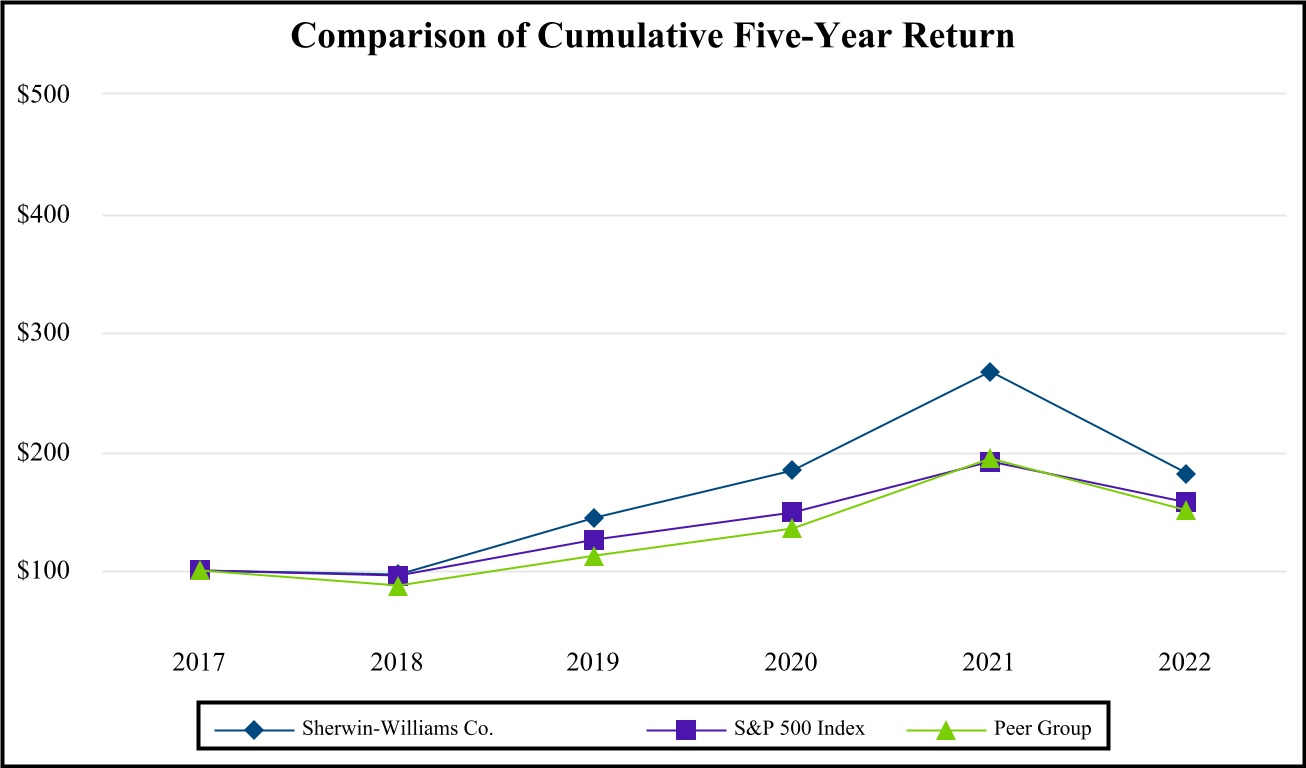
Peer group of companies comprised of the following: Akzo Nobel N.V., Axalta Coating Systems Ltd., BASF SE, Genuine Parts Company, H.B. Fuller Company, The Home Depot, Inc., Lowe’s Companies, Inc., Masco Corporation, Newell Brands Inc., PPG Industries, Inc., RPM International Inc., and Stanley Black & Decker, Inc.
Item 6. [Reserved]
Item 7. MANAGEMENT’S DISCUSSION AND ANALYSIS OF FINANCIAL CONDITION AND RESULTS OF OPERATIONS
(dollars in millions, except as noted and per share data)
Company Background
The Sherwin-Williams Company, founded in 1866, and its consolidated wholly owned subsidiaries (collectively, the Company) are engaged in the development, manufacture, distribution and sale of paint, coatings and related products to professional, industrial, commercial and retail customers primarily in North and South America with additional operations in the Caribbean region and throughout Europe, Asia and Australia.
The Company is structured into three reportable segments – The Americas Group, Consumer Brands Group and Performance Coatings Group (collectively, the Reportable Segments) – and an Administrative segment in the same way it is internally organized for assessing performance and making decisions regarding allocation of resources. See Notes 23 and 24 to the Consolidated Financial Statements in Item 8 for additional information on the Company’s Reportable Segments.
Summary
- Consolidated net sales increased 11.1% in the year to a record $22.149 billion
◦Net sales from stores in U.S. and Canada open more than twelve calendar months increased 11.7% in the year
- Diluted net income per share increased to $7.72 per share in the year compared to $6.98 per share in the full year 2021
◦Adjusted diluted net income per share increased to $8.73 per share in the year compared to $8.15 per share in the full year 2021
- Generated strong net operating cash of $1.920 billion
◦Deployed $1.003 billion toward five acquisitions that will add to our product offerings and capabilities
◦Invested $883.2 million in share repurchases and paid $618.5 million in dividends to return value to our shareholders
Outlook
During 2022, we continued to experience the effects of macroeconomic challenges such as raw material inflation, less than optimal raw material availability, armed conflict in Europe, and COVID-related lockdowns in Asia. Our focus on cost control measures remains steady as we execute on targeted restructuring actions to simplify our business. The growth investments we made during the year, including five completed acquisitions, are well-positioned to contribute to our resilient portfolio. While we anticipate a challenging demand environment in 2023, our long-term strategy and customer-focused solutions drive confidence in our outlook.
We anticipate inflationary pressure in 2023 to impact consumer behavior in both the United States and Europe, particularly in housing markets. Elevated mortgage rates may have a negative impact on new residential volume. Certain other costs, such as wages, energy and transportation are expected to increase. We are focused on gaining market share despite this challenging environment, while leveraging our exposure in more historically resilient end markets such as residential repaint, property maintenance, auto refinish, and packaging. During 2023, we expect to benefit from price increases we implemented during 2021 and 2022. Additionally, we expect to realize approximately $50 million to $70 million in estimated annual savings from previously announced restructuring actions, of which we expect 75% will be realized by the end of 2023. Our deliberate cost control and ongoing continuous improvement initiatives, coupled with anticipated raw material cost deflation, are expected to drive full year gross margin expansion in 2023.
Our capital deployment strategy remains balanced and consistent. We do not have any long-term debt maturities due in 2023 and expect to reduce short-term borrowings while generating net operating cash. We have plans to invest in the construction of new facilities, including our new global headquarters (new headquarters) in downtown Cleveland, Ohio and new research and development (R&D) center in the Cleveland suburb of Brecksville, and in the expansion of certain existing manufacturing and distribution facilities. We plan to expand our footprint by opening 80 to 100 new stores in the United States and Canada in 2023, and pursue acquisitions that align with our long-term growth strategy. We will also return value to our shareholders through the payment of dividends and the reinvestment of excess cash for share repurchases of Company stock.
Please see Item 1A “Risk Factors” in Part I of this Annual Report on Form 10-K for further information regarding the current and potential impact of macroeconomic conditions on the Company, including those relating to supply chain disruptions, raw material availability, and inflation, and the Company’s restructuring actions.
RESULTS OF OPERATIONS
The following discussion and analysis addresses comparisons of material changes in the consolidated financial statements for the years ended December 31, 2022 and 2021. For comparisons of the years ended December 31, 2021 and 2020, see Management’s Discussion and Analysis of Financial Condition and Results of Operations in Part II, Item 7 of the Company’s Annual Report on Form 10-K for the fiscal year ended December 31, 2021 filed on February 17, 2022.
Net Sales
| Year Ended December 31, | |||||||||||||||||||||||
| 2022 | 2021 | $ Change | % Change | ||||||||||||||||||||
| Net Sales: | |||||||||||||||||||||||
| The Americas Group | $ | 12,661.0 | $ | 11,217.0 | $ | 1,444.0 | 12.9 | % | |||||||||||||||
| Consumer Brands Group | 2,690.7 | 2,721.6 | (30.9) | (1.1) | % | ||||||||||||||||||
| Performance Coatings Group | 6,793.5 | 6,003.8 | 789.7 | 13.2 | % | ||||||||||||||||||
| Administrative | 3.7 | 2.2 | 1.5 | 68.2 | % | ||||||||||||||||||
| Total | $ | 22,148.9 | $ | 19,944.6 | $ | 2,204.3 | 11.1 | % |
Consolidated Net sales for 2022 increased 11.1% primarily due to selling price increases in all Reportable Segments and higher product sales volume in The Americas Group, partially offset by lower sales volume in the Consumer Brands and Performance Coatings Groups. Currency translation rate changes decreased 2022 consolidated Net sales by 1.5%, while acquisitions which were completed during the past twelve months added approximately 1.1% to consolidated Net sales. Net sales of all consolidated foreign subsidiaries increased 1.7% to $4.294 billion for 2022 versus $4.223 billion for 2021 primarily due to benefits from acquisitions offset by weakening demand in the Europe and Asia Pacific regions. Net sales of all operations other than consolidated foreign subsidiaries increased 13.6% to $17.855 billion for 2022 versus $15.722 billion for 2021.
Net sales in The Americas Group increased primarily due to selling price increases as well as volume growth in all end markets, particularly residential repaint. Net sales from stores in U.S. and Canada open for more than twelve calendar months increased 11.7% in the year over last year’s comparable period. Currency translation rate changes reduced Net sales by 0.4% compared to 2021. During 2022, The Americas Group opened 89 new stores and closed 17 redundant locations for a net increase of 72 stores, with a net increase of 75 new stores in the U.S. and Canada. The total number of stores in operation at December 31, 2022 was 4,931 in the United States, Canada, Latin America and the Caribbean. The Americas Group’s objective is to expand its store base by an average of 2% each year, primarily through organic growth. Sales of products other than paint increased approximately 0.2% over last year. A discussion of changes in volume versus pricing f
Showing the first 8K of 77K characters. Open the full section
Item 7A. QUANTITATIVE AND QUALITATIVE DISCLOSURES ABOUT MARKET RISK
We are exposed to market risk associated with interest rates, foreign currency and commodity fluctuations. We occasionally utilize derivative instruments as part of our overall financial risk management policy, but do not use derivative instruments for speculative or trading purposes. In 2022 and 2021, the Company utilized U.S. Dollar to Euro cross currency swap contracts to hedge the Company’s net investment in its European operations. The contracts have been designated as net investment hedges and have various maturity dates. See Note 17 to the Consolidated Financial Statements in Item 8. The Company entered into forward foreign currency exchange contracts during 2022 to hedge against value changes in foreign currency. There were no material contracts outstanding at December 31, 2022. Forward foreign currency exchange contracts are described in Note 20 to the Consolidated Financial Statements in Item 8. We believe we may experience continuing losses from foreign currency fluctuations. However, we do not expect currency translation, transaction or hedging contract losses to have a material adverse effect on our financial condition, results of operations or cash flows.
Item 8. FINANCIAL STATEMENTS AND SUPPLEMENTARY DATA
| Index to Consolidated Financial Statements | |||||
| Page | |||||
| Report of Management on Internal Control Over Financial Reporting | 40 | ||||
| Report of Independent Registered Public Accounting Firm on Internal Control Over Financial Reporting | 41 | ||||
| Report of Management on the Consolidated Financial Statements | 43 | ||||
| Report of Independent Registered Public Accounting Firm on the Consolidated Financial Statements (PCAOB ID: 42) | 44 | ||||
| Statements of Consolidated Income | 46 | ||||
| Statements of Consolidated Comprehensive Income | 47 | ||||
| Consolidated Balance Sheets | 48 | ||||
| Statements of Consolidated Cash Flows | 49 | ||||
| Statements of Consolidated Shareholders’ Equity | 50 | ||||
| Notes to Consolidated Financial Statements | 51 | ||||
Report of Management
On Internal Control Over Financial Reporting
Shareholders of The Sherwin-Williams Company
We are responsible for establishing and maintaining adequate internal control over financial reporting as defined in Rules 13a-15(f) and 15d-15(f) under the Securities Exchange Act of 1934, as amended. We recognize that internal control over financial reporting cannot provide absolute assurance of achieving financial reporting objectives because of its inherent limitations. Internal control over financial reporting is a process that involves human diligence and is subject to the possibility of human error or the circumvention or the overriding of internal control. Therefore, there is a risk that material misstatements may not be prevented or detected on a timely basis by internal control over financial reporting. However, we believe we have designed into the process safeguards to reduce, though not eliminate, this risk. Projections of any evaluation of effectiveness to future periods are subject to the risk that controls may become inadequate because of changes in conditions, or that the degree of compliance with the policies or procedures may deteriorate.
In order to ensure that the Company’s internal control over financial reporting was effective as of December 31, 2022, we conducted an assessment of its effectiveness under the supervision and with the participation of our management group, including our principal executive officer and principal financial officer. This assessment was based on the criteria established in the 2013 Internal Control – Integrated Framework issued by the Committee of Sponsoring Organizations of the Treadway Commission.
As permitted by SEC rules, we have excluded the operations and related assets of the 2022 acquisitions from the scope of our assessment of the effectiveness of internal control over financial reporting as of December 31, 2022. The Total assets and Net sales of the 2022 acquisitions represented approximately 5.0% and 0.6% of the Company's respective consolidated Total assets and Net sales as of and for the year ended December 31, 2022.
Based on our assessment of internal control over financial reporting under the criteria established in Internal Control – Integrated Framework, we have concluded that, as of December 31, 2022, the Company’s internal control over financial reporting was effective to provide reasonable assurance regarding the reliability of financial reporting and the preparation of financial statements for external purposes in accordance with U.S. generally accepted accounting principles. Our internal control over financial reporting as of December 31, 2022 has been audited by Ernst & Young LLP, an independent registered public accounting firm, and their report on the effectiveness of our internal control over financial reporting is included on page 41 of this report.
J. G. Morikis
Chairman and Chief Executive Officer
A. J. Mistysyn
Senior Vice President - Finance and Chief Financial Officer
J. M. Cronin
Senior Vice President - Enterprise Finance
Report of Independent Registered Public Accounting Firm
To the Shareholders and the Board of Directors of The Sherwin-Williams Company
Opinion on Internal Control Over Financial Reporting
We have audited The Sherwin-Williams Company’s internal control over financial reporting as of December 31, 2022, based on criteria established in Internal Control—Integrated Framework issued by the Committee of Sponsoring Organizations of the Treadway Commission (2013 framework) (the COSO criteria). In our opinion, The Sherwin-Williams Company maintained, in all material respects, effective internal control over financial reporting as of December 31, 2022, based on the COSO criteria.
As indicated in the accompanying Report of Management On Internal Control Over Financial Reporting, management’s assessment of and conclusion on the effectiveness of internal control over financial reporting did not include the internal controls of Sika AG, Gross & Perthun GmbH, Dur-A-Flex, Inc., Powdertech Oy Ltd., and Industria Chimica Adriatica S.p.A. (collectively the 2022 acquisitions), which are included in the 2022 consolidated financial statements of the Company and constituted 5.0% of Total assets as of December 31, 2022 and 0.6% of Net sales for the year then ended. Our audit of internal control over financial reporting of the Company also did not include an evaluation of the internal control over financial reporting of the 2022 acquisitions excluded from the scope of management’s assessment.
We also have audited, in accordance with the standards of the Public Company Accounting Oversight Board (United States) (“PCAOB”), the consolidated balance sheets of The Sherwin-Williams Company as of December 31, 2022, 2021, and 2020, the related statements of consolidated income, comprehensive income, cash flows and shareholders’ equity for each of the three years in the period ended December 31, 2022, and the related notes and the financial statement schedule listed in Item 15(a) and our report dated February 22, 2023 expressed an unqualified opinion thereon.
Basis for Opinion
The Company’s management is responsible for maintaining effective internal control over financial reporting, and for its assessment of the effectiveness of internal control over financial reporting included in the accompanying Report of Management on Internal Control Over Financial Reporting. Our responsibility is to express an opinion on the Company’s internal control over financial reporting based on our audit. We are a public accounting firm registered with the PCAOB and are required to be independent with respect to the Company in accordance with the U.S. federal securities laws and the applicable rules and regulations of the Securities and Exchange Commission and the PCAOB.
We conducted our audit in accordance with the standards of the PCAOB. Those standards require that we plan and perform t
Showing the first 8K of 226K characters. Open the full section
Item 9. CHANGES IN AND DISAGREEMENTS WITH ACCOUNTANTS ON ACCOUNTING AND FINANCIAL DISCLOSURE
None.
Item 9A. CONTROLS AND PROCEDURES
Disclosure Controls and Procedures
As of the end of the period covered by this report, we carried out an evaluation, under the supervision and with the participation of our Chairman and Chief Executive Officer and our Senior Vice President – Finance and Chief Financial Officer, of the effectiveness of our disclosure controls and procedures pursuant to Rule 13a-15 and Rule 15d-15 of the Securities Exchange Act of 1934, as amended (“Exchange Act”). Based upon that evaluation, our Chairman and Chief Executive Officer and our Senior Vice President – Finance and Chief Financial Officer concluded that as of the end of the period covered by this report, our disclosure controls and procedures were effective to ensure that information required to be disclosed by us in reports we file or submit under the Exchange Act is recorded, processed, summarized and reported within the time periods specified in SEC rules and forms, and accumulated and communicated to our management, including our Chairman and Chief Executive Officer and our Senior Vice President – Finance and Chief Financial Officer, to allow timely decisions regarding required disclosure.
Internal Control Over Financial Reporting
The “Report of Management on Internal Control over Financial Reporting” and the “Report of the Independent Registered Public Accounting Firm on Internal Control over Financial Reporting” are set forth in Item 8.
There were no changes in our internal control over financial reporting identified in connection with the evaluation that occurred during the period covered by this report that have materially affected, or are reasonably likely to materially affect, our internal control over financial reporting.
Item 9B. OTHER INFORMATION
None.
Item 9C. DISCLOSURE REGARDING JURISDICTIONS THAT PREVENT INSPECTIONS
Not applicable.
PART III
Item 10. DIRECTORS, EXECUTIVE OFFICERS AND CORPORATE GOVERNANCE
Directors
The information regarding our directors and director nominees is set forth in our Proxy Statement under the caption “Proposal 1 – Election of 9 Directors” and is incorporated herein by reference.
There were no material changes to the procedures by which security holders may recommend nominees to our Board of Directors during 2022. Please refer to the information set forth in our Proxy Statement under the caption “Board Committees,” which is incorporated herein by reference.
Executive Officers
The information regarding our executive officers is set forth under the caption “Information About Our Executive Officers” in Part I of this report, which is incorporated herein by reference.
Section 16(a) Beneficial Ownership Reporting Compliance
To the extent disclosure of any delinquent form under Section 16(a) of the Securities Exchange Act of 1934 is made by the Company, such disclosure will be set forth in our Proxy Statement under the caption “Delinquent Section 16(a) Reports” and is incorporated herein by reference.
Audit Committee
The information regarding the Audit Committee of our Board of Directors and audit committee financial experts is set forth in our Proxy Statement under the caption “Board Committees” and is incorporated herein by reference.
Code of Ethics
We have adopted a Code of Conduct, which applies to all directors and employees, including our executive officers, of Sherwin-Williams and our subsidiaries wherever located. Our Code of Conduct contains the general guidelines and principles for conducting Sherwin-Williams’ business consistent with the highest standards of business ethics.
Under our Code of Ethics for Senior Financial Management, our chief executive officer, chief financial officer and senior financial management are responsible for creating and maintaining a culture of high ethical standards and of commitment to compliance throughout our Company to ensure the fair and timely reporting of Sherwin-Williams’ financial results and condition. Senior financial management includes the controller, the treasurer, the principal financial/accounting personnel in our operating groups and divisions, and all other financial/accounting personnel within our corporate departments and operating groups and divisions with staff supervision responsibilities.
Please refer to the information set forth in our Proxy Statement under the caption “Code of Conduct,” which is incorporated herein by reference. Our Code of Conduct and Code of Ethics for Senior Financial Management are available on our Investor Relations website, investors.sherwin.com.
We intend to disclose on our Investor Relations website, investors.sherwin.com, any amendment to, or waiver from, a provision of our Code of Conduct or Code of Ethics for Senior Financial Management that applies to our directors and executive officers, including our principal executive officer, principal financial officer, principal accounting officer or controller, or any persons performing similar functions, and that is required to be publicly disclosed pursuant to the rules of the SEC.
Item 11. EXECUTIVE COMPENSATION
The information required by this item is set forth in our Proxy Statement under the captions “2022 Director Compensation Table,” “Director Compensation Program,” “Executive Compensation” and “Executive Compensation Tables” and is incorporated herein by reference.
Item 12. SECURITY OWNERSHIP OF CERTAIN BENEFICIAL OWNERS AND MANAGEMENT AND RELATED STOCKHOLDER MATTERS
The information regarding security ownership of certain beneficial owners and management is set forth in our Proxy Statement under the captions “Security Ownership of Management, Directors and Director Nominees” and “Security Ownership of Certain Beneficial Owners” and is incorporated herein by reference.
The information regarding securities authorized for issuance under the Company’s equity compensation plans is set forth in our Proxy Statement under the caption “Equity Compensation Plan Information” and is incorporated herein by reference.
Item 13. CERTAIN RELATIONSHIPS AND RELATED TRANSACTIONS, AND DIRECTOR INDEPENDENCE
The information required by this item is set forth in our Proxy Statement under the captions “Certain Relationships and Transactions with Related Persons” and “Director Independence” and is incorporated herein by reference.
Item 14. PRINCIPAL ACCOUNTANT FEES AND SERVICES
The information required by this item is set forth in our Proxy Statement under the caption “Matters Relating to the Independent Registered Public Accounting Firm” and is incorporated herein by reference.
PART IV
Item 15. EXHIBITS AND FINANCIAL STATEMENT SCHEDULES
(a)(1)Financial Statements
| Page Number in Form 10-K | |||||
| Statements of Consolidated Income | 46 | ||||
| Statements of Consolidated Comprehensive Income | 47 | ||||
| Consolidated Balance Sheets | 48 | ||||
| Statements of Consolidated Cash Flows | 49 | ||||
| Statements of Consolidated Shareholders’ Equity | 50 | ||||
| Notes to Consolidated Financial Statements | 51 |
(2) Financial Statement Schedule
Schedule II — Valuation and Qualifying Accounts and Reserves for the years ended December 31, 2022, 2021 and 2020 is set forth below. All other schedules for which provision is made in the applicable SEC accounting regulations are not required under the related instructions or are inapplicable and therefore have been omitted.
Valuation and Qualifying Accounts and Reserves
(Schedule II)
Changes in deferred tax asset valuation allowances were as follows:
| (millions of dollars) | 2022 | 2021 | 2020 | ||||||||||||||
| Beginning balance | $ | 97.2 | $ | 104.6 | $ | 84.6 | |||||||||||
| Additions (deductions) (1) | 0.3 | (7.4) | 20.0 | ||||||||||||||
| Ending balance | $ | 97.5 | $ | 97.2 | $ | 104.6 |
(1) Additions (deductions) did not have a material impact on the Income Statement in 2022, 2021 or 2020.
(3) Exhibits
| * | Certain exhibits and schedules have been omitted and the Company agrees to furnish supplementally to the SEC a copy of any omitted exhibits and schedules upon request. | |||||||
| ** | Management contract or compensatory plan or arrangement. |
Item 16. FORM 10-K SUMMARY
None.
SIGNATURES
Pursuant to the requirements of Section 13 or 15(d) of the Securities Exchange Act of 1934, the Company has duly caused this report to be signed on its behalf by the undersigned, thereunto duly authorized, on February 22, 2023.
Pursuant to the requirements of the Securities Exchange Act of 1934, this report has been signed below by the following persons on behalf of the registrant and in the capacities indicated on February 22, 2023.
| THE SHERWIN-WILLIAMS COMPANY | ||||||||
| By: | /S/ | MARY L. GARCEAU | ||||||
| Mary L. Garceau, Secretary |
| * JOHN G. MORIKIS | Chairman and Chief Executive Officer, Director (Principal Executive Officer) | |||||||
| John G. Morikis | ||||||||
| * ALLEN J. MISTYSYN | Senior Vice President – Finance and Chief Financial Officer (Principal Financial Officer) | |||||||
| Allen J. Mistysyn | ||||||||
| * JANE M. CRONIN | Senior Vice President – Enterprise Finance (Principal Accounting Officer) | |||||||
| Jane M. Cronin | ||||||||
| * KERRII B. ANDERSON | Director | |||||||
| Kerrii B. Anderson | ||||||||
| * ARTHUR F. ANTON | Director | |||||||
| Arthur F. Anton | ||||||||
| * JEFF M. FETTIG | Director | |||||||
| Jeff M. Fettig | ||||||||
| * RICHARD J. KRAMER | Director | |||||||
| Richard J. Kramer | ||||||||
| * CHRISTINE A. POON | Director | |||||||
| Christine A. Poon | ||||||||
| * AARON M. POWELL | Director | |||||||
| Aaron M. Powell | ||||||||
| * MARTA R. STEWART | Director | |||||||
| Marta R. Stewart | ||||||||
| * MICHAEL H. THAMAN | Director | |||||||
| Michael H. Thaman | ||||||||
| * MATTHEW THORNTON III | Director | |||||||
| Matthew Thornton III | ||||||||
| * STEVEN H. WUNNING | Director | |||||||
| Steven H. Wunning |
| * | The undersigned, by signing her name hereto, does sign this report on behalf of the designated officers and directors of the Company pursuant to powers of attorney executed on behalf of each such officer and director and filed as an exhibit to this report. |
| By: | /S/ | MARY L. GARCEAU | February 22, 2023 | |||||||||||
| Mary L. Garceau, Attorney-in-fact |