 filings.tools
J.M. Smucker 10-K 2021-04-30
Filed 2021-06-17. 21 sections, 401K characters. Original on sec.gov · Markdown · JSON
Cover and table of contents
UNITED STATES
SECURITIES AND EXCHANGE COMMISSION
WASHINGTON, D.C. 20549
FORM 10-K
| ☒ | ANNUAL REPORT PURSUANT TO SECTION 13 OR 15(d) OF THE SECURITIES EXCHANGE ACT OF 1934 |
For the fiscal year ended April 30, 2021
or
| ☐ | TRANSITION REPORT PURSUANT TO SECTION 13 OR 15(d) OF THE SECURITIES EXCHANGE ACT OF 1934 |
For the transition period from to
Commission file number 001-5111
THE J. M. SMUCKER COMPANY
(Exact name of registrant as specified in its charter)
| Ohio | 34-0538550 | ||||||||||||||||
| (State or other jurisdiction of incorporation or organization) | (I.R.S. Employer Identification No.) | ||||||||||||||||
| One Strawberry Lane | |||||||||||||||||
| Orrville, | Ohio | 44667-0280 | |||||||||||||||
| (Address of principal executive offices) | (Zip code) | ||||||||||||||||
| Registrant’s telephone number, including area code | (330) | 682-3000 | |||||||||||||||
| Securities registered pursuant to Section 12(b) of the Act: | |||||||||||||||||
| Title of each class | Trading symbol | Name of each exchange on which registered | |||||||||||||||
| Common shares, no par value | SJM | New York Stock Exchange | |||||||||||||||
Securities registered pursuant to Section 12(g) of the Act: None
Indicate by check mark if the registrant is a well-known seasoned issuer, as defined in Rule 405 of the Securities Act. Yes ☒ No ☐
Indicate by check mark if the registrant is not required to file reports pursuant to Section 13 or Section 15(d) of the Act. Yes ☐ No ☒
Indicate by check mark whether the registrant (1) has filed all reports required to be filed by Section 13 or 15(d) of the Securities Exchange Act of 1934 during the preceding 12 months (or for such shorter period that the registrant was required to file such reports), and (2) has been subject to such filing requirements for the past 90 days. Yes ☒ No ☐
Indicate by check mark whether the registrant has submitted electronically every Interactive Data File required to be submitted pursuant to Rule 405 of Regulation S-T (§232.405 of this chapter) during the preceding 12 months (or for such shorter period that the registrant was required to submit such files). Yes ☒ No ☐
Indicate by check mark whether the registrant is a large accelerated filer, an accelerated filer, a non-accelerated filer, a smaller reporting company, or an emerging growth company. See the definitions of “large accelerated filer,” “accelerated filer,” “smaller reporting company,” and “emerging growth company” in Rule 12b-2 of the Exchange Act. (Check one):
| Large Accelerated Filer | ☒ | Accelerated filer | ☐ | |||||||||||||||||
| Non-accelerated filer | ☐ | Smaller reporting company | ☐ | |||||||||||||||||
| Emerging growth company | ☐ |
If an emerging growth company, indicate by check mark if the registrant has elected not to use the extended transition period for complying with any new or revised financial accounting standards provided pursuant to Section 13(a) of the Exchange Act. ☐
Indicate by checkmark whether the registrant has filed a report on and attestation to its management’s assessment of the effectiveness of its internal control over financial reporting under Section 404(b) of the Sarbanes-Oxley Act (15 U.S.C. 7262(b)) by the registered public accounting firm that prepared or issued its audit report. ☒
Indicate by check mark whether the registrant is a shell company (as defined in Rule 12b-2 of the Exchange Act). Yes ☐ No ☒
The aggregate market value of the common shares held by nonaffiliates of the registrant at October 31, 2020, was $12,194,989,389.
As of June 10, 2021, 108,343,689 common shares of The J. M. Smucker Company were issued and outstanding.
DOCUMENTS INCORPORATED BY REFERENCE
Certain sections of the registrant’s definitive Proxy Statement to be filed in connection with its Annual Meeting of Shareholders to be held on August 18, 2021, are incorporated by reference into Part III of this Annual Report on Form 10-K.
TABLE OF CONTENTS
| PART I. | Page No. | |||||||
| Item 1. | Business | 2 | ||||||
| Item 1A. | Risk Factors | 8 | ||||||
| Item 1B. | Unresolved Staff Comments | 18 | ||||||
| Item 2. | Properties | 19 | ||||||
| Item 3. | Legal Proceedings | 19 | ||||||
| Item 4. | Mine Safety Disclosures | 19 | ||||||
| PART II. | ||||||||
| Item 5. | Market for Registrant’s Common Equity, Related Stockholder Matters and Issuer Purchases of Equity Securities | 20 | ||||||
| Item 6. | [Reserved] | 21 | ||||||
| Item 7. | Management’s Discussion and Analysis of Financial Condition and Results of Operations | 21 | ||||||
| Item 7A. | Quantitative and Qualitative Disclosures About Market Risk | 35 | ||||||
| Item 8. | Financial Statements and Supplementary Data | 37 | ||||||
| Item 9. | Changes in and Disagreements with Accountants on Accounting and Financial Disclosures | 79 | ||||||
| Item 9A. | Controls and Procedures | 79 | ||||||
| Item 9B. | Other Information | 79 | ||||||
| PART III. | ||||||||
| Item 10. | Directors, Executive Officers and Corporate Governance | 80 | ||||||
| Item 11. | Executive Compensation | 80 | ||||||
| Item 12. | Security Ownership of Certain Beneficial Owners and Management and Related Stockholder Matters | 80 | ||||||
| Item 13. | Certain Relationships and Related Transactions, and Director Independence | 80 | ||||||
| Item 14. | Principal Accountant Fees and Services | 80 | ||||||
| PART IV. | ||||||||
| Item 15. | Exhibits and Financial Statement Schedules | 81 | ||||||
| Signatures | 84 |
PART I
Item 1. Business.
The Company: The J. M. Smucker Company (“Company,” “registrant,” “we,” “us,” or “our”), often referred to as Smucker’s (a registered trademark), was established in 1897 and incorporated in Ohio in 1921. We operate principally in one industry, the manufacturing and marketing of branded food and beverage products on a worldwide basis, although the majority of our sales are in the U.S. Our operations outside the U.S. are principally in Canada, although products are exported to other countries as well. Net sales outside the U.S., subject to foreign currency translation, represented approximately
5 percent of consolidated net sales for 2021. Our branded food and beverage products include a strong portfolio of trusted, iconic, market-leading brands that are sold to consumers through retail outlets in North America.
On January 29, 2021, we sold the Natural Balance® premium pet food business to Nexus Capital Management LP (“Nexus”). The transaction included pet food products sold under the Natural Balance brand, certain trademarks and licensing agreements, and select employees who supported the Natural Balance business. Under our ownership, the business generated net sales of $156.7, $222.8, and $274.2 in 2021, 2020, and 2019, respectively, included in the U.S. Retail Pet Foods segment. For additional information, refer to Note 4: Divestitures.
On December 1, 2020, we sold the Crisco® oils and shortening business to B&G Foods, Inc. (“B&G Foods”). The transaction included oils and shortening products sold under the Crisco brand, primarily in the U.S. and Canada, certain trademarks and licensing agreements, dedicated manufacturing and warehouse facilities located in Cincinnati, Ohio, and approximately 160 employees who supported the Crisco business. Under our ownership, the business generated net sales of $198.9, $269.2, and $258.5 in 2021, 2020, and 2019, respectively, primarily included in the U.S. Retail Consumer Foods segment. For additional information, refer to Note 4: Divestitures.
On August 31, 2018, we sold our U.S. baking business to Brynwood Partners VII L.P. and Brynwood Partners VIII L.P., subsidiaries of Brynwood Partners, an unrelated party. The transaction included products that were primarily sold in U.S. retail channels under the Pillsbury®, Martha White®, Hungry Jack®, White Lily®, and Jim Dandy® brands, along with all relevant trademarks and licensing agreements, and our manufacturing facility in Toledo, Ohio. This business generated net sales of $105.9 in 2019, primarily included in the U.S. Retail Consumer Foods segment. The transaction did not include our baking business in Canada. For additional information, refer to Note 4: Divestitures.
On May 14, 2018, we acquired the outstanding equity of Ainsworth Pet Nutrition, LLC (“Ainsworth”) in an all-cash transaction, which was funded by debt and valued at $1.9 billion. Ainsworth was a leading producer, distributor, and marketer of premium pet food and pet snacks, predominantly within the U.S. The majority of Ainsworth’s sales were generated by the Rachael Ray® Nutrish® brand within the premium pet food category. Results of the Ainsworth acquisition are primarily included in the U.S. Retail Pet Foods segment. For additional information, refer to Note 2: Acquisition.
We have three reportable segments: U.S. Retail Pet Foods, U.S. Retail Coffee, and U.S. Retail Consumer Foods. Effective during the first quarter of 2021, the presentation of International and Away From Home represents a combination of all other operating segments that are not individually reportable. As a result of leadership changes, these operating segments are being managed and reported separately and no longer represent a reportable segment for segment reporting purposes. Segment results for prior periods have not been modified, as the combination of these operating segments represents the previously reported International and Away From Home reportable segment. The U.S. retail market segments in total comprised 88 percent of 2021 consolidated net sales and represent a major portion of our strategic focus – the sale of branded food and beverage products with leadership positions to consumers through retail outlets in North America. International and Away From Home represents sales outside of the U.S. retail market segments.
Principal Products: Our principal products as of April 30, 2021, are coffee, dog food, cat food, pet snacks, peanut butter, frozen handheld products, fruit spreads, juices and beverages, portion control products, and baking mixes and ingredients. Product sales information for the years 2021, 2020, and 2019 is included within Note 5: Reportable Segments.
In the U.S. retail market segments, our products are primarily sold through a combination of direct sales and brokers to food retailers, club stores, discount and dollar stores, food wholesalers, online retailers, pet specialty stores, natural foods stores and distributors, drug stores, military commissaries, and mass merchandisers. In International and Away From Home, our products are distributed domestically and in foreign countries through retail channels and foodservice distributors and operators (e.g., health care operators, restaurants, lodging, hospitality, offices, K-12, colleges and universities, and convenience stores).
Sources and Availability of Raw Materials: The raw materials used in each of our segments are primarily commodities, agricultural-based products, and packaging materials. Green coffee, peanuts, protein meals, oils and fats, grains, sweeteners, fruit, and other ingredients are obtained from various suppliers. The availability, quality, and costs of many of these commodities have fluctuated, and may continue to fluctuate, over time. Futures, options, basis, and fixed price contracts are used to manage price volatility for a significant portion of our commodity costs. Green coffee, along with certain other raw materials, is sourced solely from foreign countries and its supply and price is subject to high volatility due to factors such as weather, global supply and demand, plant disease, investor speculation, and political and economic conditions in the source countries. We source peanuts, protein meals, and oils and fats mainly from North America. The principal packaging materials we use are plastic, glass, metal cans, caps, carton board, and corrugate. For additional information on the commodities we purchase, see “Commodities Overview” within Management’s Discussion and Analysis of Financial Condition and Results of Operations.
Raw materials are generally available from numerous sources, although we have elected to source certain plastic packaging materials and finished goods, such as K-Cup® pods and our Pup-Peroni*®* dog snacks, from single sources of supply pursuant to long-term contracts. While availability may vary year-to-year, we believe that we will continue to obtain adequate supplies and that alternatives to single-sourced materials are available. We have not historically encountered significant shortages of key raw materials. We consider our relationships with key raw material suppliers to be in good standing.
Trademarks and Patents: Our products are produced under certain patents and marketed under trademarks owned or licensed by us or one of our subsidiaries. Our major trademarks as of April 30, 2021, are listed below.
| Primary Reportable Segment | Major Trademark | |||||||
| U.S. Retail Pet Foods | Rachael Ray Nutrish, Meow Mix*®, Milk-Bone®, 9Lives®, Kibbles ‘n Bits®, Pup-Peroni, and Nature’s Recipe®* | |||||||
| U.S. Retail Coffee | Folgers*®, Dunkin’TM, and Café Bustelo®* | |||||||
| U.S. Retail Consumer Foods | Jif*®**,* Smucker’s*®, and Uncrustables®* | |||||||
| Other (A) | Folgers and Smucker’s |
(A) Represents the combined International and Away From Home operating segments.
Dunkin’ is a trademark of DD IP Holder LLC for packaged coffee products, including K-Cup® pods, sold in retail channels such as grocery stores, mass merchandisers, club stores, e-commerce, and drug stores. Information included in this document does not pertain to coffee or other products for sale in Dunkin’ restaurants. The terms of the Dunkin’ license includes the payment of royalties to an affiliate of DD IP Holder LLC and other financial commitments by the Company. The Dunkin’ license is in effect until January 1, 2039. Keurig® and K-Cup® are trademarks of Keurig Green Mountain, Inc. (“Keurig”), used with permission.
We utilize Rachael Ray’s image and likeness and related Rachael Ray trademarks for premium pet food and pet snacks under an exclusive license which expires in 2063. The terms of the license include the payment of royalties to The Rachael Ray Foundation. Rachael Ray is a trademark of Ray Marks II LLC. In addition, we and our subsidiaries license the use of several other trademarks, none of which are individually material to our business.
Slogans or designs considered to be important trademarks include, without limitation, “With A Name Like Smucker’s, It Has To Be Good®,” “The Best Part of Wakin’ Up Is Folgers In Your Cup®,” “Choosy Moms Choose Jif®,” “That Jif'ing GoodTM,” “The Only One Cats Ask For By Name®,” the Smucker’s banner, the Crock Jar shape, the Gingham design, the Jif Color Banner design, the Folgers Mountain Sunrise design, the Café Bustelo Angelina design, and the Smucker’s Strawberry, Milk-Bone, Meow Mix, and 9Lives logos.
We own several hundred patents worldwide in addition to proprietary trade secrets, technology, know-how processes, and other intellectual property rights that are not registered.
We consider all of our owned and licensed intellectual property, taken as a whole, to be essential to our business.
Seasonality: The U.S. Retail Coffee and U.S. Retail Consumer Foods segments have historically been seasonal around the Fall Bake and Holiday period, which generally resulted in higher sales and profits in our second and third quarters. However, as a result of the Crisco and U.S. baking business divestitures during 2021 and 2019, respectively, the U.S. Retail Consumer Foods segment has experienced less seasonality. Additionally, the U.S. Retail Pet Foods segment does not experience significant seasonality, further reducing the overall impact of seasonality to the total Company.
Customers: Sales to Walmart Inc. and subsidiaries amounted to 32 percent of net sales in 2021, 2020, and 2019. These sales are primarily included in our U.S. retail market segments. No other customer exceeded 10 percent of net sales for any year.
During 2021, our top 10 customers, collectively, accounted for approximately 60 percent of consolidated net sales. Supermarkets, warehouse clubs, and food distributors continue to consolidate, and we expect that a significant portion of our revenues will continue to be derived from a limited number of customers. Although the loss of any large customer for an extended length of time could negatively impact our sales and profits, we do not anticipate that this will occur to a significant extent due to strong consumer demand for our brands.
Government Business: No material portion of our business is subject to renegotiation of profits or termination of contracts at the election of the government.
Competition: We are the branded market leader in the coffee, dog snacks, peanut butter, fruit spreads, and natural shelf stable juices categories in the U.S. In Canada, we are the branded market leader in the flour, pickles, fruit spreads, canned milk, and ice cream toppings categories. Our business is highly competitive as all of our brands compete for retail shelf space with other branded products as well as private label products.
In order to remain competitive, companies in the food industry need to consider emerging consumer preferences, technological advances, product and packaging innovations, and the growth of certain retail channels, such as the
e-commerce market. The primary ways in which products and brands are distinguished are brand recognition, product quality, price, packaging, new product introductions, nutritional value, convenience, advertising, promotion, and the ability to identify and satisfy consumer preferences. Positive factors pertaining to our competitive position include well-recognized brands, high-quality products, consumer trust, experienced brand and category management, a single national grocery broker in the U.S., varied product offerings, product innovation, good customer service, and an integrated distribution network.
The packaged foods industry has been challenged by a general decline in sales volume in the center of the store. Certain evolving consumer trends have contributed to the decline, such as a heightened focus on health and wellness, an increased desire for fresh foods, and the growing impact of social media and e-commerce on consumer behavior. To address these dynamics, we continue to focus on innovation with an increased emphasis on products that satisfy evolving consumer trends.
In addition, private label continues to be a competitor in many of the categories in which we compete, partially due to improvements in private label quality and the increased emphasis of store brands by retailers in an effort to cultivate customer loyalty. In our total U.S. retail categories, private label held a 12.2 dollar average market share during the 52 weeks ended April 18, 2021, as compared to a 16.4 dollar average market share during the same period in the prior year. The decrease in average market share is primarily driven by excluding the shortening and oils category in 2021, as a result of the Crisco divestiture. We believe that both private label and leading brands play an important role in the categories in which we compete, appealing to different consumer segments. We closely monitor the price gap, or price premium, between our brands and private label brands, with the view that value is about more than price and the expectation that number one brands will continue to be an integral part of consumers’ shopping baskets.
Our primary brands and major competitors as of April 30, 2021, are listed below.
| Our Primary Products | Our Primary Brands | Competing Brands | Competitors | ||||||||
| U.S. Retail Pet Foods | |||||||||||
| Mainstream pet food | Meow Mix, 9Lives, and Kibbles ‘n Bits | Dog Chow (A), Beneful, Cat Chow (A), Friskies, Kit & Kaboodle, and Fancy Feast | Nestlé Purina PetCare Company | ||||||||
| Pedigree, Iams, and Sheba | Mars, Incorporated | ||||||||||
| Pet snacks | Milk-Bone (A) and Pup-Peroni | Beggin’ Strips and Waggin’ Train | Nestlé Purina PetCare Company | ||||||||
| Dentastix and Greenies | Mars, Incorporated | ||||||||||
| Premium pet food | Rachael Ray Nutrish and Nature’s Recipe | Blue Buffalo (A) | General Mills, Inc. | ||||||||
| Nutro | Mars, Incorporated | ||||||||||
| Hill’s | Hill’s Pet Nutrition, Inc. | ||||||||||
| Pro Plan, ONE, and Merrick | Nestlé Purina PetCare Company | ||||||||||
| U.S. Retail Coffee | |||||||||||
| Mainstream roast and ground coffee | Folgers (A) and Café Bustelo | Maxwell House and Yuban | The Kraft Heinz Company | ||||||||
| Private Label Brands | Various | ||||||||||
| McCafé | Keurig Dr. Pepper | ||||||||||
| Cafe La Llave | F. Gaviña & Sons, Inc. | ||||||||||
| Single serve coffee - K-Cup® | Dunkin’, Folgers, Café Bustelo, and 1850*®* | Green Mountain Coffee (A) , Donut Shop, and McCafé | Keurig Dr. Pepper | ||||||||
| Starbucks | Nestlé S.A. | ||||||||||
| Private Label Brands | Various | ||||||||||
| Maxwell House and Gevalia | The Kraft Heinz Company | ||||||||||
| Premium coffee | Dunkin’ and 1850 | Starbucks (A) and Seattle’s Best Coffee | Nestlé S.A. | ||||||||
| Peet’s Coffee & Tea | JDE Peet’s N.V. | ||||||||||
| Private Label Brands | Various | ||||||||||
| Eight O’Clock | Tata Global Beverages Limited | ||||||||||
| Gevalia | The Kraft Heinz Company | ||||||||||
| U.S. Retail Consumer Foods | |||||||||||
| Peanut butter and specialty spreads | Jif (A) | Private Label Brands | Various | ||||||||
| Skippy | Hormel Foods Corporation | ||||||||||
| Nutella | Ferrero SpA | ||||||||||
| Peter Pan | Post Holding, Inc. | ||||||||||
| Fruit spreads | Smucker’s (A) | Private Label Brands | Various | ||||||||
| Welch’s | Welch Foods Inc. | ||||||||||
| Bonne Maman | Andros Foods USA, Inc. | ||||||||||
| Frozen sandwiches and snacks | Smucker’s Uncrustables | Hot Pockets (A) | Nestlé S.A. | ||||||||
| El Monterrey | Ruiz Foods | ||||||||||
| Totino's | General Mills, Inc. | ||||||||||
| International and Away From Home | |||||||||||
| Foodservice hot beverage | Folgers, 1850, and Café Bustelo | Starbucks | Nestlé S.A. | ||||||||
| Private Label Brands | Various | ||||||||||
| Nescafé | Société des Produits Nestlé S.A. | ||||||||||
| Foodservice portion control | Smucker’s and Jif | Private Label Brands | Various | ||||||||
| Heinz, Welch’s, and Private Label Brands | The Kraft Heinz Company | ||||||||||
| Foodservice frozen handheld | Smucker’s Uncrustables | Hot Off the Grill | Integrated Food Service | ||||||||
| Canada coffee | Folgers | Tim Hortons (A) | Restaurant Brands International Inc. | ||||||||
| Maxwell House | The Kraft Heinz Company | ||||||||||
| Private Label Brands | Various | ||||||||||
| Canada flour | Robin Hood® (A) and Five Roses*®* | Private Label Brands | Various |
(A) Identifies the current market leader within the product category. In certain categories, the market leader is not identified as two or more brands compete for the largest share.
Government Regulation: Our operations are subject to various regulations and laws administered by federal, state, and local government agencies in the U.S., including the Food and Drug Administration, Federal Trade Commission, Departments of Labor and Commerce, and Environmental Protection Agency. Additionally, we are subject to regulations and laws administered by government agencies in Canada and other countries in which we have operations and our products are sold. In particular, the manufacturing, marketing, packaging, labeling, transportation, storage, distribution, and sale of food products are each subject to governmental regulation, encompassing such matters as ingredients, pricing, advertising, relations with distributors and retailers, health, safety, data privacy and security, anti-corruption, and the environment. Additionally, we are subject to tax and securities regulations, accounting and reporting standards, and other financial laws and regulations. We rely on legal and operational compliance programs, including in-house and outside counsel, to guide our businesses in complying with applicable laws and regulations of the countries in which we do business. We believe we are in compliance with such laws and regulations and do not expect continued compliance to have a material impact on our capital expenditures, earnings, or competitive position in 2022.
Environmental Matters: Compliance with environmental regulations and prioritizing our environmental sustainability efforts are important to us as a good corporate citizen. As such, we have public goals related to waste diversion, water usage intensity reduction, greenhouse gas emissions intensity reduction, and sustainable packaging. In addition, we have implemented and manage a variety of programs across our operations, including energy optimization, utilization of renewable energy, water conservation, recycling, and partnerships with farmers who implement sustainable practices, in support of our commitment to environmental sustainability. We continue to evaluate and modify our processes to further limit our impact on the environment.
Human Capital Management: Our values and principles are rooted in our Basic Beliefs and serve as the foundation for our strategic and daily decisions. As demonstrated by our Basic Beliefs of Quality, People, Ethics, Growth, and Independence, we are committed to supporting our employees holistically, both personally and professionally. With approximately 7,100 full-time employees worldwide, every Smucker employee makes a difference to our Company. We believe it is critical that we have an inclusive and diverse environment and that we take proactive steps to ensure we meet our employees’ physical, emotional, and financial needs. In order to hold ourselves accountable, we conduct an employee engagement survey every two to three years to provide an opportunity for open and confidential feedback from our employees and identify opportunities for improvement. Additionally, we send out pulse surveys as needed to gain additional information based on responses to the larger engagement survey and other topics that may be immediately applicable.
Additional information regarding our human capital management is available in our 2020 Corporate Impact Report that can be found on our website at www.jmsmucker.com/news-stories/corporate-publications/corporate-impact-report. Information on our website, including our 2020 Corporate Impact Report, is not incorporated by reference into this Annual Report on Form 10-K.
Health and Wellness: Maintaining a safe and healthy workplace is among our top priorities. We are diligent in ensuring workforce health and safety through education and training which is provided at all locations. These efforts resulted in us achieving a total recordable incident rate during 2021 that is four times below the national average. Further, we have maintained an unwavering commitment to supporting the health and well-being of our employees during the novel coronavirus (“COVID-19”) pandemic. We have implemented extensive safety and sanitation measures to help ensure employee health and well-being, encouraging remote work for all who are able, and introducing protocols in our manufacturing facilities to allow for appropriate social distancing and protection of our employees. Additionally, we are paying 100 percent of the cost for employee COVID-19 testing and providing personal leave to individuals who test positive or have to care for a family member who tests positive. Further, during 2021, we have reinforced the importance of self-care and the availability of mental health resources to our employees.
As part of our focus on well-being, we emphasize the need for our employees to embrace healthy lifestyles. We offer a variety of wellness education opportunities and on-site conveniences, including our wellness facility, fitness center, and Child Development Center, at our corporate headquarters in Orrville, Ohio. Although some facilities were temporarily closed during 2021 due to the COVID-19 pandemic, we are conducting a phased reopening of these facilities during early 2022.
Diversity and Inclusion: We believe having an inclusive culture and the expertise of diverse professionals across our business is critical to our success. Our commitment to inclusion, diversity, and equity is focused around three pillars:
-
Workforce: promoting a diverse workforce;
-
Workplace: maintaining an inclusive environment for all employees; and
-
Marketplace: sharing our efforts with external constituents to support greater cultural awareness and sensitivity in society.
In support of these pillars, we have accelerated our inclusion and diversity efforts by introducing unconscious bias training and developing employee resource groups to encourage empathy and provide support to our employees. These groups encourage and help employees feel more comfortable bringing their whole selves to work and reinforce our commitment to creating an environment that celebrates the differences that make each of us who we are.
We approach diversity from the top-down, exemplified by our Board of Directors (the “Board”), where 3 of 12 directors are ethnically diverse and 5 of 12 directors are women. Additionally, 3 of 7 members of our Executive Leadership Team are women, demonstrating our belief that a diverse team with a variety of viewpoints is important and further contributes to a more effective decision-making process and overall greater success.
Further, in 2021, Mark Smucker signed the “CEO Action for Diversity and Inclusion” pledge to publicly demonstrate the importance of ensuring inclusivity in the workplace. Additionally, we will honor Juneteenth as a Company holiday beginning this calendar year. We updated our marketing guidelines to clarify our expectations of our social media partners to eliminate hate speech and discriminatory content from their platforms, resulting in us joining the #StopHateForProfit movement. In June 2020, we committed to providing financial support to non-profit organizations that support education, economic advancement, and justice for minorities. As part of this campaign, we are partnering with the Akron Urban League, the Urban League of Greater Cleveland, the Equal Justice Initiative, the Human Rights Campaign, and the NAACP Legal Defense and Educational Fund to further our commitment to this cause. These organizations advocate for inclusion, racial justice, and the advancement of underrepresented people. To ensure ongoing progress against our commitments, we are evaluating our success through several measures, including reviews of organization health assessments, evaluation of workforce composition and minority representation across all levels of the organization, and successful integration of key programming.
Learning and Development: We strive to foster an environment of growth for our people. We support and challenge our employees to increase their knowledge, skills, and capabilities through all phases of their career. Our Employee Development programs offer foundational instruction on Company culture and provide employees additional learning opportunities throughout their career. We are committed to providing the tools and resources our employees need to learn, develop, and grow with us, including the introduction of virtual sessions in light of current social distancing guidelines. A suite of online training and education programs are available to our employees, ranging from role-specific training to education on soft skills and our Company culture. Our best-in-class “Discovering the Art of Leadership” series, developed in collaboration with Case Western Reserve University, teaches our people managers how to effectively lead teams and develop employees. We dedicate time to developing and coaching our people managers to provide support to our employees holistically. This means promoting resonant leadership and the practice of emotional intelligence and mindfulness so our people managers have the knowledge and tools to support the unique needs of each employee.
Compensation and Benefits: We believe compensating our employees at market competitive rates and with performance-based awards supports the overall well-being of our employees. Our Total Rewards program offers competitive, comprehensive benefits to meet the unique needs of each employee at each life stage, including insurance coverage options for domestic partners in addition to married couples. While our approach to paid time off has always been competitive with our industry peers, in 2020, we increased vacation time for employees with less than five years of tenure to three weeks per calendar year. Further, we increased Company paid parental leave from 2 to 12 weeks, in addition to the up to 12 weeks of short-term disability available to birth mothers. Additionally, we introduced pet bereavement leave to allow pet parents to take a day of leave following the loss of a pet.
Community and Social Impact: Supporting the communities where we live and work has been a Company priority since our inception. Through our many partnerships, we are able to understand the needs and support required within our local communities and leverage these relationships to make the connections necessary to offer this critical assistance. With our partners, including the American Red Cross®, United Way®, and Habitat for Humanity®, we have helped support disaster relief efforts with product and financial donations. We have supported the LeBron James Family Foundation and its work with the I PROMISE School, including helping supply the school’s on-site food pantry, donating funds to the school’s library, and the development of the I PROMISE School’s J. M. Smucker Hometown Hall. In addition to our employees volunteering time and effort to help their neighbors in need, they also engage in environmental sustainability efforts, such as participating in a virtual Earth Day event.
Information about our Executive Officers: The names, ages as of June 15, 2021, and current positions of our executive officers are listed below. All executive officers serve at the pleasure of the Board, with no fixed term of office.
| Name | Age | Years with Company | Position | Served as an Officer Since | ||||||||||||||||||||||
| Richard K. Smucker | 73 | 48 | Executive Chairman (A) | 1974 | ||||||||||||||||||||||
| Mark T. Smucker | 51 | 23 | President and Chief Executive Officer (B) | 2001 | ||||||||||||||||||||||
| John P. Brase | 53 | 1 | Chief Operating Officer (C) | 2020 | ||||||||||||||||||||||
| Amy C. Held | 47 | 8 | Chief Strategy and International Officer (D) | 2018 | ||||||||||||||||||||||
| Jeannette L. Knudsen | 51 | 18 | Chief Legal and Compliance Officer and Secretary (E) | 2009 | ||||||||||||||||||||||
| Tucker H. Marshall | 45 | 9 | Chief Financial Officer (F) | 2020 | ||||||||||||||||||||||
| Jill R. Penrose | 48 | 17 | Chief People and Administrative Officer (G) | 2014 | ||||||||||||||||||||||
| Geoff E. Tanner | 47 | 18 | Chief Commercial and Marketing Officer (H) | 2019 |
(A)Mr. Richard Smucker was elected to his present position in May 2016, previously serving as Chief Executive Officer since August 2011.
(B)Mr. Mark Smucker was elected to his present position in May 2016, previously serving as President and President, Consumer and Natural Foods since April 2015.
(C)Mr. Brase was elected to his present position in April 2020, having previously served at The Procter & Gamble Company (“P&G”) for 30 years. He was the Vice President and General Manager of P&G’s North American Family Care business from April 2016 through March 2020.
(D)Ms. Held was elected to her present position in November 2019, having served as Senior Vice President, Corporate Strategy, M&A, and International since July 2018. Prior to that time, she served as Senior Vice President, Strategy and M&A since March 2018, and Vice President, Corporate Strategy and Development since May 2016.
(E)Ms. Knudsen was elected to her present position in November 2019, having served as Senior Vice President, General Counsel and Secretary since May 2016.
(F)Mr. Marshall was elected to his present position in May 2020, having served as Senior Vice President and Deputy Chief Financial Officer since November 2019. Prior to that time, he served as Vice President, Finance since May 2016.
(G)Ms. Penrose was elected to her present position in November 2019, having served as Senior Vice President, Human Resources and Corporate Communications since May 2016.
(H)Mr. Tanner was elected to his present position in November 2019, having served as Senior Vice President, Growth and Consumer Engagement since May 2016.
Available Information: Access to all of our Securities and Exchange Commission (“SEC”) filings, including our Annual Report on Form 10-K, quarterly reports on Form 10-Q, current reports on Form 8-K, and amendments to those reports filed or furnished pursuant to Section 13(a) or 15(d) of the Securities Exchange Act of 1934, as amended (the “Exchange Act”), is provided, free of charge, on our website (investors.jmsmucker.com/sec-filings) as soon as reasonably practicable after such reports are electronically filed with, or furnished to, the SEC.
Item 1A. Risk Factors.
Our business, operations, and financial condition are subject to various risks and uncertainties. The risk factors described below should be carefully considered, together with the other information contained or incorporated by reference in this Annual Report on Form 10-K and our other filings with the SEC, in connection with evaluating the Company, our business, and the forward-looking statements contained in this Annual Report. Additional risks and uncertainties not presently known to us or that we currently deem immaterial also may affect us. The occurrence of any of these known or unknown risks could have a material adverse impact on our business, financial condition, and results of operations.
Risks Related to Our Business
The COVID-19 pandemic and related ongoing implications could negatively impact our business and results of operations.
The COVID-19 pandemic has had, and could continue to have, a negative impact on financial markets, economic conditions, and portions of our business and industry as a result of changes in consumer behaviors, retailer inventory levels, cost inflation, manufacturing and supply chain disruption, and overall macroeconomic conditions. While our overall business has benefited from increased at-home consumption due to COVID-19, our ability to sustain heightened sales is dependent on evolving consumer mobility and purchasing behavior. Though the continued availability and effectiveness of vaccines may partially mitigate the risks around the continued spread of COVID-19, the related ongoing implications could negatively impact our business and results of operations in a number of ways, including, but not limited to, the following:
-
a shutdown or slowdown of one or more of our manufacturing facilities due to illness or labor shortages could significantly disrupt our production capabilities, particularly with respect to our coffee production, substantially all of which takes place in New Orleans, Louisiana;
-
a slowdown or stoppage in our supply chain could result from government restrictions or labor shortages due to illness or if our suppliers, vendors, distributors, or third-party manufacturers fail to meet their obligations to us or experience disruptions in their ability to do so;
-
a strain on our supply chain could result from increased consumer demand at our retail and e-commerce customers;
-
an increase in commodity and other input costs could result from market volatility, particularly with respect to protein meals, fats, and green coffee, the supply chain for which has been significantly disrupted by COVID-19;
-
a significant portion of our workforce, including our management team, could become unable to work as a result of
illness or government restrictions, or the attention of our management team could be diverted if any key employees
become ill from COVID-19 and are unable to work;
-
an impairment in the carrying value of goodwill, other intangible assets, or other long-lived assets, or a change in the useful life of finite-lived intangible assets could occur if there are sustained changes in consumer purchasing behaviors, government restrictions, financial results, or a deterioration of macroeconomic conditions;
-
a decrease in demand for away from home establishments, resulting from government restrictions and social distancing measures, has adversely affected, and may continue to adversely affect, our away from home operations;
-
an increase in working capital needs could occur, caused by an increase in days sales outstanding or an extension of
payment terms by our customers or a reduction of payment terms by our suppliers resulting from increased financial
pressures;
-
a change in demand resulting from restrictions on social interactions could affect customers’ and consumers’ plans to purchase or methods of purchasing our products;
-
a change in demand for or availability of our products could result from retailers, distributors, or carriers modifying
their restocking, fulfillment, or shipping practices;
-
a shift in consumer spending as a result of the economic downturn could result in consumers moving to private label or competitive products or our lower-priced products;
-
a change in trade promotions and marketing activities could occur in response to changes in consumer viewing and
shopping habits resulting from the cancellation of major events, travel restrictions, and changes in in-store shopping
practices;
-
a fluctuation in foreign currency exchange rates or interest rates could result from market uncertainties;
-
an increase in the cost or the difficulty to obtain debt or equity financing, or to refinance our debt in the future, could
affect our financial condition or our ability to fund operations or future investment opportunities; and
- an increase in regulatory restrictions or continued market volatility could hinder our ability to implement price increases resulting from commodity or other input cost increases or to execute strategic business activities, including
acquisitions and divestitures.
Our proprietary brands, packaging designs, and manufacturing methods are essential to the value of our business, and the inability to protect these could harm the value of our brands and adversely affect our sales and profitability.
The success of our business depends significantly on our brands, know-how, and other intellectual property. We rely on a combination of trademarks, service marks, trade secrets, patents, copyrights, and similar rights to protect our intellectual property. The success of our growth strategy depends on our continued ability to use our existing trademarks and service marks in order to maintain and increase brand awareness and further develop our brands. If our efforts to protect our intellectual property are not adequate, or if any third party misappropriates or infringes on our intellectual property, the value of our brands may be harmed, which could have a material adverse effect on our business. From time to time, we are engaged
in litigation to protect our intellectual property, which could result in substantial costs as well as diversion of management attention.
In particular, we consider our proprietary coffee roasting methods essential to the consistent flavor and richness of our coffee products and, therefore, essential to our coffee brands. Because many of the roasting methods we use are not protected by patents, it may be difficult for us to prevent competitors from copying our roasting methods if such methods become known. We also believe that our packaging innovations, such as our AromaSeal™ canisters, are important to the coffee business’ marketing and operational efforts. If our competitors copy our roasting or packaging methods or develop more advanced roasting or packaging methods, the value of our coffee brands may be diminished, and we could lose customers to our competitors.
We use a single national broker to represent a portion of our branded products to the retail grocery trade and any failure by the broker to effectively represent us could adversely affect our business.
We use a single national broker in the U.S. to represent a portion of our branded products to the retail grocery trade. Our business would suffer disruption if this broker were to fail to perform brokerage services or to effectively represent us to the retail grocery trade, which could adversely affect our business.
Loss or interruption of supply from single-source suppliers of raw materials and finished goods could have a disruptive effect on our business and adversely affect our results of operations.
We have elected to source certain raw materials, such as packaging for our Folgers coffee products, as well as our Jif peanut butter, and finished goods, such as K-Cup® pods and our Pup-Peroni dog snacks, from single sources of supply. While we believe that, except as set forth below, alternative sources of these raw materials and finished goods could be obtained on commercially reasonable terms, loss or an extended interruption in supplies from a single-source supplier would result in additional costs, could have a disruptive short-term effect on our business, and could adversely affect our results of operations.
Keurig is our single-source supplier for K-Cup® pods, which are used in its proprietary Keurig® K-Cup® brewing system. There are a limited number of manufacturers other than Keurig that are making pods that will work in such proprietary brewing system. If Keurig is unable to supply K-Cup® pods to us for any reason, it could be difficult to find an alternative supplier for such goods on commercially reasonable terms, which could have a material adverse effect on our results of operations.
Certain of our products are produced at single manufacturing sites.
We have consolidated our production capacity for certain products into single manufacturing sites, including substantially all of our coffee, Milk-Bone dog snacks, fruit spreads, toppings, and syrups. We could experience a production disruption at these or any of our manufacturing sites resulting in a reduction or elimination of the availability of some of our products. If we are not able to obtain alternate production capability in a timely manner, our business, financial condition, and results of operations could be adversely affected.
A significant interruption in the operation of any of our supply chain or distribution capabilities could have an adverse effect on our business, financial condition, and results of operations.
Our ability and the ability of our third-party suppliers and service providers, distributors, and contract manufacturers to manufacture, distribute, and sell products is critical to our success. A significant interruption in the operation of any of our manufacturing or distribution capabilities, or the manufacturing or distribution capabilities of our suppliers, distributors, or contract manufacturers, or a service failure by a third-party service provider, whether as a result of adverse weather conditions or a natural disaster, work stoppage, terrorism, pandemic illness (such as the COVID-19 pandemic), or other causes, could significantly impair our ability to operate our business. In particular, substantially all of our coffee production takes place in New Orleans, Louisiana, and is subject to risks associated with hurricane and other weather-related events, and some of our production facilities are located in places where tornadoes or wildfires can frequently occur, such as Alabama, Kansas, and California. In addition, we are actively monitoring COVID-19 and its impact on our supply chain and consolidated results of operations, which could be negatively impacted in a number of ways, as previously noted. Failure to take adequate steps to mitigate the likelihood or potential impact of such events, or to effectively manage such events if they occur, could adversely affect our business, financial condition, and results of operations.
Our business could be harmed by strikes or work stoppages.
As of April 30, 2021, 24 percent of our full-time employees, located at eight manufacturing locations, are covered by collective bargaining agreements. These contracts vary in term depending on location, with five contracts expiring in 2022, representing 8 percent of our total employees. We cannot assure that we will be able to renew these collective bargaining agreements on the same or more favorable terms as the current agreements, or at all, without production interruptions caused by labor stoppages. If a strike or work stoppage were to occur in connection with negotiations of new collective bargaining agreements or as a result of disputes under collective bargaining agreements with labor unions, our business, financial condition, and results of operations could be materially adversely affected.
The success of our business depends substantially on consumer perceptions of our brands.
We are the branded market leader in several categories both in the U.S. and Canada. We believe that maintaining and continually enhancing the value of our brands is critical to the success of our business. Brand value is based in large part on consumer perceptions. Success in promoting and enhancing brand value depends in large part on our ability to provide high-quality products. Brand value could diminish significantly as a result of a number of factors, such as if we fail to preserve the quality of our products, if we are perceived to act in an irresponsible manner, if the Company or our brands otherwise receive negative publicity, if our brands fail to deliver a consistently positive consumer experience, or if our products become unavailable to consumers. The growing use of social and digital media by consumers increases the speed and extent that information and opinions can be shared. Negative posts or comments about us or our brands or products on social or digital media could damage our brands and reputation. If we are unable to build and sustain brand equity by offering recognizably superior products, we may be unable to maintain premium pricing over private label products. If our brand values are diminished, our revenues and operating results could be materially adversely affected. In addition, anything that harms the Dunkin’ or Rachael Ray brands could adversely affect the success of our exclusive licensing agreements with the owners of these brands.
We may not be able to attract, develop, and retain the highly skilled people we need to support our business.
We depend on the skills and continued service of key employees, including our experienced management team. In addition, our ability to achieve our strategic and operating goals depends on our ability to identify, recruit, hire, train, and retain qualified individuals. We compete with other companies both within and outside of our industry for talented people, and we may lose key employees or fail to attract, recruit, train, develop, and retain other talented individuals. Any such loss, failure, or negative perception with respect to these individuals may adversely affect our business or financial results. In addition, activities related to identifying, recruiting, hiring, integrating, and training qualified individuals may require significant time and expense. We may not be able to locate suitable replacements for any key employees who leave or to offer employment to potential replacements on reasonable terms, each of which may adversely affect our business and financial results.
Our operations are subject to the general risks associated with acquisitions, divestitures, and restructurings.
Our stated strategic vision is to own and market a portfolio of food and beverage brands that combines number one and leading brands with emerging, on-trend brands to drive balanced, long-term growth, primarily in North America. We have historically made strategic acquisitions of brands and businesses, including Ainsworth, and intend to do so in the future in support of this strategy. If we are unable to complete acquisitions or to successfully integrate and develop acquired businesses, including the effective management of integration and related restructuring costs, we could fail to achieve the anticipated synergies and cost savings, or the expected increases in revenues and operating results, either of which could have a material adverse effect on our financial results.
In addition, we have made strategic divestitures of brands and businesses, including the sale of the Crisco, Natural Balance, and U.S. baking businesses, and we may do so in the future. If we are unable to complete divestitures or successfully transition divested businesses, including the effective management of the related separation and stranded overhead costs and transition services, our business and financial results could be negatively impacted. Divestitures and related restructuring costs, such as the restructuring plan entered into in 2021, require a significant amount of management and operational resources. These additional demands could divert management’s attention from core business operations, potentially adversely impacting existing business relationships and employee morale, resulting in negative impacts on our financial performance.
We may not realize the benefits we expect from our cost reduction and other cash management initiatives.
We continuously pursue initiatives to reduce costs, increase effectiveness, and optimize cash flow. We may not realize all of the anticipated cost savings or other benefits from such initiatives. Other events and circumstances, such as financial or strategic difficulties, delays, or unexpected costs, may also adversely impact our ability to realize all of the anticipated cost savings or other benefits, or cause us not to realize such cost savings or other benefits on the expected timetable. If we are unable to realize the anticipated benefits, our ability to fund other initiatives may be adversely affected. Finally, the complexity of the implementation will require a substantial amount of management and operational resources. Our management team must successfully execute the administrative and operational changes necessary to achieve the anticipated benefits of the initiatives. These and related demands on our resources may divert the organization’s attention from other business issues, have adverse effects on existing business relationships with suppliers and customers, and impact employee morale. Any failure to implement these initiatives in accordance with our plans could adversely affect our business and financial results.
Risks Related to Our Industry
Our operations are subject to the general risks of the food industry.
The food industry is subject to risks posed by food spoilage and contamination, product tampering, product recall, and consumer product liability claims. Our operations could be impacted by both genuine and fictitious claims regarding our products as well as our competitors’ products. In the event of product contamination or tampering, we may need to recall some of our products. A widespread product recall could result in significant loss due to the cost of conducting a product recall, including destruction of inventory and the loss of sales resulting from the unavailability of product for a period of time. We could also suffer losses from a significant product liability judgment against us. A significant product recall or a product liability judgment, involving either us or our competitors, could also result in a loss of consumer confidence in our food products or the food category, and an actual or perceived loss of value of our brands, materially impacting consumer demand.
Changes in our relationships with significant customers, including the loss of our largest customer, could adversely affect our results of operations.
Sales to Walmart Inc. and subsidiaries amounted to 32 percent of net sales in 2021. These sales are primarily included in our U.S. retail market segments. Trade receivables – net at April 30, 2021, included amounts due from Walmart Inc. and subsidiaries of $149.7 million, or 28 percent of the total trade receivables – net balance. During 2021, our top 10 customers, collectively, accounted for approximately 60 percent of consolidated net sales. We expect that a significant portion of our revenues will continue to be derived from a limited number of customers as the retail environment continues to consolidate. Our customers are generally not contractually obligated to purchase from us. These customers make purchase decisions based on a combination of price, promotional support, product quality, consumer demand, customer service performance, their desired inventory levels, and other factors. Changes in customers’ strategies, including a reduction in the number of brands they carry or a shift of shelf space to private label products, may adversely affect sales and profitability. Customers also may respond to price increases by reducing distribution, resulting in reduced sales of our products. Additionally, our customers may face financial or other difficulties that may impact their operations and their purchases from us, which could adversely affect our results of operations. A reduction in sales to one or more major customers could have a material adverse effect on our business, financial condition, and results of operations.
We operate in the competitive food industry and continued demand for our products may be affected by our failure to effectively compete or by changes in consumer preferences.
We face competition across our product lines from other food companies with the primary methods and factors in competition being product quality, price, packaging, product innovation, nutritional value, convenience, customer service, advertising, and promotion. Continued success is dependent on product innovation, the ability to secure and maintain adequate retail shelf space and to compete in new and growing channels, and effective and sufficient trade merchandising, advertising, and marketing programs. In particular, technology-based systems, which give consumers the ability to shop through e-commerce websites and mobile commerce applications, are also significantly altering the retail landscape in many of our markets. We are committed to expanding our presence in e-commerce, transforming our manufacturing, commercial, and corporate operations through digital technologies, and enhancing our data analytics capabilities to develop new commercial insights. However, if we are unable to effectively compete in the expanding e-commerce market, adequately leverage technology to improve operating efficiencies, or develop the data analytics capabilities needed to generate actionable
commercial insights, our business performance may be impacted, which may negatively impact our financial condition and results of operations.
Some of our competitors have substantial financial, marketing, and other resources, and competition with them in our various markets, channels, and product lines could cause us to reduce prices, increase marketing or other expenditures, or lose category share. Category share and growth could also be adversely impacted if we are not successful in introducing new products. Introduction of new products and product extensions requires significant development and marketing investment. If our products fail to meet consumer preferences, or we fail to introduce new and improved products on a timely basis, then the return on that investment will be less than anticipated and our strategy to grow sales and profits through investment in innovation will be less successful. In order to generate future revenues and profits, we must continue to sell products that appeal to our customers and consumers. Specifically, there are a number of trends in consumer preferences that may impact us and the food industry as a whole, including convenience, flavor variety, an emphasis on protein and snacking, and the desire for transparent product labeling and simple and natural ingredients.
We may be limited in our ability to pass cost increases on to our customers in the form of price increases or may realize a decrease in sales volume to the extent price increases are implemented.
We may not be able to pass some or all of any increases in the price of raw materials, energy, and other input costs to our customers by raising prices. To the extent competitors do not also increase their prices, customers and consumers may choose to purchase competing products or may shift purchases to private label or other lower-priced offerings, which may adversely affect our results of operations.
Consumers may be less willing or able to pay a price differential for our branded products and may increasingly purchase lower-priced offerings and may forego some purchases altogether, especially during economic downturns. Retailers may also increase levels of promotional activity for lower-priced offerings as they seek to maintain sales volumes during times of economic uncertainty. Accordingly, sales volumes of our branded products could be reduced or lead to a shift in sales mix toward our lower-margin offerings. As a result, decreased demand for our products may adversely affect our results of operations.
Our ability to competitively serve customers depends on the availability of reliable transportation. Increases in logistics and other transportation-related costs could adversely impact our results of operations.
Logistics and other transportation-related costs have a significant impact on our earnings and results of operations. We use multiple forms of transportation, including ships, trucks, and railcars, to bring our products to market. Disruption to the timely supply of these services or increases in the cost of these services for any reason, including availability or cost of fuel, regulations affecting the industry, labor shortages in the transportation industry, service failures by third-party service providers, accidents, natural disasters, or a pandemic illness (such as COVID-19), which may impact the transportation infrastructure or demand for transportation services, could have an adverse effect on our ability to serve our customers, and could have a material adverse effect on our business, financial condition, and results of operations.
We must leverage our brand value to compete against private label products.
In nearly all of our product categories, we compete against branded products as well as private label products. Our products must provide higher value and/or quality to our consumers than alternatives, particularly during periods of economic uncertainty. Consumers may not buy our products if relative differences in value and/or quality between our products and private label products change in favor of competitors’ products or if consumers perceive this type of change. If consumers prefer private label products, which are typically sold at lower prices, then we could lose category share or sales volumes or shift our product mix to lower margin offerings, which could have a material effect on our business and consolidated financial position and on the consolidated results of our operations and profitability.
Financial Risks
Our results may be adversely impacted as a result of increased cost, limited availability, and/or insufficient quality of raw materials, including commodities and agricultural products.
We and our business partners purchase and use large quantities of many different commodities and agricultural products in the manufacturing of our products, including green coffee, peanuts, protein meals, oils and fats, grains, sweeteners, and fruit.
In addition, we and our business partners utilize significant quantities of plastic, glass, and cardboard to package our products and natural gas and fuel oil to manufacture, package, and distribute our products. The prices of these commodities, agricultural products, and other materials are subject to volatility and can fluctuate due to conditions that are difficult to predict, including global supply and demand, commodity market fluctuations, crop sizes and yield fluctuations, weather, natural disasters, pandemic illness (such as the COVID-19 pandemic), foreign currency fluctuations, investor speculation, trade agreements, political unrest, consumer demand, and changes in governmental agricultural programs. In particular, the supply chain for protein meals, fats, and green coffee has been significantly disrupted by the COVID-19 pandemic; therefore, the price for these commodities has increased and may continue to increase due to such disruptions. We also compete for certain raw materials, notably corn and soy-based agricultural products, with the biofuels industry, which has resulted in increased prices for these raw materials. Additionally, farm acreage currently devoted to other agricultural products we purchase may be utilized for biofuels crops resulting in higher costs for the other agricultural products we utilize. Although we use futures, options, basis, and fixed price contracts to manage commodity price volatility in some instances, commodity price increases ultimately result in corresponding increases in our raw material and energy costs.
Due to the significance of green coffee to our coffee business, combined with our ability to only partially mitigate future price risk through purchasing practices and hedging activities, significant increases or decreases in the cost of green coffee could have an adverse impact on our profitability, as compared to that of our competitors. In addition, if we are not able to purchase sufficient quantities of green coffee due to any of the above factors or to a worldwide or regional shortage, we may not be able to fulfill the demand for our coffee, which could have a material adverse effect on our business, financial condition, and results of operations.
Our efforts to manage commodity, foreign currency exchange, and other price volatility through derivative instruments could adversely affect our results of operations and financial condition.
We use derivative instruments, including commodity futures and options, to reduce the price volatility associated with anticipated commodity purchases. The extent of our derivative position at any given time depends on our assessment of the markets for these commodities. If we fail to take a derivative position and costs subsequently increase, or if we institute a position and costs subsequently decrease, our costs may be greater than anticipated or higher than our competitors’ costs and our financial results could be adversely affected. In addition, our liquidity may be adversely impacted by the cash margin requirements of the commodities exchanges or the failure of a counterparty to perform in accordance with a contract.
We currently do not qualify any of our commodity or foreign currency exchange derivatives for hedge accounting treatment. We instead mark-to-market our derivatives through the Statement of Consolidated Income, which results in changes in the fair value of all of our derivatives being immediately recognized in consolidated earnings, resulting in potential volatility in both gross profit and net income. These gains and losses are reported in cost of products sold in our Statement of Consolidated Income but are excluded from our segment operating results and non-GAAP earnings until the related inventory is sold, at which time the gains and losses are reclassified to segment profit and non-GAAP earnings. Although this accounting treatment aligns the derivative gains and losses with the underlying exposure being hedged within segment results, it may result in volatility in our consolidated earnings.
Weak financial performance, downgrades in our credit ratings, or disruptions in the financial markets may adversely affect our ability to access capital in the future.
We may need new or additional financing in the future to conduct our operations, expand our business, or refinance existing indebtedness, which would be dependent upon our financial performance. Any downgrade in our credit ratings, particularly our short-term rating, would likely impact the amount of commercial paper we could issue and increase our commercial paper borrowing costs. The liquidity of the overall capital markets and the state of the economy, including the food and beverage industry, may make credit and capital markets more difficult for us to access, even though we have an established revolving credit facility. From time to time, we have relied, and also may rely in the future, on access to financial markets as a source of liquidity for working capital requirements, acquisitions, and general corporate purposes. In particular, our access to funds under our revolving credit facility is dependent on the ability of the financial institutions that are parties to that facility to meet their funding commitments. The obligations of the financial institutions under our revolving credit facility are several and not joint and, as a result, a funding default by one or more institutions does not need to be made up by the others. In addition, long-term volatility and disruptions in the capital and credit markets as a result of uncertainty, changing or increased regulation of financial institutions, reduced alternatives, or the failure of significant financial institutions could adversely affect our access to the liquidity needed for our businesses in the longer term. Such disruptions could require us to take measures to conserve cash until the markets stabilize or until alternative credit arrangements or other funding for our
business needs can be arranged. Disruptions in the capital and credit markets could also result in higher interest rates on publicly issued debt securities and increased costs under credit facilities. Continuation of these disruptions would increase our interest expense and capital costs and could adversely affect our results of operations and financial position. Furthermore, as a result of COVID-19, we may experience an increase in the cost of or the difficulty to obtain debt or equity financing, or to refinance our debt in the future, which could also affect our financial condition or our ability to fund operations or future investment opportunities.
Our fixed- and variable-rate debt use the London Interbank Offered Rate (“LIBOR”) as a benchmark for establishing interest rates, and we enter into interest rate swaps from time to time that contain a variable element based on LIBOR. The Financial Conduct Authority in the United Kingdom has stated that it will not require banks to submit LIBOR beyond calendar year 2021. Once LIBOR ceases to be available, we may need to amend affected agreements, and we cannot predict what alternative index will be negotiated with our counterparties. Although we do not anticipate a significant impact to our financial position as a result of this transition given our current mix of fixed- and variable-rate debt, our interest expense could increase, and our available cash flow for general corporate requirements may be adversely affected.
Our substantial debt obligations could restrict our operations and financial condition. Additionally, our ability to generate cash to make payments on our indebtedness depends on many factors beyond our control.
As of April 30, 2021, we had $4.8 billion of short-term borrowings and long-term debt. We may also incur additional indebtedness in the future. Our debt service obligations will require us to use a portion of our operating cash flow to pay interest and principal on indebtedness rather than for other corporate purposes, including funding future expansion of our business and ongoing capital expenditures, which could impede our growth. Our substantial indebtedness could have other adverse consequences, including:
-
making it more difficult for us to satisfy our financial obligations;
-
increasing our vulnerability to adverse economic, regulatory, and industry conditions, and placing us at a disadvantage compared to our competitors that are less leveraged;
-
limiting our ability to compete and our flexibility in planning for, or reacting to, changes in our business and the industry in which we operate;
-
limiting our ability to borrow additional funds for working capital, capital expenditures, acquisitions, and general corporate or other purposes; and
-
exposing us to greater interest rate risk, including the risk to variable borrowings of a rate increase and the risk to fixed borrowings of a rate decrease.
Our ability to make payments on our indebtedness will depend on our ability to generate cash in the future. Our ability to generate cash is subject to general economic, financial, competitive, legislative, regulatory, and other factors, many of which are beyond our control. Our business may not generate sufficient cash flow from operations, and future borrowings may not be available to us in an amount sufficient to enable us to pay our indebtedness when scheduled payments are due or to fund other liquidity needs. In these circumstances, we may need to refinance all or a portion of our indebtedness on or before maturity. Any refinancing of our debt could be at higher interest rates and may require make-whole payments and compliance with more onerous covenants, which could further restrict our business operations. Our ability to refinance our indebtedness or obtain additional financing would depend on, among other things, our financial condition at the time, restriction in the agreements governing our indebtedness, and the condition of the financial markets and the industry in which we operate. As a result, we may not be able to refinance any of our indebtedness on commercially reasonable terms or at all. Without this financing, we may have to seek additional equity or debt financing or restructure our debt, which could harm our long-term business prospects. Our failure to comply with the terms of any existing or future indebtedness could result in an event of default which, if not cured or waived, could result in the acceleration of the payment of all of our debt.
A material impairment in the carrying value of acquired goodwill or other intangible assets could negatively affect our consolidated operating results and net worth.
A significant portion of our assets is composed of goodwill and other intangible assets, the majority of which are not amortized but are reviewed for impairment at least annually on February 1, and more often if indicators of impairment exist. At April 30, 2021, the carrying value of goodwill and other intangible assets totaled $12.1 billion, compared to total assets of $16.3 billion and total shareholders’ equity of $8.1 billion. If the carrying value of these assets exceeds the current estimated fair value, the asset would be considered impaired, and this would result in a noncash charge to earnings, which could be material. Events and conditions that could result in impairment include a sustained drop in the market price of our common
shares, increased competition or loss of market share, obsolescence, product claims that result in a significant loss of sales or profitability over the product life, deterioration in macroeconomic conditions, or declining financial performance in comparison to projected results.
As of April 30, 2021, goodwill and indefinite-lived intangible assets totaled $6.0 billion and $2.9 billion, respectively. The carrying values of the goodwill and indefinite-lived intangible assets were $2.4 billion and $1.4 billion, respectively, within the U.S. Retail Pet Foods segment, and $2.1 billion and $1.2 billion, respectively, within the U.S. Retail Coffee segment, which represent approximately 80 percent of the total goodwill and indefinite-lived intangible assets as of April 30, 2021. Furthermore, the carrying values of the goodwill and indefinite-lived intangible assets within the U.S. Retail Pet Foods segment are susceptible to future impairment charges due to narrow differences between fair value and carrying value, which is primarily attributable to the recognition of these assets at fair value resulting from recent impairment charges and the acquisition of Ainsworth in 2019. To date, we have recognized $465.0 million of impairment charges related to the goodwill and indefinite-lived intangible assets acquired as part of the Big Heart Pet Brands (“Big Heart”) acquisition in 2015, primarily as a result of reductions in our long-term net sales and profitability projections.
We do not believe that the Pet Foods reporting unit or any of the indefinite-lived assets within the U.S. Retail Pet Foods segment are more likely than not impaired as of April 30, 2021. However, further changes to the assumptions regarding the future performance of the U.S. Retail Pet Foods segment or its brands, an adverse change to macroeconomic conditions, or a change to other assumptions could result in additional impairment losses in the future, which could be significant. As of April 30, 2021, the estimated fair value was substantially in excess of the carrying value for the majority of the remaining reporting units and material indefinite-lived intangible assets, and in all such instances, the estimated fair value exceeded the carrying value by greater than 10 percent, with the exception of the Rachael Ray Nutrish brand within the U.S. Retail Pet Foods segment.
Furthermore, we continue to evaluate the potential impact of COVID-19 on the fair value of our goodwill and indefinite-lived intangible assets. While we concluded there were no indicators of impairment as of April 30, 2021, any significant sustained adverse change in consumer purchasing behaviors, government restrictions, financial results, or macroeconomic conditions could result in future impairment, specifically as it relates to the Away From Home reporting unit, which has experienced a significant decline in demand as a result of COVID-19. For additional information, refer to Note 7: Goodwill and Other Intangible Assets.
Risks Related to Regulation and Litigation
We could be subject to adverse publicity or claims from consumers.
Certain of our products contain ingredients which are the subject of public scrutiny, including the suggestion that consumption may have adverse health effects. Although we strive to respond to consumer preferences and social expectations, we may not be successful in these efforts. An unfavorable report on the effects of ingredients present in our products, product recalls, or negative publicity or litigation could influence consumer preferences, significantly reduce the demand for our products, and adversely affect our profitability.
We may also be subject to complaints from or litigation by consumers who allege food and beverage-related illness, or other quality, health, or operational concerns. Adverse publicity resulting from such allegations could materially adversely affect us, regardless of whether such allegations are true or whether we are ultimately held liable. A lawsuit or claim could result in an adverse decision against us, which could have a material adverse effect on our business, financial condition, and results of operations.
Changes in tax, environmental, or other regulations and laws, or their application, or failure to comply with existing licensing, trade, and other regulations and laws could have a material adverse effect on our financial condition.
We are subject to income and other taxes, primarily in the U.S. and Canada, based upon the jurisdictions in which our sales and profits are determined to be earned and taxed. Federal, state, and foreign statutory tax rates and taxing regimes have been subject to significant change and continue to evolve. Our interpretation of current tax laws and their applicability to our business, as well as any changes to existing laws, can significantly impact our effective tax rate and deferred tax balances. In particular, recent proposals brought forth by the new U.S. presidential administration include increases to federal income tax rates that, if enacted, could have a material impact to our financial results. We are also subject to regular reviews, examinations, and audits by the Internal Revenue Service (“IRS”) and other taxing authorities with respect to taxes within and outside of the U.S. Although we believe our tax estimates are reasonable, the final outcome of tax controversies could
result in material incremental tax liabilities, including interest and penalties. Our effective tax rate is also influenced by the geography, timing, nature, and magnitude of transactions, such as acquisitions and divestitures, restructuring activities, and impairment charges.
Our operations are subject to various regulations and laws, in addition to tax laws, administered by federal, state, and local government agencies in the U.S. as well as to regulations and laws administered by government agencies in Canada and other countries in which we have operations and our products are sold. In particular, the manufacturing, marketing, packaging, labeling, distribution, and sale of food products are each subject to governmental regulation that is increasingly extensive, encompassing such matters as ingredients (including whether a product contains genetically modified ingredients), packaging, pricing, advertising, relations with distributors and retailers, health, safety, data privacy, and the environment. Additionally, we are routinely subject to new or modified securities regulations, other laws and regulations, and accounting and reporting standards.
In the U.S., we are required to comply with federal laws, such as the Food, Drug and Cosmetic Act, the Food Safety Modernization Act, the Occupational Safety and Health Act, the Clean Air Act, the Clean Water Act, the Resource Conservation and Recovery Act, the Tariff Act, laws governing equal employment opportunity, and various other federal statutes and regulations. We are also subject to various state and local statutes and regulations, including the California Safe Drinking Water and Toxic Enforcement Act of 1986 (better known as “Proposition 65”), which requires that a specific warning appear on any product sold in the State of California that contains a substance listed by that state as having been found to cause cancer or birth defects. Proposition 65 exposes all food and beverage producers to the possibility of having to provide warnings on their products, as well as civil penalties.
We regularly move data across national and state borders to conduct our operations and, consequently, are subject to a variety of laws and regulations in the U.S. and other jurisdictions regarding privacy, data protection, and data security, including those related to the collection, storage, handling, use, disclosure, transfer, and security of personal data. There is significant uncertainty with respect to compliance with such privacy and data protection laws and regulations, because they are continuously evolving and developing and may be interpreted and applied differently from country to country and state to state and may create inconsistent or conflicting requirements.
Complying with new regulations and laws, or changes to existing regulations and laws, or their application could increase our costs or adversely affect our sales of certain products. In addition, our failure or inability to comply with applicable regulations and laws could subject us to civil remedies, including fines, injunctions, recalls or seizures, and potential criminal sanctions, which could have a material adverse effect on our business and financial condition.
Our operations in certain developing markets expose us to regulatory risks.
In many countries outside of the U.S., particularly in those with developing economies, it may be common for others to engage in business practices prohibited by laws and regulations applicable to us, such as the U.S. Foreign Corrupt Practices Act or similar local anti-bribery or anti-corruption laws. These laws generally prohibit companies and their employees, contractors, or agents from making improper payments to government officials for the purpose of obtaining or retaining business. Failure to comply with these laws could subject us to civil and criminal penalties that could have a material adverse effect on our financial condition and results of operations.
Changes in climate or legal, regulatory, or market measures to address climate change may negatively affect our business and operations.
There is significant political and scientific concern that emissions of carbon dioxide and other greenhouse gases may alter the composition of the global atmosphere in ways that are affecting and are expected to continue affecting the global climate. The emission of such greenhouse gases may have an adverse impact on global temperatures, weather patterns, and the frequency and severity of extreme weather and natural disasters. In the event that climate change has a negative effect on agricultural productivity, we may be subject to decreased availability or less favorable pricing for certain commodities that are necessary for our products, such as green coffee, peanuts, protein meals, oils and fats, grains, sweeteners, and fruit. We may also be subjected to decreased availability or less favorable pricing for water as a result of such change, which could impact our manufacturing and distribution operations. In addition, natural disasters and extreme weather conditions may disrupt the productivity of our facilities or the operation of our supply chain. Specifically, due to unforeseen weather events in Texas, Oklahoma, and Kansas during 2021, our pet manufacturing facilities in Kansas were temporarily shut down. Although we
consider this to be an uncommon event, extreme weather could disrupt our production in the future, adversely affecting our ability to meet customer deadlines and supply demands.
Increasing concern over climate change also may result in more regulatory requirements to reduce or mitigate the effects of greenhouse gases. In the event that such regulations are enacted and are more rigorous than existing regulations, we may experience significant increases in costs of operation and delivery. In particular, increased regulation of utility providers, fuel emissions, or suppliers could substantially increase our operating, distribution, or supply chain costs. We could also face increased costs related to defending and resolving legal claims and other litigation related to climate change. As a result, climate change could negatively affect our results of operations, cash flows, or financial position.
General Risk Factors
We may be unable to grow market share of our products.
We operate in the competitive food industry whose growth potential is positively correlated to population growth. Our success depends in part on our ability to grow our brands faster than the population in general. We consider our ability to build and sustain the equity of our brands critical to our market share growth. If we do not succeed in these efforts, our market share growth may slow, which could have a material impact on our results of operations.
If our information technology systems fail to perform adequately or we are unable to protect such information technology systems against data corruption, cyber-based attacks, or network security breaches, our operations could be disrupted, and we may suffer financial damage or loss because of lost or misappropriated information.
We rely on information technology networks and systems, including the Internet, to process, transmit, and store electronic information, and the importance of such networks and systems has increased due to many of our employees working remotely as a result of the COVID-19 pandemic. In particular, we depend on our information technology infrastructure to effectively manage our business data, supply chain, logistics, finance, and other business processes and for digital marketing activities and electronic communications between Company personnel and our customers and suppliers. If we do not allocate and effectively manage the resources necessary to build, sustain, and protect an appropriate technology infrastructure, or we do not effectively implement system upgrades, our business or financial results could be negatively impacted. We are regularly the target of attempted cyber and other security threats. Therefore, we continuously monitor and update our information technology networks and infrastructure to prevent, detect, address, and mitigate the risk of unauthorized access, misuse, computer viruses, and other events that could have a security impact. We invest in industry standard security technology to protect our data and business processes against the risk of data security breaches and cyber-based attacks. We believe our security technology tools and processes provide adequate measures of protection against security breaches and in reducing cybersecurity risks. Nevertheless, despite continued vigilance in these areas, security breaches or system failures of our infrastructure, whether due to attacks by hackers, employee error, or other causes, can create system disruptions, shutdowns, transaction errors, or unauthorized disclosure of confidential information. If we are unable to prevent such breaches or failures, our operations could be disrupted, or we may suffer financial damage or loss because of lost or misappropriated information. In addition, the cost to remediate any damages to our information technology systems suffered as a result of a cyber-based attack could be significant.
Further, we have outsourced several information technology support services and administrative functions, including benefit plan administration and other functions, to third-party service providers, and may outsource other functions in the future to achieve cost savings and efficiencies. In addition, certain of our processes rely on third-party cloud computing services. If the service providers to which we outsource these functions do not perform effectively, we may not be able to achieve the expected benefits and may have to incur additional costs to correct errors made by such service providers. Depending on the function involved, such errors may also lead to business disruption, processing inefficiencies, inaccurate financial reporting, the loss of or damage to intellectual property through security breach, the loss of sensitive data through security breach, or otherwise.
Item 1B. Unresolved Staff Comments.
None.
Item 2. Properties.
The table below lists all of our manufacturing and processing facilities at April 30, 2021. All of our properties are maintained and updated on a regular basis, and we continue to make investments for expansion and safety and technological improvements. We believe that the capacity at our existing facilities will be sufficient to sustain current operations and the anticipated near-term growth of our businesses.
We own all of the properties listed below, except as noted. Additionally, our principal distribution centers in the U.S. include two that we own and seven that we lease. We also lease our principal distribution center in Canada. Our distribution facilities are in good condition, and we believe that they have sufficient capacity to meet our distribution needs in the near future. We lease eight sales and administrative offices in the U.S. and one in Canada. Our corporate headquarters is located in Orrville, Ohio, and our Canadian headquarters is located in Markham, Ontario.
| Locations | Products Produced/Processed/Stored | Primary Reportable Segment | ||||||||||||
| Bloomsburg, Pennsylvania | Wet dog and cat food and dry dog and cat food | U.S. Retail Pet Foods | ||||||||||||
| Buffalo, New York | Dog snacks | U.S. Retail Pet Foods | ||||||||||||
| Chico, California | Fruit and vegetable juices and beverages and grain products | U.S. Retail Consumer Foods | ||||||||||||
| Decatur, Alabama | Dry dog and cat food | U.S. Retail Pet Foods | ||||||||||||
| Frontenac, Kansas | Dry dog and cat food | U.S. Retail Pet Foods | ||||||||||||
| Grandview, Washington | Fruit | U.S. Retail Consumer Foods | ||||||||||||
| Havre de Grace, Maryland | Fruit and vegetable juices and beverages | U.S. Retail Consumer Foods | ||||||||||||
| Lawrence, Kansas | Dry dog food | U.S. Retail Pet Foods | ||||||||||||
| Lexington, Kentucky | Peanut butter | U.S. Retail Consumer Foods | ||||||||||||
| Longmont, Colorado | Frozen sandwiches | U.S. Retail Consumer Foods | ||||||||||||
| Meadville, Pennsylvania | Dry dog and cat food | U.S. Retail Pet Foods | ||||||||||||
| Memphis, Tennessee | Peanut butter and fruit spreads | U.S. Retail Consumer Foods | ||||||||||||
| New Bethlehem, Pennsylvania | Peanut butter and combination peanut butter and jelly products | U.S. Retail Consumer Foods | ||||||||||||
| New Orleans, Louisiana (four facilities) (A) | Coffee | U.S. Retail Coffee | ||||||||||||
| Orrville, Ohio | Fruit spreads, toppings, and syrups | U.S. Retail Consumer Foods | ||||||||||||
| Oxnard, California | Fruit | U.S. Retail Consumer Foods | ||||||||||||
| Ripon, Wisconsin | Fruit spreads, toppings, syrups, and condiments | U.S. Retail Consumer Foods | ||||||||||||
| Scottsville, Kentucky | Frozen sandwiches | U.S. Retail Consumer Foods | ||||||||||||
| Seattle, Washington (A) | Nut mix products | U.S. Retail Consumer Foods | ||||||||||||
| Sherbrooke, Quebec | Canned milk | Other (C) | ||||||||||||
| Suffolk, Virginia (B) | Liquid coffee | Other (C) | ||||||||||||
| Topeka, Kansas | Dry dog and cat food and dog and cat snacks | U.S. Retail Pet Foods |
(A)We lease our coffee silo facility in New Orleans and our facilities in Seattle.
(B)As recently announced, we plan to close our Suffolk liquid coffee plant by the end of 2022.
(C)Represents the combined International and Away From Home operating segments.
Item 3. Legal Proceedings.
The information required for this Item is incorporated herein by reference to Note 16: Contingencies in Part II, Item 8 in this Annual Report on Form 10-K.
Item 4. Mine Safety Disclosures.
Not applicable.
PART II
Item 5. Market for Registrant’s Common Equity, Related Stockholder Matters and Issuer Purchases of Equity Securities.
Our common shares are listed on the New York Stock Exchange – ticker symbol SJM. There were 324,874 shareholders of record as of June 10, 2021, of which 34,421 were registered holders of common shares.
Purchases of Equity Securities by the Issuer and Affiliated Purchasers: The following table presents the total number of shares of common stock purchased during the fourth quarter of 2021, the average price paid per share, the number of shares that were purchased as part of a publicly announced repurchase program, if any, and the approximate dollar value of the maximum number of shares that may yet be purchased under the share repurchase program:
| Period | (a) | (b) | (c) | (d) | ||||||||||||||||||||||
| Total number of shares purchased | Average price paid per share | Total number of shares purchased as part of publicly announced plans or programs | Maximum number (or approximate dollar value) of shares that may yet be purchased under the plans or programs | |||||||||||||||||||||||
| February 1, 2021 - February 28, 2021 | 380 | $ | 118.78 | — | 4,086,598 | |||||||||||||||||||||
| March 1, 2021 - March 31, 2021 | 1,275,930 | 117.64 | 1,275,126 | 2,811,472 | ||||||||||||||||||||||
| April 1, 2021 - April 30, 2021 | — | — | — | 2,811,472 | ||||||||||||||||||||||
| Total | 1,276,310 | $ | 117.64 | 1,275,126 | 2,811,472 |
(a) Shares in this column include shares repurchased from stock plan recipients in lieu of cash payments.
(c) During the fourth quarter of 2021, we repurchased approximately 1.3 million common shares under our repurchase program, as discussed in Note 17: Common Shares in Part II, Item 8 in this Annual Report on Form 10-K.
(d) As of April 30, 2021, there were approximately 2.8 million common shares remaining available for repurchase pursuant to the Board’s authorizations.
Comparison of Cumulative Total Return: The following graph compares the cumulative total shareholder return for the five years ended April 30, 2021, for our common shares, the Standard & Poor’s (“S&P”) Packaged Foods & Meats Index, and the S&P 500 Index. These figures assume all dividends are reinvested when received and are based on $100.00 invested in our common shares and the referenced index funds on April 30, 2016.
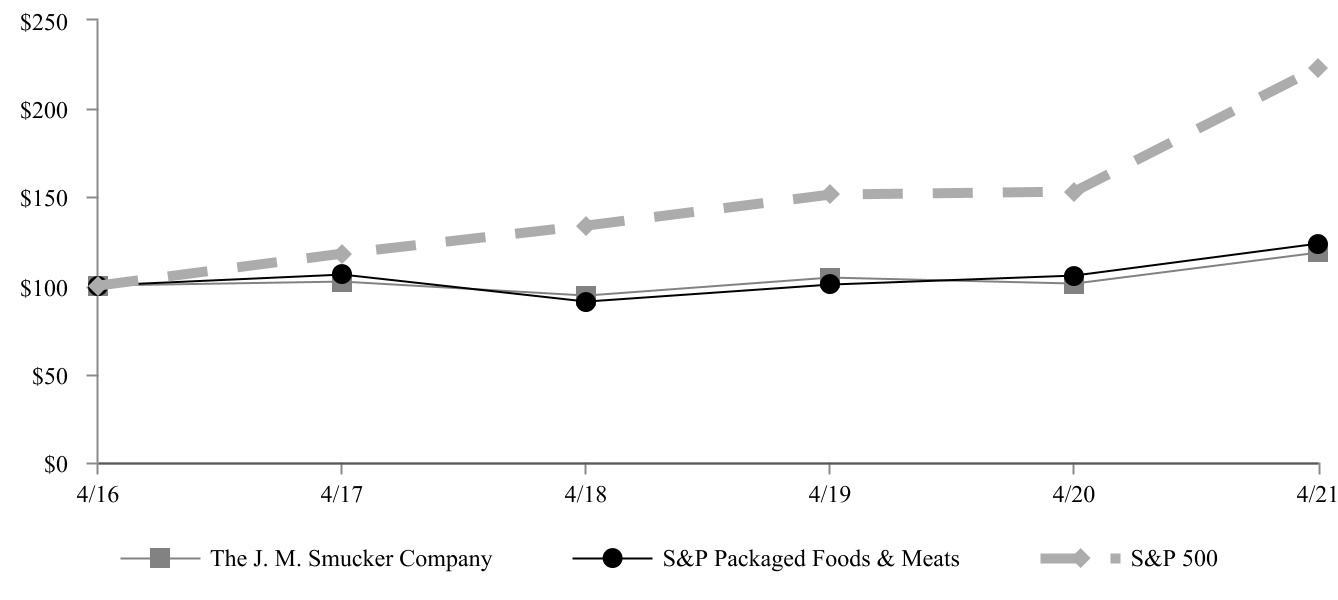
| April 30, | |||||||||||||||||||||||||||||||||||
| 2016 | 2017 | 2018 | 2019 | 2020 | 2021 | ||||||||||||||||||||||||||||||
| The J. M. Smucker Company | $ | 100.00 | $ | 101.92 | $ | 94.22 | $ | 104.38 | $ | 100.89 | $ | 118.62 | |||||||||||||||||||||||
| S&P Packaged Foods & Meats | 100.00 | 105.77 | 90.62 | 100.12 | 105.22 | 123.73 | |||||||||||||||||||||||||||||
| S&P 500 | 100.00 | 117.92 | 133.56 | 151.58 | 152.89 | 223.20 |
Copyright © 2021 Standard & Poor’s, a division of S&P Global. All rights reserved.
Item 6. [Reserved]
Item 7. Management’s Discussion and Analysis of Financial Condition and Results of Operations.
(Dollars and shares in millions, unless otherwise noted, except per share data)
Company Background
Inspired by more than 120 years of business success and five generations of family leadership, The J. M. Smucker Company makes food that people and pets love. The Company’s portfolio of 40+ brands, which are found in nearly 90 percent of U.S. homes and countless away from home dining locations, include iconic products consumers have always loved such as Folgers, Jif, and Milk-Bone, plus new favorites like Café Bustelo, Smucker’s Uncrustables, and Rachael Ray Nutrish. Over the past two decades, the Company has grown by thoughtfully acquiring leading and emerging brands, while ensuring the business has a positive impact on its 7,000+ employees, the communities it is a part of, and the planet.
We have three reportable segments: U.S. Retail Pet Foods, U.S. Retail Coffee, and U.S. Retail Consumer Foods. Effective during the first quarter of 2021, the presentation of International and Away From Home represents a combination of all other operating segments that are not individually reportable. As a result of leadership changes, these operating segments are being managed and reported separately and no longer represent a reportable segment for segment reporting purposes. Segment results for prior periods have not been modified, as the combination of these operating segments represents the previously reported International and Away From Home reportable segment.
The U.S. retail market segments in total comprised 88 percent of net sales in 2021 and represent a major portion of our strategic focus – the sale of branded food and beverage products with leadership positions to consumers through retail outlets in North America. In the U.S. retail market segments, our products are sold primarily to food retailers, club stores, discount and dollar stores, food wholesalers, online retailers, pet specialty stores, natural foods stores and distributors, drug stores, military commissaries, and mass merchandisers. International and Away From Home includes the sale of products distributed domestically and in foreign countries through retail channels and foodservice distributors and operators (e.g., health care operators, restaurants, lodging, hospitality, offices, K-12, colleges and universities, and convenience stores).
Strategic Overview
We remain rooted in our Basic Beliefs of Quality, People, Ethics, Growth, and Independence established by our founder and namesake, Jerome Smucker, more than a century ago. Today, these Basic Beliefs are the core of our unique corporate culture and serve as a foundation for decision-making and actions. We have been led by five generations of family leadership, having had only six chief executive officers in 124 years. This continuity of management and thought extends to the broader leadership team that embodies the values and embraces the business practices that have contributed to our consistent growth. Our strategic vision is to own and market a portfolio of food and beverage brands that combines number one and leading brands with emerging, on-trend brands to drive balanced, long-term growth, primarily in North America.
Our strategic growth objectives include increasing net sales by 2 percent and operating income excluding non-GAAP adjustments (“adjusted operating income”) by 5 percent on average over the long term. Related to income per diluted share excluding non-GAAP adjustments (“adjusted earnings per share”), our strategic growth objective is to achieve an average increase of 8 percent over the long term. We expect organic growth, including new products, to drive much of our top-line growth, while the contribution from acquisitions will vary from year to year. Our non-GAAP adjustments include amortization expense and impairment charges related to intangible assets; divestiture, acquisition, integration, and restructuring costs (“special project costs”); gains and losses related to the sale of a business; unallocated gains and losses on commodity and foreign currency exchange derivative activities (“unallocated derivative gains and losses”); and other one-time items that do not directly reflect ongoing operating results. Refer to “Non-GAAP Financial Measures” in this discussion and analysis for additional information. Due to the unknown and potentially prolonged impact of COVID-19, we may experience difficulties or be delayed in achieving our long-term strategies; however, we continue to evaluate the effects from COVID-19 on our long-term growth objectives.
Net sales has increased at a compound annual growth rate of 1 percent over the past five years, while adjusted operating income and adjusted earnings per share have increased at a rate of 1 percent and 4 percent, respectively, over the same period. These increases were driven by increased at-home consumption for the U.S. Retail Coffee and U.S. Retail Consumer Foods segments and the Ainsworth acquisition in 2019, partially offset by the reduction in net sales from the divestitures of the Crisco and Natural Balance businesses in 2021 and the U.S. baking business in 2019. Net cash provided by operating activities has increased at a compound annual growth rate of 1 percent over the past five years. Our cash deployment strategy is to balance reinvesting in our business through acquisitions and capital expenditures with returning cash to our shareholders
through the payment of dividends and share repurchases. Our deployment strategy also includes a significant focus on debt repayment.
On December 1, 2020, we sold the Crisco oils and shortening business to B&G Foods. The transaction included oils and shortening products sold under the Crisco brand, primarily in the U.S. and Canada, certain trademarks and licensing agreements, dedicated manufacturing and warehouse facilities located in Cincinnati, Ohio, and approximately 160 employees who supported the Crisco business. Under our ownership, the business generated net sales of $198.9 and $269.2 in 2021 and 2020, respectively, primarily included in the U.S. Retail Consumer Foods segment. We received net proceeds from the divestiture of $530.2, which were net of cash transaction costs and included a working capital adjustment. Upon completion of the transaction, we recognized a pre-tax gain of $114.8 during 2021, which is included in other operating expense (income) – net within the Statement of Consolidated Income.
On January 29, 2021, we sold the Natural Balance premium pet food business to Nexus. The transaction included pet food products sold under the Natural Balance brand, certain trademarks and licensing agreements, and select employees who supported the Natural Balance business. Under our ownership, the business generated net sales of $156.7 and $222.8 in 2021 and 2020, respectively, included in the U.S. Retail Pet Foods segment. We received net proceeds from the divestiture of $33.8, which were net of cash transaction costs and included a working capital adjustment. Upon completion of the transaction, we recognized a pre-tax loss of $89.5 during 2021, which is included in other operating expense (income) – net within the Statement of Consolidated Income.
COVID-19
The spread of COVID-19 throughout the United States and the international community has had, and will continue to have, an impact on financial markets, economic conditions, and portions of our business and industry.
During 2021, state governments reopened their economies, while adhering to new guidelines and enhanced safety measures, such as social distancing and face mask protocols. While there has been a general downward trend in U.S. cases in calendar year 2021, consumers continue to stay at home more frequently as a precaution, and as a result, at-home food consumption and demand remains elevated. We anticipate these changes in consumer behavior to continue into 2022, dependent upon continued vaccine availa
Showing the first 8K of 69K characters. Open the full section
Item 7A. Quantitative and Qualitative Disclosures About Market Risk.
DERIVATIVE FINANCIAL INSTRUMENTS AND MARKET RISK
The following discussions about our market risk disclosures involve forward-looking statements. Actual results could differ from those projected in the forward-looking statements. We are exposed to market risk related to changes in interest rates, commodity prices, and foreign currency exchange rates.
Interest Rate Risk: The fair value of our cash and cash equivalents at April 30, 2021, approximates carrying value. We are exposed to interest rate risk with regard to existing debt consisting of fixed- and variable-rate maturities. Our interest rate exposure primarily includes U.S. Treasury rates, LIBOR, and commercial paper rates in the U.S. The Financial Conduct Authority in the United Kingdom has stated that it will not require banks to submit LIBOR beyond calendar year 2021. We do not anticipate a significant impact to our financial position as a result of this action given our current mix of fixed- and variable-rate debt.
We utilize derivative instruments to manage interest rate risk associated with anticipated debt transactions, as well as to manage changes in the fair value of our long-term debt. At the inception of an interest rate contract, the instrument is evaluated and documented for qualifying hedge accounting treatment. If the contract is designated as a cash flow hedge, the mark-to-market gains or losses on the contract are deferred and included as a component of accumulated other comprehensive income (loss), and reclassified to interest expense in the period during which the hedged transaction affects earnings. If the contract is designated as a fair value hedge, the contract is recognized at fair value on the balance sheet, and changes in the fair value are recognized in interest expense. Generally, changes in the fair value of the contract are equal to changes in the fair value of the underlying debt and have no net impact on earnings.
In 2020, we terminated interest rate contracts concurrent with the pricing of the Senior Notes due March 15, 2030, and March 15, 2050. They were designated as cash flow hedges and were used to manage our exposure to interest rate volatility associated with the anticipated debt financing. The termination resulted in a pre-tax loss of $239.8, which was deferred and included as a component of accumulated other comprehensive income (loss) and is being amortized as interest expense over the life of the debt.
In 2015, we terminated the interest rate swap on the Senior Notes due October 15, 2021, which was designated as a fair value hedge and used to hedge against the changes in the fair value of the debt. As a result of the early termination, we received $58.1 in cash, which included $4.6 of accrued and prepaid interest and a $53.5 benefit that was deferred as a component of the carrying value of the long-term debt and is being recognized ratably as a reduction to interest expense over the life of the debt. At April 30, 2021, the remaining benefit of $4.0 was recorded as an increase in the long-term debt balance.
In measuring interest rate risk by the amount of net change in the fair value of our financial liabilities, a hypothetical
100-basis-point decrease in interest rates at April 30, 2021, would increase the fair value of our long-term debt by $386.0.
Commodity Price Risk: We use certain raw materials and other commodities that are subject to price volatility caused by supply and demand conditions, political and economic variables, weather, investor speculation, and other unpredictable factors. To manage the volatility related to anticipated commodity purchases, we use derivatives with maturities of generally less than one year. We do not qualify commodity derivatives for hedge accounting treatment. As a result, the gains and losses on all commodity derivatives are immediately recognized in cost of products sold.
The following sensitivity analysis presents our potential loss of fair value resulting from a hypothetical 10 percent change in market prices related to commodities.
| Year Ended April 30, | |||||||||||
| 2021 | 2020 | ||||||||||
| High | $ | 47.5 | $ | 37.8 | |||||||
| Low | 11.7 | 14.5 | |||||||||
| Average | 29.0 | 26.9 |
The estimated fair value was determined using quoted market prices and was based on our net derivative position by commodity for the previous four quarters. The calculations are not intended to represent actual losses in fair value that we expect to incur. In practice, as markets move, we actively manage our risk and adjust hedging strategies as appropriate. The commodities hedged have a high inverse correlation to price changes of the derivative instrument; thus, we would expect that any gain or loss in the estimated fair value of these derivatives would generally be offset by an increase or decrease in the estimated fair value of the underlying exposures.
Foreign Currency Exchange Risk: We have operations outside the U.S. with foreign currency denominated assets and liabilities, primarily denominated in Canadian currency. Because we have foreign currency denominated assets and liabilities, financial exposure may result, primarily from the timing of transactions and the movement of exchange rates. The foreign currency balance sheet exposures as of April 30, 2021, are not expected to result in a significant impact on future earnings or
cash flows.
We utilize foreign currency derivatives to manage the effect of foreign currency exchange fluctuations on future cash payments primarily related to purchases of certain raw materials and finished goods. The contracts generally have maturities of less than one year. We do not qualify instruments used to manage foreign currency exchange exposures for hedge accounting treatment. Therefore, the change in value of these instruments is immediately recognized in cost of products sold. Based on our hedged foreign currency positions as of April 30, 2021, a hypothetical 10 percent change in exchange rates would not materially impact the fair value.
Revenues from customers outside the U.S., subject to foreign currency exchange, represented 5 percent of net sales during 2021. Thus, certain revenues and expenses have been, and are expected to be, subject to the effect of foreign currency fluctuations, and these fluctuations may have an impact on operating results.
Item 8. Financial Statements and Supplementary Data.
THE J. M. SMUCKER COMPANY
INDEX TO FINANCIAL STATEMENTS
| Page No. | |||||
| Report of Management on Internal Control Over Financial Reporting | 38 | ||||
| Report of Independent Registered Public Accounting Firm on Internal Control Over Financial Reporting | 39 | ||||
| Report of Independent Registered Public Accounting Firm on the Consolidated Financial Statements | 40 | ||||
| Report of Management on Responsibility for Financial Reporting | 43 | ||||
| Consolidated Balance Sheets at April 30, 2021 and 2020 | 45 | ||||
| For the years ended April 30, 2021, 2020, and 2019: | |||||
| Statements of Consolidated Income | 44 | ||||
| Statements of Consolidated Comprehensive Income | 44 | ||||
| Statements of Consolidated Cash Flows | 46 | ||||
| Statements of Consolidated Shareholders’ Equity | 47 | ||||
| Notes to Consolidated Financial Statements | 48 |
REPORT OF MANAGEMENT ON INTERNAL CONTROL
OVER FINANCIAL REPORTING
Shareholders
The J. M. Smucker Company
Management is responsible for establishing and maintaining adequate accounting and internal control systems over financial reporting, as such term is defined in Rules 13a-15(f) and 15d-15(f) under the Securities and Exchange Act of 1934, as amended. Our internal control system is designed to provide reasonable assurance that we have the ability to record, process, summarize, and report reliable financial information on a timely basis.
Our management, with the participation of the principal financial officer and principal executive officer, assessed the effectiveness of the internal control over financial reporting as of April 30, 2021. In making this assessment, we used the criteria established in Internal Control – Integrated Framework issued by the Committee of Sponsoring Organizations of the Treadway Commission (2013 Framework) (“the COSO criteria”).
Based on our assessment of internal control over financial reporting under the COSO criteria, we concluded the internal control over financial reporting was effective as of April 30, 2021.
Ernst & Young LLP, an independent registered public accounting firm, audited the effectiveness of our internal control over financial reporting as of April 30, 2021, and their report thereon is included on page 39 of this report.
| Mark T. Smucker | Tucker H. Marshall | |||||||||||||
| President and | Chief Financial Officer | |||||||||||||
| Chief Executive Officer |
REPORT OF INDEPENDENT REGISTERED PUBLIC ACCOUNTING FIRM
ON INTERNAL CONTROL OVER FINANCIAL REPORTING
Board of Directors and Shareholders
The J. M. Smucker Company
Opinion on Internal Control Over Financial Reporting
We have audited The J. M. Smucker Company’s internal control over financial reporting as of April 30, 2021, based on criteria established in Internal Control – Integrated Framework issued by the Committee of Sponsoring Organizations of the Treadway Commission (2013 framework) (“the COSO criteria”). In our opinion, The J. M. Smucker Company (the “Company”) maintained, in all material respects, effective internal control over financial reporting as of April 30, 2021, based on the COSO criteria.
We also have audited, in accordance with the standards of the Public Company Accounting Oversight Board (United States) (“PCAOB”), the 2021 consolidated financial statements of the Company and our report dated June 17, 2021 expressed an unqualified opinion thereon.
Basis for Opinion
The Company’s management is responsible for maintaining effective internal control over financial reporting and for its assessment of the effectiveness of internal control over financial reporting included in the accompanying Report of Management on Internal Control Over Financial Reporting. Our responsibility is to express an opinion on the Company’s internal control over financial reporting based on our audit. We are a public accounting firm registered with the PCAOB and are required to be independent with respect to the Company in accordance with the U.S. federal securities laws and the applicable rules and regulations of the Securities and Exchange Commission and the PCAOB.
We conducted our audit in accordance with the standards of the PCAOB. Those standards require that we plan and perform the audit to obtain reasonable assurance about whether effective internal control over financial reporting was maintained in all material respects.
Our audit included obtaining an understanding of internal control over financial reporting, assessing the risk that a material weakness exists, testing and evaluating the design and operating effectiveness of internal control based on the assessed risk, and performing such other procedures as we considered necessary in the circumstances. We believe that our audit provides a reasonable basis for our opinion.
Definition and Limitations of Internal Control Over Financial Reporting
A company’s internal control over financial reporting is a process designed to provide reasonable assurance regarding the reliability of financial reporting and the preparation of financial statements for external purposes in accordance with generally accepted accounting principles. A company’s internal control over financial reporting includes those policies and procedures that (1) pertain to the maintenance of records that, in reasonable detail, accurately and fairly reflect the transactions and dispositions of the assets of the company; (2) provide reasonable assurance that transactions are recorded as necessary to permit preparation of financial statements in accordance with generally accepted accounting principles, and that receipts and expenditures of the company are being made only in accordance with authorizations of management and directors of the company; and (3) provide reasonable assurance regarding prevention or timely detection of unauthorized acquisition, use, or disposition of the company’s assets that could have a material effect on the financial statements.
Because of its inherent limitations, internal control over financial reporting may not prevent or detect misstatements. Also, projections of any evaluation of effectiveness to future periods are subject to the risk that controls may become inadequate because of changes in conditions, or that the degree of compliance with the policies or procedures may deteriorate.
/s/ Ernst & Young LLP
Akron, Ohio
June 17, 2021
REPORT OF INDEPENDENT REGISTERED PUBLIC ACCOUNTING FIRM
ON THE CONSOLIDATED FINANCIAL STATEMENTS
Board of Directors and Shareholders
The J. M. Smucker Company
Opinion on the Financial Statements
We have audited the accompanying consolidated balance sheets of The J. M. Smucker Company (the “Company”) as of April 30, 2021 and 2020, the related statements of consolidated income, comprehensive income, shareholders’ equity, and cash flows for each of the three years in the period ended April 30, 2021, and the related notes (collectively referred to as the “consolidated financial statements”). In our opinion, the consolidated financial statements present fairly, in all material respects, the financial position of the Company at April 30, 2021 and 2020, and the results of
Showing the first 8K of 189K characters. Open the full section
Item 9. Changes in and Disagreements with Accountants on Accounting and Financial Disclosure.
None.
Item 9A. Controls and Procedures.
Evaluation of Disclosure Controls and Procedures: Management, including the principal executive officer and principal financial officer, evaluated the effectiveness of our disclosure controls and procedures (as defined in Rule 13a-15(e) or 15d-15(e) under the Exchange Act), as of April 30, 2021 (the “Evaluation Date”). Based on that evaluation, the principal executive officer and principal financial officer have concluded that, as of the Evaluation Date, our disclosure controls and procedures were effective in ensuring that information required to be disclosed in reports that we file or submit under the Exchange Act is (1) recorded, processed, summarized, and reported within the time periods specified in SEC rules and forms, and (2) accumulated and communicated to management, including the chief executive officer and chief financial officer, as appropriate to allow timely decisions regarding required disclosure.
Changes in Internal Controls: There were no changes in internal control over financial reporting that occurred during the fourth quarter ended April 30, 2021, that have materially affected, or are reasonably likely to materially affect, our internal control over financial reporting.
Item 9B. Other Information.
None.
PART III
Item 10. Directors, Executive Officers and Corporate Governance.
The information required by this Item as to the directors of the Company, the Audit Committee, the Audit Committee financial expert, and compliance with Section 16(a) of the Exchange Act is incorporated herein by reference to the information set forth under the captions “Election of Directors,” “Corporate Governance,” “Board and Committee Meetings,” and “Ownership of Common Shares” in our definitive Proxy Statement for the Annual Meeting of Shareholders to be held on August 18, 2021. The information required by this Item as to the executive officers of the Company is incorporated herein by reference to Part I, Item 1 in this Annual Report on Form 10-K**.**
The Board has adopted a Code of Business Conduct and Ethics, last revised January 2018, which applies to our directors, principal executive officer, and principal financial and accounting officer. The Board has adopted charters for each of the Audit, Executive Compensation, and Nominating, Governance, and Corporate Responsibility committees and has also adopted Corporate Governance Guidelines. Copies of these documents are available on our website (investors.jmsmucker.com/governance-documents).
Item 11. Executive Compensation.
The information required by this Item is incorporated herein by reference to the information set forth under the captions “Executive Compensation,” “Board and Committee Meetings,” and “Compensation Committee Interlocks and Insider Participation” in our definitive Proxy Statement for the Annual Meeting of Shareholders to be held on August 18, 2021.
Item 12. Security Ownership of Certain Beneficial Owners and Management and Related Stockholder Matters.
The information required by this Item is incorporated herein by reference to the information set forth under the captions “Ownership of Common Shares” and “Equity Compensation Plan Information” in our definitive Proxy Statement for the Annual Meeting of Shareholders to be held on August 18, 2021.
Item 13. Certain Relationships and Related Transactions, and Director Independence.
The information required by this Item is incorporated herein by reference to the information set forth under the captions “Corporate Governance” and “Related Party Transactions” in our definitive Proxy Statement for the Annual Meeting of Shareholders to be held on August 18, 2021.
Item 14. Principal Accountant Fees and Services.
The information required by this Item is incorporated herein by reference to the information set forth under the captions “Service Fees Paid to the Independent Registered Public Accounting Firm” and “Audit Committee Pre-Approval Policies and Procedures” in our definitive Proxy Statement for the Annual Meeting of Shareholders to be held on August 18, 2021.
PART IV
Item 15. Exhibits and Financial Statement Schedules.
| (a)(1) | Financial Statements: | |||||||
| See the Index to Financial Statements on page 37 of this Annual Report on Form 10-K. | ||||||||
| (a)(2) | Financial Statement Schedules: | |||||||
| Financial statement schedules are omitted because they are not applicable or because the information required is set forth in the Consolidated Financial Statements or notes thereto. | ||||||||
| (a)(3) | Exhibits: | |||||||
| The following exhibits are either attached or incorporated herein by reference to another filing with the SEC. |
- Identifies exhibits that consist of a management contract or compensatory plan or arrangement.
SIGNATURES
Pursuant to the requirements of Section 13 or 15(d) of the Securities Exchange Act of 1934, the registrant has duly caused this report to be signed on its behalf by the undersigned, thereunto duly authorized.
| Date: June 17, 2021 | The J. M. Smucker Company | |||||||
| /s/ Tucker H. Marshall | ||||||||
| By: | Tucker H. Marshall | |||||||
| Chief Financial Officer |
Pursuant to the requirements of the Securities Exchange Act of 1934, this report has been signed below by the following persons on behalf of the registrant and in the capacities and on the dates indicated.
| * | ||||||||||||||
| Mark T. Smucker | President and Chief Executive Officer and Director (Principal Executive Officer) | June 17, 2021 | ||||||||||||
| /s/ Tucker H. Marshall | ||||||||||||||
| Tucker H. Marshall | Chief Financial Officer (Principal Financial Officer and Principal Accounting Officer) | June 17, 2021 | ||||||||||||
| * | ||||||||||||||
| Timothy P. Smucker | Chairman Emeritus | June 17, 2021 | ||||||||||||
| * | ||||||||||||||
| Richard K. Smucker | Executive Chairman | June 17, 2021 | ||||||||||||
| * | ||||||||||||||
| Susan E. Chapman-Hughes | Director | June 17, 2021 | ||||||||||||
| * | ||||||||||||||
| Paul J. Dolan | Director | June 17, 2021 | ||||||||||||
| * | ||||||||||||||
| Jay L. Henderson | Director | June 17, 2021 | ||||||||||||
| * | ||||||||||||||
| Kirk L. Perry | Director | June 17, 2021 | ||||||||||||
| * | ||||||||||||||
| Sandra Pianalto | Director | June 17, 2021 | ||||||||||||
| * | ||||||||||||||
| Nancy Lopez Russell | Director | June 17, 2021 | ||||||||||||
| * | ||||||||||||||
| Alex Shumate | Director | June 17, 2021 | ||||||||||||
| * | ||||||||||||||
| Jodi L. Taylor | Director | June 17, 2021 | ||||||||||||
| * | ||||||||||||||
| Dawn C. Willoughby | Director | June 17, 2021 |
| * | The undersigned, by signing her name hereto, does sign and execute this report pursuant to the powers of attorney executed by the above-named officers and directors of the registrant, which are being filed herewith with the Securities and Exchange Commission on behalf of such officers and directors. |
| Date: June 17, 2021 | /s/ Jeannette L. Knudsen | |||||||||||||
| By: | Jeannette L. Knudsen Attorney-in-Fact |