 filings.tools
J.M. Smucker 10-K 2022-04-30
Filed 2022-06-16. 21 sections, 432K characters. Original on sec.gov · Markdown · JSON
Cover and table of contents
UNITED STATES
SECURITIES AND EXCHANGE COMMISSION
WASHINGTON, D.C. 20549
FORM 10-K
| ☒ | ANNUAL REPORT PURSUANT TO SECTION 13 OR 15(d) OF THE SECURITIES EXCHANGE ACT OF 1934 |
For the fiscal year ended April 30, 2022
or
| ☐ | TRANSITION REPORT PURSUANT TO SECTION 13 OR 15(d) OF THE SECURITIES EXCHANGE ACT OF 1934 |
For the transition period from to
Commission file number 001-5111
THE J. M. SMUCKER COMPANY
(Exact name of registrant as specified in its charter)
| Ohio | 34-0538550 | ||||||||||||||||
| (State or other jurisdiction of incorporation or organization) | (I.R.S. Employer Identification No.) | ||||||||||||||||
| One Strawberry Lane | |||||||||||||||||
| Orrville, | Ohio | 44667-0280 | |||||||||||||||
| (Address of principal executive offices) | (Zip code) | ||||||||||||||||
| Registrant’s telephone number, including area code | (330) | 682-3000 | |||||||||||||||
| Securities registered pursuant to Section 12(b) of the Act: | |||||||||||||||||
| Title of each class | Trading symbol | Name of each exchange on which registered | |||||||||||||||
| Common shares, no par value | SJM | New York Stock Exchange | |||||||||||||||
Securities registered pursuant to Section 12(g) of the Act: None
Indicate by check mark if the registrant is a well-known seasoned issuer, as defined in Rule 405 of the Securities Act. Yes ☒ No ☐
Indicate by check mark if the registrant is not required to file reports pursuant to Section 13 or Section 15(d) of the Act. Yes ☐ No ☒
Indicate by check mark whether the registrant (1) has filed all reports required to be filed by Section 13 or 15(d) of the Securities Exchange Act of 1934 during the preceding 12 months (or for such shorter period that the registrant was required to file such reports), and (2) has been subject to such filing requirements for the past 90 days. Yes ☒ No ☐
Indicate by check mark whether the registrant has submitted electronically every Interactive Data File required to be submitted pursuant to Rule 405 of Regulation S-T (§232.405 of this chapter) during the preceding 12 months (or for such shorter period that the registrant was required to submit such files). Yes ☒ No ☐
Indicate by check mark whether the registrant is a large accelerated filer, an accelerated filer, a non-accelerated filer, a smaller reporting company, or an emerging growth company. See the definitions of “large accelerated filer,” “accelerated filer,” “smaller reporting company,” and “emerging growth company” in Rule 12b-2 of the Exchange Act. (Check one):
| Large Accelerated Filer | ☒ | Accelerated filer | ☐ | |||||||||||||||||
| Non-accelerated filer | ☐ | Smaller reporting company | ☐ | |||||||||||||||||
| Emerging growth company | ☐ |
If an emerging growth company, indicate by check mark if the registrant has elected not to use the extended transition period for complying with any new or revised financial accounting standards provided pursuant to Section 13(a) of the Exchange Act. ☐
Indicate by checkmark whether the registrant has filed a report on and attestation to its management’s assessment of the effectiveness of its internal control over financial reporting under Section 404(b) of the Sarbanes-Oxley Act (15 U.S.C. 7262(b)) by the registered public accounting firm that prepared or issued its audit report. ☒
Indicate by check mark whether the registrant is a shell company (as defined in Rule 12b-2 of the Exchange Act). Yes ☐ No ☒
The aggregate market value of the common shares held by nonaffiliates of the registrant at October 31, 2021, was $12,691,431,980.
As of June 9, 2022, 106,457,951 common shares of The J. M. Smucker Company were issued and outstanding.
DOCUMENTS INCORPORATED BY REFERENCE
Certain sections of the registrant’s definitive Proxy Statement to be filed in connection with its Annual Meeting of Shareholders to be held on August 17, 2022, are incorporated by reference into Part III of this Annual Report on Form 10-K.
TABLE OF CONTENTS
| PART I. | Page No. | |||||||
| Item 1. | Business | 2 | ||||||
| Item 1A. | Risk Factors | 9 | ||||||
| Item 1B. | Unresolved Staff Comments | 22 | ||||||
| Item 2. | Properties | 23 | ||||||
| Item 3. | Legal Proceedings | 23 | ||||||
| Item 4. | Mine Safety Disclosures | 23 | ||||||
| PART II. | ||||||||
| Item 5. | Market for Registrant’s Common Equity, Related Stockholder Matters and Issuer Purchases of Equity Securities | 24 | ||||||
| Item 6. | [Reserved] | 25 | ||||||
| Item 7. | Management’s Discussion and Analysis of Financial Condition and Results of Operations | 25 | ||||||
| Item 7A. | Quantitative and Qualitative Disclosures About Market Risk | 41 | ||||||
| Item 8. | Financial Statements and Supplementary Data | 43 | ||||||
| Item 9. | Changes in and Disagreements with Accountants on Accounting and Financial Disclosures | 85 | ||||||
| Item 9A. | Controls and Procedures | 85 | ||||||
| Item 9B. | Other Information | 85 | ||||||
| PART III. | ||||||||
| Item 10. | Directors, Executive Officers and Corporate Governance | 86 | ||||||
| Item 11. | Executive Compensation | 86 | ||||||
| Item 12. | Security Ownership of Certain Beneficial Owners and Management and Related Stockholder Matters | 86 | ||||||
| Item 13. | Certain Relationships and Related Transactions, and Director Independence | 86 | ||||||
| Item 14. | Principal Accountant Fees and Services | 86 | ||||||
| PART IV. | ||||||||
| Item 15. | Exhibits and Financial Statement Schedules | 87 | ||||||
| Signatures | 90 |
PART I
Item 1. Business.
The Company: The J. M. Smucker Company (“Company,” “registrant,” “we,” “us,” or “our”), often referred to as Smucker’s (a registered trademark), was established in 1897 and incorporated in Ohio in 1921. We operate principally in one industry, the manufacturing and marketing of branded food and beverage products on a worldwide basis, although the majority of our sales are in the U.S. Our operations outside the U.S. are principally in Canada, although products are exported to other countries as well. Net sales outside the U.S., subject to foreign currency translation, represented 5 percent of consolidated net sales for 2022. Our branded food and beverage products include a strong portfolio of trusted, iconic, market-leading brands that are sold to consumers through retail outlets in North America.
We have three reportable segments: U.S. Retail Pet Foods, U.S. Retail Coffee, and U.S. Retail Consumer Foods. The U.S. retail market segments in total comprised 87 percent of 2022 consolidated net sales and represent a major portion of our strategic focus – the sale of branded food and beverage products with leadership positions to consumers through retail outlets in North America. International and Away From Home represents sales outside of the U.S. retail market segments. For additional information on our reportable segments, see Note 4: Reportable Segments.
On January 31, 2022, we sold the natural beverage and grains businesses to Nexus Capital Management LP (“Nexus”). The transaction included products sold under the R.W. Knudsen*®* and TruRoots*®* brands, inclusive of certain trademarks, a licensing agreement for Santa Cruz Organic*®* beverages, dedicated manufacturing and distribution facilities in Chico, California, and Havre de Grace, Maryland, and approximately 150 employees who supported the natural beverage and grains businesses. The transaction did not include Santa Cruz Organic nut butters, fruit spreads, syrups, or applesauce. Under our ownership, the businesses generated net sales of $106.7, $143.4, and $131.6 in 2022, 2021, and 2020, respectively, primarily included in the U.S. Retail Consumer Foods segment.
On December 1, 2021, we sold the private label dry pet food business to Diamond Pet Foods, Inc. (“Diamond Pet Foods”). The transaction included dry pet food products sold under private label brands, a dedicated manufacturing facility located in Frontenac, Kansas, and approximately 220 employees who supported the private label dry pet food business. The transaction did not include any branded products or our private label wet pet food business. Under our ownership, the business generated net sales of $62.3, $94.0, and $120.6 in 2022, 2021, and 2020, respectively, included in the U.S. Retail Pet Foods segment.
On January 29, 2021, we sold the Natural Balance® premium pet food business to Nexus. The transaction included pet food products sold under the Natural Balance brand, certain trademarks and licensing agreements, and select employees who supported the Natural Balance business. Under our ownership, the business generated net sales of $156.7 and $222.8 in 2021 and 2020, respectively, included in the U.S. Retail Pet Foods segment.
On December 1, 2020, we sold the Crisco® oils and shortening business to B&G Foods, Inc. (“B&G Foods”). The transaction included oils and shortening products sold under the Crisco brand, primarily in the U.S. and Canada, certain trademarks and licensing agreements, dedicated manufacturing and warehouse facilities located in Cincinnati, Ohio, and approximately 160 employees who supported the Crisco business. Under our ownership, the business generated net sales of $198.9 and $269.2 in 2021 and 2020, respectively, primarily included in the U.S. Retail Consumer Foods segment.
For additional information on these divestitures, see Note 3: Divestitures.
Principal Products: Our principal products as of April 30, 2022, are coffee, cat food, pet snacks, dog food, peanut butter, frozen handheld products, fruit spreads, portion control products, juices and beverages, as well as baking mixes and ingredients. Product sales information for the years 2022, 2021, and 2020 is included within Note 4: Reportable Segments.
In the U.S. retail market segments, our products are primarily sold through a combination of direct sales and brokers to food retailers, club stores, discount and dollar stores, online retailers, pet specialty stores, natural foods stores and distributors, drug stores, military commissaries, and mass merchandisers. In International and Away From Home, our products are distributed domestically and in foreign countries through retail channels and foodservice distributors and operators (e.g., health care operators, restaurants, lodging, hospitality, offices, K-12, colleges and universities, and convenience stores).
Sources and Availability of Raw Materials: The raw materials used in each of our segments are primarily commodities, agricultural-based products, and packaging materials. Green coffee, peanuts, protein meals, oils and fats, grains, sweeteners, fruit, and other ingredients are obtained from various suppliers. The availability, quality, and costs of many of these
commodities have fluctuated, and may continue to fluctuate over time, partially driven by the novel coronavirus (“COVID-19”) pandemic. Futures, basis, options, and fixed price contracts are used to manage price volatility for a significant portion of our commodity costs. Green coffee, along with certain other raw materials, is sourced solely from foreign countries and its supply and price is subject to high volatility due to factors such as weather, global supply and demand, plant disease, investor speculation, and political and economic conditions in the source countries. We source peanuts, protein meals, and oils and fats mainly from North America. The principal packaging materials we use are plastic, glass, metal cans, caps, carton board, and corrugate. For additional information on the commodities we purchase, see “Commodities Overview” within Management’s Discussion and Analysis of Financial Condition and Results of Operations of this Annual Report on Form 10-K.
Raw materials are generally available from numerous sources, although we have elected to source certain plastic packaging materials and finished goods, such as K-Cup® pods, our Pup-Peroni*®* dog snacks, and liquid coffee, from single sources of supply pursuant to long-term contracts. While availability may vary year-to-year, we believe that we will continue to obtain adequate supplies and that alternatives to single-sourced materials are available. We have not historically encountered significant shortages of key raw materials. We consider our relationships with key raw material suppliers to be in good standing.
Trademarks and Patents: Many of our products are produced and sold under various patents or patents pending, and marketed under trademarks owned or licensed by us or one of our subsidiaries. Our major trademarks as of April 30, 2022, are listed below.
| Primary Reportable Segment | Major Trademark | |||||||
| U.S. Retail Pet Foods | Meow Mix*®, Rachael Ray®* Nutrish*®, Milk-Bone®,* 9Lives*®,* Kibbles ‘n Bits*®**,* Pup-Peroni, and Nature’s Recipe*®* | |||||||
| U.S. Retail Coffee | Folgers*®,* *Dunkin’®**,* and Café Bustelo*®* | |||||||
| U.S. Retail Consumer Foods | Uncrustables*®,* Jif*®,* and Smucker’s*®* | |||||||
| Other (A) | Smucker’s and Folgers |
(A) Represents the combined International and Away From Home operating segments.
Dunkin’ is a trademark of DD IP Holder LLC for packaged coffee products, including K-Cup® pods, sold in retail channels such as grocery stores, mass merchandisers, club stores, e-commerce, and drug stores. Information included in this document does not pertain to coffee or other products for sale in Dunkin’ restaurants. The terms of the Dunkin’ license includes the payment of royalties to an affiliate of DD IP Holder LLC and other financial commitments by the Company. The Dunkin’ license is in effect until January 1, 2039. Keurig® and K-Cup® are trademarks of Keurig Green Mountain, Inc. (“Keurig”), used with permission.
We utilize Rachael Ray’s image and likeness and related Rachael Ray trademarks for premium pet food and pet snacks under an exclusive license which expires in 2063. The terms of the license include the payment of royalties to The Rachael Ray Foundation. Rachael Ray is a trademark of Ray Marks II LLC. In addition, we and our subsidiaries license the use of several other trademarks, none of which are individually material to our business.
Slogans or designs considered to be important trademarks include, without limitation, “With A Name Like Smucker’s, It Has To Be Good®,” “The Best Part of Wakin’ Up Is Folgers In Your Cup®,” “Choosy Moms Choose Jif®,” “That Jif’ing GoodTM,” “The Only One Cats Ask For By Name®,” the Smucker’s banner, the Crock Jar shape, the Gingham design, the Jif Color Banner design, the Café Bustelo Angelina design, and the Milk-Bone, Meow Mix, and 9Lives logos.
We own many patents worldwide in addition to proprietary trade secrets, technology, know-how processes, and other intellectual property rights that are not registered.
We consider all of our owned and licensed intellectual property, taken as a whole, to be essential to our business.
Seasonality: The U.S. Retail Pet Foods, U.S. Retail Coffee, and U.S. Retail Consumer Foods segments do not experience significant seasonality, as demand for our products is generally consistent throughout the year.
Customers: Sales to Walmart Inc. and subsidiaries amounted to 34 percent of net sales in 2022 and 32 percent of net sales in both 2021 and 2020. These sales are primarily included in our U.S. retail market segments. No other customer exceeded 10 percent of net sales for any year.
During 2022, our top 10 customers, collectively, accounted for approximately 60 percent of consolidated net sales. Supermarkets, warehouse clubs, and food distributors continue to consolidate, and we expect that a significant portion of our revenues will continue to be derived from a limited number of customers. Although the loss of any large customer for an extended length of time could negatively impact our sales and profits, we do not anticipate that this will occur to a significant extent due to strong consumer demand for our brands.
Government Business: No material portion of our business is subject to renegotiation of profits or termination of contracts at the election of the government.
Competition: We are the branded market leader in the coffee, dog snacks, peanut butter, and fruit spreads categories in the U.S. In Canada, we are the branded market leader in the pickles, flour, fruit spreads, canned milk, and ice cream toppings categories. Our business is highly competitive as all of our brands compete for retail shelf space with other branded products as well as private label products.
In order to remain competitive, companies in the food industry need to consider emerging consumer preferences, technological advances, product and packaging innovations, and the growth of certain retail channels, such as the
e-commerce market. The primary ways in which products and brands are distinguished are brand recognition, product quality, price, packaging, new product introductions, nutritional value, convenience, advertising, promotion, and the ability to identify and satisfy consumer preferences. Positive factors pertaining to our competitive position include well-recognized brands, high-quality products, consumer trust, experienced brand and category management, a single national grocery broker in the U.S., varied product offerings, product innovation, good customer service, and an integrated distribution network.
The packaged foods industry has been challenged by a general decline in sales volume in the center of the store. However, there has been a recent increase in sales primarily driven by changes in consumer behaviors, including employees working at home more frequently as a result of the pandemic. Certain evolving consumer trends have contributed to the longer-term decline, such as a heightened focus on health and wellness, an increased desire for fresh foods, and the growing impact of social media and e-commerce on consumer behavior. To address these dynamics, we continue to focus on innovation with an increased emphasis on products that satisfy evolving consumer trends.
In addition, private label continues to be a competitor in many of the categories in which we compete, partially due to improvements in private label quality and the increased emphasis of store brands by retailers in an effort to cultivate customer loyalty. In our total U.S. retail categories, private label held a 11.5 dollar average market share during the 52 weeks ended April 17, 2022, as compared to a 12.2 dollar average market share during the same period in the prior year. We believe that both private label and leading brands play an important role in the categories in which we compete, appealing to different consumer segments. We closely monitor the price gap, or price premium, between our brands and private label brands, with the view that value is about more than price and the expectation that number one brands will continue to be an integral part of consumers’ shopping baskets.
Our primary brands and major competitors as of April 30, 2022, are listed below.
| Our Primary Products | Our Primary Brands | Competing Brands | Competitors | ||||||||
| U.S. Retail Pet Foods | |||||||||||
| Mainstream pet food | Meow Mix, 9Lives, and Kibbles ‘n Bits | Dog Chow (A), Beneful, Cat Chow (A), Friskies, Kit & Kaboodle, and Fancy Feast | Nestlé Purina PetCare Company | ||||||||
| Pedigree, Iams, and Sheba | Mars, Incorporated | ||||||||||
| Pet snacks | Milk-Bone (A) and Pup-Peroni | Beggin’ Strips | Nestlé Purina PetCare Company | ||||||||
| Nudges | General Mills, Inc. | ||||||||||
| Dentastix and Greenies | Mars, Incorporated | ||||||||||
| Premium pet food | Rachael Ray Nutrish and Nature’s Recipe | Blue Buffalo (A) | General Mills, Inc. | ||||||||
| Nutro | Mars, Incorporated | ||||||||||
| Hill’s | Hill’s Pet Nutrition, Inc. | ||||||||||
| Pro Plan, ONE, and Merrick | Nestlé Purina PetCare Company | ||||||||||
| U.S. Retail Coffee | |||||||||||
| Mainstream roast and ground coffee | Folgers (A) and Café Bustelo | Maxwell House and Yuban | The Kraft Heinz Company | ||||||||
| Private Label Brands | Various | ||||||||||
| McCafé | Keurig Dr. Pepper | ||||||||||
| Cafe La Llave | F. Gaviña & Sons, Inc. | ||||||||||
| Single serve coffee - K-Cup® | Dunkin’, Folgers, Café Bustelo, and 1850*®* | Green Mountain Coffee (A) , Donut Shop, and McCafé | Keurig Dr. Pepper | ||||||||
| Starbucks | Nestlé S.A. | ||||||||||
| Private Label Brands | Various | ||||||||||
| Maxwell House and Gevalia | The Kraft Heinz Company | ||||||||||
| Premium coffee | Dunkin’ and 1850 | Starbucks (A) and Seattle’s Best Coffee | Nestlé S.A. | ||||||||
| Peet’s Coffee & Tea | JDE Peet’s N.V. | ||||||||||
| Private Label Brands | Various | ||||||||||
| Eight O’Clock | Tata Global Beverages Limited | ||||||||||
| Gevalia | The Kraft Heinz Company | ||||||||||
| U.S. Retail Consumer Foods | |||||||||||
| Peanut butter and specialty spreads | Jif (A) | Private Label Brands | Various | ||||||||
| Skippy | Hormel Foods Corporation | ||||||||||
| Nutella | Ferrero SpA | ||||||||||
| Peter Pan | Post Holding, Inc. | ||||||||||
| Fruit spreads | Smucker’s (A) | Private Label Brands | Various | ||||||||
| Welch’s | Welch Foods Inc. | ||||||||||
| Bonne Maman | Andros Foods USA, Inc. | ||||||||||
| Frozen sandwiches and snacks | Smucker’s Uncrustables | Hot Pockets (A) | Nestlé S.A. | ||||||||
| Totino’s | General Mills, Inc. | ||||||||||
| El Monterrey | Ruiz Foods | ||||||||||
| International and Away From Home | |||||||||||
| Foodservice hot beverage | Folgers, 1850, and Café Bustelo | Starbucks | Nestlé S.A. | ||||||||
| Private Label Brands | Various | ||||||||||
| Nescafé | Société des Produits Nestlé S.A. | ||||||||||
| Foodservice portion control | Smucker’s and Jif | Private Label Brands | Various | ||||||||
| Heinz, Welch’s, and Private Label Brands | The Kraft Heinz Company | ||||||||||
| Foodservice frozen handheld | Smucker’s Uncrustables | Hot Off the Grill | Integrated Food Service | ||||||||
| Canada coffee | Folgers | Tim Hortons (A) | Restaurant Brands International Inc. | ||||||||
| Maxwell House | The Kraft Heinz Company | ||||||||||
| Private Label Brands | Various | ||||||||||
| Canada flour | Robin Hood® (A) and Five Roses*®* | Private Label Brands | Various |
(A) Identifies the current market leader within the product category. In certain categories, the market leader is not identified as two or more brands compete for the largest share.
Government Regulations: Our operations are subject to various regulations and laws administered by federal, state, and local government agencies in the U.S., including the Food and Drug Administration, Federal Trade Commission, Departments of Labor, Commerce, and Agriculture, Environmental Protection Agency, and Occupational Safety and Health Administration. Additionally, we are subject to regulations and laws administered by government agencies in Canada and other countries in which we have operations and our products are sold. In particular, the manufacturing, marketing, packaging, labeling, transportation, storage, distribution, and sale of food products are each subject to governmental regulation, encompassing such matters as ingredients, pricing, advertising, relations with distributors and retailers, health, safety, data privacy and security, anti-corruption, and the environment. Additionally, we are subject to tax and securities regulations, accounting and reporting standards, and other financial laws and regulations. We rely on legal and operational compliance programs, including in-house and outside counsel, to guide our businesses in complying with applicable laws and regulations of the countries in which we do business. We believe we are in compliance with such laws and regulations and do not expect continued compliance to have a material impact on our capital expenditures, earnings, or competitive position in 2023.
Environmental Matters: Compliance with environmental regulations and prioritizing our environmental sustainability efforts are important to us as a good corporate citizen. As such, we have public goals related to waste diversion, water usage intensity reduction, greenhouse gas emissions intensity reduction, and sustainable packaging. In support of our commitment to environmental sustainability, we have implemented and manage a variety of programs across our operations, including energy optimization, utilization of renewable energy, water conservation, recycling, and partnerships with farmers who implement sustainable practices. We continue to evaluate and modify our processes to further limit our impact on the environment.
Human Capital Management: Our values and principles are rooted in our Basic Beliefs and serve as the foundation for our strategic and daily decisions. As demonstrated by our Basic Beliefs of Quality, People, Ethics, Growth, and Independence, we are committed to supporting our employees holistically, both personally and professionally. With approximately 6,700 full-time employees worldwide, every employee makes a difference to our Company. We believe it is critical that we have an inclusive and diverse environment and that we take proactive steps to ensure we are enabling our employees to reach their full potential. In order to hold ourselves accountable, we conduct an employee engagement survey every two to three years to provide an opportunity for open and confidential feedback from our employees and to identify opportunities for improvement. Additionally, we conduct pulse surveys as needed to gain additional information based on responses to the larger engagement survey and other topics that may be immediately applicable. Employees also have the opportunity to anonymously report violations to the Commitment to Integrity: Our Code (“Code of Conduct”) or complaints regarding accounting, auditing, and financial-related matters through our Smucker Voice Line, which is managed by an independent third-party service provider.
Additional information regarding our human capital management is available in our 2021 Corporate Impact Report that can be found on our website at www.jmsmucker.com/news-stories/corporate-publications. Information on our website, including our 2021 Corporate Impact Report, is not incorporated by reference into this Annual Report on Form 10-K.
Health and Wellness: Maintaining a safe and healthy workplace is among our top priorities. We are diligent in ensuring workforce health and safety through education and training which is provided at all locations. These efforts resulted in our achievement of a total recordable incident rate during 2022 that is three times below the industry average. Further, we have maintained an unwavering commitment to supporting the health and well-being of our employees during the COVID-19 pandemic. We have implemented extensive safety and sanitation measures to help ensure employee health and well-being, encouraged remote work for all who are able, and introduced protocols in our manufacturing facilities to allow for appropriate social distancing and protection of our employees. During the second half of 2022, COVID-19 cases began to trend downward, and consistent with national and local health department direction, certain pandemic related safety measures were relaxed at our corporate offices and manufacturing facilities. However, if these trends were to reverse or another variant became prevalent, we would reevaluate our safety protocols at that time. Further, we have continued to promote the importance of self-care and the availability of mental health resources to our employees. In recognition of the need for mental health resources across society, we have partnered with the United Way® of Summit County 211 program and the National Council for Behavioral Health to provide support for our employees and communities.
As part of our focus on well-being, we emphasize the need for our employees to embrace healthy lifestyles. We offer all employees a variety of free and discounted services, as well as education opportunities, to support their physical, emotional, and financial well-being, including free sessions through our Employee Assistance Program and access to discounted gym memberships. We also offer on-site conveniences, such as health and wellness centers at several of our locations and a Child
Development Center at our corporate headquarters in Orrville, Ohio. In addition, we provide our employees with time to renew and programs to promote workplace flexibility.
Diversity and Inclusion: We believe having an inclusive culture and the expertise of diverse professionals across our business is critical to our success. Our commitment to inclusion, diversity, and equity is focused around the following three pillars:
-
Workforce | Promoting a diverse workforce;
-
Workplace | Maintaining an inclusive environment for all employees; and
-
Marketplace | Sharing our efforts with external constituents to support greater cultural awareness and sensitivity in society.
In support of these pillars, we have made important progress over the past year on our commitment to create an environment where our employees are supported and differences are truly celebrated. We have successfully introduced six business resource groups (as part of our employee resource groups network) and our Advocate Alliance group to support employees and encourage allyship. Our business resource groups include BLAC (Black Leadership and Ally Council); PRIDE Alliance (i.e., LGBTQ+); GROW (Greater Resources and Opportunities for Women); RAICES (i.e., Latino/a/x and Hispanic contributions); AFVA (Armed Forces Veterans and Allies); and CAPIA (Community of Asians, Pacific Islanders, and Allies), and we are continuing to work on the introduction of other groups. Additionally, we have coordinated more than 8,500 hours of employee programming on education and understanding, hosted panels to reflect the unique experiences of underrepresented groups to increase employee awareness while encouraging empathy and allyship, and published regular content to celebrate our differences and increase understanding.
We approach diversity from the top-down, exemplified by our Board of Directors (the “Board”), where 4 of 12 directors are women and 2 of 12 directors are racially or ethnically diverse. Additionally, 46 percent of our executive and senior management team members are women, inclusive of 3 of 7 members of our Executive Leadership Team, demonstrating our belief that a diverse team with a variety of viewpoints is important and further contributes to a more effective decision-making process and overall greater success. Furthermore, approximately 30 percent of our employees are women and 25 percent of our employees are racially or ethnically diverse. We recognize we have work to do to ensure a more inclusive and diverse organization, which is why we are implementing changes to our recruiting, hiring, and retention programs to improve diversity at all levels within our Company. Beginning in 2022, all executive officers have 10 percent of their annual cash incentive awards based on the achievement of our environmental, social, and governance (“ESG”) objectives, which are focused on our inclusion, diversity, and equity efforts.
Further, we have partnered with the Akron Urban League, the Urban League of Greater Cleveland, the Equal Justice Initiative, the Human Rights Campaign, the NAACP Legal Defense and Educational Fund, the Asian Americans Advancing Justice, and the Toronto Chapter of Chinese Canadian National Council to further our commitment to this cause and have committed more than $600,000 to these partners as part of multi-year partnerships. These organizations advocate for inclusion, racial justice, and the advancement of underrepresented and vulnerable people. To ensure ongoing progress against our commitments, we are evaluating our success through several measures, including reviews of organization health assessments, evaluation of workforce composition and minority representation across all levels of the organization, and successful integration of key programming.
During 2022, due to our increased effort to support diversity and inclusion, our Corporate Equality Index (“CEI”) from the Human Rights Campaign was 95 out of 100 points, which increased from 80 and 55 points in 2021 and 2020, respectively. Specifically, we were able to increase the CEI index through enhancements to our transgender-inclusive health benefits, philanthropic contributions to and partnerships with LGBTQ+ organizations, pledging our support of the Human Rights Campaign’s Business Coalition for the Equality Act, enhancement of charitable giving guidelines to prohibit philanthropic support of organizations with an explicit policy of sexual orientation and gender identity discrimination, having a supplier diversity program that includes the outreach to LGBTQ+ owned businesses, and the establishment of the PRIDE Alliance business resource group.
Learning and Development: We strive to foster an environment of growth for our people and support our culture of continuous learning. We support and challenge our employees to increase their knowledge, skills, and capabilities through all phases of their career. Our Employee Development programs offer foundational instruction on Company culture and provide employees additional learning opportunities throughout their careers. This is reflected in annual reviews, which allows management and employees to partner and determine specific opportunities for growth within each role through important work, new experiences generated through a dynamic environment, regular feedback, and purposeful development opportunities. Building a career at our Company is fundamental to who we are and is evidenced by our Executive Leadership Team, where 6 of 7 members were promoted from within. For additional information, see Information about Executive Officers.
In addition, we are committed to providing the tools and resources our employees need to learn, develop, and grow with us, including virtual sessions. A suite of online training and education programs are available to our employees, ranging from role-specific training to education on soft skills and our Company culture. Through these tools and resources, in 2022, we have coordinated more than 20,000 hours of professional development training for our employees. Our best-in-class “Discovering the Art of Leadership” series, developed in collaboration with Case Western Reserve University, teaches our people managers how to effectively lead teams and develop employees. We dedicate time to developing and coaching our people managers to provide support to our employees holistically. This means promoting resonant leadership and the practice of emotional intelligence and mindfulness, so our people managers have the knowledge and tools to support the unique needs of each employee.
Compensation and Benefits: We believe compensating our employees at market competitive rates and with performance-based awards supports the overall well-being of our employees. Our Total Rewards program offers competitive, comprehensive benefits to meet the unique needs of each employee at each life stage, including insurance coverage options for domestic partners in addition to married couples. The rewards program also addresses the holistic needs of our employees by supporting their physical well-being, providing tools and resources to help them actively take responsibility, share in the cost, and make the best decisions regarding their personal well-being. These programs provide resources that respond to their changing needs throughout their careers, including access to our Child Development Center, flexible work schedules, tuition assistance, pet insurance, and expanded parental leave. Additionally, our approach to paid time off is competitive with our industry peers, which includes at least three weeks of paid time off (and increases based on an employee’s tenure), 12 paid Company holidays per calendar year, including a floating holiday, which can be used at the employees’ discretion to observe and celebrate occasions that align with their personal interests and beliefs, 12 weeks of parental leave, in addition to up to 12 weeks of short-term disability available to birth mothers, and pet bereavement leave. In 2022, we extended our Total Rewards benefits package to include advocacy resources to help LGBTQ+ employees navigate obstacles and identify LGBTQ+ knowledgeable providers. In addition, we broadened our family building benefits to support the desire for all aspiring parents to build their family through enhanced infertility benefits, including adoption and surrogacy reimbursement.
Community and Social Impact: Supporting the communities where we live and work has been a Company priority since our inception. Through our many partnerships, we are able to understand the needs and support required within our local communities and leverage these relationships to make the connections necessary to offer this critical assistance. With our partners, including the American Red Cross®, United Way®, Feeding America®, and Habitat for Humanity®, we have helped support disaster relief efforts with product and financial donations. We have supported the LeBron James Family Foundation and its work with the I PROMISE School, including helping supply the school’s on-site food pantry, donating funds to the school’s library, and the development of the I PROMISE School’s J. M. Smucker Hometown Hall. In addition to our work to support those in the communities where we live and work, we believe it is important that we help facilitate business success globally and are proud that our employees share in this belief. Through our relationship with Partners in Food Solutions and TechnoServe®, we have opened up skills-based employee volunteer opportunities to our workforce, allowing our people to share their talents and expertise with companies that work to help provide a secure and consistent food supply for families in Africa.
Our Company is fortunate to have the expertise and passion of talented employees who help us deliver high-quality products to our customers and consumers across North America. We are also fortunate to have employees who share our commitment to ensure that people, pets, and communities where we live and work have access to the support and essential resources they need. We believe it is important to celebrate their contributions, including recognizing organizations they are especially passionate about. One way we do this is through our Company Matching Gift Program, which gives employees the opportunity to donate to partner charities and have their donation matched by the Company, dollar-for-dollar, from a minimum of $5 up to a maximum of $2,500 per calendar year per employee. In addition, each year we offer employees the opportunity to nominate the organizations most important to them to be added to the program.
Information about our Executive Officers: The names, ages as of June 14, 2022, and current positions of our executive officers are listed below. All executive officers serve at the pleasure of the Board, with no fixed term of office.
| Name | Age | Years with Company | Position | Served as an Officer Since | ||||||||||||||||||||||
| Richard K. Smucker | 74 | 49 | Executive Chairman (A) | 1974 | ||||||||||||||||||||||
| Mark T. Smucker | 52 | 24 | President and Chief Executive Officer (B) | 2001 | ||||||||||||||||||||||
| John P. Brase | 54 | 2 | Chief Operating Officer (C) | 2020 | ||||||||||||||||||||||
| Amy C. Held | 48 | 9 | Chief Strategy and International Officer (D) | 2018 | ||||||||||||||||||||||
| Jeannette L. Knudsen | 52 | 19 | Chief Legal and Compliance Officer and Secretary (E) | 2009 | ||||||||||||||||||||||
| Tucker H. Marshall | 46 | 10 | Chief Financial Officer (F) | 2020 | ||||||||||||||||||||||
| Jill R. Penrose | 49 | 18 | Chief People and Administrative Officer (G) | 2014 | ||||||||||||||||||||||
| Geoff E. Tanner | 48 | 19 | Chief Commercial and Marketing Officer (H) | 2019 |
(A)Mr. Richard Smucker was elected to his present position in May 2016, previously serving as Chief Executive Officer since August 2011.
(B)Mr. Mark Smucker was elected to his present position in May 2016, previously serving as President and President, Consumer and Natural Foods since April 2015.
(C)Mr. Brase was elected to his present position in April 2020, having previously served at The Procter & Gamble Company (“P&G”) for 30 years. He was the Vice President and General Manager of P&G’s North American Family Care business from April 2016 through March 2020.
(D)Ms. Held was elected to her present position in November 2019, having served as Senior Vice President, Corporate Strategy, M&A, and International since July 2018. Prior to that time, she served as Senior Vice President, Strategy and M&A since March 2018, and Vice President, Corporate Strategy and Development since May 2016.
(E)Ms. Knudsen was elected to her present position in November 2019, having served as Senior Vice President, General Counsel and Secretary since May 2016.
(F)Mr. Marshall was elected to his present position in May 2020, having served as Senior Vice President and Deputy Chief Financial Officer since November 2019. Prior to that time, he served as Vice President, Finance since May 2016.
(G)Ms. Penrose was elected to her present position in November 2019, having served as Senior Vice President, Human Resources and Corporate Communications since May 2016.
(H)Mr. Tanner was elected to his present position in November 2019, having served as Senior Vice President, Growth and Consumer Engagement since May 2016.
Available Information: Access to all of our Securities and Exchange Commission (“SEC”) filings, including our Annual Report on Form 10-K, quarterly reports on Form 10-Q, current reports on Form 8-K, and amendments to those reports filed or furnished pursuant to Section 13(a) or 15(d) of the Securities Exchange Act of 1934, as amended (the “Exchange Act”), is provided, free of charge, on our website (investors.jmsmucker.com/sec-filings) as soon as reasonably practicable after such reports are electronically filed with, or furnished to, the SEC.
Item 1A. Risk Factors.
Our business, operations, and financial condition are subject to various risks and uncertainties. The risk factors described below should be carefully considered, together with the other information contained or incorporated by reference in this Annual Report on Form 10-K and our other filings with the SEC, in connection with evaluating the Company, our business, and the forward-looking statements contained in this Annual Report. Although the risks are organized and described separately, many of the risks are interrelated. Additional risks and uncertainties not presently known to us or that we currently deem immaterial also may affect us. The occurrence of any of these known or unknown risks could have a material adverse impact on our business, financial condition, and results of operations.
Risks Related to Our Business
The COVID-19 pandemic and related ongoing implications could negatively impact our business, financial condition, and results of operations.
The COVID-19 pandemic has had, and could continue to have, a negative impact on financial markets, economic conditions, and portions of our business and industry as a result of changes in consumer behaviors, retailer inventory levels, cost inflation, manufacturing and supply chain disruption, vaccination rates and effectiveness, the impact of vaccination requirements, and overall macroeconomic conditions. While our overall business has benefited from increased at-home consumption due to COVID-19, our ability to sustain heightened sales is dependent on evolving consumer mobility and purchasing behavior. Though the vaccination requirements and effectiveness may partially mitigate the risks around the continued spread of COVID-19, the related ongoing implications of the pandemic could negatively impact our business and results of operations in a number of ways, including, but not limited to, the following:
-
a shutdown or slowdown of one or more of our manufacturing facilities due to illness or labor shortages could significantly disrupt our production capabilities, particularly with respect to our coffee production, substantially all of which takes place in New Orleans, Louisiana;
-
a slowdown or stoppage in our supply chain could result from government restrictions or labor shortages due to illness or vaccination requirements, or if our suppliers, vendors, distributors, or third-party manufacturers fail to meet their obligations to us or experience disruptions in their ability to do so;
-
a portion of our workforce, including our management team, could become unable to work as a result of illness or government restrictions, or the attention of our management team could be diverted if any key employees become ill from COVID-19 and are unable to work;
-
a strain on our supply chain could result from increased consumer demand at our retail and e-commerce customers;
-
an increase in commodity and other input costs could result from market volatility, particularly with respect to protein meals, fats, corn products, and green coffee, the supply chain for which has been significantly disrupted by COVID-19;
-
an impairment in the carrying value of goodwill, other intangible assets, or other long-lived assets, or a change in the useful life of finite-lived intangible assets could occur if there are sustained changes in consumer purchasing behaviors, government restrictions, financial results, or a deterioration of macroeconomic conditions;
-
a decrease in demand for away from home establishments, resulting from government restrictions and social distancing measures, may adversely affect our away from home operations;
-
an increase in working capital needs could occur, caused by an increase in days sales outstanding or an extension of payment terms by our customers or a reduction of payment terms by our suppliers resulting from increased financial pressures;
-
a change in demand resulting from restrictions on social interactions could affect customers’ and consumers’ plans to purchase or methods of purchasing our products;
-
a change in demand for or availability of our products could result from retailers, distributors, or carriers modifying their restocking, fulfillment, or shipping practices;
-
a shift in consumer spending as a result of the economic downturn could result in consumers moving to private label or competitive products or our lower-priced products;
-
a change in trade promotions and marketing activities could occur in response to changes in consumer viewing and shopping habits resulting from the cancellation of major events, travel restrictions, and changes in in-store shopping practices;
-
a fluctuation in foreign currency exchange rates, interest rates, or inflation could result from market uncertainties;
-
an increase in the cost or the difficulty to obtain debt or equity financing, or to refinance our debt in the future, could affect our financial condition or our ability to fund operations or future investment opportunities; and
-
an increase in regulatory restrictions or continued market volatility could hinder our ability to implement price increases resulting from commodity or other input cost increases or to execute strategic business activities, including acquisitions and divestitures.
These and other impacts of the COVID-19 pandemic could also heighten many of the other risk factors discussed in this section. Overall, the impact of COVID-19 remains uncertain and ultimately depends on the length and severity of the pandemic, inclusive of the introduction of new strains of the virus; the federal, state, and local government actions taken in response; vaccination rates and effectiveness; the impact of vaccination requirements; and the macroeconomic environment. We will continue to evaluate the nature and extent to which COVID-19 impacts our business, supply chain, including labor availability and attrition, consolidated results of operations, financial condition, and liquidity.
Our proprietary brands, packaging designs, and manufacturing methods are essential to the value of our business, and the inability to protect our intellectual property could harm the value of our brands and adversely affect our sales and profitability.
The success of our business depends significantly on our brands, know-how, and other intellectual property. We rely on a combination of trademarks, service marks, trade secrets, patents, copyrights, licensing agreements, and similar rights to protect our intellectual property. The success of our growth strategy depends on our continued ability to use our existing trademarks and service marks in order to maintain and increase brand awareness and further develop our brands. If our efforts to protect our intellectual property are not adequate, if any third party misappropriates or infringes on our intellectual property, or if we are alleged to be misappropriating or infringing on the intellectual property rights of others, the value of our brands may be harmed, which could have a material adverse effect on our business. From time to time, we are engaged in litigation to protect our intellectual property, which could result in substantial costs as well as diversion of management attention.
In particular, we consider our proprietary coffee roasting methods essential to the consistent flavor and richness of our coffee products and, therefore, essential to our coffee brands. Because many of the roasting methods we use are not protected by patents, it may be difficult for us to prevent competitors from copying our roasting methods if such methods become known. We also believe that our packaging innovations, such as our AromaSeal™ canisters, are important to the coffee business’ marketing and operational efforts. If our competitors copy our roasting or packaging methods or develop more advanced roasting or packaging methods, the value of our coffee brands may be diminished, and we could lose customers to our competitors.
**We use a
Showing the first 8K of 67K characters. Open the full section
Item 1B. Unresolved Staff Comments.
None.
Item 2. Properties.
The table below lists all of our manufacturing and processing facilities at April 30, 2022. All of our properties are maintained and updated on a regular basis, and we continue to make investments for expansion and safety and technological improvements. We believe that the capacity at our existing facilities will be sufficient to sustain current operations and the anticipated near-term growth of our businesses.
We own all of the properties listed below, except as noted. Additionally, our principal distribution centers in the U.S. include one that we own and six that we lease. We also lease our principal distribution center in Canada. Our distribution facilities are in good condition, and we believe that they have sufficient capacity to meet our distribution needs in the near future. We lease seven sales and administrative offices in the U.S. and one in Canada. Our corporate headquarters is located in Orrville, Ohio, and our Canadian headquarters is located in Markham, Ontario.
| Locations | Products Produced/Processed/Stored | Primary Reportable Segment | ||||||||||||
| Bloomsburg, Pennsylvania | Wet dog and cat food and dry dog and cat food | U.S. Retail Pet Foods | ||||||||||||
| Buffalo, New York | Dog snacks | U.S. Retail Pet Foods | ||||||||||||
| Decatur, Alabama | Dry dog and cat food | U.S. Retail Pet Foods | ||||||||||||
| Grandview, Washington | Fruit | U.S. Retail Consumer Foods | ||||||||||||
| Lawrence, Kansas | Dry dog food | U.S. Retail Pet Foods | ||||||||||||
| Lexington, Kentucky | Peanut butter | U.S. Retail Consumer Foods | ||||||||||||
| Longmont, Colorado | Frozen sandwiches | U.S. Retail Consumer Foods | ||||||||||||
| McCalla, Alabama (A) | Frozen sandwiches | U.S. Retail Consumer Foods | ||||||||||||
| Meadville, Pennsylvania | Dry dog and cat food | U.S. Retail Pet Foods | ||||||||||||
| Memphis, Tennessee | Peanut butter and fruit spreads | U.S. Retail Consumer Foods | ||||||||||||
| New Bethlehem, Pennsylvania | Peanut butter and combination peanut butter and jelly products | U.S. Retail Consumer Foods | ||||||||||||
| New Orleans, Louisiana (four facilities) (B) | Coffee | U.S. Retail Coffee | ||||||||||||
| Orrville, Ohio | Fruit spreads, toppings, and syrups | U.S. Retail Consumer Foods | ||||||||||||
| Oxnard, California | Fruit | U.S. Retail Consumer Foods | ||||||||||||
| Ripon, Wisconsin (C) | Fruit spreads, toppings, syrups, and condiments | U.S. Retail Consumer Foods | ||||||||||||
| Scottsville, Kentucky | Frozen sandwiches | U.S. Retail Consumer Foods | ||||||||||||
| Seattle, Washington (B) | Nut mix products | U.S. Retail Consumer Foods | ||||||||||||
| Sherbrooke, Quebec | Canned milk | Other (E) | ||||||||||||
| Suffolk, Virginia (D) | Liquid coffee | Other (E) | ||||||||||||
| Topeka, Kansas | Dry dog and cat food and dog and cat snacks | U.S. Retail Pet Foods |
(A)Our new facility in McCalla will help meet growing demand for Smucker’s Uncrustables frozen sandwiches and will complement our existing facilities in Longmont and Scottsville. Production is expected to begin at the McCalla facility during calendar year 2025.
(B)We lease our coffee silo facility in New Orleans and our facilities in Seattle.
(C)We plan to close our Ripon, Wisconsin, production facility by the end of calendar year 2022, as previously announced.
(D)The Suffolk liquid coffee plant stopped production at the end of calendar year 2021 and is expected to close in early 2023.
(E)Represents the combined International and Away From Home operating segments.
Item 3. Legal Proceedings.
The information required for this Item is incorporated herein by reference to Note 15: Contingencies in Part II, Item 8 in this Annual Report on Form 10-K.
Item 4. Mine Safety Disclosures.
Not applicable.
PART II
Item 5. Market for Registrant’s Common Equity, Related Stockholder Matters and Issuer Purchases of Equity Securities.
Our common shares are listed on the New York Stock Exchange – ticker symbol SJM. There were 382,938 shareholders of record as of June 9, 2022, of which 32,914 were registered holders of common shares.
Purchases of Equity Securities by the Issuer and Affiliated Purchasers: The following table presents the total number of shares of common stock purchased during the fourth quarter of 2022, the average price paid per share, the number of shares that were purchased as part of a publicly announced repurchase program, if any, and the approximate dollar value of the maximum number of shares that may yet be purchased under the share repurchase program:
| Period | (a) | (b) | (c) | (d) | ||||||||||||||||||||||
| Total number of shares purchased | Average price paid per share | Total number of shares purchased as part of publicly announced plans or programs | Maximum number (or approximate dollar value) of shares that may yet be purchased under the plans or programs | |||||||||||||||||||||||
| February 1, 2022 - February 28, 2022 | 1,291 | $ | 135.32 | — | 7,811,472 | |||||||||||||||||||||
| March 1, 2022 - March 31, 2022 | 2,000,000 | 131.23 | 2,000,000 | 5,811,472 | ||||||||||||||||||||||
| April 1, 2022 - April 30, 2022 | 408 | 137.33 | — | 5,811,472 | ||||||||||||||||||||||
| Total | 2,001,699 | $ | 131.23 | 2,000,000 | 5,811,472 |
(a) Shares in this column include shares repurchased from stock plan recipients in lieu of cash payments.
(c) During the fourth quarter of 2022, we repurchased 2.0 million common shares under our repurchase program, as discussed in Note 16: Common Shares in Part II, Item 8 in this Annual Report on Form 10-K.
(d) As of April 30, 2022, there were approximately 5.8 million common shares remaining available for repurchase pursuant to the Board’s authorizations.
Comparison of Cumulative Total Return: The following graph compares the cumulative total shareholder return for the five years ended April 30, 2022, for our common shares, the Standard & Poor’s (“S&P”) Packaged Foods & Meats Index, and the S&P 500 Index. These figures assume all dividends are reinvested when received and are based on $100.00 invested in our common shares and the referenced index funds on April 30, 2017.
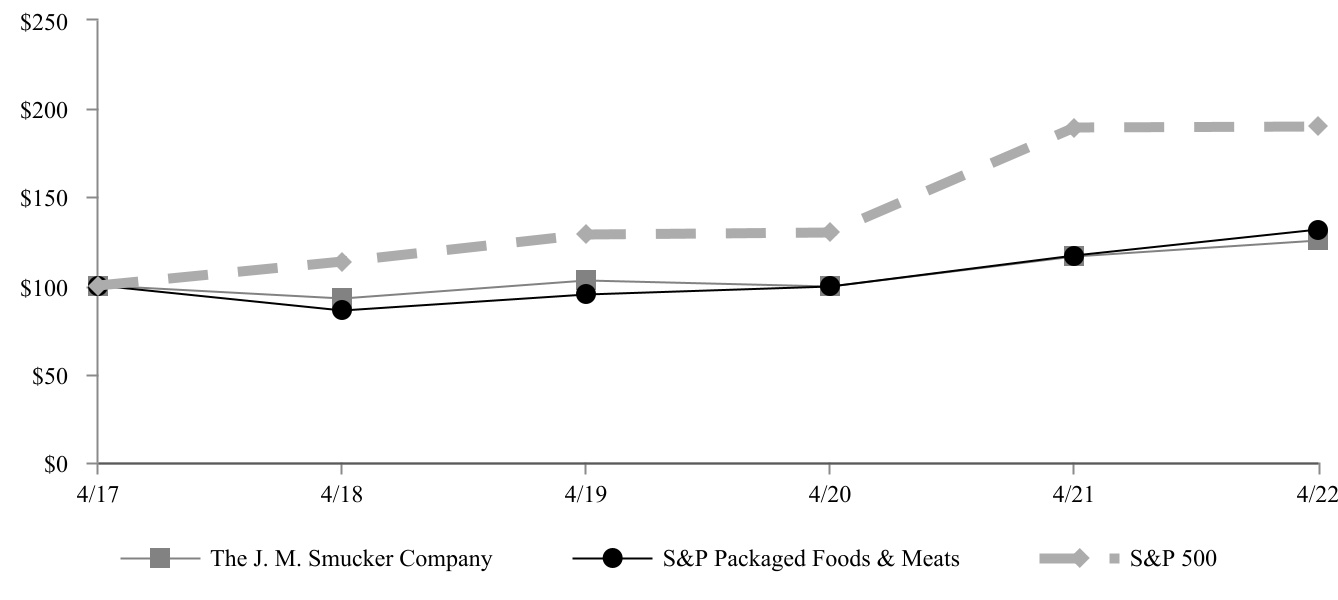
| April 30, | |||||||||||||||||||||||||||||||||||
| 2017 | 2018 | 2019 | 2020 | 2021 | 2022 | ||||||||||||||||||||||||||||||
| The J. M. Smucker Company | $ | 100.00 | $ | 92.44 | $ | 102.41 | $ | 98.99 | $ | 116.39 | $ | 125.28 | |||||||||||||||||||||||
| S&P Packaged Foods & Meats | 100.00 | 85.68 | 94.66 | 99.48 | 116.98 | 131.64 | |||||||||||||||||||||||||||||
| S&P 500 | 100.00 | 113.27 | 128.55 | 129.66 | 189.28 | 189.68 |
Copyright© 2022 Standard & Poor’s, a division of S&P Global. All rights reserved.
Item 6. [Reserved]
Item 7. Management’s Discussion and Analysis of Financial Condition and Results of Operations.
(Dollars and shares in millions, unless otherwise noted, except per share data)
This Management’s Discussion and Analysis of Financial Condition and Results of Operations is intended to provide an understanding of our results of operations, financial condition, and cash flows by focusing on changes in certain key measures from year-to-year, and should be read in conjunction with our consolidated financial statements and the accompanying notes presented in Item 8. “Financial Statements and Supplementary Data” of this Annual Report on Form 10-K. This discussion contains forward-looking statements that involve risks and uncertainties. Our actual results could differ materially from those anticipated in these forward-looking statements as a result of various factors, including those discussed in Item 1A. “Risk Factors” of this Annual Report on Form 10-K.
Company Background
Each generation of consumers leaves their mark on culture by establishing new expectations for food and the companies that make it. At the J. M. Smucker Company, it is our privilege to be at the heart of this dynamic with a diverse portfolio that appeals to each generation of people and pets and is found in nearly 90 percent of U.S. homes and countless restaurants, including iconic brands consumers have always loved such as Folgers, Jif, and Milk-Bone and new favorites like Café Bustelo, Smucker’s Uncrustables, and Rachael Ray Nutrish. By continuing to immerse ourselves in consumer preferences and acting responsibly, we will continue growing our business and the positive impact we have on society.
We have three reportable segments: U.S. Retail Pet Foods, U.S. Retail Coffee, and U.S. Retail Consumer Foods. The U.S. retail market segments in total comprised 87 percent of net sales in 2022 and represent a major portion of our strategic focus – the sale of branded food and beverage products with leadership positions to consumers through retail outlets in North America. In the U.S. retail market segments, our products are primarily sold to food retailers, club stores, discount and dollar stores, online retailers, pet specialty stores, natural foods stores and distributors, drug stores, military commissaries, and mass merchandisers. International and Away From Home includes the sale of products distributed domestically and in foreign countries through retail channels and foodservice distributors and operators (e.g., health care operators, restaurants, lodging, hospitality, offices, K-12, colleges and universities, and convenience stores).
Strategic Overview
We remain rooted in our Basic Beliefs of Quality, People, Ethics, Growth, and Independence established by our founder and namesake, Jerome Smucker, more than a century ago. Today, these Basic Beliefs are the core of our unique corporate culture and serve as a foundation for decision-making and actions. We have been led by five generations of family leadership, having had only six chief executive officers in 125 years. This continuity of management and thought extends to the broader leadership team that embodies the values and embraces the business practices that have contributed to our consistent growth.
Our strategic vision is to engage, delight, and inspire consumers by building brands they love and leading in growing categories. This vision is our long-term direction that guides business priorities and aligns our organization. We will continue to drive balanced, long-term growth by advancing on the following executional priorities:
-
Drive Commercial Excellence | Deliver best-in-class go-to-market execution and commercial delivery;
-
Streamline our Cost Infrastructure | Focus on profitability and cost discipline;
-
Reshape our Portfolio | Optimize our portfolio to meet the evolving needs of consumers; and
-
Unleash our Organization to Win | Inspire, enable, and empower our employees while improving diversity at every level.
Our strategic growth objectives include net sales increasing by a low-single digit percentage and operating income excluding non-GAAP adjustments (“adjusted operating income”) increasing by a mid-single digit percentage on average over the long-term. Related to income per diluted share excluding non-GAAP adjustments (“adjusted earnings per share”), our strategic growth objective is to increase by a high-single digit percentage over the long-term. We expect organic growth, including new products, to drive much of our top-line growth, while the contribution from acquisitions will vary from year to year. Our non-GAAP adjustments include amortization expense and impairment charges related to intangible assets, certain divestiture, acquisition, integration, and restructuring costs (“special project costs”), gains and losses on divestitures, the net change in cumulative unallocated gains and losses on commodity and foreign currency exchange derivative activities (“change in net cumulative unallocated derivative gains and losses”), and other one-time items that do not directly reflect ongoing operating
results. Refer to “Non-GAAP Financial Measures” in this discussion and analysis for additional information. Due to the unknown and potentially prolonged impact of COVID-19, as well as the challenged supply network and increased labor shortages, we may experience difficulties or be delayed in achieving our long-term strategies; however, we continue to evaluate the effects on our long-term growth objectives.
Over the past five years, net sales and adjusted earnings per share increased at a compound annual growth rate of 2 percent and 3 percent, respectively, while adjusted operating income decreased at a rate of 1 percent. These changes were primarily driven by increased at-home consumption for the U.S. Retail Coffee and U.S. Retail Consumer Foods segments and the Ainsworth acquisition in 2019, partially offset by the reduction in net sales from the divestitures of the private label dry pet food and natural beverage and grains businesses in 2022, Crisco and Natural Balance businesses in 2021, and the U.S. baking business in 2019. Net cash provided by operating activities has increased at a compound annual growth rate of 1 percent over the past five years. Our cash deployment strategy is to balance reinvesting in our business through acquisitions and capital expenditures with returning cash to our shareholders through the payment of dividends and share repurchases. Our deployment strategy also includes a significant focus on debt repayment.
Divestitures
On January 31, 2022, we sold the natural beverage and grains businesses to Nexus. The transaction included products sold under the R.W. Knudsen and TruRoots brands, inclusive of certain trademarks, a licensing agreement for Santa Cruz Organic beverages, dedicated manufacturing and distribution facilities in Chico, California, and Havre de Grace, Maryland, and approximately 150 employees who supported the natural beverage and grains businesses. The transaction did not include Santa Cruz Organic nut butters, fruit spreads, syrups, or applesauce. Under our ownership, the businesses generated net sales of $106.7 and $143.4 in 2022 and 2021, respectively, primarily included in the U.S. Retail Consumer Foods segment. Net proceeds from the divestiture were $97.1, which were inclusive of a preliminary working capital adjustment and cash transaction costs, and will be finalized during the first quarter of 2023. Upon completion of this transaction, we recognized a pre-tax gain of $26.7 during 2022, which was included in other operating expense (income) – net within the Statement of Consolidated Income.
On December 1, 2021, we sold the private label dry pet food business to Diamond Pet Foods. The transaction included dry pet food products sold under private label brands, a dedicated manufacturing facility located in Frontenac, Kansas, and approximately 220 employees who supported the private label dry pet food business. The
Showing the first 8K of 79K characters. Open the full section
Item 7A. Quantitative and Qualitative Disclosures About Market Risk.
DERIVATIVE FINANCIAL INSTRUMENTS AND MARKET RISK
The following discussions about our market risk disclosures involve forward-looking statements. Actual results could differ from those projected in the forward-looking statements. We are exposed to market risk related to changes in interest rates, commodity prices, and foreign currency exchange rates.
Interest Rate Risk: The fair value of our cash and cash equivalents at April 30, 2022, approximates carrying value. We are exposed to interest rate risk with regard to existing debt consisting of fixed- and variable-rate maturities. Our interest rate exposure primarily includes U.S. Treasury rates, LIBOR, and commercial paper rates in the U.S.
We utilize derivative instruments to manage interest rate risk associated with anticipated debt transactions, as well as to manage changes in the fair value of our long-term debt. At the inception of an interest rate contract, the instrument is evaluated and documented for qualifying hedge accounting treatment. If the contract is designated as a cash flow hedge, the mark-to-market gains or losses on the contract are typically deferred and included as a component of accumulated other comprehensive income (loss) and reclassified to interest expense in the period during which the hedged transaction affects earnings. If the contract is designated as a fair value hedge, the contract is recognized at fair value on the balance sheet, and changes in the fair value are recognized in interest expense. Generally, changes in the fair value of the contract are equal to changes in the fair value of the underlying debt and have no net impact on earnings.
In 2020, we terminated interest rate contracts concurrent with the pricing of the Senior Notes due March 15, 2030, and March 15, 2050. They were designated as cash flow hedges and were used to manage our exposure to interest rate volatility associated with the anticipated debt financing. The termination resulted in a pre-tax loss of $239.8, which was deferred and included as a component of accumulated other comprehensive income (loss) and is being amortized as interest expense over the life of the debt.
In 2018, we terminated a treasury lock concurrent with the pricing of the Senior Notes due December 15, 2027, which was designated as a cash flow hedge and used to manage our exposure to interest rate volatility. The termination resulted in a pre-tax gain of $2.7, which was deferred and included as a component of accumulated other comprehensive income (loss) and is being amortized as a reduction to interest expense over the life of the debt.
In 2015, we terminated the interest rate swap on the Senior Notes due October 15, 2021, which was designated as a fair value hedge and used to hedge against the changes in the fair value of the debt. As a result of the early termination, we received $58.1 in cash, which included $4.6 of accrued and prepaid interest. The gain on termination was recorded as an increase in the long-term debt balance and was recognized over the life of the debt as a reduction of interest expense. As of the second quarter of 2022, we had fully recognized the gain of $53.5, of which $4.0 was recognized in 2022.
In measuring interest rate risk by the amount of net change in the fair value of our financial liabilities, a hypothetical
100 basis-point decrease in interest rates at April 30, 2022, would increase the fair value of our long-term debt by $349.5.
Commodity Price Risk: We use certain raw materials and other commodities that are subject to price volatility caused by supply and demand conditions, political and economic variables, weather, investor speculation, and other unpredictable factors. To manage the volatility related to anticipated commodity purchases, we use derivatives with maturities of generally less than one year. We do not qualify commodity derivatives for hedge accounting treatment. As a result, the gains and losses on all commodity derivatives are immediately recognized in cost of products sold.
The following sensitivity analysis presents our potential loss of fair value resulting from a hypothetical 10 percent change in market prices related to commodities.
| Year Ended April 30, | |||||||||||
| 2022 | 2021 | ||||||||||
| High | $ | 72.3 | $ | 47.5 | |||||||
| Low | 14.8 | 11.7 | |||||||||
| Average | 37.1 | 29.0 |
The estimated fair value was determined using quoted market prices and was based on our net derivative position by commodity for the previous four quarters. The calculations are not intended to represent actual losses in fair value that we expect to incur. In practice, as markets move, we actively manage our risk and adjust hedging strategies as appropriate. The commodities hedged have a high inverse correlation to price changes of the derivative instrument. Thus, we would expect that any gain or loss in the estimated fair value of these derivatives would generally be offset by an increase or decrease in the estimated fair value of the underlying exposures.
Foreign Currency Exchange Risk: We have operations outside the U.S. with foreign currency denominated assets and liabilities, primarily denominated in Canadian currency. Because we have foreign currency denominated assets and liabilities, financial exposure may result, primarily from the timing of transactions and the movement of exchange rates. The foreign currency balance sheet exposures as of April 30, 2022, are not expected to result in a significant impact on future earnings or
cash flows.
We utilize foreign currency derivatives to manage the effect of foreign currency exchange fluctuations on future cash payments primarily related to purchases of certain raw materials and finished goods. The contracts generally have maturities of less than one year. We do not qualify instruments used to manage foreign currency exchange exposures for hedge accounting treatment. Therefore, the change in value of these instruments is immediately recognized in cost of products sold. Based on our hedged foreign currency positions as of April 30, 2022, a hypothetical 10 percent change in exchange rates would not materially impact the fair value.
Revenues from customers outside the U.S., subject to foreign currency exchange, represented 5 percent of net sales during 2022. Thus, certain revenues and expenses have been, and are expected to be, subject to the effect of foreign currency fluctuations, and these fluctuations may have an impact on operating results.
Item 8. Financial Statements and Supplementary Data.
THE J. M. SMUCKER COMPANY
INDEX TO FINANCIAL STATEMENTS
| Page No. | |||||
| Report of Management on Internal Control Over Financial Reporting | 44 | ||||
| Report of Independent Registered Public Accounting Firm on Internal Control Over Financial Reporting | 45 | ||||
| Report of Independent Registered Public Accounting Firm on the Consolidated Financial Statements (PCAOB ID: 42) | 46 | ||||
| Report of Management on Responsibility for Financial Reporting | 49 | ||||
| Consolidated Balance Sheets at April 30, 2022 and 2021 | 51 | ||||
| For the years ended April 30, 2022, 2021, and 2020: | |||||
| Statements of Consolidated Income | 50 | ||||
| Statements of Consolidated Comprehensive Income | 50 | ||||
| Statements of Consolidated Cash Flows | 52 | ||||
| Statements of Consolidated Shareholders’ Equity | 53 | ||||
| Notes to Consolidated Financial Statements | 54 |
REPORT OF MANAGEMENT ON INTERNAL CONTROL
OVER FINANCIAL REPORTING
Shareholders
The J. M. Smucker Company
Management is responsible for establishing and maintaining adequate accounting and internal control systems over financial reporting, as such term is defined in Rules 13a-15(f) and 15d-15(f) under the Securities and Exchange Act of 1934, as amended. Our internal control system is designed to provide reasonable assurance that we have the ability to record, process, summarize, and report reliable financial information on a timely basis.
Our management, with the participation of the principal financial officer and principal executive officer, assessed the effectiveness of the internal control over financial reporting as of April 30, 2022. In making this assessment, we used the criteria established in Internal Control – Integrated Framework issued by the Committee of Sponsoring Organizations of the Treadway Commission (2013 Framework) (“the COSO criteria”).
Based on our assessment of internal control over financial reporting under the COSO criteria, we concluded the internal control over financial reporting was effective as of April 30, 2022.
Ernst & Young LLP, an independent registered public accounting firm, audited the effectiveness of our internal control over financial reporting as of April 30, 2022, and their report thereon is included on page 45 of this report.
| Mark T. Smucker | Tucker H. Marshall | |||||||||||||
| President and | Chief Financial Officer | |||||||||||||
| Chief Executive Officer |
REPORT OF INDEPENDENT REGISTERED PUBLIC ACCOUNTING FIRM
ON INTERNAL CONTROL OVER FINANCIAL REPORTING
Board of Directors and Shareholders
The J. M. Smucker Company
Opinion on Internal Control Over Financial Reporting
We have audited The J. M. Smucker Company’s internal control over financial reporting as of April 30, 2022, based on criteria established in Internal Control – Integrated Framework issued by the Committee of Sponsoring Organizations of the Treadway Commission (2013 framework) (“the COSO criteria”). In our opinion, The J. M. Smucker Company (the “Company”) maintained, in all material respects, effective internal control over financial reporting as of April 30, 2022, based on the COSO criteria.
We also have audited, in accordance with the standards of the Public Company Accounting Oversight Board (United States) (“PCAOB”), the 2022 consolidated financial statements of the Company and our report dated June 16, 2022 expressed an unqualified opinion thereon.
Basis for Opinion
The Company’s management is responsible for maintaining effective internal control over financial reporting and for its assessment of the effectiveness of internal control over financial reporting included in the accompanying Report of Management on Internal Control Over Financial Reporting. Our responsibility is to express an opinion on the Company’s internal control over financial reporting based on our audit. We are a public accounting firm registered with the PCAOB and are required to be independent with respect to the Company in accordance with the U.S. federal securities laws and the applicable rules and regulations of the Securities and Exchange Commission and the PCAOB.
We conducted our audit in accordance with the standards of the PCAOB. Those standards require that we plan and perform the audit to obtain reasonable assurance about whether effective internal control over financial reporting was maintained in all material respects.
Our audit included obtaining an understanding of internal control over financial reporting, assessing the risk that a material weakness exists, testing and evaluating the design and operating effectiveness of internal control based on the assessed risk, and performing such other procedures as we considered necessary in the circumstances. We believe that our audit provides a reasonable basis for our opinion.
Definition and Limitations of Internal Control Over Financial Reporting
A company’s internal control over financial reporting is a process designed to provide reasonable assurance regarding the reliability of financial reporting and the preparation of financial statements for external purposes in accordance with generally accepted accounting principles. A company’s internal control over financial reporting includes those policies and procedures that (1) pertain to the maintenance of records that, in reasonable detail, accurately and fairly reflect the transactions and dispositions of the assets of the company; (2) provide reasonable assurance that transactions are recorded as necessary to permit preparation of financial statements in accordance with generally accepted accounting principles, and that receipts and expenditures of the company are being made only in accordance with authorizations of management and directors of the company; and (3) provide reasonable assurance regarding prevention or timely detection of unauthorized acquisition, use, or disposition of the company’s assets that could have a material effect on the financial statements.
Because of its inherent limitations, internal control over financial reporting may not prevent or detect misstatements. Also, projections of any evaluation of effectiveness to future periods are subject to the risk that controls may become inadequate because of changes in conditions, or that the degree of compliance with the policies or procedures may deteriorate.
/s/ Ernst & Young LLP
Akron, Ohio
June 16, 2022
REPORT OF INDEPENDENT REGISTERED PUBLIC ACCOUNTING FIRM
ON THE CONSOLIDATED FINANCIAL STATEMENTS
Board of Directors and Shareholders
The J. M. Smucker Company
Opinion on the Financial Statements
We have audited the accompanying consolidated balance sheets of The J. M. Smucker Company (the “Company”) as of April 30, 2022 and 2021, the related statements of consolidated income, comprehensive income, shareholders’ equity, and cash flows for each of the three years in the period ended April 30, 2022, and the related notes (collectively referred to as the “consolidated financial statements”). In our opinion, the consolidated financial statements present fairly, in all material respects, the financial position of the Company at April 30, 2022 and 2021, and
Showing the first 8K of 192K characters. Open the full section
Item 9. Changes in and Disagreements with Accountants on Accounting and Financial Disclosure.
None.
Item 9A. Controls and Procedures.
Evaluation of Disclosure Controls and Procedures: Management, including the principal executive officer and principal financial officer, evaluated the effectiveness of our disclosure controls and procedures (as defined in Rule 13a-15(e) or 15d-15(e) under the Exchange Act), as of April 30, 2022 (the “Evaluation Date”). Based on that evaluation, the principal executive officer and principal financial officer have concluded that, as of the Evaluation Date, our disclosure controls and procedures were effective in ensuring that information required to be disclosed in reports that we file or submit under the Exchange Act is (1) recorded, processed, summarized, and reported within the time periods specified in SEC rules and forms, and (2) accumulated and communicated to management, including the chief executive officer and chief financial officer, as appropriate to allow timely decisions regarding required disclosure.
Changes in Internal Controls: There were no changes in internal control over financial reporting that occurred during the fourth quarter ended April 30, 2022, that have materially affected, or are reasonably likely to materially affect, our internal control over financial reporting.
Item 9B. Other Information.
None.
PART III
Item 10. Directors, Executive Officers and Corporate Governance.
The information required by this Item as to the directors of the Company, the Audit Committee, the Audit Committee financial expert, and compliance with Section 16(a) of the Exchange Act is incorporated herein by reference to the information set forth under the captions “Election of Directors,” “Corporate Governance,” “Board and Committee Meetings,” and “Ownership of Common Shares” in our definitive Proxy Statement for the Annual Meeting of Shareholders to be held on August 17, 2022. The information required by this Item as to the executive officers of the Company is incorporated herein by reference to Part I, Item 1 in this Annual Report on Form 10-K**.**
The Board has adopted a Code of Conduct, last revised April 2022, which applies to our directors, principal executive officer, and principal financial and accounting officer. The Board has adopted charters for each of the Audit, Executive Compensation, and Nominating, Governance, and Corporate Responsibility Committees and has also adopted Corporate Governance Guidelines. Copies of these documents are available on our website (investors.jmsmucker.com/governance-documents).
Item 11. Executive Compensation.
The information required by this Item is incorporated herein by reference to the information set forth under the captions “Executive Compensation,” “Board and Committee Meetings,” and “Compensation Committee Interlocks and Insider Participation” in our definitive Proxy Statement for the Annual Meeting of Shareholders to be held on August 17, 2022.
Item 12. Security Ownership of Certain Beneficial Owners and Management and Related Stockholder Matters.
The information required by this Item is incorporated herein by reference to the information set forth under the captions “Ownership of Common Shares” and “Equity Compensation Plan Information” in our definitive Proxy Statement for the Annual Meeting of Shareholders to be held on August 17, 2022.
Item 13. Certain Relationships and Related Transactions, and Director Independence.
The information required by this Item is incorporated herein by reference to the information set forth under the captions “Corporate Governance” and “Related Party Transactions” in our definitive Proxy Statement for the Annual Meeting of Shareholders to be held on August 17, 2022.
Item 14. Principal Accountant Fees and Services.
The information required by this Item is incorporated herein by reference to the information set forth under the captions “Service Fees Paid to the Independent Registered Public Accounting Firm” and “Audit Committee Pre-Approval Policies and Procedures” in our definitive Proxy Statement for the Annual Meeting of Shareholders to be held on August 17, 2022.
PART IV
Item 15. Exhibits and Financial Statement Schedules.
| (a)(1) | Financial Statements: | |||||||
| See the Index to Financial Statements on page 43 of this Annual Report on Form 10-K. | ||||||||
| (a)(2) | Financial Statement Schedules: | |||||||
| Financial statement schedules are omitted because they are not applicable or because the information required is set forth in the Consolidated Financial Statements or notes thereto. | ||||||||
| (a)(3) | Exhibits: | |||||||
| The following exhibits are either attached or incorporated herein by reference to another filing with the SEC. |
- Identifies exhibits that consist of a management contract or compensatory plan or arrangement.
SIGNATURES
Pursuant to the requirements of Section 13 or 15(d) of the Securities Exchange Act of 1934, the registrant has duly caused this report to be signed on its behalf by the undersigned, thereunto duly authorized.
| Date: June 16, 2022 | The J. M. Smucker Company | |||||||
| /s/ Tucker H. Marshall | ||||||||
| By: | Tucker H. Marshall | |||||||
| Chief Financial Officer |
Pursuant to the requirements of the Securities Exchange Act of 1934, this report has been signed below by the following persons on behalf of the registrant and in the capacities and on the dates indicated.
| * | ||||||||||||||
| Mark T. Smucker | President and Chief Executive Officer and Director (Principal Executive Officer) | June 16, 2022 | ||||||||||||
| /s/ Tucker H. Marshall | ||||||||||||||
| Tucker H. Marshall | Chief Financial Officer (Principal Financial Officer and Principal Accounting Officer) | June 16, 2022 | ||||||||||||
| * | ||||||||||||||
| Timothy P. Smucker | Chairman Emeritus | June 16, 2022 | ||||||||||||
| * | ||||||||||||||
| Richard K. Smucker | Executive Chairman | June 16, 2022 | ||||||||||||
| * | ||||||||||||||
| Susan E. Chapman-Hughes | Director | June 16, 2022 | ||||||||||||
| * | ||||||||||||||
| Paul J. Dolan | Director | June 16, 2022 | ||||||||||||
| * | ||||||||||||||
| Jay L. Henderson | Director | June 16, 2022 | ||||||||||||
| * | ||||||||||||||
| Jonathan E. Johnson III | Director | June 16, 2022 | ||||||||||||
| * | ||||||||||||||
| Kirk L. Perry | Director | June 16, 2022 | ||||||||||||
| * | ||||||||||||||
| Sandra Pianalto | Director | June 16, 2022 | ||||||||||||
| * | ||||||||||||||
| Alex Shumate | Director | June 16, 2022 | ||||||||||||
| * | ||||||||||||||
| Jodi L. Taylor | Director | June 16, 2022 | ||||||||||||
| * | ||||||||||||||
| Dawn C. Willoughby | Director | June 16, 2022 |
| * | The undersigned, by signing her name hereto, does sign and execute this report pursuant to the powers of attorney executed by the above-named officers and directors of the registrant, which are being filed herewith with the Securities and Exchange Commission on behalf of such officers and directors. |
| Date: June 16, 2022 | /s/ Jeannette L. Knudsen | |||||||||||||
| By: | Jeannette L. Knudsen Attorney-in-Fact |