 filings.tools
Snap-on 10-K 2021-01-02
Filed 2021-02-11. 22 sections, 587K characters. Original on sec.gov · Markdown · JSON
Cover and table of contents
UNITED STATES
SECURITIES AND EXCHANGE COMMISSION
Washington, D.C. 20549
FORM 10-K
| ☒ | ANNUAL REPORT PURSUANT TO SECTION 13 OR 15(d) OF THE SECURITIES EXCHANGE ACT OF 1934 |
For the fiscal year ended January 2, 2021, or
| ☐ | TRANSITION REPORT PURSUANT TO SECTION 13 OR 15(d) OF THE SECURITIES EXCHANGE ACT OF 1934 |
Commission File Number 1-7724
Snap-on Incorporated
(Exact name of registrant as specified in its charter)
| Delaware | 39-0622040 | |||||||||||||
| (State of incorporation) | (I.R.S. Employer Identification No.) | |||||||||||||
| 2801 80th Street | Kenosha | Wisconsin | 53143 | |||||||||||
| (Address of principal executive offices) | (Zip code) |
(262) 656-5200
(Registrant’s telephone number, including area code)
Securities registered pursuant to Section 12(b) of the Act:
| Title of each class | Trading Symbol(s) | Name of each exchange on which registered | ||||||
| Common Stock, $1.00 par value | SNA | New York Stock Exchange |
Securities registered pursuant to Section 12(g) of the Act: None
Indicate by check mark if the registrant is a well-known seasoned issuer, as defined in Rule 405 of the Securities Act. Yes ☒ No ☐
Indicate by check mark if the registrant is not required to file reports pursuant to Section 13 or 15(d) of the Act. Yes ☐ No ☒
Indicate by check mark whether the registrant (1) has filed all reports required to be filed by Section 13 or 15(d) of the Securities Exchange Act of 1934 during the preceding 12 months (or for such shorter period that the registrant was required to file such reports), and (2) has been subject to such filing requirements for the past 90 days. Yes ☒ No ☐
Indicate by check mark whether the registrant has submitted electronically every Interactive Data File required to be submitted pursuant to Rule 405 of Regulation S-T (§232.405 of this chapter) during the preceding 12 months (or for such shorter period that the registrant was required to submit such files). Yes ☒ No ☐
Indicate by check mark whether the registrant is a large accelerated filer, an accelerated filer, a non-accelerated filer, a smaller reporting company, or an emerging growth company. See the definitions of “large accelerated filer,” “accelerated filer,” “smaller reporting company,” and “emerging growth company” in Rule 12b-2 of the Exchange Act.
Large accelerated filer ☒ Accelerated filer ☐ Non-accelerated filer ☐
Smaller reporting company ☐ Emerging growth company ☐
If an emerging growth company, indicate by check mark if the registrant has elected not to use the extended transition period for complying with any new or revised financial accounting standards provided pursuant to Section 13(a) of the Exchange Act. ☐
Indicate by check mark whether the registrant has filed a report on and attestation to its management’s assessment of the effectiveness of its internal control over financial reporting under Section 404(b) of the Sarbanes-Oxley Act (15 U.S.C. 7262(b)) by the registered public accounting firm that prepared or issued its audit report. ☒
Indicate by check mark whether the registrant is a shell company (as defined in Rule 12b-2 of the Exchange Act). Yes ☐ No ☒
The aggregate market value of voting and non-voting common equity held by non-affiliates (excludes 710,101 shares held by directors and executive officers) computed by reference to the price ($133.56) at which common equity was last sold as of the last business day of the registrant’s most recently completed second fiscal quarter (June 26, 2020) was $7.2 billion.
The number of shares of Common Stock ($1.00 par value) of the registrant outstanding as of February 5, 2021, was 54,203,094 shares.
DOCUMENTS INCORPORATED BY REFERENCE
Part III of this Annual Report on Form 10-K incorporates by reference certain information that will be set forth in Snap-on’s Proxy Statement, which is expected to first be mailed to shareholders on or about March 12, 2021, prepared for the Annual Meeting of Shareholders scheduled for April 29, 2021.
TABLE OF CONTENTS
| 2 | SNAP-ON INCORPORATED |
PART I
Safe Harbor
Statements in this document that are not historical facts, including statements that (i) are in the future tense; (ii) include the words “expects,” “plans,” “targets,” “estimates,” “believes,” “anticipates,” or similar words that reference Snap-on Incorporated (“Snap-on” or “the company”) or its management; (iii) are specifically identified as forward-looking; or (iv) describe Snap-on’s or management’s future outlook, plans, estimates, objectives or goals, are forward-looking statements within the meaning of the Private Securities Litigation Reform Act of 1995. Snap-on cautions the reader that any forward-looking statements included in this document that are based upon assumptions and estimates were developed by management in good faith and are subject to risks, uncertainties or other factors that could cause (and in some cases have caused) actual results to differ materially from those described in any such statement. Accordingly, forward-looking statements should not be relied upon as a prediction of actual results or regarded as a representation by the company or its management that the projected results will be achieved. For those forward-looking statements, Snap-on cautions the reader that numerous important factors, such as those listed below, as well as those factors discussed in this Annual Report on Form 10-K, particularly those in “Item 1A: Risk Factors,” could affect the company’s actual results and could cause its actual consolidated results to differ materially from those expressed in any forward-looking statement made by, or on behalf of, Snap-on.
These risks and uncertainties include, without limitation, uncertainties related to estimates, statements, assumptions and projections generally, and the timing and progress with which Snap-on can attain value through its Snap-on Value Creation Processes, including its ability to realize efficiencies and savings from its rapid continuous improvement and other cost reduction initiatives, improve workforce productivity, achieve improvements in the company’s manufacturing footprint and greater efficiencies in its supply chain, and enhance machine maintenance, plant productivity and manufacturing line set-up and change-over practices, any or all of which could result in production inefficiencies, higher costs and/or lost revenues. These risks include the evolving impact and unknown duration of the coronavirus (“COVID-19”) pandemic, which has the potential to amplify the impact of the other risks facing the company. These risks also include the impact of governmental actions related thereto on Snap-on’s business, as well as uncertainties related to Snap-on’s capability to implement future strategies with respect to its existing businesses, its ability to refine its brand and franchise strategies, retain and attract franchisees, further enhance service and value to franchisees and thereby help improve their sales and profitability, introduce successful new products, successfully pursue, complete and integrate acquisitions, as well as its ability to withstand disruption arising from natural disasters, planned facility closures or other labor interruptions, the effects of external negative factors, including adverse developments in world financial markets, developments related to tariffs and other trade issues or disputes, weakness in certain areas of the global economy (including as a result of the United Kingdom’s exit from the European Union and the COVID-19 pandemic), and significant changes in the current competitive environment, inflation, interest rates and other monetary and market fluctuations, changes in tax rates, laws and regulations as well as uncertainty surrounding potential changes, and the impact of energy and raw material supply and pricing, including steel (as a result of U.S. tariffs imposed on certain steel imports or otherwise) and gasoline, the amount, rate and growth of Snap-on’s general and administrative expenses, including health care and postretirement costs (resulting from, among other matters, U.S. health care legislation and its ongoing implementation or reform), continuing and potentially increasing required contributions to pension and postretirement plans, the impacts of non-strategic business and/or product line rationalizations, and the effects on business as a result of new legislation, regulations or government-related developments or issues, risks associated with data security and technological systems and protections, potential reputational damages and costs related to litigation as well as an inability to assure that costs will be reduced or eliminated on appeal, the impact of changes in financial accounting standards, the ability to effectively manage human capital resources, and other world or local events outside Snap-on’s control, including terrorist disruptions, other outbreaks of infectious diseases and civil unrest. Snap-on disclaims any responsibility to update any forward-looking statement provided in this document, except as required by law.
In addition, investors should be aware that generally accepted accounting principles in the United States of America (“GAAP”) prescribe when a company should reserve for particular risks, including litigation exposures. Accordingly, results for a given reporting period could be significantly affected if and when a reserve is established for a major contingency. Reported results, therefore, may appear to be volatile in certain accounting periods.
Fiscal Year
Snap-on’s fiscal year ends on the Saturday that is on or nearest to December 31. Unless otherwise indicated, references in this document to “fiscal 2020” or “2020” refer to the fiscal year ended January 2, 2021; references to “fiscal 2019” or “2019” refer to the fiscal year ended December 28, 2019; and references to “fiscal 2018” or “2018” refer to the fiscal year ended December 29, 2018. References in this document to 2020, 2019 and 2018 year end refer to January 2, 2021, December 28, 2019, and December 29, 2018, respectively. Snap-on’s 2020 fiscal year contained 53 weeks of operating results with the extra week occurring in the fourth quarter. Snap-on’s 2019 and 2018 fiscal years each contained 52 weeks of operating results.
| 2020 ANNUAL REPORT | 3 |
Item 1. Business
Snap-on is a leading global innovator, manufacturer and marketer of tools, equipment, diagnostics, repair information and systems solutions for professional users performing critical tasks. Products and services include hand and power tools, tool storage, diagnostics software, handheld and PC-based diagnostic products, information and management systems, shop equipment and other solutions for vehicle dealerships and repair centers, as well as for customers in industries, such as aviation and aerospace, agriculture, construction, government and military, mining, natural resources, power generation and technical education. Snap-on also derives income from various financing programs designed to facilitate the sales of its products and support its franchise business.
Snap-on markets its products and brands worldwide through multiple sales distribution channels in more than 130 countries. Snap-on’s largest geographic markets include the United States, Europe, Canada and Asia Pacific. Snap-on reaches its customers through the company’s franchised, company-direct, distributor and internet channels.
The company began with the development of the original Snap-on interchangeable socket set in 1920 and subsequently pioneered mobile tool distribution in the automotive repair market, where well-stocked vans sell to professional vehicle technicians at their place of business. Today, Snap-on defines its value proposition more broadly, extending its reach “beyond the garage” to deliver a broad array of unique solutions that make work easier for serious professionals performing critical tasks. The company’s “coherent growth” strategy focuses on developing and expanding its professional customer base in its legacy automotive market, as well as in adjacent markets, additional geographies and other areas, including in critical industries, where the cost and penalties for failure can be high. In addition to its coherent growth strategy, Snap-on is committed to its “Value Creation Processes” – a set of strategic principles and processes designed to create value and employed in the areas of (i) safety; (ii) quality; (iii) customer connection; (iv) innovation; and (v) rapid continuous improvement (“RCI”). Snap-on’s RCI initiatives employ a structured set of tools and processes across multiple businesses and geographies intended to eliminate waste and improve operations. Savings from Snap-on’s RCI initiatives reflect benefits from a wide variety of ongoing efficiency, productivity and process improvements, including savings generated from product design cost reductions, improved manufacturing line set-up and change-over practices, lower-cost sourcing initiatives and facility consolidations.
Snap-on’s primary customer segments include: (i) commercial and industrial customers, including professionals in critical industries and emerging markets; (ii) professional vehicle repair technicians who purchase products through the company’s mobile tool distribution network; and (iii) other professional customers related to vehicle repair, including owners and managers of independent and original equipment manufacturer (“OEM”) dealership service and repair shops (“OEM dealerships”). Snap-on’s Financial Services customer segment includes: (i) franchisees’ customers, principally serving vehicle repair technicians, and Snap-on customers who require financing for the purchase or lease of tools and diagnostics and equipment products on an extended-term payment plan; and (ii) franchisees who require financing options for vehicle and business needs.
Snap-on’s business segments are based on the organization structure used by management for making operating and investment decisions and for assessing performance. Snap-on’s reportable business segments are: (i) the Commercial & Industrial Group; (ii) the Snap-on Tools Group; (iii) the Repair Systems & Information Group; and (iv) Financial Services. The Commercial & Industrial Group consists of business operations serving a broad range of industrial and commercial customers worldwide, including customers in the aerospace, natural resources, government, power generation, transportation and technical education market segments (collectively, “critical industries”), primarily through direct and distributor channels. The Snap-on Tools Group consists of business operations primarily serving vehicle service and repair technicians through the company’s worldwide mobile tool distribution channel. The Repair Systems & Information Group consists of business operations serving other professional vehicle repair customers worldwide, primarily owners and managers of independent repair shops and OEM dealerships, through direct and distributor channels. Financial Services consists of the business operations of Snap-on Credit LLC (“SOC”), the company’s financial services business in the United States, and Snap-on’s other financial services subsidiaries in those international markets where Snap-on has franchise operations. See Note 20 to the Consolidated Financial Statements for information on business segments and foreign operations.
Snap-on evaluates the performance of its operating segments based on segment revenues, including both external and intersegment net sales, and segment operating earnings. Snap-on accounts for intersegment sales and transfers based primarily on standard costs with reasonable mark-ups established between the segments. Identifiable assets by segment are those assets used in the respective reportable segment’s operations. Corporate assets consist of cash and cash equivalents (excluding cash held at Financial Services), deferred income taxes and certain other assets. Intersegment amounts are eliminated to arrive at Snap-on’s consolidated financial results.
| 4 | SNAP-ON INCORPORATED |
Recent Acquisitions
Snap-on has continued to expand its business throughout the years via acquisitions. Below are acquisitions completed in the last three fiscal years:
On September 28, 2020, Snap-on acquired substantially all of the assets of AutoCrib, Inc. (“AutoCrib”) for a cash purchase price of $35.4 million. AutoCrib, based in Tustin, California, designs, manufactures and markets asset and tool control solutions. The acquisition of AutoCrib complemented and expanded Snap-on’s existing tool control offering to customers in a variety of industrial applications, including aerospace, automotive, military, natural resources and general industry.
On January 31, 2020, Snap-on acquired substantially all of the assets related to the TreadReader product line from Sigmavision Limited (“Sigmavision”) for a cash purchase price of $5.9 million. Sigmavision designs and manufactures handheld devices and drive-over ramps that provide tire information for use in the automotive industry. The acquisition of the TreadReader product line enhanced and expanded Snap-on’s existing capabilities in serving vehicle repair facilities and expanded the company’s presence with repair shop owners and managers.
On August 7, 2019, Snap-on acquired Cognitran Limited (“Cognitran”) for a cash purchase price of $30.6 million (or $29.6 million, net of cash acquired). Cognitran, based in Chelmsford, U.K., specializes in flexible, modular and highly scalable “Software as a Service” (SaaS) products for OEM customers and their dealers, focused on the creation and delivery of service, diagnostics, parts and repair information to the OEM dealers and connected vehicle platforms. The acquisition of Cognitran enhanced and expanded Snap-on’s capabilities in providing shop efficiency solutions through integrated upstream services to OEM customers in automotive, heavy duty, agricultural and recreational applications.
On April 2, 2019, Snap-on acquired Power Hawk Technologies, Inc. (“Power Hawk”) for a cash purchase price of $7.9 million. Power Hawk, based in Rockaway, New Jersey, designs, manufactures and distributes rescue tools and related equipment for a variety of military, governmental, fire and rescue, and emergency operations. The acquisition of the Power Hawk product line complemented and increased Snap-on’s existing product offering and broadened its established capabilities in serving critical industries.
On January 25, 2019, Snap-on acquired substantially all of the assets of TMB GeoMarketing Limited (“TMB”) for a cash purchase price of $1.3 million. TMB, based in Dorking, U.K., designs planning software used by OEMs to optimize dealer locations and manage the performance of dealer outlets. The acquisition of TMB extended Snap-on’s product line in its core dealer network solutions business.
On January 31, 2018, Snap-on acquired substantially all of the assets of George A. Sturdevant, Inc. (d/b/a Fastorq) for a cash purchase price of $3.0 million. Fastorq, based in New Caney, Texas, designs, assembles and distributes hydraulic torque and hydraulic tensioning products for use in critical industries. The acquisition of the Fastorq product line complemented and increased Snap-on’s existing torque product offering and broadened its established capabilities in serving in critical industries.
For segment reporting purposes, the results of operations and assets of Sigmavision, Cognitran and TMB have been included in the Repair Systems & Information Group since the respective acquisition dates, and the results of operations and assets of AutoCrib, Power Hawk and Fastorq have been included in the Commercial & Industrial Group since the respective acquisition dates.
Pro forma financial information has not been presented for any of these acquisitions as the net effects, individually and collectively, were neither significant nor material to Snap-on’s results of operations or financial position.
Information Available on the Company’s Website
Additional information regarding Snap-on and its products is available on the company’s website at www.snapon.com. Snap-on is not including the information contained on its website as a part of, or incorporating it by reference into, this Annual Report on Form 10-K. Snap-on’s Annual Reports on Form 10-K, Quarterly Reports on Form 10-Q, Proxy Statements on Schedule 14A and Current Reports on Form 8-K, as well as any amendments to those reports, are made available to the public at no charge through the Investors section of the company’s website at www.snapon.com. Snap-on makes such material available on its website as soon as reasonably practicable after it electronically files such material with, or furnishes it to, the Securities and Exchange Commission (“SEC”). Copies of any materials the company files with the SEC can also be obtained free of charge through the SEC’s website at www.sec.gov. In addition, Snap-on’s (i) charters for the Audit, Corporate Governance and Nominating, and Organization and Executive Compensation Committees of the company’s Board of Directors; (ii) Corporate Governance Guidelines; and (iii) Code of Business Conduct and Ethics are available on the company’s website. Snap-on will also post any amendments to these documents, or information about any waivers granted to directors or executive officers with respect to the Code of Business Conduct and Ethics, on the company’s website at www.snapon.com.
| 2020 ANNUAL REPORT | 5 |
Products and Services
Tools; Diagnostics, Information and Management Systems; and Equipment
Snap-on offers a broad line of products and complementary services that are grouped into three product categories: (i) tools; (ii) diagnostics, information and management systems; and (iii) equipment. Further product line information is not presented as it is not practicable to do so. The following table shows the consolidated net sales of these product categories for the last three years:
| Net Sales | ||||||||||||||||||||
| (Amounts in millions) | 2020 | 2019 | 2018 | |||||||||||||||||
| Product Category: | ||||||||||||||||||||
| Tools | $ | 1,984.7 | $ | 2,017.5 | $ | 2,021.2 | ||||||||||||||
| Diagnostics, information and management systems | 783.8 | 827.5 | 797.9 | |||||||||||||||||
| Equipment | 824.0 | 885.0 | 921.6 | |||||||||||||||||
| $ | 3,592.5 | $ | 3,730.0 | $ | 3,740.7 |
The tools product category includes hand tools, power tools, tool storage products and other similar products. Hand tools include wrenches, sockets, ratchet wrenches, pliers, screwdrivers, punches and chisels, saws and cutting tools, pruning tools, torque measuring instruments and other similar products. Power tools include cordless (battery), pneumatic (air), hydraulic and corded (electric) tools, such as impact wrenches, ratchets, screwdrivers, drills, sanders, grinders and similar products. Tool storage includes tool chests, roll cabinets and other similar products. For many industrial customers, Snap-on creates specific, engineered solutions, including facility-level tool control and asset management hardware and software, custom kits in a wide range of configurations, and custom-built tools designed to meet customer requirements. The majority of products are manufactured by Snap-on and, in completing the product offering, other items are purchased from external manufacturers.
The diagnostics, information and management systems product category includes handheld and PC-based diagnostic products, service and repair information products, diagnostic software solutions, electronic parts catalogs, business management systems and services, point-of-sale systems, integrated systems for vehicle service shops, OEM purchasing facilitation services, and warranty management systems and analytics to help OEM dealerships manage and track performance.
The equipment product category includes solutions for the service of vehicles and industrial equipment. Products include wheel alignment equipment, wheel balancers, tire changers, vehicle lifts, test lane equipment, collision repair equipment, vehicle air conditioning service equipment, brake service equipment, fluid exchange equipment, transmission troubleshooting equipment, safety testing equipment, battery chargers and hoists.
Snap-on supports the sale of its diagnostics and vehicle service shop equipment by offering training programs as well as after-sales support for its customers, primarily focusing on the technologies and the application of specific products developed and marketed by Snap-on.
| 6 | SNAP-ON INCORPORATED |
Products are marketed under a number of brand names and trademarks, many of which are well known in the vehicle service and industrial markets served. Some of the major trade names and trademarks and the products and services with which they are associated include the following:
| Names | Products and Services | |||||||
| Snap-on | Hand tools, power tools, tool storage products (including tool control software and hardware), diagnostics, certain equipment and related accessories, mobile tool stores, websites, electronic parts catalogs, warranty analytics solutions, business management systems and services, OEM specialty tools and equipment development and distribution, and OEM facilitation services | |||||||
| ATI | Aircraft hand tools and machine tools | |||||||
| AutoCrib | Asset and tool control systems | |||||||
| autoVHC | Vehicle inspection and training services | |||||||
| BAHCO | Saw blades, cutting tools, pruning tools, hand tools, power tools and tool storage, including tool control systems | |||||||
| Blackhawk | Collision repair equipment | |||||||
| Blue-Point | Hand tools, power tools, tool storage, diagnostics, certain equipment and related accessories | |||||||
| Cartec | Safety testing, brake testers, test lane equipment, dynamometers, suspension testers, emission testers and other equipment | |||||||
| Car-O-Liner | Collision repair equipment, and information and truck alignment systems | |||||||
| CDI | Torque tools | |||||||
| Challenger | Vehicle lifts | |||||||
| Cognitran | OEM SaaS products | |||||||
| Ecotechnics | Vehicle air conditioning service equipment | |||||||
| Fastorq | Hydraulic torque and tensioning products | |||||||
| Fish and Hook | Saw blades, cutting tools, pruning tools, hand tools, power tools and tool storage | |||||||
| Hofmann | Wheel balancers, vehicle lifts, tire changers, wheel aligners, brake testers and test lane equipment | |||||||
| Irimo | Saw blades, cutting tools, hand tools, power tools and tool storage | |||||||
| John Bean | Wheel balancers, vehicle lifts, tire changers, wheel aligners, brake testers and test lane equipment | |||||||
| Josam | Heavy duty alignment and collision repair solutions | |||||||
| Lindström | Hand tools | |||||||
| Mitchell1 | Repair and service information, shop management systems and business services | |||||||
| Nexiq | Diagnostic tools, information and program distributions for fleet and heavy duty equipment | |||||||
| Norbar | Torque tools | |||||||
| Power Hawk | Rescue tools and related equipment for military, government, fire and rescue | |||||||
| Pro-Cut | Brake service equipment and accessories | |||||||
| Sandflex | Hacksaw blades, bandsaws, saw blades, hole saws and reciprocating saw blades | |||||||
| ShopKey | Repair and service information, shop management systems and business services | |||||||
| Sioux | Power tools | |||||||
| Sturtevant Richmont | Torque tools | |||||||
| Sun | Diagnostic tools, wheel balancers, vehicle lifts, tire changers, wheel aligners, air conditioning products and emission testers | |||||||
| TreadReader | Automotive tire drive-over ramps and handheld devices | |||||||
| TruckCam | Commercial vehicle OEM factory solutions | |||||||
| Williams | Hand tools, tool storage, certain equipment and related accessories |
| 2020 ANNUAL REPORT | 7 |
Financial Services
Snap-on also generates revenue from various financing programs that include: (i) installment sales and lease contracts arising from franchisees’ customers and Snap-on customers who require financing for the purchase or lease of tools and diagnostic and equipment products on an extended-term payment plan; and (ii) business and vehicle loans and leases to franchisees. The decision to finance through Snap-on or another financing source is solely by election of the customer. When assessing customers for potential financing, Snap-on considers various factors regarding ability to pay, including the customers’ financial condition, debt-servicing ability, past payment experience, and credit bureau and proprietary Snap-on credit model information, as well as the value of the underlying collateral.
Snap-on offers financing through SOC and the company’s international finance subsidiaries in most markets where Snap-on has franchise operations. Financing revenue from contract originations is recognized over the life of the underlying contracts, with interest or finance charges computed primarily on the average daily balances of the underlying contracts.
Markets
Sales and Distribution
Snap-on markets and distributes its products and related services principally to professional tool and equipment users around the world. The two largest market sectors are the vehicle service and repair sector and the industrial sector.
Vehicle Service and Repair Sector
The vehicle service and repair sector has three main customer groups: (i) professional technicians who purchase tools and diagnostic and equipment products for use in their work; (ii) other professional customers related to vehicle repair, including owners and managers of independent repair shops and OEM dealerships who purchase tools and diagnostic and equipment products for use by multiple technicians within a service or repair facility; and (iii) OEMs.
Snap-on provides innovative tool, equipment and business solutions, as well as technical sales support and training, designed to meet technicians’ evolving needs. Snap-on’s mobile tool distribution system offers technicians the convenience of purchasing quality tools at their place of business with minimal disruption of their work routine. Snap-on also provides owners and managers of repair shops, where technicians work, with tools, diagnostic equipment, and repair and service information, including electronic parts catalogs and shop management products. Snap-on’s OEM facilitation business provides OEMs with products and services including special and essential tools as well as consulting and facilitation services, which include product procurement, distribution and administrative support to customers for their dealership equipment programs.
The vehicle service and repair sector is characterized by an increasing rate of technological change within motor vehicles, vehicle population growth and increasing vehicle life, and the resulting effects of these changes on the businesses of both our suppliers and customers. Snap-on believes it is a meaningful participant in the vehicle service and repair market sector.
Industrial Sector
Snap-on markets its products and services globally to a broad cross-section of commercial and industrial customers, including maintenance and repair operations; manufacturing and assembly facilities; various government agencies, facilities and operations, including military operations; schools with vocational and technical programs; aviation and aerospace operations; oil and gas developers; mining operations; energy and power generation operations; equipment fabricators and operators; railroad manufacturing and maintenance; customers in agriculture; infrastructure construction companies; and other customers that require instrumentation, service tools and/or equipment for their products and business needs. The industrial sector for Snap-on focuses on providing value-added products and services to an increasingly expanding global base of customers in critical industries.
The industrial sector is characterized by a highly competitive environment with multiple suppliers offering either a full line or industry specific portfolios for tools and equipment. Industrial customers increasingly require specialized solutions that provide repeatability and reliability in performing tasks of consequence that are specific to the particular end market in which they operate. Snap-on believes it is a meaningful participant in the industrial tools and equipment market sector.
Distribution Channels
Snap-on serves customers primarily through the following channels of distribution: (i) the mobile van channel; (ii) company direct sales; (iii) distributors; and (iv) e-commerce. The following discussion summarizes Snap-on’s general approach for each channel and is not intended to be all-inclusive.
| 8 | SNAP-ON INCORPORATED |
Mobile Van Channel
In the United States, a significant portion of sales to the vehicle service and repair sector is conducted through Snap-on’s mobile franchise van channel. Snap-on’s franchisees primarily serve vehicle repair technicians and vehicle service shop owners, generally providing weekly contact at the customer’s place of business. Franchisees’ sales are concentrated in hand and power tools, tool storage products, shop equipment, and diagnostic and repair information products, which can be transported in a van or trailer and demonstrated during a sales call. Franchisees purchase Snap-on’s products at a discount from suggested list prices and resell them at prices established by the franchisee. U.S. franchisees are provided a list of calls that serves as the basis of the franchisee’s sales route. Snap-on’s franchisees also have the opportunity to add a limited number of additional franchises.
Snap-on charges nominal initial and ongoing monthly franchise fees. Franchise fee revenue, including nominal, non-refundable initial and ongoing monthly fees (primarily for sales and business training, marketing and product promotion programs, and technology support), is recognized as the fees are earned. Franchise fee revenue totaled $16.2 million, $15.4 million and $16.2 million in fiscal 2020, 2019 and 2018, respectively.
Snap-on also has a company-owned route program that is designed to: (i) provide another pool of potential field organization personnel; (ii) service customers in select new and/or open routes not currently serviced by franchisees; and (iii) allow Snap-on to pilot new sales and promotional ideas prior to introducing them to franchisees. As of 2020 year end, company-owned routes comprised approximately 4% of the total route population. Snap-on may elect to increase or reduce the number of company-owned routes in the future.
In addition to its mobile van channel in the United States, Snap-on has franchise distribution models in certain other countries, including Canada, the United Kingdom, Japan, Australia, Germany, Netherlands, South Africa, New Zealand, Belgium and Ireland. In many of these markets, as in the United States, purchase decisions are generally made or influenced by professional vehicle service technicians as well as repair shop owners and managers. As of 2020 year end, Snap-on’s worldwide route count was approximately 4,775, including approximately 3,425 routes in the United States.
Through SOC, financing is available to U.S. franchisees, including financing for van leases, working capital loans and loans to help enable new franchisees to fund the purchase of the franchise or the expansion of an existing franchise. In many international markets, Snap-on offers a variety of financing options to its franchisees and/or customer networks through its international finance subsidiaries. The decision to finance through Snap-on or another financing source is solely at the customer’s election.
Snap-on supports its franchisees with a field organization of regional offices, franchise performance teams, customer care centers and distribution centers. Snap-on also provides sales and business training, and marketing and product promotion programs, as well as customer and franchisee financing programs through SOC and the company’s international finance subsidiaries, all of which are designed to strengthen franchisee sales. National Franchise Advisory Councils in the United States, the United Kingdom, Canada and Australia, composed primarily of franchisees that are elected by franchisees, assist Snap-on in identifying and implementing enhancements to the franchise program.
Company Direct Sales
A significant proportion of shop equipment sales in North America under the John Bean, Hofmann, Blackhawk, Car-O-Liner, Challenger and Pro-Cut brands, diagnostic products under the Snap-on brand, and information and shop management products under the Mitchell1 brand are made by direct and independent sales forces that have responsibility for national and other accounts. As the vehicle service and repair sector consolidates (with more business conducted by national chains and franchised service centers), Snap-on believes these larger organizations can be serviced most effectively by sales people who can demonstrate and sell the full line of diagnostic and equipment products and services. Snap-on also sells these products and services directly to OEMs and their franchised dealers.
Snap-on brand tools and equipment are marketed to industrial and governmental customers worldwide through both industrial sales associates and independent distributors. Selling activities focus on industrial customers whose main purchase criteria are quality and integrated solutions. As of 2020 year end, Snap-on had industrial sales associates and independent distributors primarily in the United States, Canada and in various European, Latin American, Middle Eastern, Asian and African countries, with the United States representing the majority of Snap-on’s total industrial sales.
Snap-on also sells software, services and solutions to the automotive, commercial, heavy duty, agriculture, power equipment and power sports segments. Products and services are marketed to targeted groups, including OEMs and their dealerships, fleets and individual repair shops. To effectively reach OEMs, which frequently have a multi-national presence, Snap-on has deployed focused business teams globally.
| 2020 ANNUAL REPORT | 9 |
Distributors
Sales of certain tools and equipment are made through independent distributors who purchase the items from Snap-on and resell them to end users. Hand tools sold under the BAHCO, Irimo, Lindström, CDI, ATI, Fastorq, Norbar, Sioux, Sturtevant Richmont and Williams brands and trade names, for example, are sold through distributors worldwide. Wheel service and other vehicle service equipment are sold through distributors primarily under brands including Hofmann, John Bean, Car-O-Liner, Challenger, Pro-Cut, Cartec, Blackhawk and Ecotechnics. Diagnostic and equipment products are marketed through distributors in South America and Asia, and through both a direct sales force and distributors in Europe under the Snap-on, Sun and Blue-Point brands.
E-commerce
Snap-on offers current and prospective customers online access to research and purchase products through its public website, www.snapon.com. The site features an online catalog of Snap-on hand tools, power tools, tool storage units and diagnostic equipment available to customers in the United States, the United Kingdom, Canada and Australia. E-commerce and certain other system enhancement initiatives are designed to improve productivity and further leverage the one-on-one relationships and service Snap-on has with its current and prospective customers. Sales through the company’s e-commerce distribution channel were not significant in any of the last three years.
Competition
Snap-on competes on the basis of its product quality and performance, product line breadth and depth, service, brand awareness and imagery, technological innovation and availability of financing (through SOC or its international finance subsidiaries). While Snap-on does not believe that any single company competes with it across all of its product lines and distribution channels, various companies compete in one or more product categories and/or distribution channels.
Snap-on believes it is a leading manufacturer and distributor of professional tools, tool storage, diagnostic and equipment products, and repair software and solutions, offering a broad line of these products to both vehicle service and industrial marketplaces. Various competitors target and sell to professional technicians in the vehicle service and repair sector through the mobile tool distribution channel. Snap-on also competes with companies that sell tools and equipment to vehicle service and repair technicians online and through retail stores, vehicle parts supply outlets and tool supply warehouses/distributorships. Within the power tools category and the industrial sector, Snap-on has various other competitors, including companies with offerings that overlap with other areas discussed herein. Major competitors selling diagnostics, shop equipment and information to vehicle dealerships and independent repair shops include OEMs and their proprietary electronic parts catalogs and diagnostics and information systems, and other companies that offer products serving this sector.
Resources
Raw Materials and Purchased Product
Snap-on’s supply of raw materials and purchased components are generally and readily available from numerous suppliers. Snap-on believes it has secured an ample supply of both bar and coil steel for the near future to ensure stable supply to meet material demands. The company does not currently anticipate experiencing any significant impact in 2021 from steel pricing or availability issues, though it is continuing to monitor the impact of tariffs and other trade protection measures put in place by the U.S. and other countries.
Patents, Trademarks and Other Intellectual Property
Snap-on vigorously pursues and relies on patent protection to protect its intellectual property and position in its markets. As of 2020 year end, Snap-on and its subsidiaries held approximately 800 active and pending patents in the United States and approximately 2,350 active and pending patents outside of the United States. Sales relating to any single patent did not represent a material portion of Snap-on’s revenues in any of the last three years.
Examples of products that have features or designs that benefit from patent protection include hand tools (including sealed ratchets and ratcheting screwdrivers), power tools, wheel alignment systems, wheel balancers, tire changers, vehicle lifts, tool storage, tool control, collision measurement, test lane equipment, brake lathes, electronic torque instruments, emissions-sensing devices and diagnostic equipment.
Much of the technology used in the manufacture of vehicle service tools and equipment is in the public domain. Snap-on relies primarily on trade secret protection for proprietary processes used in manufacturing. Methods and processes are patented when appropriate. Copyright protection is also utilized when appropriate.
| 10 | SNAP-ON INCORPORATED |
Trademarks used by Snap-on are of continuing importance in the marketplace. Trademarks have been registered in the United States and many other countries, and additional applications for trademark registrations are pending. Snap-on vigorously polices proper use of its trademarks. Snap-on’s right to manufacture and sell certain products is dependent upon licenses from others; however, these products under license do not represent a material portion of Snap-on’s net sales.
Domain names are a valuable corporate asset for companies around the world, including Snap-on. Domain names often contain a trademark or service mark or even a corporate name and are often considered intellectual property. The recognition and value of the Snap-on name, trademark and domain name are core strengths of the company.
Snap-on strategically licenses the Snap-on brand to carefully selected manufacturing and distribution companies for items such as apparel and a variety of other goods, in order to further build brand awareness and market presence for the company’s strongest brand.
Environmental and Government Regulations
Snap-on is subject to various environmental laws, ordinances, regulations, and requirements of government authorities in the United States and other nations. At Snap-on, these environmental liabilities are managed through the Snap-on Environmental, Health and Safety Management System (“EH & SMS”), which is applied worldwide. The system is based upon continual improvement and is certified to ISO 14001:2015 and OHSAS 18001:2007, verified through Det Norske Veritas (DNV) Certification, Inc.
Snap-on believes that it complies with applicable environmental and government requirements in its operations. Expenditures on environmental and governmental matters through EH & SMS have not had, and Snap-on does not for the foreseeable future expect them to have, a material effect upon Snap-on’s capital expenditures, earnings or competitive position.
Human Capital Management
As of January 2, 2021, Snap-on employed approximately 12,300 people worldwide, of which approximately 6,800 were employed in the United States and approximately 5,500 were outside the United States. Approximately 2,600 employees are represented by unions and/or covered under collective bargaining agreements with varying expiration dates through 2023. In recent years, Snap-on has not experienced any significant work slowdowns, stoppages or other labor disruptions.
Snap-on is guided by the beliefs and values in the company’s “Who We Are” mission statement and strives to be the “employer of choice” for its current and future associates. Furthermore, through our Snap-on Value Creation Processes, a suite of principles we use every day, the company remains committed to the areas of safety, quality, customer connection, innovation and RCI, which are closely linked to and contribute to improving employee engagement, productivity, and efficiency.
Successful execution of our way forward is dependent on attracting, developing and retaining key employees and members of our management team, which we achieve through the following:
-
Snap-on believes strongly in work place safety. As a permanent priority agenda item at all operational meetings, safety comes first. Snap-on strives to maintain a safe workplace and expects its employees to broadly embrace the company’s safety programs. Snap-on invests in its strong safety culture and in elevating the importance of worker safety throughout all levels of the organization. For 2020, Snap-on had an overall safety incident rate of 0.85 (number of injuries and illnesses multiplied by 200,000, divided by hours worked).
-
Snap-on is committed to its employees and provides developmental opportunities, as well as competitive pay and benefits. Leadership reviews to identify high potential talent in the organization are conducted on an ongoing basis with all business units and on an annual basis with the Board of Directors. Snap-on offers pension, postretirement and stock-based compensation as well as other stock plans, including an employee stock purchase plan for associates in the United States and Canada. Additional information related to these plans is included in Notes 12, 13 and 14 to the Consolidated Financial Statements. Other benefits, including skill training and tuition assistance programs, are available to employees, but vary from location to location.
-
Snap-on’s people and the behaviors they display define our success, including integrity, respect and teamwork. Annual employee training is used to reinforce ethics, environmental matters, health and safety, and regulatory compliance.
| 2020 ANNUAL REPORT | 11 |
In response to the COVID-19 pandemic, Snap-on has generally maintained its headcount as the company accommodated its operations to the virus environment. Snap-on has taken what it believes to be appropriate measures to ensure the health and safety of its personnel, including enhancing cleaning protocols, providing protective equipment, permitting remote work and providing wages for quarantined associates. Snap-on also provided direct assistance to its franchisees as they accommodated the turbulence caused by the virus to enable continued service to their essential technician customers. Refer to the “Impact of the COVID-19” included in Item 7, “Management’s Discussion and Analysis of Financial Condition and Results of Operations” for additional information on actions taken by the company in response to the COVID-19 pandemic.
Social Responsibility
Snap-on is committed to conducting business and making decisions honestly, ethically, fairly and within the law, and is guided by the company’s mission statement. Snap-on is dedicated to earning and keeping the trust and confidence of its shareholders, customers, franchisees, distributors, retirees and associates, as well as of the communities where the company does business. Snap-on’s Code of Business Conduct and Ethics provides guidelines and a framework for conducting business in an ethical manner. These beliefs go beyond Snap-on and are expected of our suppliers as detailed in the company’s Supplier Code of Conduct. Snap-on has adopted policies that seek to eliminate human trafficking, slavery, forced labor and child labor from its global supply chain.
Snap-on’s sustainability framework is focused on key areas impacting our industry, including energy management, employee health and safety, and material management, and is aligned with the guidelines of the Sustainability Accounting Standards Board (SASB). Snap-on’s sustainability metrics are available on the company’s website at www.snapon.com.
Customers and Seasonality
Snap-on does not have any single customer or government on which its business was substantially dependent in any of the indicated periods. Most of Snap-on’s businesses are not seasonal and their inventory needs are relatively constant.
Item 1A. Risk Factors
In evaluating the company, careful consideration should be given to the following risk factors, in addition to the other information included in this Annual Report on Form 10-K, including the Consolidated Financial Statements and the related notes. Each of these risk factors could adversely affect the company’s business, operating results, cash flows and/or financial condition, as well as adversely affect the value of an investment in the company’s common stock.
Risk related to COVID-19 and Other Infectious Diseases
The COVID-19 pandemic has adversely affected, and is expected to continue to pose risks to our business, results of operations, financial condition and cash flows, and other epidemics or outbreaks of infectious diseases may have a similar impact.
We face risks related to outbreaks of infectious diseases, including the ongoing COVID-19 pandemic. COVID-19 spread across the globe during 2020 and continues to impact economic activity worldwide. COVID-19 caused disruption and volatility in the global capital markets, and authored an economic slowdown during 2020. The COVID-19 pandemic and its associated economic uncertainty negatively impacted Snap-on’s sales volumes in 2020 in most geographies and across a variety of customers, including those in automotive repair with the impact most pronounced in the first and second quarters of 2020. In response to COVID-19, national and local governments around the world instituted certain measures, including travel bans, prohibitions on group events and gatherings, shutdowns of certain businesses, curfews, shelter-in-place orders and recommendations to practice social distancing. These measures resulted in attenuating activity and, in some cases, required temporary closures of certain of our facilities, among other impacts in 2020. The duration of these measures may be extended and additional measures may be imposed to combat the COVID-19 pandemic or future outbreaks of infectious diseases.
Among the effects of COVID-19, and potential effects of other similar outbreaks, on the company include, but are not limited to, the following:
-
Reduced consumer and investor confidence, instability in the credit and financial markets, volatile corporate profits, and reduced business and consumer spending, which may adversely affect our results of operations by reducing our sales, margins and/or net income as a result of a slowdown in customer orders or order cancellations. In addition, volatility in the financial markets could increase the cost of capital and/or limit its availability.
-
Economic uncertainties that make it difficult for our franchisees, customers, suppliers and the company to accurately forecast and plan future business activities.
| 12 | SNAP-ON INCORPORATED |
-
As a result of government orders and social distancing, some of our franchisees would be expected to make fewer in-person sales calls during any such outbreak reflecting the reluctance of some customers to receive franchisee visits. Further, shelter-in-place orders could cause vehicle owners to temporarily refrain from bringing cars to repair shops. To the extent that there is significantly reduced driving due to shelter-in-place and similar orders and the aftermath of such orders, there could be fewer repairs and there could be a decrease in demand for our products; in addition, some repair shops may not be able to stay in business if these conditions continue to exist for an extended period of time.
-
The potential to weaken the financial position of some of our customers, including customers utilizing our financing programs. If circumstances surrounding our customers’ financial capabilities were to deteriorate, write-downs or write-offs could negatively affect our operating results and, if large, or ongoing for extended periods, could have a material adverse effect on our business, financial condition, results of operations and cash flow.
-
Disruptions could occur to our supply chain in connection with the sourcing of materials from geographic areas that continue to be impacted by an outbreak and by efforts to contain its spread.
-
Volatility related to pension plan assets. While our plan assets are broadly diversified, there are inherent market risks associated with investments. We may need to make additional contributions to address an increase in obligations and/or a loss in plan assets as a result of the combination of declining market interest rates and/or past or future plan asset investment losses, which could adversely impact our financial condition, results of operations and cash flows.
-
The need to incur additional restructuring charges to optimize our cost structure.
To the extent the COVID-19 pandemic, or a future outbreak, adversely affects our business, financial condition, results of operations and cash flows, it may also heighten many of the other risks described in this section. The ultimate impact of COVID-19, as well as future outbreaks of infectious diseases, on our business, results of operations, financial condition and cash flows is dependent on future developments, including the duration of the pandemic and the related length of its impact on the global economy, which are uncertain and cannot be predicted at this time.
Business Risks
The sales of many of our products are dependent on the health of the vehicle repair market and the changing requirements of vehicle repair.
We believe sales of many of our products are dependent on the changing vehicle repair requirements, the number of vehicles on the road, the general aging of vehicles and the number of miles driven. These factors affect the frequency, type and amount of service and repair performed on vehicles by technicians, and therefore affect the demand for the number of technicians, the prosperity of technicians and, consequently, the demand technicians have for our tools, other products and services, as well as the value technicians place on those products and services. The use of other methods of transportation, including more frequent use of public transportation in the future, could result in a decrease in the use of privately operated vehicles. A decrease in the use of privately operated vehicles may lead to fewer repairs and less demand for our products.
The performance of Snap-on’s mobile tool distribution business depends on the success of its franchisees.
Approximately 42% of our consolidated net revenues in 2020 were generated by the Snap-on Tools Group, which consists of Snap-on’s business operations primarily serving vehicle service and repair technicians through the company’s worldwide mobile tool distribution channel. Snap-on’s success is dependent on its relationships with franchisees, individually and collectively, as they are the primary sales and service link between the company and vehicle service and repair technicians, who are an important class of end users for Snap-on’s products and services.
If our franchisees are not successful, or if we do not maintain an effective relationship with our franchisees, the delivery of products, the collection of receivables and/or our relationship with end users could be adversely affected and thereby negatively impact our business, financial condition, results of operations and cash flows.
In addition, if we are unable to maintain effective relationships with franchisees, Snap-on or the franchisees may choose to terminate the relationship, which may result in: (i) open routes, in which end-user customers are not provided reliable service; (ii) litigation resulting from termination; (iii) reduced collections or increased charge-offs of franchisee receivables owed to Snap-on; and/or (iv) reduced collections or increased charge-offs of finance and contract receivables.
| 2020 ANNUAL REPORT | 13 |
The inability to continue to introduce new products that respond to customer needs and achieve market acceptance could result in lower revenues and reduced profitability.
Sales from new products represent a significant portion of our net sales and are expected to continue to represent a significant component of our future net sales. We may not be able to compete effectively unless we continue to enhance existing products or introduce new products to the marketplace in a timely manner. Product improvements and new product introductions require significant financial and other resources, including significant planning, design, development, and testing at the technological, product and manufacturing process levels. Our competitors’ new products may beat our products to market, be more effective, contain more features, be less expensive than our products, and/or render our products obsolete. Any new products that we develop may not receive market acceptance or otherwise generate any meaningful net sales or profits for us relative to our expectations based on, among other things, existing and anticipated investments in manufacturing capacity and commitments to fund advertising, marketing, promotional programs and research and development.
Failure to adequately protect intellectual property, or claims of infringement, could adversely affect our business, reputation, financial condition, results of operations and cash flows.
Intellectual property rights are an important and integral component of our business and failure to obtain or maintain adequate protection of our intellectual property rights for any reason could have a material adverse effect on our business. We attempt to protect our intellectual property rights through a combination of patent, trademark, copyright and trade secret laws, as well as licensing agreements and third-party nondisclosure and assignment agreements. In addition, we have been, and in the future may be, subject to claims of intellectual property infringement against us by third parties; whether or not these claims have merit, we could be required to expend significant resources in defense of those claims. Adverse determinations in a judicial or administrative proceeding or via a settlement could prevent us from manufacturing and selling our products, prevent us from stopping others from manufacturing and selling competing products, and/or result in payments for damages. In the event of an infringement claim, we may also be required to spend significant resources to develop alternatives or obtain licenses, which may not be available on reasonable terms or at all, and may reduce our sales and disrupt our production. Failure to obtain or maintain adequate protection of our intellectual property rights for any reason could have a material adverse effect on our business.
The global tool, equipment, and diagnostics and repair information industries are competitive.
We face strong competition in all of our market segments. Price competition in our various industries is intense and pricing pressures from competitors and customers continue to increase. In general, as a manufacturer and marketer of premium products and services, the expectations of Snap-on’s customers and its franchisees are high and continue to increase. Any inability to maintain customer satisfaction could diminish Snap-on’s premium image and reputation and could result in a lessening of our ability to command premium pricing. We expect that the level of competition will remain high in the future, which could limit our ability to maintain or increase market share or profitability.
Foreign operations are subject to political, economic and other risks that could adversely affect our business, financial condition, results of operations and cash flows.
Approximately 30% of our revenues in 2020 were generated outside of the United States. Future growth rates and success of our business depends in large part on continued growth in our non-U.S. operations, including growth in emerging markets and critical industries. Numerous risks and uncertainties affect our non-U.S. operations. These risks and uncertainties include political, economic and social instability, such as acts of war, civil disturbance or acts of terrorism, local labor conditions, trade relations with China, changes in government policies and regulations, including imposition or increases in withholding and other taxes on remittances and other payments by international subsidiaries, as well as exposure to liabilities under anti-bribery and anti-corruption laws in various countries, such as the U.S. Foreign Corrupt Practices Act, currency volatility, transportation delays or interruptions, sovereign debt uncertainties and difficulties in enforcement of contract and intellectual property rights, reputational risks related to, among other factors, different standards and practices among countries, as well as natural disasters and outbreaks of infectious diseases. Should the economic environment in our non-U.S. markets deteriorate from current levels, our results of operations and financial position could be materially impacted, including as a result of the effects of potential impairment write-downs of goodwill and/or other intangible assets related to these businesses.
| 14 | SNAP-ON INCORPORATED |
The United Kingdom (“U.K.”) formally left the European Union (“Brexit”) on January 31, 2020, and was in a transition period until December 31, 2020. The U.K. and the European Union reached an agreement regarding Brexit on December 24, 2020. As part of the agreement, there will be a new series of customs and regulatory checks, including rules of origin and stringent local content requirements. There will also be restrictions on the free movement of people and temporary visas for work-related purposes are being re-introduced. The implications of Brexit, or how such implications are expected to affect Snap-on, continue to be reviewed by the company. In addition to disruptions to trade and the movement of goods, services and people between the U.K. and the European Union or other countries, Brexit, among other impacts, could lead to additional cost, delays and volatility in currency exchange rates, as well as create legal and global economic uncertainty. These and other potential implications could adversely affect our business and results of operations.
Operational Risks
Risks associated with the disruption of manufacturing operations could adversely affect our profitability or competitive position.
We manufacture a significant portion of the products we sell. Any prolonged disruption in the operations of our existing manufacturing facilities, whether due to technical or labor difficulties, facility consolidation or closure actions, lack of raw material or component availability, destruction of or damage to any facility (as a result of natural disasters, weather events, use and storage of hazardous materials, acts of war, sabotage, or terrorism, civil unrest or other events), or other reasons, including outbreaks of infectious diseases, such as the current COVID-19 pandemic, could have a material adverse effect on our business, financial condition, results of operations and cash flows.
Price fluctuations and shortages of raw materials, components, certain finished goods inventory and energy sources could adversely affect the ability to obtain needed materials or products and could adversely affect our results of operations.
The principal raw material used in the manufacture of our products is steel, which we purchase in competitive, price-sensitive markets. To meet Snap-on’s high quality standards, our steel needs range from specialized alloys, which are available only from a limited group of approved suppliers, to common alloys, which are available from multiple suppliers. Some of these materials have been, and in the future may be, in short supply, particularly in the event of mill shutdowns or production cut backs. In addition, outbreaks of infectious diseases, weather events or other circumstances beyond our control could also impact the availability of raw materials. As some steel alloys require specialized manufacturing procedures, we could experience inventory shortages if we were required to use an alternative manufacturer on short notice. These and other raw materials, components and certain finished goods inventory can exhibit price and demand cyclicality, including as a result of tariffs and other trade protection measures. Associated unexpected price increases could result in an erosion of product margins or require Snap-on to increase prices to customers to maintain margins.
We use various energy sources to transport, produce and distribute products, and some of our products have components that are petroleum based. Petroleum and energy prices have periodically increased significantly over short periods of time; future volatility and changes may be caused by market fluctuations, supply and demand, currency fluctuations, production and transportation disruptions, world events and changes in governmental programs. Energy price increases raise both our operating costs and the costs of our materials, and we may not be able to increase our prices enough to offset these costs. Higher prices also may reduce the level of future customer orders and our profitability.
Failure to maintain effective distribution of products and services could adversely impact revenue, gross margin and profitability.
We use a variety of distribution methods to sell our products and services. Successfully managing the interaction of our distribution efforts to reach various potential customer segments for our products and services is a complex process. Moreover, since each distribution method has distinct risks, costs and gross margins, our failure to implement the most advantageous balance in the delivery model for our products and services could adversely affect our revenue, gross margins and profitability.
| 2020 ANNUAL REPORT | 15 |
Data security and information technology infrastructure and security are critical to supporting business objectives; failure of our systems to operate effectively could adversely affect our business and reputation.
We depend heavily on information technology infrastructure to achieve our business objectives and to protect sensitive information, and continually invest in improving such systems. Problems that impair or compromise this infrastructure, including natural disasters, power outages, major network failures, security breaches or malicious attacks, or during system upgrades and/or new system implementations, could impede our ability to record or process orders, manufacture and ship in a timely manner, manage our financial services operations including originating, processing, accounting for and collecting receivables, protect sensitive data of the company, our customers, our suppliers and business partners, or otherwise carry on business in the normal course. Any such events, if significant, could cause us to lose customers and/or revenue and could require us to incur significant expense to remediate, including as a result of legal or regulatory claims, proceedings, fines or penalties, and could also damage our reputation. While we have taken steps to maintain adequate data security and address these risks and uncertainties by implementing security technologies, internal controls, network and data center resiliency, and redundancy and recovery processes, as well as by securing insurance, these measures may be inadequate. These risks may be heightened as greater numbers of associates work remotely in response to safety measures adopted to address the COVID-19 pandemic.
In association with initiatives to better integrate business units, rationalize our operating footprint and improve responsiveness to franchisees and customers, Snap-on is continually enhancing its global Enterprise Resource Planning (ERP) management information systems. As we integrate, implement and deploy new information technology processes and enhance our information infrastructure across our global operations, we could experience disruptions in our business that could have an adverse effect on our business, financial condition, results of operations and cash flows.
Failure to attract, retain and effectively manage qualified personnel could lead to a loss of revenue and/or profitability.
Snap-on’s success depends, in part, on the efforts and abilities of its senior management team and other key employees. Their skills, experience and industry contacts significantly benefit our operations and administration. The failure to attract and retain members of our senior management team and other key employees, to effectively develop personnel and to execute succession plans could have a negative effect on our operating results. In addition, transitions of important responsibilities to new individuals inherently include the possibility of disruptions to our business and operations, which could negatively affect our business, financial condition, results of operations and cash flows.
We may not successfully integrate businesses we acquire, which could have an adverse impact on our business, financial condition, results of operations and cash flows.
The pursuit of growth through acquisitions, including participation in joint ventures, involves significant risks that could have a material adverse effect on our business, financial condition, results of operations and cash flows. These risks include:
-
Loss of the acquired businesses’ customers;
-
Inability to integrate successfully the acquired businesses’ operations;
-
Inability to coordinate management and integrate and retain employees of the acquired businesses;
-
Unforeseen or contingent liabilities of the acquired businesses;
-
Large write-offs or write-downs, or the impairment of goodwill or other intangible assets;
-
Difficulties in implementing and maintaining consistent standards, controls, procedures, policies and information systems;
-
Failure to realize anticipated synergies, economies of scale or other anticipated benefits, or to maintain operating margins;
-
Strain on our personnel, systems and resources, and diversion of attention from other priorities;
-
Incurrence of additional debt and related interest expense; and
-
The dilutive effect in the event of the issuance of additional equity securities.
| 16 | SNAP-ON INCORPORATED |
The steps taken to restructure operations, rationalize operating footprint, lower operating expenses and achieve greater efficiencies in the supply chain could disrupt business.
We have taken steps in the past, and expect to take additional steps in the future, intended to improve customer service and drive further efficiencies as well as reduce costs, some of which could be disruptive to our business or adversely impact our results in certain periods. These actions, collectively across our operating groups, are focused on the following:
-
Continuing to invest in initiatives focused on building a strong sales and operating presence in emerging growth markets;
-
Continuing to enhance service and value to our franchisees and customers;
-
Continuing to implement productivity initiatives throughout the company to drive further efficiencies and reduce energy and other operating costs;
-
Continuing on the company’s existing path to improve and transform global manufacturing and the supply chain into a market-demand-based replenishment system with lower costs;
-
Continuing to invest in developing and marketing new, innovative, higher-value-added products and advanced technologies;
-
Extending our products and services into additional and/or adjacent markets or to new customers; and
-
Continuing to provide financing for, and grow our portfolio of, receivables within our financial services businesses.
A failure to succeed in the implementation of any or all of these actions could result in an inability to achieve our financial goals and could be disruptive to the business.
In addition, any future reductions to headcount and other cost reduction measures may result in the loss of technical expertise and could adversely affect our research and development efforts as well as our ability to meet product development schedules. Efforts to reduce components of expense could result in the recording of charges for inventory and technology-related write-offs, workforce reduction costs or other charges relating to the consolidation or closure of facilities. If we were to incur a substantial charge to further these efforts or are unable to effectively manage our cost reduction and restructuring efforts, our business, financial condition, results of operations and cash flows could be adversely affected.
Financial Risks
Our inability to provide acceptable financing alternatives to franchisees and other end-user customers could adversely impact our operating results.
An integral component of our business and profitability is our ability to offer competitive financing alternatives to franchisees and other end-user customers. The lack of our ability to offer such alternatives or obtain capital resources or other financing to support our receivables on terms that we believe are attractive, whether resulting from the state of the financial markets, our own operating performance, or other factors, would negatively affect our operating results and financial condition. Adverse fluctuations in interest rates and/or our ability to provide competitive financing programs could also have an adverse impact on our revenue and profitability.
Exposure to credit risks of customers and resellers may make it difficult to collect receivables, and our allowances for credit losses for receivables may prove inadequate, which could adversely affect operating results and financial condition.
A decline in industry and/or economic conditions could have the potential to weaken the financial position of some of our customers, including financial services customers. If circumstances surrounding our customers’ ability to repay their credit obligations were to deteriorate and result in the write-down or write-off of such receivables, it would negatively affect our operating results for the relevant period and, if large, could have a material adverse effect on our business, financial condition, results of operations and cash flows.
The company maintains allowances for credit losses for receivables to provide for defaults and nonperformance. These allowances represent an estimate of losses over the remaining contractual lives of our receivables which include current market conditions and estimates for reasonable and supportable forecasts, when appropriate. The determination of the appropriate levels of the allowances for credit losses involves a high degree of subjectivity and judgement, and requires the company to make estimates of credit risks, which may undergo material changes as a result of economic conditions and other factors. The company’s allowances may not be adequate to cover actual losses, and future allowances for credit losses could materially and adversely affect our financial condition, results of operations and cash flows.
| 2020 ANNUAL REPORT | 17 |
Foreign operations are subject to currency exchange, inflation, interest and other risks that could adversely affect our business, financial condition, results of operations and cash flows.
The reporting currency for Snap-on’s consolidated financial statements is the U.S. dollar. Certain of the company’s assets, liabilities, expenses and revenues are denominated in currencies other than the U.S. dollar. In preparing Snap-on’s Consolidated Financial Statements, those assets, liabilities, expenses and revenues are translated into U.S. dollars at applicable exchange rates. Increases or decreases in exchange rates between the U.S. dollar and other currencies affect the U.S. dollar value of those items, as reflected in the Consolidated Financial Statements. Substantial fluctuations in the value of the U.S. dollar or other transactional currencies could have a significant impact on the company’s financial condition and results of operations.
We are also affected by changes in inflation rates and interest rates. Additionally, cash generated in certain non-U.S. jurisdictions may be difficult to repatriate to the United States in a tax-efficient manner. Our foreign operations are also subject to other risks and challenges, such as the need to staff and manage diverse workforces, respond to the needs of multiple national and international marketplaces, and differing business climates and cultures in various countries.
Adverse developments in the credit and financial markets could negatively impact the availability of credit that we and our customers need to operate our businesses.
We depend upon the availability of credit to operate our business, including the financing of receivables from end-user customers that are originated by our financial services businesses. Our end-user customers, franchisees and suppliers also require access to credit for their businesses. At times, world financial markets have been unstable and subject to uncertainty, such as during the COVID-19 pandemic in 2020. Adverse developments in the credit and financial markets, or unfavorable changes in Snap-on’s credit rating, could negatively impact the availability of future financing and the terms on which it might be available to Snap-on, its end-user customers, franchisees and suppliers. Inability to access credit or capital markets, or a deterioration in the terms on which financing might be available, could have an adverse impact on our business, financial condition, results of operations and cash flows.
Increasing our financial leverage could affect our operations and profitability.
The maximum available credit under our multi-currency revolving credit facility is $800 million. The company’s leverage ratio may affect both our availability of additional capital resources as well as our operations in several ways, including:
-
The terms on which credit may be available to us could be less attractive, both in the economic terms of the credit and the covenants stipulated by the credit terms;
-
The possible lack of availability of additional credit or access to the commercial paper market;
-
The potential for higher levels of interest expense to service or maintain our outstanding debt;
-
The possibility of additional borrowings in the future to repay our indebtedness when it comes due; and
-
The possible diversion of capital resources from other uses.
While we believe we will have the ability to service our debt and obtain additional resources in the future if and when needed, that will depend upon our results of operations and financial position at the time, the then-current state of the credit and financial markets, and other factors that may be beyond our control. Therefore, we cannot give assurances that credit will be available on terms that we consider attractive, or at all, if and when necessary or beneficial to us.
Furthermore, a portion of our indebtedness bears interest at rates that fluctuate with changes in certain short-term prevailing interest rates, including the London Interbank Offer Rate (“LIBOR”). Although we attempt to manage our exposure to rate fluctuations via hedging arrangements, such arrangements may be ineffective or may not protect us to the extent we expect. In addition, the United Kingdom’s Financial Conduct Authority announced that after 2021 it would no longer persuade or compel panel banks to submit the rates required to calculate LIBOR, and it is unclear whether the banks currently reporting information used to set LIBOR will stop doing so after 2021. The United States (“U.S.”) Federal Reserve, in conjunction with the Alternative Reference Rates Committee, a steering committee composed of large U.S. financial institutions, is considering replacing the U.S. dollar LIBOR with a new index, the Secured Overnight Financing Rate (“SOFR”), calculated using short-term repurchase agreements backed by Treasury securities. Although the consequences of these developments cannot be predicted at this time, the rates under our variable rate indebtedness could increase and access to capital could be limited.
| 18 | SNAP-ON INCORPORATED |
Failure to achieve expected investment returns on pension plan assets, as well as changes in interest rates or plan demographics, could adversely impact our results of operations, financial condition and cash flows.
Snap-on sponsors various defined benefit pension plans (the “pension plans”). The assets of the pension plans are diversified in an attempt to mitigate the risk of a large loss. Required funding for the company’s domestic defined benefit pension plans is determined in accordance with guidelines set forth in the federal Employee Retirement Income Security Act (“ERISA”); foreign defined benefit pension plans are funded in accordance with local statutes or practice. Additional contributions to enhance the funded status of the pension plans can be made at the company’s discretion. However, there can be no assurance that the value of the pension plan assets, or the investment returns on those plan assets, will be sufficient to meet the future benefit obligations of such plans. In addition, during periods of adverse investment market conditions and declining interest rates, the company may be required to make additional cash contributions to the pension plans that could reduce our financial flexibility. Changes in plan demographics, including an increase in the number of retirements or changes in life expectancy assumptions, may also increase the costs and funding requirements of the obligations related to the company’s pension plans.
Our pension plan obligations are affected by changes in market interest rates. Significant fluctuations in market interest rates have added, and may further add, volatility to our pension plan obligations. In periods of declining market interest rates, our pension plan obligations generally increase; in periods of increasing market interest rates, our pension plan obligations generally decrease. While our plan assets are broadly diversified, there are inherent market risks associated with investments; if adverse market conditions occur, our plan assets could incur significant or material losses. Since we may need to make additional contributions to address changes in obligations and/or a loss in plan assets, the combination of declining market interest rates, past or future plan asset investment losses, and/or changes in plan demographics could adversely impact our results of operations, financial condition and cash flows.
The company’s pension plan expense is comprised of the following factors: (i) service cost; (ii) interest on projected benefit obligations; (iii) expected return on plan assets; (iv) the amortization of prior service costs and credits; (v) effects of actuarial gains and losses; and (vi) settlement/curtailment costs, when applicable. The accounting for pensions involves the estimation of a number of factors that are highly uncertain. Certain factors, such as the interest on projected benefit obligations and the expected return on plan assets, are impacted by changes in market interest rates and the value of plan assets. A significant decrease in market interest rates and a decrease in the fair value of plan assets would increase net pension expense and may adversely affect the company’s future results of operations. See Note 12 to the Consolidated Financial Statements for further information on the company’s pension plans.
The recognition of impairment charges on goodwill or other intangible assets would adversely impact our future financial condition and results of operations.
We have a substantial amount of goodwill and purchased intangible assets, almost all of which are booked in the Commercial & Industrial Group and in the Repair Systems & Information Group. We are required to perform impairment tests on our goodwill and other intangibles annually or at any time when events occur that could impact the value of our business segments. Our determination of whether impairment has occurred is based on a comparison of each of our reporting units’ fair market value with its carrying value.
Significant and unanticipated changes in circumstances, such as significant and long-term adverse changes in business climate, adverse actions by regulators, unanticipated competition, the loss of key customers, and/or changes in technology or markets, could require a provision for impairment in a future period that could substantially impact our reported earnings and reduce our consolidated net worth and shareholders’ equity. Should the economic environment in these markets deteriorate, our results of operations and financial position could be materially impacted, including as a result of the effects of potential impairment write-downs of goodwill and/or other intangible assets related to these businesses.
| 2020 ANNUAL REPORT | 19 |
Legal and Regulatory Risks
Legislation and regulations relating to our business and the countries where we operate, as well as any changes to such legislation or regulations, in addition to new compliance obligations or a failure to maintain existing compliance requirements, may, if significant, affect our business, reputation, results of operations and financial condition.
Significant changes to legislative and regulatory activity, and compliance burdens, including those associated with: (i) sales to our government, military and defense contractor customers; and (ii) classification of third parties, including our franchisees, as independent from the company, as well as the manner in which they are applied, could significantly impact our business and the economy as a whole.
Financial services businesses of all kinds are subject to significant and complex regulations and enforcement. In addition to potentially increasing the costs and other requirements of doing business due to compliance obligations, new laws and regulations, or changes to existing laws and regulations, as well as the enforcement thereof, may affect the relationships between creditors and debtors, inhibit the rights of creditors to collect amounts owed to them, expand liability for certain actions or inaction, or limit the types of financial products or services offered, any or all of which could have a material adverse effect on our financial condition, results of operations and cash flows. Failure to comply with any of these laws or regulations could also result in civil, criminal, monetary and/or non-monetary penalties, damage to our reputation, and/or the incurrence of remediation costs.
These developments, and other potential future legislation and regulations, including the increasing global regulation of privacy rights, may also adversely affect the customers to which, and the markets into which, we sell our products, and increase our costs and otherwise negatively affect our business, reputation, results of operations and financial condition, including in ways that cannot yet be foreseen.
Product liability claims and litigation could affect our business, reputation, financial condition, results of operations and cash flows.
The products that we design and/or manufacture, and/or the services we provide, can lead to product liability claims or other legal claims being filed against us. To the extent that plaintiffs are successful in showing that a defect in a product’s design, manufacture or warnings led to personal injury or property damage, or that our provision of services resulted in similar injury or damage, we may be subject to claims for damages. Although we are insured for damages above a certain amount, we bear the costs and expenses associated with defending claims, including frivolous lawsuits, and are responsible for damages up to the insurance retention amount. In addition to claims concerning individual products, as a manufacturer, we can be subject to costs, potential negative publicity and lawsuits related to product recalls, which could adversely impact our results of operations and damage our reputation.
Legal disputes could adversely affect our business, reputation, financial condition, results of operations and cash flows.
From time to time we are subject to legal disputes that are being litigated and/or settled in the ordinary course of business. Disputes or future lawsuits could result in the diversion of management’s time and attention away from business operations. Additionally, negative developments with respect to legal disputes and the costs incurred in defending ourselves, even if successful, could have an adverse impact on the company and its reputation. Successful outcomes, at trial or on appeal, can never be assured. Adverse outcomes or settlements could also require us to pay damages, potentially in excess of amounts reserved, or incur liability for other remedies that could have a material adverse effect on our business, reputation, financial condition, results of operations and cash flows.
Our operations expose us to the risk of environmental liabilities, costs, litigation and violations that could adversely affect our financial condition, results of operations and reputation.
Certain of our operations are subject to environmental laws and regulations in the jurisdictions in which they operate, which impose limitations on the discharge of pollutants into the ground, air and water and establish standards for the generation, treatment, use, storage and disposal of hazardous wastes. We must also comply with various health and safety regulations in the United States and abroad in connection with our operations. Failure to comply with any of these laws could result in civil and criminal, monetary and non-monetary penalties and damage to our reputation. In addition, we may incur costs related to remedial efforts or alleged environmental damage associated with past or current waste disposal practices. We cannot provide assurance that our costs of complying with current or future environmental protection and health and safety laws will not exceed our estimates.
| 20 | SNAP-ON INCORPORATED |
The inability to successfully defend claims from taxing authorities could adversely affect our financial condition, results of operations and cash flows.
We conduct business in many countries, which requires us to interpret the income tax laws and rulings in each of those taxing jurisdictions. Due to the subjectivity of tax laws in and between jurisdictions, as well as the subjectivity of factual interpretations, our estimates of income tax liabilities may differ from actual payments or assessments. Claims from taxing authorities related to these differences could have an adverse impact on our financial condition, results of operations and cash flows.
General Risk Factor
Economic conditions and world events could affect our operating results.
In addition to the specific risks above, we, our franchisees and our customers, may be adversely affected by changing economic conditions, including conditions that may particularly impact specific regions. These conditions may result in reduced consumer and investor confidence, instability in the credit and financial markets, volatile corporate profits, and reduced business and consumer spending. We, our franchisees and our customers, and the economy as a whole, also may be affected by future world or local events outside our control, such as tariffs and other trade protection measures put in place by the United States or other countries, acts of terrorism, developments in the war on terrorism, civil unrest, conflicts in international situations, weather events and natural disasters, outbreaks of infectious diseases such as the ongoing COVID-19 pandemic, as well as government-related developments or issues, including changes in tax laws and regulations. These factors may affect our results of operations by reducing our sales, margins and/or net earnings as a result of a slowdown in customer orders or order cancellations, impact the availability and/or pricing of raw materials and/or the supply chain, and could potentially lead to future impairment of goodwill or other intangible assets. In addition, political, social turmoil, international conflicts and terrorist acts may put pressure on global economic conditions. Unstable political, social and economic conditions may make it difficult for our franchisees, customers, suppliers and us to accurately forecast and plan future business activities. If such conditions persist, our business, financial condition, results of operations and cash flows could be negatively affected.
Item 1B. Unresolved Staff Comments
None.
Item 2. Properties
Snap-on maintains leased and owned manufacturing, software development, warehouse, distribution, research and development and office facilities throughout the world. Snap-on believes that its facilities currently in use are suitable and have adequate capacity to meet its present and foreseeable future demand. Snap-on’s facilities in the United States occupy approximately 3.9 million square feet, of which 75% is owned, including its corporate and general office facility located in Kenosha, Wisconsin. Snap-on’s facilities outside the United States occupy approximately 4.5 million square feet, of which approximately 73% is owned. Certain Snap-on facilities are leased through operating and finance lease agreements. See Note 17 to the Consolidated Financial Statements for information on the company’s operating and finance leases. Snap-on management continually monitors the company’s capacity needs and makes adjustments as dictated by market and other conditions.
| 2020 ANNUAL REPORT | 21 |
The following table provides information about our corporate headquarters and financial services operations, and each of Snap-on’s principal active manufacturing locations, distribution centers and software development locations (exceeding 50,000 square feet) as of 2020 year end:
| Location | Principal Property Use | Owned/Leased | Segment* | |||||||||||||||||
| U.S. Locations: | ||||||||||||||||||||
| Elkmont, Alabama | Manufacturing | Owned | SOT | |||||||||||||||||
| Conway, Arkansas | Manufacturing and distribution | Owned | RS&I | |||||||||||||||||
| City of Industry, California | Manufacturing | Leased | C&I | |||||||||||||||||
| San Diego, California | Software development | Owned | RS&I | |||||||||||||||||
| San Jose, California | Software development | Leased | RS&I | |||||||||||||||||
| Tustin, California | Manufacturing and distribution | Leased | C&I | |||||||||||||||||
| Columbus, Georgia | Distribution | Owned | C&I | |||||||||||||||||
| Crystal Lake, Illinois | Distribution | Owned and leased | SOT | |||||||||||||||||
| Libertyville, Illinois | Financial services | Leased | FS | |||||||||||||||||
| Algona, Iowa | Manufacturing and distribution | Owned | SOT | |||||||||||||||||
| Louisville, Kentucky | Manufacturing and distribution | Leased | RS&I | |||||||||||||||||
| Olive Branch, Mississippi | Distribution | Owned | SOT | |||||||||||||||||
| Carson City, Nevada | Distribution | Owned and leased | SOT | |||||||||||||||||
| Murphy, North Carolina | Manufacturing and distribution | Owned and leased | C&I | |||||||||||||||||
| Richfield, Ohio | Software development | Owned | RS&I | |||||||||||||||||
| Robesonia, Pennsylvania | Distribution | Owned | SOT | |||||||||||||||||
| Elizabethton, Tennessee | Manufacturing | Owned | SOT | |||||||||||||||||
| Kenosha, Wisconsin | Distribution and corporate | Owned | SOT, C&I, RS&I | |||||||||||||||||
| Milwaukee, Wisconsin | Manufacturing | Owned | SOT | |||||||||||||||||
| Pleasant Prairie, Wisconsin | Distribution | Owned | SOT, C&I, RS&I | |||||||||||||||||
| Non-U.S. Locations: | ||||||||||||||||||||
| Santo Tome, Argentina | Manufacturing | Owned | C&I | |||||||||||||||||
| New South Wales, Australia | Distribution and financial services | Leased | SOT, FS | |||||||||||||||||
| Minsk, Belarus | Manufacturing | Owned | C&I | |||||||||||||||||
| Santa Bárbara d’Oeste, Brazil | Manufacturing and distribution | Owned | RS&I | |||||||||||||||||
| Calgary, Canada | Distribution | Leased | SOT | |||||||||||||||||
| Mississauga, Canada | Distribution | Leased | SOT, RS&I | |||||||||||||||||
| Beijing, China | Manufacturing and distribution | Leased | C&I | |||||||||||||||||
| Kunshan, China | Manufacturing | Owned | C&I | |||||||||||||||||
| Xiaoshan, China | Manufacturing | Owned | C&I | |||||||||||||||||
| Banbury, England | Manufacturing and distribution | Owned | C&I | |||||||||||||||||
| Bramley, England | Manufacturing | Owned | C&I | |||||||||||||||||
| Kettering, England | Distribution and financial services | Owned and leased | SOT, C&I, FS | |||||||||||||||||
| Sopron, Hungary | Manufacturing | Owned | RS&I | |||||||||||||||||
| Correggio, Italy | Manufacturing | Owned | RS&I | |||||||||||||||||
| Tokyo, Japan | Distribution | Leased | C&I | |||||||||||||||||
| Helmond, Netherlands | Distribution | Owned | C&I | |||||||||||||||||
| Vila do Conde, Portugal | Manufacturing | Owned | C&I | |||||||||||||||||
| Irun, Spain | Manufacturing | Owned | C&I | |||||||||||||||||
| Placencia, Spain | Manufacturing | Owned | C&I | |||||||||||||||||
| Vitoria, Spain | Manufacturing and distribution | Owned | C&I | |||||||||||||||||
| Bollnäs, Sweden | Manufacturing | Owned | C&I | |||||||||||||||||
| Edsbyn, Sweden | Manufacturing | Owned | C&I | |||||||||||||||||
| Kungsör, Sweden | Manufacturing and distribution | Owned | RS&I | |||||||||||||||||
| Lidköping, Sweden | Manufacturing | Owned | C&I |
| * Segment abbreviations: |
C&I – Commercial & Industrial Group SOT – Snap-on Tools Group RS&I – Repair Systems & Information Group FS – Financial Services
| 22 | SNAP-ON INCORPORATED |
Item 3. Legal Proceedings
Snap-on is involved in various legal matters that are being litigated and/or settled in the ordinary course of business. Although it is not possible to predict the outcome of these legal matters, management believes that the results of these legal matters will not have a material impact on Snap-on’s consolidated financial position, results of operations or cash flows.
Item 4. Mine Safety Disclosures
Not applicable.
PART II
Item 5. Market for Registrant’s Common Equity, Related Stockholder Matters and Issuer Purchases of Equity Securities
Snap-on had 54,102,099 shares of common stock outstanding as of 2020 year end. Snap-on’s stock is listed on the New York Stock Exchange under the ticker symbol “SNA.” At February 5, 2021, there were 4,400 registered holders of Snap-on common stock.
Issuer Purchases of Equity Securities
The following chart discloses information regarding the shares of Snap-on’s common stock repurchased by the company during the fourth quarter of fiscal 2020, all of which were purchased pursuant to the Board’s authorizations that the company has publicly announced. Snap-on has undertaken stock repurchases from time to time to offset dilution created by shares issued for employee and franchisee stock purchase plans, and equity plans, and for other corporate purposes, as well as when the company believes market conditions are favorable. The repurchase of Snap-on common stock is at the company’s discretion, subject to prevailing financial and market conditions.
| Period | Shares purchased | Average price per share | Shares purchased as part of publicly announced plans or programs | Approximate value of shares that may yet be purchased under publicly announced plans or programs* | ||||||||||||||||||||||
| 09/27/20 to 10/24/20 | — | — | — | $307.2 million | ||||||||||||||||||||||
| 10/25/19 to 11/21/20 | 250,000 | $165.61 | 250,000 | $283.9 million | ||||||||||||||||||||||
| 11/22/20 to 1/2/21 | 210,000 | $177.42 | 210,000 | $275.7 million | ||||||||||||||||||||||
| Total/Average | 460,000 | $171.00 | 460,000 | N/A |
N/A: Not applicable
- Subject to further adjustment pursuant to the 1996 Authorization described below, as of January 2, 2021, the approximate value of shares that may yet be purchased pursuant to the outstanding Board authorizations discussed below is $275.7 million.
-
In 1996, the Board authorized the company to repurchase shares of the company’s common stock from time to time in the open market or in privately negotiated transactions (“the 1996 Authorization”). The 1996 Authorization allows the repurchase of up to the number of shares issued or delivered from treasury from time to time under the various plans the company has in place that call for the issuance of the company’s common stock. Because the number of shares that are purchased pursuant to the 1996 Authorization will change from time to time as (i) the company issues shares under its various plans; and (ii) shares are repurchased pursuant to this authorization, the number of shares authorized to be repurchased will vary from time to time. The 1996 Authorization will expire when terminated by the Board. When calculating the approximate value of shares that the company may yet purchase under the 1996 Authorization, the company assumed a price of $169.39, $172.92 and $171.14 per share of common stock as of the end of the fiscal 2020 months ended October 24, 2020, November 21, 2020, and January 2, 2021, respectively.
-
On February 14, 2019, the Board authorized the repurchase of an aggregate of up to $500 million of the company’s common stock (the “2019 Authorization”). The 2019 Authorization will expire when the aggregate repurchase price limit is met, unless terminated earlier by the Board. The 2019 Authorization replaced the Board’s 2017 $500 million authorization, under which $206 million of the authorization remained at the time of its replacement.
| 2020 ANNUAL REPORT | 23 |
Other Purchases or Sales of Equity Securities
The following chart discloses information regarding transactions in shares of Snap-on’s common stock by Citibank, N.A. (“Citibank”) during the fourth quarter of 2020 pursuant to a prepaid equity forward agreement (the “Agreement”) with Citibank that is intended to reduce the impact of market risk associated with the stock-based portion of the company’s deferred compensation plans. The company’s stock-based deferred compensation liabilities, which are impacted by changes in the company’s stock price, increase as the company’s stock price rises and decrease as the company’s stock price declines. Pursuant to the Agreement, Citibank may purchase or sell shares of the company’s common stock (for Citibank’s account) in the market or in privately negotiated transactions. The Agreement has no stated expiration date and does not provide for Snap-on to purchase or repurchase its shares.
Citibank Sales of Snap-on Stock
| Period | Shares sold | Average price per share | ||||||||||||
| 09/27/20 to 10/24/20 | — | — | ||||||||||||
| 10/25/19 to 11/21/20 | 14,000 | $172.37 | ||||||||||||
| 11/22/20 to 1/2/21 | 5,900 | $171.10 | ||||||||||||
| Total/Average | 19,900 | $171.99 |
| 24 | SNAP-ON INCORPORATED |
Five-year Stock Performance Graph
The graph below illustrates the cumulative total shareholder return on Snap-on common stock since December 31, 2015, of a $100 investment, assuming that dividends were reinvested quarterly. The graph compares Snap-on’s performance to that of the Standard & Poor’s 500 Industrials Index (“S&P 500 Industrials”) and Standard & Poor’s 500 Stock Index (“S&P 500”).
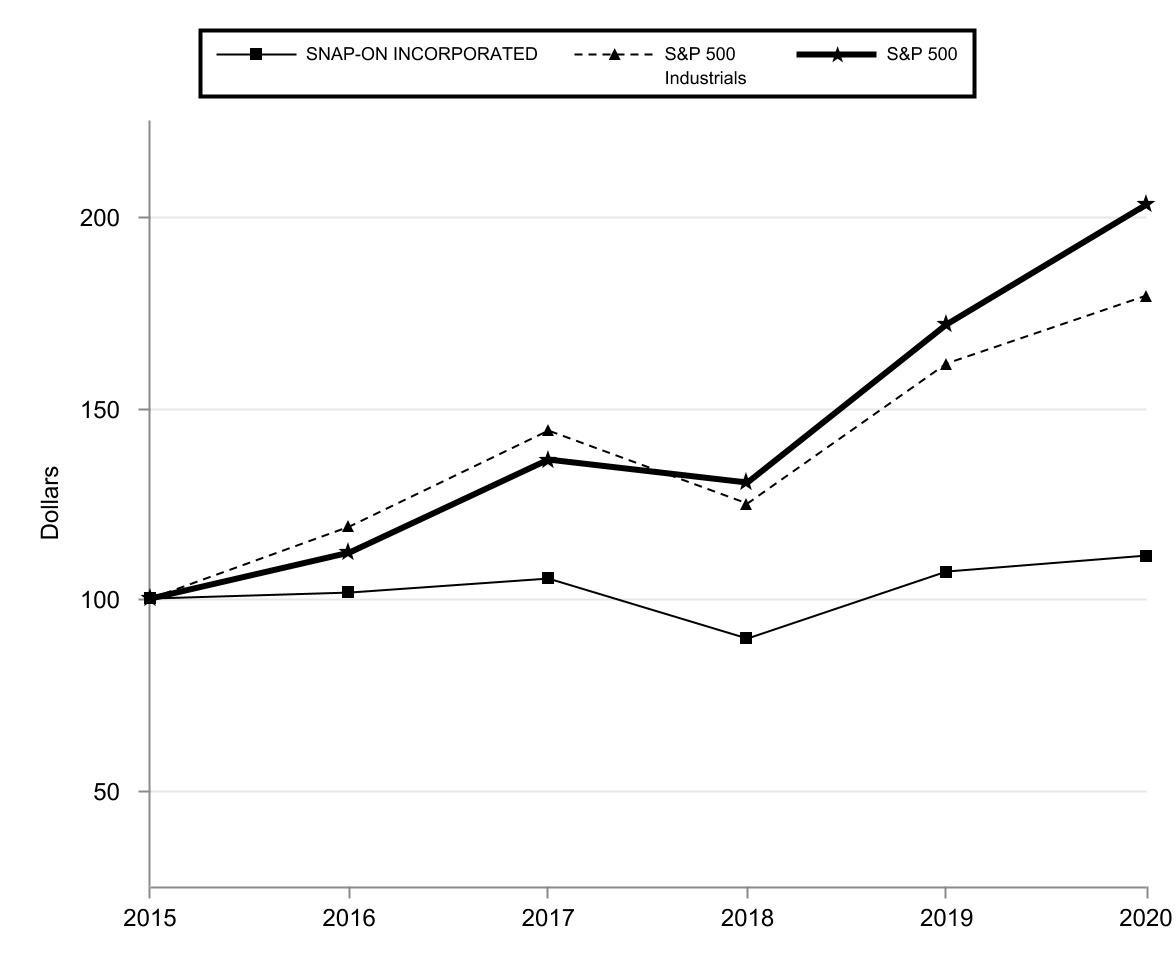
| Fiscal Year Ended (1) | Snap-on Incorporated | S&P 500 Industrials | S&P 500 | |||||||||||||||||
| December 31, 2015 | $100.00 | $100.00 | $100.00 | |||||||||||||||||
| December 31, 2016 | $101.54 | $118.86 | $111.96 | |||||||||||||||||
| December 31, 2017 | $105.24 | $143.86 | $136.40 | |||||||||||||||||
| December 31, 2018 | $89.61 | $124.74 | $130.42 | |||||||||||||||||
| December 31, 2019 | $107.12 | $161.38 | $171.49 | |||||||||||||||||
| December 31, 2020 | $111.42 | $179.23 | $203.04 |
(1) The company’s fiscal year ends on the Saturday that is on or nearest to December 31 of each year; for ease of calculation, the fiscal year end is assumed to be December 31.
| 2020 ANNUAL REPORT | 25 |
Item 6. Selected Financial Data
The selected financial data presented below has been derived from, and should be read in conjunction with, the respective historical consolidated financial statements of the company, including the notes thereto, and “Part II, Item 7: Management’s Discussion and Analysis of Financial Condition and Results of Operations.”
| Five-year Data | |||||||||||||||||||||||||||||||||||
| (Amounts in millions, except per share data) | 2020 | 2019 | 2018 | 2017 | 2016 | ||||||||||||||||||||||||||||||
| Results of Operations | |||||||||||||||||||||||||||||||||||
| Net sales | $ | 3,592.5 | $ | 3,730.0 | $ | 3,740.7 | $ | 3,686.9 | $ | 3,430.4 | |||||||||||||||||||||||||
| Gross profit | 1,748.5 | 1,844.0 | 1,870.0 | 1,825.9 | 1,710.4 | ||||||||||||||||||||||||||||||
| Operating expenses | 1,116.6 | 1,127.6 | 1,144.0 | 1,161.3 | 1,048.0 | ||||||||||||||||||||||||||||||
| Operating earnings before financial services | 631.9 | 716.4 | 726.0 | 664.6 | 662.4 | ||||||||||||||||||||||||||||||
| Financial services revenue | 349.7 | 337.7 | 329.7 | 313.4 | 281.4 | ||||||||||||||||||||||||||||||
| Financial services expenses | 101.1 | 91.8 | 99.6 | 95.9 | 82.7 | ||||||||||||||||||||||||||||||
| Operating earnings from financial services | 248.6 | 245.9 | 230.1 | 217.5 | 198.7 | ||||||||||||||||||||||||||||||
| Operating earnings | 880.5 | 962.3 | 956.1 | 882.1 | 861.1 | ||||||||||||||||||||||||||||||
| Interest expense | 54.0 | 49.0 | 50.4 | 52.4 | 52.2 | ||||||||||||||||||||||||||||||
| Earnings before income taxes and equity earnings | 835.2 | 922.1 | 909.9 | 821.9 | 801.4 | ||||||||||||||||||||||||||||||
| Income tax expense | 189.1 | 211.8 | 214.4 | 250.9 | 244.3 | ||||||||||||||||||||||||||||||
| Earnings before equity earnings | 646.1 | 710.3 | 695.5 | 571.0 | 557.1 | ||||||||||||||||||||||||||||||
| Equity earnings, net of tax | 0.3 | 0.9 | 0.7 | 1.2 | 2.5 | ||||||||||||||||||||||||||||||
| Net earnings | 646.4 | 711.2 | 696.2 | 572.2 | 559.6 | ||||||||||||||||||||||||||||||
| Net earnings attributable to noncontrolling interests | (19.4) | (17.7) | (16.3) | (14.5) | (13.2) | ||||||||||||||||||||||||||||||
| Net earnings attributable to Snap-on | 627.0 | 693.5 | 679.9 | 557.7 | 546.4 | ||||||||||||||||||||||||||||||
| Financial Position | |||||||||||||||||||||||||||||||||||
| Cash and cash equivalents | $ | 923.4 | $ | 184.5 | $ | 140.9 | $ | 92.0 | $ | 77.6 | |||||||||||||||||||||||||
| Trade and other accounts receivable – net | 640.7 | 694.6 | 692.6 | 675.6 | 598.8 | ||||||||||||||||||||||||||||||
| Finance receivables – net (current) | 530.2 | 530.1 | 518.5 | 505.4 | 472.5 | ||||||||||||||||||||||||||||||
| Contract receivables – net (current) | 112.5 | 100.7 | 98.3 | 96.8 | 88.1 | ||||||||||||||||||||||||||||||
| Inventories – net | 746.5 | 760.4 | 673.8 | 638.8 | 530.5 | ||||||||||||||||||||||||||||||
| Property and equipment – net | 526.2 | 521.5 | 495.1 | 484.4 | 425.2 | ||||||||||||||||||||||||||||||
| Long-term finance receivables – net | 1,136.3 | 1,103.5 | 1,074.4 | 1,039.2 | 934.5 | ||||||||||||||||||||||||||||||
| Long-term contract receivables – net | 374.7 | 360.1 | 344.9 | 322.6 | 286.7 | ||||||||||||||||||||||||||||||
| Total assets | 6,557.3 | 5,693.5 | 5,373.1 | 5,249.1 | 4,723.2 | ||||||||||||||||||||||||||||||
| Notes payable and current maturities of long-term debt | 268.5 | 202.9 | 186.3 | 433.2 | 301.4 | ||||||||||||||||||||||||||||||
| Accounts payable | 222.9 | 198.5 | 201.1 | 178.2 | 170.9 | ||||||||||||||||||||||||||||||
| Long-term debt | 1,182.1 | 946.9 | 946.0 | 753.6 | 708.8 | ||||||||||||||||||||||||||||||
| Total debt | 1,450.6 | 1,149.8 | 1,132.3 | 1,186.8 | 1,010.2 | ||||||||||||||||||||||||||||||
| Total shareholders’ equity attributable to Snap-on | 3,824.9 | 3,409.1 | 3,098.8 | 2,953.9 | 2,617.2 | ||||||||||||||||||||||||||||||
| Common Share Summary | |||||||||||||||||||||||||||||||||||
| Weighted-average shares outstanding – diluted | 54.8 | 55.9 | 57.3 | 58.6 | 59.4 | ||||||||||||||||||||||||||||||
| Net earnings per share attributable to Snap-on: | |||||||||||||||||||||||||||||||||||
| Basic | $ | 11.55 | $ | 12.59 | $ | 12.08 | $ | 9.72 | $ | 9.40 | |||||||||||||||||||||||||
| Diluted | 11.44 | 12.41 | 11.87 | 9.52 | 9.20 | ||||||||||||||||||||||||||||||
| Cash dividends paid per share | 4.47 | 3.93 | 3.41 | 2.95 | 2.54 | ||||||||||||||||||||||||||||||
| Shareholders’ equity per basic share | 70.44 | 61.87 | 55.04 | 51.46 | 45.05 |
| 26 | SNAP-ON INCORPORATED |
| Management’s Discussion and Analysis of Financial Condition and Results of Operations |
Item 7. Management’s Discussion and Analysis of Financial Condition and Results of Operations
Management Overview
In 2020, the COVID-19 pandemic impacted the company’s sales and earnings as a result of decreased activity in the first half of the year. By safely pursuing opportunities in the COVID-19 environment, we believe our 2020 operating results demonstrate our continued commitment to providing repeatability and reliability to a wide range of professional customers performing critical and essential tasks in workplaces of consequence. Leveraging capabilities already demonstrated in the automotive repair arena, our strategy continued to focus on developing and expanding our professional customer base, not only in automotive repair, but in adjacent markets, additional geographies and other areas, including critical industries, where the cost and penalties for failure can be high. Snap-on’s value proposition of making work easier for serious professionals is an ongoing strength as we move forward along our runways for coherent growth:
-
Enhancing the franchise network, where we continued to focus on helping our franchisees extend their reach through innovative selling processes and productivity initiatives that break the traditional time and space barriers inherent in a mobile van;
-
Expanding with repair shop owners and managers, where we continued to make progress in connecting with customers and translating the resulting insights into innovation that solves specific challenges in the repair facility;
-
Further extending to critical industries, where we continued to grow our lines of products customized for specific industries, including through acquisitions; and
-
Building in emerging markets, where we continued to maintain manufacturing capacity, as well as refine product lines and distribution capabilities.
Our strategic priorities and plans for 2021 involve continuing to build on our Snap-on Value Creation Processes – our suite of strategic principles and processes we employ every day designed to create value, and employed in the areas of safety, quality, customer connection, innovation and rapid continuous improvement (“Rapid Continuous Improvement” or “RCI”). We expect to continue to deploy these processes in our existing operations as well as into our recently acquired businesses.
Snap-on’s RCI initiatives employ a structured set of tools and processes across multiple businesses and geographies intended to eliminate waste and improve operations. Savings from Snap-on’s RCI initiatives reflect benefits from a wide variety of ongoing efficiency, productivity and process improvements, including savings generated from product design cost reductions, improved manufacturing line set-up and change-over practices, lower-cost sourcing initiatives and facility consolidations. Unless individually significant, it is not practicable to disclose each RCI activity that generated savings and/or segregate RCI savings embedded in sales volume increases.
Our global financial services operations continue to serve a significant strategic role in offering financing options to our franchisees, to their customers, and to customers in other parts of our business. We expect that our global financial services business, which includes both Snap-on Credit LLC (“SOC”) in the United States and our other international finance subsidiaries, will continue to be a meaningful contributor to our operating earnings going forward.
Snap-on has significant international operations and is subject to risks inherent with foreign operations, including foreign currency translation fluctuations.
Recent Acquisitions
On September 28, 2020, Snap-on acquired substantially all of the assets of AutoCrib, Inc. (“AutoCrib”) for a cash purchase price of $35.4 million. AutoCrib, based in Tustin, California, designs, manufactures and markets asset and tool control solutions. The acquisition of AutoCrib complemented and expanded Snap-on’s existing tool control offering to customers in a variety of industrial applications, including aerospace, automotive, military, natural resources and general industry.
On January 31, 2020, Snap-on acquired substantially all of the assets related to the TreadReader product line from Sigmavision Limited (“Sigmavision”) for a cash purchase price of $5.9 million. Sigmavision designs and manufactures handheld devices and drive-over ramps that provide tire information for use in the automotive industry. The acquisition of the TreadReader product line enhanced and expanded Snap-on’s existing capabilities in serving vehicle repair facilities and expanded the company’s presence with repair shop owners and managers.
| 2020 ANNUAL REPORT | 27 |
| Management’s Discussion and Analysis of Financial Condition and Results of Operations (continued) |
On August 7, 2019, Snap-on acquired Cognitran Limited (“Cognitran”) for a cash purchase price of $30.6 million (or $29.6 million, net of cash acquired), which reflects a $0.2 million working capital adjustment finalized in fiscal 2020. Cognitran, based in Chelmsford, U.K., specializes in flexible, modular and highly scalable “Software as a Service” (SaaS) products for Original Equipment Manufacturer (“OEM”) customers and their dealers, focused on the creation and delivery of service, diagnostics, parts and repair information to the OEM dealers and connected vehicle platforms. The acquisition of Cognitran enhanced and expanded Snap-on’s capabilities in providing shop efficiency solutions through integrated upstream services to OEM customers in automotive, heavy duty, agricultural and recreational applications.
On April 2, 2019, Snap-on acquired Power Hawk Technologies, Inc. (“Power Hawk”) for a cash purchase price of $7.9 million. Power Hawk, based in Rockaway, New Jersey, designs, manufactures and distributes rescue tools and related equipment for a variety of military, governmental, fire and rescue, and emergency operations. The acquisition of the Power Hawk product line complemented and increased Snap-on’s existing product offering and broadened its established capabilities in serving critical industries.
On January 25, 2019, Snap-on acquired substantially all of the assets of TMB GeoMarketing Limited (“TMB”) for a cash purchase price of $1.3 million. TMB, based in Dorking, U.K., designs planning software used by OEMs to optimize dealer locations and manage the performance of dealer outlets. The acquisition of TMB extended Snap-on’s product line in its core dealer network solutions business.
For segment reporting purposes, the results of operations and assets of Sigmavision, Cognitran and TMB have been included in the Repair Systems & Information Group since the respective acquisition dates, and the results of operations and assets of AutoCrib and Power Hawk have been included in the Commercial & Industrial Group since the respective acquisition dates.
Pro forma financial information has not been presented for any of these acquisitions as the net effects, individually and collectively, were neither significant nor material to Snap-on’s results of operations or financial position.
Fiscal 2019 as Compared to Fiscal 2018
A discussion regarding our financial condition and results of operations for fiscal 2019 compared to fiscal 2018 can be found under “Part II, Item 7: Management’s Discussion and Analysis of Financial Condition and Results of Operations,” in our Annual Report on the Form 10-K for the fiscal year ended December 28, 2019, which was filed with the SEC on February 13, 2020, and is available on the SEC’s website at www.sec.gov as well as in the “Investors” section of our corporate website at www.snapon.com.
Non-GAAP Measures
References in this Management’s Discussion and Analysis of Financial Condition and Results of Operations to
Showing the first 8K of 127K characters. Open the full section
Item 7A. Quantitative and Qualitative Disclosures About Market Risk
Market, Credit and Economic Risks
Market risk is the potential economic loss that may result from adverse changes in the fair value of financial instruments. Snap-on is exposed to market risk from changes in interest rates and foreign currency exchange rates. Snap-on is also exposed to market risk associated with the stock-based portion of its deferred compensation plans. Snap-on monitors its exposure to these risks and attempts to manage the underlying economic exposures through the use of financial instruments such as foreign currency forward contracts, interest rate swap agreements, treasury lock agreements and prepaid equity forward agreements (“equity forwards”). Snap-on does not use derivative instruments for speculative or trading purposes. Snap-on’s broad-based business activities help to reduce the impact that volatility in any particular area or related areas may have on its operating earnings as a whole. Snap-on’s management takes an active role in the risk management process and has developed policies and procedures that require specific administrative and business functions to assist in the identification, assessment and control of various risks.
Foreign Currency Risk Management
Snap-on has significant international operations and is subject to certain risks inherent with foreign operations that include currency fluctuations. Foreign currency exchange risk exists to the extent that Snap-on has payment obligations or receipts denominated in currencies other than the functional currency, including intercompany loans denominated in foreign currencies. To manage these exposures, Snap-on identifies naturally offsetting positions and then purchases hedging instruments to protect the residual net exposures. See Note 11 to the Consolidated Financial Statements for information on foreign currency risk management.
Interest Rate Risk Management
Snap-on aims to control funding costs by managing the exposure created by the differing maturities and interest rate structures of Snap-on’s borrowings through the use of interest rate swap agreements. Treasury lock agreements are used from time to time to manage the potential change in interest rates in anticipation of the possible issuance of fixed rate debt. See Note 11 to the Consolidated Financial Statements for information on interest rate risk management.
Snap-on utilizes a Value-at-Risk (“VAR”) model to determine the potential one-day loss in the fair value of its interest rate and foreign exchange-sensitive financial instruments from adverse changes in market factors. The VAR model estimates were made assuming normal market conditions and a 95% confidence level. Snap-on’s computations are based on the inter-relationships among movements in various currencies and interest rates (variance/co-variance technique). These inter-relationships were determined by observing interest rate and foreign currency market changes over the preceding quarter.
The estimated maximum potential one-day loss in fair value, calculated using the VAR model, as of 2020 and 2019 year end was $13.9 million and $9.9 million, respectively, on interest rate-sensitive financial instruments, and $0.1 million and $0.2 million, respectively, on foreign currency-sensitive financial instruments. The VAR model is a risk management tool and does not purport to represent actual losses in fair value that will be incurred by Snap-on, nor does it consider the potential effect of favorable changes in market factors.
Stock-based Deferred Compensation Risk Management
Snap-on aims to manage market risk associated with the stock-based portion of its deferred compensation plans through the use of equity forwards. Equity forwards are used to aid in offsetting the potential mark-to-market effect on stock-based deferred compensation from changes in Snap-on’s stock price. Since stock-based deferred compensation liabilities increase as the company’s stock price rises and decrease as the company’s stock price declines, the equity forwards are intended to mitigate the potential impact on compensation expense that may result from such mark-to-market changes. See Note 11 to the Consolidated Financial Statements for additional information on stock-based deferred compensation risk management.
Credit Risk
Credit risk is the possibility of loss from a customer’s failure to make payments according to contract terms. Prior to extending credit, each customer is evaluated, taking into consideration various factors, including the customer’s financial condition, debt-servicing ability, past payment experience, credit bureau information, and other financial and qualitative factors that may affect the customer’s ability to repay, as well as the value of the underlying collateral. Finance receivable credit risk is also monitored regularly through the use of internal proprietary custom scoring models to evaluate each transaction at the time of the application for credit. Snap-on evaluates credit quality through the use of an internal proprietary measuring system that provides a framework to analyze finance receivables on the basis of risk factors of the individual obligor as well as transaction specific risk. The finance receivables are typically monitored through an asset quality review process that closely monitors past due accounts and initiates a progressive collection action process when appropriate.
| 2020 ANNUAL REPORT | 51 |
Counterparty Risk
Snap-on is exposed to credit losses in the event of non-performance by the counterparties to its various financial agreements, including its foreign currency forward contracts, interest rate swap agreements, treasury lock agreements and prepaid equity forward agreements. Snap-on does not obtain collateral or other security to support financial instruments subject to credit risk, but monitors the credit standing of the counterparties and generally enters into agreements with financial institution counterparties with a credit rating of A- or better. Snap-on does not anticipate non-performance by its counterparties, but cannot provide assurances.
Economic Risk
Economic risk is the possibility of loss resulting from economic instability in certain areas of the world. Snap-on continually monitors its exposure in these markets. For example, the company is monitoring the impact of and developments related to the COVID-19 pandemic, which has created global economic uncertainty. In addition, the company is monitoring the effects of the United Kingdom’s exit from the European Union, although it is too soon to know what effects this might have on the world economy or the company. Inflation has not had a significant impact on the company.
As a result of the above market, credit and economic risks, net earnings and revenues in any particular period may not be representative of full-year results and may vary significantly from year to year.
Commodity Risk
Snap-on is a purchaser of certain commodities such as steel, natural gas and electricity. The company is also a purchaser of components and parts that are integrated into the company’s end products, as well as the purchaser of certain finished goods, all of which may contain various commodities including steel, aluminum, nickel, copper and others. Snap-on’s supply of raw materials and purchased components are generally and readily available from numerous suppliers.
The principal raw material used in the manufacture of the company’s products is steel, which the company purchases in competitive, price-sensitive markets. To meet Snap-on’s high quality standards, the company’s steel needs range from specialized alloys, which are available only from a limited group of approved suppliers, to common alloys, which are available from multiple suppliers. Some of these materials have been, and in the future may be, in short supply, particularly in the event of mill shutdowns or production cut backs. As some steel alloys require specialized manufacturing procedures, Snap-on could experience inventory shortages if it were required to use an alternative manufacturer on short notice. Steel and other raw materials, components and certain finished goods inventory can exhibit price and demand cyclicality, including as a result of tariffs and other trade protection measures. Associated unexpected price increases could result in an erosion of product margins or require Snap-on to increase prices to customers to maintain margins.
Snap-on believes its ability to sell product is also dependent on the changing vehicle repair requirements, the number of vehicles on the road, the general aging of vehicles and the number of miles driven. These factors affect the frequency, type and amount of service and repair performed on vehicles by technicians, and therefore affect the demand for the number of technicians, the prosperity of the technicians and, consequently, the demand technicians have for the company’s tools, other products and services, and the value technicians place on those products and services. The use of other methods of transportation, including more frequent use of public transportation, could result in a decrease in the use of privately operated vehicles. A decrease in the use of privately operated vehicles may lead to fewer repairs and less demand for the company’s products.
To the extent that commodity prices increase and the company does not have firm pricing agreements with its suppliers, the company may experience margin declines to the extent that it is not able to increase the selling prices of its products.
Item 8. Financial Statements and Supplementary Data
The financial statements and schedules are listed in Part IV, Item 15(a) and are incorporated by reference into this Item 8.
Item 9. Changes in and Disagreements With Accountants on Accounting and Financial Disclosure
None.
| 52 | SNAP-ON INCORPORATED |
Item 9A. Controls and Procedures
Evaluation of Disclosure Controls and Procedures
Snap-on maintains a system of disclosure controls and procedures that is designed to provide reasonable assurance that material information relating to the company and its consolidated subsidiaries is timely communicated to the officers who certify Snap-on’s financial reports and to other members of senior management and the Board, as appropriate.
In accordance with Rule 13a-15(b) of the Securities Exchange Act of 1934 (the “Exchange Act”), the company’s management evaluated, with the participation of the Chief Executive Officer and Chief Financial Officer, the effectiveness of the design and operation of the company’s disclosure controls and procedures (as defined in Rules 13a-15(e) and 15d-15(e) under the Exchange Act) as of January 2, 2021. Based upon their evaluation of these disclosure controls and procedures, the Chief Executive Officer and Chief Financial Officer concluded that the disclosure controls and procedures were effective as of January 2, 2021, to ensure that information required to be disclosed by the company in the reports it files or submits under the Exchange Act is recorded, processed, summarized and reported, within the time period specified in the Securities and Exchange Commission rules and forms, and to ensure that information required to be disclosed by the company in the reports it files or submits under the Exchange Act is accumulated and communicated to the company’s management, including its principal executive and principal financial officers, or persons performing similar functions, as appropriate, to allow timely decisions regarding required disclosure.
Changes in Internal Control
There has not been any change in the company’s internal control over financial reporting during the quarter ended January 2, 2021, that has materially affected, or is reasonably likely to materially affect, the company’s internal control over financial reporting (as such term is defined in Exchange Act Rules 13a-15(f) and 15d-15(f)).
Management’s Report on Internal Control over Financial Reporting
Our management is responsible for establishing and maintaining adequate internal control over financial reporting (as defined in Exchange Act Rules 13a-15(f) and 15d-15(f) under the Securities Exchange Act of 1934, as amended). Under the supervision and with the participation of our management, including our Chief Executive Officer and Chief Financial Officer, we evaluated the effectiveness of our internal control over financial reporting based on the criteria set forth by the Committee of Sponsoring Organizations of the Treadway Commission in Internal Control - Integrated Framework (2013). Based on this assessment, the company’s management believes that, as of January 2, 2021, our internal control over financial reporting was effective at a reasonable assurance level. The company’s internal control over financial reporting as of January 2, 2021, has been audited by Deloitte & Touche LLP, an independent registered public accounting firm, as stated in its attestation report, which is included herein.
Our management, including the Chief Executive Officer and Chief Financial Officer, does not expect that our internal control over financial reporting will prevent all errors or fraud. Because of inherent limitations, a system of internal control over financial reporting can provide only reasonable assurance and may not prevent or detect misstatements. Further, because of changes in conditions, the effectiveness of internal control over financial reporting may vary over time.
| 2020 ANNUAL REPORT | 53 |
REPORT OF INDEPENDENT REGISTERED PUBLIC ACCOUNTING FIRM
To the Board of Directors and Shareholders of Snap-on Incorporated:
Opinion on Internal Control over Financial Reporting
We have audited the internal control over financial reporting of Snap-on Incorporated and subsidiaries (the “Company”) as of January 2, 2021, based on criteria established in Internal Control — Integrated Framework (2013) issued by the Committee of Sponsoring Organizations of the Treadway Commission (“COSO”). In our opinion, the Company maintained, in all material respects, effective internal control over financial reporting as of January 2, 2021, based on criteria established in Internal Control — Integrated Framework (2013) issued by COSO.
We have also audited, in accordance with the standards of the Public Company Accounting Oversight Board (United States) (“PCAOB”), the consolidated financial statements as of and for the year ended January 2, 2021, of the Company and our report dated February 11, 2021, expressed an unqualified opinion on those financial statements and included an explanatory paragraph regarding the Company’s adoption of Accounting Standard Update No. 2016-13, Financial Instruments – Credit Losses (Topic 326).
Basis for Opinion
The Company’s management is responsible for maintaining effective internal control over financial reporting and for its assessment of the effectiveness of internal control over financial reporting, included in the accompanying Management’s Report on Internal Control over Financial Reporting. Our responsibility is to express an opinion on the Company’s internal control over financial reporting based on our audit. We are a public accounting firm registered with the PCAOB and are required to be independent with respect to the Company in accordance with the U.S. federal securities laws and the applicable rules and regulations of the Securities and Exchange Commission and the PCAOB.
We conducted our audit in accordance with the standards of the PCAOB. Those standards require that we plan and perform the audit to obtain reasonable assurance about whether effective internal control over financial reporting was maintained in all material respects. Our audit included obtaining an understanding of internal control over financial reporting, assessing the risk that a material weakness exists, testing and evaluating the design and operating effectiveness of internal control based on the assessed risk, and performing such other procedures as we considered necessary in the circumstances. We believe that our audit provides a reasonable basis for our opinion.
Definition and Limitations of Internal Control over Financial Reporting
A company’s internal control over financial reporting is a process designed to provide reasonable assurance regarding the reliability of financial reporting and the preparation of financial statements for external purposes in accordance with generally accepted accounting principles. A company’s internal control over financial reporting includes those policies and procedures that (1) pertain to the maintenance of records that, in reasonable detail, accurately and fairly reflect the transactions and dispositions of the assets of the company; (2) provide reasonable assurance that transactions are recorded as necessary to permit preparation of financial statements in accordance with generally accepted accounting principles, and that receipts and expenditures of the company are being made only in accordance with authorizations of management and directors of the company; and (3) provide reasonable assurance regarding prevention or timely detection of unauthorized acquisition, use, or disposition of the company’s assets that could have a material effect on the financial statements.
Because of its inherent limitations, internal control over financial reporting may not prevent or detect misstatements. Also, projections of any evaluation of effectiveness to future periods are subject to the risk that controls may become inadequate because of changes in conditions, or that the degree of compliance with the policies or procedures may deteriorate.
| /s/ DELOITTE & TOUCHE LLP | ||||||||
| Milwaukee, Wisconsin | ||||||||
| February 11, 2021 |
| 54 | SNAP-ON INCORPORATED |
Item 9B. Other Information
None.
PART III
Item 10. Directors, Executive Officers and Corporate Governance
Incorporated by reference to the sections entitled “Item 1: Election of Directors,” “Corporate Governance Practices and Board Information” and “Other Information” in Snap-on’s 2021 Annual Meeting Proxy Statement, which is expected to be mailed to shareholders on or about March 12, 2021 (the “2021 Proxy Statement”).
The Section 16(a) filing compliance disclosure pursuant to Item 405 of Regulation S-K is contained in Snap-on’s 2021 Proxy Statement in the section entitled “Other Information – Delinquent Section 16(a) Reports,” and is incorporated herein by reference.
Information about our Executive Officers
Information regarding Snap-on’s executive officers, including their ages, business experience (for at least the last five years) and titles as of January 2, 2021, is presented below:
Nicholas T. Pinchuk (74) – Chairman of the Board of Directors since 2009, President and Chief Executive Officer since December 2007, and President and Chief Operating Officer during 2007. Senior Vice President and President – Worldwide Commercial & Industrial Group from 2002 to 2007. Prior to joining Snap-on, Mr. Pinchuk held various positions, including President of Global Refrigeration Operations and President of Asia Pacific Operations, at Carrier Corporation, a producer of air conditioning, heating and refrigeration systems, and a subsidiary of United Technologies Corporation. Mr. Pinchuk serves on the board of directors of Columbus McKinnon Corporation.
Aldo J. Pagliari (66) – Senior Vice President – Finance and Chief Financial Officer since 2010.
Jesus M. Arregui (55) – Senior Vice President and President – Commercial Group since 2019, President, SNA Europe from 2015 to 2019, and Vice President, SNA Europe Operations from 2008 to 2015.
Anup R. Banerjee (70) – Senior Vice President, Human Resources and Chief Development Officer since 2015, and President, Commercial Group from 2011 to 2015.
Iain Boyd (58) – Vice President – Operations Development since 2015. Vice President, Human Resources from 2007 to 2015.
Timothy L. Chambers (56) – Senior Vice President and President – Snap-on Tools Group since 2019, President, Commercial Group from 2015 to 2019 and President, Equipment from 2014 to 2015.
June C. Lemerand (58) – Vice President and Chief Information Officer since 2017. Vice President of Information Technology Services from 2015 to 2017, and Senior Director, Information Technology Sales and Marketing Applications from 2005 to 2015.
Richard T. Miller (50) – Vice President, General Counsel and Secretary since 2018. Associate General Counsel from 2012 to 2018.
Richard K. Strege (63) – Vice President and Controller since 2017. Vice President, Internal Audit, Controls and Compliance from 2007 to 2017.
Thomas J. Ward (68) – Senior Vice President and President – Repair Systems & Information Group since 2010.
There is no family relationship among the executive officers and there has been no involvement in legal proceedings during the past ten years that would be material to the evaluation of the ability or integrity of any of the executive officers. Executive officers may either be elected by the Board or may be appointed by the Chief Executive Officer at the regular meeting of the Board that follows the Annual Shareholders’ Meeting, which is ordinarily held in April each year, or at such other times as new positions are created or vacancies must be filled.
Code of Ethics and Website Disclosure
Snap-on has adopted a written code of ethics that applies to its Chief Executive Officer, Chief Financial Officer, Vice President and Controller, and all other financial officers and executives performing similar functions. Snap-on has posted a copy of the code of ethics in the Investors/Corporate Governance section on the company’s website at www.snapon.com. Snap-on will also post any amendments to these documents, or information about any waivers granted to directors or executive officers with respect to the Code of Business Conduct and Ethics, on the company’s website at www.snapon.com.
Snap-on intends to satisfy the disclosure requirements under Item 10 of Form 8-K regarding amendments to, or waivers from, the code of ethics by posting such information in the “Investors” section of its corporate website at www.snapon.com.
| 2020 ANNUAL REPORT | 55 |
Item 11. Executive Compensation
The information required by Item 11 is contained in Snap-on’s 2021 Proxy Statement in the sections entitled “Executive Compensation,” “Board Compensation,” “Compensation Committee Report,” and “Other Information” and is incorporated herein by reference.
Item 12. Security Ownership of Certain Beneficial Owners and Management and Related Stockholder Matters
The information required by Item 12 is contained in Snap-on’s 2021 Proxy Statement in the sections entitled “Executive Compensation,” “Security Ownership of Certain Beneficial Owners and Management,” “Other Information” and “Item 4: Approval of the Amendment to, and Restatement of, the Snap-on Incorporated 2011 Incentive Stock and Awards Plan,” and is incorporated herein by reference.
Item 13. Certain Relationships and Related Transactions, and Director Independence
Incorporated by reference to the sections entitled “Corporate Governance Practices and Board Information – Board Information” and “Other Information – Transactions with the Company” in Snap-on’s 2021 Proxy Statement.
Item 14. Principal Accounting Fees and Services
Incorporated by reference to the section entitled “Deloitte & Touche LLP Fee Disclosure” in Snap-on’s 2021 Proxy Statement.
PART IV
Item 15: Exhibits, Financial Statement Schedules
Item 15. (a): Documents Filed as Part of This Report:
1. List of Financial Statements
Unless otherwise indicated, references to “fiscal 2020” or “2020” refer to the fiscal year ended January 2, 2021; references to “fiscal 2019” or “2019” refer to the fiscal year ended December 28, 2019; and references to “fiscal 2018” or “2018” refer to the fiscal year ended December 29, 2018. References to 2020, 2019 and 2018 year end refer to January 2, 2021, December 28, 2019, and December 29, 2018, respectively.
The following consolidated financial statements of Snap-on and the Report of Independent Registered Public Accounting Firm thereon, are filed as part of this report:
-
Report of Independent Registered Public Accounting Firm.
-
Consolidated Statements of Earnings for the 2020, 2019 and 2018 fiscal years.
-
Consolidated Statements of Comprehensive Income for the 2020, 2019 and 2018 fiscal years.
-
Consolidated Balance Sheets as of 2020 and 2019 year end.
-
Consolidated Statements of Equity for the 2020, 2019 and 2018 fiscal years.
-
Consolidated Statements of Cash Flows for the 2020, 2019 and 2018 fiscal years.
-
Notes to Consolidated Financial Statements.
2. Financial Statement Schedules
All schedules are omitted because they are not applicable, or the required information is included in the consolidated financial statements or notes thereto.
| 56 | SNAP-ON INCORPORATED |
3. List of Exhibits**(*)**
| 2020 ANNUAL REPORT | 57 |
Except for the foregoing, Snap-on and its subsidiaries have no unregistered long-term debt agreement for which the related outstanding debt exceeds 10% of consolidated total assets as of January 2, 2021. Copies of debt instruments for which the related debt is less than 10% of consolidated total assets will be furnished to the Commission upon request.
| 58 | SNAP-ON INCORPORATED |
| * | Filed electronically or incorporated by reference as an exhibit to this Annual Report on Form 10-K. Copies of any materials the company files with the SEC can also be obtained free of charge through the SEC’s website at www.sec.gov. | ||||
| ** | Represents a management compensatory plan or agreement. | ||||
Item 16. Form 10-K Summary
None.
| 2020 ANNUAL REPORT | 59 |
REPORT OF INDEPENDENT REGISTERED PUBLIC ACCOUNTING FIRM
To the Board of Directors and Shareholders and of Snap-on Incorporated:
Opinion on the Financial Statements
We have audited the accompanying consolidated balance sheets of Snap-on Incorporated and subsidiaries (the “Company”) as of January 2, 2021, and December 28, 2019, and the related consolidated statements of earnings, comprehensive income, equity, and cash flows for each of the three years in the period ended January 2, 2021, and the related notes (collectively referred to as the “financial statements”). In our opinion, the financial statements present fairly, in all material respects, the financial position of the Company as of January 2, 2021, and December 28, 2019, and the results of its operations and its cash flows for each of the three years in the period ended January 2, 2021, in conformity with accounting principles generally accepted in the United States of America.
We have also audited, in accordance with the standards of the Public Company Accounting Oversight Board (United States) (“PCAOB”), the Company’s internal control over financial reporting as of January 2, 2021, based on criteria established in Internal Control — Integrated Framework (2013) issued by the Committee of Sponsoring Organizations of the Treadway Commission and our report dated February 11, 2021, expressed an unqualified opinion on the Company’s internal control over financial reporting.
Change in Accounting Principles
As discussed in Note 1 to the consolidated financial statements, the Company changed its method of accounting for credit losses in the year ended January 2, 2021, due to the adoption of Accounting Standard Update No. 2016-13, Financial Instruments – Credit Losses (Topic 326) under the modified retrospective adoption method. The Company changed its method of accounting for leases in the year ended December 28, 2019 due to the adoption of Accounting Standard Update No. 2016-02, Leases (Topic 842) under the modified retrospective adoption method.
Basis for Opinion
These financial statements are the responsibility of the Company’s management. Our responsibility is to express an opinion on the Company’s financial statements based on our audits. We are a public accounting firm registered with the PCAOB and are required to be independent with respect to the Company in accordance with the U.S. federal securities laws and the applicable rules and regulations of the Securities and Exchange Commission and the PCAOB.
We conducted our audits in accordance with the standards of the PCAOB. Those standards require that we plan and perform the audit to obtain reasonable assurance about whether the financial statements are free of material misstatement, whether due to error or fraud. Our audits included performing procedures to assess the risks of material misstatement of the financial statements, whether due to error or fraud, and performing procedures that respond to those risks. Such procedures included examining, on a test basis, evidence regarding the amounts and disclosures in the financial statements. Our audits also included evaluating the accounting principles used and significant estimates made by management, as well as evaluating the overall presentation of the financial statements. We believe that our audits provide a reasonable basis for our opinion.
Critical Audit Matter
The critical audit matter communicated below is a matter arising from the current-period audit of the financial statements that was communicated or required to be communicated to the audit committee and that (1) relates to accounts or disclosures that are material to the financial statements and (2) involved our especially challenging, subjective, or complex judgments. The communication of critical audit matters does not alter in any way our opinion on the financial statements, taken as a whole, and we are not, by communicating the critical audit matter below, providing a separate opinion on the critical audit matter or on the accounts or disclosures to which it relates.
| 60 | SNAP-ON INCORPORATED |
Finance Receivables - Net - Refer to Notes 1 and 4 to the financial statements
Critical Audit Matter Description
The Company’s finance receivables are comprised of extended-term installment payment contracts to both technicians and independent shop owners (i.e., franchisees’ customers) to enable them to purchase tools, diagnostics, and equipment products on an extended-term payment plan, generally with average payment terms of approximately four years. The receivables are generally secured by the underlying tools and/or diagnostic or equipment products financed. At January 2, 2021, these loans totaled $1,742.8 million with an allowance of $76.3 million recorded against the receivables. Determining the proper level of allowance requires management to exercise judgment about the timing, frequency and severity of credit losses expected to occur over the life of the contracts. The Company estimates and records an allowance for credit losses over the expected contractual life of their contracts considering collectability, historical loss experience, current conditions and future market changes.
Evaluating the judgments related to the finance receivable allowance for credit losses is subjective and requires auditor judgment to effectively evaluate whether management’s judgments were reasonable.
How the Critical Audit Matter Was Addressed in the Audit
Our audit procedures related to the finance receivables allowance for credit losses balance included the following procedures, among others:
-
We tested the design, implementation and operating effectiveness of management’s controls over the allowance for credit losses including controls over the completeness and accuracy of underlying data.
-
Where appropriate, we assessed the reasonableness of, and evaluated support for, qualitative adjustments based on market conditions and/or portfolio performance metrics.
-
We tested the completeness and accuracy and evaluated the relevance of the key data used as inputs in management’s allowance for credit losses calculation, including loan balances, recoveries, charge-offs, portfolio characteristics and other data.
-
We tested the mathematical accuracy of the allowance for credit losses calculation with the assistance of our credit specialists and developed an expectation of the allowance for credit losses and compared it to the recorded balance.
-
We performed a retrospective review based on net losses as compared to estimates in the Company’s allowance to highlight any inconsistencies.
| /s/ DELOITTE & TOUCHE LLP | ||||||||
| Milwaukee, Wisconsin | ||||||||
| February 11, 2021 |
We have served as the Company’s auditor since 2002.
| 2020 ANNUAL REPORT | 61 |
| Snap-on Incorporated – Consolidated Statements of Earnings |
| (Amounts in millions, except per share data) | 2020 | 2019 | 2018 | |||||||||||||||||
| Net sales | $ | 3,592.5 | $ | 3,730.0 | $ |
Showing the first 8K of 283K characters. Open the full section