 filings.tools
Synopsys (SNPS) 10-K risk factor changes: FY2020 vs FY2019
The 2020-10-31 10-K against the 2019-10-31 one, compared heading by heading and sentence by sentence.
Item 1A49 rewritten45 added16 removed404 unchanged
All filing items945 rewritten429 added443 removed2,362 unchanged
Summary
counted, not written
- Item 1A lists 26 risk factor headings: 1 new, 0 reworded and 25 unchanged since FY2019. 0 headings from FY2019 no longer appear.
- Sentence by sentence, 429 added, 443 removed, 945 rewritten and 2,362 unchanged across 17 items that differ.
New Item 1A headings (1)
- The COVID-19 pandemic could have a material adverse effect on our business, operations and financial condition.
Removed Item 1A headings (0)
Every FY2019 risk factor heading is still here, word for word or reworded.
A heading is new when no FY2019 heading matches it after ignoring case and punctuation, and reworded when it shares at least 60 percent of its words with one that went away. All current risk factor headings.
Sentences by item
21 items, with every count and a link to each item that changed
Underlined words on a shaded ground are new in FY2020; struck-through words were in FY2019. Sentences that are wholly new or wholly gone are labelled rather than marked.
Item 1A. Risk Factors
49 rewritten, 45 added, 16 removed, 404 unchanged
Read the full itemFY2020 item · filed December 15, 2020FY2019 item · filed December 20, 2019
The growth of the electronic design automation (EDA) industry as a whole, our Semiconductor & System Design segment product sales, and to some extent our Software Integrity segment product sales, [removed: is] [added: are] dependent on the semiconductor and electronics industries.
The increasing complexity of designs of systems-on-chips, integrated circuits, electronic systems and customers’ concerns about managing [removed: costs,] [added: costs] have previously led and in the future could lead to a decrease in design starts and design activity in general, with some customers focusing more on one discrete phase of the design process or opting for less advanced, but less risky, manufacturing processes that may not require the most advanced EDA products.
Demand for our products and services could decrease and our financial condition and results of operations could be adversely affected if growth in the semiconductor and electronics industries slows or [removed: stalls.][added: stalls, including due to the impact of the COVID-19 pandemic.]
We work closely with major foundries to ensure that our EDA, IP, and [removed: manufacturing solutions are compatible with their manufacturing processes.]
[Table of [removed: Contents](#s7EC9245BA7305F5BB7C6C40978370A14)][added: Contents](#sDE27B510A17E5235B5B0169C7DCCEA1A)]
| • | Government trade restrictions, including tariffs, export licenses, or other trade barriers, and changes to existing trade arrangements between various [removed: countries;] [added: countries such as China;] |
| • | Other factors beyond our control such as natural disasters, terrorism, civil unrest, [removed: war] [added: war,] and infectious [removed: diseases.] [added: diseases and pandemics, including COVID-19.] |
[removed: As our business volume increases in the Asia Pacific region, there] [added: There] is inherent risk, based on the complex relationships between certain Asian countries [added: such as China] and the United States, that political, diplomatic, or military events could result in trade disruptions, including tariffs, trade embargoes, export restrictions and other trade barriers.
In response to [removed: that action] [added: these actions] or similar actions taken by the United States, other countries may adopt tariffs and trade barriers that could limit our ability to offer our products and services.
If we violate these laws and [removed: regulations] [added: regulations,] we could be subject to fines, penalties or criminal sanctions, and may be prohibited from conducting business in one or more countries.
[Table of [removed: Contents](#s7EC9245BA7305F5BB7C6C40978370A14)][added: Contents](#sDE27B510A17E5235B5B0169C7DCCEA1A)]
Uncertainty caused by [added: the recent] challenging global economic [removed: conditions] [added: conditions, including due to the effects of the COVID-19 pandemic,] could lead some of our customers to postpone their decision-making, decrease their spending and/or delay their payments to us.
In addition, economic conditions could deteriorate in the future, and, in particular, the semiconductor and electronics industries could fail to grow, including as the result of [added: the effects of the COVID-19 pandemic and] any disruption of international trade [removed: relationships.][added: relationships such as tariffs, export licenses, or other government trade restrictions.]
| • | Changes in demand for our [removed: products—especially] [added: products-especially] products, such as hardware, generating upfront [removed: revenue—due] [added: revenue-due] to fluctuations in demand for our customers’ products and due to constraints in our customers’ budgets for research and development and EDA products and services; |
| • | General economic and political conditions that affect the semiconductor and electronics industries, such as disruptions to international trade relationships, including tariffs, export licenses, or other trade barriers affecting our or our [removed: suppliers' products;] [added: suppliers’ products, as well as impacts due to the COVID-19 pandemic;] and |
[Table of [removed: Contents](#s7EC9245BA7305F5BB7C6C40978370A14)][added: Contents](#sDE27B510A17E5235B5B0169C7DCCEA1A)]
| • | Customer contract amendments or renewals that provide discounts or defer revenue to later periods; [added: and] |
| • | The levels of our hardware and IP revenues, which are recognized upfront and are primarily dependent upon our ability to provide the latest technology and meet customer [removed: requirements; and] [added: requirements.] |
| • | Our ability to enhance the value of our offerings through more favorable terms such as expanded license usage, future purchase rights, price discounts and other differentiating rights, such as [added: multiple tool copies, post-contract customer support, “re-mix” rights that allow customers to exchange the software they initially licensed for other Synopsys products, and the ability to purchase pools of technology;] |
[Table of [removed: Contents](#s7EC9245BA7305F5BB7C6C40978370A14)][added: Contents](#sDE27B510A17E5235B5B0169C7DCCEA1A)]
While we identified and [removed: closed] [added: remediated] the [removed: method used to gain access,] [added: incident,] it is possible that our security measures may be circumvented again in the future, and [added: any] such [removed: a] breach could harm our business and reputation.
An attack could disrupt the proper functioning of our software, cause errors in the output of our customers’ work, allow unauthorized access to our or our customers’ proprietary information, [removed: and] [added: or cause] other destructive outcomes.
[Table of [removed: Contents](#s7EC9245BA7305F5BB7C6C40978370A14)][added: Contents](#sDE27B510A17E5235B5B0169C7DCCEA1A)]
Additionally, despite our measures to prevent piracy, other parties may attempt to illegally copy or use our products, which could result in lost [removed: revenue.][added: revenue if their efforts are successful.]
[removed: We] [added: From time to time, we] may need to commence litigation or other legal proceedings in order to:
[Table of [removed: Contents](#s7EC9245BA7305F5BB7C6C40978370A14)][added: Contents](#sDE27B510A17E5235B5B0169C7DCCEA1A)]
Difficulties in any of our new product development efforts or our efforts to enter adjacent [removed: markets] [added: markets, including delays or disruptions as a result of the COVID-19 pandemic,] could adversely affect our operating results and financial condition.
[Table of [removed: Contents](#s7EC9245BA7305F5BB7C6C40978370A14)][added: Contents](#sDE27B510A17E5235B5B0169C7DCCEA1A)]
| • | Increasingly variable revenue and [removed: decreasingly accurate] [added: less predictable] revenue forecasts, due to fluctuations in hardware revenue, which is recognized upfront upon shipment, as opposed to most sales of software products for which revenue is recognized over time; |
| • | Decreases or delays in customer purchases in favor of next-generation releases, which may lead to excess or obsolete inventory or require us to discount our older hardware products; [removed: and] |
| • | Longer warranty periods than those of our software products, which may require us to replace hardware components under warranty, thus increasing our [removed: costs.] [added: costs; and] |
[removed: For information regarding new accounting standards, please refer to Note 14 of *Notes to Consolidated Financial Statements* under the heading "Effect of New Accounting Pronouncements."] These and other such standards generally result in different accounting principles, which may significantly impact our reported results or could result in variability of our financial results.
Our operations are subject to income and transaction taxes in the United States and in multiple foreign [removed: jurisdictions, with a significant amount of our foreign earnings generated by our subsidiaries organized in Ireland and Hungary.][added: jurisdictions.]
Furthermore, a change in the tax law of the jurisdictions where we do business, including an increase in tax [removed: rates or] [added: rates,] an adverse change in the treatment of an item of income or [removed: expense,] [added: expense or limitations on our ability to utilize tax credits,] could result in a material increase in our tax expense and impact our financial position and cash flows.
[Table of [removed: Contents](#s7EC9245BA7305F5BB7C6C40978370A14)][added: Contents](#sDE27B510A17E5235B5B0169C7DCCEA1A)]
Since the beginning of fiscal 2019, the U.S. Treasury Department has issued proposed regulations [removed: that, if finalized as written, would have a material impact on our ability to claim certain tax benefits related to the Tax Act.][added: that]
While [removed: the Company continues] [added: we continue] to evaluate the potential impact on [removed: its] [added: our] estimated annual tax rate, certain of these regulations have not been finalized and are subject to change.
Further changes in the tax laws of foreign jurisdictions could arise as a result of the [removed: base erosion and profit shifting (BEPS) project undertaken] [added: *Programme of Work to Develop a Concensus Solution to the Tax Challenges Arising from the Digitalization of the Economy (Programme of Work)* agreement] by the Organisation for Economic Co-operation and Development (OECD), which represents a coalition of member [removed: countries.][added: countries, including the United States.]
[removed: Many of these recommendations are being adopted] [added: These changes, if enacted,] by various countries in which we do business [removed: and] may increase our taxes in these countries.
For further discussion of the Hungary audit, see Note [removed: 11] [added: 13] of [removed: *Notes] [added: Notes] to Consolidated Financial [removed: Statements* under the heading "Non-U.S. Examinations."][added: Statements.]
COVID-19 Pandemic Risks
The COVID-19 pandemic could have a material adverse effect on our business, operations and financial condition.
The COVID-19 pandemic has caused minor disruptions to our business operations to date and could have a material adverse effect on our business, operations and financial condition in the future.
For example, we experienced limited hardware supply chain and logistical challenges as well as a slowdown in customer commitments in our Software Integrity segment.
In response to the COVID-19 novel coronavirus pandemic, governments and businesses have taken unprecedented actions to contain the virus, including social distancing, travel restrictions, shelter-in-place orders and restrictions on non-essential businesses.
These restrictions have significantly curtailed global economic activity and have caused substantial volatility and disruption in global financial markets.
We transitioned most of our employees in affected regions to work remotely in order to comply with applicable restrictions and government requirements, and implemented travel restrictions and other changes to our business operations.
We are transitioning employees back into offices in select jurisdictions in conformity with local guidelines and regulations.
Each office must follow physical distancing guidelines and affirmative health measures in compliance with different local and national requirements.
Although we have been able to navigate workplace restrictions and limitations with minimal disruptions to our business operations to date, we may further modify our business practices and real estate needs in response to the risks and negative impacts caused by the COVID-19 pandemic.
We cannot be certain that these measures will be successful.
The extent to which the COVID-19 pandemic impacts our business operations in future periods will depend on multiple uncertain factors, including the duration and scope of the pandemic, its overall negative impact on the global economy, continued responses by governments and businesses to COVID-19, the ability to secure timely payment from customers, the ability to accurately estimate customer demand, reduced willingness of current and potential customers to purchase our products and services due to their own business and market uncertainties, the ability of our business partners and third-party providers to fulfill their responsibilities and commitments, the ability to secure adequate and timely supply of equipment and materials from suppliers for our hardware products, and the ability to develop and deliver our products.
In addition, continued weak economic conditions may result in impairment in value of our tangible and intangible assets.
The impact of the COVID-19 pandemic may also have the effect of heightening many of the other risks and uncertainties described in this “Risk Factors” section.
Industry Risks
manufacturing solutions are compatible with their manufacturing processes.
Outside of a slowdown in customer commitments in our Software Integrity segment, we have not seen evidence of impacts on customer orders from the COVID-19 pandemic to date.
For example, the adoption of cloud computing and artificial intelligence technologies can bring new demands and also challenges in terms of disruption to both business models and our existing technology offerings.
| • | Our ability to manage an efficient supply chain to ensure availability of hardware products; |
Business Operations Risks
As a result of this government action, unless and until the restriction is lifted, we are not able to ship products or provide support to these entities.
In addition, in May 2020, the United States government placed further restrictions on certain entities on the Entity List to prevent them from sharing designs developed using U.S. software or technology with other entities on the Entity List and obtaining semiconductors manufactured with processes that use U.S. software and technology.
In August 2020, the Entity List rules were further revised such that any company with knowledge that a customer will use certain U.S. technologies to design or produce any item for a Huawei-affiliated company on the Entity List must obtain a license prior to any export of such technologies.
We believe that this latest restriction will not materially impact our business at this time, but cannot predict the impact that additional regulatory changes may have on our business in the future.
| • | Changes in demand for our products due to customers reducing their expenditures, whether as a cost-cutting measure or a result of their insolvency or bankruptcy, and whether due to the COVID-19 pandemic or other reasons; |
As a result of the COVID-19 pandemic and shelter-in-place orders, most of our employees in affected areas are working remotely, which magnifies the importance of the integrity of our remote access security measures.
| | |
| --- | --- |
| | |
| --- | --- |
| • | Potential impacts on our supply chain due to the effects of the COVID-19 pandemic. |
Any failure to recruit and retain key technical,
sales and managerial employees could harm our business, results of operations and financial condition, and our recruiting and retention efforts may be negatively impacted by restrictions on travel and business activity due to the COVID-19 pandemic.
In addition, we cannot predict the full impact of the COVID-19 pandemic on our business operations.
The uncertainty affects management’s estimates and assumptions, which could result in greater variability in a variety of areas that depend on these estimates and assumptions.
Legal and Regulatory Risks
For example, in response to the fiscal impact of the COVID-19 pandemic, the State of California enacted legislation on June 29, 2020 that would suspend the use of certain corporate research and development tax credits for a three-year period beginning in our fiscal 2021, which could result in an impact in our tax expense.
could have a material impact on our ability to claim certain tax benefits related to the Tax Act.
The *Programme of Work* is evaluating potential changes to numerous long-standing tax principles.
The Hungarian Supreme Court heard our appeal on November 12, 2020 and issued a ruling from the bench to remand the case to the Hungarian Administrative Court for further proceedings.
As a result of this government action, we are not able to book new business with these entities, and revenue associated with these entities is put “on hold” until either the contract expires, or the restriction is lifted.
While the global economy has been relatively strong in recent years, there are still uncertainties surrounding the strength of economic recovery in many regions.
| • | Changes in our revenue recognition model. |
multiple tool copies, post-contract customer support, “re-mix” rights that allow customers to exchange the software they initially licensed for other Synopsys products, and the ability to purchase pools of technology;
We determined that no customer project or design data had been accessed.
No personally identifiable information or payment card information is stored on the system.
The applicability and impact of these new tax provisions is dependent in part on changes to our tax structure that were implemented in response to the Tax Act at the end of fiscal 2018.
The net impact of such changes is uncertain, and could adversely affect our tax rate and cash flow in future years.
As regulations and guidance evolve with respect to the Tax Act, and as we gather more information and perform more analysis, our results may materially differ from previous estimates, and those differences may materially affect our financial position.
On October 5, 2015, the OECD issued a series of reports recommending changes to numerous long-standing tax principles.
For example, we were engaged in complex patent litigation with Mentor Graphics Corporation (Mentor) involving several actions in different forums.
In June 2018, we settled all outstanding patent litigation with Mentor for a $65.0 million payment made in the third quarter of fiscal 2018 to Siemens, which acquired Mentor in March 2017.
Further information regarding the lawsuits and settlement are contained in Part I, Item 3, *Legal Proceedings* and Note 7 of *Notes to Consolidated Financial Statements* under the heading “Legal Proceedings.” In conjunction with the settlement, we also amended an existing interoperability agreement with Mentor to collaborate on a wide range of EDA products.
The amendment includes a one-time termination charge between $0.0 and $25.0 million, payable to Mentor under certain conditions.
In the event such conditions are met, the termination charge could have an adverse effect on our operating results.
Any failure to recruit and retain key technical, sales and managerial employees could harm our business, results of operations and financial condition.
An excerpt. Shown here: 40 of 49 rewritten, 40 of 45 added and all 16 removed. The counts are complete. For every sentence, read Item 1A. Risk Factors in the FY2020 filing and the FY2019 filing.
Item 7. Management’s Discussion and Analysis of Financial Condition and Results of Operations
167 rewritten, 42 added, 45 removed, 330 unchanged
Read the full itemFY2020 item · filed December 15, 2020FY2019 item · filed December 20, 2019
Synopsys, Inc. provides products and services used across the entire [removed: silicon] [added: Silicon] to [removed: software] [added: Software] spectrum, from engineers creating advanced semiconductors to [added: product teams developing advanced electronic systems to] software developers seeking to ensure the security and quality of their code.
To complement these offerings, we provide technical services and support to help our customers [removed: develop advanced chips and electronic systems.]
We are also a leading provider of software tools and services that improve the [removed: security and] [added: security,] quality [added: and compliance] of software [removed: code] in a wide variety of industries, including electronics, financial services, [removed: media,] automotive, medicine, energy and industrials.
[removed: Despite global economic uncertainty, we] [added: We] have consistently grown our revenue since [removed: 2005.][added: 2005, despite periods of global economic uncertainty.]
We achieved these results because of our solid execution, leading technologies and strong customer [removed: relationships.][added: relationships, and because we recognize our revenue for software licenses over the arrangement period, which typically approximates three years.]
[removed: We] [added: As we] recognize our revenue for [removed: the] software licenses over the arrangement period, [removed: which typically approximates three years.][added: any potential impact related to COVID-19 may be delayed.]
[added: See Note 2 of *Notes to Consolidated Financial Statements* for discussion on our revenue recognition policy*.*] The revenue we recognize in a particular period generally results from selling efforts in prior periods rather than the current period.
Our growth strategy is based on [added: maintaining and] building on our leadership in our EDA products, expanding and proliferating our IP offerings, [removed: and] driving growth in the software security and quality [added: market, and continuing to expand our product portfolio and our total addressable] market.
In addition, due to our adoption of Accounting Standard Codification 606 (ASC 606), "Revenue from Contracts with Customers", in the beginning of fiscal 2019, [removed: as further described in Note 2 of *Notes to Consolidated Financial Statements*,] the way in which we are required to account for certain types of arrangements has increased the variability in our total revenue from period to period.
Nevertheless, the accounting impact has not affected [removed: our] [added: the] cash generated from our business.
[Table of [removed: Contents](#s7EC9245BA7305F5BB7C6C40978370A14)][added: Contents](#sDE27B510A17E5235B5B0169C7DCCEA1A)]
EDA includes digital, custom [removed: IC design] and Field Programmable Gate Array (FPGA) [added: IC] design software, verification products, and manufacturing software products.
Designers use these products to automate the [added: highly complex] IC design process and to reduce [removed: errors.][added: defects that could lead to expensive design or manufacturing re-spins or suboptimal end products.]
Fiscal [removed: 2019] [added: 2020] and [removed: 2017] [added: 2019] were 52-week years ending on [added: October 31, 2020 and] November 2, [removed: 2019 and October 28, 2017,] [added: 2019,] respectively.
Fiscal [removed: 2020] [added: 2021] will be a 52-week year.
Fiscal [removed: 2019] [added: 2020] Financial Performance Summary
In fiscal [removed: 2019,] [added: 2020,] compared to fiscal [removed: 2018,] [added: 2019,] our financial performance reflects the following:
| • | Total cost of revenue and operating expenses were [removed: $2.8] [added: $3.1] billion, an increase of [removed: $79.6] [added: $224.8] million or [removed: 3%,] [added: 8%,] primarily due to increases in [removed: restructuring costs of $34.2 million and] employee-related costs of [removed: $81.3] [added: $193.4] million, resulting from [added: headcount] increases [removed: in headcount,] [added: through organic growth and acquisitions,] partially offset by a [removed: litigation settlement in fiscal 2018 of $26.0 million and a legal settlement in our favor] [added: decrease] in [removed: fiscal 2019] [added: restructuring costs] of [removed: $18.3] [added: $11.1] million; |
| • | Operating income of [removed: $520.2] [added: $620.1] million, an increase of [removed: $160.0] [added: $99.9] million or [removed: 44%.] [added: 19%.] |
[Table of [removed: Contents](#s7EC9245BA7305F5BB7C6C40978370A14)][added: Contents](#sDE27B510A17E5235B5B0169C7DCCEA1A)]
We have concluded that our EDA software licenses in [removed: TSL] [added: Time-based Subscription License (TSL)] contracts are not distinct from our obligation to provide unspecified software updates to the licensed software throughout the license term, because those promises represent inputs to a single, combined performance obligation.
[Table of [removed: Contents](#s7EC9245BA7305F5BB7C6C40978370A14)][added: Contents](#sDE27B510A17E5235B5B0169C7DCCEA1A)]
See Note [removed: 14] [added: 16] of *Notes to Consolidated Financial Statements.*
See Note [removed: 13] [added: 15] of the *Notes to Consolidated Financial Statements* for additional information about our reportable segments and revenue by geographic regions.
| • | EDA software includes digital, custom and Field Programmable Gate Array (FPGA) IC design software, verification products and obligations to provide unspecified updates and support services. EDA products and services are typically sold through TSL arrangements that grant customers the right to access and use all of the licensed products at the outset of an arrangement and software updates are generally made available throughout the entire term of the arrangement. The weighted-average term of the TSLs we entered into in fiscal [added: 2020,] 2019, [removed: 2018,] and [removed: 2017] [added: 2018] were [removed: all 2.7] [added: approximately three] years, respectively. Under ASC 606, we have concluded that the software licenses in TSL contracts are not distinct from the obligation to provide unspecified software updates to the licensed software throughout the license term, because the multiple software licenses represent inputs to a single, combined offering, and timely, relevant software updates are integral to maintaining the utility of the software licenses. We recognize revenue for the combined performance obligation under TSL contracts ratably over the term of the license. [removed: Under ASC 605, these arrangements were previously recognized ratably over the contract term.] |
| • | IP & System Integration includes our DesignWare® IP portfolio and system-level products and services. Under ASC 606, these arrangements generally have two performance obligations which consist of transferring of the licensed IP and providing related support, which includes rights to technical support and software updates that are provided over the support term and are transferred to the customer over [removed: a] time. Revenue allocated to the IP licenses is recognized at a point in time upon the later of the delivery date or the beginning of the license period, and revenue allocated to support is recognized over the support term. Royalties are recognized as revenue in the quarter in which the applicable customer sells its products that incorporate our IP. Payments for IP contracts are generally received upon delivery of the IP. Revenue related to the customization of certain IP is recognized as “Professional Services.” [removed: Under ASC 605, we previously recognized revenues ratably for certain IP licensing and support arrangements.] |
[Table of [removed: Contents](#s7EC9245BA7305F5BB7C6C40978370A14)][added: Contents](#sDE27B510A17E5235B5B0169C7DCCEA1A)]
[added: | • | In the case of arrangements involving the sale of Hardware products, we generally have two performance obligations.] The [added: first performance obligation is to transfer the hardware product, which includes software integral to the functionality of the hardware product. The] second performance obligation is to provide maintenance on the hardware and its embedded software, which includes rights to technical support, hardware repairs and software updates that are all provided over the same term and have the same time-based pattern of transfer to the customer. [added: The portion of the transaction price allocated to the hardware product is generally recognized as revenue at the time of shipment because the customer obtains control of the product at that point in time. We have concluded that control generally transfers at that point in time because the customer has the ability to direct the use of the asset and an obligation to pay for the hardware. The portion of the transaction price allocated to the maintenance obligation is recognized as revenue ratably over the maintenance term. |]
| • | Revenue from Professional Service contracts is recognized over time, generally using costs incurred or hours expended to measure progress. We have a history of reasonably estimating project status and the costs necessary to complete projects. A number of internal and external factors can affect these estimates, including labor rates, utilization and efficiency variances and specification and testing requirement changes. [removed: The adoption of ASC 606 did not change from ASC 605 the timing of revenue recognition for professional services.] |
| • | We sell Software Integrity products in arrangements that provide customers the right to software licenses, maintenance updates and technical support. Over the term of these arrangements, the customer expects us to provide integral maintenance updates to the software licenses, which help customers protect their own software from new critical quality defects and potential security vulnerabilities. The licenses and maintenance updates serve together to fulfill our commitment to the customer as both work together to provide [removed: the] functionality to the customer and represent a combined performance obligation. We [removed: will] recognize revenue for the combined performance obligation over the term of the arrangement. |
Most of our customer arrangements [removed: are complex, involving] [added: involve] hundreds of products and various license rights, and our customers bargain with us over many aspects of these arrangements.
| | [removed: 2019] [added: 2020] | | | | [removed: 2018] [added: 2019] | | | | [removed: 2017] [added: 2018] | | | | [removed: 2018] [added: 2019] to [removed: 2019] [added: 2020] | | | | | | | [removed: 2017] [added: 2018] to [removed: 2018] [added: 2019] | | | | | |
| Semiconductor & System Design Segment | $ | [removed: 3,026.1] [added: 3,327.2] | | | $ | [removed: 2,840.6] [added: 3,026.1] | | | $ | [removed: 2,551.1] [added: 2,840.6] | | | $ | [removed: 185.5] [added: 301.1] | | | [removed: 7] [added: 10] | % | | $ | [removed: 289.5] [added: 185.5] | | | [removed: 11] [added: 7] | % |
| Software Integrity Segment | [removed: 334.6] [added: 358.1] | | | | [removed: 280.5] [added: 334.6] | | | | [removed: 173.8] [added: 280.5] | | | | [removed: 54.1] [added: 23.5] | | | | [removed: 19] [added: 7] | % | | [removed: 106.7] [added: 54.1] | | | | [removed: 61] [added: 19] | % |
| Total | $ | [removed: 3,360.7] [added: 3,685.3] | | | $ | [removed: 3,121.1] [added: 3,360.7] | | | $ | [removed: 2,724.9] [added: 3,121.1] | | | $ | [removed: 239.6] [added: 324.6] | | | [removed: 8] [added: 10] | % | | $ | [removed: 396.2] [added: 239.6] | | | [removed: 15] [added: 8] | % |
Our revenues are subject to fluctuations, primarily due to customer [removed: requirements,] [added: requirements] including the timing and value of contract [removed: renewals, as well as payment terms for revenue recognized under ASC 605.][added: renewals.]
For example, we experience [removed: variability] [added: fluctuations] in our revenue due to factors such as the timing of IP [added: product sales,] consulting projects, [added: Flexible Spending Account (FSA) drawdowns,] royalties, [removed: variability in IP products sales] and hardware sales.
[Table of [removed: Contents](#s7EC9245BA7305F5BB7C6C40978370A14)][added: Contents](#sDE27B510A17E5235B5B0169C7DCCEA1A)]
For a discussion of revenue by geographic areas, see Note [removed: 13] [added: 15] of *Notes to Consolidated Financial Statements.*
| | [removed: 2019] [added: 2020] | | | | [removed: 2018] [added: 2019] | | | | [removed: 2017] [added: 2018] | | | | [removed: 2018] [added: 2019] to [removed: 2019] [added: 2020] | | | | | | | [removed: 2017] [added: 2018] to [removed: 2018] [added: 2019] | | | | | |
develop advanced chips and electronic systems.
COVID-19 Pandemic
While the COVID-19 pandemic has changed the physical working environment of the substantial majority of our workforce to working from home, it has otherwise caused only minor disruptions to our business operations with a limited impact on our operating results thus far.
Given the unpredictable nature of the COVID-19 pandemic’s impact on the global economy, our historical results may not be an indication of future performance.
The extent to which the COVID-19 pandemic impacts our business operations in future periods will depend on multiple uncertain factors, including the duration and scope of the pandemic, its overall negative impact on the global economy generally and the semiconductor and electronics industries specifically, and continued responses by governments and businesses to COVID-19.
We have not identified trends that we expect will materially impact our future operating results at this time.
We have not observed any changes in the design activity of customers, but we experienced a slowdown in customer commitments in our Software Integrity segment.
We have not received any significant requests from our customers to either delay payments or modify arrangements due to COVID-19.
However, this situation could change in future periods and the extent that these requests may impact our business is uncertain.
We have also experienced minor disruptions in our hardware supply chain, which we have been able to address with minimal impact to our business operations to date.
We will continue to consider the potential impact of the COVID-19 pandemic on our business operations.
Although no material impairment or other effects have been identified to date related to the COVID-19 pandemic, there is substantial uncertainty in the nature and degree of its continued effects over time.
That uncertainty affects
management’s accounting estimates and assumptions, which could result in greater variability in a variety of areas that depend on these estimates and assumptions as additional events and information become known.
See Part I, Item 1A, *Risk Factors* for further discussion of the possible impact of the COVID-19 pandemic on our business, operations and financial condition.
| • | Revenues were $3.7 billion, an increase of $324.6 million or 10%, primarily due to our continued organic growth; |
The increase in total revenue for fiscal 2020 compared to fiscal 2019 was primarily attributable to the continued organic growth of the business in time-based and upfront IP license products, and higher maintenance and service revenue.
million in consulting costs primarily related to servicing IP consulting arrangements, $5.1 million in depreciation and maintenance expenses, and $2.8 million in hardware related direct costs, partially offset by a decrease of $7.1 million in amortization of intangible assets.
Sales and marketing expenses remained relatively flat for fiscal 2020 compared to fiscal 2019, primarily due to a decrease of $19.5 million that included reduced travel and marketing expenses as a result of COVID-19 restrictions, partially offset by an increase in personnel-related costs of $19.1 million.
The increase in general and administrative expenses for fiscal 2020 compared to fiscal 2019 was primarily due to an increase of $24.2 million in personnel-related expenses, a legal settlement of $18.3 million in our favor in the first quarter of fiscal 2019, and an increase of $13.1 million in depreciation and maintenance expenses, partially offset by a decrease of $1.6 million in professional service costs.
| 2020 | $ | 22.6 | | | $ | 36.1 | | | $ | (57.4 | ) | | $ | 1.3 | |
Our effective tax rate for fiscal 2020 was (4.0%), which included a tax benefit of $39.2 million of U.S. federal research tax credit, a foreign derived intangible income (FDII) deduction of $24.3 million, and excess tax benefits from stock-based compensation of $72.3 million.
The Tax Act includes certain new tax provisions listed below which apply to us beginning in fiscal 2019.
In the second quarter of 2019, as a result of the Court's decision, we recorded a tax expense due to an unrecognized tax benefit of $17.4 million, which is net of estimated U.S. foreign tax credits for the tax assessments.
The Hungarian Supreme Court heard our appeal on November 12, 2020 and issued a ruling from the bench to remand the case to the Hungarian Administrative Court for further proceedings.
We expect to receive the Hungarian Supreme Court’s written decision in the first quarter of fiscal 2021.
We have considered the potential impact of the COVID-19 pandemic on our liquidity and capital resources.
Although we have not observed any material effects on our liquidity, collections from customers or other working capital requirements due to the COVID-19 pandemic to date, there is substantial uncertainty that could result in greater variability as additional events and information become known.
We believe that our existing balances of cash and cash equivalents will be sufficient to satisfy our working capital needs, capital asset purchases, share repurchases, acquisitions, debt repayments and other liquidity requirements associated with our existing operations.
We are continuously evaluating the COVID-19 pandemic’s effects and taking steps to mitigate known risks, including potential constraints on our liquidity and capital resources as a result of customers’ reduced expenditures or disruptions to our supply chain.
In light of that ongoing assessment, we may choose to temporarily defer certain expenditures due to the effects of the COVID-19 pandemic.
The Tax Act provides an exemption from federal income taxes for distributions from foreign subsidiaries made after December 31, 2017 that were not subject to the one-time transition tax.
We have provided for foreign withholding taxes on undistributed earnings of certain of our foreign subsidiaries to the extent such earnings are no longer considered to be indefinitely reinvested in the operations of those subsidiaries.
| | 2020 | | | | 2019 | | | | | | | | | |
We did not see a significant impact on our working capital during this period from the COVID-19 pandemic.
| Total | $ | 102,187 | |
See Note 6 of the *Notes to Consolidated Financial Statements* for additional information.
[Table of Contents](#sDE27B510A17E5235B5B0169C7DCCEA1A)
| Operating Leases(1) | $ | 659,559 | | | $ | 87,592 | | | $ | 155,057 | | | $ | 125,958 | | | $ | 290,952 | | | $ | — | |
| Purchase Obligations(2) | 420,585 | | | | 273,101 | | | | 147,484 | | | | — | | | | — | | | | — | | |
For discussion on our revenue recognition policy, please see Note 2 of *Notes to Consolidated Financial Statements.* Time-based revenue consists of time-based products, maintenance and service revenue.
As we continue to expand our product portfolio and our total addressable market, for instance in the software security and quality space, and as hardware product sales grow, we expect to experience increased variability in our total revenue.
Effective in fiscal 2019, we realigned our business to evaluate the results of our Software Integrity business separately from our traditional EDA and semiconductor IP business.
The Chief Operating Decision Makers (CODMs) now regularly review disaggregated information for the following two reportable segments: (1) Semiconductor & System Design, which includes EDA tools, IP products, system integration solutions and other revenue categories, and (2) Software Integrity, which includes a comprehensive solution for building integrity—security, quality and compliance testing—into our customers’ software development lifecycle and supply chain.
Our historical results have been recast to retrospectively reflect the change from one to two reportable segments.
As a result of the change in reporting structure, financial information provided to and used by the CODMs to assist in making operational decisions, allocating resources and assessing performance reflects consolidated financial information as well as revenue, adjusted operating income, and adjusted operating margin for the Semiconductor & System Design and Software Integrity segments, accompanied by disaggregated information relating to revenues by geographic region.
We adopted new revenue guidance, ASC 606, at the beginning of fiscal 2019 under the modified retrospective method which has limited the comparability of prior year results in revenue and commission expense.
Additional comparative information is provided in Note 2 of the *Notes to Consolidated Financial Statements* for the adoption of ASC 606 and our pro-forma financial results under Accounting Standards Codification 605 (ASC 605), "Revenue Recognition", for fiscal 2019.
| • | Revenues were $3.4 billion, an increase of $239.6 million or 8%, primarily due to our continued growth organically, as well as the adoption of ASC 606, partially offset by additional revenue of approximately $46.0 million due to the extra week in fiscal 2018; |
The comparative information for periods prior to the fiscal 2019 has not been restated.
Additional comparative information is provided in Note 2 of the *Notes to Consolidated Financial Statements* for the adoption of ASC 606 and our pro-forma financial results under ASC 605 for fiscal 2019.
| • | In the case of arrangements involving the sale of Hardware products, we generally have two performance obligations. The first performance obligation is to transfer the hardware product, which |
includes software integral to the functionality of the hardware product.
The portion of the transaction price allocated to the hardware product is generally recognized as revenue at the time of delivery because the customer obtains control of the product at that point in time.
We have concluded that control generally transfers at that point in time because the customer has title to the hardware, physical possession, and a present obligation to pay for the hardware.
The portion of the transaction price allocated to the maintenance obligation is recognized as revenue ratably over the maintenance term.
The adoption of ASC 606 did not change the timing of revenue recognition for hardware products.
The increase in total revenue for fiscal 2018 compared to fiscal 2017 was primarily attributable to the continued overall growth of our business, mainly due to higher TSL license revenue from arrangements booked in prior periods, an increase in professional services, additional revenue of approximately $46.0 million due to an extra week in the first quarter of fiscal 2018 compared to fiscal 2017, and contributions from acquired companies.
The increase in sales and marketing expense for fiscal 2018 compared to fiscal 2017 was primarily attributable to an increase of $51.0 million in personnel costs as a result of headcount increases, an increase of $7.5 million due to timing of marketing events, and one additional week of expenses of approximately $5.8 million in fiscal 2018.
The increase in general and administrative expenses for fiscal 2018 compared with fiscal 2017 was primarily due to an increase of $21.5 million in personnel-related costs as a result of headcount increases, an increase of $22.1 million in professional service costs primarily due to additional legal, accounting, and tax services related to various projects, an increase of $18.2 million in net litigation settlement costs primarily due to a $26.0 million litigation settlement recorded in fiscal 2018 compared with $7.6 million net litigation charges recorded in fiscal 2017, an increase of $11.0 million in facilities expenses, and one additional week of expenses of approximately $4.1 million in fiscal 2018.
Restructuring charges under the Plan are anticipated to be completed by the second quarter of fiscal 2020.
| 2017 | $ | 5.7 | | | $ | 36.6 | | | $ | (24.8 | ) | | $ | 17.5 | |
Our effective tax rate for fiscal 2017 was 64.4%, which included income tax expense of $166.2 million relating to a repatriation of foreign earnings of $825 million, $30.5 million due to an increase in valuation allowance on state deferred tax assets, a settlement with the Korean National Tax Service for the audit of fiscal years 2012 to 2016 of $7.9 million, and tax expense related to the integration of acquired technologies of $36.4 million.
These expenses were partially offset by excess tax benefits from stock-based compensation of $38.1 million, a U.S. federal research tax credit of $25.5 million, and a settlement with the Taiwanese tax authorities for fiscal 2014 of $10.9 million.
We continue to obtain, analyze and interpret additional guidance issued related to the Tax Act.
The applicability and impact of the following new tax provisions are dependent in part on forthcoming IRS guidance.
As a result of the Tax Act, if we decide to repatriate the undistributed earnings of our foreign subsidiaries for use in the U.S. in the future, the earnings made after December 31, 2017 would not be subject to further U.S. tax.
In addition, we have provided foreign deferred taxes on our undistributed earnings of $6.3 million in fiscal 2019, which is sufficient to address the incremental tax that would be due on future foreign earnings.
| | 2019 | | | | 2018 | | | | 2017 | | | | 2018 to 2019 | | | | 2017 to 2018 | | |
Disbursements in fiscal 2018 included certain one-time payments of $163.3 million for income taxes and $65.0 million for a litigation settlement.
On November 28, 2016, we entered into an amended and restated credit agreement with several lenders (the Credit Agreement) providing for (i) a $650.0 million senior unsecured revolving credit facility (the Revolver) and (ii) a $150.0 million senior unsecured term loan facility (the Term Loan).
The Credit Agreement amended and restated our previous credit agreement dated May 19, 2015, in order to increase the size of the revolving credit facility from $500.0 million to $650.0 million, provide a new $150.0 million senior unsecured term loan facility, and extend the termination date of the revolving credit facility from May 19, 2020 to November 28, 2021.
Subject to obtaining additional commitments from lenders, the principal amount of the loans provided under the Credit Agreement may be increased by us by up to an additional $150.0 million.
The Credit Agreement contains financial covenants requiring us to operate within a maximum leverage ratio and maintain a minimum interest coverage ratio, as well as other non-financial covenants.
As of October 31, 2019, we were in compliance with all financial covenants.
| 2020 | $ | 17,813 | |
| Total | $ | 120,000 | |
The total outstanding balance under the Revolver as of October 31, 2018 was $330.0 million, which was included in short-term liabilities.
Subsequent to fiscal year 2019, we drew down $160.0 million under the Revolver.
The total outstanding balance of the Revolver as of December 20, 2019 is $160.0 million, net of repayments.
An excerpt. Shown here: 40 of 167 rewritten, 40 of 42 added and 40 of 45 removed. The counts are complete. For every sentence, read Item 7. Management’s Discussion and Analysis of Financial Condition and Results of Operations in the FY2020 filing and the FY2019 filing.
Item 7A. Quantitative and Qualitative Disclosures About Market Risk
21 rewritten, 20 added, 24 removed, 28 unchanged
Read the full itemFY2020 item · filed December 15, 2020FY2019 item · filed December 20, 2019
As of October 31, [removed: 2019,] [added: 2020,] all of our cash, cash equivalents, and debt were at short-term variable [removed: and] [added: or] fixed interest rates.
[Table of [removed: Contents](#s7EC9245BA7305F5BB7C6C40978370A14)][added: Contents](#sDE27B510A17E5235B5B0169C7DCCEA1A)]
Our cash equivalents and debt by fiscal year of expected maturity and average interest rates as of October 31, [removed: 2019] [added: 2020] are as follows:
| | Maturing in Year Ending October 31, | | | | | | | | | | | | | | | | | | | | | | | [removed: | |]
| | [removed: 2020 | | | |] 2021 | | | | 2022 | | | | 2023 | | | [removed: |] 2024 | | [added: | 2025 and thereafter | |] Total | | | | Fair Value | | |
| | (in thousands) | | | | | | | | | | | | | | | | | | | | | | | [removed: | |]
| Approx. average interest rate | [removed: 1.03] [added: 0.13] | | % | | | | | | | | | | | | | | | | | | | | | [removed: | |]
| Short-term debt (variable rate): | | | | | | | | | | | | | | | | | | | | | | | | [removed: | |]
| Average interest rate | [removed: $ | — |] [added: LIBOR + 1.125%] | | | | | | | | | | | | | | | | | | | | | | |
| Term Loan | $ | [removed: 17,813 | | | $ |] 27,187 | | | $ | 75,000 | | | [removed: $] [added: —] | [added: | |] — | | | | | $ | [removed: 120,000] [added: 102,187] | | | $ | [removed: 120,000] [added: 102,187] | |
| Credit Facility in China | $ | [removed: 17,905 | |] [added: 25,823] | | | | | | | | | | | | | | | $ | [removed: 17,905] [added: 25,823] | | | $ | [removed: 17,905] [added: 25,823] | |
| Average interest rate | [removed: Chinese Central Bank rate] [added: LPR] + [removed: 10%] [added: 0.74%] of such rate | | | | | | | | | | | | | | | | | | | | | | | [removed: | |]
See Note 2 and Note [removed: 5] [added: 6] of *Notes to Consolidated Financial Statements* for a description of our accounting for foreign currency contracts*.*
For example, if the Euro were to depreciate by 10% compared to the U.S. dollar prior to the settlement of the Euro forward contracts listed in the table below providing information as of October 31, [removed: 2019,] [added: 2020,] the fair value of the contracts would decrease by approximately [removed: $10.4] [added: $7.6] million, and we would be required to pay approximately [removed: $10.4] [added: $7.6] million to the counterparty upon contract maturity.
At the same time, the U.S. dollar value of our Euro-based expenses would decline, resulting in [removed: a gain and] positive cash flow of approximately [removed: $10.4] [added: $7.6] million that would offset the loss and negative cash flow on the maturing forward contracts.
Net unrealized [removed: loss] [added: gain] of approximately [removed: $4.5] [added: $3.4] million and [removed: $23.9] [added: net unrealized loss of $4.5] million, net of tax, are included in accumulated other comprehensive income (loss) in our consolidated balance sheets as of October 31, [removed: 2019] [added: 2020] and [removed: 2018,] [added: 2019,] respectively.
[Table of [removed: Contents](#s7EC9245BA7305F5BB7C6C40978370A14)][added: Contents](#sDE27B510A17E5235B5B0169C7DCCEA1A)]
Information about the gross notional values of our foreign currency contracts as of October 31, [removed: 2019] [added: 2020] was as follows:
| British pound sterling | [removed: 27,395] [added: 21,826] | | | | [removed: 1.284] [added: 1.262] | |
*Equity Risk.* We [removed: have] [added: had] approximately [removed: $11.0] [added: $13.2] million and [removed: $10.9] [added: $11.0] million of non-marketable equity securities in privately held companies as of October 31, [removed: 2019] [added: 2020] and [removed: 2018,] [added: 2019,] respectively.
[Table of [removed: Contents](#s7EC9245BA7305F5BB7C6C40978370A14)][added: Contents](#sDE27B510A17E5235B5B0169C7DCCEA1A)]
| | | | | | | | | | | | | | | | | | | | | | | | |
| --- | --- | --- | --- | --- | --- | --- | --- | --- | --- | --- | --- | --- | --- | --- | --- | --- | --- | --- | --- | --- | --- | --- | --- |
| | | | | | | | | | | | | | | | | | | | | | | | |
| Cash & Cash equivalents | $ | 1,097,122 | | | | | | | | | | | | | | | $ | 1,097,122 | | | $ | 1,097,122 | |
| Japanese yen | $ | 472,000 | | | 104.706 | |
| Indian rupee | 138,080 | | | | 76.984 | |
| Euro | 76,076 | | | | 1.141 | |
| Hungarian forint | 70,000 | | | | 308.939 | |
| Canadian dollar | 45,658 | | | | 1.339 | |
| Chinese renminbi | 43,130 | | | | 6.725 | |
| Taiwanese dollar | 38,735 | | | | 28.751 | |
| Korean won | 21,547 | | | | 1,183.202 | |
| Armenian dram | 21,243 | | | | 479.960 | |
| Israel shekel | 20,116 | | | | 3.369 | |
| Singapore dollar | 8,277 | | | | 1.359 | |
| Swiss franc | 4,545 | | | | 0.909 | |
| | $ | 981,233 | | | | |
The investments that we do not have the ability to exercise significant influence are accounted using the measurement alternative when the fair value of the investment is not readily determinable.
Securities accounted for as equity method investments are recorded at cost plus the proportional share of the issuers’ income or loss, which is recorded in the other income (expense), net.
Investments are written down to the fair value when an event or circumstance which impacts the fair value of these investments indicates that the investments are impaired and the fair value of the investments is less than the carrying value.
| | | | | | | | | | | | | | | | | | | | | | | | | | |
| --- | --- | --- | --- | --- | --- | --- | --- | --- | --- | --- | --- | --- | --- | --- | --- | --- | --- | --- | --- | --- | --- | --- | --- | --- | --- |
| | | | | | | | | | | | | | | | | | | | | | | | | | |
| Cash & Cash equivalent (variable rate) | $ | 598,027 | | | | | | | | | | | | | | | | | $ | 598,027 | | | $ | 598,027 | |
| Revolver | $ | — | | | | | | | | | | | | | | | | | $ | — | | | $ | — | |
| Average interest rate | LIBOR + 1.125% | | | | | | | | | | | | | | | | | | | | | | | | |
| Japanese yen | $ | 266,383 | | | 106.829 | |
| Indian rupee | 118,635 | | | | 74.243 | |
| Euro | 104,142 | | | | 1.148 | |
| Hungarian forint | 88,164 | | | | 294.994 | |
| Canadian dollar | 49,633 | | | | 1.318 | |
| Taiwanese dollar | 48,831 | | | | 30.291 | |
| Chinese renminbi | 39,606 | | | | 7.040 | |
| Korean won | 37,039 | | | | 1,176.930 | |
| Armenian dram | 10,784 | | | | 471.530 | |
| Israel shekel | 9,840 | | | | 3.524 | |
| Singapore dollar | 8,950 | | | | 1.370 | |
| Swiss franc | 8,039 | | | | 0.971 | |
| | $ | 817,441 | | | | |
These investments are accounted for under the cost or equity methods.
The cost basis of securities sold is based on the specific identification method.
The securities of privately held companies are reported at carrying value.
Investments are written down to the fair value if there are any events or changes in circumstances that indicate any other than temporary decline in the value.
We did not recognize any impairment during fiscal 2019 and 2018.
Item 1. Business
66 rewritten, 77 added, 28 removed, 239 unchanged
Read the full itemFY2020 item · filed December 15, 2020FY2019 item · filed December 20, 2019
Synopsys, Inc. provides products and services used across the entire [removed: silicon] [added: Silicon] to [removed: software spectrum, from engineers creating advanced semiconductors] [added: Software*™* spectrum] to [removed: software developers seeking] [added: bring Smart Everything] to [removed: ensure the security and quality of their code.][added: life.]
We are also a leading provider of software tools and services that improve the [removed: security and] [added: security,] quality [added: and compliance] of software [removed: code] in a wide variety of industries, including electronics, financial services, [removed: media,] automotive, medicine, energy and industrials.
[removed: Recent years] [added: In this era of Smart Everything, we] have seen a remarkable proliferation of consumer and wireless electronic products, particularly mobile devices.
The growth of the Internet and cloud computing has provided people with new ways to create, [removed: store] [added: store,] and share information.
At the same time, the increasing use of electronics in cars, buildings, [removed: appliances] [added: appliances,] and other consumer products is creating a connected landscape of [removed: “smart”] [added: smart] devices.
It is [added: now] common for a single chip to combine many components (processor, communications, memory, custom logic, input/output) and embedded software into a single system-on-chip (SoC), necessitating highly complex chip designs.
Our [removed: customers are the designers of] [added: customers, who design] those [removed: products and] [added: products,] are facing intense pressure to deliver innovative [removed: products] [added: offerings] in shorter timeframes and at lower prices.
In other words, innovation in chip and system design often hinges on providing products [added: “better,” “sooner,” and “cheaper” than competitors.]
[Table of [removed: Contents](#s7EC9245BA7305F5BB7C6C40978370A14)][added: Contents](#sDE27B510A17E5235B5B0169C7DCCEA1A)]
Our [removed: Role—The] [added: Role—As the] Silicon to [removed: Software*™* Partner][added: Software Partner]
[removed: Synopsys] [added: Synopsys' Silicon to Software] technologies and services are designed to help our [removed: customers—both hardware designers] [added: customers—chip] and [added: system engineers and] software developers—to speed time to market, achieve the highest quality of results, mitigate risk, and maximize profitability.
[removed: The task of the chip] [added: Chip] and system [removed: designer is to] [added: designers must] determine how best to design, locate, and connect the building blocks of chips, and to verify that the resulting design behaves as intended and can be manufactured efficiently and cost-effectively.
This [removed: task] is a complex, multi-step process that is both expensive and time-consuming.
[removed: We offer a] [added: Our] wide range of products [removed: that] help designers at different steps in the overall design process, [removed: both for] [added: from] the design of individual ICs [removed: and for] [added: to] the design of larger systems.
Our products [removed: can] increase designer productivity and efficiency by automating tasks, keeping track of large amounts of design data, adding intelligence to the design process, facilitating reuse of past designs, and reducing errors.
Our IP products offer proven, high-quality pre-configured circuits that are [removed: ready-to-use] [added: ready to use] in a chip design, saving customers time and enabling them to direct resources to features that differentiate their products.
[removed: The task of the software developer is to write] [added: Software developers are responsible for writing] code that not only accomplishes [removed: the developer's goal] [added: their goals] as efficiently as possible, but also runs securely and is free of defects.
[removed: The process of designing] [added: Designing] ICs [removed: contains] [added: involves] many complex steps: architecture definition, register transfer level (RTL) design, functional/RTL verification, logic design or synthesis, gate-level verification, floorplanning, [removed: and] place and route, [added: and physical verification,] to name just a few.
Designers use our EDA products to automate the IC design [removed: process and to] [added: process,] reduce [removed: errors.][added: errors, and enable more powerful and robust designs.]
Our [added: platforms comprehensively address the process, featuring a large number of] EDA products [added: that] generally fall into the following categories:
[Table of [removed: Contents](#s7EC9245BA7305F5BB7C6C40978370A14)][added: Contents](#sDE27B510A17E5235B5B0169C7DCCEA1A)]
[removed: The] [added: Our] Fusion Design [removed: Platform, which was launched in the fall of 2018,] [added: Platform™ provides customers with a comprehensive digital design implementation solution that includes industry-leading products and] redefines conventional design tool boundaries to deliver a more integrated flow than ever before, with better quality and time to results.
The platform gives designers the flexibility to integrate internally developed tools as well as those from [removed: third-parties.][added: third parties.]
The platform supports multiple technology nodes, including advanced nodes at [removed: 16/14nm,] 12nm, 10nm, [added: 8/7nm, 6 nm, 5/4nm,] and [removed: 7/8nm,] [added: 3nm,] with technology collaborations [removed: at 5nm and below.][added: on next-generation process technologies.]
Key design products, available as part of the Fusion Design Platform, include Fusion Compiler™ RTL to GDSII design implementation, Design Compiler® logic synthesis, IC Compiler™ II physical design, Synopsys TestMAXTM test and diagnosis, PrimeTime® static timing analysis, StarRC™ parasitic extraction, [removed: Ansys RedHawk fusion rail analysis,] and IC Validator physical verification.
Our Custom Design Platform™ is a unified suite of design and verification tools that accelerates the [removed: development] [added: transistor-level design] of robust [removed: custom] [added: analog, mixed-signal,] and [removed: AMS designs.][added: custom-digital ICs.]
[removed: Key] [added: The platform] features [removed: of the Custom Design Platform include reliability-aware verification, visually-assisted] [added: visually assisted] layout automation, [added: high-performance circuit simulation, reliability-aware verification, and natively integrated StarRC™] extraction [removed: fusion,] and [removed: DRC fusion technologies.][added: physical verification.]
Our Verification [removed: Continuum™] [added: Continuum®] platform is built from our industry-leading and fastest verification technologies, providing virtual prototyping, static and formal verification, simulation, emulation, FPGA-based prototyping, and debug in a unified environment with verification IP, planning, and coverage technology.
By providing consistent compile, runtime and debug environments across the flow of verification tasks and by enabling seamless transitions [removed: between simulation, emulation, and prototyping,] [added: across functions,] the platform helps our customers accelerate [removed: hardware] [added: chip] verification, bring up software earlier, and get to market sooner with advanced SoCs.
| • | [removed: SpyGlass®] [added: VC SpyGlass™] family of static verification technologies including lint, CDC (clock domain crossing), RDC (reset domain crossing), [added: Constraint Checking,] Synopsys TestMAX Advisor, and low-power analysis and verification; |
[Table of [removed: Contents](#s7EC9245BA7305F5BB7C6C40978370A14)][added: Contents](#sDE27B510A17E5235B5B0169C7DCCEA1A)]
We [removed: are a leading provider] [added: provide the largest and broadest portfolio] of high-quality, silicon-proven IP solutions for SoCs.
| • | HAPS® FPGA-based prototyping systems, which [removed: provide design and verification teams with an] [added: are] integrated and scalable hardware-software [removed: solution] [added: solutions] for early software development and [added: faster time] to [removed: improve their SoC schedules;] [added: market;] |
[Table of [removed: Contents](#s7EC9245BA7305F5BB7C6C40978370A14)][added: Contents](#sDE27B510A17E5235B5B0169C7DCCEA1A)]
| • | Platform Architect solution, which provides [removed: architects and system designers with tools and efficient methods] for early analysis and optimization of multi-core SoC architectures for performance and power. |
Our Software Integrity [removed: platform is] [added: segment provides] a comprehensive solution for building integrity—security, quality and compliance testing—into our customers’ software development lifecycle and supply chain.
Our offerings include security and quality [removed: testing,] [added: testing products,] managed services, programs and professional services, and training.
Key [removed: products] [added: offerings] in the security, quality and compliance testing space include:
| • | Polaris Software Integrity Platform™, which is designed to provide customers with an easy-to-use and integrated platform that [removed: features critical application security] [added: enables organizations to intelligently orchestrate software testing or integrate Synopsys] products [removed: (see below)] and [removed: certain services.] [added: third-party tools into DevOps workflows.] Introduced in April 2019 with its initial configuration, Polaris Software Integrity Platform™ will be enhanced throughout [removed: 2020] [added: 2021] and beyond; |
| • | Coverity® static analysis [removed: tools (including regular critical updates),] [added: tools,] which analyze software code to find crash-causing bugs, incorrect program behavior, the latest security vulnerabilities, memory leaks and other performance-degrading flaws; |
From engineers creating advanced semiconductors to product teams developing advanced electronic systems to software developers seeking to ensure the security and quality of their code, our customers trust that our technologies will enable them to meet new requirements for low power as well as reliability, mobility, and security.
Over the past several years, market verticals including AI, 5G, automotive and cloud computing infrastructure have contributed to ongoing demand for our products and services.
In 2020, we launched two new solutions to address some of the most pressing challenges facing the industry.
3DIC Compiler is the industry’s first next-generation chip packaging solution, aimed at enabling customers to combine or stack multiple dice on a single chip.
Our new DSO.ai™ solution utilizes artificial intelligence to autonomously learn from the process of IC design and further enable design teams to more efficiently reach design targets (performance, power, and area).
Our Silicon Lifecycle Management Platform is a new data analytics-driven platform that uses on-chip monitor and sensor data to optimize all phases of the silicon lifecycle—from design and manufacturing to in-field deployment and maintenance.
This platform currently includes the PrimeShield™ design robustness solution, the SiliconDash data analytics engine, Yield Explorer® design yield analysis, and process, voltage and temperature sensors, with additional capabilities to be rolled out over time.
| • | An industry-leading offering of IP for the automotive market, optimized for strict functional safety and reliability standards such as ISO 26262; |
| | |
| --- | --- |
demand audit services, which provides open source compliance and software vulnerability assessments as part of the due diligence process for mergers and acquisitions.
See Note 2 of *Notes to Consolidated Financial Statements* for further information.
support, flexibility of tool use, and interoperability with our own and other vendors’ products.
Corporate Social Responsibility at Synopsys
We recognize that our significant role in shaping a future of Smart Everything brings important responsibilities.
The future is not smart if it is not sustainable, fair and secure.
Our "Smart Future" Corporate Social Responsibility (CSR) program provides a focus and structure for how Synopsys addresses both our own operational impact on the world and our ability to influence others around us.
We are helping address global issues such as climate change, as well as focusing on the need for social justice and equality.
Through our CSR program, we are committed to taking actions related to our operational impact, such as driving diversity and inclusion initiatives throughout our workforce and on our Board of Directors, building security into our products, and reducing our environmental impact.
Synopsys has committed to ambitious CSR goals, including, for example, a pledge to reduce our Scope 1 and Scope 2 greenhouse gas emissions by 25% by 2024, compared with our 2018 baseline.
Additional detail on our proactive efforts to address climate change are included in our Corporate Social Responsibility Report, CDP Climate Change Questionnaire, and on our website.1
1The contents of our website and our Corporate Social Responsibility Report and CDP Climate Change Questionnaire are referenced for general information only and are not incorporated into this 10-K.
Our Smart Future commitment also means applying our problem-solving approach, people, technology and other resources to influence those around us—including our customers, partners and suppliers—to join us in driving positive change in the world.
Synopsys technology is in action in countless ways: from bringing safety and security to the driverless car revolution to enabling the technologies that are an increasingly vital component of protecting human health and well-being.
As the role of computing increases exponentially, IoT, 5G and machine learning applications risk driving similarly exponential energy consumption and carbon emissions.
This makes Synopsys’ work to enable low-power computing at the device level and in the cloud especially critical to the industry’s sustainability.
At the same time, we are advancing global supply chain sustainability as a member of the Responsible Business Alliance and our Synopsys for Good program combines volunteer time, our technology expertise and financial donations to bring STEM education and other support to the communities in which we work.
Human Capital Resources
Synopsys is committed to attracting and retaining the brightest and best talent, so investing in human capital is critical to our success.
As of October 31, 2020, Synopsys had 15,036 employees, of which approximately 35% are in the Americas, and 65% in other global regions.
Approximately 80% of our employees are engineers, and almost half of those employees hold Masters’ or PhD degrees.
Human capital measures and objectives that Synopsys focuses on in managing its business include employee safety, talent acquisition and retention, employee engagement, development and training, diversity and inclusion, and compensation and pay equity.
COVID-19 and Employee Safety
During the COVID-19 pandemic, our primary focus has been on the safety and well-being of our employees and their families.
Our global pandemic efforts include leveraging the advice and recommendations of infectious disease experts to establish proper safety standards and secure appropriate levels of personal protective equipment.
We launched regional emergency response teams to ensure that our employees have the appropriate equipment and support to safely and productively work remotely.
In addition, in order to reinforce a deep connection and establish clear direction with our employees, we have significantly increased leadership updates and management outreach.
As part of our planning, we also solicited voluntary individual profiles from our employees, enabling us to efficiently and effectively address their unique needs.
Our employees have been provided with a composite of benefits and support initiatives to address the inherent challenges of working remotely during a pandemic.
As the pandemic continues, the health and well-being of our workforce remains our top priority while we ensure productivity while working from home.
“better,” “sooner,” and “cheaper” than competitors.
Synopsys' products and services enable innovators across a variety of markets—from mobile electronics and finance to media, medical, energy, industrial, and automotive—to develop smart and secure products and applications.
Across all industries, our customers face tremendous pressure to build differentiated chips and develop robust code more quickly and cost-effectively than ever before.
With the increasing amount of embedded software in today’s devices, security and quality are top concerns.
Our offerings span from silicon to software.
We offer a platform that features a large number of EDA products intended to address the process comprehensively.
Our Fusion Design Platform™ provides customers with a comprehensive digital design implementation solution that includes industry-leading products and incorporates common libraries and consistent timing, delay calculation, UPF power intent descriptions, and constraints throughout the design process.
Anchored by the Custom Compiler custom design environment, the platform features industry-leading circuit simulation performance, a fast, easy-to-use custom layout editor complemented with best-in-class technologies for parasitic extraction, reliability analysis, and physical verification.
The platform supports multiple technology nodes, including advanced technology nodes such as 16/14nm, 12nm, 10nm, and 7/8nm, with technology collaborations at 5nm and below.
Our Custom Design Platform is based on the OpenAccess database and includes open APIs for third-party tool integration.
Customers that purchase Technology Subscription Licenses (TSLs) receive post-contract customer support bundled with their license fee.
Customers that purchase perpetual licenses may purchase these services separately, as further described in *Product Sales and Licensing Agreements* below.
Performance Obligations and Backlog
We adopted the Accounting Standards Update (“ASU”) 2014-09, Revenue from Contracts with Customers (ASC 606) at the beginning of fiscal 2019.
This revenue standard requires disclosure of revenue allocated to remaining performance obligations.
Contracted but unsatisfied or partially unsatisfied performance obligations were approximately $4.4 billion as of October 31, 2019, of which $494.3 million were in non-cancellable commitments from customers who will determine specific products or services selections at a later date.
The remaining performance obligations, excluding the non-cancellable commitments, were $3.9 billion, of which 56% are expected to be fulfilled and recognized over the next 12 months.
Our historical backlog was $4.0 billion as of October 31, 2018, primarily representing three years of committed orders which included non-cancellable commitments with future deliverables.
Beginning in fiscal 2019, we report under two segments: Semiconductor & System Design segment and Software Integrity segment.
No other customer accounted for more than 10% of our revenue during such periods.
In a number of cases regarding our EDA products, we provide our customers the right to “re-mix” a portion of the software they initially licensed for other specified Synopsys products.
For example, a customer may use our front-end design products for a portion of the license term and then exchange such products for back-end place-and-route software for the remainder of the term in order to complete the customer’s IC design.
This practice helps ensure our EDA customer’s access to the complete design flow needed to design their product.
Offering remix rights to EDA customers gives us an advantage over competitors who offer a narrower range of EDA products because customers can obtain more of their design flow from a single vendor.
At the same time—because in such cases the customer does not need to obtain a new license and pay an additional license fee for the use of the additional EDA products—the use of these arrangements could result in reduced revenue compared to licensing the individual products separately without re-mix rights.
Royalty arrangements are not material to our total revenue.
Employees
As of October 31, 2019, Synopsys had 13,896 employees, of which 4,512 were based in the United States.
An excerpt. Shown here: 40 of 66 rewritten, 40 of 77 added and all 28 removed. The counts are complete. For every sentence, read Item 1. Business in the FY2020 filing and the FY2019 filing.
Item 3. Legal Proceedings
5 rewritten, 4 added, 12 removed, 15 unchanged
Read the full itemFY2020 item · filed December 15, 2020FY2019 item · filed December 20, 2019
The HTA [removed: has] disallowed Synopsys Hungary's tax positions taken during these years regarding the timing of the deduction of research expenses and applied withholding taxes on certain payments made to affiliates, resulting in an aggregate tax assessment of approximately $44.5 million and interest and penalties of $18.0 million.
On August 2, 2017, Synopsys Hungary filed a claim contesting the final assessment with the Hungarian Administrative [removed: Court.][added: Court (the Court).]
On April 30, 2019, the [removed: Hungarian Administrative] Court [removed: (Court)] ruled against Synopsys Hungary.
In the second quarter of 2019, as a result of the Court's decision, [removed: the Company] [added: we] recorded a tax expense due to an unrecognized tax benefit of $17.4 million, which is net of estimated U.S. foreign tax credits for the tax assessments.
For further discussion of the Hungary audit, see Note [removed: 11] [added: 13] of *Notes to Consolidated Financial Statements* under the heading "Non-U.S. Examinations."
The Hungarian Supreme Court heard our appeal on November 12, 2020 and issued a ruling from the bench to remand the case to the Hungarian
[Table of Contents](#sDE27B510A17E5235B5B0169C7DCCEA1A)
Administrative Court for further proceedings.
We expect to receive the Hungarian Supreme Court’s written decision in the first quarter of fiscal 2021.
Mentor Patent Litigation
Prior to the legal settlement as further described below, we were engaged in complex patent litigation with Mentor Graphics Corporation (Mentor) involving several actions in different forums.
We succeeded to the litigation when we acquired Emulation & Verification Engineering S.A. on October 4, 2012.
Legal Settlement
In March 2017, Siemens PLM Software (Siemens) acquired Mentor.
On June 29, 2018, Synopsys, Siemens and Mentor settled all outstanding patent litigation between Synopsys and Mentor for a $65.0 million payment made in the third quarter from Synopsys to Mentor.
Synopsys had previously accrued $39.0 million and recorded the remaining $26.0 million as an expense in the quarter ended July 31, 2018.
As a result of the settlement, the litigation with Mentor was dismissed and the injunction entered in connection with that litigation was vacated.
The settlement included mutual seven-year patent cross-licenses between Synopsys and Siemens, and between Synopsys and Mentor.
Synopsys and Mentor also amended an existing interoperability agreement to collaborate on a wide range of EDA products for the benefit of their mutual customers.
The amendment includes a one-time termination charge between $0.0 and $25.0 million, payable to Mentor under certain conditions.
Other Proceedings
Cover and table of contents
36 rewritten, 10 added, 4 removed, 145 unchanged
Read the full itemFY2020 item · filed December 15, 2020FY2019 item · filed December 20, 2019
[Table of [removed: Contents](#s7EC9245BA7305F5BB7C6C40978370A14)][added: Contents](#sDE27B510A17E5235B5B0169C7DCCEA1A)]
For the fiscal year ended October 31, [removed: 2019][added: 2020]
[removed: ][added: ]
[Table of [removed: Contents](#s7EC9245BA7305F5BB7C6C40978370A14)][added: Contents](#sDE27B510A17E5235B5B0169C7DCCEA1A)]
The aggregate market value of the voting and non-voting common equity held by non-affiliates computed by reference to the price at which the common equity was last sold as of the last business day of the registrant’s most recently completed second fiscal quarter was approximately [removed: $13.7] [added: $17.7] billion.
Aggregate market value excludes an aggregate of approximately [removed: 37.5] [added: 38.9] million shares of common stock held by the registrant’s executive officers and directors and by each person known by the registrant to own 5% or more of the outstanding common stock on such date.
On December [removed: 13, 2019, 150,534,877] [added: 10, 2020, 153,032,497] shares of the registrant’s Common Stock, $0.01 par value, were outstanding.
Portions of the registrant’s Proxy Statement relating to the registrant’s [removed: 2020] [added: 2021] Annual Meeting of Stockholders, scheduled to be held on April [removed: 9, 2020,] [added: 8, 2021,] are incorporated by reference into Part III of this Annual Report on Form 10-K where indicated.
[Table of [removed: Contents](#s7EC9245BA7305F5BB7C6C40978370A14)][added: Contents](#sDE27B510A17E5235B5B0169C7DCCEA1A)]
Fiscal year ended October 31, [removed: 2019][added: 2020]
| Item 1. | | [removed: [Business](#s2CEB4F0F7361562F84EF19DB9582342F)] [added: [Business](#s1E1C7EFC65F7525CBA86403F62C3771F)] | | [removed: [3](#s2CEB4F0F7361562F84EF19DB9582342F)] [added: [3](#s1E1C7EFC65F7525CBA86403F62C3771F)] |
| Item 1A. | | [Risk [removed: Factors](#s0FD238D5DA895D9A9343EFAD9788EBA5)] [added: Factors](#s49B801F30F2C508DBB789A0974C84B97)] | | [removed: [13](#s0FD238D5DA895D9A9343EFAD9788EBA5)] [added: [15](#s49B801F30F2C508DBB789A0974C84B97)] |
| Item 1B. | | [Unresolved Staff [removed: Comments](#sF802CF5A5D4F573FA24536661A064CB9)] [added: Comments](#s6EEB11343A495F3D8F41E1A2A80276D6)] | | [removed: [24](#sF802CF5A5D4F573FA24536661A064CB9)] [added: [27](#s6EEB11343A495F3D8F41E1A2A80276D6)] |
| Item 2. | | [removed: [Properties](#s3E23C7FAD76F50028AE948789161E279)] [added: [Properties](#s522A84D8C08E59E7BBB2860CD6666BA7)] | | [removed: [24](#s3E23C7FAD76F50028AE948789161E279)] [added: [28](#s522A84D8C08E59E7BBB2860CD6666BA7)] |
| Item 3. | | [Legal [removed: Proceedings](#sDBC5B911BD5856BEB0EF7570B8A9798F)] [added: Proceedings](#sC8CCA3F36A3B55C29659FD139D03AEBE)] | | [removed: [25](#sDBC5B911BD5856BEB0EF7570B8A9798F)] [added: [28](#sC8CCA3F36A3B55C29659FD139D03AEBE)] |
| Item 4. | | [Mine Safety [removed: Disclosures](#s2FA785F9704653B19B5D4DDE6FD1F38B)] [added: Disclosures](#s184A398F007F554DB5EF1A7360C50D06)] | | [removed: [25](#s2FA785F9704653B19B5D4DDE6FD1F38B)] [added: [29](#s184A398F007F554DB5EF1A7360C50D06)] |
| Item 5. | | [Market for Registrant’s Common Equity, Related Stockholder Matters and Issuer Purchases of Equity [removed: Securities](#s7AF1B9F8B9D0525C9F7ACD6A596136A5)] [added: Securities](#s464EBEB4A9E45D768F308034067ED40E)] | | [removed: [26](#s7AF1B9F8B9D0525C9F7ACD6A596136A5)] [added: [30](#s464EBEB4A9E45D768F308034067ED40E)] |
| Item 6. | | [Selected Financial [removed: Data](#s0F20AE2E6D3B526D9D4C5ACCF4A2F5C7)] [added: Data](#sF19F9DF120C95CCA8118CDC1C20CB30E)] | | [removed: [28](#s0F20AE2E6D3B526D9D4C5ACCF4A2F5C7)] [added: [32](#sF19F9DF120C95CCA8118CDC1C20CB30E)] |
| Item 7. | | [Management’s Discussion and Analysis of Financial Condition and Results of [removed: Operations](#s068276BE05835118B545E2D51FED4765)] [added: Operations](#s436C3D37B3A850AEAE41C7DCEBC0AFF0)] | | [removed: [29](#s068276BE05835118B545E2D51FED4765)] [added: [32](#s436C3D37B3A850AEAE41C7DCEBC0AFF0)] |
| Item 7A. | | [Quantitative and Qualitative Disclosures About Market [removed: Risk](#sD9591E76A8F354FE902873456CC33889)] [added: Risk](#sBB105830C9F65F90B035B9C76FC2322B)] | | [removed: [43](#sD9591E76A8F354FE902873456CC33889)] [added: [47](#sBB105830C9F65F90B035B9C76FC2322B)] |
| Item 8. | | [Financial Statements and Supplementary [removed: Data](#sA2F74B9A55CF58169A455E9B4777C8B2)] [added: Data](#sBBFA1996982D50CFB405F7A0F83D04A5)] | | [removed: [46](#sA2F74B9A55CF58169A455E9B4777C8B2)] [added: [50](#sBBFA1996982D50CFB405F7A0F83D04A5)] |
| Item 9. | | [Changes in and Disagreements with Accountants on Accounting and Financial [removed: Disclosure](#s0FA206279B765E61934032FBEA33E226)] [added: Disclosure](#s0E6C2FA6B1105A678EDB5FC456264EC9)] | | [removed: [92](#s0FA206279B765E61934032FBEA33E226)] [added: [92](#s0E6C2FA6B1105A678EDB5FC456264EC9)] |
| Item 9A. | | [Controls and [removed: Procedures](#s1D58E018ADD551EE88343504348741E7)] [added: Procedures](#s258C0D896E9558F99E71EED4532BA2BB)] | | [removed: [92](#s1D58E018ADD551EE88343504348741E7)] [added: [92](#s258C0D896E9558F99E71EED4532BA2BB)] |
| Item 9B. | | [Other [removed: Information](#s04D88EED2757593A9B852D896A905EF5)] [added: Information](#s253E0ACD978D5946804F89F65104D368)] | | [removed: [92](#s04D88EED2757593A9B852D896A905EF5)] [added: [92](#s253E0ACD978D5946804F89F65104D368)] |
| [PART [removed: III](#sB41B58F3C4345CBAB3066A5B807571D3)] [added: III](#sE97B5DB48FA55BA7BD9C26D5E91881B9)] | | | | |
| Item 10. | | [Directors, Executive Officers and Corporate [removed: Governance](#s2D3077DD4A2052CB9D33D1AB9CAF00F2)] [added: Governance](#s4CF0FA6943EF564AA554311CE49395DC)] | | [removed: [93](#s2D3077DD4A2052CB9D33D1AB9CAF00F2)] [added: [94](#s4CF0FA6943EF564AA554311CE49395DC)] |
| Item 11. | | [Executive [removed: Compensation](#sE4533CB97EF751A8A38B9CC58968043E)] [added: Compensation](#s548D4A2C73FE5DD7B01EE54C279DA394)] | | [removed: [93](#sE4533CB97EF751A8A38B9CC58968043E)] [added: [94](#s548D4A2C73FE5DD7B01EE54C279DA394)] |
| Item 12. | | [Security Ownership of Certain Beneficial Owners and Management and Related Stockholder [removed: Matters](#s5821B01806DE56EDB18FD6B83F68C0E9)] [added: Matters](#s38B9BE27ABDD5B7EB5553F633288A67A)] | | [removed: [93](#s5821B01806DE56EDB18FD6B83F68C0E9)] [added: [94](#s38B9BE27ABDD5B7EB5553F633288A67A)] |
| Item 13. | | [Certain Relationships and Related Transactions, and Director [removed: Independence](#sD74340CDF55B53A585488C9C6B848434)] [added: Independence](#sCF4BC6532EAF5759BAC11484B83B7E59)] | | [removed: [93](#sD74340CDF55B53A585488C9C6B848434)] [added: [94](#sCF4BC6532EAF5759BAC11484B83B7E59)] |
| Item 14. | | [Principal Accountant Fees and [removed: Services](#s3E149A56E6A9565198C94C72555F5C64)] [added: Services](#s4580A3A942845631A2A911847AC6A970)] | | [removed: [93](#s3E149A56E6A9565198C94C72555F5C64)] [added: [94](#s4580A3A942845631A2A911847AC6A970)] |
| Item 15. | | [Exhibits and Financial Statement [removed: Schedules](#sC022166D1A04542CA606FDA8CF5CECD1)] [added: Schedules](#s9A7AEF0A1E4D501B8F5AF4B65C63794B)] | | [removed: [94](#sC022166D1A04542CA606FDA8CF5CECD1)] [added: [95](#s9A7AEF0A1E4D501B8F5AF4B65C63794B)] |
[Table of [removed: Contents](#s7EC9245BA7305F5BB7C6C40978370A14)][added: Contents](#sDE27B510A17E5235B5B0169C7DCCEA1A)]
[Table of [removed: Contents](#s7EC9245BA7305F5BB7C6C40978370A14)][added: Contents](#sDE27B510A17E5235B5B0169C7DCCEA1A)]
Fiscal [removed: 2019] [added: 2020] and [removed: 2017] [added: 2019] were 52-week years and ended on [added: October 31, 2020 and] November 2, [removed: 2019 and October 28, 2017,] [added: 2019,] respectively.
Fiscal [removed: 2020] [added: 2021] will be a 52-week year.
[Table of [removed: Contents](#s7EC9245BA7305F5BB7C6C40978370A14)][added: Contents](#sDE27B510A17E5235B5B0169C7DCCEA1A)]
Indicate by check mark whether the registrant has filed a report on and attestation to its management’s assessment of the effectiveness of its
internal control over financial reporting under Section 404(b) of the Sarbanes-Oxley Act (15 U.S.C. 7262(b)) by the registered public accounting
firm that prepared or issued its audit report.
| [PART I](#sDEC9A972CDC158C28CCFFF5DB3BE128E) | | | | |
| [PART II](#s2029AAE42EC35737A40518751AFC1BB9) | | | | |
| [PART IV](#sED62F76B1A85585BAA403C2DF2910AC8) | | | | |
| [SIGNATURES](#sC1A3862D9D7051ECBA3EA27E9542D89E) | | | | [99](#sC1A3862D9D7051ECBA3EA27E9542D89E) |
| • | the potential impact of the COVID-19 pandemic on our business; |
| | |
| --- | --- |
| [PART I](#s22764DF13E7B598E861367BDF6861AC4) | | | | |
| [PART II](#s206FBB4455875FB1B0D4D8BFFB41305C) | | | | |
| [PART IV](#s6A52B4634C3B5BC6A1DE02A346888912) | | | | |
| [SIGNATURES](#s4343025EF48E5D44AD73EFBC51C871B9) | | | | [98](#s4343025EF48E5D44AD73EFBC51C871B9) |
Item 1B. Unresolved Staff Comments
0 rewritten, 1 added, 0 removed, 4 unchanged
Read the full itemFY2020 item · filed December 15, 2020FY2019 item · filed December 20, 2019
[Table of Contents](#sDE27B510A17E5235B5B0169C7DCCEA1A)
Item 2. Properties
5 rewritten, 2 added, 2 removed, 9 unchanged
Read the full itemFY2020 item · filed December 15, 2020FY2019 item · filed December 20, 2019
We also lease approximately [removed: 238,000] [added: 350,000] square feet of space in three [removed: separate] [added: adjacent] buildings in Sunnyvale, California, [removed: with lease expirations ranging from December 2019] [added: which we have leased] through [removed: June 2020.][added: October 2031.]
Additionally, we own one building in Sunnyvale, California with approximately 120,000 square feet of space that [removed: will be] [added: was] vacated [added: in February 2020] and [added: is currently] leased to a third party [removed: in 2020] under a lease agreement that runs through February 2031.
We currently lease [removed: 31] [added: 29] other offices throughout the United States, and own two office buildings in Oregon, one of which is leased to a [removed: tenant.][added: third party.]
We lease additional space for sales, service, and research and development activities for both of our business segments in approximately 29 countries throughout the world, including 25,000 square feet in Dublin, Ireland for our international headquarters, as well as significant sites in Yerevan, Armenia, Bangalore, India, Shanghai and [removed: Wuhan.][added: Wuhan, China.]
In addition, we own two buildings in [removed: Hsinchu] [added: Hsinchu, Taiwan] with approximately 212,000 square feet of combined space.
We own several buildings in Wuhan, China with approximately 551,000 square feet of combined space.
Beginning on March 2021, we will lease approximately 181,000 square feet of space in Shanghai with a term of ten years, and plan to vacate our existing lease in Shanghai, China.
We will vacate these four Sunnyvale buildings between November 2019 and February 2020, and move into three separate buildings comprising approximately 350,000 square feet of space in Sunnyvale, California, which we have leased through October 2031.
[Table of Contents](#s7EC9245BA7305F5BB7C6C40978370A14)
Item 4. Mine Safety Disclosures
1 rewritten, 0 added, 0 removed, 5 unchanged
Read the full itemFY2020 item · filed December 15, 2020FY2019 item · filed December 20, 2019
[Table of [removed: Contents](#s7EC9245BA7305F5BB7C6C40978370A14)][added: Contents](#sDE27B510A17E5235B5B0169C7DCCEA1A)]
Item 5. Market for Registrant’s Common Equity, Related Stockholder Matters and Issuer Purchases of Equity Securities
17 rewritten, 4 added, 21 removed, 27 unchanged
Read the full itemFY2020 item · filed December 15, 2020FY2019 item · filed December 20, 2019
Our common stock trades on the Nasdaq Global Select Market under the symbol “SNPS.” As of December [removed: 13, 2019,] [added: 10, 2020,] we had [removed: 260] [added: 242] stockholders of record.
The graph assumes that $100 was invested in Synopsys common stock on October 31, [removed: 2014] [added: 2015] (the last trading day before the beginning of our fifth preceding fiscal year) and in each of the indexes on October 31, [removed: 2014] [added: 2015] (the closest month end) and that all dividends were reinvested.
[removed: 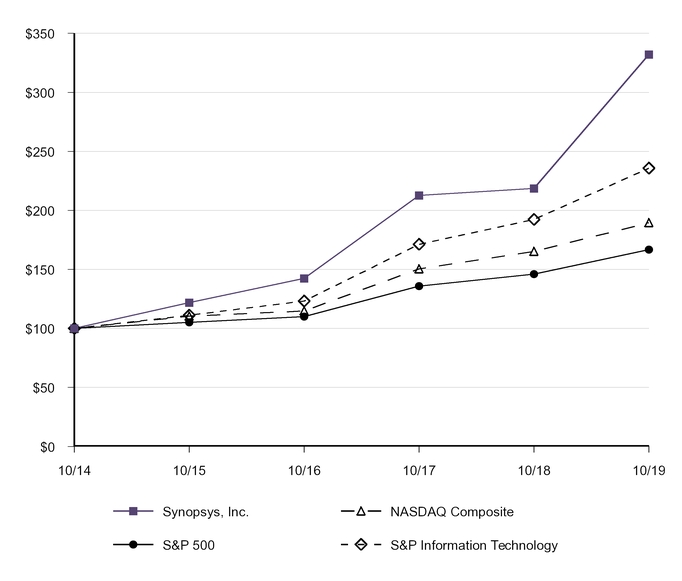][added: 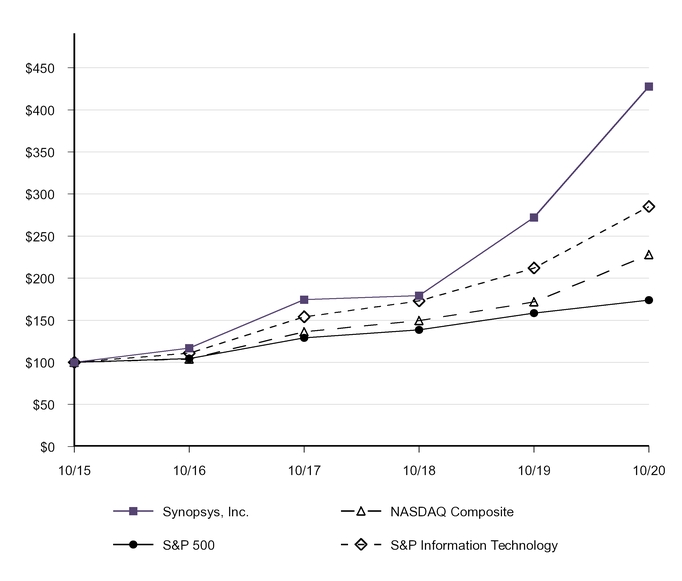]
| *$100 invested on October 31, [removed: 2014] [added: 2015] in stock or index, including reinvestment of dividends. |
[Table of [removed: Contents](#s7EC9245BA7305F5BB7C6C40978370A14)][added: Contents](#sDE27B510A17E5235B5B0169C7DCCEA1A)]
Our Board replenished the stock repurchase program up to $500.0 million on June [removed: 14, 2019.][added: 19, 2020.]
As of October 31, [removed: 2019, $400.0] [added: 2020, $457.9] million remained available for [removed: further] [added: future] repurchases under the program.
In December [removed: 2017,] [added: 2019,] we entered [removed: into two simultaneous] [added: an] accelerated share repurchase [removed: agreements] [added: agreement] (the December [removed: 2017 ASRs)] [added: 2019 ASR)] to repurchase an aggregate of [removed: $200.0] [added: $100.0] million of our common stock.
Pursuant to the December [removed: 2017 ASRs,] [added: 2019 ASR,] we made a prepayment of [removed: $200.0] [added: $100.0] million [removed: and received] [added: to receive] initial share deliveries of shares valued at [removed: $160.0] [added: $80.0] million.
The remaining balance of $20.0 million was settled in [removed: March 2018.][added: February 2020.]
Total shares [removed: repurchased] [added: purchased] under the December [removed: 2017 ASRs] [added: 2019 ASR] were approximately [removed: 2.3] [added: 0.7] million shares, at an average purchase price of [removed: $87.08] [added: $149.75] per share.
In [removed: May 2018,] [added: February 2020,] we entered into an accelerated share repurchase agreement (the [removed: May 2018] [added: February 2020] ASR) to repurchase an aggregate of [removed: $165.0] [added: $100.0] million of our common stock.
Pursuant to the [removed: May 2018] [added: February 2020] ASR, we made a prepayment of [removed: $165.0] [added: $100.0] million [removed: and received] [added: to receive] initial share deliveries [added: of shares] valued at [removed: $132.0] [added: $80.0] million.
The remaining balance of [removed: $33.0] [added: $20.0] million was settled in [removed: October 2018.][added: May 2020.]
Total shares [removed: repurchased] [added: purchased] under the [removed: May 2018] [added: February 2020] ASR were approximately [removed: 1.8] [added: 0.7] million shares, at an average purchase price of [removed: $92.42] [added: $140.41] per share.
[Table of [removed: Contents](#s7EC9245BA7305F5BB7C6C40978370A14)][added: Contents](#sDE27B510A17E5235B5B0169C7DCCEA1A)]
The table below sets forth information regarding our repurchases of our common stock during the three months ended October 31, [removed: 2019:][added: 2020:]
| August 2, 2020 through September 5, 2020 | 2,178 | | | $ | 229.50 | | | 2,178 | | | $ | 499,500,159 | |
| September 6, 2020 through October 3, 2020 | 178,918 | | | $ | 203.88 | | | 178,918 | | | $ | 463,022,956 | |
| October 4, 2020 through October 31, 2020 | 23,641 | | | $ | 215.75 | | | 23,641 | | | $ | 457,922,451 | |
| Total | 204,737 | | | $ | 205.52 | | | 204,737 | | | $ | 457,922,451 | |
In February 2018, we received additional deliveries of shares valued at $20.0 million for one of the two December 2017 ASRs.
In February 2019, we entered into an accelerated share repurchase agreement (the February 2019 ASR) to repurchase an aggregate of $100.0 million of our common stock.
Pursuant to the February 2019 ASR, we made a prepayment of $100.0 million and received initial share deliveries valued at $80.0 million.
The remaining balance of $20.0 million was settled in May 2019.
Total shares repurchased under the February 2019 ASR were approximately 0.9 million shares, at an average purchase price of $114.01 per share.
In June 2019, we entered into an accelerated share repurchase agreement (the June 2019 ASR) to repurchase an aggregate of $100.0 million of our common stock.
Pursuant to the June 2019 ASR, we made a prepayment of $100.0 million and received initial share deliveries valued at $80.0 million.
The remaining balance of $20.0 million was settled in August 2019.
Total shares repurchased under the June 2019 ASR were approximately 0.8 million shares, at an average purchase price of $130.23 per share.
In August 2019, we entered into an accelerated share repurchase agreement (the August 2019 ASR) to repurchase an aggregate of $100.0 million of our common stock.
Pursuant to the August 2019 ASR, we made a prepayment of $100.0 million and received initial share deliveries valued at $80.0 million.
The remaining balance of $20.0 million was settled in October 2019.
Total shares repurchased under the August 2019 ASR were approximately 0.7 million shares, at an average purchase price of $134.99 per share.
In December 2019, we entered an accelerated share repurchase agreements (the December 2019 ASR) to repurchase an aggregate of $100.0 million of our common stock.
Pursuant to the December 2019 ASR, we will make a prepayment of $100.0 million to receive initial share deliveries of shares valued at $80.0 million.
The remaining balance of $20.0 million is anticipated to be settled on or before February 27, 2020, upon completion of the repurchase.
Under the terms of the December 2019 ASR, the specific number of shares that we ultimately repurchase will be based on the volume-weighted average share price of our common stock during the repurchase period, less a discount.
| August 4, 2019 through September 7, 2019 | 675,211 | | | $ | 148.10 | | | 675,211 | | | $ | 400,000,000 | |
| September 8, 2019 through October 5, 2019 | — | | | $ | — | | | — | | | $ | 400,000,000 | |
| October 6, 2019 through November 2, 2019 | 155,808 | | | $ | 128.36 | | | 155,808 | | | $ | 400,000,000 | |
| Total | 831,019 | | | $ | 144.40 | | | 831,019 | | | $ | 400,000,000 | |
Item 6. Selected Financial Data
13 rewritten, 2 added, 4 removed, 13 unchanged
Read the full itemFY2020 item · filed December 15, 2020FY2019 item · filed December 20, 2019
| | [removed: 2019] [added: 2020] | | | | [removed: 2018] [added: 2019] | | | | [removed: 2017] [added: 2018] | | | | [removed: 2016] [added: 2017] | | | | [removed: 2015] [added: 2016] | | |
| Revenue | $ | [removed: 3,360,694] [added: 3,685,281] | | | $ | [removed: 3,121,058] [added: 3,360,694] | | | $ | [removed: 2,724,880] [added: 3,121,058] | | | $ | [removed: 2,422,532] [added: 2,724,880] | | | $ | [removed: 2,242,211] [added: 2,422,532] | |
| Income before provisions for income taxes | [removed: 545,506] [added: 638,159] | | | | [removed: 363,543] [added: 545,506] | | | | [removed: 383,098] [added: 363,543] | | | | [removed: 329,548] [added: 383,098] | | | | [removed: 281,610] [added: 329,548] | | |
| Provision (benefit) for income taxes(2) | [added: (25,288 | | ) | |] 13,139 | | | | (68,975 | | ) | | 246,535 | | | | 62,722 | | | [removed: | 55,676 | | |]
| Net income | [removed: 532,367] [added: 663,447] | | | | [removed: 432,518] [added: 532,367] | | | | [removed: 136,563] [added: 432,518] | | | | [removed: 266,826] [added: 136,563] | | | | [removed: 225,934] [added: 266,826] | | |
| Basic | [removed: 3.55] [added: 4.40] | | | | [removed: 2.90] [added: 3.55] | | | | [removed: 0.91] [added: 2.90] | | | | [removed: 1.76] [added: 0.91] | | | | [removed: 1.46] [added: 1.76] | | |
| Diluted | [removed: 3.45] [added: 4.27] | | | | [removed: 2.82] [added: 3.45] | | | | [removed: 0.88] [added: 2.82] | | | | [removed: 1.73] [added: 0.88] | | | | [removed: 1.43] [added: 1.73] | | |
| Working capital [removed: (deficit)(3)] [added: (deficit)] | [added: 409,295 | | | |] (13,536 | | ) | | (558,618 | | ) | | 68,484 | | | | 1,992 | | | [removed: | (109,546 | | ) |]
| Total assets | [removed: 6,405,160] [added: 8,030,062] | | | | [removed: 6,145,974] [added: 6,405,160] | | | | [removed: 5,396,414] [added: 6,145,974] | | | | [removed: 5,240,365] [added: 5,396,414] | | | | [removed: 5,045,739] [added: 5,240,365] | | |
| Long-term debt | [removed: 120,093] [added: 100,823] | | | | [removed: 125,535] [added: 120,093] | | | | [removed: 134,063] [added: 125,535] | | | | [removed: —] [added: 134,063] | | | | — | | |
| Stockholders’ equity | [removed: 4,088,876] [added: 4,912,367] | | | | [removed: 3,485,015] [added: 4,088,876] | | | | [removed: 3,279,724] [added: 3,485,015] | | | | [removed: 3,195,146] [added: 3,279,724] | | | | [removed: 3,133,989] [added: 3,195,146] | | |
| (1) | Our fiscal year ends on the Saturday nearest to October 31 and consists of 52 weeks, with the exception that approximately every five years, we have a 53-week year. When a 53-week year occurs, we include the additional week in the first quarter to realign fiscal quarters with calendar quarters. Fiscal 2018 was a 53-week year and ended on November 3, 2018. Fiscal [added: 2020,] 2019, 2017, [removed: 2016,] and [removed: 2015] [added: 2016] were 52-week years ending on [added: October 31, 2020,] November 2, 2019, October 28, [removed: 2017,] [added: 2017 and] October 29, 2016, [removed: and October 31, 2015,] respectively. |
| (2) | Includes [added: $13.2 million,] $10.9 million, $14.7 million, $7.1 million, [removed: $16.5 million,] and [removed: $6.3] [added: $16.5] million in net tax benefits from tax settlements received in fiscal [added: 2020,] 2019, 2018, 2017, [removed: 2016,] and [removed: 2015,] [added: 2016,] respectively. Fiscal 2018 additionally includes a $57.8 million net benefit from tax reform and tax restructuring. Fiscal 2017 additionally includes a $166.2 million expense from our repatriation of foreign earnings. See Note [removed: 11] [added: 13] of *Notes to Consolidated Financial Statements*. |
| Net income (loss) attributed to non-controlling interest | (900 | | ) | | — | | | | — | | | | — | | | | — | | |
| Net income attributed to Synopsys | 664,347 | | | | 532,367 | | | | 432,518 | | | | 136,563 | | | | 266,826 | | |
| | |
| --- | --- |
| (3) | Includes reclassifications of deferred tax assets and liabilities for fiscal year 2015 related to ASU 2015-17 “Income Taxes (Topic 740): Balance Sheet Classification of Deferred Taxes.” See Note 11 of *Notes to Consolidated Financial Statements*. |
[Table of Contents](#s7EC9245BA7305F5BB7C6C40978370A14)
Item 8. Financial Statements and Supplementary Data
509 rewritten, 208 added, 280 removed, 1,005 unchanged
Read the full itemFY2020 item · filed December 15, 2020FY2019 item · filed December 20, 2019
We have audited the accompanying consolidated balance sheets of Synopsys, Inc. and subsidiaries (the Company) as of [removed: November 2, 2019] [added: October 31, 2020] and November [removed: 3, 2018,] [added: 2, 2019,] the related consolidated statements of operations, comprehensive income, stockholders’ equity, and cash flows for each of the years in the three-year period ended [removed: November 2, 2019,] [added: October 31, 2020,] and the related notes (collectively, the consolidated financial statements).
We also have audited the Company’s internal control over financial reporting as of [removed: November 2, 2019,] [added: October 31, 2020,] based on criteria established in *Internal [removed: Control - Integrated Framework* *(2013)*] [added: Control* — *Integrated Framework (2013)*] issued by the Committee of Sponsoring Organizations of the Treadway Commission.
In our opinion, the consolidated financial statements referred to above present fairly, in all material respects, the financial position of the Company as of [removed: November 2, 2019] [added: October 31, 2020] and November [removed: 3, 2018,] [added: 2, 2019,] and the results of its operations and its cash flows for each of the years in the three-year period ended [removed: November 2, 2019,] [added: October 31, 2020,] in conformity with U.S. generally accepted accounting principles.
Also in our opinion, the Company maintained, in all material respects, effective internal control over financial reporting as of [removed: November 2, 2019] [added: October 31, 2020] based on criteria established in *Internal [removed: Control - Integrated] [added: Control* — *Integrated] Framework (2013)* issued by the Committee of Sponsoring Organizations of the Treadway Commission.
As discussed in [removed: Note] [added: Notes] 2 [added: and 3] to the consolidated financial statements, the Company has changed its method of accounting for [added: leases as of November 3, 2019 due to the adoption of Financial Accounting Standards Board’s (FASB) Accounting Standards Update (ASU) 2016-02, “Leases (Topic 842),” and changed its method of accounting for] revenue from contracts with customers and sales commissions as of November 4, [removed: 2018,] [added: 2018] due to the adoption of [removed: Financial Accounting Standards Board’s] [added: FASB’s] Accounting Standards Codification (ASC) Topic 606, [removed: *Revenue] [added: “*Revenue] from Contracts with [removed: Customers,*] [added: Customers* (ASC 606),”] and Subtopic 340-40, [removed: *Other] [added: “Other] Assets and Deferred Costs [removed: -* *Contracts] [added: - Contracts] with [removed: Customers*.][added: Customers (ASC 340-40).”]
[Table of [removed: Contents](#s7EC9245BA7305F5BB7C6C40978370A14)][added: Contents](#sDE27B510A17E5235B5B0169C7DCCEA1A)]
*Critical Audit [removed: Matters*][added: Matter*]
The critical audit [removed: matters] [added: matter] communicated below [removed: are matters] [added: is a matter] arising from the current period audit of the consolidated financial statements that [removed: were] [added: was] communicated or required to be communicated to the audit committee and that: (1) [removed: relate] [added: relates] to accounts or disclosures that are material to the consolidated financial statements and (2) involved our especially challenging, subjective, or complex judgments.
The communication of [added: a] critical audit [removed: matters] [added: matter] does not alter in any way our opinion on the consolidated financial statements, taken as a whole, and we are not, by communicating the critical audit [removed: matters] [added: matter] below, providing [added: a] separate [removed: opinions] [added: opinion] on the critical audit [removed: matters] [added: matter] or on the accounts or disclosures to which [removed: they relate.][added: it relates.]
The [added: following are the] primary procedures we performed to address this critical audit [removed: matter included the following.][added: matter.]
*Assessment of recognition of uncertain tax [removed: positions*][added: provisions*]
As discussed in Notes 2 and [removed: 11] [added: 13] to the consolidated financial statements, as of [removed: November 2, 2019] [added: October 31, 2020] the Company [removed: has] recognized uncertain tax positions.
The Company recognizes tax benefits from uncertain tax positions [removed: only if there] [added: when it] is [added: determined that it is] more [added: likely] than [removed: a 50% likelihood] [added: not] that the [removed: tax] position will be sustained [removed: upon examination by the taxing authorities based] on [removed: the technical merits of the position.][added: audit.]
As of [removed: November 2, 2019,] [added: October 31, 2020,] the Company [removed: has] recorded a liability for gross unrecognized tax benefits, excluding associated interest and penalties, of [removed: $116.2] [added: $83.1] million.
[Table of [removed: Contents](#s7EC9245BA7305F5BB7C6C40978370A14)][added: Contents](#sDE27B510A17E5235B5B0169C7DCCEA1A)]
We identified the assessment of [added: the] recognition of uncertain tax positions [added: within the U.S. federal jurisdiction] as a critical audit matter.
Complex auditor judgment, including the involvement of tax professionals with specialized skills and knowledge, was required to evaluate the Company’s interpretation and application of [added: U.S. federal] tax [removed: law globally across its multiple subsidiaries.][added: law.]
We [added: evaluated the design and] tested [added: the operating effectiveness of] certain internal controls over the Company’s [removed: unrecognized] [added: accounting process for uncertain] tax [removed: benefit process,] [added: positions,] including controls related to the interpretation of [added: U.S. federal] tax law and its application in the liability [removed: estimation] [added: recognition] process.
Since [added: U.S. federal] tax law is complex and often subject to interpretation, we involved tax professionals with specialized skills and knowledge, who assisted in:
| • | Obtaining an understanding of the Company’s overall tax structure and assessing the Company’s compliance with [added: U.S. federal] tax [removed: laws globally,] [added: laws,] |
| • | Inspecting correspondence, assessments, and settlements from taxing authorities to assess the Company’s determination of its tax positions having more than a 50% likelihood to be sustained upon [removed: examination, and] [added: examination.] |
[Table of [removed: Contents](#s7EC9245BA7305F5BB7C6C40978370A14)][added: Contents](#sDE27B510A17E5235B5B0169C7DCCEA1A)]
| | [added: 2020 | | | |] 2019 | | | | 2018 | | |
| Cash and cash equivalents | $ | [removed: 728,597] [added: 1,235,653] | | | $ | [removed: 723,115] [added: 728,597] | |
| Accounts receivable, net | [removed: 553,895] [added: 780,709] | | | | [removed: 554,217] [added: 553,895] | | |
| Income taxes receivable and prepaid taxes | [removed: 24,855] [added: 32,355] | | | | [removed: 76,525] [added: 24,855] | | |
| Prepaid and other current assets | [removed: 290,052] [added: 308,167] | | | | [removed: 67,533] [added: 290,052] | | |
| Total current assets | [removed: 1,738,917] [added: 2,549,217] | | | | [removed: 1,543,797] [added: 1,738,917] | | |
| Property and equipment, net | [removed: 429,532] [added: 483,818] | | | | [removed: 309,310] [added: 429,532] | | |
| Goodwill | [removed: 3,171,179] [added: 3,365,114] | | | | [removed: 3,143,249] [added: 3,171,179] | | |
| Intangible assets, net | [removed: 279,374] [added: 254,322] | | | | [removed: 360,404] [added: 279,374] | | |
| Long-term prepaid taxes | [removed: 15,503] [added: 8,276] | | | | [removed: 138,312] [added: 15,503] | | |
| Deferred income taxes | [removed: 390,129] [added: 497,546] | | | | [removed: 404,166] [added: 390,129] | | |
| Other long-term assets | [removed: 380,526] [added: 405,951] | | | | [removed: 246,736] [added: 380,526] | | |
| Total assets | $ | [removed: 6,405,160] [added: 8,030,062] | | | $ | [removed: 6,145,974] [added: 6,405,160] | |
| Accounts payable and accrued liabilities | $ | [removed: 506,459] [added: 623,664] | | | $ | [removed: 578,326] [added: 506,459] | |
| Accrued income taxes | [removed: 15,904] [added: 27,738] | | | | [removed: 27,458] [added: 15,904] | | |
| Deferred revenue | [removed: 1,212,476] [added: 1,388,263] | | | | [removed: 1,152,862] [added: 1,212,476] | | |
| Short-term debt | [removed: 17,614] [added: 27,084] | | | | [removed: 343,769] [added: 17,614] | | |
| Total current liabilities | [removed: 1,752,453] [added: 2,139,922] | | | | [removed: 2,102,415] [added: 1,752,453] | | |
| • | Evaluating U.S. federal tax law and assessing the Company’s interpretation of the tax law, and |
December 14, 2020
| | 2020 | | | | 2019 | | |
| Inventories, net | 192,333 | | | | 141,518 | | |
| Operating lease right-of-use assets, net | 465,818 | | | | — | | |
| Operating lease liabilities, current | 73,173 | | | | — | | |
| Operating lease liabilities, non-current | 462,411 | | | | — | | |
| Net income (loss) attributed to non-controlling interest | (900 | | ) | | — | | | | — | | |
| Less: Net income (loss) attributed to non-controlling interest | (900 | | ) | | — | | | | — | | |
| Comprehensive income attributed to Synopsys | $ | 702,720 | | | $ | 553,097 | | | $ | 385,320 | |
| Net income | | | | | | | | | | | | 664,347 | | | | | | | | | | | | 664,347 | | | | (900 | | ) | | 663,447 | | |
| Purchases of treasury stock | (1,585 | ) | | (14 | | ) | | 14 | | | | | | | | (242,078 | | ) | | | | | | (242,078 | | ) | | | | | | (242,078 | | ) |
| Common stock issued, net of shares withheld for employee taxes | 3,872 | | | 39 | | | | (230,887 | | ) | | (33,094 | | ) | | 379,107 | | | | | | | | 115,165 | | | | | | | | 115,165 | | |
| Balance at October 31, 2020 | 152,618 | | | $ | 1,528 | | | $ | 1,653,166 | | | $ | 3,795,397 | | | $ | (488,613 | ) | | $ | (54,074 | ) | | $ | 4,907,404 | | | $ | 4,963 | | | $ | 4,912,367 | |
| Reduction of operating lease right-of-use assets | 82,895 | | | | — | | | | — | | |
| Other non-cash | 5,419 | | | | (993 | | ) | | (851 | | ) |
| Inventories | (55,024 | | ) | | (17,396 | | ) | | (65,751 | | ) |
| Other long-term assets | (83,367 | | ) | | (125,749 | | ) | | (25,815 | | ) |
| Operating lease liabilities | (78,578 | | ) | | — | | | | — | | |
In addition, the Company has considered the potential impact of the COVID-19 pandemic on the business operations.
Although no material impairment or other effects have been identified to date related to the COVID-19 pandemic, there is substantial uncertainty in the nature and degree of its continued effects over time.
This uncertainty affects management’s accounting estimates and assumptions, which could result in greater variability in a variety of areas that depend on these estimates and assumptions as additional events and information are known.
Non-marketable equity securities are accounted for using either the measurement alternative or equity method of accounting, net of impairments.
| | 2020 | | | | 2019 | | |
| 2020 | $ | 9,046 | | | $ | 20,875 | | | $ | (1,357 | ) | | $ | 28,564 | |
Valuation process include a review of the stage of the product life cycle and forecasts based upon future demand and market conditions.
to taxable income in the years in which those temporary differences are expected to be recovered or settled.
| | 2020 | | | | 2019 | | |
| | 1,253,348 | | | | 1,112,880 | | |
*Leases*.
Topic 842 was subsequently amended by several ASUs.
The new standard did not have a material impact on the consolidated financial statements for arrangements in which the Company is the lessor.
The Company adopted Topic 842 at the beginning of fiscal 2020 using the modified retrospective method without restatement of comparative periods.
The Company elected the package of practical expedients permitted under the transition guidance, which allows the carryforward of historical assessments about (1) lease classification, (2)
whether a contract is or contains a lease, and (3) which costs qualify as initial direct costs for leases that existed prior to the adoption.
The Company did not elect either the use of hindsight or land easements practical expedients available in transition.
The adoption of the standard did not have an impact on the Company’s beginning retained earnings, results of operations, or cash flows.
The operating lease liabilities equaled the present value of the remaining Topic 840 minimum rental payments for those leases, discounted at the Company’s incremental borrowing rate as of the date of adoption.
The ROU assets were measured at the amount of the related lease liabilities plus any prepaid rental payments and less any unamortized lease incentives such as tenant improvement allowances.
The Company recognized ROU assets of $475 million and operating lease liabilities of $540 million on the consolidated balance sheets.
*Assessment of performance obligations*
As discussed in Notes 2 to the consolidated financial statements, the Company has determined that its software licenses in Technology Subscription License offerings (TSLs) are not distinct from its obligation to provide unspecified software updates.
In these situations revenue is recognized ratably over the subscription period for which the updates are provided.
We identified the assessment of performance obligations in TSL arrangements as a critical audit matter.
Especially challenging auditor judgment was required to assess whether receiving updates to the licensed software is integral to maintaining the software’s utility to the customer throughout the contracted TSL period, and therefore integral to fulfilling the Company’s promise to the customer in its TSLs.
We tested certain internal controls over the Company’s revenue recognition process, including controls over the determination of performance obligations in their revenue arrangements.
We read the standard terms and conditions provided to customers purchasing TSLs to identify the commitments being made in the contracts.
We obtained and examined the Company’s marketing materials and publicly available information about the offerings to evaluate how the offerings are marketed and sold to customers, including how the right to unspecified software updates was portrayed.
We interviewed individuals in the Company’s product and engineering department to both understand the nature of the updates typically provided to TSL customers and whether such updates are integral to maintaining the utility of the software over a typical TSL period.
We also observed updates that have historically been provided as part of the TSLs as to their nature and frequency.
In addition, a higher degree of auditor judgment was required in evaluating the Company’s estimate of the ultimate resolution of its tax positions.
The primary procedures we performed to address this critical audit matter included the following.
| | |
| --- | --- |
| | |
| --- | --- |
| • | Evaluating changes in the Company’s overall tax structure that occurred during the year as well as changes in tax law, and assessing the interpretation of those changes under the relevant jurisdiction’s tax law, |
| | |
| --- | --- |
| • | Performing an independent assessment of the Company’s uncertain tax positions and comparing the results to the Company’s evaluation. |
December 20, 2019
SYNOPSYS, INC.
| | | | | | | | |
| --- | --- | --- | --- | --- | --- | --- | --- |
| | | | | | | | |
| Inventories | 141,518 | | | | 122,407 | | |
SYNOPSYS, INC.
| | | | | | | | | | | | |
| --- | --- | --- | --- | --- | --- | --- | --- | --- | --- | --- | --- |
| | | | | | | | | | | | |
| Cost of revenue: | | | | | | | | | | | |
| Shares used in computing per share amounts: | | | | | | | | | | | |
| | | | | | | | | | | | |
| --- | --- | --- | --- | --- | --- | --- | --- | --- | --- | --- | --- |
| Change in unrealized gains (losses) on investments, net of tax of $0, for fiscal year 2017 | — | | | | — | | | | (19 | | ) |
| Balance at October 31, 2016 | 151,454 | | | $ | 1,515 | | | $ | 1,644,675 | | | $ | 1,947,585 | | | $ | (294,052 | ) | | $ | (104,577 | ) | | $ | 3,195,146 | | | $ | — | | | $ | 3,195,146 | |
| Net income | | | | | | | | | | | | 136,563 | | | | | | | | | | | | 136,563 | | | | | | | | 136,563 | | |
| Purchases of treasury stock | (5,413 | ) | | (54 | | ) | | 54 | | | | | | | | (380,000 | | ) | | | | | | (380,000 | | ) | | | | | | (380,000 | | ) |
| Equity forward contract | | | | | | | | (20,000 | | ) | | | | | | | | | | | | | | (20,000 | | ) | | | | | | (20,000 | | ) |
| Common stock issued, net of shares withheld for employee taxes | 4,404 | | | 44 | | | | (110,976 | | ) | | (46,382 | | ) | | 247,844 | | | | | | | | 90,530 | | | | | | | | 90,530 | | |
An excerpt. Shown here: 40 of 509 rewritten, 40 of 208 added and 40 of 280 removed. The counts are complete. For every sentence, read Item 8. Financial Statements and Supplementary Data in the FY2020 filing and the FY2019 filing.
Item 9A. Controls and Procedures
4 rewritten, 0 added, 0 removed, 12 unchanged
Read the full itemFY2020 item · filed December 15, 2020FY2019 item · filed December 20, 2019
| (a) | *Evaluation of Disclosure Controls and Procedures.* As of October 31, [removed: 2019,] [added: 2020,] Synopsys carried out an evaluation under the supervision and with the participation of Synopsys’ management, including the Co-Chief Executive Officers and Chief Financial Officer, of the effectiveness of the design and operation of Synopsys’ disclosure controls and procedures (as such term is defined in Rules 13a-15(e) and 15d-15(e) under the Exchange Act). There are inherent limitations to the effectiveness of any system of disclosure controls and procedures. Accordingly, even effective disclosure controls and procedures can only provide reasonable, not absolute, assurance of achieving their control objectives. Our Co-Chief Executive Officers and Chief Financial Officer have concluded that, as of October 31, [removed: 2019,] [added: 2020,] Synopsys’ disclosure controls and procedures were effective to provide reasonable assurance that information required to be disclosed in the reports Synopsys files and submits under the Exchange Act is recorded, processed, summarized and reported as and when required, and that such information is accumulated and communicated to Synopsys’ management, including the Co-Chief Executive Officers and Chief Financial Officer, to allow timely decisions regarding its required disclosure. |
Under the supervision and with the participation of our management, including our Co-Chief Executive Officers and Chief Financial Officer, we conducted an evaluation of the effectiveness of our internal control over financial reporting as of October 31, [removed: 2019.][added: 2020.]
Our management has concluded that, as of October 31, [removed: 2019,] [added: 2020,] our internal control over financial reporting was effective based on these criteria.
| (c) | *Changes in Internal Control Over Financial Reporting.* On November [removed: 4, 2018,] [added: 3, 2019,] Synopsys implemented new and modified existing internal controls for the adoption of the new [removed: revenue recognition] [added: lease] accounting standard, ASC [removed: 606.] [added: 842.] There were no additional changes in Synopsys’ internal control over financial reporting during the fiscal quarter ended October 31, [removed: 2019] [added: 2020] that have materially affected, or are reasonably likely to materially affect, Synopsys’ internal control over financial reporting. |
Item 9B. Other Information
1 rewritten, 11 added, 1 removed, 4 unchanged
Read the full itemFY2020 item · filed December 15, 2020FY2019 item · filed December 20, 2019
[Table of [removed: Contents](#s7EC9245BA7305F5BB7C6C40978370A14)][added: Contents](#sDE27B510A17E5235B5B0169C7DCCEA1A)]
Item 5.02 Departure of Directors or Certain Officers; Election of Directors; Appointment of Certain Officers; Compensatory Arrangements of Certain Officers.
On December 10, 2020, Steven C.
Walske notified the Company of his decision not to stand for re-election to Synopsys’ Board of Directors at its 2021 Annual Meeting of Stockholders (the 2021 Annual Meeting).
Mr. Walske’s decision not to stand for re-election was not the result of any disagreement with Synopsys on any matter.
Mr. Walske will continue to serve as a director and audit committee member until his term ends at the 2021 Annual Meeting, and the Company is thankful for his dedicated service.
Item 5.03 Amendments to Articles of Incorporation or Bylaws; Change in Fiscal Year.
On December 10, 2020, the Board of Directors amended and restated the bylaws of the Company (as so amended, the Amended and Restated Bylaws), effective immediately.
The Amended and Restated Bylaws, among other things: (i) add the ability for stockholders holding not less than 20% of all outstanding shares of capital stock of the Company, which shares are held for not less than one (1) year prior to the date of the request, to request a
special meeting of the stockholders; and (ii) provide that directors shall be elected by a majority of the votes cast by stockholders with respect to his or her election at a meeting for the election of directors, except that, if the number of nominees for election at any such meeting exceeds the number of directors to be elected at such meeting, each director to be so elected shall be elected by a plurality of votes cast by stockholders.
The foregoing summary of the Amended and Restated Bylaws does not purport to be complete and is qualified in its entirety by reference to the complete text of the Amended and Restated Bylaws, which are attached hereto as Exhibit 3.2 and are incorporated herein by reference.
[Table of Contents](#sDE27B510A17E5235B5B0169C7DCCEA1A)
None.
Item 10. Directors, Executive Officers and Corporate Governance
1 rewritten, 0 added, 0 removed, 4 unchanged
Read the full itemFY2020 item · filed December 15, 2020FY2019 item · filed December 20, 2019
All other information required by this Item is incorporated herein by reference from our definitive Proxy Statement for the [removed: 2020] [added: 2021] Annual Meeting [removed: of Stockholders] (the Proxy Statement) scheduled to be held on April [removed: 9, 2020,] [added: 8, 2021,] as provided under the headings “Proposal 1: Election of Directors,” “Audit Committee Report,” and “Corporate Governance.”
Item 14. Principal Accountant Fees and Services
1 rewritten, 0 added, 0 removed, 5 unchanged
Read the full itemFY2020 item · filed December 15, 2020FY2019 item · filed December 20, 2019
[Table of [removed: Contents](#s7EC9245BA7305F5BB7C6C40978370A14)][added: Contents](#sDE27B510A17E5235B5B0169C7DCCEA1A)]
Item 15. Exhibits and Financial Statement Schedules
49 rewritten, 3 added, 6 removed, 97 unchanged
Read the full itemFY2020 item · filed December 15, 2020FY2019 item · filed December 20, 2019
| [Report of Independent Registered Public Accounting [removed: Firm](#sB8F117547D665BE7B1700A93B035E99B)] [added: Firm](#sFE207CF4FB9E571ABEA330A1A240D70C)] | [removed: [46](#sB8F117547D665BE7B1700A93B035E99B)] [added: [50](#sFE207CF4FB9E571ABEA330A1A240D70C)] |
| [Consolidated Balance [removed: Sheets](#sE8C1F16375015EE1B287D8F7367F79C0)] [added: Sheets](#sE67E065441915EF4A942CF6A19F470E0)] | [removed: [49](#sE8C1F16375015EE1B287D8F7367F79C0)] [added: [52](#sE67E065441915EF4A942CF6A19F470E0)] |
| [Consolidated Statements of [removed: Operations](#s0598F035A8195C95A237F845A856BD3A)] [added: Operations](#s5E8D3AD2982F591D81C39FDB8DAE096C)] | [removed: [50](#s0598F035A8195C95A237F845A856BD3A)] [added: [53](#s5E8D3AD2982F591D81C39FDB8DAE096C)] |
| [Consolidated Statements of Comprehensive [removed: Income](#sB5FC7D675A345FE782180F176921C28C)] [added: Income](#s3571C3F1E2F457A5A82CC14AB13D73C7)] | [removed: [51](#sB5FC7D675A345FE782180F176921C28C)] [added: [54](#s3571C3F1E2F457A5A82CC14AB13D73C7)] |
| [Consolidated Statements of Stockholders’ [removed: Equity](#s3A2626E704855AAC80486C92E29C8310)] [added: Equity](#s4E4E76AA60E3504E95BE58AA80F8C123)] | [removed: [52](#s3A2626E704855AAC80486C92E29C8310)] [added: [55](#s4E4E76AA60E3504E95BE58AA80F8C123)] |
| [Consolidated Statements of Cash [removed: Flows](#s0D9AD32857BC54D2907C1EC58067C703)] [added: Flows](#s945D0312CD82557996DD5DEAEA6E500C)] | [removed: [53](#s0D9AD32857BC54D2907C1EC58067C703)] [added: [56](#s945D0312CD82557996DD5DEAEA6E500C)] |
| [Notes to Consolidated Financial [removed: Statements](#s36EC0545D0BF55CE8B062F85AF3CC024)] [added: Statements](#sFEE585C5BC6C5A1790E6A462D0F8DCFC)] | [removed: [54](#s36EC0545D0BF55CE8B062F85AF3CC024)] [added: [57](#sFEE585C5BC6C5A1790E6A462D0F8DCFC)] |
| 3.2 | [Amended and Restated [removed: Bylaws](http://www.sec.gov/Archives/edgar/data/883241/000088324118000012/a103118exhibit32.htm)] [added: Bylaws](https://www.sec.gov/Archives/edgar/data/883241/000088324120000015/a103120exhibit32.htm)] | | [removed: 10-K] | | [removed: 000-19807] | | [removed: 3.2] | | [removed: 12/17/2018] | | [added: X] |
| 4.2 | [Description of Synopsys' [removed: Stock](https://www.sec.gov/Archives/edgar/data/883241/000088324119000019/a103119exhibit42.htm)] [added: Stock](https://www.sec.gov/Archives/edgar/data/883241/000088324120000015/a103120exhibit42.htm)] | | | | | | | | | | X |
[Table of [removed: Contents](#s7EC9245BA7305F5BB7C6C40978370A14)][added: Contents](#sDE27B510A17E5235B5B0169C7DCCEA1A)]
| [removed: 10.4*] [added: 10.3*] | [2006 Employee Equity Incentive Plan, as [removed: amended](http://www.sec.gov/Archives/edgar/data/883241/000119312518110052/d564794dex104.htm)] [added: amended](https://www.sec.gov/Archives/edgar/data/883241/000119312520107549/d903111dex104.htm)] | | 8-K | | 000-19807 | | 10.4 | | [removed: 4/9/2019] [added: 4/15/2020] | | |
[Table of [removed: Contents](#s7EC9245BA7305F5BB7C6C40978370A14)][added: Contents](#sDE27B510A17E5235B5B0169C7DCCEA1A)]
| [removed: 10.5*] [added: 10.4*] | [Form of Restricted Stock Unit Grant Notice and Award Agreement under 2006 Employee Equity Incentive Plan](http://www.sec.gov/Archives/edgar/data/883241/000119312518110052/d564794dex105.htm) | | 8-K | | 000-19807 | | 10.5 | | 4/6/2018 | | |
| [removed: 10.6*] [added: 10.5*] | [Form of Notice of Grant of Stock Options and Option Agreement under 2006 Employee Equity Incentive Plan](http://www.sec.gov/Archives/edgar/data/883241/000119312518110052/d564794dex106.htm) | | 8-K | | 000-19807 | | 10.6 | | 4/6/2018 | | |
| [removed: 10.7*] [added: 10.6*] | [Employee Stock Purchase Plan, as [removed: amended](http://www.sec.gov/Archives/edgar/data/883241/000119312518110052/d564794dex107.htm)] [added: amended](https://www.sec.gov/Archives/edgar/data/883241/000119312520107549/d903111dex107.htm)] | | 8-K | | 000-19807 | | 10.7 | | [removed: 4/6/2018] [added: 4/15/2020] | | |
| [removed: 10.8*] [added: 10.7*] | [2017 Non-Employee Directors Equity Incentive [removed: Plan](http://www.sec.gov/Archives/edgar/data/883241/000119312517118712/d360146dex108.htm)] [added: Plan](https://www.sec.gov/Archives/edgar/data/883241/000119312517118712/d360146dex108.htm)] | | 8-K | | 000-19807 | | 10.8 | | 4/10/2017 | | |
| [removed: 10.9*] [added: 10.8*] | [Form of Restricted Stock Grant Notice and Award Agreement under 2017 Non-Employee Directors Equity Incentive Plan](http://www.sec.gov/Archives/edgar/data/883241/000088324117000014/a103117exhibit109.htm) | | 10-K | | 000-19807 | | 10.9 | | 12/14/2017 | | |
| [removed: 10.10*] [added: 10.9*] | [Form of Stock Options Grant Notice and Option Agreement under 2017 Non-Employee Directors Equity Incentive Plan](http://www.sec.gov/Archives/edgar/data/883241/000088324117000014/a103117exhibit1010.htm) | | 10-K | | 000-19807 | | 10.10 | | 12/14/2017 | | |
| [removed: 10.11*] [added: 10.10*] | [Deferred Compensation Plan as restated effective August 1, 2002](http://www.sec.gov/Archives/edgar/data/883241/000110465904016631/a04-6701_1ex10d5.htm) | | 10-Q | | 000-19807 | | 10.5 | | 6/10/2004 | | |
| [removed: 10.12*] [added: 10.11*] | [Synopsys Amended and Restated Deferred Compensation Plan II](http://www.sec.gov/Archives/edgar/data/883241/000110465909015587/a09-7033_1ex10d23.htm) | | 10-Q | | 000-19807 | | 10.23 | | 3/9/2009 | | |
| [removed: 10.13] [added: 10.12] | [Form of Indemnification Agreement for directors and executive officers](http://www.sec.gov/Archives/edgar/data/883241/000119312511188451/dex992.htm) | | 8-K | | 000-19807 | | 99.2 | | 7/14/2011 | | |
| [removed: 10.14*] [added: 10.13*] | Director’s and Officer’s Insurance and Company Reimbursement Policy | | S-1 | | 33-45138 | | 10.2 | | 2/24/1992 (effective date) | | |
| [removed: 10.15*] [added: 10.14*] | [Amended and Restated Employment Agreement, dated December 15, 2016 between Synopsys, Inc. and Dr. Aart de Geus](http://www.sec.gov/Archives/edgar/data/883241/000119312516800528/d275546dex1016.htm) | | 8-K | | 000-19807 | | 10.16 | | 12/21/2016 | | |
| [removed: 10.16*] [added: 10.15*] | [Amended and Restated Employment Agreement, dated December 15, 2016 between Synopsys, Inc. and Dr. Chi-Foon Chan](http://www.sec.gov/Archives/edgar/data/883241/000119312516800528/d275546dex1017.htm) | | 8-K | | 000-19807 | | 10.17 | | 12/21/2016 | | |
| [removed: 10.17*] [added: 10.16*] | [Executive Incentive Plan, as amended](http://www.sec.gov/Archives/edgar/data/883241/000119312516800528/d275546dex1018.htm) | | 8-K | | 000-19807 | | 10.18 | | 12/21/2016 | | |
| [removed: 10.18*] [added: 10.17*] | [Amended and Restated Executive Change of Control Severance Benefit Plan](http://www.sec.gov/Archives/edgar/data/883241/000119312516800528/d275546dex1019.htm) | | 8-K | | 000-19807 | | 10.19 | | 12/21/2016 | | |
| [removed: 10.19*] [added: 10.18*] | [Compensation Recovery Policy](http://www.sec.gov/Archives/edgar/data/883241/000104746908013321/a2189740zex-10_46.htm) | | 10-K | | 000-19807 | | 10.46 | | 12/22/2008 | | |
| 21.1 | [Subsidiaries of Synopsys, [removed: Inc.](https://www.sec.gov/Archives/edgar/data/883241/000088324119000019/a103119exhibit211.htm)] [added: Inc.](https://www.sec.gov/Archives/edgar/data/883241/000088324120000015/a103120exhibit211.htm)] | | | | | | | | | | X |
[Table of [removed: Contents](#s7EC9245BA7305F5BB7C6C40978370A14)][added: Contents](#sDE27B510A17E5235B5B0169C7DCCEA1A)]
| 23.1 | [Consent of KPMG LLP, Independent Registered Public Accounting [removed: Firm](https://www.sec.gov/Archives/edgar/data/883241/000088324119000019/a103119exhibit231.htm)] [added: Firm](https://www.sec.gov/Archives/edgar/data/883241/000088324120000015/a103120exhibit231.htm)] | | | | | | | | | | X |
| 24.1 | [Power of Attorney (see signature page to this Annual Report on Form [removed: 10-K)](#s4343025EF48E5D44AD73EFBC51C871B9)] [added: 10-K)](#sC1A3862D9D7051ECBA3EA27E9542D89E)] | | | | | | | | | | X |
| 31.1 | [Certification of Co-Chief Executive Officer pursuant to Rule 13a-14(a) or Rule 15d-14(a) of the Exchange [removed: Act](https://www.sec.gov/Archives/edgar/data/883241/000088324119000019/a103119exhibit311.htm)] [added: Act](https://www.sec.gov/Archives/edgar/data/883241/000088324120000015/a103120exhibit311.htm)] | | | | | | | | | | X |
| 31.2 | [Certification of Co-Chief Executive Officer pursuant to Rule 13a-14(a) or Rule 15d-14(a) of the Exchange [removed: Act](https://www.sec.gov/Archives/edgar/data/883241/000088324119000019/a103119exhibit312.htm)] [added: Act](https://www.sec.gov/Archives/edgar/data/883241/000088324120000015/a103120exhibit312.htm)] | | | | | | | | | | X |
| 31.3 | [Certification of Chief Financial Officer pursuant to Rule 13a-14(a) or Rule 15d-14(a) of the Exchange [removed: Act](https://www.sec.gov/Archives/edgar/data/883241/000088324119000019/a103119exhibit313.htm)] [added: Act](https://www.sec.gov/Archives/edgar/data/883241/000088324120000015/a103120exhibit313.htm)] | | | | | | | | | | X |
| 32.1 | [Certification of Co-Chief Executive Officers and Chief Financial Officer furnished pursuant to Rule 13a-14(b) or Rule 15d-14(b) of the Exchange Act and Section 1350 of Chapter 63 of Title 18 of the United States [removed: Code](https://www.sec.gov/Archives/edgar/data/883241/000088324119000019/a103119exhibit321.htm)] [added: Code](https://www.sec.gov/Archives/edgar/data/883241/000088324120000015/a103120exhibit321.htm)] | | | | | | | | | | X |
[Table of [removed: Contents](#s7EC9245BA7305F5BB7C6C40978370A14)][added: Contents](#sDE27B510A17E5235B5B0169C7DCCEA1A)]
| Date: December [removed: 20, 2019] [added: 14, 2020] | | By: | | /s/ Trac Pham |
[Table of [removed: Contents](#s7EC9245BA7305F5BB7C6C40978370A14)][added: Contents](#sDE27B510A17E5235B5B0169C7DCCEA1A)]
| /S/ AART J. DE GEUS | | Co-Chief Executive Officer (Co-Principal Executive Officer) and Chairman of the Board of Directors | | December [removed: 20, 2019] [added: 14, 2020] |
| /S/ CHI\-FOON CHAN | | Co-Chief Executive Officer (Co-Principal Executive Officer), President and Director | | December [removed: 20, 2019] [added: 14, 2020] |
| /s/ JEANNINE SARGENT | | Director | | December 14, 2020 |
| Jeannine Sargent | | | | |
| | | | | |
| 10.3 | [Lease Agreement, dated January 2, 1996 between Synopsys, Inc. and Tarigo-Paul, a California Limited Partnership, (“The January 2, 1996 Lease”)](http://www.sec.gov/Archives/edgar/data/883241/0000891618-96-000421.txt) | | 10-Q | | 000-19807 | | 10.28 | | 5/14/1996 | | |
| 10.3(i) | [First Amendment to The January 2, 1996 Lease](http://www.sec.gov/Archives/edgar/data/883241/000110465906060622/a06-19342_1ex10d42.htm) | | 8-K | | 000-19807 | | 10.42 | | 9/12/2006 | | |
| 10.3(ii) | [Second Amendment to The January 2, 1996 Lease](http://www.sec.gov/Archives/edgar/data/883241/000110465906060622/a06-19342_1ex10d41.htm) | | 8-K | | 000-19807 | | 10.41 | | 9/12/2006 | | |
| 10.3(iii) | [Third Amendment to The January 2, 1996 Lease](http://www.sec.gov/Archives/edgar/data/883241/000119312512510596/d420241dex108iii.htm) | | 10-K | | 000-19807 | | 10.8(iii) | | 12/20/2012 | | |
| 10.3(iv) | [Fourth Amendment to The January 2, 1996 Lease](http://www.sec.gov/Archives/edgar/data/883241/000119312512510596/d420241dex108iv.htm) | | 10-K | | 000-19807 | | 10.8(iv) | | 12/20/2012 | | |
| 10.3(v)† | [Notification of Change of Ownership of Leased Premises under The January 2, 1996 Lease—Effective September 25, 2012](http://www.sec.gov/Archives/edgar/data/883241/000119312512510596/d420241dex108v.htm) | | 10-K | | 000-19807 | | 10.8(v) | | 12/20/2012 | | |
An excerpt. Shown here: 40 of 49 rewritten, all 3 added and all 6 removed. The counts are complete. For every sentence, read Item 15. Exhibits and Financial Statement Schedules in the FY2020 filing and the FY2019 filing.