 filings.tools
Synopsys 2022 10-K Annual Report
SNPS · CIK 883241 · Form 10-K · Fiscal year ended October 31, 2022 · Filed December 12, 2022
22 sections, 435K characters. Original on sec.gov · ·
Risk FactorsBusinessMD&AFinancial StatementsWhat changed vs 2021
Cover and table of contents
UNITED STATES
SECURITIES AND EXCHANGE COMMISSION
Washington, D.C. 20549
FORM 10-K
(Mark One)
| ☒ | ANNUAL REPORT PURSUANT TO SECTION 13 OR 15(d) OF THE SECURITIES EXCHANGE ACT OF 1934 |
For the fiscal year ended October 31, 2022
OR
| ☐ | TRANSITION REPORT PURSUANT TO SECTION 13 OR 15(d) OF THE SECURITIES EXCHANGE ACT OF 1934 |
For the transition period from to
Commission File Number 0-19807

SYNOPSYS, INC.
(Exact name of registrant as specified in its charter)
| Delaware | 56-1546236 | ||||||||||||||||
| (State or other jurisdiction of incorporation or organization) | (I.R.S. Employer Identification No.) | ||||||||||||||||
| 690 East Middlefield Road, | Mountain View, | California | 94043 | ||||||||||||||
| (Address of principal executive offices) | (Zip Code) |
(650) 584-5000
(Registrant’s telephone number, including area code)
Securities Registered Pursuant to Section 12(b) of the Act:
| Title of Each Class | Trading Symbol(s) | Name of Each Exchange on Which Registered | ||||||
| Common Stock (par value of $0.01 per share) | SNPS | Nasdaq Global Select Market |
Securities Registered Pursuant to Section 12(g) of the Act: None
Indicate by check mark if the registrant is a well-known seasoned issuer, as defined in Rule 405 of the Securities Act. Yes ☒ No ☐
Indicate by check mark if the registrant is not required to file reports pursuant to Section 13 or Section 15(d) of the Act. Yes ☐ No ☒
Indicate by check mark whether the registrant (1) has filed all reports required to be filed by Section 13 or 15(d) of the Securities Exchange Act of 1934 during the preceding 12 months (or for such shorter period that the registrant was required to file such reports), and (2) has been subject to such filing requirements for the past 90 days. Yes ☒ No ☐
Indicate by check mark whether the registrant has submitted electronically every Interactive Data File required to be submitted pursuant to Rule 405 of Regulation S-T (§ 232.405 of this chapter) during the preceding 12 months (or for such shorter period that the registrant was required to submit such files). Yes ☒ No ☐
Indicate by check mark whether the registrant is a large accelerated filer, an accelerated filer, a non-accelerated filer, a smaller reporting company, or an emerging growth company. See the definitions of “large accelerated filer,” “accelerated filer,” “smaller reporting company,” and "emerging growth company" in Rule 12b-2 of the Exchange Act.
| Large accelerated filer | ý | Accelerated Filer | ☐ | |||||||||||||||||
| Non-accelerated filer | ☐ | Smaller reporting company | ☐ | |||||||||||||||||
| Emerging growth company | ☐ |
If an emerging growth company, indicate by check mark if the registrant has elected not to use the extended transition period for complying with any new or revised financial accounting standards provided pursuant to Section 13(a) of the Exchange Act. ☐
Indicate by check mark whether the registrant has filed a report on and attestation to its management’s assessment of the effectiveness of its
internal control over financial reporting under Section 404(b) of the Sarbanes-Oxley Act (15 U.S.C. 7262(b)) by the registered public accounting
firm that prepared or issued its audit report. ☐
Indicate by check mark whether the registrant is a shell company (as defined in Rule 12b-2 of the Act). Yes ☐ No ☒
The aggregate market value of the voting and non-voting common equity held by non-affiliates computed by reference to the price at which the common equity was last sold as of the last business day of the registrant’s most recently completed second fiscal quarter was approximately $32.2 billion. Aggregate market value excludes an aggregate of approximately 40.8 million shares of the registrant's common stock, par value of $0.01 per share (Common Stock) held by the registrant’s executive officers and directors and by each person known by the registrant to own 5% or more of the outstanding common stock on such date. Exclusion of shares held by any of these persons should not be construed to indicate that such person possesses the power, direct or indirect, to direct or cause the direction of the management or policies of the registrant, or that such person is controlled by or under common control with the registrant.
On December 7, 2022, 152,417,194 shares of Common Stock were outstanding.
DOCUMENTS INCORPORATED BY REFERENCE
Portions of the registrant’s definitive Proxy Statement relating to the registrant’s 2023 Annual Meeting of Stockholders, scheduled to be held on April 12, 2023, are incorporated by reference into Part III of this Annual Report on Form 10-K where indicated. Except as expressly incorporated by reference, the registrant’s Proxy Statement shall not be deemed to be part of this report.
SYNOPSYS, INC.
ANNUAL REPORT ON FORM 10-K
Fiscal year ended October 31, 2022
TABLE OF CONTENTS
i
Cautionary Note Regarding Forward-Looking Statements
This Annual Report on Form 10-K (this Form 10-K) contains forward-looking statements within the meaning of Section 27A of the Securities Act of 1933, as amended (the Securities Act), Section 21E of the Securities Exchange Act of 1934, as amended (the Exchange Act), and the Private Securities Litigation Reform Act of 1995. Any statements herein that are not statements of historical fact are forward-looking statements. Words such as “may,” “will,” “could,” “would,” “can,” “should,” “anticipate,” “expect,” “intend,” “believe,” “estimate,” “project,” “continue,” “forecast,” “likely,” “potential,” “seek,” or the negatives of such terms and similar expressions are intended to identify forward-looking statements. This Form 10-K includes, among others, forward-looking statements regarding:
-
our business, product and platform strategies and business outlook;
-
the impact of macroeconomic conditions, rising global interest rates, legislative developments, trade disruptions, including export control restrictions, semiconductor shortages and supply chain disruptions on our business and our customers’ businesses;
-
regulatory changes in the United States and other regions in which we operate;
-
the impact of the ongoing COVID-19 pandemic;
-
demand for our products and our customers’ products;
-
the expected realization of our contracted but unsatisfied or partially unsatisfied performance obligations;
-
customer license renewals;
-
our ability to successfully compete in the markets in which we serve;
-
our license mix, business model and variability in our revenue;
-
the continuation of current industry trends towards customer and vendor consolidation, and the impact of such consolidation;
-
prior and future acquisitions, including the expected benefits and risks of completed acquisitions;
-
the completion of development of our unfinished products, or further development or integration of our existing products;
-
technological trends in integrated circuit design;
-
the status of litigation and/or regulatory investigations;
-
our ability to protect our intellectual property;
-
our ability to attract and retain senior management and key employees worldwide;
-
the impact of tax laws and changes in such laws on our business;
-
our cash, cash equivalents and cash generated from operations; and
-
our future liquidity requirements.
These statements are based on our current expectations about future events and involve certain known and unknown risks, uncertainties and other factors that could cause our actual results, time frames or achievements to differ materially from those expressed or implied in our forward-looking statements. Accordingly, we caution readers not to place undue reliance on these statements. Such risks and uncertainties include, among others, those listed in Part I, Item 1A, Risk Factors and Item 3, Legal Proceedings; and Part II, Item 7, Management’s Discussion and Analysis of Financial Condition and Results of Operations, Item 7A, Quantitative and Qualitative Disclosures About Market Risk and Item 9A, Controls and Procedures of this Form 10-K. The information included herein represents our estimates and assumptions as of the date of this filing. Unless required by law, we undertake no obligation to update publicly any forward-looking statements, or to update the reasons actual results could differ materially from those anticipated in these forward-looking statements, even if new information becomes available in the future. All subsequent written or oral forward-looking statements attributable to Synopsys, Inc. or persons acting on our behalf are expressly qualified in their entirety by these cautionary statements. Readers are urged to carefully review and
consider the various disclosures made in this report and in other documents we file from time to time with the Securities and Exchange Commission (SEC) that attempt to advise interested parties of the risks and factors that may affect our business.
Fiscal Year End
Our fiscal year ends on the Saturday nearest to October 31 and consists of 52 weeks, with the exception that approximately every five years, we have a 53-week year. When a 53-week year occurs, we include the additional week in the first quarter to realign fiscal quarters with calendar quarters. Fiscal 2022, 2021 and 2020 were 52-week years and ended on October 29, 2022, October 30, 2021 and October 31, 2020, respectively. Fiscal 2023 will be a 52-week year.
For presentation purposes, this Form 10-K refers to the closest calendar month end.
PART I
Item 1. Business
Company and Segment Overview
Synopsys, Inc. (Synopsys, we, our or us) provides products and services used across the entire Silicon to Software spectrum to bring Smart Everything to life. From engineers creating advanced semiconductors to product teams developing advanced electronic systems to software developers seeking to ensure the security and quality of their code, our customers trust that our technologies will enable them to meet new requirements for low power, reliability, mobility, security and more.
We are a global leader in supplying the electronic design automation (EDA) software that engineers use to design and test integrated circuits (ICs), also known as chips. We also offer semiconductor intellectual property (IP) products, which are pre-designed circuits that engineers use as components of larger chip designs rather than designing those circuits themselves. We provide software and hardware used to validate the electronic systems that incorporate chips and the software that runs on them. To complement these offerings, we provide technical services and support to help our customers develop advanced chips and electronic systems. These products and services are part of our Semiconductor & System Design segment.
We are also a leading provider of software tools and services that improve the security, quality and compliance of software in a wide variety of industries, including electronics, financial services, automotive, medicine, energy and industrials. These tools and services are part of our Software Integrity segment.
Corporate Information
We incorporated in 1986 in North Carolina and reincorporated in 1987 in Delaware. Our headquarters are located at 690 East Middlefield Road, Mountain View, California 94043, and our headquarters’ telephone number is (650) 584-5000. Our website is https://www.synopsys.com/. We have approximately 125 offices worldwide.
Our Annual Report on Form 10-K, Quarterly Reports on Form 10-Q, Current Reports on Form 8-K, Proxy Statements, including those relating to our Annual Meeting of Stockholders, and any amendments to such reports or other information filed or furnished pursuant to Section 13(a) or 15(d) of the Exchange Act are available through the Investor Relations page of our website (https://www.synopsys.com/company/investor-relations/financials.html) free of charge as soon as reasonably practicable after we file them with, or furnish them to, the SEC (www.sec.gov). We use our Investor Relations page as a routine channel for distribution of important information, including news releases, investor presentations and financial information. The contents of our website are not part of this Form 10-K and shall not be deemed incorporated by reference.
Background
In this era of Smart Everything, we have seen a remarkable proliferation of consumer and wireless electronic products, particularly mobile devices. The growth of the Internet and cloud computing has provided people with new ways to create, store, and share information. At the same time, the increasing use of electronics in cars, buildings, appliances, and other consumer products is creating a connected landscape of smart devices. Numerous software applications have been developed to expand the potential of these connected devices. The increasing impact of artificial intelligence and machine learning is driving an increase in the activity of new and existing chip and system design companies around the world.
These developments have been fueled by innovation in the semiconductor and software industries. It is now common for a single chip to combine many components (processor, communications, memory, custom logic, input/output) and embedded software into a single system-on-chip (SoC), necessitating highly complex chip designs. The most complex chips today contain more than a billion transistors. Transistors are the basic building blocks for ICs, each of which may have features that are less than 1/1,000th the diameter of a human hair.
These devices are manufactured using masks to direct beams of light onto a wafer of silicon. At such small dimensions, the wavelength of light itself can become an obstacle to production, proving too big to create such dense features and requiring creative and complicated new approaches. Designers have turned to new manufacturing techniques to solve these problems, such as multiple-patterning lithography and FinFET 3D transistors, which in turn have introduced new challenges to design and production.
The popularity of mobile devices and other electronic products has increased demand for chips and systems with greater functionality and performance, reduced size, and lower power consumption. Our customers, who design those products, are facing intense pressure to deliver innovative offerings in shorter timeframes and at lower prices. In other words, innovation in chip and system design often hinges on providing products “better,” “sooner,” and “cheaper” than competitors. The design of these chips and systems is extremely complex and necessitates state-of-the-art solutions. Over the past several years, market verticals including artificial intelligence (AI), 5G, automotive and cloud computing infrastructure have contributed to the ongoing demand for our products and services.
A similar dynamic is at work in the software arena, whether the software is embedded on a chip or used in other applications. The pace of innovation often requires developers to deliver more secure, high-quality software, which can include millions of lines of code, in increasingly frequent release cycles. Bugs, defects and security vulnerabilities in code can be difficult to detect and expensive to fix. Despite these challenges, it is crucial to have high-quality, secure code to ensure consumers' privacy and safety, especially at a time when software is critical in many industries across a growing array of smart devices.
Our Role—As the Silicon to Software Partner
Synopsys' Silicon to Software technologies and services are designed to help our customers**—chip and system engineers and software developers—**to speed up time to market, achieve the highest quality of results, mitigate risk, and maximize profitability.
Chip and system designers must determine how best to design, locate and connect the building blocks of chips, and to verify that the resulting design behaves as intended and can be manufactured efficiently and cost-effectively. This is a complex, multi-step process that is both expensive and time-consuming. Our wide range of products help at different steps in the overall design process, from the design of individual ICs to the design of larger systems. Our products increase designer productivity and efficiency by automating tasks, keeping track of large amounts of data, adding intelligence to the design process, facilitating reuse of past designs and reducing errors. Our IP products offer proven, high-quality pre-configured circuits that are ready to use in a chip design, saving customers time and enabling them to direct resources to features that differentiate their products. Our global service and support engineers also provide expert technical support and design assistance to our customers.
Software developers are responsible for writing code that not only accomplishes its goals as efficiently as possible, but also runs securely and is free of defects. We offer products that can help developers write higher quality, more secure code by analyzing code for quality defects and known security vulnerabilities, adding intelligence and automation to the software testing process, and helping to eliminate defects in a systematic manner. As developers make use of open source software in their code, our products can help developers better manage the composition and security of the code. Our products enable software developers to catch flaws earlier in the development cycle, when they are less costly to fix.
Products and Services
Semiconductor & System Design Segment
Our Semiconductor & System Design segment includes the EDA, IP and System Integration and Other revenue categories.
EDA
Designing ICs involves many complex steps, including, among others architecture definition, register transfer level (RTL) design, functional/RTL verification, logic design or synthesis, gate-level verification, floorplanning, place and route, and physical verification. Designers use our EDA products to automate the IC design process, reduce errors and enable more powerful and robust designs.
As the availability and amount of cloud-based data storage grows, customer interest in accessing EDA on the cloud is also increasing as customers seek to benefit from the scalability and flexibility that cloud computing can offer to their flows and engineering teams. While many of our solutions have been used in cloud-based environments for years, such as in a customer’s own server and/or cloud environment, in fiscal 2022 we launched a new Synopsys Cloud offering that provides customers additional options for accessing our EDA products.
Our solutions comprehensively address the design process, featuring a large number of EDA products that generally fall into the following categories:
-
Digital and custom IC design and field programmable gate array (FPGA) design, which includes software tools to design an IC;
-
Verification, which includes technology to verify that an IC design behaves as intended; and
-
Manufacturing, which includes products that both enable early manufacturing process development and convert IC design layouts into the masks used to manufacture the chips.
Digital and Custom IC Design
Our Digital Design Family provides customers with a comprehensive digital design implementation solution that includes industry-leading products and redefines conventional design tool boundaries to deliver a more integrated flow than ever before, with better quality and time to results. The platform gives designers the flexibility to integrate internally developed tools as well as those from third parties. With innovative technologies, a common foundation, and flexibility, our Digital Design Family helps reduce design times, decrease uncertainties in design steps, and minimize the risks inherent in advanced, complex IC design. The platform supports multiple technology nodes, including advanced nodes at 12nm, 10nm, 8/7nm, 6 nm, 5/4nm, and 3nm, with technology collaborations on next-generation process technologies.
Key design products, available as part of the Digital Design Family, include Fusion Compiler RTL to GDSII design implementation, Design Compiler® logic synthesis, IC Compiler II physical design, Synopsys TestMAX test and diagnosis, PrimeTime® static timing analysis, StarRC parasitic extraction, IC Validator physical verification and 3DIC Compiler, the industry’s first next-generation chip packaging solution, aimed at enabling customers to combine or stack multiple dice on a single chip. Many of our EDA solutions are bolstered by AI and machine learning capabilities. In addition, we offer DSO.ai, the first product in the market that brings AI to the entire design process. This groundbreaking solution autonomously learns through quickly exploring potential design alternatives, enabling engineers to develop superior design outcomes with our design tools.
Our Custom Design Family is a unified suite of design and verification tools that accelerates the transistor-level design of robust analog, mixed-signal, and custom-digital ICs. The platform features visually assisted layout automation, high-performance circuit simulation, reliability-aware verification, and natively integrated StarRC extraction and physical verification. This product family includes Custom Compiler layout and schematic editor, StarRC parasitic extraction, and IC Validator physical verification. It also includes PrimeSim, which was launched in fiscal 2021. The PrimeSim solution integrates PrimeSim SPICE, PrimeSim HSPICE, PrimeSim Pro and PrimeSim XA. The PrimeWave design environment is also included and provides comprehensive analysis and improved productivity and ease of use across all tools in PrimeSim.
Our Silicon Lifecycle Management (SLM) Family is a new data analytics-driven platform that uses in-chip monitoring and sensing to optimize all phases of the silicon lifecycle—from design and manufacturing to in-field deployment and maintenance. The solution is integrated with the Digital Design Family for design calibration and analytics and includes Yield Explorer® for product ramp analytics, SiliconDash for test and production analytics, TestMAX ALE (adaptive learning engine) for intelligent data extraction and communication to the SLM database and DesignWare PVT IP for in-chip monitoring and sensing.
FPGA Design
FPGAs are complex chips that can be customized or programmed to perform a specific function after they are manufactured. For FPGA design, we offer Synplify® (Pro® and Premier) implementation and Identify® debug software tools.
Verification
Our Verification Family is built from our industry-leading verification technologies, providing virtual prototyping, static and formal verification, simulation, emulation, FPGA-based prototyping, and debug in a unified environment with verification IP, planning, and coverage technology. By providing consistent compile, runtime and debug environments across the flow of verification tasks and by enabling seamless transitions across functions, the platform helps our customers accelerate chip verification, bring up software earlier, and get to market sooner with advanced SoCs.
The individual products included in the Verification Family are reported in our EDA and IP and System Integration revenue categories. The solutions reported in our EDA revenue include the following:
-
VC SpyGlass family of static verification technologies including lint, CDC (clock domain crossing), RDC (reset domain crossing), Constraint Checking, Synopsys TestMAX Advisor, and low-power analysis and verification;
-
VCS® functional verification solution, our comprehensive RTL and gate-level simulation technology, including Fine-Grained Parallelism;
-
Verdi® automated debug system, the industry’s most comprehensive SoC debug;
-
VC Formal, our next-generation formal verification product;
-
ZeBu® emulation systems, which use high-performance hardware to emulate SoC designs so that designers can accelerate hardware, software and power verification of large complex SoCs and perform earlier verification and optimization of the SoC together with software; and
-
Other principal individual verification solutions, including the PrimeSim solution and the PrimeWave design environment.
The verification IP, virtual prototyping, and FPGA-based prototyping solutions that are part of our Verification Family are included in our IP and System Integration category and further described below.
Manufacturing
Our manufacturing solutions include Sentaurus technology computer-aided design device and process simulation products, Proteus mask synthesis tools, CATS® mask data preparation software, Yield Explorer® Odyssey, Yield-Manager® yield management solutions and QuantumATK atomic-scale modeling software.
We also provide consulting and design services that address all phases of the SoC development process, as well as a broad range of expert training and workshops on our latest tools and methodologies.
IP and System Integration
IP Products
As more functionality converges into a single chip or even a multi-die system, the number of third-party IP blocks incorporated into designs is rapidly increasing. We provide the broadest, most comprehensive portfolio of high-quality, silicon-proven IP solutions for SoCs. Our broad Synopsys IP portfolio includes:
-
High-quality solutions for widely used wired and wireless interfaces such as USB, PCI Express, DDR, Ethernet, MIPI, HDMI, and Bluetooth Low Energy;
-
Logic libraries and embedded memories, including memory compilers, non-volatile memory, and standard cells with integrated test and repair;
-
Processor solutions, including configurable ARC® processors, Neural Network processors, Digital Signal Processor cores, and software and application-specific instruction-set processor tools for embedded applications;
-
Security IP solutions, including cryptographic cores and software, security subsystems, platform security and secured interface IP;
-
An industry-leading IP offering for the automotive market, optimized for strict functional safety and reliability standards such as ISO 26262; and
-
SoC infrastructure IP, datapath and building block IP, mathematical and floating-point components, Arm® AMBA® interconnect fabric and peripherals, and verification IP.
Our IP Accelerated initiative augments our established, broad portfolio of silicon-proven Synopsys IP with IP Prototyping Kits and customized IP subsystems to accelerate prototyping, software development, and integration of IP into SoCs.
We offer a broad portfolio of IP that has been optimized to address specific application requirements for the mobile, automotive, digital home, Internet of things, and cloud computing markets, enabling designers to quickly develop SoCs in these areas.
Our Verification IP portfolio, part of our Verification Family, is also part of the IP Products category.
System Integration Solutions
Our System Integration verification solutions include the following elements of our Verification Family:
-
HAPS® FPGA-based prototyping systems, which are integrated and scalable hardware-software solutions for early software development and faster time to market;
-
Virtualizer virtual prototyping solution, which addresses the increasing development challenges associated with software-rich semiconductor and electronic products by accelerating both the development and deployment of virtual prototypes; and
-
Platform Architect solution, which provides for early analysis and optimization of multi-core SoC architectures for performance and power.
We also provide a series of tools used in the design of optical systems and photonic devices. Our CODE V® solution enables engineers to model, analyze and optimize designs for optical imaging and communication systems. Our LightTools® design and analysis software allows designers to simulate and improve the performance of a broad range of illumination systems, from vehicle lighting to projector systems.
Other
Our Other revenue category includes revenue from sales of products to academic and research institutions.
Software Integrity Segment
Our Software Integrity segment helps organizations align people, processes and technology to intelligently address software risks across their portfolio and at all stages of the application lifecycle. The testing tools, services, and programs enable our customers to manage open source license compliance and detect, prioritize, and remediate security vulnerabilities and defects across their entire software development lifecycle. Our offerings include security and quality testing products, managed services, programs and professional services, and training offered as on-premises and cloud-based delivery.
The Polaris Software Integrity Platform is designed to bring our products and services together into an integrated, easy-to-use solution that enables security and development teams to build secure, high-quality software faster.
Key offerings in this space include:
-
Intelligent Orchestration solution, which enables DevOps to build a testing pipeline that enables a company to define—within its particular policy guidelines—the rules to determine which tests to run, including the Synopsys portfolio tests, third party products, or open source tests;
-
Code Dx, which correlates and prioritizes findings from the Synopsys portfolio, third party products, and open source tools, providing a comprehensive view of software security risk;
-
Coverity® static analysis tools, which analyze software code to find crash-causing bugs, incorrect program behavior, the latest security vulnerabilities, memory leaks and other performance-degrading flaws;
-
Black Duck software composition analysis tools, which scan binary and source code for license and compliance issues and other known security vulnerabilities stemming from incorporated third-party and open source code;
-
WhiteHat® Dynamic, our latest dynamic application security testing solution, which rapidly and accurately finds vulnerabilities in websites and applications;
-
Seeker® IAST tool, which identifies exploitable security vulnerabilities while web applications are running, thereby verifying results and eliminating false positives; and
- Defensics® fuzz testing tools, which examine security vulnerabilities in software binaries and libraries, particularly network protocols and file formats, by systematically sending invalid or unexpected inputs to the system under test.
Managed services allow developers to test code across many dimensions, and to rapidly respond to changing testing requirements and evolving threats. This includes mobile application security testing services to find vulnerabilities in mobile applications as well as dynamic application security testing services, which identify security vulnerabilities while web applications are running, without the need for source code.
Programs and professional services address unique security and quality needs with specialized consulting by skilled experts, including the Building Security in Maturity Mode, which measures the effectiveness of software security initiatives by assessing the current state as compared to industry benchmarks, and the Black Duck on demand audit services, which provides open source compliance and software vulnerability assessments as part of the due diligence process for mergers and acquisitions.
Finally, training includes eLearning and instructor-led training that prepares developers and security professionals to build security and quality into their software development process and remediate found vulnerabilities and defects.
Customer Service and Technical Support
A high level of customer service and support is critical to the adoption and successful use of our products. We provide technical support for our products through both field-based and corporate-based application engineering teams.
Post-contract customer support includes providing frequent updates to maintain the utility of the software due to rapid changes in technology. In our Semiconductor & System Design segment, post-contract customer support for our EDA and IP products also includes access to the SolvNet® Plus portal, where customers can explore our complete design knowledge database. Updated daily, the SolvNet Plus portal includes technical documentation, design tips and answers to user questions. Customers can also engage, for additional charges, with our worldwide network of applications consultants for additional support needs.
In our Software Integrity segment, post-contract customer support for our products includes access to our support community portal, where customers can access our product documentation, self-service training materials, customer forums and our product knowledge base. Customers can also raise support tickets, request replacement license keys and validate the terms of their active license keys through the portal. Our support community portal is frequently updated with new and supplemental materials on a variety of topics. Customers may engage dedicated support engineers for an additional charge.
In addition, we offer training workshops designed to increase customer design proficiency and productivity with our products. Workshops cover our EDA products and methodologies used in our design and verification flows, as well as specialized modules addressing system design, logic design, physical design, simulation and testing. We offer regularly scheduled public and private courses in a variety of locations worldwide, as well as online training (live or on-demand) through our Virtual Classrooms.
Product Warranties
We generally warrant our products to be free from defects in media and to substantially conform to material specifications for a period of 90 days for our software products and for up to six months for our hardware products. In certain cases, we also provide our customers with limited indemnification with respect to claims that their use of our software products infringes on patents, copyrights, trademarks or trade secrets. We have not experienced material warranty or indemnity claims to date.
Support for Industry Standards
We actively create and support standards that help our EDA and IP customers increase productivity, facilitate efficient design flows, improve interoperability of tools from different vendors and ensure connectivity, functionality and interoperability of IP building blocks. Standards in the electronic design industry can be established by formal accredited organizations, industry consortia, company licensing made available to all, de facto usage, or through open source licensing.
In our Semiconductor & System Design segment, our EDA products support many standards, including the most commonly used hardware description languages: SystemVerilog, Verilog, VHDL and SystemC®. Our products utilize
numerous industry-standard data formats, APIs and databases for the exchange of design data among our tools, other EDA vendors’ products and applications that customers develop internally. We also comply with a wide range of industry standards within our IP product family to ensure usability and interconnectivity.
In our Software Integrity segment, our solutions support several existing and emerging industry standards for software coding and security, such as the Motor Industry Software Reliability Association coding standards for the automotive industry. In addition, our products support multiple major programming languages, including C/C++, Objective C, C#, JavaScript (including many commonly used frameworks), and others. In addition, we support many common compilers, development environments, frameworks, and data and file formats.
Sales and Distribution
Our Semiconductor & System Design segment customers are primarily semiconductor and electronics systems companies. The customers for products in our Software Integrity segment include many of these companies as well as companies from a wider array of industries, including electronics, financial services, automotive, medicine, energy and industrials.
We market our products and services principally through direct sales in the United States and our principal foreign markets. Our Software Integrity segment continues to grow its indirect sales partner program, enabling our Software Integrity segment to engage geographies beyond the reach of our direct sales force and opening opportunities in targeted vertical markets. We typically distribute our software products and documentation to customers electronically, but provide physical media (e.g., DVD-ROMs) when requested by the customer.
We maintain sales and support centers throughout the United States. Outside the United States, we maintain sales, support or service offices in Canada, multiple countries in Europe, Israel and throughout Asia, including Japan, China, Korea, and Taiwan. Our offices are further described under Part I, Item 2, Properties.
Information relating to domestic and foreign operations, including revenue and long-lived assets by geographic area, is contained in Part II, Item 8, Financial Statements and Supplementary Data. Risks related to our foreign operations are described in Part I, Item 1A, Risk Factors.
Revenue Attributable to Product Categories and Segments
Revenue attributable to each of our four product categories (with EDA, IP & Systems Integration, and Other comprising our Semiconductor & System Design segment) is shown below as a percentage of our total revenue for those fiscal years.
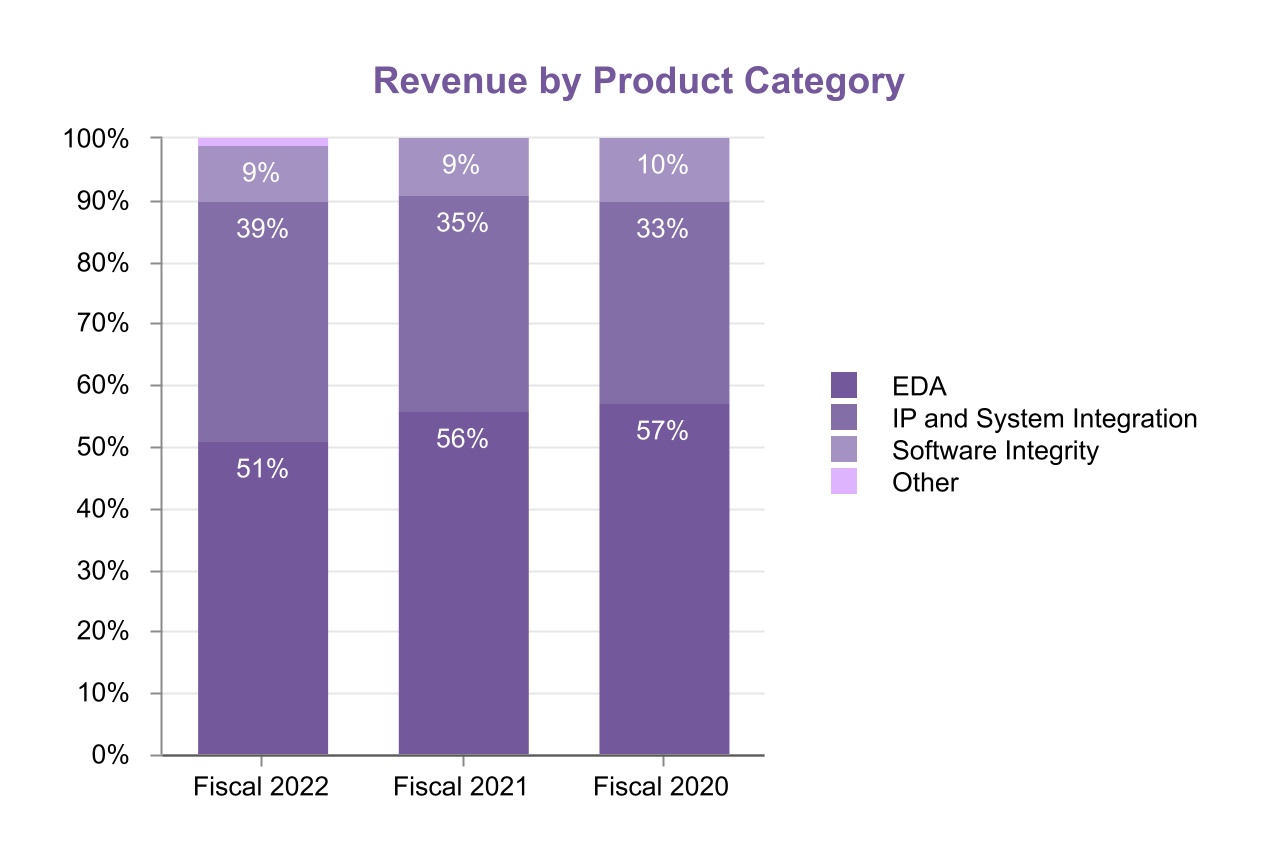
Aggregate revenue derived from one of our customers and its subsidiaries through multiple agreements accounted for 11.7%, 10.6% and 12.4% of our total revenue in fiscal 2022, 2021 and 2020, respectively. In each such year, the revenue derived from such customer and its subsidiaries was primarily attributable to our Semiconductor & System Design segment.
Product Sales and Licensing Agreements
We typically license our software to customers under non-exclusive license agreements that restrict use of our software to specified purposes within specified geographical areas. The majority of licenses to our EDA products are network licenses that allow a number of individual users to access the software on a defined network, including, in some cases, regional or global networks. The majority of licenses to our Software Integrity products are capacity or user licenses that allow a number of users to access the software based on a specified number of team members or specified code-bases in a defined territory. License fees depend on the type of license, product mix, and number of copies of each product licensed.
For a full discussion of our software product offerings, see Part II, Item 7, Management’s Discussion and Analysis of Financial Condition and Results of Operations.
We typically license Synopsys IP products under nonexclusive license agreements that provide usage rights for specific designs. Fees under these licenses are typically charged on a per design basis plus, in some cases, royalties. See Note 2 of the Notes to Consolidated Financial Statements for further information.
Our hardware products, which principally consist of our prototyping and emulation systems, are either sold or leased to our customers. Risks related to disruptions in our supply chain affecting our business are described in Part I, Item 1A, Risk Factors.
Our professional services team typically provides design consulting services to our customers under consulting agreements with statements of work specific to each project.
Competition
The EDA industry is highly competitive. We compete against other EDA vendors and against our customers’ own design tools and internal design capabilities. In general, we compete principally on technology leadership, product quality and features (including ease-of-use), license terms, price and payment terms, post-contract customer support, flexibility of tool use, and interoperability with our own and other vendors’ products. We also deliver a significant amount of engineering and design consulting for our products. No single factor drives an EDA customer’s buying decision, and we compete on all fronts to capture a higher portion of our customers’ budgets. Our competitors include EDA vendors that offer varying ranges of products and services, such as Cadence Design Systems, Inc. and Siemens EDA. We also compete with other EDA vendors, including new entrants to the marketplace, that offer products focused on one or more discrete phases of the IC design process, as well as with customers’ internally developed design tools and capabilities.
Within our Semiconductor & System Design segment, Synopsys also competes against numerous other IP providers, including Cadence Design Systems, Inc., and our customers' internally developed IP. We generally compete on the basis of product quality, reliability, features, availability of titles for new manufacturing processes, ease of integration with customer designs, compatibility with design tools, license terms, price and payment terms, and customer support.
Our Software Integrity segment competes with numerous other solution providers, many of which focus on specific aspects of software security or quality analysis. We also compete with frequent new entrants, which include start-up companies and more established software companies. For example, competitors named in the Gartner Magic Quadrant for Application Security Testing include Checkmarx Ltd., Veracode, Inc. and Micro Focus International plc (now a part of Open Text Corporation).
Risks related to competitive factors affecting our business are described in Part I, Item 1A, Risk Factors.
Proprietary Rights
We primarily rely upon a combination of copyright, patent, trademark, and trade secret laws and license and non-disclosure agreements to establish and protect our proprietary rights. We have a diversified portfolio of more than 3,400 United States and foreign patents issued, and we will continue to pursue additional patents in the future. Our issued patents have expiration dates through 2041. Our patents primarily relate to our products and the technology used in connection with our products. Our source code is protected both as a trade secret and as an unpublished copyrighted work. However, third parties may independently develop similar technology. In addition, effective copyright and trade secret protection may be unavailable or limited in some foreign countries. While protecting our proprietary technology is important to our success, our business as a whole is not significantly dependent upon any single patent, copyright, trademark, or license.
In many cases, under our customer agreements and other license agreements, we offer to indemnify our customers if the licensed products infringe on a third party’s intellectual property rights. As a result, we may from time to time need to defend claims that our customers’ use of our products infringes on these third-party rights. We license software and other intellectual property from third parties, including, in several instances, for inclusion in our products. Risks related to our use of third-party technology are described in Part I, Item 1A, Risk Factors.
Corporate Social Responsibility at Synopsys
Sustainable, just and secure business practices are at the core of who we are as a company and influence our behavior as individuals. Our "Smart Future" Corporate Social Responsibility (CSR) strategy provides a framework for how we manage our own operational impact, so that we can conduct business in a manner that we believe both drives commercial success and contributes to a better world. Through CSR, we are taking action on important Environmental, Social and Governance (ESG) matters to build a more sustainable business, including initiatives to procure more renewable energy and to reduce our operational footprint, as well as driving a culture of inclusion and diversity throughout our workforce and on our Board of Directors.
We aim to influence positive social and environmental change across our ecosystem by applying our resources, competencies, and team-based problem-solving approach. Our technology is in action in countless ways, from bringing safety and security to the driverless car revolution to enabling the technologies that are an
increasingly vital component of protecting human health and well-being. As the role of computing increases exponentially, the Internet of things (IoT), 5G and machine learning applications risk driving similarly exponential energy consumption and carbon emissions. This makes our work to enable low-power computing at the device level and in the cloud especially critical to the industry’s sustainability.
Additional information about our approach to CSR and ESG issues is available on our CSR website, including our Environmental Policy, our CSR Report, and our CDP Climate Change Questionnaire. The contents of our website, CSR Report and CDP Climate Change Questionnaire are referenced for general information only and are not incorporated into this Form 10-K.
Human Capital Resources
At Synopsys, we are helping our employees pursue their passion and make their mark on the world of Smart Everything. We believe this creates value for us, our stockholders, and the lives of the people we impact every day. Our commitment to attracting, developing and retaining the brightest and best talent makes this goal possible. As of our fiscal year-end, Synopsys had approximately 19,000 employees, with approximately 26% in the United States and 74% in other locations around the world. Approximately 80% of our employees are engineers, and over half of those employees hold Masters’ or PhD degrees. The human capital measures and objectives that we focus on include employee health, safety and wellbeing, talent acquisition and retention, employee engagement, development and training, inclusion and diversity, and compensation and pay equity.
Risks related to our human capital are described in Part I, Item 1A, Risk Factors.
Health, Safety and Wellbeing
The health and safety of our employees and their families remains a top priority. In fiscal 2022, we held employee vaccination clinics in our offices and as the year progressed our focus shifted from supporting our employees during a pandemic to helping them thrive in the new hybrid work environment.
With employee wellness at the forefront of our efforts, we provided our employees with a variety of benefits and resources to address the inherent challenges of working remotely, transitioning to a hybrid work environment, or returning to the office full-time. This included a focus on building skills to navigate a hybrid work environment in a way that enables employees to be successful at work and in their personal lives. We also continued our Stronger Through Wellbeing campaign, focused on the importance of employees prioritizing their health and overall wellbeing. As part of this campaign, employees were encouraged to participate in four global recharge days which were designed to help them unplug and unwind.
Recruitment and Retention
Our workforce is representative of the industry we serve. In fiscal 2022, we increased our employee headcount by approximately 16%, with a continued focus on increasing the number of women in technical positions and ensuring a vibrant talent pipeline with early career hiring and investment in training and development. As with many other companies in the technology industry, we experienced an increase in total employee turnover in fiscal 2022. As of our fiscal year-end, our undesired turnover rate was 6.9%. We calculate undesired turnover rate by dividing the number of undesired exits from Synopsys by the average headcount for fiscal 2022, and we define undesired turnover as exits by high-performing employees who resigned from Synopsys (or its subsidiaries) to pursue other work opportunities. Undesired turnover does not include employees with low performance or whose resignation was mutual or due to personal reasons, such as retirement and returning to school. We attribute the strong retention of our talented workforce to a number of factors, including exciting and challenging assignments, strong leadership and management, a culture of integrity, the opportunity to learn new skills and advance careers, our commitment to inclusion and diversity, and the strength of our technology and customer relationships, along with competitive and equitable total rewards.
Inclusion and Diversity
Inclusion and diversity run through our corporate values at every level—from our foundation of integrity to our execution excellence, from our dedicated leadership to our united passion for a better tomorrow. We have always strived to be a company where different perspectives and backgrounds are celebrated, which we believe helps make Synopsys stronger. We care deeply about the diversity of our teams, talent pipelines and pay and development programs, with a goal to ensure inclusive, equitable practices. We carefully study retention trends and feedback from diverse groups to identify areas where we can improve.
In fiscal 2022, we continued to increase the representation of women in our workforce globally and increased representation of Black, Latinx and Indigenous individuals in our U.S. employee base. As of our fiscal year-end:
-
Women comprised 24.9% of our global organization;
-
Women in senior level positions comprised 12.4% of all senior level positions at the company; and
-
U.S. Black, Latinx, and Indigenous persons comprised 5.8% of our U.S. workforce.
We provide leadership training designed to promote inclusion and diversity in attracting, retaining and developing our workforce. In addition, the employee resource groups continue to meet regularly, host events and implement actions to attract diverse talent and foster an inclusive workplace.
In fiscal 2022, we added workforce metrics such as diversity, employee retention and leadership succession planning as performance criteria that are considered by our Compensation and Organizational Development Committee when establishing incentive goals for our executive officers. This reinforces that inclusion and diversity are a key part of our culture and amplifies the importance of executive involvement to advance our progress.
Total Rewards
To ensure a compelling total rewards philosophy, we have practices in place to deliver fair and equitable compensation for employees based on their contribution and performance. We benchmark market practices and regularly review our compensation against the market to ensure it remains competitive. We also offer a comprehensive and tailored set of benefits for employees and their families, providing protection from unexpected losses or medical expenses. Our compensation and benefit programs are tailored to the various geographies in which we operate, and for eligible employees, may include:
-
Market-competitive salary and cash bonus opportunity;
-
Robust medical, dental, vision, and wellness benefits;
-
Financial planning tools and employee assistance plans;
-
Comprehensive leave alternatives;
-
Employee Stock Purchase Plan;
-
Equity compensation for eligible employees;
-
Life insurance options;
-
Retirement plans and associated benefits;
-
Student loan repayment assistance; and
-
Parental resources and adoption benefits.
Employee Engagement
We use employee feedback to drive and improve processes that support our customers and ensure a deep understanding of our culture and vision among our employees. Through our semi-annual SHAPE Synopsys surveys, we obtain employee insights on our values, manager effectiveness, ability to innovate, perceptions on inclusion and diversity, and other critical factors. By inviting employees to share their experiences, we create space for important conversations about who we are, where we are going, and how we can connect with each other and our work.
At mid-year fiscal 2022, approximately 90% of our employee population participated in the SHAPE survey. Results showed our global workforce to be highly engaged, with our overall score outpacing the industry engagement benchmark. We saw strong scores from our people regarding their connection to our culture, their personal investment in Synopsys’ strategies and objectives, and their team’s ability to innovate. As we grow, we aspire to maintain our results-oriented culture by balancing productivity with smart investments in our people’s development, while also supporting individual wellbeing.
Ongoing performance feedback encourages greater engagement in our business and improved individual performance. Each year, our employees participate in our performance development process that summarizes key accomplishments for the preceding year, establishes new stretch goals, and identifies critical capabilities for development. As part of this process, we encourage managers to solicit and share supportive multi-rater feedback, further strengthening the focus on teamwork and team success.
Talent Development and Succession Planning
We provide several leadership programs to address the career advancement and associated business impact of our employees. Through our digital learning platform, which was heavily utilized in fiscal 2022, we foster and support an “always learning” culture where employees can access training, external articles, videos and blogs. In addition, we hosted a series of in-person and on-demand learning sessions designed to build capability and adaptability required for the future. As employees advance in their careers, our training framework builds new capabilities on established foundational skills.
Based upon the belief that our employees deserve great managers, our management training is designed to increase capability in the areas of communication, engagement, coaching, inclusion and diversity, hiring and on-boarding, business skills and ensuring an ethical and supportive work environment free from bias and harassment. In fiscal 2022, we also focused on training and resources for our managers to help them effectively manage and lead hybrid teams to enable effective team dynamics as more team members transition back to the office. In addition, our regions and business teams customize development programs for their specific needs.
We remain committed to equipping leaders for the future. Because the depth and readiness of our leadership pipeline is critically important to our business, in fiscal 2022 we identified key roles across our enterprise, ensured qualified successors were in place for those roles and have committed to establishing development plans that will be tracked, assessed for effectiveness, and adjusted as we move ahead. We believe these actions will enable us to sustain a culture that honors the importance of learning, leading and growing.
Information about our Executive Officers
The executive officers of Synopsys and their ages as of December 12, 2022 were as follows:
| Name | Age | Position | ||||||||||||
| Aart J. de Geus | 68 | Chief Executive Officer and Chairman of the Board of Directors | ||||||||||||
| Sassine Ghazi | 52 | President and Chief Operating Officer | ||||||||||||
| Shelagh Glaser | 58 | Chief Financial Officer | ||||||||||||
| Richard Mahoney | 60 | Chief Revenue Officer | ||||||||||||
| John F. Runkel, Jr. | 67 | General Counsel and Corporate Secretary |
Aart J. de Geus co-founded Synopsys and has served as Chairman of our Board of Directors since February 1998 and Chief Executive Officer since January 1994. He served as Co-Chief Executive Officer with Dr. Chi-Foon Chan from May 2012 until April 2022. Since the inception of Synopsys in December 1986, Dr. de Geus has held a variety of positions, including President, Senior Vice President of Engineering and Senior Vice President of Marketing. He has served as a member of Synopsys’ Board of Directors since 1986, and served as Chairman of our Board of Directors from 1986 to 1992 and again from 1998 until present. Dr. de Geus has also served on the board of directors of Applied Materials, Inc. since July 2007. Dr. de Geus holds an M.S.E.E. from the Swiss Federal Institute of Technology in Lausanne, Switzerland and a Ph.D. in Electrical Engineering from Southern Methodist University.
Sassine Ghazi has served as our Chief Operating Officer since August 2020 and became our President in November 2021. Mr. Ghazi joined Synopsys in March 1998 as an Application Engineer and most recently served as General Manager of the Design Group. Prior to joining Synopsys, Mr. Ghazi was a design engineer at Intel Corporation. Mr. Ghazi received his bachelor’s degree in Business Administration from Lebanese American University; a B.S.E.E from the Georgia Institute of Technology in 1993; and an M.S.E.E. from the University of Tennessee in 1995.
Shelagh Glaser joined Synopsys as our Chief Financial Officer on December 2, 2022 and succeeds Trac Pham, our former Chief Financial Officer. Prior to joining Synopsys, Ms. Glaser served as Chief Financial Officer of Zendesk, Inc. from May 2021 to November 2022. Ms. Glaser previously served in senior finance roles at Intel Corporation, a multinational technology company, including serving as its Corporate Vice President and Chief Financial Officer and Chief Operating Officer for its Data Platform Group since July 2019 and serving as its Corporate Vice President and Chief Financial Officer and in various other senior roles in its Client Computing Group from December 2013 to July
- Ms. Glaser has served as a director and member of the Audit Committee at PubMatic, Inc. since June 2022. Ms. Glaser holds a B.A. in Economics from the University of Michigan and an M.B.A. in Finance from Carnegie Mellon University.
Richard Mahoney has served as our Chief Revenue Officer since November 2022. Mr. Mahoney succeeds Joseph W. Logan, who served as our Chief Revenue Officer during fiscal 2022. Mr. Mahoney joined Synopsys as a Special Projects Advisor in May 2022. Prior to joining Synopsys, Mr. Mahoney held several senior management positions with Ansys, Inc. from 2016 to 2022, including most recently as Senior Vice President of Worldwide Sales, Marketing and Customer Excellence from December 2016 to May 2022. Prior to joining Ansys, from 2014 to 2016, Mr. Mahoney was Senior Vice President, Design Enablement and International Sales, at Global Foundries, a semiconductor manufacturing company. Mr. Mahoney holds an A.S. in Computer Science from the Maxwell Institute of Technology.
John F. Runkel, Jr. has served as our General Counsel and Corporate Secretary since May 2014. From October 2008 to March 2013, he was Executive Vice President, General Counsel, and Corporate Secretary of Affymetrix, Inc. He served as Senior Vice President, General Counsel and Corporate Secretary of Intuitive Surgical, Inc. from 2006 to 2007. Mr. Runkel served in several roles at VISX, Inc. from 2001 to 2005, most recently as Senior Vice President of Business Development and General Counsel. Mr. Runkel was also a partner at the law firm of Sheppard, Mullin, Richter & Hampton LLP for 11 years. Mr. Runkel holds a Bachelor of Arts and a Juris Doctorate from the University of California, Los Angeles.
There are no family relationships among any Synopsys executive officers or directors.
Item 1A. Risk Factors
A description of the risk factors associated with our business is set forth below. Some of these risks are highlighted in the following discussion, and in Management’s Discussion and Analysis of Financial Condition and Results of Operations, Legal Proceedings, and Quantitative and Qualitative Disclosures About Market Risk. The occurrence of any of these risks or additional risks and uncertainties not presently known to us or that we currently believe to be immaterial could materially and adversely affect our business, financial condition, operating results and stock price. These risks and uncertainties could cause our actual results to differ materially from the results contemplated by the forward-looking statements contained in this report. Investors should carefully consider all relevant risks and uncertainties before investing in our common stock.
Industry Risks
Uncertainty in the global economy, and its potential impact on the semiconductor and electronics industries, may negatively affect our business, operating results and financial condition.
Uncertainty caused by the recent challenging global economic conditions, including due to the effects of the recent rise in inflation and interest rates and the continuing COVID-19 pandemic, could lead some of our customers to postpone their decision-making, decrease their spending and/or delay their payments to us. Such caution by customers could, among other things, limit our ability to maintain or increase our sales or recognize revenue from committed contracts.
Economic conditions could continue to deteriorate in the future, and, in particular, the semiconductor and electronics industries could fail to grow, including as a result of the effects of, among other things, rising inflation and interest rates, a sustained global semiconductor shortage, supply chain disruptions, the COVID-19 pandemic, and any disruption of international trade relationships such as tariffs, export licenses or other government trade restrictions. Furthermore, China’s stated policy of becoming a global leader in the semiconductor industry may lead to increased competition and further disruption of international trade relationships, including, but not limited to, additional government trade restrictions. For more on risks related to government export and import restrictions such as the U.S. government’s Entity List and Export Regulations (as defined below), see “Industry Risks – We are subject to governmental export and import requirements that could subject us to liability and restrict our ability to sell our products and services, which could impair our ability to compete in international markets.”
Adverse economic conditions affect demand for devices that our products help create, such as the ICs incorporated in personal computers, smartphones, automobiles and servers. Longer-term reduced demand for these or other products could result in reduced demand for design solutions and significant decreases in our average selling prices and product sales over time. Future economic downturns could also adversely affect our business. In addition, if our customers or distributors build elevated inventory levels, we could experience a decrease in short-term and/or long-term demand for our products. If any of these events or disruptions were to occur, the demand for our products and services could be adversely affected along with our business, operating results and financial condition. Further, the negative impact of these events or disruptions may be deferred due to our business model.
Further economic instability could also adversely affect the banking and financial services industry and result in credit downgrades of the banks we rely on for foreign currency forward contracts, credit and banking transactions, and deposit services, or cause them to default on their obligations. Additionally, the banking and financial services industries are subject to complex laws and are heavily regulated. There is uncertainty regarding how proposed, contemplated or future changes to the laws, policies and regulations governing our industry, the banking and financial services industry and the economy could affect our business, including rising global interest rates. A deterioration of conditions in worldwide credit markets could limit our ability to obtain external financing to fund our operations and capital expenditures. In addition, difficult economic conditions may also result in a higher rate of losses on our accounts receivable due to credit defaults. Any of the foregoing could cause adverse effects on our business, operating results and financial condition, and could cause our stock price to decline.
The growth of our business depends primarily on the semiconductor and electronics industries.
The growth of the EDA industry as a whole, our Semiconductor & System Design segment product sales, and, to some extent, our Software Integrity segment product sales, are dependent on the semiconductor and electronics industries. A substantial portion of our business and revenue depends upon the commencement of new design projects by semiconductor manufacturers, systems companies and their customers. The increasing complexity of designs of SoCs, ICs, electronic systems and customers’ concerns about managing costs have previously led to, and in the future could lead to, a decrease in design starts and design activity in general. For example, in response
to this increasing complexity, some customers may choose to focus on one discrete phase of the design process or opt for less advanced, but less risky, manufacturing processes that may not require the most advanced EDA products. Demand for our products and services could decrease and our financial condition and results of operations could be adversely affected if growth in the semiconductor and electronics industries slows or stalls, including due to rising inflation and global interest rates, a continued or worsening global supply chain disruption, or the impact of the COVID-19 pandemic. Additionally, as the EDA industry has matured, consolidation has resulted in stronger competition from companies better able to compete as sole source vendors. This increased competition may cause our revenue growth rate to decline and exert downward pressure on our operating margins, which may have an adverse effect on our business and financial condition.
Furthermore, the semiconductor and electronics industries have become increasingly complex ecosystems. Many of our customers outsource the manufacturing of their semiconductor designs to foundries. Our customers also frequently incorporate third-party IP, whether provided by us or other vendors, into their designs to improve the efficiency of their design process. We work closely with major foundries to ensure that our EDA, IP and manufacturing solutions are compatible with their manufacturing processes. Similarly, we work closely with other major providers of semiconductor IP, particularly microprocessor IP, to optimize our EDA tools for use with their IP designs and to assure that their IP and our own IP products work effectively together, as we may each provide for the design of separate components on the same chip. If we fail to optimize our EDA and IP solutions for use with major foundries’ manufacturing processes or major IP providers’ products, or if our access to such foundry processes or third-party IP products is hampered, then our solutions may become less desirable to our customers, resulting in an adverse effect on our business and financial condition.
We operate in highly competitive industries, and if we do not continue to meet our customers’ demand for innovative technology at lower costs, our products may not be competitive or may become obsolete.
In our Semiconductor & System Design segment, we compete against EDA vendors that offer a variety of products and se
Showing the first 8K of 70K characters. Open the full section
Item 1B. Unresolved Staff Comments
None.
Item 2. Properties
Our principal offices are currently located in Mountain View, California. We currently lease approximately 1 million square feet of space in 33 offices throughout the United States, inclusive of our principal offices, but excluding 407,000 square feet which are currently sublet to third parties and 120,000 square feet, which we own and currently lease to third parties. We own buildings in Oregon and California. These offices are used primarily for sales and support, marketing, and administrative activities as well as research and development for our business segments.
We currently lease approximately 2.6 million square feet of space in 29 countries other than the United States, and own buildings in Wuhan, China and Hsinchu, Taiwan as well as office space in Xiamen, China and Yongin-si, South Korea. These offices are used primarily for sales and support, service, and research and development activities for our business segments.
As our needs change, from time to time, we may relocate, expand, and/or otherwise increase or decrease the size of our operations, offices or personnel. We believe that our existing facilities, including both owned and leased properties, are in good condition and suitable for our current needs and that suitable additional or substitute space will be available on commercially reasonable terms as needed to accommodate any expansion of our operations.
Item 3. Legal Proceedings
We are subject to routine legal proceedings, as well as demands, claims and threatened litigation that arise in the normal course of our business. The ultimate outcome of any litigation is often uncertain and unfavorable outcomes could have a negative impact on our results of operations and financial condition. Regardless of outcome, litigation can have an adverse impact on Synopsys because of the defense costs, diversion of management resources and other factors.
We regularly review the status of each significant matter and assess its potential financial exposure. If the potential loss from any claim or legal proceeding is considered probable and the amount is estimable, we accrue a liability for the estimated loss. Legal proceedings are inherently uncertain and as circumstances change, it is possible that the amount of any accrued liability may increase, decrease or be eliminated.
Hungarian Tax Matter
In 2017, the Hungarian Tax Authority (the HTA) assessed withholding taxes of approximately $25.0 million and interest and penalties of $11.0 million against our Hungary subsidiary (Synopsys Hungary). Synopsys Hungary contested the assessment with the Hungarian Administrative Court (Administrative Court). In 2019, as required under Hungarian law, Synopsys Hungary paid the assessment and recorded a tax expense due to an unrecognized tax benefit of $17.4 million, which is net of estimated U.S. foreign tax credits. The Administrative Court found against Synopsys Hungary, and we appealed to the Hungarian Supreme Court. During 2021, the Hungarian Supreme Court heard our appeal and remanded the case to the Administrative Court for further proceedings. The Administrative Court once again ruled against Synopsys Hungary, and we filed another appeal with the Hungarian Supreme Court. The Hungarian Supreme Court heard our appeal on January 27, 2022, vacated the lower court's decision and remanded the case back to the Administrative Court for further proceedings. Hearings with the Administrative Court were held on June 30, 2022 and September 22, 2022. In response to a request by the Administrative Court, we filed an additional brief on November 23, 2022. We expect a hearing to be scheduled in early 2023.
For further discussion of the Hungary audit, see Note 15 of the Notes to Consolidated Financial Statements under the heading “Non-U.S. Examinations.”
Bell Semic Actions
On April 27, 2022, Bell Semiconductor LLC (Bell Semic), a patent monetization entity, began filing a series of patent infringement lawsuits against certain technology companies alleging that certain semiconductor devices designed using certain design tools offered by electronic design automation (EDA) vendors, including Synopsys, infringe upon one or more patents held by Bell Semic. Bell Semic seeks money damages, attorneys’ fees and costs, and a permanent injunction prohibiting the defendants from using allegedly infringing EDA design tools.
On April 29, 2022, Bell Semic also began filing a series of complaints with the U.S. International Trade Commission (ITC) alleging violations of Section 337 of the Tariff Act of 1930 and seeking limited exclusion orders preventing the respondents from importing into the United States semiconductor devices designed using certain design tools offered by EDA vendors, including Synopsys, and cease-and-desist orders prohibiting respondents from importing, selling, offering for sale, advertising, or transferring products made using certain design tools offered by EDA vendors, including Synopsys. On November 8, 2022, the ITC instituted the investigations.
Synopsys is not named as a respondent or defendant in any of the aforementioned actions; however, certain of the respondents and defendants are Synopsys customers and have sought defense and indemnity from Synopsys under their End User License Agreements in response to Bell Semic’s allegations. Synopsys has offered to defend some of its customers consistent with the terms of its End User License Agreement.
On November 18, 2022, Synopsys and another EDA vendor filed an action for Declaratory Judgment of invalidity and non-infringement as to each of the six patents asserted by Bell Semic in the aforementioned actions. On November 28, 2022, Synopsys and another EDA vendor also filed a Motion for Preliminary Injunction seeking to enjoin Bell Semic from proceeding with the ITC investigations.
Item 4. Mine Safety Disclosures
Item 5. Market for Registrant’s Common Equity, Related Stockholder Matters and Issuer Purchases of Equity Securities
Our common stock trades on the Nasdaq Global Select Market under the symbol “SNPS.” As of December 7, 2022, we had 227 stockholders of record.
Performance Graph
The following graph compares the five-year total return to stockholders of our common stock relative to the cumulative total returns of the S&P 500 Index, the S&P Information Technology Index and the Nasdaq Composite Index. The graph assumes that $100 was invested in Synopsys common stock on October 27, 2017 (the last trading day before the beginning of our fifth preceding fiscal year) and in each of the indexes on October 27, 2017 (the closest month end) and that all dividends were reinvested. No cash dividends were declared on our common stock during such time. The comparisons in the table are not intended to forecast or be indicative of possible future performance of our common stock.
COMPARISON OF 5 YEAR CUMULATIVE TOTAL RETURN*

| *$100 invested on October 27, 2017 in stock or index, including reinvestment of dividends. Fiscal year ending October 29. |
The information presented above in the stock performance graph shall not be deemed to be “soliciting material” or to be “filed” with the SEC or subject to Regulation 14A or 14C, except to the extent that we subsequently specifically request that such information be treated as soliciting material or specifically incorporate it by reference into a filing under the Securities Act or Exchange Act.
Dividends
We have not paid cash dividends on our common stock.
Stock Repurchase Program
Our Board of Directors (the Board) previously approved a stock repurchase program (the Program) with authorization to purchase up to $1.0 billion of our common stock in December 2021. The Board approved a replenishment of the Program with authorization to purchase up to $1.5 billion in September 2022. As of October 31, 2022, $1.4 billion remained available for future repurchases under the program.
In August 2022, we entered into an accelerated share repurchase agreement (the August 2022 ASR) to repurchase an aggregate of $240.0 million of our common stock. Pursuant to the August 2022 ASR, we made a prepayment of $240.0 million to receive initial deliveries of shares valued at $192.0 million. The remaining balance of $48.0 million was settled in October 2022. Total shares purchased under the August 2022 ASR were approximately 0.8 million shares, at an average purchase price of $307.60 per share.
The table below sets forth information regarding our repurchases of our common stock during the three months ended October 31, 2022:
| Period | Total number of shares purchased (1) | Average price paid per share (1) | Total number of shares purchased as part of publicly announced programs | Maximum dollar value of shares that may yet be purchased under the programs | |||||||||||||||||||
| Month #1 | |||||||||||||||||||||||
| July 31, 2022 through September 3, 2022 | 644,623 | $ | 364.14 | 637,013 | $ | 1,500,000,000 | |||||||||||||||||
| Month #2 | |||||||||||||||||||||||
| September 4, 2022 through October 1, 2022 | 191,624 | $ | 313.09 | — | $ | 1,440,005,356 | |||||||||||||||||
| Month #3 | |||||||||||||||||||||||
| October 2, 2022 through October 29, 2022 | 372,813 | $ | 236.06 | 244,954 | $ | 1,400,000,207 | |||||||||||||||||
| Total | 1,209,060 | 881,967 | $ | 1,400,000,207 |
(1) Amounts are calculated based on the settlement date.
Item 6. [Reserved]
Item 7. Management’s Discussion and Analysis of Financial Condition and Results of Operations
Overview
The following overview is qualified in its entirety by the more complete discussion contained in this Item 7, the risk factors set forth in Item 1A of this Form 10-K, and our consolidated financial statements and the notes thereto set forth in Item 8 of this Form 10-K. Please also see the cautionary language at the beginning of Part I of this Form 10-K regarding forward-looking statements.
Business Summary
Synopsys provides products and services used across the entire Silicon to Software spectrum, from engineers creating advanced semiconductors to product teams developing advanced electronic systems to software developers seeking to ensure the security and quality of their code. We are a global leader in electronic design automation (EDA) software that engineers use to design and test integrated circuits (ICs), also known as chips. We also offer semiconductor intellectual property (IP) products, which are pre-designed circuits that engineers use as components of larger chip designs rather than designing those circuits themselves. We provide software and hardware used to validate the electronic systems that incorporate chips and the software that runs on them. We also provide technical services and support to help our customers develop advanced chips and electronic systems. These products and services are part of our Semiconductor & System Design segment.
We are also a leading provider of software tools and services that improve the security, quality and compliance of software in a wide variety of industries, including electronics, financial services, automotive, medicine, energy and industrials. These tools and services are part of our Software Integrity segment.
Our EDA and IP customers are generally semiconductor and electronics systems companies. Our solutions help these companies overcome the challenges of developing increasingly advanced electronics products while also helping them reduce their design and manufacturing costs. While our products are an important part of our customers’ development process, our sales could be affected based on their research and development budgets, and our customers' spending decisions may be affected by their business outlook and willingness to invest in new and increasingly complex chip designs.
Our Software Integrity segment delivers products and services that enable software developers to test their code - while it is being written - for known security vulnerabilities and quality defects, as well as testing for open source security vulnerabilities and license compliance. Our Software Integrity customers are software developers across many industries, including, but also well beyond, the semiconductor and systems industries. Our Software Integrity products and services form a platform that helps our customers build security into the software development lifecycle and across the entire cyber supply chain.
We have consistently grown our revenue since 2005, despite periods of global economic uncertainty. We achieved these results because of our solid execution, leading technologies and strong customer relationships, and because we generally recognize our revenue for software licenses over the arrangement period, which typically approximates three years. See Note 2 of the Notes to Consolidated Financial Statements for a discussion on our revenue recognition policy*.* The revenue we recognize in a particular period generally results from selling efforts in prior periods rather than the current period. As a result, decreases as well as increases in customer spending do not immediately affect our revenues in a significant way.
Our growth strategy is based on maintaining and building on our leadership in our EDA products, expanding and proliferating our IP offerings, driving growth in the software security and quality market, and continuing to expand our product portfolio and our total addressable market. Our revenue growth from period to period is expected to vary based on the mix of our time based and upfront products. Based on our leading technologies, customer relationships, business model, diligent expense management, and acquisition strategy, we believe that we will continue to execute our strategies successfully.
Recent Developments
Developments in Export Control Regulations
On October 7, 2022, the Bureau of Industry and Security (BIS) of the U.S. Department of Commerce published changes to U.S. export control regulations (U.S. Export Regulations), including new restrictions on Chinese entities' ability to obtain advanced computing chips, develop and maintain supercomputers, and manufacture advanced semiconductors. Further, on October 14, 2022, a new rule went into effect imposing U.S. export controls on additional technologies, including electronic computer-aided design software specially designed for the development of ICs with Gate-All-Around Field-Effect Transistor structures. Based on our current understanding, we believe these regulations will not have a material impact on our business. We anticipate additional changes to U.S. Export Regulations in the future, but we cannot forecast the scope or timing of such changes. We will continue to monitor such developments, including potential additional trade restrictions, and other regulatory or policy changes by the U.S. and foreign governments.
For more on risks related to government export and import restrictions such as the U.S. government’s Entity List and other U.S. Export Regulations, see Part I, Item 1A, Risk Factors, “Industry Risks – We are subject to governmental export and import requirements that could subject us to liability and restrict our ability to sell our products and services, which could impair our ability to compete in international markets.”
Impact of the Current Macroeconomic Environment and COVID-19
Uncertainty in the macroeconomic environment, including due to the effects of the recent rise in global inflation and interest rates, supply chain disruptions, geopolitical pressures, including the unknown impact of current and future U.S. and Chinese trade regulations, changes in China-Taiwan relations and the war in Ukraine, fluctuation in foreign exchange rates, and associated global economic conditions have resulted in volatility in credit, equity and foreign currency markets.
These uncertain macroeconomic conditions could lead some of our customers to postpone their decision-making, decrease their spending and/or delay their payments to us. For example, in the fourth quarter of fiscal 2022, we experienced a minor impact from the current macroeconomic environment in our Software Integrity segment as customers applied elevated levels of scrutiny to purchasing decisions, which has, in some cases, caused some customers to elect shorter term contracts due to their own budget uncertainty. If these uncertain macroeconomic conditions persist, they may continue to have an adverse impact on certain aspects of our business.
Additionally, the ongoing COVID-19 pandemic has impacted worldwide economic activity and financial markets and significantly increased economic volatility and uncertainty. Despite this widespread volatility and uncertainty, the COVID-19 pandemic has caused only minor disruptions to our business operations with a limited impact on our operating results thus far. The extent to which the COVID-19 pandemic impacts our business operations in future periods will depend on multiple uncertain factors, including the duration of the pandemic and its overall negative impact on the global economy generally and the semiconductor and electronics industries specifically. We have not identified trends that we expect will materially impact our future operating results at this time and continue to consider the impacts of the COVID-19 pandemic on our business operations.
Whi
Showing the first 8K of 64K characters. Open the full section
Item 7A. Quantitative and Qualitative Disclosures About Market Risk
We are exposed to financial market risks, primarily due to changes in interest rates, foreign currency exchange rates, and non-marketable equity security price. None of market risk sensitive instruments are held for speculative trading purposes.
Interest Rate Risk. Our exposure to market risk for changes in interest rates relates to our cash, cash equivalents, short-term investments, and outstanding debt. As of October 31, 2022, all of our cash, cash equivalents, and debt were at short-term variable or fixed interest rates. As of October 31, 2022, we had an investment portfolio of fixed income securities of $147.9 million. These securities, as with all fixed income instruments, are subject to interest rate risk and will decline in value if market interest rates increase. While par value generally approximates fair value on variable instruments, rising interest rates over time would increase both our interest income and our interest expense. The primary objective of our investment activities is to preserve the principal while at the same time maximizing yields without significantly increasing the risk. To achieve this objective, we maintain our portfolio of investments in a mix of tax-exempt and taxable instruments that meet high credit quality standards, as specified in our investment policy. Our policy also limits the amount of credit exposure to any one issue, issuer and type of instrument.
Our cash equivalents and debt by fiscal year of expected maturity and average interest rates as of October 31, 2022 were as follows:
| Maturing in Year Ending October 31, | |||||||||||||||||||||||||||||||||||||||||||||||
| 2023 | 2024 | 2025 | 2026 | 2027 and thereafter | Total | Fair Value | |||||||||||||||||||||||||||||||||||||||||
| (in thousands) | |||||||||||||||||||||||||||||||||||||||||||||||
| Cash & Cash equivalents | $ | 1,227,136 | $ | 1,227,136 | $ | 1,227,136 | |||||||||||||||||||||||||||||||||||||||||
| Approx. average interest rate | 0.70 | % | |||||||||||||||||||||||||||||||||||||||||||||
| Short-term investments | $ | 82,264 | $ | 39,410 | $ | 17,705 | $ | 2,265 | $ | 6,269 | $ | 147,913 | $ | 147,913 | |||||||||||||||||||||||||||||||||
| Approx. average coupon rate | 2.01 | % | 2.01 | % | 3.11 | % | 0.98 | % | 1.45 | % | |||||||||||||||||||||||||||||||||||||
| Short-term debt (variable rate): | |||||||||||||||||||||||||||||||||||||||||||||||
| Credit Facility in China | $ | 20,824 | $ | 20,824 | $ | 20,824 | |||||||||||||||||||||||||||||||||||||||||
| Average interest rate | LPR + 0.74% of such rate |
Foreign Currency Risk. We operate internationally and are exposed to potentially adverse movements in currency exchange rates. The functional currency of the majority of our active foreign subsidiaries is the foreign subsidiary’s local currency. A weakening U.S. dollar relative to other currencies increases expenses of our foreign subsidiaries when they are translated into U.S. dollars in our consolidated statements of income. Likewise, a strengthening of the U.S. dollar relative to other currencies, including the renminbi or Yen, reduces revenue of our foreign subsidiaries upon translation and consolidation. If the U.S. dollar continues to strengthen, this could adversely affect our financial condition and operating results. In addition, increased international sales in the future may result in greater foreign currency denominated sales, increasing our foreign currency risk. Our operating expenses incurred outside the United States and denominated in foreign currencies are increasing and are subject to fluctuations due to changes in foreign currency exchange rates. If we are not able to successfully hedge against the risks associated with foreign currency fluctuations, our financial condition and operating results could be adversely affected. We enter into hedges in the form of foreign currency forward contracts to reduce our exposure to foreign currency rate changes on non-functional currency denominated forecasted transactions and balance sheet positions including: (1) certain assets and liabilities, (2) shipments forecasted to occur within approximately one month, (3) future billings and revenue on previously shipped orders, and (4) certain future intercompany invoices denominated in foreign currencies. The foreign currency contracts are carried at fair value and denominated in various currencies as listed in the tables below. The duration of forward contracts usually ranges from one month to 27 months. See Note 2 and Note 7 of the Notes to Consolidated Financial Statements for a description of our accounting for foreign currency contracts*.*
The success of our hedging activities depends upon the accuracy of our estimates of various balances and transactions denominated in non-functional currencies. Exchange rates are subject to significant and rapid fluctuations due to a number of factors, including interest rate changes and political and economic uncertainty. Therefore, we cannot predict the prospective impact of exchange rate fluctuations. To the extent our estimates are correct, gains and losses on our foreign currency contracts will be offset by corresponding losses and gains on the underlying transactions. For example, if the Euro were to depreciate by 10% compared to the U.S. dollar prior to the settlement of the Euro forward contracts listed in the table below providing information as of October 31, 2022, the fair value of the contracts would decrease by approximately $19.5 million, and we would be required to pay approximately $19.5 million to the counterparty upon contract maturity. At the same time, the U.S. dollar value of our Euro-based expenses would decline, resulting in positive cash flow of approximately $19.5 million that would offset the loss and negative cash flow on the maturing forward contracts.
If estimates of our balances and transactions prove inaccurate, we will not be completely hedged, and we will record gains or losses, depending upon the nature and extent of such inaccuracy. Although we engage in foreign currency hedging activity, we may be unable to hedge all of our foreign currency risk, which could have a negative impact on our results of operations.
We enter into foreign exchange forward contracts with financial institutions and have not experienced nonperformance by counterparties. Further, we anticipate performance by all counterparties to such agreements.
Information about the gross notional values of our foreign currency contracts as of October 31, 2022 was as follows:
| Gross Notional Amount in U.S. Dollars | Average Contract Rate | ||||||||||
| (in thousands) | |||||||||||
| Forward Contract Values: | |||||||||||
| Indian rupee | $ | 368,282 | 82.500 | ||||||||
| Japanese yen | 264,649 | 146.852 | |||||||||
| Euro | 195,285 | 1.086 | |||||||||
| Taiwanese dollar | 130,412 | 29.967 | |||||||||
| Canadian dollar | 102,201 | 1.321 | |||||||||
| Chinese renminbi | 90,436 | 7.214 | |||||||||
| Korean won | 83,935 | 1,289.396 | |||||||||
| Hungarian forint | 51,056 | 423.933 | |||||||||
| British pound sterling | 41,817 | 1.234 | |||||||||
| Israel shekel | 38,386 | 3.419 | |||||||||
| Singapore dollar | 10,498 | 1.396 | |||||||||
| Swiss franc | 9,183 | 0.958 | |||||||||
| $ | 1,386,140 |
Equity Price Risk. Our non-marketable equity securities investments totaled $31.9 million and $17.6 million as of October 31, 2022 and 2021, respectively. Our strategic investments include privately-held companies that are considered to be in the start-up or development stages and have a higher inherent risk. Specifically, the technologies or products these companies have under development are typically in the early stages and may never materialize, which could result in a loss of a substantial part of our initial investment in these companies. These investments could be impaired if the carrying value exceeds the fair value and is not expected to recover. The evaluation of these investments is based on information provided by these companies, which is not subject to the same disclosure regulations as U.S. publicly traded companies and as such, the basis for these evaluations is subject to the timing and accuracy of the data provided.
Item 8. Financial Statements and Supplementary Data
Report of Independent Registered Public Accounting Firm
To the Stockholders and Board of Directors
Synopsys, Inc.:
Opinions on the Consolidated Financial Statements and Internal Control Over Financial Reporting
We have audited the accompanying consolidated balance sheets of Synopsys, Inc. and subsidiaries (the Company) as of October 29, 2022 and October 30, 2021, the related consolidated statements of income, comprehensive income, stockholders’ equity, and cash flows for each of the years in the three-year period ended October 29, 2022, and the related notes (collectively, the consolidated financial statements). We also have audited the Company’s internal control over financial reporting as of October 29, 2022, based on criteria established in Internal Control – Integrated Framework (2013) issued by the Committee of Sponsoring Organizations of the Treadway Commission.
In our opinion, the consolidated financial statements referred to above present fairly, in all material respects, the financial position of the Company as of October 29, 2022 and October 30, 2021, and the results of its operations and its cash flows for each of the years in the three-year period ended October 29 2022, in conformity with U.S. generally accepted accounting principles. Also in our opinion, the Company maintained, in all material respects, effective internal control over financial reporting as of October 29, 2022 based on criteria established in Internal Control – Integrated Framework (2013) issued by the Committee of Sponsoring Organizations of the Treadway Commission.
Basis for Opinions
The Company’s management is responsible for these consolidated financial statements, for maintaining effective internal control over financial reporting, and for its assessment of the effectiveness of internal control over financial reporting, included in the accompanying Management's Report on Internal Control Over Financial Reporting. Our responsibility is to express an opinion on the Company’s consolidated financial statements and an opinion on the Company’s internal control over financial reporting based on our audits. We are a public accounting firm registered with the Public Company Accounting Oversight Board (United States) (PCAOB) and are required to be independent with respect to the Company in accordance with the U.S. federal securities laws and the applicable rules and regulations of the Securities and Exchange Commission and the PCAOB.
We conducted our audits in accordance with the standards of the PCAOB. Those standards require that we plan and perform the audits to obtain reasonable assurance about whether the consolidated financial statements are free of material misstatement, whether due to error or fraud, and whether effective internal control over financial reporting was maintained in all material respects.
Our audits of the consolidated financial statements included performing procedures to assess the risks of material misstatement of the consolidated financial statements, whether due to error or fraud, and performing procedures that respond to those risks. Such procedures included examining, on a test basis, evidence regarding the amounts and disclosures in the consolidated financial statements. Our audits also included evaluating the accounting principles used and significant estimates made by management, as well as evaluating the overall presentation of the consolidated financial statements. Our audit of internal control over financial reporting included obtaining an understanding of internal control over financial reporting, assessing the risk that a material weakness exists, and testing and evaluating the design and operating effectiveness of internal control based on the assessed risk. Our audits also included performing such other procedures as we considered necessary in the circumstances. We believe that our audits provide a reasonable basis for our opinions.
Definition and Limitations of Internal Control Over Financial Reporting
A company’s internal control over financial reporting is a process designed to provide reasonable assurance regarding the reliability of financial reporting and the preparation of financial statements for external purposes in accordance with generally accepted accounting principles. A company’s internal control over financial reporting
includes those policies and procedures that (1) pertain to the maintenance of records that, in reasonable detail, accurately and fairly reflect the transactions and dispositions of the assets of the company; (2) provide reasonable assurance that transactions are recorded as necessary to permit preparation of financial statements in accordance with generally accepted accounting principles, and that receipts and expenditures of the company are being made only in accordance with authorizations of management and directors of the company; and (3) provide reasonable assurance regarding prevention or timely detection of unauthorized acquisition, use, or disposition of the company’s assets that could have a material effect on the financial statements.
Because of its inherent limitations, internal control over financial reporting may not prevent or detect misstatements. Also, projections of any evaluation of effectiveness to future periods are subject to the risk that controls may become inadequate because of changes in conditions, or that the degree of compliance with the policies or procedures may deteriorate.
Critical Audit Matter
The critical audit matter communicated below is a matter arising from the current period audit of the consolidated financial statements that was communicated or required to be communicated to the audit committee and that: (1) relates to accounts or disclosures that are material to the consolidated financial statements and (2) involved our especially challenging, subjective, or complex judgments. The communication of a critical audit matter does not alter in any way our opinion on the consolidated financial statements, taken as a whole, and we are not, by communicating the critical audit matter below, providing a separate opinion on the critical audit matter or on the accounts or disclosures to which it relates.
Evaluation of the Company’s analysis of terms and conditions in software and intellectual property license contracts with customers
As discussed in Notes 2 and 3 to the consolidated financial statements, the Company generates revenue from the sale of products that include software and intellectual property (IP) licenses, hardware products, maintenance and services. The Company’s contracts with customers often include promises to transfer multiple products and services to a customer. Arrangements with customers can involve hundreds of products and various license rights, and customers negotiate with the Company over many aspects of these arrangements. The Company’s customers often request a broader portfolio of solutions, support and services and seek more favorable terms such as expanded license usage, future purchase rights and other unique rights at an overall lower total cost. The Company recognized total revenue of $5,081.5 million for the year ended October 29, 2022, which included revenue related to software and IP licenses.
We identified the evaluation of the Company’s analysis of terms and conditions in significant software and IP license contracts with customers and their effect on revenue recognition as a critical audit matter. Complex auditor judgment was required to assess the Company’s judgments made in applying revenue recognition requirements to certain terms and conditions.
The following are the primary procedures we performed to address this critical audit matter. We evaluated the design and tested the operating effectiveness of certain internal controls related to the Company’s revenue recognition process, including the Company’s analysis of terms and conditions in
Showing the first 8K of 187K characters. Open the full section
Item 9. Changes in and Disagreements with Accountants on Accounting and Financial Disclosure
Not applicable.
Item 9A. Controls and Procedures
(a)Evaluation of Disclosure Controls and Procedures. As of October 29, 2022, Synopsys carried out an evaluation under the supervision and with the participation of Synopsys’ management, including the Chief Executive Officer and Chief Financial Officer, of the effectiveness of the design and operation of Synopsys’ disclosure controls and procedures (as such term is defined in Rules 13a-15(e) and 15d-15(e) under the Exchange Act). There are inherent limitations to the effectiveness of any system of disclosure controls and procedures. Accordingly, even effective disclosure controls and procedures can only provide reasonable, not absolute, assurance of achieving their control objectives. Our Chief Executive Officer and Chief Financial Officer have concluded that, as of October 29, 2022, Synopsys’ disclosure controls and procedures were effective to provide reasonable assurance that information required to be disclosed in the reports Synopsys files and submits under the Exchange Act is recorded, processed, summarized and reported as and when required, and that such information is accumulated and communicated to Synopsys’ management, including the Chief Executive Officer and Chief Financial Officer, to allow timely decisions regarding its required disclosure.
(b)Management’s Report on Internal Control Over Financial Reporting. Our management is responsible for establishing and maintaining adequate internal control over financial reporting (as defined in Rules 13a-15(f) and 15d-15(f) under the Exchange Act) for Synopsys.
Under the supervision and with the participation of our management, including our Chief Executive Officer and Chief Financial Officer, we conducted an evaluation of the effectiveness of our internal control over financial reporting as of October 29, 2022. In assessing the effectiveness of our internal control over financial reporting, our management used the framework established in Internal Control Integrated Framework (2013) issued by The Committee of Sponsoring Organizations of the Treadway Commission (COSO).
Our management has concluded that, as of October 29, 2022, our internal control over financial reporting was effective based on these criteria. Our independent registered public accounting firm, KPMG LLP, has issued an auditors’ report on the effectiveness of our internal control over financial reporting, which is included herein.
(c)Changes in Internal Control Over Financial Reporting. There were no changes in Synopsys’ internal control over financial reporting during the fiscal quarter ended October 29, 2022 that have materially affected, or are reasonably likely to materially affect, Synopsys’ internal control over financial reporting.
Item 9B. Other Information
None.
Item 9C. Disclosure Regarding Foreign Jurisdictions that Prevent Inspections
Item 10. Directors, Executive Officers and Corporate Governance
For information required by this Item relating to our executive officers, see Information about our Executive Officers in Part I, Item 1 of this Annual Report on Form 10-K.
The information required by this Item relating to our directors and nominees is included under the heading “Proposal 1 — Election of Directors,” in our definitive Proxy Statement to be filed within 120 days after October 29, 2022 for the 2023 Annual Meeting of Stockholders (the Proxy Statement) and is incorporated herein by reference. The information required by this Item regarding our Audit Committee is included under the headings “Audit Committee Report” and “Corporate Governance” in our Proxy Statement and is incorporated herein by reference. We will provide disclosure of delinquent Section 16(a) reports, if any, in our Proxy Statement, and such disclosure, if any, is incorporated herein by reference.
The information required by this Item relating to our code of ethics and its applicability to our Principal Executive Officer, Principal Financial Officer and Principal Accounting Officer is included under the subheading “Ethics and Business Conduct” under the heading “Corporate Governance” in our Proxy Statement and is incorporated herein by reference.
Item 11. Executive Compensation
The information required by this Item relating to director and executive compensation is included under the headings “Compensation Discussion and Analysis” (and all subheadings thereunder), “Executive Compensation Tables” (and all subheadings thereunder), “Director Compensation,” “Compensation Committee Interlocks and Insider Participation,” and “Compensation Committee Report” in our Proxy Statement and is incorporated herein by reference.
Item 12. Security Ownership of Certain Beneficial Owners and Management and Related Stockholder Matters
The information required by this Item relating to security ownership of certain beneficial owners and management is included under the heading “Security Ownership of Certain Beneficial Owners and Management” in our Proxy Statement, and the information required by this Item relating to securities authorized for issuance under equity compensation plans is included under the heading “Equity Compensation Plan Information” in our Proxy Statement, and, in each case, is incorporated herein by reference.
Item 13. Certain Relationships and Related Transactions and Director Independence
The information required by this Item relating to the review, approval or ratification of transactions with related persons is included under the heading “Transactions with Related Persons” in our Proxy Statement, and the information required by this Item relating to director independence is included under the heading “Director Independence,” and, in each case, is incorporated herein by reference.
Item 14. Principal Accountant Fees and Services
The information required by this Item is included under the subheadings “Fees and Services of Independent Registered Public Accounting Firm” and “Audit Committee Pre-Approval Policies and Procedures” under the proposal titled “Ratification of Selection of Independent Registered Public Accounting Firm” in our Proxy Statement and is incorporated herein by reference.
PART IV
Item 15. Exhibits and Financial Statement Schedules
(a)The following documents are filed as part of this Form 10-K:
(1)Financial Statements
The following documents are included as Part II, Item 8 of this Form 10-K:
(2)Financial Statement Schedules
Schedules not listed above have been omitted because the information required to be set forth therein is not applicable or is shown in the financial statements or notes herein.
(3)Exhibits
See Item 15(b) below.
(b)Exhibits
EXHIBIT INDEX
| Exhibit Number | Exhibit Description | Incorporated By Reference | Filed or Furnished Herewith | ||||||||||||||||||||||||||||||||
| Form | File No. | Exhibit | Filing Date | ||||||||||||||||||||||||||||||||
| 3.1 | Amended and Restated Certificate of Incorporation | 10-Q | 000-19807 | 3.1 | 9/15/2003 | ||||||||||||||||||||||||||||||
| 3.2 | Amended and Restated Bylaws | 10-K | 000-19807 | 3.2 | 12/15/2020 | ||||||||||||||||||||||||||||||
| 4.1 | Description of Synopsys' Capital Stock | 10-K | 000-19807 | 4.2 | 12/15/2020 | ||||||||||||||||||||||||||||||
| 10.1 | Conformed Credit Agreement, as amended and restated pursuant to that certain Fourth Extension and Amendment Agreement, dated January 22, 2021, among Synopsys, Inc. as Borrower, the Lenders parties thereto and JPMorgan Chase Bank, N.A., as administrative agent for the lenders | 8-K | 000-19807 | 10.1 | 1/25/2021 | ||||||||||||||||||||||||||||||
| 10.2* | 2006 Employee Equity Incentive Plan, as amended | 8-K | 000-19807 | 10.3 | 4/15/2022 | ||||||||||||||||||||||||||||||
| 10.3* | Form of Restricted Stock Unit Grant Notice and Award Agreement under 2006 Employee Equity Incentive Plan | 8-K | 000-19807 | 10.4 | 4/15/2022 |
| Exhibit Number | Exhibit Description | Incorporated By Reference | Filed or Furnished Herewith | ||||||||||||||||||||||||||||||||
| Form | File No. | Exhibit | Filing Date | ||||||||||||||||||||||||||||||||
| 23.1 | Consent of KPMG LLP, Independent Registered Public Accounting Firm | X | |||||||||||||||||||||||||||||||||
| 24.1 | Power of Attorney (see signature page to Annual Report on Form 10-K) | X | |||||||||||||||||||||||||||||||||
| 31.1 | Certification of Chief Executive Officer pursuant to Rule 13a-14(a) or Rule 15d-14(a) of the Exchange Act | X | |||||||||||||||||||||||||||||||||
| 31.2 | Certification of Chief Financial Officer pursuant to Rule 13a-14(a) or Rule 15d-14(a) of the Exchange Act | X | |||||||||||||||||||||||||||||||||
| 32.1+ | Certification of Chief Executive Officer and Chief Financial Officer furnished pursuant to Rule 13a-14(b) or Rule 15d-14(b) of the Exchange Act and Section 1350 of Chapter 63 of Title 18 of the United States Code | X | |||||||||||||||||||||||||||||||||
| 101 | The following financial statements from the Company’s Annual Report on Form 10-K for the year ended October 29, 2022, formatted in Inline XBRL: (i) Consolidated Balance Sheets as of October 29, 2022 and October 30, 2021, (ii) Consolidated Statements of Income for the Years Ended October 29, 2022, October 30, 2021 and October 31, 2020, (iii) Consolidated Statements of Comprehensive Income for the Years Ended October 29, 2022, October 30, 2021 and October 31, 2020, (iv) Consolidated Statements of Stockholders' Equity for the Years Ended October 29, 2022, October 30, 2021 and October 31, 2020, (v) Consolidated Statements of Cash Flows for the Years Ended October 29, 2022, October 30, 2021 and October 31, 2020 and (vi) Notes to Consolidated Financial Statements, tagged as blocks of text and including detailed tags | X |
- Indicates a management contract, compensatory plan or arrangement.
+ This exhibit is furnished with this Annual Report on Form 10-K and is not deemed filed with the Securities and Exchange Commission and is not incorporated by reference in any filing of Synopsys, Inc. under the Securities Act of 1933, as amended, or the Securities Exchange Act of 1934, as amended, whether made before or after the date hereof and irrespective of any general incorporation language contained in such filing.
SIGNATURES
Pursuant to the requirements of Section 13 or 15(d) of the Securities Exchange Act of 1934, the registrant has duly caused this report to be signed on its behalf by the undersigned, thereunto duly authorized.
| SYNOPSYS, INC. | ||||||||||||||
| Date: December 12, 2022 | By: | /s/ Shelagh Glaser | ||||||||||||
| Shelagh Glaser Chief Financial Officer (Principal Financial Officer) |
POWER OF ATTORNEY
KNOW ALL PERSONS BY THESE PRESENTS, that each person whose signature appears below constitutes and appoints Aart J. de Geus and Shelagh Glaser, and each of them, as their true and lawful attorneys-in-fact and agents, with full power of substitution and reconstitution, for them and in their name, place and stead, in any and all capacities, to sign any and all amendments to this Annual Report on Form 10-K, and to file the same, with all exhibits thereto, and other documents in connection therewith, with the Securities and Exchange Commission, granting unto said attorneys-in-fact and agents, and each of them, full power and authority to do and perform each and every act and thing requisite and necessary to be done in connection therewith, as fully to all intents and purposes as they might or could do in person, hereby ratifying and confirming all that said attorneys-in-fact and agents, or any of them, or their substitute or substitutes, may lawfully do or cause to be done by virtue hereof.
Pursuant to the requirements of the Securities Exchange Act of 1934, this report has been signed below by the following persons on behalf of the registrant and in the capacities and on the dates indicated:
| Name | Title | Date | ||||||||||||
| /S/ AART J. DE GEUS | Chief Executive Officer (Principal Executive Officer) and Chairman of the Board of Directors | December 12, 2022 | ||||||||||||
| Aart J. de Geus | ||||||||||||||
| /S/ SHELAGH GLASER | Chief Financial Officer (Principal Financial Officer) | December 12, 2022 | ||||||||||||
| Shelagh Glaser | ||||||||||||||
| /S/ SUDHINDRA KANKANWADI | Chief Accounting Officer (Principal Accounting Officer) | December 12, 2022 | ||||||||||||
| Sudhindra Kankanwadi | ||||||||||||||
| /S/ LUIS BORGEN | Director | December 12, 2022 | ||||||||||||
| Luis Borgen | ||||||||||||||
| /S/ MARC CASPER | Director | December 12, 2022 | ||||||||||||
| Marc Casper | ||||||||||||||
| /S/ JANICE D. CHAFFIN | Director | December 12, 2022 | ||||||||||||
| Janice D. Chaffin | ||||||||||||||
| /S/ BRUCE R. CHIZEN | Director | December 12, 2022 | ||||||||||||
| Bruce R. Chizen | ||||||||||||||
| /S/ MERCEDES JOHNSON | Director | December 12, 2022 | ||||||||||||
| Mercedes Johnson | ||||||||||||||
| /S/ CHRYSOSTOMOS L. NIKIAS | Director | December 12, 2022 | ||||||||||||
| Chrysostomos L. Nikias | ||||||||||||||
| /s/ JEANNINE SARGENT | Director | December 12, 2022 | ||||||||||||
| Jeannine Sargent | ||||||||||||||
| /S/ JOHN G. SCHWARZ | Director | December 12, 2022 | ||||||||||||
| John G. Schwarz | ||||||||||||||
| /S/ ROY VALLEE | Director | December 12, 2022 | ||||||||||||
| Roy Vallee |