 filings.tools
Stanley Black & Decker 10-K 2022-01-01
Filed 2022-02-22. 22 sections, 641K characters. Original on sec.gov · Markdown · JSON
Cover and table of contents
UNITED STATES
SECURITIES AND EXCHANGE COMMISSION
WASHINGTON, D.C. 20549
FORM 10-K
☑ ANNUAL REPORT PURSUANT TO SECTION 13 OR 15(d) OF THE SECURITIES EXCHANGE ACT OF 1934
For the fiscal year ended January 1, 2022
or
☐ TRANSITION REPORT PURSUANT TO SECTION 13 OR 15(d) OF THE SECURITIES EXCHANGE ACT OF 1934
For the transition period from ___________ to ___________
Commission File Number 001-05224
STANLEY BLACK & DECKER, INC.
(Exact Name Of Registrant As Specified In Its Charter)
| Connecticut | 06-0548860 | |||||||
| (State or Other Jurisdiction of Incorporation or Organization) | (I.R.S. Employer Identification Number) |
1000 STANLEY DRIVE
NEW BRITAIN, CT 06053
(Address of Principal Executive Offices and Zip Code)
Registrant’s Telephone Number, Including Area Code 860 225-5111
Securities Registered Pursuant to Section 12(b) of the Act:
| Title Of Each Class | Trading Symbol(s) | Name Of Each Exchange on Which Registered | |||||||||
| Common Stock | $2.50 Par Value per Share | SWK | New York Stock Exchange | ||||||||
| Corporate Units | SWT | New York Stock Exchange |
Securities Registered Pursuant To Section 12(g) Of The Act:
None
Indicate by check mark if the registrant is a well-known seasoned issuer, as defined in Rule 405 of the Securities Act. Yes þ No ¨
Indicate by check mark if the registrant is not required to file reports pursuant to Section 13 or 15(d) of the Act. Yes ¨ No þ
Indicate by check mark whether the registrant (1) has filed all reports required to be filed by Section 13 or 15(d) of the Securities Exchange Act of 1934 during the preceding 12 months (or for such shorter period that the registrant was required to file such reports) and (2) has been subject to such filing requirements for the past 90 days. Yes þ No ¨
Indicate by check mark whether the registrant has submitted electronically every Interactive Data File required to be submitted pursuant to Rule 405 of Regulation S-T (§ 232.405 of this chapter) during the preceding 12 months (or for such shorter period that the registrant was required to submit such files).
Yes þ No ¨
Indicate by check mark whether the registrant is a large accelerated filer, an accelerated filer, a non-accelerated filer, a smaller reporting company, or an emerging growth company. See the definitions of “large accelerated filer,” “accelerated filer,” “smaller reporting company,” and "emerging growth company" in Rule 12b-2 of the Exchange Act.
| Large Accelerated Filer | þ | Accelerated Filer | ¨ | |||||||||||
| Non-Accelerated Filer | ¨ | Smaller Reporting Company | ☐ | |||||||||||
| Emerging Growth Company | ☐ |
If an emerging growth company, indicate by check mark if the registrant has elected not to use the extended transition period for complying with any new or revised financial accounting standards provided pursuant to Section 13(a) of the Exchange Act. ¨
Indicate by check mark whether the registrant has filed a report on and attestation to its management’s assessment of the effectiveness of its internal control over financial reporting under Section 404(b) of the Sarbanes-Oxley Act (15 U.S.C. 7262(b)) by the registered public accounting firm that prepared or issued its audit report.☑
Indicate by check mark whether the registrant is a shell company (as defined in Rule 12b-2 of the Act). Yes ☐ No þ
As of July 2, 2021, the aggregate market value of the voting and non-voting common equity held by non-affiliates of the registrant was $33.9 billion based on the New York Stock Exchange closing price for such shares on that date. On February 16, 2022, the registrant had 163,352,135 shares of common stock outstanding.
DOCUMENTS INCORPORATED BY REFERENCE
Portions of the registrant’s definitive proxy statement relating to its 2022 annual meeting of shareholders (the "2022 Proxy Statement") are incorporated by reference into Part III of this Annual Report on Form 10-K where indicated. The 2022 Proxy Statement will be filed with the U.S. Securities Exchange Commission within 120 days after the end of the fiscal year to which this report relates.
TABLE OF CONTENTS
FORM 10-K
PART I
Item 1. BUSINESS
Stanley Black & Decker, Inc. ("the Company") was founded in 1843 by Frederick T. Stanley and incorporated in Connecticut in 1852. In March 2010, the Company completed a merger ("the Merger") with The Black & Decker Corporation (“Black & Decker”), a company founded by S. Duncan Black and Alonzo G. Decker and incorporated in Maryland in 1910. At that time, the Company changed its name from The Stanley Works to Stanley Black & Decker, Inc. The Company’s principal executive office is located at 1000 Stanley Drive, New Britain, Connecticut 06053 and its telephone number is (860) 225-5111.
The Company is a diversified global provider of hand tools, power tools, outdoor products and related accessories, engineered fastening systems and products, services and equipment for oil & gas and infrastructure applications, and automatic doors, with 2021 consolidated annual revenues of $15.6 billion. Approximately 60% of the Company’s 2021 revenues were generated in the United States, with the remainder largely from Europe (17%), emerging markets (14%) and Canada (5%).
The Company continues to execute a growth and acquisition strategy that involves industry, geographic and customer diversification to foster sustainable revenue, earnings and cash flow growth. The Company remains focused on delivering above-market organic growth with margin expansion by leveraging its proven and long-standing Stanley Black & Decker Operating Model (“SBD Operating Model”) which has continually evolved over the past 15 years as times have changed. At the center of the SBD Operating Model is the concept of the interrelationship between people and technology, which intersect and interact with the other key elements: Performance Resiliency, Extreme Innovation, Operations Excellence and Extraordinary Customer Experience. Each of these elements co-exists synergistically with the others in a systems-based approach. The Company will leverage the SBD Operating Model to continue making strides towards achieving its vision of delivering top-quartile financial performance, becoming known as one of the world’s leading innovators and elevating its commitment to social responsibility.
The above strategy has also resulted in approximately $13.5 billion of acquisitions since 2002 (excluding the Merger), which was enabled by strong cash flow generation and increased debt capacity. In recent years, the Company completed the acquisitions of the remaining 80 percent ownership stake of MTD Holdings Inc. ("MTD") for approximately $1.5 billion, Excel Industries ("Excel") for approximately $374 million, Consolidated Aerospace Manufacturing, LLC ("CAM") for approximately $1.4 billion, and International Equipment Solutions Attachments Group ("IES Attachments") for approximately $654 million. The MTD acquisition expands the Company's presence in the $25 billion and growing outdoor category, with strong brands and growth opportunities. Excel is a strategically important bolt-on acquisition that bolsters the presence in the independent dealer network. The CAM acquisition further diversified the Company's presence in the industrial markets and expanded its portfolio of specialty fasteners in the aerospace and defense markets. The IES Attachments acquisition further diversified the Company's presence in the industrial markets, expanded its portfolio of attachment solutions and provided a meaningful platform for continued growth.
Furthermore, in December 2021, the Company announced that it had reached a definitive agreement for the sale of most of its Security assets to Securitas AB for $3.2 billion in cash. The proposed transaction includes the Company's Convergent Security Solutions ("CSS") business comprising of commercial electronic security and healthcare businesses. The transaction does not include the Company's automatic doors business. The sale is subject to regulatory approvals and other customary closing conditions, and is expected to close in the first half of 2022. Net proceeds from the sale are expected to be used to fund, in part, an approximately $4 billion share repurchase which is planned to be completed in 2022. The use of net proceeds towards a planned share repurchase program is consistent with the Company's long-term capital allocation strategy focused on value maximization.
In May 2019, the Company sold its Sargent and Greenleaf mechanical locks business for net proceeds of $79 million. The Company has also divested several smaller businesses in recent years that did not fit into its long-term strategic objectives. These divestitures allowed the Company to invest in other areas of the Company that fit into its long-term growth strategy.
Refer to Note E, Acquisitions and Investments, and Note T, Divestitures, of the Notes to Consolidated Financial Statements in Item 8 for further discussion.
The Company’s growth and acquisition strategy is interdependent with its social responsibility strategy focused on workforce upskilling, product innovation, and environmental preservation including mitigating the impacts of climate change. These are core business issues that ensure the long-term viability of the Company, its customers, suppliers, and communities. The Company has established environmental, social and corporate governance ("ESG") targets embodied in its 2030 ESG strategy that include empowering 10 million makers and creators, enhancing 500 million lives through purpose-driven product
innovation, becoming carbon-neutral, landfill-free across its operations, and reducing water use in water stressed and scarce areas. The carbon neutrality target includes third-party approved science-based targets to reduce absolute scope 1 and 2 greenhouse gas emissions by greater than 100% by 2030, and to reduce supply chain emissions by 35%. The Company’s ESG strategy considers all life-cycle stages including material procurement from supply chain partners, product design, manufacturing, distribution and transportation, product use, product service and end-of-life. Refer to section "Human Capital Management" for additional information regarding the Company's commitment to upskilling its employees and improving diversity, equity and inclusion.
Description of the Business
The Company’s operations are classified into two reportable business segments: Tools & Storage and Industrial. The Company has one non-reportable business operating segment, Mechanical Access Solutions ("MAS"). All reportable segments have significant international operations and are exposed to translational and transactional impacts from fluctuations in foreign currency exchange rates.
Additional information regarding the Company’s business segments and geographic areas is incorporated herein by reference to the material captioned “Business Segment Results” in Item 7 and Note P, Business Segments and Geographic Areas, of the Notes to Consolidated Financial Statements in Item 8.
Tools & Storage
The Tools & Storage segment is comprised of the Power Tools Group ("PTG"), Hand Tools, Accessories & Storage ("HTAS"), and Outdoor Power Equipment ("Outdoor") businesses. Annual revenues in the Tools & Storage segment were $12.8 billion in 2021, representing 82% of the Company’s total revenues.
The PTG business includes both professional and consumer products. Professional products include professional grade corded and cordless electric power tools and equipment including drills, impact wrenches and drivers, grinders, saws, routers and sanders, as well as pneumatic tools and fasteners including nail guns, nails, staplers and staples, concrete and masonry anchors. Consumer products include corded and cordless electric power tools sold primarily under the BLACK+DECKER® brand, and home products such as hand-held vacuums, paint tools and cleaning appliances.
The HTAS business sells hand tools, power tool accessories and storage products. Hand tools include measuring, leveling and layout tools, planes, hammers, demolition tools, clamps, vises, knives, saws, chisels and industrial and automotive tools. Power tool accessories include drill bits, screwdriver bits, router bits, abrasives, saw blades and threading products. Storage products include tool boxes, sawhorses, medical cabinets and engineered storage solution products.
The Outdoor business primarily sells corded and cordless electric lawn and garden products, including hedge trimmers, string trimmers, lawn mowers, pressure washers and related accessories, and gas powered lawn and garden products, including lawn tractors, zero turn ride on mowers, walk behind mowers, snow blowers, residential robotic mowers, utility terrain vehicles (UTVs), handheld outdoor power equipment, garden tools, and parts and accessories to professionals and consumers under the DEWALT®, CUB CADET®, BLACK+DECKER®, CRAFTSMAN®, TROY-BILT®, and HUSTLER® brand names.
The segment sells its products to professional end users, distributors, independent dealers, retail consumers and industrial customers in a wide variety of industries and geographies. The majority of sales are distributed through retailers, including home centers, mass merchants, hardware stores, and retail lumber yards, as well as third-party distributors, independent dealers, and a direct sales force.
Industrial
The Industrial segment is comprised of the Engineered Fastening and Infrastructure businesses. Annual revenues in the Industrial segment were $2.5 billion in 2021, representing 16% of the Company’s total revenues.
The Engineered Fastening business primarily sells highly engineered components such as fasteners, fittings and various engineered products, which are designed for specific application across multiple verticals. The product lines include externally threaded fasteners, blind rivets and tools, blind inserts and tools, drawn arc weld studs and systems, engineered plastic and mechanical fasteners, self-piercing riveting systems, precision nut running systems, micro fasteners, high-strength structural fasteners, axel swage, latches, heat shields, pins, and couplings. The business sells to customers in the automotive, manufacturing, electronics, construction, and aerospace industries, amongst others, and its products are distributed through direct sales forces and, to a lesser extent, third-party distributors.
The Infrastructure business consists of the Attachment Tools and Oil & Gas product lines. Attachment Tools sells hydraulic tools and high quality, performance-driven heavy equipment attachment tools for off-highway applications. Oil & Gas sells and
rents custom pipe handling, joint welding and coating equipment used in the construction of large and small diameter pipelines, and provides pipeline inspection services. The Infrastructure business sells to the oil and natural gas pipeline industry and other industrial customers. The products and services are primarily distributed through a direct sales force and, to a lesser extent, third-party distributors.
Mechanical Access Solutions
Annual revenues for the MAS segment were $0.3 billion in 2021, representing 2% of the Company’s total revenues. The MAS business primarily sells automatic doors to commercial customers. Products are sold predominantly on a direct sales basis.
Other Information
Competition
The Company competes on the basis of its reputation for product quality, its well-known brands, its commitment to customer service, its strong customer relationships, the breadth of its product lines, its innovative products and customer value propositions.
The Company encounters active competition in the Tools & Storage and Industrial segments from both larger and smaller companies that offer the same or similar products and services. Certain large customers offer private label brands (“house brands”) that compete across a wide spectrum of the Company’s Tools & Storage segment product offerings.
Major Customers
A significant portion of the Company’s Tools & Storage products are sold to home centers and mass merchants in the U.S. and Europe. A consolidation of retailers both in North America and abroad has occurred over time. While this consolidation and the domestic and international expansion of these large retailers have provided the Company with opportunities for growth, the increasing size and importance of individual customers creates a certain degree of exposure to potential sales volume loss. Lowe's accounted for approximately 15%, 17% and 17% of the Company's consolidated net sales in 2021, 2020 and 2019, respectively, while The Home Depot accounted for approximately 15%, 14% and 12% of the Company's consolidated net sales in 2021, 2020 and 2019, respectively. No other customer exceeded 10% of the Company's consolidated net sales in 2021, 2020 or 2019.
Working Capital
The Company continues to practice the five operating principles encompassed by Operations Excellence, one element of the SBD Operating Model, which work in concert: sales and operations planning, operational lean, complexity reduction, global supply management, order-to-cash excellence, the application of Industry 4.0 and upskilling the Company's workforce. The Company develops standardized business processes and system platforms to reduce costs and provide scalability. Working capital turns were 5.1 at the end of 2021, down 6.0 turns from 2020, due to inventory investments to support the sustained strong demand outlook and longer lead times related to the challenged global supply chain which has substantially increased inventory in transit. The Company plans to continue leveraging Operations Excellence to generate ongoing improvements, both in the existing business and future acquisitions, in working capital turns, cycle times, complexity reduction and customer service levels, with a long-term goal of delivering 10+ working capital turns.
Raw Materials
The Company’s products are manufactured using resins, ferrous and non-ferrous metals including, but not limited to, steel, zinc, copper, brass, aluminum and nickel. The Company also purchases components such as batteries, motors, engines, transmissions, and electronic components to use in manufacturing and assembly operations along with resin-based molded parts. The raw materials required are procured globally and generally available from multiple sources at competitive prices. As part of the Company's Enterprise Risk Management, the Company has implemented a supplier risk mitigation strategy in order to identify and address any potential supply disruption or material scarcity issues associated with commodities, components, finished goods and critical services. Similar to other industries, the Company is experiencing supply chain constraints in semiconductors that is limiting its ability to fully serve its customer demand, however the Company has taken steps in 2021 to add supply and the Company's supply chain outlook for these electronic components continues to improve. The Company does not anticipate difficulties in obtaining supplies for any raw materials or energy used in its production processes.
Patents and Trademarks
No business segment is solely dependent, to any significant degree, on patents, licenses, franchises or concessions, and the loss of one or several of these patents, licenses, franchises or concessions would not have a material adverse effect on any of the Company's businesses. The Company owns numerous patents, none of which individually is material to the Company's
operations as a whole. These patents expire at various times over the next 20 years. The Company holds licenses, franchises and concessions, none of which individually or in the aggregate are material to the Company's operations as a whole. These licenses, franchises and concessions vary in duration, but generally run from one to 40 years.
The Company has numerous trademarks that are used in its businesses worldwide. In the Tools & Storage segment, significant trademarks include STANLEY®, BLACK+DECKER®, DEWALT®, FLEXVOLT®, IRWIN®, LENOX®, CRAFTSMAN®, PORTER-CABLE®, BOSTITCH®, FATMAX®, Powers®, Guaranteed Tough®, MAC TOOLS®, PROTO®, Vidmar®, FACOM®, Expert®, LISTA®, MTD®, CUB CADET®, TROY-BILT®, HUSTLER®, and the yellow & black color scheme for power tools and accessories. Significant trademarks in the Industrial segment include STANLEY®, CRC®, NELSON®, LaBounty®, Dubuis®, CribMaster®, POP®, Avdel®, Heli-Coil®, Tucker®, NPR®, Spiralock®, PALADIN®, CAM®, Bristol Industries®, Voss™, Aerofit™, EA Patten™, Integra®, Optia®, PENGO® and STANLEY® Assembly Technologies. The MAS segment includes significant trademarks such as STANLEY® and Stanley Access Technologies™. The terms of these trademarks typically vary from 10 to 20 years, with most trademarks being renewable indefinitely for like terms.
Governmental Regulations
The Company's operations are subject to numerous federal, state and local laws and regulations, both within and outside the U.S., in areas such as environmental protection, international trade, data privacy, tax, consumer protection, government contracts, climate change and others. The Company is subject to import and export controls, tariffs, and other trade-related regulations and restrictions in the countries in which it has operations or otherwise does business. These controls, tariffs, regulations, and restrictions have had, and may continue to have, a material impact on the Company's business, including its ability to sell products and to manufacture or source components. Refer to Item 1A. Risk Factors in Part I of this Form 10-K for additional information regarding various laws and regulations that affect the Company's business operations.
The Company is also subject to various environmental laws and regulations in the U.S. and foreign countries where it has operations. In the normal course of business, the Company is involved in various legal proceedings relating to environmental issues. The Company’s policy is to accrue environmental investigatory and remediation costs for identified sites when it is probable that a liability has been incurred and the amount of loss can be reasonably estimated. In the event that no amount in the range of probable loss is considered most likely, the minimum loss in the range is accrued. The amount of liability recorded is based on an evaluation of currently available facts with respect to each individual site and includes such factors as existing technology, presently enacted laws and regulations, and prior experience in remediation of contaminated sites. The liabilities recorded do not take into account any claims for recoveries from insurance or third parties. As assessments and remediation progress at individual sites, the amounts recorded are reviewed periodically and adjusted to reflect additional technical and legal information that becomes available. As of January 1, 2022 and January 2, 2021, the Company had reserves of $159.1 million and $174.2 million, respectively, for remediation activities associated with Company-owned properties, as well as for Superfund sites, for losses that are probable and estimable. Of the 2021 amount, $46.1 million is classified as current and $113.0 million as long-term, which is expected to be paid over the estimated remediation period. As of January 1, 2022, the Company has recorded $16.1 million in other assets related to funding by the Environmental Protection Agency ("EPA") and monies received have been placed in trust in accordance with the Consent Decree associated with the West Coast Loading Corporation ("WCLC") proceedings, as further discussed in Note S, Contingencies, of the Notes to Consolidated Financial Statements in Item 8. Accordingly, the Company's net cash obligation as of January 1, 2022 associated with the aforementioned remediation activities is $143.0 million. The range of environmental remediation costs that is reasonably possible is $93.7 million to $229.3 million, which is subject to change in the near term. The Company may be liable for environmental remediation of sites it no longer owns. Liabilities have been recorded on those sites in accordance with the Company's policy.
The amount recorded for identified contingent liabilities is based on estimates. Amounts recorded are reviewed periodically and adjusted to reflect additional technical and legal information that becomes available. Actual costs to be incurred in future periods may vary from the estimates, given the inherent uncertainties in evaluating certain exposures. Subject to the imprecision in estimating future contingent liability costs, the Company does not expect that any sum it may have to pay in connection with these matters in excess of the amounts recorded will have a materially adverse effect on its financial position, results of operations or liquidity. Additional information regarding environmental matters is available in Note S, Contingencies, of the Notes to Consolidated Financial Statements in Item 8.
Compliance with government regulations, including environmental and climate change regulations, has not had, and based on current information and the applicable laws and regulations currently in effect, is not expected to have a material effect on the Company's capital expenditures, results of operations or competitive position. However, laws and regulations may be changed, accelerated or adopted that impose significant operational restrictions and compliance requirements upon the Company and which could negatively impact its operating results and financial condition.
Human Capital Management
At Stanley Black & Decker, human capital management proliferates what the Company considers to be its Purpose (why the organization exists), Values (intrinsically important priorities), Leadership Principles (how the senior leadership thinks about problems and people), and Operating Model (the long-term plan of action and priorities). The Company is aware that the world in which it operates necessitates acceleration of how it prioritizes human capital and the enhanced focus on empathic leadership, health and well-being and the growing needs of a globally diverse workforce.
The Company believes its strategic focus on its people, culture and employer brand differentiates it in this dynamic, competitive landscape. Tenets of its strategic focus include employee experience powered by the intersection of people and technology, hybrid working models, understanding how to maximize talent by leveraging people analytics, and driving leadership behaviors such as agility, inclusion, flexibility, among others in its management teams. The Company continues to focus and invest in talent and people experiences, which it believes is critical to its continued success as a 179-year-old organization.
As of January 1, 2022, the Company had approximately 71,300 employees, inclusive of recently acquired businesses and approximately 8,000 employees included in the aforementioned pending sale of the CSS business, in over 60 countries. Approximately 37% of total employees were employed in the U.S. In addition, the Company had approximately 10,400 temporary contractors globally, primarily in operations. The workforce is comprised of approximately 69% hourly-paid employees, principally in manufacturing, distribution centers and security monitoring operations, and 31% salaried employees. There were approximately 1,500 U.S. employees covered by collective bargaining agreements dispersed among 28 different local labor unions, and a majority of European employees are represented by Works Councils. Six U.S. collective bargaining agreements are scheduled for renegotiation in the next 12 months. The Company strives to maintain a positive relationship with all its employees, as well as the unions and works councils representing them, where applicable.
Talent Attraction, Development, and Retention
Attraction
In 2021, the Company invested in its employer of choice branding and specialty recruiting. Examples of branding investments include launching a program for new hires to notify their social media networks upon joining the Company, new app-based technology that allows colleagues to share curated news about the Company externally, and a refresh of the Company’s public website. Examples of recruiting investments include dedicated resources to source diverse talent, a new recruiting client resource management platform, and organizing internal recruiting teams to better focus on highly technical roles with skills shortages such as data scientists, software engineers, and battery engineers.
The Company also has an emphasis on university recruiting at historically black colleges and universities and professional associations such as the Society of Hispanic Professional Engineers to expand its reach to identify diverse candidates. Approximately 37% of global new hires in 2021 were female, inclusive of recently acquired businesses, versus 35% in 2020, and in the U.S. approximately 45% of new employees were racially or ethnically diverse, inclusive of recently acquired businesses, versus 47% in 2020.
Development
Talent development is a key enabler of the SBD Operating Model where people and technology sit at the center. Performance feedback is designed to happen in real time throughout the year. Lifelong learning is supported internally through the Stanley Black & Decker University and externally with third-party partners. The Company offers over 30,000 training courses to its colleagues, and employees attended more than 25,000 hours of online voluntary learning in 2021. Additionally, the Company focuses on leadership development anchored around its Leader Principles, Values and newly introduced leader habits and behaviors that highlight the importance of attributes like empathy, inclusivity and listening. The Company invested in AI-based video technology to help its operations employees learn outside of the classroom and to increase uptake. In 2021, the Company invested in development and talent initiatives for its operations workforce through a dedicated operations-focused Workforce Readiness organization. With a focus on critical skills, up-skilling initiatives, and future career opportunities across its operations workforce, the Company is educating and developing the workforce together with advancements in manufacturing capabilities.
Retention
The Company monitors organizational health through a variety of channels including employee opinion surveys, townhalls, roundtables, listening sessions, and an internal communications and social collaboration platform called Workplace. The
Company’s People Analytics team has built an interactive cloud-based organizational portal that provides leaders with over 30 metrics related to headcount, hiring, and retention to enhance insight from people data and add new dimensions of forward looking, predictive capability.
Compensation
Compensation and benefits are globally managed and tailored by country to maintain market competitiveness, and effectively attract, retain, and reward employees. The Company’s portfolio of programs is designed in the context of its compensation philosophy underpinned by the tenets of competitive pay, pay for performance, alignment with shareholder interests, and the Company's intent to provide fair and equitable pay supporting an inclusive culture. In addition to standard compensation and benefits packages, a sizable portion of managers and select individual contributors receive annual incentives contingent on achievement of business objectives, and all employees are generally eligible for special recognition awards.
Diversity, Equity & Inclusion
The Company is committed to building and nurturing an inclusive culture of passion and belonging where employees feel valued, heard, and are positioned to succeed. As of January 1, 2022, the Company's Board of Directors (the “Board”) is comprised of 36% female and 9% racially or ethnically diverse directors. The Chief Executive Officer (“CEO”) and his direct staff are comprised of 36% female leaders versus 27% in 2020, and 36% racially or ethnically diverse leaders versus 20% in 2020. Females represent approximately 33% of the global workforce versus 31% in 2020. In the U.S., approximately 34% of employees are racially or ethnically diverse versus 33% in 2020. A copy of the Company's most recently filed Equal Employment Opportunity report to the U.S. government (EEO-1) can be found on the Company’s website.
In early 2021, the Chief Diversity Officer (“CDO”) position was created and added to the CEO’s direct reports. The CDO, with the support of a dedicated team of diversity, equity, and inclusion (“DEI”) professionals, intends to promote a broad approach to DEI with the goal of accelerating Company performance, optimizing organizational culture, enhancing transparency, and strengthening accountability. The Company is continuing to execute initiatives across the global workforce designed to foster an inclusive workplace and facilitate equitable career development opportunities. The Company provides training and guidance to employees regarding diversity, including inclusive workforce training and DEI training for new hires. An internal knowledge library of DEI resources is available on the Company intranet. Management monitors hiring, retention, promotion and continued progress toward achieving the Company's diversity goals. DEI quarterly reviews are completed by management to increase diverse representation at all levels of the organization by: 1) creating consistent visibility to employee demographic data and trends, 2) highlighting female and racially diverse talent, and 3) increasing leadership accountability for creating a diverse and inclusive workplace. Mentorship programs have been created to grow the next generation of talent at the Company by pairing employee resource groups (“ERGs”) leadership, women, people of color, and early career talent with the Company’s leaders to encourage leadership development and mentor allyship. The Company also prioritizes investing in its communities by supporting individuals and organizations that advance DEI goals across cities and regions in which it operates.
The Company has nine ERGs with more than 90 local chapters across the globe, and two regional inclusion councils newly formed in 2021. Over 12,000 employees are engaged with the Company’s ERGs and Inclusion Councils. These ERGs are formed around various dimensions of diversity and participation across groups is encouraged. The ERGs include Abilities (including cognitive, social-emotional, and physical abilities), African Ancestry, Asian Heritage, Hispanic/Latino, Developing Professionals, Pride & Allies (LGBTQ+), Veterans, Women, and Working Parents. Company executives and leaders actively participate, sponsor and engage with the ERGs. The CEO and more than 75% of his direct staff also serve as an executive sponsor for one or more ERGs providing executive sponsorship and support, which serve as one of the cornerstones for inclusion and engagement of talent at scale.
The Company launched a racial equity roadmap in 2020 with ten actions to confront racism and social injustice throughout its communities and across the world, which includes specific goals across culture, career, and community focus areas. Each of the ten items were initiated in 2021. Through the RISE (Reach. Inspire. Support. Engage.) Community program the Company provides Scholar students access to expanded experiential learning beyond their classrooms. The Company’s mission is to help its RISE Scholars discover their passions, expose them to business, technology, potential STEM career opportunities, and help to develop them as leaders.
The Company is a signatory of Paradigm for Parity committing to addressing the gender gap in corporate leadership. The Company also participates in the Business Roundtable Diversity & Inclusion Index, where many of the largest U.S.-based employers are committed to building a more inclusive environment. The Company's CEO was among the signatories of the CEO Action for Diversity & Inclusion.
Employee Wellness, Health and Safety
The Company is committed to providing competitive benefits to attract and retain talent, that vary by country, including benefits and programs to support the broad wellness of its employees’ healthy lifestyles, mental health, and retirement readiness. The Company also supports its employees and promotes work/life balance through benefits such as paid parental leave, paid time off, flexible work arrangement and virtual/hybrid working model policies.
In 2021, the Company's continued commitment to ensuring the health and safety of its employees and supply chain partners was demonstrated through its agile and adaptive response to the ongoing coronavirus pandemic (“COVID-19”). Under the guidance of the Chief Medical Officer, the Company was able to sustain business operations by implementing safety measures and wellness policies, oversight, and systems, including expansion of the Employee Assistance Program to be available globally. The Company maintained virtual working for its office employees around the globe where feasible, while providing the necessary technical and collaboration support to enable its employees to succeed in a virtual working environment. The Company believes its adopted hybrid work model is likely to outlast the pandemic and will be a key enabler to support the broad needs of its employee whether they perform work on-site to fully virtual. Additional information regarding the Company's response to COVID-19 is available under the caption “COVID-19 Pandemic” in Item 7.
The Company’s Environmental, Health and Safety (“EHS”) Management System Plan describes the core elements of health and safety responsibility and accountability, including policies and procedures, designed in alignment with global standards, the Company’s Code of Business Ethics, applicable law and individual facility needs. Health and safety requirements apply to all employees and operating unit locations worldwide, including all manufacturing facilities, distribution centers, warehouses, field service centers, retail, office locations and mobile units, as well as to the Company's subsidiaries and joint ventures (in which the Company exercises decision making control over operations). Legal requirements may vary in different countries in which the Company’s facilities are located. Primary measures of safety performance include Total Recordable Incident Rate ("TRIR") and the Lost Time Incident Rate ("LTIR") based upon the number of incidents per 100 employees (or per 200,000 work hours). Through December 2021, the Company reported a TRIR of 0.65, a LTIR of 0.22 and zero work-related fatalities. Reported total workforce numbers include employees and supervised contractors.
Governance and Oversight
The CEO and the management Executive Committee are entrusted with developing and advancing the Company’s human capital strategy which is reviewed annually with periodic updates on progress with the Board. The Chief Human Resources Officer (“CHRO”), who reports directly to the CEO, is charged with the development and stewardship of this strategy on an enterprise-wide basis. This incorporates a broad range of dimensions, including culture, values, labor and employee relations, leadership expectations and capabilities, talent development, performance management and total rewards. Each year, the Company conducts an extensive talent review with its CEO where the leadership team, key talent, succession plans and new investments are reviewed. Afterwards, the CEO, CHRO, and Chief Talent Officers lead a talent review with the Compensation & Talent Development Committee of the Board and the entire membership of the Board, at least annually. In 2021, the CHRO presented a 3-year strategic plan to the Executive Committee and the Board on human capital and talent strategies.
Code of Business Ethics, Workplace Harassment Prevention, and Managing Unconscious Bias training, among others, are provided to employees and the content is regularly reviewed and updated. All employees have access to the INTEGRITY@SBD platform where support, guidance and resources are available. Employees are encouraged to raise any concerns through multiple channels, including through the confidential Integrity Helpline, without fear of retaliation or retribution.
Additional information regarding the Company's Human Capital programs and initiatives is available in the Company's Annual Sustainability Report and in the Company’s Environmental, Social and Governance Report located under the Social Responsibility section of the Company’s website. The information on the Company’s website is not, and is not intended to be, part of this Form 10-K and is not incorporated into this report by reference.
Research and Development Costs
Research and development costs, which are classified in Selling, general and administrative ("SG&A"), were $276.3 million, $200.0 million and $240.8 million for fiscal years 2021, 2020 and 2019, respectively. In 2021, the Company returned to normalized spend levels as the Company continues to focus on becoming known as one of the world's greatest innovators and remains committed to generating new core and breakthrough innovations. The reduction in spending in 2020 versus 2019 was primarily due to the temporary cost actions taken in response to COVID-19.
Available Information
The Company’s website is located at http://www.stanleyblackanddecker.com. This URL is intended to be an inactive textual reference only. It is not intended to be an active hyperlink to the Company's website. The information on the Company's website is not, and is not intended to be, part of this Form 10-K and is not incorporated into this report by reference. The Company makes its Forms 10-K, 10-Q, 8-K and amendments to each available free of charge on its website as soon as reasonably practicable after filing them with, or furnishing them to, the U.S. Securities and Exchange Commission ("SEC").
Item 1A. RISK FACTORS
The Company’s business, operations and financial condition are subject to various risks and uncertainties. You should carefully consider the risks and uncertainties described below, together with all of the other information in this Annual Report on Form 10-K, including those risks set forth under the heading entitled "Cautionary Statements Under the Private Securities Litigation Reform Act of 1995" in Item 7, and in other documents that the Company files with the SEC, before making any investment decision with respect to its securities. If any of the risks or uncertainties actually occur or develop, the Company’s business, financial condition, results of operations and future growth prospects could change. Under these circumstances, the trading prices of the Company’s securities could decline, and you could lose all or part of your investment in the Company’s securities.
Business and Operational Risks
The Company’s business is subject to risks associated with sourcing and manufacturing.
The Company imports large quantities of finished goods, component parts and raw materials. Lead times for these items vary significantly and are increasing in light of global shortages of critical components, including semiconductors. Global supply chain constraints in the wake of the COVID-19 pandemic continue to decrease the Company's visibility into availability and lead times for the products and their component parts and raw materials. In addition, the Company’s ability to import these items in a timely and cost-effective manner has been and may continue to be affected by conditions at ports or issues that otherwise affect transportation and warehousing providers, such as fluctuations in freight costs, port and shipping capacity, labor disputes and shortages, severe weather due to climate change or increased homeland security requirements in the U.S. and other countries. In 2021, the Company experienced significantly higher freight costs compared to freight costs incurred in 2020 and 2019. These issues have and could delay importation of products or require the Company to locate alternative ports or warehousing providers to avoid disruption to customers. These alternatives have not and in the future may not be available on short notice or have and could result in higher transit costs, which could have an adverse impact on the Company’s business and financial condition.
Substantially all of its import operations are subject to customs requirements and to tariffs and quotas set by governments through mutual agreements, bilateral actions or, in some cases unilateral action. In addition, the countries in which the Company’s products and materials are manufactured or imported from (including importation into the U.S. of the Company's products manufactured overseas) may from time to time impose additional quotas, duties, tariffs or other restrictions on its imports (including restrictions on manufacturing operations) or adversely modify existing restrictions. In recent years, changes in U.S. policy regarding international trade, including import and export regulation and international trade agreements, have negatively impacted the Company’s business. For example, in 2018 the U.S. imposed tariffs on steel and aluminum as well as on goods imported from China and certain other countries, which resulted in retaliatory tariffs by China and other countries. Similar U.S. actions and any corresponding retaliatory efforts, could result in an increase in supply chain costs that the Company may not be able to offset or otherwise adversely impact the Company’s results of operations. Imports are also subject to unpredictable foreign currency variation which may increase the Company’s cost of goods sold. Adverse changes in these import costs and restrictions, or failure by the Company’s suppliers to comply with customs regulations or similar laws, could harm the Company’s business.
The Company’s operations are also subject to the effects of international trade agreements and regulations such as the United States-Mexico-Canada Agreement, and the activities and regulations of the World Trade Organization. Although these trade agreements generally have positive effects on trade liberalization, sourcing flexibility and cost of goods by reducing or eliminating the duties and/or quotas assessed on products manufactured in a particular country, trade agreements can also impose requirements that adversely affect the Company’s business, such as setting quotas on products that may be imported from a particular country into key markets including the U.S. or the European Union ("EU"), or making it easier for other
companies to compete, by eliminating restrictions on products from countries where the Company’s competitors source products.
In addition, the Company has a number of key suppliers in South Korea. Escalation of hostilities with North Korea and/or military action in the region could cause disruptions in the Company's supply chain which could, in turn, cause product shortages, delays in delivery and/or increases in the Company's cost incurred to produce and deliver products to its customers.
The Company also relies on its suppliers to provide high quality products and to comply with applicable laws. The Company’s ability to find qualified suppliers who meet its standards, including a majority having carbon emission reduction targets, and supply products in a timely, cost-effective and efficient manner is a significant challenge with the increasing demand from customers, especially with respect to goods sourced from outside the U.S. For certain products, the Company may rely on one or very few suppliers. A supplier’s failure to meet the Company’s standards, provide products in a timely, cost-effective and efficient manner, or comply with applicable laws is beyond the Company’s control. These issues could have a material negative impact on the Company's business and profitability. Poor quality or an insecure supply chain, may also adversely affect the reliability and reputation of the Company.
The effects of climate change, such as extreme weather conditions, could also place capacity constraints on the Company’s supply chain. For example, steel and copper are critical to the design of the Company's products and some countries, including Chile and Australia, where steel and copper are sourced from have experienced and are expected to continue to experience severe weather due to climate change. A severe weather event in these countries could cause disruptions in the Company's supply chain which could, in turn, cause product shortages, delays in delivery and/or increases in the Company's cost incurred to produce and deliver products to its customers.
The continued adverse effects of the COVID-19 pandemic and an indeterminate recovery period could have a materially negative impact on the Company’s business, operations, financial condition, results of operations, and liquidity, the nature and extent of which is highly uncertain.
The impact of the COVID-19 pandemic has adversely affected, and may continue to adversely affect, the Company’s business, financial condition, workforce and operations and the operations of its customers, distributors, suppliers and contractors. There continues to be significant uncertainty regarding restrictions on the Company's access to its manufacturing facilities or on its support operations or workforce, or similar limitations for its distributors and suppliers. These measures have limited and could continue to limit customer demand and has and could continue to limit the Company's capacity to meet customer demand, which could have a material negative impact on its financial condition and results of operations.
The COVID-19 pandemic has adversely affected global economics and markets and has resulted in disruptions in commerce that will continue to evolve, including with respect to financial and other economic activities, services, t
Showing the first 8K of 80K characters. Open the full section
Item 1B. UNRESOLVED STAFF COMMENTS
None.
Item 2. PROPERTIES
As of January 1, 2022, the Company and its subsidiaries owned or leased significant facilities used for manufacturing, distribution and sales offices in 23 states and 20 countries. The Company leases its corporate headquarters in New Britain, Connecticut. The Company has 110 facilities including its corporate headquarters that are larger than 100,000 square feet, as follows:
| Owned | Leased | Total | |||||||||||||||
| Tools & Storage | 46 | 38 | 84 | ||||||||||||||
| Industrial | 14 | 7 | 21 | ||||||||||||||
| Mechanical Access Solutions | 1 | 1 | 2 | ||||||||||||||
| Corporate | 2 | 1 | 3 | ||||||||||||||
| Total | 63 | 47 | 110 |
The combined size of these facilities is approximately 29 million square feet. The buildings are in good condition, suitable for their intended use, adequate to support the Company’s operations, and generally fully utilized. Excluded from the table above, the Company identified one lease, larger than 100,000 square feet, which is part of discontinued operations.
Item 3. LEGAL PROCEEDINGS
The Company has identified that certain expenses it incurred in previous years constituted undisclosed perquisites. The Company has voluntarily disclosed this information to the U.S. Securities and Exchange Commission ("SEC") and is cooperating with the SEC’s investigation of this matter.
For the named executive officers in fiscal year 2021, the Company has calculated the amount of the undisclosed perquisites to be up to approximately $225,000 in 2020 and up to approximately $350,000 in 2019. These amounts relate principally to use of corporate aircraft and will be included in the Company’s proxy statement for its 2022 annual shareholders meeting.
The Company is committed to upholding the highest standards of corporate governance and is continuously focused on ensuring the effectiveness of its policies, procedures, and controls. The Company is in the process, with the assistance of professional advisors, of reviewing and further enhancing relevant policies, procedures, and controls.
Currently the Company does not believe that this matter will have a material impact on its financial condition or results of operations, although it is possible that a loss related to this matter may be incurred. Given the ongoing nature of this matter, management cannot predict the duration, scope, or outcome of the SEC’s investigation or estimate the potential magnitude of any such loss or range of loss, or the cost of the ongoing SEC investigation. Any determination that the Company’s expense and perquisite reporting practices were not in compliance with existing laws or regulations could result in the imposition of fines, civil or criminal penalties, equitable remedies, including disgorgement, injunctive relief, or other sanctions against the Company. The Company also may become a party to litigation or other legal proceedings over these matters.
In the normal course of business, the Company is involved in various lawsuits and claims, including product liability, environmental, intellectual property, contract and commercial, advertising, employment and distributor claims, and administrative proceedings. The Company does not expect that the resolution of these matters will have a materially adverse effect on the Company’s consolidated financial position, results of operations or liquidity.
Item 4. MINE SAFETY DISCLOSURES
Not applicable.
PART II
Item 5. MARKET FOR THE REGISTRANT’S COMMON EQUITY, RELATED STOCKHOLDER MATTERS AND ISSUER PURCHASES OF EQUITY SECURITIES
The Company’s common stock is listed and traded on the New York Stock Exchange, Inc. (“NYSE”) under the abbreviated ticker symbol “SWK”, and is a component of the Standard & Poor’s (“S&P”) 500 Composite Stock Price Index. The Company’s high and low quarterly stock prices on the NYSE for the years ended January 1, 2022 and January 2, 2021 follow:
| 2021 | 2020 | |||||||||||||||||||||||||||||||||||||
| High | Low | Dividend Per Common Share | High | Low | Dividend Per Common Share | |||||||||||||||||||||||||||||||||
| QUARTER: | ||||||||||||||||||||||||||||||||||||||
| First | $ | 202.07 | $ | 169.35 | $ | 0.70 | $ | 172.53 | $ | 72.03 | $ | 0.69 | ||||||||||||||||||||||||||
| Second | $ | 220.69 | $ | 194.92 | $ | 0.70 | $ | 148.23 | $ | 92.13 | $ | 0.69 | ||||||||||||||||||||||||||
| Third | $ | 209.43 | $ | 174.87 | $ | 0.79 | $ | 166.25 | $ | 135.61 | $ | 0.70 | ||||||||||||||||||||||||||
| Fourth | $ | 196.61 | $ | 171.07 | $ | 0.79 | $ | 190.94 | $ | 161.48 | $ | 0.70 | ||||||||||||||||||||||||||
| Total | $ | 2.98 | $ | 2.78 |
As of February 4, 2022, there were 8,755 holders of record of the Company’s common stock. Information required by Item 201(d) of Regulation S-K concerning securities authorized for issuance under equity compensation plans can be found under Item 12 of this Annual Report on Form 10-K.
Issuer Purchases of Equity Securities
The following table provides information about the Company’s purchases of equity securities that are registered by the Company pursuant to Section 12 of the Securities Exchange Act of 1934 for the three months ended January 1, 2022:
| 2021 | Total Number Of Shares Purchased (a) | Average Price Paid Per Share | Total Number Of Shares Purchased As Part Of A Publicly Announced Plan or Program | Maximum Number Of Shares That May Yet Be Purchased Under The Program (b) | ||||||||||||||||||||||
| October 3 - November 6 | 3,980 | $ | 180.09 | — | 20,000,000 | |||||||||||||||||||||
| November 7 - December 4 | 58,996 | 177.99 | — | 20,000,000 | ||||||||||||||||||||||
| December 5 - January 1 | 15,877 | 187.71 | — | 20,000,000 | ||||||||||||||||||||||
| Total | 78,853 | $ | 180.05 | — | 20,000,000 |
(a)The shares of common stock in this column were deemed surrendered to the Company by participants in various benefit plans of the Company to satisfy the participants’ taxes related to vesting or delivery of time-vesting restricted share units under those plans.
(b)On April 23, 2021, the Board of Directors approved a new repurchase program of up to 20.0 million shares of the Company's common stock (the "April 2021 Program") and terminated the previously approved repurchase program. As of January 1, 2022, the authorized shares available for repurchase under April 2021 Program totaled 20.0 million shares. On February 16, 2022, the Board of Directors terminated the April 2021 Program and approved a new repurchase program of up to the greater of (i) 20.0 million shares of the Company’s common stock; and (ii) the number of shares of the Company’s common stock in the aggregate that can be purchased for an amount up to $2.5 billion. As of February 16, 2022, the authorized shares available for purchase under the new program totaled the greater of (i) 20.0 million shares; and (ii) the number of shares in the aggregate that can be purchased for an amount up to $2.5 billion. The new repurchase program does not have an expiration date. The Company may repurchase shares under the repurchase program through open market purchases, privately negotiated transactions or share repurchase programs, including one or more accelerated share repurchase programs (under which an initial payment for the entire repurchase amount may be made at the inception of the program). Such repurchases may be funded from cash on hand, short-term borrowings or other sources of cash at the Company’s discretion, and the Company is under no obligation to repurchase any shares pursuant to the repurchase program. In the second quarter of 2021, the Company net-share settled capped call options and received 344,004 shares. This transaction was completed under the approved repurchase program in place prior to the April 2021 Program. The currently authorized shares available for repurchase under the new repurchase program do not include approximately 3.6 million shares reserved and authorized for purchase under the Company’s approved repurchase program in place prior to the April 2021 Program relating to a forward share purchase contract entered into
in March 2015. Refer to Note J, Capital Stock, of the Notes to Consolidated Financial Statements in Item 8 for further discussion.
Stock Performance Graph
The following line graph compares the yearly percentage change in the Company’s cumulative total shareholder return for the last five years to that of the S&P 500 Index and the S&P 500 Industrials Index. The Company has decided to use the S&P 500 Industrials Index, which is utilized by a number of the Company’s industrial peers, for the purpose of this disclosure.
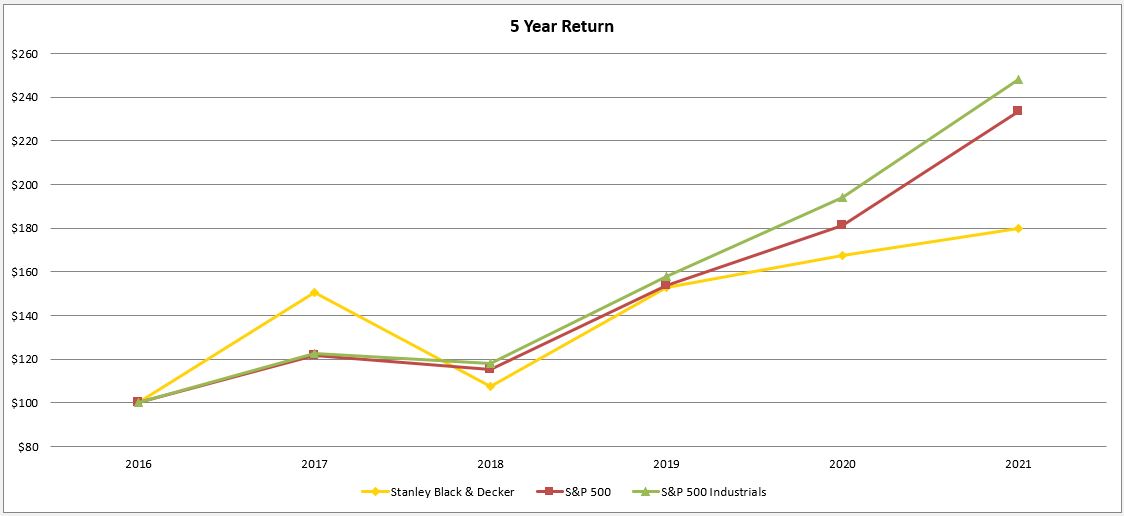
| THE POINTS IN THE ABOVE TABLE ARE AS FOLLOWS: | 2016 | 2017 | 2018 | 2019 | 2020 | 2021 | |||||||||||||||||||||||||||||
| Stanley Black & Decker | $ | 100.00 | $ | 150.48 | $ | 107.32 | $ | 152.79 | $ | 167.52 | $ | 179.76 | |||||||||||||||||||||||
| S&P 500 | $ | 100.00 | $ | 121.82 | $ | 115.48 | $ | 153.54 | $ | 181.29 | $ | 233.28 | |||||||||||||||||||||||
| S&P 500 Industrials | $ | 100.00 | $ | 122.71 | $ | 118.04 | $ | 157.93 | $ | 194.02 | $ | 248.15 |
The comparison assumes $100 invested at the closing price on December 31, 2016 in the Company’s common stock, S&P 500 Index, and S&P 500 Industrials Index. Total return assumes reinvestment of dividends.
Item 6. REMOVED AND RESERVED
Item 7. MANAGEMENT’S DISCUSSION AND ANALYSIS OF FINANCIAL CONDITION AND RESULTS OF OPERATIONS
The financial and business analysis below provides information which the Company believes is relevant to an assessment and understanding of its consolidated financial position, results of operations and cash flows. This financial and business analysis should be read in conjunction with the Consolidated Financial Statements and related notes. All references to “Notes” in this Item 7 refer to the Notes to Consolidated Financial Statements included in Item 8 of this Annual Report.
The following discussion and certain other sections of this Annual Report on Form 10-K contain statements reflecting the Company’s views about its future performance that constitute “forward-looking statements” under the Private Securities Litigation Reform Act of 1995. These forward-looking statements are based on current expectations, estimates, forecasts and projections about the industry and markets in which the Company operates as well as management’s beliefs and assumptions. Any statements contained herein (including without limitation statements to the effect that Stanley Black & Decker, Inc. or its management “believes,” “expects,” “anticipates,” “plans” and similar expressions) that are not statements of historical fact should be considered forward-looking statements. These statements are not guarantees of future performance and involve certain risks, uncertainties and assumptions that are difficult to predict. There are a number of important factors that could cause actual results to differ materially from those indicated by such forward-looking statements. These factors include, without limitation, those set forth, or incorporated by reference, below under the heading “Cautionary Statements Under The Private Securities Litigation Reform Act Of 1995.” The Company does not intend to update publicly any forward-looking statements whether as a result of new information, future events or otherwise.
Strategic Objectives
The Company continues to pursue a growth and acquisition strategy, which involves industry, geographic and customer diversification to foster sustainable revenue, earnings and cash flow growth, and employ the following strategic framework in pursuit of its vision to deliver top-quartile financial performance, become known as one of the world’s leading innovators and elevate its commitment to ESG:
-
Continue organic growth momentum by leveraging the SBD Operating Model to drive innovation and commercial excellence, while diversifying toward higher-growth, higher-margin businesses;
-
Be selective and operate in markets where brand is meaningful, the value proposition is definable and sustainable through innovation, and global cost leadership is achievable; and
-
Pursue acquisitive growth on multiple fronts by building upon its existing global tools platform and expanding the outdoor products category, expanding the Industrial platform in Engineered Fastening and Infrastructure, and pursuing adjacencies with sound industrial logic.
Execution of the above strategy has resulted in approximately $13.5 billion of acquisitions since 2002 (excluding the Black & Decker merger), several divestitures, improved efficiency in the supply chain and manufacturing operations, and enhanced investments in organic growth, enabled by cash flow generation and increased debt capacity. In addition, the Company's continued focus on diversification and organic growth has resulted in improved financial results and an increase in its global presence. The Company also remains focused on leveraging its SBD Operating Model to deliver success in the 2020s and beyond. The latest evolution of the SBD Operating Model builds on the strength of the Company's past while embracing changes in the external environment to ensure the Company has the right skillsets, incorporates technology advances in all areas, maintains operational excellence, drives efficiency in business processes and resiliency into its culture, delivers extreme innovation and ensures the customer experience is world class. The operating model underpins the Company's ability to deliver above-market organic growth with margin expansion, maintain efficient levels of selling, general and administrative expenses ("SG&A") and deliver top-quartile asset efficiency.
The Company’s long-term financial objectives remain as follows:
-
4-6% organic revenue growth;
-
10-12% total revenue growth;
-
10-12% total EPS growth (7-9% organically) excluding acquisition-related charges;
-
Free cash flow equal to, or exceeding, net income;
-
Deliver 10+ working capital turns; and
-
Cash Flow Return On Investment ("CFROI") between 12-15%.
In terms of capital allocation, the Company remains committed, over time, to returning approximately 50% of excess capital to shareholders through a strong and growing dividend as well as opportunistically repurchasing shares. The remaining capital (approximately 50%) will be deployed towards acquisitions.
Pending Sale of Convergent Security Solutions ("CSS")
In December 2021, the Company announced that it had reached a definitive agreement for the sale of most of its Security assets to Securitas AB for $3.2 billion in cash. The proposed transaction includes the Company's CSS business comprising of commercial electronic security and healthcare businesses. The transaction does not include the Company's automatic doors business. The sale is subject to regulatory approvals and other customary closing conditions, and is expected to close in the first half of 2022. Net proceeds from the sale are expected to be used to fund, in part, an approximately $4 billion share repurchase which is planned to be completed in 2022. The use of net proceeds towards a planned share repurchase program is consistent with the Company's long-term capital allocation strategy focused on value maximization.
Acquisitions and Investments
On December 1, 2021, the Company acquired the remaining 80 percent ownership stake in MTD Holdings Inc. ("MTD"), a privately held global manufacturer of outdoor power equipment. The Company previously acquired a 20 percent interest in MTD in January 2019. With over $2.6 billion of revenue in 2021, MTD designs, manufactures and distributes lawn tractors, zero turn ride on mowers, walk behind mowers, snow blowers, residential robotic mowers, handheld outdoor power equipment and garden tools for both residential and professional consumers under well-known brands like Cub Cadet® and Troy-Bilt®.
On November 12, 2021, the Company acquired Excel Industries ("Excel"). Excel is a leading designer and manufacturer of premium commercial and residential turf-care equipment under the brands of Hustler Turf Equipment® and BigDog Mower Co®. The Company believes this is a strategically important bolt-on acquisition that bolsters the presence in the independent dealer network.
The Company expects the combination of MTD, Excel and its existing outdoor strategic business unit in Tools & Storage will create a global leader in the $25 billion and growing outdoor category, with strong brands and growth opportunities. As part of the integration of these businesses, the Company plans to design, develop and manufacture battery and electric-powered solutions for professional and residential users. This will position the combined businesses to be a leader as preferences shift from gas powered equipment toward electrified solutions in outdoor power equipment.
On February 24, 2020, the Company acquired Consolidated Aerospace Manufacturing, LLC ("CAM"), an industry-leading manufacturer of specialty fasteners and components for the aerospace and defense markets. The acquisition further diversified the Company's presence in the industrial markets and expanded its portfolio of specialty fasteners in the aerospace and defense markets.
On March 8, 2019, the Company acquired the International Equipment Solutions Attachments businesses, Paladin and Pengo, ("IES Attachments"), manufacturers of high quality, perform
Showing the first 8K of 114K characters. Open the full section
Item 7A. QUANTITATIVE AND QUALITATIVE DISCLOSURES ABOUT MARKET RISK
The Company incorporates by reference the material captioned “Market Risk” in Item 7 and in Note I, Financial Instruments, of the Notes to Consolidated Financial Statements in Item 8.
Item 8. FINANCIAL STATEMENTS AND SUPPLEMENTARY DATA
See Item 15 for an index to Financial Statements and Financial Statement Schedule. Such Financial Statements and Financial Statement Schedule are incorporated herein by reference.
Item 9. CHANGES IN AND DISAGREEMENTS WITH ACCOUNTANTS ON ACCOUNTING AND FINANCIAL DISCLOSURE
None.
Item 9A. CONTROLS AND PROCEDURES
Material Weaknesses in Internal Control Over Financial Reporting
The management of Stanley Black & Decker, Inc. (the "Company") is responsible for establishing and maintaining adequate internal control over financial reporting, as that term is defined under Rules 13a-15(f) and 15d-15(f) of the Securities Exchange Act of 1934, as amended (the “Exchange Act”). Under the supervision and with the participation of management, including the Chief Executive Officer and the President and Chief Financial Officer, the Company has assessed the effectiveness of its internal control over financial reporting as of the end of the period covered by this report based upon the criteria set forth by the Committee of Sponsoring Organizations (COSO) of the Treadway Commission in Internal Control — Integrated Framework (2013 Framework). Based on that assessment, the Chief Executive Officer and the President and Chief Financial Officer concluded that the Company's internal control over financial reporting was not effective to provide reasonable assurance regarding the reliability of its financial reporting and the preparation of its financial statements for external purposes in accordance with accounting principles generally accepted in the United States of America as of January 1, 2022 due to the material weaknesses in internal control described below.
A material weakness, as defined in Rule 12b-2 under the Exchange Act, is a deficiency, or a combination of deficiencies, in internal control over financial reporting, such that there is a reasonable possibility that a material misstatement of a company’s annual or interim financial statements will not be prevented or detected on a timely basis.
Subsequent to the filing of its 2020 Form 10-K, the Company received comments from the SEC Staff regarding its accounting for equity units issued in May 2017 and November 2019 (the “Equity Units”). Upon further reflection of the comments received by the Staff and the nature of the Equity Units, the Company determined that errors were made in its original accounting conclusions resulting from material weaknesses in its internal control over financial reporting for such instruments. The Company determined the errors were the result of the following deficiencies in internal control over financial reporting:
1.The design of its control to consider all the relevant authoritative accounting guidance for financial instruments with debt- and equity-like features; and
2.The design of its control to consider financial instruments with debt- and equity-like features in the calculation of earnings per share.
The Company assessed whether there was a reasonable possibility that a material misstatement would not have been prevented or detected on a timely basis as a result of the above control deficiencies. The first control deficiency could result in a determination that there are two units of account in which the forward stock purchase contracts, when evaluated separately as freestanding instruments, would be precluded from equity classification. As a result, the asset or liability related to the forward stock purchase contracts would be subject to mark-to-market accounting, which would be significantly influenced by factors outside of the Company’s control, including fluctuations in its share price. The second control deficiency resulted in material errors in the calculation of diluted earnings per share previously disclosed in the Company’s historical financial statements. Based on these factors, the Company concluded that the deficiencies noted above each rise to the level of a material weakness.
Remediation of Material Weaknesses
The Company acknowledges that its management is responsible for establishing and maintaining adequate internal control over financial reporting and assessing the effectiveness of its internal controls. The Company is committed to maintaining a strong internal control environment and implementing measures to ensure that the control deficiencies identified above are remediated as soon as possible. Management is in the process of implementing its remediation plan, which includes steps to design and implement new controls and expand education and training related to the accounting considerations for complex financing transactions. The Company will consider the material weakness remediated after the applicable controls operate for a sufficient period of time, and management has concluded, through testing, that the controls are operating effectively.
Evaluation of Disclosure Controls and Procedures
The Company’s management is responsible for establishing and maintaining adequate internal control over financial reporting. Internal control over financial reporting is a process designed to provide reasonable assurance regarding the reliability of financial reporting and the preparation of financial statements for external reporting purposes in accordance with accounting principles generally accepted in the United States of America. Because of its inherent limitations, internal control over financial reporting may not prevent or detect misstatements.
During the fourth quarter of 2021, the Company acquired the remaining 80 percent ownership stake in MTD Holdings Inc. ("MTD") and Excel Industries ("Excel") for approximately $1.5 billion and $374 million, respectfully. Since Stanley Black & Decker, Inc. has not yet fully incorporated the internal controls and procedures of MTD and Excel into Stanley Black & Decker, Inc.'s internal control over financial reporting, management excluded these businesses from its assessment of the effectiveness of internal control over financial reporting as of January 1, 2022. MTD accounted for 5% of Stanley Black & Decker, Inc.'s total assets as of January 1, 2022 and 1% of Stanley Black & Decker, Inc.'s net sales for the year then ended. Excel accounted less than 1% of Stanley Black & Decker, Inc.'s total assets as of January 1, 2022 and less than 1% of Stanley Black & Decker, Inc.'s net sales for the year then ended.
Other than those items noted above, there has been no change in the Company’s internal control over financial reporting that occurred during the fiscal year ended January 1, 2022 that has materially affected, or is reasonably likely to materially affect, the Company’s internal control over financial reporting.
Refer to Management’s Report On Internal Control Over Financial Reporting on page 63.
Item 9B. OTHER INFORMATION
None.
PART III
Item 10. DIRECTORS, EXECUTIVE OFFICERS AND CORPORATE GOVERNANCE OF THE REGISTRANT
The information required by this Item, except for certain information with respect to the Company’s Code of Ethics, the identification of the executive officers of the Company and any material changes to the procedures by which security holders may recommend nominees to the Company’s Board of Directors, as set forth below, is incorporated herein by reference to the information set forth in the section of the Company’s definitive proxy statement (which will be filed pursuant to Regulation 14A under the Exchange Act within 120 days after the close of the Company’s fiscal year) under the headings “Information Concerning Nominees for Election as Directors,” and “Board of Directors".
Available on the Company's website at http://www.stanleyblackanddecker.com under the “Who We Are” heading is the Code of Business Ethics applicable to all of its directors, officers, including the Chief Executive Officer, President and Chief Financial Officer, and Vice President, Chief Accounting Officer, and employees worldwide. The Company intends to post on its website required information regarding any amendment to, or waiver from, the Code of Business Ethics that applies to the Company's Chief Executive Officer and senior financial officers within four business days after any such amendment or waiver.
The following is a list of the executive officers of the Company as of February 22, 2022:
| Name and Age | Office | Date Elected to Office | ||||||||||||
| James M. Loree (63) | Chief Executive Officer since August 2016. President & Chief Operating Officer (2013); Executive Vice President and Chief Operating Officer (2009); Executive Vice President Finance and Chief Financial Officer (1999). | 7/19/1999 | ||||||||||||
| Donald Allan, Jr. (57) | President & Chief Financial Officer since April 2021. Executive Vice President & Chief Financial Officer (2016); Senior Vice President & Chief Financial Officer (2010); Vice President & Chief Financial Officer (2009); Vice President & Corporate Controller (2002); Corporate Controller (2000); Assistant Controller (1999). | 10/24/2006 | ||||||||||||
| Janet M. Link (52) | Senior Vice President, General Counsel and Secretary since July 2017. Executive Vice President, General Counsel, JC Penney Company, Inc. (2015); Vice President, Deputy General Counsel, JC Penney Company, Inc. (2014); Vice President, Deputy General Counsel, Clear Channel Companies (2013). | 7/19/2017 | ||||||||||||
| Jaime A. Ramirez (54) | Executive Vice President & President, Global Tools & Storage since July 2020. Senior Vice President & Chief Operating Officer, Tools & Storage (2019); Senior Vice President & President, Global Emerging Markets (2012); President, Construction & DIY, Latin America (2010); Vice President and General Manager - Latin America, Power Tools & Accessories, The Black & Decker Corporation (2008); Vice President and General Manager - Andean Region The Black & Decker Corporation (2007). | 3/12/2010 | ||||||||||||
| John H. Wyatt (63) | Senior Vice President & President, Stanley Outdoor since January 2021. Senior Vice President & President, Stanley Outdoor and Aerospace (2020); President, Stanley Engineered Fastening (2016); President, Sales & Marketing - Global Tools & Storage (2015); President, Construction & DIY, Europe and ANZ (2012); President, Construction & DIY, EMEA (2010); President-Europe, Middle East, and Africa, Power Tools and Accessories, The Black & Decker Corporation (2008); Vice President-Consumer Products (Europe, Middle East and Africa), The Black & Decker Corporation (2006). | 3/12/2010 | ||||||||||||
| Robert H. Raff (55) | Head of Outdoor Integration since July 2021. President, Stanley Security (2016); President, Stanley Electronic Security North America (2015); President, North America Sales, Construction & DIY (2010); President, Stanley National Hardware (2007); Vice President of Latin America, Construction & DIY (2005); General Manager, Construction & DIY (2002). | 4/19/2018 | ||||||||||||
| Graham N. Robinson (53) | Senior Vice President & President, Stanley Industrial since April 2020. President, Honeywell Industrial Safety (Honeywell International) (2018); President, Honeywell Sensing and Internet of Things (Honeywell International) (2016); Chief Marketing Officer and Vice President, Global Strategy & Marketing, Automation and Control Solutions (Honeywell International) (2014). | 4/17/2020 | ||||||||||||
| Stephen Subasic (53) | Senior Vice President, Chief Human Resources Officer since January 2021. Vice President, Human Resources & Corporate Talent Management (2019); Vice President, Human Resources, Global Tools & Storage (2015); Vice President, Human Resources, Construction & DIY (2011). | 2/18/2021 |
Item 11. EXECUTIVE COMPENSATION
The information required by this Item is incorporated herein by reference to the information set forth under the sections entitled "Compensation Discussion & Analysis" and “2021 Executive Compensation” of the Company’s definitive proxy statement, which will be filed pursuant to Regulation 14A under the Exchange Act within 120 days after the end of the fiscal year covered by this Annual Report on Form 10-K.
Item 12. SECURITY OWNERSHIP OF CERTAIN BENEFICIAL OWNERS AND MANAGEMENT AND RELATED STOCKHOLDER MATTERS
The information required by Item 403 of Regulation S-K is incorporated herein by reference to the information set forth under the sections entitled "Security Ownership of Certain Beneficial Owners," "Security Ownership of Directors and Officers," "Compensation Discussion & Analysis" and “2021 Executive Compensation” of the Company’s definitive proxy statement, which will be filed pursuant to Regulation 14A under the Exchange Act within 120 days after the end of the fiscal year covered by this Annual Report on Form 10-K.
EQUITY COMPENSATION PLAN INFORMATION
Compensation plans under which the Company’s equity securities are authorized for issuance at January 1, 2022 follow:
| (A) | (B) | (C) | |||||||||||||||||||||
| Plan Category | Number of securities to be issued upon exercise of outstanding options and stock awards | Weighted-average exercise price of outstanding options | Number of securities remaining available for future issuance under equity compensation plans (excluding securities reflected in column (A)) | ||||||||||||||||||||
| Equity compensation plans approved by security holders | 7,561,496 | (1) | $ | 151.46 | (2) | 6,648,660 | (3) | ||||||||||||||||
| Equity compensation plans not approved by security holders (4) | — | — | — | ||||||||||||||||||||
| Total | 7,561,496 | $ | 151.46 | 6,648,660 |
(1)Consists of 5,573,672 shares underlying outstanding stock options (whether vested or unvested) with a weighted-average exercise price of $151.46 and a weighted-average term of 7.04 years; 1,877,887 shares underlying time-vesting restricted stock units that have not yet vested and the maximum number of shares that will be issued pursuant to outstanding performance awards if all established goals are met; and 109,937 of shares earned but related to which participants elected deferral of delivery. All stock-based compensation plans are discussed in Note J, Capital Stock, of the Notes to Consolidated Financial Statements in Item 8.
(2)There is no cost to the recipient for shares issued pursuant to time-vesting restricted stock units or performance awards. Because there is no strike price applicable to these stock awards they are excluded from the weighted-average exercise price which pertains solely to outstanding stock options.
(3)Consists of 1,388,655 of shares available for purchase under the employee stock purchase plan ("ESPP") at the election of employees and 5,260,005 securities available for future grants by the Board of Directors under stock-based compensation plans. On January 22, 2018, the Board of Directors adopted the 2018 Omnibus Award Plan (the "2018 Plan") and authorized the issuance of 16,750,000 shares of the Company's common stock in connection with the awards pursuant to the 2018 Plan. No further awards will be issued under the Company's 2013 Long-Term Incentive Plan.
(4)U.S. non-highly compensated employees are eligible to contribute from 1% to 25% of their salary to a qualified tax deferred savings plan as described in the Employee Stock Ownership Plan ("ESOP") section of Note L, Employee Benefit Plans, of the Notes to the Consolidated Financial Statements in Item 8. The Company contributes an amount equal to one half of the employee contribution up to the first 7% of salary. There is a non-qualified tax deferred savings plan for highly compensated salaried employees which mirrors certain qualified plan provisions, but was not specifically approved by security holders. Eligible highly compensated salaried U.S. employees are eligible to contribute from 1% to 50% of their salary to the non-qualified tax deferred savings plan. The same matching arrangement was provided for highly compensated salaried employees in the non-qualified plan, to the extent the match was not fully met in the qualified plan, except that the arrangement for these employees is outside of the ESOP, and is not funded in advance of distributions. Effective January 1, 2019, the Company, at its discretion, will determine whether matching and core contributions will be made for the non-qualified tax deferred savings plan for a particular year. If the Company decides to make matching contributions for a year, it will make contributions, in an amount determined at its discretion, that may constitute part or all of or more than the matching contributions that would have been made pursuant to the provisions of the Stanley Black & Decker Supplemental Retirement Account Plan that were
in effect prior to 2019. For both qualified and non-qualified plans, the investment of the employee’s contribution and the Company’s matching contribution is controlled by the employee and may include an election to invest in Company stock. Shares of the Company’s common stock may be issued at the time of a distribution from the qualified plan. The number of securities remaining available for issuance under the plans at January 1, 2022 is not determinable, since the plans do not authorize a maximum number of securities.
Item 13. CERTAIN RELATIONSHIPS AND RELATED TRANSACTIONS, AND DIRECTOR INDEPENDENCE
The information required by Items 404 and 407(a) of Regulation S-K is incorporated by reference to the information set forth under the sections entitled "Corporate Governance," "Director Independence" and "Related Person Transactions" of the Company’s definitive proxy statement, which will be filed pursuant to Regulation 14A under the Exchange Act within 120 days after the end of the fiscal year covered by this Annual Report on Form 10-K.
Item 14. PRINCIPAL ACCOUNTANT FEES AND SERVICES
The information required by Item 9(e) of Schedule 14A is incorporated herein by reference to the information set forth under the section entitled “Fees of Independent Auditors” of the Company’s definitive proxy statement, which will be filed pursuant to Regulation 14A under the Exchange Act within 120 days after the end of the fiscal year covered by this Annual Report on Form 10-K.
PART IV
ITEM 15. EXHIBITS AND FINANCIAL STATEMENT SCHEDULE
(a) Index to documents filed as part of this report:
- and 2. Financial Statements and Financial Statement Schedule.
The response to this portion of Item 15 is submitted as a separate section of this report beginning with an index thereto on page 59.
- Exhibits
See Exhibit Index in this Form 10-K on page 128.
(b) See Exhibit Index in this Form 10-K on page 128.
(c) The response in this portion of Item 15 is submitted as a separate section of this Form 10-K with an index thereto beginning on page 59.
FORM 10-K
Item 15. (a) (1) AND (2)
STANLEY BLACK & DECKER, INC. AND SUBSIDIARIES
INDEX TO FINANCIAL STATEMENTS AND FINANCIAL STATEMENT SCHEDULE
| Schedule II — Valuation and Qualifying Accounts is included in Item 15 (page 62). | ||
| Management’s Report on Internal Control Over Financial Reporting (page 63). | ||
| Report of Independent Registered Public Accounting Firm (PCAOB ID: 00042) — Financial Statement Opinion (page 64). | ||
| Report of Independent Registered Public Accounting Firm — Internal Control Opinion (page 67). | ||
| Consolidated Statements of Operations — fiscal years ended January 1, 2022, January 2, 2021, and December 28, 2019 (page 69). | ||
| Consolidated Statements of Comprehensive Income — fiscal years ended January 1, 2022, January 2, 2021, and December 28, 2019 (page 70). | ||
| Consolidated Balance Sheets — January 1, 2022 and January 2, 2021 (page 71). | ||
| Consolidated Statements of Cash Flows — fiscal years ended January 1, 2022, January 2, 2021, and December 28, 2019 (page 72). | ||
| Consolidated Statements of Changes in Shareowners’ Equity — fiscal years ended January 1, 2022, January 2, 2021, and December 28, 2019 (page 74). | ||
| Notes to Consolidated Financial Statements (page 75). | ||
| Selected Quarterly Financial Data (Unaudited) (page 126). | ||
| Consent of Independent Registered Public Accounting Firm (Exhibit 23). |
All other schedules are omitted because either they are not applicable or the required information is shown in the financial statements or the notes thereto.
Item 16. FORM 10-K SUMMARY
Not applicable.
SIGNATURES
Pursuant to the requirements of Section 13 or 15(d) of the Securities Exchange Act of 1934, the Company has duly caused this report to be signed on its behalf by the undersigned, thereunto duly authorized.
| STANLEY BLACK & DECKER, INC. | ||||||||
| By: | /s/ James M. Loree | |||||||
| James M. Loree, Chief Executive Officer | ||||||||
| Date: | February 22, 2022 |
Pursuant to the requirements of the Securities Exchange Act of 1934, this report has been signed below by the following persons on behalf of the Company and in the capacities and on the dates indicated.
| Signature | Title | Date | |||||||||||||||
| /s/ James M. Loree | Chief Executive Officer | February 22, 2022 | |||||||||||||||
| James M. Loree | |||||||||||||||||
| /s/ Donald Allan, Jr. | President and Chief Financial Officer | February 22, 2022 | |||||||||||||||
| Donald Allan, Jr. | |||||||||||||||||
| /s/ Jocelyn S. Belisle | Vice President and Chief Accounting Officer | February 22, 2022 | |||||||||||||||
| Jocelyn S. Belisle | |||||||||||||||||
| * | Director | February 22, 2022 | |||||||||||||||
| Andrea J. Ayers | |||||||||||||||||
| * | Director | February 22, 2022 | |||||||||||||||
| George W. Buckley | |||||||||||||||||
| * | Director | February 22, 2022 | |||||||||||||||
| Patrick D. Campbell | |||||||||||||||||
| * | Director | February 22, 2022 | |||||||||||||||
| Carlos M. Cardoso | |||||||||||||||||
| * | Director | February 22, 2022 | |||||||||||||||
| Robert B. Coutts | |||||||||||||||||
| * | Director | February 22, 2022 | |||||||||||||||
| Debra A. Crew | |||||||||||||||||
| * | Director | February 22, 2022 | |||||||||||||||
| Michael D. Hankin | |||||||||||||||||
| * | Director | February 22, 2022 | |||||||||||||||
| Jane M. Palmieri | |||||||||||||||||
| * | Director | February 22, 2022 | |||||||||||||||
| Mojdeh Poul | |||||||||||||||||
| * | Director | February 22, 2022 | |||||||||||||||
| Irving Tan |
| *By: /s/ Janet M. Link | ||
| Janet M. Link (As Attorney-in-Fact) |
Schedule II — Valuation and Qualifying Accounts
Stanley Black & Decker, Inc. and Subsidiaries
Fiscal years ended January 1, 2022, January 2, 2021, and December 28, 2019
(Millions of Dollars)
| ADDITIONS | |||||||||||||||||||||||||||||
| Beginning Balance | Charged To Costs And Expenses | Charged To Other Accounts (b) | (a) Deductions | Ending Balance | |||||||||||||||||||||||||
| Allowance for Credit Losses: | |||||||||||||||||||||||||||||
| Year Ended 2021 | $ | 110.9 | $ | 3.9 | $ | 3.9 | $ | (15.6) | $ | 103.1 | |||||||||||||||||||
| Year Ended 2020 | $ | 94.1 | $ | 29.0 | $ | 8.5 | $ | (20.7) | $ | 110.9 | |||||||||||||||||||
| Year Ended 2019 | $ | 81.1 | $ | 26.3 | $ | (4.8) | $ | (8.5) | $ | 94.1 | |||||||||||||||||||
| Tax Valuation Allowance: | |||||||||||||||||||||||||||||
| Year Ended 2021 (c) | $ | 1,001.9 | $ | 190.7 | $ | 61.1 | $ | (186.5) | $ | 1,067.2 | |||||||||||||||||||
| Year Ended 2020 | $ | 1,006.4 | $ | 296.9 | $ | (18.2) | $ | (283.2) | $ | 1,001.9 | |||||||||||||||||||
| Year Ended 2019 | $ | 573.6 | $ | 452.1 | $ | 1.2 | $ | (20.5) | $ | 1,006.4 |
(a)With respect to the allowance for credit losses, deductions represent amounts charged-off less recoveries of accounts previously charged-off.
(b)Amounts represent the impact of foreign currency translation, acquisitions and net transfers to/from other accounts.
(c)Refer to Note Q, Income Taxes, of the Notes to Consolidated Financial Statements in Item 8 for further discussion.
The prior year amounts in the table above have been recast to exclude the amounts relating to businesses classified as discontinued operations. Refer to Note T, Divestitures, of the Notes to Consolidated Financial Statements in Item 8 for further discussion.
MANAGEMENT’S REPORT ON INTERNAL CONTROL OVER FINANCIAL REPORTING
The management of Stanley Black & Decker, Inc. is responsible for establishing and maintaining adequate internal control over financial reporting. Internal control over financial reporting is a process designed to provide reasonable assurance regarding the reliability of financial reporting and the preparation of financial statements for external reporting purposes in accordance with accounting principles generally accepted in the United States of America. Because of its inherent limitations, internal control over financial reporting may not prevent or detect misstatements.
During the fourth quarter of 2021, the Company acquired the remaining 80 percent ownership stake in MTD Holdings Inc. ("MTD") and Excel Industries ("Excel") for approximately $1.5 billion and $374 million, respectfully. Since Stanley Black & Decker, Inc. has not yet fully incorporated the internal controls and procedures of MTD and Excel into Stanley Black & Decker, Inc.'s internal control over financial reporting, management excluded these businesses from its assessment of the effectiveness of internal control over financial reporting as of January 1, 2022. MTD accounted for 5% of Stanley Black & Decker, Inc.'s total assets as of January 1, 2022 and 1% of Stanley Black & Decker, Inc.'s net sales for the year then ended. Excel accounted for less than 1% of St
Showing the first 8K of 366K characters. Open the full section