 filings.tools
Stanley Black & Decker (SWK) 10-K risk factor changes: FY2022 vs FY2021
The 2022-12-31 10-K against the 2022-01-01 one, compared heading by heading and sentence by sentence.
Item 1A84 rewritten53 added96 removed233 unchanged
All filing items1,397 rewritten657 added803 removed1,843 unchanged
Summary
counted, not written
- Item 1A lists 32 risk factor headings: 4 new, 2 reworded and 26 unchanged since FY2021. 5 headings from FY2021 no longer appear.
- Sentence by sentence, 657 added, 803 removed, 1,397 rewritten and 1,843 unchanged across 16 items that differ.
- New this year: Item 9C. DISCLOSURE REGARDING FOREIGN JURISDICTIONS THAT PREVENT INSPECTIONS.
New Item 1A headings (4)
- The continuing adverse effects of the COVID-19 pandemic, including new variants, could have a materially negative impact on the Company’s business, operations, financial condition, results of operations, and liquidity.
- A material disruption of the Company's operations, particularly at its manufacturing facilities or within its information technology infrastructure, could adversely affect business.
- The development of technology products and services presents security and safety risks.
- Cybersecurity incidents could disrupt business operations, result in the loss of critical and confidential information, and adversely impact the Company's reputation and results of operations.Cybersecurity
Removed Item 1A headings (5)
- The continued adverse effects of the COVID-19 pandemic and an indeterminate recovery period could have a materially negative impact on the Company’s business, operations, financial condition, results of operations, and liquidity, the nature and extent of which is highly uncertain.
- The performance of the Company may suffer from business disruptions with catastrophic losses affecting distribution centers and other infrastructure, or other costs associated with information technology, system implementations, or cyber security risks.
- Expansion of the Company’s activity in emerging markets may result in risks due to differences in business practices and cultures.
- The Company is exposed to risks related to cybersecurity.
- The Company has identified material weaknesses in its internal control over financial reporting. If not remediated, the Company’s failure to establish and maintain effective disclosure controls and procedures and internal control over financial reporting could result in material misstatements in its financial statements and a failure to meet its reporting and financial obligations, each of which could have a material adverse effect on the Company’s financial condition and the trading price of its common stock.
Reworded Item 1A headings (2)
- The Company’s business is subject to risks associated with
[removed: sourcing][added: sourcing, manufacturing] and[removed: manufacturing.][added: maintaining appropriate inventory levels.] - The Company has incurred, and may incur in the future, significant indebtedness, and may in the future issue additional equity [added: or debt] securities, including in connection with mergers or acquisitions, which may impact the manner in which it conducts business or the Company’s access to external sources of liquidity. The potential issuance of such securities may limit the Company’s ability to implement elements of its
[removed: growth][added: business] strategy and may have a dilutive effect on earnings.
A heading is new when no FY2021 heading matches it after ignoring case and punctuation, and reworded when it shares at least 60 percent of its words with one that went away. All current risk factor headings.
Sentences by item
23 items, with every count and a link to each item that changed
Underlined words on a shaded ground are new in FY2022; struck-through words were in FY2021. Sentences that are wholly new or wholly gone are labelled rather than marked.
Item 1A. RISK FACTORS
84 rewritten, 53 added, 96 removed, 233 unchanged
The Company’s business is subject to risks associated with [removed: sourcing] [added: sourcing, manufacturing] and [removed: manufacturing.][added: maintaining appropriate inventory levels.]
Lead times for these items vary significantly and [removed: are increasing in light of] [added: may be further impacted by] global shortages of critical [removed: components, including semiconductors.][added: components.]
Global supply chain constraints in the wake of the COVID-19 pandemic [removed: continue to decrease] [added: limited] the Company's visibility into availability and lead times for [removed: the] products and their component parts and raw [removed: materials.][added: materials but such constraints have softened in the second half of 2022.]
In addition, the Company’s ability to import these items in a timely and cost-effective manner [removed: has been and] may [removed: continue to] be affected by conditions at ports or issues that otherwise affect transportation and warehousing providers, such as fluctuations in freight costs, port and shipping capacity, labor disputes and shortages, severe weather due to climate change or increased homeland security requirements in the U.S. and other countries.
In [added: 2022 and] 2021, the Company experienced significantly higher freight costs compared to freight costs incurred in [removed: 2020 and 2019.][added: 2020.]
These issues have [added: delayed,] and could delay [added: in the future,] importation of products or require the Company to [removed: locate alternative ports or warehousing providers to avoid disruption to customers.]
These alternatives [removed: have not and in the future] may not be available on short notice or [removed: have and] could result in higher transit costs, which could have an adverse impact on the Company’s business and financial condition.
Substantially all of [removed: its] [added: the Company's] import operations are subject to customs requirements and to tariffs and quotas set by governments through mutual agreements, bilateral actions or, in some cases unilateral action.
In addition, the countries in which the Company’s products and materials are manufactured or imported from (including importation into the [removed: U.S.] [added: United States] of the Company's products manufactured overseas) may from time to time impose additional quotas, duties, tariffs or other restrictions on its imports (including restrictions on manufacturing operations) or adversely modify existing restrictions.
For example, in 2018 the [removed: U.S.] [added: United States] imposed tariffs on steel and aluminum as well as on goods imported from China and certain other countries, which resulted in retaliatory tariffs by China and other countries.
Imports are also subject to unpredictable foreign currency [removed: variation] [added: changes] which may increase the Company’s cost of goods sold.
Although these trade agreements generally have positive effects on trade liberalization, sourcing flexibility and cost of goods by reducing or eliminating the duties and/or quotas assessed on products manufactured in a particular country, trade agreements can also impose requirements that adversely affect the Company’s business, such as setting quotas on products that may be imported from a particular country into key markets including the U.S. or the European Union ("EU"), or making it easier for other [added: companies to compete, by eliminating restrictions on products from countries where the Company’s competitors source products.]
In addition, the Company has a number of key suppliers in South [removed: Korea.][added: Korea, China and Taiwan.]
[removed: Escalation of hostilities with North Korea and/or military action] [added: Any future tensions or conflicts] in [removed: the region] [added: such regions] could cause [added: material] disruptions in the Company's supply chain which could, in turn, cause product shortages, delays in delivery and/or increases in the Company's cost incurred to produce and deliver products to its customers.
The [removed: continued] [added: continuing] adverse effects of the COVID-19 [removed: pandemic and an indeterminate recovery period] [added: pandemic, including new variants,] could have a materially negative impact on the Company’s business, operations, financial condition, results of operations, and [removed: liquidity, the nature and extent of which is highly uncertain.][added: liquidity.]
The [removed: impact of the] COVID-19 [removed: pandemic has] [added: pandemic, including new variants, and the responses of governments, consumers and other businesses have] adversely affected, and may continue to adversely affect, the Company’s business, financial condition, workforce and operations and the operations of its customers, distributors, suppliers and contractors.
[removed: There continues to be significant uncertainty regarding] [added: -] restrictions on the Company's access to its manufacturing facilities [removed: or] [added: and] on its support operations or workforce, [removed: or] [added: and] similar limitations for its distributors and [removed: suppliers.][added: suppliers;]
[removed: Global] [added: Any future global] and national health concerns could lead to further and/or increased volatility in global capital and credit markets.
[removed: Furthermore,] [added: - delays or modifications to the Company's strategic plans and other initiatives, including] as a result of [removed: the ongoing COVID-19 pandemic, in 2020 the Company executed certain] temporary and permanent [removed: cost reduction] [added: cost-reduction] measures [removed: including] [added: such as] adjustments to its supply chain and manufacturing labor base to match the demand environment [removed: and] [added: or] reductions in staffing, compensation and [removed: benefits in a manner that allows] [added: benefits, both of which] the Company [removed: to respond to changes] [added: implemented] in [removed: demand, some of which were reversed] [added: response to the COVID-19 pandemic,] and [removed: some were made][added: may continue or occur in the future.]
The degree to which COVID-19 [removed: ultimately affects] [added: and related responses continue to affect] the Company’s business, liquidity, results and operations will depend on future developments, which continue to be highly uncertain and cannot be predicted.
These uncertainties, include, but are not limited to, the duration [removed: and spread] of the [removed: outbreak and] [added: outbreak,] the [added: severity of any] resurgence in [removed: cases,, its severity,] [added: cases,] the actions to contain the virus or treat its [removed: impact,] [added: impact and] the availability [removed: of vaccines, effectiveness against new variants of COVID-19] and [removed: achievement] [added: effectiveness] of [removed: sufficient vaccination levels, supply chain disruptions, competition in the labor market and how quickly and to what extent economic and operating conditions can become more predictable] [added: vaccines] and [removed: certain.][added: other treatments.]
In [removed: 2021,] [added: 2022,] the two largest customers comprised approximately [removed: 29%] [added: 28%] of [added: consolidated] net sales, with U.S. and international mass merchants and home centers collectively comprising approximately [removed: 46%] [added: 41%] of [added: consolidated] net sales.
In addition, the Company’s major customers are volume purchasers, a few of which are much larger than the [removed: Company] [added: Company,] and have strong bargaining power with suppliers.
This [added: factor] limits the ability to recover cost increases through higher selling prices.
To remain profitable and [removed: defend] [added: maintain or grow] market share, the Company must maintain a competitive cost structure, develop new products and services, lead product innovation, respond to competitor innovations and enhance its existing products in a timely manner.
In addition, the Company may have to reduce prices on its products and services, or make other concessions, to stay [removed: competitive and retain market share.][added: competitive.]
[removed: In order to] [added: To] remain competitive, the Company will need to stay abreast of [removed: such] [added: new] technologies, require its employees to continue to learn and adapt to new technologies and be able to integrate them into [removed: its] current and future business models, products, services and processes and also guard against existing and new competitors disrupting [removed: its business] [added: the marketplace] using such technologies.
- [removed: ongoing stability] [added: instability] or changes in the general political and economic conditions in the countries where the Company [removed: operates, particularly in emerging markets;][added: operates (such as the conflict between Russia and Ukraine);]
The Company has undertaken restructuring [added: and cost-reduction] actions, the savings of which may be mitigated by many factors, including economic weakness, inflation, competitive pressures, higher labor costs and decisions to increase costs in areas such as sales promotion or research and development above levels that were otherwise assumed.
Failure to achieve, or delays in achieving, projected levels of efficiencies and cost savings from [added: this transformation and other restructuring or cost reduction actions introduced by the Company, significant increases in the costs related to] such [removed: measures,] [added: actions,] or unanticipated inefficiencies resulting from [added: this transformation and other] manufacturing and administrative reorganization actions in progress or contemplated, [removed: would] [added: could] adversely affect the [removed: Company’s business and financial results.][added: anticipated cost savings.]
In a limited number of circumstances, the magnitude of the Company’s purchases of certain items is of such significance that a change in established relationships with suppliers or increase in the costs of purchased raw materials, component parts or finished goods could result in manufacturing interruptions, delays, inefficiencies or an inability to market [removed: products.]
If the Company is unable to mitigate any possible supply [removed: constraints,] [added: constraints or] related increased costs or drive alternative technology through innovation, its profitably and financial results could be negatively impacted.
The Company generates approximately [removed: 40%] [added: 37%] of its revenues outside the U.S., including [removed: 17%] [added: 15%] from Europe and [removed: 14%] [added: 12%] from various emerging market countries.
While the Company believes any downturn in the European or emerging marketplaces might be offset to some degree by the relative stability in North America, the Company’s future growth, profitability and financial liquidity could be affected, in several ways, [removed: including] [added: including,] but not limited [removed: to] [added: to,] the following:
- the impact of an event [added: or changes to political and economic conditions] (individual country default, Brexit, or break up of the Euro) could have an adverse impact on the global credit markets and global liquidity potentially impacting the Company’s ability to access these credit markets and to raise [removed: capital.][added: capital or disrupt global energy supply or supply chains.]
The Company’s predominant currency exposures are related to the Euro, Canadian Dollar, British Pound, Australian Dollar, Brazilian Real, [removed: Argentine Peso,] Chinese Renminbi (“RMB”) and the Taiwan Dollar.
The Company has incurred, and may incur in the future, significant indebtedness, and may in the future issue additional equity [added: or debt] securities, including in connection with mergers or acquisitions, which may impact the manner in which it conducts business or the Company’s access to external sources of liquidity.
The potential issuance of such securities may limit the Company’s ability to implement elements of its [removed: growth] [added: business] strategy and may have a dilutive effect on earnings.
As described in *Note H, Long-Term Debt and Financing Arrangements*, of the *Notes to Consolidated Financial Statements* in *Item 8*, the Company has a five-year $2.5 billion committed credit [removed: facility] [added: facility, a $1.5 billion syndicated 364-Day Credit Agreement,] and [removed: $2.0] [added: a $0.5] billion [removed: 364-day committed] [added: revolving] credit [removed: facilities.][added: loan.]
No amounts were outstanding against [removed: either] [added: any] of these facilities on [removed: January 1,] [added: December 31,] 2022.
For example, in 2022, the Company completed the divestitures of its Security and Oil & Gas businesses.
- the failure to identify significant issues with a target company’s product quality, financial disclosures, accounting practices or internal control deficiencies or the factors necessary to estimate reasonably accurate costs, timing and other matters, and the failure to identify, or accurately assess the risks of, historical practices of target companies that would create liability or other exposures for the Company if they continue post-completion or as a result of successor liability;
locate alternative ports or warehousing providers to avoid disruption to customers.
The Company also relies on its ability to maintain inventory levels appropriate to meet consumer and customer demand.
During the second half of 2020 and during 2021, the Company experienced higher than historical customer demand and increased supply chain constraints, resulting in historically high inventory levels.
As consumer and DIY demand softened in the second quarter of 2022, the Company’s inventory levels peaked in the first half of the year.
The Company is actively addressing this dynamic through the Global Cost Reduction Program implemented in the third quarter of 2022, which includes an initiative to reduce inventory levels by curtailing production and by reducing complexity through SKU rationalization.
This initiative resulted in $775 million of inventory reduction in the second half of 2022.
However, any failure to achieve SKU rationalization efforts in an efficient manner or reduce inventory levels, or otherwise maintain appropriate inventory levels to meet consumer and customer demand, may expose the Company to risks of excess inventory and less marketable or obsolete inventory and could require the Company to sell excess or obsolete inventory at a discount, which could result in inventory write-offs that would negatively impact the Company’s revenues and profit margin.
The Company also competes for labor, particularly in its manufacturing facilities, which can drive higher labor costs and adversely impact its ability to efficiently operate.
Any failure to attract and retain employees at the Company’s manufacturing facilities or in other parts of the Company’s operations may adversely affect its business and ability to meet customer demand, which in turn could adversely affect the Company’s liquidity and results of operations.
The Company's future growth rate depends upon a number of factors, including its ability to (i) identify and evolve with emerging technological and broader industry trends in its target end-markets; (ii) defend its market share against an ever-expanding number of competitors, including many new and non-traditional competitors; (iii) monitor disruptive technologies and business models; and (iv) attract, develop, and retain individuals with the requisite technical expertise and understanding of customers’ needs to develop new technologies and introduce new products.
For example, changing market trends, such as increased consumer demand for energy efficient products and technologies in response to climate change, require the Company to develop and adopt new innovations focused on electrification.
The Company may not adequately meet these demands or develop and adapt to the applicable new technologies focused on electrification, which could adversely affect the Company’s reputation and the consumer and customer demand for the Company’s products.
The failure of the Company's technologies or products to gain market acceptance due to more attractive offerings by its competitors or the failure to address any of the above factors could negatively impact revenues and adversely affect its competitive standing and prospects.
The impacts of the COVID-19 pandemic include, but are not limited to:
- shifts and volatility in consumer spending and purchasing behaviors (such as the higher than usual customer demand for the Company’s products that occurred during the second half of 2020 and during 2021) that may hinder its ability to meet customer demand or may hinder its production capacity or supply chain;
- disruptions in commerce, including with respect to financial and other economic activities, services, travel and supply chains, and impacts on third parties with which the Company does business, which has, and may in the future result in, disruptions in the Company's supply chain, the inability of customers or suppliers to meet their obligations to the Company, loss or disruption of essential manufacturing and supply elements, operational delays, and increases in the cost of freight and labor;
- modifications to the Company’s business practices, including with respect to employee travel, employee work locations, restrictions on in-person meetings and events, and government-mandated vaccine protocols or policies;
- deteriorating economic conditions, such as economic slowdowns or recessions or significant disruptions or volatility in financial markets; and
In the third quarter of 2022, the Company initiated a supply chain transformation aiming to improve fill rates and better match the needs of its customers, while improving gross margins.
This transformation will involve significant investment from the Company over the next two to three years, and the success and anticipated cost savings from this transformation are not assured.
A material disruption of the Company's operations, particularly at its manufacturing facilities or within its information technology infrastructure, could adversely affect business.
The Company's facilities, supply chains, distribution systems, and information technology systems are subject to catastrophic loss due to natural disasters or other disruptions, including hurricanes and floods, power outages, fires, explosions, terrorism, equipment failures, sabotage, cyber incidents, any potential effects of climate change and adverse weather conditions, labor disputes, critical supply failure, inaccurate downtime forecast, political disruption, public health crises, like a regional or global pandemic, and other reasons, which can result in undesirable consequences, including financial losses and damaged relationships with customers.
The COVID-19 pandemic has disrupted, and may continue to disrupt, the Company's supply chain, distribution channels, production facilities, operations and customer demand, which has negatively impacted its operations and adversely affected its business and could continue to do so.
The Company employs information technology systems and networks to support the business and relies on them to process, transmit and store electronic information, and to manage or support a variety of business processes and activities.
Disruptions to its information technology infrastructure from system failures, shutdowns, power outages, telecommunication or utility failures, cybersecurity incidents, and other events, including disruptions at its cloud computing, server, systems and other third party IT service providers, could interfere with its operations, interrupt production and shipments, damage customer and business partner relationships, and negatively impact its reputation.
The development of technology products and services presents security and safety risks.
An increasing number of the Company's products, services, and technologies are delivered with Internet of Things (IoT) capabilities and the accompanying interconnected device networks, which include sensors, data and advanced computing capabilities.
The Company has developed product software designs that it believes are less susceptible to cyber-attacks, but despite these efforts, if products and services that include IoT solutions do not work as intended or are compromised, the possible consequences include financial loss, reputational damage, exposure to legal claims or enforcement actions, theft of intellectual property, and diminution in the value of the Company's investment in research, development and engineering, which in turn could adversely affect its competitiveness and results of operations.
products.
As of December 31, 2022, the Company had $7.5 billion of indebtedness, including $5.4 billion of principal and $2.1 billion of commercial paper borrowings.
- customary events of default, including repayment of all amounts outstanding in the event of the occurrence and continuance of an event of default; and
In February 2023, the Company entered into amendments to its credit facilities described above to: (a) amend the definition of Adjusted EBITDA to allow for additional adjustment addbacks, not to exceed $500 million in the aggregate, for amounts incurred during each four fiscal quarter period beginning with the period ending in the third quarter of 2023 through the period ending in the second quarter of 2024, and (b) amend the minimum interest coverage ratio to not less than 1.5 to 1.0 times computed quarterly, on a rolling twelve months (last twelve months) basis, for the period from and including the third quarter of 2023 through the second quarter of 2024.
The minimum interest coverage ratio will revert back to 3.5 times for periods after the second quarter of 2024.
market conditions.
Certain of the Company’s contracts and derivative financial instruments use short-term prevailing interest rates, including LIBOR, as a reference rate.
standards, and other requirements could negatively impact revenues and brand reputation.
Cybersecurity incidents could disrupt business operations, result in the loss of critical and confidential information, and adversely impact the Company's reputation and results of operations.
Global cybersecurity threats and incidents can range from uncoordinated individual attempts to gain unauthorized access to
companies to compete, by eliminating restrictions on products from countries where the Company’s competitors source products.
These measures have limited and could continue to limit customer demand and has and could continue to limit the Company's capacity to meet customer demand, which could have a material negative impact on its financial condition and results of operations.
The COVID-19 pandemic has adversely affected global economics and markets and has resulted in disruptions in commerce that will continue to evolve, including with respect to financial and other economic activities, services, travel and supply chains.
The ongoing COVID-19 pandemic has caused the Company to modify its business practices (including employee travel, employee work locations, and cancellation of physical participation in meetings, events and conferences).
The Company has announced an internal vaccine protocol.
The Department of Labor’s Occupational Safety and Health Administration (“OSHA”) had issued rules requiring that employers with more than 100 employees in the U.S. have employee populations that are fully vaccinated against or tested weekly for COVID-19, however, the implementation of the OSHA rules was stayed by the Supreme Court on January 13, 2022 and the OSHA withdrew the rules on January 25, 2022.
Although OSHA left open the possibility that it might try to finalize a permanent vaccine and testing rule in the future, vaccine protocols are currently state and employer-specific.
It is currently not possible to predict with certainty the impact any future rules and the Company's vaccination policy will have on its workforce.
Additional vaccine mandates may also be implemented in other jurisdictions in which the Company operates and the Company may take further actions as may be required by government authorities or that the Company determines are in the best interests of its employees, customers, distributors, suppliers and contractors.
There is no certainty that such measures will be sufficient to mitigate the risks posed by the virus, and the Company's ability to perform critical functions could be harmed and vaccine mandates could result in higher than usual employee attrition rates and adversely impact the operations of the Company if higher than usual customer demand of its products continues similar to demand levels experienced during the second half of 2020 and during 2021.
permanent.
These cost reduction measures may not prove to be successful and the Company may need to undertake further measures that could adversely impact its business and/or its ability to ramp up operations in a timely manner.
Continued uncertainties related to the COVID-19 pandemic have caused, and may continue to cause, disruptions in the Company's supply chain, cause delay, or limit the ability of, customers to continue to operate and perform, including in making timely payments to the Company, result in the Company's inability to meet its consumers' and customers' needs due to disruptions in manufacturing and supply arrangements caused by the loss or disruption of essential manufacturing and supply elements, and cause other unpredictable events.
In addition, the ongoing COVID-19 pandemic may also limit the Company’s resources or delay the Company’s ability to implement strategic initiatives.
If strategic initiatives are delayed, such initiatives may not achieve some or all of the expected benefits, which could have a material adverse effect on the Company’s competitive position, business, financial condition and results of operations and cash flows.
The continued spread of COVID-19 has caused, and may continue to cause, significant reductions in demand or significant volatility in demand for certain of the Company’s products.
As lockdowns occurred in the first and second quarters of 2020 and the work from home trend continued in 2021, those subject to lockdowns and working from home engaged in home improvement projects in large numbers, and demand for the Company’s products at its retail partners increased significantly.
As different geographical areas anticipate and begin moving into a recovery era, demand for the Company’s products may decrease as focus shifts to activities outside the home.
The pace of technological change is increasing at an exponential rate.
The continued creation, development and advancement of new technologies such as 5G data networks, artificial intelligence, blockchain, quantum computing, data analytics, 3-D printing, robotics, sensor technology, data storage, neural networks, augmented reality, amongst others, as well as other technologies in the future that are not foreseen today, continue to transform the Company’s processes, products and services.
The Company’s strategy, value creation model, operating model and innovation ecosystem have important technological elements and many of the Company’s products and offerings are based on technological advances, including artificial intelligence, machine learning, advanced analytics and the Internet of Things.
In addition, the Company will need to compete for talent in a competitive market that is familiar with such technologies including upskilling its workforce.
Higher than expected employee attrition rates may also result in difficulties to recruit and obtain talent needed to compete effectively.
There can be no assurance that the Company will continue to compete effectively with its industry peers due to technological changes, which could result in a material adverse effect on the Company's business and results of operations.
The performance of the Company may suffer from business disruptions with catastrophic losses affecting distribution centers and other infrastructure, or other costs associated with information technology, system implementations, or cyber security risks.
The Company relies heavily on digital technology, including from third parties, to manage and operate its businesses and record and process transactions.
Digital technology plays a crucial role in effectively operating the Company’s physical operations, notably manufacturing sites, distribution centers, security alarm monitoring facilities, offices and processing centers, which are distributed in various geographic locations.
Factors that are hard to predict or are beyond the Company’s control, like weather (including any potential effects of climate change), natural disasters, supply and commodity shortages, fire, explosions, acts or threats of war or terrorism, political unrest, cybersecurity breaches, sabotage, generalized labor unrest or public health crises, including pandemics, could damage or disrupt the Company’s digital technology infrastructure, or that of its suppliers or distributors.
If the Company does not effectively plan for or respond to disruptions in its operations, or cannot quickly repair
damage to its systems, the Company may be late in delivering or unable to deliver products and services to its customers, and the quality and safety of its products and services might be negatively affected.
If a material or extended disruption occurs, the Company may lose its customers’ or business partners’ confidence or suffer damage to its reputation, and long-term consumer demand for its products and services could decline.
Although the Company maintains business interruption insurance, it may not fully protect the Company against all adverse effects that could result from significant disruptions.
These events could materially and adversely affect the Company’s product sales, financial condition, results of operations, and reputation.
In addition, the Company is in the process of system integrations, conversions, and capability additions such as eCommerce, Artificial Intelligence and Data Analytics to drive enhanced business outcomes.
There can be no assurances that expected expense or revenue synergies will be achieved or that there will not be delays to the expected timing of system integrations, conversions or capability additions.
It is possible the costs to complete the system integrations, conversions or capability additions may exceed expectations, and that significant costs may be incurred that will require immediate expense recognition as opposed to capitalization.
The risk of disruption to key operations and overall business is increased when complex system changes, such as integrations, conversions or capability additions are undertaken.
If systems fail to function effectively, or become damaged, operational delays may ensue and the Company may be forced to make significant expenditures to remedy such issues.
Any significant disruption in the Company’s digital technology could have a material adverse impact on its business and results.
Despite efforts to prevent such situations and maintaining insurance policies and loss control and risk management practices that partially mitigate these risks, the Company’s digital technologies may be affected by damage or interruption from, among other causes, power outages, system failures or cyber attacks.
An excerpt. Shown here: 40 of 84 rewritten, 40 of 53 added and 40 of 96 removed. The counts are complete. For every sentence, read Item 1A. RISK FACTORS in the FY2022 filing and the FY2021 filing.
Item 7. MANAGEMENT’S DISCUSSION AND ANALYSIS OF FINANCIAL CONDITION AND RESULTS OF OPERATIONS
221 rewritten, 129 added, 191 removed, 241 unchanged
All references to “*Notes*” in this *Item 7* refer to the *Notes to Consolidated Financial Statements* included in *Item 8* of this Annual [removed: Report.][added: Report on Form 10-K.]
Any statements contained herein (including without limitation statements to the effect that [removed: Stanley Black & Decker, Inc.] [added: the Company] or its management “believes,” “expects,” “anticipates,” “plans” and similar expressions) that are not statements of historical fact should be considered forward-looking statements.
The Company also remains focused on leveraging its SBD Operating Model to deliver [removed: success in the 2020s and beyond.][added: success.]
The [removed: operating model] [added: SBD Operating Model] underpins the Company's ability to deliver above-market organic growth with margin expansion, maintain efficient levels of selling, general and administrative expenses ("SG&A") and deliver top-quartile asset efficiency.
- [removed: 4-6% organic] [added: Organic] revenue [removed: growth;][added: growth at 2 to 3 times the market;]
- Free cash flow equal to, or exceeding, net income; [added: and]
In terms of capital allocation, the Company remains committed, over time, to returning [removed: approximately 50% of] excess capital to shareholders through a strong and growing dividend as well as opportunistically repurchasing shares.
The use of [removed: net] proceeds [removed: towards] [added: to support] a [removed: planned] share repurchase program is consistent with the Company's long-term capital allocation [removed: strategy focused on value maximization.][added: strategy.]
[removed: With over $2.6 billion of revenue in] [added: On December 1,] 2021, [added: the Company acquired the remaining 80 percent ownership stake in] MTD [removed: designs, manufactures] [added: Holdings Inc. ("MTD"), a privately held global designer, manufacturer] and [removed: distributes] [added: distributor of] lawn tractors, zero turn ride on mowers, walk behind mowers, snow blowers, residential robotic mowers, [removed: handheld] [added: hand-held] outdoor power equipment and garden tools for both residential and professional consumers under well-known brands like [removed: Cub Cadet®] [added: CUB CADET®] and [removed: Troy-Bilt®.][added: TROY-BILT®.]
[added: On November 12, 2021, the Company acquired] Excel [removed: is] [added: Industries ("Excel"),] a leading designer and manufacturer of premium commercial and residential turf-care equipment under the [removed: brands of Hustler Turf Equipment® and BigDog Mower Co®.][added: HUSTLER® brand.]
[removed: The Company believes this is] [added: This was] a strategically important bolt-on acquisition that [removed: bolsters] [added: bolstered] the [added: Company's] presence in the independent dealer network.
The [removed: Company expects the] combination of MTD, Excel and [removed: its] [added: the Company's] existing outdoor strategic business unit in Tools & [removed: Storage will create] [added: Outdoor created] a global leader in the $25 billion and growing outdoor category, with strong brands and growth opportunities.
As part of the integration of these [removed: businesses,] [added: businesses into] the [added: Tools & Outdoor segment, the] Company [removed: plans to design, develop] [added: designed, developed] and [removed: manufacture] [added: manufactured] battery and electric-powered solutions for professional and residential users.
This [removed: will position] [added: positioned] the combined businesses to be a leader [added: in outdoor power equipment] as preferences shift from gas powered equipment toward electrified [removed: solutions in outdoor power equipment.][added: solutions.]
[removed: On March 8, 2019, the Company acquired the International Equipment Solutions Attachments businesses, Paladin] [added: The Infrastructure business sells hydraulic tools] and [removed: Pengo, ("IES Attachments"), manufacturers of] high quality, performance-driven heavy equipment attachment tools for off-highway applications.
The Company has also divested several smaller businesses in recent years that [removed: did not] [added: allowed the Company to invest in other areas that] fit into its long-term [removed: strategic objectives.][added: strategy.]
- The Tools & [removed: Storage] [added: Outdoor] business is the tool company to own, with strong brands, proven innovation, global scale, and a broad offering of power tools, hand tools, outdoor products, accessories, and storage [removed: &] [added: and] digital products across many channels in both developed and developing markets.
- The Engineered Fastening business [added: within the Industrial segment] is a highly profitable, GDP+ growth business offering highly engineered, value-added innovative solutions with recurring revenue attributes and global scale.
[removed: While diversifying the business portfolio through strategic acquisitions remains important, management] [added: Management] recognizes that the core franchises described above are important foundations that [removed: continue to provide] [added: have a proven track record of providing] strong cash flow and growth prospects.
Among the Company's most valuable assets, STANLEY®, [removed: BLACK+DECKER®] [added: BLACK+DECKER®, DEWALT®,] and [removed: DEWALT®] [added: CUB CADET®] are recognized as [removed: three] [added: four] of the world's great brands, while CRAFTSMAN® is recognized as a premier American brand.
[removed: The] [added: During 2022, the] National Collegiate Athletic Association sponsorship delivered [added: DEWALT® to] an estimated [removed: 308+] [added: 269+] million [removed: views] [added: viewers] through TV-visible [removed: DEWALT®] branding at 25 colleges and universities across five [added: Division 1 conferences] (Atlantic Coast Conference, Big Ten, Big 12, Pac-12 and Mountain [removed: West) Division 1 conferences.][added: West).]
The Company has also maintained long-standing NASCAR and NHRA racing sponsorships, which provided brand exposure during nearly 60 events in [removed: 2021] [added: 2022] with the [removed: STANLEY®,] DEWALT®, CRAFTSMAN®, [removed: IRWIN®] and MAC TOOLS® brands.
[removed: In 2014, the] [added: The] Company [removed: became a sponsor for] [added: continued its sponsorship of] one of the world’s most popular football clubs, FC Barcelona ("FCB"), [removed: including] [added: sponsoring both the Men’s and Women’s first teams, which includes team and] player image rights, hospitality assets and stadium signage.
The above marketing initiatives highlight the Company's strong emphasis on brand building and commercial support, which has resulted in more than 300 billion global brand impressions [removed: – an annual increase of 110% –] from digital and traditional advertising and strong brand awareness.
Among the goals: [removed: being front] [added: placing end-user data] and [removed: center in an emerging digital landscape,] [added: insights at the core of product commercialization, generating demand and brand loyalty through promotional support, in-market execution and salesforce effectiveness,] evolving proven marketing programs that tie trusted global brands with societal purpose and tapping into technologies to build [removed: meaning] [added: meaningful] 1:1 experiences with customers, consumers, employees and shareholders in line with the Company’s mission and vision.
The SBD Operating [removed: Model: Winning in the 2020s][added: Model]
Over the past 15 years, the Company has successfully leveraged its proven and continually evolving operating model to focus the organization to [removed: sustain top-quartile performance, resulting in] [added: target] asset efficiency, above-market organic growth and expanding operating margins.
The latest evolution occurred in 2020, when the Company launched the SBD Operating [removed: Model: Winning in the 2020s,] [added: Model,] which recognized the changing dynamics of the world in which the Company operates, including the acceleration of technological change, geopolitical instability and the changing nature of work.
The remaining four categories [removed: are: Performance Resiliency; Extreme] [added: are focused on:] Innovation; Operations [removed: Excellence] [added: Excellence; Functional Excellence;] and Extraordinary Customer Experience.
The Company has made a significant commitment to the SBD Operating Model and management believes that its success will be characterized by [removed: continued] asset efficiency, organic [added: revenue] growth [removed: in] [added: 2 to 3 times] the [removed: 4-6% range] [added: market] in the long-term as well as expanded [added: adjusted] operating margin rates over the next 3 to 5 years as the Company leverages the growth and pursues structural cost [removed: reductions with the margin resiliency initiatives.][added: reductions.]
The Company’s operations are classified into two reportable business segments: Tools & [removed: Storage] [added: Outdoor] and Industrial.
The Tools & [removed: Storage] [added: Outdoor] segment is comprised of the Power Tools Group ("PTG"), Hand Tools, Accessories & Storage ("HTAS"), and Outdoor Power Equipment ("Outdoor") businesses.
Professional products include professional grade corded and cordless electric power tools and equipment including drills, impact wrenches and drivers, grinders, saws, routers and sanders, as well as pneumatic tools and fasteners including nail guns, nails, staplers and staples, [added: and] concrete and masonry anchors.
The Outdoor business primarily sells corded and cordless electric lawn and garden products, including hedge trimmers, string trimmers, lawn mowers, pressure washers and related accessories, and gas powered lawn and garden products, including lawn tractors, zero turn ride on mowers, walk behind mowers, snow blowers, residential robotic mowers, utility terrain vehicles (UTVs), [removed: handheld] [added: hand-held] outdoor power equipment, garden tools, and parts and accessories to professionals and consumers under the DEWALT®, CUB CADET®, BLACK+DECKER®, CRAFTSMAN®, TROY-BILT®, and HUSTLER® brand names.
[removed: The] [added: Therefore, the] operating results of these businesses [removed: previously were included in the Security segment and] have been classified as discontinued operations.
Certain Items Impacting [removed: Earnings][added: Earnings and Non-GAAP Financial Measures]
Organic growth is [removed: also] utilized to describe [added: the Company's] results [removed: aside from] [added: excluding] the impacts of foreign currency fluctuations, acquisitions during their initial 12 months of ownership, and divestitures.
The results and measures, including gross profit, [removed: selling, general, and administrative ("SG&A"),] [added: SG&A,] Other, net, and segment [removed: profit,] [added: profit (including Corporate Overhead),] on a basis excluding acquisition-related and other charges, [added: free cash flow, CFROI] and organic growth are Non-GAAP financial measures.
[removed: These] [added: The acquisition-related and other charges] amounts for the year-to-date periods of [removed: 2021, 2020] [added: 2022, 2021] and [removed: 2019] [added: 2020] are as follows:
| | | | Gross profit | | | | | | $ | [removed: 5,194.2] [added: 5,092.2] | | | | | $ | 39.0 | | | | | $ | [removed: 5,233.2] [added: 5,131.2] | |
The Company continues to execute a business strategy that involves organic growth in excess of the market and industry, geographic and customer diversification to foster sustainable revenue, earnings and cash flow growth over the long term.
Over the past two years, the Company has focused the portfolio on its leading positions in the Tools & Outdoor and Industrial businesses.
Leveraging the benefits of a more focused portfolio, the Company initiated a business transformation that includes reinvestment for faster growth as well as a $2.0 billion Global Cost Reduction Program through 2025.
The Company’s primary areas of strategic focus are as follows:
- Continuing to advance innovation, electrification and global market penetration to achieve organic revenue growth of 2 to 3 times the market;
- Streamlining and simplifying the organization, as well as shifting resources to prioritize investments believed to have a positive and more direct impact to customers;
- Accelerating the operations and supply chain transformation to improve fill rates and better match the needs of its customers while improving adjusted gross margins back to historical 35%+ levels; and
- Prioritizing cash flow generation and inventory optimization.
The Company's business transformation is intended to drive strong financial performance over the long term, including:
- 35%+ adjusted gross margins;
In the near term, the Company intends to direct any capital in excess of the quarterly dividend on its common share toward debt reduction and internal investments.
Share Repurchases And Other Securities
During the first quarter of 2022, the Company repurchased 12,645,371 shares of its common stock for approximately $2.3 billion through a combination of an accelerated share repurchase ("ASR") and open market share repurchases.
The ASR terms provided for an initial delivery of 85% of the total notional share equivalent at execution, or 10,756,770 shares.
The final delivery of the remaining shares totaling 3,211,317 under the ASR was completed during the second quarter of 2022.
In addition, on April 23, 2021, the Board of Directors approved repurchases by the Company of its outstanding securities, other than its common stock up to an aggregate amount of $3.0 billion.
No repurchases have been executed pursuant to this authorization to date.
On August 19, 2022, the Company sold its Oil & Gas business comprised of the pipeline services and equipment businesses to Pipeline Technique Limited.
On July 22, 2022, the Company sold its Convergent Security Solutions ("CSS") business comprised of the commercial electronic security and healthcare businesses to Securitas AB for net proceeds of $3.1 billion.
On July 5, 2022, the Company sold its Mechanical Access Solutions ("MAS") business comprised of the automatic doors business to Allegion plc for net proceeds of $922.2 million.
Proceeds from the sale of these businesses were used to repay borrowings made in the first quarter of 2022 to fund the Company's share repurchase program previously discussed.
Global Cost Reduction Program
During 2022, the Company advanced a series of initiatives designed to generate cost savings by resizing the organization and reducing inventory with the ultimate objective of driving long-term growth, improving profitability and generating strong cash flow.
These initiatives are expected to optimize the cost base as well as provide a platform to fund investments to accelerate growth in the core businesses.
The Company realized approximately $200 million of pre-tax savings during the second half of
2022 from its leaner organizational structure, as well as enhanced cost controls, and believes that it remains on track to generate additional pre-tax savings of approximately $1 billion by the end of 2023 and grow to approximately $2 billion by 2025 from these initiatives.
In addition, the Company reduced inventory by $775 million during the second half of 2022 and expects further inventory and working capital reductions to support free cash flow generation in 2023.
The program consists of an SG&A reduction of $500 million and a supply chain transformation expected to deliver $1.5 billion of cumulative cost savings to achieve projected 35%+ adjusted gross margins.
The $500 million in SG&A savings is expected to be generated by simplifying the corporate structure, optimizing organizational spans and layers and reducing indirect spend and is expected to be achieved by the end of 2023.
These savings are intended to fund $300 million to $500 million of innovation and commercial investments over the next three years to accelerate organic growth.
The charges associated with the SG&A savings are reflected in the 2022 acquisition-related and other charges detailed below.
The supply chain transformation consists of:
- Leveraging strategic sourcing and contract manufacturing;
- Consolidating facilities and optimizing the distribution network;
- Executing the SBD Operating Model to deliver operational excellence through efficiency, simplified organizational design and inventory optimization; and
- Platforming products and implementing initiatives to drive a SKU reduction.
The cash investment required over the next two to three years to achieve the $1.5 billion of cumulative supply chain cost savings is expected to be approximately $0.9 billion to $1.0 billion, of which approximately 40% is expected to be capital expenditures.
The Company will continue prioritizing capital expenditures consistent with its existing approach and expects total capital expenditures, inclusive of the supply chain transformation, to approximate 3.0% to 3.5% of net sales annually.
Management is committed to growing these businesses through accelerating investments into innovative product development, brand support, commercial activation, and accelerating the operations and supply chain transformation to improve fill rates and better serve the Company's customers, while improving global cost competitiveness.
The Company also announced its “Official Tools Partner of NASCAR” and “Official Tools" of all NASCAR-owned and operated tracks and announced that CRAFTSMAN® would return as the title sponsor of the NASCAR CRAFTSMAN® Truck Series starting in 2023.
The Company continues to pursue a growth and acquisition strategy, which involves industry, geographic and customer diversification to foster sustainable revenue, earnings and cash flow growth, and employ the following strategic framework in pursuit of its vision to deliver top-quartile financial performance, become known as one of the world’s leading innovators and elevate its commitment to ESG:
- Continue organic growth momentum by leveraging the SBD Operating Model to drive innovation and commercial excellence, while diversifying toward higher-growth, higher-margin businesses;
- Be selective and operate in markets where brand is meaningful, the value proposition is definable and sustainable through innovation, and global cost leadership is achievable; and
- Pursue acquisitive growth on multiple fronts by building upon its existing global tools platform and expanding the outdoor products category, expanding the Industrial platform in Engineered Fastening and Infrastructure, and pursuing adjacencies with sound industrial logic.
Execution of the above strategy has resulted in approximately $13.5 billion of acquisitions since 2002 (excluding the Black & Decker merger), several divestitures, improved efficiency in the supply chain and manufacturing operations, and enhanced investments in organic growth, enabled by cash flow generation and increased debt capacity.
In addition, the Company's continued focus on diversification and organic growth has resulted in improved financial results and an increase in its global presence.
The Company’s long-term financial objectives remain as follows:
- 10-12% total revenue growth;
- 10-12% total EPS growth (7-9% organically) excluding acquisition-related charges;
- Deliver 10+ working capital turns; and
The remaining capital (approximately 50%) will be deployed towards acquisitions.
Pending Sale of Convergent Security Solutions ("CSS")
In December 2021, the Company announced that it had reached a definitive agreement for the sale of most of its Security assets to Securitas AB for $3.2 billion in cash.
The proposed transaction includes the Company's CSS business comprising of commercial electronic security and healthcare businesses.
The transaction does not include the Company's automatic doors business.
The sale is subject to regulatory approvals and other customary closing conditions, and is expected to close in the first half of 2022.
Net proceeds from the sale are expected to be used to fund, in part, an approximately $4 billion share repurchase which is planned to be completed in 2022.
On December 1, 2021, the Company acquired the remaining 80 percent ownership stake in MTD Holdings Inc. ("MTD"), a privately held global manufacturer of outdoor power equipment.
On November 12, 2021, the Company acquired Excel Industries ("Excel").
The acquisition further diversified the Company's presence in the industrial markets, expanded its portfolio of attachment solutions and provided a meaningful platform for growth.
On May 30, 2019, the Company sold its Sargent and Greenleaf mechanical locks business within the Security segment.
These divestitures allow the Company to invest in other areas of the Company that fit into its long-term growth strategy.
COVID-19 Pandemic
The novel coronavirus ("COVID-19") outbreak has adversely affected the Company's workforce and operations, as well as the operations of its customers, distributors, suppliers and contractors.
The COVID-19 pandemic has also resulted in significant volatility and uncertainty in the markets in which the Company operates.
To successfully navigate through this unprecedented period, the Company has remained focused on the following key priorities:
- Ensuring the health and safety of its employees and supply chain partners;
- Maintaining business continuity and financial strength and stability;
- Serving its customers as they provide essential products and services to the world; and
- Doing its part to mitigate the impact of the virus across the globe.
To respond to the volatile and uncertain environment, the Company implemented a comprehensive cost reduction and efficiency program in 2020, which delivered approximately $625 million of net savings across 2021 and 2020.
Cost actions executed under the program included headcount reductions, furloughs, reduced employee work schedules, a voluntary retirement program, and footprint rationalizations.
The Company took steps in 2020 to make some of the cost actions permanent while certain employees were returned to full-time status.
This ensured the sustainability of the cost reduction program into 2021 while providing more employment stability for the Company's remaining associates.
Management is committed to growing these businesses through innovative product development, brand support, continued investment in emerging markets and a sharp focus on global cost competitiveness.
During 2021, the Company also announced its “Official Tools” sponsorship with McLaren Racing in Formula 1 – a partnership well on track for 2022.
In 2021, the McLaren team sported the DEWALT® logo on the car for 16 races starting at the British Grand Prix in July.
The STANLEY®, DEWALT® and CRAFTSMAN® brands continue to have prominent signage in Major League Baseball ("MLB") stadiums appearing in many MLB games.
In 2018, the Company was announced as the first ever shirt sponsor for the FCB Women's team in support of its commitment to global diversity and inclusion.
People and Technology
An excerpt. Shown here: 40 of 221 rewritten, 40 of 129 added and 40 of 191 removed. The counts are complete. For every sentence, read Item 7. MANAGEMENT’S DISCUSSION AND ANALYSIS OF FINANCIAL CONDITION AND RESULTS OF OPERATIONS in the FY2022 filing and the FY2021 filing.
Item 1. BUSINESS
82 rewritten, 50 added, 54 removed, 100 unchanged
In March 2010, the Company completed a merger [removed: ("the Merger")] with The Black & Decker Corporation (“Black & Decker”), a company founded by S.
The Company is a [removed: diversified] global provider of hand tools, power tools, outdoor products and related accessories, [added: as well as a leading provider of] engineered fastening [removed: systems and products, services] [added: solutions] and [removed: equipment] [added: attachment tools] for [removed: oil & gas and] infrastructure applications, [removed: and automatic doors,] with [removed: 2021] [added: 2022] consolidated annual revenues of [removed: $15.6] [added: $16.9] billion.
Approximately [removed: 60%] [added: 63%] of the Company’s [removed: 2021] [added: 2022] revenues were generated in the United States, with the remainder largely from Europe [removed: (17%),] [added: (15%),] emerging markets [removed: (14%)] [added: (12%)] and Canada (5%).
The Company continues to execute a [removed: growth and acquisition] [added: business] strategy that involves [added: organic growth in excess of the market and] industry, geographic and customer diversification to foster sustainable revenue, earnings and cash flow [removed: growth.][added: growth over the long term.]
In recent years, the Company completed the acquisitions of the remaining 80 percent ownership stake of MTD Holdings Inc. ("MTD") for [removed: approximately] $1.5 billion, Excel Industries ("Excel") for [removed: approximately] $374 million, [added: and] Consolidated Aerospace Manufacturing, LLC ("CAM") for [removed: approximately] $1.4 [removed: billion, and International Equipment Solutions Attachments Group ("IES Attachments") for approximately $654 million.][added: billion.]
The MTD acquisition [removed: expands] [added: expanded] the Company's presence in the $25 billion and growing outdoor category, with strong brands and growth opportunities.
Excel [removed: is] [added: was] a strategically important bolt-on acquisition that [removed: bolsters] [added: bolstered] the [added: Company's] presence in the independent dealer network.
The Company has also divested several smaller businesses in recent years that [removed: did not] [added: allowed the Company to invest in other areas that] fit [removed: into] its long-term [removed: strategic objectives.][added: strategy.]
The Company’s [removed: growth and acquisition] [added: business] strategy is interdependent with its social responsibility strategy [removed: focused on] [added: that encompasses] workforce upskilling, product innovation, and environmental [removed: preservation] [added: preservation,] including mitigating the impacts of climate change.
These are core business [removed: issues] [added: areas] that ensure the long-term viability of the Company, its customers, suppliers, [added: employee base,] and communities.
[removed: innovation, becoming carbon-neutral, landfill-free across] [added: - Improving the sustainability of] its [removed: operations, and] [added: operations by] reducing [added: carbon emissions, waste to landfill, and] water use in [removed: water stressed] [added: water-stressed] and scarce areas.
[removed: The Company’s ESG strategy considers] [added: - Driving responsible product innovation by considering sustainability throughout] all [removed: life-cycle stages] [added: aspects of the product lifecycle,] including material procurement from supply chain partners, product design, manufacturing, distribution and transportation, product use, product [removed: service] [added: service,] and [removed: end-of-life.][added: end-of-life; and]
Refer to [removed: section "Human] [added: the *"Human] Capital [removed: Management"] [added: Management"* section in this *Item 1* below] for additional information regarding the Company's commitment to [removed: upskilling] [added: supporting] its employees and improving diversity, equity and inclusion.
The Company’s operations are classified into two reportable business segments: Tools & [removed: Storage] [added: Outdoor] and Industrial.
[removed: All] [added: Both] reportable segments have significant international operations and are exposed to translational and transactional impacts from fluctuations in foreign currency exchange rates.
The Tools & [removed: Storage] [added: Outdoor] segment is comprised of the Power Tools Group ("PTG"), Hand Tools, Accessories & Storage ("HTAS"), and Outdoor Power Equipment ("Outdoor") businesses.
Annual revenues in the Tools & [removed: Storage] [added: Outdoor] segment were [removed: $12.8] [added: $14.4] billion in [removed: 2021,] [added: 2022,] representing [removed: 82%] [added: 85%] of the Company’s total revenues.
Professional products include professional grade corded and cordless electric power tools and equipment including drills, impact wrenches and drivers, grinders, saws, routers and sanders, as well as pneumatic tools and fasteners including nail guns, nails, staplers and staples, [added: and] concrete and masonry anchors.
The Outdoor business primarily sells corded and cordless electric lawn and garden products, including hedge trimmers, string trimmers, lawn mowers, pressure washers and related accessories, and gas powered lawn and garden products, including lawn tractors, zero turn ride on mowers, walk behind mowers, snow blowers, residential robotic mowers, utility terrain vehicles (UTVs), [removed: handheld] [added: hand-held] outdoor power equipment, garden tools, and parts and accessories to professionals and consumers under the DEWALT®, CUB CADET®, BLACK+DECKER®, CRAFTSMAN®, TROY-BILT®, and HUSTLER® brand names.
Annual revenues in the Industrial segment were $2.5 billion in [removed: 2021,] [added: 2022,] representing [removed: 16%] [added: 15%] of the Company’s total revenues.
The business sells to customers in the automotive, manufacturing, electronics, construction, and aerospace industries, amongst others, and its products are distributed through [added: a] direct sales [removed: forces] [added: force] and, to a lesser extent, third-party distributors.
[removed: Attachment Tools] [added: The Infrastructure business] sells hydraulic tools and high quality, performance-driven heavy equipment attachment tools for off-highway applications.
The Company encounters active competition in the Tools & [removed: Storage] [added: Outdoor] and Industrial segments from both larger and smaller companies that offer the same or similar products and [removed: services.][added: services or that produce different products appropriate for the same uses.]
Certain large customers offer private label brands (“house brands”) that compete across a wide spectrum of the Company’s Tools & [removed: Storage] [added: Outdoor] segment product offerings.
A significant portion of the Company’s Tools & [removed: Storage] [added: Outdoor] products are sold to home centers and mass merchants in the U.S. and Europe.
Lowe's accounted for approximately 15%, [removed: 17%] [added: 15%] and 17% of the Company's consolidated net sales in [removed: 2021, 2020] [added: 2022, 2021] and [removed: 2019,] [added: 2020,] respectively, while The Home Depot accounted for approximately [removed: 15%, 14%] [added: 13%, 15%] and [removed: 12%] [added: 14%] of the Company's consolidated net sales in [removed: 2021, 2020] [added: 2022, 2021] and [removed: 2019,] [added: 2020,] respectively.
No other customer exceeded 10% of the Company's consolidated net sales in [removed: 2021, 2020] [added: 2022, 2021] or [removed: 2019.][added: 2020.]
The Company continues to practice the [removed: five] operating principles encompassed by Operations Excellence, one element of the SBD Operating Model, which work in concert: sales and operations planning, operational lean, complexity reduction, global supply management, order-to-cash excellence, [removed: the application of Industry 4.0] and upskilling the Company's workforce.
The Company plans to continue leveraging Operations Excellence to generate ongoing [removed: improvements, both in the existing business and future acquisitions,] [added: improvements] in working capital turns, cycle times, complexity reduction and customer service [removed: levels, with a long-term goal of delivering 10+ working capital turns.][added: levels.]
The Company does not anticipate difficulties in obtaining supplies for any raw materials [removed: or energy] used in its production [removed: processes.][added: processes and has taken proactive measures to secure energy supply in its European factories to insulate the Company's production from supply constraints in the region.]
The Company owns numerous patents, none of which individually [removed: is] [added: are] material to the Company's [added: operations as a whole.]
In the Tools & [removed: Storage] [added: Outdoor] segment, significant trademarks include STANLEY®, BLACK+DECKER®, DEWALT®, FLEXVOLT®, IRWIN®, LENOX®, CRAFTSMAN®, PORTER-CABLE®, BOSTITCH®, FATMAX®, Powers®, Guaranteed Tough®, MAC TOOLS®, PROTO®, Vidmar®, FACOM®, Expert®, LISTA®, MTD®, CUB CADET®, TROY-BILT®, HUSTLER®, and the yellow & black color scheme for power tools and accessories.
Significant trademarks in the Industrial segment include STANLEY®, [removed: CRC®,] NELSON®, LaBounty®, Dubuis®, CribMaster®, POP®, Avdel®, [removed: Heli-Coil®,] Tucker®, NPR®, Spiralock®, PALADIN®, CAM®, Bristol Industries®, Voss™, Aerofit™, EA Patten™, Integra®, Optia®, PENGO® and STANLEY® Assembly Technologies.
As of [removed: January 1,] [added: December 31,] 2022 and January [removed: 2, 2021,] [added: 1, 2022,] the Company had reserves of [removed: $159.1] [added: $129.3] million and [removed: $174.2] [added: $159.1] million, respectively, for remediation activities associated with Company-owned properties, as well as for Superfund sites, for losses that are probable and estimable.
Of the [removed: 2021] [added: 2022] amount, [removed: $46.1] [added: $39.4] million is classified as current and [removed: $113.0] [added: $89.9] million as long-term, which is expected to be paid over the estimated remediation period.
As of [removed: January 1,] [added: December 31,] 2022, the Company has recorded [removed: $16.1] [added: $16.4] million in other assets related to funding by the Environmental Protection Agency ("EPA") and monies received have been placed in trust in accordance with the Consent Decree associated with the West Coast Loading Corporation ("WCLC") proceedings, as further discussed in *Note S, Contingencies*, of the *Notes to Consolidated Financial Statements* in *Item 8*.
Accordingly, the Company's net cash obligation as of [removed: January 1,] [added: December 31,] 2022 associated with the aforementioned remediation activities is [removed: $143.0] [added: $112.9] million.
The range of environmental remediation costs that is reasonably possible is [removed: $93.7] [added: $58.5] million to [removed: $229.3] [added: $220.1] million, which is subject to change in the near term.
Approximately [removed: 37%] [added: 35%] of total employees were employed in the U.S. In addition, the Company had approximately [removed: 10,400] [added: 5,700] temporary contractors globally, primarily in operations.
The workforce is comprised of approximately [removed: 69%] [added: 72%] hourly-paid employees, principally in [removed: manufacturing, distribution centers] [added: manufacturing] and [removed: security monitoring operations,] [added: distribution centers,] and [removed: 31%] [added: 28%] salaried employees.
Over the past two years, the Company has focused the portfolio on its leading positions in the Tools & Outdoor and Industrial businesses.
Leveraging the benefits of a more focused portfolio, the Company initiated a business transformation that includes reinvestment for faster growth as well as the $2.0 billion Global Cost Reduction Program through 2025.
The Company’s primary areas of strategic focus are as follows:
- Continuing to advance innovation, electrification and global market penetration to achieve organic revenue growth of 2 to 3 times the market;
- Streamlining and simplifying the organization, as well as shifting resources to prioritize investments believed to have a positive and more direct impact to customers;
- Accelerating the operations and supply chain transformation to improve fill rates and better match the needs of its customers while improving adjusted gross margins back to historical 35%+ levels; and
- Prioritizing cash flow generation and inventory optimization.
During this period, the focus for capital deployment will be on debt reduction, internal investment and shareholder return through dividends.
The Company has focused its portfolio through a series of acquisitions and divestitures.
In August 2022, the Company sold its Oil & Gas business comprised of the pipeline services and equipment businesses.
In July 2022, the Company sold its Convergent Security Solutions ("CSS") business comprised of the commercial electronic security and healthcare businesses for net proceeds of $3.1 billion and its Mechanical Access Solutions ("MAS") business comprised of the automatic doors business for net proceeds of $922 million.
These businesses were part of the previously reported Security segment.
These divestitures are part of the Company's strategic commitment to simplify and streamline its portfolio to focus on the core Tools & Outdoor and Industrial businesses.
In November 2020, the Company sold its commercial electronic security businesses in five countries in Europe and emerging markets within the Security segment.
In October 2020, the Company sold a product line in Oil & Gas within the Industrial segment.
In 2017, the Company established an environmental, social, and corporate governance ("ESG") strategy to drive positive impact for people, products, and the planet.
The recent portfolio transformation prompted the Company to re-baseline its ESG data and update its ESG targets to align with the more focused Company, while maintaining continuity with the legacy ESG pillars of people, products, and planet.
The updated strategy and targets will be described in more detail within the Company’s ESG report to be released in 2023.
The Company's renewed ESG priorities are as follows:
- Supporting the long-term viability of the skilled trades that the Company serves and which are integral to thriving economic communities by focusing philanthropic efforts on growing these trades;
Tools & Outdoor
The segment is a worldwide leader in the tools and outdoor markets and carries iconic brands in the industry, including DEWALT®, CRAFTSMAN®, STANLEY®, BLACK+DECKER® and CUB CADET®.
Working capital turns were 3.5 at the end of 2022, down 1.7 turns from 2021, as the Company focuses on optimizing inventory levels following the increased supply chain constraints and a consumer-driven slowdown in 2022 demand.
As a result of this focus, inventory as of December 31, 2022 was $5.9 billion, down $775 million from its peak at the end of the second quarter of 2022.
Stanley Black & Decker has a strategic vision to grow as an employer of choice with leading market positions in each of its major categories.
The Company’s human capital management fuels every part of the path to this vision.
It begins with its Purpose (why we do what we do), Values (intrinsically what we prioritize), Leadership Principles (how we lead), Focus Forward Priorities (what we work on), Operating Model (how we work), and Key Performance Indicators (how we measure success).
To achieve this vision, the Company will be focusing intently on its Focus Forward strategy, which details the long-term focus areas that will guide the journey forward.
The priorities include a strong foundation of People & Culture, with Talent Attraction, Development, and Retention being core focus areas.
The Company’s People & Culture foundation is something that everyone is responsible for – especially people managers.
The Company’s goal is to continue to create an environment where its employees are included and can thrive.
The Company remains fully committed to its key priorities of: Health & Safety; Diversity, Equity & Inclusion; Environmental & Social Responsibility; and Integrity & Compliance.
As of December 31, 2022, the Company had approximately 54,200 employees in 59 countries.
Examples of recruiting investments include hiring dedicated talent acquisition resources within the regions to better focus on skill shortages locally.
Talent development is a key enabler of the People & Culture pillar of the Company's Focus Forward strategy.
A key part of development is leader and performance feedback.
Throughout 2022, the Talent Development team began planning the Company’s annual feedback process in its new Human Capital Management tool, which has a targeted implementation date by the end of 2023.
In 2022, the Company had 12,932 users with 3,142 published videos and 172,465 workflow views to assist operations employees with on-the-job training.
This data will be available to all people leaders for their direct and indirect teams as the Company launches its new Human Capital Management tool by the end of 2023.
The Company has nine Employee Resource Groups ("ERGs") and two regional inclusion councils.
The Company remains focused on delivering above-market organic growth with margin expansion by leveraging its proven and long-standing Stanley Black & Decker Operating Model (“SBD Operating Model”) which has continually evolved over the past 15 years as times have changed.
At the center of the SBD Operating Model is the concept of the interrelationship between people and technology, which intersect and interact with the other key elements: Performance Resiliency, Extreme Innovation, Operations Excellence and Extraordinary Customer Experience.
Each of these elements co-exists synergistically with the others in a systems-based approach.
The Company will leverage the SBD Operating Model to continue making strides towards achieving its vision of delivering top-quartile financial performance, becoming known as one of the world’s leading innovators and elevating its commitment to social responsibility.
The above strategy has also resulted in approximately $13.5 billion of acquisitions since 2002 (excluding the Merger), which was enabled by strong cash flow generation and increased debt capacity.
The IES Attachments acquisition further diversified the Company's presence in the industrial markets, expanded its portfolio of attachment solutions and provided a meaningful platform for continued growth.
Furthermore, in December 2021, the Company announced that it had reached a definitive agreement for the sale of most of its Security assets to Securitas AB for $3.2 billion in cash.
The proposed transaction includes the Company's Convergent Security Solutions ("CSS") business comprising of commercial electronic security and healthcare businesses.
The transaction does not include the Company's automatic doors business.
The sale is subject to regulatory approvals and other customary closing conditions, and is expected to close in the first half of 2022.
Net proceeds from the sale are expected to be used to fund, in part, an approximately $4 billion share repurchase which is planned to be completed in 2022.
The use of net proceeds towards a planned share repurchase program is consistent with the Company's long-term capital allocation strategy focused on value maximization.
In May 2019, the Company sold its Sargent and Greenleaf mechanical locks business for net proceeds of $79 million.
These divestitures allowed the Company to invest in other areas of the Company that fit into its long-term growth strategy.
The Company has established environmental, social and corporate governance ("ESG") targets embodied in its 2030 ESG strategy that include empowering 10 million makers and creators, enhancing 500 million lives through purpose-driven product
The carbon neutrality target includes third-party approved science-based targets to reduce absolute scope 1 and 2 greenhouse gas emissions by greater than 100% by 2030, and to reduce supply chain emissions by 35%.
The Company has one non-reportable business operating segment, Mechanical Access Solutions ("MAS").
Tools & Storage
The Infrastructure business consists of the Attachment Tools and Oil & Gas product lines.
Oil & Gas sells and
rents custom pipe handling, joint welding and coating equipment used in the construction of large and small diameter pipelines, and provides pipeline inspection services.
The Infrastructure business sells to the oil and natural gas pipeline industry and other industrial customers.
Mechanical Access Solutions
Annual revenues for the MAS segment were $0.3 billion in 2021, representing 2% of the Company’s total revenues.
The MAS business primarily sells automatic doors to commercial customers.
Products are sold predominantly on a direct sales basis.
Working capital turns were 5.1 at the end of 2021, down 6.0 turns from 2020, due to inventory investments to support the sustained strong demand outlook and longer lead times related to the challenged global supply chain which has substantially increased inventory in transit.
Similar to other industries, the Company is experiencing supply chain constraints in semiconductors that is limiting its ability to fully serve its customer demand, however the Company has taken steps in 2021 to add supply and the Company's supply chain outlook for these electronic components continues to improve.
operations as a whole.
The MAS segment includes significant trademarks such as STANLEY® and Stanley Access Technologies™.
At Stanley Black & Decker, human capital management proliferates what the Company considers to be its Purpose (why the organization exists), Values (intrinsically important priorities), Leadership Principles (how the senior leadership thinks about problems and people), and Operating Model (the long-term plan of action and priorities).
The Company is aware that the world in which it operates necessitates acceleration of how it prioritizes human capital and the enhanced focus on empathic leadership, health and well-being and the growing needs of a globally diverse workforce.
The Company believes its strategic focus on its people, culture and employer brand differentiates it in this dynamic, competitive landscape.
Tenets of its strategic focus include employee experience powered by the intersection of people and technology, hybrid working models, understanding how to maximize talent by leveraging people analytics, and driving leadership behaviors such as agility, inclusion, flexibility, among others in its management teams.
The Company continues to focus and invest in talent and people experiences, which it believes is critical to its continued success as a 179-year-old organization.
As of January 1, 2022, the Company had approximately 71,300 employees, inclusive of recently acquired businesses and approximately 8,000 employees included in the aforementioned pending sale of the CSS business, in over 60 countries.
Examples of recruiting investments include dedicated resources to source diverse talent, a new recruiting client resource management platform, and organizing internal recruiting teams to better focus on highly technical roles with skills shortages such as data scientists, software engineers, and battery engineers.
Talent development is a key enabler of the SBD Operating Model where people and technology sit at the center.
Performance feedback is designed to happen in real time throughout the year.
The
An excerpt. Shown here: 40 of 82 rewritten, 40 of 50 added and 40 of 54 removed. The counts are complete. For every sentence, read Item 1. BUSINESS in the FY2022 filing and the FY2021 filing.
Item 3. LEGAL PROCEEDINGS
6 rewritten, 2 added, 2 removed, 4 unchanged
[removed: The] [added: As previously disclosed, the] Company has identified that certain expenses it incurred in previous years constituted undisclosed perquisites.
[removed: Currently] [added: Currently,] the Company does not believe that [removed: this matter] [added: these matters] will have a material impact on its financial condition or results of operations, although it is possible that a loss related to [removed: this matter] [added: these matters] may be incurred.
Given the ongoing nature of [removed: this matter,] [added: these matters,] management cannot predict the duration, scope, or outcome of the SEC’s [removed: investigation] [added: and DOJ’s investigations] or estimate the potential magnitude of any such loss or range of loss, or the cost of the ongoing [removed: SEC investigation.][added: investigations.]
Any determination that the Company’s expense and perquisite reporting practices were not in compliance with existing laws or regulations [added: or that certain transactions relating to the Company’s international operations were not in compliance with the FCPA] could result in the imposition of fines, civil or criminal penalties, equitable remedies, including disgorgement, injunctive relief, or other sanctions against the Company.
In [added: addition to] the [added: matters above, in the] normal course of business, the Company is involved in various lawsuits and claims, including product liability, environmental, intellectual property, contract and commercial, advertising, employment and distributor claims, and administrative proceedings.
The Company does not expect that the resolution of these matters [added: occurring in the normal course of business] will have a materially adverse effect on the Company’s consolidated financial position, results of operations or liquidity.
Also, the Company has identified certain transactions relating to its international operations that may raise compliance questions under the U.S. Foreign Corrupt Practices Act (“FCPA”) and has voluntarily disclosed this information to the U.S. Department of Justice (“DOJ”) and the SEC.
The Company is cooperating with both agencies in their investigations.
For the named executive officers in fiscal year 2021, the Company has calculated the amount of the undisclosed perquisites to be up to approximately $225,000 in 2020 and up to approximately $350,000 in 2019.
These amounts relate principally to use of corporate aircraft and will be included in the Company’s proxy statement for its 2022 annual shareholders meeting.
Cover and table of contents
28 rewritten, 11 added, 4 removed, 64 unchanged
For the fiscal year ended [removed: January 1,] [added: December 31,] 2022
As of July [removed: 2, 2021,] [added: 1, 2022,] the aggregate market value of the voting and non-voting common equity held by non-affiliates of the registrant was [removed: $33.9] [added: $15.9] billion based on the New York Stock Exchange closing price for such shares on that date.
On February [removed: 16, 2022,] [added: 13, 2023,] the registrant had [removed: 163,352,135] [added: 153,023,886] shares of common stock outstanding.
Portions of the registrant’s definitive proxy statement relating to its [removed: 2022] [added: 2023] annual meeting of shareholders (the [removed: "2022] [added: "2023] Proxy Statement") are incorporated by reference into Part III of this Annual Report on Form 10-K where indicated.
The [removed: 2022] [added: 2023] Proxy Statement will be filed with the U.S. Securities [added: and] Exchange Commission within 120 days after the end of the fiscal year to which this report relates.
| ITEM 1. | | | [removed: [BUSINESS](#i59ce910e86a74863a213e069ee221194_13)] [added: [BUSINESS](#i3d8817ab60b74d99a2ff780baa1f08f3_13)] | | | [removed: [3](#i59ce910e86a74863a213e069ee221194_13)] [added: [3](#i3d8817ab60b74d99a2ff780baa1f08f3_13)] | | | | | |
| ITEM 1A. | | | [RISK [removed: FACTORS](#i59ce910e86a74863a213e069ee221194_16)] [added: FACTORS](#i3d8817ab60b74d99a2ff780baa1f08f3_16)] | | | [removed: [10](#i59ce910e86a74863a213e069ee221194_16)] [added: [10](#i3d8817ab60b74d99a2ff780baa1f08f3_16)] | | | | | |
| ITEM 1B. | | | [UNRESOLVED STAFF [removed: COMMENTS](#i59ce910e86a74863a213e069ee221194_19)] [added: COMMENTS](#i3d8817ab60b74d99a2ff780baa1f08f3_19)] | | | [removed: [24](#i59ce910e86a74863a213e069ee221194_19)] [added: [24](#i3d8817ab60b74d99a2ff780baa1f08f3_19)] | | | | | |
| ITEM 2. | | | [removed: [PROPERTIES](#i59ce910e86a74863a213e069ee221194_22)] [added: [PROPERTIES](#i3d8817ab60b74d99a2ff780baa1f08f3_22)] | | | [removed: [24](#i59ce910e86a74863a213e069ee221194_22)] [added: [24](#i3d8817ab60b74d99a2ff780baa1f08f3_22)] | | | | | |
| ITEM 3. | | | [LEGAL [removed: PROCEEDINGS](#i59ce910e86a74863a213e069ee221194_25)] [added: PROCEEDINGS](#i3d8817ab60b74d99a2ff780baa1f08f3_25)] | | | [removed: [24](#i59ce910e86a74863a213e069ee221194_25)] [added: [24](#i3d8817ab60b74d99a2ff780baa1f08f3_25)] | | | | | |
| ITEM 4. | | | [MINE SAFETY [removed: DISCLOSURES](#i59ce910e86a74863a213e069ee221194_28)] [added: DISCLOSURES](#i3d8817ab60b74d99a2ff780baa1f08f3_28)] | | | [removed: [25](#i59ce910e86a74863a213e069ee221194_28)] [added: [24](#i3d8817ab60b74d99a2ff780baa1f08f3_28)] | | | | | |
| ITEM 5. | | | [MARKET FOR THE REGISTRANT’S COMMON EQUITY, RELATED STOCKHOLDER MATTERS AND ISSUER PURCHASES OF EQUITY [removed: SECURITIES](#i59ce910e86a74863a213e069ee221194_34)] [added: SECURITIES](#i3d8817ab60b74d99a2ff780baa1f08f3_34)] | | | [removed: [26](#i59ce910e86a74863a213e069ee221194_34)] [added: [25](#i3d8817ab60b74d99a2ff780baa1f08f3_34)] | | | | | |
| ITEM 6. | | | [REMOVED AND [removed: RESERVED](#i59ce910e86a74863a213e069ee221194_37)] [added: RESERVED](#i3d8817ab60b74d99a2ff780baa1f08f3_37)] | | | [removed: [28](#i59ce910e86a74863a213e069ee221194_37)] [added: [27](#i3d8817ab60b74d99a2ff780baa1f08f3_37)] | | | | | |
| ITEM 7. | | | [MANAGEMENT’S DISCUSSION AND ANALYSIS OF FINANCIAL CONDITION AND RESULTS OF [removed: OPERATIONS](#i59ce910e86a74863a213e069ee221194_40)] [added: OPERATIONS](#i3d8817ab60b74d99a2ff780baa1f08f3_40)] | | | [removed: [28](#i59ce910e86a74863a213e069ee221194_40)] [added: [27](#i3d8817ab60b74d99a2ff780baa1f08f3_40)] | | | | | |
| ITEM 7A. | | | [QUANTITATIVE AND QUALITATIVE DISCLOSURES ABOUT MARKET [removed: RISK](#i59ce910e86a74863a213e069ee221194_55)] [added: RISK](#i3d8817ab60b74d99a2ff780baa1f08f3_55)] | | | [removed: [51](#i59ce910e86a74863a213e069ee221194_55)] [added: [48](#i3d8817ab60b74d99a2ff780baa1f08f3_55)] | | | | | |
| ITEM 8. | | | [FINANCIAL STATEMENTS AND SUPPLEMENTARY [removed: DATA](#i59ce910e86a74863a213e069ee221194_58)] [added: DATA](#i3d8817ab60b74d99a2ff780baa1f08f3_58)] | | | [removed: [51](#i59ce910e86a74863a213e069ee221194_58)] [added: [48](#i3d8817ab60b74d99a2ff780baa1f08f3_58)] | | | | | |
| ITEM 9. | | | [CHANGES IN AND DISAGREEMENTS WITH ACCOUNTANTS ON ACCOUNTING [removed: AND](#i59ce910e86a74863a213e069ee221194_61)] [added: AND](#i3d8817ab60b74d99a2ff780baa1f08f3_61)] [FINANCIAL [removed: DISCLOSURE](#i59ce910e86a74863a213e069ee221194_61)] [added: DISCLOSURE](#i3d8817ab60b74d99a2ff780baa1f08f3_61)] | | | [removed: [51](#i59ce910e86a74863a213e069ee221194_61)] [added: [48](#i3d8817ab60b74d99a2ff780baa1f08f3_61)] | | | | | |
| ITEM 9A. | | | [CONTROLS AND [removed: PROCEDURES](#i59ce910e86a74863a213e069ee221194_64)] [added: PROCEDURES](#i3d8817ab60b74d99a2ff780baa1f08f3_64)] | | | [removed: [52](#i59ce910e86a74863a213e069ee221194_64)] [added: [49](#i3d8817ab60b74d99a2ff780baa1f08f3_64)] | | | | | |
| ITEM 9B. | | | [OTHER [removed: INFORMATION](#i59ce910e86a74863a213e069ee221194_67)] [added: INFORMATION](#i3d8817ab60b74d99a2ff780baa1f08f3_67)] | | | [removed: [53](#i59ce910e86a74863a213e069ee221194_67)] [added: [49](#i3d8817ab60b74d99a2ff780baa1f08f3_67)] | | | | | |
| [PART [removed: III](#i59ce910e86a74863a213e069ee221194_70)] [added: III](#i3d8817ab60b74d99a2ff780baa1f08f3_70)] | | | | | | | | | | | |
| ITEM 10. | | | [DIRECTORS, EXECUTIVE OFFICERS AND CORPORATE GOVERNANCE OF THE [removed: REGISTRANT](#i59ce910e86a74863a213e069ee221194_73)] [added: REGISTRANT](#i3d8817ab60b74d99a2ff780baa1f08f3_73)] | | | [removed: [54](#i59ce910e86a74863a213e069ee221194_73)] [added: [50](#i3d8817ab60b74d99a2ff780baa1f08f3_73)] | | | | | |
| ITEM 11. | | | [EXECUTIVE [removed: COMPENSATION](#i59ce910e86a74863a213e069ee221194_76)] [added: COMPENSATION](#i3d8817ab60b74d99a2ff780baa1f08f3_76)] | | | [removed: [56](#i59ce910e86a74863a213e069ee221194_76)] [added: [52](#i3d8817ab60b74d99a2ff780baa1f08f3_76)] | | | | | |
| ITEM 12. | | | [SECURITY OWNERSHIP OF CERTAIN BENEFICIAL OWNERS AND MANAGEMENT AND RELATED STOCKHOLDER [removed: MATTERS](#i59ce910e86a74863a213e069ee221194_79)] [added: MATTERS](#i3d8817ab60b74d99a2ff780baa1f08f3_79)] | | | [removed: [56](#i59ce910e86a74863a213e069ee221194_79)] [added: [52](#i3d8817ab60b74d99a2ff780baa1f08f3_79)] | | | | | |
| ITEM 13. | | | [CERTAIN RELATIONSHIPS AND RELATED TRANSACTIONS, AND DIRECTOR [removed: INDEPENDENCE](#i59ce910e86a74863a213e069ee221194_82)] [added: INDEPENDENCE](#i3d8817ab60b74d99a2ff780baa1f08f3_82)] | | | [removed: [58](#i59ce910e86a74863a213e069ee221194_82)] [added: [54](#i3d8817ab60b74d99a2ff780baa1f08f3_82)] | | | | | |
| ITEM 14. | | | [PRINCIPAL ACCOUNTANT FEES AND [removed: SERVICES](#i59ce910e86a74863a213e069ee221194_85)] [added: SERVICES](#i3d8817ab60b74d99a2ff780baa1f08f3_85)] | | | [removed: [58](#i59ce910e86a74863a213e069ee221194_85)] [added: [54](#i3d8817ab60b74d99a2ff780baa1f08f3_85)] | | | | | |
| ITEM 15. | | | [EXHIBITS AND FINANCIAL STATEMENT [removed: SCHEDULE](#i59ce910e86a74863a213e069ee221194_91)] [added: SCHEDULE](#i3d8817ab60b74d99a2ff780baa1f08f3_91)] | | | [removed: [58](#i59ce910e86a74863a213e069ee221194_91)] [added: [54](#i3d8817ab60b74d99a2ff780baa1f08f3_91)] | | | | | |
| ITEM 16. | | | [FORM 10-K [removed: SUMMARY](#i59ce910e86a74863a213e069ee221194_97)] [added: SUMMARY](#i3d8817ab60b74d99a2ff780baa1f08f3_97)] | | | [removed: [60](#i59ce910e86a74863a213e069ee221194_97)] [added: [56](#i3d8817ab60b74d99a2ff780baa1f08f3_97)] | | | | | |
| SIGNATURES | | | | | | [removed: [61](#i59ce910e86a74863a213e069ee221194_100)] [added: [57](#i3d8817ab60b74d99a2ff780baa1f08f3_100)] | | | | | |
If securities are registered pursuant to Section 12(b) of the Act, indicate by check mark whether the financial statements of the registrant included in the filing reflect the correction of an error to previously issued financial statements.
Indicate by check mark whether any of those error corrections are restatements that required a recovery analysis of incentive-based compensation received by any of the registrant’s executive officers during the relevant recovery period pursuant to §240.10D-1(b).
| [PART I](#i3d8817ab60b74d99a2ff780baa1f08f3_10) | | | | | | | | | | | |
| [PART II](#i3d8817ab60b74d99a2ff780baa1f08f3_31) | | | | | | | | | | | |
| ITEM 9C. | | | [DISCLOSURE REGARDING FOREIGN JURISDICTION](#i3d8817ab60b74d99a2ff780baa1f08f3_1997)[S](#i3d8817ab60b74d99a2ff780baa1f08f3_1997) [THAT PREVENT INSPECTIONS](#i3d8817ab60b74d99a2ff780baa1f08f3_1997) | | | [49](#i3d8817ab60b74d99a2ff780baa1f08f3_1997) | | | | | |
| [PART IV](#i3d8817ab60b74d99a2ff780baa1f08f3_88) | | | | | | | | | | | |
| EX-4.5 | | | | | | | | | | | |
| EX-10.17(b) | | | | | | | | | | | |
| EX-10.17(c) | | | | | | | | | | | |
| EX-10.17(d) | | | | | | | | | | | |
| EX-10.21 | | | | | | | | | | | |
| Corporate Units | | | | | | SWT | | | New York Stock Exchange | | |
| [PART I](#i59ce910e86a74863a213e069ee221194_10) | | | | | | | | | | | |
| [PART II](#i59ce910e86a74863a213e069ee221194_31) | | | | | | | | | | | |
| [PART IV](#i59ce910e86a74863a213e069ee221194_88) | | | | | | | | | | | |
Item 2. PROPERTIES
4 rewritten, 2 added, 4 removed, 6 unchanged
As of [removed: January 1,] [added: December 31,] 2022, the Company and its subsidiaries owned or leased significant facilities used for manufacturing, distribution and sales offices in [removed: 23] [added: 21] states and [removed: 20] [added: 22] countries.
The Company has [removed: 110] [added: 121] facilities including its corporate headquarters that are larger than 100,000 square feet, as follows:
| Industrial | | | [removed: 14] [added: 15] | | | | | | 7 | | | | | | [removed: 21] [added: 22] | | |
The combined size of these facilities is approximately [removed: 29] [added: 34] million square feet.
| Tools & Outdoor | | | 52 | | | | | | 44 | | | | | | 96 | | |
| Total | | | 69 | | | | | | 52 | | | | | | 121 | | |
| Tools & Storage | | | 46 | | | | | | 38 | | | | | | 84 | | |
| Mechanical Access Solutions | | | 1 | | | | | | 1 | | | | | | 2 | | |
| Total | | | 63 | | | | | | 47 | | | | | | 110 | | |
Excluded from the table above, the Company identified one lease, larger than 100,000 square feet, which is part of discontinued operations.
Item 5. MARKET FOR THE REGISTRANT’S COMMON EQUITY, RELATED STOCKHOLDER MATTERS AND ISSUER PURCHASES OF EQUITY SECURITIES
13 rewritten, 12 added, 26 removed, 9 unchanged
As of February [removed: 4, 2022,] [added: 1, 2023,] there were [removed: 8,755] [added: 8,519] holders of record of the Company’s common stock.
Information required by Item 201(d) of Regulation S-K concerning securities authorized for issuance under equity compensation plans can be found under [removed: Item 12] [added: *Item 12*] of this Annual Report on Form 10-K.
The following table provides information about the Company’s purchases of equity securities that are registered by the Company pursuant to Section 12 of the Securities Exchange Act of 1934 for the three months ended [removed: January 1,] [added: December 31,] 2022:
| [removed: 2021] [added: 2022] | | | | | | Total Number Of [added: Common] Shares Purchased (a) | | | | | | Average Price Paid Per [added: Common] Share | | | | | | Total Number Of [added: Common] Shares Purchased As Part Of A Publicly Announced Plan or Program | | | | | | [added: (In Millions)] Maximum Number Of [added: Common] Shares That May Yet Be Purchased Under The [removed: Program (b)] [added: Program (b)] | | |
[removed: (a)The shares] [added: (a)Shares] of common stock in this column were deemed surrendered to the Company by participants in various benefit plans of the Company to satisfy the participants’ taxes related to vesting or delivery of time-vesting restricted share units under those plans.
(b)On April [removed: 23, 2021,] [added: 21, 2022,] the Board [removed: of Directors] approved a [removed: new] [added: share] repurchase program of up to [removed: 20.0] [added: 20] million shares of the [removed: Company's] [added: Company’s] common stock (the [removed: "April 2021 Program") and terminated the previously approved repurchase program.][added: “April 2022 Program”).]
The [removed: new repurchase program] [added: April 2022 Program] does not have an expiration date.
The Company may repurchase shares under the [removed: repurchase program] [added: April 2022 Program] through open market purchases, privately negotiated transactions or share repurchase programs, including one or more accelerated share repurchase programs (under which an initial payment for the entire repurchase amount may be made at the inception of the program).
The currently authorized shares available for repurchase under the [removed: new repurchase program] [added: April 2022 Program] do not include approximately 3.6 million shares reserved and authorized for purchase under the Company’s approved repurchase program in place prior to the April [removed: 2021] [added: 2022] Program relating to a forward share purchase contract entered into [added: in March 2015.]
The following line graph compares the yearly percentage change in the Company’s cumulative total shareholder return for the last five years to that of the S&P 500 [added: Index, S&P 500 Capital Goods] Index and [removed: the] S&P 500 Industrials Index.
[removed: 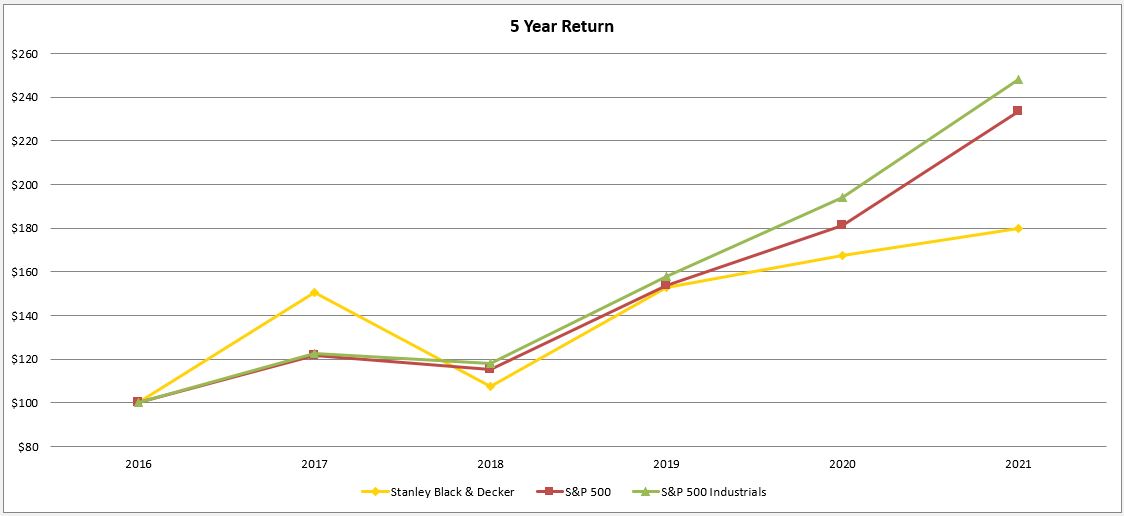][added: 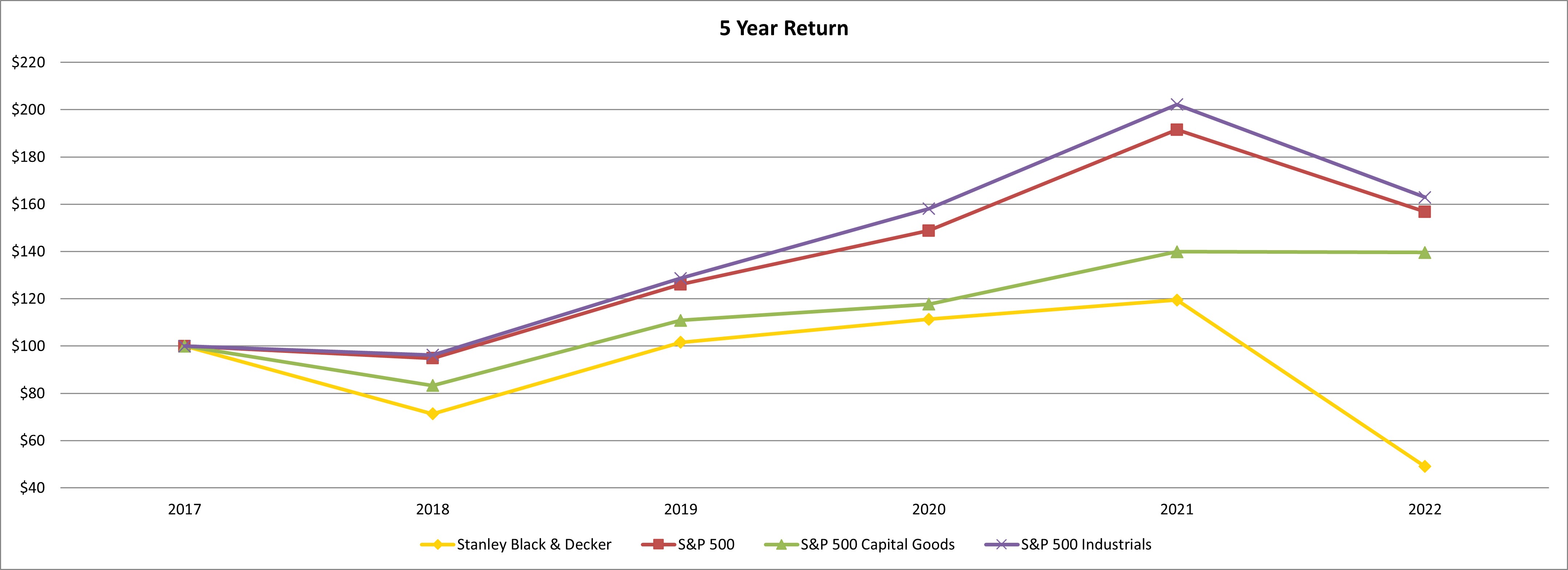]
| THE POINTS IN THE ABOVE TABLE ARE AS FOLLOWS: | | | [removed: 2016] [added: 2017] | | | | | | [removed: 2017] [added: 2018] | | | | | | [removed: 2018] [added: 2019] | | | | | | [removed: 2019] [added: 2020] | | | | | | [removed: 2020] [added: 2021] | | | | | | [removed: 2021] [added: 2022] | | |
The comparison assumes $100 invested at the closing price on December [removed: 31, 2016] [added: 30, 2017] in the Company’s common stock, S&P 500 Index, [added: S&P 500 Capital Goods Index,] and S&P 500 Industrials Index.
The Company increased its annual dividend per common share by $0.20 in 2022 compared to 2021 and intends to continue to pay quarterly dividends in 2023.
In July 2022, the Company raised the quarterly dividend per common share, its 55th consecutive increase, which extended its record for the longest, consecutive quarterly and annual dividend payments among industrial companies.
| October 2 - November 5 | | | | | | 2,824 | | | | | | $ | 76.43 | | | | | — | | | | | | 20 | | |
| November 6 - December 3 | | | | | | 15,211 | | | | | | 81.85 | | | | | | — | | | | | | 20 | | |
| December 4 - December 31 | | | | | | 36,412 | | | | | | 79.20 | | | | | | — | | | | | | 20 | | |
| Total | | | | | | 54,447 | | | | | | $ | 79.79 | | | | | — | | | | | | 20 | | |
Following the recent portfolio transformation, the Company has elected to replace the S&P 500 Industrials Index with the S&P 500 Capital Goods Index which it believes is a more appropriate comparison.
The S&P 500 Capital Goods Index represents a more focused group of 45 companies across major industrial manufacturing categories that carry similar operational characteristics to the Company.
| Stanley Black & Decker | | | $ | 100.00 | | | | | $ | 71.32 | | | | | $ | 101.54 | | | | | $ | 111.32 | | | | | $ | 119.46 | | | | | $ | 49.06 | |
| S&P 500 Index | | | $ | 100.00 | | | | | $ | 94.79 | | | | | $ | 126.03 | | | | | $ | 148.81 | | | | | $ | 191.48 | | | | | $ | 156.77 | |
| S&P 500 Capital Goods Index | | | $ | 100.00 | | | | | $ | 83.26 | | | | | $ | 110.83 | | | | | $ | 117.67 | | | | | $ | 139.93 | | | | | $ | 139.55 | |
| S&P 500 Industrials Index | | | $ | 100.00 | | | | | $ | 96.19 | | | | | $ | 128.70 | | | | | $ | 158.11 | | | | | $ | 202.22 | | | | | $ | 162.96 | |
The Company’s high and low quarterly stock prices on the NYSE for the years ended January 1, 2022 and January 2, 2021 follow:
| | | | | | | | | | | | | | | | | | | | | | | | | | | | | | | | | | | | | | | |
| --- | --- | --- | --- | --- | --- | --- | --- | --- | --- | --- | --- | --- | --- | --- | --- | --- | --- | --- | --- | --- | --- | --- | --- | --- | --- | --- | --- | --- | --- | --- | --- | --- | --- | --- | --- | --- | --- | --- |
| | | | | | | 2021 | | | | | | | | | | | | | | | | | | 2020 | | | | | | | | | | | | | | |
| | | | | | | High | | | | | | Low | | | | | | Dividend Per Common Share | | | | | | High | | | | | | Low | | | | | | Dividend Per Common Share | | |
| QUARTER: | | | | | | | | | | | | | | | | | | | | | | | | | | | | | | | | | | | | | | |
| First | | | | | | $ | 202.07 | | | | | $ | 169.35 | | | | | $ | 0.70 | | | | | $ | 172.53 | | | | | $ | 72.03 | | | | | $ | 0.69 | |
| Second | | | | | | $ | 220.69 | | | | | $ | 194.92 | | | | | $ | 0.70 | | | | | $ | 148.23 | | | | | $ | 92.13 | | | | | $ | 0.69 | |
| Third | | | | | | $ | 209.43 | | | | | $ | 174.87 | | | | | $ | 0.79 | | | | | $ | 166.25 | | | | | $ | 135.61 | | | | | $ | 0.70 | |
| Fourth | | | | | | $ | 196.61 | | | | | $ | 171.07 | | | | | $ | 0.79 | | | | | $ | 190.94 | | | | | $ | 161.48 | | | | | $ | 0.70 | |
| Total | | | | | | | | | | | | | | | | | | $ | 2.98 | | | | | | | | | | | | | | | | | $ | 2.78 | |
| October 3 - November 6 | | | | | | 3,980 | | | | | | $ | 180.09 | | | | | — | | | | | | 20,000,000 | | |
| November 7 - December 4 | | | | | | 58,996 | | | | | | 177.99 | | | | | | — | | | | | | 20,000,000 | | |
| December 5 - January 1 | | | | | | 15,877 | | | | | | 187.71 | | | | | | — | | | | | | 20,000,000 | | |
| Total | | | | | | 78,853 | | | | | | $ | 180.05 | | | | | — | | | | | | 20,000,000 | | |
As of January 1, 2022, the authorized shares available for repurchase under April 2021 Program totaled 20.0 million shares.
On February 16, 2022, the Board of Directors terminated the April 2021 Program and approved a new repurchase program of up to the greater of (i) 20.0 million shares of the Company’s common stock; and (ii) the number of shares of the Company’s common stock in the aggregate that can be purchased for an amount up to $2.5 billion.
As of February 16, 2022, the authorized shares available for purchase under the new program totaled the greater of (i) 20.0 million shares; and (ii) the number of shares in the aggregate that can be purchased for an amount up to $2.5 billion.
In the second quarter of 2021, the Company net-share settled capped call options and received 344,004 shares.
This transaction was completed under the approved repurchase program in place prior to the April 2021 Program.
in March 2015.
Refer to *Note J, Capital Stock,* of the *Notes to Consolidated Financial Statements* in *Item 8* for further discussion.
The Company has decided to use the S&P 500 Industrials Index, which is utilized by a number of the Company’s industrial peers, for the purpose of this disclosure.
| Stanley Black & Decker | | | $ | 100.00 | | | | | $ | 150.48 | | | | | $ | 107.32 | | | | | $ | 152.79 | | | | | $ | 167.52 | | | | | $ | 179.76 | |
| S&P 500 | | | $ | 100.00 | | | | | $ | 121.82 | | | | | $ | 115.48 | | | | | $ | 153.54 | | | | | $ | 181.29 | | | | | $ | 233.28 | |
| S&P 500 Industrials | | | $ | 100.00 | | | | | $ | 122.71 | | | | | $ | 118.04 | | | | | $ | 157.93 | | | | | $ | 194.02 | | | | | $ | 248.15 | |
Item 9A. CONTROLS AND PROCEDURES
5 rewritten, 7 added, 22 removed, 3 unchanged
[removed: Material Weaknesses] [added: Changes] in Internal Control Over Financial Reporting
The management of Stanley Black & Decker, Inc. (the [removed: "Company")] [added: “Company”)] is responsible for establishing and maintaining adequate internal control over financial [removed: reporting, as that term is defined under Rules 13a-15(f) and 15d-15(f) of the Securities Exchange Act of 1934, as amended (the “Exchange Act”).][added: reporting.]
[removed: Under the supervision and with the participation of management, including the Chief Executive Officer and the President and Chief Financial Officer, the Company has assessed the effectiveness of] [added: In making] its [removed: internal control over financial reporting as of the end of the period covered by this report based upon] [added: assessment, management has utilized] the criteria set forth by the Committee of Sponsoring Organizations (COSO) of the Treadway Commission in Internal Control — Integrated Framework (2013 Framework).
Remediation of [added: Previously Reported] Material Weaknesses
[removed: Other than those items noted above, there] [added: There] has been no change in the Company’s internal control over financial reporting that occurred during the fiscal [removed: year] [added: quarter] ended [removed: January 1,] [added: December 31,] 2022 that has materially affected, or is reasonably likely to materially affect, the Company’s internal control over financial reporting.
Management has assessed the effectiveness of the Company’s internal control over financial reporting as of December 31, 2022.
Management concluded that based on its assessment, the Company’s internal control over financial reporting was effective as of December 31, 2022.
Ernst & Young LLP, the auditor of the financial statements included in this annual report, has issued an attestation report on the registrant’s internal control over financial reporting, a copy of which appears on page 62.
Under the supervision and with the participation of management, including the Company’s President and Chief Executive Officer and its Interim Chief Financial Officer, the Company has, pursuant to Rule 13a-15(b) of the Securities Exchange Act of 1934, as amended (the “Exchange Act”), evaluated the effectiveness of the design and operation of its disclosure controls and procedures (as defined under Rule 13a-15(e) of the Exchange Act).
Based upon that evaluation, the Company’s President and Chief Executive Officer and its Interim Chief Financial Officer have concluded that, as of December 31, 2022, the Company’s disclosure controls and procedures are effective.
To address the previously reported material weaknesses in internal control over financial reporting described in Part II, Item 9A of the Company's 2021 Form 10-K, the Company enhanced and revised the design of existing controls and procedures to properly account for financial instruments with debt- and equity-like features, including the impact to the calculation of earnings per share.
During the first quarter of fiscal 2022, the Company successfully completed the testing necessary to conclude that the material weaknesses have been remediated.
Based on that assessment, the Chief Executive Officer and the President and Chief Financial Officer concluded that the Company's internal control over financial reporting was not effective to provide reasonable assurance regarding the reliability of its financial reporting and the preparation of its financial statements for external purposes in accordance with accounting principles generally accepted in the United States of America as of January 1, 2022 due to the material weaknesses in internal control described below.
A material weakness, as defined in Rule 12b-2 under the Exchange Act, is a deficiency, or a combination of deficiencies, in internal control over financial reporting, such that there is a reasonable possibility that a material misstatement of a company’s annual or interim financial statements will not be prevented or detected on a timely basis.
Subsequent to the filing of its 2020 Form 10-K, the Company received comments from the SEC Staff regarding its accounting for equity units issued in May 2017 and November 2019 (the “Equity Units”).
Upon further reflection of the comments received by the Staff and the nature of the Equity Units, the Company determined that errors were made in its original accounting conclusions resulting from material weaknesses in its internal control over financial reporting for such instruments.
The Company determined the errors were the result of the following deficiencies in internal control over financial reporting:
1.The design of its control to consider all the relevant authoritative accounting guidance for financial instruments with debt- and equity-like features; and
2.The design of its control to consider financial instruments with debt- and equity-like features in the calculation of earnings per share.
The Company assessed whether there was a reasonable possibility that a material misstatement would not have been prevented or detected on a timely basis as a result of the above control deficiencies.
The first control deficiency could result in a determination that there are two units of account in which the forward stock purchase contracts, when evaluated separately as freestanding instruments, would be precluded from equity classification.
As a result, the asset or liability related to the forward stock purchase contracts would be subject to mark-to-market accounting, which would be significantly influenced by factors outside of the Company’s control, including fluctuations in its share price.
The second control deficiency resulted in material errors in the calculation of diluted earnings per share previously disclosed in the Company’s historical financial statements.
Based on these factors, the Company concluded that the deficiencies noted above each rise to the level of a material weakness.
The Company acknowledges that its management is responsible for establishing and maintaining adequate internal control over financial reporting and assessing the effectiveness of its internal controls.
The Company is committed to maintaining a strong internal control environment and implementing measures to ensure that the control deficiencies identified above are remediated as soon as possible.
Management is in the process of implementing its remediation plan, which includes steps to design and implement new controls and expand education and training related to the accounting considerations for complex financing transactions.
The Company will consider the material weakness remediated after the applicable controls operate for a sufficient period of time, and management has concluded, through testing, that the controls are operating effectively.
The Company’s management is responsible for establishing and maintaining adequate internal control over financial reporting.
During the fourth quarter of 2021, the Company acquired the remaining 80 percent ownership stake in MTD Holdings Inc. ("MTD") and Excel Industries ("Excel") for approximately $1.5 billion and $374 million, respectfully.
Since Stanley Black & Decker, Inc. has not yet fully incorporated the internal controls and procedures of MTD and Excel into Stanley Black & Decker, Inc.'s internal control over financial reporting, management excluded these businesses from its assessment of the effectiveness of internal control over financial reporting as of January 1, 2022.
MTD accounted for 5% of Stanley Black & Decker, Inc.'s total assets as of January 1, 2022 and 1% of Stanley Black & Decker, Inc.'s net sales for the year then ended.
Excel accounted less than 1% of Stanley Black & Decker, Inc.'s total assets as of January 1, 2022 and less than 1% of Stanley Black & Decker, Inc.'s net sales for the year then ended.
Refer to Management’s Report On Internal Control Over Financial Reporting on page 63.
Item 9B. OTHER INFORMATION
0 rewritten, 0 added, 1 removed, 1 unchanged
PART III
Item 9C. DISCLOSURE REGARDING FOREIGN JURISDICTIONS THAT PREVENT INSPECTIONS
0 rewritten, 2 added, 0 removed, 0 unchanged
New section this year
Not applicable.
PART III
Item 10. DIRECTORS, EXECUTIVE OFFICERS AND CORPORATE GOVERNANCE OF THE REGISTRANT
10 rewritten, 3 added, 3 removed, 9 unchanged
The information required by this Item, except for certain information with respect to the Company’s Code of [added: Business] Ethics, the identification of the executive officers of the Company and any material changes to the procedures by which [removed: security holders] [added: shareholders] may recommend nominees to the Company’s Board of Directors, as set forth below, is incorporated herein by reference to the information set forth in the section of the Company’s definitive proxy statement (which will be filed pursuant to Regulation 14A under the Exchange Act within 120 days after the close of the Company’s fiscal year) under the headings [added: “Delinquent Section 16(a) Reports,”] “Information Concerning Nominees for Election as Directors,” and “Board of Directors".
Available on the Company's website at http://www.stanleyblackanddecker.com under the [removed: “Who We Are”] [added: “Impact”] heading is the Code of Business Ethics applicable to all of its [removed: directors,] [added: directors and] officers, including the [added: President and] Chief Executive Officer, [removed: President and] [added: Interim] Chief Financial Officer, and [removed: Vice President,] Chief Accounting Officer, and employees [removed: worldwide.][added: worldwide, as well as the Supplemental Code of Ethics for CEO and Senior Financial Officers, applicable to the Company’s President and Chief Executive Officer, and all senior financial officers, including the Interim Chief Financial Officer and Chief Accounting Officer.]
The Company intends to post on its website required information regarding any amendment to, or waiver from, the Code of Business Ethics [added: or the Code of Ethics for CEO and Senior Financial Officers] that applies to the Company's [added: President and] Chief Executive Officer and senior financial officers within four business days after any such amendment or waiver.
The following is a list of the executive officers of the Company as of February [removed: 22, 2022:][added: 23, 2023:]
| Name and Age | | | | | | Office | | | | | | Date Elected to [removed: Office] [added: Office as an Executive Officer] | | |
| Donald Allan, Jr. [removed: (57)] [added: (58)] | | | | | | President & Chief [removed: Financial] [added: Executive] Officer since [removed: April 2021.] [added: July 2022. President & Chief Financial Officer (2021);] Executive Vice President & Chief Financial Officer (2016); Senior Vice President & Chief Financial Officer (2010); Vice President & Chief Financial Officer (2009); Vice President & Corporate Controller (2002); Corporate Controller (2000); Assistant Controller (1999). | | | | | | 10/24/2006 | | |
| Janet M. Link [removed: (52)] [added: (53)] | | | | | | Senior Vice President, General Counsel and Secretary since July 2017. Executive Vice President, General Counsel, JC Penney Company, Inc. (2015); Vice President, Deputy General Counsel, JC Penney Company, Inc. (2014); Vice President, Deputy General Counsel, Clear Channel Companies (2013). | | | | | | 7/19/2017 | | |
| John H. Wyatt [removed: (63)] [added: (64)] | | | | | | [added: Interim Co-President &] Senior Vice [added: President, Tools & Outdoor since July 2022. Senior Vice] President & President, Stanley Outdoor [removed: since January 2021.] [added: (2021);] Senior Vice President & President, Stanley Outdoor and Aerospace (2020); President, Stanley Engineered Fastening (2016); President, [added: Global] Sales & Marketing - Global Tools & Storage [removed: (2015);] [added: (2014);] President, Construction & DIY, Europe and ANZ (2012); President, Construction & DIY, EMEA (2010); President-Europe, Middle East, and Africa, Power Tools and Accessories, The Black & Decker Corporation (2008); Vice President-Consumer Products (Europe, Middle East and Africa), The Black & Decker Corporation (2006). | | | | | | 3/12/2010 | | |
| Robert H. Raff [removed: (55)] [added: (56)] | | | | | | [added: Interim Co-President & Chief Commercial Officer, Tools & Outdoor since July 2022.] Head of Outdoor Integration [removed: since July 2021.] [added: (2021);] President, Stanley Security (2016); President, Stanley Electronic Security North America (2015); President, North America Sales, Construction & DIY (2010); President, Stanley National Hardware (2007); Vice President of Latin America, Construction & DIY (2005); General Manager, Construction & DIY (2002). | | | | | | 4/19/2018 | | |
| Graham N. Robinson [removed: (53)] [added: (54)] | | | | | | Senior Vice President & President, Stanley Industrial since April 2020. President, Honeywell Industrial Safety (Honeywell International) (2018); President, Honeywell Sensing and Internet of Things (Honeywell International) (2016); Chief Marketing Officer and Vice President, Global Strategy & Marketing, Automation and Control Solutions (Honeywell International) (2014). | | | | | | 4/17/2020 | | |
| Corbin B. Walburger (52) | | | | | | Interim Chief Financial Officer since July 2022. Vice President of Corporate Business Development (2008); Vice President and Associate in Investment Banking Division, Goldman Sachs (1999); Financial Analyst, Goldman Sachs (1995). | | | | | | 7/1/2022 | | |
| Scot D. Greulach (40) | | | | | | Chief Accounting Officer since October 2022. Business Unit Controller for Stanley Industrial (2021); Director – Corporate and Technical Accounting (2018); Director – Statutory Reporting and Tax Compliance (2017); Director – External Reporting (2014); Senior Manager – External Reporting (2012). | | | | | | 10/1/2022 | | |
| John T. Lucas (63) | | | | | | Chief Human Resources Officer since January 2023. Founder & Principal, True North Human Capital Consulting, LLC (2019); Senior Vice President and Chief Human Resources Officer, Goodyear Tire & Rubber Company (2015); Senior Vice President, Human Resources & Communications, Lockheed Martin Corporation (2009). | | | | | | 1/30/2023 | | |
| James M. Loree (63) | | | | | | Chief Executive Officer since August 2016. President & Chief Operating Officer (2013); Executive Vice President and Chief Operating Officer (2009); Executive Vice President Finance and Chief Financial Officer (1999). | | | | | | 7/19/1999 | | |
| Jaime A. Ramirez (54) | | | | | | Executive Vice President & President, Global Tools & Storage since July 2020. Senior Vice President & Chief Operating Officer, Tools & Storage (2019); Senior Vice President & President, Global Emerging Markets (2012); President, Construction & DIY, Latin America (2010); Vice President and General Manager - Latin America, Power Tools & Accessories, The Black & Decker Corporation (2008); Vice President and General Manager - Andean Region The Black & Decker Corporation (2007). | | | | | | 3/12/2010 | | |
| Stephen Subasic (53) | | | | | | Senior Vice President, Chief Human Resources Officer since January 2021. Vice President, Human Resources & Corporate Talent Management (2019); Vice President, Human Resources, Global Tools & Storage (2015); Vice President, Human Resources, Construction & DIY (2011). | | | | | | 2/18/2021 | | |
Item 11. EXECUTIVE COMPENSATION
1 rewritten, 0 added, 0 removed, 0 unchanged
The information required by this Item is incorporated herein by reference to the information set forth under the sections entitled "Compensation Discussion & Analysis" and [removed: “2021] [added: “2022] Executive [removed: Compensation”] [added: Compensation Program”] of the Company’s definitive proxy statement, which will be filed pursuant to Regulation 14A under the Exchange Act within 120 days after the end of the fiscal year covered by this Annual Report on Form 10-K.
Item 12. SECURITY OWNERSHIP OF CERTAIN BENEFICIAL OWNERS AND MANAGEMENT AND RELATED STOCKHOLDER MATTERS
8 rewritten, 2 added, 2 removed, 17 unchanged
The information required by Item 403 of Regulation S-K is incorporated herein by reference to the information set forth under the sections entitled "Security Ownership of Certain Beneficial Owners," "Security Ownership of Directors and Officers," "Compensation Discussion & Analysis" and [removed: “2021] [added: “2022] Executive [removed: Compensation”] [added: Compensation Program”] of the Company’s definitive proxy statement, which will be filed pursuant to Regulation 14A under the Exchange Act within 120 days after the end of the fiscal year covered by this Annual Report on Form 10-K.
Compensation plans under which the Company’s equity securities are authorized for issuance at [removed: January 1,] [added: December 31,] 2022 follow:
| Plan Category | | | | | | Number of securities to be issued upon exercise of outstanding [removed: options] [added: options, warrants] and [removed: stock awards] [added: rights] | | | | | | Weighted-average exercise price of outstanding [removed: options] [added: options, warrants and rights] | | | | | | Number of securities remaining available for future issuance under equity compensation plans (excluding securities reflected in column (A)) | | | | | |
(1)Consists of [removed: 5,573,672] [added: 5,281,713] shares underlying outstanding stock options (whether vested or unvested) with a weighted-average exercise price of [removed: $151.46] [added: $140.22] and a weighted-average term of [removed: 7.04] [added: 6.54] years; [removed: 1,877,887] [added: 1,873,031] shares underlying time-vesting restricted stock units that have not yet vested and the maximum number of shares that will be issued pursuant to outstanding performance awards if all established goals are met; and [removed: 109,937] [added: 134,614] of shares earned but [removed: related to] [added: for] which participants elected deferral of delivery.
(3)Consists of [removed: 1,388,655] [added: 1,251,699] of shares available for purchase under the employee stock purchase plan ("ESPP") at the election of employees and [removed: 5,260,005] [added: 8,403,765] securities available for future grants by the Board of Directors under stock-based compensation plans.
On [removed: January 22, 2018,] [added: February 16, 2022,] the Board of Directors adopted the [removed: 2018] [added: 2022] Omnibus Award Plan (the [removed: "2018] [added: "2022] Plan") and authorized the issuance of [removed: 16,750,000] [added: 9,800,000] shares of the Company's common stock in connection with [removed: the] awards pursuant to the [removed: 2018] [added: 2022] Plan.
No further awards will be issued under the Company's [removed: 2013 Long-Term Incentive] [added: 2018 Omnibus Award] Plan.
The number of securities remaining available for issuance under the plans at [removed: January 1,] [added: December 31,] 2022 is not determinable, since the plans do not authorize a maximum number of securities.
| Equity compensation plans approved by security holders | | | | | | 7,289,358 | | | (1) | | | $ | 140.22 | | (2) | | | 9,655,464 | | | (3) | | |
| Total | | | | | | 7,289,358 | | | | | | $ | 140.22 | | | | | 9,655,464 | | | | | |
| Equity compensation plans approved by security holders | | | | | | 7,561,496 | | | (1) | | | $ | 151.46 | | (2) | | | 6,648,660 | | | (3) | | |
| Total | | | | | | 7,561,496 | | | | | | $ | 151.46 | | | | | 6,648,660 | | | | | |
Item 14. PRINCIPAL ACCOUNTANT FEES AND SERVICES
4 rewritten, 0 added, 0 removed, 11 unchanged
The response to this portion of Item 15 is submitted as a separate section of this report beginning with an index thereto on page [removed: 59.][added: 55.]
See Exhibit Index in this Form 10-K on page [removed: 128.][added: 119.]
(b) See Exhibit Index in this Form 10-K on page [removed: 128.][added: 119.]
(c) The response in this portion of Item 15 is submitted as a separate section of this Form 10-K with an index thereto beginning on page [removed: 59.][added: 55.]
Item 15. (a) (1) AND (2)
11 rewritten, 0 added, 0 removed, 6 unchanged
| Schedule II — Valuation and Qualifying Accounts is included in Item 15 (page [removed: 62).] [added: 58).] | | |
| Management’s Report on Internal Control Over Financial Reporting (page [removed: 63).] [added: 59).] | | |
| Report of Independent Registered Public Accounting Firm (PCAOB ID: 00042) — Financial Statement Opinion (page [removed: 64).] [added: 60).] | | |
| Report of Independent Registered Public Accounting Firm — Internal Control Opinion (page [removed: 67).] [added: 62).] | | |
| Consolidated Statements of Operations — fiscal years ended [added: December 31, 2022,] January 1, 2022, [added: and] January 2, [removed: 2021, and December 28, 2019] [added: 2021] (page [removed: 69).] [added: 63).] | | |
| Consolidated Statements of Comprehensive Income — fiscal years ended [added: December 31, 2022,] January 1, 2022, [added: and] January 2, [removed: 2021, and December 28, 2019] [added: 2021] (page [removed: 70).] [added: 64).] | | |
| Consolidated Balance Sheets — [removed: January 1,] [added: December 31,] 2022 and January [removed: 2, 2021] [added: 1, 2022] (page [removed: 71).] [added: 65).] | | |
| Consolidated Statements of Cash Flows — fiscal years ended [added: December 31, 2022,] January 1, 2022, [added: and] January 2, [removed: 2021, and December 28, 2019] [added: 2021] (page [removed: 72).] [added: 66).] | | |
| Consolidated Statements of Changes in Shareowners’ Equity — fiscal years ended [added: December 31, 2022,] January 1, 2022, [added: and] January 2, [removed: 2021, and December 28, 2019] [added: 2021] (page [removed: 74).] [added: 68).] | | |
| Notes to Consolidated Financial Statements (page [removed: 75).] [added: 69).] | | |
| Selected Quarterly Financial Data (Unaudited) (page [removed: 126).] [added: 117).] | | |
Item 16. FORM 10-K SUMMARY
920 rewritten, 384 added, 398 removed, 1,131 unchanged
| Date: | | | | | | February [removed: 22, 2022] [added: 23, 2023] | | |
| /s/ Donald Allan, Jr. | | | | | | President and Chief [removed: Financial] [added: Executive] Officer | | | | | | February [removed: 22, 2022] [added: 23, 2023] | | | | | |
| * | | | | | | Director | | | | | | February [removed: 22, 2022] [added: 23, 2023] | | | | | |
Fiscal years ended [added: December 31, 2022,] January 1, 2022, [added: and] January 2, [removed: 2021, and December 28, 2019][added: 2021]
| Year Ended 2021 [removed: (c)] | | | $ | 1,001.9 | | | | | $ | 190.7 | | | | | $ | 61.1 | | | | | $ | (186.5) | | | | | $ | 1,067.2 | |
(b)Amounts represent the impact of foreign currency translation, [removed: acquisitions] [added: acquisitions, divestitures] and net transfers to/from other accounts.
Refer to *Note T, Divestitures*, [removed: of the *Notes to Consolidated Financial Statements* in *Item 8*] for further discussion.
[removed: Since Stanley Black & Decker, Inc.] [added: Management] has [removed: not yet fully incorporated] [added: assessed] the [removed: internal controls and procedures] [added: effectiveness] of [removed: MTD and Excel into] Stanley Black & Decker, [removed: Inc.'s internal control over financial reporting, management excluded these businesses from its assessment of the effectiveness of] [added: Inc.’s] internal control over financial reporting as of [removed: January 1,] [added: December 31,] 2022.
Management [removed: has assessed the effectiveness of] [added: concluded that based on its assessment,] Stanley Black & Decker, Inc.’s internal control over financial reporting [added: was effective] as of [removed: January 1,] [added: December 31,] 2022.
Ernst & Young LLP, Registered Public Accounting Firm included in this annual report, has issued an attestation report on the registrant’s internal control over financial reporting, a copy of which appears on page [removed: 67.][added: 62.]
| [added: | | | | | |] Donald Allan, Jr., President and Chief [removed: Financial] [added: Executive] Officer | | | [removed: | | |]
We have audited the accompanying consolidated balance sheets of Stanley Black & Decker, Inc. (the Company) as of [removed: January 1,] [added: December 31,] 2022 and January [removed: 2, 2021,] [added: 1, 2022,] the related consolidated statements of operations, comprehensive income, shareowners’ equity and cash flows for each of the three years in the period ended [removed: January 1,] [added: December 31,] 2022, and the related notes and the financial statement schedule listed in the Index at Item 15(a) (collectively referred to as the “consolidated financial statements”).
In our opinion, the consolidated financial statements present fairly, in all material respects, the financial position of the Company at [removed: January 1,] [added: December 31,] 2022 and January [removed: 2, 2021,] [added: 1, 2022,] and the results of its operations and its cash flows for each of the three years in the period ended [removed: January 1,] [added: December 31,] 2022, in conformity with U.S. generally accepted accounting principles.
We also have audited, in accordance with the standards of the Public Company Accounting Oversight Board (United States) (PCAOB), the Company’s internal control over financial reporting as of [removed: January 1,] [added: December 31,] 2022, based on criteria established in Internal Control-Integrated Framework issued by the Committee of Sponsoring Organizations of the Treadway Commission (2013 framework) and our report dated February [removed: 22, 2022] [added: 23, 2023] expressed an [removed: adverse] [added: unqualified] opinion thereon.
The critical audit [removed: matters] [added: matter] communicated below [removed: are matters] [added: is a matter] arising from the current period audit of the financial statements that [removed: were] [added: was] communicated or required to be communicated to the audit committee and that: (1) [removed: relate] [added: relates] to accounts or disclosures that are material to the financial statements and (2) involved our especially challenging, subjective or complex judgments.
The communication of [added: the] critical audit [removed: matters] [added: matter] does not alter in any way our opinion on the consolidated financial statements, taken as a whole, and we are not, by communicating the critical audit [removed: matters] [added: matter] below, providing [added: a] separate [removed: opinions] [added: opinion] on the critical audit [removed: matters] [added: matter] or on the [removed: accounts] [added: account] or [removed: disclosures] [added: disclosure] to which [removed: they relate.][added: it relates.]
[removed: | | | | | | | *Accounting] [added: The acquisition accounting] for [removed: Acquisition of] MTD [removed: Holdings, Inc.* | | |][added: is complete.]
We have audited Stanley Black & Decker, Inc.’s internal control over financial reporting as of [removed: January 1,] [added: December 31,] 2022, based on criteria established in Internal Control—Integrated Framework issued by the Committee of Sponsoring Organizations of the Treadway Commission (2013 framework) (the COSO criteria).
In our opinion, [removed: because of the effect of the material weaknesses described below on the achievement of the objectives of the control criteria,] Stanley Black & [removed: Decker, Inc.] [added: Decker] (the Company) [removed: has not maintained] [added: maintained, in all material respects,] effective internal control over financial reporting as of [removed: January 1,] [added: December 31,] 2022, based on the COSO criteria.
We also have audited, in accordance with the standards of the Public Company Accounting Oversight Board (United States) (PCAOB), the consolidated balance sheets of the Company as of [removed: January 1,] [added: December 31,] 2022 and January [removed: 2, 2021,] [added: 1, 2022, the] related consolidated statements of [added: operations,] comprehensive income, shareowners’ equity and cash flows for each of the three years in the period ended [removed: January 1,] [added: December 31,] 2022, and the related notes and schedule listed in the Index at Item [removed: 15(a).][added: 15(a) and our report dated February 23, 2023 expressed an unqualified opinion thereon.]
| | | | [removed: 2021] [added: 2022] | | | | | | [removed: 2020] [added: 2021] | | | | | | [removed: 2019] [added: 2020] | | |
| Selling, general and administrative | | | [removed: 3,236.5] [added: 3,355.7] | | | | | | [removed: 2,599.5] [added: 3,193.1] | | | | | | [removed: 2,542.0] [added: 2,554.7] | | |
| Provision for credit losses | | | [removed: 3.9] [added: 14.3] | | | | | | [removed: 29.0] [added: —] | | | | | | [removed: 26.3] [added: 24.6] | | |
| Loss [removed: (gain)] on sales of businesses | | | [removed: 0.6] [added: 8.4] | | | | | | [removed: 13.5] [added: 0.6] | | | | | | [removed: (17.0)] [added: 13.5] | | |
| Restructuring charges | | | [removed: 14.5] [added: 140.8] | | | | | | [removed: 73.8] [added: 14.5] | | | | | | [removed: 138.4] [added: 73.8] | | |
| Gain on equity method investment | | | [removed: (68.0)] [added: —] | | | | | | [removed: —] [added: (68.0)] | | | | | | — | | |
| Loss on debt [removed: extinguishments] [added: extinguishment] | | | — | | | | | | [removed: 46.9] [added: —] | | | | | | [removed: 17.9] [added: 46.9] | | |
| Interest income | | | [removed: (9.8)] [added: (54.7)] | | | | | | [removed: (17.5)] [added: (9.8)] | | | | | | [removed: (51.9)] [added: (17.5)] | | |
| Interest expense | | | [removed: 185.4] [added: 338.5] | | | | | | [removed: 222.6] [added: 185.4] | | | | | | [removed: 282.2] [added: 222.7] | | |
| Earnings from continuing operations before income taxes and equity interest | | | [removed: 1,641.0] [added: 37.9] | | | | | | [removed: 1,219.8] [added: 1,586.9] | | | | | | [removed: 1,094.4] [added: 1,183.7] | | |
| Income taxes on continuing operations | | | [removed: 61.4] [added: (132.4)] | | | | | | [removed: 43.0] [added: 55.1] | | | | | | [removed: 126.8] [added: 38.0] | | |
| Net earnings from continuing operations before equity interest | | | [removed: 1,579.6] [added: 170.3] | | | | | | [removed: 1,176.8] [added: 1,531.8] | | | | | | [removed: 967.6] [added: 1,145.7] | | |
| Share of net earnings [removed: (losses)] of equity method investment | | | [removed: 19.0] [added: —] | | | | | | [removed: 9.1] [added: 19.0] | | | | | | [removed: (11.2)] [added: 9.1] | | |
| Net earnings from continuing operations | | | [removed: 1,598.6] [added: 170.3] | | | | | | [removed: 1,185.9] [added: 1,550.8] | | | | | | [removed: 956.4] [added: 1,154.8] | | |
| Less: Net [removed: (losses)] earnings [added: (losses)] attributable to non-controlling interests | | | [removed: (1.7)] [added: 0.2] | | | | | | [removed: 0.9] [added: (1.7)] | | | | | | [removed: 2.2] [added: 0.9] | | |
| Net earnings from continuing operations attributable to Stanley Black & Decker, Inc. | | | $ | [removed: 1,600.3] [added: 170.1] | | | | | $ | [removed: 1,185.0] [added: 1,552.5] | | | | | $ | [removed: 954.2] [added: 1,153.9] | |
| Less: Preferred stock dividends and beneficial conversion feature | | | [removed: 14.2] [added: 5.8] | | | | | | [removed: 24.1] [added: 14.2] | | | | | | [removed: 1.8] [added: 24.1] | | |
| Net Earnings from Continuing Operations Attributable to Common Shareowners | | | $ | [removed: 1,586.1] [added: 164.3] | | | | | $ | [removed: 1,160.9] [added: 1,538.3] | | | | | $ | [removed: 952.4] [added: 1,129.8] | |
| Add: Contract adjustment payments accretion | | | [removed: 1.3] [added: 1.2] | | | | | | [removed: 1.7] [added: 1.3] | | | | | | 1.7 | | |
| Net [removed: Earnings] [added: earnings] from [removed: Continuing Operations Attributable] [added: continuing operations attributable] to [removed: Common Shareowners] [added: common shareowners] - Diluted | | | [removed: $ | 1,587.4 | | | | | $] [added: 318.3] | [removed: 1,162.6] | | | | | [removed: $] [added: 1,666.0] | [removed: 954.1] | |
| By: | | | | | | /s/ Donald Allan, Jr. | | |
| /s/ Corbin Walburger | | | | | | Interim Chief Financial Officer | | | | | | February 23, 2023 | | | | | |
| Corbin Walburger | | | | | | | | | | | | | | | | | |
| /s/ Scot Greulach | | | | | | Chief Accounting Officer | | | | | | February 23, 2023 | | | | | |
| Scot Greulach | | | | | | | | | | | | | | | | | |
| * | | | | | | Director | | | | | | February 23, 2023 | | | | | |
| * | | | | | | Director | | | | | | February 23, 2023 | | | | | |
| * | | | | | | Director | | | | | | February 23, 2023 | | | | | |
| * | | | | | | Director | | | | | | February 23, 2023 | | | | | |
| * | | | | | | Director | | | | | | February 23, 2023 | | | | | |
| * | | | | | | Director | | | | | | February 23, 2023 | | | | | |
| Robert J. Manning | | | | | | | | | | | | | | | | | |
| * | | | | | | Director | | | | | | February 23, 2023 | | | | | |
| Adrian V. Mitchell | | | | | | | | | | | | | | | | | |
| * | | | | | | Director | | | | | | February 23, 2023 | | | | | |
| * | | | | | | Director | | | | | | February 23, 2023 | | | | | |
| * | | | | | | Director | | | | | | February 23, 2023 | | | | | |
| Year Ended 2022 | | | $ | 95.9 | | | | | $ | 14.3 | | | | | $ | 16.9 | | | | | $ | (20.5) | | | | | $ | 106.6 | |
| Year Ended 2021 | | | $ | 106.2 | | | | | $ | — | | | | | $ | 3.8 | | | | | $ | (14.1) | | | | | $ | 95.9 | |
| Year Ended 2020 | | | $ | 91.5 | | | | | $ | 24.6 | | | | | $ | 7.4 | | | | | $ | (17.3) | | | | | $ | 106.2 | |
| Year Ended 2022 (c) | | | $ | 1,067.2 | | | | | $ | 21.2 | | | | | $ | (5.9) | | | | | $ | (50.0) | | | | | $ | 1,032.5 | |
| Donald Allan, Jr., President and Chief Executive Officer | | | | | |
| /s/ Corbin B. Walburger | | | | | |
| Corbin B. Walburger, Interim Chief Financial Officer | | | | | |
| *Description of the Matter* | | | | | | As described in Notes A and Q, the Company conducts business globally and, as a result, files income tax returns in the U.S. federal jurisdiction and various state and foreign jurisdictions. In the normal course, the Company is subject to examinations by taxing authorities throughout the world. Uncertainty in a tax position may arise as tax laws are subject to interpretation. At December 31, 2022, the Company has recorded approximately $503 million relating to uncertain tax positions. The Company records uncertain tax positions in accordance with ASC 740, which requires a two-step process. First, management determines whether it is more likely than not that a tax position will be sustained based on the technical merits of the position and second, for those tax positions that meet the more likely than not threshold, management recognizes the largest amount of the tax benefit that is greater than 50 percent likely to be realized upon ultimate settlement with the related taxing authority. The Company then evaluates uncertain tax positions in subsequent periods for recognition, de-recognition or re-measurement if changes have occurred, or when effective settlement or expiration of the statute of limitations occurs. Auditing the uncertain tax positions is complex because of the judgmental nature of the tax accruals and various other tax return positions that might not be sustained upon review by taxing authorities. The Company files tax returns in multiple jurisdictions and is subject to examination by taxing authorities throughout the world due to its complex global footprint. | | |
| *How We Addressed the Matter in Our Audit* | | | | | | We obtained an understanding, evaluated the design, and tested the operating effectiveness of controls related to the recognition, measurement and the evaluation of changes in uncertain tax positions. This included testing controls over management’s review of the tax positions, their evaluation of whether they met the measurement threshold and then recalculating the amounts recognized in the consolidated financial statements. Our audit procedures to test the Company’s uncertain tax positions included, among others, involvement of our tax professionals, including transfer pricing professionals. This included evaluating tax opinions and third-party transfer pricing studies obtained by the Company and assessing the Company’s correspondence with the relevant tax authorities. We analyzed the Company’s assumptions and data used to determine the amount of tax benefit to recognize and tested the accuracy of the calculations. Our testing also included the evaluation of the ongoing positions and consideration of changes, the recording of penalties and interest and the ultimate settlement and payment of certain tax matters. | | |
February 23, 2023
February 23, 2023
Fiscal years ended December 31, 2022, January 1, 2022, and January 2, 2021
| Net Sales | | | $ | 16,947.4 | | | | | $ | 15,281.3 | | | | | $ | 12,750.0 | |
| Cost of sales | | | $ | 12,663.3 | | | | | $ | 10,189.1 | | | | | $ | 8,431.9 | |
| Other, net | | | 274.8 | | | | | | 189.5 | | | | | | 215.7 | | |
| Asset impairment charge | | | 168.4 | | | | | | — | | | | | | — | | |
| | | | $ | 16,909.5 | | | | | $ | 13,694.4 | | | | | $ | 11,566.3 | |
| Earnings from discontinued operations before income taxes (including 2022 pre-tax gain on Security sale of $1,197.4 million) | | | 1,210.9 | | | | | | 124.3 | | | | | | 83.3 | | |
| Income taxes on discontinued operations (including 2022 income taxes for gain on Security sale of $312.5 million) | | | 318.5 | | | | | | (12.4) | | | | | | 3.4 | | |
| Continuing operations | | | $ | 1.11 | | | | | $ | 9.69 | | | | | $ | 7.33 | |
| Discontinued operations | | | $ | 6.02 | | | | | $ | 0.86 | | | | | $ | 0.52 | |
| Continuing operations | | | $ | 1.06 | | | | | $ | 9.33 | | | | | $ | 6.97 | |
| Discontinued operations | | | $ | 5.70 | | | | | $ | 0.83 | | | | | $ | 0.49 | |
| | | | | | | | | |
| --- | --- | --- | --- | --- | --- | --- | --- | --- |
| By: | | | | | | /s/ James M. Loree | | |
| | | | | | | James M. Loree, Chief Executive Officer | | |
| /s/ James M. Loree | | | | | | Chief Executive Officer | | | | | | February 22, 2022 | | | | | |
| James M. Loree | | | | | | | | | | | | | | | | | |
| /s/ Jocelyn S. Belisle | | | | | | Vice President and Chief Accounting Officer | | | | | | February 22, 2022 | | | | | |
| Jocelyn S. Belisle | | | | | | | | | | | | | | | | | |
| George W. Buckley | | | | | | | | | | | | | | | | | |
| Year Ended 2021 | | | $ | 110.9 | | | | | $ | 3.9 | | | | | $ | 3.9 | | | | | $ | (15.6) | | | | | $ | 103.1 | |
| Year Ended 2020 | | | $ | 94.1 | | | | | $ | 29.0 | | | | | $ | 8.5 | | | | | $ | (20.7) | | | | | $ | 110.9 | |
| Year Ended 2019 | | | $ | 81.1 | | | | | $ | 26.3 | | | | | $ | (4.8) | | | | | $ | (8.5) | | | | | $ | 94.1 | |
| Year Ended 2019 | | | $ | 573.6 | | | | | $ | 452.1 | | | | | $ | 1.2 | | | | | $ | (20.5) | | | | | $ | 1,006.4 | |
During the fourth quarter of 2021, the Company acquired the remaining 80 percent ownership stake in MTD Holdings Inc. ("MTD") and Excel Industries ("Excel") for approximately $1.5 billion and $374 million, respectfully.
MTD accounted for 5% of Stanley Black & Decker, Inc.'s total assets as of January 1, 2022 and 1% of Stanley Black & Decker, Inc.'s net sales for the year then ended.
Excel accounted for less than 1% of Stanley Black & Decker, Inc.'s total assets as of January 1, 2022 and less than 1% of Stanley Black & Decker, Inc.'s net sales for the year then ended.
Management concluded that based on its assessment, and the existence of material weaknesses related to the accounting for equity units issued in May 2017 and November 2019, Stanley Black & Decker, Inc.’s internal control over financial reporting was not effective as of January 1, 2022.
| /s/ James M. Loree | | | | | |
| James M. Loree, Chief Executive Officer | | | | | |
| *Description of the Matter* | | | | | | As discussed in Note E of the consolidated financial statements, the Company acquired the remaining 80 percent ownership stake of MTD Holdings, Inc., on December 1, 2021 for a total purchase price of approximately $1.5 billion, net of cash acquired. The Company previously acquired a 20 percent interest in MTD in January 2019 for $234 million. The Company allocated the purchase price, on a preliminary basis, to the assets acquired and liabilities assumed based on their respective fair values, which included identified intangible assets of $840 million. Auditing the Company's accounting for the acquired intangible assets involved subjective auditor judgment due to the significant estimation required in management’s determination of the fair value of customer relationships and certain tradenames. The significant estimation was primarily due to the sensitivity of the significant assumptions in determining fair value, including discount rates, projected revenue growth rates and profit margins. These assumptions related to the future performance of the acquired business, are forward-looking and could be affected by future economic and market conditions. | | |
| *How We Addressed the Matter in Our Audit* | | | | | | We obtained an understanding, evaluated the design and tested the operating effectiveness of the controls over the Company’s accounting for business combinations. Our audit procedures included, among other procedures, testing controls over the valuation of customer relationships, including the valuation models and underlying assumptions used to develop such estimates. To test the estimated fair value of the customer relationships and certain tradenames, we performed audit procedures that included, among other procedures, evaluating the appropriateness of the valuation methodologies and testing the significant assumptions used in the model, as described above, including the completeness and accuracy of the underlying data. We compared the significant assumptions to current industry, market and economic trends, to the historical results of the acquired business and to other guideline companies within the same industry. We performed sensitivity analyses to evaluate the change in the fair value of the customer relationships and certain tradenames that would result from changes in the discount rates, projected revenue growth rates and profit margins. We involved our internal valuation specialists to assist with our evaluation of the methodology used by the Company as well as certain assumptions within the valuation. | | |
| | | | | | | *Annual Test of Impairment of Goodwill in the Infrastructure Reporting Unit* | | |
| *Description of the Matter* | | | | | | At January 1, 2022, the Company’s goodwill balance was approximately $8,784 million. As discussed in Note A of the consolidated financial statements, goodwill is not amortized but rather is tested for impairment at least annually at the reporting unit level. The Company’s goodwill is initially assigned to its reporting units as of the relevant acquisition date. Auditing management’s annual goodwill impairment test for the Infrastructure reporting unit was challenging and highly judgmental due to the significant estimation required to determine the estimated fair value of the reporting unit. In particular, the fair value estimate was sensitive to the significant assumption of revenue growth, which is affected by expected future market or economic conditions. | | |
| *How We Addressed the Matter in Our Audit* | | | | | | We obtained an understanding, evaluated the design and tested the operating effectiveness of controls over the determination of fair value, including the significant assumption of revenue growth discussed above, used in the Infrastructure goodwill impairment analysis. Our audit procedures included, among other procedures, testing controls over the Company’s budgetary process and management’s review of that information. To test the estimated fair value of the Infrastructure reporting unit, we performed audit procedures that included, among other procedures, assessing the Company’s methodologies and testing the revenue growth assumption discussed above and the underlying data used by the Company in its analysis. We compared the revenue growth rates used by management to current industry and economic trends, including, among other factors, the price of oil and scrap metal, and considering the Company’s business model, customer base, product mix and other relevant factors. We assessed the historical accuracy of management’s estimates and performed sensitivity analyses to evaluate the change in the fair value of the reporting unit that would result from changes in the revenue growth assumption. In addition, we evaluated the reconciliation of the combined estimated fair value of the Company’s reporting units to the market capitalization of the Company and assessed the resulting control premium. Further, we involved our internal valuation specialists to assist in the evaluation of the methodology and certain assumptions used to estimate the fair value of the Infrastructure reporting unit. | | |
| *Description of the Matter* | | | | | | At January 1, 2022, the Company had recorded a liability for uncertain tax positions of approximately $488 million. As discussed in Notes A and Q of the consolidated financial statements, the Company conducts business globally and, as a result, is subject to income tax in a number of locations, including many state and foreign jurisdictions. Uncertainty in a tax position may arise as tax laws are subject to interpretation. The Company uses significant judgment in (1) determining whether a tax position’s technical merits are more likely than not to be sustained and (2) measuring the amount of tax benefit that qualifies for recognition. The Company considers many factors when evaluating and estimating its tax positions such as, but not limited to, the settlements of on-going audits. Auditing the completeness of the uncertain tax reserves is challenging and subjective due to the Company’s global operations, the many tax jurisdictions in which it operates, the distinctive nature and unique facts and circumstances of each tax position and the interpretations of tax law and legal rulings. | | |
| *How We Addressed the Matter in Our Audit* | | | | | | We identified and tested controls around the Company’s judgments and determinations on tax positions, including the Company’s process to verify that all uncertain tax positions are identified and considered as part of the analysis and controls addressing completeness of the uncertain tax positions. With the support of our tax professionals, we performed an evaluation of the Company’s estimates with respect to uncertain tax positions including the technical merits of the Company’s tax positions. This included assessing the Company’s analysis of jurisdictions with potential tax liabilities and other international tax considerations. We considered the Company’s judgments and the factors involved with each significant tax position. To support our evaluation, we used our knowledge of, and experience with, the application of international and local income tax laws by the relevant income tax authorities to evaluate the Company’s accounting for those tax positions. We analyzed the Company’s assumptions and data used to determine the amount of tax benefit to recognize and tested the completeness and accuracy of the data used to determine the amount of tax benefits recognized and tested the accuracy of such calculations. We also evaluated the Company’s income tax disclosures included in Note Q to the consolidated financial statements in relation to these matters. | | |
February 22, 2022
A material weakness is a deficiency, or combination of deficiencies, in internal control over financial reporting, such that there is a reasonable possibility that a material misstatement of the company’s annual or interim financial statements will not be prevented or detected on a timely basis.
The following material weaknesses have been identified and included in management’s assessment.
Management has identified material weaknesses in controls related to (1) the design of its control to consider financial instruments with debt- and equity-like features in the calculation of earnings per share and (2) the design of its control to consider all the relevant authoritative accounting guidance for financial instruments with debt- and equity-like features.
As indicated in the accompanying Management’s Report on Internal Control over Financial Reporting, management’s assessment of and conclusion on the effectiveness of internal control over financial reporting did not include the internal controls of MTD Holdings, Inc. or Excel Industries, which are included in the 2021 consolidated financial statements of the Company and constituted 5% and less than 1% of total and net assets, respectively, as of January 1, 2022 and 1% and less than 1% of net sales, respectively, for the year then ended.
Our audit of internal control over financial reporting of the Company also did not include an evaluation of the internal control over financial reporting of MTD Holdings, Inc. or Excel Industries.
The material weaknesses were considered in determining the nature, timing and extent of audit tests applied in our audit of the 2021 consolidated financial statements, and this report does not affect our report dated February 22, 2022, which expressed an unqualified opinion thereon.
| Net Sales | | | $ | 15,617.2 | | | | | $ | 13,057.7 | | | | | $ | 12,912.9 | |
| Cost of sales | | | $ | 10,423.0 | | | | | $ | 8,652.3 | | | | | $ | 8,679.5 | |
| Other, net | | | 190.1 | | | | | | 217.8 | | | | | | 201.1 | | |
| | | | $ | 13,976.2 | | | | | $ | 11,837.9 | | | | | $ | 11,818.5 | |
| Continuing operations | | | $ | 9.99 | | | | | $ | 7.53 | | | | | $ | 6.42 | |
| Discontinued operations | | | $ | 0.56 | | | | | $ | 0.32 | | | | | $ | 0.01 | |
| Continuing operations | | | $ | 9.62 | | | | | $ | 7.16 | | | | | $ | 6.10 | |
An excerpt. Shown here: 40 of 920 rewritten, 40 of 384 added and 40 of 398 removed. The counts are complete. For every sentence, read Item 16. FORM 10-K SUMMARY in the FY2022 filing and the FY2021 filing.