 filings.tools
Stryker 10-K 2021-12-31
Filed 2022-02-11. 23 sections, 334K characters. Original on sec.gov · Markdown · JSON
Cover and table of contents
UNITED STATES
SECURITIES AND EXCHANGE COMMISSION
Washington, D.C. 20549
FORM 10-K
| ☒ | ANNUAL REPORT PURSUANT TO SECTION 13 OR 15(d) OF THE SECURITIES EXCHANGE ACT OF 1934 |
For the fiscal year ended December 31, 2021
OR
| ☐ | TRANSITION REPORT PURSUANT TO SECTION 13 OR 15(d) OF THE SECURITIES EXCHANGE ACT OF 1934 |
Commission file number: 001-13149
STRYKER CORPORATION
(Exact name of registrant as specified in its charter)
| Michigan | 38-1239739 | |||||||||||||||||||
| (State of incorporation) | (I.R.S. Employer Identification No.) | |||||||||||||||||||
| 2825 Airview Boulevard, | Kalamazoo, | Michigan | 49002 | |||||||||||||||||
| (Address of principal executive offices) | (Zip Code) | |||||||||||||||||||
| (269) | 385-2600 | |||||||||||||||||||
| (Registrant’s telephone number, including area code) | ||||||||||||||||||||
| Securities registered pursuant to Section 12(b) of the Act: | ||||||||
| Title of each class | Trading Symbol(s) | Name of each exchange on which registered | ||||||
| Common Stock, $.10 Par Value | SYK | New York Stock Exchange | ||||||
| 1.125% Notes due 2023 | SYK23 | New York Stock Exchange | ||||||
| 0.250% Notes due 2024 | SYK24A | New York Stock Exchange | ||||||
| 2.125% Notes due 2027 | SYK27 | New York Stock Exchange | ||||||
| 0.750% Notes due 2029 | SYK29 | New York Stock Exchange | ||||||
| 2.625% Notes due 2030 | SYK30 | New York Stock Exchange | ||||||
| 1.000% Notes due 2031 | SYK31 | New York Stock Exchange |
Securities registered pursuant to Section 12(g) of the Act: None
Indicate by check mark if the registrant is a well-known seasoned issuer, as defined in Rule 405 of the Securities Act. Yes ☒ No ☐
Indicate by check mark if the registrant is not required to file reports pursuant to Section 13 or 15(d) of the Act. Yes ☐ No ☒
Indicate by check mark whether the registrant (1) has filed all reports required to be filed by Section 13 or 15(d) of the Securities and Exchange Act of 1934 during the preceding 12 months (or for such shorter period that the registrant was required to file such reports), and (2) has been subject to such filing requirements for the past 90 days. Yes ☒ No ☐
Indicate by check mark whether the registrant has submitted electronically every Interactive Data File required to be submitted pursuant to Rule 405 of Regulation S-T (§232.405 of this chapter) during the preceding 12 months (or for such shorter period that the registrant was required to submit such files). Yes ☒ No ☐
Indicate by check mark whether the registrant is a large accelerated filer, an accelerated filer, a non-accelerated filer, a smaller reporting company, or an emerging growth company. See definitions of "large accelerated filer," "accelerated filer," "smaller reporting company," and "emerging growth company" in Rule 12b-2 of the Exchange Act.
| Large accelerated filer | ☒ | Accelerated filer | ☐ | Emerging growth company | ☐ | ||||||||||||
| Non-accelerated filer | ☐ | Small reporting company | ☐ |
If an emerging growth company, indicate by check mark if the registrant has elected not to use the extended transition period for complying with any new or revised financial accounting standards provided pursuant to Section 13(a) of the Exchange Act. ☐
Indicate by check mark whether the registrant has filed a report on and attestation to its management’s assessment of the effectiveness of its internal control over financial reporting under Section 404(b) of the Sarbanes-Oxley Act (15 U.S.C.7262(b)) by the registered public accounting firm that prepared or issued its audit report. ☒
Indicate by check mark whether the registrant is a shell company (as defined in Rule 12b-2 of the Act). Yes ☐ No ☒
The aggregate market value of the voting stock held by non-affiliates of the registrant was approximately $91,942,474,363 at June 30, 2021. There were 377,544,686 shares outstanding of the registrant’s common stock, $0.10 par value, on January 31, 2022.
DOCUMENTS INCORPORATED BY REFERENCE
Portions of the proxy statement to be filed with the U.S. Securities and Exchange Commission relating to the 2022 Annual Meeting of Shareholders (the 2022 proxy statement) are incorporated by reference into Part III.
STRYKER CORPORATION 2021 FORM 10-K
TABLE OF CONTENTS
| PART I | ||||||||
| Item 1. | Business | 1 | ||||||
| Item 1A. | Risk Factors | 4 | ||||||
| Item 1B. | Unresolved Staff Comments | 9 | ||||||
| Item 2. | Properties | 9 | ||||||
| Item 3. | Legal Proceedings | 9 | ||||||
| Item 4. | Mine Safety Disclosures | 9 | ||||||
| PART II | ||||||||
| Item 5. | Market for the Registrant’s Common Equity, Related Stockholder Matters and Issuer Purchases of Equity Securities | 9 | ||||||
| Item 6. | Selected Financial Data | 11 | ||||||
| Item 7. | Management’s Discussion and Analysis of Financial Condition and Results of Operations | 12 | ||||||
| Item 7A. | Quantitative and Qualitative Disclosures About Market Risk | 19 | ||||||
| Item 8. | Financial Statements and Supplementary Data | 20 | ||||||
| Report of Independent Registered Public Accounting Firm (PCAOB ID: 42) | 20 | |||||||
| Consolidated Statements of Earnings | 22 | |||||||
| Consolidated Statements of Comprehensive Income | 22 | |||||||
| Consolidated Balance Sheets | 23 | |||||||
| Consolidated Statements of Shareholders’ Equity | 24 | |||||||
| Consolidated Statements of Cash Flows | 25 | |||||||
| Notes to Consolidated Financial Statements | 26 | |||||||
| Item 9. | Changes in and Disagreements With Accountants on Accounting and Financial Disclosure | 37 | ||||||
| Item 9A. | Controls and Procedures | 38 | ||||||
| Item 9B. | Other Information | 39 | ||||||
| Item 9C. | Disclosure Regarding Foreign Jurisdictions That Prevent Inspections | 39 | ||||||
| PART III | ||||||||
| Item 10. | Directors, Executive Officers and Corporate Governance | 39 | ||||||
| Item 11. | Executive Compensation | 39 | ||||||
| Item 12. | Security Ownership of Certain Beneficial Owners and Management and Related Stockholder Matters | 39 | ||||||
| Item 13. | Certain Relationships and Related Transactions, and Director Independence | 39 | ||||||
| Item 14. | Principal Accounting Fees and Services | 39 | ||||||
| PART IV | ||||||||
| Item 15. | Exhibits, Financial Statement Schedules | 40 | ||||||
| Item 16. | Form 10-K Summary | 43 |
STRYKER CORPORATION 2021 FORM 10-K
| PART I |
Item 1. BUSINESS.
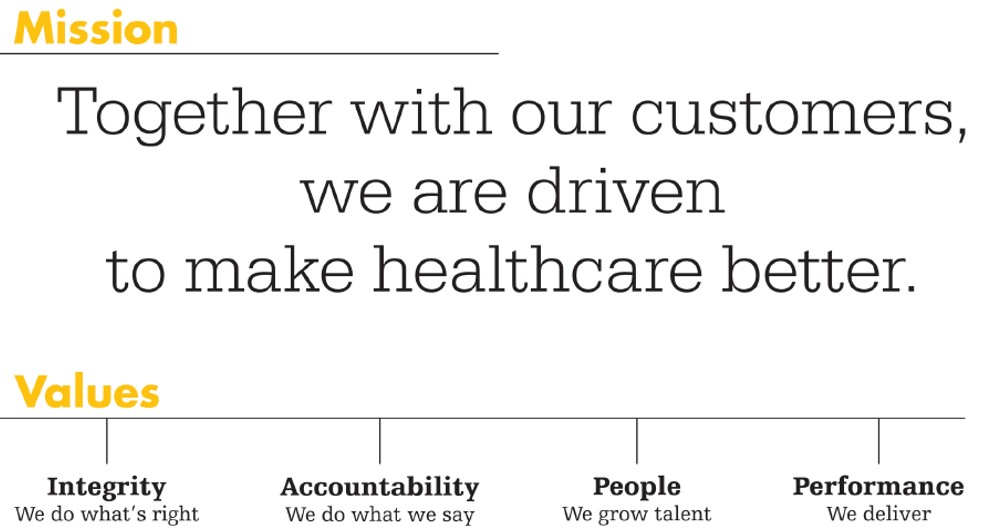
Stryker Corporation (Stryker or the Company) is one of the world's leading medical technology companies and, together with its customers, is driven to make healthcare better. Stryker offers innovative products and services in Medical and Surgical, Neurotechnology, Orthopaedics and Spine that help improve patient and hospital outcomes.
Our core values guide our behaviors and actions and are fundamental to how we execute our mission.
Stryker was incorporated in Michigan in 1946 as the successor company to a business founded in 1941 by Dr. Homer H. Stryker, a prominent orthopaedic surgeon and the inventor of several medical products. Our products are sold in over 75 countries through company-owned subsidiaries and branches, as well as, third-party dealers and distributors, and include surgical equipment and surgical navigation systems; endoscopic and communications systems; patient handling, emergency medical equipment and intensive care disposable products; neurosurgical and neurovascular devices; implants used in joint replacement and trauma surgeries; Mako Robotic-Arm Assisted technology; spinal devices; as well as other products used in a variety of medical specialties. In the United States most of our products are marketed directly to doctors, hospitals and other healthcare facilities.
As used herein, and except where the context otherwise requires, "Stryker," "we," "us," and "our" refer to Stryker Corporation and its consolidated subsidiaries.
Business Segments and Geographic Information
Effective December 31, 2021 we changed our reportable business segments to (i) MedSurg and Neurotechnology and (ii) Orthopaedics and Spine to align to our new internal reporting structure. We have reflected this change in all historical periods presented. Financial information regarding our reportable business segments and certain geographic information is included under "Consolidated Results of Operations" in Item 7 of this report and Note 14 to our Consolidated Financial Statements.
| Net Sales by Reportable Segment | ||||||||||||||||||||||||||
| 2021 | 2020 | 2019 | ||||||||||||||||||||||||
| MedSurg and Neurotechnology | $ | 9,538 | 56 | % | $ | 8,345 | 58 | % | $ | 8,475 | 57 | % | ||||||||||||||
| Orthopaedics and Spine | 7,570 | 44 | 6,006 | 42 | 6,409 | 43 | ||||||||||||||||||||
| Total | $ | 17,108 | 100 | % | $ | 14,351 | 100 | % | $ | 14,884 | 100 | % |
MedSurg and Neurotechnology
MedSurg products include surgical equipment, patient and caregiver safety technologies, and navigation systems
(Instruments), endoscopic and communications systems (Endoscopy), patient handling, emergency medical equipment and intensive care disposable products (Medical), reprocessed and remanufactured medical devices, and other medical device products used in a variety of medical specialties. Neurotechnology includes neurosurgical, neurovascular and craniomaxillofacial implant products. Our neurotechnology offering includes products used for minimally invasive endovascular procedures; a comprehensive line of products for traditional brain and open skull based surgical procedures; orthobiologic and biosurgery products, including synthetic bone grafts and vertebral augmentation products (Neuro Cranial); and minimally invasive products for the treatment of acute ischemic and hemorrhagic stroke (Neurovascular). The craniomaxillofacial implant offering includes cranial, maxillofacial, and chest wall devices, as well as, dural substitutes and sealants.
We are one of five leading global competitors in Instruments; the other four being Zimmer Biomet Holdings, Inc. (Zimmer), Medtronic plc., Johnson & Johnson and ConMed Linvatec, Inc. (a subsidiary of CONMED Corporation). In Endoscopy we compete with Karl Storz GmbH & Co., Olympus Optical Co. Ltd., Smith & Nephew plc (Smith & Nephew), ConMed Linvatec, Arthrex, Inc. and STERIS plc. In Medical our primary competitors are Baxter/Hill-Rom, Inc., Zoll Medical Corporation, Medline Industries and Ferno-Washington, Inc. Stryker is also one of five leading global competitors in Neurotechnology; the other four being Medtronic, Johnson & Johnson, Terumo Corporation and Penumbra, Inc.
| Composition of MedSurg and Neurotechnology Net Sales | ||||||||||||||||||||||||||
| 2021 | 2020 | 2019 | ||||||||||||||||||||||||
| Instruments | $ | 2,111 | 22 | % | $ | 1,863 | 22 | % | $ | 1,959 | 23 | % | ||||||||||||||
| Endoscopy | 2,141 | 22 | 1,763 | 21 | 1,983 | 23 | ||||||||||||||||||||
| Medical | 2,607 | 27 | 2,524 | 30 | 2,264 | 27 | ||||||||||||||||||||
| Neurovascular | 1,188 | 13 | 973 | 12 | 924 | 11 | ||||||||||||||||||||
| Neuro Cranial | 1,214 | 13 | 972 | 12 | 1,059 | 13 | ||||||||||||||||||||
| Other | 277 | 3 | 250 | 3 | 286 | 3 | ||||||||||||||||||||
| Total | $ | 9,538 | 100 | % | $ | 8,345 | 100 | % | $ | 8,475 | 100 | % |
In 2021 Instruments launched a T7 helmet with increased comfort and disposables in orthopaedic instruments, and had strong second year sales of TPX next generation corded power tools for conducting small bone orthopaedic procedures. Endoscopy launched the SLX surgical light portfolio to improve safety in the operating room through customized lighting. In addition, Endoscopy launched the InSpace balloon, the industry’s first balloon implant for arthroscopic treatment of massive, irreparable rotator cuff tears (MIRCTs). Medical increased penetration and focus in their broad portfolio with significant investment in their specialized sales forces.
In 2021 we furthered our expansion into the global flow diversion market with the continued launch of the next generation Surpass Evolve™ Flow Diverter in the United States and Brazil, as well as the Surpass Streamline™ Flow Diverter in China and Japan. Also in 2021 we continued the launches of the Trevo NXT and Vecta Aspiration Catheter families, as well as the next generation of the market leading Synchro guidewire in multiple regions of the world.
Orthopaedics and Spine
Orthopaedics products consist primarily of implants used in total joint replacements, such as hip, knee and shoulder, and trauma and extremities surgeries. We bring patients and physicians advanced implant designs and specialized instrumentation that make orthopaedic surgery and recovery simpler, faster and more effective. We support surgeons with the technology and services they need as they develop new surgical techniques. The Mako
| Dollar amounts in millions except per share amounts or as otherwise specified. | 1 |
STRYKER CORPORATION 2021 FORM 10-K
Robotic-Arm Assisted Surgical System was designed to help surgeons provide patients with a personalized surgical experience based on their specific diagnosis and anatomy. The Mako System currently offers three applications supporting Partial Knee, Total Hip and Total Knee procedures. Mako is the only robotic-arm assisted technology enabled by 3D CT-based pre-operative planning and, with AccuStop™ haptic technology, Mako provides surgeons the ability to know more about their patients' anatomy so they can cut less in bone preparation and implant placement with intra-operative haptic guidance.
Our spinal implant offering includes cervical and thoracolumbar systems that include fixation, minimally invasive and interbody systems used in spinal injury, complex spine and degenerative therapies. Our spine enabling technologies portfolio includes best in class imaging solutions, image-guided surgical technology, patient specific implants and digital health solutions supporting surgeons and their patients throughout the continuum of care.
We are one of four leading global competitors for joint replacement and trauma and extremities products and robotics; the other three being Zimmer, DePuy Synthes (a Johnson & Johnson company) and Smith & Nephew. We are one of five leading global competitors in Spine; the other four being Medtronic Sofamor Danek, Inc. (a subsidiary of Medtronic), DePuy Synthes, Nuvasive, Inc. and Globus Medical, Inc.
| Composition of Orthopaedics and Spine Net Sales | ||||||||||||||||||||||||||
| 2021 | 2020 | 2019 | ||||||||||||||||||||||||
| Knees | $ | 1,848 | 25 | % | $ | 1,567 | 26 | % | $ | 1,815 | 28 | % | ||||||||||||||
| Hips | 1,342 | 18 | 1,206 | 20 | 1,383 | 22 | ||||||||||||||||||||
| Trauma and Extremities | 2,664 | 35 | 1,722 | 29 | 1,639 | 26 | ||||||||||||||||||||
| Spine | 1,167 | 15 | 1,047 | 17 | 1,157 | 18 | ||||||||||||||||||||
| Other | 549 | 7 | 464 | 8 | 415 | 6 | ||||||||||||||||||||
| Total | $ | 7,570 | 100 | % | $ | 6,006 | 100 | % | $ | 6,409 | 100 | % |
In 2021 we moved to full commercial launch in the United States, and first clinical use in the European Union and Canada, of the new Tornier Perform Humeral™ shoulder implant system for anatomic and reverse shoulder arthroplasty. United States Food and Drug Administration (FDA) approval was received in 2020, Health Canada approval was received in the first quarter of 2021 and European Union approval is expected in early 2022.
Raw Materials and Inventory
Raw materials essential to our business are generally readily available from multiple sources; however, certain of our raw materials are currently sourced from single suppliers. Substantially all products we manufacture are stocked in inventory, while certain MedSurg products are assembled to order. Where some electronic components have had limited availability due to current global shortages, we have worked closely with suppliers to ensure this temporary supply constraint did not have a material adverse effect on continuity of supply.
Patents and Trademarks
Patents and trademarks are significant to our business to the extent that a product or an attribute of a product represents a unique design or process. Patent protection of such products restricts competitors from duplicating these unique designs and features. We seek to obtain patent protection on our products whenever appropriate for protecting our competitive advantage. On December 31, 2021 we owned approximately 4,458 United States patents and approximately 7,199 patents in other countries.
Seasonality
Our business is generally not seasonal in nature; however, the number of orthopaedic implant surgeries is typically lower in the summer months, and sales of capital equipment are generally
higher in the fourth quarter. The dollar amount of customer backlog orders at any given time is not meaningful to an understanding of our business taken as a whole.
Competition
In each of our product lines we compete with local and global companies. The development of new and innovative products is important to our success in all areas of our business. Competition in research involving the development and improvement of new and existing products and processes is particularly significant. The competitive environment requires substantial investments in continuing research and maintaining sales forces.
We believe our commitment to innovation, quality and service and our reputation differentiates us in the highly competitive product categories in which we operate and enables us to compete effectively. We believe that our competitive position in the future will depend to a large degree on our ability to develop new products and make improvements to existing products.
Regulation
Our businesses are subject to varying degrees of governmental regulation in the countries in which we operate, and the general trend is toward increasingly stringent regulation.
In the United States the Medical Device Amendments of 1976 to the Federal Food, Drug and Cosmetic Act and its subsequent amendments and the regulations issued and proposed thereunder provide for regulation by the FDA of the design, manufacture and marketing of medical devices, including most of our products. Many of our new products fall into FDA classifications that require notification submitted as a 510(k) and review by the FDA before we begin marketing them. Certain of our products require extensive clinical testing, consisting of safety and efficacy studies, followed by pre-market approval (PMA) applications for specific surgical indications. Certain of our products also fall under other FDA classifications, such as drugs and Human Cells, Tissues, and Cellular and Tissue-Based Products.
The FDA's Quality System regulations set forth standards for our product design and manufacturing processes, require the maintenance of certain records and provide for inspections of our facilities by the FDA. There are also certain requirements of state, local and foreign governments that must be complied with in the manufacture and marketing of our products.
The European Union enacted the European Union Medical Device Regulation in May 2017 with an effective date of May 2021, which imposes stricter requirements for the marketing and sale of medical devices, including in the areas of clinical evaluation requirements, quality systems, labeling and post-market surveillance. Additionally, as a result of the exit of the United Kingdom from the European Union (Brexit), new medical device regulations were released by the United Kingdom, which became effective January 1, 2021. A gap analysis against the prior Medical Device Directive (MDD) and a compliance plan are being implemented for both the European Union and United Kingdom regulations to ensure compliance and minimize business disruption. Finally, we are required to comply with the unique regulatory requirements of each country within which we market and sell our products. For example, China's National Medical Products Administration (NMPA) has recently promulgated more stringent regulatory requirements.
Initiatives to limit the growth of general healthcare expenses and hospital costs are ongoing in the markets in which we do business. These initiatives are sponsored by government agencies, legislative bodies and the private sector and include
| Dollar amounts in millions except per share amounts or as otherwise specified. | 2 |
STRYKER CORPORATION 2021 FORM 10-K
price regulation and competitive pricing. It is not possible to predict at this time the long-term impact of such cost containment measures on our future business. In addition, business practices in the healthcare industry are scrutinized, particularly in the United States, by federal and state government agencies. The resulting investigations and prosecutions carry the risk of significant civil and criminal penalties.
Environment
We are subject to various rules and regulation in the United States and internationally related to the protection of human health and the environment. Our operations involve the use of substances regulated under environmental laws, primarily in manufacturing and sterilization processes. We believe our policies, practices and procedures are properly designed to comply, in all material respects, with applicable environmental laws and regulations. We do not expect compliance with these requirements to have a material effect on purchases of property, plant and equipment, cash flows, net earnings or competitive position.
Employees
On December 31, 2021 we had approximately 46,000 employees globally, with approximately 25,000 employees in the United States. Our talented employees are an integral reason for our standing as one of the world's leading medical technology companies where, together with our customers, we are driven to make healthcare better. Our company values of integrity, accountability, people and performance are a key component of that mission. Our people, as one of our core values, continue to be a key focus.
Our success is dependent on our ability to attract the best talent that reflects our diverse communities. To do so, we continue to focus on the basics of creating a great workplace. We believe in attracting the right people, maintaining and building employee engagement and developing our employees. We believe when people are able to do what they do best, they will look forward to coming to work and, in turn, will deliver great business results. Stryker is made up of hardworking, results-oriented people who are driven to go above and beyond for our customers.
Our leadership team and Board of Directors receive regular updates on our people and culture strategy and provide feedback on our strategy and goals, including alignment to mission and values, peer benchmarking and stakeholder feedback.
Employee Development
Our employee development is extensive and exists at all levels of the organization, including company-wide training on our Code of Conduct, job-related technical training and management and leadership training. Our development programs include on-the-job learning, coaching and mentoring, management and leadership development courses, team building and collaboration training and immersive experiences with expert partners.
We encourage all employees to establish individual development plans, in partnership with their manager, to help employees gain the needed development experience to grow their careers.
Employee Engagement
An engaged workplace culture that drives performance and business outcomes is central to our mission. Listening to and learning from our employees forms the foundation of an engaging culture. More than 90% of our global employees participate in our annual engagement survey, which provides a valued platform for listening and allows us to take action based on the feedback collected.
We supplement our annual engagement survey with targeted pulse surveys to gather feedback on topics relevant to the current climate. Additionally, we establish forums for collecting qualitative feedback to gain insights and identify actions we can take to ensure all employees feel included, engaged and able to achieve their full potential.
We also provide tools and resources that enable managers and teams to act on the insights we gain from our surveys and to drive employee engagement and strong business outcomes.
Diversity, Equity and Inclusion (DE&I)
An essential part of our culture is respecting each individual’s strengths and values. Building on this foundation, we are focused on maintaining an inclusive, engaging work environment and prioritizing DE&I in keeping with our values of integrity and people. Our DE&I strategy is centered around these three commitments:
-
Strengthen the diversity of our workforce
-
Advance a culture of inclusion, engagement and belonging
-
Maximize the power of inclusion to drive innovation and growth
We are advancing our commitments through the following actions, among others:
-
Holding leadership accountable through transparent data, performance objectives and inclusion in our business review process
-
Engaging and inspiring all talent and empowering every employee to take action
-
Developing our people and processes by removing barriers and optimizing the power of diverse backgrounds, talents and perspectives
-
Attracting a diverse talent pool through focused outreach and ensuring an objective hiring process
-
Advancing our employee resource groups (ERGs) to expand reach through executive leadership, global presence, funding and aligned strategies
-
Positively impacting our customers and communities through building and strengthening external partnerships
As of December 31, 2021, approximately 36.6% of our global employees were women and 26.0% of our employees in the United States identified as racially or ethnically diverse.
Attracting and Hiring
We understand that every employee drives our success. We focus on attracting, identifying and selecting strong candidates who will be successful at Stryker and ensuring that each person we hire brings the talent, expertise and passion we need to continue to be successful.
Health and Safety
Ensuring our employees' safety is a top priority. It is a responsibility that we share throughout the company and one that has evolved to meet the needs of our workforce during the pandemic. Employees' safety risks vary depending on the roles they perform, so we tailor our safety efforts accordingly.
Competitive Pay and Benefits
Our compensation and benefits programs are designed to attract and retain top talent and to incentivize performance and alignment to our mission and values.
We offer market-competitive base pay and benefits to our employees in countries around the world. We regularly evaluate our compensation and benefit offerings and levels, using
| Dollar amounts in millions except per share amounts or as otherwise specified. | 3 |
STRYKER CORPORATION 2021 FORM 10-K
recognized outside consulting firms to ensure fairness and competitiveness in our offerings.
Most of our employees also have variable components to their compensation packages that reward employees based on individual, business unit and/or company-wide performance.
Our proxy statement provides more detail on the competitive compensation programs we offer.
Information about our Executive Officers
| As of January 31, 2022 | |||||||||||
| Name | Age | Title | First Became an Executive Officer | ||||||||
| Kevin A. Lobo | 56 | Chair, Chief Executive Officer and President | 2011 | ||||||||
| Yin C. Becker | 58 | Vice President, Communications, Public Affairs and Corporate Marketing | 2016 | ||||||||
| William E. Berry Jr. | 56 | Vice President, Chief Accounting Officer | 2014 | ||||||||
| Glenn S. Boehnlein | 60 | Vice President, Chief Financial Officer | 2016 | ||||||||
| M. Kathryn Fink | 52 | Vice President, Chief Human Resources Officer | 2016 | ||||||||
| Robert S. Fletcher | 51 | Vice President, Chief Legal Officer | 2019 | ||||||||
| Viju S. Menon | 54 | Group President, Global Quality and Operations | 2018 | ||||||||
| J. Andrew Pierce | 48 | Group President, MedSurg and Neurotechnology | 2021 | ||||||||
| Spencer S. Stiles | 45 | Group President, Orthopaedics and Spine | 2021 |
Each of our executive officers was elected by our Board of Directors to serve in the office indicated until the first meeting of the Board of Directors following the annual meeting of shareholders in 2022 or until a successor is chosen and qualified or until his or her resignation or removal. Each of our executive officers held the position above or served Stryker in various executive or administrative capacities for at least five years, except for Mr. Fletcher and Mr. Menon. Prior to joining Stryker in April 2019, Mr. Fletcher held various legal leadership roles with Johnson & Johnson for the previous 14 years, most recently as the Worldwide Vice President, Litigation. Prior to joining Stryker in April 2018, Mr. Menon held various senior supply chain leadership roles with Verizon Communications Inc. during the previous eight years, most recently as the Chief Supply Chain Officer.
Available Information
Our main corporate website address is www.stryker.com. Copies of our filings with the United States Securities and Exchange Commission (SEC) are available free of charge on our website within the "Investors Relations" section as soon as reasonably practicable after having been electronically filed or furnished to the SEC. All SEC filings are also available at the SEC's website at www.sec.gov.
Item 1A. RISK FACTORS.
This report contains statements that are not historical facts and are considered "forward-looking statements" within the meaning of the Private Securities Litigation Reform Act of 1995. These statements are based on current projections about operations, industry conditions, financial condition and liquidity. Words that identify forward-looking statements include words such as "may," "could," "will," "should," "possible," "plan," "predict," "forecast," "potential," "anticipate," "estimate," "expect," "project," "intend," "believe," "may impact," "on track," "goal," "strategy" and words and terms of similar substance used in connection with any discussion of future operating or financial performance, an acquisition or our businesses. In addition, any statements that
refer to expectations, projections or other characterizations of future events or circumstances, including any underlying assumptions, are forward-looking statements. Those statements are not guarantees and are subject to risks, uncertainties and assumptions that are difficult to predict. Therefore, actual results could differ materially and adversely from these forward-looking statements. Some important factors that could cause our actual results to differ from our expectations in any forward-looking statements include the risks discussed below.
Our operations and financial results are subject to various risks and uncertainties discussed below that could materially and adversely affect our business, cash flows, financial condition and results of operations. Additional risks and uncertainties not currently known to us or that we currently deem not to be material may also materially and adversely affect our business, cash flows, financial condition or results of operations.
COVID-19 PANDEMIC RISKS
The COVID-19 pandemic has materially adversely affected, and could continue to materially adversely affect, our operations, supply chain, manufacturing, product distribution, customers and other business activities: The global COVID-19 pandemic has led to severe disruptions in the market and the United States and international economies that may continue for a prolonged duration and trigger a recession or a period of economic slowdown. In response, various governmental authorities and private enterprises have implemented, and may continue to implement, numerous measures to contain the pandemic, such as travel bans and restrictions, quarantines, shelter-in-place orders and shutdowns. A significant number of our customers, global suppliers, distributors and manufacturing facilities are located in regions that have been affected by the pandemic and those operations have been, and could continue to be, materially affected by restrictive measures implemented in response to the pandemic. As a result, some of our customers, distributors and indirect sales channels have at times been unable to retain employees, distribute or use our products or provide required services. Any delay or shortage in the supply of components or materials or delay in delivering our products may result in our inability to satisfy consumer demand for our products in a timely manner or at all, which could harm our reputation, future sales and profitability. For example, certain of our products contain electronic components and we have experienced, and could continue to experience, limited product availability due to the electronic components shortage in certain product lines. If the shortage persists, we may not be able to obtain electronic components from our suppliers on a timely basis, or at all, or identify any alternative suppliers to provide the electronic components we need to produce our products.
In addition, the pandemic could adversely impact our ability, and the ability of our third-party suppliers, manufacturers, distributors and customers, to retain key employees and ensure the continued service and availability of skilled personnel necessary to run our, and their, complex operations. To the extent our management or other personnel, or the management or other personnel of our third-party suppliers, manufacturers, distributors and customers, are impacted in significant numbers by the pandemic and are not available to perform their job duties, we could experience delays in, or the suspension of, our manufacturing operations, sales activities, research and product development activities, regulatory work streams, clinical development programs and other important commercial and corporate functions.
| Dollar amounts in millions except per share amounts or as otherwise specified. | 4 |
STRYKER CORPORATION 2021 FORM 10-K
Moreover, the actions we take to mitigate the effect of the pandemic on our workforce could reduce the efficiency of our operations or prove insufficient. Our relationships with our employees may be disrupted due to measures implemented in response to the COVID-19 pandemic. We have observed an overall tightening and increasingly competitive labor market due to labor shortages caused in part by the COVID-19 pandemic and responsive measures, which has included increased wages offered by other employers and voluntary attrition of our employees and the employees of our third-party suppliers, manufacturers, distributors and customers.
The extent of the pandemic’s effect on our business and industry will depend on future developments, including the duration, spread and intensity of the pandemic, including future resurgences and/or the spread of variants, and the successful development, distribution and acceptance of vaccines for COVID-19, all of which are uncertain and difficult to predict. We are not able at this time to estimate with certainty the effect of these and other unforeseen factors on our business, but the adverse impact on our business, cash flows, financial condition and results of operations has been, and could in the future be, material. A prolonged impact of COVID-19 also could heighten many of the other risks described in this report.
We have experienced, and may continue to experience, a significant and unpredictable need to adjust our operations as market demand for certain of our products has shifted and continues to shift or as may be mandated by governmental authorities in response to the COVID-19 pandemic: Some of our products are particularly sensitive to reductions in elective medical procedures. Elective medical procedures were suspended or reduced at various times in 2020 and 2021 in many of the markets where our products are marketed and sold, which negatively affected our business, cash flows, financial condition and results of operations. It is not possible to predict whether elective medical procedures will again be suspended or reduced in the future and, to the extent individuals and customers are required to continue to de-prioritize, delay or cancel elective procedures as a result of the COVID-19 pandemic or otherwise, our business, cash flows, financial condition and results of operations could be negatively affected.
In addition, our products in certain divisions, such as Medical, have experienced, and could continue to experience, higher demand as our customers focus on treating COVID-19 patients. Unpredictable increases in demand for certain of our products have exceeded in the past, and could exceed in the future, our capacity to meet such demand timely, which could adversely affect our customer relationships and result in negative publicity. In this regard, the accelerated development and production of products and services in an effort to address medical and other requirements as a result of the pandemic could increase the risk of regulatory enforcement actions, product defects or related claims.
LEGAL AND REGULATORY RISKS
Current economic and political conditions make tax rules in jurisdictions subject to significant change: Our future results of operations could be affected by changes in the effective tax rate as a result of changes in tax laws, regulations and judicial rulings. We are continuing to evaluate the impact of tax reform in the countries in which we operate as new guidance and regulations are published. In addition, further changes in the tax laws could arise, including as a result of the base erosion and profit shifting (BEPS) project undertaken by the Organisation for
Economic Cooperation and Development (OECD). The OECD, which represents a coalition of member countries, has issued recommendations that, in some cases, would make substantial changes to numerous long-standing tax positions and principles. These contemplated changes, to the extent adopted by OECD members and/or other countries, could increase tax uncertainty and may adversely affect our provision for income taxes.
We could be negatively impacted by future changes in the allocation of income to each of the income tax jurisdictions in which we operate: We operate in multiple income tax jurisdictions both in the United States and internationally. Accordingly, our management must determine the appropriate allocation of income to each jurisdiction based on current interpretations of complex income tax regulations. Income tax authorities regularly perform audits of our income tax filings. Income tax audits associated with the allocation of income and other complex issues, including inventory transfer pricing and cost sharing, product royalty and foreign branch arrangements, may require an extended period of time to resolve and may result in significant income tax adjustments.
The impact of United States healthcare reform legislation on our business remains uncertain: In 2010 the Patient Protection and Affordable Care Act (ACA) was enacted. While the provisions of the ACA are intended to expand access to health insurance coverage and improve the quality of healthcare over time, other provisions of the legislation, including Medicare provisions aimed at decreasing costs, comparative effectiveness research, an independent payment advisory board and pilot programs to evaluate alternative payment methodologies, are having a meaningful effect on the way healthcare is developed and delivered and could have a significant effect on our business. There have been ongoing litigation and congressional efforts to modify or repeal all or certain provisions of the ACA. We face uncertainties that might result from modification or repeal of any of the provisions of the ACA, including as a result of current and future executive orders and legislative actions. We cannot predict what other healthcare programs and regulations will ultimately be implemented at the federal or state level or the effect that any future legislation or regulation in the United States may have on our business.
We are subject to extensive governmental regulation relating to the classification, manufacturing, sterilization, labeling, marketing and sale of our products: The classification, manufacturing, sterilization, labeling, marketing and sale of our products are subject to extensive and evolving regulations and rigorous regulatory enforcement by the FDA, European Union, the NMPA in China, and other governmental authorities in the United States and internationally. The process of obtaining regulatory clearances and/or approvals to market and sell our products can be costly and time consuming and the clearances and/or approvals might not be granted timely. We have ongoing responsibilities under the laws and regulations applicable to the manufacturing of products within our facilities and those contracted by third parties that are subject to periodic inspections by the FDA and other governmental authorities to determine compliance with the quality system, medical device reporting regulations and other requirements. Costs to comply with regulations, including the European Union Medical Device Regulation enacted by the European Union in May 2017 and effective in May 2021, the free trade agreement between the United Kingdom and the European Union that became effective January 1, 2021, and the regulatory laws established by the NMPA in China, and costs associated with remediation can be significant. If we fail to comply with applicable regulatory
| Dollar amounts in millions except per share amounts or as otherwise specified. | 5 |
STRYKER CORPORATION 2021 FORM 10-K
requirements, we may be subject to a range of sanctions, including substantial fines, warning letters that require corrective action, product seizures, recalls, the suspension of product manufacturing, revocation of approvals, exclusion from future participation in government healthcare programs, substantial fines and criminal prosecution.
We are subject to federal, state and foreign healthcare regulations, including anti-bribery, anti-corruption, anti-kickback and false claims laws, globally and could face substantial penalties if we fail to comply with such regulations and laws: The relationships that we, and third-parties that market and/or sell our products, have with healthcare professionals, such as physicians, hospitals, healthcare organizations and others, are subject to scrutiny under various state and federal laws often referred to collectively as healthcare fraud and abuse laws. In addition, the United States and foreign government regulators have increased the enforcement of the Foreign Corrupt Practices Act (FCPA) and other anti-bribery and anti-kickback laws. We also must comply with a variety of other laws that impose extensive tracking and reporting related to all transfers of value provided to certain healthcare professionals and others. These laws and regulations are broad in scope and are subject to evolving interpretation and we have in the past been, and in the future could be, required to incur substantial costs to investigate, audit and monitor compliance or to alter our practices. Violations of these laws could result in litigation and we may be subject to criminal or civil penalties and sanctions, including substantial fines, imprisonment of current or former employees and exclusion from participation in governmental healthcare programs. In 2013 and 2018 we settled claims brought by the United States Securities and Exchange Commission (SEC) related to the FCPA. Pursuant to these settlements, we paid fines and penalties and retained an independent compliance consultant. We continue to implement recommendations that resulted from the independent compliance consultant’s review of our commercial practices to enhance our commercial business practices.
We are subject to privacy, data protection and data security regulations and laws globally, and could face substantial penalties if we fail to comply with such regulations and laws: We are subject to a variety of laws and regulations globally regarding privacy, data protection, and data security, including those related to the collection, storage, handling, use, disclosure, transfer, and security of personally identifiable healthcare information. For example, in the United States, privacy and security regulations under the Health Insurance Portability and Accountability Act of 1996, including the expanded requirements under the Health Information Technology for Economic and Clinical Health Act of 2009, establish comprehensive standards with respect to the use and disclosure of protected health information (PHI), by covered entities, in addition to setting standards to protect the confidentiality, integrity and security of PHI. Further, the European Union’s General Data Protection Regulation (GDPR), which became effective in May 2018, applies to all of our activities related to products and services that we offer to European Union customers and employees. The GDPR established requirements regarding the handling of personal data and includes significant penalties for non-compliance (including possible fines of up to 4% of total company revenue). Other governmental authorities around the world are considering similar types of legislative and regulatory proposals concerning data protection, which could impose significant limitations and increase our cost of providing our products and services where we process personal data. These laws and regulations are broad
in scope and are subject to evolving interpretation and we have in the past been, and in the future could be, required to incur substantial costs to monitor compliance or to alter our practices.
We may be adversely affected by product liability claims, unfavorable court decisions or legal settlements: We are exposed to potential product liability risks inherent in the design, manufacture and marketing of medical devices, many of which are implanted in the human body for long periods of time or indefinitely. We may be exposed to additional potential product liability risks related to products designed, manufactured and marketed in response to the COVID-19 pandemic, including discretionary products and products permitted under the Emergency Use Authorization granted by the FDA. We are currently defendants in a number of product liability matters, including those relating to our Rejuvenate and ABGII Modular-Neck hip stems, LFIT Anatomic CoCr V40 Femoral Heads and the product liability lawsuits and claims relating to Wright legacy hip products discussed in Note 7 to our Consolidated Financial Statements. These matters are subject to many uncertainties and outcomes are not predictable. Further, in November 2020 the European Parliament voted in favor of the European Representative Actions Directive (the Collective Redress Directive), which mandates a class action regime in each member state to facilitate domestic and cross-border class actions in a wide range of areas, including product liability claims with medical devices. The Collective Redress Directive will take effect in 2023 after a 24-month implementation period. The Collective Redress Directive, when implemented, could result in additional litigation risks and significant legal expenses for us. In addition, we may incur significant legal expenses for product liability claims regardless of whether we are found to be liable.
Intellectual property litigation and infringement claims could cause us to incur significant expenses or prevent us from selling certain of our products: The medical device industry is characterized by extensive intellectual property litigation and, from time to time, we are the subject of claims of infringement or misappropriation. Regardless of outcome, such claims are expensive to defend and divert management and operating personnel from other business issues. A successful claim or claims of patent or other intellectual property infringement against us could result in payment of significant monetary damages and/or royalty payments or negatively impact our ability to sell current or future products in the affected category.
Dependence on patent and other proprietary rights and failing to protect such rights or to be successful in litigation related to such rights may impact offerings in our product portfolios: Our long-term success largely depends on our ability to market technologically competitive products. If we fail to obtain or maintain adequate intellectual property protection, it could allow others to sell products that directly compete with proprietary features in our product portfolio. Also, our issued patents may be subject to claims challenging their validity and scope and raising other issues. In addition, currently pending or future patent applications may not result in issued patents.
MARKET RISKS
We have exposure to exchange rate fluctuations on cross border transactions and translation of local currency results into United States Dollars: We report our financial results in United States Dollars and approximately 30% of our net sales are denominated in foreign currencies, including the Australian Dollar, British Pound, Canadian Dollar, Chinese Yuan, Euro and Japanese Yen. Cross border transactions with external parties and intercompany relationships result in increased exposure to
| Dollar amounts in millions except per share amounts or as otherwise specified. | 6 |
STRYKER CORPORATION 2021 FORM 10-K
foreign currency exchange effects. While we use derivative instruments to manage the impact of currency exchange, our hedging strategies may not be successful, and our unhedged exposures continue to be subject to currency fluctuations. In addition, the weakening or strengthening of the United States Dollar results in favorable or unfavorable translation effects when the results of our foreign locations are translated into United States Dollars.
Additional capital that we may require in the future may not be available to us or may only be available to us on unfavorable terms, which could negatively affect our liquidity: Our future capital requirements will depend on many factors, including operating requirements, current and future acquisitions and the need to refinance existing debt. Our ability to issue additional debt or enter into other financing arrangements on acceptable terms could be adversely affected by our debt levels, unfavorable changes in economic conditions or uncertainties that affect the capital markets, including disruption caused by the COVID-19 pandemic. Changes in credit ratings issued by nationally recognized credit rating agencies could also adversely affect our access to and cost of financing. Higher borrowing costs or the inability to access capital markets could adversely affect our ability to support future growth and operating requirements. In addition, we have experienced, and could continue to experience, loss of sales and profits due to delayed payments or insolvency of healthcare professionals, hospitals and other customers and suppliers facing liquidity issues caused by the COVID-19 pandemic. As a result, we may be compelled to take additional measures to preserve our cash flow, including through the reduction of operating expenses or suspension of dividend payments, at least until the consequences of the pandemic subside.
BUSINESS AND OPERATIONAL RISKS
We are subject to cost containment measures in the United States and other countries resulting in pricing pressures: Initiatives to limit the growth of general healthcare expenses and hospital costs are ongoing in the markets in which we do business. These initiatives are sponsored by government agencies, legislative bodies and the private sector and include price regulation and competitive pricing. For example, China has implemented a volume-based procurement process designed to decrease prices for medical devices and other products. This has already impacted our joint replacement business on a national level, and our trauma and spine products on a provincial level, and we expect further adoption of volume-based procurement provincially or nationally in China in 2022. Pricing pressure has also increased due to continued consolidation among healthcare providers, trends toward managed care, the shift toward governments becoming the primary payers of healthcare expenses, reduction in reimbursement levels and medical procedure volumes and government laws and regulations relating to sales and promotion, reimbursement and pricing generally.
We operate in a highly competitive industry in which competition in the development and improvement of new and existing products is significant: The markets in which we compete are highly competitive. New business models, products and surgical procedures are introduced on an ongoing basis and our present or future products could be rendered obsolete or uneconomical by technological advances by us, as we continue to innovate to address physician and patient needs, or by our existing competitors and new market entrants. Our existing competitors and new market entrants may respond more quickly to new or emerging technologies, undertake more extensive marketing campaigns, have greater access to clinical information
to support ongoing product position in the market, have greater financial, marketing and other resources or be more successful in attracting potential customers, employees and strategic partners.
We may be unable to maintain adequate working relationships with healthcare professionals: We seek to maintain close working relationships with respected physicians and medical personnel in healthcare organizations, such as hospitals and universities, who assist in product research and development. We rely on these professionals to assist us in the development and improvement of proprietary products. As a result of the COVID-19 pandemic, our access to these professionals has been limited as hospitals have restricted access for non-patients, including our research and development specialists and other employees, and governmental authorities have imposed travel restrictions, shutdowns or similar measures, which has adversely affected our ability to develop, market and sell products. If we are unable to maintain these relationships, our ability to develop, market and sell new and improved products could be further adversely affected.
We rely on indirect distribution channels and major distributors that are independent of Stryker: In many markets, we rely on indirect distribution channels to market, distribute, and sell our products. These indirect channels often are the main point of contact for the healthcare professionals and healthcare organization customers who buy and use our products. Our ability to market, distribute, and sell our products through indirect channels has been adversely affected as a result of precautionary responses to the COVID-19 pandemic, including travel restrictions, suspension and shutdown orders and other measures intended to limit person-to-person contact. Our ability to continue to market, distribute, and sell our products may be at risk if the indirect channels become insolvent, choose to sell competitive products, choose to stop selling medical technology, or are subject to new or additional government regulation, whether related to the COVID-19 pandemic or for unrelated reasons.
We are subject to risks associated with our extensive global operations: We develop, manufacture and distribute our products globally. Our global operations are subject to risks and potential costs, including changes in reimbursement, changes in regulatory requirements, differing local product preferences and product requirements, diminished protection of intellectual property in some countries, tariffs and other trade protection measures, international trade disputes and import or export requirements, difficulty in staffing and managing foreign operations, introduction of new internal business structures and programs, political and economic instability, such as the United Kingdom's exit from the European Union (Brexit), and disruptions of transportation due to a global pandemic of contagious diseases like COVID-19 or otherwise, such as reduced availability of transportation, port closures, increased border controls or closures, increased transportation costs and increased security threats to our supply chain. Our business could be adversely impacted if we are unable to successfully manage these and other risks of global operations in an increasingly volatile environment.
We may be unable to capitalize on previous or future acquisitions: In addition to internally developed products, we invest in new products and technologies through acquisitions, including our pending acquisition of Vocera Communications, Inc. Such investments are inherently risky, and we cannot guarantee that any acquisition will be successful or will not have a material unfavorable impact on us. The risks include the activities required and resources allocated to integrate new businesses, diversion of
| Dollar amounts in millions except per share amounts or as otherwise specified. | 7 |
STRYKER CORPORATION 2021 FORM 10-K
management time that could adversely affect management's ability to focus on other projects, the inability to realize the expected benefits, savings or synergies from the acquisition, the loss of key personnel, litigation resulting from the acquisition and exposure to unexpected liabilities of acquired companies. In addition, we cannot be certain that the businesses we acquire will become or remain profitable.
We could experience a failure of a key information technology system, process or site or a breach of information security, including a cybersecurity breach or failure of one or more key information technology systems, networks, processes, associated sites or service providers: We rely extensively on information technology (IT) systems to conduct business. In addition, we rely on networks and services, including internet sites, cloud and SaaS solutions, data hosting and processing facilities and tools and other hardware, software (including open source software) and technical applications and platforms, some of which are managed, hosted, provided and/or used by third-parties or their vendors, to assist in conducting our business. Numerous and evolving cybersecurity threats have posed, and will continue to pose, risks to the security of our IT systems, networks and product offerings, as well as the confidentiality, availability and integrity of our data. Some of our products and services, and information technology systems, contain or use open source software, which poses particular risks, including potential security vulnerabilities, licensing compliance issues and quality issues. A security breach, whether of our products, of our customers’ network security and systems or of third-party hosting services, could impact the use of such products and the security of information stored therein. While we have made investments seeking to address these threats, including monitoring of networks and systems, hiring of experts, employee training and security policies for employees and third-party providers, the techniques used in these attacks change frequently and may be difficult to detect for periods of time and we may face difficulties in anticipating and implementing adequate preventative measures. In addition, a greater number of our employees working remotely during the COVID-19 pandemic has exposed us, and may continue to expose us, to greater risks related to cybersecurity and cyber-liability. If our IT systems are damaged or cease to function properly, the networks or service providers we rely upon fail to function properly, or we or one of our third-party providers suffer a loss or disclosure of our business or stakeholder information due to any number of causes ranging from catastrophic events or power outages to improper data handling or security breaches and our business continuity plans do not effectively address these failures on a timely basis, we may be exposed to reputational, competitive and business harm as well as litigation and regulatory action.
An inability to successfully manage the implementation of our new commercial global enterprise resource planning (ERP) system could adversely affect our operations and operating results: We are in the process of implementing a new commercial global ERP system. This system will replace many of our existing operating and financial systems. Such an implementation is a major undertaking, both financially and from a management and personnel perspective. Any disruptions, delays or deficiencies in the design and implementation of our new ERP system could adversely affect our ability to process orders, ship products, provide services and customer support, send invoices and track payments, fulfill contractual obligations or otherwise operate our business.
We may be unable to attract and retain key employees: Our sales, technical and other key personnel play an integral role in
the development, marketing and selling of new and existing products. If we are unable to recruit, hire, develop and retain a talented, competitive work force in our highly competitive industry, or if we are unable to plan effective succession for the future, we may not be able to meet our strategic business objectives. In addition, if we are unable to maintain an inclusive culture that aligns our diverse work force with our mission and values, this could adversely impact our ability to recruit, hire, develop and retain key talent. Further, the ongoing remote work environment in response to COVID-19 could harm our culture and/or decrease employee engagement, which could adversely impact our ability to recruit, hire, develop and retain a talented, competitive work force.
Interruption of manufacturing operations could adversely affect our business: We and our suppliers have manufacturing and supply sites all over the world; however, the manufacturing of certain of our product lines is concentrated in one or more plants or geographic regions. We have principal manufacturing and distribution facilities in the United States in Arizona, California, Florida, Illinois, Indiana, Michigan, Minnesota, New Jersey, Tennessee, Texas, Utah, Virginia and Washington, and outside the United States in China, France, Germany, Ireland, Mexico, the Netherlands, Puerto Rico, Switzerland and Turkey. Damage to our facilities, to our suppliers’ or service providers' facilities, or to our central distribution centers as a result of natural disasters, fires, explosions or otherwise, as well as issues in our manufacturing arising from a failure to follow specific internal protocols and procedures, compliance concerns relating to the quality systems regulation, equipment breakdown or malfunction, IT system failures or cybersecurity incidents, environmental hazard incidents or changes to environmental regulations or other factors, could adversely affect the availability of our products. In the event of an interruption in manufacturing, we may be unable to move quickly to alternate means of producing affected products to meet customer demand. In the event of a significant interruption, we may experience lengthy delays in resuming production of affected products due to the need for regulatory approvals, and we may experience loss of market share, additional expense and harm to our reputation.
We use a variety of raw materials, components, devices and third-party services in our global supply chains, production and distribution processes; significant shortages, price increases or unavailability of third-party services could increase our operating costs, require significant capital expenditures, or adversely impact the competitive position of our products: Our reliance on certain suppliers to secure raw materials, components and finished devices, and on certain third-party service providers, such as sterilization service providers, exposes us to product shortages and unanticipated increases in prices, whether due to inflationary pressure, regulatory changes or otherwise. In addition, several raw materials, components, finished devices and services are procured from a sole-source due to the quality considerations, unique intellectual property considerations or constraints associated with regulatory requirements. If sole-source suppliers or service providers are acquired or were unable or unwilling to deliver these materials or services, we may not be able to manufacture or have available one or more products during such period of unavailability and our business could suffer. In certain cases we may not be able to establish additional or replacement suppliers for such materials or service providers for such services in a timely or cost effective manner, largely as a result of FDA and other regulations that require, among other things, validation of materials, components and services prior to their use in or with our products. In addition,
| Dollar amounts in millions except per share amounts or as otherwise specified. | 8 |
STRYKER CORPORATION 2021 FORM 10-K
during 2021, the market experienced increasing inflationary pressures in part due to global supply chain disruptions, labor shortages and other impacts of the COVID-19 pandemic, which we anticipate will continue in 2022. We may experience inflationary increases in manufacturing costs and operating expenses, caused by the COVID-19 pandemic or as a result of general macroeconomic factors, and may not be able to pass these cost increases on to our customers in a timely manner, which could have a material adverse impact on our profitability and results of operations.
Our insurance program may not be adequate to cover future losses: We maintain third-party insurance to cover our exposure to certain property and casualty losses and are self-insured for claims and expenses related to other property and casualty losses, including product liability, intellectual property infringement and enforcement, environmental, and cybersecurity and data privacy losses. We manage a portion of our exposure to self-insured losses through a wholly-owned captive insurance company. Insurance coverage limits provided by third-party insurers and/or our captive insurance company may not be sufficient to fully cover unanticipated losses.
ENVIRONMENTAL, SOCIAL AND GOVERNANCE (ESG) RISKS
We could be negatively impacted by ESG and sustainability-related matters: Governments, investors, customers, employees and other stakeholders are increasingly focusing on corporate ESG practices and disclosures, and expectations in this area are rapidly evolving. On occasion, we announce new initiatives, including goals, under our Corporate Responsibility framework. This framework is aligned with our areas of interest, which include environment and sustainability, social impact, diversity, equity and inclusion and supply chain management, among others. The criteria by which our ESG practices are assessed may change due to the quickly evolving landscape, which could result in greater expectations of us and cause us to undertake costly initiatives to satisfy such new criteria. Moreover, the increasing attention to corporate ESG initiatives could also result in reduced demand for products, reduced profits and increased investigations and litigation. If we are unable to satisfy such new criteria, investors may conclude that our policies and/or actions with respect to ESG matters are inadequate. If we fail or are perceived to have failed to achieve previously announced initiatives or goals or to accurately disclose our progress on such initiatives or goals, our reputation, business, financial condition and results of operations could be adversely impacted.
Physical effects of climate change or legal, regulatory or market measures intended to address climate change could adversely affect our operations and operating results: Risks associated with climate change are subject to increasing societal, regulatory and political focus in the United States and globally. Shifts in weather patterns caused by climate change are expected to increase the frequency, severity or duration of certain adverse weather conditions and natural disasters, such as hurricanes, tornadoes, earthquakes, wildfires, droughts, extreme temperatures or flooding, which could cause more significant business and supply chain interruptions, damage to our products and facilities as well as the infrastructure of hospitals, medical care facilities and other customers, reduced workforce availability, increased costs of raw materials and components, increased liabilities, and decreased revenues than what we have experienced in the past from such events. In addition, increased public concern over climate change could result in new legal or regulatory requirements designed to mitigate the effects of
climate change, which could include the adoption of more stringent environmental laws and regulations or stricter enforcement of existing laws and regulations. Such developments could result in increased compliance costs and adverse impacts on raw material sourcing, manufacturing operations and the distribution of our products, which could adversely affect our operations and operating results.
Item 1B. UNRESOLVED STAFF COMMENTS.
None.
Item 2. PROPERTIES.
We have approximately 28 company-owned and 328 leased locations worldwide including 50 manufacturing locations. We believe that our properties are in good operating condition and adequate for the manufacture and distribution of our products. We do not anticipate difficulty in renewing existing leases as they expire or in finding alternative facilities.
Item 3. LEGAL PROCEEDINGS.
We are involved in various proceedings, legal actions and claims arising in the normal course of business, including proceedings related to product, labor and intellectual property, and the matters described in more detail in Note 7 to our Consolidated Financial Statements.
Item 4. MINE SAFETY DISCLOSURES.
Not applicable.
| PART II |
Item 5. MARKET FOR THE REGISTRANT’S COMMON EQUITY, RELATED STOCKHOLDER MATTERS AND ISSUER PURCHASES OF EQUITY SECURITIES.
Our common stock is traded on the New York Stock Exchange under the symbol SYK.
Our Board of Directors considers payment of cash dividends at its quarterly meetings. On January 31, 2022 there were 2,543 shareholders of record of our common stock.
We did not repurchase any shares in the three months ended December 31, 2021 and the total dollar value of shares that could be acquired under our authorized repurchase program at December 31, 2021 was $1,033.
In the fourth quarter 2021 we did not issue shares of our common stock as performance incentive awards to employees. When issued, these shares are not registered under the Securities Act of 1933 based on the conclusion that the awards would not be events of sale within the meaning of Section 2(a)(3) of the Act.
| Dollar amounts in millions except per share amounts or as otherwise specified. | 9 |
STRYKER CORPORATION 2021 FORM 10-K
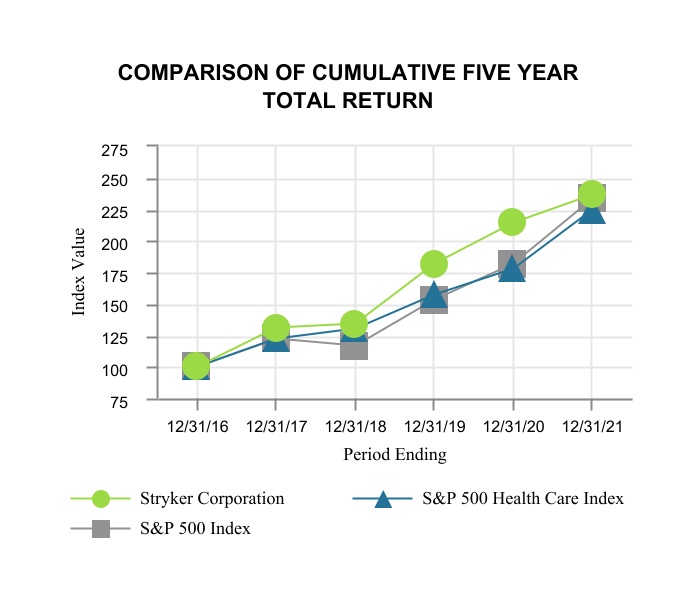
The following graph compares our total returns (including reinvestments of dividends) against the Standard & Poor’s (S&P) 500 Index and the S&P 500 Health Care Index. The graph assumes $100 (not in millions) invested on December 31, 2016 in our common stock and each of the indices.
| Company / Index | 2016 | 2017 | 2018 | 2019 | 2020 | 2021 | ||||||||||||||
| Stryker Corporation | $ | 100.00 | $ | 130.84 | $ | 134.02 | $ | 181.37 | $ | 214.32 | $ | 236.24 | ||||||||
| S&P 500 Index | $ | 100.00 | $ | 121.83 | $ | 116.49 | $ | 153.17 | $ | 181.35 | $ | 233.41 | ||||||||
| S&P 500 Health Care Index | $ | 100.00 | $ | 122.08 | $ | 129.97 | $ | 157.04 | $ | 178.15 | $ | 224.71 |
| Dollar amounts in millions except per share amounts or as otherwise specified. | 10 |
STRYKER CORPORATION 2021 FORM 10-K
Item 6. SELECTED FINANCIAL DATA.
| Statement of Earnings Data | 2021 | 2020 | 2019 | 2018 | 2017 | |||||||||||||||||||||||||||
| Net sales | $ | 17,108 | $ | 14,351 | $ | 14,884 | $ | 13,601 | $ | 12,444 | ||||||||||||||||||||||
| Cost of sales | 6,140 | 5,294 | 5,188 | 4,663 | 4,264 | |||||||||||||||||||||||||||
| Gross profit | $ | 10,968 | $ | 9,057 | $ | 9,696 | $ | 8,938 | $ | 8,180 | ||||||||||||||||||||||
| Research, development and engineering expenses | 1,235 | 984 | 971 | 862 | 787 | |||||||||||||||||||||||||||
| Selling, general and administrative expenses | 6,427 | 5,361 | 5,356 | 5,099 | 4,552 | |||||||||||||||||||||||||||
| Recall charges | 103 | 17 | 192 | 23 | 173 | |||||||||||||||||||||||||||
| Amortization of intangible assets | 619 | 472 | 464 | 417 | 371 | |||||||||||||||||||||||||||
| Total operating expenses | $ | 8,384 | $ | 6,834 | $ | 6,983 | $ | 6,401 | $ | 5,883 | ||||||||||||||||||||||
| Operating income | $ | 2,584 | $ | 2,223 | $ | 2,713 | $ | 2,537 | $ | 2,297 | ||||||||||||||||||||||
| Other income (expense), net | (303) | (269) | (151) | (181) | (234) | |||||||||||||||||||||||||||
| Earnings before income taxes | $ | 2,281 | $ | 1,954 | $ | 2,562 | $ | 2,356 | $ | 2,063 | ||||||||||||||||||||||
| Income taxes | 287 | 355 | 479 | (1,197) | 1,043 | |||||||||||||||||||||||||||
| Net earnings | $ | 1,994 | $ | 1,599 | $ | 2,083 | $ | 3,553 | $ | 1,020 | ||||||||||||||||||||||
| Net earnings per share of common stock: | ||||||||||||||||||||||||||||||||
| Basic | $ | 5.29 | $ | 4.26 | $ | 5.57 | $ | 9.50 | $ | 2.73 | ||||||||||||||||||||||
| Diluted | $ | 5.21 | $ | 4.20 | $ | 5.48 | $ | 9.34 | $ | 2.68 | ||||||||||||||||||||||
| Dividends declared per share of common stock | $ | 2.585 | $ | 2.355 | $ | 2.135 | $ | 1.93 | $ | 1.745 | ||||||||||||||||||||||
| Balance Sheet Data | ||||||||||||||||||||||||||||||||
| Cash, cash equivalents and current marketable securities | $ | 3,019 | $ | 3,024 | $ | 4,425 | $ | 3,699 | $ | 2,793 | ||||||||||||||||||||||
| Accounts receivable, net | 3,022 | 2,701 | 2,893 | 2,332 | 2,198 | |||||||||||||||||||||||||||
| Inventories | 3,314 | 3,494 | 2,980 | 2,955 | 2,465 | |||||||||||||||||||||||||||
| Property, plant and equipment, net | 2,833 | 2,752 | 2,567 | 2,291 | 1,975 | |||||||||||||||||||||||||||
| Total assets | $ | 34,631 | $ | 34,330 | $ | 30,167 | $ | 27,229 | $ | 22,197 | ||||||||||||||||||||||
| Accounts payable | 1,129 | 810 | 675 | 646 | 487 | |||||||||||||||||||||||||||
| Total debt | 12,479 | 13,991 | 11,090 | 9,859 | 7,222 | |||||||||||||||||||||||||||
| Shareholders’ equity | $ | 14,877 | $ | 13,084 | $ | 12,807 | $ | 11,730 | $ | 9,980 | ||||||||||||||||||||||
| Cash Flow Data | ||||||||||||||||||||||||||||||||
| Net cash provided by operating activities | $ | 3,263 | $ | 3,277 | $ | 2,191 | $ | 2,610 | $ | 1,559 | ||||||||||||||||||||||
| Purchases of property, plant and equipment | 525 | 487 | 649 | 572 | 598 | |||||||||||||||||||||||||||
| Depreciation | 371 | 340 | 314 | 306 | 271 | |||||||||||||||||||||||||||
| Acquisitions, net of cash acquired | 339 | 4,222 | 802 | 2,451 | 831 | |||||||||||||||||||||||||||
| Amortization of intangible assets | 619 | 472 | 464 | 417 | 371 | |||||||||||||||||||||||||||
| Payments of dividends | 950 | 863 | 778 | 703 | 636 | |||||||||||||||||||||||||||
| Repurchase of common stock | — | — | 307 | 300 | 230 | |||||||||||||||||||||||||||
| Other Data | ||||||||||||||||||||||||||||||||
| Number of shareholders of record | 2,551 | 2,597 | 2,636 | 2,732 | 2,850 | |||||||||||||||||||||||||||
| Approximate number of employees | 46,000 | 43,000 | 40,000 | 36,000 | 33,000 |
| Dollar amounts in millions except per share amounts or as otherwise specified. | 11 |
STRYKER CORPORATION 2021 FORM 10-K
Item 7. MANAGEMENT’S DISCUSSION AND ANALYSIS OF FINANCIAL CONDITION AND RESULTS OF OPERATIONS.
About Stryker
Stryker is one of the world's leading medical technology companies and, together with our customers, we are driven to make healthcare better. We offer innovative products and services in Medical and Surgical, Neurotechnology, Orthopaedics and Spine that help improve patient and hospital outcomes. Our goal is to achieve sales growth at the high-end of the medical technology (MedTech) industry and maintain our long-term capital allocation strategy that prioritizes: (1) Acquisitions, (2) Dividends and (3) Share repurchases.
COVID-19 Pandemic
The COVID-19 pandemic has led to severe disruptions in the market and the global and United States economies that may continue for a prolonged duration and trigger a recession or a period of economic slowdown. In response, various governmental authorities and private enterprises have implemented numerous measures to contain the pandemic, such as travel bans and restrictions, quarantines, shelter-in-place orders and shutdowns. A significant number of our customers, global suppliers, vendors, distributors and manufacturing facilities are located in regions that have been affected by the pandemic. Those operations have been materially adversely affected by restrictive government and private enterprise measures implemented in response to the pandemic.
Some of our products are particularly sensitive to reductions in elective medical procedures. Elective medical procedures were suspended in the first quarter of 2020 in many of the markets where our products are marketed and sold, which negatively affected our business, cash flows, financial condition and results of operations through the first quarter of 2021. In the second quarter of 2021 we saw partial recovery of elective procedures in most geographies; however, in the third quarter of 2021 we saw hospitalization rates increase, especially in the United States, as a result of the Delta variant. This, along with the Omicron variant, has continued to adversely impact elective procedures and increased inflationary pressure on our gross margin, including an increase in freight and transportation costs as well as increased absenteeism in the fourth quarter of 2021.
Overview of 2021
In 2021 we achieved reported net sales growth of 19.2%. Excluding the impact of acquisitions and divestitures, sales grew 12.6% in constant currency. We reported net earnings of $1,994 and net earnings per diluted share of $5.21. Excluding the impact of certain items, we achieved adjusted net earnings**(1)** of $3,474
and adjusted net earnings per diluted share**(1)** of $9.09 representing growth of 22.3%.
Effective December 31, 2021 we changed our reportable business segments to (i) MedSurg and Neurotechnology and (ii) Orthopaedics and Spine to align to our new internal reporting structure. Refer to Note 14 to our Consolidated Financial Statements for further information.
We continued our capital allocation strategy by investing $339 in acquisitions and paying $950 in dividends to our shareholders.
In 2021 we had total long-term debt repayments of $1,151. In October 2021 we entered into a new revolving credit agreement that replaces our previous agreement dated August 19, 2016. Refer to Note 10 to our Consolidated Financial Statements for further information.
In 2021 we completed acquisitions for total net cash consideration of $339 and $54 in future milestone payments primarily due upon the achievement of certain regulatory and commercial milestones. In September 2021 we completed the acquisition of Gauss Surgical, Inc. (Gauss) for $120 in cash and up to $40 in future milestone payments. Gauss is a medical device company that has developed Triton, an artificial intelligence-enabled platform for real-time monitoring of blood loss during surgery. Gauss is part of our Instruments business within MedSurg and Neurotechnology. In January 2022 we announced a definitive merger agreement to acquire all of the issued and outstanding common shares of Vocera Communications, Inc. (Vocera) for $79.25 per share, or an aggregate purchase price of approximately $3.1 billion (including convertible notes). Refer to Note 6 to our Consolidated Financial Statements for further information.
In 2021 we did not repurchase any shares of our common stock under our authorized repurchase program. The total dollar value of shares of our common stock that could be acquired under our authorized repurchase program was $1,033 as of December 31, 2021.
In 2021 we recorded asset impairments of $264, $105 for certain long-lived and intangible assets related to the China volume-based procurement program and the remaining consisting primarily of in-process research and development, other intangible assets and property, plant and equipment as a result of COVID-19-related demand impacts on in-process product development and certain other divestiture and restructuring activities. Refer to Note 15 to our Consolidated Financial Statements for further information.
(1) Refer to "Non-GAAP Financial Measures" for a discussion of non-GAAP financial measures used in this report and a reconciliation to the most directly comparable GAAP financial measure.
| Dollar amounts in millions except per share amounts or as otherwise specified. | 12 |
STRYKER CORPORATION 2021 FORM 10-K
CONSOLIDATED RESULTS OF OPERATIONS
| Percent Net Sales | Percentage Change | |||||||||||||||||||||||||||||||
| 2021 | 2020 | 2019 | 2021 | 2020 | 2019 | 2021 vs. 2020 | 2020 vs. 2019 | |||||||||||||||||||||||||
| Net sales | $ | 17,108 | $ | 14,351 | $ | 14,884 | 100.0 | % | 100.0 | % | 100.0 | % | 19.2 | % | (3.6) | % | ||||||||||||||||
| Gross profit | 10,968 | 9,057 | 9,696 | 64.1 | 63.1 | 65.1 | 21.1 | (6.6) | ||||||||||||||||||||||||
| Research, development and engineering expenses | 1,235 | 984 | 971 | 7.2 | 6.9 | 6.5 | 25.5 | 1.3 | ||||||||||||||||||||||||
| Selling, general and administrative expenses | 6,427 | 5,361 | 5,356 | 37.6 | 37.4 | 36.0 | 19.9 | 0.1 | ||||||||||||||||||||||||
| Recall charges, net of insurance proceeds | 103 | 17 | 192 | 0.6 | 0.1 | 1.3 | nm | (91.1) | ||||||||||||||||||||||||
| Amortization of intangible assets | 619 | 472 | 464 | 3.6 | 3.3 | 3.1 | 31.1 | 1.7 | ||||||||||||||||||||||||
| Other income (expense), net | (303) | (269) | (151) | (1.8) | (1.9) | (1.0) | 12.6 | 78.1 | ||||||||||||||||||||||||
| Income taxes | 287 | 355 | 479 | (19.2) | (25.9) | |||||||||||||||||||||||||||
| Net earnings | $ | 1,994 | $ | 1,599 | $ | 2,083 | 11.7 | % | 11.1 | % | 14.0 | % | 24.7 | % | (23.2) | % | ||||||||||||||||
| Net earnings per diluted share | $ | 5.21 | $ | 4.20 | $ | 5.48 | 24.0 | % | (23.4) | % | ||||||||||||||||||||||
| **Adjusted net earnings per diluted s |
Showing the first 8K of 65K characters. Open the full section
Item 7A. QUANTITATIVE AND QUALITATIVE DISCLOSURES ABOUT MARKET RISK.
We sell our products globally and, as a result, our financial results could be significantly affected by factors such as market risk exposure from weak economic conditions, exchange rate risk and the impacts of the COVID-19 pandemic on our operations and financial results. Our operating results are primarily exposed to changes in exchange rates among the United States Dollar, Australian Dollar, British Pound, Canadian Dollar, Chinese Yuan, Euro and Japanese Yen. We develop and manufacture products in the United States, Canada, China, France, Germany, India, Ireland, Mexico, Puerto Rico, Switzerland and Turkey and incur costs in the applicable local currencies. This global deployment of facilities serves to partially mitigate the impact of currency exchange rate changes on our cost of sales. Refer to Notes 1, 4 and 5 to our Consolidated Financial Statements for information regarding our use of derivative instruments to mitigate these risks. A hypothetical 10% change in foreign currencies relative to the United States Dollar would change the December 31, 2021 fair value of these instruments by approximately $514.
We are not able to quantify the impacts of the COVID-19 pandemic on our financial results. Qualitative disclosures about the COVID-19 pandemic are included in Part II, Item 7 "Management's Discussion and Analysis of Financial Condition and Results of Operations" and Part I, Item 1A "Risk Factors" of this Form 10-K.
| Dollar amounts in millions except per share amounts or as otherwise specified. | 19 |
STRYKER CORPORATION 2021 FORM 10-K
Item 8. FINANCIAL STATEMENTS AND SUPPLEMENTARY DATA.
REPORT OF INDEPENDENT REGISTERED PUBLIC ACCOUNTING FIRM
To the Shareholders and the Board of Directors of Stryker Corporation
Opinion on the Financial Statements
We have audited the accompanying consolidated balance sheets of Stryker Corporation and subsidiaries (the Company) as of December 31, 2021 and 2020, the related consolidated statements of earnings and comprehensive income, shareholders’ equity, and cash flows, for each of the three years in the period ended December 31, 2021, and the related notes and the financial statement schedule listed in the Index at Item 15(a) (collectively referred to as the “consolidated financial statements“). In our opinion, the consolidated financial statements present fairly, in all material respects, the consolidated financial position of the Company at December 31, 2021 and 2020, and the consolidated results of its operations and its cash flows for each of the three years in the period ended December 31, 2021, in conformity with U.S. generally accepted accounting principles.
We also have audited, in accordance with the standards of the Public Company Accounting Oversight Board (United States) (PCAOB), the Company's internal control over financial reporting as of December 31, 2021, based on criteria established in Internal Control-Integrated Framework issued by the Committee of Sponsoring Organizations of the Treadway Commission (2013 framework) and our report dated February 11, 2022 expressed an unqualified opinion thereon.
Basis for Opinion
These financial statements are the responsibility of the Company's management. Our responsibility is to express an opinion on the Company’s financial statements based on our audits. We are a public accounting firm registered with the PCAOB and are required to be independent with respect to the Company in accordance with the U.S. federal securities laws and the applicable rules and regulations of the Securities and Exchange Commission and the PCAOB.
We conducted our audits in accordance with the standards of the PCAOB. Those standards require that we plan and perform the audit to obtain reasonable assurance about whether the financial statements are free of material misstatement, whether due to error or fraud. Our audits included performing procedures to assess the risks of material misstatement of the financial statements, whether due to error or fraud, and performing procedures that respond to those risks. Such procedures included examining, on a test basis, evidence regarding the amounts and disclosures in the financial statements. Our audits also included evaluating the accounting principles used and significant estimates made by management, as well as evaluating the overall presentation of the financial statements. We believe that our audits provide a reasonable basis for our opinion.
Critical Audit Matters
The critical audit matters communicated below are matters arising from the current period audit of the financial statements that were communicated or required to be communicated to the audit committee and that: (1) relate to accounts or disclosures that are material to the financial statements and (2) involved our especially challenging, subjective, or complex judgments. The communication of critical audit matters does not alter in any way our opinion on the consolidated financial statements, taken as a whole, and we are not, by communicating the critical audit matters below, providing separate opinions on the critical audit matters or on the accounts or disclosures to which they relate.
| Product Liabilities | |||||
| Description of the Matter | As described in Note 7 to the consolidated financial statements, the Company recognized $385 million of liabilities at December 31, 2021 for product liability matters relating to claims for certain products. The Company establishes liabilities for product claims to the extent probable future losses are estimable based on quantitative and qualitative information from various sources. Auditing management’s estimate of product liabilities was especially challenging due to the significant measurement uncertainty associated with the product liabilities estimate that involved management’s significant judgment and analysis. Further, the product liability is sensitive to significant management assumptions, including average costs per claim and the number of future claims, including those resulting in revision surgery. | ||||
| How We Addressed the Matter in Our Audit | We obtained an understanding, evaluated management’s design and tested the operating effectiveness of the controls over the Company’s product liability estimation process, including management's assessment of the assumptions, and the completeness and accuracy of the data underlying the product liabilities. To evaluate the liabilities for product claims, we performed audit procedures that included, among others, testing the completeness and accuracy of the underlying claims and average cost per claim data and obtaining legal confirmation letters to evaluate the liabilities recognized. We involved our actuarial specialists in the evaluation of the methodologies and significant assumptions applied by management in estimating the product liabilities and range of probable losses. We also evaluated the adequacy of the Company’s disclosures included in Note 7 related to these liabilities. |
| Dollar amounts in millions except per share amounts or as otherwise specified. | 20 |
STRYKER CORPORATION 2021 FORM 10-K
| Uncertain Tax Positions | |||||
| Description of the Matter | As described in Note 11 to the consolidated financial statements, the Company operates in multiple jurisdictions with complex tax policy and regulatory environments and establishes reserves for uncertain tax positions in accordance with the accounting guidance governing uncertainty in income taxes. Uncertainty in a tax position may arise because tax laws are subject to interpretation. The Company uses significant judgment to (1) determine whether, based on the technical merits, a tax position is more likely than not to be sustained and (2) measure the amount of tax benefit that qualifies for recognition. At December 31, 2021, the Company had accrued liabilities of $444 million relating to uncertain tax positions. Auditing management’s analysis of the Company’s uncertain tax positions and the related unrecognized tax benefits was especially challenging as the analysis involved significant auditor judgment due to complex interpretations of tax laws, legal rulings and determination of arm’s length pricing for intercompany transactions. | ||||
| How We Addressed the Matter in Our Audit | We obtained an understanding, evaluated the design and tested the operating effectiveness of controls over the Company’s accounting process for uncertain tax positions. For example, we tested controls over management’s identification of uncertain tax positions and its application of the recognition and measurement principles, including management’s review of the inputs and calculations of unrecognized income tax benefits. Our audit procedures included, among others, evaluating the assumptions the Company used to develop its uncertain tax positions and related unrecognized income tax benefit amounts by jurisdiction. We also tested the completeness and accuracy of the underlying data used by the Company to calculate its uncertain tax positions. For example, we involved our tax professionals to evaluate tax technical merits, which included, for certain intercompany transactions, assessing the Company’s assumptions and pricing methodology to determine they were arm’s length and complied with local jurisdictional laws and regulations. We al |
Showing the first 8K of 130K characters. Open the full section
Item 9. CHANGES IN AND DISAGREEMENTS WITH ACCOUNTANTS ON ACCOUNTING AND FINANCIAL DISCLOSURE.
Not applicable.
Item 9A. CONTROLS AND PROCEDURES.
Evaluation of Disclosure Controls and Procedures
The Company's management, with the participation of the Chief Executive Officer and Chief Financial Officer (the Certifying Officers), evaluated the effectiveness of the Company’s disclosure controls and procedures (as defined in Rules 13a-15(e) or 15d-15(e) promulgated under the Securities Exchange Act of 1934, as amended) (Exchange Act) as of December 31, 2021. Based on that evaluation, the Certifying Officers concluded that the Company’s disclosure controls and procedures were effective as of December 31, 2021.
Changes in Internal Control over Financial Reporting
There was no change to our internal control over financial reporting during the fourth quarter of 2021 that materially affected, or is reasonably likely to materially affect, our internal control over financial reporting.
MANAGEMENT'S REPORT ON INTERNAL CONTROL OVER FINANCIAL REPORTING
The Company's management is responsible for establishing and maintaining adequate internal control over financial reporting, as such term is defined in Exchange Act Rule 13a-15(f). The Company's internal control over financial reporting was designed to provide reasonable assurance to the Company's management and Board of Directors regarding the reliability of financial reporting and the preparation of financial statements for external purposes in accordance with generally accepted accounting principles and includes those policies and procedures that: (i) pertain to the maintenance of records that in reasonable detail accurately and fairly reflect the transactions and dispositions of the assets of the Company; (ii) provide reasonable assurance that transactions are recorded as necessary to permit preparation of financial statements in accordance with generally accepted accounting principles, and that receipts and expenditures of the Company are being made only in accordance with authorizations of management and directors of the Company; and (iii) provide reasonable assurance regarding prevention or timely detection of unauthorized acquisition, use or disposition of the Company's assets that could have a material effect on the financial statements.
The Company's management assessed the effectiveness of our internal control over financial reporting on December 31, 2021. In making this assessment, we used the criteria set forth by the Committee of Sponsoring Organizations of the Treadway Commission in Internal Control-Integrated Framework (2013). Based on this assessment, management concluded that our internal control over financial reporting was effective as of December 31, 2021.
Stryker’s independent registered public accounting firm has issued an audit report on their assessment of the effectiveness of the Company’s internal control over financial reporting.
REPORT OF INDEPENDENT REGISTERED PUBLIC ACCOUNTING FIRM
To the Shareholders and the Board of Directors of Stryker Corporation
Opinion on Internal Control over Financial Reporting
We have audited Stryker Corporation and subsidiaries’ internal control over financial reporting as of December 31, 2021, based on criteria established in Internal Control—Integrated Framework issued by the Committee of Sponsoring Organizations of the Treadway Commission (2013 framework) (the COSO criteria). In our opinion, Stryker Corporation and subsidiaries (the Company) maintained, in all material respects, effective internal control over financial reporting as of December 31, 2021, based on the COSO criteria.
We also have audited, in accordance with the standards of the Public Company Accounting Oversight Board (United States) (PCAOB), the 2021 consolidated financial statements of the Company and our report dated February 11, 2022 expressed an unqualified opinion thereon.
Basis for Opinion
The Company’s management is responsible for maintaining effective internal control over financial reporting and for its assessment of the effectiveness of internal control over financial reporting included in the accompanying Management’s Report on Internal Control Over Financial Reporting. Our responsibility is to express an opinion on the Company’s internal control over financial reporting based on our audit. We are a public accounting firm registered with the PCAOB and are required to be independent with respect to the Company in accordance with the U.S. federal securities laws and the applicable rules and regulations of the Securities and Exchange Commission and the PCAOB.
We conducted our audit in accordance with the standards of the PCAOB. Those standards require that we plan and perform the audit to obtain reasonable assurance about whether effective internal control over financial reporting was maintained in all material respects.
Our audit included obtaining an understanding of internal control over financial reporting, assessing the risk that a material weakness exists, testing and evaluating the design and operating effectiveness of internal control based on the assessed risk, and performing such other procedures as we considered necessary in the circumstances. We believe that our audit provides a reasonable basis for our opinion.
Definition and Limitations of Internal Control Over Financial Reporting
A company’s internal control over financial reporting is a process designed to provide reasonable assurance regarding the reliability of financial reporting and the preparation of financial statements for external purposes in accordance with generally accepted accounting principles. A company’s internal control over financial reporting includes those policies and procedures that (1) pertain to the maintenance of records that, in reasonable detail, accurately and fairly reflect the transactions and dispositions of the assets of the company; (2) provide reasonable assurance that transactions are recorded as necessary to permit preparation of financial statements in accordance with generally accepted accounting principles, and that receipts and expenditures of the company are being made only in accordance with authorizations of management and directors of the company; and (3) provide reasonable assurance regarding prevention or timely detection of unauthorized acquisition, use, or disposition of the company’s
| Dollar amounts in millions except per share amounts or as otherwise specified. | 38 |
STRYKER CORPORATION 2021 FORM 10-K
assets that could have a material effect on the financial statements.
Because of its inherent limitations, internal control over financial reporting may not prevent or detect misstatements. Also, projections of any evaluation of effectiveness to future periods are subject to the risk that controls may become inadequate because of changes in conditions, or that the degree of compliance with the policies or procedures may deteriorate.
/s/ ERNST & YOUNG LLP
Grand Rapids, Michigan
February 11, 2022
Item 9B. OTHER INFORMATION.
Not applicable.
Item 9C. DISCLOSURE REGARDING FOREIGN JURISDICTIONS THAT PREVENT INSPECTIONS.
Not applicable.
| PART III |
Item 10. DIRECTORS, EXECUTIVE OFFICERS AND CORPORATE GOVERNANCE.
Information regarding our executive officers appears under the caption "Information about our Executive Officers" in Part I, Item 1 of this report.
Information regarding our directors and certain corporate governance and other matters appearing under the captions "Proposal 1—Election of Directors," "Corporate Governance," and "Additional Information—Delinquent Section 16(a) Reports" in the 2022 proxy statement is incorporated herein by reference.
The Corporate Governance Guidelines adopted by our Board of Directors, as well as the charters of each of the Audit Committee, the Governance and Nominating Committee and the Compensation Committee and the Code of Ethics applicable to the principal executive officer, president, principal financial officer and principal accounting officer or controller or persons performing similar functions are posted on the "Corporate Governance" section of our website at www.stryker.com.
Item 11. EXECUTIVE COMPENSATION.
Information regarding the compensation of our management appearing under the captions "Compensation Discussion and Analysis," "Compensation Committee Report," "Executive Compensation" and "Compensation of Directors" in the 2022 proxy statement is incorporated herein by reference.
Item 12. SECURITY OWNERSHIP OF CERTAIN BENEFICIAL OWNERS AND MANAGEMENT AND RELATED STOCKHOLDER MATTERS.
The information under the caption "Stock Ownership" in the 2022 proxy statement is incorporated herein by reference.
On December 31, 2021 we had an equity compensation plan under which options were granted at a price not less than fair market value at the date of grant and under which awards of restricted stock units (RSUs) and performance stock units (PSUs) were made. Options and RSUs were also awarded under a previous plan. Additional information regarding our equity compensation plans appears in Note 1 and Note 9 to our Consolidated Financial Statements. On December 31, 2021 we
also had a stock performance incentive award program pursuant to which shares of our common stock were and may be issued to certain employees with respect to performance. The status of these plans, each of which were previously submitted to and approved by our shareholders, on December 31, 2021 is as follows:
| Plan | Number of securities to be issued upon exercise of outstanding options, warrants and rights | Weighted-average exercise price of outstanding options, warrants and rights | Number of securities remaining available for future issuance under equity compensation plans (excluding shares reflected in the first column) | ||||||||
| 2006 Long-Term Incentive Plan | 752,254 | $ | 61.46 | — | |||||||
| 2008 Employee Stock Purchase Plan | N/A | N/A | 4,189,238 | ||||||||
| 2011 Long-Term Incentive Plan(1) | 12,314,563 | $ | 156.03 | 25,210,811 | |||||||
| 2011 Performance Incentive Award Plan | N/A | N/A | 293,449 | ||||||||
| Total | 29,693,498 |
(1) The 2011 Long-Term Incentive Plan securities to be issued upon exercise include 717,277 RSUs and 202,424 PSUs. The weighted-average exercise prices does not take these awards into account.
Item 13. CERTAIN RELATIONSHIPS AND RELATED TRANSACTIONS, AND DIRECTOR INDEPENDENCE.
The information under the caption "Corporate Governance" and "Corporate Governance—Certain Relationships and Related Party Transactions" in the 2022 proxy statement is incorporated herein by reference.
Item 14. PRINCIPAL ACCOUNTING FEES AND SERVICES.
The information under the caption "Proposal 2—Ratification of Appointment of Our Independent Registered Public Accounting Firm" in the 2022 proxy statement is incorporated herein by reference.
| Dollar amounts in millions except per share amounts or as otherwise specified. | 39 |
STRYKER CORPORATION 2021 FORM 10-K
| PART IV |
Item 15. EXHIBITS, FINANCIAL STATEMENT SCHEDULES.
| (a) 1. | Financial Statements | ||||||||||||||||||||||||||||||||||
| The following Consolidated Financial Statements are set forth in Part II, Item 8 of this report. | |||||||||||||||||||||||||||||||||||
| Report of Independent Registered Public Accounting Firm | 20 | ||||||||||||||||||||||||||||||||||
| Consolidated Statements of Earnings for 2021, 2020 and 2019 | 22 | ||||||||||||||||||||||||||||||||||
| Consolidated Statements of Comprehensive Income for 2021, 2020 and 2019 | 22 | ||||||||||||||||||||||||||||||||||
| Consolidated Balance Sheets on 2021 and 2020 | 23 | ||||||||||||||||||||||||||||||||||
| Consolidated Statements of Shareholders’ Equity for 2021, 2020 and 2019 | 24 | ||||||||||||||||||||||||||||||||||
| Consolidated Statements of Cash Flows for 2021, 2020 and 2019 | 25 | ||||||||||||||||||||||||||||||||||
| Notes to Consolidated Financial Statements | 26 | ||||||||||||||||||||||||||||||||||
| (a) 2. | Financial Statement Schedules | ||||||||||||||||||||||||||||||||||
| The Consolidated Financial Statement schedule of Stryker Corporation and its subsidiaries is: | |||||||||||||||||||||||||||||||||||
| SCHEDULE II - VALUATION AND QUALIFYING ACCOUNTS | |||||||||||||||||||||||||||||||||||
| Additions | Deductions | ||||||||||||||||||||||||||||||||||
| Description | Balance at Beginning of Period | Charged to Costs & Expenses | Uncollectible Amounts Written Off, Net of Recoveries | Effect of Changes in Foreign Currency Exchange Rates | Balance at End of Period | ||||||||||||||||||||||||||||||
| DEDUCTED FROM ASSET ACCOUNTS | |||||||||||||||||||||||||||||||||||
| Allowance for Doubtful Accounts: | |||||||||||||||||||||||||||||||||||
| Year ended December 31, 2021 | $ | 131 | $ | 61 | $ | 23 | $ | 2 | $ | 167 | |||||||||||||||||||||||||
| Year ended December 31, 2020 | $ | 88 | $ | 65 | $ | 22 | $ | — | $ | 131 | |||||||||||||||||||||||||
| Year ended December 31, 2019 | $ | 64 | $ | 39 | $ | 13 | $ | 2 | $ | 88 | |||||||||||||||||||||||||
| All other schedules for which provision is made in the applicable accounting regulation of the United States Securities and Exchange Commission are not required under the related instructions or are inapplicable and, therefore, have been omitted. | |||||||||||||||||||||||||||||||||||
| (a) 3. | Exhibits |
FORM 10-K—ITEM 15(a) 3. AND ITEM 15(c)
STRYKER CORPORATION AND SUBSIDIARIES
EXHIBIT INDEX
| Dollar amounts in millions except per share amounts or as otherwise specified. | 40 |
STRYKER CORPORATION 2021 FORM 10-K
| 41 |
STRYKER CORPORATION 2021 FORM 10-K
| 42 |
STRYKER CORPORATION 2021 FORM 10-K
| Exhibit 31— | Rule 13a-14(a) Certifications | |||||||
| (i) | † | Certification by Principal Executive Officer of Stryker Corporation. | ||||||
| (ii) | † | Certification by Principal Financial Officer of Stryker Corporation. | ||||||
| Exhibit 32— | 18 U.S.C. Section 1350 Certifications | |||||||
| (i) | † | Certification by Principal Executive Officer of Stryker Corporation. | ||||||
| (ii) | † | Certification by Principal Financial Officer of Stryker Corporation. | ||||||
| Exhibit 101— | iXBRL (Inline Extensible Business Reporting Language) Documents | |||||||
| 101.INS | iXBRL Instance Document | |||||||
| 101.SCH | iXBRL Schema Document | |||||||
| 101.CAL | iXBRL Calculation Linkbase Document | |||||||
| 101.DEF | iXBRL Definition Linkbase Document | |||||||
| 101.LAB | iXBRL Label Linkbase Document | |||||||
| 101.PRE | iXBRL Presentation Linkbase Document | |||||||
| 104 | Cover Page Interactive Data File (the cover page XBRL tags are embedded within the Inline XBRL document) |
| * | Compensation arrangement |
| † | Furnished with this Form 10-K |
| © | Schedules have been omitted pursuant to Item 601(a)(5) of Regulation S-K. Stryker hereby agrees to furnish supplementally a copy of any omitted schedule upon request by the U.S. Securities and Exchange Commission. |
Item 16. FORM 10-K SUMMARY.
None.
| 43 |
STRYKER CORPORATION 2021 FORM 10-K
SIGNATURES
Pursuant to the requirements of Section 13 or 15(d) of the Securities Exchange Act of 1934, the registrant has duly caused this report to be signed on its behalf by the undersigned, thereunto duly authorized.
| STRYKER CORPORATION | |||||||||||
| Date: | February 11, 2022 | /s/ GLENN S. BOEHNLEIN | |||||||||
| Glenn S. Boehnlein | |||||||||||
| Vice President, Chief Financial Officer |
Pursuant to the requirements of the Securities Exchange Act of 1934, this report has been signed below by the following persons on the date indicated above on behalf of the registrant and in the capacities indicated.
| /s/ KEVIN A. LOBO | /s/ GLENN S. BOEHNLEIN | |||||||
| Kevin A. Lobo | Glenn S. Boehnlein | |||||||
| Chair, Chief Executive Officer and President | Vice President, Chief Financial Officer | |||||||
| (Principal Executive Officer) | (Principal Financial Officer) | |||||||
| /s/ WILLIAM E. BERRY JR. | ||||||||
| William E. Berry, Jr. | ||||||||
| Vice President, Chief Accounting Officer | ||||||||
| (Principal Accounting Officer) | ||||||||
| /s/ ALLAN C. GOLSTON | /s/ ANDREW K. SILVERNAIL | |||||||
| Allan C. Golston | Andrew K. Silvernail | |||||||
| Lead Independent Director | Director | |||||||
| /s/ MARY K. BRAINERD | /s/ LISA M. SKEETE TATUM | |||||||
| Mary K. Brainerd | Lisa M. Skeete Tatum | |||||||
| Director | Director | |||||||
| /s/ GIOVANNI CAFORIO | /s/ RONDA E. STRYKER | |||||||
| Giovanni Caforio, M.D. | Ronda E. Stryker | |||||||
| Director | Director | |||||||
| /s/ SRIKANT M. DATAR | /s/ RAJEEV SURI | |||||||
| Srikant M. Datar, Ph.D. | Rajeev Suri | |||||||
| Director | Director | |||||||
| /s/ SHERILYN S. MCCOY | ||||||||
| Sherilyn S. McCoy | ||||||||
| Director |
| 44 |