 filings.tools
Sysco 10-K 2018-06-30
Filed 2018-08-27. 22 sections, 532K characters. Original on sec.gov · Markdown · JSON
Cover and table of contents
10-K 1 syy2018q410-k.htm 10-K
UNITED STATES SECURITIES AND EXCHANGE COMMISSION
Washington, D.C. 20549
Form 10-K
| (Mark One) | |
| þ | ANNUAL REPORT PURSUANT TO SECTION 13 OR 15(d) OF THE SECURITIES EXCHANGE ACT OF 1934 |
For the fiscal year ended June 30, 2018
OR
| ¨ | TRANSITION REPORT PURSUANT TO SECTION 13 OR 15(d) OF THE SECURITIES EXCHANGE ACT OF 1934 |
Commission File Number 1-6544

Sysco Corporation
(Exact name of registrant as specified in its charter)
| DELAWARE (State or other jurisdiction of incorporation or organization) 1390 Enclave Parkway Houston, Texas (Address of principal executive offices) | 74-1648137 (I.R.S. Employer Identification No.) 77077-2099 (Zip Code) |
Registrant’s Telephone Number, Including Area Code:
(281) 584-1390
Securities Registered Pursuant to Section 12(b) of the Act:
| Title of Each Class | Name of each exchange on which registered | |
| Common Stock, $1.00 Par Value | New York Stock Exchange | |
| 1.25% Notes due June 2023 | New York Stock Exchange |
Securities Registered Pursuant to Section 12(g) of the Act: None
Indicate by checkmark if the registrant is a well-known seasoned issuer, as defined in Rule 405 of the Securities Act. Yes ☑ No ☐
Indicate by checkmark if the registrant is not required to file reports pursuant to Section 13 or Section 15(d) of the Act. Yes ☐ No ☑
Indicate by check mark whether the registrant (1) has filed all reports required to be filed by Section 13 or 15(d) of the Securities Exchange Act of 1934 during the preceding 12 months (or for such shorter period that the registrant was required to file such reports), and (2) has been subject to such filing requirements for the past 90 days. Yes ☑ No ☐
Indicate by check mark whether the registrant has submitted electronically and posted on its corporate Web site, if any, every Interactive Data File required to be submitted and posted pursuant to Rule 405 of Regulation S-T during the preceding 12 months (or for such shorter period that the registrant was required to submit and post such files).
Yes ☑ No ☐
Indicate by check mark if disclosure of delinquent filers pursuant to Item 405 of Regulation S-K is not contained herein, and will not be contained, to the best of registrant’s knowledge, in definitive proxy or information statements incorporated by reference in Part III of this Form 10-K or any amendment to this Form 10-K. ☐
Indicate by check mark whether the registrant is a large accelerated filer, an accelerated filer, a non-accelerated filer or a smaller reporting company. See definition of “large accelerated filer,” “accelerated filer” and “smaller reporting company” in Rule 12b-2 of the Exchange Act. (Check one):
| Large Accelerated Filer ☑ | Accelerated Filer ☐ | |
| Non-accelerated Filer ☐ (Do not check if a smaller reporting company) | Smaller Reporting Company ☐ |
Indicate by check mark whether the registrant is a shell company (as defined in Rule 12b-2 of the Exchange Act). Yes ☐ No ☑
The aggregate market value of the voting stock of the registrant held by stockholders who were not affiliates (as defined by regulations of the Securities and Exchange Commission) of the registrant was approximately $28,886,944,016 as of December 30, 2017 (based on the closing sales price on the New York Stock Exchange Composite Tape on December 29, 2017, as reported by The Wall Street Journal (Southwest Edition)). As of August 10, 2018, the registrant had issued and outstanding an aggregate of 519,774,992 shares of its common stock.
DOCUMENTS INCORPORATED BY REFERENCE:
Portions of the company’s 2018 Proxy Statement to be filed with the Securities and Exchange Commission no later than 120 days after the end of the fiscal year covered by this Form 10-K are incorporated by reference into Part III.
TABLE OF CONTENTS
PART I
Item 1. Business
Unless this Form 10-K indicates otherwise or the context otherwise requires, the terms “we,” “our,” “us,” “Sysco,” or “the company” as used in this Form 10-K refer to Sysco Corporation together with its consolidated subsidiaries and divisions.
Overview
Sysco Corporation, acting through its subsidiaries and divisions, is the largest global distributor of food and related products primarily to the foodservice or food-away-from-home industry. We provide products and related services to over 600,000 customer locations, including restaurants, healthcare and educational facilities, lodging establishments and other foodservice customers.
Founded in 1969, Sysco commenced operations as a public company in March 1970 when the stockholders of nine companies exchanged their stock for Sysco common stock. Since our formation, we have grown from $115 million to $58.7 billion in annual sales, both through internal expansion of existing operations and through acquisitions.
Sysco’s fiscal year ends on the Saturday nearest to June 30th. This resulted in a 52-week year ending June 30, 2018 for fiscal 2018, a 52-week year ending July 1, 2017 for fiscal 2017, and a 53-week year ending July 2, 2016 for fiscal 2016. We will have a 52-week year ending June 29, 2019 for fiscal 2019.
Sysco Corporation is organized under the laws of Delaware. The address and telephone number of our executive offices are 1390 Enclave Parkway, Houston, Texas 77077-2099, (281) 584-1390. This annual report on Form 10-K, as well as all other reports filed or furnished by Sysco pursuant to Section 13(a) or 15(d) of the Securities Exchange Act of 1934, as amended, are available free of charge on Sysco’s website at www.sysco.com as soon as reasonably practicable after they are electronically filed with or furnished to the Securities and Exchange Commission.
Reporting Segments
Sysco distributes food and related products to restaurants, healthcare and educational facilities, lodging establishments and other foodservice customers. Our primary operations are located in North America and Europe. Under the accounting provisions related to disclosures about segments of an enterprise, we have aggregated certain operating segments into three reportable segments. “Other” financial information is attributable to the company’s other operating segments that do not meet the quantitative disclosure thresholds.
| • | U.S. Foodservice Operations - primarily includes U.S. Broadline operations, which distribute a full line of food products, including custom-cut meat, seafood, specialty produce, specialty imports and a wide variety of non-food products; |
| • | International Foodservice Operations - includes operations in the Americas and Europe, which distribute a full line of food products and a wide variety of non-food products. The Americas primarily consists of operations in Canada, Bahamas, Mexico, Costa Rica and Panama, as well as our operations that distribute to international customers. Our European operations primarily consist of operations in the United Kingdom (U.K.), France, Ireland and Sweden; |
| • | SYGMA - our U.S. customized distribution subsidiary; and |
| • | Other - primarily our hotel supply operations and Sysco Labs, which includes our suite of technology solutions that help support the business needs of our customers and provide support for some of our business technology needs. |
Broadline operating companies distribute a full line of food products and a wide variety of non-food products to both traditional and chain restaurant customers, hospitals, schools, hotels, industrial caterers and other venues where foodservice products are served. SYGMA operating companies distribute a full line of food products and a wide variety of non-food products to certain chain restaurant customer locations. Selected financial data for each of our reportable segments, as well as financial information concerning geographic areas, can be found in Note 20, “Business Segment Information,” in the Notes to Consolidated Financial Statements in Item 8.
Customers and Products
Sysco’s customers in the foodservice industry include restaurants, hospitals and nursing homes, schools and colleges, hotels and motels, industrial caterers and other similar venues where foodservice products are served. Services to our customers are supported by similar physical facilities, vehicles, material handling equipment and techniques, and administrative and operating staffs.
The products we distribute include:
| • | a full line of frozen foods, such as meats, seafood, fully prepared entrées, fruits, vegetables and desserts; |
| • | a full line of canned and dry foods; |
| • | fresh meats and seafood; |
| • | dairy products; |
| • | beverage products; |
| • | imported specialties; and |
| • | fresh produce. |
We also supply a wide variety of non-food items, including:
| • | paper products such as disposable napkins, plates and cups; |
| • | tableware such as china and silverware; |
| • | cookware such as pots, pans and utensils; |
| • | restaurant and kitchen equipment and supplies; and |
| • | cleaning supplies. |
A comparison of the sales mix in the principal product categories during the last three years is presented below:
| Principal product categories | 2018 | 2017 | 2016 | |||||
| Fresh and frozen meats | 20 | % | 19 | % | 20 | % | ||
| Canned and dry products | 17 | 16 | 17 | |||||
| Frozen fruits, vegetables, bakery and other | 15 | 15 | 13 | |||||
| Poultry | 10 | 11 | 11 | |||||
| Dairy products | 10 | 11 | 11 | |||||
| Fresh produce | 8 | 8 | 8 | |||||
| Paper and disposables | 7 | 6 | 7 | |||||
| Seafood | 6 | 6 | 5 | |||||
| Beverage products | 3 | 4 | 4 | |||||
| Janitorial products | 2 | 2 | 2 | |||||
| Equipment and smallwares | 1 | 1 | 1 | |||||
| Medical supplies | 1 | 1 | 1 | |||||
| Totals | 100 | % | 100 | % | 100 | % |
Our distribution centers, which we refer to as operating companies, distribute branded merchandise, as well as products packaged under our private brands. Products packaged under our private brands have been manufactured for Sysco according to specifications that have been developed by our quality assurance team. In addition, our quality assurance team certifies the manufacturing and processing plants where these products are packaged, enforces our quality control standards and identifies supply sources that satisfy our requirements.
We believe that prompt and accurate delivery of orders, competitive pricing, close contact with customers and the ability to provide a full array of products and services to assist customers in their foodservice operations are of primary importance in the marketing and distribution of foodservice products to our customers. Our operating companies offer daily delivery to certain customer locations and have the capability of delivering special orders on short notice. Through the sales and marketing representatives and support staff of Sysco and our operating companies, we stay informed of the needs of our customers and acquaint them with new products and services. Our operating companies also provide ancillary services relating to foodservice distribution, such as providing customers with product usage reports and other data, menu-planning advice, food safety training
and assistance in inventory control, as well as access to various third party services designed to add value to our customers’ businesses.
No single customer accounted for 10% or more of Sysco’s total sales for the fiscal year ended June 30, 2018.
We estimate that our sales by type of customer during the past three fiscal years were as follows:
| Type of Customer | 2018 | 2017 | 2016 | |||||
| Restaurants | 62 | % | 61 | % | 63 | % | ||
| Healthcare | 9 | 9 | 9 | |||||
| Education, government | 8 | 9 | 8 | |||||
| Travel, leisure, retail | 8 | 9 | 8 | |||||
| Other (1) | 13 | 12 | 12 | |||||
| Totals | 100 | % | 100 | % | 100 | % |
| (1) | Other includes cafeterias that are not stand alone restaurants, bakeries, caterers, churches, civic and fraternal organizations, vending distributors, other distributors and international exports. None of these types of customers, as a group, exceeded 5% of total sales in any of the years for which information is presented. |
Sources of Supply
We purchase from thousands of suppliers, both domestic and international, none of which individually accounts for more than 10% of our purchases. These suppliers consist generally of large corporations selling brand name and private label merchandise, as well as independent regional brand and private label processors and packers. We also provide specialty and seasonal products from small to mid-sized producers to meet a growing demand for locally sourced products. Our locally sourced products, including produce, meats, cheese and other products, help differentiate our customers’ offerings, satisfy demands for new products, and support local communities. Purchasing is generally carried out through both centrally developed purchasing programs, domestically and internationally, and direct purchasing programs established by our various operating companies.
We administer a consolidated product procurement program designed to develop, obtain and ensure consistent quality food and non-food products. The program covers the purchasing and marketing of branded merchandise, as well as products from a number of national brand suppliers, encompassing substantially all product lines. Some of our products are purchased internationally within global procurement centers in order to build strategic relationships with international suppliers and to optimize our supply chain network. Sysco’s operating companies purchase product from the suppliers participating in these consolidated programs and from other suppliers, although Sysco Brand products are only available to the operating companies through these consolidated programs. We also focus on increasing profitability by lowering operating costs and by lowering aggregate inventory levels, which reduces future facility expansion needs at our Broadline operating companies, while providing greater value to our suppliers and customers.
Working Capital Practices
Our growth is funded through a combination of cash flow from operations, commercial paper issuances and long-term borrowings. See the discussion in Item 7 “Management’s Discussion and Analysis of Financial Condition and Results of Operations - Liquidity and Capital Resources” regarding our liquidity, financial position and sources and uses of funds.
We extend credit terms to our customers that can vary from cash on delivery to 30 days or more based on our assessment of each customer’s credit worthiness. We monitor each customer’s account and will suspend shipments if necessary.
A majority of our sales orders are filled within 24 hours of when customer orders are placed. We generally maintain inventory on hand to be able to meet customer demand. The level of inventory on hand will vary by product depending on shelf-life, supplier order fulfillment lead times and customer demand. We also make purchases of additional volumes of certain products based on supply or pricing opportunities.
We take advantage of suppliers’ cash discounts where appropriate and otherwise generally receive payment terms from our suppliers ranging from weekly to 45 days or more.
Corporate Headquarters and Shared Services Center
Our corporate staff makes available a number of services to our operating companies and our shared services center performs support services for employees, suppliers and customers. Members of these groups possess experience and expertise in, among other areas, customer and vendor contract administration, accounting and finance, treasury, legal, information technology, payroll and employee benefits, risk management and insurance, sales and marketing, merchandising, inbound logistics, human resources, strategy and tax compliance services. The corporate office also makes available supply chain expertise, such as in warehousing and distribution services, which provide assistance in operational best practices, including space utilization, energy conservation, fleet management and work flow.
Capital Improvements
During fiscal 2018, 2017 and 2016, $687.8 million, $686.4 million and $527.3 million, respectively, were invested in delivery fleet, facilities, technology and other capital asset enhancements. From time to time, we dispose of assets in the normal course of business; we consider proceeds from these asset sales to be an offset to capital expenditures. During fiscal 2018, 2017 and 2016, capital expenditures, net of proceeds from sales of assets, were $665.6 million, $662.7 million and $503.8 million, respectively. Capital expenditures as a percentage of sales during fiscal 2018, 2017 and 2016 were 1.1%, 1.2% and 1.0%, respectively. We estimate our capital expenditures, net of proceeds from sales of assets, in fiscal 2019 should be approximately 1.2% to 1.3% of sales. During the three years ended June 30, 2018, capital expenditures were financed primarily by internally generated funds, our commercial paper program and bank and other borrowings. We expect to finance our fiscal 2019 capital expenditures from the same sources.
Employees
As of June 30, 2018, we had approximately 67,000 employees, approximately 24% of whom were represented by unions, primarily the International Brotherhood of Teamsters and unions in France and Sweden. Contract negotiations are handled by each individual operating company. Approximately 19% of our union employees who are covered by collective bargaining agreements have or will have expired contracts during fiscal 2019, which contracts are subject to renegotiation. Since June 30, 2018, there have been no contract renegotiations. We consider our labor relations to be satisfactory.
Competition
There are a large number of companies engaged in the distribution of food and non-food products to the foodservice industry. Our customers may also choose to purchase products directly from wholesale or retail outlets, including club, cash and carry and grocery stores, online retailers, or negotiate prices directly with our suppliers. While we compete primarily with local and regional distributors, some organizations compete with us on a multi-region basis. In addition, these local, regional and multi-regional distributors can create purchasing cooperatives and marketing groups to enhance their competitive abilities by expanding their product mix, improving purchasing power and extending their geographic capabilities. We believe that the principal competitive factors in the foodservice industry are effective customer contacts, the ability to deliver a wide range of quality products and related services on a timely and dependable basis and competitive prices. Our customers are accustomed to purchasing from multiple suppliers and channels concurrently. Product needs, service requirements and price are just a few of the factors they evaluate when deciding where to purchase. Customers can choose from many broadline foodservice distributors, specialty distributors that focus on specific categories such as produce, meat or seafood, other wholesale channels, club stores, cash and carry stores, grocery stores and numerous online retailers. Since switching costs are very low, customers can make supplier and channel changes very quickly. There are few barriers to market entry. Existing foodservice competitors can extend their shipping distances and add truck routes and warehouses relatively quickly to serve new markets or customers.
We estimate that we serve about 16% of an approximately $289 billion annual foodservice market in the United States (U.S.) based on a measurement as of the end of calendar 2017, based on industry data obtained from Technomic, Inc. We also serve certain international geographies that vary in size and amount of market share. We believe, based upon industry trade data, that our sales to the U.S. and Canada food-away-from-home industry were the highest of any foodservice distributor during fiscal 2018. While comprehensive industry statistics are not available, we believe that, in most instances, our operations in the U.S. and Canada are among the leading distributors of food and related non-food products to foodservice customers in those trading areas. We believe our competitive advantages include our marketing associates; our diversified product base, which includes quality-assured Sysco brand products; the suite of services we provide to our customers such as business reviews and menu analysis; and our multi-regional presence in North America and Europe, which mitigates some of the impact of regional economic declines that may occur over time.
We believe our liquidity and access to capital provides us the ability to continuously invest in business improvements. There are a small number of companies competing in the food-away-from-home industry in the U.S. with publicly traded equity. While our public company status provides us with some advantages over many of our competitors, including access to capital, we believe it also puts us at a disadvantage, in that most of our competitors do not face the obligations and additional costs related to complying with regulatory requirements applicable to public companies.
Government Regulation
Our company is required to comply, and it is our policy to comply, with all applicable laws in the numerous countries throughout the world in which we do business.
In the U.S., as a marketer and distributor of food products, we are subject to the Federal Food, Drug and Cosmetic Act and regulations promulgated thereunder by the U.S. Food and Drug Administration (FDA). The FDA regulates food safety and quality through various statutory and regulatory mandates, including manufacturing and holding requirements for foods through good manufacturing practice regulations, hazard analysis and critical control point (HACCP) requirements for certain foods, and the food and color additive approval process. The agency also specifies the standards of identity for certain foods, prescribes the format and content of information required to appear on food product labels, regulates food contact packaging and materials, and maintains a Reportable Food Registry for the industry to report when there is a reasonable probability that an article of food will cause serious adverse health consequences. For certain product lines, we are also subject to the Federal Meat Inspection Act, the Poultry Products Inspection Act, the Perishable Agricultural Commodities Act, the Packers and Stockyard Act and regulations promulgated by the U.S. Department of Agriculture (USDA) to interpret and implement these statutory provisions. The USDA imposes standards for product safety, quality and sanitation through the federal meat and poultry inspection program. The USDA reviews and approves the labeling of these products and also establishes standards for the grading and commercial acceptance of produce shipments from our suppliers. We are also subject to the Public Health Security and Bioterrorism Preparedness and Response Act of 2002, which imposes certain registration and record keeping requirements on facilities that manufacture, process, pack or hold food for human or animal consumption, as well as Food Defense, which is a responsibility of the Department of Homeland Security.
The recently published rules under the Food Safety Modernization Act (FSMA) will significantly expand our food safety requirements. Among other things, FDA regulations implementing the FSMA require us to establish and maintain comprehensive, prevention-based controls across the food supply chain that are both verified and validated. The FSMA further imposes new requirements for food products imported into the U.S. and provides the FDA with mandatory recall authority. In particular, the final rule on the sanitary transportation of food, which became effective for Sysco in the fourth quarter of fiscal 2017, required us to enhance certain of our systems to ensure that we met the rule’s new standards for maintaining the safety of food during transportation.
We and our products are also subject to state and local regulation through such measures as the licensing of our facilities; enforcement by state and local health agencies of state and local standards for our products; and regulation of our trade practices in connection with the sale of our products. Our facilities are subject to regulations issued pursuant to the U.S. Occupational Safety and Health Act by the U.S. Department of Labor. These regulations require us to comply with certain manufacturing, health and safety standards to protect our employees from accidents and to establish hazard communication programs to transmit information on the hazards of certain chemicals present in products we distribute.
Our processing and distribution facilities must be registered with the FDA biennially and are subject to periodic government agency inspections by the FDA and USDA. Our facilities are generally inspected at least annually by federal and/or state authorities. We also must establish communication programs to transmit information about the hazards of certain chemicals present in some of the products we distribute.
Our customers include several departments of the federal government, including the Department of Defense and Department of Veterans Affairs facilities, as well as certain state and local entities. These customer relationships subject us to additional regulations applicable to government contractors.
We are also subject to regulation by numerous federal, state and local regulatory agencies, including, but not limited to, the U.S. Department of Labor, which sets employment practice standards for workers, and the U.S. Department of Transportation, as well as its agencies, the Surface Transportation Board, the Federal Highway Administration, the Federal Motor Carrier Safety Administration, and the National Highway Traffic Safety Administration, which collectively regulate our trucking operations through the regulation of operations, safety, insurance and hazardous materials. We must comply with the safety and fitness regulations promulgated by the Federal Motor Carrier Safety Administration, including those relating to drug and alcohol testing and hours-of service. Such matters as weight and dimension of equipment also fall under federal and state regulations. We are
subject to regulations of the Federal Aviation Administration covering items transported by air. In addition, we are subject to the U.S. False Claims Act, and similar state statutes, which prohibit the submission of claims for payment to the government that are false and the knowing retention of overpayments.
The U.S. Foreign Corrupt Practices Act (FCPA) prohibits bribery of public officials to obtain or retain business in foreign jurisdictions. The FCPA also requires us to keep accurate books and records and to maintain internal accounting controls to detect and prevent bribery and to ensure that transactions are properly authorized. We have implemented and continue to develop a robust anti-corruption compliance program applicable to our global operations to detect and prevent bribery and to comply with these and other anti-corruption laws in countries where we operate.
Our business is subject to competition laws in the various jurisdictions where we operate, including the Sherman Antitrust Act and related federal and state antitrust laws in the U.S. These laws and regulations generally prohibit competitors from fixing prices, boycotting competitors, or engaging in other conduct that unreasonably restrains competition. In many jurisdictions, compliance with these competition laws is of special importance to us, and our operations may come under special scrutiny by competition law authorities, due to our competitive position in those jurisdictions.
Outside the U.S., our business is subject to numerous similar statutes and regulations, as well as other legal and regulatory requirements. For example, we are subject to legal and regulatory requirements of the European Union (the EU), as well as those of EU countries where we conduct business (including the U.K., Ireland, France and Sweden), which requirements relate to, among other things, competition, product composition, packaging, labeling, advertisement and the safety of food products, as well as the health, safety and working conditions of employees. We are subject to privacy laws in the EU, including the new regulation that became effective in May 2018, the General Data Protection Regulation (GDPR), which requires companies to meet new requirements regarding the handling of personal data. In addition, our business is subject to the U.K. Modern Slavery Act 2015, which requires certain companies that operate in the U.K. to prepare a report describing steps taken to ensure that slavery and human trafficking is not taking place in its supply chain or business, as well as the U.K. Bribery Act 2010, an anti-corruption law that restricts the offer or payment of anything of value to both government officials as well as to other non-governmental persons with the intent of gaining favorable government action, business or an advantage.
All of our company’s facilities and other operations in the U.S. and elsewhere around the world are subject to various environmental protection statutes and regulations, including those in the U.S. and the EU, relating to: (1) the use of water resources and the discharge of wastewater; (2) the discharge of pollutants into the air, including vehicle emissions; (3) proper handling, treatment and disposing of solid and hazardous wastes; and (4) protecting against and appropriately investigating and remediating spills and releases. Further, most of our distribution facilities have ammonia-based refrigeration systems and tanks for the storage of diesel fuel and other petroleum products which are subject to laws regulating such systems and storage tanks (including the investigation and remediation of soil and groundwater contamination associated with the use of underground storage tanks). See “Item 1A. Risk Factors - Business and Operational Risks - We may incur significant costs to comply with environmental laws and regulations, and we may be subject to substantial fines, penalties, or third-party claims for non-compliance.”
General
We have numerous trademarks that are of significant importance, including the SYSCO® and Brakes® trademarks, in addition to our privately branded product trademarks that include these trademarks. These trademarks and the private brands on which they are used are widely recognized within the foodservice industry. In North America, approximately half of our privately branded sales are from products labeled with our SYSCO® trademark without any other trademark. We believe the loss of the SYSCO® trademark would have a material adverse effect on our results of operations. In Europe, approximately 26% of our privately branded European sales are from products labeled with the Brakes® trademark. Both our U.S. and European trademarks are effective for a ten-year period and the company generally renews its trademarks before their expiration dates unless a particular trademark is no longer in use. The company does not have any material patents or licenses.
We are not engaged in material research and development activities relating to the development of new products or the improvement of existing products.
Our sales do not generally fluctuate significantly on a seasonal basis; therefore, the business of the company is not deemed to be seasonal.
As of June 30, 2018, we operated 332 distribution facilities throughout North America and Europe.
Item 1A. Risk Factors
The following discussion of “risk factors” identifies the most significant factors that may adversely affect our business, operations, financial position or future financial performance. This information should be read in conjunction with Management’s Discussion and Analysis of Financial Condition and Results of Operations and the consolidated financial statements and related notes contained in this report. The following discussion of risks is not all inclusive, but is designed to highlight what we believe are the most significant factors to consider when evaluating our business. These factors could cause our future results to differ from our expectations expressed in the forward-looking statements identified within “Management’s Discussion and Analysis of Financial Condition and Results of Operations,” and from historical trends.
Industry and General Economic Risks
Our industry is characterized by low margins, and periods of significant or prolonged inflation or deflation affect our product costs and may negatively impact our profitability.
The foodservice distribution industry is characterized by relatively high inventory turnover with relatively low profit margins. Volatile food costs have a direct impact on our industry. Periods of significant product cost inflation may have a negative impact on our results of operations to the extent that we are unable to pass on all or a portion of such product cost increases to our customers in a timely manner. In addition, periods of rapidly increasing inflation may negatively impact our business due to the impact of such inflation on discretionary spending by consumers and our limited ability to increase prices in the current, highly competitive environment. Conversely, our business may be adversely impacted by periods of product cost deflation, because we make a significant portion of our sales at prices that are based on the cost of products we sell plus a percentage margin. As a result, our results of operations may be negatively impacted during periods of product cost deflation, even though our gross profit percentage may remain relatively constant.
Unfavorable macroeconomic conditions in North America and Europe, as well as unfavorable conditions in particular local markets, may adversely affect our results of operations and financial condition.
The foodservice industry is characterized by relatively low profit margins with modest demand growth expected in the near-term, and, consequently, our results of operations are susceptible to regional, national and international economic trends and uncertainties. Economic conditions can affect us in the following ways:
| • | Unfavorable conditions can depress sales and/or gross margins in a given market. |
| • | Food cost and fuel cost inflation experienced by the consumer can lead to reductions in the frequency of dining out and the amount spent by consumers for food-away-from-home purchases, which could negatively impact our business by reducing demand for our products. |
| • | Heightened uncertainty in the financial markets negatively affects consumer confidence and discretionary spending, which can cause disruptions with our customers and suppliers. |
| • | Liquidity issues and the inability of our customers to consistently access credit markets to obtain cash to support their operations can cause temporary interruptions in our ability to conduct day-to-day transactions involving the collection of funds from such customers. |
| • | Liquidity issues and the inability of our suppliers to consistently access credit markets to obtain cash to support their operations can cause temporary interruptions in our ability to obtain the foodservice products and supplies needed by us in the quantities and at the prices requested. |
Historically, North America and Europe have experienced, from time to time, deteriorating economic conditions and heightened uncertainty in their financial markets, which adversely impacted business and consumer confidence and spending and depressed capital investment and economic activity in the affected regions. If similar unfavorable economic conditions were to arise in the future, our results of operations and financial condition could be adversely affected.
Economic and political instability and potential unfavorable changes in laws and regulations resulting from the U.K.’s exit from the European Union (the EU) could adversely affect our results of operations and financial condition.
The U.K.’s anticipated exit from the EU and the resulting significant change to the U.K.’s relationship with the EU and with countries outside the EU (and its laws and regulations impacting business conducted between them) could disrupt the overall stability of the U.K. and the EU and otherwise negatively impact our European operations. If changes occur in laws and regulations impacting the flow of goods, services and workers between the U.K. and the EU, our European operations could also be negatively impacted. The completion of the U.K.’s exit from the EU could adversely affect the value of our euro- and pound-denominated assets and obligations. Exchange rates related to the British pound sterling have been more volatile since the U.K. announced it
would exit the EU and such volatility may continue in the future. Future fluctuations in the exchange rate between the British pound sterling and the local currencies of our suppliers may have the effect of increasing our cost of goods sold in the U.K., which increases we may not be able to pass on to our customers. In addition, the U.K.’s exit from the EU could cause financial and capital markets within and outside the EU to constrict, thereby negatively impacting our ability to finance our business, and could cause a substantial dip in consumer confidence and spending that could negatively impact the foodservice distribution industry. Any one of these impacts could have an adverse effect on our financial condition and results of operations.
Competition and the impact of GPOs may reduce our margins and make it difficult for us to maintain our market share, growth rate and profitability.
The foodservice distribution industry is fragmented and highly competitive, with local, regional and multi-regional distributors and specialty competitors. Local and regional companies often align themselves with other smaller distributors through purchasing cooperatives and marketing groups, with the goal of enhancing their geographic reach, private label offerings, overall purchasing power, cost efficiencies and ability to meet customer distribution requirements. These suppliers may also rely on local presence as a source of competitive advantage, and they may have lower costs and other competitive advantages due to geographic proximity. Furthermore, barriers to entry by new competitors, or geographic or product line expansion by existing competitors, are low. Additionally, increased competition from non-traditional sources (such as club stores and commercial wholesale outlets with lower cost structures), online direct food wholesalers and cash and carry operations have served to further increase pressure on the industry’s profit margins, and continued margin pressure within the industry may have a material adverse effect on our results of operations.
Moreover, some of our customers purchase their products from us through group purchasing organizations, or “GPOs,” in an effort to lower the prices paid by these customers on their foodservice orders. GPOs have a relatively larger presence in the healthcare, lodging and foodservice management customer segments. If these GPOs are able to add a significant number of our customers as members, it may negatively affect our business, financial condition, or results of operations.
Finally, demand for food-away-from-home products is volatile and price sensitive, imposing limits on our customers’ ability to absorb cost increases. New and increasing competitive sources may result in increased focus on pricing and on limiting price increases, or may require increased discounting or other concessions. Such competition or other industry pressures may result in margin erosion and/or make it difficult for us to attract and retain customers.
If we are unable to effectively differentiate ourselves from our competitors, our results of operations could be adversely impacted. In addition, even if we are able to effectively differentiate ourselves, we may only be able to do so through increased expenditures or decreased prices, which could also adversely impact our results of operations.
We may not be able to fully compensate for increases in fuel costs, and fuel hedging arrangements intended to contain fuel costs could result in above market fuel costs.
Volatile fuel prices have a direct impact on our industry. We require significant quantities of fuel for our delivery vehicles and are exposed to the risk associated with fluctuations in the market price for fuel. The price and supply of fuel can fluctuate significantly based on international, political and economic circumstances, as well as other factors outside our control, such as actions by the Organization of the Petroleum Exporting Countries, or OPEC, and other oil and gas producers, regional production patterns, weather conditions and environmental concerns. The cost of fuel affects the price paid by us for products, as well as the costs we incur to deliver products to our customers. Although we have been able to pass along a portion of increased fuel costs to our customers in the past through, among other things, our fuel surcharge program, there is no guarantee that we will be able to do so in the future. If fuel costs increase in the future, we may experience difficulties in passing all or a portion of these costs along to our customers, which may have a negative impact on our results of operations.
We routinely enter into fuel hedging arrangements, including fuel derivatives, to hedge our exposure to volatile fuel prices. There can be no assurance that our fuel hedging transactions will be effective to protect us from changes in fuel prices, and if fuel prices decrease significantly, these hedging arrangements would result in our paying higher than market costs for a portion of our diesel fuel. In addition, our future use of fuel derivatives would expose us to the risk that one of our counterparties fails to perform its obligations, whether due to its insolvency or otherwise, which could result in financial losses.
Business and Operational Risks
Conditions beyond our control can interrupt our supplies and increase our product costs.
We obtain substantially all of our foodservice and related products from third-party suppliers. Although our purchasing volume can provide benefits when dealing with suppliers, suppliers may not provide the foodservice products and supplies needed by us in the quantities and at the prices requested. We are also subject to delays caused by interruptions in production and increases in product costs based on conditions outside of our control. These conditions include shortages of qualified labor for our suppliers, work slowdowns, work interruptions, strikes or other job actions by employees of suppliers, short-term weather conditions or more prolonged climate change, crop and other agricultural conditions, water shortages, animal disease outbreaks, transportation interruptions, unavailability of fuel or increases in fuel costs, product recalls, competitive demands, terrorist attacks or international hostilities and natural disasters or other catastrophic events (including, but not limited to, food-borne illnesses). Further, increased frequency or duration of extreme weather conditions could also impair production capabilities, disrupt our supply chain or impact demand for our products. Input costs could increase at any point in time for a large portion of the products that we sell for a prolonged period. Additionally, we procure products from suppliers outside of the United States (U.S.), and we are subject to the risks associated with political or financial instability, trade restrictions, tariffs, currency exchange rates, transport capacity and costs and other factors relating to foreign trade, any or all of which could delay our receipt of product or increase our input costs. Our inability to obtain adequate supplies of foodservice and related products as a result of any of the foregoing factors or otherwise could mean that we could not fulfill our obligations to customers, and customers may turn to other distributors.
In addition, as a foodservice distributor, it is necessary for us to maintain an inventory of products, and declines in product pricing levels between the time we purchase the product from our suppliers and the time we sell the product to our customers could reduce our margin on that inventory, adversely affecting our results of operations.
Adverse publicity about us or lack of confidence in our products could negatively impact our reputation and reduce earnings.
Maintaining a good reputation and public confidence in the safety of the products we distribute is critical to our business. Sysco’s brand names, trademarks and logos and our reputation are powerful sales and marketing tools, and we devote significant resources to promoting and protecting them. Anything that damages our reputation or public confidence in our products, whether or not justified, including adverse publicity about the quality, safety, sustainability or integrity of our products or relating to illegal or unethical activities by our employees, suppliers or agents, could tarnish our reputation and diminish the value of our brand, which could adversely affect our results of operations.
Reports, whether true or not, of food-borne illnesses (such as e-coli, avian flu, bovine spongiform encephalopathy, hepatitis A, trichinosis, salmonella, listeria or swine flu) or injuries caused by food tampering could also severely injure our reputation or negatively impact public confidence in our products. If patrons of our restaurant customers become ill from food-borne illnesses, our customers could be forced to temporarily close restaurant locations and our sales and profitability would be correspondingly decreased. In addition, instances of food-borne illnesses or food tampering or other health concerns (even those unrelated to the use of Sysco products) or public concern regarding the safety of our products, can result in negative publicity about the food service distribution industry and cause our results of operations to decrease dramatically.
Damage to our reputation and loss of brand equity could reduce demand for our products and services. This reduction in demand, together with the dedication of time and expense necessary to defend our reputation, would have an adverse effect on our financial condition and results of operations, as well as require additional resources to rebuild our reputation and restore the value of our brand. Our business prospects, financial condition and results of operations could be adversely affected if our public image or reputation were to be tarnished by negative publicity, including dissemination via print, broadcast or social media, or other forms of Internet-based communications. Adverse publicity about regulatory or legal action against us could damage our reputation and image, undermine our customers’ confidence and reduce short-term or long-term demand for our products and services, even if the regulatory or legal action is unfounded or not material to our operations. Any of these events could have a material adverse effect on our results of operations and financial condition.
Our relationships with long-term customers may be materially diminished or terminated.
We have long-standing relationships with a number of our customers, many of whom could unilaterally terminate their relationship with us or materially reduce the amount of business they conduct with us at any time. Market competition, customer requirements, customer financial condition and customer consolidation through mergers or acquisitions also could adversely affect our ability to continue or expand these relationships. There is no guarantee that we will be able to retain or renew existing agreements, maintain relationships with any of our customers on acceptable terms, or at all, or collect amounts owed to us from insolvent customers. Our customer agreements are generally terminable upon written notice by either us or the customer, which provides our customers with the opportunity to renegotiate their contracts with us on less favorable terms or to award more business to our competitors. The loss of one or more of our major customers could adversely affect our business, financial condition, and results of operations.
Unfavorable changes to the mix of locally managed customers versus multi-unit customers could have a material adverse effect on our results of operations and financial condition.
Increasing the volume of our sales to locally managed customers is very important for our business and our results of operations. Gross margin from our multi-unit customers is generally lower than that of our locally managed customers because we typically sell higher volumes of products to these customers and provide a relatively lower level of value-added services than we do to locally managed customers. If sales to our locally managed customers do not grow at the same or a greater rate as sales to our multi-unit customers, our operating margins may decline.
Moreover, if sales to our multi-unit customers increase at a faster pace of growth than sales to our locally managed customers, we will become more dependent on multi-unit customers as they begin to represent a greater proportion of our total sales. Additionally, the loss of sales to the larger of these multi-unit customers could have a material negative impact on our results of operations and financial condition. Additionally, as a result of our greater dependence on these customers, we could be pressured by them to lower our prices and/or offer expanded or additional services at the same prices. In that event, if we were unable to achieve additional cost savings to offset these price reductions and/or cost increases, our results of operations could be materially adversely affected. We may be unable to change our cost structure and pricing practices rapidly enough to successfully compete in such an environment.
Changes in consumer eating habits could materially and adversely affect our business, financial condition, or results of operations.
Changes in consumer eating habits (such as a decline in consuming food away from home, a decline in portion sizes, or a shift in preferences toward restaurants that are not our customers) could reduce demand for our products. Consumer eating habits could be affected by a number of factors, including changes in attitudes regarding diet and health or new information regarding the health effects of consuming certain foods. There is a growing consumer preference for sustainable, organic and locally grown products, and a shift towards plant-based proteins and/or animal proteins derived from animals that were humanely treated and anti-biotic free.
Changing consumer eating habits also occur due to generational shifts. Millennials, the largest demographic group in terms of spend, seek new and different, as well as more ethnic, menu options and menu innovation. If consumer eating habits change significantly, we may be required to modify or discontinue sales of certain items in our product portfolio, and we may experience higher costs and/or supply shortages associated with our efforts to accommodate those changes as our suppliers adapt to the new eating preferences. Changing consumer eating habits may reduce the frequency with which consumers purchase meals outside of the home. Additionally, changes in consumer eating habits may result in the enactment or amendment of laws and regulations that impact the ingredients and nutritional content of our food products, or laws and regulations requiring us to disclose the nutritional content of our food products. Compliance with these laws and regulations, as well as others regarding the ingredients and nutritional content of our food products, may be costly and time-consuming. We cannot make any assurances regarding our ability to effectively respond to changes in consumer health perceptions or resulting new laws or regulations or to adapt our menu offerings to trends in eating habits.
We may not be able to achieve our three-year financial targets by the end of fiscal year 2020.
In fiscal 2018, we set new three-year financial targets to grow operating income, accelerate earnings per share growth faster than operating income growth and improve return on invested capital. Our ability to meet these financial targets depends largely on our successful execution of our business plan including various related initiatives. There are various risks related to these efforts, including the risk that these efforts may not provide the expected benefits in our anticipated time frame, if at all, and may prove costlier than expected; and the risk of adverse effects to our business, results of operations and liquidity if past and future undertakings, and the associated changes to our business, do not prove to be cost effective or do not result in the cost savings and other benefits at the levels that we anticipate. Our intentions and expectations with regard to the execution of our business plan, and the timing of any related initiatives, are subject to change at any time based on management’s subjective evaluation of our overall business needs. If we are unable to successfully execute our business plan, whether due to our failure to realize the anticipated benefits from our various business initiatives in the anticipated time frame or otherwise, we may be unable to achieve our three-year financial targets.
Expanding into international markets and complementary lines of business presents unique challenges, and our expansion efforts with respect to international operations and complementary lines of business may not be successful.
An element of our strategy includes further expansion of operations into international markets and the establishment of international procurement organizations. Our ability to successfully operate in international markets may be adversely affected
by political, economic and social conditions beyond our control, local laws and customs, and legal and regulatory constraints, including compliance with applicable anti-corruption and currency laws and regulations, of the countries or regions in which we currently operate or intend to operate in the future. Risks inherent in our existing and future international operations also include, among others, the costs and difficulties of managing international operations, difficulties in identifying and gaining access to local suppliers, suffering possible adverse tax consequences from changes in tax laws or the unfavorable resolution of tax assessments or audits, maintaining product quality and greater difficulty in enforcing intellectual property rights. Additionally, foreign currency exchange rates and fluctuations thereof may have an adverse effect on the financial results of our international operations.
Another element of our strategy includes the possibility of expansion into businesses that are closely related or complementary to, but not currently part of, our core foodservice distribution business. Our ability to successfully operate in these complementary business markets may be adversely affected by legal and regulatory constraints, including compliance with regulatory programs to which we become subject. Risks inherent in branching out into such complementary markets also include the costs and difficulties of managing operations outside of our core business, which may require additional skills and competencies, as well as difficulties in identifying and gaining access to suppliers or customers in new markets.
Changes in applicable tax laws or regulations and the resolution of tax disputes could negatively affect our financial results.
As a multinational corporation, we are subject to income taxes, as well as non-income based taxes, in both the U.S. and various foreign jurisdictions. Significant judgment is required in determining our worldwide provision for income taxes and other tax liabilities. Changes in tax laws or tax rulings may have a significant adverse impact on our effective tax rate. For example, the U.S. and many countries in the EU where we do business are actively considering or have recently enacted changes in relevant tax, accounting and other laws, regulations and interpretations, including changes to tax laws applicable to corporate multinationals.
In particular, the U.S. government enacted in December 2017 comprehensive tax legislation commonly referred to as the Tax Cuts and Jobs Act of 2017 (the Tax Act). The Tax Act makes broad and complex changes to the U.S. tax code, the estimated impacts of which are disclosed elsewhere in this report. The final effects of the Tax Act may differ materially from our estimates, due to, among other things, changes in interpretations of the Tax Act, any further legislative actions to address questions that arise because of the Tax Act, any changes in accounting standards for income taxes or related interpretations in response to the Tax Act, and/or any updates to estimates the company has utilized to calculate the effects. In addition, as discussed more fully at Note 18, “Income Taxes,” our accounting for certain elements of the Tax Act is provisional, and we have recorded reasonable estimates of the effects of those elements in our financial statements included in this Annual Report on Form 10-K. Completion of our accounting for such elements could result in charges or other adjustments that would impact our financial results for fiscal 2019.
Further, in the ordinary course of a global business, there are many intercompany transactions and calculations where the ultimate tax determination could change if tax laws or tax rulings were to be modified. We are also subject to non-income based taxes, such as payroll, sales, use, value-added, net worth, property and goods and services taxes, in both the U.S. and various foreign jurisdictions. Although we believe that our income and non-income based tax estimates are appropriate, there is no assurance that the final determination of tax audits or tax disputes will not be different from what is reflected in our historical income tax provisions and accruals.
Given the breadth and complexity of the Tax Act, as well as the unpredictability of possible further changes to the U.S. or foreign tax laws and regulations and their potential interdependency, it is very difficult to predict the cumulative effect of such tax laws and regulations on our results of operations and cash flow, but such laws and regulations (and changes thereto) could adversely impact our financial results.
If the products distributed by us are alleged to have caused injury or illness, or to have failed to comply with governmental regulations, we may need to recall our products and may experience product liability claims.
We, like any other foodservice distributor, may be subject to product recalls, including voluntary recalls or withdrawals, if the products we distribute are alleged to have caused injury or illness, to have been mislabeled, misbranded, or adulterated or to otherwise have violated applicable governmental regulations. We may also choose to voluntarily recall or withdraw products that we determine do not satisfy our quality standards, whether for taste, appearance or otherwise, in order to protect our brand and reputation. Any future product recall or withdrawal that results in substantial and unexpected expenditures, destruction of product inventory, damage to our reputation and/or lost sales due to the unavailability of the product for a period of time could materially adversely affect our results of operations and financial condition.
We also face the risk of exposure to product liability claims in the event that the use of products sold by Sysco are alleged to have caused injury or illness. We cannot be sure that consumption of our products will not cause a health-related illness in the future or that we will not be subject to claims or lawsuits relating to such matters. Further, even if a product liability claim is
unsuccessful or is not fully pursued, the negative publicity surrounding any assertion that our products caused illness or injury could adversely affect our reputation with existing and potential customers and our corporate and brand image. With respect to product liability claims, we believe we have sufficient primary or excess umbrella liability insurance. However, this insurance may not continue to be available at a reasonable cost or, if available, may not be adequate to cover all of our liabilities. We generally seek contractual indemnification and insurance coverage from parties supplying our products, but this indemnification or insurance coverage is limited, as a practical matter, to the creditworthiness of the indemnifying party and the insured limits of any insurance provided by suppliers. If Sysco does not have adequate insurance or contractual indemnification available, product liability relating to defective products could materially adversely affect our results of operations and financial condition.
If we fail to comply with requirements imposed by applicable law or other governmental regulations, we could become subject to lawsuits, investigations and other liabilities and restrictions on our operations that could significantly and adversely affect our business.
We are subject to regulation by various federal, state, provincial, regional and local governments in the countries in which we operate with respect to many aspects of our business, such as food safety and sanitation, ethical business practices, transportation, minimum wage, overtime, wage payment, wage and hour and employment discrimination, immigration, human health and safety, and due to the services we provide in connection with governmentally funded entitlement programs. For a detailed discussion of the laws and regulations to which our business is subject, please refer to “Business - Government Regulation” in Part I, Item 1 of this Annual Report on Form 10-K.
From time to time, both federal and state governmental agencies have conducted audits of our billing practices as part of investigations of providers of services under governmental contracts, or otherwise. We also receive requests for information from governmental agencies in connection with these audits. While we attempt to comply with all applicable laws and regulations, we cannot represent that we are in full compliance with all applicable laws and regulations or interpretations of these laws and regulations at all times or that we will be able to comply with any future laws, regulations or interpretations of these laws and regulations.
If we fail to comply with applicable laws and regulations or encounter disagreements with respect to our contracts subject to governmental regulations, including those referred to above, we may be subject to investigations, criminal sanctions or civil remedies, including fines, injunctions, prohibitions on exporting, or seizures or debarments from contracting with such government. The cost of compliance or the consequences of non-compliance, including debarments, could have an adverse effect on our results of operations. In addition, governmental units may make changes in the regulatory frameworks within which we operate that may require us to incur substantial increases in costs in order to comply with such laws and regulations.
We may incur significant costs to comply with environmental laws and regulations, and we may be subject to substantial fines, penalties or third-party claims for non-compliance.
Our operations are subject to various federal, state, provincial, regional and local laws, rules and regulations in the various countries in which we operate relating to the protection of the environment, including those governing:
| • | the discharge of pollutants into the air, soil, and water; |
| • | the management and disposal of solid and hazardous materials and wastes; |
| • | employee exposure to hazards in the workplace; and |
| • | the investigation and remediation of contamination resulting from releases of petroleum products and other regulated materials. |
In the course of our operations, we operate, maintain and fuel fleet vehicles; store fuel in on-site above and underground storage tanks; operate refrigeration systems; and use and dispose of hazardous substances and food wastes. We could incur substantial costs, including fines or penalties and third-party claims for property damage or personal injury, as a result of any violations of environmental or workplace safety laws and regulations or releases of regulated materials into the environment. In addition, we could incur investigation, remediation or other costs related to environmental conditions at our currently or formerly owned or operated properties.
For example, most of our distribution facilities have ammonia-based refrigeration systems and tanks for the storage of diesel fuel and other petroleum products, which are subject to laws regulating such systems and storage tanks (including the investigation and remediation of soil and groundwater contamination associated with the use of underground storage tanks). Certain of these laws and regulations in the EU may impose liability for costs of investigation or remediation of contamination (which could be material), regardless of fault or the legality of the original disposal, and even if such contamination was present prior to the commencement of our operations at the site and was not caused by our activities. In addition, many of our facilities
have propane and battery powered forklifts. Proposed or recently enacted legal requirements, such as those requiring the phase-out of certain ozone-depleting substances, and proposals for the regulation of greenhouse gas emissions, may require us to upgrade or replace equipment, or may increase our transportation or other operating costs.
We must finance and integrate acquired businesses effectively.
Historically, a portion of our growth has come through acquisitions. If we are unable to integrate acquired businesses successfully or realize anticipated economic, operational and other benefits and synergies in a timely manner, our earnings per share may be materially adversely affected. Integration of an acquired business may be more difficult when we acquire a business in a market in which we have limited expertise, or with a culture different from Sysco’s. A significant expansion of our business and operations, in terms of geography or magnitude, could strain our administrative and operational resources. Significant acquisitions may also require the issuance of material additional amounts of debt or equity, which could materially alter our debt-to-equity ratio, increase our interest expense and decrease earnings per share, and make it difficult for us to obtain favorable financing for other acquisitions or capital investments. In addition, our failure to implement effective internal control over financial reporting and disclosure controls and procedures with respect to a significant acquired business could result in material weaknesses and/or a failure to file our periodic reports with the Securities and Exchange Commission on a timely basis.
We need access to borrowed funds to grow, and any default by us under our indebtedness could have a material adverse effect on our cash flow and liquidity.
A substantial part of our growth historically has been the result of acquisitions and capital expansion. We anticipate additional acquisitions and capital expansion in the future. As a result, our inability to finance acquisitions and capital expenditures through borrowed funds could restrict our ability to expand. Moreover, any default under the documents governing our indebtedness could have a significant adverse effect on our cash flows, as well as the market value of our common stock.
Our level of indebtedness and the terms of our indebtedness could adversely affect our business and liquidity position.
As described in Note 11, “Debt and Other Financing Arrangements,” as of June 30, 2018, we had approximately $8.3 billion of total indebtedness. This amount included senior notes and issuances under a commercial paper program allowing us to issue short-term unsecured notes in an aggregate amount not to exceed $2.0 billion. We also have a revolving credit facility supporting our U.S. commercial paper program in the amount of $2.0 billion scheduled to expire on November 2, 2021, and various other smaller bank facilities.
Our level of indebtedness could have important consequences for us, including:
| • | limiting our ability to obtain additional financing, if needed, for working capital, capital expenditures, acquisitions, debt service requirements or other purposes; |
| • | increasing our vulnerability to adverse economic, industry or competitive developments; |
| • | limiting our flexibility in planning for, or reacting to, changes in our business and our industry; and |
| • | placing us at a competitive disadvantage compared to our competitors that have less debt. |
Our indebtedness may further increase from time to time for various reasons, including fluctuations in operating results, working capital needs, capital expenditures, potential acquisitions, joint ventures and/or share repurchase programs. Our increased level of indebtedness and the ultimate cost of such indebtedness could have a negative impact on our liquidity, cost of future debt financing and financial results, and our credit ratings may be adversely affected as a result of the incurrence of additional indebtedness. In the future, our cash flow and capital resources may not be sufficient for payments of interest on and principal of our debt, and any alternative financing measures available may not be successful and may not permit us to meet our scheduled debt service obligations.
We rely on technology in our business and any cybersecurity incident, other technology disruption or delay in implementing new technology could negatively affect our business and our relationships with customers.
We use technology in substantially all aspects of our business operations, and our ability to serve customers most effectively depends on the reliability of our technology systems. We use software and other technology systems, among other things, to generate and select orders, to load and route trucks, to make purchases, to manage our warehouses and to monitor and manage our business on a day-to-day basis. We also use mobile devices, social networking and other online platforms to connect with our employees, suppliers, business partners and customers. Further, our business involves the storage and transmission of numerous classes of sensitive and/or confidential information and intellectual property, including customers’ and suppliers’ personal information, private information about employees and financial and strategic information about the company and our business partners.
These technology systems and our uses thereof are vulnerable to disruption from circumstances beyond our control, including fire, natural disasters, power outages, systems failures, security breaches, espionage, cyber-attacks, viruses, theft and inadvertent release of information. Any such disruption to these software and other technology systems, or the technology systems of third parties on which we rely, the failure of these systems to otherwise perform as anticipated, or the theft, destruction, loss, misappropriation, or release of sensitive and/or confidential information or intellectual property, could result in business disruption, negative publicity, brand damage, violation of privacy laws, loss of customers, potential liability, including litigation or other legal actions against us or the imposition of penalties, fines, fees or liabilities, which may not be covered by our insurance policies, and competitive disadvantage, any or all of which would potentially adversely affect our customer service, decrease the volume of our business and result in increased costs and lower profits. Moreover, a cybersecurity breach could require us to devote significant management resources to address the problems associated with the breach and to expend significant additional resources to upgrade further the security measures we employ to protect personal information against cyber-attacks and other wrongful attempts to access such information, which could result in a disruption of our operations.
Further, as we pursue our strategy to grow through acquisitions and to pursue new initiatives that improve our operations and cost structure, we are also expanding and improving our information technologies, resulting in a larger technological presence and corresponding exposure to cybersecurity risk. If we fail to assess and identify cybersecurity risks associated with acquisitions and new initiatives, we may become increasingly vulnerable to such risks.
While Sysco has invested, and continues to invest, in technology security initiatives and other measures to prevent security breaches and cyber incidents, as well as disaster recovery plans, these initiatives and measures may not be entirely effective to insulate us from technology disruption that could result in adverse effects on our results of operations. Additionally, information technology systems continue to evolve and, in order to remain competitive, we must implement new technologies in a timely and efficient manner. If our competitors implement new technologies more quickly or successfully than we do, such competitors may be able to provide lower cost or enhanced services of superior quality compared to those we provide, which could have an adverse effect on our results of operations.
In addition, data privacy is subject to frequently changing rules and regulations, which sometimes conflict among the various jurisdictions and countries where we do business. For example, the EU adopted a new regulation that became effective in May 2018, the General Data Protection Regulation (GDPR), which requires companies to meet new requirements regarding the handling of personal data. Our failure to successfully implement or comply with appropriate processes to adhere to the requirements of GDPR and other laws and regulations in this area could result in substantial fines or penalties and legal liability and could tarnish our reputation.
We may be required to pay material amounts under multiemployer defined benefit pension plans.
We contribute to several multiemployer defined benefit pension plans based on obligations arising under collective bargaining agreements covering union-represented employees. Approximately 13% of our current U.S. employees are participants in such multiemployer plans. In fiscal 2018, our total contributions to these plans were approximately $46.4 million. The costs of providing benefits through such plans have increased in recent years. The amount of any increase or decrease in our required contributions to these multiemployer plans will depend upon many factors, including the outcome of collective bargaining, actions taken by trustees who manage the plans, government regulations, the actual return on assets held in the plans and the potential payment of a withdrawal liability if we choose to exit. Based upon the information available to us from plan administrators, we believe that several of these multiemployer plans are underfunded. The unfunded liabilities of these plans may result in increased future payments by us and the other participating employers. Underfunded multiemployer pension plans may impose a surcharge requiring additional pension contributions. Our risk of such increased payments may be greater if any of the participating employers in these underfunded plans withdraws from the plan due to insolvency and is not able to contribute an amount sufficient to fund the unfunded liabilities associated with its participants in the plan. We could also be treated as partially withdrawing from
participation in one of these plans if the number of our employees participating in a given plan is reduced to a certain percentage over a certain period of time. Such reductions in the number of employees participating in these plans could occur as a result of changes in our business operations, such as facility closures or consolidations. Based on the latest information available from plan administrators, we estimate our share of the aggregate withdrawal liability on the multiemployer plans in which we participate could have been as much as $131 million as of June 30, 2018. A significant increase to funding requirements could adversely affect the company’s financial condition, results of operations or cash flows.
Our funding requirements for our company-sponsored qualified pension plan may increase should financial markets experience future declines.
At the end of fiscal 2012, we decided to freeze future benefit accruals under the company-sponsored qualified pension plan (U.S. Retirement Plan) as of December 31, 2012 for all U.S. based salaried and non-union hourly employees. Effective January 1, 2013, these employees were eligible for additional contributions under an enhanced, defined contribution plan. While these actions will serve to limit future growth in our pension liabilities, we had a sizable pension obligation of $4.0 billion as of June 30, 2018; therefore, financial market factors could impact our funding requirements. See Note 13, “Company-Sponsored Employee Benefit Plans” to the Consolidated Financial Statements in Item 8 for a discussion of the funded status of the U.S. Retirement Plan.
The amount of our annual contribution to the U.S. Retirement Plan is dependent upon, among other things, the returns on the U.S. Retirement Plan’s assets and discount rates used to calculate the plan’s liability. In fiscal 2018, the company made voluntary contributions of $380 million to the U.S. Retirement Plan allowing the company to set an investment strategy that more closely aligns the duration of the U.S. Retirement Plan’s assets with the duration of its liabilities. As a result, our U.S. Retirement Plan holds a greater amount of investments in fixed income securities, but also holds equity securities. Fluctuations in asset values can cause the amount of our anticipated future contributions to the plan to increase. The projected liability of the U.S. Retirement Plan will be impacted by the fluctuations of interest rates on high quality bonds in the public markets as these are inputs in determining our minimum funding requirements. Specifically, decreases in these interest rates may have an adverse effect on our funding obligations. To the extent financial markets experience significant future declines, and/or interest rates on high quality bonds in the public markets decline, our required contributions may increase for future years as our funded status decreases, which could have an adverse effect on our financial condition.
Failure to successfully renegotiate union contracts could result in work stoppages.
As of June 30, 2018, we had approximately 67,000 employees, approximately 24% of whom were represented by unions, primarily the International Brotherhood of Teamsters and unions in France and Sweden. Contract negotiations are handled by each individual operating company. Approximately 19% of our union employees who are covered by collective bargaining agreements have or will have expired contracts during fiscal 2019, which contracts are subject to renegotiation. Failure of our operating companies to effectively renegotiate these contracts could result in work stoppages. Although our operating subsidiaries have not experienced any significant labor disputes or work stoppages to date, and we believe they have satisfactory relationships with their unions, a work stoppage due to failure of multiple operating subsidiaries to renegotiate union contracts could have a material adverse effect on us.
A shortage of qualified labor could negatively affect our business and materially reduce earnings.
The future success of our operations, including the achievement of our strategic objectives, depends on our ability, and the ability of third-parties on which we rely to supply and to deliver our products, to identify, recruit, develop and retain qualified and talented individuals, and any shortage of qualified labor could significantly affect our business. Employee recruitment, development and retention efforts undertaken by us and/or such third-parties may not be successful, resulting in a shortage of qualified individuals in future periods. Any such shortage could decrease Sysco’s ability to effectively serve our customers and achieve our strategic objectives. Such a shortage would also likely lead to higher wages for employees (or higher costs to purchase the services of such third parties) and a corresponding reduction in our results of operations.
Our authorized preferred stock provides anti-takeover benefits that may not be viewed as beneficial to stockholders.
Under our Restated Certificate of Incorporation, Sysco’s Board of Directors is authorized to issue up to 1,500,000 shares of preferred stock without stockholder approval. Issuance of these shares could make it more difficult for anyone to acquire Sysco without approval of the Board of Directors, depending on the rights and preferences of the stock issued. In addition, if anyone attempts to acquire Sysco without approval of the Board of Directors of Sysco, the existence of this undesignated preferred stock could allow the Board of Directors to adopt a shareholder rights plan without obtaining stockholder approval, which could result
in substantial dilution to a potential acquirer. As a result, hostile takeover attempts that might result in an acquisition of Sysco, which could otherwise have been financially beneficial to our stockholders, could be deterred.
Item 1B. Unresolved Staff Comments
None.
Item 2. Properties
The table below shows the number of distribution facilities occupied by Sysco in each country and the aggregate square footage devoted to cold and dry storage as of June 30, 2018.
| Location | Number of Facilities | Square Feet (in thousands) | Segment Served (1) | ||||
| Bahamas | 1 | 200 | I | ||||
| Canada | 34 | 4,412 | I, O | ||||
| Costa Rica (2) | 2 | 268 | I | ||||
| France | 38 | 1,192 | I | ||||
| Ireland and Northern Ireland | 4 | 371 | I | ||||
| Mexico | 6 | 294 | I | ||||
| Panama | 1 | 44 | I | ||||
| Spain | 2 | 26 | I | ||||
| Sweden | 9 | 788 | I | ||||
| United Kingdom | 68 | 2,828 | I, O | ||||
| United States and its territories (3) | 167 | 38,537 | U, I, S, O | ||||
| Totals | 332 | 48,960 |
| (1) | Segments served include U.S. Foodservice (U), International Foodservice (I), SYGMA (S), and Other (O). |
| (2) | Costa Rica facility count does not include 15 cash and carry locations. |
| (3) | Florida, California, and Texas account for 19, 18, and 14, respectively, of the facilities located in the U.S. |
We own approximately 38,134,000 square feet of our distribution facilities (or 77.9% of the total square feet), and the remainder is occupied under leases expiring at various dates from fiscal 2019 to fiscal 2063, exclusive of renewal options.
We own our approximately 625,000 square foot headquarters office complex in Houston, Texas. In addition, we own our approximately 669,000 square foot complex in Cypress, Texas that houses shared business services and other corporate services.
We are currently constructing expansions or build-outs for our distribution facilities in Georgia, Florida and Quebec. These operating companies, in the aggregate, accounted for 2% of fiscal 2018 sales.
As of June 30, 2018, our fleet of approximately 14,000 delivery vehicles consisted of tractor and trailer combinations, vans and panel trucks, most of which are either wholly or partially refrigerated for the transportation of frozen or perishable foods. We own approximately 88% of these vehicles and lease the remainder.
Item 3. Legal Proceedings
None.
Item 4. Mine Safety Disclosures
Not applicable.
PART II – FINANCIAL INFORMATION
Item 5. Market for Registrant’s Common Equity, Related Stockholder Matters and Issuer Repurchases of Equity Securities
The principal market for Sysco’s common stock (SYY) is the New York Stock Exchange. The table below sets forth the high and low sales prices per share for our common stock as reported on the New York Stock Exchange Composite Tape and the cash dividends declared for the periods indicated.
| Common Stock Prices | Dividends Declared Per Share | ||||||||||
| High | Low | ||||||||||
| Fiscal 2017: | |||||||||||
| First Quarter | $ | 53.97 | $ | 48.70 | $ | 0.31 | |||||
| Second Quarter | 57.07 | 47.14 | 0.33 | ||||||||
| Third Quarter | 55.95 | 49.90 | 0.33 | ||||||||
| Fourth Quarter | 56.10 | 49.22 | 0.33 | ||||||||
| Fiscal 2018: | |||||||||||
| First Quarter | $ | 54.47 | $ | 48.85 | $ | 0.33 | |||||
| Second Quarter | 62.79 | 52.30 | 0.36 | ||||||||
| Third Quarter | 64.27 | 56.01 | 0.36 | ||||||||
| Fourth Quarter | 68.87 | 58.12 | 0.36 |
The number of record owners of Sysco’s common stock as of August 10, 2018 was 9,169.
We currently expect that comparable quarterly cash dividends will continue to be paid in the future; however, future declarations of dividends and the establishment of future record and payment dates are subject to the final determination of our Board of Directors.
We made the following share repurchases during the fourth quarter of fiscal 2018:
| ISSUER PURCHASES OF EQUITY SECURITIES | ||||||||||||
| Period | (a) Total Number of Shares Purchased (1) | (b) Average Price Paid per Share | (c) Total Number of Shares Purchased as Part of Publicly Announced Plans or Programs | (d) Maximum Number of Shares that May Yet Be Purchased Under the Plans or Programs | ||||||||
| Month #1 | ||||||||||||
| April 1 – April 28 | 309,951 | $ | 60.65 | 309,951 | — | |||||||
| Month #2 | ||||||||||||
| April 29 – May 26 | 346,365 | 63.33 | 346,365 | — | ||||||||
| Month #3 | ||||||||||||
| May 27 – June 30 | 413,197 | 66.07 | 411,692 | — | ||||||||
| Totals | 1,069,513 | $ | 63.61 | 1,068,008 | — |
| (1) | The total number of shares purchased includes 0, 0, and 1,505 shares tendered by individuals in connection with stock option exercises in month #1, month #2, and month #3, respectively. All other shares were purchased pursuant to the publicly announced program described below. |
In February 2017, our Board of Directors approved a repurchase program authorizing the repurchase of shares of the company’s common stock not to exceed $1.0 billion through the end of fiscal 2019. In November 2017, our Board of Directors approved a repurchase program to authorize the repurchase of the company’s common stock not to exceed $1.5 billion through the end of fiscal 2020. These repurchase programs are intended to allow Sysco to continue offsetting dilution resulting from shares issued under the company’s benefit plans and to make opportunistic repurchases. These share repurchase programs were approved using a dollar value limit and, therefore, are not included in the table above for “Maximum Number of Shares that May Yet Be Purchased Under the Plans or Programs.”
We purchased 17,930,114 shares under these plans in fiscal 2018, resulting in a remaining authorization under these programs of approximately $1.5 billion as of June 30, 2018. There were 35,744,589 shares repurchased under our then outstanding plans in fiscal 2017. We purchased approximately 1,344,000 additional shares under these authorizations through August 10, 2018.
The Board of Directors has authorized us to enter into agreements from time to time to extend our ongoing repurchase program to include repurchases during company announced “blackout periods” of such securities in compliance with Rule 10b5-1 promulgated under the Securities Exchange Act of 1934, as amended (Exchange Act).
Stock Performance Graph
The following performance graph and related information shall not be deemed “soliciting material” or to be “filed” with the Securities and Exchange Commission, nor shall such information be incorporated by reference into any future filing under the Securities Act of 1933 or the Exchange Act, each as amended, except to the extent that Sysco specifically incorporates such information by reference into such filing.
The following stock performance graph compares the performance of Sysco’s Common Stock to the S&P 500 Index and to the S&P 500 Food/Staple Retail Index for Sysco’s last five fiscal years.
The graph assumes that the value of the investment in our Common Stock, the S&P 500 Index, and the S&P 500 Food/Staple Retail Index was $100 on the last trading day of fiscal 2013, and that all dividends were reinvested. Performance data for Sysco, the S&P 500 Index and the S&P 500 Food/Staple Retail Index is provided as of the last trading day of each of our last five fiscal years.
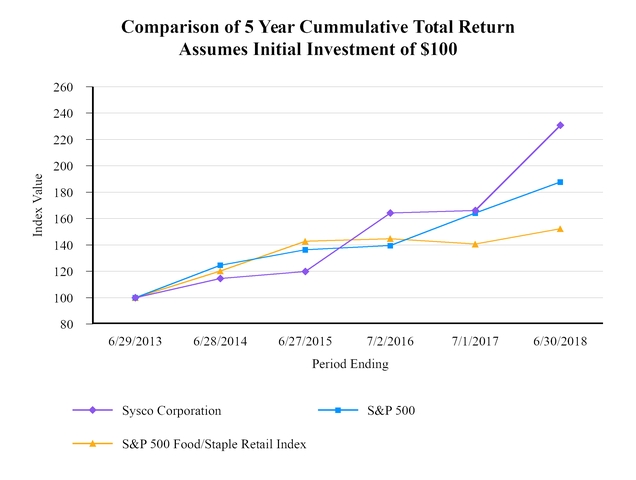
| 6/29/2013 | 6/28/2014 | 6/27/2015 | 7/2/2016 | 7/1/2017 | 6/30/2018 | |||||||
| Sysco Corporation | $100 | $115 | $120 | $164 | $166 | $231 | ||||||
| S&P 500 | 100 | 125 | 136 | 140 | 164 | 188 | ||||||
| S&P 500 Food/Staple Retail Index | 100 | 120 | 143 | 145 | 141 | 152 |
Item 6. Selected Financial Data
| Fiscal Year | |||||||||||||||||||
| 2018 (1) | 2017 (1) | 2016 (1)(2) | 2015 (1) | 2014 (1) | |||||||||||||||
| (In thousands except for per share data) | |||||||||||||||||||
| Sales | $ | 58,727,324 | $ | 55,371,139 | $ | 50,366,919 | $ | 48,680,752 | $ | 46,516,712 | |||||||||
| Operating income | 2,328,974 | 2,053,171 | 1,850,500 | 1,229,362 | 1,587,122 | ||||||||||||||
| Earnings before income taxes | 1,956,224 | 1,766,230 | 1,433,007 | 1,008,147 | 1,475,624 | ||||||||||||||
| Income taxes | 525,458 | 623,727 | 483,385 | 321,374 | 544,091 | ||||||||||||||
| Net earnings | $ | 1,430,766 | $ | 1,142,503 | $ | 949,622 | $ | 686,773 | $ | 931,533 | |||||||||
| Net earnings: | |||||||||||||||||||
| Basic earnings per share | $ | 2.74 | $ | 2.10 | $ | 1.66 | $ | 1.16 | $ | 1.59 | |||||||||
| Diluted earnings per share | 2.70 | 2.08 | 1.64 | 1.15 | 1.58 | ||||||||||||||
| Dividends declared per share | $ | 1.41 | $ | 1.30 | $ | 1.23 | $ | 1.19 | $ | 1.15 | |||||||||
| Total assets | $ | 18,070,404 | $ | 17,756,655 | $ | 16,721,804 | $ | 17,989,281 | $ | 13,141,113 | |||||||||
| Capital expenditures | 687,815 | 686,378 | 527,346 | 542,830 | 523,206 | ||||||||||||||
| Current maturities of long-term debt (3) | $ | 782,329 | $ | 530,075 | $ | 8,909 | $ | 4,979,301 | $ | 304,777 | |||||||||
| Long-term debt | 7,540,765 | 7,660,877 | 7,336,930 | 2,271,825 | 2,357,330 | ||||||||||||||
| Total long-term debt | 8,323,094 | 8,190,952 | 7,345,839 | 7,251,126 | 2,662,107 | ||||||||||||||
| Shareholders’ equity | 2,506,957 | 2,381,516 | 3,479,608 | 5,260,224 | 5,266,695 | ||||||||||||||
| Total capitalization | $ | 10,830,051 | $ | 10,572,468 | $ | 10,825,447 | $ | 12,511,350 | $ | 7,928,802 | |||||||||
| Ratio of long-term debt to capitalization (3) | 76.9 | % | 77.5 | % | 67.9 | % | 58.0 | % | 33.6 | % | |||||||||
| Supplemental Information: | |||||||||||||||||||
| Fiscal 2019 expected retroactive impact to other income (expense), historically included in operating expense (4) | $ | 15,003 | $ | (1,294 | ) | $ | 8,935 | $ | 26,522 | $ | 4,887 |
| (1) | Our results of operations are impacted by Certain Items that have resulted in reduced earnings on a GAAP basis. See “Non-GAAP Reconciliations,” within Management’s Discussion and Analysis of Financial Condition and Results of Operations, for a description of these items and our results on an adjusted basis that exclude Certain Items. |
| (2) | Sysco’s fiscal year ends on the Saturday nearest to June 30th. This resulted in a 53-week year ending July 2, 2016 for fiscal 2016. |
| (3) | Specific to fiscal 2015, our current maturities of long-term debt included senior notes issued for the proposed merger with US Foods that were required to be redeemed due to the termination of the merger agreement. We redeemed these notes in July 2015. |
| (4) | In the first quarter of fiscal 2019, Sysco will adopt Accounting Standards Update 2017-07 requiring that an employer report all of the components except the service cost component of pension and postretirement benefits outside of operating income. This will be applied retroactively. As a result, the company expects to report amounts for net periodic income (expense) in other income (expense) that were previously included in operating expense. |
Item 7. Management’s Discussion and Analysis of Financial Condition and Results of Operations
Our discussion below of our results includes certain non-GAAP financial measures that we believe provide important perspective with respect to underlying business trends. Other than free cash flow, any non-GAAP financial measures will be
denoted as adjusted measures and exclude the impact from restructuring costs consisting of: (1) expenses associated with our revised business technology strategy announced in fiscal 2016, as a result of which we incurred costs to convert to a modernized version of our established platform as opposed to completing the implementation of an Enterprise Resource Planning (ERP) system; (2) professional fees related to our three-year strategic plans; (3) restructuring expenses within our Brakes Group operations; (4) severance charges related to restructuring; and (5) foreign non-income based taxes. In addition, fiscal 2018 results of operations are impacted by business technology transformation initiative costs, facility closure charges, multiemployer pension (MEPP) withdrawal charges and debt extinguishment charges, which are also excluded from our non-GAAP financial measures.
The non-GAAP financial measures presented in this report also exclude the impact of the following acquisition-related items: (1) intangible amortization expense and (2) integration costs. All acquisition-related costs in fiscal 2018 and 2017 that have been excluded relate to the fiscal 2017 acquisition of Cucina Lux Investments Limited (the Brakes Acquisition), discussed in Note 4, “Acquisitions.” The Brakes Acquisition also resulted in non-recurring tax expense in fiscal 2017, primarily from non-deductible transaction costs.
The non-GAAP financial measures presented in this report further exclude certain impacts of the Tax Cuts and Jobs Act of 2017 (the Tax Act) enacted on December 22, 2017. The impact for fiscal 2018 includes: a provisional estimate of a one-time transition tax on certain unrepatriated earnings of foreign subsidiaries and a net benefit from remeasuring Sysco’s accrued income taxes, deferred tax liabilities and deferred tax assets due to the changes in tax rates. Other tax-related items impacting results of operations include foreign withholding taxes on repatriated earnings, net of foreign tax credits, and a benefit from contributions made to fund Sysco’s tax-qualified United States (U.S.) pension plan (the U.S. Retirement Plan).
The fiscal 2018 and fiscal 2017 items described above and excluded from our non-GAAP measures are collectively referred to as “Certain Items.” In addition, our three-year plan that ended in fiscal 2018, included an adjusted return on invested capital target that excluded the Brakes Acquisition, and therefore, our invested capital is adjusted for the accumulation of debt incurred for the Brakes Acquisition that would not have been borrowed absent this acquisition.
Sysco’s fiscal year ends on the Saturday nearest to June 30th. This resulted in a 52-week year ending June 30, 2018 for fiscal 2018, a 52-week year ending July 1, 2017 for fiscal 2017, and a 53-week year ending July 2, 2016 for fiscal 2016. Because fiscal 2016 contained one additional week as compared to fiscal 2017, our Consolidated Results of Operations for fiscal 2017 are not directly comparable to fiscal 2016. Management believes that adjusting the fiscal 2016 Consolidated Results of Operations for the estimated impact of the additional week provides more comparable financial results on a year-over-year basis. Sysco’s results of operations and related metrics within this section will be disclosed on both a 52-week and 53-week basis for fiscal 2017 as compared to fiscal 2016. This is calculated by deducting one-fourteenth of the total metric for the fourth quarter of fiscal 2016.
Any metric within this section referred to as “adjusted” will reflect the applicable impact of Certain Items. More information on the rationale for the use of these measures and reconciliations to GAAP numbers can be found under “Non-GAAP Reconciliations.”
Overview
Sysco distributes food and related products to restaurants, healthcare and educational facilities, lodging establishments and other foodservice customers. Our primary operations are located in North America and Europe. The company has aggregated certain of its operating segments into three reportable segments. “Other” financial information is attributable to the company’s other operating segments that do not meet the quantitative disclosure thresholds.
| • | U.S. Foodservice Operations - primarily includes U.S. Broadline operations, which distribute a full line of food products, including custom-cut meat, seafood, specialty produce, specialty imports and a wide variety of non-food products; |
| • | International Foodservice Operations - includes operations in the Americas and Europe, which distribute a full line of food products and a wide variety of non-food products. The Americas primarily consists of operations in Canada, Bahamas, Mexico, Costa Rica and Panama, as well as our operations that distribute to international customers. Our European operations primarily consist of operations in the United Kingdom (U.K.), France, Ireland and Sweden; |
| • | SYGMA - our U.S. customized distribution subsidiary; and |
| • | Other - primarily our hotel supply operations and Sysco Labs, which includes our suite of technology solutions that help support the business needs of our customers and provide support for some of our business technology needs. |
We estimate that we serve about 16% of an approximately $289 billion annual foodservice market in the U.S. based on industry data obtained from Technomic, Inc. From time to time, Technomic may revise the methodology used to calculate the size of the foodservice market and, as a result, our percentage can change not only from our sales results, but also from such revisions. We also serve certain international geographies that vary in size and amount of market share.
According to industry sources, the foodservice, or food-away-from-home, market represents approximately 51% of the total dollars spent on food purchases made at the consumer level in the U.S. as of the end of calendar 2017. Industry sources estimate the total foodservice market in the U.S. experienced a real sales increase of approximately 1.4% in both calendar year 2017 and calendar year 2016. Real sales changes do not include the impact of inflation or deflation.
Highlights and Trends
Comparison of results from fiscal 2018 to fiscal 2017:
| • | Sales: |
| ◦ | increased 6.1%, or $3.4 billion, to $58.7 billion; |
| • | Operating income: |
| ◦ | increased 13.4%, or $275.8 million, to $2.3 billion; |
| ◦ | adjusted operating income increased 8.4%, or $196.5 million, to $2.5 billion; |
| • | Net earnings: |
| ◦ | increased 25.2%, or $288.3 million, to $1.4 billion; |
| ◦ | adjusted net earnings increased 22.1%, or $300.8 million, to $1.7 billion; |
| • | Basic earnings per share: |
| ◦ | increased 30.5%, or $0.64, to $2.74 from the comparable prior year amount of $2.10 per share; |
| • | Diluted earnings per share: |
| ◦ | increased 29.8%, or $0.62, to $2.70 from the comparable prior year amount of $2.08 per share; and |
| ◦ | adjusted diluted earnings per share were $3.14 in fiscal 2018, a 26.6% increase from the comparable prior year amount of $2.48 per share. |
Fiscal 2015 - Fiscal 2018 Three-Year Plan Highlights
| 3-year Plan Target | 2018 | 2015 | 3-year Plan Change $ Resul |
Showing the first 8K of 153K characters. Open the full section
Item 7A. Quantitative and Qualitative Disclosures about Market Risk
Our market risks consist of interest rate risk, foreign currency exchange rate risk, fuel price risk and investment risk.
Interest Rate Risk
We do not utilize financial instruments for trading purposes. Our use of debt directly exposes us to interest rate risk. Floating rate debt, where the interest rate fluctuates periodically, exposes us to short-term changes in market interest rates. Fixed rate debt, where the interest rate is fixed over the life of the instrument, exposes us to changes in market interest rates reflected in the fair value of the debt and to the risk that we may need to refinance maturing debt with new debt at higher rates.
We manage our debt portfolio to achieve an overall desired position of fixed and floating rates and may employ interest rate swaps as a tool to achieve that position. The major risks from interest rate derivatives include changes in the interest rates affecting the fair value of such instruments, potential increases in interest expense due to market increases in floating interest rates and the creditworthiness of the counterparties in such transactions.
At June 30, 2018, there were no commercial paper issuances outstanding. Total debt as of June 30, 2018 was $8.3 billion, of which approximately 74% was at fixed rates of interest, including the impact of our interest rate swap agreements.
At July 1, 2017, there were $119.7 million commercial paper issuances outstanding. Total debt as of July 1, 2017 was $8.2 billion, of which approximately 71% was at fixed rates of interest, including the impact of our interest rate swap agreements.
Details of our outstanding swap agreements as of June 30, 2018 are below:
| Maturity Date of Swap | Notional Value | Fixed Coupon Rate on Hedged Debt | Floating Interest Rate on Swap | Floating Rate Reset Terms | Location of Fair Value on Balance Sheet | Fair Value of Asset (Liability) (in thousands) | |||||||||||
| April 1, 2019 | $ | 500,000,000 | 1.90 | % | Three-month LIBOR | Every three months in advance | Other long-term liabilities | $ | (6,820 | ) | |||||||
| October 1, 2020 | 750,000,000 | 2.60 | Three-month LIBOR | Every three months in advance | Other long-term liabilities | (23,654 | ) | ||||||||||
| July 15, 2021 | 500,000,000 | 2.50 | Three-month LIBOR | Every three months in advance | Other long-term liabilities | (23,147 | ) | ||||||||||
| March 15, 2025 | 500,000,000 | 3.55 | Three-month LIBOR | Every three months in advance | Other long-term liabilities | (2,933 | ) |
We receive or pay amounts on these interest rate swap agreements on a semi-annual basis.
The following tables present our interest rate position as of June 30, 2018. All amounts are stated in U.S. dollar equivalents.
| Interest Rate Position as of June 30, 2018 | |||||||||||||||||||||||||||||||
| Principal Amount by Expected Maturity | |||||||||||||||||||||||||||||||
| Average Interest Rate | |||||||||||||||||||||||||||||||
| 2019 | 2020 | 2021 | 2022 | 2023 | Thereafter | Total | Fair Value | ||||||||||||||||||||||||
| (Dollars in thousands) | |||||||||||||||||||||||||||||||
| U.S. $ Denominated: | |||||||||||||||||||||||||||||||
| Fixed Rate Debt | $ | 250,000 | $ | — | $ | — | $ | 450,000 | $ | — | $ | 4,794,462 | $ | 5,494,462 | $ | 5,471,453 | |||||||||||||||
| Average Interest Rate | 5.4 | % | — | % | — | % | 2.6 | % | — | % | 4.2 | % | 4.1 | % | |||||||||||||||||
| Floating Rate Debt (1) | $ | 500,000 | $ | — | $ | 750,000 | $ | 500,000 | $ | — | $ | 500,000 | $ | 2,250,000 | $ | 2,250,000 | |||||||||||||||
| Average Interest Rate | 1.9 | % | — | % | 2.6 | % | 2.5 | % | — | % | 3.6 | % | 2.6 | % | |||||||||||||||||
| Euro Denominated: | |||||||||||||||||||||||||||||||
| Fixed Rate Debt | $ | — | $ | — | $ | — | $ | — | $ | 584,150 | $ | — | $ | 584,150 | $ | 587,045 | |||||||||||||||
| Average Interest Rate | — | % | — | % | — | % | — | % | 1.3 | % | — | % | 1.3 | % |
| (1) | Includes fixed rate debt that has been converted to floating rate debt through an interest rate swap agreement. |
| Interest Rate Position as of June 30, 2018 | |||||||||||||||||||||||||||||||
| Notional Amount by Expected Maturity | |||||||||||||||||||||||||||||||
| Average Interest Swap Rate | |||||||||||||||||||||||||||||||
| 2019 | 2020 | 2021 | 2022 | 2023 | Thereafter | Total | Fair Value | ||||||||||||||||||||||||
| (Dollars in thousands) | |||||||||||||||||||||||||||||||
| Interest Rate Swaps | |||||||||||||||||||||||||||||||
| Related To Debt: | |||||||||||||||||||||||||||||||
| Pay Variable/Receive Fixed | $ | 500,000 | $ | — | $ | 750,000 | $ | 500,000 | $ | — | $ | 500,000 | $ | 2,250,000 | $ | (56,554 | ) | ||||||||||||||
| Average Variable Rate Paid: | |||||||||||||||||||||||||||||||
| Rate A Plus | 0.8 | % | — | % | 1.12 | % | 1.13 | % | — | % | 0.75 | % | 0.97 | % | — | % | |||||||||||||||
| Fixed Rate Received | 1.9 | % | — | % | 2.6 | % | 2.5 | % | — | % | 3.55 | % | 2.63 | % | — | % |
Rate A – three-month LIBOR
Foreign Currency Exchange Rate Risk
The majority of our foreign subsidiaries use their local currency as their functional currency. To the extent that business transactions are not denominated in a foreign subsidiary’s functional currency, we are exposed to foreign currency exchange rate risk. We will also incur gains and losses within our shareholders’ equity due to the translation of our financial statements from foreign currencies into U.S. dollars. Our largest currency exposures are with Canadian dollars, British pound sterling and Euro currencies. Our income statement trends may be impacted by the translation of the income statements of our foreign subsidiaries
into U.S. dollars. The exchange rates used to translate our foreign sales into U.S. dollars positively impacted sales by 1.0% in fiscal 2018 when compared to fiscal 2017. The exchange rate used to translate our foreign sales into U.S. dollars positively impacted sales by 0.1% in fiscal 2017 when compared to fiscal 2016. The impact to our operating income, net earnings and earnings per share was not material in fiscal 2018 or fiscal 2017. A 10% unfavorable change in the fiscal 2018 weighted year-to-date exchange rate and the resulting impact on our financial statements would have negatively impacted fiscal 2018 sales by 1.9% and would not have materially impacted our operating income, net earnings and earnings per share. We do not routinely enter into material agreements to hedge foreign currency exchange rate risks.
Our investments and loans to our foreign operations created additional foreign currency exposure. In fiscal 2017, we designated €500 million of Euro notes issued in June 2016 and various cross currency swaps as hedges of a portion of our net investment in Euro-denominated and Sterling-denominated foreign operations to reduce foreign currency risk associated with the investment in these operations. Changes in the value of these items resulting from fluctuations in the underlying exchange rates to U.S. Dollar exchange rates are recorded as foreign currency translation adjustments within Accumulated other comprehensive income (loss). In fiscal 2018 and in fiscal 2017, we entered into various cross currency swaps to mitigate the risk of exchange rate changes for intercompany loans that are not in the functional currency of our subsidiaries. These have been designated as cash flow hedges with changes recorded within foreign currency translation adjustments within Accumulated other comprehensive income (loss).
Fuel Price Risk
Due to the nature of our distribution business, we are exposed to potential volatility in fuel prices. The price and availability of diesel fuel fluctuates due to changes in production, seasonality and other market factors generally outside of our control. Increased fuel costs may have a negative impact on our results of operations in three areas. First, the high cost of fuel can negatively impact consumer confidence and discretionary spending and thus reduce the frequency and amount spent by consumers for food-away-from-home purchases. Second, the high cost of fuel can increase the price we pay for product purchases and we may not be able to pass these costs fully to our customers. Third, increased fuel costs impact the costs we incur to deliver product to our customers. Fuel costs related to outbound deliveries represented approximately 0.5% of sales during fiscal 2018, fiscal 2017 and fiscal 2016.
Our activities to mitigate fuel costs include routing optimization with the goal of reducing miles driven, improving fleet utilization by adjusting idling time and maximum speeds and using fuel surcharges that primarily track with the change in market prices of fuel. We use diesel fuel swap contracts to fix the price of a portion of our projected monthly diesel fuel requirements. As of June 30, 2018, we had diesel fuel swaps with a total notional amount of approximately 46 million gallons through June 2019. These swaps will lock in the price of approximately 55% to 60% of our projected fuel purchase needs for fiscal 2019. Our remaining fuel purchase needs will occur at market rates unless contracted for a fixed price or hedged at a later date. Using current, published quarterly market price projections for diesel and estimates of fuel consumption, a 10% unfavorable change in diesel prices from the market price would result in a potential increase of approximately $10.0 million in our fuel costs on our non-contracted volumes.
Investment Risk
Our U.S. Retirement Plan and U.K. Retirement Plan hold various investments, including public and private equity, fixed income securities and real estate funds. The amount of our annual contribution to the plan is dependent upon, among other things, the return on the plan’s assets and discount rates used to calculate the plan’s liability. Fluctuations in asset values can cause the amount of our anticipated future contributions to the plan to increase and can result in a reduction to shareholders’ equity on our balance sheet as of fiscal year-end, which is when this plan’s funded status is measured. Also, the projected liability of the plan will be impacted by the fluctuations of interest rates on high quality bonds in the public markets. To the extent the financial markets experience declines, our anticipated future contributions and funded status will be affected for future years. A 10% unfavorable change in the value of the investments held by our company-sponsored retirement plans at the plan’s fiscal year end (December 31, 2017) would not have a material impact on our anticipated future contributions for fiscal 2019; however, such an unfavorable change would increase our pension expense for fiscal 2019 by $30.6 million and would reduce our shareholders’ equity on our balance sheet as of June 30, 2018 by $366.6 million. An unfavorable change in the fair value of our U.K. Plan assets would not materially increase our fiscal 2019 pension expense and would reduce our shareholders’ equity on our balance sheet, as of June 30, 2018, by $25.9 million.
Item 8. Financial Statements and Supplementary Data
SYSCO CORPORATION AND SUBSIDIARIES
INDEX TO CONSOLIDATED FINANCIAL STATEMENTS
All schedules are omitted because they are not applicable or the information is set forth in the consolidated financial statements or notes thereto.
REPORT OF MANAGEMENT ON INTERNAL CONTROL OVER FINANCIAL REPORTING
The management of Sysco Corporation (“Sysco”) is responsible for establishing and maintaining adequate internal control over financial reporting for the company. Sysco’s internal control system is designed to provide reasonable assurance regarding the reliability of financial reporting and the preparation and fair presentation of published financial statements. All internal control systems, no matter how well designed, have inherent limitations. Therefore, even those systems determined to be effective can provide only reasonable assurance with respect to financial statement preparation and presentation.
Sysco’s management assessed the effectiveness of Sysco’s internal control over financial reporting as of June 30, 2018. In making this assessment, management used the criteria set forth by the Committee of Sponsoring Organizations of the Treadway Commission in Internal Control — Integrated Framework (2013). Based on this assessment, management concluded that, as of June 30, 2018, Sysco’s internal control over financial reporting was effective based on those criteria.
Ernst & Young LLP, the independent registered public accounting firm that audited the company’s consolidated financial statements included in this report, has issued an audit report on the effectiveness of Sysco’s internal control over financial reporting as of June 30, 2018.
REPORT OF INDEPENDENT REGISTERED PUBLIC ACCOUNTING FIRM
To the Shareholders and the Board of Directors of Sysco Corporation
Opinion on Internal Control over Financial Reporting
We have audited Sysco Corporation and its Consolidated Subsidiaries’ (the “Company”) internal control over financial reporting as of June 30, 2018, based on criteria established in Internal Control-Integrated Framework issued by the Committee of Sponsoring Organizations of the Treadway Commission (2013 framework) (the COSO criteria). In our opinion, Sysco Corporation and its Consolidated Subsidiaries maintained, in all material respects, effective internal control over financial reporting as of June 30, 2018, based on the COSO criteria.
We also have audited, in accordance with the standards of the Public Company Accounting Oversight Board (United States) (PCAOB), the 2018 consolidated financial statements of the Company and our report dated August 24, 2018, expressed an unqualified opinion thereon.
Basis for Opinion
The Company’s management is responsible for maintaining effective internal control over financial reporting and for its assessment of the effectiveness of internal control over financial reporting included in the accompanying Report of Management on Internal Control over Financial Reporting. Our responsibility is to express an opinion on the Company’s internal control over financial reporting based on our audit. We are a public accounting firm registered with the PCAOB and are required to be independent with respect to the Company in accordance with the U.S. federal securities laws and the applicable rules and regulations of the Securities and Exchange Commission and the PCAOB.
We conducted our audit in accordance with the standards of the PCAOB. Those standards require that we plan and perform the audit to obtain reasonable assurance about whether effective internal control over financial reporting was maintained in all material respects.
Our audit included obtaining an understanding of internal control over financial reporting, assessing the risk that a material weakness exists, testing and evaluating the design and operating effectiveness of internal control based on the assessed risk, and performing such other procedures as we considered necessary in the circumstances. We believe that our audit provides a reasonable basis for our opinion.
Definition and Limitations of Internal Control over Financial Reporting
A company’s internal control over financial reporting is a process designed to provide reasonable assurance regarding the reliability of financial reporting and the preparation of financial statements for external purposes in accordance with generally accepted accounting principles. A company’s internal control over financial reporting includes those policies and procedures that (1) pertain to the maintenance of records that, in reasonable detail, accurately and fairly reflect the transactions and dispositions of the assets of the company; (2) provide reasonable assurance that transactions are recorded as necessary to permit preparation of financial statements in accordance with generally accepted accounting principles, and that receipts and expenditures of the company are being made only in accordance with authorizations of management and directors of the company; and (3) provide reasonable assurance regarding prevention or timely detection of unauthorized acquisition, use, or disposition of the company’s assets that could have a material effect on the financial statements.
Because of its inherent limitations, internal control over financial reporting may not prevent or detect misstatements. Also, projections of any evaluation of effectiveness to future periods are subject to the risk that controls may become inadequate because of changes in conditions, or that the degree of compliance with the policies or procedures may deteriorate.
/s/ Ernst & Young LLP
Houston, Texas
August 24, 2018
REPORT OF INDEPENDENT REGISTERED PUBLIC ACCOUNTING FIRM
To the Shareholders and the Board of Directors of Sysco Corporation
Opinion on the Financial Statements
We have audited the accompanying consolidated balance sheets of Sysco Corporation and its Consolidated Subsidiaries (the “Company”) as of June 30, 2018 and July 1, 2017, the related consolidated results of operations, statements of comprehensive income, changes in shareholders’ equity and cash flows for each of the three years in the period ended June 30, 2018 and the related notes (collectively referred to as the “consolidated financial statements”). In our opinion, the consolidated financial statements present fairly, in all material respects, the financial position of the Company at June 30, 2018 and July 1, 2017, and the results of its operations and its cash flows for each of the three years in the period ended June 30, 2018, in conformity with U.S. generally accepted accounting principles.
We also have audited, in accordance with the standards of the Publi
Showing the first 8K of 229K characters. Open the full section
Item 9. [Changes in and Disagreements with Accountants on Accounting and Financial Disclosure](#s8BA741BD699251ACBDFF6E376CB1A793)
None.
Item 9A. Controls and Procedures
Sysco’s management, with the participation of our chief executive officer and chief financial officer, evaluated the effectiveness of our disclosure controls and procedures as of June 30, 2018. The term “disclosure controls and procedures,” as defined in Rules 13a-15(e) and 15d-15(e) under the Exchange Act, means controls and other procedures of a company that are designed to ensure that information required to be disclosed by a company in the reports that it files or submits under the Exchange Act is recorded, processed, summarized and reported, within the time periods specified in the Securities and Exchange Commission’s rules and forms. Disclosure controls and procedures include, without limitation, controls and procedures designed to ensure that information required to be disclosed by a company in the reports that it files or submits under the Exchange Act is accumulated and communicated to the company’s management, including its principal executive and principal financial officers, as appropriate to allow timely decisions regarding the required disclosure. Management recognizes that any controls and procedures, no matter how well designed and operated, can provide only reasonable assurance of achieving their objectives and management necessarily applies its judgment in evaluating the cost-benefit relationship of possible controls and procedures. Sysco’s disclosure controls and procedures have been designed to provide reasonable assurance of achieving their objectives. Based on the evaluation of our disclosure controls and procedures as of June 30, 2018, our chief executive officer and chief financial officer concluded that, as of such date, Sysco’s disclosure controls and procedures were effective at the reasonable assurance level.
Management’s report on internal control over financial reporting is included in the financial statement pages at page 40.
There have been no changes in our internal control over financial reporting (as that term is defined in Rules 13a-15(f) and 15d-15(f) under the Exchange Act) that occurred during the fourth quarter ended June 30, 2018, that have materially affected, or are reasonably likely to materially affect, our internal control over financial reporting.
Item 9B. Other Information
None.
PART III
Item 10. Directors, Executive Officers and Corporate Governance
The information required by this item will be included in our proxy statement for the 2018 Annual Meeting of Stockholders under the following captions, and is incorporated herein by reference thereto: “Corporate Governance,” “Executive Officers,” “Section 16(a) Beneficial Ownership Reporting Compliance,” “Report of the Audit Committee” and “Board of Directors Matters.”
Item 11. Executive Compensation
The information required by this item will be included in our proxy statement for the 2018 Annual Meeting of Stockholders under the following captions, and is incorporated herein by reference thereto: “Compensation Discussion and Analysis,” “Report of the Compensation Committee,” “Director Compensation” and “Executive Compensation.”
Item 12. Security Ownership of Certain Beneficial Owners and Management and Related Stockholder Matters
The information required by this item will be included in our proxy statement for the 2018 Annual Meeting of Stockholders under the following captions, and is incorporated herein by reference thereto: “Stock Ownership” and “Equity Compensation Plan Information.”
Item 13. Certain Relationships and Related Transactions, and Director Independence
The information required by this item will be included in our proxy statement for the 2018 Annual Meeting of Stockholders under the following caption, and is incorporated herein by reference thereto: “Corporate Governance – Certain Relationships and Related Person Transactions” and “Corporate Governance – Director Independence.”
Item 14. Principal Accounting Fees and Services
The information required by this item will be included in our proxy statement for the 2018 Annual Meeting of Stockholders under the following caption, and is incorporated herein by reference thereto: “Fees Paid to Independent Registered Public Accounting Firm.”
PART IV
Item 15. Exhibits
(a) The following documents are filed, or incorporated by reference, as part of this Form 10-K:
1.All financial statements. See Index to Consolidated Financial Statements on page 39 of this Form 10-K.
2.All financial statement schedules are omitted because they are not applicable or the information is set forth in the consolidated financial statements or notes thereto within Item 8. Financial Statements and Supplementary Data.
3.Exhibits.
The exhibits listed on the Exhibit Index immediately preceding such exhibits, which is hereby incorporated herein by reference, are filed or furnished as part of this Annual Report on Form 10-K.
Item 16. Form 10-K Summary
None.
SIGNATURES
Pursuant to the requirements of Section 13 or 15(d) of the Securities Exchange Act of 1934, Sysco Corporation has duly caused this Form 10-K to be signed on its behalf by the undersigned, thereunto duly authorized, on this 24th day of August 2018.
| SYSCO CORPORATION | |
| By: | /s/ THOMAS L. BENÉ |
| Thomas L. Bené | |
| President and Chief Executive Officer |
Pursuant to the requirements of the Securities Exchange Act of 1934, this report has been signed below by the following persons on behalf of Sysco Corporation in the capacities indicated and on the date indicated above.
PRINCIPAL EXECUTIVE, FINANCIAL & ACCOUNTING OFFICERS:
| /s/ THOMAS L. BENÉ | President and Chief Executive Officer |
| Thomas L. Bené | (principal executive officer) |
| /s/ JOEL T. GRADE | Executive Vice President and Chief Financial Officer |
| Joel T. Grade | (principal financial officer) |
| /s/ ANITA A. ZIELINSKI | Senior Vice President and Chief Accounting Officer |
| Anita A. Zielinski | (principal accounting officer) |
DIRECTORS:
| /s/ THOMAS L. BENÉ | /s/ HANS-JOACHIM KOERBER |
| Thomas L. Bené | Hans-Joachim Koerber |
| /s/ DANIEL J. BRUTTO | /s/ NANCY S. NEWCOMB |
| Daniel J. Brutto | Nancy S. Newcomb |
| /s/ JOHN M. CASSADAY | /s/ NELSON PELTZ |
| John M. Cassaday | Nelson Peltz |
| /s/ JOSHUA D. FRANK | /s/ EDWARD D. SHIRLEY |
| Joshua D. Frank | Edward D. Shirley |
| /s/ LARRY C. GLASSCOCK | /s/ SHEILA G. TALTON |
| Larry C. Glasscock | Sheila G. Talton |
| /s/ BRADLEY M. HALVERSON | /s/ RICHARD G. TILGHMAN |
| Bradley M. Halverson | Richard G. Tilghman |
| /s/ JOHN M. HINSHAW | /s/ JACKIE M. WARD |
| John M. Hinshaw | Jackie M. Ward |
EXHIBIT INDEX
Exhibits.
| 31.2# | — | CFO Certification Pursuant to Section 302 of the Sarbanes-Oxley Act of 2002. |
| 32.1# | — | CEO Certification Pursuant to Section 906 of the Sarbanes-Oxley Act of 2002. |
| 32.2# | — | CFO Certification Pursuant to Section 906 of the Sarbanes-Oxley Act of 2002. |
| 101.1# | — | The following financial information from Sysco Corporation’s Annual Report on Form 10-K for the year ended June 30, 2018 filed with the SEC on August 24, 2018, formatted in XBRL includes: (i) Consolidated Balance Sheets as of June 30, 2018 and July 1, 2017, (ii) Consolidated Results of Operations for the periods ended June 30, 2018, July 1, 2017 and July 2, 2016, (iii) Consolidated Shareholders’ Equity for the periods ended June 30, 2018, July 1, 2017 and July 2, 2016, (iv) Consolidated Cash Flows for the periods ended June 30, 2018, July 1, 2017 and July 2, 2016, and (v) the Notes to Consolidated Financial Statements. |
† Executive Compensation Arrangement pursuant to 601(b)(10)(iii)(A) of Regulation S-K
Filed Herewith
Note: Debt instruments of Sysco Corporation and its subsidiaries defining the rights of long-term debt holders in principal amounts not exceeding 10% of Sysco Corporation’s consolidated assets have been omitted and will be provided to the Securities and Exchange Commission upon request.