 filings.tools
Sysco 10-K 2021-07-03
Filed 2021-08-30. 23 sections, 594K characters. Original on sec.gov · Markdown · JSON
Cover and table of contents
UNITED STATES SECURITIES AND EXCHANGE COMMISSION
Washington, D.C. 20549
Form 10-K
| (Mark One) | |||||
| ☑ | ANNUAL REPORT PURSUANT TO SECTION 13 OR 15(d) OF THE SECURITIES EXCHANGE ACT OF 1934 |
For the fiscal year ended July 3, 2021
OR
| ☐ | TRANSITION REPORT PURSUANT TO SECTION 13 OR 15(d) OF THE SECURITIES EXCHANGE ACT OF 1934 |
Commission File Number 1-6544
Sysco Corporation
(Exact name of registrant as specified in its charter)
| Delaware (State or other jurisdiction of incorporation or organization) | 74-1648137 (I.R.S. Employer Identification No.) | |||||||
| 1390 Enclave Parkway Houston, Texas (Address of principal executive offices) | 77077-2099 (Zip Code) |
Registrant’s Telephone Number, Including Area Code:
(281) 584-1390
Securities Registered Pursuant to Section 12(b) of the Act:
| Title of each class | Trading symbols | Name of each exchange on which registered | ||||||||||||
| Common Stock, $1.00 Par Value | SYY | New York Stock Exchange | ||||||||||||
| 1.25% Notes due June 2023 | SYY 23 | New York Stock Exchange |
Securities Registered Pursuant to Section 12(g) of the Act: None
Indicate by checkmark if the registrant is a well-known seasoned issuer, as defined in Rule 405 of the Securities Act. Yes ☑ No ☐
Indicate by checkmark if the registrant is not required to file reports pursuant to Section 13 or Section 15(d) of the Act. Yes ☐ No ☑
Indicate by check mark whether the registrant (1) has filed all reports required to be filed by Section 13 or 15(d) of the Securities Exchange Act of 1934 during the preceding 12 months (or for such shorter period that the registrant was required to file such reports), and (2) has been subject to such filing requirements for the past 90 days. Yes ☑ No ☐
Indicate by check mark whether the registrant has submitted electronically every Interactive Data File required to be submitted pursuant to Rule 405 of Regulation S-T during the preceding 12 months (or for such shorter period that the registrant was required to submit such files). Yes ☑ No ☐
Indicate by check mark whether the registrant is a large accelerated filer, an accelerated filer, a non-accelerated filer, a smaller reporting company or an emerging growth company. See definition of “large accelerated filer,” “accelerated filer,” “smaller reporting company” and “emerging growth company” in Rule 12b-2 of the Exchange Act.
| Large Accelerated Filer ☑ | Accelerated Filer ☐ | |||||||
| Non-accelerated Filer ☐ | Smaller Reporting Company ☐ | |||||||
| Emerging Growth Company ☐ |
If an emerging growth company, indicate by check mark if the registrant has elected not to use the extended transition period for complying with any new or revised financial accounting standards provided pursuant to Section 13(a) of the Exchange Act ☐
Indicate by check mark whether the registrant has filed a report on and attestation to its management’s assessment of the effectiveness of its internal control over financial reporting under Section 404(b) of the Sarbanes-Oxley Act (15 U.S.C. 7262(b)) by the registered public accounting firm that prepared or issued its audit report. ☑
Indicate by check mark whether the registrant is a shell company (as defined in Rule 12b-2 of the Exchange Act). Yes ☐ No ☑
The aggregate market value of the voting stock of the registrant held by stockholders who were not affiliates (as defined by regulations of the Securities and Exchange Commission) of the registrant was approximately $35,407,391,982 as of December 24, 2020 (based on the closing sales price on the New York Stock Exchange Composite Tape on December 24, 2020, as reported by The Wall Street Journal (Southwest Edition)). As of August 10, 2021, the registrant had issued and outstanding an aggregate of 512,081,796 shares of its common stock.
DOCUMENTS INCORPORATED BY REFERENCE:
Portions of the company’s 2021 Proxy Statement to be filed with the Securities and Exchange Commission no later than 120 days after the end of the fiscal year covered by this Form 10-K are incorporated by reference into Part III.
TABLE OF CONTENTS
PART I
Item 1. Business
Unless this Form 10-K indicates otherwise or the context otherwise requires, the terms “we,” “our,” “us,” “Sysco,” or “the company” as used in this Form 10-K refer to Sysco Corporation together with its consolidated subsidiaries and divisions.
Overview
Sysco Corporation, acting through its subsidiaries and divisions, is the largest global distributor of food and related products primarily to the foodservice or food-away-from-home industry. Our purpose is “Connecting the World to Share Food and Care for One Another.” We provided products and related services to over 650,000 customer locations, including restaurants, healthcare and educational facilities, lodging establishments and other foodservice customers during fiscal 2021.
Founded in 1969, Sysco commenced operations as a public company in March 1970 when the stockholders of nine companies exchanged their stock for Sysco common stock. Since our formation, we have grown from $115 million to as high as $60.1 billion in annual sales in fiscal 2019, both through internal expansion of existing operations and through acquisitions. Sysco’s annual sales in fiscal 2021 were $51.3 billion.
Sysco’s fiscal year ends on the Saturday nearest to June 30th. This resulted in a 53-week year ended July 3, 2021 for fiscal 2021, a 52-week year ended June 27, 2020 for fiscal 2020 and a 52-week year ended June 29, 2019 for fiscal 2019. We will have a 52-week year ending July 2, 2022 for fiscal 2022.
Sysco Corporation is organized under the laws of Delaware. The address and telephone number of our executive offices are 1390 Enclave Parkway, Houston, Texas 77077-2099, (281) 584-1390. This annual report on Form 10-K, as well as all other reports filed or furnished by Sysco pursuant to Section 13(a) or 15(d) of the Securities Exchange Act of 1934, as amended (Exchange Act), are available free of charge on Sysco’s website at www.sysco.com as soon as reasonably practicable after they are electronically filed with or furnished to the Securities and Exchange Commission (SEC).
Reporting Segments
Sysco distributes food and related products to restaurants, healthcare and educational facilities, lodging establishments and other foodservice customers. Our primary operations are located in North America and Europe. Under the accounting provisions related to disclosures about segments of an enterprise, we have aggregated certain operating segments into three reportable segments. “Other” financial information is attributable to our other operating segments that do not meet the quantitative disclosure thresholds.
-
U.S. Foodservice Operations – primarily includes U.S. Broadline operations, which distribute a full line of food products, including custom-cut meat, seafood, specialty produce, specialty imports and a wide variety of non-food products;
-
International Foodservice Operations – includes operations in the Americas (primarily outside of the United States (U.S.)) and Europe, which distribute a full line of food products and a wide variety of non-food products. The Americas primarily consists of operations in Canada, Bahamas, Mexico, Costa Rica and Panama, as well as our operations that distribute to international customers. Our European operations primarily consist of operations in the United Kingdom (U.K.), France, Ireland and Sweden;
-
SYGMA – our U.S. customized distribution operations serving quick-service chain restaurant customer locations; and
-
Other – primarily our hotel supply operations, Guest Worldwide. Sysco sold its interests in Cake Corporation in the first quarter of fiscal 2021.
Broadline operating sites distribute a full line of food products and a wide variety of non-food products to both traditional and chain restaurant customers, hospitals, schools, hotels, industrial caterers and other venues where foodservice products are served. SYGMA operating sites distribute a full line of food products and a wide variety of non-food products to certain chain restaurant customer locations. Selected financial data for each of our reportable segments, as well as financial information concerning geographic areas, can be found in Note 21, “Business Segment Information,” in the Notes to Consolidated Financial Statements in Item 8.
Customers and Products
Sysco’s customers in the foodservice industry include restaurants, hospitals and nursing homes, schools and colleges, hotels and motels, industrial caterers and other similar venues where foodservice products are served.
The products we distribute include:
-
frozen foods, such as meats, seafood, fully prepared entrées, fruits, vegetables and desserts;
-
canned and dry foods;
-
fresh meats and seafood;
-
dairy products;
-
beverage products;
-
imported specialties; and
-
fresh produce.
We also supply a wide variety of non-food items, including:
-
paper products such as disposable napkins, plates and cups;
-
tableware such as china and silverware;
-
cookware such as pots, pans and utensils;
-
restaurant and kitchen equipment and supplies; and
-
cleaning supplies.
A comparison of the sales mix in the principal product categories during the last three years is presented below:
| Principal product categories | 2021 | 2020 | 2019 | ||||||||||||||
| Fresh and frozen meats | 19 | % | 19 | % | 19 | % | |||||||||||
| Canned and dry products | 16 | 16 | 17 | ||||||||||||||
| Frozen fruits, vegetables, bakery and other | 15 | 15 | 15 | ||||||||||||||
| Poultry | 11 | 10 | 10 | ||||||||||||||
| Dairy products | 10 | 10 | 10 | ||||||||||||||
| Paper and disposables | 8 | 7 | 7 | ||||||||||||||
| Fresh produce | 8 | 9 | 8 | ||||||||||||||
| Seafood | 5 | 5 | 6 | ||||||||||||||
| Beverage products | 3 | 4 | 4 | ||||||||||||||
| Other (1) | 5 | 5 | 4 | ||||||||||||||
| Totals | 100 | % | 100 | % | 100 | % |
(1)Other sales relate to non-food products, including textiles and amenities for our hotel supply business, equipment and subscription sales for our previously-owned Cake business, and other janitorial products, medical supplies and smallwares. We sold our interests in Cake Corporation in the first quarter of fiscal 2021.
Our distribution centers, which we refer to as operating sites, distribute branded merchandise, as well as products packaged under our private brands. Products packaged under our private brands have been manufactured for Sysco according to specifications that have been developed by our quality assurance team. In addition, our quality assurance team certifies the manufacturing and processing plants where these products are packaged, enforces our quality control standards and identifies supply sources that satisfy our requirements.
We believe that prompt and accurate delivery of orders, competitive pricing, customer service and the ability to provide a full array of products and services to assist customers in their foodservice operations are of primary importance in the marketing and distribution of foodservice products to our customers. Our operating sites offer daily delivery to certain customer locations and have the capability of delivering special orders on short notice. Through the sales and marketing representatives and support staff, we stay informed of the needs of our customers and acquaint them with new products and services. We also provide ancillary services relating to foodservice distribution, such as providing customers with product usage reports and other data, menu-planning advice, food safety training and assistance in inventory control, as well as access to various third-party services designed to add value to our customers’ businesses.
No single customer accounted for 10% or more of Sysco’s total sales for the fiscal year ended July 3, 2021.
We estimate that our sales by type of customer during the past three fiscal years were as follows:
| Type of Customer | 2021 | 2020 | 2019 | ||||||||||||||
| Restaurants | 66 | % | 62 | % | 62 | % | |||||||||||
| Healthcare | 9 | 9 | 8 | ||||||||||||||
| Education, government | 6 | 8 | 9 | ||||||||||||||
| Travel and leisure | 5 | 7 | 9 | ||||||||||||||
| Other (1) | 14 | 14 | 12 | ||||||||||||||
| Totals | 100 | % | 100 | % | 100 | % |
(1)Other includes cafeterias that are not stand-alone restaurants, bakeries, caterers, churches, civic and fraternal organizations, vending distributors, other distributors and international exports, as well as retail food sales and logistics services. None of these types of customers, as a group, exceeded 5% of total sales in any of the years for which information is presented.
We estimate that sales to our customers in the food service management (FSM) sector, which include large customers that service cafeterias in institutions such as universities, hospitals, and sporting venues, accounted for just over 5% of sales in fiscal 2021. These sales are reflected within the respective customer types listed in the table above, depending on the type of customer the FSM operator serves.
Sources of Supply
We purchase from thousands of suppliers, both domestic and international, none of which individually accounts for more than 10% of our purchases. These suppliers consist generally of large corporations selling brand name and private label merchandise, as well as independent regional brand and private label processors and packers. We also provide specialty and seasonal products from small to mid-sized producers to meet a growing demand for locally sourced products. Our locally sourced products, including produce, meats, cheese and other products, help differentiate our customers’ offerings, satisfy demands for new products, and support local communities. Purchasing is generally carried out through both centrally developed purchasing programs, domestically and internationally, and direct purchasing programs established by our various operating sites.
We administer a consolidated product procurement program designed to develop, obtain and ensure consistent quality food and non-food products. The program covers the purchasing and marketing of branded merchandise, as well as products from a number of national brand suppliers, encompassing substantially all product lines. Some of our products are purchased internationally within global procurement centers in order to build strategic relationships with international suppliers and to optimize our supply chain network. We also focus on increasing profitability by lowering operating costs and by lowering aggregate inventory levels, which reduces future facility expansion needs at our operating sites, while providing greater value to our suppliers and customers.
Working Capital Practices
Our growth is funded through a combination of significant cash on hand, incremental cash flow from operations, commercial paper issuances and long-term borrowings. See the discussion in Item 7, “Management’s Discussion and Analysis of Financial Condition and Results of Operations – Liquidity and Capital Resources” regarding our liquidity, financial position and sources and uses of funds.
We extend credit terms to some of our customers based on our assessment of each customer’s creditworthiness. We monitor each customer’s account and will suspend shipments if necessary.
A majority of our sales orders are filled within 24 hours of when customer orders are placed. We generally maintain inventory on hand to be able to meet customer demand. The level of inventory on hand will vary by product depending on shelf-life, supplier order fulfillment lead times and customer demand. We also make purchases of additional volumes of certain products based on supply or pricing opportunities.
We take advantage of suppliers’ cash discounts where appropriate, otherwise we pay out suppliers according to our payment terms.
Corporate Headquarters
Our corporate staff makes available a number of services to our operating sites and our shared services staff performs support activities for employees, suppliers and customers. Members of these group possess experience and expertise in, among other areas, customer and vendor contract administration, accounting and finance, treasury, legal, information technology, payroll and employee benefits, risk management and insurance, sales and marketing, merchandising, inbound logistics, human resources, strategy and tax compliance services. The corporate office also makes available supply chain expertise, such as in warehousing and distribution services, which provide assistance in operational best practices, including space utilization, energy conservation, fleet management and work flow.
Capital Improvements
During fiscal 2021, 2020 and 2019, $470.7 million, $720.4 million and $692.4 million, respectively, were invested in facilities, technology, equipment, delivery fleet and other capital asset enhancements. From time to time, we dispose of assets in the normal course of business; we consider proceeds from these asset sales to be an offset to capital expenditures. During fiscal 2021, 2020 and 2019, capital expenditures, net of proceeds from sales of assets, were $411.5 million, $691.7 million and $671.5 million, respectively. Capital expenditures, net of proceeds from sales of assets, as a percentage of sales during fiscal 2021, 2020 and 2019 were 0.8%, 1.3% and 1.1%, respectively. In order to preserve our liquidity in response to the COVID-19 pandemic, we reduced our expected capital expenditures by eliminating capital projects that were not critical for our business. We estimate our capital expenditures, net of proceeds from sales of assets, in fiscal 2022 will be approximately 1.3% of fiscal 2022 sales, as we continue to invest in our business for the long-term. During the three years ended July 3, 2021, capital expenditures were financed primarily by internally generated funds, our commercial paper program and bank and other borrowings. We expect to finance our fiscal 2022 capital expenditures from internally generated funds.
Human Capital Resources
Sysco believes engaged and empowered associates drive business success and that attracting, developing and retaining the best talent globally to drive our business success is a key driver of the company’s long-term value. Our diverse associates and inclusive culture create an environment where associates can develop their skills and contribute to our success by driving strong financial performance. Sysco’s Board of Directors, through its Compensation and Leadership Development Committee, together with Sysco’s chief executive officer and chief human resources officer, are tasked with providing oversight of our human capital strategy, which consists of (1) talent acquisition, (2) talent management, (3) total rewards, (4) diversity, equity and inclusion and (5) health, well-being and safety. As of July 3, 2021, we had approximately 58,000 employees, including approximately 40,000 U.S. employees and approximately 18,000 employees outside the United States, as compared to approximately 57,000 employees as of June 27, 2020. As of July 3, 2021, approximately 99% of our U.S.-based associates are classified as full-time associates, defined as employees who work 30 or more hours per week.
Collective Bargaining Agreements — As of July 3, 2021, approximately 19% of our employees were represented by unions, primarily the International Brotherhood of Teamsters and unions in France and Sweden. Contract negotiations are handled by each individual operating site with support from our Labor Relations team. Approximately 1.2% of our union employees are covered by collective bargaining agreements that are subject to renegotiation in fiscal 2022. Since July 3, 2021, there have been two contract renegotiations. We consider our labor relations to be satisfactory.
COVID-19 Response — We have been actively responding to the COVID-19 pandemic and its impact globally. Our highest priorities continue to be the safety of our employees and working with our employees and network of suppliers and customers to help maintain the global food supply chain. We have defined and implemented procedures to protect the health and safety of our employees, while also ensuring business continuity and our ability to service our customers. We have allowed employees to work remotely whenever possible and have installed protocols for daily temperature checks and health screenings for our employees not working remotely. We have also provided guidelines for performing deep cleaning and proper social distancing in our offices and warehouses and have implemented requirements for employees to wear face coverings when not working remotely. Given the unprecedented challenges brought on by COVID-19, in April 2020 we launched a global mental health and well-being campaign that continues to be a primary focus for Sysco.
In response to the COVID-19 pandemic in fiscal 2020, we made a reduction to our staffing levels through both temporary workforce furloughs and permanent reductions in force. As business conditions improved in the second half of fiscal 2021, we hired over 6,000 additional sales consultants, new business developers, culinary experts and operations associates in preparation for the incremental volume associated with the expected business recovery. Sysco is monitoring the spread of variants of COVID-19, and while the future impact of the disease on our business is uncertain, we will respond appropriately to
maintain the health and safety of our associates. For more information on our COVID-19 workplace and community response, see our COVID-19 disclosures in “Management’s Discussion and Analysis of Financial Condition and Results of Operations.”
Talent Acquisition and Talent Management — Maintaining a pipeline of talent is critical to Sysco’s ongoing success and is essential to our succession planning efforts and to growing leaders throughout the organization. Our leadership and teams are responsible for attracting and retaining top talent by facilitating an environment where employees feel supported and encouraged in their professional and personal development. Specifically, we promote employee development by cultivating a high-impact learning culture for Sysco associates through a variety of enterprise development programs and learning resources, growing associates through goal-setting and career development processes, and reviewing strategic positions regularly and identifying potential internal candidates to fill those roles. We commit to investing in our employees through on the job experiences and coaching, as well as tuition reimbursement for a majority of our employees in the U.S. to promote continued professional growth. Additionally, we understand the importance of providing competitive compensation and benefits, as well as appropriate training that cultivates growth, developmental opportunities and multiple career paths within the company.
A key focus of Sysco’s Talent Acquisition in fiscal 2021 has been achieving hiring targets for our transportation associates. Throughout our industry, drivers are in short supply and hiring is a challenge. Sysco has developed partnerships with driving school organizations, on a national and local level, to support hiring across our U.S. sites. We encourage our business locations to partner with high schools to recruit non-college bound future graduates to consider a career path that will take them from a warehouse selector to a driver position and beyond. Our current national partner helps to identify a diverse slate of unemployed or underemployed individuals who aspire to be commercially qualified drivers and present them to Sysco as candidates for tuition sponsorship and subsequent hire; and our partner provides training to existing Sysco associates who choose to pursue a driving career. Sysco also has an in-house network of Supply Chain Instructors who ensure that we successfully onboard and train new drivers and support them as they learn how to deliver product to our customers safely and efficiently. In fiscal 2022, Sysco is investing in its first Sysco Driver Academy that will enable us to train our own drivers. For example, this program will give our warehouse associate population an opportunity to become drivers. Trainees will be paid to attend the academy, and Sysco will pay the licensing and certification fees. In return, associates will sign a contract to work for Sysco for an agreed upon period of time. If successful, we may expand the program nationally within the U.S.
Furthermore, through a program entitled Sysco Speaks, we conduct annual, confidential engagement surveys of our global workforce that are administered and analyzed by an independent third party. All Sysco associates across our global operations are invited to participate, and 86% of associates completed the survey in fiscal 2021. Aggregate survey results are reviewed by executive officers and the Board of Directors. By acting on results, both at an aggregate enterprise level and a department/business/work group level, and by analyzing our scores compared to both global and internal benchmarks, we have been able to enhance our culture and improve our overall engagement levels.
Total Rewards — We are committed to equal pay for equal work, regardless of gender, race, ethnicity or other personal characteristics. To deliver on that commitment, we benchmark and set pay ranges based on market data and consider various factors, such as an employee’s role and experience, job location and performance. We also regularly review our compensation practices to promote fair and equitable pay. In fiscal 2021, Sysco’s hourly associates received an average hourly wage of $28.46, and 100% of associates in our U.S. distribution facilities received pay above state minimum wage thresholds. Along with equitable pay, total rewards for Sysco’s full-time associates include paid vacation and sick time benefits, short-term and long-term incentives, retirement plans, training and development, access to career opportunities, paid pregnancy and adoption leave benefits, health and welfare, and recognition, as well as other programs like dependent scholarships and employee discounts.
Diversity, Equity and Inclusion — Sysco’s Diversity, Equity and Inclusion (DEI) team develops global strategic initiatives that are implemented locally to ensure that the needs specific to each region are addressed. To accelerate our global efforts to create a more diverse workforce and an equitable and inclusive culture, Sysco hired its Vice President, Chief Diversity Officer in fiscal 2021. Also, in fiscal 2021, we launched our Global DEI Advisory Council, which has been tasked with creating our three-year DEI Roadmap and our Real Talk Dialogues, which provide leaders and their associates safe forums to have open, honest, two-way and completely voluntary conversations. Sysco’s chief executive officer signed the CEO Pledge, as part of the CEO Action for Racial Equity, a group that includes business leaders from across the Fortune 100 companies. In addition, Sysco is a member of the Business Coalition for Equality Act, a group of U.S. employers that support legislation providing the same protections for LGBTQ+ associates as other protected groups under federal law.
At the end of fiscal 2021, women held 24% of U.S. management roles (defined as managers of people) and 24% of officer roles (defined as the executives and senior level positions within the corporate office and field organizations). For our U.S. leadership, Hispanic or Latinx, Black or African American, and Asian employees held 12%, 8% and 4% of management roles (defined as managers of people), respectively, at the end of fiscal 2021.
Our Associate Resource Groups (ARGs) are voluntary, associate-led groups organized to foster a diverse, inclusive workplace at Sysco, and are a critical element of our engagement and DEI efforts at both our headquarters and at operating sites by interested associates. These groups are effective vehicles for diverse associates to strengthen their skills, build relationships and foster mutually supportive interactions with their Sysco colleagues. By the end of fiscal 2021, twelve ARGs had been formed, representing gender, race, ethnicity, sexual orientation and gender identification, veterans and generations, among other groups.
Health, Well-being and Safety — Our occupational health services and total rewards/benefits teams offer a wide range of programs that address the needs of our workforce. We offer our associates and their families programs that support their lives, and we offer programs for U.S. associates that support health, mind, security and community. In fiscal 2020, our environmental compliance, occupational health and safety teams were combined under one central Environmental Health and Safety (EHS) team comprising functional experts across many geographies to address EHS at every point in our business process.
Competition
A large number of companies are engaged in the distribution of food and non-food products to the foodservice industry. Our customers may also choose to purchase products directly from wholesale or retail outlets, including club, cash and carry and grocery stores, online retailers, or negotiate prices directly with our suppliers. While we compete primarily with local and regional distributors, some organizations compete with us on a multi-region basis. In addition, these local, regional and multi-regional distributors can create purchasing cooperatives and marketing groups to enhance their competitive abilities by expanding their product mix, improving purchasing power and extending their geographic capabilities. Our customers are accustomed to purchasing from multiple suppliers and channels concurrently. Customers can choose from many broadline foodservice distributors, specialty distributors that focus on specific categories such as produce, meat or seafood, other wholesale channels, club stores, cash and carry stores, grocery stores and numerous online retailers. Since switching costs are very low, customers can make supplier and channel changes very quickly. We believe that the principal competitive factors in the foodservice industry are effective customer contacts, the ability to deliver a wide range of quality products and related services on a timely and dependable basis and competitive prices. There are few barriers to market entry. Existing foodservice competitors can extend their shipping distances and add truck routes and warehouses relatively quickly to serve new markets or customers.
We estimate that we serve about 17% of the approximately $230 billion annual foodservice market in the U.S., as estimated by Technomic, Inc., for calendar year 2020. Technomic projects the market size to increase to approximately $285 billion by the end of calendar 2021. We also serve certain international geographies that vary in size and amount of market share. We believe, based upon industry trade data, that our sales to the U.S. and Canada food-away-from-home industry were the highest of any foodservice distributor during fiscal 2021. While comprehensive industry statistics are not available, we believe that, in most instances, our operations in the U.S. and Canada are among the leading distributors of food and related non-food products to foodservice customers in those trading areas. We believe our competitive advantages include our sales consultants; our diversified product base, which includes quality-assured Sysco brand products; our service reliability; the ancillary services we provide to our customers, such as business reviews and menu analysis; and our multi-regional presence in North America and Europe, combined with a large geographical footprint of multi-temperature warehouses, which mitigates some of the impact of regional economic declines that may occur over time.
Government Regulation
Our company is required to comply, and it is our policy to comply, with all applicable laws and regulations in the numerous countries throughout the world in which we do business.
In the U.S., as a marketer and distributor of food products, we are subject to the Federal Food, Drug and Cosmetic Act and regulations promulgated thereunder by the U.S. Food and Drug Administration (FDA). The FDA regulates food safety and quality through various statutory and regulatory mandates, including manufacturing and holding requirements for foods through good manufacturing practice regulations, hazard analysis and critical control point (HACCP) requirements for certain foods, and the food and color additive approval process. The agency also specifies the standards of identity for certain foods, prescribes the format and content of information required to appear on food product labels, regulates food contact packaging and materials, and maintains a Reportable Food Registry for the industry to report when there is a reasonable probability that an article of food will cause serious adverse health consequences. For certain product lines, we are also subject to the Federal Meat Inspection Act, the Poultry Products Inspection Act, the Perishable Agricultural Commodities Act, the Packers and Stockyard Act and regulations promulgated by the U.S. Department of Agriculture (USDA) to interpret and implement these statutory
provisions. The USDA imposes standards for product safety, quality and sanitation through the federal meat and poultry inspection program. The USDA reviews and approves the labeling of these products and also establishes standards for the grading and commercial acceptance of produce shipments from our suppliers. We are also subject to the Public Health Security and Bioterrorism Preparedness and Response Act of 2002, which imposes certain registration and record keeping requirements on facilities that manufacture, process, pack or hold food for human or animal consumption, as well as Food Defense, which is a responsibility of the Department of Homeland Security.
The Food Safety Modernization Act (FSMA) has significantly expanded our food safety requirements. We have established and continue to maintain comprehensive, prevention-based controls across the food supply chain that are both verified and validated, as required by FDA regulations implementing FSMA. The FSMA further imposes requirements for food products imported into the U.S. and provides the FDA with mandatory recall authority.
We and our products are also subject to state and local regulation through such measures as the licensing of our facilities; enforcement by state and local health agencies of state and local standards for our products; and regulation of our trade practices in connection with the sale of our products. Our facilities are subject to regulations issued pursuant to the U.S. Occupational Safety and Health Act by the U.S. Department of Labor. These regulations require us to comply with certain manufacturing, health and safety standards to protect our employees from accidents and to establish hazard communication programs to transmit information on the hazards of certain chemicals present in products we distribute. We are also subject to the National Labor Relations Act, which governs the process for collective bargaining between employers and employees and protects the rights of both employers and employees in the workplace.
Our processing and distribution facilities must be registered with the FDA biennially and are subject to periodic government agency inspections by the FDA and USDA. Our facilities are generally inspected at least annually by federal and/or state authorities. We also must establish communication programs to transmit information about the hazards of certain chemicals present in some of the products we distribute.
Our customers include several departments of the federal government, including the Department of Defense and Department of Veterans Affairs facilities, as well as certain state and local entities. These customer relationships subject us to additional regulations applicable to government contractors.
We are also subject to regulation by numerous federal, state and local regulatory agencies, including, but not limited to, the U.S. Department of Labor, which sets employment practice standards for workers, and the U.S. Department of Transportation, as well as its agencies, the Surface Transportation Board, the Federal Highway Administration, the Federal Motor Carrier Safety Administration, and the National Highway Traffic Safety Administration, which collectively regulate our trucking operations through the regulation of operations, safety, insurance and hazardous materials. We must comply with the safety and fitness regulations promulgated by the Federal Motor Carrier Safety Administration, including those relating to drug and alcohol testing and hours-of service. Such matters as weight and dimension of equipment also fall under federal and state regulations. We are subject to regulations of the Federal Aviation Administration covering items transported by air. In addition, we are subject to the U.S. False Claims Act, and similar state statutes, which prohibit the submission of claims for payment to the government that are false and the knowing retention of overpayments.
The U.S. Foreign Corrupt Practices Act (FCPA) prohibits bribery of public officials to obtain or retain business in foreign jurisdictions. The FCPA also requires us to keep accurate books and records and to maintain internal accounting controls to detect and prevent bribery and to ensure that transactions are properly authorized and recorded. We have implemented and continue to develop a robust anti-corruption compliance program applicable to our global operations to detect and prevent bribery and to comply with these and other anti-corruption laws in countries where we operate.
Our business is subject to competition laws in the various jurisdictions where we operate, including the Sherman Antitrust Act and related federal and state antitrust laws in the U.S. These laws and regulations generally prohibit competitors from fixing prices, boycotting competitors, or engaging in other conduct that unreasonably restrains competition. In many jurisdictions, compliance with these competition laws is of special importance to us, and our operations may come under special scrutiny by competition law authorities, due to our competitive position in those jurisdictions.
Outside the U.S., our business is subject to numerous similar statutes and regulations, as well as other legal and regulatory requirements. For example, we are subject to legal and regulatory requirements of the European Union (the EU), as well as those of EU countries where we conduct business (including Ireland, France and Sweden), which requirements relate to, among other things, competition, product composition, packaging, labeling, advertisement (including nutrition and health claims) and the safety of food products, as well as the health, safety and working conditions of employees. We are subject to privacy laws in the EU, including the General Data Protection Regulation (GDPR), which requires companies to meet certain
requirements regarding the handling of personal data. In addition, our business is subject to the U.K. Modern Slavery Act 2015, which requires certain companies that operate in the U.K. to prepare a report describing steps that they have taken to ensure that slavery and human trafficking is not taking place in their supply chain or business. Our business is also subject to the U.K. Bribery Act 2010, an anti-corruption law that criminalizes the failure by a company to prevent persons associated with that company from offering or paying bribes to government officials or non-government persons in order to obtain or retain business or a business advantage for the company, as well as restricting the offer, payment or receipt of bribes to or from governmental officials and non-governmental persons.
All of our company’s facilities and other operations in the U.S. and elsewhere around the world are subject to various environmental protection statutes and regulations, including those in the U.S., the U.K. and the EU, relating to: (1) the use of water resources and the discharge of wastewater; (2) the discharge of pollutants into the air, including vehicle emissions; (3) proper handling, treatment and disposing of solid and hazardous wastes; and (4) protecting against and appropriately investigating and remediating spills and releases. Further, most of our distribution facilities have ammonia-based refrigeration systems and tanks for the storage of diesel fuel and other petroleum products which are subject to laws regulating such systems and storage tanks (including the investigation and remediation of soil and groundwater contamination associated with the use of underground storage tanks). See “Item 1A. Risk Factors - Business and Operational Risks - We may incur significant costs to comply with environmental laws and regulations, and we may be subject to substantial fines, penalties, or third-party claims for non-compliance.”
General
We have numerous trademarks that are of significant importance, including the SYSCO® and Brakes® trademarks, in addition to our privately branded product trademarks that include these trademarks. Five of our private brands have had annual sales in excess of $1 billion. These trademarks and the private brands on which they are used are widely recognized within the foodservice industry. Both our U.S. and European trademarks are effective for a ten-year period, and we generally renew our trademarks before their expiration dates unless a particular trademark is no longer in use. We believe the loss of the SYSCO® trademark would have a material adverse effect on our results of operations. We do not have any material patents or licenses.
We are not engaged in material research and development activities relating to the development of new products or the improvement of existing products.
Our sales do not generally fluctuate significantly on a seasonal basis; therefore, our business is not deemed to be seasonal.
As of July 3, 2021, we operated 343 distribution facilities throughout North America and Europe.
Item 1A. Risk Factors
The following discussion of “risk factors” identifies the most significant factors that may adversely affect our business, operations, financial position or future financial performance. This information should be read in conjunction with Management’s Discussion and Analysis of Financial Condition and Results of Operations and the consolidated financial statements and related notes contained in this report. The following discussion of risks is not all inclusive but is designed to highlight what we believe are the most significant factors to consider when evaluating our business. These factors could cause our future results to differ from our expectations expressed in the forward-looking statements identified within “Management’s Discussion and Analysis of Financial Condition and Results of Operations,” and from historical trends.
Industry and General Economic Risks
Global health developments and economic uncertainty resulting from the COVID-19 pandemic have adversely affected, and are expected to continue to adversely affect, our business, financial condition and results of operations.
Public health crises, pandemics and epidemics, such as the COVID-19 pandemic, have impacted our operations directly and may continue to impact us directly, or may continue to disrupt the operations of our business partners, suppliers and customers in ways that could have an adverse effect on our business, results of operations and financial condition. Fear of such events may further alter consumer confidence, behavior and spending patterns, and could adversely affect the economies and financial markets of many countries (or globally), resulting in an economic downturn that could affect customers’ demand for our products.
In response to the outbreak of COVID-19 and its development into a pandemic, governmental authorities in many countries in which we operate, and in which our customers are present and suppliers operate, have imposed mandatory closures, sought voluntary closures and imposed restrictions on, or advisories with respect to, travel, business operations and public gatherings or interactions. Among other matters, these actions have required or strongly urged various venues where foodservice products are served, including restaurants, schools, hotels and cruise liners, to reduce or discontinue operations, which have adversely affected and will continue to adversely affect demand in the foodservice industry, including demand for our products and services. In addition, some consumers are choosing to stay home due to the perceived risk of infection and health risk associated with COVID-19, which is adversely affecting demand in the foodservice industry, including demand for our products and services. Recently, mutations of the virus have arisen, some of which are proving to be particularly aggressive variants. As these variants spread, some governmental authorities have reintroduced certain restrictions and others may decide to do so in the future, which could adversely affect the timing of business reopenings and demand in the foodservice industry.
These events have had, and could continue to have, an adverse impact on numerous aspects of our business, financial condition and results of operations including, but not limited to, our growth, product costs, supply chain disruptions and the potential for inventory spoilage, labor shortages, logistics constraints, customer demand for our products and industry demand generally, difficulties in collecting our accounts receivables and corresponding increases in our bad debt exposure, consumer spending, our liquidity, the price of our securities and trading markets with respect thereto, our ability to access capital markets, and the global economy and financial markets generally. A prolonged or deeper economic downturn that adversely affects our business, financial condition or results of operations could affect our ability to access the credit markets for additional liquidity. A significant downgrade in our credit ratings or adverse conditions in the capital markets may increase the cost of borrowing for us or limit our access to capital. As a result, we may be unable to continue to comply with the debt covenants that are specific to our revolving credit facility, which could result in an event of default. We may see an increase in bankruptcies of customers, which could contribute to an increase in bad debt expense. In the third and fourth quarters of fiscal 2020, the company experienced an increase in past due receivables and recognized additional bad debt charges on its trade receivables that were outstanding at the time the pandemic caused closures among our customers in mid-March 2020. These receivables were all created in fiscal 2020 and are referred to as pre-pandemic receivables. As of July 3, 2021, our pre-pandemic receivable balance outstanding is no longer significant and a majority of the amount outstanding is reserved within our allowance for doubtful accounts. If further significant governmental restrictions are imposed in response to the spread of COVID-19 (including any variants thereof), Sysco could experience additional increases in past due receivables, which would have an adverse effect on the company’s financial condition and results of operations.
We have implemented employee safety measures, based on guidance from the Centers for Disease Control and Prevention and World Health Organization, across all our supply chain facilities, including proper hygiene, social distancing, mask use, and temperature screenings. These measures may not be sufficient to prevent the spread of COVID-19 among our employees. Illness, travel restrictions, absenteeism, or other workforce disruptions could negatively affect our supply chain, distribution, or other business processes. We may face additional production disruptions in the future, which may place constraints on our ability to distribute products in a timely manner or may increase our costs.
The ultimate extent of the impact of COVID-19 on our business, financial condition and results of operations will depend largely on future developments, including the duration and spread of the outbreak and the related impact on consumer confidence and spending, all of which are highly uncertain and cannot be predicted with certainty at this time. Even after the COVID-19 pandemic subsides, we could experience a longer-term impact on our business, such as costs associated with enhanced health, safety and hygiene requirements in one or more regions in attempts to counteract future outbreaks or the possibility that venues where foodservice products are served are slow to reopen and/or experience reduced customer traffic after reopening.
The impact of the COVID-19 pandemic may change our mix of earnings by customer type and by jurisdiction and has increased the risk that operating losses may occur within certain of our jurisdictions that could lead to the recognition of valuation allowances against certain deferred tax assets in the future, if these losses are prolonged beyond our current expectations. This would negatively impact our income tax expense, net earnings, and balance sheet.
Sustained adverse impacts to our company, certain suppliers, and customers may also affect our future valuation of certain assets, and therefore, may increase the likelihood of an impairment charge, write-off, or reserve associated with such assets, including goodwill, long-lived intangible assets, property and equipment, inventories, accounts receivable, tax assets and other assets.
To the extent the COVID-19 pandemic continues to adversely affect our business, results of operations and financial condition, it may also have the effect of heightening many of the other risks described in this Annual Report on Form 10-K and
subsequent filings with the SEC, such as those risks relating to our level of indebtedness, and may have an adverse effect on the price of our common stock.
Showing the first 8K of 68K characters. Open the full section
Item 1B. Unresolved Staff Comments
None.
Item 2. Properties
The table below shows the number of distribution facilities occupied by Sysco in each country and the aggregate square footage devoted to cold and dry storage as of July 3, 2021.
| Location | Number of Facilities | Square Feet (in thousands) | Segment Served (1) | ||||||||||||||
| Bahamas | 2 | 220 | I | ||||||||||||||
| Belgium | 1 | 200 | I | ||||||||||||||
| Canada | 32 | 4,181 | I, O | ||||||||||||||
| Costa Rica | 1 | 188 | I | ||||||||||||||
| France | 65 | 3,005 | I | ||||||||||||||
| Ireland and Northern Ireland | 6 | 657 | I | ||||||||||||||
| Mexico | 7 | 299 | I | ||||||||||||||
| Panama | 1 | 44 | I | ||||||||||||||
| Sweden | 7 | 948 | I | ||||||||||||||
| United Kingdom | 49 | 2,610 | I | ||||||||||||||
| United States and its territories (2) | 172 | 39,623 | U, I, S, O | ||||||||||||||
| Totals | 343 | 51,975 |
(1)Segments served include U.S. Foodservice (U), International Foodservice (I), SYGMA (S), and Other (O).
(2) California, Florida, and Texas account for 20, 16, and 14, respectively, of the facilities located in the U.S.
We own approximately 40,600,000 square feet of our distribution facilities (or 78.1% of the total square feet), and the remainder is occupied under leases expiring at various dates from fiscal 2022 to fiscal 2063, exclusive of renewal options.
Within our Latin American operations, we operate 16 cash and carry facilities and 4 warehouse and storage facilities in Costa Rica and 3 cash and carry facilities in Panama.
We own our approximately 634,000 square foot headquarters office complex in Houston, Texas. In fiscal 2021, we sold our complex in Cypress, TX which previously housed our shared business services and other services, and began performing all corporate and shared service operations from our headquarters.
We are currently constructing expansions or build-outs for various distribution facilities in the United States. The various operating sites, in the aggregate, accounted for 3% of fiscal 2021 sales.
As of July 3, 2021, our fleet of approximately 14,000 delivery vehicles consisted of tractor and trailer combinations, vans and panel trucks, most of which are either wholly or partially refrigerated for the transportation of frozen or perishable foods. We own approximately 86% of these vehicles and lease the remainder.
Item 3. Legal Proceedings
Environmental Matters
Item 103 of SEC Regulation S-K requires disclosure of certain environmental matters in which a governmental authority is a party to the proceedings and when such proceedings involve the potential for monetary sanctions that Sysco’s management reasonably believes will exceed a specified threshold. Pursuant to recent SEC amendments to this item, Sysco has chosen a reporting threshold for such proceedings of $1 million. Applying this threshold, there are no environmental matters to disclose for this period.
From time to time, we may be party to legal proceedings that arise in the ordinary course of our business. We do not believe there are any pending legal proceedings that, individually or in the aggregate, will have a material adverse effect on the company’s financial condition, results of operations or cash flows.
Item 4. Mine Safety Disclosures
Not applicable.
PART II – FINANCIAL INFORMATION
Item 5. Market for Registrant’s Common Equity, Related Stockholder Matters and Issuer Purchases of Equity Securities
The principal market for Sysco’s common stock (SYY) is the New York Stock Exchange. The number of record owners of Sysco’s common stock as of August 10, 2021 was 8,016.
We currently expect that comparable quarterly cash dividends will continue to be paid in the future; however, future declarations of dividends and the establishment of future record and payment dates are subject to the final determination of our Board of Directors.
During March 2020, we discontinued share repurchases under the August 2019 program due to business conditions and certain restrictions imposed by the amendment to our credit agreement providing for Sysco’s $2 billion long-term revolving credit facility, and we made no further repurchases during fiscal 2021. See the discussion in Item 7, “Management’s Discussion and Analysis of Financial Condition and Results of Operations – Liquidity and Capital Resources – Debt Activity and Borrowing Availability” for additional information regarding the credit agreement amendment. In May 2021, our Board of Directors approved a separate repurchase program to authorize the repurchase of up to $5.0 billion of the company’s common stock, which will remain available until fully utilized.
Stock Performance Graph
The following performance graph and related information shall not be deemed “soliciting material” or to be “filed” with the Securities and Exchange Commission, nor shall such information be incorporated by reference into any future filing under the Securities Act of 1933, as amended, or the Exchange Act, except to the extent that Sysco specifically incorporates such information by reference into such filing.
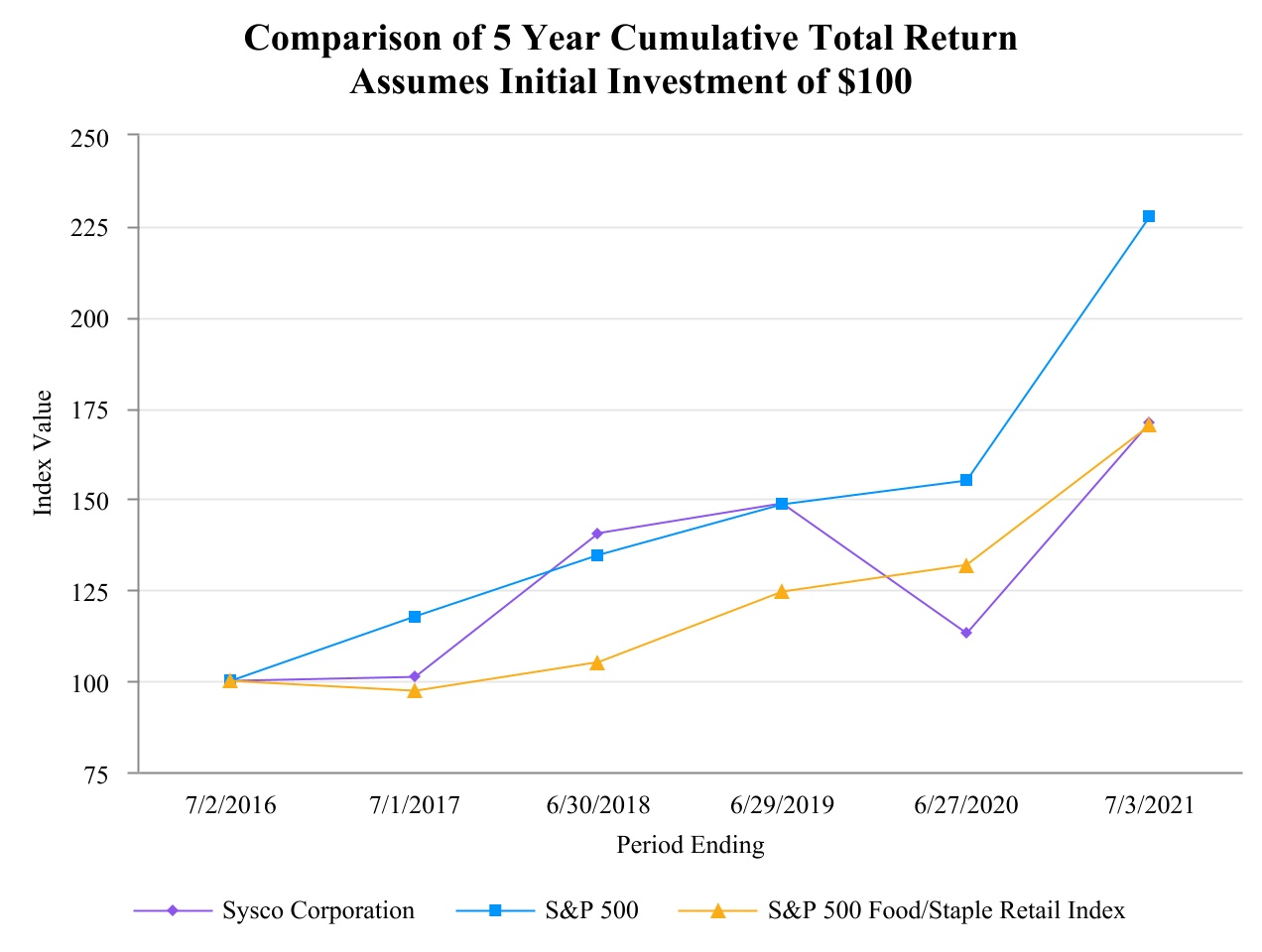
The following stock performance graph compares the performance of Sysco’s Common Stock to the S&P 500 Index and to the S&P 500 Food/Staple Retail Index for Sysco’s last five fiscal years.
The graph assumes that the value of the investment in our Common Stock, the S&P 500 Index, and the S&P 500 Food/Staple Retail Index was $100 on the last trading day of fiscal 2016, and that all dividends were reinvested. Performance data for Sysco, the S&P 500 Index and the S&P 500 Food/Staple Retail Index is provided as of the last trading day of each of our last five fiscal years.
| 7/2/2016 | 7/1/2017 | 6/30/2018 | 6/29/2019 | 6/27/2020 | 7/3/2021 | |||||||||||||||||||||||||||||||||
| Sysco Corporation | $100 | $101 | $141 | $149 | $113 | $171 | ||||||||||||||||||||||||||||||||
| S&P 500 | 100 | 118 | 135 | 149 | 155 | 228 | ||||||||||||||||||||||||||||||||
| S&P 500 Food/Staple Retail Index | 100 | 97 | 105 | 125 | 132 | 170 |
Item 6. [Reserved]
Item 7. Management’s Discussion and Analysis of Financial Condition and Results of Operations
The following discussion and analysis of Sysco’s financial condition, results of operations and liquidity and capital resources for the fiscal years ended July 3, 2021 and June 27, 2020 should be read as a supplement to our Consolidated Financial Statements and the accompanying notes contained in Item 8 of this report, and in conjunction with the “Forward-looking Statements” section set forth in Part II and the “Risk Factors” section set forth in Item 1A of Part I. All discussion of changes in our results of operations from fiscal 2019 to fiscal 2020 has been omitted from this Form 10-K, but may be found in Item 7, “Management’s Discussion and Analysis of Financial Condition and Results of Operations” of our Form 10-K for the year ended June 27, 2020, filed with the Securities and Exchange Commission on August 25, 2020.
Overview
Sysco distributes food and related products to restaurants, healthcare and educational facilities, lodging establishments and other foodservice customers. Our primary operations are located in North America and Europe. Under the accounting provisions related to disclosures about segments of an enterprise, we have aggregated certain operating segments into three reportable segments. “Other” financial information is attributable to our other operating segments that do not meet the quantitative disclosure thresholds.
-
U.S. Foodservice Operations – primarily includes U.S. Broadline operations, which distribute a full line of food products, including custom-cut meat, seafood, specialty produce, specialty imports and a wide variety of non-food products;
-
International Foodservice Operations – includes operations in the Americas (primarily outside of the United States (U.S.)) and Europe, which distribute a full line of food products and a wide variety of non-food products. The Americas primarily consists of operations in Canada, Bahamas, Mexico, Costa Rica and Panama, as well as our operations that distribute to international customers. Our European operations primarily consist of operations in the United Kingdom (U.K.), France, Ireland and Sweden;
-
SYGMA – our U.S. customized distribution operations serving quick-service chain restaurant customer locations; and
-
Other – primarily our hotel supply operations, Guest Worldwide. Sysco sold its interests in Cake Corporation in the first quarter of fiscal 2021.
We estimate that we serve about 17% of an approximately $230 billion annual foodservice market in the U.S. based on industry data obtained from Technomic, Inc as of the end of calendar 2020. Technomic projects the market size to increase to approximately $285 billion by the end of calendar 2021. From time to time, Technomic may revise the methodology used to calculate the size of the foodservice market and, as a result, our percentage can change not only from our sales results, but also from such revisions. We also serve certain international geographies that vary in size and amount of market share.
According to industry sources, the foodservice, or food-away-from-home, market represents approximately 45% of the total dollars spent on food purchases made at the consumer level in the U.S. as of the end of calendar year 2020.
COVID-19 Response
We have closely monitored developments in the COVID-19 pandemic as the situation has evolved, and we are continuously revising our approach to create new processes and guidelines to keep associates and customers safe, with careful consideration to remaining aligned with guidance from relevant health authorities.
-
Supporting employees – We defined and implemented procedures to protect the health and safety of our employees while also ensuring business continuity and our ability to service our customers. Per our protocols, all employees at our offices or warehouses take part in daily temperature checks upon entry. Our policies for wearing face coverings at all Sysco and customer locations are aligned with the guidance provided by the Centers for Disease Control and Prevention (CDC), unless local or state regulations differ.
-
Serving customers – We have procedures available to limit the contact between our drivers and customers’ employees, including alternative delivery methods, not collecting signatures for customer invoices, and guidelines for safely accepting customer returns. These contact-less procedures are available to all customers by request.
-
Assisting our communities – We have donated over 27 million meals in fiscal 2021 across our global operations as part of our community response strategy to the pandemic. These donations were valued at over $55 million. Additionally, we continue to support community organizations in their efforts to address hunger and food insecurity by providing direct delivery to food banks and other hunger relief organizations by loaning refrigerated trucks and facility storage space to increase capacity for local food distribution and by providing volunteer and staffing support for mobile distribution efforts.
Highlights
Our fiscal 2021 results were strong due to improved sales and disciplined expense management. Our business recovery is stronger than anticipated in the U.S., and the recovery is beginning to present itself in our international markets. Our increased profitability drove an improved cash flow performance and allowed us to pay down a large amount of debt. We are also making meaningful progress in advancing our Recipe for Growth strategy, which we expect will allow us to better serve our customers and differentiate Sysco from our competition. See below for a comparison of our fiscal 2021 results to our fiscal 2020 results, both including and excluding Certain Items (as defined below).
Below is a comparison of results from fiscal 2021 to fiscal 2020:
- Sales:
◦decreased 3.0%, or $1.6 billion, to $51.3 billion;
- Operating income:
◦increased 91.8%, or $687.7 million, to $1.4 billion;
◦adjusted operating income decreased 14.7%, or $251.8 million, to $1.5 billion;
- Net earnings:
◦increased 143.3%, or $308.7 million, to $524.2 million;
◦adjusted net earnings decreased 28.3%, or $291.6 million, to $740.4 million;
- Basic earnings per share:
◦increased 145.2%, or $0.61, to $1.03 from the comparable prior year amount of $0.42 per share;
- Diluted earnings per share:
◦increased 142.9%, or $0.60, to $1.02 from the comparable prior year amount of $0.42 per share;
◦adjusted diluted earnings per share were $1.44 in fiscal 2021, a $0.57 decrease from the comparable prior year amount of $2.01 per share.
- EBITDA:
◦increased 46.1%, or $695.4 million, to $2.2 billion; and
◦adjusted EBITDA decreased 9.1%, or $216.2 million, to $2.2 billion.
Our discussion of our results includes certain non-GAAP financial measures, including EBITDA and adjusted EBITDA, that we believe provide important perspective with respect to underlying business trends. Other than free cash flow, any non-GAAP financial measures will be denoted as adjusted measures to remove the impact of restructuring and transformational project costs consisting of: (1) restructuring charges, (2) expenses associated with our various transformation initiatives and (3) facility closure and severance charges; and by acquisition-related costs consisting of: (1) intangible amortization expense related to the fiscal 2017 acquisition of Cucina Lux Investments Limited (the Brakes Acquisition) and (2) due diligence and integration costs incurred in fiscal 2021 associated with the acquisition of Greco and Sons, which closed in August 2021. Our results for fiscal 2021 were also impacted by the reduction of bad debt expense previously recognized in fiscal 2020 due to the impact of the COVID-19 pandemic on the collectability of our pre-pandemic trade receivable balances, as well as non-operating gains and losses including (1) losses on the extinguishment of debt, (2) losses on the sale of businesses and (3) gains on the sale of property.
Fiscal 2020 results
Showing the first 8K of 162K characters. Open the full section
Item 7A. Quantitative and Qualitative Disclosures about Market Risk
Our market risks consist of interest rate risk, foreign currency exchange rate risk, fuel price risk and investment risk.
Interest Rate Risk
We do not utilize financial instruments for trading purposes. Our use of debt directly exposes us to interest rate risk. Floating rate debt, where the interest rate fluctuates periodically, exposes us to short-term changes in market interest rates. Fixed rate debt, where the interest rate is fixed over the life of the instrument, exposes us to changes in market interest rates reflected in the fair value of the debt and to the risk that we may need to refinance maturing debt with new debt at higher rates.
We manage our debt portfolio to achieve an overall desired position of fixed and floating rates and may employ interest rate swaps as a tool to achieve that position. The major risks from interest rate derivatives include changes in the interest rates affecting the fair value of such instruments, potential increases in interest expense due to market increases in floating interest rates and the creditworthiness of the counterparties in such transactions.
At July 3, 2021, there were no commercial paper issuances outstanding under our U.S. commercial paper program. Total debt as of July 3, 2021 was $11.1 billion, of which approximately 90% was at fixed rates of interest, including the impact of our interest rate swap agreements.
At June 27, 2020, there were no commercial paper issuances outstanding under our U.S. commercial paper program and we had £600.0 million outstanding under our U.K. commercial paper program. Total debt as of June 27, 2020 was $14.4 billion, of which approximately 79% was at fixed rates of interest, including the impact of our interest rate swap agreements.
Details of our outstanding swap agreements as of July 3, 2021 are below:
| Maturity Date of Swap | Notional Value | Fixed Coupon Rate on Hedged Debt | Floating Interest Rate on Swap | Floating Rate Reset Terms | Location of Fair Value on Balance Sheet | Fair Value of Asset (Liability) (in thousands) | ||||||||||||||||||||||||||||||||
| June 23, 2023 | € | 500,000,000 | 1.25 | Three-month EURIBOR | Every three months in advance | Other long-term assets | $ | 6,532 | ||||||||||||||||||||||||||||||
| March 15, 2025 | $ | 500,000,000 | 3.55 | Three-month LIBOR | Every three months in advance | Other long-term assets | $ | 36,685 |
We receive or pay amounts on these interest rate swap agreements on a semi-annual basis.
The following tables present our interest rate position as of July 3, 2021. All amounts are stated in U.S. dollar equivalents.
| Interest Rate Position as of July 3, 2021 | |||||||||||||||||||||||||||||||||||||||||||||||
| Principal Amount by Expected Maturity | |||||||||||||||||||||||||||||||||||||||||||||||
| Average Interest Rate | |||||||||||||||||||||||||||||||||||||||||||||||
| 2022 | 2023 | 2024 | 2025 | 2026 | Thereafter | Total | Fair Value | ||||||||||||||||||||||||||||||||||||||||
| (Dollars in thousands) | |||||||||||||||||||||||||||||||||||||||||||||||
| U.S. Dollar Denominated: | |||||||||||||||||||||||||||||||||||||||||||||||
| Fixed Rate Debt | $ | 450,000 | $ | — | $ | — | $ | 750,000 | $ | 750,000 | $ | 7,582,055 | $ | 9,532,055 | $ | 9,454,290 | |||||||||||||||||||||||||||||||
| Average Interest Rate | 2.60 | % | — | % | — | % | 5.65 | % | 3.75 | % | 4.80 | % | 4.68 | % | |||||||||||||||||||||||||||||||||
| Floating Rate Debt (1) | $ | — | $ | — | $ | — | $ | 500,000 | $ | — | $ | — | $ | 500,000 | $ | 533,681 | |||||||||||||||||||||||||||||||
| Average Interest Rate | — | % | — | % | — | % | 3.55 | % | — | % | — | % | 3.55 | % | |||||||||||||||||||||||||||||||||
| Euro Denominated: | |||||||||||||||||||||||||||||||||||||||||||||||
| Floating Rate Debt (1) | $ | — | $ | 593,303 | $ | — | $ | — | $ | — | $ | — | $ | 593,303 | $ | 598,253 | |||||||||||||||||||||||||||||||
| Average Interest Rate | — | % | 1.25 | % | — | % | — | % | — | % | — | % | 1.25 | % | |||||||||||||||||||||||||||||||||
| Canadian Dollar Denominated: | |||||||||||||||||||||||||||||||||||||||||||||||
| Fixed Rate Debt | $ | — | $ | — | $ | — | $ | 404,138 | $ | — | $ | — | $ | 404,138 | $ | 402,589 | |||||||||||||||||||||||||||||||
| Average Interest Rate | — | % | — | % | — | % | 3.65 | % | — | % | — | % | 3.65 | % |
(1)Includes fixed rate debt that has been converted to floating rate debt through an interest rate swap agreement.
| Interest Rate Position as of July 3, 2021 | |||||||||||||||||||||||||||||||||||||||||||||||
| Notional Amount by Expected Maturity | |||||||||||||||||||||||||||||||||||||||||||||||
| Average Interest Swap Rate | |||||||||||||||||||||||||||||||||||||||||||||||
| 2022 | 2023 | 2024 | 2025 | 2026 | Thereafter | Total | Fair Value | ||||||||||||||||||||||||||||||||||||||||
| (Dollars in thousands) | |||||||||||||||||||||||||||||||||||||||||||||||
| Interest Rate Swaps | |||||||||||||||||||||||||||||||||||||||||||||||
| Related To Debt: | |||||||||||||||||||||||||||||||||||||||||||||||
| Pay Variable/Receive Fixed | $ | — | $ | 593,303 | $ | — | $ | 500,000 | $ | — | $ | — | $ | 1,093,303 | $ | 43,217 | |||||||||||||||||||||||||||||||
| Average Variable Rate Paid: | |||||||||||||||||||||||||||||||||||||||||||||||
| Rate A Plus | — | % | 1.10 | % | — | % | 0.75 | % | — | % | — | % | 0.94 | % | |||||||||||||||||||||||||||||||||
| Fixed Rate Received | — | % | 1.25 | % | — | % | 3.55 | % | — | % | — | % | 2.30 | % |
Rate A – three-month LIBOR
Foreign Currency Exchange Rate Risk
The majority of our foreign subsidiaries use their local currency as their functional currency. To the extent that business transactions are not denominated in a foreign subsidiary’s functional currency, we are exposed to foreign currency exchange rate risk. We will also incur gains and losses within our shareholders’ equity due to the translation of our financial statements from foreign currencies into U.S. dollars. Our largest currency exposures are with Canadian dollars, British pound sterling and Euro currencies. Our income statement trends may be impacted by the translation of the income statements of our foreign subsidiaries into U.S. dollars. The exchange rates used to translate our foreign sales into U.S. dollars positively affected sales by 0.9% in fiscal 2021 when compared to fiscal 2020. The exchange rate used to translate our foreign sales into U.S. dollars negatively affected sales by 0.3% in fiscal 2020 when compared to fiscal 2019. The impact to our operating income, net earnings and earnings per share was not material in fiscal 2021 or fiscal 2020. A 10% unfavorable change in the fiscal 2021 weighted year-to-date exchange rate and the resulting impact on our financial statements would have negatively affected fiscal 2021 sales by 1.3% and would not have materially affected our operating income, net earnings and earnings per share. We do not routinely enter into material agreements to hedge foreign currency exchange rate risks.
Our investments and loans to our foreign operations created additional foreign currency exposure. In fiscal 2017, we designated €500 million of Euro notes issued in June 2016 as a hedge of a portion of our net investment in Euro-denominated foreign operations to reduce foreign currency risk associated with the investment in these operations. Changes in the value of these items resulting from fluctuations in the underlying exchange rates to U.S. Dollar exchange rates are recorded as foreign currency translation adjustments within Accumulated other comprehensive income (loss).
Fuel Price Risk
Due to the nature of our distribution business, we are exposed to potential volatility in fuel prices. The price and availability of diesel fuel fluctuates due to changes in production, seasonality and other market factors generally outside of our control. Increased fuel costs may have a negative impact on our results of operations in three areas. First, the high cost of fuel can negatively impact consumer confidence and discretionary spending and thus reduce the frequency and amount spent by consumers for food-away-from-home purchases. Second, the high cost of fuel can increase the price we pay for product purchases and we may not be able to pass these costs fully to our customers. Third, increased fuel costs impact the costs we incur to deliver product to our customers. Fuel costs related to outbound deliveries represented approximately 0.5% of sales during fiscal 2021, fiscal 2020 and fiscal 2019.
Our activities to mitigate fuel costs include routing optimization with the goal of reducing miles driven, improving fleet utilization by adjusting idling time and maximum speeds and using fuel surcharges that primarily track with the change in market prices of fuel. We use diesel fuel swap contracts to fix the price of a portion of our projected monthly diesel fuel requirements. As of July 3, 2021, we had diesel fuel swaps with a total notional amount of approximately 32 million gallons through June 2022. These swaps are expected to lock in the price of approximately 50% of our projected fuel purchase needs for fiscal 2022. Our remaining fuel purchase needs will occur at market rates unless contracted for a fixed price or hedged at a later date. Using current, published quarterly market price projections for diesel and estimates of fuel consumption, a 10% unfavorable change in diesel prices from the market price would result in a potential increase of approximately $7.1 million in our fuel costs on our non-contracted volumes.
Investment Risk
Our U.S. Retirement Plan holds various investments, including public and private equity, fixed income securities and real estate funds. The amount of our annual contribution to the plan is dependent upon, among other things, the return on the plan’s assets and discount rates used to calculate the plan’s liability. Fluctuations in asset values can cause the amount of our anticipated future contributions to the plan to increase and can result in a reduction to shareholders’ equity on our balance sheet as of fiscal year-end, which is when this plan’s funded status is measured. Also, the projected liability of the plan will be impacted by the fluctuations of interest rates on high quality bonds in the public markets. To the extent the financial markets experience declines, our anticipated future contributions and funded status will be affected for future years. A 10% unfavorable change in the value of the investments held by our company-sponsored retirement plans at the plans’ fiscal year end (December 31, 2020) would not have a material impact on our anticipated future contributions for fiscal 2022; however, such an unfavorable change would increase our pension expense for fiscal 2022 by $35.8 million and would reduce our shareholders’ equity on our balance sheet as of July 3, 2021 by $465.5 million.
Item 8. Financial Statements and Supplementary Data
SYSCO CORPORATION AND SUBSIDIARIES
INDEX TO CONSOLIDATED FINANCIAL STATEMENTS
All schedules are omitted because they are not applicable or the information is set forth in the consolidated financial statements or notes thereto.
REPORT OF MANAGEMENT ON INTERNAL CONTROL OVER FINANCIAL REPORTING
The management of Sysco Corporation (“Sysco”) is responsible for establishing and maintaining adequate internal control over financial reporting for the company. Sysco’s internal control system is designed to provide reasonable assurance regarding the reliability of financial reporting and the preparation and fair presentation of published financial statements. All internal control systems, no matter how well designed, have inherent limitations. Therefore, even those systems determined to be effective can provide only reasonable assurance with respect to financial statement preparation and presentation.
Sysco’s management assessed the effectiveness of Sysco’s internal control over financial reporting as of July 3, 2021. In making this assessment, management used the criteria set forth by the Committee of Sponsoring Organizations of the Treadway Commission in Internal Control — Integrated Framework (2013). Based on this assessment, management concluded that, as of July 3, 2021, Sysco’s internal control over financial reporting was effective based on those criteria.
Ernst & Young LLP, the independent registered public accounting firm that audited the company’s consolidated financial statements included in this report, has issued an audit report on the effectiveness of Sysco’s internal control over financial reporting as of July 3, 2021.
REPORT OF INDEPENDENT REGISTERED PUBLIC ACCOUNTING FIRM
To the Shareholders and the Board of Directors of Sysco Corporation
Opinion on Internal Control over Financial Reporting
We have audited Sysco Corporation and its Consolidated Subsidiaries’ (the “Company”) internal control over financial reporting as of July 3, 2021, based on criteria established in Internal Control-Integrated Framework issued by the Committee of Sponsoring Organizations of the Treadway Commission (2013 framework) (the COSO criteria). In our opinion, Sysco Corporation and Consolidated Subsidiaries maintained, in all material respects, effective internal control over financial reporting as of July 3, 2021, based on the COSO criteria.
We also have audited, in accordance with the standards of the Public Company Accounting Oversight Board (United States) (PCAOB), the 2021 consolidated financial statements of the Company and our report dated August 27, 2021, expressed an unqualified opinion thereon.
Basis for Opinion
The Company’s management is responsible for maintaining effective internal control over financial reporting and for its assessment of the effectiveness of internal control over financial reporting included in the accompanying Report of Management on Internal Control over Financial Reporting. Our responsibility is to express an opinion on the Company’s internal control over financial reporting based on our audit. We are a public accounting firm registered with the PCAOB and are required to be independent with respect to the Company in accordance with the U.S. federal securities laws and the applicable rules and regulations of the Securities and Exchange Commission and the PCAOB.
We conducted our audit in accordance with the standards of the PCAOB. Those standards require that we plan and perform the audit to obtain reasonable assurance about whether effective internal control over financial reporting was maintained in all material respects.
Our audit included obtaining an understanding of internal control over financial reporting, assessing the risk that a material weakness exists, testing and evaluating the design and operating effectiveness of internal control based on the assessed risk, and performing such other procedures as we considered necessary in the circumstances. We believe that our audit provides a reasonable basis for our opinion.
Definition and Limitations of Internal Control over Financial Reporting
A company’s internal control over financial reporting is a process designed to provide reasonable assurance regarding the reliability of financial reporting and the preparation of financial statements for external purposes in accordance with generally accepted accounting principles. A company’s internal control over financial reporting includes those policies and procedures that (1) pertain to the maintenance of records that, in reasonable detail, accurately and fairly reflect the transactions and dispositions of the assets of the company; (2) provide reasonable assurance that transactions are recorded as necessary to permit preparation of financial statements in accordance with generally accepted accounting principles, and that receipts and expenditures of the company are being made only in accordance with authorizations of management and directors of the company; and (3) provide reasonable assurance regarding prevention or timely detection of unauthorized acquisition, use, or disposition of the company’s assets that could have a material effect on the financial statements.
Because of its inherent limitations, internal control over financial reporting may not prevent or detect misstatements. Also, projections of any evaluation of effectiveness to future periods are subject to the risk that controls may become inadequate because of changes in conditions, or that the degree of compliance with the policies or procedures may deteriorate.
/s/ Ernst & Young LLP
Houston, Texas
August 27, 2021
REPORT OF INDEPENDENT REGISTERED PUBLIC ACCOUNTING FIRM
To the Shareholders and the Board of Directors of Sysco Corporation
Opinion on the Financial Statements
We have audited the accompanying consolidated balance sheets of Sysco Corporation and its Consolidated Subsidiaries (the “Company”) as of July 3, 2021 and June 27, 2020, the related consolidated results of operations, statements of comprehensive income, changes in shareholders’ equity and cash flows for each of the three years in the period ended July 3, 2021 and the related notes (collectively referred to as the “consolidated financial statements”). In our opinion, the consolidated financial statements present fairly, in all material respects, the financial position of the Company at July
Showing the first 8K of 251K characters. Open the full section
Item 9. Changes in and Disagreements with Accountants on Accounting and Financial Disclosure
None.
Item 9A. Controls and Procedures
Sysco’s management, with the participation of our chief executive officer and chief financial officer, evaluated the effectiveness of our disclosure controls and procedures as of July 3, 2021. The term “disclosure controls and procedures,” as defined in Rules 13a-15(e) and 15d-15(e) under the Exchange Act, means controls and other procedures of a company that are designed to ensure that information required to be disclosed by a company in the reports that it files or submits under the Exchange Act is recorded, processed, summarized and reported, within the time periods specified in the Securities and Exchange Commission’s rules and forms. Disclosure controls and procedures include, without limitation, controls and procedures designed to ensure that information required to be disclosed by a company in the reports that it files or submits under the Exchange Act is accumulated and communicated to the company’s management, including its principal executive and principal financial officers, as appropriate to allow timely decisions regarding the required disclosure. Management recognizes that any controls and procedures, no matter how well designed and operated, can provide only reasonable assurance of achieving their objectives and management necessarily applies its judgment in evaluating the cost-benefit relationship of possible controls and procedures. Sysco’s disclosure controls and procedures have been designed to provide reasonable assurance of achieving their objectives. Based on the evaluation of our disclosure controls and procedures as of July 3, 2021, our chief executive officer and chief financial officer concluded that, as of such date, Sysco’s disclosure controls and procedures were effective at the reasonable assurance level.
Management’s report on internal control over financial reporting is included in the financial statement pages at page 61.
There have been no changes in our internal control over financial reporting (as that term is defined in Rules 13a-15(f) and 15d-15(f) under the Exchange Act) that occurred during the fourth quarter ended July 3, 2021, that have materially affected, or are reasonably likely to materially affect, our internal control over financial reporting.
Item 9B. Other Information
On and effective August 27, 2021, the Company’s Board of Directors (the “Board”), upon the recommendation of the Corporate Governance and Nominating Committee of the Board, approved and adopted an amendment (the “Amendment”) to Article IX – “Exclusive Forum” of the amended and restated the By-Laws of the Company (the “By-Laws”) to provide that, unless the Company consents in writing to the selection of an alternative forum, the Court of Chancery of the State of Delaware (or the federal district court for the District of Delaware, if the Court of Chancery lacks jurisdiction) will, to the fullest extent permitted by law, be the sole and exclusive forum for:
-
any derivative action or proceeding brought on behalf of the Company;
-
any action asserting a claim of breach of a fiduciary duty owed by any director or officer or other employee of the Company to the Company (or the stockholders thereof);
-
any action asserting a claim against the Company or any director or officer or other employee of the Company arising pursuant to any provision of the General Corporation Law or the Company’s certificate of incorporation or bylaws (as either may be amended from time to time); or
-
any action asserting a claim against the Company (or any director or officer or other employee thereof) governed by the internal affairs doctrine.
This exclusive forum provision, as amended by the Amendment, does not apply to any claim (A) as to which such court determines that there is an indispensable party not subject to the jurisdiction of such court (and the indispensable party does not consent to the personal jurisdiction of such court within ten days following such determination), (B) which is vested in the exclusive jurisdiction of a court or forum other than such court, or (C) for which such court does not have subject matter jurisdiction.
The foregoing summary of the Amendment is qualified in its entirety by reference to the full text of the By-Laws, as amended and restated and filed as Exhibit 3.4 to this Annual Report on Form 10-K and incorporated by reference herein.
Item 9C. Disclosure Reporting Regarding Foreign Jurisdictions that Prevent Inspections
Not applicable.
PART III
Item 10. Directors, Executive Officers and Corporate Governance
The information required by this item will be included in our proxy statement for the 2021 Annual Meeting of Stockholders under the following captions, and is incorporated herein by reference thereto: “Corporate Governance,” “Executive Officers,” “Delinquent Section 16(a) Reports,” “Report of the Audit Committee” and “Board of Directors Matters.”
Item 11. Executive Compensation
The information required by this item will be included in our proxy statement for the 2021 Annual Meeting of Stockholders under the following captions, and is incorporated herein by reference thereto: “Compensation Discussion and Analysis,” “Report of the Compensation and Leadership Development Committee,” “Director Compensation” and “Executive Compensation.”
Item 12. Security Ownership of Certain Beneficial Owners and Management and Related Stockholder Matters
The information required by this item will be included in our proxy statement for the 2021 Annual Meeting of Stockholders under the following captions, and is incorporated herein by reference thereto: “Stock Ownership” and “Equity Compensation Plan Information.”
Item 13. Certain Relationships and Related Transactions, and Director Independence
The information required by this item will be included in our proxy statement for the 2021 Annual Meeting of Stockholders under the following caption, and is incorporated herein by reference thereto: “Corporate Governance – Certain Relationships and Related Person Transactions” and “Corporate Governance – Director Independence.”
Item 14. Principal Accountant Fees and Services
The information required by this item will be included in our proxy statement for the 2021 Annual Meeting of Stockholders under the following caption, and is incorporated herein by reference thereto: “Fees Paid to Independent Registered Public Accounting Firm.”
PART IV
Item 15. Exhibit and Financial Statement Schedules
(a)The following documents are filed, or incorporated by reference, as part of this Form 10-K:
1.All financial statements. See Index to Consolidated Financial Statements on page 60 of this Form 10-K.
2.All financial statement schedules are omitted because they are not applicable or the information is set forth in the consolidated financial statements or notes thereto within Item 8. Financial Statements and Supplementary Data.
3.Exhibits.
The exhibits listed on the Exhibit Index below are filed or furnished as part of this Annual Report on Form 10-K.
EXHIBIT INDEX
Exhibits.
| 21.1# | — | Subsidiaries of the Registrant. | ||||||
| 22.1# | — | Subsidiary Guarantors and Issuers of Guaranteed Securities. | ||||||
| 23.1# | — | Consent of Independent Registered Public Accounting Firm. | ||||||
| 31.1# | — | CEO Certification Pursuant to Section 302 of the Sarbanes-Oxley Act of 2002. | ||||||
| 31.2# | — | CFO Certification Pursuant to Section 302 of the Sarbanes-Oxley Act of 2002. | ||||||
| 32.1# | — | CEO Certification Pursuant to Section 906 of the Sarbanes-Oxley Act of 2002. | ||||||
| 32.2# | — | CFO Certification Pursuant to Section 906 of the Sarbanes-Oxley Act of 2002. | ||||||
| 101.SCH# | — | Inline XBRL Taxonomy Extension Schema Document | ||||||
| 101.CAL# | — | Inline XBRL Taxonomy Extension Calculation Linkbase Document | ||||||
| 101.DEF# | — | Inline XBRL Taxonomy Extension Definition Linkbase Document | ||||||
| 101.LAB# | — | Inline XBRL Taxonomy Extension Labels Linkbase Document | ||||||
| 101.PRE# | — | Inline XBRL Taxonomy Extension Presentation Linkbase Document | ||||||
| 104# | Cover Page Interactive Data File (formatted as Inline XBRL and contained in Exhibit 101) |
† Executive Compensation Arrangement pursuant to 601(b)(10)(iii)(A) of Regulation S-K
Filed Herewith
Note: Debt instruments of Sysco Corporation and its subsidiaries defining the rights of long-term debt holders in principal amounts not exceeding 10% of Sysco Corporation’s consolidated assets have been omitted and will be provided to the Securities and Exchange Commission upon request.
Item 16. Form 10-K Summary
None.
SIGNATURES
Pursuant to the requirements of Section 13 or 15(d) of the Securities Exchange Act of 1934, Sysco Corporation has duly caused this Form 10-K to be signed on its behalf by the undersigned, thereunto duly authorized, on this 27th day of August 2021.
| SYSCO CORPORATION | |||||
| By: | /s/ KEVIN P. HOURICAN | ||||
| Kevin P. Hourican | |||||
| President and Chief Executive Officer |
Pursuant to the requirements of the Securities Exchange Act of 1934, this report has been signed below by the following persons on behalf of Sysco Corporation in the capacities indicated and on the date indicated above.
PRINCIPAL EXECUTIVE, FINANCIAL & ACCOUNTING OFFICERS:
| /s/ KEVIN P. HOURICAN | President and Chief Executive Officer | ||||
| Kevin P. Hourican | (principal executive officer) | ||||
| /s/ AARON E. ALT | Executive Vice President and Chief Financial Officer | ||||
| Aaron E. Alt | (principal financial officer) | ||||
| /s/ ANITA A. ZIELINSKI | Senior Vice President and Chief Accounting Officer | ||||
| Anita A. Zielinski | (principal accounting officer) | ||||
DIRECTORS:
| /s/ DANIEL J. BRUTTO | /s/ KEVIN P. HOURICAN | ||||
| Daniel J. Brutto | Kevin P. Hourican | ||||
| /s/ JOHN M. CASSADAY | /s/ HANS-JOACHIM KOERBER | ||||
| John M. Cassaday | Hans-Joachim Koerber | ||||
| /s/ LARRY C. GLASSCOCK | /s/ STEPHANIE A. LUNDQUIST | ||||
| Larry C. Glasscock | Stephanie A. Lundquist | ||||
| /s/ BRADLEY M. HALVERSON | /s/ EDWARD D. SHIRLEY | ||||
| Bradley M. Halverson | Edward D. Shirley | ||||
| /s/ JOHN M. HINSHAW | /s/ SHEILA G. TALTON | ||||
| John M. Hinshaw | Sheila G. Talton |