 filings.tools
AT&T 10-K 2022-12-31
Filed 2023-02-13. 22 sections, 551K characters. Original on sec.gov · Markdown · JSON
Cover and table of contents
FORM 10-K
UNITED STATES
SECURITIES AND EXCHANGE COMMISSION
Washington, D.C. 20549
| (Mark One) | ||||||||||||||
| ☒ | ANNUAL REPORT PURSUANT TO SECTION 13 OR 15(d) | |||||||||||||
| OF THE SECURITIES EXCHANGE ACT OF 1934 | ||||||||||||||
| For the fiscal year ended December 31, 2022 | ||||||||||||||
| OR | ||||||||||||||
| ☐ | TRANSITION REPORT PURSUANT TO SECTION 13 OR 15(d) | |||||||||||||
| OF THE SECURITIES EXCHANGE ACT OF 1934 |
For the transition period from ______ to
Commission File Number: 001-8610
AT&T INC.
Incorporated under the laws of the State of Delaware
I.R.S. Employer Identification Number 43-1301883
208 S. Akard St., Dallas, Texas, 75202
Telephone Number 210-821-4105
Securities registered pursuant to Section 12(b) of the Act:
| Name of each exchange | ||||||||
| Title of each class | Trading Symbol(s) | on which registered | ||||||
| Common Shares (Par Value $1.00 Per Share) | T | New York Stock Exchange | ||||||
| Depositary Shares, each representing a 1/1000th interest in a share of 5.000% Perpetual Preferred Stock, Series A | T PRA | New York Stock Exchange | ||||||
| Depositary Shares, each representing a 1/1000th interest in a share of 4.750% Perpetual Preferred Stock, Series C | T PRC | New York Stock Exchange | ||||||
| AT&T Inc. 2.500% Global Notes due March 15, 2023 | T 23 | New York Stock Exchange | ||||||
| AT&T Inc. 2.750% Global Notes due May 19, 2023 | T 23C | New York Stock Exchange | ||||||
| AT&T Inc. Floating Rate Global Notes due September 5, 2023 | T 23D | New York Stock Exchange | ||||||
| AT&T Inc. 1.050% Global Notes due September 5, 2023 | T 23E | New York Stock Exchange | ||||||
| AT&T Inc. 1.300% Global Notes due September 5, 2023 | T 23A | New York Stock Exchange | ||||||
| AT&T Inc. 1.950% Global Notes due September 15, 2023 | T 23F | New York Stock Exchange | ||||||
| AT&T Inc. 2.400% Global Notes due March 15, 2024 | T 24A | New York Stock Exchange | ||||||
| AT&T Inc. 3.500% Global Notes due December 17, 2025 | T 25 | New York Stock Exchange | ||||||
| AT&T Inc. 0.250% Global Notes due March 4, 2026 | T 26E | New York Stock Exchange |
| Name of each exchange | ||||||||
| Title of each class | Trading Symbol(s) | on which registered | ||||||
| AT&T Inc. 1.800% Global Notes due September 5, 2026 | T 26D | New York Stock Exchange | ||||||
| AT&T Inc. 2.900% Global Notes due December 4, 2026 | T 26A | New York Stock Exchange | ||||||
| AT&T Inc. 1.600% Global Notes due May 19, 2028 | T 28C | New York Stock Exchange | ||||||
| AT&T Inc. 2.350% Global Notes due September 5, 2029 | T 29D | New York Stock Exchange | ||||||
| AT&T Inc. 4.375% Global Notes due September 14, 2029 | T 29B | New York Stock Exchange | ||||||
| AT&T Inc. 2.600% Global Notes due December 17, 2029 | T 29A | New York Stock Exchange | ||||||
| AT&T Inc. 0.800% Global Notes due March 4, 2030 | T 30B | New York Stock Exchange | ||||||
| AT&T Inc. 2.050% Global Notes due May 19, 2032 | T 32A | New York Stock Exchange | ||||||
| AT&T Inc. 3.550% Global Notes due December 17, 2032 | T 32 | New York Stock Exchange | ||||||
| AT&T Inc. 5.200% Global Notes due November 18, 2033 | T 33 | New York Stock Exchange | ||||||
| AT&T Inc. 3.375% Global Notes due March 15, 2034 | T 34 | New York Stock Exchange | ||||||
| AT&T Inc. 2.450% Global Notes due March 15, 2035 | T 35 | New York Stock Exchange | ||||||
| AT&T Inc. 3.150% Global Notes due September 4, 2036 | T 36A | New York Stock Exchange | ||||||
| AT&T Inc. 2.600% Global Notes due May 19, 2038 | T 38C | New York Stock Exchange | ||||||
| AT&T Inc. 1.800% Global Notes due September 14, 2039 | T 39B | New York Stock Exchange | ||||||
| AT&T Inc. 7.000% Global Notes due April 30, 2040 | T 40 | New York Stock Exchange | ||||||
| AT&T Inc. 4.250% Global Notes due June 1, 2043 | T 43 | New York Stock Exchange | ||||||
| AT&T Inc. 4.875% Global Notes due June 1, 2044 | T 44 | New York Stock Exchange | ||||||
| AT&T Inc. 4.000% Global Notes due June 1, 2049 | T 49A | New York Stock Exchange | ||||||
| AT&T Inc. 4.250% Global Notes due March 1, 2050 | T 50 | New York Stock Exchange | ||||||
| AT&T Inc. 3.750% Global Notes due September 1, 2050 | T50A | New York Stock Exchange | ||||||
| AT&T Inc. 5.350% Global Notes due November 1, 2066 | TBB | New York Stock Exchange | ||||||
| AT&T Inc. 5.625% Global Notes due August 1, 2067 | TBC | New York Stock Exchange |
Securities registered pursuant to Section 12(g) of the Act: None.
Indicate by check mark if the registrant is a well-known seasoned issuer, as defined in Rule 405 of the Securities Act.
Yes ☒ No ☐
Indicate by check mark if the registrant is not required to file reports pursuant to Section 13 or Section 15(d) of the Act. Yes ☐ No ☒
Indicate by check mark whether the registrant (1) has filed all reports required to be filed by Section 13 or 15(d) of the Securities Exchange Act of 1934 during the preceding 12 months (or for such shorter period that the registrant was required to file such reports), and (2) has been subject to such filing requirements for the past 90 days. Yes ☒ No ☐
Indicate by check mark whether the registrant has submitted electronically every Interactive Data File required to be submitted pursuant to Rule 405 of Regulation S-T during the preceding 12 months (or for such shorter period that the registrant was required to submit such files). Yes ☒ No ☐
Indicate by check mark whether the registrant is a large accelerated filer, an accelerated filer, a non-accelerated filer, a smaller reporting company, or an emerging growth company. See definition of “large accelerated filer,” “accelerated filer,” “smaller reporting company,” and “emerging growth company” in Rule 12b-2 of the Exchange Act.
| Large Accelerated Filer | ☒ | Accelerated Filer | ☐ | |||||||||||
| Non-accelerated filer | ☐ | Smaller reporting company | ☐ | |||||||||||
| Emerging growth company | ☐ |
If an emerging growth company, indicate by check mark if the registrant has elected not to use the extended transition period for complying with any new or revised financial accounting standards provided pursuant to Section 13(a) of the Exchange Act. ☐
Indicate by check mark whether the registrant has filed a report on and attestation to its management's assessment of the effectiveness of its internal control over financial reporting under Section 404(b) of the Sarbanes-Oxley Act (15 U.S.C. 7262(b)) by the registered public accounting firm that prepared or issued its audit report. ☒
If securities are registered pursuant to Section 12(b) of the Act, indicate by check mark whether the financial statements of the registrant included in the filing reflect the correction of an error to previously issued financial statements. ☐
Indicate by check mark whether any of those error corrections are restatements that required a recovery analysis of incentive-based compensation received by any of the registrant’s executive officers during the relevant recovery period pursuant to §240.10D-1(b). ☐
Indicate by check mark whether the registrant is a shell company (as defined in Rule 12b-2 of the Exchange Act).
Yes ☐ No ☒
Based on the closing price of $20.96 per share on June 30, 2022, the aggregate market value of our voting and non-voting common stock held by non-affiliates was $149 billion.
At February 8, 2023, common shares outstanding were 7,129,870,323.
DOCUMENTS INCORPORATED BY REFERENCE
(1)Portions of AT&T Inc.’s Notice of 2022 Annual Meeting and Proxy Statement dated on or about April 3, 2023 to be filed within the period permitted under General Instruction G(3) (Part III).
| AT&T Inc. | ||||||||
| Dollars in millions except per share amounts |
TABLE OF CONTENTS
| AT&T Inc. | ||||||||
| Dollars in millions except per share amounts |
PART I
Item 1. BUSINESS
GENERAL
AT&T Inc. (“AT&T,” “we” or the “Company”) is a holding company incorporated under the laws of the State of Delaware in 1983 and has its principal executive offices at 208 S. Akard St., Dallas, Texas, 75202 (telephone number 210-821-4105). We maintain an internet website at www.att.com. (This website address is for information only and is not intended to be an active link or to incorporate any website information into this document.) We file electronically with the Securities and Exchange Commission (SEC) required reports on Form 8-K, Form 10-Q and Form 10-K; proxy materials; registration statements on Forms S-3 and S-8, as necessary; and other forms or reports as required. The SEC maintains a website (www.sec.gov) that contains reports, proxy and information statements, and other information regarding issuers that file electronically with the SEC. We make available, free of charge, on our website our annual report on Form 10-K, our quarterly reports on Form 10-Q, current reports on Form 8-K and all amendments to those reports as soon as reasonably practicable after such reports are electronically filed with, or furnished to, the SEC. We also make available on that website, and in print, if any stockholder or other person so requests, our “Code of Ethics” applicable to all employees and Directors, our “Corporate Governance Guidelines,” and the charters for all committees of our Board of Directors, including Audit, Human Resources and Corporate Governance and Nominating. Any changes to our Code of Ethics or waiver of our Code of Ethics for senior financial officers, executive officers or Directors will be posted on that website.
A reference to a “Note” refers to the Notes to Consolidated Financial Statements in Item 8.
History
AT&T, formerly known as SBC Communications Inc. (SBC), was formed as one of several regional holding companies created to hold AT&T Corp.’s (ATTC) local telephone companies. On January 1, 1984, we were spun-off from ATTC pursuant to an anti-trust consent decree, becoming an independent publicly traded telecommunications services provider.
Following our formation, we expanded our communications footprint and operations and invested in entertainment businesses, most significantly:
-
Our subsidiaries merged with incumbent local exchange carriers (ILEC) Pacific Telesis Group in 1997 and Ameritech Corporation in 1999.
-
In 2005, we merged one of our subsidiaries with ATTC, creating one of the world’s leading telecommunications providers. In connection with the merger, we changed the name of our company from “SBC Communications Inc.” to “AT&T Inc.”
-
In 2006, we acquired ILEC BellSouth Corporation (BellSouth), which included BellSouth’s 40 percent economic interest in AT&T Mobility LLC (AT&T Mobility), formerly Cingular Wireless LLC, resulting in 100 percent ownership of AT&T Mobility.
-
In 2014, we completed the acquisition of wireless provider Leap Wireless International, Inc.
-
In 2015, we acquired wireless properties in Mexico and acquired DIRECTV, a leading provider of digital television entertainment services in both the United States (included in our Video business) and Latin America (referred to as Vrio).
-
From 2018 through April 2022, we acquired and held various investments in entertainment businesses, namely Time Warner Inc., which comprised a substantial portion of our WarnerMedia segment.
-
In July 2021, we closed our transaction with TPG Capital (TPG) to form a new company named DIRECTV Entertainment Holdings, LLC (DIRECTV). With the close of the transaction (DIRECTV Transaction), we separated our Video business, comprised of our U.S. video operations, and began accounting for our investment in DIRECTV under the equity method.
-
In April 2022, we completed the separation of our WarnerMedia business in a Reverse Morris Trust transaction (WarnerMedia/Discovery Transaction). Upon its separation and distribution, the WarnerMedia business met the criteria for discontinued operations, as did other dispositions that were part of a single plan, including Vrio, Xandr and Playdemic Ltd. (Playdemic). These businesses are reflected in our historical financial statements as discontinued operations, including for periods prior to the consummation of the WarnerMedia separation.
| AT&T Inc. | ||||||||
| Dollars in millions except per share amounts |
General
We are a leading provider of telecommunications and technology services globally. The services and products that we offer vary by market and utilize various technology platforms in a range of geographies. Our reportable segments are organized as follows:
The Communications segment provides wireless and wireline telecom and broadband services to consumers located in the U.S. and businesses globally. Our business strategies reflect bundled product offerings that cut across product lines and utilize shared assets. This segment contains the following business units:
-
Mobility provides nationwide wireless service and equipment.
-
Business Wireline provides advanced ethernet-based fiber services, IP Voice and managed professional services, as well as traditional voice and data services and related equipment to business customers.
-
Consumer Wireline provides broadband services, including fiber connections that provide our multi-gig services to residential customers in select locations. Consumer Wireline also provides legacy telephony voice communication services.
The Latin America segment provides wireless services and equipment in Mexico.
Corporate and Other reconciles our segment results to consolidated operating income and income before income taxes.
Corporate includes:
*•*DTV-related retained costs, which are costs previously allocated to the Video business that were retained after the transaction, net of reimbursements from DIRECTV under transition service agreements.
-
Parent administration support, which includes costs borne by AT&T where the business units do not influence decision making.
-
Securitization fees associated with our sales of receivables (see Note 17).
-
Value portfolio, which are businesses no longer integral to our operations or which we no longer actively market.
Other items consist of*:*
*•*Video, which includes our former U.S. video operations that were contributed to DIRECTV on July 31, 2021, and our share of DIRECTV’s earnings as equity in net income of affiliates (see Note 19).
-
Held-for-sale and other reclassifications, which includes our former Crunchyroll, Government Solutions and wireless and wireline operations in Puerto Rico and the U.S. Virgin Islands.
-
Reclassification of prior service credits, which includes the reclassification of prior service credit amortization, where we present the impact of benefit plan amendments in our business unit results. Prior service credit amortization is presented in “Other income (expense) - net” in the consolidated statements of income and therefore has no impact on consolidated operating income or EBITDA (EBITDA is defined as operating income excluding depreciation and amortization).
-
Certain significant items, which includes items associated with the merger and integration of acquired or divested businesses, including amortization of intangible assets, employee separation charges associated with voluntary and/or strategic offers, asset impairments and abandonments and restructuring, and other items for which the segments are not being evaluated.
*•*Eliminations and consolidations, which removes transactions involving dealings between Mobility and our Video business, prior to the July 31, 2021 separation of Video.
Areas of Focus
We are a leader in providing connectivity services through our market focus areas of 5G and fiber. Fiber underpins the connectivity we deliver, both wired and wireless. Building on that fiber foundation is our solid spectrum portfolio, strengthened through recent years’ Federal Communications Commission (FCC) auction acquisitions and 5G deployment. We believe our hybrid fixed wireline and mobile approach will differentiate our services and provide us with additional growth opportunities in the future as bandwidth demands continue to grow. We will continue to demonstrate our commitment to ensure management attention is sharply focused on growth areas and operational efficiencies.
Communications
Our integrated telecommunications network utilizes different technological platforms to provide instant connectivity at the higher speeds made possible by our fiber network expansion and wireless network enhancements. Streaming, augmented reality, “smart” technologies and user generated content are expected to continue to drive greater demand for broadband and capitalize on our fiber and 5G deployments. During 2023, we will continue to develop and provide high-value, integrated mobile and broadband solutions.
Wireless Service We continue to experience rapid growth in data usage as consumers are demanding seamless access across their wireless and wired devices, and businesses and municipalities are connecting more and more equipment and facilities to the internet. The deployment of 5G, which allows for faster connectivity, lower latency and greater bandwidth, requires modifications of existing cell sites to add equipment supporting new frequencies, like the C-Band and the 3.45 GHz band. Our
| AT&T Inc. | ||||||||
| Dollars in millions except per share amounts |
5G service went nationwide in July 2020, and with that availability, the introduction of 5G handsets and devices has contributed to a renewed interest in equipment upgrades. The increased speeds and network operating efficiency expected with 5G technology should enable massive deployment of devices connected to the internet as well as faster delivery of data services. In January 2022, we began to deploy our C-band spectrum, subject to certain voluntary limitations.
In North America, our network covers over 441 million people with 4G LTE and over 285 million with 5G technology. In the United States, our network covers all major metropolitan areas and more than 337 million people with our LTE technology and more than 285 million people with our 5G technology.
As the wireless industry has matured, future wireless growth will increasingly depend on our ability to offer innovative data services on a wireless network that has sufficient spectrum and capacity to support these innovations. We expect to continue to invest significant capital in expanding our network capacity, as well as obtaining additional spectrum that meets our long-term needs. We participate in FCC spectrum auctions and have been redeploying spectrum previously used for more basic services to support more advanced mobile internet services.
Broadband Technology In 2020, we identified fiber as a core priority for our business and enhanced our focus to expand our fiber footprint and grow customers. At December 31, 2022, we had more than 7 million fiber consumer wireline broadband customers, adding more than 1.2 million during the year. The expansion builds on our recent investments to convert to a software-based network, managing the migration of wireline customers to services using our fiber infrastructure to provide broadband technology. Software-based technologies align with our global leadership in software defined network (SDN) and network function virtualization (NFV). This network approach delivers a demonstrable cost advantage in the deployment of next-generation technology over the traditional, hardware-intensive network approach. Our virtualized network supports next-generation applications like 5G and broadband-based services quickly and efficiently.
Latin America
We believe that the wireless model in the U.S., with accelerating demand for mobile internet service and the associated economic benefits, will be repeated around the world as companies invest in high-speed mobile networks. We acquired Mexican wireless operations in 2015 to establish a seamless, cross-border North American wireless network which now covers an area with over 441 million people and businesses in the United States and Mexico. With the increased capacity from our LTE network, we also expect additional wholesale revenue in the coming years. Our 4G LTE network in Mexico now covers approximately 104 million people and businesses.
BUSINESS OPERATIONS
OPERATING SEGMENTS
Our segments are strategic business units that offer different products and services over various technology platforms and/or in different geographies that are managed accordingly. We have two reportable segments: Communications and Latin America.
Additional information about our segments, including financial information, is included under the heading “Segment Results” in Item 7. and in Note 4 of Item 8.
COMMUNICATIONS
Our Communications segment provides wireless and wireline telecom and broadband services to consumers located in the U.S. and businesses globally. Our Communications services and products are marketed under the AT&T, Cricket, AT&T PREPAIDSM and AT&T Fiber brand names. The Communications segment provided approximately 97% of 2022 segment operating revenues and accounted for all of our 2022 total segment income. This segment contains the Mobility, Business Wireline and Consumer Wireline business units.
Mobility – Our Mobility business unit provides nationwide wireless services to consumers and wholesale and resale wireless subscribers located in the United States by utilizing our network to provide voice and data services, including high-speed internet over wireless devices. We classify our subscribers as either postpaid, prepaid, connected device or reseller. As of December 31, 2022, we served 217 million Mobility subscribers, including 85 million postpaid (70 million phone), 19 million prepaid, 6 million reseller and 107 million connected devices. Our Mobility business unit revenue includes the following categories: service and equipment.
Services
We offer a comprehensive range of high-quality nationwide wireless voice and data communications services in a variety of pricing plans to meet the communications needs of targeted customer categories. Through FirstNet services, we also provide a nationwide wireless broadband network dedicated to public safety.
| AT&T Inc. | ||||||||
| Dollars in millions except per share amounts |
Consumers continue to require increasing availability of data-centric services and a network to connect and control those devices. An increasing number of our subscribers are using more advanced integrated and data-centric devices, including embedded computing systems and/or software, commonly called the Internet of Things (IoT). We offer plans that include unlimited features allowing for the sharing of voice, text and data across multiple devices, which attracts subscribers from other providers and helps minimize subscriber churn. Customers in our “connected device” category (e.g., users of monitoring devices and automobile systems) generally purchase those devices from third-party suppliers that buy data access supported by our network. We continue to upgrade our network and coordinate with equipment manufacturers and application developers to further capitalize on the continued growing demand for wireless data services.
We also offer nationwide wireless voice and data communications to certain customers who prefer to pay in advance. These services are offered under the Cricket and AT&T PREPAID brands and are typically monthly prepaid services.
Equipment
We sell a wide variety of handsets, wireless data cards and wireless computing devices manufactured by various suppliers for use with our voice and data services. We also sell accessories, such as carrying cases and hands-free devices. We sell through our own company-owned stores, agents and third-party retail stores. We provide our customers the ability to purchase handsets on an installment basis and the opportunity to bring their own device. Subscribers that bring their own devices or retain handsets for longer periods impact upgrade activity. Like other wireless service providers, we also provide a limited number of postpaid contract subscribers substantial equipment subsidies to initiate, renew or upgrade service.
Business Wireline – Our Business Wireline business unit provides services to business customers, including multinational corporations, small and mid-sized businesses, governmental and wholesale customers. Our Business Wireline business unit revenue includes the following categories: service and equipment.
Services
We offer advanced IP-based services, such as Virtual Private Networks (VPN), AT&T Dedicated Internet, and Ethernet as well as traditional data services, cloud solutions, outsourcing and managed professional services. We provide collaboration services that utilize our IP infrastructure and allow our customers to utilize the most advanced technology to improve their productivity. We also provide state-of-the-art security solutions like threat management and intrusion detection.
We continue to reconfigure our wireline network to take advantage of the latest technologies and services, and rely on our SDN and NFV to enhance business customers’ digital agility in a rapidly evolving environment. Some of the services we have offered historically are in secular decline and going forward we will focus on our owned and operated connectivity services powered by 5G and fiber.
Equipment
Equipment revenues include customer premises equipment.
Consumer Wireline – Our Consumer Wireline business unit provides broadband services, including fiber connections, and legacy telephony voice communication services to customers in the United States by utilizing our IP-based and copper wired network. Our Consumer Wireline business unit revenue includes the following categories: broadband, legacy voice and data services and other service and equipment.
Broadband Services
We provide broadband and internet services to approximately 15 million customer locations, with 7 million fiber broadband connections at December 31, 2022. With changes in video viewing preferences and the recent work and learn from home trends, we are experiencing increasing demand for high-speed broadband services. Our investment in expanding our industry-leading fiber network positions us to be a leader in wired connectivity. With our focus on fiber that brings efficiencies and owner economics, we continue to evaluate opportunities where we can turn down existing copper infrastructure.
We believe that our flexible platform with a broadband and wireless connection is the most efficient way to transport direct-to-consumer video and data experiences both at home and on mobile devices. Through this integrated approach, we can optimize the use of storage in the home as well as in the cloud, while also providing a seamless service for consumers across screens and locations.
Legacy Voice and Data Services
Revenues from our traditional voice services continue to decline as customers switch to wireless or VoIP services provided by us, cable companies or other internet-based providers.
Other Services and Equipment
Other service revenues include AT&T U-verse voice services (which use VoIP technology), customer fees and equipment.
| AT&T Inc. | ||||||||
| Dollars in millions except per share amounts |
Additional information on our Communications segment is contained in the “Overview” section of Item 7.
LATIN AMERICA
Our Latin America segment provides wireless services in Mexico. We utilize our regional and national wireless networks in Mexico to provide consumer and business customers with wireless data and voice communication services. We divide our revenue into the following categories: service and equipment.
Services
We provide postpaid and prepaid wireless services in Mexico to approximately 22 million subscribers under the AT&T and Unefon brands. Postpaid services allow for (1) no annual service contract for subscribers who bring their own device or purchase a device on installment and (2) service contracts for periods up to 36 months for subscribers who purchase their equipment under the traditional device subsidy model. We also offer prepaid services to customers who prefer to pay in advance.
Equipment
We sell a wide variety of handsets, including smartphones manufactured by various suppliers for use with our voice and data services. We sell through our own company-owned stores, agents and third-party retail stores.
Additional information on our Latin America segment is contained in the “Overview” section of Item 7.
MAJOR CLASSES OF SERVICE
The following table sets forth the percentage of total consolidated reported operating revenues by any class of service that accounted for 10% or more of our consolidated total operating revenues in any of the last three fiscal years:
| Percentage of Total Consolidated Operating Revenues | |||||||||||
| 2022 | 2021 | 2020 | |||||||||
| Communications Segment | |||||||||||
| Wireless service | 50 | % | 43 | % | 39 | % | |||||
| Business service | 18 | 17 | 17 | ||||||||
| Equipment | 18 | 16 | 12 | ||||||||
| Latin America Segment | |||||||||||
| Wireless service | 2 | 1 | 1 | ||||||||
| Equipment | 1 | 1 | 1 | ||||||||
| Corporate and Other | |||||||||||
| Video services1 | — | 12 | 20 | ||||||||
| 1U.S. video operations were separated in July 2021. See Note 6 | |||||||||||
Additional information on our geographical distribution of revenues is contained in Note 4 of Item 8.
GOVERNMENT REGULATION
Facilities-based wireless communications providers in the United States, like AT&T, must be licensed by the FCC to provide communications services at specified spectrum frequencies within defined geographic areas and must comply with FCC rules and policies governing the use of the spectrum. The FCC’s rules have a direct impact on whether the wireless industry has sufficient spectrum available to support the high-quality, innovative services our customers demand. Wireless licenses are issued for a fixed time period, typically 10 to 15 years, and we must seek renewal of these licenses. While the FCC has generally renewed licenses, the FCC has authority to both revoke a license for cause and to deny a license renewal if a renewal is not in the public interest. Additionally, while wireless communications providers’ prices and service offerings are generally not subject to regulation, the federal government and various states periodically consider new regulations and legislation relating to various aspects of wireless services.
The Communications Act of 1934 and other related laws give the FCC broad authority to regulate the U.S. operations of our satellite and interstate telecommunications services. In addition, our ILEC subsidiaries are subject to regulation by state governments, which have the power to regulate intrastate rates and services, including local, long-distance and network access
| AT&T Inc. | ||||||||
| Dollars in millions except per share amounts |
services, provided such state regulation is consistent with federal law. Some states have eliminated or reduced regulations on our retail offerings. These subsidiaries are also subject to the jurisdiction of the FCC with respect to intercarrier compensation, interconnection, and interstate and international rates and services, including interstate access charges. Access charges are a form of intercarrier compensation designed to reimburse our wireline subsidiaries for the use of their networks by other carriers.
We continue to support regulatory and legislative measures and efforts at both the federal and state levels to minimize and/or moderate regulatory burdens that are no longer appropriate in a competitive communications market and that inhibit our ability to compete more effectively and offer services wanted and needed by our customers, including initiatives to transition services from traditional networks to all IP-based networks. At the same time, we also seek to ensure that legacy regulations are not further extended to broadband or wireless services, which are subject to vigorous competition.
Our subsidiaries operating outside the United States are subject to the jurisdiction of national and supranational regulatory authorities in the market where service is provided.
For a discussion of significant regulatory issues directly affecting our operations, please see the information contained under the headings “Operating Environment Overview” and “Regulatory Developments” of Item 7, which information is incorporated herein by reference.
IMPORTANCE, DURATION AND EFFECT OF LICENSES
Certain of our subsidiaries own or have licenses to various patents, copyrights, trademarks and other intellectual property necessary to conduct business. Many of our subsidiaries also hold government-issued licenses or franchises to provide wireline or wireless services. Additional information relating to regulation affecting those rights is contained under the heading “Operating Environment Overview,” of Item 7. We actively pursue patents, trademarks and service marks to protect our intellectual property within the United States and abroad. We maintain a significant global portfolio of patents, trademarks and service mark registrations. We have also entered into agreements that permit other companies, in exchange for fees and rights, and subject to appropriate safeguards and restrictions, to utilize certain of our patents, trademarks and service marks. As we transition our network from a switch-based network to an IP, software-based network, we have increasingly entered into licensing agreements with software developers.
We periodically receive offers from third parties to obtain licenses for patents and other intellectual rights in exchange for royalties or other payments. We also receive notices from third parties asserting that our products or services sold to customers or software-based network functions infringe on their patents and other intellectual property rights. These claims, whether against us directly, such as network functions, or against third-party suppliers of products or services that we, in turn, sell to our customers, such as wireless handsets, could require us to pay damages, pay royalties, stop offering the relevant products or services and/or cease network functions or other activities. While the outcome of any litigation is uncertain, we do not believe that the resolution of any of these infringement claims or the expiration or non-renewal of any of our intellectual property rights would have a material adverse effect on our results of operations.
MAJOR CUSTOMERS
No customer accounted for 10% or more of our consolidated revenues in 2022, 2021 or 2020.
COMPETITION
Competition continues to increase for communications and digital services from traditional and nontraditional competitors. Technological advances have expanded the types and uses of services and products available. In addition, lack of or a reduced level of regulation of comparable legacy services has lowered costs for alternative communications service providers. As a result, we face continuing competition as well as some new opportunities in significant portions of our business.
Wireless We face substantial competition in our wireless businesses. Under current FCC rules, multiple licensees, who provide wireless services on the cellular, PCS, Advanced Wireless Services, 700 MHz and other spectrum bands, may operate in each of our U.S. service areas. Our competitors include two national wireless providers; a larger number of regional providers and resellers of those services; and certain cable companies. In addition, we face competition from providers who offer voice, text messaging and other services as applications on data networks. We are one of three facilities-based providers in Mexico (retail and wholesale), with the most significant market share controlled by América Móvil. We may experience significant competition from companies that provide similar services using other communications technologies and services. While some of these technologies and services are now operational, others are being developed or may be developed. We compete for customers based principally on service/device offerings, price, network quality, coverage area and customer service.
| AT&T Inc. | ||||||||
| Dollars in millions except per share amounts |
Broadband The desire for high-speed data on demand, including video, is continuing to lead customers to terminate their traditional wired or linear services and use our fiber services or competitors’ wireless, satellite and internet-based services. In most U.S. markets, we compete for customers with large cable companies for high-speed internet and voice services, wireless broadband providers, and other smaller telecommunications companies for both long-distance and local services.
Legacy Voice and Data We continue to lose legacy voice and data subscribers due to competitors (e.g., wireless, cable and VoIP providers) who can provide comparable services at lower prices because they are not subject to traditional telephone industry regulation (or the extent of regulation they are subject to is in dispute), utilize different technologies or promote a different business model (such as advertising-based).
Additionally, we provide local and interstate telephone and switched services to other service providers, primarily large internet service providers using the largest class of nationwide internet networks (internet backbone), wireless carriers, other telephone companies, cable companies and systems integrators. These services are subject to additional competitive pressures from the development of new technologies, the introduction of innovative offerings and increasing satellite, wireless, fiber-optic and cable transmission capacity for services.
RESEARCH AND DEVELOPMENT
AT&T scientists and engineers conduct research in a variety of areas, including IP networking, advanced network design and architecture, network and cyber security, network operations support systems and data analytics. The majority of the development activities are performed to create new services and to invent tools and systems to manage secure and reliable networks for us and our customers. Research and development expenses were $1,236 in 2022, $1,325 in 2021, and $1,013 in 2020.
HUMAN CAPITAL
Number of Employees As of January 31, 2023, we employed approximately 160,700 persons.
Employee Development We believe our success depends on our employees’ success and that all employees must have the skills they need to thrive. We offer training and elective courses that give employees the opportunity to enhance their skills. We also intend to help cultivate the next generation of talent that will lead our company into the future by providing employees with educational opportunities through our award-winning internal training organization, AT&T University.
Labor Contracts Approximately 42% of our employees are represented by the Communications Workers of America (CWA), the International Brotherhood of Electrical Workers (IBEW) or other unions. After expiration of the collective bargaining agreements, work stoppages or labor disruptions may occur in the absence of new contracts or other agreements being reached. The main contracts included the following: A contract covering approximately 7,000 Mobility employees in nine states, for which we reached tentative agreement in February 2023. A contract covering approximately 400 employees supporting internet-based products is set to expire in July 2023. A contract covering approximately 200 employees in Illinois is set to expire in May 2023.
Compensation and Benefits In addition to salaries, we provide a variety of benefit programs to help meet the needs of our employees. These programs cover active and former employees and may vary by subsidiary and region. These programs include 401(k) plans, pension benefits, and health and welfare benefits, among many others. In addition to our active employee base, at December 31, 2022, we had approximately 506,000 retirees and dependents who were eligible to receive retiree benefits.
We review our benefit plans to maintain competitive packages that reflect the needs of our workforce. We also adapt our compensation model to provide fair and inclusive pay practices across our business. We are committed to pay equity for employees who hold the same jobs, work in the same geographic area, and have the same levels of experience and performance.
Employee Safety We provide our employees access to flexible and convenient health and welfare programs and workplace accommodations. We have prioritized self-care and emphasized a focus on wellness, providing personal protective equipment, flexible scheduling or time-off options and implementing technologies to enhance the remote-work environment.
Diversity, Equity and Inclusion We believe that championing diversity and fostering inclusion does more than just make us a better company, it contributes to a world where people are empowered to be their very best. That is why we are committed to equality and why our company purpose is to connect people to greater possibilities. This focus on diversity emanates from our diverse and inclusive workforce, which is a product of our unwavering commitment to ensure that employees from any and every segment of society are treated with fairness and provided equal opportunities to advance in the company.
| AT&T Inc. | ||||||||
| Dollars in millions except per share amounts |
To have a diverse and inclusive workforce, we have put an emphasis on attracting and hiring talented people who represent a mix of backgrounds, identities and experiences. Across the AT&T family of companies, we have employee groups that reflect our diverse workforce. These groups are not only organized around women, people of color, LGBTQ+ individuals, people with disabilities and veterans, but also around professionals who are experienced or interested in cybersecurity, engineering, innovation and project management. When everyone’s unique story is celebrated, we are able to connect, create and innovate in real and meaningful ways. It is important that our employees feel valued, have a sense of belonging and are fully engaged in our success.
Item 1A. RISK FACTORS
In addition to the other information set forth in this document, including the matters contained under the caption “Cautionary Language Concerning Forward-Looking Statements,” you should carefully read the matters described below. We believe that each of these matters could materially affect our business. We recognize that most of these factors are beyond our ability to control and therefore we cannot predict an outcome.
Macro-economic Factors:
Adverse changes in the U.S. securities markets, interest rates, rising inflation and medical costs could materially increase our benefit plan costs and future funding requirements.
Our costs to provide current benefits and funding for future benefits are subject to increases, primarily due to continuing increases in medical and prescription drug costs, in part due to inflation, and can be affected by lower returns on assets held by our pension and other benefit plans, which are reflected in our financial statements for that year. In calculating the recognized benefit costs, we have made certain assumptions regarding future investment returns, interest rates and medical costs. These assumptions could change significantly over time and could be materially different than originally projected. Lower than assumed investment returns, an increase in our benefit obligations, and higher than assumed medical and prescription drug costs will increase expenses.
The Financial Accounting Standards Board (FASB) requires companies to recognize the funded status of defined benefit pension and postretirement plans as an asset or liability in their statement of financial position and to recognize changes in that funded status in the year in which the changes occur. We have elected to reflect the annual adjustments to the funded status in our consolidated statement of income. Therefore, an increase in our costs or adverse market conditions will have a negative effect on our operating results.
Significant adverse changes in capital markets could result in the deterioration of our defined benefit plans’ funded status.
Inflationary pressures on costs, such as inputs for devices we sell and network components, labor and distribution costs may impact our network construction, our financial condition or results of operations.
As a provider of telecommunications and technology services, we sell handsets, wireless data cards, wireless computing devices and customer premises equipment manufactured by various suppliers for use with our voice and data services and depend on suppliers to provide us, directly or through other suppliers, with items such as network equipment, customer premises equipment, and wireless-related equipment such as mobile hotspots, handsets, wirelessly enabled computers, wireless data cards and other connected devices for our customers. Beginning in 2021 and continuing through the early part of 2023, the costs of these inputs and the costs of labor necessary to develop, deploy and maintain our networks and our products and services rapidly increased. In addition, many of these inputs are subject to price fluctuations from a number of factors, including, but not limited to, market conditions, demand for raw materials used in the production of these devices and network components, weather, climate change, energy costs, currency fluctuations, supplier capacities, governmental actions, import and export requirements (including tariffs), and other factors beyond our control. Inflationary and supply pressures may continue into the future and could have an adverse impact on our ability to source materials.
Our attempts to offset these cost pressures, such as through increases in the selling prices of some of our products and services, may not be successful. Higher product prices may result in reductions in sales volume. Consumers may be less willing to pay a price differential for our products and may increasingly purchase lower-priced offerings, or may forego some purchases altogether, during a period of inflationary pressure or an economic downturn. To the extent that price increases are not sufficient to offset these increased costs adequately or in a timely manner, and/or if they result in significant decreases in sales volume, our business, financial condition or operating results may be adversely affected. Furthermore, we may not be able to offset any cost increases through productivity and cost-saving initiatives.
| AT&T Inc. | ||||||||
| Dollars in millions except per share amounts |
Adverse changes in global financial markets could limit our ability and our larger customers’ ability to access capital or increase the cost of capital needed to fund business operations.
During 2022, uncertainty surrounding global growth rates, inflation, an increasing interest rate environment and the impact of the COVID-19 pandemic continued to produce volatility in the credit, currency and equity markets. Volatility may affect companies’ access to the credit markets, leading to higher borrowing costs, or, in some cases, the inability to fund ongoing operations. In addition, we contract with large financial institutions to support our own treasury operations, including contracts to hedge our exposure on interest rates and foreign exchange and the funding of credit lines and other short-term debt obligations, including commercial paper. These financial institutions face stricter capital-related and other regulations in the United States and Europe, as well as ongoing legal and financial issues concerning their loan portfolios, which may hamper their ability to provide credit or raise the cost of providing such credit.
The U.K. Financial Conduct Authority, which regulates the London Interbank Offering Rate (LIBOR), has announced that it intends to phase out LIBOR in 2023. Although our securities and other debt obligations may provide for alternative methods of calculating the interest rate payable on such indebtedness, uncertainty as to the extent and manner of future changes may adversely affect the current trading market for LIBOR-based securities and the value of variable rate indebtedness in general. A company’s cost of borrowing is also affected by evaluations given by various credit rating agencies and these agencies have been applying tighter credit standards when evaluating debt levels and future growth prospects. While we have been successful in continuing to access the credit and fixed income markets when needed, adverse changes in the financial markets could render us either unable to access these markets or able to access these markets only at higher interest costs and with restrictive financial or other conditions, severely affecting our business operations. Additionally, downgrades of our credit rating by the major credit rating agencies could increase our cost of borrowing and also impact the collateral we would be required to post under certain agreements we have entered into with our derivative counterparties, which could negatively impact our liquidity. Further, valuation changes in our derivative portfolio due to interest rates and foreign exchange rates could require us to post collateral and thus may negatively impact our liquidity.
Our international operations increase our exposure to political instability, to changes in the international economy and to regulation on our business and these risks could offset our expected growth opportunities.
We have international operations, particularly in Mexico, and other countries worldwide where we need to comply with a wide variety of complex local laws, regulations and treaties. In addition, we are exposed to, among other factors, fluctuations in currency values, changes in relationships between U.S. and foreign governments, war or other hostilities, and other regulations that may materially affect our earnings. Involvement with foreign firms also exposes us to the risk of being unable to control the actions of those firms and therefore exposes us to risks associated with our obligation to comply with the Foreign Corrupt Practices Act (FCPA). Violations of the FCPA could have a material adverse effect on our operating results.
Industry-wide Factors:
Our business is subject to risks related to the COVID-19 virus.
The COVID-19 pandemic and resulting mitigation measures have caused, and may continue to cause, a negative effect on our operating results. These effects include, but are not limited to closure of retail stores; impact on our customers’ ability to pay for our products and services; reduction in international roaming revenue; and reduced staffing levels in call centers and field operations. We may also incur significantly higher expenses attributable to infrastructure investments required to meet higher network utilization from more customers consuming bandwidth from changes in work from home trends; extended cancellation periods; and increased labor costs if the COVID-19 pandemic continues for an extended period.
The COVID-19 pandemic and mitigation measures have caused, and may continue to cause, adverse impacts on global supply chains and economic conditions. These impacts could affect our network development, deployment and maintenance, and the demand for our products and services. The extent to which the COVID-19 pandemic impacts our business, results of operations, cash flows and financial condition will depend on future developments that are highly uncertain and cannot be predicted, including new information that may emerge concerning other strains of the virus and the actions to contain its impact.
Changes to federal, state and foreign government regulations and decisions in regulatory proceedings, as well as private litigation, could further increase our operating costs and/or alter customer perceptions of our operations, which could materially adversely affect us.
Our subsidiaries providing wired services are subject to significant federal and state regulation while many of our competitors are not. In addition, our subsidiaries and affiliates operating outside the United States are also subject to the jurisdiction of national and supranational regulatory authorities in the market where service is provided. Our wireless subsidiaries are regulated to varying degrees by the FCC and in some instances, by state and local agencies. Adverse regulations and rulings by the FCC relating to broadband and wireless deployment could impede our ability to manage our networks and recover costs and lessen incentives to invest in our networks. The continuing growth of IP-based services, especially when accessed by wireless
| AT&T Inc. | ||||||||
| Dollars in millions except per share amounts |
devices, has created or potentially could create conflicting regulation between the FCC and various state and local authorities, which may involve lengthy litigation to resolve and may result in outcomes unfavorable to us. In addition, in response to the FAA questioning whether our 5G C-band launch could impact radio altimeter equipment on airplanes, we voluntarily committed to a series of temporary, precautionary measures, in addition to deferring turning on a limited number of towers around certain airports to allow the FAA more time to evaluate. These measures have been subsequently modified from time to time. The FAA’s continued evaluation may impact our planned 5G C-band launch in certain areas. In addition, increased public focus on a variety of issues related to our operations, such as privacy issues, government requests or orders for customer data, and concerns about global climate changes, have led to proposals or new legislation at state, federal and foreign government levels to change or increase regulation on our operations. Enactment of new privacy laws and regulations could, among other things, adversely affect our ability to collect and offer targeted advertisements or result in additional costs of compliance or litigation. Should customers decide that our competitors offer a more customer-friendly environment, our competitive position, results of operations or financial condition could be materially adversely affected.
Effects of climate change may impose risk of damage to our infrastructure, our ability to provide services, and may cause changes in federal, state and foreign government regulation, all of which may result in potential adverse impact to our financial results.
Extreme weather events precipitated by long-term climate change have the potential to directly damage network facilities or disrupt our ability to build and maintain portions of our network and could potentially disrupt suppliers’ ability to provide products and services required to provide reliable network coverage. Any such disruption could delay network deployment plans, interrupt service for our customers, increase our costs and have a negative effect on our operating results. The potential physical effects of climate change, such as increased frequency and severity of storms, floods, fires, freezing conditions, sea-level rise and other climate-related events, could adversely affect our operations, infrastructure and financial results. Operational impacts resulting from the potential physical effects of climate change, such as damage to our network infrastructure, could result in increased costs and loss of revenue. We could incur significant costs to improve the climate resiliency of our infrastructure and otherwise prepare for, respond to, and mitigate such physical effects of climate change. We are not able to accurately predict the materiality of any potential losses or costs associated with the physical effects of climate change.
Further, customers, consumers, investors and other stakeholders are increasingly focusing on environmental issues, including climate change, water use, deforestation, plastic waste and other sustainability concerns. Concern over climate change or other environmental, social and governance (ESG) matters may result in new or increased legal and regulatory requirements to reduce or mitigate impacts to the environment and reduce the impact of our business on climate change. Further, climate change regulations may require us to alter our proposed business plans or increase our operating costs due to increased regulation or environmental considerations, and could adversely affect our business and reputation.
Continuing growth in and the converging nature of wireless and broadband services will require us to deploy significant amounts of capital and require ongoing access to spectrum in order to provide attractive services to customers.
Wireless and broadband services are undergoing rapid and significant technological changes and a dramatic increase in usage, including, in particular, the demand for faster and seamless usage of data, including video, across mobile and fixed devices. The COVID-19 pandemic has accelerated these changes and also resulted in higher network utilization, as more customers consume bandwidth from changes in work and learn from home trends. We must continually invest in our networks in order to improve our wireless and broadband services to meet this increasing demand and changes in customer expectations while remaining competitive. Improvements in these services depend on many factors, including continued access to and deployment of adequate spectrum and the capital needed to expand our wireline network to support transport of these services. In order to stem broadband subscriber losses to cable competitors in our non-fiber wireline areas, we have been expanding our all-fiber wireline network. We must maintain and expand our network capacity and coverage for transport of data, including video, and voice between cell and fixed landline sites. To this end, we participate in spectrum auctions and continue to deploy software and other technology advancements in order to efficiently invest in our network.
We have spent, and plan to continue spending, significant capital and other resources on the ongoing development and deployment of our 5G and fiber wireline networks. This deployment and other network service enhancements and product launches may not occur as scheduled or at the cost expected due to many factors, including unexpected inflation, delays in determining equipment and wireless handset operating standards, supplier delays, software issues, increases in network and handset component costs, regulatory permitting delays for tower sites or enhancements, or labor-related delays. Deployment of new technology also may adversely affect the performance of the network for existing services. If we cannot acquire needed spectrum, our 5G and fiber offerings fail to gain acceptance in the marketplace or we otherwise fail to deploy the services customers desire on a timely basis with acceptable quality and at reasonable costs, then our ability to attract and retain customers, and, therefore, maintain and improve our operating margins, could be materially adversely affected.
| AT&T Inc. | ||||||||
| Dollars in millions except per share amounts |
Increasing competition for wireless customers could materially adversely affect our operating results.
We have multiple wireless competitors in each of our service areas and compete for customers based principally on service/device offerings, price, network quality, coverage area and customer service. In addition, we are facing growing competition from providers offering services using advanced wireless technologies and IP-based networks. We expect market saturation to continue to cause the wireless industry’s customer growth rate to moderate in comparison with historical growth rates, leading to increased competition for customers. Our share of industry sales could be reduced due to aggressive pricing or promotional strategies pursued by competitors. We also expect that our customers’ growing demand for high-speed video and data services will place constraints on our network capacity. These competition and capacity constraints will continue to put pressure on pricing and margins as companies compete for potential customers. Our ability to respond will depend, among other things, on continued improvement in network quality and customer service and our ability to price our products and services competitively as well as effective marketing of attractive products and services. These efforts will involve significant expenses and require strategic management decisions on, and timely implementation of, equipment choices, network deployment and service offerings.
Intellectual property rights may be inadequate to take advantage of business opportunities, which may materially adversely affect our operations.
Effective intellectual property protection may not be available in every country where we operate. We may need to spend significant amounts of money to protect our rights. Any impairment of our intellectual property rights, including due to changes in U.S. or foreign intellectual property laws or the absence of effective legal protections or enforcement measures, could materially adversely impact our operations.
Incidents leading to damage to our reputation, and any resulting lawsuits, claims or other legal proceedings, could have a material adverse effect on our business.
We believe that our brand image, awareness and reputation strengthen our relationship with consumers and contribute significantly to the success of our business. We strive to create a culture in which our colleagues act with integrity and respect and feel comfortable speaking up to report instances of misconduct or other concerns. Our ability to attract and retain employees is highly dependent upon our commitment to a diverse and inclusive workplace, ethical business practices and other qualities. Acts of misconduct by any employee, and particularly by senior management, could erode trust and confidence and damage our reputation. Negative public opinion could result from actual or alleged conduct by us or those currently or formerly associated with us, and from any number of activities or circumstances, including operations, employment-related offenses (such as sexual harassment and discrimination), regulatory compliance and actions taken by regulators or others in response to such conduct. Any damage to our reputation or payments of significant amounts, even if reserved, could materially and adversely affect our business, reputation, financial condition, results of operations and cash flows. We currently are, and may in the future be, named as a defendant in lawsuits, claims and other legal proceedings that arise in the ordinary course of our business based on alleged acts of misconduct by employees. These actions seek, among other things, compensation for alleged personal injury (including claims for loss of life), workers’ compensation, employment discrimination, sexual harassment, workplace misconduct, wage and hour claims and other employment-related damages, compensation for breach of contract, statutory or regulatory claims, negligence or gross negligence, punitive damages, consequential damages, and civil penalties or other losses or injunctive or declaratory relief. The outcome of any allegations, lawsuits, claims or legal proceedings is inherently uncertain and could result in significant costs, damage to our brands or reputation and diversion of management’s attention from our business.
Company-Specific Financial Factors:
Customer adoption of new software-based technologies may require higher quality services from us, and meeting these demands could create supply chain issues and could increase capital costs.
The communications industry has experienced rapid changes in the past several years. An increasing number of our customers are using mobile devices as their primary means of viewing video. In addition, businesses and government bodies are broadly shifting to wireless-based services for homes and infrastructure to improve services to their respective customers and constituencies. We have spent, and continue to spend, significant capital to shift our wired network to software-based technology to manage this demand and are expanding 5G wireless technology to address these consumer demands. We are entering into a significant number of software licensing agreements and working with software developers to provide network functions in lieu of installing switches or other physical network equipment in order to respond to rapid developments in wireless demand. While software-based functionality can be changed much more quickly than, for example, physical switches, the rapid pace of development means that we may increasingly need to rely on single-source and software solutions that have not previously been deployed in production environments. Should this software not function as intended or our license agreements provide inadequate protection from intellectual property infringement claims, we could be forced to either substitute (if available) or else spend time to develop alternative technologies at a much higher cost and incur harm to our reputation for reliability, and, as a result, our ability to remain competitive could be materially adversely affected.
| AT&T Inc. | ||||||||
| Dollars in millions except per share amounts |
We depend on various suppliers to provide equipment to operate our business and satisfy customer demand and interruption or delay in supply can adversely impact our operating results.
We depend on suppliers to provide us, directly or through other suppliers, with items such as network equipment, customer premises equipment and wireless-related equipment such as mobile hotspots, handsets, wirelessly enabled computers, wireless data cards and other connected devices for our customers. These suppliers could fail to provide equipment on a timely or cost effective basis, or fail to meet our performance expectations, for a number of reasons, including difficulties in obtaining export licenses for certain technologies, inflationary pressures, inability to secure component parts, general business disruption, natural disasters, safety issues, economic and political instability, including the outbreak of war and other hostilities, and public health emergencies such as the COVID-19 pandemic. These factors have caused, and may again cause, delays in the development, manufacturing (including the sourcing of key components) and shipment of products to the extent that we or our suppliers are impacted. In certain limited circumstances, suppliers have been unable to supply products in a timely fashion, affecting our ability to provide products and services precisely as and when requested by our customers. It is possible that, in some circumstances, we could be forced to switch to a different key supplier or be unable to meet customer demand for certain products or services. Because of the cost and time lag that can be associated with transitioning from one supplier to another, our business could be substantially disrupted if we were required to, or chose to, replace the products of one or more key suppliers with products from another source, especially if the replacement became necessary on short notice. Any such disruption could increase our costs, decrease our operating efficiencies and have a negative effect on our operating results.
Increasing costs to provide services and failure to renew agreements on favorable terms, or at all, could adversely affect operating margins.
Our operating costs, including customer acquisition and retention costs, could continue to put pressure on margins and customer retention levels.
A number of our competitors offering comparable legacy services that rely on alternative technologies and business models are typically subject to less regulation, and therefore are able to operate with lower costs. These competitors generally can focus on discrete customer segments since they do not have regulatory obligations to provide universal service. Also, these competitors have cost advantages compared to us, due in part to operating on newer, more technically advanced and lower-cost networks with a nonunionized workforce, lower employee benefits and fewer retirees. We are transitioning services from our old copper-based network and seeking regulatory approvals, where needed, at both the state and federal levels. If we do not obtain regulatory approvals for our network transition or obtain approvals with onerous conditions, we could experience significant cost and competitive disadvantages.
We may not realize or sustain the expected benefits from our business transformation initiatives and these efforts could have a materially adverse effect on our business, operations, financial condition, results of operations and competitive position.
We have been and will be undertaking certain transformation initiatives, including the WarnerMedia/Discovery Transaction, which are designed to reduce costs, streamline and modernize distribution and customer service, remove redundancies and simplify and improve processes and support functions. Our focus is on supporting added customer value with an improved customer experience. We intend for these efficiencies to enable increased investments in our strategic areas of focus, which consist of improving broadband connectivity (for example, fiber and 5G). We also expect these initiatives to drive efficiencies and improved margins. If we do not successfully manage and execute these initiatives, or if they are inadequate or ineffective, we may fail to meet our financial goals and achieve anticipated benefits, improvements may be delayed, not sustained or not realized, and our business, operations and competitive position could be adversely affected.
Unfavorable litigation or governmental investigation results could require us to pay significant amounts or lead to onerous operating procedures.
We are subject to a number of lawsuits both in the United States and in foreign countries, including, at any particular time, claims relating to antitrust, patent infringement, wage and hour, personal injury, customer privacy violations, regulatory proceedings, breach of contract, and selling and collection practices. We also spend substantial resources complying with various government standards, which may entail related investigations and litigation. In the wireless area, we also face current and potential litigation relating to alleged adverse health effects on customers or employees who use such technologies including, for example, wireless devices. We may incur significant expenses defending such suits or government charges and may be required to pay amounts or otherwise change our operations in ways that could materially adversely affect our operations or financial results.
Cyberattacks impacting our networks or systems may have a material adverse affect on our operations.
Cyberattacks, including through the use of malware, computer viruses, distributed denial of services attacks, ransomware attacks, credential harvesting, social engineering and other means for obtaining unauthorized access to or disrupting the operation of our networks and systems and those of our suppliers, vendors and other service providers, could have a material adverse effect on our operations. Cyberattacks can cause equipment or network failures, loss of information, including sensitive personal information of customers or employees or proprietary information, as well as disruptions to our or our customers’, suppliers’ or vendors’ operations, which could result in significant expenses, potential investigations and legal liability, a loss of
| AT&T Inc. | ||||||||
| Dollars in millions except per share amounts |
current or future customers and reputational damage. Our wired network in particular is becoming increasingly reliant on software as it evolves to handle growing demands for video transmission. Cyberattacks against companies, including the Company and its suppliers and vendors, have occurred and will continue to occur and have increased in frequency, scope and potential harm in recent years. The development and maintenance of systems to prevent such attacks is costly and requires ongoing monitoring and updating. While, to date, we have not been subject to cyberattacks that, individually or in the aggregate, have been material to our operations or financial condition, the preventive actions we take to reduce the risks associated with cyberattacks may be insufficient to repel or mitigate the effects of a major cyberattack in the future.
Natural disasters, extreme weather conditions or terrorist or other hostile acts could cause damage to our infrastructure and result in significant disruptions to our operations.
Our business operations could be subject to interruption by equipment failures, power outages, terrorist or other hostile acts, and natural disasters, such as flooding, hurricanes and forest fires, whether caused by discrete severe weather events and/or precipitated by long-term climate change. Such events could cause significant damage to the infrastructure upon which our business operations rely, resulting in degradation or disruption of service to our customers, as well as significant recovery time and expenditures to resume operations. Our system redundancy and other measures we take to protect our infrastructure and operations from the impacts of such events may be ineffective or inadequate to sustain our operations through all such events. Any of these occurrences could result in lost revenues from business interruption, damage to our reputation and reduced profits.
Increases in our debt levels to fund spectrum purchases, or other strategic decisions could adversely affect our ability to finance future debt at attractive rates and reduce our ability to respond to competition and adverse economic trends.
We have incurred debt to fund significant acquisitions, as well as spectrum purchases needed to compete in our industry. While we believe such decisions were prudent and necessary to take advantage of both growth opportunities and respond to industry developments, we did experience credit-rating downgrades from historical levels. Banks and potential purchasers of our publicly traded debt may decide that these strategic decisions and similar actions we may take in the future, as well as expected trends in the industry, will continue to increase the risk of investing in our debt and may demand a higher rate of interest, impose restrictive covenants or otherwise limit the amount of potential borrowing. Additionally, our capital allocation plan is focused on, among other things, managing our debt level going forward. Any failure to successfully execute this plan could adversely affect our cost of funds, liquidity, competitive position and access to capital markets.
Our business may be impacted by changes in tax laws and regulations, judicial interpretations of the same or administrative actions by federal, state, local and foreign taxing authorities.
Tax laws are dynamic and subject to change as new laws are passed and new interpretations of the law are issued or applied. In many cases, the application of existing, newly enacted or amended tax laws (such as the U.S. Tax Cuts and Jobs Act of 2017 and the Inflation Reduction Act of 2022) may be uncertain and subject to differing interpretations, especially when evaluated against ever changing products and services provided by our global telecommunications and technology businesses. In addition, tax legislation has been introduced or is being considered in various jurisdictions that could significantly impact our tax rate, tax liabilities, and carrying value of deferred tax assets or deferred tax liabilities. Any of these changes could materially impact our financial performance and our tax provision, net income and cash flows.
We are also subject to ongoing examinations by taxing authorities in various jurisdictions. Although we regularly assess the likelihood of an adverse outcome resulting from these examinations to determine the adequacy of provisions for taxes, there can be no assurance as to the outcome of these examinations. In the event that we have not accurately or fully described, disclosed or determined, calculated or remitted amounts that were due to taxing authorities or if the ultimate determination of our taxes owed is for an amount in excess of amounts previously accrued, we could be subject to additional taxes, penalties and interest, which could materially impact our business, financial condition and operating results.
If the distribution of WarnerMedia, together with certain related transactions, were to fail to qualify for non-recognition treatment for U.S. federal income tax purposes under audit, then we could be subject to significant tax liability.
In connection with the WarnerMedia/Discovery Transaction, AT&T received a favorable Private Letter Ruling from the IRS. Nonetheless, the IRS or another applicable tax authority could determine on audit that the distribution by us of WarnerMedia to our stockholders and certain related transactions should be treated as taxable transactions if it determines that any of the facts, representations or undertakings made in connection with the request for the ruling were incorrect or are violated. We may be entitled to indemnification from Warner Bros. Discovery (Warner Bros.) in the case of certain breaches of representations or undertakings by Warner Bros. under the tax matters agreement related to the WarnerMedia/Discovery Transaction. However, we could potentially be required to pay such tax prior to reimbursement from Warner Bros., and such indemnification is subject to Warner Bros.’ credit risk. If the IRS or another tax authority were to so conclude, there could be a material adverse impact on our business, financial condition, results of operations and cash flows.
| AT&T Inc. | ||||||||
| Dollars in millions except per share amounts |
CAUTIONARY LANGUAGE CONCERNING FORWARD-LOOKING STATEMENTS
Information set forth in this report contains forward-looking statements that are subject to risks and uncertainties, and actual results could differ materially. Many of these factors are discussed in more detail in the “Risk Factors” section. We claim the protection of the safe harbor for forward-looking statements provided by the Private Securities Litigation Reform Act of 1995.
The following factors could cause our future results to differ materially from those expressed in the forward-looking statements:
-
The severity, magnitude and duration of the COVID-19 pandemic and containment, mitigation and other measures taken in response, including the potential impacts of these matters on our business and operations.
-
Our inability to predict the extent to which the COVID-19 pandemic and related impacts will continue to impact our business operations, financial performance and results of operations.
-
Adverse economic, political and/or capital access changes or war or other hostilities in the markets served by us or in countries in which we have investments and/or operations, including inflationary pressures, the impact on customer demand and our ability and our suppliers’ ability to access financial markets at favorable rates and terms.
-
Increases in our benefit plans’ costs, including increases due to adverse changes in the United States and foreign securities markets, resulting in worse-than-assumed investment returns and discount rates; adverse changes in mortality assumptions; adverse medical cost trends; and unfavorable or delayed implementation or repeal of healthcare legislation, regulations or related court decisions.
-
The final outcome of FCC and other federal, state or foreign government agency proceedings (including judicial review, if any, of such proceedings) and legislative efforts involving issues that are important to our business, including, without limitation, pending Notices of Apparent Liability; the transition from legacy technologies to IP-based infrastructure, including the withdrawal of legacy TDM-based services; universal service; broadband deployment; wireless equipment siting regulations and, in particular, siting for 5G service; E911 services; rules concerning digital discrimination; competition policy; privacy; net neutrality; copyright protection; availability of new spectrum on fair and balanced terms; and wireless and satellite license awards and renewals.
-
Enactment of additional state, local, federal and/or foreign regulatory and tax laws and regulations, or changes to existing standards and actions by tax agencies and judicial authorities including the resolution of disputes with any taxing jurisdictions, pertaining to our subsidiaries and foreign investments, including laws and regulations that reduce our incentive to invest in our networks, resulting in lower revenue growth and/or higher operating costs.
-
U.S. and foreign laws and regulations regarding intellectual property rights protection and privacy, personal data protection and user consent, which are complex and rapidly evolving and could result in adverse impacts to our business plans, increased costs, or claims against us that may harm our reputation.
-
Our ability to compete in an increasingly competitive industry and against competitors that can offer product/service offerings at lower prices due to lower cost structures and regulatory and legislative actions adverse to us, including non-regulation of comparable alternative technologies and/or government-owned or subsidized networks.
-
Disruption in our supply chain for a number of reasons, including, difficulties in obtaining export licenses for certain technology, inability to secure component parts, general business disruption, workforce shortage, natural disasters, safety issues, vendor fraud, economic and political instability, including the outbreak of war or other hostilities, and public health emergencies.
-
The continued development and delivery of attractive and profitable wireless, and broadband offerings and devices; the extent to which regulatory and build-out requirements apply to our offerings; our ability to match speeds offered by our competitors; and the availability, cost and/or reliability of the various technologies and/or content required to provide such offerings.
-
The availability and cost and our ability to adequately fund additional wireless spectrum and network development, deployment and maintenance; and regulations and conditions relating to spectrum use, licensing, obtaining additional spectrum, technical standards and deployment and usage, including network management rules.
-
Our ability to manage growth in wireless data services, including network quality and acquisition of adequate spectrum at reasonable costs and terms.
-
The outcome of pending, threatened or potential litigation (which includes arbitrations), including, without limitation, patent and product safety claims by or against third parties or claims based on alleged misconduct by employees.
-
The impact from major equipment or software failures on our networks or cyber incidents; the effect of security breaches related to the network or customer information; our inability to obtain handsets, equipment/software or have handsets, equipment/software serviced in a timely and cost-effective manner from suppliers; or severe weather conditions or other climate related events including flooding and hurricanes, natural disasters including earthquakes and forest fires, pandemics, energy shortages, wars or terrorist attacks.
-
The issuance by the FASB or other accounting oversight bodies of new accounting standards or changes to existing standards.
-
Our response to competition and regulatory, legislative and technological developments.
-
The uncertainty surrounding further congressional action regarding spending and taxation, which may result in changes in government spending and affect the ability and willingness of businesses and consumers to spend in general.
-
Our ability to realize or sustain the expected benefits of our business transformation initiatives, which are designed to reduce costs, streamline distribution, remove redundancies and simplify and improve processes and support functions.
-
Our ability to successfully complete divestitures, as well as achieve our expectations regarding the financial impact of the completed and/or pending transactions.
Readers are cautioned that other factors discussed in this report, although not enumerated here, also could materially affect our future earnings.
| AT&T Inc. | ||||||||
| Dollars in millions except per share amounts |
Item 1B. UNRESOLVED STAFF COMMENTS
Not applicable.
Item 2. PROPERTIES
Our properties do not lend themselves to description by character and location of principal units. At December 31, 2022, of our total property, plant and equipment, central office equipment represented 30%; outside plant (including cable, wiring and other non-central office network equipment) represented 26%; other equipment, comprised principally of wireless network equipment attached to towers, furniture and office equipment and vehicles and other work equipment, represented 25%; land, building and wireless communications towers represented 12%; and other miscellaneous property represented 7%.
For our Communications segment, substantially all of the installations of central office equipment are located in buildings and on land we own. Many garages, administrative and business offices, wireless towers, telephone centers and retail stores are leased. Property on which communication towers are located may be either owned or leased.
Item 3. LEGAL PROCEEDINGS
We are a party to numerous lawsuits, regulatory proceedings and other matters arising in the ordinary course of business. As of the date of this report, we do not believe any pending legal proceedings to which we or our subsidiaries are subject are required to be disclosed as material legal proceedings pursuant to this item.
Item 4. MINE SAFETY DISCLOSURES
Not applicable.
| AT&T Inc. | ||||||||
| Dollars in millions except per share amounts |
Information about our Executive Officers
(As of February 1, 2023)
| Name | Age | Position | Held Since | ||||||||
| John T. Stankey | 60 | Chief Executive Officer and President | 7/2020 | ||||||||
| F. Thaddeus Arroyo | 59 | Chief Strategy and Development Officer | 5/2022 | ||||||||
| Pascal Desroches | 58 | Senior Executive Vice President and Chief Financial Officer | 4/2021 | ||||||||
| Edward W. Gillespie | 61 | Senior Executive Vice President - External and Legislative Affairs, AT&T Services, Inc. | 4/2020 | ||||||||
| David S. Huntley | 64 | Senior Executive Vice President and Chief Compliance Officer | 12/2014 | ||||||||
| Kellyn S. Kenny | 45 | Chief Marketing and Growth Officer | 5/2022 | ||||||||
| Lori M. Lee | 57 | Global Marketing Officer and Senior Executive Vice President - International | 12/2022 | ||||||||
| Jeremy Legg | 53 | Chief Technology Officer, AT&T Services, Inc. | 5/2022 | ||||||||
| David R. McAtee II | 54 | Senior Executive Vice President and General Counsel | 10/2015 | ||||||||
| Jeffery S. McElfresh | 52 | Chief Operating Officer | 5/2022 | ||||||||
| Angela R. Santone | 51 | Senior Executive Vice President - Human Resources | 12/2019 |
The above executive officers have held high-level managerial positions with AT&T or its subsidiaries for more than the past five years, except for Mr. Desroches, Mr. Gillespie, Ms. Kenny, Mr. Legg, and Ms. Santone. Executive officers are not appointed to a fixed term of office.
Mr. Desroches was previously Executive Vice President - Finance of AT&T from November 2020 to March 2021, Executive Vice President and Chief Financial Officer of WarnerMedia from June 2018 to November 2020, and Executive Vice President and Chief Financial Officer of Turner from January 2015 to June 2018.
Mr. Gillespie was previously Managing Director of Sard Verbinnen & Co. from June 2018 to April 2020, Founder and Principal of Ed Gillespie Strategies from February 2009 to December 2016, and Counselor to the President for George W. Bush, Executive Office of the President at The White House, from July 2007 to January 2009.
Ms. Kenny was previously Chief Marketing and Growth Officer, AT&T Communications, LLC from November 2020 to May 2022. Prior to that she was Global Chief Marketing Officer of Hilton Worldwide Holdings from January 2018 to June 2020 and Vice President of Marketing for Uber Technologies from April 2016 to January 2018.
Mr. Legg was previously Chief Technology Officer - AT&T Technology Services of AT&T from June 2020 to April 2022, Chief Technology Officer of WarnerMedia from December 2018 to June 2020, and Chief Technology Officer of Turner from June 2015 to December 2018.
Ms. Santone was previously Chief Administrative Officer of AT&T from May 2019 to December 2019, Executive Vice President and Global Chief Human Resources Officer of Turner from February 2016 to April 2019, and Senior Vice President and Chief Human Resources Officer of Turner from June 2013 to January 2016.
| AT&T Inc. | ||||||||
| Dollars in millions except per share amounts |
PART II
Item 5. MARKET FOR REGISTRANT’S COMMON EQUITY, RELATED STOCKHOLDER MATTERS AND ISSUER PURCHASES OF EQUITY SECURITIES
Our common stock is listed on the New York Stock Exchange under the ticker symbol “T”. The number of stockholders of record as of December 31, 2022 and 2021 was 784,110 and 817,330. The number of stockholders of record as of February 8, 2023, was 781,511. We declared dividends on common stock, on a quarterly basis, totaling $1.11 per share in 2022 and $2.08 per share in 2021.
STOCK PERFORMANCE GRAPH
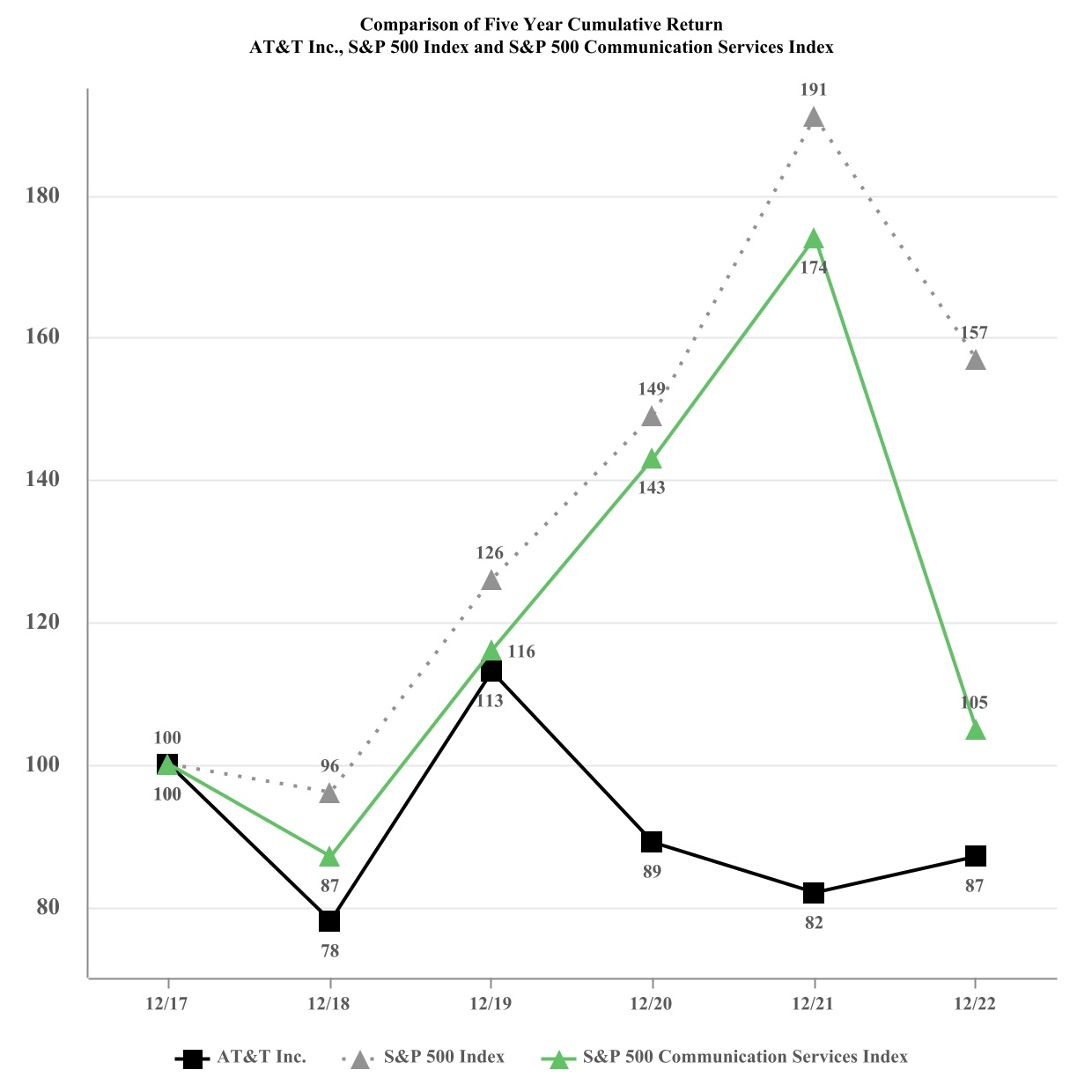
The comparison above assumes $100 invested on December 31, 2017, in AT&T common stock and the following Standard & Poor’s (S&P) Indices: S&P 500 Index and S&P 500 Communication Services Index. Total return equals stock price appreciation plus reinvestment of dividends.
| AT&T Inc. | ||||||||
| Dollars in millions except per share amounts |
Our Board of Directors has approved the following authorization to repurchase common stock: March 2014 authorization program for 300 million shares, with 144 million outstanding at December 31, 2022. To implement this authorization, we used open market repurchases, relying on Rule 10b5-1 of the Securities Exchange Act of 1934, where feasible. We also used accelerated share repurchase agreements with large financial institutions to repurchase our stock. We will continue to fund any share repurchases through a combination of cash from operations, borrowings dependent on market conditions, or cash from the disposition of certain non-strategic investments.
Our 2023 financing activities will focus on managing our debt level and paying dividends, subject to approval by our Board of Directors. We plan to fund our financing uses of cash through a combination of cash from operations, issuance of debt and asset sales. The timing and mix of any debt issuance and/or refinancing will be guided by credit market conditions and interest rate trends.
A summary of our repurchases of common stock during the fourth quarter of 2022 is as follows:
ISSUER PURCHASES OF EQUITY SECURITIES
| (a) | (b) | (c) | (d) | |||||||||||
| Period | Total Number of Shares (or Units) Purchased****1,2,3 | Average Price Paid Per Share (or Unit) | Total Number of Shares (or Units) Purchased as Part of Publicly Announced Plans or Programs****1 | Maximum Number (or Approximate Dollar Value) of Shares (or Units) That May Yet Be Purchased Under The Plans or Programs | ||||||||||
| October 1, 2022 - | ||||||||||||||
| October 31, 2022 | 400,261 | $ | 15.23 | — | 143,731,972 | |||||||||
| November 1, 2022 - | ||||||||||||||
| November 30, 2022 | 344,935 | $ | 18.41 | — | 143,731,972 | |||||||||
| December 1, 2022 - | ||||||||||||||
| December 31, 2022 | 146,267 | $ | 19.16 | — | 143,731,972 | |||||||||
| Total | 891,463 | $ | 17.10 | — |
1In March 2014, our Board of Directors approved an authorization to repurchase up to 300 million shares of our common stock. The authorization has no expiration date.
2Of the shares purchased, 891,463 shares were acquired through the withholding of taxes on the vesting of restricted stock and performance shares or in respect of the exercise price of options.
3Of the shares repurchased or transferred, no shares were transferred from AT&T maintained Voluntary Employee Benefit Association (VEBA) trusts.
Item 6. [RESERVED]
Item 7. MANAGEMENT’S DISCUSSION AND ANALYSIS OF FINANCIAL CONDITION AND RESULTS OF OPERATIONS
OVERVIEW
AT&T Inc. is referred to as “we,” “AT&T” or the “Company” throughout this document. AT&T products and services are provided or offered by subsidiaries and affiliates of AT&T Inc. under the AT&T brand and not by AT&T Inc., and the names of the particular subsidiaries and affiliates providing the services generally have been omitted. AT&T is a holding company whose subsidiaries and affiliates operate worldwide in the telecommunications and technology industries. You should read this discussion in conjunction with the consolidated financial statements and accompanying notes (Notes). Unless otherwise noted, this discussion refers only to our continuing operations and does not include discussion of balances or activity of WarnerMedia, Vrio, Xandr and Playdemic Ltd. (Playdemic), which are part of discontinued operations.
Our Management’s Discussion and Analysis of Financial Condition and Results of Operations included in this document generally discusses 2022 and 2021 items and year-to-year comparisons between 2022 and 2021. Discussions of 2020 items and year-to-year comparisons between 2021 and 2020 that are not included in this document can be found in “Management’s Discussion and Analysis of Financial Condition and Results of Operations” in Part II, Item 7 of our Annual Report on Form 10-K for the fiscal year ended December 31, 2021.
| AT&T Inc. | ||||||||
| Dollars in millions except per share amounts |
On April 8, 2022, we closed our transaction to combine substantially all of our WarnerMedia segment (WarnerMedia) with a subsidiary of Discovery, Inc (Discovery). Upon the separation and distribution of WarnerMedia, the WarnerMedia business met the criteria for discontinued operations. For discontinued operations, we also evaluated transactions that were components of AT&T’s single plan of a strategic shift, including dispositions that did not individually meet the criteria due to materiality, and have determined discontinued operations to be comprised of WarnerMedia, Vrio, Xandr and Playdemic. These businesses are reflected in the accompanying financial statements as discontinued operations, including for periods prior to the consummation of the WarnerMedia/Discovery transaction. (See Notes 6 and 23)
On July 31, 2021, we closed our transaction with TPG Capital (TPG) to form a new company named DIRECTV Entertainment Holdings, LLC (DIRECTV). With the close of the transaction, we separated our Video business, comprised of our U.S. video operations, and began accounting for our investment in DIRECTV under the equity method. (See Note 6)
We have two reportable segments: Communications and Latin America. Our segment results presented in Note 4 and discussed below follow our internal management reporting. Each segment’s percentage calculation of total segment operating revenue is derived from our segment results table in Note 4. Segment operating income is attributable to our Communications segment due to operating losses in Latin America. Percentage increases and decreases that are not considered meaningful are denoted with a dash.
| Percent Change | |||||||||||||||||
| 2022 | 2021 | 2020 | 2022 vs. 2021 | 2021 vs. 2020 | |||||||||||||
| Operating Revenues | |||||||||||||||||
| Communications | $ | 117,067 | $ | 114,730 | $ | 109,965 | 2.0 | % | 4.3 | % | |||||||
| Latin America | 3,144 | 2,747 | 2,562 | 14.5 | 7.2 | ||||||||||||
| Corporate and Other: | |||||||||||||||||
| Corporate | 530 | 731 | 766 | (27.5) | (4.6) | ||||||||||||
| Video | — | 15,513 | 28,610 | — | (45.8) | ||||||||||||
| Held-for-sale and other reclassifications | — | 453 | 1,414 | — | (68.0) | ||||||||||||
| Eliminations and consolidations | — | (136) | (267) | — | 49.1 | ||||||||||||
| AT&T Operating Revenues | $ | 120,741 | $ | 134,038 | $ | 143,050 | (9.9) | % | (6.3) | % | |||||||
| Operating Income | |||||||||||||||||
| Communications | $ | 29,107 | $ | 28,393 | $ | 29,062 | 2.5 | % | (2.3) | % | |||||||
| Latin America | (326) | (510) | (587) | 36.1 | 13.1 | ||||||||||||
| Segment Operating Income | 28,781 | 27,883 | 28,475 | 3.2 | (2.1) | ||||||||||||
| Corporate | (2,570) | (1,644) | (1,398) | (56.3) | (17.6) | ||||||||||||
| Video | — | 2,491 | 2,174 | — | 14.6 | ||||||||||||
| Held-for-sale and other reclassifications | — | 143 | 681 | — | (79.0) | ||||||||||||
| Reclassification of prior service credits | (2,691) | (2,680) | (2,442) | (0.4) | (9.7) | ||||||||||||
| Certain significant items | (28,107) | (296) | (19,118) | — | 98.5 | ||||||||||||
| AT&T Operating Income (Loss) | $ | (4,587) | $ | 25,897 | $ | 8,372 | — | % | — | % |
The Communications segment accounted for approximately 97% of our 2022 total segment operating revenues compared to 98% in 2021 and accounted for all segment operating income in 2022 and 2021. This segment provides services to businesses and consumers located in the U.S. and businesses globally. Our business strategies reflect bundled product offerings that cut across product lines and utilize shared assets. This segment contains the following business units:
-
Mobility** provides nationwide wireless service and equipment.
-
Business Wireline** provides advanced ethernet-based fiber services, IP Voice and managed professional services, as well as traditional voice and data services and related equipment to business customers.
-
Consumer Wireline** provides broadband services, including fiber connections that provide our multi-gig services to residential customers in select locations. Consumer Wireline also provides legacy telephony voice communication services.
The Latin America segment accounted for approximately 3% of our 2022 total segment operating revenues compared to 2% in 2021. This segment provides wireless services and equipment in Mexico.
| AT&T Inc. | ||||||||
| Dollars in millions except per share amounts |
RESULTS OF OPERATIONS
Consolidated Results Our financial results from continuing operations are summarized in the following table. We then discuss factors affecting our overall results from continuing operations. Additional analysis is discussed in our “Segment Results” section. We also discuss our expected revenue and expense trends for 2023 in the “Operating Environment and Trends of the Business” section. Certain prior-period amounts have been reclassified to conform to the current period’s presentation.
| Percent Change | |||||||||||||||||
| 2022 | 2021 | 2020 | 2022 vs. 2021 | 2021 vs. 2020 | |||||||||||||
| Operating revenues | |||||||||||||||||
| Service | $ | 97,831 | $ | 11 |
Showing the first 8K of 104K characters. Open the full section
Item 7A. QUANTITATIVE AND QUALITATIVE DISCLOSURES ABOUT MARKET RISK
We are exposed to market risks primarily from changes in interest rates and foreign currency exchange rates. These risks, along with other business risks, impact our cost of capital. It is our policy to manage our debt structure and foreign exchange exposure in order to manage capital costs, control financial risks and maintain financial flexibility over the long term. In managing market risks, we employ derivatives according to documented policies and procedures, including interest rate swaps, interest rate locks, foreign currency exchange contracts and combined interest rate foreign currency contracts (cross-currency swaps). We do not use derivatives for trading or speculative purposes. We do not foresee significant changes in the strategies we use to manage market risk in the near future.
One of the most significant assumptions used in estimating our postretirement benefit obligations is the assumed weighted-average discount rate, which is the hypothetical rate at which the projected benefit obligations could be effectively settled or paid out to participants. We determined our discount rate based on a range of factors, including a yield curve composed of the rates of return on several hundred high-quality, fixed income corporate bonds available at the measurement date and corresponding to the related expected durations of future cash outflows for the obligations. In recent years, the discount rates have been increasingly volatile, and on average have been lower than in historical periods. Lower discount rates used to measure our pension and postretirement plans result in higher obligations. Future increases in these rates could result in lower obligations, improved funded status and actuarial gains.
Interest Rate Risk
The majority of our financial instruments are medium- and long-term fixed-rate notes and debentures. Changes in interest rates can lead to significant fluctuations in the fair value of these instruments. The principal amounts by expected maturity, average interest rate and fair value of our liabilities that are exposed to interest rate risk are described in Notes 11 and 12. In managing interest expense, we control our mix of fixed and floating rate debt through term loans, floating rate notes, and interest rate swaps. We have established interest rate risk limits that we closely monitor by measuring interest rate sensitivities in our debt and interest rate derivatives portfolios.
Most of our foreign-denominated long-term debt has been swapped from fixed-rate or floating-rate foreign currencies to fixed-rate U.S. dollars at issuance through cross-currency swaps, removing interest rate risk and foreign currency exchange risk associated with the underlying interest and principal payments. Likewise, periodically we enter into interest rate locks to partially hedge the risk of increases in the benchmark interest rate during the period leading up to the probable issuance of fixed-rate debt. We expect gains or losses in our cross-currency swaps and interest rate locks to offset the losses and gains in the financial instruments they hedge.
We had no interest rate swaps and no interest rate locks at December 31, 2022.
Foreign Exchange Risk
We principally use foreign exchange contracts to hedge costs and debt denominated in foreign currencies. We are also exposed to foreign currency exchange risk through our foreign affiliates and equity investments in foreign companies.
Through cross-currency swaps, most of our foreign-denominated debt has been swapped from fixed-rate or floating-rate foreign currencies to fixed-rate U.S. dollars at issuance, removing interest rate and foreign currency exchange risk associated with the underlying interest and principal payments. We expect gains or losses in our cross-currency swaps to offset the gains and losses in the financial instruments they hedge. We had cross-currency swaps with a notional value of $38,213 and a fair value of $(5,982) outstanding at December 31, 2022.
For the purpose of assessing specific risks, we use a sensitivity analysis to determine the effects that market risk exposures may have on the fair value of our financial instruments and results of operations. We had foreign exchange forward contracts with a notional value of $617 and a fair value of $(23) outstanding at December 31, 2022.
| AT&T Inc. | ||||||||
Report of Management
The consolidated financial statements have been prepared in conformity with U.S. generally accepted accounting principles. The integrity and objectivity of the data in these financial statements, including estimates and judgments relating to matters not concluded by year end, are the responsibility of management, as is all other information included in the Annual Report, unless otherwise indicated.
The financial statements of AT&T Inc. (AT&T) have been audited by Ernst & Young LLP, Independent Registered Public Accounting Firm. Management has made available to Ernst & Young LLP all of AT&T’s financial records and related data, as well as the minutes of stockholders’ and directors’ meetings. Furthermore, management believes that all representations made to Ernst & Young LLP during its audit were valid and appropriate.
Management maintains disclosure controls and procedures that are designed to ensure that information required to be disclosed by AT&T is recorded, processed, summarized, accumulated and communicated to its management, including its principal executive and principal financial officers, to allow timely decisions regarding required disclosure, and reported within the time periods specified by the Securities and Exchange Commission’s rules and forms.
Management also seeks to ensure the objectivity and integrity of its financial data by the careful selection of its managers, by organizational arrangements that provide an appropriate division of responsibility and by communication programs aimed at ensuring that its policies, standards and managerial authorities are understood throughout the organization.
The Audit Committee of the Board of Directors meets periodically with management, the internal auditors and the independent auditors to review the manner in which they are performing their respective responsibilities and to discuss auditing, internal accounting controls and financial reporting matters. Both the internal auditors and the independent auditors periodically meet alone with the Audit Committee and have access to the Audit Committee at any time.
Assessment of Internal Control
The management of AT&T is responsible for establishing and maintaining adequate internal control over financial reporting, as defined in Rule 13a-15(f) or 15d-15(f) under the Securities Exchange Act of 1934. AT&T’s internal control system was designed to provide reasonable assurance to the company’s management and Board of Directors regarding the preparation and fair presentation of published financial statements.
AT&T management assessed the effectiveness of the company’s internal control over financial reporting as of December 31, 2022. In making this assessment, it used the criteria set forth by the Committee of Sponsoring Organizations of the Treadway Commission (COSO) in Internal Control – Integrated Framework (2013 framework). Based on its assessment, AT&T management believes that, as of December 31, 2022, the company’s internal control over financial reporting is effective based on those criteria.
Ernst & Young LLP, the independent registered public accounting firm that audited the financial statements included in this Annual Report, has issued an attestation report on the company’s internal control over financial reporting.
| /s/John T. Stankey | /s/Pascal Desroches . | ||||
| John T. Stankey | Pascal Desroches | ||||
| Chief Executive Officer and President | Senior Executive Vice President and Chief Financial Officer |
| AT&T Inc. | ||||||||
Report of Independent Registered Public Accounting Firm
To the Stockholders and the Board of Directors of AT&T Inc.
Opinion on the Financial Statements
We have audited the accompanying consolidated balance sheets of AT&T Inc. (the Company) as of December 31, 2022 and 2021, the related consolidated statements of income, comprehensive income, cash flows and changes in stockholders’ equity for each of the three years in the period ended December 31, 2022, and the related notes and financial statement schedule listed in Item 15(a) (collectively referred to as the “consolidated financial statements”). In our opinion, the consolidated financial statements present fairly, in all material respects, the financial position of the Company at December 31, 2022 and 2021, and the results of its operations and its cash flows for each of the three years in the period ended December 31, 2022, in conformity with U.S. generally accepted accounting principles.
We also have audited, in accordance with the standards of the Public Company Accounting Oversight Board (United States) (PCAOB), the Company’s internal control over financial reporting as of December 31, 2022, based on criteria established in Internal Control—Integrated Framework issued by the Committee of Sponsoring Organizations of the Treadway Commission (2013 framework) and our report dated February 13, 2023 expressed an unqualified opinion thereon.
Basis for Opinion
These financial statements are the responsibility of the Company’s management. Our responsibility is to express an opinion on the Company’s financial statements based on our audits. We are a public accounting firm registered with the PCAOB and are required to be independent with respect to the Company in accordance with the U.S. federal securities laws and the applicable rules and regulations of the Securities and Exchange Commission and the PCAOB.
We conducted our audits in accordance with the standards of the PCAOB. Those standards require that we plan and perform the audit to obtain reasonable assurance about whether the financial statements are free of material misstatement, whether due to error or fraud. Our audits included performing procedures to assess the risks of material misstatement of the financial statements, whether due to error or fraud, and performing procedures that respond to those risks. Such procedures included examining, on a test basis, evidence regarding the amounts and disclosures in the financial statements. Our audits also included evaluating the accounting principles used and significant estimates made by management, as well as evaluating the overall presentation of the financial statements. We believe that our audits provide a reasonable basis for our opinion.
Critical Audit Matters
The critical audit matters communicated below are matters arising from the current period audit of the financial statements that were communicated or required to be communicated to the audit committee and that: (1) relate to accounts or disclosures that are material to the financial statements and (2) involved our especially challenging, subjective or complex judgments. The communication of critical audit matters does not alter in any way our opinion on the consolidated financial statements, taken as a whole, and we are not, by communicating the critical audit matters below, providing separate opinions on the critical audit matters or on the accounts or disclosures to which they relate.
| Discount rates used in determining pension and postretirement benefit obligations | |||||
| Description of the Matter | At December 31, 2022, the Company’s defined benefit pension obligation was $42,828 million and exceeded the fair value of pension plan assets of $40,874 million, resulting in an unfunded benefit obligation of $1,954 million. Additionally, at December 31, 2022, the Company’s postretirement benefit obligation was $7,280 million and exceeded the fair value of postretirement plan assets of $2,160 million, resulting in an unfunded benefit obligation of $5,120 million. As explained in Note 14 to the consolidated financial statements, the Company updates the assumptions used to measure the defined benefit pension and postretirement benefit obligations, including discount rates, at December 31 or upon a remeasurement event. The Company determines the discount rates used to measure the obligations based on the development of a yield curve using high-quality corporate bonds selected to yield cash flows that correspond to the expected timing and amount of the expected future benefit payments. |
| AT&T Inc. | ||||||||
| Auditing the defined benefit pension and postretirement benefit obligations was complex due to the judgmental nature of the actuarial assumptions made by management, primarily the discount rate, used in the Company’s measurement process. The discount rate has a significant effect on the measurement of the defined benefit pension and postretirement benefit obligations, and auditing the discount rate was complex because it required an evaluation of the credit quality of the corporate bonds used to develop the discount rate and the correlation of those bonds’ cash inflows to the timing and amount of future expected benefit payments. | |||||
| How We Addressed the Matter in Our Audit | We obtained an understanding, evaluated the design and tested the operating effectiveness of certain controls over management’s review of the determination of the discount rates used in the defined benefit pension and postretirement benefit obligations calculations. | ||||
| To test the determination of the discount rate used in the calculation of the defined benefit pension and postretirement benefit obligations, we performed audit procedures that focused on evaluating, with the assistance of our actuarial specialists, the determination of the discount rates, among other procedures. For example, we evaluated the selected yield curve used to determine the discount rates applied in measuring the defined benefit pension and postretirement benefit obligations. As part of this assessment, we considered the credit quality of the corporate bonds that comprised the yield curve and compared the timing and amount of cash flows at maturity with the expected amounts and duration of the related benefit payments. | |||||
| Evaluation of goodwill for impairment | |||||
| Description of the Matter | At December 31, 2022, the Company’s goodwill balance was $67,895 million. As discussed in Note 1 to the consolidated financial statements, reporting unit goodwill is tested at least annually for impairment. Estimating fair values in connection with these impairment evaluations involves the utilization of discounted cash flow and market multiple approaches. As described in Note 9 to the consolidated financial statements, impairment charges of $13,478 million in the Business Wireline reporting unit, $10,508 million in the Consumer Wireline reporting unit and $826 million in the Mexico reporting unit were recorded during the year. | ||||
| Auditing management’s annual goodwill impairment test for the Consumer Wireline and Business Wireline reporting units was complex because the estimation of fair values involves subjective management assumptions, such as projected terminal growth rates, projected long-term EBITDA margins, and weighted average cost of capital, and complex valuation methodologies, such as the discounted cash flow and market multiple approaches. Assumptions used in these valuation models are forward-looking, and changes in these assumptions can have a material effect on the determination of fair value. | |||||
| How We Addressed the Matter in Our Audit | We obtained an understanding, evaluated the design and tested the operating effectiveness of certain controls over the Company’s impairment evaluation processes. Our procedures included testing controls over management’s review of the valuation models and its determination of the significant assumptions described above. | ||||
| Our audit procedures to test management’s impairment evaluations included, among others, assessing the valuation methodologies and significant assumptions discussed above and the underlying data used to develop such assumptions. For example, we compared the significant assumptions to current industry, market and economic trends, and other guideline companies in the same industry. Where appropriate, we evaluated whether changes to the Company’s business and other factors would affect the significant assumptions. We also assessed the historical accuracy of management’s estimates and performed independent sensitivity analyses. We involved our valuation specialists to assist us in evaluating the methodologies and auditing the assumptions used to calculate the estimated fair values of the Company’s reporting units. | |||||
/s/ Ernst & Young LLP
We have served as the Company’s auditor since 1999.
Dallas, Texas
February 13, 2023
| AT&T Inc. | ||||||||
Report of Independent Registered Public Accounting Firm
To the Stockholders and the Board of Directors of AT&T Inc.
Opinion on Internal Control Over Financial Reporting
We have audited AT&T Inc.’s internal control over financial reporting as of December 31, 2022, based on criteria established in Internal Control—Integrated Framework issued by the Committee of Sponsoring Organizations of the Treadway Commission (2013 framework) (the COSO criteria). In our opinion, AT&T Inc. (the Company) maintained, in all material respects, effective internal control over financial reporting as of December 31, 2022, based on the COSO criteria.
We also have audited, in accordance with the standards of the Public Company Accounting Oversight Board (United States) (PCAOB), the 2022 consolidated financial statements of the Company and our report dated February 13, 2023 expressed an unqualified opinion thereon.
Basis for Opinion
The Company’s management is responsible for maintaining effective internal control over financial reporting and for its assessment of the effectiveness of internal control over financial reporting included in the accompanying Report of Management. Our responsibility is to express an opinion on the Company’s internal control over financial reporting based on our audit. We are a public accounting firm registered with the PCAOB and are required to be independent with respect to the Company in accordance with the U.S. federal securities laws and the applicable rules and regulations of the Securities and Exchange Commission and the PCAOB.
We conducted our audit in accordance with the standards of the PCAOB. Those standards require that we plan and perform the audit to obtain reasonable assurance about whether effective internal control over financial reporting was maintained in all material respects.
Our audit included obtaining an understanding of internal control over financial reporting, assessing the risk that a material weakness exists, testing and evaluating the design and operating effectiveness of internal control based on the assessed risk, and performing such other procedures as we considered necessary in the circumstances. We believe that our audit provides a reasonable basis for our opinion.
Definition and Limitations of Internal Control Over Financial Reporting
A company’s internal control over financial reporting is a process designed to provide reasonable assurance regarding the reliability of financial reporting and the preparation of financial statements for external purposes in accordance with generally accepted accounting principles. A company’s internal control over financial reporting includes those policies and procedures that (1) pertain to the maintenance of records that, in reasonable detail, accurately and fairly reflect the transactions and dispositions of the assets of the company; (2) provide reasonable assurance that transactions are recorded as necessary to permit preparation of financial statements in accordance with generally accepted accounting principles, and that receipts and expenditures of the company are being made only in accordance with authorizations of management and directors of the company; and (3) provide reasonable assurance regarding prevention or timely detection of unauthorized acquisition, use, or disposition of the company’s assets that could have a material effect on the financial statements.
Because of its inherent limitations, internal control over financial reporting may not prevent or detect misstatements. Also, projections of any evaluation of effectiveness to future periods are subject to the risk that controls may become inadequate because of changes in conditions, or that the degree of compliance with the policies or procedures may deteriorate.
/s/ Ernst & Young LLP
Dallas, Texas
February 13, 2023
| AT&T Inc. | ||
| Dollars in millions except per share amounts |
Item 8. FINANCIAL STATEMENTS AND SUPPLEMENTARY DATA
| Consolidated Statements of Income | |||||||||||||||||
| 2022 | 2021 | 2020 | |||||||||||||||
| Operating Revenues | |||||||||||||||||
| Service | $ | 97,831 | $ | 111,565 | $ | 124,057 | |||||||||||
| Equipment | 22,910 | 22,473 | 18,993 | ||||||||||||||
| Total operating revenues | 120,741 | 134,038 | 143,050 | ||||||||||||||
| Operating Expenses | |||||||||||||||||
| Cost of revenues | |||||||||||||||||
| Equipment | 24,009 | 23,685 | 19,585 | ||||||||||||||
| Broadcast, programming and operations | — | 8,106 | 16,077 | ||||||||||||||
| Other cost of revenues (exclusive of depreciation and amortization shown separately below) | 26,839 | 28,616 | 29,989 | ||||||||||||||
| Selling, general and administrative | 28,961 | 29,669 | 30,817 | ||||||||||||||
| Asset impairments and abandonments and restructuring | 27,498 | 213 | 15,687 | ||||||||||||||
| Depreciation and amortization | 18,021 | 17,852 | 22,523 | ||||||||||||||
| Total operating expenses | 125,328 | 108,141 | 134,678 | ||||||||||||||
| Operating Income (Loss) | (4,587) | 25,897 | 8,372 | ||||||||||||||
| Other Income (Expense) | |||||||||||||||||
| Interest expense | (6,108) | (6,716) | (7,727) | ||||||||||||||
| Equity in net income of affiliates | 1,791 | 603 | 89 | ||||||||||||||
| Other income (expense) – net | 5,810 | 9,387 | (1,088) | ||||||||||||||
| Total other income (expense) | 1,493 | 3,274 | (8,726) | ||||||||||||||
| Income (Loss) from Continuing Operations Before Income Taxes | (3,094) | 29,171 | (354) | ||||||||||||||
| Income tax expense on continuing operations | 3,780 | 5,395 | 1,168 | ||||||||||||||
| Income (Loss) from Continuing Operations | (6,874) | 23,776 | (1,522) | ||||||||||||||
| Loss from discontinued operations, net of tax | (181) | (2,297) | (2,299) | ||||||||||||||
| Net Income (Loss) | (7,055) | 21,479 | (3,821) | ||||||||||||||
| Less: Net Income Attributable to Noncontrolling Interest | (1,469) | (1,398) | (1,355) | ||||||||||||||
| Net Income (Loss) Attributable to AT&T | $ | (8,524) | $ | 20,081 | $ | (5,176) | |||||||||||
| Less: Preferred Stock Dividends | (203) | (207) | (193) | ||||||||||||||
| Net Income (Loss) Attributable to Common Stock | $ | (8,727) | $ | 19,874 | $ | (5,369) | |||||||||||
| Basic Earnings (Loss) Per Share from continuing operations | $ | (1.10) | $ | 3.07 | $ | (0.45) | |||||||||||
| Basic Loss Per Share from discontinued operations | $ | (0.03) | $ | (0.30) | $ | (0.30) | |||||||||||
| Basic Earnings (Loss) Per Share Attributable to Common Stock | $ | (1.13) | $ | 2.77 | $ | (0.75) | |||||||||||
| Diluted Earnings (Loss) Per Share from continuing operations | $ | (1.10) | $ | 3.02 | $ | (0.45) | |||||||||||
| Diluted Loss Per Share from discontinued operations | $ | (0.03) | $ | (0.29) | $ | (0.30) | |||||||||||
| Diluted Earnings (Loss) Per Share Attributable to Common Stock | $ | (1.13) | $ | 2.73 | $ | (0.75) |
The accompanying notes are an integral part of the consolidated financial statements.
| AT&T Inc. | ||||||||
| Dollars in millions except per share amounts |
| Consolidated Statements of Comprehensive Income | |||||||||||||||||
| 2022 | 2021 | 2020 | |||||||||||||||
| Net income (loss) | $ | (7,055) | $ | 21,479 | $ | (3,821) | |||||||||||
| Other comprehensive income (loss), net of tax: | |||||||||||||||||
| Foreign Currency: | |||||||||||||||||
| Translation adjustment (includes $0, $(2) and $(59) attributable to noncontrolling interest), net of taxes of $90, $(44) and $(42) | 346 | (127) | (929) | ||||||||||||||
| Reclassification adjustment included in net income (loss), net of taxes of $0, $204 and $0 | — | 2,087 | — | ||||||||||||||
| Distributions of WarnerMedia, net of taxes of $(38), $0 and $0 | (182) | — | — | ||||||||||||||
| Securities: | |||||||||||||||||
| Net unrealized gains (losses), net of taxes of $(49), $(21) and $27 | (143) | (63) | 78 | ||||||||||||||
| Reclassification adjustment included in net income (loss), net of taxes of $3, $(1) and $(5) | 8 | (3) | (15) | ||||||||||||||
| Derivative Instruments: | |||||||||||||||||
| Net unrealized gains (losses), net of taxes of $(183), $(192) and $(212) | (648) | (715) | (811) | ||||||||||||||
| Reclassification adjustment included in net income (loss), net of taxes of $25, $19 and $18 | 96 | 72 | 69 | ||||||||||||||
| Distributions of WarnerMedia, net of taxes of $(12), $0 and $0 | (24) | — | — | ||||||||||||||
| Defined benefit postretirement plans: | |||||||||||||||||
| Net prior service (cost) credit arising during period, net of taxes of $583, $(8) and $735 | 1,787 | (34) | 2,250 | ||||||||||||||
| Amortization of net prior service credit included in net income (loss), net of taxes of $(663), $(660) and $(601) | (2,028) | (2,020) | (1,841) | ||||||||||||||
| Distributions of WarnerMedia, net of taxes of $5, $0 and $0 | 25 | — | — | ||||||||||||||
| Other comprehensive income (loss) | (763) | (803) | (1,199) | ||||||||||||||
| Total comprehensive income (loss) | (7,818) | 20,676 | (5,020) | ||||||||||||||
| Less: Total comprehensive income attributable to noncontrolling interest | (1,469) | (1,396) | (1,296) | ||||||||||||||
| Total Comprehensive Income (Loss) Attributable to AT&T | $ | (9,287) | $ | 19,280 | $ | (6,316) |
The accompanying notes are an integral part of the consolidated financial statements.
| AT&T Inc. | ||||||||
| Dollars |
Showing the first 8K of 282K characters. Open the full section
Item 9. CHANGES IN AND DISAGREEMENTS WITH ACCOUNTANTS ON ACCOUNTING AND FINANCIAL DISCLOSURE
During our two most recent fiscal years, there has been no change in the independent accountant engaged as the principal accountant to audit our financial statements, and the independent accountant has not expressed reliance on other independent accountants in its reports during such time period.
Item 9A. CONTROLS AND PROCEDURES
Disclosure Controls and Procedures
The registrant maintains disclosure controls and procedures that are designed to ensure that information required to be disclosed by the registrant is recorded, processed, summarized, accumulated and communicated to its management, including its principal executive and principal financial officers, to allow timely decisions regarding required disclosure, and reported within the time periods specified in the SEC’s rules and forms. The Chief Executive Officer and Chief Financial Officer have performed an evaluation of the effectiveness of the design and operation of the registrant’s disclosure controls and procedures as of December 31, 2022. Based on that evaluation, the Chief Executive Officer and Chief Financial Officer concluded that the registrant’s disclosure controls and procedures were effective as of December 31, 2022.
There have not been any changes in our internal control over financial reporting during our most recent fiscal quarter that have materially affected, or are reasonably likely to materially affect, our internal control over financial reporting.
Internal Control Over Financial Reporting
a.Management’s Annual Report on Internal Control over Financial Reporting
The management of AT&T is responsible for establishing and maintaining adequate internal control over financial reporting. AT&T’s internal control system was designed to provide reasonable assurance as to the integrity and reliability of the published financial statements. AT&T management assessed the effectiveness of the company’s internal control over financial reporting as of December 31, 2022. In making this assessment, it used the criteria set forth by the Committee of Sponsoring Organizations of the Treadway Commission (COSO) in Internal Control – Integrated Framework (2013 framework). Based on its assessment, AT&T management believes that, as of December 31, 2022, the Company’s internal control over financial reporting is effective based on those criteria.
b.Attestation Report of the Independent Registered Public Accounting Firm
The independent registered public accounting firm that audited the financial statements included in the Annual Report containing the disclosure required by this Item, Ernst & Young LLP, has issued an attestation report on the Company’s internal control over financial reporting.
Item 9B. OTHER INFORMATION
There is no information that was required to be disclosed in a report on Form 8-K during the fourth quarter of 2022 but was not reported.
| AT&T Inc. | ||
| Dollars in millions except per share amounts |
PART III
Item 10. DIRECTORS, EXECUTIVE OFFICERS AND CORPORATE GOVERNANCE
Information regarding executive officers required by Item 401 of Regulation S-K is furnished in a separate disclosure at the end of Part I of this report entitled “Information about our Executive Officers.” Information regarding directors required by Item 401 of Regulation S-K is incorporated herein by reference pursuant to General Instruction G(3) from the registrant’s 2023 definitive proxy statement (Proxy Statement) under the heading “Management Proposal Item No. 1. Election of Directors.”
Information required by Item 405 of Regulation S-K is incorporated herein by reference pursuant to General Instruction G(3) from the registrant’s Proxy Statement under the heading “Delinquent Section 16(a) Reports.”
The registrant has a separately-designated standing audit committee established in accordance with Section 3(a)(58)(A) of the Securities Exchange Act of 1934. The members of the committee are Messrs. Luczo, McCallister and Ubiñas, and Ms. Taylor. The additional information required by Item 407(d)(5) of Regulation S-K is incorporated herein by reference pursuant to General Instruction G(3) from the registrant’s Proxy Statement under the heading “Audit Committee.”
The registrant has adopted a code of ethics entitled “Code of Ethics” that applies to the registrant’s principal executive officer, principal financial officer, principal accounting officer, or controller or persons performing similar functions. The additional information required by Item 406 of Regulation S-K is provided in this report under the heading “General” under Part I, Item 1. Business.
Item 11. EXECUTIVE COMPENSATION
Information required by this Item is incorporated herein by reference pursuant to General Instruction G(3) from the registrant’s Proxy Statement under the headings “Director Compensation,” “CEO Pay Ratio,” and the pages beginning with the heading “Compensation Discussion and Analysis” and ending with, and including, the pages under the heading “Potential Payments upon Change in Control.”
Information required by Item 407(e)(5) of Regulation S-K is included in the registrant’s Proxy Statement under the heading “Compensation Committee Report” and is incorporated herein by reference pursuant to General Instruction G(3) and shall be deemed furnished in this Annual Report on Form 10-K and will not be deemed incorporated by reference into any filing under the Securities Act of 1933 or the Securities Exchange Act of 1934.
| AT&T Inc. | ||
| Dollars in millions except per share amounts |
Item 12. SECURITY OWNERSHIP OF CERTAIN BENEFICIAL OWNERS AND MANAGEMENT AND RELATED STOCKHOLDER MATTERS
Information required by Item 403 of Regulation S-K is included in the registrant’s Proxy Statement under the heading “Common Stock Ownership,” which is incorporated herein by reference pursuant to General Instruction G(3).
Equity Compensation Plan Information
The following table provides information as of December 31, 2022, concerning shares of AT&T common stock authorized for issuance under AT&T’s existing equity compensation plans.
| Equity Compensation Plan Information | |||||||||||
| Plan Category | Number of securities to be issued upon exercise of outstanding options, warrants and rights (a) | Weighted average exercise price of outstanding options, warrants and rights (b) | Number of securities remaining available for future issuance under equity compensation plans (excluding securities reflected in column (a)) (c) | ||||||||
| Equity compensation plans approved by security holders | 76,927,549 (1) | $ | — | 102,240,827 (2) | |||||||
| Equity compensation plans not approved by security holders | — | — | — | ||||||||
| Total | 76,927,549 (3) | $ | — | 102,240,827 (2) |
(1)Includes the issuance of stock in connection with the following stockholder approved plans: (a) 0 stock options under the Stock Purchase and Deferral Plan (SPDP), (b) 945,111 phantom stock units under the Stock Savings Plan (SSP), 18,492,845 phantom stock units under the SPDP, 0 restricted stock units under the 2011 Incentive Plan, 0 restricted stock units under the 2016 Incentive Plan and 35,383,614 restricted stock units under the 2018 Incentive Plan, (c) 0 target number of stock-settled performance shares under the 2011 Incentive Plan, 0 target number of stock-settled performance shares under the 2016 Incentive Plan, and 19,478,272 target number of stock-settled performance shares under the 2018 Incentive Plan. At payout, the target number of performance shares may be reduced to zero or increased by up to 150%. Each phantom stock unit and performance share is settleable in stock on a 1-to-1 basis. The weighted-average exercise price in the table does not include outstanding performance shares or phantom stock units.
The SSP was approved by stockholders in 1994 and then was amended by the Board of Directors in 2000 to increase the number of shares available for purchase under the plan (including shares from the Company match and reinvested dividend equivalents). Stockholder approval was not required for the amendment. To the extent applicable, the amount shown for approved plans in column (a), in addition to the above amounts, includes 2,648,162 phantom stock units (computed on a first-in-first-out basis) that were approved by the Board in 2000. Under the SSP, shares could be purchased with payroll deductions and reinvested dividend equivalents by mid-level and above managers and limited Company partial matching contributions. No new contributions may be made to the plan.
(2)Includes 19,493,387 shares that may be issued under the SPDP, 80,375,750 shares that may be issued under the 2018 Incentive Plan, and up to 2,371,691 shares that may be purchased through reinvestment of dividends on phantom shares held in the SSP.
(3)Does not include certain stock options issued by companies acquired by AT&T that were converted into options to acquire AT&T stock. As of December 31, 2022, there were 2,861,614 shares of AT&T common stock subject to the converted options, having a weighted-average exercise price of $20.18. Also, does not include 346,157 outstanding phantom stock units that were issued by companies acquired by AT&T that are convertible into stock on a 1-to-1 basis, along with an estimated 135,365 shares that may be purchased with reinvested dividend equivalents paid on the outstanding phantom stock units. No further phantom stock units, other than reinvested dividends, may be issued under the assumed plans. The weighted-average exercise price in the table does not include outstanding performance shares or phantom stock units.
| AT&T Inc. | ||
| Dollars in millions except per share amounts |
Item 13. CERTAIN RELATIONSHIPS AND RELATED TRANSACTIONS, AND DIRECTOR INDEPENDENCE
Information required by Item 404 of Regulation S-K is included in the registrant’s Proxy Statement under the heading “Related Person Transactions,” which is incorporated herein by reference pursuant to General Instruction G(3). Information required by Item 407(a) of Regulation S-K is included in the registrant’s Proxy Statement under the heading “Director Independence,” which is incorporated herein by reference pursuant to General Instruction G(3).
Item 14. PRINCIPAL ACCOUNTANT FEES AND SERVICES
Information required by this Item is included in the registrant’s Proxy Statement under the heading “Principal Accountant Fees and Services,” which is incorporated herein by reference pursuant to General Instruction G(3).
Part IV
Item 15. EXHIBITS AND FINANCIAL STATEMENT SCHEDULES
(a)Documents filed as a part of the report:
| Page | ||||||||||||||
| (1) Report of Independent Registered Public Accounting Firm (PCAOB ID: 42) | 40 | |||||||||||||
| Financial Statements covered by Report of Independent Registered Public Accounting Firm: | 42 | |||||||||||||
| Consolidated Statements of Income | 43 | |||||||||||||
| Consolidated Statements of Comprehensive Income | 44 | |||||||||||||
| Consolidated Balance Sheets | 45 | |||||||||||||
| Consolidated Statements of Cash Flows | 46 | |||||||||||||
| Consolidated Statements of Changes in Stockholders’ Equity | 47 | |||||||||||||
| Notes to Consolidated Financial Statements | 49 | |||||||||||||
| (2) Financial Statement Schedules: | ||||||||||||||
| II - Valuation and Qualifying Accounts | 105 |
Financial statement schedules other than those listed above have been omitted because the required information is contained in the financial statements and notes thereto, or because such schedules are not required or applicable.
| (3) Exhibits: | ||||||||||||||
| Exhibits identified in parentheses below, on file with the SEC, are incorporated herein by reference as exhibits hereto. Unless otherwise indicated, all exhibits so incorporated are from File No. 1-8610. |
| Exhibit Number | ||||||||||||||
| 2-a | Agreement and Plan of Merger, dated as of May 17, 2021, by and among AT&T Inc., Magallanes, Inc., and Discovery, Inc. (Exhibit 2.1 to Form 8-K filed on May 20, 2021)* | |||||||||||||
| 2-b | Separation and Distribution Agreement, dated as of May 17, 2021, by and among AT&T Inc., Magallanes, Inc., and Discovery, Inc. (Exhibit 2.2 to Form 8-K filed on May 20, 2021)* | |||||||||||||
| 3-a | Restated Certificate of Incorporation, filed with the Secretary of State of Delaware on December 13, 2013 (Exhibit 3.1 to Form 8-K filed on December 16, 2013) | |||||||||||||
| 3-b | Bylaws (Exhibit 3.1 to Form 8-K filed on February 2, 2023) | |||||||||||||
| 3-c | Certificate of Designations with respect to Series A Preferred Stock (Exhibit 3.1 to Form 8-K filed on December 12, 2019) | |||||||||||||
| 3-d | Certificate of Designations with respect to Series B Preferred Stock (Exhibit 3.1 to Form 8-K filed on February 18, 2020) | |||||||||||||
| 3-e | Certificate of Designations with respect to Series C Preferred Stock (Exhibit 3.2 to Form 8-K filed on February 18, 2020) |
| AT&T Inc. | ||
| Dollars in millions except per share amounts |
| 4-a | No instrument which defines the rights of holders of long-term debt of the registrant and all of its consolidated subsidiaries is filed herewith pursuant to Regulation S-K, Item 601(b)(4)(iii)(A), except for the instruments referred to in 4-b, 4-c, 4-d, 4-e, 4-f below. Pursuant to this regulation, the registrant hereby agrees to furnish a copy of any such instrument not filed herewith to the SEC upon request. | |||||||||||||
| 4-b | Guaranty of certain obligations of Pacific Bell Telephone Co. and Southwestern Bell Telephone Co. (Exhibit 4-c to Form 10-K for the period ending December 31, 2011) | |||||||||||||
| 4-c | Guaranty of certain obligations of Ameritech Capital Funding Corp., Indiana Bell Telephone Co. Inc., Michigan Bell Telephone Co., Pacific Bell Telephone Co., Southwestern Bell Telephone Company, Illinois Bell Telephone Company, The Ohio Bell Telephone Company, The Southern New England Telephone Company, Southern New England Telecommunications Corporation, and Wisconsin Bell, Inc. (Exhibit 4-d to Form 10-K for the period ending December 31, 2011) | |||||||||||||
| 4-d | Guarantee of certain obligations of AT&T Corp. (Exhibit 4-e to Form 10-K for the period ending December 31, 2011) | |||||||||||||
| 4-e | Indenture, dated as of May 15, 2013, between AT&T Inc. and The Bank of New York Mellon Trust Company, N.A., as Trustee (Exhibit 4.1 to Form 8-K filed on May 15, 2013) | |||||||||||||
| 4-f | Indenture dated as of November 1, 1994 between SBC Communications Inc. and The Bank of New York, as Trustee (Exhibit 4-h to Form 10-K for the period ending December 31, 2013) | |||||||||||||
| 4-g | Deposit Agreement, dated December 12, 2019, among the AT&T Inc., Computershare Inc. and Computershare Trust Company, N.A., collectively, as depositary, and the holders from time to time of the depository receipts described therein (Exhibit 4.3 to Form 8-K filed December 12, 2019) | |||||||||||||
| 4-h | Deposit Agreement, dated February 18, 2020, among the Company, Computershare Inc. and Computershare Trust Company, N.A., collectively, as depositary, and the holders from time to time of the depositary receipts described therein (Exhibit 4.3 to Form 8-K filed February 18, 2020) | |||||||||||||
| 4-i | Description of AT&T’s Securities Registered Under Section 12 of the Exchange Act | |||||||||||||
| 10-a | 2018 Incentive Plan (Exhibit 10-a to Form 10-K for the period ending December 31, 2017)** | |||||||||||||
| 10-b | 2016 Incentive Plan (Exhibit 10-a to Form 10-Q for the period ending March 31, 2016)** | |||||||||||||
| 10-c | Resolution Regarding John Stankey (Exhibit 10-b to Form 10-Q for the period ending September 30, 2017)** | |||||||||||||
| 10-d | 2011 Incentive Plan (Exhibit 10-a to Form 10-Q for the period ending September 30, 2015)** | |||||||||||||
| 10-e | Short Term Incentive Plan (Exhibit 10.1 to Form 8-K filed on February 2, 2018)** | |||||||||||||
| 10-f | Supplemental Life Insurance Plan (Exhibit 10.1 to Form 8-K filed on June 26, 2020)** | |||||||||||||
| 10-g | Supplemental Retirement Income Plan (Exhibit 10-e to Form 10-K for the period ending December 31, 2013)** | |||||||||||||
| 10-h | 2005 Supplemental Employee Retirement Plan (Exhibit 10-g to Form 10-K for the period ending December 31, 2021)** | |||||||||||||
| 10-i | Salary and Incentive Award Deferral Plan (Exhibit 10-k to Form 10-K for the period ending December 31, 2011)** | |||||||||||||
| 10-j | Stock Savings Plan (Exhibit 10-l to Form 10-K for the period ending December 31, 2011)** | |||||||||||||
| 10-k | Stock Purchase and Deferral Plan as amended July 28, 2022 (Exhibit 10.3 to Form 10-Q for the period ending September 30, 2022)** | |||||||||||||
| 10-l | Cash Deferral Plan as amended July 28, 2022 (Exhibit 10.2 to Form 10-Q for the period ending September 30, 2022)** | |||||||||||||
| 10-m | Master Trust Agreement for AT&T Inc. Deferred Compensation Plans and Other Executive Benefit Plans and subsequent amendments dated August 1, 1995 and November 1, 1999 (Exhibit 10-dd to Form 10-K for the period ending December 31, 2009)** | |||||||||||||
| 10-n | Officer Disability Plan (Exhibit 10-i to Form 10-Q for the period ending June 30, 2009)** | |||||||||||||
| 10-o | AT&T Inc. Health Plan (Exhibit 10.1 to Form 10-Q for the period ending September 30, 2022)** | |||||||||||||
| 10-p | Pension Benefit Makeup Plan No.1 (Exhibit 10-n to Form 10-K for the period ending December 31, 2016)** | |||||||||||||
| 10-q | AT&T Inc. Equity Retention and Hedging Policy as amended March 24, 2022 (Exhibit 10.2 to Form 10-Q for the period ending March 31, 2022) | |||||||||||||
| 10-r | Administrative Plan (Exhibit 10-q to Form 10-K for the period ending December 31, 2019)** | |||||||||||||
| 10-s | AT&T Inc. Non-Employee Director Stock and Deferral Plan** | |||||||||||||
| 10-t | AT&T Inc. Non-Employee Director Stock Purchase Plan (Exhibit 10-t to Form 10-K for the period ending December 31, 2013)** |
| AT&T Inc. | ||
| Dollars in millions except per share amounts |
| 10-u | AT&T Inc. Board of Directors Communications Concession Program | |||||||||||||
| 10-v | Form of Indemnity Agreement, effective July 1, 1986, between Southwestern Bell Corporation (now AT&T Inc.) and its directors and officers. (Exhibit 10-bb to Form 10-K for the period ending December 31, 2011)** | |||||||||||||
| 10-w | AT&T Executive Physical Program (Exhibit 10-ff to Form 10-K for the period ending December 31, 2016)** | |||||||||||||
| 10-x | Attorney Fee Payment Agreement for John Stankey (Exhibit 10.1 to Form 8-K filed on July 3, 2018)** | |||||||||||||
| 10-y | $12,000,000,000 Amended and Restated Credit Agreement, dated as of November 18, 2022, among AT&T Inc., the lenders named therein and Citibank, N.A., as agent. (Exhibit 10.1 to Form 8-K filed on November 18, 2022) | |||||||||||||
| 10-z | Amended and Restated Contribution Agreement (Exhibit 10-ee to Form 10-K for the period ending December 31, 2018) | |||||||||||||
| 10-aa | Fifth Amended and Restated Limited Liability Company Agreement of Mobility II LLC (Exhibit 10.1 to Form 10-Q for the period ending September 30, 2020) | |||||||||||||
| 10-bb | First Amendment to the Fifth Amended and Restated Limited Liability Company Agreement of Mobility II LLC | |||||||||||||
| 10-cc | Second Amendment to the Fifth Amended and Restated Limited Liability Company Agreement of Mobility II LLC | |||||||||||||
| 10-dd | Third Amendment to the Fifth Amended and Restated Limited Liability Company Agreement of Mobility II LLC | |||||||||||||
| 10-ee | Amended and Restated Registration Rights Agreement by and among AT&T Inc. and The SBC Master Pension Trust and Brock Fiduciary Services LLC (Exhibit 10-ii to Form 10-K for the period ending December 31, 2018) | |||||||||||||
| 10-ff | First Amendment to Amended and Restated Registration Rights Agreement by and among AT&T Inc. and The SBC Master Pension Trust and Brock Fiduciary Services LLC (Exhibit 10.2 to Form 10-Q for the period ending September 30, 2020) | |||||||||||||
| 10-gg | Second Amended and Restated Limited Liability Company Agreement of NCWPCS MPL Holdings, LLC (Exhibit 10.1 to Form 8-K filed on December 12, 2019) | |||||||||||||
| 10-hh | AT&T Inc. Change in Control Severance Plan (Exhibit 10.1 to Form 8-K filed on June 30, 2014)** | |||||||||||||
| 10-ii | Agreement of Contribution and Subscription, dated February 25, 2021 (Exhibit 10.1 to Form 8-K filed on February 25, 2021) | |||||||||||||
| 10-jj | Employee Matters Agreement by and among AT&T Inc., Magallanes, Inc., and Discovery, Inc. dated as of May 17, 2021 (Exhibit 10.3 to Form 8-K Filed on May 20, 2021) | |||||||||||||
| 10-kk | Tax Matters Agreement between AT&T Inc., Magallanes, Inc., and Discovery, Inc. dated as of May 17, 2021 (Exhibit 10.4 to Form 8-K Filed on May 20, 2021) | |||||||||||||
| 10-ll | Amended and Restated Limited Liability Company Agreement of DIRECTV Entertainment Holdings LLC, dated as of July 31, 2021 (Exhibit 10.1 to Form 8-K filed August 2, 2021) | |||||||||||||
| 10-mm | Relocation Program Plan (Exhibit 10.2 to Form 10-Q for the period ending September 30, 2021)** | |||||||||||||
| 10-nn | Amendment Regarding Continuation of Active Employee Participant Benefits in Certain AT&T Benefit Plans in Connection with DIRECTV Transaction (Exhibit 10.3 to Form 10-Q for the period ending September 30, 2021)** | |||||||||||||
| 21 | Subsidiaries of AT&T Inc. | |||||||||||||
| 23 | Consent of Ernst & Young LLP | |||||||||||||
| 24 | Powers of Attorney | |||||||||||||
| 31 | Rule 13a-14(a)/15d-14(a) Certifications | |||||||||||||
| 31.1 | Certification of Principal Executive Officer | |||||||||||||
| 31.2 | Certification of Principal Financial Officer | |||||||||||||
| 32 | Section 1350 Certification | |||||||||||||
| 99 | Supplemental Interim Financial Information |
| AT&T Inc. | ||
| Dollars in millions except per share amounts |
| 101 | The consolidated financial statements from the Company’s Form 10-K for the year ended December 31, 2022, as filed with the SEC on February 13, 2023, formatted in Inline XBRL: (i) Consolidated Statements of Cash Flows, (ii) Consolidated Statements of Operations, (iii) Consolidated Statements of Comprehensive Income, (iv) Consolidated Balance Sheets, and (v) Notes to Consolidated Financial Statements, tagged as blocks of text and including detailed tags. | |||||||||||||
| 104 | Cover Page Interactive Data File (formatted as Inline XBRL and contained in Exhibit 101) |
- Certain schedules (or similar attachments) have been omitted pursuant to Item 601(a)(5) or Item 601(b)(2) of Regulation S-K. The registrant agrees to furnish copies of such schedules (or similar attachments) to the U.S. Securities and Exchange Commission upon request.
**Management contracts and compensatory plans and arrangements required to be filed as exhibits pursuant to Item 15(b) of this report.
We will furnish to stockholders upon request, and without charge, a copy of the Annual Report to Stockholders and the Proxy Statement, portions of which are incorporated by reference in the Form 10-K. We will furnish any other exhibit at cost.
Item 16. FORM 10-K SUMMARY
None.
| AT&T Inc. | ||
| Dollars in millions except per share amounts |
SCHEDULE II - VALUATION AND QUALIFYING ACCOUNTS
Allowance for Credit Losses
| COL. A | COL. B | COL. C | COL. D | COL. E | ||||||||||||||||
| Additions | ||||||||||||||||||||
| (1) | (2) | (3) | ||||||||||||||||||
| Balance at Beginning of Period | Charged to Costs and Expenses (a) | Charged to Other Accounts (b) | Acquisitions | Deductions (c) | Balance at End of Period (d) | |||||||||||||||
| Year 2022 | $ | 1,163 | $ | 1,865 | $ | — | $ | — | $ | 2,017 | $ | 1,011 | ||||||||
| Year 2021 | $ | 1,457 | $ | 1,241 | $ | — | $ | — | $ | 1,535 | $ | 1,163 | ||||||||
| Year 2020 | $ | 1,150 | $ | 1,798 | $ | 405 | $ | — | $ | 1,896 | $ | 1,457 | ||||||||
(a)Includes amounts previously written off which were credited directly to this account when recovered.
Excludes direct charges and credits to expense for nontrade receivables in the consolidated statements of income.
Includes the impact to operating expenses, for the year ended December 31, 2020, after adoption of ASC 326.
(b)Opening adjustments upon adoption of ASC 326, with modified retrospective application, as of January 1, 2020 (see Note 1).
(c)Amounts written off as uncollectible, or related to divested entities.
(d)Includes balances applicable to trade receivables, loans, contract assets and other assets subject to credit loss measurement (see Note 1).
SCHEDULE II - VALUATION AND QUALIFYING ACCOUNTS
Allowance for Deferred Tax Assets
| COL. A | COL. B | COL. C | COL. D | COL. E | ||||||||||||||||
| Additions | ||||||||||||||||||||
| (1) | (2) | (3) | ||||||||||||||||||
| Balance at Beginning of Period | Charged to Costs and Expenses | Charged to Other Accounts | Acquisitions | Deductions | Balance at End of Period | |||||||||||||||
| Year 2022 | $ | 4,343 | (168) | — | — | — | $ | 4,175 | ||||||||||||
| Year 2021 | $ | 4,557 | (214) | — | — | — | $ | 4,343 | ||||||||||||
| Year 2020 | $ | 4,715 | (158) | — | — | — | $ | 4,557 |
SIGNATURES
Pursuant to the requirements of Section 13 or 15(d) of the Securities Exchange Act of 1934, the registrant has duly caused this report to be signed on its behalf by the undersigned, thereunto duly authorized, on the 14th day of February, 2023.
AT&T INC.
| /s/ Pascal Desroches | ||
| Pascal Desroches | ||
| Senior Executive Vice President | ||
| and Chief Financial Officer |
Pursuant to the requirements of the Securities Exchange Act of 1934, this report has been signed below by the following persons on behalf of the registrant and in the capacities and on the date indicated.
Principal Executive Officer:
John T. Stankey*
Chief Executive Officer
and President
Principal Financial Officer:
Pascal Desroches
Senior Executive Vice President
and Chief Financial Officer
| /s/ Pascal Desroches | ||
| Pascal Desroches, as attorney-in-fact | ||
| and on his own behalf as Principal | ||
| Financial Officer |
Principal Accounting Officer:
Debra L. Dial
Senior Vice President, Chief
Accounting Officer and Controller
| /s/ Debra L. Dial |
February 13, 2023
| Directors: | |||||
| William E. Kennard* | Beth E. Mooney* | ||||
| Scott T. Ford* | Matthew K. Rose* | ||||
| Glenn H. Hutchins* | John T. Stankey* | ||||
| Stephen J. Luczo* | Cynthia B. Taylor* | ||||
| Michael B. McCallister* | Luis A. Ubiñas* | ||||
| * by power of attorney |