 filings.tools
Molson Coors Beverage 10-K 2020-12-31
Filed 2021-02-11. 22 sections, 767K characters. Original on sec.gov · Markdown · JSON
Cover and table of contents
UNITED STATES
SECURITIES AND EXCHANGE COMMISSION
Washington, D.C. 20549
FORM 10-K
| (Mark One) | |||||
| ☒ | ANNUAL REPORT PURSUANT TO SECTION 13 OR 15(d) OF THE SECURITIES EXCHANGE ACT OF 1934 |
For the fiscal year ended December 31, 2020
| OR | |||||
| ☐ | TRANSITION REPORT PURSUANT TO SECTION 13 OR 15(d) OF THE SECURITIES EXCHANGE ACT OF 1934 | ||||
| For the transition period from ______ to ______ . |
Commission File Number: 1-14829
Molson Coors Beverage Company
(Exact name of registrant as specified in its charter)
Delaware
(State or other jurisdiction of incorporation or organization)
P.O. Box 4030, NH353, Golden, Colorado, USA
1555 Notre Dame Street East, Montréal, Québec, Canada
(Address of principal executive offices)
84-0178360
(I.R.S. Employer Identification No.)
80401
H2L 2R5
(Zip Code)
303-279-6565 (Colorado)
514-521-1786 (Québec)
(Registrant's telephone number, including area code)
Securities registered pursuant to Section 12(b) of the Act:
| Title of each class | Trading symbols | Name of each exchange on which registered | ||||||||||||
| Class A Common Stock, $0.01 par value | TAP.A | New York Stock Exchange | ||||||||||||
| Class B Common Stock, $0.01 par value | TAP | New York Stock Exchange | ||||||||||||
| 1.25% Senior Notes due 2024 | TAP | New York Stock Exchange |
Securities registered pursuant to Section 12(g) of the Act: None
Indicate by check mark if the registrant is a well-known seasoned issuer, as defined in Rule 405 of the Securities Act. Yes ☒ No ☐
Indicate by check mark if the registrant is not required to file reports pursuant to Section 13 or Section 15(d) of the Act. Yes ☐ No ☒
Indicate by check mark whether the registrant (1) has filed all reports required to be filed by Section 13 or 15(d) of the Securities Exchange Act of 1934 during the preceding 12 months (or for such shorter period that the registrant was required to file such reports), and (2) has been subject to such filing requirements for the past 90 days. Yes ☒ No ☐
Indicate by check mark whether the registrant has submitted electronically every Interactive Data File required to be submitted pursuant to Rule 405 of Regulation S-T (§232.405 of this chapter) during the preceding 12 months (or for such shorter period that the registrant was required to submit such files). Yes ☒ No ☐
Indicate by check mark whether the registrant is a large accelerated filer, an accelerated filer, a non-accelerated filer, a smaller reporting company, or an emerging growth company. See the definitions of "large accelerated filer," "accelerated filer," "smaller reporting company" and "emerging growth company" in Rule 12b-2 of the Exchange Act.
Large accelerated filer ☒ Accelerated filer ☐ Non-accelerated filer ☐ Smaller reporting company ☐ Emerging growth company ☐
If an emerging growth company, indicate by check mark if the registrant has elected not to use the extended transition period for complying with any new or revised financial accounting standards provided pursuant to Section 13(a) of the Exchange Act. o
Indicate by check mark whether the registrant has filed a report on and attestation to its management's assessment of the effectiveness of its internal control over financial reporting under Section 404(b) of the Sarbanes-Oxley Act (15 U.S.C. 7262(b)) by the registered public accounting firm that prepared or issued its audit report. ☒
Indicate by check mark whether the registrant is a shell company (as defined in Rule 12b-2 of the Act). YES ☐ NO ☒
The aggregate market value of the registrant's voting and non-voting common stock held by non-affiliates of the registrant at the close of business on the last trading day of the registrant's most recently completed second fiscal quarter, June 30, 2020, was approximately $6.3 billion based upon the last sales price reported for such date on the New York Stock Exchange and the Toronto Stock Exchange. For purposes of this disclosure, shares of common and exchangeable stock held by officers and directors of the registrant (and their respective affiliates) as of June 30, 2020, are excluded in that such persons may be deemed to be affiliates. This determination is not necessarily conclusive of affiliate status for other purposes.
The number of shares outstanding of each of the registrant's classes of common stock, as of February 4, 2021:
Class A Common Stock—2,561,670 shares Class B Common Stock—200,395,991 shares
Exchangeable shares:
As of February 4, 2021, the following number of exchangeable shares was outstanding for Molson Coors Canada, Inc.:
Class A Exchangeable Shares—2,718,267 shares Class B Exchangeable Shares—11,104,594 shares
The Class A exchangeable shares and Class B exchangeable shares are shares of the share capital in Molson Coors Canada Inc., a wholly-owned subsidiary of the registrant. They are publicly traded on the Toronto Stock Exchange under the symbols TPX.A and TPX.B, respectively. These shares are intended to provide substantially the same economic and voting rights as the corresponding class of Molson Coors common stock in which they may be exchanged. In addition to the registered Class A common stock and the Class B common stock, the registrant has also issued and outstanding one share each of a Special Class A voting stock and Special Class B voting stock. The Special Class A voting stock and the Special Class B voting stock provide the mechanism for holders of Class A exchangeable shares and Class B exchangeable shares to be provided instructions to vote with the holders of the Class A common stock and the Class B common stock, respectively. The holders of the Special Class A voting stock and Special Class B voting stock are entitled to one vote for each outstanding Class A exchangeable share and Class B exchangeable share, respectively, excluding shares held by the registrant or its subsidiaries, and generally vote together with the Class A common stock and Class B common stock, respectively, on all matters on which the Class A common stock and Class B common stock are entitled to vote. The Special Class A voting stock and Special Class B voting stock are subject to a voting trust arrangement. The trustee which holds the Special Class A voting stock and the Special Class B voting stock is required to cast a number of votes equal to the number of then-outstanding Class A exchangeable shares and Class B exchangeable shares, respectively, but will only cast a number of votes equal to the number of Class A exchangeable shares and Class B exchangeable shares as to which it has received voting instructions from the owners of record of those Class A exchangeable shares and Class B exchangeable shares, other than the registrant or its subsidiaries, respectively, on the record date, and will cast the votes in accordance with such instructions so received.
Documents Incorporated by Reference: Portions of the registrant's definitive proxy statement for the registrant's 2021 annual meeting of stockholders, which will be filed no later than 120 days after the close of the registrant's fiscal year ended December 31, 2020, are incorporated by reference under Part III of this Annual Report on Form 10-K.
MOLSON COORS BEVERAGE COMPANY AND SUBSIDIARIES
INDEX
Glossary of Terms and Abbreviations
| AOCI | Accumulated other comprehensive income (loss) | ||||
| CAD | Canadian dollar | ||||
| CZK | Czech Koruna | ||||
| DBRS | A global credit rating agency in Toronto | ||||
| DSUs | Deferred stock units | ||||
| EBITDA | Earnings before interest, tax, depreciation and amortization | ||||
| EPS | Earnings per share | ||||
| EROA | Assumed long-term expected return on assets | ||||
| EUR | Euro | ||||
| FASB | Financial Accounting Standards Board | ||||
| GBP | British Pound | ||||
| HRK | Croatian Kuna | ||||
| JPY | Japanese Yen | ||||
| LIBOR | London Interbank Offered Rate | ||||
| Moody’s | Moody’s Investors Service Limited, a nationally recognized statistical rating organization designated by the SEC | ||||
| NAV | Net asset value | ||||
| OCI | Other comprehensive income (loss) | ||||
| OPEB | Other postretirement benefit plans | ||||
| PBO | Projected benefit obligation | ||||
| PSUs | Performance share units | ||||
| RSD | Serbian Dinar | ||||
| RSUs | Restricted stock units | ||||
| S&P 500 | Standard & Poor’s 500 Index® | ||||
| SEC | U.S. Securities and Exchange Commission | ||||
| Standard & Poor’s | Standard and Poor’s Ratings Services, a nationally recognized statistical rating organization designated by the SEC | ||||
| STRs | Sales-to-retailers | ||||
| STWs | Sales-to-wholesalers | ||||
| 2017 Tax Act | U.S. Tax Cuts and Jobs Act | ||||
| U.K. | United Kingdom | ||||
| U.S. | United States | ||||
| U.S. GAAP | Accounting principles generally accepted in the U.S. | ||||
| USD or $ | U.S. dollar | ||||
| VIEs | Variable interest entities |
Cautionary Statement Pursuant to Safe Harbor Provisions of the Private Securities Litigation Reform Act of 1995
This Annual Report on Form 10-K ("this report") contains forward-looking statements within the meaning of Section 27A of the Securities Act of 1933, as amended, and Section 21E of the Securities Exchange Act of 1934, as amended, (the "Exchange Act"). From time to time, we may also provide oral or written forward-looking statements in other materials we release to the public. Such forward-looking statements are subject to the safe harbor created by the Private Securities Litigation Reform Act of 1995.
Statements that refer to projections of our future financial performance, our anticipated growth and trends in our businesses, and other characterizations of future events or circumstances are forward-looking statements, and include, but are not limited to, statements in Part II—Item 7 Management's Discussion and Analysis of Financial Condition and Results of Operations in this report, and under the heading "Outlook for 2021" therein, with respect to expectations regarding the impact of the coronavirus pandemic on our operations, liquidity, financial condition and financial results, expectations regarding future dividends, overall volume trends, consumer preferences, pricing trends, industry forces, cost reduction strategies, including our revitalization plan announced in 2019 and the estimated range of related charges and timing of cash charges, anticipated results, expectations for funding future capital expenditures and operations, debt service capabilities, timing and amounts of debt and leverage levels, shipment levels and profitability, market share and the sufficiency of capital resources. In addition, statements that we make in this report that are not statements of historical fact may also be forward-looking statements. Words such as "expects," "intend," "goals," "plans," "believes," "continues," "may," "anticipate," "seek," "estimate," "outlook," "trends," "future benefits," "potential," "projects," "strategies," and variations of such words and similar expressions are intended to identify forward-looking statements.
Forward-looking statements are subject to risks and uncertainties that could cause actual results to be materially different from those indicated (both favorably and unfavorably). These risks and uncertainties include, but are not limited to, those described in Part I—Item 1A "Risk Factors" elsewhere throughout this report, and those described from time to time in our past and future reports filed with the SEC. Caution should be taken not to place undue reliance on any such forward-looking statements. Forward-looking statements speak only as of the date when made and we undertake no obligation to update any forward-looking statement, whether as a result of new information, future events or otherwise.
Market and Industry Data
The market and industry data used in this report are based on independent industry publications, customers, trade or business organizations, reports by market research firms and other published statistical information from third parties (collectively, the “Third Party Information”), as well as information based on management’s good faith estimates, which we derive from our review of internal information and independent sources. Such Third Party Information generally states that the information contained therein or provided by such sources has been obtained from sources believed to be reliable.
Risks Factors Summary
Our business is subject to a number of risks and uncertainties, including those described in Part I, Item 1A. Risk Factors of this annual report. These risks include, but are not limited to, the following:
-
the novel coronavirus pandemic, efforts to mitigate or disrupt the pandemic and related weak, or weakening of, economic or other negative conditions;
-
the constant evolution of the global beer industry and the broader alcohol industry, and our position within the global beer industry and our markets in which we operate;
-
competition in our markets, which could require us to reduce prices or increase capital and other expenditures or cause us to lose sales volume;
-
our dependence on the success of relatively few products in several mature markets specific to the beer industry;
-
our brand image, reputation, product quality and protection of intellectual property;
-
changes in the social acceptability, perceptions and the political view of the beverage categories in which we operate, including alcohol;
-
weak, or weakening of, economic or other negative conditions in the markets in which we do business, including reductions in discretionary consumer spending;
-
our restructuring activities and the success of our revitalization plan;
-
climate change and other weather events;
-
inadequate supply or availability or quality water;
-
loss, operational disruptions or closure of a major brewery or other key facility, including those of our suppliers, due to unforeseen or catastrophic events or otherwise;
-
labor strikes, work stoppages or other employee-related issues;
-
our reliance on third-party service providers and internal and outsourced systems for our information technology and certain other administrative functions;
-
a breach of our information systems;
-
our dependence on key personnel;
-
our significant debt level and the agreements governing such debt, which subject us to financial and operating covenants and restrictions;
-
a deterioration in our credit rating;
-
our significant exposure to changes in commodity prices;
-
impairments of the carrying value of our goodwill and other intangible assets;
-
our reliance on a small number of suppliers to obtain the packaging materials we need to operate our business;
-
unfavorable outcomes of legal or regulatory matters may adversely affect our business and financial condition and damage our reputation;
-
our operations in developing and emerging markets;
-
changes to the regulation of the distribution systems for our products;
-
our consolidated financial statements are subject to fluctuations in foreign exchange rates;
-
changes in tax, environmental, trade or other regulations or failure to comply with existing licensing, trade and other regulations;
-
our ability to effectively operate our joint ventures;
-
the dependence of our U.S. business on independent distributors to sell our products, with no assurance that these distributors will effectively sell our products;
-
the effect of government mandated changes to the retail distribution model resulting from new regulations on our Canada business;
-
our Canadian business’s joint venture in the Canadian cannabis industry;
-
the U.K.'s exit from the European Union;
-
if Pentland and the Coors Trust do not agree on a matter submitted to our stockholders or if a super-majority of our board of directors do not agree on certain actions;
-
the interests of the controlling stockholders may differ from those of other stockholders; and
-
the estimates and assumptions on which our financial projections are based may prove to be inaccurate.
PART I
Item 1. BUSINESS
Unless otherwise noted in this report, any description of "we," "us" or "our" includes Molson Coors Beverage Company ("MCBC," "Molson Coors" or the "Company") (formerly known as Molson Coors Brewing Company), principally a holding company, and its operating and non-operating subsidiaries included within our reporting segments. On January 1, 2020, we changed our management structure from a corporate center and four segments to two segments - North America and Europe. Our International segment was reconstituted with the Africa and Asia Pacific businesses reporting into the Europe segment and the remaining International business reporting into the North America segment. Accordingly, effective January 1, 2020, our reporting segments include: North America (North America segment), operating in the U.S., Canada and various countries in the Caribbean, Latin and South America; and Europe (Europe segment), operating in Bulgaria, Croatia, Czech Republic, Hungary, Montenegro, the Republic of Ireland, Romania, Serbia, the U.K., various other European countries, and certain countries within the Middle East, Africa and Asia Pacific. We recast the historical presentation of segment information as a result of these reporting segment changes accordingly.
Unless otherwise indicated, information in this report is presented in USD and comparisons are to comparable prior periods. Our primary operating currencies, other than the USD, include the CAD, the GBP, and our Central European operating currencies such as the EUR, CZK, HRK and RSD.
Background
For more than two centuries, we have been brewing beverages that unite people to celebrate all life’s moments. From Coors Light, Miller Lite, Molson Canadian, Carling, and Staropramen to Coors Banquet, Blue Moon Belgian White, Blue Moon LightSky, Vizzy, Coors Seltzer, Leinenkugel’s Summer Shandy, Creemore Springs, Hop Valley and more, we produce many beloved and iconic beer brands. While the Company’s history is rooted in beer, we offer a modern portfolio that expands beyond the beer aisle as well. As a business, our ambition is to be the first choice for our people, our consumers and our customers, and our success depends on our ability to make our products available to meet a wide range of consumer segments and occasions.
Molson and Coors were founded in 1786 and 1873, respectively. Our commitment to producing the highest quality beers is a key part of our heritage and remains so to this day. Our brands are designed to appeal to a wide range of consumer tastes, styles and price preferences. Coors was incorporated in June 1913 under the laws of the state of Colorado. In October 2003, Coors merged with and into Adolph Coors Company, a Delaware corporation. In February 2005, Adolph Coors Company merged with Molson Inc. ("the Merger"). Upon completion of the Merger, Adolph Coors Company changed its name to Molson Coors Brewing Company. In January 2020, we changed our name from Molson Coors Brewing Company to Molson Coors Beverage Company in connection with our revitalization plan.
As we continue to evolve our strategy and portfolio to appeal to the ever-changing preferences of our consumer base, we are also broadening our range of products and offerings within our portfolio. Expanded offerings include, among others, hard seltzers and a variety of non-alcoholic offerings.
Coronavirus Global Pandemic
The coronavirus pandemic had a material adverse effect on our operations, liquidity, financial condition and results of operations in 2020 and we currently expect it will continue to have a material impact to our financial results in 2021 and possibly beyond. The extent to which our operations will continue to be impacted by the pandemic will depend largely on future developments, which are highly uncertain and cannot be accurately predicted, including new information which may emerge concerning the severity and duration of the outbreak, roll out and efficacy of the vaccines, and actions by government authorities to contain the pandemic or treat its impact, among other things. We continue to actively monitor the ongoing evolution of the pandemic and resulting impacts to our business and have taken various mitigating actions in response to the impacts of the pandemic and to position our business for the long term.
See further discussion of the status of the pandemic and its impacts on our Company, including the on- and off-premise impacts to our segments in Part II. Item 7. Management's Discussion and Analysis.
Industry Overview
The brewing industry has significantly evolved over the years to become an increasingly global beer market. The industry was previously founded on local presence with modest international expansion achieved through export, license and partnership arrangements. Over time the market has become increasingly complex as the consolidation of brewers has occurred globally,
resulting in a small number of large global brewers representing the majority of the worldwide beer market. In addition to the consolidation and the acquisitive nature of the industry, exports, licensing and partnership arrangements continued to be used and these transactions typically occurred between the same global competitors that make up the majority of the market. At the same time, smaller local brewers within certain established markets have experienced accelerated growth as consumers increasingly place value on locally-produced, regionally-sourced products. In addition to the growth of smaller local craft breweries, changing consumer trends are pushing the industry toward above premium beer, flavored malt beverages and beyond beer altogether. In recent years, the hard seltzer market has emerged and has experienced phenomenal growth, particularly in the U.S.. We believe the hard seltzer market will continue to gain traction and be of increasing importance. As the beer industry continues its evolution of consolidation and diversification of its products to meet consumer demand with broadening preferences, we believe large global brewers are uniquely positioned to leverage the scale, depth of product portfolio and industry knowledge to continue to lead the market forward. We believe we are well positioned to compete in this continually evolving market, particularly in beer, hard seltzer and beyond.
Global Competitors' Market Capitalization
We evaluate ourselves in relation to other global brewers using various metrics, including overall market capitalization, volume, net sales revenue, gross margins and net profits, as well as our position within each of our core markets, with the goal to be the first choice for our people, consumers and customers. To provide a perspective of the relative size of the major participants in the global brewing market, the market capitalization of our primary global competitors, based on foreign exchange rates as of December 31, 2020, were as follows:
| Market Capitalization | |||||
| (In billions) | |||||
| Anheuser-Busch InBev SA/NV ("ABI") | $ | 140.6 | |||
| Heineken N.V. ("Heineken") | $ | 64.2 | |||
| Carlsberg Group ("Carlsberg") | $ | 23.9 | |||
| Asahi Group Holdings, Ltd. ("Asahi") | $ | 20.8 | |||
| MCBC | $ | 10.0 |
Our Products
We have a diverse portfolio of beloved and iconic owned and partner brands including Blue Moon, Coors Banquet, Coors Light, Miller Genuine Draft, Miller Lite and Staropramen. We continue to invest in and focus on growing these brands. In addition to these iconic brands, we offer premium, premium lights, economy, above premium and craft beers. Further, we offer a modern and growing portfolio that expands beyond the beer aisle as well. We craft high-quality, innovative beverages with the purpose of uniting people to celebrate all life’s moments. Additionally, as we continue to evo
Showing the first 8K of 64K characters. Open the full section
Item 1A. RISK FACTORS
Investing in our Company involves risk. The reader should carefully consider the following risk factors and the other information contained within this report. The risks set forth below are those that management believes are most likely to have a material adverse effect on us. The reader is encouraged to read each risk factor as related and interconnected to the other risk factors set forth in this section. However, the risks set forth below are not a comprehensive description of the risks facing our Company. We may also be subject to other risks or uncertainties not presently known to us or that we currently deem to be immaterial but may materially adversely affect our business, financial condition or results of operations in future periods. If the following risks or uncertainties, individually or in combination, actually occur, they may have a material adverse effect on our business, financial conditions, results of operations or prospects. See also "Cautionary Statement Pursuant to Safe Harbor Provisions of the Private Securities Litigation Reform Act of 1995."
Risks Related to our Company and Operations
The novel coronavirus pandemic, efforts to mitigate or disrupt the pandemic and related weak, or weakening of, economic or other negative conditions, have disrupted, and may continue to disrupt our business, which has had and could continue to have a material adverse effect on our operations, liquidity, financial condition and financial results.
Our business has been, and we currently expect will continue to be, materially and adversely affected by the coronavirus pandemic and related weak, or continued weakening of, economic or other negative conditions, particularly in regions where we derive a significant amount of our revenue or profit or where our suppliers and business partners are located, including, in North America and Europe. Specifically, the coronavirus pandemic has disrupted and we currently expect it to continue to disrupt our business and potential associated financial impacts. Those impacts include, but are not limited to, lower net sales in markets affected by the pandemic, including potential material shifts in, and impacts to, demand, the inability to sell our products to on-premise consumers and further disruption to the on-premise channel, including staged on premise re-openings and subsequent closure of on-premise accounts, our ability to reinstate or pay a dividend, the delay of, and potential increased costs related to, inventory production and fulfillment, including packaging availability impacted by package mix shifts related to off-premise demand, including significantly increased need for and limited supplies of aluminum cans and paperboard, and lower return rates of our returnable packaging in certain markets, potentially impacting net sales and cost of goods globally and increased incremental costs associated with mitigating the effects of the pandemic, including increased raw materials, freight and logistics costs and other expenses. Packaging material supply shortages and supply chain constraints have impacted and could continue to negatively impact our ability to meet increased demand in off-premise channels or particular packages, particularly aluminum cans, which in turn could impact our net sales revenues and market share. Continued disruption and
declines in the global economy have impacted and could continue to impact our customers’ liquidity and capital resources and therefore our ability to collect, or the timeliness of collection of our accounts receivable from them, which may have a material adverse impact on our performance, cash flows and capital resources. The coronavirus pandemic is ongoing, and its dynamic nature, including uncertainties relating to the ultimate spread of the virus, newer variants, the severity of the disease, the duration of the pandemic, the roll out and efficacy of the vaccines and related prolonged weakening of economic or other negative conditions, such as a recession or slowed economic growth in our markets, and actions that may be taken by governmental authorities to contain the pandemic or to mitigate its impact, makes it difficult to forecast any effects on our results of operations for 2021 and in subsequent years. However, our results of operations in 2020 were negatively affected and we currently expect our results of operations for 2021 to be significantly and adversely affected.
Specifically, difficult macroeconomic conditions in our markets, such as further decreases in per capita income and level of disposable income, increased and prolonged unemployment or a further decline in consumer confidence as a result of the coronavirus pandemic, as well as limited or significantly reduced points of access of our product, could continue to have a material adverse effect on the demand for our products. Under difficult economic conditions, consumers may continue to seek to reduce discretionary spending by forgoing purchases of our products, by shifting away from our above-premium products to lower-priced products offered by us or other companies or by shifting to off-premise from on-premise consumption, negatively impacting our net sales and margins. Softer consumer demand for our products could reduce our profitability and could negatively affect our overall financial performance. A significant portion of our consolidated net sales revenues are concentrated in markets where the coronavirus pandemic impacts have been significant. Therefore, unfavorable macroeconomic conditions, including as a result of the coronavirus pandemic and any resulting recession or slowed economic growth, have had, and could continue to have, an outsized negative impact on us. In addition, difficult economic conditions may have a negative impact on our ability to access capital markets and other funding sources, on acceptable terms or at all, should we seek future financing. Additionally, we may have unexpected costs and liabilities; revenue and cash provided by operations may continue to decline; macroeconomic conditions may continue to weaken; prolonged and severe levels of unemployment may negatively impact our consumers; and competitive pressures may increase, resulting in difficulty maintaining adequate liquidity and meeting our deleverage commitments and as a result, our credit ratings could be downgraded, which would adversely impact our business, including by increasing our costs of future borrowing and harming our ability to refinance our debt in the future on acceptable terms or access the capital markets, if we are able to obtain additional financing on terms that are acceptable to us at all. Further, notwithstanding the amendment to our revolving credit facility on June 19, 2020 to revise the leverage ratios under the financial maintenance covenant upwards for the six fiscal quarters beginning with the second quarter of 2020, should the impacts of the pandemic and resulting performance adversely affect our ability to remain compliant with our covenants in our revolving credit facility agreement and absent another amendment or waiver from participating lenders, the outstanding borrowings on our revolving credit facility agreement may become immediately due. Such events may additionally trigger an event of default on our senior notes resulting in the potential acceleration of amounts due thereunder.
In addition, the coronavirus pandemic and related efforts to mitigate its spread, have impacted, and may continue to impact for the foreseeable future, customer traffic to the on-premise channel, which includes bars, restaurants and sporting, festival and other large venues. Many governmental authorities across our North America and Europe businesses have required that bars and restaurants limit, close or cease sit-down service, which has negatively impacted and we expect will continue to negatively impact on-premise sales of our beverages and previously led to the incurrence of cost
Showing the first 8K of 106K characters. Open the full section
Item 1B. UNRESOLVED STAFF COMMENTS
None.
Item 2. PROPERTIES
As of February 11, 2021, our major facilities were owned (unless otherwise indicated) and are as follows:
| Facility | Location | Character | ||||||||||||
| North America Segment | ||||||||||||||
| Administrative offices | Chicago, Illinois(1) | North America segment operational headquarters | ||||||||||||
| Montréal, Québec | Corporate principal executive office and North America segment administrative office | |||||||||||||
| Golden, Colorado | Corporate principal executive office and North America segment administrative office | |||||||||||||
| Milwaukee, Wisconsin | North America segment administrative office | |||||||||||||
| Toronto, Ontario | North America segment administrative office | |||||||||||||
| Brewery/packaging plants | Albany, Georgia(2) | Brewing and packaging | ||||||||||||
| Elkton, Virginia(2) | Brewing and packaging | |||||||||||||
| Fort Worth, Texas(2) | Brewing and packaging | |||||||||||||
| Golden, Colorado(2) | Brewing and packaging | |||||||||||||
| Milwaukee, Wisconsin | Brewing and packaging | |||||||||||||
| Trenton, Ohio(2) | Brewing and packaging | |||||||||||||
| Montréal, Québec(3) | Brewing and packaging | |||||||||||||
| Toronto, Ontario | Brewing and packaging | |||||||||||||
| Chilliwack, British Columbia | Brewing and packaging | |||||||||||||
| Beer distributorship | Denver, Colorado | Distribution | ||||||||||||
| Container operations | Wheat Ridge, Colorado(4) | Bottling manufacturing facility | ||||||||||||
| Golden, Colorado(4) | Can and end manufacturing facilities | |||||||||||||
| Malting operations | Golden, Colorado | Malting | ||||||||||||
| Europe Segment | ||||||||||||||
| Administrative offices | Burton-on-Trent, U.K. | Europe segment operational headquarters | ||||||||||||
| Prague, Czech Republic | Europe segment administrative office | |||||||||||||
| Brewery/packaging plants | Apatin, Serbia(5) | Brewing and packaging | ||||||||||||
| Bőcs, Hungary | Brewing and packaging | |||||||||||||
| Burton-on-Trent, U.K.(5) | Brewing and packaging | |||||||||||||
| Haskovo, Bulgaria | Brewing and packaging | |||||||||||||
| Niksic, Montenegro | Brewing and packaging | |||||||||||||
| Ostrava, Czech Republic | Brewing and packaging | |||||||||||||
| Ploiesti, Romania(5) | Brewing and packaging | |||||||||||||
| Prague, Czech Republic(5) | Brewing and packaging | |||||||||||||
| Tadcaster Brewery, Yorkshire, U.K.(5) | Brewing and packaging | |||||||||||||
| Zagreb, Croatia | Brewing and packaging |
(1)We lease the office space for our North America segment operational headquarters in Chicago, Illinois.
(2)The Golden, Trenton, Elkton, Albany and Fort Worth breweries collectively account for approximately 73% of our North America production.
(3)In June 2019, we completed the sale of our Montréal brewery, and in conjunction with the sale, we agreed to lease back the existing property to continue operations on an uninterrupted basis until the new Longueuil, Quebec brewery is operational, which is currently expected to occur in 2021.
(4)The Wheat Ridge and Golden, Colorado facilities are leased from us by RMBC and RMMC, respectively.
(5)The Burton-on-Trent, Prague, Ploiesti, Apatin and Tadcaster breweries collectively account for approximately 70% of our Europe production.
In addition to the properties listed above, we have smaller capacity facilities, including craft breweries and cideries, in each of our segments. We own and lease various warehouses, distribution centers and office spaces throughout the North American segment and European segment countries in which we operate. Additionally, our Truss joint venture subleases its production facility in Belleville, Ontario from our joint venture partner, HEXO.
We believe our facilities are well maintained and suitable for their respective operations. In 2020, our operating facilities were not capacity constrained.
Item 3. LEGAL PROCEEDINGS
Litigation and other disputes
For information regarding litigation, other disputes and environmental and regulatory proceedings see Part II—Item 8 Financial Statements and Supplementary Data, Note 18, "Commitments and Contingencies."
Item 4. MINE SAFETY DISCLOSURES
Not applicable.
PART II
Item 5. MARKET FOR REGISTRANT'S COMMON EQUITY, RELATED STOCKHOLDER MATTERS AND ISSUER PURCHASES OF EQUITY SECURITIES
Our Class A common stock and Class B common stock trade on the New York Stock Exchange under the symbols "TAP.A" and "TAP," respectively. In addition, the Class A exchangeable shares and Class B exchangeable shares of our indirect subsidiary, Molson Coors Canada Inc., trade on the Toronto Stock Exchange under the symbols "TPX.A" and "TPX.B," respectively. The Class A and B exchangeable shares are a means for shareholders to defer tax in Canada and have substantially the same economic and voting rights as the respective common shares. The exchangeable shares can be exchanged for our Class A or B common stock at any time and at the exchange ratios described in the Merger documents, and receive the same dividends. At the time of exchange, shareholders' taxes are due. The exchangeable shares have voting rights through special voting shares held by a trustee.
The approximate number of record security holders by class of stock at February 4, 2021, is as follows:
| Title of class | Number of record security holders | |||||||
| Class A common stock, $0.01 par value | 23 | |||||||
| Class B common stock, $0.01 par value | 2,902 | |||||||
| Class A exchangeable shares, no par value | 214 | |||||||
| Class B exchangeable shares, no par value | 2,289 |
PERFORMANCE GRAPH
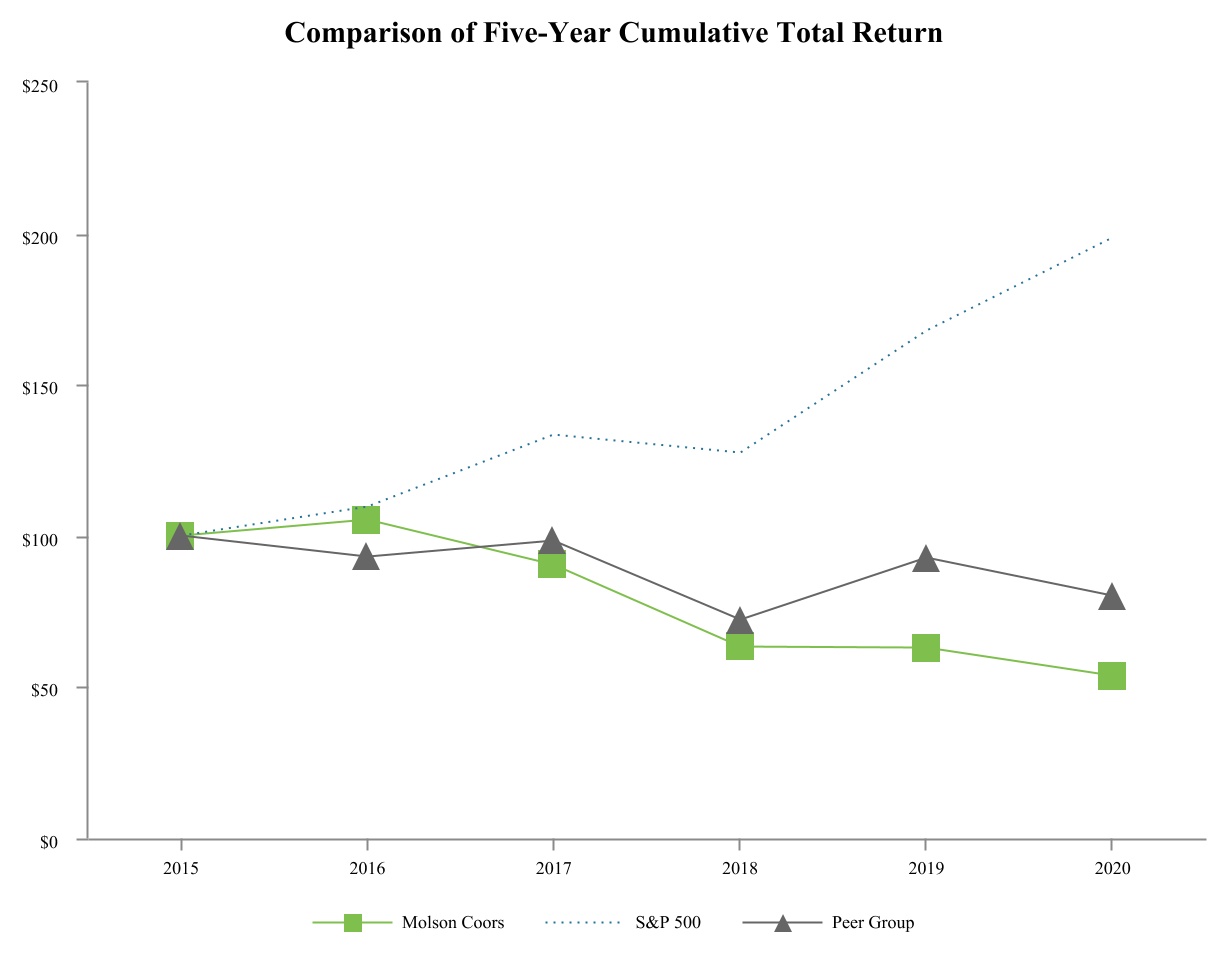
The following graph compares our cumulative total stockholder return over the last five fiscal years with the S&P 500 and a customized peer index including MCBC, ABI, Carlsberg, Heineken and Asahi (the "Peer Group"). We have used a weighted-average based on market capitalization to determine the return for the Peer Group. The graph assumes $100 was invested on December 31, 2015, in our Class B common stock, the S&P 500 and the Peer Group, and assumes reinvestment of all dividends. The below is provided for informational purposes and is not indicative of future performance.
| 2015 | 2016 | 2017 | 2018 | 2019 | 2020 | ||||||||||||||||||||||||||||||
| Molson Coors | $ | 100.00 | $ | 105.36 | $ | 90.50 | $ | 63.45 | $ | 63.15 | $ | 53.58 | |||||||||||||||||||||||
| S&P 500 | $ | 100.00 | $ | 109.54 | $ | 133.44 | $ | 127.58 | $ | 167.75 | $ | 198.59 | |||||||||||||||||||||||
| Peer Group | $ | 100.00 | $ | 92.99 | $ | 98.38 | $ | 72.33 | $ | 92.66 | $ | 80.24 |
Dividends
In response to the global economic uncertainty created by the coronavirus pandemic our board of directors suspended our regular quarterly dividends on our Class A and Class B common and exchangeable shares in May 2020.
Item 6. SELECTED FINANCIAL DATA
Not applicable. Financial information related to fiscal years 2017 and 2016 may be found in Part II, Item 6. Selected Financial Data in our fiscal 2019 Form 10-K filed with the SEC on February 12, 2020. Please refer to the consolidated financial statements included herein in Part II—Item 8 Financial Statements and Supplementary Data for fiscal year 2020, 2019 and 2018 information.
Item 7. MANAGEMENT'S DISCUSSION AND ANALYSIS OF FINANCIAL CONDITION AND RESULTS OF OPERATIONS
The following Management's Discussion and Analysis of Financial Condition and Results of Operations ("MD&A") is provided to assist in understanding our Company, operations and current business environment and should be considered a supplement to, and read in conjunction with, the accompanying consolidated financial statements and notes included within Part II—Item 8 Financial Statements and Supplementary Data, as well as the discussion of our business and related risk factors in Part I—Item 1 Business and Part I—Item 1A Risk Factors, respectively. See also "Cautionary Statement Pursuant to Safe Harbor Provisions of the Private Securities Litigation Reform Act of 1995."
A discussion related to the results of operations and changes in financial condition for 2019 compared to 2018 has been omitted from this report, but may be found in Part II, Item 7. Management's Discussion and Analysis of Financial Condition and Results of Operations in our fiscal 2019 Form 10-K, filed with the SEC on February 12, 2020, which is available free of charge on the SEC's website at www.sec.gov and our corporate website at www.molsoncoors.com. Such discussion does not reflect the recast of the historical presentation of segment information as a result of the reporting segment changes that became effective on January 1, 2020.
Our Fiscal Year
Unless otherwise indicated, (a) all $ amounts are in USD, (b) comparisons are to comparable prior periods and (c) 2020, 2019 and 2018 refers to the 12 months ended December 31, 2020, December 31, 2019 and December 31, 2018, respectively.
Operational Measures
We have certain operational measures, such as STWs and STRs, which we believe are important metrics. STW is a metric that we use in our business to reflect the sales from our operations to our direct customers, generally wholesalers. We believe the STW metric is important because it gives an indication of the amount of beer and adjacent products that we have produced and shipped to customers. STR is a metric that we use in our business to refer to sales closer to the end consumer than STWs, which generally means sales from wholesalers or our company to retailers, who in turn sell to consumers. We believe the STR metric is important because, unlike STWs, it provides the closest indication of the performance of our brands in relation to market and competitor sales trends.
Executive Summary
For more than two centuries, we have been brewing beverages that unite people for all life’s moments. From Coors Light, Miller Lite, Molson Canadian, Carling, and Staropramen to Coors Banquet, Blue Moon Belgian White, Blue Moon LightSky, Vizzy, Coors Seltzer, Leinenkugel’s Summer Shandy, Creemore Springs, Hop Valley and more, we produce some of the most beloved and iconic beer brands ever made. While the Company’s history is rooted in beer, we offer a modern portfolio that expands beyond the beer aisle with sparkling cocktails, hard coffee, canned wine, kombucha, cider and more. As a business, our ambition is to be the first choice for our people, our consumers and our customers, and our success depends on our ability to make our products available to meet a wide range of consumer segments and occasions.
Coronavirus Global Pandemic
The coronavirus pandemic had a material adverse effect on our operations, liquidity, financial condition and results of operations during our full year 2020 due mainly to the on-premise closures worldwide. The effects of the pandemic remain highly uncertain especially around the severity and duration of the outbreak and actions by government authorities to contain the pandemic or address its impact, among other things.
Many governmental entities across North America and Europe required that bars and restaurants close or cease sit-down service during the second quarter of 2020 and again at the end of 2020, which negatively impacted the on-premise sales of our beverages and led to the incurrence of costs to repurchase products that on-premise accounts or distributors were unable or prohibited from selling as a result of the governmental regulations. This can be seen in our financial results during the full year 2020. During this same time, other restaurants and bars implemented closures and modified their hours, either voluntarily or as a result of governmental orders or quarantines. At the end of the second quarter and into the third quarter of 2020, there was a phased reopening of a significant number of on-premise accounts in certain of our markets, but with restrictions and in the fourth quarter some of these re-openings were reversed and businesses were shut down again. Sales to restaurants and bars have not returned to pre-pandemic levels and in many instances, the reopened on-premise accounts have been impacted by further restrictions or further shut downs imposed as a result of the increased spread of the coronavirus. In addition, sporting events, festivals and other large public gatherings where our products are served have been canceled throughout North America and Europe. Sales to on-premise customers tend to be higher margin than sales to off-premise (retail outlets) customers.
Additionally, these and other governmental or societal impositions of restrictions on public gatherings, especially if prolonged in nature, whether government or self-imposed, will have adverse effects on on-premise traffic and, in turn, our business.
We experienced a significant adverse volume impact in 2020 resulting from the initial closure of, and subsequent continued impacts to, the on-premise channel. As perspective, we estimate that approximately 23% of our 2019 consolidated net sales resulted from on-premise consumption, with approximately 17% of our North America net sales and approximately 50-55% of our Europe net sales each coming from this important part of the industry, and in many of our markets the on-premise business had been reduced to zero for much of the second quarter of 2020. See further discussion in Part I. Item 1. Business regarding the historical percentage of volume and net sales represented in the on-premise within our North America and Europe segments and resulting implications to expected profitability as a result of the effective closures of the on-premise in the markets in which we operate. While we began to see some of the on-premise return mid-year in many of our markets, with the exception of the U.K., which did not reopen until early July, business and consumer behavior in the channel has been slow and remains uncertain. Subsequently, in the fourth quarter of 2020, the second pandemic wave triggered new lockdowns with different levels of restrictions in Europe and Canada depending on the market. Therefore, as a result of this uncertainty, we currently continue to expect a significant adverse impact to both net sales and profit performance for fiscal 2021 and, possibly beyond.
In addition, where we have seen shifts in demand to the off-premise, and shifts into certain package types, which has strained our supply chain and package availability, particularly with aluminum can demand and other packaging materials, requiring that we strategically prioritize certain brands and package types. Our supply chain continues to work diligently to ensure sufficient supply of these high demand brand and packages as we adjust to these changing consumer dynamics.
Further, during 2020, we recorded charges of $15.5 million within cost of goods sold related to temporary "thank you" pay for certain essential North America brewery employees. Additionally, in order to support the challenges facing our on-premise customers and retailers, and our overall commitment to quality, during the first quarter of 2020, we initiated voluntary temporary keg relief programs in many of our markets providing customers with reimbursements for untapped kegs that met certain established return requirements. As a result,
Showing the first 8K of 143K characters. Open the full section
Item 7A. QUANTITATIVE AND QUALITATIVE DISCLOSURES ABOUT MARKET RISK
In the normal course of business, we actively manage our exposure to various market risks by entering into various supplier-based and market-based hedging transactions, authorized under established risk management policies that place clear controls on these activities. Our objective in managing these exposures is to decrease the volatility of our earnings and cash flows due to changes in underlying rates and costs.
The counterparties to our market-based transactions are generally highly rated institutions. We perform assessments of their credit risk regularly. Our market-based transactions include a variety of derivative financial instruments, none of which are used for trading or speculative purposes.
Interest Rate Risk
We are exposed to volatility in interest rates with regard to current and future debt offerings. Primary exposures include U.S. Department of Treasury rates, Canadian government rates and LIBOR. To mitigate this exposure as it pertains to future debt offerings and to achieve our desired fixed-to-floating rate debt profile, we may enter into interest rate swaps from time to time.
Foreign Exchange Risk
Foreign currency fluctuations affect our net investments in foreign subsidiaries and foreign currency-denominated cash flows. We manage our foreign currency exposures through foreign currency forward contracts and foreign-denominated debt. We may also enter into cross currency swaps from time to time.
Commodity Price Risk
We use commodities in the production and distribution of our products. To manage the related price risk for these costs, we utilize market-based derivatives and long-term supplier-based contracts. Our primary objective when entering into these transactions is to achieve price certainty for commodities used in our supply chain. We manage our exposures through a combination of purchase orders, long-term supply contracts and over-the-counter financial instruments.
Equity Price Risk
We currently hold warrants allowing us the option to purchase common shares of HEXO Corp. ("HEXO"), our Truss LP ("Truss") joint venture partner in Canada. These warrants are subject to equity price risk, representative of the potential future loss of value that would result from a decline in the market price of HEXO's underlying common shares.
Details of market-risk sensitive debt, derivative and other financial instruments are included in the table below. Notional amounts and fair values are presented in USD based on the applicable exchange rate as of December 31, 2020. See Part II—Item 8 Financial Statements and Supplementary Data, Note 11, "Debt" and Note 16, "Derivative Instruments and Hedging Activities" for further discussion.
| Notional amounts by expected maturity date | December 31, 2020 | ||||||||||||||||||||||||||||||||||||||||||||||
| Year end | |||||||||||||||||||||||||||||||||||||||||||||||
| 2021 | 2022 | 2023 | 2024 | 2025 | Thereafter | Total | Fair value Asset/ (Liability) | ||||||||||||||||||||||||||||||||||||||||
| (In millions) | |||||||||||||||||||||||||||||||||||||||||||||||
| Long-term debt: | |||||||||||||||||||||||||||||||||||||||||||||||
| CAD 500 million 2.84% notes due 2023 | $ | — | $ | — | $ | 392.9 | $ | — | $ | — | $ | — | $ | 392.9 | $ | (414.9) | |||||||||||||||||||||||||||||||
| CAD 500 million 3.44% notes due 2026 | $ | — | $ | — | $ | — | $ | — | $ | — | $ | 392.9 | $ | 392.9 | $ | (432.6) | |||||||||||||||||||||||||||||||
| $1.0 billion 2.10% notes due 2021 | $ | 1,000.0 | $ | — | $ | — | $ | — | $ | — | $ | — | $ | 1,000.0 | $ | (1,017.9) | |||||||||||||||||||||||||||||||
| $500 million 3.5% notes due 2022 | $ | — | $ | 500.0 | $ | — | $ | — | $ | — | $ | — | $ | 500.0 | $ | (524.0) | |||||||||||||||||||||||||||||||
| $2.0 billion 3.0% notes due 2026 | $ | — | $ | — | $ | — | $ | — | $ | — | $ | 2,000.0 | $ | 2,000.0 | $ | (2,206.4) | |||||||||||||||||||||||||||||||
| $1.1 billion 5.0% notes due 2042 | $ | — | $ | — | $ | — | $ | — | $ | — | $ | 1,100.0 | $ | 1,100.0 | $ | (1,376.0) | |||||||||||||||||||||||||||||||
| $1.8 billion 4.2% notes due 2046 | $ | — | $ | — | $ | — | $ | — | $ | — | $ | 1,800.0 | $ | 1,800.0 | $ | (2,087.1) | |||||||||||||||||||||||||||||||
| EUR 800 million 1.25% notes due 2024 | $ | — | $ | — | $ | — | $ | 977.3 | $ | — | $ | — | $ | 977.3 | $ | (1,013.8) | |||||||||||||||||||||||||||||||
| Foreign currency management: | |||||||||||||||||||||||||||||||||||||||||||||||
| Forwards | $ | 116.9 | $ | 56.3 | $ | 8.0 | $ | — | $ | — | $ | — | $ | 181.2 | $ | (4.9) | |||||||||||||||||||||||||||||||
| Cross currency swaps | $ | 400.0 | $ | — | $ | — | $ | — | $ | — | $ | — | $ | 400.0 | $ | (26.5) | |||||||||||||||||||||||||||||||
| Interest rate management: | |||||||||||||||||||||||||||||||||||||||||||||||
| Forward starting interest rate swaps | $ | 250.0 | $ | 250.0 | $ | — | $ | — | $ | — | $ | 1,000.0 | $ | 1,500.0 | $ | (221.5) | |||||||||||||||||||||||||||||||
| Commodity pricing management: | |||||||||||||||||||||||||||||||||||||||||||||||
| Swaps | $ | 460.4 | $ | 318.8 | $ | 139.7 | $ | — | $ | — | $ | — | $ | 918.9 | $ | 65.2 | |||||||||||||||||||||||||||||||
| Options | $ | 16.8 | $ | — | $ | — | $ | — | $ | — | $ | — | $ | 16.8 | $ | — |
We hold warrants providing us with the ability to purchase 2.9 million common shares of HEXO, our Truss joint venture partner, at a strike price of CAD 24.00 per share, which expire on October 4, 2021. The fair value of our warrant asset at December 31, 2020 was $0.3 million. See Note 16, "Derivative Instruments and Hedging Activities" for further details.
Sensitivity Analysis
Our market sensitive derivative and other financial instruments, as defined by the SEC, are debt, foreign currency forward contracts, commodity swaps, commodity options, cross currency swaps, forward starting interest rate swaps and warrants. We monitor foreign exchange risk, interest rate risk, commodity risk, equity price risk and related derivatives using a sensitivity analysis.
The following table presents the results of the sensitivity analysis, which reflects the impact of a hypothetical 10% adverse change in each of these risks to our derivative and debt portfolio, with the exception of interest rate risk to our forward starting interest rate swaps in which we have applied an absolute 1% adverse change to the respective instrument's interest rate:
| As of | |||||||||||
| December 31, 2020 | December 31, 2019 | ||||||||||
| (In millions) | |||||||||||
| Estimated fair value volatility | |||||||||||
| Foreign currency risk: | |||||||||||
| Forwards | $ | (20.5) | $ | (25.8) | |||||||
| Foreign currency denominated debt | $ | (190.4) | $ | (194.2) | |||||||
| Cross currency swaps | $ | (43.0) | $ | (89.2) | |||||||
| Interest rate risk: | |||||||||||
| Debt | $ | (219.7) | $ | (255.4) | |||||||
| Forward starting interest rate swaps | $ | (177.1) | $ | (150.4) | |||||||
| Commodity price risk: | |||||||||||
| Commodity swaps | $ | (96.0) | $ | (52.9) | |||||||
| Commodity options | $ | — | $ | — | |||||||
| Equity price risk: | |||||||||||
| Warrants | $ | (0.1) | $ | (0.6) |
The volatility of the applicable rates and prices are dependent on many factors that cannot be forecast with reliable accuracy. Therefore, actual changes in fair values could differ materially from the results presented in the table above.
Item 8. FINANCIAL STATEMENTS AND SUPPLEMENTARY DATA
MANAGEMENT'S REPORT
The preparation, integrity and objectivity of the financial statements and all other financial information included in this annual report are the responsibility of the management of Molson Coors Beverage Company. The financial statements have been prepared in accordance with generally accepted accounting principles in the United States, applying estimates based on management's best judgment where necessary. Management believes that all material uncertainties have been appropriately accounted for and disclosed.
Our management, under the supervision and with the participation of our Chief Executive Officer and Chief Financial Officer, assessed the effectiveness of our internal control over financial reporting as of December 31, 2020, based on the framework and criteria established in Internal Control—Integrated Framework (2013 Framework), issued by the Committee of Sponsoring Organizations of the Treadway Commission. Based upon its assessment, management concluded that, as of December 31, 2020, the Company's internal control over financial reporting was effective.
PricewaterhouseCoopers LLP, the Company's independent registered public accounting firm, provides an objective, independent audit of the consolidated financial statements and internal control over financial reporting. Their accompanying report is based upon an examination conducted in accordance with standards of the Public Company Accounting Oversight Board (United States), including tests of accounting procedures, records and internal control.
The Board of Directors, operating through its Audit Committee composed of independent, outside directors, monitors the Company's accounting control systems and reviews the results of the Company's auditing activities. The Audit Committee meets at least quarterly, either separately or jointly, with representatives of management, PricewaterhouseCoopers LLP, and internal auditors. To ensure complete independence, PricewaterhouseCoopers LLP and the Company's internal auditors have full and free access to the Audit Committee and may meet with or without the presence of management.
| /s/ GAVIN D.K. HATTERSLEY | /s/ TRACEY I. JOUBERT | |||||||
| Gavin D.K. Hattersley | Tracey I. Joubert | |||||||
| President & Chief Executive Officer | Chief Financial Officer | |||||||
| Molson Coors Beverage Company | Molson Coors Beverage Company | |||||||
| February 11, 2021 | February 11, 2021 |
Report of Independent Registered Public Accounting Firm
To the Board of Directors and Stockholders of Molson Coors Beverage Company
Opinions on the Financial Statements and Internal Control over Financial Reporting
We have audited the accompanying consolidated balance sheets of Molson Coors Beverage Company and its subsidiaries (the “Company”) as of December 31, 2020 and 2019, and the related consolidated statements of operations, of comprehensive income (loss), of stockholders’ equity and noncontrolling interests and of cash flows for each of the three years in the period ended December 31, 2020, including the related notes and schedule of valuation and qualifying accounts for each of the three years in the period ended December 31, 2020 appearing under Item 15(c) (collectively referred to as the “consolidated financial statements”). We also have audited the Company's internal control over financial reporting as of December 31, 2020, based on criteria established in Internal Control - Integrated Framework (2013) issued by the Committee of Sponsoring Organizations of the Treadway Commission (COSO).
In our opinion, the consolidated financial statements referred to above present fairly, in all material respects, the financial position of the Company a
Showing the first 8K of 359K characters. Open the full section
Item 9. CHANGES IN AND DISAGREEMENTS WITH ACCOUNTANTS ON ACCOUNTING AND FINANCIAL DISCLOSURE
None.
Item 9A. CONTROLS AND PROCEDURES
Evaluation of Disclosure Controls and Procedures
Under the supervision and with the participation of our management, including our Chief Executive Officer and Chief Financial Officer, we conducted an evaluation of our disclosure controls and procedures as such term is defined under Rule 13a-15(e) under the Exchange Act. Based on this evaluation, our Chief Executive Officer and Chief Financial Officer concluded that our disclosure controls and procedures were effective as of December 31, 2020 to provide reasonable assurance that information required to be disclosed in our reports that we file or submit under the Exchange Act is recorded, processed, summarized and reported within the time periods specified in the SEC rules and forms and that such information is accumulated and communicated to our management, including our Chief Executive Officer and Chief Financial Officer, as appropriate, to allow timely decisions regarding required disclosure. Management necessarily applies its judgment in assessing the costs and benefits of such disclosure controls and procedures that, by their nature, can only provide reasonable assurance regarding management's control objectives. Also, we have investments in certain unconsolidated entities that we do not control or manage.
Management's Annual Report on Internal Control over Financial Reporting
Our management is responsible for establishing and maintaining adequate internal control over financial reporting as such term is defined in Exchange Act Rule 13a-15(f). Our internal control over financial reporting is a process designed to provide reasonable assurance regarding the reliability of financial reporting and the preparation of financial statements for external purposes in accordance with U.S. GAAP. A company's internal control over financial reporting includes those policies and procedures that (i) pertain to the maintenance of records that, in reasonable detail, accurately and fairly reflect the transactions and dispositions of the assets of the company; (ii) provide reasonable assurance that transactions are recorded as necessary to permit preparation of financial statements in accordance with U.S. GAAP, and that receipts and expenditures of the company are being made only in accordance with authorizations of management and directors of the company; and (iii) provide reasonable assurance regarding prevention or timely detection of unauthorized acquisition, use, or disposition of the company's assets that could have a material effect on the financial statements.
Because of its inherent limitations, internal control over financial reporting may not prevent or detect misstatements. Also, projections of any evaluation of effectiveness to future periods are subject to the risk that controls may become inadequate because of changes in conditions, or that the degree of compliance with the policies or procedures may deteriorate.
Our Chief Executive Officer and our Chief Financial Officer, with assistance from other members of management, assessed the effectiveness of our internal control over financial reporting as of December 31, 2020, based on the framework and criteria established in Internal Control—Integrated Framework (2013 Framework), issued by the Committee of Sponsoring Organizations of the Treadway Commission. Based on its evaluation, management has concluded that our internal control over financial reporting was effective as of December 31, 2020.
An independent registered public accounting firm, PricewaterhouseCoopers LLP, has audited the effectiveness of our internal control over financial reporting as of December 31, 2020, as stated in their report which appears in Part II—Item 8 Financial Statements and Supplementary Data.
Changes in Internal Control over Financial Reporting
There were no changes in our internal control over financial reporting (as defined in Exchange Act Rule 13a-15(f)) during the quarter ended December 31, 2020, that have materially affected, or are reasonably likely to materially affect, our internal control over financial reporting.
Item 9B. OTHER INFORMATION
None.
PART III
Item 10. DIRECTORS, EXECUTIVE OFFICERS AND CORPORATE GOVERNANCE
Incorporated by reference to our definitive proxy statement for our 2021 annual meeting of stockholders, which will be filed no later than 120 days after December 31, 2020.
Item 11. EXECUTIVE COMPENSATION
Incorporated by reference to our definitive proxy statement for our 2021 annual meeting of stockholders, which will be filed no later than 120 days after December 31, 2020.
Item 12. SECURITY OWNERSHIP OF CERTAIN BENEFICIAL OWNERS AND MANAGEMENT AND RELATED STOCKHOLDER MATTERS
Incorporated by reference to our definitive proxy statement for our 2021 annual meeting of stockholders, which will be filed no later than 120 days after December 31, 2020.
Equity Compensation Plan Information
The following table summarizes information about the Incentive Compensation Plan as of December 31, 2020. All outstanding awards shown in the table below relate to our Class B common stock.
| A | B | C | |||||||||||||||
| Plan category | Number of securities to be issued upon exercise of outstanding options, warrants and rights | Weighted-average exercise price of outstanding options, warrants and rights | Number of securities remaining available for future issuance under equity compensation plans (excluding securities reflected in column A) | ||||||||||||||
| Equity compensation plans approved by security holders(1) | 3,640,266 | $66.32 | 2,303,746 | ||||||||||||||
| Equity compensation plans not approved by security holders | — | N/A | — | ||||||||||||||
| Total | 3,640,266 | $66.32 | 2,303,746 |
(1)Under the Incentive Compensation Plan, we may issue RSUs, DSUs, PSUs and stock options. Amount in column A includes 1,098,748 RSUs and DSUs, 702,594 PSUs (assuming the target award is met) and 1,838,924 options outstanding as of December 31, 2020. See Part II—Item 8 Financial Statements and Supplementary Data, Note 13, "Share-Based Payments" for further discussion. Outstanding RSUs, DSUs and PSUs do not have exercise prices and therefore have been disregarded for purposes of calculating the weighted-average exercise price.
Item 13. CERTAIN RELATIONSHIPS AND RELATED TRANSACTIONS, AND DIRECTOR INDEPENDENCE
Incorporated by reference to our definitive proxy statement for our 2021 annual meeting of stockholders, which will be filed no later than 120 days after December 31, 2020.
Item 14. PRINCIPAL ACCOUNTANT FEES AND SERVICES
Incorporated by reference to our definitive proxy statement for our 2021 annual meeting of stockholders, which will be filed no later than 120 days after December 31, 2020.
PART IV
Item 15. EXHIBITS, FINANCIAL STATEMENT SCHEDULES
**(a)**Financial Statements, Financial Statement Schedules and Exhibits
The following are filed or incorporated by reference as a part of this Annual Report on Form 10-K:
(1)Management's Report
Report of Independent Registered Public Accounting Firm
Consolidated Statements of Operations for the years ended December 31, 2020, December 31, 2019, and December 31, 2018
Consolidated Statements of Comprehensive Income (Loss) for the years ended December 31, 2020, December 31, 2019, and December 31, 2018
Consolidated Balance Sheets as of December 31, 2020, and December 31, 2019
Consolidated Statements of Cash Flows for the years ended December 31, 2020, December 31, 2019, and December 31, 2018
Consolidated Statements of Stockholders' Equity and Noncontrolling Interests for the years ended December 31, 2020, December 31, 2019, and December 31, 2018
Notes to Consolidated Financial Statements
(2)Schedule II—Valuation and Qualifying Accounts for the years ended December 31, 2020, December 31, 2019, and December 31, 2018
(3)Exhibit list
| Incorporated by Reference | Filed Herewith | ||||||||||||||||||||||||||||||||||
| Exhibit Number | Document Description | Form | Exhibit | Filing Date | |||||||||||||||||||||||||||||||
| 101.DEF | ****** | XBRL Taxonomy Extension Definition Linkbase Document | X | ||||||||||||||||||||||||||||||||
| 101.LAB | ****** | XBRL Taxonomy Extension Label Linkbase Document | X | ||||||||||||||||||||||||||||||||
| 101.PRE | ****** | XBRL Taxonomy Extension Presentation Linkbase Document | X |
- Represents a management contract or compensatory plan or arrangement.
** Attached as Exhibit 101 to this report are the following documents formatted in iXBRL (Inline Extensible Business Reporting Language): (i) the Consolidated Statements of Operations, (ii) the Consolidated Statements of Comprehensive Income (Loss), (iii) the Consolidated Balance Sheets, (iv) the Consolidated Statements of Cash Flows, (v) the Consolidated Statements of Stockholders' Equity and Noncontrolling Interests, (vi) the Notes to Consolidated Financial Statements, and (vii) document and entity information.
**(b)**Exhibits
The exhibits included in Item 15(a)(3) above are filed or incorporated by reference pursuant to the requirements of Item 601 of Regulation S-K.
**(c)**Other Financial Statement Schedules
SCHEDULE II
MOLSON COORS BEVERAGE COMPANY AND SUBSIDIARIES
VALUATION AND QUALIFYING ACCOUNTS
(IN MILLIONS)
| Balance at beginning of year | Additions charged to costs and expenses | Deductions | Foreign exchange impact | Balance at end of year | |||||||||||||||||||||||||
| Allowance for doubtful accounts—trade accounts receivable | |||||||||||||||||||||||||||||
| Year ended: | |||||||||||||||||||||||||||||
| December 31, 2020 | $ | 12.1 | $ | 12.8 | $ | (7.4) | $ | 0.6 | $ | 18.1 | |||||||||||||||||||
| December 31, 2019 | $ | 14.5 | $ | 7.0 | $ | (9.3) | $ | (0.1) | $ | 12.1 | |||||||||||||||||||
| December 31, 2018 | $ | 17.2 | $ | 5.1 | $ | (7.1) | $ | (0.7) | $ | 14.5 | |||||||||||||||||||
| Allowance for obsolete supplies and inventory | |||||||||||||||||||||||||||||
| Year ended: | |||||||||||||||||||||||||||||
| December 31, 2020 | $ | 22.2 | $ | 70.6 | $ | (54.3) | $ | (0.1) | $ | 38.4 | |||||||||||||||||||
| December 31, 2019 | $ | 25.4 | $ | 34.8 | $ | (38.2) | $ | 0.2 | $ | 22.2 | |||||||||||||||||||
| December 31, 2018 | $ | 15.5 | $ | 30.1 | $ | (19.6) | $ | (0.6) | $ | 25.4 | |||||||||||||||||||
| Deferred tax valuation account | |||||||||||||||||||||||||||||
| Year ended: | |||||||||||||||||||||||||||||
| December 31, 2020 | $ | 73.8 | $ | 31.8 | $ | (43.4) | $ | — | $ | 62.2 | |||||||||||||||||||
| December 31, 2019 | $ | 1,040.0 | $ | 46.4 | $ | (990.4) | $ | (22.2) | $ | 73.8 | |||||||||||||||||||
| December 31, 2018 | $ | 1,077.7 | $ | 18.7 | $ | (7.3) | $ | (49.1) | $ | 1,040.0 |
Deductions relate to write-offs of uncollectible accounts, claims or obsolete inventories and supplies. Deduction amounts related to the deferred tax valuation allowance are primarily due to the utilization of capital loss and operating loss carryforwards and re-evaluations of deferred tax assets. The impacts of changes in income tax rates on deferred tax valuation allowances are reported in the additions or deductions column accordingly. Deductions for the year ended December 31, 2019 also includes write-offs of valuation allowances resulting from the liquidation of certain European entities. See Part II—Item 8 Financial Statements and Supplementary Data, Note 6, “Income Tax” for additional details.
Item 16. FORM 10-K SUMMARY
None.
SIGNATURES
Pursuant to the requirements of Section 13 or 15(d) of the Securities Exchange Act of 1934, the registrant has duly caused this report to be signed on its behalf by the undersigned, thereunto duly authorized.
MOLSON COORS BEVERAGE COMPANY
| By | /s/ GAVIN D.K. HATTERSLEY | President, Chief Executive Officer and Director (Principal Executive Officer) | ||||||||||||
| Gavin D.K. Hattersley |
February 11, 2021
Pursuant to the requirements of the Securities Exchange Act of 1934, this report has been signed below by the following persons on behalf of the registrant and in the capacities and on the date indicated.
| By | /s/ GAVIN D.K. HATTERSLEY | President, Chief Executive Officer and Director (Principal Executive Officer) | ||||||||||||
| Gavin D.K. Hattersley | ||||||||||||||
| By | /s/ TRACEY I. JOUBERT | Chief Financial Officer (Principal Financial Officer) | ||||||||||||
| Tracey I. Joubert | ||||||||||||||
| By | /s/ BRIAN C. TABOLT | Vice President and Controller (Principal Accounting Officer) | ||||||||||||
| Brian C. Tabolt | ||||||||||||||
| By | /s/ ANDREW T. MOLSON | Chairman | ||||||||||||
| Andrew T. Molson | ||||||||||||||
| By | /s/ PETER H. COORS | Vice Chairman | ||||||||||||
| Peter H. Coors | ||||||||||||||
| By | /s/ DAVID S. COORS | Director | ||||||||||||
| David S. Coors | ||||||||||||||
| By | /s/ ROGER G. EATON | Director | ||||||||||||
| Roger G. Eaton | ||||||||||||||
| By | /s/ MARY LYNN FERGUSON-MCHUGH | Director | ||||||||||||
| Mary Lynn Ferguson-McHugh | ||||||||||||||
| By | /s/ CHARLES M. HERINGTON | Director | ||||||||||||
| Charles M. Herington | ||||||||||||||
| By | /s/ GEOFFREY E. MOLSON | Director | ||||||||||||
| Geoffrey E. Molson | ||||||||||||||
| By | /s/ IAIN JOHN G. NAPIER | Director | ||||||||||||
| Iain John G. Napier | ||||||||||||||
| By | /s/ NESSA O'SULLIVAN | Director | ||||||||||||
| Nessa O'Sullivan | ||||||||||||||
| By | /s/ H. SANFORD RILEY | Director | ||||||||||||
| H. Sanford Riley | ||||||||||||||
| By | /s/ DOUGLAS D. TOUGH | Director | ||||||||||||
| Douglas D. Tough | ||||||||||||||
| By | /s/ LOUIS VACHON | Director | ||||||||||||
| Louis Vachon | ||||||||||||||
| By | /s/ JAMES A. WINNEFELD, JR. | Director | ||||||||||||
| James A. Winnefeld, Jr. |
February 11, 2021