 filings.tools
Molson Coors Beverage 10-K 2023-12-31
Filed 2024-02-20. 24 sections, 637K characters. Original on sec.gov · Markdown · JSON
Cover and table of contents
UNITED STATES
SECURITIES AND EXCHANGE COMMISSION
Washington, D.C. 20549
FORM 10-K
| (Mark One) | |||||
| ☒ | ANNUAL REPORT PURSUANT TO SECTION 13 OR 15(d) OF THE SECURITIES EXCHANGE ACT OF 1934 |
For the fiscal year ended December 31, 2023
| OR | |||||
| ☐ | TRANSITION REPORT PURSUANT TO SECTION 13 OR 15(d) OF THE SECURITIES EXCHANGE ACT OF 1934 | ||||
| For the transition period from ______ to ______ . |
Commission File Number: 1-14829
Molson Coors Beverage Company
(Exact name of registrant as specified in its charter)
Delaware
(State or other jurisdiction of incorporation or organization)
P.O. Box 4030, BC555, Golden, Colorado, USA
111 Boulevard Robert-Bourassa, 9th Floor, Montréal, Québec, Canada
(Address of principal executive offices)
84-0178360
(I.R.S. Employer Identification No.)
80401
H3C 2M1
(Zip Code)
303-279-6565 (Colorado)
514-521-1786 (Québec)
(Registrant's telephone number, including area code)
Securities registered pursuant to Section 12(b) of the Act:
| Title of each class | Trading symbols | Name of each exchange on which registered | ||||||||||||
| Class A Common Stock, $0.01 par value | TAP.A | New York Stock Exchange | ||||||||||||
| Class B Common Stock, $0.01 par value | TAP | New York Stock Exchange | ||||||||||||
| 1.25% Senior Notes due 2024 | TAP 24 | New York Stock Exchange |
Securities registered pursuant to Section 12(g) of the Act: None
Indicate by check mark if the registrant is a well-known seasoned issuer, as defined in Rule 405 of the Securities Act. Yes ☒ No ☐
Indicate by check mark if the registrant is not required to file reports pursuant to Section 13 or Section 15(d) of the Act. Yes ☐ No ☒
Indicate by check mark whether the registrant (1) has filed all reports required to be filed by Section 13 or 15(d) of the Securities Exchange Act of 1934 during the preceding 12 months (or for such shorter period that the registrant was required to file such reports), and (2) has been subject to such filing requirements for the past 90 days. Yes ☒ No ☐
Indicate by check mark whether the registrant has submitted electronically every Interactive Data File required to be submitted pursuant to Rule 405 of Regulation S-T (§232.405 of this chapter) during the preceding 12 months (or for such shorter period that the registrant was required to submit such files). Yes ☒ No ☐
Indicate by check mark whether the registrant is a large accelerated filer, an accelerated filer, a non-accelerated filer, a smaller reporting company, or an emerging growth company. See the definitions of "large accelerated filer," "accelerated filer," "smaller reporting company" and "emerging growth company" in Rule 12b-2 of the Exchange Act.
Large accelerated filer ☒ Accelerated filer ☐ Non-accelerated filer ☐ Smaller reporting company ☐ Emerging growth company ☐
If an emerging growth company, indicate by check mark if the registrant has elected not to use the extended transition period for complying with any new or revised financial accounting standards provided pursuant to Section 13(a) of the Exchange Act. o
Indicate by check mark whether the registrant has filed a report on and attestation to its management's assessment of the effectiveness of its internal control over financial reporting under Section 404(b) of the Sarbanes-Oxley Act (15 U.S.C. 7262(b)) by the registered public accounting firm that prepared or issued its audit report. ☒
If securities are registered pursuant to Section 12(b) of the Act, indicate by check mark whether the financial statements of the registrant included in the filing reflect the correction of an error to previously issued financial statements. ☐
Indicate by check mark whether any of those error corrections are restatements that required a recovery analysis of incentive-based compensation received by any of the registrant's executive officers during the relevant recovery period pursuant to §240.10D-1(b). ☐
Indicate by check mark whether the registrant is a shell company (as defined in Rule 12b-2 of the Act). Yes ☐ No ☒
The aggregate market value of the registrant's voting and non-voting common stock held by non-affiliates of the registrant at the close of business on the last trading day of the registrant's most recently completed second fiscal quarter, June 30, 2023, was approximately $12.0 billion based upon the last sales price reported for such date on the New York Stock Exchange and the Toronto Stock Exchange. For purposes of this disclosure, shares of common and exchangeable stock held by officers and directors of the registrant (and their respective affiliates) as of June 30, 2023, are excluded in that such persons may be deemed to be affiliates. This determination is not necessarily conclusive of affiliate status for other purposes.
The number of shares outstanding of each of the registrant's classes of common stock, as of February 13, 2024.
Class A Common Stock—2,563,034 shares
Class B Common Stock—198,001,985 shares
Exchangeable shares:
As of February 13, 2024, the following number of exchangeable shares was outstanding for Molson Coors Canada, Inc.:
Class A Exchangeable Shares—2,678,963 shares
Class B Exchangeable Shares—9,362,866 shares
The Class A exchangeable shares and Class B exchangeable shares are shares of the share capital in Molson Coors Canada Inc., a wholly-owned subsidiary of the registrant. They are publicly traded on the Toronto Stock Exchange under the symbols TPX.A and TPX.B, respectively. These shares are intended to provide substantially the same economic and voting rights as the corresponding class of Molson Coors common stock in which they may be exchanged. In addition to the registered Class A common stock and the Class B common stock, the registrant has also issued and outstanding one share each of a Special Class A voting stock and Special Class B voting stock. The Special Class A voting stock and the Special Class B voting stock provide the mechanism for holders of Class A exchangeable shares and Class B exchangeable shares to be provided instructions to vote with the holders of the Class A common stock and the Class B common stock, respectively. The holders of the Special Class A voting stock and Special Class B voting stock are entitled to one vote for each outstanding Class A exchangeable share and Class B exchangeable share, respectively, excluding shares held by the registrant or its subsidiaries, and generally vote together with the Class A common stock and Class B common stock, respectively, on all matters on which the Class A common stock and Class B common stock are entitled to vote. The Special Class A voting stock and Special Class B voting stock are subject to a voting trust arrangement. The trustee which holds the Special Class A voting stock and the Special Class B voting stock is required to cast a number of votes equal to the number of then-outstanding Class A exchangeable shares and Class B exchangeable shares, respectively, but will only cast a number of votes equal to the number of Class A exchangeable shares and Class B exchangeable shares as to which it has received voting instructions from the owners of record of those Class A exchangeable shares and Class B exchangeable shares, other than the registrant or its subsidiaries, respectively, on the record date, and will cast the votes in accordance with such instructions so received.
Documents Incorporated by Reference: Portions of the registrant's definitive proxy statement for the registrant's 2024 annual meeting of stockholders, which will be filed no later than 120 days after the close of the registrant's fiscal year ended December 31, 2023, are incorporated by reference under Part III of this Annual Report on Form 10-K.
MOLSON COORS BEVERAGE COMPANY AND SUBSIDIARIES
INDEX
Glossary of Terms and Abbreviations
| AOCI | Accumulated other comprehensive income (loss) | ||||
| CAD | Canadian dollar | ||||
| CAD Prime | The base interest rate utilized by Canadian commercial banks | ||||
| COGS | Cost of goods sold | ||||
| CZK | Czech Koruna | ||||
| DBRS | Morningstar DBRS, a global credit rating agency in Toronto | ||||
| DSUs | Deferred stock units | ||||
| EBITDA | Earnings before interest, tax, depreciation and amortization | ||||
| EPS | Earnings per share | ||||
| EROA | Assumed long-term expected return on assets | ||||
| EUR | Euro | ||||
| EURIBOR | Euro Interbank Offered Rate | ||||
| FASB | Financial Accounting Standards Board | ||||
| GBP | British Pound | ||||
| GBP Base Rate | The base interest rate set by the Bank of England | ||||
| LIBOR | London Interbank Offered Rate | ||||
| MG&A | Marketing, general and administrative | ||||
| Moody’s | Moody’s Investors Service Limited, a nationally recognized statistical rating organization designated by the SEC | ||||
| NAV | Net asset value | ||||
| OCI | Other comprehensive income (loss) | ||||
| OPEB | Other postretirement benefit plans | ||||
| PBO | Projected benefit obligation | ||||
| PSUs | Performance share units | ||||
| RON | Romanian leu | ||||
| RSD | Serbian Dinar | ||||
| RSUs | Restricted stock units | ||||
| S&P 500 | Standard & Poor’s 500 Index® | ||||
| SEC | U.S. Securities and Exchange Commission | ||||
| SOFR | Secured Overnight Financing Rate | ||||
| SONIA | Sterling Overnight Index Average | ||||
| SKU | Stock-keeping unit | ||||
| Standard & Poor’s | Standard and Poor’s Ratings Services, a nationally recognized statistical rating organization designated by the SEC | ||||
| STWs | Sales-to-wholesalers | ||||
| U.K. | United Kingdom | ||||
| U.S. | United States | ||||
| U.S. GAAP | Accounting principles generally accepted in the U.S. | ||||
| USD or $ | U.S. dollar | ||||
| USD Prime | The base interest rate utilized by U.S. commercial banks | ||||
| VIEs | Variable interest entities |
Cautionary Statement Pursuant to Safe Harbor Provisions of the Private Securities Litigation Reform Act of 1995
This Annual Report on Form 10-K ("this report") contains forward-looking statements within the meaning of Section 27A of the Securities Act of 1933, as amended, and Section 21E of the Securities Exchange Act of 1934, as amended, (the "Exchange Act"). From time to time, we may also provide oral or written forward-looking statements in other materials we release to the public. Such forward-looking statements are subject to the safe harbor created by the Private Securities Litigation Reform Act of 1995.
Statements that refer to projections of our future financial performance, our anticipated growth and trends in our businesses, and other characterizations of future events or circumstances are forward-looking statements, and include, but are not limited to, statements in Part II—Item 7. Management's Discussion and Analysis of Financial Condition and Results of Operations in this report, and under the heading Items Affecting Reported Results, with respect to expectations of cost inflation, limited consumer disposable income, consumer preferences, overall volume and market share trends, pricing trends, industry forces, cost reduction strategies, shipment levels and profitability, the sufficiency of capital resources, anticipated results, expectations for funding future capital expenditures and operations, effective tax rate, debt service capabilities, timing and amounts of debt and leverage levels, Preserving the Planet and related environmental initiatives and expectations regarding future dividends and share repurchases. In addition, statements that we make in this report that are not statements of historical fact may also be forward-looking statements. Words such as "expects," "intend," "goals," "plans," "believes," "continues," "may," "anticipate," "seek," "estimate," "outlook," "trends," "future benefits," "potential," "projects," "strategies" and variations of such words and similar expressions are intended to identify forward-looking statements.
Forward-looking statements are subject to risks and uncertainties that could cause actual results to be materially different from those indicated (both favorably and unfavorably). These risks and uncertainties include, but are not limited to, those described in Part I—Item 1A. Risk Factors, elsewhere throughout this report and those described from time to time in our past and future reports filed with the SEC. Caution should be taken not to place undue reliance on any such forward-looking statements. Forward-looking statements speak only as of the date when made and we undertake no obligation to update any forward-looking statement, whether as a result of new information, future events or otherwise, except as required by applicable law.
Market and Industry Data
The market and industry data used in this report are based on independent industry publications, customers, trade or business organizations, reports by market research firms and other published statistical information from third parties (collectively, the “Third Party Information”), as well as information based on management’s good faith estimates, which we derive from our review of internal information and independent sources. Such Third Party Information generally states that the information contained therein or provided by such sources has been obtained from sources believed to be reliable.
Risks Factors Summary
The following is a summary of the principal risks that could materially adversely affect our business, financial condition or results of operations in future periods. The summary should be read together with the more detailed description of each risk factor described in Part I, Item 1A. Risk Factors of this report.
-
deterioration of general economic, political, credit and/or capital market conditions, including those caused by the ongoing conflict between Russia and Ukraine (which we refer to as "Russia-Ukraine conflict") or other geopolitical tensions;
-
our dependence on the global supply chain and significant exposure to changes in commodity and other input prices, and the impacts of supply chain constraints and inflationary pressures;
-
weak, or weakening of, economic, social or other conditions in the markets in which we do business, including cost inflation and reductions in discretionary consumer spending;
-
loss, operational disruptions or closure of a major brewery or other key facility, including those of our suppliers, due to unforeseen or catastrophic events or otherwise;
-
cybersecurity incidents impacting our information systems, and violations of data privacy laws and regulations;
-
our reliance on brand image, reputation, product quality and protection of intellectual property;
-
constant evolution of the global beer industry and the broader alcohol industry, and our position within the global beer industry and success of our products in our markets;
-
competition in our markets;
-
our ability to successfully and timely innovate beyond beer;
-
changes in the social acceptability, perceptions and the political view of the beverage categories in which we operate, including alcohol;
-
artificial intelligence and machine learning risks and challenges;
-
labor strikes, work stoppages or other employee-related issues;
-
environmental, social and governance ("ESG") issues and regulations;
-
potential adverse impacts of climate change and other weather events;
-
inadequate supply or availability of quality water;
-
our dependence on key personnel;
-
our reliance on third-party service providers and internal and outsourced systems for our information technology and certain other administrative functions;
-
investment performance of pension plan holdings and other factors impacting related pension plan costs and contributions;
-
our debt level risks and operating covenants and restrictions;
-
deterioration in our credit rating;
-
default by, or failure of, our counterparty financial institutions;
-
impairments of the carrying value of our goodwill and other intangible assets;
-
the estimates and assumptions on which our financial projections are based may prove to be inaccurate;
-
our reliance on a small number of suppliers to obtain the input materials we need to operate our business;
-
termination or changes of one or more manufacturer, distribution, or production agreements, or issues caused by our dependence on the parties to these agreements;
-
unfavorable outcomes of legal or regulatory matters;
-
our operations in developing and emerging markets;
-
changes to the regulation of the distribution systems for our products;
-
our consolidated financial statements are subject to fluctuations in foreign exchange rates;
-
changes in tax, environmental, trade or other regulations or failure to comply with existing licensing, trade and other regulations;
-
risks associated with operating our joint ventures;
-
failure to successfully identify, complete or integrate attractive acquisitions and joint ventures into our existing operations;
-
the dependence of our U.S. business on independent distributors to sell our products, with no assurance that these distributors will effectively sell our products, and distributor consolidation in the U.S.;
-
government mandated changes to the retail distribution model resulting from new regulations on our Canada business;
-
indemnities provided to the purchaser of our previous interest in the Cervejarias Kaiser Brasil S.A. business in Brazil;
-
economic trends and intense competition in European markets;
-
the potential for Pentland and the Coors Trust to disagree on a matter submitted to our stockholders or the super-majority of the Board of Directors to disagree on certain actions;
-
the interests of the controlling stockholders may differ from those of other stockholders; and
-
shareholder activism efforts or unsolicited offers from a third-party.
PART I
Item 1. BUSINESS
Business Overview
Unless otherwise noted in this report, any description of "we," "us" or "our" includes Molson Coors Beverage Company ("MCBC" or the "Company"), principally a holding company, and its operating and non-operating subsidiaries included within its Americas and EMEA&APAC reporting segments. Unless otherwise indicated, information in this report is presented in USD and comparisons are to comparable prior periods. Our primary operating currencies, other than the USD, include the CAD, the GBP and our Central European operating currencies such as the EUR, CZK, RON and RSD.
For over two centuries, we have been brewing beverages that unite people to celebrate all life’s moments. From our core power brands Coors Light, Miller Lite, Coors Banquet, Molson Canadian, Carling and Ožujsko to our above premium brands including Madri, Staropramen, Blue Moon Belgian White and Leinenkugel’s Summer Shandy, to our economy and value brands like Miller High Life and Keystone, we produce many beloved and iconic beer brands. While our Company’s history is rooted in beer, we offer a modern portfolio that expands beyond the beer aisle as well, including flavored beverages like Vizzy Hard Seltzer, spirits like Five Trail whiskey as well as non-alcoholic beverages. As a business, our ambition is to be the first choice for our people, our consumers and our customers, and our success depends on our ability to make our products available to meet a wide range of consumer segments and occasions.
Our primary founders, the Molson, Coors and Miller families date back to over two centuries ago. Our commitment to producing the highest quality beers is a key part of our heritage and remains so to this day. Our brands are designed to appeal to a wide range of consumer tastes, styles and price preferences. Coors Brewing Company was incorporated in June 1913 under the laws of the state of Colorado. In October 2003, Coors Brewing Company merged with and into Adolph Coors Company, a Delaware corporation. In February 2005, Adolph Coors Company merged with Molson Inc. ("the Merger"). Upon completion of the Merger, Adolph Coors Company changed its name to Molson Coors Brewing Company. In 2008, Molson Coors Brewing Company and the former SABMiller plc formed the MillerCoors joint venture that combined their respective operations in the U.S. and Puerto Rico. In 2016, we acquired 100% of the outstanding equity and voting interests of MillerCoors, from SABMiller plc. In January 2020, we changed our name from Molson Coors Brewing Company to Molson Coors Beverage Company in connection with our expansion beyond the beer aisle.
In October 2023, we announced our Acceleration Plan, building off the successes achieved under the Revitalization Plan. The Acceleration Plan focuses on the execution of the following principal strategies: consistently grow our core power brand net sales, aggressively premiumize our portfolio, scale and expand in beyond beer, invest in our capabilities and support our people, communities and planet.
Our Segments
Our reporting segments include the Americas and EMEA&APAC. Our Americas segment operates in the U.S., Canada and various countries in the Caribbean, Latin and South America. Our EMEA&APAC segment operates in Bulgaria, Croatia, Czech Republic, Hungary, Montenegro, the Republic of Ireland, Romania, Serbia, the U.K., various other European countries and certain countries within the Middle East, Africa and Asia Pacific regions. A separate operating team manages each segment and each segment manufactures, markets, distributes and sells beer as well as offers a modern and growing portfolio that expands beyond the beer aisle. No single customer accounted for more than 10% of our consolidated net sales for the years ended December 31, 2023, 2022 or 2021.
Americas Segment
Our Americas segment consists of the production, importing, marketing, distribution and sales of our brands as well as other owned and licensed brands in the U.S., Canada and various countries in the Caribbean, Latin and South America. We currently operate nine primary breweries, nine craft breweries and two container operations. We are North America's oldest beer company and the second largest brewer by volume in North America, representing approximately 23% of the total 2023 North America beer market, which is the largest region of our Americas segment. The Americas segment also includes partnership arrangements with Brewers' Retail Inc. ("BRI") for the distribution of beer in Ontario, Canada, and Brewers' Distributor Ltd. ("BDL") for the distribution of beer in the western provinces of Canada. In addition, we have an agreement with Heineken that grants us the right to produce, import, market, distribute and sell certain Heineken products in Canada. We also have authorizations from The Coca-Cola Company that grant us the right to produce, market, sell and distribute Topo Chico Hard Seltzer and Simply Spiked branded products in the U.S. and Canada, and Peace Hard Tea branded products in the U.S.
We have agreements to brew, package and ship products for Pabst Brewing Company, LLC ("Pabst"), The Yuengling Company ("TYC") in the U.S. and an agreement with Labatt USA Operating Co, LLC to brew and package certain Labatt brands in Canada for export. The agreement with Pabst ends on December 31, 2024 and is expected to wind down through that time period.
EMEA&APAC Segment
The EMEA&APAC segment consists of the production, marketing and sales of our primary brands as well as other owned and licensed brands in Bulgaria, Croatia, Czech Republic, Hungary, Montenegro, the Republic of Ireland, Romania, Serbia, the U.K., various other European countries and certain countries within the Middle East, Africa and Asia Pacific regions. We currently operate eleven primary breweries, four craft breweries and one cidery. Our EMEA&APAC segment is Europe's second largest brewer by volume, on a combined basis, within the countries in which we operate, with an approximate aggregate 18% market share (excluding factored products which are beverage brands owned by other companies but sold and delivered to retail by us) in 2023. The majority of our EMEA&APAC segment sales are in the U.K., Croatia, Czech Republic and Romania with the U.K. representing over 55% of the segment's net sales in 2023.
Our portfolio includes beers that have the largest share in their respective countries, such as Carling in the U.K., Ožujsko in Croatia and Niksicko in Montenegro. We have beers that rank in the top five in market share in their respective segments throughout the region, such as Staropramen in the Czech Republic, Bergenbier in Romania, Jelen in Serbia, Borsodi in Hungary and Kamenitza in Bulgaria. Additionally, we sell Staropramen, Coors, Madri and Miller Genuine Draft in various countries. Our EMEA&APAC segment includes the sale of factored brands and our consolidated joint venture arrangement for the production and distribution of Cobra brands in the U.K.
Unallocated
We have certain activity that is not allocated to our segments, and primarily includes financing-related costs such as interest expense and income, foreign exchange gains and losses on intercompany balances, realized and unrealized changes in fair value on instruments not designated in hedging relationships related to financing and other treasury-related activities and the unrealized changes in fair value on our commodity swaps not designated in hedging relationships recorded within cost of goods sold, which are later reclassified when realized to the segment in which the underlying exposure resides. Additionally, only the service cost component of net periodic pension and OPEB cost is reported within each operating segment and all other components remain unallocated.
Industry Overview
The brewing industry has significantly evolved over the years to become an increasingly global and complex market as the consolidation of brewers globally has resulted in a small number of large global brewers representing the majority of the worldwide beer market. In addition to the consolidation of brewers and the acquisitive nature of the industry, exports, licensing and partnership arrangements continue to be used and these transactions typically occur between the same global competitors that make up the majority of the market. While the market is dominated by a small number of large global brewers, smaller local brewers continue to inhabit the market as consumers place value on locally-produced, regionally-sourced products from time to time.
Consumer trends and preferences continue to evolve. During 2023, in the U.S., we saw a shift in consumer purchasing behavior largely within the premium segment that drove an increase in our core power brands' net sales. In addition, consumers continue to push the industry toward above premium products, including flavored beverages, imports and beyond beer altogether. As the beer industry continues its diversification of its products to meet consumer demand with broadening preferences, we believe large global brewers are uniquely positioned to leverage the scale, depth of product portfolio and industry knowledge to continue to lead the market forward. We believe we are well positioned to compete in this continually evolving market, particularly in beer, flavor and beyond.
Our Products
We craft and distribute high-quality, innovative beverages with the purpose of uniting people to celebrate all life's moments. We have a diverse portfolio of beloved and iconic owned and partner brands including our core power brands of Coors Light, Miller Lite, Coors Banquet, Molson Canadian, Carling and Ožujsko. We continue to invest in and focus on growing these brands. In addition to these brands, we offer products in various categories like flavored malt beverages (which includes hard seltzers), craft, ready to drink beverages, spirits and energy beverages as well as beers in various price segments. We categorize our brands globally for consistency of reporting based on the following price segments: Above Premium, Premium and Economy. For example, our Above Premium classification includes brands that are sold at a price point higher than the market average. Price segment classifications may vary between the Americas and EMEA&APAC segments and the naming conventions and classifications may be different in the various countries that we operate based on local terminology.
For example, in our EMEA&APAC segment, brands categorized in the Premium classification such as Carling would be described as core brands in the local market.
The following presents the primary brands sold:
Owned Brands
Above Premium Brands - Aspall Cider, Blue Moon, Coors Original, Five Trail, Hop Valley brands*, Leinenkugel's* brands*, Madri, Miller Genuine Draft, Molson Ultra*, Sharp's, Staropramen, Vizzy Hard Seltzer
Premium - Bergenbier, Borsodi, Carling, Coors Banquet, Coors Light, Jelen, Kamenitza, Miller Lite, Molson Canadian brands*, Niksicko, Ožujsko*
Economy - Branik, Icehouse, Keystone, Miller High Life, Milwaukee's Best, Steel Reserve
Partner Brands
Our partner brands are licensed through various agreements with third parties, such as license, distribution, partnership and joint venture agreements and include:
Arnold Palmer Spiked, Beck's, Blue Run, Cobra, Corona Extra, Heineken, Lowenbrau, Peroni Nastro Azurro, Pilsner Urquell, Redd's brands*, Simply Spiked, Sol, Stella Artois, Topo Chico Hard Seltzer, ZOA*
Competition
The beer industry is highly competitive and our portfolio of beers competes with numerous brands in all segments which are produced by international, national, regional and local brewers. Competitive factors impacting our business include, but are not limited to, brand recognition and loyalty, pricing, quality, advertising, marketing and promotional activity, packaging, product variety, and the ability to anticipate and respond to consumer tastes and preferences. We believe our brand portfolio gives us strong representation in all major beer categories. In the U.S. and Canada, we compete most directly with Anheuser-Busch InBev SA/NV ("ABI") brands, but we also compete with imports and other providers of craft beer and flavored malt beverages. In the European countries where we currently operate, our primary competitors are ABI, Asahi, Carlsberg and Heineken.
Our products also compete with other alcohol beverages, including wine and spirits, and thus their competitive position is affected by consumer preferences between and among these other categories. Sales of spirits have grown faster than sales of beer in recent years, driven by, among other things, increased spirits advertising, a narrowing price gap with spirits and the growth of spirits-based ready to drink products. This has resulted in a reduction in the beer segment's lead in the overall alcohol beverage market.
In addition, consumer preferences have continued to shift within the industry to above premium products, with volume growth in recent years seen in flavored malt beverages, imports and super premium portfolios. We believe accelerating our growth and increasing or maintaining our market share will require us to build on the strength of our core power brands, aggressively premiumize our portfolio and scale and expand in the fast-growing areas of the industry and beyond the beer aisle.
Sales and Distribution
Our go to market strategy differs between geographic regions due to the differences in regulations among those areas.
In the U.S., beer is generally distributed through a three-tier system consisting of manufacturers, distributors and retailers. A national network of independent distributors and one Company-owned distributor, Coors Distributing Company, purchases our products and distributes them to on- and off-premise retail accounts. No single customer accounted for more than 10% of our consolidated net sales for the years ended December 31, 2023, 2022 or 2021. Coors Distributing Company distributed approximately 5% of our total owned and non-owned Americas segment net sales for the year ended December 31, 2023. Transportation of our products to distributors in the U.S. is primarily contracted through third-party logistics providers and shipped by truckload. We have long-term contracts in place with third-party logistics providers to mitigate price fluctuations in freight costs. Transportation costs for shipping product throughout our network is related to contracted freight carriers or, if needed, through the spot bidding freight market. In the Americas, we have taken steps to diversify transportation modes to reduce the impact of truck market volatility including shipping via railcar and intermodal shipping containers.
In Canada, because provincial governments regulate the beer industry and provincial liquor boards control the distribution and retail sale of alcohol products, distribution strategies and transportation of products vary by province. In Ontario, beer is primarily sold at retail outlets operated by BRI, at government-regulated retail outlets operated by the Liquor Control Board of Ontario ("LCBO"), at approved agents of the LCBO, at certain licensed grocery stores, or at any bar, restaurant, or tavern licensed by the LCBO to sell alcohol for on-premise consumption. In Québec, the distribution and sale of beer is governed by the Société des Alcools du Québec ("SAQ"). Beer is distributed to retail outlets directly by each brewer or through approved independent agents. Retail sales for off-premise consumption are made through grocery and convenience stores, as well as government operated outlets. BDL manages the distribution of our products throughout British Columbia, Alberta, Manitoba and Saskatchewan.
In the Caribbean, Latin and South America, we use a combination of export models and license agreements to sell Blue Moon, Coors Light, Miller Genuine Draft, Miller High Life, Miller Lite and other brands. In our export model markets, we import beer from the U.S. and sell it through agreements with independent distributors. In license markets, we have established exclusive licensing agreements with brewers and distributors for the manufacturing and distribution of our products. In certain of our markets, we rely on a combination of these agreements.
In the European countries in which we operate, beer is generally distributed through either a two-tier system consisting of manufacturers and retailers, or a three-tier system consisting of manufacturers, distributors and retailers. Distribution activities for both the on- and off-premise channels are conducted primarily by third-party logistics providers. Most of our beer in the U.K. is sold directly to retailers. We have an agreement with Tradeteam Ltd. ("Tradeteam," a subsidiary of DHL) to provide the distribution of our products throughout the U.K. until April 2029. We utilize several hundred third-party logistics providers across our Central European operations. We also conduct a small amount of secondary distribution in several Central European countries utilizing our own fleet of vehicles. It is also common in the U.K. for brewers to distribute beer, wine, spirits and other products owned and produced by other companies, which we refer to as factored brands, to the on-premise channel (bars and restaurants). Approximately 17% of our EMEA&APAC segment net sales in 2023 represented factored brands.
In addition, we have an agreement with Heineken whereby they sell, market and distribute Coors in the Republic of Ireland, as well as agreements with ABI to brew and distribute Beck's, Stella Artois and Lowenbrau, and to distribute Hoegaarden, Leffe, and Corona in Central Europe.
Our operations in Africa, the Middle East and Asia Pacific include markets such as Australia, South Africa and South Korea, with the sale and distribution completed under local license agreements, through the export of our brands from our sites or contract manufacturing with sale through local distributors.
Channels
References to on- and off-premise sales volumes are sales to retailers, which we believe is a useful data point relative to consumer trends. The on-premise channel includes sales to bars, pubs and restaurants while the off-premise channel includes sales to convenience stores, grocery stores, liquor stores and other retail outlets including The Beer Store in Ontario, which is Canada's largest beer retailer. Industry channel trends vary by segment.
With the onset of the coronavirus pandemic during the year ended December 31, 2020, we experienced a significant adverse impact on the operating results of our Company resulting from the closure of the on-premise channel and increased restrictions which effectively shut down the on-premise channel for various portions of time across the geographies in which we operate. We began to see a progressive return to the on-premise channel at varying degrees across geographies throughout the years ended December 31, 2021 and 2022 and observed a more normalized level of on-premise volume during the year ended December 31, 2023. A more normalized level of STR volume from the on-premise channel, as observed during the year ended December 31, 2019 consisted of approximately 16% in the U.S. and Canada and approximately 61% in the U.K.
Manufacturing, Production and Packaging
Brewing Raw Materials
We use high quality ingredients to brew our products, including hops, water and barley, among others.
Hops used to brew our products are purchased under various contracts from suppliers in the U.S. and Europe primarily sourced from Germany, the U.K., Czech Republic and Slovenia. These contracts vary in length based on market conditions.
In the Americas segment, we malt a majority of our production requirements in the U.S. and Canada, using barley purchased primarily under annual contracts from independent farmers located predominately in the western U.S. and Canadian Prairies. In addition, we source barley malt from three other commercial providers, from which we have a committed supply through 2025. Other brewing adjuncts are sourced from three main suppliers, all in the U.S. and Canada, with a portion of our supply committed through 2024 and a portion committed through 2025. Other malt and cereal grains are purchased primarily from suppliers in the U.S. and Canada.
In EMEA&APAC, during the year ended December 31, 2023, our malt requirements were sourced from third-party suppliers, with the majority of our brewing materials provided by suppliers based in Europe. We have multiple agreements with various suppliers that cover almost all of our total required malt, with terms ending in 2024 through 2027. Adjuncts are purchased under various contracts with local producers, which are typically crop year contracts commencing in October of each year.
In the U.S. and Canada, we both own and lease water rights, as well as purchase water through local municipalities and communities, to provide for and sustain brewing operations. In EMEA&APAC, water used in the brewing process is sourced through water rights for water wells, river water use or supply contracts with water suppliers.
We do not currently anticipate future difficulties in accessing water or agricultural products used in our brewing process in the near term.
Packaging Materials
Our primary packaging materials include aluminum, glass bottles, reusable kegs and casks, and recyclable plastic containers. We saw a shift back from aluminum cans to kegs during 2021 and 2022 as the on-premise progressively reopened after being shut down during the coronavirus pandemic.
In our Americas segment, a portion of the aluminum cans and ends are purchased from Rocky Mountain Metal Container ("RMMC"), our joint venture with Ball Corporation ("Ball"), whose production facilities, which are leased from us, are located near our brewery in Golden, Colorado. In addition to the supply agreement with RMMC, we have supply agreements with Ball and other vendors to purchase aluminum containers in addition to what is supplied from RMMC. In EMEA&APAC, we have long-term agreements with various suppliers that cover all of our required supply of cans.
In the Americas segment, a portion of the glass bottles are purchased from Rocky Mountain Bottle Company ("RMBC"), our joint venture with Owens-Brockway Glass Container, Inc. ("Owens"), whose production facilities, which are leased from us, are located in Wheat Ridge, Colorado. In addition to the supply agreement with RMBC, we have supply agreements with Owens and other vendors for requirements in excess of RMBC's production.
The standard bottle for beer brewed in Canada is the 341ml returnable bottle and represents more than half of bottle sales in Canada.
While we experienced some challenges in obtaining supplies required for certain packaging materials in 2021 and 2022 as a result of the global supply chain disruption, partially due to the impact of the coronavirus pandemic and the Russia-Ukraine conflict, these more severe supply constraints were short term in nature and, overall, did not materially impact our ability to produce product and meet production forecasts.
We do not currently foresee future difficulties in accessing packaging materials in the near term. In addition, we do not foresee any issues in maintaining and renegotiating the various long-term agreements we have in place for supply of key materials.
Many of our ingredients, raw materials and commodities for both brewing and packaging are purchased in the open market. The prices we pay for such items are subject to fluctuation, and we manage this risk through the use of fixed-price contracts and purchase orders, pricing agreements and derivative instruments, including commodity swaps and options. In addition, risk to our supply of certain raw materials is mitigated through purchases from multiple geographies and suppliers. When prices increase for materials, we may or may not be able to pass on such increases to our customers. In addition, we continue to make investments to improve the sustainability and resources of our agricultural supply chain, including the development of our initiative to advance sustainable farming practices by our suppliers.
Seasonality of the Business
Total industry volume is sensitive to factors such as weather, holidays, changes in demographics, consumer preferences and drinking occasions including major televised sporting events. Weather conditions consisting of high temperatures and extended periods of warm and dry weather favor increased consumption of our products, while unseasonably cool or wet weather, especially during the summer months, adversely affects our sales volumes and net sales. Consumption of beer in the Americas segment is seasonal, with nearly 39% of financial volume occurring during the months from May through August. In EMEA&APAC, the peak selling seasons typically occur during the summer months and during the Christmas and New Year holiday season.
Regulation
Our business is subject to various laws and regulations in the jurisdictions around the world in which we operate. These regulations govern many parts of our operations, including brewing, marketing and advertising, transportation, distributor relationships, sales and environmental issues. Excise taxes remitted to tax authorities are government-imposed excise taxes on beer. Excise taxes on beer are shown in a separate line item in the consolidated statements of operations as a reduction of sales.
The U.S. beer business is regulated by federal, state and local governments. To operate our facilities, we must obtain and maintain numerous permits, licenses and approvals from various governmental agencies, including the U.S. Department of Treasury, Alcohol and Tobacco Tax and Trade Bureau, the U.S. Department of Agriculture, the U.S. Food and Drug Administration, state alcohol regulatory agencies and state and federal environmental agencies. U.S. governmental entities also levy taxes and may require bonds to ensure compliance with applicable laws and regulations. In 2023, our U.S. business excise taxes on malt beverages were approximately $15 per hectoliter sold on a reported basis. Excise taxes are also levied in specific state and local jurisdictions at varying rates.
In Canada, provincial governments regulate the production, marketing, distribution, selling and pricing of beer and other alcoholic beverages produced or imported into Canada (including the establishment of minimum prices), and impose commodity taxes, mark-ups and license fees in relation to its production, distribution and sale. In addition, the Canadian federal government regulates the advertising, labeling, quality control, and international trade of beer, and also imposes commodity taxes on both domestically produced and imported beer. In 2023, our Canadian business excise taxes, federal and provincial, were approximately $56 per hectoliter sold on a reported basis. Further, certain bilateral and multilateral treaties entered into by the federal government, provincial governments and certain foreign governments, especially within the U.S., affect the Canadian beer industry.
Most countries included in our EMEA&APAC segment where we carry out significant brewing or distribution activities are either a member of the European Union ("EU") or a current candidate to join the EU. The U.K. left the EU during 2020. As such, there are similarities in the regulations that apply to many parts of our EMEA&APAC segment's operations and products, including brewing, food safety, labeling and packaging, marketing and advertising, environmental, health and safety, employment, data protection and regulations. To operate breweries and conduct our business in these countries, we must obtain and maintain numerous permits and licenses from various governmental agencies. The government(s) of each country in which we sell our products levy excise taxes on alcohol beverages. All countries which are members of the EU apply laws on excise taxes that are consistent with the EU Directives and use measurements based on either alcohol by volume or Plato degrees. Non-EU countries use various taxation methods, including a flat excise rate per volume or methods similar to those used in the EU. In the year ended December 31, 2023 the excise taxes for our EMEA&APAC segment were approximately $46 per hectoliter on a reported basis.
People and Planet
Through Our Imprint Strategy, we have established goals and supporting initiatives for our People and Planet pillars to ensure we are good stewards of the assets and resources most important to our business. More information about our strategy and progress can be found in Our Imprint Report, available at www.molsoncoors.com/goals-and-reporting. The information provided on our website (or any other website referred to in this report) is not part of this report and is not incorporated by reference as part of this report.
Governance of Our People and Planet Strategy
Our Board of Directors ("Board") is responsible for overseeing and monitoring Our Imprint Strategy, with specific areas of oversight delegated to the committees of the Board. The Board receives regular reports and recommendations from management and the Board committees to help guide our strategy, from Planet goals related to water, packaging and climate change, to People initiatives focused on retaining and developing a diverse and talented workforce. At the management level, our ESG Leadership Steering Committee ("ESG Steering Committee") is composed of senior executives and is responsible for the evolution of Our Imprint Strategy. Our Vice President of Sustainability & EHS works closely with the ESG Steering Committee on strategy development and initiative implementation and progress for our People and Planet focus areas.
Our executive leadership team and the chief people and diversity officers for the Americas and EMEA&APAC segments are tasked with managing all employment-related matters including recruitment, retention, leadership and development, compensation planning, succession planning, performance management, and diversity, equity and inclusion ("DEI"). The Compensation and Human Resource Committee ("CHR Committee") of the Board is responsible for establishing and reviewing the overall compensation philosophy of our Company and providing oversight on certain human capital matters, including our talent retention and development, leadership development, talent pipeline, programs and systems for performance management and DEI initiatives. Further, the CHR Committee is responsible for overseeing our progress against our social initiatives related to human capital management.
Putting People First
We believe that people are the heart of our Company and strive to create a culture where people are encouraged to and feel comfortable to bring their diverse perspectives and experiences to the table. As a global company, we believe we have a responsibility to nurture a workforce that reflects our local communities, which we believe makes us a better employer, partner and company of choice for our consumers and customers.
We have a global and varied workforce, with major employee centers in the U.S., Canada, the U.K. and Romania. As of December 31, 2023, we employed approximately 16,500 employees within our business globally with approximately 10,100 within our Americas segment and 6,400 within our EMEA&APAC segment. Approximately 750 of our employees are in our Global Business Services Centers based in Milwaukee, Wisconsin and Bucharest, Romania. As of December 31, 2023, approximately 30% and 24% of our Americas segment and EMEA&APAC segment workforces, respectively, are represented by trade unions or councils, which are subject to collective bargaining agreements that come due for renegotiation from time to time.
Diversity, Equity & Inclusion
We believe DEI should be deeply embedded in our corporate culture and how we operate, from how we work together to how we grow as a company. We have created roadmaps and action plans for the Americas and EMEA&APAC segments based on an assessment of our existing culture, programs and talent management processes.
Our 2023 initiatives and progress include:
-
Month of Inclusion - In order to further increase awareness around DEI issues, we launched the Month of Inclusion in 2021, which built on the Week of Inclusion we introduced in 2020. The Month of Inclusion continued in 2023 and brought together our U.S., Latin America and Canada employees, and our EMEA&APAC employees, respectively, to focus on prioritizing inclusion, equity and workplace respect. The theme for the 2023 Month of Inclusion focused on Belonging and included a variety of presentations, discussions and external speakers. In the Americas, we promoted and supported our Employee Resource Groups ("ERGs") in their work to represent a number of different communities within our employee population – by race/ethnicity, gender, sexual orientation, early professionals, young families, and veterans, amongst others. The ERGs are aimed to help foster a diverse, inclusive workplace aligned with our values and culture. In 2022, we launched our 12th ERG, Disabilities United, to increase inclusion and awareness of visible and invisible disabilities and caretakers of members of the disabled community. In Western Europe, we created ERGs for gender, sexual orientation, disability and ethnicity and these groups are expected to play a key role in development of our strategy, initiatives and in encouraging and supporting all employees to bring their whole self to work.
-
EMEA&APAC Governance Structure - In EMEA&APAC, we have implemented a governance structure that strives to (i) link DEI to business strategy, (ii) demonstrate senior level accountability, (iii) provide a voice to diverse talent at all levels of our organization and (iv) allow for regional autonomy to attempt to assure relevancy. A Divisional DEI Council leads, advocates, and is accountable for DEI progress in EMEA&APAC and aims to provide a common, coordinated approach across the regions. Further, Regional DEI Councils, with representatives sitting on the Divisional DEI Council, attempt to ensure divisional connectivity while recognizing the need for flexibility. Membership of these councils includes senior leaders and employee representatives. Key topics for the DEI Councils have included pay equity, inclusive hiring, external partnerships, representation goals and building DEI into our brands.
-
Empathy Experience - Our Empathy Experience in the Americas is an immersive and interactive learning experience focused on building empathy between colleagues, within teams, and across our organization. As part of the experience, employees are guided through various spaces to build their awareness and understanding of the lived experience of certain diverse groups and communities. In the U.S., the Empathy Experience explores relationships and perceptions across five communities: Latino, Black, Women, LGBTQ and Asian Pacific. In 2023, we launched an "In Canada, For Canada" Empathy Experience based in Toronto. Through education, stories and activities, the participants in these empathy experiences explore how biases, microaggressions and stereotypes affect others in hopes of fostering a better connection through empathy.
Employee Wellbeing
We strive to be a provider of meaningful experiences and a safe and healthy workplace for all employees.
-
Wellness - We promote healthy lifestyles across our global enterprise by offering health and insurance benefits and wellness and work/life balance programs that are tailored to employees' needs and culture by work location. In the Americas, employees can participate in our wellness programs that incentivize healthy habits and lifestyles. These resources include connections to virtual healthcare, remote fitness and wellness support, and a free employee assistance program for coping with stress, feelings of isolation, and anxiety. In the EMEA&APAC regions, we drive our employee wellbeing culture through a team made up of regional representatives who coordinate activities focused on the topics based on employee feedback. In 2023, these activities included certain wellness programs, as well as flexible work hours, wellness webinars and challenges, to further emphasize our wellbeing culture.
-
Health & Safety - Our commitment to Health & Safety is focused on preventing workplace incidents and building a strong behavior-based safety culture across our entire workforce through training, our World Class Supply Chain operating system, and our values-based leadership development approach.
-
Compensation and Benefits - We offer affordable and comprehensive benefits, which we routinely benchmark to try to ensure they are competitive, inclusive, aligned with our company culture and local practices, and allow our employees to meet their individual needs and the needs of their families. Our Total Rewards program in general provides a competitive base salary, incentive plans, health and insurance benefits, a deferred compensation option in certain regions with a potential employer match, paid time off plans, enhanced parental leave policies in many locations, an engaging Wellness Program and an Employee Assistance Program. Our business units comply with applicable parental leave laws and in many cases go further to provide flexible work schedules and extended leave for new parents. We believe our compensation and incentive programs motivate us to ignite growth and help to hold ourselves accountable for living out our values to achieve our short- and long-term goals.
-
Talent Development - Our aim is to help employees unlock their full potential so they can thrive in their current job and realize new, potential growth opportunities. At Molson Coors, First Choice Learning serves as the global home for development resources to support the unique needs of our employees around the world. First Choice Learning invests in our people through in-person and online training programs, and experiential training opportunities to support employee health and safety, assist in building core competencies, share best practices and develop leadership capabilities. In 2023, we continued to invest in targeted development programs, including one aimed to accelerate the readiness of high potential employees to move into roles of greater scope and complexity. These programs include a blend of classroom training, coaching and mentoring and experiential action learning projects.
-
Employee Engagement - We believe that engaging our employees through surveys during the onboarding process and throughout the employee journey provides us with valuable insight into how we can develop our company culture to help ensure that our people feel supported and are able to thrive at our company. We gauge our employees’ sentiments through Employee Experience surveys three times a year in the Americas and yearly in EMEA&APAC. In addition, our Chief Executive Officer regularly hosts live online question and answer sessions available to all employees. We believe these sessions also help create a company culture where open, honest dialogue is supported and encouraged, and where people are empowered to raise questions and concerns about our business and our culture.
Preserving the Planet
We have a long legacy of commitment to environmental sustainability, dating back to Bill Coors’ pioneering efforts to bring the two-piece aluminum can to market in the late 1950s and implementation of some of the first recycling programs in the U.S. In 2017, we launched Our Imprint goals for climate and water and, in 2019, incorporated our ambition to make our packaging more sustainable. As further detailed in the annual Our Imprint Report, we have several key Planet focus areas:
-
Reduce greenhouse gas ("GHG") emissions – Against our 2016 baseline, our goal is to reduce Scope 1 & 2 GHG emissions by 50% for 2025 and 65% for 2030 along with a 40% reduction in Scope 3 emissions for 2030 and to achieve net zero emissions (Scope 1, 2 & 3) by at least 2050.
-
Improve water resilience – We targeted an overall 22% improvement (versus 2016 baseline) in the water-to-product ratio of our breweries producing more than 150,000 hectoliters annually, and we collaborate with key partners on watershed management programs to improve the health of the Trinity River Basin watershed in Texas (home of our Fort Worth brewery) and the Upper South Platte River watershed in Colorado (home of our Golden brewery), collectively restoring more than three billion gallons of water to these watersheds since 2014.
-
Responsibly manage packaging and waste – We aim to use widely recyclable packaging materials such as aluminum cans, glass bottles and fiberboard cartons, and we are working to eliminate polyethylene terephthalate ("PET") bottles and single-use plastic rings for our beer brands in the U.S., Canada and the U.K. while our Central & Eastern European operations are on pace to ensuring the PET bottles in those markets contain at least 25% recycled content by 2025 and 30% by 2030. By weight, approximately 4.3% of our packaging was plastic as of December 31, 2022.
-
Implement more sustainable agricultural practices – We work closely with our barley farmers to test and learn with different growing practices across multiple regions and collect a broad range of data including water consumption. Against our 2016 baseline, by 2025, our goal is to produce annual barley crop with 10% less water per ton yielded.
As detailed in the annual Our Imprint Report, we continued the implementation of energy and water efficiency improvements across our facilities, including a multi-year renovation project of our Golden, Colorado brewery, a renewables contract for our Fort Worth, Texas brewery, and a wind-power based power purchase agreement in the U.K.
Environmental Compliance Matters
Our operations are subject to a variety of extensive and changing federal, state and local environmental laws, regulations and ordinances that govern activities or operations that may have an impact on human health or the environment. Such laws, regulations or ordinances may impose liability for the cost of remediation, and for certain damages resulting from sites of past releases of hazardous materials. Our policy is to comply with all such legal requirements. While we cannot predict our eventual aggregate cost for the environmental and related matters in which we may be or are currently involved, we believe that any payments, if required, for these matters would be made over a period of time in amounts that would not be material in any one year to our operating results, cash flows, or our financial or competitive position. We believe adequate reserves have been provided for losses that are probable and estimable. However, there can be no assurance that environmental laws will not become more stringent in the future or that we will not incur material costs in the future in order to comply with such laws. See Part II—Item 8 Financial Statements and Supplementary Data, Note 13, "Commitments and Contingencies" under the caption "Environmental" for additional information regarding environmental matters.
Global Intellectual Property
We own trademarks on the majority of the brands we produce and have licenses for the remainder. We also hold several patent and design registrations with expiration dates through 2043 relating to brewing methods, beer dispensing systems, packaging and certain other innovations. We are not reliant on patent royalties for our financial success. Therefore, these expirations are not expected to have a significant impact on our business.
Available Information
We file with, or furnish to, the SEC reports, including our annual report on Form 10-K, quarterly reports on Form 10-Q, current reports on Form 8-K and amendments to those reports pursuant to Section 13(a) or 15(d) of the Exchange Act. These reports are available free of charge via EDGAR through the SEC website (www.sec.gov) and are also available free of charge on our corporate website (www.molsoncoors.com) as soon as reasonably practicable after they are electronically filed with or furnished to the SEC. The foregoing website addresses are provided as inactive textual references only. The information provided on our website (or any other website referred to in this report) is not part of this report and is not incorporated by reference as part of this report.
Information About Our Executive Officers
The following table sets forth certain information regarding our executive officers as of February 20, 2024:
| Name | Age | Position | ||||||||||||
| Gavin D.K. Hattersley | 61 | President and Chief Executive Officer | ||||||||||||
| Tracey I. Joubert | 57 | Chief Financial Officer | ||||||||||||
| Sergey Yeskov | 47 | President and Chief Executive Officer, Molson Coors EMEA&APAC | ||||||||||||
| Natalie Maciolek | 45 | Chief Legal & Government Affairs Officer and Secretary | ||||||||||||
| Michelle E. St. Jacques | 46 | Chief Commercial Officer |
Item 1A. RISK FACTORS
Investing in our Company involves risk. Investors should carefully consider the following risk factors and the other information contained within this report. The risks set forth below are those that management believes are most likely to have a material adverse effect on us. Investors are encouraged to read each risk factor as related and interconnected to the other risk factors set forth in this section. However, the risks set forth below are not a comprehensive description of the risks facing our Company. We may also be subject to other risks or uncertainties not presently known to us or that we currently deem to be immaterial but may materially adversely affect our business, financial condition or results of operations in future periods. Investors should not interpret the disclosure of any risk factor to imply that the risk has not already materialized. If the following risks or uncertainties, individually or in combination, actually occur, they may have a material adverse effect on our business, financial conditions, results of operations or prospects. See also "Cautionary Statement Pursuant to Safe Harbor Provisions of the Private Securities Litigation Reform Act of 1995."
Risks Related to our Company and Operations
Deterioration of general economic, political, credit and/or capital market conditions, including those caused by the ongoing Russia-Ukraine conflict, or other geopolitical tensions, could adversely affect our financial performance, our ability to grow or sustain our business, financial condition and results of operations, and our ability to access the capital markets. We compete around the world in various geographic regions and product markets. Global economic and political conditions affect our business and the businesses of our customers, suppliers and consumers. Recessions, economic downturns, price instability, inflation, slowing economic growth, social and political instability, and violent crime and related matters in the markets where we compete could negatively affect our revenues and financial performance, and adversely impact our ability to grow or sustain our business. For example, current macroeconomic and political instability caused by the Russia-Ukraine conflict, global supply chain disruptions and inflation have adversely impacted and could continue to adversely impact our business and financial results.
Specifically, the ongoing Russia-Ukraine conflict, has adversely affected the global economy, and the geopolitical tensions and conflicts it has generated and continues to generate negatively impact our operations. It has resulted in heightened economic sanctions from the U.S., the U.K., the European Union and the international community. As a result of the Russia-Ukraine conflict, in 2022 we suspended all exports of all our brands to Russia and subsequently terminated the license to produce any of our brands in Russia. Even though our sales in Russia have historically been limited, representing less than 0.2% of our 2021 consolidated net sales and less than 1% of our 2021 EMEA&APAC net sales, and we have no physical assets in Russia, the effect of the Russia-Ukraine conflict due to the widespread impact, particularly in Eastern Europe, has had and could continue to have a material adverse outcome on our business, financial condition, results of operations, supply chain, availability of critical supplies, intellectual property, partners, customers or employees. Further escalation of geopolitical tensions related to the Russia-Ukraine conflict, including increased trade barriers or restrictions on global trade, could result in, among other things, broader impacts that expand into other markets, cyberattacks, energy supply availability shortages, supply chain and logistics disruptions, lower consumer demand, and volatility in foreign exchange rates, interest rates and financial markets, any of which may adversely affect our business and supply chain. Similar geopolitical tensions and political conflicts could adversely impact our employees, financial performance and global operations, including by, among other things, jeopardizing the safety of our employees and facilities, disrupting our and our partners’ production, supply chain and logistics and communications, and causing market volatility, which could adversely impact consumer demand and our sales. More broadly, there could be additional negative impacts to our financial results if the Russia-Ukraine conflict worsens, including, among other potential impacts, economic recessions in certain neighboring countries or globally due to inflationary pressures, including with respect to food, energy and supply chain cost increases or shortages, or the geographic proximity of the conflict relative to the rest of Europe. In addition, the effects of the ongoing Russia-Ukraine conflict could amplify or affect many of our other risks described elsewhere in Part I, Item 1A, "Risk Factors" in this Annual Report on Form 10-K.
In addition, the capital and credit markets provide us with liquidity to operate and grow our business beyond the liquidity that operating cash flows provide, which can vary from period to period. A global or regional economic downturn or disruption of the credit markets could increase our future borrowing costs and impair our ability to access capital and credit markets necessary for our operations and to execute our strategic plan. If our access to capital on terms commercially acceptable to us were to become significantly constrained, or if costs of capital increased significantly, then our financial condition, results of operations and cash flows could be adversely affected. Further, continued disruption and declines in the global economy have impacted and could continue to impact our customers' liquidity and capital resources and therefore our ability to collect, or the timeliness of collection of our accounts receivable from them, which may have a material adverse impact on our performance, cash flows and capital resources.
Our operations are dependent on the global supply chain and face significant exposure to changes in commodity and other input prices, and impacts of supply chain constraints and inflationary pressures could adversely impact our operating results. We depend on the effectiveness of our supply chain management to assure reliable and sufficient supply of quality products. Our business has been, and may continue to be, impacted by supply chain constraints, including longer lead times, in part, by the Russia-Ukraine conflict and the uncertain economic environment worldwide. These supply chain constraints could put significant inflationary pressures on commodity and other input prices. In addition, current proposed or future governmental policies may increase the risk of inflation, which could further increase the costs of raw materials and other components for our business. We use a large volume of agricultural and other raw materials, some of which are purchased through supply contracts with third parties, to produce our products, including barley, malted barley, hops, corn, other various starches, water and packaging materials, including aluminum cans and bottles, glass and polyethylene terephthalate containers as well as cardboard and other paper products. We also use a significant amount of diesel fuel, natural gas, electricity and carbon dioxide in our operations. The supply and price of these raw materials and commodities can be affected by a number of factors beyond our control, including market demand, inflation, alternative sources for suppliers, global geopolitical events, such as the Russia-Ukraine conflict (especially as to their impact on energy supply prices in general, including crude oil prices and the resulting impact on diesel fuel prices), global or regional disease outbreaks or pandemics, trade agreements among producing and consuming nations, governmental regulations (including tariffs), frosts, dr
Showing the first 8K of 102K characters. Open the full section
Item 1B. UNRESOLVED STAFF COMMENTS
None.
Item 1C. CYBERSECURITY
Our cybersecurity program is managed by a dedicated Global Chief Information Officer whose team, including the head of Information Technology Security, is responsible for leading enterprise-wide cybersecurity strategy, policy, standards, architecture and processes. Our Global Chief Information Officer has over 35 years of relevant industry experience, including over 29 years at our Company. Our Senior Director of Information Security functions as our Chief Information Security Officer and has over 20 years of relevant industry experience. Further, team members who support our cybersecurity program have relevant educational and industry experience through various roles involving information technology, security, auditing, compliance, systems and programming, as well as cybersecurity certifications such as a Certified Information Systems Security Professional or Certified Information Security Manager. Our Board, Audit Committee and senior management receive periodic briefings from the Global Chief Information Officer and the Senior Director of Information Security, concerning cybersecurity, information security and technology risks, and our related risk mitigation programs. In general, the Board is responsible for overseeing our enterprise risk management program ("ERM Program").
The ERM Program is a proactive and ongoing process led by our legal and risk professionals and senior management, to identify, assess and manage risks and to build out and track mitigation and reduction efforts. The Board has tasked the Audit Committee with overseeing, reviewing and discussing with management, the internal audit team and the independent auditors, our ERM Program, policies and procedures with respect to, among other things, the assessment and management of risks related to our cybersecurity and information security and the steps management has taken to monitor and control such risks.
The Audit Committee is also responsible for overseeing risks related to our cybersecurity, technology and information security programs and reviewing emerging cybersecurity, technology and information security developments and threats and our strategy to mitigate such risks. The Audit Committee provides another level of cybersecurity oversight through engagements at each Audit Committee meeting with senior management, including our Global Chief Information Officer and the Senior Director of Information Security. These reports include updates on our cybersecurity risks, threats, and incidents; our efforts to monitor, prevent, detect, mitigate and remediate the same; regulatory updates; the status of our cybersecurity projects, programs, and assessments; and periodic updates on our cybersecurity staffing and related matters. The Audit Committee regularly reports to the Board regarding these matters.
We engage in the ERM Program process semi-annually, which addresses, among other matters, emerging cybersecurity threats and models our exposure to the threat landscape against the overall strategic objectives of our Company. We regularly engage cybersecurity industry experts to assess, audit and consult on our cybersecurity practices. Further, we engage Managed Security Service Providers to monitor our information technology ("IT") environment, help identify attacks, forensically investigate and remediate breaches, and assess and test our IT system security. We also operate a cyber controls assessment program to monitor our internal program in between external assessments. We have also implemented a cybersecurity awareness training program to facilitate initial and continuing education for employees on cybersecurity and related matters. Regular reviews are conducted to assess our information security programs and practices, including incident management, service continuity, information security compliance programs and related achievements.
In addition, we operate a third-party cyber risk management capability which monitors the exposure of significant IT suppliers, significant software as a service suppliers and major vendors with access to our IT systems. We also monitor for significant changes in our cybersecurity risk posture and attempt to remediate the risk through collaboration with that partner. We also monitor for known breaches of the IT supplier landscape.
As previously disclosed, during March 2021, we experienced a systems outage that was caused by a cybersecurity incident. We engaged leading forensic information technology firms and legal counsel to assist our investigation into the incident and we restored our systems. Despite these actions, we experienced delays and disruptions to our business, including brewery operations, production and shipments. This incident caused a shift in production and shipments from the first quarter of 2021 to the balance of fiscal year 2021. In addition, we incurred certain incremental one-time costs of $2.4 million for the year ended December 31, 2021, related to consultants, experts and data recovery efforts, net of insurance recoveries. See also Part I—Item 1A Risk Factors for the following risk: Cybersecurity incidents impacting our information systems, and violations of data privacy laws and regulations could disrupt our business operations and adversely impact our reputation and results of operations.
Item 2. PROPERTIES
As of February 20, 2024, our major facilities were owned (unless otherwise indicated) and are as follows:
| Facility | Location | Character | ||||||||||||
| Administrative Offices | ||||||||||||||
| Bucharest, Romania(1) | Global business services center | |||||||||||||
| Burton-on-Trent, U.K.(2) | EMEA&APAC segment operational headquarters | |||||||||||||
| Chicago, Illinois(1) | Americas segment operational headquarters | |||||||||||||
| Golden, Colorado | Corporate principal executive office and Americas segment administrative office | |||||||||||||
| Milwaukee, Wisconsin | Americas segment administrative office | |||||||||||||
| Montréal, Québec(1) | Corporate principal executive office and Americas segment administrative office | |||||||||||||
| Prague, Czech Republic | EMEA&APAC segment administrative office | |||||||||||||
| Toronto, Ontario | Americas segment administrative office | |||||||||||||
| Americas Segment | ||||||||||||||
| Brewery/packaging plants | Albany, Georgia(3) | Brewing and packaging | ||||||||||||
| Chilliwack, British Columbia | Brewing and packaging | |||||||||||||
| Elkton, Virginia(3) | Brewing and packaging | |||||||||||||
| Fort Worth, Texas(3) | Brewing and packaging | |||||||||||||
| Golden, Colorado(3) | Brewing and packaging | |||||||||||||
| Longueuil, Québec | Brewing and packaging | |||||||||||||
| Milwaukee, Wisconsin | Brewing and packaging | |||||||||||||
| Toronto, Ontario | Brewing and packaging | |||||||||||||
| Trenton, Ohio(3) | Brewing and packaging | |||||||||||||
| Beer distributorship | Denver, Colorado | Distribution | ||||||||||||
| Container operations | Golden, Colorado(4) | Can and end manufacturing facilities | ||||||||||||
| Wheat Ridge, Colorado(4) | Bottling manufacturing facility | |||||||||||||
| Malting operations | Golden, Colorado | Malting | ||||||||||||
| EMEA&APAC Segment | ||||||||||||||
| Brewery/packaging plants | Apatin, Serbia(5) | Brewing and packaging | ||||||||||||
| Bőcs, Hungary | Brewing and packaging | |||||||||||||
| Burton-on-Trent, U.K.(5) | Brewing and packaging | |||||||||||||
| Haskovo, Bulgaria | Brewing and packaging | |||||||||||||
| Niksic, Montenegro | Brewing and packaging | |||||||||||||
| Ostrava, Czech Republic | Brewing and packaging | |||||||||||||
| Ploiesti, Romania(5) | Brewing and packaging | |||||||||||||
| Prague, Czech Republic(5) | Brewing and packaging | |||||||||||||
| Tadcaster Brewery, Yorkshire, U.K. | Brewing and packaging | |||||||||||||
| Zagreb, Croatia(5) | Brewing and packaging |
(1)We lease office space for our Americas segment operational headquarters in Chicago, Illinois, our global business services center in Bucharest, Romania as well as our corporate principal executive office and Americas segment administrative office in Montréal, Québec.
(2)As of December 31, 2022, we signed a sale and leaseback agreement for the EMEA&APAC segment operational headquarters facility located in Burton-on-Trent. The sale and leaseback agreement is in effect until we relocate to an owned facility location that will serve as the new EMEA&APAC segment operational headquarters.
(3)The Golden, Trenton, Elkton, Albany and Fort Worth breweries collectively accounted for approximately 78% of our Americas segment production for the year ended December 31, 2023.
(4)The Wheat Ridge and Golden, Colorado facilities are leased from us by RMBC and RMMC, respectively.
(5)The Burton-on-Trent, Prague, Ploiesti, Apatin and Zagreb breweries collectively accounted for approximately 74% of our EMEA&APAC segment production for the year ended December 31, 2023.
In addition to the properties listed above, we have smaller capacity facilities, including craft breweries, in each of our segments. We own and lease various warehouses, distribution centers and office spaces throughout the Americas segment and EMEA&APAC segment countries in which we operate.
We believe our facilities are well maintained and suitable for their respective operations. During the year ended December 31, 2023, our operating facilities were not capacity constrained.
Item 3. LEGAL PROCEEDINGS
For information regarding litigation, other disputes and environmental and regulatory proceedings see Part II—Item 8 Financial Statements and Supplementary Data, Note 13, "Commitments and Contingencies."
Item 4. MINE SAFETY DISCLOSURES
Not applicable.
PART II
Item 5. MARKET FOR REGISTRANT'S COMMON EQUITY, RELATED STOCKHOLDER MATTERS AND ISSUER PURCHASES OF EQUITY SECURITIES
Overview
Our Class A common stock and Class B common stock trade on the New York Stock Exchange under the symbols "TAP.A" and "TAP," respectively. In addition, the Class A exchangeable shares and Class B exchangeable shares of our indirect subsidiary, Molson Coors Canada Inc., trade on the Toronto Stock Exchange under the symbols "TPX.A" and "TPX.B," respectively. The Class A and B exchangeable shares are a means for shareholders to potentially defer Canadian income tax and have substantially the same economic and voting rights as the respective common shares. The exchangeable shares can be exchanged for our Class A or B common stock at any time and at the exchange ratios described in the Merger documents and receive the same dividends. At the time of an exchange, a shareholder's Canadian tax liability, if any, would become due. The exchangeable shares have voting rights through special voting shares held by a trustee.
The approximate number of record security holders by class of stock at February 13, 2024, is as follows:
| Title of class | Number of record security holders | |||||||
| Class A common stock, $0.01 par value | 22 | |||||||
| Class B common stock, $0.01 par value | 2,880 | |||||||
| Class A exchangeable shares, no par value | 205 | |||||||
| Class B exchangeable shares, no par value | 2,214 |
Performance Graph
The following graph compares our cumulative total stockholder return over the last five fiscal years with the S&P 500 and a customized peer index including MCBC, ABI, Carlsberg, Heineken and Asahi (the "Peer Group"). We have used a weighted-average based on market capitalization to determine the return for the Peer Group. The graph assumes $100 was invested on December 31, 2018, in our Class B common stock, the S&P 500 and the Peer Group, and assumes reinvestment of all dividends.
The below is provided for informational purposes and is not indicative of future performance.
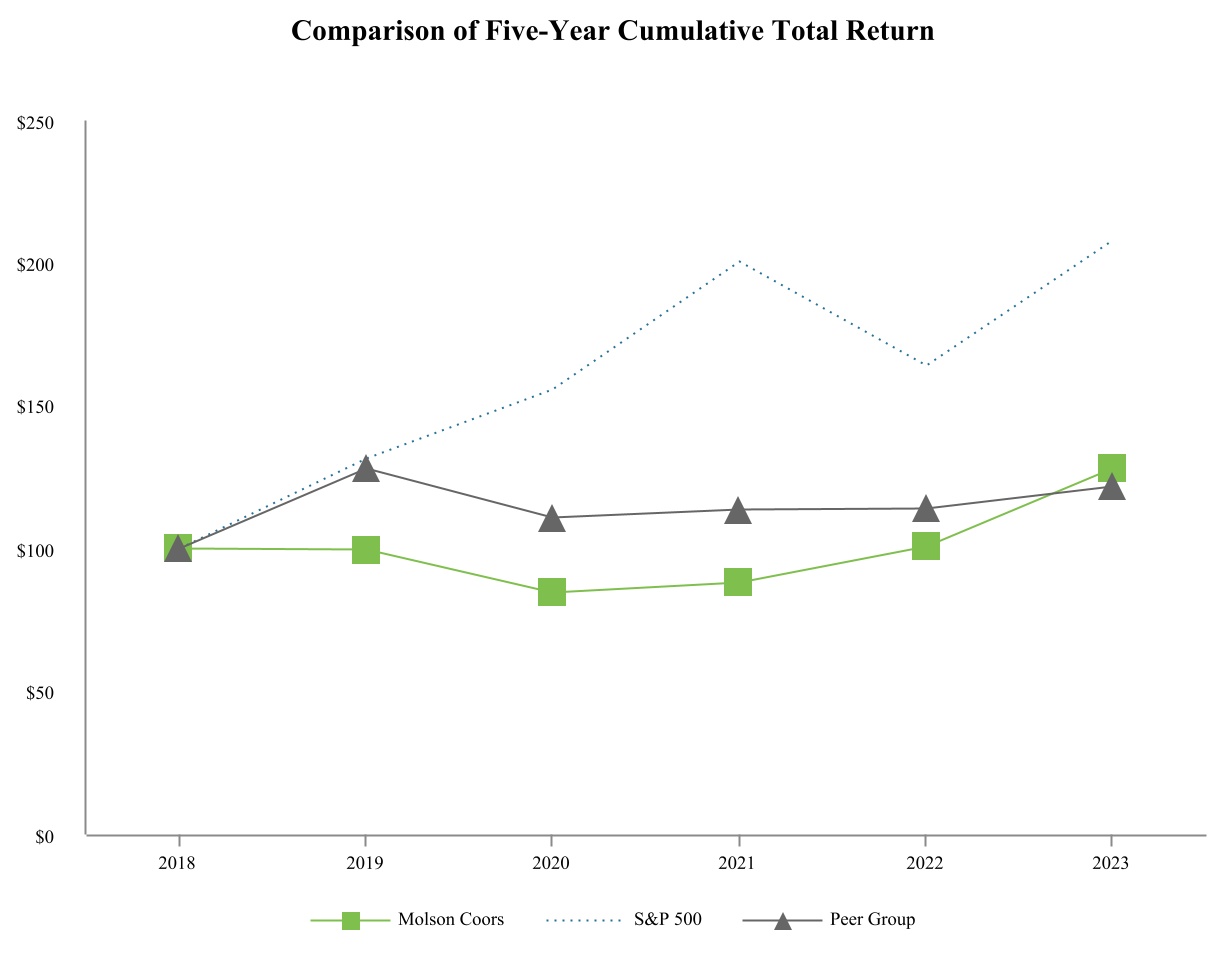
| 2018 | 2019 | 2020 | 2021 | 2022 | 2023 | ||||||||||||||||||||||||||||||
| Molson Coors | $ | 100.00 | $ | 99.54 | $ | 84.45 | $ | 87.89 | $ | 100.54 | $ | 127.91 | |||||||||||||||||||||||
| S&P 500 | $ | 100.00 | $ | 131.48 | $ | 155.66 | $ | 200.30 | $ | 163.99 | $ | 207.87 | |||||||||||||||||||||||
| Peer Group | $ | 100.00 | $ | 128.10 | $ | 110.93 | $ | 113.47 | $ | 113.80 | $ | 121.72 |
Dividends
We do not have any restrictions that prevent or limit our ability to declare or pay dividends. A quarterly dividend of $0.34 per share was paid during the third and fourth quarters of 2021 following the reinstatement of the quarterly dividend on July 15, 2021 by the Board after the quarterly dividend's suspension as a result of the coronavirus pandemic, for a total of $0.68 per share or a CAD equivalent of CAD 0.84 per share. A quarterly dividend of $0.38 per share was declared and paid to eligible shareholders of record on the respective record dates throughout 2022 for a total of $1.52 per share or a CAD equivalent of CAD 1.95 per share. A quarterly dividend of $0.41 per share was declared and paid to eligible shareholders of record on the respective record dates throughout 2023 for a total of $1.64 per share or a CAD equivalent of CAD 2.19 per share.
Issuer Purchases of Equity Securities
The following table presents information with respect to Class B common stock purchases made by our Company during the three months ended December 31, 2023:
| Issuer Purchases of Equity Securities | ||||||||||||||||||||||||||
| Total number of shares purchased | Average price paid per share | Total number of shares purchased as part of publicly announced plans or programs | Maximum number (or approximate dollar value) of shares that may yet be purchased under the plans or programs**(1)** | |||||||||||||||||||||||
| October 1, 2023 through October 31, 2023 | — | $ | — | — | $ | 2,000,000,000 | ||||||||||||||||||||
| November 1, 2023 through November 30, 2023 | 1,371,697 | $ | 59.29 | 1,371,697 | $ | 1,918,670,260 | ||||||||||||||||||||
| December 1, 2023 through December 31, 2023 | 1,102,997 | $ | 62.30 | 1,102,997 | $ | 1,849,958,156 | ||||||||||||||||||||
| Total | 2,474,694 | $ | 60.63 | 2,474,694 | $ | 1,849,958,156 |
(1)On September 29, 2023, the Board approved a share repurchase program to repurchase up to an aggregate of $2.0 billion of our Company's Class B common stock, excluding brokerage commissions and excise taxes, with an expected program term of five years.
The number, price, structure and timing of the repurchases under the program, if any, will be at our sole discretion and future repurchases will be evaluated by us depending on market conditions, liquidity needs, restrictions under our debt arrangements and other factors. Share repurchases may be made in the open market, in structured transactions, or in privately negotiated transactions. The repurchase authorization does not oblige us to acquire any particular amount of our Company's Class B common stock. The Board may suspend, modify or terminate the repurchase program at any time without prior notice.
Item 6. [Reserved]
Item 7. MANAGEMENT'S DISCUSSION AND ANALYSIS OF FINANCIAL CONDITION AND RESULTS OF OPERATIONS
Overview
For over two centuries, we have been brewing beverages that unite people to celebrate all life’s moments. From our core power brands Coors Light, Miller Lite, Coors Banquet, Molson Canadian, Carling and Ožujsko to our above premium brands including Madri, Staropramen, Blue Moon Belgian White and Leinenkugel’s Summer Shandy, to our economy and value brands like Miller High Life and Keystone, we produce many beloved and iconic beer brands. While our Company’s history is rooted in beer, we offer a modern portfolio that expands beyond the beer aisle as well, including flavored beverages like Vizzy Hard Seltzer, spirits like Five Trail whiskey as well as non-alcoholic beverages. As a business, our ambition is to be the first choice for our people, our consumers and our customers, and our success depends on our ability to make our products available to meet a wide range of consumer segments and occasions.
Management's Discussion and Analysis of Financial Condition and Results of Operations ("MD&A") in this Annual Report on Form 10-K is provided to assist in understanding our Company, operations and current business environment and should be considered a supplement to, and read in conjunction with, the accompanying audited consolidated financial statements and notes included within Part II—Item 8 Financial Statements and Supplementary Data, as well as the discussion of our business and related risk factors in Part I—Item 1 Business and Part I—Item 1A Risk Factors, respectively. See also "Cautionary Statement Pursuant to Safe Harbor Provisions of the Private Securities Litigation Reform Act of 1995."
A discussion related to the results of operations and changes in financial condition for 2022 compared to 2021 has been omitted from this report, but may be found in Part II, Item 7. Management's Discussion and Analysis of Financial Condition and Results of Operations in our fiscal 2022 Form 10-K, filed with the SEC on February 21, 2023, which is available free of charge on the SEC's website at www.sec.gov and our corporate website at www.molsoncoors.com.
Our Fiscal Year
Unless otherwise indicated, (a) all $ amounts are in USD, (b) comparisons are to comparable prior periods and (c) 2023, 2022 and 2021 refers to the 12 months ended December 31, 2023, December 31, 2022 and December 31, 2021, respectively.
Items Affecting Reported Results
Items Affecting Consolidated Results of Operations
Cost Inflation
We have continued to incur significant cost inflation, including materials and manufacturing expenses, which negatively impacted our results of operations for the year ended December 31, 2023, although we experienced moderation in the second half of the year. While cost inflation has been high in all of our markets, the impact to COGS on a percentage basis was higher for our EMEA&APAC segment than our Americas segment. In addition, consumers in certain markets in our EMEA&APAC segment continued to be impacted by local inflation leading to a reduction in their discretionary purchases. In 2024, we expect inflationary pressures to moderate and improve from those experienced over the last year.
To the extent materials and manufacturing prices continue to fluctuate, our business and financial results could continue to be materially adversely impacted. We continue to monitor these risks and rely on our risk management hedging program, increased pricing to our customers, our premiumization strategy and cost savings programs to help mitigate some of the inflationary pressures. Even if we are able to raise the prices of our products, consumers might react negatively to such price increases, which could have a material adverse effect on, among other things, our brands, reputation and sales. If our competitors maintain or substantially lower their prices, we may lose customers or be forced to lower prices to remain competitive. Our profitability may be impacted by prices that do not offset the inflationary pressures, which would negatively impact gross margins. In addition, even if we increase the prices of our products in response to increases in the cost of commodities or other cost increases, we may not be able to sustain our price increases or customers may trade down to cheaper alternatives.
Premiumization of our Portfolio
In 2021, in order to support continued premiumization of our portfolio, we strategically de-prioritized and rationalized certain non-core SKUs predominantly in the economy segment. While we rationalized certain non-core economy SKUs, we retained key economy brands allowing us to maintain a portfolio for all socio-economic demographics. We believe the continued premiumization of our portfolio will drive sustainable net sales and earnings growth but result in potential volume declines due to the rationalization of certain SKUs and as the portfolio mix shifts towards a higher composition of above premium products.
Items Affecting Americas Segment Results of Operations
Truss Impairment and Sale
During the first quarter of 2022, we recognized an impairment loss of $28.6 million related to the Truss joint venture asset group of which $12.1 million was attributable to the noncontrolling interest. Additionally, during the third quarter of 2023, we sold our controlling interest in Truss and recognized a loss of $11.1 million. These losses were recorded within other operating income (expense), net. See Part II—Item 8 Financial Statements and Supplementary Data, Note 17, "Other Operating Income (Expense), net" and Part II—Item 8 Financial Statements and Supplementary Data, Note 3, "Investments" for further information.
Goodwill Impairment
During the fourth quarter of 2022, we recorded a partial goodwill impairment charge of $845.0 million related to the Americas reporting unit as a result of the annual goodwill impairment analysis. See Part II—Item 8 Financial Statements and Supplementary Data, Note 6, "Goodwill and Intangible Assets" for further information.
Montreal/Longueuil, Québec Brewery and Distribution Centers Labor Strike
From late March 2022 until June 2022, approximately 400 unionized employees in our Montreal/Longueuil, Québec brewery and distribution centers went on strike which adversely affected our business and operations. Over the course of the third quarter of 2022, we recovered from the strike by rebuilding inventory and replenishing our retailers' shelves. As the brewery had not yet fully recovered until the end of the third quarter, results for the second and third quarters of 2022 were adversely impacted by this strike.
Keystone Litigation
During the first quarter of 2022, we accrued a liability of $56.0 million within MG&A related to probable losses as a result of the ongoing Keystone litigation case. During the years ended December 31, 2023 and December 31, 2022 we accrued $1.9 million and $0.6 million, respectively, in associated interest related to this accrued liability. See Part II—Item 8 Financial Statements and Supplementary Data, Note 13, "Commitments and Contingencies" for further information.
Items Affecting EMEA&APAC Segment Results of Operations
Staropramen Brands Impairment
During the fourth quarter of 2023, we recorded a partial impairment charge of $160.7 million to our indefinite-lived intangible asset related to the Staropramen family of brands within the EMEA&APAC segment as a result of our annual impairment analysis. See [Part II—Item 8 Financial Statements and Supplementary Dat
Showing the first 8K of 82K characters. Open the full section
Item 7A. QUANTITATIVE AND QUALITATIVE DISCLOSURES ABOUT MARKET RISK
In the normal course of our global operations, we are exposed to market risks associated with foreign currency exchange fluctuations, volatile interest rates and commodity price risks. To manage our exposure to these market risks, we enter into certain supplier-based and market-based hedging transactions. Such transactions are allowed under our risk management policy and are monitored closely with clear controls around the activities. Our market-based transactions include a variety of derivative financial instruments, none of which are used for trading or speculative purposes. The counterparties to these market-based transactions are generally highly rated institutions. Our objective is to manage our exposures and to decrease the volatility of our earnings and cash flows as a result of changes in underlying rates and costs.
Interest Rate Risk
We are exposed to volatility in interest rates with regard to our current and future debt offerings. Specifically, we are exposed to U.S. Department of Treasury rates, Canadian government rates and SOFR, or any such alternatives like SONIA or EURIBOR, for example. We may from time to time enter into interest rate swaps on our current debt obligations as our hedging strategy is to achieve our desired fixed-to-floating rate debt profile such that we manage the volatility in earnings as well as the cost of funding our operations. Further, we may enter into forward starting interest rate swaps to manage our exposure to the volatility of interest rates associated with future interest payments on a forecasted debt issuance.
In May 2023, we amended our 2026 forward starting interest rate swaps to replace LIBOR with SOFR. Subsequent to this transition, we are no longer exposed to LIBOR. As of December 31, 2023, the following table presents our fixed rate debt and forward starting interest rate swaps as well as the impact of an absolute 1% adverse change in interest rates on their respective fair values. As of December 31, 2022, the following table presents our fixed rate debt and forward starting interest rate swaps and the impact of an absolute 1% adverse change in interest rates on our forward starting interest rate swaps and a 10% adverse change in the yield on our fixed rate debt. Notional amounts and fair values are presented in USD based on the applicable exchange rates as of December 31, 2023 and December 31, 2022, respectively. See Part II - Item 8. Financial Statements and Supplementary Data, Note 9. "Debt" for the maturity dates of our outstanding debt instruments.
| Notional amounts | Fair Value Asset/(Liability) | Effect of Adverse Change | ||||||||||||||||||||||||||||||||||||
| (in millions) | As of December 31, 2023 | As of December 31, 2022 | As of December 31, 2023 | As of December 31, 2022 | As of December 31, 2023 | As of December 31, 2022 | ||||||||||||||||||||||||||||||||
| USD denominated fixed rate debt | $ | 4,900.0 | $ | 4,900.0 | $ | (4,608.2) | $ | (4,295.9) | $ | (414.4) | $ | (223.4) | ||||||||||||||||||||||||||
| Foreign currency denominated fixed rate debt | $ | 1,260.7 | $ | 1,594.2 | $ | (1,248.6) | $ | (1,557.4) | $ | (13.5) | $ | (11.1) | ||||||||||||||||||||||||||
| Forward starting interest rate swaps | $ | 1,000.0 | $ | 1,000.0 | $ | 41.6 | $ | 40.0 | $ | (78.9) | $ | (73.8) |
Foreign Exchange Risk
Foreign currency exchange risk is inherent in our operations primarily due to operating results that are denominated in currencies other than the USD. We closely monitor our operations in each country and seek to adopt appropriate strategies that are responsive to foreign currency fluctuations. Our financial risk management policy is intended to mitigate a portion of the potentially unfavorable impact of exchange rates on our earnings and cash flows.
Changes in foreign currency exchange rates affect the translation of local currency balances of foreign subsidiaries, transaction gains and losses associated with intercompany loans with foreign subsidiaries, royalty agreements and transactions denominated in currencies other than the USD, and their related cash flows, specifically related to the purchase of production inputs and imports, as well as our foreign currency-denominated debt. See Part II - Item, 8. Financial Statements and Supplementary Data, Note 1. "Basis of Presentation and Summary of Significant Accounting Policies" for our accounting policy over the accounting for translation adjustments and foreign currency transactions.
Approximately $3.6 billion, or 30%, of our net sales were denominated in functional currencies other than the USD for the year ended December 31, 2023. As a result, fluctuations in foreign currency exchange rates, particularly the CAD and the GBP, may have a material impact on our reported results. For the year ended December 31, 2023, net sales denominated in CAD and GBP both approximated $1.3 billion, for each respective currency.
We manage our foreign currency exposures through foreign currency forward contracts and net investment hedges. Our EUR foreign-denominated debt is a net investment hedge against our investment in our Europe business in order to hedge a portion of the foreign currency translational impacts. The changes in fair value of the net investment hedge due to the fluctuations in the spot rate are recorded to AOCI. Our foreign currency forward contracts manage our exposure related to certain royalty agreements, the purchase of production inputs and imports that are denominated in currencies other than the entity's functional local currency and other foreign currency exchange exposure.
The following table includes details of our foreign currency forwards used to hedge our foreign exchange rate risk as well as the impact of a hypothetical 10% adverse change in the related foreign currency exchange rates on the fair value of the foreign currency forwards. Notional amounts and fair values are presented in USD based on the applicable exchange rate as of December 31, 2023 and December 31, 2022. Approximately 62% of our outstanding foreign currency forwards mature in 2024, 33% mature in 2025 and 5% mature thereafter.
| Notional amounts | Fair Value Asset/(Liability) | Effect of Adverse Change | ||||||||||||||||||||||||||||||||||||
| (in millions) | As of December 31, 2023 | As of December 31, 2022 | As of December 31, 2023 | As of December 31, 2022 | As of December 31, 2023 | As of December 31, 2022 | ||||||||||||||||||||||||||||||||
| Foreign currency denominated fixed rate debt | $ | 1,260.7 | $ | 1,594.2 | $ | (1,248.6) | $ | (1,557.4) | $ | (124.8) | $ | (142.6) | ||||||||||||||||||||||||||
| Foreign currency forwards | $ | 219.4 | $ | 176.6 | $ | (1.4) | $ | 7.6 | $ | (23.6) | $ | (18.3) |
Commodity Price Risk
We are exposed to volatility in commodity prices as we use commodities in the production and distribution of our products. We specifically hedge our exposure to fluctuations in the price of natural gas, aluminum, including surcharges relating to our aluminum exposures, corn, sweeteners, barley and diesel. We utilize market-based derivatives and long-term supplier-based contracts, specifically a combination of purchase orders, long-term supply contracts and over-the-counter financial instruments to mitigate our commodity price risk by reducing price volatility for select commodities that are used in our supply chain.
The following table includes details of our commodity swaps used to hedge commodity price risk as well as the impact of a hypothetical 10% adverse change in the related commodity prices on the fair value of the derivatives. The following table excludes our commodity options because we have offsetting buy and sell positions. Notional amounts and fair values are presented in USD based on the applicable exchange rate as of December 31, 2023 and December 31, 2022. Approximately 68% of commodity swaps mature in 2024, 29% mature in 2025 and 3% mature thereafter.
| Notional amounts | Fair Value Asset/(Liability) | Effect of Adverse Change | ||||||||||||||||||||||||||||||||||||
| (in millions) | As of December 31, 2023 | As of December 31, 2022 | As of December 31, 2023 | As of December 31, 2022 | As of December 31, 2023 | As of December 31, 2022 | ||||||||||||||||||||||||||||||||
| Swaps | $ | 653.5 | $ | 525.2 | $ | (30.4) | $ | 69.0 | $ | (58.1) | $ | (55.8) | ||||||||||||||||||||||||||
Item 8. FINANCIAL STATEMENTS AND SUPPLEMENTARY DATA
MANAGEMENT'S REPORT
The preparation, integrity and objectivity of the financial statements and all other financial information included in this annual report are the responsibility of the management of Molson Coors Beverage Company. The financial statements have been prepared in accordance with generally accepted accounting principles in the United States, applying estimates based on management's best judgment where necessary. Management believes that all material uncertainties have been appropriately accounted for and disclosed.
Our management, under the supervision and with the participation of our Chief Executive Officer and Chief Financial Officer, assessed the effectiveness of our internal control over financial reporting as of December 31, 2023, based on the framework and criteria established in Internal Control—Integrated Framework (2013 Framework), issued by the Committee of Sponsoring Organizations of the Treadway Commission. Based upon its assessment, management concluded that, as of December 31, 2023, the Company's internal control over financial reporting was effective.
PricewaterhouseCoopers LLP, the Company's independent registered public accounting firm, provides an objective, independent audit of the consolidated financial statements and internal control over financial reporting. Their accompanying report is based upon an examination conducted in accordance with standards of the Public Company Accounting Oversight Board (United States), including tests of accounting procedures, records and internal control.
The Board of Directors, operating through its Audit Committee composed of independent, outside directors, monitors the Company's accounting control systems and reviews the results of the Company's auditing activities. The Audit Committee meets at least quarterly, either separately or jointly, with representatives of management, PricewaterhouseCoopers LLP and internal auditors. To ensure complete independence, PricewaterhouseCoopers LLP and the Company's internal auditors have full and free access to the Audit Committee and may meet with or without the presence of management.
| /s/ GAVIN D.K. HATTERSLEY | /s/ TRACEY I. JOUBERT | |||||||
| Gavin D.K. Hattersley | Tracey I. Joubert | |||||||
| President & Chief Executive Officer | Chief Financial Officer | |||||||
| Molson Coors Beverage Company | Molson Coors Beverage Company | |||||||
| February 20, 2024 | February 20, 2024 |
Report of Independent Registered Public Accounting Firm
To the Board of Directors and Stockholders of Molson Coors Beverage Company
Opinions on the Financial Statements and Internal Control over Financial Reporting
We have audited the accompanying consolidated balance sheets of Molson Coors Beverage Company and its subsidiaries (the “Company”) as of December 31, 2023 and 2022, and the related consolidated statements of operations, of comprehensive income (loss), of stockholders’ equity and noncontrolling interests and of cash flows for each of the three years in the period ended December 31, 2023, including the related notes and schedule of valuation and qualifying accounts for each of the three years in the period ended December 31, 2023 appearing under item 15(c) (collectively referred to as the “consolidated financial statements”). We also have audited the Company's internal control over financial reporting as of December 31, 2023, based on criteria established in Internal Control - Integrated Framework (2013) is
Showing the first 8K of 303K characters. Open the full section
Item 9. CHANGES IN AND DISAGREEMENTS WITH ACCOUNTANTS ON ACCOUNTING AND FINANCIAL DISCLOSURE
None.
Item 9A. CONTROLS AND PROCEDURES
Evaluation of Disclosure Controls and Procedures
Under the supervision and with the participation of our management, including our Chief Executive Officer and Chief Financial Officer, we conducted an evaluation of our disclosure controls and procedures as such term is defined under Rule 13a-15(e) under the Exchange Act. Based on this evaluation, our Chief Executive Officer and Chief Financial Officer concluded that our disclosure controls and procedures were effective as of December 31, 2023 to provide reasonable assurance that information required to be disclosed in our reports that we file or submit under the Exchange Act is recorded, processed, summarized and reported within the time periods specified in the SEC rules and forms and that such information is accumulated and communicated to our management, including our Chief Executive Officer and Chief Financial Officer, as appropriate, to allow timely decisions regarding required disclosure. Management necessarily applies its judgment in assessing the costs and benefits of such disclosure controls and procedures that, by their nature, can only provide reasonable assurance regarding management's control objectives. Also, we have investments in certain unconsolidated entities that we do not control or manage.
Management's Annual Report on Internal Control over Financial Reporting
Our management is responsible for establishing and maintaining adequate internal control over financial reporting as such term is defined in Exchange Act Rule 13a-15(f). Our internal control over financial reporting is a process designed to provide reasonable assurance regarding the reliability of financial reporting and the preparation of financial statements for external purposes in accordance with U.S. GAAP. A company's internal control over financial reporting includes those policies and procedures that (i) pertain to the maintenance of records that, in reasonable detail, accurately and fairly reflect the transactions and dispositions of the assets of the company; (ii) provide reasonable assurance that transactions are recorded as necessary to permit preparation of financial statements in accordance with U.S. GAAP, and that receipts and expenditures of the company are being made only in accordance with authorizations of management and directors of the company; and (iii) provide reasonable assurance regarding prevention or timely detection of unauthorized acquisition, use, or disposition of the company's assets that could have a material effect on the financial statements.
Because of its inherent limitations, internal control over financial reporting may not prevent or detect misstatements. Also, projections of any evaluation of effectiveness to future periods are subject to the risk that controls may become inadequate because of changes in conditions, or that the degree of compliance with the policies or procedures may deteriorate.
Our Chief Executive Officer and our Chief Financial Officer, with assistance from other members of management, assessed the effectiveness of our internal control over financial reporting as of December 31, 2023, based on the framework and criteria established in Internal Control—Integrated Framework (2013 Framework), issued by the Committee of Sponsoring Organizations of the Treadway Commission. Based on its evaluation, management has concluded that our internal control over financial reporting was effective as of December 31, 2023.
An independent registered public accounting firm, PricewaterhouseCoopers LLP, has audited the effectiveness of our internal control over financial reporting as of December 31, 2023, as stated in their report which appears in Part II—Item 8 Financial Statements and Supplementary Data.
Changes in Internal Control over Financial Reporting
There were no changes in our internal control over financial reporting (as defined in Exchange Act Rule 13a-15(f)) during the quarter ended December 31, 2023, that have materially affected, or are reasonably likely to materially affect, our internal control over financial reporting.
Item 9B. OTHER INFORMATION
During the three months ended December 31, 2023, no directors or officers adopted or terminated a "Rule 10b5-1 trading arrangement" or a "non-Rule 10b5-1 trading arrangement", as each term is defined in Item 408(a) of Regulation S-K.
Item 9C. DISCLOSURES REGARDING FOREIGN JURISDICTIONS THAT PREVENT INSPECTION
None.
PART III
Item 10. DIRECTORS, EXECUTIVE OFFICERS AND CORPORATE GOVERNANCE
Incorporated by reference to our definitive proxy statement for our 2024 annual meeting of stockholders, which will be filed no later than 120 days after December 31, 2023.
Item 11. EXECUTIVE COMPENSATION
Incorporated by reference to our definitive proxy statement for our 2024 annual meeting of stockholders, which will be filed no later than 120 days after December 31, 2023.
Item 12. SECURITY OWNERSHIP OF CERTAIN BENEFICIAL OWNERS AND MANAGEMENT AND RELATED STOCKHOLDER MATTERS
Incorporated by reference to our definitive proxy statement for our 2024 annual meeting of stockholders, which will be filed no later than 120 days after December 31, 2023.
Equity Compensation Plan Information
The following table summarizes information about the Incentive Compensation Plan as of December 31, 2023. All outstanding awards shown in the table below relate to our Class B common stock.
| Plan category | Number of securities to be issued upon exercise of outstanding options, warrants and rights (Column A) | Weighted-average exercise price of outstanding options, warrants and rights | Number of securities remaining available for future issuance under equity compensation plans (excluding securities reflected in column A) | ||||||||||||||
| Equity compensation plans approved by security holders(1) | 3,697,498 | $57.25 | 4,325,695 | ||||||||||||||
| Equity compensation plans not approved by security holders | — | N/A | — | ||||||||||||||
| Total | 3,697,498 | $57.25 | 4,325,695 |
(1)Under the Incentive Compensation Plan, we may issue RSUs, DSUs, PSUs and stock options. The number of securities to be issued upon exercise of outstanding awards includes 1,279,121 RSUs and DSUs, 880,125 PSUs (assuming the target award is met) and 1,538,252 options outstanding as of December 31, 2023. See Part II—Item 8 Financial Statements and Supplementary Data, Note 16, "Share-Based Payments" for further discussion. Outstanding RSUs, DSUs
and PSUs do not have exercise prices and therefore have been disregarded for purposes of calculating the weighted-average exercise price.
Item 13. CERTAIN RELATIONSHIPS AND RELATED TRANSACTIONS, AND DIRECTOR INDEPENDENCE
Incorporated by reference to our definitive proxy statement for our 2024 annual meeting of stockholders, which will be filed no later than 120 days after December 31, 2023.
Item 14. PRINCIPAL ACCOUNTANT FEES AND SERVICES
Incorporated by reference to our definitive proxy statement for our 2024 annual meeting of stockholders, which will be filed no later than 120 days after December 31, 2023.
PART IV
Item 15. EXHIBITS, FINANCIAL STATEMENT SCHEDULES
**(a)**Financial Statements, Financial Statement Schedules and Exhibits
The following are filed or incorporated by reference as a part of this Annual Report on Form 10-K:
(1)Management's Report
Report of Independent Registered Public Accounting Firm
Consolidated Statements of Operations for the years ended December 31, 2023, December 31, 2022 and December 31, 2021
Consolidated Statements of Comprehensive Income (Loss) for the years ended December 31, 2023, December 31, 2022 and December 31, 2021
Consolidated Balance Sheets as of December 31, 2023 and December 31, 2022
Consolidated Statements of Cash Flows for the years ended December 31, 2023, December 31, 2022 and December 31, 2021
Consolidated Statements of Stockholders' Equity and Noncontrolling Interests for the years ended December 31, 2023, December 31, 2022 and December 31, 2021
Notes to Consolidated Financial Statements
(2)Schedule II—Valuation and Qualifying Accounts for the years ended December 31, 2023, December 31, 2022 and December 31, 2021
(3)Exhibit list
| Incorporated by Reference | Filed/Furnished Herewith | ||||||||||||||||||||||||||||||||||
| Exhibit Number | Document Description | Form | Exhibit | Filing Date | |||||||||||||||||||||||||||||||
| 3.1 | Restated Certificate of Incorporation of Molson Coors Beverage Company, as amended to date. | 10-K | 3.1 | February 12, 2020 | |||||||||||||||||||||||||||||||
| 3.2 | Fifth Amended and Restated Bylaws of Molson Coors Beverage Company. | 8-K | 3.1 | May 23, 2022 | |||||||||||||||||||||||||||||||
| 4.1.1 | Specimen Class A Common Stock Certificate | 10-K | 4.1.1 | February 12, 2020 | |||||||||||||||||||||||||||||||
| 4.1.2 | Specimen Class B Common Stock Certificate | 10-K | 4.1.2 | February 12, 2020 | |||||||||||||||||||||||||||||||
| 4.2.1 | Indenture, dated as of May 3, 2012, by and among Molson Coors Brewing Company, the guarantors named therein and Deutsche Bank Trust Company Americas, as trustee. | 8-K | 4.1 | May 3, 2012 | |||||||||||||||||||||||||||||||
| 4.2.2 | First Supplemental Indenture, dated as of May 3, 2012, to the Indenture dated May 3, 2012, by and among Molson Coors Brewing Company, the guarantors named therein and Deutsche Bank Trust Company Americas, as trustee. | 8-K | 4.2 | May 3, 2012 |
| Incorporated by Reference | Filed/Furnished Herewith | ||||||||||||||||||||||||||||||||||
| Exhibit Number | Document Description | Form | Exhibit | Filing Date | |||||||||||||||||||||||||||||||
| 23 | Consent of Independent Registered Public Accounting Firm. | X | |||||||||||||||||||||||||||||||||
| 31.1 | Section 302 Certification of Chief Executive Officer. | X | |||||||||||||||||||||||||||||||||
| 31.2 | Section 302 Certification of Chief Financial Officer. | X | |||||||||||||||||||||||||||||||||
| 32 | Written Statement of Chief Executive Officer and Chief Financial Officer furnished pursuant to Section 906 of the Sarbanes-Oxley Act of 2002 (18 U.S.C. Section 1350). | XX | |||||||||||||||||||||||||||||||||
| 97 | ***** | Global Incentive Compensation Clawback Policy | X | ||||||||||||||||||||||||||||||||
| 101.INS | ******* | XBRL Instance Document - the instance document does not appear in the Interactive Data File because its XBRL tags are embedded within the Inline XBRL document | X | ||||||||||||||||||||||||||||||||
| 101.SCH | ******* | XBRL Taxonomy Extension Schema Document | X | ||||||||||||||||||||||||||||||||
| 101.CAL | ******* | XBRL Taxonomy Extension Calculation Linkbase Document | X | ||||||||||||||||||||||||||||||||
| 101.DEF | ******* | XBRL Taxonomy Extension Definition Linkbase Document | X | ||||||||||||||||||||||||||||||||
| 101.LAB | ******* | XBRL Taxonomy Extension Label Linkbase Document | X | ||||||||||||||||||||||||||||||||
| 101.PRE | ******* | XBRL Taxonomy Extension Presentation Linkbase Document | X | ||||||||||||||||||||||||||||||||
| 104 | Cover page formatted as Inline XBRL and contained in Exhibit 101. | X |
- Represents a management contract or compensatory plan or arrangement.
** Certain of the exhibits and schedules to this exhibit have been omitted in accordance with Regulation S-K Item 601(a)(5). The Company agrees to furnish supplementally a copy of all omitted exhibits and schedules to the SEC upon its request.
*** Attached as Exhibit 101 to this report are the following documents formatted in iXBRL (Inline Extensible Business Reporting Language): (i) the Consolidated Statements of Operations, (ii) the Consolidated Statements of Comprehensive Income (Loss), (iii) the Consolidated Balance Sheets, (iv) the Consolidated Statements of Cash Flows, (v) the Consolidated Statements of Stockholders' Equity and Noncontrolling Interests, (vi) the Notes to Consolidated Financial Statements, and (vii) document and entity information.
X Filed herewith
XX Furnished herewith
**(b)**Exhibits
The exhibits included in Item 15(a)(3) above are filed or incorporated by reference pursuant to the requirements of Item 601 of Regulation S-K.
**(c)**Other Financial Statement Schedules
SCHEDULE II
MOLSON COORS BEVERAGE COMPANY AND SUBSIDIARIES
VALUATION AND QUALIFYING ACCOUNTS
(IN MILLIONS)
| Balance at beginning of year | Additions charged to costs and expenses | Deductions | Foreign exchange impact | Balance at end of year | |||||||||||||||||||||||||
| Deferred tax valuation allowance | |||||||||||||||||||||||||||||
| Year ended: | |||||||||||||||||||||||||||||
| December 31, 2023 | $ | 57.2 | $ | 13.2 | $ | (10.2) | $ | 1.7 | $ | 61.9 | |||||||||||||||||||
| December 31, 2022 | $ | 60.7 | $ | 20.6 | $ | (23.0) | $ | (1.1) | $ | 57.2 | |||||||||||||||||||
| December 31, 2021 | $ | 62.2 | $ | 14.8 | $ | (16.2) | $ | (0.1) | $ | 60.7 |
Deduction amounts related to the deferred tax valuation allowance are primarily due to the utilization of capital loss and operating loss carryforwards and re-evaluations of deferred tax assets.
The impacts of changes in income tax rates on deferred tax valuation allowances are reported in the additions or deductions column accordingly.
Item 16. FORM 10-K SUMMARY
None.
SIGNATURES
Pursuant to the requirements of Section 13 or 15(d) of the Securities Exchange Act of 1934, the registrant has duly caused this report to be signed on its behalf by the undersigned, thereunto duly authorized.
MOLSON COORS BEVERAGE COMPANY
| By | /s/ GAVIN D.K. HATTERSLEY | President, Chief Executive Officer and Director (Principal Executive Officer) | ||||||||||||
| Gavin D.K. Hattersley |
February 20, 2024
Pursuant to the requirements of the Securities Exchange Act of 1934, this report has been signed below by the following persons on behalf of the registrant and in the capacities and on the date indicated.
| By | /s/ GAVIN D.K. HATTERSLEY | President, Chief Executive Officer and Director (Principal Executive Officer) | ||||||||||||
| Gavin D.K. Hattersley | ||||||||||||||
| By | /s/ TRACEY I. JOUBERT | Chief Financial Officer (Principal Financial Officer) | ||||||||||||
| Tracey I. Joubert | ||||||||||||||
| By | /s/ ROXANNE M. STELTER | Vice President and Controller (Principal Accounting Officer) | ||||||||||||
| Roxanne M. Stelter | ||||||||||||||
| By | /s/ GEOFFREY E. MOLSON | Chairman | ||||||||||||
| Geoffrey E. Molson | ||||||||||||||
| By | /s/ DAVID S. COORS | Vice Chairman | ||||||||||||
| David S. Coors | ||||||||||||||
| By | /s/ JULIA M. BROWN | Director | ||||||||||||
| Julia M. Brown | ||||||||||||||
| By | /s/ PETER H. COORS | Director | ||||||||||||
| Peter H. Coors | ||||||||||||||
| By | /s/ ROGER G. EATON | Director | ||||||||||||
| Roger G. Eaton | ||||||||||||||
| By | /s/ MARY LYNN FERGUSON-MCHUGH | Director | ||||||||||||
| Mary Lynn Ferguson-McHugh | ||||||||||||||
| By | /s/ CHARLES M. HERINGTON | Director | ||||||||||||
| Charles M. Herington | ||||||||||||||
| By | /s/ ANDREW T. MOLSON | Director | ||||||||||||
| Andrew T. Molson | ||||||||||||||
| By | /s/ NESSA O'SULLIVAN | Director | ||||||||||||
| Nessa O'Sullivan | ||||||||||||||
| By | /s/ H. SANFORD RILEY | Director | ||||||||||||
| H. Sanford Riley | ||||||||||||||
| By | /s/ JILL TIMM | Director | ||||||||||||
| Jill Timm | ||||||||||||||
| By | /s/ LEROY J. WILLIAMS, JR. | Director | ||||||||||||
| Leroy J. Williams, Jr. | ||||||||||||||
| By | /s/ JAMES A. WINNEFELD, JR. | Director | ||||||||||||
| James A. Winnefeld, Jr. |
February 20, 2024