 filings.tools
TransDigm Group 10-K 2018-09-30
Filed 2018-11-09. 16 sections, 570K characters. Original on sec.gov · Markdown · JSON
Cover and table of contents
10-K 1 tdg2018-09x3010xk.htm 10-K
UNITED STATES
SECURITIES AND EXCHANGE COMMISSION
Washington, D.C. 20549
| FORM 10-K |
| x | ANNUAL REPORT PURSUANT TO SECTION 13 OR 15(d) OF THE SECURITIES EXCHANGE ACT OF 1934 |
For the fiscal year ended September 30, 2018
| ¨ | TRANSITION REPORT PURSUANT TO SECTION 13 OR 15(d) OF THE SECURITIES EXCHANGE ACT OF 1934 |
For the transition period from to
Commission File Number 001-32833
| TransDigm Group Incorporated (Exact name of registrant as specified in its charter) | ||
Delaware
(State or other jurisdiction of incorporation or organization)
41-2101738
(I.R.S. Employer Identification No.)
| 1301 East 9th Street, Suite 3000, Cleveland, Ohio | 44114 | |
| (Address of principal executive offices) | (Zip Code) |
(216) 706-2960
(Registrants’ telephone number, including area code)
Securities registered pursuant to Section 12(b) of the Act:
| Common Stock | New York Stock Exchange | |
| (Title) | (Name of exchange on which registered) |
Securities registered pursuant to Section 12(g) of the Act:
None
Indicate by check mark if the registrant is a well-known seasoned issuer, as defined in Rule 405 of the Securities Act. Yes x No ¨
Indicate by check mark if the registrant is not required to file reports pursuant to Section 13 or Section 15(d) of the Act. Yes ¨ No x
Indicate by check mark whether the registrant: (1) has filed all reports required to be filed by Section 13 or 15(d) of the Securities Exchange Act of 1934 during the preceding 12 months (or for such shorter period that the registrant was required to file such reports) and (2) has been subject to such filing requirements for the past 90 days. Yes x No ¨
Indicate by check mark whether the registrant has submitted electronically every Interactive Data File required to be submitted pursuant to Rule 405 of Regulation S-T during the preceding 12 months (or for such shorter period that the registrant was required to submit such files). Yes x No ¨
Indicate by check mark if disclosure of delinquent filers pursuant to Item 405 of Regulation S-K is not contained herein, and will not be contained, to the best of registrant’s knowledge, in definitive proxy or information statements incorporated by reference in Part III of this Form 10-K or any amendment to this Form 10-K. ¨
Indicate by check mark whether the registrant is a large accelerated filer, an accelerated filer, a non-accelerated filer, or smaller reporting company or an emerging growth company. See the definitions of “large accelerated filer,” “accelerated filer,” “smaller reporting company” and “emerging growth company” in Rule 12b-2 of the Exchange Act.
| LARGE ACCELERATED FILER | ý | ACCELERATED FILER | ¨ | |
| NON-ACCELERATED FILER | ¨ | SMALLER REPORTING COMPANY | ¨ | |
| EMERGING GROWTH COMPANY | ¨ | |||
| If an emerging growth company, indicate by check mark if the registrant has elected not to use the extended transition period for complying with any new or revised financial accounting standards provided pursuant to Section 13(a) of the Exchange Act. | ¨ |
Indicate by check mark whether the registrant is a shell company (as defined in Rule 12b-2 of the Exchange Act). Yes ¨ No x
The aggregate market value of the voting and non-voting common stock held by non-affiliates of the registrant as of March 31, 2018, based upon the last sale price of such voting and non-voting common stock on that date, was $14,986,503,095.
The number of shares outstanding of TransDigm Group Incorporated’s common stock, par value $.01 per share, was 52,748,435 as of November 2, 2018.
Documents incorporated by reference: The registrant incorporates by reference in Part III hereof portions of its definitive Proxy Statement for its 2019 Annual Meeting of Stockholders.
TABLE OF CONTENTS
Special Note Regarding Forward-Looking Statements
This report on Form 10-K contains forward-looking statements within the meaning of Section 21E of the Securities Exchange Act of 1934, as amended (the “Exchange Act”), and 27A of the Securities Act of 1933, as amended. Discussions containing such forward-looking statements may be found in Items 1, 1A, 2, 3, 5, 7 and 7A hereof and elsewhere within this Report generally. In addition, when used in this Report, the words “believe,” “may,” “will,” “should,” “expect,” “intend,” “plan,” “predict,” “anticipate,” “estimate” or “continue” and other words and terms of similar meaning are intended to identify forward-looking statements. Although the Company (as defined below) believes that its plans, intentions and expectations reflected in or suggested by such forward-looking statements are reasonable, such forward-looking statements are subject to a number of risks and uncertainties that could cause actual results to differ materially from the forward-looking statements made in this Report. The more important of such risks and uncertainties are set forth under the caption “Risk Factors” and elsewhere in this Report. Many such factors are outside the control of the Company. Consequently, such forward-looking statements should be regarded solely as our current plans, estimates and beliefs. We do not undertake, and specifically decline, any obligation, to publicly release the results of any revisions to these forward-looking statements that may be made to reflect any future events or circumstances after the date of such statements or to reflect the occurrence of anticipated or unanticipated events. All forward-looking statements attributable to the Company or persons acting on its behalf are expressly qualified in their entirety by these cautionary statements.
Important factors that could cause actual results to differ materially from the forward-looking statements made in this Annual Report on Form 10-K include but are not limited to: the sensitivity of our business to the number of flight hours that our customers’ planes spend aloft and our customers’ profitability, both of which are affected by general economic conditions; future geopolitical or other worldwide events; cyber-security threats and natural disasters; our reliance on certain customers; the U.S. defense budget and risks associated with being a government supplier; failure to maintain government or industry approvals; failure to complete or successfully integrate acquisitions; our indebtedness; potential environmental liabilities; liabilities arising in connection with litigation; increases in raw material costs, taxes and labor costs that cannot be recovered in product pricing; risks and costs associated with our international sales and operations; and other factors.
In this report, the term “TD Group” refers to TransDigm Group Incorporated, which holds all of the outstanding capital stock of TransDigm Inc. The terms “Company,” “TransDigm,” “we,” “us,” “our” and similar terms, unless the context otherwise requires, refer to TD Group, together with TransDigm Inc. and its wholly-owned and majority-owned subsidiaries for which it has a controlling interest. References to “fiscal year” mean the year ending or ended September 30. For example, “fiscal year 2018” or “fiscal 2018” means the period from October 1, 2017 to September 30, 2018.
PART I
Item 1. BUSINESS
The Company
TransDigm Inc. was formed in 1993 in connection with a leveraged buyout transaction. TD Group was formed in 2003 to facilitate a leveraged buyout of TransDigm Inc. The Company was owned by private equity funds until its initial public offering in 2006. TD Group’s common stock is publicly traded on the New York Stock Exchange, or NYSE, under the ticker symbol “TDG.”
We believe we are a leading global designer, producer and supplier of highly engineered aircraft components for use on nearly all commercial and military aircraft in service today. Our business is well diversified due to the broad range of products we offer to our customers. We estimate that about 90% of our net sales for fiscal year 2018 were generated by proprietary products. In addition, for fiscal year 2018, we estimate that we generated about 80% of our net sales from products for which we are the sole source provider.
Most of our products generate significant aftermarket revenue. Once our parts are designed into and sold on a new aircraft, we generate net sales from aftermarket consumption over the life of that aircraft, which is generally estimated to be approximately 25 to 30 years. A typical platform can be produced for 20 to 30 years, giving us an estimated product life cycle in excess of 50 years. We estimate that approximately 60% of our net sales in fiscal year 2018 were generated from aftermarket sales, the vast majority of which come from the commercial and military aftermarkets. These aftermarket revenues have historically produced a higher gross margin and been more stable than sales to original equipment manufacturers, or OEMs.
Products
We primarily design, produce and supply highly engineered proprietary aerospace components (and certain systems/subsystems) with significant aftermarket content. We seek to develop highly customized products to solve specific needs for aircraft operators and manufacturers. We attempt to differentiate ourselves based on engineering, service and manufacturing capabilities. We typically choose not to compete for non-proprietary “build to print” business because it frequently offers lower
margins than proprietary products. We believe that our products have strong brand names within the industry and that we have a reputation for high quality, reliability and customer support.
Our business is well diversified due to the broad range of products that we offer to our customers. Some of our more significant product offerings, substantially all of which are ultimately provided to end-users in the aerospace industry, include mechanical/electro-mechanical actuators and controls, ignition systems and engine technology, specialized pumps and valves, power conditioning devices, specialized AC/DC electric motors and generators, NiCad batteries and chargers, engineered latching and locking devices, rods and locking devices, engineered connectors and elastomers, databus and power controls, cockpit security components and systems, specialized cockpit displays, aircraft audio systems, specialized lavatory components, seat belts and safety restraints, engineered interior surfaces and related components, lighting and control technology, military personnel parachutes, high performance hoists, winches and lifting devices, and cargo loading, handling and delivery systems.
Segments
The Company’s businesses are organized and managed in three reporting segments: Power & Control, Airframe and Non-aviation.
The Power & Control segment includes operations that primarily develop, produce and market systems and components that predominately provide power to or control power of the aircraft utilizing electronic, fluid, power and mechanical motion control technologies. Major product offerings include mechanical/electro-mechanical actuators and controls, ignition systems and engine technology, specialized pumps and valves, power conditioning devices, specialized AC/DC electric motors and generators, databus and power controls, high performance hoists, winches and lifting devices and cargo loading and handling systems. Primary customers of this segment are engine and power system and subsystem suppliers, airlines, third party maintenance suppliers, military buying agencies and repair depots. Products are sold in the OEM and aftermarket market channels.
The Airframe segment includes operations that primarily develop, produce and market systems and components that are used in non-power airframe applications utilizing airframe and cabin structure technologies. Major product offerings include engineered latching and locking devices, rods and locking devices, engineered connectors and elastomers, cockpit security components and systems, aircraft audio systems, specialized lavatory components, seat belts and safety restraints, engineered interior surfaces and related components, lighting and control technology, military personnel parachutes and cargo delivery systems. Primary customers of this segment are airframe manufacturers and cabin system suppliers and subsystem suppliers, airlines, third party maintenance suppliers, military buying agencies and repair depots. Products are sold in the OEM and aftermarket market channels.
The Non-aviation segment includes operations that primarily develop, produce and market products for non-aviation markets. Major product offerings include seat belts and safety restraints for ground transportation applications, mechanical/electro-mechanical actuators and controls for space applications, and refueling systems for heavy equipment used in mining, construction and other industries. Primary customers of this segment are off-road vehicle suppliers and subsystem suppliers, child restraint system suppliers, satellite and space system suppliers and manufacturers of heavy equipment used in mining, construction and other industries.
For financial information about our segments, see Note 16, “Segments,” to the consolidated financial statements included herein, which is incorporated by reference.
Pending Acquisition of Esterline Technologies Corporation
On October 9, 2018, the Company entered into a merger agreement with Esterline Technologies Corporation (“Esterline”), under which the Company agreed to acquire Esterline. Under the terms of the merger agreement, the Company will purchase each share of Esterline common stock outstanding for $122.50 per share in cash. TransDigm anticipates that the total transaction value will be approximately $4 billion, representing the $122.50 price paid per share for common stock outstanding plus existing debt. The Company expects the acquisition to be financed primarily through existing cash on hand and the incurrence of new term loans. In connection with the merger agreement, the Company entered into a commitment letter for a senior secured term facility up to $3.7 billion. The actual amount and timing of the new senior secured term facility is subject to the closing of the Esterline acquisition and the cash on hand at that time. The Company currently expects that the merger will be completed in 2019, subject to approval of Esterline’s shareholders, as well as other customary closing conditions, including the receipt of required regulatory approvals.
For further details on the acquisitions and divestiture that occurred during fiscal 2018, refer to Note 2, “Acquisitions and Divestitures,” to the consolidated financial statements included herein, which is incorporated by reference.
Sales and Marketing
Consistent with our overall strategy, our sales and marketing organization is structured to continually develop technical solutions that meet customer needs. In particular, we attempt to focus on products and programs that will lead to high-margin, repeatable sales in the aftermarket.
We have structured our sales efforts along our major product offerings, assigning a business unit manager to certain products. Each business unit manager is expected to grow the sales and profitability of the products for which he or she is responsible and to achieve the targeted annual level of bookings, sales, new business and profitability for such products. The business unit managers are assisted by account managers and sales engineers who are responsible for covering major OEM and aftermarket accounts. Account managers and sales engineers are expected to be familiar with the personnel, organization and needs of specific customers to achieve total bookings and new business goals at each account and, together with the business unit managers, to determine when additional resources are required at customer locations. Most of our sales personnel are evaluated, in part, on their bookings and their ability to identify and obtain new business opportunities.
Though typically performed by employees, the account manager function may be performed by independent representatives depending on the specific customer, product and geographic location. We also use a number of distributors to provide logistical support as well as serve as a primary customer contact with certain smaller accounts. Our major distributors are Aviall, Inc. (a subsidiary of The Boeing Company) and Satair A/S (a subsidiary of Airbus S.A.S.).
Manufacturing and Engineering
We maintain approximately 80 manufacturing facilities. Most of our manufacturing facilities are comprised of manufacturing, distribution and engineering functions, and most facilities have certain administrative functions, including management, sales and finance. We continually strive to improve productivity and reduce costs, including rationalization of operations, developing improved control systems that allow for accurate accounting and reporting, investing in equipment, tooling, information systems and implementing broad-based employee training programs. Management believes that our manufacturing systems and equipment contribute to our ability to compete by permitting us to meet the rigorous tolerances and cost sensitive price structure of aircraft component customers.
We attempt to differentiate ourselves from our competitors by producing uniquely engineered products with high quality and timely delivery. Our engineering costs are recorded in cost of sales and in selling and administrative expenses and research and development costs are recorded in selling and administrative expenses in our consolidated statements of income. The aggregate of engineering expense and research and development expense represents approximately 8% of our operating units’ aggregate costs, or approximately 4% of our consolidated net sales for fiscal year 2018. Our proprietary products, and particularly our new product initiatives, are designed by our engineers and are intended to serve the needs of the aircraft component industry. These proprietary designs must withstand the extraordinary conditions and stresses that will be endured by products during use and meet the rigorous demands of our customers’ tolerance and quality requirements.
We use sophisticated equipment and procedures to comply with quality requirements, specifications and Federal Aviation Administration (“FAA”) and OEM requirements. We perform a variety of testing procedures as required by our customers, such as testing under different temperature, humidity and altitude levels, flammability testing, shock and vibration testing and X-ray fluorescent measurement. These procedures, together with other customer approved techniques for document, process and quality control, are used throughout our manufacturing facilities. Refer to Note 3, “Summary of Significant Accounting Policies,” to the consolidated financial statements included herein with respect to total costs of research and development, which is incorporated by reference.
Customers
We predominantly serve customers in the commercial, regional, business jet and general aviation aftermarket, which accounts for approximately 36% of total sales; the commercial aerospace OEM market, comprising large commercial transport manufacturers and regional and business jet manufacturers, which accounts for approximately 24% of total sales; and the defense market, which accounts for approximately 35% of total sales. Non-aerospace sales comprise approximately 5% of our total sales.
Our customers include: (1) distributors of aerospace components; (2) worldwide commercial airlines, including national and regional airlines; (3) large commercial transport and regional and business aircraft OEMs; (4) various armed forces of the United States and friendly foreign governments; (5) defense OEMs; (6) system suppliers; and (7) various other industrial customers. For the year ended September 30, 2018, Airbus S.A.S. (which includes Satair A/S, a distributor of commercial aftermarket parts to airlines throughout the world) accounted for approximately 11% of our net sales and The Boeing Company (which includes Aviall, Inc., also a distributor of commercial aftermarket parts to airlines throughout the world) accounted for approximately 10% of our net sales. Our top ten customers for fiscal year 2018 accounted for approximately 43% of our net sales. Products supplied to many of our customers are used on multiple platforms.
Active commercial production programs include the Boeing 737 (including the 737MAX), 747, 767, 777 and 787, the Airbus A220 (previously known as the Bombardier CSeries), A320 family (including neo), A330, A350 and A380, the Bombardier CRJs, Q400/Dash-8 aircraft, Challenger and Learjets, the Embraer regional and business jets, the Cessna Citation family, the Gulfstream aircraft family, the Dassault aircraft family, the HondaJet and the ATR42/72 turboprop. Military platforms include aircraft such as the Boeing AH-64 Apache, CH-47, C-17, F-15, F-18, KC46 Tanker, P-8 and V-22, the Airbus A400M, the Lockheed Martin C-130J, F-16 and F-35 Joint Strike Fighter, UH-60 Blackhawk helicopter, the Northrop Grumman E-2C Hawkeye, the General
Atomics Predator Drone and the Raytheon Patriot Missile. We have been awarded numerous contracts for the development of engineered products for production on the Airbus A330neo, the Boeing 777x, the Bombardier Global 7500/8000, the Embraer E2, the Mitsubishi Regional Jet and the Sikorsky S-97 and JMR helicopter.
The markets in which we sell our products are, to varying degrees, cyclical and have experienced upswings and downturns. The demand for our commercial aftermarket parts and services depends on, among other things, the breadth of our installed OEM base, revenue passenger miles (“RPMs”), the size and age of the worldwide aircraft fleet, the percentage of the worldwide fleet that is in warranty, and airline profitability. The demand for defense products is specifically dependent on government budget trends, military campaigns and political pressures.
Competition
The niche markets within the aerospace industry that we serve are relatively fragmented and we face several competitors for many of the products and services we provide. Due to the global nature of the commercial aircraft industry, competition in these categories comes from both U.S. and foreign companies. Competitors in our product offerings range in size from divisions of large public corporations to small privately-held entities with only one or two components in their entire product portfolios.
We compete on the basis of engineering, manufacturing and marketing high quality products, which we believe meet or exceed the performance and maintenance requirements of our customers, consistent and timely delivery, and superior customer service and support. The industry’s stringent regulatory, certification and technical requirements and the investments necessary in the development and certification of products may create disincentives for potential new competitors for certain products. If customers receive products that meet or exceed expectations and performance standards, we believe that they will have a reduced incentive to certify another supplier because of the cost and time of the technical design and testing certification process. In addition, we believe that the availability, dependability and safety of our products are reasons for our customers to continue long-term supplier relationships.
Government Contracts
Companies engaged in supplying defense-related equipment and services to U.S. Government agencies are subject to business risks specific to the defense industry. These risks include the ability of the U.S. Government to unilaterally: (1) suspend us from receiving new contracts; (2) terminate existing contracts; (3) reduce the value of existing contracts; (4) audit our contract-related costs and fees, including allocated indirect costs; (5) control and potentially prohibit the export of our products; and (6) seek repayment of contract related payments under certain circumstances. Violations of government procurement laws could result in civil or criminal penalties.
Governmental Regulation
The commercial aircraft component industry is highly regulated by the FAA in the United States and by the Joint Aviation Authorities in Europe and other agencies throughout the world, while the military aircraft component industry is governed by military quality specifications. We, and the components we manufacture, are required to be certified by one or more of these entities or agencies, and, in many cases, by individual OEMs, in order to engineer and service parts and components used in specific aircraft models.
We must also satisfy the requirements of our customers, including OEMs and airlines that are subject to FAA regulations, and provide these customers with products and services that comply with the government regulations applicable to commercial flight operations. In addition, the FAA requires that various maintenance routines be performed on aircraft components. We believe that we currently satisfy or exceed these maintenance standards in our repair and overhaul services. We also maintain several FAA approved repair stations.
In addition, our businesses are subject to many other laws and requirements typically applicable to manufacturers and exporters. Without limiting the foregoing, sales of many of our products that will be used on aircraft owned by foreign entities are subject to compliance with export control laws and the manufacture of our products and the operations of our businesses, including the disposal of hazardous wastes, are subject to compliance with applicable environmental laws.
Market Channels
The commercial aerospace industry, including the aftermarket and OEM market, is impacted by the health of the global economy and geo-political events around the world. The commercial aerospace industry has shown strength with increases in revenue passenger miles, or RPMs, since 2010, and positive growth continued through 2018 with increases in RPMs, as well as the growth in the large commercial OEM sector (aircraft with 100 or more seats) with order announcements by The Boeing Company and Airbus S.A.S. leading to planned increases in production. The 2019 leading indicators and industry consensus suggest a continuation of current trends in the commercial transport market sector supported by continued RPM growth and increases in production at the OEM level.
The defense aerospace market is dependent on government budget constraints, the timing of orders, political pressures and the extent of global conflicts. It is not necessarily affected by general economic conditions that affect the commercial aerospace industry.
Our presence in both the commercial aerospace and military sectors of the aerospace industry may mitigate the impact on our business of any specific industry risk. We service a diversified customer base in the commercial and military aerospace industry, and we provide components to a diverse installed base of aircraft, which mitigates our exposure to any individual airframe platform. At times, declines in sales in one channel have been offset by increased sales in another channel. However, due to differences between the profitability of our products sold to OEM and aftermarket customers, variation in product mix can cause variation in gross margin.
There are many short-term factors (including inventory corrections, unannounced changes in order patterns, strikes and mergers and acquisitions) that can cause short-term disruptions in our quarterly shipment patterns as compared to previous quarters and the same periods in prior years. As such, it can be difficult to determine longer-term trends in our business based on quarterly comparisons. To normalize for short-term fluctuations, we tend to look at our performance over several quarters or years of activity rather than discrete short-term periods.
There are also fluctuations in OEM and aftermarket ordering and delivery requests from quarter-to-quarter, as well as variations in product mix from quarter-to-quarter, that may cause positive or negative variations in gross profit margins since commercial aftermarket sales have historically produced a higher gross margin than sales to commercial OEMs. Again, in many instances these are timing events between quarters and must be balanced with macro aerospace industry indicators.
Commercial Aftermarket
The key growth factors in the commercial aftermarket include worldwide RPMs and the size and activity level of the worldwide fleet of aircraft and the percentage of the fleet that is in warranty.
Commercial OEM Market
The commercial transport market sector, the largest sector in the commercial OEM market, grew modestly during 2018. Our commercial transport OEM shipments and revenues generally run ahead of the Boeing and Airbus airframe delivery schedules. As a result and consistent with prior years, our fiscal 2019 shipments will be a function of, among other things, the estimated 2019 and 2020 commercial airframe production rates. We have been experiencing increased sales in the large commercial OEM sector (aircraft with 100 or more seats) driven by an increase in production by The Boeing Company and Airbus S.A.S tied to previous order announcements. Industry consensus indicates this production increase will continue in 2019 and 2020, though the growth may continue to moderate and begin to flatten.
Defense
Our military business fluctuates from year to year, and is dependent, to a degree, on government budget constraints, the timing of orders and the extent of global conflicts. For a variety of reasons, the military spending outlook is very uncertain. For planning purposes we assume that military related sales of our types of products to be flat in future years over the recent high levels.
Raw Materials
We require the use of various raw materials in our manufacturing processes. We also purchase a variety of manufactured component parts from various suppliers. At times, we concentrate our orders among a few suppliers in order to strengthen our supplier relationships. Most of our raw materials and component parts are generally available from multiple suppliers at competitive prices.
Intellectual Property
We have various trade secrets, proprietary information, trademarks, trade names, patents, copyrights and other intellectual property rights, which we believe, in the aggregate but not individually, are important to our business.
Backlog
As of September 30, 2018, the Company estimated its sales order backlog at $2,026 million compared to an estimated sales order backlog of $1,669 million as of September 30, 2017. The increase in estimated sales order backlog is primarily due to organic growth in the commercial and defense markets and growth from acquisitions. The majority of the purchase orders outstanding as of September 30, 2018 are scheduled for delivery within the next twelve months. Purchase orders may be subject to cancellation or deferral by the customer prior to shipment. The level of unfilled purchase orders at any given date during the year will be materially affected by the timing of the Company’s receipt of purchase orders and the speed with which those orders are filled. Accordingly, the Company’s backlog as of September 30, 2018 may not necessarily represent the actual amount of shipments or sales for any future period.
Foreign Operations
Although we manufacture a significant portion of our products in the United States, we manufacture some products in Belgium, China, Germany, Hungary, Japan, Malaysia, Mexico, Norway, Sri Lanka, Sweden and the United Kingdom. Although the majority of sales of our products are made to customers (including distributors) located in the United States, our products are ultimately sold to and used by customers (including airlines and other end users of aircraft) throughout the world. A number of risks inherent in international operations could have a material adverse effect on our results of operations, including currency fluctuations, difficulties in staffing and managing multi-national operations, general economic and political uncertainties and potential for social unrest in countries in which we operate, limitations on our ability to enforce legal rights and remedies, restrictions on the repatriation of funds, change in trade policies, tariff regulation, difficulties in obtaining export and import licenses and the risk of government financed competition.
Environmental Matters
Our operations and facilities are subject to a number of federal, state, local and foreign environmental laws and regulations that govern, among other things, discharges of pollutants into the air and water, the generation, handling, storage and disposal of hazardous materials and wastes, the remediation of contamination and the health and safety of our employees. Environmental laws and regulations may require that the Company investigate and remediate the effects of the release or disposal of materials at sites associated with past and present operations. Certain facilities and third-party sites utilized by the Company have been identified as potentially responsible parties under the federal superfund laws and comparable state laws. The Company is currently involved in the investigation and remediation of a number of sites under applicable laws. For information regarding environmental accruals, see Note 14, “Environmental Liabilities,” to the consolidated financial statements included herein, which is incorporated by reference.
Employees
As of September 30, 2018, we had approximately 10,100 full-time, part-time and temporary employees. Approximately 10% of our full-time and part-time employees were represented by labor unions. Collective bargaining agreements between us and these labor unions expire at various dates ranging from December 2018 to May 2022. We consider our relationship with our employees generally to be satisfactory.
Available Information
TD Group’s Annual Report on Form 10-K, Quarterly Reports on Form 10-Q and Current Reports on Form 8-K, including any amendments, will be made available free of charge on the Company’s website, www.transdigm.com, as soon as reasonably practicable, following the filing of the reports with the Securities and Exchange Commission. In addition, the Company’s website allows investors and other interested persons to sign up to automatically receive e-mail alerts when news releases and financial information is posted on the website. The SEC also maintains a website, www.sec.gov, that contains reports, proxy and information statements and other information regarding issuers that file electronically with the SEC. The content on any website referred to in this Annual Report on Form 10-K is not incorporated by reference into this Annual Report unless expressly noted.
Item 1A. RISK FACTORS
Set forth below are important risks and uncertainties that could negatively affect our business and financial condition and could cause our actual results to differ materially from those expressed in forward-looking statements contained in this report.
Our commercial business is sensitive to the number of flight hours that our customers’ planes spend aloft, the size and age of the worldwide aircraft fleet and our customers’ profitability. These items are, in turn, affected by general economic and geopolitical and other worldwide conditions.
Our commercial business is directly affected by, among other factors, changes in revenue passenger miles (RPMs), the size and age of the worldwide aircraft fleet, the percentage of the fleet that is out-of-warranty and changes in the profitability of the commercial airline industry. RPMs and airline profitability have historically been correlated with the general economic environment, although national and international events also play a key role. For example, in the past, the airline industry has been severely affected by the downturn in the global economy, higher fuel prices, the increased security concerns among airline customers following the events of September 11, 2001, the Severe Acute Respiratory Syndrome (SARS) epidemic, and the conflicts abroad, and could be impacted by future geopolitical or other worldwide events, such as war, terrorist acts, or a worldwide infectious disease outbreak. In addition, global market and economic conditions have been challenging with turbulence in the U.S. and international markets and economies and have prolonged declines in business and consumer spending. As a result of the substantial reduction in airline traffic resulting from these events, the airline industry incurred large losses and financial difficulties. Some carriers have also parked or retired a portion of their fleets and have reduced workforces and flights. During periods of reduced airline profitability, some airlines may delay purchases of spare parts, preferring instead to deplete existing inventories, and delay refurbishments and discretionary spending. If demand for spare parts decreases, there would be a decrease in demand for certain of our products. An adverse change in demand could impact our results of operations, collection of accounts receivable and our
expected cash flow generation from current and acquired businesses which may adversely impact our financial condition and access to capital markets.
Our sales to manufacturers of aircraft are cyclical, and a downturn in sales to these manufacturers may adversely affect us.
Our sales to manufacturers of large commercial aircraft, such as The Boeing Company, Airbus S.A.S, and related OEM suppliers, as well as manufacturers of business jets (which collectively accounted for approximately 24% of our net sales in fiscal year 2018) have historically experienced periodic downturns. In the past, these sales have been affected by airline profitability, which is impacted by, among other things, fuel and labor costs, price competition, interest rates, downturns in the global economy and national and international events. In addition, sales of our products to manufacturers of business jets are impacted by, among other things, downturns in the global economy. Downturns adversely affect our net sales, gross margin and net income.
We rely heavily on certain customers for much of our sales.
Our two largest customers for fiscal year 2018 were Airbus S.A.S. (which includes Satair A/S) and The Boeing Company (which includes Aviall, Inc.). Airbus S.A.S. accounted for approximately 11% of our net sales and The Boeing Company accounted for approximately 10% of our net sales in fiscal year 2018. Our top ten customers for fiscal year 2018 accounted for approximately 43% of our net sales. A material reduction in purchasing by one of our larger customers for any reason, including but not limited to economic downturn, decreased production, strike or resourcing, could have a material adverse effect on our net sales, gross margin and net income.
We generally do not have guaranteed future sales of our products. Further, when we enter into fixed price contracts with some of our customers, we take the risk for cost overruns.
As is customary in our business, we do not generally have long-term contracts with most of our aftermarket customers and, therefore, do not have guaranteed future sales. Although we have long-term contracts with many of our OEM customers, many of those customers may terminate the contracts on short notice and, in most cases, our customers have not committed to buy any minimum quantity of our products. In addition, in certain cases, we must anticipate the future volume of orders based upon the historic purchasing patterns of customers and upon our discussions with customers as to their anticipated future requirements, and this anticipated future volume of orders may not materialize.
We also have entered into multi-year, fixed-price contracts with some of our customers, pursuant to which we have agreed to perform the work for a fixed price and, accordingly, realize all the benefit or detriment resulting from any decreases or increases in the costs of making these products. Sometimes we accept a fixed-price contract for a product that we have not yet produced, and this increases the risk of cost overruns or delays in the completion of the design and manufacturing of the product. Most of our contracts do not permit us to recover increases in raw material prices, taxes or labor costs.
U.S. military spending is dependent upon the U.S. defense budget.
The military and defense market is significantly dependent upon government budget trends, particularly the U.S. Department of Defense (the “DOD”) budget. In addition to normal business risks, our supply of products to the United States Government is subject to unique risks largely beyond our control. DOD budgets could be negatively impacted by several factors, including, but not limited to, a change in defense spending policy by the current presidential administration, the U.S. Government’s budget deficits, spending priorities, the cost of sustaining the U.S. military presence internationally and possible political pressure to reduce U.S. Government military spending, each of which could cause the DOD budget to remain unchanged or to decline. A significant decline in U.S. military expenditures could result in a reduction in the amount of our products sold to the various agencies and buying organizations of the U.S. Government.
We intend to pursue acquisitions. Our business may be adversely affected if we cannot consummate acquisitions on satisfactory terms, or if we cannot effectively integrate acquired operations.
A significant portion of our growth has occurred through acquisitions. Any future growth through acquisitions will be partially dependent upon the continued availability of suitable acquisition candidates at favorable prices and upon advantageous terms and conditions. We intend to pursue acquisitions that we believe will present opportunities consistent with our overall business strategy. However, we may not be able to find suitable acquisition candidates to purchase or may be unable to acquire desired businesses or assets on economically acceptable terms or may be unable to receive necessary regulatory approvals or support. In addition, we may not be able to raise the capital necessary to fund future acquisitions. Because we may actively pursue a number of opportunities simultaneously, we may encounter unforeseen expenses, complications and delays, including regulatory complications or difficulties in employing sufficient staff and maintaining operational and management oversight.
We regularly engage in discussions with respect to potential acquisition and investment opportunities. If we consummate an acquisition, our capitalization and results of operations may change significantly. Future acquisitions could result in margin dilution and further likely result in the incurrence of additional debt and contingent liabilities and an increase in interest and
amortization expenses or periodic impairment charges related to goodwill and other intangible assets as well as significant charges relating to integration costs.
Acquisitions involve risks that the businesses acquired will not perform in accordance with expectations and that business judgments concerning the value, strengths and weaknesses of businesses acquired will prove incorrect. In addition, we may not be able to successfully integrate any business we acquire into our existing business. The successful integration of new businesses depends on our ability to manage these new businesses and cut excess costs. The successful integration of future acquisitions may also require substantial attention from our senior management and the management of the acquired business, which could decrease the time that they have to service, attract customers and develop new products and services or attend to other acquisition opportunities.
We are subject to many of the foregoing risks in connection with our recently announced agreement to acquire Esterline, and these risks may be exacerbated due to the scale and complexity of that acquisition as compared to our recent acquisitions. The acquisition is not expected to close until 2019, subject to approval of Esterline’s shareholders, as well as other customary closing conditions, including the receipt of required regulatory approvals, so there can be no assurance that we will not encounter unforeseen expenses, complications and delays in the process or that we will be able to consummate the acquisition as contemplated or at all. If the acquisition is completed, it will require extensive integration efforts. These efforts could result in significant unforeseen costs and will require substantial attention from our senior management. If we are unable to successfully integrate Esterline or the acquisition otherwise does not perform to our expectations, our results of operations and financial condition may be adversely affected. It is also possible that the substantial management attention required by, and the indebtedness to be incurred in connection with, the transaction could cause us to forgo other acquisition opportunities, particularly if we encounter delays or unexpected costs or the acquisition otherwise does not perform to our expectations.
We are subject to certain unique business risks as a result of supplying equipment and services to the U.S. Government.
Companies engaged in supplying defense-related equipment and services to U.S. Government agencies are subject to business risks specific to the defense industry. These risks include the ability of the U.S. Government to unilaterally:
| • | suspend us from receiving new contracts based on alleged violations of procurement laws or regulations; |
| • | terminate existing contracts; |
| • | reduce the value of existing contracts; and |
| • | audit our contract-related costs and fees, including allocated indirect costs. |
Most of our U.S. Government contracts can be terminated by the U.S. Government for its convenience without significant notice. Termination for convenience provisions provide only for our recovery of costs incurred or committed, settlement expenses and profit on the work completed prior to termination.
On contracts for which the price is based on cost, the U.S. Government may review our costs and performance, as well as our accounting and general business practices. Based on the results of such audits, the U.S. Government may adjust our contract-related costs and fees, including allocated indirect costs. In addition, under U.S. Government purchasing regulations, some of our costs, including most financing costs, amortization of intangible assets, portions of research and development costs, and certain marketing expenses may not be subject to reimbursement.
Furthermore, even where the price is not based on cost, the U.S. Government may seek to review our costs to determine whether our pricing is “fair and reasonable.” Our subsidiaries are periodically subject to a pricing review and in fact, government buying agencies that purchase some of our subsidiaries’ products are currently the subject of a DOD Office of Inspector General audit with respect to prices paid for such products. Pricing reviews and government audits, including the one underway, could be costly and time consuming for our management and could distract from our ability to effectively manage the business. As a result of such a review, we could be subject to providing a refund to the U.S. Government or we could be asked to enter into an arrangement whereby our prices would be based on cost or the DOD could seek to pursue alternative sources of supply for our parts. Any of those occurrences could lead to a reduction in our revenue from, or the profitability of certain of our supply arrangements with, certain agencies and buying organizations of the U.S. Government.
Moreover, U.S. Government purchasing regulations contain a number of additional operational requirements, which do not apply to entities not engaged in government contracting. Failure to comply with such government contracting requirements could result in civil and criminal penalties that could have a material adverse effect on the Company’s results of operations.
Our business may be adversely affected if we would lose our government or industry approvals or if more stringent government regulations are enacted or if industry oversight is increased.
The aerospace industry is highly regulated in the United States and in other countries. In order to sell our components, we and the components we manufacture must be certified by the FAA, the DOD and similar agencies in foreign countries and by individual manufacturers. If new and more stringent government regulations are adopted or if industry oversight increases, we
might incur significant expenses to comply with any new regulations or heightened industry oversight. In addition, if material authorizations or approvals were revoked or suspended, our business would be adversely affected.
In addition to the aviation approvals, we are at times required to obtain approval from U.S. Government agencies to export our products. Failure to obtain approval to export or determination by the U.S. Government that we failed to receive required approvals or licenses could eliminate or restrict our ability to sell our products outside the United States, and the penalties that could be imposed by the U.S. Government for failure to comply with these laws could be significant.
Our indebtedness could adversely affect our financial health and could harm our ability to react to changes to our business and prevent us from fulfilling our obligations under our indebtedness.
We have a significant amount of indebtedness. As of September 30, 2018, our total indebtedness, excluding approximately $17.5 million of letters of credit outstanding, was approximately $12.9 billion, which was 116.3% of our total book capitalization as a result of our prior year special dividends being funded, in part, with indebtedness and the addition of approximately $1.1 billion in net new incremental borrowings during fiscal 2018.
Also, in connection with the merger agreement to acquire Esterline for approximately $4 billion, the Company entered into a commitment letter for a senior secured term facility up to $3.7 billion. The actual amount and timing of the new senior secured term facility is subject to the closing of the Esterline acquisition and the cash on hand at that time.
In addition, we may be able to incur substantial additional indebtedness in the future. For example, as of September 30, 2018, we had approximately $582.5 million of unused commitments under our revolving loan facility. Although our senior secured credit facility and the indentures governing the various senior subordinated notes outstanding (the “Indentures”) contain restrictions on the incurrence of additional indebtedness, these restrictions are subject to a number of significant qualifications and exceptions, and the indebtedness incurred in compliance with these qualifications and exceptions could be substantial. For example, if the usage of the revolving loan facility exceeds 25% of the total revolving commitments, the Company will be required to maintain a maximum consolidated net leverage ratio of net debt, as defined, to trailing four-quarter EBITDA As Defined. A breach of any of the covenants or an inability to comply with the required leverage ratio could result in a default under the senior secured credit facility or the Indentures.
An increase in our substantial indebtedness could also have other important consequences to investors. For example, it could:
| • | increase our vulnerability to general economic downturns and adverse competitive and industry conditions; |
| • | increase the risk we are subjected to downgrade or put on a negative watch by the ratings agencies; |
| • | require us to dedicate a substantial portion of our cash flow from operations to payments on our indebtedness, thereby reducing the availability of our cash flow to fund working capital requirements, capital expenditures, acquisitions, research and development efforts and other general corporate requirements; |
| • | limit our flexibility in planning for, or reacting to, changes in our business and the industry in which we operate; |
| • | place us at a competitive disadvantage compared to competitors that have less debt; and |
| • | limit, along with the financial and other restrictive covenants contained in the documents governing our indebtedness, among other things, our ability to borrow additional funds, make investments and incur liens. |
In addition, all of our debt under the senior secured credit facility, which includes $7.6 billion in term loans and a revolving loan facility of $600 million, bears interest at variable rates. Accordingly, if interest rates increase, our debt service expense will also increase. Interest rate swap and cap agreements are used to manage interest rate risk associated with variable rate borrowings under our credit facilities. For information about our interest rate swap and cap agreements, see Note 20, “Derivatives and Hedging Instruments,” in the notes to the consolidated financial statements included herein.
Our substantial level of indebtedness increases the possibility that we may be unable to generate cash sufficient to pay, when due, the principal of, interest on or other amounts due in respect of our indebtedness, including the Indentures. We cannot assure that our business will generate sufficient cash flow from operations or that future borrowings will be available to us under the senior secured credit facility or otherwise in amounts sufficient to enable us to service our indebtedness. If we cannot service our debt, we will have to take actions such as reducing or delaying capital investments, selling assets, restructuring or refinancing our debt or seeking additional equity capital.
To service our indebtedness, we will require a significant amount of cash. Our ability to generate cash depends on many factors beyond our control and any failure to meet our debt service obligations could harm our business, financial condition and results of operations.
Our ability to make payments on and to refinance our indebtedness, including the Indentures, amounts borrowed under the senior secured credit facility, amounts due under our Securitization Facility, and to fund our operations, will depend on our ability
to generate cash in the future, which, to a certain extent, is subject to general economic, financial, competitive, legislative, regulatory and other factors that are beyond our control.
We cannot assure that our business will generate sufficient cash flow from operations, that currently anticipated cost savings and operating improvements will be realized on schedule, or at all, or that future borrowings will be available to us under the senior secured credit facility or otherwise in amounts sufficient to enable us to service our indebtedness, including the amounts borrowed under the senior secured credit facility, amounts borrowed under our Securitization Facility and the Indentures, or to fund our other liquidity needs. If we cannot service our debt, we will have to take actions such as reducing or delaying capital investments, selling assets, restructuring or refinancing our debt or seeking additional equity capital. We cannot assure that any of these remedies could, if necessary, be effected on commercially reasonable terms, or at all. Our ability to restructure or refinance our debt will depend on the condition of the capital markets and our financial condition at such time. Any refinancing of our debt could be at higher interest rates and may require us to comply with more onerous covenants, which could further restrict our business operations. The terms of existing or future debt instruments, the Securitization Facility, the Indentures and the senior secured credit facility may restrict us from adopting any of these alternatives. In addition, any failure to make payments of interest and principal on our outstanding indebtedness on a timely basis would likely result in a reduction of our credit rating, which could harm our ability to incur additional indebtedness on acceptable terms and would otherwise adversely affect the Indentures.
The terms of the senior secured credit facility and Indentures may restrict our current and future operations, particularly our ability to respond to changes or to take certain actions.
Our senior secured credit facility and the Indentures contain a number of restrictive covenants that impose significant operating and financial restrictions on TD Group, TransDigm Inc. and its subsidiaries (in the case of the senior secured credit facility) and TransDigm Inc. and its subsidiaries (in the case of the Indentures) and may limit their ability to engage in acts that may be in our long-term best interests. The senior secured credit facility and Indentures include covenants restricting, among other things, the ability of TD Group, TransDigm Inc. and its subsidiaries (in the case of the senior secured credit facility) and TransDigm Inc. and its subsidiaries (in the case of the Indentures) to:
| • | incur or guarantee additional indebtedness or issue preferred stock; |
| • | pay distributions on, redeem or repurchase our capital stock or redeem or repurchase our subordinated debt; |
| • | make investments; |
| • | sell assets; |
| • | enter into agreements that restrict distributions or other payments from our restricted subsidiaries to us; |
| • | incur or allow to exist liens; |
| • | consolidate, merge or transfer all or substantially all of our assets; |
| • | engage in transactions with affiliates; |
| • | create unrestricted subsidiaries; and |
| • | engage in certain business activities. |
A breach of any of these covenants could result in a default under the senior secured credit facility or the Indentures. If any such default occurs, the lenders under the senior secured credit facility and the holders of the senior subordinated notes may elect to declare all outstanding borrowings, together with accrued interest and other amounts payable thereunder, to be immediately due and payable. The lenders under the senior secured credit facility also have the right in these circumstances to terminate any commitments they have to provide further borrowings. In addition, following an event of default under the senior secured credit facility, the lenders under that facility will have the right to proceed against the collateral granted to them to secure the debt, which includes our available cash, and they will also have the right to prevent us from making debt service payments on the senior subordinated notes. If the debt under the senior secured credit facility or the senior subordinated notes were to be accelerated, we cannot assure that our assets would be sufficient to repay in full our debt.
We could incur substantial costs as a result of violations of or liabilities under environmental laws and regulations.
Our operations and facilities are subject to a number of federal, state, local and foreign environmental laws and regulations that govern, among other things, discharges of pollutants into the air and water, the generation, handling, storage and disposal of hazardous materials and wastes, the remediation of contamination and the health and safety of our employees. Environmental laws and regulations may require that the Company investigate and remediate the effects of the release or disposal of materials at sites associated with past and present operations. Certain facilities and third-party sites utilized by subsidiaries of the Company have been identified as potentially responsible parties under the federal superfund laws and comparable state laws. The Company is currently involved in the investigation and remediation of a number of sites under applicable laws.
Estimates of the Company’s environmental liabilities are based on current facts, laws, regulations and technology. These estimates take into consideration the Company’s prior experience and professional judgment of the Company’s environmental advisors. Estimates of the Company’s environmental liabilities are further subject to uncertainties regarding the nature and extent of site contamination, the range of remediation alternatives available, evolving remediation standards, imprecise engineering evaluations and cost estimates, the extent of corrective actions that may be required and the number and financial condition of other potentially responsible parties, as well as the extent of their responsibility for the remediation.
Accordingly, as investigation and remediation proceed, it is likely that adjustments in the Company’s accruals will be necessary to reflect new information. The amounts of any such adjustments could have a material adverse effect on the Company’s results of operations or cash flows in a given period. Based on currently available information, however, the Company does not believe that future environmental costs in excess of those accrued with respect to sites for which the Company has been identified as a potentially responsible party are likely to have a material adverse effect on the Company’s financial condition.
We are dependent on our senior management team and highly trained employees and any work stoppage or difficulty hiring similar employees could adversely affect our business.
Because our products are complicated and highly engineered, we depend on an educated and trained workforce. There is substantial competition for skilled personnel in the aircraft component industry, and we could be adversely affected by a shortage of skilled employees. We may not be able to fill new positions or vacancies created by expansion or turnover or attract and retain qualified personnel.
Although we believe that our relations with our employees are satisfactory, we cannot assure that we will be able to negotiate a satisfactory renewal of collective bargaining agreements or that our employee relations will remain stable. Because we maintain a relatively small inventory of finished goods, any work stoppage could materially and adversely affect our ability to provide products to our customers.
In addition, our success depends in part on our ability to attract and motivate our senior management and key employees. Achieving this objective may be difficult due to a variety of factors, including fluctuations in economic and industry conditions, competitors’ hiring practices, and the effectiveness of our compensation programs. Competition for qualified personnel can be intense. A loss of senior management and key personnel, or failure to attract qualified new talent could prevent us from capitalizing on business opportunities, and our operating results and/or market value could be adversely affected. The Board continually monitors this risk and we believe that the Board’s succession plan, together with our straightforward strategy, clear value drivers, decentralized nature and the quality of managers running our operating units helps to mitigate this risk.
We may be subject to periodic litigation and regulatory proceedings, including Fair Labor Standards Act and state wage and hour class action lawsuits, which may adversely affect our business and financial performance.
From time to time, we are involved in lawsuits and regulatory actions brought or threatened against us in the ordinary course of business. These actions and proceedings may involve claims for, among other things, compensation for alleged personal injury, workers’ compensation, employment discrimination, or breach of contract. In addition, we may be subject to class action lawsuits, including those involving allegations of violations of consumer product statutes or the Fair Labor Standards Act and state wage and hour laws. Due to the inherent uncertainties of litigation, we cannot accurately predict the ultimate outcome of any such actions or proceedings. The outcome of litigation, particularly class action lawsuits and regulatory actions, is difficult to assess or quantify, as plaintiffs may seek recovery of very large or indeterminate amounts in these types of lawsuits, and the magnitude of the potential loss may remain unknown for substantial periods of time. In addition, plaintiffs in many types of actions may seek punitive damages, civil penalties, consequential damages or other losses, or injunctive or declaratory relief. These proceedings could result in substantial cost and may require us to devote substantial resources to defend ourselves. The ultimate resolution of these matters through settlement, mediation, or court judgment could have a material impact on our financial condition, results of operations, and cash flows.
Our business is dependent on the availability of certain components and raw materials from suppliers.
Our business is affected by the price and availability of the raw materials and component parts that we use to manufacture our components. Our business, therefore, could be adversely impacted by factors affecting our suppliers (such as the destruction of our suppliers’ facilities or their distribution infrastructure, a work stoppage or strike by our suppliers’ employees or the failure of our suppliers to provide materials of the requisite quality), or by increased costs of such raw materials or components if we were unable to pass along such price increases to our customers. Because we maintain a relatively small inventory of raw materials and component parts, our business could be adversely affected if we were unable to obtain these raw materials and components from our suppliers in the quantities we require or on favorable terms. Although we believe in most cases that we could identify alternative suppliers, or alternative raw materials or component parts, the lengthy and expensive FAA and OEM certification processes associated with aerospace products could prevent efficient replacement of a supplier, raw material or component part.
Our operations depend on our manufacturing facilities, which are subject to physical and other risks that could disrupt production.
A number of our manufacturing facilities are located in the greater Los Angeles area, an area known for earthquakes, and are thus vulnerable to damage. In addition, a number of our manufacturing facilities are located along the Eastern seaboard area susceptible to hurricanes. We are also vulnerable to damage from other types of disasters, including power loss, fire, explosions, floods, communications failures, terrorist attacks and similar events. Disruptions could also occur due to cyber-attacks, computer or equipment malfunction (accidental or intentional), operator error or process failures. Any disruption of our ability to operate our business could result in a material decrease in our revenues or significant additional costs to replace, repair or insure our assets, which could have a material adverse impact on our financial condition and results of operations.
Operations and sales outside of the United States may be subject to additional risks.
A number of risks inherent in international operations could have a material adverse effect on our results of operations, including currency fluctuations, difficulties in staffing and managing multi-national operations, general economic and political uncertainties and potential for social unrest in countries in which we operate, limitations on our ability to enforce legal rights and remedies, restrictions on the repatriation of funds, change in trade policies, tariff regulation, difficulties in obtaining export and import licenses and the risk of government financed competition. Furthermore, the Company is subject to laws and regulations, such as the Foreign Corrupt Practices Act, UK Bribery Act and similar local anti-bribery laws, which generally prohibit companies and their employees, agents and contractors from making improper payments for the purpose of obtaining or retaining business. Failure to comply with these laws could subject the Company to civil and criminal penalties that could materially adversely affect the Company’s results of operations.
We face significant competition.
We operate in a highly competitive global industry and compete against a number of companies. Competitors in our product lines are both U.S. and foreign companies and range in size from divisions of large public corporations to small privately held entities. We believe that our ability to compete depends on high product performance, consistent high quality, short lead-time and timely delivery, competitive pricing, superior customer service and support and continued certification under customer quality requirements and assurance programs. We may have to adjust the prices of some of our products to stay competitive.
We could be adversely affected if one of our components causes an aircraft to crash.
Our operations expose us to potential liabilities for personal injury or death as a result of the failure of an aircraft component that we have designed, manufactured or serviced. While we maintain liability insurance to protect us from future product liability claims, in the event of product liability claims our insurers may attempt to deny coverage or any coverage we have may not be adequate. We also may not be able to maintain insurance coverage in the future at an acceptable cost. Any liability not covered by insurance or for which third party indemnification is not available could result in significant liability to us.
In addition, a crash caused by one of our components could damage our reputation for quality products. We believe our customers consider safety and reliability as key criteria in selecting a provider of aircraft components. If a crash were to be caused by one of our components, or if we were to otherwise fail to maintain a satisfactory record of safety and reliability, our ability to retain and attract customers may be materially adversely affected.
We could incur substantial costs as a result of data protection concerns.
The interpretation and application of data protection laws in the U.S., Europe, including but not limited to the General Data Protection Regulation (the “GDPR”), and elsewhere are uncertain and evolving. It is possible that these laws may be interpreted and applied in a manner that is inconsistent with our data practices. Complying with these various laws is difficult and could cause us to incur substantial costs or require us to change our business practices in a manner adverse to our business. Further, although we are implementing internal controls and procedures designed to ensure compliance with the GDPR and other privacy-related laws, rules and regulations (collectively, the “Data Protection Laws”), there can be no assurance that our controls and procedures will enable us to be fully compliant with all Data Protection Laws.
Despite our efforts to protect sensitive information and confidential and personal data, comply with applicable laws, rules and regulations and implement data security measures, our facilities, and systems may be vulnerable to security breaches and other data loss, including cyber-attacks and, in fact, we have experienced data security incidents that have not had a material impact on our financial results. In addition, it is not possible to predict the impact on our business of the future loss, alteration or misappropriation of information in our possession related to us, our employees, former employees, customers, suppliers or others. This could lead to negative publicity, legal claims, theft, modification or destruction of proprietary information or key information, damage to or inaccessibility of critical systems, manufacture of defective products, production downtimes, operational disruptions and other significant costs, which could adversely affect our reputation, financial condition and results of operations.
We have recorded a significant amount of intangible assets, which may never generate the returns we expect.
Mergers and acquisitions have resulted in significant increases in identifiable intangible assets and goodwill. Identifiable intangible assets, which primarily include trademarks, trade names, trade secrets, and technology, were approximately $1.8 billion at September 30, 2018, representing approximately 15% of our total assets. Goodwill recognized in accounting for the mergers and acquisitions was approximately $6.2 billion at September 30, 2018, representing approximately 51% of our total assets. We may never realize the full value of our identifiable intangible assets and goodwill, and to the extent we were to determine that our identifiable intangible assets or our goodwill were impaired within the meaning of applicable accounting standards, we would be required to write-off the amount of any impairment.
The Company may be subject to risks relating to changes in its tax rates or exposure to additional income tax liabilities.
The Company is subject to income taxes in the United States and various non-U.S. jurisdictions. The Company’s domestic and international tax liabilities are dependent upon the location of earnings among these different jurisdictions. The Company’s future results of operations could be adversely affected by changes in the Company’s effective tax rate as a result of changes in the mix of earnings in countries with differing statutory tax rates, changes in the valuation of deferred tax assets, challenges by tax authorities or changes in tax laws or regulations. In addition, the amount of income taxes paid by the Company is subject to ongoing audits by U.S. federal, state and local tax authorities and by non-U.S. tax authorities. If these audits result in assessments different from amounts reserved, future financial results may include unfavorable adjustments to the Company’s tax liabilities, which could have a material adverse effect on the Company’s results of operations.
Our stock price may be volatile, and an investment in our common stock could suffer a decline in value.
There has been significant volatility in the market price and trading volume of equity securities, which is unrelated to the operating performance of the companies issuing the securities. These market fluctuations may negatively affect the market price of our common stock. Shareholders may not be able to sell their shares at or above the purchase price due to fluctuations in the market price of our common stock. Such changes could be caused by changes in our operating performance or prospects, including possible changes due to the cyclical nature of the aerospace industry and other factors such as fluctuations in OEM and aftermarket ordering, which could cause short-term swings in profit margins. Or such changes could be unrelated to our operating performance, such as changes in market conditions affecting the stock market generally or the stocks of aerospace companies or changes in the outlook for our common stock, such as changes to or the confidence in our business strategy, changes to or confidence in our management, or expectations for future growth of the Company.
Future sales of our common stock in the public market could lower our share price.
We may sell additional shares of common stock into the public markets or issue convertible debt securities to raise capital in the future. The market price of our common stock could decline as a result of sales of a large number of shares of our common stock in the public markets or the perception that these sales could occur. These sales, or the possibility that these sales may occur, also might make it more difficult for us to sell equity securities to raise capital at a time and price that we deem appropriate.
Our corporate documents and Delaware law contain certain provisions that could discourage, delay or prevent a change in control of our company.
Provisions in our amended and restated certificate of incorporation and bylaws may discourage, delay or prevent a merger or acquisition involving us that our stockholders may consider favorable. For example, our amended and restated certificate of incorporation authorizes our Board of Directors to issue up to 149,600,000 shares of “blank check” preferred stock. Without stockholder approval, the Board of Directors has the authority to attach special rights, including voting and dividend rights, to this preferred stock. With these rights, holders of preferred stock could make it more difficult for a third party to acquire us. Our amended and restated certificate of incorporation also provides that the affirmative vote of the holders of at least 75% of the voting power of our issued and outstanding capital stock, voting together as a single class, is required for the alteration, amendment or repeal of certain provisions of our amended and restated certificate of incorporation and certain provisions of our amended and restated bylaws, including the provisions relating to our stockholders’ ability to call special meetings, notice provisions for stockholder business to be conducted at an annual meeting, requests for stockholder lists and corporate records, nomination and removal of directors, and filling of vacancies on our Board of Directors.
We are also subject to the anti-takeover provisions of Section 203 of the Delaware General Corporation Law. Under these provisions, if anyone becomes an “interested stockholder,” we may not enter into a “business combination” with that person for three years without special approval, which could discourage a third party from making a takeover offer and could delay or prevent a change of control. For purposes of Section 203, “interested stockholder” means, generally, someone owning 15% or more of our outstanding voting stock or an affiliate of ours that owned 15% or more of our outstanding voting stock during the past three years, subject to certain exceptions as described in Section 203.
We do not regularly declare and pay quarterly or annual cash dividends on our stock.
On July 3, 2013, June 4, 2014, October 14, 2016 and August 23, 2017, the Company’s Board of Directors authorized and declared special cash dividends of $22.00, $25.00, $24.00 and $22.00, respectively, on each outstanding share of common stock and cash dividend equivalent payments to holders of options under its stock option plans.
Notwithstanding the special cash dividends, we do not anticipate declaring regular quarterly or annual cash dividends on our common stock or any other equity security in the foreseeable future. The amounts that may be available to us to pay future special cash dividends are restricted under our debt and other agreements. Any payment of special cash dividends on our common stock in the future will be at the discretion of our Board of Directors and will depend on our results of operations, earnings, capital requirements, financial condition, future prospects, contractual restrictions and other factors deemed relevant by our Board of Directors. Therefore, shareholders should not rely on regular quarterly or annual dividend income from shares of our common stock and should not rely on special dividends with any regularity or at all.
Item 1B. UNRESOLVED STAFF COMMENTS
None.
Item 2. PROPERTIES
TransDigm’s principal owned properties (defined as greater than 10,000 square feet or related to a principal operation) as of September 30, 2018 are as follows:
| Location | Reporting Segment | Square Footage | |
| Brea, CA | Airframe | 315,000 | |
| Meisbach, Germany | Power & Control | 242,000 | |
| Liberty, SC | Power & Control | 219,000 | |
| Waco, TX | Power & Control | 218,800 | |
| Ingolstadt, Germany | Airframe | 191,900 | |
| Kent, OH | Airframe | 185,000 | |
| Liverpool, NY | Power & Control | 176,800 | |
| Bridport, United Kingdom | Airframe | 174,700 | |
| Union Gap, WA | Airframe | 142,000 | |
| Phoenix, AZ | Airframe | 138,700 | |
| Paks, Hungary | Airframe | 137,800 | |
| Los Angeles, CA | Power & Control | 131,000 | |
| Bohemia, NY | Power & Control | 124,000 | |
| Westbury, NY | Power & Control | 112,300 | |
| Llangeinor, United Kingdom | Airframe | 110,000 | |
| Letchworth, United Kingdom | Airframe | 88,200 | |
| Placentia, CA | Airframe | 86,600 | |
| Addison, IL | Power & Control | 83,300 | |
| Herstal, Belgium | Airframe | 73,700 | |
| Painesville, OH | Power & Control | 63,900 | |
| Clearwater, FL | Power & Control | 61,000 | |
| South Euclid, OH | Power & Control | 60,000 | |
| Wichita, KS | Power & Control | 57,000 | |
| Branford, CT | Airframe | 52,000 | |
| Avenel, NJ | Power & Control | 48,500 | |
| Rancho Cucamonga, CA | Power & Control | 47,000 | |
| Valencia, CA | Airframe | 38,000 | |
| Pennsauken, NJ | Airframe | 38,000 | |
| Ryde, United Kingdom | Power & Control | 33,200 | |
| Rancho Cucamonga, CA | Airframe | 32,700 | |
| Melaka, Malaysia | Power & Control | 24,800 | |
| Deerfield Beach, FL | Non-aviation | 20,000 |
The Brea, Liberty, Kent, Union Gap, Bohemia, Addison, and 47,000 square feet Rancho Cucamonga properties are subject to mortgage liens under our senior secured credit facility.
TransDigm’s principal leased properties (defined as greater than 10,000 square feet or related to a principal operation) as of September 30, 2018 are as follows:
| Location | Reporting Segment | Square Footage | |
| Nittambuwa, Sri Lanka | Airframe | 168,000 | |
| Santa Ana, CA | Airframe | 159,200 | |
| Holmestrand, Norway | Airframe | 149,300 | |
| Dayton, NV | Airframe | 144,000 | |
| Everett, WA | Airframe | 121,000 | |
| Whippany, NJ | Power & Control | 115,300 | |
| Whippany, NJ | Power & Control | 114,300 | |
| Goldsboro, NC | Power & Control | 101,000 | |
| Kunshan, China | Airframe | 100,600 | |
| Fullerton, CA | Airframe | 100,000 | |
| Anaheim, CA | Airframe | 99,900 | |
| Elkhart, IN | Non-aviation | 91,500 | |
| Davis Junction, IL | Airframe | 84,500 | |
| Miesbach, Germany | Power & Control | 80,800 | |
| Kunshan, China | Non-aviation | 75,300 | |
| Camarillo, CA | Power & Control | 70,000 | |
| Matamoros, Mexico | Power & Control | 60,500 | |
| Melbourne, FL | Power & Control | 52,100 | |
| Tempe, AZ | Power & Control | 40,200 | |
| Chongqing, China | Airframe | 37,700 | |
| Collegeville, PA | Airframe | 37,000 | |
| Northridge, CA | Power & Control | 35,000 | |
| Erie, PA | Airframe | 30,500 | |
| Ashford, United Kingdom | Power & Control | 28,000 | |
| London, United Kingdom | Airframe | 27,400 | |
| Nogales, Mexico | Airframe | 27,000 | |
| Bridgend, United Kingdom | Airframe | 24,800 | |
| Ravenna, OH | Airframe | 22,500 | |
| Pennsauken, NJ | Airframe | 20,500 | |
| Lund, Sweden | Power & Control | 19,800 | |
| Matamoros, Mexico | Power & Control | 15,000 | |
| Cleveland, OH | Power & Control | 13,100 | |
| Poway, CA | Power & Control | 12,800 | |
| Corona, CA | Airframe | 12,500 | |
| Long Beach, CA | Airframe | 12,200 |
Our Cleveland, OH and Pasadena, CA corporate facilities house our principal executive offices, and we currently lease approximately 20,100 square feet and 5,300 square feet, respectively, for those purposes. TransDigm also leases certain of its other non-material facilities. Management believes that our machinery, plants and offices are in satisfactory operating condition and that it will have sufficient capacity to meet foreseeable future needs without incurring significant additional capital expenditures.
Item 3. LEGAL PROCEEDINGS
We and certain of our current or former officers and directors are defendants in a consolidated securities class action captioned In re TransDigm Group, Inc. Securities Litigation, Case No. 1:17-cv-01677-DCN (N.D. Ohio). The cases were originally filed on August 10, 2017, and September 18, 2017 and were consolidated on December 5, 2017. A consolidated amended complaint was filed on February 16, 2018. The plaintiffs allege that the defendants made false or misleading statements with respect to, or failed to disclose, the impact of certain alleged business practices in connection with sales to the U.S. government on the Company’s growth and profitability. The plaintiffs assert claims under Section 10(b) of the Exchange Act and Rule 10b-5 promulgated
thereunder and Section 20(a) of the Exchange Act, and seek unspecified monetary damages and other relief. In addition, we, as nominal defendant, and certain of our current or former officers and directors are defendants in a shareholder derivative action captioned Sciabacucchi v. Howley et al., No. 1:17-cv-1971-DCN (N.D. Ohio). The case was filed on September 19, 2017. The plaintiffs allege breach of fiduciary duty and other claims arising out of substantially the same actions or inactions alleged in the securities class actions described above. This action has been stayed pending the outcome of a motion to dismiss on the securities class action. Although we are only a nominal defendant in the derivative action, we could have indemnification obligations and/or be required to advance the costs and expenses of the officer and director defendants in the action.
We intend to vigorously defend these matters and believe they are without merit. We also believe we have sufficient insurance coverage available for these matters. Therefore, we do not expect these matters to have a material adverse impact on our financial condition or results of operations. However, given the preliminary status of the litigation, it is difficult to predict the likelihood of an adverse outcome or estimate a range of any potential loss.
PART II
| ITEM 5. | MARKET FOR REGISTRANT’S COMMON EQUITY, RELATED STOCKHOLDER MATTERS AND ISSUER PURCHASES OF EQUITY SECURITIES |
Market Information
Our common stock is traded on the New York Stock Exchange, or NYSE, under the ticker symbol “TDG.”
Holders
On November 2, 2018, there were 35 stockholders of record of our common stock. We estimate that there were approximately 70,000 beneficial stockholders, which includes an estimated amount of stockholders who have their shares held in their accounts by banks and brokers.
Dividends
During fiscal 2017, TD Group’s Board of Directors authorized and declared special cash dividends of $24.00 (in October 2016) and $22.00 (in August 2017) on each outstanding share of common stock and cash dividend equivalent payments under options granted under its stock incentive plans. No dividends were declared during fiscal 2018.
We do not anticipate declaring regular quarterly or annual cash dividends on our common stock in the near future. Any declaration of special cash dividends on our common stock in the future will be at the discretion of our Board of Directors and will depend upon our results of operations, earnings, capital requirements, financial condition, future prospects, contractual restrictions under the senior secured credit facility and Indentures, the availability of surplus under Delaware law and other factors deemed relevant by our Board of Directors. TD Group is a holding company and conducts all of its operations through direct and indirect subsidiaries. Unless TD Group receives dividends, distributions, advances, transfers of funds or other payments from our subsidiaries, TD Group will be unable to pay any dividends on our common stock in the future. The ability of any subsidiaries to take any of the foregoing actions is limited by the terms of our senior secured credit facility and Indentures and may be limited by future debt or other agreements that we may enter into.
Performance Graph
Set forth below is a line graph comparing the cumulative total return of a hypothetical investment in the shares of common stock of TD Group with the cumulative total return of a hypothetical investment in each of the S&P 500 Index and the S&P MidCap 400 Aerospace & Defense Index based on the respective market prices of each such investment on the dates shown below, assuming an initial investment of $100 on September 30, 2013.
The following performance graph and related information shall not be deemed “soliciting material” nor to be “filed” with the SEC, nor shall such information be incorporated by reference into any future filings under the Securities Act of 1933 or the Securities Exchange Act of 1934, each as amended, except to the extent we specifically incorporate it by reference into such filing.
COMPARISON OF 5 YEAR CUMULATIVE TOTAL RETURN*
Among TransDigm Group Inc., the S&P 500 Index
and S&P MidCap 400 Aerospace & Defense Index
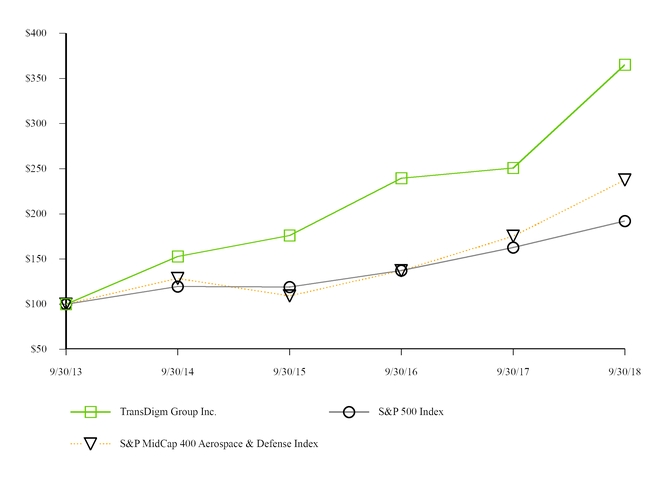
*$100 invested on 9/30/13 in stock or index, including reinvestment of dividends.
Fiscal year ending September 30.
Copyright 2018 Standard & Poor’s, a division of S&P Global. All rights reserved.
| 9/30/13 | 9/30/14 | 9/30/15 | 9/30/16 | 9/30/17 | 9/30/18 | ||||||||||
| TransDigm Group Inc. | 100.00 | 152.71 | 175.97 | 239.52 | 250.86 | 365.32 | |||||||||
| S&P 500 Index | 100.00 | 119.73 | 119.00 | 137.36 | 162.92 | 192.10 | |||||||||
| S&P MidCap 400 Aerospace & Defense Index | 100.00 | 128.40 | 109.15 | 136.91 | 175.37 | 237.67 |
Purchases of Equity Securities by the Issuer or Affiliated Purchaser
On November 8, 2017, our Board of Directors, authorized a new stock repurchase program replacing the $600 million program and permitting repurchases of our outstanding shares not to exceed $650 million in the aggregate, subject to any restrictions specified in the Credit Agreement and/or Indentures governing the existing Notes as described within the Liquidity and Capital Resources section of Item 7. - “Management’s Discussion and Analysis of Financial Conditions and Results of Operations.” No
repurchases were made under the program during the fiscal year ended September 30, 2018. As of September 30, 2018, the entire $650 million of repurchases allowable under the program remained, subject to any restrictions specified in the Credit Agreement and/or Indentures governing the existing Notes.
During the fiscal years ended September 30, 2018 and 2017, the Company received 2,119 shares and 2,548 shares, respectively as forfeitures in lieu of payment for withholding taxes on the vesting of restricted stock. The deemed gross cost of the shares was approximately $0.6 million in both periods at a weighted-average price per share of $274.62 and $247.33, respectively.
Item 6. SELECTED FINANCIAL DATA
The following table sets forth selected historical consolidated financial and other data of TD Group for the fiscal years ended September 30, 2014 to 2018, which have been derived from TD Group’s audited consolidated financial statements.
Separate historical financial information of TransDigm Inc. is not presented since the 5.50% Senior Subordinated Notes issued in October 2012 (the “2020 Notes”), the 6.00% Senior Subordinated Notes issued in June 2014 (the “2022 Notes”), the 6.50% Senior Subordinated Notes issued June 2014 (the “2024 Notes”), the 6.50% Senior Subordinated Notes issued May 2015 (the “2025 Notes”) and the 6.375% Senior Subordinated Notes issued June 2016 (the “6.375% 2026 Notes”) (also together with the 2020 Notes, the 2022 Notes, the 2024 Notes, the 2025 Notes, and the 2026 Notes, the “Notes”) are fully and unconditionally guaranteed on a senior subordinated basis by TD Group, TransDigm UK and all of TransDigm Inc.’s Domestic Restricted Subsidiaries and because TD Group has no significant operations or assets separate from its investment in TransDigm Inc.
Separate financial information of TransDigm UK Holdings plc (“TransDigm UK”) is not presented because TransDigm UK’s 6.875% Senior Subordinated Notes issued in May 2018 (the “6.875% 2026 Notes”) are fully and unconditionally guaranteed on a senior subordinated basis by TD Group, TransDigm Inc., and all of TransDigm Inc.’s Domestic Restricted Subsidiaries.
Acquisitions of businesses and product lines completed by TD Group during the last five fiscal years are as follows:
| Date | Acquisition |
| December 19, 2013 | Airborne Global Inc. (“Airborne”) |
| March 6, 2014 | Elektro-Metall Export GmbH (“EME”) |
| March 26, 2015 | Telair Cargo Group (comprised of Telair International GmbH (“Telair Int’l”), Telair US LLC and Nordisk Aviation Products) |
| March 31, 2015 | Franke Aquarotter GmbH (“Adams Rite Aerospace GmbH”) |
| May 14, 2015 | Pexco LLC (“Pexco Aerospace”) |
| August 19, 2015 | PneuDraulics, Inc. (“PneuDraulics”) |
| January 4, 2016 | Breeze-Eastern Corporation (“Breeze-Eastern”) |
| June 23, 2016 | Data Device Corporation (“DDC”) |
| September 23, 2016 | Young & Franklin Inc. / Tactair Fluid Controls Inc. (“Y&F/Tactair”) |
| February 22, 2017 | Schroth Safety Products Group (“Schroth”) |
| May 5, 2017, May 31, 2017 and June 1, 2017 | North Hills Signal Processing Corp, Cablecraft Motion Controls LLC and Preece Incorporated (together, the “Third Quarter 2017 Acquisitions”) |
| March 15, 2018 | Kirkhill Elastomers (“Kirkhill”) |
| April 24, 2018 | Extant Components Group Holdings, Inc. (together with the product line acquisition on August 17, 2018 listed below, “Extant”) |
| July 13, 2018 | Skandia Inc. (“Skandia”) |
| August 17, 2018 | Certain assets and liabilities of Rockwell Collins (Extant product line acquisition) |
All of the acquisitions were accounted for using the acquisition method. The results of operations of the acquired businesses and product lines are included in TD Group’s consolidated financial statements from the effective date of each acquisition.
In connection with the settlement of a Department of Justice investigation into the competitive effects of the acquisition, during the fourth quarter of 2017, the Company committed to dispose of the Schroth business. Therefore, Schroth was classified as held-for-sale beginning in the fourth quarter of fiscal 2017. The results of operations of Schroth are reflected as discontinued operations in the accompanying consolidated financial statements. On January 26, 2018, the Company completed the sale of Schroth in a management buyout to a private equity fund and certain members of Schroth management for approximately $61.4 million, which includes a working capital adjustment of $0.3 million that was settled in July 2018. Further disclosure related to Schroth’s discontinued operations is included within Note 22, “Discontinued Operations,” to the consolidated financial statements.
The information presented below should be read together with “Management’s Discussion and Analysis of Financial Condition and Results of Operations” and the consolidated financial statements and accompanying notes included elsewhere herein.
| Fiscal Years Ended September 30, | |||||||||||||||||||
| 2018 | 2017 | 2016 | 2015 | 2014 | |||||||||||||||
| (in thousands, except per share amounts ) | |||||||||||||||||||
| Statement of Income Data: | |||||||||||||||||||
| Net sales | $ | 3,811,126 | $ | 3,504,286 | $ | 3,171,411 | $ | 2,707,115 | $ | 2,372,906 | |||||||||
| Gross profit(1) | 2,177,510 | 1,984,627 | 1,728,063 | 1,449,845 | 1,267,874 | ||||||||||||||
| Selling and administrative expenses | 450,095 | 415,575 | 382,858 | 321,624 | 276,446 | ||||||||||||||
| Amortization of intangible assets | 72,454 | 89,226 | 77,445 | 54,219 | 63,608 | ||||||||||||||
| Income from operations(1) | 1,654,961 | 1,479,826 | 1,267,760 | 1,074,002 | 927,820 | ||||||||||||||
| Interest expense—net | 663,008 | 602,589 | 483,850 | 418,785 | 347,688 | ||||||||||||||
| Refinancing costs | 6,396 | 39,807 | 15,794 | 18,393 | 131,622 | ||||||||||||||
| Income from continuing operations before income taxes | 985,557 | 837,430 | 768,116 | 636,824 | 448,510 | ||||||||||||||
| Income tax provision | 24,021 | 208,889 | 181,702 | 189,612 | 141,600 | ||||||||||||||
| Income from continuing operations | 961,536 | 628,541 | 586,414 | 447,212 | 306,910 | ||||||||||||||
| Loss from discontinued operations, net of tax (5) | (4,474 | ) | (31,654 | ) | — | — | — | ||||||||||||
| Net income | $ | 957,062 | $ | 596,887 | $ | 586,414 | $ | 447,212 | $ | 306,910 | |||||||||
| Net income applicable to common stock | $ | 900,914 | $ | 437,630 | $ | 583,414 | $ | 443,847 | $ | 180,284 | |||||||||
| Denominator for basic and diluted earnings per share under the two-class method: | |||||||||||||||||||
| Weighted-average common shares outstanding | 52,345 | 52,517 | 53,326 | 53,112 | 52,748 | ||||||||||||||
| Vested options deemed participating securities | 3,252 | 3,013 | 2,831 | 3,494 | 4,245 | ||||||||||||||
| Total shares for basic and diluted earnings per share | 55,597 | 55,530 | 56,157 | 56,606 | 56,993 | ||||||||||||||
| Net earnings per share: | |||||||||||||||||||
| Net earnings per share from continuing operations—basic and diluted | $ | 16.28 | $ | 8.45 | $ | 10.39 | $ | 7.84 | $ | 3.16 | |||||||||
| Net loss per share from discontinued operations—basic and diluted | (0.08 | ) | (0.57 | ) | — | — | — | ||||||||||||
| Net earnings per share(2) | $ | 16.20 | $ | 7.88 | $ | 10.39 | $ | 7.84 | $ | 3.16 | |||||||||
| Cash dividends paid per common share | $ | — | $ | 46.00 | $ | — | $ | — | $ | 25.00 |
| As of September 30, |
Showing the first 8K of 112K characters. Open the full section
Item 7A. QUANTITATIVE AND QUALITATIVE DISCLOSURES ABOUT MARKET RISK
Interest Rate Risk
Our main exposure to market risk relates to interest rates. Our financial instruments that are subject to interest rate risk principally include fixed-rate and floating-rate long-term debt. At September 30, 2018, we had borrowings under our term loans of approximately $7,600 million that were subject to interest rate risk. Borrowings under our term loans bear interest, at our option, at a rate equal to either an alternate base rate or an adjusted LIBOR for a one-, two-, three- or six-month (or to the extent available to each lender, nine- or twelve-month) interest period chosen by us, in each case, plus an applicable margin percentage. Accordingly, the Company’s cash flows and earnings will be exposed to the market risk of interest rate changes resulting from variable rate borrowings under our term loans. The Company's objective is to maintain an allocation of approximately 75% fixed rate and 25% variable rate debt thereby limiting its exposure to changes in near-term interest rates. The effect of a hypothetical one percentage point increase in interest rates would increase the annual interest costs under our term loans by approximately $76 million based on the amount of outstanding borrowings at September 30, 2018. The weighted average interest rate on the $7,600 million of borrowings under our term loans on September 30, 2018 was 4.5%.
Interest rate swaps and caps used to hedge and offset, respectively, the variable interest rates on the credit facility are described in Note 20, “Derivatives and Hedging Activities,” to our consolidated financial statements included herein. We do not hold or issue derivative instruments for speculative purposes.
For information about the fair value of the aggregate principal amount of borrowings under our term loans and the fair value of the Notes, see Note 19, “Fair Value Measurements,” to our consolidated financial statements included herein.
ITEM 8. FINANCIAL STATEMENTS AND SUPPLEMENTARY DATA
The information required by this Item is contained on pages F-1 through F-44 of this Report.
| ITEM 9. | CHANGES IN AND DISAGREEMENTS WITH ACCOUNTANTS ON ACCOUNTING AND FINANCIAL DISCLOSURE |
None.
Item 9A. CONTROLS AND PROCEDURES
Evaluation of Disclosure Controls and Procedures
As of September 30, 2018, TD Group carried out an evaluation, under the supervision and with the participation of TD Group’s management, including its President, Chief Executive Officer and Director (Principal Executive Officer) and Chief Financial Officer (Principal Financial Officer), of the effectiveness of the design and operation of TD Group’s disclosure controls and procedures. Based upon that evaluation, the President, Chief Executive Officer and Director and Chief Financial Officer concluded that TD Group’s disclosure controls and procedures are effective to ensure that information required to be disclosed by TD Group in the reports it files or submits under the Exchange Act is recorded, processed, summarized and reported, within the time periods specified by the Securities and Exchange Commission’s rules and forms, and that such information is accumulated and communicated to TD Group’s management, including its President, Chief Executive Officer and Director and Chief Financial Officer, as appropriate, to allow timely decisions regarding required disclosure. In designing and evaluating the disclosure controls and procedures, TD Group’s management recognized that any controls and procedures, no matter how well designed and operated, can provide only reasonable assurance of achieving the desired control objectives, and management necessarily was required to apply its judgment in designing and evaluating the controls and procedures.
Management’s Report on Internal Control Over Financial Reporting
The management of TD Group is responsible for establishing and maintaining adequate internal control over financial reporting as defined in Exchange Act Rule 13a-15(f). Using criteria set forth by the Committee of Sponsoring Organizations of the Treadway Commission (2013 framework) (COSO) in Internal Control-Integrated Framework, TransDigm’s management assessed the effectiveness of the Company’s internal control over financial reporting as of September 30, 2018. Based on our assessment, management concluded that the Company’s internal control over financial reporting was effective as of September 30, 2018.
During fiscal 2018, we completed the acquisitions of Kirkhill, Extant and Skandia. The results of operations are included in our consolidated financial statements from the date of acquisition. As permitted by the Securities and Exchange Commission rules and regulations, we have excluded these acquisitions from our assessment of the effectiveness of our internal control over financial reporting as of September 30, 2018. Total assets as of September 30, 2018, net sales and income from continuing operations before income taxes for the fiscal year ended September 30, 2018 for these fiscal 2018 acquisitions constituted approximately 6%, 2% and 2%, respectively, of each of these key measures as reported in our consolidated financial statements.
The effectiveness of the Company’s internal control over financial reporting as of September 30, 2018 has been audited by Ernst & Young LLP, an independent registered public accounting firm, as stated in their report, which is included elsewhere in this Annual Report on Form 10-K and is incorporated herein by reference.
Changes in Internal Control Over Financial Reporting
There have been no changes in the Company’s internal control over financial reporting that occurred during the fourth quarter of fiscal 2018 that materially affected, or are reasonably likely to materially affect, the Company’s internal control over financial reporting.
Report of Independent Registered Public Accounting Firm
The Board of Directors and Shareholders of
TransDigm Group Incorporated
Opinion on Internal Control over Financial Reporting
We have audited TransDigm Group Incorporated’s ("the Company") internal control over financial reporting as of September 30, 2018, based on criteria established in Internal Control- Integrated Framework issued by the Committee of Sponsoring Organizations of the Treadway Commission (2013 framework) (the COSO criteria). In our opinion, the Company maintained, in all material respects, effective internal control over financial reporting as of September 30, 2018, based on the COSO criteria.
As indicated in the accompanying Management’s Report on Internal Control Over Financial Reporting, management’s assessment of and conclusion on the effectiveness of internal control over financial reporting did not include the internal controls of Kirkhill, Extant and Skandia, which are included in the 2018 consolidated financial statements of TransDigm Group Incorporated and constituted 6% of total assets as of September 30, 2018, 2% of revenues and 2% of pre-tax income for the year then ended. Our audit of internal control over financial reporting of TransDigm Group Incorporated also did not include an evaluation of the internal control over financial reporting of Kirkhill, Extant and Skandia.
We also have audited, in accordance with the standards of the Public Company Accounting Oversight Board (United States) (PCAOB), the consolidated balance sheets of the Company as of September 30, 2018 and 2017, the related consolidated statements of income, comprehensive income, cash flows and changes in stockholders’ deficit for each of the three years in the period ended September 30, 2018 and the related notes and financial statement schedule listed in the Index at Item 15(a) of the Company and our report dated November 9, 2018 expressed an unqualified opinion thereon.
Basis for Opinion
The Company’s management is responsible for maintaining effective internal control over financial reporting and for its assessment of the effectiveness of internal control over financial reporting included in the accompanying management's report on internal control over financial reporting in Item 9A of the Form 10-K. Our responsibility is to express an opinion on the Company’s internal control over financial reporting based on our audit. We are a public accounting firm registered with the PCAOB and are required to be independent with respect to the Company in accordance with the U.S. federal securities laws and the applicable rules and regulations of the Securities and Exchange Commission and the PCAOB.
We conducted our audit in accordance with the standards of the PCAOB. Those standards require that we plan and perform the audit to obtain reasonable assurance about whether effective internal control over financial reporting was maintained in all material respects.
Our audit included obtaining an understanding of internal control over financial reporting, assessing the risk that a material weakness exists, testing and evaluating the design and operating effectiveness of internal control based on the assessed risk, and performing such other procedures as we considered necessary in the circumstances. We believe that our audit provides a reasonable basis for our opinion.
Definition and Limitations of Internal Control Over Financial Reporting
A company’s internal control over financial reporting is a process designed to provide reasonable assurance regarding the reliability of financial reporting and the preparation of financial statements for external purposes in accordance with generally accepted accounting principles. A company’s internal control over financial reporting includes those policies and procedures that (1) pertain to the maintenance of records that, in reasonable detail, accurately and fairly reflect the transactions and dispositions of the assets of the company; (2) provide reasonable assurance that transactions are recorded as necessary to permit preparation of financial statements in accordance with generally accepted accounting principles, and that receipts and expenditures of the company are being made only in accordance with authorizations of management and directors of the company; and (3) provide reasonable assurance regarding prevention or timely detection of unauthorized acquisition, use, or disposition of the company’s assets that could have a material effect on the financial statements.
Because of its inherent limitations, internal control over financial reporting may not prevent or detect misstatements. Also, projections of any evaluation of effectiveness to future periods are subject to the risk that controls may become inadequate because of changes in conditions, or that the degree of compliance with the policies or procedures may deteriorate.
/s/ Ernst & Young LLP
Cleveland, Ohio
November 9, 2018
Item 9B. OTHER INFORMATION
Appointment of Officer
The Company has, effective November 10, 2018, appointed Sarah Wynne, age 44, as Chief Accounting Officer of the Company. Ms. Wynne was most recently a Group Controller of the Company (since 2015). Prior to that, Ms. Wynne was Controller at Aero Fluid Products, a TransDigm operating company (2009 -2015) and held accounting positions with increasing responsibility.
Employment Agreement with Named Executive Officer
On November 6, 2018, the Company entered into a Third Amended and Restated Employment Agreement with Robert Henderson whereby Mr. Henderson will continue to serve as Vice Chairman of the Company. Mr. Henderson’s prior employment agreement was scheduled to terminate on December 31, 2018. It is intended that Mr. Henderson will be responsible for planning for the integration of the Esterline acquisition and, upon closing, integrating the Esterline business. The Employment Agreement replaced Mr. Henderson’s Second Amended and Restated Employment Agreement dated January 25, 2018. The term of the Employment Agreement will expire on December 31, 2021, unless earlier terminated by the Company or Mr. Henderson; provided, however, that if the Esterline acquisition has not been completed by December 31, 2019, the Employment Agreement will terminate. The Employment Agreement contemplates that Mr. Henderson will spend full time working for the Company. This is a change from the prior agreement, which contemplated that Mr. Henderson would work approximately three-quarters time.
Mr. Henderson will receive equity compensation in lieu of cash compensation for salary and bonus on similar terms to those contained in the employment agreement of Mr. Howley, the Company’s Executive Chairman. Under the terms of the Employment Agreement, Mr. Henderson will receive $10,000 in cash to cover his employee co-premiums for health benefits and related taxes and, for 2019 salary, a grant of options calculated on a Black Scholes basis with a 37.5% risk premium equal to $750,000. In addition, Mr. Henderson is entitled to participate in the Company’s annual cash incentive plan with a target bonus of 80%, which will be paid in options calculated in the same manner as his salary. Mr. Henderson may give notice one time during the term of the Employment Agreement if he wishes to discontinue his receipt of equity compensation effective with his bonus or as of the following year. Other than the manner in calculating the option grant, which was a fixed number in Mr. Henderson’s prior employment agreement, these provisions did not change materially from the prior employment agreement.
The options granted in lieu of salary and bonus will vest 40% immediately and, to the extent the performance criteria is met, 40% at completion of the first fiscal year after the grant and 20% after the second fiscal year after the date of grant. These options will include provisions with regard to post-employment vesting upon termination of employment by reason of death, disability, good reason, without cause or retirement (each as defined in the Employment Agreement). More specifically, if Mr. Henderson’s employment terminates for the aforementioned reasons after the first fiscal year following the date of grant but on or after the second fiscal year end following the date of grant, 40% of the remaining unvested options may continue to vest in accordance with their terms; if Mr. Henderson’s employment terminates for the aforementioned reasons after the second fiscal year end following the date of grant but on or prior to the third fiscal year end following the date of grant, 80% of the remaining unvested options may continue to vest in accordance with their terms; and if Mr. Henderson’s employment terminates for any of the aforementioned reasons after the third fiscal year end following the date of grant, 100% of the remaining unvested options may continue to vest in accordance with their terms. Mr. Henderson is entitled to participate in the Company’s stock option plan and the other employee benefit plans, programs and arrangements that the Company may maintain from time to time for its senior officers. These provisions did not change from the prior employment agreement.
The Employment Agreement provides that if Mr. Henderson is terminated for any reason, he will be entitled to payment of any accrued but unpaid base salary through the termination date, any unreimbursed expenses, an amount for accrued but unused sick and vacation days, and benefits owing to him under the benefit plans and programs sponsored by the Company. In addition, if Mr. Henderson’s employment is terminated without cause, if he terminates his employment for customary good reasons, or if his employment terminates due to his death or disability, the Company will pay him, in substantially equal installments over a 12-month period, an amount equal to one times his salary plus one times the greater of the all of the bonuses paid or payable to him for the prior fiscal year (excluding any extraordinary bonus) or the target bonuses for the year in which his employment terminates, determined in accordance with the Company’s bonus program(s) if any, plus 18 times the difference of the monthly COBRA continuation coverage rate and the monthly cost of coverage to Mr. Henderson as of the date of termination. These provisions did not change from the prior employment agreement.
The Employment Agreement also includes non-competition, non-solicitation provisions, confidentiality and indemnity consistent with Mr. Henderson’s prior agreement. These provisions did not change from the prior employment agreement.
The foregoing description of the terms of the Employment Agreement is qualified in its entirety by the full text of the Third Amended and Restated Employment Agreement, a copy of which is filed herewith.
PART III
Item 10. DIRECTORS, EXECUTIVE OFFICERS, AND CORPORATE GOVERNANCE
Directors and Executive Officers
Information regarding TD Group’s directors will be set forth under the caption “Proposal One: Election of Directors” in our Proxy Statement, which is incorporated herein by reference. The following table sets forth certain information concerning TD Group’s executive officers:
| Name | Age | Position | |
| W. Nicholas Howley | 66 | Executive Chairman of the Board of Directors | |
| Kevin Stein | 52 | President, Chief Executive Officer and Director | |
| Robert S. Henderson | 62 | Vice Chairman | |
| Jorge L. Valladares III | 44 | Chief Operating Officer—Power and Control | |
| Michael Lisman | 35 | Chief Financial Officer | |
| James Skulina | 59 | Senior Vice President of Finance | |
| Bernt G. Iversen II | 61 | Executive Vice President—Mergers & Acquisitions and Business Development | |
| Halle Terrion | 50 | General Counsel, Chief Compliance Officer & Secretary |
Mr. Howley was appointed Executive Chairman of the Board of Directors of TD Group in April 2018. Mr. Howley previously served as Chairman of the Board of Directors of TD Group from July 2003 to April 2018. He served as Chief Executive Officer of TD Group from December 2005 to April 2018 and of TransDigm Inc. from December 2001 to March 2018. Mr. Howley served as President of TD Group from July 2003 through December 2015, as Chief Operating Officer of TransDigm Inc. from December 1998 through December 2001 and as President of TransDigm Inc. from December 1998 through September 2005.
Mr. Stein was appointed President, Chief Executive Officer and Director in April 2018. Prior to that, Mr. Stein served as President and Chief Operating Officer from January 2017 through March 2018 and Chief Operating Officer—Power from October 2014 to December 2016. Prior to joining TransDigm, Mr. Stein served as Executive Vice President and President of the Structurals division of Precision Castparts Corp. from November 2011 to October 2014 and Executive Vice President and President of the Fasteners division of Precision Castparts Corp. from January 2009 through November 2011.
Mr. Henderson was appointed Vice Chairman in January 2017. Prior to that, Mr. Henderson served as Chief Operating Officer—Airframe from October 2014 to December 2016. Mr. Henderson also previously served as Executive Vice President from December 2005 to October 2014, and as President of the AdelWiggins Group, a division of TransDigm Inc., from August 1999 to April 2008.
Mr. Valladares was appointed Chief Operating Officer—Power in June 2018. Prior to that, Mr. Valladares served as Executive Vice President from October 2013 to May 2018, as President of AvtechTyee, Inc. (formerly Avtech Corporation), a wholly-owned subsidiary of TransDigm Inc., from August 2009 to September 2013, and as President of AdelWiggins Group, a division of TransDigm Inc., from April 2008 to July 2009.
Mr. Lisman was appointed Chief Financial Officer in July 2018. Prior to that, Mr. Lisman served as Vice President—Mergers and Acquisitions from January 2018 through June 2018, Business Unit Manager for the Air & Fuel Valves business unit at Aero Fluid Products, a wholly-owned subsidiary of TransDigm Inc., from January 2017 to January 2018 and Director of Mergers and Acquisitions of the Company from November 2015 to January 2017. Prior to joining TransDigm, Mr. Lisman was a Vice President at Warburg Pincus from 2011 to 2015.
Mr. Skulina was appointed Senior Vice President of Finance in July 2018. Prior to that, Mr. Skulina served as Interim Chief Financial Officer from January 2018 to June 2018, Executive Vice President from January 2012 to December 2017, as President of the Aero Fluid Products division of AeroControlex Group, Inc., a wholly-owned subsidiary of TransDigm Inc., from September 2009 to December 2011, and as Controller of TransDigm Inc., from August 2007 to August 2009.
Mr. Iversen was appointed Executive Vice President—Mergers & Acquisitions and Business Development in May 2012. Prior to that, Mr. Iversen served as Executive Vice President of TD Group from December 6, 2010 through May 2012 and as President of Champion Aerospace LLC, a wholly-owned subsidiary of TransDigm Inc., from June 2006 to December 2010.
Ms. Terrion was appointed General Counsel and Chief Compliance Office in March 2012 and Secretary in May 2015. Prior to that, Ms. Terrion was a partner at BakerHostetler LLP.
Section 16(a) Beneficial Ownership Reporting Compliance
The information regarding compliance with Section 16 of the Securities Exchange Act of 1934 will be set forth under the caption entitled “Section 16(a) Beneficial Ownership Reporting Compliance” in our Proxy Statement, which is incorporated herein by reference.
Code of Ethics
We have adopted a Code of Business Conduct and Ethics, which applies to all of our directors, officers, and employees and a Code of Ethics for Senior Financial Officers which includes additional ethical obligations for our senior financial management (which includes our chief executive officer and president, chief financial officer, senior vice president of finance, division presidents, controllers, treasurer, and chief internal auditor). Please refer to the information set forth under the caption “Corporate Governance—Codes of Ethics & Whistleblower Policy” in our Proxy Statement, which is incorporated herein by reference. Our Code of Business Conduct and Ethics and our Code of Ethics for Senior Financial Officers is available on our website at www.transdigm.com. Any person may receive a copy without charge by writing to us at TransDigm Group Incorporated, 1301 East 9th Street, Suite 3000, Cleveland, Ohio 44114. We intend to disclose on our website any amendment to, or waiver from, a provision of our Code of Business Conduct and Ethics that applies to directors and executive officers and that is required to be disclosed pursuant to the rules of the Securities and Exchange Commission.
Nominations of Directors
The procedure by which stockholders may recommend nominees to our Board of Directors will be set forth under the caption “Corporate Governance-Board Committees—Nominating and Corporate Governance Committee” in our Proxy Statement, which is incorporated herein by reference.
Audit Committee
The information regarding the audit committee of our Board of Directors and audit committee financial experts will be set forth under the caption “Corporate Governance-Board Committees—Audit Committee” in our Proxy Statement, which is incorporated herein by reference.
Item 11. EXECUTIVE COMPENSATION
The information required by this item will be set forth under the captions “Executive Compensation”, “Compensation of Directors”, “Compensation Committee Interlocks and Insider Participation” and “Compensation Committee Report” in our Proxy Statement, which is incorporated herein by reference.
Item 12. SECURITY OWNERSHIP OF BENEFICIAL OWNERS AND MANAGEMENT AND RELATED STOCKHOLDER MATTERS
The information regarding security ownership of certain beneficial owners and management will be set forth under the caption “Security Ownership of Certain Beneficial Owners and Management” in our Proxy Statement, which is incorporated herein by reference.
Equity Compensation Plan Information
| Plan category | Number of Securities to Be Issued upon Exercise of Outstanding Options, Warrants and Rights (a) | Weighted-Average Exercise Price of Outstanding Options, Warrants and Rights (b) | Number of Securities Remaining Available for Future Issuance Under Equity Compensation Plans (excluding securities reflected in column (a)) (c) | |||||||
| Equity compensation plans approved by security holders(1) | 6,069,234 | (2) | $ | 194.75 | 2,876,222 | (3) |
| (1) | Includes information related to the 2003 stock option plan, the 2006 stock incentive plan and the 2014 stock option plan. |
| (2) | This amount represents 77,829, 3,878,127 and 2,113,278 shares subject to outstanding stock options under our 2003 stock option plan, 2006 stock incentive plan and 2014 stock option plan, respectively. No further grants may be made under our 2003 stock option plan and 2006 stock incentive plan, although outstanding stock options continue in force in accordance with their terms. |
| (3) | This amount represents remaining shares available for award under our 2014 stock option plan. |
| ITEM 13. | CERTAIN RELATIONSHIPS AND RELATED TRANSACTIONS, AND DIRECTOR INDEPENDENCE |
The information required by this item will be set forth under the captions entitled “Certain Relationships and Related Transactions,” “Compensation of Directors,” and “Independence of Directors” in our Proxy Statement, which is incorporated herein by reference.
Item 14. PRINCIPAL ACCOUNTING FEES AND SERVICES
The information required by this item will be set forth under the caption “Principal Accounting Fees and Services” in our Proxy Statement, which is incorporated herein by reference.
PART IV
Item 15. EXHIBITS AND FINANCIAL STATEMENT SCHEDULES
(a) Documents Filed with Report
(a) (1) Financial Statements
| Page | |
| Report of Independent Registered Public Accounting Firm | F-1 |
| Consolidated Balance Sheets as of September 30, 2018 and 2017 | F-2 |
| Consolidated Statements of Income for Fiscal Years Ended September 30, 2018, 2017 and 2016 | F-3 |
| Consolidated Statements of Comprehensive Income for Fiscal Years Ended September 30, 2018, 2017 and 2016 | F-4 |
| Consolidated Statements of Changes in Stockholders’ Deficit for Fiscal Years Ended September 30, 2018, 2017 and 2016 | F-5 |
| Consolidated Statements of Cash Flows for Fiscal Years Ended September 30, 2018, 2017 and 2016 | F-6 |
| Notes to Consolidated Financial Statements for Fiscal Years Ended September 30, 2018, 2017 and 2016 | pages F-7 to F-43 |
| (a) (2) Financial Statement Schedules | |
| Valuation and Qualifying Accounts for the Fiscal Years Ended September 30, 2018, 2017 and 2016 | F-44 |
(a) (3) Exhibits
| Exhibit No. | Description | Filed Herewith or Incorporated by Reference From | ||
| 2.2 | Agreement and Plan of Merger dated as of May 23, 2016 among TransDigm Inc., Thunder Merger Sub Inc., ILC Holdings, Inc. and Behrman Capital PEP L.P. | Incorporated by reference to TransDigm Group Incorporated’s Form 8-K filed May 26, 2016 (File No. 001-32833) | ||
| 2.3 | Agreement and Plan of Merger dated as of October 9, 2018, by and among Esterline Technologies Corporation, TransDigm Group Incorporated and Thunderbird Merger Sub Inc. | Incorporated by reference to TransDigm Group Incorporated’s Form 8-K filed October 11, 2018 (File No. 001-32833) | ||
| 2.4 | First Amendment to Agreement and Plan of Merger dated as of October 10, 2018, by and among Esterline Technologies Corporation, TransDigm Group Incorporated and Thunderbird Merger Sub Inc. | Incorporated by reference to TransDigm Group Incorporated’s Form 8-K filed October 11, 2018 (File No. 001-32833) | ||
| 3.1 | Second Amended and Restated Certificate of Incorporation, filed April 28, 2014, of TransDigm Group Incorporated | Incorporated by reference to TransDigm Group Incorporated’s Form 8-K filed April 28, 2014 (File No. 001-32833) | ||
| 3.2 | Third Amended and Restated Bylaws of TransDigm Group Incorporated | Incorporated by reference to TransDigm Group Incorporated’s Form 8-K filed January 30, 2018 (File No. 001-32833) | ||
| 3.3 | Certificate of Incorporation, filed July 2, 1993, of NovaDigm Acquisition, Inc. (now known as TransDigm Inc.) | Incorporated by reference to TransDigm Inc. and TransDigm Holding Company’s Form S-4 filed January 29, 1999 (File No. 333-71397) | ||
| 3.4 | Certificate of Amendment, filed July 22, 1993, of the Certificate of Incorporation of NovaDigm Acquisition, Inc. (now known as TransDigm Inc.) | Incorporated by reference to TransDigm Inc. and TransDigm Holding Company’s Form S-4 filed January 29, 1999 (File No. 333-71397) | ||
| 3.5 | Bylaws of NovaDigm Acquisition, Inc. (now known as TransDigm Inc.) | Incorporated by reference to TransDigm Inc. and TransDigm Holding Company’s Form S-4 filed January 29, 1999 (File No. 333-71397) | ||
| 3.6 | Certificate of Incorporation, filed July 10, 2009, of Acme Aerospace Inc. | Incorporated by reference to TransDigm Group Incorporated’s Form 10-Q filed August 5, 2009 (File No. 001-32833) | ||
| 3.7 | Bylaws of Acme Aerospace Inc. | Incorporated by reference to TransDigm Group Incorporated’s Form 10-Q filed August 5, 2009 (File No. 001-32833) | ||
| 3.8 | Articles of Incorporation, filed July 30, 1986, of ARP Acquisition Corporation (now known as Adams Rite Aerospace, Inc.) | Incorporated by reference to TransDigm Inc.’s and TransDigm Holding Company’s Form S-4 filed April 23, 1999 (File No. 333-71397) | ||
| 3.9 | Certificate of Amendment, filed September 12, 1986, of the Articles of Incorporation of ARP Acquisition Corporation (now known as Adams Rite Aerospace, Inc.) | Incorporated by reference to TransDigm Inc.’s and TransDigm Holding Company’s Form S-4 filed April 23, 1999 (File No. 333-71397) | ||
| 3.10 | Certificate of Amendment, filed January 27, 1992, of the Articles of Incorporation of Adams Rite Products, Inc. (now known as Adams Rite Aerospace, Inc.) | Incorporated by reference to TransDigm Inc.’s and TransDigm Holding Company’s Form S-4 filed April 23, 1999 (File No. 333-71397) | ||
| 3.11 | Certificate of Amendment, filed December 31, 1992, of the Articles of Incorporation of Adams Rite Products, Inc. (now known as Adams Rite Aerospace, Inc.) | Incorporated by reference to TransDigm Inc.’s and TransDigm Holding Company’s Form S-4 filed April 23, 1999 (File No. 333-71397) | ||
| 3.12 | Certificate of Amendment, filed August 11, 1997, of the Articles of Incorporation of Adams Rite Sabre International, Inc. (now known as Adams Rite Aerospace, Inc.) | Incorporated by reference to TransDigm Inc.’s and TransDigm Holding Company’s Form S-4 filed April 23, 1999 (File No. 333-71397) | ||
| [3.13](http://www.sec.gov/Archives/edgar/ |
Showing the first 8K of 146K characters. Open the full section
Item 8. AND ITEM 15(a) (1)
FINANCIAL STATEMENTS AND SUPPLEMENTARY DATA
INDEX
| Page | |
| Financial Statements: | |
| Report of Independent Registered Public Accounting Firm | F-1 |
| Consolidated Balance Sheets as of September 30, 2018 and 2017 | F-2 |
| Consolidated Statements of Income for Fiscal Years Ended September 30, 2018, 2017 and 2016 | F-3 |
| Consolidated Statements of Comprehensive Income for Fiscal Years Ended September 30, 2018, 2017 and 2016 | F-4 |
| Consolidated Statements of Changes in Stockholders’ Deficit for Fiscal Years Ended September 30, 2018, 2017 and 2016 | F-5 |
| Consolidated Statements of Cash Flows for Fiscal Years Ended September 30, 2018, 2017 and 2016 | F-6 |
| Notes to Consolidated Financial Statements for Fiscal Years Ended September 30, 2018, 2017 and 2016 | F-7 – F-43 |
| Supplementary Data: | |
| Valuation and Qualifying Accounts for the Fiscal Years Ended September 30, 2018, 2017 and 2016 | F-44 |
Report of Independent Registered Public Accounting Firm
The Board of Directors and Shareholders of
TransDigm Group
Opinion on the Financial Statements
We have audited the accompanying consolidated balance sheets of TransDigm Group Incorporated (“the Company”) as of September 30, 2018 and 2017, the related consolidated statements of income, comprehensive income, changes in stockholders’ deficit, and cash flows for each of the three years in the period ended September 30, 2018, and the related notes and financial statement schedule listed in the Index at Item 15(a) (collectively referred to as the “consolidated financial statements”). In our opinion, the consolidated financial statements present fairly, in all material respects, the consolidated financial position of the Company at September 30, 2018 and 2017, and the consolidated results of its operations and its cash flows for each of the three years in the period ended September 30, 2018, in conformity with U.S. generally accepted accounting principles.
We also have audited, in accordance with the standards of the Public Company Accounting Oversight Board (United States) (PCAOB), the Company's internal control over financial reporting as of September 30, 2018, based on criteria established in Internal Control-Integrated Framework issued by the Committee of Sponsoring Organizations of the Treadway Commission (2013 framework) and our report dated November 9, 2018 expressed an unqualified opinion thereon.
Basis for Opinion
These financial statements are the responsibility of the Company's management. Our responsibility is to express an opinion on the Company’s financial statements based on our audits. We are a public accounting firm registered with the PCAOB and are required to be independent with respect to the Company in accordance with the U.S. federal securities laws and the applicable rules and regulations of the Securities and Exchange Commission and the PCAOB.
We conducted our audits in accordance with the standards of the PCAOB. Those standards require that we plan and perform the audit to obtain reasonable assurance about whether the financial statements are free of material misstatement, whether due to error or fraud. Our audits included performing procedures to assess the risks of material misstatement of the financial statements, whether due to error or fraud, and performing procedures that respond to those risks. Such procedures included examining, on a test basis, evidence regarding the amounts and disclosures in the financial statements. Our audits also included evaluating the accounting principles used and significant estimates made by management, as well as evaluating the overall presentation of the financial statements. We believe that our audits provide a reasonable basis for our opinion.
/s/ Ernst & Young LLP
We have served as the Company’s auditor since 2004.
Cleveland, Ohio
November 9, 2018
F-1
TRANSDIGM GROUP INCORPORATED
CONSOLIDATED BALANCE SHEETS
AS OF SEPTEMBER 30, 2018 AND 2017
(Amounts in thousands, except share amounts)
| 2018 | 2017 | ||||||
| ASSETS | |||||||
| CURRENT ASSETS: | |||||||
| Cash and cash equivalents | $ | 2,073,017 | $ | 650,561 | |||
| Trade accounts receivable—Net | 704,310 | 636,127 | |||||
| Inventories—Net | 805,292 | 730,681 | |||||
| Assets held-for-sale | — | 77,500 | |||||
| Prepaid expenses and other | 74,668 | 38,683 | |||||
| Total current assets | 3,657,287 | 2,133,552 | |||||
| PROPERTY, PLANT AND EQUIPMENT—Net | 388,333 | 324,924 | |||||
| GOODWILL | 6,223,290 | 5,745,338 | |||||
| OTHER INTANGIBLE ASSETS—Net | 1,788,404 | 1,717,862 | |||||
| DERIVATIVE ASSETS | 97,286 | 15,809 | |||||
| OTHER | 42,867 | 38,176 | |||||
| TOTAL ASSETS | $ | 12,197,467 | $ | 9,975,661 | |||
| LIABILITIES AND STOCKHOLDERS’ DEFICIT | |||||||
| CURRENT LIABILITIES: | |||||||
| Current portion of long-term debt | $ | 75,817 | $ | 69,454 | |||
| Short-term borrowings—trade receivable securitization facility | 299,519 | 299,587 | |||||
| Accounts payable | 173,603 | 148,761 | |||||
| Accrued liabilities | 351,443 | 335,888 | |||||
| Liabilities held-for-sale | — | 17,304 | |||||
| Total current liabilities | 900,382 | 870,994 | |||||
| LONG-TERM DEBT | 12,501,946 | 11,393,620 | |||||
| DEFERRED INCOME TAXES | 399,496 | 500,949 | |||||
| OTHER NON-CURRENT LIABILITIES | 204,114 | 161,302 | |||||
| Total liabilities | 14,005,938 | 12,926,865 | |||||
| STOCKHOLDERS’ DEFICIT: | |||||||
| Common stock—$.01 par value; authorized 224,400,000 shares; issued 56,895,686 and 56,093,659 shares at September 30, 2018 and 2017, respectively | 569 | 561 | |||||
| Additional paid-in capital | 1,208,742 | 1,095,319 | |||||
| Accumulated deficit | (2,246,578 | ) | (3,187,220 | ) | |||
| Accumulated other comprehensive income (loss) | 4,100 | (85,143 | ) | ||||
| Treasury stock, at cost; 4,161,326 and 4,159,207 shares at September 30, 2018 and 2017, respectively | (775,304 | ) | (774,721 | ) | |||
| Total stockholders’ deficit | (1,808,471 | ) | (2,951,204 | ) | |||
| TOTAL LIABILITIES AND STOCKHOLDERS’ DEFICIT | $ | 12,197,467 | $ | 9,975,661 |
See Notes to Consolidated Financial Statements
F-2
TRANSDIGM GROUP INCORPORATED
CONSOLIDATED STATEMENTS OF INCOME
(Amounts in thousands, except per share amounts)
| Fiscal Years Ended September 30, | |||||||||||
| 2018 | 2017 | 2016 | |||||||||
| NET SALES | $ | 3,811,126 | $ | 3,504,286 | $ | 3,171,411 | |||||
| COST OF SALES | 1,633,616 | 1,519,659 | 1,443,348 | ||||||||
| GROSS PROFIT | 2,177,510 | 1,984,627 | 1,728,063 | ||||||||
| SELLING AND ADMINISTRATIVE EXPENSES | 450,095 | 415,575 | 382,858 | ||||||||
| AMORTIZATION OF INTANGIBLE ASSETS | 72,454 | 89,226 | 77,445 | ||||||||
| INCOME FROM OPERATIONS | 1,654,961 | 1,479,826 | 1,267,760 | ||||||||
| INTEREST EXPENSE—Net | 663,008 | 602,589 | 483,850 | ||||||||
| REFINANCING COSTS | 6,396 | 39,807 | 15,794 | ||||||||
| INCOME FROM CONTINUING OPERATIONS BEFORE INCOME TAXES | 985,557 | 837,430 | 768,116 | ||||||||
| INCOME TAX PROVISION | 24,021 |
Showing the first 8K of 191K characters. Open the full section