 filings.tools
TransDigm Group 10-K 2023-09-30
Filed 2023-11-09. 19 sections, 693K characters. Original on sec.gov · Markdown · JSON
Cover and table of contents
UNITED STATES
SECURITIES AND EXCHANGE COMMISSION
Washington, D.C. 20549
FORM 10-K
| ☒ | ANNUAL REPORT PURSUANT TO SECTION 13 OR 15(d) OF THE SECURITIES EXCHANGE ACT OF 1934 |
For the fiscal year ended September 30, 2023
| ☐ | TRANSITION REPORT PURSUANT TO SECTION 13 OR 15(d) OF THE SECURITIES EXCHANGE ACT OF 1934 |
For the transition period from to
Commission File Number 001-32833
TransDigm Group Incorporated
(Exact name of registrant as specified in its charter)
Delaware
(State or other jurisdiction of incorporation or organization)
41-2101738
(I.R.S. Employer Identification No.)
| 1301 East 9th Street, | Suite 3000, | Cleveland, | Ohio | 44114 | |||||||||||||
| (Address of principal executive offices) | (Zip Code) |
(216) 706-2960
(Registrants’ telephone number, including area code)
Securities registered pursuant to Section 12(b) of the Act:
| Title of each class | Trading symbol | Name of exchange on which registered | ||||||||||||
| Common Stock, $0.01 par value | TDG | New York Stock Exchange |
Securities registered pursuant to Section 12(g) of the Act:
None
Indicate by check mark if the registrant is a well-known seasoned issuer, as defined in Rule 405 of the Securities Act. Yes x No ¨
Indicate by check mark if the registrant is not required to file reports pursuant to Section 13 or Section 15(d) of the Act. Yes ¨ No x
Indicate by check mark whether the registrant: (1) has filed all reports required to be filed by Section 13 or 15(d) of the Securities Exchange Act of 1934 during the preceding 12 months (or for such shorter period that the registrant was required to file such reports) and (2) has been subject to such filing requirements for the past 90 days. Yes x No ¨
Indicate by check mark whether the registrant has submitted electronically every Interactive Data File required to be submitted pursuant to Rule 405 of Regulation S-T during the preceding 12 months (or for such shorter period that the registrant was required to submit such files). Yes x No ¨
Indicate by check mark whether the registrant is a large accelerated filer, an accelerated filer, a non-accelerated filer, or smaller reporting company or an emerging growth company. See the definitions of “large accelerated filer,” “accelerated filer,” “smaller reporting company” and “emerging growth company” in Rule 12b-2 of the Exchange Act.
| Large Accelerated Filer | ☒ | Accelerated Filer | ☐ | |||||||||||
| Non-Accelerated Filer | ☐ | Smaller Reporting Company | ☐ | |||||||||||
| Emerging Growth Company | ☐ | |||||||||||||
| If an emerging growth company, indicate by check mark if the registrant has elected not to use the extended transition period for complying with any new or revised financial accounting standards provided pursuant to Section 13(a) of the Exchange Act. | ☐ | |||||||||||||
| Indicate by check mark whether the registrant has filed a report on and attestation to its management’s assessment of the effectiveness of its internal control over financial reporting under Section 404(b) of the Sarbanes-Oxley Act (15 U.S.C. 7262(b)) by the registered public accounting firm that prepared or issued its audit report. | ☒ | |||||||||||||
| If securities are registered pursuant to Section 12(b) of the Act, indicate by check mark whether the financial statements of the registrant included in the filing reflect the correction of an error to previously issued financial statements. | ☐ | |||||||||||||
| Indicate by check mark whether any of those error corrections are restatements that required a recovery analysis of incentive-based compensation received by any of the registrant's executive officers during the relevant recovery period pursuant to §240.10D-1(b). | ☐ |
Indicate by check mark whether the registrant is a shell company (as defined in Rule 12b-2 of the Exchange Act). Yes ☐ No x
The aggregate market value of the voting and non-voting common stock held by non-affiliates of the registrant as of March 31, 2023, based upon the last sale price of such voting and non-voting common stock on that date, was $39,444,381,187.
The number of shares outstanding of TransDigm Group Incorporated’s common stock, par value $.01 per share, was 55,314,104 as of October 31, 2023.
Documents incorporated by reference: Certain sections of the registrant’s definitive Proxy Statement to be filed in connection with its 2024 Annual Meeting of Shareholders expected to be held on March 7, 2024 are incorporated by reference into Part III of this Annual Report on Form 10-K.
TABLE OF CONTENTS
Special Note Regarding Forward-Looking Statements
This Annual Report on Form 10-K contains both historical and “forward-looking statements” within the meaning of Section 21E of the Securities Exchange Act of 1934, as amended (the “Exchange Act”), and 27A of the Securities Act of 1933, as amended. All statements other than statements of historical fact included that address activities, events or developments that we expect, believe or anticipate will or may occur in the future are forward-looking statements, including, in particular, the statements about our plans, objectives, strategies and prospects regarding, among other things, our financial condition, results of operations and business. We have identified some of these forward-looking statements with words like “believe,” “may,” “will,” “should,” “expect,” “intend,” “plan,” “predict,” “anticipate,” “estimate” or “continue” and other words and terms of similar meaning. These forward-looking statements may be contained throughout this Annual Report on Form 10-K. These forward-looking statements are based on current expectations about future events affecting us and are subject to uncertainties and factors relating to, among other things, our operations and business environment, all of which are difficult to predict and many of which are beyond our control. Many factors mentioned in our discussion in this Annual Report on Form 10-K, including the risks outlined under “Risk Factors,” will be important in determining future results. Although we believe that the expectations reflected in these forward-looking statements are reasonable, we do not know whether our expectations will prove correct. They can be affected by inaccurate assumptions we might make or by known or unknown risks and uncertainties, including those described under “Risk Factors” in this Annual Report on Form 10-K. Since our actual results, performance or achievements could differ materially from those expressed in, or implied by, these forward-looking statements, we cannot give any assurance that any of the events anticipated by these forward-looking statements will occur or, if any of them does occur, what impact they will have on our business, results of operations and financial condition. You are cautioned not to place undue reliance on these forward-looking statements, which speak only as of the date they are made. We do not undertake any obligation to update these forward-looking statements or the risk factors contained in this Annual Report on Form 10-K to reflect new information, future events or otherwise, except as may be required under federal securities laws.
Important factors that could cause actual results to differ materially from the forward-looking statements made in this Annual Report on Form 10-K include but are not limited to: the sensitivity of our business to the number of flight hours that our customers’ planes spend aloft and our customers’ profitability, both of which are affected by general economic conditions; supply chain constraints; increases in raw material costs, taxes and labor costs that cannot be recovered in product pricing; failure to complete or successfully integrate acquisitions; our indebtedness; current and future geopolitical or other worldwide events, including, without limitation, wars or conflicts and public health crises; cybersecurity threats; risks related to the transition or physical impacts of climate change and other natural disasters or meeting sustainability-related voluntary goals or regulatory requirements; our reliance on certain customers; the United States (“U.S.”) defense budget and risks associated with being a government supplier including government audits and investigations; failure to maintain government or industry approvals; risks related to changes in laws and regulations, including increases in compliance costs; potential environmental liabilities; liabilities arising in connection with litigation; risks and costs associated with our international sales and operations; and other factors.
In this report, the term “TD Group” refers to TransDigm Group Incorporated, which holds all of the outstanding capital stock of TransDigm Inc. The terms “Company,” “TransDigm,” “we,” “us,” “our” and similar terms, unless the context otherwise requires, refer to TD Group, together with TransDigm Inc. and its wholly-owned and majority-owned subsidiaries for which it has a controlling interest. References to “fiscal year” mean the year ending or ended September 30. For example, “fiscal year 2023” or “fiscal 2023” means the period from October 1, 2022 to September 30, 2023.
PART I
Item 1. BUSINESS
The Company
TD Group, through its wholly-owned subsidiary, TransDigm Inc., is a leading global designer, producer and supplier of highly engineered aircraft components for use on nearly all commercial and military aircraft in service today. Our business is well diversified due to the broad range of products we offer to our customers. We estimate that approximately 90% of our net sales for fiscal year 2023 were generated by proprietary products.
Most of our products generate significant aftermarket revenue. Once our parts are designed into and sold on a new aircraft, we generate net sales from aftermarket consumption over the life of that aircraft, which is generally estimated to be approximately 25 to 30 years. A typical platform can be produced for 20 to 30 years, giving us an estimated product life cycle in excess of 50 years. We estimate that approximately 56% of our net sales in fiscal year 2023 were generated from the aftermarket, the vast majority of which come from the commercial and military aftermarkets. Historically, these aftermarket revenues have produced a higher gross profit and have been more stable than net sales to original equipment manufacturers (“OEMs”).
We believe we have achieved steady, long-term growth in sales and improvements in operating performance we believe that due to our competitive strengths and through execution of our value-driven operating strategy. More specifically, focusing our businesses on our value-driven operating strategy of obtaining profitable new business, carefully controlling the cost structure and pricing our highly engineered value-added products to fairly reflect the value we provide and the resources required to do so has historically resulted in improvements in gross profit and income from operations over the long-term.
Products
We primarily design, produce and supply highly engineered proprietary aerospace components with significant aftermarket content. We seek to develop highly customized products to solve specific needs for aircraft operators and manufacturers. We attempt to differentiate ourselves based on engineering, service and manufacturing capabilities. We typically choose not to compete for non-proprietary “build to print” business because it frequently offers lower margins than proprietary products. We believe that our products have strong brand names within the industry and that we have a reputation for high quality, reliability and strong customer support.
Our business is well diversified due to the broad range of products that we offer to our customers. Our major product offerings, substantially all of which are ultimately provided to end-users in the aerospace industry, include mechanical/electromechanical actuators and controls, ignition systems and engine technology, specialized pumps and valves, power conditioning devices, specialized AC/DC electric motors and generators, batteries and chargers, engineered latching and locking devices, engineered rods, engineered connectors and elastomer sealing solutions, databus and power controls, cockpit security components and systems, specialized and advanced cockpit displays, engineered audio, radio and antenna systems, specialized lavatory components, seat belts and safety restraints, engineered and customized interior surfaces and related components, advanced sensor products, switches and relay panels, thermal protection and insulation, lighting and control technology, parachutes, high performance hoists, winches and lifting devices, cargo loading, handling and delivery systems and specialized flight, wind tunnel and jet engine testing services and equipment. Each of our product offerings is composed of many individual products that are typically customized to meet the needs of a particular aircraft platform or customer.
Segments
The Company’s businesses are organized and managed in three reporting segments: Power & Control, Airframe and Non-aviation.
The Power & Control segment includes operations that primarily develop, produce and market systems and components that predominately provide power to or control power of the aircraft utilizing electronic, fluid, power and mechanical motion control technologies. Major product offerings include mechanical/electromechanical actuators and controls, ignition systems and engine technology, specialized pumps and valves, power conditioning devices, specialized AC/DC electric motors and generators, batteries and chargers, databus and power controls, advanced sensor products, switches and relay panels, high performance hoists, winches and lifting devices, and cargo loading, handling and delivery systems. Primary customers of this segment are engine and power system and subsystem suppliers, airlines, third party maintenance suppliers, military buying agencies and repair depots. Products are sold in the original equipment and aftermarket market channels.
The Airframe segment includes operations that primarily develop, produce and market systems and components that are used in non-power airframe applications utilizing airframe and cabin structure technologies. Major product offerings include engineered latching and locking devices, engineered rods, engineered connectors and elastomer sealing solutions, cockpit security components and systems, specialized and advanced cockpit displays, engineered audio, radio and antenna systems, specialized lavatory components, seat belts and safety restraints, engineered and customized interior surfaces and related components, thermal protection and insulation, lighting and control technology, parachutes and specialized flight, wind tunnel and jet engine testing services and equipment. Primary customers of this segment are airframe manufacturers and cabin system suppliers and subsystem suppliers, airlines, third party maintenance suppliers, military buying agencies and repair depots. Products are sold in the original equipment and aftermarket market channels.
The Non-aviation segment includes operations that primarily develop, produce and market products for non-aviation markets. Major product offerings include seat belts and safety restraints for ground transportation applications, mechanical/electromechanical actuators and controls for space applications, hydraulic/electromechanical actuators and fuel valves for land-based gas turbines, and refueling systems for heavy equipment used in mining, construction and other industries and turbine controls for the energy and oil and gas markets. Primary customers of this segment are off-road vehicle suppliers and subsystem suppliers, child restraint system suppliers, satellite and space system suppliers, manufacturers of heavy equipment used in mining, construction and other industries and turbine original equipment manufacturers, gas pipeline builders and electric utilities.
The primary measurement used by management to review and assess the operating performance of each segment is EBITDA As Defined. The Company defines EBITDA As Defined as earnings before interest, taxes, depreciation and amortization plus certain non-operating items recorded as corporate expenses including non-cash compensation charges incurred in connection with the Company’s stock incentive or deferred compensation plans, restructuring costs related to the Company's cost reduction measures in response to the COVID-19 pandemic, foreign currency gains and losses, acquisition-integration costs, acquisition and divestiture transaction-related expenses, and refinancing costs. COVID-19 restructuring costs represented actions primarily taken by the Company in fiscal 2021 and 2020 only, to reduce its workforce to align with customer demand, as well as incremental costs related to the pandemic that were not expected to recur once the pandemic subsided and were clearly separable from normal operations (e.g., additional cleaning and disinfecting of facilities by contractors above and beyond normal requirements, personal protective equipment). Acquisition and divestiture-related costs represent accounting adjustments to inventory associated with acquisitions of businesses and product lines that were charged to cost of sales when the inventory was sold; costs incurred to integrate acquired businesses and product lines into the Company’s operations, facility relocation costs and other acquisition-related costs; transaction-related costs for both acquisitions and divestitures comprising deal fees; legal, financial and tax diligence expenses and valuation costs that are required to be expensed as incurred and other acquisition accounting adjustments.
For financial information about our segments, refer to Note 17, “Segments,” in the notes to the consolidated financial statements included herein.
Sales and Marketing
Consistent with our overall strategy, our sales and marketing organization is structured to continually develop technical solutions that meet customer needs. In particular, we attempt to focus on products and programs that will lead to high-margin, repeatable sales in the aftermarket.
We have structured our sales efforts along our major product offerings, assigning a business unit manager to certain products. Each business unit manager is expected to grow the sales and profitability of the products for which he or she is responsible and to achieve the targeted annual level of bookings, net sales, new business and profitability for such products. The business unit managers are assisted by account managers and sales engineers who are responsible for covering major OEM and aftermarket accounts. Account managers and sales engineers are expected to be familiar with the personnel, organization and needs of specific customers to achieve total bookings and new business goals for each account and, together with the business unit managers, to determine when additional resources are required at customer locations. Most of our sales personnel are evaluated, in part, on their bookings and their ability to identify and obtain new business opportunities.
Though typically performed by employees, the account manager function may be performed by independent representatives depending on the specific customer, product and geographic location. We also use a number of distributors to provide logistical support as well as serve as a primary customer contact with certain smaller accounts. Boeing Distribution Services, Inc. and Satair A/S (a subsidiary of Airbus S.A.S.) among others, are our major distributors.
Manufacturing and Engineering
We maintain approximately 100 manufacturing facilities. Most of our manufacturing facilities are comprised of manufacturing, distribution and engineering functions, and most facilities have certain administrative functions, including management, sales and finance. We continually strive to improve productivity and reduce costs, including rationalization of operations, developing improved control systems that allow for accurate accounting and reporting, investing in equipment, tooling, information systems (including cybersecurity) and implementing broad-based employee training programs. Management believes that our manufacturing systems and equipment contribute to our ability to compete by permitting us to meet the rigorous tolerances and cost sensitive price structure of aircraft component customers.
We attempt to differentiate ourselves from our competitors by producing uniquely engineered products with high quality and timely delivery. Our engineering costs are recorded in cost of sales and in selling and administrative expenses within our consolidated statements of income. Research and development costs are recorded in selling and administrative expenses within our consolidated statements of income. The aggregate of engineering expense and research and development expense represents approximately 9% of our operating units’ aggregate costs, or approximately 4% of our consolidated net sales for fiscal year 2023. Our proprietary products, and particularly our new product initiatives, are designed by our engineers and are intended to serve the needs of the aircraft component industry. These proprietary designs must withstand the extraordinary conditions and stresses that will be endured by products during use and meet the rigorous demands of our customers’ tolerance and quality requirements. Refer to Note 3, “Summary of Significant Accounting Policies,” in the notes to the consolidated financial statements included herein with respect to the total costs of research and development.
We use sophisticated equipment and procedures to comply with quality requirements, specifications and aviation authority and OEM requirements. We perform a variety of testing procedures as required by our customers, such as testing under different temperature, humidity and altitude levels, flammability testing, shock and vibration testing and X-ray fluorescent measurement. These procedures, together with other customer approved techniques for document, process and quality control, are used throughout our manufacturing facilities.
Customers
We predominantly serve customers in the commercial, regional, business jet and general aviation aftermarket, which accounted for approximately 32% of our net sales for fiscal year 2023; the commercial aerospace OEM market, comprising large commercial transport manufacturers and regional and business jet manufacturers, which accounted for approximately 22% of our net sales for fiscal year 2023; and the defense market (which includes defense OEMs and aftermarket sales to the U.S. and friendly foreign governments), which accounted for approximately 39% of our net sales for fiscal year 2023. Non-aerospace net sales comprised approximately 7% of our net sales for fiscal year 2023.
The commercial aerospace industry was significantly disrupted by the COVID-19 pandemic and its adverse impact on air travel worldwide. To a lesser extent, the defense aerospace market was adversely impacted by the COVID-19 pandemic, with this impact arising primarily from supply chain shortages. This led to the defense market comprising a greater percentage of our net sales in fiscal years 2023, 2022 and 2021 compared to pre-pandemic historical levels. In fiscal years 2015 through 2019, defense market net sales ranged from 29% to 37% of total net sales. As the commercial aerospace industry continues to recover, defense market net sales continue to trend to account for a percentage of total net sales that is relatively in line with our historical levels prior to the COVID-19 pandemic. We began to see this expected trend in fiscal 2022 and this trend has continued in fiscal 2023, as defense sales represented 39% of net sales compared to 43% of net sales in fiscal 2022 and 50% of net sales in fiscal 2021.
Our customers include: (1) distributors of aerospace components; (2) worldwide commercial airlines, including national and regional airlines; (3) large commercial transport and regional and business aircraft OEMs; (4) various armed forces of the United States and friendly foreign governments; (5) defense OEMs; (6) system suppliers; and (7) various other industrial customers. Our top ten customers for fiscal year 2023 accounted for approximately 41% of our net sales. Products supplied to many of our customers are used on multiple platforms. None of our customers individually accounted for greater than 10% of our net sales for fiscal year 2023.
The markets in which we sell our products are, to varying degrees, cyclical and have experienced upswings and downturns. The demand for our commercial aftermarket parts and services depends on, among other things, the breadth of our installed OEM base, revenue passenger kilometers (“RPKs”), the size and age of the worldwide aircraft fleet, the percentage of the worldwide fleet that is in warranty, and airline profitability. The demand for defense products is specifically dependent on government budget trends, military campaigns and political pressures.
Competition
The niche markets within the aerospace industry that we serve are relatively fragmented and we face several competitors for many of the products and services we provide. Due to the global nature of the commercial aircraft industry, competition in these categories comes from both U.S. and foreign companies. Competitors in our product offerings range in size from divisions of large public corporations to small privately-held entities with only one or two components in their entire product portfolios.
We compete on the basis of engineering, manufacturing and marketing high quality products, which we believe meet or exceed the performance and maintenance requirements of our customers, consistent and timely delivery, and superior customer service and support. The industry’s stringent regulatory, certification and technical requirements and the investments necessary in the development and certification of products may create disincentives for potential new competitors for certain products. If customers receive products that meet or exceed expectations and performance standards, we believe that they will have a reduced incentive to certify another supplier because of the cost and time of the technical design and testing certification process. In addition, we believe that the availability, dependability and safety of our products are reasons for our customers to continue long-term supplier relationships.
Government Contracts
Companies engaged in supplying defense-related equipment and services to United States Government (“U.S. Government”) agencies are subject to business risks specific to the defense industry. These risks include the ability of the U.S. Government to unilaterally: (1) suspend us from receiving new contracts; (2) terminate existing contracts; (3) reduce the value of existing contracts; (4) audit our contract-related costs and fees, including allocated indirect costs; (5) control and potentially prohibit the export of our products; and (6) seek repayment of contract related payments under certain circumstances. Violations of government procurement laws could result in civil or criminal penalties.
Governmental Regulation
The commercial aircraft component industry is highly regulated by the Federal Aviation Administration (“FAA”) in the United States and by the European Union Aviation Safety Agency in Europe and other agencies throughout the world, while the military aircraft component industry is governed by military quality specifications. We, and the components we manufacture, are required to be certified by one or more of these entities or agencies, and, in many cases, by individual OEMs, in order to engineer and service parts and components used in specific aircraft models.
We must also satisfy the requirements of our customers, including OEMs and airlines that are subject to FAA regulations, and provide these customers with products and services that comply with the government regulations applicable to commercial flight operations. In addition, the FAA and other aviation authorities require that various maintenance routines be performed on aircraft components. We believe that we currently satisfy or exceed these maintenance standards in our repair and overhaul services. We also maintain several FAA-approved repair stations.
In addition, our businesses are subject to many other laws and requirements typically applicable to manufacturers and exporters. Without limiting the foregoing, sales of many of our products that will be used on aircraft owned by foreign entities are subject to compliance with export control laws and the manufacture of our products and the operations of our businesses, including the disposal of hazardous wastes, are subject to compliance with applicable environmental laws.
Market Channels
Commercial Aftermarket
The key market factors in the commercial aftermarket include RPKs and the size and activity level of the worldwide fleet of aircraft and the percentage of the fleet that is in warranty. Throughout fiscal 2023, we continued to see a rebound in our commercial aerospace end markets from the COVID-19 pandemic and are encouraged by the progression of the commercial aerospace market recovery to date. Commercial air travel in domestic markets continues to lead the air traffic recovery with most domestic markets nearing, achieving or surpassing pre-pandemic air traffic levels. The pace of the international recovery has been slower than the domestic recovery and remains below pre-pandemic levels. However, RPKs, which is a key metric used to measure air traffic demand, continues to make positive strides as most countries have removed international traveler restrictions and there is pent-up demand for long-haul travel. Current industry consensus indicates that worldwide RPKs will recover and surpass the calendar year 2019 (i.e., pre-pandemic levels) in calendar year 2024. Therefore, we expect the Company's commercial aerospace end markets to continue progressing into fiscal 2024 barring any significant disruptions or setbacks.
Commercial OEM Market
The commercial OEM market recovery is progressing with airlines returning to the commercial OEMs to place orders; however, the continuation of commercial OEM supply chain challenges impacting manufacturers such as Boeing and Airbus are slowing the pace of new aircraft manufacturing. Our commercial transport OEM shipments and revenues generally run ahead of Boeing and Airbus aircraft delivery schedules. As a result, and consistent with prior years, our fiscal 2024 shipments will be a function of, among other things, the estimated 2024 and 2025 commercial aircraft production rates. In fiscal 2023, we experienced improved sales in the commercial OEM sector primarily due to increased production by Boeing and Airbus. Both Boeing and Airbus have disclosed further planned OEM production rate increases for calendar 2024.
Our businesses continually seek to provide innovative solutions for our customers and others in the commercial aerospace and defense industries. Our current initiatives include creating new products that are more environmentally friendly, creating new products that will help further improve commercial airlines’ efforts to keep passengers healthy and safe, such as touch-free aircraft lavatory suite products and air shields to better cabin air quality. We strive to create new products that ensure the safety of our customer’s endeavors on the land, sea and space.
Defense
Our military business fluctuates from year-to-year, and is dependent, to a degree, on government budget constraints, the timing of orders, macro and micro dynamics with respect to the U.S. Department of Defense (“DOD”) procurement policy and the extent of global conflicts, such as the existing conflicts between Russia and Ukraine and Israel and Hamas. Also, delays in government spending outlays and government funding reprioritization, such as shifting funds to efforts to assist friendly countries in conflicts, provides for further unpredictability in the military spending outlook. For a variety of reasons, the military spending outlook is very uncertain, though recent DOD budgets have trended upwards.
Other Considerations
Historically, our presence in both the commercial aerospace and military sectors of the aerospace industry has served to mitigate the impact on our business of any specific industry risk. We service a diversified customer base in the commercial and military aerospace industry, and we provide components to a diverse installed base of aircraft, which mitigates our exposure to any individual airframe platform. At times, declines in net sales in one channel have been offset by increased net sales in another channel. However, due to differences between the profitability of our products sold to OEM and aftermarket customers, variation in product mix can cause variation in gross profit.
Outside of the market disruptions caused by COVID-19, there are other factors (including customer inventory level adjustments, supply chain issues, unannounced changes in order patterns, strikes, facility shutdowns caused by fires, hurricanes, health crises or other incidents and mergers and acquisitions) that can cause short-term disruptions in our quarterly shipment patterns as compared to previous quarters and the same periods in prior years. As such, it can be difficult to determine longer-term trends in our business based on quarterly comparisons. To normalize for short-term fluctuations, we tend to look at our performance over several quarters or years of activity rather than discrete short-term periods. Additionally, there are fluctuations in OEM and aftermarket product mix from quarter-to-quarter that may cause positive or negative variations in gross profit since commercial aftermarket net sales have historically produced higher gross profit margins than net sales to commercial OEMs. Again, in many instances these are timing events between quarters and must be balanced with macro aerospace industry indicators.
Raw Materials
We require the use of various raw materials in our manufacturing processes. We purchase a variety of manufactured component parts from various suppliers. We also purchase replacement parts, which are utilized in our various repair and overhaul operations. At times, we concentrate our orders among a few suppliers in order to strengthen our supplier relationships. Most of our raw materials and component parts are generally available from multiple suppliers at competitive prices.
In fiscal 2023, the global supply chain continued to be disrupted by the pandemic, though the disruption has gradually improved. The disruption has resulted in delays in the availability of certain raw materials and increased raw material costs, among other costs such as labor. Our business has been adversely affected, though not materially, and could continue to be adversely affected in fiscal 2024 by disruptions in our ability to timely obtain raw materials and components from our suppliers in the quantities we require or on favorable terms. Although we believe in most cases that we could identify alternative suppliers, or alternative raw materials or component parts, the lengthy and expensive aviation authority and OEM certification processes associated with aerospace products could prevent efficient replacement of a supplier, raw material or component part.
Intellectual Property
We have various trade secrets, proprietary information, trademarks, trade names, patents, copyrights and other intellectual property rights, which we believe, in the aggregate but not individually, are important to our business. The Company's products are manufactured, marketed and sold using a portfolio of patents, trademarks, licenses, and other forms of intellectual property, some of which expire in the future. The Company develops and acquires new intellectual property on an ongoing basis. Based on the broad scope of the Company’s product lines, management believes that the loss or expiration of any single intellectual property right would not have a material effect on our consolidated financial statements.
Environmental Matters
Our operations and facilities are subject to a number of federal, state, local and foreign environmental laws and regulations that govern, among other things, discharges of pollutants into the air and water, the generation, handling, storage and disposal of hazardous materials and wastes, the remediation of contamination and the health and safety of our employees. Environmental laws and regulations may require that the Company investigate and remediate the effects of the release or disposal of materials at sites associated with past and present operations. Certain facilities and third-party sites utilized by the Company have been identified as potentially responsible parties under the federal superfund laws and comparable state laws. The Company is currently involved in the investigation and remediation of a number of sites under applicable laws.
For information regarding environmental accruals, refer to Note 15, “Commitments and Contingencies,” in the notes to the consolidated financial statements included herein. Compliance with federal, state, local and foreign environmental laws during fiscal 2023 had no material impact on our capital expenditures, results of operations or cash flows. Based upon consideration of currently available information, we believe liabilities for environmental matters will not have a material adverse impact on our consolidated financial statements, but we cannot assure that material environmental liabilities may not arise in the future. For further information on environmental-related risks, including climate change, refer to Item 1A. “Risk Factors.”
Human Capital Resources
As of September 30, 2023, we had approximately 15,500 full-time, part-time and temporary employees. Approximately 18% of our full-time and part-time employees are represented by labor unions. Collective bargaining agreements between us and these labor unions expire at various dates up to September 2027.
Talent Development
We consider our employees to be our greatest asset. Succession planning and the development, attraction and retention of employees is critical for TransDigm and its operating units to sustain our three core value drivers (obtaining profitable new business, continually improving our cost structure and providing highly engineered value-added products to customers). To support the advancement of our employees, we offer training and development programs encouraging advancement from within and continue to fill our team with strong and experienced management talent. We leverage both formal and informal programs to identify, foster, and retain top talent at both the corporate and operating unit level.
We have established TransDigm University, in partnership with the University of Southern California Marshall School of Business, a formal mentoring and education program with a curated curriculum and established leadership serving as mentors. Participants in the program learn and develop more advanced skills leading to higher contribution and satisfaction within their roles, while mentors enhance their leadership capabilities by helping others progress. This program helps identify top performers, improving employee performance and retention, increasing our organizational learning and supporting the promotion of our current employees.
The Company’s Management Development Program (“MDP”) identifies new talent and prepares them for success within our organization. The Company actively recruits for MDP candidates at colleges and universities across the U.S. to ensure we are reaching a large and diverse pool of candidates. The program hires recent Master of Business Administration graduates who work for three eight-month periods at a selection of operating units. Program participants gain experience in developing, manufacturing, and selling aerospace components with the intent of becoming fully immersed in the operations of our business. Once the program is complete, MDP participants are better equipped with the knowledge and experience needed to excel as a manager at TransDigm. Our goal for successful MDP participants is to hire them on a full-time basis at an operating unit upon completion of the program.
TransDigm’s executive team also mentors rising talent on a more informal basis. This informal mentorship achieves a number of goals, including accelerating the development of top performers, increasing organizational learning, and improving employee performance and retention. The executive team also commits substantial time to evaluating the bench strength of our leadership and working with our leadership to improve their performance.
TransDigm University, MDP, various internship programs and informal mentoring demonstrates the Company’s ongoing commitment and initiatives towards accelerating the development of our future leaders.
Benefits
We are proud to offer attractive benefits packages that attract, retain, motivate and reward our talent, and we are committed to providing our employees and their families with programs that support their health and overall well-being. To assist employees with financial empowerment, we offer retirement savings plans. We also offer employees the ability to save money on a tax-free basis through flexible spending accounts and health savings accounts. TransDigm offers competitive compensation programs to our employees that includes base pay, bonus programs and equity programs. TransDigm employees also receive paid time off and holidays.
We understand the value in furthering the knowledge and education of our current employee base. In addition to formal and informal employee development programs within TransDigm and our operating units, employees can expand their careers by accessing tuition reimbursement programs. Some operating units also partner with local colleges to provide training courses to TransDigm employees. Access to programs such as these enhance our employees’ value to the Company, our customers and our communities.
TransDigm’s equity compensation plans are designed to assist in attracting, retaining, motivating and rewarding key employees and directors, and promoting the creation of long-term value for our stockholders by closely aligning the interests of these individuals with those of our stockholders. TransDigm’s equity compensation plans provide for the granting of performance-based stock options. Equity compensation, and specifically stock options, is a significant component of TransDigm’s equity-based compensation strategy and value-based culture. Our approach to equity has a track record of success and we believe that the continued use of performance-based stock options will help retain the Company’s key employees and recruit the talented minds of the future.
Diversity
At TransDigm, we value new ideas, different experiences and fresh perspectives, and we firmly believe this is enhanced by a more diverse workforce throughout all levels of our organization. Diversity and inclusion make us stronger as a company – it is critical to innovation, provides a competitive advantage, yields better outcomes, and in turn, enables us to better deliver for all of our stakeholders.
We know that the tone is set from the top, and our commitment to diversity, equity and inclusion must be reflected within our leadership team as well as our Board of Directors. Beginning in fiscal 2022, TransDigm implemented unconscious bias training for our Board of Directors and management. Approximately 44% of the most recent MDP participant group is gender and racially diverse, which is almost double that of the program’s inaugural class in 2019. Total past and present MDP participants are approximately 39% gender or racially diverse, and we continuously work to enhance the diversity of the program. We are committed to diversity at all levels of management and leadership, and our leadership team and Board of Directors are committed to improving diversity throughout the Company and fostering a more inclusive and open environment. Diversity, equity and inclusion make us stronger as a business so we can effectively serve all our stakeholders. Our workforce includes talented people from many backgrounds.
Discrimination is not tolerated at TransDigm. We are committed to high ethical standards and equal employment opportunities in all personnel actions without regard to race, color, religion, gender, national origin, citizenship status, age, marital status, gender identity or expression, sexual orientation, physical or mental disability, or veteran status.
As a company whose products and values are closely tied to supporting the U.S. military and its allies, we are dedicated to offering employment opportunities to U.S. military veterans. Supporting our veterans as they enter the civilian workforce is incredibly important to us given their valuable wealth of knowledge and skills. Many of our U.S.-based operating units have specific programs or initiatives that provide career opportunities to veterans as they transition into the civilian workforce.
Health and Safety
Our commitment to manufacturing the safest, highest quality products is matched by our commitment to keeping our employees healthy and safe as they work to produce these products. We are dedicated to building, designing, maintaining, and operating our facilities to effectively manage process safety and other hazards, and to minimize risks. We also seek to empower and support our employees to prevent accidents and promote a safe environment. We expect personnel to report and communicate risks, potential hazards, incidents and near hits so that they can be investigated, and appropriate action can be taken to prevent future issues. Our operating units report on environmental health and safety matters to the TransDigm executive management on a monthly basis.
Seasonality
We do not believe our net sales are subject to significant seasonal variation; however, our net sales have generally been lower in the first quarter of our fiscal year compared to the subsequent quarters due to fewer working days resulting from the observance of various holidays.
Available Information
TD Group’s Annual Report on Form 10-K, Quarterly Reports on Form 10-Q and Current Reports on Form 8-K, including any amendments, will be made available free of charge on the Company’s website, www.transdigm.com, as soon as reasonably practicable, following the filing of the reports with the Securities and Exchange Commission (“SEC”). In addition, the Company’s website allows investors and other interested persons to sign up to automatically receive e-mail alerts when news releases and financial information is posted on the website. The SEC also maintains a website, www.sec.gov, that contains reports, proxy and information statements and other information regarding issuers that file electronically with the SEC. The information on or obtainable through our website is not incorporated into this Annual Report on Form 10-K.
Item 1A. RISK FACTORS
Set forth below are material risks and uncertainties that could negatively affect our business and financial condition and could cause our actual results to differ materially from those expressed in forward-looking statements contained in this report. Additional risks and uncertainties not presently known to us or that we currently deem immaterial also may impair our business operations and financial condition. You should not interpret the disclosure of any risk factor to imply that the risk has not already materialized.
Risks Related to our Strategy
Our business focuses almost exclusively on the aerospace and defense industry.
During a prolonged period of significant market disruption in the aerospace and defense industry, such as the adverse impact that the COVID-19 pandemic had on the commercial aerospace market, and other macroeconomic factors such as when recessions occur, our business may be disproportionately impacted compared to peer companies that are more diversified in the industries they serve. A more diversified company with significant sales and earnings derived from outside the aerospace and defense sector may be able to recover more quickly from significant market disruptions such as the COVID-19 pandemic.
We rely heavily on certain customers for much of our sales.
In fiscal year 2023, no customer individually accounted for 10% or more of the Company’s net sales; however, our top ten customers for fiscal year 2023 accounted for approximately 41% of our net sales. A material reduction in purchasing by one of our larger customers for any reason, including but not limited to general economic or aerospace downturns, decreased production, strike or resourcing, could have a material adverse effect on results of operations, financial position and cash flows.
We generally do not have guaranteed future sales of our products. Further, when we enter into fixed price contracts with some of our customers, we take the risk for cost overruns.
As is customary in our business, we do not generally have long-term contracts with most of our aftermarket customers and, therefore, do not have guaranteed future sales. Although we have long-term contracts with many of our OEM customers, many of those customers may terminate the contracts on short notice and, in most cases, our customers have not committed to buy any minimum quantity of our products. In addition, in certain cases, we must anticipate the future volume of orders based upon the historic purchasing patterns of customers and upon our discussions with customers as to their anticipated future requirements, and this anticipated future volume of orders may not materialize.
We also have entered into multi-year, fixed-price contracts with some of our customers, pursuant to which we have agreed to perform the work for a fixed price and, accordingly, realize all the benefit or detriment resulting from any decreases or increases in the costs of making these products. This risk is greater in a high inflationary environment, such as currently. Sometimes we accept a fixed-price contract for a product that we have not yet produced, and this increases the risk of cost overruns or delays in the completion of the design and manufacturing of the product. Most of our contracts do not permit us to recover increases in raw material prices, taxes or labor costs.
We intend to pursue acquisitions. Our business may be adversely affected if we cannot consummate acquisitions on satisfactory terms, or if we cannot effectively integrate acquired operations.
A significant portion of our growth has occurred through acquisitions. Any future growth through acquisitions will be partially dependent upon the continued availability of suitable acquisition candidates at favorable prices and upon advantageous terms and conditions. We intend to pursue acquisitions that we believe will present opportunities consistent with our overall business strategy. However, we may not be able to find suitable acquisition candidates to purchase or may be unable to acquire desired businesses or assets on economically acceptable terms or may be unable to receive necessary regulatory approvals or support. In addition, we may not be able to raise the capital necessary to fund future acquisitions. Because we may actively pursue a number of opportunities simultaneously, we may encounter unforeseen expenses, complications and delays, including regulatory complications or difficulties in employing sufficient staff and maintaining operational and management oversight.
We regularly engage in discussions with respect to potential acquisition and investment opportunities. If we consummate an acquisition, our capitalization and results of operations may change significantly. Future acquisitions could result in margin dilution and further likely result in the incurrence of additional debt and contingent liabilities and an increase in interest and amortization expenses or periodic impairment charges related to goodwill and other intangible assets as well as significant charges relating to integration costs.
Acquisitions involve risks that the businesses acquired will not perform in accordance with expectations and that business judgments concerning the value, strengths and weaknesses of businesses acquired will prove incorrect. In addition, we may not be able to successfully integrate any business we acquire into our existing business. The successful integration of new businesses, with the most significant recent acquisition being the Calspan Corporation (“Calspan”) acquisition in the third quarter of fiscal 2023, depends on our ability to manage these new businesses and cut excess costs. The successful integration of future acquisitions may also require substantial attention from our senior management and the management of the acquired business, which could decrease the time that they have to service, attract customers and develop new products and services or attend to other acquisition opportunities.
Our indebtedness could adversely affect our financial health and could harm our ability to react to changes to our business and prevent us from fulfilling our obligations under our indebtedness.
We have a significant amount of indebtedness. As of September 30, 2023, our total indebtedness, excluding approximately $51 million in letters of credit outstanding, approximately $193 million of finance lease obligation liabilities and approximately $21 million of government refundable advances, was approximately $20 billion, which was approximately 111% of our total book capitalization.
In addition, we may be able to incur substantial additional indebtedness in the future. As of September 30, 2023, we had approximately $759 million of unused commitments under our revolving credit facility and $100 million of additional borrowing capacity under our trade receivable securitization facility (the “Securitization Facility”). Although our senior secured credit facility and the indentures governing the various series of senior secured and senior subordinated notes outstanding (the “Notes”) contain restrictions on the incurrence of additional indebtedness, these restrictions are subject to a number of significant qualifications and exceptions, and the indebtedness incurred in compliance with these qualifications and exceptions could be substantial. A breach of any of the covenants or an inability to comply with the required leverage ratio could result in a default under the senior secured credit facility or the indentures.
An increase in our indebtedness could also have other important consequences to investors. For example, it could:
-
increase our vulnerability to general economic downturns and adverse competitive and industry conditions;
-
increase the risk we are subjected to downgrade or put on a negative watch by the ratings agencies;
-
require us to dedicate a substantial portion of our cash flows from operations to payments on our indebtedness, thereby reducing the availability of our cash flow to fund working capital requirements, capital expenditures, acquisitions, research and development efforts and other general corporate requirements;
-
limit our flexibility in planning for, or reacting to, changes in our business and the industry in which we operate;
-
place us at a competitive disadvantage compared to competitors that have less debt; and
-
limit, along with the financial and other restrictive covenants contained in the documents governing our indebtedness, among other things, our ability to borrow additional funds, make investments and incur liens.
All of our debt under the senior secured credit facility, which includes $6.2 billion in term loans and a revolving credit facility of $810 million, and the Securitization Facility bears interest at variable rates primarily based on the Term Secured Overnight Financing Rate (“Term SOFR”). Accordingly, if Term SOFR or other variable interest rates increase, our debt service expense will also increase. In order to mitigate the interest rate risk of these variable rate borrowings, we have in the past entered into interest rate swap, cap, and collar agreements that cover a significant portion of the existing variable rate debt and may do so in the future, subject to market and other conditions. In connection with our term loans, we entered into various interest rate swap, cap and collar agreements associated with Term SOFR. The Company's objective is to maintain an allocation of at least 75% fixed rate and 25% variable rate debt thereby limiting its exposure to changes in near-term interest rates. As of September 30, 2023, approximately 90% of our total debt was fixed rate. For information about our interest rate swap, cap and collar agreements, refer to Note 21, “Derivatives and Hedging Instruments,” in the notes to the consolidated financial statements included herein.
Our indebtedness increases the possibility that we may be unable to generate cash sufficient to pay, when due, the principal of, interest on or other amounts due in respect of our indebtedness, including debt under the senior secured credit facility and the Notes. We cannot assure that our business will generate sufficient cash flow from operations or that future borrowings will be available to us under the senior secured credit facility or otherwise in amounts sufficient to enable us to service our indebtedness. If we cannot service our debt, we will have to take actions such as reducing or delaying capital investments, selling assets, restructuring or refinancing our debt or seeking additional equity capital.
To service our indebtedness, we will require a significant amount of cash. Our ability to generate cash depends on many factors beyond our control and any failure to meet our debt service obligations could harm our business, financial condition and results of operations.
Our ability to make payments on and to refinance our indebtedness, including the Notes, amounts borrowed under the senior secured credit facility, amounts due under our Securitization Facility, and to fund our operations, will depend on our ability to generate cash in the future, which, to a certain extent, is subject to general economic, financial, competitive, legislative, regulatory and other factors that are beyond our control.
We cannot assure that our business will generate sufficient cash flow from operations, or that future borrowings will be available to us under the senior secured credit facility or otherwise in amounts sufficient to enable us to service our indebtedness, including the amounts borrowed under the senior secured credit facility, amounts borrowed under our Securitization Facility and the Notes, or to fund our other liquidity needs. If we cannot service our debt, we will have to take actions such as reducing or delaying capital investments, selling assets, restructuring or refinancing our debt or seeking additional equity capital. We cannot assure that any of these remedies could, if necessary, be effected on commercially reasonable terms, or at all. Our ability to restructure or refinance our debt will depend on the condition of the capital markets and our financial condition at such time. Any refinancing of our debt could be at higher interest rates and may require us to comply with more onerous covenants, which could further restrict our business operations. The terms of existing or future debt instruments, the Securitization Facility, the indentures governing the Notes and the senior secured credit facility may restrict us from adopting any of these alternatives. In addition, any failure to make payments of interest and principal on our outstanding indebtedness on a timely basis would likely result in a reduction of our credit rating, which could harm our ability to incur additional indebtedness on acceptable terms and could otherwise adversely affect our business, financial condition and results of operations.
The terms of the senior secured credit facility and indentures governing the Notes may restrict our current and future operations, particularly our ability to respond to changes or to take certain actions.
Our senior secured credit facility and the indentures governing the Notes contain a number of restrictive covenants that impose significant operating and financial restrictions on TD Group, TransDigm Inc. and its subsidiaries (in the case of the senior secured credit facility) and TransDigm Inc. and its subsidiaries (in the case of the indentures) and may limit their ability to engage in acts that may be in our long-term best interests. The senior secured credit facility and indentures governing the Notes include covenants restricting, among other things, the ability of TD Group, TransDigm Inc. and its subsidiaries (in the case of the senior secured credit facility) and TransDigm Inc. and its subsidiaries (in the case of the indentures) to:
-
incur or guarantee additional indebtedness or issue preferred stock;
-
pay distributions on, redeem or repurchase our capital stock or redeem or repurchase our subordinated debt;
-
make investments;
-
sell assets;
-
enter into agreements that restrict distributions or other payments from our restricted subsidiaries to us;
-
incur or allow to exist liens;
-
consolidate, merge or transfer all or substantially all of our assets;
-
engage in transactions with affiliates;
-
create unrestricted subsidiaries; and
-
engage in certain business activities.
A breach of any of these covenants could result in a default under the senior secured credit facility or the indentures governing the Notes. If any such default occurs, the lenders under the senior secured credit facility and the holders of the Notes may elect to declare all outstanding borrowings, together with accrued interest and other amounts payable thereunder, to be immediately due and payable. The lenders under the senior secured credit facility also have the right in these circumstances to terminate any commitments they have to provide further borrowings. In addition, subject to the terms of an intercreditor agreement, following an event of default under the senior secured credit facility or the indentures governing our various series of outstanding senior secured notes, the lenders thereunder or the holders thereof, as applicable, will have the right to proceed against the collateral granted to them to secure the debt, which includes our available cash, and they will also have the right to prevent us from making debt service payments on the senior subordinated notes. If the debt under the senior secured credit facility or the Notes were to be accelerated, we cannot assure that our assets would be sufficient to repay in full our debt.
We are dependent on our executive officers, senior management team and highly trained employees and any work stoppage, difficulty hiring similar employees, or ineffective succession planning could adversely affect our business.
Because our products are complicated and highly engineered, we depend on an educated and trained workforce. Historically, there has been substantial competition for skilled personnel in the aerospace and defense industry, and we could be adversely affected by a shortage of skilled employees. We may not be able to fill new positions or vacancies created by expansion or turnover or attract and retain qualified personnel. We cannot be assured that we can continue to hire, train and retain qualified employees at current wage rates since we operate in a competitive labor market, and there are currently significant inflationary and other pressures on wages.
Although we believe that our relations with our employees are satisfactory, we cannot assure that we will be able to negotiate a satisfactory renewal of collective bargaining agreements or that our employee relations will remain stable. Because we strive to limit the volume of finished goods inventory, any work stoppage could materially and adversely affect our ability to provide products to our customers.
In addition, our success depends in part on our ability to attract and motivate our senior management and key employees. Achieving this objective may be difficult due to a variety of factors, including fluctuations in economic and industry conditions, competitors’ hiring practices, and the effectiveness of our compensation programs. Competition for qualified personnel can be intense. If we are unable to effectively provide for the succession of key personnel, senior management and our executive officers, including our President, Chief Executive Officer and Director, our business, results of operations, cash flows and financial condition may be adversely affected. The Company’s Board of Directors continually monitors this risk and we believe that the Company’s succession plan, together with our straightforward strategy, clear value drivers, decentralized nature and the quality of managers running our operating units helps to mitigate this risk.
Public health crises, such as the COVID-19 pandemic, and other health pandemics, epidemics and outbreaks could adversely affect our business*.*
A significant public health crisis, such as the COVID-19 pandemic, could cause disruption to our operations. The COVID-19 pandemic had a negative effect on our business, results of operations, cash flows and financial condition. It affected our business due to the impact on the global economy, including its effects on the commercial aerospace industry, the supply chain and raw material availability, production efforts and customer demand for our products and services. Our ability to predict and respond to future changes resulting from potential health crises is uncertain. Even after a public health crises subsides, there may be long-term effects on our business practices and customers in economies in which we operate that could severely disrupt our operations and could have a material adverse effect on our business, results of operations, cash flows and financial condition. As we cannot predict the duration, scope or severity of future public health crises, the negative financial impact to our results cannot be reasonably estimated and could be material.
Risks Related to our Operations
Our sales to manufacturers of aircraft are cyclical, and a downturn in sales to these manufacturers may adversely affect us.
Our sales to manufacturers of large commercial aircraft, such as Boeing, Airbus, and related OEM suppliers, as well as manufacturers of business jets have historically experienced periodic downturns. In the past, these sales have been affected by airline profitability, which is impacted by, among other things, fuel and labor costs, price competition, interest rates, downturns in the global economy and national and international events. In addition, sales of our products to manufacturers of business jets are impacted by, among other things, downturns in the global economy. In recent years, such as in fiscal 2021 and the second half of fiscal 2020, we experienced decreased sales across the commercial OEM sector driven primarily by the decrease in production by Boeing and Airbus related to reduced demand in the commercial aerospace industry from the COVID-19 pandemic, and airlines deferring or cancelling orders. Regulatory and quality challenges, such as with Boeing’s 737 MAX aircraft and 787 aircraft, also has had an adverse impact. Downturns adversely affect our results of operations, financial position and cash flows.
Our business is dependent on the availability of certain components and raw materials from suppliers.
Our business is affected by the price and availability of the raw materials and component parts that we use to manufacture our components. Our business, therefore, could be adversely impacted by factors affecting our suppliers (such as the destruction of our suppliers’ facilities or their distribution infrastructure, a work stoppage or strike by our suppliers’ employees or the failure of our suppliers to provide materials of the requisite quality), or by increased costs of such raw materials or components if we were unable to pass along such price increases to our customers.
We are currently experiencing supply shortages and inflationary pressures for certain components and raw materials that are important to our manufacturing process, particularly electronic parts, due to global supply chain constraints. Expected growth in the global economy may exacerbate these pressures on us and our suppliers, and we expect these supply chain challenges and cost impacts to continue for the foreseeable future. Because we strive to limit the volume of raw materials and component parts on hand, our business could be adversely affected if we were unable to obtain these raw materials and components from our suppliers in the quantities we require or on favorable terms. Although we believe in most cases that we could identify alternative suppliers, or alternative raw materials or component parts, the lengthy and expensive aviation authority and OEM certification processes associated with aerospace products could prevent efficient replacement of a supplier, raw material or component part.
We face significant competition.
We operate in a highly competitive global industry and compete against a number of companies. Competitors in our product lines are both U.S. and foreign companies and range in size from divisions of large public corporations to small privately-held entities. We believe that our ability to compete depends on high product performance, consistent high quality, short lead-time and timely delivery, competitive pricing, superior customer service and support and continued certification under customer quality requirements and assurance programs. We may have to adjust the prices of some of our products to stay competitive.
Climate-related regulations designed to address climate change may result in additional compliance costs.
Our operations and the products we sell are currently subject to rules limiting emissions and to other climate-related regulations in certain jurisdictions where we operate. The increased prevalence of global climate change concerns may result in new regulations that may negatively impact us, our suppliers and customers. We are continuing to evaluate short-, medium- and long-term risks related to climate change. We cannot predict what environmental legislation or regulations will be enacted in the future, how existing or future laws or regulations will be administered or interpreted, or what environmental conditions may be found to exist. Compliance with any new or more stringent laws or regulations, or stricter interpretations of existing laws, could require additional expenditures by us or our suppliers, in which case, the costs of raw materials and component parts could increase.
As a whole, because our manufacturing facilities primarily engage in assembly and light manufacturing and because we do not maintain any transportation infrastructure, we have relatively low Scope 1 and Scope 2 emissions. Accordingly, we do not anticipate any material adverse impact from increased carbon regulation directly on our manufacturing operations. Further, because of our wide portfolio of hundreds of thousands of products, we do not anticipate any material adverse impact from the reliance on a supplier or group of suppliers that may be subject to climate risks. However, regulation that would have a material adverse impact on air travel could have a material adverse impact on our business. Given the political significance and uncertainty around these issues, we cannot predict how legislation, regulation, and increased awareness of these issues will affect our operations and financial condition. We have established a science-aligned greenhouse gas emissions reduction target of at least a 50% reduction in our Scope 1 and Scope 2 emissions on an absolute basis by the year 2031. Fiscal 2019 is the selected baseline year for TransDigm that we will compare against as we make progress towards our emissions reduction goal. We continue to evaluate ways to reduce our energy and water consumption and lower our greenhouse gas emissions through energy efficiency measures, the purchase of green power and other actions.
Our operations depend on our manufacturing facilities, which are subject to physical and other risks that could disrupt production.
Our operations and those of our customers and suppliers have been and may again be subject to natural disasters, climate change-related events, pandemics or other business disruptions, which could seriously harm our results of operation and increase our costs and expenses. Some of our manufacturing facilities are located in regions that may be impacted by severe weather events, such as increased storm frequency or severity in the Atlantic and fires in hotter and drier climates. These could result in potential damage to our physical assets as well as disruptions in manufacturing activities. Some of our manufacturing facilities are located in areas that may be at risk due to rising sea levels. Moreover, some of our manufacturing facilities are located in areas that could experience decreased access to water due to climate issues.
We are also vulnerable to damage from other types of disasters, including power loss, fire, explosions, floods, communications failures, terrorist attacks and similar events. Disruptions could also occur due to health-related outbreaks and crises, cyber attacks, computer or equipment malfunction (accidental or intentional), operator error or process failures. Should insurance or other risk transfer mechanisms, such as our existing disaster recovery and business continuity plans, be insufficient to recover all costs, we could experience a material adverse effect on our business, results of operations, financial position and cash flows.
Operations and sales outside of the United States may be subject to additional risks.
Our net sales to foreign customers were approximately $2.3 billion for the fiscal year ended September 30, 2023. A number of risks inherent in international operations could have a material adverse effect on our results of operations, including war, sanctions, global health crises, currency fluctuations, difficulties in staffing and managing multinational operations, general economic and political uncertainties and potential for social unrest in countries in which we operate, limitations on our ability to enforce legal rights and remedies, restrictions on the repatriation of funds, change in trade policies, tariff regulation, difficulties in obtaining export and import licenses and the risk of government financed competition.
Issues with the global supply chain can also rise due to some of the aforementioned risks, as well as the availability and cost of raw materials to suppliers, merchandise quality or safety issues, shipping and transport availability and cost, increases in wage rates and taxes, transport security, inflation and other factors relating to the suppliers and the countries in which they are located or from which they import. Such issues are often beyond our control and could adversely affect our operations and profitability. Furthermore, the Company is subject to laws and regulations, such as the Foreign Corrupt Practices Act, U.K. Bribery Act and similar local anti-bribery laws, which generally prohibit companies and their employees, agents and contractors from making improper payments for the purpose of obtaining or retaining business. Failure to comply with these laws could subject the Company to civil and criminal penalties that could materially adversely affect the Company’s results of operations, financial position and cash flows.
We are monitoring the ongoing conflicts between Israel and Hamas and between Russia and Ukraine and the related export controls and financial and economic sanctions imposed on certain industry sectors, including the aviation sector, and parties in Russia by the U.S., the U.K., the European Union and others. Although the conflicts have not, nor are expected to, have a direct material adverse impact on TransDigm's business, the implications of the Israel and Hamas and Russia and Ukraine conflicts in the short-term and long-term are difficult to predict at this time. Factors such as increased energy costs, the availability of certain raw materials for aircraft manufacturers, embargoes on flights from certain airlines, sanctions on certain companies, and the stability of certain customers could impact the global economy and aviation sector.
We are subject to certain unique business risks as a result of supplying equipment and services to the U.S. Government.
Companies engaged in supplying defense-related equipment and services to U.S. Government agencies, whether through direct contracts with the U.S. Government or as a subcontractor to customers contracting with the U.S. Government, are subject to business risks specific to the defense industry. These risks include the ability of the U.S. Government to unilaterally:
-
suspend or debar from receiving new contracts based on alleged violations of procurement laws or regulations;
-
terminate existing contracts;
-
revoke required security clearances; and
-
audit contract-related costs and fees, including allocated indirect costs.
Most U.S. Government contracts can be terminated by the U.S. Government at its convenience without significant notice. Termination for convenience provisions provide only for recovery of costs incurred or committed, settlement expenses and profit on the work completed prior to termination.
Most of our U.S. Government contracts are based on a firm-fixed price. On contracts for which the price is based on the reimbursement of costs, the U.S. Government may review our costs and performance, as well as our accounting and general business practices. Based on the results of such audits, the U.S. Government may adjust our contract-related costs and fees, including allocated indirect costs. In addition, under U.S. Government purchasing regulations, some of our costs, including most financing costs, amortization of intangible assets, portions of research and development costs, and certain marketing expenses may not be subject to reimbursement under cost-reimbursement contracts.
Furthermore, even where the price is not based on cost, the U.S. Government may seek to review our costs to determine whether our pricing is “fair and reasonable.” Our subsidiaries are periodically subject to pricing reviews and government buying agencies that purchase some of our subsidiaries’ products are periodically subject to audits by the DOD with respect to prices paid for such products. As a result of these audits, we could be asked to enter into an arrangement whereby our prices would be based on cost, plus a nominal fee, the DOD could seek to pursue alternative sources of supply for our parts, or the U.S. Government could take other adverse actions with respect to our contracts. Any of those occurrences could lead to a reduction in our revenue from, or the profitability of certain of our supply arrangements with, certain agencies and buying organizations of the U.S. Government. Further, negative publicity relating to the results of any audit, inquiry or subsequent hearing or the like could negatively impact our stock price.
If a government inquiry or investigation uncovers improper or illegal activities, we could be subject to civil or criminal penalties or administrative sanctions, including contract termination, fines, forfeiture of fees, suspension of payment and suspension or debarment from doing business with U.S. Government agencies, any of which could materially adversely affect our reputation, business, financial condition, results of operations and cash flows.
Moreover, U.S. Government purchasing regulations contain a number of additional operational requirements, which do not apply to entities not engaged in government contracting. Failure to comply with such government contracting requirements could result in civil and criminal penalties that could have a material adverse effect on the Company’s results of operations.
Our business may be adversely affected if we would lose our government or industry approvals or if more stringent government regulations are enacted or if industry oversight is increased.
The aerospace industry is highly regulated in the U.S. and in other countries. In order to sell our products, we and the products we manufacture must be certified by the FAA, the DOD and similar agencies in foreign countries and by individual manufacturers. If new and more stringent government regulations are adopted or if industry oversight increases, we might incur significant expenses to comply with any new regulations or heightened industry oversight. In addition, if material authorizations or approvals were revoked or suspended, our business would be adversely affected.
In addition to the aviation approvals, we are at times required to obtain approval from U.S. Government agencies and similar agencies elsewhere in the world to export our products. U.S. laws and regulations applicable to us include the Arms Export Control Act, the International Traffic in Arms Regulations (“ITAR”), the Export Administration Regulations (“EAR”) and the trade sanctions laws and regulations administered by the United States Department of the Treasury's Office of Foreign Assets Control (“OFAC”). EAR restricts the export of commercial and dual-use products and technical data to certain countries, while ITAR restricts the export of defense products, technical data and defense services.
Failure to obtain approval to export or determination by the U.S. Government or similar agencies elsewhere in the world that we failed to receive required approvals or licenses could eliminate or restrict our ability to sell our products outside the United States or other country of origin, and the penalties that could be imposed by the U.S. Government or other applicable government for failure to comply with these laws could be significant.
We could incur substantial costs as a result of data protection concerns.
The interpretation and application of data protection laws in the U.S. and globally, including but not limited to the General Data Protection Regulation (the “GDPR”), the California Consumer Privacy Act (the “CCPA”) and China’s Personal Information Protection Law (“PIPL”), are uncertain and evolving. It is possible that these laws may be interpreted and applied in a manner that is inconsistent with our data practices. Complying with these various laws is difficult and could cause us to incur substantial costs or require us to change our business practices in a manner adverse to our business. Further, although we have implemented internal controls and procedures designed to ensure compliance with the GDPR, CCPA, PIPL and other privacy-related laws, rules and regulations (collectively, the “Data Protection Laws”), there can be no assurance that our controls and procedures will enable us to be fully compliant with all Data Protection Laws. Any failure to comply with Data Protection Laws could result in significant penalties, fines, legal challenges and reputational harm.
Increased cybersecurity threats and more sophisticated and targeted computer crime have posed and could continue to pose a risk to our information technology systems and a disruption to or breach in the security of such systems, if material, could have adverse effects on our result of operations and financial condition.
We rely extensively on information technology systems to manage and operate our business, some of which are managed by third parties. The security and functionality of these information technology systems, and the processing of data by these systems, are critical to our business operations. If these systems, or any part of the systems, are damaged, intruded upon, attacked, shutdown or cease to function properly (whether by planned upgrades, force majeure, telecommunications failures, criminal acts, including hardware or software break-ins or extortion attempts, or viruses, or other cybersecurity incidents) and we suffer any resulting interruption in our ability to manage and operate our business or if our products are affected, our results of operations and financial condition could be materially adversely affected. In fact, we have experienced data security incidents, although these have not had a material impact on our financial results. Furthermore, the Company has access to classified, sensitive, confidential, or personal data or information that is subject to privacy and security laws, regulations, or other contractually-imposed controls.
Despite our use of reasonable and appropriate technical security controls and monitoring, security breaches, theft, misplaced, lost or corrupted data, programming, or employee errors and/or malfeasance have led and could in the future lead to the compromise or improper use of such sensitive, confidential, or personal data or information. Such events may result in possible negative consequences, such as fines, ransom demands, penalties, failure to comply with laws governing sensitive data, negative publicity, loss of reputation, loss of intellectual property, loss of competitiveness or customers, increased security and compliance costs or other negative consequences. Further, the amount of insurance coverage that we maintain may be inadequate to cover claims or liabilities relating to a cybersecurity incident. Depending on the nature and magnitude of these events, they may have an adverse impact on our results of operations or financial condition.
Risks Related to Legal and Regulatory Matters
We could incur substantial costs as a result of violations of or liabilities under environmental laws and regulations.
Our operations and facilities are subject to a number of federal, state, local and foreign environmental laws and regulations that govern, among other things, discharges of pollutants into the air and water, the generation, handling, storage and disposal of hazardous materials and wastes, the remediation of contamination and the health and safety of our employees. Environmental laws and regulations may require that the Company investigate and remediate the effects of the release or disposal of materials at sites associated with past and present operations. Certain facilities and third-party sites utilized by subsidiaries of the Company have been identified as potentially responsible parties under the federal superfund laws and comparable state laws. The Company is currently involved in the investigation and remediation of a number of sites under applicable laws.
Estimates of the Company’s environmental liabilities are based on current facts, laws, regulations and technology. These estimates take into consideration the Company’s prior experience and professional judgment of the Company’s environmental advisors. Estimates of the Company’s environmental liabilities are further subject to uncertainties regarding the nature and extent of site contamination, the range of remediation alternatives available, evolving remediation standards, imprecise engineering evaluations and cost estimates, the extent of corrective actions that may be required and the number and financial condition of other potentially responsible parties, as well as the extent of their responsibility for the remediation.
Accordingly, as investigations and remediations proceed, it is likely that adjustments in the Company’s accruals will be necessary to reflect new information. The amounts of any such adjustments could have a material adverse effect on the Company’s results of operations or cash flows in a given period. Based on currently available information, however, the Company does not believe that future environmental costs in excess of those accrued with respect to sites for which the Company has been identified as a potentially responsible party are likely to have a material adverse effect on the Company’s financial condition.
We may be subject to periodic litigation and regulatory proceedings, which may adversely affect our business and financial performance.
From time to time, we are involved in lawsuits and regulatory actions brought or threatened against us in the ordinary course of business. These actions and proceedings may involve claims for, among other things, compensation for alleged personal injury, workers’ compensation, employment discrimination, or breach of contract. In addition, we may be subject to class action lawsuits, including those involving allegations of violations of consumer product statutes or the Fair Labor Standards Act and state wage and hour laws. Due to the inherent uncertainties of litigation, we cannot accurately predict the ultimate outcome of any such actions or proceedings. The outcome of litigation, particularly class action lawsuits and regulatory actions, is difficult to assess or quantify, as plaintiffs may seek recovery of very large or indeterminate amounts in these types of lawsuits, and the magnitude of the potential loss may remain unknown for substantial periods of time. In addition, plaintiffs in many types of actions may seek punitive damages, civil penalties, consequential damages or other losses, or injunctive or declaratory relief. These proceedings could result in substantial cost and may require us to devote substantial resources to defend ourselves. The ultimate resolution of these matters through settlement, mediation, or court judgment could have a material impact on our financial condition, results of operations, and cash flows.
We could be adversely affected if one of our products causes an aircraft to crash.
Our operations expose us to potential liabilities for personal injury or death as a result of the failure of an aircraft product that we have designed, manufactured or serviced. While we maintain liability insurance to protect us from future product liability claims, in the event of product liability claims our insurers may attempt to deny coverage or any coverage we have may not be adequate. We also may not be able to maintain insurance coverage in the future at an acceptable cost. Any liability not covered by insurance or for which third-party indemnification is not available could result in significant liability to us.
In addition, a crash caused by one of our products could damage our reputation for quality products. We believe our customers consider safety and reliability as key criteria in selecting a provider of aircraft products. If a crash were to be caused by one of our products, or if we were to otherwise fail to maintain a satisfactory record of safety and reliability, our ability to retain and attract customers may be materially adversely affected.
Our ability to achieve our environmental, social and governance goals are subject to risks, many of which are outside of our control, and our reputation and brands could be harmed if we fail to meet such goals.
Companies across all industries are facing increasing scrutiny from stakeholders related to environmental, social and governance (“ESG”) matters, including practices and disclosures related to environmental stewardship; social responsibility; diversity, equity and inclusion; and workplace rights. Our ability to achieve our ESG goals, including our goal to achieve our Scope 1 and Scope 2 emissions by the year 2031, and to accurately and transparently report our progress presents numerous operational, financial, legal and other risks, and may be dependent on the actions of suppliers and other third parties and significant technological advancements with respect to the development and availability of reliable, affordable and sustainable alternative solutions, all of which are outside of our control. If we are unable to meet our ESG goals or evolving stakeholder expectations and industry standards, or if we are perceived to have not responded appropriately to the growing concern for ESG issues, our reputation could be negatively impacted. In addition, in recent years, investor advocacy groups and certain institutional investors have placed increasing importance on ESG matters. If, as a result of their assessment of our ESG practices, certain investors are unsatisfied with our actions or progress, they may reconsider their investment in us.
As the nature, scope and complexity of ESG reporting, diligence and disclosure requirements expand, including the SEC’s recently proposed disclosure requirements regarding, among other matters, greenhouse gas emissions, we may have to undertake additional costs to control, assess and report on ESG metrics. Any failure or perceived failure, whether or not valid, to pursue or fulfill our ESG goals, targets and objectives or to satisfy various ESG reporting standards within the timelines we announce, or at all, could increase the risk of litigation.
Risks Related to Financial Matters
We have recorded a significant amount of intangible assets, which may never generate the returns we expect.
Mergers and acquisitions have resulted in significant increases in identifiable intangible assets and goodwill. Identifiable intangible assets, which primarily include trademarks, trade names, customer relationships, and technology, were approximately $2.7 billion at September 30, 2023, representing approximately 14% of our total assets. Goodwill recognized in accounting for mergers and acquisitions was approximately $9.0 billion at September 30, 2023, representing approximately 45% of our total assets. We may never realize the full value of our identifiable intangible assets and goodwill, and to the extent we were to determine that our identifiable intangible assets or our goodwill were impaired within the meaning of applicable accounting standards, we would be required to write-off the amount of any impairment.
We may be subject to risks relating to changes in our tax rates or exposure to additional income tax liabilities.
We are subject to income taxes in the U.S. and various non-U.S. jurisdictions. The Company’s domestic and international tax liabilities are dependent upon the location of earnings among these different jurisdictions. The Company’s future results of operations could be adversely affected by changes in the Company’s effective tax rate as a result of changes in the mix of earnings in countries with differing statutory tax rates, changes in the valuation of deferred tax assets, challenges by tax authorities or changes in tax laws or regulations. From time to time, changes in tax laws or regulations may be proposed or enacted that could adversely affect our overall tax liability. There can be no assurance that changes in tax laws or regulations, both within the U.S. and the other jurisdictions in which we operate, such as the proposed 15% global minimum tax under the Organisation for Economic Co-operation and Development (the “OECD”) Pillar Two, Global Anti-Base Erosion Rules (the “Pillar Two Rules”), will not materially and adversely affect our effective tax rate, tax payments, financial condition and results of operations. As of September 30, 2023, among the jurisdictions where the Company operates, only the U.K. has enacted legislation adopting the Pillar Two Rules, effective in fiscal 2025.
In addition, the amount of income taxes paid by the Company is subject to ongoing audits by U.S. federal, state and local tax authorities and by non-U.S. tax authorities. If these audits result in assessments different from amounts reserved, future financial results may include unfavorable adjustments to the Company’s tax liabilities, which could have a material adverse effect on the Company’s results of operations.
We do not regularly declare and pay quarterly or annual cash dividends on our stock.
Notwithstanding special cash dividends, of which the most recent declaration by the Company’s Board of Directors was on November 9, 2023 in the amount of $35.00 per outstanding share of common stock, which is payable on November 27, 2023 to stockholders of record as of November 20, 2023, we do not anticipate declaring regular cash dividends, whether quarterly or annual, on our common stock or any other equity security in the foreseeable future.
The amounts that may be available to us to pay future special cash dividends are restricted under our debt and other agreements. Any payment of special cash dividends on our common stock in the future will be at the discretion of our Board of Directors and will depend on our results of operations, earnings, capital requirements, financial condition, future prospects, contractual restrictions and other factors deemed relevant by our Board of Directors. Therefore, shareholders should not rely on regular quarterly or annual dividend income from shares of our common stock and should not rely on special dividends with any regularity or at all.
General Risks
Our commercial business is sensitive to the number of flight hours that our customers’ planes spend aloft, the size and age of the worldwide aircraft fleet and our customers’ profitability. These items are, in turn, affected by general economic and geopolitical and other worldwide conditions.
Our commercial business is directly affected by, among other factors, changes in RPKs, the size and age of the worldwide aircraft fleet, the percentage of the fleet that is out-of-warranty and changes in the profitability of the commercial airline industry. RPKs and airline profitability have historically been correlated with the general economic environment, although national and international events also play a key role. For example, in addition to the COVID-19 pandemic, past examples in which the airline industry has been negatively affected include downturns in the global economy, higher fuel prices, increased security concerns among airline customers following the events of September 11, 2001, the Severe Acute Respiratory Syndrome (“SARS”) epidemic, and conflicts abroad. Additional examples include future geopolitical or other worldwide events, such as war, terrorist acts, or additional worldwide infectious disease outbreaks.
In addition, global market and economic conditions have been challenging due to turbulence in the U.S. and international markets and economies and have prolonged declines in business and consumer spending. As a result of the substantial reduction in airline traffic resulting from the aforementioned events, the airline industry incurred large losses and financial difficulties. Some carriers parked or retired a portion of their fleets and reduced workforces and flights. During periods of reduced airline profitability, some airlines may delay purchases of spare parts, preferring instead to deplete existing inventories, and delay refurbishments and discretionary spending. If demand for spare parts decreases, there would be a decrease in demand for certain products. An adverse change in demand could impact our results of operations, collection of accounts receivable and our expected cash flow generation from current and acquired businesses which may adversely impact our financial condition and access to capital markets.
U.S. military spending is dependent upon the U.S. defense budget.
The military and defense market is significantly dependent upon government budget trends, particularly the DOD budget. In addition to normal business risks, our supply of products to the U.S. Government is subject to unique risks largely beyond our control. DOD budgets could be negatively impacted by several factors, including, but not limited to, a change in defense spending policy as a result of the presidential election or otherwise, the U.S. Government’s budget deficits, spending priorities (e.g., shifting funds to assist Ukraine in the Russia and Ukraine conflict or to assist Israel), the cost of sustaining the U.S. military presence internationally and possible political pressure to reduce U.S. Government military spending, each of which could cause the DOD budget to remain unchanged or to decline. A significant decline in U.S. military expenditures could result in a reduction in the amount of our products sold to the various agencies and buying organizations of the U.S. Government.
Our stock price may be volatile, and an investment in our common stock could suffer a decline in value.
There has been significant volatility in the market price and trading volume of equity securities, which is unrelated to the operating performance of the companies issuing the securities. These market fluctuations may negatively affect the market price of our common stock. Shareholders may not be able to sell their shares at or above the purchase price due to fluctuations in the market price of our common stock. Such changes could be caused by changes in our operating performance or prospects, including possible changes due to the cyclical nature of the aerospace industry and other factors such as fluctuations in OEM and aftermarket ordering, which could cause short-term swings in profit margins. Or such changes could be unrelated to our operating performance, such as changes in market conditions affecting the stock market generally or the stocks of aerospace companies or changes in the outlook for our common stock, such as changes to or the confidence in our business strategy, changes to or confidence in our management, or expectations for future growth of the Company.
Item 1B. UNRESOLVED STAFF COMMENTS
None.
Item 2. PROPERTIES
TransDigm’s principal owned properties (defined as greater than 20,000 square feet or related to a principal operation) as of September 30, 2023 are as follows:
| Location | Reporting Segment | Square Footage | ||||||||||||
| Cheektowaga, NY | Airframe | 656,200 | ||||||||||||
| Brea, CA (1) | Airframe | 315,000 | ||||||||||||
| Stillington, United Kingdom | Airframe | 274,800 | ||||||||||||
| Montreal, Canada | Airframe | 271,700 | ||||||||||||
| Miesbach, Germany | Power & Control | 242,000 | ||||||||||||
| Liberty, SC (1) | Power & Control | 219,000 | ||||||||||||
| Waco, TX | Power & Control | 218,800 | ||||||||||||
| Liverpool, NY | Power & Control | 197,100 | ||||||||||||
| Ingolstadt, Germany | Airframe | 191,900 | ||||||||||||
| Kent, OH (1) | Airframe | 185,000 | ||||||||||||
| Bridport, United Kingdom | Airframe | 174,700 | ||||||||||||
| Lillington, NC | Power & Control | 162,400 | ||||||||||||
| Union Gap, WA (1) | Airframe | 144,400 | ||||||||||||
| Coachella, CA (1) | Power & Control | 140,000 | ||||||||||||
| Phoenix, AZ | Airframe | 138,700 | ||||||||||||
| Paks, Hungary | Airframe | 137,800 | ||||||||||||
| Los Angeles, CA | Power & Control | 131,000 | ||||||||||||
| Bohemia NY (1) | Power & Control | 124,000 | ||||||||||||
| Buena Park, CA | Power & Control | 115,000 | ||||||||||||
| Llangeinor, United Kingdom | Airframe | 112,300 | ||||||||||||
| Bourges, France | Power & Control | 109,400 | ||||||||||||
| Westbury, NY | Power & Control | 106,800 | ||||||||||||
| Kent, WA (1) | Airframe | 100,000 | ||||||||||||
| Painesville, OH | Power & Control | 94,200 | ||||||||||||
| Newport News, VA | Airframe | 93,000 | ||||||||||||
| Valencia, CA (1) | Airframe | 88,400 | ||||||||||||
| Letchworth, United Kingdom | Airframe | 88,200 | ||||||||||||
| Placentia, CA | Airframe | 86,600 | ||||||||||||
| Addison, IL (1) | Power & Control | 83,300 | ||||||||||||
| Niagara Falls, NY | Airframe | 82,500 | ||||||||||||
| Sarralbe, France | Power & Control | 77,900 | ||||||||||||
| Niort, France | Power & Control | 69,000 | ||||||||||||
| Prescott, AZ | Airframe | 66,200 | ||||||||||||
| Clearwater, FL | Power & Control | 64,200 | ||||||||||||
| South Euclid, OH | Power & Control | 60,000 | ||||||||||||
| Wichita, KS | Power & Control | 57,000 | ||||||||||||
| Branford, CT | Airframe | 52,000 | ||||||||||||
| Ontario, Canada | Airframe | 50,000 | ||||||||||||
| Avenel, NJ | Power & Control | 48,500 | ||||||||||||
| Rancho Cucamonga, CA (1) | Power & Control | 47,000 | ||||||||||||
| Pennsauken, NJ | Airframe | 38,000 | ||||||||||||
| Ryde, United Kingdom | Power & Control | 33,200 | ||||||||||||
| Rancho Cucamonga, CA | Airframe | 32,700 | ||||||||||||
| Plymouth, MN | Airframe | 25,000 | ||||||||||||
| Melaka, Malaysia | Power & Control | 24,800 | ||||||||||||
| Cheveley, United Kingdom | Airframe | 24,000 | ||||||||||||
| Broussard, LA | Airframe | 22,000 | ||||||||||||
| Deerfield Beach, FL | Non-aviation | 20,000 |
(1)Subject to mortgage liens under our senior secured credit facility, our 6.25% secured notes due March 15, 2026 (“2026 Secured Notes”), our 6.75% secured notes due August 15, 2028 (“2028 Secured Notes”) and our 6.875% secured notes due December 15, 2030 (“2030 Secured Notes”).
TransDigm’s principal leased properties (defined as greater than 20,000 square feet or related to a principal operation) as of September 30, 2023 are as follows:
| Location | Reporting Segment | Square Footage | ||||||||||||
| Everett, WA | Airframe | 339,300 | ||||||||||||
| East Camden, AR | Power & Control | 276,000 | ||||||||||||
| Whippany, NJ | Power & Control | 230,500 | ||||||||||||
| Nittambuwa, Sri Lanka | Airframe | 168,000 | ||||||||||||
| Santa Ana, CA | Airframe | 159,200 | ||||||||||||
| Dayton, NV | Airframe | 144,000 | ||||||||||||
| Tijuana, Mexico | Airframe | 141,000 | ||||||||||||
| Holmestrand, Norway | Airframe | 139,500 | ||||||||||||
| Marlow, United Kingdom | Airframe | 116,100 | ||||||||||||
| Tijuana, Mexico | Power & Control | 112,800 | ||||||||||||
| Melbourne, FL | Power & Control | 107,000 | ||||||||||||
| Farnborough, United Kingdom | Power & Control | 103,400 | ||||||||||||
| Goldsboro, NC | Power & Control | 101,000 | ||||||||||||
| Fullerton, CA | Airframe | 100,000 | ||||||||||||
| Kunshan, China | Airframe | 99,500 | ||||||||||||
| Sylmar, CA | Airframe | 93,000 | ||||||||||||
| Elkhart, IN | Non-aviation | 91,500 | ||||||||||||
| Carson City, NV | Airframe | 90,100 | ||||||||||||
| Kunshan, China | Non-aviation | 86,100 | ||||||||||||
| Miesbach, Germany | Power & Control | 85,600 | ||||||||||||
| Davis Junction, IL | Airframe | 84,500 | ||||||||||||
| Camarillo, CA | Power & Control | 70,000 | ||||||||||||
| Matamoros, Mexico | Power & Control | 69,200 | ||||||||||||
| Gloucestor, United Kingdom | Airframe | 69,100 | ||||||||||||
| St. Paul, MN | Airframe | 66,600 | ||||||||||||
| Chihuahua, Mexico | Airframe | 55,000 | ||||||||||||
| Portland, OR | Airframe | 50,000 | ||||||||||||
| Zunyi, China | Power & Control | 45,600 | ||||||||||||
| Sugar Grove, IL | Airframe | 45,000 | ||||||||||||
| Tempe, AZ | Power & Control | 40,200 | ||||||||||||
| Anaheim, CA | Airframe | 39,000 | ||||||||||||
| Collegeville, PA | Airframe | 37,000 | ||||||||||||
| Chongqing, China | Airframe | 36,300 | ||||||||||||
| Rancho Santa Margarita, CA | Airframe | 35,200 | ||||||||||||
| Joensuu, Finland | Airframe | 32,300 | ||||||||||||
| Eloy, AZ | Airframe | 28,100 | ||||||||||||
| Ashford, United Kingdom | Power & Control | 28,000 | ||||||||||||
| Nogales, Mexico | Airframe | 27,000 | ||||||||||||
| Niagara Falls, NY | Airframe | 24,200 | ||||||||||||
| Redhill, United Kingdom | Airframe | 22,700 | ||||||||||||
| Ravenna, OH | Airframe | 22,500 | ||||||||||||
| Pennsauken, NJ | Airframe | 20,500 |
Our Cleveland, OH and Pasadena, CA corporate facilities house our principal executive offices, and we currently lease approximately 20,100 square feet and 5,300 square feet, respectively, for those purposes. TransDigm also leases certain of its other non-material facilities. Management believes that our machinery, plants and offices are in satisfactory operating condition and that it will have sufficient capacity to meet foreseeable future needs without incurring significant additional capital expenditures.
Item 3. LEGAL PROCEEDINGS
The Company is involved in various claims and legal actions arising in the ordinary course of business. The Securities and Exchange Commission (“SEC”) regulations require us to disclose certain information about environmental proceedings when a governmental authority is a party to the proceedings if we reasonably believe that such proceedings may result in monetary sanctions above a stated threshold. Pursuant to such regulations, the Company uses a threshold of $1 million or more for purposes of determining whether disclosure of any such proceedings is required as we believe matters under this threshold are not material to the Company. While the Company is currently involved in certain legal proceedings, it believes the results of these proceedings will not have a material adverse effect on its financial condition, results of operations, or cash flows.
Information with respect to our legal proceedings is contained in Note 15, “Commitments and Contingencies,” within the notes to the consolidated financial statements included herein.
PART II
Item 5. MARKET FOR REGISTRANT’S COMMON EQUITY, RELATED STOCKHOLDER MATTERS AND ISSUER PURCHASES OF EQUITY SECURITIES
Market Information
Our common stock is traded on the New York Stock Exchange, or NYSE, under the ticker symbol “TDG.”
Holders
As of October 12, 2023, there were 34 stockholders of record of our common stock and approximately 434,000 beneficial stockholders, which includes an estimated number of stockholders who have their shares held in their accounts by banks and brokers.
Dividends
During fiscal 2022, TD Group’s Board of Directors (the “Board”) declared a special cash dividend of $18.50 (in August 2022) on each outstanding share of common stock and cash dividend equivalent payments on eligible vested options granted under its stock option plans.
On November 9, 2023, the Company announced that TD Group's Board of Directors authorized and declared a special cash dividend of $35.00 on each outstanding share of common stock and cash dividend equivalent payments on eligible vested options outstanding under its stock option plans. The record date and payment date for the special dividend is November 20, 2023 and November 27, 2023, respectively. The total estimated cash payment, to be funded by existing cash on hand, related to the special dividend and dividend equivalent payments in the first quarter of fiscal 2024 is approximately $2,020 million.
Performance Graph
Set forth below is a line graph comparing the cumulative total return of a hypothetical investment in the shares of common stock of TD Group with the cumulative total return of a hypothetical investment in each of the S&P 500 Index and the S&P Aerospace & Defense Select Index. An investment of $100 (with reinvestment of all dividends) is assumed to have been made in our common stock and in each of the indexes on September 30, 2018, and its relative performance is tracked through September 30, 2023.
The following performance graph and related information shall not be deemed “soliciting material” nor to be “filed” with the SEC, nor shall such information be incorporated by reference into any future filings under the Securities Act of 1933 or the Securities Exchange Act of 1934, each as amended, except to the extent we specifically incorporate it by reference into such filing.
COMPARISON OF 5 YEAR CUMULATIVE TOTAL RETURN*
Among TransDigm Group Inc., the S&P 500 Index and S&P Aerospace & Defense Select Index
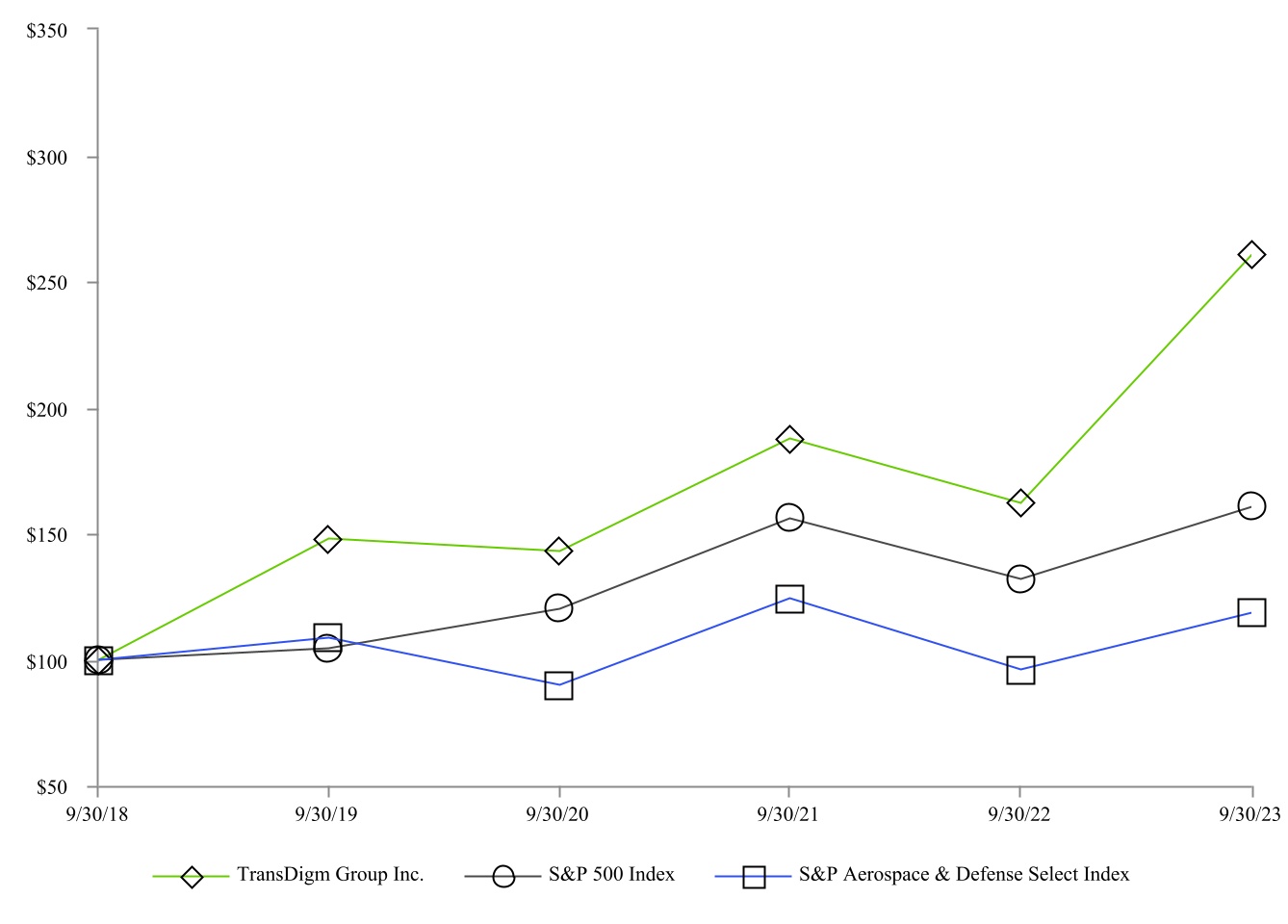
*$100 invested on 9/30/2018 in stock or index, including reinvestment of dividends.
Copyright 2023 Standard & Poor’s, a division of S&P Global. All rights reserved.
| 9/30/2018 | 9/30/2019 | 9/30/2020 | 9/30/2021 | 9/30/2022 | 9/30/2023 | ||||||||||||||||||||||||||||||
| TransDigm Group Inc. | 100.00 | 147.98 | 142.82 | 187.74 | 162.21 | 260.59 | |||||||||||||||||||||||||||||
| S&P 500 Index | 100.00 | 104.25 | 120.05 | 156.07 | 131.92 | 160.44 | |||||||||||||||||||||||||||||
| S&P Aerospace & Defense Select Index | 100.00 | 108.68 | 89.79 | 124.17 | 96.14 | 118.54 |
Purchases of Equity Securities by the Issuer or Affiliated Purchaser
On January 27, 2022, the Board of Directors of the Company authorized a new stock repurchase program to permit repurchases of its outstanding common stock not to exceed $2,200 million in the aggregate (the “$2,200 million stock repurchase program”), replacing the $650 million stock repurchase program previously authorized by the Board on November 8, 2017, subject to any restrictions specified in the Second Amended and Restated Credit Agreement dated as of June 4, 2014 (the “Credit Agreement”) and indentures governing the Company's existing Notes. There is no expiration date for this program.
No repurchases were made under the program during fiscal 2023. During fiscal 2022, the Company repurchased 1,490,413 shares of common stock at an average price of $612.13 per share, for a total amount of $912 million. The repurchased shares of common stock are classified as treasury stock in the statement of changes in stockholders' deficit. As of September 30, 2023, $1,288 million remains available for repurchase under the $2,200 million stock repurchase program.
Item 6. [RESERVED]
Item 7. MANAGEMENT’S DISCUSSION AND ANALYSIS OF FINANCIAL CONDITION AND RESULTS OF OPERATIONS
The following discussion of our financial condition and results of operations should be read together with TD Group’s consolidated financial statements and the related notes included elsewhere in this report. The following discussion may contain predictions, estimates and other forward-looking statements that involve a number of risks and uncertainties, including those discussed under the heading entitled “Risk Factors” included elsewhere in this report. These risks could cause our actual results to differ materially from any future performance suggested below.
Overview
For fiscal year 2023, we generated net sales of $6,585 million, gross profit of $3,842 million or 58.3% of net sales, and net income attributable to TD Group of $1,298 million. We believe we have achieved steady, long-term growth in sales and improvements in operating performance due to our competitive strengths and through execution of our value-driven operating strategy. More specifically, we believe that focusing our businesses on our value-driven operating strategy of obtaining profitable new business, carefully controlling the cost structure and pricing our highly engineered value-added products to fairly reflect the value we provide and the resources required to do so has historically resulted in improvements in gross profit and income from operations over the long-term.
Our selective acquisition strategy has also been an important contribution to the growth of our business. The integration of acquisitions into our existing businesses combined with implementing our proven operating strategy has historically resulted in improvements in the financial performance of the acquired business.
We believe our key competitive strengths include:
Large and Growing Installed Product Base with Aftermarket Revenue Stream. We provide components to a large and growing installed base of aircraft to which we supply aftermarket products. We estimate that our products are installed on over 100,000 commercial transport, regional transport, military and general aviation fixed wing turbine aircraft and rotary wing aircraft.
Diversified Revenue Base. We believe that our diversified revenue base reduces our dependence on any particular product, platform or market channel and has been a significant factor in maintaining our financial performance. Our products are installed on almost all of the major commercial aircraft platforms now in production. We expect to continue to develop new products for military and commercial applications. Our current initiatives include creating new products that are more environmentally friendly, such as radiation-free exciters, and creating new products that will help further improve commercial airlines’ efforts to keep passengers healthy and safe, such as touch-free aircraft lavatory suite products.
Our business strategy is made up of two key elements: (1) a value-driven operating strategy focused around our three core value drivers and (2) a selective acquisition strategy.
Value-Driven Operating Strategy. Our three core value drivers are:
-
Obtaining Profitable New Business. We attempt to obtain profitable new business by using our technical expertise and application skill and our detailed knowledge of our customer base and the individual niche markets in which we operate. We have regularly been successful in identifying and developing both aftermarket and OEM products to drive our growth.
-
Improving Our Cost Structure. We are committed to maintaining and continuously improving our lean cost structure through detailed attention to the cost of each of the products that we offer and our organizational structure, with a focus on reducing the cost of each.
-
Providing Highly Engineered Value-Added Products to Customers. We focus on the engineering, manufacturing and marketing of a broad range of highly engineered niche products that we believe provide value to our customers. We believe we have been consistently successful in communicating to our customers the value of our products. This has generally enabled us to price our products to fairly reflect the value we provide and the resources required to do so.
Selective Acquisition Strategy. We selectively pursue the acquisition of proprietary aerospace component businesses when we see an opportunity to create value through the application of our three core value-driven operating strategies. The aerospace industry, in particular, remains highly fragmented, with many of the companies in the industry being small private businesses or small non-core operations of larger businesses. We have significant experience among our management team in executing acquisitions and integrating acquired businesses into our company and culture. As of the date of this report, we have successfully acquired approximately 88 businesses and product lines since our formation in 1993. Many of these acquisitions have been integrated into an existing TransDigm production facility, which enables a higher production capacity utilization, which in turn improves gross profit levels due to the ability to spread the fixed manufacturing overhead costs over higher production volume. In the case of larger acquisitions that consist of multiple operating units (such as the Esterline acquisition in fiscal 2019), we may pursue opportunities to divest certain acquired operating units that are not in line with our long-term acquisition strategy.
Acquisitions and divestitures during the most recent three fiscal years is described in Note 2, “Acquisitions and Divestitures,” in the notes to the consolidated financial statements included herein. Also as further disclosed in Note 2, on November 9, 2023, TransDigm announced that it entered into a definitive agreement to acquire the Electron Device Business of Communications & Power Industries for approximately $1,385 million in cash. The acquisition is expected to close by the end of TransDigm’s third quarter of fiscal 2024.
Throughout fiscal 2023, we continued to see a rebound in our commercial aerospace end markets from the COVID-19 pandemic and are encouraged by the progression of the commercial aerospace market recovery to date. Commercial air travel in domestic markets continues to lead the air traffic recovery with most domestic markets nearing, achieving or surpassing pre-pandemic air traffic levels. The pace of the international recovery has been slower than the domestic recovery and remains below pre-pandemic levels. However, international RPKs, a metric used to measure air traffic demand, continues to make positive strides as most countries have removed international traveler restrictions and there is pent-up demand for long-haul travel. Current industry consensus indicates that worldwide RPKs will recover or surpass calendar year 2019 (i.e., pre-pandemic levels) in calendar year 2024. Therefore, we expect the Company's commercial aerospace end markets to continue progressing into fiscal 2024 barring any significant disruptions or setbacks. In fiscal 2023, we experienced improved sales in the commercial OEM sector primarily due to increased aircraft production by Boeing and Airbus. Aircraft production rates continue to lag pre-pandemic levels, mainly due to continued commercial OEM supply chain issues that are slowing the pace of new aircraft manufacturing. However, airline demand for new aircraft is strong and both Boeing and Airbus have disclosed further planned OEM production rate increases for calendar 2024.
The pace of U.S. government defense spending outlays and government funding reprioritization provides for uncertainty in the defense aerospace market. Defense sales rebounded in the second half of fiscal 2023 due to improving U.S. government defense spend outlays (though, in management’s estimation, the current lag between spend authorizations and outlays remains longer than historical average levels). Recent DOD budgets have trended upwards; however, the ongoing co
Showing the first 8K of 98K characters. Open the full section
Item 7A. QUANTITATIVE AND QUALITATIVE DISCLOSURES ABOUT MARKET RISK
Interest Rate Risk
At September 30, 2023, we had borrowings under our Term Loans Facility, which consists of two tranches of term loans of approximately $6,249 million, as well as $350 million from the Securitization Facility, that are subject to interest rate risk, particularly movements in Term SOFR. Borrowings under our term loans bear interest, at our option, at a rate equal to either an alternate base rate or an adjusted Term SOFR for a one-, three- or six-month thereafter (in each case, subject to the availability thereof), interest period chosen by us, in each case, plus an applicable margin percentage. Our Securitization Facility bears interest at a rate of three-month Term SOFR plus 1.60%. Accordingly, the Company’s cash flows and earnings will be exposed to the market risk of interest rate changes resulting from variable rate borrowings under our term loans. The Company's objective is to maintain an allocation of at least 75% fixed rate and 25% variable rate debt thereby limiting its exposure to changes in near-term interest rates. Interest rate swaps, caps and collars used to hedge and offset, respectively, the variable interest rates on the credit facility are described in Note 21, “Derivatives and Hedging Activities,” in the notes to the consolidated financial statements included herein. We do not hold or issue derivative instruments for speculative purposes. As of September 30, 2023, approximately 90% of our gross debt was fixed rate. The effect of a hypothetical one percentage point increase in interest rates would increase the annual interest costs under our Term Loans Facility and Securitization Facility by approximately $44 million based on the amount of outstanding borrowings at September 30, 2023. The weighted average interest rate on the $6,249 million of term loans and the $350 million drawn on the Securitization Facility at September 30, 2023 was 6.3%.
For information about the fair value of the aggregate principal amount of borrowings under our term loans and the fair value of the senior secured and subordinated notes, refer to Note 20, “Fair Value Measurements,” in the notes to the consolidated financial statements included herein.
Foreign Currency Risk
Certain of our foreign subsidiaries’ sales and results of operations are subject to the impact of foreign currency fluctuations, primarily the British pound and the euro. Because our consolidated financial statements are presented in U.S. dollars, increases or decreases in the value of the U.S. dollar relative to other currencies in which we transact business could materially adversely affect our net sales, net income and the carrying values of our assets located outside the U.S. Global economic uncertainty continues to exist. Foreign currency forward exchange contracts provide for the purchase or sale of foreign currencies at specified future dates at specified exchange rates, and are used to offset changes in the fair value of certain assets or liabilities or forecasted cash flows resulting from transactions denominated in foreign currencies. The foreign currency forward exchange contracts entered into by the Company are described in Note 21, “Derivatives and Hedging Activities,” in the notes to the consolidated financial statements included herein. A 10% change in foreign currency exchange rates would not have resulted in a material impact to net income for the fiscal year ended September 30, 2023.
ITEM 8. FINANCIAL STATEMENTS AND SUPPLEMENTARY DATA
The information required by this Item is contained on pages F-1 through F-45 of this Report.
Item 9. CHANGES IN AND DISAGREEMENTS WITH ACCOUNTANTS ON ACCOUNTING AND FINANCIAL DISCLOSURE
None.
Item 9A. CONTROLS AND PROCEDURES
Evaluation of Disclosure Controls and Procedures
As of September 30, 2023, TD Group carried out an evaluation, under the supervision and with the participation of TD Group’s management, including its President, Chief Executive Officer and Director (Principal Executive Officer) and Chief Financial Officer (Principal Financial Officer), of the effectiveness of the design and operation of TD Group’s disclosure controls and procedures. Based upon that evaluation, the President, Chief Executive Officer and Director and Chief Financial Officer concluded that TD Group’s disclosure controls and procedures are effective to ensure that information required to be disclosed by TD Group in the reports it files or submits under the Exchange Act is recorded, processed, summarized and reported, within the time periods specified by the Securities and Exchange Commission’s rules and forms, and that such information is accumulated and communicated to TD Group’s management, including its President, Chief Executive Officer and Director and Chief Financial Officer, as appropriate, to allow timely decisions regarding required disclosure. In designing and evaluating the disclosure controls and procedures, TD Group’s management recognized that any controls and procedures, no matter how well designed and operated, can provide only reasonable assurance of achieving the desired control objectives, and management necessarily was required to apply its judgment in designing and evaluating the controls and procedures.
Management’s Report on Internal Control Over Financial Reporting
The management of TD Group is responsible for establishing and maintaining adequate internal control over financial reporting as defined in Exchange Act Rule 13a-15(f). Using criteria set forth by the Committee of Sponsoring Organizations of the Treadway Commission (2013 framework) (“COSO”) in Internal Control-Integrated Framework, TransDigm’s management assessed the effectiveness of the Company’s internal control over financial reporting as of September 30, 2023. Based on our assessment, management concluded that the Company’s internal control over financial reporting was effective as of September 30, 2023.
During the third quarter of fiscal 2023, the Company completed the acquisition of Calspan. The Company is currently integrating the acquisition into its operations, compliance programs and internal control processes. As permitted by SEC rules and regulations, the Company has excluded the acquisition from management's evaluation of internal controls over financial reporting as of September 30, 2023. The acquisition constituted approximately 4% of the Company's total assets (inclusive of acquired intangible assets) as of September 30, 2023 and approximately 2% and 1% of the Company's net sales and income from continuing operations before income taxes, respectively, for the fiscal year ended September 30, 2023.
The effectiveness of the Company’s internal control over financial reporting as of September 30, 2023 has been audited by Ernst & Young LLP, an independent registered public accounting firm, as stated in their report, which is included elsewhere in this Annual Report on Form 10-K and is incorporated herein by reference.
Changes in Internal Control Over Financial Reporting
There have been no changes in the Company’s internal control over financial reporting that occurred during the fourth quarter of fiscal 2023 that materially affected, or are reasonably likely to materially affect, the Company’s internal control over financial reporting.
Report of Independent Registered Public Accounting Firm
To the Stockholders and the Board of Directors of
TransDigm Group Incorporated
Opinion on Internal Control over Financial Reporting
We have audited TransDigm Group Incorporated’s internal control over financial reporting as of September 30, 2023, based on criteria established in Internal Control—Integrated Framework issued by the Committee of Sponsoring Organizations of the Treadway Commission (2013 framework) (the “COSO criteria”). In our opinion, TransDigm Group Incorporated (the “Company”) maintained, in all material respects, effective internal control over financial reporting as of September 30, 2023, based on the COSO criteria.
As indicated in the accompanying Management’s Report on Internal Control Over Financial Reporting, management’s assessment of and conclusion on the effectiveness of internal control over financial reporting did not include the internal controls of Calspan Corporation (“Calspan”), which is included in the 2023 consolidated financial statements of the Company and constituted 4% of total assets as of September 30, 2023 and 2% and 1% of net sales and income from continuing operations before income taxes, respectively, for the fiscal year then ended. Our audit of internal control over financial reporting of the Company also did not include an evaluation of the internal control over financial reporting of Calspan.
We also have audited, in accordance with the standards of the Public Company Accounting Oversight Board (United States) (“PCAOB”), the consolidated balance sheets of the Company as of September 30, 2023 and 2022, the related consolidated statements of income, comprehensive income, changes in stockholders’ deficit and cash flows for each of the three fiscal years in the period ended September 30, 2023, and the related notes and financial statement schedule listed in the Index at Item 15(a) and our report dated November 9, 2023 expressed an unqualified opinion thereon.
Basis for Opinion
The Company’s management is responsible for maintaining effective internal control over financial reporting and for its assessment of the effectiveness of internal control over financial reporting included in the accompanying Management's Report on Internal Control Over Financial Reporting. Our responsibility is to express an opinion on the Company’s internal control over financial reporting based on our audit. We are a public accounting firm registered with the PCAOB and are required to be independent with respect to the Company in accordance with the U.S. federal securities laws and the applicable rules and regulations of the Securities and Exchange Commission and the PCAOB.
We conducted our audit in accordance with the standards of the PCAOB. Those standards require that we plan and perform the audit to obtain reasonable assurance about whether effective internal control over financial reporting was maintained in all material respects.
Our audit included obtaining an understanding of internal control over financial reporting, assessing the risk that a material weakness exists, testing and evaluating the design and operating effectiveness of internal control based on the assessed risk, and performing such other procedures as we considered necessary in the circumstances. We believe that our audit provides a reasonable basis for our opinion.
Definition and Limitations of Internal Control Over Financial Reporting
A company’s internal control over financial reporting is a process designed to provide reasonable assurance regarding the reliability of financial reporting and the preparation of financial statements for external purposes in accordance with generally accepted accounting principles. A company’s internal control over financial reporting includes those policies and procedures that (1) pertain to the maintenance of records that, in reasonable detail, accurately and fairly reflect the transactions and dispositions of the assets of the company; (2) provide reasonable assurance that transactions are recorded as necessary to permit preparation of financial statements in accordance with generally accepted accounting principles, and that receipts and expenditures of the company are being made only in accordance with authorizations of management and directors of the company; and (3) provide reasonable assurance regarding prevention or timely detection of unauthorized acquisition, use, or disposition of the company’s assets that could have a material effect on the financial statements.
Because of its inherent limitations, internal control over financial reporting may not prevent or detect misstatements. Also, projections of any evaluation of effectiveness to future periods are subject to the risk that controls may become inadequate because of changes in conditions, or that the degree of compliance with the policies or procedures may deteriorate.
/s/ Ernst & Young LLP
Cleveland, Ohio
November 9, 2023
Item 9B. OTHER INFORMATION
None of the Company’s directors or officers adopted, modified or terminated at Rule 10b5-1 trading arrangement or a non-Rule 10b5-1 trading arrangement during the Company’s fiscal quarter ended September 30, 2023.
PART III
Item 10. DIRECTORS, EXECUTIVE OFFICERS AND CORPORATE GOVERNANCE
Directors and Executive Officers
Information regarding TD Group’s directors will be set forth under the caption “Proposal No. 1 - Election of Directors” in our Proxy Statement, which is incorporated herein by reference. The following table sets forth certain information concerning TD Group’s executive officers:
| Name | Age | Position | ||||||||||||
| Kevin Stein | 57 | President, Chief Executive Officer and Director | ||||||||||||
| Jorge L. Valladares III | 49 | Co-Chief Operating Officer (through September 30, 2023) and Director | ||||||||||||
| Michael Lisman | 41 | Co-Chief Operating Officer | ||||||||||||
| Joel Reiss | 53 | Co-Chief Operating Officer | ||||||||||||
| Sarah Wynne | 49 | Chief Financial Officer | ||||||||||||
| Jessica L. Warren | 41 | General Counsel, Chief Compliance Officer and Secretary |
Mr. Stein was appointed President, Chief Executive Officer and Director in April 2018. Prior to that, Mr. Stein served as President and Chief Operating Officer from January 2017 through March 2018 and Chief Operating Officer—Power and Control from October 2014 to December 2016. Prior to joining TransDigm, Mr. Stein served as Executive Vice President and President of the Structurals division of Precision Castparts Corp. from November 2011 to October 2014 and Executive Vice President and President of the Fasteners division of Precision Castparts Corp. from January 2009 through November 2011.
Mr. Valladares was appointed to Board of Directors in May 2023 and served as Chief Operating Officer from April 2019 until his retirement, effective October 1, 2023. Prior to that, Mr. Valladares served as Chief Operating Officer—Power & Control from June 2018 to March 2019, Executive Vice President from October 2013 to May 2018, as President of AvtechTyee, Inc. (formerly Avtech Corporation), a wholly-owned subsidiary of TransDigm Inc., from August 2009 to September 2013, and as President of AdelWiggins Group, a division of TransDigm Inc., from April 2008 to July 2009.
Mr. Lisman was appointed Co-Chief Operating Officer in May 2023. Prior to that, Mr. Lisman served as Chief Financial Officer from July 2018 to May 2023 and Executive Vice President from January 2022 to May 2023. Mr. Lisman also served as Vice President—Mergers and Acquisitions from January 2018 through June 2018, Business Unit Manager for the Air & Fuel Valves business unit at Aero Fluid Products, a wholly-owned subsidiary of TransDigm Inc., from January 2017 to January 2018 and Director of Mergers and Acquisitions of TransDigm from November 2015 to January 2017.
Mr. Reiss was appointed Co-Chief Operating Officer in May 2023. Prior to that, Mr. Reiss served as Executive Vice President from October 2015 to May 2023. Mr. Reiss also served as President of Hartwell Corporation, a wholly-owned subsidiary of TransDigm Inc., from July 2012 to October 2015; President of Skurka Aerospace, a wholly-owned subsidiary of TransDigm Inc., from July 2010 to July 2012; and Director of Operations of Adams Rite Aerospace, a wholly-owned subsidiary of TransDigm Inc., from July 2000 to July 2010.
Ms. Wynne was appointed Chief Financial Officer in May 2023. Prior to that, Ms. Wynne served as Chief Accounting Officer from November 2018 to May 2023. Ms. Wynne also served as Group Controller from April 2015 to October 2018, as Controller of the Aero Fluid Products division of AeroControlex Group, Inc., a wholly-owned subsidiary of TransDigm Inc., from October 2009 to March 2015, and previously in other accounting roles within the Company.
Ms. Warren was appointed General Counsel, Chief Compliance Officer and Secretary in February 2023. Prior to that, Ms. Warren served as Associate General Counsel of the Company from December 2018 to February 2023. Prior to joining TransDigm as Associate General Counsel, Ms. Warren maintained a private legal practice focusing on providing services to technology-driven businesses, including providing counsel to TransDigm on disputes, environmental matters, intellectual property and a variety of other matters. Ms. Warren also served as General Counsel of Thogus Products Company from October 2014 to July 2016.
Code of Ethics
We have adopted a Code of Business Conduct and Ethics, which applies to all of our directors, officers, and employees and a Code of Ethics for Senior Financial Officers which includes additional ethical obligations for our senior financial management (which includes our president, chief executive officer and director, co-chief operating officers, chief financial officer, treasurer, vice president of finance, director of internal audit, general counsel, operating unit presidents and operating unit vice presidents of finance). Please refer to the information set forth in our Proxy Statement, which is incorporated herein by reference. Our Code of Business Conduct and Ethics and our Code of Ethics for Senior Financial Officers is available on our website at www.transdigm.com. Any person may receive a copy without charge by writing to us at TransDigm Group Incorporated, 1301 East 9th Street, Suite 3000, Cleveland, Ohio 44114. We intend to disclose on our website any amendment to, or waiver from, a provision of our Code of Business Conduct and Ethics that applies to directors and executive officers and that is required to be disclosed pursuant to the rules of the Securities and Exchange Commission.
Nominations of Directors
The procedure by which stockholders may recommend nominees to our Board of Directors will be set forth under the caption “Stockholder Proposals for 2024 Annual Meeting” in our Proxy Statement, which is incorporated herein by reference.
Audit Committee
The information regarding the audit committee of our Board of Directors and audit committee financial experts will be set forth under the caption “Corporate Governance” in our Proxy Statement, which is incorporated herein by reference.
Item 11. EXECUTIVE COMPENSATION
The information required by this item will be set forth under the captions “Executive Compensation” and “Director Compensation” in our Proxy Statement, which is incorporated herein by reference.
Item 12. SECURITY OWNERSHIP OF BENEFICIAL OWNERS AND MANAGEMENT AND RELATED STOCKHOLDER MATTERS
The information regarding security ownership of certain beneficial owners and management will be set forth under the caption “Security Ownership of Certain Beneficial Owners and Management” in our Proxy Statement, which is incorporated herein by reference.
Equity Compensation Plan Information
| Plan category | Number of Securities to Be Issued upon Exercise of Outstanding Options, Warrants and Rights (a) | Weighted-Average Exercise Price of Outstanding Options, Warrants and Rights (b) | Number of Securities Remaining Available for Future Issuance Under Equity Compensation Plans (excluding securities reflected in column (a)) (c) | ||||||||||||||||||||
| Equity compensation plans approved by security holders (1) | 4,920,458 | (2) | $ | 430.25 | 3,866,336 | (3) |
(1)Includes information related to the 2006 stock incentive plan, the 2014 stock option plan and the 2019 stock option plan.
(2)This amount represents 450,192, 4,246,321 and 223,945 shares subject to outstanding stock options under our 2006 stock incentive plan, 2014 stock option plan and 2019 stock option plan, respectively. No further grants may be made under our 2006 stock incentive plan, although outstanding stock options continue in force in accordance with their terms.
(3)This amount represents remaining shares available for award under our 2014 stock option plan and 2019 stock option plan. In August 2019, the 2019 stock option plan was adopted by the Board of Directors of TD Group and was subsequently approved by stockholders on October 3, 2019. The 2019 stock option plan permits TD Group to award stock options to our key employees, directors or consultants. The total number shares of TD Group common stock reserved for issuance or delivery under the 2019 stock option plan is 4,000,000, subject to adjustment in the event of any stock dividend or split, reorganization, recapitalization, merger, share exchange or any other similar corporate transaction or event.
Item 13. CERTAIN RELATIONSHIPS AND RELATED TRANSACTIONS, AND DIRECTOR INDEPENDENCE
The information required by this item will be set forth under the captions entitled “Corporate Governance” and “Director Compensation” in our Proxy Statement, which is incorporated herein by reference.
Item 14. PRINCIPAL ACCOUNTANT FEES AND SERVICES
The information required by this item will be set forth under the caption “Proposal No. 2 - Ratification of Appointment of Independent Registered Public Accounting Firm,” in our Proxy Statement, which is incorporated herein by reference.
PART IV
15. EXHIBITS AND FINANCIAL STATEMENT SCHEDULES
(a) Documents Filed with Report
(a) (1) Financial Statements
| Page | |||||
| Report of Independent Registered Public Accounting Firm (Ernst & Young LLP, PCAOB ID: 42) | F-1 | ||||
| Consolidated Balance Sheets as of September 30, 2023 and 2022 | F-3 | ||||
| Consolidated Statements of Income for Fiscal Years Ended September 30, 2023, 2022 and 2021 | F-4 | ||||
| Consolidated Statements of Comprehensive Income for Fiscal Years Ended September 30, 2023, 2022 and 2021 | F-5 | ||||
| Consolidated Statements of Changes in Stockholders’ Deficit for Fiscal Years Ended September 30, 2023, 2022 and 2021 | F-6 | ||||
| Consolidated Statements of Cash Flows for Fiscal Years Ended September 30, 2023, 2022 and 2021 | F-7 | ||||
| Notes to Consolidated Financial Statements for Fiscal Years Ended September 30, 2023, 2022 and 2021 | F-8 to F-44 | ||||
| (a) (2) Financial Statement Schedules | |||||
| Valuation and Qualifying Accounts for the Fiscal Years Ended September 30, 2023, 2022 and 2021 | F-45 |
(a) (3) Exhibits
Showing the first 8K of 228K characters. Open the full section
Item 8. AND ITEM 15(a) (1)
FINANCIAL STATEMENTS AND SUPPLEMENTARY DATA
INDEX
| Page | |||||
| Financial Statements: | |||||
| Report of Independent Registered Public Accounting Firm (Ernst & Young LLP, PCAOB ID: 42) | F-1 | ||||
| Consolidated Balance Sheets as of September 30, 2023 and 2022 | F-3 | ||||
| Consolidated Statements of Income for Fiscal Years Ended September 30, 2023, 2022 and 2021 | F-4 | ||||
| Consolidated Statements of Comprehensive Income for Fiscal Years Ended September 30, 2023, 2022 and 2021 | F-5 | ||||
| Consolidated Statements of Changes in Stockholders’ Deficit for Fiscal Years Ended September 30, 2023, 2022 and 2021 | F-6 | ||||
| Consolidated Statements of Cash Flows for Fiscal Years Ended September 30, 2023, 2022 and 2021 | F-7 | ||||
| Notes to Consolidated Financial Statements for Fiscal Years Ended September 30, 2023, 2022 and 2021 | F-8 to F-44 | ||||
| Supplementary Data: | |||||
| Valuation and Qualifying Accounts for the Fiscal Years Ended September 30, 2023, 2022 and 2021 | F-45 |
Report of Independent Registered Public Accounting Firm
To the Stockholders and the Board of Directors of
TransDigm Group Incorporated
Opinion on the Financial Statements
We have audited the accompanying consolidated balance sheets of TransDigm Group Incorporated (the “Company”) as of September 30, 2023 and 2022, the related consolidated statements of income, comprehensive income, changes in stockholders’ deficit and cash flows for each of the three fiscal years in the period ended September 30, 2023, and the related notes and financial statement schedule listed in the Index at Item 15(a) (collectively referred to as the “consolidated financial statements”). In our opinion, the consolidated financial statements present fairly, in all material respects, the financial position of the Company at September 30, 2023 and 2022, and the results of its operations and its cash flows for each of the three fiscal years in the period ended September 30, 2023, in conformity with U.S. generally accepted accounting principles.
We also have audited, in accordance with the standards of the Public Company Accounting Oversight Board (United States) (“PCAOB”), the Company's internal control over financial reporting as of September 30, 2023, based on criteria established in Internal Control—Integrated Framework issued by the Committee of Sponsoring Organizations of the Treadway Commission (2013 framework) and our report dated November 9, 2023 expressed an unqualified opinion thereon.
Basis for Opinion
These financial statements are the responsibility of the Company's management. Our responsibility is to express an opinion on the Company’s financial statements based on our audits. We are a public accounting firm registered with the PCAOB and are required to be independent with respect to the Company in accordance with the U.S. federal securities laws and the applicable rules and regulations of the Securities and Exchange Commission and the PCAOB.
We conducted our audits in accordance with the standards of the PCAOB. Those standards require that we plan and perform the audit to obtain reasonable assurance about whether the financial statements are free of material misstatement, whether due to error or fraud. Our audits included performing procedures to assess the risks of material misstatement of the financial statements, whether due to error or fraud, and performing procedures that respond to those risks. Such procedures included examining, on a test basis, evidence regarding the amounts and disclosures in the financial statements. Our audits also included evaluating the accounting principles used and significant estimates made by management, as well as evaluating the overall presentation of the financial statements. We believe that our audits provide a reasonable basis for our opinion.
Critical Audit Matter
The critical audit matter communicated below is a matter arising from the current period audit of the financial statements that was communicated or required to be communicated to the audit committee and that: (1) relates to accounts or disclosures that are material to the financial statements and (2) involved our especially challenging, subjective or complex judgments. The communication of the critical audit matter does not alter in any way our opinion on the consolidated financial statements, taken as a whole, and we are not, by communicating the critical audit matter below, providing a separate opinion on the critical audit matter or on the accounts or disclosures to which it relates.
F-1
| Valuation of goodwill and indefinite-lived intangible assets | ||||||||
| Description of the Matter | As disclosed in Note 10, the Company had goodwill and indefinite-lived intangible assets (trademarks and trade names) of $8.9 billion and $1.0 billion, respectively, at September 30, 2023. As discussed in Note 3 to the consolidated financial statements, goodwill and indefinite-lived intangible assets are tested for impairment annually as of the first day of the fourth fiscal quarter, or more frequently, if an event occurs or circumstances change that would more likely than not reduce fair value below carrying value. The Company’s goodwill is initially assigned to its reporting units as of the acquisition date. The Company’s indefinite-lived intangible assets consist of acquired trademarks and trade names. The Company first assesses qualitative factors to determine whether it is more likely than not that the fair value of a reporting unit or indefinite-lived intangible asset is less than its carrying value. If the Company determines the qualitative assessment is not sufficient to conclude on whether it is more likely than not that the fair value is less than the carrying value, a quantitative impairment test is performed. The Company performed a quantitative assessment on the goodwill and indefinite-lived intangible assets at five of its reporting units. As part of the quantitative assessment, the Company determines the fair value of the reporting units and indefinite-lived intangible assets using a discounted cash flow valuation model. Auditing management’s quantitative impairment assessment was complex and judgmental for certain of the five reporting units and their indefinite-lived intangible assets due to the significant estimation required to determine fair value. In particular, the fair value estimates were sensitive to significant assumptions, such as changes in the discount rate, revenue growth rates and EBITDA margins, which are affected by expectations about future market or economic conditions. | |||||||
| How We Addressed the Matter in Our Audit | We obtained an understanding, evaluated the design and tested the operating effectiveness of controls over the Company’s impairment process, including controls over management’s review of the valuation model and the significant assumptions underlying the fair value determination, as described above. To test the fair values of the Company’s reporting units and indefinite-lived intangible assets, our audit procedures included, among others, assessing the use of the discounted cash flow valuation model and testing the si |
Showing the first 8K of 224K characters. Open the full section