 filings.tools
TE Connectivity 10-K 2018-09-28
Filed 2018-11-13. 17 sections, 447K characters. Original on sec.gov · Markdown · JSON
Cover and table of contents
10-K 1 a2237090z10-k.htm 10-K
Use these links to rapidly review the document TE CONNECTIVITY LTD. TABLE OF CONTENTS TE CONNECTIVITY LTD. INDEX TO CONSOLIDATED FINANCIAL STATEMENTS
**UNITED STATES SECURITIES AND EXCHANGE COMMISSION **Washington, D.C. 20549
FORM 10-K
| (Mark One) | ||
| ý | ANNUAL REPORT PURSUANT TO SECTION 13 OR 15(d) OF THE SECURITIES EXCHANGE ACT OF 1934 | |
| For the fiscal year ended September 28, 2018 | ||
| or | ||
| o | TRANSITION REPORT PURSUANT TO SECTION 13 OR 15(d) OF THE SECURITIES EXCHANGE ACT OF 1934 |
001-33260 (Commission File Number)

**TE CONNECTIVITY LTD. **(Exact name of registrant as specified in its charter)
| Switzerland (Jurisdiction of Incorporation) | 98-0518048 (IRS Employer Identification No.) |
Rheinstrasse 20, CH-8200 Schaffhausen, Switzerland (Address of principal executive offices)
+41 (0)52 633 66 61 (Registrant's telephone number)
Securities registered pursuant to Section 12(b) of the Act:
| Title of each class | Name of each exchange on which registered | |
| Common Shares, Par Value CHF 0.57 | New York Stock Exchange |
Securities registered pursuant to Section 12(g) of the Act: None
Indicate by check mark if the registrant is a well-known seasoned issuer, as defined in Rule 405 of the Securities Act. Yes ý No o
Indicate by check mark if the registrant is not required to file reports pursuant to Section 13 or 15(d) of the Act. Yes o No ý
Indicate by check mark whether the registrant (1) has filed all reports required to be filed by Section 13 or 15(d) of the Securities Exchange Act of 1934 during the preceding 12 months (or for such shorter period that the registrant was required to file such reports), and (2) has been subject to such filing requirements for the past 90 days. Yes ý No o
Indicate by check mark whether the registrant has submitted electronically every Interactive Data File required to be submitted pursuant to Rule 405 of Regulation S-T during the preceding 12 months (or for such shorter period that the registrant was required to submit such files). Yes ý No o
Indicate by check mark if disclosure of delinquent filers pursuant to Item 405 of Regulation S-K is not contained herein, and will not be contained, to the best of registrant's knowledge, in definitive proxy or information statements incorporated by reference in Part III of this Form 10-K or any amendment to this Form 10-K. ý
Indicate by check mark whether the registrant is a large accelerated filer, an accelerated filer, a non-accelerated filer, a smaller reporting company, or an emerging growth company. See the definitions of "large accelerated filer," "accelerated filer," "smaller reporting company," and "emerging growth company" in Rule 12b-2 of the Exchange Act:
| Large accelerated filer ý | Accelerated filer o | Non-accelerated filer o | Smaller reporting company o | Emerging growth company o |
If an emerging growth company, indicate by check mark if the registrant has elected not to use the extended transition period for complying with any new or revised financial accounting standards provided pursuant to Section 13(a) of the Exchange Act. o
Indicate by check mark whether the registrant is a shell company (as defined in Rule 12b-2 of the Act). Yes o No ý
The aggregate market value of the registrant's common shares held by non-affiliates of the registrant was $36.3 billion as of March 30, 2018, the last business day of the registrant's most recently completed second fiscal quarter. Directors and executive officers of the registrant are considered affiliates for purposes of this calculation but should not necessarily be deemed affiliates for any other purpose.
The number of common shares outstanding as of November 8, 2018 was 343,034,000.
DOCUMENTS INCORPORATED BY REFERENCE
Portions of the registrant's Proxy Statement to be filed in connection with the registrant's 2019 annual general meeting of shareholders are incorporated by reference into Part III of this Form 10-K.
**TE CONNECTIVITY LTD. TABLE OF CONTENTS **
i
**SPECIAL NOTE ABOUT FORWARD-LOOKING STATEMENTS **
We have made forward-looking statements in this Annual Report that are based on our management's beliefs and assumptions and on information currently available to our management. Forward-looking statements include, among others, the information concerning our possible or assumed future results of operations, business strategies, financing plans, competitive position, potential growth opportunities, potential operating performance improvements, acquisitions, divestitures, the effects of competition, and the effects of future legislation or regulations. Forward-looking statements include all statements that are not historical facts and can be identified by the use of forward-looking terminology such as the words "believe," "expect," "plan," "intend," "anticipate," "estimate," "predict," "potential," "continue," "may," "should," or the negative of these terms or similar expressions.
Forward-looking statements involve risks, uncertainties, and assumptions. Actual results may differ materially from those expressed in these forward-looking statements. Investors should not place undue reliance on any forward-looking statements. We do not have any intention or obligation to update forward-looking statements after we file this report except as required by law.
The risk factors discussed in "Risk Factors" and other risks described in this Annual Report could cause our results to differ materially from those expressed in forward-looking statements. There may be other risks and uncertainties that we are unable to predict at this time or that we currently do not expect to have a material adverse effect on our business.
ii
**PART I **
"TE Connectivity" and "TE Connectivity (logo)" are trademarks. This report further contains other trademarks of ours and additional trade names and trademarks of other companies that are not owned by TE Connectivity. We do not intend our use or display of other companies' trade names or trademarks to imply an endorsement or sponsorship of us by such companies, or any relationship with any of these companies.
© 2018 TE Connectivity Ltd. All Rights Reserved.
Item 1. BUSINESS
**
**General **
TE Connectivity Ltd. ("TE Connectivity" or the "Company," which may be referred to as "we," "us," or "our") is a global technology and manufacturing leader creating a safer, sustainable, productive, and connected future. Our connectivity and sensor solutions, proven in the harshest environments, have enabled advancements in transportation, industrial applications, medical technology, energy, data communications, and the home.
We became an independent, publicly traded company in 2007; however, through our predecessor companies, we trace our foundations in the connectivity business back to 1941. We are organized under the laws of Switzerland. The rights of holders of our shares are governed by Swiss law, our Swiss articles of association, and our Swiss organizational regulations.
We have a 52- or 53-week fiscal year that ends on the last Friday of September. For fiscal years in which there are 53 weeks, the fourth quarter reporting period includes 14 weeks. Fiscal 2018, 2017, and 2016 ended on September 28, 2018, September 29, 2017, and September 30, 2016, respectively. Fiscal 2018 and 2017 were 52 weeks in length. Fiscal 2016 was a 53-week year.
**Segments **
We operate through three reportable segments: Transportation Solutions, Industrial Solutions, and Communications Solutions. We believe our segments serve a combined market of approximately $190 billion. In fiscal 2018, our Subsea Communications business met the held for sale and discontinued operations criteria. As a result, we reclassified amounts previously reported to reflect this business as a discontinued operation in all periods presented. Prior to reclassification to discontinued operations, this business was included in our Communications Solutions segment.
Our net sales by segment as a percentage of our total net sales were as follows:
| Fiscal | ||||||||||
| 2018 | 2017 | 2016 | ||||||||
| Transportation Solutions | 59 | % | 58 | % | 58 | % | ||||
| Industrial Solutions | 28 | 29 | 28 | |||||||
| Communications Solutions | 13 | 13 | 14 | |||||||
| | | | | | | | | | | |
| Total | 100 | % | 100 | % | 100 | % | ||||
| | | | | | | | | | | |
| | | | | | | | | | | |
| | | | | | | | | | | |
Below is a description of our reportable segments and the primary products, markets, and competitors of each segment.
Transportation Solutions
The Transportation Solutions segment is a leader in connectivity and sensor technologies. The primary products sold by the Transportation Solutions segment include terminals and connector systems and components; sensors; antennas; relays; application tooling; and wire and heat shrink tubing. The Transportation Solutions segment's products, which must withstand harsh conditions, are used in the following end markets:
Automotive (74% of segment's net sales). We are one of the leading providers of advanced automobile connectivity solutions. The automotive industry uses our products in automotive technologies for body and chassis systems, convenience applications, driver information, infotainment solutions, miniaturization solutions, motor and powertrain applications, and safety and security systems. Hybrid and electronic mobility solutions include in-vehicle technologies, battery technologies, and charging solutions.
Commercial transportation (15% of segment's net sales). We deliver reliable connectivity products designed to withstand harsh environmental conditions for on- and off-highway vehicles and recreational transportation, including heavy trucks, construction, agriculture, buses, and other vehicles.
Sensors (11% of segment's net sales). We offer a portfolio of intelligent, efficient, and high-performing sensor solutions that are used by customers across multiple industries, including automotive, industrial equipment, commercial transportation, medical solutions, aerospace and defense, and consumer applications.
The Transportation Solutions segment's major competitors include Yazaki, Aptiv, Delphi, Sumitomo, Sensata, Honeywell, Molex, and Amphenol.
Industrial Solutions
The Industrial Solutions segment is a leading supplier of products that connect and distribute power, data, and signals. The primary products sold by the Industrial Solutions segment include terminals and connector systems and components; heat shrink tubing; relays; and wire and cable. The Industrial Solutions segment's products are used in the following end markets:
Industrial equipment (52% of segment's net sales). Our products are used in factory automation and process control systems such as industrial controls, robotics, human machine interface, industrial communication, and power distribution. Our intelligent building products are used to connect lighting, HVAC, elevators/escalators, and security. Our rail products are used in high-speed trains, metros, light rail vehicles, locomotives, and signaling switching equipment. Also, our products are used by the solar industry. The medical industry uses our products in imaging, diagnostic, surgical, and minimally invasive interventional applications.
Aerospace, defense, oil, and gas (30% of segment's net sales). We design, develop, and manufacture a comprehensive portfolio of critical electronic components and systems for the harsh operating conditions of the aerospace, defense, and marine industries. Our products and systems are designed and manufactured to operate effectively in harsh conditions ranging from the depths of the ocean to the far reaches of space.
Energy (18% of segment's net sales). Our products are used by OEMs and utility companies in the electrical power industry and include a wide range of solutions for the electrical power generation, transmission, distribution, and industrial markets.
The Industrial Solutions segment competes primarily against Amphenol, Belden, Hubbell, Carlisle Companies, 3M, Integer Holdings, Esterline, Molex, and Phoenix Contact.
Communications Solutions
The Communications Solutions segment is a leading supplier of electronic components for the data and devices and the appliances markets. The primary products sold by the Communications Solutions segment include terminals and connector systems and components; relays; heat shrink tubing; and antennas. The Communications Solutions segment's products are used in the following end markets:
Data and devices (58% of segment's net sales). We deliver products and solutions that are used in a variety of equipment architectures within the networking equipment, data center equipment, and wireless infrastructure industries. Additionally, we deliver a range of connectivity solutions for the Internet of Things, smartphones, tablet computers, notebooks, and virtual reality applications to help our customers meet their current challenges and future innovations.
Appliances (42% of segment's net sales). We provide solutions to meet the daily demands of home appliances. Our products are used in many household appliances, including washers, dryers, refrigerators, air conditioners, dishwashers, cooking appliances, water heaters, and microwaves. Our expansive range of standard products is supplemented by an array of custom-designed solutions.
The Communications Solutions segment's major competitors include Amphenol, Molex, JST, and Korea Electric Terminal (KET).
**Customers **
As an industry leader, we have established close working relationships with many of our customers. These relationships allow us to better anticipate and respond to customer needs when designing new products and new technical solutions. By working with our customers in developing new products and technologies, we believe we can identify and act on trends and leverage knowledge about next-generation technology across our products.
Our approach to our customers is driven by our dedication to further develop our product families and ensure that we are globally positioned to best provide our customers with sales and engineering support. We believe that as electronic component technologies continue to proliferate, our broad product portfolio and engineering capability give us a potential competitive advantage when addressing the needs of our global customers.
We manufacture and sell a broad portfolio of products to customers in various industries. Our customers include many of the leaders in their respective industries, and our relationships with them typically date back many years. We believe that our diversified customer base provides us an opportunity to leverage our skills and experience across markets and reduce our exposure to individual end markets, thereby reducing the variability of our financial performance. Additionally, we believe that the diversity of our customer base reduces the level of cyclicality in our results and distinguishes us from our competitors.
No single customer accounted for a significant amount of our net sales in fiscal 2018, 2017, or 2016.
**Sales and Distribution **
We maintain a strong local presence in each of the geographic regions in which we operate. Our net sales by geographic region(1) as a percentage of our total net sales were as follows:
| Fiscal | ||||||||||
| 2018 | 2017 | 2016 | ||||||||
| Europe/Middle East/Africa ("EMEA") | 38 | % | 36 | % | 36 | % | ||||
| Asia–Pacific | 34 | 35 | 35 | |||||||
| Americas | 28 | 29 | 29 | |||||||
| | | | | | | | | | | |
| Total | 100 | % | 100 | % | 100 | % | ||||
| | | | | | | | | | | |
| | | | | | | | | | | |
| | | | | | | | | | | |
(1)
Net sales to external customers are attributed to individual countries based on the legal entity that records the sale.
We sell our products into approximately 140 countries primarily through direct selling efforts to manufacturers. In fiscal 2018, our direct sales represented approximately 80% of total net sales. We also sell our products indirectly via third-party distributors.
We maintain distribution centers around the world. Products are generally delivered to the distribution centers by our manufacturing facilities and then subsequently delivered to the customer. In some instances, however, products are delivered directly from our manufacturing facility to the customer. Our global coverage positions us near our customers' locations and allows us to assist them in consolidating their supply base and lowering their production costs. We contract with a wide range of transport providers to deliver our products globally via road, rail, sea, and air. We believe our balanced sales distribution lowers our exposure to any particular geography and improves our financial profile.
**Seasonality and Backlog **
We experience a slight seasonal pattern to our business. Overall, the third and fourth fiscal quarters are typically the strongest quarters of our fiscal year, whereas the first fiscal quarter is negatively affected by holidays and the second fiscal quarter may be affected by adverse winter weather conditions in some of our markets.
Certain of our end markets experience some seasonality. Our sales into the automotive market are dependent upon global automotive production, and seasonal declines in European production may negatively impact net sales in the fourth fiscal quarter. Also, our sales into the energy market typically increase in the third and fourth fiscal quarters as customer activity increases.
Customer orders typically fluctuate from quarter to quarter based upon business and market conditions. Backlog is not necessarily indicative of future net sales as unfilled orders may be cancelled prior to shipment of goods. Backlog by reportable segment was as follows:
| Fiscal Year End | |||||||
| 2018 | 2017 | ||||||
| (in millions) | |||||||
| Transportation Solutions | $ | 1,779 | $ | 1,681 | |||
| Industrial Solutions | 1,245 | 1,032 | |||||
| Communications Solutions | 441 | 418 | |||||
| | | | | | | | |
| Total | $ | 3,465 | $ | 3,131 | |||
| | | | | | | | |
| | | | | | | | |
| | | | | | | | |
We expect that the majority of our backlog at fiscal year end 2018 will be filled during fiscal 2019.
**Competition **
The industries in which we operate are highly competitive, and we compete with thousands of companies that range from large multinational corporations to local manufacturers. Competition is generally based on breadth of product offering, product innovation, price, quality, delivery, and service. Our markets have generally been growing but with downward pressure on prices.
**Raw Materials **
We use a wide variety of raw materials in the manufacture of our products. The principal raw materials that we use include plastic resins for molding; precious metals such as gold and silver for plating; and other metals such as copper, aluminum, brass, and steel for manufacturing cable, contacts, and other parts that are used for cable and component bodies and inserts. Many of these raw materials are produced in a limited number of countries around the world or are only available from a limited number of suppliers. The prices of these materials are driven by global supply and demand.
**Intellectual Property **
Patents and other proprietary rights are important to our business. We also rely upon trade secrets, manufacturing know-how, continuing technological innovations, and licensing opportunities to maintain and improve our competitive position. We review third-party proprietary rights, including patents and patent applications, as available, in an effort to develop an effective intellectual property strategy, avoid infringement of third-party proprietary rights, identify licensing opportunities, and monitor the intellectual property claims of others.
We own a large portfolio of patents that relate principally to electrical, optical, and electronic products. We also own a portfolio of trademarks and are a licensee of various patents and trademarks. Patents for individual products extend for varying periods according to the date of patent filing or grant and the legal term of patents in the various countries where patent protection is obtained. Trademark rights may potentially extend for longer periods of time and are dependent upon national laws and use of the trademarks.
While we consider our patents and trademarks to be valued assets, we do not believe that our competitive position or our operations are dependent upon or would be materially impacted by any single patent or group of related patents.
**Management Team and Employees **
We believe our management team has the experience necessary to effectively execute our strategy and advance our product and technology leadership. Our chief executive officer and segment leaders average over 25 years of industry experience. They are supported by an experienced and talented management team who is dedicated to maintaining and expanding our position as a global leader in the industry.
Our strong employee base, along with their commitment to uncompromising values, provides the foundation of our company's success. We continue to emphasize employee development and training, and we embrace diversity and inclusion.
We have employees located throughout the world. As of fiscal year end 2018, we employed approximately 80,000 people worldwide, of whom 30,000 were in the EMEA region, 25,000 were in the Asia–Pacific region, and 25,000 were in the Americas region. Of our total employees, approximately 51,000 were employed in manufacturing.
**Government Regulation and Supervision **
The import and export of products are subject to regulation by the various jurisdictions where we conduct business. A small portion of our products, including defense-related products, may require governmental import and export licenses, whose issuance may be influenced by geopolitical and other events. We have a trade compliance organization and other systems in place to apply for licenses and otherwise comply with such regulations. Any failure to maintain compliance with domestic and foreign trade regulation could limit our ability to import and export raw materials and finished goods into or from the relevant jurisdiction.
**Environmental **
Our operations are subject to numerous environmental, health, and safety laws and regulations, including those regulating the discharge of materials into the environment, greenhouse gas emissions, hazardous materials in products, and chemical usage. We are committed to complying with these laws and to the protection of our employees and the environment. We maintain a global environmental, health, and safety program that includes appropriate policies and standards; staff dedicated to environmental, health, and safety issues; periodic compliance auditing; training; and other measures. We also have a program for compliance with the European Union ("EU") Restriction of Hazardous Substances and Waste Electrical and Electronic Equipment Directives, the China Restriction of Hazardous Substances law, the EU Registration, Evaluation, Authorization, and Restriction of Chemicals ("REACH") Regulation, and similar laws.
Compliance with these laws has increased our costs of doing business in a variety of ways and may continue to do so in the future. For example, laws regarding product content and chemical registration require extensive and costly data collection, management, and reporting, and laws regulating greenhouse gas emissions may increase our costs for energy and certain materials and products. We also have projects underway at a number of current and former manufacturing sites to investigate and remediate environmental contamination resulting from past operations. Based upon our experience, available information, and applicable laws, as of fiscal year end 2018, we concluded that we would incur investigation and remediation costs at these sites in the reasonably possible range of $15 million to $42 million, and we accrued $17 million as the probable loss, which was the best estimate within this range. We do not anticipate any material capital expenditures during fiscal 2019 for environmental control facilities or other costs of compliance with laws or regulations relating to greenhouse gas emissions.
**Available Information **
All periodic and current reports, registration filings, and other filings that we are required to file with the United States Securities and Exchange Commission ("SEC"), including Annual Reports on Form 10-K, Quarterly Reports on Form 10-Q, Current Reports on Form 8-K, and amendments to those reports filed or furnished pursuant to Section 13(a) or 15(d) of the Securities Exchange Act of 1934 ("Exchange Act") are available free of charge through our internet website at www.te.com. Such documents are available as soon as reasonably practicable after electronic filing or furnishing of the material with the SEC. The information on our website is not incorporated by reference in this Annual Report on Form 10-K.
Item 1A. RISK FACTORS
**
Investors should carefully consider the risks described below before investing in our securities. These risks are not the only ones facing us. Our business is also subject to general risks that affect many other companies. Additional risks not currently known to us or that we currently believe are immaterial may also impair our business operations, financial condition, and liquidity.
**Risks Relating to the Macroeconomic Environment and Our Global Presence **
Conditions in global or regional economies, capital and money markets, and banking systems, and cyclical industry demand may adversely affect our results of operations, financial position, and cash flows.
Our business and operating results have been and will continue to be affected by economic conditions regionally or globally, including the cost and availability of consumer and business credit, end demand from consumer and industrial markets, and concerns as to sovereign debt levels including credit rating downgrades and defaults on sovereign debt and significant bank failures or defaults. Any of these economic factors could cause our customers to experience deterioration of their businesses, cash flow, and ability to obtain financing. As a result, existing or potential customers may delay or cancel plans to purchase our products and may not be able to fulfill their obligations to us in a timely fashion or in full. Further, our vendors may experience similar problems, which may impact their ability to fulfill our orders or meet agreed service and quality levels. If regional or global economic conditions deteriorate, our results of operations, financial position, and cash flows could be materially adversely affected. Also, deterioration in economic conditions could trigger the recognition of impairment charges for our goodwill or other long-lived assets. Impairment charges, if any, may be material to our results of operations and financial position.
Foreign currency exchange rates may adversely affect our results.
Our Consolidated Financial Statements are prepared in United States ("U.S.") dollars; however, a significant portion of our business is conducted outside the U.S. Changes in the relative values of currencies may have a significant effect on our results of operations, financial position, and cash flows.
We are exposed to the effects of changes in foreign currency exchange rates on our costs and revenue. Approximately 60% of our net sales for fiscal 2018 were invoiced in currencies other than the U.S. dollar, and we expect non-U.S. dollar revenue to continue to represent a significant portion of our future net sales. We have elected not to hedge this foreign currency exposure. Therefore, when the U.S. dollar strengthens in relation to the currencies of the countries where we sell our products, such as the euro or Asian currencies, our U.S. dollar reported revenue and income will decrease.
We manage certain cash, intercompany, and other balance sheet currency exposures in part by entering into financial derivative contracts. In addition to the risk of non-performance by the counterparty to these contracts, our efforts to manage these risks might not be successful.
We could suffer significant business interruptions.
Our operations and those of our suppliers and customers, and the supply chains that support their operations, may be vulnerable to interruption by natural disasters such as earthquakes, tsunamis, typhoons, or floods; or other disasters such as fires, explosions, acts of terrorism or war, disease, or failures of management information or other systems due to internal or external causes. If a business interruption occurs and we are unsuccessful in our continuing efforts to minimize the impact of these events, our business, results of operations, financial position, and cash flows could be materially adversely affected.
We could be adversely affected by a decline in the market value of our pension plans' investment portfolios or a reduction in returns on plan assets.
Concerns about deterioration in the global economy, together with concerns about credit, inflation, or deflation, have caused and could continue to cause significant volatility in the price of all securities, including fixed income and equity securities, which has reduced and could further reduce the value of our pension plans' investment portfolios. In addition, the expected returns on plan assets may not be achieved. A decrease in the value of our pension plans' investment portfolios or a reduction in returns on plan assets could have an adverse effect on our results of operations, financial position, and cash flows.
Disruption in credit markets and volatility in equity markets may affect our ability to access sufficient funding.
The global equity markets have been volatile and at times credit markets have been disrupted, which has reduced the availability of investment capital and credit. Downgrades of sovereign debt credit ratings have similarly affected the availability and cost of capital. As a result, we may be unable to access adequate funding to operate and grow our business. Our inability to access adequate funding or to generate sufficient cash from operations may require us to reconsider certain projects and capital expenditures. The extent of any impact will depend on several factors, including our operating cash flows, the duration of tight credit conditions and volatile equity markets, our credit ratings and credit capacity, the cost of financing, and other general economic and business conditions.
We are subject to global risks of political, economic, and military instability.
Our workforce; manufacturing, research, administrative, and sales facilities; markets; customers; and suppliers are located throughout the world. As a result, we are exposed to risks that could negatively affect sales or profitability, including:
changes in global trade policies, including sanctions, tariffs, trade barriers, and trade disputes;
regulations related to customs and import/export matters;
variations in lengths of payment cycles and challenges in collecting accounts receivable;
tax law and regulatory changes in the U.S. and EU among other jurisdictions, including tax law and regulatory changes that may be effected as a result of tax policy recommendations from quasi-governmental organizations such as the Organisation for Economic Co-operation and Development ("OECD"), examinations by taxing authorities, variations in tax laws from country to country, changes to the terms of income tax treaties, and difficulties in the tax-efficient repatriation of cash generated or held in a number of jurisdictions;
employment regulations and local labor conditions, including increases in employment costs, particularly in low-cost regions in which we currently operate;
difficulties protecting intellectual property;
instability in economic or political conditions, including sovereign debt levels, Eurozone uncertainty, inflation, recession, actual or anticipated military or political conflicts, and any impact as a result of the expected exit of the United Kingdom from the EU; and
the impact of each of the foregoing on our outsourcing and procurement arrangements.
We have sizeable operations in China, including 16 manufacturing sites. In addition, approximately 20% of our net sales in fiscal 2018 were made to customers in China. Economic conditions in China have been and may continue to be volatile and uncertain. In addition, the legal and regulatory system in China is still developing and subject to change. Accordingly, our operations and transactions with
customers in China could be adversely affected by changes to market conditions, changes to the regulatory environment, or interpretation of Chinese law.
In addition, any downgrade by rating agencies of long-term U.S. sovereign debt or downgrades or defaults of sovereign debt of other nations may negatively affect global financial markets and economic conditions, which could negatively affect our business, financial condition, and liquidity.
Changes in U.S. federal tax laws could result in adverse consequences to U.S. persons treated as owning 10% or more of our shares.
Although we are a Swiss corporation, recent U.S. tax law changes have expanded application of certain ownership attribution rules and cause certain of our non-U.S. subsidiaries to be treated as Controlled Foreign Corporations ("CFCs") for U.S. federal income tax purposes. A U.S. person that is treated for U.S. federal income tax purposes as owning, directly, indirectly, or constructively, 10% or more of our shares may be required to annually report and include in its U.S. taxable income its pro rata share of certain types of income earned by our subsidiaries that are treated as CFCs, whether or not we make any distributions to such U.S. shareholder. A U.S. person that owns 10% or more of our shares should consult a tax adviser regarding the potential implications to it of these changes in U.S. federal income tax law. The risk of U.S. federal income tax reporting and compliance obligations with respect to our subsidiaries that now are treated as CFCs may deter our current shareholders from increasing their investment in us, and others from investing in us, which could impact the demand for, and value of, our shares.
**Risks Relating to the Industry in Which We Operate **
We are dependent on the automotive and other industries.
We are dependent on end market dynamics to sell our products, and our operating results could be adversely affected by cyclical and reduced demand in these markets. Periodic downturns in our customers' industries can significantly reduce demand for certain of our products, which could have a material adverse effect on our results of operations, financial position, and cash flows.
Approximately 44% of our net sales for fiscal 2018 were to customers in the automotive industry. The automotive industry is dominated by large manufacturers that can exert significant price pressure on their suppliers. Additionally, the automotive industry has historically experienced significant downturns during periods of deteriorating global or regional economic or credit conditions. As a supplier of automotive electronics products, our sales of these products and our profitability have been and could continue to be negatively affected by significant declines in global or regional economic and credit conditions and changes in the operations, products, business models, part-sourcing requirements, financial condition, and market share of automotive manufacturers, as well as potential consolidations among automotive manufacturers.
During fiscal 2018, approximately 14% of our net sales were to customers in the industrial equipment end market, 9% of our net sales were to customers in the commercial transportation market, and 8% of our net sales were to customers in the aerospace, defense, oil, and gas end market. Demand for industrial equipment is dependent upon economic conditions, including customer investment in factory automation, intelligent buildings, and process control systems, as well as market conditions in the medical, rail transportation, solar and lighting, and other major industrial markets we serve. The commercial transportation industry can experience variability in demand depending on the economic environment and market conditions in the heavy truck, construction, agriculture, and recreational vehicle markets. The aerospace and defense industry has undergone significant fluctuations in demand, depending on worldwide economic and political conditions. Demand in the oil and gas market is impacted by oil price volatility.
We encounter competition in substantially all areas of the electronic components industry.
We operate in highly competitive markets for electronic components, and expect that both direct and indirect competition will increase in the future. Our overall competitive position depends on a number of factors including the price, quality, and performance of our products; the level of customer service; the development of new technology; our ability to participate in emerging markets; and customers' expectations relating to socially responsible operations. The competition we experience across product lines from other companies ranges in size from large, diversified manufacturers to small, highly specialized manufacturers. The electronic components industry has become increasingly concentrated and globalized in recent years, and our major competitors have significant financial resources and technological capabilities. A number of these competitors compete with us primarily on price, and in some instances may enjoy lower production costs for certain products. We cannot provide assurance that additional competitors will not enter our markets, or that we will be able to compete successfully against existing or new competitors. Increased competition may result in price reductions, reduced margins, or loss of market share, any of which could materially and adversely affect our results of operations, financial position, and cash flows.
We are dependent on market acceptance of our new product introductions and product innovations for future revenue.
Substantially all markets in which we operate are impacted by technological change or change in consumer tastes and preferences, which are rapid in certain end markets. Our operating results depend substantially upon our ability to continually design, develop, introduce, and sell new and innovative products; to modify existing products; and to customize products to meet customer requirements driven by such change. There are numerous risks inherent in these processes, including the risk that we will be unable to anticipate the direction of technological change or that we will be unable to develop and market profitable new products and applications in time to satisfy customer demands.
Like other suppliers to the electronics industry, we are subject to continuing pressure to lower our prices.
We have historically experienced, and we expect to continue to experience, continuing pressure to lower our prices. In recent years, we have experienced price erosion averaging from 1% to 2% each year. To maintain our margins, we must continue to reduce our costs by similar amounts. We cannot provide assurance that continuing pressures to reduce our prices will not have a material adverse effect on our margins, results of operations, financial position, and cash flows.
We may be negatively affected as our customers and vendors continue to consolidate.
Many of the industries to which we sell our products, as well as many of the industries from which we buy materials, have become more concentrated in recent years, including the automotive, data and devices, and aerospace and defense industries. Consolidation of customers may lead to decreased product purchases from us. In addition, as our customers buy in larger volumes, their volume buying power has increased, enabling them to negotiate more favorable pricing and find alternative sources from which to purchase. Our materials suppliers similarly have increased their ability to negotiate favorable pricing. These trends may adversely affect the margins on our products, particularly for commodity components.
The life cycles of certain of our products can be very short.
The life cycles of certain of our products can be very short relative to their development cycle. As a result, the resources devoted to product sales and marketing may not result in material revenue and, from time to time, we may need to write off excess or obsolete inventory or equipment. If we were to incur significant engineering expenses and investments in inventory and equipment that we were not
able to recover, and we were not able to compensate for those expenses, our results of operations, financial position, and cash flows could be materially and adversely affected.
**Risks Relating to Our Operations **
Our results are sensitive to raw material availability, quality, and cost.
We are a large buyer of resins, chemicals, additives, and metals, including copper, gold, silver, aluminum, brass, steel, and zinc. Many of these raw materials are produced in a limited number of countries around the world or are only available from a limited number of suppliers. In addition, the price of many of these raw materials, including gold and copper, continues to fluctuate. If we have difficulty obtaining these raw materials, the quality of available raw materials deteriorates, or there are significant price increases for these raw materials, it could have a substantial impact on the price we pay for raw materials. To the extent we cannot compensate for cost increases through productivity improvements or price increases to our customers, our margins may decline, materially affecting our results of operations, financial position, and cash flows. In addition, we use financial instruments to hedge the volatility of certain commodities prices. The success of our hedging program depends on accurate forecasts of planned consumption of the hedged commodity materials. We could experience unanticipated hedge gains or losses if these forecasts are inaccurate.
In accordance with the Dodd-Frank Wall Street Reform and Consumer Protection Act, the SEC established annual disclosure and reporting requirements for those companies who use tin, tantalum, tungsten, or gold ("conflict minerals" or "3TG") mined from the Democratic Republic of the Congo ("DRC") and adjoining countries (together with the DRC, the "Covered Countries") in their products. These requirements could affect the sourcing, pricing, and availability of 3TG used in the manufacture of certain of our products. As a result, there may only be a limited pool of suppliers who can demonstrate that they do not source any 3TG from the Covered Countries, and we cannot provide assurance that we will be able to obtain non-conflict 3TG in sufficient quantities or at competitive prices. Further, since our supply chain is complex, we may face reputational challenges with our customers and other stakeholders if we are unable to sufficiently verify the origins and chain of custody for all conflict minerals used in our products through our due diligence procedures.
We may use components and products manufactured by third parties.
We may rely on third-party suppliers for the components used in our products, and we may rely on third-party manufacturers to manufacture certain of our assemblies and finished products. Our results of operations, financial position, and cash flows could be adversely affected if such third parties lack sufficient quality control or if there are significant changes in their financial or business condition. If these third parties fail to deliver quality products, parts, and components on time and at reasonable prices, we could have difficulties fulfilling our orders, sales and profits could decline, and our commercial reputation could be damaged.
Our future success is significantly dependent on our ability to attract and retain management and executive management employees.
Our success depends to a significant extent upon our continued ability to retain our management and executive management employees and hire new management and executive management employees to replace, succeed, or add to members of our management team. Our management team has significant industry experience and would be difficult to replace. Competition for management talent is intense, and any difficulties we may have to retain or hire members of mangagement to achieve our objectives may have an adverse effect on our results of operations, financial position, and cash flows.
Security breaches and other disruptions to our information technology infrastructure could interfere with our operations, compromise confidential information, and expose us to liability which could materially adversely impact our business and reputation.
Security breaches and other disruptions to our information technology infrastructure could interfere with our operations; compromise information belonging to us, our employees, customers, and suppliers; and expose us to liability which could adversely impact our business and reputation. In the normal course of business, we rely on information technology networks and systems, some of which are managed by third parties, to process, transmit, and store electronic information, and to manage or support a variety of business processes and activities. Additionally, we collect and store certain data, including proprietary business information and customer and employee data, and may have access to confidential or personal information in certain of our businesses that is subject to privacy and security laws, regulations, and customer-imposed controls. Despite our cybersecurity measures (including employee and third-party training, monitoring of networks and systems, and maintenance of backup and protective systems) which are continuously reviewed and upgraded to mitigate persistent and continuously evolving cybersecurity threats, our information technology networks and infrastructure may still be vulnerable to damage, disruptions, or shutdowns due to attack by hackers or breaches, employee error or malfeasance, power outages, computer viruses, telecommunication or utility failures, systems failures, natural disasters, or other catastrophic events. Any such events could result in legal claims or proceedings, liability or penalties under privacy laws, disruption in operations, and damage to our reputation, which could materially adversely affect our business. While we have experienced, and expect to continue to experience, these types of threats to our information technology networks and infrastructure, to date none of these threats have had a material impact on our business or operations.
Covenants in our debt instruments may adversely affect us.
Our five-year unsecured senior revolving credit facility ("Credit Facility") contains financial and other covenants, such as a limit on the ratio of Consolidated Total Debt to Consolidated EBITDA (as defined in the Credit Facility) and limits on the amount of subsidiary debt and incurrence of liens. Our outstanding notes' indentures contain customary covenants including limits on incurrence of liens, sale and lease-back transactions, and our ability to consolidate, merge, and sell assets.
Although none of these covenants are presently restrictive to our operations, our continued ability to meet the Credit Facility financial covenant can be affected by events beyond our control, and we cannot provide assurance that we will continue to comply with the covenant. A breach of any of our covenants could result in a default under our Credit Facility or indentures. Upon the occurrence of certain defaults under our Credit Facility and indentures, the lenders or trustee could elect to declare all amounts outstanding thereunder to be immediately due and payable, and our lenders could terminate commitments to extend further credit under our Credit Facility. If the lenders or trustee accelerate the repayment of borrowings, we cannot provide assurance that we will have sufficient assets or access to lenders or capital markets to repay or fund the repayment of any amounts outstanding under our Credit Facility and our other affected indebtedness. Acceleration of any debt obligation under any of our material debt instruments may permit the holders or trustee of our other material debt to accelerate payment of debt obligations to the creditors thereunder.
The indentures governing our outstanding senior notes contain covenants that may require us to offer to buy back the notes for a price equal to 101% of the principal amount, plus accrued and unpaid interest to the repurchase date, upon a change of control triggering event (as defined in the indentures). We cannot provide assurance that we will have sufficient funds available or access to funding to repurchase tendered notes in that event, which could result in a default under the notes. Any future debt that we incur may contain covenants regarding repurchases in the event of a change of control triggering event.
The market price of our shares may fluctuate widely.
The market price of our shares may fluctuate widely, depending upon many factors, including:
our quarterly or annual earnings;
quarterly or annual sales or earnings guidance that we may provide or changes thereto;
actual or anticipated fluctuations in our operating results;
volatility in financial markets and market fluctuations caused by global and regional economic conditions and investors' concerns about potential risks to future economic growth;
changes in earnings estimates by securities analysts or our ability to meet those estimates;
changes in accounting standards, policies, guidance, interpretations, or principles;
tax legislative and regulatory actions and proposals in Switzerland, the U.S., and other jurisdictions;
announcements by us or our competitors of significant acquisitions or dispositions; and
the operating and stock price performance of comparable companies and companies that serve end markets important to our business.
**Risks Relating to Strategic Transactions **
Future acquisitions may not be successful.
We regularly evaluate the possible acquisition of strategic businesses, product lines, or technologies which have the potential to strengthen our market position or enhance our existing product offerings. We cannot provide assurance that we will identify or successfully complete transactions with acquisition candidates in the future. We also cannot provide assurance that completed acquisitions will be successful. If an acquired business fails to operate as anticipated or cannot be successfully integrated with our existing business, our results of operations, financial position, and cash flows could be materially and adversely affected.
Future acquisitions could require us to issue additional debt or equity.
If we were to make a substantial acquisition with cash, the acquisition may need to be financed in part through funding from banks, public offerings or private placements of debt or equity securities, or other arrangements. This acquisition financing might decrease our ratio of earnings to fixed charges and adversely affect other leverage measures. We cannot provide assurance that sufficient acquisition financing would be available to us on acceptable terms if and when required. If we were to make an acquisition partially or wholly funded by issuing equity securities or equity-linked securities, the issued securities may have a dilutive effect on the interests of the holders of our shares.
Divestitures of some of our businesses or product lines may have a material adverse effect on our results of operations, financial position, and cash flows.
We continue to evaluate the strategic fit of specific businesses and products which may result in additional divestitures. Any divestitures may result in significant write-offs, including those related to goodwill and other intangible assets, which could have a material adverse effect on our results of operations and financial position. Divestitures could involve additional risks, including difficulties in the separation of operations, services, products, and personnel; the diversion of management's attention from other business concerns; the disruption of our business; and the potential loss of key employees. There can be no assurance that we will be successful in addressing these or any other significant risks encountered.
**Risks Relating to Intellectual Property, Litigation, and Regulations **
Our ability to compete effectively depends, in part, on our ability to maintain the proprietary nature of our products and technology.
The electronics industry is characterized by litigation regarding patent and other intellectual property rights. Within this industry, companies have become more aggressive in asserting and defending patent claims against competitors. There can be no assurance that we will not be subject to future litigation alleging infringement or invalidity of certain of our intellectual property rights or that we will not have to pursue litigation to protect our property rights. Depending on the importance of the technology, product, patent, trademark, or trade secret in question, an unfavorable outcome regarding one of these matters may have a material adverse effect on our results of operations, financial position, and cash flows.
We are a defendant to a variety of litigation in the course of our business that could cause a material adverse effect on our results of operations, financial position, and cash flows.
In the normal course of business, we are, from time to time, a defendant in litigation, including litigation alleging the infringement of intellectual property rights, anti-competitive behavior, product liability, breach of contract, and employment-related claims. In certain circumstances, patent infringement and antitrust laws permit successful plaintiffs to recover treble damages. The defense of these lawsuits may divert our management's attention, and we may incur significant expenses in defending these lawsuits. In addition, we may be required to pay damage awards or settlements, or become subject to injunctions or other equitable remedies, that could cause a material adverse effect on our results of operations, financial position, and cash flows.
If any of our operations are found not to comply with applicable antitrust or competition laws or applicable trade regulations, our business may suffer.
Our operations are subject to applicable antitrust and competition laws in the jurisdictions in which we conduct our business, in particular the U.S. and the EU. These laws prohibit, among other things, anticompetitive agreements and practices. If any of our commercial agreements and practices with respect to the electronic components or other markets are found to violate or infringe such laws, we may be subject to civil and other penalties. We may also be subject to third-party claims for damages. Further, agreements that infringe these antitrust and competition laws may be void and unenforceable, in whole or in part, or require modification in order to be lawful and enforceable. If we are unable to enforce our commercial agreements, whether at all or in material part, our results of operations, financial position, and cash flows could be adversely affected. Further, any failure to maintain compliance with trade regulations could limit our ability to import and export raw materials and finished goods into or from the relevant jurisdiction, which could negatively impact our results of operations, financial position, and cash flows.
We could be adversely affected by violations of the U.S. Foreign Corrupt Practices Act, the United Kingdom's Bribery Act, and similar worldwide anti-bribery laws.
The U.S. Foreign Corrupt Practices Act, the United Kingdom's Bribery Act, and similar worldwide anti-bribery laws generally prohibit companies and their intermediaries from making improper payments to government officials for the purpose of obtaining or retaining business. Our policies mandate compliance with these anti-bribery laws. We operate in many parts of the world that have experienced governmental corruption to some degree, and in certain circumstances, strict compliance with anti-bribery laws may conflict with local customs and practices. Despite our training and compliance program, we cannot provide assurance that our internal control policies and procedures always will protect us from reckless or criminal acts committed by our employees or agents. Violations
of these laws, or allegations of such violations, could disrupt our business and result in a material adverse effect on our results of operations, financial position, and cash flows.
Our operations expose us to the risk of material environmental liabilities, litigation, government enforcement actions, and reputational risk.
We are subject to numerous federal, state, and local environmental protection and health and safety laws and regulations in the various countries where we operate and where our products are sold. These laws and regulations govern, among other things:
the generation, storage, use, and transportation of hazardous materials;
emissions or discharges of substances into the environment;
investigation and remediation of hazardous substances or materials at various sites;
greenhouse gas emissions;
product hazardous material content; and
the health and safety of our employees.
We may not have been, or we may not always be, in compliance with all environmental and health and safety laws and regulations. If we violate these laws, we could be fined, criminally charged, or otherwise sanctioned by regulators. In addition, environmental and health and safety laws are becoming more stringent, resulting in increased costs and compliance requirements.
Certain environmental laws assess liability on current or previous owners or operators of real property for the costs of investigation, removal, and remediation of hazardous substances or materials at their properties or at properties at which they have disposed of hazardous substances. Liability for investigation, removal, and remediation costs under certain federal and state laws is retroactive, strict, and joint and several. In addition to cleanup actions brought by governmental authorities, private parties could bring personal injury or other claims due to the presence of, or exposure to, hazardous substances. We have received notifications from the U.S. Environmental Protection Agency, other environmental agencies, and third parties that conditions at a number of currently and formerly-owned or operated sites where we and others have disposed of hazardous substances require investigation, cleanup, and other possible remedial action and require that we reimburse the government or otherwise pay for the costs of investigation and remediation and for natural resource damage claims from such sites. We also have independently investigated various sites and determined that further investigation and/or remediation is necessary.
While we plan for future capital and operating expenditures to maintain compliance with environmental laws, we cannot provide assurance that our costs of complying with current or future environmental protection and health and safety laws, or our liabilities arising from past or future releases of, or exposures to, hazardous substances will not exceed our estimates or adversely affect our results of operations, financial position, and cash flows or that we will not be subject to additional environmental claims for personal injury, property damage, and/or cleanup in the future based on our past, present, or future business activities.
Our products are subject to various requirements related to chemical usage, hazardous material content, and recycling.
The EU, China, and other jurisdictions in which our products are sold have enacted or are proposing to enact laws addressing environmental and other impacts from product disposal, use of hazardous materials in products, use of chemicals in manufacturing, recycling of products at the end of their useful life, and other related matters. These laws include but are not limited to the EU
Restriction of Hazardous Substances, End of Life Vehicle, and Waste Electrical and Electronic Equipment Directives; the EU REACH Regulation; and the China law on Management Methods for Controlling Pollution by Electronic Information Products. These laws prohibit the use of certain substances in the manufacture of our products and directly and indirectly impose a variety of requirements for modification of manufacturing processes, registration, chemical testing, labeling, and other matters. These laws continue to proliferate and expand in these and other jurisdictions to address other materials and other aspects of our product manufacturing and sale. These laws could make the manufacture or sale of our products more expensive or impossible, could limit our ability to sell our products in certain jurisdictions, and could result in liability for product recalls, penalties, or other claims.
**Risks Relating to Our Swiss Jurisdiction of Incorporation **
As a Swiss corporation, we have less flexibility with respect to certain aspects of capital management involving the issuance of shares.
As a Swiss corporation, our board of directors may not declare and pay dividends or distributions on our shares or reclassify reserves on our standalone unconsolidated Swiss balance sheet without shareholder approval and without satisfying certain other requirements. In addition, our articles of association allow us to create authorized share capital that can be issued by the board of directors, but this authorization is limited to (i) authorized share capital up to 50% of the existing registered shares with such authorization valid for a maximum of two years, which authorization period ends on March 14, 2020, approved by our shareholders at our March 14, 2018 annual general meeting of shareholders and (ii) conditional share capital of up to 50% of the existing registered shares that may be issued only for specific purposes. Additionally, subject to specified exceptions, Swiss law grants preemptive rights to existing shareholders to subscribe for new issuances of shares from authorized share capital and advance subscription rights to existing shareholders to subscribe for new issuances of shares from conditional share capital. Swiss law also does not provide much flexibility in the various terms that can attach to different classes of shares, and reserves for approval by shareholders many types of corporate actions, including the creation of shares with preferential rights with respect to liquidation, dividends, and/or voting. Moreover, under Swiss law, we generally may not issue registered shares for an amount below par value without prior shareholder approval to decrease the par value of our registered shares. Any such actions for which our shareholders must vote will require that we file a preliminary proxy statement with the SEC and convene a meeting of shareholders, which would delay the timing to execute such actions. Such limitations provide the board of directors less flexibility with respect to our capital management. While we do not believe that Swiss law requirements relating to the issuance of shares will have a material adverse effect on us, we cannot provide assurance that situations will not arise where such flexibility would have provided substantial benefits to our shareholders and such limitations on our capital management flexibility would make our stock less attractive to investors.
We might not be able to make distributions on our shares without subjecting shareholders to Swiss withholding tax.
In order to make distributions on our shares to shareholders free of Swiss withholding tax, we anticipate making distributions to shareholders through a reduction of contributed surplus (as determined for Swiss tax and statutory purposes). Various tax law and corporate law proposals in Switzerland, if passed in the future, may affect our ability to pay dividends or distributions to our shareholders free from Swiss withholding tax. There can be no assurance that we will be able to meet the legal requirements for future distributions to shareholders through dividends from contributed surplus or through a reduction of registered share capital, or that Swiss withholding rules would not be changed in the future. In addition, over the long term, the amount of registered share capital available for reductions will be limited. Our ability to pay dividends or distributions to our shareholders free
from Swiss withholding tax is a significant component of our capital management and shareholder return practices that we believe is important to our shareholders, and any restriction on our ability to do so could make our stock less attractive to investors.
Currency fluctuations between the U.S. dollar and the Swiss franc may limit the amount available for any future distributions on our shares without subjecting shareholders to Swiss withholding tax.
Under Swiss law, the registered share capital in our unconsolidated Swiss statutory financial statements is required to be denominated in Swiss francs. Although distributions that are effected through a return of contributed surplus or registered share capital are expected to be paid in U.S. dollars, shareholder resolutions with respect to such distributions must take into account the Swiss francs denomination of the registered share capital. If the U.S. dollar were to increase in value relative to the Swiss franc, the U.S. dollar amount of registered share capital available for future distributions without Swiss withholding tax will decrease.
We have certain limitations on our ability to repurchase our shares.
The Swiss Code of Obligations regulates a corporation's ability to hold or repurchase its own shares. We and our subsidiaries may only repurchase shares to the extent that sufficient freely distributable reserves (including contributed surplus as determined for Swiss tax and statutory purposes) are available. The aggregate par value of our registered shares held by us and our subsidiaries may not exceed 10% of our registered share capital. We may repurchase our registered shares beyond the statutory limit of 10%, however, only if our shareholders have adopted a resolution at a general meeting of shareholders authorizing the board of directors to repurchase registered shares in an amount in excess of 10% and the repurchased shares are dedicated for cancellation. Additionally, various tax law and corporate law proposals in Switzerland, if passed in the future, may affect our ability to repurchase our shares. Our ability to repurchase our shares is a significant component of our capital management and shareholder return practices that we believe is important to our shareholders, and any restriction on our ability to repurchase our shares could make our stock less attractive to investors.
Registered holders of our shares must be registered as shareholders with voting rights in order to vote at shareholder meetings.
Our articles of association contain a provision regarding voting rights that is required by Swiss law for Swiss companies like us that issue registered shares (as opposed to bearer shares). This provision provides that to be able to exercise voting rights, holders of our shares must be registered in our share register (Aktienbuch) as shareholders with voting rights. Only shareholders whose shares have been registered with voting rights on the record date may participate in and vote at our shareholders' meetings, but all shareholders will be entitled to dividends, distributions, preemptive rights, advance subscription rights, and liquidation proceeds. The board of directors may, in its discretion, refuse to register shares as shares with voting rights if a shareholder does not fulfill certain disclosure requirements in our articles of association. Additionally, various proposals in Switzerland for corporate law changes, if passed in the future, may require shareholder registration in order to exercise voting rights for shareholders who hold their shares in street name through brokerages and banks. Such a registration requirement could make our stock less attractive to investors.
Certain provisions of our articles of association may reduce the likelihood of any unsolicited acquisition proposal or potential change of control that our shareholders might consider favorable.
Our articles of association contain provisions that could be considered "anti-takeover" provisions because they would make it harder for a third party to acquire us without the consent of our incumbent board of directors. Under these provisions, among others:
shareholders may act only at shareholder meetings and not by written consent, and
restrictions will apply to any merger or other business combination between our company and any holder of 15% or more of our issued voting shares who became such without the prior approval of our board of directors.
These provisions may only be amended by the affirmative vote of the holders of 80% of our issued voting shares, which could have the effect of discouraging an unsolicited acquisition proposal or delaying, deferring, or preventing a change of control transaction that might involve a premium price, or otherwise be considered favorable by our shareholders. Our articles of association also contain provisions permitting our board of directors to issue new shares from authorized or conditional capital (in either case, representing a maximum of 50% of the shares presently registered in the commercial register and in case of issuances from authorized capital, until March 14, 2020 unless re-authorized by shareholders for a subsequent two-year period) without shareholder approval and without regard for shareholders' preemptive rights or advance subscription rights, for the purpose of the defense of an actual, threatened, or potential unsolicited takeover bid, in relation to which the board of directors, upon consultation with an independent financial advisor, has not recommended acceptance to the shareholders. We note that Swiss courts have not addressed whether or not a takeover bid of this nature is an acceptable reason under Swiss law for withdrawing or limiting preemptive rights with respect to authorized share capital or advance subscription rights with respect to conditional share capital. In addition, the New York Stock Exchange ("NYSE"), on which our shares are listed, requires shareholder approval for issuances of shares equal to 20% or more of the outstanding shares or voting power, with limited exceptions.
Legislative and regulatory actions and proposals in Switzerland, the U.S., and other jurisdictions could cause a material change in our worldwide effective corporate tax rate.
Various legislative and regulatory proposals have been directed at multinational companies with operations in lower-tax jurisdictions. There has been heightened focus on adoption of such legislation and on other initiatives, such as:
the OECD's initiative to develop agreed-upon best practices to prevent base erosion and profit shifting, which contemplate changes to numerous long-standing tax principles related to the distribution of profits between affiliated entities in different tax jurisdictions,
corporate tax reform in Switzerland, which is proposed in response to OECD and EU concerns,
EU and other country efforts to adopt certain OECD proposals and modified OECD proposals (including the Anti-Tax Avoidance Directive, state aid cases, and various transparency proposals), and
tax policy in the U.S., such as federal tax reform and revisions to the Model Income Tax Treaty.
If these proposals are adopted in the main jurisdictions in which we do business, they could, among other things, cause double taxation, increase audit risk, and materially increase our worldwide corporate effective tax rate. We cannot predict the outcome of any specific legislative proposals or initiatives, and we cannot provide assurance that any such legislation or initiative will not apply to us.
Legislation in the U.S. could adversely impact our results of operations, financial position, and cash flows.
Various U.S. federal and state legislative proposals have been introduced in recent years that may negatively impact the growth of our business by denying government contracts to U.S. companies that have moved to lower-tax jurisdictions.
We expect the U.S. Congress to continue to consider implementation and/or expansion of policies that would restrict the federal and state governments from contracting with entities that have corporate locations abroad. We cannot predict the likelihood that, or final form in which, any such proposed legislation might become law, the nature of regulations that may be promulgated under any future legislative enactments, the effect such enactments and increased regulatory scrutiny may have on our business, or the outcome of any specific legislative proposals. Therefore, we cannot provide assurance that any such legislative action will not apply to us. In addition, we are unable to predict whether the final form of any potential legislation discussed above also would affect our indirect sales to U.S. federal or state governments or the willingness of our non-governmental customers to do business with us. As a result of these uncertainties, we are unable to assess the potential impact of any proposed legislation in this area and cannot provide assurance that the impact will not be materially adverse to us.
Swiss law differs from the laws in effect in the U.S. and may afford less protection to holders of our securities.
As we are organized under the laws of Switzerland, it may not be possible to enforce court judgments obtained in the U.S. against us in Switzerland based on the civil liability provisions of the U.S. federal or state securities laws. In addition, there is some uncertainty as to whether the courts of Switzerland would recognize or enforce judgments of U.S. courts obtained against us or our directors or officers based on the civil liability provisions of the U.S. federal or state securities laws or hear actions against us or those persons based on those laws. We have been advised that the U.S. and Switzerland currently do not have a treaty providing for the reciprocal recognition and enforcement of judgments in civil and commercial matters. Some remedies available under the laws of U.S. jurisdictions, including some remedies available under the U.S. federal securities laws, would not be allowed in Swiss courts as they are contrary to Switzerland's public policy.
Swiss law differs in certain material respects from laws generally applicable to U.S. corporations and their shareholders. These differences include the manner in which directors must disclose transactions in which they have an interest, the rights of shareholders to bring class action and derivative lawsuits, and the scope of indemnification available to directors and officers. Thus, holders of our securities may have more difficulty protecting their interests than would holders of securities of a corporation incorporated in a jurisdiction of the U.S.
Item 2. PROPERTIES
**
Our principal executive office is located in Schaffhausen, Switzerland. As of fiscal year end 2018, we owned approximately 20 million square feet and leased approximately 9 million square feet of manufacturing, warehousing, and office space. We believe our facilities are suitable for the conduct of our business and adequate for our current needs.
We manufacture our products in approximately 25 countries worldwide. Our manufacturing sites focus on various aspects of our manufacturing processes, including our primary processes of stamping, plating, molding, extrusion, beaming, and assembly. We consider the productive capacity of our manufacturing facilities sufficient. As of fiscal year end 2018, our principal centers of manufacturing output by segment and geographic region were as follows:
| Transportation Solutions | Industrial Solutions | Communications Solutions | Total | ||||||||||
| (number of manufacturing facilities) | |||||||||||||
| EMEA | 19 | 22 | 3 | 44 | |||||||||
| Asia–Pacific | 7 | 7 | 8 | 22 | |||||||||
| Americas | 11 | 23 | 4 | 38 | |||||||||
| | | | | | | | | | | | | | |
| Total | 37 | 52 | 15 | 104 | |||||||||
| | | | | | | | | | | | | | |
| | | | | | | | | | | | | | |
| | | | | | | | | | | | | | |
Item 3. LEGAL PROCEEDINGS
**
In the normal course of business, we are subject to various legal proceedings and claims, including product liability matters, employment disputes, disputes on agreements, other commercial disputes, environmental matters, antitrust claims, and tax matters, including non-income tax matters such as value added tax, sales and use tax, real estate tax, and transfer tax. In addition, we operate in an industry susceptible to significant patent legal claims. At any given time in the normal course of business, we are involved as either a plaintiff or defendant in a number of patent infringement actions. If infringement of a third party's patent were to be determined against us, we might be required to make significant royalty or other payments or might be subject to an injunction or other limitation on our ability to manufacture or sell one or more products. If a patent owned by or licensed to us were determined to be invalid or unenforceable, we might be required to reduce the value of the patent on our Consolidated Balance Sheet and to record a corresponding charge, which could be significant in amount.
Management believes that these legal proceedings and claims likely will be resolved over an extended period of time. Although it is not feasible to predict the outcome of these proceedings, based upon our experience, current information, and applicable law, we do not expect that the outcome of these proceedings, either individually or in the aggregate, will have a material effect on our results of operations, financial position, or cash flows.
During the fourth quarter of fiscal 2018, one of our manufacturing sites in China was found to have failed to complete the environmental impact assessment inspection for certain of its production lines and assets within the mandatory timeframe as defined within applicable environmental regulation. At the request of the Shanghai Xuhui Environmental Protection Bureau, we are taking remedial action to cure the deficiencies, and we expect to pay an administrative penalty in the amount of 700,000 Chinese renminbi (approximately $0.1 million using an exchange rate of $0.15 per renminbi). We do not anticipate that any monetary sanctions or remedial actions we take will have a material adverse effect on our results of operations, financial position, or cash flows.
**PART II **
Item 5. MARKET FOR REGISTRANT'S COMMON EQUITY, RELATED STOCKHOLDER MATTERS AND ISSUER PURCHASES OF EQUITY SECURITIES
**
**Market Information and Holders **
Our common shares are listed and traded on the NYSE under the symbol "TEL." The number of registered holders of our common shares at November 8, 2018 was 20,236.
**Performance Graph **
The following graph compares the cumulative total shareholder return on our common shares against the cumulative return on the S&P 500 Index and the Dow Jones Electrical Components and Equipment Index. The graph assumes the investment of $100 in our common shares and in each index at fiscal year end 2013 and assumes the reinvestment of all dividends and distributions. The graph shows the cumulative total return for the last five fiscal years. The comparisons in the graph are based upon historical data and are not indicative of, nor intended to forecast, future performance of our common shares.
**COMPARISON OF CUMULATIVE TOTAL RETURN AMONG TE CONNECTIVITY LTD., S&P 500 INDEX, AND DOW JONES ELECTRICAL COMPONENTS AND EQUIPMENT INDEX **
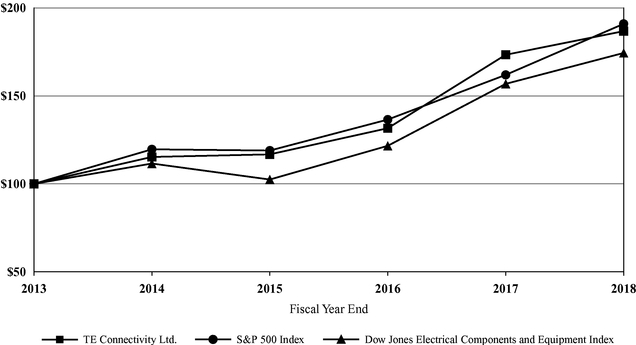
| Fiscal Year End | |||||||||||||||||||
| 2013(1) | 2014 | 2015 | 2016 | 2017 | 2018 | ||||||||||||||
| TE Connectivity Ltd. | $ | 100.00 | $ | 115.30 | $ | 116.76 | $ | 131.63 | $ | 173.37 | $ | 186.80 | |||||||
| S&P 500 Index | 100.00 | 119.64 | 118.93 | 136.54 | 161.95 | 190.95 | |||||||||||||
| Dow Jones Electrical Components and Equipment Index | 100.00 | 111.56 | 102.46 | 121.63 | 156.84 | 174.41 |
(1)
$100 invested on September 27, 2013 in TE Connectivity Ltd.'s common shares and in indexes. Indexes calculated on month-end basis.
**Issuer Purchases of Equity Securities **
The following table presents information about our purchases of our common shares during the quarter ended September 28, 2018:
| Period | Total Number of Shares Purchased(1) | Average Price Paid Per Share(1) | Total Number of Shares Purchased as Part of Publicly Announced Plans or Programs(2) | Maximum Approximate Dollar Value of Shares that May Yet Be Purchased Under the Plans or Programs(2) | |||||||||
| June 30–July 27, 2018 | 1,465 | $ | 93.28 | — | $ | 1,368,819,073 | |||||||
| July 28–August 31, 2018 | 2,217,725 | 92.90 | 2,213,500 | 1,163,190,015 | |||||||||
| September 1–September 28, 2018 | 1,655,395 | 90.63 | 1,635,400 | 1,014,947,770 | |||||||||
| | | | | | | | | | | | | | |
| Total | 3,874,585 | $ | 91.93 | 3,848,900 | |||||||||
| | | | | | | | | | | | | | |
| | | | | | | | | | | | | | |
| | | | | | | | | | | | | | |
(1)
These columns include the following transactions which occurred during the quarter ended September 28, 2018:
(i)
the acquisition of 25,685 common shares from individuals in order to satisfy tax withholding requirements in connection with the vesting of restricted share awards issued under equity compensation plans; and
(ii)
open market purchases totaling 3,848,900 common shares, summarized on a trade-date basis, in conjunction with the share repurchase program announced in September 2007.
(2)
Our share repurchase program authorizes us to purchase a portion of our outstanding common shares from time to time through open market or private transactions, depending on business and market conditions. The share repurchase program does not have an expiration date.
Item 6. SELECTED FINANCIAL DATA
**
The following table presents selected consolidated financial data. The data presented should be read in conjunction with our Consolidated Financial Statements and accompanying notes and "Management's Discussion and Analysis of Financial Condition and Results of Operations" included elsewhere in this Annual Report. Our consolidated financial information may not be indicative of our future performance.
| As of or for Fiscal | ||||||||||||||||
| 2018 | 2017(1) | 2016(1)(2) | 2015(1) | 2014(1) | ||||||||||||
| (in millions, except per share data) | ||||||||||||||||
| Statement of Operations Data | ||||||||||||||||
| Net sales | $ | 13,988 | $ | 12,185 | $ | 11,352 | $ | 11,524 | $ | 11,690 | ||||||
| Acquisition and integration costs | 14 | 6 | 22 | 55 | 31 | |||||||||||
| Restructuring and other charges (credits), net(3) | 126 | 147 | (2 | ) | 152 | 15 | ||||||||||
| Other income (expense), net(4) | 1 | (42 | ) | (677 | ) | (55 | ) | 63 | ||||||||
| Income tax (expense) benefit(4) | 344 | (180 | ) | 826 | (306 | ) | (160 | ) | ||||||||
| Income from continuing operations | 2,584 | 1,540 | 1,847 | 1,180 | 1,634 | |||||||||||
| Income (loss) from discontinued operations, net of income taxes(5) | (19 | ) | 143 | 162 | 1,240 | 147 | ||||||||||
| Net income | $ | 2,565 | $ | 1,683 | $ | 2,009 | $ | 2,420 | $ | 1,781 | ||||||
| Per Share Data | ||||||||||||||||
| Basic earnings per share: | ||||||||||||||||
| Income from continuing operations | $ | 7.38 | $ | 4.34 | $ | 5.05 | $ | 2.91 | $ | 3.99 | ||||||
| Net income | 7.33 | 4.74 | 5.49 | 5.98 | 4.34 | |||||||||||
| Diluted earnings per share: | ||||||||||||||||
| Income from continuing operations | $ | 7.32 | $ | 4.30 | $ | 5.01 | $ | 2.87 | $ | 3.92 | ||||||
| Net income | 7.27 | 4.70 | 5.44 | 5.89 | 4.27 | |||||||||||
| Dividends paid per common share | $ | 1.68 | $ | 1.54 | $ | 1.40 | $ | 1.24 | $ | 1.08 | ||||||
| Balance Sheet Data | ||||||||||||||||
| Total assets | $ | 20,386 | $ | 19,403 | $ | 17,608 | $ | 20,589 | $ | 20,132 | ||||||
| Long-term liabilities | 5,145 | 5,805 | 6,057 | 7,429 | 7,128 | |||||||||||
| Total shareholders' equity | $ | 10,831 | $ | 9,751 | $ | 8,485 | $ | 9,585 | $ | 9,007 |
(1)
In fiscal 2018, our Subsea Communications business met the held for sale and discontinued operations criteria. As a result, we reclassified amounts previously reported to reflect this business as a discontinued operation in all periods presented. For additional information regarding discontinued operations, see Notes 4 and 23 to the Consolidated Financial Statements.
(2)
Fiscal 2016 was a 53-week year.
(3)
Fiscal 2016 included a pre-tax gain of $144 million on the sale of our Circuit Protection Devices business. See Note 3 to the Consolidated Financial Statements for additional information.
(4)
For fiscal 2018, 2017, and 2016, see Notes 15 and 16 to the Consolidated Financial Statements for additional information. Fiscal 2015 income tax (expense) benefit included a $216 million income tax charge associated with the tax impacts of certain intercompany legal entity restructurings made in connection with our integration of Measurement Specialties, Inc; a $201 million income tax benefit related to the effective settlement of all undisputed tax matters for the years 2001 through 2007 and the related impact of $84 million to other expense pursuant to the Tax Sharing Agreement with Tyco International plc and Covidien plc; and a $63 million income tax benefit associated with the effective settlement of all undisputed tax matters for the years 2008 through 2010. Fiscal 2014 income tax (expense) benefit included a $282 million income tax benefit recognized in connection with a reduction in the valuation allowance associated with certain tax loss carryforwards relating to ADC Telecommunications, Inc.
(5)
Fiscal 2015 included a pre-tax gain of $1.1 billion on the sale of our Broadband Network Solutions business.
Item 7. MANAGEMENT'S DISCUSSION AND ANALYSIS OF FINANCIAL CONDITION AND RESULTS OF OPERATIONS
**
The following discussion and analysis of our financial condition and results of operations should be read in conjunction with our Consolidated Financial Statements and the accompanying notes included elsewhere in this Annual Report. The following discussion may contain forward-looking statements that reflect our plans, estimates, and beliefs. Our actual results could differ materially from those discussed in these forward-looking statements. Factors that could cause or contribute to these differences include those factors discussed below and elsewhere in this Annual Report, particularly in "Risk Factors" and "Forward-Looking Information."
Our Consolidated Financial Statements have been prepared in U.S. dollars, in accordance with accounting principles generally accepted in the U.S. ("GAAP").
The following discussion includes organic net sales growth which is a non-GAAP financial measure. See "Non-GAAP Financial Measure" for additional information regarding this measure.
**Overview **
We are a global technology and manufacturing leader creating a safer, sustainable, productive, and connected future. For more than 75 years, our connectivity and sensor solutions, proven in the harshest environments, have enabled advancements in transportation, industrial applications, medical technology, energy, data communications, and the home.
Fiscal 2018 highlights included the following:
Our fiscal 2018 net sales increased 14.8% over fiscal 2017 levels due to growth in all segments. On an organic basis, our net sales increased 9.2% in fiscal 2018 as compared to fiscal 2017.
Our net sales by segment were as follows:
Transportation Solutions—Our net sales increased 17.8% as a result of increased sales in all end markets. Also, our net sales in the automotive end market benefited from sales contributions from a recent acquisition.
Industrial Solutions—Our net sales increased 10.0% due to increased sales in the industrial equipment end market and, to a lesser degree, the aerospace, defense, oil, and gas and the energy end markets.
Communications Solutions—Our net sales increased 12.4% due to sales increases in the appliances and the data and devices end markets.
During fiscal 2018, our shareholders approved a dividend payment to shareholders of $1.76 per share, payable in four equal quarterly installments of $0.44 beginning in the third quarter of fiscal 2018 and ending in the second quarter of fiscal 2019.
Net cash provided by continuing operating activities was $2,301 million in fiscal 2018.
**Outlook **
In the first quarter of fiscal 2019, we expect our net sales to be between $3.33 billion and $3.43 billion as compared to $3.34 billion in the first quarter of fiscal 2018, with sales increases in the Industrial Solutions and Communications Solutions segments. Additional information regarding expectations for our reportable segments for the first quarter of fiscal 2019 as compared to the same period of fiscal 2018 is as follows:
Transportation Solutions—We expect our net sales increase in the sensors end market to be offset by sales declines in the automotive end market. Our net sales in the automotive end market are
expected to benefit from content gains; however, this growth will be more than offset by the negative impact of foreign currency exchange rates. We expect global automotive production to decline approximately 2% in the first quarter of fiscal 2019.
Industrial Solutions—We expect our net sales growth to be driven primarily by increased sales in the aerospace, defense, oil, and gas and the industrial equipment end markets.
Communications Solutions—We expect net sales growth primarily as a result of increased sales in the data and devices end market.
In the first quarter of fiscal 2019, we expect diluted earnings per share from continuing operations to be in the range of $1.09 to $1.13 per share. This outlook reflects the negative impact of foreign currency exchange rates on net sales and earnings per share of approximately $75 million and $0.04 per share, respectively, in the first quarter of fiscal 2019 as compared to the same period of fiscal 2018.
We expect our net sales to be between $13.9 billion and $14.3 billion in fiscal 2019 as compared to $14.0 billion in fiscal 2018, with moderate growth in all segments. Additional information regarding expectations for our reportable segments for fiscal 2019 as compared to fiscal 2018 is as follows:
Transportation Solutions—We expect our net sales increases in the sensors end market to be largely offset by sales declines in the commercial transportation end market. Fiscal 2019 global automotive production is expected to be consistent with fiscal 2018 levels.
Industrial Solutions—We expect our net sales to increase in the industrial equipment end market due primarily to continued growth in medical applications and a recent acquisition.
Communications Solutions—We expect net sales growth due primarily to sales increases in the data and devices end market.
We expect diluted earnings per share from continuing operations to be in the range of $5.20 to $5.40 per share in fiscal 2019. This outlook reflects the negative impact of foreign currency exchange rates on net sales and earnings per share of approximately $400 million and $0.16 per share, respectively, in fiscal 2019 as compared to fiscal 2018.
The above outlook is based on foreign currency exchange rates and commodity prices that are consistent with current levels.
We are monitoring the current macroeconomic environment and its potential effects on our customers and the end markets we serve. We continue to closely manage our costs in line with economic conditions. Additionally, we are managing our capital resources and monitoring capital availability to ensure that we have sufficient resources to fund future capital needs. See further discussion in "Liquidity and Capital Resources."
**Acquisitions **
During fiscal 2018, we acquired two businesses for a combined cash purchase price of $153 million, net of cash acquired. The acquisitions were reported as part of our Industrial Solutions segment from the date of acquisition.
We acquired two businesses during fiscal 2017 for a combined cash purchase price of $250 million, net of cash acquired. The acquisitions were reported as part of our Transportation Solutions and Industrial Solutions segments from the date of acquisition.
In fiscal 2016, we acquired four businesses, including the Creganna Medical group ("Creganna"), for a combined cash purchase price of $1.3 billion, net of cash acquired. The acquisitions were reported as part of our Industrial Solutions and Transportation Solutions segments from the date of acquisition.
See Note 5 to the Consolidated Financial Statements for additional information regarding acquisitions.
**Discontinued Operations **
On September 16, 2018, we entered into a definitive agreement to sell our Subsea Communications ("SubCom") business for $325 million, subject to a final working capital adjustment. The SubCom business met the held for sale and discontinued operations criteria and has been reported as such in all periods presented on the Consolidated Financial Statements. Prior to reclassification to discontinued operations, the SubCom business was included in the Communications Solutions segment.
See Notes 4 and 23 to the Consolidated Financial Statements for additional information regarding discontinued operations.
**Divestiture **
During fiscal 2016, we sold our Circuit Protection Devices ("CPD") business for net cash proceeds of $333 million. We recognized a pre-tax gain of $144 million on the transaction. The CPD business was reported as part of the Data and Devices business within our Communications Solutions segment.
**Results of Operations **
**Net Sales **
The following table presents our net sales and the percentage of total net sales by segment:
| | | |
Showing the first 8K of 89K characters. Open the full section
Item 7A. QUANTITATIVE AND QUALITATIVE DISCLOSURES ABOUT MARKET RISK
**
In the normal course of business, our financial position is routinely subject to a variety of risks, including market risks associated with interest rate and foreign currency movements on outstanding debt and non-U.S. dollar denominated assets and liabilities and commodity price movements. We utilize established risk management policies and procedures in executing derivative financial instrument transactions to manage a portion of these risks.
We do not execute transactions or hold derivative financial instruments for trading or speculative purposes. Substantially all counterparties to derivative financial instruments are limited to major financial institutions with at least an A/A2 credit rating. There is no significant concentration of exposures with any one counterparty.
**Foreign Currency Exposures **
As part of managing the exposure to changes in foreign currency exchange rates, we utilize cross-currency swap contracts and foreign currency forward contracts, a portion of which are designated as cash flow hedges. The objective of these contracts is to minimize impacts to cash flows and profitability due to changes in foreign currency exchange rates on intercompany and other cash transactions. A 10% appreciation or depreciation of the underlying currency in our cross-currency swap contracts or foreign currency forward contracts from the fiscal year end 2018 market rates would have changed the unrealized value of our contracts by $101 million. A 10% appreciation or depreciation of the underlying currency in our cross-currency swap contracts or foreign currency forward contracts from the fiscal year end 2017 market rates would have changed the unrealized value of our contracts by $122 million. Such gains or losses on these contracts would generally be offset by the losses or gains on the revaluation or settlement of the underlying transactions.
**Interest Rate and Investment Exposures **
We issue debt, as needed, to fund our operations and capital requirements. Such borrowings can result in interest rate exposure. To manage the interest rate exposure, we use interest rate swap contracts to convert a portion of fixed-rate debt into variable-rate debt. We may use forward starting interest rate swap contracts to manage interest rate exposure in periods prior to the anticipated issuance of fixed-rate debt. We also utilize investment swap contracts to manage earnings exposure on certain nonqualified deferred compensation liabilities.
Based on our floating rate debt balances at fiscal year end 2018 and 2017, a 50 basis point increase in the levels of the U.S. dollar interest rates, with all other variables held constant, would have resulted in an immaterial increase in interest expense in both fiscal 2018 and 2017.
**Commodity Exposures **
Our worldwide operations and product lines may expose us to risks from fluctuations in commodity prices. To limit the effects of fluctuations in the future market price paid and related volatility in cash flows, we utilize commodity swap contracts designated as cash flow hedges. We continually evaluate the commodity market with respect to our forecasted usage requirements over the next eighteen months and periodically enter into commodity swap contracts to hedge a portion of usage requirements over that period. At fiscal year end 2018, our commodity hedges, which related to expected purchases of gold, silver, and copper, were in a net loss position of $34 million and had a notional value of $401 million. At fiscal year end 2017, our commodity hedges, which related to expected purchases of gold, silver, and copper, were in a net gain position of $20 million and had a notional value of $314 million. A 10% appreciation or depreciation of the price of a troy ounce of gold, a troy ounce of silver, and a pound of copper, from the fiscal year end 2018 prices would have changed the unrealized value of our forward contracts by $37 million. A 10% appreciation or depreciation of the price of a
troy ounce of gold, a troy ounce of silver, and a pound of copper, from the fiscal year end 2017 prices would have changed the unrealized value of our forward contracts by $33 million.
See Note 13 to the Consolidated Financial Statements for additional information regarding financial instruments.
Item 8. FINANCIAL STATEMENTS AND SUPPLEMENTARY DATA
**
The following Consolidated Financial Statements and schedule specified by this Item, together with the reports thereon of Deloitte & Touche LLP, are presented following Item 15 and the signature pages of this report:
Financial Statements:
Reports of Independent Registered Public Accounting Firm
Consolidated Statements of Operations for the Fiscal Years Ended September 28, 2018, September 29, 2017, and September 30, 2016
Consolidated Statements of Comprehensive Income for the Fiscal Years Ended September 28, 2018, September 29, 2017, and September 30, 2016
Consolidated Balance Sheets as of September 28, 2018 and September 29, 2017
Consolidated Statements of Shareholders' Equity for the Fiscal Years Ended September 28, 2018, September 29, 2017, and September 30, 2016
Consolidated Statements of Cash Flows for the Fiscal Years Ended September 28, 2018, September 29, 2017, and September 30, 2016
Notes to Consolidated Financial Statements
Financial Statement Schedule:
Schedule II—Valuation and Qualifying Accounts
All other financial statements and schedules have been omitted since the information required to be submitted has been included on the Consolidated Financial Statements and related notes or because they are either not applicable or not required under the rules of Regulation S-X.
Item 9A. CONTROLS AND PROCEDURES
**
**Evaluation of Disclosure Controls and Procedures **
Our management, with the participation of our Chief Executive Officer and Chief Financial Officer, evaluated the effectiveness of our disclosure controls and procedures (as defined in Rule 13a-15(e) under the Exchange Act) as of September 28, 2018. Based on that evaluation, our Chief Executive Officer and Chief Financial Officer concluded that our disclosure controls and procedures were effective as of September 28, 2018.
**Management's Report on Internal Control Over Financial Reporting **
Our management is responsible for establishing and maintaining adequate internal control over financial reporting (as defined in Rule 13a-15(f) under the Exchange Act). Management, with the participation of our Chief Executive Officer and Chief Financial Officer, evaluated the effectiveness of our internal control over financial reporting based on the framework in Internal Control—Integrated Framework (2013) issued by the Committee of Sponsoring Organizations of the Treadway Commission. Based on this evaluation, management concluded our internal control over financial reporting was effective as of September 28, 2018.
Because of its inherent limitations, internal control over financial reporting may not prevent or detect misstatements. Also, projections of any evaluation of effectiveness to future periods are subject to the risk that controls may become inadequate because of changes in conditions, or that the degree of compliance with policies and procedures may deteriorate.
Deloitte & Touche LLP, an independent registered public accounting firm, has issued an attestation report on our internal control over financial reporting as of September 28, 2018, which is included in this Annual Report.
**Changes in Internal Control Over Financial Reporting **
During the quarter ended September 28, 2018, there were no changes in our internal control over financial reporting that have materially affected, or are reasonably likely to materially affect, our internal control over financial reporting.
**PART III **
Item 10. DIRECTORS, EXECUTIVE OFFICERS AND CORPORATE GOVERNANCE
**
Information concerning directors, executive officers, and corporate governance may be found under the captions "Agenda Item No. 1—Election of Directors," "Nominees for Election," "Corporate Governance," "The Board of Directors and Board Committees," and "Executive Officers" in our definitive proxy statement for our 2019 Annual General Meeting of Shareholders (the "2019 Proxy Statement"), which will be filed with the SEC within 120 days after the close of our fiscal year. Such information is incorporated herein by reference. The information in the 2019 Proxy Statement under the caption "Section 16(a) Beneficial Ownership Reporting Compliance" is incorporated herein by reference.
**Code of Ethics **
We have adopted a guide to ethical conduct, which applies to all employees, officers, and directors. Our Guide to Ethical Conduct meets the requirements of a "code of ethics" as defined by Item 406 of Regulation S-K and applies to our Chief Executive Officer, Chief Financial Officer, and Chief Accounting Officer, as well as all other employees and directors. Our Guide to Ethical Conduct also meets the requirements of a code of business conduct and ethics under the listing standards of the NYSE. Our Guide to Ethical Conduct is posted on our website at www.te.com under the heading "Corporate Responsibility—Governance and Environment—Guide to Ethical Conduct." We also will provide a copy of our Guide to Ethical Conduct to shareholders upon request. We intend to disclose any amendments to our Guide to Ethical Conduct, as well as any waivers for executive officers or directors, on our website.
Item 11. EXECUTIVE COMPENSATION
**
Information concerning executive compensation may be found under the captions "Compensation Discussion and Analysis," "Management Development and Compensation Committee Report," "Compensation Committee Interlocks and Insider Participation," "Executive Officer Compensation," and "Compensation of Non-Employee Directors" in our 2019 Proxy Statement. Such information is incorporated herein by reference.
Item 12. SECURITY OWNERSHIP OF CERTAIN BENEFICIAL OWNERS AND MANAGEMENT AND RELATED STOCKHOLDER MATTERS
**
The information in our 2019 Proxy Statement under the caption "Security Ownership of Certain Beneficial Owners and Management" is incorporated herein by reference.
**Equity Compensation Plan Information **
The following table provides information as of fiscal year end 2018 with respect to common shares issuable under our equity compensation plans:
| Plan Category | Number of securities to be issued upon exercise of outstanding options, warrants and rights (a) | Weighted-average exercise price of outstanding options, warrants and rights (b)(3) | Number of securities remaining available for future issuance under equity compensation plans (excluding securities reflected in column (a)) (c)(4) | |||||||
| Equity compensation plans approved by security holders: | ||||||||||
| 2007 Stock and Incentive Plan, amended and restated as of March 8, 2017(1) | 7,705,831 | $ | 65.20 | 19,087,257 | ||||||
| Equity compensation plans not approved by security holders: | ||||||||||
| Equity awards under the 2010 Stock and Incentive Plan, amended and restated as of March 9, 2017(2) | 1,374,677 | 70.67 | 1,375,652 | |||||||
| | | | | | | | | | | |
| Total | 9,080,508 | 20,462,909 | ||||||||
| | | | | | | | | | | |
| | | | | | | | | | | |
| | | | | | | | | | | |
(1)
The TE Connectivity Ltd. 2007 Stock and Incentive Plan, amended and restated as of March 8, 2017 (the "2017 Plan"), provides for the award of annual performance bonuses and long-term performance awards, including share options; restricted, performance, and deferred share units; and other share-based awards (collectively, "Awards") to board members, officers, and non-officer employees. The 2017 Plan provides for a maximum of 69,843,452 common shares to be issued as Awards, subject to adjustment as provided under the terms of the 2017 Plan.
(2)
In connection with the acquisition of ADC Telecommunications, Inc. ("ADC") in fiscal 2011, we assumed equity awards issued under plans sponsored by ADC and the remaining pool of shares available for grant under the plans. Subsequent to the acquisition, we registered 6,764,455 shares related to the plans via Forms S-3 and S-8 and renamed the primary ADC plan the TE Connectivity Ltd. 2010 Stock and Incentive Plan, amended and restated as of March 9, 2017 (the "2010 Plan"). Grants under the 2010 Plan are settled in TE Connectivity common shares.
(3)
Does not take into account restricted, performance, or deferred share unit awards that do not have exercise prices.
(4)
The 2017 Plan and the 2010 Plan apply weightings of 1.80 and 1.21, respectively, to outstanding nonvested restricted, performance, and deferred share units. The remaining shares issuable under both the 2017 Plan and the 2010 Plan are increased by forfeitures and cancellations, among other factors.
Item 13. CERTAIN RELATIONSHIPS AND RELATED TRANSACTIONS, AND DIRECTOR INDEPENDENCE
**
The information in our 2019 Proxy Statement under the captions "Corporate Governance," "The Board of Directors and Board Committees," and "Certain Relationships and Related Transactions" is incorporated herein by reference.
Item 14. PRINCIPAL ACCOUNTANT FEES AND SERVICES
**
The information in our 2019 Proxy Statement under the caption "Agenda Item No. 7—Election of Auditors—Agenda Item No. 7.1" is incorporated herein by reference.
**PART IV **
Item 15. EXHIBITS AND FINANCIAL STATEMENT SCHEDULES
**
(a)
-
Financial Statements. See Item 8.
Financial Statement Schedule. See Item 8.
Exhibit Index:
| Incorporated by Reference Herein | ||||||||||||
| Exhibit Number | ||||||||||||
| Description | Form | Exhibit | Filing Date | |||||||||
| 10.2 | Five-Year Senior Credit Agreement among Tyco Electronics Group S.A., as borrower, TE Connectivity Ltd., as guarantor, the lenders parties thereto and Deutsche Bank AG New York Branch, as administrative agent, dated as of June 24, 2011 | Current Report on Form 8-K | 10.1 | June 27, 2011 | ||||||||
| 10.3 | [First Amendment to the Five-Year Senior Credit Agreement dated as of August 2, 2013 among Tyco Electronics Group S.A., as borrower, TE Connectivity Ltd., as guarantor, the lenders parties thereto and Deutsche Bank AG New York Branch, as administrative agent](http://www.sec.gov/Archives/edgar/data/1385157/0001104659130594 |
Showing the first 8K of 249K characters. Open the full section