 filings.tools
Truist Financial 10-K 2021-12-31
Filed 2022-02-23. 20 sections, 974K characters. Original on sec.gov · Markdown · JSON
Cover and table of contents
UNITED STATES
SECURITIES AND EXCHANGE COMMISSION
Washington, D.C. 20549
_________________________________________________________________
FORM 10-K
_________________________________________________________________
☒ ANNUAL REPORT PURSUANT TO SECTION 13 OR 15(d)
OF THE SECURITIES EXCHANGE ACT OF 1934
For the fiscal year ended December 31, 2021
Commission File Number: 1-10853
TRUIST FINANCIAL CORPORATION
(Exact name of registrant as specified in its charter)
_________________________________________________________________
| North Carolina | 56-0939887 | ||||||||||
| (State or other jurisdiction of incorporation or organization) | (I.R.S. Employer Identification No.) | ||||||||||
| 214 North Tryon Street | |||||||||||
| Charlotte, | North Carolina | 28202 | |||||||||
| (Address of principal executive offices) | (Zip Code) | ||||||||||
| Registrant's telephone number, including area code: | (336) | 733-2000 | |||||||||
_________________________________________________________________
Securities registered pursuant to Section 12(b) of the Act:
| Title of each class | Trading Symbol | Name of each exchange on which registered | ||||||||||||
| Common Stock, $5 par value | TFC | New York Stock Exchange | ||||||||||||
| Depositary Shares each representing 1/4,000th interest in a share of Series I Perpetual Preferred Stock | TFC.PI | New York Stock Exchange | ||||||||||||
| 5.853% Fixed-to-Floating Rate Normal Preferred Purchase Securities each representing 1/100th interest in a share of Series J Perpetual Preferred Stock | TFC.PJ | New York Stock Exchange | ||||||||||||
| Depositary Shares each representing 1/1,000th interest in a share of Series O Non-Cumulative Perpetual Preferred Stock | TFC.PO | New York Stock Exchange | ||||||||||||
| Depositary Shares each representing 1/1,000th interest in a share of Series R Non-Cumulative Perpetual Preferred Stock | TFC.PR | New York Stock Exchange |
Securities registered pursuant to Section 12(g) of the Act: None
Indicate by check mark if the registrant is a well-known seasoned issuer, as defined in Rule 405 of the Securities Act. Yes ☐ No ☒
Indicate by check mark if the registrant is not required to file reports pursuant to Section 13 or Section 15(d) of the Act. Yes ☐ No ☒
Indicate by check mark whether the registrant (1) has filed all reports required to be filed by Section 13 or 15(d) of the Securities Exchange Act of 1934 during the preceding 12 months (or for such shorter period that the registrant was required to file such reports), and (2) has been subject to such filing requirements for the past 90 days. Yes ☒ No ☐
Indicate by check mark whether the registrant has submitted electronically every Interactive Data File required to be submitted pursuant to Rule 405 of Regulation S-T (§232.405 of this chapter) during the preceding 12 months (or for such shorter period that the registrant was required to submit such files). Yes ☒ No ☐
Indicate by check mark whether the Registrant is a large accelerated filer, an accelerated filer, a non-accelerated filer, smaller reporting company, or an emerging growth company. See the definitions of "large accelerated filer," "accelerated filer," "smaller reporting company" and "emerging growth company" in Rule 12b-2 of the Exchange Act.
| Large accelerated filer | ☒ | Accelerated filer | ☐ | |||||||||||
| Non-accelerated filer | ☐ | Smaller reporting company | ☐ | |||||||||||
| Emerging growth company | ☐ |
If an emerging growth company, indicate by check mark if the registrant has elected not to use the extended transition period for complying with any new or revised financial accounting standards provided pursuant to Section 13(a) of the Exchange Act. ☐
Indicate by check mark whether the registrant has filed a report on and attestation to its management’s assessment of the effectiveness of its internal control over financial reporting under Section 404(b) of the Sarbanes-Oxley Act (15 U.S.C. 7262(b)) by the registered public accounting firm that prepared or issued its audit report. ☒
Indicate by check mark whether the registrant is a shell company (as defined in Rule 12b-2 of the Act). Yes ☐ No ☒
At January 31, 2022, the Company had 1,328,120,453 shares of its common stock, $5 par value, outstanding. As of June 30, 2021, the aggregate market value of voting stock held by nonaffiliates of the Company was approximately $73.9 billion. Documents incorporated by reference: Portions of the definitive proxy statement relating to the registrant's 2022 annual meeting of stockholders are incorporated by reference in this Form 10-K in response to Items 10, 11, 12, 13 and 14 of Part III.
| TABLE OF CONTENTS | ||||||||||||||
| TRUIST FINANCIAL CORPORATION | ||||||||||||||
| FORM 10-K | ||||||||||||||
| December 31, 2021 | ||||||||||||||
| Page No. | ||||||||||||||
| PART I | ||||||||||||||
| Glossary of Defined Terms | 1 | |||||||||||||
| Forward-Looking Statements | 3 | |||||||||||||
| Item 1 | Business | 4 | ||||||||||||
| Item 1A | Risk Factors | 19 |
Item 1B. Unresolved Staff Comments (None to be reported)
Item 4. Mine Safety Disclosures (Not applicable)
| PART II | | | | | | | | | | | | | | | | Item 5 | | | | | | Market for Registrant's Common Equity, Related Stockholder Matters and Issuer Purchases of Equity Securities | | | 36 | | | | | | | Item 7 | | | | | | Management's Discussion and Analysis of Financial Condition and Results of Operations | | | 39 | | | | | | | Item 7A | | | | | | Quantitative and Qualitative Disclosures About Market Risk (see Market Risk Management) | | | 64 | | | | | | Item 8. Financial Statements and Supplementary Data | | | | | | | Report of Independent Registered Public Accounting Firm (PCAOB ID : 238) | | | 80 | | | | | | | | | | | | | Consolidated Balance Sheets | | | 82 | | | | | | | | | | | | | Consolidated Statements of Income | | | 83 | | | | | | | | | | | | | Consolidated Statements of Comprehensive Income | | | 84 | | | | | | | | | | | | | Consolidated Statements of Changes in Shareholders' Equity | | | 85 | | | | | | | | | | | | | Consolidated Statements of Cash Flows | | | 86 | | | | | | | | | | | | | Notes to Consolidated Financial Statements | | | | | | | | | | | | | | | | Note 1. Basis of Presentation | | | 87 | | | | | | | | | | | | | Note 2. Business Combinations | | | 100 | | | | | | | | | | | | | Note 3. Securities Financing Activities | | | 101 | | | | | | | | | | | | | Note 4. Investment Securities | | | 101 | | | | | | | | | | | | | Note 5. Loans and ACL | | | 103 | | | | | | | | | | | | | Note 6. Premises and Equipment | | | 109 | | | | | | | | | | | | | Note 7. Goodwill and Other Intangible Assets | | | 109 | | | | | | | | | | | | | Note 8. Loan Servicing | | | 110 | | | | | | | | | | | | | Note 9. Other Assets and Liabilities | | | 111 | | | | | | | | | | | | | Note 10. Deposits | | | 112 | | | | | | | | | | | | | Note 11. Borrowings | | | 112 | | | | | | | | | | | | | Note 12. Shareholders’ Equity | | | 113 | | | | | | | | | | | | | Note 13. AOCI | | | 115 | | | | | | | | | | | | | Note 14. Income Taxes | | | 116 | | | | | | | | | | | | | Note 15. Benefit Plans | | | 118 | | | | | | | | | | | | | Note 16. Commitments and Contingencies | | | 121 | | | | | | | | | | | | | Note 17. Regulatory Requirements and Other Restrictions | | | 125 | | | | | | | | | | | | | Note 18. Fair Value Disclosures | | | 126 | | | | | | | | | | | | | Note 19. Derivative Financial Instruments | | | 131 | | | | | | | | | | | | | Note 20. Computation of EPS | | | 135 | | | | | | | | | | | | | Note 21. Operating Segments | | | 136 | | | | | | | | | | | | | Note 22. Parent Company Financial Information | | | 139 | | | | | | | | | | | | | | | | | | | | | |
Item 9. Changes in and Disagreements with Accountants on Accounting and Financial Disclosure (None to be reported)
| Item 9A | | | | | | Controls and Procedures | | | 141 | | | | | |
Item 9B. Other Information (None to be reported)
Item 9C. Disclosure Regarding Foreign Jurisdictions that Prevent Inspections (Not applicable)
| PART III | | | | | | | | | | | | | | |
Item 10. Directors, Executive Officers and Corporate Governance
Item 11. Executive Compensation
Item 12. Security Ownership of Certain Beneficial Owners and Management and Related Stockholder Matters
Item 13. Certain Relationships and Related Transactions, and Director Independence
Item 14. Principal Accounting Fees and Services
| PART IV | | | | | | | | | | | | | | | Item 15. Exhibits, Financial Statement Schedules | | | | | | | Financial Statements (see Listing in Item 8 above) | | | | | | | | | | | | | | | | Exhibits | | | 142 | | | | | | | | | | | | | Financial Statement Schedules (None required) | | | | | | | | |
Item 16. Form 10-K Summary (None)
| | | | | | | | | | | | | | | |
| * | For information regarding executive officers, refer to "Executive Officers" in Part I. The other information required by Item 10 is incorporated herein by reference to the information that appears under the headings "Nominees for Election as Directors for a One-Year Term Expiring in 2023," "Nominating and Governance Committee Director Nominations," "Ethics at Truist," "Corporate Governance Guidelines," "Audit Committee Report" and "Audit Committee" in the Registrant's Proxy Statement for the 2022 Annual Meeting of Shareholders. The information required by Item 11 is incorporated herein by reference to the information that appears under the headings "Compensation Discussion and Analysis," "Compensation of Executive Officers," "Compensation and Human Capital Committee Report on Executive Compensation," "Compensation and Human Capital Committee Interlocks and Insider Participation" and "Compensation of Directors" in the Registrant's Proxy Statement for the 2022 Annual Meeting of Shareholders. For information regarding the registrant's securities authorized for issuance under equity compensation plans, refer to "Equity Compensation Plan Information" in Part II herein. The other information required by Item 12 is incorporated herein by reference to the information that appears under the heading "Stock Ownership Information" in the Registrant's Proxy Statement for the 2022 Annual Meeting of Shareholders. The information required by Item 13 is incorporated herein by reference to the information that appears under the headings "Director Independence" and "Related Person Transactions" in the Registrant's Proxy Statement for the 2022 Annual Meeting of Shareholders. The information required by Item 14 is incorporated herein by reference to the information that appears under the headings "Fees to Independent Registered Public Accounting Firm" and "Audit Committee Pre-Approval Policy" in the Registrant's Proxy Statement for the 2022 Annual Meeting of Shareholders. | |||||||||||||
Glossary of Defined Terms
The following terms may be used throughout this report, including the consolidated financial statements and related notes.
| Term | Definition | ||||
| ACL | Allowance for credit losses | ||||
| AFS | Available-for-sale | ||||
| Agency MBS | Mortgage-backed securities issued by a U.S. government agency or GSE | ||||
| ALLL | Allowance for loan and lease losses | ||||
| ALM | Asset/Liability management | ||||
| ARRC | Alternative Reference Rates Committee of the FRB and the Federal Reserve Bank of New York | ||||
| AOCI | Accumulated other comprehensive income (loss) | ||||
| Basel III Rules | Rules issued by the FRB, OCC, and FDIC on capital adequacy and liquidity requirements in the U.S for banking organizations. | ||||
| BB&T | BB&T Corporation and subsidiaries (changed to “Truist Financial Corporation” effective with the Merger) | ||||
| BCBS | Basel Committee on Banking Supervision | ||||
| BHC | Bank holding company | ||||
| BHCA | Bank Holding Company Act of 1956, as amended | ||||
| BSA/AML | Bank Secrecy Act/Anti-Money Laundering | ||||
| Board | Truist’s Board of Directors | ||||
| C&CB | Corporate and Commercial Banking, an operating segment | ||||
| CARES Act | The Coronavirus Aid, Relief, and Economic Security Act | ||||
| CB&W | Consumer Banking and Wealth, an operating segment | ||||
| CCAR | Comprehensive Capital Analysis and Review | ||||
| CD | Certificate of deposit | ||||
| CDI | Core deposit intangible | ||||
| CECL | Current expected credit loss model | ||||
| CEO | Chief Executive Officer | ||||
| CFTC | Commodity Futures Trading Commission | ||||
| CFO | Chief Financial Officer | ||||
| CET1 | Common equity tier 1 | ||||
| CIB | Corporate and Investment Banking | ||||
| CFPB | Consumer Financial Protection Bureau | ||||
| CMO | Collateralized mortgage obligation | ||||
| Company | Truist Financial Corporation and its subsidiaries (interchangeable with “Truist” below), formerly BB&T Corporation | ||||
| COVID-19 | Coronavirus disease 2019 | ||||
| CRA | Community Reinvestment Act of 1977 | ||||
| CRE | Commercial real estate | ||||
| CRO | Chief Risk Officer | ||||
| CVA | Credit valuation adjustment | ||||
| DC | Disclosure Committee | ||||
| DEI | Diversity, Equity & Inclusion | ||||
| DIF | Deposit Insurance Fund administered by the FDIC | ||||
| Dodd-Frank Act | Dodd-Frank Wall Street Reform and Consumer Protection Act | ||||
| DTA | Deferred tax asset | ||||
| DTL | Deferred tax liability | ||||
| EBPCC | Ethics, Business Practices, and Conduct Committee | ||||
| ECRC | Enterprise Credit Risk Committee | ||||
| EGRRCPA | Economic Growth, Regulatory Relief, and Consumer Protection Act | ||||
| ERC | Enterprise Risk Committee | ||||
| ERISA | Employee Retirement Income Security Act of 1974 | ||||
| EPS | Earnings per common share | ||||
| ESG | Environmental, Social, and Governance | ||||
| ETF | Exchange traded fund | ||||
| EVE | Economic value of equity | ||||
| Exchange Act | Securities Exchange Act of 1934, as amended | ||||
| FASB | Financial Accounting Standards Board | ||||
| FDIC | Federal Deposit Insurance Corporation | ||||
| FHA | Federal Housing Administration | ||||
| FHC | Financial holding company | ||||
| FHLB | Federal Home Loan Bank | ||||
| FHLMC | Federal Home Loan Mortgage Corporation | ||||
| FINRA | Financial Industry Regulatory Authority | ||||
| FNMA | Federal National Mortgage Association | ||||
| FRB | Board of Governors of the Federal Reserve System | ||||
| FTE | Full-time equivalent employee | ||||
| GAAP | Accounting principles generally accepted in the United States of America | ||||
| GDP | Gross Domestic Product | ||||
| GLBA | Gramm-Leach-Bliley Act | ||||
| GNMA | Government National Mortgage Association | ||||
| Grandbridge | Grandbridge Real Estate Capital, LLC | ||||
| GSE | U.S. government-sponsored enterprise | ||||
| HFI | Held for investment |
Truist Financial Corporation 1
| Term | Definition | ||||
| HMDA | Home Mortgage Disclosure Act | ||||
| HQLA | High-quality liquid assets | ||||
| HTM | Held-to-maturity | ||||
| IDI | Insured depository institution | ||||
| IH | Insurance Holdings, an operating segment | ||||
| IPV | Independent price verification | ||||
| IRC | Internal Revenue Code | ||||
| IRS | Internal Revenue Service | ||||
| ISDA | International Swaps and Derivatives Association, Inc. | ||||
| LCR | Liquidity Coverage Ratio | ||||
| LHFS | Loans held for sale | ||||
| LIBOR | London Interbank Offered Rate | ||||
| LOCOM | Lower of cost or market | ||||
| Market Risk Rule | Market risk capital requirements issued jointly by the OCC, U.S. Treasury, FRB, and FDIC | ||||
| MBS | Mortgage-backed securities | ||||
| MD&A | Management’s Discussion and Analysis of Financial Condition and Results of Operations | ||||
| Merger | Merger of BB&T and SunTrust effective December 6, 2019 | ||||
| MRLCC | Market Risk, Liquidity and Capital Committee | ||||
| MRM | Model Risk Management | ||||
| MSR | Mortgage servicing right | ||||
| MSRB | Municipal Securities Rulemaking Board | ||||
| NA | Not applicable | ||||
| NCCOB | North Carolina Office of the Commissioner of Banks | ||||
| NFA | National Futures Association | ||||
| NIM | Net interest margin, computed on a TE basis | ||||
| NM | Not meaningful | ||||
| NPA | Nonperforming asset | ||||
| NPL | Nonperforming loan | ||||
| NSFR | Net stable funding ratio | ||||
| NYSE | New York Stock Exchange | ||||
| OAS | Option adjusted spread | ||||
| OCC | Office of the Comptroller of the Currency | ||||
| OCI | Other comprehensive income (loss) | ||||
| OFAC | U.S. Department of the Treasury’s Office of Foreign Assets Control | ||||
| OPEB | Other post-employment benefit | ||||
| OREO | Other real estate owned | ||||
| OT&C | Other, Treasury and Corporate | ||||
| OTC | Over-the-counter | ||||
| OTTI | Other than temporary impairment | ||||
| Parent Company | Truist Financial Corporation, the parent company of Truist Bank and other subsidiaries | ||||
| Patriot Act | Uniting and Strengthening America by Providing Appropriate Tools Required to Intercept and Obstruct Terrorism Act of 2001 | ||||
| PCD | Purchased credit deteriorated loans | ||||
| PCI | Purchased credit impaired loans | ||||
| PPP | Paycheck Protection Program, established by the CARES Act | ||||
| PSU | Performance share units | ||||
| Re-REMICs | Re-securitizations of Real Estate Mortgage Investment Conduits | ||||
| RMO | Risk Management Organization | ||||
| ROU assets | Right-of-use assets | ||||
| RSA | Restricted stock award | ||||
| RSU | Restricted stock unit | ||||
| RUFC | Reserve for unfunded lending commitments | ||||
| S&P | Standard & Poor’s | ||||
| SBIC | Small Business Investment Company | ||||
| SCB | Stress Capital Buffer | ||||
| SEC | Securities and Exchange Commission | ||||
| SOFR | Secured Overnight Financing Rate | ||||
| SunTrust | SunTrust Banks, Inc. | ||||
| Tailoring Rules | The final rules changing the applicability thresholds for regulatory capital and liquidity requirements, issued by the OCC, FRB, and FDIC, together with the final rules changing the applicability thresholds for enhanced prudential standards issued by the FRB | ||||
| TDR | Troubled debt restructuring | ||||
| TE | Taxable-equivalent | ||||
| TMC | Technology Management Committee | ||||
| TRS | Total Return Swap | ||||
| Truist | Truist Financial Corporation and its subsidiaries (interchangeable with the “Company” above), formerly BB&T Corporation | ||||
| Truist Bank | Truist Bank, formerly Branch Banking and Trust Company | ||||
| U.S. | United States of America | ||||
| U.S. Treasury | United States Department of the Treasury | ||||
| UPB | Unpaid principal balance | ||||
| UTB | Unrecognized tax benefit | ||||
| VaR | Value-at-risk | ||||
| VIE | Variable interest entity |
2 Truist Financial Corporation
Forward-Looking Statements
This Annual Report on Form 10-K contains “forward-looking statements” within the meaning of the Private Securities Litigation Reform Act of 1995, regarding the financial condition, results of operations, business plans and the future performance of Truist. Words such as “anticipates,” “believes,” “estimates,” “expects,” “forecasts,” “intends,” “plans,” “projects,” “may,” “will,” “should,” “would,” “could,” and other similar expressions are intended to identify these forward-looking statements.
Forward-looking statements are not based on historical facts but instead represent management’s expectations and assumptions regarding Truist’s business, the economy, and other future conditions. Such statements involve inherent uncertainties, risks, and changes in circumstances that are difficult to predict. As such, Truist’s actual results may differ materially from those contemplated by forward-looking statements. While there can be no assurance that any list of risks and uncertainties or risk factors is complete, important factors that could cause actual results to differ materially from those contemplated by forward-looking statements include the following, without limitation, as well as the risks and uncertainties more fully discussed in Item 1A-Risk Factors:
-
risks and uncertainties relating to the Merger of heritage BB&T and heritage SunTrust, including the ability to successfully integrate the companies or to realize the anticipated benefits of the Merger;
-
expenses relating to the Merger and integration of heritage BB&T and heritage SunTrust;
-
deposit attrition, client loss or revenue loss following completed mergers or acquisitions may be greater than anticipated;
-
the COVID-19 pandemic disrupted the global economy and adversely impacted Truist’s financial condition and results of operations, including through increased expenses, reduced fee income and net interest margin, decreased demand for certain types of loans, and increases in the allowance for credit losses; a resurgence of the pandemic, whether due to new variants of the coronavirus or other factors, could reintroduce or prolong these negative impacts and also adversely affect Truist’s capital and liquidity position or cost of capital, impair the ability of borrowers to repay outstanding loans, cause an outflow of deposits, and impair goodwill or other assets;
-
Truist is subject to credit risk by lending or committing to lend money, and may have more credit risk and higher credit losses to the extent that loans are concentrated by loan type, industry segment, borrower type or location of the borrower or collateral;
-
changes in the interest rate environment, including the replacement of LIBOR as an interest rate benchmark, which could adversely affect Truist’s revenue and expenses, the value of assets and obligations, and the availability and cost of capital, cash flows, and liquidity;
-
inability to access short-term funding or liquidity, loss of client deposits or changes in Truist’s credit ratings, which could increase the cost of funding or limit access to capital markets;
-
risk management oversight functions may not identify or address risks adequately, and management may not be able to effectively manage credit risk;
-
risks resulting from the extensive use of models in Truist’s business, which may impact decisions made by management and regulators;
-
failure to execute on strategic or operational plans, including the ability to successfully complete or integrate mergers and acquisitions;
-
increased competition, including from (i) new or existing competitors that could have greater financial resources or be subject to different regulatory standards, and (ii) products and services offered by non-bank financial technology companies, may reduce Truist’s client base, cause Truist to lower prices for its products and services in order to maintain market share or otherwise adversely impact Truist’s businesses or results of operations;
-
failure to maintain or enhance Truist’s competitive position with respect to new products, services and technology, whether it fails to anticipate client expectations or because its technological developments fail to perform as desired or do not achieve market acceptance or regulatory approval or for other reasons, may cause Truist to lose market share or incur additional expense;
-
negative public opinion, which could damage Truist’s reputation;
-
increased scrutiny regarding Truist’s consumer sales practices, training practices, incentive compensation design, and governance;
-
regulatory matters, litigation or other legal actions, which may result in, among other things, costs, fines, penalties, restrictions on Truist’s business activities, reputational harm, negative publicity, or other adverse consequences;
-
evolving legislative, accounting and regulatory standards, including with respect to capital and liquidity requirements, and results of regulatory examinations may adversely affect Truist’s financial condition and results of operations;
-
the monetary and fiscal policies of the federal government and its agencies could have a material adverse effect on profitability;
-
accounting policies and processes require management to make estimates about matters that are uncertain, including the potential write down to goodwill if there is an elongated period of decline in market value for Truist’s stock and adverse economic conditions are sustained over a period of time;
-
general economic or business conditions, either globally, nationally or regionally, may be less favorable than expected, and instability in global geopolitical matters or volatility in financial markets could result in, among other things, slower deposit or asset growth, a deterioration in credit quality, or a reduced demand for credit, insurance, or other services;
-
risks related to originating and selling mortgages, including repurchase and indemnity demands from purchasers related to representations and warranties on loans sold, which could result in an increase in the amount of losses for loan repurchases;
-
risks relating to Truist’s role as a loan servicer, including an increase in the scope or costs of the services Truist is required to perform, without any corresponding increase in servicing fees or a breach of Truist’s obligations as servicer;
-
Truist’s success depends on hiring and retaining key teammates, and if these individuals leave or change roles without effective replacements, Truist’s operations and integration activities could be adversely impacted, which could be exacerbated in the increased work-from-home environment caused by the COVID-19 pandemic as job markets may be less constrained by physical geography;
-
fraud or misconduct by internal or external parties, which Truist may not be able to prevent, detect, or mitigate;
-
security risks, including denial of service attacks, hacking, social engineering attacks targeting Truist’s teammates and clients, malware intrusion, data corruption attempts, system breaches, cyber-attacks, identity theft, ransomware attacks, and physical security risks, such as natural disasters, environmental conditions, and intentional acts of destruction, could result in the disclosure of confidential information, adversely affect Truist’s business or reputation or create significant legal or financial exposure; and
-
widespread outages of operational, communication, or other systems, whether internal or provided by third parties, natural or other disasters (including acts of terrorism and pandemics), and the effects of climate change, including physical risks, such as more frequent and intense weather events, and risks related to the transition to a lower carbon economy, such as regulatory or technological changes or shifts in market dynamics or consumer preferences, could have an adverse effect on Truist’s financial condition and results of operations, lead to material disruption of Truist’s operations or the ability or willingness of clients to access Truist’s products and services.
Readers are cautioned not to place undue reliance on these forward-looking statements, which speak only as of the date they are made. Except to the extent required by applicable law or regulation, Truist undertakes no obligation to revise or update any forward-looking statements.
Truist Financial Corporation 3
Item 1. BUSINESS
Truist Financial Corporation is a purpose-driven financial services company committed to inspiring and building better lives and communities. Formed by the historic merger of equals of BB&T and SunTrust, Truist has leading market share in many high-growth markets in the country. The Company offers a wide range of services. Headquartered in Charlotte, North Carolina, Truist is a top 10 U.S. commercial bank.
Truist Bank, Truist’s largest subsidiary, was chartered in 1872 and is the oldest bank headquartered in North Carolina. Truist Bank provides a wide range of banking and trust services for clients through 2,517 offices as of December 31, 2021 and its digital platform.
Services
Truist’s subsidiaries offer commercial and consumer clients a full array of products and services to meet their financial needs. The following table reflects examples of services provided by Truist:
| Table 1: Services | |||||||||||
| Consumer Services: | Commercial Services: | ||||||||||
| Asset management | Asset based lending | ||||||||||
| Automobile lending | Asset management | ||||||||||
| Credit card lending | Commercial deposit and treasury services | ||||||||||
| Consumer finance | Commercial finance | ||||||||||
| Home equity lending | Commercial lending | ||||||||||
| Home mortgage lending | Floor plan lending | ||||||||||
| Insurance | Debt and equity derivative services | ||||||||||
| Investment brokerage services | Institutional trust services | ||||||||||
| Mobile/online banking | Insurance | ||||||||||
| Payment solutions | Insurance premium finance | ||||||||||
| Point-of-sale lending | International banking | ||||||||||
| Retail deposit products | Investment banking and capital markets services | ||||||||||
| Small business lending | Leasing | ||||||||||
| Student lending | Merchant services | ||||||||||
| Wealth management/private banking | Mortgage warehouse lending | ||||||||||
| Payment solutions | |||||||||||
| Real estate lending | |||||||||||
| Supply chain financing |
Market Area
The following table reflects Truist’s deposit market share and branch locations by state:
| Table 2: Deposit Market Share and Branch Locations by State | ||||||||||||||||||||
| % of Truist’s Deposits (2) | Deposit Market Share Rank (2) | Number of Branches (3) | ||||||||||||||||||
| Florida | 22 | % | 3rd | 572 | ||||||||||||||||
| Georgia | 19 | 1st | 288 | |||||||||||||||||
| Virginia | 15 | 2nd | 365 | |||||||||||||||||
| North Carolina (1) | 14 | 1st | 348 | |||||||||||||||||
| Maryland | 6 | 3rd | 208 | |||||||||||||||||
| Tennessee | 5 | 5th | 130 | |||||||||||||||||
| Pennsylvania | 5 | 9th | 157 | |||||||||||||||||
| South Carolina | 4 | 3rd | 112 | |||||||||||||||||
| Texas | 2 | 18th | 102 | |||||||||||||||||
| West Virginia | 2 | 1st | 48 | |||||||||||||||||
| Kentucky | 2 | 4th | 62 | |||||||||||||||||
| Washington, D.C. | 2 | 5th | 27 | |||||||||||||||||
| Alabama | 1 | 6th | 67 | |||||||||||||||||
| New Jersey | 1 | 19th | 23 | |||||||||||||||||
| Other states | NA | NA | 8 | |||||||||||||||||
(1)Deposit market share rank excludes home office deposits.
(2)Source: FDIC.gov data as of June 30, 2021.
(3)As of December 31, 2021.
4 Truist Financial Corporation
Competition
The financial services industry is intensely competitive and constantly evolving. Management believes that Truist’s community bank approach to providing client service is a competitive advantage that strengthens the Company’s ability to effectively provide financial products and services to businesses and individuals in its markets. In addition, management has made significant investments in recent years to develop its digital platform and believes that its mobile and online applications are highly competitive in meeting clients' expectations. Legislative, regulatory, economic, and technological changes, as well as continued consolidation within the industry, could result in increased competition from new and existing market participants. Truist’s subsidiaries compete actively with national, regional, and local financial services providers, including banks, thrifts, securities dealers, mortgage bankers, finance companies, financial technology companies, and insurance companies. The ability of non-banking entities, including financial technology companies, to provide services previously limited to commercial banks has increased competition. Non-banking entities are not subject to the same regulatory framework as banks and BHCs, and therefore, can often operate with greater flexibility and lower costs. In addition, the ability to access and use technology is an increasingly significant competitive factor in the financial services industry. Having the right technology is a critically important component to client satisfaction because it affects the Company’s ability to deliver the products and services that clients desire in a manner that they find convenient and attractive. Management believes that the Company is well positioned to compete and that its continued focus on touch and technology will engender trust among its current and future clients.
General Business Development
Truist seeks to satisfy all of its clients' financial needs, enabling the Company to grow and diversify its sources of revenue and profitability. Truist’s long-term strategy encompasses both organic and inorganic growth, including mergers or acquisitions of complementary financial institutions or other businesses.
Merger and Acquisition Strategy
Truist’s merger and acquisition strategy focuses on meeting the following criteria:
-
the organization must be a good fit with Truist’s culture;
-
the merger or acquisition must be strategically attractive;
-
associated risks must be identified and mitigation plans put in place, such that any residual risks fall within Truist’s risk appetite; and
-
the transaction must meet Truist’s financial criteria.
Truist’s growth in business, profitability, and market share has historically been enhanced by strategic mergers and acquisitions. Truist will assess future opportunities, based on geography and market conditions, and may, among other possibilities, pursue economically advantageous acquisitions of banks, insurance agencies, certain lending businesses, and fee income generating financial services businesses.
Regulatory Considerations
The regulatory
Showing the first 8K of 78K characters. Open the full section
Item 1A. RISK FACTORS
Summary of Risk Factors
Merger-Related Risks
*•*Truist may not be able to successfully integrate the companies or to realize the anticipated benefits of the Merger.
*•*Truist will continue to incur substantial expenses related to the Merger and the integration.
COVID-19 Risks
*•*The effects of COVID-19 have adversely impacted the Company’s operations; the duration and impact of these effects is still unknown.
Climate Risks
*•*Physical, transition, or other risks associated with climate change have the potential to negatively impact operations, business results, and clients.
Market Risks
*•*Changes in interest rates could adversely affect revenue and expenses, the value of assets and liabilities, as well as the availability and cost of capital, and liquidity.
*•*The monetary and fiscal policies of the U.S. federal government could have a material adverse effect on profitability.
*•*Financial results, lending or other business activities could be materially affected by a deterioration of economic conditions.
*•*Instability in global economic conditions and geopolitical matters, as well as volatility in financial markets, could have a material adverse effect on the Company’s results of operations and financial condition.
*•*The replacement of LIBOR could adversely affect Truist’s profitability and financial condition.
Credit Risks
*•*The Company is subject to credit risk by lending or committing to lend money, or entering into a letter of credit or other types of contracts with counterparties.
*•*The Company may have more credit risk and higher credit losses to the extent that loans are concentrated by loan type, industry segment, borrower type, or location of the borrower or collateral.
Liquidity Risks
- Loss of deposits or a change in deposit mix could increase Truist’s funding costs.
*•*Truist’s liquidity could be impaired by an inability to access short-term funding, an unforeseen outflow of cash, or the inability to monetize liquid assets.
*•*Truist relies on the mortgage secondary market and GSEs for some of the Company’s liquidity.
*•*Any reduction in the Company’s credit ratings could increase the Company’s cost of funding or reduce its access to the capital markets.
*•*The Parent Company could have less access to funding sources and its liquidity could be constrained if the Bank becomes unable to pay dividends during a time of stress.
Compliance Risks
*•*Truist is subject to extensive and evolving government regulation and supervision, which could increase the cost of doing business, limit Truist’s ability to make investments and generate revenue, and lead to costly enforcement actions.
*•*Truist is subject to regulatory capital and liquidity standards that affect the Company’s business, operations, and ability to pay dividends, or otherwise return capital to shareholders.
*•*Truist is subject to certain risks related to originating and selling mortgages and may be required to repurchase mortgage loans or indemnify mortgage loan purchasers.
*•*Truist faces risks as a servicer of loans.
Strategic Risks
*•*Truist may face the risk of financial loss or negative impact resulting from ineffective strategy setting and execution, adverse business decisions, or lack of responsiveness to changes in the external environment.
*•*Competition may reduce Truist’s client base or cause Truist to modify pricing for products and services.
*•*Truist may not be able to complete future mergers or acquisitions.
*•*Truist has businesses other than banking that are subject to a variety of risks.
Truist Financial Corporation 19
Reputational Risks
*•*Negative public opinion could damage the Company’s reputation and adversely impact business and revenues.
*•*Scrutiny of the Company’s sales, training, and incentive compensation practices could damage the Company’s reputation and adversely impact business and revenues.
Operational Risks
*•*Litigation may adversely affect the Company’s results.
*•*The Company may incur fines, penalties and other negative consequences from regulatory violations, including inadvertent or unintentional violations.
*•*Truist relies on other companies to provide key components of the Company’s business infrastructure.
*•*Truist depends on the expertise of key teammates. If these individuals leave or change their roles without effective replacements, operations may suffer.
*•*The Company may not be able to hire or retain additional qualified teammates and recruiting and compensation costs may increase as a result of changes in the marketplace, which may increase costs and adversely impact the Company’s ability to implement business strategies.
*•*The Company’s framework for managing risks may not be effective.
*•*There are risks resulting from the extensive use of models in Truist’s business, which may impact decisions made by Management and regulators.
*•*The Company is at risk of increased losses from fraud.
*•*The Company’s operational or security systems or infrastructure or those of third parties, could fail or be breached, which could disrupt the Company’s business and adversely impact the Company’s results of operations, liquidity and financial condition, as well as cause legal or reputational harm.
*•*Natural disasters and other catastrophic events, which may increase in frequency and intensity due to climate change, could have a material adverse impact on the Company’s operations or the Company’s financial condition and results.
*•*Truist may be impacted by the soundness of other financial institutions.
*•*Truist depends on the accuracy and completeness of information about clients and counterparties.
*•*The Company’s accounting policies and processes are critical to how the Company reports its financial condition and results of operations and require management to make estimates about matters that are uncertain.
*•*Depressed market values for the Company’s stock and adverse economic conditions sustained over a period of time may require the Company to write down all or some portion of the Company’s goodwill.
*•*Certain banking laws and certain provisions of the Company’s articles of incorporation may have an anti-takeover effect.
Technology Risks
*•*The Company faces cybersecurity risks, including denial of service, hacking, and malware or ransomware attacks, which could result in the disclosure of confidential information, adversely affect the Company’s operations or reputation, and create significant legal and financial exposure.
*•*Truist will continually encounter technological change and must effectively anticipate, develop, and implement new technology.
*•*The Company faces risks associated with quality, availability and retention of key data for operational, strategic, and compliance purposes.
The following discussion sets forth some of the more important risk factors that could materially affect Truist's financial condition and operations. When a risk factor spans several risk categories, the risks have been listed by their primary risk category. The risks described are not all inclusive. Additional risks that are not presently known or risks deemed immaterial may have a material adverse effect on Truist's financial condition, results of operations, business, and prospects.
Merger-Related Risks
Truist may not be able to successfully integrate the companies or to realize the anticipated benefits of the Merger.
The Company was formed by the Merger of BB&T and SunTrust on December 6, 2019. Since the closing of the Merger, Truist has expended significant time and resources, and incurred substantial expenses, in the integration of systems, operations, and teammates of BB&T and SunTrust. Although many integration milestones have been achieved, important integration steps remain to be completed. In addition, the core bank conversion of heritage SunTrust clients occurred in February 2022. Conversion activities remain subje
Showing the first 8K of 90K characters. Open the full section
Item 2. PROPERTIES
Truist’s owns its headquarters building at 214 North Tryon Street, Charlotte, NC, 28202. Truist owns or leases free-standing operations centers, with its primary operations and information technology centers located in various locations in the Southeastern and Mid-Atlantic United States. Truist owns or leases retail branches and other offices in a number of states, primarily concentrated in the Southeastern and Mid-Atlantic United States. See Table 2 for a list of Truist’s branches by state. Truist also operates numerous insurance agencies and other businesses that occupy facilities throughout the U.S. and Canada. Management believes that these premises, in the aggregate, are well-located and suitably equipped to serve as financial services facilities. See "Note 6. Premises and Equipment" for additional disclosures.
Item 5. MARKET FOR REGISTRANT'S COMMON EQUITY, RELATED STOCKHOLDER MATTERS AND ISSUER PURCHASES OF EQUITY SECURITIES
Truist’s common stock is traded on the NYSE under the symbol "TFC." As of December 31, 2021, Truist’s common stock was held by 87,467 registered shareholders.
Common Stock
Truist’s ability to pay dividends is primarily dependent on earnings from operations, the adequacy of capital and the availability of liquid assets for distribution and is subject to its capital plan meeting the SCB requirements from the FRB. Truist’s ability to generate liquid assets for distribution is dependent on the ability of Truist Bank to pay dividends to the Parent Company. The payment of cash dividends is an integral part of providing a competitive return on shareholders' investments and needs to be balanced with maintaining sufficient capital to support future growth and meet regulatory requirements.
Management’s target common dividend payout ratio (computed by dividing common stock dividends by net income available to common shareholders) is between 30% and 50% during normal economic conditions. Truist’s common dividend payout ratio was 41% in 2021 compared to 58% in 2020 and 43% in 2019. Truist expects common dividend declarations, if made, to occur in January, April, July, and October with payment dates on or about the first of March, June, September and December. A discussion of dividend restrictions is included in "Note 17. Regulatory Requirements and Other Restrictions" and in the "Regulatory Considerations" section.
Share Repurchases
Truist has periodically repurchased shares of its own common stock. Truist would expect to periodically repurchase shares in the future, to the extent the Company has excess capital and does not have sufficient investment opportunities in the form of organic growth and / or acquisitions. In accordance with North Carolina law, repurchased shares cannot be held as treasury stock, but revert to the status of authorized and unissued shares upon repurchase. Repurchases may be effected through open market purchases, privately negotiated transactions, trading plans established in accordance with SEC rules or other means. The timing and exact amount of repurchases are subject to various factors, including the Company’s capital position, liquidity, financial performance, alternative uses of capital, stock trading price and general market conditions, and may be suspended at any time. Shares repurchased constitute authorized but unissued shares of the Company and are therefore available for future issuances. During 2021, the Company repurchased 27.6 million shares of common stock totaling $1.6 billion through open market purchases and shares exchanged or surrendered in connection with the exercise of equity-based awards.
| Table 5: Share Repurchase Activity | |||||||||||||||||||||||
| (Dollars in millions, except per share data, shares in thousands) | Total Shares Repurchased (1) | Average Price Paid Per Share (2) | Total Shares Repurchased Pursuant to Publicly-Announced Plan (3) | Maximum Remaining Dollar Value of Shares Available for Repurchase Pursuant to Publicly-Announced Plan | |||||||||||||||||||
| October 2021 | 4,277 | $ | 63.56 | 4,277 | $ | 2,793 | |||||||||||||||||
| November 2021 | 3,545 | 64.37 | 3,545 | 2,565 | |||||||||||||||||||
| December 2021 | — | — | — | 2,565 | |||||||||||||||||||
| Total | 7,822 | 63.93 | 7,822 |
(1)Includes shares exchanged or surrendered in connection with the exercise of equity-based awards under equity-based compensation plans.
(2)Excludes commissions.
(3)Pursuant to the 2020 Repurchase Plan, announced in December 2020, authorizing up to $2.0 billion of share repurchases beginning in the first quarter of 2021. In June 2021, the Board of Directors increased, effective July 1, 2021, the previous repurchase authority to effectuate repurchases up to an additional $2.2 billion in shares of the Company’s common stock through September 30, 2022 (up to $4.2 billion in aggregate amount). With the additional authorization, the Company has $2.6 billion remaining for share repurchases.
36 Truist Financial Corporation
Preferred Stock
Issuances
During 2020, Truist issued $3.5 billion in series O, series P, series Q, and series R preferred stock, gross of issuance cost, to further strengthen its capital position. During 2019, the Company issued $1.7 billion of series N non-cumulative perpetual preferred stock.
Upon closing of the Merger, each outstanding share of SunTrust perpetual preferred stock was converted into the right to receive one share of an applicable newly issued series of Truist preferred stock having substantially the same terms as such share of SunTrust preferred stock. The Company issued series I, J, K, L and M non-cumulative perpetual preferred stock with a total par and fair value of $2.0 billion on the Merger closing date.
Redemptions
During 2021, the Company redeemed all 18,000 outstanding shares of its perpetual preferred stock series F and the corresponding depositary shares representing fractional interests in such series for $450 million, all 20,000 outstanding shares of its perpetual preferred stock series G and the corresponding depositary shares representing fractional interests in such series for $500 million, and all 18,600 outstanding shares of its perpetual preferred stock series H and the corresponding depositary shares representing fractional interests in such series for $465 million.
During 2020, the Company redeemed all 5,000 outstanding shares of its perpetual preferred stock series K and the corresponding depositary shares representing fractional interests in such series for $500 million plus any unpaid dividends. The preferred stock redemption was in accordance with the terms of the Company’s Articles of Amendment to its Articles of Incorporation, effective as of December 6, 2019.
During 2019, the Company redeemed all 23,000 outstanding shares of series D and 46,000 outstanding shares of series E non-cumulative perpetual preferred stock and the corresponding depositary shares representing fractional interests in each such series for $1.7 billion.
See "Note 12. Shareholders’ Equity" for information about preferred stock.
Equity Compensation Plan Information
The following table provides information concerning securities to be issued upon the exercise of outstanding equity-based awards as of December 31, 2021:
| Table 6: Equity Compensation Plan Information | ||||||||||||||||||||
| Plan Category | (a)(1)(2) Number of securities to be issued upon exercise of outstanding options, warrants and rights | (b)(3) Weighted-average exercise price of outstanding options, warrants and rights | (c)(4) Number of securities remaining available for future issuance under equity compensation plans (excluding securities reflected in (a)) | |||||||||||||||||
| Approved by security holders | 11,669,654 | $ | 32.89 | 4,884,430 | ||||||||||||||||
| Not approved by security holders | 6,472,392 | 22.42 | 8,261,255 | |||||||||||||||||
| Total | 18,142,046 | $ | 29.74 | 13,145,685 |
(1)Includes 10,913,889 RSUs and PSUs in plans approved by security holders.
(2)Plans not approved by security holders consists of 325,263 options outstanding with a weighted average exercise price of $22.42 and 6,147,129 RSUs for plans that were assumed in mergers and acquisitions.
(3)Excludes RSUs and PSUs because they do not have an exercise price.
(4)Plans not approved by security holders consists of shares of common stock issuable pursuant to the 2012 Incentive Plan, as amended, in respect of shares reserved for issuance under the SunTrust Banks, Inc. 2018 Omnibus Incentive Compensation Plan. Awards with respect to such shares may only be granted to heritage SunTrust teammates.
Truist Financial Corporation 37
Five-Year Common Stock Performance
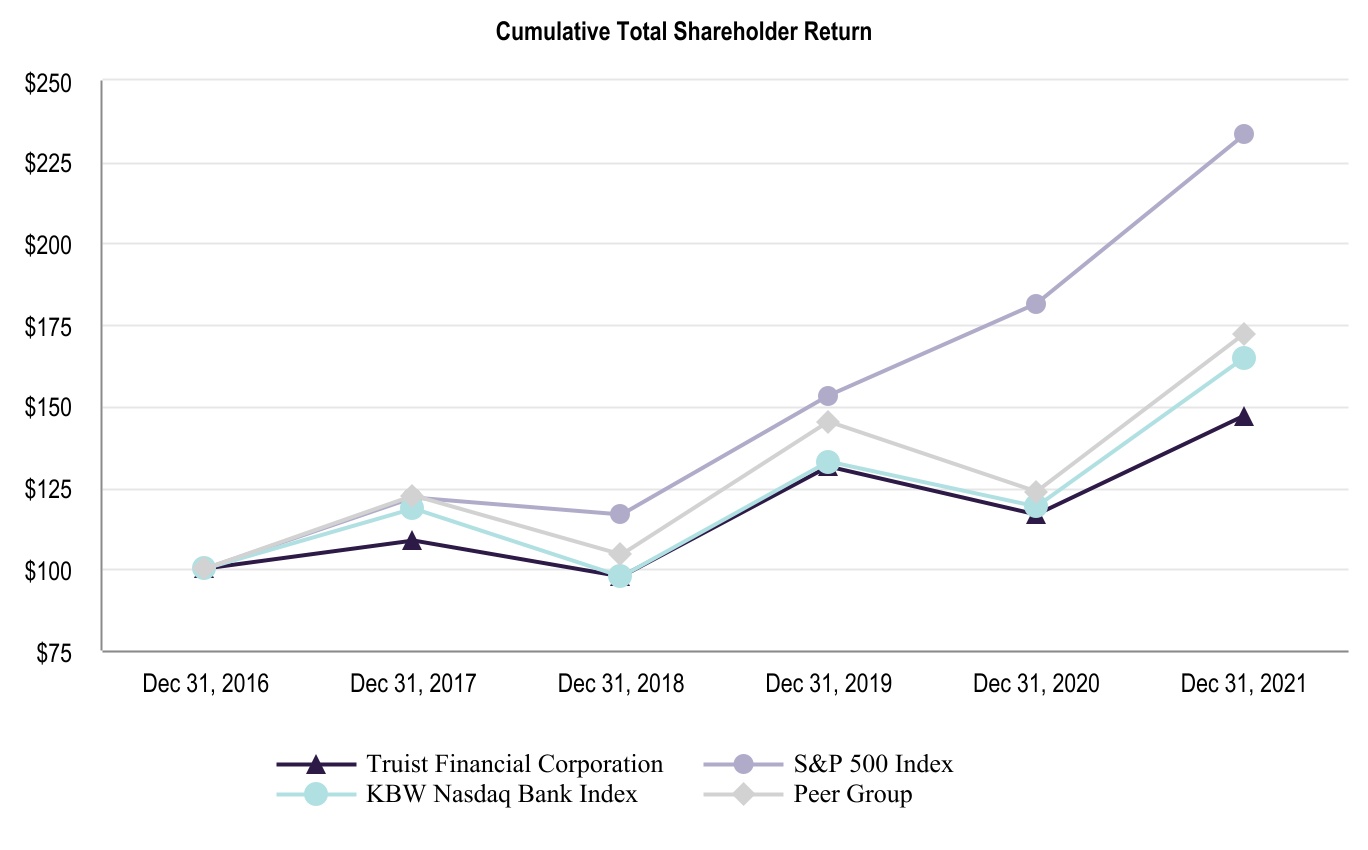
The following graph and table compare the cumulative total shareholder return of the Company’s common stock, the S&P 500 Index, the KBW Nasdaq Bank Index, and the Truist peer group for the five years ended December 31, 2021. The Company is a component of both indexes. The graph and table assume an initial investment of $100 was made on December 31, 2016 in each of the Company’s common stock, the indexes, and the peer group, as well as reinvestment of all dividends without commissions. The Truist peer group consists of Bank of America Corporation; Citizens Financial Group, Inc.; Fifth Third Bancorp; JPMorgan Chase & Co.; KeyCorp; M&T Bank Corporation; The PNC Financial Services Group, Inc.; Regions Financial Corporation; U.S. Bancorp; and Wells Fargo & Company.
| Table 7: Cumulative Total Shareholder Return | ||||||||||||||||||||||||||||||||||||||||||||
| Invested | Cumulative Total Return | |||||||||||||||||||||||||||||||||||||||||||
| As of / Through December 31, | 2016 | 2017 | 2018 | 2019 | 2020 | 2021 | ||||||||||||||||||||||||||||||||||||||
| Truist Financial Corporation | $ | 100.00 | $ | 108.67 | $ | 97.57 | $ | 131.25 | $ | 116.64 | $ | 147.05 | ||||||||||||||||||||||||||||||||
| S&P 500 Index | 100.00 | 121.82 | 116.47 | 153.13 | 181.29 | 233.28 | ||||||||||||||||||||||||||||||||||||||
| KBW Nasdaq Bank Index | 100.00 | 118.59 | 97.59 | 132.84 | 119.15 | 164.83 | ||||||||||||||||||||||||||||||||||||||
| Peer Group | 100.00 | 122.32 | 104.43 | 145.11 | 123.60 | 172.29 |
38 Truist Financial Corporation
Item 7. MANAGEMENT’S DISCUSSION AND ANALYSIS OF FINANCIAL CONDITION AND RESULTS OF OPERATIONS
MD&A is intended to assist readers in their analysis of the accompanying Consolidated Financial Statements and supplemental financial information. It should be read in conjunction with the Consolidated Financial Statements, the accompanying Notes to the Consolidated Financial Statements in this Form 10-K, and other information contained in this document. For discussion of 2020 results as compared to 2019 results, see "Item 7. Management’s Discussion and Analysis of Financial Condition and Results of Operations" in the Annual Report on Form 10-K for the year ended December 31, 2020.
Executive Overview
Truist financial performance in 2021 was solid, highlighted by strong performances from investment banking, insurance, wealth and card and payment related fees, and positive trends in a number of other businesses given improving economic conditions. Improving economic conditions also led to a strong credit performance and a benefit from the provision for credit losses. Truist achieved its fourth quarter 2021 net cost saves target and continues to reaffirm its commitment to achieving $1.6 billion in net cost saves on a run rate basis by the fourth quarter of 2022. Truist also continues to closely monitor the COVID-19 pandemic and its effects on stakeholders and the financial markets, and is actively supporting teammates, clients, and communities. Truist formed a Together Safely Committee focused on developing new working models in a post-pandemic era. Further, Truist continued to activate its Integrated Relationship Management approach, which is designed to deepen client relationships and bring the full breadth and depth of Truist’s products and services to meet clients’ financial needs. As we enter 2022 and shift priorities, aiming past systems integrations and the pandemic, Truist is well positioned for purposeful growth.
Executive Leadership Changes
Truist made several Executive Leadership changes during 2021 as we continued to execute on the strategy first agreed upon in the Merger. In September 2021, Kelly S. King, transitioned to the role of Executive Chairman, and William H. Rogers, Jr. became the CEO of Truist. There were other changes to Truist’s Executive Leadership team that included the addition of John M. Howard, as Chief Insurance Officer, the appointment of Hugh S. Cummins III as Vice Chair, and the retirement of Christopher L. Henson, Head of Banking and Insurance. The members of the Executive Leadership team as of December 31, 2021 are detailed in the Executive Officers table within Item 1 “Business.”
In January 2022, Truist appointed Denise M. DeMaio as Chief Audit Officer, effective February 28, 2022. Denise will join the Executive leadership team and will lead Truist's internal audit function and provide counsel to senior management on emerging risk trends from the vantage points of governance, processes, technologies and reporting.
Integration Efforts
Major milestones during 2021 and early 2022 include:
-
Made critical progress on core bank conversions, including migrating heritage BB&T clients to the Truist ecosystem in October. We recently completed the core bank conversion in February 2022 for heritage SunTrust clients.
-
Completed the Wealth brokerage and trust transitions and the mortgage systems transition.
-
Introduced the new Truist digital app for Truist retail, wealth, and small business commercial clients.
-
Launched new Truist.com and Truist Digital Commerce platform offering Truist‑branded products in a goal-based, mobile-optimized experience.
Truist Financial Corporation 39
ESG Efforts
Supporting Clients
Truist is committed to investing in and serving all clients, no matter where they are in their financial journey. Some of the ways we are helping clients include:
-
In January 2022, Truist announced a first-of-its-kind approach to the checking account experience, designed to address clients’ direct feedback, which will be available to clients beginning in the summer of 2022. The Truist One checking account features will include: no overdraft fees; a $100 negative balance buffer for qualifying clients; an easily accessible, deposit-based line of credit of up to $750; and premium rewards that instantly recognize relationships and honor loyalty. In addition, Truist will offer an alternative checking account product created for clients who are new to credit and want simplicity and control without overdraft fees. This will help clients avoid high fees from check-cashing and payday lenders, bring many more households into mainstream banking, and create a pathway to upgrade to Truist One.
-
Increased access to financial education for Truist’s clients through a partnership with Operation HOPE.
-
Partnering with the Bank Policy Institute to publish the Child Tax Credit Toolkit and promoting Child Tax Credit expansion awareness with modules on all digital financial education platforms.
-
Truist continues to work closely with clients as they navigate through the continuing challenges from the COVID-19 pandemic. Truist ranked as the fourth largest PPP lender amongst commercial banks overall.
Supporting Teammates
-
Truist met its commitment to increase racially and ethnically diverse representation in senior leadership roles to more than 15% one year early with 15.1% as of December 31, 2021.
-
Truist offered a voluntary separation and retirement program to eligible teammates in June 2021. While Truist is hiring in some areas and rightsizing in others through natural attrition, planned staffing reductions, and the voluntary separation and retirement program, Truist is actively supporting all teammates affected by reductions with opportunities and tools for internal placement, severance payments, and outplacement assistance and coaching. The Company recognized $231 million of merger-related and restructuring charges in 2021 related to the voluntary separation and retirement program.
-
Implemented onsite, remote, and hybrid work styles in order to provide the most flexible work environment.
Supporting Communities
Truist continued to fulfill its purpose in meaningful ways in the community through a number of unique and creative initiatives. Some highlights from these initiatives and recognition of Truist’s efforts include:
-
Truist continued to make solid progress towards the Company’s $60 billion Community Benefits Plan, ending November 2021 at 113% of the annual target.
-
Recognized in JUST Capital’s ‘JUST 100’ list for ongoing efforts around good corporate citizenship.
-
Released inaugural TCFD report, joined the Partnership for Carbon Accounting Financials, issued its first social bond, and set 2030 goals to reduce Scope 1 and Scope 2 emissions by 35% each, and to reduce water consumption by 25%, relative to 2019.
-
Announced plans to achieve net zero greenhouse gas emissions by 2050, furthering the Company's aspiration to support the transition to a low-carbon economy.
-
Released second annual Corporate Social Responsibility and Environmental, Social, and Governance report to outline its advancements and commitments with regard to diversity, equity, and inclusion; environmental sustainability and climate change; governance; community involvement; and financial inclusion.
-
In December 2021, Truist and Sterling Capital Management LLC established the Sterling Capital Diverse Multi-Manager Active Exchange Traded Fund to demonstrate the Company’s support for increasing access for individuals and institutions to invest using strategies from diverse-owned firms.
40 Truist Financial Corporation
Financial Results
Net income available to common shareholders totaled $6.0 billion for 2021, a 44% increase from the prior year. On a diluted per common share basis, earnings for 2021 were $4.47, compared to $3.08 for 2020. Truist's results of operations for 2021 produced a return on average assets of 1.23% and a return on average common shareholders' equity of 9.7% compared to prior year
Showing the first 8K of 259K characters. Open the full section
Item 8. FINANCIAL STATEMENTS AND SUPPLEMENTARY DATA
Report of Independent Registered Public Accounting Firm
To the Board of Directors and Shareholders of Truist Financial Corporation
Opinions on the Financial Statements and Internal Control over Financial Reporting
We have audited the accompanying consolidated balance sheets of Truist Financial Corporation and its subsidiaries (the “Company”) as of December 31, 2021 and 2020, and the related consolidated statements of income, comprehensive income, changes in shareholders’ equity and cash flows for each of the three years in the period ended December 31, 2021, including the related notes (collectively referred to as the “consolidated financial statements”). We also have audited the Company's internal control over financial reporting as of December 31, 2021 based on criteria established in Internal Control - Integrated Framework (2013) issued by the Committee of Sponsoring Organizations of the Treadway Commission (COSO).
In our opinion, the consolidated financial statements referred to above present fairly, in all material respects, the financial position of the Company as of December 31, 2021 and 2020, and the results of its operations and its cash flows for each of the three years in the period ended December 31, 2021 in conformity with accounting principles generally accepted in the United States of America. Also in our opinion, the Company maintained, in all material respects, effective internal control over financial reporting as of December 31, 2021, based on criteria established in Internal Control - Integrated Framework (2013) issued by the COSO.
Change in Accounting Principle
As discussed in Note 1 to the consolidated financial statements, the Company changed the manner in which it accounts for the allowance for credit losses in 2020.
Basis for Opinions
The Company's management is responsible for these consolidated financial statements, for maintaining effective internal control over financial reporting, and for its assessment of the effectiveness of internal control over financial reporting, included in Management's Report on Internal Control over Financial Reporting appearing under Item 9A. Our responsibility is to express opinions on the Company’s consolidated financial statements and on the Company's internal control over financial reporting based on our audits. We are a public accounting firm registered with the Public Company Accounting Oversight Board (United States) (PCAOB) and are required to be independent with respect to the Company in accordance with the U.S. federal securities laws and the applicable rules and regulations of the Securities and Exchange Commission and the PCAOB.
We conducted our audits in accordance with the standards of the PCAOB. Those standards require that we plan and perform the audits to obtain reasonable assurance about whether the consolidated financial statements are free of material misstatement, whether due to error or fraud, and whether effective internal control over financial reporting was maintained in all material respects.
Our audits of the consolidated financial statements included performing procedures to assess the risks of material misstatement of the consolidated financial statements, whether due to error or fraud, and performing procedures that respond to those risks. Such procedures included examining, on a test basis, evidence regarding the amounts and disclosures in the consolidated financial statements. Our audits also included evaluating the accounting principles used and significant estimates made by management, as well as evaluating the overall presentation of the consolidated financial statements. Our audit of internal control over financial reporting included obtaining an understanding of internal control over financial reporting, assessing the risk that a material weakness exists, and testing and evaluating the design and operating effectiveness of internal control based on the assessed risk. Our audits also included performing such other procedures as we considered necessary in the circumstances. We believe that our audits provide a reasonable basis for our opinions.
Definition and Limitations of Internal Control over Financial Reporting
A company’s internal control over financial reporting is a process designed to provide reasonable assurance regarding the reliability of financial reporting and the preparation of financial statements for external purposes in accordance with generally accepted accounting principles. A company’s internal control over financial reporting includes those policies and procedures that (i) pertain to the maintenance of records that, in reasonable detail, accurately and fairly reflect the transactions and dispositions of the assets of the company; (ii) provide reasonable assurance that transactions are recorded as necessary to permit preparation of financial statements in accordance with generally accepted accounting principles, and that receipts and expenditures of the company are being made only in accordance with authorizations of management and directors of the company; and (iii) provide reasonable assurance regarding prevention or timely detection of unauthorized acquisition, use, or disposition of the company’s assets that could have a material effect on the financial statements.
80 Truist Financial Corporation
Because of its inherent limitations, internal control over financial reporting may not prevent or detect misstatements. Also, projections of any evaluation of effectiveness to future periods are subject to the risk that controls may become inadequate because of changes in conditions, or that the degree of compliance with the policies or procedures may deteriorate.
Critical Audit Matters
The critical audit matter communicated below is a matter arising from the current period audit of the consolidated financial statements that was communicated or required to be communicated to the audit committee and that (i) relates to accounts or disclosures that are material to the consolidated financial statements and (ii) involved our especially challenging, subjective, or complex judgments. The communication of critical audit matters does not alter in any way our opinion on the consolidated financial statements, taken as a whole, and we are not, by communicating the critical audit matter below, providing a separate opinion on the critical audit matter or on the accounts or disclosures to which it relates.
Allowance for Credit Losses for Certain Commercial and Consumer Portfolios
As described in Notes 1 and 5 to the consolidated financial statements, the Company’s allowance for credit losses (ACL) represents management's best estimate of expected future credit losses related to loan and lease portfolios and off-balance sheet lending commitments at the balance sheet date. The consolidated ACL balance was $4.7 billion as of December 31, 2021, including $1.8 billion for commercial portfolios and $2.3 billion for consumer portfolios. Estimates of expected future credit losses are determined by management using quantitative models and by applying qualitative adjustments to the modeled results. The models are designed to forecast probability of default, exposure at default, and loss given default by correlating certain macroeconomic forecast data to historical experience. The models are applied to pools of loans with similar risk characteristics. The macroeconomic forecast data used in the quantitative models is based on forecasted variables for a reasonable and supportable period. The qualitative adjustments incorporate management judgment and are used to account for limitations in modeled results related to current economic conditions and other risks in the portfolios.
The principal considerations for our determination that performing procedures relating to the ACL for certain commercial and consumer portfolios is a critical audit matter are (i) the significant judgment by management in determining the ACL quantit
Showing the first 8K of 457K characters. Open the full section
Item 9A. CONTROLS AND PROCEDURES
Management's Report on Internal Control over Financial Reporting and Evaluation of
Disclosure Controls and Procedures
Management’s Report on Internal Control over Financial Reporting
Management of Truist is responsible for establishing and maintaining adequate internal control over financial reporting as defined in Rule 13a-15(f) of the Exchange Act. The Company’s internal control over financial reporting is a process designed to provide reasonable assurance regarding the reliability of financial reporting and the preparation of financial statements for external purposes in accordance with GAAP. Truist’s internal control over financial reporting includes those policies and procedures that (1) pertain to the maintenance of records, that in reasonable detail, accurately and fairly reflect the transactions and disposition of the Company’s assets; (2) provide reasonable assurance that transactions are recorded as necessary to permit the preparation of financial statements in accordance with GAAP and that receipts and expenditures of the Company are being made only in accordance with the authorizations of Truist’s management and directors; and (3) provide reasonable assurance regarding prevention or timely detection of unauthorized acquisition, use or disposition of the Company’s assets that could have a material impact on the financial statements.
Because of its inherent limitations, internal control over financial reporting may not prevent or detect misstatements. Also, projections of any evaluation of effectiveness to future periods are subject to the risk that controls may become inadequate due to changes in conditions, or that the degree of compliance with the policies and procedures may deteriorate.
Under the supervision and with the participation of management, including the Chief Executive Officer and the Chief Financial Officer, the Company conducted an evaluation of the effectiveness of the internal control over financial reporting based on the framework in Internal Control-Integrated Framework (2013) promulgated by the Committee of Sponsoring Organizations of the Treadway Commission, commonly referred to as the "COSO" criteria. Based on this evaluation under the COSO criteria, management concluded that the internal control over financial reporting was effective as of December 31, 2021.
The effectiveness of the Company’s internal control over financial reporting as of December 31, 2021 has been audited by PricewaterhouseCoopers LLP, an independent registered public accounting firm, as stated in their accompanying report, which expresses an unqualified opinion on the effectiveness of the Company’s internal control over financial reporting as of December 31, 2021.
Disclosure Controls and Procedures and Changes in Internal Control over Financial Reporting
As of the end of the period covered by this report, the management of the Company, under the supervision and with the participation of the Company’s Chief Executive Officer and Chief Financial Officer, carried out an evaluation of the Company’s disclosure controls and procedures as defined in Rule 13a-15(e) of the Exchange Act. Based on that evaluation, the Chief Executive Officer and Chief Financial Officer concluded that the Company’s disclosure controls and procedures were effective.
There was no change in the Company’s internal control over financial reporting that occurred during the fourth quarter of 2021 that has materially affected, or is likely to materially affect, the Company’s internal control over financial reporting.
Truist Financial Corporation 141
Item 15. EXHIBITS, FINANCIAL STATEMENT SCHEDULES
| Exhibit No. | Description | Location | |||||||||||||||
| 2.1 | Agreement and Plan of Merger, dated as of February 7, 2019, by and between SunTrust Banks, Inc. and BB&T Corporation. | Incorporated herein by reference to Exhibit 2.1 of the Current Report on Form 8-K, filed February 13, 2019. | |||||||||||||||
| 2.2 | First Amendment to the Agreement and Plan of Merger, dated as of June 14, 2019, by and between SunTrust Banks, Inc. and BB&T Corporation. | Incorporated herein by reference to Exhibit 2.1 of the Current Report on Form 8-K, filed June 14, 2019. | |||||||||||||||
| 3.1 | Articles of Incorporation of the Registrant, as consolidated and restated December 15, 2020. | Incorporated herein by reference to Exhibit 3.1 of the Annual Report on Form 10-K, filed February 24, 2021. | |||||||||||||||
| 3.2 | Amended and Restated Bylaws of Truist Financial Corporation. | Incorporated herein by reference to Exhibit 3.1 of the Current Report on Form 8-K, filed October 26, 2021. | |||||||||||||||
| 3.3 | Amended and Restated Bylaws of Truist Financial Corporation | Incorporated herein by reference to Exhibit 3.1 of the Current Report on Form 8-k, filed December 15, 2021 | |||||||||||||||
| 4.1 | Indenture Regarding Senior Securities (including form of Senior Debt Security) between Registrant and U.S. Bank National Association (as successor in interest to State Street Bank and Trust Company), as trustee, dated as of May 24, 1996. | Incorporated herein by reference to Exhibit 4.1 of the Quarterly Report on Form 10-Q, filed August 14, 1996. | |||||||||||||||
| 4.2 | First Supplemental Indenture, dated May 4, 2009, to the Indenture Regarding Senior Securities, dated as of May 24, 1996, between the Registrant and U.S. Bank National Association. | Incorporated herein by reference to Exhibit 4.2 of the Current Report on Form 8-K, filed May 4, 2009. | |||||||||||||||
| 4.3 | Indenture Regarding Subordinated Securities (including Form of Subordinated Debt Security) between the Registrant and U.S. Bank National Association (as successor in interest to State Street Bank and Trust Company), as trustee, dated as of May 24, 1996. | Incorporated herein by reference to Exhibit 4.2 of the Quarterly Report on Form 10-Q, filed August 14, 1996. | |||||||||||||||
| 4.4 | First Supplemental Indenture, dated as of December 23, 2003, to the Indenture Regarding Subordinated Securities, dated as of May 24, 1996, between the Registrant and U.S. Bank National Association. | Incorporated herein by reference to Exhibit 4.5 of the Annual Report on Form 10-K, filed February 27, 2009. | |||||||||||||||
| 4.5 | Second Supplemental Indenture, dated as of September 24, 2004, to the Indenture Regarding Subordinated Securities, dated as of May 24, 1996, between the Registrant and U.S. Bank National Association. | Incorporated herein by reference to Exhibit 4.7 of the Annual Report on Form 10-K, filed February 26, 2010. | |||||||||||||||
| 4.6 | Third Supplemental Indenture, dated May 4, 2009, to the Indenture Regarding Subordinated Securities, dated as of May 24, 1996, between the Registrant and U.S. Bank National Association. | Incorporated herein by reference to Exhibit 4.6 of the Current Report on Form 8-K, filed May 4, 2009. | |||||||||||||||
| 4.7 | Deposit Agreement, dated as of July 29, 2019, between the Company and Computershare Inc. and Computershare Trust Company, N.A., jointly as depositary. | Incorporated herein by reference to Exhibit 4.2 of the Current Report on Form 8-K, filed July 29, 2019. | |||||||||||||||
| 4.8 | Form of Depositary Receipt. | Incorporated herein by reference to Exhibit 4.2 of the Current Report on Form 8-K, filed July 29, 2019. | |||||||||||||||
| 4.9 | Description of the Securities Registered Pursuant to Section 12 of the Securities Exchange Act of 1934 | Filed herewith. | |||||||||||||||
| Other instruments defining the rights of holders of long-term debt securities of Truist are omitted pursuant to Section (b)(4)(iii)(A) of Item 601 of Regulation S-K. Truist agrees to furnish copies of these instruments to the SEC upon request. | |||||||||||||||||
| 10.1* | BB&T Corporation Amended and Restated Non-Employee Directors' Deferred Compensation Plan (amended and restated January 1, 2005). | Incorporated herein by reference to Exhibit 10.1 of the Annual Report on Form 10-K, filed February 28, 2008. | |||||||||||||||
| 10.2* | BB&T Corporation Amended and Restated 2004 Stock Incentive Plan, as amended (as amended through February 24, 2009). | Incorporated herein by reference to the Appendix to the Proxy Statement for the 2009 Annual Meeting of Shareholders on Schedule 14A, filed March 13, 2009. | |||||||||||||||
| 10.3* | BB&T Corporation 2012 Incentive Plan, as amended | Incorporated herein by reference to Exhibit 10.1 of the Registration Statement on Form S-8, filed May 25, 2017. | |||||||||||||||
| 10.4* | Form of Restricted Stock Unit Agreement (Non-Employee Directors) for the BB&T 2012 Incentive Plan (effective 2019). | Incorporated herein by reference to Exhibit 10.1 of the Quarterly Report on Form 10-Q, filed April 30, 2019. | |||||||||||||||
| 10.5* | Form of Employee Nonqualified Stock Option Agreement for the BB&T Corporation Amended and Restated 2004 Stock Incentive Plan (5-Year Vesting). | Incorporated herein by reference to Exhibit 10.8 of the Annual Report on Form 10-K, filed February 28, 2008. | |||||||||||||||
| 10.6* | Form of Employee Nonqualified Stock Option Agreement for the BB&T Corporation Amended and Restated 2004 Stock Incentive Plan (4-Year Vesting). | Incorporated herein by reference to Exhibit 10.5 of the Quarterly Report on Form 10-Q, filed May 7, 2010. | |||||||||||||||
| 10.7* | Southern National Deferred Compensation Plan for Key Executives including amendments. | Incorporated herein by reference to Exhibit 10.21 of the Annual Report on Form 10-K, filed February 25, 2011. | |||||||||||||||
| 10.8* | BB&T Non-Qualified Defined Benefit Plan (January 1, 2012 Restatement). | Incorporated herein by reference to Exhibit 10.11 of the Annual Report on Form 10-K, filed February 25, 2016. | |||||||||||||||
| 10.9* | First Amendment to the BB&T Non-Qualified Defined Benefit Plan (January 1, 2012 Restatement). | Incorporated herein by reference to Exhibit 10.12 of the Annual Report on Form 10-K, filed February 25, 2016. | |||||||||||||||
| 10.10* | Second Amendment to the BB&T Non-Qualified Defined Benefit Plan (January 1, 2012 Restatement). | Incorporated herein by reference to Exhibit 10.13 of the Annual Report on Form 10-K, filed February 25, 2016. |
142 Truist Financial Corporation
| Exhibit No. | Description | Location | |||||||||||||||
| 10.11* | Third Amendment to the BB&T Non-Qualified Defined Benefit Plan (January 1, 2012 Restatement) | Filed herewith | |||||||||||||||
| 10.12* | Fourth Amendment to the BB&T Non-Qualified Benefit Plan (January 1, 2012 Restatement) | Filed herewith | |||||||||||||||
| 10.13* | Form of Employee Nonqualified Stock Option Agreement for the BB&T Corporation Amended and Restated 2004 Stock Incentive Plan (4-Year Vesting with Clawback Provision). | Incorporated herein by reference to Exhibit 10.1 of the Quarterly Report on Form 10-Q, filed May 4, 2012. | |||||||||||||||
| 10.14* | Form of Employee Nonqualified Stock Option Agreement for the BB&T Corporation 2012 Incentive Plan. | Incorporated herein by reference to Exhibit 10.1 of the Quarterly Report on Form 10-Q, filed May 2, 2013. | |||||||||||||||
| 10.15* | Form of Nonqualified Option Agreement (Senior Executive) for the BB&T Corporation 2012 Incentive Plan. | Incorporated herein by reference to Exhibit 10.4 of the Quarterly Report on Form 10-Q, filed April 30, 2014. | |||||||||||||||
| 10.16* | Form of Director Restricted Stock Unit Agreement for the BB&T Corporation 2012 Incentive Plan. | Incorporated herein by reference to Exhibit 10.2 of the Quarterly Report on Form 10-Q, filed May 2, 2013. | |||||||||||||||
| 10.17* | Form of Restricted Stock Unit Agreement (Performance-Based Vesting Component)(Senior Executive) for the BB&T Corporation 2012 Incentive Plan. | Incorporated herein by reference to Exhibit 10.3 of the Quarterly Report on Form 10-Q, filed April 30, 2014. | |||||||||||||||
| 10.18* | Form of LTIP Award Agreement for the BB&T Corporation 2012 Incentive Plan (effective 2019). | Incorporated herein by reference to Exhibit 10.2 of the Quarterly Report on Form 10-Q, filed April 30, 2019. | |||||||||||||||
| 10.19* | Form of Performance Unit Award Agreement for the BB&T Corporation 2012 Incentive Plan (effective 2019). | Incorporated herein by reference to Exhibit 10.3 of the Quarterly Report on Form 10-Q, filed April 30, 2019. | |||||||||||||||
| 10.20* | 2008 Amended and Restated Employment Agreement by and among BB&T Corporation, Branch Banking and Trust Co. and Daryl N. Bible. | Incorporated herein by reference to Exhibit 10.22 of the Annual Report on Form 10-K, filed February 27, 2009. | |||||||||||||||
| 10.21* | 2008 Amended and Restated Employment Agreement by and among BB&T Corporation, Branch Banking and Trust Co. and Clarke R. Starnes, III. | Incorporated herein by reference to Exhibit 10.27 of the Annual Report on Form 10-K, filed February 27, 2009. | |||||||||||||||
| 10.22* | 2016 Employment Agreement by and among BB&T Corporation, Branch Banking and Trust Company and David H. Weaver. | Incorporated herein by reference to Exhibit 10.39 of the Annual Report on Form 10-K, filed February 25, 2016. | |||||||||||||||
| 10.23* | 2016 Employment Agreement by and among BB&T Corporation, Branch Banking and Trust Company and Brant J. Standridge. | Incorporated herein by reference to Exhibit 10.2 of the Quarterly Report on Form 10-Q, filed October 24, 2016. | |||||||||||||||
| 10.24* | 2016 Employment Agreement by and among BB&T Corporation, Branch Banking and Trust Company and Dontá L. Wilson. | Incorporated herein by reference to Exhibit 10.3 of the Quarterly Report on Form 10-Q, filed October 24, 2016. | |||||||||||||||
| 10.25* | Amended and Restated Employment Agreement by and among BB&T Corporation, Branch Banking and Trust Co. and Kelly S. King dated as of February 7, 2019. | Incorporated herein by reference to Exhibit 10.1 of the Current Report on Form 8-K, filed February 13, 2019. | |||||||||||||||
| 10.26* | Form of Notice of Term Non-Renewal under Employment Agreements | Incorporated herein by reference to Exhibit 10.1 of the Current Report on Form 8-K, filed March 6, 2019. | |||||||||||||||
| 10.27* | Form of Synergy Incentive Award Letter with each of Daryl N. Bible and Clarke R. Starnes, III | Incorporated herein by reference to Exhibit 10.1 of the Current Report on Form 8-K, filed June 3, 2019. | |||||||||||||||
| 10.28* | Form of First Amendment to Employment Agreement with each of Daryl N. Bible and Clarke R. Starnes, III | Incorporated herein by reference to Exhibit 10.4 of the Current Report on Form 8-K, filed June 3, 2019. | |||||||||||||||
| 10.29* | First Amendment to 2016 Employment Agreement with Brant J. Standridge | Incorporated herein by reference to Exhibit 10.9 of the Quarterly Report on Form 10-Q, filed July 31, 2019. | |||||||||||||||
| 10.30* | First Amendment to 2016 Employment Agreement with David H. Weaver | Incorporated herein by reference to Exhibit 10.10 of the Quarterly Report on Form 10-Q, filed July 31, 2019. | |||||||||||||||
| 10.31* | First Amendment to 2016 Employment Agreement with Dontá L. Wilson | Incorporated herein by reference to Exhibit 10.11 of the Quarterly Report on Form 10-Q, filed July 31, 2019. | |||||||||||||||
| 10.32* | Form of Synergy Incentive Award Letter with each of Brant J. Standridge, David H. Weaver and Dontá L. Wilson | Incorporated herein by reference to Exhibit 10.14 of the Quarterly Report on Form 10-Q, filed July 31, 2019. | |||||||||||||||
| 10.33* | SunTrust Banks, Inc. 2009 Stock Plan, as amended and restated as of August 11, 2015 | Incorporated by reference to Exhibit 10.1 to SunTrust's Current Report on Form 8-K, filed August 13, 2015. | |||||||||||||||
| 10.34* | Form of Nonqualified Stock Option Agreement | Incorporated by reference to Exhibit 10.1.1 to SunTrust's Registration Statement No. 333-158866 on Form S-8, filed April 28, 2009. | |||||||||||||||
| 10.35* | Form of Nonqualified Stock Option Award Agreement with clawback under the SunTrust Banks, Inc. 2009 Stock Plan | Incorporated by reference to Exhibit 10.29 of SunTrust's Annual Report on Form 10-K, filed February 24, 2012. | |||||||||||||||
| 10.36* | Form of Performance Vested Restricted Stock Unit Award Agreement, 2018, Type I | Incorporated herein by reference to Exhibit 10.18 of SunTrust's Annual Report on Form 10-K, filed February 23, 2018. |
Truist Financial Corporation 143
144 Truist Financial Corporation
| Exhibit No. | Description | Location | |||||||||||||||
| 10.62* | First Amendment to the Truist Financial Corporation 401(k) Savings Plan (August 1, 2020 Restatement) | Filed herewith | |||||||||||||||
| 10.63* | Second Amendment to the Truist Financial Corporation 401(k) Saving Plan (August 1, 2020 Restatement) | Filed herewith | |||||||||||||||
| 10.64* | SunTrust Banks, Inc. Directors Deferred Compensation Plan, amended and restated as of January 1, 2009 | Incorporated by reference to Exhibit 10.1 to the SunTrust Current Report on Form 8-K, filed January 7, 2009. | |||||||||||||||
| 10.65* | Amendment Number One to the SunTrust Banks, Inc. Directors Deferred Compensation Plan, effective as of January 1, 2018 | Incorporated herein by reference to Exhibit 10.14 of SunTrust's Annual Report on Form 10-K, filed February 22, 2019. | |||||||||||||||
| 10.66* | First Amendment to BB&T Corporation Amended and Restated Non-Employee Directors’ Deferred Compensation Plan (Amended and Restated January 1, 2005) | Incorporated herein by reference to Exhibit 10.69 of the Annual Report on Form 10-K, filed February 24, 2021. | |||||||||||||||
| 10.67* | 2020 Amendment to the Truist Financial Corporation Amended and Restated Non-Employee Directors’ Deferred Compensation Plan | Filed herewith. | |||||||||||||||
| 10.68* | Employment Agreement by and between Truist Insurance Holdings, Inc. and John Howard Employment Agreement | Filed herewith. | |||||||||||||||
| 10.69* | Qualified Trust Agreement between Truist Financial Corporation and Fidelity Management Trust Company (July 15, 2020) | Incorporated herein by reference to Exhibit 10.65 of the Annual Report on Form 10-K, filed February 24, 2021. | |||||||||||||||
| 10.70* | First Amendment to Qualified Trust Agreement between Truist Financial Corporation and Fidelity Management Trust Company (July 15, 2020) | Incorporated herein by reference to Exhibit 10.66 of the Annual Report on Form 10-K, filed February 24, 2021. | |||||||||||||||
| 11 | Statement re computation of earnings per share. | Filed herewith as Computation of EPS note to the consolidated financial statements. | |||||||||||||||
| 21† | Subsidiaries of the Registrant. | Filed herewith. | |||||||||||||||
| 22† | List of Subsidiary Issuers of Guaranteed Securities. | Filed herewith. | |||||||||||||||
| 23† | Consent of Independent Registered Public Accounting Firm. | Filed herewith. | |||||||||||||||
| 31.1 | Certification of Chief Executive Officer pursuant to Rule 13a-14(a) or 15d-14(a) of the Exchange Act, as adopted pursuant to Section 302 of the Sarbanes-Oxley Act of 2002. | Filed herewith. | |||||||||||||||
| 31.2 | Certification of Chief Financial Officer pursuant to Rule 13a-14(a) or 15d-14(a) of the Exchange Act, as adopted pursuant to Section 302 of the Sarbanes-Oxley Act of 2002. | Filed herewith. | |||||||||||||||
| 32 | Certification of Chief Executive Officer and Chief Financial Officer pursuant to 18 U.S.C. Section 1350, as adopted pursuant to Section 906 of the Sarbanes-Oxley Act of 2002. | Filed herewith. | |||||||||||||||
| 101.INS | XBRL Instance Document – the instance document does not appear in the interactive data file because its XBRL tags are embedded within the inline XBRL document. | Filed herewith. | |||||||||||||||
| 101.SCH | XBRL Taxonomy Extension Schema. | Filed herewith. | |||||||||||||||
| 101.CAL | XBRL Taxonomy Extension Calculation Linkbase. | Filed herewith. | |||||||||||||||
| 101.LAB | XBRL Taxonomy Extension Label Linkbase. | Filed herewith. | |||||||||||||||
| 101.PRE | XBRL Taxonomy Extension Presentation Linkbase. | Filed herewith. | |||||||||||||||
| 101.DEF | XBRL Taxonomy Definition Linkbase. | Filed herewith. | |||||||||||||||
| 104 | Cover Page Interactive Data File (formatted as inline XBRL with applicable taxonomy extension information contained in Exhibits101). | Filed herewith. | |||||||||||||||
| † Exhibit filed with the SEC and available upon request. | |||||||||||||||||
| * Management compensatory plan or arrangement. |
Truist Financial Corporation 145
SIGNATURES
Pursuant to the requirements of Section 13 or 15(d) of the Securities Exchange Act of 1934, the registrant has duly caused this report to be signed on its behalf by the undersigned, thereunto duly authorized, as of February 22, 2022:
| Truist Financial Corporation | ||||||||
| (Registrant) | ||||||||
| /s/ William H. Rogers Jr. | ||||||||
| William H. Rogers Jr. | ||||||||
| President and Chief Executive Officer |
Pursuant to the requirements of the Securities Exchange Act of 1934, this report has been signed below by the following persons on behalf of the registrant and in the capacities indicated:
| /s/ William H. Rogers Jr. | President and Chief Executive Officer | February 22, 2022 | ||||||||||||
| William H. Rogers Jr. | ||||||||||||||
| /s/ Daryl N. Bible | Senior Executive Vice President and Chief Financial Officer | February 22, 2022 | ||||||||||||
| Daryl N. Bible | (Principal Financial Officer) | |||||||||||||
| /s/ Cynthia B. Powell | Executive Vice President and Corporate Controller | February 22, 2022 | ||||||||||||
| Cynthia B. Powell | (Principal Accounting Officer) | |||||||||||||
| /s/ Kelly S. King | Chairman of the Board | February 22, 2022 | ||||||||||||
| Kelly S. King | ||||||||||||||
| Director | ||||||||||||||
| Jennifer S. Banner | ||||||||||||||
| /s/ K. David Boyer, Jr. | Director | February 22, 2022 | ||||||||||||
| K. David Boyer, Jr. | ||||||||||||||
| /s/ Agnes Bundy Scanlan | Director | February 22, 2022 | ||||||||||||
| Agnes Bundy Scanlan | ||||||||||||||
| /s/ Anna R. Cablik | Director | February 22, 2022 | ||||||||||||
| Anna R. Cablik | ||||||||||||||
| /s/ Dallas S. Clement | Director | February 22, 2022 | ||||||||||||
| Dallas S. Clement | ||||||||||||||
| /s/ Paul D. Donahue | Director | February 22, 2022 | ||||||||||||
| Paul D. Donahue | ||||||||||||||
| /s/ Patrick C. Graney III | Director | February 22, 2022 | ||||||||||||
| Patrick C. Graney III | ||||||||||||||
| /s/ Linnie M. Haynesworth | Director | February 22, 2022 | ||||||||||||
| Linnie M. Haynesworth | ||||||||||||||
| /s/ Easter A. Maynard | Director | February 22, 2022 | ||||||||||||
| Easter A. Maynard | ||||||||||||||
| /s/ Donna S. Morea | Director | February 22, 2022 | ||||||||||||
| Donna S. Morea | ||||||||||||||
| /s/ Charles A. Patton | Director | February 22, 2022 | ||||||||||||
| Charles A. Patton | ||||||||||||||
| /s/ Nido R. Qubein | Director | February 22, 2022 | ||||||||||||
| Nido R. Qubein | ||||||||||||||
| /s/ David M. Ratcliffe | Director | February 22, 2022 | ||||||||||||
| David M. Ratcliffe | ||||||||||||||
| /s/ Frank P. Scruggs, Jr. | Director | February 22, 2022 | ||||||||||||
| Frank P. Scruggs, Jr. | ||||||||||||||
| /s/ Christine Sears | Director | February 22, 2022 | ||||||||||||
| Christine Sears | ||||||||||||||
| /s/ Thomas E. Skains | Director | February 22, 2022 | ||||||||||||
| Thomas E. Skains | ||||||||||||||
| /s/ Bruce L. Tanner | Director | February 22, 2022 | ||||||||||||
| Bruce L. Tanner | ||||||||||||||
| /s/ Thomas N. Thompson | Director | February 22, 2022 | ||||||||||||
| Thomas N. Thompson | ||||||||||||||
| /s/ Steven C. Voorhees | Director | February 22, 2022 | ||||||||||||
| Steven C. Voorhees | ||||||||||||||
146 Truist Financial Corporation