 filings.tools
Target 10-K 2020-02-01
Filed 2020-03-11. 22 sections, 311K characters. Original on sec.gov · Markdown · JSON
Cover and table of contents
| UNITED STATES SECURITIES AND EXCHANGE COMMISSION |
Washington, D.C. 20549
FORM 10-K
(Mark One)
☒ ANNUAL REPORT PURSUANT TO SECTION 13 OR 15(d) OF THE SECURITIES EXCHANGE ACT OF 1934
For the fiscal year ended February 1, 2020
OR
☐ TRANSITION REPORT PURSUANT TO SECTION 13 OR 15(d) OF THE SECURITIES EXCHANGE ACT OF 1934
For the transition period from ____ to ____
Commission File Number 1-6049

TARGET CORPORATION
(Exact name of registrant as specified in its charter)
Minnesota 41-0215170
(State or other jurisdiction of incorporation or organization) (I.R.S. Employer Identification No.)
1000 Nicollet Mall, Minneapolis, Minnesota 55403
(Address of principal executive offices) (Zip Code)
Registrant’s telephone number, including area code: 612/304-6073
Former name, former address and former fiscal year, if changed since last report: N/A
Securities registered pursuant to Section 12(b) of the Securities Exchange Act of 1934:
| Title of each class | Trading Symbol(s) | Name of each exchange on which registered | ||||||||||||
| Common stock, par value $0.0833 per share | TGT | New York Stock Exchange |
Securities registered pursuant to Section 12(g) of the Act: None
Indicate by check mark if the registrant is a well-known seasoned issuer, as defined in Rule 405 of the Securities Act. Yes x No o
Indicate by check mark if the registrant is not required to file reports pursuant to Section 13 or Section 15(d) of the Act. Yes o No x
Note – Checking the box above will not relieve any registrant required to file reports pursuant to Section 13 or 15(d) of the Exchange Act from their obligations under those Sections.
Indicate by check mark whether the registrant (1) has filed all reports required to be filed by Section 13 or 15(d) of the Securities Exchange Act of 1934 during the preceding 12 months (or for such shorter period that the registrant was required to file such reports), and (2) has been subject to such filing requirements for the past 90 days. Yes x No o
Indicate by check mark whether the registrant has submitted electronically every Interactive Data File required to be submitted pursuant to Rule 405 of Regulation S-T (§232.405 of this chapter) during the preceding 12 months (or for such shorter period that the registrant was required to submit such files). Yes x No o
Indicate by check mark if disclosure of delinquent filers pursuant to Item 405 of Regulation S-K (§229.405 of this chapter) is not contained herein, and will not be contained, to the best of registrant's knowledge, in definitive proxy or information statements incorporated by reference in Part III of this Form 10-K or any amendment to this Form 10-K. x
Indicate by check mark whether the registrant is a large accelerated filer, an accelerated filer, a non-accelerated filer, smaller reporting company, or an emerging growth company (as defined in Rule 12b-2 of the Exchange Act).
| Large accelerated filer | x | Accelerated filer | o | Non-accelerated filer | o |
| Smaller reporting company | ☐ | Emerging growth company | ☐ |
If an emerging growth company, indicate by check mark if the registrant has elected not to use the extended transition period for complying with any new or revised financial accounting standards provided pursuant to Section 13(a) of the Exchange Act. o
Indicate by check mark whether the registrant is a shell company (as defined in Rule 12b-2 of the Act). Yes ☐ No x
The aggregate market value of the voting stock held by non-affiliates of the registrant as of August 2, 2019, was $41,576,546,635 based on the closing price of $81.52 per share of Common Stock as reported on the New York Stock Exchange Composite Index.
Indicate the number of shares outstanding of each of registrant's classes of Common Stock, as of the latest practicable date. Total shares of Common Stock, par value $0.0833, outstanding as of March 5, 2020, were 500,961,951.
DOCUMENTS INCORPORATED BY REFERENCE
Portions of Target's Proxy Statement for the Annual Meeting of Shareholders to be held on June 10, 2020, are incorporated into Part III.
| Table of Contents | |||||
| Index to Financial Statements |
TABLE OF CONTENTS
| TARGET CORPORATION |  | 2019 Form 10-K | 1 |
| BUSINESS | Table of Contents | |||||||
| Index to Financial Statements |
PART I
Item 1. Business
General
Target Corporation (Target, the Corporation or the Company) was incorporated in Minnesota in 1902. We offer to our customers, referred to as "guests," everyday essentials and fashionable, differentiated merchandise at discounted prices. Our ability to deliver a preferred shopping experience to our guests is supported by our supply chain and technology, our devotion to innovation, our loyalty offerings and suite of fulfillment options, and our disciplined approach to managing our business and investing in future growth. We operate as a single segment designed to enable guests to purchase products seamlessly in stores or through our digital channels. Since 1946, we have given 5 percent of our profit to communities.
Financial Highlights
For information on key financial highlights, see Part II, Item 6, Selected Financial Data, and Part II, Item 7, Management's Discussion and Analysis of Financial Condition and Results of Operations (MD&A).
Seasonality
A larger share of annual revenues and earnings traditionally occurs in the fourth quarter because it includes the November and December holiday sales period.
Merchandise
We sell a wide assortment of general merchandise and food. The majority of our general merchandise stores offer an edited food assortment, including perishables, dry grocery, dairy, and frozen items. Nearly all of our stores larger than 170,000 square feet offer a full line of food items comparable to traditional supermarkets. Our small format stores, generally smaller than 50,000 square feet, offer curated general merchandise and food assortments. Our digital channels include a wide merchandise assortment, including many items found in our stores, along with a complementary assortment.
A significant portion of our sales is from national brand merchandise. Approximately one-third of 2019 sales was related to our owned and exclusive brands, including but not limited to the following:
| Owned Brands | ||||||||
| A New Day™ | Hyde & EEK! Boutique™ | Smartly™ | ||||||
| All in Motion™ | JoyLab™ | Smith & Hawken® | ||||||
| Archer Farms® | Kona Sol™ | Sonia Kashuk® | ||||||
| Art Class™ | Made By Design™ | Spritz™ | ||||||
| Auden™ | Market Pantry® | Stars Above™ | ||||||
| Ava & Viv® | More Than Magic™ | Sun Squad™ | ||||||
| Boots & Barkley® | Opalhouse™ | Sutton & Dodge® | ||||||
| Cat & Jack™ | Open Story™ | Threshold™ | ||||||
| Cloud Island™ | Original Use™ | Universal Thread™ | ||||||
| Colsie™ | Pillowfort™ | up & up® | ||||||
| Everspring™ | Project 62™ | Wild Fable™ | ||||||
| Good & Gather™ | Prologue™ | Wondershop™ | ||||||
| Goodfellow & Co™ | Room Essentials® | Xhilaration® | ||||||
| Hearth & Hand™ with Magnolia | Shade & Shore™ | |||||||
| heyday™ | Simply Balanced™ | |||||||
| Exclusive Brands | ||||||||
| California Roots™ | Isabel Maternity™ by Ingrid & Isabel® | The Collection | ||||||
| Defy & Inspire™ | Just One You® made by carter's® | Wine Cube® | ||||||
| Fieldcrest® | Kristin Ess | Who What Wear™ | ||||||
| Hand Made Modern® | Rosé Bae™ |
| TARGET CORPORATION | | 2019 Form 10-K | 2 |
| BUSINESS | Table of Contents | |||||||
| Index to Financial Statements |
We also sell merchandise through periodic exclusive design and creative partnerships and generate revenue from in-store amenities such as Target Café and leased or licensed departments such as Target Optical, Starbucks, and other food service offerings. CVS Pharmacy, Inc. (CVS) operates pharmacies and clinics in our stores under a perpetual operating agreement from which we generate annual occupancy income.
Customer Loyalty Program****s
Our guests receive a 5 percent discount on nearly all purchases and receive free shipping at Target.com when they use their Target Debit Card, Target Credit Card, or Target™ MasterCard® (collectively, RedCards™). We also seek to drive customer loyalty and trip frequency through our Target Circle program, where members earn 1 percent rewards on nearly all non-RedCard purchases and other benefits.
Distribution
The vast majority of merchandise is distributed to our stores through our network of distribution centers. Common carriers ship merchandise to and from our distribution centers. Vendors or third-party distributors ship certain food items and other merchandise directly to our stores. Merchandise sold through our digital channels is distributed to our guests via common carriers (from stores, distribution centers, vendors, and third-party distributors), delivery via our wholly owned subsidiary, Shipt, Inc. (Shipt), and through guest pick-up at our stores. Our stores fulfill the majority of the digitally originated sales, which allows improved product availability, faster delivery times, and reduced shipping costs.
Employees
As of February 1, 2020, we employed approximately 368,000 full-time, part-time, and seasonal employees, referred to as "team members." Because of the seasonal nature of the retail business, employment levels peak in the holiday season. We offer a broad range of company-paid benefits to our team members. Eligibility for and the level of benefits vary depending on team members' full-time or part-time status, compensation level, date of hire, and/or length of service. Company-paid benefits include a 401(k) plan, medical and dental plans, disability insurance, paid vacation, tuition reimbursement, various team member assistance programs, life insurance, a pension plan (closed to new participants, with limited exceptions), and merchandise and other discounts. We believe our team member relations are good.
Working Capital
Effective inventory management is key to our ongoing success, and we use various techniques including demand forecasting and planning and various forms of replenishment management. We achieve effective inventory management by staying in-stock in core product offerings, maintaining positive vendor relationships, and carefully planning inventory levels for seasonal and apparel items to minimize markdowns.
The Liquidity and Capital Resources section in MD&A provides additional details.
Competition
We compete with traditional and internet retailers, including department stores, off-price general merchandise retailers, wholesale clubs, category-specific retailers, drug stores, supermarkets, and other forms of retail commerce. Our ability to positively differentiate ourselves from other retailers and provide compelling value to our guests largely determines our competitive position within the retail industry.
Intellectual Property
Our brand image is a critical element of our business strategy. Our principal trademarks, including Target, our "Expect More. Pay Less." brand promise, and our "Bullseye Design," have been registered with the United States (U.S.) Patent and Trademark Office. We also seek to obtain and preserve intellectual property protection for our owned brands.
| TARGET CORPORATION | | 2019 Form 10-K | 3 |
| BUSINESS | Table of Contents | |||||||
| Index to Financial Statements |
Geographic Information
Nearly all of our revenues are generated within the U.S. The vast majority of our property and equipment is located within the U.S.
Available Information
Our Annual Report on Form 10-K, quarterly reports on Form 10-Q, current reports on Form 8-K, and amendments to those reports filed or furnished pursuant to Section 13(a) or 15(d) of the Exchange Act are available free of charge at investors.target.com as soon as reasonably practicable after we file such material with, or furnish it to, the U.S. Securities and Exchange Commission (SEC). Our Corporate Governance Guidelines, Code of Ethics, Corporate Responsibility Report, and the charters for the committees of our Board of Directors are also available free of charge in print upon request or at investors.target.com.
Item 1A. Risk Factors
Our business is subject to many risks. Set forth below are the material risks we face. Risks are listed in the categories where they primarily apply, but other categories may also apply.
Competitive and Reputational Risks
Our continued success is dependent on positive perceptions of Target which, if eroded, could adversely affect our business and our relationships with our guests and team members.
We believe that one of the reasons our guests, team members, and vendors choose Target is the positive reputation we have built over many years for serving our four primary constituencies: guests, team members, shareholders, and the communities in which we operate. To be successful in the future, we must continue to preserve Target's reputation. Reputational value is based in large part on perceptions, and broad access to social media makes it easy for anyone to provide public feedback that can influence perceptions of Target. It may be difficult to control negative publicity, regardless of whether it is accurate. Target’s position or perceived lack of position on social, environmental, public policy or other sensitive issues, and any perceived lack of transparency about those matters, could harm our reputation with certain groups or guests. While reputations may take decades to build, negative incidents can quickly erode trust and confidence and can result in consumer boycotts, governmental investigations, or litigation. In addition, vendors and others with whom we do business may affect our reputation. For example, CVS operates clinics and pharmacies within our stores, and our guests’ perceptions of and experiences with CVS may affect our reputation. Negative reputational incidents could adversely affect our business through lost sales, loss of new store and development opportunities, or team member retention and recruiting difficulties.
If we are unable to positively differentiate ourselves from other retailers, our results of operations could be adversely affected.
In the past, we have been able to compete successfully by differentiating our guests’ shopping experience through a careful combination of price, merchandise assortment, store environment, convenience, guest service, loyalty programs, and marketing efforts. Guest perceptions regarding the cleanliness and safety of our stores, the functionality, reliability, and speed of our digital channels and fulfillment options, our in-stock levels, and the value of our promotions are among the factors that affect our ability to compete. In addition, our ability to create a personalized guest experience through the collection and use of accurate and relevant guest data is important to our ability to differentiate from other retailers. No single competitive factor is dominant, and actions by our competitors on any of these factors or the failure of our strategies could adversely affect our sales, gross margins, and expenses.
Our owned and exclusive brand products help differentiate us from other retailers, generally carry higher margins than equivalent national brand products and represent a significant portion of our overall sales. If we are unable to successfully develop, support, and evolve our owned and exclusive brands, if one or more of these brands experiences a loss of consumer acceptance or confidence, or if we are unable to successfully protect our intellectual property rights, our sales and gross margins could be adversely affected.
| TARGET CORPORATION | | 2019 Form 10-K | 4 |
| RISK FACTORS | Table of Contents | |||||||
| Index to Financial Statements |
The retail industry's continuing migration to digital channels has affected the ways we differentiate ourselves from other retailers. In particular, consumers are able to quickly and conveniently comparison shop and determine real-time product availability using digital tools, which can lead to decisions based solely on price or the functionality of the digital tools. Consumers may also use third-party channels or devices, such as voice assistants and smart home devices, to initiate shopping searches and place orders, which could sometimes make us dependent on the capabilities and search algorithms of those third parties to reach those consumers. Any difficulties in executing our differentiation efforts, actions by our competitors in response to these efforts, or failures by vendors in managing their own channels, content and technology systems to support these efforts could adversely affect our sales, gross margins, and expenses.
If we are unable to successfully provide a relevant and reliable experience for our guests across multiple channels, our sales, results of operations and reputation could be adversely affected.
Our business has evolved from an in-store experience to interaction with guests across multiple channels (in-store, online, mobile, social media, voice assistants, and smart home devices, among others). Our guests are using those channels to shop with us and provide feedback and public commentary about our business. We must anticipate and meet changing guest expectations and counteract developments and investments by our competitors. Our evolving retailing efforts include implementing technology, software and processes to be able to conveniently and cost-effectively fulfill guest orders directly from any point within our system of stores and distribution centers and from our vendors. We also need to collect accurate, relevant, and usable guest data to personalize our offerings. Providing multiple fulfillment options and implementing new technology is complex and may not meet expectations for accurate order fulfillment, faster and guaranteed delivery times, low-cost or free shipping, and desired payment methods. Even when we are successful in meeting expectations for fulfillment, if we are unable to offset increased costs of fulfilling orders outside of our traditional in-store channel with efficiencies, cost-savings or expense reductions, our results of operations could be adversely affected.
If we do not anticipate and respond quickly to changing consumer preferences, our sales and profitability could suffer.
A large part of our business is dependent on our ability to make trend-right decisions and effectively manage our inventory in a broad range of merchandise categories, including apparel, accessories, home décor, electronics, toys, seasonal offerings, food, and other merchandise. If we do not obtain accurate and relevant data on guest preferences, predict changing consumer tastes, preferences, spending patterns and other lifestyle decisions, emphasize the correct categories, implement competitive and effective pricing and promotion strategies, or personalize our offerings to our guests, we may experience lost sales, spoilage, and increased inventory markdowns, which could adversely affect our results of operations by reducing our profitability.
Investments and Infrastructure Risks
If our capital investments in remodeling existing stores, building new stores, and improving technology and supply chain infrastructure do not achieve appropriate returns, our competitive position, financial condition and results of operations could be adversely affected.
Our business depends, in part, on our ability to remodel existing stores and build new stores in a manner that achieves appropriate returns on our capital investment. Our store remodel program is larger than historic levels and is being implemented using a custom approach based on the condition of each store and characteristics of the surrounding neighborhood. When building new stores, we compete with other retailers and businesses for suitable locations for our stores. Pursuing the wrong remodel or new store opportunities and any delays, cost increases, disruptions or other uncertainties related to those opportunities could adversely affect our results of operations.
We are making, and expect to continue to make, significant investments in technology and selective acquisitions to improve guest experiences across multiple channels and improve the speed, accuracy, and cost efficiency of our supply chain and inventory management systems. The effectiveness of these investments can be less predictable than remodeling stores, and might not provide the anticipated benefits or desired rates of return. In addition, if we are unable to successfully protect any intellectual property rights resulting from our investments, the value received from those investments may be eroded, which could adversely affect our financial condition.
| TARGET CORPORATION | | 2019 Form 10-K | 5 |
| RISK FACTORS | Table of Contents | |||||||
| Index to Financial Statements |
Pursuing the wrong investment opportunities, being unable to make new concepts scalable, making an investment commitment significantly above or below our needs, or failing to effectively incorporate acquired businesses into our business could result in the loss of our competitive position and adversely affect our financial condition or results of operations.
A significant disruption in our computer systems and our inability to adequately maintain and update those systems could adversely affect our operations and negatively affect our guests.
We rely extensively on computer systems throughout our business. We also rely on continued and unimpeded access to the Internet to use our computer systems. Our systems are subject to damage or interruption from power outages, telecommunications failures, computer viruses, malicious attacks, security breaches, catastrophic events, and implementation errors. If our systems are damaged, disrupted or fail to function properly or reliably, we may incur substantial repair or replacement costs, experience data loss or theft and impediments to our ability to manage inventories or process guest transactions, and encounter lost guest confidence, which could require additional promotional activities to attract guests and otherwise adversely affect our results of operations.
We continually invest to maintain and update our computer systems. Implementing significant system changes increases the risk of computer system disruption. The potential problems and interruptions associated with implementing technology initiatives, as well as providing training and support for those initiatives, could disrupt or reduce our operational efficiency, and could negatively impact guest experience and guest confidence. For example, during the past year we experienced disruptions in our point-of-sale system that prevented our ability to process debit or credit transactions, negatively impacted some guests’ experiences, and generated negative publicity.
Information Security, Cybersecurity and Data Privacy Risks
If our efforts to provide information security, cybersecurity and data privacy are unsuccessful or if we are unable to meet increasingly demanding regulatory requirements, we may face additional costly government enforcement actions and private litigation, and our reputation and results of operations could suffer.
We regularly receive and store information about our guests, team members, vendors, and other third parties. We have programs in place to detect, contain, and respond to data security incidents. However, because the techniques used to obtain unauthorized access, disable or degrade service, or sabotage systems change frequently and may be difficult to detect for long periods of time, we may be unable to anticipate these techniques or implement adequate preventive measures. In addition, hardware, software, or applications we develop or procure from third parties may contain defects in design or manufacture or other problems that could unexpectedly compromise information security, cybersecurity, and data privacy. Unauthorized parties may also attempt to gain access to our systems or facilities, or those of third parties with whom we do business, through fraud, trickery, or other forms of deceiving our team members, contractors, and vendors.
Prior to 2013, all data security incidents we encountered were insignificant. Our 2013 data breach was significant and went undetected for several weeks. Both we and our vendors have had data security incidents since the 2013 data breach; however, to date these other incidents have not been material to our results of operations. Based on the prominence and notoriety of the 2013 data breach, even minor additional data security incidents could draw greater scrutiny. If we, our vendors, or other third parties with whom we do business experience additional significant data security incidents or fail to detect and appropriately respond to significant incidents, we could be exposed to additional government enforcement actions and private litigation. In addition, our guests could lose confidence in our ability to protect their information, discontinue using our RedCards or loyalty programs, or stop shopping with us altogether, which could adversely affect our reputation, sales, and results of operations.
The legal and regulatory environment regarding information security, cybersecurity, and data privacy is increasingly demanding and has enhanced requirements for using and treating personal data. Complying with new data protection requirements, such as those imposed by the recently effective California data privacy laws, may cause us to incur substantial costs, require changes to our business practices, limit our ability to obtain data used to provide a differentiated guest experience, and expose us to further litigation and regulatory risks, each of which could adversely affect our results of operations.
| TARGET CORPORATION | | 2019 Form 10-K | 6 |
| RISK FACTORS | Table of Contents | |||||||
| Index to Financial Statements |
Supply Chain and Third-Party Risks
Changes in our relationships with our vendors, changes in tax or trade policy, interruptions in our supply chain or increased commodity or supply chain costs could adversely affect our results of operations.
We are dependent on our vendors to supply merchandise to our distribution centers, stores, and guests. As we continue to add capabilities to quickly move the appropriate amount of inventory at optimal operational costs through our entire supply chain, operating our fulfillment network becomes more complex and challenging. If our fulfillment network does not operate properly or if a vendor fails to deliver on its commitments, we could experience merchandise out-of-stocks, delivery delays or increased delivery costs, which could lead to lost sales and decreased guest confidence, and adversely affect our results of operations.
A large portion of our merchandise is sourced, directly or indirectly, from outside the U.S., with China as our single largest source, so any major changes in tax or trade policy, such as the imposition of additional tariffs or duties on imported products, between the U.S. and countries from which we source merchandise could require us to take certain actions, including for example raising prices on products we sell and seeking alternative sources of supply from vendors in other countries with whom we have less familiarity, which could adversely affect our reputation, sales, and our results of operations.
Political or financial instability, currency fluctuations, the outbreak of pandemics or other illnesses (such as the recent coronavirus), labor unrest, transport capacity and costs, port security, weather conditions, natural disasters or other events that could slow or disrupt port activities and affect foreign trade are beyond our control and could materially disrupt our supply of merchandise, increase our costs, and/or adversely affect our results of operations. There have been periodic labor disputes impacting the U.S. ports that have caused us to make alternative arrangements to continue the flow of inventory, and if these types of disputes recur, worsen, or occur in other countries through which we source products, it may have a material impact on our costs or inventory supply. Changes in the costs of procuring commodities used in our merchandise or the costs related to our supply chain, could adversely affect our results of operations.
A disruption in relationships with third-party service providers could adversely affect our operations.
We rely on third parties to support our business, including portions of our technology infrastructure, development and support, our digital platforms and fulfillment operations, credit and debit card transaction processing, extensions of credit for our 5% RedCard Rewards loyalty program, the clinics and pharmacies operated by CVS within our stores, the infrastructure supporting our guest contact centers, aspects of our food offerings, and delivery services. If we are unable to contract with third parties having the specialized skills needed to support those strategies or integrate their products and services with our business, or if they fail to meet our performance standards and expectations, then our reputation and results of operations could be adversely affected. For example, if our guests unfavorably view CVS’s operations, our ability to discontinue the relationship is limited and our results of operations could be adversely affected.
Legal, Regulatory, Global and Other External Risks
Our earnings depend on the state of macroeconomic conditions and consumer confidence in the U.S.
Nearly all of our sales are in the U.S., making our results highly dependent on U.S. consumer confidence and the health of the U.S. economy. In addition, a significant portion of our total sales is derived from stores located in five states: California, Texas, Florida, Minnesota and Illinois, resulting in further dependence on local economic conditions in these states. Deterioration in macroeconomic conditions or consumer confidence could negatively affect our business in many ways, including slowing sales growth, reducing overall sales, and reducing gross margins.
These same considerations impact the success of our credit card program. We share in the profits generated by the credit card program with TD Bank Group (TD), which owns the receivables generated by our proprietary credit cards. Deterioration in macroeconomic conditions or changes in consumer preferences concerning our credit card program could adversely affect the volume of new credit accounts, the amount of credit card program balances, and the ability of credit card holders to pay their balances. These conditions could result in us receiving lower profit-sharing payments.
| TARGET CORPORATION | | 2019 Form 10-K | 7 |
| RISK FACTORS | Table of Contents | |||||||
| Index to Financial Statements |
Uncharacteristic or significant weather conditions, natural disasters, and other catastrophic events could adversely affect our results of operations.
Uncharacteristic or significant weather conditions can affect consumer shopping patterns, particularly in apparel and seasonal items, which could lead to lost sales or greater than expected markdowns and adversely affect our short-term results of operations. In addition, our three largest states by total sales are California, Texas and Florida, areas where natural disasters are more prevalent. Natural disasters in those states or in other areas where our sales or operations are concentrated could result in significant physical damage to or closure of one or more of our stores, distribution centers, facilities, or key vendors. In addition, natural disasters and other catastrophic events, such as the recent coronavirus outbreak, in areas where we or our vendors have operations, could cause delays in the distribution of merchandise from our vendors to our distribution centers, stores, and guests, affect consumer purchasing power, or reduce consumer demand, which could adversely affect our results of operations by increasing our costs and lowering our sales.
We rely on a large, global and changing workforce of team members, contractors and temporary staffing. If we do not effectively manage our workforce and the concentration of work in certain global locations, our labor costs and results of operations could be adversely affected.
With over 300,000 team members, our workforce costs represent our largest operating expense, and our business is dependent on our ability to attract, train, and retain the appropriate mix of qualified team members, contractors, and temporary staffing and effectively organize and manage those resources as our business and strategic priorities change. Many team members are in entry-level or part-time positions with historically high turnover rates. Our ability to meet our changing labor needs while controlling our costs is subject to external factors such as labor laws and regulations, unemployment levels, prevailing wage rates, benefit costs, changing demographics, and our reputation and relevance within the labor market. If we are unable to attract and retain a workforce meeting our needs, our operations, guest service levels, support functions, and competitiveness could suffer and our results of operations could be adversely affected. We are periodically subject to labor organizing efforts. If we become subject to one or more collective bargaining agreements in the future, it could adversely affect our labor costs and how we operate our business. We also have support offices in India and China, and any extended disruption of our operations in those locations, whether due to labor difficulties or otherwise, could adversely affect our operations and financial results.
Failure to address product safety and sourcing concerns could adversely affect our sales and results of operations.
If our merchandise offerings do not meet applicable safety standards or Target's or our guests’ expectations regarding safety, supply chain transparency and responsible sourcing, we could experience lost sales and increased costs and be exposed to legal and reputational risk. All of our vendors must comply with applicable product safety laws, and we are dependent on them to ensure that the products we buy comply with all safety standards. Events that give rise to actual, potential or perceived product safety concerns, including food or drug contamination and product defects, could expose us to government enforcement action or private litigation and result in costly product recalls and other liabilities. Our sourcing vendors, including any third parties selling through our digital channels, must also meet our expectations across multiple areas of social compliance, including supply chain transparency and responsible sourcing. We have a social compliance audit process that perform audits on a regular basis, but we cannot continuously monitor every vendor, so we are also dependent on our vendors to ensure that the products we buy comply with our standards. If we need to seek alternative sources of supply from vendors with whom we have less familiarity, the risk of our standards not being met may increase. Negative guest perceptions regarding the safety and sourcing of the products we sell and events that give rise to actual, potential or perceived compliance and social responsibility concerns could hurt our reputation, result in lost sales, cause our guests to seek alternative sources for their needs, and make it difficult and costly for us to regain the confidence of our guests.
| TARGET CORPORATION | | 2019 Form 10-K | 8 |
| RISK FACTORS & UNRESOLVED STAFF COMMENTS | Table of Contents | |||||||
| Index to Financial Statements |
Our failure to comply with federal, state, local, and international laws, or changes in these laws could increase our costs, reduce our margins, and lower our sales.
Our business is subject to a wide array of laws and regulations.
Our expenses could increase and our operations could be adversely affected by law changes or adverse judicial developments involving an employer's obligation to recognize collective bargaining units, minimum wage requirements, advance scheduling notice requirements, health care mandates, the classification of exempt and non-exempt employees, and the classification of workers as either employees or independent contractors (particularly as it applies to our Shipt subsidiary, a technology company that connects Shipt members through its online marketplace with a network of independent contractors who select, purchase, and deliver groceries and household essentials ordered from Target and other retailers). The classification of workers as employees or independent contractors in particular is an area that is experiencing legal challenges and legislative changes. If our Shipt subsidiary is required to treat its independent contractor network as employees, it could result in higher compensation and benefit costs.
Changes in the legal or regulatory environment affecting information security, cybersecurity and data privacy, product safety, payment methods and related fees, responsible sourcing, supply chain transparency, or environmental protection, among others, could cause our expenses to increase without an ability to pass through any increased expenses through higher prices. In addition, if we fail to comply with other applicable laws and regulations, including the Foreign Corrupt Practices Act and local anti-bribery laws, we could be subject to reputation and legal risk, including government enforcement action and class action civil litigation, which could adversely affect our results of operations by increasing our costs, reducing our margins, and lowering our sales.
Financial Risks
Increases in our effective income tax rate could adversely affect our business, results of operations, liquidity, and net income.
A number of factors influence our effective income tax rate, including changes in tax law and related regulations, tax treaties, interpretation of existing laws, and our ability to sustain our reporting positions on examination. Changes in any of those factors could change our effective tax rate, which could adversely affect our net income. In addition, our operations outside of the U.S. may cause greater volatility in our effective tax rate.
If we are unable to access the capital markets or obtain bank credit, our financial position, liquidity, and results of operations could suffer.
We are dependent on a stable, liquid, and well-functioning financial system to fund our operations and capital investments. Our continued access to financial markets depends on multiple factors including the condition of debt capital markets, our operating performance, and maintaining strong credit ratings. If rating agencies lower our credit ratings, it could adversely affect our ability to access the debt markets, our cost of funds, and other terms for new debt issuances. Each of the credit rating agencies reviews its rating periodically, and there is no guarantee our current credit rating will remain the same. In addition, we use a variety of derivative products to manage our exposure to market risk, principally interest rate fluctuations. Disruptions or turmoil in the financial markets could reduce our ability to fund our operations and capital investments, and lead to losses on derivative positions resulting from counterparty failures, which could adversely affect our financial position and results of operations.
Item 1B. Unresolved Staff Comments
Not applicable.
| TARGET CORPORATION | | 2019 Form 10-K | 9 |
| PROPERTIES | Table of Contents | |||||||
| Index to Financial Statements |
Item 2. Properties
| Stores as of February 1, 2020 | Stores | Retail Sq. Ft. (in thousands) | Stores as of February 1, 2020 | Stores | Retail Sq. Ft. (in thousands) | |||||||||||||||
| Alabama | 22 | 3,132 | Montana | 7 | 777 | |||||||||||||||
| Alaska | 3 | 504 | Nebraska | 14 | 2,005 | |||||||||||||||
| Arizona | 46 | 6,080 | Nevada | 17 | 2,242 | |||||||||||||||
| Arkansas | 9 | 1,165 | New Hampshire | 9 | 1,148 | |||||||||||||||
| California | 297 | 36,474 | New Jersey | 47 | 5,992 | |||||||||||||||
| Colorado | 42 | 6,244 | New Mexico | 10 | 1,185 | |||||||||||||||
| Connecticut | 21 | 2,731 | New York | 84 | 10,178 | |||||||||||||||
| Delaware | 3 | 440 | North Carolina | 51 | 6,540 | |||||||||||||||
| District of Columbia | 5 | 342 | North Dakota | 4 | 554 | |||||||||||||||
| Florida | 124 | 17,053 | Ohio | 64 | 7,829 | |||||||||||||||
| Georgia | 50 | 6,820 | Oklahoma | 15 | 2,167 | |||||||||||||||
| Hawaii | 7 | 1,111 | Oregon | 20 | 2,312 | |||||||||||||||
| Idaho | 6 | 664 | Pennsylvania | 75 | 9,094 | |||||||||||||||
| Illinois | 95 | 11,950 | Rhode Island | 4 | 517 | |||||||||||||||
| Indiana | 31 | 4,174 | South Carolina | 19 | 2,359 | |||||||||||||||
| Iowa | 20 | 2,835 | South Dakota | 5 | 580 | |||||||||||||||
| Kansas | 17 | 2,385 | Tennessee | 30 | 3,816 | |||||||||||||||
| Kentucky | 14 | 1,571 | Texas | 150 | 20,919 | |||||||||||||||
| Louisiana | 15 | 2,120 | Utah | 14 | 1,979 | |||||||||||||||
| Maine | 5 | 630 | Vermont | 1 | 60 | |||||||||||||||
| Maryland | 40 | 4,960 | Virginia | 59 | 7,713 | |||||||||||||||
| Massachusetts | 47 | 5,467 | Washington | 39 | 4,377 | |||||||||||||||
| Michigan | 53 | 6,286 | West Virginia | 6 | 755 | |||||||||||||||
| Minnesota | 73 | 10,315 | Wisconsin | 36 | 4,427 | |||||||||||||||
| Mississippi | 6 | 743 | Wyoming | 2 | 187 | |||||||||||||||
| Missouri | 35 | 4,608 | ||||||||||||||||||
| Total | 1,868 | 240,516 |
| Stores and Distribution Centers as of February 1, 2020 | Stores | Distribution Centers (a) | ||||||
| Owned | 1,526 | 33 | ||||||
| Leased | 185 | 9 | ||||||
| Owned buildings on leased land | 157 | — | ||||||
| Total | 1,868 | 42 |
(a)The 42 distribution centers have a total of 53.2 million square feet.
We own our corporate headquarters buildings located in and around Minneapolis, Minnesota, and we lease and own additional office space elsewhere in Minneapolis and the U.S. We also lease office space in other countries. Our properties are in good condition, well maintained, and suitable to carry on our business.
For additional information on our properties, see the Capital Expenditures section in MD&A and Notes 10 and 17 to Part II, Item 8, Financial Statements and Supplementary Data (the Financial Statements).
| TARGET CORPORATION | | 2019 Form 10-K | 10 |
| LEGAL PROCEEDINGS & MINE SAFETY DISCLOSURES | Table of Contents | |||||||
| Index to Financial Statements |
Item 3. Legal Proceedings
The following proceedings are being reported pursuant to Item 103 of Regulation S-K:
The Federal Securities Law Class Actions and ERISA Class Actions defined below relate to certain prior disclosures by Target about its expansion of retail operations into Canada (the Canada Disclosure). Target intends to continue to vigorously defend these actions.
Federal Securities Law Class Actions
On May 17, 2016 and May 24, 2016, Target Corporation and certain present and former officers were named as defendants in two purported federal securities law class actions filed in the U.S. District Court for the District of Minnesota (the Court). The lead plaintiff filed a Consolidated Amended Class Action Complaint (First Complaint) on November 14, 2016, alleging violations of Sections 10(b) and 20(a) of the Securities Exchange Act of 1934, as amended, and Rule 10b-5 relating to the Canada Disclosure and naming Target, its former chief executive officer, its present chief operating officer, and the former president of Target Canada as defendants. On March 19, 2018, the Court denied the plaintiff's motion to alter or amend the final judgment issued on July 31, 2017, dismissing the Federal Securities Law Class Actions. On April 18, 2018, the plaintiff appealed the Court's final judgment. The appeal has been argued before the U.S. Court of Appeals for the Eighth Circuit (the Appeals Court), and we are awaiting a decision.
ERISA Class Actions
On July 12, 2016 and July 15, 2016, Target Corporation, the Plan Investment Committee and Target’s current chief operating officer were named as defendants in two purported Employee Retirement Income Security Act of 1974 (ERISA) class actions filed in the Court. The plaintiffs filed an Amended Class Action Complaint (the First ERISA Class Action) on December 14, 2016, alleging violations of Sections 404 and 405 of ERISA relating to the Canada Disclosure and naming Target, the Plan Investment Committee, and seven present or former officers as defendants. The plaintiffs sought to represent a class consisting of all persons who were participants in or beneficiaries of the Target Corporation 401(k) Plan or the Target Corporation Ventures 401(k) Plan (collectively, the Plans) at any time between February 27, 2013 and May 19, 2014 and whose Plan accounts included investments in Target stock. The plaintiffs sought damages, an injunction and other unspecified equitable relief, and attorneys’ fees, expenses, and costs, based on allegations that the defendants breached their fiduciary duties by failing to take action to prevent Plan participants from continuing to purchase Target stock during the class period at prices that allegedly were artificially inflated. After the Court dismissed the First ERISA Class Action on July 31, 2017, the plaintiffs filed a new ERISA Class Action (the Second ERISA Class Action) with the Court on August 30, 2017, which had substantially similar allegations, defendants, class representation, and damages sought as the First ERISA Class Action, except that the class period was extended to August 6, 2014. On June 15, 2018, the Court granted the motion by Target and the other defendants to dismiss the Second ERISA Class Action. On July 16, 2018, the plaintiffs appealed the Court's dismissal to the Appeals Court. The Appeals Court has not yet heard oral arguments or issued a decision.
For a description of other legal proceedings, see Note 14 to the Financial Statements.
Item 4. Mine Safety Disclosures
Not applicable.
| TARGET CORPORATION | | 2019 Form 10-K | 11 |
| EXECUTIVE OFFICERS | Table of Contents | |||||||
| Index to Financial Statements |
Item 4A. Executive Officers
Executive officers are elected by, and serve at the pleasure of, the Board of Directors. There are no family relationships between any of the officers named and any other executive officer or member of the Board of Directors, or any arrangement or understanding pursuant to which any person was selected as an officer.
| Name | Title and Business Experience | Age | ||||||
| Brian C. Cornell | Chairman of the Board and Chief Executive Officer since August 2014. | 61 | ||||||
| Michael J. Fiddelke | Executive Vice President and Chief Financial Officer since November 2019. Senior Vice President, Operations from August 2018 to October 2019. Senior Vice President, Merchandising Capabilities from March 2017 to August 2018. Senior Vice President, Financial Planning & Analysis from July 2015 to March 2017. Vice President, Pay & Benefits from March 2013 to July 2015. | 43 | ||||||
| Rick H. Gomez | Executive Vice President and Chief Marketing, Digital & Strategy Officer since December 2019. Executive Vice President and Chief Marketing & Digital Officer from January 2019 to December 2019. Executive Vice President and Chief Marketing Officer from January 2017 to January 2019. Senior Vice President, Brand and Category Marketing from April 2013 to January 2017. | 50 | ||||||
| A. Christina Hennington | Executive Vice President and Chief Merchandising Officer, Hardlines, Essentials and Capabilities since January 2020. Senior Vice President, Group Merchandise Manager, Essentials, Beauty, Hardlines and Services from January 2019 to January 2020. Senior Vice President, Merchandising Essentials, Beauty and Wellness from April 2017 to January 2019. Senior Vice President, Merchandising Transformation and Operations from August 2015 to April 2017. Senior Vice President, Health and Beauty from May 2014 to August 2015. | 45 | ||||||
| Melissa K. Kremer | Executive Vice President and Chief Human Resources Officer since January 2019. Senior Vice President, Talent and Organizational Effectiveness from October 2017 to January 2019. Vice President, Human Resources, Merchandising, Strategy & Innovation, from September 2015 to October 2017. From February 2012 until September 2015, Ms. Kremer held several leadership positions in Human Resources, supporting Merchandising, Target.com & Mobile, Enterprise Strategy & Multichannel. | 42 | ||||||
| Don H. Liu | Executive Vice President, Chief Legal & Risk Officer and Corporate Secretary since October 2017. Executive Vice President, Chief Legal Officer and Corporate Secretary from August 2016 to September 2017. Executive Vice President, General Counsel and Corporate Secretary of Xerox Corporation from July 2014 to August 2016. | 58 | ||||||
| Stephanie A. Lundquist | Executive Vice President and President, Food & Beverage since January 2019. Executive Vice President and Chief Human Resources Officer from February 2016 to January 2019. Senior Vice President, Human Resources from January 2015 to February 2016. | 44 | ||||||
| Michael E. McNamara | Executive Vice President and Chief Information Officer since January 2019. Executive Vice President and Chief Information & Digital Officer from September 2016 to January 2019. Executive Vice President and Chief Information Officer from June 2015 to September 2016. Officer of Tesco PLC, a multinational grocery and general merchandise retailer, from March 2011 to May 2015. | 55 | ||||||
| John J. Mulligan | Executive Vice President and Chief Operating Officer since September 2015. Executive Vice President and Chief Financial Officer from April 2012 to August 2015. | 54 | ||||||
| Jill K. Sando | Executive Vice President and Chief Merchandising Officer, Style and Owned Brands since January 2020. Senior Vice President, Group Merchandise Manager, Apparel & Accessories and Home from January 2019 to January 2020. Senior Vice President, Home from May 2014 to January 2019. | 51 | ||||||
| Mark J. Schindele | Executive Vice President and Chief Stores Officer since January 2020. Senior Vice President, Target Properties from January 2015 to January 2020. | 51 | ||||||
| Laysha L. Ward | Executive Vice President and Chief External Engagement Officer since January 2017. Executive Vice President and Chief Corporate Social Responsibility Officer from December 2014 to January 2017. | 52 |
| TARGET CORPORATION | | 2019 Form 10-K | 12 |
| OTHER INFORMATION | Table of Contents | |||||||
| Index to Financial Statements |
PART II
Item 5. Market for the Registrant's Common Equity, Related Stockholder Matters and Issuer Purchases of Equity Securities
Our common stock is listed on the New York Stock Exchange under the symbol "TGT." We are authorized to issue up to 6,000,000,000 shares of common stock, par value $0.0833, and up to 5,000,000 shares of preferred stock, par value $0.01. As of March 5, 2020, there were 14,019 shareholders of record. Dividends declared per share for each fiscal quarter during 2019 and 2018 are disclosed in Note 25 to the Financial Statements.
On September 20, 2016, our Board of Directors authorized a $5 billion share repurchase program (2016 Program). On September 19, 2019, our Board of Directors authorized a new $5 billion share repurchase program (2019 Program). There is no stated expiration for the share repurchase programs. Under the 2016 Program, we had repurchased 64.5 million shares of common stock through February 1, 2020, at an average price of $75.55, for a total investment of $4.9 billion. The table below presents information with respect to Target common stock purchases made during the three months ended February 1, 2020, by Target or any "affiliated purchaser" of Target, as defined in Rule 10b-18(a)(3) under the Exchange Act.
| Share Repurchase Activity | Total Number of Shares Purchased (b) | Average Price Paid per Share | Total Number of Shares Purchased as Part of Publicly Announced Programs | Dollar Value of Shares that May Yet Be Purchased Under Publicly Announced Programs | |||||||||||||||||||
| Period | |||||||||||||||||||||||
| November 3, 2019 through November 30, 2019 | |||||||||||||||||||||||
| Open market and privately negotiated purchases | 42,836 | $ | 126.41 | 42,836 | $ | 5,274,490,965 | |||||||||||||||||
| December 1, 2019 through January 4, 2020 | |||||||||||||||||||||||
| Open market and privately negotiated purchases | 515,087 | 124.21 | 514,737 | 5,210,557,849 | |||||||||||||||||||
| January 5, 2020 through February 1, 2020 | |||||||||||||||||||||||
| October 2019 ASR (a) | 275,916 | 117.64 | 275,916 | 5,337,294,566 | |||||||||||||||||||
| Open market and privately negotiated purchases | 1,830,760 | 116.08 | 1,830,760 | 5,124,785,446 | |||||||||||||||||||
| Total | 2,664,599 | $ | 117.81 | 2,664,249 | $ | 5,124,785,446 |
(a)Represents the incremental shares received upon final settlement of the accelerated share repurchase (ASR) arrangement initiated in third quarter 2019.
(b)Includes shares of common stock reacquired from team members who tendered owned shares to satisfy the exercise price and tax withholding on stock option exercises. For the three months ended February 1, 2020, 350 shares were reacquired at a weighted average price per share of $128.81 pursuant to our long-term incentive plan.
| TARGET CORPORATION | | 2019 Form 10-K | 13 |
| OTHER INFORMATION | Table of Contents | |||||||
| Index to Financial Statements |
| Fiscal Years Ended | |||||||||||||||||||||||||||||||||||
| January 31, 2015 | January 30, 2016 | January 28, 2017 | February 3, 2018 | February 2, 2019 | February 1, 2020 | ||||||||||||||||||||||||||||||
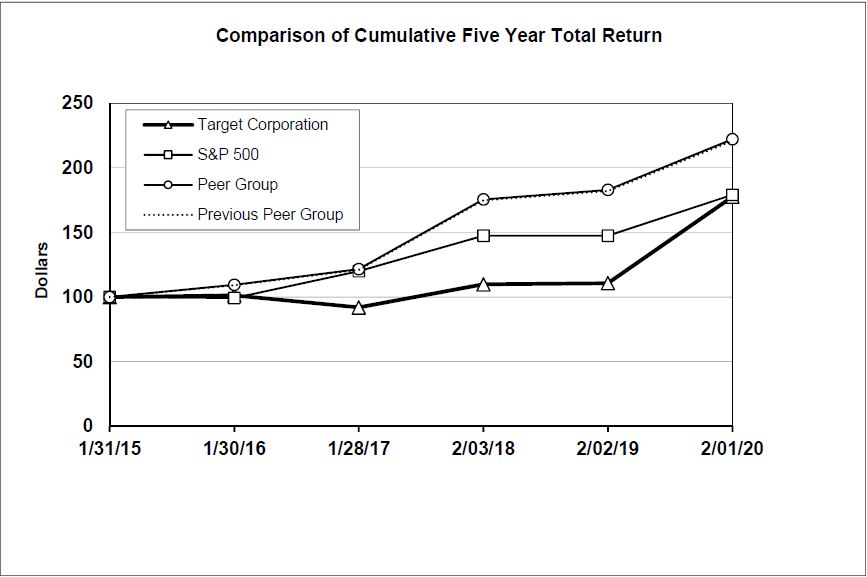
| Target | $ | 100.00 | $ | 101.21 | $ | 91.94 | $ | 109.76 | $ | 110.65 | $ | 177.66 | |||||||||||||||||||||||
| S&P 500 Index | 100.00 | 99.33 | 120.06 | 147.48 | 147.40 | 179.17 | |||||||||||||||||||||||||||||
| Current Peer Group | 100.00 | 109.53 | 121.71 | 175.63 | 183.05 | 222.19 | |||||||||||||||||||||||||||||
| Previous Peer Group | 100.00 | 109.11 | 121.15 | 174.97 | 182.10 | 220.86 | |||||||||||||||||||||||||||||
The graph above compares the cumulative total shareholder return on our common stock for the last five fiscal years with (i) the cumulative total return on the S&P 500 Index, (ii) the peer group used in previous filings consisting of 17 online, general merchandise, department store, food, and specialty retailers (Amazon.com, Inc., Best Buy Co., Inc., Costco Wholesale Corporation, CVS Health Corporation, Dollar General Corporation, Dollar Tree, Inc., The Gap, Inc., The Home Depot, Inc., Kohl's Corporation, The Kroger Co., Lowe's Companies, Inc., Macy's, Inc., Rite Aid Corporation, Sears Holdings Corporation, The TJX Companies, Inc., Walgreens Boots Alliance, Inc., and Walmart Inc.) (Previous Peer Group), and (iii) a new peer group consisting of the companies in the Previous Peer Group, plus Nordstrom, Inc., but excluding Sears Holdings Corporation, which filed for bankruptcy protection and is no longer publicly traded, and The Gap, Inc., which announced its intention to enter a transformational period for its brands (Current Peer Group). The Current Peer Group is consistent with the retail peer group used for our definitive Proxy Statement for the Annual Meeting of Shareholders to be held on June 10, 2020, excluding Publix Super Markets, Inc., which is not quoted on a public stock exchange.
The peer group is weighted by the market capitalization of each component company. The graph assumes the investment of $100 in Target common stock, the S&P 500 Index, and the Peer Group on January 30, 2015, and reinvestment of all dividends.
| TARGET CORPORATION | | 2019 Form 10-K | 14 |
| OTHER INFORMATION | Table of Contents | |||||||
| Index to Financial Statements |
Item 6. Selected Financial Data
| Selected Financial Data | For the Fiscal Year | ||||||||||||||||||||||||||||
| 2017 | 2016 | 2015 | |||||||||||||||||||||||||||
| (millions, except per share data) | 2019 | 2018 | As Adjusted (a)(b) | As Adjusted (b) | As Adjusted (b) | ||||||||||||||||||||||||
| Sales | $ | 77,130 | $ | 74,433 | $ | 71,786 | $ | 69,414 | $ | 73,717 | |||||||||||||||||||
| Total revenue | 78,112 | 75,356 | 72,714 | 70,271 | 74,494 | ||||||||||||||||||||||||
| Net Earnings | |||||||||||||||||||||||||||||
| Continuing operations | 3,269 | 2,930 | 2,908 | 2,666 | 3,321 | ||||||||||||||||||||||||
| Discontinued operations | 12 | 7 | 6 | 68 | 42 | ||||||||||||||||||||||||
| Net earnings | 3,281 | 2,937 | 2,914 | 2,734 | 3,363 | ||||||||||||||||||||||||
| Basic Earnings Per Share | |||||||||||||||||||||||||||||
| Continuing operations | 6.39 | 5.54 | 5.32 | 4.61 | 5.29 | ||||||||||||||||||||||||
| Discontinued operations | 0.02 | 0.01 | 0.01 | 0.12 | 0.07 | ||||||||||||||||||||||||
| Basic earnings per share | 6.42 | 5.55 | 5.32 | 4.73 | 5.35 | ||||||||||||||||||||||||
| Diluted Earnings Per Share | |||||||||||||||||||||||||||||
| Continuing operations | 6.34 | 5.50 | 5.29 | 4.58 | 5.25 | ||||||||||||||||||||||||
| Discontinued operations | 0.02 | 0.01 | 0.01 | 0.12 | 0.07 | ||||||||||||||||||||||||
| Diluted earnings per share | 6.36 | 5.51 | 5.29 | 4.69 | 5.31 | ||||||||||||||||||||||||
| Cash dividends declared per share | 2.62 | 2.54 | 2.46 | 2.36 | 2.20 | ||||||||||||||||||||||||
| As of | |||||||||||||||||||||||||||||
| February 1, 2020 | February 2, 2019 | February 3, 2018 As Adjusted (b) | January 28, 2017 As Adjusted (b) | January 30, 2016 (b) | |||||||||||||||||||||||||
| Total assets | 42,779 | 41,290 | 40,303 | 38,724 | 40,262 | ||||||||||||||||||||||||
| Long-term debt, including current portion | 11,499 | 11,275 | 11,398 | 12,591 | 12,760 |
Note: This information should be read in conjunction with MD&A and the Financial Statements. Per share amounts may not foot due to rounding.
(a)Consisted of 53 weeks.
(b)The selected financial data for fiscal years 2017, 2016, and 2015 and as of February 3, 2018 and January 28, 2017, reflect the adoption of Accounting Standards Update (ASU) No. 2014-09—Revenue from Contracts with Customers (Topic 606). The selected financial data for fiscal years 2017 and 2016 and as of February 3, 2018 and January 28, 2017, reflect the adoption of ASU No. 2016-02—Leases (Topic 842) (Lease Standard). The selected financial data as of January 30, 2016, does not reflect adoption of Topic 606 or Topic 842.
| TARGET CORPORATION | | 2019 Form 10-K | 15 |
| MANAGEMENT'S DISCUSSION AND ANALYSIS | Table of Contents | |||||||
| EXECUTIVE SUMMARY & ANALYSIS OF OPERATIONS | Index to Financial Statements |
Item 7. Management's Discussion and Analysis of Financial Condition and Results of Operations
Executive Overview
Over the last several years, we have made strategic investments to build a durable operating and financial model that further differentiates Target and is designed to drive sustainable sales and profit growth. We have done this through an investment strategy focused on:
Elevating the shopping experiences and winning with high-touch service
-
During the past three years, we have remodeled more than 700 stores, including nearly 300 during 2019. We plan to remodel approximately 300 in 2020.
-
We have grown our stores network and now have over 100 small format stores in key urban markets and on college campuses.
-
We have redesigned our store operating model – redefining roles for hundreds of thousands of team members to deliver better guest service.
-
We have invested significantly in our team, including a $13 starting hourly wage with a commitment to $15 by the end of 2020.
Curation at Scale
- We have delivered a steady stream of newness and exclusives across our assortment. We have introduced over 25 new owned and exclusive brands, including the 2019 launch of our new food and beverage owned brand, Good & Gather, which we expect will become our largest owned brand.
Delivering Ease and Convenience through Same Day Services
- We have expanded our digital fulfillment capabilities, which elevate the shopping experience and give our guests new reasons to choose Target. During 2019, over 70% of our comparable digital sales growth was driven by same-day fulfillment options: Order Pickup, Drive Up, and delivery via our wholly owned subsidiary, Shipt.
These investments are translating into tangible financial results summarized below.
Financial Summary
Fiscal 2019 included the following notable items:
-
GAAP earnings per share from continuing operations were $6.34.
-
Adjusted earnings per share from continuing operations were $6.39.
-
Total revenue increased 3.7 percent, driven by a comparable sales increase and sales from new stores.
-
Comparable sales increased 3.4 percent, driven by a 2.7 percent increase in traffic.
◦Comparable store sales grew 1.4 percent.
◦Digital channel sales increased 29 percent, contributing 1.9 percentage points to comparable sales growth.
- Operating income of $4,658 million was 13.3 percent higher than the comparable prior-year period.
Sales were $77,130 million for 2019, an increase of $2,697 million or 3.6 percent from the prior year. Operating cash flow provided by continuing operations was $7,099 million for 2019, an increase of $1,129 million, or 18.9 percent, from $5,970 million for 2018.
| TARGET CORPORATION | | 2019 Form 10-K | 16 |
| MANAGEMENT'S DISCUSSION AND ANALYSIS | Table of Contents | |||||||
| EXECUTIVE SUMMARY & ANALYSIS OF OPERATIONS | Index to Financial Statements |
| Earnings Per Share From Continuing Operations | Percent Change | |||||||||||||||||||
| 2019 | 2018 | 2017 (a) | 2019/2018 | 2018/2017 | ||||||||||||||||
| GAAP diluted earnings per share | $ | 6.34 | $ | 5.50 | $ | 5.29 | 15.4 | % | 4.0 | % | ||||||||||
| Adjustments | 0.05 | (0.10) | (0.60) | |||||||||||||||||
| Adjusted diluted earnings per share | $ | 6.39 | $ | 5.39 | $ | 4.69 | 18.4 | % | 15.1 | % |
Note: Amounts may not foot due to rounding. Adjusted diluted earnings per share from continuing operations (Adjusted EPS), a non-GAAP metric, excludes the impact of certain items. Management believes that Adjusted EPS is useful in providing period-to-period comparisons of the results of our continuing operations. A reconciliation of non-GAAP financial measures to GAAP measures is provided on page 21.
(a)Consisted of 53 weeks.
We report after-tax return on invested capital (ROIC) from continuing operations because we believe ROIC provides a meaningful measure of our capital-allocation effectiveness over time. For the trailing twelve months ended February 1, 2020, ROIC was 16.0 percent, compared with 14.7 percent for the trailing twelve months ended February 2, 2019. The calculation of ROIC is provided on page 22.
Analysis of Results of Operations
| Summary of Operating Income | Percent Change | |||||||||||||||||||
| (dollars in millions) | 2019 | 2018 | 2017 (a) | 2019/2018 | 2018/2017 | |||||||||||||||
| Sales | $ | 77,130 | $ | 74,433 | $ | 71,786 | 3.6 | % | 3.7 | % | ||||||||||
| Other revenue | 982 | 923 | 928 | 6.3 | (0.5) | |||||||||||||||
| Total revenue | 78,112 | 75,356 | 72,714 | 3.7 | 3.6 | |||||||||||||||
| Cost of sales | 54,864 | 53,299 | 51,125 | 2.9 | 4.3 | |||||||||||||||
| SG&A expenses | 16,233 | 15,723 | 15,140 | 3.2 | 3.9 | |||||||||||||||
| Depreciation and amortization (exclusive of depreciation included in cost of sales) | 2,357 | 2,224 | 2,225 | 6.0 | (0.1) | |||||||||||||||
| Operating income | $ | 4,658 | $ | 4,110 | $ | 4,224 | 13.3 | % | (2.7) | % |
(a)Consisted of 53 weeks.
| Rate Analysis | 2019 | 2018 | 2017 (a) | ||||||||
| Gross margin rate | 28.9 | % | 28.4 | % | 28.8 | % | |||||
| SG&A expense rate | 20.8 | 20.9 | 20.8 | ||||||||
| Depreciation and amortization (exclusive of depreciation included in cost of sales) expense rate | 3.0 | 3.0 | 3.1 | ||||||||
| Operating income margin rate | 6.0 | 5.5 | 5.8 |
Note: Gross margin rate is calculated as gross margin (sales less cost of sales) divided by sales. All other rates are calculated by dividing the applicable amount by total revenue.
(a)Consisted of 53 weeks.
A discussion regarding Results of Operations and Analysis of Financial Condition for the year ended February 2, 2019, as compared to the year ended February 3, 2018, is included in Part II, Item 7, MD&A to our Annual Report on Form 10-K for the fiscal year ended February 2, 2019.
| TARGET CORPORATION | | 2019 Form 10-K | 17 |
| MANAGEMENT'S DISCUSSION AND ANALYSIS | Table of Contents | |||||||
| ANALYSIS OF OPERATIONS | Index to Financial Statements |
Sales
Sales include all merchandise sales, net of e
Showing the first 8K of 62K characters. Open the full section
Item 7A. Quantitative and Qualitative Disclosures About Market Risk
As of February 1, 2020, our exposure to market risk was primarily from interest rate changes on our debt obligations, some of which are at a London Interbank Offered Rate (LIBOR). Our interest rate exposure is primarily due to differences between our floating rate debt obligations compared to our floating rate short-term investments. As of February 1, 2020, our floating rate short-term investments exceeded our floating rate debt by approximately $300 million. Based on our balance sheet position as of February 1, 2020, the annualized effect of a 0.1 percentage point increase in floating interest rates on our floating rate debt obligations, net of our floating rate short-term investments, would not be significant. In general, we expect our floating rate debt to exceed our floating rate short-term investments over time, but that may vary in different interest rate environments. See further description of our debt and derivative instruments in Notes 15 and 16 to the Financial Statements.
In 2017, the United Kingdom's Financial Conduct Authority announced the intent to phase out LIBOR by the end of 2021. As a result, we may amend our contracts that use LIBOR as a benchmark, but do not expect these changes will have a material impact on our financial statements, liquidity and access to capital markets.
We record our general liability and workers' compensation liabilities at net present value; therefore, these liabilities fluctuate with changes in interest rates. Based on our balance sheet position as of February 1, 2020, the annualized effect of a 0.5 percentage point decrease in interest rates would be to decrease earnings before income taxes by $6 million.
In addition, we are exposed to market return fluctuations on our qualified defined benefit pension plan. The value of our pension liabilities is inversely related to changes in interest rates. A 1 percentage point decrease to the weighted average discount rate would increase annual expense by $61 million. To protect against declines in interest rates, we hold high-quality, long-duration bonds and interest rate swaps in our pension plan trust. At year-end, we had hedged 60 percent of the interest rate exposure of our plan liabilities.
As more fully described in Note 22 to the Financial Statements, we are exposed to market returns on accumulated team member balances in our nonqualified, unfunded deferred compensation plans. We control the risk of offering the nonqualified plans by making investments in life insurance contracts and prepaid forward contracts on our own common stock that substantially offset our economic exposure to the returns on these plans.
There have been no other material changes in our primary risk exposures or management of market risks since the prior year.
| TARGET CORPORATION | | 2019 Form 10-K | 29 |
| FINANCIAL STATEMENTS | Table of Contents | |||||||
| INDEX | Index to Financial Statements |
Item 8. Financial Statements and Supplementary Data
Showing the first 8K of 138K characters. Open the full section
Item 9. Changes in and Disagreements with Accountants on Accounting and Financial Disclosure
Not applicable.
Item 9A. Controls and Procedures
Changes in Internal Control Over Financial Reporting
During the most recently completed fiscal quarter, the following change to our information technology systems materially affected, or is reasonably likely to materially affect, our internal control over financial reporting:
- We are in the process of a broad multi-year migration of many mainframe-based systems and middleware products to a modern platform, including systems and processes supporting inventory and supply chain-related transactions.
During the most recently completed fiscal quarter, no other change in our internal control over financial reporting materially affected, or is reasonably likely to materially affect, our internal control over financial reporting.
Evaluation of Disclosure Controls and Procedures
As of the end of the period covered by this Annual Report, we conducted an evaluation, under supervision and with the participation of management, including the chief executive officer and chief financial officer, of the effectiveness of the design and operation of our disclosure controls and procedures pursuant to Rules 13a-15 and 15d-15 of the Securities Exchange Act of 1934, as amended (Exchange Act). Based upon that evaluation, our chief executive officer and chief financial officer concluded that our disclosure controls and procedures are effective at a reasonable assurance level. Disclosure controls and procedures are defined by Rules 13a-15(e) and 15d-15(e) of the Exchange Act as controls and other procedures that are designed to ensure that information required to be disclosed by us in reports filed with the SEC under the Exchange Act is recorded, processed, summarized and reported within the time periods specified in the SEC's rules and forms. Disclosure controls and procedures include, without limitation, controls and procedures designed to ensure that information required to be disclosed by us in reports filed under the Exchange Act is accumulated and communicated to our management, including our principal executive and principal financial officers, or persons performing similar functions, as appropriate, to allow timely decisions regarding required disclosure.
For the Report of Management on Internal Control and the Report of Independent Registered Public Accounting Firm on Internal Control over Financial Reporting, see Part II, Item 8, Financial Statements and Supplementary Data.
Item 9B. Other Information
Not applicable.
| TARGET CORPORATION | | 2019 Form 10-K | 60 |
| SUPPLEMENTAL INFORMATION | Table of Contents | |||||||
| Index to Financial Statements |
PART III
Certain information required by Part III is incorporated by reference from Target's definitive Proxy Statement for the Annual Meeting of Shareholders to be held on June 10, 2020 (our Proxy Statement). Except for those portions specifically incorporated in this Form 10-K by reference to the Proxy Statement, no other portions of the Proxy Statement are deemed to be filed as part of this Form 10-K.
Item 10. Directors, Executive Officers and Corporate Governance
The following sections of the Proxy Statement are incorporated herein by reference:
-
Item one--Election of directors
-
Stock ownership information--Section 16(a) beneficial ownership reporting compliance
-
General information about corporate governance and the Board of Directors
◦Business ethics and conduct
◦Committees
- Questions and answers about our Annual Meeting and voting--Question 14
See also Part I, Item 4A, Executive Officers of this Form 10-K.
Item 11. Executive Compensation
The following sections of the Proxy Statement are incorporated herein by reference:
-
Compensation Discussion and Analysis
-
Compensation tables
-
Human Resources & Compensation Committee Report
Item 12. Security Ownership of Certain Beneficial Owners and Management and Related Stockholder Matters
The following sections of the Proxy Statement are incorporated herein by reference:
- Stock ownership information--
◦Beneficial ownership of directors and officers
◦Beneficial ownership of Target’s largest shareholders
- Compensation tables--Equity compensation plan information
Item 13. Certain Relationships and Related Transactions, and Director Independence
The following sections of the Proxy Statement are incorporated herein by reference:
- General information about corporate governance and the Board of Directors--
◦Policy on transactions with related persons
◦Director independence
◦Committees
Item 14. Principal Accountant Fees and Services
The following section of the Proxy Statement is incorporated herein by reference:
- Item two-- Ratification of appointment of Ernst & Young LLP as independent registered public accounting firm-audit and non-audit fees
| TARGET CORPORATION | | 2019 Form 10-K | 61 |
| SUPPLEMENTAL INFORMATION | Table of Contents | |||||||
| Index to Financial Statements |
PART IV
Item 15. Exhibits, Financial Statement Schedules
The following information required under this item is filed as part of this report:
a) Financial Statements
-
Consolidated Statements of Operations for the Years Ended February 1, 2020, February 2, 2019, and February 3, 2018
-
Consolidated Statements of Comprehensive Income for the Years Ended February 1, 2020, February 2, 2019, and February 3, 2018
-
Consolidated Statements of Financial Position as of February 1, 2020 and February 2, 2019
-
Consolidated Statements of Cash Flows for the Years Ended February 1, 2020, February 2, 2019, and February 3, 2018
-
Consolidated Statements of Shareholders' Investment for the Years Ended February 1, 2020, February 2, 2019, and February 3, 2018
-
Report of Independent Registered Public Accounting Firm on Consolidated Financial Statements
| Financial Statement Schedules | ||
| None. | ||
| Other schedules have not been included either because they are not applicable or because the information is included elsewhere in this Report. |
| TARGET CORPORATION | | 2019 Form 10-K | 62 |
| SUPPLEMENTAL INFORMATION | Table of Contents | |||||||
| Index to Financial Statements |
b) Exhibits
| TARGET CORPORATION | | 2019 Form 10-K | 63 |
| SUPPLEMENTAL INFORMATION | Table of Contents | |||||||
| Index to Financial Statements |
Copies of exhibits will be furnished upon written request and payment of Registrant's reasonable expenses in furnishing the exhibits.
‡ Certain portions of this exhibit have been omitted pursuant to a request for confidential treatment and have been filed separately with the Securities and Exchange Commission.
*** Management contract or compensation plan or arrangement required to be filed as an exhibit to this Form 10-K.
*(1)*Incorporated by reference to Exhibit (3)A to Target's Form 8-K Report filed June 10, 2010.
*(2)*Incorporated by reference to Exhibit (3)B to Target's Form 8-K Report filed January 10, 2020.
*(3)*Incorporated by reference to Exhibit 4.1 to Target's Form 8-K Report filed August 10, 2000.
*(4)*Incorporated by reference to Exhibit 4.1 to the Registrant's Form 8-K Report filed May 1, 2007.
*(5)*Incorporated by reference to Exhibit (10)KK to Target's Form 8-K Report filed June 15, 2017.
*(6)*Incorporated by reference to Exhibit (10)B to Target's Form 10-Q Report for the quarter ended July 30, 2011.
*(7)*Incorporated by reference to Exhibit (10)C to Target's Form 10-Q Report for the quarter ended July 29, 2017.
*(8)*Incorporated by reference to Exhibit (10)C to Target's Form 10-Q Report for the quarter ended April 30, 2016.
*(9)*Incorporated by reference to Exhibit (10)D to Target's Form 10-Q Report for the quarter ended April 30, 2016.
*(10)*Incorporated by reference to Exhibit (10)E to Target's Form 10-K Report for the year ended February 1, 2014.
*(11)*Incorporated by reference to Exhibit (10)NN to Target's Form 10-Q Report for the quarter ended April 30, 2016.
*(12)*Incorporated by reference to Exhibit (10)F to Target's Form 10-Q Report for the quarter ended July 30, 2011.
*(13)*Incorporated by reference to Exhibit (10)I to Target's Form 10-K Report for the year ended January 28, 2017.
*(14)*Incorporated by reference to Exhibit (10)I to Target's Form 10-K Report for the year ended February 3, 2007.
| TARGET CORPORATION | | 2019 Form 10-K | 64 |
| SUPPLEMENTAL INFORMATION | Table of Contents | |||||||
| Index to Financial Statements |
*(15)*Incorporated by reference to Exhibit (10)I to Target's Form 10-K Report for the year ended February 1, 2014.
*(16)*Incorporated by reference to Exhibit (10)L to Target's Form 10-Q Report for the quarter ended July 29, 2017.
*(17)*Incorporated by reference to Exhibit (10)A to Target's Form 10-Q Report for the quarter ended October 30, 2010.
*(18)*Incorporated by reference to Exhibit (10)O to Target's Form 10-K Report for the year ended January 29, 2005.
*(19)*Incorporated by reference to Exhibit (10)O to Target's Form 10-K Report for the year ended January 31, 2009.
*(20)*Incorporated by reference to Exhibit (10)AA to Target's Form 10-Q Report for the quarter ended July 30, 2011.
*(21)*Incorporated by reference to Exhibit (10)MM to Target's Form 10-Q Report for the quarter ended October 28, 2017.
*(22)*Incorporated by reference to Exhibit (10)V to Target's Form 10-K Report for the year ended January 31, 2015.
*(23)*Incorporated by reference to Exhibit (10)JJ to Target's Form 10-Q Report for the quarter ended April 29, 2017.
*(24)*Incorporated by reference to Exhibit (10)EE to Target's Form 8-K Report filed January 11, 2012.
*(25)*Incorporated by reference to Exhibit (10)W to Target's Form 10-K Report for the year ended February 2, 2013.
*(26)*Incorporated by reference to Exhibit (10)HH to Target's Form 10-K Report for the year ended January 31, 2015.
*(27)*Incorporated by reference to Exhibit (10)A to Target's Form 8-K Report filed January 10, 2019.
*(28)*Incorporated by reference to Exhibit (10)O to Target's Form 10-Q Report for the quarter ended October 29, 2016.
*(29)*Incorporated by reference to Exhibit (10)LL to Target's Form 10-Q Report for the quarter ended October 28, 2017.
*(30)*Incorporated by reference to Exhibit (10)II to Target's Form 10-Q Report for the quarter ended November 3, 2018.
*(31)*Incorporated by reference to Exhibit (10)X to Target's Form 10-Q/A Report for the quarter ended May 4, 2013.
*(32)*Incorporated by reference to Exhibit (10)II to Target's Form 10-Q Report for the quarter ended May 2, 2015.
*(33)*Incorporated by reference to Exhibit (10)KK to Target's Form 10-K Report for the year ended January 30, 2016.
*(34)*Incorporated by reference to Exhibit (10)CC to Target's Form 10-K Report for the year ended January 28, 2017.
*(35)*Incorporated by reference to Exhibit (10)HH to Target's Form 10-K Report for the year ended February 3, 2018.
| TARGET CORPORATION | | 2019 Form 10-K | 65 |
| SUPPLEMENTAL INFORMATION | Table of Contents | |||||||
| Index to Financial Statements |
SIGNATURES
Pursuant to the requirements of Section 13 or 15(d) of the Securities Exchange Act of 1934, Target has duly caused this report to be signed on its behalf by the undersigned, thereunto duly authorized.
| TARGET CORPORATION | |||||||||||
| By: | /s/ Michael J. Fiddelke | ||||||||||
| Dated: March 11, 2020 | Michael J. Fiddelke Executive Vice President and Chief Financial Officer | ||||||||||
Pursuant to the requirements of the Securities Exchange Act of 1934, the report has been signed below by the following persons on behalf of Target and in the capacities and on the dates indicated.
| /s/ Brian C. Cornell | |||||
| Dated: March 11, 2020 | Brian C. Cornell Chairman of the Board and Chief Executive Officer |
| /s/ Michael J. Fiddelke | |||||
| Dated: March 11, 2020 | Michael J. Fiddelke Executive Vice President and Chief Financial Officer |
| /s/ Robert M. Harrison | |||||
| Dated: March 11, 2020 | Robert M. Harrison Senior Vice President, Chief Accounting Officer and Controller |
| ROXANNE S. AUSTIN DOUGLAS M. BAKER, JR. GEORGE S. BARRETT CALVIN DARDEN HENRIQUE DE CASTRO ROBERT L. EDWARDS | MELANIE L. HEALEY DONALD R. KNAUSS MONICA C. LOZANO MARY E. MINNICK KENNETH L. SALAZAR DMITRI L. STOCKTON | Constituting a majority of the Board of Directors |
Michael J. Fiddelke, by signing his name hereto, does hereby sign this document pursuant to powers of attorney duly executed by the Directors named, filed with the Securities and Exchange Commission on behalf of such Directors, all in the capacities and on the date stated.
| By: | /s/ Michael J. Fiddelke | |||||||
| Dated: March 11, 2020 | Michael J. Fiddelke Attorney-in-fact |
| TARGET CORPORATION | | 2019 Form 10-K | 66 |