 filings.tools
T-Mobile US 10-K 2023-12-31
Filed 2024-02-02. 24 sections, 759K characters. Original on sec.gov · Markdown · JSON
Cover and table of contents
UNITED STATES
SECURITIES AND EXCHANGE COMMISSION
Washington, D.C. 20549
FORM 10-K
☒ ANNUAL REPORT PURSUANT TO SECTION 13 OR 15(d) OF THE SECURITIES EXCHANGE ACT OF 1934
For the fiscal year ended December 31, 2023
or
☐ TRANSITION REPORT PURSUANT TO SECTION 13 OR 15(d) OF THE SECURITIES EXCHANGE ACT OF 1934
For the transition period from to
Commission File Number: 1-33409
T-MOBILE US, INC.
(Exact name of registrant as specified in its charter)
| Delaware | 20-0836269 | |||||||
| (State or other jurisdiction of incorporation or organization) | (I.R.S. Employer Identification No.) | |||||||
12920 SE 38th Street
Bellevue, Washington
(Address of principal executive offices)
98006-1350
(Zip Code)
| (425) | 378-4000 | ||||
| (Registrant’s telephone number, including area code) | |||||
| Securities registered pursuant to Section 12(b) of the Act: |
| Title of each class | Trading Symbol | Name of each exchange on which registered | ||||||||||||
| Common Stock, par value $0.00001 per share | TMUS | The NASDAQ Stock Market LLC | ||||||||||||
| Securities registered pursuant to Section 12(g) of the Act: None |
Indicate by check mark if the registrant is a well-known seasoned issuer, as defined in Rule 405 of the Securities Act. Yes ☒ No
Indicate by check mark if the registrant is not required to file reports pursuant to Section 13 or Section 15(d) of the Act. Yes No ☒
Indicate by check mark whether the registrant (1) has filed all reports required to be filed by Section 13 or 15(d) of the Securities Exchange Act of 1934 during the preceding 12 months (or for such shorter period that the registrant was required to file such reports), and (2) has been subject to such filing requirements for the past 90 days. Yes ☒ No ☐
Indicate by check mark whether the registrant has submitted electronically every Interactive Data File required to be submitted pursuant to Rule 405 of Regulation S-T (§232.405 of this chapter) during the preceding 12 months (or for such shorter period that the registrant was required to submit such files). Yes ☒ No ☐
Indicate by check mark whether the registrant is a large accelerated filer, an accelerated filer, a non-accelerated filer, a smaller reporting company, or an emerging growth company. See the definitions of “large accelerated filer,” “accelerated filer,” “smaller reporting company,” and “emerging growth company” in Rule 12b-2 of the Exchange Act.
| Large accelerated filer | ☒ | Accelerated filer | ☐ | ||||||||
| Non-accelerated filer | ☐ | Smaller reporting company | ☐ | ||||||||
| Emerging growth company | ☐ |
If an emerging growth company, indicate by check mark if the registrant has elected not to use the extended transition period for complying with any new or revised financial accounting standards provided pursuant to Section 13(a) of the Exchange Act. ☐
Indicate by check mark whether the registrant has filed a report on and attestation to its management’s assessment of the effectiveness of its internal control over financial reporting under Section 404(b) of the Sarbanes-Oxley Act (15 U.S.C. 7262(b)) by the registered public accounting firm that prepared or issued its audit report. ☒
If securities are registered pursuant to Section 12(b) of the Act, indicate by check mark whether the financial statements of the registrant included in the filing reflect the correction of an error to previously issued financial statements. ☐
Indicate by check mark whether any of those error corrections are restatements that required a recovery analysis of incentive-based compensation received by any of the registrant’s executive officers during the relevant recovery period pursuant to §240.10D-1(b). ☐
Indicate by check mark whether the registrant is a shell company (as defined in Rule 12b-2 of the Act). Yes ☐ No ☒
As of June 30, 2023, the aggregate market value of the voting and non-voting common equity held by non-affiliates was $73.2 billion based on the closing sale price as reported on the NASDAQ Global Select Market. As of January 31, 2024, there were 1,186,867,575 shares of common stock outstanding.
DOCUMENTS INCORPORATED BY REFERENCE
Part III of this Annual Report on Form 10-K will be incorporated by reference from certain portions of the definitive Proxy Statement for the Registrant’s 2024 Annual Meeting of Stockholders, which definitive Proxy Statement will be filed with the Securities and Exchange Commission pursuant to Regulation 14A or will be included in an amendment to this Report.
T-Mobile US, Inc.
Form 10-K
For the Year Ended December 31, 2023
Table of Contents
Cautionary Statement Regarding Forward-Looking Statements
This Annual Report on Form 10-K (“Form 10-K”) of T-Mobile US, Inc. (“T-Mobile,” “we,” “our,” “us” or the “Company”) includes forward-looking statements within the meaning of the Private Securities Litigation Reform Act of 1995. All statements, other than statements of historical fact, including information concerning our future results of operations, are forward-looking statements. These forward-looking statements are generally identified by the words “anticipate,” “believe,” “estimate,” “expect,” “intend,” “may,” “could” or similar expressions. Forward-looking statements are based on current expectations and assumptions, which are subject to risks and uncertainties that may cause actual results to differ materially from the forward-looking statements. The following important factors, along with the Risk Factors included in Part I, Item 1A of this Form 10-K, could affect future results and cause those results to differ materially from those expressed in the forward-looking statements:
-
competition, industry consolidation and changes in the market for wireless communications services and other forms of connectivity;
-
criminal cyberattacks, disruption, data loss or other security breaches;
-
our inability to take advantage of technological developments on a timely basis;
-
our inability to retain or motivate key personnel, hire qualified personnel or maintain our corporate culture;
-
system failures and business disruptions, allowing for unauthorized use of or interference with our network and other systems;
-
the scarcity and cost of additional wireless spectrum, and regulations relating to spectrum use;
-
challenges in modernizing our existing applications and systems;
-
the impacts of the actions we have taken and conditions we have agreed to in connection with the regulatory proceedings and approvals of our merger (the “Merger”) with Sprint Corporation (“Sprint”) pursuant to a Business Combination Agreement with Sprint and the other parties named therein (as amended, the “Business Combination Agreement”) and the other transactions contemplated by the Business Combination Agreement (collectively, the “Transactions”), including the acquisition by DISH Network Corporation (“DISH”) of the prepaid wireless business operated under the Boost Mobile and Sprint prepaid brands (excluding the Assurance brand Lifeline customers and the prepaid wireless customers of Shenandoah Personal Communications Company LLC (“Shentel”) and Swiftel Communications, Inc.), including customer accounts, inventory, contracts, intellectual property and certain other specified assets, and the assumption of certain related liabilities (collectively, the “Prepaid Transaction”), the complaint and proposed final judgment (the “Final Judgment”) agreed to by us, Deutsche Telekom AG (“DT”), Sprint, SoftBank Group Corp. (“SoftBank”) and DISH with the U.S. District Court for the District of Columbia, which was approved by the Court on April 1, 2020, as amended on October 23, 2023, the proposed commitments filed with the Secretary of the Federal Communications Commission (“FCC”), which we announced on May 20, 2019, certain national security commitments and undertakings, and any other commitments or undertakings entered into, including, but not limited to, those we have made to certain states and nongovernmental organizations (collectively, the “Government Commitments”), and the challenges in satisfying the Government Commitments in the required time frames and the significant cumulative costs incurred in tracking and monitoring compliance over multiple years;
-
adverse economic, political or market conditions in the U.S. and international markets, including changes resulting from increases in inflation or interest rates, supply chain disruptions and impacts of geopolitical instability, such as the Ukraine-Russia and Israel-Hamas wars and further escalations thereof;
-
sociopolitical volatility and polarization;
-
our inability to manage the ongoing arrangements entered into in connection with the Prepaid Transaction, and known or unknown liabilities arising in connection therewith;
-
the timing and effects of any future acquisition, divestiture, investment, or merger involving us;
-
any disruption or failure of our third parties (including key suppliers) to provide products or services for the operation of our business;
-
our substantial level of indebtedness and our inability to service our debt obligations in accordance with their terms;
-
changes in the credit market conditions, credit rating downgrades or an inability to access debt markets;
-
the risk of future material weaknesses we may identify or any other failure by us to maintain effective internal controls, and the resulting significant costs and reputational damage;
-
any changes in regulations or in the regulatory framework under which we operate;
-
laws and regulations relating to the handling of privacy and data protection;
-
unfavorable outcomes of and increased costs from existing or future regulatory or legal proceedings;
-
difficulties in protecting our intellectual property rights or if we infringe on the intellectual property rights of others;
-
our offering of regulated financial services products and exposure to a wide variety of state and federal regulations;
-
new or amended tax laws or regulations or administrative interpretations and judicial decisions affecting the scope or application of tax laws or regulations;
-
our wireless licenses, including those controlled through leasing agreements, are subject to renewal and may be revoked;
-
our exclusive forum provision as provided in our Fifth Amended and Restated Certificate of Incorporation (the “Certificate of Incorporation”);
-
interests of DT, our controlling stockholder, which may differ from the interests of other stockholders;
-
the dollar amount authorized for our 2023-2024 Stockholder Return Program (as defined in Note 13 – Stockholder Return Programs of the Notes to the Consolidated Financial Statements) may not be fully utilized, and our share repurchases and dividend payments pursuant thereto may fail to have the desired impact on stockholder value; and
-
future sales of our common stock by DT and SoftBank and our inability to attract additional equity financing outside the United States due to foreign ownership limitations by the FCC.
In addition, historical, current, and forward-looking environmental, social and governance (“ESG”) related statements may be based on standards for measuring progress that are still developing and internal controls and processes that continue to evolve. Our ESG initiatives are subject to additional risks and uncertainties, including regarding the evolving nature of data availability, quality, and assessment; related methodological concerns; our ability to implement various initiatives under expected timeframes, cost, and complexity; our dependency on third parties to provide certain information and to comply with applicable laws and policies; and other unforeseen events or conditions. For example, we note that standards and expectations regarding greenhouse gas (“GHG”) accounting and the processes for measuring and counting GHG emissions and GHG emission reductions are evolving, and it is possible that our approaches both to measuring our emissions and to reducing emissions and measuring those reductions may be, either currently by some stakeholders or at some point in the future, considered inconsistent with common or best practices with respect to measuring and accounting for such matters, and reducing overall emissions. These factors, as well as others, may cause results to differ materially and adversely from those expressed in any of our forward-looking statements. Given these risks and uncertainties, readers are cautioned not to place undue reliance on such forward-looking statements. We undertake no obligation to revise or publicly release the results of any revision to these forward-looking statements, except as required by law. Additionally, we may provide information that is not necessarily material for SEC reporting purposes but that is informed by various ESG standards and frameworks (including standards for the measurement of underlying data), internal controls, and assumptions or third-party information that are still evolving and subject to change. Our disclosures based on any standards may change due to revisions in framework requirements, availability of information, changes in our business or applicable governmental policies, or other factors, some of which may be beyond our control.
Investors and others should note that we announce material information to our investors using our investor relations website (https://investor.t-mobile.com), newsroom website (https://t-mobile.com/news), press releases, SEC filings and public conference calls and webcasts. We intend to also use certain social media accounts as means of disclosing information about us and our services and for complying with our disclosure obligations under Regulation FD (the @TMobileIR X (formerly Twitter) account (https://twitter.com/TMobileIR), the @MikeSievert X account (https://twitter.com/MikeSievert), which Mr. Sievert also uses as a means for personal communications and observations, and the @TMobileCFO X Account (https://twitter.com/tmobilecfo) and our Chief Financial Officer’s LinkedIn account (https://www.linkedin.com/in/peter-osvaldik-3887394), both of which Mr. Osvaldik also uses as a means for personal communication and observations). The information we post through these social media channels may be deemed material. Accordingly, investors should monitor these social media channels in addition to following our press releases, SEC filings and public conference calls and webcasts. The social media channels that we intend to use as a means of disclosing the information described above may be updated from time to time as listed on our investor relations website.
PART I.
Item 1. Business
Business Overview and Strategy
Un-carrier Strategy
As America’s supercharged Un-carrier, we have disrupted the wireless communications services industry by actively engaging with and listening to our customers and focusing on eliminating their pain points. This includes providing added value and what we believe is an exceptional experience while implementing signature Un-carrier initiatives that have changed the wireless industry. We ended annual service contracts, overages, unpredictable international roaming fees and data buckets, among other things. We are inspired by a relentless focus on customer experience, consistently delivering award-winning customer experience with our “Total Experience” approach, which drives our customer satisfaction levels while enabling operational efficiencies.
With what we believe is America’s largest, fastest, most awarded and most advanced 5G network, the Un-carrier strives to offer customers unrivaled coverage and capacity where they live, work and travel. We believe our network is the foundation of our success and powers everything we do. Our “layer cake” of spectrum provides an unmatched 5G and overall network experience to our customers, which consists of our foundational layer of low-band, our mid-band and our millimeter-wave (“mmWave”) spectrum licenses (see “Spectrum Position” below). This multilayer portfolio of spectrum broadens and deepens our nationwide 5G network, enabling accelerated innovation and increased competition in the U.S. wireless and broadband industries.
We continue to expand the footprint and improve the quality of our network, enabling us to provide what we believe are outstanding wireless experiences for customers who should not have to compromise on quality and value. Our network allows us to deliver new, innovative products and services, such as our High Speed Internet fixed wireless product, with the same customer experience focus and industry-disrupting mindset that we have adopted in our attempt to redefine the wireless communications services industry in the United States in the customers’ favor.
Our Operations
As of December 31, 2023, we provide wireless communications services to 119.7 million postpaid and prepaid customers and generate revenue by providing affordable wireless communications services to these customers, as well as a wide selection of wireless devices and accessories. We also provide wholesale wireless services to various partners, who then offer the services for sale to their customers. Our most significant expenses relate to operating and expanding our network, providing a full range of devices, acquiring and retaining high-quality customers and compensating employees. We provide services, devices and accessories across our flagship brands, T-Mobile and Metro by T-Mobile, through our owned and operated retail stores, as well as through our websites (www.t-mobile.com and www.metrobyt-mobile.com), T-Mobile and Metro by T-Mobile apps, customer care channels and through national retailers. In addition, we sell devices to dealers and other third-party distributors for resale through independent third-party retail outlets and a variety of third-party websites. The information on our websites is not part of this Form 10-K. See Item 7. Management’s Discussion and Analysis of Financial Condition and Results of Operations for additional information.
Services and Products
We provide mobile wireless communications services through a variety of service plan options. We also offer for sale to customers a wide selection of wireless devices, including smartphones, wearables, tablets, home broadband routers and other mobile communication devices that are manufactured by various suppliers.
Our most popular service plan offering is Go5G Plus, which includes unlimited talk, text and data on our network, 5G access at no extra cost, scam protection features, access to the same device offers as new customers and more. We also offer an Essentials rate plan for customers who want the basics at a lower price point, specific rate plans to qualifying customers, including Military and Veterans, First Responder and 55+, as well as Go5G and Go5G Next plans to deliver a full suite of plans that provide customers the features that meet their lifestyle and daily needs.
At the time of device purchase, qualified customers can finance all or a portion of the individual device or accessory purchase price over an installment period, generally of 24 months, using an equipment installment plan (“EIP”).
In addition to our mobile wireless communications services, we offer High Speed Internet, which includes a fixed wireless product that utilizes the excess capacity of our nationwide 5G network. Our fixed wireless product is available to millions of domestic households where we currently have excess network capacity, providing, for some consumers, an alternative to traditional landline internet service providers and expanding access to and choice for some consumers. With our High Speed Internet plan, customers can access the internet without worrying about annual service contracts, data overages or hidden fees.
We also provide products and services that are complementary to our wireless communications services, including device protection, financial services and advertising. In September 2022, we entered into an agreement for the sale of the Wireline Business, and on May 1, 2023, we completed the sale of the Wireline Business. See Note 14 – Wireline for additional information.
Customers
We provide wireless communications services to a variety of customers needing connectivity, but focus primarily on two categories of customers:
-
Postpaid customers generally are qualified to pay after receiving wireless communications services utilizing phones, High Speed Internet modems, mobile internet devices (including tablets and hotspots), wearables, DIGITS and other connected devices, including SyncUP and internet of things (“IoT”). We serve consumers as well as business customers, who are provided services under the T-Mobile for Business brand.
-
Prepaid customers generally pay for wireless communications services in advance. We serve prepaid customers under the T-Mobile and Metro by T-Mobile brands.
We provide Machine-to-Machine (“M2M”) and Mobile Virtual Network Operator (“MVNO”) customers access to our network. This access and the customer relationship are managed by wholesale partners, with whom we have commercial agreements permitting them to sell services utilizing our network.
We generate the majority of our service revenues by providing wireless communications services to postpaid and prepaid customers. Our ability to attract and retain postpaid and prepaid customers is important to our business in the generation of service revenues, equipment revenues and other revenues. In 2023, our service revenues generated by providing wireless communications services by customer category were:
-
77% Postpaid customers;
-
15% Prepaid customers; and
-
8% Wholesale and other services.
Substantially all of our revenues for the years ended December 31, 2023, 2022 and 2021, were earned in the United States, including Puerto Rico and the U.S. Virgin Islands.
Network Strategy
Utilizing our multilayer spectrum portfolio, our mission is to become “Famous for Network.” We have deployed low-band, mid-band and mmWave spectrum dedicated for 5G across our dense and broad network to create what we believe is America’s largest, fastest, most awarded and most advanced 5G network.
The Merger greatly enhanced our spectrum position. Integration of the spectrum and network assets acquired in the Merger was substantially completed in 2023. Our integration strategy included deploying the acquired spectrum on the combined network assets to supplement capacity, migrating Sprint customers to our network and optimizing the combined assets by decommissioning redundant sites. As of December 31, 2022, we had decommissioned substantially all targeted Sprint macro sites. As a result of the Merger, we have achieved significant synergies and cost reductions by eliminating redundancies within our network, as well as through other business processes and operations.
Spectrum Position
We provide wireless communications services utilizing low-band spectrum licenses covering our 600 MHz and 700 MHz spectrum, mid-band spectrum licenses, such as Advanced Wireless Services (“AWS”), Personal Communications Services (“PCS”) and 2.5 GHz spectrum, and mmWave spectrum.
-
We controlled, or expected to control based on previously announced auction results, an average of 392 MHz of combined low- and mid-band spectrum nationwide as of December 31, 2023. This spectrum is comprised of:
-
An average of 40 MHz in the 600 MHz band;
-
An average of 10 MHz in the 700 MHz band;
-
An average of 14 MHz in the 800 MHz band;
-
An average of 41 MHz in the 1700 MHz AWS band;
-
An average of 66 MHz in the 1900 MHz PCS band;
-
An average of 182 MHz in the 2.5 GHz band;
-
An average of 12 MHz in the 3.45 GHz band; and
-
An average of 27 MHz in the C-band.
-
We controlled an average of 1,157 GHz of combined mmWave spectrum licenses.
-
In August 2022, we entered into license purchase agreements pursuant to which we will acquire spectrum in the 600 MHz band in exchange for total cash consideration of $3.5 billion. See Note 6 – Goodwill, Spectrum License Transactions and Other Intangible Assets of the Notes to the Consolidated Financial Statements for additional details.
-
In September 2022, the FCC announced that we were the winning bidder of 7,156 licenses in Auction 108 (2.5 GHz spectrum) for an aggregate price of $304 million. The timing of when the licenses will be issued will be determined by the FCC after all post-auction procedures have been completed.
-
In September 2023, we entered into a license purchase agreement pursuant to which we will acquire spectrum in the 600 MHz band in exchange for total cash consideration of between $1.2 billion and $3.3 billion. See Note 6 – Goodwill, Spectrum License Transactions and Other Intangible Assets of the Notes to the Consolidated Financial Statements for additional details.
-
We plan to evaluate future spectrum purchases in future auctions and in the secondary market to further augment our current spectrum position.
-
As of December 31, 2023, we had equipment deployed on approximately 80,000 macro cell sites and 48,000 small cell/distributed antenna system sites across our network.
5G Leadership
We believe our 5G network is America’s largest, fastest, most awarded and most advanced:
-
As of December 31, 2023, our Ultra Capacity 5G utilizing mid-band and mmWave spectrum covers more than 300 million people.
-
As of December 31, 2023, our total 5G coverage, including low-band spectrum, covers more than 330 million people, reaching 98% of Americans.
Competition
The wireless communications services industry remains competitive. We are the second largest provider of wireless communications services in the U.S. as measured by our total postpaid and prepaid customers. Our competitors include other carriers, such as AT&T Inc. (“AT&T”), Verizon Communications, Inc. (“Verizon”), and DISH as it continues to grow its network. In addition, our competitors include numerous smaller and regional providers, including Comcast Corporation, Charter Communications, Inc., Cox Communications, Inc., and Altice USA, Inc., many of which offer no-contract, postpaid and prepaid service plans. Competitors also include providers who offer similar communication services, such as voice, messaging and data services, using alternative technologies. Competitive factors within the wireless communications services industry include pricing, market saturation, service and product offerings, customer experience, network investment and quality, development and deployment of technologies and regulatory changes. Some of our competitors have shown a willingness to use discounted pricing or offer bundled services as a potential source of differentiation.
Human Capital
Employees
As of December 31, 2023, we employed approximately 67,000 full-time and part-time employees, including network, retail, administrative and customer support functions.
Attraction and Retention
We employ a highly skilled workforce within a broad range of functions. Substantially all of our employees are located throughout the United States, including Puerto Rico, to serve our nationwide network and retail operations. Our headquarters are located in Bellevue, Washington, and Overland Park, Kansas.
We attract and retain our workforce through a dynamic and inclusive culture and by providing a comprehensive set of benefits, including:
-
Competitive medical, dental and vision benefits;
-
Family-building benefits designed to meet the diverse needs of our employees, including IVF and IUI, adoption and surrogacy benefits;
-
Annual stock grants to all full-time and part-time employees and a discounted Employee Stock Purchase Program;
-
A 401(k) Savings Plan;
-
Nationwide minimum pay of at least $20 per hour to all full-time and part-time employees;
-
LiveMagenta: a custom-branded program for employee engagement and well-being, including free access to life coaches, financial coaches and tools for healthy living;
-
Access to personal health advocates offering independent guidance;
-
A generous paid time off program, including paid family leave;
-
Tuition assistance for all full-time and part-time employees, including full tuition partnerships with multiple schools; and
-
A matching program for employee donations and volunteering.
Training and Development
Career growth and development is foundational to T-Mobile’s culture and success. We want to deliver the best experiences from the best teams, and one way we do that is by offering an array of development programs and resources to build diverse talent and empower our people to succeed through every step of their career. It is all easily accessible on our Magenta U site, which is our one-stop shop for all things career development and learning. The online learning portal is designed to put employees in the driver’s seat and give them access to mentoring, training, videos, books, job search and interview tips, and much more.
By strategically investing in the following three key areas of career development and learning, we are developing our talent now and for the future.
-
Evolve skills and careers – Learn every day, champion relentless improvement, develop critical skills, explore career possibilities, and build the desired career;
-
Advance leadership expertise – Build critical leadership capabilities, enable leadership growth at all levels, and develop skills to lead in the future; and
-
Champion diversity, equity and inclusion (“DE&I”) – Promote inclusive habits and behaviors, enhance belonging and connectedness, and advocate for equitable opportunities.
Diversity, Equity and Inclusion
DE&I have always been a part of the Un-carrier culture, and we are committed to having DE&I touch every aspect of our future. Our Equity in Action Plan is a five-year plan that spans the values we live by, how we invest in and provide opportunities for our employees, how we select the suppliers we do business with and how we advocate for our communities.
For our employees, we have established six DE&I Employee Resource Groups and four sub-affinity groups that have helped us establish and maintain a culture of inclusion. Currently, we have over 40 DE&I chapters across the nation that help spearhead volunteer opportunities, events and meaningful conversation with employees at a local level. Our DE&I Employee Resource Groups include the following:
-
Accessibility Community at T-Mobile;
-
Multicultural Alliance;
-
Asia Pacific & Allies Network;
-
Black Empowerment Network;
-
Indigenous Peoples Network;
-
Magenta Latinx Network;
-
Multigenerational Network;
-
Pride;
-
Veterans & Allies Network; and
-
Women & Allies Network.
As part of T-Mobile’s Equity In Action Plan and Promises, we have established two External Diversity and Inclusion Councils in connection with our civil rights memorandum of understanding. The councils include civil rights leaders representing a wide range of underrepresented communities. Together with T-Mobile, the councils are helping us identify ways to improve our efforts in focus areas such as corporate governance, workforce recruitment and retention, procurement, entrepreneurship, philanthropy and community investment. Since April 2020, we have achieved a significant portion of the Equity In Action Promises, currently at 80% completed.
As DE&I are instrumental to our culture and values, we are also on a mission to create fair and equitable opportunities for all suppliers, including veteran-owned, disability-owned, woman-owned, minority-owned, LGBT-owned and small and disadvantaged businesses. We have implemented a Supplier Diversity Category Management Strategy for our network technology procurement organization to help identify opportunities and develop actionable targets for progress on this topic. This year, we updated our Supplier Diversity Policy that provides the primary guidance designed to ensure that DE&I are integrated into the purchasing process of goods and services for and on behalf of T-Mobile. In addition, we published T-Mobile’s CEO Supplier Diversity Policy Statement, reenforcing our Equity In Action diversity plan that aims to increase the amount of business we do with diverse suppliers.
Environmental Sustainability
Reducing Our Carbon Footprint
We are working to reduce the impact of our operations on the climate by setting carbon reduction goals that are aligned with science and investing in renewable energy. We are reducing our carbon footprint through several initiatives, including:
-
Making progress on our science-based net-zero target for 2040 that includes Scope 1, 2 and 3 emissions;
-
Investing in renewable energy, as evidenced by our RE100 pledge, a global initiative that unites businesses committed to 100% renewable electricity. We first met this goal in 2021 and have achieved it in each subsequent year so far by matching our electricity usage with renewable energy credits acquired through a variety of sources, including through our engagement in Virtual Power Purchasing Agreements and a Green Direct tariff agreement with nine clean energy providers for expected annual provision of approximately 3.5 million megawatt hours of renewable electricity;
-
Continuously testing and evaluating more efficient equipment for our facilities, including switch stations, cell sites, retail stores and customer experience centers to reduce energy consumption; and
-
Promoting a circular economy through our device reuse and recycle program, which collects millions of devices for reuse, resale, and recycling annually.
Responsible Sourcing
We believe our suppliers are a valuable extension of our business and corporate values. Our Supplier Code of Conduct outlines expectations around ethical business practices for our suppliers. We require our suppliers to operate in full compliance with the laws, rules, regulations and ethical standards of the countries in which they operate or provide products or services. We expect
our suppliers to share our commitment to ethical conduct and environmentally responsible business practices while they conduct business with or on behalf of us. Our Responsible Sourcing Policy further outlines T-Mobile’s expectations in this area.
We employ a third-party risk management (“TPRM”) process to screen for anti-corruption, global sanctions, human rights and environmental risks before engaging with a supplier. Our TPRM process also continuously monitors current suppliers for policy violations and risks.
Regulation
The FCC regulates many key aspects of our business, including licensing, construction, the operation and use of our network, modifications of our network, control and ownership of our licenses and authorizations, the sale, transfer and acquisition of certain licenses, domestic roaming arrangements and interconnection agreements, pursuant to its authority under the Communications Act of 1934, as amended (“Communications Act”). The FCC has a number of complex requirements that affect our operations and pending proceedings regarding additional or modified requirements that could increase our costs or diminish our revenues. For example, the FCC has rules regarding provision of 911, 988 and E-911 services, porting telephone numbers, interconnection, roaming, internet openness or net neutrality, robocalling/robotexting, disabilities access, privacy and cybersecurity, digital discrimination, consumer protection and the universal service and Lifeline programs. Many of these and other issues are being considered in ongoing proceedings, and we cannot predict whether or how such actions will affect our business, financial condition or operating results. Our ability to provide services and generate revenues could be harmed by adverse regulatory action or changes to existing laws and regulations. In addition, regulation of companies that offer competing services can impact our business indirectly.
Except for operations in certain unlicensed frequency bands, wireless communications services providers generally must be licensed by the FCC to provide communications services at specified spectrum frequencies within specified geographic areas and must comply with the rules and policies governing the use of the spectrum as adopted by the FCC. The FCC issues each license for a fixed period of time, typically 10-15 years depending on the particular licenses. While the FCC has generally renewed licenses given to operating companies like us, the FCC has authority both to revoke a license for cause and to deny a license renewal if a renewal is not in the public interest. Furthermore, we could be subject to fines, forfeitures and other penalties for failure to comply with FCC regulations, even if any such noncompliance was unintentional. In extreme cases, penalties can include revocation of our licenses. The loss of any licenses, or any related fines or forfeitures, could adversely affect our business, results of operations and financial condition. In addition, the FCC retains the right to modify rules related to use of licensed spectrum, which could impact T-Mobile’s ability to provide services.
Additionally, Congress’s and the FCC’s allocation of additional spectrum for broadband commercial mobile radio service (“CMRS”), which includes cellular, PCS and other wireless services, could significantly increase and intensify competition. We cannot assess the impact that any developments that may occur in the U.S. economy or any future spectrum allocations by the FCC may have on license values. FCC spectrum auctions and other market developments may adversely affect the market value of our licenses or our competitive position in the future. A significant decline in the value of our licenses could adversely affect our financial condition and results of operations. In addition, the FCC periodically reviews its policies on how to evaluate carriers’ spectrum holdings in the context of spectrum transactions or acquisitions. Most recently, for example, in September 2023, the FCC sought public comment on whether it should initiate a rulemaking proceeding to consider changes to its mobile spectrum rules and policies. A change in these rules and policies could affect our access to additional spectrum resources and competition among us and other carriers.
Congress and the FCC have imposed limitations on foreign ownership of CMRS licensees that exceed 20% direct ownership or 25% indirect ownership through an entity controlling the licensee. The FCC has ruled that higher levels of indirect foreign ownership, even up to 100%, are presumptively consistent with the public interest, but must be reviewed and approved. Consistent with that established policy, the FCC has issued a declaratory ruling authorizing up to 100% ownership of our Company by DT.
For our Educational Broadband Service (“EBS”) licenses in the 2.5 GHz band, FCC rules previously limited eligibility to hold EBS licenses to accredited educational institutions and certain governmental, religious and nonprofit entities, while permitting those license holders to lease their licenses to commercial providers for non-educational purposes. Therefore, we have historically accessed EBS spectrum primarily through long-term leasing arrangements with EBS license holders. Our EBS spectrum leases typically have an initial term equal to the remaining term of the EBS license, with an option to renew the lease for additional terms, for a total lease term of up to 30 years. On April 27, 2020, the FCC lifted the restriction on who can hold EBS licenses and the 30-year limitation on lease duration, among other changes. The elimination of these restrictions allows current license holders to sell their licenses, including to T-Mobile. While a majority of our leases have contractual provisions enabling us to match offers, we may be forced to compete with others to purchase 2.5 GHz licenses on the secondary market
and expend additional capital earlier than we may have anticipated. T-Mobile has started to acquire some of these EBS licenses, but we continue to lease spectrum in this band and expect that to be the case for some time.
While the Communications Act generally preempts state and local governments from regulating the entry of, or the rates charged by, wireless communications services providers, certain state and local governments regulate other terms and conditions of wireless service, including billing, termination of service arrangements and the imposition of early termination fees, advertising, network outages, the use of devices while driving, service mapping, protection of consumer information, zoning and land use. Notwithstanding this federal preemption, several states are considering or have passed laws or regulations that could potentially set prices, minimum performance standards and/or restrictions on service discontinuation that could impact our business in those states.
In addition, following the FCC’s adoption of the 2017 Restoring Internet Freedom (“RIF”) Order reclassifying broadband internet access services as non-common carrier “information services”, a number of states have sought to impose state-specific net neutrality, rate-setting, and privacy requirements on providers’ broadband services. The FCC’s RIF Order expressly preempted such state efforts, which are inconsistent with the FCC’s federal deregulatory approach. In 2019, however, the DC Circuit issued a ruling largely upholding the RIF Order, but also vacating the portion of the ruling broadly preempting state/local measures regulating broadband services. The court left open the prospect that particular state laws could still unlawfully conflict with the FCC RIF Order and be preempted; court challenges to some state enactments are pending.
While most states pursuing net neutrality legislation are largely seeking to codify the repealed federal rules, there are differences in some states, notably California, which has passed separate privacy and net neutrality legislation, Colorado, Connecticut, Utah, Virginia, Delaware, Indiana, Iowa, Montana, Oregon, Tennessee and Texas, which have passed privacy laws; and New York, which has passed a broadband rate-setting law. There are also efforts within Congress to pass federal legislation to codify uniform federal privacy and net neutrality requirements. Ensuring the preemption of separate state requirements, including the California laws, is critical to this effort. If not preempted or rescinded, separate state requirements will impose significant business costs and could also result in increased litigation costs and enforcement risks. State authority over wireless broadband services will remain unsettled until final action by the courts or Congress.
In addition, the Federal Trade Commission (“FTC”) and other federal agencies have jurisdiction over some consumer protection matters and the elimination and prevention of anticompetitive business practices with respect to the provision of non-common carrier services. Further, the FCC and the Federal Aviation Administration regulate the siting, lighting and construction of transmitter towers and antennae. Tower siting and construction are also subject to state and local zoning, as well as federal statutes regarding environmental and historic preservation. The future costs to comply with all relevant regulations are, to some extent, unknown, and changes to regulations, or the applicability of regulations, could result in higher operating and capital expenses, or reduced revenues in the future.
Available Information
The SEC maintains an internet site that contains reports, proxy and information statements, and other information regarding issuers that file electronically at www.sec.gov. Our Annual Report on Form 10-K, Quarterly Reports on Form 10-Q, Current Reports on Form 8-K and amendments to those reports filed or furnished pursuant to Section 13(a) or 15(d) of the Securities Exchange Act of 1934, as amended (the “Exchange Act”) are also publicly available free of charge on the investor relations section of our website at investor.t-mobile.com as soon as reasonably practicable after they are electronically filed with or furnished to the SEC. Our corporate governance guidelines, director selection guideline, code of ethics for senior financial officers, code of business conduct, speak up policy, supplier code of conduct, and charters for the audit, compensation, nominating and corporate governance, and executive committees of our Board of Directors are also posted on the investor relations section of our website at investor.t-mobile.com. The information on our website is not part of this or any other report we file with, or furnish to, the SEC.
Item 1A. Risk Factors
In addition to the other information contained in this Form 10-K, the following risk factors should be considered carefully in evaluating T-Mobile. Our business, financial condition, liquidity, or operating results, as well as the price of our common stock and other securities, could be materially adversely affected by any of these risks.
Risks Related to Our Business
We operate in a highly competitive industry. If we are unable to attract and retain customers, our business, financial conditions, and operating results would be negatively affected.
The wireless communications services industry is highly competitive. As the industry reaches saturation with a relatively fixed pool of customers, competition will likely further intensify, putting pressure on pricing and margins for us and all our competitors. Our ability to attract and retain customers will depend on key factors such as network quality and capacity, customer service excellence, effective marketing strategies, competitive pricing, and compelling value propositions. Additionally, targeted marketing approaches for diverse customer segments, including Prepaid, Postpaid, Business and Government customers, coupled with continuous innovation in products and services, are essential for retaining and expanding our customer base. If we are unable to successfully differentiate our services from our competitors, it would adversely affect our competitive position and ability to grow our business.
We have seen and expect to continue to see intense competition in all market segments from traditional Mobile Network Operators (MNOs), such as AT&T and Verizon, particularly as they invest in spectrum, their wireless network and services, and device promotions, and DISH as it continues to build out its wireless network and roll out services. Numerous other smaller and regional MNOs and MVNOs offering wireless services may also compete with us in some markets, including cable providers, such as Comcast, Charter, Cox, and Altice, as they continue to diversify their offerings to include wireless services offered under MVNO agreements. As new products and services emerge, we may also be forced to compete against non-traditional competitors from outside of the wireless communications services industry, such as satellite providers, offering similar connectivity services using alternative technologies. In broadband connectivity services, AT&T and Verizon, as well as numerous other players, such as satellite providers and cable companies, compete for customers in an increasingly competitive environment.
If we are unable to compete effectively in attracting and retaining customers, it could negatively impact our business, financial condition, and operating results.
We have experienced criminal cyberattacks and are vulnerable to disruption, data loss and other security breaches, whether directly or indirectly through third parties whose products and services we rely on in operating our business.
Our business involves the receipt, storage, and transmission of confidential information about our customers, such as sensitive personal, account and payment card information, confidential information about our employees and suppliers, and other sensitive information about our Company, such as our business plans, transactions, financial information, and intellectual property (collectively, “Confidential Information”). Additionally, to offer services to our customers and operate our business, we utilize a number of applications and systems, including those we own and operate as well as others provided by third-party providers, such as cloud services (collectively, “Systems”).
We are subject to persistent cyberattacks and threats to our business from a variety of bad actors, many of whom attempt to gain unauthorized access to and compromise Confidential Information and Systems. In some cases, the bad actors exploit bugs, errors, misconfigurations or other vulnerabilities in our Systems to obtain Confidential Information. In other cases, these bad actors may obtain unauthorized access to Confidential Information by exploiting insider access or utilizing log in credentials taken from our customers, employees, or third-party providers through credential harvesting, social engineering or other means. Other bad actors aim to cause serious operational disruptions to our business and Systems through ransomware or distributed denial of services attacks.
Cyberattacks against companies like ours have increased in frequency and scope of potential harm over time, and the methods used to gain unauthorized access constantly evolve, making it increasingly difficult to anticipate, prevent, and detect incidents successfully in every instance. They are perpetrated by a variety of groups and persons, including state-sponsored parties, malicious actors, employees, contractors, or other unrelated third parties. Some of these persons reside in jurisdictions where law enforcement measures to address such attacks are ineffective or unavailable, and such attacks may even be perpetrated by or at the behest of foreign governments.
In addition, we routinely rely upon third-party providers whose products and services are used in our business. These third-party providers have experienced in the past, and will continue to experience in the future, cyberattacks that involve attempts to obtain unauthorized access to our Confidential Information and/or to create operational disruptions that could adversely affect our business, and these providers also face other security challenges common to all parties that collect and process information.
In August 2021, we disclosed that our systems were subject to a criminal cyberattack that compromised certain data of millions of our current customers, former customers, and prospective customers, including, in some instances, social security numbers, names, addresses, dates of birth and driver’s license/identification numbers. As a result of the August 2021 cyberattack, we are subject to numerous claims, lawsuits and regulatory inquiries, the ongoing costs of which may be material, and we may be subject to further regulatory inquiries and private litigation. For more information, see “– Contingencies and Litigation – Litigation and Regulatory Matters” in Note 17 – Commitments and Contingencies of the Notes to the Consolidated Financial Statements.
In January 2023, we disclosed that a bad actor was obtaining data through a single Application Programming Interface (“API”) without authorization that was only able to provide a limited set of customer account data, including name, billing address, email, phone number, date of birth, T-Mobile account number and information such as the number of lines on the account and plan features. Our investigation indicated that the bad actor(s) obtained data from this API for approximately 37 million current postpaid and prepaid customer accounts, though many of these accounts did not include the full data set.
As a result of the August 2021 cyberattack and the January 2023 cyberattack, we have incurred and may continue to incur significant costs or experience other material financial impacts, which may not be covered by, or may exceed the coverage limits of, our cyber liability insurance, and such costs and impacts may have a material adverse effect on our business, reputation, financial condition, cash flows and operating results.
In addition to the August 2021 cyberattack and the January 2023 cyberattack, we have experienced other unrelated non-material incidents involving unauthorized access to certain Confidential Information and Systems. Typically, these incidents have involved attempts to commit fraud by taking control of a customer’s phone line, often by exploiting insider access or using compromised credentials. In other cases, the incidents have involved unauthorized access to certain of our customers’ private inf
Showing the first 8K of 71K characters. Open the full section
Item 1B. Unresolved Staff Comments
None.
Item 1C. Cybersecurity
Risk Management and Strategy
Our Cybersecurity Approach and Integration
We have implemented processes for overseeing and identifying material risks from cybersecurity threats, and our cybersecurity processes are integrated into the Company’s overall risk management system and processes. As part of management’s oversight of cybersecurity, our Chief Security Officer (“CSO”) presents on our cybersecurity practices to the Nominating and Corporate Governance Committee of our Board of Directors (the “NCG Committee”) and to our full Board of Directors on a periodic basis. Our Senior Vice President, Internal Audit & Risk Management (the “Chief Audit Executive”), periodically presents
enterprise risks, including cybersecurity risks, to the Audit Committee of our Board of Directors (the “Audit Committee”). Our Chief Compliance Officer regularly attends meetings at the NCG Committee providing insights from the compliance perspective relating to cybersecurity.
Cyber risk management is a core component of the Company's governance structure. We utilize the National Institute of Standards and Technology’s Cybersecurity Framework (“NIST CSF”) as a guide in cyber risk management to identify, assess, and assist the CSO in managing cybersecurity risks. Cyber risk management encompasses partnerships among teams that are responsible for cyber governance, prevention, detection, and remediation activities within the Company’s cybersecurity environment. As part of our cyber risk management efforts, we conduct periodic reviews and collaborate with enterprise-wide risk assessments to assess and manage cybersecurity risks. Our cybersecurity team also provides enterprise-wide cybersecurity training for employees to continuously improve our mitigation against human-driven vulnerabilities.
Our management also conducts a quarterly enterprise-wide risk assessment that considers a wide spectrum of risks facing the Company, including cybersecurity. Through these quarterly risk assessments, management informs the Audit Committee on the cyber risk landscape facing the Company and the Company’s preparedness to manage such risk. The enterprise-wide risk assessment is a top-down risk assessment that leverages the assessments performed by cyber risk management.
Engagement with External Experts
The Company engages top-tier external cyber security firms, as needed, leveraging their expertise as part of our ongoing effort to evaluate and enhance our cybersecurity program. They help with cyber defense capabilities (including staff enhancement of certain functions) and transformation to mitigate associated threats, reduce risk, enhance our cybersecurity posture, and meet the Company's evolving needs.
Oversight of Third-Party Service Providers
Our third-party risk management program includes processes for identifying and managing material cybersecurity risks arising from third-party providers. Our third-party risk management program actively engages with the enterprise-wide risk assessment process and partners with cyber risk management to report relevant risks to the NCG Committee, the Audit Committee and our internal Enterprise Risk & Compliance Committee. Our third-party risk management program includes cybersecurity as an aspect of its risk assessment of third parties with the objective that key risks are identified and addressed. Moreover, the program also considers risks associated with certain fourth parties, entities that are partners or subcontractors of our direct third-party vendors, through assessments carried out by our third-party service providers.
Cybersecurity Incident Impact
As previously disclosed, in August 2021, we experienced a cybersecurity incident that resulted in numerous lawsuits, including mass arbitration claims and multiple class action lawsuits. In January 2023, we experienced another cybersecurity incident that also resulted in consumer class actions and regulatory inquires. As a result of the August 2021 cyberattack and the January 2023 cyberattack, we have incurred and may continue to incur significant costs or experience other material financial impacts, which may not be covered by, or may exceed the coverage limits of, our cyber liability insurance, and such costs and impacts may have a material adverse effect on our business, reputation, financial condition, cash flows and operating results. For additional details regarding the impact of both cybersecurity incidents, see Note 17 – Commitments and Contingencies of the Notes to the Consolidated Financial Statements.
We have not identified other known risks from previous cybersecurity threats that have materially affected or are reasonably likely to materially affect us. However, we face ongoing risks from certain cybersecurity threats that, if realized, are reasonably likely to materially affect business strategy, results of operations, or financial condition. See “Risk Factors – We have experienced criminal cyberattacks and could in the future be further harmed by disruption, data loss or other security breaches, whether directly or indirectly through third parties whose products and services we rely on in operating our business.”
Governance
Disclosure of Management’s Responsibilities
Transformation and Chief Information & Digital Officer
The Transformation and Chief Information & Digital Officer under the direction of the Company’s Chief Executive Officer, is responsible for overseeing the Company’s information technology systems, digital capabilities, and cybersecurity practices. The
CSO, under the direction of the Transformation and Chief Information & Digital Officer, is responsible for overseeing the cybersecurity organization and promoting a security-centric culture throughout our business and operational functions. The CSO is at the forefront of enhancing our cybersecurity framework and strengthening the overall cybersecurity program. This involves upgrading tools and capabilities, which are part of a broader, multi-year strategy to continue to enhance security measures. The CSO oversees the cyber risk management function, which identifies cybersecurity threats, assesses cybersecurity risks and supports the Transformation and Chief Information & Digital Officer and the Company in managing such risks.
As the Company’s Executive Vice President, Transformation and Chief Information & Digital Officer, Néstor Cano has served in several leadership positions at both the Company and Sprint, including as Sprint’s Chief Operating Officer, overseeing, among other things, Sprint’s digital architecture and delivery. Mr. Cano studied industrial engineering at Barcelona Polytechnic University, attended the Executive Distribution Academy by INSEAD Business School in Fontainebleau, France, and also completed his post-graduate degree in executive management at IESE Business School in Barcelona, Spain.
As the Company’s CSO, Jeff Simon has extensive experience in risk management and information security, including serving as the Chief Information Security Officer at Fidelity National Information Services, Inc. Mr. Simon received his Master of Science in Computer Science, Software Engineering & Artificial Intelligence from the Johns Hopkins Whiting School of Engineering and Bachelor of Science in Business Administration and Applied Economics from Marquette University. Mr. Simon is a Certified Information Systems Security Professional.
Enterprise Risk & Compliance Committee
Our Enterprise Risk & Compliance Committee is comprised of a collective of senior management representatives and subject matter experts from across the Company. The Enterprise Risk & Compliance Committee is chaired by the Chief Financial Officer (“CFO”) of the Company, with the Executive Vice President & General Counsel as the co-chair and comprises core members including the Transformation and Chief Information & Digital Officer, while the CSO serves in an advisory capacity. The purpose of the Enterprise Risk & Compliance Committee is to oversee and govern the Company’s risk management, environmental, social, corporate governance, cybersecurity, and operational compliance activities, as well as provide a means of bringing risk issues to the attention of management. Specific to cybersecurity, the Transformation and Chief Information & Digital Officer and the CSO have the expertise to provide insights into the nature of cyber threats, the Company’s readiness, and actions taken to mitigate such risks.
Disclosure of the Board’s Roles and Responsibilities
Our Board of Directors oversees risks from cybersecurity threats using a multi-faceted approach that involves the NGC Committee and Audit Committee and various executive roles. Additionally, our Transformation and Chief Information & Digital Officer and CSO report on cybersecurity to the full Board.
Nominating and Corporate Governance Committee
The NCG Committee oversees risks associated with data privacy and information security, which encompasses cybersecurity. Our CSO and Chief Compliance Officer, among other executives, provide periodic reports to the NCG Committee and also meet with the NCG Committee to discuss any material events when they arise. The periodic reports are designed to keep the NCG Committee abreast of the Company’s cybersecurity practices, risks and trends in cybersecurity threats. The NCG Committee also has discussions with management focused on evaluating the Company’s exposure to cybersecurity risks and cybersecurity practices in place to mitigate such risks. These discussions enable the NCG Committee to be informed of the steps management is taking to detect, monitor and manage cybersecurity risks. These reports to the NCG Committee typically include information on any significant incidents that have occurred, how they were managed, and any changes to the risk profile of the Company. The NCG Committee seeks updates to facilitate proactive governance and to allow the NCG Committee to address emerging cybersecurity issues with management.
Audit Committee
The Audit Committee is integral to overseeing the Company’s overall risk management strategies, including cybersecurity risks and disclosures. To keep the Audit Committee informed, the Chief Audit Executive maintains a direct and open communication channel with the Audit Committee. Regular meetings are held for the Chief Audit Executive to report to the Audit Committee. These include an enterprise-wide risk assessment that highlights cybersecurity risks and cybersecurity risk mitigation actions. Additionally, the Audit Committee receives updates on significant incidents and cybersecurity risks that have been presented to or discussed with the Enterprise Risk and Compliance Committee.
Item 2. Properties
Our properties are best described on a collective basis, as no individual property is material. Our property and equipment consists of the following:
| (percent of gross property and equipment) | December 31, 2023 | December 31, 2022 | |||||||||
| Wireless communications systems | 68 | % | 68 | % | |||||||
| Land, buildings and building equipment | 5 | % | 5 | % | |||||||
| Data processing equipment and other | 27 | % | 27 | % | |||||||
| Total | 100 | % | 100 | % |
Wireless communications systems primarily consist of assets used to operate our wireless network and information technology data centers, including switching equipment, radio frequency equipment, tower assets, High Speed Internet routers, construction in progress and leasehold improvements related to the wireless network and asset retirement costs.
Land, buildings and building equipment primarily consist of land and land improvements, central office buildings or any other buildings that house network equipment, buildings used for administrative and other purposes, related construction in progress and certain network service equipment.
Data processing equipment and other primarily consist of data processing equipment, office equipment, capitalized software, leased wireless devices, construction in progress and leasehold improvements.
We also lease distributed antenna systems and small cell sites, as well as properties throughout the United States that contain data and switching centers, customer call centers, retail locations, warehouses and administrative spaces.
Item 3. Legal Proceedings
For more information regarding the legal proceedings in which we are involved, see Note 17 – Commitments and Contingencies of the Notes to the Consolidated Financial Statements.
Item 4. Mine Safety Disclosures
Not applicable.
PART II.
Item 5. Market for Registrant’s Common Equity, Related Stockholder Matters and Issuer Purchases of Equity Securities
Market Information
Our common stock is traded on the NASDAQ Global Select Market under the symbol “TMUS.” We are included within the S&P 500 in the Wireless Telecommunication Services GICS (Global Industry Classification Standard) Sub-Industry index. As of January 31, 2024, there were 15,240 registered stockholders of record of our common stock, but we estimate the total number of stockholders to be much higher as a number of our shares are held by brokers or dealers for their customers in street name.
On September 25, 2023, our Board of Directors declared a cash dividend of $0.65 per share on our issued and outstanding shares of common stock, which was paid on December 15, 2023. We intend to declare and pay approximately $3.0 billion in total additional dividends in 2024, with payments occurring each quarter during the year. The dividend amount paid per share is expected to grow by around 10% annually with the first increase expected in the fourth quarter of 2024; however, the declaration and payment of all dividends is subject to the discretion of our Board of Directors and will depend on financial and legal requirements and other considerations.
Subsequent to December 31, 2023, on January 24, 2024, our Board of Directors declared a cash dividend of $0.65 per share on our issued and outstanding common stock, which is payable on March 14, 2024, to stockholders of record as of the close of business on March 1, 2024.
Issuer Purchases of Equity Securities
The table below provides information regarding our share repurchases during the three months ended December 31, 2023:
| (in millions, except share and per share amounts) | Total Number of Shares Purchased | Average Price Paid per Share | Total Number of Shares Purchased as Part of Publicly Announced Plans or Programs | Approximate Dollar Value of Shares that may yet be Purchased Under the Plans or Programs (1) | |||||||||||||||||||||||||||||||||||||
| October 1, 2023 - October 31, 2023 | 7,980,509 | $ | 140.09 | 7,980,509 | $ | 17,135 | |||||||||||||||||||||||||||||||||||
| November 1, 2023 - November 30, 2023 | 5,675,804 | 147.45 | 5,675,804 | 16,298 | |||||||||||||||||||||||||||||||||||||
| December 1, 2023 - December 31, 2023 | 1,807,794 | 158.53 | 1,807,794 | 16,012 | |||||||||||||||||||||||||||||||||||||
| Total | 15,464,107 | 15,464,107 |
(1) On September 6, 2023, our Board of Directors authorized our 2023-2024 Stockholder Return Program for up to $19.0 billion of repurchases of our common stock and payment of dividends through December 31, 2024. The amounts presented represent the remaining dollar amount authorized for purchase under the 2023-2024 Stockholder Return Program as of the end of the period, which has been reduced by the amount of any cash dividends declared and paid by the Company.
On December 19, 2023, the U.S. Court of Appeals for the Fifth Circuit vacated the SEC amendments to share repurchase disclosure requirements. Accordingly, we will continue to present monthly share repurchase activity in this Item.
See Note 13 - Stockholder Return Programs of the Notes to the Consolidated Financial Statements for more information about our 2023-2024 Stockholder Return Program.
Performance Graph
The graph below compares the five-year cumulative total returns of T-Mobile, the S&P 500 index, the NASDAQ Composite index and the Dow Jones US Mobile Telecommunications TSM index. The graph tracks the performance of a $100 investment, with the reinvestment of all dividends, from December 31, 2018 to December 31, 2023.
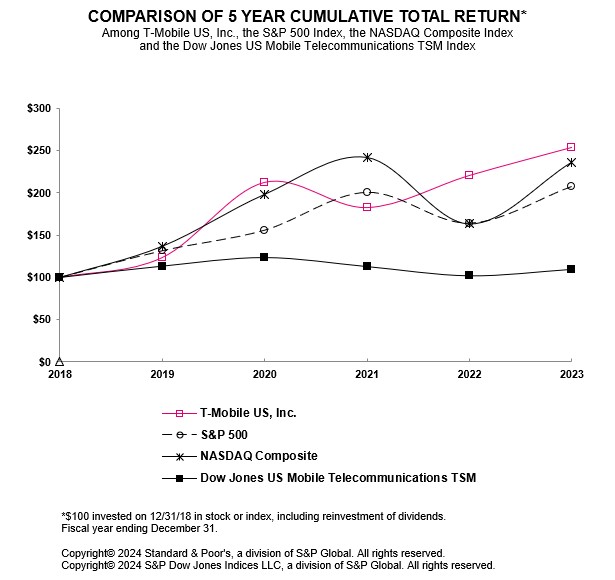
The five-year cumulative total returns of T-Mobile, the S&P 500 index, the NASDAQ Composite index and the Dow Jones US Mobile Telecommunications TSM index, as illustrated in the graph above, are as follows:
| At December 31, | |||||||||||||||||||||||||||||||||||
| (in dollars) | 2018 | 2019 | 2020 | 2021 | 2022 | 2023 | |||||||||||||||||||||||||||||
| T-Mobile US, Inc. | $ | 100.00 | $ | 123.28 | $ | 211.99 | $ | 182.33 | $ | 220.09 | $ | 253.14 | |||||||||||||||||||||||
| S&P 500 | 100.00 | 131.49 | 155.68 | 200.37 | 164.08 | 207.21 | |||||||||||||||||||||||||||||
| NASDAQ Composite | 100.00 | 136.69 | 198.10 | 242.03 | 163.28 | 236.17 | |||||||||||||||||||||||||||||
| Dow Jones US Mobile Telecommunications TSM | 100.00 | 113.40 | 123.64 | 112.98 | 101.97 | 109.60 |
The stock price performance included in this graph is not necessarily indicative of future stock price performance.
Item 6. [Reserved]
Item 7. Management’s Discussion and Analysis of Financial Condition and Results of Operations
Overview
The objectives of our Management’s Discussion and Analysis of Financial Condition and Results of Operations (“MD&A”) are to provide users of our consolidated financial statements with the following:
-
A narrative explanation from the perspective of management of our financial condition, results of operations, cash flows, liquidity and certain other factors that may affect future results;
-
Context to the consolidated financial statements; and
-
Information that allows assessment of the likelihood that past performance is indicative of future performance.
Our MD&A is provided as a supplement to, and should be read together with, our audited consolidated financial statements as of December 31, 2023 and 2022, and for each of the three years in the period ended December 31, 2023, included in Part II, Item 8 of this Form 10-K. Except as expressly stated, the financial condition and results of operations discussed throughout our MD&A are those of T-Mobile US, Inc. and its consolidated subsidiaries.
Sprint Merger, Network Integration and Decommissioning Activities
Transaction Overview
On April 1, 2020, we completed the Merger with Sprint, a communications company offering a comprehensive range of wireless and wireline communications products and services. As a result, Sprint and its subsidiaries became wholly owned consolidated subsidiaries of T-Mobile.
Contingent Consideration
As previously reported, on February 20, 2020, T-Mobile, SoftBank and DT entered into a letter agreement (the “Letter Agreement”) concurrently with an amendment to the Business Combination Agreement. The Letter Agreement required SoftBank to cause its applicable affiliates to surrender to T-Mobile, for no additional consideration, 48,751,557 shares of T-Mobile’s common stock immediately following the effective time of the Merger. The Letter Agreement also required T-Mobile to issue to SoftBank an equivalent number of shares (the “SoftBank Specified Shares”), for no additional consideration, if the trailing 45-trading day volume-weighted average price per share (“VWAP”) of T-Mobile’s common stock on NASDAQ was equal to or greater than $150.00, as adjusted in accordance with the Letter Agreement (the “Threshold Price”), at any time during the period from April 1, 2022, through December 31, 2025 (the “Measurement Period”).
As of the close of trading on December 22, 2023, the 45-trading day VWAP exceeded $149.35, the then-current Threshold Price. On December 28, 2023, T-Mobile issued the SoftBank Specified Shares to SoftBank in accordance with the Letter Agreement.
Merger-Related Costs
Merger-related costs associated with the Merger and acquisitions of affiliates generally include:
-
Integration costs to achieve efficiencies in network, retail, information technology and back office operations, migrate customers to the T-Mobile network and billing systems and the impact of legal matters assumed as part of the Merger;
-
Restructuring costs, including severance, store rationalization and network decommissioning; and
-
Transaction costs, including legal and professional services related to the completion of the transactions.
Restructuring costs are disclosed in Note 18 – Restructuring Costs of the Notes to the Consolidated Financial Statements. Merger-related costs have been excluded from our calculations of Adjusted EBITDA and Core Adjusted EBITDA, which are non-GAAP financial measures, as we do not consider these costs to be reflective of our ongoing operating performance. See “Adjusted EBITDA and Core Adjusted EBITDA” in the “Performance Measures” section of this MD&A. Net cash payments for Merger-related costs, including payments related to our restructuring plan, are included in Net cash provided by operating activities on our Consolidated Statements of Cash Flows.
Merger-related costs are presented below:
| (in millions) | Year Ended December 31, | 2023 Versus 2022 | 2022 Versus 2021 | ||||||||||||||||||||||||||||||||||||||||||||||||||||||||||||||
| 2023 | 2022 | 2021 | $ Change | % Change | $ Change | % Change | |||||||||||||||||||||||||||||||||||||||||||||||||||||||||||
| Merger-related costs | |||||||||||||||||||||||||||||||||||||||||||||||||||||||||||||||||
| Cost of services, exclusive of depreciation and amortization | $ | 652 | $ | 2,670 | $ | 1,015 | $ | (2,018) | (76) | % | $ | 1,655 | 163 | % | |||||||||||||||||||||||||||||||||||||||||||||||||||
| Cost of equipment sales, exclusive of depreciation and amortization | (12) | 1,524 | 1,018 | (1,536) | (101) | % | 506 | 50 | % | ||||||||||||||||||||||||||||||||||||||||||||||||||||||||
| Selling, general and administrative | 394 | 775 | 1,074 | (381) | (49) | % | (299) | (28) | % | ||||||||||||||||||||||||||||||||||||||||||||||||||||||||
| Total Merger-related costs | $ | 1,034 | $ | 4,969 | $ | 3,107 | $ | (3,935) | (79) | % | $ | 1,862 | 60 | % | |||||||||||||||||||||||||||||||||||||||||||||||||||
| Net cash payments for Merger-related costs | $ | 1,973 | $ | 3,364 | $ | 2,170 | $ | (1,391) | (41) | % | $ | 1,194 | 55 | % |
We expect to incur all of the remaining restructuring and integration costs associated with the Merger by the first half of 2024, with the cash expenditure for the Merger-related costs extending beyond 2024. Cash payments extending beyond 2024 primarily relate to operating and financing leases for which we have recognized accelerated lease expense. See the “Contractual Obligations” section of this MD&A for more details on the expected amount and timing of lease payments.
Network Integration
To achieve Merger synergies in network costs, we performed rationalization activities to identify duplicative networks, backhaul services and other agreements, in addition to decommissioning certain small cell sites and distributed antenna systems. Our integration and decommissioning initiatives also included the acceleration or termination of certain of our operating and financing leases for cell sites,
Showing the first 8K of 201K characters. Open the full section
Item 7A. Quantitative and Qualitative Disclosures About Market Risk
We are exposed to economic risks in the normal course of business, primarily from changes in interest rates, including changes in investment yields and changes in spreads due to credit risk and other factors. These risks, along with other business risks, impact our cost of capital. Our policy is to manage exposure related to fluctuations in interest rates in order to manage capital costs, control financial risks and maintain financial flexibility over the long term. We have established interest rate risk limits that are closely monitored by measuring interest rate sensitivities of our debt portfolio. We do not foresee significant changes in the strategies used to manage market risk in the near future.
Certain potential sources of financing available to us, including our Revolving Credit Facility, bear interest that is indexed to a benchmark rate plus a fixed margin. As of December 31, 2023, we did not have outstanding balances under these facilities. See Note 8 – Debt of the Notes to the Consolidated Financial Statements for additional information.
Item 8. Financial Statements and Supplementary Data
Report of Independent Registered Public Accounting Firm
To the Board of Directors and Stockholders of T-Mobile US, Inc.
Opinions on the Financial Statements and Internal Control over Financial Reporting
We have audited the accompanying consolidated balance sheets of T-Mobile US, Inc. and subsidiaries (the “Company”) as of December 31, 2023 and 2022, the related consolidated statements of comprehensive income, stockholders' equity, and cash flows, for each of the two years in the period ended December 31, 2023, and the related notes (collectively referred to as the “consolidated financial statements”). We also have audited the Company’s internal control over financial reporting as of December 31, 2023, based on criteria established in Internal Control — Integrated Framework (2013) issued by the Committee of Sponsoring Organizations of the Treadway Commission (COSO).
In our opinion, the consolidated financial statements referred to above present fairly, in all material respects, the financial position of the Company as of December 31, 2023 and 2022, and the results of its operations and its cash flows for each of the two years in the period ended December 31, 2023, in conformity with accounting principles generally accepted in the United States of America. Also, in our opinion, the Company maintained, in all material respects, effective internal control over financial reporting as of December 31, 2023, based on criteria established in Internal Control — Integrated Framework (2013) issued by COSO.
Basis for Opinions
The Company’s management is responsible for these consolidated financial statements, for maintaining effective internal control over financial reporting, and for its assessment of the effectiveness of internal control over financial reporting, included in the Management’s Annual Report on Internal Control over Financial Reporting included in Item 9A. Our responsibility is to express an opinion on the Company’s consolidated financial statements and an opinion on the Company’s internal control over financial reporting based on our audits. We are a public accounting firm registered with the Public Company Accounting Oversight Board (United States) (PCAOB) and are required to be independent with respect to the Company in accordance with the U.S. federal securities laws and the applicable rules and regulations of the Securities and Exchange Commission and the PCAOB.
We conducted our audits in accordance with the standards of the PCAOB. Those standards require that we plan and perform the audits to obtain reasonable assurance about whether the consolidated financial statements are free of material misstatement, whether due to error or fraud, and whether effective internal control over financial reporting was maintained in all material respects.
Our audit of the consolidated financial statements included performing procedures to assess the risks of material misstatement of the consolidated financial statements, whether due to error or fraud, and performing procedures to respond to those risks. Such procedures included examining, on a test basis, evidence regarding the amounts and disclosures in the consolidated financial statements. Our audit also included evaluating the accounting principles used and significant estimates made by management, as well as evaluating the overall presentation of the consolidated financial statements. Our audit of internal control over financial reporting included obtaining an understanding of internal control over financial reporting, assessing the risk that a material weakness exists, and testing and evaluating the design and operating effectiveness of internal control based on the assessed risk. Our audits also included performing such other procedures as we considered necessary in the circumstances. We believe that our audits provide a reasonable basis for our opinions.
Definition and Limitations of Internal Control over Financial Reporting
A company’s internal control over financial reporting is a process designed to provide reasonable assurance regarding the reliability of financial reporting and the preparation of financial statements for external purposes in accordance with generally accepted accounting principles. A company’s internal control over financial reporting includes those policies and procedures that (1) pertain to the maintenance of records that, in reasonable detail, accurately and fairly reflect the transactions and dispositions of the assets of the company; (2) provide reasonable assurance that transactions are recorded as necessary to permit preparation of financial statements in accordance with generally accepted accounting principles, and that receipts and expenditures of the company are being made only in accordance with authorizations of management and directors of the company; and (3) provide reasonable assurance regarding prevention or timely detection of unauthorized acquisition, use, or disposition of the company’s assets that could have a material effect on the financial statements.
Index for Notes to the Consolidated Financial Statements
Because of its inherent limitations, internal control over financial reporting may not prevent or detect misstatements. Also, projections of any evaluation of effectiveness to future periods are subject to the risk that controls may become inadequate because of changes in conditions, or that the degree of compliance with the policies or procedures may deteriorate.
Critical Audit Matter
The critical audit matter communicated below is a matter arising from the current-period audit of the consolidated financial statements that was communicated or required to be communicated to the audit committee and that (1) relates to accounts or disclosures that are material to the financial statements and (2) involved our especially challenging, subjective, or complex judgments. The communication of critical audit matters does not alter in any way our opinion on the consolidated financial statements, taken as a whole, and we are not, by communicating the critical audit matter below, providing a separate opinion on the critical audit matter or on the accounts or disclosures to which it relates.
Revenues – Refer to Notes 1 and 10 to the consolidated financial statements
Critical Audit Matter Description
The Company generates revenues from providing wireless communications services and selling devices and accessories to customers. The processing and recording of service revenues related to monthly wireless services billings is highly automated and is based on contractual terms with customers. Equipment revenues related to device and accessory sales are typically recognized at a point in time when control of the device or accessory is transferred to the customer or dealer. The Company’s service and equipment revenues consist of a significant volume of low-dollar transactions accumulated from multiple systems and databases.
Given the large volume of low-dollar service and equipment revenue transactions which are initiated, accumulated, and recorded in multiple systems and databases, auditing service and equipment revenues was complex and challenging due to the extent of audit effort required and the need for professionals with expertise in information technology (IT) to identify, evaluate, and test the Company’s systems, databases, automated controls, and system interface controls.
How the Critical Audit Matter Was Addressed in the Audit
Our audit procedures related to the Company’s service and equipment revenue transactions included the following, among others:
- With the assistance of our IT specialists, we:
◦Identified the relevant systems and databases used to process service and equipment revenue transactions and tested the relevant IT controls over each of those systems and databases.
◦Performed testing of automated business controls
Showing the first 8K of 327K characters. Open the full section
Item 9. Changes in and Disagreements with Accountants on Accounting and Financial Disclosure
None.
Item 9A. Controls and Procedures
Evaluation of Disclosure Controls and Procedures
We maintain disclosure controls and procedures (as defined in Rules 13a-15(e) and 15d-15(e) under the Exchange Act) designed to ensure information required to be disclosed in our reports filed or submitted under the Exchange Act is recorded, processed, summarized and reported within the time periods specified in the SEC’s rules and forms. Our disclosure controls are also designed to ensure that information required to be disclosed in the reports we file or submit under the Exchange Act is accumulated and communicated to our management, including our principal executive officer and principal financial officer, as appropriate, to allow timely decisions regarding required disclosure.
Under the supervision and with the participation of our management, including our Chief Executive Officer and our Chief Financial Officer, we carried out an evaluation of the effectiveness of the design and operation of our disclosure controls and procedures. Based upon that evaluation, our Chief Executive Officer and Chief Financial Officer concluded that our disclosure controls and procedures were effective as of the end of the period covered by this Form 10-K.
The certifications required by Section 302 of the Sarbanes-Oxley Act of 2002 are filed as exhibits 31.1 and 31.2, respectively, to this Form 10-K.
Changes in Internal Control over Financial Reporting
There were no changes in our internal control over financial reporting, as defined in Rules 13a-15(f) and 15d-15(f) of the Exchange Act, during our most recently completed fiscal quarter that materially affected, or are reasonably likely to materially affect, our internal control over financial reporting.
Management’s Annual Report on Internal Control over Financial Reporting
Our management is responsible for establishing and maintaining adequate internal control over financial reporting. Internal control over financial reporting is a process designed to provide reasonable assurance regarding the reliability of our financial reporting and the preparation of financial statements for external purposes in accordance with generally accepted accounting principles. Internal control over financial reporting includes maintaining records that in reasonable detail accurately and fairly reflect our transactions, providing reasonable assurance that transactions are recorded as necessary for preparation of our financial statements in accordance with generally accepted accounting principles, providing reasonable assurance that receipts and expenditures are made in accordance with management authorization, and providing reasonable assurance that unauthorized acquisition, use or disposition of company assets that could have a material effect on our financial statements would be prevented or detected on a timely basis. Because of its inherent limitations, internal control over financial reporting may not prevent or detect misstatements. Also, projections of any evaluation of effectiveness to future periods are subject to the risk that controls may become inadequate because of changes in conditions, or that the degree of compliance with policies and procedures may deteriorate.
Management conducted an evaluation of the effectiveness of our internal control over financial reporting based on the framework and criteria established in Internal Control – Integrated Framework (2013), issued by the Committee of Sponsoring Organizations of the Treadway Commission. Based on this evaluation, management concluded that our internal control over financial reporting was effective as of December 31, 2023.
The effectiveness of our internal control over financial reporting as of December 31, 2023 has been audited by Deloitte & Touche LLP, an independent registered public accounting firm, as stated in their report herein.
Item 9B. Other Information
On November 16, 2023, G. Michael Sievert, President and Chief Executive Officer, adopted a trading plan intended to satisfy the affirmative defense of Rule 10b5-1(c) to sell up to 160,000 shares of T-Mobile US, Inc. common stock between February 27, 2024, and November 12, 2024, subject to certain conditions. The duration of this trading plan is 362 days.
On November 21, 2023, Peter Osvaldik, Executive Vice President and Chief Financial Officer, adopted a trading plan intended to satisfy the affirmative defense of Rule 10b5-1(c) to sell up to 20,000 shares of T-Mobile US, Inc. common stock between February 20, 2024, and November 15, 2024, subject to certain conditions. The duration of this trading plan is 360 days.
On November 16, 2023, Callie Field, President, Business Group, adopted a trading plan intended to satisfy the affirmative defense of Rule 10b5-1(c) to sell all of her T-Mobile US, Inc. common stock to be acquired on March 4, 2024, upon the vesting of certain time-based restricted stock unit awards and performance-based restricted stock unit awards (“PRSUs”), up to a total of 26,407 shares assuming PRSUs will vest at maximum value, subject to certain conditions. The duration of this trading plan is 134 days.
On November 9, 2023, Michael Katz, President, Marketing, Strategy and Products, adopted a trading plan intended to satisfy the affirmative defense of Rule 10b5-1(c) to sell up to 23,748 shares of T-Mobile US, Inc. common stock between February 15, 2024, and December 31, 2024, subject to certain conditions. The duration of this trading plan is 418 days.
Item 9C. Disclosure Regarding Foreign Jurisdictions that Prevent Inspections
Not applicable.
PART III.
Item 10. Directors, Executive Officers and Corporate Governance
We maintain a code of ethics applicable to our Chief Executive Officer, Chief Financial Officer, Chief Accounting Officer, Treasurer, and Controller, which is a “Code of Ethics for Senior Financial Officers” as defined by applicable rules of the SEC. This code is publicly available on our website at investor.t-mobile.com. If we make any amendments to this code other than technical, administrative or other non-substantive amendments, or grant any waivers, including implicit waivers, from a provision of this code we will disclose the nature of the amendment or waiver, its effective date and to whom it applies on our website at investor.t-mobile.com or in a Current Report on Form 8-K filed with the SEC.
The remaining information required by this item, including information about our Directors, Executive Officers and Audit Committee, will be incorporated by reference from our definitive Proxy Statement to be filed with the SEC pursuant to Regulation 14A or will be included in an amendment to this Report.
Item 11. Executive Compensation
The information required by this item will be incorporated by reference from our definitive Proxy Statement to be filed with the SEC pursuant to Regulation 14A or will be included in an amendment to this Report.
Item 12. Security Ownership of Certain Beneficial Owners and Management and Related Stockholder Matters
The information required by this item will be incorporated by reference from our definitive Proxy Statement to be filed with the SEC pursuant to Regulation 14A or will be included in an amendment to this Report.
Item 13. Certain Relationships and Related Transactions, and Director Independence
The information required by this item will be incorporated by reference from our definitive Proxy Statement to be filed with the SEC pursuant to Regulation 14A or will be included in an amendment to this Report.
Item 14. Principal Accountant Fees and Services
The information required by this item will be incorporated by reference from our definitive Proxy Statement to be filed with the SEC pursuant to Regulation 14A or will be included in an amendment to this Report.
PART IV.
Item 15. Exhibit and Financial Statement Schedules
(a) Documents filed as a part of this Form 10-K
1. Financial Statements
The following financial statements are included in Part II, Item 8 of this Form 10-K:
**Report of Independent Registered Public Accounting Firm (**PCAOB ID: 34)
Report of Independent Registered Public Accounting Firm (PCAOB ID: 238)
Consolidated Balance Sheets
Consolidated Statements of Comprehensive Income
Consolidated Statements of Cash Flows
Consolidated Statement of Stockholders’ Equity
Notes to the Consolidated Financial Statements
2. Financial Statement Schedules
All other schedules have been omitted because they are not required, not applicable or the required information is otherwise included.
3. Exhibits
See the Index to Exhibits immediately following “Item 16. Form 10-K Summary” of this Form 10-K.
Item 16. Form 10–K Summary
None**.**
INDEX TO EXHIBITS
| Incorporated by Reference | ||||||||||||||||||||||||||||||||
| Exhibit No. | Exhibit Description | Form | Date of Filing | Exhibit Number | Included Herewith | |||||||||||||||||||||||||||
| 4.9 | Thirty-Seventh Supplemental Indenture, dated as of May 20, 2018, by and among T-Mobile USA, Inc., the guarantors party thereto, and Deutsche Bank Trust Company Americas. | 8-K | 5/21/2018 | 4.1 | ||||||||||||||||||||||||||||
| 4.10 | Thirty-Eighth Supplemental Indenture, dated as of December 20, 2018, by and among T-Mobile USA, Inc., the guarantors party thereto, and Deutsche Bank Trust Company Americas. | 8-K | 12/21/2018 | 4.1 |
Showing the first 8K of 80K characters. Open the full section