 filings.tools
Cover and table of contents
42K characters. Original on sec.gov · Markdown
Cover and table of contents
UNITED STATES
SECURITIES AND EXCHANGE COMMISSION
Washington, D.C. 20549
FORM 10-K
(Mark One)
þ ANNUAL REPORT PURSUANT TO SECTION 13 OR 15(d) OF THE SECURITIES EXCHANGE ACT OF 1934
For the fiscal year ended December 31, 2023
or
☐ TRANSITION REPORT PURSUANT TO SECTION 13 OR 15(d) OF THE SECURITIES EXCHANGE ACT OF 1934
For the transition period from ______ to ______
Commission File Number: 1-39804
Exact name of registrant as specified in its charter:
Texas Pacific Land Corporation
| State or other jurisdiction of incorporation or organization: | IRS Employer Identification No.: | |||||||
| Delaware | 75-0279735 |
Address of principal executive offices:
1700 Pacific Avenue, Suite 2900 Dallas, Texas 75201
Registrant’s telephone number, including area code:
(214) 969-5530
Securities registered pursuant to Section 12(b) of the Act:
| Title of each class | Trading Symbol(s) | Name of each exchange on which registered | ||||||
| Common Stock (par value $.01 per share) | TPL | New York Stock Exchange |
Securities registered pursuant to Section 12(g) of the Act:
None
Indicate by check mark if the registrant is a well-known seasoned issuer, as defined in Rule 405 of the Securities Act. Yes þ No ¨
Indicate by check mark if the registrant is not required to file reports pursuant to Section 13 or Section 15(d) of the Act. Yes ¨ No þ
Indicate by check mark whether the registrant: (1) has filed all reports required to be filed by Section 13 or 15(d) of the Securities Exchange Act of 1934 during the preceding 12 months (or for such shorter period that the registrant was required to file such reports), and (2) has been subject to such filing requirements for the past 90 days. Yes þ No ¨
Indicate by check mark whether the registrant has submitted electronically every Interactive Data File required to be submitted pursuant to Rule 405 of Regulation S-T during the preceding 12 months (or for such shorter period that the registrant was required to submit and post such files). Yes þ No ¨
Indicate by check mark whether the registrant is a large accelerated filer, an accelerated filer, a non-accelerated filer, or a smaller reporting company. See the definitions of “large accelerated filer,” “accelerated filer,” “smaller reporting company” and “emerging growth company” in Rule 12b-2 of the Exchange Act. (Check One)
| Large Accelerated Filer | þ | Accelerated filer | ¨ | ||||||||
| Non-accelerated filer | ¨ | Smaller reporting company | ¨ | ||||||||
| Emerging growth company | ¨ |
If an emerging growth company, indicate by check mark if the registrant has elected not to use the extended transition period for complying with any new or revised financial accounting standards provided pursuant to Section 13(a) of the Exchange Act. ¨
Indicate by check mark whether the registrant has filed a report on and attestation to its management’s assessment of the effectiveness of its internal control over financial reporting under Section 404(b) of the Sarbanes-Oxley Act (15 U.S.C. 7262(b)) by the registered public accounting firm that prepared or issued its audit report. þ
If securities are registered pursuant to Section 12(b) of the Act, indicate by check mark whether the financial statements of the registrant included in the filing reflect the correction of an error to previously issued financial statements. ¨
Indicate by check mark whether any of those error corrections are restatements that required a recovery analysis of incentive-based compensation received by any of the registrant’s executive officers during the relevant recovery period pursuant to §240.10D-1(b). ¨
Indicate by check mark whether the registrant is a shell company (as defined in Rule 12b-2 of the Exchange Act). Yes ☐ No þ
The aggregate market value of the common stock held by non-affiliates of the registrant as of the last business day of the registrant’s most recently completed second fiscal quarter (June 30, 2023) was approximately $7.5 billion.
As of February 14, 2024, there were 7,668,422 shares of Common Stock outstanding.
DOCUMENTS INCORPORATED BY REFERENCE:
None
TEXAS PACIFIC LAND CORPORATION
TABLE OF CONTENTS
PART I
Statements in this Annual Report on Form 10-K that are not purely historical are forward-looking statements within the meaning of Section 27A of the Securities Act of 1933 and Section 21E of the Securities Exchange Act of 1934, including statements regarding management’s expectations, hopes, intentions or strategies regarding the future. Words or phrases such as “expects” and “believes,” or similar expressions, when used in this Annual Report on Form 10-K or other filings with the Securities and Exchange Commission (the “SEC”), are intended to identify “forward-looking statements” within the meaning of the Private Securities Litigation Reform Act of 1995. Forward-looking statements include statements regarding the Company’s future operations and prospects, the markets for real estate in the areas in which the Company owns real estate, applicable zoning regulations, the markets for oil and gas including actions of other oil and gas producers or consortiums worldwide such as the Organization of Petroleum Exporting Countries (“OPEC”) and Russia (collectively referred to as “OPEC+”), expected competition, management’s intent, beliefs or current expectations with respect to the Company’s future financial performance and other matters. All forward-looking statements in this Report are based on information available to us as of the date this Report is filed with the SEC, and we assume no responsibility to update any such forward-looking statements, except as required by law. All forward-looking statements are subject to a number of risks, uncertainties and other factors that could cause our actual results, performance, prospects or opportunities to differ materially from those expressed in, or implied by, these forward-looking statements. These risks, uncertainties and other factors include, but are not limited to, the factors discussed in Item 1A. “Risk Factors” and Item 7. “Management’s Discussion and Analysis of Financial Condition and Results of Operations.”
Item 1. Business.
General
Texas Pacific Land Corporation (which, together with its subsidiaries as the context requires, may be referred to as “TPL”, the “Company”, “our”, “we” or “us”) is a Delaware Corporation and one of the largest landowners in the State of Texas with approximately 868,000 surface acres of land in West Texas, principally concentrated in the Permian Basin. Additionally, we own a 1/128th nonparticipating perpetual oil and gas royalty interest (“NPRI”) under approximately 85,000 acres of land, a 1/16th NPRI under approximately 371,000 acres of land, and approximately 4,000 additional net royalty acres (normalized to 1/8th) (“NRA”), for a collective total of approximately 195,000 NRA all located in the western part of Texas.
The Company was originally organized as Texas Pacific Land Trust (the “Trust”) under a Declaration of Trust, dated February 1, 1888 (the “Declaration of Trust”), to receive and hold title to extensive tracts of land in the State of Texas, previously the property of the Texas and Pacific Railway Company. The Declaration of Trust provided for the appointment of trustees (the “Trustees”) to manage the assets of the Trust with all of the powers of an absolute owner. On January 11, 2021, the Trust completed its reorganization from a business trust, Texas Pacific Land Trust, into Texas Pacific Land Corporation (“TPL Corporation”), a corporation formed and existing under the laws of the State of Delaware. TPL Corporation is an independent public company and its common stock, par value of $0.01 per share (“Common Stock”) is listed under the symbol “TPL” on the New York Stock Exchange (the “NYSE”). See further discussion under “Corporate Reorganization” below. Any references in this Annual Report on Form 10-K to the Company, TPL, our, we or us with respect to periods prior to January 11, 2021, will be in reference to the Trust, and references to periods on that date and thereafter will be in reference to Texas Pacific Land Corporation or TPL Corporation.
Our surface and royalty ownership provide revenue opportunities throughout the oil and gas development value chain. While we are not an oil and gas producer, we benefit from various revenue sources throughout the life cycle of a well. During the initial development phase where infrastructure for oil and gas development is constructed, we receive fixed fee payments for use of our land and revenue for sales of materials (caliche) used in the construction of the infrastructure. During the drilling and completion phase, we generate revenue for providing sourced and/or treated produced water in addition to fixed fee payments for use of our land. During the production phase, we receive revenue from our oil and gas royalty interests and also revenues related to saltwater disposal on our land. In addition, we generate revenue from pipeline, power line and utility easements, commercial leases and temporary permits principally related to a variety of land uses, including, but not limited to, midstream infrastructure projects and processing facilities as hydrocarbons are processed and transported to market.
TPL’s mission is to pursue a thoughtful, long-term approach towards optimizing and building upon the commercial and environmental virtues of our extensive lands and resources. TPL has a long history of responsible management of its legacy assets, and in recent years, the Company has expanded its business strategy to generate incremental revenue streams that take advantage of the Company’s vast surface and royalty footprint, such as its investments in the Water Services and Operations business segment. Beyond TPL’s current businesses, the Company continues to explore new opportunities related
to renewable energy, environmental sustainability, and technology, among others, that can leverage the already existing legacy surface and royalty assets. The Company’s business model emphasizes high cash flow margins and relatively low ongoing capital expenditure requirements, and new opportunities would generally be expected to align with these priorities. The Company remains focused on optimizing long-term value creation and profitability, fostering responsible stewardship of our assets, providing quality customer service, and engaging with and advocating for employee and stakeholder interests.
Corporate Reorganization
On January 11, 2021, TPL completed its reorganization from a trust into a corporation (the “Corporate Reorganization”).
As part of the Corporate Reorganization, on January 11, 2021, shares of TPL Corporation’s Common Stock were distributed to holders of sub-share certificates of proprietary interest, par value $0.03-1/3 of the Trust (“Sub-shares”) on the basis of one share of Common Stock for every Sub-share (the “Distribution”).
Prior to the Corporate Reorganization, as a result of a proxy contest mounted by certain holders of Sub-shares, the Trust entered into a stockholders’ agreement dated as of June 11, 2020 and amended as of December 14, 2020 (the “Stockholders’ Agreement”), with Horizon Kinetics LLC, Horizon Kinetics Asset Management LLC (together with Horizon Kinetics LLC and its affiliates, “Horizon”), SoftVest Advisors, LLC, SoftVest, L.P. (together with SoftVest Advisors, LLC and its affiliates, “SoftVest,” and together with Horizon, the “Investor Group”), and Mission Advisors, LP, (“Mission” and together with the Investor Group, collectively, the “stockholder parties”). The Stockholders’ Agreement provided for, among other things, the appointment of Dana F. McGinnis, Eric L. Oliver and Murray Stahl as directors of TPL’s board of directors (the “Board”) in connection with the Corporate Reorganization. Mr. McGinnis resigned from the Board in March 2022.
Pursuant to the Stockholders’ Agreement, the stockholder parties agreed to vote all of the shares of Common Stock they beneficially owned at each annual or special meeting of stockholders of the Company in accordance with the Board’s recommendations, subject to certain exceptions. The termination date of the Stockholders’ Agreement was to occur immediately following the completion of the 2022 annual meeting of stockholders, except that the respective obligations of the Investor Group were to survive until such time as neither Investor Group designee is serving on the Board.
A dispute arose relating to the voting by the Investor Group on a proposal at the 2022 annual meeting of stockholders. The dispute was eventually resolved by the Delaware Court of Chancery, which ruling is now being appealed, but prior to such resolution, on July 28, 2023, the Company and the Investor Group entered into a Cooperation Agreement (the “Cooperation Agreement”) pursuant to which (i) Mr. Stahl, Marguerite Woung-Chapman and Robert Roosa would be nominated by the Company for election at the 2023 annual meeting of stockholders, (ii) the pre-signed conditional resignation letters submitted by Messrs. Stahl and Oliver pursuant to the Stockholders’ Agreement were considered withdrawn and no longer effective, and (iii) the Investor Group agreed to vote or cause to be voted all of the shares of Common Stock over which the Investor Group has direct or indirect voting control for the election of the three nominees named above and against any director nominee not recommended by the Board, for proposals regarding approval of executive compensation and ratification of the Company’s independent registered public accounting firm, and in accordance with the recommendation of the majority of the Board in respect of any proposals submitted by stockholders. The Cooperation Agreement also provided for mutual non-disparagement covenants and certain standstill obligations for the Investor Group as long as one of Mr. Stahl or Mr. Oliver remain on the Board. In addition, the termination date of the Stockholders’ Agreement was changed to occur following the completion of the 2023 annual meeting, which occurred on November 10, 2023.
Historical Operating Performance
The table below reflects our historical operating results for the last five years (in thousands, except per share amounts):
| Years Ended December 31, | |||||||||||||||||||||||||||||
| 2023 | 2022 | 2021 | 2020 | 2019 | |||||||||||||||||||||||||
| Revenues | $ | 631,595 | $ | 667,422 | $ | 450,958 | $ | 302,564 | $ | 490,496 | |||||||||||||||||||
| Net income | $ | 405,645 | $ | 446,362 | $ | 269,980 | $ | 176,049 | $ | 318,728 | |||||||||||||||||||
| Net income per share: | |||||||||||||||||||||||||||||
| Basic | $ | 52.81 | $ | 57.80 | $ | 34.83 | $ | 22.70 | $ | 41.09 | |||||||||||||||||||
| Diluted | $ | 52.77 | $ | 57.77 | $ | 34.83 | $ | 22.70 | $ | 41.09 |
Business Segments
We operate our business in two reportable segments: Land and Resource Management and Water Services and Operations. Our segments provide management with a comprehensive financial view of our key businesses. The segments enable the alignment of strategies and objectives of the Company and provide a framework for timely and rational allocation of resources within businesses. See Item 7. “Management’s Discussion and Analysis of Financial Condition and Results of Operations” and Note 14, “Business Segment Reporting” in Item 8. “Financial Statements and Supplementary Data” in this Annual Report on Form 10-K.
Land and Resource Management
Our Land and Resource Management segment encompasses the business of managing our approximately 868,000 surface acres of land and our oil and gas royalty interests in West Texas, principally concentrated in the Permian Basin. The revenue streams of this segment consist primarily of royalties from oil and gas, revenues from easements, commercial leases and renewables, and land and material sales.
We are not an oil and gas producer. Rather, our oil and gas revenue is derived from our oil and gas royalty interests. Thus, in addition to being subject to fluctuations in response to the market prices for oil and gas, our oil and gas royalties are also subject to decisions made by the owners and operators of the oil and gas wells to which our royalty interests relate as to investments in and production from those wells. Our oil and gas royalty interests require no capital expenditures or operating expense burden from us for well development.
Our revenue from easements is primarily generated from pipelines transporting oil, gas and related hydrocarbons, power line and utility easements, and subsurface wellbore easements. Easements typically have a thirty-plus year term but subsequently renew every ten years with an additional payment. In addition to easements, we also receive revenues from other surface-related operations on our land, including but not limited to, commercial leases, well development and material sales. Commercial lease revenue is derived primarily from processing, storage and compression facilities, and roads. Material sales include caliche, sand, and other material sales to operators. Caliche is used in the construction of oil and gas-related infrastructure, and sand is utilized for completion operations.
In recent years, we entered into agreements with third parties related to renewables and various “next generation” opportunities that will potentially utilize TPL’s surface assets. These agreements include the evaluation of grid-connected batteries, studies on carbon capture and sequestration, and development of bitcoin mining facilities, among other opportunities. Generally, these projects are structured with multi-year terms that allow for feasibility and/or commercial suitability and revenue arrangements that provide royalty, fee, profit sharing, lease and/or rental payments, though contractual terms and timing for commercial operations will vary by project. We do not anticipate these agreements will have a significant impact on our revenues in the short-term but do have the potential to contribute meaningfully to our revenues in the longer term.
As a significant landowner, we also generate revenue from land sales. From time to time, we receive offers from third parties to acquire tracts of our land. Sales demand and related sale prices of particular tracts of land are influenced by many factors, including general economic conditions, the rate of development in nearby areas and the suitability of the particular tract for commercial uses prevalent in West Texas.
Operations
Revenues from the Land and Resource Management segment for the last three years were as follows (dollars presented in thousands):
| Years Ended December 31, | |||||||||||||||||||||||||||||||||||
| 2023 | 2022 | 2021 | |||||||||||||||||||||||||||||||||
| Segment Revenue | % of Total Consolidated Revenue | Segment Revenue | % of Total Consolidated Revenue | Segment Revenue | % of Total Consolidated Revenue | ||||||||||||||||||||||||||||||
| Oil and gas royalties | $ | 357,394 | 57 | % | $ | 452,434 | 68 | % | $ | 286,468 | 64 | % | |||||||||||||||||||||||
| Easements and other surface-related income | 67,905 | 11 | % | 44,569 | 7 | % | 32,892 | 7 | % | ||||||||||||||||||||||||||
| Land sales and other operating revenue | 6,806 | 1 | % | 9,972 | 1 | % | 1,027 | — | % | ||||||||||||||||||||||||||
| Total Revenue - Land and Resource Management segment | $ | 432,105 | 69 | % | $ | 506,975 | 76 | % | $ | 320,387 | 71 | % |
Please see discussion of our financial results at Item 7. “Management’s Discussion and Analysis of Financial Condition and Results of Operations — Segment Results of Operations.”
Oil and Gas Activity for the Year Ended December 31, 2023
For the year ended December 31, 2023, our share of crude oil, natural gas and natural gas liquid (“NGL”) production was 23.5 thousand barrels of oil equivalent (“Boe”) per day compared to 21.3 thousand Boe per day for the same period of 2022. The total equivalent price was $42.58 per Boe for the year ended December 31, 2023, a decrease of 30.0% compared to the total equivalent price of $60.81 per Boe for the same period of 2022.
For the year ended December 31, 2023, the number of oil and gas wells that had been drilled but are not yet completed (“DUC”) subject to our royalty interest was 675 compared to 584 for the same period of 2022. The number of DUC wells is determined using uniform drilling spacing units with pooled interests for all wells awaiting completion.
Competition
Our Land and Resource Management segment does not have direct peers, as such, in that it sells, leases and generally manages land owned by the Company and, to that extent, any owner of property located in areas comparable to the Company is a potential competitor.
Water Services and Operations
Our Water Services and Operations segment encompasses the business of providing full-service water offerings to operators in the Permian Basin through Texas Pacific Water Resources LLC (“TPWR”), a single member Texas limited liability company owned by the Company.
These full-service water offerings include, but are not limited to, water sourcing, produced-water treatment, infrastructure development, and disposal solutions. We are committed to sustainable water development. Our significant surface ownership in the Permian Basin provides TPWR with a unique opportunity to provide multiple full-service water offerings to operators.
The revenue streams of this segment principally consist of revenue generated from sales of sourced and treated water as well as revenue from produced water royalties. Energy businesses use water for their oil and gas projects while service businesses (i.e., water management service companies) operate water facilities to produce and sell water to energy businesses.
Operations
Revenues from our Water Services and Operations segment for the last three years were as follows (dollars presented in thousands):
| Years Ended December 31, | |||||||||||||||||||||||||||||||||||
| 2023 | 2022 | 2021 | |||||||||||||||||||||||||||||||||
| Segment Revenue | % of Total Consolidated Revenue | Segment Revenue | % of Total Consolidated Revenue | Segment Revenue | % of Total Consolidated Revenue | ||||||||||||||||||||||||||||||
| Water sales | $ | 112,203 | 18 | % | $ | 84,725 | 13 | % | $ | 67,766 | 15 | % | |||||||||||||||||||||||
| Produced water royalties | 84,260 | 13 | % | 72,234 | 11 | % | 58,081 | 13 | % | ||||||||||||||||||||||||||
| Easements and other surface-related income | 3,027 | — | % | 3,488 | — | % | 4,724 | 1 | % | ||||||||||||||||||||||||||
| Total Revenue – Water Services and Operations segment | $ | 199,490 | 31 | % | $ | 160,447 | 24 | % | $ | 130,571 | 29 | % |
Please see discussion of our financial results at Item 7. “Management’s Discussion and Analysis of Financial Condition and Results of Operations — Segment Results of Operations.”
Activity for the year ended December 31, 2023
The increase in water sales during 2023 compared to 2022 is principally due to a 21.8% increase in water sales volumes over the same time period.
During 2023, we invested $15.2 million in TPWR projects to maintain and/or enhance water sourcing assets and acquired groundwater rights for $3.8 million to provide us access to additional water volumes outside of our existing surface footprint to assist in managing fluctuations in customer demand. We also acquired a saltwater disposal (“SWD”) easement for $17.6 million. The SWD easement covers approximately 49,000 acres and provides us future disposal opportunities to service injection customers seeking disposal solutions located outside of core basins.
Competition
While there is competition in the water service business in the Permian Basin, we believe our position as a significant landowner of approximately 868,000 surface acres in West Texas gives us a unique advantage over our competitors who must negotiate with existing landowners to source water and then for the right of way to deliver the water to the end user.
Major Customers
The chart below depicts our total revenues and revenues from customers representing more than 10% of our 2023 consolidated revenues:
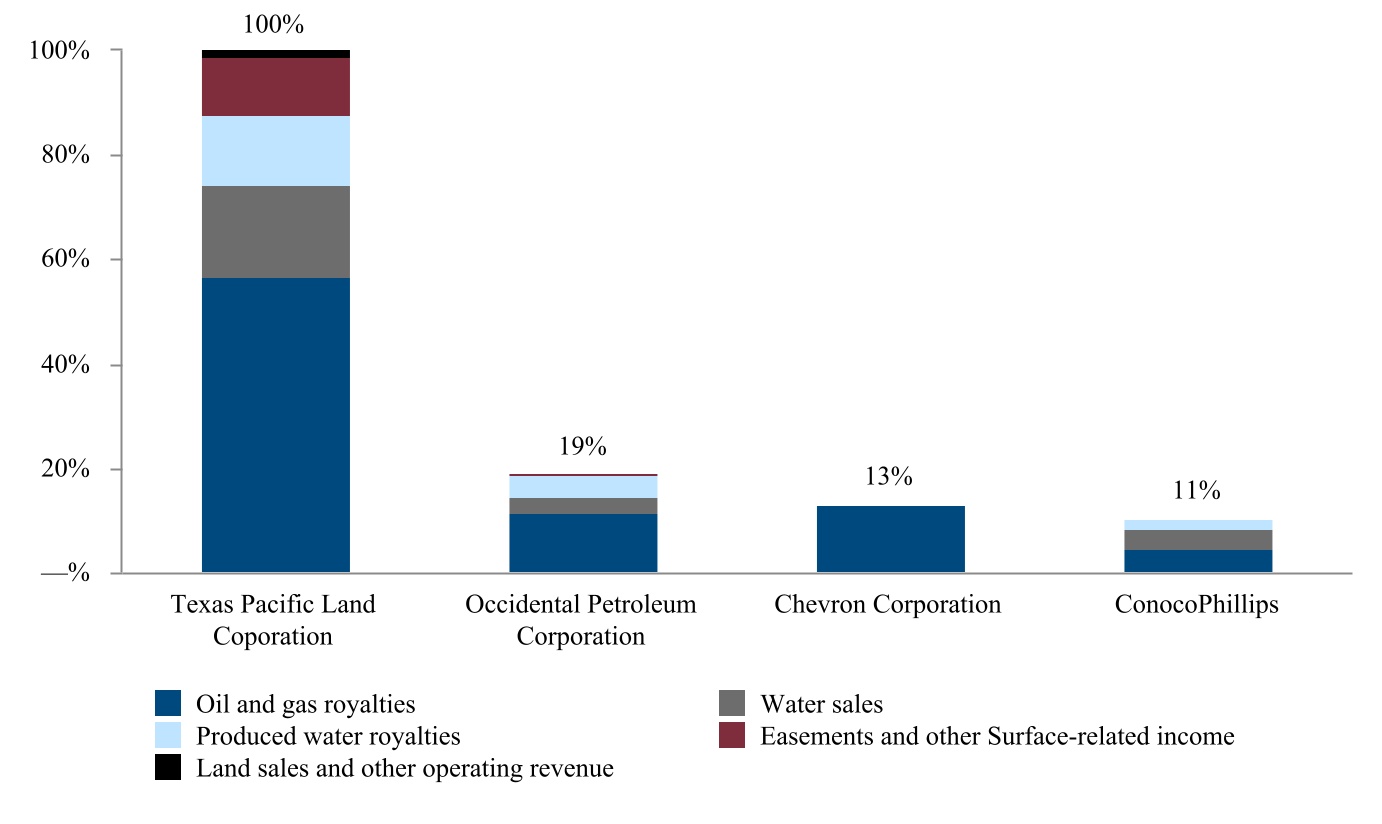
While approximately 43% of our 2023 revenue is derived from only three customers, two of these customers are in the top 10, and the remaining customer is in the top 35, energy companies in the world based on market capitalization, and we believe each of them is a strong and reliable operator. Given their major presence in the Permian Basin and our significant surface lands in the same area, the high concentration of business with these three customers is expected. Further, the choice of whom we do business with largely depends on location of mineral royalties and surface rights on or near our assets and consists of a limited universe of oil and gas companies who operate in the Permian Basin.
Seasonality
While the business of TPL is not seasonal in nature, as that term is generally understood, revenues from oil and gas royalties may fluctuate from period to period based upon market prices for oil and gas and production decisions made by the operators. Our other revenue streams, which include, but are not limited to, water sales and royalties, easements and other surface related income and sales of land, may also fluctuate from period to period. In addition, our results generally rely on the decisions and actions of third parties out of our ultimate control. As a consequence, the results of our operations for any particular period are not necessarily indicative of the results of operations for a full year.
Regulations
We are subject to various federal, state and local laws. Management believes that our operations comply in all material respects with applicable laws and regulations and that the existence and enforcement of such laws and regulations have no more restrictive effect on our method of operations than on other companies similar to TPL.
We cannot determine the extent to which new legislation, new regulations or changes in existing laws or regulations may affect our future operations.
Environmental Considerations
Compliance with Federal, State and local provisions that have been enacted or adopted regulating the discharge of materials into the environment, or otherwise relating to the protection of the environment, have had no material effect upon our business generally, including the capital expenditures, earnings and competitive position of the Company. To date, the Company has not been called upon to expend any funds for these purposes.
Environmental, Social and Governance (“ESG”)
In August 2021, the Company published its inaugural Environmental, Social, Governance (“ESG”) disclosure highlighting data and processes that began in 2020. The Company’s current ESG disclosure is available at the Company’s website at www.TexasPacific.com. The ESG disclosure has been prepared in accordance with the frameworks of the Sustainable Accounting Standards Board, the Global Reporting Initiative, and the Task Force on Climate Related Disclosures.
Integrating sustainability and ESG objectives is a priority for our Company. The Company’s ESG strategy reflects its dedication to meeting tactical business priorities while managing the environmental impacts of its operations, maintaining principles for social responsibility, and upholding a commitment to strong corporate governance. Our ESG strategy is focused on the overarching priorities of environmental management, employee health and safety, workforce management and equality, community and landowner engagement, and strong corporate governance and ethics. We are committed to sustainability and responsible stewardship across all of our operations and land management activities.
As the Company does not produce oil or gas from the land from which its royalties’ revenue stream is derived, it developed its sustainability goals and partnership opportunities in consultation with the entities operating on its land. On the water solutions side of its business, the Company developed a tailored ESG program that addresses the ethical and responsible buildout of water assets and management of water as a natural resource. The Company’s continued goal is an integrated and iterative approach to sustainable and responsible resource management.
TPL’s ESG accomplishments and goals include but are not limited to:
- Converted from a business trust to a Delaware corporation in January 2021, providing enhanced governance to the Company’s stockholders.
*•*Increased the electrification of the Company’s water assets in an effort to reduce costs and mitigate the overall emission profile of the Company by reducing reliance on diesel generators. Cumulatively through December 31, 2023, TPL has spent $15.8 million of capital on electric infrastructure.
-
Initiated energy tracking in 2020 to monitor and identify trends in energy consumption and sourcing.
-
Prioritizing the health and welfare of TPL’s workforce.
-
Employed practices for the tracking and monitoring of all spills, regardless if they are within or outside of regulatory reporting requirements. We had zero spills of produced water in 2023 and 2022.
-
Partnered with oil & gas operators on the Company’s surface estate to collectively discuss and manage ESG risks. Partnership opportunities included: developing renewable energy infrastructure across the Company’s land, developing water infrastructure to support the reuse and recycling of produced water—a critical response to climate change, partnering to develop innovative technologies that support emissions management, and more.
-
Instituted a governance framework that includes oversight and stewardship of the Company’s ESG strategies. The Nominating and Corporate Governance Committee reviews the Company’s policies and programs concerning corporate social responsibility, including ESG matters, with the support of the Audit Committee and the Compensation Committee, where appropriate. The committees provide guidance to the Board and management with respect to trends and developments regarding environmental, social, governance, and political matters that could significantly impact the Company.
The disclosure denotes that the Company’s ESG strategy, including metrics and targets, will be continuously reviewed and assessed annually to determine if updates or process improvements are needed.
Our full ESG disclosure is available at www.TexasPacific.com/esg.
Human Capital Resources
We believe we have a talented, motivated and dedicated team and we are committed to supporting the development of our team members and continuously building on our strong culture. As of December 31, 2023, the Company had 100 full-time employees, of which 30 were employees of TPWR.
Our business strategy and ability to serve customers relies on employing talented professionals and attracting, training, developing and retaining a knowledgeable skilled workforce. We maintain a good working relationship with our employees. We value our employees and their experience in providing value through land, mineral and water resource management and water solutions. Maintaining a robust pipeline of talent is crucial to our ongoing success and is a key aspect of succession planning efforts across the organization. Our leadership and human resources teams are responsible for attracting and retaining top talent by facilitating an environment where employees feel supported and encouraged in their professional and personal development. We are committed to enhancing gender, racial and ethnic diversity throughout our organization. We believe that diversity is an important factor in bringing people together, encouraging shared commitment and fostering new ideas.
We strive to be a great place for our employees to work. Accordingly, we offer industry competitive pay and benefits, tuition reimbursement and continuing education classes and are committed to maintaining a workplace environment that promotes employee productivity and satisfaction.
Employee safety is also among our top priorities. Accordingly, we have developed and administer company-wide policies to ensure a safe and fair workplace free of discrimination or harassment for each team member and compliance with Occupational Safety and Health Administration (“OSHA”) standards, as further discussed in our Code of Business Conduct and Ethics. This commitment applies to recruiting, hiring, compensation, benefits, training, termination, promotions or any other terms and conditions of employment. We maintain our strong focus on safety and have taken measures to protect our employees and maintain safe, reliable operations.
We strive for a goal of zero occupational injuries, illnesses and incidents in our workplace. To ensure that we protect our safety culture, we have in place a dedicated HS&E team with substantial combined years of experience and have in-house authorized trainers for OSHA-required certified training, powered equipment training and PCE-safe land certificated training.
Available Information on our Website
The Company makes available on our website at www.TexasPacific.com, free of charge, its Annual Reports on Form 10-K, Quarterly Reports on Form 10-Q, Current Reports on Form 8-K and amendments to those reports as soon as reasonably practicable after they are electronically filed with, or furnished to, the SEC pursuant to Section 13(a) or 15(d) of the Securities Exchange Act of 1934 (the “Exchange Act”). Such reports are also available at www.sec.gov. The information contained on our website is not part of this Report.