 filings.tools
Tapestry 10-K 2014-06-28
Filed 2014-08-15. 21 sections, 360K characters. Original on sec.gov · Markdown · JSON
Cover and table of contents
10-K 1 coh6282014-10k.htm 10-K
UNITED STATES
SECURITIES AND EXCHANGE COMMISSION
Washington, D.C. 20549
FORM 10-K
| þ | ANNUAL REPORT PURSUANT TO SECTION 13 OR 15(d) OF THE SECURITIES EXCHANGE ACT OF 1934 |
For the Fiscal Year Ended June 28, 2014
OR
| o | TRANSITION REPORT PURSUANT TO SECTION 13 OR 15(d) OF THE SECURITIES EXCHANGE ACT OF 1934 |
Commission file number: 1-16153
Coach, Inc.
(Exact name of registrant as specified in its charter)
| Maryland | 52-2242751 | |
| (State or other jurisdiction of incorporation or organization) | (I.R.S. Employer Identification No.) |
516 West 34th Street, New York, NY 10001
(Address of principal executive offices); (Zip Code)
(212) 594-1850
(Registrant’s telephone number, including area code)
Securities Registered Pursuant to Section 12(b) of the Act:
| Title of Each Class: | Name of Each Exchange on which Registered | |
| Common Stock, par value $.01 per share | New York Stock Exchange |
Securities Registered Pursuant to Section 12(g) of the Act: None
Indicate by check mark if the registrant is a well-known seasoned issuer, as defined in Rule 405 of the Securities Act.Yes þ No o
Indicate by check mark if the registrant is not required to file reports pursuant to Section 13 or Section 15(d) of the Act.Yes o No þ
Indicate by check mark whether the registrant (1) has filed all reports required to be filed by Section 13 or 15(d) of the Securities Exchange Act of 1934 during the preceding 12 months (or for such shorter period that the registrant was required to file such reports), and (2) has been subject to such filing requirements for the past 90 days. Yes þ No o
Indicate by check mark whether the registrant has submitted electronically and posted on its corporate Web site, if any, every Interactive Data File required to be submitted and posted pursuant to Rule 405 of Regulation S-T (§232.405 of this chapter) during the preceding 12 months (or for such shorter period that the registrant was required to submit and post such files). Yes þ No o
Indicate by check mark if disclosure of delinquent filers pursuant to Item 405 of Regulation S-K (§229.405 of this chapter) is not contained herein, and will not be contained, to the best of registrant's knowledge, in definitive proxy or information statements incorporated by reference in Part III of this Form 10-K or any amendment to this Form 10-K. o
Indicate by check mark whether the registrant is a large accelerated filer, an accelerated filer, a non-accelerated filer, or a smaller reporting company. See the definitions of “large accelerated filer”, “accelerated filer” and “smaller reporting company” in Rule 12b-2 of the Exchange Act.
| Large accelerated filer þ | Accelerated filer o | Non-accelerated filer o | Smaller reporting company o |
Indicate by check mark whether the registrant is a shell Company (as defined in Rule 12b-2 of the Act).Yes o No þ
The aggregate market value of Coach, Inc. common stock held by non-affiliates as of December 27, 2013 (the last business day of the most recently completed second fiscal quarter) was approximately $15.5 billion. For purposes of determining this amount only, the registrant has excluded shares of common stock held by directors and officers. Exclusion of shares held by any person should not be construed to indicate that such person possesses the power, direct or indirect, to cause the direction of the management or policies of the registrant, or that such person is controlled by or under common control with the registrant.
On August 1, 2014, the Registrant had 274,631,764 shares of common stock outstanding.
DOCUMENTS INCORPORATED BY REFERENCE
| Documents | Form 10-K Reference | |
| Proxy Statement for the 2014 Annual Meeting of Stockholders | Part III, Items 10 – 14 |
COACH, INC.
TABLE OF CONTENTS
i
SPECIAL NOTE ON FORWARD-LOOKING INFORMATION
This document, and the documents incorporated by reference in this document, in our press releases and in oral statements made from time to time by us or on our behalf, contain certain "forward-looking statements" within the meaning of the Private Securities Litigation Reform Act of 1995, and are based on management’s current expectations. These forward-looking statements can be identified by the use of forward-looking terminology such as “believes,” “may,” “will,” “should,” “expect,” “confidence,” “trends,” “intend,” “estimate,” “on track,” “are positioned to,” “on course,” “opportunity,” “continue,” “project,” “guidance,” “target,” “forecast,” “anticipated,” “plan,” “potential,” the negative of these terms or comparable terms. The Company assumes no obligation to revise or update any forward-looking statements for any reason, except as required by law.
Coach, Inc.’s actual results could differ materially from the results contemplated by these forward-looking statements due to a number of factors, including those discussed in the sections of this Form 10-K filing entitled “Risk Factors” and “Management’s Discussion and Analysis of Financial Condition and Results of Operations.” These factors are not necessarily all of the important factors that could cause actual results to differ materially from those expressed in any of the forward-looking statements contained in this Form 10-K.
INFORMATION REGARDING HONG KONG DEPOSITARY RECEIPTS
Coach’s Hong Kong Depositary Receipts are traded on The Stock Exchange of Hong Kong Limited under the symbol 6388. Neither the Hong Kong Depositary Receipts nor the Hong Kong Depositary Shares evidenced thereby have been or will be registered under the U.S. Securities Act of 1933, as amended (the “Securities Act”), and may not be offered or sold in the United States or to, or for the account of, a U.S. Person (within the meaning of Regulation S under the Securities Act), absent registration or an applicable exemption from the registration requirements. Hedging transactions involving these securities may not be conducted unless in compliance with the Securities Act.
In this Form 10-K, references to “Coach,” “we,” “our,” “us” and the “Company” refer to Coach, Inc., including consolidated subsidiaries. The fiscal years ended June 28, 2014 (“fiscal 2014”), June 29, 2013 (“fiscal 2013”) and June 30, 2012 (“fiscal 2012”) were each 52-week periods. The fiscal year ending June 27, 2015 (“fiscal 2015”) will be also be a 52-week period.
PART I
Item 1. BUSINESS
GENERAL DEVELOPMENT OF BUSINESS
Founded in 1941, Coach was acquired by Sara Lee Corporation (“Sara Lee”) in 1985. In June 2000, Coach was incorporated in the state of Maryland. In October 2000, Coach was listed on the New York Stock Exchange and sold approximately 68 million shares of common stock, split adjusted, representing 19.5% of the then outstanding shares. In April 2001, Sara Lee completed a distribution of its remaining ownership in Coach via an exchange offer, which allowed Sara Lee stockholders to tender Sara Lee common stock for Coach common stock.
Coach’s international expansion strategy is to enter into joint ventures and distributor relationships to build market presence and capability. To further accelerate brand awareness, aggressively grow market share and to exercise greater control of our brand, Coach has historically acquired its partner’s interests.
| • | In June 2001, Coach Japan was initially formed as a joint venture with Sumitomo Corporation. On July 1, 2005, we purchased Sumitomo’s 50% interest in Coach Japan. |
| • | In fiscal 2011, the Company purchased a non-controlling interest in a joint venture with Hackett Limited to expand the Coach business in Europe. Through the joint venture, the Company opened retail locations in Spain, Portugal and the United Kingdom in fiscal 2011, in France and Ireland in fiscal 2012 and in Germany in fiscal 2013. In the beginning of fiscal 2014, the Company purchased Hackett Limited’s 50% interest in the joint venture. |
| • | Coach acquired the domestic retail businesses from its distributors as follows: |
| n | Fiscal 2009: Hong Kong, Macau and mainland China (“Coach China”). |
| n | Fiscal 2012: Singapore and Taiwan. |
| n | Fiscal 2013: Malaysia and South Korea. |
FINANCIAL INFORMATION ABOUT SEGMENTS
See Note 16, "Segment Information" for more information.
NARRATIVE DESCRIPTION OF BUSINESS
Coach has grown from a family-run workshop in a Manhattan loft to a leading New York design house of modern luxury accessories and lifestyle collections. Coach is one of the most recognized fine accessories brands in the U.S. and in targeted international markets. We offer premium lifestyle accessories to a loyal and engaged customer base and provide consumers with fresh, compelling and innovative products that are extremely well made, at an attractive price. Coach’s product offering uses a broad range of high quality leathers, fabrics and materials. In response to our customer’s demands for both fashion and function, Coach offers updated styles and multiple product categories which address an increasing share of our customer’s accessory wardrobe. Coach created a sophisticated, modern and inviting environment to showcase our product assortment and reinforce a consistent brand positioning wherever the consumer may shop. We utilize a flexible, cost-effective global sourcing model, in which independent manufacturers supply our products, allowing us to bring our broad range of products to market rapidly and efficiently.
Coach offers a number of key differentiating elements that set it apart from the competition, including:
A Distinctive Brand — The Coach brand represents a blend of classic American style with a distinctive New York spirit, offering a design that is known for a distinctive combination of style and function. Coach offers lifestyle products that are relevant, extremely well made and provide excellent value.
A Market Leadership Position With Growing International Recognition — Coach is a global leader in premium handbags and lifestyle accessories. Our long-standing reputation and distinctive image have been consistently developed across an expanding number of products, sales channels and international markets, including within North America, in which Coach is the leading brand, and in Japan, where Coach is the leading imported luxury handbag and accessories brand by units sold. Coach is also gaining traction in China and other Asian markets, Europe and Latin America.
A Loyal And Involved Consumer — Coach consumers have a strong emotional connection with the brand. Part of the Company’s everyday mission is to cultivate consumer relationships by strengthening this emotional connection.
A Multi-Channel Global Distribution Model — Coach products are available in image-enhancing locations globally wherever our consumer chooses to shop including: retail and outlet stores, directly operated concession shop-in-shops, online, and department and specialty stores. This allows Coach to maintain a dynamic balance as results do not depend solely on the performance of a single channel or geographic area. Our stores showcase the world of Coach and enhance the shopping experience while reinforcing the image of the Coach brand. The modern store design creates a distinctive environment to display our products. Coach has committed a future investment of approximately $500 million to further elevate its in-store imagery. Store associates are trained to maintain high standards of visual presentation, merchandising and customer service.
Innovation With A Consumer-Centric Focus — Coach listens to its consumer through rigorous consumer research and strong consumer orientation. To truly understand globalization and its impact on Coach, we also need to understand the local context in each market, learning about our consumer wherever Coach is sold. Coach works to anticipate the consumer’s changing needs by keeping the product assortment fresh and compelling.
PRODUCTS
Coach's product offerings include modern luxury accessories and lifestyle collections, including women's and men's bags, women’s and men’s small leather goods, business cases, footwear, wearables including outerwear, watches, weekend and travel accessories, scarves, sunwear, fragrance, jewelry, travel bags and other lifestyle products. The following table shows net sales for each product category represented:
| Fiscal Year Ended | ||||||||||||||||||||
| (dollars in millions) | ||||||||||||||||||||
| June 28, 2014 | June 29, 2013 | June 30, 2012 | ||||||||||||||||||
| Amount | % of total net sales | Amount | % of total net sales | Amount | % of total net sales | |||||||||||||||
| Women's Handbags | $ | 2,642 | 55 | % | $ | 2,923 | 58 | % | $ | 2,886 | 61 | % | ||||||||
| Women's Accessories | 1,046 | 22 | 1,196 | 23 | 1,170 | 24 | ||||||||||||||
| Men's | 692 | 14 | 600 | 12 | 424 | 9 | ||||||||||||||
| All Other Products | 426 | 9 | 356 | 7 | 283 | 6 | ||||||||||||||
| Total Sales | $ | 4,806 | 100 | % | $ | 5,075 | 100 | % | $ | 4,763 | 100 | % | ||||||||
Women’s Handbags — Women’s handbag collections feature classically inspired designs as well as fashion designs. Typically, there are three to four collections per quarter and four to seven styles per collection. These collections are designed to meet the fashion and functional requirements of our broad and diverse consumer base.
Women’s Accessories — Women’s accessories include small leather goods and novelty accessories. Women’s small leather goods, which complement our handbags, include money pieces, wristlets and cosmetic cases. Key rings and charms are also included in this category.
Men’s — Men’s bag collections include business cases, computer bags, messenger-style bags and totes. Men’s small leather goods consist primarily of wallets, card cases and belts. Novelty accessories include time management and electronic accessories.
All Other Products consist of the following:
Footwear — Jimlar Corporation (“Jimlar”) has been Coach's footwear licensee since 1999. Footwear is distributed through select Coach retail stores our Internet sales sites and U.S. department stores and military locations. Footwear sales are comprised primarily of women’s styles.
Wearables — This category is comprised of certain seasonal lifestyle apparel collections, including outerwear, ready-to-wear and cold weather accessories, such as gloves, scarves and hats. These products are primarily women's and contain a fashion assortment in all components of this category.
Jewelry — This category is comprised of bracelets, necklaces, rings and earrings offered in sterling silver, leather and non-precious metals.
Travel Bags — The travel collections are comprised of luggage and related accessories, such as travel kits and valet trays.
Sunwear — Luxottica Group SPA (“Luxottica”) has been Coach’s eyewear licensee since 2012. This collection is a collaborative effort that combines the Coach aesthetic for fashion accessories with the latest fashion directions in sunglasses.
Coach sunglasses are sold in Coach retail stores and our Internet sales sites, department stores worldwide, select sunglass retailers and optical retailers in major global markets.
Watches — Movado Group, Inc. (“Movado”) has been Coach's watch licensee since 1998 and has developed a distinctive collection of watches inspired primarily by women's collections with select men's styles. The Coach watch collection is currently sold in Coach retail stores and our Internet sales sites, department stores worldwide, and select watch retailers in major global markets.
Fragrance — Starting in the spring of 2010, Estée Lauder Companies Inc. (“Estée Lauder”), through its subsidiary, Aramis Inc., became Coach's fragrance licensee. Fragrance is distributed through Coach retail stores, our Internet sales sites, department and specialty stores worldwide, and select perfumeries in major global markets. Coach offers women's fragrance collections which include eau de perfume spray, eau de toilette spray, purse spray, and body lotion. Coach also offers men's fragrance collections.
DESIGN AND MERCHANDISING
Coach's New York-based design team is responsible for conceptualizing and directing the design of all Coach products. Designers have access to Coach's extensive archives of product designs created since the Company's inception, which are a valuable resource for new product concepts. Coach designers are also supported by a strong merchandising team that analyzes sales, market trends and consumer preferences to identify market opportunities that help guide each season's design process. Merchandisers also analyze, edit, add and discontinue products to maximize sales across all channels. The product category teams, each comprised of design, merchandising/product development and sourcing specialists help Coach execute design concepts that are consistent with the brand's strategic direction.
Coach's design and merchandising teams work in close collaboration with all of our licensing partners to ensure that the licensed products (watches, footwear, eyewear and fragrance) are conceptualized and designed to address the intended market opportunity and convey the distinctive perspective and lifestyle associated with the Coach brand.
In the first quarter of fiscal 2014, Stuart Vevers joined the Company as Executive Creative Director, replacing Reed Krakoff, who departed from the Company in connection with the sale of the Reed Krakoff business.
SEGMENTS
In fiscal 2014, the Company’s operations reflect five operating segments aggregated into two reportable segments:
| • | North America, which includes sales to North American consumers through Coach-operated stores (including the Internet) and sales to wholesale customers. This segment represented approximately 65% of Coach's total net sales in fiscal 2014. |
| • | International, which includes sales to consumers through Coach-operated stores (including the Internet) and concession shop-in-shops in Japan and mainland China, Coach-operated stores and concession shop-in-shops in Hong Kong, Macau, Singapore, Taiwan, Malaysia, South Korea, the United Kingdom, France, Ireland, Spain, Portugal, Germany and Italy, as well as sales to wholesale customers and distributors in approximately 35 countries. This segment represented approximately 34% of total net sales in fiscal 2014. |
Other, which is not a reportable segment, consists of sales and expenses generated in ancillary channels, including licensing and disposition.
North America Segment
North American Retail Stores — Coach stores are located in regional shopping centers and metropolitan areas throughout the U.S. and Canada. The retail stores carry an assortment of products depending on their size, location and customer preferences. Our flagship stores, which offer the broadest assortment of Coach products, are located in high-visibility locations within New York City, Chicago, Beverly Hills, San Francisco, Toronto and Vancouver.
In fiscal 2014, we have reduced the number of both retail stores and total square footage, as we continue to optimize our real estate position. We expect this trend to accelerate in the next fiscal year with the anticipated closure of approximately 70 retail stores in fiscal 2015, attributable to our Transformation Plan, as described in Note 3, "Transformation, Restructuring and Other Related Actions." The number of Coach retail stores and their total and average square footage remained relatively constant in fiscal 2013 when compared from fiscal 2012.
| Fiscal Year Ended | |||||||||
| June 28, 2014 | June 29, 2013 | June 30, 2012 | |||||||
| Retail stores | 332 | 351 | 354 | ||||||
| Net (decrease) increase vs. prior year | (19 | ) | (3 | ) | 9 | ||||
| % (decrease) increase vs. prior year | (5.4 | )% | (0.8 | )% | 2.6 | % | |||
| Retail square footage | 910,003 | 952,422 | 959,099 | ||||||
| Net (decrease) increase vs. prior year | (42,419 | ) | (6,677 | ) | 22,822 | ||||
| % (decrease) increase vs. prior year | (4.5 | )% | (0.7 | )% | 2.4 | % | |||
| Average square footage | 2,741 | 2,713 | 2,709 |
North American Outlet Stores — Coach's outlet stores serve as an efficient means to sell manufactured-for-outlet product, including outlet exclusives, and to a lesser extent, discontinued and irregular inventory outside the retail channel. These stores operate under the Coach name and are geographically positioned primarily in established outlet centers that are generally more than 30 miles from major markets.
Coach’s outlet store design, visual presentations and customer service levels support and reinforce the brand's image. Through these outlet stores, Coach targets value-oriented customers.
The expansion in the number of North America Coach outlet stores and their total and average square footage is shown in the following table:
| Fiscal Year Ended | |||||||||
| June 28, 2014 | June 29, 2013 | June 30, 2012 | |||||||
| Outlet stores | 207 | 193 | 169 | ||||||
| Net increase vs. prior year | 14 | 24 | 26 | ||||||
| % increase vs. prior year | 7.3 | % | 14.2 | % | 18.2 | % | |||
| Outlet square footage | 1,132,714 | 982,202 | 789,699 | ||||||
| Net increase vs. prior year | 150,512 | 192,503 | 140,605 | ||||||
| % increase vs. prior year | 15.3 | % | 24.4 | % | 21.7 | % | |||
| Average square footage | 5,472 | 5,089 | 4,673 |
Over the next few years, we expect to see modest to no growth in outlet store square footage as we continue to optimize our real estate position across channels by expanding our most productive stores to accommodate a broader expression of lifestyle assortment while also assessing opportunities to close under-performing stores.
Internet — Coach views its website as a key communications vehicle for the brand to promote traffic in Coach retail stores and department store locations and build brand awareness. With approximately 76 million unique visits to www.coach.com in fiscal 2014, our online store provides a showcase environment where consumers can browse through a selected offering of the latest styles and colors. Our e-commerce programs also include our invitation-only outlet Internet sales site.
North America Wholesale — Coach began as a U.S. wholesaler to department stores and this channel continues to remain a part of our overall consumer reach. Today, we work closely with our partners to ensure a clear and consistent product presentation. Coach enhances its presentation through the creation of shop-in-shops with proprietary Coach fixtures within the department store environment. Coach custom tailors its assortments through wholesale product planning and allocation processes to match the attributes of our department store consumers in each local market. The Company continues to closely manage inventories in this channel given the highly promotional environment at point-of-sale. The Company has implemented automatic replenishment with major accounts in an effort to optimize inventory across wholesale doors. Over the next few years, we expect to make significant investment in the elevation of shop-in-shop environments in this channel.
Coach's products are sold in approximately 1,000 wholesale locations in the U.S. and Canada. Our most significant U.S. wholesale customers are Macy’s (including Bloomingdale's), Dillard's, Nordstrom, Lord & Taylor, The Bay, Bon Ton, Belk and Von Maur. Coach products are also available on these customers' websites.
International Segment
Our International Markets operate department store concession shop-in-shop locations and freestanding flagship, retail and outlet stores as well as e-commerce websites. Flagship stores, which offer the broadest assortment of Coach products, are located in select high-visibility shopping districts within Tokyo, Shanghai, Hong Kong and London.
The following table shows the number of international directly-operated locations and their total and average square footage:
| Fiscal Year Ended | |||||||||
| June 28, 2014 | June 29, 2013 | June 30, 2012 | |||||||
| Coach Japan: | |||||||||
| Locations: | 198 | 191 | 180 | ||||||
| Net increase vs. prior year | 7 | 11 | 11 | ||||||
| % increase vs. prior year | 3.7 | % | 6.1 | % | 6.5 | % | |||
| Square footage: | 355,014 | 350,994 | 320,781 | ||||||
| Net increase vs. prior year | 4,020 | 30,213 | 16,856 | ||||||
| % increase vs. prior year | 1.1 | % | 9.4 | % | 5.5 | % | |||
| Average square footage | 1,793 | 1,838 | 1,782 | ||||||
| Coach International, excluding Japan: | |||||||||
| Locations: | 277 | 218 | 188 | ||||||
| Net increase vs. prior year | 59 | 30 | 46 | ||||||
| % increase vs. prior year | 27.1 | % | 16.0 | % | 32.4 | % | |||
| Square footage: | 563,981 | 417,573 | 344,615 | ||||||
| Net increase vs. prior year | 146,408 | 72,958 | 103,742 | ||||||
| % increase vs. prior year | 35.1 | % | 21.2 | % | 43.1 | % | |||
| Average square footage | 2,036 | 1,915 | 1,833 |
Coach Japan plans to maintain a relatively consistent store count over the next several years. Furthermore, the balance of Coach International, excluding Japan, anticipates modest growth in our store count over the next few years.
International Wholesale — In addition to our company-operated stores, this channel includes sales to international wholesale distributors and authorized retailers. Travel retail represents the largest portion of our customers’ sales in this channel. However, we continue to drive growth by expanding our distribution to reach local consumers in new markets. Coach has developed relationships with a select group of distributors who sell Coach products through department stores and freestanding retail locations in approximately 35 countries. Coach's current network of international distributors serve the following domestic and/or travel retail markets: Argentina, Aruba, Australia, Bahamas, Bahrain, Benelux, Brazil, Canada, China (including Hong Kong and Macau), Colombia, France, Germany, Indonesia, Italy, Japan, South Korea, Kuwait, Lebanon, Malaysia, Mexico, New Zealand, Panama, Peru, Philippines, Saudi Arabia, Singapore, Spain, Switzerland, Taiwan, Thailand, the United Arab Emirates, the United Kingdom, U.S. & Territories, Venezuela and Vietnam.
For locations not in freestanding stores, Coach has created shop-in-shops and other image enhancing environments to increase brand appeal and stimulate growth. Coach continues to improve productivity in this channel by opening larger image-enhancing locations, expanding existing stores and closing less productive stores. Coach's most significant international wholesale customers are the DFS Group, Everrich DFS Corp, Lotte Group, Shilla Group and Vantage Point. Coach's products are sold in approximately 280 wholesale locations.
Other
Licensing — In our worldwide licensing relationships, Coach takes an active role in the design process and controls the marketing and distribution of products under the Coach brand. Licensing revenue of approximately $27.9 million and $32.1 million in fiscal 2014 and fiscal 2013, respectively, is included Other sales. (Other, which is not a reportable segment, consists of sales generated in ancillary channels). The licensing relationships as of June 28, 2014 are as follows:
| Date | ||||||
| Category | Partner | Introduction | Expiration | |||
| Footwear | Jimlar | 1999 | 2015 | |||
| Eyewear | Luxottica | 2012 | 2016 | |||
| Watches | Movado | 1998 | 2015 | |||
| Fragrance | Estee Lauder | 2010 | 2015 |
Products made under license are, in most cases, sold through all of the channels discussed above and, with Coach's approval, these licensees have the right to distribute Coach brand products selectively through several other channels: shoes in department store salons, watches in selected jewelry stores and eyewear and sunwear in selected optical retailers. These venues provide additional, yet controlled, exposure of the Coach brand. Coach's licensing partners pay royalties to Coach on their net sales of Coach branded products. However, such royalties are not material to the Coach business as they currently comprise less than 1% of Coach’s total net sales. The licensing agreements generally give Coach the right to terminate the license if specified sales targets are not achieved.
MARKETING
Coach’s global marketing strategy is to deliver a consistent, relevant and multi-layered message every time the consumer comes in contact with the Coach brand through our communications and visual merchandising. The Coach image is created and executed by our creative marketing, visual merchandising and public relations teams. Coach also has a sophisticated consumer and market research capability, which helps us assess consumer attitudes and trends.
In conjunction with promoting a consistent global image, Coach uses its extensive customer database and consumer knowledge to target specific products and communications to specific consumers to efficiently stimulate sales across all distribution channels.
Coach engages in several consumer communication initiatives, including direct marketing activities and national, regional and local advertising. Total expenses related to consumer communications in fiscal 2014 were $130.1 million, approximately 3% of net sales.
Coach’s wide range of direct marketing activities includes email contacts and catalogs targeted to promote sales to consumers in their preferred shopping venue. In addition to building brand awareness, the Company's website serves as an effective brand communication vehicle by providing a showcase environment where consumers can browse through a strategic offering of the latest styles and colors, which drives store traffic and enables the collection of customer data.
As part of Coach's direct marketing strategy, the Company uses its database primarily consisting of approximately 24 million households in North America and 10 million households in Asia. Email contacts and direct mail pieces are Coach's principal means of communication and are sent to selected households to stimulate consumer purchases and build brand awareness. The growing number of visitors to the Company's e-commerce sites in the U.S., Canada, Japan and China provides an opportunity to increase the size of these databases.
In fiscal 2014, Coach had informational websites in Australia, Bahrain, Brazil, Chile, Colombia, France, Hong Kong, Indonesia, Ireland, South Korea, Kuwait, Malaysia, Mexico, Panama, Peru, Portugal, Saudi Arabia, Singapore, Spain, Taiwan, Thailand, UAE, United Kingdom, Venezuela and Vietnam. In addition, the Company utilizes and continues to explore new technologies such as blogs and social networking websites, including Twitter, Facebook, Instagram, Pinterest, WeChat and Sina Weibo, as a cost effective consumer communication opportunity to increase on-line and store sales, acquire new customers and build brand awareness.
The Company also runs national, regional and local marketing campaigns in support of its major selling seasons. In fiscal 2014, the Company refreshed its strategy to expand its marketing campaigns to more clearly message its brand and products under an effortless New York style positioning. We plan to continue to support this strategy in the future through an increased presence in relevant fashion, media events and publications.
MANUFACTURING
Coach carefully balances its commitments to a limited number of “better brand” partners with demonstrated integrity, quality and reliable delivery. Our manufacturers are located in many countries, including Vietnam, China, the Philippines, India, Thailand, Italy, Hong Kong and the United States. Coach continues to evaluate new manufacturing sources and geographies to deliver the finest quality products at the lowest cost and help limit the impact of manufacturing in inflationary markets. During fiscal 2014, the Company had five vendors who each provided slightly over 10% of Coach’s total units. These five vendors are geographically dispersed and have multiple locations in different countries. No other individual vendor currently provides more than approximately 10% of Coach’s total units. Before partnering with a vendor, Coach evaluates each facility by conducting a quality and business practice standards audit. Periodic evaluations of existing, previously approved facilities are conducted on a random basis. We believe that all of our manufacturing partners are in material compliance with Coach’s integrity standards.
These independent manufacturers each or in aggregate support a broad mix of product types, materials and a seasonal influx of new, fashion oriented styles, which allows us to meet shifts in marketplace demand and changes in consumer preferences.
Our raw material suppliers, independent manufacturers and licensing partners, must achieve and maintain Coach's high quality standards, which are an integral part of the Coach identity. One of Coach's keys to success lies in the rigorous selection of raw materials. Coach has longstanding relationships with purveyors of fine leathers and hardware. Although Coach products are manufactured by independent manufacturers, we maintain control of the raw materials that are used in all of our products. Compliance with quality control standards is monitored through on-site quality inspections at all independent manufacturing facilities.
We maintain control of the supply chain process from design through manufacture. We are able to do this by qualifying raw material suppliers and by maintaining sourcing management offices in Vietnam, China, Hong Kong and the Philippines that work closely with our independent manufacturers. This broad-based, global manufacturing strategy is designed to optimize the mix of cost, lead times and construction capabilities. Over the last several years, we have increased the presence of our senior management in the countries of our manufacturers to enhance control over decision making and ensure the speed with which we bring new product to market is maximized.
DISTRIBUTION
In North America, Coach operates an 850,000 square foot distribution and consumer service facility in Jacksonville, Florida. This automated facility uses a bar code scanning warehouse management system. Coach's distribution center employees use handheld scanners to read product bar codes, which allow them to more accurately process and pack orders, track shipments, manage inventory and generally provide excellent service to our customers. Coach's products are primarily shipped to Coach retail stores and wholesale customers via express delivery providers and common carriers, and direct to consumers via express delivery providers.
Outside of North America, the Company has established regional distribution centers, through third-parties, in Shanghai, China and Oldenzaal, The Netherlands. The Company also operates local distribution centers, through third-parties, in Japan, China, Hong Kong, Singapore, Taiwan, Malaysia and South Korea.
INFORMATION SYSTEMS
The foundation of Coach's information systems is its Enterprise Resource Planning (“ERP”) system. This fully integrated system supports finance and accounting, procurement, inventory control, sales and store replenishment. The system functions as a central repository for all of Coach's transactional information, resulting in increased efficiencies, improved inventory control and a better understanding of consumer demand.
Complementing its ERP system are several other system solutions, each of which Coach believes is suitable for its needs. The data warehouse system summarizes the transaction information and provides a global platform for management reporting. The supply chain management systems support sales, procurement, inventory planning and reporting functions. In North America, product fulfillment is facilitated by Coach's highly automated warehouse management system and electronic data interchange system, while the unique requirements of Coach's Internet business are supported by Coach’s order management system. Internationally, Coach selectively relies on the warehouse and distribution systems owned by the third-parties that operate certain of our international distributions centers. Additionally, the point-of-sale system supports all in-store transactions, distributes management reporting to each store, and collects sales and payroll information on a daily basis. This daily collection of store sales and inventory information results in early identification of business trends and provides a detailed baseline for store inventory replenishment. Updates and upgrades of these systems are made on a periodic basis in order to ensure that we constantly improve our functionality.
TRADEMARKS AND PATENTS
Coach owns all of the material worldwide trademark rights used in connection with the production, marketing and distribution of all of its products. In addition, it licenses trademarks and copyrights used in connection with limited edition collaborative special
projects. Coach also owns and maintains worldwide registrations for trademarks in all relevant classes of products in each of the countries in which Coach products are sold. Major trademarks include COACH, COACH NEW YORK, COACH and Horse & Carriage Design, COACH and Story Patch Design, COACH and Lozenge Design, COACH and Tag Design, Signature C Design, and Op Art C Design, and COACH LEATHERWARE EST. 1941 (the "Heritage Logo"). Coach is not dependent on any one particular trademark or design patent although Coach believes that the Coach name is important for its business. In addition, several of Coach's products are covered by design patents and a utility patent application. Coach aggressively polices its trademarks and trade dress, and pursues infringers both domestically and internationally. It also pursues counterfeiters domestically and internationally through leads generated internally, as well as through its network of investigators, the Coach hotline and business partners around the world.
Coach expects that its material trademarks will remain in existence for as long as Coach continues to use and renew them.
SEASONALITY
Because Coach products are frequently given as gifts, Coach experiences seasonal variations in its net sales, operating cash flows and working capital requirements, primarily related to seasonal holiday shopping. During the first fiscal quarter, Coach builds inventory for the holiday selling season. In the second fiscal quarter, its working capital requirements are reduced substantially as Coach generates higher net sales and operating income, especially during the holiday months of November and December. Fluctuations in net sales, operating income and operating cash flows in any fiscal quarter may be affected by other events affecting retail sales, including adverse weather conditions.
GOVERNMENT REGULATION
Most of Coach's imported products are subject to duties, indirect taxes, quotas and non-tariff trade barriers that may limit the quantity of products that Coach may import into the U.S. and other countries or may impact the cost of such products. Coach is not materially restricted by quotas or other government restrictions in the operation of its business, however customs duties do represent a material part of total product cost. To maximize opportunities, Coach operates complex supply chains through foreign trade zones, bonded logistic parks and other strategic initiatives such as free trade agreements. Additionally, the Company operates a direct import business in many countries worldwide. As a result, Coach is subject to stringent government regulations and restrictions with respect to its cross-border activity either by the various customs and border protection agencies or by other government agencies which control the quality and safety of the Company’s products. Coach maintains an internal global trade and customs organization to help manage its import/export activity.
COMPETITION
The premium handbag and accessories industry is highly competitive. The Company competes primarily with European and American luxury and accessible luxury brands as well as private label retailers, including some of Coach’s wholesale customers. Over the last several years the category has grown, encouraging the entry of new competitors as well as increasing the competition from existing competitors. This increased competition drives consumer interest in this brand loyal category.
EMPLOYEES
As of June 28, 2014, Coach employed approximately 17,200 people globally, including both full and part time employees, but excluding seasonal and temporary employees. Of these employees, approximately 7,300 and 7,000 were full time and part time employees, respectively, in the global retail field. Approximately 60 of Coach’s employees are covered by a collective bargaining agreement. Coach believes that its relations with its employees are good, and has never encountered a strike or work stoppage.
FINANCIAL INFORMATION ABOUT GEOGRAPHIC AREAS
See the Note 16, "Segment Information" presented in the Notes to the Consolidated Financial Statements for geographic information.
AVAILABLE INFORMATION
Our Annual Reports on Form 10-K, Quarterly Reports on Form 10-Q, Current Reports on Form 8-K, and all amendments to these reports filed or furnished pursuant to Section 13(a) or 15(d) of the Securities Exchange Act of 1934, are available free of charge on our investor website, located at www.coach.com/investors under the caption “SEC Filings”, as soon as reasonably practicable after they are filed with or furnished to the Securities and Exchange Commission. These reports are also available on the Securities and Exchange Commission’s website at www.sec.gov. No information contained on any of our websites is intended to be included as part of, or incorporated by reference into, this Annual Report on Form 10-K.
The Company has included the Chief Executive Officer (“CEO”) and Chief Financial Officer certifications regarding its public disclosure required by Section 302 of the Sarbanes-Oxley Act of 2002 as Exhibit 31.1 to this report on Form 10-K. Additionally, the Company filed with the New York Stock Exchange (“NYSE”) the CEO’s certification regarding the Company’s
compliance with the NYSE’s Corporate Governance Listing Standards (“Listing Standards”) pursuant to Section 303A.12(a) of the Listing Standards, which indicated that the CEO was not aware of any violations of the Listing Standards by the Company.
Item 1A. RISK FACTORS
You should consider carefully all of the information set forth or incorporated by reference in this document and, in particular, the following risk factors associated with the business of Coach and forward-looking information in this document. Please also see “Special Note on Forward-Looking Information” at the beginning of this report. The risks described below are not the only ones we face. Additional risks not presently known to us or that we currently deem immaterial may also have an adverse effect on us. If any of the risks below actually occur, our business, results of operations, cash flows or financial condition could suffer.
Economic conditions could materially adversely affect our financial condition, results of operations and consumer purchases of luxury items.
Our results can be impacted by a number of macroeconomic factors, including but not limited to consumer confidence and spending levels, unemployment, consumer credit availability, raw materials costs, fuel and energy costs, global factory production, commercial real estate market conditions, credit market conditions and the level of customer traffic in malls and shopping centers.
Demand for our products, and consumer spending in the premium handbag and accessories market generally, is significantly impacted by trends in consumer confidence, general business conditions, interest rates, the availability of consumer credit, and taxation. Consumer purchases of discretionary luxury items, such as Coach products, tend to decline during recessionary periods or periods of sustained high unemployment, when disposable income is lower.
The growth of our business depends on the successful execution of our growth strategies, including our efforts to expand internationally into a global lifestyle brand.
Our growth depends on the continued success of existing products, as well as the successful design and introduction of new products. Our ability to create new products and to sustain existing products is affected by whether we can successfully anticipate and respond to consumer preferences and fashion trends. The failure to develop and launch successful new products could hinder the growth of our business. Also, any delay in the development or launch of a new product could result in our company not being the first to bring product to market, which could compromise our competitive position.
Additionally, our current growth strategy includes plans to expand in a number of international regions, including Asia and Europe. We currently plan to open additional Coach stores in China, Europe and other international markets, and we have entered into strategic agreements with various partners to expand our operations in South America. In addition, we have taken control of certain of our retail operations in Europe and the Asia-Pacific region, including the United Kingdom, Spain, Ireland, Portugal, France and Germany during calendar 2013, and Malaysia and South Korea during calendar year 2012. We do not yet have significant experience directly operating in these countries, and in many of them we face established competitors. Many of these countries have different operational characteristics, including but not limited to employment and labor, transportation, logistics, real estate, environmental regulations and local reporting or legal requirements.
Furthermore, consumer demand and behavior, as well as tastes and purchasing trends may differ in these countries, and as a result, sales of our product may not be successful, or the margins on those sales may not be in line with those we currently anticipate. Further, such markets will have upfront short-term investment costs that may not be accompanied by sufficient revenues to achieve typical or expected operational and financial performance and therefore may be dilutive to Coach in the short-term. In many of these countries, there is significant competition to attract and retain experienced and talented employees.
Consequently, if our international expansion plans are unsuccessful, or we are unable to retain and/or attract key personnel, our business, financial condition and results of operation could be materially adversely affected.
The successful execution of our multi-year transformation initiatives is key to the long-term growth of our business.
During the fourth quarter of fiscal 2014, we announced a multi-year strategic plan with the objective of transforming the brand and reinvigorating growth, which will enable the Company to return to ‘best-in-class’ profitability. Key operational and cost elements in order to fund and execute this plan include: (i) the future investment of approximately $500 million in capital improvements in our stores and wholesale locations; (ii) the optimization of our North American store fleet including the closure of approximately 70 underperforming locations, (iii) the realignment of inventory levels to reflect our elevated product strategy; (iv) the investment of approximately $50 million in incremental advertising costs to further promote our new strategy; and (v) the significant scale-back of our promotional cadence, particularly within our outlet Internet sales site. The Company believes that long-term growth can be realized through its transformational efforts over time. However, there is no assurance that such efforts will be successful in achieving long-term growth or changing the perception of Coach from an accessories brand to a global lifestyle brand. Refer to Part II, Item 7, "Management's Discussion and Analysis of Financial Condition and Results of Operations" and Note 3, "Transformation, Restructuring and Other Related Actions," for further information regarding the Transformation Plan.
If the execution of our transformation plan falls short, our business, financial condition and results of operation could be materially adversely affected.
Our business is subject to increased costs due to excess inventories if we misjudge the demand for our products.
If Coach misjudges the market for its products it may be faced with significant excess inventories for some products and missed opportunities for other products. If that occurs, we may be forced to rely on destruction, donation, markdowns or promotional sales to dispose of excess, slow-moving inventory, which may negatively impact our gross margin, overall profitability and efficacy of our brand.
Significant competition in our industry could adversely affect our business.
We face intense competition in the product lines and markets in which we operate. Our competitors are European and American luxury brands, as well as private label retailers, including some of Coach’s wholesale customers. There is a risk that our competitors may develop new products or product categories that are more popular with our customers. We may be unable to anticipate the timing and scale of such product introductions by competitors, which could harm our business. Our ability to compete also depends on the strength of our brand, whether we can attract and retain key talent, and our ability to protect our trademarks and design patents. A failure to compete effectively could adversely affect our growth and profitability.
The success of our business depends on our ability to retain the value of the Coach brand and to respond to changing fashion and retail trends in a timely manner.
We believe that the Coach brand, established almost 75 years ago, is regarded as America's preeminent designer, producer, and marketer of fine accessories and gifts for women and men. We attribute the prominence of the Coach brand to the unique combination of our original American attitude and design, our heritage of fine leather goods and custom fabrics, our superior product quality and durability and our commitment to customer service. Any misstep in product quality or design, customer service, marketing, unfavorable publicity or excessive product discounting could negatively affect the image of our brand with our customers. Furthermore, the product lines we have historically marketed and those that we plan to market in the future are becoming increasingly subject to rapidly changing fashion trends and consumer preferences. If we do not anticipate and respond promptly to changing customer preferences and fashion trends in the design, production, and styling of our products, as well as create compelling marketing and retail environments that appeal to our customers, our sales and results of operations may be negatively impacted. Even if our products do meet changing customer preferences and/or stay ahead of changing fashion trends, our brand image could become tarnished or undesirable in the minds of our customers or target markets, which could materially adversely impact our business, financial condition, and results of operations.
We face risks associated with operating in international markets.
We operate on a global basis, with approximately 34% of our net sales coming from operations outside of North America. While geographic diversity helps to reduce the Company’s exposure to risks in any one country, we are subject to risks associated with international operations, including, but not limited to:
| • | changes in exchange rates for foreign currencies, which may adversely affect the retail prices of our products, result in decreased international consumer demand, or increase our supply costs in those markets, with a corresponding negative impact on our gross margin rates, |
| • | compliance with laws relating to foreign operations, including the Foreign Corrupt Practices Act and the U.K. Bribery Act, which in general concern the bribery of foreign public officials, |
| • | political or economic instability or changing macroeconomic conditions in our major markets, |
| • | the repatriation of foreign cash, |
| • | natural and other disasters, and |
| • | changes in legal and regulatory requirements, including, but not limited to safeguard measures, anti-dumping duties, cargo restrictions to prevent terrorism, restrictions on the transfer of currency, climate change legislation, product safety regulations or other charges or restrictions, resulting in the imposition of new or more onerous trade restrictions, tariffs, embargoes, exchange or other government controls. |
We monitor our global foreign currency exposure. In order to minimize the impact on earnings of foreign currency rate movements, we hedge our subsidiaries’ U.S. dollar-denominated inventory purchases in Japan and Canada, as well as Coach’s cross currency denominated intercompany loan portfolio. We cannot ensure, however, that these hedges will fully offset the impact of foreign currency rate movements. Additionally, our international subsidiaries primarily use local currencies as the functional currency and translate their financial results from the local currency to U.S. dollars. If the U.S. dollar strengthens against these subsidiaries’ foreign currencies, the translation of their foreign currency denominated transactions may decrease consolidated net sales and profitability. Sales to our international wholesale customers are denominated in U.S. dollars.
Our stock price may periodically fluctuate based on the accuracy of our earnings guidance or other forward-looking statements regarding our financial performance.
Our business and long-range planning process is designed to maximize our long-term strength, growth, and profitability, and not to achieve an earnings target in any particular fiscal quarter. We believe that this longer-term focus is in the best interests of the Company and our stockholders. At the same time, however, we recognize that, from time to time, it may be helpful to provide investors with guidance as to our forecast of net sales, earnings per share and other financial metrics or projections. While we generally expect to provide updates to our financial guidance when we report our results each fiscal quarter, we assume no responsibility to update any of our forward-looking statements at such times or otherwise. In addition, any longer-term guidance that we provide is based on goals that we believe, at the time guidance is given, are reasonably attainable for growth and performance over a number of years. However, such long-range targets are more difficult to predict than our current quarter and fiscal year expectations. If, and when, we announce actual results that differ from those that have been predicted by us, outside investment analysts, or others, our stock price could be adversely affected. Investors who rely on these predictions when making investment decisions with respect to our securities do so at their own risk. We take no responsibility for any losses suffered as a result of such changes in our stock price.
Failure to adequately protect our intellectual property and curb the sale of counterfeit merchandise could injure the brand and negatively affect sales.
We believe our trademarks, copyrights, patents, and other intellectual property rights are extremely important to our success and our competitive position. We devote significant resources to the registration and protection of our trademarks and to anti-counterfeiting efforts worldwide. In spite of our efforts, counterfeiting still occurs and if we are unsuccessful in challenging a third-party’s rights related to trademark, copyright, or patent this could adversely affect our future sales, financial condition, and results of operations. We are aggressive in pursuing entities involved in the trafficking and sale of counterfeit merchandise through legal action or other appropriate measures. We cannot guarantee that the actions we have taken to curb counterfeiting and protect our intellectual property will be adequate to protect the brand and prevent counterfeiting in the future. Our trademark applications may fail to result in registered trademarks or provide the scope of coverage sought. Furthermore, our efforts to enforce our intellectual property rights are often met with defenses and counterclaims attacking the validity and enforceability of our intellectual property rights. Unplanned increases in legal fees and other costs associated with defending our intellectual property rights could result in higher operating expenses. Finally, many countries’ laws do not protect intellectual property rights to the same degree as U.S. laws.
Computer system disruption and cyber security threats, including a privacy or data security breach, could damage our relationships with our customers, harm our reputation, expose us to litigation and adversely affect our business.
We depend on digital technologies for the successful operation of our business, including corporate email communications to and from employees, customers and stores, the design, manufacture and distribution of our finished goods, digital marketing efforts, collection and retention of customer data, employee information, the processing of credit card transactions, online e-commerce activities and our interaction with the public in the social media space. The possibility of a cyber-attack on any one or all of these systems is a serious threat. As part of our business model, we collect, retain, and transmit confidential information over public networks. In addition to our own databases, we use third party service providers to store, process and transmit this information on our behalf. Although we contractually require these service providers to implement and use reasonable security measures, we cannot control third parties and cannot guarantee that a security breach will not occur in the future either at their location or within their systems. We also store all designs, goods specifications, projected sales and distribution plans for our finished products digitally. We have confidential security measures in place to protect both our physical facilities and digital systems from attacks. Despite these efforts, however, we may be vulnerable to targeted or random security breaches, acts of vandalism, computer viruses, misplaced or lost data, programming and/or human errors, or other similar events.
Consumer awareness and sensitivity to privacy breaches and cyber security threats is at an all-time high. Any misappropriation of confidential or personally identifiable information gathered, stored or used by us, be it intentional or accidental, could have a material impact on the operation of our business, including severely damaging our reputation and our relationships with our customers, employees and investors. We may also incur significant costs implementing additional security measures to comply with state, federal and international laws governing the unauthorized disclosure of confidential information as well as increased cyber security protection costs such as organizational changes, deploying additional personnel and protection technologies, training employees, and engaging third party experts and consultants and lost revenues resulting from unauthorized use of proprietary information including our intellectual property. Lastly, we could face increased litigation as a result of cyber security breaches.
In addition, we maintain e-commerce sites in the U.S., Canada, Japan and China and have plans for additional e-commerce sites in other parts of the world. Additionally, Coach has informational websites in various countries, as described in Item I, "Business." Lastly, our e-commerce programs also include an invitation-only Coach outlet flash sale site. Given the robust nature of our e-commerce presence and digital strategy, it is imperative that we and our e-commerce partners maintain uninterrupted operation of our: (i) computer hardware, (ii) software systems, (ii) customer marketing databases, and (iv) ability to email our
current and potential customers. Despite our preventative efforts, our systems are vulnerable from time-to-time to damage, disruption or interruption from, among other things, physical damage, natural disasters, inadequate system capacity, system issues, security breaches, email blocking lists, computer viruses or power outages. Any material disruptions in our e-commerce presence or information technology systems could have a material adverse effect on our business, financial condition and results of operations.
Our business is subject to the risks inherent in global sourcing activities.
As a Company engaged in sourcing on a global scale, we are subject to the risks inherent in such activities, including, but not limited to:
| • | unavailability of, or significant fluctuations, in the cost of raw materials, |
| • | compliance with labor laws and other foreign governmental regulations, |
| • | imposition of additional duties, taxes and other charges on imports or exports, |
| • | increases in the cost of labor, fuel, travel and transportation, |
| • | compliance with our Global Business Integrity Program, |
| • | compliance with U.S. laws regarding the identification and reporting on the use of “conflict minerals” sourced from the Democratic Republic of the Congo in the Company’s products, |
| • | disruptions or delays in shipments, |
| • | loss or impairment of key manufacturing or distribution sites, |
| • | inability to engage new independent manufacturers that meet the Company’s cost-effective sourcing model, |
| • | product quality issues, |
| • | political unrest, |
| • | natural disasters or other extreme weather events, whether as a result of climate change or otherwise, and |
| • | acts of war or terrorism and other external factors over which we have no control. |
While we require our independent manufacturers and suppliers to operate in compliance with applicable laws and regulations, as well as our Global Operating Principles and/or Supplier Selection Guidelines, we do not control these manufacturers or suppliers or their labor, environmental or other business practices. Copies of our Global Business Integrity Program, Global Operating Principles and Supplier Selection Guidelines are posted on our website, www.coach.com. The violation of labor, environmental or other laws by an independent manufacturer or supplier, or divergence of an independent manufacturer’s or supplier’s labor practices from those generally accepted as ethical or appropriate in the U.S., could interrupt or otherwise disrupt the shipment of our products, harm our trademarks or damage our reputation. The occurrence of any of these events could materially adversely affect our business, financial condition and results of operations.
We are dependent on a limited number of distribution and sourcing centers. While we have business continuity and contingency plans for our sourcing and distribution center sites, significant disruption of manufacturing or distribution for any of the above reasons could interrupt product supply, result in a substantial loss of inventory, increase our costs, disrupt deliveries to our customers and our retail stores, and, if not remedied in a timely manner, could have a material adverse impact on our business. Because our distribution centers include automated and computer controlled equipment, they are susceptible to risks including power interruptions, hardware and system failures, software viruses, and security breaches. We maintain a distribution center in Jacksonville, Florida, owned and operated by Coach. To support our growth in China and Europe, we established distribution centers in Shanghai, China and Oldenzaal, The Netherlands, owned and operated by a third-party, allowing us to better manage the logistics in these regions while reducing costs. We also operate distribution centers, through third-parties, in Japan, China, Hong Kong, Singapore, Taiwan, Malaysia and South Korea. The warehousing of Coach merchandise, store replenishment and processing direct-to-customer orders is handled by these centers and a prolonged disruption in any center’s operation could materially adversely affect our business and operations.
Increases in our costs, such as raw materials, labor or freight could negatively impact our gross margin. Labor costs at many of our manufacturers have been increasing significantly and, as the middle class in developing countries continues to grow, it is unlikely that such cost pressure will abate. The cost of transportation has been increasing as well and it is unlikely such cost pressure will abate if oil prices continue to increase. We may not be able to offset such increases in raw materials, labor or transportation costs through pricing measures or other means.
We are subject to risks associated with leasing retail space subject to long-term and non-cancelable leases. We may be unable to renew leases at the end of their terms. If we close a leased retail space, we remain obligated under the applicable lease.
We do not own any of our retail store locations. We lease our corporate-owned stores under long-term, non-cancelable leases, which usually have initial terms ranging from five and ten years, with renewal options typically in five year increments. We believe that the leases we enter into in the future will likely be long-term and non-cancelable and have similar renewal options. Generally, our leases are “net” leases, which require us to pay our proportionate share of the cost of insurance, taxes, maintenance and utilities. We generally cannot cancel these leases at our option. If we determine that it is no longer economic to operate a retail store subject to a lease and decide to close it as we have done in the past and will do in the future, we may remain obligated under the applicable lease for, among other things, payment of the base rent for the balance of the lease term. For example, in the fourth quarter of FY14, we announced that we will close approximately 70 retail stores in North America. In some instances, we may be unable to close an underperforming retail store due to continuous operation clauses in our lease agreements. In addition, as each of our leases expire, we may be unable to negotiate renewals, either on commercially acceptable terms or at all, which could cause us to close retail stores in desirable locations. Our inability to secure desirable retail space or favorable lease terms could impact our ability to grow. Likewise, our obligation to continue making lease payments in respect of leases for closed retail spaces could have a material adverse effect on our business, financial condition and results of operations.
Our success depends, in part, on attracting, developing and retaining qualified employees, including key personnel.
The ability to successfully execute against our goals is heavily dependent on attracting, developing and retaining qualified employees, including our senior management team. Competition in our industry to attract and retain these employees is intense and is influenced by: our ability to offer competitive compensation and benefits, employee morale, our reputation, recruitment by other employers, perceived internal opportunities, non-competition and non-solicitation agreements and macro unemployment rates. Our recently announced transformation plan and its attendant changes regarding organizational efficiencies may intensify this risk.
We depend on the guidance of our senior management team and other key employees who have significant experience and expertise in our industry and our operations. In recent years, we have experienced turnover of several senior management roles and we have focused time and resources on recruiting or promoting from within the new members of our current senior management team. The continued turnover of senior management or the unexpected loss of one or more of our key personnel or any negative public perception with respect to these individuals could also have a material adverse effect on our business, results of operations and financial condition. We do not maintain key-person or similar life insurance policies on any of senior management team or other key personnel.
Our North American wholesale business could suffer as a result of consolidations, liquidations, restructurings and other ownership changes in the retail industry.
Our wholesale business, primarily consisting of the U.S. Wholesale business, comprised approximately 5% of total net sales for fiscal 2014. Continued consolidation in the retail industry could further decrease the number of, or concentrate the ownership of, stores that carry our and our licensees’ products. Furthermore, a decision by the controlling owner of a group of stores or any other significant customer, whether motivated by competitive conditions, financial difficulties or otherwise, to decrease or eliminate the amount of merchandise purchased from us or our licensing partners could result in an adverse effect on the sales and profitability within this channel.
We rely on our licensing partners to preserve the value of our licenses and the failure to maintain such partners could harm our business.
We currently have multi-year agreements with licensing partners for our footwear, eyewear, watches and fragrance products. See Item 1 — “Business — Products” where discussed further. In the future, we may enter into additional licensing arrangements. The risks associated with our own products also apply to our licensed products as well as unique problems that our licensing partners may experience, including risks associated with each licensing partner’s ability to obtain capital, manage its labor relations, maintain relationships with its suppliers, manage its credit and bankruptcy risks, and maintain customer relationships. While we maintain significant control over the products produced for us by our licensing partners, any of the foregoing risks, or the inability of any of our licensing partners to execute on the expected design and quality of the licensed products or otherwise exercise operational and financial control over its business, may result in loss of revenue and competitive harm to our operations in the product categories where we have entered into such licensing arrangements. Further, while we believe that we could replace our existing licensing partners if required, our inability to do so for any period of time could materially adversely affect our revenues and harm our business.
Our operating results are subject to seasonal and quarterly fluctuations, which could adversely affect the market price of Coach common stock.
Because Coach products are frequently given as gifts, Coach has historically realized, and expects to continue to realize, higher sales and operating income in the second quarter of its fiscal year, which includes the holiday months of November and December. Poor sales in Coach’s second fiscal quarter would have a material adverse effect on its full year operating results and result in higher inventories. In addition, fluctuations in sales and operating income in any fiscal quarter are affected by the timing of seasonal wholesale shipments and other events affecting retail sales.
If we are unable to pay quarterly dividends at intended levels, our reputation and stock price may be harmed.
The dividend program requires the use of a moderate portion of our cash flow. Our ability to pay dividends will depend on our ability to generate sufficient cash flows from operations in the future. This ability may be subject to certain economic, financial, competitive and other factors that are beyond our control. Our Board of Directors (“Board”) may, at its discretion, decrease the intended level of dividends or entirely discontinue the payment of dividends at any time. Any failure to pay dividends after we have announced our intention to do so may negatively impact our reputation, investor confidence in us and negatively impact our stock price.
Changes in our credit profile or deterioration in market conditions may limit our access to the credit and capital markets and adversely impact our financial results or our business initiatives.
We have maintained and accessed revolving credit facilities as a source of liquidity, along with cash flows generated from our operations, our available cash and cash equivalents and short-term investments, our non-current investments, and other available financing options. We remain committed to maintaining a strong financial profile with ample liquidity. To date, we have not accessed the capital markets in a meaningful way, and therefore are not currently rated by credit rating agencies. Our ability to access the capital markets in the future as a source of funding, and the borrowing costs associated with such financing, is dependent upon capital market conditions and our assigned credit rating and outlook.
Fluctuations in our tax obligations and effective tax rate may result in volatility of our financial results and stock price.
We are subject to income taxes in many U.S. and foreign jurisdictions. We record tax expense based on our estimates of taxable income and required reserves for uncertain tax positions in multiple tax jurisdictions. At any one time, many tax years are subject to audit by various taxing jurisdictions. The results of these audits and negotiations with taxing authorities may result in a settlement which differs from our original estimate. As a result, we expect that throughout the year there could be ongoing variability in our quarterly tax rates as events occur and exposures are evaluated. In addition, our effective tax rate in a given financial statement period may be materially impacted by changes in the mix and level of earnings. Further, proposed tax changes that may be enacted in the future could negatively impact our current or future tax structure and effective tax rates.
We could experience cost overruns and disruptions to our operations in connection with the construction of, and relocation to, our new global corporate headquarters.
The Company has entered into various agreements relating to the development of the Company’s new global corporate headquarters in a new office building to be located at the Hudson Yards development site in New York City. The financing, development and construction of the new building is taking place through a joint venture between the Company and the developers. Construction of the new building has commenced and occupancy in the new global headquarters is currently expected to take place in fiscal 2016. During fiscal 2014, the Company invested $87.2 million in the Hudson Yards joint venture. The Company expects to invest approximately $350 million in the joint venture over the next two years, with approximately $240 million estimated in fiscal 2015, depending on construction progress. Outside of the joint venture, the Company is directly investing in aspects of the new corporate headquarters. In fiscal 2014, $2.1 million was included in capital expenditures and we expect $188 million of additional expenditures over the remaining period of construction. The Company’s allocable share of the joint venture investments and capital expenditures will be financed by the Company with cash on hand, debt-related borrowings and approximately $130 million of proceeds from the sale of its current headquarters buildings.
Due to the inherent difficulty in estimating costs associated with projects of this scale and nature, together with the fact that we are in the early stages of construction of the project, certain of the costs associated with this project may be higher than estimated and it may take longer than expected to complete the project. In addition, the process of moving our headquarters is inherently complex and not part of our day to day operations. Thus, that process could cause significant disruption to our operations and cause the temporary diversion of management resources, all of which could have a material adverse effect on our business. In addition, we cannot give any assurance that our developer will complete its obligations in a timely manner or at all or how changes in the overall development of the Hudson Yards project may impact the development of, or value of, the building in which our new global headquarters will be located. Further, our developer has financing, construction and development obligations to parties other than us, and we cannot give any assurance as to how those obligations may impact the development of the project.
The ownership of real property, such as the new global corporate headquarters, also subjects us to various other risks, including, among others:
| - | the possibility of environmental contamination and the costs associated with correcting any environmental problems; |
| - | the risk of financial loss in excess of amounts covered by insurance, or uninsured risks, such as the loss caused by damage to the new building as a result of fire, floods, or other natural disasters; and |
| - | adverse changes in the value of these properties, due to interest rate changes, changes in the neighborhood in which the property is located, or other factors. |
Provisions in Coach’s charter, bylaws and Maryland law may delay or prevent an acquisition of Coach by a third party.
Coach’s charter, bylaws and Maryland law contain provisions that could make it more difficult for a third party to acquire Coach without the consent of Coach’s Board. Coach’s charter permits its Board, without stockholder approval, to amend the charter to increase or decrease the aggregate number of shares of stock or the number of shares of stock of any class or series that Coach has the authority to issue. In addition, Coach’s Board may classify or reclassify any unissued shares of common stock or preferred stock and may set the preferences, rights and other terms of the classified or reclassified shares. Although Coach’s Board has no intention to do so at the present time, it could establish a series of preferred stock that could have the effect of delaying, deferring or preventing a transaction or a change in control that might involve a premium price for Coach’s common stock or otherwise be in the best interest of Coach’s stockholders.
Coach’s bylaws can only be amended by Coach’s Board. Coach’s bylaws also provide that nominations of persons for election to Coach’s Board and the proposal of business to be considered at a stockholders meeting may be made only in the notice of the meeting, by Coach’s Board or by a stockholder who is entitled to vote at the meeting and has complied with the advance notice procedures of Coach’s bylaws. Also, under Maryland law, business combinations, including issuances of equity securities, between Coach and any person who beneficially owns 10% or more of Coach’s common stock or an affiliate of such person are prohibited for a five-year period, beginning on the date such person last becomes a 10% stockholder, unless exempted in accordance with the statute. After this period, a combination of this type must be approved by two super-majority stockholder votes, unless some conditions are met or the business combination is exempted by Coach’s Board.
Risks relating to our Hong Kong Depositary Receipts (“HDRs”)
An active trading market for the Hong Kong Depositary Receipts on the Hong Kong Stock Exchange might not develop or be sustained and their trading prices might fluctuate significantly.
We cannot assure you that an active trading market for the HDRs on the Hong Kong Stock Exchange can develop or be sustained. If an active trading market of the HDRs on the Hong Kong Stock Exchange does not develop or is not sustained, the market price and liquidity of the HDRs could be materially and adversely affected. As a result, the market price for HDRs in Hong Kong might not be indicative of the trading prices of Coach’s common stock on the NYSE, even allowing for currency differences.
The characteristics of the U.S. capital markets and the Hong Kong capital markets are different.
The NYSE and the Hong Kong Stock Exchange have different trading hours, trading characteristics (including trading volume and liquidity), trading and listing rules, and investor bases (including different levels of retail and institutional participation). As a result of these differences, the trading prices of common stock and the HDRs representing them might not be the same, even allowing for currency differences. Fluctuations in the price of our common stock due to circumstances peculiar to the U.S. capital markets could materially and adversely affect the price of the HDRs. Because of the different characteristics of the U.S. and Hong Kong equity markets, the historic market prices of our common stock may not be indicative of the performance of the HDRs.
We are a corporation incorporated in the State of Maryland in the United States and our corporate governance practices are principally governed by U.S. federal and Maryland state laws and regulations.
We are a corporation incorporated in the State of Maryland in the United States and our HDRs are listed on the Hong Kong Stock Exchange. Our corporate governance practices are primarily governed by and subject to U.S. federal and Maryland laws and regulations. U.S. federal and Maryland laws and regulations differ in a number of respects from comparable laws and regulations in Hong Kong. There are certain differences between the stockholder protection regimes in Maryland and the United States and in Hong Kong.
We have obtained a ruling from the Securities and Futures Commission of Hong Kong (the “SFC”) that we will not be regarded as a public Company in Hong Kong for the purposes of the Code on Takeovers and Mergers and the Share Repurchases Code of Hong Kong and hence, these codes will not apply to us. We have also obtained a partial exemption from the SFC in respect of the disclosure of interest provisions set out in the Securities and Futures Ordinance of Hong Kong. In addition, we have been granted waivers or exemptions by the Hong Kong Stock Exchange from certain requirements under its listing rules. Neither our stockholders
nor the HDR holders will have the benefit of those Hong Kong rules, regulations and the listing rules of the Hong Kong Stock Exchange for which we have applied, and been granted, waivers or exemptions by the Hong Kong Stock Exchange and SFC.
Additionally, if any of these waivers or exemptions were to be revoked in circumstances including our non-compliance with applicable undertakings for any reason, additional legal and compliance obligations might be costly and time consuming, and might result in issues of interjurisdictional compliance, which could adversely affect us and HDR holders.
As the SFC does not have extra-territorial jurisdiction on any of its powers of investigation and enforcement, it will also have to rely on the regulatory regimes of Maryland state authorities and the SEC to enforce any corporate governance breaches committed by us in the United States. Investors in the HDRs should be aware that it could be difficult to enforce any judgment obtained outside the United States against us or any of our associates.
Furthermore, prospective investors in the HDRs should be aware, among other things, that there are U.S. federal withholding and estate tax implications for HDR holders.
HDR holders are not stockholders of the Company and must rely on the depositary for the HDRs (the “HDR Depositary”) to exercise on their behalf the rights that are otherwise available to the stockholders of the Company.
HDR holders do not have the rights of stockholders. They only have the contractual rights set forth for their benefit under the deposit agreement for the HDRs (the “Deposit Agreement”). Holders of HDRs are not permitted to vote at stockholders’ meetings, and they may only vote by providing instructions to the HDR Depositary. There is no guarantee that holders of HDRs will receive voting materials in time to instruct the HDR Depositary to vote and it is possible that holders of HDRs, or persons who hold their Hong Kong depositary shares through brokers, dealers or other third parties, will not have the opportunity to exercise a right to vote, although both we and the HDR Depositary will endeavor to make arrangements to ensure as far as practicable that all holders of HDRs will be able to vote. As the HDR Depositary or its nominee will be the registered owner of the common stock underlying their HDRs, holders of HDRs must rely on the HDR Depositary (or its nominee) to exercise rights on their behalf. In addition, holders of HDRs will also incur charges on any cash distribution made pursuant to the Deposit Agreement and on transfers of certificated HDRs.
Holders of HDRs will experience dilution in their indirect interest in the Company in the event of an equity offering which is not extended to them.
If we decide to undertake an equity offering (that is not a rights or other offering that is extended to HDR holders), HDR holders may suffer a dilution in their indirect ownership and voting interest in the common stock, as compared to their holdings in the HDRs immediately prior to such an offering.
Holders of HDRs will be reliant upon the performance of several service providers. Any breach of those service providers of their contractual obligations could have adverse consequences for an investment in HDRs.
An investment in HDRs will depend for its continuing viability on the performance of several service providers, including but not limited to the HDR Depositary, the registrar for the HDRs, the custodian and any sub-custodian appointed in respect of the underlying common stock. A failure by any of those service providers to meet their contractual obligations, whether or not by culpable default, could detract from the continuing viability of the HDRs as an investment. Coach will not have direct contractual recourse against the custodian, any sub-custodian or the registrar; hence the potential for redress in circumstances of default will be limited. However, Coach and the HDR Depositary have executed a deed poll in favor of HDR holders in relation to the exercise by them of their rights as HDR holders under the Deposit Agreement against the Company or the HDR Depositary.
Withdrawals and exchanges of HDRs into common stock traded on the NYSE might adversely affect the liquidity of the HDRs.
Our common stock is presently traded on the NYSE. Any HDR holder may at any time request that their HDRs be withdrawn and exchanged into common stock for trading on the NYSE. Upon the exchange of HDRs into common stock, the relevant HDRs will be cancelled. In the event that a substantial number of HDRs are withdrawn and exchanged into Common Stock and subsequently cancelled, the liquidity of the HDRs on the Hong Kong Stock Exchange might be adversely affected.
The time required for HDRs to be exchanged into common stock (and vice versa) might be longer than expected and investors might not be able to settle or effect any sales of their securities during this period.
There is no direct trading or settlement between the NYSE and the Hong Kong Stock Exchange on which the common stock and the HDRs are respectively traded. In addition, the time differences between Hong Kong and New York and unforeseen market circumstances or other factors may delay the exchange of HDRs into common stock (and vice versa). Investors will be prevented from settling or effecting the sale of their securities across the various stock exchanges during such periods of delay. In addition, there is no assurance that any exchange of HDRs into common stock (and vice versa) will be completed in accordance with the timelines investors might anticipate.
Investors are subject to exchange rate risk between Hong Kong dollars and U.S. dollars.
The value of an investment in the HDRs quoted in Hong Kong dollars and the value of dividend payments in respect of the HDRs could be affected by fluctuations in the U.S. dollar/Hong Kong dollar exchange rate. While the Hong Kong dollar is currently linked to the U.S. dollar using a specified trading band, no assurance can be given that the Hong Kong government will maintain the trading band at its current limits or at all.
Item 1B. UNRESOLVED STAFF COMMENTS
None.
Item 2. PROPERTIES
The following table sets forth the location, use and size of Coach's key distribution, corporate and product development facilities as of June 28, 2014. The majority of the properties are leased, with the leases expiring at various times through 2028, subject to renewal options.
| Location | Use | Approximate Square Footage | |||
| Jacksonville, Florida | North America distribution and consumer service | 850,000 | |||
| New York, New York | Corporate, design, sourcing and product development | 465,000(1) | |||
| Carlstadt, New Jersey | Corporate and product development | 65,000 | |||
| Tokyo, Japan | Coach Japan regional management | 32,000 | |||
| Hong Kong | Coach Hong Kong regional management | 31,000 | |||
| Dongguan, China | Corporate sourcing, quality control and product development | 27,000 | |||
| South Korea | Coach South Korea regional management | 18,000 | |||
| Shanghai, China | Coach Asia shared service center | 17,700 | |||
| Hong Kong | Corporate sourcing and quality control | 17,000(2) | |||
| Shanghai, China | Coach China regional management | 15,800 | |||
| Ho Chi Minh City, Vietnam | Corporate sourcing and quality control | 10,200 | |||
| Taipei City, Taiwan | Coach Taiwan regional management | 6,400 | |||
| London | Coach Europe regional management | 4,000 | |||
| Malaysia | Coach Malaysia regional management | 3,800 | |||
| Singapore | Coach Singapore regional management | 2,900 | |||
| Beijing, China | Coach China regional management | 2,800 | |||
| Clark, Philippines | Corporate sourcing and quality control | 2,400 |
| (1) | Includes approximately 285,000 square feet related to Coach-owned buildings. |
| (2) | Represents a Coach-owned location. |
As of June 28, 2014, Coach also occupied 332 retail and 207 outlet leased stores located in North America, 198 Coach-operated concession shop-in-shops within department stores, retail stores and outlet stores in Japan, and 277 Coach-operated concession shop-in-shops within department stores, retail stores and outlet stores in our remaining international locations, excluding Japan. These leases expire at various times through 2026. Coach considers these properties to be in generally good condition and believes that its facilities are adequate for its operations and provide sufficient capacity to meet its anticipated requirements. Refer to Part II, Item 7, "Management's Discussion and Analysis of Financial Condition and Results of Operations" and Note 3, "Transformation, Restructuring and Other Related Actions," for further information regarding the Transformation Plan, and its impact on future store trends.
Item 3. LEGAL PROCEEDINGS
Coach is involved in various routine legal proceedings as both plaintiff and defendant incident to the ordinary course of its business, including proceedings to protect Coach’s intellectual property rights, litigation instituted by persons alleged to have been injured upon premises within Coach’s control and litigation with present or former employees.
As part of Coach’s policing program for its intellectual property rights, from time to time, Coach files lawsuits in the U.S. and abroad alleging acts of trademark counterfeiting, trademark infringement, patent infringement, trade dress infringement, copyright infringement, unfair competition, trademark dilution and/or state or foreign law claims. At any given point in time, Coach may have a number of such actions pending. These actions often result in seizure of counterfeit merchandise and/or out of court settlements with defendants. From time to time, defendants will raise, either as affirmative defenses or as counterclaims, the invalidity or unenforceability of certain of Coach’s intellectual properties.
Although Coach’s litigation with present or former employees is routine and incidental to the conduct of Coach’s business, as well as for any business employing significant numbers of employees, such litigation can result in large monetary awards when a civil jury is allowed to determine compensatory and/or punitive damages for actions claiming discrimination on the basis of age, gender, race, religion, disability or other legally protected characteristic or for termination of employment that is wrongful or in violation of implied contracts.
Coach believes that the outcome of all pending legal proceedings in the aggregate will not have a material effect on Coach’s business or consolidated financial statements.
Coach has not entered into any transactions that have been identified by the IRS as abusive or that have a significant tax avoidance purpose. Accordingly, we have not been required to pay a penalty to the IRS for failing to make disclosures required with respect to certain transactions that have been identified by the IRS as abusive or that have a significant tax avoidance purpose.
Item 4. MINE SAFETY DISCLOSURES
Not applicable.
PART II
Item 5. MARKET FOR REGISTRANT’S COMMON EQUITY, RELATED STOCKHOLDER MATTERS AND ISSUER PURCHASES OF EQUITY SECURITIES
Market and Dividend Information
Coach’s common stock is listed on the New York Stock Exchange and is traded under the symbol “COH.” Coach’s Hong Kong Depositary Receipts have been listed on the Hong Kong Stock Exchange since December 2011 and the issuance from time-to-time of these Hong Kong Depositary Receipts has not been registered under the Securities Act, or with any securities regulatory authority of any state or other jurisdiction of the United States and is being made pursuant to Regulation S of the Securities Act. Accordingly, they may not be re-offered, resold, pledged or otherwise transferred in the United States or to, or for the account of, a “U.S. person” (within the meaning of Regulation S promulgated under the Securities Act), unless the securities are registered under the Securities Act or pursuant to an exemption from, or in a transaction not subject to, the registration requirements of the Securities Act, and hedging transactions involving the Hong Kong Depositary Receipts may not be conducted unless in compliance with the Securities Act. No additional common stock was issued, nor capital raised through this listing.
The following table sets forth, for the fiscal periods indicated, the high, low and closing prices per share of Coach’s common stock as reported on the New York Stock Exchange Composite Index.
| High | Low | Closing | Dividends Declared per Common Share | ||||||||||||
| Fiscal 2014 Quarter ended: | |||||||||||||||
| September 28, 2013 | $ | 59.58 | $ | 51.53 | $ | 0.3375 | |||||||||
| December 28, 2013 | 57.95 | 47.89 | 0.3375 | ||||||||||||
| March 29, 2014 | 56.72 | 44.31 | 0.3375 | ||||||||||||
| June 28, 2014 | 50.86 | 33.60 | $ | 34.47 | 0.3375 | ||||||||||
| Fiscal 2013 Quarter ended: | |||||||||||||||
| September 29, 2012 | $ | 63.24 | $ | 48.24 | $ | 0.3000 | |||||||||
| December 29, 2012 | 60.33 | 52.20 | 0.3000 | ||||||||||||
| March 30, 2013 | 61.94 | 45.87 | 0.3000 | ||||||||||||
| June 29, 2013 | 60.12 | 48.76 | $ | 57.09 | 0.3375 |
As of August 1, 2014, there were 5,031 holders of record of Coach’s common stock.
Any future determination to pay cash dividends will be at the discretion of Coach’s Board and will be dependent upon Coach’s financial condition, operating results, capital requirements and such other factors as the Board deems relevant.
The information under the principal heading “Securities Authorized For Issuance Under Equity Compensation Plans” in the Company’s definitive Proxy Statement for the Annual Meeting of Stockholders to be held on November 6, 2014, to be filed with the Securities and Exchange Commission (The “Proxy Statement”), is incorporated herein by reference.
Performance Graph
The following graph compares the cumulative total stockholder return (assuming reinvestment of dividends) of Coach’s common stock with the cumulative total return of the S&P 500 Stock Index and the “peer set” companies listed below over the five-fiscal-year period ending June 28, 2014, the last trading day of Coach’s most recent fiscal year.
| • | The Gap, Inc., |
| • | Guess?, Inc., |
| • | L Brands, Inc., |
| • | PVH Corp., |
| • | Ralph Lauren Corporation, |
| • | Tiffany & Co., |
| • | V.F. Corporation, and |
| • | Williams-Sonoma, Inc. |
Coach management selected the “peer set” on an industry/line-of -business basis and believes these companies represent good faith comparables based on their history, size, and business models in relation to Coach, Inc.
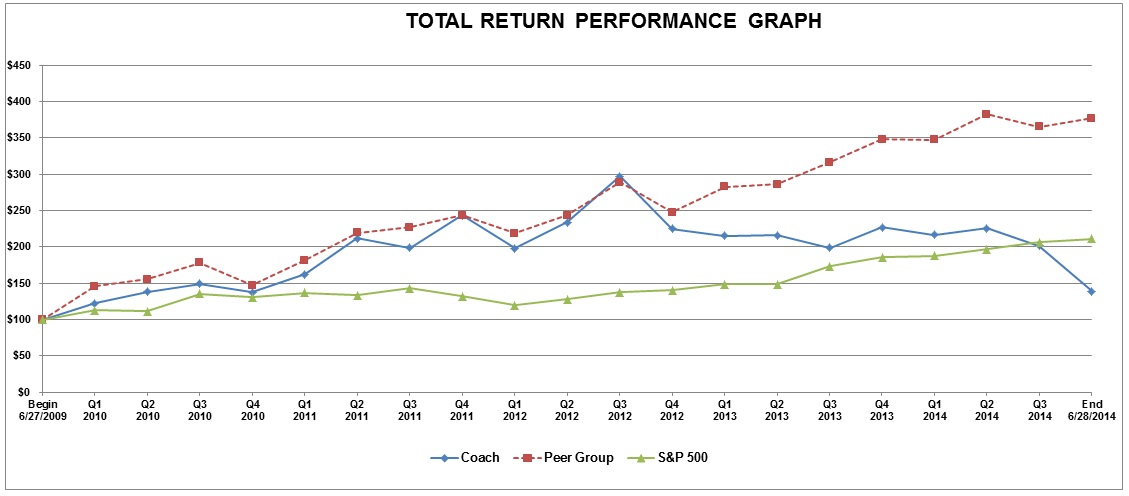
| June-09 | June-10 | June-11 | June-12 | June-13 | June-14 | |||||||
| COH | $100.00 | $137.40 | $243.47 | $225.11 | $227.13 | $138.96 | ||||||
| Peer Set | $100.00 | $147.40 | $243.56 | $247.69 | $348.08 | $376.76 | ||||||
| S&P 500 | $100.00 | $130.65 | $131.90 | $140.43 | $185.47 | $210.92 |
The graph assumes that $100 was invested on June 27, 2009 at the per share closing price in each of Coach’s common stock, the S&P 500 Stock Index and a peer set index compiled by us tracking the peer group companies listed above, and that all dividends were reinvested. The stock performance shown in the graph is not intended to forecast or be indicative of future performance.
Stock Repurchase Program
The Company did not repurchase any shares during the fourth quarter of fiscal 2014. As of June 28, 2014, Coach had $836,701 remaining in the stock repurchase program. The Company repurchases its common shares under the repurchase program that was approved by the Board as follows:
| Date Share Repurchase Programs were Publicly Announced | Total Dollar Amount Approved | Expiration Date of Plan | ||
| October 23, 2012 | $1.5 billion | June 2015 |
Item 6. SELECTED FINANCIAL DATA (dollars and shares in thousands, except per share data)
The selected historical financial data presented below as of and for each of the fiscal years in the five-year period ended June 28, 2014 has been derived from Coach’s audited Consolidated Financial Statements. The financial data should be read in conjunction with Item 7, “Management’s Discussion and Analysis of Financial Condition and Results of Operations,” the Consolidated Financial Statements and Notes thereto and other financial data included elsewhere herein.
| Fiscal Year Ended(1) | |||||||||||||||||||
| June 28, 2014(2)(3) | June 29, 2013(2)(3) | June 30, 2012(2)(3) | July 2, 2011(3) | July 3, 2010 | |||||||||||||||
| Consolidated Statements of Income: | |||||||||||||||||||
| Net sales | $ | 4,806,226 | $ | 5,075,390 | $ | 4,763,180 | $ | 4,158,507 | $ | 3,607,636 | |||||||||
| Gross profit | 3,296,963 | 3,698,148 | 3,466,078 | 3,023,541 | 2,633,691 | ||||||||||||||
| Selling, general and administrative ("SG&A") expenses | 2,176,889 | 2,173,607 | 1,954,089 | 1,718,617 | 1,483,520 | ||||||||||||||
| Operating income | 1,120,074 | 1,524,541 | 1,511,989 | 1,304,924 | 1,150,171 | ||||||||||||||
| Net income | 781,336 | 1,034,420 | 1,038,910 | 880,800 | 734,940 | ||||||||||||||
| Net income: | |||||||||||||||||||
| Per basic share | $ | 2.81 | $ | 3.66 | $ | 3.60 | $ | 2.99 | $ | 2.36 | |||||||||
| Per diluted share | 2.79 | 3.61 | 3.53 | 2.92 | 2.33 | ||||||||||||||
| Weighted-average basic shares outstanding | 277,790 | 282,494 | 288,284 | 294,877 | 311,413 | ||||||||||||||
| Weighted-average diluted shares outstanding | 280,379 | 286,307 | 294,129 | 301,558 | 315,848 | ||||||||||||||
| Dividends declared per common share | $ | 1.350 | $ | 1.238 | $ | 0.975 | $ | 0.675 | $ | 0.375 | |||||||||
| Consolidated Percentage of Net Sales Data: | |||||||||||||||||||
| Gross margin | 68.6 | % | 72.9 | % | 72.8 | % | 72.7 | % | 73.0 | % | |||||||||
| Selling, general and administrative expenses | 45.3 | % | 42.8 | % | 41.0 | % | 41.3 | % | 41.1 | % | |||||||||
| Operating margin | 23.3 | % | 30.0 | % | 31.7 | % | 31.4 | % | 31.9 | % | |||||||||
| Net income | 16.3 | % | 20.4 | % | 21.8 | % | 21.2 | % | 20.4 | % | |||||||||
| Consolidated Balance Sheet Data: | |||||||||||||||||||
| Working capital | $ | 1,042,099 | $ | 1,348,437 | $ | 1,086,368 | $ | 859,371 | $ | 773,605 | |||||||||
| Total assets | 3,663,131 | 3,531,897 | 3,104,321 | 2,635,116 | 2,467,115 | ||||||||||||||
| Cash, cash equivalents and investments | 1,353,144 | 1,332,231 | 923,215 | 712,754 | 702,398 | ||||||||||||||
| Inventory | 526,175 | 524,706 | 504,490 | 421,831 | 363,285 | ||||||||||||||
| Total debt | 140,485 | 985 | 23,360 | 24,155 | 24,901 | ||||||||||||||
| Stockholders' equity | 2,420,653 | 2,409,158 | 1,992,931 | 1,612,569 | 1,505,293 |
| Fiscal Year Ended(1) | ||||||||||||||
| June 28, 2014(2)(3) | June 29, 2013(2)(3) | June 30, 2012(2)(3) | July 2, 2011(3) | July 3, 2010 | ||||||||||
| Coach Operated Store Data | ||||||||||||||
| Stores open at fiscal year-end: | ||||||||||||||
| North American retail stores | 332 | 351 | 354 | 345 | 342 | |||||||||
| North American outlet stores | 207 | 193 | 169 | 143 | 121 | |||||||||
| Coach Japan locations | 198 | 191 | 180 | 169 | 161 | |||||||||
| Coach International, excluding Japan | 277 | 218 | 188 | 142 | 101 | |||||||||
| Total stores open at fiscal year-end | 1,014 | 953 | 891 | 799 | 725 | |||||||||
| Store square footage at fiscal year-end: | ||||||||||||||
| North American retail stores | 910,003 | 952,422 | 959,099 | 936,277 | 929,580 | |||||||||
| North American outlet stores | 1,132,714 | 982,202 | 789,699 | 649,094 | 548,797 | |||||||||
| Coach Japan locations | 355,014 | 350,994 | 320,781 | 303,925 | 293,441 | |||||||||
| Coach International, excluding Japan | 563,981 | 417,573 | 344,615 | 240,873 | 164,522 | |||||||||
| Total store square footage at fiscal year-end | 2,961,712 | 2,703,191 | 2,414,194 | 2,130,169 | 1,936,340 | |||||||||
| Average store square footage at fiscal year-end: | ||||||||||||||
| North American retail stores | 2,741 | 2,713 | 2,709 | 2,714 | 2,718 | |||||||||
| North American outlet stores | 5,472 | 5,089 | 4,673 | 4,539 | 4,536 | |||||||||
| Coach Japan locations | 1,793 | 1,838 | 1,782 | 1,798 | 1,823 | |||||||||
| Coach International, excluding Japan | 2,036 | 1,915 | 1,833 | 1,696 | 1,629 |
| (1) | Coach’s fiscal year ends on the Saturday closest to June 30. Fiscal years 2014, 2013, 2012 and 2011 were each 52-week years. Fiscal year 2010 was a 53-week year. |
| (2) | The Company acquired its international businesses from its former distributors as follows: fiscal 2014 — the remaining 50% interest in Europe; fiscal 2013 — Malaysia and South Korea; fiscal 2012 — Singapore and Taiwan. |
| (3) | During fiscal years 2014, 2013, 2012 and 2011, the Company recorded certain items which affect the comparability of our results. See item 7, “Management’s Discussion and Analysis of Financial Condition and Results of Operations,” for further information on the items related to fiscal 2014, fiscal 2013 and fiscal 2012. Fiscal 2011 was impacted by the result of a favorable settlement of a multi-year tax return examination and charitable contributions. The following table reconciles the Company's reported results on a U.S. GAAP basis to our adjusted results that exclude these items: |
| Net Income | |||||||||||||||||||
| Fiscal 2014 | Gross Profit | SG&A | Operating Income | Amount | Per Diluted Share | ||||||||||||||
| As Reported: (GAAP Basis) | $ | 3,296,963 | $ | 2,176,889 | $ | 1,120,074 | $ | 781,336 | $ | 2.79 | |||||||||
| Excluding items affecting comparability | 82,192 | (49,315 | ) | 131,507 | 88,281 | 0.31 | |||||||||||||
| Adjusted: (Non-GAAP Basis) | $ | 3,379,155 | $ | 2,127,574 | $ | 1,251,581 | $ | 869,617 | $ | 3.10 | |||||||||
| Net Income | |||||||||||||||||||
| Fiscal 2013 | Gross Profit | SG&A | Operating Income | Amount | Per Diluted Share | ||||||||||||||
| As Reported: (GAAP Basis) | $ | 3,698,148 | $ | 2,173,607 | $ | 1,524,541 | $ | 1,034,420 | $ | 3.61 | |||||||||
| Excluding items affecting comparability | 4,800 | (48,402 | ) | 53,202 | 32,568 | 0.11 | |||||||||||||
| Adjusted: (Non-GAAP Basis) | $ | 3,702,948 | $ | 2,125,205 | $ | 1,577,743 | $ | 1,066,988 | $ | 3.73 | |||||||||
| Net Income | |||||||||||||||||||
| Fiscal 2012 | Gross Profit | SG&A | Operating Income | Amount | Per Diluted Share | ||||||||||||||
| As Reported: (GAAP Basis) | $ | 3,466,078 | $ | 1,954,089 | $ | 1,511,989 | $ | 1,038,910 | $ | 3.53 | |||||||||
| Excluding items affecting comparability | — | (39,209 | ) | 39,209 | — | — | |||||||||||||
| Adjusted: (Non-GAAP Basis) | $ | 3,466,078 | $ | 1,914,880 | $ | 1,551,198 | $ | 1,038,910 | $ | 3.53 | |||||||||
| Net Income | |||||||||||||||||||
| Fiscal 2011 | Gross Profit | SG&A | Operating Income | Amount | Per Diluted Share | ||||||||||||||
| As Reported: (GAAP Basis) | $ | 3,023,541 | $ | 1,718,617 | $ | 1,304,924 | $ | 880,800 | $ | 2.92 | |||||||||
| Excluding items affecting comparability | — | (25,678 | ) | 25,678 | — | — | |||||||||||||
| Adjusted: (Non-GAAP Basis) | $ | 3,023,541 | $ | 1,692,939 | $ | 1,330,602 | $ | 880,800 | $ | 2.92 |
Item 7. MANAGEMENT’S DISCUSSION AND ANALYSIS OF FINANCIAL CONDITION AND RESULTS OF OPERATIONS
The following discussion of Coach’s financial condition and results of operations should be read together with Coach’s consolidated financial statements and notes to those statements, included elsewhere in this document. When used herein, the terms “Coach,” “Company,” “we,” “us” and “our” refer to Coach, Inc., including consolidated subsidiaries.
EXECUTIVE OVERVIEW
Coach is a leading New York design house of modern luxury accessories and lifestyle collections. Our product offerings include fine accessories, gifts and certain seasonal lifestyle apparel collections for women and men.
Coach operates in two segments: North America and International. The North America segment includes sales to North American customers through Coach-operated stores (including the Internet) and sales to North American wholesale customers. The International segment includes sales to customers through Coach-operated stores (including the Internet) and concession shop-in-shops in Japan and mainland China, Coach-operated stores and concession shop-in-shops in Hong Kong, Macau, Singapore, Taiwan, Malaysia, South Korea, the United Kingdom, France, Ireland, Spain, Portugal, Germany and Italy, as well as sales to wholesale customers and distributors in approximately 35 countries. As Coach’s business model is based on multi-channel global distribution, our success does not depend solely on the performance of a single channel or geographic area.
In order to drive growth within our global business, we are focused on four key initiatives, which directly align with the Company's Transformation Plan, described below:
| • | Grow our business in North America and worldwide, by transforming from a leading international accessories Company into a global lifestyle brand, anchored in luxury accessories. |
| • | Leverage the global opportunity for Coach by raising brand awareness and building market share in markets where Coach is under-penetrated, most notably in Asia and Europe. We are also developing the brand opportunity as we expand into South America and Central America. |
| • | Focus on the Men’s opportunity for the brand, by drawing on our long heritage in the category. We are capitalizing on this opportunity by opening new standalone and dual gender stores and broadening the men’s assortment in existing stores. |
| • | Harness the growing power of the digital world, accelerating the development of our digital programs and capabilities in North America and worldwide, reflecting the change in consumer shopping behavior globally. Our intent is to rapidly drive further innovation to engage with customers in this channel. Key elements include www.coach.com, our invitation-only outlet Internet site, our global e-commerce sites, marketing sites and social media. |
In addition, during the fourth quarter of fiscal 2014, Coach announced a multi-year strategic plan with the objective of transforming the brand and reinvigorating growth, which will enable the Company to return to ‘best-in-class’ profitability. This multi-faceted, multi-year transformation plan (the "Transformation Plan") builds on the core brand equities of quality and craftsmanship with the aim of evolving our competitive value proposition. We believe our strategy offers significant growth opportunities in handbags and accessories, as well as in the broader set of lifestyle categories that we have operated in for some time but are less developed, including footwear and outerwear. This will require an integrated holistic approach, across product, stores and marketing and promotional activities. It will also entail the roll-out of carefully crafted aspirational marketing campaigns to define our brand to deliver a fuller and more consistent brand expression.
Key operational and cost measures needed in order to fund and execute this plan include: (i) the investment of approximately $500 million in capital improvements in our stores and wholesale locations in fiscal 2015 and fiscal 2016; (ii) the optimization of our North American store fleet including the closure of approximately 70 underperforming locations in fiscal 2015; (iii) the realignment of inventory levels to reflect our elevated product strategy in fiscal 2014; (iv) the investment of approximately $50 million in incremental advertising costs to further promote our new strategy starting in fiscal 2015; and (v) the significant scale-back of our promotional cadence, particularly within our outlet Internet sales site starting in fiscal 2014. The Company believes that long-term growth can be realized through its transformational efforts over time. For further discussion of charges incurred in connection with the Transformation Plan, see "Items Affecting Comparability," herein.
Current Trends and Outlook
In addition to the risks surrounding the successful execution of our Transformation Plan initiatives, our outlook reflects a certain level of uncertainty despite signs of improvement in the global economy. The global economic environment continues to negatively impact consumer confidence, which in turn influences the level of spending on discretionary items. Consumer retail traffic remains relatively weak and inconsistent, which has led to a more promotional environment due to increased competition and a desire to offset traffic declines with increased levels of conversion. If the global macroeconomic environment remains volatile
or worsens, the constrained level of worldwide consumer spending and modified consumption behavior may continue to have a negative effect on our trends in fiscal 2015.
We will continue to monitor these risks and evaluate and adjust our operating strategies and cost management opportunities to mitigate the related impact on our results of operations, while remaining focused on the long-term growth of our business and protecting the value of our brand.
For a detailed discussion of significant risk factors that have the potential to cause our actual results to differ materially from our expectations, see Part I, Item 1A - "Risk Factors" included in this Annual Report on Form 10-K.
SUMMARY — FISCAL 2014
In fiscal 2014, we reported net sales of $4.81 billion, net income of $781.3 million and net income per diluted share of $2.79. This compares to net sales of $5.08 billion, net income of $1.03 billion, and net income per diluted share of $3.61 in fiscal 2013. In fiscal 2014, the comparability of our operating results has been affected by $131.5 million of pretax charges ($88.3 million after tax or $0.31 per diluted share) related to our Transformation Plan. In fiscal 2013, the comparability of our operating results was affected by $53.2 million of pretax charges ($32.6 million after tax or $0.11 per diluted share) related to restructuring and transformation-related charges.
Our operating performance for fiscal 2014 reflected a decline in revenue of 5.3%, primarily due to decreased revenues from our North America business partially offset by gains in our International businesses. Excluding the effects of foreign currency, net sales decreased 3.1%. Our gross profit decreased by 10.8% to $3.30 billion during fiscal 2014 which included the negative impact of charges under our Transformation Plan of $82.2 million. In fiscal 2013, restructuring and transformation-related charges negatively impacted gross profit by $4.8 million. Selling, general and administrative ("SG&A") expenses remained fairly consistent from fiscal 2013, however SG&A expense as a percentage of net sales increased by 250 basis points primarily due to higher selling expenses to support our International businesses as well as a decline in total Net sales. Excluding charges under our Transformation Plan in fiscal 2014 and restructuring and transformation-related charges in fiscal 2013, SG&A expenses remained fairly consistent.
Net income decreased in fiscal 2014 as compared to fiscal 2013, pr
Showing the first 8K of 84K characters. Open the full section
Item 7A. QUANTITATIVE AND QUALITATIVE DISCLOSURES ABOUT MARKET RISK
Market Risk
The market risk inherent in our financial instruments represents the potential loss in fair value, earnings or cash flows, arising from adverse changes in foreign currency exchange rates or interest rates. Coach manages these exposures through operating and financing activities and, when appropriate, through the use of derivative financial instruments. The use of derivative financial instruments is in accordance with Coach’s risk management policies, and we do not enter into derivative transactions for speculative or trading purposes.
The quantitative disclosures in the following discussion are based on quoted market prices obtained through independent pricing sources for the same or similar types of financial instruments, taking into consideration the underlying terms and maturities and theoretical pricing models.
Foreign Currency Exchange Rate Risk
Foreign currency exposures arise from transactions, including firm commitments and anticipated contracts, denominated in a currency other than the entity’s functional currency, and from foreign-denominated revenues and expenses translated into U.S. dollars. Substantially all of Coach’s purchases and sales involving international parties, excluding international consumer sales, are denominated in U.S. dollars and, therefore, are not subject to foreign currency exchange risk. The Company is exposed to risk from foreign currency exchange rate fluctuations resulting from its foreign operating subsidiaries’ U.S. dollar denominated inventory purchases. To mitigate such risk, Coach Japan and Coach Canada enter into foreign currency derivative contracts, primarily zero-cost collar options. As of June 28, 2014 and June 29, 2013, zero-cost collar options designated as cash flow hedges with a notional amount of $90.3 million and $193.4 million, respectively, were outstanding. As a result of the use of derivative instruments, we are exposed to the risk that counterparties to the derivative instruments will fail to meet their contractual obligations. To mitigate the counterparty credit risk, we only enter into derivative contracts with carefully selected financial institutions. The Company also reviews the creditworthiness of our counterparties on a regular basis. As a result of the above considerations, we do not believe that we are exposed to any undue concentration of counterparty credit risk associated with our derivative contracts as of June 28, 2014.
Coach is also exposed to market risk from foreign currency exchange rate fluctuations with respect to various cross-currency intercompany and related party loans which are not long term in investment nature. This primarily includes exposure to exchange rate fluctuations in the Hong Kong Dollar, the South Korean Won, the New Taiwan Dollar, and the British Pound Sterling. To manage the exchange rate risk related to these loans, the Company entered into forward exchange and cross-currency swap contracts, the terms of which include the exchange of foreign currency fixed interest for U.S. dollar fixed interest and an exchange of the foreign currency and U.S. dollar based notional values at the maturity dates of the contracts, the latest of which is November 2014. As of June 28, 2014 and June 29, 2013, the total notional values of outstanding forward exchange and cross-currency swap contracts related to these loans were $13.2 million and $147.6 million, respectively.
The fair value of outstanding foreign currency derivatives included in current assets at June 28, 2014 and June 29, 2013 was $0.5 million and $4.5 million, respectively. The fair value of outstanding foreign currency derivatives included in current liabilities at June 28, 2014 and June 29, 2013 was $0.9 million and $2.9 million, respectively. The fair value of these contracts is sensitive to changes in foreign currency exchange rates. A sensitivity analysis of the effects of foreign exchange rate fluctuations on the fair values of our derivative contracts was performed to assess the risk of loss. As of June 28, 2014, a 10% devaluation of the U.S. Dollar against the exchange rates for foreign currencies under contract would result in an immaterial impact on derivative contract fair values.
Interest Rate Risk
Coach is exposed to interest rate risk in relation to its investments and revolving credit facilities.
The Company’s investment portfolio is maintained in accordance with the Company’s investment policy, which defines our investment principles including credit quality standards and limits the credit exposure of any single issuer. The primary objective of our investment activities is the preservation of principal while maximizing interest income and minimizing risk. We do not hold any investments for trading purposes.
Item 8. FINANCIAL STATEMENTS AND SUPPLEMENTARY DATA
See “Index to Financial Statements,” appearing at the end of this Annual Report on Form 10-K.
Item 9. CHANGES IN AND DISAGREEMENTS WITH ACCOUNTANTS ON ACCOUNTING AND FINANCIAL DISCLOSURE
None.
Item 9A. CONTROLS AND PROCEDURES
Disclosure Controls and Procedures
Based on the evaluation of the Company’s disclosure controls and procedures, as that term is defined in Rule 13a-15(e) under the Securities Exchange Act of 1934, as amended, the Chief Executive Officer of the Company and the Chief Financial Officer of the Company, have concluded that the Company’s disclosure controls and procedures are effective as of June 28, 2014.
Management’s Report on Internal Control over Financial Reporting
The Company’s management is responsible for establishing and maintaining adequate internal controls over financial reporting. The Company’s internal control system was designed to provide reasonable assurance to the Company’s management and Board regarding the preparation and fair presentation of published financial statements. Management evaluated the effectiveness of the Company’s internal control over financial reporting using the criteria set forth by the Committee of Sponsoring Organizations (COSO) of the Treadway Commission in Internal Control — Integrated Framework in 1992. Management, under the supervision and with the participation of the Company’s Chief Executive Officer and Chief Financial Officer, assessed the effectiveness of the Company’s internal control over financial reporting as of June 28, 2014 and concluded that it is effective.
The Company’s independent auditors have issued an audit report on the Company's internal control over financial reporting as included elsewhere herein.
Changes in Internal Control over Financial Reporting
There were no changes in internal control over financial reporting that occurred during the fourth fiscal quarter that have materially affected, or are reasonably likely to materially affect, the Company’s internal control over financial reporting.
Item 9B. OTHER INFORMATION
None.
PART III
Item 10. DIRECTORS, EXECUTIVE OFFICERS AND CORPORATE GOVERNANCE
The information required to be included by Item 10 of Form 10-K will be included in the Proxy Statement for the 2014 Annual Meeting of Stockholders and such information is incorporated by reference herein. The Proxy Statement will be filed with the Commission within 120 days after the end of the fiscal year covered by this Form 10-K pursuant to Regulation 14A under the Securities Exchange Act of 1934, as amended.
Item 11. EXECUTIVE COMPENSATION
The information regarding executive and director compensation set forth in the Proxy Statement for the 2014 Annual Meeting of Stockholders is incorporated herein by reference.
Item 12. SECURITY OWNERSHIP OF CERTAIN BENEFICIAL OWNERS AND MANAGEMENT AND RELATED STOCKHOLDER MATTERS
The information under the headings “Securities Authorized for Issuance Under Equity Compensation Plans” and “Coach Stock Ownership by Certain Beneficial Owners and Management” in the Company’s Proxy Statement for the 2014 Annual Meeting of Stockholders is incorporated herein by reference.
There are no arrangements known to the registrant that may at a subsequent date result in a change in control of the registrant.
Item 13. CERTAIN RELATIONSHIPS AND RELATED TRANSACTIONS, AND DIRECTOR INDEPENDENCE
The information required to be included by Item 13 of Form 10-K will be included in the Proxy Statement for the 2014 Annual Meeting of Stockholders and such information is incorporated by reference herein.
Item 14. PRINCIPAL ACCOUNTING FEES AND SERVICES
The information required by this item is incorporated herein by reference to the sections entitled “Fees For Audit and Other Services” and “Audit Committee Pre-Approval Policy” in the Proxy Statement for the 2014 Annual Meeting of Stockholders.
PART IV
Item 15. EXHIBITS, FINANCIAL STATEMENT SCHEDULES
| (a) | Financial Statements and Financial Statement Schedules. See “Index to Financial Statements,” appearing herein. |
| (b) | Exhibits. See the exhibit index which is included herein. |
SIGNATURES
Pursuant to the requirements of Section 13 or 15(d) of the Securities Exchange Act of 1934, the Registrant has duly caused this report to be signed on its behalf by the undersigned, thereunto duly authorized.
COACH, INC.
| Date: August 15, 2014 | By: | /s/ Victor Luis |
| Name: Victor Luis Title: Chief Executive Officer |
Pursuant to the requirements of the Securities Exchange Act of 1934, this report has been signed below by the following persons on behalf of the Registrant and in the capacities indicated below on August 15, 2014.
| Signature | Title | |
| /s/ Victor Luis | Chief Executive Officer and Director | |
| Victor Luis | (Principal Executive Officer) | |
| /s/ Jane Nielsen | Chief Financial Officer | |
| Jane Nielsen | (Principal Financial and Accounting Officer) | |
| /s/ Lew Frankfort | Executive Chairman and Director | |
| Lew Frankfort | ||
| /s/ David Denton | Director | |
| David Denton | ||
| /s/ Susan Kropf | Director | |
| Susan Kropf | ||
| /s/ Gary Loveman | Director | |
| Gary Loveman | ||
| /s/ Ivan Menezes | Director | |
| Ivan Menezes | ||
| /s/ Michael Murphy | Director | |
| Michael Murphy | ||
| /s/ William Nuti | Director | |
| William Nuti | ||
| /s/ Stephanie Tilenius | Director | |
| Stephanie Tilenius | ||
| /s/ Jide Zeitlin | Director | |
| Jide Zeitlin |
COACH, INC.
INDEX TO CONSOLIDATED FINANCIAL STATEMENTS AND SUPPLEMENTARY INFORMATION
All other schedules are omitted because they are not applicable or the required information is shown in the Consolidated Financial Statements or Notes thereto.
REPORT OF INDEPENDENT REGISTERED PUBLIC ACCOUNTING FIRM
To the Board of Directors and Stockholders of
Coach, Inc.
New York, New York
We have audited the accompanying consolidated balance sheets of Coach, Inc. and subsidiaries (the "Company") as of June 28, 2014 and June 29, 2013, and the related consolidated statements of income, comprehensive income, stockholders' equity, and cash flows for each of the three years in the period ended June 28, 2014. Our audits also included the financial statement schedule listed in the Index to the financial statements. These financial statements and financial statement schedule are the responsibility of the Company's management. Our responsibility is to express an opinion on the financial statements and financial statement schedule based on our audits.
We conducted our audits in accordance with the standards of the Public Company Accounting Oversight Board (United States). Those standards require that we plan and perform the audit to obtain reasonable assurance about whether the financial statements are free of material misstatement. An audit includes examining, on a test basis, evidence supporting the amounts and disclosures in the financial statements. An audit also includes assessing the accounting principles used and significant estimates made by management, as well as evaluating the overall financial statement presentation. We believe that our audits provide a reasonable basis for our opinion.
In our opinion, such consolidated financial statements present fairly, in all material respects, the financial position of Coach, Inc. and subsidiaries at June 28, 2014 and June 29, 2013, and the results of their operations and their cash flows for each of the three years in the period ended June 28, 2014, in conformity with accounting principles generally accepted in the United States of America. Also, in our opinion, such financial statement schedule, when considered in relation to the basic consolidated financial statements taken as a whole, present fairly, in all material respects, the information set forth therein.
We have also audited, in accordance with the standards of the Public Company Accounting Oversight Board (United States), the Company's internal control over financial reporting as of June 28, 2014, based on the criteria established in Internal Control - Integrated Framework (1992) issued by the Committee of Sponsoring Organizations of the Treadway Commission and our report dated August 15, 2014 expressed an unqualified opinion on the Company's internal control over financial reporting.
/s/ DELOITTE & TOUCHE LLP
New York, New York
August 15, 2014
REPORT OF INDEPENDENT REGISTERED PUBLIC ACCOUNTING FIRM
To the Board of Directors and Stockholders of
Coach, Inc.
New York, New York
We have audited the internal control over financial reporting of Coach, Inc. and subsidiaries (the "Company") as of June 28, 2014, based on criteria established in Internal Control - Integrated Framework (1992) issued by the Committee of Sponsoring Organizations of the Treadway Commission. The Company's management is responsible for maintaining effective internal control over financial reporting and for its assessment of the effectiveness of internal control over financial reporting, included in the accompanying Management’s Report on Internal Control over Financial Reporting. Our responsibility is to express an opinion on the Company's internal control over financial reporting based on our audit.
We conducted our audit in accordance with the standards of the Public Company Accounting Oversight Board (United States). Those standards require that we plan and perform the audit to obtain reasonable assurance about whether effective internal control over financial reporting was maintained in all material respects. Our audit included obtaining an understanding of internal control over financial reporting, assessing the risk that a material weakness exists, testing and evaluating the design and operating effectiveness of internal control based on the assessed risk, and performing such other procedures as we considered necessary in the circumstances. We believe that our audit provides a reasonable basis for our opinion.
A company's internal control over financial reporting is a process designed by, or under the supervision of, the company's principal executive and principal financial officers, or persons performing similar functions, and effected by the company's board of directors, management, and other personnel to provide reasonable assurance regarding the reliability of financial reporting and the preparation of financial statements for external purposes
Showing the first 8K of 152K characters. Open the full section