 filings.tools
Tapestry 10-K 2021-07-03
Filed 2021-08-19. 21 sections, 495K characters. Original on sec.gov · Markdown · JSON
Cover and table of contents
UNITED STATES
SECURITIES AND EXCHANGE COMMISSION
Washington, D.C. 20549
FORM 10-K
| ☑ | ANNUAL REPORT PURSUANT TO SECTION 13 OR 15(d) OF THE SECURITIES EXCHANGE ACT OF 1934 |
For the Fiscal Year Ended July 3, 2021
OR
| ☐ | TRANSITION REPORT PURSUANT TO SECTION 13 OR 15(d) OF THE SECURITIES EXCHANGE ACT OF 1934 |
Commission file number: 1-16153
Tapestry, Inc.
(Exact name of registrant as specified in its charter)
| Maryland | 52-2242751 | |||||||
| (State or other jurisdiction of incorporation or organization) | (I.R.S. Employer Identification No.) |
10 Hudson Yards, New York, NY 10001
(Address of principal executive offices); (Zip Code)
(212) 946-8400
(Registrant’s telephone number, including area code)
Securities Registered Pursuant to Section 12(b) of the Act:
| Title of Each Class | Trading Symbol | Name of Each Exchange on which Registered | ||||||||||||
| Common Stock, par value $.01 per share | TPR | New York Stock Exchange |
Securities Registered Pursuant to Section 12(g) of the Act: None
Indicate by check mark if the registrant is a well-known seasoned issuer, as defined in Rule 405 of the Securities Act. Yes ☑ No ☐
Indicate by check mark if the registrant is not required to file reports pursuant to Section 13 or Section 15(d) of the Act. Yes ☐ No ☑
Indicate by check mark whether the registrant (1) has filed all reports required to be filed by Section 13 or 15(d) of the Securities Exchange Act of 1934 during the preceding 12 months (or for such shorter period that the registrant was required to file such reports), and (2) has been subject to such filing requirements for the past 90 days. Yes ☑ No ☐
Indicate by check mark whether the registrant has submitted electronically every Interactive Data File required to be submitted and posted pursuant to Rule 405 of Regulation S-T (§232.405 of this chapter) during the preceding 12 months (or for such shorter period that the registrant was required to submit and post such files). Yes ☑ No ☐
Indicate by check mark whether the registrant is a large accelerated filer, an accelerated filer, a non-accelerated filer, a smaller reporting company, or an emerging growth company. See the definitions of “large accelerated filer”, “accelerated filer,” “smaller reporting company,” and "emerging growth company" in Rule 12b-2 of the Exchange Act.
| Large accelerated filer | ☑ | Accelerated filer | ☐ | Non-accelerated filer | ☐ | Smaller reporting company | ☐ | |||||||||||||||||||||||||
| Emerging growth company | ☐ |
If an emerging growth company, indicate by check mark if the registrant has elected not to use the extended transition period for complying with any new or revised financial accounting standards provided pursuant to Section 13(a) of the Exchange Act. ☐
Indicate by check mark whether the registrant has filed a report on and attestation to its management’s assessment of the effectiveness of its internal control over financial reporting under Section 404(b) of the Sarbanes-Oxley Act (15 U.S.C. 7262(b)) by the registered public accounting firm that prepared or issued its audit report. ☑
Indicate by check mark whether the registrant is a shell Company (as defined in Rule 12b-2 of the Act).Yes ☐ No ☑
The aggregate market value of Tapestry, Inc. common stock held by non-affiliates as of December 24, 2020 (the last business day of the most recently completed second fiscal quarter) was approximately $8.6 billion. For purposes of determining this amount only, the registrant has excluded shares of common stock held by directors and officers. Exclusion of shares held by any person should not be construed to indicate that such person possesses the power, direct or indirect, to cause the direction of the management or policies of the registrant, or that such person is controlled by or under common control with the registrant.
On August 6, 2021, the Registrant had 279,575,180 shares of common stock outstanding.
DOCUMENTS INCORPORATED BY REFERENCE
| Documents | Form 10-K Reference | |||||||
| Proxy Statement for the 2021 Annual Meeting of Stockholders | Part III, Items 10 – 14 |
TAPESTRY, INC.
TABLE OF CONTENTS
i
SPECIAL NOTE ON FORWARD-LOOKING INFORMATION
This document, and the documents incorporated by reference in this document, our press releases and oral statements made from time to time by us or on our behalf, may contain certain "forward-looking statements" within the meaning of the federal securities laws, including Section 27A of the Securities Act of 1933, as amended, and Section 21E of the Securities Exchange Act of 1934, as amended, and are based on management's current expectations, that involve risks and uncertainties that could cause our actual results to differ materially from our current expectations. In this context, forward-looking statements often address expected future business and financial performance and financial condition, and often contain words such as "may," "can," "continue," "project," "should," "expect," "confidence," "trends," "anticipate," "intend," "estimate," "on track," "well positioned to," "plan," "potential," "position," "believe," "seek," "see," "will," "would," "target," similar expressions, and variations or negatives of these words. Forward-looking statements by their nature address matters that are, to different degrees, uncertain. Such statements involve risks, uncertainties and assumptions. If such risks or uncertainties materialize or such assumptions prove incorrect, the results of Tapestry, Inc. and its consolidated subsidiaries could differ materially from those expressed or implied by such forward-looking statements and assumptions. All statements other than statements of historical fact are statements that could be deemed forward-looking statements. Tapestry, Inc. assumes no obligation to revise or update any such forward-looking statements for any reason, except as required by law.
Tapestry, Inc.’s actual results could differ materially from the results contemplated by these forward-looking statements and are subject to a number of risks, uncertainties, estimates and assumptions that may cause actual results to differ materially from current expectations due to a number of factors, including those discussed in the sections of this Form 10-K filing entitled “Risk Factors” and “Management’s Discussion and Analysis of Financial Condition and Results of Operations.” These factors include, but are not limited to: (i) the impact of the novel coronavirus ("Covid-19") global pandemic on our business and financial results, including impacts on our supply chain due to temporary closures of our manufacturing partners and shipping and fulfillment constraints; (ii) our ability to successfully execute our multi-year growth agenda under our Acceleration Program; (iii) the impact of economic conditions; (iv) our ability to control costs; (v) our exposure to international risks, including currency fluctuations and changes in economic or political conditions in the markets where we sell or source our products; (vi) the risk of cyber security threats and privacy or data security breaches; (vii) the effect of existing and new competition in the marketplace; (viii) our ability to retain the value of our brands and to respond to changing fashion and retail trends in a timely manner, including our ability to execute on our e-commerce and digital strategies; (ix) the effect of seasonal and quarterly fluctuations on our sales or operating results; (x) our ability to protect against infringement of our trademarks and other proprietary rights; (xi) the impact of tax and other legislation; (xii) our ability to achieve intended benefits, cost savings and synergies from acquisitions; (xiii) the risks associated with potential changes to international trade agreements and the imposition of additional duties on importing our products; (xiv) the impact of pending and potential future legal proceedings; and (xv) the risks associated with climate change and other corporate responsibility issues. These factors are not necessarily all of the factors that could cause actual results to differ materially from those expressed in any of our forward-looking statements.
In this Form 10-K, references to “we,” “our,” “us,” "Tapestry" and the “Company” refer to Tapestry, Inc., including consolidated subsidiaries as of July 3, 2021 ("fiscal 2021"). References to "Coach," "Kate Spade," "kate spade new york" or "Stuart Weitzman" refer only to the referenced brand. The fiscal year ended July 3, 2021 ("fiscal 2021") was a 53-week period, June 27, 2020 ("fiscal 2020") and June 29, 2019 ("fiscal 2019") were 52-week periods.
PART I
Item 1. BUSINESS
Founded in 1941, Coach, Inc., the predecessor to Tapestry, Inc. (the "Company"), was incorporated in the state of Maryland in 2000. During fiscal 2015, the Company acquired Stuart Weitzman Holdings LLC, a luxury women's footwear company. During the first quarter of fiscal 2018, the Company acquired Kate Spade & Company, a lifestyle accessories and ready-to-wear company. Later in fiscal 2018, the Company changed its name to Tapestry, Inc.
Tapestry, Inc. is a leading New York-based house of modern luxury accessories and lifestyle brands. Our global house of brands unites the magic of Coach, kate spade new york and Stuart Weitzman. Each of our brands are unique and independent, while sharing a commitment to innovation and authenticity defined by distinctive products and differentiated customer experiences across channels and geographies. We use our collective strengths to move our customers and empower our communities, to make the fashion industry more sustainable, and to build a company that’s equitable, inclusive, and diverse. Individually, our brands are iconic. Together, we can stretch what’s possible.
OUR STRATEGY
Acceleration Program
The Company has implemented a strategic growth plan after undergoing a review of its business under its multi-year growth agenda (the "Acceleration Program"). The guiding principle of the Company’s multi-year growth agenda under the Acceleration Program is to better meet the needs of each of its brands' unique customers by:
-
Sharpening our Focus on the Consumer:** Operating with a clearly defined purpose and strategy for each brand and an unwavering focus on the consumer at the core of everything we do
-
Leveraging Data and Leading with a Digital-First Mindset:** Building significant data and analytics capabilities to drive decision-making and increase efficiency; Offering immersive customer experiences across our e-commerce and social channels to meet the needs of consumers who are increasingly utilizing digital platforms to engage with brands; Rethinking the role of stores with an intent to optimize our fleet
-
Transforming into a Leaner and More Responsive Organization:** Moving with greater agility, simplifying internal processes and empowering teams to act quickly to meet the rapidly changing needs of the consumer. The Company achieved approximately $200 million of gross run rate expense savings in fiscal 2021 and remains on track to realize gross run-rate savings of $300 million.
Covid-19 Impact
Our business has been significantly impacted by Covid-19. In response, the Company took strategic actions to reinforce its liquidity and financial flexibility, as well as to comply with local regulations to protect employees and customers. While the ongoing pandemic continues to present challenges, such as the supply chain related pressures facing the industry, store closures and other additional actions necessary to protect our stakeholders, the Company has been adapting to the current environment by remaining flexible in the short-term while continuing to focus on its long-term strategy and multi-year growth agenda.
OUR BRANDS
The Company has three reportable segments:
-
Coach includes global sales of Coach products to customers through Coach operated stores, including e-commerce sites and concession shop-in-shops, and sales to wholesale customers and through independent third party distributors. This segment represented 74.0% of total net sales in fiscal 2021.
-
Kate Spade includes global sales primarily of kate spade new york brand products to customers through Kate Spade operated stores, including e-commerce sites, sales to wholesale customers, through concession shop-in-shops and through independent third party distributors. This segment represented 21.1% of total net sales in fiscal 2021.
-
Stuart Weitzman includes global sales of Stuart Weitzman brand products primarily through Stuart Weitzman operated stores, including e-commerce sites, sales to wholesale customers and through independent third party distributors. This segment represented 4.9% of total net sales in fiscal 2021.
Corporate, which is not a reportable segment, represents certain costs that are not directly attributable to a brand. These costs primarily include administrative and information systems expense.
Coach
Coach is a leading design house of modern luxury accessories and lifestyle collections, with a long-standing reputation built on quality craftsmanship. Defined by a free-spirited, all-American attitude, the brand approaches design with a modern vision, reimagining luxury for today with an authenticity and innovation that is uniquely Coach. All over the world, the Coach name is synonymous with effortless New York style.
Stores — Coach operates freestanding flagship, retail and outlet stores as well as concession shop-in-shop locations. These stores are located in regional shopping centers, metropolitan areas throughout the world and established outlet centers.
Coach flagship stores, which offer the fullest expression of the Coach brand, are located in tourist-heavy, densely populated cities globally. Retail stores carry an assortment of products depending on their size, location and customer preferences. Coach outlet stores serve as an efficient means to sell manufactured-for-outlet product and discontinued retail inventory outside the retail channel. The outlet store design, visual presentations and customer service levels support and reinforce the brand's image. Through these outlet stores, we target value-oriented customers in established outlet centers that are close to major markets.
The following table shows the number of Coach directly-operated locations and their total and average square footage:
| Coach | ||||||||||||||||||||
| North America | International | Total | ||||||||||||||||||
| Store Count | ||||||||||||||||||||
| Fiscal 2021 | 354 | 585 | 939 | |||||||||||||||||
| Net change vs. prior year | (21) | 2 | (19) | |||||||||||||||||
| % change vs. prior year | (5.6) | % | 0.3 | % | (2.0) | % | ||||||||||||||
| Fiscal 2020 | 375 | 583 | 958 | |||||||||||||||||
| Net change vs. prior year | (16) | (12) | (28) | |||||||||||||||||
| % change vs. prior year | (4.1) | % | (2.0) | % | (2.8) | % | ||||||||||||||
| Fiscal 2019 | 391 | 595 | 986 | |||||||||||||||||
| Net change vs. prior year | (11) | 10 | (1) | |||||||||||||||||
| % change vs. prior year | (2.7) | % | 1.7 | % | (0.1) | % | ||||||||||||||
| Square Footage | ||||||||||||||||||||
| Fiscal 2021 | 1,774,244 | 1,392,707 | 3,166,951 | |||||||||||||||||
| Net change vs. prior year | 15,576 | 107,378 | 122,954 | |||||||||||||||||
| % change vs. prior year | 0.9 | % | 8.4 | % | 4.0 | % | ||||||||||||||
| Fiscal 2020 | 1,758,668 | 1,285,329 | 3,043,997 | |||||||||||||||||
| Net change vs. prior year |
Showing the first 8K of 64K characters. Open the full section
Item 1A. RISK FACTORS
You should consider carefully all of the information set forth or incorporated by reference in this document and, in particular, the following risk factors associated with the business of the Company and forward-looking information in this document. Please also see “Special Note on Forward-Looking Information” at the beginning of this report. The risks described below are not the only ones we face. Additional risks not presently known to us or that we currently deem immaterial may also have an adverse effect on us. If any of the risks below actually occur, our business, results of operations, cash flows or financial condition could suffer.
Risks Related to our Business and our Industry
The Covid-19 pandemic and resulting adverse economic conditions are and may continue to have a material adverse impact on our business, financial condition, results of operations and cash flows.
The Covid-19 pandemic has impacted a significant majority of the regions in which we operate, disrupting operations, consumer spending and global supply chains and creating significant disruption and volatility of financial markets. The impacts of Covid-19 have and may continue to materially adversely impact our operations, cash flow and liquidity. In March 2020, the outbreak was labeled a global pandemic by the World Health Organization. National, state and local governments have responded to the Covid-19 pandemic in a variety of ways, including, but not limited to, by declaring states of emergency, restricting people from gathering in groups or interacting within a certain physical distance (i.e., social distancing), requiring individuals to stay at home, and in most cases, ordering non-essential businesses to close or limit operations. As a result, the Company had temporarily closed the majority of its directly operated stores globally for some period of time to help reduce the spread of Covid-19 during fiscal 2020. Throughout fiscal year 2021, the vast majority of the Company’s stores were opened, although experienced reduce traffic from historical levels, for either in-store or curb-side service and have continued to operate. Some store locations have, however, experienced temporary re-closures or operated under tighter restrictions in compliance with local government regulation during the course of fiscal year 2021 and into the beginning of fiscal year 2022. Many of the Company’s wholesale partners also experienced closure of their stores or operating restrictions during the fiscal year, as required by government orders. The Company has noted that certain geographies have experienced increased infection rates due to new variants of Covid-19, resulting in a decline in store traffic in these regions. The Company currently expects that this trend will not have a material adverse impact on its financial results for Fiscal 2022. However, if such infections rates continue to rise resulting in further declines in store traffic, the Company's financial results may be negatively impacted from that which is currently expected. In addition, certain of the Company’s supply chain partners, particularly those in Southeast Asia, have experienced temporary closures due to an increase in Covid-19 cases in the region, which has and may continue to negatively impact the Company’s supply chain operations.
The global Covid-19 pandemic is continuously evolving and the extent to which the pandemic ultimately impacts our results and our business - including unforeseen increased costs to our business - will depend on future developments, which are highly uncertain and cannot be predicted, including the ultimate duration, severity and sustained geographic resurgence of the virus, including the emergence of new variants and strains of the virus, and the success of actions to contain the virus and its variants, or treat its impact, such as the availability and acceptance of vaccines, among others. While the full magnitude of the effects on our business continues to be difficult to predict, the Covid-19 pandemic has and may continue to have a material adverse impact on our business, financial condition, and results of operations. Although the ultimate severity and impact of the Covid-19 pandemic is uncertain at this time and depends on future events outside of our control, our business is expected to continue to be adversely impacted by several factors, including, but not limited to:
-
We source and manufacture our products on a global scale and we have experienced and may continue to experience material temporary or long-term disruption in our supply chain, given the global reach of the Covid-19 pandemic. Travel restrictions, closures or disruptions of business and facilities, including manufacturing facilities and raw material providers, unavailability of vaccines for our international employees or workers in our supply chain, or social, economic, political or labor instability in the affected areas may impact the operations of our raw material suppliers or manufacturing partners. This disruption to our supply chain may result in inventory not being available in a timely manner and/or during the appropriate season, and higher inbound freight costs, all of which could have a material adverse impact on our financial results.
-
The potential economic effects of the pandemic, including a possible recession, increased unemployment and decreased consumer credit availability, may result in lower consumer confidence and decreased disposable income and discretionary spending levels, which may lead to reduced sales of our products. Unfavorable economic conditions, fears of becoming ill and sustained travel restrictions may also reduce consumers’ willingness and ability to travel to major cities and vacation destinations in which the Company’s stores are located. Furthermore, reduced discretionary spending may result in an excess of inventory throughout the industry, which could lead to increased pressure on our gross margin in the near term if the Company has to increase promotional activity above its normal levels to sell through its existing product.
-
Social distancing measures and general consumer behaviors due to the Covid-19 pandemic may continue to impact mall and store traffic even as stores return to normal operations, which may have a further negative impact on our business. Furthermore, declines in traffic beyond our current exceptions could result in additional impairment charges if expected future cash flows of the related asset group do not exceed the carrying value.
-
We continue to sell products through our stores and through our e-commerce sites. The majority of our fulfillment centers remain open and operational through the date of this report; however, such fulfillment centers may be forced to close or limit operations due to governmental mandates, health and safety concerns, or illness or absence of a substantial number of distribution center employees. We may not be able to keep up with demand for our products because we have and may continue to experience delays in or increased costs for the shipment or delivery of our products due to capacity constraints, shipping delays or port congestion.
The successful execution of our Acceleration Program is key to the long-term success of our business.
The Company has implemented a strategic growth plan after undergoing a review of its business under the Acceleration Program. The guiding principle of this multi-year growth agenda is to better meet the needs of each of its brands' unique customers by (i) Sharpening our Focus on the Customer (ii) Leveraging Data and Leading with a Digital-First Mindset and (iii) Transforming into a Leaner and More Responsive Organization. The Company believes the successful execution of these priorities will fuel desire for the Coach, Kate Spade and Stuart Weitzman brands, driving accelerated revenue growth, higher gross margins and substantial operating leverage across Tapestry’s portfolio
Showing the first 8K of 75K characters. Open the full section
Item 1B. UNRESOLVED STAFF COMMENTS
None.
Item 2. PROPERTIES
The following table sets forth the location, use and size of the Company's key fulfillment, corporate and product development facilities as of July 3, 2021. The majority of the properties are leased, with the leases expiring at various times through fiscal 2037, subject to renewal options.
| Location | Use | Approximate Square Footage | |||||||||||||||
| Jacksonville, Florida | Coach North America fulfillment and customer service | 1,050,000 | |||||||||||||||
| Westchester, Ohio | Kate Spade North America fulfillment | 601,000 | |||||||||||||||
| New York, New York | Corporate, design, sourcing and product development | 546,000 | |||||||||||||||
| Chiba, Japan | Japan regional fulfillment | 244,000 | |||||||||||||||
| Shanghai, China | Asia regional fulfillment | 179,000 | |||||||||||||||
| New York, New York | Kate Spade corporate management | 135,000 | |||||||||||||||
| North Bergen, New Jersey | Corporate office and customer service | 106,000 | |||||||||||||||
| Tokyo, Japan | Corporate and regional management | 24,900 | |||||||||||||||
| Shanghai, China | Coach Greater China regional management | 23,000 | |||||||||||||||
| Elda, Spain | Stuart Weitzman regional management, sourcing and quality control | 19,000 | |||||||||||||||
| Seoul, South Korea | Corporate regional management | 18,000 | |||||||||||||||
| Hong Kong SAR, China | Coach sourcing and quality control | 17,000 | |||||||||||||||
| Dongguan, China | Corporate sourcing, quality control and product development | 16,700 | |||||||||||||||
| London, England | International regional management | 16,500 | |||||||||||||||
| Singapore | Coach Singapore regional management, sourcing and quality control | 12,600 | |||||||||||||||
| Ho Chi Minh City, Vietnam | Coach sourcing and quality control | 12,600 | |||||||||||||||
| Tokyo, Japan | Kate Spade Japan regional management | 11,000 | |||||||||||||||
| Shanghai, China | Asia regional management | 10,200 | |||||||||||||||
| Montreal, Canada | Stuart Weitzman Canada regional management and fulfillment | 9,100 | |||||||||||||||
In addition to the above properties, the Company occupies leased retail and outlet store locations located in North America and internationally for each of our brands. These leases expire at various times through fiscal 2033. The Company considers these properties to be in generally good condition, and believes that its facilities are adequate for its operations and provide sufficient capacity to meet its anticipated requirements. Refer to Item 1. "Business," for further information.
Item 3. LEGAL PROCEEDINGS
The Company is involved in various routine legal proceedings as both plaintiff and defendant incident to the ordinary course of its business, including proceedings to protect Tapestry, Inc.'s intellectual property rights, litigation instituted by persons alleged to have been injured by advertising claims or upon premises within the Company's control, contract disputes, insurance claims and litigation with present or former employees.
As part of Tapestry’s policing program for its intellectual property rights, from time to time, the Company files lawsuits in the U.S. and abroad alleging acts of trademark counterfeiting, trademark infringement, patent infringement, trade dress infringement, copyright infringement, unfair competition, trademark dilution and/or state or foreign law claims. At any given point in time, Tapestry may have a number of such actions pending. These actions often result in seizure of counterfeit merchandise and/or out of court settlements with defendants. From time to time, defendants will raise, either as affirmative defenses or as counterclaims, the invalidity or unenforceability of certain of Tapestry’s intellectual properties.
Although the Company's litigation as described above is routine and incidental to the conduct of Tapestry’s business, such litigation can result in large monetary awards, such as when a civil jury is allowed to determine compensatory and/or punitive damages.
The Company believes that the outcome of all pending legal proceedings in the aggregate will not have a material effect on the Company's business or consolidated financial statements.
Item 4. MINE SAFETY DISCLOSURES
Not applicable.
PART II
Item 5. MARKET FOR REGISTRANT’S COMMON EQUITY, RELATED STOCKHOLDER MATTERS AND ISSUER PURCHASES OF EQUITY SECURITIES
Market and Dividend Information
Tapestry, Inc.’s common stock is listed on the New York Stock Exchange and is traded under the symbol “TPR.”
As of August 6, 2021, there were 2,039 holders of record of Tapestry’s common stock.
Any future determination to pay cash dividends will be at the discretion of Tapestry’s Board and will be dependent upon Tapestry’s financial condition, operating results, capital requirements and such other factors as the Board deems relevant.
The information under the principal heading “Securities Authorized For Issuance Under Equity Compensation Plans” in the Company’s definitive Proxy Statement for the Annual Meeting of Stockholders to be held on November 3, 2021, to be filed with the Securities and Exchange Commission (the “Proxy Statement”), is incorporated herein by reference.
Performance Graph
The following graph compares the cumulative total stockholder return (assuming reinvestment of dividends) of the Company's common stock with the cumulative total return of the Standard & Poor's ("S&P") 500 Stock Index and the “peer set" companies listed below over the five-fiscal-year period ending July 3, 2021, the last day of Tapestry’s most recent fiscal year. The graph assumes that $100 was invested on July 2, 2016 at the per share closing price in each of Tapestry’s common stock, the S&P 500 Stock Index and a peer set index tracking the peer group companies listed below, and that all dividends were reinvested. The stock performance shown in the graph is not intended to forecast or be indicative of future performance.
-
L Brands, Inc.
-
PVH Corp.,
-
Ralph Lauren Corporation,
-
V.F. Corporation,
-
Estee Lauder, Inc.,
-
Capri Holdings Limited
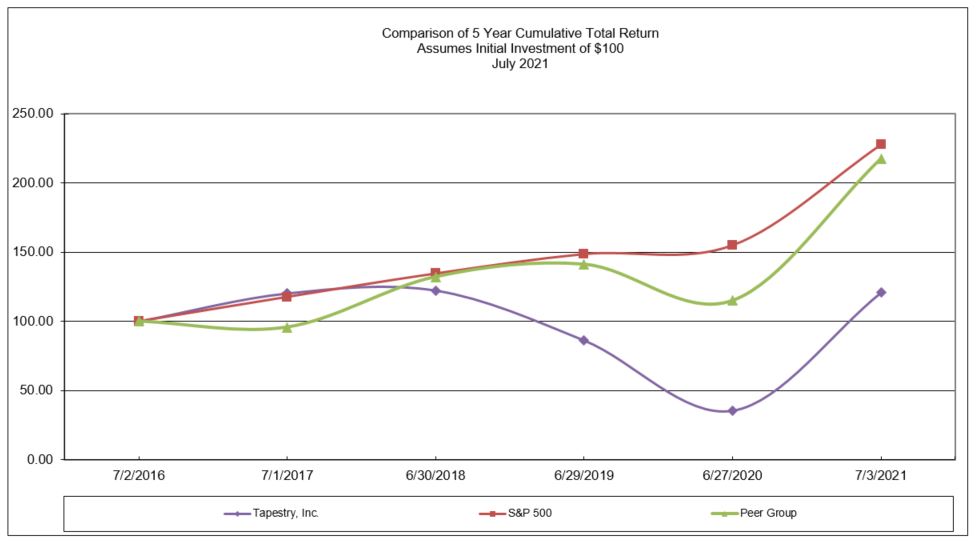
| Fiscal 2016 | Fiscal 2017 | Fiscal 2018 | Fiscal 2019 | Fiscal 2020 | Fiscal 2021 | |||||||||||||||||||||||||||||||||
| TPR | $100.00 | $120.21 | $122.24 | $86.15 | $35.57 | $120.90 | ||||||||||||||||||||||||||||||||
| Peer Set | $100.00 | $95.69 | $132.10 | $141.16 | $114.90 | $217.56 | ||||||||||||||||||||||||||||||||
| S&P 500 | $100.00 | $117.64 | $134.56 | $148.57 | $154.99 | $227.79 |
Stock Repurchase Program
The Company did not repurchase any shares of common stock during the fourth quarter of fiscal 2021. As of July 3, 2021, the Company had $600 million availability remaining in the stock repurchase program. The Company may terminate or limit the share repurchase program at any time. The Company is restricted from engaging in share buybacks during the Covenant Relief Period under Amendment No.1 to its Credit Facility.
Item 6. SELECTED FINANCIAL DATA
Not applicable as the Company has adopted certain provisions within the amendments to Regulation S-K, including the elimination of Item 301.
Item 7. MANAGEMENT’S DISCUSSION AND ANALYSIS OF FINANCIAL CONDITION AND RESULTS OF OPERATIONS
The following discussion of the Company's financial condition and results of operations should be read together with the Company’s consolidated financial statements and notes to those financial statements included elsewhere in this document. When used herein, the terms “the Company,” "Tapestry," “we,” “us” and “our” refer to Tapestry, Inc., including consolidated subsidiaries. References to "Coach," "Stuart Weitzman," "Kate Spade" or "kate spade new york" refer only to the referenced brand.
EXECUTIVE OVERVIEW
The fiscal year ended July 3, 2021 was a 53-week period, June 27, 2020 and June 29, 2019 were each 52-week periods.
Tapestry, Inc. is a leading New York-based house of modern luxury accessories and lifestyle brands. Our global house of brands unites the magic of Coach, kate spade new york and Stuart Weitzman. Each of our brands are unique and independent, while sharing a commitment to innovation and authenticity defined by distinctive products and differentiated customer experiences across channels and geographies. We use our collective strengths to move our customers and empower our communities, to make the fashion industry more sustainable, and to build a company that’s equitable, inclusive, and diverse. Individually, our brands are iconic. Together, we can stretch what’s possible.
The Company has three reportable segments:
-
Coach - Includes global sales of Coach products to customers through Coach operated stores, including e-commerce sites and concession shop-in-shops, and sales to wholesale customers and through independent third party distributors.
-
Kate Spade - Includes global sales primarily of kate spade new york brand products to customers through Kate Spade operated stores, including e-commerce sites, sales to wholesale customers, through concession shop-in-shops and through independent third party distributors.
-
Stuart Weitzman - Includes global sales of Stuart Weitzman brand products primarily through Stuart Weitzman operated stores, including e-commerce sites, sales to wholesale customers and through numerous independent third party distributors.
Each of our brands is unique and independent, while sharing a commitment to innovation and authenticity defined by distinctive products and differentiated customer experiences across channels and geographies. Our success does not depend solely on the performance of a single channel, geographic area or brand.
Acceleration Program
The guiding principle of the Company’s multi-year growth agenda under the Acceleration Program is to better meet the needs of each of its brands' unique customers by:
-
Sharpening our Focus on the Consumer:** Operating with a clearly defined purpose and strategy for each brand and an unwavering focus on the consumer at the core of everything we do
-
Leveraging Data and Leading with a Digital-First Mindset:** Building significant data and analytics capabilities to drive decision-making and increase efficiency; Offering immersive customer experiences across our e-commerce and social channels to meet the needs of consumers who are increasingly utilizing digital platforms to engage with brands; Rethinking the role of stores with an intent to optimize our fleet
-
Transforming into a Leaner and More Responsive Organization:** Moving with greater agility, simplifying internal processes and empowering teams to act quickly to meet the rapidly changing needs of the consumer. The Company achieved approximately $200 million of gross run rate expense savings in fiscal 2021 and remains on track to realize gross run-rate savings of $300 million.
In fiscal 2021, the Company continued to make meaningful progress against its Acceleration Program to sharpen its focus on the consumer, leverage data to lead with a digital-first mindset and transform into a leaner and more responsive organization:
-
Recruited approximately 4 million new customers, including through our e-commerce channels in North America,** representing gains versus prior year;
-
Continued to deliver an increase in number of repeat transactions** versus prior year and reactivated lapsed customers across brands;
-
Drove high-single digit revenue gains with Chinese consumers globally** compared to pre-pandemic levels;
-
Effectively reduced SKU counts by** 40% to 45% and improved assortment productivity, supported by data and analytics, resulting in stronger overall AUR and gross margin through higher IMUs and lower promotional activity and increased inventory turn for the fiscal year;
-
Optimized global fleet** with 59 net closures in FY21 compared to FY20, representing a net decrease of 90 doors over the past two years.
Covid-19 Pandemic
The Covid-19 virus has impacted regions all around the world, resulting in restrictions and shutdowns implemented by national, state, and local authorities. Consequently, the spread of Covid-19 has caused significant global business disruptions. As a result of the widespread impact of Covid-19, Tapestry had temporarily closed the majority of its directly operated stores globally for some period of time to help reduce the spread of Covid-19. The vast majority of the Company's stores re-opened for either in-store or pick-up service and they have continued to operate since then, however, some store locations have experienced temporary re-closures or are operating under tighter restrictions in compliance with local government regulation. Many of the Company's wholesale and licensing partners also closed their bricks and mortar stores as required by government orders during the third and fourth quarters of fiscal 2020, and while the majority of stores have reopened, they have also been subject to temporary re-closures and tighter capacity restrictions operating in compliance with the rules of certain local governments. In addition, certain of the Company’s supply chain partners, particularly those in Southeast Asia, have experienced closures due to an increase in Covid-19 cases in the region, which has and may continue to negatively impact the Company’s supply chain operations. However, there is still uncertainty around the duration of these disruptions and the possibility of other effects on the business. We will continue to monitor the rapidly evolving situation pertaining to the Covid-19 outbreak, including guidance from international and domestic authorities. In these circumstances, the Company will need to make adjustments to our operating plan. Refer to Part I, Item 1A. "Risk Factors" herein for further information.
In response to the challenges that Covid-19 has imposed on our business, the Company implemented the following actions to mitigate these headwinds:
-
Re-opened stores as quickly as possible, while following governmental and public health guidelines.
-
Driving with a digital-first mindset for all brands. Implemented practices designed to support the continued operations of our e-commerce platforms and fulfillment centers remain operational across all major regions.
-
Reduced capital expenditures through fleet optimization through fiscal 2021.
-
Drove SG&A savings, including actions taken under the Acceleration Program, through the reduction of corporate and retail workforce, right-sizing of marketing expenses, reduction of fixed costs such as rent as well as procurement savings, including reducing external third party services.
-
Did not pay out bonuses under the Annual Incentive Plan for fiscal year 2020, eliminated merit salary increases for all employees and temporarily reduced compensation for the Board of Directors and corporate employees above a certain salary threshold. During the second quarter of fiscal 2021, compensation resumed normal levels.
-
Tightly managed inventories by reflowing product introductions and cancelling inventory receipts as well as planned reduction of SKUs.
-
Drew down $700 million from its $900 million Revolving Credit Facility to add to cash balances, all of which was repaid duri
Showing the first 8K of 98K characters. Open the full section
Item 7A. QUANTITATIVE AND QUALITATIVE DISCLOSURES ABOUT MARKET RISK
Market Risk
The market risk inherent in our financial instruments represents the potential loss in fair value, earnings or cash flows, arising from adverse changes in foreign currency exchange rates or interest rates. The Company manages these exposures through operating and financing activities and, when appropriate, through the use of derivative financial instruments. The use of derivative financial instruments is in accordance with the Company's risk management policies, and we do not enter into derivative transactions for speculative or trading purposes.
The quantitative disclosures in the following discussion are based on quoted market prices obtained through independent pricing sources for the same or similar types of financial instruments, taking into consideration the underlying terms and maturities and theoretical pricing models. These quantitative disclosures do not represent the maximum possible loss or any expected loss that may occur, since actual results may differ from those estimates.
Foreign Currency Exchange Rate Risk
Foreign currency exposures arise from transactions, including firm commitments and anticipated contracts, denominated in a currency other than the entity’s functional currency, and from foreign-denominated revenues and expenses translated into U.S. dollars. The majority of the Company's purchases and sales involving international parties, excluding international consumer sales, are denominated in U.S. dollars and, therefore, our foreign currency exchange risk is limited. The Company is exposed to risk from foreign currency exchange rate fluctuations resulting from its operating subsidiaries’ transactions denominated in foreign currencies. To mitigate such risk, certain subsidiaries enter into forward currency contracts. As of July 3, 2021 and June 27, 2020, forward currency contracts designated as cash flow hedges with a notional amount of $61.4 million and $586.2 million, respectively, were outstanding. As a result of the use of derivative instruments, we are exposed to the risk that counterparties to the derivative instruments will fail to meet their contractual obligations. To mitigate the counterparty credit risk, we only enter into derivative contracts with carefully selected financial institutions. The Company also reviews the creditworthiness of our counterparties on a regular basis. As a result of the above considerations, we do not believe that we are exposed to any undue concentration of counterparty credit risk associated with our derivative contracts as of July 3, 2021.
The Company is also exposed to transaction risk from foreign currency exchange rate fluctuations with respect to various cross-currency intercompany loans and payables. This primarily includes exposure to exchange rate fluctuations in the Chinese Renminbi, the British Pound Sterling and the Euro. To manage the exchange rate risk related to these loans, the Company enters into forward currency contracts. As of July 3, 2021 and June 27, 2020, the total notional values of outstanding forward foreign currency contracts related to these loans were $248.2 million and $76.9 million, respectively.
The fair value of outstanding forward currency contracts included in current assets at July 3, 2021 and June 27, 2020 was $0.3 million and $2.9 million, respectively. The fair value of outstanding foreign currency contracts included in current liabilities at July 3, 2021 and June 27, 2020 was $1.2 million and $1.7 million, respectively. The fair value of these contracts is sensitive to changes in foreign currency exchange rates. A sensitivity analysis of the effects of foreign exchange rate fluctuations on the fair values of our derivative contracts was performed to assess the risk of loss. As of July 3, 2021, a 10% devaluation of the U.S. Dollar against the exchange rates for foreign currencies under contract would result in an immaterial impact on derivative contract fair values.
Interest Rate Risk
The Company is exposed to interest rate risk in relation to its Revolving Credit Facility entered into under the credit agreement dated October 24, 2019 as amended May 19, 2020, the 2025 Senior Notes, 2022 Senior Notes, 2027 Senior Notes (collectively the "Senior Notes") and investments.
Our exposure to changes in interest rates is primarily attributable to debt outstanding under the Revolving Credit Facility. Borrowings under the Facility bear interest at a rate per annum equal to, at the Company’s option, either (a) an alternate base rate (which is a rate equal to the greatest of (i) the Prime Rate in effect on such day, (ii) the Federal Funds Effective Rate in effect on such day plus ½ of 1% or (iii) the Adjusted LIBO Rate for a one month Interest Period on such day plus 1%) or (b) a rate based on the rates applicable for deposits in the interbank market for U.S. dollars or the applicable currency in which the loans are made plus, in each case, an applicable margin. The applicable margin will be determined by reference to a grid, as defined in the Credit Agreement, based on the ratio of (a) consolidated debt plus operating lease liability to (b) consolidated EBITDAR. A hypothetical 10% change in the credit agreement interest rate would have resulted in an immaterial change in interest expense in fiscal 2021. Furthermore, a prolonged disruption on our business resulting from the Covid-19 pandemic may impact our ability to satisfy the terms of our Revolving Credit Facility, including our liquidity covenant.
The Company is exposed to changes in interest rates related to the fair value of the Senior Notes. At July 3, 2021, the fair value of the 2025 Senior Notes, 2022 Senior Notes and 2027 Senior Notes was approximately $652 million, $407 million and
$659 million, respectively. At June 27, 2020, the fair value of the 2025 Senior Notes, 2022 Senior Notes and 2027 Senior Notes was approximately $577 million, $393 million and $565 million, respectively. These fair values are based on external pricing data, including available quoted market prices of these instruments, and consideration of comparable debt instruments with similar interest rates and trading frequency, among other factors, and are classified as Level 2 measurements within the fair value hierarchy. The interest rate payable on the 2022 and 2027 Senior Notes will be subject to adjustments from time to time if either Moody’s or S&P or a substitute rating agency (as defined in the Prospectus Supplement furnished with the SEC on June 7, 2017) downgrades (or downgrades and subsequently upgrades) the credit rating assigned to the respective Senior Notes of such series.
The Company’s investment portfolio is maintained in accordance with the Company’s investment policy, which defines our investment principles including credit quality standards and limits the credit exposure of any single issuer. The primary objective of our investment activities is the preservation of principal while maximizing interest income and minimizing risk. We do not hold any investments for trading purposes.
Item 8. FINANCIAL STATEMENTS AND SUPPLEMENTARY DATA
Refer to “Index to Financial Statements,” appearing at the end of this Annual Report on Form 10-K.
Item 9. CHANGES IN AND DISAGREEMENTS WITH ACCOUNTANTS ON ACCOUNTING AND FINANCIAL DISCLOSURE
None.
Item 9A. CONTROLS AND PROCEDURES
Disclosure Controls and Procedures
Based on the evaluation of the Company’s disclosure controls and procedures, as that term is defined in Rule 13a-15(e) under the Securities Exchange Act of 1934, as amended, the Chief Executive Officer of the Company and the Chief Financial Officer of the Company, have concluded that the Company’s disclosure controls and procedures are effective as of July 3, 2021.
Management’s Report on Internal Control over Financial Reporting
The Company’s management is responsible for establishing and maintaining adequate internal controls over financial reporting as defined in Rule 13a-15(f). The Company’s internal control system was designed to provide reasonable assurance to the Company’s management and Board regarding the preparation and fair presentation of published financial statements. Management evaluated the effectiveness of the Company’s internal control over financial reporting using the criteria set forth by the Committee of Sponsoring Organizations ("COSO") of the Treadway Commission in Internal Control — Integrated Framework in 2013. Management, under the supervision and with the participation of the Company’s Chief Executive Officer and Chief Financial Officer, assessed the effectiveness of the Company’s internal control over financial reporting as of July 3, 2021 and concluded that it is effective.
The Company’s independent auditors have issued an audit report on the Company's internal control over financial reporting as of July 3, 2021 as included elsewhere herein.
Changes in Internal Control over Financial Reporting
There were no changes in internal control over financial reporting that occurred during the fourth fiscal quarter that have materially affected, or are reasonably likely to materially affect, the Company’s internal control over financial reporting.
We have not experienced any material impact to our internal controls over financial reporting, despite the fact that most of our Corporate employees continue to work remotely due to the Covid-19 pandemic. We will continue to evaluate and monitor the impact of Covid-19 on our internal controls. Refer to item 1A. “Risk Factors,” for further information regarding the risks to our business associated with Covid-19.
Item 9B. OTHER INFORMATION
None.
PART III
Item 10. DIRECTORS, EXECUTIVE OFFICERS AND CORPORATE GOVERNANCE
The information required to be included by Item 10 of Form 10-K will be included in the Proxy Statement for the 2021 Annual Meeting of Stockholders and such information is incorporated by reference herein. The Proxy Statement will be filed with the Commission within 120 days after the end of the fiscal year covered by this Form 10-K pursuant to Regulation 14A under the Securities Exchange Act of 1934, as amended.
Item 11. EXECUTIVE COMPENSATION
The information regarding executive and director compensation set forth in the Proxy Statement for the 2021 Annual Meeting of Stockholders is incorporated herein by reference.
Item 12. SECURITY OWNERSHIP OF CERTAIN BENEFICIAL OWNERS AND MANAGEMENT AND RELATED STOCKHOLDER MATTERS
The information under the headings “Securities Authorized for Issuance Under Equity Compensation Plans” and “Tapestry Stock Ownership by Certain Beneficial Owners and Management” in the Company’s Proxy Statement for the 2021 Annual Meeting of Stockholders is incorporated herein by reference.
There are no arrangements known to the registrant that may at a subsequent date result in a change in control of the registrant.
Item 13. CERTAIN RELATIONSHIPS AND RELATED TRANSACTIONS, AND DIRECTOR INDEPENDENCE
The information required to be included by Item 13 of Form 10-K will be included in the Proxy Statement for the 2021 Annual Meeting of Stockholders and such information is incorporated by reference herein.
Item 14. PRINCIPAL ACCOUNTING FEES AND SERVICES
The information required by this item is incorporated herein by reference to the sections entitled “Fees For Audit and Other Services” and “Audit Committee Pre-Approval Policy” in the Proxy Statement for the 2021 Annual Meeting of Stockholders.
PART IV
Item 15. EXHIBITS, FINANCIAL STATEMENT SCHEDULES
(a)Financial Statements and Financial Statement Schedules. Refer to “Index to Financial Statements” appearing herein.
(b)Exhibits. Refer to the exhibit index which is included herein.
SIGNATURES
Pursuant to the requirements of Section 13 or 15(d) of the Securities Exchange Act of 1934, the Registrant has duly caused this report to be signed on its behalf by the undersigned, thereunto duly authorized.
TAPESTRY, INC.
| Date: August 19, 2021 | By: | /s/ Joanne C. Crevoiserat | ||||||
| Name: Joanne C. Crevoiserat Title: Chief Executive Officer |
Pursuant to the requirements of the Securities Exchange Act of 1934, this report has been signed below by the following persons on behalf of the Registrant and in the capacities indicated below on August 19, 2021.
| Signature | Title | |||||||
| /s/ Joanne C. Crevoiserat | Chief Executive Officer | |||||||
| Joanne C. Crevoiserat | (Principal Executive Officer) | |||||||
| /s/ Scott A. Roe | Chief Financial Officer | |||||||
| Scott A. Roe | (Principal Financial Officer) | |||||||
| /s/ Manesh B. Dadlani | Corporate Controller | |||||||
| Manesh B. Dadlani | (Principal Accounting Officer) | |||||||
| /s/ Susan Kropf | Independent Chair, Board of Directors | |||||||
| Susan Kropf | ||||||||
| /s/ John P. Bilbrey | Director | |||||||
| John P. Bilbrey | ||||||||
| /s/ Darrell Cavens | Director | |||||||
| Darrell Cavens | ||||||||
| /s/ David Denton | Director | |||||||
| David Denton | ||||||||
| /s/ Anne Gates | Director | |||||||
| Anne Gates | ||||||||
| /s/ Thomas R. Greco | Director | |||||||
| Thomas R. Greco | ||||||||
| /s/ Pam Lifford | Director | |||||||
| Pam Lifford | ||||||||
| /s/ Annabelle Yu Long | Director | |||||||
| Annabelle Yu Long | ||||||||
| /s/ Ivan Menezes | Director | |||||||
| Ivan Menezes | ||||||||
TAPESTRY, INC.
INDEX TO CONSOLIDATED FINANCIAL STATEMENTS AND SUPPLEMENTARY INFORMATION
All other schedules are omitted because they are not applicable or the required information is shown in the Consolidated Financial Statements or Notes thereto.
REPORT OF INDEPENDENT REGISTERED PUBLIC ACCOUNTING FIRM
To the stockholders and the Board of Directors of Tapestry, Inc.
Opinion on the Financial Statements
We have audited the accompanying consolidated balance sheets of Tapestry, Inc. and subsidiaries (the "Company") as of July 3, 2021 and June 27, 2020, the related consolidated statements of operations, comprehensive income, stockholders' equity, and cash flows, for each of the three years in the period ended July 3, 2021, and the related notes and the financial statement Schedule II listed in the Index to the Consolidated Financial Statements (collectively referred to as the "financial statements"). In our opinion, the financial statements present fairly, in all material respects, the financial position of the Company as of July 3, 2021 and June 27, 2020, and the results of its operations and its cash flows for each of the three years in the period ended July 3, 2021, in conformity with accounting principles generally accepted in the United States of America.
We have also audited, in accordance with the standards of the Public Company Accounting Oversight Board (United States) ("PCAOB"), the Company's internal control over financial reporting as of July 3, 2021, based on criteria established in Internal Control — Integrated Framework (2013) issued by the Committee of Sponsoring Organizations of the Treadway Commission and our report dated August 19, 2021, expressed an unqualified opinion on the Company's internal control over financial reporting.
Change in Accounting Principle
As discussed in Note 3 to the financial statements, effective June 30, 2019, the Company adopted Accounting Standards Update ("ASU") No. 2016-02, "Leases (Topic 842)” (“ASC 842”), using the modified retrospective approach.
Basis for Opinion
These financial statements are the responsibility of the Company's management. Our responsibility is to express an opinion on the Company's financial statements based on our audits. We are a public accounting firm registered with the PCAOB and are required to be independent with respect to the Company in accordance with the U.S. federal securities laws and the applicable rules and regulations of the Securities and Exchange Commission and the PCAOB.
We conducted our audits in accordance with the standards of the PCAOB. Those standards require that we plan and perform the audit to obtain reasonable assurance about whether the financial statements are free of material misstatement, whether due to error or fraud. Our audits included performing procedures to assess the risks of material misstatement of the financial statements, whether due to error or fraud, and performing procedures that respond to those risks. Such procedures included examining, on a test basis, evidence regarding the amounts and disclosures in the financial statements. Our audits also included evaluating the accounting principles used and significant estimates made by management, as well as evaluating the overall presentation of the financial statements. We believe that our audits provide a reasonable basis for our opinion.
Critical Audit Matter
The critical audit matter communicated below is a matter arising from the current-period audit of the financial statements that was communicated or re
Showing the first 8K of 223K characters. Open the full section