 filings.tools
Cover and table of contents
124K characters. Original on sec.gov · Markdown
Cover and table of contents
UNITED STATES
SECURITIES AND EXCHANGE COMMISSION
Washington, D.C. 20549
FORM 10-K
| ☑ | ANNUAL REPORT PURSUANT TO SECTION 13 OR 15(d) OF THE SECURITIES EXCHANGE ACT OF 1934 |
For the fiscal year ended December 31, 2022
OR
| ☐ | TRANSITION REPORT PURSUANT TO SECTION 13 OR 15(d) OF THE SECURITIES EXCHANGE ACT OF 1934 |
For the transition period from _____ to _____
Commission File Number: 001-34991

TARGA RESOURCES CORP.
(Exact name of registrant as specified in its charter)
| Delaware | 20-3701075 | |
| (State or other jurisdiction of incorporation or organization) | (I.R.S. Employer Identification No.) | |
| 811 Louisiana Street**,** Suite 2100**,** Houston**,** Texas | 77002 | |
| (Address of principal executive offices) | (Zip Code) |
(713) 584-1000
(Registrant’s telephone number, including area code)
Securities registered pursuant to section 12(b) of the Act:
| Title of each class | Trading Symbol(s) | Name of each exchange on which registered | ||
| Common Stock | TRGP | New York Stock Exchange |
Securities registered pursuant to section 12(g) of the Act: None
Indicate by check mark if the registrant is a well-known seasoned issuer, as defined in Rule 405 of the Securities Act. Yes ☑ No ☐
Indicate by check mark if the registrant is not required to file reports pursuant to Section 13 or Section 15(d) of the Act. Yes ☐ No ☑
Indicate by check mark whether the registrant (1) has filed all reports required to be filed by Section 13 or 15(d) of the Securities Exchange Act of 1934 during the preceding 12 months (or for such shorter period that the registrant was required to file such reports), and (2) has been subject to such filing requirements for the past 90 days. Yes ☑ No ☐
Indicate by check mark whether the registrant has submitted electronically every Interactive Data File required to be submitted pursuant to Rule 405 of Regulation S-T (§232.405 of this chapter) during the preceding 12 months (or for such shorter period that the registrant was required to submit such files). Yes ☑ No ☐
Indicate by check mark whether the registrant is a large accelerated filer, an accelerated filer, a non-accelerated filer, smaller reporting company, or an emerging growth company. See the definitions of “large accelerated filer,” “accelerated filer,” “smaller reporting company” and “emerging growth company” in Rule 12b-2 of the Exchange Act.
| Large accelerated filer | ☑ | Accelerated filer | ☐ | |
| Non-accelerated filer | ☐ | Smaller reporting company | ☐ | |
| Emerging growth company | ☐ |
If an emerging growth company, indicate by check mark if the registrant has elected not to use the extended transition period for complying with any new or revised financial accounting standards provided pursuant to Section 13(a) of the Exchange Act. ☐
Indicate by check mark whether the registrant has filed a report on and attestation to its management’s assessment of the effectiveness of its internal control over financial reporting under Section 404(b) of the Sarbanes-Oxley Act (15 U.S.C. 7262(b)) by the registered public accounting firm that prepared or issued its audit report. ☑
If securities are registered pursuant to Section 12(b) of the Act, indicate by check mark whether the financial statements of the registrant included in the filing reflect the correction of an error to previously issued financial statements. ☐
Indicate by check mark whether any of those error corrections are restatements that required a recovery analysis of incentive-based compensation received by any of the registrant’s executive officers during the relevant recovery period pursuant to §240.10D-1(b). ☐
Indicate by check mark whether the registrant is a shell company (as defined in Rule 12b-2 of the Exchange Act). Yes ☐ No ☑
The aggregate market value of the common stock held by non-affiliates of the registrant was $13,379.6 million on June 30, 2022, based on $59.67 per share, the closing price of the common stock as reported on the New York Stock Exchange (NYSE) on such date.
As of February 17, 2023, there were 226,639,398 shares of the registrant’s common stock, $0.001 par value, outstanding.
DOCUMENTS INCORPORATED BY REFERENCE
Portions of the registrant’s definitive proxy statement for the 2023 Annual Meeting of Stockholders, to be filed no later than 120 days after the end of the fiscal year to which this Annual Report on Form 10-K relates, are incorporated by reference into Part III of this Annual Report on Form 10-K.
TABLE OF CONTENTS
CAUTIONARY STATEMENT ABOUT FORWARD-LOOKING STATEMENTS
Targa Resources Corp.’s (together with its subsidiaries, including Targa Resources Partners LP (the “Partnership”), “we,” “us,” “our,” “Targa,” “TRGP,” or the “Company”) reports, filings and other public announcements may from time to time contain statements that do not directly or exclusively relate to historical facts. Such statements are “forward-looking statements.” You can typically identify forward-looking statements within the meaning of Section 27A of the Securities Act of 1933, as amended, and Section 21E of the Securities Exchange Act of 1934, as amended, by the use of forward-looking statements, such as “may,” “could,” “project,” “believe,” “anticipate,” “expect,” “estimate,” “potential,” “plan,” “forecast” and other similar words.
All statements that are not statements of historical facts, including statements regarding our future financial position, business strategy, budgets, projected costs and plans and objectives of management for future operations, are forward-looking statements.
These forward-looking statements reflect our intentions, plans, expectations, assumptions and beliefs about future events and are subject to risks, uncertainties and other factors, many of which are outside our control. Important factors that could cause actual results to differ materially from the expectations expressed or implied in the forward-looking statements include known and unknown risks. Known risks and uncertainties include, but are not limited to, the following risks and uncertainties:
the level and success of crude oil and natural gas drilling around our assets, our success in connecting natural gas supplies to our gathering and processing systems, oil supplies to our gathering systems and natural gas liquid supplies to our logistics and transportation facilities and our success in connecting our facilities to transportation services and markets;
the timing and extent of changes in natural gas, natural gas liquids, crude oil and other commodity prices, interest rates and demand for our services;
our ability to access the capital markets, which will depend on general market conditions, including the impact of rising interest rates and associated Federal Reserve policies and potential economic recession, our credit ratings and debt obligations, and demand for our common equity, senior notes and commercial paper;
the impact of outbreaks of illnesses, pandemics or any other public health crises;
downside commodity price volatility from a variety of potential factors;
actions taken by other countries with significant hydrocarbon production;
the timing and success of business development efforts;
the amount of collateral required to be posted from time to time in our transactions;
our success in risk management activities, including the use of derivative instruments to hedge commodity price risks;
the level of creditworthiness of counterparties to various transactions with us;
changes in laws and regulations, such as the Inflation Reduction Act of 2022 (the “IRA”), particularly with regard to taxes, safety and protection of the environment;
weather and other natural phenomena, and related impacts;
industry changes, including the impact of consolidations, changes in competition and the drive to reduce fossil fuel use and substitute alternative forms of energy for oil and gas;
our ability to timely obtain and maintain necessary licenses, permits and other approvals;
our ability to grow through internal growth capital projects or acquisitions and the successful integration and future performance of such assets;
general economic, market and business conditions; and
the risks described elsewhere in “Item 1A. Risk Factors” in this Annual Report and our reports and registration statements filed from time to time with the United States Securities and Exchange Commission (“SEC”).
Although we believe that the assumptions underlying our forward-looking statements are reasonable, any of the assumptions could be inaccurate, and, therefore, we cannot assure you that the forward-looking statements included in this Annual Report will prove to be accurate. Some of these and other risks and uncertainties that could cause actual results to differ materially from such forward-looking statements are more fully described in “Item 1A. Risk Factors” in this Annual Report. Except as may be required by applicable law, we undertake no obligation to publicly update or advise of any change in any forward-looking statement, whether as a result of new information, future events or otherwise.
As generally used in the energy industry and in this Annual Report, the identified terms have the following meanings:
| Bbl | Barrels (equal to 42 U.S. gallons) | |
| BBtu | Billion British thermal units | |
| Bcf | Billion cubic feet | |
| Btu | British thermal units, a measure of heating value | |
| /d | Per day | |
| FERC | Federal Energy Regulatory Commission | |
| GAAP | Accounting principles generally accepted in the United States of America | |
| gal | U.S. gallons | |
| LIBOR | London Inter-Bank Offered Rate | |
| LPG | Liquefied petroleum gas | |
| MBbl | Thousand barrels | |
| MMBbl | Million barrels | |
| MMBtu | Million British thermal units | |
| MMcf | Million cubic feet | |
| MMgal | Million U.S. gallons | |
| NGL(s) | Natural gas liquid(s) | |
| NYMEX | New York Mercantile Exchange | |
| NYSE | New York Stock Exchange | |
| SCOOP | South Central Oklahoma Oil Province | |
| SOFR | Secured Overnight Financing Rate | |
| STACK | Sooner Trend, Anadarko, Canadian and Kingfisher | |
| VLGC | Very large gas carrier |
PART I
Item 1. B****usiness.
The following section of this Form 10-K generally refers to business developments during the year ended December 31, 2022. Discussion of prior period business developments that are not included in this Form 10-K can be found in “Part I, Item 1. Business” of our Annual Report on Form 10-K for the year ended December 31, 2021.
Overview
Targa Resources Corp. (NYSE: TRGP) is a publicly traded Delaware corporation formed in October 2005. Targa is a leading provider of midstream services and is one of the largest independent midstream infrastructure companies in North America. We own, operate, acquire, and develop a diversified portfolio of complementary domestic midstream infrastructure assets.
Our Operations
We are engaged primarily in the business of:
gathering, compressing, treating, processing, transporting, and purchasing and selling natural gas;
transporting, storing, fractionating, treating, and purchasing and selling NGLs and NGL products, including services to LPG exporters; and
gathering, storing, terminaling, and purchasing and selling crude oil.
To provide these services, we operate in two primary segments: (i) Gathering and Processing, and (ii) Logistics and Transportation (also referred to as the Downstream Business).
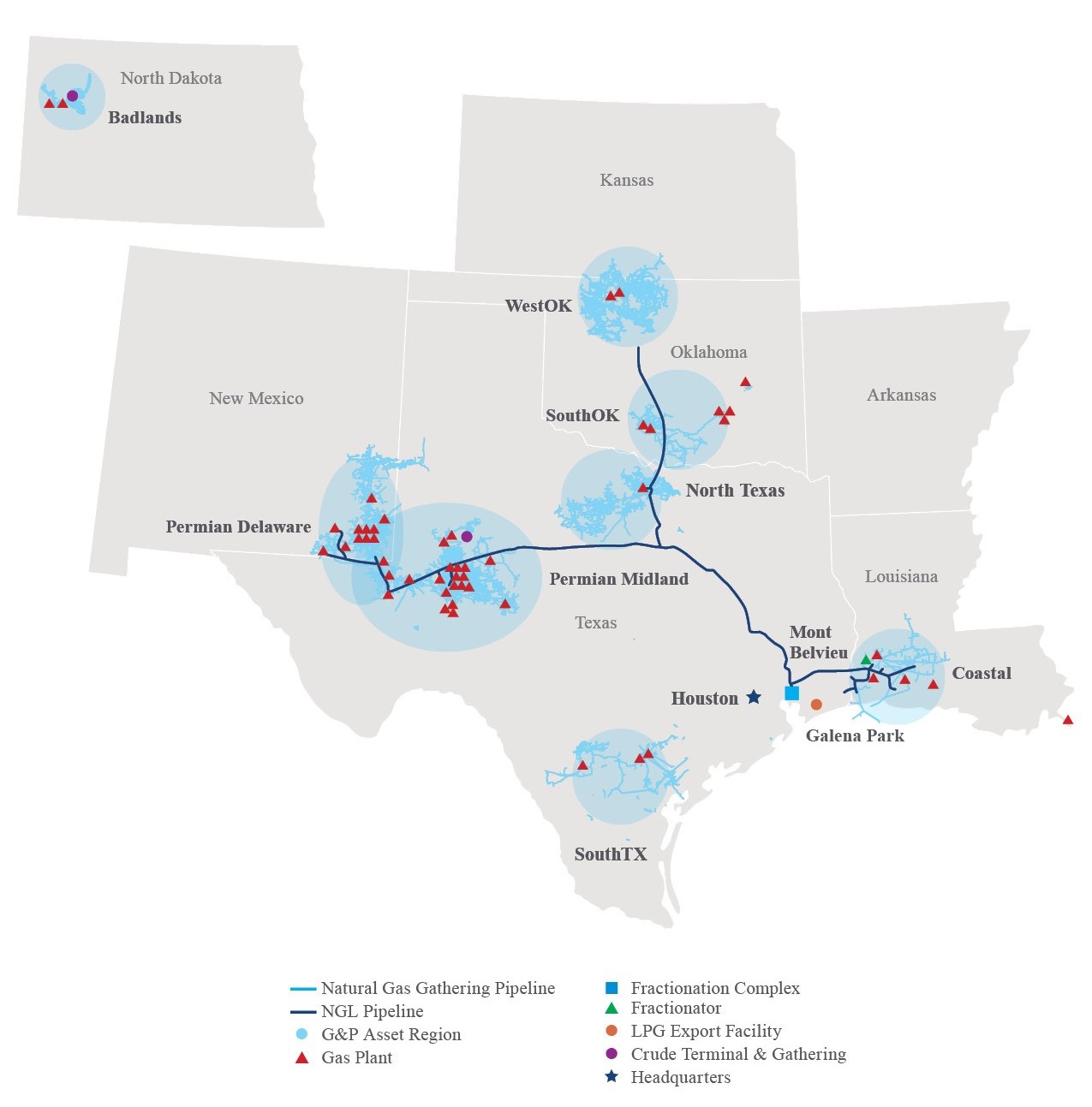
Our Gathering and Processing segment includes assets used in the gathering and/or purchase and sale of natural gas produced from oil and gas wells, removing impurities and processing this raw natural gas into merchantable natural gas by extracting NGLs; and assets used for the gathering and terminaling and/or purchase and sale of crude oil. The Gathering and Processing segment's assets are located in the Permian Basin of West Texas and Southeast New Mexico (including the Midland, Central and Delaware Basins); the Eagle Ford Shale in South Texas; the Barnett Shale in North Texas; the Anadarko, Ardmore, and Arkoma Basins in Oklahoma (including the SCOOP and STACK) and South Central Kansas; the Williston Basin in North Dakota (including the Bakken and Three Forks plays); and the onshore and near offshore regions of the Louisiana Gulf Coast and the Gulf of Mexico.
Our Logistics and Transportation segment includes the activities and assets necessary to convert mixed NGLs into NGL products and also includes other assets and value-added services such as transporting, storing, fractionating, terminaling, and marketing of NGLs and NGL products, including services to LPG exporters and certain natural gas supply and marketing activities in support of our other businesses. The Logistics and Transportation segment also includes the Grand Prix NGL Pipeline (“Grand Prix”), which connects our gathering and processing positions in the Permian Basin, Southern Oklahoma and North Texas with our Downstream facilities in Mont Belvieu, Texas. Our Downstream facilities are located predominantly in Mont Belvieu and Galena Park, Texas, and in Lake Charles, Louisiana.
Other contains the unrealized mark-to-market gains/losses related to derivative contracts that were not designated as cash flow hedges.
The map below highlights our more significant assets as of December 31, 2022:
Recent Developments
In response to increasing production and to meet the infrastructure needs of producers and our downstream customers, our major expansion projects include the following:
Permian Midland Processing Expansions
In August 2021, we announced the construction of a new 275 MMcf/d cryogenic natural gas processing plant in Permian Midland (the “Legacy plant”). The Legacy plant commenced operations in the third quarter of 2022.
In February 2022, we announced the construction of a new 275 MMcf/d cryogenic natural gas processing plant in Permian Midland (the “Legacy II plant”). The Legacy II plant is expected to begin operations in the second quarter of 2023.
In August 2022, we announced the construction of a new 275 MMcf/d cryogenic natural gas processing plant in Permian Midland (the “Greenwood plant”). The Greenwood plant is expected to begin operations late in the fourth quarter of 2023.
Permian Delaware Processing Expansions
In February 2022, we announced the construction of a new 275 MMcf/d cryogenic natural gas processing plant in Permian Delaware (the “Midway plant”). The Midway plant is expected to begin operations in the second quarter of 2023. In conjunction with the commencement of operations of the Midway plant, we expect to idle an existing 165 MMcf/d cryogenic natural gas processing plant (the “Sand Hills plant”).
In July 2022, we acquired a 230 MMcf/d cryogenic natural gas processing plant, which was under construction at the time of acquisition, in Permian Delaware (the “Red Hills VI plant”) as part of our Delaware Basin Acquisition (as defined below). The Red Hills VI plant commenced operations at the end of the third quarter of 2022.
In November 2022, we announced the construction of a new 275 MMcf/d cryogenic natural gas processing plant in Permian Delaware (the “Wildcat II plant”). The Wildcat II plant is expected to begin operations in the first quarter of 2024.
In February 2023, we announced the transfer of an existing cryogenic natural gas processing plant acquired in the South Texas Acquisition (as defined below) to the Permian Delaware. The plant will be installed as a new 230 MMcf/d cryogenic natural gas processing plant (the “Roadrunner II plant”). The Roadrunner II plant is expected to begin operations in the second quarter of 2024.
Fractionation Expansion
In August 2022, we announced plans to construct a new 120 MBbl/d fractionation train in Mont Belvieu, Texas (“Train 9”). Train 9 is expected to begin operations in the second quarter of 2024.
In January 2023, we reached an agreement with our partners in Gulf Coast Fractionators (“GCF”) to reactivate GCF's 135 MBbl/d fractionation facility. The facility is expected to be operational during the first quarter of 2024.
NGL Pipeline Expansion
In November 2022, we announced plans to construct a new NGL pipeline (the “Daytona NGL Pipeline”) as an addition to our common carrier Grand Prix system. The pipeline will transport NGLs from the Permian Basin and connect to the 30-inch diameter segment of Grand Prix in North Texas, where volumes will be transported to our fractionation and storage complex in the NGL market hub at Mont Belvieu, Texas. The Daytona NGL Pipeline is expected to be in service by the end of 2024.
Capital Investments, Acquisitions and Divestitures
In January 2022, we completed the purchase of all of Stonepeak Infrastructure Partners’ (“Stonepeak”) interests in our development company joint ventures (“DevCo JVs”) for $926.3 million (the “DevCo JV Repurchase”). Following the DevCo JV Repurchase, we owned a 75% interest in the Permian to Mont Belvieu segment of Grand Prix through Grand Prix Pipeline LLC (the “Grand Prix Joint Venture”) (prior to the Grand Prix Transaction, as defined below), a 100% interest in the Train 6 fractionator in Mont Belvieu, Texas and a 25% equity interest in Gulf Coast Express Pipeline (“GCX”) (prior to the GCX Sale, as defined below). The DevCo JV Repurchase resulted in an $857.9 million reduction of Noncontrolling interests on our Consolidated Balance Sheets.
In April 2022, we completed the bolt-on acquisition of Southcross Energy Operating LLC and its subsidiaries (“Southcross”) for a purchase price of $201.9 million (the “South Texas Acquisition”), subject to customary closing adjustments. We made a final net working capital adjustment payment of approximately $1.5 million in the fourth quarter of 2022. We acquired a portfolio of complementary midstream infrastructure assets and associated contracts that have been integrated into our SouthTX Gathering and Processing operations, including the remaining interests in the two joint ventures in South Texas that we previously held as investments in unconsolidated affiliates, which were consolidated beginning in the second quarter of 2022.
In May 2022, we completed the sale of Targa GCX Pipeline LLC, which held a 25% equity interest in GCX, to a third party for $857.0 million (the “GCX Sale”). As a result of the GCX Sale, we recognized a gain of $435.9 million in Gain (loss) from sale of equity method investment in our Consolidated Statements of Operations in the second quarter of 2022.
In July 2022, we completed the acquisition of all of the interests in Lucid Energy Delaware, LLC (“Lucid”) for approximately $3.5 billion in cash (the “Delaware Basin Acquisition”), subject to customary closing adjustments. We received a final net working capital adjustment payment of approximately $11.4 million in the fourth quarter of 2022. The assets acquired in the Delaware Basin Acquisition provide natural gas gathering, treating, and processing services in the Delaware Basin, through owning and operating approximately 1,050 miles of natural gas pipelines and approximately 1.4 billion cubic feet per day (“Bcf/d”) of cryogenic natural gas processing capacity primarily in Eddy and Lea counties of New Mexico. The Delaware Basin Acquisition assets are integrated into our Permian Delaware operations.
In January 2023, we completed the acquisition of Blackstone Energy Partners’ 25% interest in Grand Prix Joint Venture (the “Grand Prix Transaction”) for approximately $1.05 billion in cash. Following the closing of the Grand Prix Transaction, we own 100% of Grand Prix, including the Daytona NGL Pipeline.
For further details on our acquisitions and divestitures, see Note 4 - Acquisitions and Divestitures and Note 7 - Investments in Unconsolidated Affiliates to our Consolidated Financial Statements beginning on page F-1 in this Form 10-K.
Common Share Repurchases and Preferred Stock Redemption
In the fourth quarter of 2022, we repurchased 395,798 shares of our common stock at a weighted average price of $70.75 for a total net cost of $28.0 million. For the year ended December 31, 2022, we repurchased 3,412,354 shares of our common stock at a weighted average price of $65.87 for a total net cost of $224.8 million. There was $143.8 million remaining under our $500 million common share repurchase program as of December 31, 2022.
In May 2022, we redeemed all of our issued and outstanding shares of Series A Preferred Stock (“Series A Preferred”) at a redemption price of $1,050.00 per share, plus $8.87 per share, which is the amount of accrued and unpaid dividends from April 1, 2022 up to, but not including, the redemption date of May 3, 2022.
Following the redemption, we have no Series A Preferred outstanding and all rights of the holders of shares of Series A Preferred were terminated. See Note 11 - Preferred Stock to our Consolidated Financial Statements for further discussion.
Financing Activities
In February 2022, we entered into a Credit Agreement with Bank of America, N.A., as the Administrative Agent and Swing Line Lender, and the other lenders party thereto (the “TRGP Revolver”). The TRGP Revolver provides for a revolving credit facility in an initial aggregate principal amount up to $2.75 billion, with an option to increase such maximum aggregate principal amount by up to $500.0 million in the future, subject to the terms of the TRGP Revolver, including a swing line sub-facility of up to $100.0 million. The TRGP Revolver matures in February 2027. In connection with our entry into the TRGP Revolver, we terminated our previous TRGP senior secured revolving credit facility (the “Previous TRGP Revolver”) and the Partnership's senior secured revolving credit facility (the “Partnership Revolver”). In February 2022, TRGP and the Partnership received a corporate investment grade credit rating from Standard & Poor’s Financial Services LLC (“S&P”) and Fitch Ratings Inc., (“Fitch”) and in March 2022, the Partnership received a corporate investment grade credit rating from Moody’s Investors Service, Inc. (“Moody's”). As a result, in accordance with the TRGP Revolver, the collateral under the TRGP Revolver was released from the liens securing our obligations thereunder. As a result of the termination of the Previous TRGP Revolver and the Partnership Revolver, we recorded a loss of $0.8 million due to a write-off of debt issuance costs.
In March 2022, the Partnership redeemed all of the outstanding 5.375% Senior Notes due 2027 (the “5.375% Notes”) with available liquidity under the TRGP Revolver. As a result of the redemption of the 5.375% Notes, we recorded a loss due to debt extinguishment of $15.0 million, comprised of $12.6 million of premiums paid and a write-off of $2.4 million of debt issuance costs.
In April 2022, we completed an underwritten public offering of (i) $750.0 million aggregate principal amount of our 4.200% Senior Notes due 2033 (the “4.200% Notes”) and (ii) $750.0 million aggregate principal amount of our 4.950% Senior Notes due 2052 (the “4.950% Notes”), resulting in net proceeds of approximately $1.5 billion. A portion of the net proceeds from the issuance was used to fund the concurrent cash tender offer (the “March Tender Offer”) and the subsequent redemption of the Partnership’s 5.875% Senior Notes due April 2026 (the “5.875% Notes”), with the remainder of the net proceeds used for repayment of the outstanding borrowings under the TRGP Revolver. As a result of the March Tender Offer and the subsequent redemption of the 5.875% Notes, we recorded a loss due to debt extinguishment of $33.8 million, comprised of $29.3 million of premiums paid and a write-off of $4.5 million of debt issuance costs.
In July 2022, we completed an underwritten public offering of (i) $750.0 million in aggregate principal amount of our 5.200% Senior Notes due 2027 (the “5.200% Notes”) and (ii) $500.0 million in aggregate principal amount of our 6.250% Senior Notes due 2052 (the “6.250% Notes”), resulting in net proceeds of approximately $1.2 billion. We used the net proceeds from the issuance to fund a portion of the Delaware Basin Acquisition.
In July 2022, we entered into the Term Loan Agreement with Mizuho Bank, Ltd. as the Administrative Agent and a lender, and other lenders party thereto (the “Term Loan Facility”). The Term Loan Facility provides for a three-year, $1.5 billion unsecured term loan facility and matures in July 2025. We used the proceeds to fund a portion of the Delaware Basin Acquisition.
In July 2022, we established an unsecured commercial paper note program (the “Commercial Paper Program”). Under the terms of the Commercial Paper Program, we may issue, from time to time, unsecured commercial paper notes with varying maturities of less than one year. Amounts available under the Commercial Paper Program may be issued, repaid and re-issued from time to time, with the maximum aggregate face or principal amount outstanding at any one time not to exceed $2.75 billion. We maintain a minimum available borrowing capacity under the TRGP Revolver equal to the aggregate amount outstanding under the Commercial Paper Program as support. The Commercial Paper Program is guaranteed by each subsidiary that guarantees the TRGP Revolver.
In September 2022, we amended the Partnership’s accounts receivable securitization facility (the “Securitization Facility”) to, among other things, increase the facility size from $400.0 million to $800.0 million and extend the facility termination date to September 1, 2023.
In January 2023, we completed an underwritten public offering of (i) $900.0 million in aggregate principal amount of our 6.125% Senior Notes due 2033 (the “6.125% Notes”) and (ii) $850.0 million in aggregate principal amount of our 6.500% Senior Notes due 2053 (the “6.500% Notes”), resulting in net proceeds of approximately $1.7 billion. We used a portion of the net proceeds from the issuance to fund the Grand Prix Transaction and the remaining net proceeds for general corporate purposes, including to reduce borrowings under the TRGP Revolver and the Commercial Paper Program.
For additional information about our recent debt-related transactions, see Note 8 - Debt Obligations to our Consolidated Financial Statements.
Organization Structure
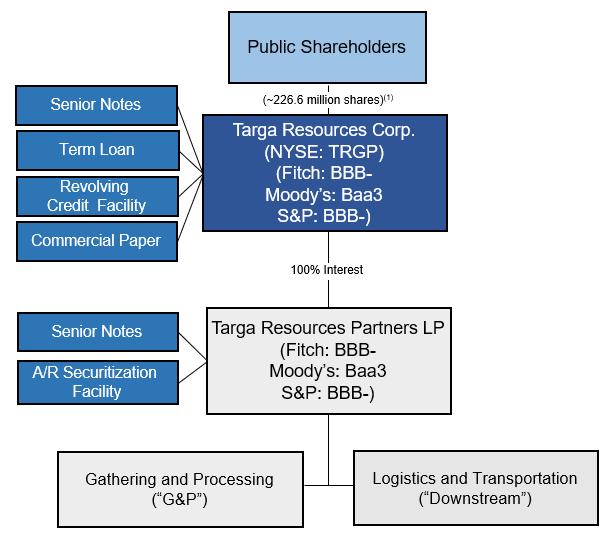
The diagram below shows our corporate structure as of February 17, 2023:
(1)
Common shares outstanding as of February 17, 2023.
Growth Drivers, Competitive Strengths and Strategies
While we believe that we are well positioned to execute our business strategies based on our growth drivers, competitive strengths and strategies outlined below, our business involves numerous risks and uncertainties which may prevent us from executing our strategies. These risks include the adverse impact of changes in natural gas, NGL and condensate/crude oil prices, the supply of, or demand for, these commodities, and our inability to access sufficient additional supplies to replace natural declines in production. For a more complete description of the risks associated with an investment in us, see “Item 1A. Risk Factors.”
Comprehensive package of midstream services
We provide a comprehensive package of services to natural gas and crude oil producers. These services are essential to gather, process, treat, purchase and sell and transport wellhead gas to meet pipeline standards; extract, transport and fractionate NGLs for sale into petrochemical, industrial, commercial and export markets; and gather and/or purchase and sell crude oil. We believe that our ability to offer these integrated services provides us with an advantage in competing for new supplies because we can provide substantially all of the services that producers, marketers and others require for moving natural gas, NGLs and crude oil from wellhead to market on a cost-effective basis. Additionally, we believe that the significant investment we have made to construct and acquire assets in key strategic positions and the expertise we have in operating such assets make us well-positioned to remain a leading provider of integrated services in the midstream sector.
Our transportation assets further enhance our position to offer an integrated midstream service across the NGL and natural gas value chain by linking supply to key markets. Grand Prix connects many of our gathering and processing positions, including the Permian Basin, with our Downstream facilities in Mont Belvieu, Texas, the major U.S. NGL market hub. Additionally, our integrated Mont Belvieu and Galena Park Marine Terminal assets allow us to provide the raw product, fractionation, storage, interconnected terminaling, refrigeration and ship loading capabilities to support exports by third-party customers.
Strategically located and leading infrastructure positions
We believe our assets are not easily replicated, are located in many attractive and active areas of exploration and production activity and are near key markets and logistics centers. Our gathering and processing infrastructure is located in attractive oil and gas producing basins and is well positioned within each of those basins. Activity in the shale resource plays underlying our gathering assets is driven by the economics of oil, condensate, gas and NGL production from the particular reservoirs in each play impacting the volumes of natural gas and crude oil available to us for gathering, processing and/or purchase and sale on our systems. Producers continue to focus drilling activity on their most attractive acreage, especially in the Permian Basin where we have a large, well-positioned and interconnected footprint, benefiting from rig activity in and around our systems.
As drilling in these areas continues, the supply of NGLs requiring transportation to market hubs and fractionation is expected to continue to grow. Continued demand for transportation, fractionation and export capacity is expected to lead to increased demand for other related fee-based services provided by our logistics and transportation assets as well as provide other growth opportunities. The connectivity of our gathering and processing and Downstream operations provided by Grand Prix further allows us to capture these growth opportunities. Additionally, we are one of the largest fractionators of NGLs along the Gulf Coast. Our fractionation assets are primarily located in key NGL market centers and are near and connected to key consumers of NGL products, including the petrochemical and industrial markets. Our logistics assets, including fractionation facilities, storage wells, our low ethane propane de-ethanizer, and our Galena Park Marine Terminal and related pipeline systems and interconnects, include connections to a number of mixed NGL (“mixed NGLs” or “Y-grade”) supply pipelines, storage, interconnection and takeaway pipelines and other transportation infrastructure. The location and interconnectivity of these assets are not easily replicated, and we have additional capability to expand their capacity.
High quality and efficient assets
Our gathering and processing systems and logistics and transportation assets consist of high-quality, well-maintained facilities, resulting in low-cost, efficient operations. Advanced technologies have been implemented for processing plants (primarily cryogenic units utilizing centralized control systems), measurement systems (essentially all electronic and electronically linked to a central data-base) and operations and maintenance management systems to manage work orders and implement preventative maintenance schedules (computerized maintenance management systems). These applications have allowed proactive management of our operations resulting in lower costs and minimal downtime. We have established a reputation in the midstream industry as a reliable and cost-effective supplier of services to our customers and have a track record of safe, efficient and reliable operation of our facilities. We will continue to pursue new contracts, cost efficiencies and operating improvements of our assets. In the past, such improvements have included new production and acreage commitments, reducing fuel gas and flare volumes and improving facility capacity and NGL recoveries. We will also continue to optimize existing plant assets to improve and maximize capacity and throughput.
In addition to routine annual maintenance expenses, our maintenance capital expenditures have averaged approximately $141 million per year over the last three years. We believe that our assets are well-maintained, and we are focused on continuing to operate both our existing and new assets in a prudent, safe and cost-effective manner.
Financial flexibility
We have historically maintained sufficient liquidity and have funded our growth investments with a mix of cash flow from operations, equity, debt, asset sales and joint ventures over time in order to manage our leverage ratio. Disciplined management of liquidity, leverage and commodity price volatility allow us to be flexible in our long-term growth strategy, as well as allocating our free cash flow after dividends in a manner that maintains a strong credit profile.
Experienced and long-term focused management team
Our current executive management team possesses breadth and depth of experience working in the midstream energy business. Certain members of our executive management team have managed our businesses prior to acquisition by Targa or joined shortly thereafter. Other officers and key employees have significant experience in the industry, including extensive experience in operating our current assets and developing, permitting and constructing new assets.
Attractive cash flow characteristics, with large diverse business mix with favorable contracts and increasing fee-based business
We believe that our strategy, combined with our high-quality asset portfolio, allows us to generate attractive cash flows. Geographic, business and customer diversity enhances our cash flow profile. We provide our services under predominantly fee-based contract terms to a diverse mix of customers across our areas of operation. Our Gathering and Processing segment contract mix has increasing components of fee-based margin driven by: (i) fees added to percent-of-proceeds contracts for natural gas treating and compression, (ii) new/amended contracts with a combination of percent-of-proceeds and fee-based components, including fee floors, and (iii) fee-based gas gathering and processing and crude oil gathering contracts. Contracts for the Coastal portion of our Gathering and Processing segment are primarily hybrid contracts (percent-of-liquids with a fee floor) or percent-of-liquids contracts (whereby we receive an agreed upon percentage of the actual proceeds of the NGLs).
Contracts in the Downstream Business are predominantly fee-based (based on volumes and contracted rates), with a large take-or-pay component. Our contract mix, along with our commodity hedging program, serves to mitigate the impact of commodity price movements on cash flow.
We have hedged the commodity price risk associated with a portion of our expected natural gas, NGL and condensate equity volumes, future commodity purchases and sales, and transportation basis risk by entering into financially settled derivative transactions. We have intentionally tailored our hedges to approximate specific NGL products and to approximate our actual NGL and residue natural gas delivery points. Although the degree of hedging will vary, we intend to continue to manage some of our exposure to commodity prices by entering into hedge transactions. We also monitor and manage our inventory levels with a view to mitigate losses related to downward price exposure.
Our Business Operations
Our operations are reported in two segments: (i) Gathering and Processing, and (ii) Logistics and Transportation (also referred to as the Downstream Business).
Gathering and Processing Segment
Our Gathering and Processing segment consists of gathering, compressing, treating, processing, transporting, and purchasing and selling natural gas and gathering, storing, terminaling and purchasing and selling crude oil. The gathering or purchase of natural gas consists of aggregating natural gas produced from various wells through varying diameter gathering lines to processing plants. Natural gas has a widely varying composition depending on the field, the formation and the reservoir from which it is produced. The processing of natural gas consists of the extraction of embedded NGLs and the removal of water vapor and other contaminants to form (i) a stream of marketable natural gas, commonly referred to as residue gas, and (ii) a stream of mixed NGLs. Once processed, the residue gas is transported to markets through residue gas pipelines. End-users of residue gas include large commercial and industrial customers, as well as natural gas and electric utilities serving individual consumers. We sell our residue gas either directly to such end-users or to marketers into intrastate or interstate pipelines, which are typically located in close proximity or with ready access to our facilities. The gathering or purchase of crude oil consists of aggregating crude oil production through our pipeline gathering systems, which deliver crude oil to a combination of other pipelines, rail and truck.
We continually seek new supplies of natural gas and crude oil, both to offset the natural decline in production from connected wells and to increase throughput volumes. We obtain additional natural gas and crude oil supply in our operating areas by contracting for production from new wells or by capturing existing production currently gathered by others. Competition for new natural gas and crude oil supplies is based primarily on location of assets, commercial terms including pre-existing contracts, service levels and access to markets. The commercial terms of natural gas gathering and processing arrangements and crude oil gathering are driven, in part, by capital costs, which are impacted by the proximity of systems to the supply source and by operating costs, which are impacted by operational efficiencies, facility design and economies of scale.
The Gathering and Processing segment’s assets are located in the Permian Basin of West Texas and Southeast New Mexico (including the Midland, Central and Delaware Basins); the Eagle Ford Shale in South Texas; the Barnett Shale in North Texas; the Anadarko, Ardmore, and Arkoma Basins in Oklahoma (including the SCOOP and STACK) and South Central Kansas; the Williston Basin in North Dakota (including the Bakken and Three Forks plays) and in the onshore and near offshore regions of the Louisiana Gulf Coast and the Gulf of Mexico. The natural gas processed in this segment is supplied through our gathering systems which, in aggregate, consist of approximately 30,900 miles of natural gas pipelines and include 50 owned and operated processing plants.
The Gathering and Processing segment’s operations consist of (i) Permian Midland and Permian Delaware (also referred to as “Permian”), (ii) SouthTX, North Texas, SouthOK, WestOK (also referred to as “Central”), (iii) Coastal and (iv) Badlands, each as described below:
Permian Midland
The Permian Midland system consists of approximately 7,210 miles of natural gas gathering pipelines and 17 processing plants with an aggregate processing capacity of 3,039 MMcf/d, all located within the Permian Basin in West Texas. Eleven of these plants and approximately 5,100 miles of gathering pipelines belong to a joint venture (“WestTX”), in which we have an approximate 72.8% ownership. Pioneer Natural Resources (“Pioneer”), a major producer in the Permian Basin, owns the remaining interest in the WestTX
system.
In response to increasing production and to meet the infrastructure needs of producers:
we are constructing the Legacy II plant, a new 275 MMcf/d cryogenic natural gas plant. The Legacy II plant is expected to begin operations in the second quarter of 2023.
we are constructing the Greenwood plant, a new 275 MMcf/d cryogenic natural gas plant. The Greenwood plant is expected to begin operations late in the fourth quarter of 2023.
Permian Delaware
The Permian Delaware system consists of approximately 7,200 miles of natural gas gathering pipelines and 15 processing plants with an aggregate capacity of 2,670 MMcf/d, all within the Delaware Basin in West Texas and Southeastern New Mexico.
As part of the Delaware Basin Acquisition in July 2022, we acquired approximately 1,050 miles of natural gas pipelines and 1.4 Bcf/d of cryogenic natural gas processing capacity primarily in Eddy and Lea counties of New Mexico including the Red Hills VI plant, which was under construction at the time of acquisition. The Red Hills VI plant commenced operations at the end of the third quarter of 2022.
In response to increasing production and to meet the infrastructure needs of producers:
we are constructing the Midway plant, a new 275 MMcf/d cryogenic natural gas processing plant. The Midway plant is expected to begin operations in the second quarter of 2023. In conjunction with the commencement of operations of the Midway plant, we expect to idle the Sand Hills plant.
we are constructing the Wildcat II plant, a new 275 MMcf/d cryogenic natural gas processing plant. The Wildcat II plant is expected to begin operations in the first quarter of 2024.
we are transferring an existing cryogenic natural gas processing plant, which was acquired in the South Texas Acquisition (the “Roadrunner II plant”), to the Permian Delaware. The plant will be installed as a new 230 MMcf/d cryogenic natural gas processing plant, and is expected to begin operations in the second quarter of 2024.
SouthTX
The South Texas system contains approximately 2,100 miles of high-pressure and low-pressure gathering and transmission pipelines and three natural gas processing plants in the Eagle Ford Shale with an aggregate processing capacity of 660 MMcf/d. The South Texas system processes natural gas through the Silver Oak I, Silver Oak II and Raptor gas processing plants.
Prior to closing the South Texas Acquisition, we participated in and served as operator for two joint ventures in South Texas with a subsidiary of Southcross Energy Partners LLC, which consisted of our 75% share in T2 LaSalle Gathering Company LLC (“T2 LaSalle”) and our 50% share in T2 Eagle Ford Gathering Company LLC (“T2 Eagle Ford”), together (the “T2 Joint Ventures”). Following the closing of the South Texas Acquisition, we own 100% of the interest in the T2 Joint Ventures. T2 LaSalle owns approximately 70 miles of high-pressure gathering pipeline and T2 Eagle Ford owns approximately 120 miles of high-pressure gathering pipelines. Together, these two pipelines gather and transport gas to the Silver Oak plants. T2 Eagle Ford also owns the residue gas delivery pipelines downstream of the Silver Oak plants.
We also participate in a third joint venture (the “Carnero Joint Venture”) in South Texas with Evolve Transition Infrastructure LP (“Evolve Transition Infrastructure”). We own a 50% interest and Evolve Transition Infrastructure owns the remaining 50% interest. The Carnero Joint Venture owns and Targa operates the Silver Oak II plant, the Raptor plant and approximately 50 miles of high-pressure
gathering pipeline located in La Salle, Dimmitt and Webb Counties, Texas which connects Mesquite Energy Inc.’s Catarina Ranch gathering system and Comanche Ranch acreage to the Raptor plant.
North Texas
North Texas includes the Chico gathering system in the Fort Worth Basin, which gathers gas from the Barnett Shale and Marble Falls plays for processing at the Chico plant with a processing capacity of 265 MMcf/d. The system consists of approximately 4,700 miles of pipelines gathering wellhead natural gas.
SouthOK
The SouthOK gathering system is located in the Ardmore and Anadarko Basins and includes the Golden Trend, SCOOP, and Woodford Shale areas of southern Oklahoma. The gathering system consists of approximately 1,600 miles of pipelines in 12 counties.
The SouthOK system includes six separate processing plants with an aggregate processing capacity of 710 MMcf/d, including: the Coalgate, Stonewall, Hickory Hills and Tupelo facilities, which are owned by our Centrahoma Joint Venture, and our wholly-owned Velma and Velma V-60 plants. We have a 60% ownership interest in Centrahoma. The remaining 40% ownership interest in Centrahoma is held by MPLX, LP.
WestOK
The WestOK gathering system is located in north central Oklahoma and southern Kansas’ Anadarko Basin and includes the Woodford shale and the STACK. The gathering system consists of approximately 6,600 miles of pipelines in 15 counties.
The WestOK system has an aggregate processing capacity of 400 MMcf/d with two separate cryogenic natural gas processing plants known as the Waynoka I and Waynoka II facilities.
Coastal
Our Coastal assets, located in and offshore Louisiana, gather and process natural gas produced from shallow-water central and western Gulf of Mexico natural gas wells and from deep shelf and deep-water Gulf of Mexico production via connections to third-party pipelines or through pipelines owned by us. The Coastal system has an aggregate processing capacity of 2,025 MMcf/d and 11 MBbl/d of integrated fractionation capacity, and consists of approximately 1,000 miles of onshore gathering system pipelines, and approximately 200 miles of offshore gathering system pipelines. The processing plants are comprised of three wholly-owned and operated plants, one partially owned and operated plant, and one partially owned, non-operated plant. Our Coastal plants have access to markets across the U.S. through the interstate natural gas pipelines to which they are interconnected. The industry continues to rationalize gas processing capacity along the western Louisiana Gulf Coast with most of the producer volumes going to more efficient plants, such as our Lowry and Gillis plants.
Badlands
Our Badlands operations are located in the Bakken and Three Forks Shale plays of the Williston Basin in North Dakota and include approximately 500 miles of crude oil gathering pipelines, 120 MBbl of operational crude oil storage capacity at the Johnsons Corner Terminal, 30 MBbl of operational crude oil storage capacity at the Alexander Terminal, 30 MBbl of operational crude oil storage at New Town and 25 MBbl of operational crude oil storage at Stanley. The Badlands assets also include approximately 300 miles of natural gas gathering pipelines and the Little Missouri I-III natural gas processing plants, which have a processing capacity of 90 MMcf/d. Additionally, Targa operates the 200 MMcf/d Little Missouri 4 plant (“LM4 plant”), in which Targa Badlands and Hess Midstream Partners LP each own a 50% interest. Targa owns 55% of Targa Badlands through a joint venture with Blackstone Credit and Blackstone Tactical Opportunities (collectively, “Blackstone”). The joint venture is a consolidated subsidiary and its financial results and related statistics are presented on a gross basis. Targa Badlands pays a minimum quarterly distribution (“MQD”) to Blackstone and Targa, with Blackstone having a priority right to the MQDs. Additionally, Blackstone’s capital contributions have a liquidation preference upon a sale of Targa Badlands. Targa Badlands is a discrete entity and the assets and credit of Targa Badlands are not available to satisfy the debts and other obligations of Targa or its other subsidiaries.
The following table lists the Gathering and Processing segment’s processing plants and related volumes for the year ended December 31, 2022:
| Facility | Process Type (1) | Operated /Non-Operated | % Owned | Location | Processing Capacity (MMcf/d) (2) | Plant Natural Gas Inlet Throughput Volume (MMcf/d) (3) (4) (5) | NGL Production (MBbl/d) (3) (4) (5) | |||||||||||||||
| Permian Midland | ||||||||||||||||||||||
| Consolidator (6) | Cryo | Operated | 72.8 | Reagan County, TX | 150.0 | |||||||||||||||||
| Midkiff (6) | Cryo | Operated | 72.8 | Reagan County, TX | 70.0 | |||||||||||||||||
| Driver (6) | Cryo | Operated | 72.8 | Midland County, TX | 220.0 | |||||||||||||||||
| Benedum (6) | Cryo | Operated | 72.8 | Upton County, TX | 45.0 | |||||||||||||||||
| Edward (6) | Cryo | Operated | 72.8 | Upton County, TX | 220.0 | |||||||||||||||||
| Buffalo (6) | Cryo | Operated | 72.8 | Martin County, TX | 220.0 | |||||||||||||||||
| Joyce (6) | Cryo | Operated | 72.8 | Upton County, TX | 220.0 | |||||||||||||||||
| Johnson (6) | Cryo | Operated | 72.8 | Midland County, TX | 220.0 | |||||||||||||||||
| Hopson (6) | Cryo | Operated | 72.8 | Midland County, TX | 275.0 | |||||||||||||||||
| Pembrook (6) | Cryo | Operated | 72.8 | Upton County, TX | 275.0 | |||||||||||||||||
| Gateway (6) | Cryo | Operated | 72.8 | Reagan County, TX | 275.0 | |||||||||||||||||
| Mertzon | Cryo | Operated | 100.0 | Irion County, TX | 52.0 | |||||||||||||||||
| Sterling | Cryo | Operated | 100.0 | Sterling County, TX | 92.0 | |||||||||||||||||
| Tarzan (7) | Cryo | Operated | 100.0 | Martin County, TX | 10.0 | |||||||||||||||||
| High Plains | Cryo | Operated | 100.0 | Midland County, TX | 220.0 | |||||||||||||||||
| Heim (8) | Cryo | Operated | 100.0 | Reagan County, TX | 200.0 | |||||||||||||||||
| Legacy (8) | Cryo | Operated | 100.0 | Midland County, TX | 275.0 | |||||||||||||||||
| Area Total | 3,039.0 | 2,223.6 | 321.7 | |||||||||||||||||||
| Permian Delaware | ||||||||||||||||||||||
| Sand Hills | Cryo | Operated | 100.0 | Crane County, TX | 165.0 | |||||||||||||||||
| Loving | Cryo | Operated | 100.0 | Loving County, TX | 70.0 | |||||||||||||||||
| Oahu | Cryo | Operated | 100.0 | Pecos County, TX | 60.0 | |||||||||||||||||
| Wildcat | Cryo | Operated | 100.0 | Winkler County, TX | 250.0 | |||||||||||||||||
| Falcon | Cryo | Operated | 100.0 | Culberson County, TX | 275.0 | |||||||||||||||||
| Eunice | Cryo | Operated | 100.0 | Lea County, NM | 110.0 | |||||||||||||||||
| Monument (9) | Cryo | Operated | 100.0 | Lea County, NM | 85.0 | |||||||||||||||||
| Peregrine | Cryo | Operated | 100.0 | Culberson County, TX | 275.0 | |||||||||||||||||
| Roadrunner | Cryo | Operated | 100.0 | Eddy County, NM | 230.0 | |||||||||||||||||
| Red Hills I | Cryo | Operated | 100.0 | Lea County, NM | 60.0 | |||||||||||||||||
| Red Hills II | Cryo | Operated | 100.0 | Lea County, NM | 200.0 | |||||||||||||||||
| Red Hills III | Cryo | Operated | 100.0 | Lea County, NM | 200.0 | |||||||||||||||||
| Red Hills IV | Cryo | Operated | 100.0 | Lea County, NM | 230.0 | |||||||||||||||||
| Red Hills V | Cryo | Operated | 100.0 | Lea County, NM | 230.0 | |||||||||||||||||
| Red Hills VI | Cryo | Operated | 100.0 | Lea County, NM | 230.0 | |||||||||||||||||
| Area Total | 2,670.0 | 1,536.1 | 193.9 | |||||||||||||||||||
| SouthTX | ||||||||||||||||||||||
| Silver Oak I | Cryo | Operated | 100.0 | Bee County, TX | 200.0 | |||||||||||||||||
| Silver Oak II | Cryo | Operated | 50.0 | Bee County, TX | 200.0 | |||||||||||||||||
| Raptor | Cryo | Operated | 50.0 | La Salle County, TX | 260.0 | |||||||||||||||||
| Area Total | 660.0 | 276.5 | 31.2 | |||||||||||||||||||
| North Texas | ||||||||||||||||||||||
| Chico | Cryo | Operated | 100.0 | Wise County, TX | 265.0 | |||||||||||||||||
| Area Total | 265.0 | 187.0 | 21.2 | |||||||||||||||||||
| SouthOK | ||||||||||||||||||||||
| Coalgate (10) | Cryo | Operated | 60.0 | Coal County, OK | 80.0 | |||||||||||||||||
| Stonewall | Cryo | Operated | 60.0 | Coal County, OK | 200.0 | |||||||||||||||||
| Tupelo | Cryo | Operated | 60.0 | Coal County, OK | 120.0 | |||||||||||||||||
| Hickory Hills | Cryo | Operated | 60.0 | Hughes County, OK | 150.0 | |||||||||||||||||
| Velma | Cryo | Operated | 100.0 | Stephens County, OK | 100.0 | |||||||||||||||||
| Velma V-60 | Cryo | Operated | 100.0 | Stephens County, OK | 60.0 | |||||||||||||||||
| Area Total | 710.0 | 406.8 | 47.6 | |||||||||||||||||||
| WestOK | ||||||||||||||||||||||
| Waynoka I | Cryo | Operated | 100.0 | Woods County, OK | 200.0 | |||||||||||||||||
| Waynoka II | Cryo | Operated | 100.0 | Woods County, OK | 200.0 | |||||||||||||||||
| Area Total | 400.0 | 208.7 | 14.6 | |||||||||||||||||||
| Coastal | ||||||||||||||||||||||
| Gillis (11) | Cryo | Operated | 100.0 | Calcasieu Parish, LA | 180.0 | |||||||||||||||||
| Big Lake (7) | Cryo | Operated | 100.0 | Calcasieu Parish, LA | 180.0 | |||||||||||||||||
| VESCO | Cryo | Operated | 76.8 | Plaquemines Parish, LA | 750.0 | |||||||||||||||||
| Lowry | Cryo | Operated | 100.0 | Cameron Parish, LA | 265.0 | |||||||||||||||||
| Sea Robin | Cryo | Non-operated | 1.2 | Vermillion Parish, LA | 650.0 | |||||||||||||||||
| Area Total | 2,025.0 | 537.6 | 32.0 | |||||||||||||||||||
| Badlands | ||||||||||||||||||||||
| Little Missouri I-III (12) | Cryo/RA | Operated | 55.0 | McKenzie County, ND | 90.0 | |||||||||||||||||
| Little Missouri IV | Cryo | Operated | 27.5 | McKenzie County, ND | 200.0 | |||||||||||||||||
| Area Total | 290.0 | 134.9 | 16.1 | |||||||||||||||||||
| Segment System Total | 10,059.0 | 5,511.2 | 678.3 |
(1)
Cryo – Cryogenic Processing; RA – Refrigerated Absorption Processing.
(2)
Processing capacity represents all parties' ownership.
(3)
Plant natural gas inlet represents the volume of natural gas passing through the meter located at the inlet of the natural gas processing plant, except for Badlands which represents the total wellhead volume.
(4)
Plant natural gas inlet and NGL production volumes represent our ownership share of volumes for partially owned plants that we proportionately consolidate based on our ownership interest, including our 72.8% of our undivided interest in our WestTX joint venture, as well as 100% of ownership interests for our consolidated VESCO joint venture, Silver Oak II, Raptor, Coalgate, Stonewall, Tupelo, and Hickory Hills plants.
(5)
Per day plant natural gas inlet and NGL production statistics for plants listed above are based on the number of calendar days during 2022. Plants acquired in the Delaware Basin acquisition and reflected in Permian Delaware include reported volumes based on number of calendar days during 2022 from August 1 through December 31, 2022.
(6)
Plant natural gas inlet throughput volumes and NGL production volumes for WestTX are presented on a pro-rata net basis representing our undivided ownership interest in WestTX, which we proportionately consolidate in our financial statements. In December 2022, the Gateway plant achieved the payout event related to the non-consent election made by the joint owner in our WestTX Permian Basin assets. As a result, the Gateway plant is now 72.8% owned and proportionately consolidated by Targa. Prior to the payout event, the Gateway plant was 100% owned and consolidated by Targa.
(7)
Plant is available and operates subject to market conditions, including availability of natural gas.
(8)
As a result of a non-consent election made by the joint owner in our WestTX Permian Basin assets, the Heim and Legacy plants are 100% owned and consolidated by Targa.
(9)
The Monument plant has fractionation capacity of approximately 1.8 MBbl/d.
(10)
We anticipate shutting down the Coalgate plant in 2023.
(11)
The Gillis plant has fractionation capacity of approximately 11 MBbl/d.
(12)
Little Missouri Trains I and II are refrigeration plants and Little Missouri Train III is a Cryo plant.
Logistics and Transportation Segment
Our Logistics and Transportation segment is also referred to as our Downstream Business. Our Downstream Business includes the activities and assets necessary to transport and convert mixed NGLs into NGL products and also includes other assets and value-added services described below. The Logistics and Transportation segment includes Grand Prix and associated assets, which are generally connected to and supplied in part by our Gathering and Processing segment. These assets are located predominantly in Mont Belvieu and Galena Park, Texas, and in Lake Charles, Louisiana. Our fractionation, pipeline transportation, storage and terminaling businesses include approximately 2,300 miles of company-owned pipelines to transport mixed NGLs and specification products.
The Logistics and Transportation segment also transports, distributes, purchases and sells and markets NGLs via terminals and transportation assets across the U.S. We own or market products at terminal facilities in a number of states, including Alabama, Arizona, California, Florida, Kentucky, Louisiana, Mississippi, New Jersey, North Carolina, Pennsylvania, Tennessee, Texas and Washington. The geographic diversity of our assets provides direct access to many NGL customers as well as markets via trucks, barges, ships, rail cars and open-access regulated NGL pipelines owned by third parties.
Transportation Pipelines
Our primary pipeline asset is Grand Prix, which connects our gathering and processing positions throughout the Permian Basin, North Texas, and Southern Oklahoma (as well as third-party positions) to our fractionation and storage complex in the NGL market hub at Mont Belvieu, Texas. Grand Prix transports NGLs from the Permian Basin on a 24-inch diameter pipeline, which is expandable to 550 MBbl/d, and from North Texas and South and Central Oklahoma via a pipeline of varying capacity, which both connect to a 30-inch diameter segment into Mont Belvieu, which is expandable to 950 MBbl/d. As of December 31, 2022, we owned a 75% interest in the Permian to Mont Belvieu segment of Grand Prix through the Grand Prix Joint Venture. In January 2023, we announced and closed on the acquisition of the remaining 25% interest in the Grand Prix Joint Venture.
We are constructing the Daytona NGL Pipeline as an addition to Grand Prix. The pipeline will transport NGLs from the Permian Basin and connect to the 30-inch diameter segment of Grand Prix in North Texas, where volumes will be transported to our fractionation and storage complex in the NGL market hub at Mont Belvieu, Texas. The Daytona NGL Pipeline is expected to be in service by the end of 2024.
Through our 50% ownership interest in Cayenne Pipeline, LLC (“Cayenne”), we operate the Cayenne pipeline, which transports mixed NGLs from VESCO in Venice, Louisiana, to an interconnection with a third-party NGL pipeline in Toca, Louisiana.
Fractionation
After being extracted in the field, mixed NGLs are typically transported to a centralized facility for fractionation where the mixed NGLs are separated into discrete NGL products: ethane, ethane-propane mix, propane, normal butane, iso-butane and natural gasoline.
We believe that sufficient volumes of mixed NGLs will be available for fractionation in commercially viable quantities for the foreseeable future due to historical increases in NGL production from shale plays and other shale-technology-driven resource plays in areas of the U.S. that include Texas, New Mexico, Oklahoma and the Rockies and certain other basins accessed by pipelines to Mont
Belvieu, as well as from conventional production of NGLs in areas such as the Permian Basin, Mid-Continent, East Texas, South Louisiana and shelf and deep-water Gulf of Mexico.
Although competition for NGL fractionation services is primarily based on the fractionation fee, the ability of an NGL fractionator to obtain mixed NGLs and distribute NGL products is also an important competitive factor. This ability is a function of the existence of storage infrastructure and supply and market connectivity necessary to conduct such operations. We believe that the location, scope and capability of our logistics assets, including our transportation and distribution systems, give us access to both substantial sources of mixed NGLs and a large number of end-use markets.
At our Mont Belvieu operated facility, we have eight fractionation trains, representing an aggregate capacity of 843.0 MBbl/d, including: (1) five fractionation trains with an aggregate capacity of 493.0 MBbl/d that are part of our 88%-owned Cedar Bayou Fractionators, (2) Train 6, a 110 MBbl/d fractionation train, which is wholly-owned by Targa, (3) Train 7, a 120 MBbl/d fractionation train, a joint venture between Targa and the Williams Companies, Inc., in which Targa owns an 80% equity interest, and (4) Train 8, a 120 MBbl/d fractionation train, which is wholly-owned by Targa. Certain fractionation-related infrastructure for Train 7, such as storage caverns and brine handling, were funded and are owned 100% by Targa. Our fractionation trains are fully integrated with our existing Gulf Coast NGL storage, terminaling and delivery infrastructure, which includes an extensive network of connections to key petrochemical and industrial customers as well as our LPG export terminal at Galena Park on the Houston Ship Channel.
We are also constructing Train 9 at our Mont Belvieu operated facility, which is expected to begin operations in the second quarter of 2024.
We additionally have a wholly-owned and operated fractionation facility in Lake Charles, Louisiana, representing a capacity of 55.0 MBbl/d.
In addition to our operated facilities, we hold an equity investment in GCF, also located at Mont Belvieu. In January 2021, the GCF facility was temporarily idled, but is available for reactivation, subject to prevailing market conditions and agreement with our partners. We assumed operatorship of GCF in the first half of 2021. In January 2023, we reached an agreement with our partners to reactivate GCF. The facility is expected to be operational during the first quarter of 2024.
We also own fractionation assets in Monument, New Mexico, and Gillis, Louisiana, which are included in our Gathering and Processing segment. In addition, we have a natural gasoline hydrotreater at Mont Belvieu, Texas, with a capacity of 35.0 MBbl/d that removes sulfur from natural gasoline, allowing customers to meet stringent fuel content standards.
The following table details the Logistics and Transportation segment’s fractionation and treating facilities:
| Facility | Location | % Owned | Capacity (MBbl/d) (1) | Throughput 2022 (MBbl/d) | ||||||||||
| Cedar Bayou Fractionators (2) | Mont Belvieu, TX | 88.0 | 493.0 | |||||||||||
| Train 6 Fractionator | Mont Belvieu, TX | 100.0 | 110.0 | |||||||||||
| Train 7 Fractionator | Mont Belvieu, TX | 80.0 | 120.0 | |||||||||||
| Train 8 Fractionator | Mont Belvieu, TX | 100.0 | 120.0 | |||||||||||
| Lake Charles Fractionator (3) | Lake Charles, LA | 100.0 | 55.0 | |||||||||||
| Fractionation Total | 898.0 | 731.7 | ||||||||||||
| Gulf Coast Fractionator (4) | Mont Belvieu, TX | 38.8 | 135.0 | — | ||||||||||
| Targa LSNG Hydrotreater | Mont Belvieu, TX | 100.0 | 35.0 | 31.6 |
(1)
Actual fractionation capacities may vary due to the composition of the NGLs being processed and does not contemplate ethane rejection.
(2)
Capacity represents 100% of the volume, and includes 40 MBbl/d of additional back-end butane/gasoline fractionation capacity.
(3)
Lake Charles Fractionator runs in a mode of ethane/propane splitting for the local petrochemical market and is configured to also handle raw product.
(4)
GCF was temporarily idled in January 2021.
NGL Storage and Terminaling
In general, our NGL storage assets provide warehousing of mixed NGLs, NGL products and petrochemical products in underground wells, which allows for the injection and withdrawal of such products at various times in order to meet supply and demand cycles. Similarly, our terminaling operations provide the inbound/outbound logistics and warehousing of mixed NGLs, NGL products and petrochemical products in above-ground storage tanks. Our NGL underground storage and terminaling facilities serve single markets, such as propane, as well as multiple products and markets. For example, the Mont Belvieu and Galena Park facilities have extensive pipeline connections for mixed NGL supply and delivery of component NGLs, including Grand Prix. In addition, some of our facilities are connected to marine, rail and truck loading and unloading facilities that provide services and products to our customers. We provide long and short-term storage and terminaling services and throughput capability to third-party customers for a fee.
Across the Logistics and Transportation segment, we own 34 storage wells at our facilities with a gross NGL storage capacity of approximately 76 MMBbl and operate seven non-owned wells. The usage of these wells may be limited by brine handling capacity, which is utilized to displace NGLs from storage.
We operate our storage and terminaling facilities to support our key fractionation facilities at Mont Belvieu and Lake Charles for receipt of mixed NGLs and storage of fractionated NGLs to service the petrochemical, refinery, export and heating customers/markets as well as our wholesale domestic terminals that focus on logistics to service the heating market customer base. Our international export assets include our facilities at both Mont Belvieu and the Galena Park Marine Terminal near Houston, Texas, which have the capability to load propane, butanes and international grade low ethane propane. The facilities have an effective export capacity of up to 15 MMBbl per month, but given the mix of propane and butane demand, vessel size and availability of supply, and a variety of other factors, our effective working capacity is estimated to be approximately 12.5 MMBbl per month. We have the capability to load VLGC vessels, alongside small and medium sized export vessels. We continue to experience demand growth for U.S.-based NGLs (both propane and butane) for export into international markets and are in the process of enhancing our loading capabilities.
The following table details the Logistics and Transportation segment’s NGL storage and terminaling facilities:
| Facility | % Owned | Location | Description | Throughput for 2022 (MMgal) | Number of Operational Wells | Storage Capacity (MMBbl) | ||||||||||
| Galena Park Marine Terminal (1) | 100 | Harris County, TX | NGL import/export terminal | 6,172.0 | N/A | 0.7 | ||||||||||
| Mont Belvieu Terminal & Storage | 100 | Chambers County, TX | Transport and storage terminal | 29,559.5 | 22 | (2) | 54.9 | |||||||||
| Hackberry Terminal & Storage | 100 | Cameron Parish, LA | Storage terminal | 393.0 | 12 | (3) | 20.9 |
(1)
Volumes reflect total import and export across the dock/terminal and may include volumes that have also been handled at the Mont Belvieu Terminal.
(2)
Excludes seven non-owned wells which we operate on behalf of Chevron Phillips Chemical Company LP. One additional well has been drilled and is being prepared for operations. One additional well is permitted.
(3)
Five of 12 owned wells leased to Citgo Petroleum Corporation under a long-term lease.
NGL Distribution and Marketing
We market our own NGL production and also purchase component NGL products from other NGL producers and marketers for resale. We also purchase product for resale in our Logistics and Transportation segment.
We generally purchase mixed NGLs at a monthly pricing index less applicable fractionation, transportation and marketing fees and resell these component products to petrochemical manufacturers, refiners and other marketing and retail companies. This is primarily a physical settlement business in which we earn margins from purchasing and selling NGL products from customers under contract. We also earn margins by purchasing and reselling NGL products in the spot and forward physical markets.
Wholesale Domestic Marketing
Our wholesale domestic propane marketing operations primarily sell propane and related logistics services to major multi-state retailers, independent retailers and other end-users. Our propane supply primarily originates from both our refinery/gas supply contracts and our other owned or managed Logistics and Transportation assets. We sell propane at a fixed posted price or at a market index basis at the time of delivery and in some circumstances, we earn margins on a netback basis.
The wholesale domestic propane marketing business is significantly impacted by seasonal and weather-driven demand, particularly in the winter, which can impact the price and volume of propane sold in the markets we serve.
Refinery Services
In our refinery services business, we typically provide NGL balancing services through contractual arrangements with refiners in several locations to purchase and/or market propane and to supply butanes. We use our commercial transportation assets (discussed below) and contract for and use the storage, transportation and distribution assets included in our Logistics and Transportation segment to assist refinery customers in managing their NGL product demand and production schedules. This includes both feedstocks consumed in refinery processes and the excess NGLs produced by other refining processes. Under typical netback purchase contracts, we generally retain a portion of the resale price of NGL sales or receive a fixed minimum fee per gallon on products sold. Under netback sales contracts, fees are earned for locating and supplying NGL feedstocks to the refineries based on a percentage of the cost to obtain such supply or a minimum fee per gallon.
Key factors impacting the results of our refinery services business include production volumes, prices of propane and butanes, as well as our ability to perform receipt, delivery and transportation services in order to meet refinery demand.
Commercial Transportation
Our NGL transportation and distribution infrastructure includes a wide range of assets supporting both third-party customers and the delivery requirements of our marketing and asset management business. We provide fee-based transportation services to refineries and petrochemical companies throughout the Gulf Coast area. Our assets are also deployed to serve our wholesale domestic distribution terminals, fractionation facilities, underground storage facilities and pipeline injection terminals. These distribution assets provide a variety of ways to transport products to and from our customers.
As of December 31, 2022, we lease and manage 606 railcars and 122 tractors, and own six vacuum trucks and two pressurized NGL barges.
The following table details the Logistics and Transportation segment’s raw NGL, propane and butane terminaling facilities:
| Facility | % Owned | Location | Description | Throughput for 2022 (MMgal) (1) | Usable Storage Capacity (MMgal) | |||||||||||
| Greenville Terminal | 100 | Washington County, MS | Marine propane terminal | 23.8 | 1.5 | |||||||||||
| Port Everglades Terminal | 100 | Broward County, FL | Marine propane terminal | 22.6 | 1.6 | |||||||||||
| Calvert City Terminal | 100 | Marshall County, KY | Propane terminal | 17.0 | 0.1 | |||||||||||
| Chattanooga Terminal | 100 | Hamilton County, TN | Propane terminal | 11.1 | 0.9 | |||||||||||
| Hattiesburg Terminal (2) | 50 | Forrest County, MS | Propane terminal | 255.3 | 179.8 | |||||||||||
| Sparta Terminal | 100 | Sparta County, NJ | Propane terminal | 12.2 | 0.2 | |||||||||||
| Tyler Terminal | 100 | Smith County, TX | Propane terminal | 11.2 | 0.2 | |||||||||||
| Winona Terminal | 100 | Flagstaff County, AZ | Propane terminal | 15.3 | 0.3 | |||||||||||
| Eagle Lake Transload (3) | 100 | Polk County, FL | Propane transload | 8.5 | — | |||||||||||
| Indianapolis Transload | 100 | Marion County, IN | Propane transload | — | 0.1 |
(1)
Throughputs include volumes related to exchange agreements and third-party storage agreements.
(2)
Throughput volume reflects 100% of the facility capacity.
(3)
Rail-to-truck transload equipment.
Natural Gas Marketing
We also market natural gas available to us from the Gathering and Processing segment, purchase and resell natural gas in selected U.S. markets and manage the scheduling and logistics for these activities.
Seasonality
Parts of our business are impacted by seasonality. Our Downstream marketing business can be significantly impacted by seasonal and weather-driven demand, which can impact the price and volume of product sold in the markets we serve, as well as the level of inventory we hold in order to meet anticipated demand. See further discussion of the extent to which our business is affected by seasonality in “Item 1A. Risk Factors.”
Operational Risks and Insurance
We are subject to all risks inherent in the midstream natural gas, NGLs and crude oil businesses. These risks include, but are not limited to, explosions, fires, mechanical failure, cyber-attacks, terrorist attacks, product spillage, weather, nature and inadequate maintenance of rights of way. These risks could result in damage to or destruction of operating assets and other property, or could result in personal injury, loss of life or environmental pollution, as well as curtailment or suspension of operations at the affected facility. We maintain, on behalf of ourselves and our subsidiaries, including the Partnership, general public liability, property, boiler and machinery and business interruption insurance in amounts that we consider to be appropriate for such risks. Such insurance is subject to deductibles or self-insured retentions that we consider reasonable and not excessive given the current insurance market environment.
The occurrence of a significant loss that is not insured, fully insured or indemnified against, or the failure of a party to meet its indemnification obligations, could materially and adversely affect our operations and financial condition. While we currently maintain levels and types of insurance that we believe to be prudent under current insurance industry market conditions, our inability to secure these levels and types of insurance in the future could negatively impact our business operations and financial stability, particularly if an uninsured loss were to occur. No assurance can be given that we will be able to maintain these levels of insurance in the future at
rates considered commercially reasonable, particularly named windstorm coverage and contingent business interruption coverage for our onshore operations, and potentially excess liability insurance given the current insurance market environment.
Competition
We face strong competition in acquiring new natural gas or crude oil supplies. Competition for natural gas and crude oil supplies is primarily based on the location and available capacity of gathering and processing facilities, pricing arrangements, reputation, efficiency, flexibility, treating capabilities (as applicable), reliability and access to end-use markets or liquid marketing hubs. Our gathering and processing operations competitors are other natural gas gatherers and processors, such as major interstate and intrastate pipeline companies, master limited partnerships and oil and gas producers.
We also compete for NGL supplies for Grand Prix. Competition for NGL supplies is primarily based on the proximity of gathering and processing facilities in relation to one or more NGL pipelines, their connectivity to NGL pipeline takeaway options, access to end-use markets or liquid marketing hubs, pricing and contractual arrangements, available capacity, reputation, efficiency, flexibility, and reliability. Our NGL pipeline competitors are other midstream providers with NGL transportation capabilities, such as major interstate and intrastate pipeline companies, master limited partnerships and midstream natural gas and NGL companies.
Additionally, we face competition for mixed NGLs supplies at our fractionation facilities. The fractionators in which we own an interest in the Mont Belvieu region compete for volumes of mixed NGLs with other fractionators also located at Mont Belvieu, Texas. In addition, certain producers fractionate mixed NGLs for their own account in captive facilities. The Mont Belvieu fractionators also compete on a more limited basis with fractionators in Conway, Kansas and a number of decentralized, smaller fractionation facilities in Texas, Louisiana and New Mexico. Our other fractionation facilities compete for mixed NGLs with the fractionators at Mont Belvieu as well as other fractionation facilities located in Louisiana. Our customers who are significant producers of mixed NGLs and NGL products or consumers of NGL products may develop their own fractionation facilities in lieu of using our services.
We also compete for NGL products to market through our Logistics and Transportation segment. Our competitors include major oil and gas producers who market NGL products for their own account and for others. Additionally, we compete with several other NGL marketing companies, trading organizations and petrochemical operators.
Human Capital
We believe that our employees are the foundation to fostering the safe operation of our assets and delivery of services to our customers. We foster a collaborative, inclusive, and safety-minded work environment, focused on working safely every day. We seek to identify qualified internal and external talent for our organization, enabling us to execute on our strategic objectives.
As of December 31, 2022, we employed approximately 2,850 people that primarily support our operations through a wholly-owned subsidiary of ours. None of these employees are covered by collective bargaining agreements, and we consider our employee relations to be good.
Employee Health and Safety
Safety is a core value of ours and begins with the protection and safety of our employees, contractors and communities where we operate. We value people above all else and remain committed to making safety and health our top priority. We believe that “Zero is Achievable”, and our goal is to operate and deliver our products without any injuries. We continually seek to maintain and deepen our safety culture by providing a safe working environment that encourages active employee engagement, including implementing safety programs to achieve improvements in our safety culture.
To protect our employees, contractors, and surrounding community from workplace hazards and risks, we implement and maintain an integrated system of policies, practices, and controls, including requirements to complete regular detailed safety and regulatory compliance training for all applicable individuals. For more information on the laws and regulations we are subject to with regard to employee, contractor, and community safety, please see our section below titled Environmental and Occupational Health and Safety Matters.
Employee Experience
We are committed to fostering a work environment in which all employees treat each other with dignity and respect. This commitment extends to providing equal employment and advancement opportunities based on merit and experience. We believe this to be a fundamental principle and is defined in our Equal Employment Opportunity Policy and our Code of Conduct. We continually strive to
attract a diverse workforce by advertising our external open jobs to several diversity job boards and partnering with local organizations to identify potential candidates to advance and strengthen our workforce.
Employee Talent Development and Retention
As a midstream infrastructure operator, we understand the importance of developing and fostering talent to ensure a skilled and talented diverse workforce both now and in the future. We value and provide opportunities for cross training and increased responsibilities, including leadership learning and formal coaching. These efforts allow us to recruit from within our organization for future vocational and occupational opportunities.
Our management promotes formal and informal learning and development throughout the organization. Candid feedback is provided to employees through our annual performance review process as well as informal meetings throughout the year.
We offer developmental programs focused on building the skills of our employees and to help advance employee careers, knowledge, and skillsets through training and related programs.
To help plan and predict succession needs, we perform annual succession planning, which is discussed and reviewed with management and, for certain levels and positions, with the board of directors. We additionally monitor employee turnover rates and conduct exit interviews with employees who voluntarily leave the company to better understand their reasons for leaving the company.
Regulation of Operations
Regulation of pipeline gathering and transportation services, natural gas, NGL and crude oil sales, and transportation of natural gas, NGLs and crude oil may affect certain aspects of our business and the market for our products and services.
Natural Gas Gathering and Processing Regulation
Our natural gas gathering operations are typically subject to open access ratable take and/or common purchaser statutes and implementing rules and regulations in the states in which we operate, which generally require us to give pipeline access or to purchase, process, or take gas without undue discrimination. These statutes, rules, and regulations can restrict our ability as an owner of gathering and processing facilities to decide with whom (and on what terms) we contract to gather or process natural gas with similarly situated customers (subject, in each case, to the limitations and requirements of each jurisdiction). In addition, the states in which we operate have adopted complaint-based regulation of natural gas gathering activities, which allows natural gas producers and shippers to file complaints with state regulators in an effort to resolve grievances relating to access and rate discrimination. We cannot predict whether such a complaint will be filed against us in the future. Failure to comply with state regulations can result in the imposition of administrative, civil and, in certain cases, criminal penalties.
Section 1(b) of the Natural Gas Act of 1938 (“NGA”) exempts natural gas gathering facilities from regulation as a natural gas company by FERC under the NGA. We believe that the natural gas pipelines in our gathering systems meet the traditional tests FERC has used to establish a pipeline’s status as a gatherer not subject to regulation as a natural gas company. However, to the extent our gathering systems buy and sell natural gas, such gatherers, in their capacity as buyers and sellers of natural gas, are subject to Order No. 704. See “—Regulation of Operations—FERC Market Transparency Rules.”
Sales of Natural Gas, NGLs and Crude Oil
The price at which we buy and sell natural gas, NGLs and crude oil is currently not subject to federal rate regulation and, for the most part, is not subject to state rate regulation. However, with regard to our physical purchases and sales of these energy commodities and any related hedging activities that we undertake, we are required to observe anti-market manipulation laws and related regulations enforced by FERC and/or the Commodities Futures Trading Commission (“CFTC”). See “—Regulation of Operations—EP Act of 2005.” We are required to report to FERC information regarding natural gas sale and purchase transactions for some of our operations, depending on the volume of natural gas transacted during the prior calendar year. See “—Regulation of Operations—FERC Market Transparency Rules.” Should we violate the anti-market manipulation laws and regulations, in addition to civil penalties, we could also be subject to related third-party damage claims by, among others, market participants, sellers, royalty owners and taxing authorities.
Interstate Natural Gas
We own (in conjunction with Pioneer) and operate the Driver Residue Pipeline, a gas transmission pipeline extending from our Driver processing plant in West Texas approximately ten miles to points of interconnection with intrastate and interstate natural gas transmission pipelines. We have obtained a certificate of public convenience and necessity from FERC waiving certain of the Commission’s tariff and rate regulations. If, however, we receive a bona fide request for firm service on the Driver Residue Pipeline from a third party, FERC would reexamine the waivers it has granted us and would require us to file for authorization to offer “open access” transportation under its regulations, which would impose additional costs upon us.
Interstate Liquids
Targa NGL Pipeline Company LLC (“Targa NGL”), Targa Gulf Coast NGL Pipeline LLC (“Targa Gulf Coast”), and the Grand Prix Joint Venture have interstate NGL pipelines that are considered common carrier pipelines subject to regulation by FERC under the Interstate Commerce Act (the “ICA”). Targa Gulf Coast leases from Targa NGL certain pipelines that run between Mont Belvieu, Texas, and Galena Park, Texas and between Mont Belvieu, Texas, and Lake Charles, Louisiana. Each of these pipelines is part of an extensive mixed NGL and purity NGL pipeline receipt and delivery system that provides services to domestic and foreign export customers.
Unless covered by a waiver, as described below, the ICA requires that we maintain tariffs on file with FERC for interstate movements of liquids on our pipelines. Those tariffs set forth the rates we charge for providing transportation services as well as the rules and regulations governing these services. The ICA requires that tariff rates for liquids pipelines, which include both crude oil pipelines and refined products pipelines, be just and reasonable and non-discriminatory. Many FERC-regulated liquids pipelines, including our pipelines discussed below, use the FERC indexing methodology to change its rates. Pursuant to the FERC indexing methodology, FERC reviews the index formula every five years to determine whether a change in the methodology is required or, if not, to determine the appropriate index for the subsequent five-year period. On January 20, 2022, FERC issued an order on rehearing of its December 17, 2020 Order Establishing Index Level in which the Commission reduced the oil pricing index factor for oil pipelines to use for the current five-year period. As a result, the ceiling levels computed for July 1, 2021 to June 30, 2022, as well as the ceiling levels for the period July 1, 2022 to June 30, 2023, and the resulting rates currently in effect for certain of Targa’s liquids pipelines, were computed to account for the appropriate index factor. Some parties sought rehearing of the January 20 order with FERC, which was denied on May 6, 2022. Certain parties have appealed the January 20 and May 6 FERC orders, and the appeals remain pending before the DC Circuit.
On July 27, 2018, Targa NGL submitted a petition for declaratory order to FERC requesting approval of a proposed rate structure and terms of service for the portions of Grand Prix that Targa NGL operates from Oklahoma to Mont Belvieu, Texas. On March 11, 2019, the Commission granted Targa NGL’s petition for declaratory order (“March 19 Order”) subject to certain conditions, including that Targa NGL meet the requirements under the Commission’s regulations to establish an initial rate either by filing a sworn affidavit that the rate has been agreed to by at least one non-affiliate shipper or by providing a cost-of-service justification for the initial rate. Targa NGL requested rehearing on April 10, 2019, seeking Commission approval of Targa NGL’s contract rate with an affiliated shipper as a settlement rate as opposed to establishing an initial rate by the methods described in the March 2019 Order. On December 16, 2022, FERC denied Targa NGL’s rehearing request.
Targa has multiple NGL pipelines that are also considered common carrier pipelines but have qualified for a waiver of applicable FERC regulatory requirements under the ICA based on current circumstances. Additionally, the crude oil pipeline system that is part of the Badlands assets operates under such a waiver, but this waiver is subject to a pending FERC proceeding as described below.
All such waivers are subject to revocation, however, should a particular pipeline’s circumstances change. FERC could, either at the request of other entities or on its own initiative, assert that some or all of these pipelines no longer qualify for a waiver. In the event that FERC were to determine that one more of these pipelines no longer qualified for waiver, we would likely be required to file a tariff with FERC for the applicable pipeline(s) and delivery point(s), provide a cost justification for the transportation charge, and provide regulated services to all potential shippers without undue discrimination. For example, on December 16, 2022, FERC initiated an investigation and established hearing procedures in FERC Docket No. OR23-2-000 to determine whether Targa’s Badland assets continue to qualify for the waiver of applicable FERC regulatory requirements and whether Targa is providing jurisdictional transportation service on this system.
Tribal Lands
Our intrastate natural gas pipelines in North Dakota are subject to the various regulations of the State of North Dakota. In addition, various federal agencies within the U.S. Department of the Interior, particularly the federal Bureau of Land Management (“BLM”), Office of Natural Resources Revenue (formerly the Minerals Management Service) and the Bureau of Indian Affairs, as well as the Three Affiliated Tribes, promulgate and enforce regulations pertaining to operations on the Fort Berthold Indian Reservation. Please see “Other State and Local Regulation of Operations” below.
Intrastate Natural Gas
Though our natural gas intrastate pipelines are not subject to regulation by FERC as natural gas companies under the NGA, our intrastate pipelines may be subject to certain FERC-imposed reporting requirements depending on the volume of natural gas purchased or sold in a given year. See “—Regulation of Operations—FERC Market Transparency Rules.”
Our intrastate pipelines located in Texas are regulated by the Railroad Commission of Texas (the “RRC”) and are required to have tariffs on file with the RRC. Some of these Texas intrastate pipelines also transport natural gas in interstate commerce pursuant to Section 311 of the Natural Gas Policy Act of 1978 (“NGPA”). Under Sections 311 and 601 of the NGPA, an intrastate pipeline may transport natural gas in interstate commerce without becoming subject to FERC regulation as a “natural-gas company” under the NGA, but must file the terms and conditions of transportation of natural gas under authority of Section 311 with FERC, and these terms and conditions must be “fair and equitable.” Specifically, during 2022, TPL SouthTex Transmission Company LP. Targa Midland Gas Pipeline LLC, Midland-Permian Pipeline LLC, Targa SouthTex Mustang Transmission Ltd., and Targa SouthTex Transmission LP provided NGPA Section 311 service.
Our Louisiana intrastate pipeline, Targa Louisiana Intrastate LLC, and the rates and terms of service on the pipeline are subject to regulation by the Office of Conservation of the Louisiana Department of Natural Resources (“DNR”).
We also operate natural gas pipelines that extend from the tailgate of our processing plants to interconnections with both intrastate and interstate natural gas pipelines. We believe these pipelines are exempt from FERC’s jurisdiction under the Natural Gas Act under FERC’s “stub” line exemption. Texas and Louisiana have adopted complaint-based regulation of intrastate natural gas transportation activities, which allows natural gas producers and shippers to file complaints with state regulators in an effort to resolve grievances relating to pipeline access and rate discrimination. The rates we charge for intrastate transportation are deemed just and reasonable unless challenged in a complaint. A complaint also can be filed with FERC regarding the rates, terms, and conditions of service on our pipelines providing service pursuant to Section 311 of the NGPA. We cannot predict whether such a complaint will be filed against us in the future. Failure to comply with state or FERC regulations can result in the imposition of administrative, civil and criminal penalties.
Intrastate Liquids
We operate intrastate NGL pipelines in Texas that transport mixed and purity NGL streams between Targa’s Mont Belvieu and Galena Park, Texas facilities. Grand Prix and Targa NGL provide transportation of mixed NGLs from points within Texas to other points within Texas, including Mont Belvieu, Texas. Further, we operate crude gathering pipelines in the Permian Basin. With respect to intrastate movements, these pipelines are not subject to FERC regulation, but are subject to rate regulation by the RRC.
Our intrastate NGL pipelines in Louisiana gather mixed NGLs streams that we own from processing plants in Louisiana and deliver such streams to the Gillis and Lake Charles fractionators in Lake Charles, Louisiana. We deliver mixed and purity NGL streams out of our fractionator to and from Targa-owned storage, to other third-party facilities and pipelines in Louisiana. Additionally, through our 50% ownership interest in Cayenne, we operate the Cayenne pipeline, which transports mixed NGLs from the Venice gas plant in Venice, Louisiana, to an interconnection with a third-party NGL pipeline in Toca, Louisiana. These pipelines are not subject to FERC regulation or rate regulation by the DNR. On May 9, 2019, the Louisiana Public Service Commission (“LPSC”) approved applications to register certain pipelines of Cayenne and Targa Downstream LLC in accordance with the LPSC 2015 General Order, Docket No. R-33390. LPSC regulations require that common carrier pipelines charge rates that are just and reasonable and not unreasonably discriminatory.
EP Act of 2005
The EP Act of 2005 amended the NGA to add an anti-market manipulation provision which makes it unlawful for any entity to engage in prohibited behavior to be prescribed by FERC, and furthermore provides FERC with additional civil penalty authority. The EP Act of 2005 provides FERC with the power to assess civil penalties up to a maximum amount that is adjusted annually for inflation, which for 2023 equals approximately $1.5 million per violation per day for violations of the NGA or NGPA. The civil penalty provisions are applicable to entities that engage in the sale of natural gas for resale in interstate commerce as well as entities that are otherwise subject to the NGA or NGPA. In 2006, FERC issued Order No. 670 to implement the anti-market manipulation provision of the EP Act of 2005. Order No. 670 does not apply to activities that relate only to intrastate or other non-jurisdictional sales or gathering, but does apply to activities of gas pipelines and storage companies that provide interstate services, as well as otherwise non-jurisdictional entities to the extent the activities are conducted “in connection with” gas sales, purchases or transportation subject to FERC jurisdiction, which includes the annual reporting requirements under a final rule on the annual natural gas transaction reporting requirements, as amended by subsequent orders on rehearing (Order No. 704), and the quarterly reporting requirement under Order No. 735.
FERC Market Transparency Rules
Under Order No. 704, wholesale buyers and sellers of more than 2.2 Bcf of physical natural gas in the previous calendar year, including interstate and intrastate natural gas pipelines, natural gas gatherers, natural gas processors and natural gas marketers, are now required to report, on May 1 of each year, aggregate volumes of natural gas purchased or sold at wholesale in the prior calendar year to the extent such transactions utilize, contribute to, or may contribute to the formation of price indices.
Under Order No. 735, intrastate pipelines providing transportation services under Section 311 of the NGPA and Hinshaw pipelines operating under Section 1(c) of the NGA are required to report on a quarterly basis more detailed transportation and storage transaction information, including: rates charged by the pipeline under each contract; receipt and delivery points and zones or segments covered by each contract; the quantity of natural gas the shipper is entitled to transport, store, or deliver; the duration of the contract; and whether there is an affiliate relationship between the pipeline and the shipper. As currently written, this rule does not apply to our Hinshaw pipelines.
Additional proposals and proceedings that might affect the natural gas industry are pending before Congress, FERC and the courts. We cannot predict the ultimate impact of these or the above regulatory changes to our natural gas operations. We do not believe that we would be affected by any such FERC action materially differently than other midstream natural gas companies with whom we compete.
Other State and Local Regulation of Operations
Our business activities are subject to various state and local laws and regulations, as well as orders of regulatory bodies pursuant thereto, governing a wide variety of matters, including operations, marketing, production, pricing, community right-to-know, protection of the environment, safety, marine traffic and other matters. In addition, the Three Affiliated Tribes promulgate and enforce regulations pertaining to operations on the Fort Berthold Indian Reservation, on which we operate a significant portion of our Badlands gathering and processing assets. The Three Affiliated Tribes is a sovereign nation having the right to enforce certain laws and regulations independent from federal, state and local statutes and regulations. For additional information regarding the potential impact of federal, state, tribal or local regulatory measures on our business, see “Risk Factors—Risks Related to Our Business.”
Environmental and Occupational Health and Safety Matters
Our business operations are subject to numerous environmental and occupational health and safety laws and regulations that may be imposed at the federal, regional, state, tribal and local levels. The activities that we conduct in connection with (i) gathering, compressing, treating, processing, transporting, and purchasing and selling natural gas; (ii) storing, fractionating, treating, transporting, and purchasing and selling NGLs and NGL products, including services to LPG exporters; and (iii) gathering, storing, terminaling, and purchasing and selling crude oil are subject to or may become subject to stringent environmental regulation. We have implemented programs and policies designed to monitor and pursue operation of our pipelines, plants and other facilities in a manner consistent with existing environmental and occupational health and safety laws and regulations, and have incurred and will continue to incur operating and capital expenditures, some of which may be material, to comply with these laws and regulations. Historically, our environmental compliance costs have not had a material adverse effect on our results of operations; however, there can be no assurance that such costs will not be material in the future or that such future compliance will not have a material adverse effect on our business and operational results.
The more significant of these existing environmental and occupational health and safety laws and regulations include the following U.S. legal standards, as amended from time to time:
the Clean Air Act ("CAA"), which restricts the emission of air pollutants from many sources and imposes various pre-construction, operational, monitoring and reporting requirements, and that the EPA has relied upon as authority for adopting climate change regulatory initiatives relating to greenhouse gas ("GHG") emissions;
the Federal Water Pollution Control Act, also known as the Clean Water Act, which regulates discharges of pollutants to state and federal waters and establishes the extent to which waterways are subject to federal jurisdiction and rulemaking as protected waters of the United States;
the Comprehensive Environmental Response, Compensation and Liability Act of 1980 ("CERCLA"), which imposes liability on generators, transporters, and arrangers of hazardous substances at sites where hazardous substance releases have occurred or are threatening to occur;
the Resource Conservation and Recovery Act ("RCRA"), which governs the generation, treatment, storage, transport, and disposal of solid wastes, including hazardous wastes;
the Oil Pollution Act of 1990, which subjects owners and operators of onshore facilities, pipelines and other facilities, as well as lessees or permittees of areas in which offshore facilities are located, that are the site of an oil spill in waters of the United States, to liability for removal costs and damages;
the Safe Drinking Water Act, which ensures the quality of the nation’s public drinking water through adoption of drinking water standards and controlling the injection of waste fluids into below-ground formations that may adversely affect drinking water sources;
the Endangered Species Act, which restricts activities that may affect federally identified endangered and threatened species or their habitats through the implementation of operating restrictions or a temporary, seasonal, or permanent ban in affected areas;
the National Environmental Policy Act, which requires federal agencies to evaluate major agency actions having the potential to impact the environment and that may require the preparation of environmental assessments and more detailed environmental impact statements that may be made available for public review and comment; and
the Occupational Safety and Health Act, which establishes workplace standards for the protection of the health and safety of employees, including the implementation of hazard communications programs designed to inform employees about hazardous substances in the workplace, potential harmful effects of these substances, and appropriate control measures.
These environmental and occupational health and safety laws and regulations generally restrict the level of substances generated as a result of our operations that may be emitted to ambient air, discharged to surface water, and disposed or released to surface and below-ground soils and ground water. Additionally, there exist tribal, state and local jurisdictions in the United States where we operate that also have, or are developing or considering developing, similar environmental and occupational health and safety laws and regulations governing many of these same types of activities. Any failure by us to comply with these laws and regulations may result in the assessment of sanctions, including administrative, civil, and criminal fines or penalties; the imposition of investigatory, remedial, and corrective action obligations or the incurrence of capital expenditures; the occurrence of restrictions, delays or cancellations in the permitting, development or expansion of projects; and the issuance of injunctions restricting or prohibiting some or all of our activities in a particular area. Certain environmental laws also provide for citizen suits, which allow environmental organizations to act in place of the government and sue operators for alleged violations of environmental law. The ultimate financial impact arising from environmental laws and regulations is neither clearly known nor determinable as existing standards are subject to change and new standards continue to evolve.
We own, lease, or operate numerous properties that have been used for crude oil and natural gas midstream services for many years. Additionally, some of our properties have been operated by third parties or by previous owners or operators whose treatment and disposal of hazardous substances, wastes, or petroleum hydrocarbons was not under our control. Under environmental laws such as CERCLA and RCRA, we could incur strict joint and several liability for remediating hydrocarbons, hazardous substances or wastes disposed of or released by us or prior owners or operators. We also could incur costs related to the clean-up of third-party sites to which we sent regulated substances for disposal or to which we sent equipment for cleaning, and for damages to natural resources or other claims related to releases of regulated substances at or from such third-party sites.
Over time, the trend in environmental and occupational health and safety regulation is to typically place more restrictions and limitations on activities that may adversely affect the environment or expose workers to injury and thus, any changes in environmental or occupational health and safety laws and regulations or reinterpretation of enforcement policies that may arise in the future and result in more stringent or costly waste management or disposal, pollution control, remediation or occupational health and safety-related requirements could have a material adverse effect on our business, results of operations and financial position. We may not have insurance or be fully covered by insurance against all environmental and occupational health and safety risks, and we may be unable to pass on increased compliance costs arising out of such risks to our customers. We review regulatory and environmental issues as they pertain to us and we consider regulatory and environmental issues as part of our general risk management approach. For more information on environmental and occupational health and safety matters, see the following Risk Factors under Part I, Item 1A. of this Form 10-K: “Our operations are subject to environmental laws and regulations and a failure to comply or an accidental release into the environment may cause us to incur significant costs and liabilities,” “We could incur significant costs in complying with stringent occupational safety and health requirements,” “Laws and regulations regarding hydraulic fracturing could result in restrictions, delays or cancellations in drilling and completing new oil and natural gas wells by our customers, which could adversely impact our revenues by decreasing the volumes of natural gas, NGLs or crude oil through our facilities and reducing the utilization of our assets,” “Our and our customers’ operations are subject to a series of risks arising out of the threat of climate change (including physical risks, or legislation or regulation to address climate change) that could result in increased operating costs, limit the areas in which oil and natural gas production may occur, and reduce demand for the products and services we provide,” and “Increasing attention to environmental, social and governance (“ESG”) matters may impact our business.”
Pipeline Safety Matters
Many of our natural gas, NGL and crude oil pipelines are subject to regulation by the federal Pipeline and Hazardous Materials Safety Administration (“PHMSA”), an agency of the U.S. Department of Transportation (“DOT”), under the Natural Gas Pipeline Safety Act of 1968, as amended (“NGPSA”), with respect to natural gas, and the Hazardous Liquids Pipeline Safety Act of 1979, as amended (“HLPSA”), with respect to crude oil, NGLs and condensates. The NGPSA and HLPSA govern the design, installation, testing, construction, operation, replacement and management of natural gas, crude oil, NGL and condensate pipeline facilities. Pursuant to these acts, PHMSA has promulgated regulations requiring pipeline operators to develop and implement integrity management programs to comprehensively evaluate certain relatively higher risk areas, known as high consequence areas (“HCAs”) and moderate consequence areas (“MCAs”) along pipelines and take additional safety measures to protect people and property in these areas. Recently, PHMSA finalized adjustments to the repair criteria for pipelines in HCAs, created new criteria for pipelines in non-HCAs, and strengthened integrity management assessment requirements. Various states have also adopted regulations, similar to existing PHMSA regulations for, and may have established agencies analogous to PHMSA to regulate, intrastate gathering and transmission lines. We currently estimate an average annual cost of $4.1 million between 2023 and 2025 to implement pipeline integrity management program inspections along certain segments of our natural gas and hazardous liquids pipelines. This estimate does not include the costs, if any, of repair, remediation, or preventative and mitigative actions that may be determined to be necessary as a result of the discovery of conditions during the inspection program, which costs could be material. At this time, we cannot predict the ultimate cost of compliance with applicable pipeline integrity management regulations, as the cost will vary significantly depending on the number and extent of any repairs found to be necessary as a result of the pipeline integrity inspections. Historically, our pipeline safety compliance costs have not had a material adverse effect on our results of operations; however, there can be no assurance that such costs will not be material in the future or that such future compliance will not have a material adverse effect on our business, financial condition or results of operations. See Risk Factors “We may incur significant costs and liabilities resulting from performance of pipeline integrity programs and related repairs” and “Federal and state legislative and regulatory initiatives relating to pipeline safety that require the use of new or more stringent safety controls or result in more stringent enforcement of applicable legal requirements could subject us to increased capital costs, operational delays and costs of operation” under Item 1A. of this Form 10-K for further discussion on pipeline safety standards, including integrity management requirements.
Title to Properties and Rights of Way
Our real property falls into two categories: (1) parcels that we own in fee and (2) parcels in which our interest derives from leases, easements, rights of way, permits or licenses from landowners or governmental authorities permitting the use of such land for our operations. Portions of the land on which our plants and other major facilities are located are owned by us in fee title and we believe that we have satisfactory title to these lands. The remainder of the land on which our plant sites and major facilities are located are held by us pursuant to ground leases or easements between us, as lessee or grantee, and the fee owner of the lands, as lessors or grantors. We and our predecessors have leased or held easements on these lands for many years without any material challenge known to us relating to the title to the land upon which the assets are located, and we believe that we have satisfactory leasehold or easement estates to such lands. We have no knowledge of any challenge to the underlying fee title of any material lease, easement, rights of way, permit, lease or license, and we believe that we have satisfactory title to all of our material leases, easements, rights of way, permits, leases and licenses.
Corporation Tax Matters
On March 27, 2020, the Coronavirus Aid, Relief and Economic Security (“CARES”) Act was enacted. The CARES Act provided corporate taxpayers an expanded five-year net operating loss (“NOL”) carryback period for losses generated in tax years 2018 through 2020. Additionally, the CARES Act allowed corporate taxpayers to request an immediate refund of alternative minimum tax credits. We requested a cash refund from the Internal Revenue Service (“IRS”) of approximately $44 million related to the CARES Act provisions and received the refund in the second quarter of 2020. In November 2022, the IRS notified us that it completed the examination of Targa's NOL carryback and associated refund previously claimed under the CARES Act with no exceptions and had forwarded its report to the Joint Committee of Taxation. In January 2023, the Company was notified that the Joint Committee of Taxation had completed its review with no exceptions.
On October 6, 2021 and April 7, 2022, we received notice from the IRS that it intends to audit three direct and indirectly wholly-owned subsidiaries of the Company (Targa Resources Partners LP, Targa Downstream LLC and Targa Midstream Services LLC) treated as partnerships for federal tax purposes for the 2019 and 2020 tax years. We are responding to the information requests from the IRS on these audits. Additionally, in January 2023, we received notice from the IRS that it intends to audit an indirectly wholly-owned subsidiary of the Company (Targa Badlands Holdings LLC), which is treated as a partnership for U.S. federal income tax purposes for the 2020 tax year. The Company is not aware of any potential audit findings that would give rise to adjustments to taxable income and does not anticipate material changes related to these audits.
All federal statutes of limitations for returns filed in 2019 (for calendar year 2018) have expired. For Texas, the statute of limitations has expired for 2018 returns (for calendar year 2017). Similarly, the statute of limitations expired on substantially all 2018 state income tax returns that were filed prior to October 15, 2019. However, tax authorities have the ability to review and adjust carryover attributes (e.g., net operating losses) generated in a closed tax year if utilized in an open tax year.
On August 16, 2022, President Biden signed into law the IRA which, among other things, introduced a corporate alternative minimum tax (the “CAMT”), imposed a 1% excise tax on stock buybacks, and provided tax incentives to promote clean energy. Under the CAMT, a 15% minimum tax will be imposed on certain financial statement income of “applicable corporations.” The IRA treats a corporation as an applicable corporation in any taxable year in which the “average annual adjusted financial statement income” of such corporation for the three taxable year period ending prior to such taxable year exceeds $1 billion.
On December 27, 2022, the Department of the Treasury and the IRS issued guidance on the application of the CAMT which may be relied upon until final regulations are released. Based on our interpretation of the IRA, the CAMT and related guidance, and a number of operational, economic, accounting and regulatory assumptions, we do not anticipate qualifying as an “applicable corporation” in the near term, but we are likely to become an applicable corporation in a subsequent tax year. If we become an applicable corporation and our CAMT liability is greater than our regular U.S. federal income tax liability for any particular tax year, the CAMT liability would effectively accelerate our future U.S. federal income tax obligations, reducing our cash available for distribution in that year, but provide an offsetting credit against our regular U.S. federal income tax liability for the future year. As a result, our current expectation is that the impact of the CAMT is limited to timing differences in future tax years. Given the complexities of the IRA and CAMT, we will continue to monitor and evaluate the potential future impact to our financial statements.
Financial Information by Reportable Segment
See “Segment Information” included under Note 24 of the “Consolidated Financial Statements” for a presentation of financial results by reportable segment and see “Item 7. Management’s Discussion and Analysis of Financial Condition and Results of Operations– By Reportable Segment” for a discussion of our financial results by segment.
Available Information
We make certain filings with the SEC, including our Annual Report on Form 10-K, quarterly reports on Form 10-Q, current reports on Form 8-K, and all amendments and exhibits to those reports. We make such filings available free of charge through our website, http://www.targaresources.com, as soon as reasonably practicable after they are filed with the SEC. Our press releases and recent analyst presentations are also available on our website. The SEC also maintains an internet website at http://www.sec.gov that contains reports, proxy and information statements and other information regarding issuers, including us, that file electronically with the SEC. The information contained on the websites referenced in this Annual Report on Form 10-K is not incorporated herein by reference.