 filings.tools
Trimble 10-K 2022-12-30
Filed 2023-02-17. 23 sections, 399K characters. Original on sec.gov · Markdown · JSON
Cover and table of contents
UNITED STATES
SECURITIES AND EXCHANGE COMMISSION
Washington, D.C. 20549
FORM 10-K
| ☒ | ANNUAL REPORT PURSUANT TO SECTION 13 OR 15 (d) OF THE SECURITIES EXCHANGE ACT OF 1934 |
For the fiscal year ended December 30, 2022
or
| ☐ | TRANSITION REPORT PURSUANT TO SECTION 13 OR 15 (d) OF THE SECURITIES EXCHANGE ACT OF 1934 |
For the transition period from to
Commission File Number: 001-14845
TRIMBLE INC.
(Exact name of Registrant as specified in its charter)
| Delaware | 94-2802192 | ||||
| (State or other jurisdiction of incorporation or organization) | (I.R.S. Employer Identification No.) |
10368 Westmoor Dr, Westminster, CO
(Address of principal executive offices)
80021
(Zip Code)
Registrant’s telephone number, including area code: (720) 887-6100
Securities registered pursuant to Section 12(b) of the Act:
| Title of each class | Trading Symbol(s) | Name of each exchange on which registered | ||||||
| Common Stock, $0.001 par value | TRMB | NASDAQ Global Select Market |
Securities registered pursuant to Section 12(g) of the Act: NONE
Indicate by check mark if the registrant is a well-known seasoned issuer, as defined in Rule 405 of the Securities Act. Yes ☒ No ☐
Indicate by check mark if the registrant is not required to file reports pursuant to Section 13 or Section 15(d) of the Exchange Act. Yes ☐ No ☒
Indicate by check mark whether the registrant (1) has filed all reports required to be filed by Section 13 or 15(d) of the Securities Exchange Act of 1934 during the preceding 12 months (or for such shorter period that the registrant was required to file such reports), and (2) has been subject to such filing requirements for the past 90 days. Yes ☒ No ☐
Indicate by check mark whether the registrant has submitted electronically, every Interactive Data File required to be submitted pursuant to Rule 405 of Regulation S-T during the preceding 12 months (or for such shorter period that the registrant was required to submit such files). Yes ☒ No ☐
Indicate by check mark whether the registrant is a large accelerated filer, an accelerated filer, or a non-accelerated filer.
| Large Accelerated Filer | ☒ | Accelerated Filer | ☐ | |||||||||||
| Non-accelerated Filer | ☐ | Smaller Reporting Company | ☐ | |||||||||||
| Emerging Growth Company | ☐ |
If an emerging growth company, indicate by check mark if the registrant has elected not to use the extended transition period for complying with any new or revised financial accounting standards provided pursuant to Section 13(a) of the Exchange Act. ☐
Indicate by check mark whether the registrant has filed a report on and attestation to its management's assessment of the effectiveness of its internal control over financial reporting under Section 404(b) of the Sarbanes-Oxley Act (15 U.S.C. 7262(b)) by the registered public accounting firm that prepared or issued its audit report. ☒
Indicate by check mark whether the registrant is a shell company (as defined in Rule 12b-2 of the Exchange Act). Yes ☐ No ☒
As of July 1, 2022, the aggregate market value of the common stock held by non-affiliates of the registrant was approximately $14.3 billion based on the closing price as reported on the NASDAQ Global Select Market. Shares of common stock held by each officer and director of the registrant have been excluded in that such person may be deemed to be an affiliate. This determination of affiliate status is not necessarily a conclusive determination for any other purpose.
Indicate the number of shares outstanding of each of the issuer’s classes of common stock, as of the latest practicable date.
| Class | Outstanding at February 14, 2023 | ||||||||||
| Common stock, $0.001 par value | 246,951,697 | shares | |||||||||
DOCUMENTS INCORPORATED BY REFERENCE
Certain parts of Trimble Inc. Proxy Statement relating to the annual meeting of stockholders to be held on June 1, 2023 (the “Proxy Statement”) are incorporated by reference into Part III of this report.
SPECIAL NOTE ON FORWARD-LOOKING STATEMENTS
This report contains forward-looking statements within the meaning of Section 27A of the Securities Act of 1933 and Section 21E of the Securities Exchange Act of 1934, which are subject to the “safe harbor” created by those sections. These statements include, among other things:
-
potential weakness and uncertainties in the US and global macroeconomic outlook, including slowing growth, inflationary pressures, and increases in interest rates, which may affect demand for our products and services and adversely affect our results of operations;
-
potential impact of volatility and conflict in the political and economic environment, including the ongoing military conflict between Russia and Ukraine and related sanctions and the direct and indirect impact on our business;
-
impact of the COVID-19 pandemic, including upon global or local macroeconomic conditions, our results of operations, and estimates or judgments;
-
the pace at which our dealers work through their inventory;
-
our belief that inflationary cost pressures will diminish over time as supply chain conditions continue to normalize;
-
fluctuations in foreign currency exchange rates;
-
our ability to convert backlog to revenue;
-
seasonal fluctuations in our hardware revenue, sales to U.S. governmental agencies, longer ordering, lead times and less flexibility to adapt to changes in product mix demand, and expectations that we will experience less seasonality in the future;
-
the portion of our revenue expected to come from sales to customers located in countries outside of the U.S.;
-
our plans to continue to invest in research and development to actively develop and introduce new products and to deliver targeted solutions to the markets we serve;
-
a continued shift in revenue towards a more significant mix of software and recurring revenue, including subscription, maintenance and support, and services revenue;
-
our belief that increases in recurring revenue, including from our software and subscription solutions, will provide us with enhanced business visibility over time;
-
our growth strategy, including our focus on historically underserved large markets, the relative importance of organic growth versus strategic acquisitions, and the reasons that we acquire businesses;
-
any anticipated benefits to us from our acquisitions, including the pending Transporeon acquisition, and our ability to successfully integrate the acquired businesses;
-
our ability to complete, on a timely basis or at all, the pending Transporeon acquisition, a leading cloud-based transportation management software platform;
-
the impact of indebtedness we have or expect to incur in connection with the pending acquisition of Transporeon on our results of operations and financial condition;
-
our belief that our cash and cash equivalents, together with borrowings under the commitments for our credit facilities and senior notes, will be sufficient in the foreseeable future to meet our anticipated operating cash needs, debt service, and planned capital expenditures;
-
our belief that our gross unrecognized tax benefits will not materially change in the next twelve months;
-
our discretion to conduct, suspend, or discontinue our share repurchase program subject to the discretion of our management; and
-
our commitments to environmental, social, and governance matters.
The forward-looking statements regarding future events and the future results of Trimble Inc. (“Trimble” or “the Company” or “we” or “our” or “us”) are based on current expectations, estimates, forecasts, and projections about the industries in which we operate, our current tax structure, including where our assets are deemed to reside for tax purposes, and the beliefs and assumptions of our management. Discussions containing such forward-looking statements may be found in “Management’s Discussion and Analysis of Financial Condition and Results of Operations” section of this report. In some cases, forward-looking statements can be identified by terminology such as “may,” “will,” “should,” “could,” “predicts,” “potential,” “continue,” “expects,” “anticipates,” “future,” “intends,” “plans,” “believes,” “estimates,” and similar expressions. These forward-looking statements involve certain risks and uncertainties that could cause actual results, levels of activity, performance, achievements, and events to differ materially from those implied by such forward-looking statements, including but not limited to those discussed in this report under the section entitled “Risk Factors” and elsewhere, and in other reports we file with the Securities and Exchange Commission (“SEC”), specifically the most recent reports on Form 8-K and Form 10-Q, each as it may be amended from time to time. These forward-looking statements are made as of the date of this report. We reserve the right to update these statements for any reason, including the occurrence of material events, but assume no duty to
update these statements to reflect subsequent events. The risks and uncertainties under the caption “Risks and Uncertainties” contained herein, among other things, should be considered in evaluating our prospects and future financial performance.
TRIMBLE INC.
2022 FORM 10-K ANNUAL REPORT
TABLE OF CONTENTS
PART I
Item 1. Business
Trimble Inc. (“Trimble” or “the Company” or “we” or “our” or “us”) is a leading technology solutions provider that enables office and mobile professionals to connect their workflows and asset lifecycles to drive a more productive, sustainable future. With a focus on the industries that feed, build, and move the world, the comprehensive depth and breadth of our solutions is transforming the way the world works, making it easier for Trimble customers to focus on what matters—getting the job done right.
We innovate at the intersection of the digital and physical worlds with solutions that span the world’s foundational industries including building, civil and infrastructure construction, geospatial, survey and mapping, agriculture, natural resources, utilities, transportation, and government.
We exist to empower our customers: asset owners, general and specialty contractors, engineers and designers, surveyors, agricultural companies and farmers, energy and utility companies, trucking companies and drivers, as well as state, federal, and municipal governments.
Productivity and sustainability are at the heart of who we are—woven into our work internally and through our customers’ application of our technologies. The state of the world today requires us to step up with an accelerated focus on our strategic approach to manage the environmental, social, and governance (“ESG”) aspects of our business. These efforts will make us a better, more resilient company and motivate us to create greater sustainability solutions for the customers and stakeholders we serve.
Our solutions provide customers with the ability to improve their work quality while being safe, efficient, and sustainable. More than that, our products enable reduced environmental impact in our markets, ranging from reduced greenhouse gas (“GHG”) emissions to improved water stewardship.
Today’s work requires solutions for an interconnected world, no matter the industry. Trimble offers a diverse range of coherent capabilities that connect applications, data, workflows, and mobile technologies to more efficiently orchestrate work, often in mixed fleet environments. Our advanced positioning and autonomous guidance capabilities enable increased precision with large equipment, such as tractors and bulldozers. We offer integrated systems that track and manage fleets of vehicles, improve the driver experience, and provide real-time logistical analytics and insights back to the office. Our connected reality capture systems enable the management of large amounts of geo-referenced information, and our software solutions connect all aspects of a fleet, a farm, or a lane, while our collaborative building information modeling (“BIM”) solutions are used throughout the design, build, and operation of the built environment.
We focus on integrating our software application and cloud capabilities to create vertically-focused, system-wide solutions that transform how work is done. The integration of sensors, software, hardware, and data in our portfolio gives us a unique ability to provide detailed insights for our customers to improve their specific workflows.
Our strategy is centered on the concept of open industry clouds and underlying common data environments as the nucleus of our connected solutions, allowing all stakeholders to collaborate and make decisions based on the same information. In construction, we connect teams across the design, build, and operational phases of a project. In agriculture, we continue to develop connected farm solutions to optimize operations for agricultural production and protection. Meanwhile, our connected supply chain solutions provide transportation companies and their drivers with tools to enhance fuel efficiency, safety, transparency, and sustainability throughout their connected fleets.
Connected software applications and cloud platform services are key elements of our solutions and account for a steadily increasing portion of our business. Our software enhances a broad range of other products and systems to allow our customers to optimize their work toward targeted outcomes and improve their decision-making and productivity. Ranging from embedded, real-time firmware to software that integrates data with large-scale enterprise back-office systems, many of our solutions are extensible and can be tailored by users for customized business processes and workflows. Trimble software capabilities include extensive three-dimensional (“3D”) modeling, analysis, planning and design solutions as well as a large suite of domain-specific software applications used across industries including agriculture, construction, geospatial, utilities, and transportation.
Our software is sold as perpetual, term, or subscription and can be provisioned for on-premise, and increasingly, hosted as Software as a Service (“SaaS”). Our tiered subscription offerings can include both hardware and software, providing a complete customer solution with technology assurance as new generations of hardware become available. We are extending our capabilities to run in multi-cloud environments, while delivering our unique value via domain-specific workflows and lifecycle management in our target industries.
Our global operations include major research, development, manufacturing, and logistics operations in the United States, the Netherlands, India, Germany, Finland, Canada, New Zealand, the United Kingdom, and Sweden.
Business Strategy
Our growth strategy is centered on multiple elements:
- Executing on our Connect and Scale strategy. We continue to focus on executing our multi-year platform strategy. This strategy contains two elements.
◦The first element, Connect, aims to connect more customer workflows, industry lifecycles, and solution offerings, so that we can continue to transform the way our customers work. This includes integrating more of our customers’ data through cloud offerings and making more of our solutions available over time on a subscription basis. Cloud enablement raises the bar with shared, on-demand services that empower network participants to proactively contribute to organic value creation and delivery, directly and with fewer intermediaries. When end users interact on a shared, online platform, the overall value that is created increases as the number of end-user participants increases. This network effect means that the willingness of developers, partners, or end users to engage increases as the number of network participants grows, which further enhances the platform experience and end-user value. For example, our flagship design and construction platform solution,Trimble Connect, enables entire project teams to collaborate in real-time between the office and the field to make efficient decisions around the same data-rich design model. And, our recently released Trimble Construction Cloud includes capabilities such as a connected data environment for online collaboration, the ability to author unique workflows that connect the digital and physical worlds, and the power to dynamically orchestrate design coordination in the cloud from wherever project stakeholders may be. Meanwhile in our Transportation business, the Trimble Transportation Cloud, for example, provides shippers and carriers with the critical information they need to make more informed bid and contract award decisions.
◦The second element, Scale, aims to invest in the people, processes, and technologies that are necessary to streamline and standardize our internal processes, provide a seamless experience for our customers as they engage with our connected solutions, and enable us to continue to grow our business efficiently and effectively for many years into the future.
- Increasing focus on software and services. Software and services targeted for the needs of vertical end markets are increasingly important elements of our solutions and
Showing the first 8K of 67K characters. Open the full section
Item 1A. Risk Factors
RISKS AND UNCERTAINTIES
You should carefully consider the following risk factors, in addition to the other information contained in this report and in any other documents to which we refer you in this report, before purchasing our securities. The risks and uncertainties described below are not the only ones we face.
Risks related to our business
We operate globally and are subject to significant risks in many jurisdictions, and our business, financial condition, and results of operations have been and may continue to be impacted by adverse global and regional economic conditions
We have operations in many countries, and a significant portion of our revenue is derived from countries outside of the United States. As a result, our business, financial condition, and results of operations, including our ability to design, develop, or sell products, may be adversely affected by a number of factors outside of our control, including:
-
global and local economic conditions, such as inflation and recession;
-
the demand and cost of commodities, such as corn and oil;
-
the strength of the agricultural, engineering, and construction markets;
-
inadequate infrastructure and other disruptions, such as supply chain interruptions and large-scale outages or unreliable provision of services from utilities, transportation, data hosting, or telecommunications providers;
-
government restrictions on our operations in any country, or restrictions on our ability to repatriate earnings from a particular country;
-
differing employment practices and labor issues;
-
formal or informal imposition of new or revised export and/or import and doing-business regulations, including trade sanctions, tariffs, and import or export licensing requirements, which could be changed without notice;
-
ineffective legal protection of our IP rights in certain countries;
-
uncertain economic and political conditions in countries where we do business;
-
local business and cultural factors that differ from our normal standards and practices;
-
differing regional responses and restrictions related to global pandemics, like the COVID-19 pandemic; and
-
uncertainty regarding social, political, immigration, and trade policies in the U.S. and abroad.
There is an inherent risk that political, diplomatic, or military events could result in trade disruptions, including tariffs, trade embargoes, export restrictions, and other trade barriers. A significant trade disruption or the establishment or increase of any trade barrier in any area where we do business could increase the cost of our products, which could adversely impact the margin that we earn on sales, make our products more expensive for customers or create uncertainty around demand for certain types of products, which could make our products less competitive and reduce customer demand. Given the geopolitical climate, there is uncertainty about the trade policies, treaties, government regulations, and tariffs that could apply to trade. If there were to be a deterioration in the global economy, the economies of the countries or regions where our customers are located or do business, or the industries that we or our customers serve, the demand for our products and services would likely decrease. In addition, government or customer efforts, attitudes, laws or policies may lead to non-U.S. customers favoring domestic suppliers that could compete with or replace our products, which would also have an adverse effect on our business. Changes in economic conditions and political uncertainty surrounding international trade also make it difficult to make financial forecasts.
Risks associated with engaging in international business include:
-
longer payment cycles and difficulties in enforcing agreements and collecting receivables through certain foreign legal systems;
-
difficulties and costs of staffing and managing international operations;
-
differing local customer product preferences and requirements than our U.S. markets;
-
difficulties protecting or procuring intellectual property rights; and
-
compliance with changes in local laws, including those relating to privacy, labor and local content.
These factors or any combination of these factors could adversely affect our business, financial condition, and results of operations.
We have experienced disruption in our supply chain including the effects of COVID-19 and related events, and are subject to ongoing supply chain risks, which could adversely affect our revenue and results of operations
We are dependent upon a limited number of contract manufacturers for the manufacture, testing, and assembly of certain products and specific suppliers for a number of our critical components. These arrangements can generally be terminated with a limited notice. Our current reliance on a limited group of contract manufacturers and suppliers involves risks, including the potential inability to obtain products or components to meet customers’ delivery requirements, reduced control over pricing and delivery schedules and discontinuation of or increased prices for certain components. In the first half of 2022, we have
experienced disruption in our supply chain as a result of the effects of COVID-19 and the geopolitical conditions such as the ongoing military conflict between Russia and Ukraine and related events and their impact on our suppliers and on international trade in general, leading to shortfalls in available components we need to make products as well as increased costs to obtain components, to make products, and to transport components and products. The disruptions include extended delivery times for certain components of our hardware products and increased freight costs. These disruptions have had an adverse effect on our ability to meet customer demand and have resulted in delays in shipping products to customers and dealers.
Future disruptions could occur as a result of any number of events, including, but not limited to, inflationary cost increases, increases in wages that drive up prices or labor, the imposition of new regulations, quotas or embargoes on components, a scarcity of, or significant increase in the price of, required components for our products, trade restrictions, tariffs or duties, fluctuations in currency exchange rates, transportation failures affecting the supply chain and shipment of materials and finished goods, third party interference in the integrity of the products sourced through the supply chain, the unavailability of raw materials, severe weather conditions, natural disasters, civil unrest, military conflicts, geopolitical developments, war or terrorism, and disruptions in utility and other services. Any other circumstance that would require us to seek alternative sources of supply or to manufacture, assemble, and test such components internally could significantly delay our ability to ship our products, which could damage relationships with current and prospective customers and could harm our reputation and brand as well as our results of operations.
Lastly, due to supply chain issues, we may accumulate excess inventories if we inaccurately forecast demand for our products.
If we are unable to effectively integrate, streamline and manage our increasingly diverse and complex businesses and operations, our ability to generate growth and revenue from new or existing customers may be adversely affected
Because our operations are geographically diverse and increasingly complex, our personnel resources and infrastructure could become strained, and our reputation in the market and our ability to successfully manage and grow our business may be adversely affected. The size, complexity, and diverse nature of our business and the expansion of our product lines and customer base have placed increased demands on our management and operations, and future growth may place add
Showing the first 8K of 77K characters. Open the full section
Item 1B. Unresolved Staff Comments
None.
Item 2. Properties
Our corporate headquarters is located in Westminster, Colorado where we own approximately 250 thousand square feet. We also currently own approximately 500 thousand square feet in Dayton, Ohio. These facilities are used by all reporting segments. For financial information regarding leases, refer to Note 8 “Leases” of this report.
We believe that our existing facilities are adequate to support current and near-term operations.
Item 3. Legal Proceedings
From time to time, we are involved in litigation arising in the ordinary course of our business. There are no material legal proceedings, other than ordinary routine litigation incidental to the business, to which we or any of our subsidiaries is a party or of which any of our or our subsidiaries' property is subject.
Item 4. Mine Safety Disclosures
Item 5. Market for Registrant’s Common Equity, Related Stockholder Matters and Issuer Purchases of Equity Securities
Company Stock Performance
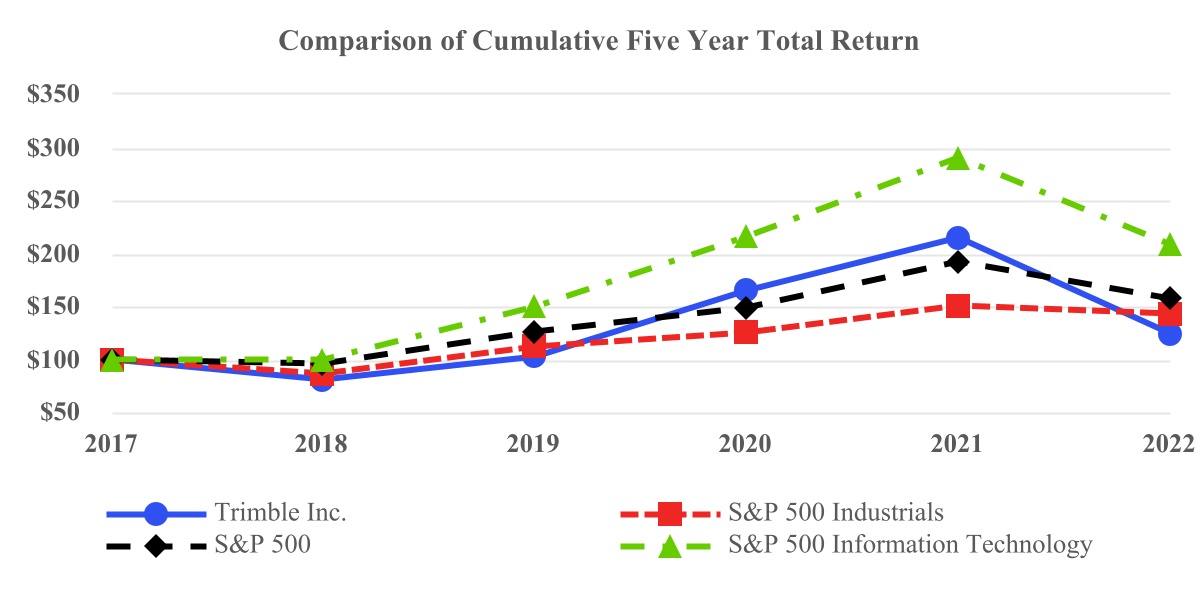
Our common stock trades on NASDAQ under the symbol “TRMB.” The following graph compares the cumulative five-year total return provided stockholders on our common stock relative to the cumulative total returns of the S&P 500 Index, the S&P 500 Information Technology Index, and the S&P 500 Industrials Index. An investment of $100 (with reinvestment of all dividends) is assumed to have been made in our common stock and in each of the indexes on December 31, 2017, and its relative performance is tracked through December 31, 2022.
Stock Repurchase Program
In August 2021, our Board of Directors approved a new share repurchase program (“2021 Stock Repurchase Program”) authorizing up to $750.0 million in repurchases of our common stock. Under the 2021 Stock Repurchase Program, the share repurchase authorization does not have an expiration date and supersedes and replaces the $600.0 million share repurchase authorization approved by our Board of Directors in November 2017 (“2017 Stock Repurchase Program”), of which $50.7 million was remaining and has been cancelled.
Under the 2021 Stock Repurchase Program, we may repurchase shares from time to time, subject to business and market conditions and other investment opportunities, through open market transactions, privately-negotiated transactions, accelerated stock repurchase plans, or by other means. The timing and actual number of any shares repurchased will depend on a variety of factors, including market conditions, our share price, other available uses of capital, applicable legal requirements, and other factors. The 2021 Stock Repurchase Program may be suspended, modified, or discontinued at any time at without prior notice.
There were no purchases of equity securities in the fourth quarter of 2022. During 2022, we repurchased approximately 6.0 million shares of common stock in open market purchases under the 2021 Stock Repurchase Programs, at an average price of $65.90 per share, for a total of $394.7 million. At the end of 2022, the 2021 Stock Repurchase Program had remaining authorized funds of $215.3 million.
Our pending acquisition of Transporeon, for a cash purchase price of €1.88 billion or $2.0 billion, will be funded through a combination of cash on hand and debt and is expected to occur in the first half of 2023. Because of the additional outstanding indebtedness we have and expect to incur in connection with the pending acquisition, we have temporarily discontinued share repurchases.
As of February 14, 2023, there were approximately 506 holders of record of our common stock.
Dividend Policy
We have not declared or paid any cash dividends on our common stock during any period for which financial information is provided in this report. At this time, we intend to retain future earnings, if any, to fund the development and growth of our business and do not anticipate paying any cash dividends on our common stock in the foreseeable future.
Item 6. Reserved
Item 7. Management’s Discussion and Analysis of Financial Condition and Results of Operations
The following discussion should be read in conjunction with the consolidated financial statements and the related notes. The following discussion contains forward-looking statements that reflect our plans, estimates, and beliefs. Our actual results could differ materially from those discussed in the forward-looking statements. Factors that could cause or contribute to these differences include, but are not limited to, those discussed below and those listed under “Risks Factors.” This section of this report generally discusses 2022 and 2021 items and year-to-year comparisons between 2022 and 2021. Discussions of 2020 items and year-to-year comparisons between 2021 and 2020 that are not included in this report can be found in “Management's Discussion and Analysis of Financial Condition and Results of Operations” in Part II, Item 7 of our Annual Report on Form 10-K, for the year ended December 31, 2021.
EXECUTIVE LEVEL OVERVIEW
We are a leading provider of technology solutions that enable professionals and field mobile workers to improve or transform their work processes. Our comprehensive work process solutions are used across a range of industries including architecture, building construction, civil engineering, geospatial, survey and mapping, agriculture, natural resources, utilities, transportation, and government. Our representative customers include construction owners, contractors, engineering and construction firms, surveying companies, farmers and agricultural companies, energy and utility companies, trucking companies, and state, federal, and municipal governments. Further information on our business is presented in Part I, Item 1, “Business” of this report.
Our growth strategy is centered on multiple elements:
- Executing on our Connect and Scale strategy;
*•*Increasing focus on software and services;
-
Focus on attractive markets with significant growth and profitability potential;
-
Domain knowledge and technological innovation that benefit a diverse customer base;
-
Geographic expansion with localization strategy;
-
Optimized go-to-market strategies to best access our markets;
-
Strategic acquisitions and venture fund investments; and
-
Sustainability.
Our focus on these growth drivers has led over time to growth in revenue and profitability and an increasingly diversified business model. We continue to experience a shift toward a more significant mix of recurring revenue contracts, as demonstrated by our success in driving annualized recurring revenue (“ARR”) of $1,603.7 million, which represents growth of 14% year-over-year at the end of 2022. ARR organic growth was 16%. This shift towards recurring revenue has positively impacted our revenue mix and growth over time and is leading to improved visibility in our businesses. As our solutions have expanded, our go-to-market model has also evolved with a balanced mix between direct, distribution, and OEM customers as well as an increasing number of enterprise level customer relationships.
Throughout this “Management’s Discussion and Analysis of Financial Condition and Results of Operations”, we refer to organic revenue growth, which is a non-GAAP measure. For a full definition of ARR, organic ARR, and organic revenue growth as used in this discussion and analysis, refer to the “Supplemental Disclosure of Non-GAAP Financial Measures and Annualized Recurring Revenue” found later in this Item 7.
Impact of Recent Events on Our Business
Macroeconomic conditions, including geopolitical tensions, such as the ongoing military conflict between Russia and Ukraine and related sanctions, exchange rate and interest rate volatility, and inflationary pressures, will continue to evolve globally. In the second half of 2022, our organic hardware sales growth and bookings moderated from slowing demand in some of our end markets served by our dealer channels and also from dealer inventories moving towards lower levels due to improved product lead times and macroeconomic concerns. The greatest impact was a decline in Europe where the impacts of foreign currency exchange rates, the ongoing military conflict in Ukraine, and energy inflation were the greatest.
Supply Chain
Over the past year, we experienced inflationary cost increases for certain components of our hardware products due to supply chain disruptions resulting from parts and labor shortages and an increase in worldwide demand for components. In response, we increased customer pricing to offset inflationary pressures. In the second half of 2022, these cost pressures lessened as component supply became more readily available. We expect these cost pressures will continue to diminish over time as supply chain conditions continue to normalize. Additionally, over the past year, due to extended component lead times, we made binding commitments over a longer horizon for certain components. This has impacted our working capital in the short term; however, we expect supply dynamics and customer demand to normalize over time.
Foreign Currency Fluctuations
We generate over half of our revenue from sales to customers outside of the U.S. In 2022, due to the strengthening of the U.S. dollar, year-over-year unfavorable foreign currency impacts on revenue and operating income were $114.1 million or 4% and $26.0 million or 5%.
Interest Rates Fluctuations
The global inflation rate has risen sharply, and interest rates are rising in an effort to curb inflation. In addition to the negative impact macroeconomic conditions have had on our sales, we may experience higher borrowing costs on existing variable rate debt and future debt issuances, including financing related to the pending acquisition of Transporeon.
Ongoing Military Conflict in Ukraine
We are monitoring and responding to effects of the ongoing military conflict in Ukraine. In the first quarter of 2022, we stopped selling to Russia and Belarus customers and wrote off uncollected customer receivables and inventory located in these countries, which was not material to our consolidated financial statements. Total revenue associated with Russia and Belarus customers, either sold directly or indirectly through resellers or OEMs, was less than 2% of our total Company revenue for 2021. We are focused on providing products and support to non-sanctioned Ukrainian customers and contributing to relief efforts.
Acquisitions and Divestitures
We acquire businesses that align with our long-term growth strategies including our strategic product roadmap and, conversely, we divest certain business that no longer fit those strategies.
In December 2022, we signed a definitive agreement to acquire Transporeon in an all-cash transaction valued at approximately €1.88 billion or $2.0 billion. Transporeon, a Germany-based company, is a leading cloud-based transportation management software platform that connects key stakeholders across the industry lifecycle to positively impact the optimization of global supply chains, in alignment with our Connect and Scale strategy. We believe the acquisition will advance our sustainability strategy by reducing under-utilized carrier capacity and “empty miles” and increase our international footprint and long-term Transportation opportunities. The acquisition will be funded through a combination of cash on hand and debt. We expect this acquisition to close in the first half of 2023, subject to customary closing conditions including the receipt of merger control clearances in Austria, Germany, and Poland. Transporeon will be reported in our Transportation segment.
In 2022, we acquired two businesses, with total purchase consideration of $379.5 million. In the aggregate, the acquired businesses contributed less than 1% of our total revenue during 2022.
In 2022,
Showing the first 8K of 78K characters. Open the full section
Item 7A. Quantitative and Qualitative Disclosures about Market Risk
We are exposed to market risk related to changes in interest rates and foreign currency exchange rates. We use certain derivative financial instruments to manage these risks. We do not use derivative financial instruments for speculative purposes. All financial instruments are used in accordance with policies approved by our board of directors.
Market Interest Rate Risk
Our cash equivalents consisted primarily of interest and non-interest bearing bank deposits as well as bank time deposits. The main objective of these instruments is safety of principal and liquidity while maximizing return, without significantly increasing risk.
Due to the nature of our cash equivalents that they are readily convertible to cash, we do not anticipate any material effect on our portfolio due to fluctuations in interest rates.
We are exposed to market risk due to the possibility of changing interest rates under our credit facilities, including the 2022 Credit Facility, 2022 Term Loan Credit Agreement, and the Bridge Facility. We also have four unsecured, uncommitted, revolving credit facilities that are callable by the bank at any time. We may borrow funds under the 2022 Credit Facility and uncommitted facilities in U.S. Dollars, Euros, or in certain other agreed currencies as described in Note 7 “Debt” of this report.
At the end of 2022, we had two $75.0 million, one €100.0 million, and one £55.0 million revolving credit facilities, which are uncommitted. At the end of 2022, $225.0 million was outstanding under the 2022 Credit Facility.
We expect to issue fixed-rate debt in the first half of 2023 as part of the pending acquisition of Transporeon and to refinance existing debt. To minimize interest rate fluctuations, in December 2022, we entered into a contract to offset the changes in the price of U.S. Treasury Notes with an original maturity of 10 years for the period commencing on the contract date and ending May 31, 2023 (“Treasury Rate Lock”). The Treasury Rate Lock is marked-to-market each period through other comprehensive income until the debt is issued, and the effective interest rate method is applied. The nominal amount is $400 million, and the fair value at the end of 2022 is $7.2 million.
While not predictive, a hypothetical 50 basis point increase or decrease in the 10-year U.S. Treasury rate as of December 30, 2022 would change the fair value of the Treasury Rate Lock by $16.5 million.
Foreign Currency Exchange Rate Risk
We operate in international markets, which expose us to market risk associated with foreign currency exchange rate fluctuations between the U.S. Dollar and various foreign currencies, the most significant of which is the Euro. In addition, volatile market conditions arising from the COVID-19 pandemic could result in changes in exchange rates.
Historically, the majority of our revenue contracts are denominated in U.S. Dollars, with the most significant exception being Europe, where we invoice primarily in Euro. Additionally, a portion of our expenses, primarily the cost to manufacture, cost of personnel to deliver technical support on our products and professional services, sales and sales support, and research and development, are denominated in foreign currencies, primarily the Euro.
Revenue resulting from selling in local currencies and costs incurred in local currencies are exposed to foreign currency exchange rate fluctuations, which can affect our operating income. As exchange rates vary, operating income may differ from expectations. In 2022, revenue and operating income were unfavorably impacted by foreign currency exchange rates by $114.1 million and $26.0 million.
We enter into foreign currency forward contracts to minimize the short-term impact of foreign currency exchange rate fluctuations on cash, debt, and certain trade and intercompany receivables and payables, primarily denominated in Euro, New Zealand Dollars, Brazilian Real, and Canadian Dollars. These contracts reduce the exposure to fluctuations in foreign currency exchange rate movements, as the gains and losses associated with foreign currency balances are generally offset with the gains and losses on the forward contracts. Additionally, in December 2022, we entered into a foreign currency exchange rate contract to minimize foreign currency fluctuations on the €1.88 billion or $2.0 billion pending acquisition of Transporeon.
Our foreign currency contracts are marked-to-market through earnings every period and generally range in maturity from one to two months, or from four to six months for acquisitions. We do not enter into foreign currency contracts for trading purposes. Foreign currency contracts outstanding at the end of 2022 and 2021 are summarized as follows:
| At the End of 2022 | At the End of 2021 | ||||||||||||||||||||||
| Nominal Amount | Fair Value | Nominal Amount | Fair Value | ||||||||||||||||||||
| (In millions) | |||||||||||||||||||||||
| Forward contracts: | |||||||||||||||||||||||
| Purchased | $ | (77.9) | $ | — | $ | (107.5) | $ | 0.1 | |||||||||||||||
| Sold | $ | 130.6 | $ | 0.2 | $ | 183.6 | $ | (0.2) | |||||||||||||||
| Foreign currency exchange contract related to acquisition | $ | 1,999.4 | $ | 10.4 | $ | — | $ | — |
While not predictive, a hypothetical 5% decrease in the Euro as of December 30, 2022 would change the fair value of the foreign currency exchange contract related to the pending acquisition of Transporeon by $68 million.
TRIMBLE INC.
INDEX TO FINANCIAL STATEMENTS
Item 8. Financial Statements and Supplementary Data
CONSOLIDATED BALANCE SHEETS
| At the End of Year | 2022 | 2021 | |||||||||
| (In millions, except par values) | |||||||||||
| ASSETS | |||||||||||
| Current assets*:* | |||||||||||
| Cash and cash equivalents | $ | 271.0 | $ | 325.7 | |||||||
| Accounts receivable, net | 643.3 | 624.8 | |||||||||
| Inventories | 402.5 | 363.3 | |||||||||
| Other current assets | 201.4 | 136.8 | |||||||||
| Total current assets | 1,518.2 | 1,450.6 | |||||||||
| Property and equipment, net | 219.0 | 233.2 | |||||||||
| Operating lease right-of-use assets | 121.2 | 141.0 | |||||||||
| Goodwill | 4,137.9 | 3,981.5 | |||||||||
| Other purchased intangible assets, net | 498.1 | 506.6 | |||||||||
| Deferred income tax assets | 438.4 | 502.0 | |||||||||
| Other non-current assets | 336.2 | 284.7 | |||||||||
| Total assets | $ | 7,269.0 | $ | 7,099.6 | |||||||
| LIABILITIES AND STOCKHOLDERS' EQUITY | |||||||||||
| Current liabilities: | |||||||||||
| Short-term debt | $ | 300.0 | $ | — | |||||||
| Accounts payable | 175.5 | 207.3 | |||||||||
| Accrued compensation and benefits | 159.4 | 231.0 | |||||||||
| Deferred revenue | 639.1 | 548.8 | |||||||||
| Other current liabilities | 188.1 | 201.5 | |||||||||
| Total current liabilities | 1,462.1 | 1,188.6 | |||||||||
| Long-term debt | 1,220.0 | 1,293.2 | |||||||||
| Deferred revenue, non-current | 98.5 | 83.0 | |||||||||
| Deferred income tax liabilities | 157.8 | 263.1 | |||||||||
| Income taxes payable | 40.9 | 54.5 | |||||||||
| Operating lease liabilities | 105.1 | 121.4 | |||||||||
| Other non-current liabilities | 134.4 | 151.1 | |||||||||
| Total liabilities | 3,218.8 | 3,154.9 | |||||||||
| Commitments and contingencies (Note 9) | |||||||||||
| Stockholders’ equity: | |||||||||||
| Preferred stock, $0.001 par value; 3.0 shares authorized; none issued and outstanding | — | — | |||||||||
| Common stock, $0.001 par value; 360.0 shares authorized; 246.9 and 250.9 shares issued and outstanding at the end of 2022 and 2021 | 0.2 | 0.3 | |||||||||
| Additional paid-in-capital | 2,054.9 | 1,935.6 | |||||||||
| Retained earnings | 2,230.0 | 2,170.5 | |||||||||
| Accumulated other comprehensive loss | (234.9) | (161.7) | |||||||||
| Total stockholders' equity | 4,050.2 | 3,944.7 | |||||||||
| Total liabilities and stockholders’ equity | $ | 7,269.0 | $ | 7,099.6 |
See accompanying Notes to the Consolidated Financial Statements.
CONSOLIDATED STATEMENTS OF INCOME
| 2022 | 2021 | 2020 | |||||||||||||||
| (In millions, except per share data) | |||||||||||||||||
| Revenue: | |||||||||||||||||
| Product | $ | 2,152.0 | $ | 2,247.5 | $ | 1,828.0 | |||||||||||
| Service | 641.3 | 649.4 | 644.8 | ||||||||||||||
| Subscription | 883.0 | 762.2 | 674.9 | ||||||||||||||
| Total revenue | 3,676.3 | 3,659.1 | 3,147.7 | ||||||||||||||
| Cost of sales: | |||||||||||||||||
| Product | 1,046.1 | 1,090.1 | 855.0 | ||||||||||||||
| Service | 235.7 | 229.9 | 234.5 | ||||||||||||||
| Subscription | 203.9 | 216.7 | 211.0 | ||||||||||||||
| Amortization of purchased intangible assets | 85.0 | 87.7 | 92.3 | ||||||||||||||
| Total cost of sales | 1,570.7 | 1,624.4 | 1,392.8 | ||||||||||||||
| Gross margin | 2,105.6 | 2,034.7 | 1,754.9 | ||||||||||||||
| Operating expense: | |||||||||||||||||
| Research and development | 542.1 | 536.6 | 475.9 | ||||||||||||||
| Sales and marketing | 553.6 | 506.8 | 467.0 | ||||||||||||||
| General and administrative | 422.2 | 369.1 | 300.9 | ||||||||||||||
| Restructuring charges | 30.2 | 10.3 | 25.8 | ||||||||||||||
| Amortization of purchased intangible assets | 46.6 | 50.9 | 65.5 | ||||||||||||||
| Total operating expense | 1,594.7 | 1,473.7 | 1,335.1 | ||||||||||||||
| Operating income | 510.9 | 561.0 | 419.8 | ||||||||||||||
| Non-operating income (expense), net: | |||||||||||||||||
| Divestitures gain, net | 99.0 | 41.4 | 13.1 | ||||||||||||||
| Interest expense, net | (71.1) | (65.4) | (77.6) | ||||||||||||||
| Income from equity method investments, net | 31.1 | 37.7 | 39.4 | ||||||||||||||
| Other income (expense), net | (0.8) | (0.1) | 0.3 | ||||||||||||||
| Total non-operating income (expense), net | 58.2 | 13.6 | (24.8) | ||||||||||||||
| Income before taxes | 569.1 | 574.6 | 395.0 | ||||||||||||||
| Income tax provision | 119.4 | 81.8 | 4.4 | ||||||||||||||
| Net income | 449.7 | 492.8 | 390.6 | ||||||||||||||
| Net income attributable to noncontrolling interests | — | 0.1 | 0.7 | ||||||||||||||
| Net income attributable to Trimble Inc. | $ | 449.7 | $ | 492.7 | $ | 389.9 | |||||||||||
| Earnings per share attributable to Trimble Inc.: | |||||||||||||||||
| Basic | $ | 1.81 | $ | 1.96 | $ | 1.56 | |||||||||||
| Diluted | $ | 1.80 | $ | 1.94 | $ | 1.55 | |||||||||||
| Shares used in calculating earnings per share: | |||||||||||||||||
| Basic | 248.6 | 251.4 | 250.5 | ||||||||||||||
| Diluted | 250.2 | 254.3 | 252.3 |
See accompanying Notes to the Consolidated Financial Statements.
CONSOLIDATED STATEMENTS OF COMPREHENSIVE INCOME
| 2022 | 2021 | 2020 | |||||||||||||||
| (In millions) | |||||||||||||||||
| Net income | $ | 449.7 | $ | 492.8 | $ | 390.6 | |||||||||||
| Other comprehensive income (loss), net of tax | |||||||||||||||||
| Foreign cu |
Showing the first 8K of 123K characters. Open the full section
Item 9. Changes in and Disagreements with Accountants on Accounting and Financial Disclosure
None
Item 9A. Controls and Procedures
(a) Evaluation of Disclosure Controls and Procedures
Our management, with the participation of our Chief Executive Officer (“CEO”) and Chief Financial Officer (“CFO”), has evaluated the effectiveness of our disclosure controls and procedures (as such term is defined in Rules 13a-15(e) and 15d-15(e) under the Securities Exchange Act of 1934, as amended (the “Exchange Act”)) as of the end of the period covered by this report. Based on such evaluation, our CEO and CFO have concluded that, as of the end of such period, our disclosure controls and procedures are effective.
Inherent Limitations on Effectiveness of Controls
Our management, including the CEO and CFO, does not expect that our internal control over financial reporting will prevent or detect all error and all fraud. A control system, no matter how well designed and operated, can provide only reasonable, not absolute, assurance that the control system’s objectives will be met. The design of any system of controls is based in part on certain assumptions about the likelihood of future events, and there can be no assurance that any design will succeed in achieving its stated goals under all potential future conditions.
(b) Management’s Report on Internal Control over Financial Reporting
Our management is responsible for establishing and maintaining adequate internal control over financial reporting, as such term is defined in Exchange Act Rule 13a-15(f). Our internal control over financial reporting is designed to provide reasonable assurance regarding the reliability of financial reporting and the preparation of financial statements for external purposes in accordance with generally accepted accounting principles.
Our management, including the CEO and CFO, conducted an evaluation of the effectiveness of our internal control over financial reporting based on the Internal Control—Integrated Framework issued by the Committee of Sponsoring Organizations of the Treadway Commission (2013 framework). We have excluded from our evaluation of the internal control over financial reporting the businesses acquired in 2022, which are included in the December 30, 2022 consolidated financial statements and constituted less than 1% of tangible assets and net assets, respectively, as of December 30, 2022, and less than 1% of revenue and net income, respectively, for the year then ended. Based on the results of this evaluation, our management concluded that our internal control over financial reporting was effective at the end of 2022.
The effectiveness of our internal control over financial reporting at the end of 2022 has been audited by Ernst & Young LLP, an independent registered public accounting firm, as stated in their report which is included elsewhere herein.
Changes in Internal Control over Financial Reporting
During the fourth quarter of 2022, there were no changes in our internal control over financial reporting that have materially affected, or are reasonably likely to materially affect, our internal control over financial reporting.
Item 9B. Other Information
None.
Item 9C. Disclosure Regarding Foreign Jurisdictions that Prevent Inspections
Item 10. Directors, Executive Officers and Corporate Governance
The information required by this item, insofar as it relates to our directors, will be contained under the captions “Election of Directors” and “Section 16(a) Beneficial Ownership Reporting Compliance” in the Proxy Statement and is incorporated herein by reference. The information required by this item relating to executive officers is set forth above in Item 1 Business Overview under the caption “Executive Officers.”
The information required by this item insofar as it relates to the nominating and audit committees will be contained in the Proxy Statement under the caption “Board Meetings and Committees; Director Independence.”
Code of Ethics
Our Business Ethics and Conduct Policy applies to, among others, our Chief Executive Officer, Chief Financial Officer, Chief Accounting Officer, and other finance organization employees. We make available our Business Ethics and Conduct Policy free of charge through our website at www.trimble.com under the heading “Corporate Governance - Governance Documents” on the Investor Relations page.
If any substantive amendments to the Business Ethics and Conduct Policy are made or any waivers are granted, including any implicit waiver, from a provision of the Business Ethics and Conduct Policy, to its Chief Executive Officer, Chief Financial Officer, or Chief Accounting Officer, we will disclose the nature of such amendment or waiver on our website at www.trimble.com or in a report on Form 8-K. The contents of these websites are not intended to be incorporated by reference into this report or in any other report or document we file or furnish with the SEC, and any reference to these websites are intended to be inactive textual references only.
Item 11. Executive Compensation
The information required by this item will be contained in the Proxy Statement under the captions “Executive Compensation” and “Non-Employee Director Compensation” and is incorporated herein by reference.
Item 12. Security Ownership of Certain Beneficial Owners and Management and Related Stockholder Matters
The information required by this item will be contained in the Proxy Statement under the caption “Security Ownership of Certain Beneficial Owners and Management and Related Stockholder Matters” and is incorporated herein by reference.
Item 13. Certain Relationships and Related Transactions, and Director Independence
The information required by this item will be contained in the Proxy Statement under the caption “Certain Relationships and Related Person Transactions” and is incorporated herein by reference.
Item 14. Principal Accounting Fees and Services
The information required by this item will be contained in the Proxy Statement under the caption “Principal Accounting Fees and Services” and is incorporated herein by reference.
PART IV
Item 15. Exhibits and Financial Statement Schedules.
(1) Financial Statements
The following consolidated financial statements required by this item are included in Part II Item 8 hereof under the caption “Financial Statements and Supplementary Data.
(2) Financial Statement Schedules
All financial statement schedules have been omitted, since the required information is not applicable or is not present in amounts sufficient to require submission of the schedule, or because the information required is included in the consolidated financial statements and accompanying notes included in this report.
(3) Exhibits
We have filed, or incorporated into the Report by reference, the exhibits listed on the accompanying Index to Exhibits immediately preceding the signature page of this report.
Item 16. Form 10-K Summary.
None.
INDEX TO EXHIBITS
- Certain portions of this exhibit have been redacted pursuant to Item 601(b)(10)(iv) of Regulation S-K. The Company agrees to supplementally furnish an unredacted copy of this exhibit to the SEC upon request; provided, however, that the Company may request confidential treatment pursuant to Rule 24b-2 of the Securities Exchange Act of 1934, as amended, to the extent so furnished.
+ Indicates management contract or compensatory plan or arrangement required to be filed as an exhibit to this Annual Report on Form 10–K.
++ Pursuant to applicable securities laws and regulations, the Company is deemed to have complied with the reporting obligation relating to the submission of interactive data files in such exhibits and is not subject to liability under any anti-fraud provisions of the federal securities laws as long as the Company has made a good faith attempt to comply with the submission requirements and promptly amends the interactive data files after becoming aware that the interactive data files fails to comply with the submission requirements.
SIGNATURES
Pursuant to the requirements of Section 13 or 15(d) of the Securities Exchange Act of 1934, the registrant has duly caused this Report of this report to be signed on its behalf by the undersigned, thereunto duly authorized.
| TRIMBLE INC. | ||||||||
| By: | /S/ ROBERT G. PAINTER | |||||||
| Robert G. Painter, President and Chief Executive Officer |
February 17, 2023
POWER OF ATTORNEY
Know all persons by these presents, that each person whose signature appears below constitutes and appoints Robert G. Painter as his attorney-in-fact, with the power of substitution, for him in any and all capacities, to sign any amendments to this Report of this Annual Report on Form 10-K, and to file the same, with exhibits thereto and other documents in connection therewith, with the Securities and Exchange Commission, hereby ratifying and confirming all that said attorney-in-fact, or his substitute or substitutes, may do or cause to be done by virtue hereof.
Pursuant to the requirements of the Securities Exchange Act of 1934, this Annual Report on Form 10-K has been signed below by the following persons on behalf of the registrant and in the capacities and on the dates indicated:
| Signature | Capacity in which Signed | |||||||||||||
| /s/ ROBERT G. PAINTER Robert G. Painter | President, Chief Executive Officer, Director | February 17, 2023 | ||||||||||||
| /s/ DAVID G. BARNES David G. Barnes | Chief Financial Officer (Principal Financial Officer) | February 17, 2023 | ||||||||||||
| /s/ JULIE A. SHEPARD Julie A. Shepard | Chief Accounting Officer (Principal Accounting Officer) | February 17, 2023 | ||||||||||||
| /s/ STEVEN W. BERGLUND Steven W. Berglund | Director | February 17, 2023 | ||||||||||||
| /s/ JAMES C. DALTON James C. Dalton | Director | February 17, 2023 | ||||||||||||
| /s/ BORJE EKHOLM Börje Ekholm | Director | February 17, 2023 | ||||||||||||
| /s/ ANN FANDOZZI Ann Fandozzi | Director | February 17, 2023 | ||||||||||||
| /s/ KAIGHAM (KEN) GABRIEL Kaigham (Ken) Gabriel | Director | February 17, 2023 | ||||||||||||
| /s/ MEAGHAN LLOYDMeaghan Lloyd | Director | February 17, 2023 | ||||||||||||
| /s/ SANDRA MACQUILLAN Sandra MacQuillan | Director | February 17, 2023 | ||||||||||||
| /s/ MARK S. PEEK Mark S. Peek | Director | February 17, 2023 | ||||||||||||
| /s/ THOMAS W. SWEET Thomas W. Sweet | Director | February 17, 2023 | ||||||||||||
| /s/ JOHAN WIBERGH Johan Wibergh | Director | February 17, 2023 |