 filings.tools
Trimble 10-K 2023-12-29
Filed 2024-02-26. 24 sections, 406K characters. Original on sec.gov · Markdown · JSON
Cover and table of contents
UNITED STATES
SECURITIES AND EXCHANGE COMMISSION
Washington, D.C. 20549

FORM 10-K
| ☒ | ANNUAL REPORT PURSUANT TO SECTION 13 OR 15 (d) OF THE SECURITIES EXCHANGE ACT OF 1934 | ||||
| For the fiscal year ended December 29, 2023 | |||||
| or | |||||
| ☐ | TRANSITION REPORT PURSUANT TO SECTION 13 OR 15 (d) OF THE SECURITIES EXCHANGE ACT OF 1934 | ||||
| For the transition period from to |
Commission File Number: 001-14845
TRIMBLE INC.
(Exact name of Registrant as specified in its charter)
| Delaware (State or other jurisdiction of incorporation or organization) | 94-2802192 (I.R.S. Employer Identification Number) |
10368 Westmoor Drive, Westminster, CO 80021
(Address of principal executive offices) (Zip Code)
(720) 887-6100
(Registrant’s telephone number, including area code)
Securities registered pursuant to Section 12(b) of the Act:
| Title of each class | Trading Symbol(s) | Name of each exchange on which registered | ||||||
| Common Stock, $0.001 par value | TRMB | NASDAQ Global Select Market |
Securities registered pursuant to Section 12(g) of the Act: NONE
Indicate by check mark if the registrant is a well-known seasoned issuer, as defined in Rule 405 of the Securities Act. Yes ☒ No ☐
Indicate by check mark if the registrant is not required to file reports pursuant to Section 13 or Section 15(d) of the Exchange Act. Yes ☐ No ☒
Indicate by check mark whether the registrant (1) has filed all reports required to be filed by Section 13 or 15(d) of the Securities Exchange Act of 1934 during the preceding 12 months (or for such shorter period that the registrant was required to file such reports), and (2) has been subject to such filing requirements for the past 90 days. Yes ☒ No ☐
Indicate by check mark whether the registrant has submitted electronically, every Interactive Data File required to be submitted pursuant to Rule 405 of Regulation S-T during the preceding 12 months (or for such shorter period that the registrant was required to submit such files). Yes ☒ No ☐
Indicate by check mark whether the registrant is a large accelerated filer, an accelerated filer, or a non-accelerated filer.
| Large Accelerated Filer | ☒ | Accelerated Filer | ☐ | |||||||||||
| Non-accelerated Filer | ☐ | Smaller Reporting Company | ☐ | |||||||||||
| Emerging Growth Company | ☐ |
If an emerging growth company, indicate by check mark if the registrant has elected not to use the extended transition period for complying with any new or revised financial accounting standards provided pursuant to Section 13(a) of the Exchange Act. ☐
Indicate by check mark whether the registrant has filed a report on and attestation to its management's assessment of the effectiveness of its internal control over financial reporting under Section 404(b) of the Sarbanes-Oxley Act (15 U.S.C. 7262(b)) by the registered public accounting firm that prepared or issued its audit report. ☒
If securities are registered pursuant to Section 12(b) of the Act, indicate by check mark whether the financial statements of the registrant included in the filing reflect the correction of an error to previously issued financial statements. ☐
Indicate by check mark whether any of those error corrections are restatements that required a recovery analysis of incentive-based compensation received by any of the registrant’s executive officers during the relevant recovery period pursuant to §240.10D-1(b). ☐
Indicate by check mark whether the registrant is a shell company (as defined in Rule 12b-2 of the Exchange Act). Yes ☐ No ☒
As of June 30, 2023, the aggregate market value of the common stock held by non-affiliates of the registrant was approximately $13.1 billion based on the closing price as reported on the NASDAQ Global Select Market. Shares of common stock held by each officer and director of the registrant have been excluded in that such person may be deemed to be an affiliate. This determination of affiliate status is not necessarily a conclusive determination for any other purpose.
Indicate the number of shares outstanding of each of the issuer’s classes of common stock, as of the latest practicable date.
| Class | Outstanding at February 20, 2024 | ||||||||||
| Common stock, $0.001 par value | 245,687,181 | shares | |||||||||
DOCUMENTS INCORPORATED BY REFERENCE
Some of the information required by Part III of this report is incorporated by reference from the proxy statement relating to the registrant’s 2024 annual meeting of stockholders (the “Proxy Statement”), to be filed with the Securities and Exchange Commission within 120 days after the end of the fiscal year to which this report relates.
SPECIAL NOTE ON FORWARD-LOOKING STATEMENTS
This report contains forward-looking statements within the meaning of Section 27A of the Securities Act of 1933 and Section 21E of the Securities Exchange Act of 1934, which are subject to the “safe harbor” created by those sections. These statements include, among other things:
-
general U.S. and global macroeconomic outlook, including slowing growth, inflationary pressures, and increases in interest rates;
-
economic disruptions caused by potential impact of volatility and conflict in the political and economic environment, including the conflicts in the Middle East and between Russian and Ukraine;
-
our belief that inflationary cost pressures will diminish over time as supply chain conditions continue to normalize;
-
fluctuations in foreign currency exchange rates;
-
our ability to convert backlog to revenue;
-
the cyclical nature of our hardware revenue;
-
our expectations that we will experience less seasonality in the future;
-
the portion of our revenue expected to come from sales to customers located in countries outside of the U.S.;
-
our plans to continue to invest in research and development for the active development and introduction of new products and to deliver targeted solutions to the markets we serve;
-
our shift towards a more significant mix of recurring revenue;
-
our belief that increases in recurring revenue will provide us with enhanced business visibility over time;
-
risks associated with our growth strategy, focusing on historically underserved large markets;
-
any anticipated benefits or impact to our results of operations and financial conditions from our acquisitions and our ability to successfully integrate the acquired businesses;
-
any anticipated benefits associated with the pending contribution of our precision agriculture business, excluding certain products and technologies, to a newly formed joint venture (the “JV”) and the sale of the majority interest in the JV to AGCO Corporation (“AGCO”);
-
our belief that our cash and cash equivalents and borrowings, along with cash provided by operations, will be sufficient in the foreseeable future to meet our anticipated operating cash needs, including expenditures related to our Connect and Scale strategy, debt service, stock repurchases, and any acquisitions;
-
tax payments or refunds related to research and development (“R&D”) costs;
-
our belief that our gross unrecognized tax benefits will not materially change in the next twelve months;
-
our discretion to conduct, suspend, or discontinue our stock repurchase program subject to the discretion of our management; and
-
our commitments to environmental, social, and governance matters.
The forward-looking statements regarding future events and the future results of Trimble Inc. (“Trimble” or “the Company” or “we” or “our” or “us”) are based on current expectations and the beliefs and assumptions of our management that are subject to risks and uncertainties. Discussions containing such forward-looking statements may be found in Item 1A “Risk Factors” and Item 7 “Management’s Discussion and Analysis of Financial Condition and Results of Operations” section of this report. Forward-looking statements generally can be identified by words such as “may,” “will,” “should,” “could,” “predicts,” “potential,” “continue,” “expects,” “anticipates,” “future,” “intends,” “plans,” “believes,” “estimates,” and similar expressions. These forward-looking statements involve certain risks and uncertainties that could cause actual results, levels of activity, performance, achievements, and events to differ materially from those implied by such forward-looking statements, including but not limited to, those discussed in this report under the section entitled “Risk Factors” and elsewhere, and in other reports we file with the Securities and Exchange Commission (“SEC”), specifically the most recent reports on Form 8-K and Form 10-Q, each as it may be amended from time to time. These forward-looking statements are made as of the date of this report. We undertake no obligation to revise or publicly release the results of any revision to these forward-looking statements, except as required by law. Given these risks and uncertainties, readers are cautioned not to place undue reliance on such forward-looking statements.
i
TRIMBLE INC.
2023 FORM 10-K ANNUAL REPORT
TABLE OF CONTENTS
ii
PART I
Item 1. Business
Trimble is a leading technology solutions provider that enables office and mobile professionals to connect their workflows and asset lifecycles to drive a more productive, sustainable future. With a focus on the industries that feed, build, and move the world, the comprehensive depth and breadth of our solutions is transforming the way the world works, making it easier for Trimble customers to focus on what matters—getting the job done right.
We innovate at the intersection of the digital and physical worlds with solutions that span the world’s foundational industries including building, civil and infrastructure construction, geospatial, survey and mapping, agriculture, natural resources, utilities, transportation, and government.
We exist to empower our customers: asset owners, general and specialty contractors, engineers and designers, surveyors, agricultural companies and farmers, energy and utility companies, trucking companies and drivers, as well as state, federal, and municipal governments.
Productivity and sustainability are at the heart of who we are—woven into our work internally and through our customers’ application of our technologies. Our solutions provide customers with the ability to improve their work quality while being safe, efficient, and sustainable. More than that, our products enable reduced environmental impact in our markets, ranging from reduced greenhouse gas (“GHG”) emissions to improved water stewardship.
Today’s work requires solutions for an interconnected world, no matter the industry. Trimble offers a diverse range of coherent capabilities that connect applications, data, workflows, and mobile technologies to more efficiently orchestrate work, often in mixed fleet environments. Our advanced positioning and autonomous guidance capabilities enable increased precision with large equipment, such as agricultural tractors and construction bulldozers. We offer integrated systems that track and manage fleets of vehicles, improve the driver experience, and provide real-time logistical analytics and insights back to the office. Our connected reality capture systems enable the management of large amounts of geo-referenced information, and our software solutions connect all aspects of a fleet, a farm, or a lane, while our collaborative building information modeling (“BIM”) solutions are used throughout the design, build, and operation of the built environment.
We focus on integrating our software application and cloud capabilities to create vertically-focused, system-wide solutions that transform how work is done. The integration of sensors, software, hardware, and data in our portfolio gives us a unique ability to provide detailed insights for our customers to improve their specific workflows.
Our strategy is centered on the concept of open industry clouds and underlying common data environments as the nucleus of our connected solutions, allowing all stakeholders to collaborate and make decisions based on the same information. In construction, we connect teams across the design, build, and operational phases of a project. In agriculture, we continue to develop connected farm solutions to optimize operations for agricultural production and protection. Meanwhile, our connected supply chain solutions provide transportation companies and their drivers with tools to enhance fuel efficiency, safety, transparency, and sustainability throughout their connected fleets.
Connected software applications and cloud platform services are key elements of our solutions and account for a steadily increasing portion of our business. Our software enhances a broad range of other products and systems to allow our customers to optimize their work toward targeted outcomes and improve their decision-making and productivity. Ranging from embedded, real-time firmware to software that integrates data with large-scale enterprise back-office systems, many of our solutions are extensible and can be tailored by users for customized business processes and workflows. Trimble software capabilities include extensive three-dimensional (“3D”) modeling, analysis, planning and design solutions as well as a large suite of domain-specific software applications used across industries including construction, geospatial, agriculture, utilities, and transportation.
Our software is sold as perpetual licenses, term licenses, or subscription services and can be provisioned for on-premise, and increasingly, hosted as Software as a Service (“SaaS”). We are extending our capabilities to run in multi-cloud environments, while delivering our unique value via domain-specific workflows and lifecycle management in our target industries.
Our global operations include major research, development, manufacturing, and logistics operations in the United States, the Netherlands, India, Germany, Finland, Canada, New Zealand, the United Kingdom, and Sweden.
Business Strategy
Our growth strategy is centered on multiple elements:
- Executing on our Connect and Scale strategy.** We continue to focus on executing our multi-year platform strategy. This strategy contains two elements.
◦The first element, Connect, aims to connect more customer workflows, industry lifecycles, and solution offerings, so that we can continue to transform the way our customers work. This includes integrating more of our customers’ data through cloud offerings and making more of our solutions available on a subscription basis. For example, our flagship design and construction platform solution, Trimble Connect, enables entire project teams to collaborate in real-time between the office and the field to make efficient decisions around the same data-rich design model enhanced by our cloud capabilities. Our Trimble Construction Cloud creates a connected data environment for online collaboration, the ability to author unique workflows that connect the digital and physical worlds, and the power to dynamically orchestrate design coordination in the cloud from wherever project stakeholders may be. Meanwhile in our Transportation business, the Trimble Transportation Cloud, for example, provides shippers and carriers with the critical information they need to make more informed bid and contract award decisions, while our Transporeon business creates a marketplace for shippers, forwarders, carriers, and retailers to connect online and digitize their end-to-end transportation management processes.
◦The second element, Scale, allows cloud enablement, which raises the bar with shared, on-demand services that empower network participants to proactively contribute to organic value creation and delivery, directly and with fewer intermediaries. When end users interact on a shared, online platform, the overall value that is created increases as the number of end-user participants increases. This network effect means that the willingness of developers, partners, or end users to engage increases as the number of network participants grows, which further enhances the platform experience and end-user value. Scale also aims to invest in the people, processes, and technologies that are necessary to streamline and standardize our internal processes; provide a seamless experience for our customers as they engage with our connected solutions; and enable us to continue to grow our business efficiently and effectively for many years into the future.
- Increasing focus on software and services.** Software and services targeted for the needs of vertical end markets are increasingly important elements of our solutions and are core to our growth strategy. We generally have an open application programming interface philosophy and open vendor environment, which leads to increased adoption of our software and analytics offerings. These software and services solutions integrate and optimize additional workflows for our customers, thereby improving their work productivity, and in the case of subscription, maintenance, and support services, also provide us with enhanced business visibility over time. Professional services constitute an additional customer offering that helps our customers integrate and optimize the use of our offerings in their environment.
*•*Focus on attractive markets with significant growth and profitability potential. We focus on large markets historically underserved by technology that offer significant potential for long-term revenue growth, profitability, and market leadership. Our core industries, such as construction, agriculture, and transportation, are each multitrillion-dollar global industries that operate in demanding environments with technology adoption in the early phases relative to other industries. With the emergence of mobile and cloud computing capabilities, the increasing technological know-how of end users, and compelling return on investment, we believe many of our markets are attractive for substituting Trimble’s technology and solutions in place of traditional operating methods.
- Domain knowledge and technological innovation that benefit a diverse customer base.** We have over time redefined our technological focus from hardware-driven point solutions to integrated work process solutions by developing domain expertise and heavily reinvesting in research and development (“R&D”) and acquisitions. We currently have over 1,000 unique patents reflective of our technology portfolio and deep domain knowledge to deliver specific, targeted solutions quickly and cost-effectively to each of the vertical markets we serve. Our patent portfolio is continuously updated with new patent grants that emerge from our investments in research and development. We look for opportunities where the opportunity for technological change is high and that have a requirement for the integration of multiple technologies into complete vertical solutions.
*•*Geographic expansion with localization strategy. We view international expansion as an important element of our strategy, and we continue to position ourselves in geographic markets that will serve as important sources of future growth. Products are sold in more than 150 countries, through dealers, joint ventures, original equipment manufacturers (“OEM”), and other channels throughout the world, as well as direct sales to end users. Sales are supported by our own offices located in over 40 countries around the world.
- Optimized go-to-market strategies to best access our markets.** We utilize vertically focused go-to-market strategies that leverage domain expertise to best serve the needs of individual markets both domestically and abroad. These go-to-market capabilities include independent dealers, joint ventures including with Caterpillar and Nikon, OEM, and distribution alliances with key partners, as well as direct sales to end users, which provide us with broad market reach and localization capabilities to effectively serve our markets.
•Strategic acquisitions, joint ventures, and investments. Organic growth continues to be our primary focus, while acquisitions serve to enhance our market position. We acquire businesses that bring domain expertise, geographic presence, technology, products, and distribution capabilities that augment our portfolio and allow us to penetrate existing
markets more effectively, or to establish a market beachhead. Our success in targeting and effectively integrating acquisitions is an important aspect of our growth strategy.
To further grow and position the Company, we partner with leaders in various fields by investing in early-to-growth stage companies through our venture fund and through strategic formation of joint ventures. In September 2023, we signed a definitive agreement to contribute our Trimble precision agriculture (“Trimble Ag”) business, excluding certain Global Navigation Satellite System (“GNSS”) and guidance technologies, to a JV with AGCO, of which we will retain a 15% ownership stake. Trimble and AGCO’s shared vision is to create a global leader in mixed fleet smart farming and autonomy solutions that delivers on our collective strategy to better serve farmers with factory fit and aftermarket applications in the mixed fleet precision agriculture market. The proposed transaction is expected to close in the first half of 2024.
*•*Sustainability. The global economy is experiencing a fundamental shift toward sustainability driven through broad stakeholder engagement, with a focus on decarbonization. Historically, through delivering productivity and efficiency gains, Trimble products have delivered sustainability for our customers, and we envision more opportunities to deliver expanded carbon reductions and other sustainability benefits, such as water management in agriculture and utilities.
Our focus on these growth drivers has led over time to growth in revenue and profitability and an increasingly diversified business model. As our solutions have expanded, our go-to-market model has also evolved, with a balanced mix between direct, distribution, and OEM customers, as well as an increasing number of enterprise-level customer relationships.
Business Segments and Markets
Our segments are distinguished by the markets they serve. Each segment consists of businesses that are responsible for product development, marketing, sales, strategy, and financial performance. We report our financial performance, including revenue and operating income, based on four reportable segments: Buildings and Infrastructure, Geospatial, Resources and Utilities, and Transportation. For further financial information about our segments, see Note 7 “Reporting Segment and Geographic Information” of this report.
Buildings and Infrastructure
The Buildings and Infrastructure segment primarily serves customers working in architecture, engineering, construction, design, asset management, operations, and maintenance. Within this segment, our most substantial product portfolios are focused on building and civil engineering construction, design, capital planning, and asset management.
Building Construction. Our building construction portfolio of solutions for the residential, commercial, and industrial building industry spans the entire lifecycle of a building and is used by construction owners, architects, designers, general contractors, sub-contractors, and engineers. These solutions serve to improve productivity and to enhance data sharing and collaboration across different teams and stakeholders to help keep projects within cost, time, and quality targets. The suite of technologies and solutions we provide to the building industry includes program management solutions for construction owners including software for 3D conceptual design and modeling; BIM software that is used in design, engineering, and construction; enterprise resource planning, project management, and project collaboration for general contractors; and advanced integrated site layout and measurement systems, cost estimating, scheduling, and project controls solutions for contractors. The suite also includes applications for sub-contractors and construction trades such as steel, concrete, and Mechanical, Electrical and Plumbing (“MEP”); project coordination; and capital program planning and management. In addition, our Trimble Connect collaboration platform streamlines customer workflows and enables interoperability between Trimble’s and other providers’ solutions. These solutions for the building industry serve to automate, streamline, and transform work processes across the building construction industry. Our solutions provide customer benefits such as reduced costs, reduced waste and re-work, increased worker safety and efficiencies, faster project completion times, improved information flow, better decision making, enhanced quality control, and multiple sustainability benefits for our customers.
During 2023, we announced a number of new developments including: (i) new versions of our Tekla Structure software for improved user experience such as extended collaboration with BIM model data; (ii) new AI features in Sketchup such as AI-powered image search capabilities to access 3D models on 3D Warehouse, as well as generative AI utilizing text prompts to convert a SketchUp 3D model to a rendered image in seconds with SketchUp Diffusion; (iii) new MEP products including Fabrication Smart Tools for use with native Autodesk users; and (iv) AI functionality for Viewpoint Vista and Spectrum to assist users with injection of PDF invoices.
Civil Engineering Construction and Asset Management. Our civil engineering and construction portfolio spans the lifecycle of civil infrastructure assets from feasibility and capital budgeting, to planning and design, to construction, through to long-term operation and maintenance. Our solutions serve the key industry stakeholders including the asset owners or clients, design engineers, consultants, contractors, sub-contractors, and suppliers. Our technological suite is employed across the entire project lifecycle to improve productivity, reduce waste and re-work, including reduced carbon emissions, and enable more informed decision making through enhanced situational awareness, data flow, data-driven insights and decision support, and project
collaboration. At the same time, our solutions can improve worker safety and reduce environmental impact. Our suite of integrated solutions and technologies in this area includes field and office software for estimating and job cost management and optimized project design and visualization; software for 3D design and data sharing; systems to automatically guide and control construction equipment such as excavators, bulldozers, wheel loaders, motor graders, and paving equipment; systems to monitor, track, and manage assets, equipment, and workers; and software to facilitate the management of the construction process and for sharing and communication of data in real time. Together, these solutions are designed to transform how work is done within the civil construction industry.
The civil construction market portfolio integrates data and information across the entire construction process and across mixed fleets. This includes data from site positioning and machine control systems, construction asset management equipment and services, and various software applications. Utilizing wireless and internet-based site communications infrastructure, our solutions include the ability to track and control equipment, deploy a 3D model to machines, track progress of work in real-time, and reduce re-work. By leveraging our technology, contractors gain greater insight into their operations helping them to lower costs and improve productivity, worker safety, and asset utilization.
We maintain a joint venture with Caterpillar, Caterpillar-Trimble Control Technologies (“CTCT”), to develop the next generation of advanced electronic guidance and control products for earth-moving machines. The joint venture develops machine control and guidance products that use site design information combined with accurate positioning technology to automatically control dozer blades and other machine tools. We also maintain a joint venture with Hilti, which focuses on the joint development of measuring solutions for the building construction trades and the integration of data for construction management.
During 2023, we announced a number of developments, including: (i) the introduction of Trimble Siteworks Machine Guidance Module, extending the capabilities of Trimble Siteworks Software from surveying and layout to support on-machine excavator guidance and operator assistance; (ii) completion of the first test of a fully autonomous soil compactor on a live jobsite, taking another important step on the path toward Trimble’s autonomous vision; and (iii) release of the Trimble DA2 GNSS Smart Antenna for construction surveying as part of the Trimble Works Subscription program, which provides contractors access to construction technology at a lower upfront cost.
We sell and distribute our products in the Building and Infrastructure segment through both a direct sales force and global networks of independent distributors with expertise and customer relationships in the respective markets, including SITECH Technology dealers, which serve the civil construction industry, and BuildingPoint dealers, which serve the building construction industry. We also sell many of our software solutions through our own direct sales force, to asset owners and clients, contractors, sub-contractors, and consulting engineers.
Competitors in this segment are typically companies that provide optical, laser, or GNSS positioning products as well as companies that produce software specific to the construction process. As we extend our software and services offerings to cover the full set of construction lifecycle management solutions used by construction owners, designers, and construction companies, we increasingly compete with large established companies that offer similar systems across all industries. We compete principally on the basis of innovation, differentiated products, domain expertise, service, quality, and geographic reach.
Geospatial
The Geospatial segment primarily serves customers working in surveying, mapping, engineering, and government. Within this segment, our most substantial product portfolios are focused on surveying and geospatial and geographic information systems (“GIS”).
Surveying and Geospatial. Through our surveying product portfolio, professional surveyors and engineers provide services to the construction, engineering, mining, oil and gas, energy and utilities, government, and land management sectors. Our survey solutions replace less productive conventional methods of surveying, mapping, 2D or 3D modeling, monitoring, measurement, reporting, and analysis. Our suite of solutions includes field-based data collection systems and field software, real time communications systems, and back-office software for data processing, modeling, monitoring, reporting, and analysis. Our field-based technologies are used in handheld, land mobile, and airborne applications and incorporate technologies such as mobile application software, high precision GNSS, robotic measurement systems, inertial positioning, 3D laser scanning, digital imaging, and optical or laser measurement. We maintain a joint venture with Nikon, which focuses on the design and manufacture in Japan of surveying instruments including mechanical total stations and related products. Our office-based products include software for planning, data processing and editing, quality control, 3D modeling, intelligent data analysis and feature extraction, deformation monitoring, project reporting, and data export. Our customers in this area benefit from using our products including significantly improved productivity in both field and office activities, improved safety through non-contact measurement and detection of potentially dangerous ground or structure movement, and improved data flow that enables better decision making.
Geographic Information Systems**.** Our GIS product line collects authoritative field data and integrates that data into GIS databases. Our handheld data collection systems allow users to efficiently and accurately log positions and descriptive information about their assets, ensure the integrity and accuracy of GIS information, and ultimately enable better decision-making. Through a combination of wireless technologies and software solutions, fieldwork results are seamlessly delivered to back-office GIS systems, while mobile workers can access relevant GIS information remotely. This capability provides significant advantages to users, including improved productivity, accuracy, and access to information in the field.
During 2023, we announced several new developments, including: (i) the scalable and configurable Trimble R580 GNSS Integrated Receiver that includes our industry-leading ProPoint engine; (ii) the newest addition to our scanning portfolio, the Trimble X9 3D laser scanning system; and (iii) the Trimble T10x model 2 tablet for survey and mapping professionals. Additionally, we delivered multiple feature releases in our powerful Trimble Access field software, Trimble Business Center office software, Trimble 4D Control Monitoring software, as well as TerraFlex and TerraOffice enabling productivity gains through improved connectivity, simplicity, and efficiency enhancements for survey, mapping, and construction professionals.
We sell and distribute our products in the Geospatial segment primarily through a global network of independent distribution partners. Major competitors in this segment are typically survey instrument companies that provide software-driven 3D measurement and imaging solutions. We compete principally based on innovation, differentiated products, integrated workflow solutions, domain expertise, service, quality, and geographic reach.
Resources and Utilities
The Resources and Utilities segment primarily serves customers working in agriculture, forestry, and utilities. Within this segment, our most substantial product portfolio addresses the agriculture market, including our Trimble Ag and Positioning Services businesses.
In September, we signed a definitive agreement to contribute our Trimble Ag business, excluding certain GNSS and guidance technologies, to a JV with AGCO, of which we will retain a 15% stake. Trimble and AGCO’s shared vision is to create a global leader in mixed fleet smart farming and autonomy solutions that delivers on our collective strategy to better serve farmers with factory fit and aftermarket applications in the mixed fleet precision agriculture market. The proposed transaction is expected to close in the first half of 2024. See Note 4 “Divestitures” of this report for additional discussion of this transaction.
Our precision agriculture products and services consist of guidance and positioning systems, including autonomous steering systems, automated and variable-rate application and technology systems, and information management solutions that enable farmers and their partners to improve crop performance, profitability, and environmental quality. Our precision agriculture solutions can assist farmers throughout every step of their farming process beginning with land preparation and continuing through the planting, nutrient, pest management, water management, and harvesting phases of a crop cycle. We provide manual and automated navigation guidance for tractors and other farm equipment used in spraying, planting, cultivating, and harvesting applications. The benefits to the farmer include faster machine operation, higher yields, lower consumption of fuel and chemicals, lower carbon footprint, and improved soil health as compared to conventional equipment. In addition, we provide solutions to automate application of pesticide and seeding. Our water solutions help farmers minimize their water costs and distribute water more efficiently and include applications for leveling agricultural fields for irrigation and aligning drainage systems to better manage water flow in fields.
Software solutions that use data to enhance farm productivity are an increasing focus in our agriculture business. Our agricultural software is used by farmers to help integrate all of the information on the farm, and is also used by advisors, suppliers, and purchasers to share information to help improve efficiencies. Our agricultural software enables farmers to make more informed decisions leading to higher yields, better quality crops, increased profitability, and increased environmental sustainability.
For many of our end-market applications and customer needs, the positional accuracy that can be derived from GNSS satellite signals alone is insufficient. In these applications, higher levels of positional accuracy are required. For these situations, we provide an augmentation service that improves the positional accuracy that is available to the customer; thereby, enabling higher levels of precision and automation in work processes that are conducted in the field. This service is provided by Trimble Positioning Services and is available in a variety of formats and accuracy levels, depending on the relevant application's specific needs. Trimble Positioning Services serves customers in a variety of end markets, including agriculture, construction, geospatial, and other markets, with a majority of its customers being in agriculture.
We use multiple distribution approaches to access the mixed fleet agricultural market including independent dealers and direct selling to enterprise accounts. Our aftermarket solutions address both new equipment as well as equipment already in the field. In 2023, the following changes occurred in the Ag distribution channels as follows:
- In February, we gave CNH a 12-month notification that we will no longer supply aftermarket precision agriculture products to CNH for resale through the CNH dealer network.
- In December, we gave CNH a 12-month notification that we will no longer supply hardware for their factory installations.
When the proposed transaction with AGCO closes, the JV will be the exclusive distributor in the agriculture market.
Competitors in the agricultural market are vertically integrated farm equipment and implement companies, agricultural instrumentation companies, and companies that provide agricultural software and services. We compete principally on the basis of robust performance, ease of use, domain expertise, customer support, price, interoperability, interconnectedness, and the completeness of our solutions.
Transportation
Our transportation solutions provide capabilities for the long-haul trucking and freight shipper markets to create a connected supply chain and integrate all forms of transportation, drivers, back-office management, shippers, and freight. We provide enterprise and mobility solutions focused on business intelligence and data analytics, safety and regulatory compliance, navigation and routing, freight brokerage, supply chain visibility and final mile, and transportation management and fleet maintenance. Within this segment, our most substantial product portfolio addresses the truckload freight market.
In the transportation market, we offer a suite of solutions that provides comprehensive fleet and transportation management systems, analytics, routing, mapping, reporting, and predictive modeling solutions to enable the transportation industry to achieve greater overall operational efficiency, fleet utilization, including greater fuel efficiency and reduced carbon emissions, and profitability while ensuring regulatory compliance. In addition to cloud-hosted solutions, we also integrate our applications and services directly into the customer’s IT infrastructure.
The mobility solutions encompass route management, safety and compliance, end-to-end vehicle management, video intelligence, and supply chain communications. The transportation management system serves as a central hub from which the core operations of transportation organizations are managed, data is stored and analyzed, and mission critical business processes are automated. Our enterprise transportation management system automates business processes spanning the entire transportation lifecycle for shippers, carriers, and intermediaries, delivering visibility, control, and decision support for the intricate relationships and complex processes involved in the movement of freight. Our products also provide truck routing, mileage, and mapping solutions, as well as a voice-guided turn-by-turn navigation solution.
During 2023, we had a number of important developments, including: (i) the acquisition and integration of Transporeon, a leading European cloud-based transportation management software platform; (ii) the wide-scale launch of our new in-cab platform, Instinct, that improves the driver experience and can support both Trimble and third-party apps; and (iii) significant progress in integrating data and connecting workflows, from our own unique set of capabilities and a growing network of partners, and through the Trimble Transportation Cloud (“TTC”). Market facing solutions enabled by TTC include Connected Maintenance, Connected Locations, and Connected Workflows.
The Transportation segment generally sells directly to end users and OEMs. Competitors in this segment are typically companies that provide fleet mobility services, transportation management software, and digital freight matching. We compete principally on the basis of interoperability, domain expertise, customer support and service, price, innovative product offerings, quality, and the completeness of our solutions.
Seasonality of Business
Construction equipment revenue, within our Buildings and Infrastructure segment, historically has been higher in early spring. Our agricultural equipment revenue, within our Resources and Utilities segment, has historically been the highest in the first quarter, followed by the second quarter, reflecting buying in anticipation of the spring planting season in the Northern hemisphere. However, overall, as a company, we are experiencing less seasonality as a result of diversification of our businesses across segments and the increased impact of software and subscription revenue. Changes in global macroeconomic conditions could also impact the level of seasonality we experience.
Manufacturing
We outsource the manufacturing of many of our hardware products to our key contract manufacturing partners that include Jabil and Benchmark Electronics Inc. Our contract manufacturing partners are responsible for significant material procurement, assembly, and testing. We continue to manage product design through pilot production for the subcontracted products, and we are directly involved in qualifying suppliers and key components used in all our products. We also utilize original design manufacturers for some of our products.
We manufacture our optics-based products, as well as some of our GPS products, at our plants in Dayton, Ohio and Danderyd, Sweden. Some of these products or portions of these products are also subcontracted to third parties for assembly.
Our primary design, manufacturing, and distribution sites in Dayton, Ohio; Sunnyvale, California; Eindhoven, Netherlands; and Danderyd, Sweden are registered to ISO9001:2015 covering the design, production, distribution, and servicing of our products.
Research and Development and Intellectual Property
We believe that our competitive position is maintained through the development and introduction of new products, including software and services. Trimble delivers digital technologies that enhance the physical world by integrating and connecting industry workflows, stakeholders, and data, while modernizing its interfaces and business models to make it easier for customers to do business. Our platform investments allow us to extend our differentiation in positioning and sensing, modeling, and analytics into emerging industry solutions and to drive ecosystem collaboration across our target industries. This improves our value over the customer lifecycle, while enhancing our leadership in software and services, which already accounts for over 65% of our R&D investment. Our investments enable us to push the state-of-the-art in key technology areas and to connect other leading technologies to solve customer problems in new and unique ways.
As part of our technology development practices, we actively establish and maintain our intellectual property rights through the use of patents, copyrights, trademarks, and trade secret laws. We hold over 1,000 unique issued and enforceable patents covering key technology areas, including precision GNSS, optical and inertial positioning solutions, artificial intelligence and machine learning, IoT, cloud computing, laser scanning, 3D modeling, point cloud processing, augmented reality, and many others. Our patent portfolio is continuously updated with new patent grants that emerge from our investments in research and development. We actively manage the intellectual property used in the development, operations, and sales of our products and services. We also own numerous trademarks and service marks that contribute to the identity and recognition of Trimble and that of its global products and services.
Environmental, Social, and Governance
We recognize that we are living in a time of increasing urgency for action on sustainability, and we are moving quickly and harnessing our potential to address global challenges. Inspired by our mission of “Transforming the Way the World Works,” and fueled by the dedication of our employees, we are working to build momentum and strive for continual improvement and measurable progress in shaping a sustainable future.
Sustainability is deeply integrated into our business strategy, threaded throughout our products and solutions and our people and culture. It’s what guides our innovations and investments. It’s what drives us to build resilience for our company and our customers, to empower people, including our employees and partners, and to lead with integrity in all that we do.
 Building Resilience •Drive, Enable, and Contribute to Decarbonization •Drive toward a net-zero future Building Resilience •Drive, Enable, and Contribute to Decarbonization •Drive toward a net-zero future |  Empowering People •Values: Belong, Grow, and Innovate •Key Pillars: Diversity, Equity, Inclusion, Leaders, and Communities Empowering People •Values: Belong, Grow, and Innovate •Key Pillars: Diversity, Equity, Inclusion, Leaders, and Communities |  Leading with Integrity •Corporate and Sustainability Governance •Ethical Business Practices •Privacy and Cybersecurity Leading with Integrity •Corporate and Sustainability Governance •Ethical Business Practices •Privacy and Cybersecurity |
Building Resilience. Building resilience is about enabling ourselves, our customers, and the essential industries we serve to adapt, grow, and thrive in the face of change. We continue to invest in innovation, research, and development in order to adapt, prepare, and expand capabilities that help transform our industries and accelerate toward a net zero future. In 2022, we received approval of our carbon reduction targets from the Science Based Targets initiative (SBTi), the predominant third-party net-zero target assessment entity. Our goals are consistent with requirements to keep global warming to 1.5°C in accordance with the Paris Climate Agreement.
To help us drive toward a net-zero future, we are working to (i) cut our Greenhouse Gas (GHG) footprint in half by 2030, (ii) source 100% renewable energy by 2025, and (iii) engage 70% of our suppliers to set their own science-based targets by 2026. Our customers trust us to deliver solutions that drive their productivity, safety, transparency, quality, and ultimately, their sustainability and profitability. Our technologies enable precision and efficiency for the world’s essential industries by helping our customers to build, move, and feed the world while minimizing waste and consumption—ultimately generating sustainable outcomes for people and communities on a global scale.
Empowering People. Together, our diverse community of innovators and problem solvers create opportunities for our employees, customers, and community members to thrive. We extend our commitment to empowering people in the communities where we do business, collectively addressing challenges in alignment with our values. As further described in the below Human Capital section, we are focused on building a welcoming, diverse, equitable, and inclusive workplace. We believe our diversity makes us stronger and better able to solve complex problems for our customers.
Leading with Integrity. We are dedicated to leadership principles that ensure excellence in all we do. Through transparency, good governance, and a deep commitment to sustainability and ethics, we continue operating from a strong foundation of integrity now and in the future.
Supported by the Audit Committee, People and Compensation Committee, and Nominating and Corporate Governance Committee, the Board of Directors has oversight for our sustainability strategy, commitments, and accountability for risk management.
The Code of Business Conduct provides the tools and information necessary for our team and partners to make the right decisions while working for or with Trimble, acting lawfully, ethically, fairly, complying with our policies, and avoiding even the appearance of impropriety.
Enhancing cybersecurity and data protection, maintaining system integrity, and ensuring availability are key to our overall security at Trimble. We make significant investments in technology safety across our value chain, ensuring our customers benefit from our cybersecurity investment as well.
Human Capital
Our culture reflects our guiding principles at work and is fundamental to sustaining our success. That company culture is foundational to a thriving workplace; it is the behaviors and values of leaders and employees that are the foundation for who we are. At Trimble, we value being yourself and thriving together; being intentional and humble; and being curious and solving problems. Our leaders inspire purpose and vision, engage to draw out the best from each other, and strive to achieve meaningful results. This mindset shapes how we treat one another and how we serve our customers, colleagues, and stockholders. We strive to make Trimble a diverse, equitable, inclusive, and safe workplace and provide opportunities for our employees to grow and develop in their careers, supported by competitive compensation, benefits, health and wellness programs, and by programs that build connections between our employees and their communities.
At the end of 2023, we employed over 12,700 full-time and part-time employees, the overwhelming majority of which were full-time employees. Approximately 42%, 37%, 17%, and 4% of employees reside in North America, Europe, Asia-Pacific, and the rest of the world. Our employees are working in approximately 200 locations in over 40 countries.
Diversity, Equity, and Inclusion (“DEI”)
We value diversity in our workforce, including various cultures, backgrounds, ages, genders, races and ethnicities, nationalities, sexual orientations, religions, people with different abilities, parents and caregivers, and many other characteristics, knowing that it drives our best thinking. Our focus on diversity starts at the top. Three out of our ten board members are female or ethnically diverse, and we are making progress towards our goal of increasing global female employees and U.S. ethnically diverse employees in our workforce and in our leadership positions across the company.
A number of employee resource networks exist in Trimble that enhance our inclusive and diverse culture, including networks that support women, caregivers, Black, Hispanic/Latinx and Indian professionals, veterans, employees with disabilities, and our LGBTQ+ community.
In 2023, we continued our investments in community partners by serving as a Board of Corporate Affiliates sponsor for the National Society of Black Engineers, sponsoring Out & Equal, a non-profit organization working on LGBTQ+ workplace equality, and increasing our presence at events like AfroTech and Colorado Technology Association’s Women in Tech annual summit.
Compensation and Benefits
We believe people should be paid for the role they perform and their skills and experience, regardless of their gender, race, age, or other personal characteristics. To deliver on that commitment, we benchmark and set pay ranges based on market data and consider factors such as an employee’s role, their experience, their performance, and the region in which they live. We also regularly review our compensation practices to ensure our pay is fair and equitable. In addition to base salaries, certain roles are eligible to participate in short-term and long-term incentive plans.
We offer market-competitive benefit programs (that vary by country/region), which include health and wellness benefits, life insurance and disability benefits, flexible savings accounts, paid time off, parental and family leave, employee support programs, retirement plans, and an employee stock purchase plan. Other benefits include fertility, adoption, and surrogacy education assistance; gender affirmation, family and caregiver support; flexible work arrangements; education assistance; and on-site services such as health centers and fitness centers at some sites.
Talent Development and Building Connections
We are committed to providing every employee with the opportunity to learn, grow, and excel in a respectful and collaborative workplace. Through our internal global talent platform, we empower employees to identify internal job opportunities, skill
development resources, and projects to achieve their personal development goals and full potential. We encourage employees to nurture a love of continuous learning and resilience that is essential for accomplishment.
We believe that building connections between our employees, their families, and our communities creates a more meaningful, fulfilling, and enjoyable workplace. In our offices around the world, our employee-led committees select local organizations to support, often in the form of grants and employee fundraising.
Our Trimble Foundation Fund (the “Foundation”) aligns international philanthropic efforts by giving back to the communities where Trimble does business and helping those in need. The Foundation focuses on three key areas within our communities (i) Disaster and Climate Resilience, (ii) Female Education and Empowerment, and (iii) Advancing Diversity, Equity, and Inclusion.
Health, Safety, and Wellness
The success of our business is fundamentally connected to the well-being of our people. Accordingly, we are committed to the health, safety, and wellness of our employees. We provide our employees and their families with access to a variety of innovative, flexible, and convenient health and wellness programs that offer choice where possible, so they can customize their benefits to meet their needs and the needs of their families.
Available Information
This Annual Report on Form 10-K, quarterly reports on Form 10-Q, current reports on Form 8-K, and all amendments to these reports are available free of charge on our website through investor.trimble.com, as soon as reasonably practicable after such material is electronically filed with or furnished to the Securities and Exchange Commission. Financial news and reports and related information about our Company, GAAP to non-GAAP reconciliations, as well as our Sustainability report and DEI report, are also found on this website. Information contained on our website is not part of this report.
In addition, you may request a copy of these filings (excluding exhibits) at no cost by writing or telephoning us at our principal executive offices at the following address or telephone number:
Trimble Inc. 10368 Westmoor Drive, Westminster, CO 80021 Attention: Investor Relations Telephone: (303) 635-8551
The URLs in this report are intended to be inactive textual references only. They are not intended to be active hyperlinks to websites. The information on such websites, even if it might be accessible through a hyperlink resulting from the URLs or referenced herein, is not and shall not be deemed to be incorporated into this report. No assurance or representation is given as to the suitability or reliability for any purpose whatsoever of any information on such websites.
Information about our Executive Officers
The names, ages, and positions of our executive officers as of February 26, 2024, are as follows:
| Name | Age | Position | ||||||||||||
| Robert G. Painter | 52 | President and Chief Executive Officer | ||||||||||||
| David G. Barnes | 62 | Chief Financial Officer | ||||||||||||
| Jennifer Allison | 51 | Vice President, General Counsel and Secretary | ||||||||||||
| Ronald J. Bisio | 55 | Senior Vice President | ||||||||||||
| Peter Large | 54 | Senior Vice President | ||||||||||||
| Phillip Sawarynski | 51 | Vice President, Treasurer | ||||||||||||
| Mark Schwartz | 49 | Senior Vice President | ||||||||||||
| Julie A. Shepard | 66 | Chief Accounting Officer |
Robert G. Painter—Robert Painter became Trimble’s president and chief executive officer in January 2020. From 2016 through 2019, he served as the Company’s chief financial officer. Prior to that, Mr. Painter held a variety of positions in the Company, including vice president of Trimble Buildings construction software, general manager of the Intelligent Construction Tools international joint venture, general manager of Construction Services, and leadership positions in corporate development and corporate strategy. Before joining the Company in 2006, Mr. Painter served in a variety of management and finance positions at Cenveo, Rapt Inc., Bain & Company, Whole Foods Market, and Kraft Foods. Mr. Painter holds a bachelor’s degree in finance from West Virginia University and an MBA from Harvard University.
David G. Barnes—David G. Barnes joined Trimble as chief financial officer in January 2020 with more than 35 years of financial and strategic management experience, including treasury, tax, investor relations, and risk management. Mr. Barnes will retire from the Company in May 2024, and Phillip Sawarynski will be his successor at that time. Prior to Trimble, he served as chief financial officer at MWH Global Inc., a global provider of engineering and construction services, from January 2009 to May 2016. At MWH, he served on the board of directors and had responsibility for information technology and procurement in addition to his financial role. Following the sale of MWH to Stantec Inc., he assumed operational responsibility for Stantec’s businesses outside North America from September 2017 to January 2019. He also served as a leader on the committee overseeing the integration of MHW into Stantec from May 2016 to July 2017. Prior to MWH, he held financial leadership positions at Western Union, Coors, and YUM Brands. He began his career as a strategy consultant at Bain & Company. Mr. Barnes received a Bachelor of Science in Applied Mathematics from Yale University and an MBA in Finance and Marketing from the University of Chicago. Mr. Barnes also serves as a board member and chair of the Audit Committee of CSG Systems International.
Jennifer Allison*—*Jennifer Allison became Trimble's general counsel and corporate secretary in April 2023, having served as general counsel for Trimble’s Construction Sector since July 2018, when Trimble acquired Viewpiont, where she had served as general counsel since 2016. Previously, Ms. Allison was general counsel at Tripwire, and prior to that she was the assistant general counsel and director of human resources and corporate compliance for EthicsPoint (now NAVEX Global). Prior to those roles, Ms. Allison clerked for the Oregon Supreme Court. Ms. Allison received a Bachelor’s degree in English Literature from Portland State University and her JD from Lewis & Clark Law School.
Ronald J. Bisio*—*Ronald Bisio currently serves as senior vice president in charge of advanced positioning, agriculture industry solutions, civil construction field systems, and geospatial business operations. From July 2022 to November 2023, he served as senior vice president responsible for Trimble’s transportation businesses. Prior to that, Mr. Bisio was responsible for Trimble’s surveying and geospatial businesses since April 2015, first as vice president and then as senior vice president as of February 2019. From January 2011 until April 2015, he served as general manager for Trimble’s rail division. He joined Trimble in 1996 and has also held several marketing, sales, and general management positions while at Trimble. Mr. Bisio earned an MBA from the University of Denver, a Master of Regional Planning from the University of Massachusetts, and a Bachelor of Science in Cartography from Salem State University in Salem, Massachusetts.
Peter Large—Peter Large currently serves as senior vice president in charge of strategy, corporate development, corporate partnerships and alliances, and Trimble’s office of technology innovation. From October 2022 to November 2023, he served as senior vice president responsible for Trimble's buildings and infrastructure segment, and from July 2021 to October 2022, as senior vice president responsible for our civil infrastructure solutions businesses, including Trimble’s joint ventures with Caterpillar and Hilti. Prior to that, he was vice president responsible for Trimble’s construction field solutions businesses. He was appointed to that position when he rejoined Trimble in December 2020, having earlier served with the Company as described below. Prior to re-joining Trimble, he was a research solutions strategist with Boeing’s Digital Solutions and Analytics business from 2019 to 2020. While pursuing a doctoral degree between 2015 to 2019, he engaged in consulting projects with Inmarsat plc, and was also employed as an executive director of Inmarsat from 2016 until 2018. Between 1996 and 2014, he served in a number of leadership roles at Trimble, including as vice president of channel development; as general manager for the mapping, GIS, and utilities business; and in a variety of product management, marketing, and sales management roles. Dr. Large holds an Ed.D. from Oklahoma State University, a Master of Science in Management from the Stanford University Graduate School of Business, a Postgraduate Diploma in Strategy and Innovation from the University of Oxford, and a Bachelor of Science degree from the University of Newcastle Upon Tyne, U.K.
Phillip Sawarynski—Phillip Sawarynski has accepted the position of chief financial officer of Trimble Inc., to be effective in May 2024, replacing David Barnes who will be retiring from the Company at that time. Mr. Sawarynski served as the Company’s treasurer since 2018, as well as managing director and co-head of Trimble Ventures since 2021, and vice president of corporate development since 2022. From 2015 to 2018, he served as sector vice president of finance in the Company’s mobility and intelligent transportation division, and from 2013 to 2015, as general manager of the Company’s imaging division. Mr. Sawarynski joined the Company in 2009 as a finance director, first in the Company’s agriculture division from 2009 to 2011 and then in the Company’s geospatial business segment from 2011 to 2013. Prior to joining the Company, Mr. Sawarynski served as CFO of Nexus Corporation and held a variety of finance and engineering positions at Ford Motor Company, The Dow Chemical Company, and International Paper Company. He holds a Bachelor of Science degree in chemical engineering from the University of Michigan, and an MBA from Carnegie Mellon University.
Mark Schwartz*—*Mark Schwartz was appointed senior vice president in November 2023 responsible for Trimble’s construction enterprise solutions, civil infrastructure design and engineering, and owner and public sector businesses. Prior to that, Mr. Schwartz served as senior vice president responsible for construction enterprise solutions from October 2022 until November 2023, and as Trimble’s chief digital officer from September 2020 through October 2022, leading the transformation initiatives of Trimble's business systems, processes, and infrastructure to better serve the customer through the transition to “as-a-service” business models. Mr. Schwartz served as vice president and general manager of Trimble’s civil construction software business
from January 2020 until September 2020 and as chief operating officer of virtual site solutions, a joint venture between Trimble and Caterpillar from April 2017 to January 2020. He joined Trimble in 2010 and has held several executive roles across Trimble’s construction businesses. Mr. Schwartz holds a Bachelor of Science from Bryant University in Smithfield, Rhode Island.
Julie A. Shepard—Julie Shepard currently serves as Trimble’s chief accounting officer. She joined Trimble in December of 2006 as vice president of finance and was appointed chief accounting officer in May 2007. Prior to joining Trimble, she served as vice president of finance and corporate controller at Quantum Corporation. She brings with her over 30 years of experience in a broad range of finance roles, with diverse experience ranging from early-stage private equity backed technology companies to large multinational corporations. She began her career at Price Waterhouse and is a Certified Public Accountant. Ms. Shepard received a Bachelor of Science in Accounting from California State University. She is a member of the AICPA, Financial Executives Institute, and the Institute of Management Accounting, where she currently serves on the Sustainable Business Management - Global Task Force.
Item 1A. Risk Factors
RISKS AND UNCERTAINTIES
You should carefully consider the following risk factors, in addition to the other information contained in this report and in any other documents to which we refer you in this report, before purchasing our securities. The risks and uncertainties described below are not the only ones we face.
Risks related to our business
We operate globally and are subject to significant risks in many jurisdictions, including risks related to adverse economic, political, regulatory, and other global and regional conditions
We have operations in many countries, and a significant portion of our revenue is derived from countries outside of the United States. As a result, our business, financial condition, and results of operations, including our ability to design, develop, or sell products, has been and may continue to be adversely affected by a number of factors outside of our control, including:
-
global and local economic conditions, such as inflation and recession;
-
the demand and cost of commodities, such as corn and oil;
-
the strength of the agricultural, engineering and construction, and transportation markets;
-
inadequate infrastructure and other disruptions, such as supply chain interruptions and large-scale outages or unreliable provision of services from utilities, transportation, data hosting, or telecommunications providers;
-
government restrictions on our operations in any country, or restrictions on our ability to repatriate earnings from a particular country;
-
differing employment practices and labor issues and the challenges and costs of staffing and managing a global workforce;
-
imposition of new and changing trade barriers, including trade sanctions, duties, tariffs, and import or export licensing requirements or restrictions;
-
compliance with differing local laws and regulations, including those relating to privacy, labor, and local content;
-
ineffective legal protection of our IP rights in certain countries or difficulties procuring or enforcing our IP rights;
-
volatile geopolitical conditions, including significant regional military conflicts and political and economic instability, in countries where we do business;
-
local business and cultural factors that differ from our normal standards and practices, which can include longer payment cycles and difficulties in enforcing agreements and collecting receivables in certain foreign jurisdictions;
-
fluctuations in currency rates; and
-
uncertainty regarding social, political, including elections, immigration, tax, and trade policies in the U.S. and abroad.
A significant trade disruption or the establishment or increase of any trade barrier in any area where we do business could increase the cost of our products, which could adversely impact the margin that we earn on sales, make our products more expensive for customers or create uncertainty around demand for certain types of products, which could make our products less competitive and reduce customer demand. If there were to be a deterioration in the global economy, the economies of the countries or regions where our customers are located or do business, or the industries that we or our customers serve, the demand for our products and services would likely decrease. In addition, government or customer efforts, attitudes, laws or policies may lead to non-U.S. customers favoring domestic suppliers that could compete with or replace our products, which would also have an adverse effect on our business. Changes in economic conditions and political uncertainty surrounding international trade also make it difficult to make financial forecasts. Any of the foregoing factors could adversely affect our business, financial condition, and results of operations.
We have experienced disruption in our supply chain and related events, and are subject to ongoing supply chain risks
We are dependent upon a limited number of contract manufacturers for the manufacture, testing, and assembly of certain products and specific suppliers for a number of our critical components. These arrangements can generally be terminated with a limited notice. Our current reliance on a limited group of contract manufacturers and suppliers involves risks, including the potential inability to obtain products or components to meet customers’ delivery requirements, reduced control over pricing and delivery schedules and discontinuation of or increased prices for certain components. The geopolitical conditions such as the ongoing military conflict in the Middle East and between Russia and Ukraine and related events and their impact on our suppliers and on international trade in general, have led to shortfalls in available components we need to make products as well as increased costs to obtain components, to make products, and to transport components and products. The disruptions include extended delivery times for certain components of our hardware products and increased freight costs. These disruptions have had an adverse effect on our ability to meet customer demand and have resulted in delays in shipping products to customers and dealers.
Future disruptions could occur as a result of any number of events, such as:
-
inflationary cost increases,
-
increases in wages that drive up prices of labor,
-
the imposition of new regulations, quotas or embargoes on components,
-
a scarcity of, or significant increase in the price of, raw materials or required components for our products,
-
trade restrictions, tariffs, or duties,
-
fluctuations in currency exchange rates,
-
transportation failures affecting the supply chain and shipment of materials and finished goods,
-
third party interference in the integrity of the products sourced through the supply chain,
-
severe weather conditions or natural disasters,
-
civil unrest, military conflicts, geopolitical developments, war or terrorism, and
-
disruptions in utility and other services.
Any other circumstance that would require us to seek alternative sources of supply or to manufacture, assemble, and test such components internally could significantly delay our ability to ship our products, which could damage relationships with current and prospective customers and could harm our reputation and brand as well as our results of operations.
Lastly, due to supply chain issues, we have in the past and may in the future accumulate excess inventories if we inaccurately forecast demand for our products, or if dealers are unable to work through their excess inventory.
If we are unable to effectively integrate, streamline and manage our diverse and complex businesses and operations, our ability to generate growth and revenue from new or existing customers may be adversely affected
Because our operations are geographically diverse and increasingly complex, our personnel resources and infrastructure could become strained, and our reputation in the market and our ability to successfully manage and grow our business may be adversely affected. The size, complexity, and diverse nature of our business and the expansion of our product lines and customer base have placed increased demands on our management and operations, and future growth may place additional strains on our resources in the future. Our ability to effectively compete and to manage our planned future growth will depend on, among other things, the following:
-
maintaining continuity in our senior management and key personnel;
-
increasing the productivity of our existing employees;
-
attracting, retaining, training, and motivating our employees, particularly our technical and management personnel;
-
deploying our solutions using third party information systems, which may require changes to our applications, documentation, and operational processes;
-
improving our operational, financial, and management con
Showing the first 8K of 77K characters. Open the full section
Item 1B. Unresolved Staff Comments
None.
Item 1C. Cybersecurity
The Company takes a multifaceted approach to assessing, identifying, and managing material risks from cybersecurity threats. The cybersecurity risk management processes described below are integrated into the Company’s overall risk management system.
Each Trimble sector has identified a dedicated expert to assess vulnerabilities, calculate risks and determine where risk mitigation efforts are needed. These experts work with the Company’s Chief Information Security Officer (“CISO”) and alongside product engineering personnel, to review technical risk data that comes from our central risk tracking system, prioritize risk mitigation activities, and manage other risk management processes. We employ a variety of security protections in our digital systems, including access controls and logging, denial of service protection, and automated intrusion-prevention tools. We have an information security training program, including an annual program of general security awareness for all employees and developer training throughout the year. We maintain an information security risk insurance policy.
As part of our product development activities, we have implemented the Trimble Secure Development Life Cycle (“TSDLC”), which uses overlapping security activities and controls to build robust security into the cloud-based products and services we provide, some of which are also deployed across our own IT infrastructure. TSLDC includes vulnerability scanning, intrusion prevention, tracking of security metrics, and code analysis vulnerability tools. Over 100 of our products are certified to ISO/IEC 27001:2013, which addresses secure information, resilience to cyber-attacks, existence of a centrally managed framework, organization-wide protection, responses to evolving security threats, and protection of data.
Core information technology systems supporting our business operations are backed up and stored outside of our network infrastructure. Our cloud-based systems, including products we sell, utilize configurations for backup designed to prevent data from being destroyed as a result of a cyber event.
Trimble’s incident response process is based on widely accepted industry frameworks, such as the cybersecurity framework set forth by the National Institute of Standards and Technology (“NIST”). Our framework includes steps to: identify threat actors, contain the affected infrastructure, eradicate threat actor access, recover affected data or systems, and study lessons learned to help ensure any root causes are mitigated outside of the affected area.
Each year, our team of cybersecurity specialists builds a strategic vision of shared outcomes which provides the basis for how cybersecurity risks are factored into the Company’s risk management initiatives. Along with the rest of the Company, the cybersecurity team, led by the CISO, sets goals for cybersecurity risk management that are then periodically tracked and reported back to the cybersecurity team and to our CEO and Audit Committee.
We utilize a set of third parties for technical and non-technical evaluation of our security posture, including regular assessment of our products for vulnerabilities. We also perform an annual external “red team” assessment that provides an attack simulation for our security operations team to identify and triage. We perform a vendor security assessment process for purchases over a certain minimum threshold.
To date, risks from cybersecurity threats, including as a result of any previous cybersecurity incidents, have not materially affected, and the Company is not aware of a basis to believe that such risks are reasonably likely to materially affect, the Company, including its business strategy, results of operations, or financial condition. For additional information, see Item 1A. Risk Factors—Our internal and customer-facing systems, and systems of third parties we rely upon, may be subject to cybersecurity breaches, disruptions, or delays.
The Board has overall responsibility for the oversight of risk management for the Company, and it exercises this oversight through Board committees and regular engagement with the Company's senior management. The Audit Committee is responsible for oversight of cybersecurity risk exposure and mitigation, and receives regular updates on cybersecurity risk management as well as timely notice of any material cybersecurity developments from the CISO through our escalation processes. The CISO presents quarterly or as needed at the Audit Committee meetings on the Company’s cybersecurity risk management activities.
We have a dedicated team that is led by the CISO, who has a technical degree in computer science from an accredited public university and has over 20 years of information technology and cybersecurity experience in multiple industries, including financial services and defense. The team comprises security engineers, detection specialists, and business cybersecurity experts. When the team identifies credible risks, we invoke our incident response process to track and manage the details,
quickly manage exposures, assess potential customer impact, and facilitate consistent reporting to our CEO and to our Audit Committee.
Item 2. Properties
Our corporate headquarters is located in Westminster, Colorado where we own approximately 250 thousand square feet. We also currently own approximately 500 thousand square feet in Dayton, Ohio. These facilities are used by all reporting segments. For financial information regarding leases, refer to Note 9 “Leases” of this report.
We believe that our existing facilities are adequate to support current and near-term operations.
Item 3. Legal Proceedings
From time to time, we are involved in litigation arising in the ordinary course of our business. There are no material legal proceedings, other than ordinary routine litigation incidental to the business, to which we or any of our subsidiaries is a party or of which any of our or our subsidiaries' property is subject.
Item 4. Mine Safety Disclosures
Item 5. Market for Registrant’s Common Equity, Related Stockholder Matters, and Issuer Purchases of Equity Securities
Company Stock Performance
Our common stock trades on NASDAQ under the symbol “TRMB.” The following graph compares the cumulative five-year total return provided to stockholders on our common stock relative to the cumulative total returns of the S&P 500 Index, the S&P 500 Information Technology Index, and the S&P 500 Industrials Index. An investment of $100 (with reinvestment of all dividends) is assumed to have been made in our common stock and in each of the indexes on December 31, 2018, and its relative performance is tracked through December 31, 2023.
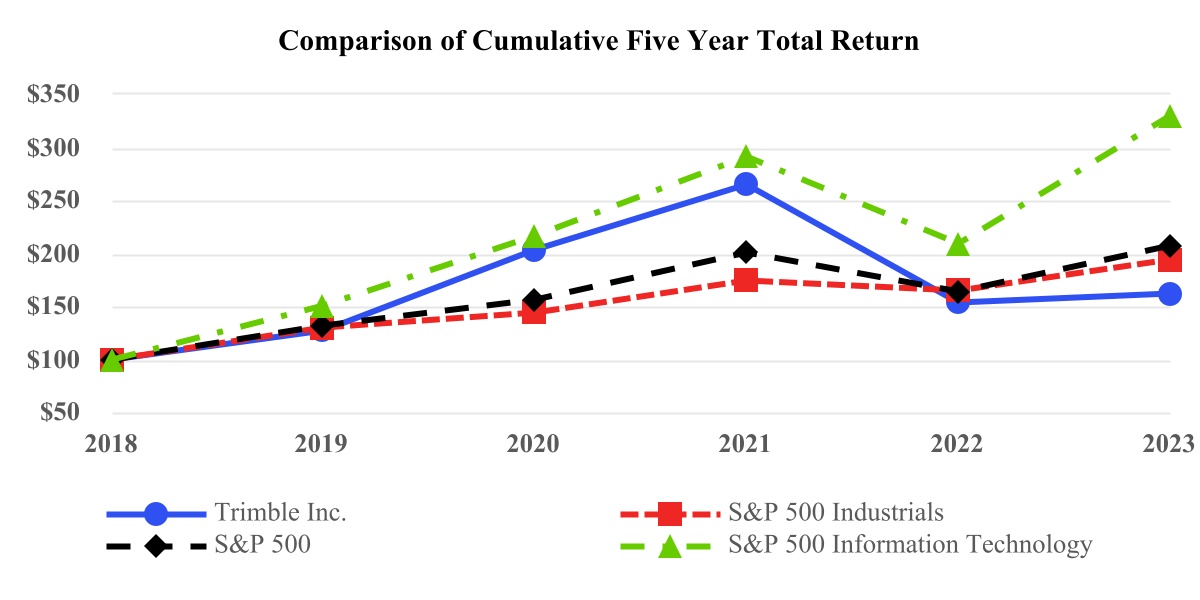
Stock Repurchase Program
In August 2021, our Board of Directors approved a stock repurchase program (“2021 Stock Repurchase Program”) authorizing up to $750.0 million in repurchases of our common stock. On January 28, 2024, our Board of Directors approved a new stock repurchase program (“2024 Stock Repurchase Program”) authorizing up to $800.0 million in repurchases of our common stock. The 2024 Stock Repurchase Program replaced the 2021 Stock Repurchase Program, which has been cancelled. Under the 2024 Stock Repurchase Program, the stock repurchase authorization does not have an expiration date.
According to the 2024 Stock Repurchase Program, we may repurchase stocks from time to time through accelerated stock repurchase programs, open market transactions, privately negotiated transactions, block purchases, tender offers or other means. The timing and actual number of any stock repurchased will depend on a variety of factors including market conditions, our stock price, other available uses of capital, applicable legal requirements, and other factors. The 2024 Stock Repurchase Program may be suspended, modified, or discontinued at any time without prior notice.
The following table provides information relating to our purchase of equity securities for the fourth quarter of 2023; these
purchases were made under the 2021 Stock Repurchase Program:
| Total Number of Shares Purchased | Average Price Paid per Share | Total Number of Shares Purchased as Part of Publicly Announced Program | Maximum Approximate Dollar Value of Shares that May Yet Be Purchased Under the Program | ||||||||||||||||||||||||||
| September 30, 2023 – November 3, 2023 | — | $ | — | — | $ | 215,255,003 | |||||||||||||||||||||||
| November 4, 2023 – December 1, 2023 | 2,352,860 | $ | 42.50 | 2,352,860 | $ | 115,255,017 | |||||||||||||||||||||||
| December 2, 2023 – December 29, 2023 | — | $ | — | — | $ | 115,255,017 | |||||||||||||||||||||||
| Total | 2,352,860 | 2,352,860 |
During 2023, we repurchased approximately 2.4 million shares of common stock in open market purchases under our 2021 Stock Repurchase Programs, at an average price of $42.50 per share, for a total of $100.0 million. At the end of 2023, the 2021
Stock Repurchase Program had remaining authorized funds of $115.3 million, which amount was subsequently replaced with $800.0 million under the 2024 Stock Repurchase Program.
As of February 20, 2024, there were approximately 499 registered holders of record of our common stock.
Dividend Policy
We have not declared or paid any cash dividends on our common stock during any period for which financial information is provided in this report. At this time, we intend to retain future earnings, if any, to fund the development and growth of our business and do not anticipate paying any cash dividends on our common stock in the foreseeable future.
Item 6. Reserved
Item 7. Management’s Discussion and Analysis of Financial Condition and Results of Operations
The following discussion should be read in conjunction with the consolidated financial statements and the related notes. The following discussion contains forward-looking statements that reflect our plans, estimates, and beliefs. Our actual results could differ materially from those discussed in the forward-looking statements. Factors that could cause or contribute to these differences include, but are not limited to, those discussed below and those listed under “Risks Factors.” This section of this report generally discusses 2023 and 2022 items and year-to-year comparisons between 2023 and 2022. Discussions of 2021 items and year-to-year comparisons between 2022 and 2021 that are not included in this report can be found in “Management's Discussion and Analysis of Financial Condition and Results of Operations” in Part II, Item 7 of our Annual Report on Form 10-K, for the year ended December 30, 2022.
EXECUTIVE LEVEL OVERVIEW
We are a leading provider of technology solutions that enable professionals and field mobile workers to improve or transform their work processes. Our comprehensive work process solutions are used across a range of industries including architecture, building construction, civil engineering, geospatial, survey and mapping, agriculture, natural resources, utilities, transportation, and government. Our representative customers include construction owners, contractors, engineering and construction firms, surveying companies, farmers and agricultural companies, energy and utility companies, trucking companies, and state, federal, and municipal governments. Further information on our business is presented in Part I, Item 1, “Business” of this report.
Our growth strategy is centered on multiple elements:
- Executing on our Connect and Scale strategy;
*•*Increasing focus on software and services;
-
Focus on attractive markets with significant growth and profitability potential;
-
Domain knowledge and technological innovation that benefits a diverse customer base;
-
Geographic expansion with a localization strategy;
-
Optimized go-to-market strategies to best access our markets;
-
Strategic and targeted acquisitions, joint ventures, and investments; and
-
Sustainability.
Our focus on these growth drivers has led over time to growth in revenue and profitability and an increasingly diversified business model. We continue to experience a shift toward a more significant mix of recurring revenue as demonstrated by our success in driving annualized recurring revenue (“ARR”) of $1,982.3 million, which represents growth of 24% year-over-year at the end of 2023. Excluding the impact of foreign currency, acquisitions, and divestitures, ARR organic growth was 13%. This shift toward recurring revenue has positively impacted our revenue mix and growth over time and is leading to improved visibility in our businesses. Our software, services, and recurring revenue represented 67% and 59% of total revenue for 2023 and 2022. Additionally, we continue to maintain focus on new product introductions and transitions to recurring revenue as evidenced by the Transporeon business and the pending Trimble Ag JV Transaction (as described below).
As our solutions have expanded, our go-to-market model has also evolved with a balanced mix between direct, distribution, and OEM customers as well as enterprise-level customer relationships.
Throughout this “Management’s Discussion and Analysis of Financial Condition and Results of Operations,” we refer to organic revenue growth, which is a non-GAAP measure. For a full definition of ARR, organic ARR, and organic revenue growth as used in this discussion and analysis, refer to the “Supplemental Disclosure of Non-GAAP Financial Measures and Annualized Recurring Revenue” found later in this Item 7.
Impact of Recent Events on Our Business
Acquisitions and Divestitures
We acquire businesses that align with our long-term growth strategies including our strategic product roadmap and, conversely, we divest certain businesses that no longer fit those strategies.
On September 28, 2023, we executed a definitive agreement with AGCO that provides for the formation of a JV with AGCO in the mixed fleet precision agriculture market. Under the terms of the agreement, we will contribute the Trimble Ag business, excluding certain GNSS and guidance technologies, and AGCO will contribute its JCA Technologies business to the JV. We will sell an interest in the JV to AGCO for $2.0 billion in pre-tax cash proceeds, subject to working capital adjustments. Immediately following the closing of this proposed transaction, we will own 15% of the JV and AGCO will own 85% of the JV.
Additionally, we plan to enter into the following agreements with AGCO as part of the overall proposed transaction:
-
a seven-year, renewable Supply Agreement through which we will provide key GNSS and guidance technologies to the JV for use in professional agriculture machines sold by AGCO, on an exclusive basis with limited exceptions;
-
a Technology Transfer and License Agreement to govern the licensing of certain non-divested intellectual property and technology for use by the JV in the agriculture field and, upon expiration of the Supply Agreement, to govern fixed and variable royalty payments made to us by the JV;
-
a Trademark License Agreement to govern the licensing of certain Trimble trademarks for use by the JV in the agriculture field;
-
a Positioning Services Agreement through which the JV will serve as our channel partner for the positioning services in the agriculture market; and
-
a Transition Services Agreement to provide contract manufacturing services for the divested products for two years following closing of the proposed transaction.
The formation of the JV is expected to better serve farmers with factory fit and aftermarket applications in the mixed fleet precision agriculture market to help farmers drive productivity, efficiency, and sustainability. Additionally, the proposed transaction is expected to (i) simplify our Connect and Scale strategy, (ii) reduce risk of channel transition in the agriculture market, and (iii) enhance our financial profile and flexibility with a resulting higher mix of software, services, and recurring revenue, as well allowing us to repurchase stock and repay $1.1 billion of our debt through use of the net proceeds.
The proposed transaction is expected to close in the first half of 2024 and is subject to customary closing conditions, including regulatory approvals. Trimble Ag is reported as a part of our Resources and Utilities segment.
The assets and liabilities of Trimble Ag that are subject to the proposed transaction were classified as held for sale at the end of 2023. See Note 4 “Divestitures” of this report.
On April 3, 2023, we acquired all of the outstanding shares of Transporeon in an all-cash transaction valued at €1.9 billion or $2.1 billion. Transporeon is a Germany-based company and leading cloud-based transportation management software platform that connects key stakeholders across the industry lifecycle to positively impact the optimization of global supply chains, which aligns with our Connect and Scale strategy. By combining Transporeon’s operations with ours, we expect economies of scale, growth, such as acceleration of recurring revenue, expansion of the addressable market, cross-sell opportunities, and enhanced productivity and sustainability solutions for our customers. Transporeon is reported in our Transportation segment. We have included the financial results of Transporeon in our Consolidated Financial Statements starting in the second quarter o
Showing the first 8K of 67K characters. Open the full section
Item 7A. Quantitative and Qualitative Disclosures about Market Risk
We are exposed to market risk related to changes in interest rates and foreign currency exchange rates. We use certain derivative financial instruments to manage these risks. We do not use derivative financial instruments for speculative purposes. All financial instruments are used in accordance with policies approved by our board of directors.
Market Interest Rate Risk
Our cash equivalents consisted primarily of interest and non-interest bearing bank deposits as well as bank time deposits. The main objective of these instruments is safety of principal and liquidity while maximizing return, without significantly increasing risk. Due to the nature of our cash equivalents that they are readily convertible to cash, we do not anticipate any material effect on our portfolio due to fluctuations in interest rates.
In the second quarter of 2023, we borrowed $1.2 billion of variable-rate debt in conjunction with the Transporeon acquisition. At the end of 2023, our outstanding balance of variable-rate debt was $1.3 billion, see details in Note 8 “Debt” of this report. We are exposed to market risk due to the possibility of changing interest rates. While not predictive, a hypothetical 50 basis point increase in interest rates on our variable-rate debt would result in an increase of approximately $6.5 million in annual interest expense.
Foreign Currency Exchange Rate Risk
We operate in international markets, which expose us to market risk associated with foreign currency exchange rate fluctuations between the U.S. Dollar and various foreign currencies, the most significant of which is the Euro.
Historically, the majority of our revenue contracts are denominated in U.S. Dollars, with the most significant exception being Europe, where we invoice primarily in Euro. Additionally, a portion of our expenses, primarily the cost to manufacture, cost of personnel to deliver technical support on our products and professional services, sales and sales support, and research and development, are denominated in foreign currencies, primarily the Euro.
Revenue resulting from selling in local currencies and costs incurred in local currencies are exposed to foreign currency exchange rate fluctuations, which can affect our operating income. As exchange rates vary, operating income may differ from expectations. In 2023, changes in foreign currency exchange rates had a favorable impact of $0.9 million on revenue and an unfavorable impact of $5.8 million on operating income.
We enter into foreign currency forward contracts to minimize the short-term impact of foreign currency exchange rate fluctuations on cash, debt, and certain trade and intercompany receivables and payables, primarily denominated in Euro, Canadian Dollars, New Zealand Dollars, British Pound, and Brazilian Real. These contracts reduce the exposure to fluctuations in foreign currency exchange rate movements, as the gains and losses associated with foreign currency balances are generally offset with the gains and losses on the forward contracts. We occasionally enter into foreign currency exchange contracts to hedge the purchase price of some of our larger business acquisitions.
Our foreign currency contracts are marked-to-market through earnings every period and generally range in maturity from one to two months, or from four to six months for acquisitions. We do not enter into foreign currency contracts for trading purposes. Foreign currency contracts outstanding at the end of 2023 and 2022 are summarized as follows:
| At the End of 2023 | At the End of 2022 | ||||||||||||||||||||||
| Nominal Amount | Fair Value | Nominal Amount | Fair Value | ||||||||||||||||||||
| (In millions) | |||||||||||||||||||||||
| Forward contracts: | |||||||||||||||||||||||
| Purchased | $ | (120.3) | $ | 0.3 | $ | (77.9) | $ | — | |||||||||||||||
| Sold | 50.8 | (0.3) | 130.6 | 0.2 | |||||||||||||||||||
| Foreign currency exchange contract related to acquisition | — | — | 1,999.4 | 10.4 |
TRIMBLE INC.
INDEX TO FINANCIAL STATEMENTS
Item 8. Financial Statements and Supplementary Data
TRIMBLE INC.
CONSOLIDATED BALANCE SHEETS
| At the End of Year | 2023 | 2022 | |||||||||
| (In millions, except par value) | |||||||||||
| ASSETS | |||||||||||
| Current assets: | |||||||||||
| Cash and cash equivalents | $ | 229.8 | $ | 271.0 | |||||||
| Accounts receivable, net | 706.6 | 643.3 | |||||||||
| Inventories | 235.7 | 402.5 | |||||||||
| Prepaid expenses | 89.8 | 73.7 | |||||||||
| Other current assets | 147.8 | 127.7 | |||||||||
| Assets held for sale | 421.2 | — | |||||||||
| Total current assets | 1,830.9 | 1,518.2 | |||||||||
| Property and equipment, net | 202.5 | 219.0 | |||||||||
| Operating lease right-of-use assets | 124.0 | 121.2 | |||||||||
| Goodwill | 5,350.6 | 4,137.9 | |||||||||
| Other purchased intangible assets, net | 1,243.5 | 498.1 | |||||||||
| Deferred income tax assets | 412.3 | 438.4 | |||||||||
| Other non-current assets | 375.5 | 336.2 | |||||||||
| Total assets | $ | 9,539.3 | $ | 7,269.0 | |||||||
| LIABILITIES AND STOCKHOLDERS’ EQUITY | |||||||||||
| Current liabilities: | |||||||||||
| Short-term debt | $ | 530.4 | $ | 300.0 | |||||||
| Accounts payable | 165.3 | 175.5 | |||||||||
| Accrued compensation and benefits | 181.2 | 159.4 | |||||||||
| Deferred revenue | 663.1 | 639.1 | |||||||||
| Income taxes payable | 39.7 | 23.7 | |||||||||
| Other current liabilities | 201.3 | 164.4 | |||||||||
| Liabilities held for sale | 48.3 | — | |||||||||
| Total current liabilities | 1,829.3 | 1,462.1 | |||||||||
| Long-term debt | 2,536.2 | 1,220.0 | |||||||||
| Deferred revenue, non-current | 98.3 | 98.5 | |||||||||
| Deferred income tax liabilities | 287.8 | 157.8 | |||||||||
| Operating lease liabilities | 121.9 | 105.1 | |||||||||
| Other non-current liabilities | 165.7 | 175.3 | |||||||||
| Total liabilities | 5,039.2 | 3,218.8 | |||||||||
| Commitments and contingencies (Note 10) | |||||||||||
| Stockholders’ equity: | |||||||||||
| Preferred stock, $0.001 par value; 3.0 shares authorized; none issued and outstanding | — | — | |||||||||
| Common stock, $0.001 par value; 360.0 shares authorized; 246.5 and 246.9 shares issued and outstanding at the end of 2023 and 2022 | 0.2 | 0.2 | |||||||||
| Additional paid-in-capital | 2,214.6 | 2,054.9 | |||||||||
| Retained earnings | 2,437.4 | 2,230.0 | |||||||||
| Accumulated other comprehensive loss | (152.1) | (234.9) | |||||||||
| Total stockholders' equity | 4,500.1 | 4,050.2 | |||||||||
| Total liabilities and stockholders' equity | $ | 9,539.3 | $ | 7,269.0 |
See accompanying Notes to the Consolidated Financial Statements.
TRIMBLE INC.
CONSOLIDATED STATEMENTS OF INCOME
| (In millions, except per share amounts) | 2023 | 2022 | 2021 | ||||||||||||||
| Revenue: | |||||||||||||||||
| Product | $ | 1,771.7 | $ | 1,986.1 | $ | 2,135.2 | |||||||||||
| Subscription and services | 2,027.0 | 1,690.2 | 1,523.9 | ||||||||||||||
| Total revenue | 3,798.7 | 3,676.3 | 3,659.1 | ||||||||||||||
| Cost of sales: | |||||||||||||||||
| Product | 875.0 | 1,040.8 | 1,086.4 | ||||||||||||||
| Subscription and services | 482.2 | 444.9 | 450.3 | ||||||||||||||
| Amortization of purchased intangible assets | 108.7 | 85.0 | 87.7 | ||||||||||||||
| Total cost of sales | 1,465.9 | 1,570.7 | 1,624.4 | ||||||||||||||
| Gross margin | 2,332.8 | 2,105.6 | 2,034.7 | ||||||||||||||
| Operating expense: | |||||||||||||||||
| Research and development | 664.3 | 542.1 | 536.6 | ||||||||||||||
| Sales and marketing | 583.0 | 553.6 | 506.8 | ||||||||||||||
| General and administrative | 487.5 | 422.2 | 369.1 | ||||||||||||||
| Restructuring | 45.6 | 30.2 | 10.3 | ||||||||||||||
| Amortization of purchased intangible assets | 103.6 | 46.6 | 50.9 | ||||||||||||||
| Total operating expense | 1,884.0 | 1,594.7 | 1,473.7 | ||||||||||||||
| Operating income | 448.8 | 510.9 | 561.0 | ||||||||||||||
| Non-operating income (expense), net: | |||||||||||||||||
| Divestitures gain, net | 9.2 | 99.0 | 41.4 | ||||||||||||||
| Interest expense, net | (161.0) | (71.1) | (65.4) | ||||||||||||||
| Income from equity method investments, net | 28.1 | 31.1 | 37.7 | ||||||||||||||
| Other income (expense), net | 31.9 | (0.8) | (0.1) | ||||||||||||||
| Total non-operating income (expense), net | (91.8) | 58.2 | 13.6 | ||||||||||||||
| Income before taxes | 357.0 | 569.1 | 574.6 | ||||||||||||||
| Income tax provision | 45.7 | 119.4 | 81.8 | ||||||||||||||
| Net income | 311.3 | 449.7 | $ | 492.8 | |||||||||||||
| Net income attributable to noncontrolling interests | — | — | 0.1 | ||||||||||||||
| Net income attributable to Trimble Inc. | $ | 311.3 | $ | 449.7 | 492.7 | ||||||||||||
| Earnings per share: | |||||||||||||||||
| Basic | $ | 1.26 | $ | 1.81 | $ | 1.96 | |||||||||||
| Diluted | $ | 1.25 | $ | 1.80 | $ | 1.94 | |||||||||||
| Shares used in calculating earnings per share: | |||||||||||||||||
| Basic | 247.9 | 248.6 | 251.4 | ||||||||||||||
| Diluted | 249.1 | 250.2 | 254.3 |
See accompanying Notes to the Consolidated Financial Statements.
TRIMBLE INC.
CONSOLIDATED STATEMENTS OF COMPREHENSIVE INCOME
| 2023 | 2022 | *2021 |
Showing the first 8K of 137K characters. Open the full section
Item 9. Changes in and Disagreements with Accountants on Accounting and Financial Disclosure
None
Item 9A. Controls and Procedures
(a) Evaluation of Disclosure Controls and Procedures
Management, including our Chief Executive Officer (“CEO”) and Chief Financial Officer (“CFO”), has evaluated the effectiveness of our disclosure controls and procedures (as such term is defined in Rules 13a-15(e) and 15d-15(e) under the Exchange Act), as of the end of the period covered by this report. Based on such evaluation, our CEO and CFO have concluded that our disclosure controls and procedures were not effective as of the end of such period because of the material weakness in internal control over financial reporting described below.
Inherent Limitations on Effectiveness of Controls
Management does not expect that the internal control over financial reporting will prevent or detect all errors and all fraud. A control system, no matter how well-designed and operated, can provide only reasonable, not absolute, assurance that the control system’s objectives will be met. The design of any system of controls is based in part on certain assumptions about the likelihood of future events, and there can be no assurance that any design will succeed in achieving its stated goals under all potential future conditions.
(b) Management’s Annual Report on Internal Control over Financial Reporting
Management is responsible for establishing and maintaining adequate internal control over financial reporting, as such term is defined in Exchange Act Rule 13a-15(f). The internal control over financial reporting is designed to provide reasonable assurance regarding the reliability of financial reporting and the preparation of financial statements for external purposes in accordance with generally accepted accounting principles.
Management conducted an evaluation of the effectiveness of the internal control over financial reporting based on the Internal Control—Integrated Framework issued by the Committee of Sponsoring Organizations of the Treadway Commission (2013 framework). Based on the assessment by management, it was determined that the Company’s internal control over financial reporting was not effective due to a material weakness related to the accounting for the Company’s business combination of Transporeon. This included lack of appropriate oversight of third-party valuation specialists and insufficient design and operating effectiveness of management review controls, including controls over the completeness and accuracy of certain assumptions used in the valuation of acquired intangible assets. The Company corrected an error, which resulted in an adjustment of $34 million between goodwill and developed technology intangibles, net of tax.
We have excluded the businesses acquired in 2023 from our evaluation of the internal control over financial reporting internal controls. The excluded businesses constituted approximately 3% of both tangible assets and revenue as of and for the year ended December 29, 2023.
The effectiveness of our internal control over financial reporting at the end of 2023 has been audited by Ernst & Young LLP, an independent registered public accounting firm, as stated in their report which is included elsewhere herein.
Remediation Plan for Material Weakness
Management, with the oversight of the Audit Committee, is currently taking actions to remediate the material weakness and is implementing additional processes and controls to address the underlying causes associated with the material weakness described above. We are in the process of reassessing the design of review controls over third-party valuation specialists to add greater levels of precision to detect and prevent potential material misstatements, including the establishment of process and controls to evaluate adequate review and evidence used in the valuation of acquired intangible assets.
The material weakness will not be considered remediated until the applicable remedial controls operate for a sufficient period of time and management has concluded, through testing, that these controls are operating effectively. We believe the measures described above will remediate the control deficiencies we have identified and strengthen our internal control over financial reporting. We are committed to continuing to improve our internal control processes and will continue to review, optimize, and enhance our financial reporting controls and procedures.
The process of designing and implementing an effective financial reporting system is a continuous effort that requires us to anticipate and react to changes in our business and the economic and regulatory environments, and to expend significant resources to maintain a financial reporting system that is adequate to satisfy our reporting obligations. As we continue to evaluate and take actions to improve our internal control over financial reporting, we may determine to take additional actions to address control deficiencies or determine to modify certain of the remediation measures described above.
Changes in Internal Control over Financial Reporting
During the fourth quarter of 2023, there were no changes in our internal control over financial reporting that have materially affected, or are reasonably likely to materially affect, our internal control over financial reporting.
Item 9B. Other Information
Rule 10b5-1 Trading Plan
On November 2, 2023, Mark Schwartz, Senior Vice President, and an officer for purposes of Section 16 of the Exchange Act as of the date of this filing, entered into a Rule 10b5-1 trading arrangement that is intended to satisfy the affirmative defense of Rule 10b5-1(c) under the Exchange Act. The trading arrangement was entered into during an open trading window and provides for potential sales of our common stock of up to 12,344 shares between April 15, 2024 and October 16, 2024.
Item 9C. Disclosure Regarding Foreign Jurisdictions that Prevent Inspections
Item 10. Directors, Executive Officers and Corporate Governance
The information required by this item, insofar as it relates to our directors, will be contained under the captions “Election of Directors” and “Section 16(a) Beneficial Ownership Reporting Compliance” in the Proxy Statement and is incorporated herein by reference. The information required by this item relating to executive officers is set forth above in Item 1 Business Overview under the caption “Executive Officers.”
The information required by this item insofar as it relates to the nominating and audit committees will be contained in the Proxy Statement under the caption “Board Meetings and Committees; Director Independence.”
Code of Ethics
Our Business Ethics and Conduct Policy applies to, among others, our Chief Executive Officer, Chief Financial Officer, Chief Accounting Officer, and other finance organization employees. We make available our Business Ethics and Conduct Policy free of charge through our website at www.trimble.com under the heading “Corporate Governance - Governance Documents” on the Investor Relations page.
If any substantive amendments to the Business Ethics and Conduct Policy are made or any waivers are granted, including any implicit waiver, from a provision of the Business Ethics and Conduct Policy, to its Chief Executive Officer, Chief Financial Officer, or Chief Accounting Officer, we will disclose the nature of such amendment or waiver on our website at www.trimble.com or in a report on Form 8-K. The contents of these websites are not intended to be incorporated by reference into this report or in any other report or document we file or furnish with the SEC, and any reference to these websites are intended to be inactive textual references only.
Item 11. Executive Compensation
The information required by this item will be contained in the Proxy Statement under the captions “Executive Compensation” and “Non-Employee Director Compensation” and is incorporated herein by reference.
Item 12. Security Ownership of Certain Beneficial Owners and Management and Related Stockholder Matters
The information required by this item will be contained in the Proxy Statement under the caption “Security Ownership of Certain Beneficial Owners and Management and Related Stockholder Matters” and is incorporated herein by reference.
Item 13. Certain Relationships and Related Transactions, and Director Independence
The information required by this item will be contained in the Proxy Statement under the caption “Certain Relationships and Related Person Transactions” and is incorporated herein by reference.
Item 14. Principal Accounting Fees and Services
The information required by this item will be contained in the Proxy Statement under the caption “Principal Accounting Fees and Services” and is incorporated herein by reference.
PART IV
Item 15. Exhibits and Financial Statement Schedules.
(1) Financial Statements
The following consolidated financial statements required by this item are included in Part II Item 8 hereof under the caption “Financial Statements and Supplementary Data.
(2) Financial Statement Schedules
All financial statement schedules have been omitted, since the required information is not applicable or is not present in amounts sufficient to require submission of the schedule, or because the information required is included in the consolidated financial statements and accompanying notes included in this report.
(3) Exhibits
We have filed, or incorporated into the Report by reference, the exhibits listed on the accompanying Index to Exhibits immediately preceding the signature page of this report.
Item 16. Form 10-K Summary.
None.
INDEX TO EXHIBITS
- Certain portions of this exhibit have been redacted pursuant to Item 601(b)(10)(iv) of Regulation S-K. The Company agrees to supplementally furnish an unredacted copy of this exhibit to the SEC upon request; provided, however, that the Company may request confidential treatment pursuant to Rule 24b-2 of the Securities Exchange Act of 1934, as amended, to the extent so furnished.
+ Indicates management contract or compensatory plan or arrangement required to be filed as an exhibit to this Annual Report on Form 10–K.
++ Pursuant to applicable securities laws and regulations, the Company is deemed to have complied with the reporting obligation relating to the submission of interactive data files in such exhibits and is not subject to liability under any anti-fraud provisions of the federal securities laws as long as the Company has made a good faith attempt to comply with the submission requirements and promptly amends the interactive data files after becoming aware that the interactive data files fails to comply with the submission requirements.
SIGNATURES
Pursuant to the requirements of Section 13 or 15(d) of the Securities Exchange Act of 1934, the registrant has duly caused this Report to be signed on its behalf by the undersigned, thereunto duly authorized.
| TRIMBLE INC. | ||||||||
| By: | /S/ ROBERT G. PAINTER | |||||||
| Robert G. Painter, President and Chief Executive Officer |
February 26, 2024
POWER OF ATTORNEY
Know all persons by these presents, that each person whose signature appears below constitutes and appoints Robert G. Painter as his attorney-in-fact, with the power of substitution, for him in any and all capacities, to sign any amendments to this Report of this Annual Report on Form 10-K, and to file the same, with exhibits thereto and other documents in connection therewith, with the Securities and Exchange Commission, hereby ratifying and confirming all that said attorney-in-fact, or his substitute or substitutes, may do or cause to be done by virtue hereof.
Pursuant to the requirements of the Securities Exchange Act of 1934, this Annual Report on Form 10-K has been signed below by the following persons on behalf of the registrant and in the capacities and on the dates indicated:
| Signature | Capacity in which Signed | |||||||||||||
| /s/ ROBERT G. PAINTER Robert G. Painter | President, Chief Executive Officer, Director | February 26, 2024 | ||||||||||||
| /s/ DAVID G. BARNES David G. Barnes | Chief Financial Officer (Principal Financial Officer) | February 26, 2024 | ||||||||||||
| /s/ JULIE A. SHEPARD Julie A. Shepard | Chief Accounting Officer (Principal Accounting Officer) | February 26, 2024 | ||||||||||||
| /s/ JAMES C. DALTON James C. Dalton | Director | February 26, 2024 | ||||||||||||
| /s/ BORJE EKHOLM Börje Ekholm | Director | February 26, 2024 | ||||||||||||
| /s/ KAIGHAM (KEN) GABRIEL Kaigham (Ken) Gabriel | Director | February 26, 2024 | ||||||||||||
| /s/ MEAGHAN LLOYDMeaghan Lloyd | Director | February 26, 2024 | ||||||||||||
| /s/ RON NERSESIAN Ron Nersesian | Director | February 26, 2024 | ||||||||||||
| /s/ MARK S. PEEK Mark S. Peek | Director | February 26, 2024 | ||||||||||||
| /s/ KARA SPRAGUE Kara Sprague | Director | February 26, 2024 | ||||||||||||
| /s/ THOMAS W. SWEET Thomas W. Sweet | Director | February 26, 2024 | ||||||||||||
| /s/ JOHAN WIBERGH Johan Wibergh | Director | February 26, 2024 |