 filings.tools
Tyson Foods (TSN) 10-K risk factor changes: FY2020 vs FY2019
The 2020-10-03 10-K against the 2019-09-28 one, compared heading by heading and sentence by sentence.
Item 1A37 rewritten89 added1 removed310 unchanged
All filing items1,128 rewritten776 added440 removed2,276 unchanged
Summary
counted, not written
- Item 1A lists 31 risk factor headings: 1 new, 2 reworded and 28 unchanged since FY2019. 0 headings from FY2019 no longer appear.
- Sentence by sentence, 776 added, 440 removed, 1,128 rewritten and 2,276 unchanged across 18 items that differ.
New Item 1A headings (1)
- The outbreak of the COVID-19 global pandemic and associated responses has had, and is expected to continue to have, an adverse impact on our business and operations.
Removed Item 1A headings (0)
Every FY2019 risk factor heading is still here, word for word or reworded.
Reworded Item 1A headings (2)
- We depend on the availability of, and good relations with, our
[removed: employees.][added: team members.] - If we are unable to attract, hire or retain key
[removed: employees][added: team members] or a highly skilled and diverse global workforce, it could have a negative impact on our business, financial condition or results of operations.
A heading is new when no FY2019 heading matches it after ignoring case and punctuation, and reworded when it shares at least 60 percent of its words with one that went away. All current risk factor headings.
Sentences by item
22 items, with every count and a link to each item that changed
Underlined words on a shaded ground are new in FY2020; struck-through words were in FY2019. Sentences that are wholly new or wholly gone are labelled rather than marked.
Item 1A. RISK FACTORS
37 rewritten, 89 added, 1 removed, 310 unchanged
Our results of operations and financial condition, as well as the selling prices for our products, are dependent upon the cost and supply of commodities and raw materials such as beef, pork, poultry, corn, [removed: soybean,] [added: soybean meal,] packaging materials and energy and, to a lesser extent, cheese, fruit, seasoning blends, flour, corn syrup, corn oils, butter and sugar.
Corn, soybean meal and other feed ingredients, for instance, represented roughly [removed: 55%] [added: 53%] of our cost of growing a live chicken in fiscal [removed: 2019.][added: 2020.]
The integration of large businesses is [removed: complex,] [added: complex] and requires us to devote significant management attention and incur substantial costs to integrate these businesses and Tyson’s business practices, policies, cultures and operations.
The integration process could also result in the loss of key [removed: employees,] [added: team members,] which could adversely impact the combined company’s future financial results.
In the fourth quarter of fiscal 2017, our Board of Directors approved a multi-year restructuring program (the [removed: “Financial Fitness] [added: “2017] Program”), which is expected to contribute to the Company’s overall strategy of financial fitness through increased operational effectiveness and overhead reduction.
For more information regarding this program, refer to [removed: the heading “Overview” set forth in] Part II, [removed: “Item 7.][added: Item 8.]
The success of the [removed: Financial Fitness Program,] [added: financial fitness programs,] including the realization of the anticipated benefits, will depend in part on our ability to successfully implement the program in an efficient and effective manner.
The implementation of the [removed: Financial Fitness Program] [added: financial fitness programs] may be more difficult, costly, or time consuming than expected, and the [removed: Financial Fitness Program] [added: financial fitness programs] may not result in any or all of the anticipated benefits.
If we are unable to implement the [removed: Financial Fitness Program] [added: financial fitness programs] smoothly or successfully, or we otherwise do not capture the anticipated savings, our business, results of operations and financial condition for future periods could be negatively impacted.
The [removed: Financial Fitness Program] [added: financial fitness programs] may become a distraction for our organization and may disrupt our ongoing business operations; cause deterioration in [removed: employee] [added: team member] morale; disrupt or weaken the internal control structures of the affected business operations; and result in negative publicity which could affect our corporate reputation.
If we are unable to successfully manage the negative consequences of the [removed: Financial Fitness Program,] [added: financial fitness programs,] our business, results of operations and financial condition for future periods could be adversely affected.
In fiscal [removed: 2019,] [added: 2020,] we sold products to customers in approximately 145 countries.
Major sales markets include Australia, Canada, Central America, [added: Chile,] China, the European Union, [added: the United Kingdom,] Japan, [removed: Malaysia,] Mexico, [removed: Chile,] [added: Malaysia,] the Middle East, [removed: the Netherlands,] South Korea, Taiwan and Thailand.
Our sales to customers in foreign countries for fiscal [removed: 2019] [added: 2020] totaled [removed: $5.4 billion,] [added: $6.0 billion] of which [removed: $4.1] [added: $4.0] billion related to export sales from the United States.
In addition, we had approximately [removed: $1,107] [added: $1,287] million of long-lived assets located in foreign locations, primarily Brazil, China, the European Union and New Zealand, at the end of fiscal [removed: 2019.][added: 2020.]
We depend on the availability of, and good relations with, our [removed: employees.][added: team members.]
We have approximately [removed: 141,000 employees,] [added: 139,000 team members,] approximately [removed: 39,000] [added: 36,000] of whom are covered by collective bargaining agreements or are members of labor unions.
Our operations depend on the availability and relative costs of labor and maintaining good relations with [removed: employees] [added: team members] and the labor unions.
If we fail to maintain good relations with our [removed: employees] [added: team members] or with the labor unions, we may experience labor strikes or work stoppages, which could adversely affect our financial results.
If we are unable to attract, hire or retain key [removed: employees] [added: team members] or a highly skilled and diverse global workforce, it could have a negative impact on our business, financial condition or results of operations.
Our continued growth requires us to attract, hire, retain and develop key [removed: employees,] [added: team members,] including our executive officers and senior management team, and maintain a highly skilled and diverse global workforce.
We compete to attract and hire highly skilled [removed: employees] [added: team members] and our own [removed: employees] [added: team members] are highly sought after by our competitors and other companies.
Competition could cause us to lose talented [removed: employees,] [added: team members,] and unplanned turnover could deplete our institutional knowledge and result in increased costs due to increased competition for [removed: employees.][added: team members.]
Our indebtedness, including borrowings under our revolving credit [added: facility, term loan] facility and commercial paper program, may increase from time to time for various reasons, including fluctuations in operating results, working capital needs, capital expenditures and possible acquisitions, joint ventures or other significant initiatives.
Goodwill valuations have been calculated principally using [removed: an] income [removed: approach.][added: and market approaches.]
As of [removed: September 28, 2019,] [added: October 3, 2020,] we had [removed: $14.9] [added: $15.0] billion of goodwill and indefinite life intangible assets, which represented approximately [removed: 45%] [added: 43%] of total assets.
Changes in laws or regulations that impose additional regulatory requirements on us (including the United Kingdom's [removed: potential] exit from the European Union) could increase our cost of doing business or restrict our actions, causing our results of operations to be adversely affected.
Although we have implemented policies and procedures designed to ensure compliance with existing laws and regulations, there can be no assurance that our [removed: employees,] [added: team members,] contractors, or agents will not violate our policies and procedures.
Legal claims or regulatory enforcement actions arising out of our failure or alleged failure to comply with applicable laws and regulations, including those contained in Item 3, Legal Proceedings and Part II, Item 8, Notes to Consolidated Financial Statements, Note [removed: 20:] [added: 21:] Commitments and Contingencies in this Annual Report on Form 10-K, could subject us to civil and criminal penalties, including debarment from governmental contracts that could materially and adversely affect our product sales, reputation, financial condition and results of operations.
Any significant failure of our systems, including failures that prevent our systems from functioning as intended or our failure to timely identify or appropriately respond to cyber-attacks or other cyber incidents, could cause transaction errors, processing inefficiencies, loss of customers and sales, have negative consequences on our [removed: employees] [added: team members] and our business partners, have a negative impact on our operations or business reputation and expose us to liability, litigation and regulatory enforcement actions.
| • | challenges in retaining the acquired businesses' customers and key [removed: employees;] [added: team members;] |
Our business could suffer significant setbacks in sales and operating income if our customers’ plans and/or markets change significantly or if we lost one or more of our largest customers, including, for example, Walmart Inc., which accounted for [removed: 16.9%] [added: 18.7%] of our sales in fiscal [removed: 2019.][added: 2020.]
We participate in several “multiemployer” pension plans that provide defined benefits to certain [removed: employees] [added: team members] covered by collective bargaining agreements.
As of [removed: September 28, 2019,] [added: October 3, 2020,] Tyson Limited Partnership (the "TLP") owns 99.985% of the outstanding shares of the Company's Class B Common Stock, $0.10 par value ("Class B stock") and the TLP and members of the Tyson family own, in the aggregate, [removed: 2.15%] [added: 2.23%] of the outstanding shares of the Company's Class A Common Stock, $0.10 par value ("Class A stock"), giving them, collectively, control of approximately [removed: 70.97%] [added: 71.06%] of the total voting power of the Company's outstanding voting stock.
As of [removed: September 28, 2019,] [added: October 3, 2020,] Mr. John Tyson, Chairman of the Board of Directors, has 33.33% of the general partner percentage interests, and Ms. Barbara Tyson, a director of the Company, has 11.115% general partner percentage interests (the remaining general partnership interests are held by the Donald J.
We sponsor a number of defined benefit plans for [removed: employees] [added: team members] in the United States.
As of [removed: September 28, 2019,] [added: October 3, 2020,] the funded status of our defined benefit pension plans was an underfunded position of [removed: $240] [added: $234] million, as compared to an underfunded position of [removed: $162] [added: $240] million at the end of fiscal [removed: 2018.][added: 2019.]
BUSINESS & OPERATIONAL RISK FACTORS
The outbreak of the COVID-19 global pandemic and associated responses has had, and is expected to continue to have, an adverse impact on our business and operations.
The COVID-19 pandemic has negatively affected, and is expected to continue to negatively affect, many parts of our business and operations and has had and continues to have a negative impact on economic activity globally.
In response to the COVID-19 pandemic, various jurisdictions have attempted to implement or have implemented measures designed to contain the spread of the virus, including travel restrictions, stay-at-home or shelter-in-place orders and shutdowns of non-essential businesses.
Certain regions in the United States are currently experiencing a resurgence in the COVID-19 pandemic, which may result in the continuation or expansion of such measures.
These actions and the broader economic impact of the COVID-19 pandemic have had, and are expected to continue to have, an adverse effect on our business, results of operations and financial condition.
The extent of future impacts of the COVID-19 pandemic on general economic conditions and on our business, operations and results of operations remains uncertain.
We have experienced, and may experience in the future, slowdowns and temporary idling of certain of our production facilities due to a number of factors, including implementing additional safety measures, testing of our team members, team member absenteeism, and governmental orders.
During fiscal 2020, we experienced slowdowns and temporary idling of production facilities.
We anticipate we may experience additional volatility in our ability to operate our facilities at full utilization rates, depending on the factors detailed above.
While the idling and slowdowns impacted our results of operations, additional or prolonged idling of facilities or an extended period of operating at a reduced capacity or more significant reductions in our operations at our facilities could have a material adverse impact on our ability to operate our business and on our results of operations.
We have experienced, and expect to continue to experience, an increase in operating costs in connection with higher costs associated with ensuring the continued health and safety of team members including by checking team members’ temperatures, providing additional personal protective equipment, deep cleaning facilities, and encouraging sick team members to stay home by providing enhanced team member benefits.
During fiscal 2020, we incurred direct incremental expenses related to COVID-19 totaling approximately $540 million, which primarily included team member costs associated with worker availability and production facility downtime, and direct costs for personal protective equipment, production facility sanitization, COVID-19 testing, donations, product downgrades, rendered product, professional fees and thank you bonuses to frontline team members.
We expect to continue to incur significantly increased operating costs related to worker health and safety measures, which have had, and will likely continue to have, a negative impact on our results of operations and financial condition.
There can be no assurance that the health and safety measures we have taken (which include adding temperature and symptom screening stations for employees prior to entering our facilities and increasing physical distancing of our employees) will eradicate the risks associated with working in a critical infrastructure industry, including but not limited to, infection of our employees or the temporary closure of a facility, which could, in turn, have an adverse impact on our reputation, business, results of operations and financial condition.
Workforce limitations and travel restrictions resulting from COVID-19 and related government actions adversely impacted, and may continue to adversely impact, many aspects of our business.
A number of our team members at various facilities have tested positive for COVID-19.
These team members, and in some cases those working in close contact with diagnosed persons, are required to be quarantined, which has led to a decrease in our available workforce in various locations.
The decrease in our available workforce has at times adversely impacted our ability to operate our business effectively.
If a significant percentage of our workforce is unable to work, including because of illness, travel or government restrictions in connection with COVID-19, this could have an adverse effect on our operations and results of operations.
In addition, certain of our team members who claim to have tested positive for COVID-19, or their family members, have filed lawsuits seeking compensatory and punitive damages for wrongful death and personal injury claims in several states.
We expect additional team members or family members of team members may assert similar claims as the COVID-19 pandemic continues.
If we are unsuccessful in defending against such claims, we may experience significant losses and expenses in connection with these lawsuits, which could adversely affect our liquidity, results of operations and financial condition.
We have also experienced, and expect to continue to experience, disruption and volatility in our supply chain, which has resulted, and may continue to result, in increased costs for certain raw materials.
The spread of COVID-19 has also disrupted and may continue to disrupt logistics necessary to import, export, and deliver products to us and our customers.
Ports and other channels of entry have been closed or were operating at only a portion of capacity, as workers have been prohibited or otherwise unable to report to work, and means of transporting products within regions or countries may be limited for the same reason.
Other supply chain risks associated with the COVID-19 pandemic include but are not limited to shutdowns or reduced operations at our suppliers’ facilities, the continued inability of some of our contract producers to manage their livestock, supply chain disruptions for feed grains, changes in consumer orders due to shifting consumer patterns, changes in livestock and protein market prices, and additional disruptions in logistics or the distribution chain for our products.
In addition, our operations, or those of independent contract poultry producers and producers who provide the live animals to our production operations, may become more limited in their ability to procure, deliver, or produce our food products because of transport restrictions related to quarantines or travel bans and the closure of certain of our production facilities.
As a result of the COVID-19 pandemic, we have experienced, and continue to experience, a significant shift in demand for our products from foodservice to retail channels, as schools and in-dining restaurants have closed across the United States and other countries.
These shifts in demand and other impacts from COVID-19 have adversely impacted our business, as volume increases in our retail channels have not fully offset the losses in foodservice channels.
We have experienced, and we expect to continue to experience, temporary idling of facilities or reduction of certain of our production capacity that service the foodservice channel in connection with this change in demand.
A prolonged shutdown of schools and in-dining restaurants could have an adverse effect on our business and results of operations.
Many large school districts throughout the United States are holding classes remotely and may continue to hold classes remotely.
If school districts within our foodservice channels continue to hold classes remotely, we anticipate we will experience a continued shift away from our foodservice channels, which would have an adverse impact on our business and results of operations.
In addition, in the event of a protracted period of economic downturn, demand for our foodservice products may remain below expectations or decrease further, and demand for our retail consumption products may also decrease, which could have an adverse impact on our results of operations.
Governmental authorities at the federal, state and local levels may increase or impose new or stricter social distancing directives, stay-at-home restrictions, travel bans, quarantines, workforce and workplace restrictions or other measures related to COVID-19.
Such actions could cause us to continue to incur additional costs.
We also face other risks associated with the COVID-19 pandemic, including:
| • | continued commodity cost volatility, which may add volatility to our costs and expenses; |
| • | additional increase in input cost may not be adequately captured through pricing; |
Management’s Discussion and Analysis of Financial Condition and Results of Operations” of this report.
An excerpt. Shown here: all 37 rewritten, 40 of 89 added and all 1 removed. The counts are complete. For every sentence, read Item 1A. RISK FACTORS in the FY2020 filing and the FY2019 filing.
Item 7. MANAGEMENT’S DISCUSSION AND ANALYSIS OF FINANCIAL CONDITION AND RESULTS OF OPERATIONS
155 rewritten, 271 added, 92 removed, 459 unchanged
International/Other primarily includes our foreign operations in Australia, China, [removed: South Korea,] Malaysia, Mexico, the Netherlands, [removed: Thailand] [added: South Korea] and [removed: the United Kingdom,] [added: Thailand,] third-party merger and integration costs and corporate overhead related to Tyson New Ventures, LLC.
[removed: | • | Fiscal year –] Our accounting cycle resulted in a [added: 53-week year for fiscal 2020 and a] 52-week year for fiscal [removed: 2019, 2018] [added: 2019] and [removed: 2017. |][added: 2018.]
[removed: | • | General – Sales grew 6% in fiscal 2019 over fiscal 2018, primarily due to acquisitions and increased average sales prices in the Beef and Prepared Foods segments. Fiscal 2019 operating income decreased compared to fiscal 2018, as record Beef segment results were offset by a decline in operating income in the Chicken and Pork segments.] In fiscal 2019, our results were impacted by a $41 million impairment associated with the planned divestiture of a business, $41 million of restructuring and related charges, $37 million related to Keystone Foods purchase accounting and acquisition related costs and $31 million of costs associated with a fire at one of our beef production facilities. [removed: In fiscal 2018, our results were impacted by $109 million of one-time cash bonus to frontline employees, as we continued to make investments in our talent, $68 million impairment, net of realized gains, associated with the divestitures of non-protein businesses, and $59 million of restructuring and related charges. |]
[removed: | • |] Margins – Our total operating margin was [removed: 6.7%] [added: 7.2%] in fiscal [removed: 2019. Operating margins by segment were as follows: |][added: 2020.]
| • | Prepared Foods – [removed: 10.0%] [added: 8.7%] |
[removed: | • | Strategy – Our strategy is to sustainably feed the world with the fastest growing protein brands.] We intend to achieve our strategy as we: grow our business through differentiated capabilities; deliver ongoing financial fitness through continuous improvement; and sustain our company and our world for future generations. [removed: |]
| | [added: 2020 | | | |] 2019 | | | | 2018 | | |
| Net income attributable to Tyson | $ | [removed: 2,022] [added: 2,140] | | | $ | [removed: 3,024] [added: 2,022] | |
| Net income attributable to Tyson - per diluted share | [removed: 5.52] [added: 5.86] | | | | [removed: 8.19] [added: 5.52] | | |
[removed: 2018] [added: 2020] – Included the following items:
| • | [removed: $59] [added: $75] million pretax, or [removed: ($0.12)] [added: ($0.16)] per diluted share, of restructuring and related charges. |
| | [removed: 2019 |] [added: 2020] | | | [removed: 2018] | [added: 2019] | | | [removed: 2017] [added: 2018] | | |
| Sales | $ | [removed: 42,405] [added: 43,185] | | | $ | [removed: 40,052] [added: 42,405] | | | $ | [removed: 38,260] [added: 40,052] | |
| Change in sales volume | [removed: 8.8] [added: 0.7] | | % | | [removed: 2.5] [added: 8.8] | | % | | | | |
| Change in average sales price | [removed: (3.0] [added: 1.1] | | [removed: )%] [added: %] | | [removed: 2.1] [added: (3.0] | | [removed: %] [added: )%] | | | | |
| Sales growth | [removed: 5.9] [added: 1.8] | | % | | [removed: 4.7] [added: 5.9] | | % | | | | |
| [removed: •] [added: •] | Average Sales Price – Sales were positively impacted by higher average sales prices, which accounted for an increase of [removed: $751] [added: $502] million. [removed: All segments had an] [added: The] increase in average sales [removed: price, other than the Pork segment. The Beef segment experienced strong demand, while] [added: price was primarily attributable to favorable product mix related to robust demand in] the [removed: Chicken and Prepared Foods] [added: retail channel across all of our] segments [removed: were positively impacted by improved mix] and [removed: business acquisitions net] [added: beef and pork demand remaining strong amid supply disruptions related to COVID-19, partially offset by approximately $45 million] of [removed: business divestitures] [added: incremental discounted sales] in the Prepared Foods segment. |
| | [removed: 2019] [added: 2020] | | | | [removed: 2018] [added: 2019] | | | [removed: 2017] | [added: 2018] | | [added: |]
| Cost of sales | $ | [removed: 37,383] [added: 37,801] | | | $ | [removed: 34,956] [added: 37,383] | | $ | [removed: 33,198] [added: 34,956] | |
| Gross profit | [removed: 5,022] [added: 5,384] | | | | [removed: 5,096] [added: 5,022] | | | | | |
| Cost of sales as a percentage of sales | [removed: 88.2] [added: 87.5] | | % | | [removed: 87.3] [added: 88.2] | | % | | | |
| • | Decrease due to one-time cash bonus to front line [removed: employees] [added: team members] of $108 million in fiscal 2018. |
| • | [removed: Remaining net change] [added: Increase] across all of our segments [removed: was] primarily driven by [removed: increased operating costs and] [added: net] impacts on average [removed: input] cost per pound from mix [removed: changes.] [added: changes as well as production inefficiencies due in part to the impact of COVID-19 in fiscal 2020.] |
| • | Cost of sales increased [removed: $1,758] [added: $418] million. This included a net increase of [removed: $813] [added: $667] million primarily related to the impact of results from acquisitions and divestitures. |
| • | For the remaining [removed: $945] [added: $249] million [removed: increase,] [added: decrease,] higher input cost per pound increased cost of sales [removed: $948 million while] [added: $393 million, offset by] lower sales [removed: volume] [added: volume, which] decreased cost of sales [removed: $3] [added: $642] million. |
| • | The [removed: $948] [added: $393] million impact of higher input cost per pound was [removed: primarily driven] [added: impacted] by: |
| • | Increase of approximately [removed: $52] [added: $80] million in our Chicken segment related to net increases in feed ingredient costs, growout expenses and outside meat purchases. |
| • | Decrease in live cattle costs of approximately [removed: $25] [added: $530] million in our Beef segment. |
| • | Decrease in live hog costs of approximately [removed: $90] [added: $255] million in our Pork segment. |
| Selling, general and administrative | $ | [removed: 2,195] [added: 2,270] | | | $ | [removed: 2,064] [added: 2,195] | | | $ | [removed: 2,141] [added: 2,064] | |
| As a percentage of sales | [removed: 5.2] [added: 5.3] | | % | | 5.2 | | % | | | | |
| • | Increase of $26 million in [removed: employee] [added: team member] costs primarily from incentive-based compensation. |
| • | [removed: Decrease] [added: Increase] of [removed: $77] [added: $75] million in selling, general and administrative was primarily driven by: |
| • | Decrease of [removed: $10] [added: $49] million in marketing, [removed: advertising,] [added: advertising] and promotion [removed: expense.] [added: expenses.] |
| • | Increase of [removed: $15] [added: $35] million from technology related costs. |
| Cash interest expense | $ | [removed: 476] [added: 497] | | | $ | [removed: 357] [added: 476] | |
| Non-cash interest (expense) income | [removed: (14] [added: (12] | | ) | | [removed: (7] [added: (14] | | ) |
| Total Interest Expense | $ | [removed: 462] [added: 485] | | | $ | [removed: 350] [added: 462] | |
[removed: 2019 / 2018 –][added: | | 2020 | | | | 2019 | | | | 2018 | | | | 2020 | | | | 2019 | | | | 2018 | | |]
| • | Cash interest expense primarily included interest expense related to our senior notes, term loans and commercial paper, in addition to [removed: commitment/letter of credit] [added: commitment] fees incurred on our revolving credit facility. The increase in cash interest expense in fiscal [removed: 2019] [added: 2020] was primarily due to debt issued in [added: fiscal 2019 in] connection with business acquisitions and higher interest [removed: rates.] [added: rates, partially offset by term loans extinguished in fiscal 2020.] |
COVID-19
We continue to monitor and respond to the evolving nature of COVID-19 and its impact to our global business.
We formed an internal COVID-19 task force for the primary purposes of maintaining the health and safety of our team members, ensuring our ability to operate our processing facilities and maintaining the liquidity of our business.
We have experienced and continue to experience multiple challenges related to the pandemic.
These challenges increased our operating costs and negatively impacted our sales volumes for the back half of fiscal 2020 and are anticipated to continue into fiscal 2021.
Operationally, we experienced slowdowns and temporary idling of production facilities due to team member absenteeism and choices we made to ensure team member health and safety.
As a result, we have experienced lower levels of productivity and higher costs of production.
This will likely continue in the short term until the effects of COVID-19 diminish.
Each of our segments has also experienced a shift in demand from foodservice to retail during 2020; however, the volume increases in retail have not been sufficient to offset the decreases in foodservice.
These current trends, including the combination of operational challenges and volume impacts, will likely continue into fiscal 2021 and have a negative impact on overall earnings.
The ultimate impact of COVID-19 remains uncertain and will depend on future developments, including the duration and spread of the pandemic and related actions taken by federal, state and local government officials to prevent and manage disease spread, all of which are uncertain and cannot be predicted.
| • | Team Members – The health and safety of our team members is our top priority. To protect our team members, we have implemented and will continue to implement safety measures recommended by the Centers for Disease Control and Prevention ("CDC") and the Occupational Safety and Health Administration ("OSHA") in our facilities and coordinate with other health officials as appropriate, including, but not limited to, checking the temperature of team members as they enter company facilities, restricting visitor access, increasing efforts to deep clean and sanitize facilities, requiring the use of protective face coverings and making protective face coverings and other protective equipment available to team members and encouraging team members who feel sick to stay at home through relaxed attendance policies and enhanced benefits. We implemented additional ways to promote social distancing in our production facilities by creating additional breakroom space and allowing extra time between shifts to reduce interaction of team members, as well as erecting dividers between workstations or increasing the space between workers on the production floor. For office-based team members, we have encouraged team members capable of working from home to do so, and are prioritizing team member safety as we begin to reintegrate into our offices over time. We paid $1,000 bonuses to approximately 106,000 domestic frontline team members who support the Company’s operations during the pandemic. Additionally, we experienced positive COVID-19 cases and worker absenteeism throughout our production network during the back half of fiscal 2020, which led to some temporary idling of production facilities. We are currently compensating our team members for sick time and COVID-19 related idling or shift cancellations. |
| • | Customers and Production – Our most significant impacts from COVID-19 relate to channel shifts and lower production. We are committed to doing our best to ensure the continuity of our business and the availability of our products to customers. We have seen a shift in demand from our foodservice to our retail sales channels as schools and in-dining restaurants remain closed or continue to operate at reduced capacity across the country. Our production capabilities, including our large scale and geographic proximities, allow us to adapt some of our facilities to the changing demand by shifting certain amounts of production from foodservice to retail. Not all of our facilities can be adapted and as a result we experienced a net negative impact to our volumes. In addition, our production facilities experienced varying levels of production impacts, including reduced volumes, due to the implementation of additional worker health precautions, worker absenteeism and temporary COVID-19 related idling at some of our production facilities. Additionally, we temporarily idled certain facilities, shifts, and/ or lines that service the foodservice channel as we balanced the shifting demand between foodservice and retail sales channels. On April 28, 2020, the President issued an Executive Order stating the importance of the continued operation of meat and poultry processing facilities and directing the Secretary of Agriculture to issue rules and orders to ensure the continued supply of meat and poultry, consistent with the guidance for the operations of meat and poultry processing facilities jointly issued by the CDC and OSHA. This order provides clarity on what standards should apply at our meat and poultry processing facilities and we anticipate continuing to work with the United States Department of Agriculture ("USDA") and other government officials in our efforts to ensure that we are able to operate our facilities safely. |
| • | Supply Chain – Our supply chain has stayed largely intact as we have built contingency plans for redundant supply for our production facilities as well as our external suppliers. We have been able to leverage our extensive distribution network and large private transportation fleet to help mitigate the impacts of COVID-19. We have experienced and expect to continue to experience volatility in commodity inputs, which has impacted our input costs, in part due to impacts caused by COVID-19. Production facility downtime in the back half of fiscal 2020 impacted all our segments' supply chains. Our Prepared Foods segment depends on adequate supplies of raw materials necessary for its production. High levels of industry pork facility idling during the back half of fiscal 2020 impacted the availability of certain raw materials which temporarily limited production capability and increased formulation costs of various Prepared Foods products. Additionally, our Chicken segment had to divert some of its live production to rendering and suboptimal product mixes, while our Beef and Pork segments had to delay deliveries of live cattle and hogs and also dealt with the impact of heavier harvest weights. Since we also export globally, container availability and port capacities have been among the challenges in meeting the global demand for our products. |
| • | Insurance and CARES Act – Although we maintain insurance policies for various risks, we do not believe most COVID-19 impacts will be covered by our policies. On March 27, 2020, the President signed into law the Coronavirus Aid, Relief and Economic Security Act (the “CARES Act”). The CARES Act, among other things, includes provisions relating to refundable payroll tax credits, deferral of the employer portion of social security payments, and a number of income tax provisions. The provisions related to income tax will not have a significant impact on our financial statements. We began implementing the deferral of the employer portion of social security payments in the back half of the fiscal year, which had a favorable impact on liquidity. This resulted in the deferral of approximately $185 million of payroll taxes in fiscal 2020. We recognized a benefit of approximately $30 million related to the refundable payroll tax credit provision. |
| • | Liquidity – We generated approximately $3.9 billion of operating cash flows during fiscal 2020. At October 3, 2020, we had $3.2 billion of liquidity, which included availability under our revolving credit facility and $1,420 million of cash and cash equivalents. We have $548 million of current debt. Combined with the cash expected to be generated from the Company’s operations, we anticipate that we will maintain sufficient liquidity to operate our business, make capital expenditures, pay dividends and address other needs including our ability to meet maturing debt obligations. However, we will continue to monitor the impact of COVID-19 on our liquidity and, if necessary, take action to preserve liquidity and ensure that our business can operate during these uncertain times. This may include temporarily suspending share repurchases, suspending or reducing dividend payments or other cash preservation actions as necessary. |
| • | Overall Financial Condition – We continue to proactively manage the Company and its operations through the pandemic. The major challenge we face is the availability of team members to operate our production facilities as our production facilities are experiencing varying levels of absenteeism. We will continue to operate our production facilities with team member health and safety as a top priority. The COVID-19-related slowdowns and temporary idling drive higher labor and production costs, which we expect to continue until the return of more normal conditions. However, some of the higher labor and other costs may become more permanent in nature. We also experienced COVID-19-related demand shifts away from foodservice and into retail, and we responded to the demand shifts by adjusting parts of our production capacity accordingly. Despite adjusting parts of our operational footprint, higher retail volumes did not fully offset the reduced volumes in foodservice. Additionally, the price and mix of these volume shifts resulted in lower margin realization for portions of the year in our Prepared Foods and Chicken segments. Further, idling of pork facilities could have downstream impacts on the availability of raw material for parts of our Prepared Foods business, which could subsequently impact its ability to produce at normal levels. Consequently, the challenges created by absenteeism and our proactive, temporary idling of production facilities due to COVID-19, adversely affects our operating costs and reduces what would otherwise be a stronger margin environment. However, we cannot predict the ultimate impact that COVID-19 will have on our short- and long-term demand at this time, as it will depend on, among other things, the severity and duration of the COVID-19 pandemic. Our liquidity is expected to be adequate to continue to run our operations and meet our obligations as they become due. |
Fiscal year
General
Sales grew 2% in fiscal 2020 over fiscal 2019 to $43.2 billion, primarily due to the impact of the additional week and increased average sales prices in the Beef, Pork and Prepared Foods segments.
Fiscal 2020 operating income increased compared to fiscal 2019, as strong Beef and Pork segment results were partially offset by a decline in operating income in the Chicken and Prepared Foods segments.
In fiscal 2020, our results were impacted by $77 million of restructuring and related charges offset by the positive impact of the additional week.
During fiscal 2020, we incurred direct incremental expenses related to COVID-19 totaling approximately $540 million, of which approximately $500 million and $40 million were recorded in Cost of Sales and Selling, General and Administrative, respectively, in our Consolidated Statements of Income.
These COVID-19 direct incremental expenses primarily included team member costs associated with worker health and availability and production facility downtime, including direct costs for personal protection equipment, production facility sanitization, COVID-19 testing, donations, product downgrades, rendered product, certain professional fees and $114 million of thank you bonuses to frontline team members, which was partially offset by the CARES Act credits.
Due to the nature of these direct incremental COVID-19 expenses, our segments were primarily impacted based on their relative number of team members, absenteeism and the degree of production disruptions they have experienced, and thus, our Beef and Chicken segments incurred a greater proportion of the total costs.
These direct incremental COVID-19 related costs exclude market related impacts that may have been driven in part by COVID-19, including such items as derivatives, deferred compensation investments and other market driven impacts to margin and demand.
Other indirect costs associated with COVID-19 are not reflected in these amounts, including costs associated with raw materials, distribution and transportation, plant underutilization and reconfiguration, premiums paid to cattle producers, and pricing discounts.
Market Environment
According to the USDA, domestic protein production (beef, pork, chicken and turkey) increased approximately 2% in fiscal 2020 compared to fiscal 2019.
We continue to monitor recent trade and tariff activity as well as COVID-19 and its potential impacts to exports and input costs across all of our segments.
Additionally, all segments experienced increased operating costs in fiscal 2020.
We will pursue recovery of these increased costs through pricing.
The Beef and Pork segments experienced strong demand but had lower production throughput associated with the impacts of COVID-19 and also experienced lower livestock costs.
The Chicken segment experienced volatile market conditions associated with increased domestic availability of supply and lower production throughput associated with COVID-19.
The Prepared Foods segment continued to experience growth in the retail channel but faced increased raw material costs and lower production throughput associated with COVID-19.
Operating margins by segment were as follows:
| • | Beef – 10.7% |
| • | Pork – 11.0% |
| • | Chicken – 0.9% |
Strategy
Some of the key factors influencing our business are customer demand for our products; the ability to maintain and grow relationships with customers and introduce new and innovative products to the marketplace; accessibility of international markets; market prices for our products; the cost and availability of live cattle and hogs, raw materials and feed ingredients; and operating efficiencies of our facilities.
| | |
| --- | --- |
| • | Market Environment – According to the United States Department of Agriculture ("USDA"), domestic protein production (beef, pork, chicken and turkey) increased approximately 2% in fiscal 2019 compared to fiscal 2018. Currently, we are experiencing impacts to domestic and export prices across all of our segments resulting from uncertainty in trade policies and increased tariffs. Additionally, all segments experienced increased operating and labor costs in fiscal 2019. We will pursue recovery of these increased costs through pricing. The Beef segment experienced strong demand offset by increased costs associated with a fire at one of our beef production facilities. The Pork segment experienced increased livestock costs during a time of excess domestic availability of pork products due to export constraints, which made market conditions challenging. Our Chicken segment also faced challenging pricing conditions associated with increased domestic availability of supply. Our Prepared Foods segment continued its strong performance due to demand despite increased raw material costs and reduced volumes from the divestiture of certain non-protein businesses in fiscal 2018. |
| • | Beef – 7.0% |
| • | Pork – 5.3% |
| • | Chicken – 4.7% |
| • | Liquidity – We generated approximately $2.5 billion of operating cash flows during fiscal 2019. At September 28, 2019, we had $1.2 billion of liquidity, which included $484 million of cash and cash equivalents and the availability under our revolving credit facility after deducting amounts outstanding under our commercial paper program. |
| • | During fiscal 2018, we acquired three operations for a total of approximately $1.5 billion, net of cash acquired. These operations, which consisted of American Proteins Inc., a poultry rendering and blending operation, Tecumseh Poultry, LLC, a vertically integrated valued-added business, and Original Philly Holdings, Inc., a value-added protein business, were acquired as part of our growth and sustainability initiatives and our acquisition strategy of new brands, new capabilities, scale and synergy, and new geographies and markets. For further description refer to Part II, Item 8, Notes to the Consolidated Financial Statements, Note 3: Acquisitions and Dispositions. |
| • | During fiscal 2018, we sold four non-protein operations for net proceeds of $805 million, as part of our strategic focus on protein brands. These operations, which were all part of our Prepared Foods segment, included Sara Lee® Frozen Bakery, Van’s®, Kettle and TNT Crust. For further description refer to Part II, Item 8, Notes to the Consolidated Financial Statements, Note 3: Acquisitions and Dispositions. |
| • | In the fourth quarter of fiscal 2017, our Board of Directors approved a multi-year restructuring program (the “Financial Fitness Program”), which is expected to contribute to the Company’s overall strategy of financial fitness through increased operational effectiveness and overhead reduction. Through a combination of synergies from the integration of business acquisitions and additional elimination of non-valued added costs, the program is focused on supply chain, procurement and overhead improvements, and net savings are expected to be realized in the Prepared Foods and Chicken segments. No liability exists under this program at September 28, 2019. For further description refer to Part II, Item 8, Notes to the Consolidated Financial Statements, Note 6: Restructuring and Related Charges. |
| | | | | | | | |
| --- | --- | --- | --- | --- | --- | --- | --- |
| • | $1,003 million post tax, or $2.71 per diluted share, tax benefit from remeasurement of net deferred tax liabilities at lower enacted tax rates. |
| • | $109 million pretax, or ($0.22) per diluted share, related to one-time cash bonus to frontline employees. |
| • | $68 million pretax, or ($0.34) per diluted share, impairments net of realized gains associated with the divestitures of non-protein businesses. |
2018 vs. 2017 –
| • | Sales Volume – Sales were positively impacted by an increase in sales volume, which accounted for an increase of $1,041 million. The Beef, Chicken and Prepared Foods segments had an increase in sales volume driven by strong demand for our beef products and incremental volumes from business acquisitions in the Chicken and Prepared Foods segments net of business divestitures in the Prepared Foods segment. |
| • | The above amounts included an incremental impact of $1,060 million in fiscal 2018 related to the inclusion of the AdvancePierre results post acquisition through the first anniversary of the acquisition on June 7, 2018. |
| • | Increase in freight of approximately $270 million incurred across all our segments. |
| • | Increase from one-time cash bonus to frontline employees of $108 million. |
| • | Increase due to impairment charges of $101 million associated with the divestiture of a non-protein business in fiscal 2018, partially offset by $33 million of realized gains related to the sale of non-protein businesses in fiscal 2018 and impairment charges of $44 million related to our San Diego Prepared Foods operation in fiscal 2017. |
| • | Decrease due to net realized derivative losses of $30 million for fiscal 2018, compared to net realized derivative loss of $79 million for fiscal 2017 due to our risk management activities. These amounts exclude offsetting impacts from related physical purchase transactions, which are included in the change in live cattle and hog costs and raw material and feed costs described above. Additionally, cost of sales decreased due to net unrealized losses of $3 million for fiscal 2018, compared to net unrealized losses of $40 million for fiscal 2017, primarily due to our Beef segment commodity risk management activities. |
| • | Decrease of $92 million in employee costs primarily from stock-based and incentive-based compensation, which also included a reduction of $24 million compensation and benefit integration expense incurred in fiscal 2017 that did not recur in fiscal 2018. |
| • | Decrease of $56 million from restructuring and related charges. |
| • | Decrease of $49 million in AdvancePierre acquisition related fees incurred as part of the acquisition in fiscal 2017 that did not recur in fiscal 2018. |
| • | Decrease of $18 million in commission and brokerage fees. |
| • | Decrease of $14 million in non-restructuring severance related expenses. |
| • | Increase of $153 million related to the AdvancePierre acquisition through the first anniversary of the acquisition on June 7, 2018, which included $91 million in incremental amortization and $62 million from the inclusion of AdvancePierre results post-acquisition. |
| • | Remainder of net change was primarily related to reduction in professional fees. |
| Interest Income | in millions | | | | | | |
| | $ | (11 | ) | | $ | (7 | ) |
2019 / 2018 – Interest income increased slightly primarily due to higher interest rates.
| | $ | (55 | ) | | $ | (56 | ) |
2018 – Included $21 million of equity earnings in joint ventures and $11 million in insurance proceeds.
Also includes $23 million of net periodic pension and postretirement benefit credit, excluding the service cost component, retrospectively recognized in accordance with recently adopted accounting guidance.
| | 16.3 | % | | (10.3 | )% |
The effective tax rates reflect impacts of the Tax Cuts and Jobs Act (the "Tax Act") signed into law on December 22, 2017.
These impacts include a statutory federal tax rate of 21% for fiscal 2019 and 24.5% for fiscal 2018.
These impacts also include a 37.9% benefit in fiscal 2018 related to the remeasurement of deferred taxes existing at the date of enactment and favorable timing differences deductible in fiscal 2018 at the 24.5% blended tax rate, but reversing in future years at 21%.
An excerpt. Shown here: 40 of 155 rewritten, 40 of 271 added and 40 of 92 removed. The counts are complete. For every sentence, read Item 7. MANAGEMENT’S DISCUSSION AND ANALYSIS OF FINANCIAL CONDITION AND RESULTS OF OPERATIONS in the FY2020 filing and the FY2019 filing.
Item 7A. QUANTITATIVE AND QUALITATIVE DISCLOSURES ABOUT MARKET RISK
19 rewritten, 4 added, 8 removed, 27 unchanged
If a derivative instrument is accounted for as a hedge, depending on the nature of the hedge, changes in the fair value of the instrument [added: either] will be offset [removed: either] against the change in fair value of the hedged assets, liabilities or firm commitments through [removed: earnings] [added: earnings,] or [added: be] recognized in other comprehensive income (loss) until the hedged item is recognized in earnings.
The ineffective portion of an instrument’s change in fair value is [removed: immediately] recognized [removed: in earnings as a component of cost of sales.][added: immediately.]
[removed: Additionally,] [added: Further,] we hold certain positions, primarily in grain and livestock futures that either do not meet the criteria for hedge accounting or are not designated as hedges.
As part of our commodity risk management activities, we use derivative financial instruments, primarily [removed: futures] [added: forwards] and options, to reduce the effect of changing prices and as a mechanism to procure the underlying commodity.
The following table presents a sensitivity analysis resulting from a hypothetical change of 10% in market prices as of [removed: September 28, 2019] [added: October 3, 2020] and September [removed: 29, 2018,] [added: 28, 2019,] on the fair value of open positions.
The fair value of such positions is a summation of the fair values calculated for each commodity by valuing each net position at quoted [removed: futures] [added: forward and option] prices.
The market risk exposure analysis included [added: both derivatives designated as] hedge [added: instruments] and [removed: non-hedge derivative financial] [added: derivatives not designated as hedge] instruments.
| Live Cattle | $ | [removed: 19] [added: 24] | | | $ | [removed: 12] [added: 19] | |
| Lean Hogs | [removed: 17] [added: 19] | | | | [removed: 4] [added: 17] | | |
| Corn | [removed: 39] [added: 23] | | | | [removed: 26] [added: 39] | | |
Interest Rate Risk: At [removed: September 28, 2019,] [added: October 3, 2020,] we had variable rate debt of [removed: $1,875] [added: $1,521] million with a weighted average interest rate of [removed: 2.5%.][added: 1.8%.]
A hypothetical 10% increase in interest rates effective at [added: October 3, 2020, and] September 28, 2019, [removed: and September 29, 2018,] would have a minimal effect on interest expense.
At [removed: September 28, 2019,] [added: October 3, 2020,] we had fixed-rate debt of [removed: $10,057] [added: $9,818] million with a weighted average interest rate of 4.42%.
A hypothetical 10% decrease in interest rates would have increased the fair value of our fixed-rate debt by approximately [removed: $184] [added: $108] million at [removed: September 28, 2019,] [added: October 3, 2020,] and [removed: $207] [added: $184] million at September [removed: 29, 2018.][added: 28, 2019.]
See Part II, Item 8, Notes to Consolidated Financial Statements, Note [removed: 15:] [added: 16:] Pensions and Other Postretirement Benefits for additional information.
Foreign Currency Risk: We have foreign exchange exposure from fluctuations in foreign currency exchange rates primarily as a result of certain receivable and payable [removed: balances as well as revenues and expenses.][added: balances.]
The primary currencies we have exposure to are the [added: Australian dollar, the] Brazilian real, the British pound sterling, the Canadian dollar, the Chinese renminbi, the [removed: Thai baht, the Malaysian ringgit, the] European euro, the [removed: Japanese yen, the New Zealand dollar,] [added: Malaysian ringgit,] the [removed: Australian dollar] [added: Mexican peso,] and the [removed: Mexican peso.][added: Thai baht.]
A hypothetical 10% change in foreign exchange rates [removed: effective at September 28, 2019 and September 29, 2018,] related to the foreign exchange forward and option contracts would have [added: had] a [removed: $15] [added: $54] million and [removed: $9] [added: $15] million [removed: impact, respectively,] [added: impact] on pretax [removed: income.][added: income at October 3, 2020 and September 28, 2019, respectively.]
At [removed: September 28, 2019] [added: October 3, 2020] and September [removed: 29, 2018, 16.2%] [added: 28, 2019, 16.5%] and [removed: 18.6%,] [added: 16.2%,] respectively, of our net accounts receivable balance was due from Walmart Inc. No other single customer or customer group represented 10% or greater of net accounts receivable.
We generally do not hedge
anticipated transactions beyond 18 months.
| | 2020 | | | | 2019 | | |
| Soybean Meal | 28 | | | | 31 | | |
Changes in market value of derivatives used in our risk management activities relating to forward sales contracts are recorded in sales.
Changes in market value of derivatives used in our risk management activities surrounding inventories on hand or anticipated purchases of inventories are recorded in cost of sales.
Changes in market value of derivatives used in our risk management activities related to interest rates are recorded in interest expense.
Changes in the market value of derivatives used in our risk management activities related to foreign exchange contracts are recorded in other, net.
| | 2019 | | | | 2018 | | |
| Soy Meal | 31 | | | | 26 | | |
We have $400 million total notional amount of interest rate swaps at September 28, 2019 as part of our risk management activities to hedge a portion of our exposure to changes in interest rates.
A hypothetical 10% decrease in interest rates would have a minimal effect on interest expense.
Item 1. BUSINESS
35 rewritten, 23 added, 12 removed, 134 unchanged
Headquartered in Springdale, Arkansas, the Company had approximately [removed: 141,000 team members] [added: 139,000 employees ("team members")] on [removed: September 28, 2019.][added: October 3, 2020.]
Through [removed: its] [added: our] Core Values, Tyson Foods is a company of people engaged in the production of food, seeking to pursue trust and integrity, and committed to creating value for our shareholders, our customers, our team members, and our communities.
Our integrated operations consist of breeding stock, contract farmers, feed production, processing, further-processing, marketing and transportation of chicken and related [removed: allied] [added: specialty] products, including animal and pet food ingredients.
In addition, we derive value from [removed: allied] [added: specialty] products such as hides and variety meats sold to further processors and others.
As part of our commitment to innovation and growth, we have a [removed: venture capital fund] [added: subsidiary] focused on investing in companies developing breakthrough technologies, business models and products to sustainably feed a growing world population.
[removed: The] Tyson New Ventures LLC [removed: fund] is used to broaden our exposure to innovative, new forms of protein and ways of sustainably producing food to complement the Company's continuing investments in innovation in our core Beef, Pork, Chicken and Prepared Foods businesses.
International/Other primarily includes our foreign operations in Australia, China, [removed: South Korea,] Malaysia, Mexico, the Netherlands, [removed: Thailand] [added: South Korea] and [removed: the United Kingdom,] [added: Thailand,] third-party merger and integration costs and corporate overhead related to Tyson New Ventures, LLC.
The contribution of each segment to net sales and operating income (loss), and the identifiable assets attributable to each segment, are set forth in Part II, Item 8, Notes to Consolidated Financial Statements, Note [removed: 17:] [added: 18:] Segment Reporting.
This segment also includes sales from [removed: allied] [added: specialty] products such as hides and variety meats, as well as logistics operations to move products through the supply chain.
This segment also includes our live swine group, related [removed: allied] [added: specialty] product processing activities and logistics operations to move products through the supply chain.
Chicken: Chicken includes our domestic operations related to raising and processing live chickens into, and purchasing raw materials for fresh, frozen and value-added chicken products, as well as sales from [removed: allied] [added: specialty] products.
This segment includes brands such as Jimmy Dean®, Hillshire Farm®, Ball Park®, Wright®, State Fair®, as well as artisanal brands [removed: Aidells®, Gallo Salame®,] [added: Aidells®] and [removed: Golden Island®.][added: Gallo Salame®.]
We do not have facilities of our own to raise cattle but employ cattle buyers located throughout cattle producing areas who visit independent feed yards and public auctions [removed: and] [added: to] buy live cattle on the open spot market.
Adult chickens are transported to processing [removed: plants] [added: facilities] where they are harvested and converted into finished products, which are then sent to distribution centers and delivered to customers.
In fiscal [removed: 2019,] [added: 2020,] corn, soybean meal and other feed ingredients were major production costs, representing roughly [removed: 55%] [added: 53%] of our cost of growing a live chicken domestically.
Prepared Foods: The primary raw materials used in our prepared foods operations are commodity based raw materials, including beef, pork, chicken, turkey, flour, vegetables, cheese, eggs, [removed: seasonings,] [added: seasonings] and other cooking ingredients.
Walmart Inc. accounted for [removed: 16.9%] [added: 18.7%] of our fiscal [removed: 2019] [added: 2020] consolidated sales.
No other single customer or customer group represented more than 10% of fiscal [removed: 2019] [added: 2020] consolidated sales.
We sold products in approximately 145 countries in fiscal [removed: 2019.][added: 2020.]
Major sales markets include Australia, Canada, Central America, Chile, China, the European Union, [added: the United Kingdom,] Japan, Mexico, Malaysia, the Middle East, South Korea, Taiwan and Thailand.
| • | Tyson Asia-Pacific, consists of [added: vertically-integrated] chicken production operations in [removed: Thailand and Malaysia,] [added: Thailand, further-processing operations in Malaysia] and a beef production operation in Australia. |
| • | Tyson China-Korea, with locations in China and South Korea, consists of vertically-integrated chicken production and [removed: chicken] further-processing [removed: operations.] [added: operations, and a joint venture interest in a non-consolidated chicken processing business.] |
| • | Tyson Europe, sells chicken products throughout Europe produced from our other global operations and co-packer arrangements, and has [added: a] chicken further processing [removed: operations] [added: operation] in the [removed: United Kingdom and the] Netherlands. |
| • | Tyson Mexico Trading Company, a Mexican subsidiary, sells chicken products primarily [removed: through] [added: from] our U.S. operations and co-packer arrangements. |
Additional information regarding export sales and long-lived assets located in foreign locations is set forth in Part II, Item 8, Notes to Consolidated Financial Statements, Note [removed: 17:] [added: 18:] Segment Reporting.
We conduct continuous research and development activities to improve product development, to automate manual processes in our processing [removed: plants] [added: facilities] and grow-out operations, and to improve chicken breeding stock.
With regards to our food products we have two [added: primary] research and development locations, our Discovery Center in Springdale, Arkansas, and an Innovation Center located in Downers Grove, Illinois.
We [removed: are] also [removed: participants] [added: participate] in the USDA's Hazard Analysis and Critical Control Points ("HACCP") program or FDA's Hazard Analysis and Risk-Based Prevention Controls ("HARPC") program as applicable and are subject to the Sanitation Standard Operating Procedures and the Public Health Security and Bioterrorism Preparedness and Response Act of 2002.
Approximately [removed: 122,000 employees] [added: 120,000 team members] were employed in the United States, [added: of which approximately 114,000 were employed at production facilities,] and [added: approximately] 19,000 [removed: employees] [added: team members] were employed in foreign countries, primarily in Thailand and China.
Approximately [removed: 34,000 employees] [added: 31,000 team members] in the United States were subject to collective bargaining agreements with various labor unions, with approximately [removed: 11%] [added: 37%] of those [removed: employees] [added: team members] at locations either under negotiation for contract renewal or included under agreements expiring in fiscal [removed: 2020.][added: 2021.]
Approximately 5,000 [removed: employees] [added: team members] in foreign countries were subject to collective bargaining agreements.
We build the Tyson®, Jimmy Dean®, Hillshire Farm®, Ball Park®, Wright®, Aidells®, ibp® and State Fair® brands while supporting strong regional and emerging brands primarily through [removed: well-defined, product-specific] [added: distinctive brand and product] advertising, [removed: marketing,] [added: promotion,] and public relations efforts focused toward key consumer targets with specific needs.
Such forward-looking statements include, but are not limited to, current views and estimates of our outlook for fiscal [removed: 2020,] [added: 2021,] other future economic circumstances, industry conditions in domestic and international markets, our performance and financial results (e.g., debt levels, return on invested capital, value-added product growth, capital expenditures, tax rates, access to foreign markets and dividend policy).
Among the factors that may cause actual results and experiences to differ from anticipated results and expectations expressed in such forward-looking statements are the following: (i) [added: the outbreak of the COVID-19 global pandemic and associated responses has had, and is expected to continue to have, an adverse impact on our business and operations; (ii) our ability to make effective acquisitions or joint ventures and successfully integrate newly acquired businesses into existing operations; (iii) the effectiveness of our financial fitness program; (iv) the implementation of an enterprise resource planning system; (v) access to foreign markets together with foreign economic conditions, including currency fluctuations, import/export restrictions and foreign politics; (vi) cyber incidents, security breaches or other disruptions of our information technology systems; (vii) risks associated with our failure to consummate favorable acquisition transactions or integrate certain acquisitions' operations; (viii) the Tyson Limited Partnership’s ability to exercise significant control over the Company; (ix)] fluctuations in the cost and availability of inputs and raw materials, such as live cattle, live swine, feed grains (including corn and soybean meal) and energy; [removed: (ii)] [added: (x)] market conditions for finished products, including competition from other global and domestic food processors, supply and pricing of competing products and alternative proteins and demand for alternative proteins; [removed: (iii)] [added: (xi)] outbreak of a livestock disease (such as African swine fever (ASF), avian influenza (AI) or bovine spongiform encephalopathy (BSE)), which could have an adverse effect on livestock we own, the availability of livestock we purchase, consumer perception of certain protein products or our ability to access certain domestic and foreign markets; [removed: (iv) the] [added: (xii) changes in consumer preference and diets and our ability to identify and react to consumer trends; (xiii)] effectiveness of [removed: our financial fitness program; (v) the implementation] [added: advertising and marketing programs; (xiv) significant marketing plan changes by large customers or loss] of [removed: an enterprise resource planning system; (vi) access] [added: one or more large customers; (xv) our ability] to [removed: foreign markets together with foreign economic conditions, including currency fluctuations, import/export restrictions and foreign politics; (vii)] [added: leverage brand value propositions; (xvi)] changes in availability and relative costs of labor and contract farmers and our ability to maintain good relationships with [removed: employees,] [added: team members,] labor unions, contract farmers and independent producers providing us livestock; [removed: (viii)] [added: (xvii)] issues related to food safety, including costs resulting from product recalls, regulatory compliance and any related claims or litigation; [removed: (ix)] [added: (xviii) compliance with and] changes [removed: in consumer preference] [added: to regulations] and [removed: diets] [added: laws (both domestic] and [removed: our ability to identify] [added: foreign), including changes in accounting standards, tax laws, environmental laws, agricultural laws] and [removed: react to consumer trends; (x) effectiveness of advertising] [added: occupational, health] and [removed: marketing programs; (xi) our ability to leverage brand value propositions; (xii)] [added: safety laws; (xix) adverse results from litigation; (xx)] risks associated with leverage, including cost increases due to rising interest rates or changes in debt ratings or outlook; [removed: (xiii)] [added: (xxi)] impairment in the carrying value of our goodwill or indefinite life intangible assets; [removed: (xiv) compliance with and changes to regulations and laws (both domestic and foreign), including changes in accounting standards, tax laws, environmental laws, agricultural laws and occupational, health and safety laws; (xv) adverse results from litigation; (xvi) cyber incidents, security breaches or other disruptions of our information technology systems; (xvii)] [added: (xxii)] our [removed: ability to make effective acquisitions] [added: participation in multiemployer pension plans; (xxiii) volatility in capital markets] or [removed: joint ventures and successfully integrate newly acquired businesses into existing operations; (xviii)] [added: interest rates; (xxiv)] risks associated with our commodity purchasing activities; [removed: (xix)] [added: (xxv)] the effect of, or changes in, general economic conditions; [removed: (xx) significant marketing plan changes by large customers or loss of one or more large customers; (xxi)] [added: (xxvi)] impacts on our operations caused by factors and forces beyond our control, such as natural disasters, fire, bioterrorism, pandemics or extreme weather; [removed: (xxii)] [added: (xxvii)] failure to maximize or assert our intellectual property rights; [removed: (xxiii) our participation in multiemployer pension plans; (xxiv) the Tyson Limited Partnership’s ability to exercise significant control over the Company; (xxv)] [added: (xxviii)] effects related to changes in tax rates, valuation of deferred tax assets and liabilities, or tax laws and their interpretation; [removed: (xxvi) volatility in capital markets or interest rates; (xxvii) risks associated with our failure to integrate Keystone Foods’ operations or to realize the targeted cost savings, revenues] and [removed: other benefits of the acquisition; and (xxviii)] [added: (xxix)] those factors listed under Item 1A.
[removed: “Risk Factors.”][added: Risk Factors.]
| • | Vibra Agroindustrial S.A., a joint venture in Brazil in which we have a minority interest, is a vertically-integrated chicken processing business. |
| | |
| --- | --- |
Additionally, in fiscal 2020, we opened the Tyson Manufacturing Automation Center to grow the development of new manufacturing solutions and to enhance team member training on new technology.
As of October 3, 2020, we employed approximately 139,000 team members.
Health and Safety: We maintain a safety culture grounded on the premise of eliminating workplace incidents, risks and hazards.
We have created and implemented processes to help eliminate safety events by reducing their frequency and severity.
We also review and monitor our performance closely.
Our goal is to reduce Occupational Safety and Health Administration ("OSHA") recordable incidents by 10% year over year.
During fiscal 2020, our recordable incident rate declined 17% compared to fiscal 2019.
In response to the global novel coronavirus pandemic (“COVID-19” or “pandemic”), we have implemented and continue to implement safety measures in all our facilities.
As an expansion of our We Care workplace safety program and continued efforts to boost the overall health and wellness of our workforce, we are piloting health clinics near our production facilities, giving team members and their families easier access to high-quality healthcare.
Inclusion and Diversity: We embrace the diversity of our team members, customers, stakeholders and consumers, including their unique backgrounds, experiences, thoughts and talents.
Everyone is valued and appreciated for their distinct contributions to the growth and sustainability of our business.
We strive to cultivate a culture and vision that supports and enhances our ability to recruit, develop and retain diverse talent at every level.
We have a goal to build a highly engaged team by increasing retention year over year.
For fiscal 2020, our domestic workforce realized a 1% increase in retention rate from fiscal 2019.
As of October 3, 2020, our domestic workforce was approximately 40% gender diverse, and of our domestic team members, our workforce was approximately 33% white, approximately 27% Hispanic or Latino, approximately 25% Black or African American, and approximately 11% Asian American.
Talent and Development: Our talent strategy is focused on attracting the best talent, recognizing and rewarding their performance, while continually developing, engaging and retaining them.
We focus on the team member experience, removing barriers to engagement, further modernizing the human relations process, focusing on hourly team member retention and continually improving equity and effectiveness of all talent practices.
Through our Upward Academy Program, we offer English as a second language and financial literacy training to all team members.
As of October 3, 2020, we have launched the program in 59 Company locations.
We have a goal to be the employer of choice within our markets and peer groups, and strive to grow and develop the different capabilities and skills that we need for the future, while maintaining a robust pipeline of talent throughout the organization.
In fiscal 2019, we acquired and consolidated MFG (USA) Holdings, Inc. and McKey Luxembourg Holdings S.à.r.l.
(“Keystone Foods”), and the Thai and European operations of BRF S.A. ("Thai and European operations"), in furtherance of our growth strategy and expansion of our value-added protein capabilities in domestic and global markets.
Keystone Foods' domestic and international results, subsequent to the acquisition closing, are included in our Chicken segment and International/Other for segment presentation, respectively.
The Thai and European operations' results, subsequent to the acquisition closing, are included in International/Other for segment presentation.
In fiscal 2018, we acquired Original Philly Holdings, Inc. ("Original Philly"), a value-added protein business, and the results from operation of this business are included in the Prepared Foods and Chicken segments.
In fiscal 2018, we also acquired Tecumseh Poultry, LLC ("Tecumseh"), a vertically integrated value-added protein business, and the assets of American Proteins, Inc. and AMPRO Products, Inc. ("American Proteins"), a poultry rendering and blending operation, as part of our strategic expansion and sustainability initiatives.
The results from operations of these businesses are included in our Chicken segment.
For further description of these transactions, refer to Part II, Item 8, Notes to Consolidated Financial Statements, Note 3: Acquisitions and Dispositions.
In fiscal 2018, we completed the sale of four non-protein businesses as part of our strategic focus on protein brands.
All of these businesses were part of our Prepared Foods segment and included Sara Lee® Frozen Bakery, Kettle, Van’s®, and TNT Crust and produced items such as frozen desserts, waffles, snack bars, soups, sauces, sides and pizza crusts.
The sales included the Chef Pierre®, Bistro Collection®, Kettle Collection™, and Van’s® brands, a license to use the Sara Lee® brand in various channels, as well as our Tarboro, North Carolina, Fort Worth, Texas, Traverse City, Michigan, and Green Bay, Wisconsin prepared foods facilities.
As of September 28, 2019, we employed approximately 141,000 employees.
Item 3. LEGAL PROCEEDINGS
6 rewritten, 12 added, 8 removed, 23 unchanged
Refer to the description of certain legal proceedings pending against us under Part II, Item 8, Notes to Consolidated Financial Statements, Note [removed: 20:] [added: 21:] Commitments and Contingencies, which discussion is incorporated herein by reference.
On June 6, 2019, our poultry rendering facility in Hanceville, Alabama, recently acquired from American Proteins, [removed: Inc.,] [added: Inc. in 2018,] experienced a release of partially treated wastewater that reached a nearby river and resulted in a fish kill.
Related [added: civil] suits have also been filed, which include individual and collective claims for compensatory and punitive damages against us and other defendants for alleged contamination of the local water supply, [added: personal injury,] property damage, diminution in property values, loss of recreational waterway use, lost non-profit revenue and business damages.
[added: Plaintiffs in the two cases sought to have the matters consolidated, and, on July 10, 2017, filed a consolidated amended complaint styled *In re Broiler Chicken Grower Litigation.*] The plaintiffs allege, among other things, that the defendants colluded not to compete for broiler raising services “with the purpose and effect of fixing, maintaining, and/or stabilizing grower compensation below competitive levels.” The plaintiffs also allege that the defendants “agreed to share detailed data on \[g\]rower compensation with one another, with the purpose and effect of artificially depressing \[g\]rower compensation below competitive levels.” The plaintiffs contend these alleged acts constitute violations of the Sherman Antitrust Act and Section 202 of the Grain Inspection, Packers and Stockyards Act of 1921.
We and the other defendants filed a motion to dismiss on September 8, [removed: 2017.][added: 2017, and that motion was denied on January 6, 2020.]
Other Matters: As of [removed: September 28, 2019,] [added: October 3, 2020,] we had approximately [removed: 141,000 employees] [added: 139,000 team members] and, at any time, have various employment practices matters outstanding.
We took remediation efforts following the release to mitigate the impact.
The State of Alabama filed suit against Tyson Farms, Inc. on April 29, 2020 for the June 6, 2019 release, as well as a prior release.
The trial concluded in October 2020.
The parties are now conducting discovery in the Oklahoma action.
Additional named plaintiffs filed similar class action complaints in federal district courts in North Carolina, Colorado, Kansas and California.
On October 6, 2020, the named plaintiffs in the Oklahoma action filed a motion with the United States Judicial Panel on Multidistrict Litigation to transfer and consolidate all actions in the Eastern District of Oklahoma.
On December 19, 2019, Olean Wholesale Grocery Cooperative, Inc. and John Gross and Company, Inc., acting on behalf of themselves and a putative class of all persons and entities who purchased turkey directly from a defendant or alleged co-conspirator during the class period of January 1, 2010 to January 1, 2017, filed a class action against us, turkey suppliers, and Agri Stats, Inc. in the United States District Court for the Northern District of Illinois.
The plaintiffs allege, among other things, that the defendants entered into an agreement to exchange competitively sensitive information regarding turkey supply, production and pricing plans, all with the intent to artificially inflate the price of turkey, in violation of the Sherman Act.
Plaintiffs are seeking treble damages, pre- and post-judgment interest, costs and attorneys’ fees on behalf of the putative class.
On April 13, 2020, Sandee's Catering filed a similar complaint in the United States District Court for the Northern District of Illinois on behalf of itself and a putative class of all commercial and institutional indirect purchasers of turkey that purchased directly from a defendant or alleged co-conspirator during the class period of January 1, 2010 to January 1, 2017, alleging claims based on the Sherman Act and various state law causes of action.
The plaintiffs are seeking treble damages, pre- and post-judgment interest, costs, and attorneys' fees on behalf of the putative class.
We moved to dismiss the complaints, and on October 19, 2020, the court partially denied the motion.
We took remediation efforts and are cooperating with the Alabama Department of Environmental Management in its review.
We currently expect to pay a civil penalty in connection with the incident.
The trial is expected to conclude in early 2020.
The Environmental Protection Bureau (“EPB”) over our Tyson Nantong poultry complex in Jiangsu Province, China, alleges that we failed to complete certain environmental protection examinations and obtain approval of an environmental impact assessment.
The EPB estimates we owe approximately 2.25 million yuan (approximately U.S. $316,000) in penalties.
We are cooperating with the EPB and are awaiting its final determination.
Plaintiffs in the two cases sought to have the matters consolidated, and, on July 10, 2017, filed a consolidated amended complaint styled In re Broiler Chicken Grower Litigation.
That motion is pending.
Cover and table of contents
38 rewritten, 13 added, 7 removed, 52 unchanged
| ☒ | Annual Report Pursuant to Section 13 or 15(d) of the Securities Exchange Act of 1934 | | [added: |]
| | For the fiscal year ended | [removed: September 28, 2019] [added: October 3, 2020] | [added: |]
| ☐ | Transition Report Pursuant to Section 13 or 15(d) of the Securities Exchange Act of 1934 | | [added: |]
| | For the transition period from to | | [added: |]
[removed: ][added: ]
| [removed: Delaware] | [added: Delaware] | | | 71-0225165 | | [added: | |]
| [added: |] (State or other jurisdiction of incorporation or organization) | | | [removed: |] (I.R.S. Employer Identification No.) | | [added: | |]
| [added: |] 2200 West Don Tyson Parkway, | [removed: Springdale,] | [removed: Arkansas] | | [removed: 72762-6999] | | [added: |]
| [added: |] (Address of principal executive offices) | | | [removed: |] (Zip Code) | | [added: | |]
| [removed: (479)] | [added: (479)] | | 290-4000 | | | [added: | |]
| (Registrant’s telephone number, including area code) | | | | | | [added: | |]
If an emerging growth company, indicate by check mark if the registrant has elected not to use the extended transition period for complying with any new or revised financial accounting standards provided pursuant to Section 13(a) of the Exchange [removed: Act.☐][added: Act.]
On March [removed: 30, 2019,] [added: 28, 2020,] the aggregate market value of the registrant’s Class A Common Stock, $0.10 par value ("Class A stock"), and Class B Common Stock, $0.10 par value ("Class B stock"), held by non-affiliates of the registrant was [removed: $20,029,681,571] [added: $16,867,056,474] and [removed: $718,948,] [added: $606,699,] respectively.
Indicate the number of shares outstanding of each of the issuer’s classes of common stock, as of October [removed: 26, 2019.][added: 31, 2020.]
| Class A Common Stock, $0.10 Par Value ("Class A stock") | | [removed: 295,184,233] [added: 294,125,924] |
Portions of the registrant’s definitive Proxy Statement for the registrant’s Annual Meeting of Shareholders to be held February [removed: 6, 2020,] [added: 11, 2021,] are incorporated by reference into Part III of this Annual Report on Form 10-K.
| Item 1. | [removed: [Business](#s20765007B31857D88CAEC8217563CF30)] [added: [Business](#s70A3288F248957449990F324E9EEA96D)] | [removed: [3](#s20765007B31857D88CAEC8217563CF30)] [added: [3](#s70A3288F248957449990F324E9EEA96D)] |
| Item 1A. | [Risk [removed: Factors](#s39E29BF9F05551D295D8D827E7329B32)] [added: Factors](#s54C6B1EEA95B5AD8BFE797CEF3377134)] | [removed: [8](#s39E29BF9F05551D295D8D827E7329B32)] [added: [8](#s54C6B1EEA95B5AD8BFE797CEF3377134)] |
| Item 1B. | [Unresolved Staff [removed: Comments](#s2AFDFE95AB715D849A56FD0B1438A321)] [added: Comments](#s1A6752128D325E4485D8FCF6DA4EAA98)] | [removed: [16](#s2AFDFE95AB715D849A56FD0B1438A321)] [added: [19](#s1A6752128D325E4485D8FCF6DA4EAA98)] |
| Item 2. | [removed: [Properties](#sEF962D7D5ABF5C89AD244C46B476C5F0)] [added: [Properties](#s92A6966265525A269B8CD96C62480739)] | [removed: [16](#sEF962D7D5ABF5C89AD244C46B476C5F0)] [added: [19](#s92A6966265525A269B8CD96C62480739)] |
| Item 3. | [Legal [removed: Proceedings](#s5A7F89B8567B5C88BF6719681F500805)] [added: Proceedings](#s831DFD24CE8C5954AEBD094C3ACC24A9)] | [removed: [17](#s5A7F89B8567B5C88BF6719681F500805)] [added: [20](#s831DFD24CE8C5954AEBD094C3ACC24A9)] |
| Item 4. | [Mine Safety [removed: Disclosures](#s3D09060215C35E8490D7987F419339C8)] [added: Disclosures](#sCD0B13623AE850C99E9B69CD6AB28DB8)] | [removed: [18](#s3D09060215C35E8490D7987F419339C8)] [added: [21](#sCD0B13623AE850C99E9B69CD6AB28DB8)] |
| Item 5. | [Market for Registrant’s Common Equity, Related Stockholder Matters and Issuer Purchases of Equity [removed: Securities](#sBE9CC2AB20965E6394CA6FAC4A7DA63A)] [added: Securities](#sB514019AC5F6557AA781261D0EF7116A)] | [removed: [20](#sBE9CC2AB20965E6394CA6FAC4A7DA63A)] [added: [23](#sB514019AC5F6557AA781261D0EF7116A)] |
| Item 6. | [Selected Financial [removed: Data](#sA3F2143B41B8565EB8365272E4D220D2)] [added: Data](#sB8A66AC93FDB5EA7B632EBE78B930CAC)] | [removed: [22](#sA3F2143B41B8565EB8365272E4D220D2)] [added: [25](#sB8A66AC93FDB5EA7B632EBE78B930CAC)] |
| Item 7. | [Management’s Discussion and Analysis of Financial Condition and Results of [removed: Operations](#s8F994F86BF115175BD0C15CE6B8E7E4F)] [added: Operations](#sC283F724F6E85AC7B6F60C2B5B47593E)] | [removed: [23](#s8F994F86BF115175BD0C15CE6B8E7E4F)] [added: [27](#sC283F724F6E85AC7B6F60C2B5B47593E)] |
| Item 7A. | [Quantitative and Qualitative Disclosures About Market [removed: Risk](#s062D63446D455A358172DB2EDF98B028)] [added: Risk](#s9B1D0F23359A5E4CA25575C424CD01D0)] | [removed: [40](#s062D63446D455A358172DB2EDF98B028)] [added: [45](#s9B1D0F23359A5E4CA25575C424CD01D0)] |
| Item 8. | [Financial Statements and Supplementary [removed: Data](#sFC9BA51EE5A25C68B8583089E85BC0CE)] [added: Data](#sF52F798B45B15AC18776517C633D5E40)] | [removed: [42](#sFC9BA51EE5A25C68B8583089E85BC0CE)] [added: [47](#sF52F798B45B15AC18776517C633D5E40)] |
| Item 9. | [Changes in and Disagreements With Accountants on Accounting and Financial [removed: Disclosure](#sA6C681BEB1845F6A8148FF9881A1FFC1)] [added: Disclosure](#sAE35131995EE530DA85BA7AF5E998E01)] | [removed: [86](#sA6C681BEB1845F6A8148FF9881A1FFC1)] [added: [90](#sAE35131995EE530DA85BA7AF5E998E01)] |
| Item 9A. | [Controls and [removed: Procedures](#s2E79FE465921589DB2659B72FE08B8BA)] [added: Procedures](#s54B8C0C1CB99575280392A54D15B99CC)] | [removed: [86](#s2E79FE465921589DB2659B72FE08B8BA)] [added: [91](#s54B8C0C1CB99575280392A54D15B99CC)] |
| Item 9B. | [Other [removed: Information](#s9668CD46233152E391BBFBCF2EAD8A78)] [added: Information](#s36A6B51A26E155D6AC97619A2C9038C5)] | [removed: [86](#s9668CD46233152E391BBFBCF2EAD8A78)] [added: [91](#s36A6B51A26E155D6AC97619A2C9038C5)] |
| [PART [removed: III](#s6798D88F47C456218FD959EDD2DCBD21)] [added: III](#s32604EB1D8B35AC29BF8B4DB56CC515D)] | | |
| Item 10. | [Directors, Executive Officers and Corporate [removed: Governance](#s95C01BE4276A52F0B70B9EDF30FF30BE)] [added: Governance](#sE56EA2FDBBD65374B73B47CB797C0CDA)] | [removed: [87](#s95C01BE4276A52F0B70B9EDF30FF30BE)] [added: [91](#sE56EA2FDBBD65374B73B47CB797C0CDA)] |
| Item 11. | [Executive [removed: Compensation](#s69733E63305E5B0F8F7B7B1526253CA9)] [added: Compensation](#s6245ACC348E955F39905143FE9224321)] | [removed: [87](#s69733E63305E5B0F8F7B7B1526253CA9)] [added: [91](#s6245ACC348E955F39905143FE9224321)] |
| Item 12. | [Security Ownership of Certain Beneficial Owners and Management and Related Stockholder [removed: Matters](#sA9FD2ECF3449540EA036517DFE131D3E)] [added: Matters](#s8BBF8C67CECB5FA096D73C24CD5F9FD6)] | [removed: [88](#sA9FD2ECF3449540EA036517DFE131D3E)] [added: [92](#s8BBF8C67CECB5FA096D73C24CD5F9FD6)] |
| Item 13. | [Certain Relationships and Related Transactions, and Director [removed: Independence](#s704F897B76F4558E9E0C5853E7B19701)] [added: Independence](#sF51BA3684A105F3BB4E67B7888FE848E)] | [removed: [88](#s704F897B76F4558E9E0C5853E7B19701)] [added: [92](#sF51BA3684A105F3BB4E67B7888FE848E)] |
| Item 14. | [Principal Accounting Fees and [removed: Services](#sDDFF0BE544185A5091E168B3F16FDCCC)] [added: Services](#s8C3F4A99C4B55AB99C2EBB8BDB9A6970)] | [removed: [88](#sDDFF0BE544185A5091E168B3F16FDCCC)] [added: [92](#s8C3F4A99C4B55AB99C2EBB8BDB9A6970)] |
| Item 15. | [Exhibits, Financial Statement [removed: Schedules](#s5097D6426EA051D684615BD9320B8695)] [added: Schedules](#sA87C028D590654218E585F7795FA7D9A)] | [removed: [88](#s5097D6426EA051D684615BD9320B8695)] [added: [92](#sA87C028D590654218E585F7795FA7D9A)] |
| Item 16. | [Form 10-K [removed: Summary](#sC8478408206857B792B2350FD10443CB)] [added: Summary](#sF7BC738A08895409BA5F2D6309974F75)] | [removed: [97](#sC8478408206857B792B2350FD10443CB)] [added: [101](#sF7BC738A08895409BA5F2D6309974F75)] |
| | | | |
| --- | --- | --- | --- |
| | | | |
| | | | |
| | | | | | | | |
| --- | --- | --- | --- | --- | --- | --- | --- |
| | | | | | | | |
| | | | | | | | |
| | Springdale, | Arkansas | | 72762-6999 | | | |
Indicate by check mark whether the registrant has filed a report on and attestation to its management’s assessment of the effectiveness of its internal control over financial reporting under Section 404(b) of the Sarbanes-Oxley Act (15 U.S.C. 7262(b)) by the registered public accounting firm that prepared or issued its audit report.
| [PART I](#s69E29989EEA052A78DB97BFE63CDF403) | | |
| [PART II](#s141E50D1BA3354D88DACC61A0FCBDCBB) | | |
| [PART IV](#s3586896C1BC9565B83486956F3C65557) | | |
| | | |
| --- | --- | --- |
| | | | | | |
| --- | --- | --- | --- | --- | --- |
| [PART I](#s27820F61A4B1584292B65FC468AE106E) | | |
| [PART II](#s9B48CA43E39358BEAA3F71AB921A71C1) | | |
| [PART IV](#sFA1252258005550CAB0EF1C97C062B3C) | | |
Item 2. PROPERTIES
21 rewritten, 1 added, 4 removed, 15 unchanged
The following table summarizes our domestic production [removed: and distribution] properties as of [removed: September 28, 2019:][added: October 3, 2020:]
| Beef Segment Production Facilities | 12 | | | — | | | 12 | | | 155,000 [removed: head(3)] [added: head] | | [removed: 85] [added: 77] | % |
| Pork Segment Production Facilities | [removed: 6] [added: 7] | | | — | | | [removed: 6] [added: 7] | | | 461,000 head | | 90 | % |
| Chicken Segment Operation Facilities | [removed: 175] [added: 177] | | | 8 | | | [removed: 183] [added: 185] | | | 45 million head | | [removed: 87] [added: 84] | % |
| Prepared Foods Operation Facilities | [removed: 38] [added: 35] | | | [removed: 2] [added: —] | | | [removed: 40] [added: 35] | | | [removed: 76] [added: 74] million pounds | | [removed: 86] [added: 81] | % |
| (2) | Capacity per week is based on the following: Beef and Pork (six day week) and Chicken and Prepared Foods (five day week). [removed: Capacity per week at year end is also impacted by acquisitions and divestitures during fiscal 2019.] Average capacity utilization is based on capacity available throughout the year. |
Beef: Beef [removed: plants] [added: facilities] include various phases of harvesting live cattle and fabricating beef [added: products and specialty] products.
We also have various [removed: plants] [added: facilities] which have rendering operations along with tanneries and hide treatment operations.
Pork: Pork [removed: plants] [added: facilities] include various phases of harvesting live hogs and fabricating pork products and [removed: allied] [added: specialty] products.
The Pork segment includes three case-ready operations that share facilities with and are included in the Beef segment [added: in the table] above.
Chicken: Our vertically-integrated Chicken operations facilities include processing [removed: plants,] [added: facilities,] rendering [removed: plants,] [added: facilities,] blending mills, feed mills, grain elevators and broiler hatcheries.
The Chicken processing [removed: plants] [added: facilities] include various phases of harvesting, dressing, cutting, packaging, deboning and further-processing.
We also have animal nutrition operations, which are associated with the Chicken rendering [removed: plants] [added: facilities] or within various Chicken processing facilities.
The Chicken segment includes five processing [removed: plants] [added: facilities] that share facilities with and are included in the Prepared Foods segment [added: in the table] above.
Prepared Foods: Our Prepared Foods segment includes processing [removed: plants] [added: facilities] and a vertically-integrated turkey operation.
Our Prepared Foods [removed: plants] [added: facilities] process fresh and frozen chicken, turkey, beef, pork and other raw materials into ready-to-eat sandwiches, sandwich components such as flame-grilled hamburgers and Philly steaks, pizza toppings, branded and processed meats, appetizers, prepared meals, ethnic foods, flour and corn tortilla products and meat dishes.
The Prepared Foods segment includes two processing [removed: plants] [added: facilities] that share facilities with and are included in the Chicken segment [added: in the table] above.
[removed: In addition, our] [added: Our] International/Other foreign production operations in Asia-Pacific and China-Korea include one beef [removed: plant,] [added: facility,] 20 chicken processing [removed: plants,] [added: facilities,] four feed mills and one broiler hatchery.
The processing [removed: plants] [added: facilities] include various phases of harvesting, dressing, cutting, packaging, deboning and further-processing.
We also have [added: a] foreign production [removed: operations] [added: operation] in Europe which [removed: include two] [added: includes a] chicken further-processing [removed: plants.][added: facility.]
We also consider the efficiencies of our operations and may from time to time consider changing the number or type of [removed: plants] [added: facilities] we operate to align with our capacity needs.
We own and lease domestic distribution and cold storage facilities that support the supply chains of all our segment operations and are not specifically dedicated to individual segments.
| Distribution Centers and Outside Cold Storage Facilities | 23 | | | 19 | | | 42 | | | n/a | | n/a | |
| | |
| --- | --- |
| (3) | Includes one temporarily idled plant due to the impact of a fire. |
Item 4. MINE SAFETY DISCLOSURES
26 rewritten, 12 added, 7 removed, 35 unchanged
The name, title, age (as of [removed: September 28, 2019)] [added: October 3, 2020)] and calendar year of initial election to executive office of our executive officers are listed below:
| John [added: H.] Tyson | | Chairman of the Board of Directors | | [removed: 66] [added: 67] | | 2011 |
| [removed: Steve Gibbs] [added: Phillip Thomas] | | [removed: Senior] Vice President, Controller and Chief Accounting Officer | | [removed: 46] [added: 45] | | [removed: 2018] [added: 2020] |
| Stewart Glendinning | | Executive Vice President and Chief Financial Officer | | [removed: 54] [added: 55] | | 2017 |
[removed: |] Donnie King [removed: | |] [added: was appointed] Group [removed: President] [added: President, Poultry in September 2020 after serving as Group President,] International and Chief Administration Officer [removed: | | 57 | |] [added: since February] 2019 [removed: |][added: and as Group President, International since January 2019.]
| [removed: Chad Martin] [added: Donnie King] | | Group President Poultry | | [removed: 45] [added: 58] | | 2019 |
| [removed: Mary Oleksiuk] [added: Johanna Söderström] | | Executive Vice President and Chief Human Resources Officer | | [removed: 57] [added: 49] | | [removed: 2014] [added: 2020] |
| Noelle O'Mara | | Group President Prepared Foods | | [removed: 40] [added: 41] | | 2019 |
| Doug Ramsey | | President Global McDonald's Business | | [removed: 50] [added: 51] | | 2017 |
| Scott Rouse | | Executive Vice President and Chief Customer Officer | | [removed: 56] [added: 57] | | 2017 |
| Scott Spradley | | Executive Vice President and Chief Technology Officer | | [removed: 54] [added: 55] | | 2017 |
| Stephen Stouffer | | Group President Fresh Meats | | [removed: 59] [added: 60] | | 2013 |
| Amy Tu | | Executive Vice President and General Counsel | | [removed: 52] [added: 53] | | 2017 |
| John R. Tyson | | Chief Sustainability Officer | | [removed: 29] [added: 30] | | 2019 |
| [removed: Noel White] [added: Dean Banks] | | President and Chief Executive Officer | | [removed: 61] [added: 47] | | [removed: 2009] [added: 2020] |
| Justin Whitmore | | Executive Vice President Alternative Proteins | | [removed: 37] [added: 38] | | 2017 |
[removed: John] Tyson has served as Chairman of the Board of Directors since 1998 and was previously Chief Executive Officer of the Company from [removed: 2001] [added: 2000] until 2006.
Mr. King previously served as [removed: President] [added: President,] North American Operations from 2015 to 2016 and [removed: President of] [added: President,] North American Operations and Foodservice in 2014.
Mr. [removed: Martin] [added: White] was initially employed by IBP, inc. ("IBP") in [removed: 1998.][added: 1983.]
[removed: Mary Oleksiuk] [added: Johanna Söderström] was appointed Executive Vice President and Chief Human Resources Officer in [removed: 2014.][added: July 2020.]
Noelle O'Mara was appointed Group President, Prepared Foods in August 2019, after serving as Chief Marketing Officer since April 2019, having previously served as General Manager and Senior Vice President, Tyson Brands Deli and Innovation since 2018, Senior Vice President and General Manager Jimmy Dean Brands since 2017 and Vice [removed: President] [added: President,] Emerging Brands Innovation since joining the company in 2016.
Mr. Ramsey previously served as Senior Vice [removed: President] [added: President,] Big Bird/Fowl since 2014, and Senior Vice President and GM Value-Added since 2011.
Scott Rouse was appointed Executive Vice President and Chief Customer Officer in 2014, after serving as Senior Vice [removed: President] [added: President,] Customer Development since 2006.
Noel White was appointed [added: to Executive Vice Chairman of the Board of Directors effective October 3, 2020, after serving as] President and Chief Executive Officer [removed: in] [added: since] 2018, [removed: after] serving as Group President, Fresh Meats and International and Chief Operations Officer, each in 2017, President, Poultry since 2013, and Senior Group Vice President, Fresh Meats since 2009.
Justin [removed: Whitmore,] [added: Whitmore was appointed Executive Vice President, Alternative Proteins in February 2019, after serving as] our Chief Sustainability Officer since his initial employment with the Company in May 2017, [removed: was appointed Executive Vice President Alternative Proteins in February 2019, after serving] [added: where he also served] as Executive Vice [removed: President] [added: President,] Continuous Improvement since 2018, after serving as Executive Vice [removed: President] [added: President,] Corporate Strategy since December 2017, and Senior Vice President Corporate Strategy since August 2017.
[added: Prior to joining the Company,] Mr Whitmore was employed by McKinsey & Company [removed: prior to joining the Company.][added: since 2014.]
| Noel White | | Executive Vice Chairman of the Board of Directors | | 62 | | 2009 |
| Chris Langholz | | President International | | 57 | | 2020 |
John H.
Dean Banks was appointed President and Chief Executive Officer, effective as of October 3, 2020.
Mr. Banks has served as President of the Company since December 20, 2019.
Prior to joining the Company as President, Mr. Banks was a Project Lead and on the Leadership Team at X (formerly Google \[x\]), an Alphabet Inc. company, prior to which he was a managing partner and interim CEO at SEED Ventures since 2015.
He has also previously served in leadership and consulting roles with IntraCelluar Technologies, now Vergent Bioscience, where he remains a board member; Cleveland Clinic Innovations and the Ohio Orthopedic Commercialization Center; OrthoHelix (acquired by Tornier, Inc.); Connective Orthopaedics; Highland Capital Partners, Cytyc Corporation (acquired by Hologic), and Ethicon Endo-Surgery, a Johnson & Johnson company.
Mr. Glendinning was employed at Molson Coors Brewing Company prior to joining the Company.
Chris Langholz was appointed President, International in February 2020.
Mr. Langholz was President of Cargill Asia Pacific and President of International Protein prior to joining the Company.
Ms. Söderström was employed by Dow Chemical Company prior to joining the Company.
Phillip Thomas was appointed Vice President, Controller and Chief Accounting Officer in July 2020 after serving as Vice President and Assistant Controller since March 2014, prior to which he served as Senior Director Financial Reporting since his initial employment with the Company in July 2008.
Steve Gibbs was appointed Senior Vice President, Controller and Chief Accounting Officer in December 2018.
Mr Gibbs previously served as the Chief Accounting Officer at Keurig Green Mountain, Inc.
Donnie King was appointed Group President International and Chief Administration Officer in February 2019 after serving as Group President, International since January 2019.
Chad Martin was appointed Group President, Poultry in January 2019 after serving as Senior Vice President and General Manager Beef Enterprise since 2017, having previously served as Vice President Beef Operations Specialist since 2016, and having previously served as Senior Director FSQA since 2007.
Ms. Oleksiuk previously served as Senior Vice President, Chief Human Resources Officer for The Hillshire Brands Company since 2012.
The Hillshire Brands Company was acquired by the Company in 2014.
Mr. White was initially employed by IBP in 1983.
Item 5. MARKET FOR REGISTRANT’S COMMON EQUITY, RELATED STOCKHOLDER MATTERS AND ISSUER PURCHASES OF EQUITY SECURITIES
11 rewritten, 11 added, 9 removed, 29 unchanged
As of October [removed: 26, 2019,] [added: 31, 2020,] there were approximately [removed: 21,000] [added: 22,000] holders of record of our Class A stock and six holders of record of our Class B stock.
In fiscal [removed: 2019,] [added: 2020,] the annual dividend rate for Class A stock was [removed: $1.50] [added: $1.68] per share and the annual dividend rate for Class B stock was [removed: $1.35] [added: $1.51] per share.
Effective November [removed: 11, 2019,] [added: 13, 2020,] the Board of Directors increased the quarterly dividend previously declared on August [removed: 8, 2019,] [added: 6, 2020,] to [removed: $0.42] [added: $0.445] per share on our Class A common stock and [removed: $0.378] [added: $0.4005] per share on our Class B common stock.
The increased quarterly dividend is payable on December [removed: 13, 2019,] [added: 15, 2020,] to shareholders of record at the close of business on [removed: November 29, 2019.][added: December 1, 2020.]
The Board also declared a quarterly dividend of [removed: $0.42] [added: $0.445] per share on our Class A common stock and [removed: $0.378] [added: $0.4005] per share on our Class B common stock, payable on March [removed: 13, 2020,] [added: 15, 2021,] to shareholders of record at the close of business on [removed: February 28, 2020.][added: March 1, 2021.]
We anticipate the remaining quarterly dividends in fiscal [removed: 2020] [added: 2021] will be [removed: $0.42] [added: $0.445] and [removed: $0.378] [added: $0.4005] per share of our Class A and Class B stock, respectively.
This results in an annual dividend rate in fiscal [removed: 2020] [added: 2021] of [removed: $1.68] [added: $1.78] for Class A shares and [removed: $1.512] [added: $1.602] for Class B shares, or a [removed: 12%] [added: 6%] increase compared to the fiscal [removed: 2019] [added: 2020] annual dividend rate.
| Period | Total Number of Shares Purchased | | | Average Price Paid per Share | | | Total Number of Shares Purchased as Part of Publicly Announced Plans or Programs [added: (3)] | | | Maximum Number of Shares that May Yet Be Purchased Under the Plans or Programs (1) | |
| (2) | We purchased [removed: 310,093] [added: 123,980] shares during the period that were not made pursuant to our previously announced stock repurchase program, but were purchased to fund certain Company obligations under our equity compensation plans. These transactions included [removed: 295,836] [added: 121,048] shares purchased in open market transactions and [removed: 13,582] [added: 2,932] shares withheld to cover required tax withholdings on the vesting of restricted stock. |
[removed: 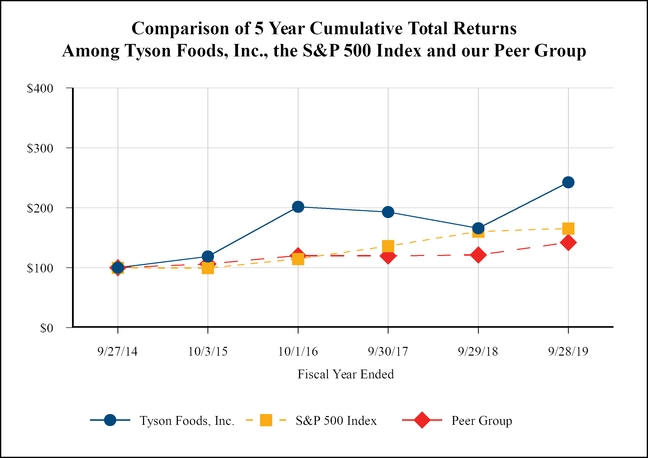][added: 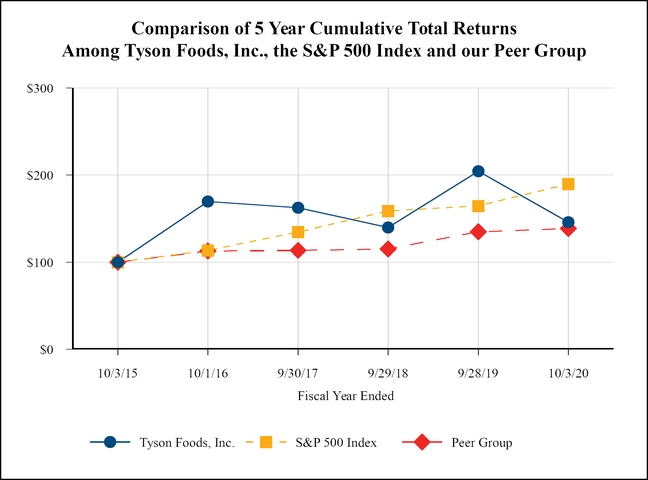]
The total cumulative return on investment (change in the year-end stock price plus reinvested dividends), which is based on the stock price or composite index at the end of fiscal [removed: 2014,] [added: 2015,] is presented for each of the periods for the Company, the S&P 500 Index and our peer group.
| Jun. 28, 2020 to July 25, 2020 | 36,636 | | | $ | 59.14 | | — | | | 18,851,028 | |
| Jul. 26, 2020 to Aug. 29, 2020 | 56,130 | | | 62.75 | | | — | | | 18,851,028 | |
| Aug. 30, 2020 to Oct. 3, 2020 | 31,214 | | | 62.78 | | | — | | | 18,851,028 | |
| Total | 123,980 | | (2) | $ | 61.69 | | — | | | 18,851,028 | |
| | |
| --- | --- |
| (3) | Shares purchased during the period pursuant to our previously announced stock repurchase program. |
| | 10/3/15 | | | | 10/1/16 | | | | 9/30/17 | | | | 9/29/18 | | | | 9/28/19 | | | | 10/3/20 | | |
| Tyson Foods, Inc. | $ | 100.00 | | | $ | 169.83 | | | $ | 162.63 | | | $ | 139.76 | | | $ | 204.38 | | | $ | 145.76 | |
| S&P 500 Index | 100.00 | | | | 115.43 | | | | 136.92 | | | | 161.43 | | | | 166.51 | | | | 191.87 | | |
| Peer Group | 100.00 | | | | 113.16 | | | | 112.81 | | | | 114.29 | | | | 133.93 | | | | 137.65 | | |
We also continue to anticipate our annual dividends to increase approximately $0.10 per share per year, though the timing and amount remains subject to the sole discretion of our Board, and no assurances can be provided that future dividends will increase or be declared at all.
| Jun. 30, 2019 to Jul. 27, 2019 | 84,436 | | | $ | 81.46 | | — | | | 20,658,386 | |
| Jul. 28, 2019 to Aug. 31, 2019 | 183,279 | | | 86.98 | | | — | | | 20,658,386 | |
| Sept. 1, 2019 to Sept. 28, 2019 | 42,378 | | | 89.73 | | | — | | | 20,658,386 | |
| Total | 310,093 | | (2) | $ | 85.85 | | — | | | 20,658,386 | |
| | 9/27/14 | | | | 10/3/15 | | | | 10/1/16 | | | | 9/30/17 | | | | 9/29/18 | | | | 9/28/19 | | |
| Tyson Foods, Inc. | $ | 100.00 | | | $ | 118.74 | | | $ | 201.66 | | | $ | 193.11 | | | $ | 165.96 | | | $ | 242.68 | |
| S&P 500 Index | 100.00 | | | | 99.39 | | | | 114.73 | | | | 136.08 | | | | 160.45 | | | | 165.49 | | |
| Peer Group | 100.00 | | | | 106.15 | | | | 120.12 | | | | 119.75 | | | | 121.32 | | | | 142.17 | | |
Item 6. SELECTED FINANCIAL DATA
39 rewritten, 2 added, 1 removed, 54 unchanged
| | [removed: 2019] [added: 2020] | | | | [removed: 2018] [added: 2019] | | | | [removed: 2017] [added: 2018] | | | | [removed: 2016] [added: 2017] | | | | [removed: 2015] [added: 2016] | | |
| Sales | $ | [removed: 42,405] [added: 43,185] | | | $ | [removed: 40,052] [added: 42,405] | | | $ | [removed: 38,260] [added: 40,052] | | | $ | [removed: 36,881] [added: 38,260] | | | $ | [removed: 41,373] [added: 36,881] | |
| Operating income | [removed: 2,827] [added: 3,114] | | | | [removed: 3,032] [added: 2,827] | | | | [removed: 2,921] [added: 3,032] | | | | [removed: 2,805] [added: 2,921] | | | | [removed: 2,180] [added: 2,805] | | |
| Net interest expense | [removed: 451] [added: 475] | | | | [removed: 343] [added: 451] | | | | [removed: 272] [added: 343] | | | | [removed: 243] [added: 272] | | | | [removed: 284] [added: 243] | | |
| Net income | [removed: 2,035] [added: 2,150] | | | | [removed: 3,027] [added: 2,035] | | | | [removed: 1,778] [added: 3,027] | | | | [removed: 1,772] [added: 1,778] | | | | [removed: 1,224] [added: 1,772] | | |
| Net income attributable to Tyson | [removed: 2,022] [added: 2,140] | | | | [removed: 3,024] [added: 2,022] | | | | [removed: 1,774] [added: 3,024] | | | | [removed: 1,768] [added: 1,774] | | | | [removed: 1,220] [added: 1,768] | | |
| Net income | [removed: 5.52] [added: 5.86] | | | | [removed: 8.19] [added: 5.52] | | | | [removed: 4.79] [added: 8.19] | | | | [removed: 4.53] [added: 4.79] | | | | [removed: 2.95] [added: 4.53] | | |
| Class A | [removed: 1.575] [added: 1.725] | | | | [removed: 1.275] [added: 1.575] | | | | [removed: 0.975] [added: 1.275] | | | | [removed: 0.650] [added: 0.975] | | | | [removed: 0.425] [added: 0.650] | | |
| Class B | [removed: 1.418] [added: 1.553] | | | | [removed: 1.148] [added: 1.418] | | | | [removed: 0.878] [added: 1.148] | | | | [removed: 0.585] [added: 0.878] | | | | [removed: 0.383] [added: 0.585] | | |
| Cash and cash equivalents | $ | [removed: 484] [added: 1,420] | | | $ | [removed: 270] [added: 484] | | | $ | [removed: 318] [added: 270] | | | $ | [removed: 349] [added: 318] | | | $ | [removed: 688] [added: 349] | |
| Total assets | [removed: 33,097] [added: 34,741] | | | | [removed: 29,109] [added: 33,097] | | | | [removed: 28,066] [added: 29,109] | | | | [removed: 22,373] [added: 28,066] | | | | [removed: 22,969] [added: 22,373] | | |
| Total gross debt | [removed: 11,932] [added: 11,339] | | | | [removed: 9,873] [added: 11,932] | | | | [removed: 10,203] [added: 9,873] | | | | [removed: 6,279] [added: 10,203] | | | | [removed: 6,690] [added: 6,279] | | |
| Shareholders’ equity | [removed: 14,226] [added: 15,597] | | | | [removed: 12,811] [added: 14,226] | | | | [removed: 10,559] [added: 12,811] | | | | [removed: 9,624] [added: 10,559] | | | | [removed: 9,706] [added: 9,624] | | |
| Depreciation and amortization | $ | [removed: 1,098] [added: 1,192] | | | $ | [removed: 943] [added: 1,098] | | | $ | [removed: 761] [added: 943] | | | $ | [removed: 705] [added: 761] | | | $ | [removed: 711] [added: 705] | |
| Capital expenditures | [removed: 1,259] [added: 1,199] | | | | [removed: 1,200] [added: 1,259] | | | | [removed: 1,069] [added: 1,200] | | | | [removed: 695] [added: 1,069] | | | | [removed: 854] [added: 695] | | |
| EBITDA | [removed: 3,968] [added: 4,423] | | | | [removed: 4,021] [added: 3,968] | | | | [removed: 3,648] [added: 4,021] | | | | [removed: 3,538] [added: 3,648] | | | | [removed: 2,906] [added: 3,538] | | |
| Return on invested capital | [removed: 11.8] [added: 12.2] | | % | | [removed: 14.1] [added: 11.8] | | % | | [removed: 16.2] [added: 14.1] | | % | | [removed: 17.9] [added: 16.2] | | % | | [removed: 13.5] [added: 17.9] | | % |
| Effective tax rate | [added: 22.4 | | % | |] 16.3 | | % | | (10.3 | | )% | | 32.3 | | % | | 31.8 | | % | [removed: | 36.3 | | % |]
| Total debt to capitalization | [removed: 45.6] [added: 42.1] | | % | | [removed: 43.5] [added: 45.6] | | % | | [removed: 49.1] [added: 43.5] | | % | | [removed: 39.5] [added: 49.1] | | % | | [removed: 40.8] [added: 39.5] | | % |
| Book value per share | $ | [removed: 38.95] [added: 42.83] | | | $ | [removed: 35.09] [added: 38.95] | | | $ | [removed: 28.72] [added: 35.09] | | | $ | [removed: 25.67] [added: 28.72] | | | $ | [removed: 24.25] [added: 25.67] | |
| [removed: a.] [added: b.] | Fiscal 2019 net income included $105 million post tax income related to the recognition of previously unrecognized tax benefit, $55 million pretax gain on sale of an investment, $37 million pretax Keystone Foods purchase accounting and acquisition related costs, $41 million pretax impairment charge related to the planned divestiture of a business, $31 million pretax Beef production [removed: plant] [added: facility] fire costs, $15 million pretax pension plan termination charge and $41 million pretax restructuring and related charges. Additionally, in fiscal 2019, we [removed: have retrospectively recognized adjustment of prior periods in accordance with recently] adopted accounting guidance related to net periodic pension and postretirement benefits. Accordingly, [removed: operating income was] [added: we retrospectively] reduced [removed: by $23 million, $10 million, $28 million, and increased by $11 million for fiscal years 2018, 2017, 2016 and 2015, respectively. For further description refer to Part II, Item 8, Notes to the Consolidated Financial Statements, Note 2: Changes in Accounting Principles.] [added: prior periods operating income.] |
| [removed: b.] [added: c.] | Fiscal 2018 net income included $1,003 million post-tax recognition of tax benefit from remeasurement of net deferred tax liabilities at lower enacted tax rates, $109 million pretax one-time cash bonus to our hourly frontline [removed: employees,] [added: team members,] $68 million pretax impairment charge net of a realized gain related to the divestiture of non-protein businesses and $59 million pretax restructuring and related charges. |
| [removed: c.] [added: d.] | Fiscal 2017 net income included $103 million pretax expense of AdvancePierre purchase accounting and acquisition related costs, pretax impairment charges of $52 million related to our San Diego Prepared Foods operation, $45 million related to the expected sale of a non-protein business and pretax restructuring and related charges of $150 million. |
| [removed: d.] [added: e.] | Fiscal 2016 net income included $53 million post tax related to the recognition of previously unrecognized tax benefits and audit settlements. In fiscal 2016, we adopted new accounting guidance, retrospectively, requiring classification of debt issuance costs as a reduction of the carrying value of the debt. In doing so, $29 million [removed: and $35 million] of deferred issuance costs were reclassified from Other Assets to Long-Term Debt in our Consolidated Balance Sheets for fiscal [removed: 2016 and 2015, respectively.] [added: 2016.] This change is reflected above in total assets, total debt, total debt to capitalization and return on invested capital ratios. |
| h. | Book value per share is calculated by dividing shareholders’ equity by the sum of Class A and B shares outstanding and for fiscal [removed: 2016 and 2015,] [added: 2016,] the remaining minimum shares that were to be issued from our tangible equity units each period. |
| Net income | $ | [removed: 2,035] [added: 2,150] | | | $ | [removed: 3,027] [added: 2,035] | | | $ | [removed: 1,778] [added: 3,027] | | | $ | [removed: 1,772] [added: 1,778] | | | $ | [removed: 1,224] [added: 1,772] | |
| Less: Interest income | [removed: (11] [added: (10] | | ) | | [removed: (7] [added: (11] | | ) | | (7 | | ) | | [removed: (6] [added: (7] | | ) | | [removed: (9] [added: (6] | | ) |
| Add: Interest expense | [removed: 462] [added: 485] | | | | [removed: 350] [added: 462] | | | | [removed: 279] [added: 350] | | | | [removed: 249] [added: 279] | | | | [removed: 293] [added: 249] | | |
| Add: Income tax expense (benefit) | [added: 620 | | | |] 396 | | | | (282 | | ) | | 850 | | | | 826 | | | [removed: | 697 | | |]
| Add: Depreciation | [removed: 819] [added: 900] | | | | [removed: 723] [added: 819] | | | | [removed: 642] [added: 723] | | | | [removed: 617] [added: 642] | | | | [removed: 609] [added: 617] | | |
| Add: Amortization (a) | [removed: 267] [added: 278] | | | | [removed: 210] [added: 267] | | | | [removed: 106] [added: 210] | | | | [removed: 80] [added: 106] | | | | [removed: 92] [added: 80] | | |
| EBITDA | $ | [removed: 3,968] [added: 4,423] | | | $ | [removed: 4,021] [added: 3,968] | | | $ | [removed: 3,648] [added: 4,021] | | | $ | [removed: 3,538] [added: 3,648] | | | $ | [removed: 2,906] [added: 3,538] | |
| Total gross debt | $ | [removed: 11,932] [added: 11,339] | | | $ | [removed: 9,873] [added: 11,932] | | | $ | [removed: 10,203] [added: 9,873] | | | $ | [removed: 6,279] [added: 10,203] | | | $ | [removed: 6,690] [added: 6,279] | |
| Less: Cash and cash equivalents | [removed: (484] [added: (1,420] | | ) | | [removed: (270] [added: (484] | | ) | | [removed: (318] [added: (270] | | ) | | [removed: (349] [added: (318] | | ) | | [removed: (688] [added: (349] | | ) |
| Less: Short-term investments | [removed: (1] [added: —] | | [removed: )] | | (1 | | ) | | [removed: (3] [added: (1] | | ) | | [removed: (4] [added: (3] | | ) | | [removed: (2] [added: (4] | | ) |
| Total net debt | $ | [removed: 11,447] [added: 9,919] | | | $ | [removed: 9,602] [added: 11,447] | | | $ | [removed: 9,882] [added: 9,602] | | | $ | [removed: 5,926] [added: 9,882] | | | $ | [removed: 6,000] [added: 5,926] | |
| Gross debt/EBITDA | [removed: 3.0x] [added: 2.6x] | | | | [removed: 2.5x] [added: 3.0x] | | | | [removed: 2.8x] [added: 2.5x] | | | | [removed: 1.8x] [added: 2.8x] | | | | [removed: 2.3x] [added: 1.8x] | | |
| Net debt/EBITDA | [removed: 2.9x] [added: 2.2x] | | | | [removed: 2.4x] [added: 2.9x] | | | | [removed: 2.7x] [added: 2.4x] | | | | [removed: 1.7x] [added: 2.7x] | | | | [removed: 2.1x] [added: 1.7x] | | |
| (a) | Excludes the amortization of debt issuance and debt discount expense of [added: $14 million,] $12 million, $10 million, $13 [removed: million, $8] million and [removed: $10] [added: $8] million for fiscal [added: 2020,] 2019, 2018, [removed: 2017, 2016] [added: 2017] and [removed: 2015,] [added: 2016,] respectively, as it is included in Interest expense. |
| a. | Fiscal 2020 net income included $116 million pretax gain from pension plan terminations, $75 million pretax restructuring and related charges and $65 million pretax income related to our accounting cycle resulting in a 53-week year in fiscal 2020. Additionally, in fiscal 2020, we adopted new guidance for leasing arrangements using the optional transition method, where prior periods were not restated. For further description, refer to Part II, Item 8, Notes to the Consolidated Financial Statements, Note 2: Changes in Accounting Principles. |
| | 2020 | | | | 2019 | | | | 2018 | | | | 2017 | | | | 2016 | | |
| e. | Fiscal 2015 was a 53-week year, while the other years presented were 52-week years. Fiscal 2015 included a $169 million pretax impairment charge related to our China operation, $57 million pretax expense related to merger and integration costs, $59 million pretax impairment charges related to our Prepared Foods network optimization, $12 million pretax charges related to Denison impairment and plant closure costs, $8 million pretax gain related to net insurance proceeds (net of costs) related to a legacy Hillshire Brands plant fire, $21 million pretax gain on the sale of equity securities, $161 million pretax gain on the sale of the Mexico operation, $39 million pretax gain related to the impact of the additional week in fiscal 2015 and $26 million post tax from unrecognized tax benefit gain. |
Item 8. FINANCIAL STATEMENTS AND SUPPLEMENTARY DATA
574 rewritten, 308 added, 252 removed, 896 unchanged
| | Three years ended [removed: September 28, 2019] [added: October 3, 2020] | | | | | | | | | | |
| | [removed: 2019] [added: 2020] | | | | [removed: 2018] [added: 2019] | | | | [removed: 2017] [added: 2018] | | |
| Sales | $ | [removed: 42,405] [added: 43,185] | | | $ | [removed: 40,052] [added: 42,405] | | | $ | [removed: 38,260] [added: 40,052] | |
| Cost of Sales | [removed: 37,383] [added: 37,801] | | | | [removed: 34,956] [added: 37,383] | | | | [removed: 33,198] [added: 34,956] | | |
| Gross Profit | [removed: 5,022] [added: 5,384] | | | | [removed: 5,096] [added: 5,022] | | | | [removed: 5,062] [added: 5,096] | | |
| Selling, General and Administrative | [removed: 2,195] [added: 2,270] | | | | [removed: 2,064] [added: 2,195] | | | | [removed: 2,141] [added: 2,064] | | |
| Operating Income | [removed: 2,827] [added: 3,114] | | | | [removed: 3,032] [added: 2,827] | | | | [removed: 2,921] [added: 3,032] | | |
| Interest income | [removed: (11] [added: (10] | | ) | | [removed: (7] [added: (11] | | ) | | (7 | | ) |
| Interest expense | [removed: 462] [added: 485] | | | | [removed: 350] [added: 462] | | | | [removed: 279] [added: 350] | | |
| Other, net | [removed: (55] [added: (52] | | ) | | [removed: (56] [added: 88] | | [removed: )] | | [removed: 21] [added: (24] | | [added: )] |
| Total Other (Income) Expense | [removed: 396] [added: 344] | | | | [removed: 287] [added: 396] | | | | [removed: 293] [added: 287] | | |
| Income before Income Taxes | [removed: 2,431] [added: 2,770] | | | | [removed: 2,745] [added: 2,431] | | | | [removed: 2,628] [added: 2,745] | | |
| Income Tax Expense (Benefit) | [removed: 396] [added: 620] | | | | [removed: (282] [added: 396] | | [removed: )] | | [removed: 850] [added: (282] | | [added: )] |
| Net Income | [removed: 2,035] [added: 2,150] | | | | [removed: 3,027] [added: 2,035] | | | | [removed: 1,778] [added: 3,027] | | |
| Less: Net Income Attributable to Noncontrolling Interests | [removed: 13] [added: 10] | | | | [removed: 3] [added: 13] | | | | [removed: 4] [added: 3] | | |
| Net Income Attributable to Tyson | $ | [removed: 2,022] [added: 2,140] | | | $ | [removed: 3,024] [added: 2,022] | | | $ | [removed: 1,774] [added: 3,024] | |
| Class A Basic | 293 | | | | [removed: 295] [added: 293] | | | | [removed: 296] [added: 295] | | |
| Diluted | [removed: 366] [added: 365] | | | | [removed: 369] [added: 366] | | | | [removed: 370] [added: 369] | | |
| Class A Basic | $ | [removed: 5.67] [added: 6.02] | | | $ | [removed: 8.44] [added: 5.67] | | | $ | [removed: 4.94] [added: 8.44] | |
| Class B Basic | $ | [removed: 5.10] [added: 5.41] | | | $ | [removed: 7.59] [added: 5.10] | | | $ | [removed: 4.45] [added: 7.59] | |
| Diluted | $ | [removed: 5.52] [added: 5.86] | | | $ | [removed: 8.19] [added: 5.52] | | | $ | [removed: 4.79] [added: 8.19] | |
| Net Income | $ | [removed: 2,035] [added: 2,150] | | | $ | [removed: 3,027] [added: 2,035] | | | $ | [removed: 1,778] [added: 3,027] | |
| Derivatives accounted for as cash flow hedges | [removed: (15] [added: 9] | | [removed: )] | | [removed: (7] [added: (15] | | ) | | [removed: —] [added: (7] | | [added: )] |
| Investments | [removed: 2] [added: 1] | | | | [removed: (1] [added: 2] | | [removed: )] | | (1 | | ) |
| Currency translation | [removed: (23] [added: (29] | | ) | | [removed: (29] [added: (23] | | ) | | [removed: 6] [added: (29] | | [added: )] |
| Postretirement benefits | [removed: (66] [added: (43] | | ) | | [removed: (7] [added: (66] | | ) | | [removed: 56] [added: (7] | | [added: )] |
| Total Other Comprehensive Income (Loss), Net of Taxes | [removed: (102] [added: (62] | | ) | | [removed: (44] [added: (102] | | ) | | [removed: 61] [added: (44] | | [added: )] |
| Comprehensive Income | [removed: 1,933] [added: 2,088] | | | | [removed: 2,983] [added: 1,933] | | | | [removed: 1,839] [added: 2,983] | | |
| Less: Comprehensive Income Attributable to Noncontrolling Interests | [removed: 13] [added: 10] | | | | [removed: 3] [added: 13] | | | | [removed: 4] [added: 3] | | |
| Comprehensive Income Attributable to Tyson | $ | [removed: 1,920] [added: 2,078] | | | $ | [removed: 2,980] [added: 1,920] | | | $ | [removed: 1,835] [added: 2,980] | |
| [removed: September 28, 2019,] [added: October 3, 2020,] and September [removed: 29, 2018] [added: 28, 2019] | | | | | | | |
| | [added: 2020 | | | |] 2019 | | | | 2018 | | |
| Cash and cash equivalents | $ | [removed: 484] [added: 1,420] | | | $ | [removed: 270] [added: 484] | |
| Accounts receivable, net | [removed: 2,173] [added: 1,952] | | | | [removed: 1,723] [added: 2,173] | | |
| Inventories | [removed: 4,108] [added: 4,144] | | | | [removed: 3,513] [added: 4,108] | | |
| Other current assets | [removed: 404] [added: 367] | | | | [removed: 182] [added: 404] | | |
| Total Current Assets | [removed: 7,169] [added: 7,883] | | | | [removed: 5,688] [added: 7,169] | | |
| Net Property, Plant and Equipment | [removed: 7,282] [added: 7,596] | | | | [removed: 6,169] [added: 7,282] | | |
| Goodwill | [removed: 10,844] [added: 10,899] | | | | [removed: 9,739] [added: 10,844] | | |
| Intangible Assets, net | [removed: 7,037] [added: 6,774] | | | | [removed: 6,759] [added: 7,037] | | |
| | Three years ended October 3, 2020 | | | | | | | | | | | | | | | | | | | |
| | Three years ended October 3, 2020 | | | | | | | | | | |
| Net income | $ | 2,150 | | | $ | 2,035 | | | $ | 3,027 | |
| Acquisition of equity investments | (183 | | ) | | — | | | | — | | |
| Cash and Cash Equivalents and Restricted Cash at End of Year | 1,466 | | | | 484 | | | | 270 | | |
| Less: Restricted Cash at End of Year | 46 | | | | — | | | | — | | |
| | 2020 | | | | 2019 | | |
We estimate the fair value of our reporting units considering the use of various valuation techniques, with the primary technique being an income approach (discounted cash flow method), with another technique being a market approach (guideline public company method), which use significant unobservable inputs, or Level 3 inputs, as defined by the fair value hierarchy.
All of our material reporting units’ estimated fair value exceeded their carrying value by more than 20% at the date of their most recent estimated fair value determination, other than the Domestic Chicken reporting unit, which had $3,266 million of goodwill at October 3, 2020.
All of our indefinite life intangible assets’ estimated fair value exceeded their carrying value by more than 20% at the date of their most recent estimated fair value determination.
Leases: We determine if an agreement is or contains a lease at its inception by evaluating if an identified asset exists that we control for a period of time.
When a lease exists, we classify it as a finance or operating lease and record a right-of-use ("ROU") asset and a corresponding lease liability at lease commencement.
We have elected to not record leases with a term of 12 months or less in our Consolidated Balance Sheets, and accordingly, lease expense for these short-term leases is recognized on a straight-line basis over the lease term.
Finance lease assets are presented within Net Property, Plant and Equipment and finance lease liabilities are presented within Current and Long-Term Debt in our Consolidated Balance Sheets.
Finance lease disclosures are omitted as they are deemed immaterial.
Operating ROU assets are presented within Other Assets, and operating lease liabilities are recorded within Other current liabilities and Other Liabilities in our Consolidated Balance Sheets.
Lease assets are subject to review for impairment within the related long-lived asset group.
ROU assets are presented in our Consolidated Balance Sheets based on the present value of the corresponding liabilities and are adjusted for any prepayments, lease incentives received or initial direct costs incurred.
The measurement of our ROU assets and liabilities includes all fixed payments and any variable payments based on an index or rate.
Variable lease payments which do not depend on an index, or where rates are unknown, are excluded from lease payments in the measurement of the ROU asset and lease liability, and accordingly, are recognized as lease expense in the period the obligation for those payments is incurred.
The present value of lease payments is based on our incremental borrowing rate according to the lease term and information available at the lease commencement date, as our lease arrangements generally do not provide an implicit interest rate.
The incremental borrowing rate is derived using a hypothetically-collateralized borrowing cost, based on our revolving credit facility, plus a country risk factor, where applicable.
We consider our credit rating and the current economic environment in determining the collateralized rate.
Our lease arrangements can include fixed or variable non-lease components, such as common area maintenance, taxes and labor.
We account for each lease and any non-lease components associated with that lease as a single lease component for all asset classes, except production and livestock grower asset classes embedded in service and supply agreements, and other asset classes that include significant maintenance or service components.
We account for lease and non-lease components of an agreement separately based on relative stand-alone prices either observable or estimated if observable prices are not readily available.
For asset classes where an election was made not to separate lease and non-lease components, all costs associated with a lease contract are disclosed as lease costs.
The accounting for some of the Company's leases may require significant judgment when determining whether a contract is or contains a lease, the lease term, and the likelihood of exercising renewal or termination options.
Our leases can include options to extend or terminate use of the underlying assets.
These options are included in the lease term used to determine ROU assets and corresponding liabilities when we are reasonably certain we will exercise the option.
Additionally, certain leases can have residual value guarantees, which are included within our operating lease liabilities when considered probable.
Our lease agreements do not include significant restrictions or covenants.
Operating lease expense is recognized on a straight-line basis over the lease term, whereas the amortization of finance lease assets is recognized on a straight-line basis over the shorter of the estimated useful life of the underlying asset or the lease term.
Operating lease expense and finance lease amortization are presented in Cost of Sales or Selling, General and Administrative in our Consolidated Statements of Income depending on the nature of the leased item.
Interest expense on finance lease obligations is recorded over the lease term and is presented in Interest expense, based on the effective interest method.
All operating lease cash payments and interest on finance leases are presented within Net cash provided by operating activities and all finance lease principal payments are presented within Net cash used in financing activities in our Consolidated Statements of Cash Flows.
| | 2020 | | | | 2019 | | |
Risks and Uncertainties: We have considered the impact of the global novel coronavirus pandemic (“COVID-19” or “pandemic”) on our consolidated financial statements.
In addition to the COVID-19 impacts already experienced, there likely will be future impacts, the extent of which is uncertain and largely subject to whether the severity worsens or duration lengthens.
These impacts could include but may not be limited to risks and uncertainty related to worker availability, our ability to operate production facilities, demand-driven production facility idling, shifts in demand between sales channels and market volatility in our supply chain.
| Payment of AdvancePierre TRA liability | — | | | | — | | | | (223 | | ) |
| | | | | | in millions | | |
We estimate the fair value of our reporting units using a combination of various valuation techniques, including an income approach (discounted cash flow analysis) and market approaches (earnings before interest, taxes, depreciation and amortization or "EBITDA" multiples of comparable publicly-traded companies and precedent transactions).
Our primary technique is discounted cash flow analysis.
The discount rate used in our indefinite life intangible test decreased to 7.5% in fiscal 2019 from 8.2% in fiscal 2018.
| | in millions | | | | | | |
Early adoption is permitted.
In July 2018, the FASB issued an adoption approach that allows entities to apply the guidance as of the date of the initial application.
We will adopt the standard in the first quarter of fiscal 2020 using this transition method, and as a result, we will not adjust comparative period financial information or make the new required lease disclosures for periods before the effective date.
We have performed a review of the lease portfolio and have implemented a leasing software solution to support the future state lease accounting requirements.
We continue to finalize our implementation efforts and currently estimate that upon adoption we will record operating right of use assets and related lease liabilities of approximately 2% of total assets, subject to the completion of our assessment including finalizing the impacts from recent business acquisitions.
In August 2018, the FASB issued guidance aligning the requirements for capitalizing implementation costs incurred in a hosting arrangement that is a service contract with the requirements for capitalizing implementation costs incurred to develop or obtain internal-use software.
The prospective transition method should be applied to all qualified implementation costs incurred after the adoption date.
In May 2017, the FASB issued guidance that clarifies which changes to the terms or conditions of a share-based payment award require an entity to apply modification accounting in Topic 718.
The prospective transition method should be applied to awards modified on or after the adoption date.
In March 2017, the FASB issued guidance that changes the presentation of net periodic benefit cost related to employer sponsored defined benefit plans and other postretirement benefits.
Service cost will be included within the same income statement line item as other compensation costs arising from services rendered during the period, while other components of net periodic benefit pension cost will be presented separately outside of operating income.
Additionally, only the service cost component will be eligible for capitalization when applicable.
The retrospective transition method should be applied for the presentation of the service cost component and the other components of net periodic pension cost and net periodic postretirement benefit cost in the income statement, and the prospective transition method should be applied, on and after the effective date, for the capitalization of the service cost component of net periodic pension cost and net periodic postretirement benefit in assets.
The guidance includes a practical expedient allowing entities to estimate amounts for comparative periods using the information previously disclosed in the pension and other postretirement benefit plan footnote.
We adopted this guidance in the first quarter of fiscal 2019 on a retrospective basis using the practical expedient and it did not have a material impact on our consolidated financial statements.
The following reconciliations provide the effect of the reclassification of the net periodic benefit cost from operating expenses to other (income) expense in our consolidated statements of income for fiscal year 2018 and 2017 (in millions):
| | | | | | | | | | |
| --- | --- | --- | --- | --- | --- | --- | --- | --- | --- |
| Twelve Months Ended September 29, 2018: | As Previously Reported | | | Adjustments | | | As Recast | | |
| Selling, General and Administrative | $ | 2,071 | | $ | (7 | ) | $ | 2,064 | |
| Operating Income | $ | 3,055 | | $ | (23 | ) | $ | 3,032 | |
| Twelve Months Ended September 30, 2017: | As Previously Reported | | | Adjustments | | | As Recast | | |
| Cost of Sales | $ | 33,177 | | $ | 21 | | $ | 33,198 | |
| Selling, General and Administrative | $ | 2,152 | | $ | (11 | ) | $ | 2,141 | |
| Operating Income | $ | 2,931 | | $ | (10 | ) | $ | 2,921 | |
| Other (Income) Expense | $ | 303 | | $ | (10 | ) | $ | 293 | |
In November 2016, the FASB issued guidance that requires entities to show the changes in the total of cash, cash equivalents, restricted cash and restricted cash equivalents in the statement of cash flows.
The retrospective transition method should be applied.
In October 2016, the FASB issued guidance that requires companies to recognize the income tax effects of intercompany sales and transfers of assets, other than inventory, in the period in which the transfer occurs.
The modified retrospective transition method should be applied.
In August 2016, the FASB issued guidance that aims to eliminate diversity in practice in how certain cash receipts and cash payments are presented and classified in the statement of cash flows.
In January 2016, the FASB issued guidance that requires most equity investments be measured at fair value, with subsequent other changes in fair value recognized in net income.
The guidance also impacts financial liabilities under the fair value option and the presentation and disclosure requirements on the classification and measurement of financial instruments.
It should be applied by means of a cumulative-effect adjustment to the balance sheet as of the beginning of the fiscal year of adoption, unless equity securities do not have readily determinable fair values, in which case the amendments should be applied prospectively.
An excerpt. Shown here: 40 of 574 rewritten, 40 of 308 added and 40 of 252 removed. The counts are complete. For every sentence, read Item 8. FINANCIAL STATEMENTS AND SUPPLEMENTARY DATA in the FY2020 filing and the FY2019 filing.
Item 9A. CONTROLS AND PROCEDURES
6 rewritten, 0 added, 0 removed, 11 unchanged
Based on that evaluation, the CEO and CFO concluded that, as of [removed: September 28, 2019,] [added: October 3, 2020,] our disclosure controls and procedures were effective.
In the quarter ended [removed: September 28, 2019,] [added: October 3, 2020,] there have been no changes in the Company’s internal control over financial reporting that have materially affected, or are reasonably likely to materially affect, the Company’s internal control over financial reporting.
The implementation will continue in additional phases [removed: over the next year.][added: into fiscal 2021.]
Management conducted an evaluation of the effectiveness of our internal control over financial reporting as of [removed: September 28, 2019.][added: October 3, 2020.]
Based on this evaluation under the framework in *Internal Control - Integrated Framework* (2013) issued by COSO, management concluded the Company’s internal control over financial reporting was effective as of [removed: September 28, 2019.][added: October 3, 2020.]
The Company’s independent registered public accounting firm, PricewaterhouseCoopers LLP, who has audited the fiscal [removed: 2019] [added: 2020] financial statements included in this Annual Report on Form 10-K, has also audited the effectiveness of the Company’s internal control over financial reporting as of [removed: September 28, 2019] [added: October 3, 2020] as stated in its report which appears in Part II, Item 8 of this Annual Report on Form 10-K.
Item 9B. OTHER INFORMATION
0 rewritten, 1 added, 23 removed, 1 unchanged
None.
On November 6, 2019, the Board of Directors (the “Board”) of the Company announced that Dean Banks, a current independent director of the Company, was appointed to the position of President, effective as of the first date of his employment with the Company, which is anticipated on December 20, 2019 (the “Effective Date”).
Mr. Banks will report to Noel White, the Company’s current President and Chief Executive Officer, who will relinquish his role as President as of the Effective Date.
Mr. Banks will continue in his position as a director of the Company but will cease serving on any of the Board committees.
Mr. Banks, 46, is currently senior executive at X, an Alphabet Inc. company, where he leads the development of emerging technology products.
He has been in that role since 2016, prior to which he was a managing partner and interim CEO at SEED Ventures since 2015.
Previously, in 2014 he served as a consultant to Cleveland Clinic Innovations and as the CEO of Occelerator.
Prior to those roles, at OrthoHelix (acquired by Tornier, Inc.) he was the SVP of Business Development and Strategic Marketing from 2011 to 2012 and, from 2012 to 2013 at Tornier, the Vice President of Product Excellence.
In connection with Mr. Banks’ appointment to the role of President, he entered into an offer letter and an employment agreement (collectively, the “Employment Agreement”) with the Company on November 6, 2019.
The Employment Agreement provides for, among other things, an annual base salary of $1,150,000, with a sign-on bonus of $5,000,000, which Mr. Banks will be required to repay should he (i) voluntarily terminate his employment without “good reason” with the Company prior to the two-year anniversary of the Effective Date or (ii) not relocate and establish a permanent residence in the Springdale, Arkansas area prior to the 12-month anniversary of the Effective Date.
Additionally, as of the Effective Date, Mr. Banks will be eligible to participate in the Company’s Annual Incentive Plan and Executive Savings Plan, as well as the Company’s long-term equity incentive program (“LTI Program”) under the Company’s 2000 Stock Incentive Plan.
His 2020 Annual Incentive Plan payout opportunity will be equal to 150% of his base salary at the target level of performance, prorated based on the Effective Date.
His 2020 LTI Program opportunity will be equal to $5,500,000 at the target level, prorated based on the Effective Date, with the dollar value of equity compensation being awarded in a mix of stock options, restricted stock with performance criteria and performance stock.
The Employment Agreement also provides that upon termination by the Company (other than for “cause” or by reason of death or permanent disability) or if Mr. Banks resigns for “good reason”, the Company will pay Mr. Banks an amount equal to two years of his base salary and two times his target annual cash bonus, to be paid out over two years, plus continued medical coverage for up to 18 months.
Additionally, Mr. Banks is entitled to personal use of Company-owned aircraft in a manner consistent with the Company’s policy governing aircraft use by executive officers.
Current Company policy is to “gross up” for tax purposes any approved personal use of Company-owned aircraft.
The Employment Agreement contains a non-competition restriction for a period of 24 months post termination and a 36 month post-termination non-solicitation restriction.
Mr. Banks will also be eligible for the Executive Rewards Allowance ("ERA"), which will provide him with an annual cash allowance of $12,000, prorated based on the Effective Date.
The ERA is taxable income to Mr. Banks and can be used for an array of items based on the needs of him and his family.
Mr. Banks will also receive relocation benefits in accordance with Company policy.
Furthermore, upon signing of the Employment Agreement, Mr. Banks received a one-time payment of $1,000 as additional consideration for signing an employment agreement with the Company.
The foregoing description is qualified by reference to the full text of the Employment Agreement, which is filed as Exhibit 10.15 attached hereto and is incorporated by reference in its entirety into this Item 9B.
There are no arrangements or understandings between Mr. Banks and any other persons pursuant to which Mr. Banks was selected to be President of the Company.
In addition, there are no transactions involving the Company and Mr. Banks that would be required to be disclosed pursuant to Item 404(a) of Regulation S-K.
Item 10. DIRECTORS, EXECUTIVE OFFICERS AND CORPORATE GOVERNANCE
2 rewritten, 0 added, 0 removed, 3 unchanged
See information set forth under the captions “Election of Directors”, "Information Regarding the Board and its Committees" and "Report of the Audit Committee" in the Company’s definitive Proxy Statement for the Company’s Annual Meeting of Shareholders to be held February [removed: 6, 2020] [added: 11, 2021] (the “Proxy Statement”), which information is incorporated herein by reference.
We have a code of ethics as defined in Item 406 of Regulation S-K, which applies to all of our directors and [removed: employees,] [added: team members,] including our principal executive officers, principal financial officer, principal accounting officer or controller, and persons performing similar functions.
Item 11. EXECUTIVE COMPENSATION
1 rewritten, 0 added, 0 removed, 1 unchanged
See the information set forth under the captions “Executive Compensation,” “Director Compensation For Fiscal Year [removed: 2019,”] [added: 2020,”] “Compensation Discussion and Analysis,” “Report of the Compensation and Leadership Development Committee,” “Compensation Committee Interlocks and Insider Participation”, and "Section 16(a) Beneficial Ownership Reporting Compliance" in the Proxy Statement, which information is incorporated herein by reference.
Item 12. SECURITY OWNERSHIP OF CERTAIN BENEFICIAL OWNERS AND MANAGEMENT AND RELATED STOCKHOLDER MATTERS
2 rewritten, 2 added, 4 removed, 8 unchanged
The following information reflects certain information about our equity compensation plans as of [removed: September 28, 2019:][added: October 3, 2020:]
[removed: |] (a) [removed: |] Shares of Class A [removed: Commone] [added: Common] Stock available for future issuance as of [removed: September 28, 2019,] [added: October 3, 2020,] under the Stock Incentive Plan [removed: (12,952,617),] [added: (9,979,081),] the Employee Stock Purchase Plan [removed: (12,725,001)] [added: (11,578,908)] and the Retirement Savings Plan [removed: (7,647,608) |][added: (7,647,608).]
| Equity compensation plans approved by security holders | 5,951,473 | | | $ | 62.86 | | | 29,205,597 | |
| Total | 5,951,473 | | | $ | 62.86 | | | 29,205,597 | |
| Equity compensation plans approved by security holders | 5,362,672 | | | $ | 54.03 | | | 33,325,226 | |
| Total | 5,362,672 | | | $ | 54.03 | | | 33,325,226 | |
| | |
| --- | --- |
Item 15. EXHIBITS, FINANCIAL STATEMENT SCHEDULES
140 rewritten, 15 added, 10 removed, 174 unchanged
Consolidated Statements of Income for the three years ended [removed: September 28, 2019][added: October 3, 2020]
Consolidated Statements of Comprehensive Income for the three years ended [removed: September 28, 2019][added: October 3, 2020]
Consolidated Balance Sheets at [removed: September 28, 2019,] [added: October 3, 2020,] and September [removed: 29, 2018][added: 28, 2019]
Consolidated Statements of Shareholders’ Equity for the three years ended [removed: September 28, 2019][added: October 3, 2020]
Consolidated Statements of Cash Flows for the three years ended [removed: September 28, 2019][added: October 3, 2020]
Financial Statement Schedule - Schedule II Valuation and Qualifying Accounts for the three years ended [removed: September 28, 2019][added: October 3, 2020]
| 2.1 | | [removed: [Agreement and Plan of Merger] [added: [Share Purchase Agreement,] dated as of [removed: April 25, 2017] [added: August 17, 2018, by and] among Tyson Foods, Inc., [removed: AdvancePierre] [added: Keystone] Foods [removed: Holdings, Inc.] [added: Holdings Limited] and [removed: DVB Merger Sub, Inc.] [added: Marfrig Global Foods S.A.] (previously filed as Exhibit 2.1 to the Company's Current Report on Form 8-K filed on [removed: April 28, 2017, Commission File No. 001-14704,] [added: August 23, 2018,] and incorporated herein by reference). Exhibits and schedules have been omitted pursuant to Item 601(b)(2) of Regulation S-K, but a copy will be furnished supplementally to the Securities and Exchange Commission upon [removed: request.](http://www.sec.gov/Archives/edgar/data/100493/000010049317000075/exhibit21agreementandplano.htm)] [added: request.](http://www.sec.gov/Archives/edgar/data/100493/000010049318000098/exhibit21spa.htm)] |
| 3.1 | | [Restated Certificate of Incorporation of the Company (previously filed as Exhibit 3.1 to the Company’s Annual Report on Form 10-K for the fiscal year ended October 3, 1998, [removed: Commission File No. 001-14704,] and incorporated herein by reference).](http://www.sec.gov/Archives/edgar/data/100493/0000100493-98-000013.txt) |
| 3.2 | | [removed: [Fifth] [added: [Sixth] Amended and Restated [removed: By-laws] [added: By-Laws] of the Company (previously filed as Exhibit [removed: 3.2] [added: 3.1] to the [removed: Company’s Quarterly] [added: Company's Current] Report on Form [removed: 10-Q] [added: 8-K,] filed [removed: for] [added: with] the [removed: period ended June 29, 2013,] [added: Securities and Exchange] Commission [removed: File No. 001-14704,] [added: on February 12, 2020,] and incorporated herein by [removed: reference).](http://www.sec.gov/Archives/edgar/data/100493/000010049313000052/tsn2013q3exh-32.htm)] [added: reference).](https://www.sec.gov/Archives/edgar/data/100493/000010049320000043/tsn20208kexh-31.htm)] |
| 4.1 | | [Description of the Registrant's Securities Registered Pursuant to Section 12 of the Securities Exchange Act of [removed: 1934.](https://www.sec.gov/Archives/edgar/data/100493/000010049319000118/tsn2019q4exh-41.htm)] [added: 1934 (previously filed as Exhibit 4.1 to the Company's Annual Report on Form 10-K for the period ended September 28, 2019, and incorporated herein by reference).](https://www.sec.gov/Archives/edgar/data/100493/000010049319000118/tsn2019q4exh-41.htm)] |
| 4.3 | | [Form of 7.0% Note due January 15, 2028, issued under the Company Indenture (previously filed as Exhibit 4.2 to the Company’s Quarterly Report on Form 10-Q for the period ended December 27, 1997, [removed: Commission File No. 001-14704,] and incorporated herein by reference).](http://www.sec.gov/Archives/edgar/data/100493/0000100493-98-000007.txt) |
| 4.4 | | [Supplemental Indenture dated as of June 13, 2012, by and between the Company and The Bank of New York Mellon Trust Company, National Association (as successor to JPMorgan Chase Bank, N.A. (formerly The Chase Manhattan Bank, N.A.)), as Trustee, supplementing the Company Indenture (previously filed as Exhibit 4.1 to the Company's Current Report on Form 8-K filed June 13, 2012, [removed: Commission File No. 001-14704,] and incorporated herein by reference).](http://www.sec.gov/Archives/edgar/data/100493/000119312512269017/d366141dex41.htm) |
| 4.5 | | [Form of 4.50% Senior Note due 2022 (previously filed as Exhibit 4.2 and included in Exhibit 4.1 to the Company's Current Report on Form 8‑K filed June 13, 2012, [removed: Commission File No. 001‑14704,] and incorporated herein by reference).](http://www.sec.gov/Archives/edgar/data/100493/000119312512269017/d366141dex41.htm) |
| 4.6 | | [Supplemental Indenture dated as of August 8, 2014, by and between the Company and The Bank of New York Mellon Trust Company, National Association (as successor to JPMorgan Chase Bank, N.A. (formerly The Chase Manhattan Bank, N.A.)), as Trustee, supplementing the Company Indenture (previously filed as Exhibit 4.2 to the Company's Current Report on Form 8-K filed August 8, 2014, [removed: Commission File No. 001-14704,] and incorporated herein by reference).](http://www.sec.gov/Archives/edgar/data/100493/000119312514302725/d770620dex42.htm) |
| 4.7 | | [Form of 2.65% Senior Note due 2019 (previously filed as Exhibit 4.2 to the Company's Current Report on Form 8‑K filed August 8, 2014, [removed: Commission File No. 001‑14704,] and incorporated herein by reference).](http://www.sec.gov/Archives/edgar/data/100493/000119312514302725/d770620dex42.htm) |
| 4.8 | | [Supplemental Indenture dated as of August 8, 2014, by and between the Company and The Bank of New York Mellon Trust Company, National Association (as successor to JPMorgan Chase Bank, N.A. (formerly The Chase Manhattan Bank, N.A.)), as Trustee, supplementing the Company Indenture (previously filed as Exhibit 4.4 to the Company's Current Report on Form 8-K filed August 8, 2014, [removed: Commission File No. 001-14704,] and incorporated herein by reference).](http://www.sec.gov/Archives/edgar/data/100493/000119312514302725/d770620dex44.htm) |
| 4.9 | | [Form of 3.95% Senior Note due 2024 (included in Exhibit 4.4 to the Company's Current Report on Form 8‑K filed August 8, 2014, [removed: Commission File No. 001‑14704,] and incorporated herein by reference).](http://www.sec.gov/Archives/edgar/data/100493/000119312514302725/d770620dex44.htm) |
| 4.10 | | [Supplemental Indenture dated as of August 8, 2014, by and between the Company and The Bank of New York Mellon Trust Company, National Association (as successor to JPMorgan Chase Bank, N.A. (formerly The Chase Manhattan Bank, N.A.)), as Trustee, supplementing the Company Indenture (previously filed as Exhibit 4.6 to the Company's Current Report on Form 8-K filed August 8, 2014, [removed: Commission File No. 001-14704,] and incorporated herein by reference).](http://www.sec.gov/Archives/edgar/data/100493/000119312514302725/d770620dex46.htm) |
| 4.11 | | [Form of 4.875% Senior Note due 2034 (included in Exhibit 4.6 to the Company's Current Report on Form 8‑K filed August 8, 2014, [removed: Commission File No. 001‑14704,] and incorporated herein by reference).](http://www.sec.gov/Archives/edgar/data/100493/000119312514302725/d770620dex46.htm) |
| 4.12 | | [Supplemental Indenture dated as of August 8, 2014, by and between the Company and The Bank of New York Mellon Trust Company, National Association (as successor to JPMorgan Chase Bank, N.A. (formerly The Chase Manhattan Bank, N.A.)), as Trustee, supplementing the Company Indenture (previously filed as Exhibit 4.8 to the Company's Current Report on Form 8-K filed August 8, 2014, [removed: Commission File No. 001-14704,] and incorporated herein by reference).](http://www.sec.gov/Archives/edgar/data/100493/000119312514302725/d770620dex48.htm) |
| 4.13 | | [Form of 5.15% Senior Note due 2044 (previously filed as Exhibit 4.8 to the Company's Current Report on Form 8‑K filed August 8, 2014, [removed: Commission File No. 001‑14704,] and incorporated herein by reference).](http://www.sec.gov/Archives/edgar/data/100493/000119312514302725/d770620dex48.htm) |
| 4.14 | | Indenture dated October 2, 1990, between Sara Lee Corporation and Continental Bank, N.A., as Trustee (the “Sara Lee Indenture”) (previously filed as Exhibit 4.1 to Amendment No. 1 to Registration Statement No. 33-33603 on Form S-3 by Sara Lee Corporation, predecessor in interest to The Hillshire Brands Company, filed with the Commission on October 5, 1990, [removed: Commission File No. 001-03344,] and incorporated herein by reference). |
| 4.15 | | [Form of 4.10% Notes due 2020 issued pursuant to the Sara Lee Indenture (previously filed as Exhibit 4.2 to the Company's Current Report on Form 8-K dated September 7, [removed: 2010] [added: 2010,] by The Hillshire Brands [removed: Company, Commission File No. 001-03344,] [added: Company] and incorporated herein by reference).](http://www.sec.gov/Archives/edgar/data/23666/000119312510205457/dex42.htm) |
| 4.16 | | [Form of 6.13% Notes due 2032 issued pursuant to the Sara Lee Indenture (previously filed as Exhibit 4.25 to the Company’s Annual Report on Form 10-K for the fiscal year ended September 27, 2014, [removed: Commission File No. 001-14704,] and incorporated herein by reference).](http://www.sec.gov/Archives/edgar/data/100493/000010049314000220/tsn2014q4exh-425.htm) |
| 4.17 | | [Supplemental Indenture dated June 2, 2017, by and between the Company and The Bank of New York Mellon Trust Company, N.A. (as successor to JPMorgan Chase Bank, N.A. (formerly The Chase Manhattan Bank, N.A.)), as Trustee, supplementing the Company Indenture (previously filed as Exhibit 4.2 to the Company's Current Report on Form 8-k filed on June 2, 2017, [removed: Commission File No. 001-14704,] and incorporated herein by reference).](http://www.sec.gov/Archives/edgar/data/100493/000095010317005328/dp76896_ex0402.htm) |
| 4.18 | | [Form of Floating Rate Senior Notes due 2019 (previously filed as Exhibit 4.2 to the Company's Current Report on Form 8-K filed on June 2, 2017, [removed: Commission File No. 001-14704,] and incorporated herein by reference).](http://www.sec.gov/Archives/edgar/data/100493/000095010317005328/dp76896_ex0402.htm) |
| 4.19 | | [Supplemental Indenture dated June 2, 2017, by and between the Company and The Bank of New York Mellon Trust Company, N.A. (as successor to JPMorgan Chase Bank, N.A. (formerly The Chase Manhattan Bank, N.A.)), as Trustee, supplementing the Company Indenture (previously filed as Exhibit 4.4 to the Company's Current Report on Form 8-K filed on June 2, 2017, [removed: Commission File No. 001-14704,] and incorporated herein by reference).](http://www.sec.gov/Archives/edgar/data/100493/000095010317005328/dp76896_ex0404.htm) |
| 4.20 | | [Form of Floating Rate Senior Notes due 2020 (previously filed as Exhibit 4.4 to the Company's Current Report on Form 8-K filed on June 2, 2017, [removed: Commission File No. 001-14704,] and incorporated herein by reference).](http://www.sec.gov/Archives/edgar/data/100493/000095010317005328/dp76896_ex0404.htm) |
| 4.21 | | [Supplemental Indenture dated June 2, 2017, by and between the Company and The Bank of New York Mellon Trust Company, N.A. (as successor to JPMorgan Chase Bank, N.A. (formerly The Chase Manhattan Bank, N.A.)), as Trustee, supplementing the Company Indenture (previously filed as Exhibit 4.6 to the Company's Current Report on Form 8-K filed on June 2, 2017, [removed: Commission File No. 001-14704,] and incorporated herein by reference).](http://www.sec.gov/Archives/edgar/data/100493/000095010317005328/dp76896_ex0406.htm) |
| 4.22 | | [Form of 3.55% Senior Notes due 2027 (previously filed as Exhibit 4.6 to the Company's Current Report on Form 8-K filed on June 2, 2017, [removed: Commission File No. 001-14704,] and incorporated herein by reference).](http://www.sec.gov/Archives/edgar/data/100493/000095010317005328/dp76896_ex0406.htm) |
| 4.23 | | [Supplemental Indenture dated June 2, 2017, by and between the Company and The Bank of New York Mellon Trust Company, N.A. (as successor to JPMorgan Chase Bank, N.A. (formerly The Chase Manhattan Bank, N.A.)), as Trustee, supplementing the Company Indenture (previously filed as Exhibit 4.8 to the Company's Current Report on Form 8-K filed on June 2, 2017, [removed: Commission File No. 001-14704,] and incorporated herein by reference).](http://www.sec.gov/Archives/edgar/data/100493/000095010317005328/dp76896_ex0408.htm) |
| 4.24 | | [Form of 4.55% Senior Notes due 2047 (previously filed as Exhibit 4.8 to the Company's Current Report on Form 8-K filed on June 2, 2017, [removed: Commission File No. 001-14704,] and incorporated herein by reference).](http://www.sec.gov/Archives/edgar/data/100493/000095010317005328/dp76896_ex0408.htm) |
| 4.25 | | [Supplemental Indenture dated August 23, 2017, by and between the Company and The Bank of New York Mellon Trust Company, N.A.(as successor to JPMorgan Chase Bank, N.A. (formerly The Chase Manhattan Bank, N.A.)), as Trustee, supplementing the Company Indenture (previously filed as Exhibit 4.2 to the Company's Current Report on Form 8-K filed on August 23, 2017, [removed: Commission File No. 001-14704,] and incorporated herein by reference).](http://www.sec.gov/Archives/edgar/data/100493/000095010317008117/dp79738_ex0402.htm) |
| 4.26 | | [Form of Floating Rate Senior Notes due 2020 (previously filed as Exhibit 4.2 to the Company's Current Report on Form 8-K filed on August 23, 2017, [removed: Commission File No. 001-14704,] and incorporated herein by [removed: reference)](http://www.sec.gov/Archives/edgar/data/100493/000095010317008117/dp79738_ex0402.htm).] [added: reference).](#sA8AC260590B8571DBA8A8724FF344BC6)] |
| 4.27 | | [Supplemental Indenture dated August 23, 2017, by and between the Company and The Bank of New York Mellon Trust Company, N.A.. (as successor to JPMorgan Chase Bank, N.A. (formerly The Chase Manhattan Bank, N.A.)), as Trustee, supplementing the Company Indenture (previously filed as Exhibit 4.4 to the Company's Current Report on Form 8-K filed on August 23, 2017, [removed: Commission File No. 001-14704,] and incorporated herein by reference).](http://www.sec.gov/Archives/edgar/data/100493/000095010317008117/dp79738_ex0404.htm) |
| 4.28 | | [Form of 2.250% Senior Notes due 2021 (previously filed as Exhibit 4.4 to the Company's Current Report on Form 8-K filed on August 23, 2017, [removed: Commission File No. 001-14704,] and incorporated herein by [removed: referen](http://www.sec.gov/Archives/edgar/data/100493/000095010317008117/dp79738_ex0404.htm)ce).] [added: reference).](#sA8AC260590B8571DBA8A8724FF344BC6)] |
| 4.29 | | [Supplemental Indenture, dated September 28, 2018, by and between the Company and the Bank of New York Mellon Trust Company, N.A. (as successor to JPMorgan Chase Bank, N.A. (formerly The Chase Manhattan Bank, N.A.)), as Trustee, supplementing the Company Indenture (previously filed as exhibit 4.2 to the Company's Current Report on Form 8-K filed on September 28, 2018, [removed: Commission File No. 001-14704,] and incorporated herein by reference.](http://www.sec.gov/Archives/edgar/data/100493/000095010318011295/dp96082_ex0402.htm) |
| 4.30 | | [Form of 3.900% Senior Notes due 2023 (previously filed as Exhibit 4.2 to the Company's Current Report on Form 8-K filed on September 28, 2018, [removed: Commission File No. 001-14704,] and incorporated herein by reference).](http://www.sec.gov/Archives/edgar/data/100493/000095010318011295/dp96082_ex0402.htm) |
| 4.31 | | [Supplemental Indenture, dated September 28, 2018, by and between the Company and the Bank of New York Mellon Trust Company, N.A. (as successor to JPMorgan Chase Bank, N.A. (formerly The Chase Manhattan Bank, N.A.)), as Trustee, supplementing the Company Indenture (previously filed as exhibit 4.4 to the Company's Current Report on Form 8-K filed on September 28, 2018, [removed: Commission File No. 001-14704,] and incorporated herein by reference.](http://www.sec.gov/Archives/edgar/data/100493/000095010318011295/dp96082_ex0404.htm) |
| 4.32 | | [Form of 5.100% Senior Notes due 2048 (previously filed as Exhibit [removed: 4.2] [added: 4.5] to the Company's Current Report on Form 8-K filed on September 28, 2018, [removed: Commission File No. 001-14704,] and incorporated herein by [removed: reference).](http://www.sec.gov/Archives/edgar/data/100493/000095010318011295/dp96082_ex0402.htm)] [added: reference).](https://www.sec.gov/Archives/edgar/data/100493/000095010318011295/dp96082_ex0404.htm)] |
| 4.33 | | [Term Loan Agreement, dated as of March 27, 2020, among the Company, the lenders party thereto, and Morgan Stanley Senior Funding, Inc. as administrative agent (previously filed as Exhibit 10.1 to the Company's Current Report on Form 8-K, filed with the Securities and Exchange Commission on April 1, 2020, and incorporated herein by reference).](https://www.sec.gov/Archives/edgar/data/100493/000010049320000065/ex101termloanagreement.htm) |
| 10.2 | | [First Amendment to the Amended and Restated Credit Agreement, dated as of January 24, 2020, among the Company, the subsidiary borrowers party thereto, and lenders party thereto and JPMorgan Chase Bank, N.A. as the Administrative Agent (previously filed as Exhibit 10.15 to the Company's Quarterly Report on Form 10-Q for the quarter ended December 28, 2019, and incorporated herein by reference).](https://www.sec.gov/Archives/edgar/data/100493/000010049320000016/tsn2020q1exh-1015.htm) |
| 10.8 | * | [Offer Letter between Tyson Foods, Inc. and Christopher Langholz (previously filed as Exhibit 10.19 to the Company's Current Report on Form 10-Q for the period ended December 28, 2019, and incorporated herein by reference).](https://www.sec.gov/Archives/edgar/data/100493/000010049320000016/tsn2020q1exh-1019.htm) |
| 10.9 | * | [Amended and Restated Employment Agreement dated as of October 2nd, 2020, entered into between the Company and Samuel Dean Banks, Jr. (previously filed as Exhibit 10.1 to the Company's Current Report on Form 8-K filed October 8, 2020, and incorporated herein by reference).](https://www.sec.gov/Archives/edgar/data/100493/000010049320000116/ex-101deanbanksagreeme.htm) |
| 10.11 | | [Offer Letter between Tyson Foods, Inc. and Johanna Söderström](https://www.sec.gov/Archives/edgar/data/100493/000010049320000132/tsn2020q4exh-1011.htm) |
| 10.13 | * | [Form of Indemnity Agreement between Tyson Foods, Inc. and its directors and certain executive officers.](https://www.sec.gov/Archives/edgar/data/100493/000010049320000132/tsn2020q4exh-1013.htm) |
| | | |
| 104 | | Cover Page Interactive Data File formatted in iXBRL. |
| | | |
| | | | | | | | | | | | | | | | | | | | | | |
| --- | --- | --- | --- | --- | --- | --- | --- | --- | --- | --- | --- | --- | --- | --- | --- | --- | --- | --- | --- | --- | --- |
| | | | | | | | | | | | | | | | | | | | | | |
| 2020 | | | $ | 21 | | | $ | 9 | | | $ | — | | | $ | (4 | ) | | $ | 26 | |
| 2020 | | | $ | 34 | | | $ | 102 | | | $ | — | | | $ | (109 | ) | | $ | 27 | |
| 2020 | | | $ | 86 | | | $ | 35 | | | $ | 13 | | | $ | (7 | ) | | $ | 127 | |
| 2.2 | | [Share Purchase Agreement, dated as of August 17, 2018, by and among Tyson Foods, Inc., Keystone Foods Holdings Limited and Marfrig Global Foods S.A. (previously filed as Exhibit 2.1 to the Company's Current Report on Form 8-K filed on August 23, 2018, Commission File No. 001-14704, and incorporated herein by reference). Exhibits and schedules have been omitted pursuant to Item 601(b)(2) of Regulation S-K, but a copy will be furnished supplementally to the Securities and Exchange Commission upon request.](http://www.sec.gov/Archives/edgar/data/100493/000010049318000098/exhibit21spa.htm) |
| 10.15 | * | [Employment Agreement, dated November 6, 2019, by and between the Company and Samuel Dean Banks, Jr.](https://www.sec.gov/Archives/edgar/data/100493/000010049319000118/tsn2019q4exh-1015.htm) |
| 10.16 | * | [Indemnity Agreement, dated as of September 28, 2007, between the Company and John Tyson (previously filed as Exhibit 10.2 to the Company’s Current Report on Form 8-K filed September 28, 2007, Commission File No. 001-14704, and incorporated herein by reference).](http://www.sec.gov/Archives/edgar/data/100493/000010049307000071/exhibit102.htm) |
| 10.64 | | [Executive Severance Plan effective October 15, 2018 (previously filed as Exhibit 10.65 to the Company's Annual Report on Form 10-K for the period ended September 29, 2018, Commission File No. 001-14704, and incorporated herein by reference).](http://www.sec.gov/Archives/edgar/data/100493/000010049318000108/tsn2018q4exh-1065.htm) |
| 14.1 | | [Code of Conduct of the Company (previously filed as Exhibit 14.1 to the Company's Annual Report on Form 10-K for the fiscal year ended September 28, 2013, Commission File No. 001-14704, and incorporated herein by reference).](http://www.sec.gov/Archives/edgar/data/100493/000010049313000079/tsn2013q4exh-141.htm) |
| | | | | | | | | | | | | | | | | | | | | |
| --- | --- | --- | --- | --- | --- | --- | --- | --- | --- | --- | --- | --- | --- | --- | --- | --- | --- | --- | --- | --- |
| 2017 | | 33 | | | | 10 | | | | — | | | | (9 | | ) | | 34 | | |
| 2017 | | 39 | | | | 5 | | | | — | | | | (41 | | ) | | 3 | | |
| 2017 | | 72 | | | | 4 | | | | — | | | | (1 | | ) | | 75 | | |
An excerpt. Shown here: 40 of 140 rewritten, all 15 added and all 10 removed. The counts are complete. For every sentence, read Item 15. EXHIBITS, FINANCIAL STATEMENT SCHEDULES in the FY2020 filing and the FY2019 filing.
Item 16. Form 10-K Summary
16 rewritten, 12 added, 2 removed, 39 unchanged
| | By: | /s/ Stewart Glendinning | | November [removed: 12, 2019] [added: 16, 2020] |
| /s/ Gaurdie E. Banister Jr. | | Director | | November [removed: 12, 2019] [added: 16, 2020] |
| Dean Banks | | [added: (Principal Executive Officer)] | | |
| /s/ Mike Beebe | | Director | | November [removed: 12, 2019] [added: 16, 2020] |
| /s/ Mikel A. Durham | | Director | | November [removed: 12, 2019] [added: 16, 2020] |
| [removed: /s/ Steve Gibbs] | | [removed: Senior] Vice President, Controller and Chief Accounting Officer [added: (Principal Accounting Officer)] | | [removed: November 12, 2019] |
| [removed: Steve Gibbs] [added: Phillip W. Thomas] | | (Principal Accounting Officer) | | |
| /s/ Stewart Glendinning | | Executive Vice President and Chief Financial Officer | | November [removed: 12, 2019] [added: 16, 2020] |
| /s/ Jonathan D. Mariner | | Director | | November [removed: 12, 2019] [added: 16, 2020] |
| /s/ Cheryl S. Miller | | Director | | November [removed: 12, 2019] [added: 16, 2020] |
| /s/ Jeffrey K. Schomburger | | Director | | November [removed: 12, 2019] [added: 16, 2020] |
| /s/ Robert C. Thurber | | Director | | November [removed: 12, 2019] [added: 16, 2020] |
| /s/ Barbara A. Tyson | | Director | | November [removed: 12, 2019] [added: 16, 2020] |
| /s/ John Tyson | | Chairman of the Board of Directors | | November [removed: 12, 2019] [added: 16, 2020] |
| /s/ [removed: Noel White] [added: Dean Banks] | | President and Chief Executive Officer | | November [removed: 12, 2019] [added: 16, 2020] |
| Noel White | | [removed: (Principal Executive Officer)] | | |
| | By: | /s/ Phillip W. Thomas | | November 16, 2020 |
| | | Phillip W. Thomas | | |
| /s/ Les R. Baledge | | Director | | November 16, 2020 |
| Les R. Baledge | | | | |
| /s/ David J. Bronczek | | Director | | November 16, 2020 |
| David J. Bronczek | | | | |
| /s/ Kevin M. McNamara | | Vice Chairman of the Board of Directors | | November 16, 2020 |
| /s/ Phillip W. Thomas | | Vice President, Controller and Chief Accounting Officer | | November 16, 2020 |
| | | | | |
| | | | | |
| | | | | |
| /s/ Noel White | | Executive Vice Chairman of the Board of Directors | | November 16, 2020 |
| /s/ Dean Banks | | Director | | November 12, 2019 |
| /s/ Kevin M. McNamara | | Director | | November 12, 2019 |