 filings.tools
Tyson Foods 10-K 2023-09-30
Filed 2023-11-13. 23 sections, 556K characters. Original on sec.gov · Markdown · JSON
Cover and table of contents
UNITED STATES
SECURITIES AND EXCHANGE COMMISSION
Washington, D.C. 20549
FORM 10-K
| ☒ | Annual Report Pursuant to Section 13 or 15(d) of the Securities Exchange Act of 1934 | ||||||||||
| For the fiscal year ended | September 30, 2023 | ||||||||||
| ☐ | Transition Report Pursuant to Section 13 or 15(d) of the Securities Exchange Act of 1934 | ||||||||||
| For the transition period from to |
001-14704
(Commission File Number)
______________________________________________
TYSON FOODS, INC.
(Exact name of registrant as specified in its charter)
______________________________________________
| Delaware | 71-0225165 | ||||||||||||||||||||||
| (State or other jurisdiction of incorporation or organization) | (I.R.S. Employer Identification No.) | ||||||||||||||||||||||
| 2200 West Don Tyson Parkway, | |||||||||||||||||||||||
| Springdale, | Arkansas | 72762-6999 | |||||||||||||||||||||
| (Address of principal executive offices) | (Zip Code) | ||||||||||||||||||||||
| (479) | 290-4000 | ||||||||||||||||||||||
| (Registrant’s telephone number, including area code) |
Securities Registered Pursuant to Section 12(b) of the Act:
| Title of Each Class | Trading Symbol | Name of Each Exchange on Which Registered | ||||||||||||
| Class A Common Stock | Par Value | $0.10 | TSN | New York Stock Exchange | ||||||||||
Securities Registered Pursuant to Section 12(g) of the Act: Not Applicable
Indicate by check mark if the registrant is a well-known seasoned issuer, as defined in Rule 405 of the Securities Act. Yes ☒ No ☐
Indicate by check mark if the registrant is not required to file reports pursuant to Section 13 or Section 15(d) of the Act. Yes ☐ No ☒
Indicate by check mark whether the registrant (1) has filed all reports required to be filed by Section 13 or 15(d) of the Securities Exchange Act of 1934 during the preceding 12 months (or for such shorter period that the registrant was required to file such reports), and (2) has been subject to such filing requirements for the past 90 days. Yes ☒ No ☐
Indicate by check mark whether the registrant has submitted electronically every Interactive Data File required to be submitted pursuant to Rule 405 of Regulation S-T (§232.405 of this chapter) during the preceding 12 months (or for such shorter period that the registrant was required to submit such files). Yes ☒ No ☐
Indicate by check mark whether the registrant is a large accelerated filer, an accelerated filer, a non-accelerated filer, a smaller reporting company or an emerging growth company. See definitions of “large accelerated filer,” “accelerated filer,” “smaller reporting company,” and “emerging growth company” in Rule 12b-2 of the Exchange Act.
| Large Accelerated Filer | ☒ | Accelerated Filer | ☐ | |||||||||||||||||
| Non-Accelerated Filer | ☐ | Smaller Reporting Company | ☐ | |||||||||||||||||
| Emerging Growth Company | ☐ |
If an emerging growth company, indicate by check mark if the registrant has elected not to use the extended transition period for complying with any new or revised financial accounting standards provided pursuant to Section 13(a) of the Exchange Act. ☐
Indicate by check mark whether the registrant has filed a report on and attestation to its management’s assessment of the effectiveness of its internal control over financial reporting under Section 404(b) of the Sarbanes-Oxley Act (15 U.S.C. 7262(b)) by the registered public accounting firm that prepared or issued its audit report. ☒
If securities are registered pursuant to Section 12(b) of the Act, indicate by check mark whether the financial statements of the registrant included in the filing reflect the correction of an error to previously issued financial statements. ☐
Indicate by check mark whether any of those error corrections are restatements that required a recovery analysis of incentive-based compensation received by any of the registrant's executive officers during the relevant recovery period pursuant to §240.10D-1(b) ☐
Indicate by check mark whether the registrant is a shell company (as defined in Rule 12b-2 of the Exchange Act). Yes ☐ No ☒
On April 1, 2023, the aggregate market value of the registrant’s Class A Common Stock, $0.10 par value (“Class A stock”), and Class B Common Stock, $0.10 par value (“Class B stock”), held by non-affiliates of the registrant was $16,538,884,747 and $614,259, respectively. Class B stock is not publicly listed for trade on any exchange or market system. However, Class B stock is convertible into Class A stock on a share-for-share basis, so the market value was calculated based on the market price of Class A stock.
Indicate the number of shares outstanding of each of the registrant’s classes of common stock, as of October 28, 2023.
| Class | Outstanding Shares | |||||||
| Class A Common Stock, $0.10 Par Value (“Class A stock”) | 285,230,824 | |||||||
| Class B Common Stock, $0.10 Par Value (“Class B stock”) | 70,009,005 |
INCORPORATION BY REFERENCE
Portions of the registrant’s definitive Proxy Statement for the registrant’s Annual Meeting of Shareholders to be held February 8, 2024, are incorporated by reference into Part III of this Annual Report on Form 10-K.
PART I
Item 1. BUSINESS
GENERAL
Tyson Foods, Inc. and its subsidiaries (collectively, the “Company,” “we,” “us,” “our,” “Tyson Foods” or “Tyson”) (NYSE: TSN) is one of the world’s largest food companies and a recognized leader in protein. Founded in 1935 by John W. Tyson and grown under four generations of family leadership, the Company has a broad portfolio of products and brands including Tyson®, Jimmy Dean®, Hillshire Farm®, Ball Park®, Wright®, Aidells®, ibp® and State Fair®. The Company’s purpose is to raise the world’s expectations for how much good food can do by winning with our team members, winning with customers and consumers and winning with execution. Headquartered in Springdale, Arkansas, the Company had approximately 139,000 employees (“team members”) on September 30, 2023. Through our Core Values, Tyson Foods is a company of people engaged in the production of food, seeking to pursue trust and integrity, and committed to creating value for our shareholders, our customers, our team members and our communities. We strive to be honorable and operate with integrity, be faith-friendly and inclusive, serve as stewards of the resources entrusted to us and provide a safe work environment. Some of the key factors influencing our business are customer demand for our products; the ability to maintain and grow relationships with customers and introduce new and innovative products to the marketplace; accessibility of international markets; market prices for our products; the cost and availability of live cattle and hogs, raw materials and feed ingredients; availability of team members to operate our production facilities; and operating efficiencies of our facilities.
We operate a fully vertically-integrated chicken production process with the majority of our production in recent years certified as no antibiotics ever (sometimes referred to as "NAE"); however, during fiscal 2023, we began transitioning the majority of our production to no antibiotics important to human medicine (sometimes referred to as "NAIHM"). Our integrated operations consist of breeding stock, contract farmers, feed production, processing, further-processing, marketing and transportation of chicken and related specialty products, including animal and pet food ingredients. Through our wholly-owned subsidiary, Cobb-Vantress, we are one of the leading poultry breeding stock suppliers in the world. Investing in breeding stock research and development allows us to breed into our flocks the characteristics found to be most desirable.
We also process live fed cattle and hogs and fabricate dressed beef and pork carcasses into primal and sub-primal meat cuts, case-ready beef and pork and fully-cooked meats. In addition, we derive value from specialty products such as hides and variety meats sold to further processors and others.
We produce a wide range of fresh, value-added, frozen and refrigerated food products. Our products are marketed and sold primarily by our sales staff to grocery retailers, grocery wholesalers, meat distributors, warehouse club stores, military commissaries, industrial food processing companies, chain restaurants or their distributors, live markets, international export companies and domestic distributors who serve restaurants, foodservice operations such as plant and school cafeterias, convenience stores, hospitals and other vendors. Additionally, sales to the military and a portion of sales to international markets are made through independent brokers and trading companies.
As part of our commitment to innovation and growth, we have a subsidiary focused on investing in companies developing breakthrough technologies, business models and products to sustainably feed a growing world population. Tyson New Ventures, LLC is used to broaden our exposure to innovative, new forms of protein and ways of sustainably producing food to complement the Company’s continuing investments in innovation in our core Beef, Pork, Chicken and Prepared Foods businesses.
FINANCIAL INFORMATION OF SEGMENTS
We operate in four reportable segments: Beef, Pork, Chicken and Prepared Foods. We measure segment profit as operating income (loss). International/Other primarily includes our foreign operations in Australia, China, Malaysia, Mexico, the Netherlands, South Korea, Thailand and the Kingdom of Saudi Arabia, third-party merger and integration costs and corporate overhead related to Tyson New Ventures, LLC. The contribution of each segment to net sales and operating income (loss), and the identifiable assets attributable to each segment, are set forth in Part II, Item 8, Notes to Consolidated Financial Statements, Note 17: Segment Reporting.
DESCRIPTION OF SEGMENTS
Beef
Beef includes our operations related to processing live fed cattle and fabricating dressed beef carcasses into primal and sub-primal meat cuts and case-ready products. Products are marketed domestically to food retailers, foodservice distributors, restaurant operators, hotel chains and noncommercial foodservice establishments such as schools, healthcare facilities, the military and other food processors, as well as to international export markets. This segment also includes sales from specialty products such as hides and variety meats, as well as logistics operations to move products through the supply chain.
Pork
Pork includes our operations related to processing live market hogs and fabricating pork carcasses into primal and sub-primal cuts and case-ready products. Products are marketed domestically to food retailers, foodservice distributors, restaurant operators, hotel chains and noncommercial foodservice establishments such as schools, healthcare facilities, the military and other food processors, as well as to international export markets. This segment also includes our live swine group, related specialty product processing activities and logistics operations to move products through the supply chain.
Chicken
Chicken includes our domestic operations related to raising and processing live chickens into, and purchasing raw materials for fresh, frozen and value-added chicken products, as well as sales from specialty products. Our value-added chicken products primarily include breaded chicken strips, nuggets, patties and other ready-to-fix or fully cooked chicken parts. Products are marketed domestically to food retailers, foodservice distributors, restaurant operators, hotel chains and noncommercial foodservice establishments such as schools, convenience stores, healthcare facilities, the military and other food processors, as well as to international export markets. This segment also includes logistics operations to move products through our domestic supply chain and the global operations of our chicken breeding stock subsidiary.
Prepared Foods
Prepared Foods includes our operations related to manufacturing and marketing frozen and refrigerated food products and logistics operations to move products through the supply chain. This segment includes brands such as Jimmy Dean®, Hillshire Farm®, Ball Park®, Wright®, State Fair®, as well as artisanal brands Aidells® and Gallo Salame®. Products primarily include ready-to-eat sandwiches, sandwich components such as flame-grilled hamburgers and Philly steaks, pepperoni, bacon, breakfast sausage, turkey, lunchmeat, hot dogs, flour and corn tortilla products, appetizers, snacks, prepared meals, ethnic foods, side dishes, meat dishes, breadsticks and processed meats. Products are marketed domestically to food retailers, foodservice distributors, restaurant operators, hotel chains and noncommercial foodservice establishments such as schools, convenience stores, healthcare facilities, the military and other food processors, as well as to international export markets.
RAW MATERIALS AND SOURCES OF SUPPLY
Beef
The primary raw materials used in our beef operations are live cattle. We do not have facilities of our own to raise cattle but employ cattle buyers located throughout cattle producing areas who visit independent feed yards and public auctions to buy live cattle on the open spot market. These buyers are trained to select high quality animals, and we continually measure their performance. We also enter into various risk-sharing and procurement arrangements with producers to secure a supply of livestock for our facilities. Although we generally expect adequate supply of live cattle in the regions we operate, there may be periods of imbalance in supply and demand.
Pork
The primary raw materials used in our pork operations are live hogs. The majority of our live hog supply is obtained through various procurement relationships with independent producers. We employ hog buyers who make purchase agreements of various time durations as well as purchase hogs on a daily basis, generally a few days before the animals are processed. These buyers are trained to select high quality animals, and we continually measure their performance. Additionally, we raise a small number of weanling swine to sell to independent finishers and to supply a minimal amount of market hogs and live swine for our own processing needs. Although we generally expect adequate supply of live hogs in the regions we operate, there may be periods of imbalance in supply and demand.
Chicken
The primary raw materials used in our domestic chicken operations are corn and soybean meal used as feed and live chickens raised primarily by independent contract farmers. Our vertically-integrated chicken process begins with the grandparent breeder flocks and ends with broilers for processing. Breeder flocks (i.e., grandparents) are raised to maturity in grandparent growing and laying farms where fertile eggs are produced. Fertile eggs are incubated at the grandparent hatchery and produce pullets (i.e., parents). Pullets are raised to 20 weeks of age, sent to breeder houses, and the resulting eggs are sent to our hatcheries. Once chicks have hatched, they are sent to broiler farms. There, contract farmers care for and raise the chicks according to our standards, with advice from our technical service personnel, until the broilers reach the desired processing weight. Adult chickens are transported to processing facilities where they are harvested and converted into finished products, which are then sent to distribution centers and delivered to customers.
We operate feed mills to produce scientifically-formulated feeds. In fiscal 2023, corn, soybean meal and other feed ingredients were major production costs, representing roughly 61% of our cost of growing a live chicken domestically. In addition to feed ingredients to grow the chickens, we use cooking ingredients, packaging materials and cryogenic agents. We believe our sources of supply for these materials are adequate for our present needs, and we do not anticipate any difficulty in acquiring these materials in the future.
While we produce nearly all our inventory of breeder chickens and live broilers, we also purchase ice-packed or deboned chicken to meet production and sales requirements.
Prepared Foods
The primary raw materials used in our prepared foods operations are commodity-based raw materials, including beef, pork, chicken, turkey, flour, vegetables, cheese, eggs, seasonings and other cooking ingredients. Some of these raw materials are provided by our other segments, while others may be purchased from numerous suppliers and manufacturers. We believe the sources of supply of raw materials are adequate for our present needs.
SEASONAL DEMAND
Demand for beef, chicken, pork and certain prepared foods products, such as hot dogs and smoked sausage, generally increases during the spring and summer months and generally decreases during the winter months. Other prepared foods products, such as prepared meals, meat dishes, appetizers, bacon, and breakfast sausage, generally experience increased demand during the winter months, primarily due to the holiday season, while demand generally decreases during the spring and summer months.
CUSTOMERS
Walmart Inc. accounted for 18.6% of our fiscal 2023 consolidated sales. Sales to Walmart Inc. were included in all of our segments. Any extended discontinuance of sales to this customer could, if not replaced, have a material impact on our operations. No other single customer or customer group represented more than 10% of fiscal 2023 consolidated sales.
COMPETITION
Our food products compete with those of other food producers and processors and certain prepared food manufacturers. Additionally, our food products compete in markets around the world. We seek to achieve a leading market position for our products via our principal marketing and competitive strategy, which includes:
-
identifying target markets for value-added products;
-
concentrating production, sales and marketing efforts to appeal to and enhance demand from those markets; and
-
utilizing our national distribution systems and customer support services.
Past efforts indicate customer demand can be increased and sustained through application of our marketing strategy, as supported by our distribution systems. The principal competitive elements are price, product safety and quality, brand identification, innovation, breadth and depth of product offerings, availability of products, customer service and credit terms.
FOREIGN OPERATIONS
We sold products in approximately 140 countries and regions in fiscal 2023. Major sales markets include Australia, Canada, Central America, Chile, China, the European Union, the United Kingdom, Japan, Mexico, Malaysia, the Middle East, Singapore, South Korea, Taiwan and Thailand. We have the following foreign operations:
-
Cobb-Vantress, a chicken breeding stock subsidiary, has business interests in Argentina, Brazil, China, Colombia, the Dominican Republic, India, the Netherlands, New Zealand, Peru, the Philippines, Spain, Turkey, and the United Kingdom.
-
Tyson Asia-Pacific consists of vertically-integrated chicken production operations in Thailand, multi-protein further-processing operations in Malaysia, a beef production operation in Australia, a producer and distributor of value-added and cooked chicken and beef products in the Kingdom of Saudi Arabia, and joint venture interests in two non-consolidated poultry businesses in Malaysia and one in the Kingdom of Saudi Arabia.
-
Tyson China-Korea, with locations in China and South Korea, consists of vertically-integrated chicken production operations, multi-protein further-processing operations, and a joint venture interest in a non-consolidated chicken processing business. Tyson China also sells beef, pork, and chicken products imported from Tyson production facilities in the United States and other global operations.
-
Tyson Europe sells chicken products throughout the United Kingdom and Europe produced from our other global operations and co-packer arrangements and has a chicken further processing operation in the Netherlands.
-
Vibra Agroindustrial S.A., a joint venture in Brazil in which we have a minority interest, is a vertically-integrated chicken processing business.
-
Holding Agro Industrial S.A., a joint venture in Argentina and Uruguay in which we have a minority interest, is a vertically-integrated chicken processing business.
-
Godrej Tyson Foods, a joint venture in India in which we have a minority interest, is primarily a chicken processing business.
-
Tyson Mexico Trading Company, a Mexican subsidiary, sells chicken and prepared foods products primarily from our U.S. operations and co-packer arrangements.
We continue to evaluate growth opportunities in foreign locations. Additional information regarding export sales and long-lived assets located in foreign locations is set forth in Part II, Item 8, Notes to Consolidated Financial Statements, Note 17: Segment Reporting.
RESEARCH AND DEVELOPMENT
We conduct continuous research and development activities to improve product development, to automate manual processes in our processing facilities and grow-out operations, and to improve chicken breeding stock. Our Discovery Center in Springdale, Arkansas, includes more than 40,000 square feet of United States Department of Agriculture (“USDA”) and United States Food and Drug Administration (“FDA”) pilot plant space, consumer sensory and focus group areas, packaging labs and 19 research kitchens. The center enables us to bring new market-leading retail and foodservice products to the customer quickly and efficiently. Additionally, we have a Manufacturing Automation Center in Springdale, Arkansas, designed to grow the development of new manufacturing solutions and to enhance team member training on new technology. Further, we have research and development capabilities located in several international locations where we operate.
ENVIRONMENTAL REGULATION AND FOOD SAFETY
Environmental Regulation
Our facilities for processing beef, pork, chicken, turkey and prepared foods, milling feed and housing live chickens and swine are subject to a variety of international, federal, state and local environmental laws and regulations, which include provisions relating to all environmental media - air, land and water, and generally provide for protection of the environment.
We believe we are in substantial compliance with such applicable laws and regulations and are not aware of any violations of such laws and regulations likely to result in material penalties or material increases in compliance costs. The cost of compliance with such laws and regulations has not had a material adverse effect on our capital expenditures, earnings or competitive position, and except as described below, is not anticipated to have a material adverse effect in the future.
Food Safety
We work to ensure our products meet high standards of food safety and quality. In addition to our own internal Food Safety and Quality Assurance oversight and review, our beef, pork, chicken, and prepared foods products are subject to inspection, primarily by the USDA and the United States Food and Drug Administration (“FDA”). We also participate in the USDA’s Hazard Analysis and Critical Control Points (“HACCP”) program or FDA’s Hazard Analysis and Risk-Based Prevention Controls (“HARPC”) program as applicable and are subject to the Sanitation Standard Operating Procedures and the Public Health Security and Bioterrorism Preparedness and Response Act of 2002. Additionally, our foreign operations are subject to various other food safety and quality assurance oversight and review.
Greenhouse Gas Emissions
Various federal, state, regulatory agencies, and non-U.S. governments continue to consider and adopt programs to regulate, report, and control greenhouse gas emissions. Although we have not incurred significant costs or capital expenditures, due to continuing uncertainty surrounding this issue, it is premature to speculate on the specific nature of impacts that imposition of greenhouse gas emission controls would have on us and whether such impacts would have a material adverse effect.
Tyson closely monitors developments in this area and strives to mitigate risks related to greenhouse gas emissions through sustainability initiatives. For example, we have voluntarily sets goals to reduce greenhouse gas emissions in accordance with the Science Based Targets initiative (SBTi) criteria, including our ambition to reach net-zero greenhouse gas emissions by 2050. We continue to evaluate the plans and associated costs of achieving our greenhouse gas emission reduction goals.
Sustainability
Through our Formula to Feed the Future, we aim to bring together a diverse set of expertise and the scalable resources needed to reimagine our people and community impact, drive product responsibility from farm to table, and work toward sustaining natural resources and achieving net-zero greenhouse gas emissions. We are reimagining our people and community impact by enabling workers to succeed while supporting the growth of our communities. We aim to drive product responsibility from farm to table by delivering value to consumers with high-quality, sustainable, nutritious protein through our leading portfolio of products. Additionally, we are working toward sustaining natural resources and achieving net zero by driving practices in our own operations and supply chains to more sustainably produce protein for a growing population within planetary boundaries.
We were selected as a potential grant recipient in fiscal 2022 under the USDA's Partnerships for Climate-Smart Commodities grant program. With the help of the USDA grant, we plan to execute a five-year program that incentivizes farmer and rancher adoption of agricultural practices that have the potential to increase carbon sequestration and work to reduce greenhouse gas emissions in our supply chain and beyond.
We have also partnered with World Resources Institute to assess water risk and develop a water stewardship strategy, completed construction of Tyson Foods Center for Sustainable Broiler Research, and announced our global forest protection standard following deforestation risk assessment. Additionally, we established sustainability governance and oversight through the Governance and Nominating Committee of our Board of Directors. This Committee advises the Board on matters relating to corporate responsibility and sustainability, including environmental, social and governance matters affecting the Company. It also oversees the Company’s key programs and oversees and reviews, at least annually, the Company’s integration of sustainability principles into our business strategy and decision-making.
HUMAN CAPITAL MANAGEMENT
Employees and Labor Relations
As of September 30, 2023, we employed approximately 139,000 team members globally. Approximately 120,000 team members were employed in the United States, of whom approximately 114,000 were employed at non-corporate sites such as production facilities, warehouses, truck shops, hatcheries and feed mills. Approximately 19,000 team members were employed in other countries, primarily in Thailand and China. For fiscal 2023, our domestic workforce experienced a 2% decrease in retention rate from fiscal 2022 primarily driven by macro trends associated with a challenging labor environment. Approximately 33,000 team members in the United States were subject to collective bargaining agreements with various labor unions, with approximately 13% of those team members at locations either under negotiation for contract renewal or included under agreements expiring in fiscal 2024. The remaining agreements expire over the next several years. Approximately 6,000 team members in other countries were subject to collective bargaining agreements. We believe our overall relations with our workforce in both unionized and non-union settings are healthy.
Health, Safety and Wellbeing
We maintain a safety culture grounded on the premise of eliminating workplace incidents, risks and identified hazards. To keep our team members safe, we focus on ensuring that all team members receive appropriate training and equipment. For example, every production facility team member completes at least 13 hours of compliance, safety and food safety training per year, and new hourly employees receive 120 hours of classroom and on-the-job orientation. We created and implemented processes to help identify and eliminate safety events by reducing their frequency and severity. We also review and monitor our safety performance closely. Our goal is to reduce Occupational Safety and Health Administration (“OSHA”) recordable incidents year over year. During fiscal 2023, our recordable incident rate declined 1% compared to fiscal 2022. As an expansion of our wellbeing culture and efforts to boost the overall health and wellness of our workforce, we continue to operate health clinics near our production facilities, giving team members and their families easier access to high-quality healthcare.
Diversity, Equity and Inclusion (DE&I)
We believe that diversity, equity and inclusion (“DE&I”) is our strength. Our Company is diverse and consists of team members with a variety of experiences, backgrounds, beliefs and lifestyles. Our workforce consists of approximately 39% women and over 60% minority groups. We strive to continue cultivating a culture and vision that supports DE&I in every aspect of our business, from recruiting to individual development and team member engagement, with the objective of promoting and retaining talent. We also believe that having engaged team members with a sense of belonging is paramount to our continued success. The Company has eight employee-led business resource groups that support our team members and assist with efforts to build a culture of inclusion to ensure that everyone feels respected and valued. Some of our functional teams have also engaged formal DE&I councils to inform special projects and initiatives and many production facilities routinely host local diversity committees.
Talent and Development
Our talent strategy and philosophy “Grow With Us” is focused on attracting the best talent, recognizing and rewarding performance, while continually developing, engaging and retaining our team members. We focus on the team member experience, removing barriers to engagement, further modernizing the human resources process, focusing on frontline team member retention and continually improving equity and effectiveness of all talent practices. Consistent with this focus, we conducted our fourth OneTyson engagement survey, that included corporate and frontline team members for the purpose of evaluating our team member experience, internal performance and how we compared to other companies in multiple areas. In addition, through our Upward Academy Onsite Program, we offer English as a second language, high-school equivalency, citizenship, financial literacy and digital literacy training to all team members. As of September 30, 2023, the onsite program was operating at 58 Company locations. To expand access to Upward Academy to all team members, we have also launched Upward Academy online, a frontline career development program. This program helps team members further hone professional skills and creates opportunities for our team members to advance to higher-paying, more senior-level positions within the Company through college degrees, job skills training and workforce certifications at no cost. We have a goal to be the most sought after company within our markets and peer groups. We strive to grow and develop the different capabilities and skills that we need for the future, while maintaining a robust pipeline of talent throughout the organization.
MARKETING AND DISTRIBUTION
Our principal marketing objective is to be the preferred provider of beef, pork, chicken and prepared foods products for our customers and consumers. We build the Tyson®, Jimmy Dean®, Hillshire Farm®, Ball Park®, Wright®, Aidells®, ibp® and State Fair® brands while supporting strong regional and emerging brands primarily through distinctive brand and product advertising, promotion and public relations efforts focused toward key consumer targets with specific needs. We identify growth and business opportunities through consumer and customer insights derived via leading research and analytic capabilities. We utilize our national distribution system and customer support services to achieve the leading market position for our products and brands.
We have the ability to produce and ship fresh, frozen and refrigerated products worldwide. Domestically, our distribution system extends to a broad network of food distributors and is supported by our owned or leased cold storage warehouses, public cold storage facilities and our transportation system. Our distribution centers accumulate fresh and frozen products so we can fill and consolidate partial-truckload orders into full truckloads, thereby decreasing shipping costs while increasing customer service. In addition, we provide our customers a wide selection of products that do not require large volume orders. Our distribution system enables us to supply large or small quantities of products to meet customer requirements anywhere in the continental United States. Internationally, we utilize both rail and truck refrigerated transportation to domestic ports, where consolidations take place to transport to foreign destinations.
PATENTS AND TRADEMARKS
We have filed a number of patent applications relating to our processes and products that either have been granted or are in the process of review. Because we do a significant amount of brand name and product line advertising to promote our products, we consider the protection of our trademarks to be important to our marketing efforts and we regularly register and apply for the registration of a number of trademarks. We also have developed non-public proprietary information regarding our production processes and other product-related matters. We utilize internal procedures and safeguards to protect the confidentiality of such information and, where appropriate, seek patent and/or other protection for the technology we utilize.
INDUSTRY PRACTICES
Our agreements with customers are generally short-term, primarily due to the nature of our products, industry practices and fluctuations in supply, demand and price for such products. In certain instances where we are selling further processed products to large customers, we may enter into written agreements whereby we will act as the exclusive or preferred supplier to the customer, with pricing terms that are either fixed or variable.
AVAILABILITY OF SEC FILINGS AND CORPORATE GOVERNANCE DOCUMENTS ON INTERNET WEBSITE
We maintain an internet website for investors at http://ir.tyson.com. On this website, we make available, free of charge, annual reports on Form 10-K, quarterly reports on Form 10-Q, current reports on Form 8-K, iXBRL (inline eXtensible Business Reporting Language) reports, and all amendments to any of those reports, as soon as reasonably practicable after we electronically file such reports with, or furnish such reports to, the Securities and Exchange Commission (the “SEC”). Also available on the website to review and print for investors are the Corporate Governance Principles, Audit Committee charter, Compensation and Leadership Development Committee charter, Governance and Nominating Committee charter, Strategy and Acquisitions Committee charter, Code of Conduct, Whistleblower Policy and other corporate governance policies. The SEC maintains an internet site that contains reports, proxy and information statements and other information regarding issuers that file electronically with the SEC at www.sec.gov.
CAUTIONARY STATEMENTS RELEVANT TO FORWARD-LOOKING INFORMATION FOR THE PURPOSE OF “SAFE HARBOR” PROVISIONS OF THE PRIVATE SECURITIES LITIGATION REFORM ACT OF 1995
Certain information in this report constitutes forward-looking statements. Such forward-looking statements include, but are not limited to, current views and estimates of our outlook for fiscal 2024, other future economic circumstances, industry conditions in domestic and international markets, our performance and financial results (e.g., debt levels, return on invested capital, value-added product growth, capital expenditures, tax rates, access to foreign markets and dividend policy). These forward-looking statements are subject to a number of factors and uncertainties that could cause our actual results and experiences to differ materially from anticipated results and expectations expressed in such forward-looking statements. We wish to caution readers not to place undue reliance on any forward-looking statements, which speak only as of the date made. We undertake no obligation to update any forward-looking statements, whether as a result of new information, future events or otherwise.
Among the factors that may cause actual results and experiences to differ from anticipated results and expectations expressed in such forward-looking statements are the following: (i) global pandemics have had, and may in the future have, an adverse impact on our business and operations; (ii) the effectiveness of our financial excellence programs; (iii) access to foreign markets together with foreign economic conditions, including currency fluctuations, import/export restrictions and foreign politics; (iv) cyber attacks, other cyber incidents, security breaches or other disruptions of our information technology systems; (v) risks associated with our failure to consummate favorable acquisition transactions or integrate certain acquisitions’ operations; (vi) the Tyson Limited Partnership’s ability to exercise significant control over the Company; (vii) fluctuations in the cost and availability of inputs and raw materials, such as live cattle, live swine, feed grains (including corn and soybean meal) and energy; (viii) market conditions for finished products, including competition from other global and domestic food processors, supply and pricing of competing products and alternative proteins and demand for alternative proteins; (ix) outbreak of a livestock disease (such as African swine fever (ASF), avian influenza (AI) or bovine spongiform encephalopathy (BSE)), which could have an adverse effect on livestock we own, the availability of livestock we purchase, consumer perception of certain protein products or our ability to conduct our operations; (x) changes in consumer preference and diets and our ability to identify and react to consumer trends; (xi) effectiveness of advertising and marketing programs; (xii) significant marketing plan changes by large customers or loss of one or more large customers; (xiii) our ability to leverage brand value propositions; (xiv) changes in availability and relative costs of labor and contract farmers and our ability to maintain good relationships with team members, labor unions, contract farmers and independent producers providing us livestock, including as a result of our plan to relocate certain corporate team members to our world headquarters in Springdale, Arkansas; (xv) issues related to food safety, including costs resulting from product recalls, regulatory compliance and any related claims or litigation; (xvi) the effect of climate change and any legal or regulatory response thereto; (xvii) compliance with and changes to regulations and laws (both domestic and foreign), including changes in accounting standards, tax laws, environmental laws, agricultural laws and occupational, health and safety laws; (xviii) adverse results from litigation; (xix) risks associated with leverage, including cost increases due to rising interest rates or changes in debt ratings or outlook; (xx) impairment in the carrying value of our goodwill or indefinite life intangible assets; (xxi) our participation in a multiemployer pension plan; (xxii) volatility in capital markets or interest rates; (xxiii) risks associated with our commodity purchasing activities; (xxiv) the effect of, or changes in, general economic conditions; (xxv) impacts on our operations caused by factors and forces beyond our control, such as natural disasters, fire, bioterrorism, pandemics, armed conflicts or extreme weather; (xxvi) failure to maximize or assert our intellectual property rights; (xxvii) effects related to changes in tax rates, valuation of deferred tax assets and liabilities, or tax laws and their interpretation; and (xxviii) those factors listed under Item 1A. Risk Factors.
Item 1A. RISK FACTORS
These risks, which should be considered carefully with the information provided elsewhere in this report, could materially adversely affect our business, financial condition or results of operations. Additional risks and uncertainties not currently known to us or that we currently deem to be immaterial also may materially adversely affect our business, financial condition or results of operations.
BUSINESS & OPERATIONAL RISK FACTORS
Global pandemics have had, and may in the future have, an adverse impact on our business and operations.
Our business relies on the health and wellbeing of our employees who run the day-to-day operations of the Company. Global pandemics, or localized epidemics, have had and may in the future have a significant adverse impact on our business and operations. Specifically, the COVID-19 pandemic negatively affected many parts of our business and operations, and the sustained, continuing impacts of the COVID-19 pandemic (including indirect effects from the immediate impacts of the pandemic) remain difficult to predict, including, but not limited to, the duration and spread of additional variants, the efficacy of vaccines against new variants and the speed at which normal economic and operating conditions can resume.
We have experienced, and expect to continue to experience, an increase in operating costs in connection with higher costs associated with protecting the health and safety of team members. There can be no assurance that the health and safety measures we have taken with respect to new COVID-19 variants or widespread illnesses, should a new global pandemic occur, will eradicate the risks associated with working in a critical infrastructure industry, including but not limited to, infection of our employees or a temporary reduction in the operating capacity of a facility. Further, there can be no assurance that we will not incur additional direct incremental expenses related to new variants or widespread illnesses going forward, and that such amounts will not be material or have a material impact on our business, cash flows or results of operations.
If a significant percentage of our workforce is unable to work, including because of illness, this could have an adverse effect on our operations and results of operations. For example, certain of our team members who claim to have tested positive for COVID-19, or their family members, have filed lawsuits seeking compensatory and punitive damages for wrongful death and personal injury claims in several states, and additional team members or family members of team members may assert similar claims as new COVID-19 variants, other contagions or if a new global pandemic arises. If we are unsuccessful in defending against such claims, we may experience significant losses and expenses in connection with these lawsuits, which could adversely affect our liquidity, results of operations and financial condition.
We have also experienced, and expect to continue to experience, disruption and volatility in our supply chain, which has resulted, and may continue to result, in increased costs for certain raw materials, packaging materials and transportation costs. Any future disruptions within our supply chain from a global pandemic will depend on a variety of factors and circumstances that remain difficult to predict. Other supply chain risks associated with a global pandemic include but are not limited to shutdowns or reduced operations at our suppliers’ facilities, the continued inability of some of our contract producers to manage their livestock, supply chain disruptions for feed grains, changes in consumer orders due to shifting consumer patterns, changes in livestock and protein market prices, and additional disruptions in logistics or the distribution chain for our products, the occurrence of any of which have and may in the future result in a reduction in our fill rates to our customers. In addition, our operations, or those of independent contract poultry producers and producers who provide the live animals to our production operations, may become more limited in their ability to procure, deliver, or produce our food products because of labor shortages.
As a result of academic and in-restaurant dining shutdowns during the COVID-19 pandemic, each of our segments previously experienced a shift in demand from foodservice to retail. While each of our segments has subsequently experienced varying levels of foodservice recovery, the long-term impact of COVID-19 remains uncertain and will depend on a number of future developments, which are uncertain and cannot be predicted at this time. In addition, in the event of a protracted period of economic downturn either in the near term or as a result of a future global pandemic, demand for our foodservice products may remain below expectations or decrease further, and demand for our retail consumption products may also decrease, which could have an adverse impact on our results of operations.
We also face other risks associated with or potentially originated from the COVID-19 pandemic, including:
-
additional increase in input cost may not be adequately captured through pricing;
-
adverse changes to the global economy may subject us to risk of material intangible and long-lived asset impairments, adjustments for inventory and market volatility for items subject to fair value measurements such as derivatives and investments;
-
an increase in working capital needs and/or an increase in trade accounts receivable write-offs (and associated reserves) as a result of increased financial pressures on our suppliers or customers who are not able to pay in a timely manner or at all;
-
a shift in consumer spending as a result of an economic downturn, which could result in consumers moving to private label or lower price products; and
-
litigation.
Actions taken by governmental authorities and other third parties in response to risks associated with COVID-19, or if in the event of a new global pandemic, are unknown and are impossible to predict with certainty. Nor can the Company predict whether or when a COVID-19 variant or widespread illness will or can disrupt our business in the future. Any such disruption could adversely impact our business and results of operations.
We may not realize any or all of the anticipated benefits of our financial excellence programs, which may prove to be more difficult, costly or time consuming than expected.
The Company approved a restructuring program in fiscal 2022 (the “2022 Program”) to improve business performance, increase collaboration, enhance team member agility, enable faster decision-making and reduce redundancies. In conjunction with the 2022 Program, the Company relocated all of its corporate team members from its former Chicago, Downers Grove and Dakota Dunes area corporate locations to its world headquarters in Springdale, Arkansas. We anticipate the remaining workstreams of the 2022 Program and associated expenses will be complete in our fiscal 2025. For more information regarding this program, refer to Part II, Item 8. Notes to the Consolidated Financial Statements, Note 7: Restructuring and Related Charges. Additionally, in fiscal 2022, we launched a new productivity program to drive a better, faster and more agile organization that is supported by a culture of continuous improvement and faster decision-making.
The success of the financial excellence programs, or future financial excellence programs, including the realization of the anticipated benefits, will depend in part on our ability to successfully implement the programs in an efficient and effective manner. The implementation of the financial excellence programs may be more difficult, costly, or time consuming than expected, and the financial excellence programs may not result in any or all of the anticipated benefits. If we are unable to implement the financial excellence programs smoothly or successfully, or we oth
Showing the first 8K of 65K characters. Open the full section
Item 1B. UNRESOLVED STAFF COMMENTS
None.
Item 2. PROPERTIES
The following table summarizes our domestic properties as of September 30, 2023:
| Number of Facilities(1) | |||||||||||||||||||||||
| Owned | Leased | Total | Capacity(2) | ||||||||||||||||||||
| Beef Segment Facilities | 14 | — | 14 | 155,000 head | |||||||||||||||||||
| Pork Segment Facilities | 7 | — | 7 | 471,000 head | |||||||||||||||||||
| Chicken Segment Facilities | 176 | 7 | 183 | 45 million head | |||||||||||||||||||
| Prepared Foods Segment Facilities | 36 | — | 36 | 71 million pounds | |||||||||||||||||||
(1)Certain facilities produce products that are reported in multiple segments. For presentation purposes, facilities are reflected in the segment that had the majority of the facility’s production. Additionally, livestock grower farms are excluded.
(2)Capacity per week is not an indication of production rates. Capacity per week is based on the following: Beef and Pork (six day week) and Chicken and Prepared Foods (five day week). Utilization of capacity varies by facility based on the type of products assigned and the level of demand for those products.
Beef
Beef facilities include various phases of harvesting live cattle and fabricating beef products and specialty products. We also have various facilities which have rendering operations along with tanneries and hide treatment operations. The Beef segment includes five case-ready operations that share facilities with the Pork segment. One of the beef facilities contains a tallow refinery.
Pork
Pork facilities include various phases of harvesting live hogs and fabricating pork products and specialty products. The Pork segment includes five case-ready operations that share facilities with and are included in the Beef segment in the table above.
Chicken
Our vertically-integrated Chicken operations facilities include processing facilities, rendering facilities, blending mills, feed mills, grain elevators and broiler hatcheries. The Chicken processing facilities include various phases of harvesting, dressing, cutting, packaging, deboning and further-processing. We also have animal nutrition operations, which are associated with the Chicken rendering facilities or within various Chicken processing facilities. The blending mills, feed mills, grain elevators and broiler hatcheries have sufficient capacity to meet the needs of the chicken growout operations. The Chicken segment includes one processing facility that shares a facility with and is included in the Prepared Foods segment in the table above. As described in Part II, Item 8, Notes to Consolidated Financial Statements, Note 7: Restructuring and Related Charges, we announced the closures of six Chicken segment facilities of which two have closed as of September 30, 2023 and four are expected to close in the first half of fiscal 2024.
Prepared Foods
Our Prepared Foods segment includes processing facilities and a vertically-integrated turkey operation. Our Prepared Foods facilities process fresh and frozen chicken, turkey, beef, pork and other raw materials into ready-to-eat sandwiches, sandwich components such as flame-grilled hamburgers and Philly steaks, pizza toppings, raw and processed meats, appetizers, prepared meals, ethnic foods, flour and corn tortilla products and meat dishes.
We own and lease domestic distribution and cold storage facilities that support the supply chains of all our segment operations and are not specifically dedicated to individual segments.
Our International/Other foreign production operations in Asia-Pacific and China-Korea include one beef facility, 21 chicken processing facilities, three feed mills and one broiler hatchery. The processing facilities include various phases of harvesting, dressing, cutting, packaging, deboning and further-processing. We also have a foreign production operation in Europe which includes a chicken further-processing facility.
We believe our present facilities are generally adequate and suitable, have sufficient capacity and are appropriately utilized for our current purposes. Fluctuations in inventories, production and utilization may occur based upon seasonal or other changes in demand for our products. We regularly engage in construction and other capital improvement projects intended to expand capacity and improve the efficiency of our processing and support facilities. We also consider the efficiencies of our operations and may from time to time consider changing the number or type of facilities we operate to align with our capacity needs.
Item 3. LEGAL PROCEEDINGS
Refer to the description of the Broiler Antitrust Civil Litigation, the Broiler Chicken Grower Litigation, the Pork Antitrust Litigation, the Beef Antitrust Litigation and the Wage Rate Litigation under the heading “Commitments and Contingencies” in Part II, Item 8, Notes to Consolidated Financial Statements, Note 20: Commitments and Contingencies, which discussion is incorporated herein by reference.
On June 19, 2005, the Attorney General and the Secretary of the Environment of the State of Oklahoma filed a complaint in the United States District Court for the Northern District of Oklahoma against Tyson Foods, Inc., three subsidiaries and six other poultry integrators. The complaint, which was subsequently amended, asserts a number of state and federal causes of action including, but not limited to, counts under the Comprehensive Environmental Response, Compensation, and Liability Act, Resource Conservation and Recovery Act, and state-law public nuisance theories. Oklahoma alleges that the defendants and certain contract growers who were not joined in the lawsuit polluted the surface waters, groundwater and associated drinking water supplies of the Illinois River Watershed through the land application of poultry litter. Oklahoma’s claims were narrowed through various rulings issued before and during trial and its claims for natural resource damages were dismissed by the district court in a ruling issued on July 22, 2009, which was subsequently affirmed on appeal by the Tenth Circuit Court of Appeals. A non-jury trial of the remaining claims including Oklahoma’s request for injunctive relief began on September 24, 2009. Closing arguments were held on February 11, 2010. On January 18, 2023, the district court entered Findings of Fact and Conclusions of Law in favor of the State of Oklahoma and directed the parties to confer in an attempt to reach an agreement on appropriate remedies by March 17, 2023. On March 17, 2023, the parties received a 90-day extension from the district court and continued to confer on appropriate remedies. On June 12, 2023, the Court ordered the parties to mediation. The parties attended an in-person mediation on October 12, 2023, but were unable to reach a resolution. Defendants subsequently filed a post-trial motion to dismiss, which remains pending.
Other Matters
As of September 30, 2023, we had approximately 139,000 team members and, at any time, have various employment practices matters outstanding. In the aggregate, these matters are important to the Company, and we devote considerable resources to managing employment issues. Additionally, we are subject to other lawsuits, investigations and claims (some of which involve substantial amounts) arising out of the conduct of our business. While the ultimate results of these matters cannot be determined, they are not expected to have a material adverse effect on our consolidated results of operations or financial position.
Item 4. MINE SAFETY DISCLOSURES
Not applicable.
INFORMATION ABOUT OUR EXECUTIVE OFFICERS
Each of our executive officers serve one-year terms from the date of their election, or until their successors are appointed and qualified. Chairman of the Board of Directors John Tyson is the father of Chief Financial Officer John R. Tyson and nephew of Director Barbara A. Tyson. No other family relationships exist among these officers. The name, title, age (as of September 30, 2023) and calendar year of initial election to executive office of our executive officers are listed below:
| Name | Title | Age | Year Elected Executive Officer | |||||||||||||||||
| John H. Tyson | Chairman of the Board of Directors | 70 | 2011 | |||||||||||||||||
| Adam Deckinger | General Counsel and Secretary | 47 | 2023 | |||||||||||||||||
| Melanie Boulden | Group President, Prepared Foods and Chief Growth Officer | 51 | 2023 | |||||||||||||||||
| Donnie King | President and Chief Executive Officer | 61 | 2019 | |||||||||||||||||
| Wes Morris | Group President, Poultry | 58 | 2023 | |||||||||||||||||
| Jason Nichol | Chief Customer Officer | 51 | 2021 | |||||||||||||||||
| Johanna Söderström | Executive Vice President and Chief People Officer | 52 | 2020 | |||||||||||||||||
| Brady Stewart | Group President, Beef, Pork and Chief Supply Chain Officer | 44 | 2023 | |||||||||||||||||
| Phillip Thomas | Vice President, Controller and Chief Accounting Officer | 48 | 2020 | |||||||||||||||||
| Amy Tu | President, International | 56 | 2017 | |||||||||||||||||
| John R. Tyson | Executive Vice President and Chief Financial Officer | 33 | 2019 |
John H. Tyson has served as Chairman of the Board of Directors since 1998 and was previously Chief Executive Officer of the Company from 2000 until 2006. Mr. Tyson was initially employed by the Company in 1973.
Adam Deckinger was appointed as General Counsel and Secretary in January 2023 after serving as Senior Vice President and Head of Law and Compliance since November 2022. Prior to that role, Mr. Deckinger served as Vice President and Associate General Counsel since his initial employment with the Company in April 2018. Mr. Deckinger was employed by The Boeing Company prior to joining the Company.
Melanie Boulden was appointed Group President, Prepared Foods in September 2023 after serving as Chief Growth Officer since her initial employment with the Company in February 2023. Prior to joining the Company, Ms. Boulden was employed by The Coca-Cola Company from 2019 to 2022, Reebok International from 2018 to 2019, and Crayola and Kraft Foods prior to that.
Donnie King was appointed President and Chief Executive Officer in June 2021 after serving as Chief Operating Officer since February 2021 and Group President Poultry since September 2020. Mr. King served as Chief Administration Officer from February 2019 to September 2020 in addition to the role of Group President, International from January 2019 to February 2020. Mr. King previously served as President, North American Operations from 2015 to 2016 and President, North American Operations and Foodservice in 2014. Mr. King was initially employed by Valmac Industries in 1982. Valmac Industries was acquired by the Company in 1984. Mr. King was self-employed from 2016 to February 2019 before returning to the Company.
Wes Morris was appointed Group President, Poultry in January 2023 after serving as a consultant to the Company since October 2020. Mr. Morris was previously employed by the Company from 1999 until 2017, and has served in many leadership roles including President, Prepared Foods Operations. Mr. Morris was employed by Simmons Foods before his return to the Company.
Jason Nichol was appointed Chief Customer Officer in February 2021 after serving as Senior Vice President, Walmart since March 2016 and as Vice President, Walmart since his initial employment with the Company in April 2015. Mr. Nichol was employed by Nabisco, Cott Beverages and Scotts Miracle-Gro prior to joining the Company.
Johanna Söderström was appointed Executive Vice President and Chief People Officer in October 2021 after serving as Executive Vice President and Chief Human Resources Officer since her initial employment with the Company in July 2020. Ms. Söderström was employed by Dow Chemical Company prior to joining the Company.
Brady Stewart was appointed Group President, Beef, Pork and Chief Supply Chain Officer in August 2023 after serving as Group President, Fresh Meats since his initial employment with the Company in January 2023. Prior to joining the Company, Mr. Stewart was employed by Smithfield Foods from 2017 to 2022 and the Kansas City Sausage Company prior to that.
Phillip Thomas was appointed Vice President, Controller and Chief Accounting Officer in July 2020 after serving as Vice President and Assistant Controller since March 2014, prior to which he served as Senior Director Financial Reporting since his initial employment with the Company in July 2008.
Amy Tu was appointed President, International in October 2022. Ms. Tu also held the role of Chief Administrative Officer from October 2022 to August 2023. Prior to that role, Ms. Tu served as Executive Vice President and Chief Legal Officer and Secretary from October 2021 to January 2023, as Executive Vice President, General Counsel and Secretary from November 2020 to October 2021 and as Executive Vice President and General Counsel since her initial employment with the Company in December 2017. Ms. Tu was employed by The Boeing Company prior to joining the Company.
John R. Tyson was appointed Executive Vice President and Chief Financial Officer in October 2022 after serving as Executive Vice President, Strategy and Chief Sustainability Officer since October 2021, as Chief Sustainability Officer from September 2019 to October 2021, and as Director, Office of the Chief Executive Officer since his initial employment with the Company in May 2019. Mr. Tyson has been an observer at the Company’s board of directors’ meetings since 2014. He was employed by J.P. Morgan and as a private equity and venture capital investor prior to joining the Company.
PART II
Item 5. MARKET FOR REGISTRANT’S COMMON EQUITY, RELATED STOCKHOLDER MATTERS AND ISSUER PURCHASES OF EQUITY SECURITIES
We have, issued and outstanding, two classes of capital stock, Class A stock and Class B stock. Holders of Class B stock may convert such stock into Class A stock on a share-for-share basis. Holders of Class B stock are entitled to 10 votes per share and holders of Class A stock are entitled to one vote per share on matters submitted to shareholders for approval. As of October 28, 2023, there were approximately 25,000 holders of record of our Class A stock and six holders of record of our Class B stock.
DIVIDENDS
Cash dividends cannot be paid to holders of Class B stock unless they are simultaneously paid to holders of Class A stock. The per share amount of the cash dividend paid to holders of Class B stock cannot exceed 90% of the cash dividend simultaneously paid to holders of Class A stock. In fiscal 2023, the annual dividend rate for Class A stock was $1.92 per share and the annual dividend rate for Class B stock was $1.728 per share. Effective November 10, 2023, the Board of Directors increased the quarterly dividend previously declared on August 10, 2023, to $0.49 per share on our Class A common stock and $0.441 per share on our Class B common stock. The increased quarterly dividend is payable on December 15, 2023, to shareholders of record at the close of business on December 1, 2023. The Board also declared a quarterly dividend of $0.49 per share on our Class A common stock and $0.441 per share on our Class B common stock, payable on March 15, 2024, to shareholders of record at the close of business on March 1, 2024. We anticipate the remaining quarterly dividends in fiscal 2024 will be $0.49 and $0.441 per share of our Class A and Class B stock, respectively. This results in an annual dividend rate in fiscal 2024 of $1.96 for Class A shares and $1.764 for Class B shares, or a 2% increase compared to the fiscal 2023 annual dividend rate. We have paid uninterrupted quarterly dividends on common stock each year since 1977.
MARKET INFORMATION
Our Class A stock is traded on the New York Stock Exchange under the symbol “TSN.” No public trading market currently exists for our Class B stock.
ISSUER PURCHASES OF EQUITY SECURITIES
The table below provides information regarding our purchases of Class A stock during the periods indicated.
| Period | Total Number of Shares Purchased (2) | Average Price Paid per Share | Total Number of Shares Purchased as Part of Publicly Announced Plans or Programs (3) | Maximum Number of Shares that May Yet Be Purchased Under the Plans or Programs (1) | ||||||||||||||||
| Jul. 2, 2023 to Jul. 29, 2023 | 73,856 | $ | 52.72 | — | 7,301,400 | |||||||||||||||
| Jul. 30, 2023 to Sept. 2, 2023 | 86,157 | 54.69 | — | 7,301,400 | ||||||||||||||||
| Sept. 3, 2023 to Sept. 30, 2023 | 33,416 | 52.57 | — | 7,301,400 | ||||||||||||||||
| Total | 193,429 | $ | 53.57 | — | 7,301,400 |
(1)On February 7, 2003, our Board of Directors approved a program to repurchase up to 25 million shares of Class A common stock from time to time in open market or privately negotiated transactions. On May 3, 2012, our Board of Directors approved an increase of 35 million shares, on January 30, 2014, our Board of Directors approved an increase of 25 million shares and on February 4, 2016, our Board of Directors approved an increase of 50 million shares under the program. The program has no fixed or scheduled termination date.
(2)We purchased 193,429 shares during the period that were not made pursuant to our previously announced stock repurchase program but were purchased to fund certain Company obligations under our equity compensation plans. These transactions included 165,441 shares purchased in open market transactions and 27,988 shares withheld to cover required tax withholdings on the vesting of restricted stock.
(3)Shares purchased during the period pursuant to our previously announced stock repurchase program.
PERFORMANCE GRAPH
The following graph shows a five-year comparison of cumulative total returns for our Class A stock, the Standard & Poor’s (“S&P”) 500 Index, our old peer group and our new peer group of companies described below.
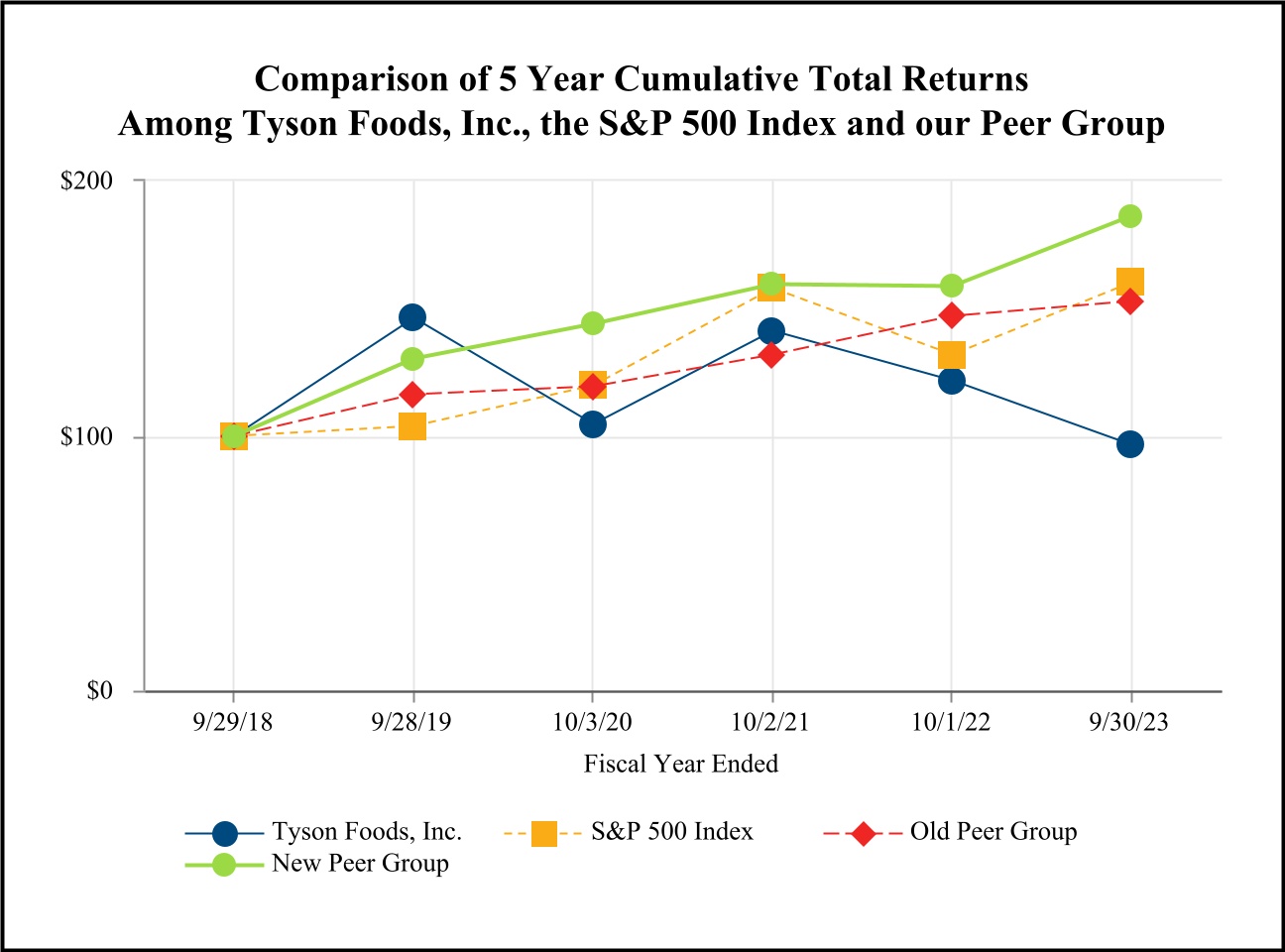
| Fiscal Years Ended | |||||||||||||||||||||||||||||||||||||||||
| 9/29/18 | 9/28/19 | 10/3/20 | 10/2/21 | 10/1/22 | 9/30/23 | ||||||||||||||||||||||||||||||||||||
| Tyson Foods, Inc. | $ | 100.00 | $ | 146.23 | $ | 104.29 | $ | 141.12 | $ | 121.45 | $ | 96.20 | |||||||||||||||||||||||||||||
| S&P 500 Index | 100.00 | 103.72 | 119.51 | 157.80 | 131.85 | 160.31 | |||||||||||||||||||||||||||||||||||
| Old Peer Group | 100.00 | 115.97 | 119.31 | 131.90 | 146.85 | 152.76 | |||||||||||||||||||||||||||||||||||
| New Peer Group | 100.00 | 129.98 | 143.64 | 159.24 | 158.38 | 186.28 |
The total cumulative return on investment (change in the year-end stock price plus reinvested dividends), which is based on the stock price or composite index at the end of fiscal 2018, is presented for each of the periods for the Company, the S&P 500 Index and our old and new peer groups. The graph compares the performance of the Company’s Class A common stock with that of the S&P 500 Index and our old and new peer groups, with the return of each company in the peer groups weighted on market capitalization. The stock price performance of the Company’s Class A common stock shown in the above graph is not necessarily indicative of future stock price performance. During fiscal 2023, we changed our peer group to include geographically relevant peers in addition to those operating in the manufacturing, food and CPG industries. Our new peer group includes: Albertsons Companies, Archer Daniels Midland Co., Bunge Ltd., Caterpillar Inc., Coca-Cola Co., Deere & Co., J.B. Hunt Transport Services, Kraft Heinz Co., Mondelez International, Inc., PepsiCo Inc., Performance Food Group, Sysco Corp., United Natural Foods, U.S. Foods Holding, Proctor & Gamble and Walmart Inc.
The complete list of our old peer group includes: Archer-Daniels-Midland Company, Bunge Limited, Campbell Soup Company, ConAgra Foods, Inc., General Mills, Inc., Hormel Foods Corp., Kellogg Co., Kraft Heinz Company, Mondelez International Inc., PepsiCo, Inc., Pilgrim’s Pride Corporation, The Coca-Cola Company, The Hershey Company and The J.M. Smucker Company.
The information in this “Performance Graph” section shall not be deemed to be “soliciting material” or to be “filed” with the SEC or subject to Regulation 14A or 14C, or to the liabilities of Section 18 of the Securities Exchange Act of 1934.
Item 6. SELECTED FINANCIAL DATA
Not applicable.
Item 7. MANAGEMENT’S DISCUSSION AND ANALYSIS OF FINANCIAL CONDITION AND RESULTS OF OPERATIONS
OBJECTIVE
The following discussion provides an analysis of the Company’s financial condition, cash flows and results of operations from management’s perspective and should be read in conjunction with the consolidated financial statements and notes thereto included in Part II, Item 8 of this Annual Report on Form 10-K. Our objective is to also provide discussion of events and uncertainties known to management that are reasonably likely to cause reported financial information not to be indicative of future operating results or of future financial condition and to offer information that provides understanding of our financial condition, cash flows and results of operations. Refer to the Company's Annual Report on Form 10-K for the fiscal year ended October 2, 2021 for additional information related to fiscal 2021.
DESCRIPTION OF THE COMPANY
We are one of the world’s largest food companies and a recognized leader in protein. Founded in 1935 by John W. Tyson and grown under four generations of family leadership, the Company has a broad portfolio of products and brands including Tyson®, Jimmy Dean®, Hillshire Farm®, Ball Park®, Wright®, Aidells®, ibp® and State Fair®.
We operate in four reportable segments: Beef, Pork, Chicken and Prepared Foods. We measure segment profit as operating income (loss). International/Other primarily includes our foreign operations in Australia, China, Malaysia, Mexico, the Netherlands, South Korea, Thailand and the Kingdom of Saudi Arabia, third-party merger and integration costs and corporate overhead related to Tyson New Ventures, LLC. For further description of the business, refer to Part I, Item 1, Business.
OVERVIEW
Fiscal year
We utilize a 52- or 53-week accounting period ending on the Saturday closest to September 30. The Company’s accounting cycle resulted in a 52-week year for fiscal 2023, 2022 and 2021.
General
Sales decreased slightly to $52.9 billion in fiscal 2023 as compared to fiscal 2022, largely due to decreased sales volumes in our Beef and Pork segments and lower average sales price in our Chicken and Pork segments, partially offset by increased sales volumes in our Chicken segment. We incurred an operating loss of $395 million in fiscal 2023 as compared to operating income of $4,410 million fiscal 2022, as we experienced lower operating income in all our segments other than the Prepared Foods segment. In fiscal 2023, our operating income was impacted by $781 million of goodwill impairment charges, $322 million of plant closure charges, $156 million of legal contingency accruals, $124 million of restructuring and related charges, $17 million of product line discontinuation charges, and benefited by $53 million of insurance proceeds, net of costs incurred, related to fires at our production facilities and $19 million related to the relocation of a production facility in China. In fiscal 2022, our results were impacted by $66 million of restructuring and related charges and $62 million of insurance proceeds, net of costs incurred related to fires at our production facilities.
Market Environment
According to the USDA, domestic protein production (beef, pork, chicken and turkey) decreased slightly in fiscal 2023 compared to fiscal 2022. All segments experienced inflation in operating costs, especially in labor and certain materials, however, the rate of inflation started to decrease and protein prices began to level off. We continue to pursue recovery of increased input costs through pricing. Additionally, the conflict between Ukraine and Russia has led to economic sanctions against Russia and certain regions of Ukraine and Belarus. As of September 30, 2023, the impact of this conflict has not had a material direct impact on our consolidated financial performance. However, the conflict is still ongoing and there are many risks and uncertainties in relation to the conflict that are outside of our control. Furthermore, the conflict in the Middle East escalated in October 2023 creating economic and political uncertainty within the region. If these conflicts escalate further, impact additional regions or countries, or additional economic sanctions are imposed, it could have a material impact on our business operations and financial performance. The Beef segment experienced reduced supply of market-ready cattle and increased live cattle costs. The Pork segment experienced sufficient supply and reduced live hog costs, but was negatively impacted by softening global demand. The Chicken segment experienced increased feed ingredient and other input costs along with excess domestic supply impacts to sales pricing. The Prepared Foods segment experienced decreased raw material costs primarily due to lower meat costs.
The Federal Reserve has increased interest rates, and it is anticipated that interest rates will continue to rise in the near term. Our direct exposure to rising interest rates is somewhat tempered given our strong liquidity position in addition to our current debt structure in which most of our borrowings have fixed interest rates. At September 30, 2023, we had $3.0 billion of liquidity and our current debt was $1.9 billion. Should we need to issue additional debt or borrow under our existing revolving and term loan facilities, we may be exposed to higher interest rates than our current outstanding borrowings.
Margins
Our total operating margin was (0.7)% in fiscal 2023. Operating margins by segment were as follows:
-
Beef – (0.5)%
-
Pork – (2.4)%
-
Chicken – (4.5)%
-
Prepared Foods – 8.4%
Strategy
Our strategy is to sustainably feed the world with the fastest growing protein brands. We intend to achieve our strategy as we: grow
our business by delivering superior value to consumers and customers; deliver fuel for growth and returns through commercial,
operational and financial excellence; and sustain our Company and our world for future generations.
We launched a new productivity program in fiscal 2022 to drive a better, faster and more agile organization that is supported by a culture of continuous improvement and faster decision-making. The execution of the program is supported by a program management office that ensures delivery of key project milestones and reports on savings achievements connected with the three pillars of the program. The first pillar is operational and functional excellence, which includes functional efficiency efforts in Finance, HR and Procurement focused on applying best practices to reduce costs. The second pillar is the use of new digital solutions like artificial intelligence and predictive analytics to drive efficiency in operations, supply chain planning, logistics and warehousing. The third pillar is automation, which will leverage automation and robotics technologies to automate difficult and higher turnover positions. We expect the productivity savings to be recognized in each of our reportable segments as they benefit from the achievements connected with the three pillars of the program. At this time, we do not anticipate costs associated with this program to be material and capital expenditures associated with automation and other activities are included in our capital expenditure expectations. We were targeting $1 billion in productivity savings by the end of fiscal 2024 relative to a fiscal 2021 cost baseline. We realized more than $700 million of productivity savings in fiscal 2022, which partially offset the impacts of inflationary market conditions, and we surpassed our aggregate $1 billion target in fiscal 2023, more than a year ahead of our plan.
The Company approved a restructuring program in fiscal 2022, the 2022 Program, which is expected to improve business performance, increase collaboration, enhance team member agility, enable faster decision-making and reduce redundancies. In conjunction with the 2022 Program, the Company relocated all of its corporate team members from the Chicago, Downers Grove and D
Showing the first 8K of 105K characters. Open the full section
Item 7A. QUANTITATIVE AND QUALITATIVE DISCLOSURES ABOUT MARKET RISK
Market risk relating to our operations results primarily from changes in commodity prices, interest rates and foreign exchange rates, as well as credit risk concentrations. To address certain of these risks, we enter into various derivative transactions as described below. If a derivative instrument is accounted for as a hedge, depending on the nature of the hedge, changes in the fair value of the instrument either will be offset against the change in fair value of the hedged assets, liabilities or firm commitments through earnings, or be recognized in Other Comprehensive Income (Loss) until the hedged item is recognized in earnings. The ineffective portion of an instrument’s change in fair value is recognized immediately.
Further, we hold certain positions, primarily in grain and livestock futures that either do not meet the criteria for hedge accounting or are not designated as hedges. With the exception of normal purchases and normal sales that are expected to result in physical delivery, we record these positions at fair value, and the unrealized gains and losses are reported in earnings at each reporting date.
The sensitivity analyses presented below are the measures of potential changes in fair value resulting from hypothetical changes in market prices related to commodities. Sensitivity analyses do not consider the actions we may take to mitigate our exposure to changes, nor do they consider the effects such hypothetical adverse changes may have on overall economic activity. Actual changes in market prices may differ from hypothetical changes.
COMMODITIES RISK
We purchase certain commodities, such as grains and livestock, during normal operations. As part of our commodity risk management activities, we use derivative financial instruments, primarily forwards and options, to reduce the effect of changing prices and as a mechanism to procure the underlying commodity. However, as the commodities underlying our derivative financial instruments can experience significant price fluctuations, any requirement to mark-to-market the positions that have not been designated or do not qualify as hedges could result in volatility in our results of operations. Contract terms of a hedge instrument closely mirror those of the hedged item providing a high degree of risk reduction and correlation. Contracts designated and highly effective at meeting this risk reduction and correlation criteria are recorded using hedge accounting. We generally do not hedge anticipated transactions beyond 18 months. The following table presents a sensitivity analysis resulting from a hypothetical change of 10% in market prices as of September 30, 2023 and October 1, 2022, on the fair value of open positions. The fair value of such positions is a summation of the fair values calculated for each commodity by valuing each net position at quoted forward and option prices. The market risk exposure analysis included both derivatives designated as hedge instruments and derivatives not designated as hedge instruments.
| Effect of 10% change in fair value | in millions | ||||||||||
| 2023 | 2022 | ||||||||||
| Livestock: | |||||||||||
| Live Cattle | $ | 68 | $ | 14 | |||||||
| Lean Hogs | 10 | 30 | |||||||||
| Grain: | |||||||||||
| Corn | 23 | 40 | |||||||||
| Soybean Meal | 22 | 25 |
INTEREST RATE RISK
At September 30, 2023, we had variable rate debt of $1,608 million with a weighted average interest rate of 6.2%. A hypothetical 10% increase in interest rates effective at September 30, 2023, and October 1, 2022, would not have a significant effect on variable interest expense.
Additionally, changes in interest rates impact the fair value of our fixed-rate debt. At September 30, 2023, we had fixed-rate debt of $7,898 million with a weighted average interest rate of 4.5%. Market risk for fixed-rate debt is estimated as the potential increase in fair value, resulting from a hypothetical 10% decrease in interest rates. A hypothetical 10% change in interest rates would have changed the fair value of our fixed-rate debt by approximately $215 million at September 30, 2023 and October 1, 2022. The fair values of our debt were estimated based on quoted market prices and/or published interest rates.
We are subject to interest rate risk associated with our pension and post-retirement benefit obligations. Changes in interest rates impact the liabilities associated with these benefit plans as well as the amount of income or expense recognized for these plans. Declines in the value of the plan assets could diminish the funded status of the pension plans and potentially increase the requirements to make cash contributions to these plans. See Part II, Item 8, Notes to Consolidated Financial Statements, Note 15: Pensions and Other Postretirement Benefits for additional information.
FOREIGN CURRENCY RISK
We have foreign exchange exposure from fluctuations in foreign currency exchange rates primarily as a result of certain receivable and payable balances. The primary currencies we have exposure to are the Australian dollar, the Brazilian real, the British pound sterling, the Canadian dollar, the Chinese renminbi, the European euro, the Malaysian ringgit, the Mexican peso, and the Thai baht. We periodically enter into foreign exchange forward and option contracts to hedge some portion of our foreign currency exposure. A hypothetical 10% change in foreign exchange rates related to the foreign exchange forward and option contracts would have had a $17 million and $25 million impact on pretax income at September 30, 2023 and October 1, 2022, respectively.
CONCENTRATIONS OF CREDIT RISK
Our financial instruments exposed to concentrations of credit risk consist primarily of cash equivalents and trade receivables. Our cash equivalents are in high quality securities placed with major banks and financial institutions. Concentrations of credit risk with respect to receivables are limited due to our large number of customers and their dispersion across geographic areas. We perform periodic credit evaluations of our customers’ financial condition and generally do not require collateral. At September 30, 2023 and October 1, 2022, 15.9% and 16.4%, respectively, of our net accounts receivable balance was due from Walmart Inc. No other single customer or customer group represented 10% or greater of net accounts receivable.
Item 8. FINANCIAL STATEMENTS AND SUPPLEMENTARY DATA
TYSON FOODS, INC.
CONSOLIDATED STATEMENTS OF INCOME
| in millions, except per share data | |||||||||||||||||
| fiscal year ended | |||||||||||||||||
| September 30, 2023 | October 1, 2022 | October 2, 2021 | |||||||||||||||
| Sales | $ | 52,881 | $ | 53,282 | $ | 47,049 | |||||||||||
| Cost of Sales | 50,250 | 46,614 | 40,523 | ||||||||||||||
| Gross Profit | 2,631 | 6,668 | 6,526 | ||||||||||||||
| Selling, General and Administrative | 2,245 | 2,258 | 2,130 | ||||||||||||||
| Goodwill Impairment | 781 | — | — | ||||||||||||||
| Operating Income (Loss) | (395) | 4,410 | 4,396 | ||||||||||||||
| Other (Income) Expense: | |||||||||||||||||
| Interest income | (30) | (17) | (8) | ||||||||||||||
| Interest expense | 355 | 365 | 428 | ||||||||||||||
| Other, net | (42) | (87) | (65) | ||||||||||||||
| Total Other (Income) Expense | 283 | 261 | 355 | ||||||||||||||
| Income (Loss) before Income Taxes | (678) | 4,149 | 4,041 | ||||||||||||||
| Income Tax Expense (Benefit) | (29) | 900 | 981 | ||||||||||||||
| Net Income (Loss) | (649) | 3,249 | 3,060 | ||||||||||||||
| Less: Net Income (Loss) Attributable to Noncontrolling Interests | (1) | 11 | 13 | ||||||||||||||
| Net Income (Loss) Attributable to Tyson | $ | (648) | $ | 3,238 | $ | 3,047 | |||||||||||
| Net Income (Loss) Per Share Attributable to Tyson: | |||||||||||||||||
| Class A Basic | $ | (1.87) | $ | 9.18 | $ | 8.57 | |||||||||||
| Class B Basic | $ | (1.68) | $ | 8.25 | $ | 7.70 | |||||||||||
| Diluted | $ | (1.87) | $ | 8.92 | $ | 8.34 |
See accompanying Notes to Consolidated Financial Statements.
TYSON FOODS, INC.
CONSOLIDATED STATEMENTS OF COMPREHENSIVE INCOME
| in millions | |||||||||||||||||
| fiscal year ended | |||||||||||||||||
| September 30, 2023 | October 1, 2022 | October 2, 2021 | |||||||||||||||
| Net Income (Loss) | $ | (649) | $ | 3,249 | $ | 3,060 | |||||||||||
| Other Comprehensive Income (Loss), Net of Taxes: | |||||||||||||||||
| Derivatives accounted for as cash flow hedges | 2 | 1 | 2 | ||||||||||||||
| Investments | 1 | (7) | (1) | ||||||||||||||
| Currency translation | 29 | (162) | 17 | ||||||||||||||
| Postretirement benefits | 5 | 43 | (11) | ||||||||||||||
| Total Other Comprehensive Income (Loss), Net of Taxes | 37 | (125) | 7 | ||||||||||||||
| Comprehensive Income (Loss) | (612) | 3,124 | 3,067 | ||||||||||||||
| Less: Comprehensive Income (Loss) Attributable to Noncontrolling Interests | (1) | 11 | 13 | ||||||||||||||
| Comprehensive Income (Loss) Attributable to Tyson | $ | (611) | $ | 3,113 | $ | 3,054 |
See accompanying Notes to Consolidated Financial Statements.
TYSON FOODS, INC.
CONSOLIDATED BALANCE SHEETS
| in millions, except share and per share data | |||||||||||
| September 30, 2023 | October 1, 2022 | ||||||||||
| Assets | |||||||||||
| Current Assets: | |||||||||||
| Cash and cash equivalents | $ | 573 | $ | 1,031 | |||||||
| Accounts receivable, net | 2,476 | 2,577 | |||||||||
| Inventories | 5,328 | 5,514 | |||||||||
| Other current assets | 345 | 508 | |||||||||
| Total Current Assets | 8,722 | 9,630 | |||||||||
| Net Property, Plant and Equipment | 9,634 | 8,685 | |||||||||
| Goodwill | 9,878 | 10,513 | |||||||||
| Intangible Assets, net | 6,098 | 6,252 | |||||||||
| Other Assets | 1,919 | 1,741 | |||||||||
| Total Assets | $ | 36,251 | $ | 36,821 | |||||||
| Liabilities and Shareholders’ Equity | |||||||||||
| Current Liabilities: | |||||||||||
| Current debt | $ | 1,895 | $ | 459 | |||||||
| Accounts payable | 2,594 | 2,483 | |||||||||
| Other current liabilities | 2,010 | 2,371 | |||||||||
| Total Current Liabilities | 6,499 | 5,313 | |||||||||
| Long-Term Debt | 7,611 | 7,862 | |||||||||
| Deferred Income Taxes | 2,308 | 2,458 | |||||||||
| Other Liabilities | 1,578 | 1,377 | |||||||||
| Commitments and Contingencies (Note 20) | |||||||||||
| Shareholders’ Equity: | |||||||||||
| Common stock ($0.10 par value): | |||||||||||
| Class A-authorized 900 million shares, issued 378 million shares | 38 | 38 | |||||||||
| Convertible Class B-authorized 900 million shares, issued 70 million shares | 7 | 7 | |||||||||
| Capital in excess of par value | 4,560 | 4,553 | |||||||||
| Retained earnings | 18,760 | 20,084 | |||||||||
| Accumulated other comprehensive gain (loss) | (260) | (297) | |||||||||
| Treasury stock, at cost – 92 million shares at September 30, 2023 and 88 million shares at October 1, 2022 | (4,972) | (4,683) | |||||||||
| Total Tyson Shareholders’ Equity | 18,133 | 19,702 | |||||||||
| Noncontrolling Interests | 122 | 109 | |||||||||
| Total Shareholders’ Equity | 18,255 | 19,811 | |||||||||
| Total Liabilities and Shareholders’ Equity | $ | 36,251 | $ | 36,821 |
See accompanying Notes to Consolidated Financial Statements.
TYSON FOODS, INC.
CONSOLIDATED STATEMENTS OF SHAREHOLDERS’ EQUITY
| in millions | |||||||||||||||||||||||||||||||||||
| fiscal year ended | |||||||||||||||||||||||||||||||||||
| September 30, 2023 | October 1, 2022 | October 2, 2021 | |||||||||||||||||||||||||||||||||
| Shares | Amount | Shares | Amount | Shares | Amount | ||||||||||||||||||||||||||||||
| Class A Common Stock: | |||||||||||||||||||||||||||||||||||
| Balance at beginning an |
Showing the first 8K of 233K characters. Open the full section
Item 9. CHANGES IN AND DISAGREEMENTS WITH ACCOUNTANTS ON ACCOUNTING AND FINANCIAL DISCLOSURE
Not applicable.
Item 9A. CONTROLS AND PROCEDURES
Evaluation of Disclosure Controls and Procedures
An evaluation was performed, under the supervision and with the participation of management, including the Chief Executive Officer (“CEO”) and the Chief Financial Officer (“CFO”), of the effectiveness of the design and operation of our disclosure controls and procedures (as defined in Rule 13a-15(e) and 15d-15(e) under the Securities Exchange Act of 1934, as amended (the “1934 Act”)). Based on that evaluation, the CEO and CFO concluded that, as of September 30, 2023, our disclosure controls and procedures were effective.
Management’s Annual Report on Internal Control Over Financial Reporting
Management is responsible for establishing and maintaining adequate internal control over financial reporting, as defined in Rule 13a-15(f) and 15d-15(f) of the 1934 Act. Our internal control over financial reporting was designed to provide reasonable assurance regarding the reliability of financial reporting and the preparation of financial statements for external purposes in accordance with generally accepted accounting principles. Because of its inherent limitations, internal control over financial reporting may not prevent or detect misstatements. Also, projections of any evaluation of effectiveness to future periods are subject to the risk that controls may become inadequate because of changes in conditions, or the degree of compliance with the policies or procedures may deteriorate.
Management conducted an evaluation of the effectiveness of our internal control over financial reporting as of September 30, 2023. In making this assessment, we used criteria set forth by the Committee of Sponsoring Organizations of the Treadway Commission (“COSO”) in Internal Control - Integrated Framework (2013). Based on this evaluation under the framework in Internal Control - Integrated Framework (2013) issued by COSO, management concluded the Company’s internal control over financial reporting was effective as of September 30, 2023.
The Company’s independent registered public accounting firm, PricewaterhouseCoopers LLP, who has audited the fiscal 2023 financial statements included in this Annual Report on Form 10-K, has also audited the effectiveness of the Company’s internal control over financial reporting as of September 30, 2023 as stated in its report which appears in Part II, Item 8 of this Annual Report on Form 10-K.
Changes in Internal Control Over Financial Reporting
There were no changes in the Company’s internal control over financial reporting (as defined in Rules 13a-15(f) and 15d-15(f) under the 1934 Act) during the quarter ended September 30, 2023 that have materially affected, or are reasonably likely to materially affect, the Company’s internal control over financial reporting.
Item 9B. OTHER INFORMATION
Rule 10b5-1 Trading Plans
During the three months ended September 30, 2023, none of the Company’s directors or executive officers adopted or terminated any contract, instruction or written plan for the purchase or sale of Company securities that was intended to satisfy the affirmative defense conditions of Rule 10b5-1(c) or any “non-Rule 10b5-1 trading arrangement” as defined in Item 408(c) of Regulation S-K.
Item 9C. DISCLOSURE REGARDING FOREIGN JURISDICTIONS THAT PREVENT INSPECTIONS
None.
PART III
Item 10. DIRECTORS, EXECUTIVE OFFICERS AND CORPORATE GOVERNANCE
See information set forth under the captions “Election of Directors” and “Board of Directors and Corporate Governance Information” in the Company’s definitive Proxy Statement for the Company’s Annual Meeting of Shareholders to be held February 8, 2024 (the “Proxy Statement”), which information is incorporated herein by reference. Pursuant to general instruction G(3) of Annual Report on Form 10-K, certain information concerning our executive officers is included under the caption “Information About Our Executive Officers” in Part I of this Annual Report on Form 10-K. The information required by this item regarding delinquent filers pursuant to Item 405 of Regulation S-K will be included under the caption “Delinquent Section 16(a) Reports” in the Proxy Statement and is incorporated by reference herein.
We have a code of ethics as defined in Item 406 of Regulation S-K, which applies to all of our directors and team members, including our principal executive officer, principal financial officer, principal accounting officer or controller, and persons performing similar functions. This code of ethics, titled “Tyson Code of Conduct,” is available, free of charge on our website at http://ir.tyson.com.
We will post any amendments to the Code of Conduct, and any waivers that are required to be disclosed by the rules of either the SEC or the New York Stock Exchange, on our website.
Item 11. EXECUTIVE COMPENSATION
See the information set forth under the captions “Executive Compensation,” “Director Compensation For Fiscal Year 2023,” “Compensation Discussion and Analysis,” “Report of the Compensation and Leadership Development Committee” and “Compensation Committee Interlocks and Insider Participation” in the Proxy Statement, which information is incorporated herein by reference. However, pursuant to instructions to Item 407(e)(5) of Regulation S-K, the material appearing under the sub-heading “Report of the Compensation and Leadership Development Committee” shall be deemed “furnished” and not be deemed to be “filed” with the SEC, other than as provided in this Item 11.
Item 12. SECURITY OWNERSHIP OF CERTAIN BENEFICIAL OWNERS AND MANAGEMENT AND RELATED STOCKHOLDER MATTERS
See the information included under the captions “Security Ownership of Certain Beneficial Owners” and “Security Ownership of Management” in the Proxy Statement, which information is incorporated herein by reference.
Securities Authorized for Issuance Under Equity Compensation Plans
The following information reflects certain information about our equity compensation plans as of September 30, 2023:
| Equity Compensation Plan Information | |||||||||||||||||
| Number of Securities to be issued upon exercise of outstanding options | Weighted average exercise price of outstanding options | Number of Securities remaining available for future issuance under equity compensation plans (excluding Securities reflected in the first column (a)) | |||||||||||||||
| Equity compensation plans approved by security holders | 6,380,008 | $ | 67.65 | 22,571,688 | |||||||||||||
| Equity compensation plans not approved by security holders | — | — | — | ||||||||||||||
| Total | 6,380,008 | $ | 67.65 | 22,571,688 |
(a) Shares of Class A Common Stock available for future issuance as of September 30, 2023, under the Stock Incentive Plan (6,923,370), the Employee Stock Purchase Plan (8,000,710) and the Retirement Savings Plan (7,647,608).
Item 13. CERTAIN RELATIONSHIPS AND RELATED TRANSACTIONS, AND DIRECTOR INDEPENDENCE
See the information included under the captions “Election of Directors,” “Board of Directors and Corporate Governance Information” and “Certain Transactions” in the Proxy Statement, which information is incorporated herein by reference.
Item 14. PRINCIPAL ACCOUNTANT FEES AND SERVICES
See the information included under the captions “Audit Fees,” “Audit-Related Fees,” “Tax Fees,” “All Other Fees,” and “Audit Committee Pre-Approval Policy” in the Proxy Statement, which information is incorporated herein by reference.
PART IV
Item 15. EXHIBITS, FINANCIAL STATEMENT SCHEDULES
(a)The following documents are filed as a part of this report:
(1) Consolidated Financial Statements
Consolidated Statements of Income for the three years ended September 30, 2023
Consolidated Statements of Comprehensive Income for the three years ended September 30, 2023
Consolidated Balance Sheets at September 30, 2023, and October 1, 2022
Consolidated Statements of Shareholders’ Equity for the three years ended September 30, 2023
Consolidated Statements of Cash Flows for the three years ended September 30, 2023
Notes to Consolidated Financial Statements
Report of Independent Registered Public Accounting Firm (PCAOB ID 238)
(2) Consolidated Financial Statement Schedules
Financial Statement Schedule - Schedule II Valuation and Qualifying Accounts for the three years ended September 30, 2023
All other schedules are omitted because they are neither applicable nor required.
(3) Exhibits required by Item 601 of Regulation S-K
EXHIBIT INDEX
Exhibit No.
Showing the first 8K of 63K characters. Open the full section
Item 16. Form 10-K Summary
None.
SIGNATURES
Pursuant to requirements of Section 13 or 15(d) of the Securities Exchange Act of 1934, the registrant has duly caused this report to be signed on its behalf by the undersigned, thereunto duly authorized.
| TYSON FOODS, INC. | ||||||||||||||
| By: | /s/ John R. Tyson | November 13, 2023 | ||||||||||||
| John R. Tyson | ||||||||||||||
| Executive Vice President and Chief Financial Officer (Principal Financial Officer) | ||||||||||||||
| By: | /s/ Phillip W. Thomas | November 13, 2023 | ||||||||||||
| Phillip W. Thomas | ||||||||||||||
| Vice President, Controller and Chief Accounting Officer (Principal Accounting Officer) | ||||||||||||||
Pursuant to the requirements of the Securities Exchange Act of 1934, this report has been signed below by the following persons on behalf of the registrant and in the capacities and on the date indicated.
| /s/ John H. Tyson | Chairman of the Board of Directors | November 13, 2023 | ||||||||||||
| John H. Tyson | ||||||||||||||
| /s/ Les R. Baledge | Director | November 13, 2023 | ||||||||||||
| Les R. Baledge | ||||||||||||||
| /s/ Mike Beebe | Director | November 13, 2023 | ||||||||||||
| Mike Beebe | ||||||||||||||
| /s/ Maria Claudia Borras | Director | November 13, 2023 | ||||||||||||
| Maria Claudia Borras | ||||||||||||||
| /s/ David J. Bronczek | Director | November 13, 2023 | ||||||||||||
| David J. Bronczek | ||||||||||||||
| /s/ Mikel A. Durham | Director | November 13, 2023 | ||||||||||||
| Mikel A. Durham | ||||||||||||||
| /s/ Donnie King | President, Chief Executive Officer, and Director | November 13, 2023 | ||||||||||||
| Donnie King | (Principal Executive Officer) | |||||||||||||
| /s/ Jonathan D. Mariner | Director | November 13, 2023 | ||||||||||||
| Jonathan D. Mariner | ||||||||||||||
| /s/ Kevin M. McNamara | Vice Chairman of the Board of Directors | November 13, 2023 | ||||||||||||
| Kevin M. McNamara | ||||||||||||||
| /s/ Cheryl S. Miller | Director | November 13, 2023 | ||||||||||||
| Cheryl S. Miller | ||||||||||||||
| /s/ Jeffrey K. Schomburger | Director | November 13, 2023 | ||||||||||||
| Jeffrey K. Schomburger | ||||||||||||||
| /s/ Phillip W. Thomas | Vice President, Controller and Chief Accounting Officer | November 13, 2023 | ||||||||||||
| Phillip W. Thomas | (Principal Accounting Officer) | |||||||||||||
| /s/ Barbara A. Tyson | Director | November 13, 2023 | ||||||||||||
| Barbara A. Tyson | ||||||||||||||
| /s/ John R. Tyson | Executive Vice President and Chief Financial Officer | November 13, 2023 | ||||||||||||
| John R. Tyson | (Principal Financial Officer) | |||||||||||||
| /s/ Noel White | Executive Vice Chairman of the Board of Directors | November 13, 2023 | ||||||||||||
| Noel White |