 filings.tools
Trane Technologies 10-K 2018-12-31
Filed 2019-02-12. 22 sections, 438K characters. Original on sec.gov · Markdown · JSON
Cover and table of contents
10-K 1 ir-10kx12312018.htm 10-K
UNITED STATES SECURITIES AND EXCHANGE COMMISSION
Washington, D.C. 20549
FORM 10-K
(Mark One)
| X | ANNUAL REPORT PURSUANT TO SECTION 13 OR 15(d) OF THE SECURITIES EXCHANGE ACT OF 1934 |
For the fiscal year ended December 31, 2018
or
| — | TRANSITION REPORT PURSUANT TO SECTION 13 OR 15(d) OF THE SECURITIES EXCHANGE ACT OF 1934 |
For the transition period from to
Commission File No. 001-34400
INGERSOLL-RAND PUBLIC LIMITED COMPANY
(Exact name of registrant as specified in its charter)
| Ireland | 98-0626632 | |
| (State or other jurisdiction of incorporation or organization) | (I.R.S. Employer Identification No.) |
170/175 Lakeview Dr.
Airside Business Park
Swords, Co. Dublin
Ireland
(Address of principal executive offices)
Registrant’s telephone number, including area code: +(353) (0) 18707400
Securities registered pursuant to Section 12(b) of the Act:
| Title of each class | Name of each exchange on which registered | |
| Ordinary Shares, | New York Stock Exchange | |
| Par Value $1.00 per Share |
Securities registered pursuant to Section 12(g) of the Act: None
Indicate by check mark if the registrant is a well-known seasoned issuer, as defined in Rule 405 of the Securities Act. YES X NO
Indicate by check mark if the registrant is not required to file reports pursuant to Section 13 or Section 15(d) of the Act. YES NO X
Indicate by check mark whether the registrant (1) has filed all reports required to be filed by Section 13 or 15(d) of the Securities Exchange Act of 1934 during the preceding 12 months (or for such shorter period that the registrant was required to file such reports), and (2) has been subject to such filing requirements for the past 90 days. YES X NO
Indicate by check mark whether the registrant has submitted electronically every Interactive Data File required to be submitted pursuant to Rule 405 of Regulation S-T (§232.405 of this chapter) during the preceding 12 months (or for such shorter period that the registrant was required to submit such files). YES X NO
Indicate by check mark if disclosure of delinquent filers pursuant to Item 405 of Regulation S-K (§229.405 of this chapter) is not contained herein, and will not be contained, to the best of registrant’s knowledge, in definitive proxy or information statements incorporated by reference in Part III of this Form 10-K or any amendment to this Form 10-K. [ ]
Indicate by check mark whether the registrant is a large accelerated filer, an accelerated filer, a non-accelerated filer, a smaller reporting company, or an emerging growth company. See the definitions of “large accelerated filer,” “accelerated filer,” “smaller reporting company,” and “emerging growth company” in Rule 12b-2 of the Exchange Act.:
| Large accelerated filer X | Accelerated filer |
| Non-accelerated filer | Smaller reporting company |
| Emerging growth company |
If an emerging growth company, indicate by check mark if the registrant has elected not to use the extended transition period for complying with any new or revised financial accounting standards provided pursuant to Section 13(a) of the Exchange Act.
Indicate by check mark whether the registrant is a shell company (as defined in Rule 12b-2 of the Act). YES NO X
The aggregate market value of ordinary shares held by nonaffiliates on June 30, 2018 was approximately $21.9 billion based on the closing price of such stock on the New York Stock Exchange.
The number of ordinary shares outstanding as of February 1, 2019 was 242,168,631.
DOCUMENTS INCORPORATED BY REFERENCE
Portions of the registrant’s proxy statement to be filed within 120 days of the close of the registrant’s fiscal year in connection with the registrant’s Annual General Meeting of Shareholders to be held June 6, 2019 are incorporated by reference into Part II and Part III of this Form 10-K.
INGERSOLL-RAND PLC
Form 10-K
For the Fiscal Year Ended December 31, 2018
TABLE OF CONTENTS
CAUTIONARY STATEMENT FOR FORWARD LOOKING STATEMENTS
Certain statements in this report, other than purely historical information, are “forward-looking statements” within the meaning of the Private Securities Litigation Reform Act of 1995, Section 27A of the Securities Act of 1933 and Section 21E of the Securities Exchange Act of 1934. These forward-looking statements generally are identified by the words “believe,” “project,” “expect,” “anticipate,” “estimate,” “forecast,” “outlook,” “intend,” “strategy,” “plan,” “may,” “could,” “should,” “will,” “would,” “will be,” “will continue,” “will likely result,” or the negative thereof or variations thereon or similar terminology generally intended to identify forward-looking statements.
Forward-looking statements may relate to such matters as projections of revenue, margins, expenses, tax provisions, earnings, cash flows, benefit obligations, share or debt repurchases or other financial items; any statements of the plans, strategies and objectives of management for future operations, including those relating to any statements concerning expected development, performance or market share relating to our products and services; any statements regarding future economic conditions or our performance; any statements regarding pending investigations, claims or disputes; any statements of expectation or belief; and any statements of assumptions underlying any of the foregoing. These statements are based on currently available information and our current assumptions, expectations and projections about future events. While we believe that our assumptions, expectations and projections are reasonable in view of the currently available information, you are cautioned not to place undue reliance on our forward-looking statements. You are advised to review any further disclosures we make on related subjects in materials we file with or furnish to the SEC. Forward-looking statements speak only as of the date they are made and are not guarantees of future performance. They are subject to future events, risks and uncertainties - many of which are beyond our control - as well as potentially inaccurate assumptions, that could cause actual results to differ materially from our expectations and projections. We do not undertake to update any forward-looking statements.
Factors that might affect our forward-looking statements include, among other things:
| • | overall economic, political and business conditions in the markets in which we operate; |
| • | the demand for our products and services; |
| • | competitive factors in the industries in which we compete; |
| • | changes in tax laws and requirements (including tax rate changes, new tax laws, new and/or revised tax law interpretations and any legislation that may limit or eliminate potential tax benefits resulting from our incorporation in a non-U.S. jurisdiction, such as Ireland); |
| • | trade protection measures such as import or export restrictions and requirements, the imposition of tariffs and quotas or revocation or material modification of trade agreements; |
| • | the outcome of any litigation, governmental investigations, claims or proceedings; |
| • | the outcome of any income tax audits or settlements; |
| • | interest rate fluctuations and other changes in borrowing costs; |
| • | other capital market conditions, including availability of funding sources; |
| • | currency exchange rate fluctuations, exchange controls and currency devaluations; |
| • | availability of and fluctuations in the prices of key commodities; |
| • | impairment of our goodwill, indefinite-lived intangible assets and/or our long-lived assets; |
| • | climate change, changes in weather patterns, natural disasters and seasonal fluctuations; |
| • | the impact of potential information technology or data security breaches; and |
| • | the strategic acquisition or divestiture of businesses, product lines and joint ventures; |
Some of the significant risks and uncertainties that could cause actual results to differ materially from our expectations and projections are described more fully in Part I, Item 1A “Risk Factors.” You should read that information in conjunction with “Management's Discussion and Analysis of Financial Condition and Results of Operations” in Part II, Item 7 of this report and our Consolidated Financial Statements and related notes in Part II, Item 8 “Financial Statements and Supplementary Data” of this report. We note such information for investors as permitted by the Private Securities Litigation Reform Act of 1995.
PART I
Item 1. BUSINESS
Overview
Ingersoll-Rand plc (Plc or Parent Company), a public limited company incorporated in Ireland in 2009, and its consolidated subsidiaries (collectively, we, our, the Company) is a diversified, global company that provides products, services and solutions to enhance the quality, energy efficiency and comfort of air in homes and buildings, transport and protect food and perishables and increase industrial productivity and efficiency. Our business segments consist of Climate and Industrial, both with strong brands and highly differentiated products within their respective markets. We generate revenue and cash primarily through the design, manufacture, sale and service of a diverse portfolio of industrial and commercial products that include well-recognized, premium brand names such as Ingersoll-Rand®, Trane®, Thermo King®, American Standard®, ARO®, and Club Car®.
To achieve our mission of being a world leader in creating comfortable, sustainable and efficient environments, we continue to focus on growth by increasing our recurring revenue stream from parts, services, controls, used equipment and rentals; and to continuously improve the efficiencies and capabilities of the products and services of our businesses. We also continue to focus on operational excellence strategies as a central theme to improving our earnings and cash flow.
Business Segments
Our business segments provide products, services and solutions used to increase the efficiency and productivity of both industrial and commercial operations and homes, as well as improve the health and comfort of people around the world.
Our business segments are as follows:
Climate
Our Climate segment delivers energy-efficient products and innovative energy services. It includes Trane® and American Standard® Heating & Air Conditioning which provide heating, ventilation and air conditioning (HVAC) systems, and commercial and residential building services, parts, support and controls; energy services and building automation through Trane Building Advantage and Nexia; and Thermo King® transport temperature control solutions. This segment had 2018 net revenues of $12,343.8 million.
Industrial
Our Industrial segment delivers products and services that enhance energy efficiency, productivity and operations. It includes compressed air and gas systems and services, power tools, material handling systems, ARO® fluid management equipment, as well as Club Car ® golf, utility and consumer low-speed vehicles. This segment had 2018 net revenues of $3,324.4 million.
Products and Services
Our principal products and services by business segment include the following:
| Climate | ||
| Aftermarket and OEM parts and supplies | Ice energy storage solutions | |
| Air conditioners | Indoor air quality | |
| Air exchangers | Industrial refrigeration | |
| Air handlers | Installation contracting | |
| Airside and terminal devices | Large commercial unitary | |
| Auxiliary power units | Light commercial unitary | |
| Building management systems | Motor replacements | |
| Bus and rail HVAC systems | Multi-pipe HVAC systems | |
| Chillers | Package heating and cooling systems | |
| Coils and condensers | Performance contracting | |
| Container refrigeration systems and gensets | Rail refrigeration systems | |
| Control systems | Refrigerant reclamation | |
| Cryogenic refrigeration systems | Repair and maintenance services | |
| Diesel-powered refrigeration systems | Rental services | |
| Ductless systems | Self-powered truck refrigeration systems | |
| Energy management services | Service agreements | |
| Facility management services | Temporary heating and cooling systems | |
| Furnaces | Thermostats/controls | |
| Geothermal systems | Trailer refrigeration systems | |
| Heat pumps | Transport heater products | |
| Home automation | Unitary systems (light and large) | |
| Humidifiers | Vehicle-powered truck refrigeration systems | |
| Hybrid and non-diesel transport refrigeration solutions | Water source heat pumps |
| Industrial | ||
| Air treatment and air separation systems | Fluid power components | |
| Aftermarket and OEM parts and supplies | Installation contracting | |
| Aftermarket controls, parts, accessories and consumables | Power tools (air, cordless and electric) | |
| Airends | Precision fastening systems | |
| Blowers | Pumps (diaphragm and piston) | |
| Compressors (centrifugal, reciprocating, and rotary) | Rental services | |
| Dryers | Rough terrain (AWD) vehicles | |
| Engine starting systems | Service agreements | |
| Ergonomic material handling systems | Service break/fix | |
| Filters | Utility and consumer low-speed vehicles | |
| Fluid handling systems | Visage® mobile golf information systems | |
| Golf vehicles | Winches (air, electric and hydraulic) | |
| Hoists (air, electric and manual) |
These products are sold primarily under our name and under other names including American Standard, ARO, Club Car, Nexia, Thermo King and Trane.
Acquisitions and Equity Investments
In May 2018, we completed our investment of a 50% ownership interest in a joint venture with Mitsubishi Electric Corporation (Mitsubishi). The joint venture, reported within the Climate segment, focuses on marketing, selling and supporting variable refrigerant flow (VRF) and ductless heating and air conditioning systems through Trane, American Standard and Mitsubishi channels in the U.S. and select Latin American countries.
In January 2018, we acquired 100% of the outstanding stock of ICS Group Holdings Limited (ICS Cool Energy). The acquired business, reported within the Climate segment, specializes in the temporary rental of energy efficient chillers for commercial and industrial buildings across Europe. It also sells, permanently installs and services high performance temperature control systems for all types of industrial processes.
During 2017, we acquired several businesses, including channel acquisitions, that complement existing products and services. Acquisitions within the Climate segment primarily consisted of independent dealers which support the ongoing strategy to expand our distribution network in North America. Other acquisitions within the segment strengthen our product portfolio. Acquisitions within the Industrial segment primarily consisted of a telematics business which builds upon our growing portfolio of connected assets. In addition, other acquisitions within the segment expand sales and service channels across the globe.
Competitive Conditions
Our products and services are sold in highly competitive markets throughout the world. Due to the diversity of these products and services and the variety of markets served, we encounter a wide variety of competitors that vary by product line and services. They include well-established regional or specialized competitors, as well as larger U.S. and non-U.S. corporations or divisions of larger companies.
The principal methods of competition in these markets relate to price, quality, delivery, service and support, technology and innovation. We believe that we are one of the leading manufacturers in the world of HVAC systems and services, air compression systems, transport temperature control products, power tools, and golf, utility and consumer low-speed vehicles.
Distribution
Our products are distributed by a number of methods, which we believe are appropriate to the type of product. U.S. sales are made through branch sales offices, distributors and dealers across the country. Non-U.S. sales are made through numerous subsidiary sales and service companies with a supporting chain of distributors throughout the world.
Operations by Geographic Area
Approximately 36% of our net revenues in 2018 were derived outside the U.S. and we sold products in more than 100 countries. Therefore, the attendant risks of manufacturing or selling in a particular country, such as currency devaluation, nationalization and establishment of common markets, may have an adverse impact on our non-U.S. operations.
Customers
We have no customer that accounted for more than 10% of our consolidated net revenues in 2018, 2017 or 2016. No material part of our business is dependent upon a single customer or a small group of customers; therefore, the loss of any one customer would not have a material adverse effect on our results of operations or cash flows.
Raw Materials
We manufacture many of the components included in our products, which requires us to employ a wide variety of commodities. Principal commodities, such as steel, copper and aluminum, are purchased from a large number of independent sources around the world. We believe that available sources of supply will generally be sufficient for the foreseeable future. There have been no commodity shortages which have had a material adverse effect on our businesses.
Working Capital
We manufacture products that must be readily available to meet our customers’ rapid delivery requirements. Therefore, we maintain an adequate level of working capital to support our business needs and our customers’ requirements. Such working capital requirements are not, however, in the opinion of management, materially different from those experienced by our major competitors. We believe our sales and payment terms are competitive in and appropriate for the markets in which we compete.
Seasonality
Demand for certain of our products and services is influenced by weather conditions. For instance, sales in our commercial and residential HVAC businesses historically tend to be seasonally higher in the second and third quarters of the year because this represents spring and summer in the U.S. and other northern hemisphere markets, which are the peak seasons for sales of air conditioning systems and services. Therefore, results of any quarterly period may not be indicative of expected results for a full year and unusual weather patterns or events could negatively or positively affect certain segments of our business and impact overall results of operations.
Research and Development
We engage in research and development activities in an effort to introduce new products, enhance existing product effectiveness, improve ease of use and reliability as well as expand the various applications for which our products may be appropriate. In addition, we continually evaluate developing technologies in areas that we believe will enhance our business for possible investment or acquisition. We anticipate that we will continue to make significant expenditures for research and development activities as we look to maintain and improve our competitive position.
Patents and Licenses
We own numerous patents and patent applications, and are licensed under others. Although in aggregate we consider our patents and licenses to be valuable to our operations, we do not believe that our business is materially dependent on a single patent or license or any group of them. In our opinion, engineering, production skills and experience are more responsible for our market position than our patents and/or licenses.
Backlog
Our approximate backlog of orders, believed to be firm, at December 31, was as follows:
| In millions | 2018 | 2017 | ||||||
| Climate | $ | 2,914.4 | $ | 1,972.4 | ||||
| Industrial | 514.8 | 525.6 | ||||||
| Total | $ | 3,429.2 | $ | 2,498.0 |
These backlog figures are based on orders received. While the major portion of our products are built in advance of order and either shipped or assembled from stock, orders for specialized machinery or specific customer application are submitted with extensive lead times and are often subject to revision and deferral, and to a lesser extent cancellation or termination. We expect to ship a majority of the December 31, 2018 backlog during 2019.
Environmental Matters
We continue to be dedicated to environmental and sustainability programs to minimize the use of natural resources, and reduce the utilization and generation of hazardous materials from our manufacturing processes and to remediate identified environmental concerns. As to the latter, we are currently engaged in site investigations and remediation activities to address environmental cleanup from past operations at current and former manufacturing facilities.
We are sometimes a party to environmental lawsuits and claims and have received notices of potential violations of environmental laws and regulations from the Environmental Protection Agency and similar state authorities. We have also been identified as a potentially responsible party (PRP) for cleanup costs associated with off-site waste disposal at federal Superfund and state remediation sites. For all such sites, there are other PRPs and, in most instances, our involvement is minimal.
In estimating our liability, we have assumed that we will not bear the entire cost of remediation of any site to the exclusion of other PRPs who may be jointly and severally liable. The ability of other PRPs to participate has been taken into account, based on our understanding of the parties’ financial condition and probable contributions on a per site basis. Additional lawsuits and claims involving environmental matters are likely to arise from time to time in the future.
For a further discussion of our potential environmental liabilities, see Note 20 to the Consolidated Financial Statements.
Asbestos-Related Matters
Certain of our wholly-owned subsidiaries and former companies are named as defendants in asbestos-related lawsuits in state and federal courts. In many of the lawsuits, a large number of other companies have also been named as defendants. The vast majority of those claims allege injury caused by exposure to asbestos contained in certain historical products, primarily pumps, boilers and railroad brake shoes. None of our existing or previously-owned businesses were a producer or manufacturer of asbestos.
See also the discussion under Part I, Item 3, "Legal Proceedings," and Part II, Item 7, "Management’s Discussion and Analysis of Financial Condition and Results of Operations," "Contingent Liabilities," as well as further detail in Note 20 to the Consolidated Financial Statements.
Employees
As of December 31, 2018, we employed approximately 49,000 people throughout the world.
Available Information
We file annual, quarterly, and current reports, proxy statements, and other documents with the SEC under the Securities Exchange Act of 1934.
This Annual Report on Form 10-K, as well as our quarterly reports on Form 10-Q, current reports on Form 8-K and any amendments to all of the foregoing reports, are made available free of charge on our Internet website (http://www.ingersollrand.com) as soon as reasonably practicable after such reports are electronically filed with or furnished to the SEC. The Board of Directors of the Company has also adopted and posted in the Investor Relations section of the Company’s website our Corporate Governance Guidelines and charters for each of the Board’s standing committees. The contents of the Company’s website are not incorporated by reference in this report.
Executive Officers of the Registrant
The following is a list of executive officers of the Company as of February 12, 2019.
| Name and Age | Date of Service as an Executive Officer | Principal Occupation and Other Information for Past Five Years | ||
| Michael W. Lamach (55) | 2/16/2004 | Chairman of the Board (since June 2010) and Chief Executive Officer (since February 2010) | ||
| Susan K. Carter (60) | 10/2/2013 | Senior Vice President and Chief Financial Officer (since October 2013) | ||
| David S. Regnery (56) | 9/5/2017 | Executive Vice President (since September 2017); Vice President, President of Commercial HVAC, North America and EMEA (2013 to 2017) | ||
| Marcia J. Avedon (57) | 2/7/2007 | Senior Vice President, Human Resources, Communications and Corporate Affairs (since June 2013); Senior Vice President, Human Resources and Communications (2007 - 2013) | ||
| Paul A. Camuti (57) | 8/1/2011 | Senior Vice President, Innovation and Chief Technology Officer (since August 2011) | ||
| Maria C. Green (66) | 11/2/2015 | Senior Vice President and General Counsel (since November 2015); Senior Vice President, General Counsel and Secretary, Illinois Tool Works Inc. (a global manufacturer of a diversified range of industrial products and equipment), (2012-2015) | ||
| Keith A. Sultana (49) | 10/12/2015 | Senior Vice President, Global Operations and Integrated Supply Chain (since October 2015); Vice President, Global Procurement (January 2015 to October 2015); Vice President, Global Integrated Supply Chain (GISC) for Climate Solutions (May 2010 to December 2014) | ||
| Christopher J. Kuehn (46) | 6/1/2015 | Vice President and Chief Accounting Officer (since June 2015); Vice President, Corporate Controller and Chief Accounting Officer, Whirlpool Corporation (a global manufacturer and marketer of major home appliances), (2012-2015) |
No family relationship exists between any of the above-listed executive officers of the Company. All officers are elected to hold office for one year or until their successors are elected and qualified.
Item 1A. RISK FACTORS
Our business, financial condition, results of operations, and cash flows are subject to a number of risks that could cause the actual results and conditions to differ materially from those projected in forward-looking statements contained in this Annual Report on Form 10-K. The risks set forth below are those we consider most significant. We face other risks, however, that we do not currently perceive to be material which could cause actual results and conditions to differ materially from our expectations. You should evaluate all risks before you invest in our securities. If any of the risks actually occur, our business, financial condition, results of operations or cash flows could be adversely impacted. In that case, the trading price of our ordinary shares could decline, and you may lose all or part of your investment.
Our global operations subject us to economic risks.
Our global operations are dependent upon products manufactured, purchased and sold in the U.S. and internationally. These activities are subject to risks that are inherent in operating globally, including:
| • | changes in local laws and regulations or imposition of currency restrictions and other restraints; |
| • | limitation of ownership rights, including expropriation of assets by a local government, and limitation on the ability to repatriate earnings; |
| • | sovereign debt crises and currency instability in developed and developing countries; |
| • | trade protection measures such as import or export restrictions and requirements, the imposition of burdensome tariffs and quotas or revocation or material modification of trade agreements; |
| • | difficulty in staffing and managing global operations; |
| • | difficulty of enforcing agreements, collecting receivables and protecting assets through non-U.S. legal systems; |
| • | national and international conflict, including war, civil disturbances and terrorist acts; and |
| • | recessions, economic downturns, slowing economic growth and social and political instability. |
These risks could increase our cost of doing business internationally, increase our counterparty risk, disrupt our operations, disrupt the ability of suppliers and customers to fulfill their obligations, limit our ability to sell products in certain markets and have a material adverse impact on our results of operations, financial condition, and cash flows.
We face significant competition in the markets that we serve and our growth is dependent, in part, on the development, commercialization and acceptance of new products and services.
The markets that we serve are highly competitive. We compete worldwide with a number of other manufacturers and distributors that produce and sell similar products. There has been consolidation and new entrants (including non-traditional competitors) within our industries and there may be future consolidation and new entrants which could result in increased competition and significantly alter the dynamics of the competitive landscape in which we operate. Due to our global footprint we are competing worldwide with large companies and with smaller, local operators who may have customer, regulatory or economic advantages in the geographies in which they are located. In addition, some of our competitors may employ pricing and other strategies that are not traditional.
In addition, we must develop and commercialize new products and services in a rapidly changing technological and business environment in order to remain competitive in our current and future markets and in order to continue to grow our business. The development and commercialization of new products and services require a significant investment of resources and an anticipation of the impact of new technologies and the ability to compete with others who may have superior resources. We cannot provide any assurance that any new product or service will be successfully commercialized in a timely manner, if ever, or, if commercialized, will result in returns greater than our investment. Investment in a product or service could divert our attention and resources from other projects that become more commercially viable in the market. We also cannot provide any assurance that any new product or service will be accepted by our current and future markets. Failure to develop new products and services that are accepted by these markets could have a material adverse impact on our competitive position, results of operations, financial condition, and cash flows.
The capital and credit markets are important to our business.
Instability in U.S. and global capital and credit markets, including market disruptions, limited liquidity and interest rate volatility, or reductions in the credit ratings assigned to us by independent rating agencies could reduce our access to capital markets or increase the cost of funding our short and long term credit requirements. In particular, if we are unable to access capital and credit markets on terms that are acceptable to us, we may not be able to make certain investments or fully execute our business plans and strategies.
Our suppliers and customers are also dependent upon the capital and credit markets. Limitations on the ability of customers, suppliers or financial counterparties to access credit at interest rates and on terms that are acceptable to them could lead to
insolvencies of key suppliers and customers, limit or prevent customers from obtaining credit to finance purchases of our products and services and cause delays in the delivery of key products from suppliers.
Currency exchange rate fluctuations and other related risks may adversely affect our results.
We are exposed to a variety of market risks, including the effects of changes in currency exchange rates. See Part II Item 7A, "Quantitative and Qualitative Disclosure About Market Risk."
We have operations throughout the world that manufacture and sell products in various international markets. As a result, we are exposed to movements in exchange rates of various currencies against the U.S. dollar as well as against other currencies throughout the world.
Many of our non-U.S. operations have a functional currency other than the U.S. dollar, and their results are translated into U.S. dollars for reporting purposes. Therefore, our reported results will be higher or lower depending on the weakening or strengthening of the U.S. dollar against the respective foreign currency.
We use derivative instruments to hedge those material exposures that cannot be naturally offset. The instruments utilized are viewed as risk management tools, involve little complexity and are not used for trading or speculative purposes. To minimize the risk of counter party non-performance, derivative instrument agreements are made only through major financial institutions with significant experience in such derivative instruments.
We also face risks arising from the imposition of exchange controls and currency devaluations. Exchange controls may limit our ability to convert foreign currencies into U.S. dollars or to remit dividends and other payments by our foreign subsidiaries or businesses located in or conducted within a country imposing controls. Currency devaluations result in a diminished value of funds denominated in the currency of the country instituting the devaluation.
Material adverse legal judgments, fines, penalties or settlements could adversely affect our results of operations or financial condition.
We are currently and may in the future become involved in legal proceedings and disputes incidental to the operation of our business or the business operations of previously-owned entities. Our business may be adversely affected by the outcome of these proceedings and other contingencies (including, without limitation, contract claims or other commercial disputes, product liability, product defects and asbestos-related matters) that cannot be predicted with certainty. Moreover, any insurance or indemnification rights that we may have may be insufficient or unavailable to protect us against the total aggregate amount of losses sustained as a result of such proceedings and contingencies. As required by generally accepted accounting principles in the United States, we establish reserves based on our assessment of contingencies. Subsequent developments in legal proceedings and other events could affect our assessment and estimates of the loss contingency recorded as a reserve and we may be required to make additional material payments, which could have a material adverse impact on our liquidity, results of operations, financial condition, and cash flows.
Our reputation, ability to do business and results of operations could be impaired by improper conduct by any of our employees, agents or business partners.
We are subject to regulation under a wide variety of U.S. federal and state and non-U.S. laws, regulations and policies, including laws related to anti-corruption, anti-bribery, export and import compliance, anti-trust and money laundering, due to our global operations. We cannot provide assurance our internal controls will always protect us from the improper conduct of our employees, agents and business partners. Any violations of law or improper conduct could damage our reputation and, depending on the circumstances, subject us to, among other things, civil and criminal penalties, material fines, equitable remedies (including profit disgorgement and injunctions on future conduct), securities litigation and a general loss of investor confidence, any one of which could have a material adverse impact on our business prospects, financial condition, results of operations, cash flows, and the market value of our stock.
We may be subject to risks relating to our information technology systems.
We rely extensively on information technology systems, some of which are supported by third party vendors including cloud services, to manage and operate our business. We are also investing in new information technology systems that are designed to continue improving our operations. If these systems cease to function properly, if these systems experience security breaches or disruptions or if these systems do not provide the anticipated benefits, our ability to manage our operations could be impaired, which could have a material adverse impact on our results of operations, financial condition, and cash flows.
Security breaches or disruptions of our technology systems, infrastructure or products could negatively impact our business and financial results.
Our information technology systems, networks and infrastructure and technology embedded in certain of our control products may be subject to cyber attacks and unauthorized security intrusions. It is possible for such vulnerabilities to remain undetected for an extended period. Like other large companies, certain of our information technology systems have been subject to computer viruses, malicious codes, unauthorized access, phishing efforts, denial-of-service attacks and other cyber attacks and we expect to be subject to similar attacks in the future. The methods used to obtain unauthorized access, disable or degrade service, or sabotage systems are constantly changing and evolving. Despite having instituted security policies and business continuity plans, and implementing and regularly reviewing and updating processes and procedures to protect against unauthorized access, the ever-evolving threats mean we must continually evaluate and adapt our systems and processes, and there is no guarantee that they will be adequate to safeguard against all data security breaches or misuses of data. Hardware, software or applications we develop or obtain from third parties may contain defects in design or manufacture or other problems that could unexpectedly result in security breaches or disruptions. Our systems, networks and certain of our control products may also be vulnerable to system damage, malicious attacks from hackers, employee errors or misconduct, viruses, power and utility outages, and other catastrophic events. Any of these incidents could cause significant harm to our business by negatively impacting our business operations, compromising the security of our proprietary information or the personally identifiable data relating to our customers, employees and business partners and exposing us to litigation or other legal actions against us or the imposition of penalties, fines, fees or liabilities. Such events could have a material adverse impact on our results of operations, financial condition and cash flows and could damage our reputation which could adversely affect our business. Our insurance coverage may not be adequate to cover all the costs related to a cybersecurity attack or disruptions resulting from such attacks. Customers are increasingly requiring cybersecurity protections and mandating cybersecurity standards in our products, and we may incur additional costs to comply with such demands. In addition, data privacy and protection laws are evolving and present increasing compliance challenges, which increase our costs, affect our competitiveness and can expose us to substantial fines or other penalties.
Commodity shortages and price increases could adversely affect our financial results.
We rely on suppliers to secure commodities, particularly steel and non-ferrous metals, required for the manufacture of our products. A disruption in deliveries from our suppliers or decreased availability of commodities could have an adverse effect on our ability to meet our commitments to customers or increase our operating costs. We believe that available sources of supply will generally be sufficient for our needs for the foreseeable future. Nonetheless, the unavailability of some commodities could have a material adverse impact on our results of operations and cash flows.
Volatility in the prices of these commodities or the impact of inflationary increases could increase the costs of our products and services. We may not be able to pass on these costs to our customers and this could have a material adverse impact on our results of operations and cash flows. Conversely, in the event there is deflation, we may experience pressure from our customers to reduce prices. There can be no assurance that we would be able to reduce our costs (through negotiations with suppliers or other measures) to offset any such price concessions which could adversely impact results of operations and cash flows. While we may use financial derivatives or supplier price locks to hedge against this volatility, by using these instruments we may potentially forego the benefits that might result from favorable fluctuations in prices and could experience lower margins in periods of declining commodity prices. In addition, while hedging activity may minimize near-term volatility of the commodity prices, it would not protect us from long-term commodity price increases.
Some of our purchases are from sole or limited source suppliers for reasons of cost effectiveness, uniqueness of design, or product quality. If these suppliers encounter financial or operating difficulties, we might not be able to quickly establish or qualify replacement sources of supply.
We may be required to recognize impairment charges for our goodwill and other indefinite-lived intangible assets.
At December 31, 2018, the net carrying value of our goodwill and other indefinite-lived intangible assets totaled $6.0 billion and $2.7 billion, respectively. In accordance with generally accepted accounting principles, we periodically assess these assets to determine if they are impaired. Significant negative industry or economic trends, disruptions to our business, unexpected significant changes or planned changes in use of the assets, divestitures and sustained market capitalization declines may result in recognition of impairments to goodwill or other indefinite-lived assets. Any charges relating to such impairments could have a material adverse impact on our results of operations in the periods recognized.
Global climate change and related regulations could negatively affect our business.
Refrigerants are essential to many of our products and there is a growing awareness and concern regarding the global warming potential of such materials. As such, national, regional and international regulations and policies are being considered to curtail their use. As regulations reduce the use of the current class of widely used refrigerants, our next generation solutions are being adopted globally, with sales in 32 countries to date. Our climate commitment requires us to fully transition out of current refrigerants
by 2030 without compromising safety or energy efficiency. Additionally, we committed to increase energy efficiency and reduce the greenhouse gas footprint of our operations by 35 percent by 2020, which we achieved in 2018, two years early. While we are committed to pursuing these sustainable solutions, there can be no assurance that our commitments will be successful, that our products will be accepted by the market, that proposed regulation or deregulation will not have a negative competitive impact or that economic returns will match the investment that we are making in new product development.
Concerns regarding global climate change have resulted in the Kigali amendment to the Montreal Protocol, pursuant to which countries have agreed to a scheduled phase down of certain high global warming potential refrigerants. Industrial countries may pass regulations that are even more restrictive than these international accords. Some countries, including the U.S., have not yet ratified the amendment and there could be lower customer demand for next generation products in these countries. There continues to be a lack of consistent climate legislation, which creates economic and regulatory uncertainty. In addition, the U.S. withdrawal from the Paris Accord could affect our competitiveness in certain markets. Such regulatory uncertainty extends to future incentives for energy efficient buildings and vehicles and costs of compliance, which may impact the demand for our products, obsolescence of our products and our results of operations.
Natural disasters or other unexpected events may disrupt our operations, adversely affect our results of operations and financial condition, and may not be fully covered by insurance.
The occurrence of one or more unexpected events, including hurricanes, fires, earthquakes, floods and other forms of severe weather in the U.S. or in other countries in which we operate or are located could adversely affect our operations and financial performance. Natural disasters, power outages or other unexpected events could result in physical damage to and complete or partial closure of one or more of our plants, temporary or long-term disruption of our operations by causing business interruptions or by impacting the availability and cost of materials needed for manufacturing. Existing insurance arrangements may not provide full protection for the costs that may arise from such events, particularly if such events are catastrophic in nature or occur in combination. The occurrence of any of these events could increase our insurance and other operating costs.
Some of the markets in which we operate are cyclical and seasonal and demand for our products and services could be adversely affected by downturns in these industries.
Demand for most of our products and services depends on the level of new capital investment and planned maintenance expenditures by our customers. The level of capital expenditures by our customers fluctuates based on planned expansions, new builds, repairs, commodity prices, general economic conditions, availability of credit, inflation, interest rates, market forecasts, tax and regulatory developments, trade policies, fiscal spending and sociopolitcal factors among others.
Our commercial and residential HVAC businesses provide products and services to a wide range of markets, including significant sales to the commercial and residential construction markets. Weakness in either or both of these construction markets may negatively impact the demand for our products and services.
Demand for our commercial and residential HVAC business is also influenced by weather conditions. For instance, sales in our commercial and residential HVAC businesses historically tend to be seasonally higher in the second and third quarters of the year because, in the U.S. and other northern hemisphere markets, spring and summer are the peak seasons for sales of air conditioning systems and services. The results of any quarterly period may not be indicative of expected results for a full year and unusual weather patterns or events could negatively or positively affect our business and impact overall results of operations.
The business of many of our industrial customers, particularly oil and gas companies are to varying degrees cyclical and have experienced periodic downturns. During such economic downturns, customers in these industries historically have tended to delay major capital projects, maintenance projects and upgrades.
Decrease in the demand for our products and services could have a material adverse impact on our results of operations and cash flow.
Our business strategy includes acquiring companies, product lines, plants and assets, entering into joint ventures and making investments that complement our existing businesses. We also occasionally divest businesses that we own. We may not identify acquisition or joint venture candidates at the same rate as the past. Acquisitions, dispositions, joint ventures and investments that we identify could be unsuccessful or consume significant resources, which could adversely affect our operating results.
We continue to analyze and evaluate the acquisition and divestiture of strategic businesses and product lines, technologies and capabilities, plants and assets, joint ventures and investments with the potential to strengthen our industry position, to enhance our existing set of product and services offerings, to increase productivity and efficiencies, to grow revenues, earnings and cash flow, to help us stay competitive or to reduce costs. There can be no assurance that we will identify or successfully complete transactions with suitable candidates in the future, that we will consummate these transactions at rates similar to the past or that completed transactions will be successful. Strategic transactions may involve significant cash expenditures, debt incurrence, operating losses and expenses that could have a material adverse effect on our business, financial condition, results of operations and cash flows. Such transactions involve numerous other risks, including:
| • | diversion of management time and attention from daily operations; |
| • | difficulties integrating acquired businesses, technologies and personnel into our business; |
| • | difficulties in obtaining and verifying the financial statements and other business information of acquired businesses; |
| • | inability to obtain required regulatory approvals and/or required financing on favorable terms; |
| • | potential loss of key employees, key contractual relationships or key customers of either acquired businesses or our business; |
| • | assumption of the liabilities and exposure to unforeseen or undisclosed liabilities of acquired businesses and exposure to regulatory sanctions; |
| • | inheriting internal control deficiencies; |
| • | dilution of interests of holders of our common shares through the issuance of equity securities or equity-linked securities; and |
| • | in the case of joint ventures and other investments, interests that diverge from those of our partners without the ability to direct the management and operations of the joint venture or investment in the manner we believe most appropriate to achieve the expected value. |
It may be difficult for us to complete transactions quickly without high costs and to integrate acquired operations efficiently into our business operations. Any acquisitions, divestitures, joint ventures or investments may ultimately harm our business, financial condition, results of operations and cash flows.
Our operations are subject to regulatory risks.
Our U.S. and non-U.S. operations are subject to a number of laws and regulations, including among others, laws related to the environment and health and safety. We have made, and will be required to continue to make, significant expenditures to comply with these laws and regulations. Any violations of applicable laws and regulations could lead to significant penalties, fines or other sanctions. Changes in current laws and regulations could require us to increase our compliance expenditures, cause us to significantly alter or discontinue offering existing products and services or cause us to develop new products and services. Altering current products and services or developing new products and services to comply with changes in the applicable laws and regulations could require significant research and development investments, increase the cost of providing the products and services and adversely affect the demand for our products and services. The U.S. federal government and various states and municipalities have enacted or may enact legislation intended to deny government contracts to U.S. companies that reincorporate outside of the U.S. or have reincorporated outside of the U.S or may take other actions negatively impacting such companies. If we are unable to effectively respond to changes to applicable laws and regulations, interpretations of applicable laws and regulations, or comply with existing and future laws and regulations, our competitive position, results of operations, financial condition and cash flows could be materially adversely impacted.
Risks Relating to Our Operations and Corporate Structure
Our corporate structure has resulted from prior corporate reorganizations and related transactions. These various transactions exposed us and our shareholders to the risks described below. In addition, we cannot be assured that all of the anticipated benefits of our operations and corporate structure will be realized.
Changes in tax or other laws, regulations or treaties, including the enactment of the U.S. Tax Cuts and Jobs Act, changes in our status under U.S. or non-U.S. laws or adverse determinations by taxing or other governmental authorities could increase our tax burden or otherwise affect our financial condition or operating results, as well as subject our shareholders to additional taxes.
The realization of any tax benefit related to our operations and corporate structure could be impacted by changes in tax or other laws, treaties or regulations or the interpretation or enforcement thereof by the U.S. or non-U.S. tax or other governmental authorities. Enacted comprehensive tax reform legislation in December 2017 known as the Tax Cuts and Jobs Act (the Act) made broad and complex changes to the U.S. tax code. As part of the migration from a worldwide system of taxation to a modified territorial system for corporations, the Act imposed a transition tax on certain unrepatriated earnings of non-U.S. subsidiaries. We recorded certain charges and benefits in connection with the Act and have taken a charge in connection with the mandatory deemed repatriation of earnings of certain of our Non-U.S. subsidiaries, and we have recorded other charges and benefits, set forth in greater detail in Note 16 to the Consolidated Financial Statements. Any additional impacts from the Act will be determined as the U.S. Department of Treasury and/or the IRS continue to release proposed and final guidance on certain relevant provisions of the Act which should provide better clarity regarding the interpretation, interaction and application of these rules; the new law’s substantial limitations on, and/or elimination of, certain tax deductions and the introduction of new taxing provisions, among other items, may increase our overall tax burden or otherwise negatively impact the Company. Moreover, our overall tax burden may also be adversely impacted by any tax law changes implemented by other countries.
Notwithstanding this change in U.S. tax law, we continue to monitor for other tax changes, U.S. and non-U.S. related. From time to time, proposals have been made and/or legislation has been introduced to change the tax laws, regulations or interpretations thereof of various jurisdictions or limit tax treaty benefits that if enacted or implemented could materially increase our tax burden and/or effective tax rate and could have a material adverse impact on our financial condition and results of operations. Moreover, the Organisation for Economic Co-operation and Development has released proposals to create an agreed set of international rules for fighting base erosion and profit shifting, such that tax laws in countries in which we do business could change on a prospective or retroactive basis, and any such changes could adversely impact us. Finally, the European Commission has been very active in investigating whether various tax regimes or private tax rulings provided by a country to particular taxpayers may constitute State Aid. We cannot predict the outcome of any of these potential changes or investigations in any of the jurisdictions, but if any of the above occurs and impacts us, this could materially increase our tax burden and/or effective tax rate and could have a material adverse impact on our financial condition and results of operations.
While we monitor proposals and other developments that would materially impact our tax burden and/or effective tax rate and investigate our options, we could still be subject to increased taxation on a going forward basis no matter what action we undertake if certain legislative proposals or regulatory changes are enacted, certain tax treaties are amended and/or our interpretation of applicable tax or other laws is challenged and determined to be incorrect. In particular, any changes and/or differing interpretations of applicable tax law that have the effect of disregarding the shareholders' decision to reorganize in Ireland, limiting our ability to take advantage of tax treaties between jurisdictions, modifying or eliminating the deductibility of various currently deductible payments, or increasing the tax burden of operating or being resident in a particular country, could subject us to increased taxation.
In addition, tax authorities periodically review income tax returns filed by us and can raise issues regarding our filing positions, timing and amount of income or deductions, and the allocation of income among the jurisdictions in which we operate. These examinations on their own, or any subsequent litigation related to the examinations, may result in additional taxes or penalties against us. If the ultimate result of these audits differ from our original or adjusted estimates, they could have a material impact on our tax provision.
Irish law differs from the laws in effect in the United States and may afford less protection to holders of our securities.
The United States currently does not have a treaty with Ireland providing for the reciprocal recognition and enforcement of judgments in civil and commercial matters. As such, there is some uncertainty as to whether the courts of Ireland would recognize or enforce judgments of U.S. courts obtained against us or our directors or officers based on U.S. federal or state civil liability laws, including the civil liability provisions of the U.S. federal or state securities laws, or hear actions against us or those persons based on those laws.
As an Irish company, we are governed by the Irish Companies Act, which differs in some material respects from laws generally applicable to U.S. corporations and shareholders, including, among others, differences relating to interested director and officer transactions and shareholder lawsuits. Likewise, the duties of directors and officers of an Irish company generally are owed to the company only. Shareholders of Irish companies generally do not have a personal right of action against directors or officers of the company and may exercise such rights of action on behalf of the company only in limited circumstances. Accordingly, holders of our securities may have more difficulty protecting their interests than would holders of securities of a corporation incorporated in a jurisdiction of the United States.
In addition, Irish law allows shareholders to authorize share capital which then can be issued by a board of directors without shareholder approval. Also, subject to specified exceptions, Irish law grants statutory pre-emptive rights to existing shareholders to subscribe for new issuances of shares for cash, but allows shareholders to authorize the waiver of the statutory pre-emptive rights with respect to any particular allotment of shares. Under Irish law, we must have authority from our shareholders to issue any shares, including shares that are part of the Company’s authorized but unissued share capital. In addition, unless otherwise authorized by its shareholders, when an Irish company issues shares for cash to new shareholders, it is required first to offer those shares on the same or more favorable terms to existing shareholders on a pro-rata basis. If we are unable to obtain these authorizations from our shareholders, or are otherwise limited by the terms of our authorizations, our ability to issue shares or otherwise raise capital could be adversely affected.
Dividends received by our shareholders may be subject to Irish dividend withholding tax.
In certain circumstances, we are required to deduct Irish dividend withholding tax (currently at the rate of 20%) from dividends paid to our shareholders. In the majority of cases, shareholders resident in the United States will not be subject to Irish withholding tax, and shareholders resident in a number of other countries will not be subject to Irish withholding tax provided that they complete certain Irish dividend withholding tax forms. However, some shareholders may be subject to withholding tax, which could have an adverse impact on the price of our shares.
Dividends received by our shareholders could be subject to Irish income tax.
Dividends paid in respect of our shares will generally not be subject to Irish income tax where the beneficial owner of these dividends is exempt from dividend withholding tax, unless the beneficial owner of the dividend has some connection with Ireland other than his or her shareholding in Ingersoll-Rand plc.
Our shareholders who receive their dividends subject to Irish dividend withholding tax will generally have no further liability to Irish income tax on the dividends unless the beneficial owner of the dividend has some connection with Ireland other than his or her shareholding in Ingersoll-Rand plc.
Item 1B. UNRESOLVED STAFF COMMENTS
None.
Item 2. PROPERTIES
As of December 31, 2018, we owned or leased a total of approximately 32 million square feet of space worldwide. Manufacturing and assembly operations are conducted in 52 plants across the world. We also maintain various warehouses, offices and repair centers throughout the world. The majority of our plant facilities are owned by us with the remainder under long-term lease arrangements. We believe that our plants have been well maintained, are generally in good condition and are suitable for the conduct of our business.
The locations by segment of our principal plant facilities at December 31, 2018 were as follows:
| Climate | ||||
| Americas | Europe and Middle East | Asia Pacific and India | ||
| Arecibo, Puerto Rico | Barcelona, Spain | Bangkok, Thailand | ||
| Charlotte, North Carolina | Bari, Italy | Penang, Malaysia | ||
| Clarksville, Tennessee | Charmes, France | Taicang, China | ||
| Columbia, South Carolina | Essen, Germany | Zhongshan, China | ||
| Curitiba, Brazil | Galway, Ireland | |||
| Fairlawn, New Jersey | Golbey, France | |||
| Fort Smith, Arkansas | King Abdullah Economic City, Saudi Arabia | |||
| Grand Rapids, Michigan | Kolin, Czech Republic | |||
| Hastings, Nebraska | ||||
| La Crosse, Wisconsin | ||||
| Lexington, Kentucky | ||||
| Lynn Haven, Florida | ||||
| Monterrey, Mexico | ||||
| Pueblo, Colorado | ||||
| Rushville, Indiana | ||||
| St. Paul, Minnesota | ||||
| Trenton, New Jersey | ||||
| Tyler, Texas | ||||
| Vidalia, Georgia | ||||
| Waco, Texas |
| Industrial | ||||
| Americas | Europe and Middle East | Asia Pacific and India | ||
| Augusta, Georgia | Fogliano Redipuglia, Italy | Changzhou, China | ||
| Buffalo, New York | Logatec, Slovenia | Guilin, China | ||
| Campbellsville, Kentucky | Oberhausen, Germany | Naroda, India | ||
| Dorval, Canada | Sin le Noble, France | Sahibabad, India | ||
| Kent, Washington | Vignate, Italy | Wujiang, China | ||
| Mocksville, North Carolina | Wasquehal, France | |||
| Sarasota, Florida | ||||
| Southern Pines, North Carolina | ||||
| West Chester, Pennsylvania |
Item 3. LEGAL PROCEEDINGS
In the normal course of business, we are involved in a variety of lawsuits, claims and legal proceedings, including commercial and contract disputes, employment matters, product liability and product defect claims, asbestos-related claims, environmental liabilities, intellectual property disputes, and tax-related matters. In our opinion, pending legal matters are not expected to have a material adverse impact on our results of operations, financial condition, liquidity or cash flows.
Asbestos-Related Matters
Certain of our wholly-owned subsidiaries and former companies are named as defendants in asbestos-related lawsuits in state and federal courts. In virtually all of the suits, a large number of other companies have also been named as defendants. The vast majority of those claims allege injury caused by exposure to asbestos contained in certain historical products, primarily pumps, boilers and railroad brake shoes. None of our existing or previously-owned businesses were a producer or manufacturer of asbestos.
See also the discussion under Part II, Item 7, "Management’s Discussion and Analysis of Financial Condition and Results of Operations," "Contingent Liabilities," and also Note 20 to the Consolidated Financial Statements.
Item 4. MINE SAFETY DISCLOSURES
Not applicable.
PART II
Item 5. MARKET FOR REGISTRANT’S COMMON EQUITY, RELATED STOCKHOLDER MATTERS AND
ISSUER PURCHASES OF EQUITY SECURITIES
Information regarding the principal market for our ordinary shares and related shareholder matters is as follows:
Our ordinary shares are traded on the New York Stock Exchange under the symbol IR. As of February 1, 2019, the approximate number of record holders of ordinary shares was 2,931.
Issuer Purchases of Equity Securities
The following table provides information with respect to purchases by us of our ordinary shares during the quarter ended December 31, 2018:
| Period | Total number of shares purchased (000's) (a) (b) | Average price paid per share (a) (b) | Total number of shares purchased as part of program (000's) (a) | Approximate dollar value of shares still available to be purchased under the program ($000's) (a) | ||||||||||
| October 1 - October 31 | 840.8 | $ | 94.54 | 840.3 | $ | 306,617 | ||||||||
| November 1 - November 30 | 2,542.6 | 100.88 | 2,542.6 | $ | 50,118 | |||||||||
| December 1 - December 31 | 485.4 | 103.60 | 484.0 | $ | — | |||||||||
| Total | 3,868.8 | $ | 99.84 | 3,866.9 |
(a) Share repurchases are made from time to time in accordance with management's capital allocation strategy, subject to market conditions and regulatory requirements. In February 2017, our Board of Directors authorized the repurchase of up to $1.5 billion of our ordinary shares under a share repurchase program (the 2017 Authorization) upon completion of the prior authorized share repurchase program. Repurchases under the 2017 Authorization began in May 2017 and ended in December 2018, completing the program. In October 2018, our Board of Directors authorized the repurchase of up to $1.5 billion of our ordinary shares upon completion of the 2017 Authorization. The authorized shares under the new share repurchase program are not included in the approximate dollar value of shares still available to be purchased in the table above.
(b) We may also reacquire shares outside of the repurchase program from time to time in connection with the surrender of shares to cover taxes on vesting of share based awards. We reacquired 456 shares in October and 1,425 shares in December in transactions outside the repurchase programs.
Performance Graph
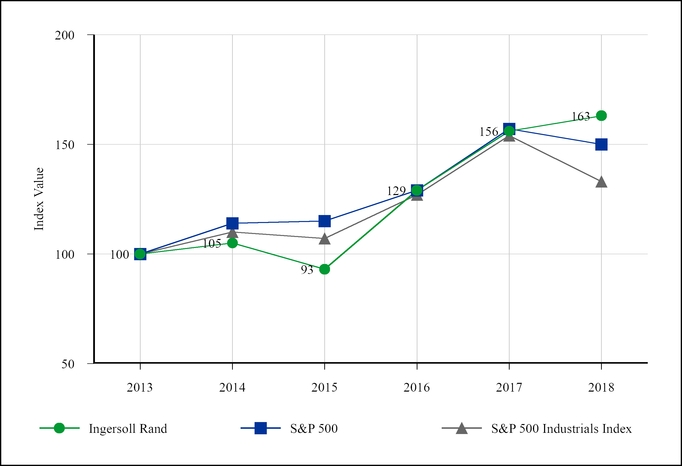
The following graph compares the cumulative total shareholder return on our ordinary shares with the cumulative total return on (i) the Standard & Poor’s 500 Stock Index and (ii) the Standard & Poor’s 500 Industrial Index for the five years ended December 31, 2018. The graph assumes an investment of $100 in our ordinary shares, the Standard & Poor’s 500 Stock Index and the Standard & Poor’s 500 Industrial Index on December 31, 2013 and assumes the reinvestment of dividends.
| Company/Index | 2013 | 2014 | 2015 | 2016 | 2017 | 2018 |
| Ingersoll Rand | 100 | 105 | 93 | 129 | 156 | 163 |
| S&P 500 | 100 | 114 | 115 | 129 | 157 | 150 |
| S&P 500 Industrials Index | 100 | 110 | 107 | 127 | 154 | 133 |
Item 6. SELECTED FINANCIAL DATA
In millions, except per share amounts:
| At and for the years ended December 31, | 2018 | 2017 | 2016 | 2015 | 2014 | |||||||||||||||
| Net revenues | $ | 15,668.2 | $ | 14,197.6 | $ | 13,508.9 | $ | 13,300.7 | $ | 12,891.4 | ||||||||||
| Net earnings (loss) attributable to Ingersoll-Rand plc ordinary shareholders: | ||||||||||||||||||||
| Continuing operations | 1,359.1 | 1,328.0 | 1,443.3 | 688.9 | 897.0 | |||||||||||||||
| Discontinued operations | (21.5 | ) | (25.4 | ) | 32.9 | (24.3 | ) | 34.7 | ||||||||||||
| Total assets | 17,914.9 | 18,173.3 | 17,397.4 | 16,717.6 | 17,274.6 | |||||||||||||||
| Total debt | 4,091.3 | 4,064.0 | 4,070.2 | 4,217.8 | 4,200.5 | |||||||||||||||
| Total Ingersoll-Rand plc shareholders’ equity | 7,022.7 | 7,140.3 | 6,643.8 | 5,816.7 | 5,987.4 | |||||||||||||||
| Earnings (loss) per share attributable to Ingersoll-Rand plc ordinary shareholders: | ||||||||||||||||||||
| Basic: | ||||||||||||||||||||
| Continuing operations | $ | 5.50 | $ | 5.21 | $ | 5.57 | $ | 2.60 | $ | 3.32 | ||||||||||
| Discontinued operations | (0.09 | ) | (0.10 | ) | 0.13 | (0.09 | ) | 0.12 | ||||||||||||
| Diluted: | ||||||||||||||||||||
| Continuing operations | $ | 5.43 | $ | 5.14 | $ | 5.52 | $ | 2.57 | $ | 3.27 | ||||||||||
| Discontinued operations | (0.08 | ) | (0.09 | ) | 0.13 | (0.09 | ) | 0.13 | ||||||||||||
| Dividends declared per ordinary share | $ | 1.96 | $ | 1.70 | $ | 1.36 | $ | 1.16 | $ | 1.00 |
Item 7. MANAGEMENT’S DISCUSSION AND ANALYSIS OF FINANCIAL CONDITION AND RESULTS OF OPERATIONS
The following Management’s Discussion and Analysis of Financial Condition and Results of Operations contains forward-looking statements that involve risks and uncertainties. Our actual results may differ materially from the results discussed in the forward-looking statements. Factors that might cause a difference include, but are not limited to, those discussed under Item 1A. Risk Factors in this Annual Report on Form 10-K. The following section is qualified in its entirety by the more detailed information, including our financial statements and the notes thereto, which appears elsewhere in this Annual Report.
Overview
Organization
We are a diversified, global company that provides products, services and solutions to enhance the quality, energy efficiency and comfort of air in homes and buildings, transport and protect food and perishables and increase industrial productivity and efficiency. Our business segments consist of Climate and Industrial, both with strong brands and highly differentiated products within their respective markets. We generate revenue and cash primarily through the design, manufacture, sale and service of a diverse portfolio of industrial and commercial products that include well-recognized, premium brand names such as Ingersoll-Rand®, Trane®, Thermo King®, American Standard®, ARO®, and Club Car®.
To achieve our mission of being a world leader in creating comfortable, sustainable and efficient environments, we continue to focus on growth by increasing our recurring revenue stream from parts, service, controls, used equipment and rentals; and to continuously improve the efficiencies and capabilities of the products and services of our businesses. We also continue to focus on operational excellence strategies as a central theme to improving our earnings and cash flows.
Trends and Economic Events
We are a global corporation with worldwide operations. As a global business, our operations are affected by worldwide, regional and industry-specific economic factors, as well as political factors, wherever we operate or do business. Our geographic and industry diversity, and the breadth of our product and services portfolios, have helped mitigate the impact of any one industry or the economy of any single country on our consolidated operating results.
Given the broad range of products manufactured and geographic markets served, management uses a variety of factors to predict the outlook for the Company. We monitor key competitors and customers in order to gauge relative performance and the outlook for the future. We regularly perform detailed evaluations of the different market segments we are serving to proactively detect trends and to adapt our strategies accordingly. In addition, we believe our order rates are indicative of future revenue and thus a key measure of anticipated performance. In those industry segments where we are a capital equipment provider, revenues depend on the capital expenditure budgets and spending patterns of our customers, who may delay or accelerate purchases in reaction to changes in their businesses and in the economy.
Current economic conditions are showing positive trends in each of the segments in which we participate. Heating, Ventilation, and Air Conditioning (HVAC) equipment replacement, services, controls and aftermarket continue to experience strong demand. In addition, Residential and Commercial markets have seen continued momentum in the United States, positively impacting the results of our HVAC businesses. Global Industrial markets remain largely supportive of continued growth in both equipment and services. While geopolitical uncertainty exists in markets such as Europe, Asia and Latin America, we are confident we will continue our strong performance globally. In 2019, we expect positive growth in both our Climate and Industrial segments, each benefiting from operational excellence initiatives, new product launches and continued productivity programs.
We believe we have a solid foundation of global brands that are highly differentiated in all of our major product lines. Our growing geographic and industry diversity coupled with our large installed product base provides growth opportunities within our service, parts and replacement revenue streams. In addition, we are investing substantial resources to innovate and develop new products and services which we expect will drive our future growth.
Significant Events
Acquisitions and Equity Investments
We continue to be active with strategic acquisitions and investments. During 2018, acquisitions and equity method investments, net of cash acquired totaled $285.2 million. Related amounts in 2017 and 2016 were $157.6 million and $9.2 million, respectively.
In May 2018, we completed our investment of a 50% ownership interest in a joint venture with Mitsubishi Electric Corporation (Mitsubishi). The joint venture, reported within the Climate segment, focuses on marketing, selling and supporting variable refrigerant flow (VRF) and ductless heating and air conditioning systems through Trane, American Standard and Mitsubishi channels in the U.S. and select Latin American countries.
In January 2018, we acquired 100% of the outstanding stock of ICS Group Holdings Limited (ICS Cool Energy). The acquired business, reported within the Climate segment, specializes in the temporary rental of energy efficient chillers for commercial and industrial buildings across Europe. It also sells, permanently installs and services high performance temperature control systems for all types of industrial processes.
During 2017, we acquired several businesses, including channel acquisitions, that complement existing products and services. Acquisitions within the Climate segment primarily consisted of independent dealers which support the ongoing strategy to expand our distribution network in North America. Other acquisitions within the segment strengthen our product portfolio. Acquisitions within the Industrial segment primarily consisted of a telematics business which builds upon our growing portfolio of connected assets. In addition, other acquisitions within the segment expand sales and service channels across the globe.
On February 6, 2019, we entered into a final, binding and irrevocable offer letter with Silver II GP Holdings S.C.A., an affiliate of BC Partners Advisors L.P. and The Carlyle Group (the Seller) pursuant to which we made a binding offer to acquire the precision flow systems management business (the Business) for approximately $1.45 billion in cash, subject to working capital and certain other adjustments (the Acquisition). The Business is a manufacturer of precision flow control equipment including electric diaphragm pumps and controls that serve the global water, oil and gas, agriculture, industrial and specialty market segments. The offer is subject to completion of information and consultation processes with employee representative bodies of the Business in applicable jurisdictions. If the offer is accepted, completion of the Acquisition would be subject to customary closing conditions and expected to close mid-year 2019 subject to regulatory approvals. The results of the Business will be included in our consolidated financial statements as of the date of acquisition and reported within the Industrial segment.
Share Repurchase Program and Dividends
Share repurchases are made from time to time in accordance with management's capital allocation strategy, subject to market conditions and regulatory requirements. In February 2017, our Board of Directors authorized the repurchase of up to $1.5 billion of our ordinary shares under a share repurchase program (the 2017 Authorization) upon completion of the prior authorized share repurchase program. Repurchases under the 2017 Authorization began in May 2017 and ended in December 2018, completing the program. In October 2018, our Board of Directors authorized the repurchase of up to $1.5 billion of
Showing the first 8K of 79K characters. Open the full section
Item 7A. QUANTITATIVE AND QUALITATIVE DISCLOSURE ABOUT MARKET RISK
We are exposed to fluctuations in currency exchange rates, interest rates and commodity prices which could impact our results of operations and financial condition.
Foreign Currency Exposures
We have operations throughout the world that manufacture and sell products in various international markets. As a result, we are exposed to movements in exchange rates of various currencies against the U.S. dollar as well as against other currencies throughout the world.
Many of our non-U.S. operations have a functional currency other than the U.S. dollar, and their results are translated into U.S. dollars for reporting purposes. Therefore, our reported results will be higher or lower depending on the weakening or strengthening of the U.S. dollar against the respective foreign currency. Our largest concentration of revenues from non-U.S. operations as of
December 31, 2018 are in Euros and Chinese Yuan. A hypothetical 10% unfavorable change in the average exchange rate used to translate Net revenues for the year ended December 31, 2018 from either Euros or Chinese Yuan-based operations into U.S. dollars would not have a material impact on our financial statements.
We use derivative instruments to hedge those material exposures that cannot be naturally offset. The instruments utilized are viewed as risk management tools, primarily involve little complexity and are not used for trading or speculative purposes. To minimize the risk of counter party non-performance, derivative instrument agreements are made only through major financial institutions with significant experience in such derivative instruments.
We evaluate our exposure to changes in currency exchange rates on our foreign currency derivatives using a sensitivity analysis. The sensitivity analysis is a measurement of the potential loss in fair value based on a percentage change in exchange rates. Based on the firmly committed currency derivative instruments in place at December 31, 2018, a hypothetical change in fair value of those derivative instruments assuming a 10% adverse change in exchange rates would result in an unrealized loss of approximately $17.6 million, as compared with $58.3 million at December 31, 2017. These amounts, when realized, would be offset by changes in the fair value of the underlying transactions.
Commodity Price Exposures
We are exposed to volatility in the prices of commodities used in some of our products and we use fixed price contracts to manage this exposure. We do not have committed commodity derivative instruments in place at December 31, 2018.
Interest Rate Exposure
Our debt portfolio mainly consists of fixed-rate instruments, and therefore any fluctuation in market interest rates is not expected to have a material effect on our results of operations.
Item 8. FINANCIAL STATEMENTS AND SUPPLEMENTARY DATA
| (a) | The following Consolidated Financial Statements and Financial Statement Schedules and the report thereon of PricewaterhouseCoopers LLP dated February 12, 2019, are presented under Item 16 of this Annual Report on Form 10-K. |
Consolidated Financial Statements:
Report of independent registered public accounting firm
Consolidated Statements of comprehensive income for the years ended December 31, 2018, 2017 and 2016
Consolidated balance sheets at December 31, 2018 and 2017
For the years ended December 31, 2018, 2017 and 2016:
Consolidated statements of equity
Consolidated statements of cash flows
Notes to Consolidated Financial Statements
Financial Statement Schedule:
Schedule II – Valuation and Qualifying Accounts for the years ended December 31, 2018, 2017 and 2016
| (b) | The unaudited selected quarterly financial data for the two years ended December 31, is as follows: |
| 2018 | ||||||||||||||||
| In millions, except per share amounts | First Quarter | Second Quarter | Third Quarter | Fourth Quarter | ||||||||||||
| Net revenues | $ | 3,384.5 | $ | 4,357.7 | $ | 4,030.9 | $ | 3,895.1 | ||||||||
| Cost of goods sold | (2,420.2 | ) | (2,964.1 | ) | (2,718.3 | ) | (2,745.0 | ) | ||||||||
| Operating income | 243.4 | 640.3 | 587.0 | 446.7 | ||||||||||||
| Net earnings | 124.1 | 452.6 | 519.4 | 261.4 | ||||||||||||
| Net earnings attributable to Ingersoll-Rand plc | 120.4 | 448.1 | 515.1 | 254.0 | ||||||||||||
| Earnings per share attributable to Ingersoll-Rand plc ordinary shareholders: | ||||||||||||||||
| Basic | $ | 0.48 | $ | 1.81 | $ | 2.09 | $ | 1.04 | ||||||||
| Diluted | $ | 0.48 | $ | 1.79 | $ | 2.06 | $ | 1.03 | ||||||||
| 2017 | ||||||||||||||||
| First Quarter | Second Quarter | Third Quarter | Fourth Quarter | |||||||||||||
| Net revenues | $ | 3,000.6 | $ | 3,908.4 | $ | 3,670.5 | $ | 3,618.1 | ||||||||
| Cost of goods sold | (2,126.1 | ) | (2,653.1 | ) | (2,489.9 | ) | (2,542.5 | ) | ||||||||
| Operating income | 215.0 | 557.6 | 506.1 | 386.6 | ||||||||||||
| Net earnings | 121.1 | 362.2 | 371.9 | 457.1 | ||||||||||||
| Net earnings attributable to Ingersoll-Rand plc | 117.1 | 358.6 | 367.0 | 459.9 | ||||||||||||
| Earnings per share attributable to Ingersoll-Rand plc ordinary shareholders: | ||||||||||||||||
| Basic | $ | 0.45 | $ | 1.40 | $ | 1.45 | $ | 1.84 | ||||||||
| Diluted | $ | 0.45 | $ | 1.38 | $ | 1.43 | $ | 1.81 |
Item 9. CHANGES IN AND DISAGREEMENTS WITH ACCOUNTANTS ON ACCOUNTING AND FINANCIAL
DISCLOSURE
None.
Item 9A. CONTROLS AND PROCEDURES
| (a) | Evaluation of Disclosure Controls and Procedures |
The Company's management, including its Chief Executive Officer and Chief Financial Officer, have conducted an evaluation of the effectiveness of the Company's disclosure controls and procedures (as such term is defined in Rules 13a-15(e) and 15d-15(e) under the Securities Exchange Act of 1934, as amended (the Exchange Act)), as of the end of the period covered by this Annual Report on Form 10-K. Based on that evaluation, the Chief Executive Officer and Chief Financial Officer concluded as of December 31, 2018, that the Company's disclosure controls and procedures were effective in ensuring that information required to be disclosed by the Company in reports that it files or submits under the Exchange Act has been recorded, processed, summarized and reported, within the time periods specified in the Commission's rules and forms, and that such information has been accumulated and communicated to the Company's management including its Chief Executive Officer and Chief Financial Officer, as appropriate, to allow timely decisions regarding required disclosure.
| (b) | Management's Report on Internal Control Over Financial Reporting |
The Company's management is responsible for establishing and maintaining adequate internal control over financial reporting as such term is defined under Exchange Act Rules 13a-15(f) and 15d-15(f). Internal control over financial reporting is a process designed by, or under the supervision of, the Chief Executive Officer and Chief Financial Officer and effected by the Company's Board of Directors to provide reasonable assurance regarding the reliability of financial reporting and the preparation of financial statements for external purposes in accordance with generally accepted accounting principles.
Because of its inherent limitations, internal control over financial reporting may not prevent or detect misstatements. Also, projections of any evaluation of effectiveness to future periods are subject to the risk that controls may become inadequate because of changes in conditions, or that the degree of compliance with the policies and procedures may deteriorate.
Management has assessed the effectiveness of internal control over financial reporting as of December 31, 2018. In making its assessment, management has utilized the criteria set forth by the Committee of Sponsoring Organizations (COSO) of the Treadway Commission in Internal Control - Integrated Framework (2013). Management concluded that based on its assessment, the Company's internal control over financial reporting was effective as of December 31, 2018.
The effectiveness of the Company's internal control over financial reporting as of December 31, 2018 has been audited by PricewaterhouseCoopers LLP, an independent registered public accounting firm, as stated in their report which appears herein.
| (c) | Changes in Internal Control Over Financial Reporting |
There were no changes in internal control over financial reporting (as defined by Rules 13a-15(f) and 15d-15(f) under the Exchange Act) that occurred during the quarter ended December 31, 2018 that have materially affected, or are reasonably likely to materially affect, the Company's internal control over financial reporting.
Item 9B. OTHER INFORMATION
On February 6, 2019, the Board of Directors of Ingersoll-Rand plc terminated the Company's Senior Executive Performance Plan effective immediately.
PART III
Item 10. DIRECTORS, EXECUTIVE OFFICERS AND CORPORATE GOVERNANCE
The information regarding our executive officers is included in Part I under the caption “Executive Officers of Registrant.”
The other information required by this item is incorporated herein by reference to the information contained under the headings “Item 1. Election of Directors”, “Section 16(a) Beneficial Ownership Reporting Compliance” and “Corporate Governance” in our definitive proxy statement for the 2019 annual general meeting of shareholders (2019 Proxy Statement).
Item 11. EXECUTIVE COMPENSATION
The other information required by this item is incorporated herein by reference to the information contained under the headings “Compensation Discussion and Analysis,” “Compensation of Directors,” “Executive Compensation,” “Compensation Committee Report” and “Compensation Committee Interlocks and Insider Participation” in our 2019 Proxy Statement.
Item 12. SECURITY OWNERSHIP OF CERTAIN BENEFICIAL OWNERS AND MANAGEMENT AND RELATED
STOCKHOLDER MATTERS
The other information required by this item is incorporated herein by reference to the information contained under the headings “Security Ownership of Certain Beneficial Owners and Management” and “Equity Compensation Plan Information” of our 2019 Proxy Statement.
Item 13. CERTAIN RELATIONSHIPS AND RELATED TRANSACTIONS, AND DIRECTOR INDEPENDENCE
The other information required by this item is incorporated herein by reference to the information contained under the headings “Corporate Governance” and “Certain Relationships and Related Person Transactions” of our 2019 Proxy Statement.
Item 14. PRINCIPAL ACCOUNTANT FEES AND SERVICES
The information required by this item is incorporated herein by reference to the information contained under the caption “Fees of the Independent Auditors” in our 2019 Proxy Statement.
PART IV
Item 15. EXHIBITS AND FINANCIAL STATEMENT SCHEDULES
| (a) 1. and 2. | Financial statements and financial statement schedule See Item 8. |
| 3. | Exhibits |
| The exhibits listed on the accompanying index to exhibits are filed as part of this Annual Report on Form 10-K. |
INGERSOLL-RAND PLC
INDEX TO EXHIBITS
(Item 15(a))
Description
Pursuant to the rules and regulations of the Securities and Exchange Commission (“SEC”), Ingersoll-Rand plc (the “Company”) has filed certain agreements as exhibits to this Annual Report on Form 10-K. These agreements may contain representations and warranties by the parties. These representations and warranties have been made solely for the benefit of the other party or parties to such agreements and (i) may have been qualified by disclosures made to such other party or parties, (ii) were made only as of the date of such agreements or such other date(s) as may be specified in such agreements and are subject to more recent developments, which may not be fully reflected in our public disclosure, (iii) may reflect the allocation of risk among the parties to such agreements and (iv) may apply materiality standards different from what may be viewed as material to investors. Accordingly, these representations and warranties may not describe our actual state of affairs at the date hereof and should not be relied upon.
On July 1, 2009, Ingersoll-Rand Company Limited, a Bermuda company, completed a reorganization to change the jurisdiction of incorporation of the parent company from Bermuda to Ireland. As a result, Ingersoll-Rand plc replaced Ingersoll-Rand Company Limited as the ultimate parent company effective July 1, 2009. All references related to the Company prior to July 1, 2009 relate to Ingersoll-Rand Company Limited.
(a) Exhibits
| Exhibit No. | Description | Method of Filing | |||
| 2.1 | Separation and Distribution Agreement between Ingersoll-Rand plc and Allegion plc, dated November 29, 2013. | Incorporated by reference to Exhibit 3.1 to the Company’s Form 8-K (File No. 001-34400) filed with the SEC on December 2, 2013. | |||
| 3.1 | Constitution of the Company, as amended and restated on June 2, 2016 | Incorporated by reference to Exhibit 3.1 to the Company’s Form 8-K (File No. 001-34400) filed with the SEC on June 7, 2016. | |||
| The Company and its subsidiaries are parties to several long-term debt instruments under which, in each case, the total amount of securities authorized does not exceed 10% of the total assets of the Company and its subsidiaries on a consolidated basis. | Pursuant to paragraph 4 (iii)(A) of Item 601 (b) of Regulation S-K, the Company agrees to furnish a copy of such instruments to the Securities and Exchange Commission upon request. | ||||
| 4.1 | Indenture, dated as of June 20, 2013, by and among Ingersoll-Rand Global Holding Company Limited, as issuer, Ingersoll-Rand plc, Ingersoll-Rand Company Limited and Ingersoll-Rand International Holding Limited, as guarantors and The Bank of New York Mellon, as Trustee.. | Incorporated by reference to Exhibit 4.1 to the Company's Form 8-K (File No. 001-34400) filed with the SEC on June 26, 2013. | |||
| 4.2 | First Supplemental Indenture, dated as of June 20, 2013, by and among Ingersoll-Rand Global Holding Company Limited, as issuer, Ingersoll-Rand plc, Ingersoll-Rand Company Limited and Ingersoll-Rand International Holding Limited, as guarantors and The Bank of New York Mellon, as Trustee, relating to the 2.875% Senior Notes due 2019. | Incorporated by reference to Exhibit 4.2 to the Company's Form 8-K (File No. 001-34400) filed with the SEC on June 26, 2013. | |||
| Exhibit No. | Description | Method of Filing | |||
| 10.13* | IR Executive Deferred Compensation Plan II (as amended and restated effective January 1, 2017). | Incorporated by reference to Exhibit 10.2 to the Company’s Form 10-Q for the quarter ended June 30, 2017 (File No. 001-34400) filed with the SEC on July 26, 2017. | |||
| 10.14* | First Amendment to IR Executive Deferred Compensation Plan II (dated December 22, 2009). | Incorporated by reference to Exhibit 10.19 to the Company’s Form 10-K for the fiscal year ended 2011 (File No. 001-34400) filed with the SEC on February 21, 2012. | |||
| 10.15* | Second Amendment to IR Executive Deferred Compensation Plan II (dated December 23, 2010). | Incorporated by reference to Exhibit 10.20 to the Company’s Form 10-K for the fiscal year ended 2011 (File No. 001-16831) filed with the SEC on February 21, 2012. | |||
| 10.16* | IR-plc Director Deferred Compensation and Stock Award Plan (as amended and restated effective July 1, 2009). | Incorporated by reference to Exhibit 10.11 to the Company’s Form 8-K (File No. 001-34400) filed with the SEC on July 1, 2009. | |||
| 10.17* | IR-plc Director Deferred Compensation and Stock Award Plan II (as amended and restated effective July 1, 2009). | Incorporated by reference to Exhibit 10.12 to the Company’s Form 8-K (File No. 001-34400) filed with the SEC on July 1, 2009. | |||
| 10.18* | Ingersoll-Rand Company Supplemental Employee Savings Plan (amended and restated effective October 1, 2012). | Incorporated by reference to exhibit 10.23 to the Company's Form 10-K for the fiscal year ended 2012 (File No. 001-34400) filed with the SEC on February 14, 2013. | |||
| 10.19* | Amendment to the Ingersoll-Rand Company Supplemental Employee Savings Plan dated April 6, 2017. | Incorporated by reference to Exhibit 10.21 to the Company’s Form 10-K (File No. 001-34400) filed with the SEC on February 12, 2018. | |||
| 10.20* | Ingersoll-Rand Company Supplemental Employee Savings Plan II (effective January 1, 2005 and amended and restated through October 1, 2012). | Incorporated by reference to exhibit 10.24 to the Company's Form 10-K for the fiscal year ended 2012 (File No. 001-34400) filed with the SEC on February 14, 2013. | |||
| 10.21* | Amendment to the Ingersoll-Rand Company Supplemental Employee Savings Plan II dated April 6, 2017. | Incorporated by reference to Exhibit 10.23 to the Company’s Form 10-K (File No. 001-34400) filed with the SEC on February 12, 2018. | |||
| 10.22* | Trane Inc. Deferred Compensation Plan (as amended and restated as of July 1, 2009, except where otherwise stated). | Incorporated by reference to Exhibit 10.19 to the Company’s Form 8-K (File No. 001-34400) filed with the SEC on July 1, 2009. | |||
| 10.23* | Amendment to Trane Inc. Deferred Compensation Plan dated April 6, 2017. | Incorporated by reference to Exhibit 10.25 to the Company’s Form 10-K (File No. 001-34400) filed with the SEC on February 12, 2018. | |||
| 10.24* | Ingersoll-Rand Company Supplemental Pension Plan (Amended and Restated Effective January 1, 2005). | Incorporated by reference to Exhibit 10.28 to the Company’s Form 10-K for the fiscal year ended 2008 (File No. 001-16831) filed with the SEC on March 2, 2009. |
| Exhibit No. | Description | Method of Filing | |||
| 10.25* | First Amendment to the Ingersoll-Rand Company Supplemental Pension Plan, dated as of July 1, 2009. | Incorporated by reference to Exhibit 10.21 to the Company’s Form 8-K (File No. 001-34400) filed with the SEC on July 1, 2009. | |||
| 10.26* | Ingersoll-Rand Company Elected Officers Supplemental Plan (Effective January 1, 2005 and Amended and Restated effective October 1, 2012). | Incorporated by reference to exhibit 10.32 to the Company's Form 10-K for the fiscal year ended 2012 (File No. 001-34400) filed with the SEC on February 14, 2013. | |||
| 10.27* | Ingersoll-Rand Company Key Management Supplemental Program (Effective January 1, 2005 and Amended and Restated effective October 1, 2012). | Filed herewith. | |||
| 10.28* | First Amendment to the Ingersoll Rand Company Key Management Supplemental Program, dated as of June 15, 2015. | Filed herewith. | |||
| 10.29* | Description of Annual Incentive Matrix Program. | Incorporated by reference to Exhibit 10.30 to the Company’s Form 10-K (File No. 001-34400) filed with the SEC on February 12, 2018. | |||
| 10.30* | Form of Tier 1 Change in Control Agreement (Officers before May 19, 2009). | Incorporated by reference to Exhibit 99.1 to the Company's Form 8-K (File No. 001-16831) filed with the SEC on December 4, 2006. | |||
| 10.31* | Form of Tier 2 Change in Control Agreement (Officers before May 19, 2009). | Incorporated by reference to Exhibit 99.2 to the Company’s Form 8-K (File No. 001-16831) filed with the SEC on December 4, 2006. | |||
| 10.32* | Form of Tier 1 Change in Control Agreement (New Officers on or after May 19, 2009). | Incorporated by reference to Exhibit 10.32 to the Company’s Form 10-Q for the period ended June 30, 2009 (File No. 001-34400) filed with the SEC on August 6, 2009. | |||
| 10.33* | Form of Tier 2 Change in Control Agreement (New Officers on or after May 19, 2009). | Incorporated by reference to Exhibit 10.33 to the Company’s Form 10-Q for the period ended June 30, 2009 (File No. 001-34400) filed with the SEC on August 6, 2009. | |||
| 10.34* | Amended and Restated Major Restructuring Severance Plan (as amended and restated effective December 31, 2014). | Incorporated by reference to Exhibit 10.35 to the Company’s Form 10-K for the fiscal year ended 2014 (File No. 001-34400) filed with the SEC on February 13, 2015. | |||
| 10.35* | Michael W. Lamach Letter, dated December 24, 2003. | Incorporated by reference to Exhibit 10.35 to the Company’s Form 10-K for the fiscal year ended 2003 (File No. 001-16831) filed with the SEC on February 27, 2004. | |||
| 10.36* | Michael W. Lamach Letter, dated June 4, 2008. | Incorporated by reference to Exhibit 10.2 to the Company’s Form 8-K (File No. 001-16831) filed with the SEC on June 10, 2008. | |||
| Exhibit No. | Description | Method of Filing | |||
| 10.37* | Michael W. Lamach Letter, dated February 4, 2009. | Incorporated by reference to Exhibit 10.43 to the Company’s Form 10-K for the fiscal year ended 2008 (File No. 001-16831) filed with the SEC on March 2, 2009. | |||
| 10.38* | Michael W. Lamach Letter, dated February 3, 2010. | Incorporated by reference to Exhibit 10.1 to the Company’s Form 8-K (File No. 001-34400) filed with the SEC on February 5, 2010. | |||
| 10.39* | Michael W. Lamach Letter, dated December 23, 2012. | Incorporated by reference to exhibit 10.48 to the Company's Form 10-K for the fiscal year ended 2012 (File No. 001-34400) filed with the SEC on February 14, 2013. | |||
| 10.40* | Marcia J. Avedon Letter, dated January 8, 2007. | Incorporated by reference to Exhibit 10.45 to the Company's Form 10-K for the fiscal year ended December 31, 2006 (File No. 001-16831) filed with the SEC on March 1, 2007. | |||
| 10.41* | Marcia J. Avedon Letter, dated December 20, 2012. | Incorporated by reference to exhibit 10.53 to the Company's Form 10-K for the fiscal year ended 2012 (File No. 001-34400) filed with the SEC on February 14, 2013. | |||
| 10.42* | Susan K. Carter Letter, dated as of August 19, 2013. | Incorporated by reference to Exhibit 10.1 to the Company's Form 8-K (File No. 001-34400) filed with the SEC on October 2, 2013. | |||
| 10.43* | Maria Green Letter, dated as of September 22, 2015. | Filed herewith. | |||
| 10.44* | Dave Regnery Letter, dated as of September 1, 2017. | Filed herewith. | |||
| 10.45* | Employee Matters Agreement between Ingersoll-Rand plc and Allegion plc, dated November 30, 2013. | Incorporated by reference to Exhibit 10.1 to the Company's Form 8-K (File No. 001-34400) filed with the SEC on December 2, 2013. | |||
| 21 | List of Subsidiaries of Ingersoll-Rand plc. | Filed herewith. | |||
| 23.1 | Consent of Independent Registered Public Accounting Firm. | Filed herewith. | |||
| 31.1 | Certification of Chief Executive Officer Pursuant to Rule 13a-14(a) or Rule 15d-14(a), as Adopted Pursuant to Section 302 of the Sarbanes-Oxley Act of 2002. | Filed herewith. | |||
| 31.2 | Certification of Chief Financial Officer Pursuant to Rule 13a-14(a) or Rule 15d-14(a), as Adopted Pursuant to Section 302 of the Sarbanes-Oxley Act of 2002. | Filed herewith. | |||
| Exhibit No. | Description | Method of Filing | |||
| 32 | Certifications of Chief Executive Officer and Chief Financial Officer Pursuant to Rule 13a-14(b) or Rule 15d-14(b) and 18 U.S.C. Section 1350, as Adopted Pursuant to Section 906 of the Sarbanes-Oxley Act of 2002. | Furnished herewith. | |||
| 101 | The following materials from the Company’s Annual Report on Form 10-K for the year ended December 31, 2018, formatted in XBRL (Extensible Business Reporting Language): (i) the Consolidated Statements of Comprehensive Income, (ii) the Consolidated Balance Sheets, (iii) the Consolidated Statements of Equity, (iv) the Consolidated Statements of Cash Flows, and (v) Notes to Consolidated Financial Statements. | Furnished herewith. |
- Management contract or compensatory plan or arrangement.
Item 16. FORM 10-K SUMMARY
Not applicable.
SIGNATURES
Pursuant to the requirements of Section 13 or 15(d) of the Securities Exchange Act of 1934, the registrant has duly caused this report to be signed on its behalf by the undersigned, thereunto duly authorized.
INGERSOLL-RAND PLC
(Registrant)
| By: | /s/ Michael W. Lamach | |
| Michael W. Lamach | ||
| Chairman of the Board and Chief Executive Officer | ||
| Date: | February 12, 2019 |
Pursuant to the requirement of the Securities Exchange Act of 1934, this report has been signed by the following persons on behalf of the registrant and in the capacities and on the dates indicated.
| Signature | Title | Date | ||
| /s/ Michael W. Lamach | Chairman of the Board and Chief Executive Officer (Principal Executive Officer) | February 12, 2019 | ||
| (Michael W. Lamach) | ||||
| /s/ Susan K. Carter | Senior Vice President and Chief Financial Officer (Principal Financial Officer) | February 12, 2019 | ||
| (Susan K. Carter) | ||||
| /s/ Christopher J. Kuehn | Vice President and Chief Accounting Officer (Principal Accounting Officer) | February 12, 2019 | ||
| (Christopher J. Kuehn) | ||||
| /s/ Kirk E. Arnold | Director | February 12, 2019 | ||
| (Kirk E. Arnold) | ||||
| /s/ Ann C. Berzin | Director | February 12, 2019 | ||
| (Ann C. Berzin) | ||||
| /s/ John Bruton | Director | February 12, 2019 | ||
| (John Bruton) | ||||
| /s/ Jared L. Cohon | Director | February 12, 2019 | ||
| (Jared L. Cohon) | ||||
| /s/ Gary D. Forsee | Director | February 12, 2019 | ||
| (Gary D. Forsee) | ||||
| /s/ Linda P. Hudson | Director | February 12, 2019 | ||
| (Linda P. Hudson) | ||||
| /s/ Myles P. Lee | Director | February 12, 2019 | ||
| (Myles P. Lee) | ||||
| /s/ Karen B. Peetz | Director | February 12, 2019 | ||
| (Karen B. Peetz) | ||||
| /s/ John P. Surma | Director | February 12, 2019 | ||
| (John P. Surma) | ||||
| /s/ Richard J. Swift | Director | February 12, 2019 | ||
| (Richard J. Swift) | ||||
| /s/ Tony L. White | Director | February 12, 2019 | ||
| (Tony L. White) |
INGERSOLL-RAND PLC
Index to Consolidated Financial Statements
F-1
Report of Independent Registered Public Accounting Firm
To the Shareholders and Board of Directors of Ingersoll-Rand plc
Opinions on the Financial Statements and Internal Control over Financial Reporting
We have audited the accompanying consolidated balance sheets of Ingersoll-Rand plc and its subsidiaries (the “Company”) as of December 31, 2018 and 2017, and the related consolidated statements of comprehensive income, of equity and of cash flows for each of the three years in the period ended December 31, 2018, including the related notes and schedule of valuation and qualifying accounts for each of the three years in the period ended December 31, 2018 appearing under Item 16 (collectively referred to as the “consolidated financial statements”). We also have audited the Company's internal control over financial reporting as of December 31, 2018, based on criteria established in Internal Control - Integrated Framework (2013) issued by the Committee of Sponsoring Organizations of the Treadway Commission (COSO).
In our opinion, the consolidated financial statements referred to above present fairly, in all material respects, the financial position of the Company as of December 31, 2018 and 2017, and the results of its operations and its cash flows for each of the three years in the period ended December 31, 2018 in conformity with accounting principles generally accepted in the United States of America. Also in our opinion, the Company maintained, in all material respects, effective internal control over financial reporting as of December 31, 2018, based on criteria established in Internal Control - Integrated Framework (2013) issued by the COSO.
Basis for Opinions
The Company's management is responsible for these consolidated financial statements, for maintaining effective internal control over financial reporting, and for its assessment of the effectiveness of internal control over financial reporting, included in Management’s Report on Internal Control over Financial Reporting appearing under Item 9A. Our responsibility is to express opinions on the Company’s consolidated financial statements and on the Company's internal control over financial reporting based on our audits. We are a public accounting firm registered with the Public Company Accounting Oversight Board (United States) (PCAOB) and are required to be independent with respect to the Company in accordance with the U.S. federal securities laws and the applicable rules and regulations of the Securities and Exchange Commission and the PCAOB.
We conducted our audits in accordance with the standards of the PCAOB. Those standards require that we plan and perform the audits to obtain reasonable assurance about whether the consolidated financial statements are free of material misstatement, whether due to error or fraud, and whether effective internal control over financial reporting was maintained in all material respects.
Our audits of the consolidated financial statements included performing procedures to assess the risks of material misstatement of the consolidated financial statements, whether due to error or fraud, and performing procedures that respond to those risks. Such procedures included examining, on a test basis, evidence regarding the amounts and disclosures in the consolidated financial statements. Our audits also included evaluating the accounting principles used and significant estimates made by management, as well as evaluating the overall presentation of the consolidated financial statements. Our audit of internal control over financial reporting included obtaining an understanding of internal control over financial reporting, assessing the risk that a material weakness exists, and testing and evaluating the design and operating effectiveness of internal control based on the assessed risk. Our audits also included performing such other procedures as we considered necessary in the circumstances. We believe that our audits provide a reasonable basis for our opinions.
Definition and Limitations of Internal Control over Financial Reporting
A company’s internal control over financial reporting is a process designed to provide reasonable assurance regarding the reliability of financial reporting and the preparation of financial statements for external purposes in accordance with generally accepted accounting principles. A company’s internal control over financial
Showing the first 8K of 236K characters. Open the full section