 filings.tools
Trane Technologies 10-K 2020-12-31
Filed 2021-02-09. 22 sections, 518K characters. Original on sec.gov · Markdown · JSON
Cover and table of contents
UNITED STATES SECURITIES AND EXCHANGE COMMISSION
Washington, D.C. 20549
FORM 10-K
(Mark One)
| ☒ | ANNUAL REPORT PURSUANT TO SECTION 13 OR 15(d) OF THE SECURITIES EXCHANGE ACT OF 1934 |
For the fiscal year ended December 31, 2020
or
| ☐ | TRANSITION REPORT PURSUANT TO SECTION 13 OR 15(d) OF THE SECURITIES EXCHANGE ACT OF 1934 |
For the transition period from to
Commission File No. 001-34400
TRANE TECHNOLOGIES PLC
(Exact name of registrant as specified in its charter)
| Ireland | 98-0626632 | |||||||
| (State or other jurisdiction of incorporation or organization) | (I.R.S. Employer Identification No.) |
170/175 Lakeview Dr.
Airside Business Park
Swords Co. Dublin
Ireland
(Address of principal executive offices)
Registrant’s telephone number, including area code: +(353) (0) 18707400
| Securities registered pursuant to Section 12(b) of the Act: | ||||||||||||||
| Title of each class | Trading Symbol | Name of each exchange on which registered | ||||||||||||
| Ordinary Shares, Par Value $1.00 per Share | TT | New York Stock Exchange |
Securities registered pursuant to Section 12(g) of the Act: None
Indicate by check mark if the registrant is a well-known seasoned issuer, as defined in Rule 405 of the Securities Act. Yes x No ☐
Indicate by check mark if the registrant is not required to file reports pursuant to Section 13 or Section 15(d) of the Act. Yes ☐ No x
Indicate by check mark whether the registrant (1) has filed all reports required to be filed by Section 13 or 15(d) of the Securities Exchange Act of 1934 during the preceding 12 months (or for such shorter period that the registrant was required to file such reports), and (2) has been subject to such filing requirements for the past 90 days. Yes x No ☐
Indicate by check mark whether the registrant has submitted electronically every Interactive Data File required to be submitted pursuant to Rule 405 of Regulation S-T (§232.405 of this chapter) during the preceding 12 months (or for such shorter period that the registrant was required to submit such files). Yes x No ☐
Indicate by check mark whether the registrant is a large accelerated filer, an accelerated filer, a non-accelerated filer, a smaller reporting company, or an emerging growth company. See the definitions of “large accelerated filer,” “accelerated filer,” “smaller reporting company,” and “emerging growth company” in Rule 12b-2 of the Exchange Act.:
| Large accelerated filer | x | Accelerated filer | ☐ | Emerging growth company | ☐ | ||||||||||||||||||
| Non-accelerated filer | ☐ | Smaller reporting company | ☐ | ||||||||||||||||||||
| If an emerging growth company, indicate by check mark if the registrant has elected not to use the extended transition period for complying with any new or revised financial accounting standards provided pursuant to Section 13(a) of the Exchange Act. ☐ | |||||||||||||||||||||||
Indicate by check mark whether the registrant has filed a report on and attestation to its management's assessment of the effectiveness of its internal control over financial reporting under Section 404(b) of the Sarbanes-Oxley Act (15 U.S.C. 7262(b)) by the registered public accounting firm that prepared or issued its audit report. Yes x No ☐
Indicate by check mark whether the registrant is a shell company (as defined in Rule 12b-2 of the Act). Yes ☐ No x
The aggregate market value of ordinary shares held by nonaffiliates on June 30, 2020 was approximately $21.2 billion based on the closing price of such stock on the New York Stock Exchange.
The number of ordinary shares outstanding as of February 1, 2021 was 238,428,700.
DOCUMENTS INCORPORATED BY REFERENCE
Portions of the registrant’s proxy statement to be filed within 120 days of the close of the registrant’s fiscal year in connection with the registrant’s Annual General Meeting of Shareholders to be held June 3, 2021 are incorporated by reference into Part II and Part III of this Form 10-K.
TRANE TECHNOLOGIES PLC
Form 10-K
For the Fiscal Year Ended December 31, 2020
TABLE OF CONTENTS
CAUTIONARY STATEMENT FOR FORWARD LOOKING STATEMENTS
Certain statements in this report, other than purely historical information, are “forward-looking statements” within the meaning of the Private Securities Litigation Reform Act of 1995, Section 27A of the Securities Act of 1933 and Section 21E of the Securities Exchange Act of 1934. These forward-looking statements generally are identified by the words “believe,” “project,” “expect,” “anticipate,” “estimate,” “forecast,” “outlook,” “intend,” “strategy,” “plan,” “may,” “could,” “should,” “will,” “would,” “will be,” “will continue,” “will likely result,” or the negative thereof or variations thereon or similar terminology generally intended to identify forward-looking statements.
Forward-looking statements may relate to such matters as projections of revenue, margins, expenses, tax provisions, earnings, cash flows, benefit obligations, share or debt repurchases or other financial items; any statements of the plans, strategies and objectives of management for future operations, including those relating to any statements concerning expected development, performance or market share relating to our products and services; any statements regarding future economic conditions or our performance including our future performance statements related to the continued impact of the COVID-19 global pandemic; any statements regarding pending investigations, claims or disputes; any statements of expectation or belief; and any statements of assumptions underlying any of the foregoing. These statements are based on currently available information and our current assumptions, expectations and projections about future events. While we believe that our assumptions, expectations and projections are reasonable in view of the currently available information, you are cautioned not to place undue reliance on our forward-looking statements. You are advised to review any further disclosures we make on related subjects in materials we file with or furnish to the Securities and Exchange Commission. Forward-looking statements speak only as of the date they are made and are not guarantees of future performance. They are subject to future events, risks and uncertainties - many of which are beyond our control - as well as potentially inaccurate assumptions, that could cause actual results to differ materially from our expectations and projections. We do not undertake to update any forward-looking statements.
Factors that might affect our forward-looking statements include, among other things:
-
impacts of the COVID-19 global pandemic on our business operations, financial results and financial position and on the world economy;
-
overall economic, political and business conditions in the markets in which we operate;
-
trade protection measures such as import or export restrictions and requirements, the imposition of tariffs and quotas or revocation or material modification of trade agreements;
-
competitive factors in the industries in which we compete;
-
our ability to develop new products and services and the acceptance of these products in the markets that we serve;
-
other capital market conditions, including availability of funding sources, interest rate fluctuations and other changes in borrowing costs;
-
currency exchange rate fluctuations, exchange controls and currency devaluations;
-
the outcome of any litigation, governmental investigations, claims or proceedings;
-
the outcome of Chapter 11 proceedings for our deconsolidated subsidiaries Aldrich Pump LLC (Aldrich) and Murray Boiler LLC (Murray);
-
the impact of potential information technology, system failures, data security breaches or other cybersecurity issues;
-
evolving data privacy and protection laws;
-
intellectual property infringement claims and the inability to protect our intellectual property rights;
-
changes in laws and regulations;
-
health epidemics or pandemics or other contagious outbreaks;
-
climate change, changes in weather patterns, natural disasters and seasonal fluctuations;
-
availability of and fluctuations in the prices of key commodities;
-
the outcome of any tax audits or settlements;
-
the strategic acquisition or divestiture of businesses, product lines and joint ventures;
-
impairment of our goodwill, indefinite-lived intangible assets and/or our long-lived assets;
-
changes in tax laws and requirements (including tax rate changes, new tax laws, new and/or revised tax law interpretations and any legislation that may limit or eliminate potential tax benefits resulting from our incorporation in a non-U.S. jurisdiction, such as Ireland); and
-
work stoppages, union negotiations, labor disputes and similar issues
Some of the significant risks and uncertainties that could cause actual results to differ materially from our expectations and projections are described more fully in Part I, Item 1A “Risk Factors.” You should read that information in conjunction with
“Management's Discussion and Analysis of Financial Condition and Results of Operations” in Part II, Item 7 of this report and our Consolidated Financial Statements and related notes in Part II, Item 8 “Financial Statements and Supplementary Data” of this report. We note such information for investors as permitted by the Private Securities Litigation Reform Act of 1995.
PART I
Item 1. BUSINESS
Overview
Trane Technologies plc (formerly known as Ingersoll-Rand plc), a public limited company incorporated in Ireland in 2009, and its consolidated subsidiaries (collectively, we, our, the Company) is a global climate innovator that brings efficient and sustainable climate solutions to buildings, homes and transportation driven by strategic brands Trane® and Thermo King® and an environmentally responsible portfolio of products and services. We generate revenue and cash primarily through the design, manufacture, sale and service of a diverse portfolio of climate control products and services for Heating, Ventilation and Air Conditioning (HVAC) and transport solutions.
To achieve our mission of being a world leader in creating comfortable, sustainable and efficient environments, we continue to focus on growth by increasing our recurring revenue stream from parts, services, controls, used equipment and rentals; and to continuously improve efficiencies and capabilities of our operations and products and services for our customers. We also continue to focus on operational excellence strategies as a central theme to improving our earnings and cash flow.
Separation of Industrial Segment Businesses
On February 29, 2020 (Distribution Date), we completed our Reverse Morris Trust transaction (the Transaction) with Gardner Denver Holdings, Inc. (Gardner Denver, which changed its name to Ingersoll Rand Inc. after the Transaction) whereby we distributed Ingersoll-Rand U.S. HoldCo, Inc., which contained our former Industrial segment (Ingersoll Rand Industrial), through a pro rata distribution (the Distribution) to our shareholders of record as of February 24, 2020. Ingersoll Rand Industrial then merged into a wholly-owned subsidiary of Gardner Denver. Upon close of the Transaction, our existing shareholders received approximately 50.1% of the shares of Gardner Denver common stock on a fully-diluted basis and Gardner Denver stockholders retained approximately 49.9% of the shares of Gardner Denver on a fully diluted basis. As a result, our shareholders received .8824 shares of Gardner Denver common stock with respect to each share owned as of February 24, 2020. In connection with the Transaction, Ingersoll-Rand Services Company, an affiliate of Ingersoll Rand Industrial, borrowed an aggregate principal amount of $1.9 billion under a senior secured first lien term loan facility (Term Loan), the proceeds of which were used to make a special cash payment of $1.9 billion to a subsidiary of ours. The obligations under the Term Loan were retained by Ingersoll-Rand Services Company, which following the Transaction is a wholly-owned subsidiary of Gardner Denver.
In connection with the Transaction, we entered into several agreements covering supply, administrative and tax matters to provide or obtain services on a transitional basis for varying periods after the Distribution Date. The agreements cover services such as manufacturing, information technology, human resources and finance. Income and expenses under these agreements were not material. In accordance with several customary transaction-related agreements between us and Gardner Denver, the parties are in a process to determine final adjustments to working capital, cash and indebtedness amounts as of the Distribution Date, as well as another process to determine funding levels related to pension plans, non-qualified deferred compensation plans and retiree health benefits. As of December 31, 2020, both are ongoing in accordance with the transaction-related agreements. Upon finalization of these agreements, any adjustments will be recognized within Retained earnings.
Reportable Segments
Prior to the separation of our Industrial segment on February 29, 2020, we announced a new organizational model and business segment structure designed to enhance our regional go-to-market capabilities, aligning the structure with our strategy and increased focus on climate innovation. Under the revised structure, we created three new regional operating segments from the former climate segment, which also serve as our reportable segments.
-
Our Americas segment innovates for customers in the North America and Latin America regions. The Americas segment encompasses commercial heating and cooling systems, building controls, and energy services and solutions; residential heating and cooling; and transport refrigeration systems and solutions. This segment had 2020 net revenues of $9.7 billion.
-
Our EMEA segment innovates for customers in the Europe, Middle East and Africa region. The EMEA segment encompasses heating and cooling systems, services and solutions for commercial buildings, and transport refrigeration systems and solutions. This segment had 2020 net revenues of $1.6 billion.
-
Our Asia Pacific segment innovates for customers throughout the Asia Pacific region. The Asia Pacific segment encompasses heating and cooling systems, services and solutions for commercial buildings and transport refrigeration systems and solutions. This segment had 2020 net revenues of $1.1 billion.
This model is designed to create deep customer focus and relevance in markets around the world. Each segment reports through separate management teams and regularly reviews their operating results with the Chief Executive Officer, our Chief Operating
Decision Maker (CODM) determined in accordance with applicable accounting guidance. All prior period comparative segment information has been recast to reflect the current reportable segments.
Products and Services
Our principal products and services include the following:
| Aftermarket and OEM parts and supplies | Hybrid-powered trailer refrigeration | |||||||
| Air conditioners | Ice energy storage solutions | |||||||
| Air exchangers | Indoor air quality assessments and related products for HVAC and Transport solutions | |||||||
| Air handlers | Industrial refrigeration | |||||||
| Airside and terminal devices | Installation contracting | |||||||
| Auxiliary power units | Large commercial unitary | |||||||
| Building management systems | Light commercial unitary | |||||||
| Bus and rail HVAC systems | Motor replacements | |||||||
| Chillers | Multi-pipe HVAC systems | |||||||
| Coils and condensers | Package heating and cooling systems | |||||||
| Container refrigeration systems and gensets | Performance contracting | |||||||
| Control systems | Rail refrigeration systems | |||||||
| Cryogenic refrigeration systems | Refrigerant reclamation | |||||||
| Diesel-powered refrigeration systems | Repair and maintenance services | |||||||
| Ductless systems | Rental services | |||||||
| Electric-powered trailer refrigeration systems | Self-powered truck refrigeration systems | |||||||
| Electric-powered truck refrigeration systems | Service agreements | |||||||
| Energy management services | Temporary heating and cooling systems | |||||||
| Facility management services | Thermostats/controls | |||||||
| Furnaces | Trailer refrigeration systems | |||||||
| Geothermal systems | Transport heater products | |||||||
| Heat pumps | Unitary systems (light and large) | |||||||
| Home automation | Variable Refrigerant Flow | |||||||
| Humidifiers | Vehicle-powered truck refrigeration systems | |||||||
| Hybrid and non-diesel transport refrigeration solutions | Water source heat pumps |
These products are sold primarily under our name and under our tradenames including Trane®, Thermo King® and American Standard®.
Competitive Conditions
Our products and services are sold in highly competitive markets throughout the world. Due to the diversity of these products and services and the variety of markets served, we encounter a wide variety of competitors that vary by product line and services. They include well-established regional or specialized competitors, as well as larger U.S. and non-U.S. corporations or divisions of larger companies.
The principal methods of competition in these markets relate to price, quality, delivery, service and support, technology and innovation. We believe that we are one of the leading manufacturers in the world of HVAC systems and services and transport temperature control products.
Distribution
Our products are distributed by a number of methods, which we believe are appropriate to the type of product. U.S. sales are made through branch sales offices, distributors and dealers across the country. Non-U.S. sales are made through numerous subsidiary sales and service companies with a supporting chain of distributors throughout the world.
Operations by Geographic Area
Approximately 28% of our net revenues in 2020 were derived outside the U.S. and we sold products in more than 100 countries. Therefore, the attendant risks of manufacturing or selling in a particular country, such as currency devaluation, nationalization and establishment of common markets, may have an adverse impact on our non-U.S. operations.
Customers
We have no customer that accounted for more than 10% of our consolidated net revenues in 2020, 2019 or 2018. No material part of our business is dependent upon a single customer or a small group of customers; therefore, the loss of any one customer would not have a material adverse effect on our results of operations or cash flows.
Raw Materials
We manufacture many of the components included in our products, which requires us to employ a wide variety of commodities. Principal commodities, such as steel, copper and aluminum, are purchased from a large number of independent sources around the world, primarily within the region where the products are manufactured. We believe that available sources of supply will generally be sufficient for the foreseeable future. There have been no commodity shortages which have had a material adverse effect on our businesses.
Seasonality
Demand for certain of our products and services is influenced by weather conditions. For instance, sales in our commercial and residential HVAC businesses historically tend to be seasonally higher in the second and third quarters of the year because this represents spring and summer in the U.S. and other northern hemisphere markets, which are the peak seasons for sales of air conditioning systems and services. Therefore, results of any quarterly period may not be indicative of expected results for a full year and unusual weather patterns or events could negatively or positively affect certain segments of our business and impact overall results of operations.
Research and Development
We engage in research and development activities in an effort to introduce new products, enhance existing product effectiveness, improve ease of use and reliability as well as expand the various applications for which our products may be appropriate. We also continually evaluate developing technologies in areas that we believe will enhance our business for possible investment or acquisition. In addition, we have a strong focus on sustaining activities, which include costs incurred to reduce production costs, improve existing products, create custom solutions for customers and provide support to our manufacturing facilities. We anticipate that we will continue to make significant expenditures for research and development and sustaining activities as we look to maintain and improve our competitive position.
Patents and Licenses
Our intellectual property rights are important to our business and include numerous patents, trademarks, copyrights, trade secrets, proprietary technology, technical data, business processes, and other confidential information. Although in aggregate we consider our intellectual property rights to be valuable to our operations, we do not believe that our business is materially dependent on a single intellectual property right or any group of them. In our opinion, engineering, production skills and experience are more responsible for our market position than our intellectual property rights.
Backlog
Our approximate backlog of orders, believed to be firm, at December 31, was as follows:
| In millions | 2020 | 2019 | ||||||||||||
| Americas | $ | 1,788.0 | $ | 1,592.4 | ||||||||||
| EMEA | 426.2 | 336.9 | ||||||||||||
| Asia Pacific | 680.6 | 584.0 | ||||||||||||
| Total | $ | 2,894.8 | $ | 2,513.3 |
These backlog figures are based on orders received and only include amounts associated with our equipment and contracting and installation performance obligations. A major portion of our products are built in advance of order and either shipped or assembled from stock. As a result, we expect to ship a majority of the December 31, 2020 backlog during 2021. However, orders for specialized machinery or specific customer application are submitted with extensive lead times and are often subject
to revision and deferral, and to a lesser extent cancellation or termination. To the extent projects are delayed, the timing of our revenue could be affected.
Environmental Matters
We continue to be dedicated to environmental and sustainability programs to minimize the use of natural resources, and reduce the utilization and generation of hazardous materials from our manufacturing processes and to remediate identified environmental concerns. As to the latter, we are currently engaged in site investigations and remediation activities to address environmental cleanup from past operations at current and former manufacturing facilities.
We are sometimes a party to environmental lawsuits and claims and have received notices of potential violations of environmental laws and regulations from the Environmental Protection Agency and similar state authorities. We have also been identified as a potentially responsible party (PRP) for cleanup costs associated with off-site waste disposal at federal Superfund and state remediation sites. For all such sites, there are other PRPs and, in most instances, our involvement is minimal.
In estimating our liability, we have assumed that we will not bear the entire cost of remediation of any site to the exclusion of other PRPs who may be jointly and severally liable. The ability of other PRPs to participate has been taken into account, based on our understanding of the parties’ financial condition and probable contributions on a per site basis. Additional lawsuits and claims involving environmental matters are likely to arise from time to time in the future.
For a further discussion of our potential environmental liabilities, see Note 22 to the Consolidated Financial Statements.
Asbestos-Related Matters
On June 18, 2020 (Petition Date), our indirect wholly-owned subsidiaries Aldrich Pump LLC (Aldrich) and Murray Boiler LLC (Murray) each filed a voluntary petition for reorganization under Chapter 11 of Title 11 of the United States Code (the Bankruptcy Code) in the United States Bankruptcy Court for the Western District of North Carolina in Charlotte (the Bankruptcy Court). As a result of the Chapter 11 filings, all asbestos-related lawsuits against Aldrich and Murray have been stayed due to the imposition of a statutory automatic stay applicable in Chapter 11 bankruptcy cases. Only Aldrich and Murray have filed for Chapter 11 relief. Neither Aldrich's wholly-owned subsidiary, 200 Park, Inc. (200 Park), Murray's wholly-owned subsidiary, ClimateLabs LLC (ClimateLabs), Trane Technologies plc nor its other subsidiaries (the Trane Companies) are part of the Chapter 11 filings.
The goal of these Chapter 11 filings is an efficient and permanent resolution of all current and future asbestos claims through court approval of a plan of reorganization, which would establish, in accordance with section 524(g) of the Bankruptcy Code, a trust to pay all asbestos claims. Such a resolution, if achieved, would likely include a channeling injunction to enjoin asbestos claims resolved in the Chapter 11 cases from being filed or pursued against us or our affiliates. The Chapter 11 cases remain pending as of December 31, 2020.
Prior to the Petition Date, certain of our wholly-owned subsidiaries and former companies were named as defendants in asbestos-related lawsuits in state and federal courts. In many of the lawsuits, a large number of other companies have also been named as defendants. The vast majority of those claims allege injury caused by exposure to asbestos contained in certain historical products, primarily pumps, boilers and railroad brake shoes. None of our existing or previously-owned businesses were a producer or manufacturer of asbestos.
See also the discussion under Part I, Item 3, "Legal Proceedings," and in Note 22 to the Consolidated Financial Statements.
Human Capital Management
Our people and culture management are critical to achieving our operational, financial and strategic goals. Further information is available in our Environmental Social and Governance (ESG) report available on our website.
As of December 31, 2020, we employed approximately 35,000 people in nearly 60 countries including approximately 12,500 outside of the U.S. As of December 31, 2020, 25.3% of our global employees were women and 35.5% of our employees in the United States were racially and ethnically diverse. In 2020, 31.2% of our new hires globally were women and 47.9% of new hires in the United States were racially and ethnically diverse. Approximately 21.7% of leadership and management positions were held by women as of December 31, 2020.
Culture and Purpose
In 2020, as Trane Technologies, we refined and reaffirmed dimensions of our culture as a climate innovator dedicated to our purpose of boldly challenging what’s possible for a sustainable world. We engaged thousands of employees in surveys and online focus groups to define the core Leadership Behaviors for all employees to live our new purpose.
Since its launch in 2006, our annual employee engagement survey has enabled employees to share their experiences and perceptions of our Company. Employees provided ratings and written comments for continuous improvement. In 2020, 90% of our workforce participated in our annual engagement survey and our overall employee engagement score positions us well into the top quartile of all companies globally.
Diversity and Inclusion
Our commitment to Diversity and Inclusion is core to our purpose and our 2030 sustainability commitments. We are proud members of Paradigm for Parity (a coalition of more than 100 corporations who have committed to closing the gender gap in corporate leadership) and OneTen (a coalition dedicated to hiring one million Black Americans in the next ten years to achieve economic mobility). In addition, our CEO is a 2018 signatory to the CEO Action for Diversity and Inclusion pledge (the largest CEO-driven business commitment to advance diversity and inclusion within the workplace).
We offer company-sponsored forums to promote diversity and inclusion in the workplace including:
-
Bridging Connections – a safe forum created to allow our employees to speak from the heart about a variety of topics without fear of retribution.
-
Unity Squads – site-based committees of employees that foster diversity and inclusion by celebrating cultural heritage milestones and offering cross-cultural awareness programs, open to all employees.
-
Black Leader Forum – a half day intensive session bringing together company leaders to learn, further a sense of community, and build upon our strategic intent to advance Black leaders.
-
Employee Resources Groups (ERGs) – Trane Technologies sponsors eight ERGs (the Women's Employee Network, the Black Employee Network, the Veterans Employee Resource Group, the Asian Employee Resource Group, the Global Organization of Latinos, the LGBTA Employee Resource Group, the InterGenerational Employee Network, and Visibility). All ERGs are voluntary, open and inclusive organizations that offer employees a sense of belonging, networking and learning opportunities.
Learning and Development
We offer learning and career development opportunities that enhance our employees’ skills and abilities and ensure contemporary technical and functional skills and competencies such as innovation, collaboration and leadership. Examples of these programs include:
-
Team Leader Development Program – An eight-week experiential development program that engages, teaches and empowers front-line plant leaders to apply continuous improvement methods, make sound business decisions, solve problems, and serve as a coach of direct workers.
-
Graduate Training Program (GTP) – A five-month development program designed to prepare university graduate engineers for a rewarding career in technical sales. The program prepares sales engineers to sell Trane’s complex HVAC systems and energy services. The program, started in 1926, is recognized as the industry’s most comprehensive training program and provides intensive technical, business, sales, and leadership training. GTP accelerates careers and provides the skills needed to help us lower the energy intensity of the world.
-
Accelerated Development Program (ADP) – An early career rotational program focused on both functional and leadership development, designed to build a pipeline of strong talent for key roles in the organization. Participants rotate to multiple geographic locations and business units during the 2.5 year program, while experiencing diverse assignments, and receiving dedicated functional training and developmental experiences. Established in 1979, the ADP holds a rich history of developing early talent and spans six functions and four regions.
-
Women’s Leadership Program – An award-winning cohort program that enables high-potential women around the world to gain individual insights and skills through mentoring and peer networking, and to build their leadership competencies and business acumen through action-learning projects and exposure to senior leaders.
-
Engaging Your Employees – Approximately 4,000 Trane managers have completed this program since its launch. During 2020, we delivered 14 virtual Engaging Your Employees workshops to approximately 311 managers globally.
-
Professional development – We have numerous online learning courses in professional development skills as varied as working virtually, resiliency, Microsoft Teams, unconscious bias, effective communication, alert driving, sustainability, and strategic capability initiatives such as product management and other programs that support our strategy of being a world class lean enterprise.
- Compliance Training – Our Compliance Training curriculum covers key topics that are important to protect our Company, our people and our customers. Topics include certification in our Code of Conduct, Information Security, Understanding and Preventing Sexual Harassment and Human Trafficking Prevention. All salaried employees globally complete our annual compliance curriculum.
Employee Volunteerism
In 2020, due to the restrictions of the COVID-19 global pandemic many of our employees sought out virtual volunteering opportunities, and more than 15,000 of our people contributed more than 20,000 volunteer hours in support of building sustainable futures in our communities. Our support for those in need also included our own colleagues support for one another. Due to the impacts of the pandemic, we accelerated our employee fundraising efforts and employees donated $1.4 million to our Helping Hand Fund (our employee crisis relief program). These funds provided approximately 1,100 employees with emergency relief grants for themselves and their families. We also developed a new Global Volunteer Time program, providing all salaried employees a full work day (8 hours) per calendar year to volunteer with non-profit organizations. This program will be piloted for hourly employees at select locations around the world in 2021, with an expected full global implementation in 2022.
Health, Safety and Well-Being
Trane Technologies believes in supporting the total health and safety of our employees. It was even more critical in 2020, given COVID-19. Therefore, we expanded the support we offered, by:
-
Providing 100% of our employees around the world access to at least one company-sponsored wellness activity.
-
Accelerating the rollout of our global Employee Assistance Program (EAP). Each year, we expand our EAP to five to six countries. This year, we accelerated rollout of our global EAP to 25 remaining countries (final country pending Works Council approvals). Employees received frequent communications on resources, targeted to crisis concerns such as mental health, childcare, and education.
-
Amending the U.S. medical plans to cover COVID-19 testing and telehealth visits at no cost to employees.
-
Modifying our Short-Term Disability Plan to eliminate previous waiting period, by ensuring benefits started on first day of absence for COVID-related illness or required quarantine.
-
Amending the defined contribution plans for U.S. employees to allow for COVID-19 related distributions and a delay for loan repayments without penalties.
-
Providing back-up care and working parent resource enhancements in the U.S.
-
Accelerating our “Future of Work” initiative to create revised Flex Time and Flex Place policies and resources that vary by type of role, continued work-from-home arrangements, and other approaches to ensuring productivity while being supportive to employee needs.
In 2020 we continued our multi-year, world class safety record with Lost-time Incident Rate of 0.07 and Recordable Rate of 0.79. In response to the pandemic, we quickly developed a pandemic response team that developed over 50 elements of standard work such as travel restrictions, active screenings, 100% requirement for face masks, etc. In our factories, we reconfigured over 5,000 work stations to meet the social distancing guidelines. We also completed over 30,000 observations of our service technicians and manufacturing employees to ensure all employees were following our COVID-19 protocols.
Competitive Pay and Benefits
Our compensation programs and policies are based on a strong connection to our strategy, to attract and retain a talented workforce and to meet the needs of employees globally. We are committed to competitive wages and benefits and equal pay for equal work, regardless of background. We have rigorous pay practices to ensure we compensate our employees fairly, equitably and competitively. In addition, our incentive compensation programs are tied to our 2030 Commitments. Beginning in 2021, management incentive compensation will include environmental sustainability and workforce diversity goals, in addition to financial goals.
Our proxy statement provides more detail on the competitive compensation programs we offer.
Available Information
We have used, and intend to continue to use, the homepage, the investor relations and the “News” section of our website (www.tranetechnologies.com), among other sources such as press releases, public conference calls and webcasts, as a means of disclosing additional information, which may include future developments related to the COVID-19 global pandemic and/or material non-public information. We encourage investors, the media, and others interested in our Company to review the information it makes public in these locations on its website.
We file annual, quarterly, and current reports, proxy statements, and other documents with the Securities and Exchange Commission under the Securities Exchange Act of 1934.
This Annual Report on Form 10-K, as well as our quarterly reports on Form 10-Q, current reports on Form 8-K and any amendments to all of the foregoing reports, are made available free of charge on our Internet website (www.tranetechnologies.com) as soon as reasonably practicable after such reports are electronically filed with or furnished to the Securities and Exchange Commission. The Board of Directors of our Company have also adopted and posted in the Investor Relations section of our website the Corporate Governance Guidelines and charters for each of the Board’s standing committees. The contents of our website are not incorporated by reference in this report.
Executive Officers of the Registrant
The following is a list of our executive officers as of February 9, 2021.
| Name and Age | Date of Service as an Executive Officer | Principal Occupation and Other Information for Past Five Years | ||||||||||||
| Michael W. Lamach (57) | 2/16/2004 | Chairman of the Board (since June 2010) and Chief Executive Officer and Director (since February 2010) | ||||||||||||
| Christopher J. Kuehn (48) | 6/1/2015 | Senior Vice President and Chief Financial Officer (since March 2020); Vice President and Chief Accounting Officer (June 2015 to February 2020) | ||||||||||||
| David S. Regnery (58) | 8/5/2017 | President and Chief Operating Officer (since January 1, 2020); Executive Vice President (September 2017 to December 2019); Vice President, President of Commercial HVAC, North America and EMEA (2013-2017) | ||||||||||||
| Marcia J. Avedon (59) | 2/7/2007 | Executive Vice President, Chief Human Resources, Marketing and Communications Officer (since January 1, 2020); Senior Vice President, Human Resources, Communications and Corporate Affairs (June 2013 to December 2019) | ||||||||||||
| Paul A. Camuti (59) | 8/1/2011 | Executive Vice President and Chief Technology and Strategy Officer (since January 1, 2020); Senior Vice President, Innovation and Chief Technology Officer (August 2011 to December 2019) | ||||||||||||
| Evan M. Turtz (52) | 4/3/2019 | Senior Vice President and General Counsel (since April 2019); Secretary (since October 2013); Vice President (2008-2019); Deputy General Counsel, Industrial, General Counsel, CTS (2016-2019); Deputy General Counsel-Labor and Employment (2008-2016) | ||||||||||||
| Keith A. Sultana (51) | 10/12/2015 | Senior Vice President, Supply Chain and Operational Services (since January 2020); Senior Vice President, Global Operations and Integrated Supply Chain (October 2015-December 2019); Vice President, Global Procurement (January 2015 to October 2015) | ||||||||||||
| Heather R. Howlett (43) | 3/1/2020 | Vice President and Chief Accounting Officer (since March 2020); Vice President and Corporate Controller (August 2019 to February 2020); Vice President and Corporate Controller, Catalent, Inc. (2015 to August 2019) |
No family relationship exists between any of the above-listed executive officers of our Company. All officers are elected to hold office for one year or until their successors are elected and qualified.
Item 1A. RISK FACTORS
Our business, financial condition, results of operations, and cash flows are subject to a number of risks that could cause the actual results and conditions to differ materially from those projected in forward-looking statements contained in this Annual Report on Form 10-K. The risks set forth below are those we consider most significant. We face other risks, however, that we do not currently perceive to be material which could cause actual results and conditions to differ materially from our expectations. You should evaluate all risks before you invest in our securities. If any of the risks actually occur, our business, financial condition, results of operations or cash flows could be adversely impacted. In that case, the trading price of our ordinary shares could decline, and you may lose all or part of your investment.
Risks Related to Economic Conditions
The COVID-19 global pandemic and resulting adverse economic conditions have already adversely impacted our business and could have a more material adverse impact on our business, financial condition and results of operations.
We continue to closely monitor the impact of the COVID-19 global pandemic on all aspects of our business and geographies, including how it has and will impact our customers, team members, suppliers, vendors, business partners and distribution channels. The COVID-19 global pandemic has created significant volatility, uncertainty and economic disruption, which may continue to affect our business operations and may materially and adversely affect our results of operations, cash flows and financial position.
While our business is largely categorized as “essential” by the U.S. Department of Homeland Security, the COVID-19 global pandemic has caused certain disruptions to and shutdowns of our business and operations and could cause material disruptions to and shutdowns of our business and operations in the future as a result of, among other things, quarantines, worker absenteeism as a result of illness or other factors, social distancing measures and other travel, health-related, business or other restrictions. Our business and operations have been impacted globally, resulting in lower revenue, supply chain delays and unfavorable foreign currency exchange rate movements. The COVID-19 global pandemic has also adversely impacted, and may continue to adversely impact, our suppliers and their manufacturers and our customers. Some of our purchases are from sole or limited source suppliers for reasons of cost effectiveness, uniqueness of design, or product quality. The effects of the COVID-19 global pandemic may exacerbate supply chain issues with these suppliers. Any delay in receiving critical supplies could have a material adverse effect on our results of operations, financial condition and cash flows.
As a result of the effects of the COVID-19 global pandemic, our costs have increased (including the costs to address the health and safety of our employees), our ability to obtain products or services from suppliers has been and may be adversely impacted, and our ability to operate at certain impacted locations has been and may be impacted, and, as a result, our business, financial condition and results of operations have been adversely impacted and could be materially adversely affected if the current outbreak and spread of the COVID-19 global pandemic continues.
The COVID-19 global pandemic also resulted in severe disruptions and volatility in financial markets which had a material adverse impact on some of our customers and suppliers. A recurrence in volatility due to a resurgence in the COVID-19 global pandemic could impact our access to capital and credit markets. Notwithstanding the recent introduction of vaccines to combat the COVID-19 global pandemic and measures taken by governments to provide economic stimulus, the severity of the pandemic’s impact on economies in the United States and around the world, the potential length of the economic recovery and the longer term economic impacts are uncertain. The current and potential further outbreaks and spread of the COVID-19 global pandemic or other future pandemics could cause a delayed recovery, a prolonged recession or future economic disruptions, which could have a further adverse impact on our financial condition and operations.
The impact of the COVID-19 global pandemic may also exacerbate other risks discussed in Item 1A. Risk Factors in our Annual Report on Form 10-K, any of which could have a material effect on us. This situation is continuing to evolve rapidly and additional impacts may arise that we are not aware of currently.
Our global operations subject us to economic risks.
Our global operations are dependent upon products manufactured, purchased and sold in the U.S. and internationally. These activities are subject to risks that are inherent in operating globally, including:
-
changes in local laws and regulations or imposition of currency restrictions and other restraints;
-
limitation of ownership rights, including expropriation of assets by a local government, and limitation on the ability to repatriate earnings;
-
sovereign debt crises and currency instability in developed and developing countries;
-
trade protection measures such as import or export restrictions and requirements, the imposition of burdensome tariffs and quotas or revocation or material modification of trade agreements;
-
difficulty in staffing and managing global operations;
-
difficulty of enforcing agreements, collecting receivables and protecting assets through non-U.S. legal systems;
-
national and international conflict, including war, civil disturbances and terrorist acts; and
-
recessions, economic downturns, slowing economic growth and social and political instability.
These risks could increase our cost of doing business internationally, increase our counterparty risk, disrupt our operations, disrupt the ability of suppliers and customers to fulfill their obligations, limit our ability to sell products in certain markets and have a material adverse impact on our results of operations, financial condition, and cash flows.
We face significant competition in the markets that we serve.
The markets that we serve are highly competitive. We compete worldwide with a number of other manufacturers and distributors that produce and sell similar products. There has been consolidation and new entrants (including non-traditional competitors) within our industries and there may be future consolidation and new entrants which could result in increased competition and significantly alter the dynamics of the competitive landscape in which we operate. Due to our global footprint we are competing worldwide with large companies and with smaller, local operators who may have customer, regulatory or economic advantages in the geographies in which they are located. In addition, some of our competitors may employ pricing and other strategies that are not traditional. While we understand our markets and competitive landscape, there is always the risk of disruptive technologies coming from companies that are not traditionally manufacturers or service providers of our products.
Our growth is dependent, in part, on the development, commercialization and acceptance of new products and services.
We must develop and commercialize new products and services in a rapidly changing technological and business environment in order to remain competitive in our current and future markets and in order to continue to grow our business. The development and commercialization of new products and services require a significant investment of resources and an anticipation of the impact of new technologies and the ability to compete with others who may have superior resources in specific technology domains. We cannot provide any assurance that any new product or service will be successfully commercialized in a timely manner, if ever, or, if commercialized, will result in returns greater than our investment. Investment in a product or service could divert our attention and resources from other projects that become more commercially viable in the market. We also cannot provide any assurance that any new product or service will be accepted by our current and future markets. Failure to develop new products and services that are accepted by these markets could have a material adverse impact on our competitive position, results of operations, financial condition, and cash flows.
Some of the markets in which we operate are cyclical and seasonal and demand for our products and services could be adversely affected by downturns in these industries.
Demand for most of our products and services depends on the level of new capital investment and planned maintenance expenditures by our customers. The level of capital expenditures by our customers fluctuates based on planned expansions, new builds, repairs, commodity prices, general economic conditions, availability of credit, inflation, interest rates, market forecasts, tax and regulatory developments, trade policies, fiscal spending and sociopolitcal factors among others.
Our commercial and residential HVAC businesses provide products and services to a wide range of markets, including significant sales to the commercial and residential construction markets. Weakness in either or both of these construction markets may negatively impact the demand for our products and services.
Demand for our commercial and residential HVAC business is also influenced by weather conditions. For instance, sales in our commercial and residential HVAC businesses historically tend to be seasonally higher in the second and third quarters of the year because, in the U.S. and other northern hemisphere markets, spring and summer are the peak seasons for sales of air conditioning systems and services. The results of any quarterly period may not be indicative of expected results for a full year and unusual weather patterns or events could negatively or positively affect our business and impact overall results of operations.
Decrease in the demand for our products and services could have a material adverse impact on our results of operations and cash flow.
The capital and credit markets are important to our business.
Instability in U.S. and global capital and credit markets, including market disruptions, limited liquidity and interest rate volatility, or reductions in the credit ratings assigned to us by independent rating agencies could reduce our access to capital markets or increase the cost of funding our short and long term credit requirements. In particular, if we are unable to access capital and credit markets on terms that are acceptable to us, we may not be able to make certain investments or fully execute our business plans and strategies.
Our suppliers and customers are also dependent upon the capital and credit markets. Limitations on the ability of customers, suppliers or financial counterparties to access credit at interest rates and on terms that are acceptable to them could lead to insolvencies of key suppliers and customers, limit or prevent customers from obtaining credit to finance purchases of our products and services and cause delays in the delivery of key products from suppliers.
In addition, changes in regulatory standards or industry practices, such as the transition away from LIBOR as a benchmark for short-term interest rates, could create incremental uncertainty in obtaining financing or increase the cost of borrowing for us, our suppliers or our customers.
Currency exchange rate fluctuations and other related risks may adversely affect our results.
We are exposed to a variety of market risks, including the effects of changes in currency exchange rates. See Part II Item 7A, "Quantitative and Qualitative Disclosure About Market Risk."
We have operations throughout the world that manufacture and sell products in various international markets. As a result, we are exposed to movements in exchange rates of various currencies against the U.S. dollar as well as against other currencies throughout the world.
Many of our non-U.S. operations have a functional currency other than the U.S. dollar, and their results are translated into U.S. dollars for reporting purposes. Therefore, our reported results will be higher or lower depending on the weakening or strengthening of the U.S. dollar against the respective foreign currency.
We use derivative instruments to hedge those material exposures that cannot be naturally offset. The instruments utilized are viewed as risk management tools, and are not used for trading or speculative purposes. To minimize the risk of counter party non-performance, derivative instrument agreements are made only through major financial institutions with significant experience in such derivative instruments.
We also face risks arising from the imposition of exchange controls and currency devaluations. Exchange controls may limit our ability to convert foreign currencies into U.S. dollars or to remit dividends and other payments by our foreign subsidiaries or businesses located in or conducted within a country imposing controls. Currency devaluations result in a diminished value of funds denominated in the currency of the country instituting the devaluation.
Risks Related to Litigation
Material adverse legal judgments, fines, penalties or settlements could adversely affect our results of operations or financial condition.
We are currently and may in the future become involved in legal proceedings and disputes incidental to the operation of our business or the business operations of previously-owned entities. Our business may be adversely affected by the outcome of these proceedings and other contingencies (including, without limitation, contract claims or other commercial disputes, product liability, product defects and asbestos-related matters) that cannot be predicted with certainty. Moreover, any insurance or indemnification rights that we may have may be insufficient or unavailable to protect us against the total aggregate amount of losses sustained as a result of such proceedings and contingencies. As required by generally accepted accounting principles in the United States, we establish reserves based on our assessment of contingencies. Subsequent developments in legal proceedings and other events could affect our assessment and estimates of the loss contingency recorded as a reserve and we may be required to make additional material payments, which could have a material adverse impact on our liquidity, results of operations, financial condition, and cash flows.
The Aldrich and Murray Chapter 11 cases involve various risks and uncertainties that could have a material effect on us.
On June 18, 2020, our indirect wholly-owned subsidiaries Aldrich Pump LLC (Aldrich) and Murray Boiler LLC (Murray) each filed a voluntary petition for reorganization under Chapter 11 of Title 11 the United States Code (the Bankruptcy Code) in the United States Bankruptcy Court for the Western District of North Carolina in Charlotte (the Bankruptcy Court). The goal of these Chapter 11 filings is an efficient and permanent resolution of all current and future asbestos claims through court approval of a plan of reorganization, which would establish, in accordance with section 524(g) of the Bankruptcy Code, a trust to pay all asbestos claims. Such a resolution, if achieved, would likely include a channeling injunction to enjoin asbestos claims resolved in the Chapter 11 cases from being filed or pursued against us or our affiliates. The Chapter 11 cases remain pending.
Certain of our subsidiaries have entered into funding agreements with Aldrich and Murray (collectively the Funding Agreements), pursuant to which those subsidiaries are obligated, among other things, to fund the costs and expenses of Aldrich and Murray during the pendency of the Chapter 11 cases to the extent distributions from their respective subsidiaries are insufficient to do so and to provide an amount for the funding for a trust established pursuant to section 524(g) of the Bankruptcy Code, to the extent that the other assets of Aldrich and Murray are insufficient to provide the requisite trust funding.
There are a number of risks and uncertainties associated with these Chapter 11 cases, including, among others, those related to:
-
the ultimate determination of the asbestos liability of Aldrich and Murray to be satisfied under a Chapter 11 plan;
-
the outcome of negotiations with the committee of asbestos personal injury claimants appointed in the Chapter 11 cases, the future claimants' representative appointed in the Chapter 11 cases and other participants in the Chapter 11 cases, including insurers, concerning, among other things, the size and structure of a potential section 524(g) trust to pay the asbestos liability of Aldrich and Murray and the means for funding that trust;
-
the actions of representatives of the asbestos claimants, including opposition to the extension of the Bankruptcy Court order temporarily staying asbestos-related claims against us and other potential actions in opposition to, or otherwise inconsistent with, the efforts by Aldrich and Murray to diligently prosecute the Chapter 11 cases and ultimately seek Bankruptcy Court approval of a plan of reorganization;
-
the decisions of the Bankruptcy Court relating to numerous substantive and procedural aspects of the Chapter 11 case, including with regard to the extension of the Bankruptcy Court order temporarily staying asbestos-related claims against us and other efforts by Aldrich and Murray to diligently prosecute the Chapter 11 cases and ultimately seek Bankruptcy Court approval of a plan of reorganization, whether such decisions are in response to actions of representatives of the asbestos claimants or otherwise; and
-
the decisions of appellate courts regarding approval of a plan of reorganization or relating to orders of the Bankruptcy Court that may be appealed.
The ability of Aldrich and Murray to successfully reorganize and resolve their asbestos liabilities will depend on various factors, including their ability to reach agreements with representatives of the asbestos claimants on the terms of a plan of reorganization that satisfies all applicable legal requirements and to obtain the requisite court approvals of such plan, and remains subject to the risks and uncertainties described above. We cannot ensure that Aldrich and Murray can successfully reorganize, nor can we give any assurances as to the amount of the ultimate obligations under the Funding Agreements or the resulting impact on our financial condition, results of operations or future prospects. We are also unable to predict the timing of any of the foregoing matters or the timing for a resolution of the Chapter 11 cases, all of which could have an impact on us.
It also is possible that, in the Chapter 11 cases, various parties will seek to bring claims against us and other related parties, including by raising allegations that we are liable for the asbestos-related liabilities of Aldrich and Murray. Although we believe we have no such responsibility for liabilities of Aldrich and Murray, except indirectly through our obligation to provide funding to Aldrich and Murray under the terms of the Funding Agreements, we cannot provide assurances that such claims will not be pursued.
In sum, the outcome of the Chapter 11 cases is uncertain and there is uncertainty as to what extent we may have to contribute to a section 524(g) trust under the Funding Agreements.
Risks Related to Cybersecurity and Technology
We are subject to risks relating to our information technology systems.
We rely extensively on information technology systems, some of which are supported by third party vendors including cloud services, to manage and operate our business. We invest in new information technology systems designed to improve our operations. We have had failures of these systems in the past and may have failures of these systems in the future. If these systems cease to function properly, if these systems experience security breaches or disruptions or if these systems do not provide the anticipated benefits, our ability to manage our operations could be impaired, which could have a material adverse impact on our results of operations, financial condition, and cash flows.
Security breaches or disruptions of the technology systems, infrastructure or products of the Company or our vendors could negatively impact our business and financial results.
Our information technology systems, networks and infrastructure and technology embedded in certain of our control products have been and may be subject to cyber attacks and unauthorized security intrusions. It is possible for such vulnerabilities to remain undetected for an extended period. Like other large companies, certain of our information technology systems and the systems of our vendors have been subject to computer viruses, malicious code, unauthorized access, phishing attempts, denial-of-service attacks and other cyber attacks and we expect that we and our vendors will be subject to similar attacks in the future.
The methods used to obtain unauthorized access, disable or degrade service, or sabotage information technology systems are constantly changing and evolving. Despite having instituted security policies and business continuity plans, and implementing and regularly reviewing and updating processes and procedures to protect against unauthorized access and requiring similar protections from our vendors, the ever-evolving threats mean we must continually evaluate and adapt our systems and processes and ask our vendors to do the same, and there is no guarantee that such steps will be adequate to safeguard against all data security breaches or misuses of data. Hardware, software or applications we develop or obtain from third parties may contain defects in design or deployment or other problems that could unexpectedly result in security breaches or disruptions. Our systems, networks and certain of our control products and those of our vendors may also be vulnerable to system damage, malicious attacks from hackers, employee errors or misconduct, viruses, power and utility outages, and other catastrophic events. Any of these incidents could cause significant harm to our business by negatively impacting our business operations, compromising the security of our proprietary information or the personally identifiable information of our customers, employees and business partners, exposing us to litigation or other legal actions against us or the imposition of penalties, fines, fees or liabilities. Such events could have a material adverse impact on our results of operations, financial condition and cash flows and could damage our reputation which could adversely affect our business. Our insurance coverage may not be adequate to cover all the costs related to a cybersecurity attack or disruptions resulting from such attacks. Customers are increasingly requiring cybersecurity protections and mandating cybersecurity standards in our products, and we may incur additional costs to comply with such demands.
Data privacy and protection laws are evolving and present increasing compliance challenges.
The regulatory environment surrounding data privacy and protection is increasingly demanding, with the frequent imposition of new and changing requirements across businesses and geographic areas. We are required to comply with complex regulations when collecting, transferring and using personal data, which increases our costs, affects our competitiveness and can expose us to substantial fines or other penalties.
Intellectual property infringement claims of others and the inability to protect our intellectual property rights could harm our competitive position.
Our intellectual property rights are important to our business and include numerous patents, trademarks, copyrights, trade secrets, proprietary technology, technical data, business processes, and other confidential information. Although in aggregate we consider our intellectual property rights to be valuable to our operations, we do not believe that our business is materially dependent on a single intellectual property right or any group of them. In our opinion, engineering, production skills and experience are more responsible for our market position than our patents and/or licenses.
Nonetheless, this intellectual property may be subject to challenge, infringement, invalidation or circumvention by third parties. Despite extensive security measures, our intellectual property may be subject to misappropriation through unauthorized access of our information technology systems, employee theft, or theft by private parties or foreign actors, including those affiliated with or controlled by state actors. Our business and competitive position could be harmed by such events. Our ability to protect our intellectual property rights by legal recourse or otherwise may be limited, particularly in countries where laws or enforcement practices are inadequate or undeveloped. Our inability to enforce our IP rights under any of these circumstances could have an impact on our competitive position and business.
Risks Related to Regulatory Matters
Our reputation, ability to do business and results of operations could be impaired by improper conduct by any of our employees, agents or business partners.
We are subject to regulation under a wide variety of U.S. federal and state and non-U.S. laws, regulations and policies, including laws related to anti-corruption, anti-bribery, export and import compliance, anti-trust and money laundering, due to our global operations. We cannot provide assurance our internal controls will always protect us from the improper conduct of our employees, agents and business partners. Any violations of law or improper conduct could damage our reputation and, depending on the circumstances, subject us to, among other things, civil and criminal penalties, material fines, equitable remedies (including profit disgorgement and injunctions on future conduct), securities litigation and a general loss of investor confidence, any one of which could have a material adverse impact on our business prospects, financial condition, results of operations, cash flows, and the market value of our stock.
Our operations are subject to regulatory risks.
Our U.S. and non-U.S. operations are subject to a number of laws and regulations, including among others, laws related to the environment and health and safety. We have made, and will be required to continue to make, significant expenditures to comply with these laws and regulations. Any violations of applicable laws and regulations could lead to significant penalties, fines or other sanctions. Changes in current laws and regulations could require us to increase our compliance expenditures, cause us to
significantly alter or discontinue offering existing products and services or cause us to develop new products and services. Altering current products and services or developing new products and services to comply with changes in the applicable laws and regulations could require significant research and development investments, increase the cost of providing the products and services and adversely affect the demand for our products and services. The U.S. federal government and various states and municipalities have enacted or may enact legislation intended to deny government contracts to U.S. companies that reincorporate outside of the U.S. or have reincorporated outside of the U.S or may take other actions negatively impacting such companies. If we are unable to effectively respond to changes to applicable laws and regulations, interpretations of applicable laws and regulations, or comply with existing and future laws and regulations, our competitive position, results of operations, financial condition and cash flows could be materially adversely impacted.
Global climate change and related regulations could negatively affect our business.
Refrigerants are essential to many of our products and there is concern regarding the global warming potential of such materials. As such, national, regional and international regulations and policies are being implemented to curtail their use. As regulations reduce the use of the current class of widely used refrigerants, our next generation solutions are being adopted globally, with sales in more than 30 countries to date. Our climate commitment requires us to offer a full line of next generation, lower global warming potential products by 2030 without compromising safety or energy efficiency. Additionally, while we met our commitment to reduce energy consumption and the greenhouse gas footprint of our operations by 35 percent by 2020, on a normalized basis, our 2030 commitment requires a much more stringent absolute energy use reduction by 10 percent. While we are committed to pursuing these sustainability objectives, there can be no assurance that our commitments will be successful, that our products will be accepted by the market, that proposed regulation or deregulation will not have a negative competitive impact or that economic returns will match the investment that we are making in new product development.
Concerns regarding global climate change have resulted in the Kigali amendment to the Montreal Protocol, pursuant to which countries have agreed to a scheduled phase down of certain high global warming potential refrigerants. Countries may pass regulations that are even more restrictive than this international accord. Some countries, including the U.S., have not yet ratified the amendment, lowering customer demand for next generation products in these countries. There continues to be a lack of consistent climate legislation, which creates economic and regulatory uncertainty. Such regulatory uncertainty extends to future incentives for energy efficient buildings and vehicles and costs of compliance, which may impact the demand for our products, obsolescence of our products and our results of operations.
Risks Related to Our Business Operations
Commodity shortages and price increases could adversely affect our financial results.
We rely on suppliers to secure commodities, particularly steel and non-ferrous metals, required for the manufacture of our products. A disruption in deliveries from our suppliers or decreased availability of commodities could have an adverse effect on our ability to meet our commitments to customers or increase our operating costs. We believe that available sources of supply will generally be sufficient for our needs for the foreseeable future. Nonetheless, the unavailability of some commodities could have a material adverse impact on our results of operations and cash flows.
Volatility in the prices of these commodities or the impact of inflationary increases could increase the costs of our products and services. We may not be able to pass on these costs to our customers and this could have a material adverse impact on our results of operations and cash flows. Conversely, in the event there is deflation, we may experience pressure from our customers to reduce prices. There can be no assurance that we would be able to reduce our costs (through negotiations with suppliers or other measures) to offset any such price concessions which could adversely impact results of operations and cash flows. While we may use financial derivatives or supplier price locks to hedge against this volatility, by using these instruments we may potentially forego the benefits that might result from favorable fluctuations in prices and could experience lower margins in periods of declining commodity prices. In addition, while hedging activity may minimize near-term volatility of the commodity prices, it would not protect us from long-term commodity price increases.
Some of our purchases are from sole or limited source suppliers for reasons of cost effectiveness, uniqueness of design, or product quality. If these suppliers encounter financial or operating difficulties, we might not be able to quickly establish or qualify replacement sources of supply.
Our business strategy includes acquiring companies, businesses, product lines, plants and assets, entering into joint ventures and making investments that complement our existing businesses. We also occasionally divest businesses that we own. We may not identify acquisition or joint venture candidates or investment opportunities at the same rate as the past. Acquisitions, dispositions, joint ventures and investments that we identify could be unsuccessful or consume significant resources, which could adversely affect our operating results.
We continue to analyze and evaluate the acquisition and divestiture of strategic businesses and product lines, technologies and capabilities, plants and assets, joint ventures and investments with the potential to strengthen our industry position, to enhance our existing set of product and services offerings, to increase productivity and efficiencies, to grow revenues, earnings and cash flow, to help us stay competitive or to reduce costs. There can be no assurance that we will identify or successfully complete transactions with suitable candidates in the future, that we will consummate these transactions at rates similar to the past or that completed transactions will be successful. Strategic transactions may involve significant cash expenditures, debt incurrence, operating losses and expenses that could have a material adverse effect on our business, financial condition, results of operations and cash flows. Such transactions involve numerous other risks, including:
-
diversion of management time and attention from daily operations;
-
difficulties integrating acquired businesses, technologies and personnel into our business without high costs;
-
difficulties in obtaining and verifying the financial statements and other business and other due diligence information of acquired businesses;
-
inability to obtain required regulatory approvals and/or required financing on favorable terms;
-
potential loss of key employees, key contractual relationships or key customers of either acquired businesses or our business;
-
assumption of the liabilities and exposure to unforeseen or undisclosed liabilities of acquired businesses and exposure to regulatory sanctions;
-
inheriting internal control deficiencies;
-
dilution of interests of holders of our common shares through the issuance of equity securities or equity-linked securities; and
-
in the case of joint ventures and other investments, interests that diverge from those of our partners without the ability to direct the management and operations of the joint venture or investment in the manner we believe most appropriate to achieve the expected value.
Any acquisitions, divestitures, joint ventures or investments may ultimately harm our business, financial condition, results of operations and cash flows. There are additional risks related to our Reverse Morris Trust transaction, see page 15 under "Risks Related to the Transactions" for more information.
We may be required to recognize impairment charges for our goodwill and other indefinite-lived intangible assets.
At December 31, 2020, the net carrying value of our goodwill and other indefinite-lived intangible assets totaled $5.3 billion and $2.6 billion, respectively. In accordance with generally accepted accounting principles, we assess these assets annually during the fourth quarter for impairment or when there is a significant change in events or circumstances that indicate that the fair value of an asset is more likely than not less than the carrying amount of the asset. Significant negative industry or economic trends, disruptions to our business, unexpected significant changes or planned changes in use of the assets, divestitures and sustained market capitalization declines may result in recognition of impairments to goodwill or other indefinite-lived assets. Any charges relating to such impairments could have a material adverse impact on our results of operations in the periods recognized.
Natural disasters, epidemics or other unexpected events may disrupt our operations, adversely affect our results of operations and financial condition, and may not be fully covered by insurance.
The occurrence of one or more unexpected events including hurricanes, fires, earthquakes, floods and other forms of severe weather, health epidemics or pandemics or other contagious outbreaks or other unexpected events in the U.S. or in other countries in which we operate or are located could adversely affect our operations and financial performance. Natural disasters, power outages, health epidemics or pandemics or other contagious outbreaks or other unexpected events could result in physical damage to and complete or partial closure of one or more of our plants, temporary or long-term disruption of our operations by causing business interruptions or by impacting the availability and cost of materials needed for manufacturing. Existing insurance arrangements may not provide full protection for the costs that may arise from such events, particularly if such events are catastrophic in nature or occur in combination. The occurrence of any of these events could increase our insurance and other operating costs or harm our sales in affected areas.
Our business may be adversely affected by work stoppages, union negotiations, labor disputes and other matters associated with our labor force.
Certain of our employees are covered by collective bargaining agreements or works councils. We experience from time to time work stoppages, union negotiations, labor disputes and other matters associated with our labor force and some of these events
could result in significant increases in our cost of labor, impact our productivity or damage our reputation. Additionally, a work stoppage at one of our suppliers could materially and adversely affect our operations if an alternative source of supply were not readily available. Stoppages by employees of our customers could also result in reduced demand for our products.
Risks Relating to Tax Matters
Changes in tax or other laws, regulations or treaties, changes in our status under U.S. or non-U.S. laws or adverse determinations by taxing or other governmental authorities could increase our tax burden or otherwise affect our financial condition or operating results, as well as subject our shareholders to additional taxes.
The realization of any tax benefit related to our operations and corporate structure could be impacted by changes in tax or other laws, treaties or regulations or the interpretation or enforcement thereof by the U.S. or non-U.S. tax or other governmental authorities. Enacted comprehensive tax reform legislation in December 2017 known as the Tax Cuts and Jobs Act (the Act) made broad and complex changes to the U.S. tax code. As part of the migration from a worldwide system of taxation to a modified territorial system for corporations, the Act imposed a transition tax on certain unrepatriated earnings of non-U.S. subsidiaries and an additional annual U.S. tax on the earnings of certain non-U.S. subsidiaries. The Act also imposed new and substantial limitations on, and/or the elimination of, certain tax deductions (including interest) and credits (including foreign tax credits) that could adversely impact our effective tax rate or operating cash flows.
Notwithstanding this change in U.S. tax law, we continue to monitor for other tax changes, U.S. and non-U.S. related, which can also adversely impact our overall tax burden. From time to time, proposals have been made and/or legislation has been introduced to change the tax laws, regulations or interpretations thereof of various jurisdictions or limit tax treaty benefits that if enacted or implemented could materially increase our tax burden and/or effective tax rate and could have a material adverse impact on our financial condition and results of operations. Moreover, the Organisation for Economic Co-operation and Development has released proposals to create an agreed set of international rules for fighting base erosion and profit shifting, including Pillar One and Pillar Two, such that tax laws in countries in which we do business could change on a prospective or retroactive basis, and any such changes could adversely impact us. Finally, the European Commission has been very active in investigating whether various tax regimes or private tax rulings provided by a country to particular taxpayers may constitute State Aid. We cannot predict the outcome of any of these potential changes or investigations in any of the jurisdictions, but if any of the above occurs and impacts us, this could materially increase our tax burden and/or effective tax rate and could have a material adverse impact on our financial condition and results of operations.
While we monitor proposals and other developments that would materially impact our tax burden and/or effective tax rate and investigate our options, we could still be subject to increased taxation on a going forward basis no matter what action we undertake if certain legislative proposals or regulatory changes are enacted, certain tax treaties are amended and/or our interpretation of applicable tax or other laws is challenged and determined to be incorrect. In particular, any changes and/or differing interpretations of applicable tax law that have the effect of disregarding the shareholders' decision to reorganize in Ireland, limiting our ability to take advantage of tax treaties between jurisdictions, modifying or eliminating the deductibility of various currently deductible payments, or increasing the tax burden of operating or being resident in a particular country could subject us to increased taxation.
In addition, tax authorities periodically review tax returns filed by us and can raise issues regarding our filing positions, timing and amount of income or deductions, and the allocation of income among the jurisdictions in which we operate. These examinations on their own, or any subsequent litigation related to the examinations, may result in additional taxes or penalties against us. If the ultimate result of these audits differ from our original or adjusted estimates, they could have a material impact on our tax provision.
Risks Related to our Reverse Morris Trust Transaction
On February 29, 2020 (the Distribution Date), we completed our Reverse Morris Trust transaction (the Transaction) with Gardner Denver Holdings, Inc. (Gardner Denver, which changed its name to Ingersoll Rand Inc. after the Transaction) whereby we distributed Ingersoll-Rand U.S. HoldCo, Inc., which contained our former Industrial segment (Ingersoll Rand Industrial), through a pro rata distribution (the Distribution) to our shareholders of record as of February 24, 2020. Ingersoll Rand Industrial then merged with a wholly-owned subsidiary of Gardner Denver. Upon close of the Transaction, our existing shareholders received approximately 50.1% of the shares of Gardner Denver common stock on a fully-diluted basis and Gardner Denver stockholders retained approximately 49.9% of the shares of Gardner Denver on a fully diluted basis. As a result, our shareholders received 0.8824 shares of Gardner Denver common stock with respect to each share of our stock owned as of February 24, 2020. In connection with the Transaction, Ingersoll-Rand Services Company, an affiliate of Ingersoll Rand Industrial, borrowed an aggregate principal amount of $1.9 billion under a senior secured first lien term loan facility (the Term Loan), the proceeds of which were transferred to one of our wholly-owned subsidiaries. The obligations under the Term Loan were retained by Ingersoll-Rand Services Company, which following the Transaction is a wholly-owned subsidiary of Ingersoll
Rand Inc. Following the Transaction, our Company was renamed Trane Technologies plc and trades under the symbol “TT” on the NYSE.
If the Distribution is determined to be taxable for Irish tax purposes, significant Irish tax liabilities may arise for our shareholders.
We received an opinion from Irish Revenue regarding certain tax matters associated with the Distribution, as well as a legal opinion from our Irish counsel Arthur Cox, regarding certain Irish tax consequences for shareholders of the Distribution. For our shareholders that are not resident or ordinarily resident in Ireland for Irish tax purposes and that do not hold their shares in connection with a trade or business carried on by such shareholders through an Irish branch or agency, we consider, based on both opinions taken together, that no adverse Irish tax consequences for such shareholders should have arisen. These opinions relied on certain facts and assumptions and certain representations. Notwithstanding the opinion from Irish Revenue, Irish Revenue could ultimately determine on audit that the Distribution is taxable for Irish tax purposes, for example, if it determines that any of these facts, assumptions or representations are not correct or have been violated. A legal opinion represents the tax adviser’s best legal judgment and is not binding on Irish Revenue or the courts and Irish Revenue or the courts may not agree with the legal opinion. In addition, the legal opinion is based on current law and cannot be relied upon if current law changes with retroactive effect. If the Distribution ultimately is determined to be taxable for Irish tax purposes, certain of our shareholders and we could have significant Irish tax liabilities as a result of the Distribution, and there could be a material adverse impact on our business, financial condition, results of operations and cash flows in future reporting periods.
If the Distribution together with certain related transactions do not qualify as tax-free under Sections 355 and 368(a) of the Code, including as a result of subsequent acquisitions of stock of the Company or Ingersoll Rand Inc., then the Company and our shareholders may be required to pay substantial U.S. federal income taxes, and Ingersoll Rand Inc. may be obligated to indemnify the Company for such taxes imposed on the Company.
We received an opinion from our U.S. tax counsel Paul, Weiss, Rifkind, Wharton & Garrison LLP (Paul Weiss) substantially to the effect that, for U.S. federal income tax purposes, the Distribution together with certain related transactions undertaken in anticipation of the Distribution and taking into account the merger of Ingersoll Rand Industrial with the wholly-owned subsidiary of Gardner Denver will qualify as a tax-free transaction under Sections 368(a), 361 and 355 of the Code, with the result that we and our shareholders will not recognize any gain or loss for U.S. federal income tax purposes as a result of the spin-off. The opinion of our counsel was based on, among other things, certain representations and assumptions as to factual matters made by Gardner Denver, Ingersoll Rand Industrial and the Company. The failure of any factual representation or assumption to be true, correct and complete in all material respects could adversely affect the validity of the opinion of counsel. An opinion of counsel represents counsel’s best legal judgment, is not binding on the Internal Revenue Service (IRS) or the courts, and the IRS or the courts may not agree with the opinion. In addition, the opinion will be based on current law, and cannot be relied upon if current law changes with retroactive effect. If the Distribution, and/or related internal transactions in anticipation of the Distribution ultimately are determined to be taxable, we could incur significant U.S. federal income tax liabilities, which could cause a material adverse impact on our business, financial condition, results of operations and cash flows in future reporting periods, although if this determination resulted from certain actions taken by Ingersoll Rand Industrial or Ingersoll Rand Inc., Ingersoll Rand Inc. would be required to bear the cost of any resultant tax liability pursuant to the terms of the Tax Matters Agreement.
The Distribution will be taxable to the Company pursuant to Section 355(e) of the Code if there is a 50% or greater change in ownership of either the Company or Ingersoll Rand Industrial, directly or indirectly (including through such a change in ownership of Ingersoll Rand Inc.), as part of a plan or series of related transactions that include the Distribution. A Section 355(e) change of ownership would not make the Distribution taxable to our shareholders, but instead may result in corporate-level taxable gain to certain of our subsidiaries. Because our shareholders will collectively be treated as owning more than 50% of the Ingersoll Rand Inc. common stock following the merger, the merger alone should not cause the Distribution to be taxable to our subsidiaries under Section 355(e). However, Section 355(e) might apply if other acquisitions of stock of the Company before or after the merger, or of Ingersoll Rand Inc. before or after the merger, are considered to be part of a plan or series of related transactions that include the Distribution together with certain related transactions. If Section 355(e) applied, certain of our subsidiaries might recognize a very substantial amount of taxable gain, although if this applied as a result of certain actions taken by Ingersoll Rand Industrial, Ingersoll Rand Inc. or certain specified Ingersoll Rand Inc. stockholders, Ingersoll Rand Inc. would be required to bear the cost of any resultant tax liability under Section 355(e) pursuant to the terms of the Tax Matters Agreement.
If the merger does not qualify as a tax-free reorganization under Section 368(a) of the Code, our shareholders may be required to pay substantial U.S. federal income taxes.
We have received an opinion from Paul Weiss, and Ingersoll Rand Inc. has received an opinion from their counsel Simpson Thacher & Bartlett LLP, substantially to the effect that the merger will qualify as a reorganization within the meaning of Section 368(a) of the Code with the result that U.S. holders of Ingersoll Rand Industrial common stock who received Gardner Denver common stock in the merger will not recognize any gain or loss for U.S. federal income tax purposes (except with respect to cash received in lieu of fractional shares of Gardner Denver common stock). These opinions were based upon, among other things, certain representations and assumptions as to factual matters made by Ingersoll Rand Inc., the Company, Ingersoll Rand Industrial and the merger subsidiary used by Ingersoll Rand Inc. The failure of any factual representation or assumption to be true, correct and complete in all material respects could adversely affect the validity of the opinions. An opinion of counsel represents counsel’s best legal judgment, is not binding on the IRS or the courts, and the IRS or the courts may not agree with the opinion. In addition, the opinions will be based on current law, and cannot be relied upon if current law changes with retroactive effect. If the merger were taxable, U.S. holders of Ingersoll Rand Industrial would be considered to have made a taxable sale of their Ingersoll Rand Industrial common stock to Ingersoll Rand Inc., and such U.S. holders of Ingersoll Rand Industrial would generally recognize taxable gain or loss on their receipt of Ingersoll Rand Inc. common stock in the merger.
Risks Related to Our Irish Domicile
Irish law differs from the laws in effect in the United States and may afford less protection to holders of our securities.
The United States currently does not have a treaty with Ireland providing for the reciprocal recognition and enforcement of judgments in civil and commercial matters. As such, there is some uncertainty as to whether the courts of Ireland would recognize or enforce judgments of U.S. courts obtained against us or our directors or officers based on U.S. federal or state civil liability laws, including the civil liability provisions of the U.S. federal or state securities laws, or hear actions against us or those persons based on those laws.
As an Irish company, we are governed by the Irish Companies Act, which differs in some material respects from laws generally applicable to U.S. corporations and shareholders, including, among others, differences relating to interested director and officer transactions, indemnification of directors and shareholder lawsuits. Likewise, the duties of directors and officers of an Irish company generally are owed to the company only. Shareholders of Irish companies generally do not have a personal right of action against directors or officers of the company and may exercise such rights of action on behalf of the company only in limited circumstances. Accordingly, holders of our securities may have more difficulty protecting their interests than would holders of securities of a corporation incorporated in a jurisdiction of the United States. In addition, Irish law does not allow for any form of legal proceedings directly equivalent to the class action available in the United States.
Irish law allows shareholders to authorize share capital which then can be issued by a board of directors without shareholder approval. Also, subject to specified exceptions, Irish law grants statutory pre-emptive rights to existing shareholders to subscribe for new issuances of shares for cash, but allows shareholders to authorize the waiver of the statutory pre-emptive rights with respect to any particular allotment of shares. Under Irish law, we must have authority from our shareholders to issue any shares, including shares that are part of the Company’s authorized but unissued share capital. In addition, unless otherwise authorized by its shareholders, when an Irish company issues shares for cash to new shareholders, it is required first to offer those shares on the same or more favorable terms to existing shareholders on a pro-rata basis. If we are unable to obtain these authorizations from our shareholders, or are otherwise limited by the terms of our authorizations, our ability to issue shares or otherwise raise capital could be adversely affected.
Dividends received by our shareholders may be subject to Irish dividend withholding tax.
In certain circumstances, we are required to deduct Irish dividend withholding tax (currently at the rate of 25%) from dividends paid to our shareholders. In the majority of cases, shareholders resident in the United States will not be subject to Irish withholding tax, and shareholders resident in a number of other countries will not be subject to Irish withholding tax provided that they complete certain Irish dividend withholding tax forms. However, some shareholders may be subject to withholding tax, which could have an adverse impact on the price of our shares.
Dividends received by our shareholders could be subject to Irish income tax.
Dividends paid in respect of our shares will generally not be subject to Irish income tax where the beneficial owner of these dividends is exempt from dividend withholding tax, unless the beneficial owner of the dividend has some connection with Ireland other than his or her shareholding in Trane Technologies plc.
Our shareholders who receive their dividends subject to Irish dividend withholding tax will generally have no further liability to Irish income tax on the dividends unless the beneficial owner of the dividend has some connection with Ireland other than his or her shareholding in Trane Technologies plc.
Item 1B. UNRESOLVED STAFF COMMENTS
None.
Item 2. PROPERTIES
As of December 31, 2020, we owned or leased a total of approximately 26 million square feet of space worldwide. Manufacturing and assembly operations are conducted in 35 plants across the world. We also maintain various warehouses, offices and repair centers throughout the world. The majority of our plant facilities are owned by us with the remainder under long-term lease arrangements. We believe that our plants have been well maintained, are generally in good condition and are suitable for conducting our business.
The locations by segment of our principal plant facilities at December 31, 2020 were as follows:
| Americas | EMEA | Asia Pacific | ||||||||||||
| Arecibo, Puerto Rico | Barcelona, Spain | Bangkok, Thailand | ||||||||||||
| Brampton, Ontario | Bari, Italy | Taicang, China | ||||||||||||
| Charlotte, North Carolina | Charmes, France | Wujiang, China | ||||||||||||
| Clarksville, Tennessee | Essen, Germany | Zhongshan, China | ||||||||||||
| Columbia, South Carolina | Galway, Ireland | |||||||||||||
| Curitiba, Brazil | Golbey, France | |||||||||||||
| Fairlawn, New Jersey | King Abdullah Economic City, Saudi Arabia | |||||||||||||
| Fort Smith, Arkansas | Kolin, Czech Republic | |||||||||||||
| Fremont, Ohio | ||||||||||||||
| Grand Rapids, Michigan | ||||||||||||||
| Hastings, Nebraska | ||||||||||||||
| La Crosse, Wisconsin | ||||||||||||||
| Lexington, Kentucky | ||||||||||||||
| Lynn Haven, Florida | ||||||||||||||
| Monterrey, Mexico | ||||||||||||||
| Newberry, South Carolina | ||||||||||||||
| Pueblo, Colorado | ||||||||||||||
| Rushville, Indiana | ||||||||||||||
| St. Paul, Minnesota | ||||||||||||||
| Trenton, New Jersey | ||||||||||||||
| Tyler, Texas | ||||||||||||||
| Vidalia, Georgia | ||||||||||||||
| Waco, Texas |
Item 3. LEGAL PROCEEDINGS
In the normal course of business, we are involved in a variety of lawsuits, claims and legal proceedings, including commercial and contract disputes, employment matters, product liability and product defect claims, asbestos-related claims, environmental liabilities, intellectual property disputes, and tax-related matters. In our opinion, pending legal matters are not expected to have a material adverse impact on our results of operations, financial condition, liquidity or cash flows.
Asbestos-Related Matters
On the Petition Date, Aldrich and Murray each filed a voluntary petition for reorganization under Chapter 11 of the Bankruptcy Code. As a result of the Chapter 11 filings, all asbestos-related lawsuits against Aldrich and Murray have been stayed due to the imposition of a statutory automatic stay applicable in Chapter 11 bankruptcy cases. Only Aldrich and Murray have filed for Chapter 11 relief. Neither Aldrich's wholly-owned subsidiary, 200 Park, Murray's wholly-owned subsidiary, ClimateLabs, Trane Technologies plc nor the Trane Companies are part of the Chapter 11 filings.
The goal of these Chapter 11 filings is an efficient and permanent resolution of all current and future asbestos claims through court approval of a plan of reorganization, which would establish, in accordance with section 524(g) of the Bankruptcy Code, a trust to pay all asbestos claims. Such a resolution, if achieved, would likely include a channeling injunction to enjoin asbestos
claims resolved in the Chapter 11 cases from being filed or pursued against us or our affiliates. The Chapter 11 cases remain pending as of December 31, 2020.
Prior to the Petition Date, certain of our wholly-owned subsidiaries and former companies were named as defendants in asbestos-related lawsuits in state and federal courts. In virtually all of the suits, a large number of other companies have also been named as defendants. The vast majority of those claims allege injury caused by exposure to asbestos contained in certain historical products, primarily pumps, boilers and railroad brake shoes. None of our existing or previously-owned businesses were a producer or manufacturer of asbestos.
See also the discussion in Note 22 to the Consolidated Financial Statements.
Item 4. MINE SAFETY DISCLOSURES
None.
PART II
Item 5. MARKET FOR REGISTRANT’S COMMON EQUITY, RELATED STOCKHOLDER MATTERS AND
ISSUER PURCHASES OF EQUITY SECURITIES
Information regarding the principal market for our ordinary shares and related shareholder matters is as follows:
Our ordinary shares are traded on the New York Stock Exchange under the symbol TT. As of February 1, 2021, the approximate number of record holders of ordinary shares was 2,656.
Issuer Purchases of Equity Securities
The following table provides information with respect to purchases by us of our ordinary shares during the quarter ended December 31, 2020:
| Period | Total number of shares purchased (000's) (a) (b) | Average price paid per share (a) (b) | Total number of shares purchased as part of program (000's) (a) | Approximate dollar value of shares still available to be purchased under the program ($000's) (a) | ||||||||||||||||||||||
| October 1 - October 31 | 6.9 | $ | 122.56 | — | $ | 749,959 | ||||||||||||||||||||
| November 1 - November 30 | 832.2 | 143.05 | 832.2 | $ | 630,910 | |||||||||||||||||||||
| December 1 - December 31 | 922.9 | 142.06 | 921.9 | $ | 499,956 | |||||||||||||||||||||
| Total | 1,762.0 | $ | 142.45 | 1,754.1 |
(a) Share repurchases are made from time to time in accordance with management's capital allocation strategy, subject to market conditions and regulatory requirements. In October 2018, our Board of Directors authorized the repurchase of up to $1.5 billion of our ordinary shares under a share repurchase program (2018 Authorization) upon completion of the prior authorized share repurchase program. During the fourth quarter of 2020, we repurchased and canceled approximately $250 million of our ordinary shares leaving approximately $500 million remaining under the 2018 Authorization.
(b) We may also reacquire shares outside of the repurchase program from time to time in connection with the surrender of shares to cover taxes on vesting of share based awards. We reacquired 6,925 shares in October and 1,045 shares in December in transactions outside the repurchase programs.
Performance Graph
The following graph compares the cumulative total shareholder return on our ordinary shares with the cumulative total return on (i) the Standard & Poor’s 500 Stock Index and (ii) the Standard & Poor’s 500 Industrial Index for the five years ended December 31, 2020. The graph assumes an investment of $100 in our ordinary shares (adjusted for the Transaction), the Standard & Poor’s 500 Stock Index and the Standard & Poor’s 500 Industrial Index on December 31, 2015 and assumes the reinvestment of dividends.
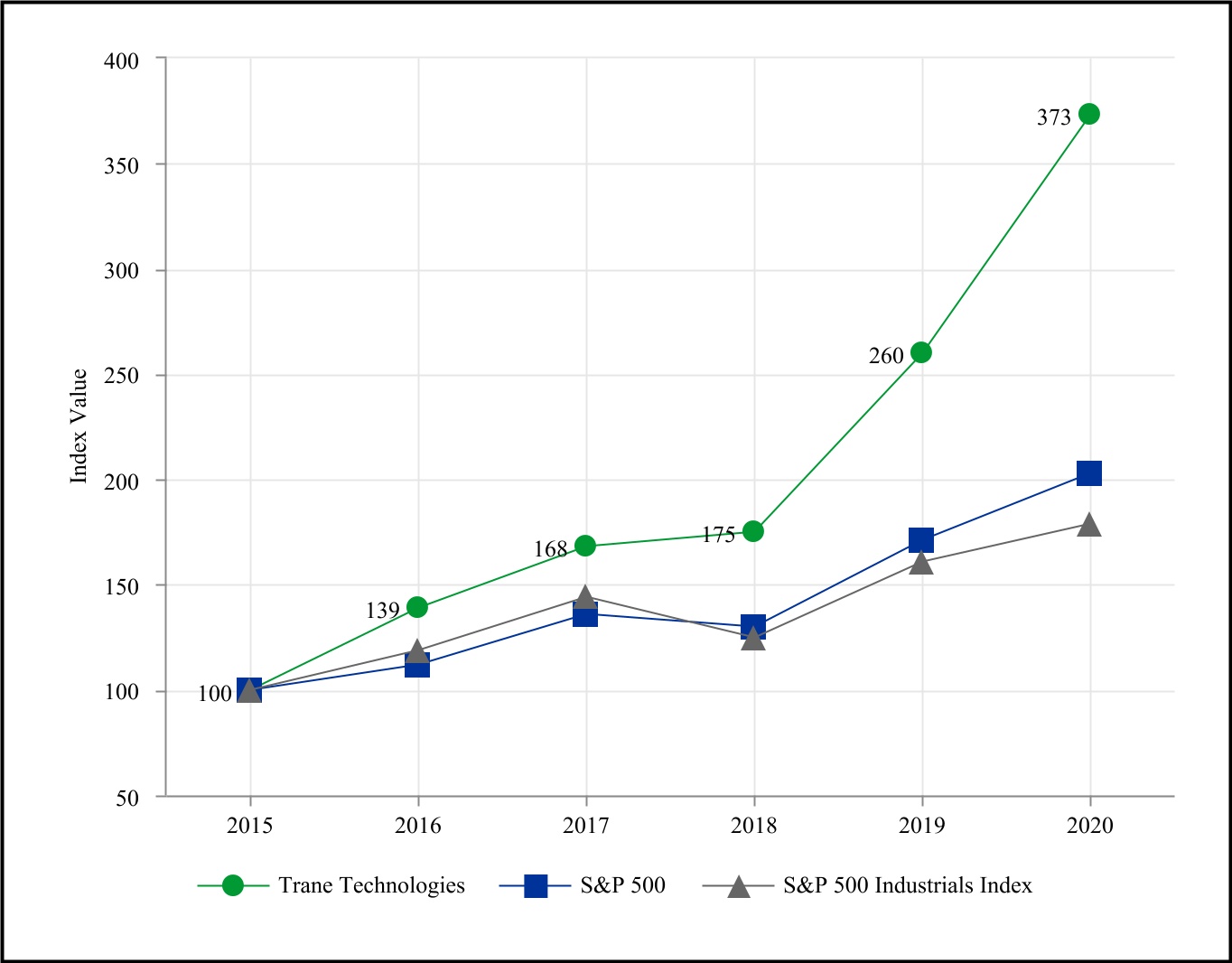
| Company/Index | 2015 | 2016 | 2017 | 2018 | 2019 | 2020 | ||||||||||||||
| Trane Technologies | 100 | 139 | 168 | 175 | 260 | 373 | ||||||||||||||
| S&P 500 | 100 | 112 | 136 | 130 | 171 | 203 | ||||||||||||||
| S&P 500 Industrials Index | 100 | 119 | 144 | 125 | 161 | 179 |
Item 6. SELECTED FINANCIAL DATA
In connection with the completion of the Transaction, we do not beneficially own any Ingersoll Rand Industrial shares of common stock and no longer consolidate Ingersoll Rand Industrial in our financial statements. As a result, the following Selected Financial Data presents the results of Ingersoll Rand Industrial as a discontinued operation for periods prior to the Distribution date.
In millions, except per share amounts:
| At and for the years ended December 31, | 2020 | 2019 | 2018 | 2017 | 2016 | |||||||||||||||||||||||||||
| Net revenues | $ | 12,454.7 | $ | 13,075.9 | $ | 12,343.8 | $ | 11,167.5 | $ | 10,545.0 | ||||||||||||||||||||||
| Net earnings (loss) attributable to Trane Technologies plc ordinary shareholders: | ||||||||||||||||||||||||||||||||
| Continuing operations | 977.2 | 1,145.1 | 1,007.8 | 1,072.8 | 1,222.2 | |||||||||||||||||||||||||||
| Discontinued operations | (122.3) | 265.8 | 329.8 | 229.8 | 254.0 | |||||||||||||||||||||||||||
| Total assets | 18,156.7 | 20,492.3 | 17,914.9 | 18,173.3 | 17,397.4 | |||||||||||||||||||||||||||
| Total debt | 5,272.1 | 5,573.2 | 4,091.2 | 4,064.0 | 4,070.1 | |||||||||||||||||||||||||||
| Total Trane Technologies plc shareholders’ equity | 6,407.7 | 7,267.6 | 7,022.7 | 7,140.3 | 6,643.8 | |||||||||||||||||||||||||||
| Earnings (loss) per share attributable to Trane Technologies plc ordinary shareholders: | ||||||||||||||||||||||||||||||||
| Basic: | ||||||||||||||||||||||||||||||||
| Continuing operations | $ | 4.07 | $ | 4.74 | $ | 4.08 | $ | 4.21 | $ | 4.72 | ||||||||||||||||||||||
| Discontinued operations | (0.51) | 1.10 | 1.33 | 0.90 | 0.98 | |||||||||||||||||||||||||||
| Diluted: | ||||||||||||||||||||||||||||||||
| Continuing operations | $ | 4.02 | $ | 4.69 | $ | 4.03 | $ | 4.16 | $ | 4.67 | ||||||||||||||||||||||
| Discontinued operations | (0.50) | 1.08 | 1.32 | 0.89 | 0.98 | |||||||||||||||||||||||||||
| Dividends declared per ordinary share | $ | 2.12 | $ | 2.12 | $ | 1.96 | $ | 1.70 | $ | 1.36 |
Item 7. MANAGEMENT’S DISCUSSION AND ANALYSIS OF FINANCIAL CONDITION AND RESULTS OF OPERATIONS
The following Management’s Discussion and Analysis of Financial Condition and Results of Operations contains forward-looking statements that involve risks and uncertainties. Our actual results may differ materially from the results discussed in the forward-looking statements. Factors that might cause a difference include, but are not limited to, those discussed under Item 1A. Risk Factors in this Annual Report on Form 10-K. The following section is qualified in its entirety by the more detailed information, including our financial statements and the notes thereto, which appears elsewhere in this Annual Report.
This section discusses 2020 and 2019 items and year-to-year comparisons between 2020 and 2019. Discussions of 2018 items and year-to-year comparisons between 2019 and 2018 have been excluded in this Form 10-K and can be found in "Management's Discussion and Analysis of Financial Condition and Results of Operations" in Part II, Item 7 of our Annual Report on Form 10-K for year ended December 31, 2019.
Overview
Organizational
Trane Technologies plc is a global climate innovator. We bring efficient and sustainable climate solutions to buildings, homes and transportation driven by strategic brands Trane® and Thermo King® and an environmentally responsible portfolio of products and services. Prior to the separation of our Industrial segment on February 29, 2020, we announced a new organizational model and business segment structure designed to enhance our regional go-to-market capabilities, aligning the structure with our strategy and increased focus on climate innovation. Under the revised structure, we created three new regional operating segments from the former climate segment, which also serve as our reportable segments.
-
Our Americas segment innovates for customers in the North America and Latin America regions. The Americas segment encompasses commercial heating and cooling systems, building controls, and energy services and solutions; residential heating and cooling; and transport refrigeration systems and solutions.
-
Our EMEA segment innovates for customers in the Europe, Middle East and Africa regions. The EMEA segment encompasses heating and cooling systems, services and solutions for commercial buildings, and transport refrigeration systems and solutions.
-
Our Asia Pacific segment innovates for customers throughout the Asia Pacific region. The Asia Pacific segment encompasses heating and cooling systems, services and solutions for commercial buildings and transport refrigeration systems and solutions.
This model is designed to create deep customer focus and relevance in markets around the world. All prior period comparative segment information has been recast to reflect the current reportable segments.
Separation of Industrial Segment Business
On February 29, 2020 (Distribution Date), we completed our Reverse Morris Trust transaction (the Transaction) with Gardner Denver Holdings, Inc. (Gardner Denver, which changed its name to Ingersoll Rand Inc. after the Transaction) whereby we distributed Ingersoll-Rand U.S. HoldCo, Inc., which contained our former Industrial segment (Ingersoll Rand Industrial), through a pro rata distribution (the Distribution) to our shareholders of record as of February 24, 2020. Ingersoll Rand Industrial then merged into a wholly-owned subsidiary of Gardner Denver. Upon close of the Transaction, our existing shareholders received approximately 50.1% of the shares of Gardner Denver common stock on a fully-diluted basis and Gardner Denver stockholders retained approximately 49.9% of the shares of Gardner Denver on a fully diluted basis. As a result, our shareholders received .8824 shares of Gardner Denver common stock with respect to each share owned as of February 24, 2020. In connection with the Transaction, Ingersoll-Rand Services Company, an affiliate of Ingersoll Rand Industrial, borrowed an aggregate principal amount of $1.9 billion under a senior secured first lien term loan facility (Term Loan), the proceeds of which were used to make a special cash payment of $1.9 billion to a subsidiary of ours. The obligations under the Term Loan were retained by Ingersoll-Rand Services Company, which following the Transaction is a wholly-owned subsidiary of Gardner Denver.
In connection with the Transaction, we entered into several agreements covering supply, administrative and tax matters to provide or obtain services on a transitional basis for varying periods after the Distribution Date. The agreements cover services such as manufacturing, information technology, human resources and finance. Income and expenses under these agreements were not material. In accordance with several customary transaction-related agreements between us and Gardner Denver, the parties are in a process to determine final adjustments to working capital, cash and indebtedness amounts as of the Distribution Date, as well as another process to determine funding levels related to pension plans, non-qualified deferred compensation plans and retiree health benefits. As of December 31, 2020, both are ongoing in accordance with the transaction-related agreements. Upon finalization of these agreements, any adjustments will be recognized within Retained earnings.
Significant Events
COVID-19 Global Pandemic
In March 2020, the World Health Organization declared the outbreak of a respiratory disease caused by a newly discovered coronavirus, known now as COVID-19, as a global pandemic and recommended containment and mitigation measures worldwide. Beginning in the first quarter of 2020, many countries responded by implementing measures to combat the outbreak which impacted global business operations and resulted in our decision to temporarily close or limit our workforce to essential crews within many facilities throughout the world in order to ensure employee safety. In addition, our non-essential employees were instructed to work from home in compliance with global government stay-in-place protocols.
We have been adversely impacted by the COVID-19 global pandemic. Temporary facility closures beginning in the first quarter of 2020 disrupted results in the Asia Pacific region with impacts more widely felt throughout operations in the Americas and EMEA in the months thereafter. During the second quarter of 2020, we began to reopen facilities while maintaining appropriate health and safety precautions. However, the challenges in connection with the pandemic continued as we experienced lower volume, which negatively impacted revenue, and certain supply chain delays. In response, we proactively initiated cost cutting actions in an effort to mitigate the impact of the pandemic on our business. This included reducing discretionary spending, restricting travel, delaying merit-based salary increases and implementing employee furloughs in certain markets.
We continue to navigate the new realities brought about by the COVID-19 global pandemic as well as any impact on our liquidity needs and ability to access capital markets. Despite these challenges, all production facilities remain open and we continue to sell, install and service our products. During the second half of 2020, we did not experience any major delays in our supply chain and continued to focus on health and safety precautions to protect our employees and customers. In addition, during the fourth quarter of 2020 we completed several restorative actions including the reinstatement of annual merit-based salary increases and resuming all aspects of our balanced capital allocation strategy which included acquisitions and share repurchases. Operationally, our financial reporting systems, internal control over financial reporting and disclosure controls and procedures continue to operate effectively despite a remote workforce of non-essential front-line employees. We w
Showing the first 8K of 82K characters. Open the full section
Item 7A. QUANTITATIVE AND QUALITATIVE DISCLOSURE ABOUT MARKET RISK
We are exposed to fluctuations in currency exchange rates, interest rates and commodity prices which could impact our results of operations and financial condition.
Foreign Currency Exposures
We have operations throughout the world that manufacture and sell products in various international markets. As a result, we are exposed to movements in exchange rates of various currencies against the U.S. dollar as well as against other currencies throughout the world.
Many of our non-U.S. operations have a functional currency other than the U.S. dollar, and their results are translated into U.S. dollars for reporting purposes. Therefore, our reported results will be higher or lower depending on the weakening or strengthening of the U.S. dollar against the respective foreign currency. Our largest concentration of revenues from non-U.S. operations as of December 31, 2020 are in Euros and Chinese Yuan. A hypothetical 10% unfavorable change in the average exchange rate used to translate Net revenues for the year ended December 31, 2020 from either Euros or Chinese Yuan-based operations into U.S. dollars would not have a material impact on our financial statements.
We use derivative instruments to hedge those material exposures that cannot be naturally offset. The instruments utilized are viewed as risk management tools, primarily involve little complexity and are not used for trading or speculative purposes. To minimize the risk of counter party non-performance, derivative instrument agreements are made only through major financial institutions with significant experience in such derivative instruments.
We evaluate our exposure to changes in currency exchange rates on our foreign currency derivatives using a sensitivity analysis. The sensitivity analysis is a measurement of the potential loss in fair value based on a percentage change in exchange rates. Based on the firmly committed currency derivative instruments in place at December 31, 2020, a hypothetical change in fair value of those derivative instruments assuming a 10% adverse change in exchange rates would result in an unrealized loss of approximately $22.3 million, as compared with $27.8 million at December 31, 2019. These amounts, when realized, would be offset by changes in the fair value of the underlying transactions.
Commodity Price Exposures
We are exposed to volatility in the prices of commodities used in some of our products and we use fixed price contracts to manage this exposure. We do not have committed commodity derivative instruments in place at December 31, 2020.
Interest Rate Exposure
Our debt portfolio mainly consists of fixed-rate instruments, and therefore any fluctuation in market interest rates is not expected to have a material effect on our results of operations.
Item 8. FINANCIAL STATEMENTS AND SUPPLEMENTARY DATA
(a)The following Consolidated Financial Statements and the report thereon of PricewaterhouseCoopers LLP dated February 9, 2021, are presented in this Annual Report on Form 10-K beginning on page F-1.
Consolidated Financial Statements:
Report of Independent Registered Public Accounting Firm
Consolidated Statements of Comprehensive Income for the years ended December 31, 2020, 2019 and 2018
Consolidated Balance Sheets at December 31, 2020 and 2019
For the years ended December 31, 2020, 2019 and 2018:
Consolidated Statements of Equity
Consolidated Statements of Cash Flows
Notes to Consolidated Financial Statements
(b)In connection with the completion of the Transaction, we do not beneficially own any Ingersoll Rand Industrial shares of common stock and no longer consolidate Ingersoll Rand Industrial in our financial statements. As a result, the following unaudited selected quarterly financial data presents the results of Ingersoll Rand Industrial as a discontinued operation for periods prior to the Distribution date. The unaudited selected quarterly financial data for the two years ended December 31, is as follows:
| 2020 | ||||||||||||||||||||||||||
| In millions, except per share amounts | First Quarter | Second Quarter | Third Quarter | Fourth Quarter | ||||||||||||||||||||||
| Net revenues | $ | 2,641.3 | $ | 3,138.8 | $ | 3,495.5 | $ | 3,179.1 | ||||||||||||||||||
| Cost of goods sold | (1,898.8) | (2,160.5) | (2,360.8) | (2,231.2) | ||||||||||||||||||||||
| Operating income | 154.4 | 423.5 | 566.9 | 388.0 | ||||||||||||||||||||||
| Earnings from continuing operations | 52.8 | 278.3 | 410.1 | 250.2 | ||||||||||||||||||||||
| Discontinued operations, net of tax | (78.7) | (36.2) | (5.5) | (1.0) | ||||||||||||||||||||||
| Net earnings (loss) | (25.9) | 242.1 | 404.6 | 249.2 | ||||||||||||||||||||||
| Net earnings (loss) attributable to Trane Technologies plc | (29.2) | 238.8 | 400.6 | 244.7 | ||||||||||||||||||||||
| Amounts attributable to Trane Technologies plc ordinary shareholders: | ||||||||||||||||||||||||||
| Continuing operations | $ | 50.0 | $ | 275.4 | $ | 406.1 | $ | 245.7 | ||||||||||||||||||
| Discontinued operations | (79.2) | (36.6) | (5.5) | (1.0) | ||||||||||||||||||||||
| Net earnings (loss) | $ | (29.2) | $ | 238.8 | $ | 400.6 | $ | 244.7 | ||||||||||||||||||
| Earnings (Loss) per share attributable to Trane Technologies plc ordinary shareholders: | ||||||||||||||||||||||||||
| Basic: | ||||||||||||||||||||||||||
| Continuing operations | $ | 0.21 | $ | 1.15 | $ | 1.69 | $ | 1.02 | ||||||||||||||||||
| Discontinued operations | $ | (0.33) | $ | (0.15) | $ | (0.02) | $ | — | ||||||||||||||||||
| Diluted: | ||||||||||||||||||||||||||
| Continuing operations | $ | 0.21 | $ | 1.14 | $ | 1.67 | $ | 1.01 | ||||||||||||||||||
| Discontinued operations | $ | (0.33) | $ | (0.15) | $ | (0.03) | $ | — | ||||||||||||||||||
| 2019 | ||||||||||||||||||||||||||
| First Quarter | Second Quarter | Third Quarter | Fourth Quarter | |||||||||||||||||||||||
| Net revenues | $ | 2,803.7 | $ | 3,617.6 | $ | 3,470.9 | $ | 3,183.7 | ||||||||||||||||||
| Cost of goods sold | (1,989.2) | (2,462.8) | (2,366.6) | (2,266.9) | ||||||||||||||||||||||
| Operating income | 236.5 | 566.9 | 536.5 | 330.2 | ||||||||||||||||||||||
| Earnings from continuing operations | 147.3 | 412.6 | 386.3 | 214.1 | ||||||||||||||||||||||
| Discontinued operations, net of tax | 56.4 | 47.7 | 77.1 | 87.0 | ||||||||||||||||||||||
| Net earnings (loss) | 203.7 | 460.3 | 463.4 | 301.1 | ||||||||||||||||||||||
| Net earnings (loss) attributable to Trane Technologies plc | 199.9 | 456.1 | 458.8 | 296.1 | ||||||||||||||||||||||
| Amounts attributable to Trane Technologies plc ordinary shareholders: | ||||||||||||||||||||||||||
| Continuing operations | $ | 144.2 | $ | 409.1 | $ | 382.6 | $ | 209.2 | ||||||||||||||||||
| Discontinued operations | 55.7 | 47.0 | 76.2 | 86.9 | ||||||||||||||||||||||
| Net earnings (loss) | $ | 199.9 | $ | 456.1 | $ | 458.8 | $ | 296.1 | ||||||||||||||||||
| Earnings (Loss) per share attributable to Trane Technologies plc ordinary shareholders: | ||||||||||||||||||||||||||
| Basic: | ||||||||||||||||||||||||||
| Continuing operations | $ | 0.59 | $ | 1.69 | $ | 1.58 | $ | 0.87 | ||||||||||||||||||
| Discontinued operations | $ | 0.23 | $ | 0.19 | $ | 0.32 | $ | 0.36 | ||||||||||||||||||
| Diluted: | ||||||||||||||||||||||||||
| Continuing operations | $ | 0.59 | $ | 1.67 | $ | 1.57 | $ | 0.86 | ||||||||||||||||||
| Discontinued operations | $ | 0.23 | $ | 0.19 | $ | 0.31 | $ | 0.36 |
Item 9. CHANGES IN AND DISAGREEMENTS WITH ACCOUNTANTS ON ACCOUNTING AND FINANCIAL
DISCLOSURE
None.
Item 9A. CONTROLS AND PROCEDURES
| (a) | Evaluation of Disclosure Controls and Procedures |
The Company's management, including its Chief Executive Officer and Chief Financial Officer, have conducted an evaluation of the effectiveness of the Company's disclosure controls and procedures (as such term is defined in Rules 13a-15(e) and 15d-15(e) under the Securities Exchange Act of 1934, as amended (the Exchange Act)), as of the end of the period covered by this Annual Report on Form 10-K. Based on that evaluation, the Chief Executive Officer and Chief Financial Officer concluded as of December 31, 2020, that the Company's disclosure controls and procedures were effective in ensuring that information required to be disclosed by the Company in reports that it files or submits under the Exchange Act has been recorded, processed, summarized and reported, within the time periods specified in the Commission's rules and forms, and that such information has been accumulated and communicated to the Company's management including its Chief Executive Officer and Chief Financial Officer, as appropriate, to allow timely decisions regarding required disclosure.
| (b) | Management's Report on Internal Control Over Financial Reporting |
The Company's management is responsible for establishing and maintaining adequate internal control over financial reporting as such term is defined under Exchange Act Rules 13a-15(f) and 15d-15(f). Internal control over financial reporting is a process designed by, or under the supervision of, the Chief Executive Officer and Chief Financial Officer and effected by the Company's Board of Directors to provide reasonable assurance regarding the reliability of financial reporting and the preparation of financial statements for external purposes in accordance with generally accepted accounting principles.
Because of its inherent limitations, internal control over financial reporting may not prevent or detect misstatements. Also, projections of any evaluation of effectiveness to future periods are subject to the risk that controls may become inadequate because of changes in conditions, or that the degree of compliance with the policies and procedures may deteriorate.
Management has assessed the effectiveness of internal control over financial reporting as of December 31, 2020. In making its assessment, management has utilized the criteria set forth by the Committee of Sponsoring Organizations (COSO) of the Treadway Commission in Internal Control - Integrated Framework (2013). Management concluded that based on its assessment, the Company's internal control over financial reporting was effective as of December 31, 2020.
The effectiveness of the Company's internal control over financial reporting as of December 31, 2020 has been audited by PricewaterhouseCoopers LLP, an independent registered public accounting firm, as stated in their report which appears herein.
| (c) | Changes in Internal Control Over Financial Reporting |
There were no changes in internal control over financial reporting (as defined by Rules 13a-15(f) and 15d-15(f) under the Exchange Act) that occurred during the quarter ended December 31, 2020 that have materially affected, or are reasonably likely to materially affect, the Company's internal control over financial reporting.
Item 9B. OTHER INFORMATION
Item 10. DIRECTORS, EXECUTIVE OFFICERS AND CORPORATE GOVERNANCE
The information regarding our executive officers is included in Part I under the caption “Executive Officers of Registrant.”
The other information required by this item is incorporated herein by reference to the information contained under the headings “Item 1. Election of Directors”, “Delinquent Section 16(a) Reports” and “Corporate Governance” in our definitive proxy statement for the 2021 annual general meeting of shareholders (2021 Proxy Statement).
Item 11. EXECUTIVE COMPENSATION
The other information required by this item is incorporated herein by reference to the information contained under the headings “Compensation Discussion and Analysis,” “Compensation of Directors,” “Executive Compensation,” “Compensation Committee Report” and “Compensation Committee Interlocks and Insider Participation” in our 2021 Proxy Statement.
Item 12. SECURITY OWNERSHIP OF CERTAIN BENEFICIAL OWNERS AND MANAGEMENT AND RELATED
STOCKHOLDER MATTERS
The other information required by this item is incorporated herein by reference to the information contained under the headings “Security Ownership of Certain Beneficial Owners and Management” and “Equity Compensation Plan Information” in our 2021 Proxy Statement.
Item 13. CERTAIN RELATIONSHIPS AND RELATED TRANSACTIONS, AND DIRECTOR INDEPENDENCE
The other information required by this item is incorporated herein by reference to the information contained under the headings “Corporate Governance” and “Certain Relationships and Related Person Transactions” in our 2021 Proxy Statement.
Item 14. PRINCIPAL ACCOUNTANT FEES AND SERVICES
Item 15. EXHIBITS AND FINANCIAL STATEMENT SCHEDULES
| (a) 1. | Financial Statements See Item 8. | ||||
| 2. | Financial Statement Schedules | ||||
| Schedules have been omitted because the required information is not applicable or because the required information is included elsewhere in this Annual Report on Form 10-K. | |||||
| 3. | Exhibits | ||||
| The exhibits listed on the accompanying index to exhibits are filed as part of this Annual Report on Form 10-K. |
TRANE TECHNOLOGIES PLC
INDEX TO EXHIBITS
(Item 15(a))
Description
Pursuant to the rules and regulations of the Securities and Exchange Commission (“SEC”), Trane Technologies plc (the “Company”) has filed certain agreements as exhibits to this Annual Report on Form 10-K. These agreements may contain representations and warranties by the parties. These representations and warranties have been made solely for the benefit of the other party or parties to such agreements and (i) may have been qualified by disclosures made to such other party or parties, (ii) were made only as of the date of such agreements or such other date(s) as may be specified in such agreements and are subject to more recent developments, which may not be fully reflected in our public disclosure, (iii) may reflect the allocation of risk among the parties to such agreements and (iv) may apply materiality standards different from what may be viewed as material to investors. Accordingly, these representations and warranties may not describe our actual state of affairs at the date hereof and should not be relied upon.
On July 1, 2009, Ingersoll-Rand Company Limited, a Bermuda company, completed a reorganization to change the jurisdiction of incorporation of the parent company from Bermuda to Ireland. As a result, Ingersoll-Rand plc replaced Ingersoll-Rand Company Limited as the ultimate parent company effective July 1, 2009. All references related to the Company prior to July 1, 2009 relate to Ingersoll-Rand Company Limited. On March 2, 2020, Ingersoll-Rand plc changed its name to Trane Technologies plc.
(a) Exhibits
| Exhibit No. | Description | Method of Filing | ||||||||||||
| 2.1 | Separation and Distribution Agreement between Ingersoll-Rand plc and Allegion plc, dated November 29, 2013. | Incorporated by reference to Exhibit 3.1 to the Company’s Form 8-K (File No. 001-34400) filed with the SEC on December 2, 2013. | ||||||||||||
| 2.2 | Agreement and Plan of Merger, dated as of April 30, 2019, by and among the Company, Gardner Denver Holdings, Inc., Ingersoll-Rand U.S. HoldCo, Inc. and Charm Merger Sub Inc. | Incorporated by reference to Exhibit 2.1 to the Company’s Form 8-K (File No. 001-34400) filed with the SEC on May 6, 2019. | ||||||||||||
| 2.3 | Separation and Distribution Agreement, dated as of April 30, 2019, by and between Ingersoll-Rand plc and Ingersoll-Rand U.S. HoldCo, Inc. | Incorporated by reference to Exhibit 2.2 to the Company’s Form 8-K (File No. 001-34400) filed with the SEC on May 6, 2019). | ||||||||||||
| 3.1 | Constitution of the Company, as amended and restated on June 2, 2016 | Incorporated by reference to Exhibit 3.1 to the Company’s Form 8-K (File No. 001-34400) filed with the SEC on June 7, 2016. | ||||||||||||
| 3.2 | Amendment to the Constitution of the Company dated March 2, 2020 | Filed herewith. | ||||||||||||
| The Company and its subsidiaries are parties to several long-term debt instruments under which, in each case, the total amount of securities authorized does not exceed 10% of the total assets of the Company and its subsidiaries on a consolidated basis. | Pursuant to paragraph 4 (iii)(A) of Item 601 (b) of Regulation S-K, the Company agrees to furnish a copy of such instruments to the Securities and Exchange Commission upon request. | |||||||||||||
| 4.1 | Indenture, dated as of June 20, 2013, by and among Ingersoll-Rand Global Holding Company Limited, as issuer, Ingersoll-Rand plc, Ingersoll-Rand Company Limited and Ingersoll-Rand International Holding Limited, as guarantors and The Bank of New York Mellon, as Trustee.. | Incorporated by reference to Exhibit 4.1 to the Company's Form 8-K (File No. 001-34400) filed with the SEC on June 26, 2013. | ||||||||||||
| Exhibit No. | Description | Method of Filing | ||||||||||||
| 10.28* | Michael W. Lamach Letter, dated December 24, 2003. | Incorporated by reference to Exhibit 10.35 to the Company’s Form 10-K for the fiscal year ended 2003 (File No. 001-16831) filed with the SEC on February 27, 2004. | ||||||||||||
| 10.29* | Michael W. Lamach Letter, dated June 4, 2008. | Incorporated by reference to Exhibit 10.2 to the Company’s Form 8-K (File No. 001-16831) filed with the SEC on June 10, 2008. | ||||||||||||
| 10.30* | Michael W. Lamach Letter, dated February 4, 2009. | Incorporated by reference to Exhibit 10.43 to the Company’s Form 10-K for the fiscal year ended 2008 (File No. 001-16831) filed with the SEC on March 2, 2009. | ||||||||||||
| 10.31* | Michael W. Lamach Letter, dated February 3, 2010. | Incorporated by reference to Exhibit 10.1 to the Company’s Form 8-K (File No. 001-34400) filed with the SEC on February 5, 2010. | ||||||||||||
| 10.32* | Michael W. Lamach Letter, dated December 23, 2012. | Incorporated by reference to exhibit 10.48 to the Company's Form 10-K for the fiscal year ended 2012 (File No. 001-34400) filed with the SEC on February 14, 2013. | ||||||||||||
| 10.33* | Marcia J. Avedon Letter, dated January 8, 2007. | Incorporated by reference to Exhibit 10.45 to the Company's Form 10-K for the fiscal year ended December 31, 2006 (File No. 001-16831) filed with the SEC on March 1, 2007. | ||||||||||||
| 10.34* | Marcia J. Avedon Letter, dated December 20, 2012. | Incorporated by reference to exhibit 10.53 to the Company's Form 10-K for the fiscal year ended 2012 (File No. 001-34400) filed with the SEC on February 14, 2013. | ||||||||||||
| 10.35* | Susan K. Carter Letter, dated as of August 19, 2013. | Incorporated by reference to Exhibit 10.1 to the Company's Form 8-K (File No. 001-34400) filed with the SEC on October 2, 2013. | ||||||||||||
| 10.36* | David S. Regnery Letter, dated as of September 1, 2017. | Incorporated by reference to Exhibit 10.44 to the Company’s Form 10-K for the year ended December 31, 2018 (File No. 001-34400) filed with the SEC on February 12, 2019. | ||||||||||||
| 10.37* | David S. Regnery Letter, dated as of December 9, 2019. | Incorporated by reference to Exhibit 10.1 to the Company’s Form 8-K (File No. 001-34400) filed with the SEC on December 11, 2019. | ||||||||||||
| 10.38* | Christopher J. Kuehn Letter, dated as of December 10, 2019. | Incorporated by reference to Exhibit 10.1 to the Company’s Form 8-K (File No. 001-34400) filed with the SEC on December 10, 2019. | ||||||||||||
| 10.39* | Employee Matters Agreement between Ingersoll-Rand plc and Allegion plc, dated November 30, 2013. | Incorporated by reference to Exhibit 10.1 to the Company's Form 8-K (File No. 001-34400) filed with the SEC on December 2, 2013. | ||||||||||||
| 21 | List of Subsidiaries of Trane Technologies plc. | Filed herewith. | ||||||||||||
| 23.1 | Consent of Independent Registered Public Accounting Firm. | Filed herewith. | ||||||||||||
| 31.1 | Certification of Chief Executive Officer Pursuant to Rule 13a-14(a) or Rule 15d-14(a), as Adopted Pursuant to Section 302 of the Sarbanes-Oxley Act of 2002. | Filed herewith. | ||||||||||||
| 31.2 | Certification of Chief Financial Officer Pursuant to Rule 13a-14(a) or Rule 15d-14(a), as Adopted Pursuant to Section 302 of the Sarbanes-Oxley Act of 2002. | Filed herewith. | ||||||||||||
| Exhibit No. | Description | Method of Filing | ||||||||||||
| 32 | Certifications of Chief Executive Officer and Chief Financial Officer Pursuant to Rule 13a-14(b) or Rule 15d-14(b) and 18 U.S.C. Section 1350, as Adopted Pursuant to Section 906 of the Sarbanes-Oxley Act of 2002. | Furnished herewith. | ||||||||||||
| 101 | The following materials from the Company’s Annual Report on Form 10-K for the year ended December 31, 2020, formatted in Inline XBRL (Extensible Business Reporting Language): (i) the Consolidated Statements of Comprehensive Income, (ii) the Consolidated Balance Sheets, (iii) the Consolidated Statements of Equity, (iv) the Consolidated Statements of Cash Flows, and (v) Notes to Consolidated Financial Statements. | Furnished herewith. |
- Management contract or compensatory plan or arrangement.
Item 16. FORM 10-K SUMMARY
Not applicable.
SIGNATURES
Pursuant to the requirements of Section 13 or 15(d) of the Securities Exchange Act of 1934, the registrant has duly caused this report to be signed on its behalf by the undersigned, thereunto duly authorized.
TRANE TECHNOLOGIES PLC
(Registrant)
| By: | /s/ Michael W. Lamach | |||||||
| Michael W. Lamach | ||||||||
| Chairman of the Board and Chief Executive Officer | ||||||||
| Date: | February 9, 2021 |
Pursuant to the requirement of the Securities Exchange Act of 1934, this report has been signed by the following persons on behalf of the registrant and in the capacities and on the dates indicated.
| Signature | Title | Date | ||||||||||||
| /s/ Michael W. Lamach | Chairman of the Board and Chief Executive Officer (Principal Executive Officer) | February 9, 2021 | ||||||||||||
| (Michael W. Lamach) | ||||||||||||||
| /s/ Christopher J. Kuehn | Senior Vice President and Chief Financial Officer (Principal Financial Officer) | February 9, 2021 | ||||||||||||
| (Christopher J. Kuehn) | ||||||||||||||
| /s/ Heather R. Howlett | Vice President and Chief Accounting Officer (Principal Accounting Officer) | February 9, 2021 | ||||||||||||
| (Heather R. Howlett) | ||||||||||||||
| /s/ Kirk E. Arnold | Director | February 9, 2021 | ||||||||||||
| (Kirk E. Arnold) | ||||||||||||||
| /s/ Ann C. Berzin | Director | February 9, 2021 | ||||||||||||
| (Ann C. Berzin) | ||||||||||||||
| /s/ John Bruton | Director | February 9, 2021 | ||||||||||||
| (John Bruton) | ||||||||||||||
| /s/ Jared L. Cohon | Director | February 9, 2021 | ||||||||||||
| (Jared L. Cohon) | ||||||||||||||
| /s/ Gary D. Forsee | Director | February 9, 2021 | ||||||||||||
| (Gary D. Forsee) | ||||||||||||||
| /s/ Linda P. Hudson | Director | February 9, 2021 | ||||||||||||
| (Linda P. Hudson) | ||||||||||||||
| /s/ Myles P. Lee | Director | February 9, 2021 | ||||||||||||
| (Myles P. Lee) | ||||||||||||||
| /s/ April Miller Boise | Director | February 9, 2021 | ||||||||||||
| (April Miller Boise) | ||||||||||||||
| /s/ Karen B. Peetz | Director | February 9, 2021 | ||||||||||||
| (Karen B. Peetz) | ||||||||||||||
| /s/ John P. Surma | Director | February 9, 2021 | ||||||||||||
| (John P. Surma) | ||||||||||||||
| /s/ Richard J. Swift | Director | February 9, 2021 | ||||||||||||
| (Richard J. Swift) | ||||||||||||||
| /s/ Tony L. White | Director | February 9, 2021 | ||||||||||||
| (Tony L. White) |
TRANE TECHNOLOGIES PLC
Index to Consolidated Financial Statements
F-1
Report of Independent Registered Public Accounting Firm
To the Shareholders and Board of Directors of Trane Technologies plc
Opinions on the Financial Statements and Internal Control over Financial Reporting
We have audited the accompanying consolidated balance sheets of Trane Technologies plc and its subsidiaries (the “Company”) as of December 31, 2020 and 2019, and the related consolidated statements of comprehensive income, of equity and of cash flows for each of the three years in the period ended December 31, 2020, including the related notes (collectively referred to as the “consolidated financial statements”). We also have audited the Company's internal control over financial reporting as of December 31, 2020, based on criteria established in Internal Control - Integrated Framework (2013) issued by the Committee of Sponsoring Organizations of the Treadway Commission (COSO).
In our opinion, the consolidated financial statements referred to above present fairly, in all material respects, the financial position of the Company as of December 31, 2020 and 2019**,** and the results of its operations and its cash flows for each of the three years in the period ended December, 31 2020 in conformity with accounting principles generally accepted in the United States of America. Also in our opinion, the Company maintained, in all material respects, effective internal control over financial reporting as of December 31, 2020, based on criteria established in Internal Control - Integrated Framework (2013) issued by the COSO.
Change in Accounting Principle
As discussed in Note 3 to the consolidated financial statements, the Company changed the manner in which it accounts for leases in 2019.
Basis for Opinions
The Company's management is responsible for these consolidated financial statements, for maintaining effective internal control over financial reporting, and for its assessment of the effectiveness of internal control over financial reporting, included in Management’s Report on Internal Control Over Financial Reporting appearing under Item 9A. Our responsibility is to express opinions on the Company’s consolidated financial statements and on the Company's internal control over f
Showing the first 8K of 252K characters. Open the full section