 filings.tools
Trade Desk (TTD) 10-K risk factor changes: FY2020 vs FY2019
The 2020-12-31 10-K against the 2019-12-31 one, compared heading by heading and sentence by sentence.
Item 1A95 rewritten47 added24 removed588 unchanged
All filing items641 rewritten344 added197 removed1,728 unchanged
Summary
counted, not written
- Item 1A headings could not be compared: only 1 carried over between the two years, which usually means one filing was read wrongly, so none is reported as new or removed.
- Sentence by sentence, 344 added, 197 removed, 641 rewritten and 1,728 unchanged across 14 items that differ.
Sentences by item
22 items, with every count and a link to each item that changed
Underlined words on a shaded ground are new in FY2020; struck-through words were in FY2019. Sentences that are wholly new or wholly gone are labelled rather than marked.
Item 1A. Risk Factors
95 rewritten, 47 added, 24 removed, 588 unchanged
If a major client representing a significant portion of our business decides to materially reduce its use of our platform or to cease using our platform altogether, it is possible that our revenue or revenue growth rate could be significantly [removed: reduced] [added: reduced,] and our business negatively impacted.
The loss of advertising agencies as clients could significantly harm our business, financial [removed: condition] [added: condition,] and results of operations.
We do not have exclusive relationships with advertising [removed: agencies] [added: agencies,] and we depend on agencies to work with us to build and maintain advertiser relationships and execute advertising campaigns.
We had approximately [removed: 820] [added: 875] clients, consisting primarily of advertising agencies, as of December 31, [removed: 2019.][added: 2020.]
Many of these agencies are owned by holding companies, where decision making is decentralized such that purchasing decisions are made, and relationships with advertisers, are located, at the agency, local [removed: branch] [added: branch,] or division level.
If all of our individual client contractual relationships were aggregated at the holding company level, Publicis Groupe and [removed: Omnicom Group Inc.] [added: WPP plc] would [added: have] each [removed: represent] [added: represented] more than 10% of our gross billings for [removed: 2019.][added: 2020.]
If so, any loss of relationships with such holding companies and, consequently, of their agencies, local branches or divisions, as clients could significantly harm our business, financial [removed: condition] [added: condition,] and results of operations.
We expect that spending on programmatic ad buying will continue to be our primary source of revenue for the foreseeable [removed: future,] [added: future] and that our revenue growth will largely depend on increasing spend through our platform.
The market for programmatic ad buying is an emerging market, and our current and potential clients may not shift to programmatic ad buying from other buying methods as quickly as we expect, [removed: reducing] [added: which would reduce] our growth potential.
[removed: Growth] [added: As the market for programmatic buying for advertising matures, growth] in spend may outpace growth in our revenue [removed: as the market for programmatic buying for advertising matures] due to a number of [removed: factors] [added: factors,] including pricing competition, quantity discounts and shifts in product, media, client and channel mix.
New technologies and methods of buying advertising present a dynamic competitive challenge, as market participants develop and offer new products and [removed: services, such as analytics, automated media buying and exchanges,] [added: services] aimed at capturing advertising spend or disrupting the digital marketing [removed: landscape.][added: landscape, such as analytics, automated media buying and exchanges.]
Our current and potential competitors may have significantly more financial, technical, [removed: marketing] [added: marketing,] and other resources than we have, which may allow them to devote greater resources to the development, promotion, sale and support of their products and services.
They may also have more extensive advertiser bases and broader publisher relationships than we have, and may be better positioned to execute on advertising conducted over certain channels, such as social media, [removed: mobile] [added: mobile,] and video.
Any of these developments would make it more difficult for us to sell our platform and could result in increased pricing pressure, increased sales and marketing [removed: expense] [added: expense,] or the loss of market share.
As a result, we may not be able to add [removed: clients,] [added: clients] or generate [removed: revenue,] [added: revenue] as quickly as we may expect, which could harm our revenue growth rates.
[removed: We] [added: We] are subject to payment-related risks [removed: that may] [added: that may] adversely affect [removed: our business,] [added: our business,] working capital, financial condition and results of operations, including from advertising agencies that do not pay us until they receive payment from their advertisers and from clients that dispute or do not pay their [removed: invoices.][added: invoices.]
As a result, we often face a timing issue with our accounts payable on shorter cycles than our accounts receivables, requiring us to remit payments from our own funds, and accept the risk of [removed: bad debt.][added: credit loss.]
If we are unable to collect or make adjustments to bills to clients, we could incur write-offs for [removed: bad debt,] [added: credit loss,] which could harm our results of operations.
In the future, [removed: bad debt] [added: credit loss] may exceed reserves for such contingencies and our [removed: bad debt] [added: credit loss] exposure may increase over time.
Any increase in write-offs for [removed: bad debt] [added: credit loss] could harm our business, financial condition and results of operations.
We also believe that our revenue growth may depend on our ability to expand within social, native, audio, and in particular, CTV, and we have been, and [removed: are continuing to, enhance such channels.]
Furthermore, if our channel mix changes due to a shift in client demand, such as clients shifting their spending more quickly or more extensively than expected to channels in which we have relatively less functionality, features, or inventory, [added: then] demand for our platform could decrease, and our business, financial condition, and results of operations could be adversely affected.
If our relationships with certain of our suppliers were to cease, or if the material terms of these relationships were to change unfavorably, our [added: business would be negatively impacted.]
As new types of [removed: inventory, such as CTV,] [added: inventory] become available, we will need to expend significant resources to ensure we have access to such new inventory.
[removed: Although] [added: For example, although] television advertising is a large market, only a very small percentage of it is currently purchased through digital advertising exchanges.
Economic downturns or unstable market conditions may cause advertisers to decrease [added: or pause] their advertising budgets, which could reduce spend though our platform and adversely affect our business, financial condition and results of operations.
Our historical revenue growth has [removed: masked] [added: lessened] the impact of seasonality, [removed: but if our growth rate declines or seasonal spending becomes more pronounced,] [added: however,] seasonality could have a more significant impact on our revenue, cash flow and results of operations from period to [removed: period.][added: period if our growth rate declines, if seasonal spending becomes more pronounced, or if seasonality otherwise differs from our expectations.]
[removed: Failure] [added: Failure] to manage our growth effectively could cause our business to suffer and have an adverse effect on our financial condition and results of [removed: operations.][added: operations.]
[removed: We] [added: We] may experience fluctuations in our results of operations, which could make our future results of operations difficult to predict or cause our results of operations to fall below analysts’ and investors’ [removed: expectations.][added: expectations.]
| | • | the length and unpredictability of our sales cycle; [removed: and] |
[removed: If we fail to meet or exceed operating results expectations of analysts and investors or if analysts and investors have] estimates and forecasts of our future performance that are unrealistic or that we do not meet, the market price of our common stock could decline.
[removed: We] [added: Despite the initial decline in revenue in response to the COVID-19 pandemic, we] anticipate continued growth that could require substantial financial and other resources to, among other things:
Investing in the foregoing, however, may not yield anticipated [removed: returns.][added: returns, especially during the period of impact from the COVID-19 pandemic.]
Section 404 of the Sarbanes-Oxley Act of [removed: 2002 (the “Sarbanes-Oxley Act”)] [added: 2002, or the Sarbanes-Oxley Act,] requires that we evaluate and determine the effectiveness of our internal control over financial reporting and provide a management report on [removed: our] internal control over financial reporting.
We may experience outages and disruptions on our platform if we fail to maintain adequate security and supporting infrastructure as we scale our platform, which may harm our reputation and negatively impact our business, financial condition [removed: and results] [added: and results] of [removed: operations.][added: operations.]
While we contractually prohibit clients, data providers and inventory suppliers [removed: form] [added: from] importing or otherwise providing information that directly identifies individuals [removed: on] [added: onto] our platform, if a partner provided such information in violation of our policies and our systems are breached, we could be subject to contractual breach and indemnification claims from other clients and partners.
Recently, the State of California adopted [removed: a law] [added: two laws] broadly regulating businesses’ processing of personal information, the California Consumer Privacy Act of 2018, or CCPA, [removed: which went into effect January 1, 2020.][added: and the California Privacy Rights Act, or CPRA.]
The [removed: CCPA’s definition of] [added: CCPA, which went into effect January 1, 2020, defines] “personal information” [removed: is broad] [added: broadly] enough to include online identifiers provided by individuals’ devices, applications, and protocols (such as IP addresses, mobile application identifiers and unique cookie identifiers) and individuals’ location data, if there is potential that individuals can be identified by such data.
The CCPA establishes a new privacy framework for covered businesses by, among other requirements, establishing new data privacy rights for consumers in the State of California (including rights to deletion of and access to personal information), imposing special rules on the collection of consumer data from minors, creating new notice obligations and new limits on the “sale” of personal information (interpreted by [removed: some] [added: many observers] to include common advertising [added: technology] practices), and creating a new and potentially severe statutory damages framework for violations of the CCPA and for businesses that fail to implement reasonable security procedures and practices to prevent data breaches.
The CCPA also offers the possibility [removed: to] [added: for] a consumer to recover statutory damages for certain violations and could open the door more broadly to additional risks of individual and class-action lawsuits even though the statute’s private right of action is limited in scope.
The effects of health epidemics, such as the ongoing global COVID-19 pandemic, have had, and could in the future have, an adverse impact on our business, financial condition and results of operations.
Our business and operations have been and could in the future be adversely affected by health epidemics, such as the global COVID-19 pandemic.
The COVID-19 pandemic and efforts to control its spread have curtailed the movement of people, goods and services worldwide, including in the regions in which we and our clients and partners operate, and are significantly impacting economic activity and financial markets.
Many marketers have decreased or paused their advertising spending as a response to the economic uncertainty, decline in business activity, and other COVID-related impacts, which have negatively impacted, and may continue to negatively impact, our revenue and results of operations, the extent and duration of which we may not be able to accurately predict.
In addition, our clients’ and advertisers’ businesses or cash flows have been and may continue to be negatively impacted by the COVID-19 pandemic, which has and may continue to lead them to seek adjustments to payment terms or delay making payments or default on their payables, any of which may impact the timely receipt and/or collectability of our receivables.
Typically, we are contractually required to pay advertising inventory and data suppliers within a negotiated period of time, regardless of whether our clients pay us on time, or at all, and we may not be able to renegotiate better terms.
As a result, our financial condition and results of operations may be adversely impacted.
Our operations are subject to a range of external factors related to the COVID-19 pandemic that are not within our control.
We have taken precautionary measures intended to minimize the risk of the spread of the virus to our employees, partners and clients, and the communities in which we operate.
A wide range of governmental restrictions has also been imposed on our employees, clients and partners’ physical movement to limit the spread of COVID-19.
There can be no assurance that precautionary measures, whether adopted by us or imposed by others, will be effective, and such measures could negatively affect our sales, marketing, and client service efforts, delay and lengthen our sales cycles, decrease our employees’, clients’, or partners’ productivity, or create operational or other challenges, any of which could harm our business and results of operations.
The economic uncertainty caused by the COVID-19 pandemic has made and may continue to make it difficult for us to forecast revenue and operating results and to make decisions regarding operational cost structures and investments.
We have committed, and we plan to continue to commit, resources to grow our business, including to expand our international presence, employee base, and technology development, and such investments may not yield anticipated returns, particularly if worldwide business activity continues to be impacted by the COVID-19 pandemic.
The duration and extent of the impact from the COVID-19 pandemic depend on future developments that cannot be accurately predicted at this time, and if we are not able to respond to and manage the impact of such events effectively, our business may be harmed.
are continuing to, enhance such channels.
| | • | factors beyond our control, such as natural disasters, terrorism, war and public health crises; |
If we fail to meet or exceed the operating results expectations of analysts and investors or if analysts and investors have
As described above, public health crises may disrupt the operations of our customers and partners for an unknown period of time, including as a result of travel restrictions and/or business shutdowns, all of which could negatively impact our business and results of operations, including cash flows.
Our platform may also receive data or information that was identifiable prior to such data and information being aggregated or pseudonymized, and if our systems are breached and such data or information is compromised, it could be damaging to our brand, reputation, and business.
Further, the CPRA recently passed, which imposes additional notice and opt out obligations on the digital advertising space, including an obligation to provide an opt-out for behavioral advertising.
When the CPRA goes into full effect in January 2023, it will cause us to incur additional compliance costs and may impose additional restrictions on us and on our industry partners.
million or 4% of total worldwide annual revenue.
Relatedly, following the United Kingdom’s withdrawal from the EEA and the European Union, and the expiry of the transition period, we have to comply with both the GDPR and the United Kingdom Data Protection Act 2018, the latter regime having the ability to separately fine up to the greater of £17.5 million or 4% of global turnover.
The Privacy Shield Framework, however, was struck down in July 2020 by the EU Court of Justice as an adequate mechanism by which EU companies may pass personal data to the US, and other EU mechanisms for adequate data transfer, such as the standard contractual clauses, were questioned by the Court of Justice and whether and how standard contractual clauses can be used to transfer personal data to the U.S. is in question.
If there is no interim agreement or guidance from the EU and standard clauses also cannot be used, we could be left with no reasonable option for the lawful cross-border transfer of personal data.
Concerns about political advertising or other advertising in areas deemed sensitive, whether or not valid and whether or not driven by applicable laws and regulations, industry standards, client or inventory provider expectations, or public perception, may harm our reputation, result in loss of goodwill, and inhibit use of our platform by current and future clients.
Advertising shown on mobile applications can also be affected by blocking or restricting use of mobile device identifiers.
Data regarding interactions between users and devices are tracked mostly through stable, pseudonymous advertising identifiers that are built into the device operating system with privacy controls that allow users to express a preference with respect to data collection for advertising, including to disable the identifier.
These identifiers and privacy controls are defined by the developers of the platforms through which the applications are accessed and could be changed by the platforms in a way that may negatively impact our business.
For example, Apple announced last year that it will require user opt-in before permitting access to Apple’s unique identifier, or IDFA.
Apple initially targeted fall 2020 for implementing these changes but has pushed that date out until at least early 2021.
This shift from enabling user opt-out to an opt-in requirement is likely to have a substantial impact on the mobile advertising ecosystem and could impact our growth in this channel.
California’s CPRA, similarly contemplates the use of technical opt outs for the sale and sharing of personal information for advertising purposes as well as to opt out of the use of sensitive information for advertising purposes and allows for AG rulemaking to develop these technical signals.
| | • | exposure to public health issues, and to travel restrictions and other measures undertaken by governments in response to such issues; |
circumvented.
| | • | terrorist attacks, political upheaval, natural disasters, public health crises, or other major catastrophic events; |
Our certificate of incorporation provides that all Class B common stock will convert automatically into Class A common stock on December 22, 2025 unless converted prior to such date.
Furthermore, in connection with the amendments and related matters voted on at the Special Meeting of Stockholders held on December 22, 2020, or the Special Meeting, we may experience legal proceedings, including securities class action claims and/or derivative litigation.
Any legal proceedings related to items voted upon at the Special Meeting may divert management’s time and attention and may result in the incurrence of significant expense, including legal fees.
General Risk Factors
business would be negatively impacted.
The California Attorney General has proposed regulations implementing the CCPA that could impose further limitations.
Other companies in the advertising technology space have been subject to government investigation by regulatory bodies, including, in Europe, a 2016 inquiry into Criteo’s compliance with French
data privacy laws.
Uncertainty caused by lack of uniformity among laws to which we are or may become subject and instability in the global legal landscape may cause us to incur additional or unexpected costs and legal risk, increase our risk of reputational harm, or cause us to change our platform or business model.
We cannot predict the future of the regulatory landscape regarding the protection of personal information.
Additionally, industry groups in the U.S. and their international counterparts have self-regulatory guidelines that are subject to periodic updates to which we have agreed to adhere.
High profile incidents involving breaches of personal information or misuse of consumer information may increase the likelihood of new U.S. federal, state, or international laws or regulations in addition to those set out above, and such laws and regulations may be inconsistent across jurisdictions.
The Privacy Shield Framework, however, continues to face criticism from privacy advocates and legal challenges in EU courts, as do other EU mechanisms for adequate data transfer such as the standard contractual clauses.
Although we will apply the guidance from the Department of Commerce regarding post-Brexit data transfers from the U.K. through Privacy Shield, it remains uncertain whether other methods of transfer will have to be implemented.
We are exposed to fluctuations in the market values of our investments.
Credit ratings and pricing of our investments can be negatively affected by liquidity, credit deterioration or losses, financial results, foreign exchange rates, changes in interest rates, or other factors.
As a result, the value and liquidity of our cash, cash equivalents and marketable securities may fluctuate substantially.
Although we have not realized any significant losses on our cash, cash equivalents or marketable securities, future fluctuations in their value could result in a significant realized loss, which could adversely affect our financial condition and results of operations.
As a result, we may incur significant costs to attract and retain employees, including significant expenditures
Our management team has limited experience managing a public company.
We became a public company in September 2016.
Most members of our management team have limited experience managing a publicly traded company, interacting with public company investors, and complying with the increasingly complex laws, rules and regulations that govern public companies.
As a public company, we are subject to significant obligations relating to reporting, procedures and internal controls, and our management team may not successfully or efficiently manage such obligations.
These obligations and scrutiny will require significant attention from our management and could divert their attention away from the day-to-day management of our business, which could adversely affect our business, financial condition and results of operations.
technology.
| | • | major catastrophic events; |
This concentrated control limits or precludes your ability to influence corporate matters for the foreseeable future.
| | • | eliminate the ability of our stockholders to call special meetings of stockholders; |
An excerpt. Shown here: 40 of 95 rewritten, 40 of 47 added and all 24 removed. The counts are complete. For every sentence, read Item 1A. Risk Factors in the FY2020 filing and the FY2019 filing.
Item 7. Management’s Discussion and Analysis of Financial Condition and Results of Operations
126 rewritten, 52 added, 32 removed, 253 unchanged
The following generally discusses [removed: 2019] [added: 2020] and [removed: 2018] [added: 2019] items and year-to-year comparisons between [removed: 2019] [added: 2020] and [removed: 2018.][added: 2019.]
Discussion of historical items and year-to-year comparisons between [removed: 2018] [added: 2019] and [removed: 2017] [added: 2018] that are not included in this discussion can be found in “Management’s Discussion and Analysis of Financial Condition and Results of Operations” in our Annual Report on Form 10-K for the fiscal year ended December 31, [removed: 2018] [added: 2019] filed with SEC on February [removed: 22, 2019.][added: 28, 2020.]
We commercially launched our platform in 2011, targeting [added: the] display [removed: advertising.][added: advertising channel.]
For the years ended December 31, [removed: 2019] [added: 2020] and [removed: 2018:][added: 2019:]
| | • | our revenue was [removed: $661.1] [added: $836.0] million and [removed: $477.3] [added: $661.1] million, respectively, representing an increase of [removed: 39%;] [added: 26%;] and |
| | • | our net income was [removed: $108.3] [added: $242.3] million and [removed: $88.1] [added: $108.3] million, respectively. |
[removed: In addition, we believe the markets outside of the U.S. offer an opportunity for growth, and we] [added: We] intend to make additional investments in sales and marketing and product development to expand in these markets, including China, where we are making significant investments in our platform and growing our team.
In order to analyze [removed: the contribution to the growth of our business driven by the increase in] gross spend [added: contributions and growth] from existing clients, we measure annual gross spend for the set of clients, or cohort, that commenced spending on our platform in a specific year relative to subsequent periods.
[removed: Seasonality][added: Seasonality]
[removed: Revenue][added: Revenue]
Platform operations expense includes hosting costs, personnel costs, and amortization of acquired technology and capitalized software costs for the development of our [removed: platform, including allocated overhead.][added: platform.]
We [added: classify our operating expenses into the following four categories and] allocate overhead such as information technology infrastructure, rent and occupancy charges based on [removed: headcount.][added: headcount for these categories:]
Sales and marketing expense also includes costs for market development programs, advertising, promotional and other marketing [removed: activities, and allocated overhead.][added: activities.]
[added: |] Technology and [removed: Development.][added: development | | | 20 | | | | 18 | |]
[added: *Technology and Development.*] Our technology and development expense consists primarily of personnel costs, including salaries, bonuses, stock-based compensation and employee benefits costs, third-party consultant costs associated with the ongoing development and maintenance of our platform and integrations with our advertising and data inventory suppliers, [added: and] amortization of capitalized third-party software used in the development of our [removed: platform and allocated overhead.][added: platform.]
We amortize capitalized software development costs relating to our platform [removed: to] [added: in] platform operations expense.
[removed: *General and Administrative.*] Our general and administrative expense consists primarily of personnel costs, including salaries, bonuses, stock-based compensation, and employee benefits costs associated with our executive, finance, legal, human resources, compliance, and other administrative personnel, as well as accounting and legal professional services fees, [removed: bad debt expense] and [removed: allocated overhead.][added: credit loss expense.]
We have foreign currency exposure related to our accounts receivable and, to a much lesser extent, accounts payable that are denominated in currencies other than the U.S. Dollar, principally the Euro, British Pound, Australian Dollar, Canadian Dollar, [removed: Indonesian Rupiah,] Japanese [removed: Yen, Singapore Dollar] [added: Yen] and [removed: Thai Baht.][added: Indonesian Rupiah.]
Provision for [added: (benefit from)] Income Taxes
The provision for [added: (benefit from)] income taxes consists primarily of U.S. federal, state, and foreign income taxes.
Our income tax provision [added: (benefit)] may be significantly affected by changes to our estimates for tax in jurisdictions in which we [removed: operate] [added: operate,] and other estimates utilized in determining the global effective tax rate.
Our effective tax rate differs from the U.S. federal statutory [removed: income] tax rate [added: of 21% primarily] due to [removed: stock-based compensation, foreign] tax [removed: rate differences,] [added: benefits associated with employee exercises of stock options and vesting of restricted stock units, state taxes,] research and development tax credits, [added: the federal rate differential on NOL carrybacks,] and [removed: state taxes.][added: foreign tax rate differences.]
[removed: Results] [added: Results] of [removed: Operations][added: Operations]
| Revenue | | $ | [removed: 661,058] [added: 836,033] | | | $ | [removed: 477,294] [added: 661,058] | |
| Platform operations | | | [removed: 156,180] [added: 178,812] | | | | [removed: 114,098] [added: 156,180] | |
| Sales and marketing | | | [removed: 132,882] [added: 174,742] | | | | [removed: 87,071] [added: 132,882] | |
| Technology and development | | | [removed: 116,752] [added: 166,654] | | | | [removed: 83,892] [added: 116,752] | |
| General and administrative | | | [removed: 143,048] [added: 171,617] | | | | [removed: 84,910] [added: 143,048] | |
| Total operating expenses | | | [removed: 548,862] [added: 691,825] | | | | [removed: 369,971] [added: 548,862] | |
| Income from operations | | | [removed: 112,196] [added: 144,208] | | | | [removed: 107,323] [added: 112,196] | |
| Total other expense (income), net | | | [removed: (4,024] [added: 305] | [removed: )] | | | [removed: 1,586] [added: (4,024] | [added: )] |
| Income before income taxes | | | [removed: 116,220] [added: 143,903] | | | | [removed: 105,737] [added: 116,220] | |
| Provision for [added: (benefit from)] income taxes | | | [removed: 7,902] [added: (98,414] | [added: )] | | | [removed: 17,597] [added: 7,902] | |
| Net income | | $ | [removed: 108,318] [added: 242,317] | | | $ | [removed: 88,140] [added: 108,318] | |
| Platform operations | | | [removed: 24] [added: 21] | | | | 24 | |
| Sales and marketing | | | [removed: 20] [added: 21] | | | | [removed: 18] [added: 20] | |
| Technology and development | | | [added: 15 | | | | 19 | | | | 29 | | | | 23 | | | | 15 | | | |] 18 | | | | 18 | | [added: | | 21 | |]
| General and administrative | | | [removed: 22] [added: 21] | | | | [removed: 18] [added: 22] | |
| Total operating expenses | | | 83 | | | | [removed: 78] [added: 83] | |
| Income from operations | | | 17 | | | | [removed: 22] [added: 17] | |
Since launching, we have added additional advertising channels.
In 2020, the gross spend on our platform came from multiple channels including mobile, video (which includes CTV), display, audio, native and social channels.
We believe the markets outside of the U.S., and in particular China, offer an opportunity for growth, although such markets also may pose challenges related to compliance with local laws and regulations, restrictions on foreign ownership or investment, uncertainty related to trade relations, and variety of additional risks.
COVID-19
The worldwide spread of COVID-19 has resulted, and is expected to continue to result, in a global slowdown of economic activity which is likely to decrease demand for a broad variety of goods and services, including those provided by our clients, while also disrupting sales channels and advertising and marketing activities for an unknown period of time until the virus is contained or economic activity normalizes.
With the current decline in economic activity, our revenue growth has slowed, and the impact on our revenue and our results of operations is likely to continue, the size and duration of which we are currently unable to accurately predict.
The extent of the impact of the COVID-19 pandemic on our operational and financial performance will depend on a variety of factors, including the duration and spread of the virus and its impact on our clients, partners, industry, and employees, all of which are uncertain at this time and cannot be accurately predicted.
See “Risk Factors” for further discussion of the adverse impacts of the COVID-19 pandemic on our business.
General and Administrative.
Our income tax provision (benefit) may also be affected by the timing of vesting and/or exercise of our stock-based awards.
The extent of the impact may be subject to volatility resulting from changes in our stock price and volume of transactions by employees.
| | | 2020 | | | | 2019 | | |
| | | 2020 | | | | 2019 | | |
| | | 2020 | | | | 2019 | | | | $ | | | | % | | |
| Revenue | | $ | 836,033 | | | $ | 661,058 | | | $ | 174,975 | | | | 26 | % |
| | | 2020 | | | | 2019 | | | | $ | | | | % | | |
The increase in facilities costs was primarily driven by new data center locations and leases for additional office space to support our growth.
| | | Year Ended December 31, | | | | | | | | 2020 vs 2019 Change | | | | | | |
| | | 2020 | | | | 2019 | | | | $ | | | | % | | |
These increases were partially offset by lower marketing costs of $3.5 million.
These sales and marketing expenses may increase in 2021 depending on the impact of the COVID-19 pandemic and the potential return of in-person events.
| | | Year Ended December 31, | | | | | | | | 2020 vs 2019 Change | | | | | | |
| | | 2020 | | | | 2019 | | | | $ | | | | % | | |
The increase in allocated facilities costs was primarily driven by new leases for additional office space to support our growth.
| | | Year Ended December 31, | | | | | | | | 2020 vs 2019 Change | | | | | | |
| | | 2020 | | | | 2019 | | | | $ | | | | % | | |
The increase in professional services fees was primarily related to the proxy solicitation for our special meeting of stockholders in December 2020.
The increase in personnel costs was primarily driven by increases in payroll related costs of $10.2 million and stock-based compensation costs of $8.6 million due to our hiring and growth, partially offset by a decrease of $9.6 million in reduced employee-related corporate events and travel due to the COVID-19 pandemic.
The increase in allocated facilities costs was primarily driven by new leases for additional office space to support our growth.
| | | Year Ended December 31, | | | | | | | | 2020 vs 2019 Change | | |
| | | 2020 | | | | 2019 | | | | $ | | |
The increase in interest expense was attributable to a draw under the Credit Facility earlier in 2020 to provide increased liquidity due to the COVID-19 pandemic.
In October 2020, this debt was paid down in full.
The decrease in interest income was attributable to lower interest rates during 2020.
| | | 2020 | | | | 2019 | | |
For 2020, the provision for income taxes included $134.6 million of benefits associated with stock-based awards, $20.2 million of research and development tax credits, and $17.0 million of benefits associated with net operating loss carryback from the CARES Act.
| | | 2020 | | | | 2020 | | | | 2020 | | | | 2020 | | | | 2019 | | | | 2019 | | | | 2019 | | | | 2019 | | |
| Basic | | $ | 3.24 | | | $ | 0.89 | | | $ | 0.54 | | | $ | 0.53 | | | $ | 1.13 | | | $ | 0.43 | | | $ | 0.63 | | | $ | 0.23 | |
| | | | | | | | | | | | | | | | | | | | | | | | | | | | | | | | | |
| | | 2020 | | | | 2020 | | | | 2020 | | | | 2020 | | | | 2019 | | | | 2019 | | | | 2019 | | | | 2019 | | |
We have since extended our platform to address additional advertising formats, and in 2019, approximately 79% of gross spend on our platform was for mobile, video, audio, native and social.
We classify our operating expenses into the following four categories:
| | | 2019 | | | | 2018 | | |
| | | 2019 | | | | 2018 | | | | $ | | | | % | | |
| Revenue | | $ | 661,058 | | | $ | 477,294 | | | $ | 183,764 | | | | 39 | % |
The increase in personnel costs was primarily attributable to increased headcount to maintain and support our technology and development efforts.
The increase in personnel costs, including stock-based compensation, was primarily due to increased headcount to support our growth and an increase in our stock price.
| | | 2019 | | | | 2018 | | | | $ | | |
The increase in interest income was primarily attributable to an increase in short-term investments during 2019.
For 2018, the provision for income taxes included $15.1 million of benefits associated with stock-based awards.
| | | 2019 | | | | 2019 | | | | 2019 | | | | 2019 | | | | 2018 | | | | 2018 | | | | 2018 | | | | 2018 | | |
| Basic | | $ | 1.13 | | | $ | 0.43 | | | $ | 0.63 | | | $ | 0.23 | | | $ | 0.91 | | | $ | 0.47 | | | $ | 0.46 | | | $ | 0.22 | |
| Technology and development | | | 15 | | | | 18 | | | | 18 | | | | 21 | | | | 15 | | | | 19 | | | | 17 | | | | 21 | |
We were in compliance with all covenants as of December 31, 2019.
| Operating lease obligations | | $ | 325,329 | | | $ | 14,770 | | | $ | 87,578 | | | $ | 70,620 | | | $ | 152,361 | |
| Other contractual commitments | | | 186,949 | | | | 55,112 | | | | 63,837 | | | | 68,000 | | | | — | |
| Total minimum payments | | $ | 512,278 | | | $ | 69,882 | | | $ | 151,415 | | | $ | 138,620 | | | $ | 152,361 | |
The increase in our stock price since our IPO in September 2016 and our growth in headcount have resulted in increased stock-based compensation for each sequential fiscal year since our IPO.
For performance-based restricted stock, expense is recognized on a graded-vesting attribution basis over the requisite service period of the award and is adjusted in subsequent reporting periods if the assessed probability or estimated level of achievement of the performance goals changes.
In April 2019, we completed a series of transactions resulting in changes to its international legal structure, including a transfer of certain intellectual property rights among wholly owned subsidiaries, primarily to align its structure to its evolving operations.
We recorded a $262.4 million deferred tax asset associated with this restructuring offset by a reserve for uncertain tax position of $51.0 million.
Based on available objective evidence, management believes it is not more-likely-than-not that these additional foreign deferred tax assets will be realizable as of December 31, 2019 and, therefore, are offset by a full valuation allowance to the extent not offset by reserves from uncertain tax positions.
Management applied significant judgment in estimating the fair value of intangible assets, which involved the use of significant assumptions, including revenue growth rates, margins and discount rates.
Leases
We have operating leases for our offices.
We recognize most of our operating lease rights and commitments as operating lease right-of-use assets (“operating lease assets”), operating lease liabilities and operating lease liabilities, non-current, respectively, on our consolidated balance sheets.
We determine if an arrangement is, or contains, a lease at inception.
Operating lease assets and liabilities are initially recorded based on the present value of lease payments over the lease term, which includes the minimum unconditional term of the lease, and may include options to extend or terminate the lease when it is reasonably certain at the commencement date that such options will be exercised.
The decision to include these options involves consideration of our overall growth plans, as well as other strategic and economic factors.
Since determination of the lease term requires an application of judgment, lease terms that differ from our determination could potentially have a material impact on our consolidated balance sheet.
As the rate implicit for each of our leases is not readily determinable, we use our incremental borrowing rate, based on the information available at the lease commencement date in determining the present value of our expected lease payments.
The rate is determined by analyzing and combining an applicable risk-free rate, a financial spread adjustment and any lease specific adjustment, which requires judgment.
An excerpt. Shown here: 40 of 126 rewritten, 40 of 52 added and all 32 removed. The counts are complete. For every sentence, read Item 7. Management’s Discussion and Analysis of Financial Condition and Results of Operations in the FY2020 filing and the FY2019 filing.
Item 7A. Quantitative and Qualitative Disclosure about Market Risk
5 rewritten, 1 added, 4 removed, 9 unchanged
We have operations [removed: both] within the U.S. and internationally, and we are exposed to market risks in the ordinary course of our business.
These risks include primarily interest [removed: rate,] [added: rate and] foreign currency exchange [removed: and inflation risks.][added: risk.]
No amount was owed on our revolving credit facility as of December 31, [removed: 2019.][added: 2020.]
We have foreign currency risks related to our revenue and expenses denominated in currencies other than the U.S. Dollar, principally the Euro, British Pound, Australian Dollar, Canadian Dollar, [removed: Indonesian Rupiah,] Japanese [removed: Yen, Singapore Dollar] [added: Yen] and [removed: Thai Baht.][added: Indonesian Rupiah.]
The effect of an immediate 10% adverse change in foreign exchange rates on foreign-denominated accounts [removed: at] [added: as of] December 31, [removed: 2019,] [added: 2020,] would result in a foreign currency loss of approximately [removed: $18.5] [added: $24.8] million.
Based upon the short-term investment amount as of December 31, 2020, a hypothetical one percentage point increase or decrease in the interest rate would result in a corresponding increase or decrease in investment income of approximately $1.9 million annually.
Inflation Risk
We do not believe that inflation has had a material effect on our business, financial condition or results of operations.
If our costs were to become subject to significant inflationary pressures, we might not be able to fully offset such higher costs through price increases.
Our inability or failure to do so could harm our business, financial condition and results of operations.
Item 1. Business
41 rewritten, 58 added, 15 removed, 191 unchanged
We commercially launched our platform in 2011, targeting [added: the] display [removed: advertising.][added: advertising channel.]
[removed: Since launching, we added support for several additional advertising formats, and in 2019, approximately 79% of] [added: In 2020, the] gross spend on our platform came from [added: multiple channels including] mobile, video (which includes CTV), [added: display,] audio, native and social channels.
The Trade Desk is a Delaware corporation established in [removed: 2009,] [added: 2009 and] headquartered in Ventura, California.
[removed: While still in its early days, we] [added: We] are witnessing a generational shift from linear TV to CTV with the convergence of the [removed: internet] [added: Internet] and television programming.
New technologies allow more video content to be delivered [added: more seamlessly] over the [removed: Internet more seamlessly,] [added: Internet,] accelerating consumer demand to watch what they want, when they want and where they want.
The [removed: anticipated] [added: current] worldwide rollout of 5G, the fifth generational standard for wireless networks, will bring significantly faster data transfer speeds with less latency, and a better user experience, to consumers of mobile video.
Digital Advertising [removed: Eco-System][added: Ecosystem]
We believe that participants on the buy-side or sell-side should be advocates for their buyers or sellers, while those in the [removed: market] [added: marketplace] business should act as a referee or have market-driven incentives to protect or enhance the integrity of the marketplace.
| | • | We Are a Clear Box, Not a Black Box. Our platform is transparent and shows our clients their costs of advertising [removed: inventory,] [added: inventory and] data, our platform [removed: fee] [added: fee,] and detailed performance metrics on their advertising campaigns. Our clients directly access and execute campaigns on our platform, control all facets of inventory purchasing decisions, and receive detailed, real-time reporting on all their advertising campaigns. By providing transparent information on our platform, our clients are able to continually compare results and target their budgets to the most effective advertising inventory, data [removed: providers] [added: providers,] and channels. |
| | • | We Are an Open Platform. Clients can customize and build their own features on top of our platform. Clients may use our APIs to, for example, design their own user interface, bulk manage advertising campaigns, and link other [removed: systems] [added: systems,] including ad servers or reporting tools. [removed: Using] [added: By using] our APIs or by working with our engineering team, clients [added: can] invest their own resources to build their own proprietary tools [removed: in areas including] [added: for] reporting, campaign strategy, custom [removed: algorithms or] [added: algorithms,] proprietary data [added: use, or other] use cases. Our open platform approach enables our advertising agency and service provider clients to provide differentiated offerings to their clients, which we believe leads to long-term relationships and increased use of our platform. |
Our [removed: bid-factor based] [added: bid-factor-based] system allows users to define desirable factors and the value associated with those factors.
| | • | Expressiveness. Our platform allows clients to easily define and manage advertising campaigns with multiple targeting parameters that [removed: may] [added: could] result in quadrillions of permutations, which we refer to as expressiveness. We believe that expressiveness provides clients with the ability to target audiences with an extremely high level of precision and thus obtain higher returns on their advertising spend. |
| | • | Auto-Optimization. We provide auto-optimization features [removed: which] [added: that] allow buyers to automate their campaigns and support them with computer generated modeling and decision making. In addition, by giving clients full reporting, budgeting, and bidding transparency, clients can take control of targeting variables when desired, and apply algorithmic automation when appropriate. |
| | • | Koa Artificial Intelligence. [removed: A] [added: Koa, a] predictive engine that helps platform users make data-driven decisions without sacrificing control or [removed: transparency. Koa] [added: transparency,] makes recommendations for campaign optimizations based on its sophisticated analysis of rich data sets. Advertisers can then choose which optimizations make the most sense for their campaigns. |
| | • | Scalable Architecture. Our platform infrastructure is hosted in data centers in eight countries around the world. [removed: On average, our real-time bidding technology evaluates more than 790 billion ad opportunities per day, reaching over 819 million devices per day on a global basis.] Our core bidding architecture is easily adaptable to a variety of inventory formats, allowing our platform to communicate with many different inventory sources. |
| | • | Grow Our Client Base. We have extensive relationships with many advertising agencies and other service providers, and believe that, given the decentralized nature of the advertising industry, we have the opportunity to expand our relationships within these agencies and with additional [removed: agencies] [added: agencies, advertisers,] and service providers. We expect to continue making investments in growing our sales and client service team to support this strategy. |
As of December 31, [removed: 2019,] [added: 2020,] we had approximately [removed: 820] [added: 875] clients, consisting primarily of advertising agencies or groups within advertising agencies that have independent relationships with us, manage budgets independently of one-another, are based in different jurisdictions, and are served by unique Trade Desk teams.
[removed: Many of these agencies are owned by holding companies, where decision-making is decentralized such that] purchasing decisions are made, and relationships with advertisers are located, at the agency, local branch or division level.
If all of our individual client contractual relationships were aggregated at the holding company level, two clients would have each represented more than 10% of our gross billings in [removed: 2019,] [added: 2020,] two clients would have each represented more than 10% of our gross billings in [removed: 2018] [added: 2019] and [removed: three] [added: two] clients would have each represented more than 10% of our gross billings in [removed: 2017.][added: 2018.]
Our contractual and billing arrangement with Omnicom Group Inc. is at the holding company level and accounted for 10% of our gross billings in [removed: 2019, 10% in 2018] [added: 2019] and [removed: 11% in 2017.][added: 2018.]
Publicis Media [removed: Inc. (formerly VivaKi, Inc.),] [added: Inc.,] which is affiliated with Publicis Groupe, accounted for [removed: 13%] [added: 11%] of our gross billings in [removed: 2019, 20%] [added: 2020, 13% of our gross billings] in [removed: 2018] [added: 2019] and [removed: 22%] [added: 20%] in [removed: 2017.][added: 2018.]
Our clients are loyal, as reflected by our client retention rate of over 95% in [removed: 2019, 2018] [added: 2020, 2019] and [removed: 2017.][added: 2018.]
We obtain digital advertising inventory from [removed: over 95] [added: 82 directly integrated] ad [removed: exchanges,] [added: exchanges and] supply-side platforms, [removed: publishers and ad networks,] providing us with access to a breadth of programmatic advertising inventory across computers, mobile devices and CTV.
As of December 31, [removed: 2019,] [added: 2020,] we have integrated our platform with [removed: over 194] [added: 237] third-party data vendors whose products we make available for purchase through our platform.
To help train our clients, suppliers and other digital media participants, we have created an e-learning program called The [removed: Trading] [added: Trade Desk Edge] Academy.
We believe that the global opportunity for programmatic advertising is [removed: significant,] [added: significant] and should continue to expand as publishers and advertisers outside the U.S. seek to adopt the benefits that programmatic advertising provides.
Information about our geographic gross billings is set forth in Note [removed: 12] [added: 12—Segment and Geographic Information] of “Item 8.
[removed: Intellectual Property][added: Intellectual Property]
We have [removed: patent applications that are pending,] [added: a small number of patents,] however, historically, we have not patented our proprietary technology in order to keep our technology architecture, trade secrets, and engineering roadmap private.
We and our clients currently use pseudonymous data about Internet [added: and mobile app] users on our platform to manage and execute digital advertising campaigns in a variety of ways, including delivering advertisements to [removed: Internet] [added: end] users based on their geographic locations, the type of device they are using, their interests as inferred from their web browsing or app usage activity, or their relationships with our clients.
We do not use this data to discover the identity of individuals, and we currently prohibit clients, data providers and inventory suppliers from importing data that directly identifies [removed: individuals.][added: individuals onto our platform.]
Such laws, regulations, and industry standards may change from time to time, including those relating to the level of consumer [removed: notice and] [added: notice,] consent [added: and/or choice] required [removed: before] [added: when] a company [removed: can employ] [added: employs] cookies or other electronic tools to collect data about interactions with users online.
The CCPA [removed: establishes a new privacy framework for covered businesses by, among other requirements, establishing new] [added: creates individual] data privacy rights for consumers in the State of California (including rights to deletion of and access to personal information), [removed: imposing] [added: imposes] special rules on the collection of consumer data from minors, [removed: creating] [added: creates] new notice obligations and new limits on [added: and rules regarding] the “sale” of personal information (interpreted by [removed: some] [added: many observers] to include common advertising practices), and [removed: creating] [added: creates] a new and potentially severe statutory damages framework for violations of the CCPA and for businesses that fail to implement reasonable security procedures and practices to prevent data breaches.
In the European Union (including the European Economic Area (the [removed: “EEA”),] [added: “EEA”) and the] countries of Iceland, Liechtenstein and Norway), or EU, separate laws and regulations (and member states’ implementations thereof) govern the processing of personal data, and these laws and regulations continue to impact us.
The General Data Protection [removed: Regulation(“GDPR”),] [added: Regulation (“GDPR”),] which applies to us, came into effect on May 25, 2018.
The digital advertising industry has collaborated to create a user-facing framework for establishing and managing legal bases under the GDPR and other EU privacy laws including ePrivacy (discussed [removed: below), however European regulators have questioned the framework’s viability and activists have filed complaints with regulators of alleged non-compliance by specific companies that employ the framework.][added: below).]
[removed: Additionally] [added: Additionally,] in the EU, EU Directive 2002/58/EC (as amended by Directive 2009/136/EC), commonly referred to as the ePrivacy or Cookie Directive, directs EU member states to ensure that accessing information on an Internet user’s computer, such as through a cookie and other similar technologies, is allowed only if the Internet user has been informed about such access, and provided consent.
For the transfer of personal data from the EU to the U.S., [added: like many U.S. and European companies,] we [removed: rely] [added: have relied] upon, and are currently certified under, the EU-U.S. and Swiss-U.S. Privacy Shield Frameworks.
If successful challenges leave us with no reasonable option for the lawful cross-border transfer of personal data, and if we nonetheless continue to transfer personal data from the EU to the [removed: US,] [added: U.S.,] that could lead to governmental enforcement actions, litigation, fines and penalties or adverse publicity which could have an adverse effect on our reputation and business or cause us to need to establish systems to maintain certain data in the EU, which may involve substantial [removed: expense and cause us to need to divert resources from other aspects of our operations.]
If a “Do Not [added: Track,” “Do Not Sell,” or similar control is adopted by many Internet users or if a “Do Not] Track” standard is imposed by state, federal, or foreign [removed: legislation, adopted by many Internet users,] [added: legislation (as it arguably is to some degree under the CCPA regulations),] or [added: is] agreed upon by standard setting groups, we may have to change our business [removed: practices.][added: practices, our clients may reduce their use of our platform, and our business, financial condition, and results of operations could be adversely affected.]
Since launching, we have added additional advertising channels.
| | • | Build Industry-Wide Collaboration and Support for Unified ID 2.0. We intend to build support for Unified ID 2.0, a new open-source identity framework under development that aims to preserve the value of relevant advertising on the open internet without reliance upon third-party cookies, while giving consumers more transparency and control over their data. |
Many of these agencies are owned by holding companies, where decision-making is decentralized such that
WPP plc, if our contractual relationships were aggregated at the holding company level, would have accounted for 11% of gross billings in 2020.
Our Human Capital
We believe that our values of vision, agility, grit, openness, generosity and being full-hearted have been an important component of our success.
Behind all our innovations are the talented people around the world who bring them to life.
To continue to produce such innovations, we believe that it is crucial that we continue to attract and retain top talent.
We strive to make The Trade Desk a diverse and inclusive workplace, where our people feel they belong, with opportunities for our employees to grow and develop their careers, supported by strong compensation, benefits and health and wellness programs, and by programs that build connections between our employees and their communities.
To ensure we live our values, and our culture stays unique and strong, our board of directors and executive team has put significant focus on our human capital resources.
As of December 31, 2020, we had 1,545 full-time employees in 14 countries.
Regionally, North America, APAC (Asia Pacific) and EMEA (Europe, Middle East and Africa) make up approximately 66%, 17% and 17% of our workforce, respectively.
Diversity and Inclusion
We are committed to fostering a culture of inclusion and belonging in which all employees are empowered to bring their whole, authentic selves to work every day.
At The Trade Desk, we believe in the people who work for us, and as part of our investment in our people, we prioritize diversity and inclusion.
Our goal is to create a culture where we value, respect, and provide fair treatment and opportunities for all employees.
We conduct an employee annual survey to give employees the opportunity to provide feedback on our culture.
This survey is managed by a third-party vendor to encourage candor and solicit feedback on many aspects of engagement, including company leadership, culture, inclusion, and career development.
Our leaders review the survey feedback and work with their teams to take action based on survey results.
We demonstrate this commitment through a strategy of education, celebration, donations to the community, diversifying our talent, and creating forums for internal dialogue and listening.
Our global leadership team is 64% male and 36% female.
Talent Development
Despite our rapid growth, we still cherish our roots as a startup and our company culture of ownership.
We empower employees to develop their skills and abilities by acting on great ideas regardless of their role or function, which translates into personal investment in building our organization.
We work to provide an environment where talented individuals and teams can thrive in fulfilling careers.
To set our global team up for success, we define key competencies for roles that are aligned to our values and extend to all levels of leadership regardless of experience and role.
We encourage everyone to create individual development plans leveraging
competency frameworks tied into their chosen career path, outlining a specific plan and actions to increase proficiency or learn new skills.
We seek to provide a wide range of learning and development opportunities in both individual and group settings with formal, social and experiential learning.
Compensation and Benefits
We provide compensation and benefits programs to help meet the needs of our employees and reward their efforts and contributions.
We seek fairness in total compensation with reference to external comparisons, internal comparisons and the relationship between management and non-management compensation.
In addition to salaries, we provide competitive compensation programs commensurate with our peers and industry.
Such compensation and benefit programs may include bonuses, equity awards, 401(k) plans, healthcare and insurance benefits, health savings and flexible spending accounts, paid time off, family leave, family care resources, employee assistance programs and tuition assistance, among many others.
Such programs and our overall compensation packages seek to facilitate retention of key personnel.
Health, Safety and Wellness
The success of our business is fundamentally connected to the well-being of our people.
Accordingly, we are committed to the health, safety, and wellness of our employees.
We provide our employees and their families with access to a variety of innovative, flexible, and convenient health and wellness programs.
In response to the COVID-19 pandemic, we implemented significant changes such as implementing and facilitating teleworking that we determined were in the best interest of our employees, as well as the communities in which we operate, and which comply with government regulations.
| --- | --- | --- |
Mindshare, which is affiliated with WPP plc, accounted for 10% of our gross billings in 2017.
On average each day, our platform provides our clients with access to over 790 billion ad impressions per day, reaching over 819 million devices per day on a global basis.
Our Employees and Culture
We have employees and offices around the world to serve advertisers’ desire to communicate with consumers worldwide.
Our business and our culture are anchored on four core principles:
| | • | No company can effect global change without passionate forward‑thinking people as both employees and clients. |
| | • | By preserving an honest and transparent culture and avoiding client conflict, we can exert exponentially less effort to grow our business. |
| | • | We have committed to our clients and employees that we will never stop innovating. |
| | • | Being profitable and changing the world can co‑exist and is more likely to happen when striving for both simultaneously. |
We believe we attract talented employees to our company and sophisticated ad buyers to our platform in large part because of our vision and unwavering commitment to empower the buy‑side of advertising.
As of December 31, 2019, we had 1,310 employees, of whom 851 are in the U.S. Our team draws from a broad spectrum of backgrounds and experiences, across technology, advertising and securities trading and other areas.
We foster an entrepreneurial culture so that we may remain focused and innovative over time, as we strive to serve our clients with openness, transparency and humility.
Continuing to maintain compliance with the GDPR’s requirements requires significant time, resources and expense, and may lead to significant changes in our business operations.
The Privacy Shield Framework, however, is facing criticism from privacy advocates and legal challenges in E.U. courts, as are other EU mechanisms for adequate data transfer to the U.S. such as the standard contractual clauses.
An excerpt. Shown here: 40 of 41 rewritten, 40 of 58 added and all 15 removed. The counts are complete. For every sentence, read Item 1. Business in the FY2020 filing and the FY2019 filing.
Cover and table of contents
28 rewritten, 44 added, 0 removed, 73 unchanged
For the fiscal year ended December 31, [removed: 2019][added: 2020]
[removed: ][added: ]
The aggregate market value of the voting and non-voting common equity held by non-affiliates of the registrant as of June 30, [removed: 2019,] [added: 2020,] based on the closing sales price for the Registrant’s Class A common stock, as reported on the NASDAQ Global Market, was approximately [removed: $8,779,399,707.][added: $16,815,566,802.]
As of January 31, [removed: 2020,] [added: 2021,] there were [removed: 40,412,377] [added: 42,598,726] shares of the registrant’s Class A common stock outstanding and [removed: 5,161,323] [added: 4,780,900] shares of the registrant’s Class B common stock outstanding.
Portions of the registrant’s Proxy Statement for the [removed: 2020] [added: 2021] Annual Meeting of Stockholders are incorporated by reference in Part III of this Annual Report on Form 10-K to the extent stated herein.
Such proxy statement will be filed with the Securities and Exchange Commission within 120 days of the registrant’s fiscal year ended December 31, [removed: 2019.][added: 2020.]
| Item 1. | | [Business](#ITEM_1_BUSINESS) | | [removed: 4] [added: 5] |
| Item 1A. | | [Risk Factors](#ITEM_1A_RISK_FACTORS) | | [removed: 12] [added: 14] |
| Item 1B. | | [Unresolved Staff Comments](#ITEM_1B_UNRESOLVED_STAFF_COMMENTS) | | [removed: 33] [added: 35] |
| Item 2. | | [Properties](#ITEM_2_PROPERTIES) | | [removed: 33] [added: 35] |
| Item 3. | | [Legal Proceedings](#ITEM_3_LEGAL_PROCEEDINGS) | | [removed: 33] [added: 35] |
| Item 4. | | [Mine Safety Disclosures](#ITEM_4_MINE_SAFETY_DISCLOSURES) | | [removed: 33] [added: 35] |
| Item 5. | | [Market for Registrant’s Common Equity, Related Stockholder Matters and Issuer Purchases of Equity Securities](#ITEM_5_MARKET_FOR_REGISTRANTS_COMMON_EQU) | | [removed: 34] [added: 36] |
| Item 6. | | [Selected Financial Data](#ITEM_6_SELECTED_FINANCIAL_DATA) | | [removed: 36] [added: 38] |
| Item 7. | | [Management’s Discussion and Analysis of Financial Condition and Results of Operations](#ITEM_7_MANAGEMENTS_DISCUSSION_ANALYSIS_F) | | [removed: 38] [added: 40] |
| Item 7A. | | [Quantitative and Qualitative Disclosures About Market Risk](#ITEM_7A_QUANTITATIVE_QUALITATIVE_DISCLOS) | | [removed: 50] [added: 52] |
| Item 8. | | [Financial Statements and Supplementary Data](#ITEM_8_FINANCIAL_STATEMENTS_SUPPLEMENTAR) | | [removed: 51] [added: 53] |
| Item 9. | | [Changes in and Disagreements with Accountants on Accounting and Financial Disclosure](#ITEM_9_CHANGES_IN_DISAGREEMENTS_WITH_ACC) | | [removed: 75] [added: 77] |
| Item 9A. | | [Controls and Procedures](#ITEM_9A_CONTROLS_PROCEDURES) | | [removed: 75] [added: 77] |
| Item 9B. | | [Other Information](#ITEM_9B_OR_INFORMATION) | | [removed: 75] [added: 77] |
| Item 10. | | [Directors, Executive Officers and Corporate Governance](#ITEM_10_DIRECTORS_EXECUTIVE_FICERS_CORPO) | | [removed: 76] [added: 78] |
| Item 11. | | [Executive Compensation](#ITEM_11_EXECUTIVE_COMPENSATION) | | [removed: 76] [added: 78] |
| Item 12. | | [Security Ownership of Certain Beneficial Owners and Management and Related Stockholder Matters](#ITEM_12_SECURITY_OWNERSHIP_CERTAIN_BENEF) | | [removed: 76] [added: 78] |
| Item 13. | | [Certain Relationships and Related Transactions, and Director Independence](#ITEM_13_CERTAIN_RELATIONSHIPS_RELATED_TR) | | [removed: 76] [added: 78] |
| Item 14. | | [Principal [removed: Accounting] [added: Accountant] Fees and Services](#ITEM_14_PRINCIPAL_ACCOUNTING_FEES_SERVIC) | | [removed: 76] [added: 78] |
| Item 15. | | [Exhibits and Financial Statement Schedules](#ITEM_15_EXHIBITS_FINANCIAL_STATEMENT_SCH) | | [removed: 77] [added: 79] |
| Item 16. | | [Form 10-K Summary](#ITEM_16_FORM_10K_SUMMARY) | | [removed: 79] [added: 81] |
| [Signatures](#SIGNATURES) | | | | [removed: 80] [added: 82] |
Indicate by check mark whether the registrant has filed a report on and attestation to its management’s assessment of the effectiveness of its internal control over financial reporting under Section 404(b) of the Sarbanes-Oxley Act (15 U.S.C. 7262(b)) by the registered public accounting firm that prepared or issued its audit report.
FOR THE FISCAL YEAR ENDED DECEMBER 31, 2020
SUMMARY OF RISK FACTORS
The following is a summary of the principal risks described below in Part I, Item 1A “Risk Factors” in this Annual Report on Form 10-K.
We believe that the risks described in the “Risk Factors” section are material to investors, but other factors not presently known to us or that we currently believe are immaterial may also adversely affect us.
The following summary should not be considered an exhaustive summary of the material risks facing us, and it should be read in conjunction with the “Risk Factors” section and the other information contained in this Annual Report on Form 10-K.
| | • | If we fail to maintain and grow our client base and spend through our platform, our revenue and business may be negatively impacted. |
| --- | --- | --- |
| | • | The loss of advertising agencies as clients could significantly harm our business, financial condition and results of operations. |
| --- | --- | --- |
| | • | If we fail to innovate or make the right investment decisions in our offerings and platform, we may not attract and retain advertisers and advertising agencies and our revenue and results of operations may decline. |
| --- | --- | --- |
| | • | The market for programmatic buying for advertising campaigns is relatively new and evolving. If this market develops slower or differently than we expect, our business, growth prospects and financial condition would be adversely affected. |
| --- | --- | --- |
| | • | The effects of health epidemics, such as the ongoing global COVID-19 pandemic, have had, and could in the future have, an adverse impact on our business, financial condition and results of operations. |
| --- | --- | --- |
| | • | The market in which we participate is intensely competitive, and we may not be able to compete successfully with our current or future competitors. |
| --- | --- | --- |
| | • | We often have long sales cycles, which can result in significant time between initial contact with a prospect and execution of a client agreement, making it difficult to project when, if at all, we will obtain new clients and when we will generate revenue from those clients. |
| --- | --- | --- |
| | • | We are subject to payment-related risks that may adversely affect our business, working capital, financial condition and results of operations, including from advertising agencies that do not pay us until they receive payment from their advertisers and from clients that dispute or do not pay their invoices. |
| --- | --- | --- |
| | • | Any decrease in the use of the advertising channels that we are primarily dependent upon, failure to expand the use of emerging channels, or unexpected shift in use among the channels in which we operate, could harm our growth prospects, financial condition and results of operations. |
| --- | --- | --- |
| | • | If our access to quality advertising inventory is diminished or fails to expand, our revenue could decline and our growth could be impeded. |
| --- | --- | --- |
| | • | Seasonal fluctuations in advertising activity could have a negative impact on our revenue, cash flow and results of operations. |
| --- | --- | --- |
| | • | We may experience outages and disruptions on our platform if we fail to maintain adequate security and supporting infrastructure as we scale our platform, which may harm our reputation and negatively impact our business, financial condition and results of operations. |
| --- | --- | --- |
| | • | If unauthorized access is obtained to user, client or inventory and third-party provider data, or our platform is compromised, our services may be disrupted or perceived as insecure, and as a result, we may lose existing clients or fail to attract new clients, and we may incur significant reputational harm and legal and financial liabilities. |
| --- | --- | --- |
| | • | Privacy and data protection laws to which we are subject may cause us to incur additional or unexpected costs, subject us to enforcement actions for compliance failures, or cause us to change our platform or business model, which may have a material adverse effect on our business. |
| --- | --- | --- |
| | • | Third parties control our access to unique identifiers, and if the use of “third-party cookies” or other technology to uniquely identify devices is rejected by Internet users, restricted or otherwise subject to unfavorable regulation, blocked or limited by technical changes on end users’ devices and web browsers, or our and our clients’ ability to use data on our platform is otherwise restricted, our performance may decline, and we may lose advertisers and revenue. |
| --- | --- | --- |
| | • | The market price of our Class A common stock may be volatile or may decline regardless of our operating performance, and you may not be able to resell your shares at or above your purchase price. |
| --- | --- | --- |
| | • | Substantial future sales of shares of our common stock could cause the market price of our Class A common stock to decline. |
| --- | --- | --- |
An excerpt. Shown here: all 28 rewritten, 40 of 44 added and all 0 removed. The counts are complete. For every sentence, read Cover and table of contents in the FY2020 filing and the FY2019 filing.
Item 1B. Unresolved Staff Comments
0 rewritten, 0 added, 3 removed, 1 unchanged
None.
Item 1B.
Unresolved Staff Comments
Item 2. Properties
0 rewritten, 3 added, 2 removed, 0 unchanged
We maintain our principal offices in Ventura, California.
We also lease office and data center space in various cities within the U.S., Europe, Asia and Australia.
We believe that our facilities are adequate to meet our needs for the immediate future and that, should it be needed, we will be able to secure additional space to accommodate expansion of our operations.
Refer to “Item 1.
Business–Overview”.
Item 5. Market for Registrant’s Common Equity, Related Stockholder Matters and Issuer Purchases of Equity Securities
5 rewritten, 1 added, 1 removed, 20 unchanged
As of January 31, [removed: 2020,] [added: 2021,] there were approximately [removed: 15] [added: 14] holders of record of our Class A common stock and [removed: 21] [added: 13] holders of record of our Class B common stock.
[removed: Stock] [added: Stock] Performance [removed: Graph][added: Graph]
The following graph compares the cumulative total stockholder return on an initial investment of $100 in our Class A common stock between September 21, 2016 (our initial trading day) and December 31, [removed: 2019,] [added: 2020,] with the comparative cumulative total returns of the Standard & Poor’s (S&P) 500 Index, [removed: Russell 3000 Index and] NASDAQ 100 Index [added: and Russell 3000 Index] over the same period.
As previously discussed, we have not paid any cash dividends and, therefore, the cumulative total return calculation for us is based solely upon stock price appreciation (depreciation) and not reinvestment of cash dividends, whereas the data for the S&P 500 Index, [removed: Russell 3000 Index and] NASDAQ 100 Index [added: and Russell 3000 Index] assumes reinvestments of dividends.
[removed: 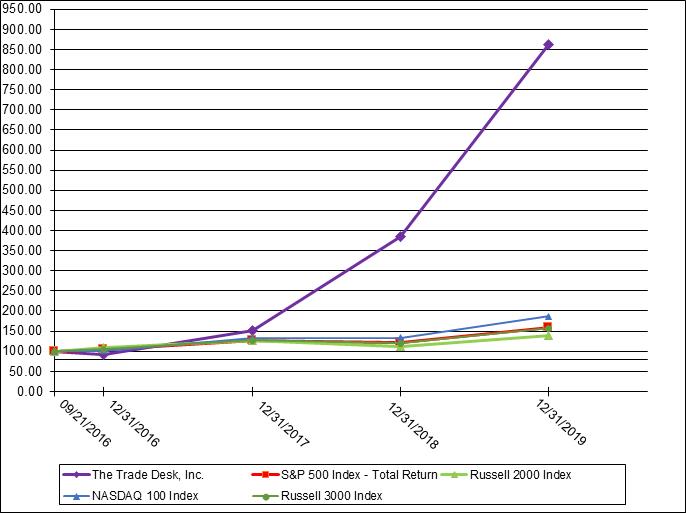][added: ]
Refer to Note 9 to our audited consolidated financial statements for more information regarding capitalization.
The performance graph also includes a comparison with the Russell 2000 Index, which we are now replacing with the Russell 3000 Index because it is the relevant index in which the Company is now included.
Item 6. Selected Financial Data
33 rewritten, 5 added, 1 removed, 28 unchanged
We have derived the selected consolidated statements of operations data for [added: 2020,] 2019, [removed: 2018,] and [removed: 2017] [added: 2018] and the selected consolidated balance sheet data as of December 31, [removed: 2019] [added: 2020] and [removed: 2018] [added: 2019] from our audited consolidated financial statements included elsewhere in this Annual Report on Form 10-K.
The selected consolidated statements of operations data for [removed: 2016] [added: 2017] and [removed: 2015] [added: 2016] and the selected consolidated balance sheet data as of December 31, [removed: 2017, 2016] [added: 2018, 2017] and [removed: 2015] [added: 2016] were derived from our audited consolidated financial statements that are not included in this Annual Report on Form 10-K.
| | | [removed: 2019] [added: 2020] | | | | [removed: 2018] [added: 2019] | | | | [removed: 2017] [added: 2018] | | | | [removed: 2016] [added: 2017] | | | | [removed: 2015] [added: 2016] | | |
| Revenue | | $ | [removed: 661,058] [added: 836,033] | | | $ | [removed: 477,294] [added: 661,058] | | | $ | [removed: 308,217] [added: 477,294] | | | $ | [removed: 202,926] [added: 308,217] | | | $ | [removed: 113,836] [added: 202,926] | |
| Platform operations | | | [removed: 156,180] [added: 178,812] | | | | [removed: 114,098] [added: 156,180] | | | | [removed: 66,230] [added: 114,098] | | | | [removed: 39,876] [added: 66,230] | | | | [removed: 22,967] [added: 39,876] | |
| Sales and marketing | | | [removed: 132,882] [added: 174,742] | | | | [removed: 87,071] [added: 132,882] | | | | [removed: 61,379] [added: 87,071] | | | | [removed: 46,056] [added: 61,379] | | | | [removed: 26,794] [added: 46,056] | |
| Technology and development | | | [removed: 116,752] [added: 166,654] | | | | [removed: 83,892] [added: 116,752] | | | | [removed: 52,806] [added: 83,892] | | | | [removed: 27,313] [added: 52,806] | | | | [removed: 12,819] [added: 27,313] | |
| General and administrative | | | [removed: 143,048] [added: 171,617] | | | | [removed: 84,910] [added: 143,048] | | | | [removed: 58,446] [added: 84,910] | | | | [removed: 32,163] [added: 58,446] | | | | [removed: 13,276] [added: 32,163] | |
| Total operating expenses | | | [removed: 548,862] [added: 691,825] | | | | [removed: 369,971] [added: 548,862] | | | | [removed: 238,861] [added: 369,971] | | | | [removed: 145,408] [added: 238,861] | | | | [removed: 75,856] [added: 145,408] | |
| Income from operations | | | [removed: 112,196] [added: 144,208] | | | | [removed: 107,323] [added: 112,196] | | | | [removed: 69,356] [added: 107,323] | | | | [removed: 57,518] [added: 69,356] | | | | [removed: 37,980] [added: 57,518] | |
| Total other expense (income), net | | | [added: 305 | | | |] (4,024 | ) | | | 1,586 | | | | 5,731 | | | | 13,684 | | [removed: | | 8,125 | |]
| Income before income taxes | | | [removed: 116,220] [added: 143,903] | | | | [removed: 105,737] [added: 116,220] | | | | [removed: 63,625] [added: 105,737] | | | | [removed: 43,834] [added: 63,625] | | | | [removed: 29,855] [added: 43,834] | |
| Provision for [added: (benefit from)] income taxes | | | [removed: 7,902] [added: (98,414] | [added: )] | | | [removed: 17,597] [added: 7,902] | | | | [removed: 12,827] [added: 17,597] | | | | [removed: 23,352] [added: 12,827] | | | | [removed: 13,926] [added: 23,352] | |
| Net income | | $ | [removed: 108,318] [added: 242,317] | | | $ | [removed: 88,140] [added: 108,318] | | | $ | [removed: 50,798] [added: 88,140] | | | $ | [removed: 20,482] [added: 50,798] | | | $ | [removed: 15,929] [added: 20,482] | |
| Net income (loss) attributable to common stockholders (2) | | $ | [removed: 108,318] [added: 242,317] | | | $ | [removed: 88,140] [added: 108,318] | | | $ | [removed: 50,798] [added: 88,140] | | | $ | [removed: (26,727] [added: 50,798] | [removed: )] | | $ | [removed: 8,764] [added: (26,727] | [added: )] |
| Net income (loss) per share attributable to common stockholders–basic (2) | | $ | [removed: 2.43] [added: 5.24] | | | $ | [removed: 2.08] [added: 2.43] | | | $ | [removed: 1.26] [added: 2.08] | | | $ | [removed: (1.46] [added: 1.26] | [removed: )] | | $ | [removed: 0.85] [added: (1.46] | [added: )] |
| Net income (loss) per share attributable to common stockholders–diluted (2) | | $ | [removed: 2.27] [added: 4.95] | | | $ | [removed: 1.92] [added: 2.27] | | | $ | [removed: 1.15] [added: 1.92] | | | $ | [removed: (1.46] [added: 1.15] | [removed: )] | | $ | [removed: 0.39] [added: (1.46] | [added: )] |
| Gross spend (3) | | $ | [removed: 3,128,872] [added: 4,198,568] | | | $ | [removed: 2,350,877] [added: 3,128,872] | | | $ | [removed: 1,555,856] [added: 2,350,877] | | | $ | [removed: 1,027,984] [added: 1,555,856] | | | $ | [removed: 552,325] [added: 1,027,984] | |
| Gross billings (4) | | $ | [removed: 3,095,687] [added: 4,168,260] | | | $ | [removed: 2,285,013] [added: 3,095,687] | | | $ | [removed: 1,491,742] [added: 2,285,013] | | | $ | [removed: 990,561] [added: 1,491,742] | | | $ | [removed: 529,975] [added: 990,561] | |
| Cash, cash equivalents and short-term investments | | $ | [removed: 254,988] [added: 624,038] | | | $ | [removed: 207,232] [added: 254,988] | | | $ | [removed: 155,950] [added: 207,232] | | | $ | [removed: 133,400] [added: 155,950] | | | $ | [removed: 4,047] [added: 133,400] | |
| Accounts receivable, net | | | [removed: 1,166,376] [added: 1,584,109] | | | | [removed: 834,764] [added: 1,166,376] | | | | [removed: 599,565] [added: 834,764] | | | | [removed: 377,240] [added: 599,565] | | | | [removed: 191,943] [added: 377,240] | |
| Total assets [added: (5)] | | | [removed: 1,728,761] [added: 2,753,645] | | | | [removed: 1,117,872] [added: 1,728,761] | | | | [removed: 797,164] [added: 1,117,872] | | | | [removed: 537,596] [added: 797,164] | | | | [removed: 210,231] [added: 537,596] | |
| Accounts payable | | | [removed: 868,618] [added: 1,348,480] | | | | [removed: 669,147] [added: 868,618] | | | | [removed: 490,377] [added: 669,147] | | | | [removed: 321,163] [added: 490,377] | | | | [removed: 108,461] [added: 321,163] | |
| Long-term debt, net of current portion | | | — | | | | — | | | | [removed: 27,000] [added: —] | | | | [removed: 25,847] [added: 27,000] | | | | [removed: 45,918] [added: 25,847] | |
| Total liabilities [added: (5)] | | | [removed: 1,116,244] [added: 1,740,500] | | | | [removed: 723,305] [added: 1,116,244] | | | | [removed: 551,581] [added: 723,305] | | | | [removed: 373,216] [added: 551,581] | | | | [removed: 171,885] [added: 373,216] | |
| Total stockholders’ equity | | | [removed: 612,517] [added: 1,013,145] | | | | [removed: 394,567] [added: 612,517] | | | | [removed: 245,583] [added: 394,567] | | | | [removed: 164,380] [added: 245,583] | | | | [removed: 14,142] [added: 164,380] | |
| Platform operations | | $ | [removed: 5,350] [added: 8,794] | | | $ | [removed: 4,463] [added: 5,350] | | | $ | [removed: 2,674] [added: 4,463] | | | $ | [removed: 756] [added: 2,674] | | | $ | [removed: 71] [added: 756] | |
| Sales and marketing | | | [removed: 20,769] [added: 29,726] | | | | [removed: 11,306] [added: 20,769] | | | | [removed: 6,261] [added: 11,306] | | | | [removed: 1,707] [added: 6,261] | | | | [removed: 127] [added: 1,707] | |
| Technology and development | | | [removed: 26,553] [added: 36,672] | | | | [removed: 13,855] [added: 26,553] | | | | [removed: 6,661] [added: 13,855] | | | | [removed: 1,513] [added: 6,661] | | | | [removed: 85] [added: 1,513] | |
| General and administrative | | | [removed: 28,086] [added: 36,583] | | | | [removed: 12,586] [added: 28,086] | | | | [removed: 5,721] [added: 12,586] | | | | [removed: 1,080] [added: 5,721] | | | | [removed: 91] [added: 1,080] | |
| Total | | $ | [removed: 80,758] [added: 111,775] | | | $ | [removed: 42,210] [added: 80,758] | | | $ | [removed: 21,317] [added: 42,210] | | | $ | [removed: 5,056] [added: 21,317] | | | $ | [removed: 374] [added: 5,056] | |
| (3) | Gross spend includes the value of a client’s purchases through our platform plus our platform fee, which is a percentage of a client’s purchases through the platform. We review gross spend for internal management purposes to assess market share and scale, and to plan for optimal levels of support for our clients. Some companies in our industry report revenue on a gross basis or use similar metrics, so tracking our gross spend allows us to compare our results to the results of those companies. Gross spend does not represent our revenue reported [added: net] on a GAAP basis. Our gross spend is influenced by the volume and characteristics of bids for advertising inventory won through our platform. We expect our revenue as a percentage of gross spend, which is sometimes referred to as take rate, to fluctuate due to the types of services and features selected by our clients through our platform and certain volume discounts. [removed: We track gross spend based on the location of our office servicing the respective clients.] Other companies, including companies in our industry, may calculate gross spend or similarly titled measures differently, which reduces its usefulness as a comparative measure. |
| (4) | Gross billings represents the amount we invoice our clients, net of allowances. As some of our clients have payment relationships directly with advertising inventory suppliers for the amount of advertising inventory the clients purchase through our platform, we do not invoice these clients for this spend, and we only invoice such clients for data, other services and our platform fee. Accordingly, gross billings are less than gross spend and represent gross spend, less platform discounts and less the value of advertising inventory and data that our clients purchase directly from publishers through our platform. We report revenue on a net basis which represents gross billings net of amounts we pay suppliers for the cost of advertising inventory, data and add-on features. We expect our revenue as a percentage of gross billings to fluctuate due to the types of services and features selected by our clients through our platform and certain volume discounts. We review gross billings for internal management purposes to adequately plan for our working capital needs and monitor collection risk. [removed: We track gross billings based on the billing address of the client. In many cases, international clients are serviced from our U.S. offices resulting in gross billings exceeding gross spend for international clients.] |
| | | 2020 | | | | 2019 | | | | 2018 | | | | 2017 | | | | 2016 | | |
| | | 2020 | | | | 2019 | | | | 2018 | | | | 2017 | | | | 2016 | | |
| | | 2020 | | | | 2019 | | | | 2018 | | | | 2017 | | | | 2016 | | |
| (5) | The selected financial data for 2020 and 2019 reflects the adoption of Accounting Standards Update (“ASU”) No. 2016-02, Leases (Topic 842). Refer to Note 2 – Basis of Presentation and Summary of Significant Accounting Policies for further detail. The selected financial data for 2018, 2017 and 2016 does not reflect the adoption of ASU No. 2016-02. |
| --- | --- |
| Convertible preferred stock | | | — | | | | — | | | | — | | | | — | | | | 24,204 | |
Item 8. Financial Statements and Supplementary Data
264 rewritten, 119 added, 106 removed, 432 unchanged
| [Report of Independent Registered Public Accounting Firm](#REPORT_INDEPENDENT_REGISTERED_PUBLIC_ACC) | | | [removed: 52] [added: 54] |
| [Consolidated Balance Sheets](#CONSOLIDATED_BALANCE_SHEETS) | | | [removed: 55] [added: 56] |
| [Consolidated Statements of Operations](#CONSOLIDATED_STATEMENTS_OPERATIONS) | | | [removed: 56] [added: 57] |
| [Consolidated Statements of Stockholders’ [removed: Equity](#CONSOLIDATED_STATEMENTS_STOCKHOLDERS_EQU)] [added: Equity](#CONDENSED_CONSOLIDATED_STATEMENTS_STOCKH)] | | | [removed: 57] [added: 58] |
| [Consolidated Statements of Cash Flows](#CONSOLIDATED_STATEMENTS_CASH_FLOWS) | | | [removed: 58] [added: 59] |
| [Notes to Consolidated Financial Statements](#NOTES) | | | [removed: 59] [added: 60] |
We have audited the accompanying consolidated balance sheets of The Trade Desk, Inc. and its subsidiaries (the “Company”) as of December 31, [removed: 2019] [added: 2020] and [removed: 2018,] [added: 2019,] and the related consolidated statements of operations, of stockholders’ equity and of cash flows for each of the three years in the period ended December 31, [removed: 2019,] [added: 2020,] including the related notes (collectively referred to as the “consolidated financial statements”).
We also have audited the Company's internal control over financial reporting as of December 31, [removed: 2019,] [added: 2020,] based on criteria established in *Internal Control - Integrated Framework* (2013) issued by the Committee of Sponsoring Organizations of the Treadway Commission (COSO).
In our opinion, the consolidated financial statements referred to above present fairly, in all material respects, the financial position of the Company as of December 31, [removed: 2019] [added: 2020] and [removed: 2018,] [added: 2019,] and the results of its operations and its cash flows for each of the three years in the period ended December 31, [removed: 2019] [added: 2020] in conformity with accounting principles generally accepted in the United States of America.
Also in our opinion, the Company maintained, in all material respects, effective internal control over financial reporting as of December 31, [removed: 2019,] [added: 2020,] based on criteria established in *Internal Control - Integrated Framework* (2013) issued by the COSO.
The critical audit [removed: matters] [added: matter] communicated below [removed: are matters] [added: is a matter] arising from the current period audit of the consolidated financial statements that [removed: were] [added: was] communicated or required to be communicated to the audit committee and that (i) [removed: relate] [added: relates] to accounts or disclosures that are material to the consolidated financial statements and (ii) involved our especially challenging, subjective, or complex judgments.
The communication of critical audit matters does not alter in any way our opinion on the consolidated financial statements, taken as a whole, and we are not, by communicating the critical audit [removed: matters] [added: matter] below, providing [added: a] separate [removed: opinions] [added: opinion] on the critical audit [removed: matters] [added: matter] or on the accounts or disclosures to which [removed: they relate.][added: it relates.]
For the year ended December 31, [removed: 2019,] [added: 2020,] the Company’s revenue was [removed: $661] [added: $836] million.
| | | [added: 2020 | | | |] 2019 | | | | 2018 | | |
| Cash and cash [removed: equivalents] [added: equivalents—Beginning of year] | | [removed: $] | 130,876 | | | [removed: $] | 207,232 | | [added: | | 155,950 | |]
| Short-term [removed: investments] [added: investments, net] | | | [removed: 124,112] [added: 186,685] | | | | [removed: —] [added: 124,112] | |
| Prepaid expenses and other current assets | | | [removed: 27,857] [added: 102,170] | | | | [removed: 14,527] [added: 27,857] | |
| TOTAL CURRENT ASSETS | | | [removed: 1,449,221] [added: 2,310,317] | | | | [removed: 1,056,523] [added: 1,449,221] | |
| Property and equipment, net | | | [removed: 64,012] [added: 115,863] | | | | [removed: 33,046] [added: 64,012] | |
| Operating lease assets | | | [removed: 173,449] [added: 248,143] | | | | [removed: —] [added: 173,449] | |
| Deferred income taxes | | | [removed: 18,950] [added: 50,168] | | | | [removed: 8,460] [added: 18,950] | |
| Other assets, non-current | | | [removed: 23,129] [added: 29,154] | | | | [removed: 19,843] [added: 23,129] | |
| TOTAL ASSETS | | $ | [removed: 1,728,761] [added: 2,753,645] | | | $ | [removed: 1,117,872] [added: 1,728,761] | |
| Accounts payable | | $ | [removed: 868,618] [added: 1,348,480] | | | $ | [removed: 669,147] [added: 868,618] | |
| Accrued expenses and other current liabilities | | | [removed: 47,178] [added: 88,335] | | | | [removed: 44,844] [added: 47,178] | |
| Operating lease liabilities | | | [removed: 14,577] [added: 37,868] | | | | [removed: —] [added: 14,577] | |
| TOTAL CURRENT LIABILITIES | | | [removed: 930,373] [added: 1,474,683] | | | | [removed: 713,991] [added: 930,373] | |
| Operating lease liabilities, non-current | | | [removed: 174,873] [added: 254,562] | | | | [removed: —] [added: 174,873] | |
| Other liabilities, non-current | | | [removed: 10,998] [added: 11,255] | | | | [removed: 9,314] [added: 10,998] | |
| TOTAL LIABILITIES | | | [removed: 1,116,244] [added: 1,740,500] | | | | [removed: 723,305] [added: 1,116,244] | |
| Preferred stock, par value $0.000001; 100,000 shares authorized, zero shares issued and outstanding as of December 31, [removed: 2019] [added: 2020] and [removed: 2018] [added: 2019] | | | — | | | | — | |
| Common stock, par value $0.000001 Class A, 1,000,000 shares authorized; [removed: 40,305] [added: 42,338] and [removed: 36,822] [added: 40,305] shares issued and outstanding as of December 31, [removed: 2019] [added: 2020] and [removed: 2018,] [added: 2019,] respectively Class B, 95,000 shares authorized; [removed: 5,171] [added: 5,002] and [removed: 7,042] [added: 5,171] shares issued and outstanding as of December 31, [removed: 2019] [added: 2020] and [removed: 2018,] [added: 2019,] respectively | | | — | | | | — | |
| Additional paid-in capital | | | [removed: 380,079] [added: 538,778] | | | | [removed: 270,447] [added: 380,079] | |
| Retained earnings | | | [removed: 232,438] [added: 474,367] | | | | [removed: 124,120] [added: 232,438] | |
| TOTAL STOCKHOLDERS’ EQUITY | | | [removed: 612,517] [added: 1,013,145] | | | | [removed: 394,567] [added: 612,517] | |
| TOTAL LIABILITIES AND STOCKHOLDERS’ EQUITY | | $ | [removed: 1,728,761] [added: 2,753,645] | | | $ | [removed: 1,117,872] [added: 1,728,761] | |
| | | [removed: 2019] [added: 2020] | | | | [removed: 2018] [added: 2019] | | | | [removed: 2017] [added: 2018] | | |
| Revenue | | $ | [removed: 661,058] [added: 836,033] | | | $ | [removed: 477,294] [added: 661,058] | | | $ | [removed: 308,217] [added: 477,294] | |
| Platform operations | | | [removed: 156,180] [added: 178,812] | | | | [removed: 114,098] [added: 156,180] | | | | [removed: 66,230] [added: 114,098] | |
| Sales and marketing | | | [removed: 132,882] [added: 174,742] | | | | [removed: 87,071] [added: 132,882] | | | | [removed: 61,379] [added: 87,071] | |
February 18, 2021
| | | 2020 | | | | 2019 | | |
| Cash and cash equivalents | | $ | 437,353 | | | $ | 130,876 | |
| Accounts receivable, net of allowance for credit losses of $7,253 and $3,920 as of December 31, 2020 and 2019, respectively | | | 1,584,109 | | | | 1,166,376 | |
| | | | | | | | | |
| Impact upon adoption of new accounting standard (Note 2) | | | — | | | | — | | | | — | | | | (388 | ) | | | (388 | ) |
| Balance as of December 31, 2020 | | | 47,340 | | | $ | — | | | $ | 538,778 | | | $ | 474,367 | | | $ | 1,013,145 | |
| | | | | | | | | | | | | | | | | | | | | |
| Net income | | $ | 242,317 | | | $ | 108,318 | | | $ | 88,140 | |
| Allowance for credit losses on accounts receivable | | | 3,149 | | | | 2,702 | | | | 2,115 | |
| Proceeds from line of credit | | | 143,000 | | | | — | | | | — | |
| | | | | | | | | | | | | |
As of December 31, 2020, the impact of the Coronavirus pandemic (“COVID-19”) on our business continues to evolve.
As a result, many of our estimates and assumptions, including the allowance for credit losses, consider macro-economic factors in the market, which require increased judgment and carry a higher degree of variability and volatility.
As events continue to evolve and additional information becomes available, our estimates may change materially in future periods.
The Company generates revenue from clients who enter into agreements with the Company to use its platform to purchase advertising inventory, data and other add-on features.
The Company charges its clients a platform fee, which is a percentage of a client’s purchases through the platform.
In addition, the Company invoices its clients for the cost of advertising inventory purchased, plus data and any add-on features purchased through the platform.
During 2020, the Company eliminated the peer group from this analysis and began to determine its price volatility based on a blend of historical and implied volatilities.
The Company uses Accounting Standards Update (“ASU”) No. 2016-13, *Financial Instruments-Credit Losses (Topic 326): Measurement of Credit Losses on Financial Instruments* (Accounting Standards Codification (“ASC”) 326 or “CECL”), to assess the investment portfolio for impairment at the individual security level and evaluates all securities in an unrealized loss position to determine if the impairment is credit-related (resulting in realized credit loss, recorded in earnings) or non-credit-related (resulting in an unrealized loss, recorded in stockholders' equity).
AFS debt securities with an amortized cost basis in excess of estimated fair value are assessed to determine what amount of that difference, if any, is caused by expected credit losses.
Expected credit loss on AFS debt securities are recognized in other expense (income), net on consolidated statement of operations and any remaining unrealized losses, net of taxes, are included in accumulated other comprehensive income (loss) in stockholders' equity.
We have not recorded any impairment charges for unrealized losses in the periods presented.
We maintain an allowance for credit losses for expected uncollectible accounts receivable, which is recorded as an offset to accounts receivable and changes in such are classified as general and administrative expense on the Consolidated Statements of Operations.
On January 1, 2020, the Company adopted ASC 326 to assess the allowance for credit losses.
The Company used the modified retrospective transition method, which required a cumulative-effect adjustment to the opening balance of retained earnings to be recognized on the date of adoption with prior periods not restated.
The cumulative-effect adjustment recorded on January 1, 2020, was not material.
ASC 326 requires the measurement of all expected credit losses for financial assets held at the reporting date based on historical experience, current conditions, and reasonable and supportable forecasts.
As a result, the Company revised its impairment model to utilize an expected loss methodology in place of an incurred loss methodology related to its marketable securities and the related allowance for credit losses.
The industry specific default rates are applied to the advertiser’s industry if the receivables are subject to sequential liability or the Company is engaged with the advertiser directly.
For the year ended December 31, 2020, the Company’s assessment considered business and market disruptions caused by COVID-19 and estimates of credit defaults by industry.
We continue to monitor the financial implications of the COVID-19 on expected credit losses.
| Add: Impact upon adoption of new accounting standard | | | 553 | | | | — | | | | — | |
In March 2020, the FASB issued ASU No. 2020-04, *Reference Rate Reform (Topic 848)* (“ASU 2020-04”), which provides optional expedients and exceptions for applying GAAP to contracts, hedging relationships, and other transactions affected by the discontinuation of the London Interbank Offered Rate or by another reference rate expected to be discontinued.
The amendments are effective for all entities as of March 12, 2020 through December 31, 2022 and can be adopted as of any date from the beginning of an interim period that includes or is subsequent to March 12, 2020.
The Company is currently evaluating the impacts of the provisions of ASU 2020-04 on our financial condition, results of operations, and cash flows.
| | | 2020 | | | | 2019 | | | | 2018 | | |
| Net income | | $ | 242,317 | | | $ | 108,318 | | | $ | 88,140 | |
| | | 2020 | | | | 2019 | | |
| | | | 158,343 | | | | 91,353 | |
| --- | --- | --- | --- |
Addressing the matter involved performing procedures and evaluating audit evidence in connection with forming our overall opinion on the consolidated financial statements.
Intellectual Property Restructuring Transaction
As described in Note 11 to the consolidated financial statements, in April 2019, the Company initiated a transaction to transfer certain intellectual property rights among wholly owned subsidiaries, primarily to align its structure to its evolving operations.
The transaction resulted in an increase in foreign deferred tax assets in an amount of $262.4 million.
Management applied significant judgment in estimating the fair value of intangible assets, which involved the use of significant assumptions, including revenue growth rates, margins and discount rates.
The principal considerations for our determination that performing procedures relating to the intellectual property restructuring transaction is a critical audit matter are that there was a significant amount of judgment by management when developing the estimate of the fair value of intellectual property rights which in turn led to a high degree of auditor judgment and subjectivity in applying procedures to evaluate the fair value of intellectual property rights.
Significant audit effort was required in evaluating the significant assumptions related to the fair value of the intellectual property rights, including the revenue growth rates, margins and discount rates, and the audit effort involved the use of professionals with specialized skill and knowledge.
These procedures included testing the effectiveness of controls over management’s valuation of intellectual property rights, including controls over the development of the revenue growth rates, margins, and discount rate assumptions.
These procedures also included, among others, reading the intellectual property license agreement and cost sharing agreement; testing management’s process for estimating the fair value of intellectual property rights, which included evaluating the appropriateness of the methodology used and evaluating the reasonableness of management’s significant assumptions.
Procedures were also performed to test the completeness, accuracy, and relevance of underlying data provided by management.
Evaluating the reasonableness of the revenue growth rates and margin assumptions involved considering current and past performance of the business and evaluating the accuracy of management’s historical forecasting.
Evaluating the reasonableness of the revenue growth rates also involved assessing consistency with external market and industry data.
The discount rates were evaluated by considering the cost of capital of comparable businesses and other industry factors.
Professionals with specialized skill and knowledge were used to assist in the evaluation of certain significant assumptions, including the discount rates.
February 27, 2020
| Accounts receivable, net | | | 1,166,376 | | | | 834,764 | |
| | | | | | | | | | | | | | | Retained | | | | | | |
| Balance as of December 31, 2016 | | | 39,131 | | | $ | — | | | $ | 179,198 | | | $ | (14,818 | ) | | $ | 164,380 | |
| --- | --- |
| Business acquisition | | | — | | | | — | | | | (3,000 | ) |
| Payment of financing obligations | | | — | | | | — | | | | (1,001 | ) |
| Cash and cash equivalents—Beginning of year | | | 207,232 | | | | 155,950 | | | | 133,400 | |
| Debt financing costs included in debt, net | | $ | — | | | $ | — | | | $ | 1,153 | |
The Company has no material components of other comprehensive income (loss), and accordingly, the Company’s comprehensive income is the same as its net income for all periods presented.
Except for the accounting policy for leases that was updated as a result of adopting Financial Accounting Standards Board ("FASB") Accounting Standards Update ("ASU") No. 2016-02, Leases, as amended ("ASU 2016-02"), our significant accounting policies have been applied consistently to all years presented.
Refer to “Operating Leases” below.
On January 1, 2018, the Company adopted Accounting Standards Update (“ASU”) No. 2014-09, *Revenue from Contracts with Customers (Topic 606)*, using the modified retrospective method.
The adoption of ASU 2014-09 did not result in a change in the timing or amount of revenue recognized.
| --- | --- | --- |
The Company classifies its operating expenses into four categories:
For performance-based restricted stock, expense is recognized on a graded-vesting attribution basis over the requisite service period of the award and is adjusted in subsequent reporting periods if the assessed probability or estimated level of achievement of the performance goals changes.
In January 2018, the FASB released guidance on the accounting for tax on the global intangible low-taxed income ("GILTI") provisions of the Tax Cuts and Jobs Act (the "Act").
The GILTI provisions impose a tax on foreign income in excess of a deemed return on tangible assets of foreign corporations.
The guidance indicates that either accounting for deferred taxes related to GILTI inclusions or to treat any taxes on GILTI inclusions as period cost are both acceptable methods subject to an accounting policy election.
The Company elected to treat any GILTI inclusions as a period cost.
Unrealized losses are charged against other expense when a decline in fair value is determined to be other-than-temporary.
The Company determines realized gains or losses on sale of marketable securities on a specific identification method, and records such gains or losses as other expense (income).
The allowance for doubtful accounts is based on the best estimate of the amount of probable credit losses in existing accounts receivable.
The allowance for doubtful accounts is determined based on historical collection experience and the review in each period of the status of the then-outstanding accounts receivable, while taking into consideration current client information, subsequent collection history and other relevant data.
An excerpt. Shown here: 40 of 264 rewritten, 40 of 119 added and 40 of 106 removed. The counts are complete. For every sentence, read Item 8. Financial Statements and Supplementary Data in the FY2020 filing and the FY2019 filing.
Item 9A. Controls and Procedures
6 rewritten, 0 added, 6 removed, 14 unchanged
Our management, with the participation of our Chief Executive Officer (“CEO”) and Chief Financial Officer (“CFO”), evaluated the effectiveness of our disclosure controls and procedures as defined in Rules 13a-15(e) and 15d-15(e) under the Securities Exchange Act of 1934, as amended (the “Exchange Act”), as of December 31, [removed: 2019.][added: 2020.]
Based on this evaluation, our CEO and CFO have concluded that our disclosure controls and procedures were effective at the reasonable assurance level as of December 31, [removed: 2019.][added: 2020.]
Management assessed the effectiveness of our internal control over financial reporting as of December 31, [removed: 2019] [added: 2020] using the criteria set forth by the Committee of Sponsoring Organizations of the Treadway Commission in *Internal Control—Integrated Framework* (2013).
Based on its assessment, our management, including our CEO and CFO, has concluded that our internal control over financial reporting was effective as of December 31, [removed: 2019.][added: 2020.]
The effectiveness of our internal control over financial reporting as of December 31, [removed: 2019] [added: 2020] has been audited by PricewaterhouseCoopers LLP, our independent registered public accounting firm, as stated in their report, which appears in Item 8 of this Annual Report on Form 10-K.
There have been no significant changes in our internal control over financial reporting during the quarter ended December 31, [removed: 2019] [added: 2020] that have materially affected, or are reasonably likely to materially affect, our internal control over financial reporting.
We transitioned to a new accounting and financial reporting system, which replaced our existing accounting and financial reporting system.
The go-live for this new system occurred during July 2019, and our system implementation was completed during the quarter ended September 30, 2019.
Management evaluated the process changes as a result of the system implementation, and where needed, modified the design of and the testing for operating effectiveness of internal control over financial reporting.
The modification to the design of and testing for operating effectiveness was specific to the new accounting and financial reporting system’s functionalities and features.
We did not identify any previously unidentified risks or design gaps as a result of the system implementation.
Testing for operating effectiveness of internal control over financial reporting has been completed for the fiscal year ended December 31, 2019, and management concluded that the internal control over financial reporting under the new accounting and financial reporting system was operating effectively.
Item 10. Directors, Executive Officers and Corporate Governance
1 rewritten, 0 added, 0 removed, 3 unchanged
The information required by this item will be included in our proxy statement relating to our [removed: 2020] [added: 2021] annual meeting of stockholders to be filed by us with the SEC no later than 120 days after the close of our fiscal year ended December 31, [removed: 2019] [added: 2020] (the "Proxy Statement") and is incorporated herein by reference.
Item 15. Exhibits and Financial Statement Schedules
28 rewritten, 11 added, 1 removed, 71 unchanged
| 3.1 | | [Amended and Restated Certificate of [removed: Incorporation.](http://www.sec.gov/Archives/edgar/data/0001671933/000104746916015272/a2229540zex-3_2.htm)] [added: Incorporation.](https://www.sec.gov/Archives/edgar/data/1671933/000156459021006726/ttd-ex31_62.htm)] | | [removed: S-1/A] | | [removed: 9/6/2016] | | [removed: 3.2] | | | [added: X] |
| 3.2 | | [Amended and Restated [removed: Bylaws.](http://www.sec.gov/Archives/edgar/data/0001671933/000104746916015074/a2229525zex-3_4.htm)] [added: Bylaws.](https://www.sec.gov/Archives/edgar/data/1671933/000156459021006726/ttd-ex32_63.htm)] | | [removed: S-1] | | [removed: 8/22/2016] | | [removed: 3.4] | | | [added: X] |
| 4.1 | | Reference is made to Exhibits [removed: [3.1](http://www.sec.gov/Archives/edgar/data/0001671933/000104746916015272/a2229540zex-3_2.htm)] [added: [3.1](https://www.sec.gov/Archives/edgar/data/1671933/000156459021006726/ttd-ex31_62.htm)] and [removed: [3.2](http://www.sec.gov/Archives/edgar/data/0001671933/000104746916015074/a2229525zex-3_4.htm).] [added: [3.2](https://www.sec.gov/Archives/edgar/data/1671933/000156459021006726/ttd-ex32_63.htm).] | | | | | | | | | |
| 4.5 | | [Description of [removed: Securities.](https://www.sec.gov/Archives/edgar/data/1671933/000156459020007498/ttd-ex45_101.htm)] [added: Securities.](https://www.sec.gov/Archives/edgar/data/1671933/000156459021006726/ttd-ex45_269.htm)] | | | | | | | | | X |
| [removed: 10.2] [added: 10.1] | | [Second Amended and Restated Loan and Security Agreement, dated as of October 26, 2018, among The Trade Desk, Inc., the lenders party thereto, and Citibank, N.A., as administrative agent.](http://www.sec.gov/Archives/edgar/data/1671933/000156459018028667/ttd-ex101_448.htm) | | 10-Q | | 11/9/2018 | | 10.1 | | | |
| [removed: 10.3(c)+] [added: 10.2(c)+] | | [Exercise Notice under The Trade Desk, Inc. 2010 Stock Plan.](http://www.sec.gov/Archives/edgar/data/0001671933/000104746916015272/a2229540zex-10_5c.htm) | | S-1/A | | 9/6/2016 | | 10.5 | (c) | | |
| [removed: 10.4(a)+] [added: 10.3(a)+] | | [The Trade Desk, Inc. 2015 Equity Incentive Plan.](http://www.sec.gov/Archives/edgar/data/0001671933/000104746916015272/a2229540zex-10_6a.htm) | | S-1/A | | 9/6/2016 | | 10.6 | (a) | | |
| [removed: 10.4(b)+] [added: 10.3(b)+] | | [First Amendment to The Trade Desk, Inc. 2015 Equity Incentive Plan.](http://www.sec.gov/Archives/edgar/data/0001671933/000110465916146150/a16-18790_1ex99d2.htm) | | S-8 | | 9/22/2016 | | 99.2 | | | |
| [removed: 10.4(c)+] [added: 10.3(c)+] | | [Form of Stock Option Agreement under The Trade Desk, Inc. 2015 Equity Incentive Plan.](http://www.sec.gov/Archives/edgar/data/0001671933/000104746916015272/a2229540zex-10_6b.htm) | | S-1/A | | 9/6/2016 | | 10.6 | (b) | | |
| [removed: 10.4(d)+] [added: 10.3(d)+] | | [Form of Stock Option Agreement under The Trade Desk, Inc. 2015 Equity Incentive Plan (with accelerated vesting).](http://www.sec.gov/Archives/edgar/data/0001671933/000104746916015272/a2229540zex-10_6c.htm) | | S-1/A | | 9/6/2016 | | 10.6 | (c) | | |
| [removed: 10.4(e)+] [added: 10.3(e)+] | | [Exercise Notice under The Trade Desk, Inc. 2015 Equity Incentive Plan.](http://www.sec.gov/Archives/edgar/data/0001671933/000104746916015272/a2229540zex-10_6d.htm) | | S-1/A | | 9/6/2016 | | 10.6 | (d) | | |
| [removed: 10.5(a)+] [added: 10.4(a)+] | | [The Trade Desk, Inc. 2016 Incentive Award Plan.](http://www.sec.gov/Archives/edgar/data/0001671933/000104746916015074/a2229525zex-10_7a.htm) | | S-1 | | 8/22/2016 | | 10.7 | (a) | | |
| [removed: 10.5(b)+] [added: 10.4(b)+] | | [Form of Stock Option Agreement under The Trade Desk, Inc. 2016 Equity Incentive Plan.](http://www.sec.gov/Archives/edgar/data/0001671933/000104746916015074/a2229525zex-10_7b.htm) | | S-1 | | 8/22/2016 | | 10.7 | (b) | | |
| [removed: 10.6+] [added: 10.5+] | | [The Trade Desk, Inc. 2016 Employee Stock Purchase Plan.](http://www.sec.gov/Archives/edgar/data/0001671933/000110465916146150/a16-18790_1ex99d5.htm) | | S-8 | | 9/22/2016 | | 99.5 | | | |
| [removed: 10.7+] [added: 10.6+] | | [Form of Indemnification Agreement.](http://www.sec.gov/Archives/edgar/data/0001671933/000104746916015074/a2229525zex-10_8.htm) | | S-1 | | 8/22/2016 | | 10.8 | | | |
| [removed: 10.8+] [added: 10.7+] | | [Employment Agreement, dated as of May 11, 2017, between The Trade Desk, Inc. and Jeff T. Green.](http://www.sec.gov/Archives/edgar/data/0001671933/000119312517167445/d274174dex102.htm) | | 10-Q | | 05/11/17 | | 10.2 | | | |
| [removed: 10.9+] [added: 10.8+] | | [Employment Agreement, dated as of May 11, 2017, between The Trade Desk, Inc. and David R. Pickles.](http://www.sec.gov/Archives/edgar/data/0001671933/000119312517167445/d274174dex103.htm) | | 10-Q | | 05/11/17 | | 10.3 | | | |
| [removed: 10.10+] [added: 10.9+] | | [Employment Agreement, dated as of [removed: May 11,] [added: November 1,] 2017, between The Trade Desk, Inc. and [removed: Paul E. Ross.](http://www.sec.gov/Archives/edgar/data/0001671933/000119312517167445/d274174dex104.htm)] [added: Susan Vobejda.](http://www.sec.gov/Archives/edgar/data/1671933/000156459019017961/ttd-ex101_350.htm)] | | 10-Q | | [removed: 05/11/17] [added: 05/09/19] | | [removed: 10.4] [added: 10.1] | | | |
| 10.11+ | | [Employment Agreement, dated [removed: as of May 11, 2017,] [added: October 29, 2019] between The Trade Desk, Inc. and [removed: Brian J. Stempeck.](http://www.sec.gov/Archives/edgar/data/0001671933/000119312517167445/d274174dex106.htm)] [added: Blake Grayson.](http://www.sec.gov/Archives/edgar/data/1671933/000156459019043644/ttd-ex102_56.htm)] | | [removed: 10-Q] [added: 8-K] | | [removed: 05/11/17] [added: 11/15/19] | | [removed: 10.6] [added: 10.2] | | | |
| 10.12+ | | [removed: [Transition] [added: [Employment] Agreement, dated as of [removed: November 30, 2018,] [added: August 24, 2020] between The Trade Desk, Inc. and [removed: Robert D. Perdue.](http://www.sec.gov/Archives/edgar/data/0001671933/000156459018030487/ttd-ex101_19.htm)] [added: Jay Grant.](http://www.sec.gov/Archives/edgar/data/1671933/000156459020051533/ttd-ex101_40.htm)] | | [removed: 8-K] [added: 10-Q] | | [removed: 12/04/18] [added: 11/06/20] | | 10.1 | | | |
| 10.13+ | | [Employment Agreement, dated [removed: as of November 1, 2017,] [added: January 11, 2021] between The Trade Desk, Inc. and [removed: Susan Vobejda.](http://www.sec.gov/Archives/edgar/data/1671933/000156459019017961/ttd-ex101_350.htm)] [added: Michelle Hulst.](http://www.sec.gov/Archives/edgar/data/1671933/000156459021001214/ttd-ex101_7.htm)] | | [removed: 10-Q] [added: 8-K] | | [removed: 05/09/19] [added: 01/14/21] | | 10.1 | | | |
| 10.14+ | | [removed: [Employment] [added: [Separation and Advisory] Agreement, dated [removed: as of May 1, 2017,] [added: February 5, 2021] between The Trade Desk, Inc. and [removed: Vivian Yang.](http://www.sec.gov/Archives/edgar/data/1671933/000156459019017961/ttd-ex102_351.htm)] [added: Brian Stempeck.](https://www.sec.gov/Archives/edgar/data/1671933/000156459021006726/ttd-ex1014_326.htm)] | | [removed: 10-Q] | | [removed: 05/09/19] | | [removed: 10.2] | | | [added: X] |
| [removed: 10.15+] [added: 10.10+] | | [Offer Letter, dated October 29, 2019, by and between the Company and Blake Grayson.](http://www.sec.gov/Archives/edgar/data/1671933/000156459019043644/ttd-ex101_55.htm) | | 8-K | | 11/15/19 | | 10.1 | | | |
| 21.1 | | [List of Subsidiaries of the [removed: Registrant.](https://www.sec.gov/Archives/edgar/data/1671933/000156459020007498/ttd-ex211_8.htm)] [added: Registrant.](https://www.sec.gov/Archives/edgar/data/1671933/000156459021006726/ttd-ex211_10.htm)] | | | | | | | | | X |
| 23.1 | | [Consent of PricewaterhouseCoopers LLP, independent registered public accounting [removed: firm.](https://www.sec.gov/Archives/edgar/data/1671933/000156459020007498/ttd-ex231_10.htm)] [added: firm.](https://www.sec.gov/Archives/edgar/data/1671933/000156459021006726/ttd-ex231_8.htm)] | | | | | | | | | X |
| 31.1 | | [Certification of Principal Executive Officer Pursuant to Exchange Act Rules 13a-14(a) and 15d-14(a), as adopted pursuant to Section 302 of the Sarbanes-Oxley Act of [removed: 2002.](https://www.sec.gov/Archives/edgar/data/1671933/000156459020007498/ttd-ex311_9.htm)] [added: 2002.](https://www.sec.gov/Archives/edgar/data/1671933/000156459021006726/ttd-ex311_6.htm)] | | | | | | | | | X |
| 31.2 | | [Certification of Principal Financial Officer Pursuant to Exchange Act Rules 13a-14(a) and 15d-14(a), as adopted pursuant to Section 302 of the Sarbanes-Oxley Act of [removed: 2002.](https://www.sec.gov/Archives/edgar/data/1671933/000156459020007498/ttd-ex312_7.htm)] [added: 2002.](https://www.sec.gov/Archives/edgar/data/1671933/000156459021006726/ttd-ex312_7.htm)] | | | | | | | | | X |
| 32.1 (1) | | [Certifications of Principal Executive Officer and Principal Financial Officer Pursuant to 18 U.S.C. Section 1350, as adopted pursuant to Section 906 of the Sarbanes-Oxley Act of [removed: 2002.](https://www.sec.gov/Archives/edgar/data/1671933/000156459020007498/ttd-ex321_6.htm)] [added: 2002.](https://www.sec.gov/Archives/edgar/data/1671933/000156459021006726/ttd-ex321_11.htm)] | | | | | | | | | X |
| 10.2(a)+ | | [The Trade Desk, Inc. 2010 Stock Plan.](http://www.sec.gov/Archives/edgar/data/0001671933/000104746916015272/a2229540zex-10_5a.htm) | | S-1/A | | 9/6/2016 | | 10.5 | (a) | | |
| 10.2(b)+ | | [Form of Stock Option Agreement under The Trade Desk, Inc. 2010 Stock Plan.](http://www.sec.gov/Archives/edgar/data/0001671933/000104746916015272/a2229540zex-10_5b.htm) | | S-1/A | | 9/6/2016 | | 10.5 | (b) | | |
| 10.4(c)+ | | [Form of Restricted Stock Award Agreement under The Trade Desk, Inc. 2016 Equity Incentive Plan.](http://www.sec.gov/Archives/edgar/data/1671933/000110465916164589/a16-23917_1ex10d1.htm) | | 8-K | | 12/30/2016 | | 10.1 | | | |
| 10.4(d)+ | | [Form of Restricted Stock Unit Award Agreement under The Trade Desk, Inc. 2016 Equity Incentive Plan.](http://www.sec.gov/Archives/edgar/data/1671933/000110465916164589/a16-23917_1ex10d2.htm) | | 8-K | | 12/30/2016 | | 10.2 | | | |
| | | | | | | | | | | | |
| | | | | | | | | | | | |
| Exhibit | | | | Incorporated by Reference | | | | | | | Filed |
| --- | --- | --- | --- | --- | --- | --- | --- | --- | --- | --- | --- |
| Number | | Exhibit Description | | Form | | Filing Date | | Number | | | Herewith |
| | | | | | | | | | | | |
| | | | | | | | | | | | |
| 10.16+ | | [Employment Agreement, dated as of October 29, 2019 between The Trade Desk, Inc. and Blake Grayson.](http://www.sec.gov/Archives/edgar/data/0001671933/000119312517167445/d274174dex106.htm) | | 8-K | | 11/15/19 | | 10.2 | | | |
Item 16. Form 10-K Summary
9 rewritten, 3 added, 2 removed, 32 unchanged
Pursuant to the requirements of Section 13 or 15(d) of the Securities Exchange Act of 1934, the registrant has duly caused this report to be signed on its behalf by the undersigned, thereunto duly authorized, on the [removed: 27th] [added: 18th] day of February, [removed: 2020.][added: 2021.]
| /s/ JEFF T. GREEN | | Chief Executive Officer, Director (principal | | February [removed: 27, 2020] [added: 18, 2021] | |
| /s/ BLAKE J. GRAYSON | | Chief Financial Officer (principal financial | | February [removed: 27, 2020] [added: 18, 2021] | |
| /s/ LISE J. BUYER | | Director | | February [removed: 27, 2020] [added: 18, 2021] | |
| /s/ KATHRYN E. FALBERG | | Director | | February [removed: 27, 2020] [added: 18, 2021] | |
| /s/ THOMAS FALK | | Director | | February [removed: 27, 2020] [added: 18, 2021] | |
| /s/ ERIC B. PALEY | | Director | | February [removed: 27, 2020] [added: 18, 2021] | |
| /s/ GOKUL RAJARAM | | Director | | February [removed: 27, 2020] [added: 18, 2021] | |
| /s/ DAVID B. WELLS | | Director | | February [removed: 27, 2020] [added: 18, 2021] | |
| /s/ DAVID R. PICKLES | | Chief Technology Officer, Director | | February 18, 2021 | |
| David R. Pickles | | | | | |
| | | | | | |
| /s/ BRIAN J. STEMPECK | | Chief Strategy Officer, Director | | February 27, 2020 | |
| Brian J. Stempeck | | | | | |