 filings.tools
Take-Two Interactive 10-K 2020-03-31
Filed 2020-05-22. 22 sections, 481K characters. Original on sec.gov · Markdown · JSON
Cover and table of contents
UNITED STATES
SECURITIES AND EXCHANGE COMMISSION
WASHINGTON, D.C. 20549
FORM 10-K
| ☒ | Annual Report Pursuant to Section 13 or 15(d) of the Securities Exchange Act of 1934 | |||||||
| For the fiscal year ended March 31, 2020 | ||||||||
| OR | ||||||||
| ☐ | Transition Report Pursuant to Section 13 or 15(d) of the Securities Exchange Act of 1934 | |||||||
| For the transition period from to . |
Commission file number 001-34003
TAKE-TWO INTERACTIVE SOFTWARE, INC.
(Exact name of registrant as specified in its charter)
| Delaware (State or Other Jurisdiction of Incorporation or Organization) | 51-0350842 (I.R.S. Employer Identification No.) | |||||||
| 110 West 44th Street New York, New York (Address of principal executive offices) | 10036 (Zip Code) |
Registrant's Telephone Number, Including Area Code: (646) 536-2842
Securities registered pursuant to Section 12(b) of the Act:
| Title of each class | Trading symbol | Name of each exchange on which registered | ||||||
| Common Stock, $.01 par value | TTWO | NASDAQ Global Select Market |
Securities registered pursuant to Section 12(g) of the Act: None
Indicate by check mark if the registrant is a well-known seasoned issuer, as defined in Rule 405 of the Securities Act. Yes ý No o
Indicate by check mark if the registrant is not required to file reports pursuant to Section 13 or Section 15(d) of the Act. Yes o No ý
Indicate by check mark whether the Registrant (1) has filed all reports required to be filed by Section 13 or 15(d) of the Securities Exchange Act of 1934 during the preceding 12 months (or for such shorter period that the registrant was required to file such reports), and (2) has been subject to such filing requirements for the past 90 days. Yes ý No o
Indicate by check mark whether the registrant has submitted electronically every Interactive Data File required to be submitted pursuant to Rule 405 of Regulation S-T (§232.405 of this chapter) during the preceding 12 months (or for such shorter period that the registrant was required to submit such files). Yes ý No o
Indicate by check mark if disclosure of delinquent filers pursuant to Item 405 of Regulation S-K is not contained herein, and will not be contained, to the best of the Registrant's knowledge, in definitive proxy or information statements incorporated by reference in Part III of this Form 10-K or any amendment to this Form 10-K. ý
Indicate by check mark whether the registrant is a large accelerated filer, an accelerated filer, a non-accelerated filer, a smaller reporting company, or an emerging growth company. See the definitions of "large accelerated filer," "accelerated filer," "smaller reporting company," and "emerging growth company" in Rule 12b-2 of the Exchange Act. (Check one):
| Large accelerated filer ý | Accelerated filer o | Non-accelerated filer o | Smaller reporting company ☐ | Emerging growth company ☐ |
If an emerging growth company, indicate by check mark if the registrant has elected not to use the extended transition period for complying with any new or revised financial accounting standards provided pursuant to Section 13(a) of the Exchange Act. o
Indicate by check mark whether the registrant is a shell company (as defined in Rule 12b-2 of the Exchange Act). Yes ☐ No ý
The aggregate market value of the voting and non-voting common equity held by non-affiliates computed by reference to the price at which the common equity was last sold, or the average bid and asked price of such common equity, as of the last business day of the Registrant's most recently completed second fiscal quarter was approximately $13,938,279,654.
As of May 7, 2020, there were 113,942,760 shares of the Registrant's Common Stock outstanding, net of treasury stock.
Documents Incorporated by Reference:
Portions of the registrant's definitive proxy statement for the 2020 Annual Meeting of Stockholders
are incorporated by reference into Part III herein.
INDEX
CAUTIONARY NOTE ABOUT FORWARD-LOOKING STATEMENTS
The statements contained herein which are not historical facts are considered forward-looking statements under federal securities laws and may be identified by words such as "anticipates," "believes," "estimates," "expects," "intends," "plans," "potential," "predicts," "projects," "seeks," "should," "will," or words of similar meaning and include, but are not limited to, statements regarding the outlook for Take-Two Interactive Software, Inc.'s ("Take-Two," the "Company," "we," "us," or similar pronouns) future business and financial performance. Such forward-looking statements are based on the current beliefs of our management as well as assumptions made by and information currently available to them, which are subject to inherent uncertainties, risks, and changes in circumstances that are difficult to predict. Actual outcomes and results may vary materially from these forward-looking statements based on a variety of risks and uncertainties including the uncertainty of the impact of the COVID-19 pandemic and measures taken in response thereto; the effect that measures taken to mitigate the COVID-19 pandemic have on our operations, including our ability to timely deliver our titles and other products, and on the operations of our counterparties, including retailers, including digital storefronts and platform partners, and distributors; the effects of the COVID-19 pandemic on consumer demand and the discretionary spending patterns of our customers; the impact of reductions in interest rates by the Federal Reserve and other central banks, including on our short-term investment portfolio; the impact of potential inflation; volatility in foreign currency exchange rates; as well as, but not limited to, the risks and uncertainties discussed under the heading "Risk Factors" included in Part I, Item 1A herein. All forward-looking statements are qualified by these cautionary statements and speak only as of the date they are made. The Company undertakes no obligation to update any forward-looking statement, whether as a result of new information, future events or otherwise.
PART I
Item 1. Business
General
We are a leading developer, publisher and marketer of interactive entertainment for consumers around the globe. We develop and publish products principally through Rockstar Games, 2K, Private Division, and Social Point. Our products are currently designed for console gaming systems, such as the Sony Computer Entertainment, Inc. ("Sony") PlayStation®4 ("PS4"), Microsoft Corporation ("Microsoft") Xbox One® ("Xbox One"), and Nintendo's SwitchTM ("Switch"), and personal computers ("PC"), including smartphones and tablets. We deliver our products through physical retail, digital download, online platforms, and cloud streaming services.
We were incorporated under the laws of the State of Delaware in 1993 and are headquartered in New York, New York with approximately 5,800 employees globally. Our website address is www.take2games.com. We make all of our filings with the Securities and Exchange Commission ("SEC") available free of charge on our website under the caption "Corporate—SEC Filings." Included in these filings are our annual reports on Form 10-K, quarterly reports on Form 10-Q, current reports on Form 8-K and amendments to those reports, which are available as soon as reasonably practicable after we electronically file or furnish such materials with the SEC pursuant to Section 13(a) or 15(d) of the Securities Exchange Act of 1934.
Our website and the information contained therein or connected thereto are not intended to be incorporated into this Annual Report on Form 10-K.
The SEC maintains a website that contains annual, quarterly and current reports, proxy and information statements and other information that issuers (including the Company) file electronically with the SEC. The SEC's website is www.sec.gov.
Strategy
Overview. We endeavor to be the most creative, innovative and efficient company in our industry. Our core strategy is to capitalize on the popularity of video games by developing and publishing high-quality interactive entertainment experiences across a range of genres. We focus on building compelling entertainment franchises by publishing a select number of titles for which we can create sequels and incremental revenue opportunities through virtual currency, add-on content, and in-game purchases. Most of our intellectual property is internally owned and developed, which we believe best positions us financially and competitively. We have established a portfolio of proprietary software content for the major hardware platforms in a wide range of genres, including action, adventure, family/casual, racing, role-playing, shooter, sports and strategy, which we distribute worldwide. We believe that our commitment to creativity and innovation is a distinguishing strength, enabling us to differentiate our products in the marketplace by combining advanced technology with compelling storylines and characters that provide unique gameplay experiences for consumers. We have created, acquired or licensed a group of highly recognizable brands to match the broad consumer demographics that we serve, ranging from adults to children and game enthusiasts to casual gamers. Another cornerstone of our strategy is to support the success of our products in the marketplace through
innovative marketing programs and global distribution on platforms and through channels that are relevant to our target audience.
Support World-Class Creative Teams. Creativity and innovation remain the core tenets of our organization and are the lifeblood of our ongoing success. We have 4,488 employees working in game development in studios around the world, including some of the most well-known names in the business. The creative teams at Rockstar Games and 2K are renowned for their consistent ability to deliver games that set new benchmarks for excellence. In addition, Private Division is dedicated to bringing titles from top independent developers to market, and Social Point further enhances our development capabilities with a track record of producing multiple hits in the free-to-play mobile sector. Whether expanding our portfolio of franchises, launching new intellectual property, or providing innovative ways for audiences to remain captivated and engaged, we prioritize producing the highest quality entertainment experiences. We support our teams by focusing on talent retention and acquisition, and our label structure enables us to target distinct market segments and opportunities.
Focus on Core Strength of Producing High Quality Titles. We focus on publishing a select number of high-quality titles based on internally owned and developed intellectual properties. We currently own the intellectual property rights to 26 proprietary brands. In addition, we selectively develop titles based on licensed properties, including sports, and also publish externally developed titles.
We use a product investment review process to evaluate potential titles for investment, to review existing titles in development, and to assess titles after release to measure their performance in the market and the return on our investment. We apply this process to all of our products, whether internally or externally developed. The product investment review process includes reviews of each project at various stages of development by our executive management team and the senior management of our publishing labels and includes coordination between our sales and marketing personnel before the launch of titles. This disciplined approach to product investment is expected to enhance the competitiveness and profitability of our titles.
We develop our products using a combination of our internal development teams and external development resources acting under contract with us. We typically select external developers based on their track record and expertise in developing products in the same category or genre. One developer will generally produce the same game for multiple platforms and will also produce sequels to the original game. We believe that selecting and using development resources in this manner allows us to leverage the particular expertise of our internal and external development resources, which is designed to maintain our quality standards for our products.
Leverage Emerging Technologies, Platforms, and Distribution Channels, Including Digitally Delivered Content. Interactive entertainment played online and on mobile platforms, including tablets and smartphones, presents opportunities to enhance our growth and profitability. In addition, the interactive entertainment software industry is delivering a growing amount of content for traditional platforms through digital download. We provide a variety of digitally delivered products and offerings, which typically have a higher gross margin than physically delivered products. Virtually all of our titles that are available through retailers as packaged goods products are also available through direct digital download (from websites we own or third-party websites). We aim to drive ongoing engagement and incremental revenue from recurrent consumer spending on our titles through virtual currency, add-on content, and in-game purchases. We also publish an expanding variety of titles for tablets and smartphones, which are delivered to consumers through digital download. We will continue to invest in emerging opportunities in mobile and online gameplay, particularly for our wholly-owned franchises, as well as downloadable content and microtransactions that enable gamers to pay to download additional content to enhance their game playing experience.
Expand International Business. The global market for interactive entertainment continues to grow, and we seek to increase our presence internationally, particularly in Asia, the Middle East, and Latin America. We are continuing to execute on our growth initiatives in Asia, where our strategy is to broaden the distribution of our existing products and expand our online gaming presence, especially in China and South Korea. We are a direct publisher in Japan and South Korea. While we retain title to all intellectual property, in some regions, local publishers, under license agreements, are responsible for localization of software content, distribution, and marketing of the products in their respective local markets. We intend to continue to build on our licensing relationships and also continue to expand on distribution strategies to grow our international business.
Our Businesses
Our revenue is primarily derived from the sale of internally developed software titles and software titles developed by third parties. Operating margins are dependent in part upon our ability to release new, commercially successful software products and to manage effectively their development and marketing costs. We have internal development studios located in Australia, Canada, China, Czech Republic, Hungary, India, Spain, the United Kingdom, and the United States. As of March 31, 2020, we had a research and development staff of 4,488 employees with the technical capabilities to develop software titles for all major consoles, PCs, and mobile platforms in multiple languages and territories.
Agreements with third-party developers generally give us exclusive publishing and marketing rights and require us to make development payments, pay royalties based on product sales, and satisfy other conditions. Development payments for software titles are typically recoupable against royalties otherwise due to developers based on software sales. Our agreements with third-party developers generally provide us with the right to monitor development efforts and to cease making development payments if specified development milestones are not satisfied. We also regularly monitor the level of development payments in light of the expected sales for the related titles.
We continue to engage in evolving business models such as online gaming, virtual currency, add-on content, and in-game purchases, and we expect to continue to generate incremental revenue from these opportunities.
Rockstar Games. Software titles published by our Rockstar Games label are primarily internally developed. We expect Rockstar Games, our wholly-owned publisher of the Grand Theft Auto, Max Payne, Midnight Club, Red Dead Redemption, and other popular franchises, to continue to be a leader in the action/adventure product category and to create groundbreaking entertainment. We believe that Rockstar Games has established a uniquely original, popular cultural phenomenon with its Grand Theft Auto series, which is the interactive entertainment industry's most iconic and critically acclaimed brand and has sold-in over 320 million units worldwide. The latest installment, Grand Theft Auto V, has sold-in over 125 million units worldwide and includes access to Grand Theft Auto Online. On October 26, 2018, Rockstar Games launched Red Dead Redemption 2, which has been a critical and commercial success that set numerous entertainment industry records. To date, Red Dead Redemption 2 has sold-in more than 30 million units worldwide. Rockstar Games is also well known for developing brands in other genres, including the LA Noire, Bully, and Manhunt franchises. Rockstar Games continues to expand on our established franchises by developing sequels, offering downloadable episodes, content, and virtual currency.
2K. Our 2K label has published a variety of popular entertainment properties across all key platforms and across a range of genres including shooter, action, role-playing, strategy, sports and family/casual entertainment. We expect 2K to continue to develop new, successful franchises in the future. 2K's internally owned and developed franchises include the critically acclaimed, multi-million unit selling BioShock, Mafia, Sid Meier's Civilization, and XCOM series. 2K also publishes externally developed franchises such as Borderlands. The latest installment, Borderlands 3, launched on September 13, 2019. 2K's realistic sports simulation titles include our flagship NBA 2K series, which continues to be the top-ranked NBA basketball video game, the WWE 2K professional wrestling series, and PGA Tour 2K. In March 2020, 2K announced a multi-year partnership with the National Football League encompassing multiple future video games that will be non-simulation football game experiences and will launch starting in fiscal year 2022.
Private Division. Our Private Division label is dedicated to bringing titles from top independent developers to market and is the publisher and owner of Kerbal Space Program. During fiscal year 2020, Private Division released The Outer Worlds and Ancestors: The Humankind Odyssey, based on new IP from renowned industry creative talent. Additionally, Private Division has announced that Disintegration is planned for release in fiscal year 2021 and Kerbal Space Program 2 in fiscal year 2022.
Social Point. Social Point develops and publishes popular free-to-play mobile games that deliver high quality, deeply-engaging entertainment experiences, including its two most successful games, Dragon City and Monster Legends. In addition, Social Point has a robust development pipeline with a number of exciting games planned for launch in the coming years.
We are continuing to execute on our growth initiatives in Asia, where our strategy is to broaden the distribution of our existing products and establish an online gaming presence, especially in China and South Korea. 2K has secured a multi-year license from the NBA to develop an online version of our NBA simulation game in China, Taiwan, South Korea and Southeast Asia. NBA 2K Online, our free-to-play NBA simulation game, that is based on the console edition of NBA 2K, which was co-developed by 2K and Tencent, is the top online PC sports game in China with over 49 million registered users. We have released two iterations of NBA 2K Online and continue to enhance the title with new features.
We have expanded our relationship with the NBA through the creation of the NBA 2K League. Launched in May 2018, this groundbreaking competitive gaming league is jointly owned by us and the NBA and consists of teams operated by actual NBA franchises. The NBA 2K League follows a professional sports league format: head-to-head competition throughout a regular season followed by a bracketed playoff system and a finals match-up that was held in August in each of the NBA 2K League's first two seasons.
Intellectual Property
Our business is highly dependent on the creation, acquisition, licensing and protection of intellectual property. The intellectual property rights we have created or acquired for our internally-owned portfolio of brands include BioShock, Bully, Carnival Games, Dragon City, Grand Theft Auto, Kerbal Space Program, L.A. Noire, Mafia, Manhunt, Max Payne, Midnight Club, Monster Legends, Red Dead, Sid Meier's Civilization, and XCOM. We believe that content ownership facilitates our
internal product development efforts and maximizes profit potential. We attempt to protect our software and production techniques under copyright, patent, trademark and trade secret laws as well as through contractual restrictions on disclosure, copying and distribution.
We also enter into content license agreements, such as those with sports leagues, players associations, music labels and musicians. These licenses are typically limited to use of the licensed rights in products for specific time periods. In addition, we license and include console manufacturer technology in our products on a non-exclusive basis, which allows our games to be played on their respective hardware systems.
Manufacturing
Platform manufacturers, such as Sony, Microsoft, and Nintendo, either manufacture or control the selection of approved manufacturers of software products sold for use on their respective hardware platforms. We place a purchase order for the manufacture of our products with Sony, Nintendo, or Microsoft's approved replicator and then send software code and a prototype of the product to the manufacturer, together with related artwork, user instructions, warranty information, brochures and packaging designs for approval, defect testing and manufacture. Games are generally shipped within two to three weeks of receipt of our purchase order and all materials.
Our software titles typically carry a 90-day limited warranty.
Arrangements with Platform Manufacturers
We have entered into license agreements with Sony and Microsoft to develop and publish software in Asia, Australia, Europe, North America, and certain Latin American, Middle Eastern, and African countries. We are not required to obtain any licenses from hardware manufacturers to develop titles for the PC.
Sony. Effective March 23, 2017, we entered into a PlayStation Global Developer and Publisher Agreement with Sony Computer Entertainment, Inc. and certain of its affiliates, pursuant to which Sony granted us the right and license to develop, publish, have manufactured, market, advertise, distribute and sell PlayStation compatible products for all PlayStation systems, including the PS4. The agreement requires us to submit products to Sony for approval and for us to make royalty payments to Sony based on the number of units manufactured or revenue from downloaded content. In addition, products for PlayStation systems are required to be manufactured by Sony approved manufacturers.
The term of the agreement expires on March 31, 2021, with automatic one-year renewal terms thereafter. Sony may terminate the agreement for any or no reason upon thirty days’ notice. The agreement may also be terminated by Sony immediately in the event of a breach by us or our bankruptcy or insolvency. Upon expiration or termination of the agreement, we have certain rights to sell off existing inventories.
Microsoft. Under the terms of the license agreements that we have entered into with Microsoft Corporation and its affiliates, Microsoft granted us the right and license to develop, publish, have manufactured, market, advertise, distribute and sell Xbox compatible products for the Xbox One and Xbox 360. The agreements require us to submit products to Microsoft for approval and for us to make royalty payments to Microsoft based on the number of units manufactured or revenue from downloaded content. In addition, products for the Xbox One and Xbox 360 are required to be manufactured by Microsoft approved manufacturers.
The term of the Xbox One license agreement renewed on April 1, 2020 for a two-month period expiring on June 1, 2020, while the parties negotiate a new license agreement also covering Microsoft's next generation consoles. The term of the Xbox 360 license agreement expires on March 31, 2021, with automatic one-year renewal terms thereafter. The Xbox One and Xbox 360 license agreements may be terminated by Microsoft immediately in the event of a breach by us, and the Xbox One licensee agreement may also be terminated by Microsoft immediately in the event of our bankruptcy or insolvency. Upon expiration or termination of the Xbox One and Xbox 360 license agreements, we have certain rights to sell off existing inventories.
Sales
We sell software titles both physically and digitally through direct relationships with large retail customers, including digital storefronts and platform partners, and third-party distributors. Our top customers include, among others, Sony, Microsoft, Steam, GameStop, and Epic. We sell our products globally and have sales operations in Australia, Canada, France, Germany, Japan, the Netherlands, New Zealand, Singapore, South Korea, Spain, Taiwan, the United Kingdom, and the United States.
We are dependent on a limited number of customers that account for a significant portion of our sales. Sales to our five largest customers during the fiscal year ended March 31, 2020 accounted for 71.5% of our net revenue, with Sony and Microsoft each accounting for more than 10.0% of our net revenue during the fiscal year ended March 31, 2020.
We also distribute our titles, add-on content, and in-game purchases through direct digital download via the Internet to consoles and PCs, including smartphones and tablets. We view digital distribution as an important growth opportunity for our industry and Company; however, we expect that packaged goods and traditional retailers will continue to be a significant channel for the sale of our products for the foreseeable future, particularly for consoles.
Marketing
Our marketing and promotional efforts are intended to maximize consumer interest in our titles, promote brand name recognition of our franchises, assist retailers and properly position, package and merchandise our titles. From time to time, we also receive marketing support from hardware manufacturers in connection with their own promotional efforts.
We market titles by:
-
Implementing public relations campaigns, using social, digital, online, television, outdoor, and print marketing, including certain performance marketing programs. We believe that we label and market our products in accordance with the applicable principles and guidelines of the Entertainment Software Rating Board, or the ESRB, an independent self-regulatory body that assigns ratings and enforces advertising guidelines for the interactive software industry.
-
Stimulating continued sales by reducing the wholesale prices of our products to retailers, digital storefronts, and platform providers at various times during the life of a product. Price protection may occur at any time in a product's life cycle, but typically occurs three to nine months after a product's initial launch. In certain international markets, we also provide volume rebates to stimulate continued product sales. Price protection, sales returns and other allowances amounted to $98.0 million, $81.7 million and $59.7 million during the fiscal years ended March 31, 2020, 2019 and 2018, respectively.
-
Employing various other marketing methods designed to promote consumer awareness, including social media, in-store promotions and point-of-purchase displays, direct mail, co-operative advertising, attendance at trade shows as well as product sampling through demonstration software distributed via the Internet or the digital online services.
As of March 31, 2020, we had a sales and marketing staff of 603 people.
Product Procurement
We procure products from suppliers principally using standard purchase orders based on our assessment of market demand. We carry inventory quantities that we believe are necessary to provide rapid response to retailer and distributor orders. We utilize electronic data interchange with many of our customers to enhance the efficiency of placing and shipping orders and receiving payments.
Competition
In our business, we compete with:
-
Companies that range in size and cost structure from very small with limited resources to very large with greater financial, marketing and technical personnel and other resources than ours. Examples of our competitors include Activision Blizzard, Inc., Electronic Arts Inc., and Ubisoft Entertainment S.A.
-
Sony, Microsoft, and Nintendo for the sale of interactive entertainment software. Each of these competitors is a large developer and marketer of software for their own platforms and has the financial resources to withstand significant price competition and to implement extensive advertising campaigns.
-
Other software, hardware, entertainment and media for limited retail shelf space and promotional resources. The competition is intense among an increasing number of newly introduced entertainment software titles and hardware for adequate levels of shelf space and promotional support.
-
Other forms of entertainment such as motion pictures, television and audio, social networking, online computer programs, mobile games, and other forms of entertainment, which may be less expensive or provide other advantages to consumers.
Competition in the entertainment software industry is based on innovation, features, playability, product quality, brand name recognition, compatibility with popular platforms, access to distribution channels, price, marketing, and customer service.
Our business is driven by hit titles, which require increasing budgets for development and marketing. Competition for our titles is influenced by the timing of competitive product releases and the similarity of such products to our titles and may result in loss of shelf space or a reduction in sell-through of our titles at retail stores.
International Operations
International sales are a significant part of our business. For the fiscal years ended March 31, 2020, 2019 and 2018, we earned 42.5%, 46.5% and 41.3%, respectively, of our net revenue outside the United States. We are continuing to execute on our growth initiatives in Asia, where our strategy is to broaden the distribution of our existing products and expand our online gaming presence, especially in China and South Korea. We are subject to risks inherent in foreign trade, including increased credit risks, tariffs and duties, fluctuations in foreign currency exchange rates, shipping delays and international political, regulatory and economic developments, all of which can have a significant effect on our operating results. See Notes 1 and 2 to the Consolidated Financial Statements.
Segment and Geographic Information
See Notes 1, 2, and 9 to the Consolidated Financial Statements.
Employees
As of March 31, 2020, we had 5,800 full-time employees, of which 3,123 were employed outside of the United States. None of our regular employees is subject to collective bargaining agreements. We consider our relations with employees to be satisfactory.
Item 1A. Risk Factors
Our business is subject to many risks and uncertainties, which may affect our future financial performance. Because of the risks and uncertainties described below, as well as other factors affecting our operating results and financial condition, past financial performance should not be considered to be a reliable indicator of future performance and our business and financial performance could be harmed and the market value of our securities could decline.
Risks relating to our business
We are dependent on the future success of our Grand Theft Auto products and we must continue to publish "hit" titles or sequels to such "hit" titles in order to compete successfully in our industry.
Grand Theft Auto and certain of our other titles, such as Red Dead Redemption or NBA 2K, are "hit" products and have historically accounted for a substantial portion of our revenue. Grand Theft Auto products contributed 23.0% of our net revenue for the fiscal year ended March 31, 2020, and the five best-selling franchises (including Grand Theft Auto), which may change year over year, in the aggregate accounted for 87.4% of our net revenue for the fiscal year ended March 31, 2020. If we fail to continue to develop and sell new commercially successful "hit" titles or sequels to such "hit" titles or experience any delays in product releases or disruptions following the commercial release of our "hit" titles or their sequels, our revenue and profits may decrease substantially and we may incur losses. In addition, competition in our industry is intense and a relatively small number of hit titles account for a large portion of total revenue in our industry. Hit products offered by our competitors may take a larger share of consumer spending than we anticipate, which could cause revenue generated from our products to fall below our expectations. If our competitors develop more successful products or services at lower price points or based on payment models perceived as offering better value, or if we do not continue to develop consistently high quality and well-received products and services, our revenue and profitability may decline. In addition, both the online and mobile games marketplaces are characterized by frequent product introductions, relatively low barriers to entry, and new and evolving business methods, technologies and platforms for development. Widespread consumer adoption of these new platforms for games and other technological advances in and/or new business or payment models in online or mobile game offerings could negatively affect our sales of console and traditional PC products before we have an opportunity to develop profitable businesses in such markets.
Our results of operations may be materially adversely impacted by the coronavirus pandemic (COVID-19).
Our results of operations may be materially adversely affected by COVID-19. The global spread of COVID-19 has created significant uncertainty, resulting in volatility and economic disruption. The extent to which COVID-19 has an impact on our business, operations and financial results will depend on numerous evolving factors that we may not be able to accurately predict, including the duration and scope of the pandemic; governmental, business and individuals’ actions that have been and continue to be taken in response to the pandemic; economic activity and related actions taken in response to the pandemic; the effect on consumer demand for our products and the discretionary spending patterns of our customers, including the ability of our customers to pay for our products; our ability to develop, market, and sell our products, including as a result of
travel restrictions and people working from home; the impact on the operations of our counterparties, including the physical retail, digital download online platforms, and cloud streaming services we rely on for the distribution of our products, the suppliers who manufacture our physical products, and other third parties with which we partner (e.g. to market or ship our products); any closures of our, our customers’, and counterparties' offices and facilities; additional volatility in exchange rates; the impact of potential inflation; and the impact of reductions in interest rates by the Federal Reserve and other central banks, including on our short-term investment portfolio.
Further, “shelter-in-place,” quarantine, or other such initiatives by governmental entities could also disrupt our operations. In such situations, if employees or third-party developers who cannot optimally perform their responsibilities from home are not able to or are unwilling to report to work, we may experience material interruptions in product development and delays in bringing products to market. Such circumstances may also impact the effectiveness of the Company's quality controls and game testing measures. An increase in the number of employees working remotely also increases the potential adverse impact of risk associated with information technology systems and networks, including cyber-attacks, computer viruses, malicious software, security breach, and telecommunication failures, both for systems and networks we control directly and for those that employees and third-party developers rely on to work remotely. Any failure to prevent or mitigate security breaches or cyber risks or detect, or respond adequately to, a security breach or cyber risk, or any other disruptions to our information technology systems and networks, can have adverse effects on our business. The spread of COVID-19 has caused us to modify our business practices (including employee travel, employee work locations, and cancellation of physical participation in meetings, events and conferences), and we may take further actions as may be required by government authorities or that we determine are in the best interests of our employees, customers and business partners. Further, key personnel could contract COVID-19 hindering their availability and productivity.
Additionally, sports organizations' operations and seasons may be altered or even canceled based on the response to COVID-19. Such events could affect the demand for our sports titles.
While we have developed and continue to develop plans to help mitigate the negative impact of the outbreak on our business, these efforts may not be effective, and a protracted economic downturn may limit the effectiveness of our mitigation efforts. Any of these considerations described above could cause or contribute to the risks described elsewhere herein and could materially adversely affect our business, financial condition, results of operations or stock price.
We are subject to product development risks which could result in delays and additional costs, and we must adapt to changes in software technologies.
We depend on our internal development studios and third-party software developers to develop new interactive entertainment software within anticipated release schedules and cost projections. The development cycle for new titles generally ranges from 12 months for annual sports releases, to multiple years for certain of our top-selling titles. Therefore, our development costs can be substantial. If we or our third-party developers experience unanticipated development delays, financial difficulties, or additional costs, for example as a result of the coronavirus pandemic (COVID-19), we may not be able to release titles according to our schedule and at budgeted costs. There can be no assurance that our products will be sufficiently successful so that we can recoup these costs or make a profit on these products.
Additionally, in order to stay competitive, our internal development studios must anticipate and adapt to rapid technological changes affecting software development, such as cloud-based game streaming. Any inability to respond to technological advances and implement new technologies could render our products obsolete or le
Showing the first 8K of 96K characters. Open the full section
Item 1B. Unresolved Staff Comments
None.
Item 2. Properties
Our principal executive offices are located at 110 West 44th Street (also known as 1133 Avenue of the Americas), New York, New York, in approximately 76,000 square feet of space under a lease expiring in December 2032.
We also lease approximately 64,000 square feet of space under a lease expiring in March 2023 at 622 Broadway, New York, New York.
Take-Two Interactive Software Europe Ltd, our wholly-owned subsidiary, leases approximately 39,500 square feet of office space in London, United Kingdom, which expires in December 2034, and approximately 12,500 square feet of office space in Windsor, United Kingdom, which expires in January 2022. Rockstar North, our wholly-owned subsidiary, leases 72,000 square feet of office space in Edinburgh, Scotland, which expires in June 2024.
2K corporate offices and two development studios occupy approximately 123,000 square feet of leased office space in Novato, California. The lease expires in June 2023 with respect to approximately 59,000 square feet and July 2025 with respect to approximately 64,000 square feet.
In addition, our other subsidiaries lease office space in Sydney, Australia; Oakville, Montreal, and Parksville Canada; Chengdu and Shanghai, China; Brno, Czech Republic; Paris, France; Munich, Germany; Budapest, Hungary; Bangalore, India; Dublin, Ireland; Tokyo, Japan; Mexico City, Mexico, Breda, Netherlands; Auckland, New Zealand; Singapore; Seoul, South Korea; Madrid and Barcelona, Spain; Luzerne, Switzerland; Taipei, Taiwan; Brighton, London, Lincoln, Leeds, and Oxford,
United Kingdom; and, in the United States, Carlsbad, Foothill Ranch, Petaluma, Moorpark, and San Mateo California; Sparks, Maryland; Andover and Westwood, Massachusetts; Las Vegas, Nevada; Bethpage and New York, New York; and Kirkland, Seattle and Vancouver, Washington.
For information regarding our lease commitments, see Note 14 to the Consolidated Financial Statements.
Item 3. Legal Proceedings
We are, or may become, subject to demands and claims (including intellectual property and employment related claims) and are involved in routine litigation in the ordinary course of business which we do not believe to be material to our business or financial statements. We have appropriately accrued amounts related to certain of these claims and legal and other proceedings. While it is reasonably possible that a loss may be incurred in excess of the amounts accrued in our financial statements, we believe that such losses, unless otherwise disclosed, would not be material.
Item 4. Mine Safety Disclosures
Not applicable.
PART II
Item 5. Market for Registrant's Common Equity, Related Stockholder Matters and Issuer Purchases of Equity Securities
Market Information and Holders
Our common stock trades on the NASDAQ Global Select Market under the symbol "TTWO." The number of record holders of our common stock was 61 as of May 7, 2020.
Dividend Policy
We have never declared or paid cash dividends. We currently anticipate that all future earnings will be retained to finance the growth of our business and we do not expect to declare or pay any cash dividends in the foreseeable future. The payment of dividends in the future is within the discretion of our Board of Directors and will depend upon future earnings, capital requirements and other relevant factors. Our Credit Agreement requires us to meet certain incurrence tests prior to paying a dividend. See "Liquidity and Capital Resources" under Item 7 for additional information on our Credit Agreement.
Securities Authorized for Issuance under Equity Compensation Plans
The table setting forth this information is included in Part III—Item 12, Security Ownership of Certain Beneficial Owners and Management and Related Stockholder Matters.
Stock Performance Graph
This performance graph shall not be deemed "filed" for purposes of Section 18 of the Exchange Act or otherwise subject to the liabilities under that Section, and shall not be deemed to be incorporated by reference into any filing of the Company under the Exchange Act or the Securities Act of 1933.
The following line graph compares, from March 31, 2015 through March 31, 2020, the cumulative total stockholder return on our common stock with the cumulative total return on the stocks comprising the NASDAQ Composite Index and the stocks comprising a peer group index consisting of Activision Blizzard, Inc. and Electronic Arts Inc. The comparison assumes $100 was invested on March 31, 2015 in our common stock and in each of the following indices and assumes reinvestment of all cash dividends, if any, paid on such securities. We have not paid any cash dividends and, therefore, our cumulative total return calculation is based solely upon stock price appreciation and not upon reinvestment of cash dividends. Historical stock price is not necessarily indicative of future stock price performance.
Comparison of 5 Year Cumulative Total Return*
Among Take-Two Interactive Software, Inc., the NASDAQ Composite Index and a Peer Group
March 2020
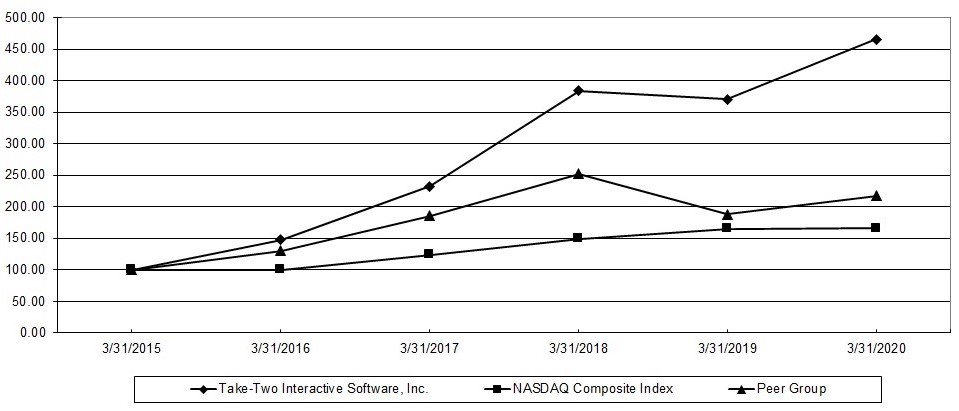
- $100 invested on March 31, 2015 in stock or index - including reinvestment of dividends.
| March 31, | |||||||||||||||||||||||||||||||||||||||||||||||||||||||||||||||||
| 2015 | 2016 | 2017 | 2018 | 2019 | 2020 | ||||||||||||||||||||||||||||||||||||||||||||||||||||||||||||
| Take-Two Interactive Software, Inc. | $ | 100.00 | $ | 147.96 | $ | 232.80 | $ | 384.05 | $ | 370.66 | $ | 465.87 | |||||||||||||||||||||||||||||||||||||||||||||||||||||
| NASDAQ Composite Index | 100.00 | 100.55 | 123.56 | 149.21 | 165.07 | 166.22 | |||||||||||||||||||||||||||||||||||||||||||||||||||||||||||
| Peer Group | 100.00 | 130.29 | 185.60 | 251.95 | 188.13 | 217.73 |
Issuer Purchases of Equity Securities
Share Repurchase Program—Our Board of Directors has authorized the repurchase of up to 14,217,683 shares of our common stock. Under this program, we may purchase shares from time to time through a variety of methods, including in the open market or through privately negotiated transactions, in accordance with applicable securities laws. Repurchases are subject to the availability of stock, prevailing market conditions, the trading price of the stock, our financial performance and other conditions. The program does not require us to repurchase shares and may be suspended or discontinued at any time for any reason.
During the fiscal years ended March 31, 2020, 2019, and 2018 we repurchased 0, 3,715,642, and 1,512,557 shares of our common stock in the open market, respectively, for $0.0 million, $362.4 million, and $154.8 million, respectively, including commissions, as part of the program. As of March 31, 2020, we had repurchased a total of 10,399,529 shares of our common stock under the program, and 3,818,154 shares of our common stock remained available for repurchase under the share repurchase program. All of the repurchased shares are classified as Treasury stock in our Consolidated Balance Sheets.
Summary Table—The table below details the share repurchases that were made by us during the three months ended March 31, 2020:
| Period | Shares purchased | Average price per share | Total number of shares purchased as part of publicly announced plans or programs | Maximum number of shares that may yet be purchased under the repurchase program | ||||||||||||||||||||||
| January 1 - 31, 2020 | — | — | — | 3,818 | ||||||||||||||||||||||
| February 1 - 28, 2020 | — | $ | — | — | 3,818 | |||||||||||||||||||||
| March 1 - 31, 2020 | — | $ | — | — | 3,818 |
Item 6. Selected Financial Data
The following Selected Financial Data should be read in conjunction with our Consolidated Financial Statements and related Notes, and Management's Discussion and Analysis of Financial Condition and Results of Operations included elsewhere in this Annual Report on Form 10-K. (in thousands, except per share data)
| Fiscal Year Ended March 31, | |||||||||||||||||||||||||||||||||||||||||||||||||||||
| STATEMENT OF OPERATIONS DATA: | 2020 | 2019 (1) | 2018 | 2017 | 2016 | ||||||||||||||||||||||||||||||||||||||||||||||||
| Net revenue | $ | 3,088,970 | $ | 2,668,394 | $ | 1,792,892 | $ | 1,779,748 | $ | 1,413,698 | |||||||||||||||||||||||||||||||||||||||||||
| Gross profit | 1,546,520 | 1,144,750 | 894,581 | 756,789 | 599,825 | ||||||||||||||||||||||||||||||||||||||||||||||||
| Net income (loss) | $ | 404,459 | $ | 333,837 | $ | 173,533 | $ | 67,303 | $ | (8,302) | |||||||||||||||||||||||||||||||||||||||||||
| Earnings per share: | |||||||||||||||||||||||||||||||||||||||||||||||||||||
| Basic: | |||||||||||||||||||||||||||||||||||||||||||||||||||||
| Earnings (loss) per share: | $ | 3.58 | $ | 2.95 | $ | 1.57 | $ | 0.73 | $ | (0.10) | |||||||||||||||||||||||||||||||||||||||||||
| Diluted: | |||||||||||||||||||||||||||||||||||||||||||||||||||||
| Earnings (loss) per share: | $ | 3.54 | $ | 2.90 | $ | 1.54 | $ | 0.72 | $ | (0.10) |
| As of March 31, | |||||||||||||||||||||||||||||||||||||||||||||||||||||
| BALANCE SHEET DATA: | 2020 | 2019 | 2018 | 2017 | 2016 | ||||||||||||||||||||||||||||||||||||||||||||||||
| Total assets | $ | 4,948,832 | $ | 4,243,065 | $ | 3,737,841 | $ | 3,149,154 | $ | 2,590,277 | |||||||||||||||||||||||||||||||||||||||||||
| Long-term debt | — | — | 8,068 | 251,929 | 497,935 |
(1) During fiscal 2019, we adopted Accounting Standards Update 2014-09, "Revenue from Contracts with Customers (Topic 606)," using a modified retrospective method. Therefore, prior periods were not restated.
Item 7. Management's Discussion and Analysis of Financial Condition and Results of Operations
Overview
Our Business
We are a leading developer, publisher, and marketer of interactive entertainment for consumers around the globe. We develop and publish products principally through Rockstar Games, 2K, Private Division, and Social Point. Our products are currently designed for console gaming systems, such as Sony's PS4, Microsoft's Xbox One, and Nintendo's Switch, and PC, including smartphones and tablets. We deliver our products through physical retail, digital download, online platforms and cloud streaming services.
We endeavor to be the most creative, innovative and efficient company in our industry. Our core strategy is to capitalize on the popularity of video games by developing and publishing high-quality interactive entertainment experiences across a range of genres. We focus on building compelling entertainment franchises by publishing a select number of titles for which we can create sequels and incremental revenue opportunities through virtual currency, add-on content, and in-game purchases. Most of our intellectual property is internally owned and developed, which we believe best positions us financially and competitively. We have established a portfolio of proprietary software content for the major hardware platforms in a wide range of genres, including action, adventure, family/casual, racing, role-playing, shooter, sports and strategy, which we distribute worldwide. We believe that our commitment to creativity and innovation is a distinguishing strength, enabling us to differentiate our products in the marketplace by combining advanced technology with compelling storylines and characters that provide unique gameplay experiences for consumers. We have created, acquired or licensed a group of highly recognizable brands to match the broad consumer demographics that we serve, ranging from adults to children and game enthusiasts to casual gamers. Another cornerstone of our strategy is to support the success of our products in the marketplace through innovative marketing programs and global distribution on platforms and through channels that are relevant to our target audience.
Our revenue is primarily derived from the sale of internally developed software titles and software titles developed by third parties. Operating margins are dependent in part upon our ability to release new, commercially successful software products and to manage effectively their development and marketing costs. We have internal development studios located in Australia, Canada, China, Czech Republic, Hungary, India, Spain, South Korea, the United Kingdom, and the United States.
Software titles published by our Rockstar Games label are primarily internally developed. We expect Rockstar Games, our wholly-owned publisher of the Grand Theft Auto, Max Payne, Midnight Club, Red Dead Redemption, and other popular franchises, to continue to be a leader in the action/adventure product category and to create groundbreaking entertainment. We believe that Rockstar Games has established a uniquely original, popular cultural phenomenon with its Grand Theft Auto series, which is the interactive entertainment industry's most iconic and critically acclaimed brand and has sold-in over 320 million units. The latest installment, Grand Theft Auto V, has sold-in over 125 million units worldwide and includes access to Grand Theft Auto Online. On October 26, 2018, Rockstar Games launched Red Dead Redemption 2, which has been a critical and commercial success that set numerous entertainment industry records. To date, Red Dead Redemption 2 has sold-in more than 30 million units worldwide. Rockstar Games is also well known for developing brands in other genres, including the L.A. Noire, Bully and Manhunt franchises. Rockstar Games continues to expand on our established franchises by developing sequels, offering downloadable episodes, content, and virtual currency.
Our 2K label has published a variety of popular entertainment properties across all key platforms and across a range of genres including shooter, action, role-playing, strategy, sports and family/casual entertainment. We expect 2K to continue to develop new, successful franchises in the future. 2K's internally owned and developed franchises include the critically acclaimed, multi-million unit selling BioShock, Mafia, Sid Meier's Civilization, and XCOM series. 2K also publishes successful externally developed franchises, such as Borderlands. 2K's realistic sports simulation titles include our flagship NBA 2K series, which continues to be the top-ranked NBA basketball video game, the WWE 2K professional wrestling series, and PGA Tour 2K. In March 2020, 2K announced a multi-year partnership with the National Football League encompassing multiple future video games that will be non-simulation football game experiences and will launch starting in fiscal year 2022.
Our Private Division label is dedicated to bringing titles from top independent developers to market and is the publisher and owner of Kerbal Space Program. During the fiscal year 2020, Private Division released The Outer Worlds and Ancestors: The Humankind Odyssey, based on new IP from renowned industry creative talent. Additionally, Private Division*,* has announced that Disintegration is planned for release in fiscal year 2021 and Kerbal Space Program 2 in fiscal year 2022.
Social Point develops and publishes popular free-to-play mobile games that deliver high quality, deeply-engaging entertainment experiences, including its two most successful games, Dragon City and Monster Legends. In addition, Social Point has a robust development pipeline with a number of exciting games planned for launch in the coming years.
We are continuing to execute on our growth initiatives in Asia, where our strategy is to broaden the distribution of our existing products and expand our online gaming presence, especially in China and South Korea. 2K has secured a multi-year license from the NBA to develop an online version of the NBA simulation game in China, Taiwan, South Korea, and Southeast Asia. NBA 2K Online, our free-to-play NBA simulation game, which was co-developed by 2K and Tencent, is the top online PC sports game in China with over 49 million registered users. We have released two iterations of NBA 2K Online and continue to enhance the title with new features.
In February 2017, we expanded our relationship with the NBA through the creation of the NBA 2K League. Launched in May 2018, this groundbreaking competitive gaming league is jointly owned by us and the NBA and consists of teams operated by actual NBA franchises. The NBA 2K League follows a professional sports league format: head-to-head competition throughout a regular season followed by a bracketed playoff system and a finals match-up that was held in August in each of the NBA 2K League's first two seasons.
Trends and Factors Affecting our Business
Product Release Schedule. Our financial results are affected by the timing of our product releases and the commercial success of those titles. Our Grand Theft Auto products in particular have historically accounted for a significant portion of our revenue. Sales of Grand Theft Auto products generated 23.0% of our net revenue for the fiscal year ended March 31, 2020. The timing of our Grand Theft Auto product releases may affect our financial performance on a quarterly and annual basis.
Economic Environment and Retailer Performance. We continue to monitor economic conditions, including the impact of the COVID-19 pandemic, that may unfavorably affect our businesses, such as deteriorating consumer demand, delays in development, pricing pressure on our products, credit quality of our receivables, and foreign currency exchange rates. The COVID-19 pandemic has affected and may continue to affect our business operations, including our employees, customers, partners, and communities, and there is
Showing the first 8K of 71K characters. Open the full section
Item 7A. Quantitative and Qualitative Disclosures About Market Risk
Market risk is the potential loss arising from fluctuations in market rates and prices. Our market risk exposures primarily include fluctuations in interest rates and foreign currency exchange rates.
Interest Rate Risk
Our exposure to fluctuations in interest rates relates primarily to our short-term investment portfolio and variable rate debt under the Credit Agreement.
We seek to manage our interest rate risk by maintaining a short-term investment portfolio that includes corporate bonds with high credit quality and maturities less than two years. Since short-term investments mature relatively quickly and can be reinvested at the then-current market rates, interest income on a portfolio consisting of short-term securities is more subject to market fluctuations than a portfolio of longer-term maturities. However, the fair value of a short-term portfolio is less sensitive to market fluctuations than a portfolio of longer-term securities. We do not currently use derivative financial instruments in our short-term investment portfolio. Our investments are held for purposes other than trading.
As of March 31, 2020, we had $644.0 million of short-term investments, which included $453.0 million of available-for-sale securities. The available-for-sale securities were recorded at fair market value with unrealized gains or losses resulting from changes in fair value reported as a separate component of accumulated other comprehensive income (loss), net of tax, in stockholders' equity. We also had $1,357.7 million of cash and cash equivalents that are comprised primarily of money market funds and bank-time deposits. We determined that, based on the composition of our investment portfolio, there was no material interest rate risk exposure to our Consolidated Financial Statements or liquidity as of March 31, 2020.
Historically, fluctuations in interest rates have not had a significant effect on our operating results. Under our Credit Agreement, loans will bear interest at a rate of (a) 0.250% to 0.750% above a certain base rate (5.50% at March 31, 2020) or (b) 1.125% to 1.750% above LIBOR (approximately 1.66% at March 31, 2020), which rates are determined by reference to our consolidated total net leverage ratio. Changes in market rates may affect our future interest expense if there is an outstanding balance on our line of credit. At March 31, 2020, there were no outstanding borrowings under our Credit Agreement.
Foreign Currency Exchange Rate Risk
We transact business in foreign currencies and are exposed to risks resulting from fluctuations in foreign currency exchange rates. Accounts relating to foreign operations are translated into United States dollars using prevailing exchange rates at the relevant period end. Translation adjustments are included as a separate component of stockholders' equity on our Consolidated Balance Sheets. For the fiscal years ended March 31, 2020 and 2019, our foreign currency translation adjustment was a loss of $27.4 million and a loss of $28.8 million, respectively. We recognized a foreign currency exchange transaction loss of $3.6 million, a loss of $0.5 million, and a loss of $3.0 million for the fiscal years ended March 31, 2020, 2019, and 2018, respectively, in Interest and other, net in our Consolidated Statements of Operations.
Balance Sheet Hedging Activities
We use foreign currency forward contracts to mitigate foreign currency exchange rate risk associated with non-functional currency denominated cash balances and inter-company funding loans, non-functional currency denominated accounts receivable and non-functional currency denominated accounts payable. These transactions are not designated as hedging instruments and are accounted for as derivatives whereby the fair value of the contracts is reported as either assets or liabilities on our Consolidated Balance Sheets, and gains and losses resulting from changes in the fair value are reported in interest and other, net, in our Consolidated Statements of Operations. We do not enter into derivative financial contracts for speculative or trading purposes. At March 31, 2020, we had $52.6 million of forward contracts outstanding to buy foreign currencies in exchange for U.S. dollars and $122.0 million of forward contracts outstanding to sell foreign currencies in exchange for U.S. dollars all of which have maturities of less than one year. At March 31, 2019, we had $116.6 million of forward contracts outstanding to buy foreign currencies in exchange for U.S. dollars and $87.8 million of forward contracts outstanding to sell foreign currencies in exchange for U.S. dollars all of which have maturities of less than one year. For the fiscal years ended March 31, 2020, 2019 and 2018, we recorded a loss of $1.0 million, a gain of $16.8 million, and a loss of $19.5 million, respectively, related to foreign currency forward contracts in Interest and other, net on the Consolidated Statements of Operations. As of March 31, 2020 and 2019, the fair value of these outstanding forward contracts was a loss of $0.0 million and a loss $0.4 million, respectively, and is included in accrued and other current liabilities. The fair value of these outstanding forward contracts is estimated based on the prevailing exchange rates of the various hedged currencies as of the end of the period.
Our hedging programs are designed to reduce, but do not entirely eliminate, the effect of currency exchange rate movements. We believe the counterparties to these foreign currency forward contracts are credit-worthy multinational commercial banks and that the risk of counterparty nonperformance is not material. Notwithstanding our efforts to mitigate some foreign currency exchange rate risks, there can be no assurance that our hedging activities will adequately protect us against the risks associated with foreign currency fluctuations, which may be more volatile as a result of COVID-19. For the fiscal year ended March 31, 2020, 42.5% of our revenue was generated outside the United States. Using sensitivity analysis, a hypothetical 10% increase in the value of the U.S. dollar against all currencies would decrease revenue by 4.3%, while a hypothetical 10% decrease in the value of the U.S. dollar against all currencies would increase revenue by 4.3%. In the opinion of management, a substantial portion of this fluctuation would be offset by cost of goods sold and operating expenses incurred in local currency.
Item 8. Financial Statements and Supplementary Data
The financial statements and supplementary data appear in a separate section of this report following Part IV. We provide details of our valuation and qualifying accounts in Note 22 - Supplementary Financial Information to the Consolidated Financial Statements. All schedules have been omitted since the information required to be submitted has been included on the Consolidated Financial Statements or notes thereto or has been omitted as not applicable or not required.
Item 9. Changes in and Disagreements with Accountants on Accounting and Financial Disclosure
None.
Item 9A. Controls and Procedures
Definition and Limitations of Disclosure Controls and Procedures
Our disclosure controls and procedures (as defined in Rules 13a-15(e) and 15d-15(e) under the Securities Exchange Act of 1934, as amended (the "Exchange Act")) are designed to reasonably ensure that information required to be disclosed in our reports filed under the Exchange Act is (i) recorded, processed, summarized, and reported within the time periods specified in the Securities and Exchange Commission's rules and forms and (ii) accumulated and communicated to management, including our principal executive officer and principal financial officer, as appropriate, to allow timely decisions regarding required disclosures.
There are inherent limitations to the effectiveness of any system of disclosure controls and procedures. These limitations include the possibility of human error, the circumvention or overriding of the controls and procedures and reasonable resource constraints. In addition, because we have designed our system of controls based on certain assumptions, which we believe are reasonable, about the likelihood of future events, our system of controls may not achieve its desired purpose under all possible future conditions. Accordingly, our disclosure controls and procedures provide reasonable assurance, but not absolute assurance, of achieving their objectives.
Evaluation of Disclosure Controls and Procedures
Our management, with the participation of our principal executive officer and principal financial officer, has evaluated the effectiveness of our disclosure controls and procedures at March 31, 2020, the end of the period covered by this report. Based on this evaluation, the principal executive officer and principal financial officer concluded that, at March 31, 2020, our disclosure controls and procedures were effective to provide reasonable assurance that information required to be disclosed by us in the reports that we file or submit under the Exchange Act is (i) recorded, processed, summarized, and reported on a timely basis, and (ii) accumulated and communicated to management, including our principal executive officer and principal financial officer, as appropriate to allow timely decisions regarding required disclosures.
Management's Report on Internal Control Over Financial Reporting
Our management is responsible for establishing and maintaining adequate internal control over financial reporting (as defined in Rule 13a-15(f) under the Exchange Act). Management conducted an evaluation of the effectiveness of our internal control over financial reporting based on the criteria set forth in Internal Control—Integrated Framework issued by the Committee of Sponsoring Organizations of the Treadway Commission 2013 framework ("COSO"). Based on this evaluation, management has concluded that our internal control over financial reporting was effective as of March 31, 2020.
Our independent registered public accounting firm, Ernst & Young LLP, has issued an audit report on our internal control over financial reporting. The report on the audit of internal control over financial reporting is included in this Form 10-K.
Changes in Internal Control Over Financial Reporting
There were no changes in our internal control over financial reporting during the fiscal quarter ended March 31, 2020, which were identified in connection with management's evaluation required by paragraph (d) of Rules 13a-15 and 15d-15 under the Exchange Act, that have materially affected, or are reasonably likely to materially affect, our internal control over financial reporting. We have not experienced any material impact to our internal controls over financial reporting despite the fact that most of our employees are working remotely due to the COVID-19 pandemic. We are continually monitoring and assessing the effect of the COVID-19 situation on our internal controls to minimize the impact on their design and operating effectiveness.
Item 9B. Other Information
None.
PART III
Item 10. Directors, Executive Officers and Corporate Governance
The information required by this Item is incorporated herein by reference to the sections entitled "Proposal 1—Election of Directors" and "Executive Compensation—Section 16(a) Beneficial Ownership Reporting Compliance" in our definitive Proxy Statement (the "Proxy Statement") for the Annual Meeting of Stockholders to be held in 2020. We intend to file the Proxy Statement within 120 days after the end of the fiscal year (i.e. on or before July 29, 2020). Our Code of Business Conduct and Ethics applicable to our directors and all employees, including senior financial officers, is available on our website at www.take2games.com. If we make any amendment to our Code of Business Conduct and Ethics that is required to be disclosed pursuant to the Exchange Act, we will make such disclosures on our website.
Item 11. Executive Compensation
The information required by this Item is incorporated herein by reference to the section entitled "Executive Compensation" in our Proxy Statement.
Item 12. Security Ownership of Certain Beneficial Owners and Management and Related Stockholder Matters
The information required by this Item is incorporated herein by reference to the sections entitled "Voting Security Ownership of Certain Beneficial Owners and Management" and "Equity Compensation Plan Information" in our Proxy Statement.
Item 13. Certain Relationships and Related Transactions, and Director Independence
The information required by this Item is incorporated herein by reference to the section entitled "Certain Relationships and Related Transactions" in our Proxy Statement.
Item 14. Principal Accounting Fees and Services
The information required by this Item is incorporated herein by reference to the section entitled "Independent Auditor Fee Information" in our Proxy Statement.
PART IV
Item 15. Exhibits, Financial Statement Schedules
(a)The following documents are filed as part of this Report:
(i)Financial Statements. See Index to Financial Statements on page 53 of this Report.
(ii)Financial Statement Schedule. See Note 22 to the Consolidated Financial Statements.
(iii)Index to Exhibits:
† Schedules omitted pursuant to item 601(b)(2) of Regulation S-K. The Company agrees to furnish supplementally a copy of any omitted schedule to the SEC upon its request.
+ Represents a management contract or compensatory plan or arrangement.
*Portions thereof were omitted and filed separately with the Securities and Exchange Commission pursuant to a request for confidential treatment that was granted in accordance with Exchange Act Rule 24b-2.
** Portions of this exhibit have been redacted in compliance with Regulation S-K Item 601(b)(10).
Attached as Exhibit 101 to this report are the following formatted in XBRL (Extensible Business Reporting Language): (i) Consolidated Balance Sheets at March 31, 2020 and 2019, (ii) Consolidated Statements of Operations for the fiscal years ended March 31, 2020, 2019 and 2018, (iii) Consolidated Statements of Comprehensive Income for the fiscal years ended March 31, 2020, 2019 and 2018, (iv) Consolidated Statements of Cash Flows for the fiscal years ended March 31, 2020, 2019 and 2018, (v) Consolidated Statements of Stockholders' Equity for the fiscal years ended March 31, 2020, 2019 and 2018; and (vi) Notes to the Consolidated Financial Statements.
Item 16. Form 10-K Summary
Not applicable.
TAKE-TWO INTERACTIVE SOFTWARE, INC.
FISCAL YEAR ENDED MARCH 31, 2020
INDEX TO FINANCIAL STATEMENTS
| Page | |||||
| Reports of Independent Registered Public Accounting Firm | 47 | ||||
| Consolidated Balance Sheets—At March 31, 2020 and 2019 | 51 | ||||
| Consolidated Statements of Operations—For the fiscal years ended March 31, 2020, 2019 and 2018 | 52 | ||||
| Consolidated Statements of Comprehensive Income—For the fiscal years ended March 31, 2020, 2019 and 2018 | 53 | ||||
| Consolidated Statements of Cash Flows—For the fiscal years ended March 31, 2020, 2019 and 2018 | 54 | ||||
| Consolidated Statements of Stockholders' Equity—For the fiscal years ended March 31, 2020, 2019 and 2018 | 55 | ||||
| Notes to the Consolidated Financial Statements | 56 |
(All other items in this report are inapplicable)
Report of Independent Registered Public Accounting Firm
To the Stockholders and the Board of Directors of Take-Two Interactive Software, Inc.
Opinion on the Financial Statements
We have audited the accompanying consolidated balance sheets of Take-Two Interactive Software, Inc. (the Company) as of March 31, 2020 and 2019, the related consolidated statements of operations, comprehensive income, cash flows, and stockholders’ equity for each of the three years in the period ended March 31, 2020, and the related notes (collectively referred to as the “consolidated financial statements”). In our opinion, the consolidated financial statements present fairly, in all material respects, the financial position of the Company at March 31, 2020 and 2019, and the results of its operations and its cash flows for each of the three years in the period ended March 31, 2020, in conformity with U.S. generally accepted accounting principles.
We also have audited, in accordance with the standards of the Public Company Accounting Oversight Board (United States) (PCAOB), the Company's internal control over financial reporting as of March 31, 2020, based on criteria established in Internal Control-Integrated Framework issued by the Committee of Sponsoring Organizations of the Treadway Commission (2013 framework) and our report dated May 22, 2020 expressed an unqualified opinion thereon.
Adoption of ASU No. 2016-02
As discussed in Note 1 to the consolidated financial statements, the Company changed its method of accounting for leases effective April 1, 2019 due to the adoption of Accounting Standards Update (ASU) No. 2016-02, Leases (Topic 842) and the related amendments.
Adoption of ASU No. 2014-09
As discussed in Note 1 to the consolidated financial statements, the Company changed its method of accounting for revenue recognition effective April 1, 2018 due to the adoption of Accounting Standards Update (ASU) No. 2014-09, Revenue from Contracts with Customers (Topic 606), and the related amendments.
Basis for Opinion
These financial statements are the responsibility of the Company's management. Our responsibility is to express an opinion on the Company’s financial statements based on our audits. We are a public accounting firm registered with the PCAOB and are required to be independent with respect to the Company in accordance with the U.S. federal securities laws and the applicable rules and regulations of the Securities and Exchange Commission and the PCAOB.
We conducted our audits in accordance with the standards of the PCAOB. Those standards require that we plan and perform the audit to obtain reasonable assurance about whether the financial statements are free of material misstatement, whether due to error or fraud. Our audits included performing procedures to assess the risks of material misstatement of the financial statements, whether due to error or fraud, and performing procedures that respond to those risks. Such procedures included examining, on a test basis, evidence regarding the amounts and disclosures in the financial statements. Our audits also included evaluating the accounting principles used and significant estimates made by management, as well as evaluating the overall presentation of the financial statements. We believe that our audits provide a reasonable basis for our opinion.
Critical Audit Matters
The critical audit matters communicated below are matters arising from the current period audit of the financial statements that were communicated or required to be communicated to the audit committee and that: (1) relate to accounts or disclosures that are material to the financial statements and (2) involved our especially challenging, subjective, or complex judgments. The communication of critical audit matters does not alter in any way our opinion on the consolidated financial statements, taken as a whole, and we are not, by communicating the critical audit matters below, providing separate opinions on the critical audit matters or on the accounts or disclosures to which they relate.
| Revenue recognition | |||||
| Description of the Matter | As described in Note 1 to the consolidated financial statements, a significant portion of the Company’s revenue recognized is for full game software products that management evaluates whether such products sold have distinct and separable performance obligations. Such performance obligations can be licenses for intellectual property that provides a functional offline gaming experience or game related services. If multiple performance obligations are identified, management must estimate a standalone selling price for each identified performance obligation which is used to allocate the full game software product transaction price. Revenue for amounts allocated to offline functionality is recognized upon delivery of the product. Separately, revenue for amounts allocated to the game related services is recognized ratably over an estimated service period. Significant judgment is exercised by the Company in identifying performance obligations within its full game software products that should be accounted for separately in each revenue arrangement, estimating the standalone selling price for each performance obligation and determining the service period to recognize revenue over time. Auditing the identification of performance obligations for full game software products requires complex auditor judgment as each full game software product has unique features that management must determine whether to be accounted for separately. Auditing the judgments and estimates made by management in determining the standalone selling prices for identified performance obligations is especially challenging as the Company typically does not have observable standalone selling prices for each performance obligation and must rely on an expected cost-plus margin methodology, taking into account relevant cost assumptions including estimates of post-release support. Similarly, auditing the estimated service period for the game related services is especially challenging as the Company must consider a variety of data points. Such data points include the weighted average number of days between players’ first and last days played online, known online trends, the service periods of the Company’s pr |
Showing the first 8K of 215K characters. Open the full section